


Abstract
The genus Asparagus L. is a traditional Chinese herb valued for its medicinal and culinary properties, with root tubers being the primary organ of interest. To elucidate the genetic mechanisms underlying tuber formation, we conducted a comparative transcriptome analysis of two species, Asparagus cochinchinensis (Lour.) Merr. and Asparagus taliensis F. T. Wang & Tang ex S. C. Chen, which exhibit distinct differences in root tuber number. High-throughput sequencing generated 6.68 Gb and 7.60 Gb of clean data for the respective species, leading to the annotation of 115,080 non-redundant unigenes. Comparative analysis identified 26,013 differentially expressed genes (DEGs), including 1096 associated with carbohydrate metabolism. Weighted gene co-expression network analysis (WGCNA) revealed that the MEred and Megreenyellow modules which included genes involved in material and energy metabolism were significantly correlated with tuber development. From these modules, we identified two candidate genes involved in carbon and sugar metabolism, designated Ac_uniYEAD and Ac_uniRPE. Quantitative real-time PCR validation confirmed that their expression levels were positively correlated with root tuber number, consistent with the transcriptomic data. These results highlight Ac_uniYEAD and Ac_uniRPE as promising targets for genetic improvement of tuber yield in Asparagus breeding programs.
1. Introduction
The genus Asparagus L. comprises traditional Chinese herbs with longstanding applications in both food and medicine. Among approximately ten utilized species in China, some are valued for their therapeutic and edible properties, while others are cultivated for ornamental purposes [1]. Asparagus cochinchinensis (Lour.) Merr. and Asparagus taliensis F. T. Wang & Tang ex S. C. Chen represent two key germplasm resources within the genus. A. cochinchinensis is widely distributed across temperate and tropical regions, including China, Japan, Korea, and Vietnam [2,3,4]. As one of the most frequently used traditional herbal medicines, its clinical efficacy has been well documented in multiple regions [5,6]. It was first recorded in Shennong’s Classic of Materia Medica—the earliest extant pharmacopoeia of traditional Chinese medicine (TCM)—and has since been validated through extensive clinical practice. In contrast, A. taliensis is endemic to Yunnan Province, China [7,8]. Phylogenetic studies indicate a close relationship between A. taliensis and A. cochinchinensis, forming a distinct clade within the dioecious Eurasian Asparagus species [9]. A. taliensis exhibits strong tolerance to environmental stresses such as drought and cold, enabling robust growth under Yunnan’s low-precipitation winter conditions. Its medicinal root tubers are notably larger than those of A. cochinchinensis, rendering it a promising alternative for commercial cultivation with higher biomass yield. Given their phylogenetic proximity, A. taliensis is also considered an ideal germplasm candidate for the genetic improvement of A. cochinchinensis via interspecific hybridization.
The root tuber serves as the primary medicinal organ of Asparangus species and has been used for centuries in China, either alone or in combination with other herbs, to treat various conditions such as asthma, tumors, Alzheimer’s disease, gastrointestinal disorders, and inflammatory diseases. These therapeutic effects are attributed to the rich profile of primary and secondary metabolites in the tuber [10,11,12,13]. A key phenotypic distinction between A. cochinchinensis and A. taliensis lies in their root tuber number, with A. taliensis producing significantly more tubers than A. cochinchinensis. To date, more than 90 phytometabolites have been isolated and identified from Asparagus root tubers, including polysaccharides, steroidal saponins, flavonoids, C21-steroids, amino acids, lignans, and cardiac glycosides, etc. [14,15]. Many classical herbal formulas containing Asparangus tuber are widely used in therapeutic practice and have contributed significantly to public health in China and other Asian countries. Besides its medicinal applications, the root tuber is also utilized as a food or nutritional supplement [16], in cosmetics for whitening and anti-aging effects, and as a raw material in fermentation and winemaking processes [17,18], indicating considerable potential for further development. Over the past few decades, Asparagus species have gained increasing research interest as important herbal medicines. Advances in scientific technology and growing international recognition of traditional medicine have accelerated progress in Asparagus R&D, particularly in the isolation and identification of bioactive constituents from the root tuber [19,20,21,22]. However, the interspecific variation in tuber number remains poorly understood, and the functional genes as well as the molecular mechanisms governing tuber formation and development are still largely unknown.
As a primary storage and economically significant organ in various plant species, the root tuber has long been a focus of research. Recent molecular genetic and proteomic studies have identified key genes and proteins involved in tuberous root development in species such as sweet potato [23,24,25] and cassava [26,27]. In potato, for instance, auxin-related genes YUCCA, PINs, and TIR1 have been shown to play critical roles in regulating tuber formation [28]. Similarly, the CAROTENOID CLEAVAGE DIOXYGENASE8 gene, a key enzyme in the strigolactone biosynthesis pathway, has also been implicated in this process [29]. In medicinal plants, the transcriptomic analysis of Rehmannia glutinosa (Gaetn.) Libosch. ex Fisch. et Mey. revealed a suite of genes associated with root tuber development, particularly those involved in sugar metabolism, hormone signaling, and transcriptional regulation [30]. In Aconitum heterophyllum Wall. ex Royle, eight genes—encoding GDP-mannose pyrophosphorylase, SHAGGY, Expansin, RING-box protein 1, SRF receptor kinase, β-amylase, ADP-glucose pyrophosphorylase, and Auxin responsive factor 2—were found to be upregulated in roots compared to shoots, suggesting their potential roles in tuber development [31]. Beyond protein-coding genes, numerous miRNAs, such as miR161, miR414, miR173, miR158, miR169−2, and miR403, have also been linked to tuber formation [32]. In contrast, the molecular mechanisms underlying root tuber development in A. cochinchinensis and A. taliensis remain largely unexplored. Identifying and characterizing key genes involved in tuber formation in these two species is essential for regulating their yield and quality, thereby providing a foundation for future breeding and genetic improvement efforts.
As one of the most widely used and rapidly advancing omics technologies, transcriptomics plays a pivotal role in elucidating molecular mechanisms underlying biological processes and in identifying functional genes [33]. Since its inception, the high throughput RNA sequencing (RNA-seq) has become the preferred method for gene expression analysis, owing to its high sensitivity, accuracy, reproducibility, and independence from a reference genome [34,35]. It has been successfully applied in transcriptomic studies of various medicinal plants, e.g., Panax japonicus (T.Nees) C.A.Mey. [36], Carthamus tinctorius L. [37], and Atractylodes lancea (Thunb.) DC. [38]. In the present study, we performed the comparative transcriptome sequencing of root tubers from A. cochinchinensis and A. taliensis to identify key enzymatic genes involved in tuber formation and development. This work provides a foundation for future functional studies and genetic regulation of tuber development in Asparagus species through genetic modification and gene editing methods.
2. Materials and Methods
2.1. Plant Materials, RNA Preparation, and Phenotypic Trait Measurement
Two Asparagus L. species, A. cochinchinensis and A. taliensis, were used in this study. The former was represented by the widely cultivated ‘Chuandong 1’, sourced from Neijiang City, Sichuan Province, China, while the latter was collected from Wuchuan County, Guizhou Province, China. Both species were planted and preserved in the same greenhouse of Neijiang Academy of Agricultural Sciences, Sichuan Province. For transcriptomic analysis, four tissue types—root tuber (RT), fibrous root (FR), leaf (LE), and spear (SP)—were separately collected from each species. All samples for RNA sequencing were collected with three biological replicates. Immediately after collection, samples were flash-frozen in liquid nitrogen and stored at −80 °C until further analysis. Total RNA of each sample was extracted from pre-frozen materials using the TaKaRa RNA extraction kit (Takara Bio, Beijing, China). RNA concentration, 28S/18S ratio, and RNA integrity number (RIN) were assessed using a Standard Sensitivity RNA Analysis Kit (Agilent Technologies, Beijing, China) on a Fragment Analyzer. For each species, three randomly selected plants were used as biological replicates for phenotypic evaluation at mature storage phase. Be careful to dig out the entire plant firstly, then remove all root tubers per plant and clean them thoroughly. The measured traits included polysaccharide content in fibrous roots and tuberous roots, as well as tuberous root diameter, weight, length, and number per plant. For polysaccharide content measurement, the phenol sulfuric acid method following the method of Lu et al. [39] was adopted. Absorbance was measured at 490 nm by spectrophotometer. A standard curve was drawn using glucose concentration as the x-axis and absorbance as the y-axis. The total polysaccharide content was calculated using the standard curve. The largest root tuber was selected to measure its diameter and length from each plant. Finally we count and weigh all of the root tubers separately on each plant.
2.2. RNA-Seq Library Construction and Sequencing
For each of the two Asparagus species, mRNA was isolated from three biological replicates using Oligo(dT) magnetic beads to enrich polyadenylated transcripts. The purified mRNA was fragmented, and the first-strand cDNA was synthesized with random N6 primers. The second-strand cDNA was subsequently generated to form the double-strand cDNA. The resulting cDNA fragments were end-repaired, phosphorylated at the 5′ end, and adenylated at the 3′ end. Sequencing adapters were then ligated to the cDNA, and the ligated products were amplified by PCR to construct sequencing libraries. The library sequencing was performed on the DNBSEQ platform (Beijing Genomics Institute, Shenzhen, China). Raw sequencing reads were processed with the software SOAPnuke (v 2.0) [40] to remove adapter sequences, reads with >5% unknown bases, and low-quality reads (where >20% of bases had a quality score of <10). The clean reads were de novo assembled using Trinity (v2.15.1) with default parameters, except for setting --max_memory [200G] --CPU [30] --min_contig_length 200 [41]. Tgicl was used to cluster redundant transcripts at a [95%] identity threshold [42], and redundant sequences were subsequently removed with Tgicl.
2.3. Functional Annotation of Unigenes
To achieve comprehensive functional annotation, the assembled unigenes were systematically aligned against eight public databases: NCBI https://www.ncbi.nlm.nih.gov/, accessed on 10 November 2025) non-redundant nucleotide (NT) and protein (NR) sequences, Kyoto Encyclopedia of Genes and Genomes (KEGG, https://www.genome.jp/kegg/, accessed on 10 November 2025), Clusters of eukaryotic Orthologous Groups (KOG, ftp://ftp.ncbi.nih.gov/pub/COG/KOG/kyva, accessed on 10 November 2025), SwissProt (https://www.uniprot.org/, accessed on 10 November 2025), Gene Ontology (GO, http://geneontology.org/, accessed on 10 November 2025), Pfam (http://pfam-legacy.xfam.org/, accessed on 10 November 2025), and InterPro (https://www.ebi.ac.uk/interpro/, accessed on 10 November 2025). For unigenes annotated in the Nr database, GO functional classification was further performed using the Blast2GO software (v2.5.0) [43]. The resulting annotations were categorized into three primary ontologies: molecular function, cellular component, and biological process.
2.4. Differentially Expressed Genes (DEGs) and Transcription Factors (TFs) Involved in Root Tuber Formation and Development
Clean reads were aligned to the reference gene sequences using Bowtie2 (v2.2.5) [44]. Gene expression levels were then quantified for each sample with RSEM (v1.2.8) and normalized using the FPKM (fragments per kilobase of transcript per million mapped reads) metric [45]. Differential gene expression analysis was performed with DEGseq2 (v1.4.5) [46], applying a threshold of |log2(fold change)| > 1 and adjusted p-value (Q value) ≤ 0.001 to identify significantly differentially expressed genes (DEGs). Functional enrichment analysis of DEGs for GO terms and KEGG pathways was conducted using the phyper function, with a significance cutoff of Q value ≤ 0.05.
To identify TFs in the two Asparagus transcriptomes, the open reading frames (ORFs) of unigenes were first predicted using getorf (EMBOSS:6.5.7.0) [47]. Subsequently, hmmsearch (v3.0) was employed to screen the predicted protein sequences for known DNA-binding or TF family domains [48]. Putative TFs were further annotated and classified by the alignment against the PlantTFDB database (http://planttfdb.cbi.pku.edu.cn, accessed on 10 November 2025) [49].
2.5. Candidate Gene Screening and Quantitative Real-Time (qRT-) PCR Gene Expression Validation
The weighted gene co-expression network analysis (WGCNA) was performed using the tuber root number as the target trait to identify gene modules associated with tuber development based on their similar expression patterns in Asparagus. Gene modules exhibiting strong correlation with tuber number were selected based on eigengene-trait correlation analysis. By integrating results from differential expression analysis, a co-expression network linked to tuber formation was constructed, in which unigenes showing significantly positive correlation with tuber number were identified as candidates.
Protein sequences of the candidate genes were aligned using DNAMAN, and their tertiary structures were predicted via SWISS-MODEL and visualized using PyMOL (v 2.5.0). In the phylogenetic analysis, homologous protein sequences from representative plant species—including Arabidopsis, Asparagus, Castanea, Citrus, Oryza, Phoenix, Zea, Setaria, Solanum, Spinacia, and Triticum—were retrieved from the UniProt database. A phylogenetic tree was constructed using MEGA7.0 with the maximum likelihood neighbor-joining method.
To validate RNA-seq results, the expression patterns of candidate genes were quantified by qRT-PCR across four tissues—fibrous root, leaf, tuber root, and spear—in both Asparagus species. Gene-specific primers were designed using Primer 3 Plus (Table 1). Reactions were performed in a 10 µL system containing 1 µL cDNA, 0.2 µL each of forward and reverse primers (10 µM), 5 µL Green One-Step qRT-PCR SuperMix (TRANSGEN, Beijing, China), and 3.6 µL RNase-free water. The thermal cycling conditions consisted of initial denaturation at 94 °C for 2 min, followed by 45 cycles of 94 °C for 5 s, 59 °C for 15 s, and 72 °C for 10 s. For the qRT-PCR validation, there were three biological replicates for each gene on each tissue, and each sample was run in three technical replicates. Relative expression levels were calculated using the 2−ΔΔCt method, and statistical significance of expression differences between species or tissues was determined using one-way ANOVA followed by Tukey’s HSD test (p < 0.05) with the SPSS software (v 19.0). Figures were prepared using GraphPad Prism 8.0.
Table 1.
Primer sequences of candidate genes used for qRT-PCR validation.
3. Results
3.1. The Number of Root Tuber of Two Asparagus Species
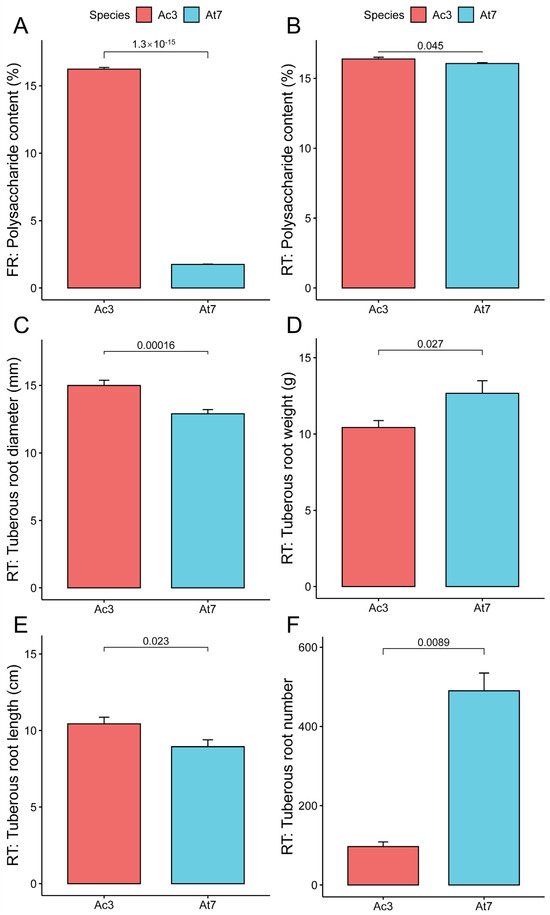
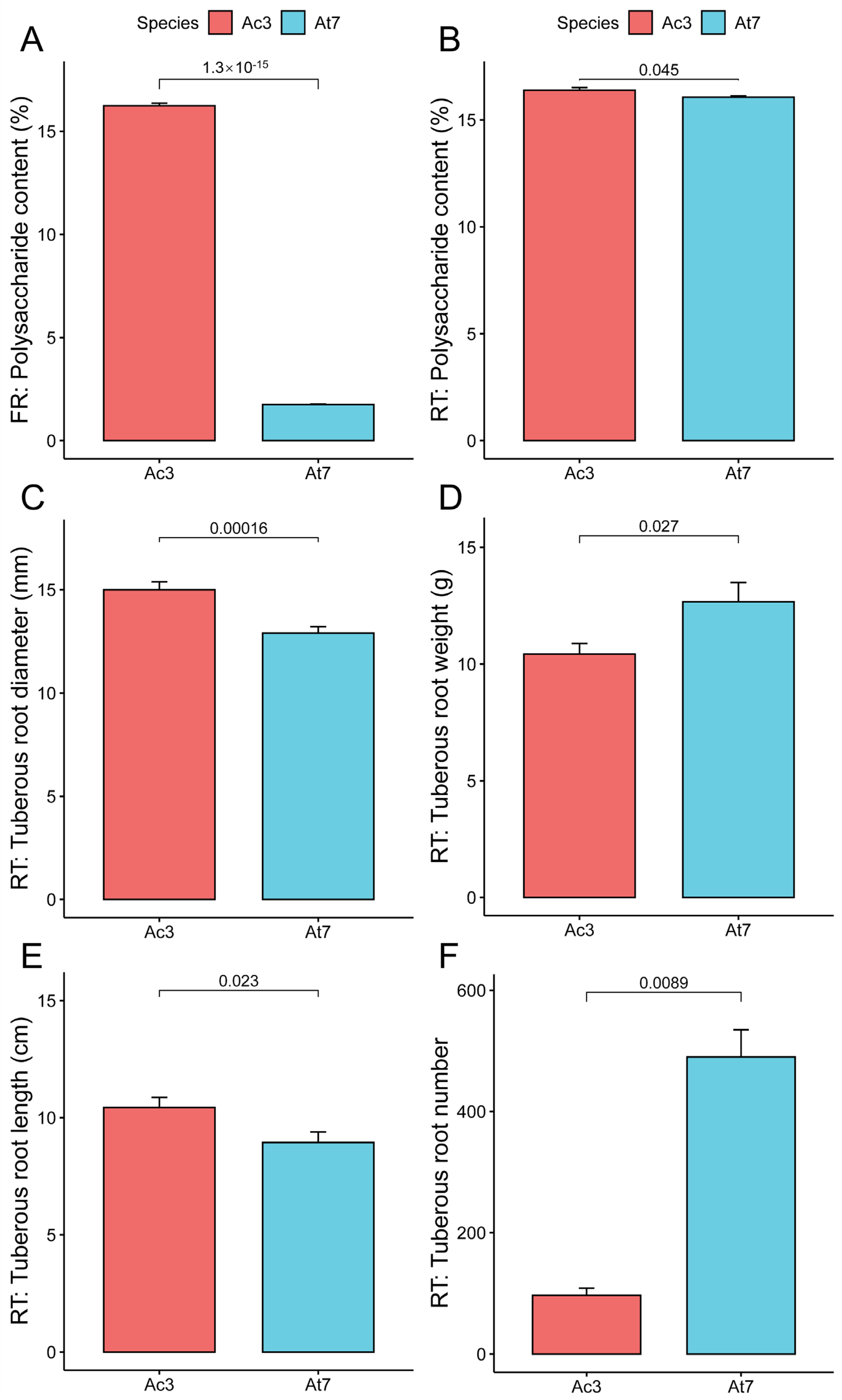
The phenotypic analysis revealed significant differences between A. cochinchinensis and A. taliensis in several traits, including fibrous root polysaccharide content and root tuber number per plant. Particularly, the quantitative measurements showed that A. taliensis produced an average of 490 ± 28 tubers per plant, significantly exceeding the average of 97 ± 7 tubers observed in A. cochinchinensis (p < 0.01, t-test) (Figure 1), suggesting that A. taliensis possesses a substantially higher tuber production capacity as compared to A. cochinchinensis.
Figure 1.
Phenotypic evaluation of A. cochinchinensis (Ac3) and A. taliensis (At7) (mean ± SD, n = 3). (A) Polysaccharide content in FR. (B) Polysaccharide content in RT. (C) Root diameter in RT. (D) Root weight in RT. (E) Root length in RT. (F) Root number in RT.
3.2. Comparing Transcriptomes of Two Asparagus Species Based on RNA-Seq
The high-throughput transcriptome sequencing of six samples from A. cochinchinensis and A. taliensis (three biological replicates per species) was performed on the DNBSEQ platform. After quality control with SOAPnuke, a total of 44.58 million and 50.78 million clean reads were obtained for A. cochinchinensis and A. taliensis, respectively, representing over 6.68 Gb and 7.60 Gb of clean data for each species. The Q30 base rates reached 97.39% and 97.53%, respectively, indicating high sequencing quality. Subsequent de novo assembly and redundancy removal using Tgicl yielded 115,080 unigenes, with a mean N50 of 1168 bp and an average GC content of 47.45% (Table 2 and Table 3).
Table 2.
Statistics of transcriptome assembly of A. cochinchinensis and A. taliensis.
Table 3.
Evaluation of transcriptome assembly of A. cochinchinensis and A. taliensis.
3.3. Functional Annotation and Expression Overview of Unigenes
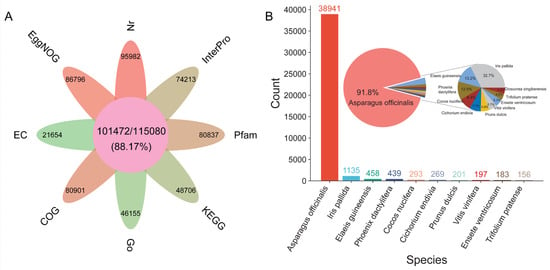
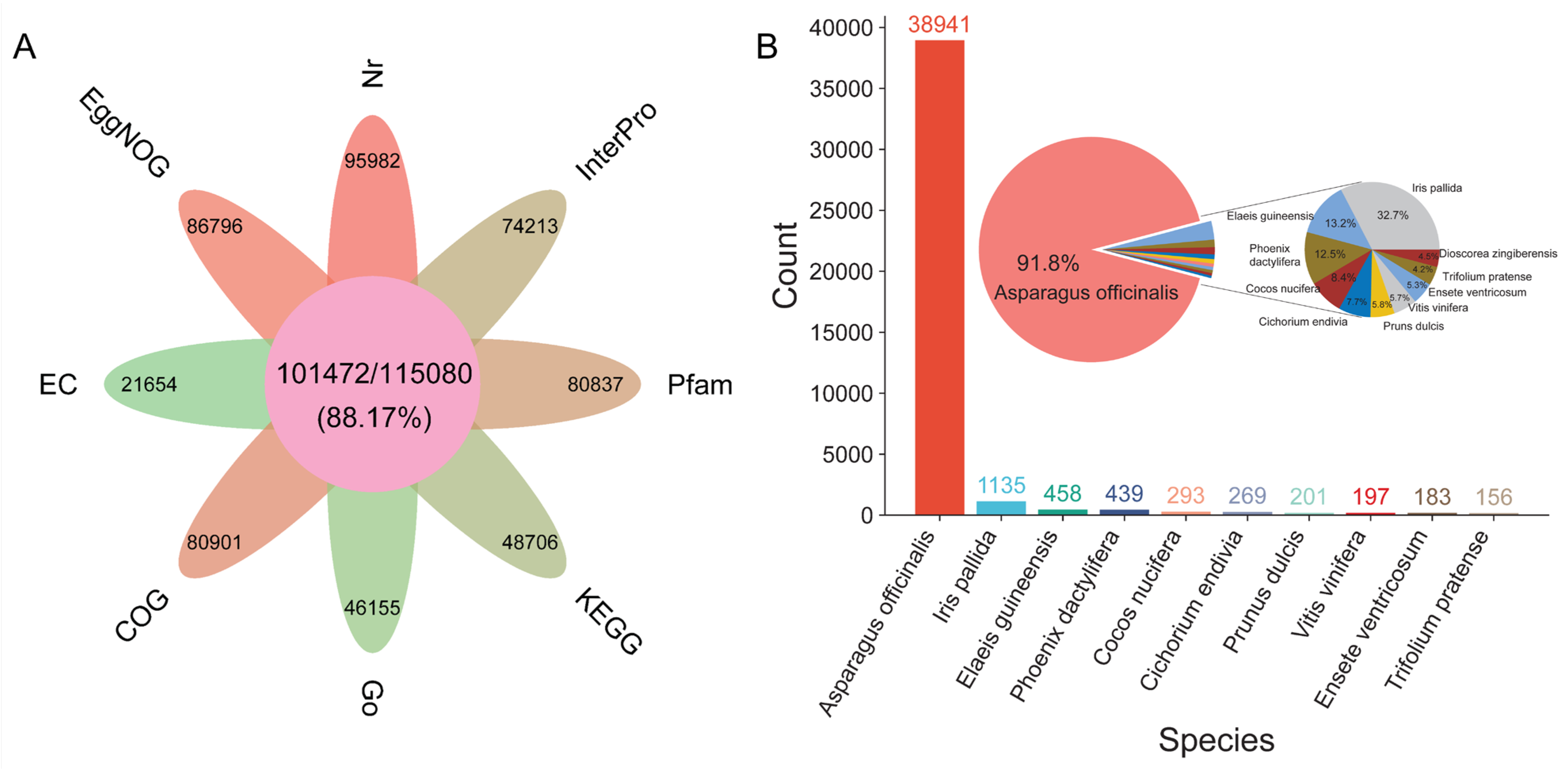
The functional annotation of the assembled unigenes was performed against eight public databases: Nr, EggNOG, EC, COG, GO, KEGG, Pfam, and InterPro. The numbers of successfully annotated unigenes in these databases were 95,982, 86,796, 21,654, 80,901, 46,155, 48,706, 80,837, and 74,213, respectively (Figure 2A; Table 4). Overall, 88.17% of the total unigenes were functionally assigned in at least one database.
Figure 2.
Transcriptome annotation. (A) Venn diagram of functional annotation across eight public databases (Nr, EggNOG, EC, COG, GO, KEGG, Pfam, and InterPro), different colors represent different databases. (B) Species distribution of homologous sequences against the Nr database, different colors represent different species.
Table 4.
Functional annotation results based on eight public databases.
Homology analysis of the 95,982 unigenes annotated in the Nr database revealed that the highest proportion (40.59%) exhibited the closest sequence similarity to Asparagus officinalis. Other species with significant homology included Iris pallida (1.18%), Elaeis guineensis (0.48%), Phoenix dactylifera (0.46%), Cocos nucifera (0.31%), and Cichorium endivia (0.28%) (Figure 2B).
3.4. Identification of DEGs and TFs Involved in Root Tuber Formation and Development
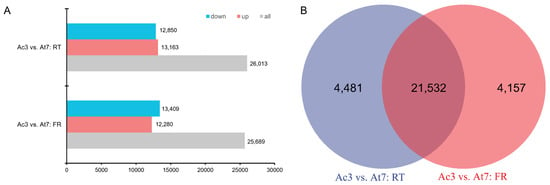
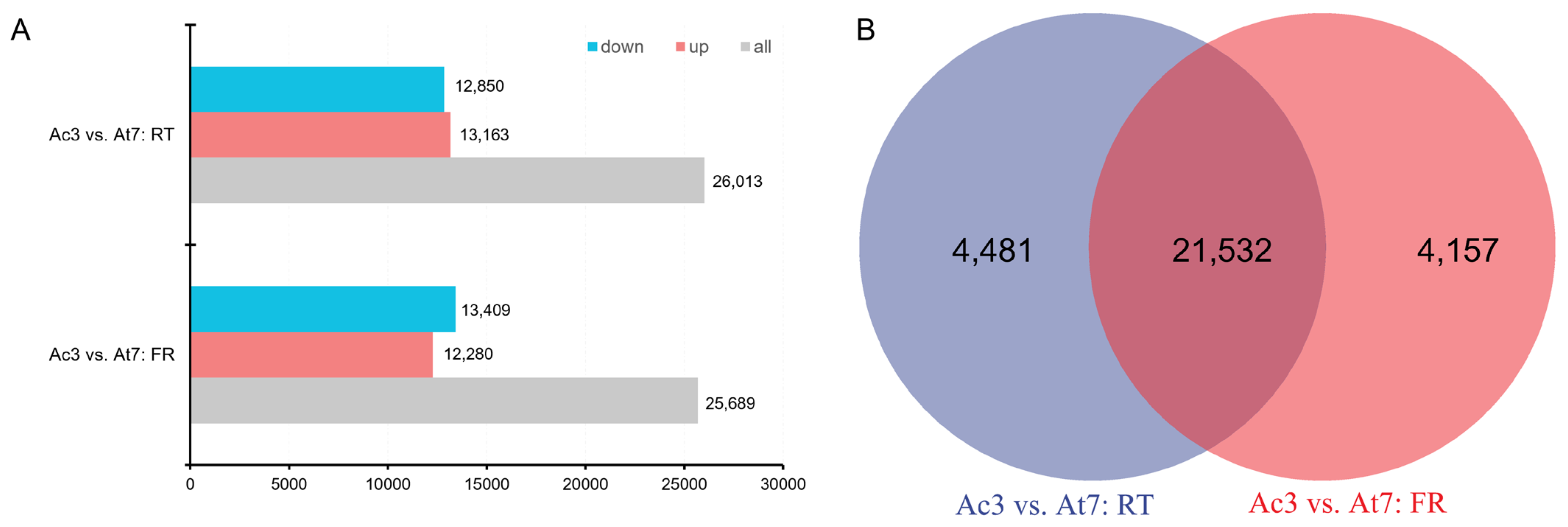
Differential expression analysis between A. cochinchinensis and A. taliensis root tubers identified 26,013 DEGs (Q value ≤ 0.001, |log2FC| > 1), including 13,163 up-regulated and 12,850 down-regulated genes (Figure 3). These DEGs were further subjected to KEGG and GO enrichment analyses using the phyper function in R (v 4.4.1).
Figure 3.
Analysis of differentially expressed genes (DEGs) between A. cochinchinensis (Ac3) and A. taliensis (At7). (A) Numbers of upregulated and downregulated DEGs across samples. (B) Venn diagram of DEGs among different comparison groups.
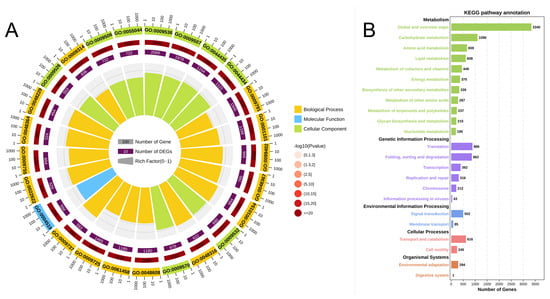
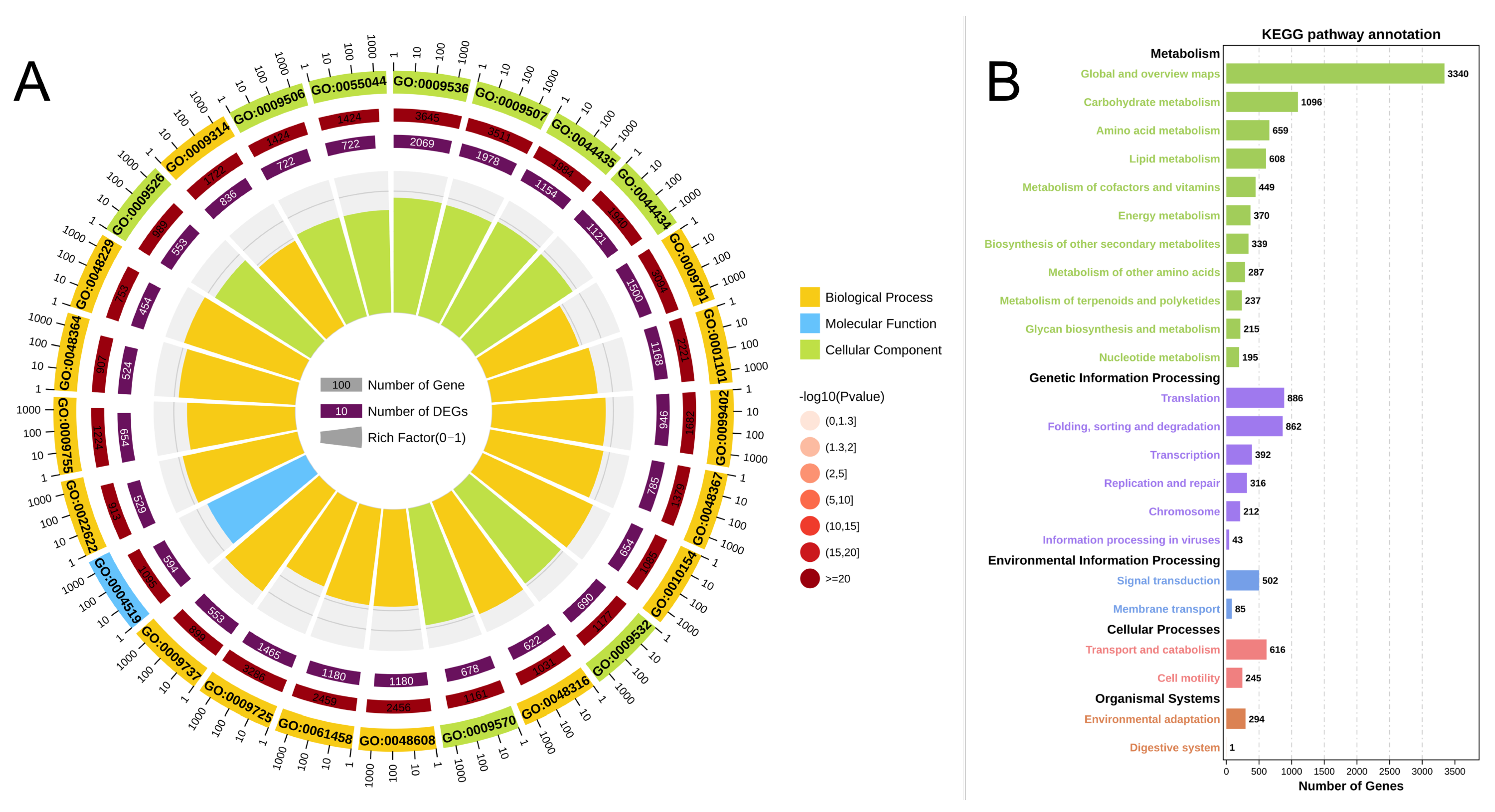
KEGG enrichment revealed 12,249 DEGs assigned to five functional categories. Within “Metabolism,” the majority of DEGs were enriched in global overview maps (3340), followed by carbohydrate metabolism (1096) and amino acid metabolism (659). Under “Genetic Information Processing”, translation and folding/sorting/degradation pathways contained 886 and 862 DEGs, respectively. In “Environmental Information Processing”, most DEGs (587) were associated with signal transduction. The “Cellular Processes” category included 616 DEGs in transport and catabolism and 245 in cell motility. In “Organismal Systems”, 294 DEGs were linked to environmental adaptation, while only one was assigned to the digestive system (Figure 4B).
Figure 4.
Functional annotation of DEGs between A. cochinchinensis (Ac3) and A. taliensis (At7) in RT. (A) GO functional classification. From the inner to the outer ring: GO annotation level, gene count, −log10 (p-value), and GO term ID. (B) KEGG pathway classification. Different colors denote the distinct secondary classifications within the pathway hierarchy. The bar chart shows the number of DEGs.
GO analysis categorized DEGs into biological process, molecular function, and cellular component. In biological process, the most enriched terms were embryo development (GO:0009791), response to hormone (GO:0009725), reproductive structure development (GO:0048608), and reproductive system development (GO:0061458). In molecular function, there were 594 DEGs that were exclusively assigned to endonuclease activity (GO:0004519). Within cellular component, the predominant terms were plastid (GO:0009536), chloroplast (GO:0009507), plastid membrane system (GO:0044435), and organelle (GO:0044434) (Figure 4A).
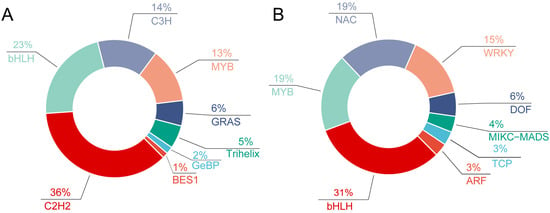
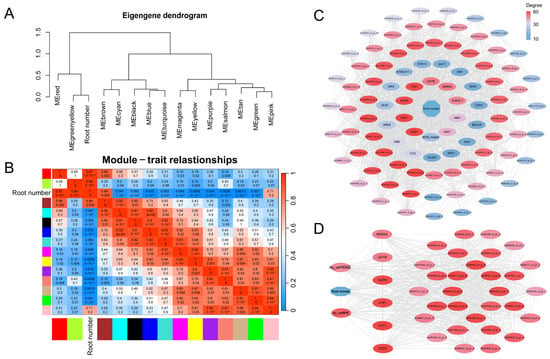
Transcription factors (TFs) play crucial roles in regulating gene expression related to metabolism, development, and stress responses. In this study, we identified 2246 TFs from the transcriptomes of A. cochinchinensis and A. taliensis. Compared to A. cochinchinensis, A. taliensis exhibited 476 up-regulated and 473 down-regulated TFs. We further analyzed TF families associated with carbohydrate metabolism and root tuber development. Among DEGs annotated to carbohydrate metabolism KEGG pathways, the most represented TF families were C2H2, followed by bHLH, C3H, and MYB (Figure 5A; Table 2). For root tuber formation and development, bHLH was the most represented family, followed by MYB, NAC, and WRKY (Figure 5B; Table 5).
Figure 5.
Transcription factors (TFs) involved in metabolic pathways. (A) TF families associated with carbohydrate metabolism. (B) TF families associated with root tuber formation and development.
Table 5.
Classification and number of TF families identified in the DEG database.
3.5. Putative DEGs Involved in Root Tuber Formation and Development
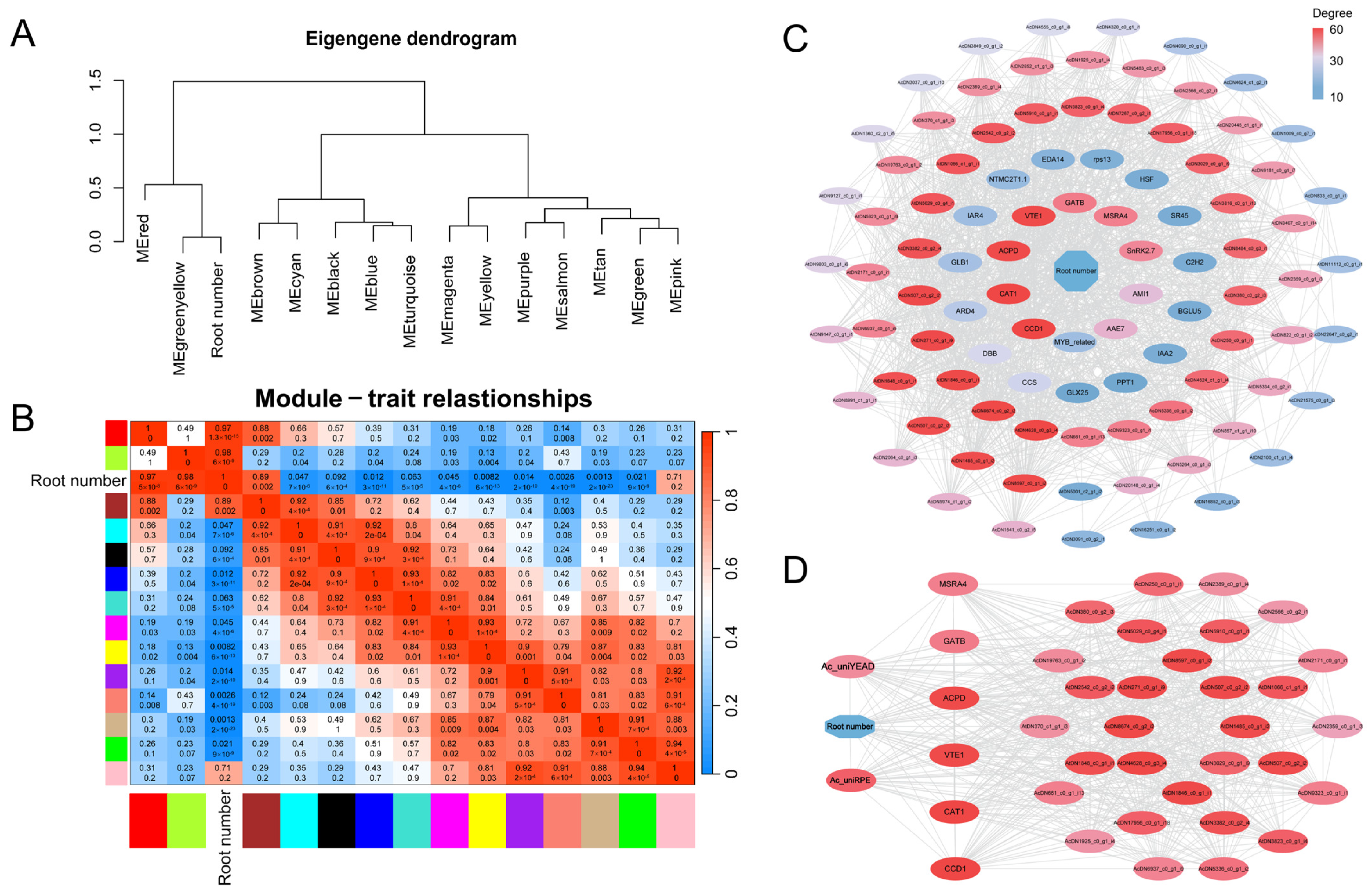
Weighted gene co-expression network analysis (WGCNA) was performed to identify genes correlated with root tuber number in A. cochinchinensis and A. taliensis. Fourteen distinct co-expression modules were identified. Correlation analysis between module eigengenes and tuber number per plant revealed that the MEred and MEgreenyellow modules which included genes involved in material and energy metabolism were significantly positively associated with this trait (p < 0.05; Figure 6A,B).
Figure 6.
Weighted gene co-expression network analysis (WGCNA) of DEGs. (A) Clustering of gene modules with root tuber number. The scale 0.0 to 1.5 represents the similarity distance between modules, with closer node distances indicating higher similarity. (B) Correlation between gene modules and tuber number. Redder colors indicate higher similarity, with numbers in the boxes representing correlation coefficients (top) and p-values (bottom). (C) Interaction network of genes in the red and green-yellow modules with tuber number. “Degree” represents the number of connections a node has with other nodes, and lines indicate potential interaction relationships. (D) Interaction network of candidate genes Ac_uniYEAD and Ac_uniRPE. Predicted interaction network of candidate genes screened based on (C), where more connecting lines indicate stronger interaction intensity.
To identify key genes within these modules, transcript expression levels were analyzed based on FPKM values. Using a threshold of |log2FC| > 1 and Padj < 0.05, we identified 94 unigenes that were both differentially expressed between species and closely linked to tuber number. An interaction network between these unigenes and tuber number was constructed, revealing several gene families such as VTE1, ACPD, CAT1, and CCD1, though some unigenes could not be assigned to a specific family. Based on the module–trait correlation analysis, a gene co-expression module significantly associated with tuber number was identified (Figure 6C). The top 100 genes with the highest intramodular connectivity were identified as hub genes. Two unigenes involved in carbon and sugar metabolism—AtDN5923_c0_g1_i9 and AtDN7267_c0_g2_i1—showed the strongest positive correlations with tuber number (r > 0.9). Given their high connectivity and putative roles in tuber development, these two genes were designated Ac_uniYEAD and Ac_uniRPE, respectively. A subnetwork extracted from Figure 6C highlights these two genes and their directly interacting partners (Figure 6D).
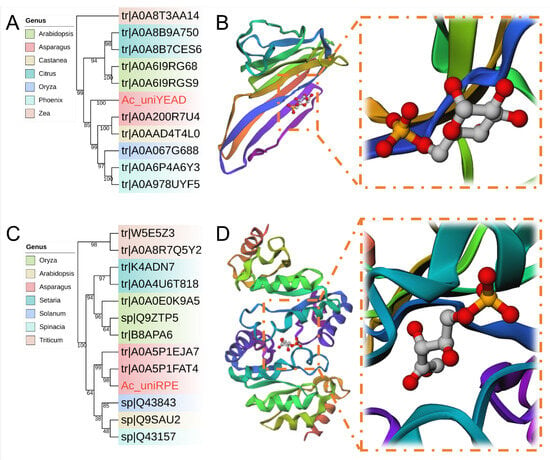
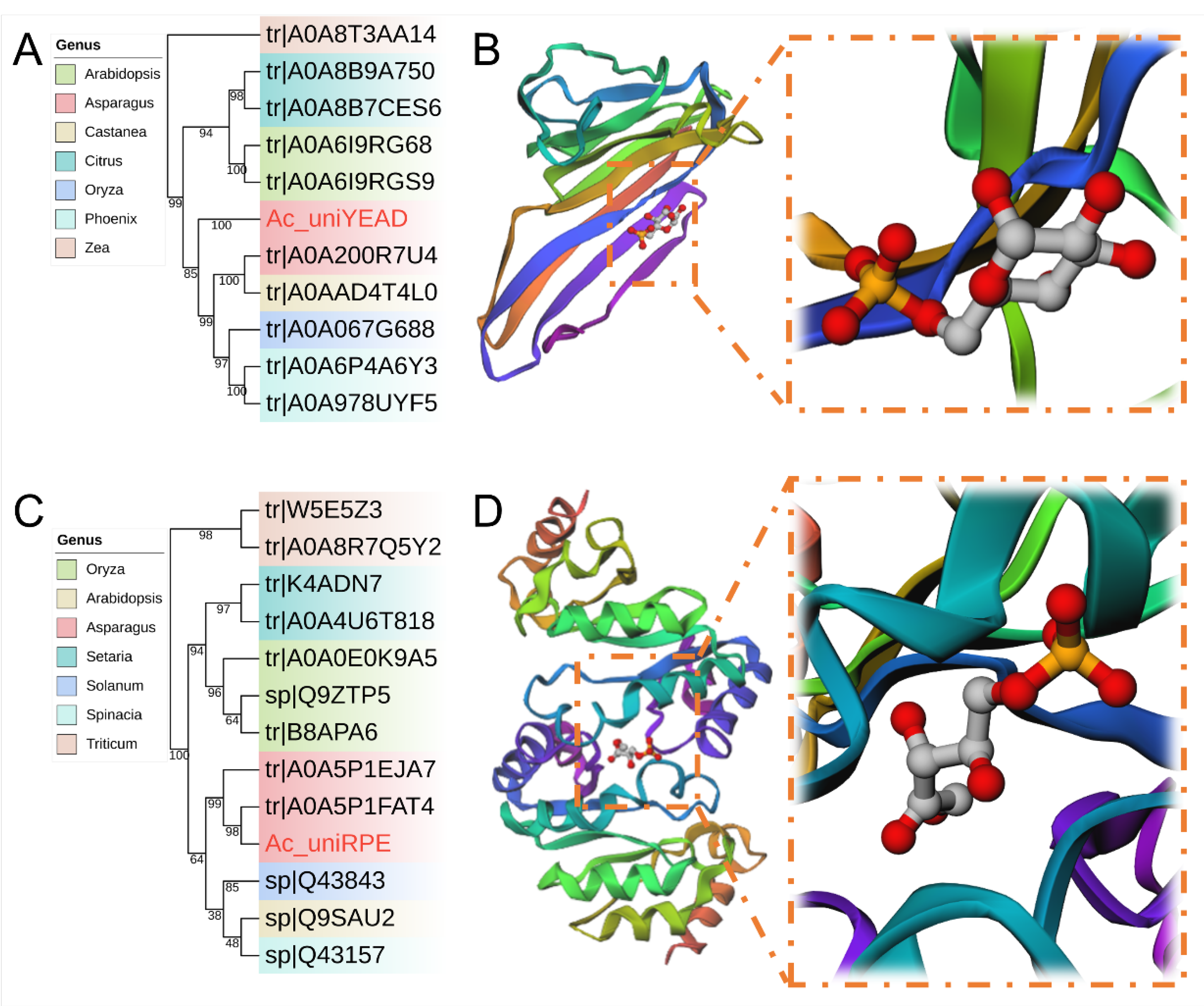
The homologous sequences of Ac_uniYEAD from eight plant species were used in phylogenetic tree reconstruction. A. cochinchinensis and A. taliensis formed a single clade closely related to Asparagus officinalis (gene A0A200R7U4), indicating a close evolutionary relationship (Figure 7A). Similarly, phylogenetic reconstruction of Ac_uniRPE with eleven plant species placed the Asparagus sequences in a clade with two A. officinalis genes (A0A5P1EJA7 and A0A5P1FAT4), supporting their phylogenetic proximity (Figure 7C).
Figure 7.
Phylogenetic analysis and molecular docking of sugar metabolism–related unigenes. (A) Phylogenetic tree of Ac_uniYEAD unigenes. (B) Spatial structure model of Ac_uniYEAD and molecular docking with D-ribulose-5-phosphate. (C) Phylogenetic tree of Ac_uniRPE unigenes. (D) Spatial structure model of Ac_uniRPE and molecular docking with α-D-glucose-6-phosphate. Phylogenetic Tree: The numbers at the nodes represent confidence values (Bootstrap = 1000). Molecular Docking: Protein secondary structures are represented with coiled ribbons for α-helices and flat arrows for β-sheets. A closer spatial distance between the protein and ligand typically suggests a more reliable docking pose.
Three-dimensional protein structure models were generated for both Ac_uniYEAD and Ac_uniRPE. To elucidate their functional mechanisms, molecular docking was performed using the predicted protein structures, which revealed potential interactions between Ac_uniYEAD and D-ribulose-5-phosphate and between Ac_uniRPE and α-D-glucose-6-phosphate (Figure 7B,D).
3.6. qRT-PCR Gene Expression Analysis of Candidate Genes
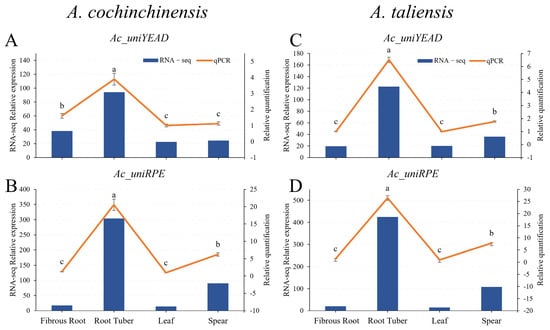
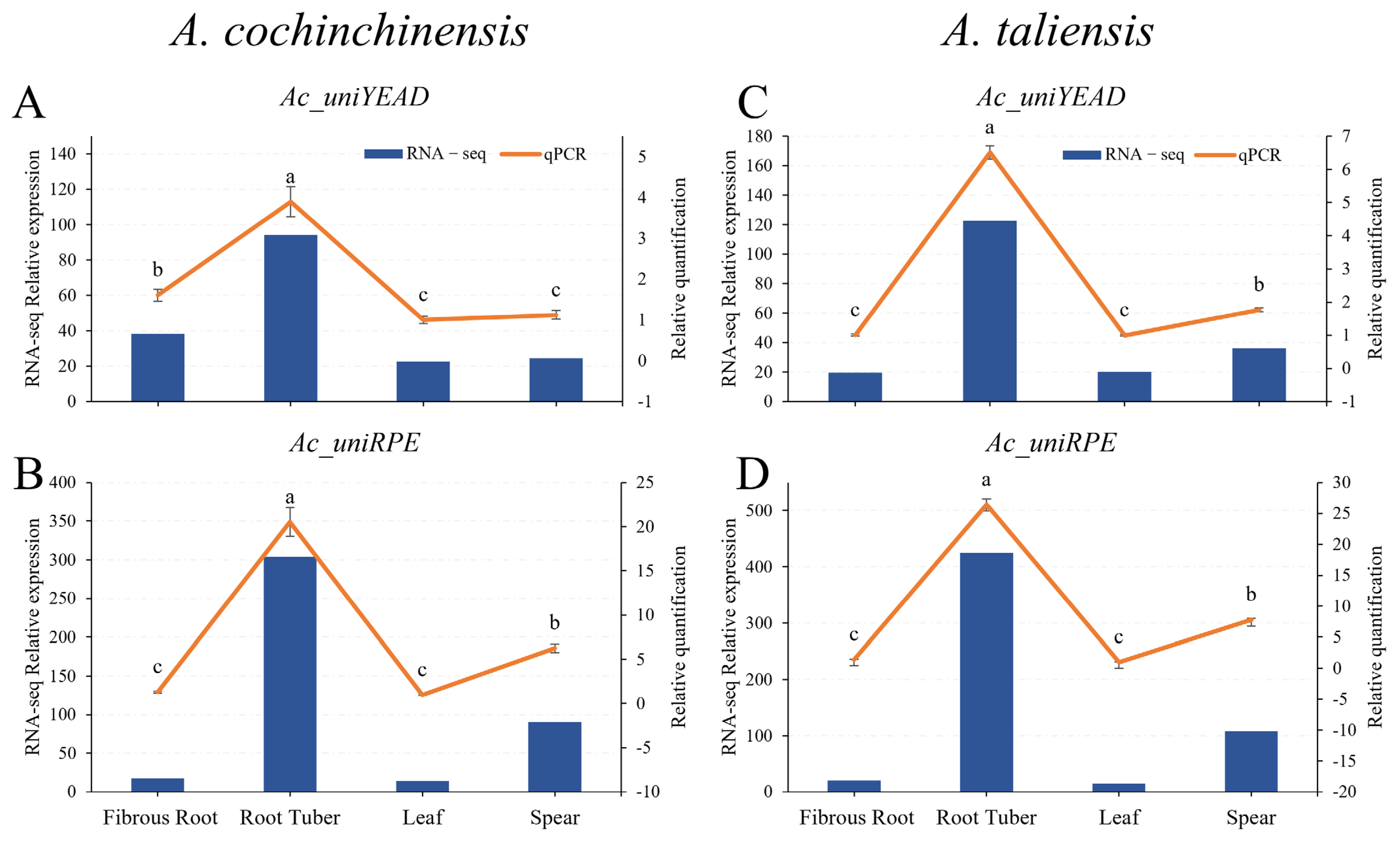
To validate the transcriptomic results, the expression patterns of the candidate genes Ac_uniYEAD and Ac_uniRPE were examined by qRT-PCR across four tissues (fibrous root, root tuber, leaf, and spear) in both A. cochinchinensis and A. taliensis. The qRT-PCR results were highly consistent with the RNA-seq data, confirming the reliability of the sequencing analysis. In both species, Ac_uniYEAD and Ac_uniRPE displayed the highest expression levels in root tubers, moderate expression in spears, and significantly lower expression in fibrous roots and leaves (Figure 8). This tissue-specific expression pattern, validated by two independent methods, strongly supports the involvement of Ac_uniYEAD and Ac_uniRPE in the regulation of root tuber formation and development.
Figure 8.
qRT-PCR validation of candidate genes in four tissues. The blue bars represent the FPKM values of genes from RNA-seq, and the orange lines represent the relative expression determined by qRT-PCR. Data represent mean ± standard error of three replicates. (A) RNA-seq result and qPCR validation of gene Ac_uniYEAD in A. cochinchinensis. (B) RNA-seq result and qPCR validation of gene Ac_uniRPE in A. cochinchinensis. (C) RNA-seq result and qPCR validation of gene Ac_uniYEAD in A. taliensis. (D) RNA-seq result and qPCR validation of gene Ac_uniRPE in A. taliensis. Different lowercase letters indicate significant differences.
4. Discussion
4.1. Identification and Putative Roles of Ac_uniYEAD and Ac_uniRPE in Tuber Development
The genus Asparagus includes several species of great importance in TCM, with A. cochinchinensis and A. taliensis being among the most prominent. Historically recognized as superior-grade herbs in Ming Yi Bie Lu, both species have been widely used for medicinal and culinary applications. However, the absence of published genome sequences for either species has limited in-depth molecular studies. Therefore, high-throughput transcriptome sequencing offers an effective alternative to investigate the molecular mechanisms of tuber development. Although molecular studies on tuber formation have progressed in various plant species, the genetic differences underlying root tuber development in A. cochinchinensis and A. taliensis remain unexplored. In this study, we conducted comparative transcriptome analysis of these two species to elucidate the similarities and differences in gene expression during tuber development. Our findings provide a foundation for future molecular-assisted breeding and genetic regulation of tuber traits in Asparagus.
Numerous regulatory genes involved in root development have been identified across plant species. For instance, heterologous expression of the rice sucrose transporter genes OsSUT5A and OsSUT2M in potato enhanced the tuber development and yield [50]. In sweet potato, IbEXP1 expression was positively correlated with fibrous root growth but negatively associated with storage root formation [51]. Sucrose synthase 1 (SUS1) was linked to root thickening in radish [52], while three isoamylase genes (IbISA1, IbISA2, and IbISA3) were shown to affect starch biosynthesis and root development in sweet potato [53]. In potato, 26 Aux/IAA (StIAA) genes were identified, 12 of which were highly expressed during tuber initiation and expansion [54]. Multi-omics analysis in cassava further elucidated the roles of starch biosynthesis and degradation genes in tuberous root development [55]. Beyond protein-coding genes, small RNAs such as miR160, miR164, miR172, miR171, StBEL5, StBEL11, and StBEL29 have also been implicated in root formation [56,57].
In this study, we identified two key genes, Ac_uniYEAD and Ac_uniRPE, associated with root tuber development in Asparagus. Phenotypic analysis revealed that A. taliensis produced significantly more tubers per plant (average 490) than A. cochinchinensis (average 97), consistent with the higher expression levels of both genes in A. taliensis tubers. The strong agreement between qRT-PCR and RNA-seq results confirmed the reliability of our transcriptomic data and highlighted the tuber-specific expression patterns of Ac_uniYEAD and Ac_uniRPE. These findings suggest their potential roles in carbohydrate synthesis, storage, and secondary metabolite accumulation, demonstrating a significant positive correlation with tuber number.
From a breeding perspective, these results provide a molecular basis for improving Asparagus varieties. Ac_uniYEAD and Ac_uniRPE can serve as molecular markers for early selection of high-yielding lines at the seedling stage, significantly shortening the breeding cycle as compared to traditional phenotypic evaluation. Furthermore, gene editing strategies could be employed to enhance their expression in low-yielding varieties or introduce favorable alleles from A. taliensis, enabling targeted increases in tuber number and overcoming the inefficiencies and instability associated with conventional hybridization.
4.2. Transcriptional Regulatory Networks and Breeding Implications
TFs play a pivotal role in gene regulatory networks by binding to specific DNA sequences to activate or repress the expression of target genes. A single TF can modulate multiple genes simultaneously, offering significant advantages over modifying individual enzymes for the improvement of complex agricultural traits and the accumulation of bioactive compounds. In this study, we identified 2246 TFs from the transcriptomes of A. cochinchinensis and A. taliensis. Among these, the C2H2 family was the most abundant in carbohydrate metabolism, followed by the bHLH, C3H, and MYB families. In contrast, the bHLH family was most prevalent in root tuber formation and development, followed by the MYB, NAC, and WRKY families.
The importance of TFs in tuber development has been demonstrated in other species. In sweet potato, the trihelix TF gene Tai6.25300 was identified as a key regulator of tuberous root expansion, acting as a molecular switch that responds to light signals via Ca2+-dependent phosphorylation/dephosphorylation [58]. In potato, the genome-wide characterization of growth-regulating factors (GRFs) revealed that StGRF1, StGRF2, StGRF5, StGRF7, StGRF10, and StGRF12 are involved in tuber sprouting, while StGRF4 and StGRF9 may function in maintaining tuber dormancy [59]. Similarly, the NAC domain TF IbNAC083 in sweet potato acts as a core regulator that modulates metabolic processes such as lignin, flavonol, and starch biosynthesis, thereby promoting the transition to swelling roots [60].
The TFs identified in our study provide valuable insights for investigating the regulatory mechanisms underlying Asparagus root tuber initiation, formation, and development. As master regulators of gene expression, TFs can coordinately regulate multiple downstream genes, enabling simultaneous improvement of multiple traits in breeding programs. For instance, bHLH TFs—key regulators of root tuber development—could be co-expressed with Ac_uniYEAD and Ac_uniRPE to synergistically enhance the tuber formation. C2H2 TFs, which are associated with carbohydrate metabolism, could be targeted to improve both tuber yield and the content of polysaccharide, a key medicinal component of Asparagus root tubers. Furthermore, stress-responsive TFs from the resilient species A. taliensis could be introgressed into A. cochinchinensis to develop high-yielding cultivars with enhanced adaptability to drought and cold, thereby expanding the cultivation range of Asparagus to more diverse environments.
5. Conclusions
In this study, comparative transcriptome analysis of root tubers from A. cochinchinensis and A. taliensis identified 26,013 DEGs, including 1096 unigenes associated with carbohydrate metabolism pathways involved in tuber formation and development. WGCNA revealed that the MEred and MEgreenyellow modules which included genes involved in material and energy metabolism were significantly positively correlated with root tuber development. From these modules, two genes involved in carbon and sugar metabolism—designated Ac_uniYEAD and Ac_uniRPE—were screened as candidate genes. The positive correlation between the expression of these genes and root tuber number was consistently validated by both RNA-seq and qRT-PCR analyses. These findings provide novel insights into the molecular mechanisms underlying tuberous root development in Asparagus and establish a theoretical foundation for genetic improvement of this medicinally important genus. Furthermore, this study facilitates the transition from traditional phenotype-based breeding to precision gene-oriented breeding in Asparagus, offering key molecular tools and targets for developing high-yield, high-quality, and stress-resilient varieties to meet growing market demands. Ultimately, these advances will support the sustainable and large-scale development of the Asparagus medicine-food industry.
Author Contributions
D.L. and A.C. contributed equally to this work. D.L.: investigation, data curation, formal analysis and drafted the original manuscript. A.C.: investigation, formal analysis, data interpretation and drafted the original manuscript. F.Y.: formal analysis and data interpretation. X.L. (Xiongwei Liu): formal analysis and data interpretation. J.W.: formal analysis and data interpretation. S.L. (Siqi Liu): resource provision and investigation. X.W.: resource provision and literature search. S.L. (Siyu Liang): resource provision and literature search. J.Z.: resource provision, supervision, and manuscript review and editing. M.Y.: conceptualization, supervision, and manuscript review and editing. X.L. (Xiangyang Lyu): supervision, funding acquisition, and project administration. All authors have read and agreed to the published version of the manuscript.
Funding
This work was supported by Neijiang Dongxing District’s Traditional Chinese Medicine Great Health Industry Promotion Center Project “Whole genome sequencing and analysis of an Asparagus species” (Grant No. 23zh0030).
Data Availability Statement
The original contributions presented in this study are included in the article. Further inquiries can be directed to the corresponding authors.
Conflicts of Interest
The authors declare no conflicts of interest.
References
- Guo, X.; Xie, P.; Zhang, G.; Wang, T.; Li, J.; Zhang, X.; Su, W.; Ji, Y. Complete Plastomes Serve as Desirable Molecular Makers for Precise Identification of Asparagus Cochinchinensis (Asparagaceae) and Nine Other Congeneric Species Frequently Utilized as Its Adulterants. BMC Plant Biol. 2025, 25, 366. [Google Scholar] [CrossRef] [Scilit] [PubMed]
- Kubota, S.; Konno, I.; Kanno, A. Molecular Phylogeny of the Genus Asparagus (Asparagaceae) Explains Interspecific Crossability between the Garden Asparagus (a. Officinalis) and Other Asparagus Species. Theor. Appl. Genet. 2012, 124, 345–354. [Google Scholar] [CrossRef] [Scilit] [PubMed]
- Pegiou, E.; Mumm, R.; Acharya, P.; De Vos, R.C.H.; Hall, R.D. Green and White Asparagus (Asparagus Officinalis): A Source of Developmental, Chemical and Urinary Intrigue. Metabolites 2019, 10, 17. [Google Scholar] [CrossRef] [Scilit] [PubMed]
- Pahwa, P.; Singh, T.; Goel, R.K. Anticonvulsant Effect of Asparagus Racemosus Willd. in a Mouse Model of Catamenial Epilepsy. Neurochem. Res. 2022, 47, 422–433. [Google Scholar] [CrossRef] [Scilit]
- Wong, K.-H.; Kong, B.L.-H.; Siu, T.-Y.; Wu, H.-Y.; But, G.W.-C.; Shaw, P.; Lau, D.T.-W. Complete Chloroplast Genomes of Asparagus Aethiopicus L., a. Densiflorus (Kunth) Jessop ‘Myers’, and a. Cochinchinensis (Lour.) Merr.: Comparative and Phylogenetic Analysis with Congenerics. PLoS ONE 2022, 17, e0266376. [Google Scholar] [CrossRef] [Scilit]
- Sheng, W. The Complete Chloroplast Genome of Two Traditional Medical Plants: Asparagus Cochinchinensis (Lour.) Merr. and Asparagus Dauricus Fisch. Ex Link. Mitochondrial DNA Part B 2022, 7, 725–726. [Google Scholar] [CrossRef] [Scilit]
- Saha, P.S.; Ray, S.; Sengupta, M.; Jha, S. Molecular Phylogenetic Studies Based on rDNA ITS, cpDNA trnL Intron Sequence and Cladode Characteristics in Nine Protasparagus Taxa. Protoplasma 2015, 252, 1121–1134. [Google Scholar] [CrossRef] [Scilit]
- Wu, H.; Dongchen, W.; Li, Y.; Brown, S.E.; Wei, S.; Lin, C.; Mao, Z.; Liu, Z. Mitogenomes Comparison of 3 Species of Asparagus L Shedding Light on Their Functions Due to Domestication and Adaptative Evolution. BMC Genom. 2024, 25, 857. [Google Scholar] [CrossRef] [Scilit]
- Zeng, L.; Brown, S.E.; Wu, H.; Dongchen, W.; Li, Y.; Lin, C.; Liu, Z.; Mao, Z. Comprehensive Genome-Wide Analysis of the HMGR Gene Family of Asparagus Taliensis and Functional Validation of AtaHMGR10 under Different Abiotic Stresses. Front. Plant Sci. 2025, 16, 1455592. [Google Scholar] [CrossRef] [Scilit]
- Lee, D.Y.; Choo, B.K.; Yoon, T.; Cheon, M.S.; Lee, H.W.; Lee, A.Y.; Kim, H.K. Anti-Inflammatory Effects of Asparagus Cochinchinensis Extract in Acute and Chronic Cutaneous Inflammation. J. Ethnopharmacol. 2009, 121, 28–34. [Google Scholar] [CrossRef] [Scilit]
- Lei, L.; Ou, L.; Yu, X. The Antioxidant Effect of Asparagus Cochinchinensis (Lour.) Merr. Shoot in d-Galactose Induced Mice Aging Model and in Vitro. J. Chin. Med. Assoc. 2016, 79, 205–211. [Google Scholar] [CrossRef] [Scilit] [PubMed]
- Choi, J.Y.; Kim, S.H.; Kim, J.E.; Park, J.W.; Kang, M.J.; Choi, H.J.; Bae, S.J.; Lee, J.H.; Jung, Y.-S.; Hwang, D.Y. Four Amino Acids as Serum Biomarkers for Anti-Asthma Effects in the Ovalbumin-Induced Asthma Mouse Model Treated with Extract of Asparagus cochinchinensis. Lab. Anim. Res. 2019, 35, 32. [Google Scholar] [CrossRef] [Scilit] [PubMed]
- Zhang, R.-S.; Liu, Y.-Y.; Zhu, P.-F.; Jin, Q.; Dai, Z.; Luo, X.-D. Furostanol Saponins from Asparagus Cochinchinensis and Their Cytotoxicity. Nat. Prod. Bioprospect. 2021, 11, 651–658. [Google Scholar] [CrossRef] [Scilit] [PubMed]
- Wang, M.; Wang, S.; Hu, W.; Wang, Z.; Yang, B.; Kuang, H. Asparagus Cochinchinensis: A Review of Its Botany, Traditional Uses, Phytochemistry, Pharmacology, and Applications. Front. Pharmacol. 2022, 13, 1068858. [Google Scholar] [CrossRef] [Scilit]
- Liu, M.; Tang, L.; Li, Y.; Lv, G.; Zhang, M. Research Status and Prospects of Chinese Medicine Herb Asparagus Cochinchinensis. Pharmacol. Res. Mod. Chin. Med. 2025, 15, 100625. [Google Scholar] [CrossRef] [Scilit]
- Sikand, G.; Kris-Etherton, P.; Boulos, N.M. Impact of Functional Foods on Prevention of Cardiovascular Disease and Diabetes. Curr. Cardiol. Rep. 2015, 17, 39. [Google Scholar] [CrossRef] [Scilit]
- Kim, M.; Kim, W.-B.; Koo, K.Y.; Kim, B.R.; Kim, D.; Lee, S.; Son, H.J.; Hwang, D.Y.; Kim, D.S.; Lee, C.Y.; et al. Optimal Fermentation Conditions of Hyaluronidase Inhibition Activity on Asparagus Cochinchinensis Merrill by Weissella Cibaria. J. Microbiol. Biotechnol. 2017, 27, 701–708. [Google Scholar] [CrossRef] [Scilit]
- Topolska, K.; Florkiewicz, A.; Filipiak-Florkiewicz, A. Functional Food—Consumer Motivations and Expectations. Int. J. Environ. Res. Public Health 2021, 18, 5327. [Google Scholar] [CrossRef] [Scilit]
- Kamdeu, E.N.; Menye Nomo, A.N.; Tchoukoua, A.; Ngomo, O.; Djimeli Douanla, P.; Tchuendem Kenmogne, M.H.; Shiono, Y.; Tabopda, T.K. Schweinfurthiamide, a new alkaloid isolated from the tuber roots of Asparagus flagellaris Baker (Liliaceae). Nat. Prod. Res. 2025, 39, 144–150. [Google Scholar]
- Rajasekhar, A.; Peddanna, K.; Vedasree, N.; Munirajeswari, P.; Nagaraju, N.; Badri, K.R.; Chippada, A.R. Antidiabetic activity of root tubers of Asparagus gonoclados Baker in streptozotocin induced diabetic rats. J. Ethnopharmacol. 2019, 242, 112027. [Google Scholar] [CrossRef] [Scilit]
- Suja, S.; Sivakala, S. Phytochemical, purification and spectral analysis of compounds from root tuber extract of Aparagus racemosus (Willd). Mater. Today Proc. 2021, 41, 618–621. [Google Scholar] [CrossRef] [Scilit]
- Tantapakul, C.; Chaiyosang, B.; Promgool, T.; Somteds, A.; Kanokmedhakul, S. Spirosteroids and α-glucosidase inhibitory norlignans from Asparagus racemosus Willd. roots. Phytochemistry 2020, 177, 112439. [Google Scholar] [CrossRef] [Scilit] [PubMed]
- You, M.K.; Hur, C.G.; Ahn, Y.S.; Suh, M.C.; Jeong, B.C.; Shin, J.S.; Bae, J.M. Identification of Genes Possibly Related to Storage Root Induction in Sweetpotato. FEBS Lett. 2003, 536, 101–105. [Google Scholar] [CrossRef] [Scilit] [PubMed]
- Tanaka, M.; Takahata, Y.; Nakatani, M. Analysis of Genes Developmentally Regulated during Storage Root Formation of Sweet Potato. J. Plant Physiol. 2005, 162, 91–102. [Google Scholar] [CrossRef] [Scilit]
- Ku, A.T.; Huang, Y.-S.; Wang, Y.-S.; Ma, D.; Yeh, K.-W. IbMADS1 (Ipomoea batatas MADS-Box 1 Gene) Is Involved in Tuberous Root Initiation in Sweet Potato (Ipomoea batatas). Ann. Bot. 2008, 102, 57–67. [Google Scholar] [CrossRef] [Scilit]
- Souza, C.; Carvalho, L.; Cascardo, J. Comparative Gene Expression Study to Identify Genes Possibly Related to Storage Root Formation in Cassava. Protein Pept. Lett. 2004, 11, 577–582. [Google Scholar] [CrossRef] [Scilit]
- Sheffield, J.; Taylor, N.; Fauquet, C.; Chen, S. The Cassava (Manihot esculenta Crantz) Root Proteome: Protein Identification and Differential Expression. Proteomics 2006, 6, 1588–1598. [Google Scholar] [CrossRef] [Scilit]
- Liao, J.-C.; Bachem, D.C. The Role of Auxin Related Genes in the Initiation of Potato Tuber Formation. Master’s Thesis, Wageningen University, Wageningen, The Netherlands, 2014. [Google Scholar]
- Pasare, S.A.; Ducreux, L.J.M.; Morris, W.L.; Campbell, R.; Sharma, S.K.; Roumeliotis, E.; Kohlen, W.; Van Der Krol, S.; Bramley, P.M.; Roberts, A.G.; et al. The Role of the Potato (Solanum tuberosum) CCD8 Gene in Stolon and Tuber Development. New Phytol. 2013, 198, 1108–1120. [Google Scholar] [CrossRef] [Scilit]
- Sun, P.; Xiao, X.; Duan, L.; Guo, Y.; Qi, J.; Liao, D.; Zhao, C.; Liu, Y.; Zhou, L.; Li, X. Dynamic Transcriptional Profiling Provides Insights into Tuberous Root Development in Rehmannia Glutinosa. Front. Plant Sci. 2015, 6, 396. [Google Scholar] [CrossRef] [Scilit]
- Malhotra, N.; Sood, H.; Chauhan, R.S. Transcriptome-Wide Mining Suggests Conglomerate of Genes Associated with Tuberous Root Growth and Development in Aconitum Heterophyllum Wall. 3 Biotech 2016, 6, 152. [Google Scholar] [CrossRef] [Scilit]
- Tang, C.; Han, R.; Zhou, Z.; Yang, Y.; Zhu, M.; Xu, T.; Wang, A.; Li, Z.; Dong, T. Identification of Candidate miRNAs Related in Storage Root Development of Sweet Potato by High Throughput Sequencing. J. Plant Physiol. 2020, 251, 153224. [Google Scholar] [CrossRef] [Scilit]
- Lowe, R.; Shirley, N.; Bleackley, M.; Dolan, S.; Shafee, T. Transcriptomics Technologies. PLoS Comput. Biol. 2017, 13, e1005457. [Google Scholar] [CrossRef] [Scilit] [PubMed]
- Su, Z.; Fang, H.; Hong, H.; Shi, L.; Zhang, W.; Zhang, W.; Zhang, Y.; Dong, Z.; Lancashire, L.J.; Bessarabova, M.; et al. An Investigation of Biomarkers Derived from Legacy Microarray Data for Their Utility in the RNA-Seq Era. Genome Biol. 2014, 15, 523. [Google Scholar] [CrossRef] [Scilit] [PubMed]
- Imadi, S.R.; Kazi, A.G.; Ahanger, M.A.; Gucel, S.; Ahmad, P. Plant Transcriptomics and Responses to Environmental Stress: An Overview. J. Genet. 2015, 94, 525–537. [Google Scholar] [CrossRef] [Scilit] [PubMed]
- Rai, A.; Yamazaki, M.; Takahashi, H.; Nakamura, M.; Kojoma, M.; Suzuki, H.; Saito, K. RNA-Seq Transcriptome Analysis of Panax Japonicus, and Its Comparison with Other Panax Species to Identify Potential Genes Involved in the Saponins Biosynthesis. Front. Plant Sci. 2016, 7, 481. [Google Scholar] [CrossRef] [Scilit]
- Lulin, H.; Xiao, Y.; Pei, S.; Wen, T.; Shangqin, H. The First Illumina-Based de Novo Transcriptome Sequencing and Analysis of Safflower Flowers. PLoS ONE 2012, 7, e38653. [Google Scholar] [CrossRef] [Scilit]
- Ahmed, S.; Zhan, C.; Yang, Y.; Wang, X.; Yang, T.; Zhao, Z.; Zhang, Q.; Li, X.; Hu, X. The Transcript Profile of a Traditional Chinese Medicine, Atractylodes Lancea, Revealing Its Sesquiterpenoid Biosynthesis of the Major Active Components. PLoS ONE 2016, 11, e0151975. [Google Scholar] [CrossRef] [Scilit]
- Lu, J.; Wang, Z.; Qin, L.; Shen, J.; He, Z.; Shao, Q.; Lin, D. Drying methods affect bioactive compound contents and antioxidant capacity of Bletilla striata (Thunb.) Reichb.f. flower. Ind. Crops Prod. 2021, 164, 113388. [Google Scholar] [CrossRef] [Scilit]
- Chen, Y.; Chen, Y.; Shi, C.; Huang, Z.; Zhang, Y.; Li, S.; Li, Y.; Ye, J.; Yu, C.; Li, Z.; et al. SOAPnuke: A MapReduce acceleration-supported software for integrated quality control and preprocessing of high-throughput sequencing data. GigaScience 2017, 7, gix120. [Google Scholar] [CrossRef] [Scilit]
- Grabherr, M.G.; Haas, B.J.; Yassour, M.; Levin, J.Z.; Thompson, D.A.; Amit, I.; Adiconis, X.; Fan, L.; Raychowdhury, R.; Zeng, Q.; et al. Full-length transcriptome assembly from RNA-Seq data without a reference genome. Nat. Biotechnol. 2011, 29, 644–652. [Google Scholar] [CrossRef] [Scilit]
- Pertea, G.; Huang, X.; Liang, F.; Antonescu, V.; Sultana, R.; Karamycheva, S.; Lee, Y.; White, J.; Cheung, F.; Parvizi, B.; et al. TIGR Gene Indices clustering tools (TGICL): A software system for fast clustering of large EST datasets. Bioinformatics 2003, 19, 651–652. [Google Scholar] [CrossRef] [Scilit]
- Conesa, A.; Götz, S.; García-Gómez, J.M.; Terol, J.; Talón, M.; Robles, M. Blast2GO: A universal tool for annotation, visualization and analysis in functional genomics research. Bioinformatics 2005, 21, 3674–3676. [Google Scholar] [CrossRef] [Scilit] [PubMed]
- Langmead, B.; Salzberg, S.L. Fast gapped-read alignment with Bowtie 2. Nat. Methods 2012, 9, 357–359. [Google Scholar] [CrossRef] [Scilit] [PubMed]
- Li, B.; Dewey, C.N. RSEM: Accurate transcript quantification from RNA-Seq data with or without a reference genome. BMC Bioinform. 2011, 12, 323. [Google Scholar] [CrossRef] [Scilit] [PubMed]
- Love, M.I.; Huber, W.; Anders, S. Moderated estimation of fold change and dispersion for RNA-seq data with DESeq2. Genome Biol. 2014, 15, 550. [Google Scholar] [CrossRef] [Scilit]
- Rice, P.; Longden, I.; Bleasby, A. EMBOSS: The European Molecular Biology Open Software Suite. Trends Genet. 2000, 16, 276–277. [Google Scholar] [CrossRef] [Scilit]
- Eddy, S.R. Accelerated Profile HMM Searches. PLoS Comput. Biol. 2011, 7, e1002195. [Google Scholar] [CrossRef] [Scilit]
- Jin, J.; Tian, F.; Yang, D.C.; Meng, Y.Q.; Kong, L.; Luo, J.; Gao, G. PlantTFDB 4.0: Toward a central hub for transcription factors and regulatory interactions in plants. Nucleic Acids Res. 2017, 45, D1040–D1045. [Google Scholar] [CrossRef] [Scilit]
- Sun, A.; Dai, Y.; Zhang, X.; Li, C.; Meng, K.; Xu, H.; Wei, X.; Xiao, G.; Ouwerkerk, P.B.F.; Wang, M.; et al. A transgenic study on affecting potato tuber yield by expressing the rice sucrose transporter genes OsSUT5Z and OsSUT2M. J. Integr. Plant Biol. 2011, 53, 586–595. [Google Scholar] [CrossRef] [Scilit]
- Noh, S.A.; Lee, H.-S.; Kim, Y.-S.; Paek, K.-H.; Shin, J.S.; Bae, J.M. Down-Regulation of the IbEXP1 Gene Enhanced Storage Root Development in Sweetpotato. J. Exp. Bot. 2013, 64, 129–142. [Google Scholar] [CrossRef] [Scilit]
- Mitsui, Y.; Shimomura, M.; Komatsu, K.; Namiki, N.; Shibata-Hatta, M.; Imai, M.; Katayose, Y.; Mukai, Y.; Kanamori, H.; Kurita, K.; et al. The Radish Genome and Comprehensive Gene Expression Profile of Tuberous Root Formation and Development. Sci. Rep. 2015, 5, 10835. [Google Scholar] [CrossRef] [Scilit] [PubMed]
- Nabemoto, M.; Watanabe, R.; Ohsu, M.; Sato, K.; Otani, M.; Nakayachi, O.; Watanabe, M. Molecular Characterization of Genes Encoding Isoamylase-Type Debranching Enzyme in Tuberous Root of Sweet Potato, Ipomoea batatas (L.) Lam. Plant Biotechnol. 2016, 33, 351–359. [Google Scholar] [CrossRef] [Scilit] [PubMed]
- Gao, J.; Cao, X.; Shi, S.; Ma, Y.; Wang, K.; Liu, S.; Chen, D.; Chen, Q.; Ma, H. Genome-Wide Survey of Aux/IAA Gene Family Members in Potato (Solanum tuberosum): Identification, Expression Analysis, and Evaluation of Their Roles in Tuber Development. Biochem. Biophys. Res. Commun. 2016, 471, 320–327. [Google Scholar] [CrossRef] [Scilit] [PubMed]
- Ding, Z.; Fu, L.; Tie, W.; Yan, Y.; Wu, C.; Dai, J.; Zhang, J.; Hu, W. Highly Dynamic, Coordinated, and Stage-Specific Profiles Are Revealed by a Multi-Omics Integrative Analysis during Tuberous Root Development in Cassava. J. Exp. Bot. 2020, 71, 7003–7017. [Google Scholar] [CrossRef] [Scilit]
- Lakhotia, N.; Joshi, G.; Bhardwaj, A.R.; Katiyar-Agarwal, S.; Agarwal, M.; Jagannath, A.; Goel, S.; Kumar, A. Identification and Characterization of miRNAome in Root, Stem, Leaf and Tuber Developmental Stages of Potato (Solanum Tuberosum L.) by High-Throughput Sequencing. BMC Plant Biol. 2014, 14, 6. [Google Scholar] [CrossRef] [Scilit]
- Hannapel, D.; Banerjee, A. Multiple Mobile mRNA Signals Regulate Tuber Development in Potato. Plants 2017, 6, 8. [Google Scholar] [CrossRef] [Scilit]
- Cai, Z.; Cai, Z.; Huang, J.; Wang, A.; Ntambiyukuri, A.; Chen, B.; Zheng, G.; Li, H.; Huang, Y.; Zhan, J.; et al. Transcriptomic Analysis of Tuberous Root in Two Sweet Potato Varieties Reveals the Important Genes and Regulatory Pathways in Tuberous Root Development. BMC Genom. 2022, 23, 473. [Google Scholar] [CrossRef] [Scilit]
- Cui, D.; Song, Y.; Jiang, W.; Ye, H.; Wang, S.; Yuan, L.; Liu, B. Genome-Wide Characterization of the GRF Transcription Factors in Potato (Solanum Tuberosum L.) and Expression Analysis of StGRF Genes during Potato Tuber Dormancy and Sprouting. Front. Plant Sci. 2024, 15, 1417204. [Google Scholar] [CrossRef] [Scilit]
- He, S.; Wang, H.; Hao, X.; Wu, Y.; Bian, X.; Yin, M.; Zhang, Y.; Fan, W.; Dai, H.; Yuan, L.; et al. Dynamic Network Biomarker Analysis Discovers IbNAC083 in the Initiation and Regulation of Sweet Potato Root Tuberization. Plant J. 2021, 108, 793–813. [Google Scholar] [CrossRef] [Scilit]

Disclaimer/Publisher’s Note: The statements, opinions and data contained in all publications are solely those of the individual author(s) and contributor(s) and not of MDPI and/or the editor(s). MDPI and/or the editor(s) disclaim responsibility for any injury to people or property resulting from any ideas, methods, instructions or products referred to in the content. |
© 2026 by the authors. Licensee MDPI, Basel, Switzerland. This article is an open access article distributed under the terms and conditions of the Creative Commons Attribution (CC BY) license.