


Highlights
What are the main findings?
- •
- Priority effects play a large role in structuring AMF communities in newly planted apple trees.
- •
- Starting community structure (related to nursery origin) influenced the ability of AMF inoculants to successfully compete with pre-established and/or native orchard AMF communities.
- •
- Although the percentage of root tissue colonized by AMF was generally higher in pasteurized than in live soil, pasteurization did not appear to improve the colonization ability of AMF inoculants.
What are the implications of the main findings?
- •
- Manipulation and/or tailoring plant–AMF relationships at the nursery could be a more impactful strategy than the application of AMF-based inoculants in the field.
- •
- In fruit tree cropping systems, soil fumigation is unlikely to improve the ability of introduced AMF inoculants to rapidly dominate the root systems of young trees.
Abstract
Species of arbuscular mycorrhizal fungi (AMF) that colonize the roots of temperate fruit trees represent potential tools that could be used to counteract a number of problems orchardists face, from environmental stresses to replant disease. Commercial products, which incorporate some of the same AMF species, would be expected to interact successfully with these crops. However, native AMF communities abundant in orchard soils are highly adapted to the orchard system. In addition, nursery-derived trees typically come with pre-established AMF communities. How AMF from different sources interact within the plant-soil system is not well-understood. Here, we assess the influence of the indigenous soil microbiome (containing native AMF) and/or introduced commercial AMF inoculants on the stability of nursery-derived AMF communities in apple. Apple rootstocks (G.11) were obtained from two different nursery locations, and AMF communities present in roots were characterized prior to planting using a Glomeromycota-specific phylogenetic tree. Rootstocks were then grown in either live orchard soil (indigenous microbiome present), pasteurized orchard soil (ablated microbiome similar to fumigated soil), or live/pasteurized orchard soil treatments inoculated with commercial AMF strains (Claroideoglomus claroideum and Funneliformis mosseae) known to interact successfully with Gala apple seedlings. AMF species pre-established at the nursery represented 73–96% of all species detected in apple roots 2 months after planting, regardless of soil treatment or nursery origin. At the same time, sequence variants from both commercial inoculants were detected in roots regardless of soil pasteurization status or rootstock nursery origin, accounting for 0.1–17% of all AMF species present. Pre-established AMF species composition strongly influenced subsequent community assembly. In terms of developing management strategies for more effective use of these products, our results suggest that manipulating plant–AMF relationships at the nursery level (rather than in the orchard) is a better approach.
1. Introduction
Arbuscular mycorrhizal fungi (AMF, phylum Glomeromycota) are soilborne, root-colonizing fungi that obtain carbon (in the form of sugar) from their host plant and can provide several benefits in return. Inoculation with AMF has been shown to be a promising option to increase plant yield in many cropping systems, including apple [1]. Despite this, the ability of commercially available AMF to compete with indigenous AMF and other fungi in native orchard soil is not well understood, regardless of the cropping system. Fruit tree rootstocks typically come with AMF communities that are pre-established at the nursery during the 2–3 year cultivation of the plant material in nursery field soil. Whether pre-existing nursery-derived AMF are displaced after planting by AMF native to orchard soils is unknown. Additionally, the role of nursery-derived AMF communities in limiting inoculant establishment in apple roots is not well addressed in the literature. This is due, in part, to difficulty in distinguishing the contribution of pre-existing AMF from native or introduced AMF of the same species. Tracking the dynamics of plant-beneficial or pathogenic organisms in soil and root systems is typically conducted using a combination of culture-dependent and molecular methods. These approaches are complicated by the fact that AMF cannot be cultured in the lab (without a host plant) or accurately identified using currently existing publicly available databases.
While some environmental drivers governing AMF colonization have been well-studied (e.g., soil pH, nitrogen/phosphorous and moisture levels), many other aspects related to the functional dynamics of plant–AMF symbioses remain poorly understood. This is largely due to the context-dependent nature of AMF–host interactions, which are not only mediated by soil physicochemical properties, but also by genetic factors and biotic elements, including mycorrhiza helper bacteria [2,3,4,5]. Thus, despite decades of research, the successful establishment, persistence, and benefits of AMF inoculants remain hard to predict. Historically, assessments have concentrated on the ability of a limited number of commercially available AMF species to colonize and/or benefit plants in sterilized soil only. Although many field studies have demonstrated the ability of AMF to benefit plant growth, characterization of the root-associated and/or endophytic microbiota has generally not been a primary focus of these types of studies [1,6,7,8,9]. For example, in a recent field study with apple, although the impacts of several different microbial inoculants on tree growth/yield were well-characterized, the study lacked any assessment of the microbial community in the root zone, leaving several open questions as to how interactions between introduced and resident microbes (including AMF) may have ultimately influenced tree development [10]. It should be noted that changes in fungal (ITS) and bacterial (16S) community structure in rhizosphere soil in response to the same microbial soil amendments were reported in a separate, subsequent study [11]. However, standard fungal (ITS) primer sets lack sufficient resolution for characterizing AMF communities [12].
In a previous study, conducted in pasteurized potting mix containing a limited consortium of AMF, nursery-derived AMF strongly influenced AMF community structure in apple rootstocks post-planting [13]. However, to our knowledge, previous studies in tree fruit have not directly examined the contribution of nursery-established mycorrhizae to AMF community structure post-planting. Thus, understanding the stability of nursery-established mycorrhizae under different field conditions (with and without native soil microbiota and/or introduced AMF) remains an unexplored but promising avenue for improving AMF-based intervention strategies. To address this knowledge gap, we conducted an initial experiment in which a variety of commercially available AMF were screened for their ability to interact successfully with Gala apple seedlings. The most promising products (Claroideoglomus claroideum and Funneliformis mosseae) were selected for use in a subsequent experiment designed to investigate the capacity of introduced AMF products, pre-existing AMF contained in nursery-derived apple roots, and native AMF orchard soil communities to compete with each other. Evaluations were conducted in both live and pasteurized soils to ascertain the effect of the soil microbiome on AMF community structure. Additionally, we utilized G.11 rootstock from two different nurseries (possessing distinct pre-existing AMF communities). AMF communities present in G.11 apple root tissue were characterized by assigning community sequence data to a Glomeromycota-specific phylogeny.
We hypothesized that nursery-derived communities would have a competitive advantage over both resident AMF and “highly infective” commercial products due to the principle of priority effects, whereby resident (earlier-arriving) species suppress invader success [14,15,16]. If rootstocks do serve as a significant source of inoculum from the production nursery, then investigating avenues for tailoring specific apple rootstock/AMF relationships at the nursery level could potentially benefit establishment of young apple trees in orchard soils. On the other hand, if “highly infective” commercial AMF products show promise (in live and/or pasteurized soil), then future research may involve experiments designed to address factors affecting the practical use of these products in orchards. Investigating the stability and transformation of nursery-derived AMF communities under field-relevant conditions will provide new information to guide future use of commercially available AMF products and improve upon current practices to promote the establishment of mycorrhizal associations in nursery and orchard systems.
2. Materials and Methods
AMF product panel assessment (pre-requisite for main experiment): A phylogenetically diverse variety of single-species AMF products designed for soil application were selected for testing (Table 1). In addition to 7 commercially available products, 3 AMF species (Diversispora eburnea, Paraglomus brasilianum and P. occultum) were obtained from the International Collection of Vesicular Arbuscular Mycorrhizal Fungi (INVAM); Paraglomus spp. have been repeatedly identified in apple roots cultivated in a variety of Central Washington orchard soils [17,18]. Diversispora spp. have also been found to be associated with the roots of apple trees [19,20]. All products were purported to contain ≥ 50 spores/propagules per g; spore counts of all products were conducted via sucrose density gradient centrifugation as described by INVAM (International Collection of Vesicular Arbuscular Mycorrhizal Fungi; https://invam.ku.edu/spore-extraction, (accessed on 25 March 2024); Table 1). Initially, product viability was confirmed in corn (the standardized assay host) via the Most Probable Number (MPN) method (adapted from [21]). Briefly, the growth substrate (1:1 sand:vermiculite mix) was pasteurized as previously described [13]. Surface-sterilized corn seeds were sown into 150 mL plastic cone-tainers (2.7” diameter × 10” height) containing pasteurized growth substrate diluted with AMF inoculum (1:10, 1:100 and 1:1000 v/v); 2 seeds per cone-tainer, 5 replicate cone-tainers per treatment. The plants were grown in a growth chamber (Controlled Environments LLC, ND, USA) at 24 °C with a 12 h photoperiod (PPFD = 200 μmol/m2/s at soil surface level). Corn roots were harvested 4 weeks after plant emergence, and MPN per liter of inoculum was calculated according to MPN tables based on the number of “positive” plants per dilution. Roots were stained with trypan blue using a modified protocol by Phillips and Hayman (1970) [22], as adapted by INVAM. Briefly, roots were rinsed clean in distilled water (dH2O) and cut into ~2 cm segments before being placed in plastic tissue biopsy cassettes (Micro Mesh, Ted Pella, Inc., Redding, CA, USA). Roots were cleared by immersion in 10% (w/v) KOH for 90 min in a 95 °C water bath. Following clearing, cassettes were rinsed (≥5 changes of dH2O) and submerged in 2% (v/v) HCl for 1 h at room temperature. Roots were then rinsed again and stained in a solution of 0.05% trypan blue in lactoglycerol (1:1:1, v:v:v; dH2O, glycerol, lactic acid) at 95 °C for 1 h. After staining, cassettes were thoroughly rinsed to remove excess stain (≥5 changes of dH2O) and stored in dH2O at 4 °C prior to microscopic examination (dissecting microscope, 10–40×). Plants were scored as “positive” if any AMF structures (including hyphae, arbuscules, or vesicles) were visible in the root.
Table 1.
List of commercially available AMF products tested for their ability to successfully colonize apple roots.
MPN estimates confirmed viability in 8/10 products; results were inconclusive for both Paraglomus spp. (Table S1). Therefore, the same set of AMF products was screened for the ability to successfully colonize apple in an “ecologically relevant” timeframe. Six-week-old Gala apple seedling roots (initially propagated from seed for 6 weeks in pasteurized potting mixture) were planted into pasteurized growth medium (1:1 sand:vermiculite) in 2.7 L pots (6” diameter × 7” height). AMF inoculum was incorporated into the planting hole in accordance with the recommended application rates/procedures, which varied depending on the manufacturer (Table 1). Pots were then arranged in a randomized complete block design with each treatment included once per randomized block (1 seedling per pot × 10 replicate pots per AMF product plus a non-inoculated control treatment) and grown for an additional 6 weeks (22/18 °C, 16/8 light-dark cycle, PPFD 70–80 μmol/m2/s at the canopy level). Seedlings were watered 3 times a week, or as needed based on soil moisture at 5 cm depth below the surface, and fertilized with a modified Hoagland’s solution recipe (0.3 mL L−1 0.01 M KH2PO4, 1.5 mL L−1 1 M KNO3, 1.5 mL L−1 1 M Ca(NO3)2, 0.3 mL L−1 micronutrient stock (2.86 g H3BO3, 1.81 g MnCl2·4H2O, 0.22 g ZnSO4, 0.08 g CuSO4·7H2O, 0.02 g H2MoO4·H2O dissolved in 1 L deionized water) [23] once per week. Plants were destructively harvested after 6 and 12 weeks (half of the plants were harvested at each time point; n = 5 per treatment). Fine, new white root tissue (>0.5 mm) was sampled from the root system and stored at 4 °C until further processing. Root staining was conducted via the procedure described above. Percent AMF root colonization was quantified as previously described by Cook et al. [24] using an adapted version of the magnified intersections method [25]. Briefly, the presence or absence of AMF structures (including hyphae, arbuscules, and vesicles; Figure S1) was recorded at each field of view using a compound light microscope (Olympus BX53, Olympus Bartlett, TN, USA) at 40–100× magnification; >100 fields of view (FOV) per slide × 3 replicate slides per plant. AMF percent colonization was calculated as the number of FOVs with AMF structures/total number of FOVs × 100.
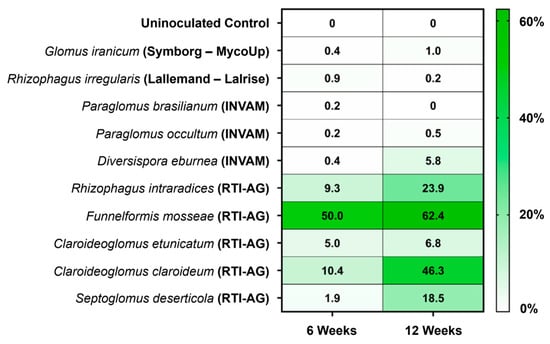
Experimental planting: Two AMF products (Claroideoglomus claroideum and Funneliformis mosseae) were selected for use in the subsequent (main) experiment designed to examine the stability of nursery-derived AMF communities. These products had the highest colonization rates in apple (Figure 1) and high levels of viable infectious propagules in the MPN bioassay with corn (Table S1). In Spring of 2024, orchard soil was collected from Washington State University Sunrise Research Orchard at Rock Island, WA (47°18′35.6″ N, 120°03′59.5″ W) and homogenized in a cement mixer. As previously documented, SRO soil texture is a Pogue fine sandy loam, pH is optimal for tree fruit (6–7.5) with low organic matter content (1.2–1.6%), low plant-available nitrogen, and a history of replant disease [17,26,27]. A portion of the soil was pasteurized by heating moistened soil in an oven at 80 °C for 15 h on two successive days. Between heating sessions, soil was allowed to cool (~4 h) and was hand-mixed (without opening the bag) to break up any remaining soil aggregates.
Figure 1.
Heat map showing percentage of apple root samples colonized 6- and 12-weeks post-inoculation. Darker green indicates higher values, while lighter green to white indicates lower values. It should be noted that the mycorrhizal structures of Paraglomus spp. have been reported to stain weakly (or not at all) with trypan blue and other traditional stains (INVAM; https://invam.ku.edu/occultum, accessed on 25 March 2024).
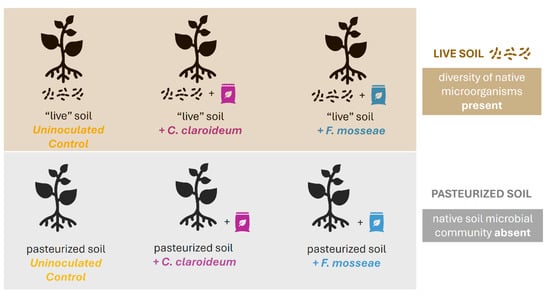
G.11 apple rootstocks with a 1/4” trunk diameter were sourced from TRECO (Woodburn, OR) and Cameron (Eltopia, WA) nurseries. Rootstocks were stored in moist wood chips at 10 °C for approximately 6 weeks. To obtain representative samples of nursery-derived/pre-existing AMF communities, a small amount of fine root tissue was collected from each plant at various locations along the root system just prior to planting, pooled, and stored at −80 °C until processing. Trees were then planted into 3.7 L pots (5.3” diameter × 6.9” height) containing live or pasteurized orchard soil with or without AMF inoculum (12 g per pot). For each nursery location, experimental treatments included: (1) live orchard soil, (2) live orchard soil + F. mosseae, (3) live orchard soil + C. claroideum, (4) pasteurized orchard soil, (5) pasteurized orchard soil + F. mosseae, and (6) pasteurized orchard soil + C. claroideum (Figure 2). Altogether, the experiment included 84 trees (7 replicate trees × 12 treatment/nursery combinations); treatment abbreviations are included in Table 2. Initial plant growth characteristics collected at planting included: total plant fresh weight (g) and trunk diameter (mm). Trunk diameter measurements were taken as described in Somera et al. [18]. The plants were grown in a temperature-controlled greenhouse at 21–29 °C for a period of 8 weeks. Supplemental lighting (50:50 red:blue ratio) with a 14 h photoperiod was provided to augment natural light. Mean PPFD was 460 μmol/m2/s at canopy level, measured with an LI-180 instrument (LI-COR, Lincoln, NE, USA). Plants were watered as needed and did not receive supplemental nutrients. During this time (4 weeks post-planting), an outbreak of powdery mildew was treated with myclobutanil (Rally 40WSP; Corteva Agroscience, Indianapolis, IN, USA) applied at a rate of 700 mg/gal.
Figure 2.
Schematic representation of the different experimental treatments. The upper (brown) and lower (grey) panels represent live and pasteurized orchard soil treatments, respectively. Each soil type included three treatments: uninoculated control, orchard soil + Claroideoglomus claroideum, and orchard soil + Funneliformis mosseae. C. claroideum and F. mosseae are represented by purple and blue bags, respectively. In total, there were 12 treatments because the experiment was conducted using G.11 apple rootstocks from two different nurseries.
Table 2.
List of sample abbreviations used in the paper.
Harvest (2 months post-planting): Upon harvest, plant growth characteristics (trunk diameter, total plant biomass, leader shoot length) were measured. Plants were removed from pots, and loosely-adhering bulk soil was shaken off. New (white) root tissue was then collected from each plant for assessment of AMF percent colonization and microbial DNA isolation. Root tissue for DNA isolation was stored at −80 °C until further processing. Percent AMF colonization was assessed using fresh root tissue according to the methodology described above.
Sequencing of AMF communities from root tissue: Prior to DNA extraction, root tissue was gently rinsed under running tap water to remove remaining soil particles and blotted dry. Rinsed roots were then ground to a fine powder in liquid nitrogen using a sterile mortar and pestle. Ground root tissue was stored at −80 °C until further processing. Microbial DNA present in apple root tissue (root surface + endosphere) was extracted using the DNeasy Plant Pro Kit (Qiagen, Valencia, CA, USA) according to the manufacturer’s instructions using 50 mg of tissue. DNA sample integrity was verified as previously described in Zhang et al. [13], and a region of the 18S (SSU) rRNA was amplified using the Glomeromycotan-specific primers AML1 (5′-ATC AAC TTT CGA TGG TAG GAT AGA-3′) and AML2 (5′-GAA CCC AAA CAC TTT GGT TTC C-3′) [28]. Six biological replicates per treatment were sequenced on a PacBio Sequel instrument in circular consensus sequencing (CCS) mode (one replicate was omitted from each treatment to reduce sequencing costs). Amplicon sequencing was also conducted (for the same set of samples) as described in [18] using the universal fungal primer pair ITS1f/ITS4r [29]. This was done in order to quantify the abundance of Glomeromycota relative to the total fungal community. All sequencing was conducted by Molecular Research, Shallowater, TX, USA.
Processing of AMF sequence data: Sequence data obtained from the sequencing facility were processed as previously described [13]. The processed reads were then used to construct an amplicon sequence variant (ASV) table. Many species of AMF have high intra-genomic heterogeneity within rRNA DNA gene sequences, complicating the ability to accurately determine species based on clustering sequences that are >97% similar [30]. CCS was used to generate unique ASVs differing by as little as one nucleotide, an approach that avoids lumping closely related species together. Nevertheless, multiple ASVs (which are phylogenetically similar) may be associated with a single AMF species. Relative abundance was calculated as the [ASV count/total read count] per sample. Six biological replicates per treatment were averaged to a single relative abundance value. These values, representative of each treatment, were used to generate a heatmap for each of the five clades containing ASVs that were present in the maximum-likelihood phylogeny. The heatmaps were constructed using the seaborn library (v0.12.2; [31]) in Python (v3.14.6). Raw sequencing data are located in the NCBI Sequence Read Archive (SRA) under NCBI BioProject ID PRJNA1522921.
Phylogenetic analysis and taxonomy assignment of AMF ASV’s: A total of 158 ASVs remained after filtering out any singletons, doubletons, and non-Glomeromycota from the dataset. The remaining sequences were aligned to a curated database of 133 Glomeromycota 18S (SSU) rRNA reference sequences (consisting of 91 distinct species from 24 genera) (derived from [12] using Geneious Prime (v2025.2) and the MAFFT plugin [32]. The original Krüger database of 142 reference sequences had been filtered to remove nine Glomeromycota strains for which ambiguous bases (N’s) represented greater than 10% of the total sequence. The multiple sequence alignment was trimmed down to only include the 748–1007 BP fragment between the AML1/AML2 primers [28]. A maximum likelihood phylogeny was constructed with IQ-TREE 3 (v3.0.1), using the best-fit nucleotide substitution model (TIM2 + F + I + R4) with 2000 bootstrap replicates (optimized with UFBoot2 + NNI). Paraglomus, comprising the most basal branch of Glomeromycota included in the analysis, was selected as the outgroup. The full tree is available in Figure S6.
Statistical analyses: All statistical analyses were conducted using GraphPad Prism (version 11.0.1). Before conducting parametric tests, the data were checked for outliers (ROUT method) and normal distribution (Shapiro–Wilk and Kolmogorov–Smirnov tests) across treatment groups. Within a particular soil type/nursery location, the effect of treatment on percent AMF colonization was tested using Brown–Forsythe ANOVA and Welch ANOVA tests with Dunnett’s T3 multiple comparisons post-hoc test or (for non-normal data sets) Kruskal–Wallis followed by Dunn’s multiple comparisons test. For a particular nursery location, two-way ANOVA followed by Tukey’s multiple comparisons test was used to examine the main effects of treatment and soil type on plant growth characteristics (fresh weight, leader shoot length, trunk diameter) and percent AMF colonization. When a main effect was identified, multiple Mann–Whitney tests (with Holm–Sidak correction for multiple tests) were then used to isolate pairwise groups that differed. Simple linear regression analysis was used to examine relative abundance relationships between specific AMF taxa.
3. Results
AMF product panel assessment: As a prerequisite to the main study, the quality/suitability of a variety of commercially available AMF products was assessed. Compared with hyphae or colonized root fragments, spores are typically more robust propagules, and a relatively high spore density is likely to be required if a product is to function effectively in agroecosystems. All products tested, except C. etunicatum (RTI-Ag), contained ≥ 50 spores per g (Table 1). It should also be noted that spore counts for R. irregularis (Lallemand) were purported to be 2000 per g; the actual spore count was significantly lower (265 per g).
As some spores may be dead or unable to germinate, MPN bioassays were used to confirm product viability. All products, apart from the Paraglomus spp., were found to be viable (Table S1). MPN assay results were inconclusive for this group. It was later learned that the mycorrhizal structures of Paraglomus typically stain weakly (or not at all) with trypan blue (https://invam.ku.edu/occultum, accessed on 25 March 2024). Next, the ability of all 10 products to successfully colonize apple roots in an “ecologically relevant” timeframe was tested. All five AMF products manufactured by RTI-Ag had successfully colonized apple by 6 weeks post-inoculation (Figure 1). Similar to the MPN bioassays, higher spore counts did not necessarily correspond with a greater ability to colonize roots. For example, apple root colonization was low for D. eburnean (0.4–5.8%; INVAM) and R. irregularis (<1%; Lallemand), two products with relatively high spore counts (530 and 265 spores/g, respectively) (Table 1). Considering that R. irregularis was previously shown to be highly compatible with apple, this result was unexpected [2]. F. mosseae (197 spores/g) and C. claroideum (106 spores/g) represented the most “promising” commercially available products in terms of their ability to colonize apple seedlings (Figure 1). For this reason, both products were selected for use in the subsequent greenhouse experiment with apple rootstocks.
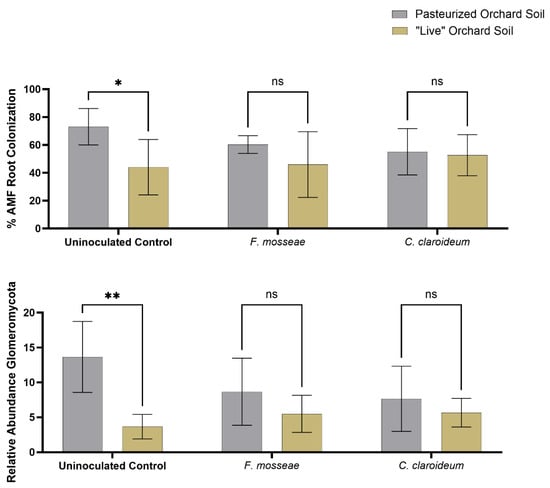
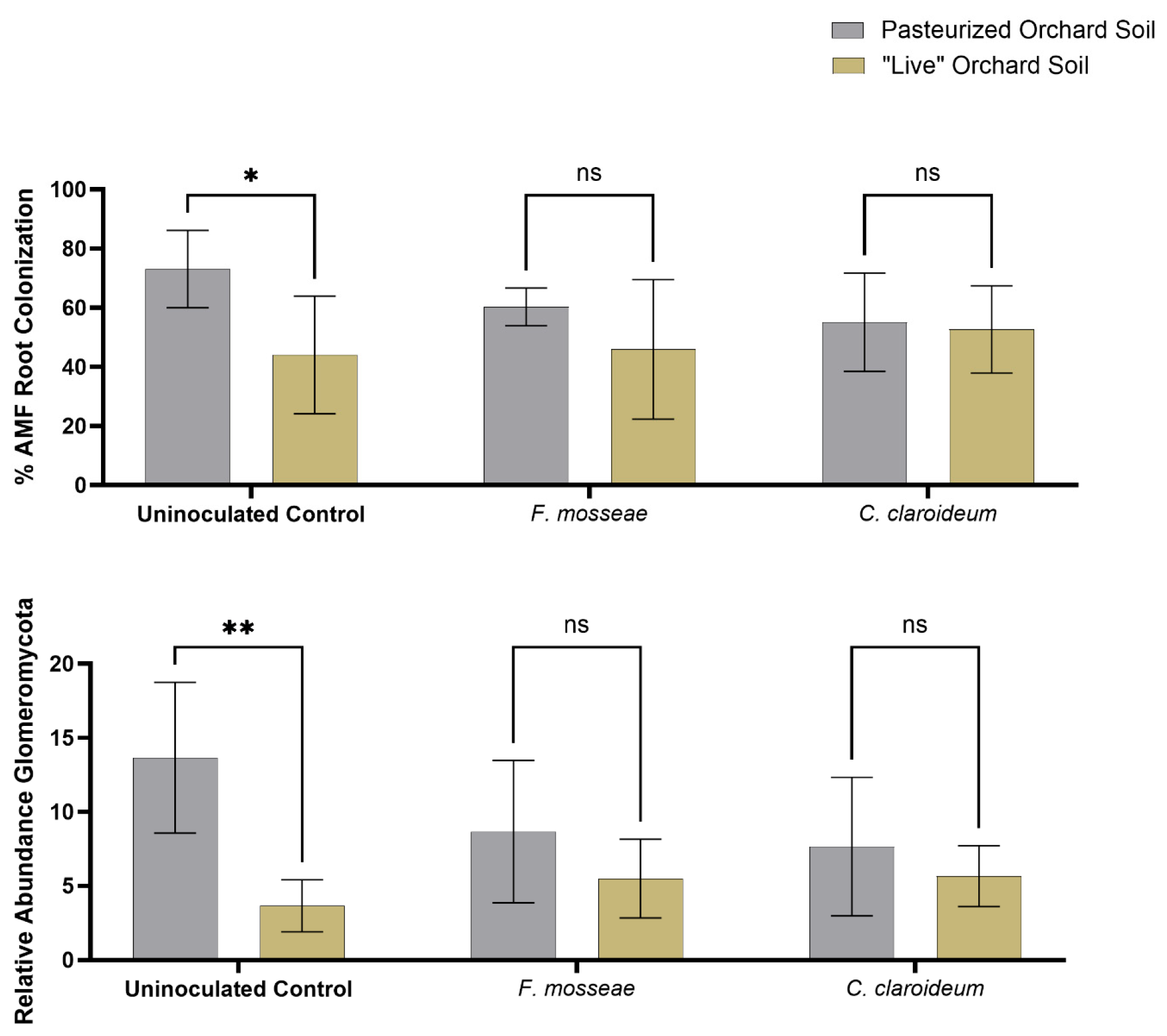
AMF colonization (greenhouse experiment): Upon harvest of the main experiment (8 weeks post-planting), AMF colonization was microscopically assessed in fresh root tissue. Across all treatments, average root colonization ranged between 40–70 and 25–60% in plants from TRECO and Cameron nurseries, respectively. Two-way ANOVA identified soil type (pasteurized vs. live) but not AMF treatment (uninoculated, F. mosseae, C. claroideum) as a significant source of variation (p = 0.0006) affecting the degree of colonization across apple rootstocks. In the TRECO × uninoculated control treatment, the percentage of root tissue colonized by AMF was significantly higher in pasteurized (74%) vs. live soil (44%) (Figure 3). Similarly, ITS amplicon sequencing indicated that Glomeromycota made up a significantly higher proportion of total fungal sequences recovered from the root tissue of plants cultivated in uninoculated × pasteurized (14%; TRECO) vs. uninoculated × live soil (4% TRECO) (Figure 3). However, when commercial inoculants were present, no significant differences in AMF percent colonization or relative abundance were observed between live vs. pasteurized treatments. Across pasteurized treatments, root colonization and relative abundance were generally lower (albeit not significant) when commercial inoculants were present (Figure 3). In comparison, when trees were sourced from a different nursery (Cameron), no significant differences in AMF percent colonization were identified between pasteurized vs. live treatments. However, it is interesting to note that, when cultivated in pasteurized soil, percent colonization was significantly greater in the +C. claroideum treatment relative to both the uninoculated control and +F. mosseae treatments (2-way ANOVA, Tukey’s multiple comparisons test; p = 0.04 and 0.009, respectively; Figure S2).
Figure 3.
(Top) The percentage of root tissue colonized by AMF after 8 weeks when G.11 (TRECO) rootstocks were cultivated in pasteurized (grey) vs. “live” (tan) orchard soil with or without AMF inoculant. (Bottom) The relative abundance of ITS sequences represented by the phylum Glomeromycota in the same set of treatments. Mann–Whitney tests (with Holm–Sidak correction for multiple tests) were used to check for significant differences between soil types within each AMF treatment (Uninoculated control, F. mosseae and C. claroideum); * = p < 0.05, ** = p < 0.01, ns = not significant.
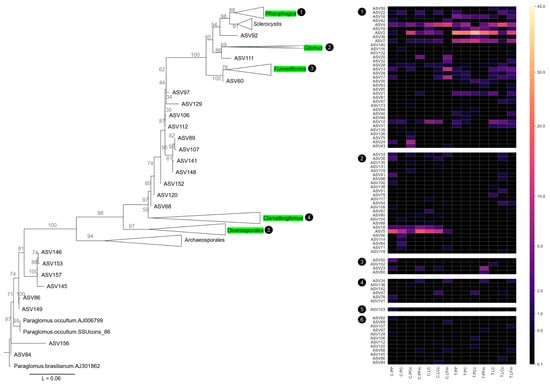
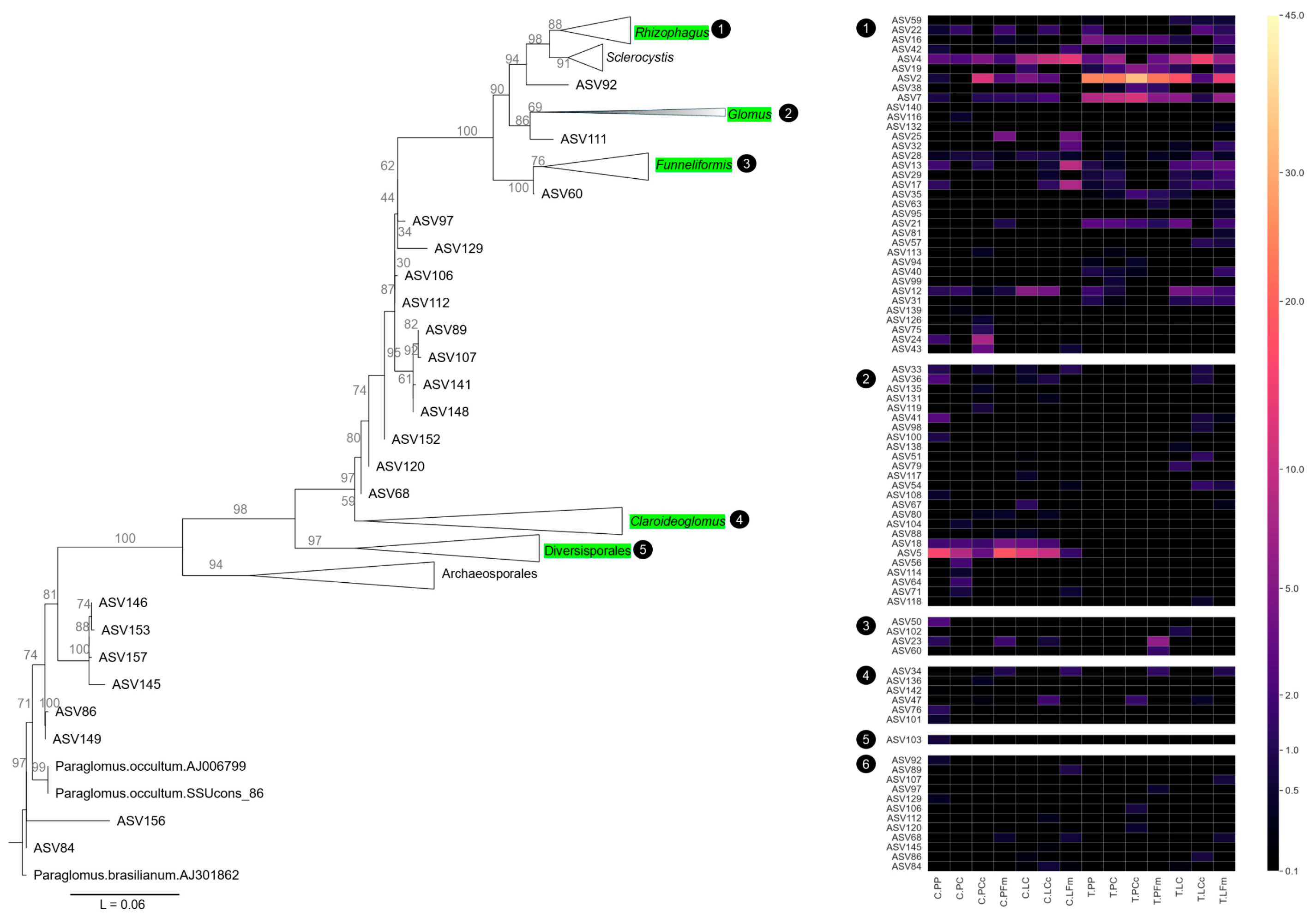
Summary of PacBio sequence data: Across all experimental samples, a total of 164 AMF 18S rRNA associated sequence variants (ASVs) were obtained after cleaning/de-noising. All samples had an adequate number of sequences, with the exception of sample B4 (T.L.C), which was excluded from further analysis. Median read length ranged from 800 to 802 bp (753 to 756 bp after primer removal). Pre-planting, a total of 28 and 43 Glomeromycotan ASVs were detected in G.11 rootstocks from TRECO and Cameron nurseries, respectively. The Cameron AMF community was more phylogenetically diverse than that of the TRECO rootstocks. For Cameron, the majority of ASVs were identified as Glomus spp. (58%; Clade 2; Figure 4). Other taxa represented included: Rhizophagus spp. (35%; Clade 1), Funneliformis (~4%; Clade 3), Claroideoglomus (~2%; Clade 4), and Diversispora (<1%; Clade 5). In comparison, all TRECO ASVs were identified as Rhizophagus spp. (Clade 1) (Figure 4). In general, pre-plant AMF communities were dominated by a handful of abundant ASVs. For TRECO rootstocks, ASVs 2, 3, 7, and 8 accounted for 60% of total sequences (25, 19, 8 and 8%, respectively). For Cameron rootstocks, ASVs 1, 5, 6 and 9 accounted for ~60% of total sequences (19, 16, 17, and 7%, respectively).
Figure 4.
(left) Maximum-likelihood phylogenetic tree for Phylum Glomeromycota used to track changes in nursery-derived AMF communities. Triangles represent clades that have been collapsed around reference sequences to better visualize tree structure; clades highlighted in green also contain ASVs identified in this study. Triangle height represents the number of sequences in the clade (except for the Glomus clade, which has been altered in the figure for readability). The triangle and branch lengths represent the expected number of nucleotide substitutions per site, with length (L) defined in the legend as 0.06. The true branch length of the Glomus clade is 0.474, or 7.9 × L. The skew of the Glomus branch was due to ASVs 158 and 163, which showed significant variation in the AML1/2 amplified region compared to other ASVs in the Glomus branch, including several large insertions (>100 bp). The full tree, without collapsed branches, is available in Figure S6. Bootstrap values are included at each node (representing the support for each branch), computed using two thousand replicates. (right) Heatmaps showing the average relative abundance of ASVs identified in the experimental samples that cluster within the major clades (labeled 1–5) and ASVs that do not cluster with these major clades (labeled 6). The color gradient represents the relative abundance of each ASV (the lighter the color, the more abundant the ASV). Values represent the mean of six biological replicates for each treatment. ASVs with very low average abundance across all treatment groups (<0.1) have been removed. For clades 1 and 2, the heatmaps were further simplified for readability by removing every other ASV; the full heatmaps are available in Figure S7. Experimental treatments are listed along the x-axis: T.PP and C.PP = pre-planting (PP) at TRECO (T) or Cameron (C); T.L.C and T.P.C = TRECO live (L) or pasteurized (P) control (C); C.L.C and C.P.C = Cameron live or pasteurized controls; T.L.Fm, T.P.Fm, C.L.Fm, and C.P.Fm = TRECO or Cameron and live or pasteurized, plus F. mosseae (Fm); T.L.Cc, T.P.Cc, C.L.Cc, and C.P.Cc = TRECO or Cameron and live or pasteurized, plus C. claroideum (Cc).
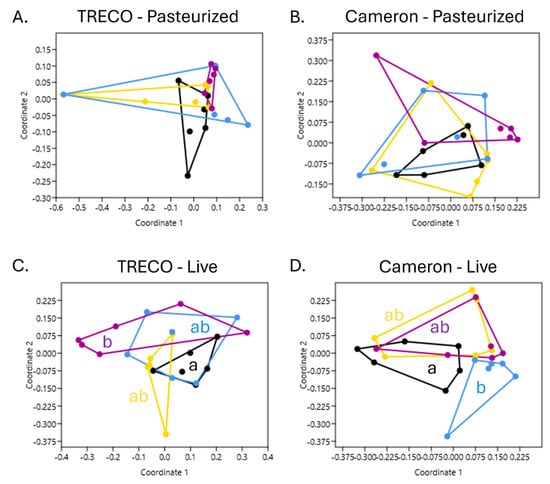
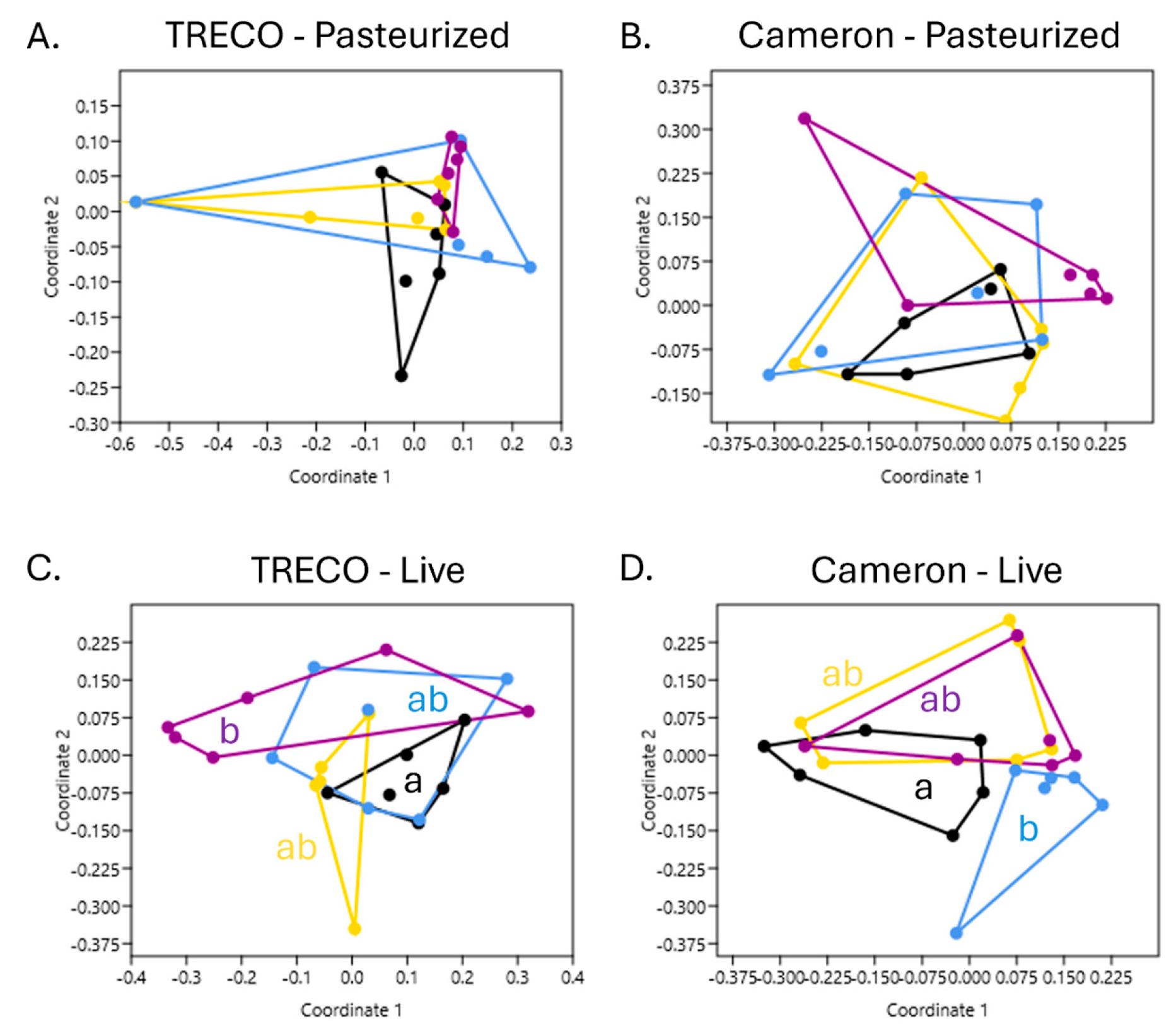
Ordination analysis of AMF community composition indicated that pre-plant AMF community structure was not significantly altered after planting into pasteurized soil, regardless of treatment or differences in starting community structure related to nursery origin (Figure 5A,B). When cultivated in live soil, AMF communities that developed after planting were only significantly altered when commercial inoculants were present, and these effects varied depending on starting community structure. In TRECO rootstocks, inoculation with C. claroideum (but not F. mosseae) significantly altered pre-established AMF community composition (Figure 5C; 1-way ANOSIM, p = 0.02), whereas inoculation with F. mosseae (but not C. claroideum) had a significant effect on the existing AMF community in rootstocks from Cameron nursery (Figure 5D, p = 0.02).
Figure 5.
Effect of different treatments on pre-established (nursery-derived) AMF community composition in apple rootstocks cultivated in either pasteurized (A,B) or live (C,D) orchard soil. G.11 rootstocks were obtained from either TRECO (A,C) or Cameron Nursery (B,D). Root tissue was collected prior to planting into orchard soil (pre-planting; black) and 2 months post-planting into either: uninoculated control soil (gold), soil inoculated with the AMF F. mosseae (blue), or soil inoculated with the AMF C. claroideum (purple). Convex hulls enclose all samples derived from the same soil treatments. Ordination of Glomeromycota (AMF) communities was conducted via NMDS analysis of amplicon sequence variant (ASV) data using the Bray–Curtis similarity coefficient. Letter groups indicate significant differences (p < 0.05) between treatments (1-way ANOSIM; Bray–Curtis similarity index, Bonferroni-corrected p-values).
As noted above, ASVs 2, 3, 7, and 8 were among the most dominant taxa in TRECO rootstocks pre-planting (all Rhizophagus spp.). Two months post-planting, ASVs 2 and 7 were still among the most dominant ASVs, except in the live × C. claroideum treatment. ASV 2 remained abundant in pasteurized soil (23–33%), was reduced to 17 and 13% in the live control and +F. mosseae treatments (respectively), but fell to ~2% in the live × C. claroideum treatment. A similar pattern occurred with ASV 7, which maintained levels close to pre-plant abundance (5–11%) in all treatments except live × C. claroideum (<1%). In comparison, ASV 3 persisted at relatively high abundance levels (8–16%) regardless of treatment. ASV 8 also remained relatively dominant in pasteurized soil (6–10%) but ranged from 1–3% in live soil treatments.
Among Clade 4 (Claroideoglomus spp.), ASV 47 (closest relative = C. luteum) was detected in all +C. claroideum treatments (C.P.Cc—0.1%, C.L.Cc—1.7%, T.P.Cc—1.5%, and T.L.Cc −0.4%, Table S2), indicating that this sequence was inoculant-derived. This sequence variant (ASV 47) was also the only Clade 4 representative detected in the TRECO × live × C. claroideum treatment, albeit only at ~0.4%. Consequently, the large drop in the relative abundance of ASV 2 and 7 following inoculation with C. claroideum (T.L.C. vs. T.L. Cc.) was not associated with an increase in Clade 4 ASVs. Instead, large increases in other, pre-established Rhizophagus spp. (esp. ASVs 1 and 4) appeared to be correlated with these losses (Figure S3). Interestingly, ASV 1 (4% pre-planting) represented 31% of the AMF community in the TRECO × live × C. claroideum treatment, 0% in the TRECO × pasteurized × C. claroideum treatment, and ranged from 9–15% in all other treatments. Similarly, ASV 4 (3% pre-planting) represented 14% in the TRECO × live × C. claroideum treatment, 0% in the pasteurized × C. claroideum treatment, and ranged from 3–8% in all other treatments. It is unclear why these particular ASVs were promoted in live soil +C. claroideum but disappeared completely in pasteurized soil +C. claroideum. Simple linear regression analysis identified negative correlations between ASV2 and 4 (R2 = 0.88) and ASV 1 and 7 (R2 = 0.68) across treatments, demonstrating the role of the inoculant in shifting the relative abundance of pre-existing AMF in either direction, depending on the microbial context (i.e., live vs. pasteurized soil).
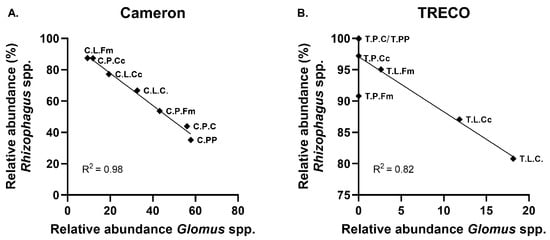
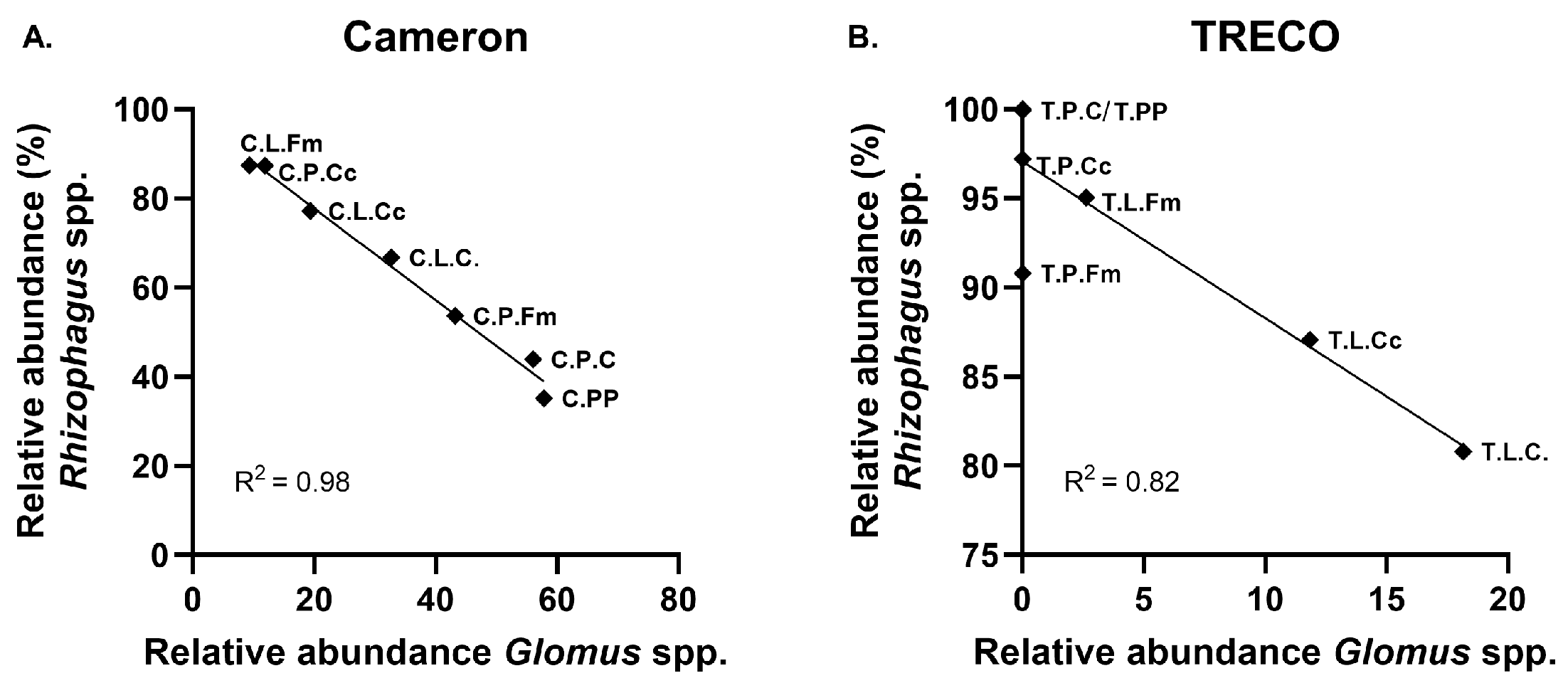
Regarding Cameron rootstocks, a handful of sequence variants, including ASV 1 (R. fasciculatus; Clade 1), ASV 5 (Glomus sp.; Clade 2), ASV 6 (G. iranicum) and ASV 9 (Glomus sp.), accounted for roughly 60% of total sequences pre-planting. These ASVs remained dominant across all or most treatments two months after planting. However, in general, there was a shift towards greater dominance by Rhizophagus spp. (vs. Glomus spp.) post-planting (Figure 6A). Although the extent of this shift varied by treatment, in most treatments, shifts were largely driven by pre-plant Rhizophagus ASVs becoming more prominent. For example, pre-planting, Rhizophagus spp. represented 35% of the AMF community. However, two months post-planting, the same group of ASVs represented 74, 71, 70, 59, 36 and 30% of all AMF ASVs in C.P.Cc, C.L.Cc, C.L.Fm, C.L.C, C.P.C, and C.P.Fm, respectively.
Figure 6.
Linear regression analysis showing a negative correlation between the relative abundance of Glomus and Rhizophagus spp. ASVs in G.11 rootstocks sourced from Cameron (A) and TRECO nurseries (B). Each point signifies the mean of a different treatment; n = 6 for each. The slope of the line is significantly non-zero in A and B (p = 0.005; p < 0.0001). Full label names are listed in Table 2.
In these same treatments (all from Cameron), other Rhizophagus ASVs (those not detected pre-planting) represented 13, 6, 17, 8, 8 and 24% of the AMF community in C.P.Cc, C.L.Cc, C.L.Fm, C.L.C, C.P.C, and C.P.Fm, respectively. Among these were three R. irregularis ASVs (14, 25, and 46) that only occurred in F. mosseae-inoculated treatments and accounted for ~17 and 15% of the AMF community in C.P.Fm and C.L.Fm, respectively (Table S2). ASV 14 was also detected in T.P.Fm (2%) and T.L.Fm (0.8%). In addition, ASV 34 (closest relative = C. etunicatum) was identified in all F. mosseae-inoculated treatments (C.P.Fm, C.L.Fm, T.P.Fm, and T.L.Fm, Table S2). The fact that these Rhizophagus and Claroideoglomus sequence variants were detected exclusively in F. mosseae-inoculated treatments strongly suggests that they were inoculant-derived. As has been documented in previous studies, what the manufacturer advertises is not always what is actually present [13]. It should be noted that ASV 60 (closest match F. mosseae) was detected in a single F. mosseae-inoculated treatment (T.P.Fm;~2%).
Although sequence variants present in both commercial inoculants formed relationships with rootstocks, inoculant AMF typically accounted for a relatively small percentage of all AMF species present (C.P.Cc—0.1%, C.P.Fm—18%, C.L.Cc—2%, C.L.Fm—15%; T.P.Cc—1.5%, T.P.Fm—6.5%, T.L.Cc—0.4%, and T.L.Fm—3%; Table S2). Despite complex interactions between pre-established AMF, inoculant AMF and native microbes present in live soil, AMF species established at the nursery represented the majority of all AMF species detected after planting, regardless of treatment (Table 3). Regarding TRECO rootstocks, AMF sequence variants that were detected pre-planting made up 82–95% (pasteurized treatments) and 80–86% (live treatments) of Glomeromycotan ASVs detected in apple roots 2 months post-planting. For rootstocks sourced from Cameron Nursery, pre-plant sequence variants comprised 73–83% (pasteurized treatments) and 74–91% (live treatments) of the AMF community post-planting (Table 3).
Table 3.
Percentage (%) of AMF that nursery-derived species made up (2 months post-planting).
As noted above, no Glomus spp. ASVs were detected in TRECO rootstocks prior to planting (T.PP) or following planting into pasteurized soil treatments (T.P.C, T.P.Cc and T.P.Fm). On the other hand, when plants were grown in live soil (T.L.C, T.L.Cc and T.L.Fm), several Glomus spp. ASVs were identified in root tissue. This result indicates that TRECO rootstocks established new relationships with several Glomus spp. present in live soil. Moreover, Glomus spp. relative abundance was higher in the live × uninoculated treatment (T.L.C.—18%) than in live soil treatments containing commercial inoculants (T.L.Cc—12% and T.L.Fm—3%). It is interesting to note that while TRECO rootstocks appeared to recruit Glomus spp. from live soil (resulting in decreased dominance of Rhizophagus) (Figure 6B), Rhizophagus spp. became more dominant in Cameron rootstocks after planting (Figure 6A, Table S2).
Finally, it should be mentioned that several “unknown” ASVs, whose sequences could not be assigned to any known taxonomic group (Figure 4, Group 6), were detected in live soil treatments. These included many ASVs closely related to Paraglomus spp. (e.g., ASVs 86, 149, 84, 156). Although the relative abundance of these sequences was relatively low across treatments (<2%), this finding is in alignment with other sequence-based studies in which Paraglomus spp. were detected in apple roots and orchard soil systems of Central Washington [17].
Plant growth: Two-way ANOVA identified soil type (pasteurized vs. live) and AMF treatment (uninoculated, F. mosseae, C. claroideum) as significant sources of variation affecting plant fresh weight across apple rootstocks (p < 0.0001 and 0.005, respectively). In addition, soil type was identified as a significant source of variation affecting leader shoot length (but not trunk diameter) (p = 0.006). Regarding plant fresh weight, growth was significantly stunted in live (replant disease-conducive) vs. pasteurized soil (Figure S4). In addition, the relative abundance of several fungal replant pathogens (incl. Rhizoctonia solani and Ilyonectria robusta) was higher when apple root tissue was cultivated in live soil (Figure S5). Leader shoot length and trunk diameter tended to be reduced in live vs. pasteurized soil treatments, although none of these differences were significant (Table S3). Interestingly, for Cameron rootstocks cultivated in pasteurized soil, tree fresh weight was significantly reduced in the +C. claroideum treatment relative to +F. mosseae and uninoculated control treatments (2-way ANOVA, Tukey’s multiple comparisons test; p = 0.0004 and p = 0.005, respectively), a result which may have been related to increased percent AMF colonization (Figure S2). No other significant differences in growth were identified between control and AMF-inoculated treatments.
4. Discussion
In this study, we constructed an AMF-specific phylogeny in order to characterize the communities present in root tissue and assess whether apple rootstocks serve as a significant source of inoculum from the nursery where they are produced. In this way, specific strains (ASVs) that existed prior to planting could be traced post-planting. We found that nursery-derived AMF made up the majority of AMF taxa that remained in root tissue post-planting. Regardless of soil treatment or differences in initial community composition prior to planting (i.e., TRECO vs. Cameron), AMF species pre-established at the nursery represented 73–96% of all AMF species actively colonizing roots 2 months after planting. These results support the hypothesis that AMF pre-established at the nursery had a “priority advantage” and corroborate earlier findings, in which commercial inoculant colonization potential was limited in a variety of apple rootstocks cultivated in pasteurized potting soil [13].
Interactions between pre-established AMF, inoculant AMF and native microbes present in live soil are complex and dynamic. One critical knowledge gap that has received more attention over the past decade is understanding the importance of the broader microbial community in modulating plant–AMF relationships [5,33]. Outcomes between existing root endophytic communities and biotic components in the soil will depend on the specific groups of microorganisms that are present, including mycorrhization helper bacteria and AMF antagonists [34,35]. In this study, significant changes in AMF community structure were identified post-planting into live (but not pasteurized) soil in two cases (TRECO × live +C. claroideum; Cameron × live +F. mosseae). Clearly, these compositional shifts were driven by collective interactions between pre-established microbes, indigenous soil microbes, and specific inoculants. Within TRECO rootstocks, compositional changes largely reflected shifts in the pool of dominant, pre-established AMF, whereas colonization by inoculant AMF (<1%) had less of a measurable impact on the general transformation of resident AMF communities established after planting (Table S2). Strong negative correlations between pre-existing R. fasciculatus ASVs were largely driven by soil microbial context (i.e., live vs. pasteurized) in combination with the presence of the C. claroideum inoculant (T.L.Cc vs. T.P.Cc) (Figure S3). A previous study in Medicago truncatula, which utilized taxon-specific qPCR assays, demonstrated strong competition between Claroideoglomus claroideum and Rhizophagus irregularis when inoculated simultaneously in sterilized substrate [34]. Interestingly, this scenario provided the greatest growth benefits to the host plant. As noted, microbial community dynamics, including interactions between AMF species/strains, are highly context-dependent. Under the conditions of our experiment, although competitive, facilitative and/or antagonistic interactions are likely to be occurring (esp. in live soil), specific interactions between AMF and other soil microbes remain unclear. Nevertheless, compensatory dynamics between closely-related root-associated AMF (even between members of the same species) may be one way in which the endosphere maintains stability in response to disturbances. In other words, surviving (or less-affected) resident species (i.e., ASVs 1 and 4) can increase activity or abundance to fill the gap left by a stressed or lost species (i.e., ASVs 2 and 7).
The ability to intensely and rapidly colonize roots is an important factor in determining the competitive ability of an AMF species [36]. In the bioassay with apple seedlings, colonization levels of the F. mosseae and C. claroideum inoculants were among the highest at both timepoints. In the current study, despite the fact that viable inoculant AMF was in direct contact with the root surface at planting, existing AMF populations (with an established symbiosis) tended to colonize new root tissue more effectively. That said, starting community structure related to nursery origin influenced the ability of commercially-available AMF to successfully compete with pre-established and/or native orchard AMF communities. In G.11 rootstocks from Cameron nursery, the majority of pre-plant ASVs were identified as Glomus spp. (58%). Post-planting, however, Rhizophagus spp., including pre-plant and inoculant-derived ASVs, increased in dominance, regardless of treatment (Figure 6A). In C.P.Fm and C.L.Fm treatments, inoculant-derived R. irregularis ASVs (14, 25, and 46) accounted for ~16 and 13% of the AMF community, respectively. This result suggests that the R. irregularis ASVs present in the “F. mosseae” inoculant were successful because they aligned with the plants’ functional needs. Along these same lines, in TRECO rootstocks, pre-plant AMF community composition was highly phylogenetically clustered (consisting only of closely-related Rhizophagus species) and Glomus spp. became more dominant after planting into live soil (T.L.C, T.L.Cc, and T.L.Fm). Because closely related AMF may be more functionally similar, having a diverse mix of AMF types likely increases functional diversity [37,38]. Thus, TRECO rootstocks may have been actively “recruiting” Glomus spp. from live soil (resulting in decreased dominance of pre-plant Rhizophagus spp.). Both Cameron and TRECO rootstocks also established new associations with several Paraglomus spp. present in live soil. As noted above, outcomes between pre-existing AMF communities and biotic components present in soil are strongly dependent upon the specific groups of microorganisms that are present.
A recent review, which examined results from several field studies specifically designed to investigate the effects of AMF inoculants on indigenous AMF assemblages, found that outcomes were highly varied and context-specific (ranging from no effects to either stimulation, suppression or exclusion) [39]. In the present study, in some cases, commercial inoculants appeared to inhibit colonization by indigenous AMF present in orchard soil. For example, the relative abundance of orchard-soil derived Glomus spp. was much lower in T.L.Cc and T.L.Fm than in T.L.C (Figure 6B). Despite this, inoculant-derived ASVs represented only 0.4 and 3.2% of the AMF community, respectively. This is consistent with a previous study in which indigenous AMF colonized the roots of apple seedlings more efficiently than commercial AMF inoculants [40]. In another study conducted with potato, researchers used qPCR to successfully quantify colonization by a specific, highly-infective strain of R. irregularis following inoculation into field soil (inoculation done at planting). Although the target isolate was detected in a handful of samples, the strain was largely absent in the roots while native R. irregularis strains were detected at high levels [41]. It is also worth noting that total AMF colonization of TRECO (but not Cameron) rootstocks tended to be reduced (relative to uninoculated controls) when commercial inoculants were added to pasteurized soil (Figure 3). This trend may be indicative of antagonistic interactions between introduced commercial inoculants and pre-established (nursery-derived) AMF, in which the resident AMF species experienced reduced intraradical growth as a result. In fact, there was a significant reduction in the relative abundance of pre-plant AMF in the +F. mosseae treatment (T.P. Fm) relative to the uninoculated control (T.P.C) (Kruskal–Wallis test, Dunn’s multiple comparisons test; p = 0.02). That said, the addition of commercial inoculants to pasteurized soil did not result in significant shifts in AMF community structure regardless of treatment or nursery origin. Thus, resident AMF community composition remained highly stable in the presence of both inoculants in pasteurized soil.
Standard nursery practice for cultivating fruit trees involves propagating rootstock material via mound or stool layering, in beds containing a mix of sawdust and orchard soil. To preserve plants during their dormant winter phase, this rootstock material is dug up in autumn and moved into cold storage (1–2 °C). Root endophytes likely persist (despite also becoming dormant) during this time. The results from this study suggest that, following planting in the spring, intraradical (internal) colonization by nursery-derived AMF developed relatively quickly, by way of older, higher-order roots from which new roots developed. This is not consistent with the process described in a study by Resendes et al. [42], which documented patterns of AMF and non-AMF colonization of new apple roots. In the Resendes study, fungal colonization was usually associated with hyphal penetration points (appressoria) and never developed intraradically by way of older, higher-order, and heavily colonized roots from which the new roots developed. One explanation for this discrepancy may be that effective colonization by soilborne mycorrhizae (native or introduced) requires the presence of newly-emerging roots. In the Resendes et al. study, roots of mature apple trees (20+ years old) were actively growing in an established hyphal network. However, rootstocks that have been in cold storage need time to transition out of physiological dormancy. Although internal vascular activity may rapidly resume, development/emergence of new root tissue (in fruit trees) typically does not occur until 2–3 weeks after spring planting. In newly planted trees, this lag time presents a disadvantage for invading species, whereas internal colonization by pre-existing AMF would be expected to occur during this time (prior to production of new root tissue). In a seminal study by Werner and Kiers [16], Medicago truncatula seedlings (with and without prior resident AMF) were inoculated with “invader” AMF in sterilized potting medium. The results demonstrated that both the presence of a resident species and a longer lag time to inoculation significantly decreased the abundance of the invading AMF, regardless of which AMF species was the resident vs. the invader.
Mycorrhizal colonization of plant roots also depends on orchard management practices, especially those impacting microbial diversity. For example, relative to live soil, pasteurized (or fumigated) soil would be expected to present a greater opportunity for root occupancy by nursery-derived and/or inoculant AMF, as these AMF would encounter less competition from a range of native soil microbes (e.g., non-mycorrhizal fungi/replant pathogens). This hypothesis was supported by the results of our study. Soil type (pasteurized vs. live), but not treatment (uninoculated, F. mosseae, C. claroideum), was identified as a significant source of variation affecting the degree of colonization across apple rootstocks; cultivation in live orchard soil tended to reduce overall AMF colonization. In TRECO rootstocks, the percentage of root tissue colonized by AMF (as well as the proportion of Glomeromycota relative to total fungi) was significantly higher in pasteurized than in live uninoculated controls. In addition, regardless of nursery location, the proportion of fungal replant pathogens was elevated in the roots of plants cultivated in live soil; plant growth was also stunted in live vs. pasteurized soil.
Although the overall percentage of root tissue colonized by AMF tended to be higher in pasteurized than in live soil, soil pasteurization did not appear to greatly improve the colonization ability of introduced AMF (Table S2). Despite the fact that the AMF inoculants used in this study represented highly promising/infective commercially available products, nursery-derived AMF associations tended to be maintained across both live and pasteurized treatments. In this study, pasteurization served as an experimental proxy for soil fumigation. Thus, unlike vegetable cropping systems replanted from seed, in fruit tree cropping systems, soil fumigation is unlikely to greatly improve the ability of introduced AMF inoculants to rapidly dominate the root systems of young trees.
Taken together, the results of our study highlight several aspects of AMF interaction dynamics (which are not necessarily mutually exclusive). As previously noted, due to the context-dependent nature of these interactions, the successful establishment, persistence, and benefits of AMF inoculants remain hard to predict. Although we are still developing an understanding of the stability and transformation of nursery-derived AMF communities under field-relevant conditions, the results of our study support the hypothesis that priority effects play a large role in structuring AMF communities in newly planted apple trees. The short-term nature of this study does not exclude the possibility that the success of nursery-derived AMF would decrease over a longer period of time. Although turnover times are highly variable, median apple root lifespan (during summer) is estimated to be between 15–28 days [42,43]. Therefore, some degree of root turnover would likely have occurred over the course of our study, particularly in live soil, where faster root turnover would be expected due to the activity of replant pathogens. Whether nursery-derived AMF are displaced by the existing orchard soil community as root systems mature/turnover is unknown.
In orchard systems, soils are typically tilled and/or fumigated shortly before planting. These practices can disrupt and/or destroy native AMF, reducing competitive advantages of resident communities which may be more compatible with the local environment [44,45,46]. Nursery-derived AMF likely aid the transition from nursery/storage to tree establishment in the field. Pre-established AMF may give new roots a “head-start” in terms of defense against soilborne pathogens and/or allow for faster development of external hyphal networks (which can benefit water and nutrient uptake). Only a handful of studies have been conducted using “native” AM fungi (isolated from local soil) as inoculum. One such study in apple showed that inoculation with indigenous AMF increased the biomass of M.9 plantlets, improved plant nitrogen and phosphorus content and promoted the production of plant defense-related enzymes in native replant soil [8].
In conclusion, our study demonstrates that manipulating and/or tailoring plant–AMF relationships at the nursery is a better approach than the application of AMF-based inoculants in the field. Pre-colonization at the nursery is likely to be the primary mechanism responsible for AM fungal community structure once trees are established in the field. Developing more effective management approaches might involve the use of native AMF (from the orchard location to be planted) as nursery inoculum. Considering current disconnects in practitioner behavior (i.e., using AMF-based inoculants in the field), these results could well be of value to growers, nursery producers and product manufacturers.
Supplementary Materials
The following supporting information can be downloaded at: https://www.mdpi.com/article/10.3390/horticulturae12111446/s1. Table S1. Most probable number (MPN) of viable infectious propagules of AMF inoculated with corn. Products/species are sorted from largest (most infectious) to smallest (least infectious). Table S2. Relative abundance of AMF ASVs likely to be inoculant-derived (i.e., detected exclusively in either +F. mosseae or +C. claroideum-inoculated treatments). Table S3. Plant growth characteristics measured at harvest (2 months post-planting). Values represent the mean followed by standard deviation in parentheses; n = 7 plants per treatment. Figure S1: Microscopic visualization of arbuscular mycorrhizal fungi stained with trypan blue in apple root. Red arrows indicate, from top to bottom: intracellular fungal hyphae, arbuscules, and vesicles. Scale bar = 100 µm. Figure S2. The percentage of root tissue colonized by AMF after 8 weeks when G.11 rootstocks from Cameron nursery were cultivated in pasteurized or live orchard soil with or without AMF inoculants (F. mosseae or C. claroideum). Two-way ANOVA followed by Tukey’s multiple comparisons test was used to identify significant differences between treatments within a particular soil type (as indicated by different letter groups). Figure S3. Linear regression analysis showing significant negative correlations between the relative abundance of different Rhizophagus spp. ASVs in G.11 rootstocks sourced from TRECO nursery. Each point signifies the mean of a different treatment (T.P.C., T.P.Cc, T.P.Fm, T.L.C, T.L.Cc, T.L.Fm; n = 6 for each). TRECO Pre-plant (T.PP) is shown in black for reference. For both plots, the slope of the line is significantly non-zero (p = 0.0018 and p = 0.02). Figure S4. Increase in plant fresh weight over the 8-week duration of the experiment. Bars show the mean (n = 7) and standard deviation. Significant differences between live vs. pasteurized soil are shown (single asterisk = p ≤ 0.05; ns = not significant; multiple Mann–Whitney tests with Holm–Šídák correction for multiple comparisons. Figure S5. Mean relative abundance of Rhizoctonia solani (A,C) and Ilyonectria robusta (B,D) fungal replant pathogens in root tissue of G.11 apple rootstocks across treatment groups, as detected by ITS amplicon sequencing. Pasteurized orchard soil = grey bars; Live orchard soil = black bars. Figure S6. Full maximum-likelihood phylogenetic tree inferred with 18S (SSU) rRNA Glomeromycotan reference sequences from Krueger et al., 2012 plus ASV sequences from this experiment. Figure S7. Full heatmap showing the average relative abundance of ASVs identified in the experimental samples. The color gradient represents the relative abundance of each ASV (the lighter the color, the more abundant the ASV). Values represent the mean of six biological replicates for each treatment.
Author Contributions
Conceptualization, T.S.; Methodology, C.C., H.Z. and T.S.; Formal Analysis, C.C., E.R.M., H.Z., T.S. and W.W.; Resources, H.Z., T.S. and W.W.; Writing—Original Draft Preparation, T.S.; Writing—Review & Editing, C.C., E.R.M., H.Z., T.S. and W.W.; Visualization, C.C., E.R.M., H.Z., T.S. and W.W.; Supervision, H.Z. and T.S.; Funding Acquisition, T.S. All authors have read and agreed to the published version of the manuscript.
Funding
This research was funded, in part, through a grant to T. Somera from the Washington State Tree Fruit Research Commission; Agreement No. 58-2094-2-005. Support for this research was also provided by the United States Department of Agriculture-Agricultural Research Service; National Program 303: Plant Diseases; Project # 2094-21220-002-000D.
Data Availability Statement
The original data presented in the study are openly available in NCBI SRA at PRJNA1522921, including 18S rRNA sequences and OTU read count tables generated using the Glomeromycota-specific primer set AML1/2. Any other data generated or analyzed during this study are included in the article/Supplementary Materials. Further inquiries can be directed to the corresponding author.
Acknowledgments
We thank Mark Mazzola for helpful advice and suggestions during grant proposal development and manuscript preparation. We also thank Amanda Jeffries, Hector Ortiz-Jeronimo, and Erick Rodriguez for their assistance in managing, harvesting, and processing experimental samples.
Conflicts of Interest
The authors declare no conflicts of interest.
References
- Berdeni, D.; Cotton, T.E.A.; Daniell, T.J.; Bidartondo, M.I.; Cameron, D.D.; Evans, K.L. The effects of arbuscular mycorrhizal fungal colonization on nutrient status, growth, productivity, and canker resistance of apple (Malus pumila). Front. Microbiol. 2018, 9, 1461. [Google Scholar] [CrossRef] [Scilit] [PubMed]
- Cook, C.; Huskey, D.; Mazzola, M.; Somera, T. Effect of rootstock genotype and arbuscular mycorrhizal fungal (AMF) species on early colonization of apple. Plants 2024, 13, 1388. [Google Scholar] [CrossRef] [Scilit] [PubMed]
- Camuy-Velez, L.; Chakraborty, D.; Young, A.; Paudel, S.; Elvers, R.; Vanderhyde, M.; Walter, K.; Herzog, C.; Banerjee, S. Context-dependent contributions of arbuscular mycorrhizal fungi to host performance under global change factors. Soil Biol. Biochem. 2025, 204, 109707. [Google Scholar] [CrossRef] [Scilit]
- Cucu, M.A.; Valeria, T.; Carnevali, P.; Ghizzoni, R.; Caterina, M. Cereal health regulation by arbuscular mycorrhizal fungi (AMF): Insights from tripartite plant–AMF–pathogen systems within the One Health framework. Agronomy 2026, 16, 621. [Google Scholar] [CrossRef] [Scilit]
- Guan, S.; Shao, X.; Liu, R.; Ge, J.; Song, G.; Yang, Z. Interactions Between Mycorrhizal Fungi and Mycorrhiza Helper Bacteria: Mechanisms, Ecological Functions, and Potential Applications in Sustainable Agriculture and Ecological Restoration. Sustainability 2026, 18, 5643. [Google Scholar] [CrossRef] [Scilit]
- Gąstoł, M.; Domagała-Świątkiewicz, I. Mycorrhizal inoculation of apple in replant soils–enhanced tree growth and mineral nutrient status. Acta Sci. Pol. Hortorum Cultus 2015, 14, 17–37. [Google Scholar]
- Cavael, U.; Lentzsch, P.; Schwärzel, H.; Eulenstein, F.; Tauschke, M.; Diehl, K. Assessment of agro-ecological apple replant disease (ARD) management strategies: Organic fertilization and inoculation with mycorrhizal fungi and bacteria. Agronomy 2021, 11, 272. [Google Scholar] [CrossRef] [Scilit]
- Wang, M.; Zhang, R.; Zhao, L.; Wang, H.; Chen, X.; Mao, Z.; Yin, C. Indigenous arbuscular mycorrhizal fungi enhance resistance of apple rootstock ‘M9T337’ to apple replant disease. Physiol. Mol. Plant Pathol. 2021, 116, 101717. [Google Scholar] [CrossRef] [Scilit]
- Bokszczanin, K.L.; Wrona, D.; Przybyłko, S. The effect of microbial inoculation under various nitrogen regimes on the uptake of nutrients by apple trees. Agronomy 2021, 11, 2348. [Google Scholar] [CrossRef] [Scilit]
- Passey, T.; Robinson-Boyer, L.; Jackson, R.; Zhou, J.; Xu, X. Microbial soil amendment to improve apple tree establishment following planting. Technol. Hortic. 2025, 6, e004. [Google Scholar] [CrossRef] [Scilit]
- Deakin, G.; Passey, T.; Fagg, G.; Robinson-Boyer, L.; Bickel, S.; Xu, X. Metataxonomic analysis revealed the lack of long-term effects of microbial soil amendments on apple rhizosphere microbial community structure. Front. Hortic. 2026, 5, 1821219. [Google Scholar] [CrossRef] [Scilit]
- Krüger, M.; Krüger, C.; Walker, C.; Stockinger, H.; Schüßler, A. Phylogenetic reference data for systematics and phylotaxonomy of arbuscular mycorrhizal fungi from phylum to species level. New Phytol. 2012, 193, 970–984. [Google Scholar] [CrossRef] [Scilit] [PubMed]
- Zhang, H.; Wang, W.; Honnas, L.; Mazzola, M.; Somera, T. Evaluating the stability of nursery-established arbuscular mycorrhizal fungal associations in apple rootstocks. Appl. Environ. Microbiol. 2024, 91, e01937-24. [Google Scholar] [CrossRef] [Scilit] [PubMed]
- Dickie, I.A.; Fukami, T.; Wilkie, J.P.; Allen, R.B.; Buchanan, P.K. Do assembly history effects attenuate from species to ecosystem properties? A field test with wood-inhabiting fungi. Ecol. Lett. 2012, 15, 133–141. [Google Scholar] [CrossRef] [Scilit] [PubMed]
- Verbruggen, E.; van der Heijden, M.G.A.; Rillig, M.C.; Kiers, E.T. Mycorrhizal fungal establishment in agricultural soils: Factors determining inoculation success. New Phytol. 2013, 197, 1104–1109. [Google Scholar] [CrossRef] [Scilit] [PubMed]
- Werner, G.D.A.; Kiers, E.T. Order of arrival structures arbuscular mycorrhizal colonization of plants. New Phytol. 2015, 205, 1515–1524. [Google Scholar] [CrossRef] [Scilit] [PubMed]
- Van Horn, C.; Somera, T.S.; Mazzola, M. Comparative analysis of the rhizosphere and endophytic microbiomes across apple rootstock genotypes in replant orchard soils. Phytobiomes J. 2021, 5, 231–243. [Google Scholar] [CrossRef] [Scilit]
- Somera, T.S.; Freilich, S.; Mazzola, M. Comprehensive analysis of the apple rhizobiome as influenced by different Brassica seed meals and rootstocks in the same soil/plant system. Appl. Soil Ecol. 2021, 157, 103766. [Google Scholar] [CrossRef] [Scilit]
- Turrini, A.; Agnolucci, M.; Palla, M.; Tomé, E.; Tagliavini, M.; Scandellari, F.; Giovannetti, M. Species diversity and community composition of native arbuscular mycorrhizal fungi in apple roots are affected by site and orchard management. Appl. Soil Ecol. 2017, 116, 42–54. [Google Scholar] [CrossRef] [Scilit]
- Van Geel, M.; Ceustermans, A.; Van Hemelrijck, W.; Lievens, B.; Honnay, O. Decrease in diversity and changes in community composition of arbuscular mycorrhizal fungi in roots of apple trees with increasing orchard management intensity across a regional scale. Mol. Ecol. 2015, 24, 941–952. [Google Scholar] [CrossRef] [Scilit] [PubMed]
- Cochran, W.G. Estimation of bacterial densities by means of the most probable number. Biometrics 1950, 6, 105–116. [Google Scholar] [CrossRef] [Scilit]
- Phillips, J.M.; Hayman, D.S. Improved procedures for clearing roots and staining parasitic and vesicular-arbuscular mycorrhizal fungi for rapid assessment of infection. Trans. Br. Mycol. Soc. 1970, 55, 158-IN18. [Google Scholar] [CrossRef] [Scilit]
- Habte, M.; Osorio, N.W. Arbuscular Mycorrhizas: Producing and Applying Arbuscular Mycorrhizal Inoculum; College of Tropical Agriculture and Human Resources, University of Hawaiʻi at Mānoa: Honolulu, HI, USA, 2001. [Google Scholar]
- Cook, C.; Buchanan, S.; Heller, W.; Kalcsits, L.A.; Somera, T. Assessing functional benefits of specific apple rootstock/AMF associations within context-dependent frameworks. Front. Plant Sci. 2026, 17, 1914090. [Google Scholar] [CrossRef] [Scilit] [PubMed]
- McGonigle, T.P.; Miller, M.H.; Evans, D.G.; Fairchild, G.L.; Swan, J.A. A new method which gives an objective measure of colonization of roots by vesicular-arbuscular mycorrhizal fungi. New Phytol. 1990, 115, 495–501. [Google Scholar] [CrossRef] [Scilit] [PubMed]
- Somera, T.; Mazzola, M.; Cook, C. Directing the apple rhizobiome toward resiliency post-fumigation. Agriculture 2023, 13, 2104. [Google Scholar] [CrossRef] [Scilit]
- Mazzola, M.; Hewavitharana, S.S.; Strauss, S.L. Brassica seed meal soil amendments transform the rhizosphere microbiome and improve apple production through resistance to pathogen reinfestation. Phytopathology 2015, 105, 460–469. [Google Scholar] [CrossRef] [Scilit] [PubMed]
- Lee, J.; Lee, S.; Young, J.P. Improved PCR primers for the detection and identification of arbuscular mycorrhizal fungi. FEMS Microbiol. Ecol. 2008, 65, 339–349. [Google Scholar] [CrossRef] [Scilit] [PubMed]
- White, T.J.; Bruns, T.; Lee, S.; Taylor, J. Amplification and direct sequencing of fungal ribosomal RNA genes for phylogenetics. In PCR Protocols: A Guide to Methods and Applications; Innis, M.A., Gelfand, D.H., Sninsky, J.J., White, T.J., Eds.; Academic Press: San Diego, CA, USA, 1990; pp. 315–322. [Google Scholar]
- Thiéry, O.; Vasar, M.; Jairus, T.; Davison, J.; Roux, C.; Kivistik, P.-A.; Metspalu, A.; Milani, L.; Saks, Ü.; Moora, M.; et al. Sequence variation in nuclear ribosomal small subunit, internal transcribed spacer and large subunit regions of Rhizophagus irregularis and Gigaspora margarita is high and isolate-dependent. Mol. Ecol. 2016, 25, 2816–2832. [Google Scholar] [CrossRef] [Scilit] [PubMed]
- Waskom, M.L. Seaborn: Statistical data visualization. J. Open Source Softw. 2021, 6, 3021. [Google Scholar] [CrossRef] [Scilit]
- Katoh, K.; Standley, D.M. MAFFT multiple sequence alignment software version 7: Improvements in performance and usability. Mol. Biol. Evol. 2013, 30, 772–780. [Google Scholar] [CrossRef] [Scilit] [PubMed]
- Duan, S.; Feng, G.; Limpens, E.; Bonfante, P.; Xie, X.; Zhang, L. Cross-kingdom nutrient exchange in the plant–arbuscular mycorrhizal fungus–bacterium continuum. Nat. Rev. Microbiol. 2024, 22, 773–790. [Google Scholar] [CrossRef] [Scilit] [PubMed]
- Thonar, C.; Frossard, E.; Šmilauer, P.; Jansa, J. Competition and facilitation in synthetic communities of arbuscular mycorrhizal fungi. Mol. Ecol. 2014, 23, 733–746. [Google Scholar] [CrossRef] [Scilit] [PubMed]
- Svenningsen, N.B.; Watts-Williams, S.J.; Joner, E.J.; Battini, F.; Efthymiou, A.; Cruz-Paredes, C.; Nybroe, O.; Jakobsen, I. Suppression of the activity of arbuscular mycorrhizal fungi by the soil microbiota. ISME J. 2018, 12, 1296–1307. [Google Scholar] [CrossRef] [Scilit] [PubMed]
- Bennett, A.E.; Bever, J.D. Trade-offs between arbuscular mycorrhizal fungal competitive ability and host growth promotion in Plantago lanceolata. Oecologia 2009, 160, 807–816. [Google Scholar] [CrossRef] [Scilit] [PubMed]
- Maherali, H.; Klironomos, J.N. Phylogenetic and trait-based assembly of arbuscular mycorrhizal fungal communities. PLoS ONE 2012, 7, e36695. [Google Scholar] [CrossRef] [Scilit] [PubMed]
- Mummey, D.L.; Antunes, P.M.; Rillig, M.C. Arbuscular mycorrhizal fungi pre-inoculant identity determines community composition in roots. Soil Biol. Biochem. 2009, 41, 1173–1179. [Google Scholar] [CrossRef] [Scilit]
- Basiru, S.; Hijri, M. The potential applications of commercial arbuscular mycorrhizal fungal inoculants and their ecological consequences. Microorganisms 2022, 10, 1897. [Google Scholar] [CrossRef] [Scilit] [PubMed]
- Ceustermans, A.; Van Hemelrijck, W.; Van Campenhout, J.; Bylemans, D. Effect of arbuscular mycorrhizal fungi on Pratylenchus penetrans infestation in apple seedlings under greenhouse conditions. Pathogens 2018, 7, 76. [Google Scholar] [CrossRef] [Scilit] [PubMed]
- Buysens, C.; Alaux, P.L.; César, V.; Huret, S.; Declerck, S.; Cranenbrouck, S. Tracing native and inoculated Rhizophagus irregularis in three potato cultivars grown under field conditions. Appl. Soil Ecol. 2017, 115, 1–9. [Google Scholar] [CrossRef] [Scilit]
- Resendes, M.L.; Bryla, D.R.; Eissenstat, D.M. Early events in the life of apple roots: Variation in root growth rate is linked to mycorrhizal and nonmycorrhizal fungal colonization. Plant Soil 2008, 313, 175–186. [Google Scholar] [CrossRef] [Scilit]
- Eissenstat, D.M.; Yanai, R.D. The ecology of root lifespan. In Advances in Ecological Research; Begon, M., Fitter, A.H., Eds.; Academic Press, Inc.: San Diego, CA, USA; London, UK, 1997; Volume 27, pp. 1–60. [Google Scholar] [CrossRef] [Scilit]
- Brito, I.; Goss, M.J.; De Carvalho, M.; Chatagnier, O.; Van Tuinen, D. Impact of Tillage System on Arbuscular Mycorrhiza Fungal Communities in the Soil under Mediterranean Conditions. Soil Tillage Res. 2012, 121, 63–67. [Google Scholar] [CrossRef] [Scilit]
- Brito, I.; Goss, M.J.; De Carvalho, M. Effect of tillage and crop on arbuscular mycorrhiza colonization of winter wheat and triticale under Mediterranean conditions. Soil Use Manag. 2012, 28, 202–208. [Google Scholar] [CrossRef] [Scilit]
- Zhang, X.; Xue, C.; Fang, D.; He, X.; Wei, M.; Zhuo, C.; Jin, J.; Shen, B.; Li, R.; Ling, N.; et al. Manipulating the soil microbiomes during a community recovery process with plant beneficial species for the suppression of Fusarium wilt of watermelon. Amb. Express 2021, 11, 87. [Google Scholar] [CrossRef] [Scilit] [PubMed]

Disclaimer/Publisher’s Note: The statements, opinions and data contained in all publications are solely those of the individual author(s) and contributor(s) and not of MDPI and/or the editor(s). MDPI and/or the editor(s) disclaim responsibility for any injury to people or property resulting from any ideas, methods, instructions or products referred to in the content. |
© 2026 by the authors. Licensee MDPI, Basel, Switzerland. This article is an open access article distributed under the terms and conditions of the Creative Commons Attribution (CC BY) license.