


Abstract
The IQ67-domain (IQD) gene family is a plant-specific protein family involved in calcium signaling, microtubule dynamics, and organ morphogenesis, with documented roles in fruit shape regulation in several crops. However, little is known about this family in eggplant (Solanum melongena L.), a globally important vegetable with remarkable fruit shape diversity. In this study, we performed a genome-wide identification of the IQD family in eggplant and characterized the function of SmIQD9 in fruit shape regulation. A total of 30 IQD genes were identified in the eggplant genome and designated SmIQD1 to SmIQD30. These genes were unevenly distributed across 10 chromosomes, with segmental duplication serving as the primary driver of family expansion. Phylogenetic analysis classified the IQD proteins from eggplant, Arabidopsis, rice, and tomato into eight groups, revealing both conserved and lineage-specific subgroups. Gene structure and motif analyses showed that SmIQD proteins share the conserved IQ67-domain but exhibit substantial structural diversity, with subfamily-specific motifs suggesting functional specialization. Expression profiling in developing ovaries revealed three distinct expression clades, with Clade C2 members—including SmIQD9—showing a transient peak at 10 or 7 DBA (days before anthesis), coinciding with the critical window for fruit shape determination. Ectopic overexpression of SmIQD9 in tomato resulted in significantly elongated fruits, reduced fruit width, and increased fruit shape index. Histological analysis demonstrated that SmIQD9 promotes fruit elongation primarily by enhancing cell expansion. Collectively, our findings provide a comprehensive genomic framework for the IQD family in eggplant and identify SmIQD9 as one of the positive regulators of fruit elongation, offering a promising candidate for future molecular breeding of eggplant fruit shape.
1. Introduction
IQ67-domain (IQD) genes constitute a plant-specific protein family characterized by the presence of a conserved IQ67-domain [1]. This IQ67-domain is characterized as a 67–amino acid segment containing repeated IQ, 1–5–10, and 1–8–14 calmodulin-binding motifs [2]. IQDs are increasingly recognized as being associated with calcium signaling, microtubule dynamics, plant development, and abiotic stress responses in both monocot and dicot species [3]. With the advancement of genomics, the IQD gene family has been comprehensively characterized in numerous plant species. Genome-wide analyses identified 33 IQD genes in Arabidopsis and 29 in rice [2]. Subsequently, this family has been reported in multiple crops, including tomato [4], cucumber [5], grape [6], wheat [3,7], and maize [8]. The IQD family sizes vary widely across plant genomes, ranging from 20 to 60 members, and show marked expansion in polyploid crops such as wheat [9], indicating that the IQD gene family has undergone varying degrees of duplication and functional divergence during plant evolution.
Numerous studies have demonstrated that the IQD gene family is crucial for plant growth and development. It is primarily involved in the dynamic reorganization and structural stabilization of the cytoskeleton, functions as a key mediator of calcium signal transduction, and integrates hormone signaling networks, thereby jointly regulating cellular activities and organ formation [10,11,12]. For instance, the Arabidopsis IQD5 can directly bind to microtubules and prevent their random depolymerization, thereby regulating cortical microtubule dynamics and the morphogenesis of pavement cells [12,13].
Fruit shape is one of the most important agronomic traits in horticultural crops. It not only directly determines commercial appearance and market value, but is also closely related to yield formation, processing suitability, and mechanical harvest efficiency [14,15,16]. The IQD protein family is crucial for controlling fruit shape in plants. In tomato, SUN is an IQD family member that regulates cell division patterns during fruit development [17,18]. Overexpression of SlSUN leads to extremely elongated fruits [17]. In watermelon, ClFS1 was mapped to a major locus on chromosome 3, and a 159 bp deletion in the IQD gene Cla011257 cosegregated with fruit shape [19]. ClIQD24 shows strong expression at 0 days after pollination, and its ectopic overexpression in tomato enhances fruit elongation [20]. In rice, OsIQD14 has been characterized as an IQD protein that associates with microtubules and is strongly expressed in hull cells. Disruption of OsIQD14 function produces seeds that are shorter and broader with increased mass, whereas OsIQD14 overexpression generates seeds that are longer and narrower without altering seed weight [21]. In pepper, CaSUN29 has been identified as an important gene controlling fruit length. It is specifically expressed at early stages of fruit development, affects cell expansion in the pericarp, and thereby influences fruit elongation [22]. Taken together, these studies suggest that IQD genes play conserved roles in controlling fruit morphology in plants. Clarifying the functions of the IQD gene family is of considerable theoretical and practical importance for advancing our understanding of the mechanisms underlying fruit shape regulation and for informing molecular breeding efforts.
Eggplant (Solanum melongena L.) is among the most economically important crops in the Solanaceae family and contributes substantially to global vegetable production. It displays a wide range of fruit shapes, which have been classified into 13 distinct categories [23]. This diversity is practically important because fruit shape influences market categories, consumer choices, variety identification, and breeding goals across different regions [23]. Although the mechanisms underlying fruit-shape regulation have been elucidated relatively systematically in closely related species such as tomato, such research in eggplant remains limited. To date, only a few candidate SUN/IQD genes associated with fruit shape have been reported in eggplant. For example, QTL-seq analysis identified a fruit-length QTL on chromosome 3, for which two IQD genes were proposed as candidate genes [24]. Further fine mapping indicated that Smechr0302217 is the best candidate gene regulating fruit elongation through promoting cell expansion in eggplant [25]. Despite extensive studies of IQDs in many plant species, little is known about this gene family in eggplant. Considering the important roles of IQDs in regulating fruit shape, there is an urgent need to identify IQDs and to characterize their roles in eggplant.
In the present study, we performed a genome-wide identification and characterization of the IQD gene family in eggplant. We analyzed the phylogenetic relationships, gene structures, conserved motifs, chromosomal distribution, and syntenic relationships of the 30 identified SmIQD genes. We further examined their expression profiles during early ovary development and selected SmIQD9, a C2 member with a transient expression peak before anthesis, for functional analysis via ectopic overexpression in tomato. Our findings demonstrate that SmIQD9 acts as a positive regulator of fruit elongation by enhancing cell expansion, offering functional evidence that IQD family members participate in controlling eggplant fruit shape.
2. Materials and Methods
2.1. Identification of IQD Genes in the Eggplant Genome
The eggplant reference genome sequence, genome annotation file (GFF), and predicted protein sequences were downloaded from the Eggplant Genome Database (Eggplant-HQ V2.0) (http://210.22.121.250:8888/Eggplant/download/download) (accessed on 2 September 2025). Protein sequences of Arabidopsis (TAIR10), rice (MSU RGAP 7.0), and tomato (ITAG4.1) were obtained from the TAIR (https://www.arabidopsis.org/) (accessed on 2 September 2025) and EnsemblPlants (https://jun2026-plants.ensembl.org/index.html) (accessed on 2 September 2025) databases. IQD proteins from Arabidopsis, rice, and tomato served as query sequences and were searched against the eggplant proteome using the BLASTP tool in TBtools (V2.376), with the E-value cutoff set to 1 × 10⁻⁵. Notably, although Abel et al. (2005) reported 29 rice IQD members based on the retired TIGR v4 annotation [2], OsIQD27 (Os03m06210) and OsIQD29 (Os04m42730) are no longer maintained as valid protein-coding models in the MSU RGAP 7.0 annotation. Similarly, Huang et al. [4] identified 34 tomato SlSUN/IQD genes using the SL2.40/ITAG2.3 annotation. In this study, 31 tomato IQD genes were used based on the updated SL4.0/ITAG4.1 annotation, because five of the previously reported members (SlSUN4, SlSUN6, SlSUN9, SlSUN10 and SUN) could not be mapped to valid gene models. In addition, two new members with a complete IQ67 domain (Solyc02g083285 and Solyc03g032243) were identified, and the 31 genes are listed in Table S1.
The candidate eggplant proteins were subsequently examined for the presence of the conserved IQ67-domain using Pfam, SMART, and the NCBI Conserved Domain Database (CDD). Only those proteins that consistently contained the canonical IQ67-domain across all three domain-analysis platforms were designated as SmIQD family members.
2.2. Phylogenetic Analysis of the IQD Gene Family
To explore the evolutionary relationships among IQD proteins, IQD protein sequences from eggplant, Arabidopsis, rice, and tomato were aligned with MUSCLE in MEGA 12. Phylogenetic trees were constructed with the Neighbor-Joining method using the Poisson correction model, and the reliability of individual branches was assessed by bootstrap analysis with 1000 replicates. The final alignment length was 1267 amino acids. All other parameters, including the handling of gaps and missing data, followed the default settings of MEGA 12 unless stated otherwise.
2.3. Gene Structure Analysis and Conserved Motif Recognition
The web-based bioinformatics tool GSDS (available online: http://gsds.cbi.pku.edu.cn/) (accessed on 9 October 2025) was used to analyze the gene structures of the SmIQD genes. Conserved motif identification was performed using MEME (Multiple Expectation Maximization for Motif Elicitation) (https://meme-suite.org/meme/) (accessed on 12 October 2025).
2.4. Syntenic Analysis of IQDs
Comparative synteny analysis was performed to investigate the evolutionary conservation and genomic relationships of IQD genes between eggplant and three other plant species, Arabidopsis, rice, and tomato. Genome sequences, predicted protein sequences, and corresponding GFF annotation files of the four species were used for the analysis. Pairwise syntenic relationships were identified using the One Step MCScanX Super Fast pipeline implemented in TBtools. Pairwise analyses were conducted independently for eggplant versus Arabidopsis, eggplant versus tomato, and eggplant versus rice. The resulting control, annotation, and collinearity files were subsequently used for downstream visualization and analysis.
For synteny visualization, GFF files and collinearity files derived from pairwise comparative analyses were imported and processed via the Multiple Synteny Plot module in TBtools. Graphical parameters, such as chromosome display mode, figure size, and line width, were fine-tuned to achieve clear visualization of conserved syntenic blocks and orthologous relationships among IQD genes.
2.5. Expression Analysis of SmIQD Genes During Ovary Development
To reveal the expression patterns of SmIQD genes during early fruit development, we analyzed the RNA-seq data generated in our previous study [26]. The eggplant inbred line ‘14-345’, which produces round and purple-black fruits, was used as the plant material. Young flower buds (YB) and developing ovaries at 10 DBA (days before anthesis), 7 DBA and 0 DPA (days post anthesis) were collected with three or four biological replicates for each tissue. Total RNA was extracted, and cDNA library construction and sequencing were performed by the Novogene Bioinformatics Technology Co., Ltd. (Beijing, China) on the Illumina HiSeq 4000 platform (Illumina Inc., San Diego, CA, USA). Clean reads were aligned to the eggplant reference genome ‘HQ-1315’ [24] using HISAT2, and transcript abundances were quantified and normalized as transcripts per million (TPM) using StringTie. For each SmIQD gene, the mean TPM value of the biological replicates was calculated for each developmental stage. The heatmap and hierarchical clustering of the 30 SmIQD genes across the four developmental stages were generated using the HeatMap tool of TBtools [27].
2.6. Construction of Overexpression Vector of SmIQD9 and Transformation of Tomato
The coding sequence (CDS) of SmIQD9 was cloned into the pBWA(V)H2S vector, and the resulting construct was transformed into Agrobacterium tumefaciens strain GV3101. The overexpression vector pBWA(V)H2S-SmIQD9 was transformed into tomato (Microtom) via Agrobacterium-mediated transformation. All plants were grown under the conditions of 16 h light at 28 °C/8 h dark at 24 °C. Phenotypic analyses were carried out on the fruits, leaves and ovaries of the transgenic plants. The expression levels of genes were analyzed by RT-qPCR. Tomato Clathrin adaptor complexes medium subunit (CAC; Solyc08g006960) was used as the internal reference gene, and Microtom (WT) served as the control. RT-qPCR analysis was carried out with three biological replicates and three technical replicates. The relative expression levels of genes were calculated by the 2−∆∆Ct method. The primers used for the identification of transgenic plants and RT-qPCR are listed in Table S2.
2.7. Histological Analysis
Ovaries at 0 DPA (days post anthesis) were collected and fixed in formalin-acetic acid-alcohol (FAA) solution, followed by dehydration in a graded ethanol series (70%, 80%, 95%, and three changes in absolute ethanol) for 1.5 h per step. The tissues were cleared sequentially in ethanol-xylene mixture (1:1) and two changes in pure xylene for 1 h per step. Gradient paraffin infiltration was performed at increasing temperatures: 30% paraffin-xylene solution at 35 °C for 5 h, 50% paraffin-xylene solution at 45 °C for 5 h, and two changes in pure paraffin at 60 °C and 70 °C for 2 h each, followed by routine paraffin embedding. The embedded wax blocks were trimmed and soaked in deionized water for approximately 10 h, then serially sectioned at 8 μm thickness using a microtome.
Sections were stained with 1% safranin O and 0.1% fast green and observed using an Olympus BX60 microscope equipped with a DP70 digital camera system (Olympus, Tokyo, Japan). The cell number and individual cell area were quantified using ImageJ (1.53e).
3. Results
3.1. Identification of IQD Genes in Eggplant Genome
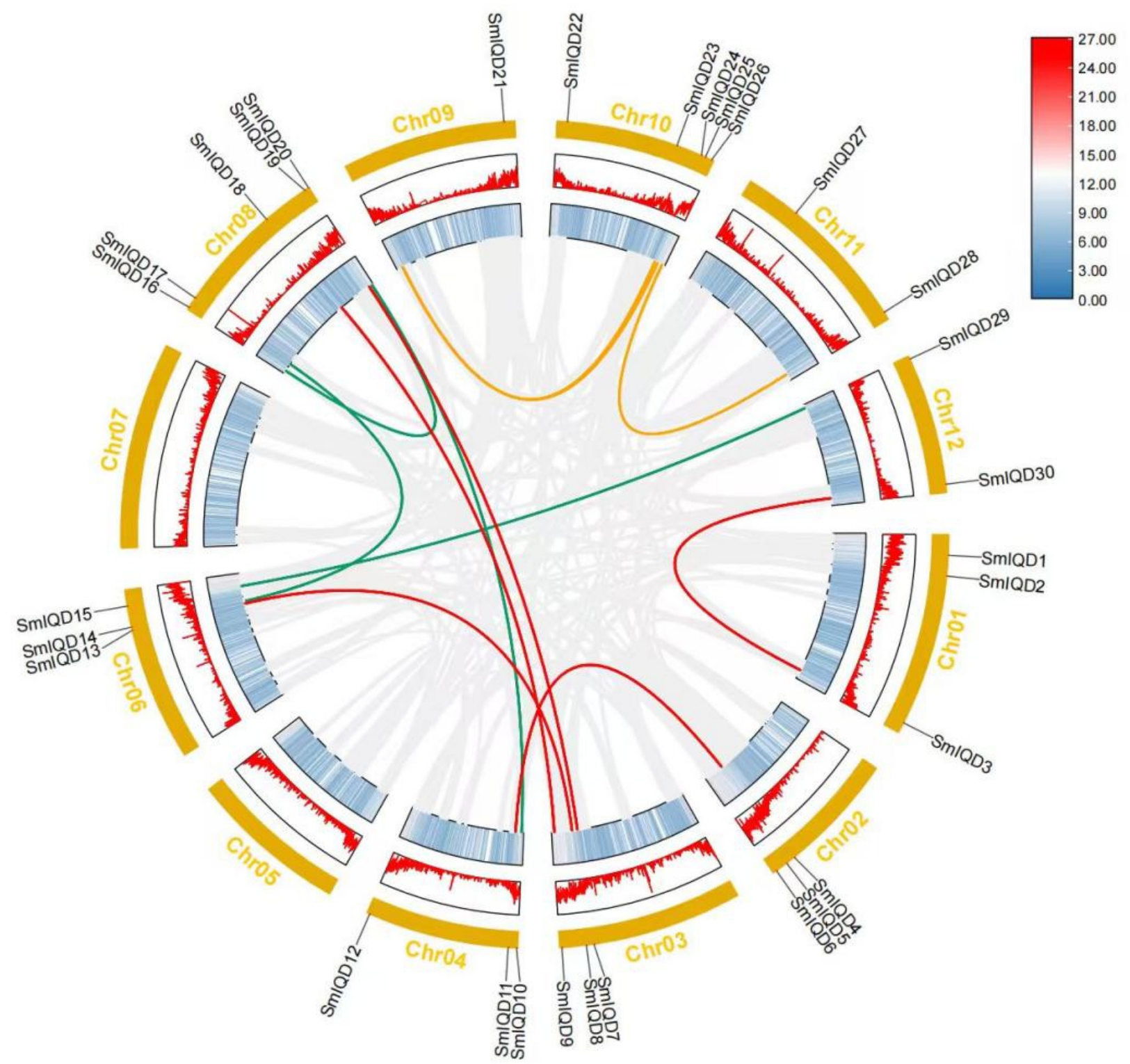
To identify IQD family genes in the eggplant genome, the 33 AtIQDs, 27 OsIQDs and 31 SlIQDs were employed as query sequences to search against the eggplant genome using the BlastP program. After removing redundant proteins and confirming the presence of the IQ67 domain, a total of 30 SmIQD proteins were obtained (Table 1). Mapping the genomic locations of these 30 SmIQD genes onto the 12 eggplant chromosomes revealed that SmIQDs are distributed on 10 chromosomes, including Chr01, Chr02, Chr03, Chr04, Chr06, Chr08, Chr09, Chr10, Chr11 and Chr12 (Figure 1; Table 1). Chr08 and Chr10 contain the highest number of SmIQD genes, with five members each, while no SmIQD genes were detected on Chr05 and Chr07 (Figure 1; Table 1). According to their physical order on the chromosomes, the 30 SmIQD genes were designated SmIQD1–SmIQD30 (Figure 1; Table 1). We further characterized the protein length, isoelectric point (pI) and molecular weight of the 30 SmIQDs. The results showed that SmIQD proteins range from 133 amino acids (SmIQD5) to 885 amino acids (SmIQD12) in length, have pI values ranging from 5.97 (SmIQD12) to 11.86 (SmIQD5), and display molecular weights from 15.33 kDa (SmIQD5) to 97.23 kDa (SmIQD12) (Table 1). Analysis of the SmIQD12 gene model based on the reference genome annotation and conserved IQ67-domain profiling verified a single uninterrupted 2658 bp open reading frame encoding an 885-amino-acid protein containing the canonical IQ67 domain, indicating that SmIQD12 represents a genuine single gene model rather than a fused/merged model.
Table 1.
Characteristics of the 30 IQD genes in the eggplant genome.
Figure 1.
Chromosomal distribution and synteny of IQD genes in eggplant. The outer orange-yellow arcs represent the 12 eggplant chromosomes. The red histogram and blue heatmap represent the gene density (number of genes per 1 Mb window) along each chromosome, with the heatmap scale shown in the upper right. Gray lines represent genome-wide syntenic blocks, whereas colored lines highlight duplicated SmIQD gene pairs. Red, green, and yellow lines are used to distinguish different syntenic blocks.
3.2. Phylogenetic Analysis of the SmIQD Family
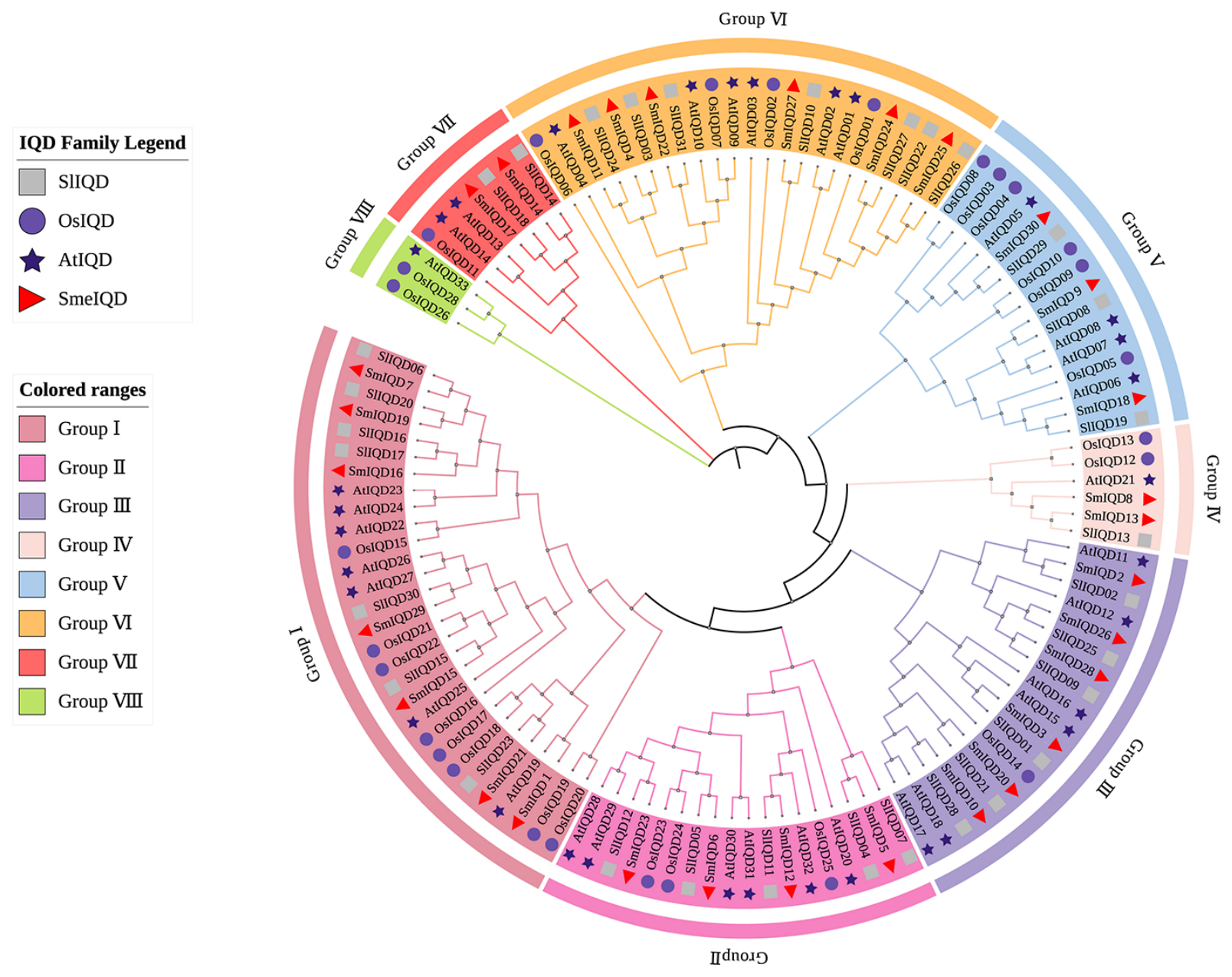
To elucidate the evolutionary relationships of SmIQDs, an unrooted neighbor-joining (NJ) phylogenetic tree was constructed using the full protein sequences of 121 IQDs, including 33 AtIQDs, 27 OsIQDs, 31 SlIQDs and 30 SmIQDs. The 121 IQDs were classified into eight groups (Figure 2). Phylogenetic analysis revealed that Group I-VII were shared by all four species (Figure 2). A similar number of the IQDs from the four species was observed in Group I (seven AtIQDs, eight OsIQDs, seven SlIQDs and seven SmIQDs) (Figure 2). Group II contained six AtIQDs, five SlIQDs, four SmIQDs and three OsIQDs, suggesting that this group has expanded in Arabidopsis relative to tomato, eggplant, and rice (Figure 2). In contrast, Group V contained six OsIQDs, but only four AtIQDs, and three SlIQDs and SmIQDs for each, indicating that OsIQDs have expanded in this group relative to the other three species (Figure 2).
Figure 2.
Phylogenetic relationships of 121 IQD proteins from eggplant, Arabidopsis, tomato, and rice.
Group III contained equal numbers of IQDs from Arabidopsis, tomato, and eggplant but only one OsIQD (OsIQD14) (Figure 2). A similar pattern was also observed in Group VII. These results suggest that these groups are expanded in dicots (Arabidopsis, tomato, and eggplant) compared with rice. Group IV contained two IQDs in rice and eggplant but only one IQD in tomato and one in Arabidopsis (Figure 2), indicating that the IQD family in this group has expanded in rice and eggplant. Notably, Group VIII was shared by rice and Arabidopsis, but absent from tomato and eggplant (Figure 2), indicating that the IQDs in Group VIII were likely lost in tomato and eggplant after their divergence from the common ancestor shared with rice and Arabidopsis.
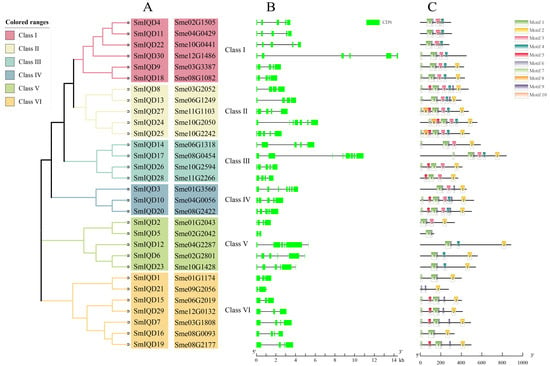
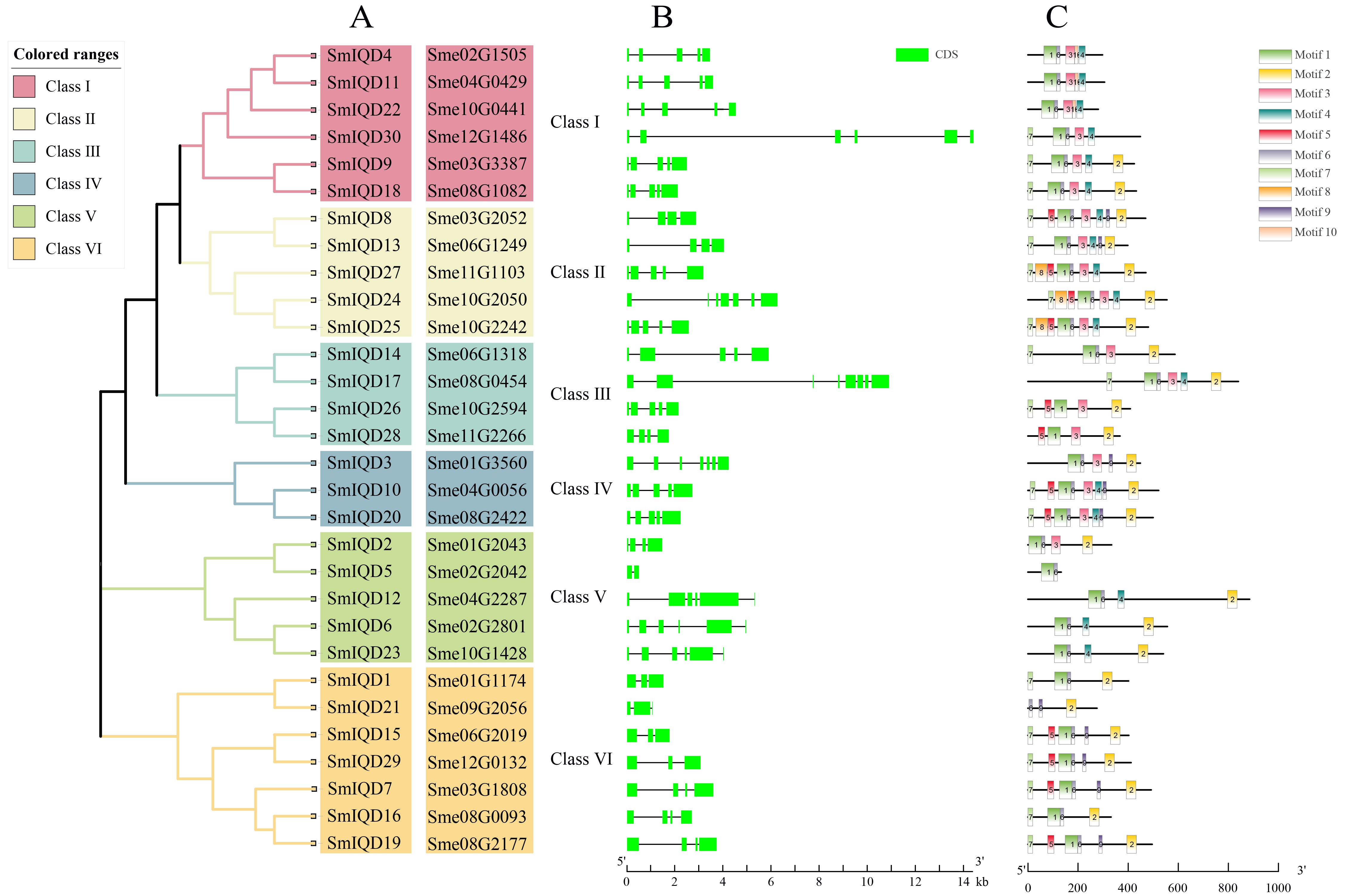
To further support the phylogenetic analysis, gene structure analysis of the SmIQD family members was performed. The results showed that all SmIQD genes contain introns (Figure 3A,B). The number of exons in most SmIQD members ranges from 4 to 7, while only SmIQD1 and SmIQD5 have fewer exons, with three and two exons, respectively. Therefore, the members of the eggplant IQD gene family exhibit significant diversity in exon number and intron distribution, indicating that this family has undergone complex structural differentiation during long-term evolution. However, members of the same class share similar gene structures (Figure 3A,B). For example, among SmIQD4, SmIQD9, SmIQD11, SmIQD18, SmIQD22, and SmIQD30 in Class I, all six members except SmIQD30 (which contains six exons) have five exons. Members in Class VI, including SmIQD1, SmIQD7, SmIQD15, SmIQD16, SmIQD19, SmIQD21, and SmIQD29, contain three or four exons.
Figure 3.
Phylogenetic relationships, gene structures, and conserved protein motifs of IQD genes in eggplant. (A) A phylogenetic tree was constructed using the full-length sequences of 30 SmIQDs proteins with the MEGA 12.0 software. (B) Gene structures of SmIQD genes. Green rectangles and black lines represent exons and introns, respectively. (C) The motif composition of SmIQD proteins. The 10 motifs are displayed as boxes in different colors. The eight groups shown in Figure 2 and the six classes shown in Figure 3 were derived from the corresponding independent evolutionary analyses and are therefore not exactly congruent.
To investigate the conserved motifs in the IQD family in eggplant, the MEME motif search tool was used to identify the conserved motifs. A total of 10 distinct motifs were identified (Figure 3C). Motif1 and Motif6 are the two most conserved motifs in the SmIQD family. All SmIQD family members contain both Motif1 and Motif6, except that SmIQD26 and SmIQD28 lack Motif6, and SmIQD21 lacks Motif1. Combined with the analysis results from Pfam and SMART, the positions of Motif1 and Motif6 highly coincide with that of the IQ domain (PF00612), indicating that Motif1 and Motif6 represent the IQ domain and are key motifs for maintaining the structural stability and functional specificity of IQD proteins. As expected, members within the same subfamily share similar motif compositions (Figure 3C). For example, all members in Class I contain Motif1, Motif3, Motif4, and Motif6, suggesting that SmIQD members within the same subfamily have functional similarity. Meanwhile, we also identified specific motifs that are unique to certain subfamilies. For instance, Motif10 is exclusively present in Class I, while Motif8 is only found in Class II (Figure 3C). These results indicate that these specific motifs may endow the corresponding subfamilies with distinct functions.
3.3. Synteny Analysis of IQD Genes from Eggplant, Arabidopsis, Tomato and Rice
Gene duplication events, including tandem and segmental duplications, were also investigated to elucidate the mechanism behind the expansion of the SmIQD gene family in the process of evolution. The results indicated that 11 pairs of SmIQDs were located in duplicated genomic regions (Figure 1; Table S3), and no tandem duplication pair was detected. Therefore, the expansion of the SmIQD family was associated with segmental duplication events.
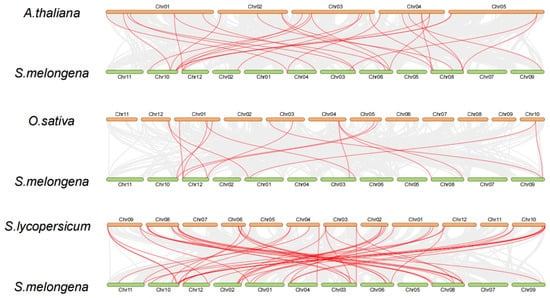
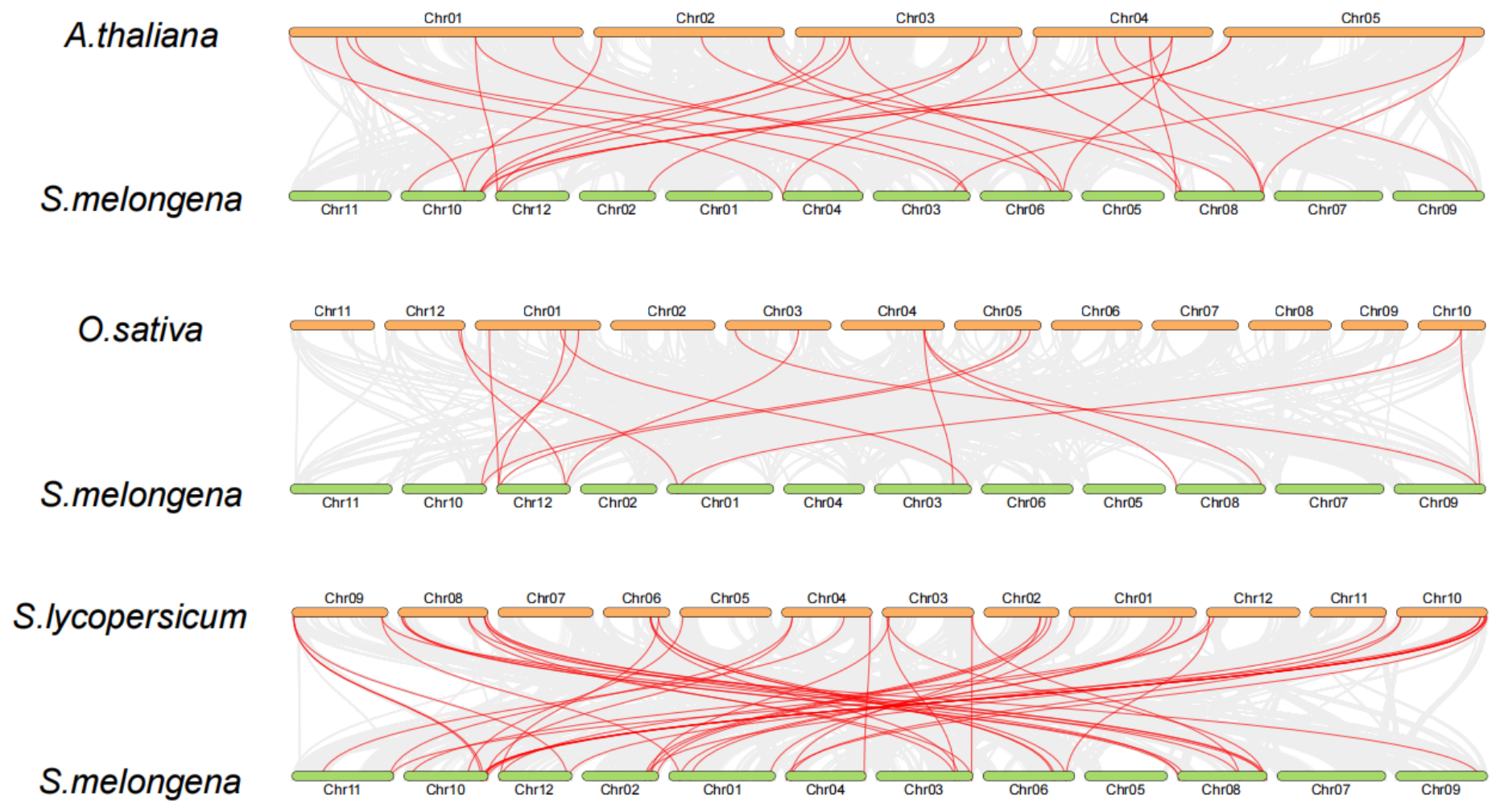
To further explore the phylogenetic mechanisms of the SmIQD family, comparative syntenic maps between eggplant and tomato, Arabidopsis and rice were constructed (Figure 4). A total of 18, 8, and 30 syntenic gene-pair events were identified for eggplant–Arabidopsis, eggplant–rice, and eggplant–tomato comparisons, respectively (Figure 4; Tables S4–S6). Several SmIQD genes, such as SmIQD15 and SmIQD29, are located in conserved syntenic blocks shared among eggplant, Arabidopsis and tomato (Figure 4; Tables S4 and S6), indicating that these orthologous relationships likely predate the divergence of ancestral lineages and reflect evolutionary conservation.
Figure 4.
Syntenic relationships of IQD genes between eggplant and Arabidopsis, rice, and tomato. Gray lines in the background represent collinear genomic blocks, whereas red lines emphasize the syntenic regions containing IQD gene pairs.
3.4. Expression Analysis of SmIQD Genes in Developing Ovaries
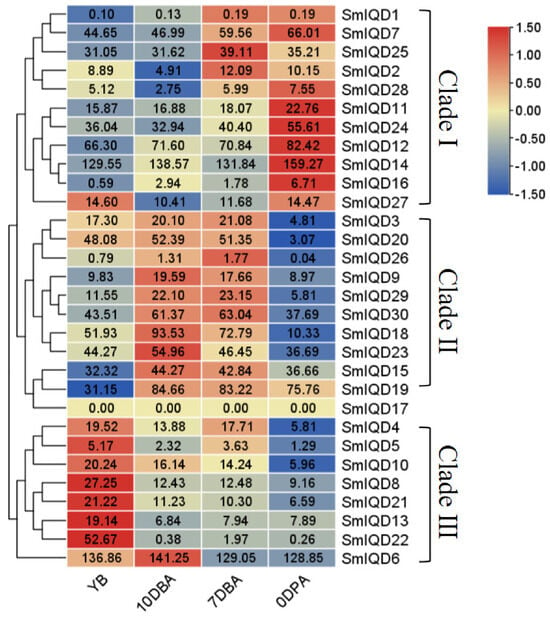
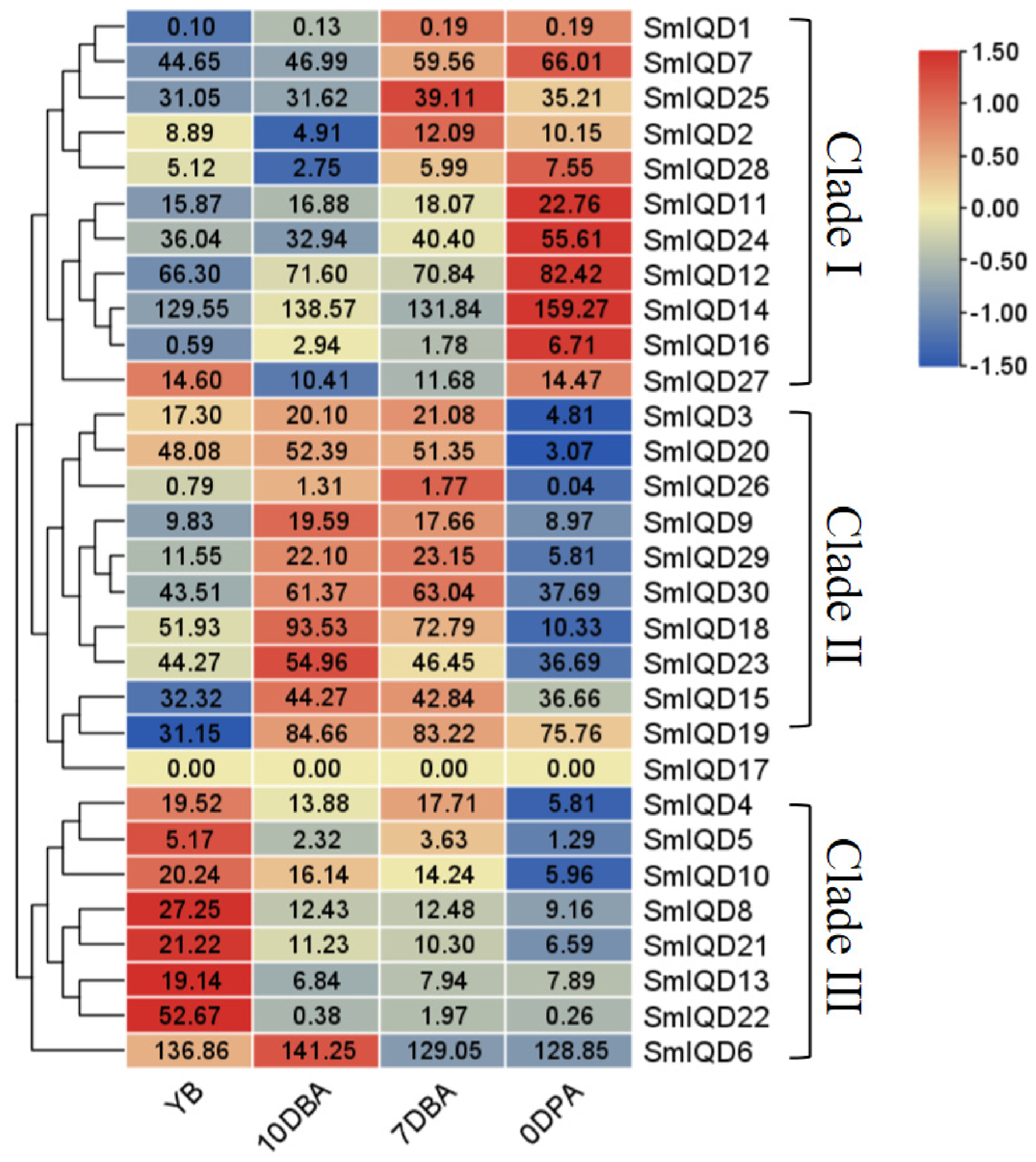
To reveal the expression patterns of eggplant IQD genes, transcriptome data from flower buds (YB) and developing ovaries were analyzed [26]. The results showed that the 30 SmIQD genes could be divided into three clades based on their expression patterns (Figure 5). The first clade (C1) showed low expression levels in YB and at 10 DBA (days before anthesis), and high expression levels at 7 DBA or 0 DPA. The second clade (C2) showed an increase followed by a decrease across the four stages, with peak expression at 10 DBA or 7 DBA (Figure 5). The third clade (C3) showed high expression at the YB stage, followed by a gradual decrease thereafter (Figure 5). It is worth noting that the high expression of C3 members at the YB may partly reflect the contribution of floral organ tissues contained in the whole-bud samples, in addition to a genuine developmental decline during ovary development. In addition, SmIQD1, SmIQD17, and SmIQD26 exhibited low or no expression at all stages, indicating that these SmIQD genes may function in specific tissues or under particular conditions.
Figure 5.
Expression analysis of the SmIQD genes in young flower buds and developing ovaries. Values shown in the heatmap represent the average TPM of three or four biological replicates. The colors represent row z-scores of the mean TPM values. YB, Young flower buds; DBA, Days before anthesis; DPA, Days post anthesis.
3.5. Functional Characterization of SmIQD9 via Ectopic Overexpression in Tomato
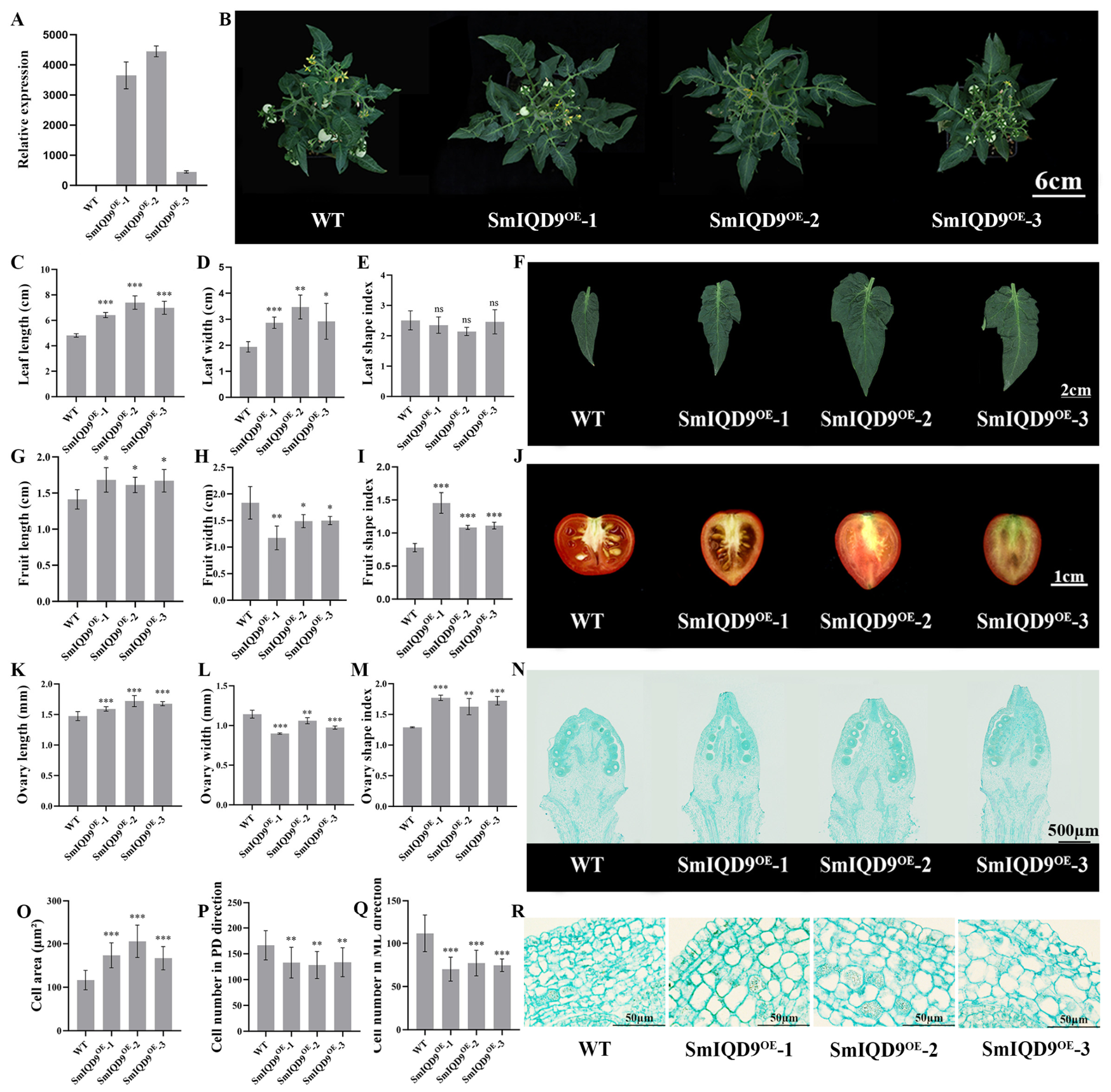
To investigate the roles of SmIQDs in regulating fruit development, SmIQD9, a clade C2 member, was selected for functional analysis because (i) genes in C2 show relatively high expression before anthesis (10–7 DBA), the critical window for fruit shape determination, and (ii) SmIQD9 is phylogenetically closely related to the fruit-length candidate gene SmeFL (Smechr0302217; SmIQD8) located on chromosome 3 (Figure 3; Table S7). We therefore ectopically overexpressed SmIQD9 in tomato. A total of 16 independent transgenic lines were obtained (Figure S1), among which three representative lines (SmIQD9OE-1, SmIQD9OE-2, and SmIQD9OE-3) with high expression levels of SmIQD9 were selected for further phenotypic analysis (Figure 6A).
Figure 6.
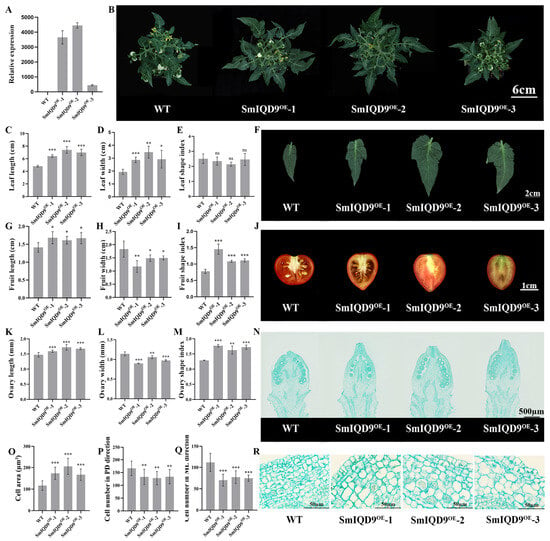
The effects of SmIQD9 overexpression on the shape of tomato leaf, fruit and ovary. (A) Expression analysis of SmIQD9 in transgenic tomato plants by quantitative real-time PCR (RT-qPCR). (B) Representative tomato plants of WT and SmIQD9 overexpressing lines. (C–E) Comparisons of leaf length (C), width (D), and shape index (E) between WT and SmIQD9 overexpressing lines. (F) Representative leaflets from WT and the three SmIQD9 overexpressing lines. (G–I) Comparisons of fruit length (G), width (H), and shape index (I) between WT and the three SmIQD9 overexpressing lines. (J) Representative fruits at the red-ripe stage from WT and the three SmIQD9 overexpressing lines. (K–M) Comparisons of ovary length (K), width (L), and shape index (M) between WT and the three SmIQD9 overexpressing lines. (N) Representative paraffin sections of ovaries at anthesis from WT and the three SmIQD9 overexpressing lines. (O–Q) Comparisons of cell area (O), cell number in the proximal-distal (PD) direction (P) and medial-lateral (ML) direction (Q) between WT and SmIQD9 over-expressing lines. (R) Representative paraffin sections showing the cellular morphology of ovaries from WT and the three SmIQD9 overexpressing lines. Data are presented as means ± SD. Statistical significance was evaluated using Student’s t-test. * p < 0.05, ** p < 0.01, and *** p < 0.001. ns, not significant.
During the vegetative growth stage, the overexpression lines displayed clear morphological changes relative to the WT (Figure 6B). Leaves of SmIQD9 overexpression plants were markedly longer and wider (Figure 6C–F), leading to an overall increase in leaf size (Figure 6F). Nevertheless, the leaf shape index (length/width ratio) showed no significant difference between the OE lines and WT (Figure 6E), suggesting that ectopic overexpression of SmIQD9 enhances leaf expansion without altering leaf shape.
To further elucidate the function of SmIQD9 in fruit development, we examined fruit length, width, and shape index in lines overexpressing SmIQD9. At the mature fruit stage, fruits from the overexpression lines exhibited clear morphological differences compared with WT (Figure 6G–J). Fruit length in SmIQD9OE-1, SmIQD9OE-2, and SmIQD9OE-3 increased significantly by 19%, 14%, and 18.4%, respectively (Figure 6G), whereas fruit width was significantly reduced in all three transgenic lines (Figure 6H). Consequently, the fruit shape index was markedly higher in the overexpression lines than in WT, leading to more elongated fruits in the SmIQD9 overexpression lines (Figure 6I).
Paraffin sectioning was used to investigate how SmIQD9 overexpression influences tomato ovary development (Figure 6K–N). The analysis revealed that ovary length in SmIQD9OE-1, SmIQD9OE-2, and SmIQD9OE-3 increased significantly by 8.2%, 17%, and 13.6%, respectively (Figure 6K), while ovary width showed a significant reduction (Figure 6L). As a result, the ovary shape index was substantially elevated in all three SmIQD9 overexpression lines (Figure 6M,N). Together, these findings suggest that ovary shape differences between the SmIQD9 overexpression lines and WT were already evident at anthesis. Furthermore, the shape index increased more markedly in mature fruits (approximately 40–90%) than in ovaries at anthesis (26–38%) (Figure 6I,M), indicating that the phenotype continued to develop during subsequent fruit growth.
We further investigated the cellular basis underlying the altered ovary development caused by SmIQD9 overexpression. Compared with WT, the three SmIQD9-overexpressing lines exhibited significantly increased cell areas (Figure 6O). The average cell area increased by approximately 50.4%, 77.4% and 45.2% in SmIQD9OE-1, SmIQD9OE-2 and SmIQD9OE-3, respectively, relative to WT (Figure 6O). In contrast, the number of cells in the proximal-distal (PD) direction was significantly reduced in SmIQD9OE-1, SmIQD9OE-2 and SmIQD9OE-3 by approximately 20.1%, 23.0% and 19.7%, respectively (Figure 6P). Similarly, the number of cells in the medial-lateral (ML) direction decreased significantly by approximately 37.5%, 31.3% and 33.9% in the three overexpression lines, respectively (Figure 6Q). These results indicate that SmIQD9 affects ovary and fruit development primarily by modulating cell expansion.
4. Discussion
In this study, we systematically identified 30 IQD genes in the eggplant genome (Table 1). The identification of the 30 SmIQD members places eggplant within the typical range of diploid dicots, closely matching the 33 IQD genes reported in Arabidopsis and the 31 tomato IQD genes identified in this study (Table S1) [4,28], but contrasting with the expanded repertoires observed in polyploid crops such as wheat [3,7]. Our synteny analysis revealed that segmental duplications contributed to 11 pairs of SmIQD genes, whereas no tandem duplication was detected (Figure 1; Table S3). This is consistent with findings in grape and maize, where segmental duplications also serve as the primary driver of IQD expansion [6,8], implying that dispersed duplication events, rather than local tandem arrays, have been the major evolutionary force shaping this family in perennial and fruit-bearing plants.
Beyond phylogenetic divergence, our gene structure and motif analyses revealed that SmIQD members possess substantial structural diversity despite sharing the core IQ domain (Figure 3). All SmIQDs contained introns, with exon numbers ranging from 2 to 7, and the conserved Motif1 and Motif6 consistently co-localized with the PF00612 IQ domain across nearly all members (Figure 3). This structural architecture aligns with the reported domain organization in cucumber and wheat [7,29], where the IQ67-domain serves as a conserved platform for calmodulin recruitment. More importantly, we identified subfamily-specific motifs, such as Motif10 exclusively in Class I and Motif8 restricted to Class II (Figure 3C). Given that IQD proteins function as adaptors linking Ca2+ signals to microtubule reorganization [1], these variable flanking motifs may mediate distinct protein–protein interactions or post-translational modifications, thereby conferring functional specialization among subfamilies.
Comparative synteny analysis provided evolutionary clues about the functional relevance of specific SmIQD genes. Notably, SmIQD15 and SmIQD29 exhibited syntenic relationships with IQD orthologs in both Arabidopsis (AtIQD25, AtIQD26 and AtIQD27) and tomato (SlIQD15 and SlIQD30) (Figure 4; Tables S4–S6), indicating that these genes represent a deeply conserved ancestral module that predates the divergence of Brassicaceae and Solanaceae. It is worth noting that SmIQD29 displayed dynamic changes during ovary development, with elevated transcript levels at early stages (10-7 DBA) (Figure 5). However, SmIQD15, which also showed cross-species synteny, exhibited differential expression patterns (Figure 4 and Figure 5), implying that while they share evolutionary origins, they may have undergone subfunctionalization to regulate distinct aspects of ovary or fruit development. Moreover, SlIQD26, also referred to as SlSUN, controls fruit elongation by modulating patterns of cell division [17,18]. Thus, the syntenic relationship of SmIQD24 and SmIQD25 with SlIQD26 strongly indicates that SmIQD24 and SmIQD25 may likewise contribute to the regulation of fruit morphogenesis.
In eggplant, fruit-shape loci have been repeatedly mapped to chromosome 3 [24,25]. QTL-seq analysis identified a fruit-length QTL on this chromosome with two IQD genes as candidates [24], and subsequent fine mapping delimited the fl3.1 locus and proposed Smechr0302217 (SmeFL) as the best candidate gene promoting fruit elongation through cell expansion [25]. To clarify the relationship between SmIQD9 and SmeFL, we mapped the SmIQD gene IDs onto the HQ-1315 assembly IDs used in Wei et al. [24] and Pang et al. [25] (Table S7). The mapping shows that SmIQD9 corresponds to Smechr0303606 (E03: 95,479,157–95,482,104), which lies outside the fl3.1 interval on chromosome 3 (E03: 82,222,982–82,329,608) [25]. Accordingly, SmIQD9 is phylogenetically closely related to SmeFL (SmIQD8) but is not the fl3.1 candidate gene itself (Table S7). Our ectopic overexpression of SmIQD9 in tomato provides transgenic functional evidence demonstrating that one phylogenetically related member of the SmeFL-like gene clade can regulate fruit shape. Together with the conserved synteny of SmIQD24 and SmIQD25 with SlSUN [17,18], these results indicate that multiple IQD family members contribute to eggplant fruit morphogenesis through functionally related yet genetically distinct loci.
In Solanaceae, fruit shape differences are commonly already evident at anthesis, when cell division and expansion in the ovary are finely tuned [17,25]. Our transcriptomic analysis of developing ovaries revealed three distinct expression clades among SmIQD genes, with C2 (which contains SmIQD9) exhibiting a particularly striking pattern (Figure 5). Members of C2 displayed a transient increase in transcript abundance that peaked at 10 DBA or 7 DBA, followed by a gradual decline towards 0 DPA. This early and transient expression window places the genes in C2, including SmIQD9, at the center of the preparatory phase of ovary development, a critical period when the basic body plan of the fruit is established through coordinated cell division and the initiation of cell expansion [17,30]. Notably, this temporal pattern diverges sharply from that of C1, which is upregulated later (at 7 DBA or 0 DPA) and may function closer to or immediately after fertilization, and from C3, which is highly expressed in young flower buds and likely participates in floral organ identity or early ovule development, as observed for CaSUN29 in pepper [22].
The most compelling evidence in our study is the functional validation of SmIQD9 through ectopic overexpression in tomato (Figure 6). The transgenic lines exhibited markedly elongated fruits with reduced width, leading to a significantly increased fruit shape index—a phenotype similar to that conferred by SlSUN [17] and ClIQD24 [20]. Furthermore, ovary shape differences were already evident at anthesis (Figure 6M), and the fruit shape index difference increased further towards maturity (Figure 6I), indicating that SmIQD9, whose transcript peaks in the pre-anthesis expression window (10–7 DBA) (Figure 5), promotes fruit elongation mainly by enhancing cell expansion, with the phenotype initiated at anthesis and further accentuated during fruit growth (Figure 6). This result is consistent with the role of IQD proteins in stabilizing cortical microtubules and preventing their random depolymerization [12,13]. Our results position SmIQD9 as a promising candidate gene for future marker-assisted selection or gene editing to tailor fruit shape in eggplant, a trait of paramount importance for market classification and consumer preference [23].
In summary, this work establishes an extensive genomic and functional framework for the IQD gene family in eggplant. The discovery of SmIQD9 as a positive regulator of fruit elongation in tomato not only deepens our insight into fruit morphogenesis in Solanaceae but also introduces promising targets for molecular breeding of eggplant cultivars with preferred fruit shapes.
Supplementary Materials
The following supporting information can be downloaded at: https://www.mdpi.com/article/10.3390/horticulturae12111368/s1. Figure S1: Identification and expression level detection of 16 independent transgenic lines. MT, Microtom; PC, Positive control; NC, Negative control. Table S1: List of the 31 tomato IQD genes identified in this study based on the updated tomato genome annotation (SL4.0/ITAG4.1). Table S2: Primers used in this study. Table S3: Collinear gene pairs of IQD genes in eggplant. Table S4: Collinear gene pairs of IQD family between eggplant and Arabidopsis. Table S5: Collinear gene pairs of IQD family between eggplant and rice. Table S6: Collinear gene pairs of IQD family between eggplant and tomato. Table S7: SmIQD gene IDs in Eggplant-HQ V1.0 and Eggplant-HQ V2.0.
Author Contributions
Conceptualization, Q.L. and X.C.; Methodology, J.M.; Software, J.M. and J.Y.; Validation, J.M., J.Y. and Y.Z.; Investigation, J.M., Y.Z. and S.L.; Data Curation, J.M., Y.Z., and R.Z.; Writing—Original Draft Preparation, J.M.; Writing—Review and Editing, J.M., J.Y., Y.Z., R.Z., S.L., X.C. and Q.L.; Visualization, J.M. and X.L.; Supervision, Q.L. and X.C.; Project Administration, J.Y., X.L. and S.L.; Funding Acquisition, Q.L., X.C. and J.Y. All authors have read and agreed to the published version of the manuscript.
Funding
This work was supported by the Hainan Provincial Natural Science Foundation (325QY915), Youth Special Program for Basic Research in Biological Breeding of the National Natural Science Foundation of China (32441074), Hebei Agriculture Research System (HBCT2023100207) and S&T Program of Hebei (21326309D).
Data Availability Statement
The original contributions presented in this study are included in the article/Supplementary Materials. Further inquiries can be directed to the corresponding authors.
Conflicts of Interest
Author Jin Yang and Xiaopeng Li were employed by Hainan State Farms Academy of Sciences Group Co., Ltd., Sanya, China. The remaining authors declare that the research was conducted in the absence of any commercial or financial relationships that could be construed as a potential conflict of interest.
References
- Bürstenbinder, K.; Savchenko, T.; Müller, J.; Adamson, A.W.; Stamm, G.; Kwong, R.; Zipp, B.J.; Dinesh, D.C.; Abel, S. Arabidopsis calmodulin-binding protein IQ67-domain 1 localizes to microtubules and interacts with kinesin light chain related protein-1. J. Biol. Chem. 2013, 288, 1871–1882. [Google Scholar] [CrossRef] [Scilit] [PubMed]
- Abel, S.; Savchenko, T.; Levy, M. Genome-wide comparative analysis of the IQD gene families in Arabidopsis thaliana and Oryza sativa. BMC Evol. Biol. 2005, 5, 72. [Google Scholar] [CrossRef] [Scilit] [PubMed]
- Ke, Q.; Sun, H.; Tang, M.; Luo, R.; Zeng, Y.; Wang, M.; Li, Y.; Li, Z.; Cui, L. Genome-wide identification, expression analysis and evolutionary relationships of the IQ67-domain gene family in common wheat (Triticum aestivum L.) and its progenitors. BMC Genom. 2022, 23, 264. [Google Scholar] [CrossRef] [Scilit] [PubMed]
- Huang, Z.; Van Houten, J.; Gonzalez, G.; Xiao, H.; van der Knaap, E. Genome-wide identification, phylogeny and expression analysis of SUN, OFP and YABBY gene family in tomato. Mol. Genet. Genom. 2013, 288, 111–129. [Google Scholar] [CrossRef] [Scilit] [PubMed]
- Ge, Q.; Wang, X.F.; Li, H.; Ren, Z.H.; Wang, L.N. Genome-wide identification and analysis of the IQD/SUN gene family in cucumber. Genom. Appl. Biol. 2019, 38, 4110–4119. [Google Scholar] [CrossRef]
- Liu, Z.; Haider, M.S.; Khan, N.; Fang, J. Comprehensive sequence analysis of IQD gene family and their expression profiling in grapevine (Vitis vinifera). Genes 2020, 11, 235. [Google Scholar] [CrossRef] [Scilit] [PubMed]
- Liu, M.; Wang, Z.; Wang, C.; Pan, X.; Gao, W.; Yan, S.; Cao, J.; Lu, J.; Chang, C.; Ma, C.; et al. Identification of the wheat (Triticum aestivum) IQD gene family and an expression analysis of candidate genes associated with seed dormancy and germination. Int. J. Mol. Sci. 2022, 23, 4093. [Google Scholar] [CrossRef] [Scilit] [PubMed]
- Cai, R.; Zhang, C.; Zhao, Y.; Zhu, K.; Wang, Y.; Jiang, H.; Xiang, Y.; Cheng, B. Genome-wide analysis of the IQD gene family in maize. Mol. Genet. Genom. 2016, 291, 543–558. [Google Scholar] [CrossRef] [Scilit] [PubMed]
- Liu, H.; Cao, Y.; Zhang, W.; Liu, Z.; Li, Y.; Chen, Y.; Zhang, H.; Yu, F.; Liu, X. The wheat TaIQD3D-6 gene encodes a microtubule-associated protein and regulates cell morphogenesis in Arabidopsis. Plant Sci. 2022, 324, 111420. [Google Scholar] [CrossRef] [Scilit]
- Kumari, P.; Dahiya, P.; Livanos, P.; Zergiebel, L.; Kölling, M.; Poeschl, Y.; Stamm, G.; Hermann, A.; Abel, S.; Müller, S.; et al. IQ67 DOMAIN proteins facilitate preprophase band formation and division-plane orientation. Nat. Plants 2021, 7, 739–747. [Google Scholar] [CrossRef] [Scilit] [PubMed]
- Lazzaro, M.D.; Wu, S.; Snouffer, A.; Wang, Y.; van der Knaap, E. Plant organ shapes are regulated by protein interactions and associations with microtubules. Front. Plant Sci. 2018, 9, 1766. [Google Scholar] [CrossRef] [Scilit] [PubMed]
- Liang, H.; Zhang, Y.; Martinez, P.; Rasmussen, C.G.; Xu, T.; Yang, Z. The microtubule-associated protein IQ67 DOMAIN5 modulates microtubule dynamics and pavement cell shape. Plant Physiol. 2018, 177, 1555–1568. [Google Scholar] [CrossRef] [Scilit] [PubMed]
- Mitra, D.; Klemm, S.; Kumari, P.; Quegwer, J.; Möller, B.; Poeschl, Y.; Pflug, P.; Stamm, G.; Abel, S.; Bürstenbinder, K. Microtubule-associated protein IQ67 DOMAIN5 regulates morphogenesis of leaf pavement cells in Arabidopsis thaliana. J. Exp. Bot. 2019, 70, 529–543. [Google Scholar] [CrossRef] [Scilit] [PubMed]
- Thompson, A.K. Fruit and Vegetables: Harvesting, Handling and Storage, 2nd ed.; Blackwell Publishing: Oxford, UK, 2003; ISBN 978-1-4051-0619-1. [Google Scholar]
- Ghonimy, M.; Alayouni, R.; Alshehry, G.; Barakat, H.; Ibrahim, M.M. Integrated Physical–Mechanical Characterization of Fruits for Enhancing Post-Harvest Quality and Handling Efficiency. Foods 2025, 14, 2521. [Google Scholar] [CrossRef] [Scilit] [PubMed]
- Zhu, Q.; Deng, L.; Chen, J.; Rodríguez, G.R.; Sun, C.; Chang, Z.; Yang, T.; Zhai, H.; Jiang, H.; Topcu, Y.; et al. Redesigning the tomato fruit shape for mechanized production. Nat. Plants 2023, 9, 1659–1674. [Google Scholar] [CrossRef] [Scilit] [PubMed]
- Xiao, H.; Jiang, N.; Schaffner, E.; Stockinger, E.J.; van der Knaap, E. A retrotransposon-mediated gene duplication underlies morphological variation of tomato fruit. Science 2008, 319, 1527–1530. [Google Scholar] [CrossRef] [Scilit] [PubMed]
- Wu, S.; Xiao, H.; Cabrera, A.; Meulia, T.; van der Knaap, E. SUN regulates vegetative and reproductive organ shape by changing cell division patterns. Plant Physiol. 2011, 157, 1175–1186. [Google Scholar] [CrossRef] [Scilit] [PubMed]
- Dou, J.; Zhao, S.; Lu, X.; He, N.; Zhang, L.; Ali, A.; Kuang, H.; Liu, W. Genetic mapping reveals a candidate gene (ClFS1) for fruit shape in watermelon (Citrullus lanatus L.). Theor. Appl. Genet. 2018, 131, 947–958. [Google Scholar] [CrossRef] [Scilit] [PubMed]
- Dou, J.; Duan, S.; Umer, M.J.; Xie, K.; Wang, Y.; Kang, Q.; Yang, S.; Yang, L.; Liu, D.; Liu, L.; et al. Genome-wide analysis of IQD proteins and ectopic expression of watermelon ClIQD24 in tomato suggests its important role in regulating fruit shape. Front. Genet. 2022, 13, 993218. [Google Scholar] [CrossRef] [Scilit] [PubMed]
- Yang, B.J.; Wendrich, J.R.; De Rybel, B.; Weijers, D.; Xue, H.-W. Rice microtubule-associated protein IQ67-DOMAIN14 regulates grain shape by modulating microtubule cytoskeleton dynamics. Plant Biotechnol. J. 2020, 18, 1141–1152. [Google Scholar] [CrossRef] [Scilit] [PubMed]
- Wang, Y.; Zhang, L.; Yang, X.; Cheng, F.; Chen, B.; Zhang, X.; Geng, S.; Du, H. Identification of major loci governing 13 agronomic traits and the fine-mapping of CaSUN29 regulating fruit length in pepper. Mol. Hortic. 2025, 5, 64. [Google Scholar] [CrossRef] [Scilit] [PubMed]
- Li, Q.; Luo, S.; Du, H.; Paradowski, C.; Ma, J.; Zhang, L.; Jia, X.; Zhao, R.; Zhang, D.; Yan, W.; et al. Classification of fruit shape based on decision tree model and identification of QTLs and genes controlling fruit shape in eggplant. J. Integr. Agric. 2026. [Google Scholar] [CrossRef] [Scilit]
- Wei, Q.; Wang, J.; Wang, W.; Hu, T.; Hu, H.; Bao, C. A high-quality chromosome-level genome assembly reveals genetics for important traits in eggplant. Hortic. Res. 2020, 7, 153. [Google Scholar] [CrossRef] [Scilit] [PubMed]
- Pang, H.; Ai, J.; Wang, W.; Hu, T.; Hu, H.; Wang, J.; Yan, Y.; Wu, X.; Bao, C.; Wei, Q. Fine mapping of QTL-fl3.1 reveal SmeFL as the candidate gene regulating fruit length in eggplant (Solanum melongena L.). Veg. Res. 2024, 4, e028. [Google Scholar] [CrossRef] [Scilit]
- Zhou, M.; Zhang, L.; Luo, S.; Song, L.; Shen, S.; Zhao, J.; Li, Q.; Chen, X. Comprehensive analysis of CYP78A family genes reveals the involvement of CYP78A5 and CYP78A10 in fruit development in eggplant. Veg. Res. 2023, 3, 5. [Google Scholar] [CrossRef] [Scilit]
- Chen, C.; Chen, H.; Zhang, Y.; Tomas, H.R.; Frank, M.H.; He, Y.; Xia, R. TBtools: An integrative toolkit developed for interactive analyses of big biological data. Mol. Plant 2020, 13, 1194–1202. [Google Scholar] [CrossRef] [Scilit] [PubMed]
- Bürstenbinder, K.; Möller, B.; Plötner, R.; Stamm, G.; Hause, G.; Mitra, D.; Abel, S. The IQD family of calmodulin-binding proteins links calcium signaling to microtubules, membrane subdomains, and the nucleus. Plant Physiol. 2017, 173, 1692–1708. [Google Scholar] [CrossRef] [Scilit] [PubMed]
- Zhang, Q.; Chen, C.; Wang, L.; Ren, Z. Identification and response to adversity of cucumber SUN family. Mol. Plant Breed. 2023, 21, 2823–2831. (In Chinese) [Google Scholar] [CrossRef]
- Wang, Y.; Clevenger, J.P.; Illa-Berenguer, E.; Meulia, T.; van der Knaap, E.; Sun, L. A comparison of sun, ovate, fs8.1 and auxin application on tomato fruit shape and gene expression. Plant Cell Physiol. 2019, 60, 1067–1081. [Google Scholar] [CrossRef] [Scilit] [PubMed]

Disclaimer/Publisher’s Note: The statements, opinions and data contained in all publications are solely those of the individual author(s) and contributor(s) and not of MDPI and/or the editor(s). MDPI and/or the editor(s) disclaim responsibility for any injury to people or property resulting from any ideas, methods, instructions or products referred to in the content. |
© 2026 by the authors. Licensee MDPI, Basel, Switzerland. This article is an open access article distributed under the terms and conditions of the Creative Commons Attribution (CC BY) license.