


Abstract
Acoustic vibrations may induce different changes in plants that perceive them, and plants themselves can also emit acoustic signals. The aim of this review was to cover the past ten years of plant acoustic research and its shortcomings, with a focus on the reflecting, sensing, and emission of ultrasound by plants. Ultrasonication may alter plant growth and development, and an increasing number of studies are being carried out to investigate its effects on both in vitro plant culture and greenhouse or field plant production, as well as on the biochemical and molecular functions of plants. In this paper, we summarized the progress in the use of ultrasound in horticulture and agriculture for enhancing plant growth and development, either in vitro or in vivo, improving yield and crop quality and increasing stress tolerance, as well as for special methodological applications, like sonication-assisted Agrobacterium-mediated transformation. Some research gaps, such as the lack of a precise mechanism for plant ultrasound emission, the possible participation of some reactive radicals in ultrasound signaling, the effect of ultrasound on the epigenome, the role of ultrasound in plant-to-plant communication, and whether there is a specific, sound perceiving organ, etc., were also presented. In addition, a predictive vision is described of how ultrasonication of plants and ultrasound detection emitted by plants can be used in the future to develop green and sustainable agricultural and horticultural technologies. Furthermore, based on our current knowledge, a proposal is presented to combine them with machine learning and artificial intelligence for developing novel production technologies.
1. Introduction
Plants are constantly subjected to rapidly changing environmental conditions due to their sessile nature. They perceive, process, and respond accordingly to these cues, possessing adaptive value in order to improve their fitness [1]. From both biotic and abiotic sources, their surroundings include many naturally present, informative sounds that may warn plants about potential danger or may guide them to resources [2,3]. Sound is a vibration, a mechanical stimulus characterized by mechanical waves of different lengths (frequency, Herz, Hz) and amplitudes (decibels, dB) that travel fast in various media (solid, gas, and liquid) acting as energy and information carriers [4]. There are different types of vibrations according to their medium, namely soil- or air-borne vibrations, where sound transmission takes place through the surrounding soil or air, respectively, or direct vibrations, where the source of the vibration touches the plant (e.g., herbivore chewing) [3]. Generally, the greater the sound amplitude, the greater the mechanical impact on the surrounding medium and thus on the plant, as well [5].
According to our latest knowledge, there is much evidence to support that acoustic vibration (sound or ultrasound) acts on plants leading to growth, developmental, and biochemical and molecular modifications in the perceiving plants [2]. In addition, the latest research has shown that plants are capable of emitting acoustic signs that are species- and stress-specific [6,7]. However, there are research gaps regarding the existence of sound perceiving organs, as well as the exact mechanism of sound or ultrasound production by plants. There has been a lot of debate over whether plants are capable of acoustic communication with each other and other organisms in their environment, whether they use the acoustic signs of the inanimate environment to improve their survival and fitness, and whether they are capable of memorizing previously perceived sound or ultrasound cues by changing their epigenetic state [7,8,9,10,11,12,13]. However, in light of the latest studies, this is presumably more than a speculative hypothesis, even if more direct research and evidence related to the acoustic communication of plants are still needed to evaluate and understand this possibility [6,7,13].
This article is an overview of plant acoustic research over the past ten years, focusing on the role of ultrasound in plant life and reviewing the progress and perspectives on the use of ultrasound in horticulture and agriculture.
2. Sound Perception in Plants
Although, according to our recent knowledge, plants lack specialized sensory organs, they have several different apparatuses that detect mechanical stimuli. Considering the magnitude of the mechanical impact, the stronger the impact, the higher the possibility that it will be sensed by the entire cell, rather than the superficial structures, such as the plasma membrane or the cell wall.
Mechanical stresses, for instance, high amplitude sound waves, may cause thigmonasty, which includes morphological changes [14]. These changes occur due to the polymerization/depolymerization of cytoskeletal elements or upon a change in the phosphorylation state of actin filaments that may influence the flexibility of pulvini [15,16]. The cytoskeleton regulates mitosis, meiosis, interaction of organelles, and movements, therefore, sound waves may affect the cell units, their structure, and may cause resonance within the cell. Subtle mechanical stimulus triggers the most sensitive sensory apparatuses, namely, the cell wall–plasma membrane interface and the trichomes. The trichomes may act as a mechanical antenna promoting downstream signaling of sound-dependent responses [17]. Considering that across plant species, trichomes are not ubiquitous, and their density and morphology varies remarkably, they may not be essential for aboveground sound perception but may facilitate stimuli amplification [18]. Roots, on the other hand, may convert belowground mechanical or sound impulses into biochemical signals (e.g., quick and local intracellular increase in Ca2+ levels facilitating biochemical responses through modulating different traits). Unfortunately, there are still huge knowledge gaps about the existence of sound perceiving organs due to the lack of research focusing on these topics [19,20].
The plasma membrane, on one hand, is a highly stretchable structure, and, on the other hand, it is filled with mechanosensitive transmembrane, anchored, and intrinsic elements. Upon sound stimuli, these elements may act as transducers of physical signals by stretching, therefore changing the tension of membranes and opening ion channels, facilitating ion fluxes [21]. During stimuli, small fragments of the cell wall may release and become loose (peptides that are non-covalently linked to the wall, such as oligosaccharides), touching the mechanoreceptors on the cell wall–plasma membrane interface causing changes in the chemical and electrical gradient between the apoplast and cellular symplast [22,23,24]. H+, Na+, and Cl− ions are transported by the mechanosensitive channel of small conductance-like (MSL, non-selective) channels [25], while K+ is transported by two pore potassium channels (TPKs) [26]. However, most transmembrane ion channels transport Ca2+ ions, namely, mid1-complementing activity (MCA) [27], voltage-independent Ca2+ conductance (VICCs) [28], MSL [25], hyperosmolality-gated calcium-permeable (OSCA) [29], defective kernel 1 (DEK1) [30], cyclic nucleotide-gated channels (CNGCs) [31], glutamate-like receptors (GLRs) [32], and PIEZO [33] ion channels. These mechanosensitive ion channels that perceive mechanostimuli are often involved in numerous processes, including the maintenance of the shape and size of epidermal plastids, cell wall integrity (CWI), relief of hypo-osmotic stress during growth and development, stomatal closure, and plant defense [26,34]. Calcium is essential for the expansion and division of cells and is in charge of active H+-ATPases. Therefore, perturbations in cytosolic Ca2+ concentrations and pH shifts may cause specific physiological responses and provoke a downstream signaling cascade. After mechanostimuli (e.g., sound vibrations), through receptor-like kinases (RLKs) or directly, the mechanosensitive channels activate and create a Ca2+ wave, which is deciphered via different sensors, such as calmodulins or calmodulin-like proteins (CaMs/CMLs), calcium-dependent protein kinases (CPDKs), calcium and calmodulin-dependent protein kinases (CCaMKs), calcineurin B-like proteins (CBLs) and CBL-interacting protein kinases (CIPKs) [35]. In different cellular components (mitochondria, ER, Golgi apparatus, and vacuoles) with distinctive functions, these Ca2+ sensors will translate the acoustic vibrations into physiological, biochemical, and molecular traits [36,37,38]. In order to restore basal Ca2+ levels and prevent any adverse effects to the cellular machinery, multifaceted Ca2+ transporters [Ca2+ exchangers (CAXs), mitochondrial Ca2+ uniporter complex (MCUC), Ca2+ ATPases, and P1-ATPases (HMA1)] control the Ca2+ influx [2,39].
Subsequently, along with Ca2+ and K+, a reactive oxygen species (ROS) burst occurs, which initiates a period of phytohormone signaling, gene regulation, and protein phosphorylation. The cooperation of these processes is responsible for the maintenance of cellular homeostasis during the transient period following the initial stimuli [40]. The enzymes involved in ROS scavenging (superoxide dismutase, catalase, peroxide dismutase, ascorbate dismutase, and peroxidase) and low molecular weight antioxidants, such as oxidized and reduced glutathione (GSSG and GSH), ascorbic acid (AA), and tocopherol, have shown enhanced activities upon sound or ultrasound vibrations, which are evidence of ROS accumulation after sound treatment [23,41,42]. For the reason that ROS and Ca2+ production can be both a cause and an effect [via ROS-induced calcium release (RICR) or Ca2+ induced ROS production (CIRP)], they have a reciprocal interaction [43]. Both ROS and Ca2+ are signaling molecules that expedite the differential expression of various sound-induced genes; therefore, studies of sound-induced epigenetic changes and chromatin remodeling are undeniably extensive [35,44]. For example, the genes encoding MSL and MCA have an increased expression upon subjecting plants to mechanical stimuli (vibrations) [26,45].
Regulating several adaptive, developmental, and physiological processes (senescence, cell differentiation, flowering, seed germination, and rooting), other than ROS, H2S and reactive nitrogen species (e.g., NO, a reactive radical) are crucial gaseous signaling molecules in plants [46]. In addition, NO is often connected or interwoven with ROS and Ca2+ signaling, for the reason that NO can swiftly react with superoxide radicals creating peroxynitrite, which can oxidize a broad range of biological macromolecules. Furthermore, directly or indirectly, NO is capable of influencing the activity of Ca2+ channels. Post-translational modifications (e.g., S-nitrosylation or tyrosine nitration) in target proteins generating confrontational modifications are triggered by NO and H2S in plants [47,48]. Although H2S and NO regulate numerous biochemical and physiological plant processes, unfortunately, there is no information regarding the effect of sound vibrations on their productions [48].
Protein kinases, either transmembrane or anchored to the plasma membrane, are also susceptible to mechanical impact, acoustic vibrations, and are involved in the polymerization and acceleration of actin filament growth. Receptor-like kinases [RLKs, including wall-associated kinases (WAKs), FERONIA (FER), THESEUS (THE1), ANXUR1/ANXUR2, and leucine-rich repeat (LRR)], lectin receptor-like kinases (LeRLKs) [23,49,50], and proline-rich extension-like receptor kinases (PERKs) [51] are the best-known mechanosensitive kinases that phosphorylate signaling proteins. Having an extracellular domain that is able to bind cell wall-derived ligands or epitopes, in addition to a cytoplasmic domain (kinase) transmitting those signals, is a unique and distinguishing trait of RLKs. RLKs also regulate the respiratory burst oxidase homolog D (RBOH) activation in the apoplast after sound stimuli, resulting in an increased level of ROS [43]. Receptor-like proteins (RLPs) interacting with cytoplasmic protein kinases are also mechanosensitive proteins, which can transfer information through phosphorylation/dephosphorylation of different signaling proteins or transcription factors (TCH, NAC, XTH, MYB, GA2OX, and HSPS) resulting in differentially expressed responsive genes [52].
Deciphering the molecular components involved in the sound perception of plants is still under debate. The role of these components in plant development will be a matter of intensive research in the future as molecular biology technologies advance. In addition, the effects of sound stimuli are diverse, as the nature of molecular responses is greatly influenced by (ultra)sound patterns, the dynamics of experimental settings, the species in question, and their physiological and environmental conditions. Therefore, it is encouraged to discover and interconnect new elements, taking part in the detection and signaling of acoustic stimuli.
3. The Effect of Ultrasound on the Molecular and Physiological Functioning, Growth, and Development of the Plant
Within a proper range, ultrasonication often has positive effects on plant growth, seed germination, somatic embryogenesis, callus induction, and antioxidant enzyme activity (Table 1). Sonication with sound waves at a low frequency of 60 Hz promoted neo-PLB (protocorm-like body) formation in the Cymbidium Twilight Moon ‘Day Light’ hybrid [53]. Based on the studies by Farrokhzad and Rezaei [54] and Koochani et al. [55], it appears that ultrasonication at 20–40 kHz enhanced somatic embryogenezis in V. vinifera L. (cv. ‘Kodori’) and C. sativus (cv. ‘Dastgerd Esfahan’) [54,55]. In grapes, proline and tryptophan application with ultrasound waves had the most advantageous effects on callusing frequency, length, width, fresh and dry weight of callus, embryo number per callus, and the percentage of embryos. The treated explants began the flowering stage faster, within two weeks, as opposed to the control, which started two weeks later in the cucumber (Table 1). Ultrasound stimulation can increase the callus formation in apple clonal rootstocks (at 22 kHz, for 60 s) and Crocus sativus L. (at 35 kHz, for 5 min), based on the work of Muratova and Papikhin [56] and Firoozi et al. [57]. A significant rise in antioxidant enzyme activity was detected in Solanum tuberosum L. after ultrasound stimulation, based on several studies. The concentrations of superoxide dismutase, ascorbate peroxidase, glutathione reductase, and α-tocopherol were increased, contrary to the level of ascorbic acid and endogenous melatonin, which were remarkably decreased [41,42]. Dobránszki et al. [58,59] and Teixeira da Silva et al. [60] examined the expression intensity of differentially expressed genes (DEGs) in potatoes after 20 min of ultrasonication at 35 kHz. Most of the significantly up- and downregulated DEGs participated in biosynthesis, carbohydrate metabolism, catabolism, cellular protein modification, and response to stress. The DEGs encoding universal stress protein, chitinase, catalase, zinc finger proteins, transcription factors (WRKY and MYB), glutathione S-transferase, heat shock proteins, peroxidase, and dehydration-responsive element-binding were detected. Naqvi et al. [61] reported that in case of both a rough (Salvadora surattense L.) and a smooth (S. persica L.) texture plant, 20 min of sonication combined with 15% sodium hypochlorite treatment proved to be the most appropriate method for controlling bacterial or fungal contamination. The highest number of treated S. surattense that survived was about 2.5 times greater compared to the group that had not received ultrasonication treatment (Table 1).
Table 1.
Main growth, developmental, biochemical, and molecular effects of ultrasonication of various in vitro explants.
For in vivo explants, ultrasonication affected germination in many cases (Table 2). Compared to the control, the seed germination percentage was 1.7 times greater in Atriplex lentiformis S. Wats, 1.95 times greater in Zygophyllum eurypterum L. Boiss and Buhse, and 1.82 times greater in Cuminum cyminum L. [62]. Furthermore, 20–59 kHz ultrasonication of the seeds enhanced the germination rate of Arabidopsis thaliana L., Chenopodium album L. (by 2.8 times), Triticum aestivum L. (by 35%), Trigonella foenum-graecum L., Ricinus cummunis L. (the maximum germination percentage was between 80–100%), and Zea mays L. [63,64,65,66,67,68,69]. Under stress conditions, ultrasonication also raised the germination parameters in castor bean, fenugreek, and maize (Table 2). The porosity of treated seeds was increased; hence, the seeds could better absorb water and oxygen [68]. The germination rate was intensified by ultrasound stimulation in the beans of Oryza sativa L. and Phaseolus vulgaris L. (the highest was 77.09%), and in the buds of Saccharum officinarum L. [70,71,72]. Younesian et al. (2017) observed that for sonicated P. vulgaris seeds combined with 24-epi-brassinolid foliar application in normal and drought stress conditions, the grain yield increased by about 20% [73]. Similarly, in sugarcane, 2–5 min of ultrasonication could significantly increase the yield [74]. Ultrasonication was advantageous to water absorption in Glycine max L. and O. sativa, enhancing the hydration of the plants [75,76]. Using an aeroponic system with a fogging period of 15 min and a nutrient solution proved to be the most favorable method in tomatoes because it had a positive effect on the height, root weight and length, fruit weight and length, and yield of the plants [77]. Moreover, a 40.5 and 42 kHz ultrasound treatment had a positive impact on disease resistance in Solanum lycopersicum L. and O. sativa [78], and it eliminated pathogenic fungi on the seeds of Triticum aestivum L. [65], respectively. It was explored in several studies that ultrasonication increased the antioxidant enzyme accumulation in wholegrain brown rice, sugarcane, peppers, soybeans, and red kidney and mung beans [70,71,72,74,79,80,81]. In addition to all this, it affected the hormone synthesis pathways, and in S. officinarum L., the auxin, abscisic acid, and jasmonic acid content was reduced, and the auxin/abscisic acid ratio was increased, improving germination [71]. In Z. mays L., the amount of auxin was enhanced by 5.5%, that of gibberellin by 37.5%, and that of salinic acid by 28.9% [69]. Yu et al. [72] detected that the treatment of red kidney beans resulted in a decrease in fat, starch, and soluble sugar content, while an increase in the total and soluble protein content. After ultrasonication of winter wheat seeds, significantly differentially expressed sequences and differentially methylated regions played a role in starch and indole-3-acetic acid biosynthesis, as well as the photosynthesis and the TCA cycle (tricarboxylic acid cycle) pathways [82]. Ultrasonic waves were beneficial to energy and lipid metabolism and protein hydrolysis in O. sativa L. In maize, the quantity of acid protease was enhanced by 96.4%, α-amylase by 73.8%, and β-amylase by 49.1% (Table 2). Furthermore, it was noticed that secondary metabolite production was also stimulated by the ultrasound treatment in different plants [66,72,76,81].
Table 2.
Main growth, developmental, biochemical, and molecular effects of ultrasonication in various in vivo explants.
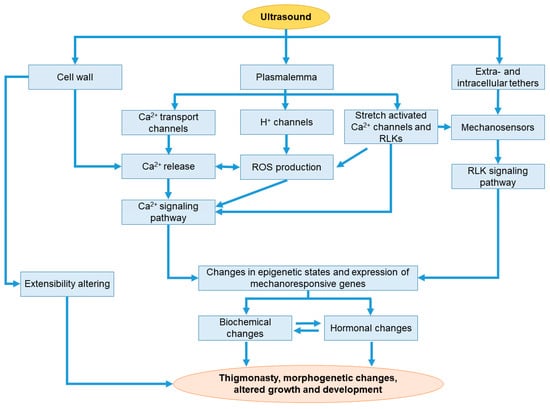
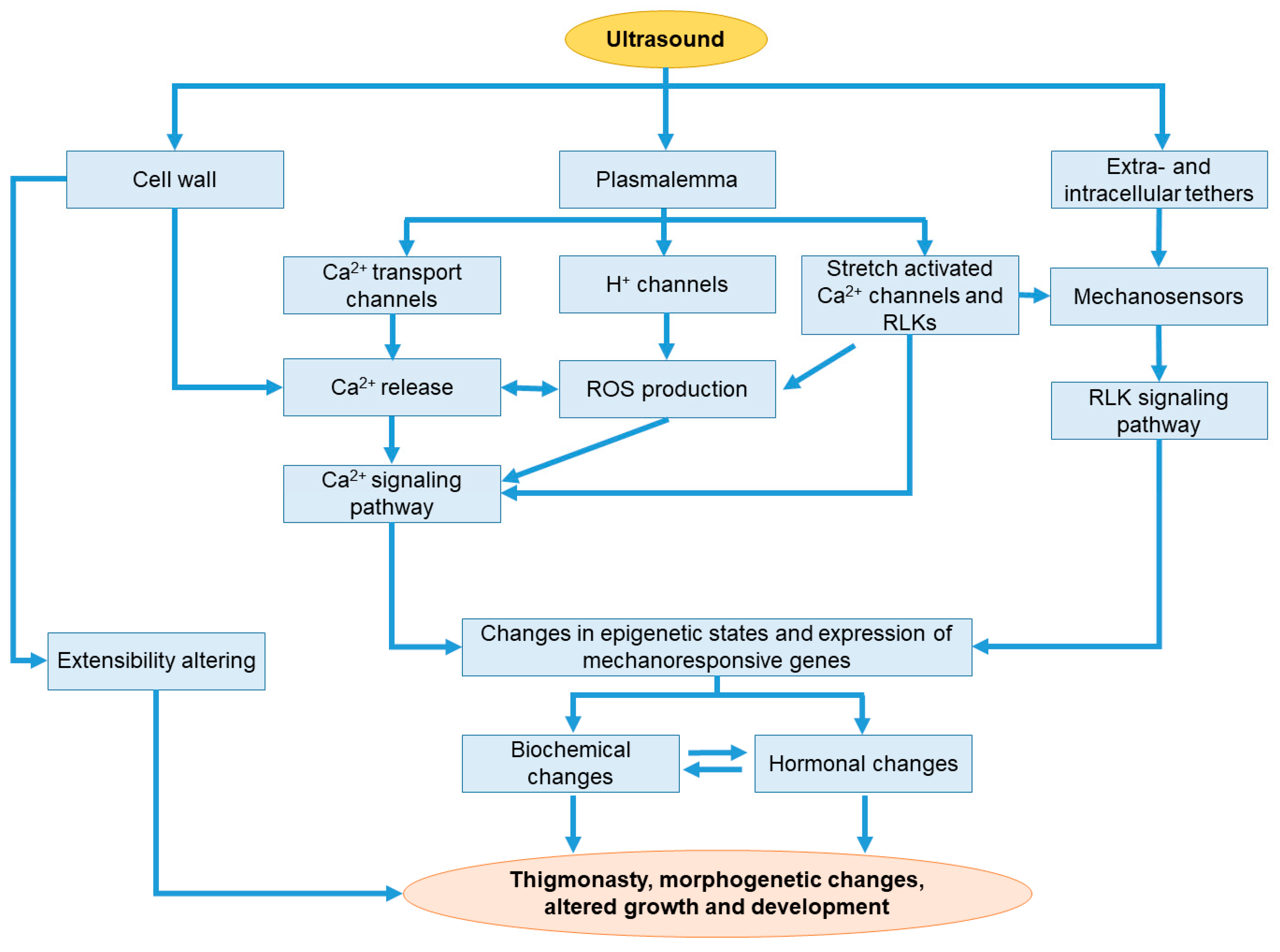
According to recent in vitro and in vivo studies (Table 1 and Table 2), the main processes of sensing and transduction mechanisms of ultrasound stimuli, which may lead to various growth and developmental alterations in plants, are summarized in Figure 1.
Figure 1.
Summary of main processes involved in sensing and transduction of ultrasound cues and how they affect molecular, biochemical, and physiological functioning of plants (abbreviations: ROS—reactive oxygen species; RLK—receptor-like kinase).
4. Ultrasound Emission by Plants
According to the latest studies of the last decade, as presented in the previous sections, we now have quite a lot of information about the growth–developmental and biochemical responses of plants induced by ultrasound. Additionally, we begin to explore the gene transcription and DNA methylation changes that are behind these responses. The question was rightly raised that if plants are able to sense acoustic signals, like ultrasound, are they capable of emitting them?
It has been proven for a long time that plants can produce both audible and ultrasonic acoustic signals, mainly if they are drought-stressed. This had been attributed to cavitation and embolism caused by the transpiration pull allowing air to enter the xylem, leading to vibrations in the vessel wall [84,85,86,87]. Audible acoustic emission was first detected by Milburn and Johnson [84] in Ricinus during leaf rehydration. The investigations of Ritman and Milburn [85] showed that larger vessels produced acoustic signals with lower frequencies, while smaller ones emitted signals, rather, in the ultrasonic frequency range. They assumed that ultrasonic acoustic emission, at least partly, is generated by other processes than cavitation, i.e., the acoustic signal emissions by plants may occur independently from cavitation, as later described by others [88,89,90,91]. Recently Khait et al. [6] proved that the overlap between cavitation and the emitted and recorded ultrasound was only partial. Plants are able to produce a wide range of acoustic emissions at specific frequencies, for varying durations and with different intensities in response to different environmental stress conditions. It means that naming transpiration and cavitation as the sole cause of plant ultrasound emission is an infinite simplification, even if they can modify the emitted acoustic signals [7,92,93]. However, the exact mode of sound and ultrasound production by plants is not yet clear.
The specificity of the ultrasound emission is determined by the type of environmental stress and by plant species [6,7]. The information-carrying property of the emitted ultrasonic sound was investigated by Khait et al. [6], both in an acoustic chamber and under greenhouse conditions. Tomato (Solanum lycopersicum L. cv. Hawai 7981) and tobacco (Nicotiana tabacum L. cv. Samsun NN) plants were stressed either by drought or by cutting. With the development of machine learning algorithms, they were able to distinguish the emitted ultrasounds in a range of 20–150 kHz. They concluded that the emitted ultrasound (20–100 kHz) was specific for the type of the stress and thereby it might play an information-carrying role. The number of sounds emitted differed depending on species and stress conditions. It was, after cutting, 25.2 per hour and 15.2 per hour while, in response to drought stress, 35.4 per hour and 11.0 per hour, for tomato and tobacco, respectively, compared to the control plants where it was under 1.00 per hour. Both the ultrasound intensity and the mean peak frequency were different in both species and in response to both stresses when measured from a 10 cm distance from plants. The watering status and the transpiration rate of the plants studied in the greenhouse and the emitted sound signal pattern (number of sounds per hour) were in strong correlation with each other in tomatoes. The more water-deficient the plant was, the more sounds it emitted, and after watering, the sound emissions decreased. The physiological state of the plant could be surveyed with high precision (99.7%) by measuring the emitted ultrasound. The authors assumed that insects or mammals are able to detect the plant ultrasound emissions from a 3–5 m distance. In addition, they successfully detected the ultrasound emission in other herbaceous plants (wheat, corn, cactus, and henbit) or even in grapevines, but not from woody species, like almonds or the woody part of grapevines. Furthermore, in the case of tomatoes, another type of specific ultrasound emission was detected when tomatoes were infected with tobacco mosaic virus (TMV).
5. The Plant’s Benefit from Reflecting, Sensing, and Emitting Ultrasound
In nature, there are some nice examples of mutual benefits and increased fitness in bats and plants based on the ultrasonic reflection of plants. Some plant species (e.g., Mucuna holtonii, Marcgravia evenia, and Marcgravia evenia), which are pollinated by bats, develop a leaf or inflorescence structure. They have properties to reflect the ultrasound emitted by bats in such a way that they attract bats by helping their echolocation and, therefore, their feeding, and at the same time, bats increase the success of plant pollination (up to 50%) [94,95]. Pitcher plants (Nepenthes sp.) living a carnivorous lifestyle attract bats with their special structure that reflects the bats’ ultrasonic sound. The plants provide roost for the bats in the pitchers, while about one-third of all nitrogen in plant foliage comes from bat droppings [96].
The latest research results presented in the previous sections indicate that plants are capable of sensing and emitting different frequencies of ultrasound. Considering that the emitted ultrasound is informative [6], there is a chance that neighboring plants and other organisms can gain information from them about environmental stresses or threats. Similarly, the detection of ultrasound vibrations using different properties from their environment and from other living beings can also carry information for plants. It can affect their growth, development, and even stress tolerance. Therefore, it can be assumed that the airborne ultrasound emissions and sensing of plants can be a way of biocommunication [6,10,13,97].
The use of ultrasound, or sound in general, for plants to communicate with each other and with other creatures living in the environment is a cheap and fast way for them to obtain information about their environment (ultrasound emitted by stressed plants, sound of water, chewing sound of herbivores, buzzle of pollinators, etc.) and to share information with those living in their environment (other plants, animals, and fungi) [92]. It allows plants to quickly learn about threats appearing in the near environment and to wait for them in preparation. Being in preparation means the formation of a primed state, when the metabolic, hormonal, and biochemical pathways of the plants are modified, and even certain epigenetic modifications occur [2,13,98]. Furthermore, sound can induce tolerance to other stresses, like drought, as was described in Arabidopsis and rice [63,99]. From the other side, sound or ultrasound can help to map environmental possibilities, such as water sources, or the appearance of symbiotic organisms in the near environment, and the plant responds to them with modified growth (in direction or extent) [2,3]. Plants are able to distinguish between sounds of different frequencies (audible and ultrasound) in their environment, and act accordingly. As an example, beach evening-primrose (Oenothera drummondii Hook.) attracts pollinators by producing sweeter nectar after sensing the sound emitted by its pollinator (1 kHz), but does not react to ultrasound (35 kHz) emitted by bats [100], which facilitates the success of the pollination.
Therefore, “hearing” and “talking”, i.e., sensing and emitting sound waves, and the ability to discriminate between sounds of different frequencies or patterns are ecologically beneficial traits even for plants, even in the lack of specialized organs. In addition, they are an adaptation of importance in plant life [2]. In terms of energy and transmission, the use of acoustic signals is more favorable in some cases than the synthesis and spread of chemical substances [92,98].
6. Perspectives on Ultrasonication and Ultrasound Detection in Horticulture and Crop Production
Taking into account the research results of the last decade, Table 1 and Table 2 summarize what changes in growth, development, and molecular function occurred in plants, when different plant parts, whether it was in vitro or ex vitro, or if the intact plants were exposed to ultrasound (Table 1 and Table 2). The methodological and technological achievements and perspectives that ultrasound application has achieved and, based on our current knowledge, is expected to enable plant biotechnology, agriculture, and horticulture practices are summarized in this chapter.
6.1. Use of Ultrasonication in Plant Tissue Culture for Enhancing In Vitro Growth and Development
Ultrasonication is of methodological importance under in vitro conditions. It was able to control contamination (both bacterial and fungal) during in vitro culture establishment, enhance callus development, somatic embryogenesis, and modify shoot or root growth and biomass in various plant species (Table 1). Thereby, ultrasonication in various in vitro explants can be incorporated into plant micropropagation and other plant tissue culture techniques, both to enhance their efficiency and to trigger developmental changes in vitro.
6.2. Sonication-Assisted Agrobacterium-Mediated Transformation (SAAT)—A Methodological Application of Plant Ultrasonication in Gene Transformation
The method of sonication-assisted Agrobacterium-mediated transformation (SAAT) was first described by Trick and Finer in 1997 [101]. This technique involves exposing the target plant tissue to the ultrasound treatment, which causes microwounds on the tissue in the presence of Agrobacterium. SAAT enhanced the transient GUS (β-glucuronidase) expression in soybeans, and, according to Zhang et al. [102,103], it was significantly higher (41.4% and 54.2%, respectively) compared to the control (9% and 11%, respectively). The highest frequency of Pinus elliottii Ehgelm. zygotic embryos with transient GUS expression were noticed, too, after ultrasonication using Agrobacterium [104]. In Dierama erectum Hillard, embryonic shoot apical meristems proved to be the best target tissue for transformation, with an efficiency in GUS gene expression of about 67%, compared to about 40% measured for calluses (Table 3) [105]. Agrobacterium-mediated gene transfer with ultrasonication enhanced the transformation efficiency in many species. In Coffea canephora Pierre ex A.Froehner, a transformation efficiency of 0.5–4% was measured, based on the number of putatively transformed hygromycin-resistant somatic embryos [106]. In Beta vulgaris, the highest transformation efficiency of 54% was observed when using diploid sugar beet explants, compared to efficiencies between 10 and 36% yielded by haploid explants, depending on the treatment [107]. In Catharanthus roseus (L.) G. Don, 10 min of ultrasonication increased it to 6%, compared to 3.5% measured using the conventional method [108]. In Paspalum vaginatum Sw., a high transient transformation efficiency of about 95% was observed with 5 min of ultrasonication, significantly exceeding the value of about 75% measured without it [109]. In Passiflora cincinnata Mast., transformation efficiencies up to 21.36% were observed using ultrasonication, in contrast to 13.63% in the case of the control [110]. In Hevea brasiliensis Müll.Arg., transformation efficiency was improved by ultrasonication at 40 kHz, mostly when using a treatment of 50 s and Agrobacterium at 0.45 OD600 [111]. In Malus x domestica, Borkh., wounding by scratching or 10 min of ultrasonication improved transformation efficiency to 9.3 roots per rooted explant, compared to 4.4 measured with no wounding (Table 3) [112]. Ultrasonication also improved transformation frequency in some cases. It was increased from the control value of 17% to 35% when using ultrasonication in Dendrobium catenatum [113]. It was increased by 2.2-fold to 60% using ultrasonication compared to manual wounding in Oroxylum indicum (L.) Benth. ex Kurz [114]. In Verbascum nigrum L., the infection frequency was 83%, detecting the first neoplastic roots at leaf wound sites two weeks after the transformation (Table 3).
Table 3.
Effects of ultrasonication-assisted Agrobacterium-mediated transformation.
The SAAT method can be enhanced with vacuum infiltration. This combined method was applied successfully by Stevens and Pijut [116] and Palla and Pijut [117] in the Fraxinus profunda (Bush) Bush and Fraxinus americana L., respectively (Table 4). In Prunus serotine Erhart, a transformation rate of 6.7% was measured using 60 and 90 s of ultrasonication and 21.7% using 15 min of vacuum infiltration, while the combination of the two treatments yielded poorer results [118]. However, this can be considered as an exception in the articles included in this review, as typically, the combination of the two treatments yielded the best results in similar cases (Table 4). Using such a combined treatment, Mayavan et al. [119] measured a maximum transformation efficiency of 29.6% in Saccharum officinarum L. Kapildev et al. [120] found an increase in transformation efficiency to 46.2% in Vigna mungo (L.) Hepper, from 25.6% measured for the control. Rani et al. [121] found that sonication increased the transformation efficiency to 10.8% in Carthamus tinctorius L. when combined with vacuum infiltration, while it was only 6.8% without it. Karthik et al. [122] achieved 33.6% using both treatments, and 19.6% without sonication, in Arachis hypogaea L. Vasudevan et al. [123] measured 17.3%, compared to 7.6% using ultrasonication only and 1.3% without treatment, in Citrullus lanatus (Thunb.) Matsum. and Nakai. Karthik et al. [124] measured 37%, compared to 18.6% in the case of the control, in Momordica charantia L. Vasudevan et al. [125] achieved a transformation efficiency of 17.33%, compared to 8.00% in the untreated case, in Citrullus lanatus. Zhang et al. [126] applied a combined treatment that yielded 18.6%, compared to about 6.7% for a simple 30 min of soaking, in Puccinellia tenuiflora (Griseb.) Scribn. and Merr. Song et al. [127] measured values up to 4.45%, contrary to control values up to 0.8%, in Vaccinium myrtillus. Saravanan et al. [128] achieved 38.0%, in contrast to 6.6% measured in untreated explants, in Glycine max L. Chandrasekaran et al. [129] found that a combination of the treatments yielded a transformation efficiency of 12.33%, compared to 6.33% yielded by the control, in Pisum sativum L. (Table 4). In Gossypium hirsutum L., the maximum transformation frequency observed was 28.66% when using ultrasonication combined with vacuum infiltration [130]. In Fraxinus mandshurica Rupr., Qi et al. [131] found that the maximum number of regenerated shoots was yielded by the combined treatment, increasing the number of adventitious buds per hypocotyl from 33.23 to 77.67 (Table 4). In Glycine max, ultrasonication combined with vacuum infiltration led to the highest total expression of GUS, according to King et al. [132]. In Withania somnifera (L.) Dunal, this combination enhanced transformation efficiency, resulting in a GUS foci frequency of 84% at the regeneration sites (Table 4) [133]. Sonication combined with vacuum infiltration also proved to be the most advantageous method in the case of Tricosanthes cucumerina L., studied by Subramanyam et al. [134] and in Abelmoschus esculentus (L.). Moench, studied by Manickavasagam et al. [135], where 39.3% and 54% of infected seeds were germinated, respectively (Table 4).
Table 4.
Effects of combined application of ultrasonication-assisted Agrobacterium-mediated transformation with vacuum infiltration (VI).
6.3. Advances and Perspectives on Ultrasound Applications in Agricultural and Horticultural Technologies
Current application possibilities of plant ultrasonication in various agricultural and horticultural practices in fields or in greenhouses are based on mechano-priming, and include amending growth and development, improving yield and crop quality, and increasing stress defense and tolerance (Table 1 and Table 2). The mechano-priming effect of ultrasound is based on the fact that it also acts as an abiotic stressor for plants [59] and induces stress-defense responses [41,42]. Ultrasonication affects plant gene transcription and DNA-methylation, as well, and its impact is memorized epigenetically in plants for at least a short period of time [58,60,82]. In addition, acoustic stimuli can prime plants for other abiotic and biotic stresses [46].
Priming effects of ultrasound have been widely utilized for seeds to increase germination rate, to enhance the germination capacity of aged seeds, and to intensify the early seedling growth and development (Table 2). The number of pores in the seed coat increased in response to seed ultrasonication, which allowed them for enhanced water uptake and higher germination percentage [75,76]. Furthermore, ultrasonic treatment of winter wheat seeds caused changes in DNA methylation and gene transcription in young seedlings, which enabled their increased growth [82]. Based on the latter study, the plants were able to epigenetically memorize, for at least a short period of time, the ultrasound exposure.
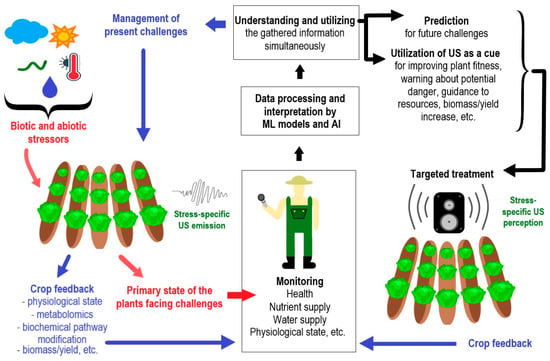
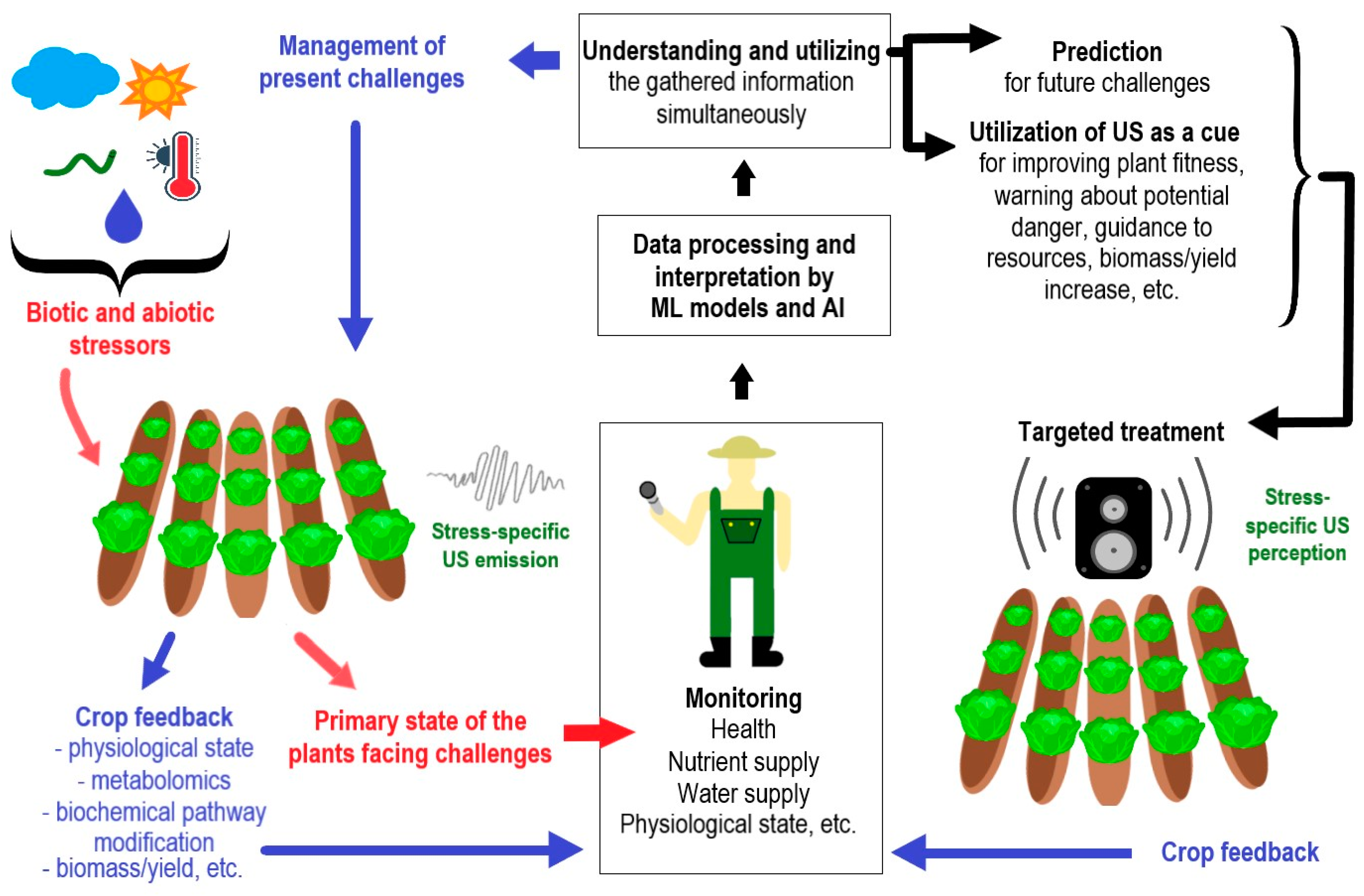
However, beyond seed treatment, ultrasound has much wider application possibilities in agriculture and horticulture. A roadmap for its commercial utilization is summarized in Figure 2. Considering that plants respond to various stresses by emitting specific ultrasound signals and patterns [6,7], their monitoring allows us a real-time assessment of the current physiological state of the plant, such as nutrient or water deficiency, or whether the plant is suffering from any other biotic or abiotic stress [9,39,97]. State-of-the-art technologies, like machine learning (ML) and artificial intelligence (AI), can be effectively used to process and interpret data on emitted ultrasound [7,9]. This enables immediate intervention and targeted stress mitigation and management. Furthermore, deciphering the information-carrying nature of ultrasound emitted and perceived by plants provides an opportunity to formulate predictions for plants about future challenges. This may include developing specific ultrasound treatments to improve plant health, enhance or modify plant growth and development, or alerting the plant to potential danger by using a specific ultrasound pattern [6,7,13]. Targeted treatment using ultrasound is an eco-friendly tool for mechano-priming in sustainable agriculture [13,78]. In addition, training a plant with various types of ultrasonic waves may enable the development of stress or multi-stress resilience in various crops.
Figure 2.
Possible perspectives on applying ultrasound in sustainable agri-and horticulture. Ultrasound emitted by plants can be applied for monitoring the physiological and health state of plants (red arrows). Data processing and interpretation can be done using machine learning (ML) models and artificial intelligence (AI). As a result of data processing, the gathered information and continuous crop feedback can be used for managing present challenges (blue arrows), and simultaneously, for the targeted ultrasound treatment of plants (black arrows).
7. Concluding Remarks
As we realized that ultrasound act on plants, including their growth and development, transcriptomics, and even epigenetics, and that plants themselves can emit ultrasound, the question arises, logically, if emitted ultrasound can be a way of communication between plants or between the plant and its environment (including animals and microbes) [11,12,13]. Can the plant use ultrasound to warn of environmental stress events or to signal environmental resources? In addition, whether and how can ultrasound emitted by plants affect life forms in their environment, or at least in their nearby environment? In the absence of enough direct evidence currently available, the questions cannot be answered clearly with either yes or no. However, taking into account nature’s cost–benefit principle and based on the latest studies [6,7,13], with the stress-specificity of the emitted ultrasound, it is theoretically and potentially possible [6,7,13]. Thereby, the acoustic emission is not merely, as said by Gagliano et al. [92], “an incidental mechanical by-product attributable to cavitation alone” but may have adaptive value. Undoubtedly, however, in practice, more and detailed direct experimental evidence is still necessary to understand its role in environmental adaptation and biocommunication.
What seems to be clear, especially based on the experimental evidence from the last decade reviewed in this article, ultrasonication is able to modify or enhance plant growth and development in several ways (Table 1 and Table 2). Thereby, ultrasound is well suited for increasing the efficiency in certain in vitro laboratory methods, e.g., gene transformation mediated by Agrobacterium (Table 3 and Table 4), or for incorporating it into certain greenhouse or green in-field agricultural technologies (Table 1 and Table 2; Figure 2). Moreover, in the future, by measuring the sound or ultrasound emitted by plants, rapid and reliable monitoring or diagnostic systems can be developed in horti- and agriculture (Figure 2). With these, it will be possible to measure and track the current physiological or health status and nutrient or water supply in plants [7,97].
We consider it important to mention the biggest limitation of the studies on ultrasonication of plants. This includes the often incomplete data on the properties of the ultrasound used for treating plants or plant parts, e.g., the volume (dB), the power (W), or the frequency (kHz) of the ultrasound (see the notes in Table 1 and Table 2).
Author Contributions
Conceptualization, J.D.; writing—original draft preparation, A.K., D.F. and J.D.; writing—review and editing, A.K., D.F. and J.D.; visualization, A.K., D.F. and J.D.; supervision and funding acquisition, J.D.; All authors have read and agreed to the published version of the manuscript.
Funding
Project no. TKP2021-EGA-20 has been implemented, with the support provided by the Ministry of Culture and Innovation of Hungary from the National Research, Development, and Innovation Fund, financed under the TKP2021-EGA funding scheme. Publication was supported by the University of Debrecen Program for Scientific Publication.
Conflicts of Interest
The authors declare no conflicts of interest.
References
- Schneider, H.M. Characterization, costs, cues and future perspectives of phenotypic plasticity. Ann. Bot. 2022, 130, 131–148. [Google Scholar] [CrossRef] [Scilit] [PubMed]
- Demey, M.L.; Mishra, R.C.; Van Der Straeten, D. Sound perception in plants: From ecological significance to molecular understanding. Trends Plant Sci. 2023, 28, 825–840. [Google Scholar] [CrossRef] [Scilit] [PubMed]
- Khait, I.; Obolski, U.; Yovel, Y.; Hadany, L. Sound perception in plants. Semin. Cell Dev. Biol. 2019, 92, 134–138. [Google Scholar] [CrossRef] [Scilit] [PubMed]
- Jung, J.; Kim, S.K.; Kim, J.Y.; Jeong, M.J.; Ryu, C.M. Beyond chemical triggers: Evidence for sound-evoked physiological reactions in plants. Front. Plant Sci. 2018, 9, 25. [Google Scholar] [CrossRef] [Scilit]
- Gorai, S.; Hazra, S. Plant acoustic frequency technology: Sound waves in crop improvement. Agric. Food E-Newsl. 2020, 2, 37–40. [Google Scholar]
- Khait, I.; Lewin-Epstein, O.; Sharon, R.; Saban, K.; Goldstein, R.; Anikster, Y.; Zeron, Y.; Agassy, C.; Nizan, S.; Gayl, S.; et al. Sounds emitted by plants under stress are airborne and informative. Cell 2023, 186, 1328–1336. [Google Scholar] [CrossRef] [Scilit]
- Hussain, M.; u Rahman, M.K.; Mishra, R.C.; Van Der Straeten, D. Plants can talk: A new era in plant acoustics. Trends Plant Sci. 2023, 28, 987–990. [Google Scholar] [CrossRef] [Scilit]
- Allievi, S.; Arru, L.; Forti, L. A tuning point in plant acoustics investigation. Plant Sign. Behav. 2021, 16, 1919836. [Google Scholar] [CrossRef] [Scilit]
- Bhandawat, A.; Jayaswall, K. Biological relevance of sound in plants. Environ. Exp. Bot. 2022, 200, 104919. [Google Scholar] [CrossRef] [Scilit]
- Del Stabile, F.; Marsili, V.; Forti, L.; Arru, L. Is There a Role for Sound in Plants? Plants 2022, 11, 2391. [Google Scholar] [CrossRef] [Scilit]
- Nardini, A.; Cochard, H.; Mayr, S. Talk is cheap: Rediscovering sounds made by plants. Trends Plant Sci. 2024, 29, 662–667. [Google Scholar] [CrossRef] [Scilit]
- Son, J.S.; Jang, S.; Mathevon, N.; Ryu, C.M. Is plant acoustic communication fact or fiction? New Phytol. 2024, 242, 1876–1880. [Google Scholar] [CrossRef] [Scilit]
- Dobránszki, J.; Agius, D.R.; Berger, M.M.J.; Moschou, P.N.; Gallusci, P.; Martinelli, F. Plant memory and communication of encounters. Trends Plant Sci. 2025, 30, 199–212. [Google Scholar] [CrossRef] [Scilit]
- Yoneda, A.; Ohtani, M.; Katagiri, D.; Hosokawa, Y.; Demura, T. Hechtian strands transmit cell wall integrity signals in plant cells. Plants 2020, 9, 604. [Google Scholar] [CrossRef] [Scilit]
- Jia, H.; Chen, S.; Wang, X.; Shi, C.; Liu, K.; Zhang, S.; Li, J. Copper oxide nanoparticles alter cellular morphology via disturbing the actin cytoskeleton dynamics in Arabidopsis roots. Nanotoxicology 2020, 14, 127–144. [Google Scholar] [CrossRef] [Scilit]
- Simon, C.; Caorsi, V.; Campillo, C.; Sykes, C. Interplay between membrane tension and the actin cytoskeleton determines shape changes. Phys. Biol. 2018, 15, 065004. [Google Scholar] [CrossRef] [Scilit]
- Matsumura, M.; Nomoto, M.; Itaya, T.; Aratani, Y.; Iwamoto, M.; Matsuura, T.; Hayashi, Y.; Kinoshita, T.; Mori, I.C.; Suzuki, T.; et al. Mechanosensory trichome cells evoke a mechanical stimuli–induced immune response in plants. Nat. Commun. 2022, 13, 1216. [Google Scholar] [CrossRef] [Scilit]
- Liu, S.; Jiao, J.; Lu, T.J.; Xu, F.; Pickard, B.G.; Genin, G.M. Arabidopsis leaf trichomes as acoustic antennae. Biophys. J. 2017, 113, 2068–2076. [Google Scholar] [CrossRef] [Scilit]
- Kim, J.Y.; Lee, H.J.; Kim, J.A.; Jeong, M.J. Sound waves promote Arabidopsis thaliana root growth by regulating root phytohormone content. Int. J. Mol. Sci. 2020, 22, 5739. [Google Scholar] [CrossRef] [Scilit]
- Rodrigo-Moreno, A.; Bazihizina, N.; Azzarello, E.; Masi, E.; Tran, D.; Bouteau, F.; Baluska, F.; Mancuso, S. Root phonotropism: Early signalling events following sound perception in Arabidopsis roots. Plant Sci. 2017, 264, 9–15. [Google Scholar] [CrossRef] [Scilit] [PubMed]
- Hamant, O.; Haswell, E.S. Life behind the wall: Sensing mechanical cues in plants. BMC Biol. 2017, 15, 59. [Google Scholar] [CrossRef] [Scilit]
- Vogler, H.; Santos-Fernandez, G.; Mecchia, M.A.; Grossniklaus, U. To preserve or to destroy, that is the question: The role of the cell wall integrity pathway in pollen tube growth. Curr. Opin. Plant Biol. 2019, 52, 131–139. [Google Scholar] [CrossRef] [Scilit]
- Fruleux, A.; Verger, S.; Boudaoud, A. Feeling stressed or strained? A biophysical model for cell wall mechanosensing in plants. Front. Plant Sci. 2019, 10, 757. [Google Scholar] [CrossRef] [Scilit]
- Voxeur, A.; Höfte, H. Pectin-derived immune elicitors in response to lignin modification in plants. Proc. Natl. Acad. Sci. USA 2020, 117, 4442–4444. [Google Scholar] [CrossRef] [Scilit]
- Kaur, A.; Taneja, M.; Tyagi, S.; Sharma, A.; Singh, K.; Upadhyay, S.K. Genome-wide characterization and expression analysis suggested diverse functions of the mechanosensitive channel of small conductance-like (MSL) genes in cereal crops. Sci. Rep. 2020, 10, 16583. [Google Scholar] [CrossRef] [Scilit]
- Basu, D.; Haswell, E.S. Plant mechanosensitive ion channels: An ocean of possibilities. Curr. Opin. Plant Biol. 2017, 40, 43–48. [Google Scholar] [CrossRef] [Scilit]
- Nishii, K.; Möller, M.; Iida, H. Mix and match: Patchwork domain evolution of the land plant-specific Ca2+-permeable mechanosensitive channel MCA. PLoS ONE 2021, 16, e0249735. [Google Scholar] [CrossRef] [Scilit]
- Suzuki, Y.; Yamamura, H.; Imaizumi, Y.; Clark, R.B.; Giles, W.R. K+ and Ca2+ channels regulate Ca2+ signaling in chondrocytes: An illustrated review. Cells 2020, 9, 1577. [Google Scholar] [CrossRef] [Scilit]
- Kefauver, J.M.; Ward, A.B.; Patapoutian, A. Discoveries in structure and physiology of mechanically activated ion channels. Nature 2020, 587, 567–576. [Google Scholar] [CrossRef] [Scilit]
- Du, F.; Jiao, Y. Mechanical control of plant morphogenesis: Concepts and progress. Curr. Opin. Plant Biol. 2020, 57, 16–23. [Google Scholar] [CrossRef] [Scilit]
- Meena, M.K.; Prajapati, R.; Krishna, D.; Divakaran, K.; Pandey, Y.; Reichelt, M.; Mathew, M.K.; Boland, W.; Mithöfer, A.; Vadassery, J. The Ca2+ channel CNGC19 regulates Arabidopsis defense against Spodoptera herbivory. Plant Cell 2019, 31, 1539–1562. [Google Scholar] [CrossRef] [Scilit]
- Gangwar, S.P.; Green, M.N.; Michard, E.; Simon, A.A.; Feijó, J.A.; Sobolevsky, A.I. Structure of the Arabidopsis glutamate receptor-like channel GLR3. 2 ligand-binding domain. Structure 2021, 29, 161–169. [Google Scholar] [CrossRef] [Scilit]
- Fang, X.; Liu, B.; Shao, Q.; Huang, X.; Li, J.; Luan, S.; He, K. AtPiezo plays an important role in root cap mechanotransduction. Int. J. Mol. Sci. 2021, 22, 467. [Google Scholar] [CrossRef] [Scilit]
- Zhang, Z.; Tateda, C.; Jiang, S.C.; Shrestha, J.; Jelenska, J.; Speed, D.J.; Greenberg, J.T. A suite of receptor-like kinases and a putative mechano-sensitive channel are involved in autoimmunity and plasma membrane–based defenses in Arabidopsis. Mol. Plant-Microb. Interact. 2017, 30, 150–160. [Google Scholar] [CrossRef] [Scilit]
- Ghosh, R.; Mishra, R.C.; Choi, B.; Kwon, Y.S.; Bae, D.W.; Park, S.C.; Jeong, M.-J.; Bae, H. Exposure to sound vibrations lead to transcriptomic, proteomic and hormonal changes in Arabidopsis. Sci. Rep. 2016, 6, 33370. [Google Scholar] [CrossRef] [Scilit]
- Peiter, E.; Maathuis, F.J.; Mills, L.N.; Knight, H.; Pelloux, J.; Hetherington, A.M.; Sanders, D. The vacuolar Ca2+-activated channel TPC1 regulates germination and stomatal movement. Nature 2005, 434, 404–408. [Google Scholar] [CrossRef] [Scilit]
- Pérez-Sancho, J.; Vanneste, S.; Lee, E.; McFarlane, H.E.; Esteban del Valle, A.; Valpuesta, V.; Friml, J.; Botella, M.A.; Rosado, A. The Arabidopsis synaptotagmin1 is enriched in endoplasmic reticulum-plasma membrane contact sites and confers cellular resistance to mechanical stresses. Plant Physiol. 2015, 168, 132–143. [Google Scholar] [CrossRef] [Scilit]
- Lee, C.P.; Maksaev, G.; Jensen, G.S.; Murcha, M.W.; Wilson, M.E.; Fricker, M.; Hell, R.; Haswell, E.S.; Harvey Millar, A.; Sweetlove, L.J. MSL 1 is a mechanosensitive ion channel that dissipates mitochondrial membrane potential and maintains redox homeostasis in mitochondria during abiotic stress. Plant J. 2016, 88, 809–825. [Google Scholar] [CrossRef] [Scilit]
- Ali, S.; Tyagi, A.; Park, S.; Bae, H. Understanding the Mechanobiology of Phytoacoustics Through Molecular Lens: Mechanisms and Future Perspectives. J. Adv. Res. 2024, 65, 47–72. [Google Scholar] [CrossRef] [Scilit]
- Wang, K.; Yang, Z.; Qing, D.; Ren, F.; Liu, S.; Zheng, Q.; Liu, J.; Zhang, W.; Dai, C.; Wu, M.; et al. Quantitative and functional posttranslational modification proteomics reveals that TREPH1 plays a role in plant touch-delayed bolting. Proc. Natl. Acad. Sci. USA 2018, 115, E10265–E10274. [Google Scholar] [CrossRef] [Scilit]
- Pesti-Asbóth, G.; Molnár-Bíróné, P.; Forgács, I.; Remenyik, J.; Dobránszki, J. Ultrasonication affects the melatonin and auxin levels and the antioxidant system in potato in vitro. Front. Plant Sci. 2022, 13, 979141. [Google Scholar] [CrossRef] [Scilit]
- Dobránszki, J.; Asbóth, G.; Homoki, D.; Bíró-Molnár, P.; Teixeira da Silva, J.A.; Remenyik, J. Ultrasonication of in vitro potato single node explants: Activation and recovery of antioxidant defence system and growth responses. Plant Phys. Biochem. 2017, 121, 153–160. [Google Scholar] [CrossRef] [Scilit]
- Kadota, Y.; Shirasu, K.; Zipfel, C. Regulation of the NADPH oxidase RBOHD during plant immunity. Plant Cell Physiol. 2015, 56, 1472–1480. [Google Scholar] [CrossRef] [Scilit]
- Ghosh, R.; Gururani, M.A.; Ponpandian, L.N.; Mishra, R.C.; Park, S.C.; Jeong, M.J.; Bae, H. Expression analysis of sound vibration-regulated genes by touch treatment in Arabidopsis. Front. Plant Sci. 2017, 8, 100. [Google Scholar] [CrossRef] [Scilit]
- Mishra, R.C.; Ghosh, R.; Bae, H. Plant acoustics: In the search of a sound mechanism for sound signaling in plants. J. Exp. Bot. 2016, 67, 4483–4494. [Google Scholar] [CrossRef] [Scilit]
- Besson-Bard, A.; Pugin, A.; Wendehenne, D. New insights into nitric oxide signaling in plants. Annu. Rev. Plant Biol. 2008, 59, 21–39. [Google Scholar] [CrossRef] [Scilit]
- Mishra, V.; Singh, V.P. Implication of nitric oxide and hydrogen sulfide signalling in alleviating arsenate stress in rice seedlings. Environ. Pollut. 2021, 291, 117958. [Google Scholar] [CrossRef] [Scilit]
- Ali, S.; Tyagi, A.; Bae, H. ROS interplay between plant growth and stress biology: Challenges and future perspectives. Plant Physiol. Biochem. 2023, 203, 108032. [Google Scholar] [CrossRef] [Scilit]
- Sparke, M.A.; Wünsche, J.N. Mechanosensing of plants. Hortic. Rev. 2020, 47, 43–83. [Google Scholar]
- Feng, W.; Kita, D.; Peaucelle, A.; Cartwright, H.N.; Doan, V.; Duan, Q.; Liu, M.-C.; Maman, J.; Steinhorst, L.; Schmitz-Thom, I.; et al. The FERONIA receptor kinase maintains cell-wall integrity during salt stress through Ca2+ signaling. Curr. Biol. 2018, 28, 666–675. [Google Scholar] [CrossRef] [Scilit]
- Behnami, S.; Bonetta, D. With an ear up against the wall: An update on Mechanoperception in Arabidopsis. Plants 2021, 10, 1587. [Google Scholar] [CrossRef] [Scilit]
- Wolf, S. Plant cell wall signalling and receptor-like kinases. Biochem. J. 2017, 474, 471–492. [Google Scholar] [CrossRef] [Scilit]
- Teixeira da Silva, J.; Dobránszki, J. Sonication (ultrasound) affects in vitro growth of hybrid Cymbidium. Bot. Lith. 2015, 20, 121–130. [Google Scholar] [CrossRef] [Scilit]
- Farrokhzad, Y.; Rezaei, A. Effects of ultrasound, tryptophan and proline on embryogenesis and regeneration of grape (Vitis vinifera L.). Azarian J. Agric. 2016, 3, 112–118. [Google Scholar]
- Koochani, M.; Majd, A.; Arbabian, S.; Ghanati, F.; Marandi, S.J. A comparative study on the effects of ultrasound and some growth factors on somatic embryogenesis and artificial seed production in cucumber (Cucumis sativus L.). Not. Bot. Horti Agrobot. 2020, 48, 1915–1928. [Google Scholar] [CrossRef] [Scilit]
- Muratova, S.A.; Papikhin, R. The effect of ultrasound irradiation on induction of callus formation and morphogenesis from the leaf discs of apple clonal rootstocks. J. Pharm. Sci. Res. 2018, 10, 2592–2596. [Google Scholar]
- Firoozi, B.; Zare, N.; Sofalian, O.; Sheikhzade-Mosadegh, P. In vitro indirect somatic embryogenesis and secondary metabolites production in the saffron: Emphasis on ultrasound and plant growth regulators. J. Agric. Sci. 2019, 25, 1–10. [Google Scholar] [CrossRef] [Scilit]
- Dobránszki, J.; Hidvégi, N.; Gulyás, A.; Teixeira da Silva, J.A. mRNA transcription profile of potato (Solanum tuberosum L.) exposed to ultrasound during different stages of in vitro plantlet development. Plant Mol. Biol. 2019, 100, 511–525. [Google Scholar] [CrossRef] [Scilit]
- Dobránszki, J.; Hidvégi, N.; Gulyás, A.; Tóth, B.; Teixeira da Silva, J.A. Abiotic stress elements in in vitro potato (Solanum tuberosum L.) exposed to air-based and liquid-based ultrasound: A comparative transcriptomic assessment. Prog. Biophys. Mol. Biol. 2020, 158, 47–56. [Google Scholar] [CrossRef] [Scilit] [PubMed]
- Teixeira da Silva, J.; Norbert, H.; Gulyás, A.; Bianka, T.; Judit, D. Transcriptomic response of in vitro potato (Solanum tuberosum L.) to piezoelectric ultrasound. Plant Mol. Biol. Rep. 2020, 38, 404–418. [Google Scholar] [CrossRef] [Scilit]
- Naqvi, B.; Mehboob, S.; Makhani, K.; Yousuf, K. Effect of physical, chemical and physiochemical treatments of surface sterilisation on medicinal plants Salvadora persica and Solanum surattense for in vitro propagation. Pak. J. Sci. Ind. Res. B Biol. Sci. 2017, 60, 141–144. [Google Scholar] [CrossRef] [Scilit]
- Sharififar, A.; Nazari, M.; Asghari, H.R. Effect of ultrasonic waves on seed germination of Atriplex lentiformis, Cuminum cyminum, and Zygophyllum eurypterum. J. Appl. Res. Med. Aromat. Plants 2015, 2, 102–104. [Google Scholar] [CrossRef] [Scilit]
- López-Ribera, I.; Vicient, C.M. Use of ultrasonication to increase germination rates of Arabidopsis seeds. Plant Methods 2017, 13, 31. [Google Scholar] [CrossRef] [Scilit] [PubMed]
- Babaei-Ghaghelestany, A.; Alebrahim, M.T.; MacGregor, D.R.; Khatami, S.A.; Farzaneh, R.H.N. Evaluation of ultrasound technology to break seed dormancy of common lambsquarters (Chenopodium album). Food Sci. Nutr. 2020, 8, 2662–2669. [Google Scholar] [CrossRef] [Scilit] [PubMed]
- Mihaylova, E.; Marcheva, M.; Peruhov, N. Ultrasound seed treatment for organic farming. Bulg. J. Agric. Sci. 2021, 27, 78–84. [Google Scholar]
- Najafi, R.; Rezaei, A.; Talei, D. Potential of ultrasound and nicotinic acid to improve physiological responses and trigonelline biosynthesis in fenugreek (Trigonella foenum-graecum L.). Ind. Crops Prod. 2022, 182, 114815. [Google Scholar] [CrossRef] [Scilit]
- Babaei, M.; Pirdashti, H.; Bakhshandeh, E. Ultrasonic waves improve aged seed germination of castor bean (Ricinus communis L.) under drought and salt stresses. Acta Physiol. Plant 2023, 45, 90. [Google Scholar] [CrossRef] [Scilit]
- El-Sattar, A.M.A.; Tawfik, E. Effects of ultrasonic waves on seedling growth, biochemical constituents, genetic stability of fenugreek (Trigonella foenum-graecum) under salinity stress. Vegetos 2023, 36, 1427–1436. [Google Scholar] [CrossRef] [Scilit]
- Gong, M.; Kong, M.; Huo, Q.; He, J.; He, J.; Yan, Z.; Lu, C.; Jiang, Y.; Song, J.; Han, W.; et al. Ultrasonic treatment can improve maize seed germination and abiotic stress resistance. BMC Plant Biol. 2024, 24, 758. [Google Scholar] [CrossRef] [Scilit]
- Xia, Q.; Tao, H.; Li, Y.; Pan, D.; Cao, J.; Liu, L.; Zhou, X.; Barba, F.J. Characterizing physicochemical, nutritional and quality attributes of wholegrain Oryza sativa L. subjected to high intensity ultrasound-stimulated pre-germination. Food Control 2020, 108, 106827. [Google Scholar] [CrossRef] [Scilit]
- Zeng, Z.; Liu, X.; Deng, Q.; Ashraf, U.; Chen, J.; Shen, W. Transcriptome analysis revealed mechanisms involved in improved germination and growth of sugarcane by ultrasonic treatment. Ind. Crops Prod. 2023, 192, 116104. [Google Scholar] [CrossRef] [Scilit]
- Yu, Z.; Gao, Y.; Duan, H.; Zheng, D.; Shang, Z.; Zhang, L.; Chen, Y. Ultrasound-assisted germination of red kidney beans: Enhancements in physicochemical and nutritional profiles. Food Chem. 2024, 454, 139829. [Google Scholar] [CrossRef] [Scilit]
- Younesian, A.; Gholipoor, M.; Ajam Norouzi, H. Alleviation of drought stress effects on red bean by ultrasonication and foliar application of 24-epi-brassinolid. Int. J. Plant Prod. 2017, 11, 505–514. [Google Scholar]
- Zeng, Z.; Cai, H.; Chen, J.; Liu, X.; Li, Y.; Zhang, Y.; Chen, J.; Rao, D.; Shen, W. Improving sugarcane agronomy: Field evidence for ultrasonic treatment enhancing yield, growth, and physiological and biochemical characteristics. Ind. Crops Prod. 2024, 211, 118276. [Google Scholar] [CrossRef] [Scilit]
- Lo Porto, C.; Ziuzina, D.; Los, A.; Boehm, D.; Palumbo, F.; Favia, P.; Tiwari, B.; Bourke, P.; Cullen, P.J. Plasma activated water and airborne ultrasound treatments for enhanced germination and growth of soybean. Innov. Food Sci. Emerg. Technol. 2018, 49, 13–19. [Google Scholar] [CrossRef] [Scilit]
- Wu, Y.; He, S.; Pan, T.; Miao, X.; Xiang, J.; Ye, Y.; Cao, X.; Sun, H. Enhancement of γ-aminobutyric acid and relevant metabolites in brown glutinous rice (Oryza sativa L.) through salt stress and low-frequency ultrasound treatments at pre-germination stage. Food Chem. 2023, 410, 135362. [Google Scholar] [CrossRef] [Scilit]
- Jamshidi, A.R.; Ghazanfari Moghaddam, A.; Ommani, A.R. Effect of ultrasonic atomizer on the yield and yield components of tomato grown in a vertical aeroponic planting system. Int. J. Hortic. Sci. 2019, 6, 237–246. [Google Scholar]
- Kawakami, D.; Yoshida, T.; Kanemaru, Y.; Zaquinaula, M.H.H.; Mizukami, T.; Arimoto, M.; Shibata, T.; Goto, A.; Enami, Y.; Amano, H.; et al. Induction of resistance to diseases in plant by aerial ultrasound irradiation. J. Pestic. Sci. 2019, 44, 41. [Google Scholar] [CrossRef] [Scilit]
- Yakupoğlu, G. Effects of magnetic field and ultrasound applications on endogenous melatonin content and drought stress tolerance of pepper seedlings. Horticulturae 2023, 9, 704. [Google Scholar] [CrossRef] [Scilit]
- Rizwan, H.M.; He, J.; Nawaz, M.; Cheng, K.-W.; Wang, M. Comprehensive in silico characterization of soybean (Glycine max L.) isoflavone reductase genes and their expressions in response to spermidine and ultrasonication. Plant Stress 2024, 11, 100392. [Google Scholar] [CrossRef] [Scilit]
- Yu, S.; Zhang, S.; Lu, L.; Liu, L.; Liang, J.; Lang, S.; Wang, C.; Wang, L.; Li, Z. Effects of combined ultrasound and calcium ion pretreatments on polyphenols during mung bean germination: Exploring underlying mechanisms. Food Res. Int. 2024, 195, 114947. [Google Scholar] [CrossRef] [Scilit] [PubMed]
- Hidvégi, N.; Gulyás, A.; Dobránszki, J. Ultrasound, as a hypomethylating agent, remodels DNA methylation and alters mRNA transcription in winter wheat (Triticum aestivum L.) seedlings. Physiol. Plant. 2022, 174, e13777. [Google Scholar] [CrossRef] [Scilit]
- Pszczółkowski, P.; Sawicka, B. Ultrasound application in potato cultivation: Potential for enhanced yield and sustainable agriculture. Sustainability 2024, 16, 108. [Google Scholar] [CrossRef] [Scilit]
- Milburn, J.A.; Johnson, R.P.C. The conduction of sap. II. Detection of vibrations produced by sap cavitation in Ricinus xylem. Planta 1966, 69, 43–52. [Google Scholar] [CrossRef] [Scilit]
- Ritman, K.T.; Milburn, J.A. Acoustic emissions from plants: Ultrasonic and audible compared. J. Exp. Bot. 1988, 39, 1237–1248. [Google Scholar] [CrossRef] [Scilit]
- Perks, M.P.; Irvine, J.; Grace, J. Xylem acoustic signals from mature Pinus sylvestris during an extended drought. Ann. For. Sci. 2004, 61, 1–8. [Google Scholar] [CrossRef] [Scilit]
- Ponomarenko, A.; Vincent, O.; Pietriga, A.; Cochard, H.; Badel, E.; Marmottant, P. Ultrasonic emissions reveal individual cavitation bubbles in water-stressed wood. J. R. Soc. Interface 2014, 11, 20140480. [Google Scholar] [CrossRef] [Scilit]
- Kikuta, S.B.; Lo Gullo, M.A.; Nardini, A.; Richter, H.; Salleo, S. Ultrasound acoustic emissions from dehydrating leaves of deciduous and evergreen trees. Plant Cell Environ. 1997, 20, 1381–1390. [Google Scholar] [CrossRef] [Scilit]
- Laschimke, R.; Burger, M.; Vallen, H. Acoustic emission analysis and experiments with physical model systems reveal a peculiar nature of the xylem tension. J. Plant Physiol. 2006, 163, 996–1007. [Google Scholar] [CrossRef] [Scilit]
- Zweifel, R.; Zeugin, F. Ultrasonic acoustic emissions in drought-stressed trees–more than signals from cavitation? New Phytol. 2008, 179, 1070–1079. [Google Scholar] [CrossRef] [Scilit]
- Vergeynst, L.L.; Dierick, M.; Bogaerts, J.A.; Cnudde, V.; Steppe, K. Cavitation: A blessing in disguise? New method to establish vulnerability curves and assess hydraulic capacitance of woody tissues. Tree Physiol. 2015, 35, 400–409. [Google Scholar] [CrossRef] [Scilit] [PubMed]
- Gagliano, M.; Mancuso, S.; Robert, D. Towards understanding plant bioacoustics. Trends Plant Sci. 2012, 17, 323–325. [Google Scholar] [CrossRef] [Scilit] [PubMed]
- Vergeynst, L.L.; Sause, M.G.; Hamstad, M.A.; Steppe, K. Deciphering acoustic emission signals in drought stressed branches: The missing link between source and sensor. Front. Plant Sci. 2015, 6, 494. [Google Scholar] [CrossRef] [Scilit] [PubMed]
- Simon, R.; Holderied, M.W.; Koch, C.U.; Helversen, O. Floral acoustics: Conspicuous echoes of a dish-shaped leaf attract bat pollinators. Science 2011, 333, 631–633. [Google Scholar] [CrossRef] [Scilit]
- Schöner, M.G.; Simon, R.; Schöner, C.R. Acoustic communication in plant–animal interactions. Curr. Opin. Plant Biol. 2016, 32, 88–95. [Google Scholar] [CrossRef] [Scilit]
- Grafe, T.U.; Schöner, C.R.; Kerth, G.; Junaidi, A.; Schöner, M.G. A novel resource–service mutualism between bats and pitcher plants. Biol. Lett. 2011, 7, 436–439. [Google Scholar] [CrossRef] [Scilit]
- Robert, D. Plant bioacoustics: The sound expression of stress. Cell 2023, 186, 1307–1308. [Google Scholar] [CrossRef] [Scilit]
- Dalal, V.K. Understanding Acoustic Communication in Plants. J. Biomed. Res. 2021, 2, 815–820. [Google Scholar] [CrossRef] [Scilit]
- Jeong, M.J.; Cho, J.I.; Park, S.H.; Kim, K.H.; Lee, S.K.; Kwon, T.R.; Park, S.-C.; Siddiqui, Z.S. Sound frequencies induce drought tolerance in rice plant. Pak. J. Bot. 2020, 46, 2015–2020. [Google Scholar]
- Veits, M.; Khait, I.; Obolski, U.; Zinger, E.; Boonman, A.; Goldshtein, A.; Saban, K.; Seltzer, R.; Ben-Dor, U.; Estlein, P. Flowers respond to pollinator sound within minutes by increasing nectar sugar concentration. Ecol. Lett. 2019, 22, 1483–1492. [Google Scholar] [CrossRef] [Scilit]
- Trick, H.N.; Finer, J.J. SAAT: Sonication-assisted Agrobacterium-mediated transformation. Transgenic Res. 1997, 6, 329–336. [Google Scholar] [CrossRef] [Scilit]
- Zhang, Y.; Liu, Z.; Yang, R.; Li, G.; Guo, X.; Zhang, H.; Zhang, H.; Di, R.; Zhao, Q.; Zhang, M. Improvement of soybean transformation via Agrobacterium tumefaciens methods involving α-aminooxyacetic acid and sonication treatments enlightened by gene expression profile analysis. Plant Cell Rep. 2016, 35, 1259–1271. [Google Scholar] [CrossRef] [Scilit] [PubMed]
- Zhang, Y.-M.; Zhang, H.-M.; Liu, Z.-H.; Guo, X.-L.; Li, H.-C.; Li, G.-L.; Jiang, C.-Z.; Zhang, M.-C. Inhibition of isoflavone biosynthesis enhanced T-DNA delivery in soybean by improving plant–Agrobacterium tumefaciens interaction. Plant Cell Tiss. Org. Cult. 2015, 121, 183–193. [Google Scholar] [CrossRef] [Scilit]
- Tang, W.; Xiao, B.; Fei, Y. Slash pine genetic transformation through embryo cocultivation with A. tumefaciens and transgenic plant regeneration. In Vitr. Cell Dev. Biol. Plant 2014, 50, 199–209. [Google Scholar] [CrossRef] [Scilit]
- Koetle, M.J.; Baskaran, P.; Finnie, J.F.; Soos, V.; Balázs, E.; Van Staden, J. Optimization of transient GUS expression of Agrobacterium-mediated transformation in Dierama erectum Hilliard using sonication and Agrobacterium. S. Afr. J. Bot. 2017, 111, 307–312. [Google Scholar] [CrossRef] [Scilit]
- Mohanan, S.; Satyanarayana, K.V.; Sridevi, V.; Gowda, K.; Giridhar, P.; Chandrashekar, A.; Ravishankar, G.A. Evaluating the effect and effectiveness of different constructs with a conserved sequence for silencing of Coffea canephora N-methyltransferases. J. Plant Biochem. Biotechnol. 2014, 23, 399–409. [Google Scholar] [CrossRef] [Scilit]
- Klimek-Chodacka, M.; Baranski, R. A protocol for sonication-assisted Agrobacterium rhizogenes-mediated transformation of haploid and diploid sugar beet (Beta vulgaris L.) explants. Acta Biochim. Pol. 2014, 61, 13–17. [Google Scholar] [CrossRef] [Scilit]
- Alam, P.; Khan, Z.A.; Abdin, M.Z.; Khan, J.A.; Ahmad, P.; Elkholy, S.F.; Sharaf-Eldin, M.A. Efficient regeneration and improved sonication-assisted Agrobacterium transformation (SAAT) method for Catharanthus roseus. 3 Biotech 2017, 7, 26. [Google Scholar] [CrossRef] [Scilit]
- Wu, X.; Shi, H.; Chen, X.; Liu, Y.; Guo, Z. Establishment of Agrobacterium-mediated transformation of seashore paspalum (Paspalum vaginatum O. Swartz). In Vitr. Cell Dev. Biol. Plant 2018, 54, 545–552. [Google Scholar] [CrossRef] [Scilit]
- da Silva, M.L.; Pinto, D.L.P.; Passos, A.B.; Marcelino-Guimaraes, F.C.; Rossi, A.A.B.; Krause, W.; de Carvalho, I.F.; Batista, D.S.; Rocha, D.I.; Otoni, W.C. Novel and efficient transformation of wild passion fruit (Passiflora cincinnata Mast.) using sonication-assisted Agrobacterium-mediated transformation. In Vitr. Cell Dev. Biol. Plant 2021, 57, 380–386. [Google Scholar] [CrossRef] [Scilit]
- Udayabhanu, J.; Huang, T.; Xin, S.; Cheng, J.; Hua, Y.; Huang, H. Optimization of the transformation protocol for increased efficiency of genetic transformation in Hevea brasiliensis. Plants 2022, 11, 1067. [Google Scholar] [CrossRef] [Scilit] [PubMed]
- Rüter, P.; Eeckhaut, T.; Dhooghe, E.; De Keyser, E.; Doan, M.H.; Bartels, J.; Winkelmann, T. Optimization of Rhizobium rhizogenes-mediated transformation, regeneration and characterization of Malus domestica Borkh. Ri lines. Plant Cell Tiss. Organ Cult. 2024, 157, 32. [Google Scholar] [CrossRef] [Scilit]
- Chen, J.; Wang, L.; Chen, J.; Huang, J.; Liu, F.; Guo, R.; Yang, L.; Grabon, A.; Zhao, K.; Kong, F.; et al. Agrobacterium tumefaciens-mediated transformation system for the important medicinal plant Dendrobium catenatum Lindl. In Vitro Cell Dev. Biol. Plant 2018, 54, 228–239. [Google Scholar] [CrossRef] [Scilit]
- Faraz, R.; Gokhale, M.; Gothalwal, R. Enhancement in production of baicalein through transformation in Oroxylum indicum (L.) Vent by Rhizobium rhizogenes. Vegetos 2024, 37, 305–320. [Google Scholar]
- Georgiev, M.I.; Radziszewska, A.; Neumann, M.; Marchev, A.; Alipieva, K.; Ludwig-Müller, J. Metabolic alterations of Verbascum nigrum L. plants and SAArT transformed roots as revealed by NMR-based metabolomics. Plant Cell Tiss. Org. 2015, 123, 349–356. [Google Scholar] [CrossRef] [Scilit]
- Stevens, M.E.; Pijut, P.M. Agrobacterium-mediated genetic transformation and plant regeneration of the hardwood tree species Fraxinus profunda. Plant Cell Rep. 2014, 33, 861–870. [Google Scholar] [CrossRef] [Scilit]
- Palla, K.J.; Pijut, P.M. Agrobacterium-mediated genetic transformation of Fraxinus americana hypocotyls. Plant Cell Tiss. Org. Cult. 2015, 120, 631–641. [Google Scholar] [CrossRef] [Scilit]
- Wang, Y.; Pijut, P. Improvement of Agrobacterium-mediated transformation and rooting of black cherry. In Vitr. Cell Dev. Biol. Plant 2014, 50, 307–316. [Google Scholar] [CrossRef] [Scilit]
- Mayavan, S.; Subramanyam, K.; Jaganath, B.; Sathish, D.; Manickavasagam, M.; Ganapathi, A. Agrobacterium-mediated in planta genetic transformation of sugarcane setts. Plant Cell Rep. 2015, 34, 1835–1848. [Google Scholar] [CrossRef] [Scilit]
- Kapildev, G.; Chinnathambi, A.; Sivanandhan, G.; Rajesh, M.; Vasudevan, V.; Mayavan, S.; Arun, M.; Jeyaraj, M.; Alharbi, S.A.; Selvaraj, N.; et al. High-efficient Agrobacterium-mediated in planta transformation in black gram (Vigna mungo (L.) Hepper). Acta Physiol. Plant. 2016, 38, 205. [Google Scholar] [CrossRef] [Scilit]
- Rani, A.; Panwar, A.; Sathe, M.; Kush, A. A modified in planta method of Agrobacterium-mediated transformation enhances the transformation efficiency in safflower (Carthamus tinctorius L.). J. Plant Biochem. Biotechnol. 2018, 27, 272–283. [Google Scholar] [CrossRef] [Scilit]
- Karthik, S.; Pavan, G.; Sathish, S.; Siva, R.; Periyasamy, S.K.; Manickavasagam, M. Genotype-independent and enhanced in planta Agrobacterium tumefaciens-mediated genetic transformation of peanut [Arachis hypogaea (L.)]. 3 Biotech 2018, 8, 1–15. [Google Scholar] [CrossRef] [Scilit] [PubMed]
- Vasudevan, V.; Siva, R.; Krishnan, V.; Manickavasagam, M. Polyamines, sonication and vacuum infiltration enhances the Agrobacterium-mediated transformation in watermelon (Citrullus lanatus Thunb.). S. Afr. J. Bot. 2020, 128, 333–338. [Google Scholar] [CrossRef] [Scilit]
- Karthik, S.; Pavan, G.; Prasanth, A.; Sathish, S.; Appunu, C.; Manickavasagam, M. Improved in planta genetic transformation efficiency in bitter gourd (Momordica charantia L.). In Vitr. Cell Dev. Biol. 2021, 57, 190–201. [Google Scholar] [CrossRef] [Scilit]
- Vasudevan, V.; Sathish, D.; Ajithan, C.; Sathish, S.; Manickavasagam, M. Efficient Agrobacterium-mediated in planta genetic transformation of watermelon [Citrullus lanatus Thunb.]. Plant Biotechnol. Rep. 2021, 15, 447–457. [Google Scholar] [CrossRef] [Scilit]
- Zhang, Y.; Chunxiao, Q.; Shijia, L.; Xu, Y.; Li, Y.; Yongxue, Z.; Song, Y.; Meihong, S.; Chunxiang, F.; Zhi, Q.; et al. Establishment of an efficient Agrobacterium-mediated genetic transformation system in halophyte Puccinellia tenuiflora. Mol. Breed. 2021, 41, 55. [Google Scholar] [CrossRef] [Scilit] [PubMed]
- Song, Y.; Luo, W.; Wu, Y.; Li, X.; Albert, N.W.; Zhang, Y.; Chen, X.; Lin-Wang, K.; Deng, C.H.; Hu, Z.; et al. A callus-derived regeneration and Agrobacterium-mediated gene transformation developed for bilberry, Vaccinium myrtillus. Plant Cell Tiss. Org. Cult. 2023, 154, 177–187. [Google Scholar] [CrossRef] [Scilit]
- Saravanan, K.; Vidya, N.; Appunu, C.; Gurusaravanan, P.; Arun, M. A simple and efficient genetic transformation system for soybean (Glycine max (L.) Merrill) targeting apical meristem of modified half-seed explant. 3 Biotech 2023, 13, 293. [Google Scholar] [CrossRef] [Scilit]
- Chandrasekaran, A.; Pilavadi, T.; Venkatachalam, V.; Umapathy, D.; Arockiam, A.J.V.; Singarayar, M.S.; Lee, G.-J.; Markandan, M. Bio-engineered As-Ag-TiO2 nanoparticles enhance the genetic transformation of Pisum sativum L. via proton-coupled electron transfer-dependent alternative protonation. Ind. Crops Prod. 2024, 215, 118604. [Google Scholar] [CrossRef] [Scilit]
- Prem Kumar, G.; Sivakumar, S.; Siva, G.; Vigneswaran, M.; Senthil Kumar, T.; Jayabalan, N. Optimization and establishment of genotype-independent seed-based in planta transformation system in cotton (Gossypium hirsutum L. cv. SVPR-2). Plant Gene 2021, 27, 100296. [Google Scholar] [CrossRef] [Scilit]
- Qi, F.; Tang, M.; Wang, W.; Liu, L.; Cao, Y.; Jing, T.; Zhan, Y. In vitro adventitious shoot regeneration system for Agrobacterium-mediated genetic transformation of Fraxinus mandshurica Rupr. Trees 2022, 36, 1387–1399. [Google Scholar] [CrossRef] [Scilit]
- King, J.L.; Finer, J.J.; McHale, L.K. Development and optimization of agroinfiltration for soybean. Plant Cell Rep. 2015, 34, 133–140. [Google Scholar] [CrossRef] [Scilit] [PubMed]
- Sivanandhan, G.; Kapil Dev, G.; Theboral, J.; Selvaraj, N.; Ganapathi, A.; Manickavasagam, M. Sonication, vacuum infiltration and thiol compounds enhance the Agrobacterium-mediated transformation frequency of Withania somnifera (L.) Dunal. PLoS ONE 2015, 10, e0124693. [Google Scholar] [CrossRef] [Scilit] [PubMed]
- Subramanyam, K.; Arunachalam, C.; Rasu, M.T.; Sulaiman, A.A.; Manickavasagam, M.; Ganapathi, A. Highly efficient Agrobacterium-mediated in planta genetic transformation of snake gourd (Tricosanthes cucumerina L.). Plant Cell Tiss. Org. Cult. 2015, 123, 133–142. [Google Scholar] [CrossRef] [Scilit]
- Manickavasagam, M.; Subramanyam, K.; Ishwarya, R.; Elayaraja, D.; Ganapathi, A. Assessment of factors influencing the tissue culture-independent Agrobacterium-mediated in planta genetic transformation of okra [Abelmoschus esculentus (L.) Moench]. Plant Cell Tiss. Org. 2015, 123, 309–320. [Google Scholar] [CrossRef] [Scilit]

Disclaimer/Publisher’s Note: The statements, opinions and data contained in all publications are solely those of the individual author(s) and contributor(s) and not of MDPI and/or the editor(s). MDPI and/or the editor(s) disclaim responsibility for any injury to people or property resulting from any ideas, methods, instructions or products referred to in the content. |
© 2025 by the authors. Licensee MDPI, Basel, Switzerland. This article is an open access article distributed under the terms and conditions of the Creative Commons Attribution (CC BY) license (https://creativecommons.org/licenses/by/4.0/).