


Abstract
Wine lees (WL) are one of the main byproducts generated during winemaking and are usually disposed of in landfills or incorporated into the soil as an organic amendment; nevertheless, these practices can have negative environmental impacts. Reusing agro-industrial byproducts is a key step toward more sustainable production cycles, and WL represent a promising alternative for formulating culture media for the production of lactic acid bacteria (LAB) biomass, microorganisms widely used in the food and wine industries. In this work, we aim to evaluate the ecotoxicity of WL using a bioassay with zebrafish (Danio rerio) embryos and to analyze their potential as a source of nitrogen and growth factors for the production of UNQLp 11 Lactiplantibacillus plantarum strain biomass in whey permeate. Trials conducted with zebrafish showed that embryos exposed to WL exhibited increased mortality in a concentration-dependent response and the appearance of sublethal effects, such as alterations in embryonic development. Regarding WL biotechnological application, the results obtained confirm that the growth of Lpb. plantarum depends largely on the composition of the culture medium. Whey permeate media (WP) without supplementation showed nutritional limitations, reflected in lower cell counts. While supplementation with WL significantly improved bacterial growth, in some cases reaching values comparable to those obtained with MRS. The results demonstrated that WL can act as an efficient nutrient source, with the potential to replace commercial yeast extract in Lpb. plantarum culture media.
1. Introduction
Wine lees (WL) are a major byproduct of the winemaking process, they are a heterogeneous mass of residues accumulated in containers after fermentation, storage, treatment, filtration, or centrifugation of the must. WL is an agro-industrial waste characterized by a high chemical oxygen demand (COD), with values exceeding 30,000 mg/L, indicating a high organic load and potential environmental impacts if improperly disposed of. The quality of WL can be influenced by grape variety, grape quality, fermentation temperature, yeast strain, shelf life, and yeast type, as well as by environmental conditions, the production area, and the agronomic practices applied to the crop. All of these factors influence the composition of this byproduct, which consists of a liquid phase and a solid phase. The liquid phase mainly contains ethanol, lactic acid, and acetic acid, while the solid phase is composed of microorganisms—predominantly yeasts—as well as cellulosic materials, proteins, organic acids, phenolic compounds, and minerals [1,2].
Current management strategies for these residues, including landfill disposal and incorporation into the soil as an organic nutrient, can compromise soil integrity and functionality [3]. The sustainable valorization of agro-industrial byproducts should not only demonstrate technological feasibility but also consider environmental safety. Although wine lees have been extensively characterized regarding their chemical composition and potential valorization, information regarding their ecotoxicity evaluated using standardized zebrafish embryo toxicity assays remains limited. Assessing the ecotoxicological profile of wine lees provides essential information regarding the environmental implications of their disposal and supports the development of safe strategies for their reutilization as industrial raw materials.
In the field of environmental sciences, ecotoxicology has acquired strategic importance, drawing on various disciplines to assess and clarify the risks posed by pollutants. Various industrial sectors continuously release effluents and waste into ecosystems, many of which are not completely removed in wastewater treatment plants [4,5]. In response to this problem, methodologies and experimental models have been developed to analyze the effects of bioactive compounds, chemicals, and pathogens on aquatic organisms.
Among these tools, the use of zebrafish (Danio rerio) embryos—a vertebrate model widely used in developmental biology and molecular genetics studies—stands out [6,7]. This organism has emerged as an increasingly important assay system in ecotoxicology, particularly for the identification and characterization of chemical compounds with potential environmental impact [8]. Zebrafish possess outstanding biological attributes for toxicological evaluation, such as its rapid development cycle and embryo transparency, which enable the direct non-invasive observation of multiple morphogenetic and physiological processes. In this sense, zebrafish embryos constitute an ideal model for quantifying toxicological endpoints through the OECD Guideline 236 for the Fish Embryo Acute Toxicity (FET) test, a gold standard in ecotoxicology [9]. The measurement of toxicity indicators allows for the estimation of the median lethal concentration (LC50) associated with exposure to toxic compounds [10].
Concurrently, the production of LAB biomass is of strategic interest to the food industry due to its application as starter cultures and bioprotective agents in a wide variety of fermentation processes [11]. In this regard, the valorization of agro-industrial byproducts, such as WL, has become increasingly important, given their rich composition of fermentable carbohydrates, nitrogenous compounds, B vitamins, and minerals—characteristics that make them a potentially suitable substrate for the sustainable production of LAB biomass. Therefore, combining the ecotoxicological assessment with the development of a bacterial culture medium provides a comprehensive framework for evaluating wine lees within a circular bioeconomy approach.
LAB are part of the natural microbial ecosystem of wine and play a key role during the winemaking process. Among them, Lactiplantibacillus plantarum has emerged as a promising candidate for malolactic fermentation (MLF) starter cultures. This potential stems from its ability to drive MLF in adverse winemaking scenarios—such as reduced pH, high ethanol concentration, and nutritional limitations—as well as its broader enzymatic profile and distinctive metabolism, compared to Oenococcus oeni, that could significantly contribute to modulating the aromatic profile of wine [12,13,14,15].
Given this background, the objective of this work was to develop a sustainable strategy for wine lees valorization by integrating environmental safety assessment with their technological application as a nutrient source—combined with whey permeate—for Lactiplantibacillus plantarum biomass production, thereby highlighting a dual waste-based sustainable approach.
First, the ecotoxicity of WL—both raw and processed through autolysis and centrifugation (retaining only the supernatant)—was evaluated using a zebrafish embryo bioassay to estimate the potential environmental impact of improper disposal. Additionally, WL were chemically characterized to determine their composition. Subsequently, they were tested as a nutrient supplement in a whey permeate-based culture medium for the growth of Lactiplantibacillus plantarum UNQLp 11 strain—selected for its potential as a malolactic starter culture in winemaking [16]—where its growth performance was evaluated in the presence of different concentrations of WL.
2. Materials and Methods
2.1. Ecotoxicity Evaluation of Wine Lees in Zebrafish
2.1.1. Zebrafish Husbandry and Embryo Collection
Zebrafish (Danio rerio) were kept as previously described [17]. In this study, “embryos” refer to zebrafish up to three days post-fertilization (dpf), while “larvae” refer to hatched animals over 3 dpf. Zebrafish procedures performed were approved by [18].
Embryos were obtained by natural mating and preserved in E3 medium (NaCl 0.29 g/L, KCl 0.012 g/L, CaCl2 0.036 g/L, and MgSO4 0.039 g/L in deionized water and 50 ppb methylene blue, a fungal growth inhibitor) [19]. Egg characteristics were evaluated with a stereomicroscope (Leica Zoom 2000, Leica Microsystems, Wetzlar, Germany).
2.1.2. Toxicity Assays
Toxicity tests were conducted in accordance with the OECD 236 guideline [9]. Pure WL were tested at concentrations of 1.0%, 0.50%, 0.25%, 0.125%, 0.10%, and 0.0625% (v/v), whereas autolyzed WL were tested at 2.0%, 1.0%, 0.50%, and 0.25% (v/v). Briefly, fertilized embryos at 2–4 h post-fertilization (hpf) were individually transferred to 24-well plates, with one embryo per well containing 2 mL of the corresponding test solution. Embryos were incubated at 28 ± 1 °C under a 14 h light/10 h dark photoperiod without renewal of the exposure medium throughout the 96 h test period.
Mortality was assessed on the total number of embryos exposed at each concentration according to the apical endpoints defined in OECD TG 236: embryo coagulation, lack of somite formation, non-detachment of the tail from the yolk sac, and absence of heartbeat. The occurrence of any of these endpoints was considered a lethal outcome. In addition, surviving embryos at the endpoint for each concentration were examined for delayed development, delayed hatching and morphological abnormalities (including scoliosis, intestinal inflammation, edema formation, impaired or absent pigmentation, eye malformation, spinal cord malformation, craniofacial malformation, impaired fin development, reduced yolk resorption, and swim bladder alterations) [20,21]. Embryos were monitored throughout the standard 96 hpf exposure period using an Olympus CKX41 inverted microscope (Olympus, Hamburg, Germany), and images were captured with an Olympus C-5040 AUD digital camera.
2.1.3. Statistical Analysis of Zebrafish Toxicity
Zebrafish embryo toxicity was evaluated in two independent experiments for each sample type (Pure WL and Autolyzed WL). Data from these replicates were pooled for final analysis. The number of embryos analyzed per concentration ranged from 10 to 20 for Pure WL and 15 to 28 for Autolyzed WL, varying according to natural spawning output; with total control group sizes of 74 and 27 embryos, respectively.
Mortality was recorded cumulatively at 24, 48, 72, and 96 hpf and expressed as the percentage of dead embryos relative to the initial number of embryos exposed at each concentration. Concentration–response relationships at 96 hpf were analyzed using Probit regression with the logarithm of the relative test concentration as the independent variable. Median lethal concentrations (LC50) and their corresponding 95% confidence intervals (95% CI) were estimated from the fitted concentration–response models.
Mortality at each exposure concentration was compared with the corresponding control using Fisher’s exact test. Differences were considered statistically significant at p < 0.05. The lowest observed effect concentration (LOEC) was defined as the lowest tested concentration producing a statistically significant increase in mortality relative to the control, whereas the no observed effect concentration (NOEC) was defined as the highest tested concentration that did not produce a statistically significant increase in mortality relative to the control. When the lowest concentration tested already produced a statistically significant effect, the NOEC was considered to be below the lowest tested concentration and could not be experimentally determined within the concentration range evaluated.
Developmental abnormalities and growth delays observed in surviving embryos were descriptively evaluated for each exposure concentration. The incidence of delayed development and delayed hatching was expressed relative to the number of surviving embryos at each concentration. These observations were not subjected to inferential statistical analysis and were not included in the determination of mortality, LC50, LOEC, or NOEC.
2.1.4. Ethics Statement
We conducted all animal studies in strict accordance with the National Institutes of Health guidelines for animal care and husbandry. All protocols were approved by [18].
2.2. Treatments of Wine Lees
WL, kindly donated by the Buenos Aires Wine Center—Winery School (C.E.B.A, Buenos Aires, Argentina), were kept frozen at −20 °C until use. WL were evaluated pure and autolyzed.
Pure WL: Total WL were sterilized by autoclave at 121 °C for 15 min.
Autolyzed WL: WL were incubated for 48 h at 50 °C to induce autolysis [22]. Autolytic activity was then stopped by thermal treating (sterilization by autoclave at 121 °C for 15 min). Afterward, the autolyzed WL were centrifuged at 10,000× g for 10 min, and the supernatant was collected.
The samples were freeze-dried for 48 h using a freeze dryer (BioBase BK-FD10P, Jinan, China) operated at a condenser temperature of −55 °C and a chamber pressure of 0.06 mbar to obtain dry powder.
Freeze-drying was performed exclusively for analytical purposes to standardize the samples and determine dry matter recovery and centesimal composition. It was not intended as a proposed industrial processing step.
A schematic representation of the preparation of pure WL and autolyzed WL is provided in Supplementary Figure S1.
2.3. Disruption Efficiency Determination
Disruption efficiency (DE) was determined using the formula (Equation (1)) described by [23] based on the loss of dried biomass during lysis treatment:
where m0 corresponds to the dry biomass prior to autolysis and m1 represents the residual dry biomass remaining after the lysis treatment followed by centrifugation. To determine m0, an aliquot of the untreated biomass, equivalent to the amount used for each lysis assay, was lyophilized in a BioBase BK-FD10P freeze dryer and subsequently weighed. The m1 values were obtained by freeze-drying the residual pellet recovered after centrifugation under the same operating conditions and recording its dry weight [24].
2.4. Determination of the Centesimal Composition
Total nitrogen was quantified according to the Kjeldahl method [25] using a Kjeltec MC 8100 distillation unit equipped with a DT2508 digestion system and an SR210 scrubber (Foss, Scandinavia, Denmark). Protein content was subsequently estimated by applying a nitrogen-to-protein conversion factor of 6.25.
Total fat content was determined using the Folch method [26] with a chloroform/methanol mixture (2:1, v/v) as the extracting solvent. Samples were homogenized with the solvent mixture, and an aqueous solution was then added to induce phase separation. The lower organic phase, containing total lipids, was recovered and evaporated to dryness for gravimetric quantification of the lipid content.
Ash content was determined by direct incineration of the samples in a muffle furnace at 550 °C until constant weight was reached.
Moisture content was quantified gravimetrically by oven drying at 105 °C until constant weight was reached.
Total carbohydrate content was estimated by difference from the percent composition obtained.
2.5. Evaluation of Wine Lees as a Source of Nutrients
2.5.1. Strain Information
Lpb. plantarum UNQLp 11 (complete genome GenBank Accession code CP031140) was obtained from a Pinot noir wine vintage 2010, chosen for its technological and enological characteristics [16,27]. This strain is a genetic resource that belongs to the Province of Río Negro (Argentina), where it was given the registry identification RGPRN-/-M-/-357-/-Semorile-/-626-/-UNQLp11-/-2024.
2.5.2. Strain Growth
Lpb. plantarum UNQLp 11 was grown in media based on whey permeate (WP) and WL. The WP used in this study was obtained from deproteinized sweet whey kindly provided by Arla Foods Ingredients S.A. (Buenos Aires, Argentina). After drying, the powder was characterized by a composition of approximately 85% w/w lactose, 6% w/w ash, and 3% w/w protein. WP was used at 5% w/v in distilled water and supplemented according to [28] with commercial yeast extract (YE) (Britania, Buenos Aires, Argentina). Also, YE was replaced by pure WL and autolyzed WL in different quantities (Table 1). MRS broth (Britania Lab S.A., Buenos Aires, Argentina) was used as a positive control [29]. Bacterial cultures were grown aerobically at 28 °C for a period of 94 h. Viable cell numbers were quantified by the plate count method using MRS agar, with plates incubated at the same temperature. The results were expressed as Log (CFU/mL).
Table 1.
Composition of alternative culture media based on whey permeate (WP), salts and yeast extract (YE) or wine lees (WL) *.
Growth curves were fitted using the Gompertz Growth model implemented in GraphPad Prism 8 (GraphPad Software, San Diego, CA, USA), according to the following equation:
where Y is the viable cell concentration (Log CFU/mL) at time t, Y0 is the initial viable cell concentration, YM is the maximum viable cell concentration (upper asymptote), and K (day−1) is the Gompertz kinetic constant. The fitted parameters (Y0, YM, and K) were used to describe and compare the growth behavior of Lpb. plantarum UNQLp11 under different culture conditions. The estimated kinetic parameters are presented in Table S1 of the Supplementary Materials.
2.5.3. Reproducibility of Results and Statistical Analysis
All experiments were performed using three independent bacterial cultures. Data are presented as mean ± standard deviation. One-way analysis of variance (ANOVA) was performed using STATISTIX 8 (Analytical Software, Tallahassee, FL, USA). Means were compared using Tukey’s or Dunnett’s multiple comparison tests, as appropriate, and differences were considered statistically significant at p < 0.05.
3. Results
3.1. Ecotoxicological Evaluation of Wine Lees and the Effect of Yeast Cell Disruption on Their Toxicity Using Zebrafish Embryos
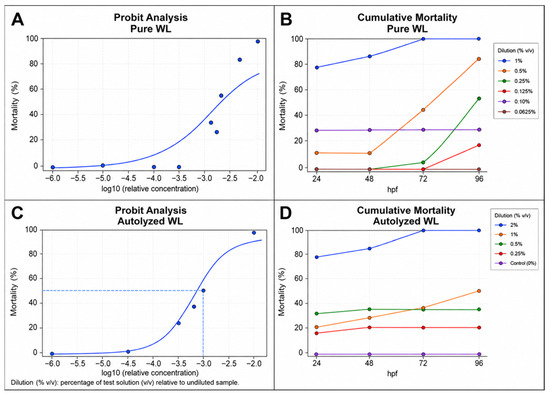
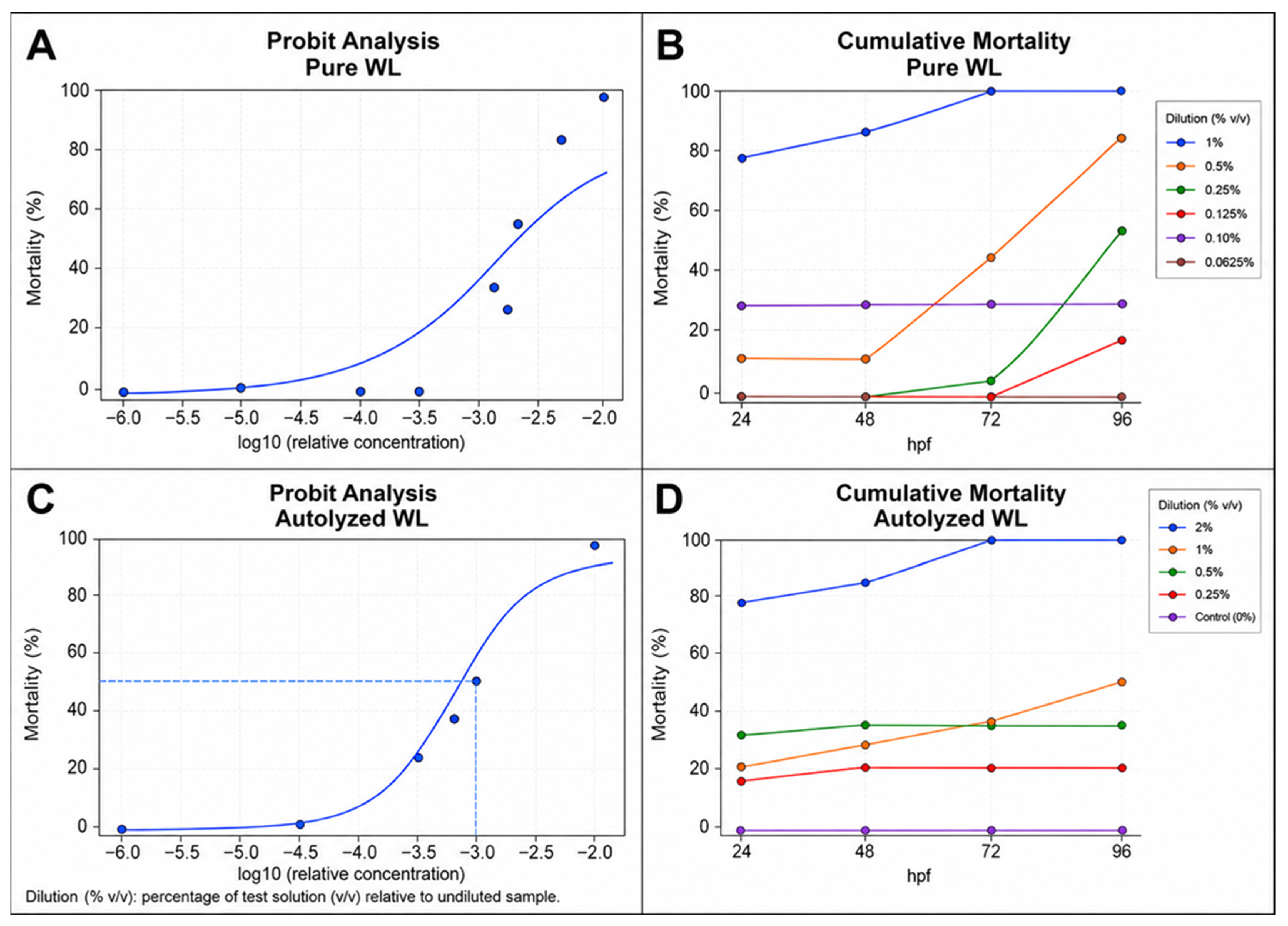
The ecotoxicity of pure and autolyzed wine lees (WLs) was analyzed using bioassays with zebrafish embryos. Lethal effects were assessed throughout the 96 h exposure period, and concentration–response relationships were used to determine the LC50, LOEC, and NOEC values. The results obtained are presented in Figure 1.
Figure 1.
Acute toxicity of wine lees in zebrafish embryos. (A) Concentration–response analysis for Pure WL at 96 hpf; (B) cumulative mortality of embryos exposed to Pure WL; (C) concentration–response analysis for Autolyzed WL at 96 hpf; and (D) cumulative mortality of embryos exposed to Autolyzed WL. Concentrations are expressed as % (v/v).
Embryonic exposure to Pure WL resulted in a concentration-dependent increase in mortality (Figure 1A,B). At 96 hpf, the LC50 was 0.21% (v/v) (95% CI: 0.17–0.27%). A statistically significant increase in mortality relative to the control was observed at 0.10% (v/v), which represented the lowest tested concentration producing a significant effect and was therefore established as the LOEC. The next lower tested concentration, 0.0625% (v/v), did not produce a statistically significant increase in mortality relative to the control and was therefore established as the NOEC.
Embryonic exposure to Autolyzed WL also resulted in a concentration-dependent increase in mortality (Figure 1C,D), with a 96 hpf LC50 of 0.70% (v/v) (95% CI: 0.52–0.94%). The lowest concentration tested, 0.25% (v/v), produced a statistically significant increase in mortality relative to the control and was therefore established as the LOEC. Since no lower concentration was experimentally evaluated, a NOEC could not be determined within the tested concentration range and was therefore considered to be <0.25% (v/v).
Overall, Autolyzed WL showed lower acute toxicity to zebrafish embryos than Pure WL, as indicated by an approximately three-fold higher LC50 (0.70% vs. 0.21%, respectively) and a higher LOEC (0.25% vs. 0.10%, respectively). These results indicate that higher concentrations of Autolyzed WL were required to induce lethal effects in zebrafish embryos.
Representative morphological abnormalities observed in surviving embryos during the exposure period are shown in Supplementary Figure S2. These images are provided for qualitative illustration only and were not used for the determination of LC50, LOEC, or NOEC values. Additionally, the incidence of the main developmental outcomes (mortality, delayed development and delayed hatching) observed at 96 hpf in embryos exposed to pure and autolyzed wine lees is presented in Supplementary Figure S3, providing a descriptive assessment of their frequency.
3.2. Centesimal Composition of Pure Wine Lees and Autolyzed Wine Lees
The percentage composition of pure and autolyzed WL, both in powder form, is presented in Table 2. Cell disruption is the process of plasma membrane disintegration, resulting in the release of intracellular components. The disruption efficiency of the autolysis treatment was calculated using Equation (1), based on the loss of dry biomass after the autolysis process. Pure WL showed higher percentages of protein, lipids, and ash than autolyzed WL, since the latter involves the soluble fraction of the lees, whereas a proportion of the insoluble compounds remained associated with the sediment. Structural proteins, lipids, and some minerals are predominantly found in the insoluble fraction of the lees; their removal during the separation process could explain the observed decrease in their relative concentrations in the autolyzed WL. Likewise, the autolyzed WL exhibited a higher moisture content than the pure WL, which is attributed to the greater proportion of soluble compounds released during the autolysis process.
Table 2.
Centesimal composition of pure wine lees (WL) and autolyzed WL. All values include the mean ± standard deviation.
3.3. Growth of UNQLp 11 in Alternative Culture Media
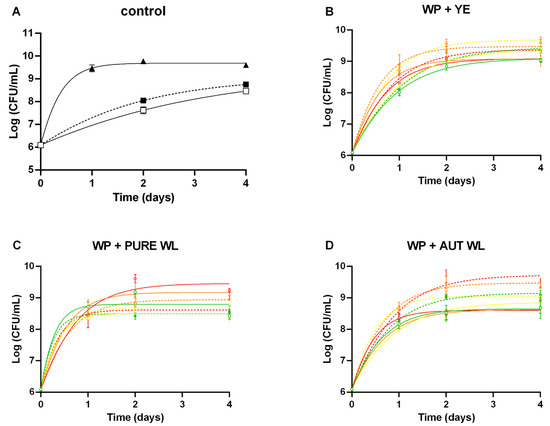
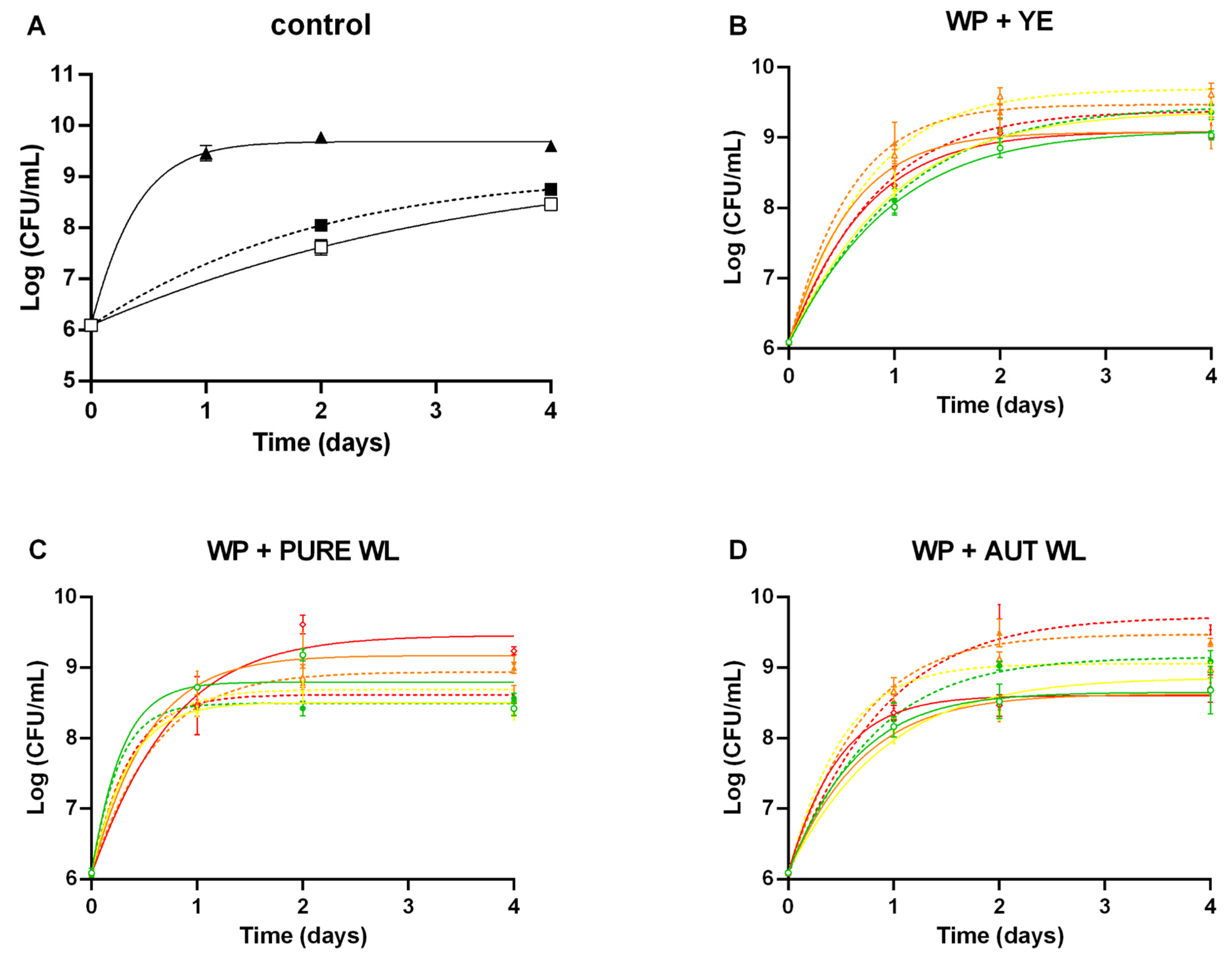
Considering the need to revalue winemaking byproduct through its reuse as a biotechnological resource, the growth of UNQLp 11 was analyzed in a sustainable culture medium formulated with whey permeate (WP), salts and Tween 80, supplemented with commercial yeast extract (YE) and wine lees (WL). The growth in the WP-YE and WP-WL medium were compared to MRS broth (commercial medium for the growth of LAB). The growth kinetics of UNQLp 11 for 4 days are shown in Figure 2 and the maximum growth achieved in Figure 3. The number of viable cells is expressed in Log (CFU/mL). The corresponding kinetic parameters obtained from the Gompertz model are presented in Table S1 (Supplementary Materials).
Figure 2.
Growth kinetics of Lpb. plantarum UNQLp 11 in whey permeate (WP)-based media supplemented with commercial yeast extract (YE) (B), Pure WL (C), or Autolyzed WL (D). Symbols represent the experimental data, whereas lines represent the corresponding fits obtained using the Gompertz growth model. Yellow, green, orange, and red lines correspond to 0.5, 1.0, 1.5, and 2.0% (w/v) of YE, Pure WL, or Autolyzed (AUT) WL, respectively. Solid lines indicate media supplemented with salts and Tween 80, whereas dashed lines indicate media without salts and Tween 80. MRS broth (black), WP without yeast extract, and WP supplemented with yeast extract, salts, and Tween 80 were used as controls (A).
Figure 3.
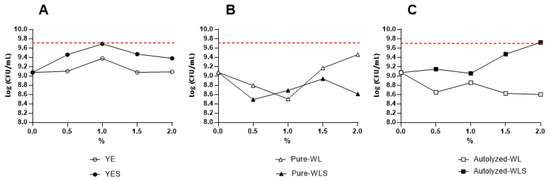
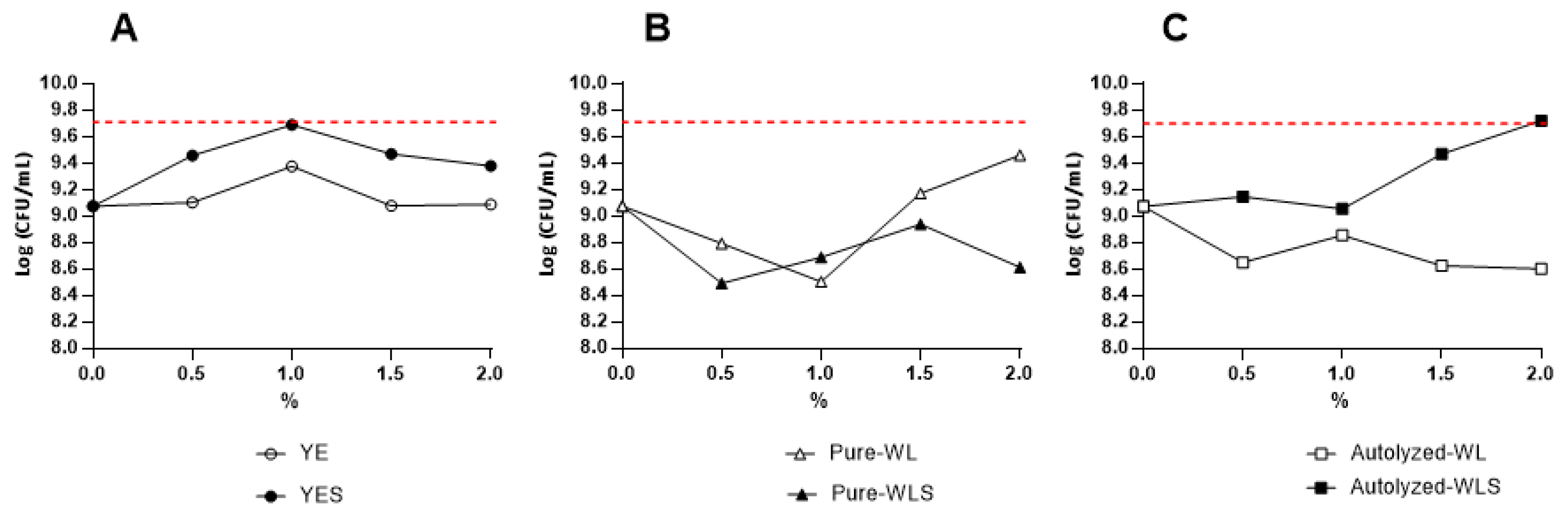
Maximum counts of the UNQLp 11 strain in whey permeate (WP) based media formulated with different concentrations of yeast extract (YE) and wine lees (WL). (A) Grown in WP medium with YE and addition of salts and Tween (YES). (B) Grown in WP medium with pure WL, and the addition of salts and Tween (Pure WLS). (C) Grown in WP medium with autolyzed WL and with the addition of salts and Tween (Autolyzed WLS). The red dashed line indicates the maximum growth reached in MRS broth, used as the reference medium.
Figure 2A shows that, using the commercial MRS medium, the UNQLp 11 strain reached counts of approximately 1010 CFU/mL after 48 h of incubation, values consistent with those previously reported by Brizuela et al., 2025 [22]. In contrast, when the strain was cultured in the WP base medium, with or without supplemental salts, the maximum growth reached was approximately 108 CFU/mL after 96 h of incubation (Figure 2A).
Figure 2B shows the growth of UNQLp 11 in WP base medium supplemented with different concentrations of YE. The highest cell counts were observed after 96 h of incubation in media formulated with 0.5% and 1% commercial YE, with the addition of salts (Figure 3A). Notably, when YE was replaced with pure WL, UNQLp 11 reached peak growth levels comparable to those obtained in the commercial MRS medium after 48 h of incubation, with a 2% pure WL concentration (Figure 2B).
Likewise, the replacement of YE with autolyzed WL in the WP base medium allowed for bacterial populations similar to those observed in MRS (Figure 2D) with 2% autolyzed WL after 48 h of incubation (Figure 3C).
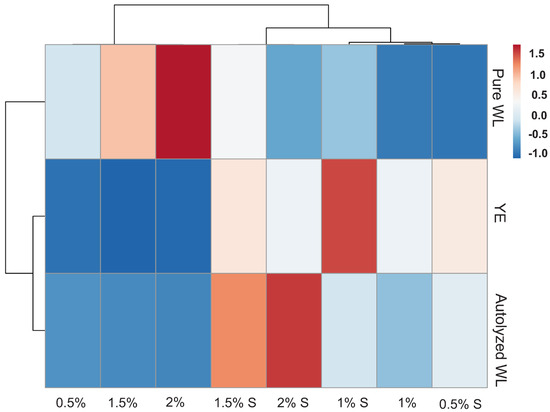
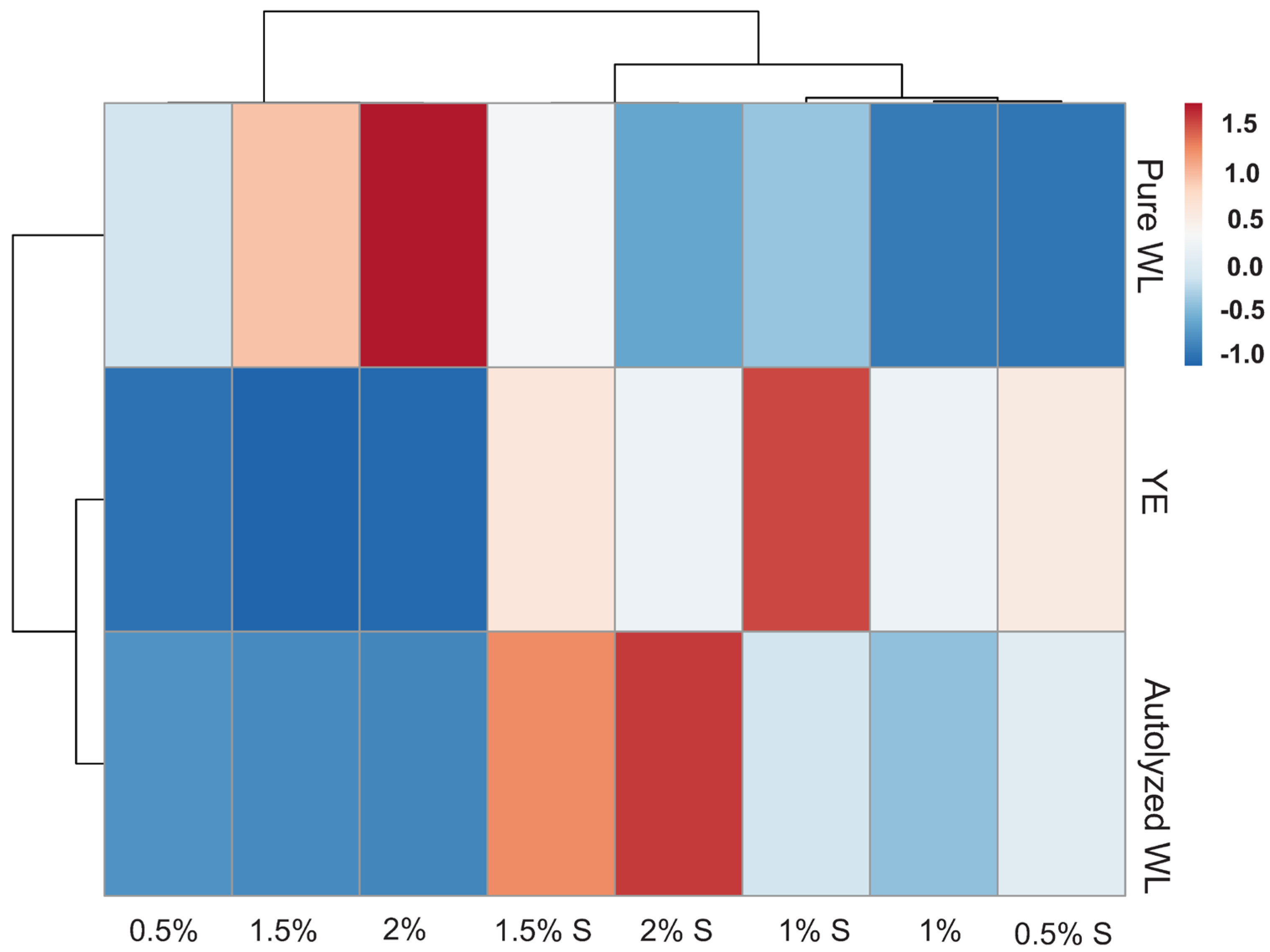
Based on the growth results obtained (Figure 4), it was observed that the UNQLp 11 strain reached the highest growth levels in formulations containing 1% w/v of commercial yeast extract supplemented with salts, 2% w/v of pure WL without added salts, and 2% w/v of autolyzed WL supplemented with salts. These results demonstrate that the composition of the culture medium plays a determining role in the strain’s growth, as different combinations of nutritional sources and mineral salts resulted in distinct growth responses.
Figure 4.
Clustered heat map showing the maximum growth of UNQLp 11 in alternative media based on whey permeate. Each horizontal row corresponds to the type of yeast added to the media (YE, pure WL or autolyzed WL), while each vertical column represents the formulation of the culture medium based on WP supplemented with YE/WL (0.5, 1.0, 1.5 and 2% w/v) and with (S) or without salts and Tween. The black dendrogram lines at the top and left represent hierarchical clustering, grouping columns and rows based on similarities in their growth response patterns. Red indicates high cell viability, while blue represents cell death.
4. Discussion
The industrial wine sector is characterized by the high generation of byproducts, including wine lees, which are produced in large quantities during grape processing [32]. Despite their high content of organic matter, nitrogen compounds, and bioactive molecules, these lees remain underutilized and, in many cases, are destined for final disposal or low-value-added applications [33].
This study addressed three related topics: i. the ecotoxicological evaluation of pure and autolyzed wine lees, ii. autolysis efficiency and compositional changes in wine lees after treatment, and iii. their potential valorization as a nutrient source supplementation for Lpb. plantarum UNQLp 11 growth in whey permeate.
i. Trials conducted with zebrafish showed that direct discharge of WL could pose a risk to aquatic ecosystems due to their high organic load and content of bioactive compounds, which is consistent with previous studies describing ecotoxicological effects associated with agro-industrial effluents with similar characteristics [34].
Embryos exposed to pure wine lees exhibited increased mortality and the appearance of sublethal effects, such as alterations in embryonic development. The autolysis treatment applied to WL modified their ecotoxicological profile, reducing their acute toxicity, through a more than threefold increase in the LC50 value and an increase in the minimum concentration required to induce adverse effects. These results suggest that cell rupture of the yeasts present in the lees generates compositional changes that decrease the environmental risk associated with this residue [24].
The toxicity observed in zebrafish embryos is likely the result of the combined action of several compounds naturally present in wine lees rather than a single toxic constituent [24]. Wine lees are characterized by a high organic load and contain organic acids, phenolic compounds [35]—including anthocyanins, tannins and phenolic acids—as well as other yeast-derived bioactive molecules. At elevated concentrations, these compounds may alter the physicochemical properties of the exposure medium, induce oxidative stress and interfere with normal embryonic development.
The acidic nature of WL may have contributed substantially to the observed toxicity. Wine-derived residues commonly contain tartaric, malic, lactic, acetic and succinic acids, which can reduce the pH of the exposure medium [36]. Exposure to strongly acidic conditions can impair embryonic homeostasis, ion regulation and normal development, and has been associated with increased mortality, delayed development, altered hatching and cardiac effects in zebrafish embryos. Moreover, pH may modify the ionization, bioavailability and uptake of other compounds present in the lees, thereby modulating their toxicity.
Residual ethanol should also be considered as a potential contributor [37]. Ethanol is a well-established developmental toxicant in zebrafish and has been associated with reduced survival, delayed hatching, impaired growth, cardiac alterations, abnormal morphology and locomotor effects. Its contribution would depend on the residual ethanol concentration in the wine lees and on the final dilution used in the exposure medium.
The high chemical oxygen demand generally associated with WL reflects their elevated content of biodegradable and oxidizable organic matter [38]. Although the test solutions were aerated and prepared under controlled conditions, a high organic load may increase oxygen demand, alter water quality and generate additional physiological stress. Consequently, oxygen availability and organic- load-related effects may have contributed to mortality, particularly at the highest concentrations.
Phenolic compounds may have exerted concentration-dependent effects as well [35]. Wine lees contain several phenolic acids, flavonoids and related compounds. Although many of these substances display antioxidant properties at low concentrations, higher concentrations or complex mixtures may promote oxidative imbalance, interfere with embryonic signaling pathways or contribute to developmental toxicity. Their effects may also depend on pH, chemical structure, bioavailability and interactions with ethanol and organic acids.
The lower toxicity observed after autolysis may be related to the enzymatic degradation of yeast cells and the subsequent removal of insoluble material during centrifugation, which modified the composition of the recovered fraction and may have reduced the concentration or bioavailability of particulate-associated bioactive compounds. Nevertheless, because the individual toxic constituents were not identified in the present study, these mechanisms remain hypothetical and warrant further investigation.
Overall, the observed acute toxicity is consistent with a mixture-driven response potentially involving acidity, residual ethanol, organic load, phenolic compounds, and interactions among these factors. However, because the contribution of each physicochemical parameter was not experimentally isolated, causal attribution to a specific component is not possible. Future studies should include the determination of pH, dissolved oxygen, chemical oxygen demand, residual ethanol, total organic acids and total phenolic content in both the original samples and the final test dilutions. Testing pH-adjusted samples or chemically fractionated lees would also help distinguish the relative contribution of acidity from that of the organic constituents.
ii. In this work, autolysis efficiency and compositional changes in WL after treatment were also evaluated. The rupture of yeast cells causes the release of intracellular compounds into the medium, which were recovered from the soluble fraction, lyophilized, and used to formulate a new bacterial culture medium. Compared to previous findings on autolyzed beer lees [22], which reported a disruption efficiency of 0.65, the autolysis treatment applied here to WL achieved a markedly higher efficiency of 0.811. This superior performance indicates that the yeast biomass from wine residues undergoes more extensive cellular breakdown under these conditions, facilitating a greater release and recovery of intracellular and wall-bound soluble compounds.
Consequently, the centesimal composition analysis showed a relative decrease in the protein, lipid, and ash contents of the autolyzed WL compared with pure WL. This behavior suggests that a fraction of these components remained associated with structural proteins, membrane lipids, and minerals strongly bound to the cell wall, as well as other cellular debris and insoluble particles removed during the recovery of the supernatant. Conversely, the autolyzed WL exhibited a higher residual moisture content, which can be attributed to the release of hydrophilic compounds—particularly mannoproteins and polysaccharides from the cell wall—that increase the matrix’s capacity to interact with water molecules.
The centesimal composition analysis revealed a decrease in protein content of approximately 30.57% following autolysis treatment. This reduction indicates that a substantial fraction of structural and wall-bound proteins remained associated with the insoluble cellular debris removed during the supernatant recovery process.
Lipid content showed a more moderate reduction of 13.31%. This smaller decline suggests that a portion of the cellular lipids—particularly polar lipids or membrane-associated components—remained effectively solubilized or emulsified within the liquid fraction.
Carbohydrates constituted the major fraction in both matrices, showing a relative increase of 5.45%. Since carbohydrates were determined by difference, this apparent increase is primarily a compositional reflection of the proportional reduction in proteins, lipids, and ash, highlighting a final product enriched in soluble cell wall polysaccharides and intracellular sugars released during the autolytic breakdown.
Previous studies have shown that wine lees contain considerable amounts of soluble peptides, free amino acids, B-group vitamins and minerals such as potassium, magnesium, phosphorus and calcium, released mainly from yeast cells during fermentation and autolysis [39,40], all of which are recognized growth-promoting factors for lactic acid bacteria. Although these specific compounds were not individually quantified in the present study, their reported presence in WL provides a plausible explanation for the enhanced growth observed after the autolytic treatment.
The centesimal composition also revealed a decrease in total ash content in the autolyzed WL compared to the untreated sample. WL naturally contains various mineral elements—such as potassium, calcium, magnesium, and phosphorus—associated with yeast cell walls, tartaric precipitates, and other settleable particles. Because a portion of these mineral fractions remained in the insoluble pellet that was discarded during the supernatant recovery process, a reduction in the total ash content of the final soluble product is expected. Despite this partial loss, the minerals remaining in the soluble fraction, combined with the released peptides and vitamins, provided a balanced nutritional matrix that supports enhanced bacterial growth.
iii. Regarding its biotechnological application, the results obtained confirm the growth of Lpb. plantarum depends largely on the composition of the culture medium. As expected, the commercial MRS medium supported the highest cell densities, thanks to its optimized formulation rich in readily assimilable nutrients.
Conversely, the WP media without supplementation showed nutritional limitations, reflected in lower cell counts. Whereas, supplementing the WP medium with WL significantly improved bacterial growth, in some cases reaching values comparable to those obtained with MRS (See Table S1). In particular, the use of autolyzed WL proved especially efficient, likely due to the greater availability of soluble nitrogen compounds, peptides, amino acids, and vitamins released during yeast cell rupture [41]. These results are consistent with previous studies highlighting the importance of yeast derivatives as a source of essential nutrients for the growth and metabolic activity of LAB [22].
Obtaining autolyzed WL requires an additional incubation step at 50 °C for 48 h, which would increase the energy and operational costs of the process. Although autolyzed WL supported bacterial growth, its performance was generally comparable to that obtained with pure WL across the tested formulations (See Table S1). In this context, the use of unprocessed pure WL emerges as a simpler and more economically viable alternative for formulating growth media, especially in industrial applications where cost reduction and simplified operations are key factors. However, because the composition of wine lees is expected to vary according to grape variety, fermentation conditions, yeast strain, vintage, and storage practices, future industrial implementation will require the establishment of standardized processing protocols together with routine quality control of relevant physicochemical parameters (e.g., dry matter, nitrogen content, ash, pH, and soluble solids) to ensure consistent nutritional performance. In addition, blending wine lees from different batches or adjusting formulations according to compositional analyses could contribute to reducing batch-to-batch variability.
Although the present study was not designed to perform a techno-economic analysis, the replacement of commercial yeast extract by an agro-industrial byproduct represents a promising strategy within the framework of circular bioeconomy. Future studies should evaluate the economic feasibility of large-scale implementation, including alternative downstream processing methods better suited for industrial production. Additionally, a more detailed chemical characterization of the nutrients within the WL and ecotoxicological assays have been identified as an important objective to fully elucidate their compositional profile and identify compounds primarily responsible for the observed developmental effects.
5. Conclusions
The results obtained demonstrate that wine lees can be a sustainable and renewable nutrient source alternative to commercial yeast extract in the formulation of culture media for Lpb. plantarum. Nevertheless, future investigations incorporating a comprehensive characterization of soluble nutrients will be essential to fully elucidate the underlying mechanisms and to facilitate process standardization for industrial-scale applications. Furthermore, the integration of ecotoxicological studies with biotechnological applications provides a comprehensive perspective that supports their safe reuse. Future studies should focus on optimizing the treatments applied to the lees, evaluating their impact on the technological and functional properties of the LAB, and scaling up the process to an industrial level. Furthermore, it will be necessary to evaluate the performance of this culture medium across other LAB species, including phylogenetically and physiologically different microorganisms, to determine whether the observed effects are strain- or species-dependent and to expand knowledge of the potential of wine lees as a universal source of nutrients.
Supplementary Materials
The following supporting information can be downloaded at: https://www.mdpi.com/article/10.3390/fermentation12090415/s1, Figure S1: Scheme for obtaining pure wine lees and used wine lees; Figure S2: Representative morphological abnormalities observed in zebrafish embryos exposed to pure and autolyzed wine lees. Images are shown for qualitative illustration of the developmental effects described in the text and are not intended as quantitative analyses: (A) Control embryo with normal development; (B) intestinal inflammation, edema, and collapsed swim bladder; (C) edema, axial curvature, malformed swim bladder, and yolk sac deformity; (D) collapsed swim bladder. Figure S3: Developmental outcomes in zebrafish embryos exposed to pure and autolyzed wine lees. Mortality and the incidence of delayed development and delayed hatching were evaluated at different concentrations of pure wine lees and autolyzed wine lees. Mortality is expressed as the percentage of the total number of exposed embryos, whereas developmental abnormalities are expressed as the percentage of surviving embryos. The number of surviving embryos evaluated for developmental abnormalities (n) is indicated below each concentration. ND, not determined. Table S1: 1:-Growth kinetic parameters of UNQLp 11 in WP based alternative culture media containing different nitrogen sources.
Author Contributions
Formal analysis and investigation, M.E.N., C.S.M., E.E.T., M.J.P. and B.M.B.-F.; methodology, M.E.N., C.S.M., E.E.T., M.J.P. and B.M.B.-F.; project administration, M.J.P. and B.M.B.-F.; writing—original draft, B.M.B.-F. and E.E.T.; writing—review and editing, M.E.N., C.S.M., E.E.T., M.J.P. and B.M.B.-F. All authors have read and agreed to the published version of the manuscript.
Funding
This research was funded by grants from Agencia Nacional de Promoción Científica y Técnica (ANPCyT) (PICT 2019 N◦0008, PICT 2022-2022-02-00334), Consejo Nacional de Investigaciones Científicas y Técnicas (CONICET) (PIP-2021–11220200100394CO), and Universidad Nacional de Quilmes (PUNQ Res. 745/25).
Institutional Review Board Statement
We conducted all animal studies in strict accordance with the National Institutes of Health guidelines for animal care and husbandry. All protocols were approved by Institutional Committee for the Care and Use of Laboratory Animals of the National University of Quilmes (UNQ). Research Protocols D002-25 and D003-25; National University of Quilmes: Bernal, Argentina, 2025.
Informed Consent Statement
Not applicable.
Data Availability Statement
The original contributions presented in this study are included in the article/Supplementary Materials. Further inquiries can be directed to the corresponding author.
Acknowledgments
C.S.M., B.M.B-F., and E.E.T. are members of the Research Career of the Consejo Nacional de Investigaciones Científicas y Técnicas (CONICET), M.E.N. is a fellow of CONICET, and M.J.P. is a member of the Research Career of the UNQ-CONICET. The authors would also like to acknowledge Egly Norka Llerena Suster, Associated Technician of CONICET, for her technical assistance and support.
Conflicts of Interest
The authors declare no conflicts of interest.
Abbreviations
The following abbreviations are used in this manuscript:
| LAB | Lactic acid bacteria |
| WL | Wine lees |
| YE | Yeast extract |
| DE | Disruption efficiency |
| WP | Whey permeate |
| Dpf | Days post-fertilization |
| Ppm | Parts per million |
References
- Council Regulation (EEC) No 337/79 of 5 February 1979 on the Common Organization of the Market in Wine. Off. J. Eur. Communities 1979, L 54, 1–47.
- Balmaseda, A.; Miot-Sertier, C.; Lytra, G.; Poulain, B.; Reguant, C.; Lucas, P.; Nioi, C. Application of white wine lees for promoting lactic acid bacteria growth and malolactic fermentation in wine. Int. J. Food Microbiol. 2024, 413, 110583. [Google Scholar] [CrossRef] [Scilit] [PubMed]
- Moldes, A.B.; Vázquez, M.; Domínguez, J.M.; Díaz-Fierros, F.; Barral, M.T. Negative effect of discharging vinification lees on soils. Bioresour. Technol. 2008, 99, 5991–5996. [Google Scholar] [CrossRef] [Scilit] [PubMed]
- Topal, M. Uptake of some elements with aquatic plants exposed to the effluent of wastewater treatment plant. Desalin. Water Treat. 2019, 172, 377–386. [Google Scholar] [CrossRef] [Scilit]
- Magyary, I. Recent advances and future trends in zebrafish bioassays for aquatic ecotoxicology. Ecocycles 2018, 4, 12–18. [Google Scholar] [CrossRef] [Scilit]
- Nagel, R. DarT: The embryo test with the zebrafish Danio rerio—A general model in ecotoxicology and toxicology. Altex 2002, 19, 38–48. [Google Scholar] [PubMed]
- Hason, M. Danio Rerio as a Model of Serious Human Diseases. Ph.D. Thesis, Charles University, Prague, Czech Republic, 2022. [Google Scholar]
- Bambino, K.; Chu, J. Zebrafish in toxicology and environmental health. Curr. Top. Dev. Biol. 2017, 124, 331–367. [Google Scholar] [CrossRef] [Scilit] [PubMed]
- OECD. Test No. 236: Fish Embryo Acute Toxicity (FET) Test; OECD Publishing: Paris, France, 2025. [Google Scholar] [CrossRef] [Scilit]
- Hill, A.J.; Teraoka, H.; Heideman, W.; Peterson, R.E. Zebrafish as a model vertebrate for investigating chemical toxicity. Toxicol. Sci. 2005, 86, 6–19. [Google Scholar] [CrossRef] [Scilit] [PubMed]
- Silva, J.; Carvalho, A.S.; Teixeira, P.; Gibbs, P.A. Bacteriocin production by spray-dried lactic acid bacteria. Lett. Appl. Microbiol. 2002, 34, 77–81. [Google Scholar] [CrossRef] [Scilit] [PubMed]
- Lee, S.M.; Hwang, Y.R.; Kim, M.S.; Chung, M.S.; Kim, Y.S. Comparison of volatile and nonvolatile compounds in rice fermented by different lactic acid bacteria. Molecules 2019, 24, 1183. [Google Scholar] [CrossRef] [Scilit] [PubMed]
- Brizuela, N.; Tymczyszyn, E.E.; Semorile, L.C.; La Hens, D.V.; Delfederico, L.; Hollmann, A.; Bravo-Ferrada, B. Lactobacillus plantarum as a malolactic starter culture in winemaking: A new (old) player? Electron. J. Biotechnol. 2019, 38, 10–18. [Google Scholar] [CrossRef] [Scilit]
- Krieger-Weber, S.; Heras, J.M.; Suarez, C. Lactobacillus plantarum, a new biological tool to control malolactic fermentation: A review and an outlook. Beverages 2020, 6, 23. [Google Scholar] [CrossRef] [Scilit]
- Capozzi, V.; Tufariello, M.; De Simone, N.; Fragasso, M.; Grieco, F. Biodiversity of oenological lactic acid bacteria: Species- and strain-dependent plus/minus effects on wine quality and safety. Fermentation 2021, 7, 24. [Google Scholar] [CrossRef] [Scilit]
- Brizuela, N.S.; Bravo-Ferrada, B.M.; La Hens, D.V.; Hollmann, A.; Delfederico, L.; Caballero, A.; Semorile, L. Comparative vinification assays with selected Patagonian strains of Oenococcus oeni and Lactobacillus plantarum. LWT 2017, 77, 348–355. [Google Scholar] [CrossRef] [Scilit]
- Prieto, M.J.; Gutierrez, H.C.; Arévalo, R.A.; Chiaramoni, N.S.; Alonso, S.D.V. Effect of risperidone and fluoxetine on the movement and neurochemical changes of zebrafish. Open J. Med. Chem. 2012, 2, 129–138. [Google Scholar] [CrossRef]
- Institutional Committee for the Care and Use of Laboratory Animals of the National University of Quilmes (UNQ). Research Protocols D002-25 and D003-25; National University of Quilmes: Bernal, Argentina, 2025. [Google Scholar]
- Martinez, C.S.; Igartúa, D.E.; Czarnowski, I.; Feas, D.A.; Prieto, M.J. Biological response and developmental toxicity of zebrafish embryo and larvae exposed to multi-walled carbon nanotubes with different dimension. Heliyon 2019, 5, e02111. [Google Scholar] [CrossRef] [Scilit] [PubMed]
- Kimmel, C.B.; Ballard, W.W.; Kimmel, S.R.; Ullmann, B.; Schilling, T.F. Stages of embryonic development of the zebrafish. Dev. Dyn. 1995, 203, 253–310. [Google Scholar] [CrossRef] [Scilit] [PubMed]
- von Hellfeld, R.; Brotzmann, K.; Baumann, L.; Strecker, R.; Braunbeck, T. Adverse effects in the fish embryo acute toxicity (FET) test: A catalogue of unspecific morphological changes versus more specific effects in zebrafish (Danio rerio) embryos. Environ. Sci. Eur. 2020, 32, 122. [Google Scholar] [CrossRef] [Scilit]
- Brizuela, N.S.; Navarro, M.E.; Rivas, G.; Gómez, G.; Pérez, C.; Semorile, L.; Bravo-Ferrada, B. Optimization of the treatment of beer lees for their use in sustainable biomass production of lactic acid bacteria. Appl. Microbiol. 2025, 5, 51. [Google Scholar] [CrossRef] [Scilit]
- Avramia, I.; Amariei, S. A simple and efficient mechanical cell disruption method using glass beads to extract β-glucans from spent brewer’s yeast. Appl. Sci. 2022, 12, 648. [Google Scholar] [CrossRef] [Scilit]
- Ciobanu, L.T.; Constantinescu-Aruxandei, D.; Tritean, N.; Lupu, C.; Negrilă, R.N.; Farcașanu, I.C.; Oancea, F. Valorization of spent brewer’s yeast bioactive components via an optimized ultrasonication process. Fermentation 2023, 9, 952. [Google Scholar] [CrossRef] [Scilit]
- AOAC. Official Methods of Analysis, 15th ed.; Association of Official Analytical Chemists: Arlington, VA, USA, 1990. [Google Scholar]
- Folch, J.; Lees, M.; Stanley, G.H.S. A simple method for the isolation and purification of total lipides from animal tissues. J. Biol. Chem. 1957, 226, 497–509. [Google Scholar] [CrossRef] [Scilit]
- Iglesias, N.G.; Brizuela, N.S.; Tymczyszyn, E.E.; Hollmann, A.; Valdés La Hens, D.; Semorile, L.; Bravo-Ferrada, B.M. Complete genome sequencing of Lactobacillus plantarum UNQLp 11 isolated from a Patagonian Pinot Noir wine. S. Afr. J. Enol. Vitic. 2020, 41, 197–209. [Google Scholar] [CrossRef] [Scilit]
- Cerdeira, V.; Bravo-Ferrada, B.M.; Semorile, L.; Tymczyszyn, E. Design of a low-cost culture medium based on whey permeate for biomass production of enological Lactobacillus plantarum strains. Biotechnol. Prog. 2019, 35, e2791. [Google Scholar] [CrossRef] [Scilit] [PubMed]
- de Man, J.D.; Rogosa, M.; Sharpe, M.E. A medium for the cultivation of lactobacilli. J. Appl. Bacteriol. 1960, 23, 130–135. [Google Scholar] [CrossRef] [Scilit]
- Ismail, B.P. Ash content determination. In Nielsen’s Food Analysis Laboratory Manual; Springer International Publishing: Cham, Switzerland, 2024; pp. 129–131. [Google Scholar] [CrossRef] [Scilit]
- Nielsen, S.S. Determination of moisture content. In Food Analysis Laboratory Manual; Springer: Boston, MA, USA, 2009; pp. 17–27. [Google Scholar] [CrossRef] [Scilit]
- Lucarini, M.; Durazzo, A.; Romani, A.; Campo, M.; Lombardi-Boccia, G.; Cecchini, F. Bio-based compounds from grape seeds: A biorefinery approach. Molecules 2018, 23, 1888. [Google Scholar] [CrossRef] [Scilit] [PubMed]
- Teixeira, A.; Baenas, N.; Dominguez-Perles, R.; Barros, A.; Rosa, E.; Moreno, D.A.; Garcia-Viguera, C. Natural bioactive compounds from winery by-products as health promoters: A review. Int. J. Mol. Sci. 2014, 15, 15638–15678. [Google Scholar] [CrossRef] [Scilit] [PubMed]
- Estrada-Almeida, A.G.; Castrejón-Godínez, M.L.; Mussali-Galante, P.; Tovar-Sánchez, E.; Rodríguez, A. Pharmaceutical pollutants: Ecotoxicological impacts and the use of agro-industrial waste for their removal from aquatic environments. J. Xenobiot. 2024, 14, 1465–1518. [Google Scholar] [CrossRef] [Scilit] [PubMed]
- Jara-Palacios, M.J. Wine lees as a source of antioxidant compounds. Antioxidants 2019, 8, 45. [Google Scholar] [CrossRef] [Scilit] [PubMed]
- du Toit, W.J.; Marais, J.; Pretorius, I.S.; du Toit, M. Oxygen in must and wine: A review. S. Afr. J. Enol. Vitic. 2006, 27, 76–94. [Google Scholar] [CrossRef] [Scilit]
- Pérez-Serradilla, J.A.; De Castro, M.L. Role of lees in wine production: A review. Food Chem. 2008, 111, 447–456. [Google Scholar] [CrossRef] [Scilit] [PubMed]
- Pérez-Bibbins, B.; Torrado-Agrasar, A.; Salgado, J.M.; de Souza Oliveira, R.P.; Domínguez, J.M. Potential of lees from wine, beer and cider manufacturing as a source of economic nutrients: An overview. Waste Manag. 2015, 40, 72–81. [Google Scholar] [CrossRef] [Scilit] [PubMed]
- Kaynarca, G.B. Characterization and molecular docking of sustainable wine lees and gelatin-based emulsions: Innovative fat substitution. J. Sci. Food Agric. 2024, 104, 7429–7440. [Google Scholar] [CrossRef] [Scilit] [PubMed]
- Sirisena, S.; Chan, S.; Roberts, N.; Dal Maso, S.; Gras, S.L.; Martin, G.J. Influence of yeast growth conditions and proteolytic enzymes on the amino acid profiles of yeast hydrolysates: Implications for taste and nutrition. Food Chem. 2024, 437, 137906. [Google Scholar] [CrossRef] [Scilit] [PubMed]
- Moyano-Gracia, R.; Vila-Crespo, J.; Ruipérez, V.; Rodríguez-Nogales, J.M.; Fernández-Fernández, E. Effect of yeast derivatives and β-glucanases on ageing over lees process of Tempranillo red sparkling wine. Fermentation 2023, 9, 1012. [Google Scholar] [CrossRef] [Scilit]

Disclaimer/Publisher’s Note: The statements, opinions and data contained in all publications are solely those of the individual author(s) and contributor(s) and not of MDPI and/or the editor(s). MDPI and/or the editor(s) disclaim responsibility for any injury to people or property resulting from any ideas, methods, instructions or products referred to in the content. |
© 2026 by the authors. Licensee MDPI, Basel, Switzerland. This article is an open access article distributed under the terms and conditions of the Creative Commons Attribution (CC BY) license.