


Abstract
In strong-flavor Baijiu brewing, surface spraying of recycled distillation tail liquor (TL) leads to volatile aroma loss, uneven substrate distribution and localized fermentation inhibition. A patented telescopic subsurface injector was adopted to deliver 0–30 kg TL per pit at a 50 cm depth on fermentation day 30, the critical transition point between acidogenesis and esterification. At the highest dosage (30 kg), total esters rose 14.8% (from 4.45 to 5.11 g/L), with ethyl hexanoate up 52.2% (to 1.72 g/L) and ethyl lactate up 69.8% (to 3.82 g/L). Fermentation temperature curves stayed unchanged, and grain-derived ethanol yield remained near 38.2% in all groups after correcting for the ethanol already present in the added TL. Subsurface injection of tail liquor-supplying ethanol and organic acid precursors-at the acidogenesis-to-esterification transition enhances ester synthesis without disrupting fermentation or reducing distillate yield. Acid profiles were also stable, suggesting that the added substrates were channeled into ester synthesis rather than acid accumulation. Targeted subsurface TL injection at this metabolic transition thus represents an industrially feasible strategy to boost ester biosynthesis, offering a recyclable TL valorization approach and verifying substrate-limited esterification in solid-state Baijiu fermentation.
1. Introduction
Traditional Chinese distilled liquor, Baijiu, is classified into four major aroma types: strong-flavor, sauce-flavor, light-flavor, and rice-flavor Baijiu. Among these, strong-flavor Baijiu accounts for approximately 70% of total Baijiu production [1,2]. Its manufacture relies on solid-state fermentation of cereal grains in fermentation pits using strong-flavor Daqu (a traditional fermentation starter), followed by solid-state distillation, aging, and blending [3,4]. Solid-state fermentation generally proceeds via three sequential phases—primary saccharification, acidogenesis and esterification. The esterification phase dominates biosynthesis of core aromatic esters that determine Baijiu flavor and quality grades [5,6].
Ester production occurs via enzymatic (esterase) and non-enzymatic chemical reactions, with alcohols and organic acids serving as common precursors [7,8]. The TL collected during late-stage distillation is low in ethanol but enriched in flavor precursors such as organic acids, esters, and higher alcohols [9,10]. Consequently, upcycling of this byproduct has attracted considerable interest for achieving dual objectives: cost reduction through recycling natural aroma precursors, and targeted enhancement of flavor complexity for quality upgrading [11,12].
Current industrial practices for TL utilization mainly involve three strategies: (1) conversion into re-esterification liquors [13]; (2) subsurface reinfusion into fermentation pits during the ongoing fermentation [14,15]; and (3) redistillation to recover aromatic compounds. Nevertheless, conventional surface spraying at pit filling suffers from well-documented limitations: severe volatile loss, heterogeneous substrate distribution and localized microbial inhibition induced by high alcohol microzones [16,17].
In our facility, surface spraying of tail liquor at pit entry is limited to 6 kg per pit due to localized moisture and ethanol accumulation. Preliminary trials indicated that subsurface injection on day 30 tolerated higher TL loads while maintaining ester yields at low dosing, implying injection timing and uniform substrate delivery are core regulating variables. This study focuses on optimizing the dosage and timing of subsurface injection, rather than comparing delivery methods.
Previous studies have described the temporal dynamics of strong-flavor Baijiu fermentation, showing that the first 20–25 days are dominated by saccharification and acidogenesis, during which organic acids (e.g., hexanoic, lactic, acetic acids) accumulate rapidly [18]. The subsequent period (days 30–60) is characterized by declining acid production rates and increasing ester biosynthesis, with esterase and lipase activities peaking around day 30–35 [5,6]. Therefore, day 30 was selected as the injection time point to coincide with the onset of maximal esterification potential, ensuring that the supplemented ethanol and flavor precursors are efficiently channeled into ester synthesis rather than being consumed for acid production or microbial biomass.
To overcome the limitations of conventional surface application, the present study employed a patented telescopic subsurface injection device that enabled quantitative and uniform injection of TL. Critically, the injection timing was set at 30 days post-sealing—a strategic point marking the transition from the acidogenic phase to the esterification-dominated phase. We hypothesized that precise, uniform supplementation of ethanol and organic acids via subsurface injection would promote esterification without perturbing the indigenous microbial community. At this metabolic transition, native microbiota retain high metabolic activity [19,20], and peak esterase/lipase activity [5,6] facilitates conversion of exogenous precursors into aromatic esters while sustaining stable fermentation.
The specific objectives of this study were: (1) to evaluate the effect of different TL dosages (0, 10, 20, 30 kg per pit) on fermentation temperature dynamics; (2) to assess distillate yield with correction for exogenous ethanol contributed by the added TL; and (3) to characterize the resulting changes in key flavor compounds, particularly ester profiles, using gas chromatography-flame ionization detection (GC-FID). Collectively, this work develops a technical pathway for improving the ester profile and aroma compound composition of strong-flavor Baijiu via circular economy practices [21,22,23].
2. Materials and Methods
2.1. Materials and Reagents
Distillation TL was provided by Shandong Wenhe Liquor Industry Co., Ltd. (Linyi, China). Chemical standards including n-propanol (chromatographic grade, CAS 71-23-8), n-amyl acetate (chromatographic grade, CAS 628-63-7), butyl acetate (analytical grade, CAS 123-86-4), isoamyl alcohol (chromatographic grade, CAS 123-51-3), and n-butanol (chromatographic grade, CAS 71-36-3) were obtained from Sinopharm Chemical Reagent Co., Ltd. (Shanghai, China) and Tianjin Guangfu Fine Chemical Research Institute (Tianjin, China).
2.2. Experimental Design and Tail Liquor Preparation
Sixteen fermentation pits with uniform age, consistent volume (8 m3) and adjacent layout were selected to eliminate confounding effects of pit age and spatial position. These pits were randomly allocated into four groups (n = 4 per pit) via random number generation: Control (0 kg TL), Treatment 1 (10 kg TL), Treatment 2 (20 kg TL), Treatment 3 (30 kg TL). Dosages were selected based on preliminary trials and industrial practice. In preliminary trials using identical fermentation pits, TL volumes of 10, 20, 30, and 40 kg per pit were tested. Volumes ≤ 30 kg were injected without observable pit flooding or leachate leakage from pit walls, whereas 40 kg resulted in transient surface seepage. Thus, 30 kg was identified as the maximum feasible dosage without compromising pit integrity. All pits received uniform feedstock: 450 kg sorghum, 100 kg each of glutinous rice, rice, wheat, and corn (total feedstock 850 kg), according to the traditional strong-flavor Baijiu recipe (GB/T 10781.1-2021) [1]. Fermentation duration was standardized at 60 days. This work aimed to optimize subsurface injection parameters, so parallel trials with surface spraying were not conducted. Follow-up tests will compare the two tail liquor recycling strategies to quantify their impacts on flavor profiles.
TL was collected from control pits of the same preceding production cycle, homogenized, and adjusted to 15% (v/v) ethanol. The selected TL exhibited the following characteristics: total acids 2.40 g/L (as acetic acid), total esters 9.29 g/L, ethyl lactate 8.61 g/L, ethyl hexanoate 0.23 g/L, and acetic acid 1.76 g/L (corrected to reconcile total acid mass balance; see Table 1 footnotes). This batch was selected for its favorable acid profile as a substrate for esterification.
Table 1.
Detection results of main aroma components in TL (g/L).
For the control group, the telescopic device was inserted to the same depth (50 cm) at three points, and the injection nozzle was actuated without delivering any liquid (sham injection), followed by identical pit mud sealing, to control for physical disturbance.
2.3. Subsurface Injection Device and Operation
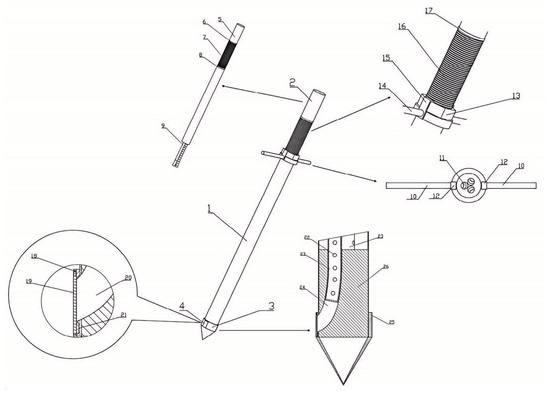
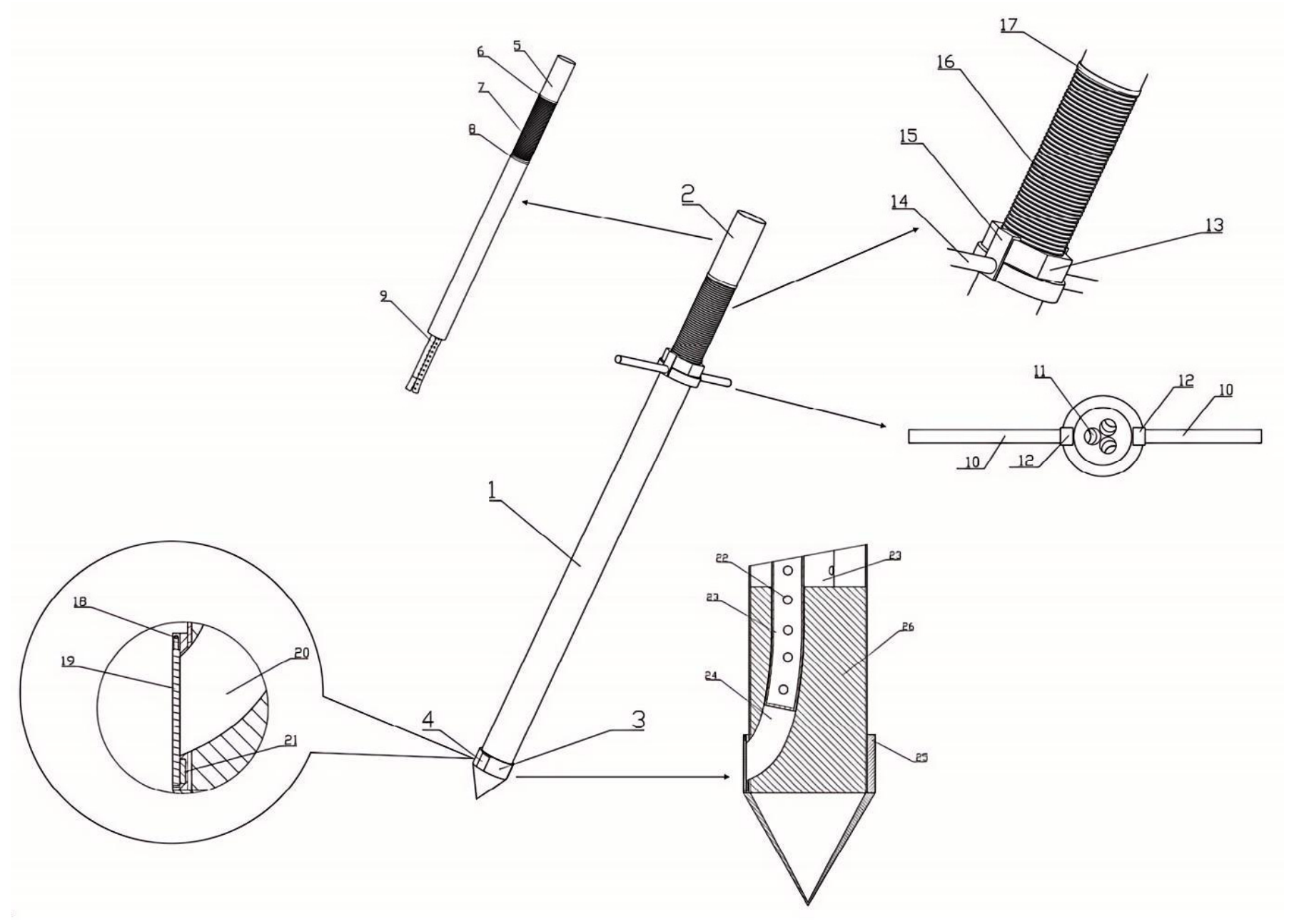
A patented telescopic subsurface injector (Patent No. ZL 2024 2 2257707.2) was developed to deliver evenly distributed TL under strictly anaerobic fermentation conditions (Figure 1) [15]. The hardware comprises an outer sleeve and a nested axially sliding inner tube. The outer sleeve features a tapered penetrating tip and sidewall graduated scales for precise depth positioning; three elastic delivery hoses extend from the base of the inner tube, each perforated with multiple lateral liquid outlets for homogeneous TL dispersion. A neodymium-magnetic baffle seals the bottom inlet of the sleeve cavity, blocking backflow of fermented grains (jiupei) during idle periods.
Figure 1.
Schematic diagram of the telescopic subsurface injection device. The device injects TL at three points per pit (center and two diagonal positions at 50 cm depth) via a retractable nozzle. The magnetic switch mechanism maintains pit seal integrity.
For on-site operation, TL was accurately weighed via an electronic balance and pumped from a sealed storage tank to the injector. Injection was implemented at three uniform positions per pit (central point plus two diagonal equidistant sites) at a fixed 50 cm depth. The inner sliding tube is driven downwards via a threaded regulating structure to stretch the three delivery hoses, which mechanically push open the magnetic baffle for liquid dispensing. Once injection is finished, the inner tube retracts upward, and the magnetic baffle automatically re-closes under magnetic attraction to avoid pit mud blockage of internal flow channels. After tube retraction at each injection point, the pit surface was immediately sealed with pit mud to sustain the anaerobic microenvironment throughout fermentation. Full mechanical parameters of the apparatus are documented in the patent literature [15].
2.4. Fermentation Temperature Monitoring
Daily temperatures were measured at a fixed time (9:00–10:00 a.m.) using calibrated digital probe thermometers (accuracy ± 0.1 °C, Model TES-1310, TES Electrical Electronic Corp., New Taipei City, Taiwan, China). Three vertical layers were defined: upper layer (20–30 cm below pit surface), middle layer (80–100 cm below surface), and lower layer (20–30 cm above pit bottom). At each layer, measurements were taken at three horizontal positions: center and at two points 50 cm from the pit wall. The nine measurements per pit were averaged to obtain the daily mean temperature. Daily mean temperatures were plotted to verify compliance with the “slow rise, stable maintenance, gradual decline” pattern characteristic of normal fermentation [24].
2.5. Distillation and Yield Correction
After 60 days, all pits were opened, mixed with auxiliary materials, and distilled using standardized procedures. Distillation fractions were collected as heads (initial fraction, 0.5–1 kg), heart (middle/main cut), and tails (late-stage fraction, 30–50 kg per batch). Alcohol content was measured in real time using precision alcohol meters, and all distillate fractions were standardized to 65% (v/v) for subsequent yield calculation.
The distillate yield (65%, v/v) was defined as the mass of 65% (v/v) liquor obtained per unit mass of grain feedstock, expressed as a percentage. To eliminate the contribution of exogenous ethanol from the added TL (15%, v/v), the corrected yield was calculated as:
where mtail is the mass of added TL (in kg; 10, 20, or 30 kg), 850 kg is the total grain feedstock, and 0.212 is the equivalent mass (in kg) of 65% (v/v) product contributed by 1 kg of 15% (v/v) TL. The conversion factor was derived from ethanol-water density data at 20 °C (CRC Handbook of Chemistry and Physics, 100th ed., and Perry’s Chemical Engineers’ Handbook, 9th ed.). At 20 °C:
15% (v/v) ethanol solution: density = 0.97897 g/mL, mass fraction = 12.1% (w/w)
65% (v/v) ethanol product: density = 0.89050 g/mL, mass fraction = 57.1% (w/w)
Accordingly, 1 kg of 15% v/v TL holds 0.1209 kg absolute ethanol, equivalent to 0.212 kg standardized 65% v/v base liquor via mass balance conversion.
2.6. Flavor Component Analysis
Key flavor compounds were quantified via GC-FID following GB/T 10345-2022 [25]. Distillate samples were filtered with 0.22 μm organic filters (MilliporeSigma, Burlington, MA, USA); a 10 mL filtrate aliquot was transferred to a volumetric flask, spiked with 0.20 mL 2% v/v n-amyl acetate internal standard, homogenized and injected (1 μL injection volume). The injection volume was 1 μL. Analytical conditions: Agilent 7890B GC system (Agilent Technologies Inc., Santa Clara, CA, USA) equipped with a capillary column (PEG-20M, 50 m × 0.25 mm × 0.25 μm; Agilent J&W, Santa Clara, CA, USA); injector temperature 250 °C; detector temperature 260 °C; column temperature programmed from 40 °C (2 min) to 150 °C at 5 °C/min, then to 230 °C at 10 °C/min (10 min hold); carrier gas nitrogen at 1.0 mL/min; split ratio 30:1. Quantification used n-amyl acetate as the internal standard, following GB/T 10345-2022. Since response factors vary among compound classes, absolute concentrations may carry bias, but the relative trends between groups remain reliable because the same method was applied to all samples. All experimental group data were corrected by subtracting components directly introduced by the added TL. The correction followed a mass balance approach: the mass of each compound introduced by TL (based on TL volume and its concentration from Table 1) was subtracted from the total mass measured in the distillate, then divided by the distillate volume. Detailed calculations are provided in Supplementary Materials. Each sample was analyzed in triplicate, and results are expressed as mean ± standard deviation (SD). The method showed LODs of 0.01–0.05 g/L for esters, R2 > 0.999, spike recoveries of 92–108%, and RSD ≤ 5% (intra-day) and ≤8% (inter-day). As recovery may be compound-dependent (e.g., lower for acids), the corrected values are approximate.
2.7. Statistical Analysis
All statistical analyses were performed using the mean value per fermentation pit (n = 4 per group) as the independent replicate. The three technical replicates from GC-FID analysis for each pit were averaged prior to statistical testing. Data were analyzed using SPSS 26.0 software (IBM Corporation, Armonk, NY, USA). Homogeneity of variances was checked using Levene’s test. For variables with homogeneous variances (p > 0.05), one-way analysis of variance (ANOVA) followed by Tukey’s Honestly Significant Difference (HSD) post hoc test was used. For variables with significant heterogeneity (p < 0.05), Welch’s ANOVA followed by Games-Howell post hoc test was applied. Significance was set at p < 0.05. All figures were generated using Origin 2021 software (OriginLab Corporation, Northampton, MA, USA). Complete ANOVA tables including sums of squares, mean squares, F-statistics, and effect sizes (η2) for all compounds are provided in Supplementary Materials Table S3.
3. Results
3.1. Characterization and Selection of Distillation Tail Liquor
Tail liquor was collected from five representative pits of the same preceding production cycle. After homogenization and adjustment to 15% (v/v) ethanol, the major aromatic compounds were determined for each batch (Table 1). Batch No. 4 was selected for this experiment because it had the highest total acid content among the five batches (2.40 g/L as acetic acid by titration, of which acetic acid accounted for 1.76 g/L by GC-FID), providing more abundant precursors for esterification [13]. It should be noted that the sum of quantifiable organic acids (2.56 g/L) slightly exceeds the titratable total acids (2.40 g/L) due to inherent methodological differences between titration and GC-FID (see Table 1 footnote); this minor discrepancy does not undermine the validity of our comparative analysis. The total ester content of the selected batch reached 9.29 g/L, comprising 8.61 g/L ethyl lactate and 0.23 g/L ethyl hexanoate.
3.2. Effects on Fermentation Temperature
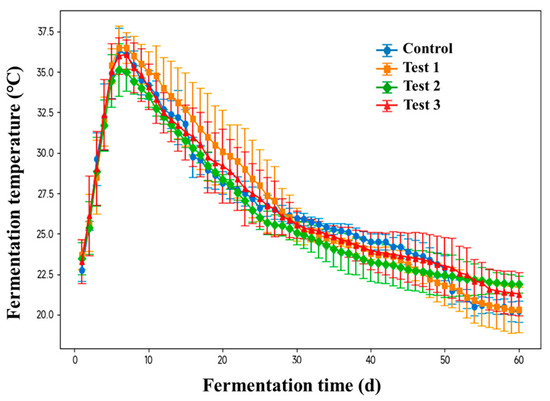
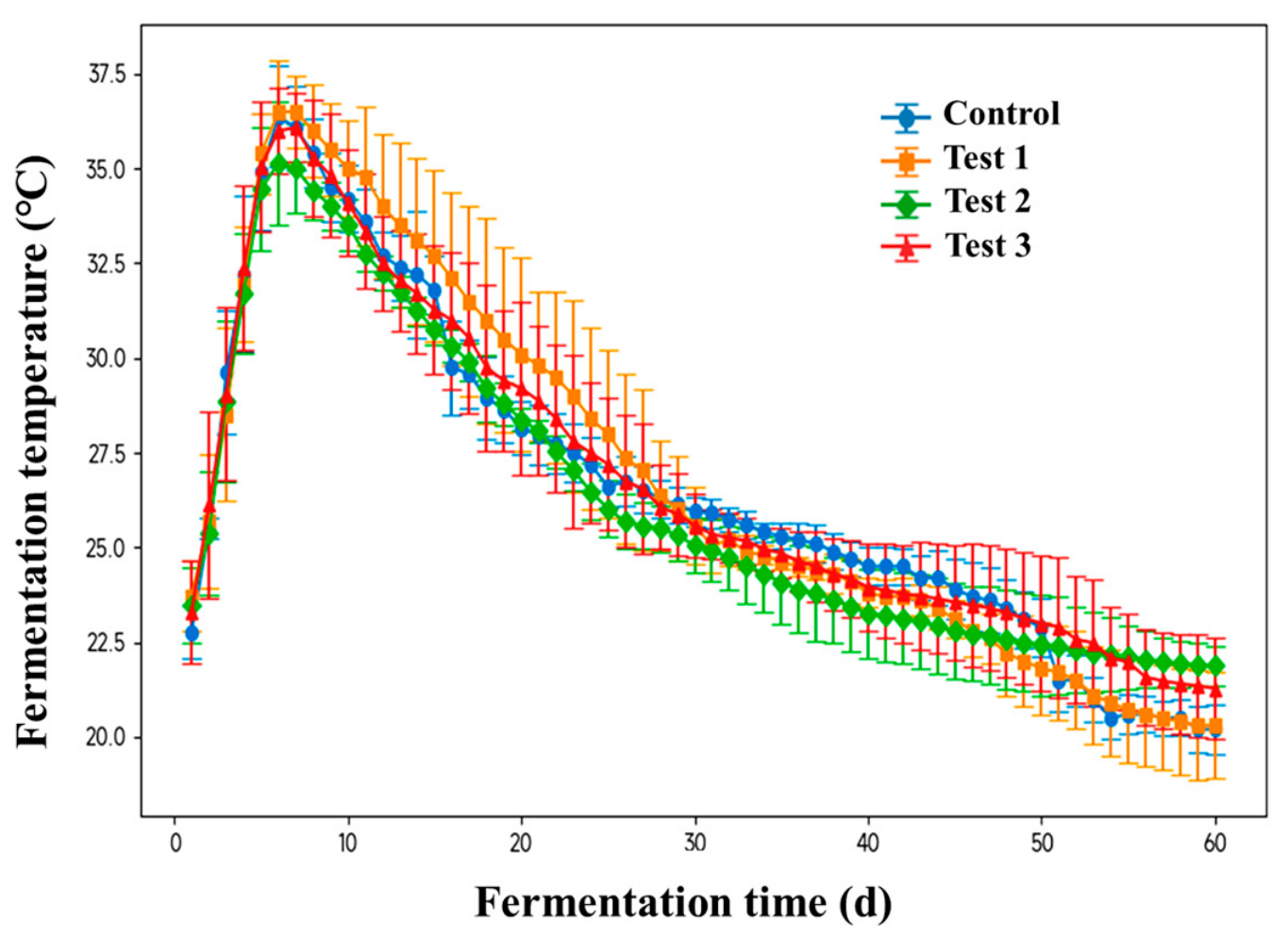
Temperature profiles across all groups followed the characteristic “slow rise, stable maintenance, gradual decline” pattern throughout the 60-day fermentation cycle (Figure 2). Peak temperatures of approximately 32–34 °C were observed between days 15 and 25 in all treatments. Subsequently, temperatures declined steadily toward ambient levels by day 60. The addition of TL at day 30 (indicated by the vertical dashed line in Figure 2) did not induce significant temperature fluctuations or abnormal thermal trajectories. Repeated-measures ANOVA confirmed that TL dosage exerted no significant main effect on fermentation temperature (F(3,12) = 0.48, p = 0.702), with no significant treatment-time interaction (F(177,708) = 0.95, p = 0.683). One-way ANOVA further verified intergroup uniformity in peak temperature, peak arrival time and cooling rate (all p > 0.05). These data indicate that TL reinfusion did not disrupt the characteristic thermal dynamics of the fermentation system. Temperature reflects net microbial heat production; its stability, considered alongside unchanged distillate yields (Table 2) and acid profiles (Table 3), supports the functional continuity of fermentation, though it does not preclude fine-scale metabolic shifts.
Figure 2.
Fermentation temperature profiles over 60 days. The vertical dashed line indicates TL injection (day 30). Data are daily means (n = 4 pits per group).
Table 2.
Effect of TL recycling on distillate yield (corrected to 65% alcohol by volume).
Table 3.
Corrected main aroma components in base liquor (g/L).
3.3. Effects on Distillate Yield
Corrected distillate yields, standardized to 65% (v/v) and corrected for exogenous ethanol contributed by the added TL using the formula in Section 2.5, were comparable across all groups (Table 2). The control group yielded 38.24 ± 0.15%, while Treatment 1 (10 kg), Treatment 2 (20 kg), and Treatment 3 (30 kg) yielded 38.32 ± 0.05%, 38.15 ± 0.10%, and 38.21 ± 0.07%, respectively. One-way ANOVA revealed no statistically significant differences among groups (p > 0.05; see Supplementary Materials Table S1). Tail liquor addition at the tested dosages did not affect the overall recovery of ethanol from the fermented grains.
3.4. Effects on Flavor Component Profiles
Table 3 shows corrected concentrations of key aroma compounds after subtracting exogenous flavor contributions carried by injected TL. TL supplementation significantly reshaped liquor aromatic profiles, with dose-dependent increases observed for core esters including ethyl hexanoate (the characteristic fruity marker of strong-flavor Baijiu), ethyl lactate, ethyl acetate and ethyl butyrate. Relative to the control group, the 30 kg TL treatment produced prominent elevations: total esters rose by 14.8%, ethyl hexanoate by 52.2%, and ethyl lactate by 69.8%. These data confirm that TL-derived ethanol and organic acid precursors jointly boost ester biosynthesis, albeit the dose–response relationship was not perfectly linear; detailed pairwise significance comparisons are listed in Supplementary Materials Table S2.
In contrast, concentrations of all measured organic acids remained statistically stable after deducting acid compounds originating from TL. Uniform total acid, hexanoic acid, lactic acid and acetic acid contents across all groups demonstrate that supplemented exogenous substrates were preferentially diverted into ester formation instead of accumulating as free acids, despite the existence of uncharacterized alternative metabolic pathways. Ethyl hexanoate increased progressively by 9.7%, 34.5% and 52.2% under 10 kg, 20 kg and 30 kg TL treatments, while ethyl lactate increased by 0.9%, 22.7% and 69.8% correspondingly. Such stepped improvements stem from elevated precursor availability for esterification: TL delivers supplementary alcohols and organic acids that cooperate with intrinsic substrates in fermented grains to shift metabolic flux toward ester production.
Among higher alcohols, n-propanol increased significantly by 78.1% in the 30 kg TL group (p < 0.05), whereas isoamyl alcohol showed no meaningful intergroup variation. Collectively, TL functions as a readily available fermentation substrate that selectively stimulates ester anabolism without elevating bulk acid levels. All significantly altered flavor compounds exhibited large effect sizes (partial η2 > 0.33) per Cohen’s criteria, indicating the observed concentration changes carry substantial practical industrial relevance beyond statistical significance.
4. Discussion
TL subsurface injection performed at the acidogenesis-to-esterification transition stage effectively optimizes the ester profile of strong-flavor Baijiu while preserving macroscopic fermentation stability. Stable fermentation temperature dynamics and corrected distillate yields were observed across all treatment groups, demonstrating that staged TL supplementation does not disrupt regular fermentation progression. Fermentation temperature serves as a reliable indicator of microbial metabolic activity in Baijiu fermentation [26], and the consistent thermal trends recorded in this study confirm that TL-derived ethanol and organic acids caused no obvious microbial inhibition at the tested dosages. Notably, the 30 kg TL treatment introduced approximately 25 kg of water, equivalent to 3% of the total feedstock weight. The stable temperature profiles and these indicators further verify that this moderate moisture increase did not interfere with fermentation performance. Nevertheless, it should be noted that macroscopic indicators cannot fully capture subtle microbial community shifts or fine-scale metabolic alterations during fermentation. Overall, this time-regulated TL recycling strategy is technically feasible for industrial flavor optimization.
The maximum 30 kg TL dosing markedly elevated core ester concentrations, with significant increases in total esters, ethyl hexanoate and ethyl lactate, which verifies that phase-targeted substrate supplementation effectively boosts ester biosynthesis. On fermentation day 30, acidogenic metabolism plateaus, and abundant endogenous organic acids accumulate inside fermented grains [5,6]. TL provides exogenous ethanol and organic acid precursors that perfectly match the peak activity window of esterase and lipase (days 30–35), jointly promoting the generation of aromatic esters [5,6]. Consistent acid levels in all distilled base liquors further demonstrate that the supplemented precursors were preferentially diverted to ester production instead of triggering extra acid accumulation [27], despite the existence of uncharacterized alternative metabolic pathways.
Supplementation timing is a critical factor governing exogenous substrate metabolism and final ester profiles, conferring prominent advantages over conventional pit-entry TL recycling [28]. Early-stage TL supplementation has been documented to cause an undesirable metabolic trade-off, characterized by increased ethyl hexanoate but decreased ethyl lactate, which limits the balanced improvement of Baijiu flavor esters [29]. In contrast, subsurface TL injection on day 30 simultaneously elevated the contents of two core flavor esters without reducing distillate yield, supporting that fermentation stage, rather than TL recycling itself, dominates esterification outcomes [30]. Early substrate addition tends to drive microbial proliferation and acidogenic metabolism [5,6], whereas supplementation at the acidogenesis-to-esterification transition matches the inherent metabolic succession of fermentation microbiota, efficiently directing exogenous substrates toward ester synthesis and maintaining fermentation homeostasis.
Consistent with the observed ester variations across groups, TL dosage exhibited a distinct non-linear dose–response effect on ester accumulation. The incremental increases in ethyl hexanoate (9.7%, 34.5%, and 52.2%) and ethyl lactate (0.9%, 22.7%, and 69.8%) under 10 kg, 20 kg, and 30 kg TL treatments indicate the existence of a critical substrate concentration threshold for efficient esterification [30,31]. The markedly enhanced ester synthesis from 20 kg to 30 kg is presumably attributed to esterase activation under sufficient substrate conditions or improved substrate micro-distribution at higher injection volumes. Additionally, the 30 kg TL treatment significantly increased n-propanol content by 78.1%. This change may reflect altered yeast amino acid metabolism under ethanol stress, though the mechanism requires further investigation [7].
Several factors limit metabolic interpretation of our data. Because ethanol and organic acids were co-introduced in all treatments [28,32], the current design cannot distinguish their individual contributions to ester improvement. In addition, acid concentrations measured in distillates do not fully reflect in situ metabolic variations in fermented grains. Differences in compound volatility during distillation and potential microbial transformation of exogenous substrates may mask actual acid consumption and replenishment during fermentation [33]. Without dynamic monitoring of fermented grains metabolites and microbial succession throughout fermentation, the precise metabolic fate of supplemented TL substrates remains unclear.
The patented subsurface injection technique also delivers unique operational advantages compared with traditional surface spraying. This method effectively reduces volatile substrate loss and avoids local high-ethanol-induced microbial stress, enabling a maximum safe TL dosage of 30 kg per pit, which is unachievable via conventional surface application [16,17]. Pit-entry recycling has been reported to elevate ethyl hexanoate at the expense of ethyl lactate [29]. In contrast, timed subsurface injection achieved synchronous enhancement of both esters. This technology realizes high-value recycling of distillation byproducts, conforming to the circular economy development requirements of the modern Baijiu industry [21,22]. These results demonstrate that timed subsurface TL injection can improve and balance Baijiu ester profiles while preserving fermentation stability and distillate yield.
5. Limitations
This study bears several limitations. First, n = 4 pits per group restricts statistical robustness, and the maximum TL dosage (30 kg) was constrained by pit seepage risk, leaving the biological saturation threshold uncharacterized. Second, single daily temperature sampling failed to capture diurnal thermal fluctuations. Third, only terminal distillate compounds were quantified; dynamic fermented grains metabolites and microbial succession were not tracked, limiting mechanistic insights. Finally, sensory profiling was not conducted to link ester shifts to sensory attributes.
6. Conclusions
Subsurface injection of distillation tail liquor (TL) at the acidogenesis–esterification transition stage effectively modulates the ester profiles of strong-flavor Baijiu without disrupting fermentation thermal dynamics or reducing corrected ethanol distillate yield. Fermentation day 30 represents a critical metabolic window where acidogenic metabolism concludes and esterase/lipase activity peaks; targeted TL supplementation at this timing delivers supplementary ethanol and organic acid precursors to coordinate with intrinsic substrates within fermented grains and facilitate ester biosynthesis. Under the experimental conditions, the patented telescopic subsurface injection device safely supports a maximum TL dosage of 30 kg per pit, substantially exceeding the 6 kg limit of conventional surface spraying applied at pit filling. The 30 kg TL treatment induced significant dose-dependent increases in core flavor esters relative to the control group, with total esters, ethyl hexanoate and ethyl lactate elevated by 14.8%, 52.2% and 69.8%, respectively, while corrected organic acid concentrations in finished distillates remained statistically unchanged across all treatments. Unlike traditional pit-entry TL recycling that generates unbalanced ester variations, mid-fermentation subsurface injection simultaneously promotes the accumulation of two pivotal aromatic esters, which provides a feasible industrial strategy for the circular valorization of distillation byproducts [34] and low-cost flavor quality improvement of strong-flavor Baijiu. This study provides process-scale evidence consistent with substrate-limited esterification at the acidogenesis-to-esterification transition, although the mixed co-supplementation of ethanol and organic acids in TL precludes discrimination of their individual metabolic contributions to ester formation. Further investigations focusing on dynamic in situ fermented grains metabolites, microbial succession and sensory evaluation are required to elucidate the underlying metabolic mechanisms, and separate ethanol/organic acid supplementation trials are recommended to decouple their respective regulatory effects on ester synthesis.
7. Patents
Telescopic Auxiliary Device for Pit Recharging of Strong-Flavor Baijiu TL, Shandong Wenhe Liquor Co., Ltd., Patent No. ZL 2024 2 2257707.2.
Supplementary Materials
The following supporting information can be downloaded at: https://www.mdpi.com/article/10.3390/fermentation12080348/s1, Table S1: One-way ANOVA of corrected distillate yield (65% v/v) among the four groups (Control, Treatment 1: 10 kg, Treatment 2: 20 kg, Treatment 3: 30 kg tail liquor addition). (Data from Table 2); Table S2: Welch’s ANOVA for compounds with heterogeneous variances (ethyl lactate and n-propanol); Table S3: Complete ANOVA results for all aroma compounds (data from Table 3).
Author Contributions
Conceptualization, R.Z., J.Z. and D.Z.; methodology, D.Z. and Y.L.; investigation, G.Y. and Y.L.; data curation, D.Z.; writing—original draft preparation, D.Z.; writing—review and editing, R.Z., J.Z. and X.L.; supervision, R.Z. and J.Z.; project administration, R.Z. and J.Z. All authors have read and agreed to the published version of the manuscript.
Funding
This research received no external funding.
Institutional Review Board Statement
Not applicable.
Informed Consent Statement
Not applicable.
Data Availability Statement
The data presented in this study are available on request from the corresponding authors.
Acknowledgments
The authors thank Shandong Wenhe Liquor Industry Co., Ltd. for providing experimental facilities and technical support.
Conflicts of Interest
Author Rongxin Zhang, Yueming Lv, and Guang Yang were employed by the company Shandong Wenhe Liquor Industry Co., Ltd. The remaining authors declare that the research was conducted in the absence of any commercial or financial relationships that could be construed as a potential conflict of interest.
Abbreviations
The following abbreviations are used in this manuscript:
| Abbreviation | Full Form |
| TL | Tail Liquor |
| GC-FID | Gas Chromatography-Flame Ionization Detection |
| SD | Standard Deviation |
| ANOVA | Analysis of Variance |
| HSD | Honestly Significant Difference |
References
- GB/T 10781.1-2021; Quality Requirements for Baijiu—Part 1: Strong-Aroma Baijiu. Standards Press of China: Beijing, China, 2021.
- GB/T 15109-2021; Terminology of Baijiu Industry. Standards Press of China: Beijing, China, 2021.
- Wang, S.; Li, Z.; Huang, D.; Luo, H. Contribution of microorganisms from pit mud to volatile flavor compound synthesis in fermented grains for Nongxiangxing Baijiu brewing. J. Sci. Food Agric. 2024, 104, 778–787. [Google Scholar] [CrossRef] [Scilit] [PubMed]
- Yang, L.; Chen, J.; Li, Z.; Gong, L.; Huang, D.; Luo, H. Effect of lactic acid bacteria on the structure and potential function of the microbial community of Nongxiangxing Daqu. Biotechnol. Lett. 2023, 45, 1183–1197. [Google Scholar] [CrossRef] [Scilit] [PubMed]
- Xu, Y.; Zhao, J.; Liu, X.; Zhang, C.; Zhao, Z.; Li, X.; Sun, B. Flavor mystery of Chinese traditional fermented Baijiu: The great contribution of ester compounds. Food Chem. 2022, 369, 130920. [Google Scholar] [CrossRef] [Scilit] [PubMed]
- Huang, X.; Zheng, J.; Zhang, K.; Qiao, Z.; Luo, H. Short-chain fatty acids and their producing microorganisms in the Nongxiangxing flavor baijiu ecosystem: Status and perspectives. Food Biosci. 2024, 61, 104701. [Google Scholar] [CrossRef] [Scilit]
- Niu, Y.; Zhao, W.; Xiao, Z.; Zhu, J.; Xiong, W.; Chen, P. Characterization of aroma compounds and effects of amino acids on the release of esters in Laimao baijiu. J. Sci. Food Agric. 2023, 103, 1784–1799. [Google Scholar] [CrossRef] [Scilit] [PubMed]
- Yan, Q.; Zhang, K.; Zou, W.; Hou, Y. Three main flavour types of Chinese Baijiu: Characteristics, research, and perspectives. J. Inst. Brew. 2021, 127, 317–326. [Google Scholar] [CrossRef] [Scilit]
- Liu, M.; Tian, X.; Liu, C.; Liu, Y.; Tang, Y. Microbiologic surveys for Baijiu fermentation are affected by experimental design. Int. J. Food Microbiol. 2024, 413, 110588. [Google Scholar] [CrossRef] [Scilit] [PubMed]
- Wang, Y.; Li, B.; Dong, H.; Huang, X.; Chen, R.; Chen, X.; Yang, L.; Peng, B.; Xie, G.; Cheng, W.; et al. Complete genome sequence of Clostridium kluyveri JZZ applied in Chinese strong-flavor liquor production. Curr. Microbiol. 2018, 75, 1429–1433. [Google Scholar] [CrossRef] [Scilit] [PubMed]
- Yuan, H.; Wang, L.; Wang, X.; Zheng, J.; An, M.; Qiao, Z.; Liang, L.; Li, Z. Distillation conditions for the recovery and utilization of the tail liquor of strong-flavor Baijiu. Food Ferment. Ind. 2020, 46, 133–139. Available online: http://sf1970.cnif.cn/fileup/0253-990X/HTML/2020-13-133.shtml (accessed on 11 July 2026). (In Chinese)
- Ding, J.; Song, Y.; Huang, Z.; Songbai, Y.; Liu, R.; Zeng, N. Research progress on the pharmacological effects of baijiu based on its traditional efficacy. China Brew. 2025, 44, 20–25. (In Chinese) [Google Scholar] [CrossRef]
- Li, M.; Xu, D.; Ao, Z.; Zhang, S.; Zhang, C.; Xu, Y. Super-long fermentation of fermented grain of strong-flavor Baijiu fed with whole sorghum and Baijiu-returning distillation. China Brew. 2022, 41, 117–121. Available online: https://manu61.magtech.com.cn/zgnz/EN/10.11882/j.issn.0254-5071.2022.06.020 (accessed on 11 July 2026). (In Chinese)
- Chen, S.; Zhang, S.; Shui, L.; Ao, Z.; Mao, Z.; Yang, Y.; Zhang, B. Study on the Dynamic Effects of Reflux Liquor Distillation on the Fermentation of Fermented Grains of Nongxiang Daqu Liquor. Liquor. Mak. Sci. Technol. 2014, 8, 16–23. (In Chinese) [Google Scholar]
- Zhang, R.X.; Zhang, D.L. Telescopic Auxiliary Device for Pit Recharging of Strong-Flavor Baijiu Tail Liquor. CN Patent No. ZL 2024 2 2257707.2, 25 July 2025. [Google Scholar]
- Wang, H.; Gu, Y.; Zhao, D.; Qiao, Z.; Zheng, J.; Gao, J.; Ren, C.; Xu, Y. Caproicibacterium lactatifermentans sp. nov., isolated from pit clay used for the production of Chinese strong aroma-type liquor. Int. J. Syst. Evol. Microbiol. 2022, 72, 005206. [Google Scholar] [CrossRef] [Scilit] [PubMed]
- Zhang, Q.; Zhang, R.; Chen, X.; Han, M.; Zhang, Y.; Li, W.; Li, X.; Hao, J.; Sun, B. Synergistic Microbial Co-Culture of Saccharomyces cerevisiae and Clostridium kluyveri Enhances Ethyl Hexanoate Production for Stable Flavor Synthesis in Strong-Flavor Baijiu. Food Biosci. 2026, 75, 108078. [Google Scholar] [CrossRef] [Scilit]
- Tan, Y.; Zhong, H.; Zhao, D.; Du, H.; Xu, Y. Succession Rate of Microbial Community Causes Flavor Difference in Strong-Aroma Baijiu Making Process. Int. J. Food Microbiol. 2019, 311, 108350. [Google Scholar] [CrossRef] [Scilit] [PubMed]
- Hu, X.; Tian, R.; Wang, K.; Cao, Z.; Yan, P.; Li, F.; Li, X.; Li, S.; He, P. The prokaryotic community, physicochemical properties and flavors dynamics and their correlations in fermented grains for Chinese strong-flavor Baijiu production. Food Res. Int. 2021, 148, 110626. [Google Scholar] [CrossRef] [Scilit] [PubMed]
- Zhang, C.; Song, P.; Yang, J.; Qin, H.; He, X.; Qiu, C.; Zeng, X.; Wang, X.; Huang, M. Research progress and development trend analysis of comprehensive utilization of Baijiu tails in Baijiu distillation. Liquor. Mak. 2025, 52, 9–17. Available online: http://dianda.cqvip.com/Qikan/Article/Detail?id=7202227258#:~:text=%E6%9C%AC%E6%96%87%E5%9C%A8%E8%A7%A3%E6%9E%90%E5%B0%BE%E9%85%92%E5%BD%A2,%E6%96%B0%E6%80%9D%E8%B7%AF%E5%92%8C%E6%96%B0%E9%80%94%E5%BE%84%E3%80%82 (accessed on 11 July 2026). (In Chinese)
- Dai, M.; Wu, M.; Feng, Z.; Lai, J.; Zhao, L.; Ji, W. A potential novel clostridium species isolated from cellar mud for producing high yield of butyric acid and the metabolic characteristics. 3 Biotech 2026, 16, 82. [Google Scholar] [CrossRef] [Scilit] [PubMed]
- Kong, C.-L.; Ma, N.; Yin, J.; Zhao, H.-Y.; Tao, Y.-S. Fine tuning of medium chain fatty acids levels increases fruity ester production during alcoholic fermentation. Food Chem. 2021, 346, 128897. [Google Scholar] [CrossRef] [Scilit] [PubMed]
- Cao, H.-N.; Liu, J.; Zhu, W.J.; Wang, C.; Liu, X.-X. Application of anaerobic digestion technology in building a circular economy model for ecological Baijiu enterprises. China Brew. 2024, 43, 13–20. (In Chinese) [Google Scholar] [CrossRef]
- Gao, L.; Zhou, J.; He, G. Effect of microbial interaction on flavor quality in Chinese baijiu fermentation. Front. Nutr. 2022, 9, 960712. [Google Scholar] [CrossRef] [Scilit] [PubMed]
- GB/T 10345-2022; Method of Analysis for Baijiu. Standards Press of China: Beijing, China, 2022.
- Chen, X.; Li, H.; Qiu, F.; Niu, J.; Ali, A.; Zhu, L.; Ma, H.; Li, W.; Li, X.; Sun, B. Impact of secondary temperature rise on microbial succession and flavor compounds in strong-flavor baijiu fermentation. Food Res. Int. 2025, 213, 116594. [Google Scholar] [CrossRef] [Scilit] [PubMed]
- Yang, R.; Hua, J.; Zhou, Y. Progress in the research of the mechanism of ethyl lactate production and ‘ethyl lactate reduction’ techniques in the Baijiu brewing process. Sci. Technol. Food Ind. 2024, 45, 398–406. (In Chinese) [Google Scholar] [CrossRef]
- Xu, H.; Xia, X.-C.; Jiang, Y.-F.; Xiong, H.-X.; Wu, W.; Liu, D.; Zhu, X.; Wang, X.-D. Research progress on comprehensive utilization of Baijiu brewing by-products. China Brew. 2025, 44, 11–16. (In Chinese) [Google Scholar] [CrossRef]
- Hu, X.; Du, H.; Xu, Y. Identification and quantification of the caproic acid-producing bacterium Clostridium kluyveri in the fermentation of pit mud used for Chinese strong-aroma type liquor production. Int. J. Food Microbiol. 2015, 214, 116–122. [Google Scholar] [CrossRef] [Scilit] [PubMed]
- Zhao, Q.; Pan, Y.; Wang, S.; Shen, C.; Li, Y. Research progress in the functions of lactic acid bacteria in the brewing of strong-flavor Baijiu. Acta Microbiol. Sin. 2025, 65, 871–882. (In Chinese) [Google Scholar] [CrossRef]
- Wang, H.; Zhou, W.; Gao, J.; Ren, C.; Xu, Y. Revealing the characteristics of glucose- and lactate-based chain elongation for caproate production by Caproicibacterium lactatifermentans through transcriptomic, bioenergetic, and regulatory analyses. mSystems 2022, 7, e00534-22. [Google Scholar] [CrossRef] [Scilit] [PubMed]
- Sun, Z.-X.; Wang, J.-K.; Ding, F.; Cui, B.-Y.; Wang, J.; Sun, G.-L.; Xiong, C. Approaches to improve the quality of Luzhou-flavor Daqu liquor—Double bottom fermentation of reflux liquor. Liquor. Mak. Sci. Technol. 2012, 8, 65–67. (In Chinese) [Google Scholar] [CrossRef]
- Ding, X.-F.; Wu, C.-D.; Huang, J.; Zhou, R.-Q. Changes in Volatile Compounds of Chinese Luzhou-Flavor Liquor during the Fermentation and Distillation Process. J. Food Sci. 2015, 80, C2373–C2381. [Google Scholar] [CrossRef] [Scilit] [PubMed]
- Zhang, C.; Li, J.-L.; Zeng, X.-D.; Wang, Y.; Qin, H.; Song, P.; Hou, X.-Y.; Liu, S.-L.; Ma, C.; Huang, Y. Comprehensive Use of Distillers’ Grains Derived from Chinese Baijiu: A Review. J. Agric. Food Res. 2024, 18, 101439. [Google Scholar] [CrossRef] [Scilit]

Disclaimer/Publisher’s Note: The statements, opinions and data contained in all publications are solely those of the individual author(s) and contributor(s) and not of MDPI and/or the editor(s). MDPI and/or the editor(s) disclaim responsibility for any injury to people or property resulting from any ideas, methods, instructions or products referred to in the content. |
© 2026 by the authors. Licensee MDPI, Basel, Switzerland. This article is an open access article distributed under the terms and conditions of the Creative Commons Attribution (CC BY) license.