


Abstract
Background: Staurosporine is a potent broad-spectrum alkaloid antibiotic originally isolated from Streptomyces sp. It is renowned for its strong inhibitory activity against protein kinases by competitively binding to their ATP-binding sites. Therefore, staurosporine and its derivatives have been extensively investigated for their potential as anticancer agents. However, a major challenge in its utilization is the low production yield in wild-type strains. To overcome this limitation, this study aimed to enhance staurosporine yield in marine-derived staurosporine-producing strain OUCMDZ-3118. Methods: The fermentation conditions were tested by single-factor experiment, Plackett–Burman experiment, steepest ascent path and Box–Benhnken response surface method. Subsequently, the ultraviolet mutagenesis was employed to generate high-yielding mutant strain. Results: The optimal culture conditions were 50 g/L rice, 50 g/L soybean powder, 3 g/L NaCl, 10 g/L L-tryptophan, inoculum concentration of 3% (v/v) in 150 mL of medium within a 500 mL flask, and fermentation time of 10 days. Following UV mutagenesis, the mutant strain produced a final staurosporine titer of 496 mg/L, an approximately 9.5-fold higher titer than that of the wild-type strain. In a 30-day solid-state fermentation under the conditions of 40 g rice, 40 g soybean powder, moistened with 80 mL water containing NaCl (3 g/L) and L-tryptophan (10 g/L), a yield of 578 mg per 80 g of substrate was also achieved. A consistent yield of 7.22 g/kg was achieved across approximately 1000 replicate fermentations under identical conditions, demonstrating the robustness of the process. Conclusions: This study yielded a stable, high-yielding strain for staurosporine production, paving the way for the development of staurosporine-based antitumor drugs and their derivatives.
1. Introduction
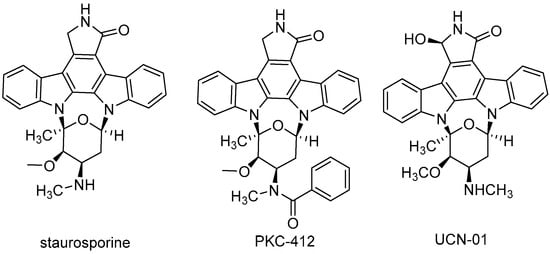
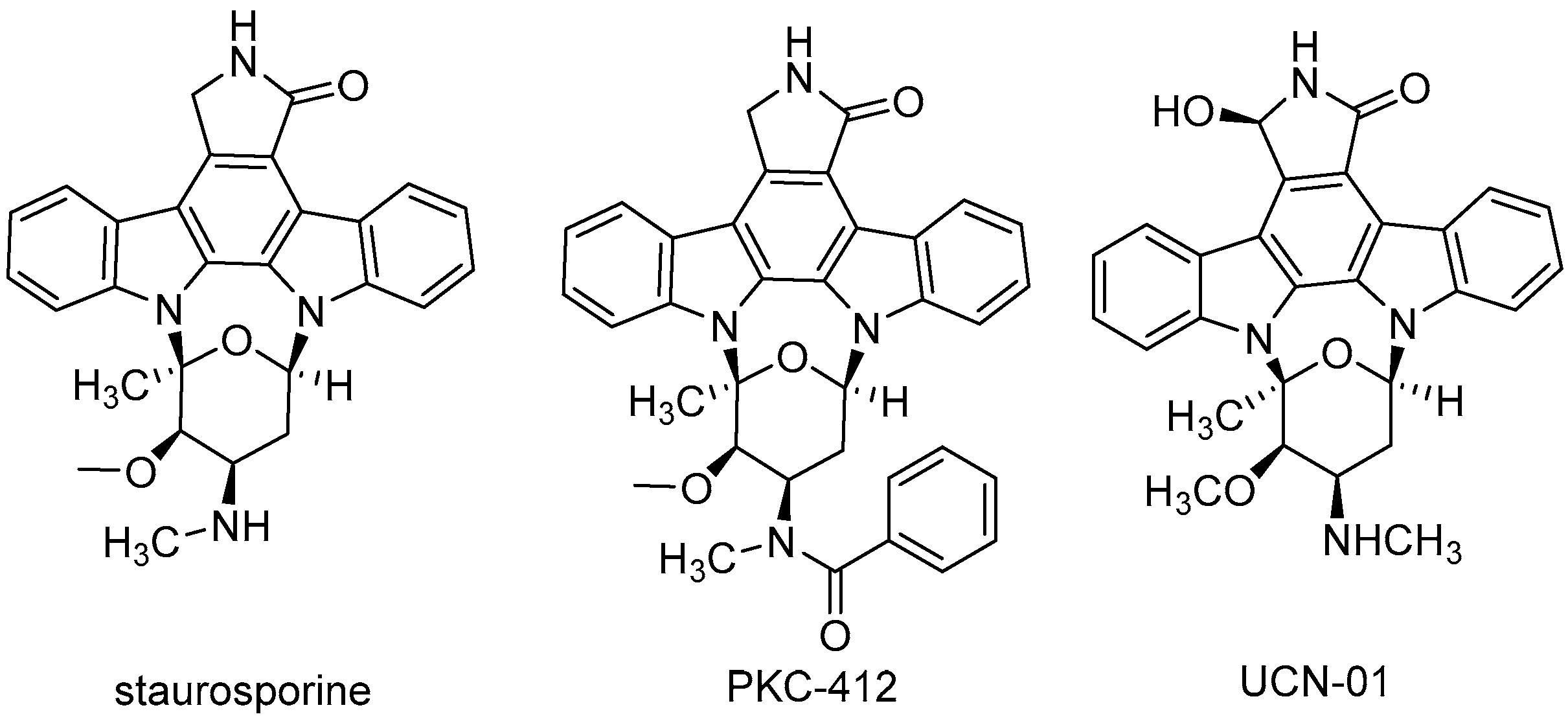
Staurosporine was first isolated in 1977 by Omura et al. from the fermentation products of Streptomyces staurosporeus AM-2282 (ATCC 55006), and it exhibits strong inhibitory effects on protein kinase C [1]. Its structural formula was determined by Furusaki et al. through X-ray crystallography [2]. However, due to its poor selectivity and high toxicity, it has not been used in clinical studies [3]. PKC-412, also known as midostaurin, is a semi-synthetic derivative of staurosporine with benzoylation at the nitrogen atom at position 3 of the sugar ring. It targets Flt-3, a tyrosine kinase receptor expressed in approximately one-third of acute myeloid leukemia patients. In clinical trials, midostaurin demonstrated promising efficacy in acute myeloid leukemia patients, showing effectiveness in both Flt-3 mutant and wild-type patients [4]. The drug was approved by the US FDA in 2017 for the treatment of acute myeloid leukemia [5]. Additionally, UCN-01 is a derivative of staurosporine hydroxylated at the 7-position methylene group, with IC50 values of 42, 32, and 58 nM against three cell cycle proteins (CDK-2, 4, 6). UCN-01 can arrest A549 cells in the G1 phase and has an IC50 of 0.4 μM against chronic lymphocytic leukemia [6]. Pharmacokinetic studies in animals indicate that despite its high plasma protein binding rate, it has a rapid clearance rate and high volume of distribution. UCN-01 has advanced to Phase II clinical trials for the treatment of pancreatic cancer, breast cancer, and lymphoma [7,8].
As mentioned above, staurosporine derivatives have demonstrated significant pharmaceutical potential; however, their strain sources remain scarce, and wild-type strains exhibit lower yields under normal fermentation conditions. Over the past 30 years, staurosporine and related natural indolocarbazole compounds have been isolated from several bacteria, including cyanobacteria. Staurosporine derivatives have also been isolated from marine invertebrates, such as sponges, tunicates, bryozoans and mollusks [9]. Among these, Streptomyces-derived strains have received the primary research attention. To date, the reported strains capable of producing staurosporine include Streptomyces sp. TP-A0274 [10], Streptomyces fradiae 007M135 [11], sponge-symbiotic Streptomyces SP6206 [12], Streptomyces longisporoflavus DSM10189 [13], Streptomyces sp. BV410 [14] and so on. Huang et al. (2019) increased the staurosporine fermentation titer of the sponge-symbiotic Streptomyces sp. SP6206 to 320 mg/L through medium optimization [12]. Huang et al. (2023) [15] used Streptomyces sp. ST-07 as the original strain and overexpressed the staR gene under the control of the kasO*p promoter. The resulting engineered strain ST-D-5 achieved the highest staurosporine titer of up to 923 mg/L [15]. Fang et al. (2021) [16] used Streptomyces sp. HY1 as the starting strain and subjected it to mutagenesis through ultraviolet-lithium chloride (UV-LiCl), atmospheric and room temperature plasma (ARTP), and N-methyl-N′-nitro-N-nitrosoguanidine (NTG). By screening on resistant plates containing tryptophan and methionine, they obtained a mutant high-yield strain, HY6-S36. This strain exhibited stable genetic performance and achieved a staurosporine fermentation titer of 360 mg/L, representing an 80% improvement over the original strain [16].
Current fermentation medium fail to generate sufficient quantities of staurosporine for downstream applications, necessitating systematic optimization of cultivation parameters. Previously, our research group isolated strain OUCMDZ-3118 from deep-sea sediment (2061 m) collected in the South China Sea, which primarily biosynthesizes staurosporine as its major secondary metabolite [17]. This study therefore focuses on strain OUCMDZ-3118, initially optimizing fermentation conditions by determining optimal incubation duration as well as ideal carbon and nitrogen sources. Single-factor experiments were conducted to establish optimal concentrations of individual medium components, followed by fractional factorial design to identify critical factors affecting staurosporine production. The concentration ranges of these key factors were subsequently determined via steepest ascent methodology, with response surface methodology applied to elucidate their optimal concentrations. The optimized medium formulation was then validated through confirmation experiments. Building upon these optimizations, UV mutagenesis was employed to generate strain variants with enhanced productivity. Mutant strains exhibiting increased staurosporine yields and genetic stability through successive generations were selected. Additionally, the effect of supplementing cultures with L-tryptophan, a precursor to the indolocarbazole core structure [18], was investigated to potentially further enhance staurosporine biosynthesis. Finally, to further increase the yield, the optimized medium subsequently utilized the solid-state fermentation process to ensure a sufficient supply of raw material for the subsequent synthesis of derivatives (Figure 1).
Figure 1.
The chemical structural formulas of staurosporine and its derivatives.
2. Materials and Methods
2.1. Test Strain
OUCMDZ-3118, preserved in our laboratory, was isolated from marine sediment and identified as Streptomyces sp. based on 16S rRNA analysis (GenBank access No. MG706259) [17]. Strain 30s-6, an ultraviolet-induced mutant of OUCMDZ-3118, is preserved under the accession number CCTCC NO. M 20251641 in China Center for Type Culture Collection. Both of strains were cultured in ISP2. The raw sequencing reads for the parental strain OUCMDZ-3118 and the mutant strain 30s-6 have been deposited in the National Center for Biotechnology Information (NCBI) Sequence Read Archive (SRA). The data are accessible under BioProject accession number PRJNA1414929.
2.2. Culture Media
For seed cultivation, the ISP2 medium was used. The medium contained the following per liter of deionized water: 10 g of malt extract, 4.0 g of glucose, and 4.0 g of yeast extract. All chemicals were of analytical grade and purchased from Beijing Aoboxing Biotech Co., Ltd. (Beijing, China). The pH was adjusted to 7.0 prior to sterilization. Cultivation was carried out at 28 °C with shaking at 220 rpm for 2 days. Optimized fermentation medium in this study, rice (Panjin Rice Group Co., Ltd., Panjin, China), NaCl (analytical reagent, Chongqing Chuandong Chemical Group Co., Ltd., Chongqing, China), soybean powder (Zaozhuang Chunliang Food Co., Ltd., Zaozhuang, China). Corresponding solid media prepared by adding 2% agar (Tianjin Zhiyuan Chemical Reagent Co., Ltd., Tianjin, China) to the above media.
2.3. Instruments and Reagents
Constant temperature shaking incubator: Shanghai Zhicheng Analytical Instrument Manufacturing Co., Ltd. (Shanghai, China). Centrifuge: Hunan Xiangyi Laboratory Instrument Development Co., Ltd. (Changsha, China). Analytical HPLC: Hitachi, Tokyo, Japan equipped with a 1430 Diode Array Detector, an 1110 pump, and a YMC-pack ODS-A column (5 µm, 4.6 × 150 mm, 1 mL/min). Ethyl acetate: analytical reagent, Shanghai Wohua Chemical Co., Ltd. (Shanghai, China). HPLC-grade methanol: Shanghai Xingke High Purity Solvent Co., Ltd. (Shanghai, China). L-tryptophan: analytical reagent, Shanghai Titan Technology Co., Ltd. (Shanghai, China). UV lamp: Foshan Yichen Electronic Technology Co., Ltd. (Foshan, China).
2.4. Construction of Standard Curve for Staurosporine Content Detection
Using staurosporine with purity above 99% as the standard for HPLC analysis, a standard curve was constructed with peak area as the y-coordinate and staurosporine concentration (5, 10, 20, 40, 80, 160 μg/mL) as the x-coordinate. Through area normalization method, the integrated peak areas of staurosporine were correlated with corresponding staurosporine concentrations to create a standard curve. This standard curve was used for the detection of staurosporine content after fermentation. HPLC analysis conditions: C18 column; UV detector at wavelength 285 nm; mobile phase consisting of 60% methanol: 40% H2O (containing 1.5‰ trifluoroacetic acid); flow rate: 1 mL/min; column temperature: 30 °C; injection volume: 20 μL.
2.5. Single-Factor Experiments Were Conducted to Investigate the Effects of Culture Medium Components and Cultivation Conditions on Fermentation Yield
To systematically optimize the production of staurosporine, we first investigated the individual effects of key medium components on its yield. This included screening optimal carbon sources (glucose, rice, soluble starch, sucrose, glycerol, and mannitol), nitrogen sources (peptone, soy peptone, tryptone, yeast extract, soybean powder, and potassium nitrate), and inorganic metal ions (NaCl, MgSO4, FeSO4, CaCO3) in the fermentation medium. Based on these results, the most effective culture components were identified.
Subsequently, using the optimized medium formulation, we further examined the influence of key process parameters on the relative fermentation titer of staurosporine. Specifically, the effects of inoculum concentration (1%, 2%, 3%, 4%, and 5%, v/v), liquid volume (60, 100, 150, 180, and 220 mL), and cultivation time (5, 7, 10, 13, 15, and 20 days) were evaluated to establish the optimal fermentation conditions.
2.6. Using Plackett–Burman Experimental Design to Determine Important Factors in the Culture Medium
The primary goal was to screen for key factors significantly affecting staurosporine yield from seven potential influencing factors (rice, glucose, CaCO3, NaCl, liquid volume, inoculum concentration, and soybean powder). Given the large number of factors and the impracticality of conducting a full factorial experiment (which would require 27 = 128 trials) in terms of time, materials, and cost, we employed a Plackett–Burman (P-B) screening design [19].
This design requires only 12 experiments to orthogonally and unbiasedly evaluate the main effects of all seven factors. Compared to the one-factor-at-a-time approach, it avoids the bias caused by fixing other factors and supports analysis of variance and p-value testing, ensuring that the screening results are both statistically objective and globally reliable. With this design, we can efficiently rank the effects and identify the significance of all factors within a limited number of experiments, thereby quickly pinpointing key variables. This provides a clear target and a solid data foundation for subsequent response surface optimization.
Based on the mentioned above, this study selected a P-B design with N = 12 to analyze seven factors: rice (X1), glucose (X2), CaCO3 (X3), NaCl (X4), liquid volume (X5), inoculum concentration (X6), and soybean powder (X7). Two levels were selected for each factor. The low level was the result of the single-factor experiment, and the high level was 1.5–2 times the low level. The response value Y was staurosporine yield, and importance ranking analysis was conducted.
2.7. Determining the Concentration Range of Important Influencing Factors
Based on the P-B experiment, the steepest ascent method was used to find the concentration range of the culture medium, as the optimal experimental point may fall outside the P-B experimental data. Therefore, the steepest ascent method was used to find the optimal experimental range based on the P-B experiment. Five groups of experiments were arranged according to a certain gradient interval, and the maximum response value was used as the central experimental point for subsequent optimization design.
2.8. Response Surface Methodology to Determine the Optimal Concentration of Important Influencing Factors in the Culture Medium
According to the factor concentrations determined by the steepest ascent experiment, Box–Behnken (BB) experimental design was carried out [20]. Design Expert software was used to perform regression analysis on the experimental results and establish regression equations. With the yield of staurosporine as the response value, response surface analysis diagrams and contour plots were drawn.
2.9. Verification of the Optimized Medium Potency
To experimentally validate the predictive model, a verification fermentation was conducted using the optimized medium composition. The fermentation was performed under liquid shake-flask conditions at 28 °C for 10 days. Following fermentation, the entire broth was extracted three times with an equal volume of ethyl acetate to ensure complete recovery of staurosporine. The combined extracts were concentrated to dryness via rotary evaporation. The resulting residue was then re-dissolved in methanol and subjected to quantitative analysis by High-Performance Liquid Chromatography (HPLC). The concentration of staurosporine was determined using a pre-established calibration curve (Figure S1). The final yield was calculated based on the measured concentration and the total fermentation volume.
2.10. Screening of High-Yielding Mutant Strains by Ultraviolet (UV) Mutagenesis
Ultraviolet light is a mutagen with long usage history, good effects, and simple equipment requirements. Approximately 80% of high-yield antibiotic-producing strains have used this mutagenesis method [21]. This study also adopted this method for high-yield strain selection. Strains in the logarithmic growth phase were selected, and 3–4 mL was inoculated into a flask (100 mL) containing 25 mL of 0.1 mol·L−1 pH 7.0 phosphate-buffered solution and glass beads, placed on a shaker at a constant temperature with 180 r·min−1 agitation to disperse the cells. The spore suspension was then diluted with sterile phosphate-buffered solution, adjusting its concentration to OD600 = 1. The UV lamp was preheated for 20 min. 3 mL of the suspension to be treated was placed 20 cm away from a 30 W UV lamp and irradiated for 10 s, 20 s, 30 s, 35 s, 40 s, and 50 s, respectively, then collected in EP tubes and kept in the dark for 1 h. The irradiated bacterial suspensions were plated on ISP2 plates at three dilution levels of 10−3, 10−4, and 10−5, and incubated inverted at 28 °C for 3–5 days, with three parallel groups. Based on the lethal rate (Table S1), 100 single spore isolates were randomly selected from different irradiation time conditions, transferred to slants, and their staurosporine yield was determined by shake flask fermentation. The mutagenic dose for this experiment was thus determined.
2.11. L-Tryptophan-Induced Strain Fermentation
Staurosporine belongs to the indolocarbazole alkaloids. Indolocarbazole compounds are composed of indole [2,3-a] carbazole and glycosides. Through isotope labeling, it was discovered that the indolocarbazole core is derived from L-tryptophan [22]. To explore the effect of this precursor substance on staurosporine yield, different concentrations of L-tryptophan (3, 5, 7, 10, and 15 g/L) were added to the optimized medium. After 10 days of fermentation on a shaker, the staurosporine yield was detected.
2.12. Liquid-to-Solid-State Fermentation to Increase Staurosporine Production
To overcome the constraints of liquid fermentation and enable expanded production of staurosporine for downstream derivative synthesis, a transition from liquid to solid-state fermentation was implemented. Following liquid culture, the optimized medium composition was directly transferred to a solid substrate. This shift not only reduced spatial demands but also enhanced product stability. Each fermentation unit consisted of a solid substrate containing 40 g rice and 40 g soybean powder, moistened with 80 mL of H2O containing NaCl (3 g/L) and L-tryptophan (10 g/L). The water was completely absorbed by the solid substrates, forming a moist but non-free-flowing matrix characteristic of solid-state fermentation. No free water was observed, and the system maintained its solid integrity without becoming slurry or fluidic during incubation. Subsequently, it was inoculated with 10 mL of seed culture that had been pre-grown in ISP2 medium for 48 h at 28 °C and 220 rpm. The units were incubated statically at 28 °C for 30 days. This setup was replicated across approximately 1000 identical fermentation units (flasks) operated in parallel.
2.13. Statistical Analysis Methods
All experiments were performed in at least three independent biological replicates. Data are presented as mean ± standard deviation (SD); these descriptive statistics were calculated using IBM SPSS Statistics (version 26). The design of experiments (P-B and BB) and their corresponding statistical analyses (e.g., regression analysis for factor screening and ANOVA for response surface modeling) were performed using Design-Expert® software (version 8). In the P-B design, the significance of factors was evaluated by analyzing the main effects (regression coefficients) through Student’s t-test. The steepest ascent path was determined based on the magnitude and direction of the significant coefficients. For the BB design, a second-order polynomial model was fitted, and its significance, along with individual model terms, was assessed by analysis of variance (ANOVA). The adequacy of the model was evaluated using the coefficient of determination (R2) and a lack-of-fit test.
2.14. Genome Sequencing and Bioinformatic Analysis
Genomic DNA was extracted from the OUCMDZ-3118 and the mutant strain 30s-6 using the TIANamp Bacteria DNA Kit (DP302, Tiangen Biotech Co., Ltd., Beijing, China). DNA integrity and concentration were assessed by agarose gel electrophoresis. Qualified DNA samples were sent to Majorbio Bio-Pharm Technology Co., Ltd. (Shanghai, China) for library construction and sequencing. The libraries were then sequenced on an Illumina NovaSeq 6000 platform (Illumina, San Diego, CA, USA) to generate paired-end 150 bp reads, with a target coverage depth of >100× for each genome. The bioinformatic analysis was performed using the Majorbio Cloud Platform (https://cloud.majorbio.com).
3. Results and Discussion
3.1. Results of Single-Factor Optimization of Medium Components
3.1.1. Determination of the Optimal Carbon Source
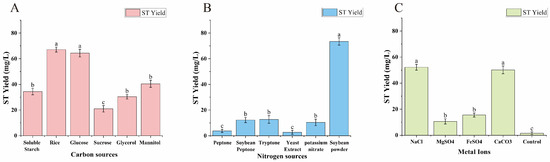
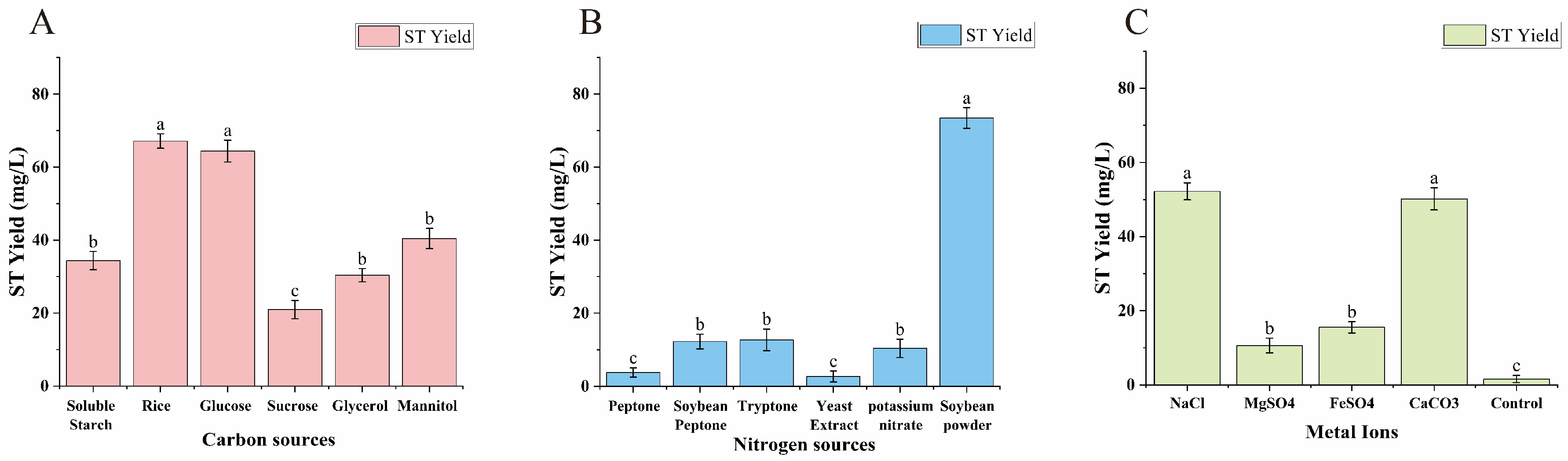
Among the carbon sources tested, rice (67.17 mg/L) and glucose (64.39 mg/L) yielded significantly higher staurosporine titers than soluble starch, sucrose, glycerol, and mannitol (p < 0.05, one-way ANOVA with Tukey’s test), with no significant difference between rice and glucose themselves (p > 0.05). Considering the comparable efficacy and potential cost advantages, rice was selected as the carbon source for all subsequent experiments (Figure 2A).
Figure 2.
Effects of different media components on staurosporine titer. (A) Carbon sources. (B) Nitrogen sources. (C) Metal ions. (Data are mean ± SD (n = 3)). Different letters above bars indicate statistically significant differences (p < 0.05, one-way ANOVA followed by Tukey’s HSD test).
3.1.2. Determination of the Optimal Nitrogen Source
In the comparative screening of nitrogen sources including yeast extract, peptone, and inorganic salts, statistical analysis (one-way ANOVA with Tukey’s test) revealed that the medium supplemented with soybean powder yielded (73.44 mg/L) significantly higher staurosporine production than all other tested sources (p < 0.05). This result indicates that the soybean-powder-containing medium provided the most favorable conditions for maximizing biosynthesis. Thus, this medium formulation was employed for the subsequent studies (Figure 2B).
3.1.3. Effect of Inorganic Metal Ions on Staurosporine Production
Screening of metal ions revealed that NaCl and CaCO3 significantly enhanced staurosporine production compared to other ions such as MgSO4 and FeSO4 (p < 0.05, one-way ANOVA with Tukey’s test). No statistically significant difference was observed between NaCl (52.18 mg/L) and CaCO3 (50.14 mg/L) themselves (p > 0.05). Given their comparable efficacy and considering the marine origin of the producing strain, which likely requires sodium ions for optimal physiological function, NaCl was selected for subsequent experiments (Figure 2C).
3.2. Results of Single-Factor Optimization of Cultivation Conditions
3.2.1. Impact of Fermentation Time on Staurosporine Yield
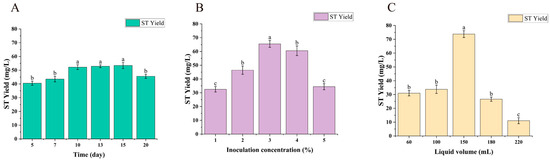
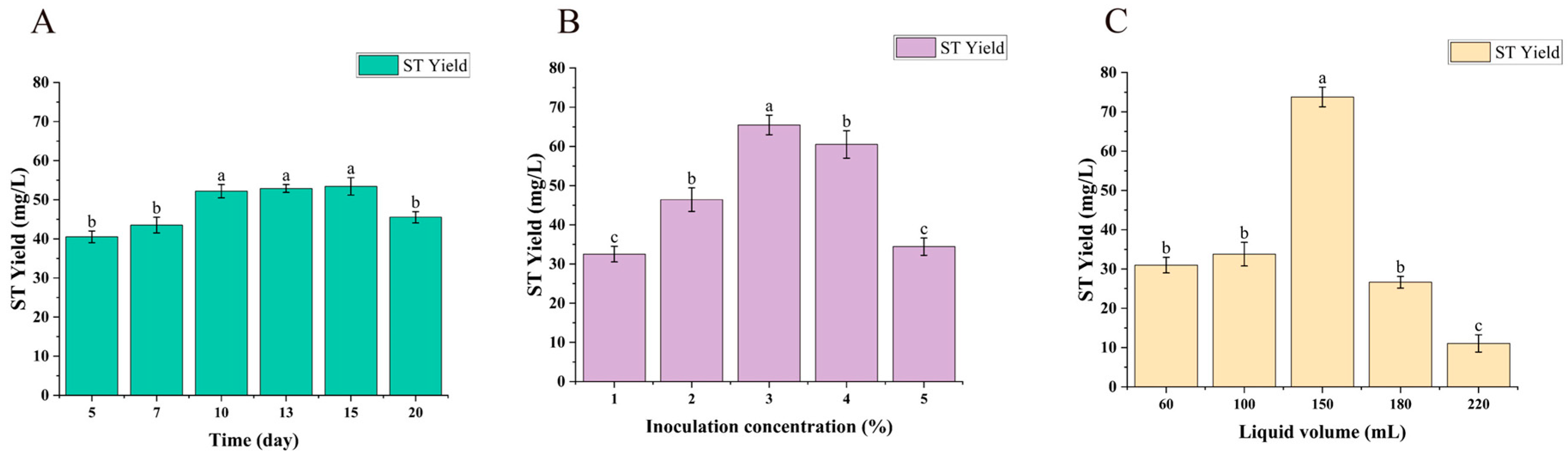
We evaluated fermentation periods of 5, 7, 10, 13, 15, and 20 days. Statistical analysis (one-way ANOVA with Tukey’s test) revealed that both the 10-day and 15-day fermentations yielded significantly higher staurosporine titers compared to the shorter periods of 5 and 7 days (p < 0.05). Notably, the yields at 10 days (52.21 mg/L) and 15 days (53.43 mg/L) were not significantly different from each other (p > 0.05). Therefore, the 10-day period was selected for all subsequent experiments as it achieved near-peak yield while offering substantially improved throughput and a more favorable trade-off between titer and productivity (Figure 3A).
Figure 3.
Effects of different culture conditions on staurosporine titer. (A) Fermentation time. (B) Inoculation concentration. (C) Liquid volume. (Data are mean ± SD (n = 3)). Different letters above bars indicate statistically significant differences (p < 0.05, one-way ANOVA followed by Tukey’s HSD test).
3.2.2. Effect of Inoculation Concentration on Staurosporine Yield
We evaluated various inoculation concentrations (1–5% v/v). Statistical analysis (one-way ANOVA with Tukey’s test) revealed that the 3% (v/v) inoculation concentration yielded a significantly higher staurosporine titer (65.47 mg/L) compared to all other concentrations tested (p < 0.05). A clear decline in production was observed at concentrations exceeding 3%. Therefore, the 3% (v/v) inoculum was selected as optimal for all subsequent experiments (Figure 3B).
3.2.3. Impact of Liquid Volume on Staurosporine Yield
Among the tested liquid volumes in 500 mL flasks, 150 mL was identified as optimal, yielding a staurosporine titer of 73.78 mg/L that was statistically superior to all other volumes tested (p < 0.05, one-way ANOVA with Tukey’s test). This optimum is attributed to a balance between two factors: volumes between 60 and 150 mL supported rapid biomass accumulation, which correlated with higher product formation, whereas volumes exceeding 150 mL led to reduced dissolved oxygen, progressively limiting biosynthesis. Therefore, the 150 mL/500 mL condition was selected to ensure adequate oxygen supply while maximizing yield (Figure 3C).
Through single-factor experiments, we established the optimal fermentation conditions: a 10-day period, a 3% (v/v) inoculation concentration, and a liquid volume of 150 mL/500 mL flask. For nutrients, soybean powder proved to be the best nitrogen source, while rice (slightly superior to glucose) and NaCl (marginally better than CaCO3) were selected as the optimal carbon source and metal ion, respectively. These parameters form the foundation for subsequent optimization studies.
3.3. P-B Experiment to Identify Significant Factors in the Medium
Based on the aforementioned single-factor experiments, this study employed a P-B design with N = 12 to analyze seven factors: rice (X1), glucose (X2), CaCO3 (X3), NaCl (X4), liquid volume (X5), inoculation concentration (X6), and soybean powder (X7). Each factor was examined at two levels. The low level corresponded to the results from the single-factor experiments, while the high level was set at 1.5 to 2 times the low level. The response value Y was the production yield of staurosporine. The experimental design and results are detailed in Table 1.
Table 1.
Test design of P-B and results.
We performed statistical analysis using Minitab-17 to identify the most influential medium components. The results pinpointed rice (X1), NaCl (X4), and soybean powder (X7) as the key factors, all exerting significant positive effects on yield. The complete analytical data supporting this conclusion are presented in Table 2.
Table 2.
Levels of factors and their effects in P-B design.
3.4. Determination of Critical Factor Concentration Ranges via Steepest Ascent Experiment
Given that the optimum experimental region may lie beyond the scope of the P-B design, a steepest ascent experiment was subsequently conducted to identify the optimal operational range. Five experimental runs with defined gradient intervals were implemented (Table 3). The run yielding the maximum response value (Run 3) was designated as the central point for subsequent response surface optimization.
Table 3.
The corresponding responses of steepest ascending experiment.
3.5. BB Experimental Design with Identified Factor Levels and Response Surface Analysis
Following P-B experimental results, which highlighted rice (X1), NaCl (X4), and soybean powder (X7) as factors that significantly and positively influenced staurosporine yield, these three key factors were selected as the independent variables for subsequent optimization. To model their interactions and determine the optimal levels, we employed a BB design (BBD). The factor levels were set according to the direction established in a prior steepest ascent experiment (Table 4). The complete design matrix and the corresponding experimental outcomes are detailed in Table 5 and Table 6, respectively.
Table 4.
Coded levels of independent variables for BB design.
Table 5.
The experimental design and results of BB.
Table 6.
Significance Analysis and ANOVA for Quadratic Regression Model.
Based on the BB experimental results, regression analysis was performed using Design Expert software, yielding the following second-order polynomial equation: Y = + 264.97 + 16.62A + 51.34B + 47.21C + 22.57AB + 2.01AC + 14.84BC − 44.18A2 − 87.88B2 − 33.94C2. ANOVA indicated that the regression model was highly significant (p < 0.0001), with a non-significant lack-of-fit term (F = 0.74, p = 0.5825 > 0.05), confirming excellent model fit. The coefficient of determination (R2 = 0.9793) and adjusted R2Adj = 0.9528) demonstrated close agreement, indicating high predictive accuracy for staurosporine yield relationships with rice (A), soybean power (B), and NaCl (C), minimal experimental error, and suitability for optimizing fermentation conditions and reliably predicting staurosporine production, collectively establishing this validated model as a robust framework for staurosporine yield optimization.
3.6. Response Surface and Contour Analysis with Staurosporine Yield as Response Variable
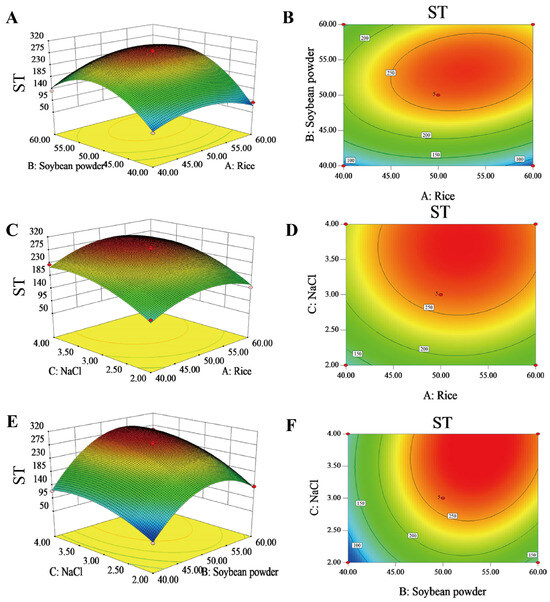
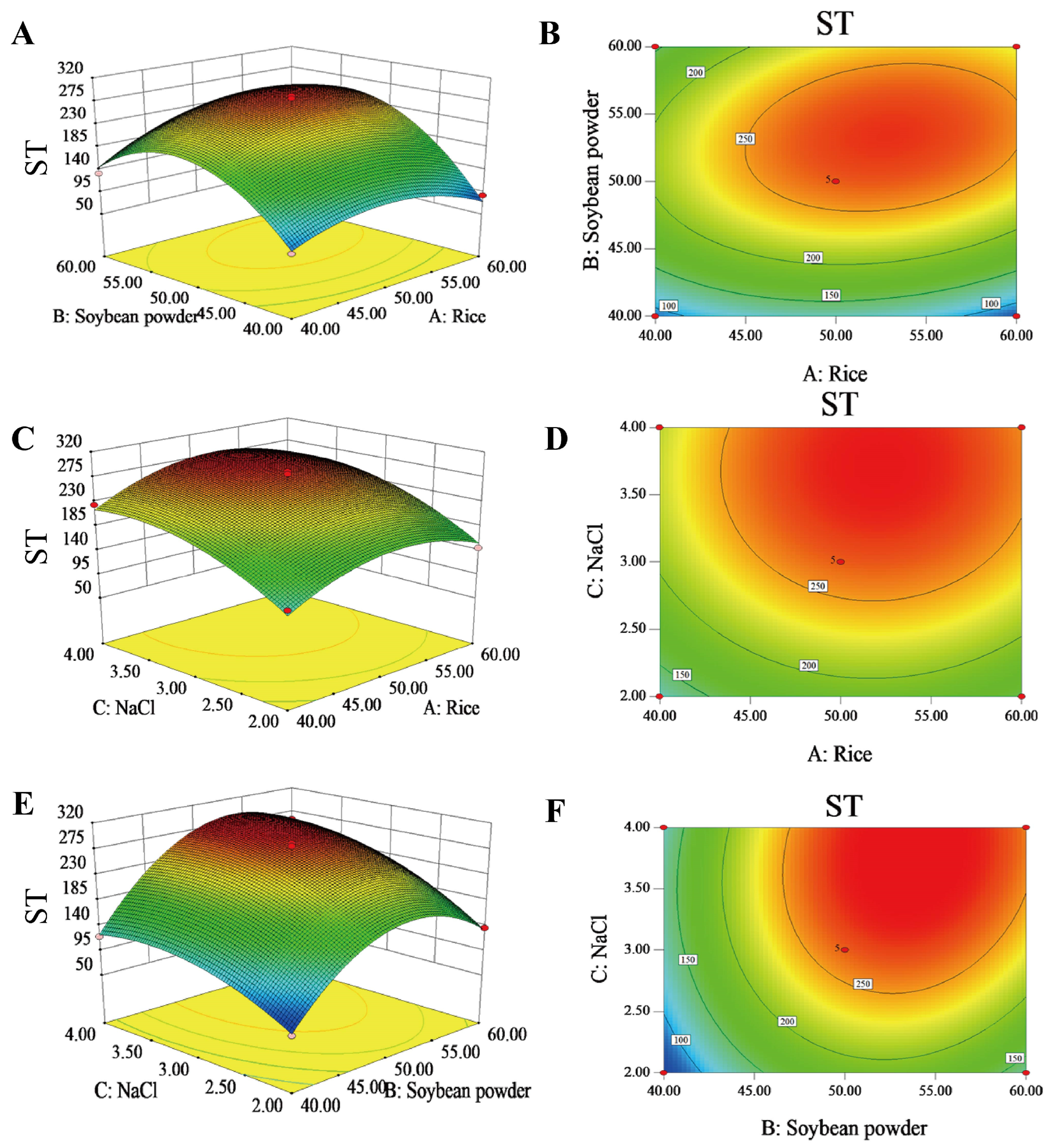
Response surface plots and corresponding contour plots were generated for the critical parameter interactions: rice versus soybean powder (Figure 4A,B), rice versus NaCl (Figure 4C,D), and soybean powder versus NaCl (Figure 4E,F), thereby visualizing the multidimensional relationships governing bioprocess optimization. A steeper surface plot and contour lines that are closer to an elliptical shape indicate a stronger interaction, with more significant interplay between the factors. Conversely, a flatter surface plot and contour lines that are closer to a circular shape suggest a weaker interaction, with less significant interplay between the factors [23]. The soybean powder surface was steeper than the rice surface (Figure 4A), with elliptical contour lines (Figure 4B), indicating a strong synergistic interaction between these two components has significant impact on staurosporine yield, with soybean powder having a greater influence. In contrast, the NaCl and rice surfaces exhibited similar topography (Figure 4C), with near-circular contours (Figure 4D), which is characteristic of a weak interactive effect on staurosporine yield. The soybean powder surface was steeper than the NaCl surface (Figure 4E), with elliptical contours (Figure 4F), again demonstrating a strong interaction between soybean powder and NaCl on staurosporine yield, with soybean powder having a greater influence too.
Figure 4.
Interaction effects of soybean powder, rice, and NaCl on staurosporine production. (A) Rice vs. soybean powder (response surface plot). (B) Rice vs. soybean powder (corresponding contour plot). (C) Rice vs. NaCl (response surface plot). (D) Rice vs. NaCl (corresponding contour plot). (E) Soybean powder vs. NaCl (response surface plot). (F) Soybean powder vs. NaCl (corresponding contour plot).
This study employed response surface methodology to optimize fermentation conditions for strain OUCMDZ-3118. By setting the first-order partial derivatives of the quadratic regression equation to zero, we identified the stationary point, which provided the optimal parameter set: 50 g/L rice, 50 g/L soybean powder, and 3 g/L NaCl. Under these conditions, the model predicts a staurosporine yield of 265 mg/L.
3.7. Validation of Optimized Medium Efficacy
Following the identification of the theoretical optimum, we proceeded directly to experimental validation. Fermentation was performed using the prescribed medium (50 g/L rice, 50 g/L soybean powder, and 3 g/L NaCl) under controlled conditions: 500 mL flasks with 150 mL working volume, 3% (v/v) inoculum, 28 °C, 180 rpm, and a 10-day period. The resulting staurosporine yield was 244.23 mg/L, achieving 92.1% of the model’s predicted yield. Despite a minor deviation, this outcome demonstrates the model’s reliability and provides clear practical guidance for process implementation.
3.8. Validation of Genetic Stability in Mutagenized Strains
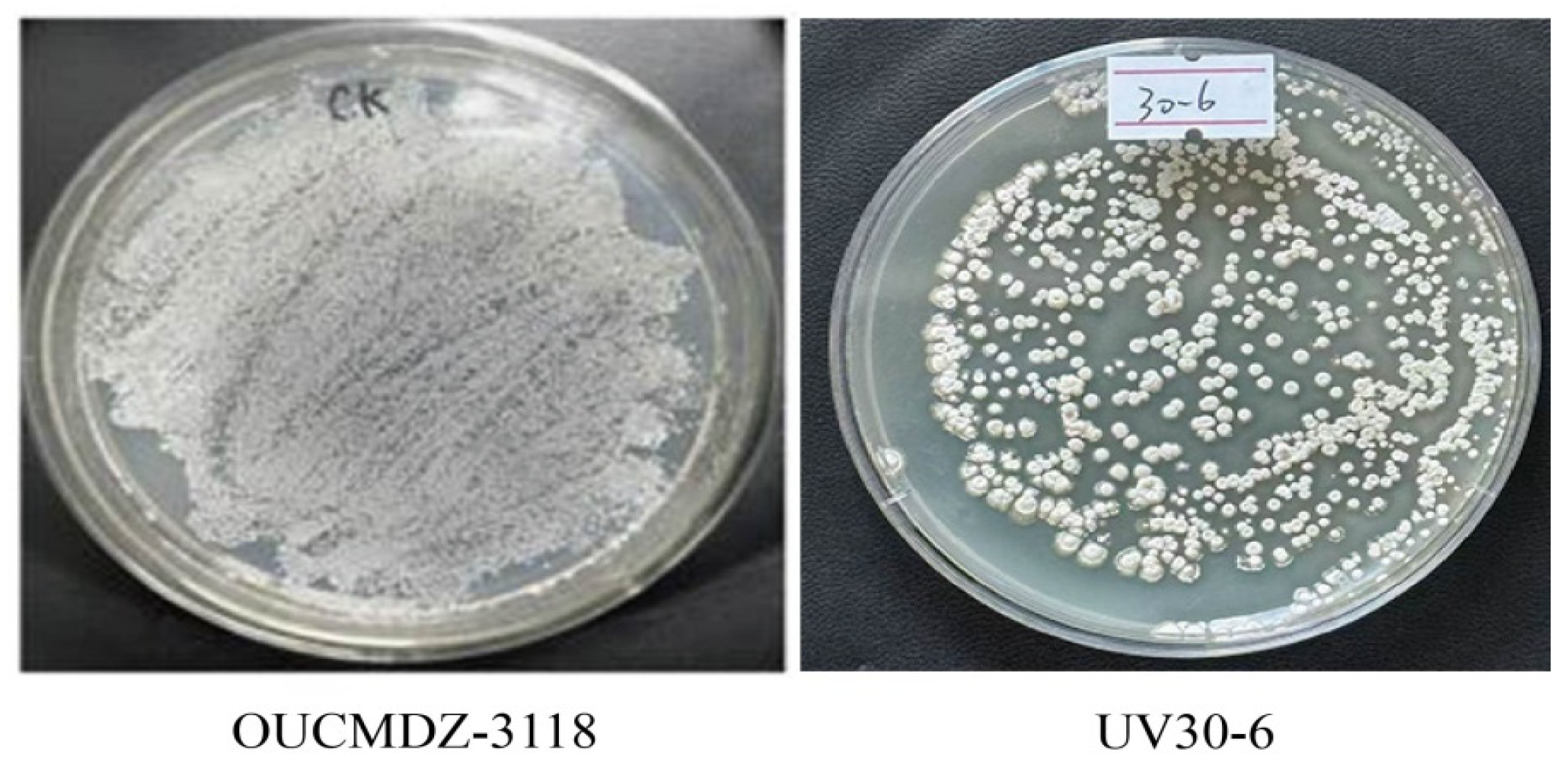
Based on the lethality rates observed at different UV irradiation durations (Table S1), 100 mutants were randomly selected from the 30–40 s irradiation groups for secondary screening of staurosporine production. This screening revealed six strains (30s-6, 35s-2, 35s-6, 40s-6, 40s-7, 40s-9) exhibiting higher staurosporine yields than the parental strain OUCMDZ-3118. Due to DNA repair mechanisms and genetic instability in mutant strains, phenotypic recover may occur during sub-culturing, leading to reduced fermentation yields in mutants [24]. Consequently, genetic stability validation was performed on six selected high-producing strains. During subsequent subculture verification, staurosporine production declined with increasing generations in all mutagenized strains except 30s-6, indicating poor genetic stability (Table 7). Thus, follow-up experiments primarily utilized the 30s-6 mutant strain, which demonstrated superior genetic stability. Mutant 30s-6 colonies cultured on ISP2 medium demonstrated circular morphology with a dry and slightly wrinkled appearance, firm agar adhesion, presenting white color (Figure 5).
Table 7.
Staurosporine production changes in mutagenized strains after five subculture passages.
Figure 5.
Characteristics of OUCMDZ-3118 and UV Mutagenesis Strains.
3.9. Impact of L-Tryptophan Precursor Supplementation on Staurosporine Yields in Strains
L-Tryptophan serves as a biosynthetic precursor for staurosporine. Gai et al. [25] demonstrated that its supplementation during early fermentation enhances staurosporine yield, whereas late-stage addition correlates with a concomitant decline due to microbial metabolic shifts. In addition, Fang et al. enhanced staurosporine production by screening for strains tolerant to the precursor L-tryptophan, thereby alleviating its feedback inhibition on cellular growth. The selected mutant strain with tolerance to high tryptophan concentrations ultimately exhibited a significantly higher product yield compared to the parental strain [16]. These findings indicate a direct relationship between staurosporine biosynthesis and precursor utilization efficiency.
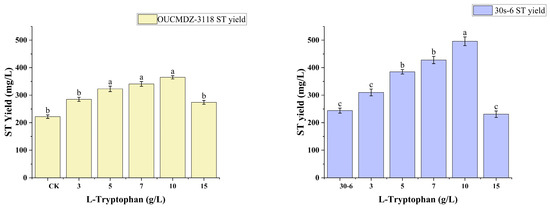
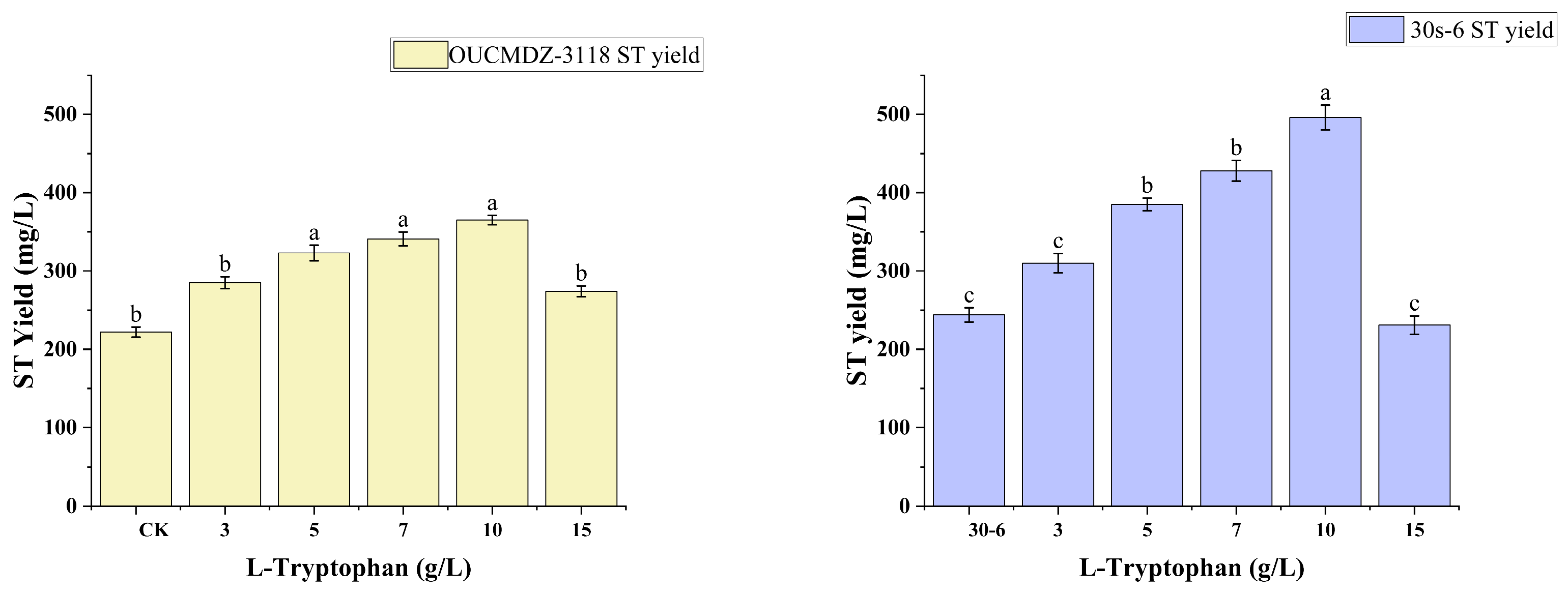
Consequently, the experiment employed parental strain OUCMDZ-3118 and its mutant strain 30s-6. Under optimized culture conditions, varying concentrations of L-tryptophan were supplemented to assess their effect on staurosporine production. For the OUCMDZ-3118 strain, statistical analysis (one-way ANOVA with Tukey’s test) showed that 10 g/L tryptophan yielded significantly higher staurosporine (365.91 mg/L) compared to the control, 3 g/L and 15 g/L groups (p < 0.05). However, no significant differences were observed between t 10 g/L group and the 5 g/L or 7 g/L groups (p > 0.05). Nonetheless, since 10 g/L provided the highest numerical yield, representing a 1.5-fold increases over the precursor-free control, it was selected for subsequent experiments. For the mutant 30s-6 strain, 10 g/L tryptophan resulted in a titer of 496.34 mg/L—significantly higher than all other tested concentrations (0, 3, 5, 7, and 15 g/L; p < 0.05, one-way ANOVA with Tukey’s test)—representing a 2-fold increase over the control. A clear inhibitory effect was observed at 15 g/L. Therefore, 10 g/L was selected as the optimal concentration for subsequent fermentations (Figure 6).
Figure 6.
The yield of staurosporine under different concentrations of L-tryptophan (Data are mean ± SD (n = 3)). Different letters above bars indicate statistically significant differences (p < 0.05, one-way ANOVA followed by Tukey’s HSD test).
3.10. Effect of Solid Medium Optimization on Staurosporine Production Yield
Compared to liquid shake-flask fermentation, solid-state fermentation requires less space. To achieve amplified production of staurosporine, we conducted solid-state fermentation using the optimized strain 30s-6. The medium composition per 500 mL flask was as follows: 40 g rice, 40 g soybean powder, moistened with 80 mL of an aqueous solution containing NaCl (3 g/L) and L-tryptophan (10 g/L) and then separately inoculated with 10 mL of seed culture. The culture was incubated statically at 28 °C for 30 days. After fermentation, the solid product was extracted with ethyl acetate, and staurosporine yield was quantified by HPLC. The results demonstrated that after 30 days, the staurosporine yield reached 7.22 g per kg of solid medium (equivalent to 578 mg per 80 g flask). To supply sufficient material for downstream synthetic studies, the optimized fermentation process was successfully scaled out by operating approximately 1000 replicate flasks in parallel. This effort not only reliably generated hundreds of grams quantities of staurosporine but also demonstrated the robustness and excellent reproducibility of the process.
3.11. Comparative Genomic Analysis and Hypothetical Mechanisms Underlying Enhanced Staurosporine Production
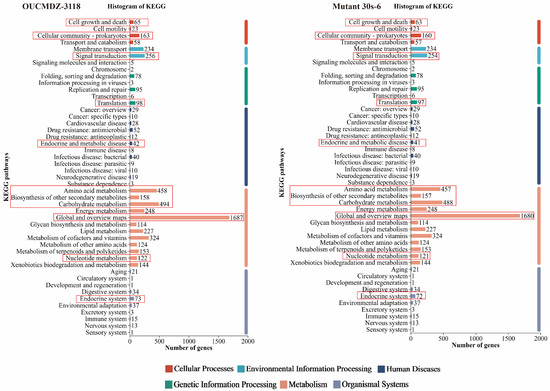
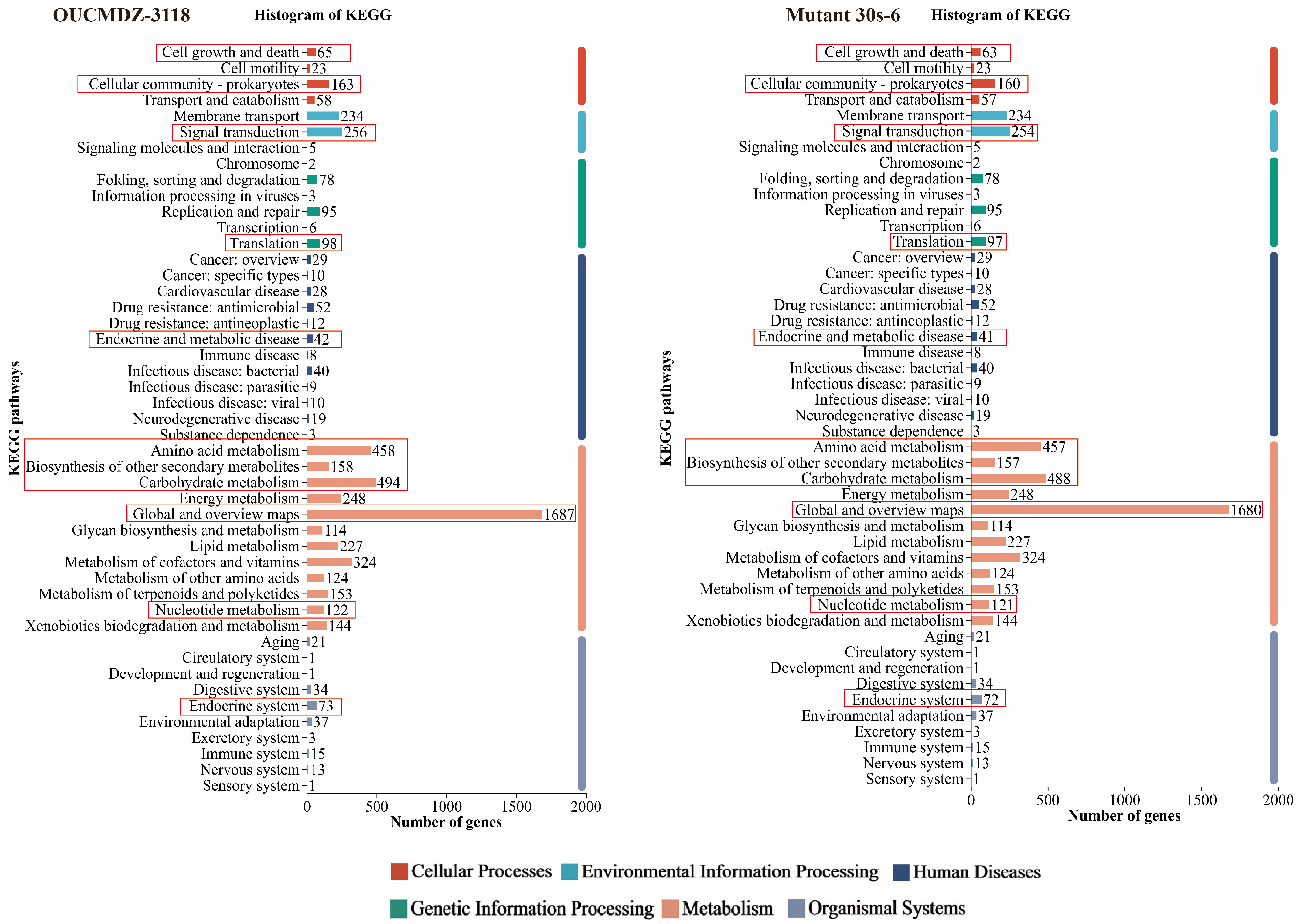
Comparative whole-genome sequencing of the parental strain OUCMDZ-3118 and the high-yielding UV mutant 30s-6 was performed. KEGG pathway enrichment analysis revealed that the genetic differences between the two strains were primarily concentrated in carbohydrate metabolism, global overview maps, and the tryptophan translation pathway (Figure 7). Specifically, the trpS gene, encoding tryptophanyl-tRNA synthetase, was completely deleted in mutant 30s-6. This enzyme catalyzes the attachment of tryptophan to its corresponding tRNA, providing a crucial substrate for the ribosome to decode the UGG codon during translation. It is an essential for maintaining translational fidelity, ensuring that correctly activated tryptophan is supplied wherever needed in protein synthesis [26]. In bacteria, such disruption often mimics amino acid starvation, which is a classic signal triggering the stringent response via the alarmone (p)ppGpp [27]. Elevated (p)ppGpp levels globally reprogram cellular physiology by suppressing growth-related processes (e.g., ribosome biogenesis) and activating secondary metabolite biosynthesis, including antibiotics [28]. In Streptomyces, (p)ppGpp has been established as a key global regulator linking nutrient signals to antibiotic biosynthesis [29]. Therefore, we hypothesize that the ΔtrpS deletion may induce (p)ppGpp accumulation, thereby shifting metabolic resources from growth to secondary metabolism and creating a physiological basis for enhanced staurosporine production. This hypothesis can be directly tested in the future by quantifying intracellular (p)ppGpp levels.
Figure 7.
Difference in the number of genes at second category level of KEGG pathways. Red boxes indicate the exact count for each pathway.
In addition, deletions were identified in several glycogen metabolism genes (glgC, glgB, glgE, glgP) in mutant 30s-6 (Table 8). These deletions are predicted to impair glycogen synthesis and turnover. Although such modifications could theoretically redirect carbon flux and energy (e.g., ATP, NADPH) towards secondary metabolism, their direct contribution to the increased staurosporine yield remains further experimental validation.
Table 8.
Specific deleted genes at the secondary category level of KEGG pathways in mutant 30s-6.
Genomic analysis revealed that the 9.5-fold enhancement in staurosporine titer in mutant 30s-6 was not attributed to mutations within its biosynthetic gene cluster (BGC) but rather to mutations in global metabolic regulators, specifically the complete deletion of trpS and disruptions in glycogen metabolism genes (glgC, glgB, glgE, glgP). This shifts the focus for yield improvement from pathway-specific engineering to global physiological rewiring. We propose a hypothesis to integrate these genetic alterations. The ΔtrpS deletion likely induces a tryptophan-imbalanced state, triggering the (p)ppGpp-mediated stringent response—a known global regulator in Streptomyces that suppresses growth and activates antibiotic biosynthesis. Concurrent disruptions in glycogen metabolism may further redirect carbon and energy fluxes. Together, these changes could shift cellular resources toward staurosporine production.
This mechanism, however, remains a hypothesis derived from comparative genomics. Future work must include direct quantification of (p)ppGpp levels in the mutant versus the parent strain to validate the activation of the stringent response. Furthermore, targeted genetic complementation or knockout experiments are necessary to establish the causal role of each identified mutation in the high-yield phenotype.
4. Conclusions
This study successfully established a high-yield, scalable production platform for staurosporine by integrating traditional fermentation optimization with UV mutagenesis and precursor supplementation in Streptomyces sp. OUCMDZ-3118. The combinatorial approach resulted in the high-yielding mutant 30s-6 and a robust solid-state fermentation (SSF) process, effectively overcoming the native production limitations of the wild-type strain. Key outcomes include achieving a titer of 496 mg/L in liquid culture with precursor feeding and maintaining a consistent SSF yield of 7.22 g/kg from flask to thousand-flask scale, confirming the process’s practical robustness for potential industrial application. The success of SSF can be attributed to its inherent advantages—such as low shear stress and a growth matrix that better mimics the natural soil habitat of Streptomyces—which are conducive to the morphological differentiation and secondary metabolism of actinomycetes. Furthermore, genomic analysis suggests that the yield improvement is associated with mutations in global metabolic regulators rather than the biosynthetic pathway itself, highlighting an effective strategy for strain improvement. Despite the limited clinical utility of staurosporine due to broad-spectrum kinase inhibition and associated toxicity, its complex indolocarbazole core remains a privileged pharmacophore for drug discovery, as evidenced by semi-synthetic derivatives such as the approved drug midostaurin (PKC-412) and the investigational agent UCN-01, which demonstrate how scaffold modification can improve target specificity and therapeutic windows. Therefore, by solving the critical bottleneck of efficient core precursor supply, this high-yield production platform provides an essential material foundation for advancing the development of clinically relevant staurosporine-based therapeutics.
Supplementary Materials
The following supporting information can be downloaded at: https://www.mdpi.com/article/10.3390/fermentation12020092/s1, Figure S1: Standard curve and equation of purity staurosporine(99%); Table S1: Lethality rate of OUCMDZ-3118 after UV Mutagenesis.
Author Contributions
Writing—original draft preparation, M.Z. (Mingxing Zuo); fermentation, J.X.; data analysis, M.Z. (Mingshen Zhang); writing—review and editing, W.Z.; supervision, L.W. All authors have read and agreed to the published version of the manuscript.
Funding
This research was funded by Guizhou Provincial Key Technology R&D Program, grant number QKHZC[2022]YB191 and Guizhou Provincial Basic Research Program (Natural Science), grant number QKHJC-ZK[2021]ZD017.
Institutional Review Board Statement
Not applicable.
Informed Consent Statement
Not applicable.
Data Availability Statement
The original contributions presented in this study are included in the article and Supplementary Materials. The raw sequence data for the two strains have been deposited in the NCBI Sequence Read Archive (SRA) under BioProject accession number PRJNA1414929. Further inquiries can be directed to the corresponding authors.
Conflicts of Interest
The authors declare no conflicts of interest.
Abbreviations
The following abbreviations are used in this manuscript:
| P-B | Plackett–Burman |
| BB | Box–Behnken |
| UV | Ultraviolet |
| KEGG | Kyoto Encyclopedia of Genes and Genomes |
| NCBI | National Center for Biotechnology Information |
References
- Omura, S.; Iwai, Y.; Hirano, A.; Nakagawa, A.; Awaya, J.; Tsuchya, H.; Takahashi, Y.; Masuma, R. A new alkaloid AM-2282 of Streptomyces origin. Taxonomy, fermentation, isolation and preliminary characterization. J. Antibiot. 1977, 30, 275–282. [Google Scholar] [CrossRef] [Scilit] [PubMed]
- Furusaki, A.; Hashiba, N.; Matsumoto, T.; Hirano, A.; Iwai, Y.; Ōmura, S. X-Ray crystal structure of staurosporine: A new alkaloid from a Streptomyces strain. J. Chem. Soc. Chem. Commun. 1978, 800–801. [Google Scholar] [CrossRef] [Scilit]
- Tamaoki, T.; Nomoto, H.; Takahashi, I.; Kato, Y.; Morimoto, M.; Tomita, F. Staurosporine, a potent inhibitor of phospholipid/Ca++dependent protein kinase. Biochem. Biophys. Res. Commun. 1986, 135, 397–402. [Google Scholar] [CrossRef] [Scilit] [PubMed]
- Berger, T.; Moshe, Y.; Yaari, S.; Hellmann, I.; Aviram, A.; Raanani, P.; Ram, R.; Ofran, Y.; Wolach, O. Adding Midostaurin to Intensive Chemotherapy in FLT3-Positive AML Patients. Results from a Multicenter Historical-Controlled Study. Blood 2018, 132, 4005. [Google Scholar] [CrossRef] [Scilit]
- Stone, R.M.; Mandrekar, S.J.; Sanford, B.L.; Laumann, K.; Geyer, S.; Bloomfield, C.D.; Thiede, C.; Prior, T.W.; Döhner, K.; Marcucci, G.; et al. Midostaurin plus Chemotherapy for Acute Myeloid Leukemia with a FLT3 Mutation. N. Engl. J. Med. 2017, 377, 454–464. [Google Scholar] [CrossRef] [Scilit]
- Dasmahapatra, G.P.; Didolkar, P.; Alley, M.C.; Ghosh, S.; Sausville, E.A.; Roy, K.K. In vitro combination treatment with perifosine and UCN-01 demonstrates synergism against prostate (PC-3) and lung (A549) epithelial adenocarcinoma cell lines. Clin. Cancer Res. 2004, 10, 5242–5252. [Google Scholar] [CrossRef] [Scilit]
- Mull, B.B.; Livingston, J.A.; Patel, N.; Bui, T.; Hunt, K.K.; Keyomarsi, K. Specific, reversible G1 arrest by UCN-01 in vivo provides cytostatic protection of normal cells against cytotoxic chemotherapy in breast cancer. Br. J. Cancer 2020, 122, 812–822. [Google Scholar] [CrossRef] [Scilit]
- Landin, E.J.B.; Williams, C.; Ryan, S.A.; Bochel, A.; Akter, N.; Redfield, C.; Sessions, R.B.; Dedi, N.; Taylor, R.J.; Crump, M.P. The structural basis for high affinity binding of α1-acid glycoprotein to the potent antitumor compound UCN-01. J. Biol. Chem. 2021, 297, 101392. [Google Scholar] [CrossRef] [Scilit]
- Khosravi Babadi, Z.; Ebrahimipour, G.; Wink, J.; Narmani, A.; Risdian, C. Isolation and identification of Streptomyces sp. Act4Zk, a good producer of Staurosporine and some derivatives. Lett. Appl. Microbiol. 2021, 72, 206–218. [Google Scholar] [CrossRef] [Scilit]
- Onaka, H.; Taniguchi, S.; Igarashi, Y.; Furumai, T. Cloning of the staurosporine biosynthetic gene cluster from Streptomyces sp. TP-A0274 and its heterologous expression in Streptomyces lividans. J. Antibiot. 2002, 55, 1063–1071. [Google Scholar] [CrossRef] [Scilit]
- Fu, P.; Zhuang, Y.; Wang, Y.; Liu, P.; Qi, X.; Gu, K.; Zhang, D.; Zhu, W. New Indolocarbazoles from a Mutant Strain of the Marine-Derived Actinomycete Streptomyces fradiae 007M135. Org. Lett. 2012, 14, 6194–6197. [Google Scholar] [CrossRef] [Scilit] [PubMed]
- Huang, X.; Huang, D.; Zhou, S.; Xu, Y.; Wu, W.; Liu, Z.; Zheng, J.; Tao, L. Sponge-Symbiotic Streptomyces sp., Fermentation Method for Producing Staurosporine, and Applications. CN Patent CN107603922A, 19 January 2018. [Google Scholar]
- Sánchez, C.; Zhu, L.; Braña, A.F.; Salas, A.P.; Rohr, J.; Méndez, C.; Salas, J.A. Combinatorial biosynthesis of antitumor indolocarbazole compounds. Proc. Natl. Acad. Sci. USA 2005, 102, 461–466. [Google Scholar] [CrossRef] [Scilit] [PubMed]
- Stevanovic, M.; D’Agostino, P.M.; Mojicevic, M.; Gulder, T.A.M.; Nikodinovic-Runic, J.; Vojnovic, S. Streptomyces sp. BV410: Interspecies cross-talk for staurosporine production. J. Appl. Microbiol. 2022, 133, 2560–2568. [Google Scholar] [CrossRef] [Scilit] [PubMed]
- Huang, H.; Tian, X.; Liu, J.; Zhang, M.; Hu, H. Optimization of electrotransformation of staurosporine producing Streptomyces sp. and construction of high-yield mutants. Chin. J. Antibiot. 2023, 48, 1024–1030. [Google Scholar] [CrossRef]
- Fang, J.-S.; Yang, X.-H.; Xiang, R.X.; Zhang, L.-J.; Jiang, N.; Zhu, W.-M.; Zhang, H. Identification and mutagenesis breeding of a new staurosporine-producing strain. Chin. J. Antibiot. 2021, 46, 557–563. [Google Scholar]
- Wang, C.; Monger, A.; Wang, L.; Fu, P.; Piyachaturawat, P.; Chairoungdua, A.; Zhu, W. Precursor-Directed Generation of Indolocarbazoles with Topoisomerase IIα Inhibitory Activity. Mar. Drugs 2018, 16, 168. [Google Scholar] [CrossRef] [Scilit]
- Makino, M.; Sugimoto, H.; Shiro, Y.; Asamizu, S.; Onaka, H.; Nagano, S. Crystal structures and catalytic mechanism of cytochrome P450 StaP that produces the indolocarbazole skeleton. Proc. Natl. Acad. Sci. USA 2007, 104, 11591–11596. [Google Scholar] [CrossRef] [Scilit]
- Plackett, R.L.; Burman, J.P. The Design of Optimum Multifactorial Experiments. Biometrika 1946, 33, 305–325. [Google Scholar] [CrossRef]
- Box, G.E.P.; Behnken, D.W. Some New Three Level Designs for the Study of Quantitative Variables. Technometrics 1960, 2, 455–475. [Google Scholar] [CrossRef]
- Yu, G.; Peng, H.; Cao, J.; Liao, A.; Long, P.; Huang, J.; Hui, M. Avilamycin production enhancement by mutagenesis and fermentation optimization in Streptomyces viridochromogenes. World J. Microbiol. Biotechnol. 2022, 38, 50. [Google Scholar] [CrossRef] [Scilit]
- Nakano, H.; Omura, S. Chemical biology of natural indolocarbazole products: 30 years since the discovery of staurosporine. J. Antibiot. 2009, 62, 17–26. [Google Scholar] [CrossRef] [Scilit]
- Yun, T.Y.; Feng, R.J.; Zhou, D.B.; Pan, Y.Y.; Chen, Y.F.; Wang, F.; Yin, L.Y.; Zhang, Y.D.; Xie, J.H. Optimization of fermentation conditions through response surface methodology for enhanced antibacterial metabolite production by Streptomyces sp. 1-14 from cassava rhizosphere. PLoS ONE 2018, 13, e0206497. [Google Scholar] [CrossRef] [Scilit]
- Németh, E.; Szüts, D. The mutagenic consequences of defective DNA repair. DNA Repair 2024, 139, 103694. [Google Scholar] [CrossRef] [Scilit] [PubMed]
- Gai, C.-J.; Dong, J.-J.; Yang, A.-G.; Lin, W.-H.; Zhong, H.-M.; Tian, L. Production improvment of staurosporine in marine actinomycetes Streptomyces sp.YB-24 by combination of biological and chemical methods. Chin. J. Antibiot. 2015, 40, 325–329. [Google Scholar] [CrossRef]
- Peng, X.; Xia, K.; Xiao, L.; Qi, H.; Huang, Q.; Xiang, M.; Han, L.; Qiu, H.; Gu, Q.; Chen, B.; et al. The mechanism of lineage-specific tRNA recognition by bacterial tryptophanyl-tRNA synthetase and its implications for inhibitor discovery. Nucleic Acids Res. 2025, 53, gkaf466. [Google Scholar] [CrossRef] [Scilit]
- Das, B.; Bhadra, R.K. (p)ppGpp Metabolism and Antimicrobial Resistance in Bacterial Pathogens. Front. Microbiol. 2020, 11, 563944. [Google Scholar] [CrossRef] [Scilit]
- Perederina, A.; Svetlov, V.; Vassylyeva, M.N.; Tahirov, T.H.; Yokoyama, S.; Artsimovitch, I.; Vassylyev, D.G. Regulation through the secondary channel--structural framework for ppGpp-DksA synergism during transcription. Cell 2004, 118, 297–309. [Google Scholar] [CrossRef] [Scilit]
- Sivapragasam, S.; Grove, A. The Link between Purine Metabolism and Production of Antibiotics in Streptomyces. Antibiotics 2019, 8, 76. [Google Scholar] [CrossRef] [Scilit]

Disclaimer/Publisher’s Note: The statements, opinions and data contained in all publications are solely those of the individual author(s) and contributor(s) and not of MDPI and/or the editor(s). MDPI and/or the editor(s) disclaim responsibility for any injury to people or property resulting from any ideas, methods, instructions or products referred to in the content. |
© 2026 by the authors. Licensee MDPI, Basel, Switzerland. This article is an open access article distributed under the terms and conditions of the Creative Commons Attribution (CC BY) license.