


Abstract
The fermentation of cow’s milk and soy beverages, a plant-based alternative, by lactic acid bacteria (LAB) and bifidobacteria strains shares the goal of creating functional products, but differs significantly in the substrates and final properties. The aim of this study was to compare the functional properties offered by 21 selected strains of LAB and bifidobacteria in the fermentation of soy beverages and cow’s milk. LAB and bifidobacteria strains showed a greater pH decrease in soy beverages, particularly in Lactiplantibacillus plantarum and Bifidobacterium pseudocatenulatum strains, which were only able to grow and ferment in soy beverages. Lacticaseibacillus rhamnosus and Lacticaseibacillus paracasei strains showed high proteolytic activity in both milk and soy beverages, while Streptococcus thermophilus and Lactococcus lactis strains showed greater proteolytic activity in cow’s milk, and most bifidobacteria strains did not show proteolytic activity. Fermentation mostly resulted in an increase in antioxidant activity in soy beverages, as measured by DPPH, and in cow’s milk by FRAP. Finally, all L. paracasei, L. rhamnosus, and bifidobacteria strains showed efficient production of daidzein and genistein in soy beverages. In conclusion, soy beverages are a better substrate for L. plantarum and bifidobacteria strains, and the production of bioactive isoflavones by many selected strains increases the functional potential of soy beverages.
1. Introduction
For many years, lactic acid bacteria (LAB) have been associated with the fermentation of animal milk, converting sugars into lactic acid and improving its texture, flavour, and nutritional profile [1]. Recently, soy beverages have become the main plant-based substitute for animal milk [2], and it has also been observed that LAB are capable of fermenting soy beverages, fermenting sugars such as stachyose and raffinose, thus improving the digestibility of these beverages [3].
The fermentation of soy beverages and cow’s milk by LAB and bifidobacteria strains shares the goal of creating functional products, but differs significantly in the substrates and the final sensory and functional properties. Soy beverages and cow’s milk are nutritionally comparable in terms of high biological value proteins [4]. Cow’s milk is notable for its natural contribution of calcium and vitamin D, while soy beverages stand out for their low concentrations of saturated fat, lack of cholesterol, and absence of lactose, making them ideal for those with lactose intolerance, vegans, or anyone looking to reduce their fat intake [5].
Cow’s milk contains approximately 3.2 g of protein per 100 mL. It is primarily composed of casein and whey proteins, making it an important source of nutrition, although it can cause allergies in children [6]. Soy beverages are excellent sources of high-quality plant-based protein, providing approximately 3 g per 100 mL and containing mainly two proteins: glycine (11S fraction) and conglycine (7S) [7]. Unlike other plant-based beverages, soy beverages, like cow’s milk, contain all the essential amino acids necessary for the body. Therefore, soy beverages are nutritionally comparable alternatives to cow’s milk [4]. The proteolysis of soy and cow’s milk beverages breaks down proteins into smaller peptides and free amino acids (hydrolysis), offering significant advantages in the nutritional, functional, and technological fields. This process improves digestibility, creates bioactive compounds, and enhances texture in the food industry [8].
While plant-based beverages contain phenolic compounds due to their plant origin, animal-derived milks such as cow’s milk do not. Therefore, the presence of isoflavones is a characteristic that makes soy beverages a food of high nutritional interest [9]. Previous studies by our group demonstrated the importance of LAB and bifidobacteria strains in improving the functional properties of soy beverages in relation to the transformation of isoflavones [10,11,12]. In this paper, we also studied the effect on proteolysis and antioxidant activity in both soy beverages and cow’s milk.
The objective of this work was to study the differences and similarities in the functional properties offered by the use of 21 strains of LAB and bifidobacteria from the Collection of the Department of Food Technology of INIA-CSIC in the fermentation of soy beverages and cow’s milk. Strains selected from this work will be potential cultures for preparation of fermented soy beverages and/or cow’s milk products with improved functionality.
2. Materials and Methods
2.1. Strains and Reagents
The strains used in this work are listed in Table 1, and they were selected from our IATA-CSIC collection for their technological and functional properties. Bifidobacterium strains were cultivated in MRS broth supplemented with 0.5 g/L L-cysteine at 37 °C under anaerobic conditions (10% H2, 10% CO2, and 80% N2; Whitley DG250 Anaerobic workstation, Don Whitley Scientific Ltd., Shipley, UK). Lacticaseibacillus paracasei and Lacticaseibacillus rhamnosus strains were grown in MRS broth at 37 °C under anaerobic conditions. Lactiplantibactillus plantarum strains were grown in MRS broth at 37 °C under aerobic conditions. Lactococcus lactis strains were grown in M17 broth supplemented with 5 g/L glucose (GM17) at 30 °C under aerobic conditions. Streptococcus thermophilus strains were grown in GM17 at 37 °C under aerobic conditions. The strains were maintained at −80 °C in their respective growth media supplemented with 10% glycerol. All media were purchased from BD Difco™ (BD Biosciences, Le Pont de Claix, France). L-cysteine, glucose, glycerol, and other reagents used in this work were purchased from Merck (Merck KGaA, Darmstadt, Germany).
Table 1.
Bacterial strains used in this work.
2.2. Fermentation of Soy Beverages and Cow’s Milk
Each strain was grown in its optimal conditions and prepared as frozen stocks in soy beverage or cow’s milk as described previously [10]. Commercial UHT soy beverage (15% soy content, Carrefour Bio, Carrefour, Madrid, Spain) and UHT cow’s milk (Carrefour, Madrid, Spain) were inoculated at approximately 7 log cfu/mL and incubated under the optimal temperature conditions for each strain. A non-inoculated control was included in each of the two independent experiments. Samples were taken after 48 h of fermentation and kept at −30 °C for further determinations. A Crison pH meter (model GPL 22, Crison Instruments, Barcelona, Spain) was used to determine pH in duplicate.
For microbial counts, decimal dilutions were prepared in sterile 0.1% peptone water and plated out on duplicate plates. Bifidobacterium counts were performed on MRS agar plates supplemented with 0.5 g/L L-cysteine at 37 °C for 48 h under anaerobic conditions. In the case of lactobacilli, MRS agar plates were used under the same conditions. Lactococcus lactis and Streptococcus thermophilus strains were grown on M17 agar plates supplemented with 5 g/L glucose (GM17) at 30 °C and 37 °C, respectively.
Finally, samples for isoflavone quantification were taken at 24 and 48 h of fermentation in soy beverages and frozen at −30 °C until analysis.
2.3. Quantification of Proteolytic Activity of LAB and Bifidobacteria Strains in Fermented Soy Beverages and Milk
The degree of proteolytic activity of LAB and bifidobacteria strains was assessed and compared with the non-fermented controls by means of the OPA assay [20]. The method was adapted to be performed on microtiter plates (flatbottom 96-well microtiter plate, Greiner Bio-One, Les Ulis, France). Briefly, 1.25 mL of the sample was mixed with re-distilled water (0.5 mL) and trichloroacetic acid (2.5 mL, 0.75 N, Panreac, Barcelona, Spain). The mixture was vortexed and allowed to stand at room temperature for 10 min before being subjected to filtration (Whatman filter #2, Cytiva, Global Life Sciences Solutions, Marlborough, MA, USA). The OPA reagent consisted of a mixture of sodium tetraborate 100 mM (25 mL), SDS (Merck KGaA) 10% w/v (5 mL), 40 mg of O-phthaldialdehyde (Merck KGaA) dissolved in 1 mL of methanol (Merck KGaA), 100 µL of β-mercaptoethanol (Merck KGaA), and 18.9 mL of re-distilled water. The reagent was prepared daily. Different concentrations of L-leucine solution (prepared in phosphate buffered saline, ranging from 0 to 10 mM were used to generate a calibration curve. Standard or filtrate (10 μL) was placed into a 96-well microtiter plate and mixed with 200 μL of OPA reagent. The reaction was allowed to proceed for exactly 10 min. Absorbance was measured at 340 nm (Spark multimode microplate reader, TECAN, Zurich, Switzerland). Each sample was tested in duplicate on different days with triplicate reactions each day.
2.4. DPPH Scavenging Assay
The DPPH assay is based on the reduction of the stable radical 2,2-diphenyl-1-picrylhydrazyl, which loses its absorption band at 517 nm upon reduction. DPPH was purchased from Merck, and a stock solution was prepared in ethanol and stored at −20 °C. Soy beverages were diluted 1:5 in distilled water, while milk samples were tested undiluted. A total of 60 µL of sample or corresponding standard solutions were mixed with 600 µL of DPPH working solution (0.1 mM in ethanol) and allowed to react for 30 min at room temperature, protected from light. Then, the tubes were centrifuged at 4000 g for 10 min at 20 °C, and 220 µL of the supernatants were transferred in duplicate to a 96-well microplate for the determination of their absorbance at 517 nm (Multiskan Spectrum spectrophotometer; ThermoFisher Scientific, Waltham, Massachusetts, USA). Blanks were included containing samples and ethanol without reagent to determine background absorbance. The percentage of absorbance decrease was expressed against the standard curve of Trolox (Merck), and the results were expressed as Trolox equivalents in the different beverages after correction for the initial dilution. Determinations were performed on two different days; each day, duplicate reactions were carried out.
2.5. Ferric Reducing Antioxidant Power (FRAP)
This assay measures antioxidant capacity based on the antioxidant′s potential to reduce ferric iron (III) to ferrous iron (II), causing an increase in the absorbance at 595 nm. The FRAP reagent was prepared by mixing 0.3 M acetate buffer (pH 3.6), 10 mM TPTZ in 40 mM HCl, and 20 mM FeCl3·6H2O at a mole ratio of 10:1:1. Soy beverages were diluted 1:20 in distilled water, while milk samples were tested undiluted. In total, 30 µL of the samples, or corresponding standard solutions, were mixed with 90 µL of water and 900 µL of the FRAP reagent, freshly prepared and warmed to 37 °C, and allowed to react for one hour at 37 °C, protected from light. Then, the tubes were centrifuged at 4000 g for 10 min at 20 °C, and 204 µL of the supernatants were transferred in duplicate to a 96-well microplate for the determination of their absorbance at 595 nm. Blanks were included containing samples and acetate buffer without reagents to determine background absorbance, and the results were expressed as Trolox equivalents in the different beverages after correction for the initial dilution. Determinations were performed on two different days; each day, duplicate reactions were carried out.
2.6. Extraction and Quantification of Isoflavones from Fermented Soy Beverages
Isoflavones in the fermented and control soy beverages were extracted in duplicate following the official AOAC method [21]. Briefly, 1 mL of the sample and 500 μL of acetonitrile were mixed and shaken vigorously for 60 min. After centrifugation (10 min at 13,500 rpm), the supernatant was filtered (0.22 μm PVDF membrane filter, Teknokroma, Sant Cugat del Vallés, Spain) and stored at −20 °C until HPLC analysis.
HPLC-PAD conditions for isoflavone analysis of the extracted samples were according as those described previously [22]. In brief, a HPLC-PAD Beckman System Gold (Beckman Coulter Inc., Fullerton, CA, USA) was used, with a reverse phase Nova-Pak C18 column (300 × 3.9 mm, 4 μm) (Waters, Barcelona, Spain) and a dynamic gradient of acetic acid/acetonitrile. A diode array detector module 168 was used with scanning from 210 to 400 nm with an acquisition speed of 1s. External standard calibration curves were used to achieve quantification. Daidzin, daidzein, genistin, and genistein were purchased from LC Laboratories (Woburn, MA, USA), and stock solutions were prepared in DMSO (Sigma-Aldrich, St. Louis, MO, USA). The concentrations used were prepared in triplicate in soy beverages and subjected to the same extraction process as the samples to obtain the calibration curve.
2.7. Statistical Analysis
The SPSS Statistics 22.0 software (IBM Corp., Armonk, NY, USA) was used for the statistical analysis. Datasets of proteolysis, antioxidant capacity, and isoflavone quantification results were first tested for normality and variance homogeneity by means of the Shapiro–Wilk and the Levene tests. Dunnett’s test was applied to detect significant differences (p < 0.01) with the control soy beverage or cow milk. Data were expressed as the mean ± standard deviation (SD). A two-tailed Pearson’s correlation test was conducted to determine the correlations between pH, proteolytic activity, antioxidant capacity, and isoflavone content.
3. Results and Discussion
3.1. Bacterial Counts and pH of Cow’s Milk and Soy Beverages After Fermentation by LAB and Bifidobacteria Strains
After 48 h, L. lactis, S. thermophilus, L. paracasei, and L. rhamnosus strains showed an increase of approximately 2 log CFU/mL in both the soy beverage and cow’s milk (Table 2). Similar growth results for L. rhamnosus and S. thermophilus strains in soy beverages and cow’s milk were observed by Hati et al. [23], who also observed growth in both beverages for Lactobacillus helveticus, Lactobacillus bulgaricus, and Lactobacillus acidophilus strains. Similarly, L. paracasei INIA P272, L. rhamnosus INIA, P344, and L. rhamnosus GG showed between 1.7 and 2.8 log units increment after 24 h fermentation in soy beverage [24].
Table 2.
Bacterial growth and pH determinations after fermentation of soy beverage or milk with the strains used in this work.
The different studies comparing the growth of LAB strains in soy beverages and cow’s milk showed an increase in both beverages [23,24,25,26]. However, the L. plantarum and bifidobacteria strains only showed growth in the soy beverage (Table 2). Only L. plantarum ESI 144 showed some growth in milk (7.82 ± 0.06 log CFU/mL). We demonstrated that not all LAB species ferment cow’s milk and soy milk equally well. Specifically, strains of L. plantarum did not ferment cow’s milk, while they ferment soy beverages. Similarly, B. pseudocatenulatum strains fermented the soy beverage, but not the cow’s milk. These data suggest that soy beverages are a more suitable medium for the growth and survival of L. plantarum strains and bifidobacteria strains.
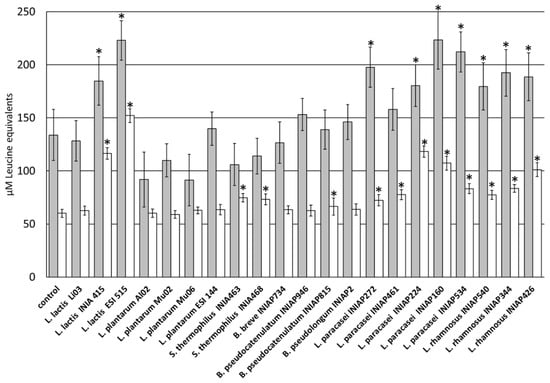
This is in accordance with the findings of Ma et al. [27] demonstrating the scarce growth of L. plantarum strains in raw milk due to their autotrophy for certain amino acids and nucleotide precursors. In our study, we did not observe proteolytic activity of L. plantarum in either soy or cow’s milk (Figure 1), which can hinder their ability to grow in milk due to the lack of amino acid release. However, L. plantarum strains grew in the soy beverage, suggesting that soy beverages contain peptides and free amino acids that allow the growth of L. plantarum strains, and this is reflected in the high OPA values of the soy beverage (Figure 1). In concordance with our study, Singh et al. [28] and Bao et al. [29] also demonstrated the growth and fermentation of L. plantarum strains in soy beverages.
Figure 1.
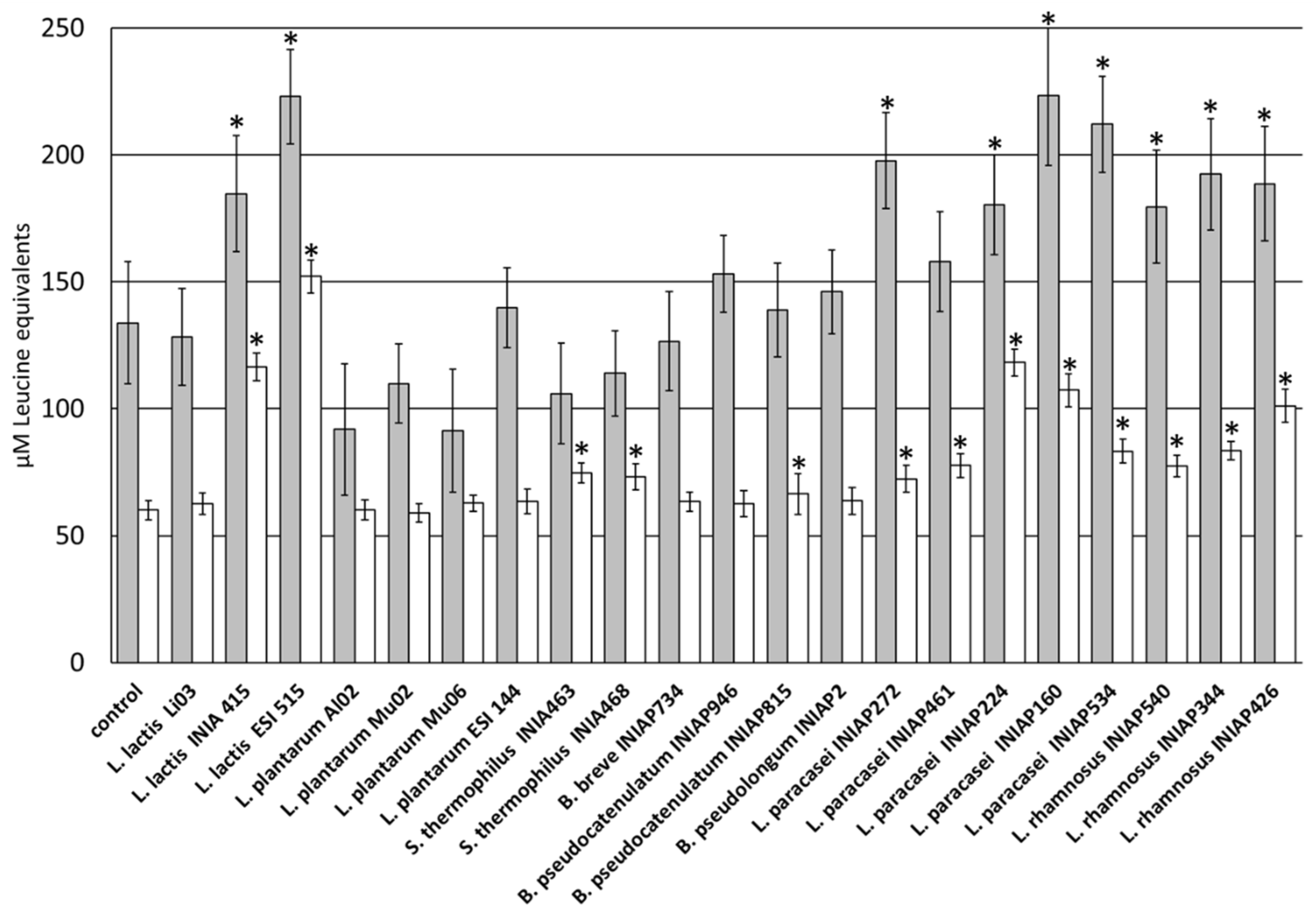
OPA determinations (µM Leucine equivalents in soy beverage (gray bars) or milk (white bars)). Values are mean ±SD (n = 12). * Values significantly higher than the non-fermented control (Dunnett’s test, p < 0.01).
Similar results to those observed with L. plantarum were also observed with the bifidobacteria strains. Bifidobacteria also grow poorly in cow’s milk; however, they grow well in soy beverages, as we had previously observed with Bifidobacterium breve and Bifidobacterium longum strains [24]. Bifidobacteria grow and ferment better when they do not depend on lactose as a fermentation sugar. Unlike human milk, raw cow’s milk does not contain the high levels of oligosaccharides necessary to naturally stimulate the growth of bifidobacteria. On the contrary, soy beverages contain, besides sucrose, the oligosaccharides raffinose and stachyose on which bifidobacteria feed very efficiently [30,31].
The results of the strain growth were reflected in the pH variations (Table 2). The initial pH of both soy beverage (7.04) and milk (6.59) gradually declined with the progression of fermentation. Fermentation by LAB and bifidobacteria strains showed a greater decrease in pH in soy beverages compared with milk. LAB and bifidobacteria decreased the pH of soy from 7.04 to 4.71, while in cow’s milk the pH decreased from 6.59 to 5.26. Thus, while LAB and bifidobacteria decreased the pH of the soy beverage by a total of 2.38 units, in milk they produced a decrease of 1.33 units. The main differences were observed with L. plantarum and Bifidobacterium strains, which showed a greater decrease in the pH of soy beverages compared with cow’s milk. L. plantarum strains decreased the pH of soy beverages by more than 2 units, while showing hardly any decrease in the pH of milk. Bifidobacterium strains showed a decrease in pH of 2.12 in the soy beverage, while only showing a decrease of 0.75 in milk. Furthermore, the bifidobacteria strains showed differences between species, with B. breve INIA 734 showing the greatest decrease in pH in both soy beverages and cow’s milk (Table 2).
On the other hand, S. thermophilus strains did not differ in pH decrease between soy beverages and cow’s milk; moreover, both S. thermophilus strains showed a decrease in pH greater than 2 units in both beverages. Moreover, Lactococcus lactis INIA 415 and ESI515 strains showed the greatest decrease in milk pH. Finally, L. paracasei and L. rhamnosus strains, although showing a significant decrease in pH in soy beverages and cow’s milk, did not show significant differences between soy beverages and cow’s milk (Table 2).
3.2. Effect of the Proteolytic Activity of LAB and Bifidobacteria Strains on the Fermentation of Cow’s Milk and Soy Beverages
One of the most important characteristics of cow’s milk and soy beverages is the presence of protein. Proteolysis of cow’s milk and soy beverages generates peptides and amino acids with potential nutritional and functional benefits [32]. Proteolytic activity was measured as micromolar leucine equivalents in this work (Figure 1). The control soy beverages already showed higher values in leucine equivalents (133.86 ± 24.11 µM) compared with those of cow’s milk (60.13 ± 3.80 µM). Thus, all soy beverages, both the control and the fermented ones, showed higher leucine equivalent values than cow’s milk (Figure 1).
An analysis of the increase in leucine equivalents in soy beverages and cow’s milk after fermentation showed that the 21 selected bacteria increased leucine equivalents by an average of 33.8% in cow’s milk and 17.6% in soy beverages. However, analysis by genus, species, and even strain revealed significant differences. L. lactis Li03 did not show proteolytic activity in either soy beverages or cow’s milk, while L. lactis INIA 415 and L. lactis ESI 515 showed a significant increase in proteolytic activity in both milk and soy beverages. L. lactis INIA 415 and L. lactis ESI 515 showed increases of 94.03% and 153.35%, respectively, in leucine equivalents in milk, while in soy beverages they showed increases of 38% and 65.53%, respectively. The proteolytic activity of some Lactococcus is well studied and key for their role as starters for dairy fermentation, greatly influencing the flavor and texture of dairy products [33]. The proteolytic activity of Lactococcus in soy has been little studied; Genet et al. [34] observed that of five strains of L. lactis used in the fermentation of a soy-based beverage, only two strains of L. lactis showed proteolytic activity, and proteomics analysis demonstrated the presence of the PrtP sequence in their genomes.
S. thermophilus strains showed low, though significant, proteolytic activity in cow’s milk, while these strains showed no proteolytic activity in soy beverages (Figure 1). The proteolytic activity of S. thermophilus strains has been associated with their growth in soy beverages [35], although in this study we observed growth in soy beverages with no proteolytic activity.
Regarding lactobacilli, no strain of L. plantarum showed proteolytic activity in either soy beverages or cow’s milk (Figure 1). L. plantarum strains were unable to grow in milk without amino acid supplementation [27]. These findings not only confirmed that L. plantarum is an amino acid auxotroph, but also suggest that L. plantarum strains cannot convert extracellular casein into free amino acids in milk. The measured low proteolysis correlated with the negligible capacity of the L. plantarum strains to hydrolyze cow’s milk proteins [36]. Moreover, in silico genome analysis of L. plantarum, WCFS1 showed the absence of genes encoding extracellular proteases [37]. Although L. plantarum strains grow poorly in milk without supplementation [38], L. plantarum strains usually grow well and are the dominant species in some cheese products that are made with mixed strain cultures [39]. The results indicate that the metabolites secreted by other starter cultures such as S. thermophilus and L. lactis probably promote the growth and propagation of L. plantarum during cheese ripening. The lack of proteolytic activity in L. plantarum strains correlates with their inability to grow and ferment milk. However, L. plantarum strains grow and ferment soy beverages, suggesting the presence of amino acids and peptides in these beverages that enable growth.
The strains of L. paracasei and L. rhamnosus showed high proteolytic activity in both cow’s milk and soy beverages, producing an increase in leucine equivalents of 41.5% in soy beverages and 45.2% in cow’s milk (Figure 1). The hydrolytic activity of L. paracasei and L. rhamnosus strains on soy and milk proteins has been previously described [40,41]. Proteolytic LAB strains in soy milk could contribute to improving its protein digestibility in addition to the production of peptides with physiological functions [42].
Finally, the bifidobacteria strains showed very low proteolytic activity in both soy beverages and cow’s milk. Bifidobacterium pseudocatenulatum INIA P815 was the only bifidobacteria that showed a significant increase in proteolytic activity in cow’s milk. As demonstrated in other studies, bifidobacteria exhibit moderate to low proteolytic activity in milk [43], while in this study we demonstrated that the proteolytic activity of bifidobacteria is negligible in soy beverages. Unlike LAB strains, bifidobacteria typically have lower proteolytic requirements.
In cow’s milk, proteolytic activity was correlated with pH. However, in soy beverages, we did not observe a correlation between pH and proteolytic activity (Table 3). In addition, proteolytic activity in cow’s milk also correlated with an increase in antioxidant activity in cow’s milk, as measured by FRAP (Table 3). These data demonstrate that the transformation of proteins into peptides and amino acids increases FRAP-measured activity, consistent with previous studies [44].
Table 3.
Pearson’s correlation coefficient (r) between the different parameters determined in soy and milk fermented with the selected strains.
3.3. Effect of Cow’s Milk and Soy Beverage Fermentation by LAB and Bifidobacteria Strains on Antioxidant Activity
The results concerning antioxidant activity showed the greatest differences in the fermentation of soy beverages and cow’s milk. The fermentation of soy beverages by most of the bacteria used in this study showed an increase in antioxidant activity measured by the DPPH method (Table 4), while the fermentation of cow’s milk by most of the bacteria used in this study showed an increase in antioxidant activity measured by the FRAP method (Table 5).
Table 4.
DPPH determinations (µM Trolox equivalents).
Table 5.
FRAP determinations (µM Trolox equivalents).
Lactococcus strains showed an increase in DPPH in soy beverages, while showing no significant change in DPPH in cow’s milk. Meanwhile, Lactococcus strains increased FRAP in cow’s milk and significantly decreased FRAP in soy beverages (Table 4 and Table 5). Moreover, S. thermophilus strains showed a significant increase in FRAP in cow’s milk, while showing no significant change by the DPPH method. These strains were the only ones that did not show changes in DPPH values, which could be correlated with the absence of the transformation of daidzin and genistin into daidzein and genistein (Table 3 and Table 6).
Table 6.
Isoflavone determination in soy beverages after 48 h of fermentation with selected bacterial strains.
The transformation of glycoside isoflavones into their aglycones correlates with the antioxidant capacity measurement by the DPPH method (Table 3). These data are in concordance with other authors [45,46], who showed that the antioxidant activity to scavenge DPPH and ABTS radicals increases with lactic acid fermentation of soy beverages, and the increase in this capacity was due to the increased content of daidzein and genistein produced during fermentation. In the case of FRAP, an explanation for the decrease in the antioxidant capacity of fermented soy beverages could be that the transformation of isoflavone glycosides into their aglycones produces a decrease in the antioxidant capacity measured by the FRAP method [47].
The fermentation of soy beverages by the lactobacilli strains showed a significant increase in DPPH and a significant decrease in FRAP (Table 4 and Table 5). Meanwhile, the fermentation of cow’s milk by the lactobacilli strains produced a significant decrease in DPPH values and a significant increase in FRAP. El-Sayed et al. [48] demonstrated that there was a highly significant correlation (p < 0.0001) between the degree of proteolysis and the values of FRAP in fermented camel’s milk using lactobacilli strains. In concordance with these data, Table 3 shows the correlation in cow’s milk between OPA values and antioxidant activity measured by the FRAP method. Moreover, a correlation between FRAP and pH was also observed in the fermentation of cow’s milk by bacterial strains (Table 3).
The correlation between proteolytic activity and the FRAP assay is usually direct and positive, since the controlled breakdown of proteins releases bioactive peptides and amino acids with reducing capacity [49,50]. Proteolysis breaks down large protein chains, exposing amino acids with electron-donating functional groups (such as tyrosine, tryptophan, cysteine, and methionine). Greater proteolytic activity and longer digestion or hydrolysis times generally result in a higher concentration of low molecular weight peptides, thus increasing FRAP values. However, excessive proteolysis can degrade active peptides into free amino acids, sometimes decreasing the total antioxidant power achieved. In addition to an increase in antioxidant activities, high proteolytic activity results in increased ACE inhibitory activity [44].
Finally, the bifidobacteria strains only showed a significant increase in DPPH in the fermentation of soy beverages (Table 4), as a consequence of the transformation of the isoflavones daidzin and genistin into daidzein and genistein (Table 6). These data are in concordance with Pyo et al. [45] and the Pearson’s correlation coefficient (Table 3). However, the bifidobacteria strains did not show an increase in FRAP in cow’s milk, which may be related to the absence of proteolytic activity. In a previous study by our group, soy beverages fermented by bifidobacteria strains showed a decrease in antioxidant capacity with FRAP [24], consistent with the results presented in this study.
3.4. Increased Concentrations of Daidzein and Genistein in Soy Beverages Due to Fermentation by LAB and Bifidobacteria Strains
In soy beverages and unfermented soy foods, isoflavones mostly appear as isoflavone glycoside conjugates (mainly daidzin and genistin). The control soy beverages showed the presence of the following concentrations of isoflavones: daidzein (8.17 ± 1.99 µM), genistein (16.29 ± 3.07 µM), daidzin (166.34 ± 10.20 µM), and genistin (187.15 ± 9.54 µM) (Table 6). Although many other isoflavones, such as glycitin, glycitein, dihydrodaidzein, dihydrogenistein, O-demethylangolesin, and 6-hydroxy-O-demethylangolesin, as well as other flavonoids such as naringenin, could be present in soy beverages in much lower concentrations than daidzin, daidzein, genistin, and genistein [10,51]. In all the soy beverages analyzed, the sum of the daidzin, daidzein, genistin, and genistein concentrations represents more than 95% of the flavonoids analyzed in fermented and non-fermented soy beverages [10].
The bioavailability and estrogenic activity of the isoflavone glycosides (daidzin and genistin) are limited and are increased by their transformation into aglycones (daidzein and genistein) [52]. This can be accomplished by microorganisms present in the gut microbiota and in fermented foods [53,54]. The fermentation of soy beverages by LAB and bifidobacteria strains produced an increase in the concentration of the main isoflavones daidzein and genistein (Table 6), although other isoflavones such as dihydrodaidzein, dihydrogenistein, O-demethylangolesin, and 6-hydroxy-O-demethylangolesin may be produced in much lower concentrations by LAB and bifidobacteria strains [51]. With the exception of the two S. thermophilus strains, all the strains used in this work showed a significant amount of daidzein and genistein, and most strains showed complete transformation of daidzin and genistin into daidzein and genistein after 48 h of fermentation. Some strains, such as B. pseudocatenulatum INIA P815, B. pseudocatenulatum INIA P946, L. paracasei INIA P160, L. paracasei INIA P534, and L. rhamnosus INIA P344, showed complete transformation of daidzin and genistin into daidzein and genistein after 24 h of fermentation (Table S1). The remaining strains required 48 h to transform most of the daidzin and genistin into daidzein and genistein, respectively.
Most bifidobacteria exhibit beta-glucosidase activity [55], enabling them to produce daidzein and genistein from daidzin and genistin. Among bifidobacteria, the species B. breve and B. pseudocatenulatum stand out due to their high deglycosidase activity and the presence of numerous genes with glucosidase activity in their genomes [56,57]. Lactobacilli strains often exhibit high glucosidase activity. In addition to strains of the genera L. plantarum, L. paracasei, and L. rhamnosus, strains of other genera such as Lacticaseibacillus casei and Limosilactobacillus mucosae are capable of producing daidzein and genistein in soy beverages at high concentrations [10,56,58,59]. In addition, in concordance with our results, Izaguirre et al. [60] demonstrated that S. thermophilus strains have very low levels of β-glucosidase activity and low production of daidzein and genistein.
In relation to the fermentation of soy beverage by bacteria with glucosidase activity, it enhances the absorption of isoflavones implying more effective results in human health of those aglycone-rich products [61]. Moreover, deglycosylation of isoflavones is accompanied by an increase in antioxidant activity in soy beverages. Therefore, a correlation can be observed between aglycone production and increased antioxidant activity measured by DPPH (Table 3).
4. Conclusions
L. lactis, L. paracasei, and L. rhamnosus strains are potential cultures for the preparation of fermented cow’s milk and soy beverage products with improved functionality. However, L. plantarum and bifidobacteria strains only showed an improvement in the functional properties of soy beverages. Soy beverages proved to be a more suitable medium for the growth, survival, and fermentative capacity of some genera of LAB, and for all the bifidobacteria used. Moreover, the high production of peptides, free amino acids, and isoflavone aglycones by most strains of LAB and bifidobacteria improved the functional properties of the soy beverages for certain population groups. Finally, strains selected from this work such as L. lactis ESI 515, L. paracasei INIA P461, L. rhamnosus INIA P344, and L. rhamnosus INIA P540 will be potential cultures for preparation of fermented food with improved functionality.
Supplementary Materials
The following supporting information can be downloaded at: https://www.mdpi.com/article/10.3390/fermentation12110497/s1, Table S1: Isoflavone determination in soy beverages after 24 h of fermentation with selected bacterial strains.
Author Contributions
Conceptualization, S.L., J.A.C., and J.M.L.; formal analysis, Á.P. and I.P.; funding acquisition, J.M.L. and J.A.C.; investigation, J.M.B.-V., Á.P., J.A., J.A.C., I.P., P.S., and S.L.; methodology, J.M.B.-V., Á.P., J.A., and I.P.; project administration, J.M.L.; resources, Á.P. and S.L.; supervision, J.M.L.; validation, Á.P. and I.P., visualization Á.P.; writing—original draft, J.M.L.; writing—review and editing, Á.P., J.A.C., and J.M.L. All authors have read and agreed to the published version of the manuscript.
Funding
PID2025-175431OR-I00 and PDC2025-166456-I00 Projects from the Spanish Ministry of Science, Innovation and Universities provided funding for this work.
Institutional Review Board Statement
Not applicable.
Informed Consent Statement
Not applicable.
Data Availability Statement
The raw data supporting the conclusions of this article will be made available by the authors on request.
Acknowledgments
L. lactis Li03, L. plantarum Al02, L. plantarum Mu02, and L. plantarum Mu06 belong to the IATA-CSIC collection and were provided by Vicente Monedero and Manolo Zuñiga [16].
Conflicts of Interest
The authors declare no conflicts of interest.
References
- Widyastuti, Y.; Febrisiantosa, A. The role of lactic acid bacteria in milk fermentation. Food Nutr. Sci. 2014, 5, 435. [Google Scholar] [CrossRef]
- Sethi, S.; Tyagi, S.K.; Anurag, R.K. Plant-based milk alternatives an emerging segment of functional beverages: A review. J. Food Sci. Technol. 2016, 53, 3408–3423. [Google Scholar] [CrossRef] [Scilit] [PubMed]
- Harlé, O.; Falentin, H.; Niay, J.; Valence, F.; Courselaud, C.; Chuat, V.; Maillard, M.-B.; Guédon, É.; Deutsch, S.-M.; Thierry, A. Diversity of the metabolic profiles of a broad range of lactic acid bacteria in soy juice fermentation. Food Microbiol. 2020, 89, 103410. [Google Scholar] [CrossRef] [Scilit] [PubMed]
- Walther, B.; Guggisberg, D.; Badertscher, R.; Egger, L.; Portmann, R.; Dubois, S.; Haldimann, M.; Kopf-Bolanz, K.; Rhyn, P.; Zoller, O.; et al. Comparison of nutritional composition between plant-based drinks and cow’s milk. Front. Nutr. 2022, 9, 988707. [Google Scholar] [CrossRef] [Scilit] [PubMed]
- Smith, N.W.; Dave, A.C.; Hill, J.P.; McNabb, W.C. Nutritional assessment of plant-based beverages in comparison to bovine milk. Front. Nutr. 2022, 9, 957486. [Google Scholar] [CrossRef] [Scilit] [PubMed]
- Meyer, R.; Groetch, M.; Santos, A.; Venter, C. The evolution of nutritional care in children with food allergies—With a focus on cow’s milk allergy. J. Hum. Nutr. Diet. 2024, 38, e13391. [Google Scholar] [CrossRef] [Scilit] [PubMed]
- Zhao, J.; Kong, X.; Zhang, C.; Hua, Y.; Chen, Y.; Li, X. A comparative study on the protein digestion of four different soy beverages: Effects of the composition, microstructure, and protein digestibility evaluation method. Food Funct. 2025, 16, 2262–2278. [Google Scholar] [CrossRef] [Scilit] [PubMed]
- Khamzaeva, N.; Kunz, C.; Schamann, A.; Pferdmenges, L.; Briviba, K. Bioaccessibility and Digestibility of Proteins in Plant-Based Drinks and Cow’s Milk: Antioxidant Potential of the Bioaccessible Fraction. J. Agric. Food Chem. 2024, 72, 2300–2308. [Google Scholar] [CrossRef] [Scilit] [PubMed]
- Villares, A.; Rostagno, M.A.; García-Lafuente, A.; Guillamón, E.; Martínez, J.A. Content and Profile of Isoflavones in Soy-Based Foods as a Function of the Production Process. Food Bioprocess Technol. 2010, 4, 27–38. [Google Scholar] [CrossRef] [Scilit]
- de la Bastida, A.R.; Peirotén, Á.; Langa, S.; Curiel, J.A.; Arqués, J.L.; Landete, J.M. Effect of storage and heat treatment on the levels of bioactive flavonoids produced in fermented soy beverages. LWT 2022, 154, 112872. [Google Scholar] [CrossRef] [Scilit]
- de la Bastida, A.R.; Langa, S.; Peirotén, Á.; Fernández-Gonzalez, R.; Sánchez-Jiménez, A.; Maroto, M.; Curiel, J.A.; Guillamon, E.; Arqués, J.L.; Gutiérrez-Adán, A.; et al. Effect of fermented soy beverage in aged female mice model. Food Res. Int. 2023, 169, 112745. [Google Scholar] [CrossRef] [Scilit] [PubMed]
- de la Bastida, A.R.; Langa, S.; Peirotén, Á.; Curiel, J.A.; Fernández-González, R.; Maroto, M.; Arqués, J.; Gutiérrez-Adán, A.; Landete, J.M. Fermented Lignan-Enriched Soy Beverage Ameliorates the Metabolic Effects of a High-Fat Diet on Female Mice. J. Agric. Food Chem. 2025, 73, 5194–5207. [Google Scholar] [CrossRef] [Scilit] [PubMed]
- Peirotén, A.; Arqués, J.; Medina, M.; Rodríguez-Mínguez, E. Bifidobacterial strains shared by mother and child as source of probiotics. Benef. Microbes 2018, 9, 231–238. [Google Scholar] [CrossRef] [Scilit] [PubMed]
- Peirotén, Á.; Gaya, P.; Álvarez, I.; Bravo, D.; Landete, J.M. Influence of different lignan compounds on enterolignan production by Bifidobacterium and Lactobacillus strains. Int. J. Food Microbiol. 2019, 289, 17–23. [Google Scholar] [CrossRef] [Scilit] [PubMed]
- Rodríguez, E.; Arqués, J.L.; Rodríguez, R.; Peirotén, Á.; Landete, J.M.; Medina, M. Antimicrobial properties of probiotic strains isolated from breast-fed infants. J. Funct. Foods 2012, 4, 542–551. [Google Scholar] [CrossRef] [Scilit]
- Langa, S.; Peirotén, Á.; Rodríguez, S.; Monedero, V.; Zúñiga, M.; Curiel, J.A.; Landete, J.M. GABA- and riboflavin-enriched soy and oat beverages using selected lactic acid bacteria. Innov. Food Sci. Emerg. Technol. 2025, 104, 104108. [Google Scholar] [CrossRef] [Scilit]
- Cogan, T.M.; Barbosa, M.; Beuvier, E.; Bianchi-Salvadori, B.; Cocconcelli, P.S.; Fernandes, I.; Gomez, J.; Gomez, R.; Kalantzopoulos, G.; Ledda, A.; et al. Characterization of the lactic acid bacteria in artisanal dairy products. J. Dairy Res. 1997, 64, 409–421. [Google Scholar] [CrossRef] [Scilit]
- Garde, S.; Rodríguez, E.; Gaya, P.; Medina, M.; Nuñez, M. PCR detection of the structural genes of nisin Z and lacticin 481 in Lactococcus lactis subsp. lactis INIA 415, a strain isolated from raw milk Manchego cheese. Biotechnol. Lett. 2001, 23, 85–89. [Google Scholar] [CrossRef] [Scilit]
- Garde, S.; Tomillo, J.; Gaya, P.; Medina, M.; Nuñez, M. Proteolysis in Hispánico Cheese Manufactured Using a Mesophilic Starter, a Thermophilic Starter, and Bacteriocin-Producing Lactococcus lactis Subsp. lactis INIA 415 Adjunct Culture. J. Agric. Food Chem. 2002, 50, 3479–3485. [Google Scholar] [CrossRef] [Scilit] [PubMed]
- Church, F.C.; Swaisgood, H.E.; Porter, D.H.; Catignani, G.L. Spectrophotometric Assay Using o-Phthaldialdehyde for Determination of Proteolysis in Milk and Isolated Milk Proteins. J. Dairy Sci. 1983, 66, 1219–1227. [Google Scholar] [CrossRef] [Scilit]
- Collison, M.W. Determination of Total Soy Isoflavones in Dietary Supplements, Supplement Ingredients, and Soy Foods by High-Performance Liquid Chromatography with Ultraviolet Detection: Collaborative Study. J. AOAC Int. 2008, 91, 489–500. [Google Scholar] [CrossRef] [Scilit]
- Gaya, P.; Arqués, J.L.; Medina, M.; Álvarez, I.; Landete, J.M. A New HPLC-PAD/HPLC-ESI-MS Method for the Analysis of Phytoestrogens Produced by Bacterial Metabolism. Food Anal. Methods 2015, 9, 537–547. [Google Scholar] [CrossRef] [Scilit]
- Hati, S.; Patel, N.; Mandal, S. Comparative Growth Behaviour and Biofunctionality of Lactic Acid Bacteria During Fermentation of Soy Milk and Bovine Milk. Probiotics Antimicrob. Proteins 2017, 10, 277–283. [Google Scholar] [CrossRef] [Scilit] [PubMed]
- de la Bastida, A.R.; Peirotén, Á.; Langa, S.; Rodríguez-Mínguez, E.; Curiel, J.A.; Arqués, J.L.; Landete, J.M. Fermented soy beverages as vehicle of probiotic lactobacilli strains and source of bioactive isoflavones: A potential double functional effect. Heliyon 2023, 9, e14991. [Google Scholar] [CrossRef] [Scilit] [PubMed]
- Wang, J.; Guo, Z.; Zhang, Q.; Yan, L.; Chen, W.; Liu, X.-M.; Zhang, H.-P. Fermentation characteristics and transit tolerance of probiotic Lactobacillus casei Zhang in soymilk and bovine milk during storage. J. Dairy Sci. 2009, 92, 2468–2476. [Google Scholar] [CrossRef] [Scilit] [PubMed]
- Fatima, S.M.; Hekmat, S. Microbial and Sensory Analysis of Soy and Cow Milk-Based Yogurt as a Probiotic Matrix for Lactobacillus rhamnosus GR-1. Fermentation 2020, 6, 74. [Google Scholar] [CrossRef] [Scilit]
- Ma, C.; Cheng, G.; Liu, Z.; Gong, G.; Chen, Z. Determination of the essential nutrients required for milk fermentation by Lactobacillus plantarum. LWT 2016, 65, 884–889. [Google Scholar] [CrossRef] [Scilit]
- Singh, B.P.; Vij, S. Growth and bioactive peptides production potential of Lactobacillus plantarum strain C2 in soy milk: A LC-MS/MS based revelation for peptides biofunctionality. LWT 2017, 86, 293–301. [Google Scholar] [CrossRef] [Scilit]
- Bao, Y.; Zhang, Y.; Li, H.; Liu, Y.; Wang, S.; Dong, X.; Su, F.; Yao, G.; Sun, T.; Zhang, H. In vitro screen of Lactobacillus plantarum as probiotic bacteria and their fermented characteristics in soymilk. Ann. Microbiol. 2011, 62, 1311–1320. [Google Scholar] [CrossRef] [Scilit]
- Kanwal, F.; Ren, D.; Kanwal, W.; Ding, M.; Su, J.; Shang, X. The potential role of nondigestible Raffinose family oligosaccharides as prebiotics. Glycobiology 2023, 33, 274–288. [Google Scholar] [CrossRef] [Scilit] [PubMed]
- Pokusaeva, K.; Fitzgerald, G.F.; van Sinderen, D. Carbohydrate metabolism in Bifidobacteria. Genes Nutr. 2011, 6, 285–306. [Google Scholar] [CrossRef] [Scilit] [PubMed]
- Singh, B.P.; Vij, S.; Hati, S. Functional significance of bioactive peptides derived from soybean. Peptides 2014, 54, 171–179. [Google Scholar] [CrossRef] [Scilit] [PubMed]
- Konkit, M.; Kim, W. Activities of amylase, proteinase, and lipase enzymes from Lactococcus chungangensis and its application in dairy products. J. Dairy Sci. 2016, 99, 4999–5007. [Google Scholar] [CrossRef] [Scilit] [PubMed]
- Genet, B.M.; Xiao, H.; Christensen, L.F.; Laforce, I.N.; Mohammadifar, M.A.; Bang-Berthelsen, C.H.; Hansen, E.B. Selection of proteolytic LAB starter cultures for acidification of soy based dairy alternatives. LWT 2023, 184, 115082. [Google Scholar] [CrossRef] [Scilit]
- Boulay, M.; Al Haddad, M.; Rul, F. Streptococcus thermophilus growth in soya milk: Sucrose consumption, nitrogen metabolism, soya protein hydrolysis and role of the cell-wall protease PrtS. Int. J. Food Microbiol. 2020, 335, 108903. [Google Scholar] [CrossRef] [Scilit] [PubMed]
- Khalid, N.M.; Marth, E.H. Proteolytic Activity by Strains of Lactobacillus plantarum and Lactobacillus casei. J. Dairy Sci. 1990, 73, 3068–3076. [Google Scholar] [CrossRef] [Scilit]
- Kleerebezem, M.; Boekhorst, J.; Van Kranenburg, R.; Molenaar, D.; Kuipers, O.P.; Leer, R.; Tarchini, R.; Peters, S.A.; Sandbrink, H.M.; Fiers, M.W.E.J.; et al. Complete genome sequence of Lactobacillus plantarum WCFS1. Proc. Natl. Acad. Sci. USA 2003, 100, 1990–1995. [Google Scholar] [CrossRef] [Scilit] [PubMed]
- Siezen, R.J.; Tzeneva, V.A.; Castioni, A.; Wels, M.; Phan, H.T.K.; Rademaker, J.L.W.; Starrenburg, M.J.C.; Kleerebezem, M.; Molenaar, D.; Vlieg, J.E.T.V.H. Phenotypic and genomic diversity of Lactobacillus plantarum strains isolated from various environmental niches. Environ. Microbiol. 2010, 12, 758–773. [Google Scholar] [CrossRef] [Scilit] [PubMed]
- Aydemir, O.; Harth, H.; Weckx, S.; Dervişoğlu, M.; De Vuyst, L. Microbial communities involved in Kaşar cheese ripening. Food Microbiol. 2015, 46, 587–595. [Google Scholar] [CrossRef] [Scilit] [PubMed]
- Singh, B.P.; Vij, S. α-Galactosidase activity and oligosaccharides reduction pattern of indigenous lactobacilli during fermentation of soy milk. Food Biosci. 2018, 22, 32–37. [Google Scholar] [CrossRef] [Scilit]
- Sorokina, N.; Lepilkina, O.; Brutskaya, A.; Topnikova, E. Evaluating the Proteolytic Activity of Lactobacilli in Cheese Production. Food Process. Tech. Technol. 2025, 55, 540–551. [Google Scholar] [CrossRef] [Scilit]
- Aguirre, L.; Hebert, E.M.; Garro, M.S.; de Giori, G.S. Proteolytic activity of Lactobacillus strains on soybean proteins. LWT 2014, 59, 780–785. [Google Scholar] [CrossRef] [Scilit]
- Roy, D. Technological aspects related to the use of bifidobacteria in dairy products. Lait 2005, 85, 39–56. [Google Scholar] [CrossRef] [Scilit]
- Loghman, S.; Moayedi, A.; Mahmoudi, M.; Khomeiri, M.; Gómez-Mascaraque, L.G.; Garavand, F. Single and Co-Cultures of Proteolytic Lactic Acid Bacteria in the Manufacture of Fermented Milk with High ACE Inhibitory and Antioxidant Activities. Fermentation 2022, 8, 448. [Google Scholar] [CrossRef] [Scilit]
- Pyo, Y.; Lee, T.; Lee, Y.C. Effect of Lactic Acid Fermentation on Enrichment of Antioxidant Properties and Bioactive Isoflavones in Soybean. J. Food Sci. 2005, 70, S215–S220. [Google Scholar] [CrossRef] [Scilit]
- Letizia, F.; Fratianni, A.; Cofelice, M.; Testa, B.; Albanese, G.; Di Martino, C.; Panfili, G.; Lopez, F.; Iorizzo, M. Antioxidative Properties of Fermented Soymilk Using Lactiplantibacillus plantarum LP95. Antioxid. 2023, 12, 1442. [Google Scholar] [CrossRef] [Scilit] [PubMed]
- Lee, C. Relative antioxidant activity of soybean isoflavones and their glycosides. Food Chem. 2005, 90, 735–741. [Google Scholar] [CrossRef] [Scilit]
- El-Sayed, M.I.; Awad, S.; Abou-Soliman, N.H.I. Improving the antioxidant properties of fermented camel milk using some strains of Lactobacillus. Food Nutr. Sci. 2021, 12, 352–371. [Google Scholar] [CrossRef]
- Karamać, M.; Kosińska-Cagnazzo, A.; Kulczyk, A. Use of Different Proteases to Obtain Flaxseed Protein Hydrolysates with Antioxidant Activity. Int. J. Mol. Sci. 2016, 17, 1027. [Google Scholar] [CrossRef] [Scilit] [PubMed]
- Paiva, L.; Lima, E.; Neto, A.I.; Baptista, J. Angiotensin I-Converting Enzyme (ACE) Inhibitory Activity, Antioxidant Properties, Phenolic Content and Amino Acid Profiles of Fucus spiralis L. Protein Hydrolysate Fractions. Mar. Drugs 2017, 15, 311. [Google Scholar] [CrossRef] [Scilit] [PubMed]
- Peirotén, Á.; Gaya, P.; Álvarez, I.; Landete, J.M. Production of O-desmethylangolensin, tetrahydrodaidzein, 6’-hydroxy-O-desmethylangolensin and 2-(4-hydroxyphenyl)-propionic acid in fermented soy beverage by lactic acid bacteria and Bifidobacterium strains. Food Chem. 2020, 318, 126521. [Google Scholar] [CrossRef] [Scilit] [PubMed]
- Vitale, D.C.; Piazza, C.; Melilli, B.; Drago, F.; Salomone, S. Isoflavones: Estrogenic activity, biological effect and bioavailability. Eur. J. Drug Metab. Pharmacokinet. 2013, 38, 15–25. [Google Scholar] [CrossRef] [Scilit] [PubMed]
- Landete, J.M.; Arques, J.; Medina, M.; Gaya, P.; de Las Rivas, B.; Muñoz, R. Bioactivation of Phytoestrogens: Intestinal Bacteria and Health. Crit. Rev. Food Sci. Nutr. 2016, 56, 1826–1843. [Google Scholar] [CrossRef] [Scilit] [PubMed]
- Letizia, F.; Fusco, G.M.; Fratianni, A.; Gaeta, I.; Carillo, P.; Messia, M.C.; Iorizzo, M. Application of Lactiplantibacillus plantarum LP95 as a Functional Starter Culture in Fermented Tofu Production. Processes 2024, 12, 1093. [Google Scholar] [CrossRef] [Scilit]
- Modrackova, N.; Vlkova, E.; Tejnecky, V.; Schwab, C.; Neuzil-Bunesova, V. Bifidobacterium β-Glucosidase Activity and Fermentation of Dietary Plant Glucosides Is Species and Strain Specific. Microorganisms 2020, 8, 839. [Google Scholar] [CrossRef] [Scilit] [PubMed]
- Peirotén, Á.; Álvarez, I.; Landete, J.M. Production of flavonoid and lignan aglycones from flaxseed and soy extracts by Bifidobacterium strains. Int. J. Food Sci. Technol. 2019, 55, 2122–2131. [Google Scholar] [CrossRef] [Scilit]
- Guadamuro, L.; Flórez, A.B.; Alegría, Á.; Vázquez, L.; Mayo, B. Characterization of four β-glucosidases acting on isoflavone-glycosides from Bifidobacterium pseudocatenulatum IPLA 36007. Food Res. Int. 2017, 100, 522–528. [Google Scholar] [CrossRef] [Scilit] [PubMed]
- Donkor, O.; Shah, N. Production of β-Glucosidase and Hydrolysis of Isoflavone Phytoestrogens by Lactobacillus acidophilus, Bifidobacterium lactis, and Lactobacillus casei in Soymilk. J. Food Sci. 2007, 73, M15–M20. [Google Scholar] [CrossRef] [Scilit] [PubMed]
- Delgado, S.; Guadamuro, L.; Flórez, A.B.; Vázquez, L.; Mayo, B. Fermentation of commercial soy beverages with lactobacilli and bifidobacteria strains featuring high β-glucosidase activity. Innov. Food Sci. Emerg. Technol. 2019, 51, 148–155. [Google Scholar] [CrossRef] [Scilit]
- Izaguirre, J.K.; Barañano, L.; Castañón, S.; Alkorta, I.; Quirós, L.M.; Garbisu, C. Optimization of the Bioactivation of Isoflavones in Soymilk by Lactic Acid Bacteria. Processes 2021, 9, 963. [Google Scholar] [CrossRef] [Scilit]
- Izumi, T.; Osawa, S.; Obata, A.; Tobe, K.; Saito, M.; Kataoka, S.; Kikuchi, M.; Piskula, M.K.; Kubota, Y. Soy Isoflavone Aglycones Are Absorbed Faster and in Higher Amounts than Their Glucosides in Humans. J. Nutr. 2000, 130, 1695–1699. [Google Scholar] [CrossRef] [Scilit] [PubMed]

Disclaimer/Publisher’s Note: The statements, opinions and data contained in all publications are solely those of the individual author(s) and contributor(s) and not of MDPI and/or the editor(s). MDPI and/or the editor(s) disclaim responsibility for any injury to people or property resulting from any ideas, methods, instructions or products referred to in the content. |
© 2026 by the authors. Licensee MDPI, Basel, Switzerland. This article is an open access article distributed under the terms and conditions of the Creative Commons Attribution (CC BY) license.