


Abstract
This work is devoted to the investigation of biochar prepared by the heat treatment of agricultural wastes: sunflower seed husks, buckwheat husks, pine nut shells, and crushed corn cobs. Through the two-stage heat treatment, the biochars with different morphology, chemical composition, C:O ratio were synthesized and investigated using X-ray diffraction, scanning electron microscopy, X-ray photoelectron spectroscopy, and Fourier transform infrared spectroscopy. It has been found that all samples are carbonaceous materials (89.2–94.7 at.% C) with appreciable oxygen contents (4.65–8.46 at.%). The lowest carbon and thus the highest oxygen content (10.49 wt.%) was found in sunflower seed husk biochar, which correlates with the high mineral impurities (K, Ca, P) inherent to this feedstock. In contrast, biochars from pine nut shells and corn cobs exhibited the highest carbon contents and the lowest oxygen contents. The samples possessed relatively high disorder degree with the lower defectiveness of corn cob-based biochar. The sensing properties of the resulting functional materials were evaluated with respect to NO2 at room temperature. The pine nut shell biochar exhibited the highest response (31.5% at 50 ppm NO2). It has been found that the sunflower seed husk-based sensor exhibited high sensor recovery at room temperature without application of external heating, returning nearly to baseline after NO2 exposure at 10 ppm. The findings establish agricultural waste-derived biochars as promising, low-cost, and sustainable candidates as active materials for room-temperature chemiresistive gas sensors.
1. Introduction
The processing and utilization of agricultural wastes are one of the most pressing environmental challenges. Millions of tons of agricultural wastes are generated worldwide every year [1]. Agricultural waste is characterized by low feed value and, at the same time, its widespread occurrence, which leads to the accumulation of significant volumes. For example, in Russia, 60 thousand tons of buckwheat husks are produced annually [2], and during the processing of sunflower seeds, 14 million m3 of sunflower seed husks were generated worldwide in 2022 [3]. Pine nut shells, which constitute 51–59% [4,5] of the nut’s mass, are also a large-scale waste, with approximately 20 thousand tons of nuts in shells collected annually. Developing approaches to apply plant material residues allows solving two pressing problems: recycling low-liquidity waste and producing functional materials. Much research is being conducted on the use of biochar materials as catalysts [6] and catalyst carriers [7], adsorbents [8], heavy metal adsorbents [9], components of gas sensors [10,11], electrodes for electrochemical energy storage devices [12,13,14], etc.
The use of biochar materials for detecting toxic gases deserves special attention. One of the polluting components formed during high-temperature fuel combustion is NO2. Long-term exposure to even low concentrations of nitrogen dioxide leads to the development of asthma, decreased lung function, and worsening of respiratory diseases [15]. Chemiresistive sensors occupy a special place among existing NO2 detection methods due to their low cost, high sensitivity, ease of calibration, and small dimensions [16]. Carbon materials are known to possess high specific surface area, high electrical conductivity, the possibility of controlled surface modification, and the ability to operate at room temperature [17] (instead of conventional semiconductor-based sensors, which require heating to 350–400 °C [18,19]), which is an advantage for their application as active materials for gas sensors. In turn, obtaining carbon materials from renewable and inexpensive raw materials (including agricultural wastes) is promising both in terms of efficiency for NO2 adsorption and from economic and environmental points of view [20,21]. Biochars derived from plant biomass have heteroatom-containing functional groups (oxygen-, nitrogen-, and phosphorus-containing) on their surface [22], derived from the original feedstock, which can act as active sites for the adsorption of polar gas molecules [23]; they have a porous structure that can be controllably modified [24], and are also a renewable feedstock, which corresponds to the concept of sustainable development [25].
Some of the key methods for controlling the properties of biochar are physical activation [26] and chemical activation [27,28], which aim to develop the porous structure and modify the chemical composition [29]. Physical activation involves treating carbonized material in a gaseous environment at temperatures of 800–1100 °C [26]. This method produces activated carbon with a porous structure and high strength through gasification of the carbon matrix. It is cost-effective and can be classified as a “green” chemistry process, since no chemical reagents are used in the production and the washing step is eliminated, resulting in no liquid waste [30]. Chemical activation involves treatment with chemical reagents (alkalis, acids) followed by thermal treatment, which promotes intercalation and subsequent removal of the reaction products [27,31].
Significant volumes of agricultural waste are generated, the majority of which has been poorly studied and is promising in the context of the synthesis of carbon-based functional materials. For example, pine nut shell-derived materials are known to have a high specific surface area of up to 1400 m2/g [32,33], making them attractive for nitrogen dioxide detection. Buckwheat husk has a rich elemental composition [34], which can also influence the sensing properties. Despite a number of papers devoted to biochars, the issue of selection of feedstock for production of carbons with defined and controlled morphology, texture properties, and chemical composition are still not clear. Therefore, this study is related to systematic comparison of four local agricultural wastes, typical for Siberian region of Russia (sunflower seed husks, buckwheat husks, pine nut shells, crushed corn cobs) treated under identical conditions with correlation of composition of the feedstock, surface chemistry, morphology, and room-temperature NO2 sensing behavior. The features of selection of feedstock for the synthesis of biochars with defined defectiveness, chemical composition and surface functional groups were considered. It has been found that the pine nut shell-based biochar exhibited the highest response (31.5% at 50 ppm NO2). It was found that the sunflower seed husk-based sensor showed the best recovery of the baseline signal after NO2 injection without application of external heating, returning nearly to baseline after NO2 exposure.
2. Experimental
2.1. Feedstock and Heat Treatment
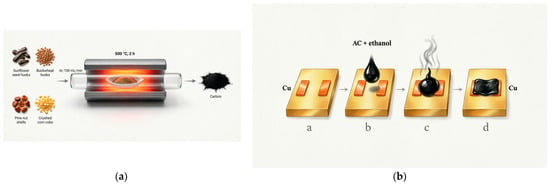
Agricultural wastes were selected as the precursors for the production of biochars: sunflower seed husks, buckwheat husks, pine nut shells, and crushed corn cobs (Russia). Carbonization of the precursors was carried out in a flow quartz reactor (Figure 1a) under an argon stream at a flow rate of 100 mL/min and a temperature of 500 °C for 2 h (initial weight was 2 g; heating from 25 °C to 500 °C was done at 10 °C/min). At the second stage the carbonized materials were additionally heat-treated at 800 °C for 2 h under an argon flow rate of 100 mL/min. For comparison with physical treatment (heating), buckwheat husk was additionally subjected to chemical activation using sodium hydroxide (NaOH) in a weight ratio of 1:3 at a temperature of 750 °C for 1.5 h.
Figure 1.
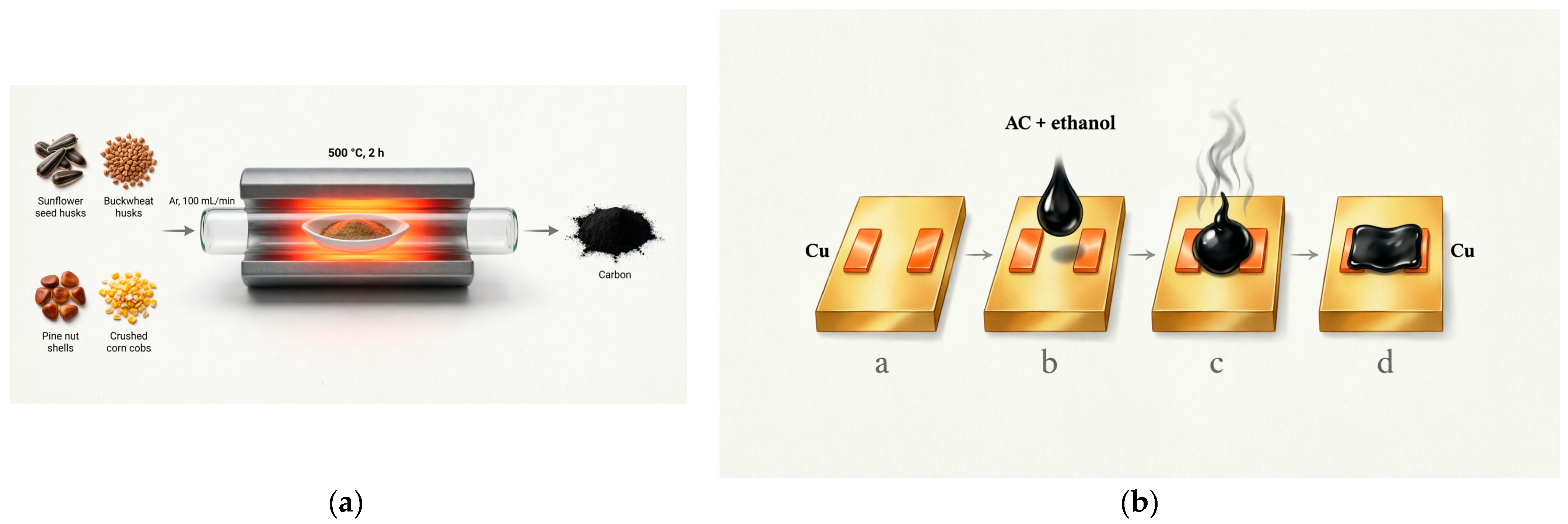
Scheme of synthesis of biochar (a); (b) scheme of a drop-casting technique (deposition of active layer of gas sensor on the substrate with two copper electrodes).
The temperatures were chosen according to preliminary experiments. The first stage (500 °C) has been chosen for carbonization and removal of volatiles while retaining the morphology of the feedstock material; the second stage (800 °C) was chosen to carry out the milder step of physical activation to develop porosity and slightly reduce in concentration of residual functional groups without huge change in texture properties and remaining the functional groups (avoiding the heating with higher temperatures, since the material loses the oxygen; the latter is better to leave maximally for adsorption and other applications providing the chemisorption when contacting with gases or liquids). These conditions were selected to compare feedstocks under identical conditions.
2.2. Materials Characterization
The composition of functional groups was determined using Fourier transform infrared (FTIR) spectroscopy on a FT-801 spectrometer (SIMEX; Novosibirsk, Russia). X-ray photoelectron spectroscopy (XPS) was used to identify the surface chemical composition of the biochar using a SPECS Surface Nano Analysis GmbH (Berlin, Germany,) spectrometer. The spectrometer was equipped with a PHOIBOS-150 hemispherical analyzer and an XR-50 characteristic X-ray source with a dual Al/Mg anode. Non-monochromatic Al Kα radiation (hv = 1486.61 eV) was used to record the spectra. The relative concentrations of elements in the analyzed zone were determined based on the integrated intensities of XPS lines, taking into account the photoionization cross-sections of the corresponding terms. For detailed analysis, the spectra were decomposed into individual components. Accordingly, after background subtraction using the Shirley method, the experimental curve was decomposed into a series of lines corresponding to the photoemission of electrons from atoms in different chemical environments. Data processing was performed using the CasaXPS software package (ver. 2.3.15). The peak shape was approximated by a symmetric function obtained by multiplying the Gaussian and Lorentzian functions. To account for the charging effect, the C1s peak of carbon in sp2 hybridization (Eb = 284.50 eV), corresponding to sp2-hybridized carbon, was used.
The morphology of the obtained samples after physical and chemical activation was analyzed using a Hitachi S-3400N scanning electron microscope (Hitachi, Japan, Tokyo) (SEM). Energy-dispersive X-ray (EDX) spectroscopy was performed using an Oxford Instruments attachment to investigate the elemental composition of the sample. The elemental composition of the sample surfaces was analyzed without sputtering (electron beam energy 10 keV) using a Li-Si detector with a detector elevation of 35° and a sample tilt of 0°. The measurement error of the equipment was no more than 1%. X-ray diffraction (XRD) was done using DRON-3 (Russia) spectrometer using CuKα radiation for determination of phase composition of the samples. Raman spectroscopy (532 nm) was carried out to estimate the disorder degree of the material on a T64000 Horiba Jobin Yvon (HORIBA Jobin Yvon, Palaiseau, France). Texture characteristics of biochars was investigated through low-temperature nitrogen adsorption using Quantachrome Nova 1000e (Quantachrome Instruments, Boynton Beach, FL, USA). The specific surface area was calculated using the Brunauer–Emmett–Teller (BET) method in the relative pressure range P/P0 = 0.05–0.30, employing the linear form of the BET equation.
2.3. Gas Sensors and Their Testing
To investigate the sensing properties, carbon-based films were fabricated from the obtained materials. The scheme of deposition procedure is shown in Figure 1b.
The active layer of the gas sensor was produced by drop-casting (Figure 1b) of a suspension of biochars in ethanol onto the surface of a dielectric substrate, i.e., textolite (10 × 10 mm), with two Cu electrodes (Figure 1b). The distance between electrodes was 4 mm. Thickness of sensing films was within 50–150 μm (according to SEM).
The suspension was prepared by dispersing a pre-ground sample (particles with a size below 200 μm) of ethyl alcohol (95 vol.%) in an ultrasonic bath (UZV-3/200, RELTEK, Yekaterinburg, Russia,) at a power of 85 W and a frequency of 22 kHz for 20 min. The resulting suspension was applied dropwise (Figure 1b) onto a substrate heated to 70 °C. Upon ethanol evaporation (Figure 1b, position c), a 5 × 5 mm film of carbon material was formed on the surface of the substrate (Figure 1b, position d). Each sensor based on biochar sample was used three times and tested subsequently. The deviation of sensor response was within an error of resistance measurements (within ±0.1–0.15%).
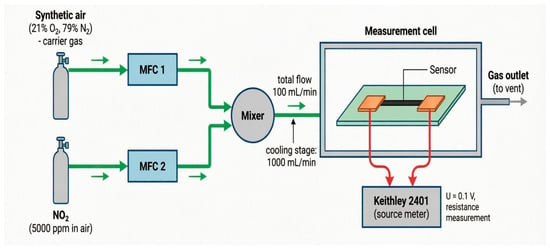
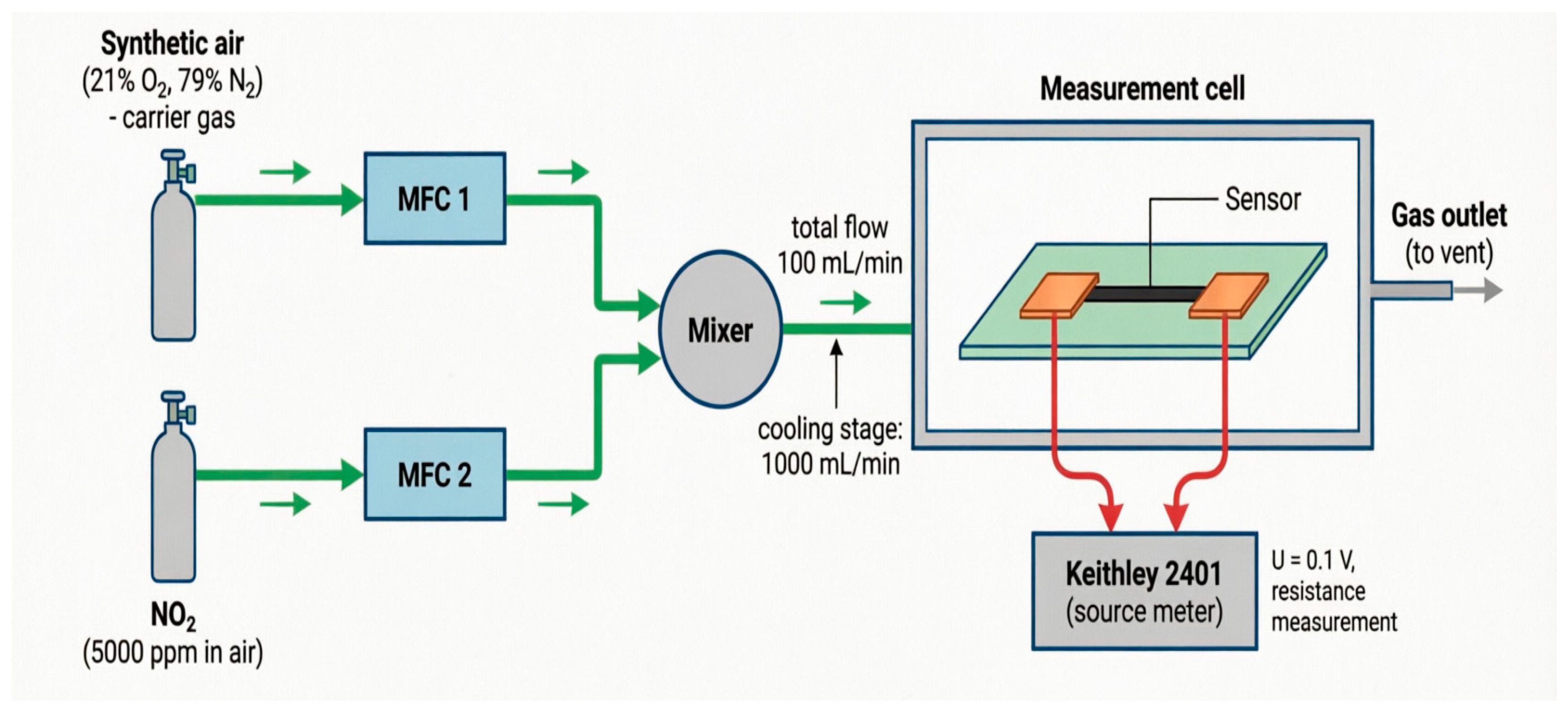
The sensing characteristics were investigated using a laboratory setup that fed the analyte and carrier gas at varying ratios (Figure 2) into the cell, driven by mass flow controllers (MFCs). Synthetic air (21 vol.% O2, 79 vol.% N2) was used as the carrier gas. A nitrogen dioxide mixture (500 ppm NO2 in synthetic air) was used as the model analyte gas. The total gas flow rate was 100 ± 2.5 mL/min. The analyte gas concentration was varied by changing the carrier-to-analyte gas ratio.
Figure 2.
Scheme of installation for testing of sensors based on biochars.
The measurement procedure included the following steps. The system was purged with carrier gas for 10 min at a flow rate of 100 mL/min to remove any residual analyte. The sensor was placed in the chamber on a ceramic plate internally heated to 70 °C, and maintained in a carrier gas flow of 100 mL/min for 10 min to desorb compounds from the sensor surface. The system was then cooled for 20 min at a flow rate of 1000 mL/min to reduce the temperature inside the chamber (150 cm3) to room temperature (25 ± 1 °C). The next stage involved baseline measurement for 60 min at a synthetic air flow rate of 100 mL/min, followed by alternating cycles of analyte (NO2) injection (10 min) and air purging (10 min).
The change in sensor resistance was recorded using a Keithley 2401 source meter (Keithley Instruments, Inc., Cleveland, OH, USA) at a bias voltage of 0.1 V. Data collection was performed using KickStart software (Tektronix, Inc., Beaverton, OR, USA).
The sensor response was calculated as follows:
where R is the sensor resistance in the air/NO2 mixture, Ω; R0 is initial electrical resistance of the sensor when exposed to carrier gas (synthetic air), Ω. The response was expressed as an absolute (positive) value throughout the paper for convenience, taking into account that resistance drops when contacting with NO2. Limit of detection (LoD) was calculated using classical IUPAC formula LoD = 3.3 SD/S, where SD—standard deviation of response, %; S—sensitivity, %/ppm [35].
ΔR/R0 = (R − R0)/R0,
3. Results
3.1. Properties
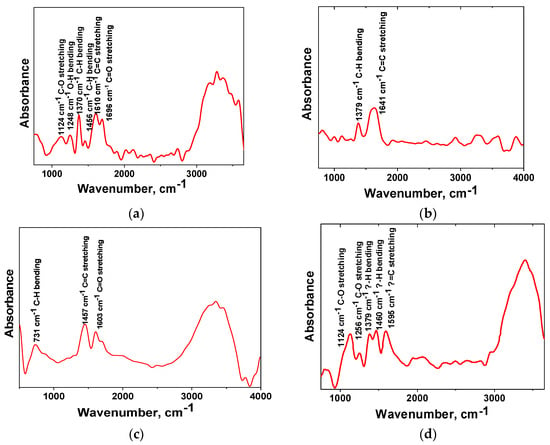
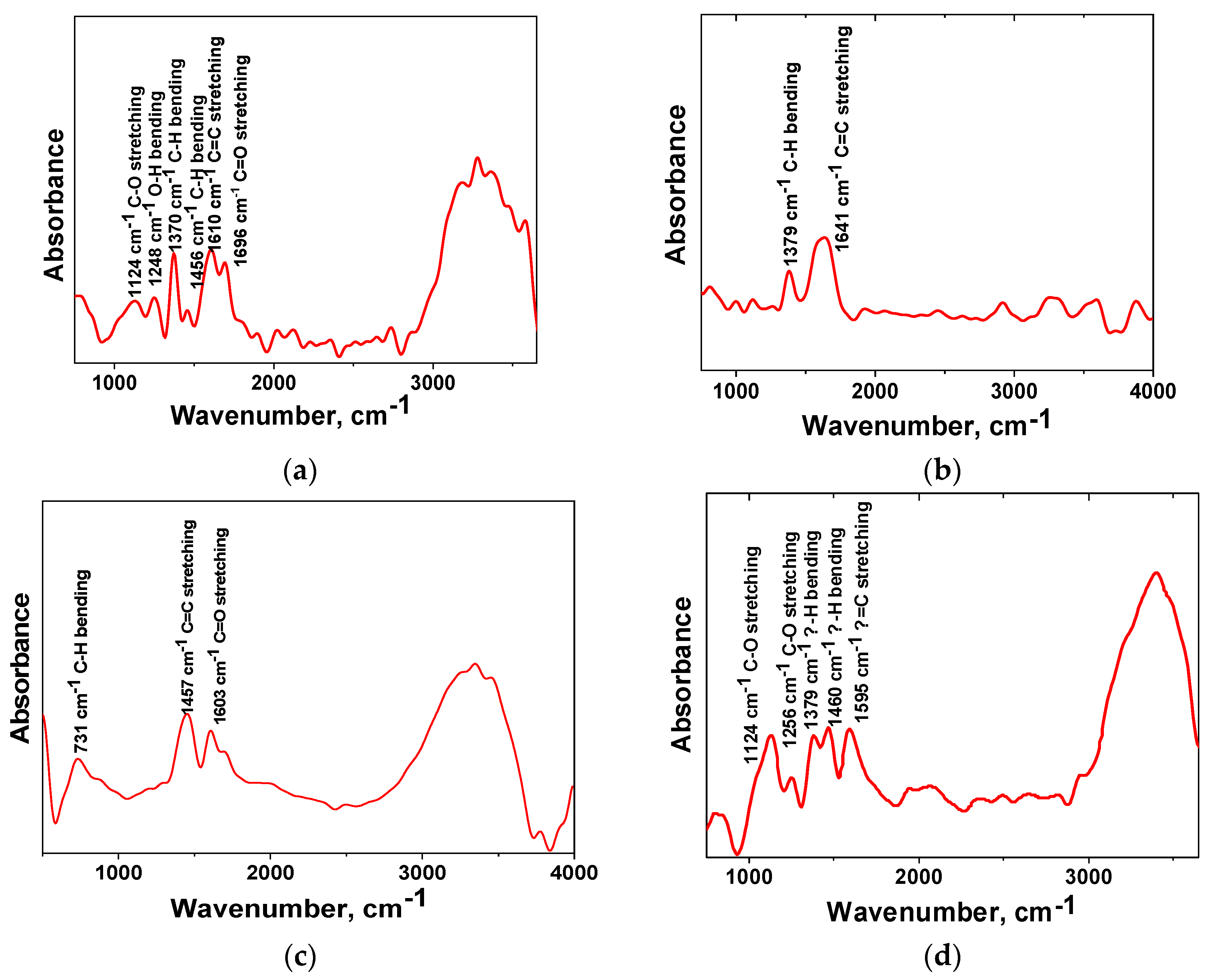
The FTIR spectra showed the presence of functional groups in biochars (Figure 3). As the elemental composition of the samples dominated by carbon, there are C=C skeletal stretching vibrations within 1600–1640 cm−1 [36]. The corn cob-based sample exhibited deformation vibrations of C–H bonds (731 cm−1) [37]. The samples based on pine nut shells and buckwheat husks showed more lines related to C-H stretching vibrations (1379 cm−1, 1460 cm−1) and C-O stretching vibrations in carboxylic groups (1124 cm−1) functional groups [38]. To compare the signals of functional groups, the FTIR spectra of the biochars treated only at 500 °C were presented in Figure S1 (Supplementary Materials). The two-stage treatment (500 °C for 2 h and 800 °C for 2 h) of above-mentioned materials led to the decrease in concentration of functional groups. For example, FTIR spectra of sunflower seed husk-based samples (Figure 3, Figure S1 in Supplementary Materials) showed the decrease in intensity of O-H vibrations and C=O vibrations (line at 1740 cm−1 almost disappeared). It can be noted that carbon materials from sunflower seed husks and corn cobs (Figure 3b,c) exhibited the fewest functional groups.
Figure 3.
FTIR spectra of carbonized materials after two-stage heat treatment (500 °C for 2 h and 800 °C for 2 h; Ar flow): (a) buckwheat husks; (b) sunflower seed husks; (c) corn cobs; (d) pine nut shells.
The quantitative elemental composition of the biochars was determined through EDX (Table 1).
Table 1.
Elemental composition of samples (EDX).
It can be seen that all samples are carbon materials (89.27–94.69 at.%) with a significant oxygen content (4.65–8.46 at.%). Additionally, the samples contained small amounts of Mg, Si, P, S, Cl, K, and Ca. The sunflower husk-based sample contained the lowest carbon content (89.27 at.%), while the amounts of phosphorus (0.146 at.%), potassium (1.192%), and calcium (0.409 at.%) exceeded those in the other samples. The pine nut shell-based sample had the lowest content of K and Mg (0.315% K and 0.076% Mg).
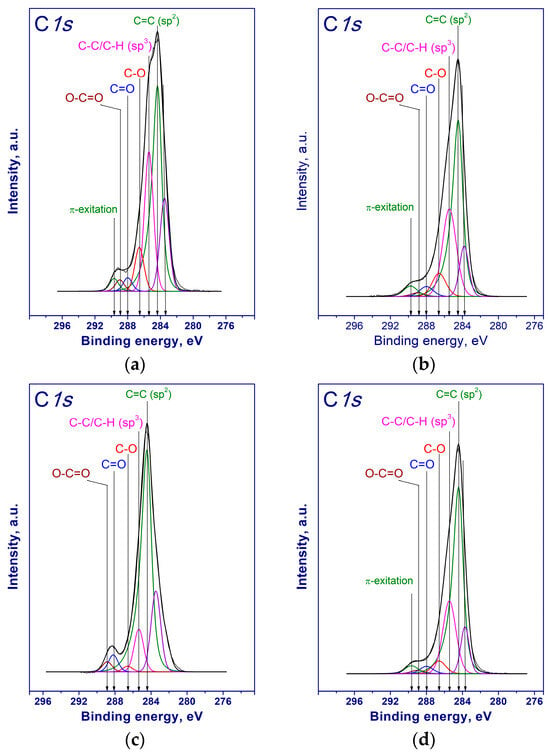
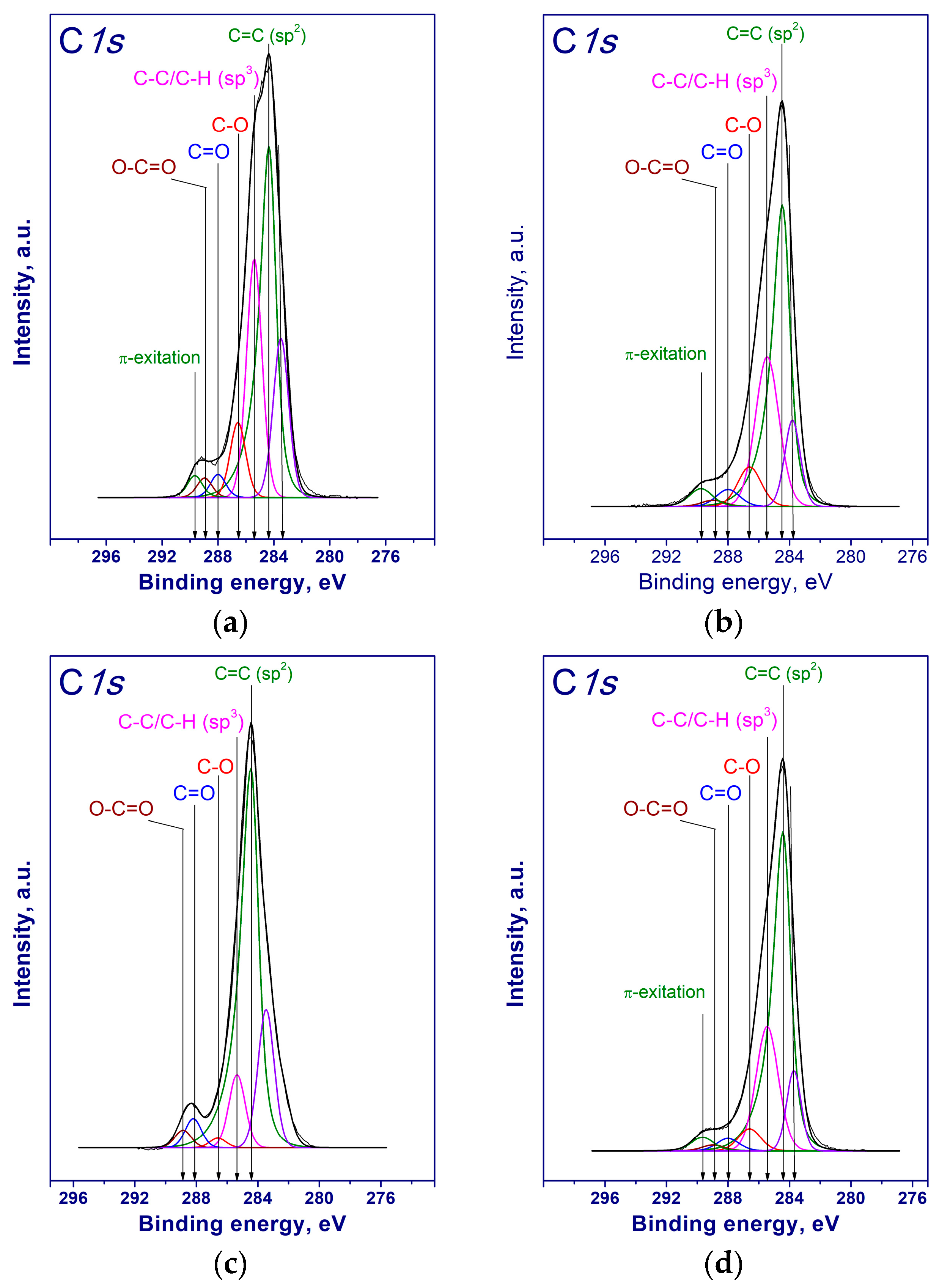
The elemental composition of the samples was also studied using XPS. Figure 4 shows the C1s spectra of the samples.
Figure 4.
C1s XPS spectra of carbonized materials after physical activation: (a) buckwheat husks; (b) sunflower seed husks; (c) corn cobs; (d) pine nut shells.
Table 2 presents bond energy values that allow a quantitative assessment of the contribution of different forms of carbon.
Table 2.
Binding energy values (C1s spectrum, XPS).
The atomic ratios of elements within the surface layer of the samples are given in Table 3.
Table 3.
Atomic concentration of elements in the surface layer of samples (according to XPS).
According to XPS, the near surface area contains carbon (84.9–86.7%), which predominantly exists in the form of sp2 C=C bonds (284.5 eV) in all samples with C-C/C-H (sp3) carbon (285.6 eV). Oxygen (12.0–14.4 at.%) is in the form of C–O (286.5 eV), C=O (288 eV), and O–C=O (288.9 eV) groups. Buckwheat husks, sunflower seed husks, and crushed corn cobs showed the highest concentration of alcohol groups (4.1–7.7%) compared to the other two. The concentration of oxygen in the surface layer is the highest for buckwheat husk-derived carbon. All samples contained 1.1–2.2% carboxylic groups. The lowest C:O ratio was found for the pine nut shell-based material. The highest C:O ratio (7.1) was observed for biochar derived from crushed corn cobs.
The surface of the carbon material made from the pine nut shell contains the highest oxygen content (14.4 at.%), whereas EDX data show only 4.99%, indicating its predominance within the surface layer. This behavior is typical for all biochar samples.
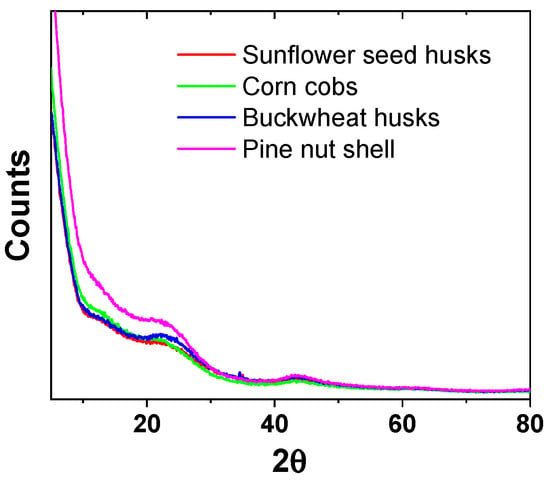
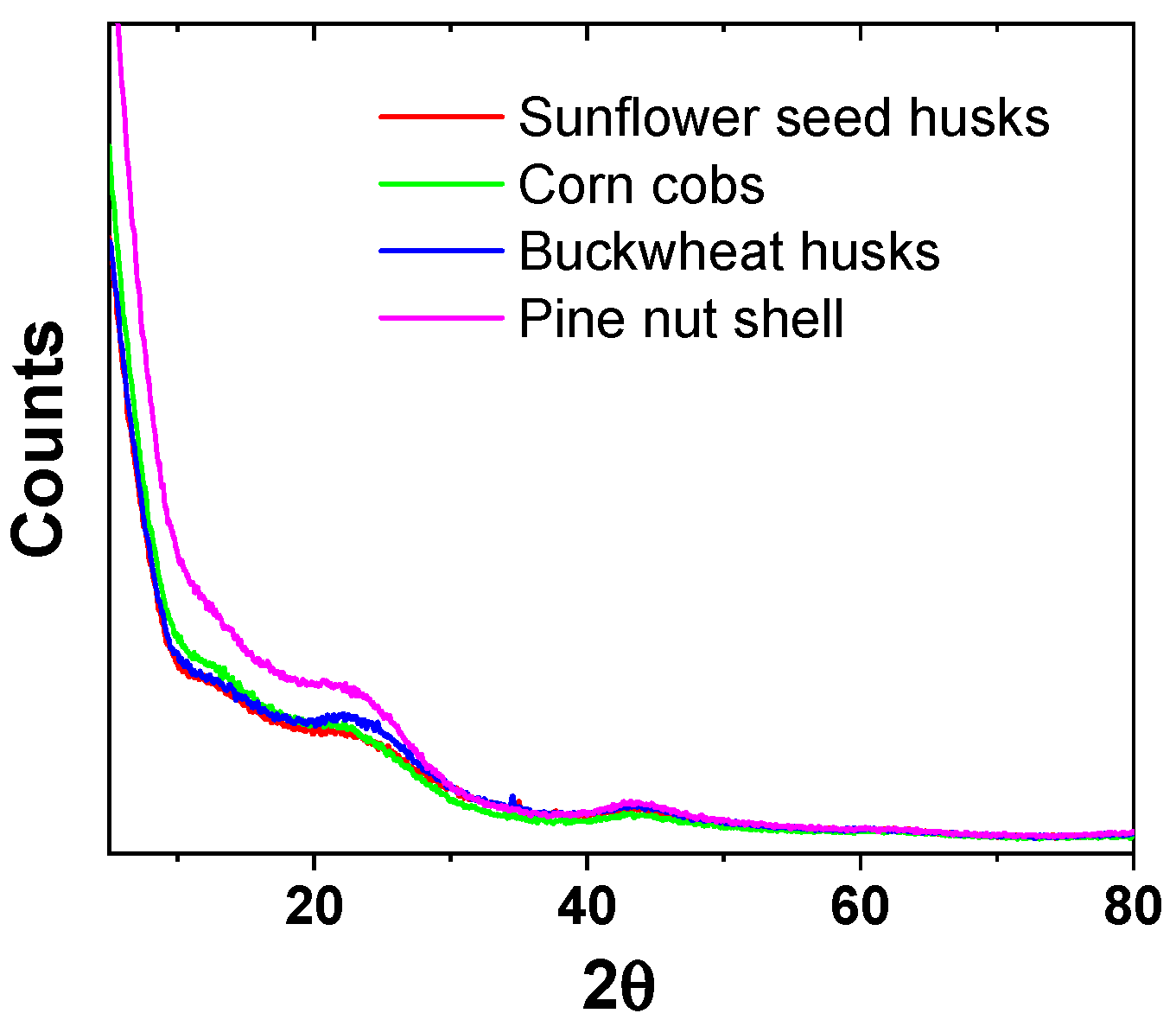
All biochars showed the component with lower binding energy (283.7 eV) compared to the one for sp2 bonded carbon atoms and its fraction is high enough (9.8–22.8). Usually, the components with energy below 284.5 eV are interpreted as carbide ones [39,40,41]. However, according to EDX, the content of metallic impurities is low enough to form carbides. The absence of diffraction reflections related to these carbide phases (Figure 5) also supports this. Some researchers attributed this component to intercalated metal (e.g., sodium) in carbons [42]. Therefore, we suggest to interpret this components as C–C bond in pentagonal rings, that is reported in [43,44].
Figure 5.
XRD patterns of biochars (Cu Kα radiation).
Nitrogen was detected on the surface of all samples at the level of 0.5–0.7 at.% (according to XPS). It can be added that EDX is a relatively bulk (~1 µm) type of analysis compared to XPS, which is surface-sensitive (nm-scale depth). For example, therefore the higher XPS oxygen content for buckwheat husk-based biochar (14.4 at.%) compared with EDX (5.99 at.%) indicates surface oxygen enrichment.
Table S1 (Supplementary Materials) indicates the presence of carbon bonded to various atoms, according to XPS. Nitrogen exists in pyridine, amine, and pyrrolic forms. Buckwheat husk-based biochar contained pyrrolic nitrogen (400.1 eV); the sunflower husk- and corn cob-based materials had nitrogen in pyridine (398.1 eV) and pyrrolic (400.4 eV) forms, whereas the pine nut shell-based one had it in the amine form (399.4 eV). Calcium was present as CaCO3 (347.6 eV) for all samples, excluding the pine nut shell-based one. Despite the presence of silicon in all samples according to EDX, XPS detected it only in corn cob-based biochar (103.1 eV).
Figure 5 shows the XRD patterns of the biochars.
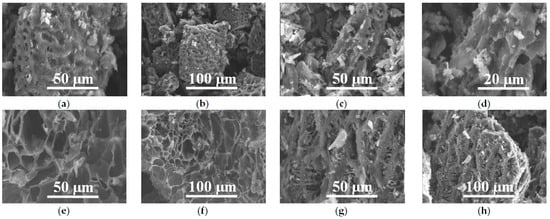
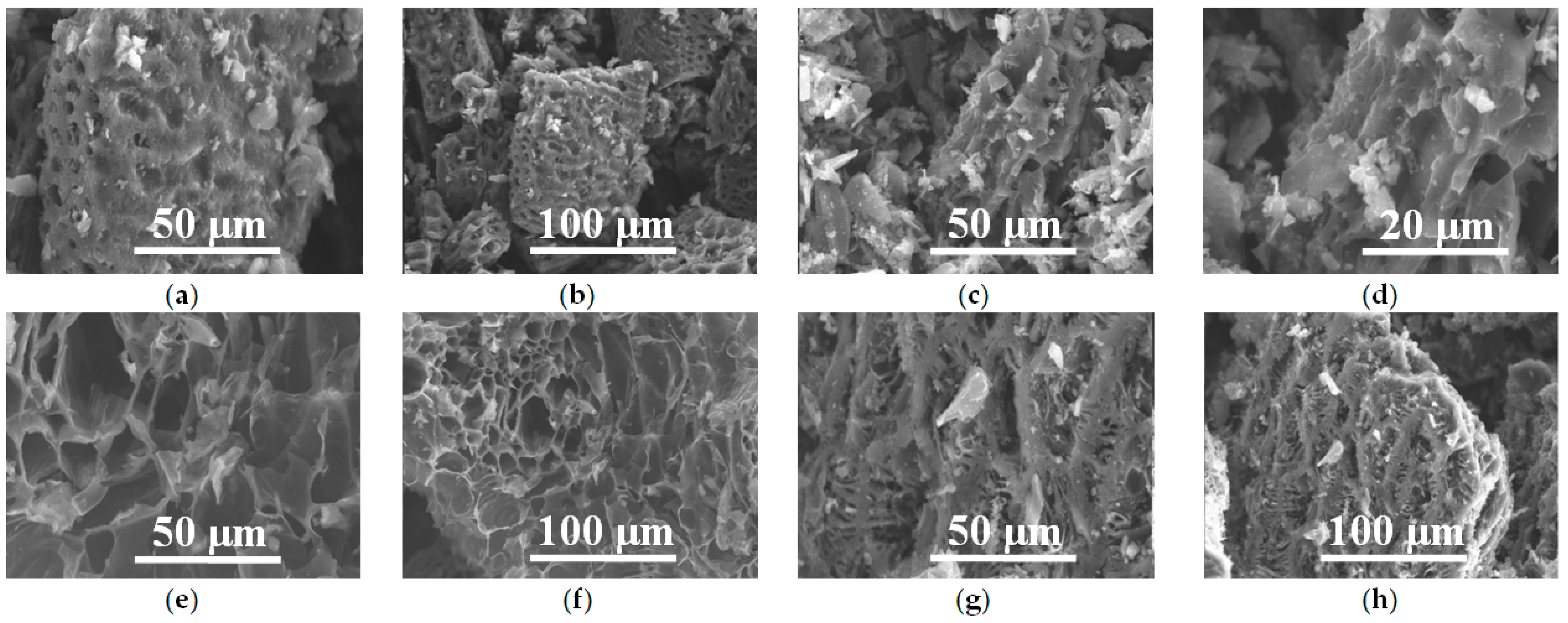
It can be noted that there are no peaks related to crystalline phases in XRD patterns. One can see from Figure 6 that all samples have a diffuse halo in the region of 2θ ≈ 20–30°, that indicates an amorphous/disordered form of carbon [45] instead of crystallite one. SEM images of these samples are shown in Figure 6.
Figure 6.
SEM images: (a,b) buckwheat husks; (c,d) sunflower seed husks; (e,f) corn cobs; (g,h) pine nut shells.
SEM images show that the surfaces of all samples are irregularly shaped and rough, which is typical of biochars derived from plant-based sources [46]. Cracks and cavities are present on the surface of all samples, indicating the development of a porous structure during heat treatment.
The samples obtained are porous enough. For example, the surface area of buckwheat husks reached 470 m2/g (155 m2/g are micropores) with a total pore volume of 0.22 cm3/g. This sample has an average pore diameter of 1.86 nm. The value of the specific surface area correlates with that for activated carbon based on buckwheat husk [47]. The specific surface area of biochars, which are all predominantly mesoporous based on sunflower seed husks, corn cobs, and pine nut shells were 210, 324, and 81 m2/g, respectively (surface area of micropores was 0, 95, and 13 m2/g, respectively). The isotherms of adsorption and pore size distributions are given in Figure S2 and Table S2 (Supplementary Materials).
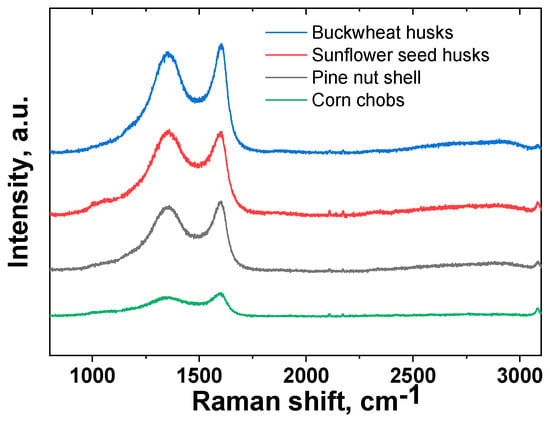
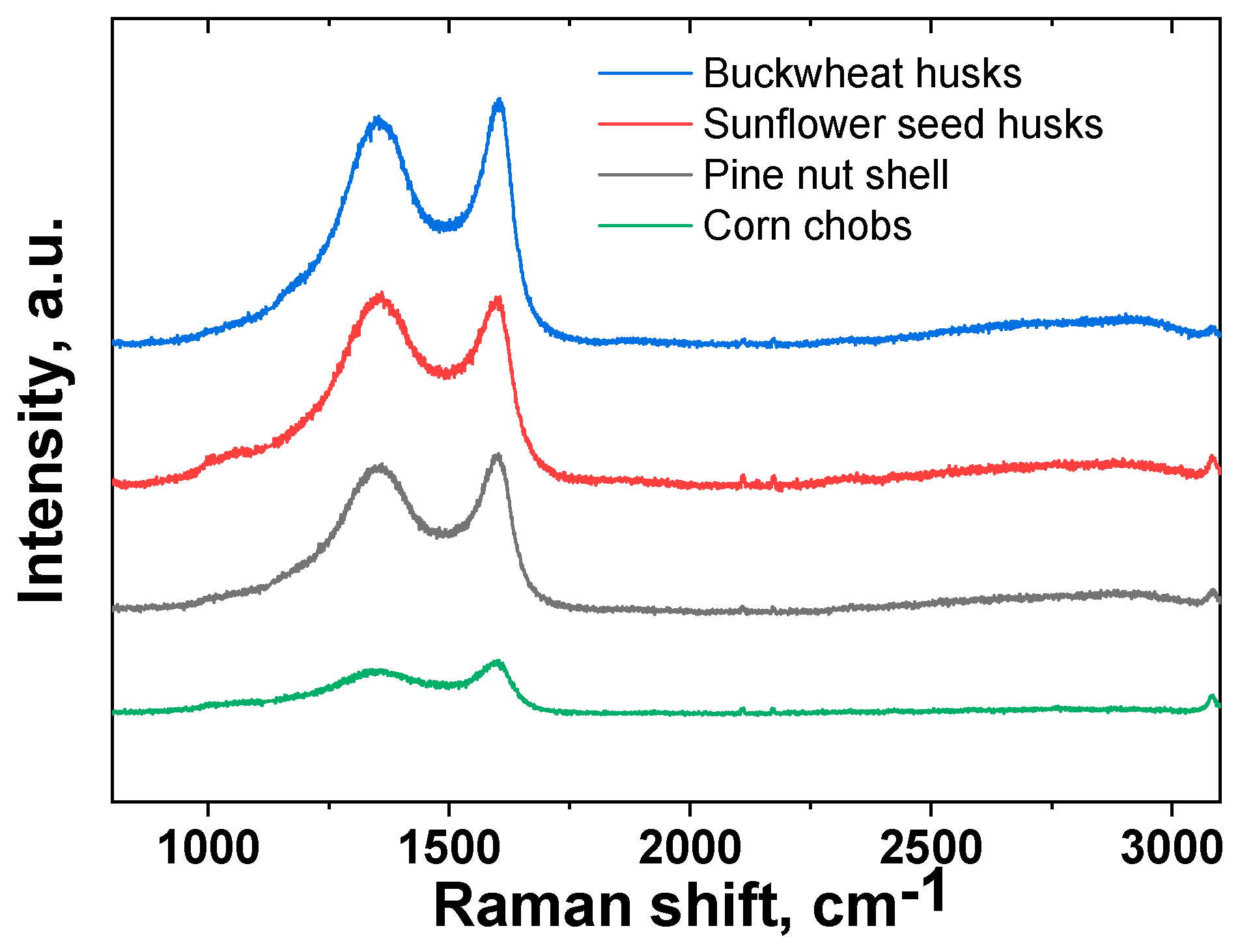
Raman spectra of biochars are given in Figure 7 below.
Figure 7.
Raman spectra of biochars.
Table 4 shows the results of treatment of the Raman spectra of biochars.
Table 4.
Results of treatment of Raman spectra of the sensing materials.
Raman spectroscopy provides direct structural characterization for biochars under study. Sunflower seed husks with the highest I(D)/I(G) ratio (0.86) and broadest D and G modes (FWHM (D) and (G) were 146.5 and 79.8 cm−1, respectively), possess abundant edge defects and small crystallites. In contrast, buckwheat husk-based biochar exhibited the narrowest FWHM values (130.0 and 69.9 cm−1, respectively) and the shifted peak positions (1346 and 1599 cm−1, respectively) indicating a more homogeneous yet heteroatom-doped carbon network. Pine nut shells showing a similar I(D)/I(G) (0.78) with buckwheat husk-based sample show broader FWHM (146.6 cm−1 for D mode), implying a wide distribution of defect sites with deep potential wells. Crushed corn cobs, with the lowest I(D)/I(G) = 0.57 and the broadest D peak (156.6 cm−1), represented the carbon materials with lower disorder degree.
3.2. NO2 Sensing Behavior
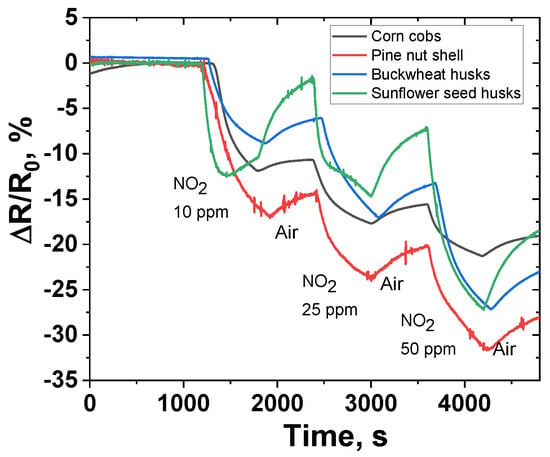
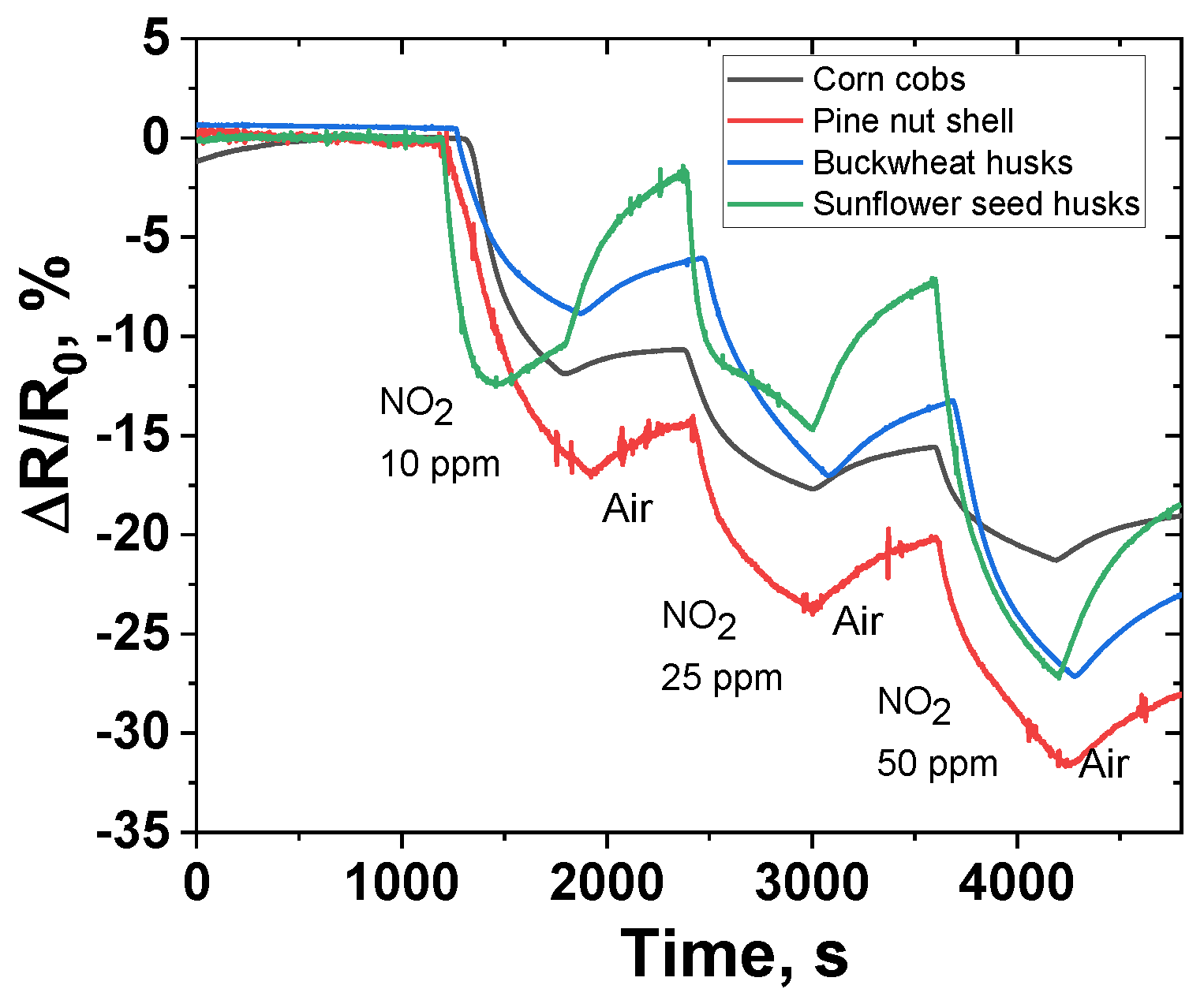
The sensing curves of biochar-based sensors for NO2 are presented in Figure 8.
Figure 8.
Response of biochar-based sensors to NO2 (25 °C).
Exposure to NO2 leads to a decrease in resistance (Figure 8) of all studied biochars, which is typical for p-type semiconductor materials. The adsorption of NO2 as an electron-withdrawing compound led to an increase in the concentration of charge carriers (holes), accompanied by a drop in resistance [48,49,50]. As the concentration of nitrogen dioxide increases, the response increases accordingly. There are two types of adsorption that pass simultaneously—the weak physical adsorption and strong chemical adsorption in terms of interaction of analyte molecules with functional groups in biochars. The feature of biochars is relatively high concentration of oxygen-containing functional groups acting as centers for NO2 adsorption.
The highest response across the entire range of NO2 concentrations is demonstrated by the pine nut shell sample: the response reaches 31.5% at 50 ppm. The sunflower seed husk sample demonstrated the best recovery to the baseline signal after NO2 injection stops. After exposure to 10 ppm NO2, the response returns almost to the baseline, indicating reversible adsorption of NO2 without any heating. This is an advantage for biochar-based sensors. It can be noted that the sensor response is high enough compared to similar materials, e.g., activated carbon [51].
The other characteristics of sensing materials were analyzed and shown in Table 5.
Table 5.
Summary of characteristics of the sensing materials.
Based on the comparative analysis of biochar-based sensing materials, a clear relationship between sensitivity, response rate, and recovery degree, governed by the domination of physical adsorption versus chemisorption. It can be suggested, that the oxygen-containing functional groups act as centers for NO2 adsorption.
Sunflower seed husks exhibit the best overall balance of the highest recovery (85%) and fastest response (108 s), making them ideal for real-time continuous monitoring, but its ΔR/R0 is the lowest one. It is interesting that this material has the higher disorder degree (according to Raman spectroscopy, I(D)/I(G) = 0.86). This value is in accordance with C:O ratio, determined through EDX analysis, and is the lowest one among the samples studied. An example of reproducibility curves of sensing curves of three samples based on sunflower seed husks is given in Figure S3 (Supplementary Materials). This sample was also examined for response to NH3 and CH4, indicating the dominating effect of NO2 detection among these gases; see Figure S4 (Supplementary Materials).
Buckwheat husk-based material, despite a moderate response (ΔR/R0 = 8.7% at 10 ppm), offers the highest sensitivity (0.455%/ppm) and is therefore best-suited for detecting concentrations at the 10–50 ppm level in laboratory settings; biochar based on pine nut shells showed the highest resistance change when contacting analyte (16.8% at 10 ppm) at the expense of poor recovery (13% at 10 ppm) and slow desorption, which makes them suitable as threshold alarms for definite NO2 concentrations. This low recovery degree is mainly caused by strong chemical adsorption of NO2 molecules compared to weak physical adsorption and the latter is desirable for real-time monitoring application, whereas the chemisorption-based material is appropriate for only “threshold”-type sensors.
It is interesting to mention the fact that the buckwheat husk-based sample with 470 m2/g surface area showed lower sensing response compared to other materials. There are few factors affecting the sensing behavior. According to numerous studies on gas sensors, the interaction of a sensing material with NO2 can occur via two mechanisms: chemisorption (adsorption at functional groups) and physisorption (adsorption at defect sites) [52,53]. In carbon nanomaterials, defects on the sidewalls and end caps are known to facilitate physical gas adsorption, while chemical functionalization creates additional surface groups that further enhance the adsorption of gas molecules and improve sensitivity. In our sensors, as in most carbon nanomaterials with an elevated oxygen concentration, the actual interaction with NO2 is a combination of both processes. Consequently, there are many reported cases in which a sensing material with a high specific surface area but high carbon content exhibits a lower response than an oxygen-rich carbon material with a more modest surface area. It can be emphasized that it is impossible to separate the contribution of each type of interaction to the sensor response. It can be only suggested that a high specific surface area alone is not sufficient to provide high sensor response. The second factor is the accessibility of the surface area and, probably, the availability of the surface to NO2 molecules is not so high compared to other biochar samples [54]. The highest response of pine nut shells can be mainly related to higher concentration of C=O and O–C=O fractions in C1s spectrum (according to XPS). But it has a shorter response time, since, usually, the faster sensors show a lower ΔR/R0 [55]. In contrast, sunflower seed husk-based sample shows the best recovery. This sample has the highest oxygen content (8.46 at.%, EDX), the lowest EDX C:O ratio (10.54 at.) and absence of micropores (according to low temperature nitrogen adsorption). Therefore, we suggest the concentration of micropores can somehow prevent the penetration inside the micropores and “trapping” of NO2 molecules; this causes more full desorption of molecules when contacting the air.
The biochar based on the corn cobs showed no outstanding parameters. The high recovery degree and short response time for the biochar based on sunflower seed husks is mainly due to the dominating effect of physical adsorption compared to chemisorption. The weak interaction with analytes makes it easy to carry out desorption. Summarizing the characteristics of biochars, we can suggest that there is one parameter that contributes to the sensing behavior: the availability of the active surface of the film to NO2 molecules. Even if a sensor shows a high surface area and a high number of functional groups acting as centers for capturing NO2 molecules, some of the active area may not be available for adsorption.
Since the biochar based on buckwheat husks showed the lowest response (8.7% at 10 ppm NO2) it was decided to carry out the NaOH activation (anhydrous NaOH; 1:3 wt. ratio; 750 °C for 1.5 h) of the sample (Figures S5–S7, Table S3 in Supplementary Materials) and test the sensor based on it. It is evident that chemical activation of buckwheat husk-based biochar with NaOH did not improve the sensor’s performance. Moreover, the NaOH activation increases the sensor response (405 s compared to 425 s for non-activated sample) and sensitivity (0.35%/ppm compared to 0.455%/ppm s for non-activated sample).
A comparison of sensor response with already reported data is shown in Table 6.
Table 6.
Comparison of biochar-based sensing properties with published data.
The biochar-based sensors can be applied in urban and industrial air quality monitoring networks, especially for controlling NO2 emissions from vehicles and thermal power plants. Their room-temperature operation, low cost, and renewable feedstock make them suitable for portable personal exposure devices, smart ventilation systems, and systems for early warning for detection of leaks of toxic gases. The variety of feedstock used for the biochar makes it possible to control their chemical composition, surface chemistry in order to tune their functional properties. The sensing materials synthesized can be applied for industrial control of NO2 in air mixtures in technological equipment within a ppm-level scale.
4. Conclusions
Biochars from agricultural waste (sunflower seed husks, buckwheat husks, pine nut shells, and crushed corn cobs) were successfully prepared using a two-stage technique. It has been found that all samples are carbonaceous materials (89.27–94.69 at.% C) with appreciable oxygen contents (4.65–8.46 wt.%). The lowest carbon and thus the highest oxygen content (8.46 at.%) is found in sunflower seed husk-based biochar, which correlates with the high mineral impurities (K, Ca, P) inherent to this feedstock. In contrast, biochars from pine nut shells and corn cobs exhibited the highest carbon contents (>92 at.%) and the lowest oxygen contents, likely due to their higher lignin and cellulose fractions in the original biomass. XPS analysis reveals that the near-surface layers of all samples are enriched in oxygen (12.3–14.4 at.%), with the maximum O concentration (14.4 at.%) observed for pine nut shell-based biochar, indicating that oxygen-containing groups are preferentially located on the surface rather than in the bulk. The main oxygen forms are C–O (alcohols/ethers), C=O (carbonyls), and O–C=O (carboxyls), with the highest proportion of alcoholic groups (7.7%) found in buckwheat husk-based material. It was suggested that chemical composition of biochars is governed not only by the activation conditions but by the mineral composition and the original plant feedstock. It has been found that all materials exhibited p-type semiconducting behavior upon NO2 exposure at room temperature. The pine nut shell sample demonstrated the highest response (16.8% at 10 ppm). The material derived from sunflower seed husks showed the best recovery of the baseline signal after NO2 injection.
Supplementary Materials
The following supporting information can be downloaded at: https://www.mdpi.com/article/10.3390/c12040094/s1, Figure S1—FTIR spectra of materials carbonized at 500 °C for 2 h made from different feedstock: (a) buckwheat husks; (b) sunflower seed husks; (c) corn cobs; (d) pine nut shells; Figure S2—Adsorption–desorption (N2) isotherms and pore size distributions of biochars based on: buckwheat husks (a,b), sunflower seed husks (c,d), pine nut shell (e,f), corn cobs (g,h); Figure S3—Reproducibility (three samples) of sensing curve of sunflower seed husk-based biochar; Figure S4—Selectivity tests of the sunflower seed husk-based biochar; Figure S5—FTIR-spectrum of activated carbons based on buckwheat husks after chemical activation with NaOH; Figure S6– SEM images of buckwheat husk-based biochar, activated with NaOH; Figure S7—NO2 sensing curves of gas sensor based on biochar based on heat-treated buckwheat husks (500 °C, 2 h) with the subsequent NaOH activation. Table S1 Binding energies of the N1s, Cr2p3/2, S2p3/2, Ca2p3/2, Si2p, and O1s components (in eV) corresponding to carbon in various states. Table S2 Texture properties of the biochars. Table S3—Elemental composition of the surface of a sample based on buckwheat husk after chemical activation with NaOH, determined by EDX.
Author Contributions
Conceptualization, K.E.G., A.G.B. and V.G.; methodology, A.G.B.; V.G., K.E.G., A.V.U. and A.R.S.; formal analysis, V.G. and K.E.G.; investigation, A.G.B.; V.G., K.E.G., A.V.U., E.A.M. and A.R.S.; resources, E.A.M. and A.V.U.; data curation, K.E.G.; writing—original draft preparation, K.E.G. and A.G.B.; writing—review and editing, K.E.G. and A.G.B.; visualization, A.G.B.; supervision, A.G.B.; project administration, A.G.B.; funding acquisition, A.G.B. All authors have read and agreed to the published version of the manuscript.
Funding
The research of carbon nanomaterials and their modification was performed under support of the State Task of the Ministry of Science and Higher Education of the Russian Federation (FSUN-2026-0006).
Institutional Review Board Statement
Not applicable.
Informed Consent Statement
Not applicable.
Data Availability Statement
The original contributions presented in this study are included in the article/Supplementary Material. Further inquiries can be directed to the corresponding author.
Acknowledgments
Authors acknowledge N.S. Lazarenko for taking part in experiments with biochar.
Conflicts of Interest
The authors declare no conflicts of interest.
References
- Agapkin, A.M.; A Makhotina, I.; A Ibragimova, N.; Goryunova, O.B.; Izembayeva, A.K.; Kalachev, S.L. The problem of agricultural waste and ways to solve it. IOP Conf. Ser. Earth Environ. Sci. 2022, 981, 022009. [Google Scholar] [CrossRef] [Scilit]
- Klintsevich, V.N.; Flyurik, E.A. Methods of Using Common Buckwheat Husk: A Review. Trudy BGTU, Ser. 2: Khimicheskie Tekhnologii, Biotekhnologii, Geoekologiya 2020, No. 1 (229), 68–81. Available online: https://elib.belstu.by/handle/123456789/33496 (accessed on 24 November 2026).
- Tsvetanova, F.; Naydenova, G.; Boyadzhieva, S. Sunflower Seed Hulls and Meal—A Waste with Diverse Biotechnological Benefits. Biomass 2025, 5, 47. [Google Scholar] [CrossRef] [Scilit]
- Chen, D.; Chen, X.; Sun, J.; Zheng, Z.; Fu, K. Pyrolysis polygeneration of pine nut shell: Quality of pyrolysis products and study on the preparation of activated carbon from biochar. Bioresour. Technol. 2016, 216, 629–636. [Google Scholar] [CrossRef] [Scilit] [PubMed]
- Tabakaev, R.; Kalinich, I.; Dimitryuk, I.; Asilbekov, A.; Astafev, A.; Ibraeva, K.; Shanenkov, I.; Mostovshchikov, A.; Chumerin, P. Experimental study of microwave processing of pine nut shells into a high-calorie gas: Main results and physicochemical features. J. Anal. Appl. Pyrolysis 2023, 176, 106264. [Google Scholar] [CrossRef] [Scilit]
- Lee, J.; Kim, K.; Kwon, E.E. Biochar as a Catalyst. Renew. Sustain. Energy Rev. 2017, 77, 70–79. [Google Scholar] [CrossRef] [Scilit]
- Hama Aziz, K.H.; Mustafa, F.S.; Karim, M.A.H.; Hama, S. Biochar-based catalysts: An efficient and sustainable approach for water remediation from organic pollutants via advanced oxidation processes. J. Environ. Manag. 2025, 390, 126245. [Google Scholar] [CrossRef] [Scilit] [PubMed]
- Drané, M.; Zbair, M.; Hajjar-garreau, S.; Josien, L.; Michelin, L.; Bennici, S.; Limousy, L. Unveiling the Potential of Corn Cob Biochar: Analysis of Microstructure and Composition with Emphasis on Interaction with NO2. Materials 2024, 17, 159. [Google Scholar] [CrossRef] [Scilit] [PubMed]
- Liu, Z.; Xu, Z.; Xu, L.; Buyong, F.; Chay, T.C.; Li, Z.; Cai, Y.; Hu, B.; Zhu, Y.; Wang, X. Modified biochar: Synthesis and mechanism for removal of environmental heavy metals. Carbon Res. 2022, 1, 1–21. [Google Scholar] [CrossRef] [Scilit]
- Hu, P.; Sun, J.; Ran, B.; Li, J.; Fang, J.; Sun, Q.; Tian, N.; Wu, Z.; Duan, H. Developing the sensing mechanism of high-performance N2H4 sensors derived from waste cotton stalk using a one-step process. Chem. Eng. J. 2025, 509, 161373. [Google Scholar] [CrossRef] [Scilit]
- Himani; Amrita; Agarwal, T. Applications of biochar in sensors: Recent advancements and future trends. Mater. Today Chem. 2025, 45, 102646. [Google Scholar] [CrossRef] [Scilit]
- Abdulla Irfan, J.; Charulatha, G.; Monisha Mary, L.; Ramanamoorthy, S.; Karthikeyan, C.; Naveen Kumar, S.; Manikandan, G.; Jayapriya, J.; Nagarasampatti Palani, K. Biomass-derived biochar for electrochemical energy storage and conversion systems: Opportunities and challenges. Future Batter. 2025, 6, 100077. [Google Scholar] [CrossRef] [Scilit]
- Ma, Z.-W.; Liu, H.-Q.; Lü, Q.-F. Porous biochar derived from tea saponin for supercapacitor electrode: Effect of preparation technique. J. Energy Storage 2021, 40, 102773. [Google Scholar] [CrossRef] [Scilit]
- Ma, C.; Tang, L.; Cheng, H.; Li, Z.; Li, W.; He, G. Biochar for supercapacitor electrodes: Mechanisms in aqueous electrolytes. Battery Energy 2024, 3, 20230058. [Google Scholar] [CrossRef] [Scilit]
- Taha, S.S.; Idoudi, S.; Alhamdan, N.; Ibrahim, R.H.; Surkatti, R.; Amhamed, A.; Alrebei, O.F. Journal of Hazardous Materials Advances Comprehensive review of health impacts of the exposure to nitrogen oxides (NOx), carbon dioxide (CO2), and particulate matter (PM). J. Hazard. Mater. Adv. 2025, 19, 100771. [Google Scholar] [CrossRef] [Scilit]
- Najafi, P.; Ghaemi, A. Chemiresistor gas sensors: Design, Challenges, and Strategies: A comprehensive review. Chem. Eng. J. 2024, 498, 154999. [Google Scholar] [CrossRef] [Scilit]
- Lee, S.W.; Lee, W.; Hong, Y.; Lee, G.; Yoon, D.S. Recent advances in carbon material-based NO2 gas sensors. Sens. Actuators B Chem. 2018, 255, 1788–1804. [Google Scholar] [CrossRef] [Scilit]
- Dai, X.; Zhu, Y.; Zhang, S.; Sun, P.; Dong, X.; Dong, F.; Chen, S. Performance Optimization of Semiconductor Gas Sensors Based on Interfacial Reaction Regulation: Status and Challenges. ACS Sens. 2026, 11, 792–810. [Google Scholar] [CrossRef] [Scilit] [PubMed]
- Krishna, K.G.; Parne, S.; Pothukanuri, N.; Kathirvelu, V.; Gandi, S.; Joshi, D. Nanostructured metal oxide semiconductor-based gas sensors: A comprehensive review. Sens. Actuators A Phys. 2022, 341, 113578. [Google Scholar] [CrossRef] [Scilit]
- Belhachemi, M.; Jeguirim, M.; Limousy, L.; Addoun, F. Comparison of NO2 removal using date pits activated carbon and modified commercialized activated carbon via different preparation methods: Effect of porosity and surface chemistry. Chem. Eng. J. 2014, 253, 121–129. [Google Scholar] [CrossRef] [Scilit]
- Ghouma, I.; Jeguirim, M.; Dorge, S.; Limousy, L.; Ghimbeu, C.M.; Ouederni, A. Activated carbon prepared by physical activation of olive stones for the removal of NO2 at ambient temperature. Comptes Rendus Chim. 2015, 18, 63–74. [Google Scholar] [CrossRef] [Scilit]
- Janu, R.; Mrlik, V.; Ribitsch, D.; Hofman, J.; Sedláček, P.; Bielská, L.; Soja, G. Biochar surface functional groups as affected by biomass feedstock, biochar composition and pyrolysis temperature. Carbon Resour. Convers. 2021, 4, 36–46. [Google Scholar] [CrossRef] [Scilit]
- Animali, L.; Corrado, S.; Mitillo, N.; Tuccimei, P.; Bartoli, M.; Mattei, M.; Giorcelli, M. Characterization and evaluation of commercial biochar for surface water purification. Sustain. Horiz. 2025, 15, 100145. [Google Scholar] [CrossRef] [Scilit]
- Leng, L.; Xiong, Q.; Yang, L.; Li, H.; Zhou, Y.; Zhang, W.; Jiang, S.; Li, H.; Huang, H. An overview on engineering the surface area and porosity of biochar. Sci. Total Environ. 2021, 763, 144204. [Google Scholar] [CrossRef] [Scilit] [PubMed]
- Afshar, M.; Mofatteh, S. Biochar for a sustainable future: Environmentally friendly production and diverse applications. Results Eng. 2024, 23, 102433. [Google Scholar] [CrossRef] [Scilit]
- Colomba, A.; Berruti, F.; Briens, C. Model for the physical activation of biochar to activated carbon. J. Anal. Appl. Pyrolysis 2022, 168, 105769. [Google Scholar] [CrossRef] [Scilit]
- Pizzanelli, S.; Maisano, S.; Pinzino, C.; Manariti, A.; Chiodo, V.; Pitzalis, E.; Forte, C. The Effect of Activation on the Structure of Biochars Prepared from Wood and from Posidonia Oceanica: A Spectroscopic Study. Physchem 2022, 2, 286–304. [Google Scholar] [CrossRef] [Scilit]
- Pathy, A.; Pokharel, P.; Chen, X.; Balasubramanian, P.; Chang, S.X. Activation methods increase biochar’s potential for heavy-metal adsorption and environmental remediation: A global meta-analysis. Sci. Total Environ. 2023, 865, 161252. [Google Scholar] [CrossRef] [Scilit] [PubMed]
- Gayathiri, M.; Pulingam, T.; Lee, K.T.; Sudesh, K. Activated carbon from biomass waste precursors: Factors affecting production and adsorption mechanism. Chemosphere 2022, 294, 133764. [Google Scholar] [CrossRef] [Scilit] [PubMed]
- Heidarinejad, Z.; Dehghani, M.H.; Heidari, M.; Javedan, G.; Ali, I.; Sillanpää, M. Methods for preparation and activation of activated carbon: A review. Environ. Chem. Lett. 2020, 18, 393–415. [Google Scholar] [CrossRef] [Scilit]
- Danish, M.; Ahmad, T. A review on utilization of wood biomass as a sustainable precursor for activated carbon production and application. Renew. Sustain. Energy Rev. 2018, 87, 1–21. [Google Scholar] [CrossRef] [Scilit]
- Mestre, A.S.; Viegas, R.M.; Mesquita, E.; Rosa, M.J.; Carvalho, A.P. Engineered pine nut shell derived activated carbons for improved removal of recalcitrant pharmaceuticals in urban wastewater treatment. J. Hazard. Mater. 2022, 437, 129319. [Google Scholar] [CrossRef] [Scilit] [PubMed]
- Qin, L.; Hou, Z.; Lu, S.; Liu, S.; Liu, Z.; Jiang, E. Porous Carbon derived from Pine Nut Shell prepared by Steam Activation for Supercapacitor Electrode Material. Int. J. Electrochem. Sci. 2019, 14, 8907–8918. [Google Scholar] [CrossRef] [Scilit]
- Zemnukhova, L.A.; Shkorina, E.D.; Fedorishcheva, G.A. Composition of Inorganic Components of Buckwheat Husk and Straw. Russ. J. Appl. Chem. 2005, 78, 324–328. [Google Scholar] [CrossRef] [Scilit]
- Long, G.L.; Winefordner, J.D. Limit of detection. A closer look at the IUPAC definition. Anal. Chem. 1983, 55, 712A–724A. [Google Scholar] [CrossRef] [Scilit]
- Manoj, B.; Raj, A.M.; Thomas, G.C. Tailoring of low grade coal to fluorescent nanocarbon structures and their potential as a glucose sensor. Sci. Rep. 2018, 8, 13891. [Google Scholar] [CrossRef] [Scilit] [PubMed]
- Thole, D.; Modibane, K.D.; Mhlaba, R.; Balogun, S.A.; Botha, E.; Musyoka, N.M. Metal-organic framework modified carbon nanotubes for hydrogen production from formic acid with carbon dioxide capture and conversion. Sci. Rep. 2025, 15, 44306. [Google Scholar] [CrossRef] [Scilit] [PubMed]
- Saito, K.; Xu, T.; Ishikita, H. Correlation between C=O Stretching Vibrational Frequency and pKa Shift of Carboxylic Acids. J. Phys. Chem. B 2022, 126, 4999–5006. [Google Scholar] [CrossRef] [Scilit] [PubMed]
- Lourenço, M.A.O.; Zeng, J.; Jagdale, P.; Castellino, M.; Sacco, A.; Farkhondehfal, M.A.; Pirri, C.F. Biochar/Zinc Oxide Composites as Effective Catalysts for Electrochemical CO2 Reduction. ACS Sustain. Chem. Eng. 2021, 9, 5445–5453. [Google Scholar] [CrossRef] [Scilit]
- Jo, W.-K. Coupling of titania with multiwall carbon nanotubes for decomposition of gas-phase pollutants under simulated indoor conditions. J. Air Waste Manag. Assoc. 2013, 63, 963–970. [Google Scholar] [CrossRef] [Scilit] [PubMed]
- Greczynski, G.; Primetzhofer, D.; Hultman, L. Reference binding energies of transition metal carbides by core-level x-ray photoelectron spectroscopy free from Ar+ etching artefacts. Appl. Surf. Sci. 2018, 436, 102–110. [Google Scholar] [CrossRef] [Scilit]
- Aina, S.; Tratnik, B.; Vizintin, A.; Tchernychova, E.; Lobera, M.P.; Dominko, R.; Bernechea, M. Simple surface treatment improves performance of carbon materials for sodium ion battery anodes. J. Power Sources 2024, 610, 234730. [Google Scholar] [CrossRef] [Scilit]
- Ayiania, M.; Smith, M.; Hensley, A.J.R.; Scudiero, L.; McEwen, J.-S.; Garcia-Perez, M. Deconvoluting the XPS spectra for nitrogen-doped chars: An analysis from first principles. Carbon N. Y. 2020, 162, 528–544. [Google Scholar] [CrossRef] [Scilit]
- Xu, W.; Cai, B.; Zhang, X.; Zhang, Y.; Zhang, Y.; Peng, H. The Biochar Derived from Pecan Shells for the Removal of Congo Red: The Effects of Temperature and Heating Rate. Molecules 2024, 29, 5532. [Google Scholar] [CrossRef] [Scilit] [PubMed]
- Girgis, B.S.; Temerk, Y.M.; Gadelrab, M.M.; Abdullah, I.D. X-ray Diffraction Patterns of Activated Carbons Prepared under Various Conditions. Carbon Lett. 2007, 8, 95–100. [Google Scholar] [CrossRef] [Scilit]
- Zhang, K.; Mao, J.; Chen, B. Reconsideration of heterostructures of biochars: Morphology, particle size, elemental composition, reactivity and toxicity. Environ. Pollut. 2019, 254, 113017. [Google Scholar] [CrossRef] [Scilit] [PubMed]
- Seimukhanova, L.; Zhantikeyev, U.; Sapargali, I.; Kunarbekova, M.; Kudaibergenov, K.; Skwarek, E.; Azat, S. Surface and Structural Characterization of Buckwheat Husk-Derived Activated Carbons: Correlation of SEM, Elemental, FTIR, Raman, and Porous Properties with Electrokinetic Behavior. Int. J. Mol. Sci. 2026, 27, 1803. [Google Scholar] [CrossRef] [Scilit] [PubMed]
- Ueda, T.; Katsuki, S.; Takahashi, K.; Narges, H.A.; Ikegami, T.; Mitsugi, F. Fabrication and characterization of carbon nanotube based high sensitive gas sensors operable at room temperature. Diam. Relat. Mater. 2008, 17, 1586–1589. [Google Scholar] [CrossRef] [Scilit]
- Zhang, W.; Cao, S.; Wu, Z.; Zhang, M.; Cao, Y.; Guo, J.; Zhong, F.; Duan, H.; Jia, D. High-Performance Gas Sensor of Polyaniline/Carbon Nanotube Composites Promoted by Interface Engineering. Sensors 2020, 20, 149. [Google Scholar] [CrossRef] [Scilit] [PubMed]
- Qi, M.; Huang, Z.; Zheng, H.; Zhao, L.; Jiang, R.; Wang, J.; Hu, J.; Chen, G.; Jia, S.; Wang, J. Layer-Dependent NO2-Sensing Performance in MoS2 for Room-Temperature Monitoring. ACS Appl. Nano Mater. 2023, 6, 9290–9297. [Google Scholar] [CrossRef] [Scilit]
- Kyokunzire, P.; Zaraket, J.; Izquierdo, M.T.; Fierro, V.; Celzard, A. p-/n-type conduction in activated carbon NO2 sensors with enhanced low-concentration sensitivity at room temperature. Carbon N. Y. 2026, 246, 120891. [Google Scholar] [CrossRef] [Scilit]
- Han, T.; Gao, S.; Wang, Z.; Fei, T.; Liu, S.; Zhang, T. Investigation of the effect of oxygen-containing groups on reduced graphene oxide-based room-temperature NO2 sensor. J. Alloys Compd. 2019, 801, 142–150. [Google Scholar] [CrossRef] [Scilit]
- Mittal, M.; Kumar, A. Carbon nanotube (CNT) gas sensors for emissions from fossil fuel burning. Sens. Actuators B Chem. 2014, 203, 349–362. [Google Scholar] [CrossRef] [Scilit]
- Cranny, A.W.J.; Atkinson, J.K.; Burr, P.M.; Mack, D. A comparison of thick- and thin-film gas-sensitive organic semiconductor compounds. Sens. Actuators B Chem. 1991, 4, 169–174. [Google Scholar] [CrossRef] [Scilit]
- Shishin, A.; Golovakhin, V.; Maksimovskiy, E.; Vostretsova, E.; Timofeev, V.; Bannov, A. Aerosol Spraying of Carbon Nanofiber-Based Films for NO2 Detection: The Role of the Spraying Technique. Appl. Sci. 2025, 15, 12110. [Google Scholar] [CrossRef] [Scilit]
- Kyokunzire, P.; Zaraket, J.; Fierro, V.; Celzard, A. Systematic Optimization of NO2 Detection Using Activated Carbon-Based Resistive Sensors. ACS Appl. Electron. Mater. 2025, 7, 2349–2361. [Google Scholar] [CrossRef] [Scilit]
- Mane, A.T.; Navale, S.T.; Patil, V.B. Room temperature NO2 gas sensing properties of DBSA doped PPy–WO3 hybrid nanocomposite sensor. Org. Electron. 2015, 19, 15–25. [Google Scholar] [CrossRef] [Scilit]
- Raju, P.; Rambeloson, J.; Ioannou, D.E.; Motayed, A.; Li, Q. Noble Metal-Decorated In2O3 for NO2 Gas Sensor: An Experimental and DFT Study. Chemosensors 2025, 13, 350. [Google Scholar] [CrossRef] [Scilit]
- Kim, D.-W.; Ha, S.; Ko, Y.; Wee, J.-H.; Kim, H.J.; Jeong, S.Y.; Tojo, T.; Yang, C.-M.; Kim, Y.A. Rapid, repetitive and selective NO2 gas sensor based on boron-doped activated carbon fibers. Appl. Surf. Sci. 2020, 531, 147395. [Google Scholar] [CrossRef] [Scilit]
- Zhang, F.; Lin, Q.; Han, F.; Wang, Z.; Tian, B.; Zhao, L.; Dong, T.; Jiang, Z. A flexible and wearable NO2 gas detection and early warning device based on a spraying process and an interdigital electrode at room temperature. Microsyst. Nanoeng. 2022, 8, 40. [Google Scholar] [CrossRef] [Scilit] [PubMed]

Disclaimer/Publisher’s Note: The statements, opinions and data contained in all publications are solely those of the individual author(s) and contributor(s) and not of MDPI and/or the editor(s). MDPI and/or the editor(s) disclaim responsibility for any injury to people or property resulting from any ideas, methods, instructions or products referred to in the content. |
© 2026 by the authors. Licensee MDPI, Basel, Switzerland. This article is an open access article distributed under the terms and conditions of the Creative Commons Attribution (CC BY) license.