


Abstract
Diesel exhaust soot (DES), a hazardous by-product of incomplete diesel combustion, was valorized into activated nanocarbon (ANC) through phosphoric acid activation for phenol removal from water. The synthesized ANC was characterized by FTIR, XRD, FE-SEM, TEM, EDX, and AFM. The results revealed predominantly spherical nanoparticles with an average size below 30 nm, a turbostratic carbon structure, and oxygen-containing surface functional groups favorable for adsorption. The adsorption performance was evaluated as a function of adsorbent dosage, contact time, initial phenol concentration, and temperature. The optimum adsorbent dosage and equilibrium time were 0.1 g and 90 min, respectively, while the highest removal efficiency was obtained at an initial phenol concentration of 10 mg L−1. The equilibrium data were best described by the Langmuir model (R2 = 0.999), with a maximum adsorption capacity of 23.98 mg g−1, indicating predominantly monolayer adsorption. Thermodynamic analysis confirmed that phenol adsorption was spontaneous (ΔG = −22.42 to −25.79 kJ mol−1) and endothermic (ΔH = +11.43 kJ mol−1), with a positive entropy change (ΔS° = +113.47 J mol−1 K−1). These findings demonstrate the potential of DES as a low-cost precursor for functional nanocarbon adsorbents and provide a sustainable approach for converting combustion waste into a value-added material for water purification.
1. Introduction
The continuous emission of gaseous pollutants and carbonaceous particulate matter into the air is still a major environmental concern related to air pollution from diesel combustion. Heavy-duty diesel generators, especially those with variable loads, and without efficient exhaust filtration systems emit large amounts of soot, which consists mainly of elemental carbon and contains varying quantities of organic compounds and inorganic ash [1]. In addition to being a source of pollution and global warming, these fine carbonaceous particles have a very high penetration potential into the respiratory system, and therefore are very harmful to humans. Hence, sustainable solutions for the recovery and reuse of soot from diesel engines have been gaining traction as a viable alternative to uncontrolled emissions into the environment. Accordingly, the conversion of such types of hazardous carbon-based waste to useful nanomaterials is an exciting waste valorization option which not only minimizes environmental impact, but also generates value added products in accordance with the principles of green chemistry [2].
Contamination of aquatic environments by the presence of phenolic compounds is now another serious environmental problem faced in parallel with atmospheric pollution. The phenolic pollutants are liberally emitted from petroleum refineries, petrochemicals, resin production, pharmaceuticals, hospitals, and other chemical processing facilities. These compounds are known to be priority pollutants due to their high toxicity, persistence and biological resistance. Additionally, chlorination of water containing phenol can result in the production of chlorophenols which are much more toxic and potentially carcinogenic than phenol itself. Phenol removal technologies developed include biological degradation, advanced oxidation, membrane separation and coagulation, but adsorption is one of the more efficient and economically attractive processes because it is relatively simple to operate, the performance of the process is high and implementation is relatively easy, especially if high-performance carbonaceous adsorbents are used [3].
Activated nanocarbon has gained significant attention due to its high specific surface area, porous structure, high physicochemical stability and tunable surface chemistry among the various types of adsorbent materials investigated for wastewater treatment (WWT). The properties mentioned above offer a large number of active adsorption sites and allow for several interaction mechanisms such as π–π electron donor/acceptor interactions between graphitic domains of carbon and aromatic contaminants, hydrogen bonding by oxygen surface functional groups and van der Waals interactions [4]. Therefore, the adsorption performance of activated nanocarbon is not solely dependent on surface area, but also on structural ordering, defect density, pore architecture and surface functionalization, all of which are strongly influenced by the material used as a precursor, the activation process. It is therefore necessary to comprehensively characterize the material’s physicochemical properties in order to determine the relationship between its structure and adsorption properties [5].
The phosphoric acid (H3PO4) was chosen as the activating agent because of the nature of the diesel exhaust soot as carbonaceous material and its surface chemistry. In contrast to the lignocellulosic precursors, diesel soot is already a highly carbonaceous material that is produced in the process of incomplete combustion and thus does not require a large-scale dehydration and carbonisation of cellulose, hemicellulose or lignin. Thermal treatment can facilitate the development of pores and create dehydration and condensation reactions, and preserve the carbon framework, with the assistance of H3PO4. This activation is attractive for the generation of oxygen functionalities on the surface, which can participate in the adsorption of phenol via surface interactions. In addition, the activation with H3PO4 is usually performed at lower temperature than strong alkaline activation with KOH and yields relatively high carbon yields and allows the use of the H3PO4 as an activation agent which can be removed by subsequent washing [6].
The materials KOH and ZnCl2 were not chosen since their activation is different from that needed in the present preparation. KOH is a more potent etching agent that can produce more extensive reactions with the carbon matrix and is often used for higher activation temperatures, while ZnCl2 is more of a dehydrating agent, and requires the extra step of cleaning up any zinc-containing residues after the activation. By contrast, the other chemical activation route, using H3PO4, is relatively mild, and does not impose incompatible restrictions on the carbon-rich soot precursor and the desired accessible porosity and surface oxygen [6,7]. Hence, the H3PO4 was chosen as an appropriate activating material for the preparation of the soot-based nanocarbon which is studied in this work.
Although extensive efforts have been made to activate a variety of activated carbon precursors, such as agricultural wastes, activated nanocarbon from diesel generator soot has not been extensively studied, especially in regions where diesel generators are a significant source of electricity. Most importantly, the previous studies have focused on adsorption efficiency enhancement and relatively little attention has been paid to understanding the structural development of nanocarbon produced from diesel with its adsorption properties towards aromatic pollutants like phenol. The structure of diesel soot is partially graphitized carbon with structural defects, showing great potential for activated production of high-performance nanocarbon. However, a detailed structural and morphological study to elucidate the relationship between its physicochemical characteristics and the adsorption performance has not been well performed [8].
To the best of our knowledge, comprehensive studies correlating the structural characteristics of activated nanocarbon derived from diesel generator soot with its adsorption behavior toward phenolic pollutants remain scarce. Addressing this knowledge gap is essential for developing efficient waste-derived carbon adsorbents for sustainable water treatment.
Considering the above, the present study suggests a sustainable approach of using Diesel Exhaust Soot as a raw material for the production of activated nanocarbon (ANC) for an efficient removal of a phenolic contaminant from aqueous solution. Structural, morphological and surface properties of the synthesized material were systematically explained by conducting the Fourier Transform Infrared Spectroscopy (FTIR), X-ray Diffraction (XRD), Field Emission Scanning Electron Microscopy (FE-SEM), Transmission Electron Microscopy (TEM), Energy-Dispersive X-ray Spectroscopy (EDX) and Atomic Force Microscopy (AFM). Furthermore, the crystallite size was estimated by using the Debye–Scherrer equation, the adsorption performance was tested by the equilibrium and thermodynamic analyses under various operating conditions. The novelty of such work is not only the use of a combustion residue, which results from combustion operations, as an unconventional carbon precursor, but also the establishment of a direct correlation between the physicochemical properties of the diesel generated activated nanocarbon and its adsorption capacity for the phenolic pollutants. The combination of waste valorization with the most modern water treatment system provides a sustainable and a profitable solution, in line with green chemistry and circular economy initiatives, and with the aim of making use of the carbon waste generated by combustion processes of a beneficial nature [9,10].
A great deal of research has been done on active carbon prepared from waste materials as an alternative material to commercial active carbon which has been costly. Carbon precursors, in particular, agricultural and biomass residues like shells, seeds, plant residues and other lignocellulosic wastes, have been extensively studied for their availability, renewability and the possibility of being processed into porous carbon by physical or chemical activation. Recently, biomass-based activated carbons have been shown to be good adsorbents for the removal of phenol and other organic contaminants from aqueous solutions, and the adsorption capacity of the biomass-based activated carbon is highly dependent on its pore development, surface area, microporosity, and surface chemistry [11].
Although these are benefits, the precursors obtained from biomass usually need a separate conversion process to convert the lignocellulosic raw material into a carbonaceous adsorbent. Conversely, the exhaust soot from diesel combustion is a naturally occurring particulate byproduct of combustion that emits directly to the environment and is already carbon-based. Therefore, it can be used as a carbon precursor in another route of waste valorization in which the carbonaceous emission, which is undesirable for the environment, can be transformed into a potentially useful carbonaceous adsorbent. To date, it has been shown that soot from diesel engines can be used to prepare carbon-based adsorbents such as onion-like nanocarbons which are capable of removing dyes or activated carbon which is effective in CO2 adsorption [12].
However, the existing studies have been primarily focused on oxidative conversion of diesel soot, adsorption of dyes, or gas-phase CO2 capture from exhaust gas of the generator, while the use of diesel exhaust soot collected from generator exhaust as a precursor for phosphoric-acid-activated nanocarbon and its application in removing phenol from water is somewhat underdeveloped. So, the present study aimed at valorization of the diesel exhaust soot by H3PO4 activation to obtain an activated nanocarbon (AC) from soot and systematic evaluation of its physicochemical properties and phenol adsorption capacity in water is the specific research gap. It is based on the idea of converting a pollutant into a resource by treating the wastewater, and creates a new pathway for the use of a carbonaceous emission that would otherwise be an environmental problem [13].
With the above facts in mind, the present study explores the transformation of diesel exhaust soot into an activated nanocarbon (ANC) that can be used as a sustainable adsorbent for removing phenol and its phenolic pollutants from water. Full characterization of synthesized material was performed by FTIR, XRD, FE-SEM, TEM, EDX and AFM to determine the correlation between physicochemical properties and adsorption performance. Various operating parameters were investigated to systematically evaluate the adsorption behavior by means of equilibrium and thermodynamic analyses. The novelty of this work is the use of soot from diesel combustion as an unconventional precursor for the synthesis of nanocarbon with activated properties and the comprehensive correlation of the structural properties of soot with the phenol adsorption behavior. The combination of waste valorization and new adsorption technology provides a sustainable solution for the transformation of carbon waste generated by combustion into an effective nanomaterial for environmental cleaning, contributing to both eco-friendly chemistry and the circular economy.
Considering the above, the present study was conceived with the hypothesis that in spite of being an undesirable carbonaceous emission, diesel exhaust soot can be chemically activated using phosphoric acid to yield nanoscale carbonaceous adsorbent that may have desirable surface properties to remove phenol from aqueous solution. The major objectives of the study were: (i) to convert diesel exhaust soot into phosphoric acid activated nanocarbon; (ii) the specific surface area and total pore volume will be determined through BET analysis to characterize the pore architecture of the synthesized samples. (iii) to characterize the structural and surface properties, morphological and elemental properties of the product by using XRD, FTIR, FE-SEM, TEM, EDX and AFM; (iv) to study the effect of dosing of the adsorbent, contact time, initial phenol concentration, and temperature on phenol adsorption; (v) to analyse the equilibrium behaviour of phenol adsorption by using Langmuir and Freundlich isotherm models; and (vi) to assess the thermodynamic feasibility of the adsorption process at different temperatures. In this regard, the study aims at assessing the feasibility of transforming the diesel exhaust soot from an environmental emission into a value-added adsorbent for aqueous phenol treatment through these objectives.
2. Materials and Methods
2.1. Materials and Collection of Diesel Exhaust Soot
Diesel exhaust soot (DES) was collected from the exhaust outlet/nozzle of heavy-duty diesel electrical generators during normal generator operation. The soot naturally deposited on the inner surface of the exhaust outlet was manually collected using clean laboratory tools and transferred into clean, airtight glass containers. The collected material represents naturally accumulated diesel exhaust soot and was used as the carbonaceous precursor for the preparation of activated nanocarbon.
Because the soot collected directly from the exhaust outlet may contain residual moisture and adsorbed/unburned hydrocarbon and other organic species, a pretreatment step was applied prior to chemical activation. The collected soot was initially dried in a laboratory oven at 100 °C for 2 h to remove residual moisture. The dried soot was then washed with chloroform to extract residual hydrocarbon/organic contaminants associated with the exhaust-derived material. After washing, the soot was dried again at 100 °C for 2 h. The pretreated soot was subsequently subjected to phosphoric acid activation as described in Section 2.2.
Phenol (C6H5OH, 99% purity, Durag, Hamburg, Germany) was used as the model organic pollutant. Orthophosphoric acid (H3PO4, analytical grade) was used as the chemical activating agent. Deionized water was used throughout the experimental procedures.
2.2. Preparation of Activated Nanocarbon
The collected diesel soot was initially dried in a laboratory oven at 100 °C for 2 h to remove residual moisture. The dried material was subsequently washed with chloroform to eliminate residual organic contaminants and then dried again under the same conditions.
Chemical activation was carried out by impregnating the pretreated soot with 20% (w/w) orthophosphoric acid (H3PO4) at a weight ratio of 1:3 (soot:H3PO4, w/w). The soot/H3PO4 mixture was allowed to stand overnight at room temperature to facilitate sufficient penetration of the activating agent into the carbon matrix. The impregnated material was subsequently thermally activated in a muffle furnace at 500 °C for 3 h under ambient air conditions. After activation, the resulting material was washed repeatedly with deionized water until a neutral pH was reached and then dried at 100 °C. Finally, the activated nanocarbon was gently ground and stored in airtight containers until further characterization and adsorption experiments [13,14].
2.3. Characterization
The physicochemical properties of the synthesized activated nanocarbon (ANC) were comprehensively characterized using complementary analytical techniques to investigate its chemical composition, crystalline structure, surface morphology, and adsorption-related characteristics. The surface functional groups were analyzed by Fourier Transform Infrared Spectroscopy (FTIR) using a Bruker ALPHA II spectrometer (Bruker Optics, Ettlingen, Germany). Spectra were recorded over the wavenumber range of 400–4000 cm−1 using the KBr pellet technique.
The crystalline structure of the activated nanocarbon was examined by X-ray diffraction (XRD) using a Philips PW1710 diffractometer equipped with Cu Kα radiation (λ = 1.5406 Å) operating at 40 kV and 40 mA with a scanning rate of 2° min−1. The surface morphology and particle characteristics were investigated using Field Emission Scanning Electron Microscopy (FE-SEM, Hitachi S-4160, Tokyo, Japan) and Transmission Electron Microscopy (TEM, JEOL JEM-2100, Tokyo, Japan). The elemental composition was determined using Energy-Dispersive X-ray Spectroscopy (EDX) coupled with the FEI Nova system. In addition, Atomic Force Microscopy (AFM) was employed to evaluate the three-dimensional surface topography and nanoscale surface roughness.
The concentration of phenol before and after adsorption was determined using a UV–Visible spectrophotometer by measuring the absorbance at the maximum absorption wavelength (λmax) of phenol.
2.4. Adsorption Experiments
A stock phenol solution (1000 mg L−1) was prepared by dissolving 1.0 g of phenol in deionized water and diluting the solution to 1 L in a volumetric flask. Working solutions of the desired concentrations were subsequently prepared by appropriate dilution of the stock solution.
Batch adsorption experiments were conducted to investigate the influence of the operational parameters on phenol removal, including adsorbent dosage (0.01–0.15 g), contact time (15–240 min), initial phenol concentration (10–50 mg L−1), and solution temperature (298, 308, 318, and 328 K).
For each adsorption experiment, 50 mL of phenol solution of known concentration was transferred into a conical flask containing the required amount of activated nanocarbon. The suspension was agitated in a thermostatically controlled shaking water bath (BS-11, Korea) at a constant shaking speed of 150 rpm for the predetermined contact time.
At the end of each experiment, the suspension was centrifuged at 4000 rpm to separate the adsorbent from the solution. The residual phenol concentration in the supernatant was determined using a UV–Visible spectrophotometer at the maximum absorption wavelength (λmax) of phenol.
The adsorption experiments were conducted at the native pH of the phenol solutions (approximately pH 5–6), without external pH adjustment.
The equilibrium adsorption capacity (qe, mg g−1) was calculated using Equation (1):
where C0 and Ce (mg L−1) are the initial and equilibrium phenol concentrations, respectively, V (L) is the solution volume, and m (g) is the mass of the adsorbent.
The phenol removal efficiency (%) was calculated according to Equation (2) [15,16].
3. Results
3.1. The Material’s Textural Properties
The textural properties of the phosphoric acid-activated nanocarbon were evaluated by nitrogen physisorption using a single-point measurement. The activated nanocarbon exhibited a BET surface area of 122 m2/g and a pore volume of 0.159 cm3/g.
3.2. Structural and Surface Characterization
3.2.1. XRD Analysis
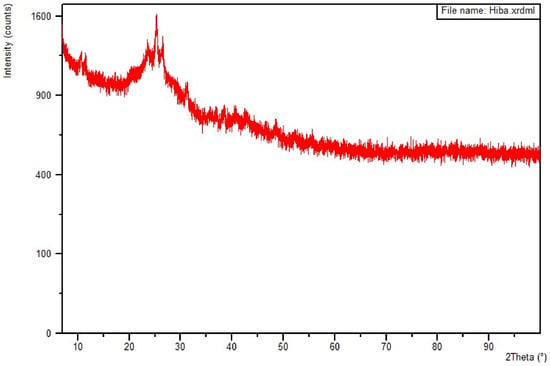
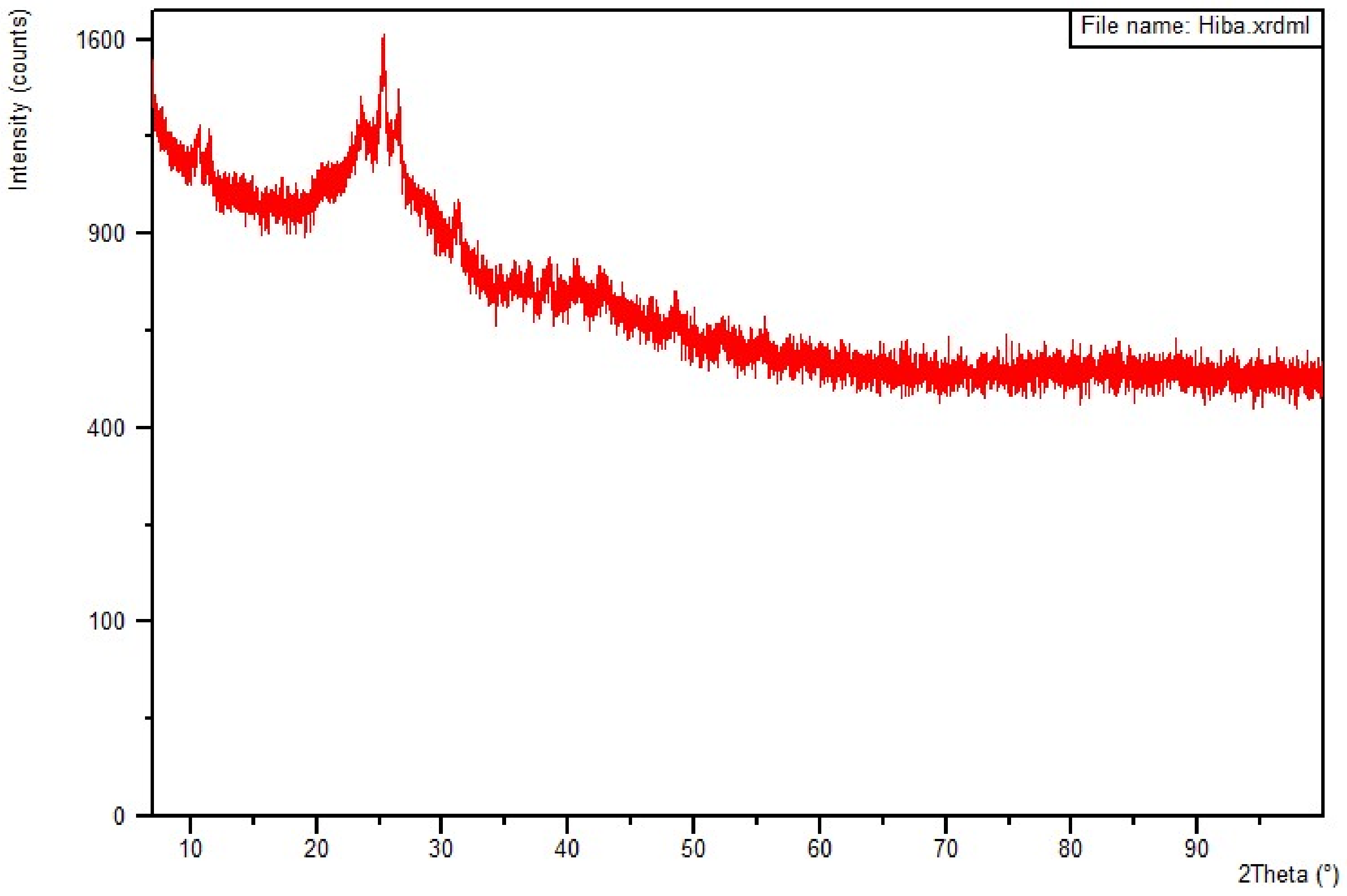
The X-ray diffraction (XRD) pattern of the synthesized activated nanocarbon (ANC) reveals a predominantly disordered carbon structure with limited graphitic ordering. As shown in Figure 1, a broad diffraction feature centered at approximately 2θ = 25–26° can be attributed to the (002) reflection of turbostratic carbon. Using Bragg’s law, nλ = 2dsinθ, with Cu Kα radiation (λ = 1.5406 Å), the corresponding interlayer spacing (d002) is estimated to be approximately 0.34–0.36 nm. This value is slightly larger than the ideal graphite interlayer spacing (0.335 nm), suggesting imperfect stacking of graphene-like layers and a relatively low degree of graphitic ordering. The broad nature of the (002) diffraction feature indicates structural disorder and limited long-range ordering. Weak diffraction features observed around 2θ = 40–45° may be associated with short-range ordering within the carbon structure. Additionally, several relatively sharp diffraction peaks are superimposed on the broad carbon background, suggesting the possible presence of minor crystalline phases originating from residual inorganic constituents or the chemical activation process. Overall, the XRD results indicate that the synthesized ANC possesses a predominantly disordered, turbostratic carbon structure with possible contributions from minor crystalline impurities [17,18,19,20].
Figure 1.
XRD pattern of the synthesized activated nanocarbon (ANC).
3.2.2. FTIR Analysis
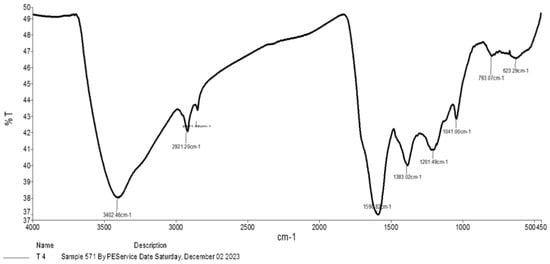
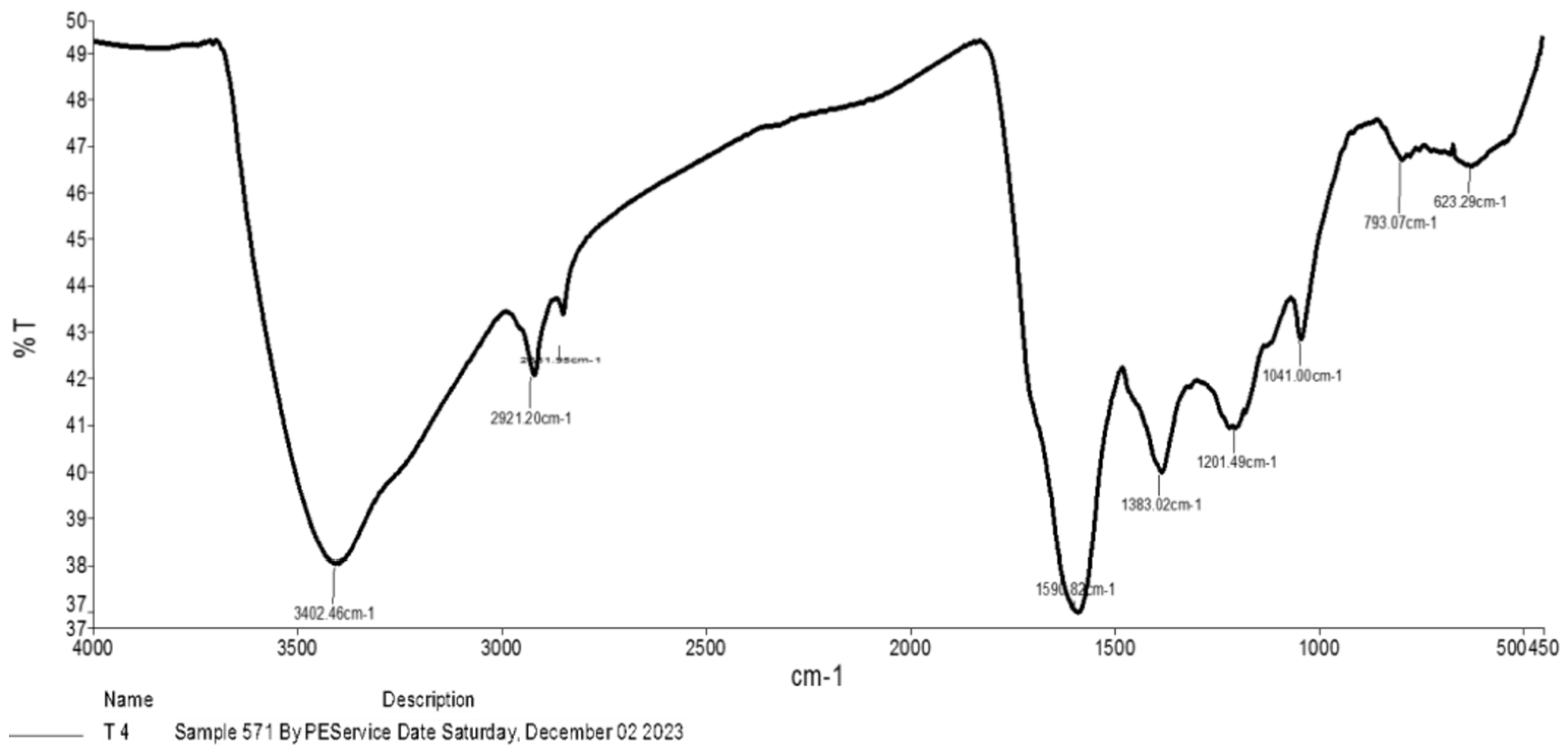
The FTIR spectrum (Figure 2) provides further evidence of the surface chemical characteristics of the synthesized ANC. The broad absorption band at 3402 cm−1 is associated with O–H stretching vibrations, indicating the presence of hydroxyl-containing surface functionalities. The bands at 2921 and 2851 cm−1 correspond to asymmetric and symmetric C–H stretching vibrations, respectively, suggesting the retention of aliphatic carbon species within the carbon framework. The absorption band at 1590 cm−1 can be attributed to aromatic C=C stretching, reflecting the presence of conjugated carbon structures. In addition, the band at approximately 1114 cm−1 is assigned to C–O stretching vibrations and indicates the presence of oxygen-containing functionalities on the activated carbon surface. The disappearance of the carbonyl (C=O) band observed in the precursor after activation suggests that the phosphoric acid treatment altered the original surface chemistry and promoted the transformation of oxygenated species during the activation process. The coexistence of aromatic carbon structures and oxygen-containing functionalities is particularly relevant to the adsorption behavior of ANC because these surface groups can modify surface polarity and provide potential interaction sites for phenol molecules [21].
Figure 2.
FTIR spectrum of the synthesized activated nanocarbon (ANC).
3.2.3. FESEM Analysis
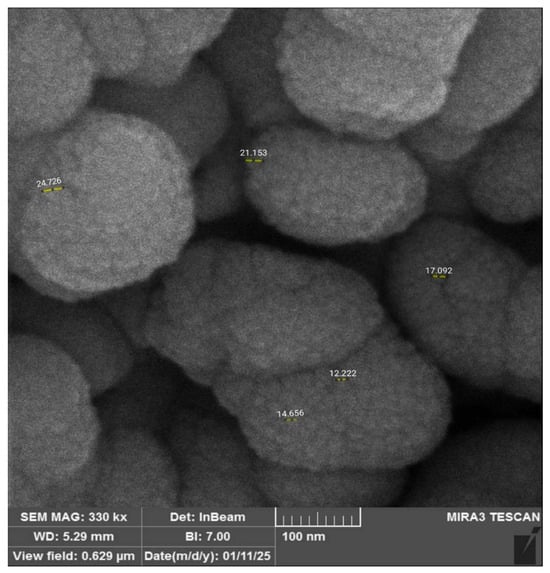
The FESEM observations provide direct evidence of the morphological changes associated with the preparation and activation of ANC. As shown in Figure 3, the material is composed predominantly of nearly spherical nanoparticles distributed throughout the carbon matrix. The particles are interconnected and form agglomerated clusters, with irregular voids appearing between adjacent particles. Such aggregation is expected for nanoscale carbon materials because of the strong interparticle interactions associated with their high surface energy. The heterogeneous and rough appearance of the carbon surface, together with the presence of visible voids and porous features, indicates that the activation treatment generated a structurally irregular surface. This morphology can increase the accessibility of the carbon framework and facilitate contact between the aqueous phase and the available surface regions during phenol adsorption [22,23].
Figure 3.
FE-SEM images of the synthesized activated nanocarbon (ANC).
3.2.4. TEM Analysis
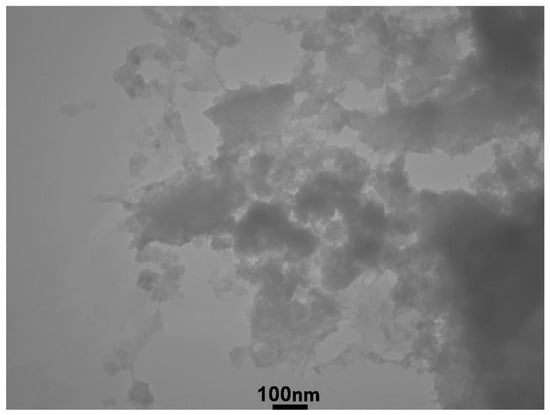
The TEM observations provide complementary information on the nanoscale structure of the synthesized ANC. As illustrated in Figure 4, the material consists of thin, predominantly spherical and partially transparent carbon domains with nanoscale dimensions. The interconnected arrangement of these domains forms an irregular porous network, reflecting the structurally disordered nature of the carbon material. The localized darker regions observed in some areas may be attributed to overlapping carbon layers or relatively thicker carbon domains, resulting in increased electron scattering. These morphological features are consistent with the predominantly disordered and turbostratic carbon structure indicated by the XRD analysis. Although no clearly distinguishable foreign particles are observed in the TEM images, the presence of minor crystalline phases suggested by the XRD pattern cannot be excluded. Overall, the TEM observations support the formation of a nanostructured carbon material with an irregular morphology and limited structural ordering [6,24].
Figure 4.
TEM micrographs of the prepared ANC.
3.2.5. EDX Analysis
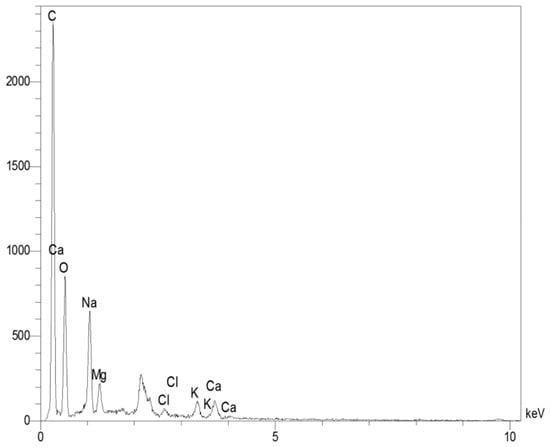
The EDX spectrum (Figure 5) further confirms the elemental characteristics of the synthesized ANC. Carbon represents the dominant elemental component, consistent with the formation of a carbon-rich material from diesel-derived soot. Oxygen is detected as the second major element, which agrees with the oxygen-containing functionalities identified by FTIR analysis. In addition, only minor signals corresponding to Na, Mg, and Ca are observed. These elements may originate from residual inorganic constituents present in the original soot precursor or retained during the preparation process. Their relatively low abundance indicates that the prepared material is predominantly carbonaceous, while the presence of oxygen provides additional evidence for the development or retention of oxygen-containing surface functionalities during activation [25,26].
Figure 5.
EDX spectrum of the synthesized ANC.
3.2.6. AFM Analysis
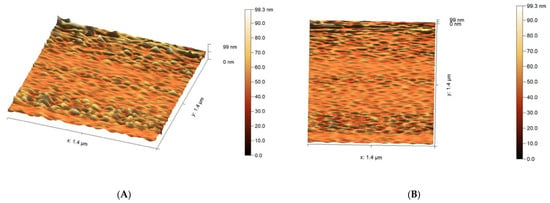
The AFM topographic image provides three-dimensional information on the surface characteristics of the synthesized ANC that complements the FESEM and TEM observations. As shown in Figure 6, the scanned area of 1.4 × 1.4 μm2 exhibits numerous nanoscale protrusions and shallow depressions, resulting in a heterogeneous and distinctly rough surface. The maximum height variation of approximately 99 nm demonstrates substantial variation in the surface topography. Such irregularities indicate that the activation process produced a non-uniform carbon surface rather than a smooth and compact structure. The three-dimensional AFM observations therefore support the morphological features identified by FESEM and TEM and confirm the heterogeneous surface architecture of ANC, which provides a structurally favorable interface for subsequent interaction with phenol molecules during adsorption [27,28].
Figure 6.
(A,B) Three-dimensional AFM topographic image of the synthesized activated nanocarbon (ANC).
3.3. Adsorption Performance
3.3.1. Effect of Contact Time
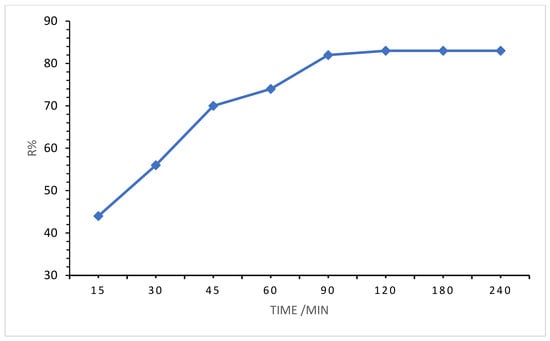
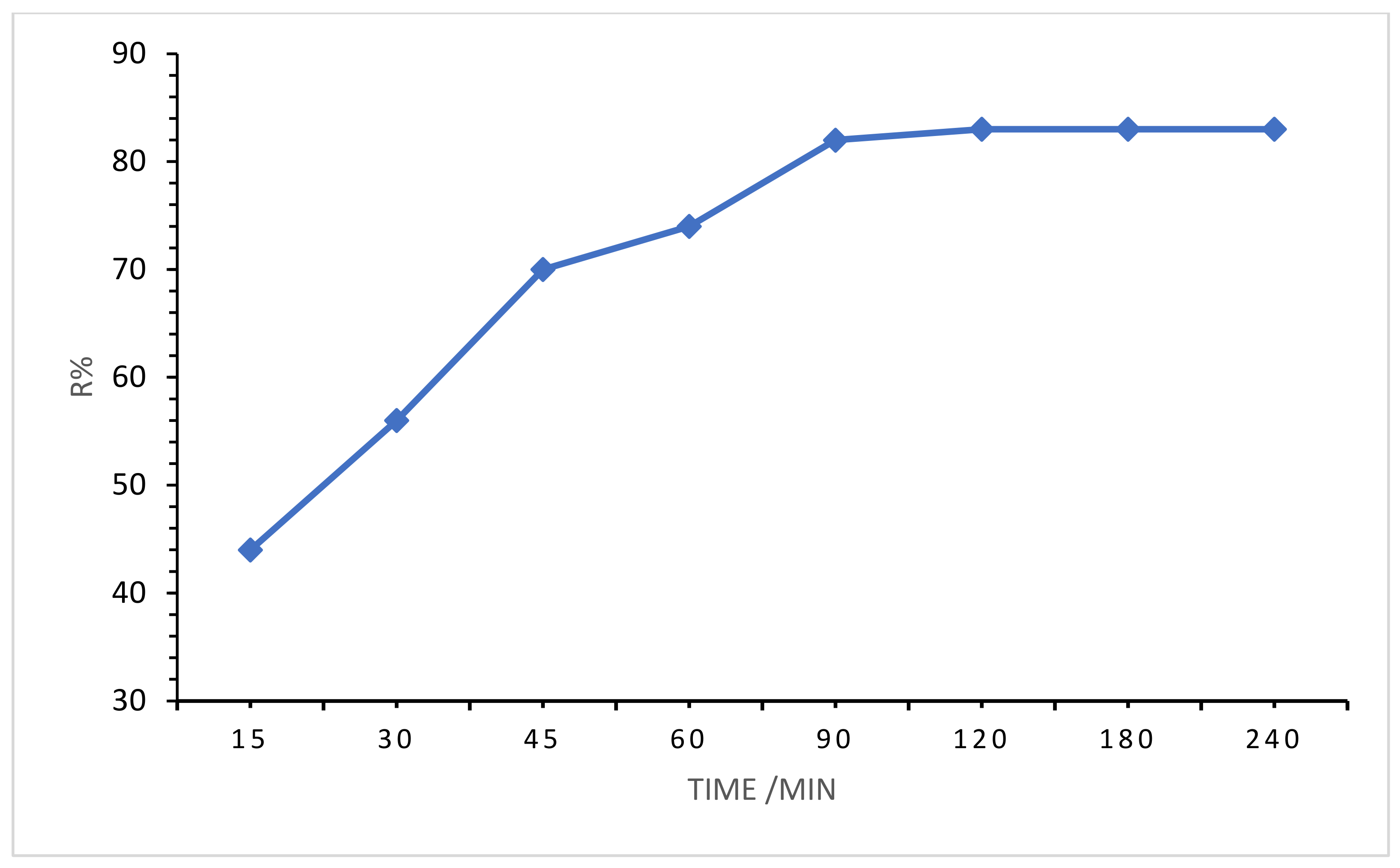
The adsorption of phenol onto the synthesized activated nanocarbon (ANC) was strongly dependent on contact time. As shown in Figure 7, phenol removal increased rapidly during the initial stage of the process and then increased more gradually until equilibrium was reached at approximately 90 min. The rapid initial uptake can be attributed to the availability of a large number of vacant adsorption sites on the ANC surface at the beginning of the process. As adsorption progressed, these sites became progressively occupied, leading to a decrease in the adsorption rate until an approximately steady state was reached. The relatively short equilibrium time indicates that the prepared ANC provides readily accessible sites for phenol uptake under the investigated conditions. Accordingly, 90 min was selected as the equilibrium contact time for the subsequent adsorption experiments [29].
Figure 7.
Effect of contact time on the adsorption of phenol onto ANC.
3.3.2. Effect of Initial Phenol Concentration
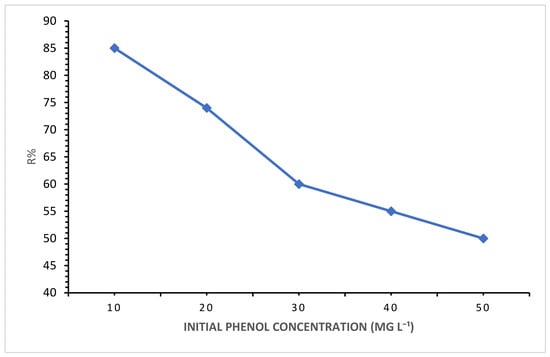
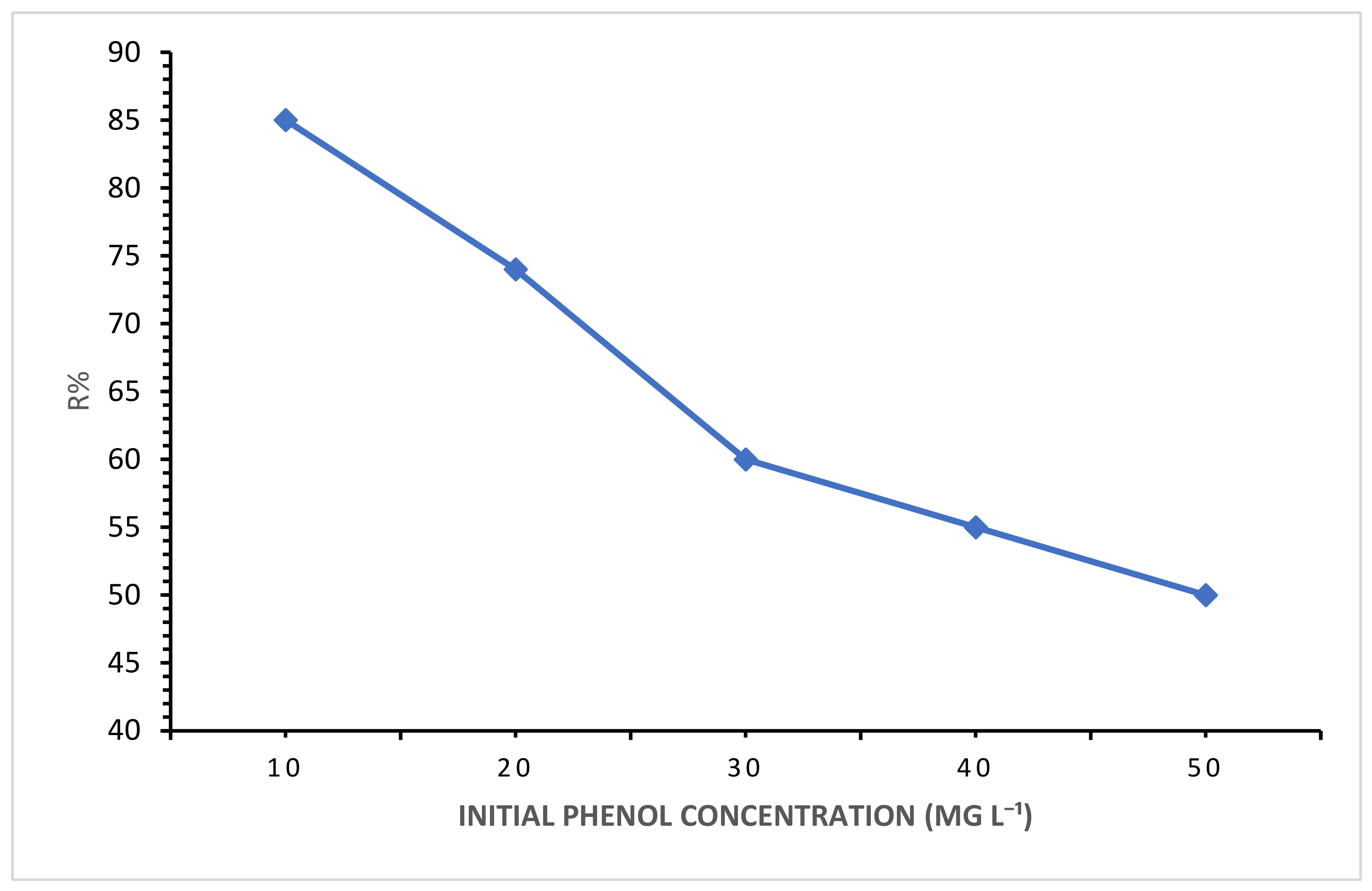
The initial phenol concentration had a noticeable effect on the removal efficiency of ANC. As shown in Figure 8, the percentage removal decreased progressively as the initial phenol concentration increased from 10 to 50 mg L−1. At the lowest concentration, the available adsorption sites were sufficient to capture a large fraction of the phenol molecules present in solution. With increasing concentration, however, the number of phenol molecules became progressively higher relative to the available adsorption sites, resulting in greater competition for the accessible surface sites and a consequent decrease in the percentage removal. This concentration-dependent behavior also provides the basis for evaluating the equilibrium characteristics of the adsorption system, and the corresponding equilibrium data were therefore used for the subsequent Langmuir and Freundlich isotherm analyses [30].
Figure 8.
Effect of initial concentration on the adsorption onto ANC.
3.3.3. Effect of Temperature
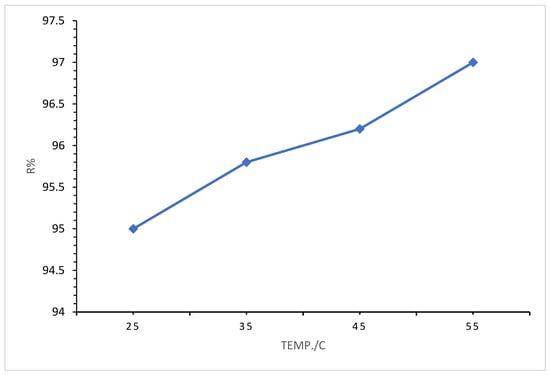
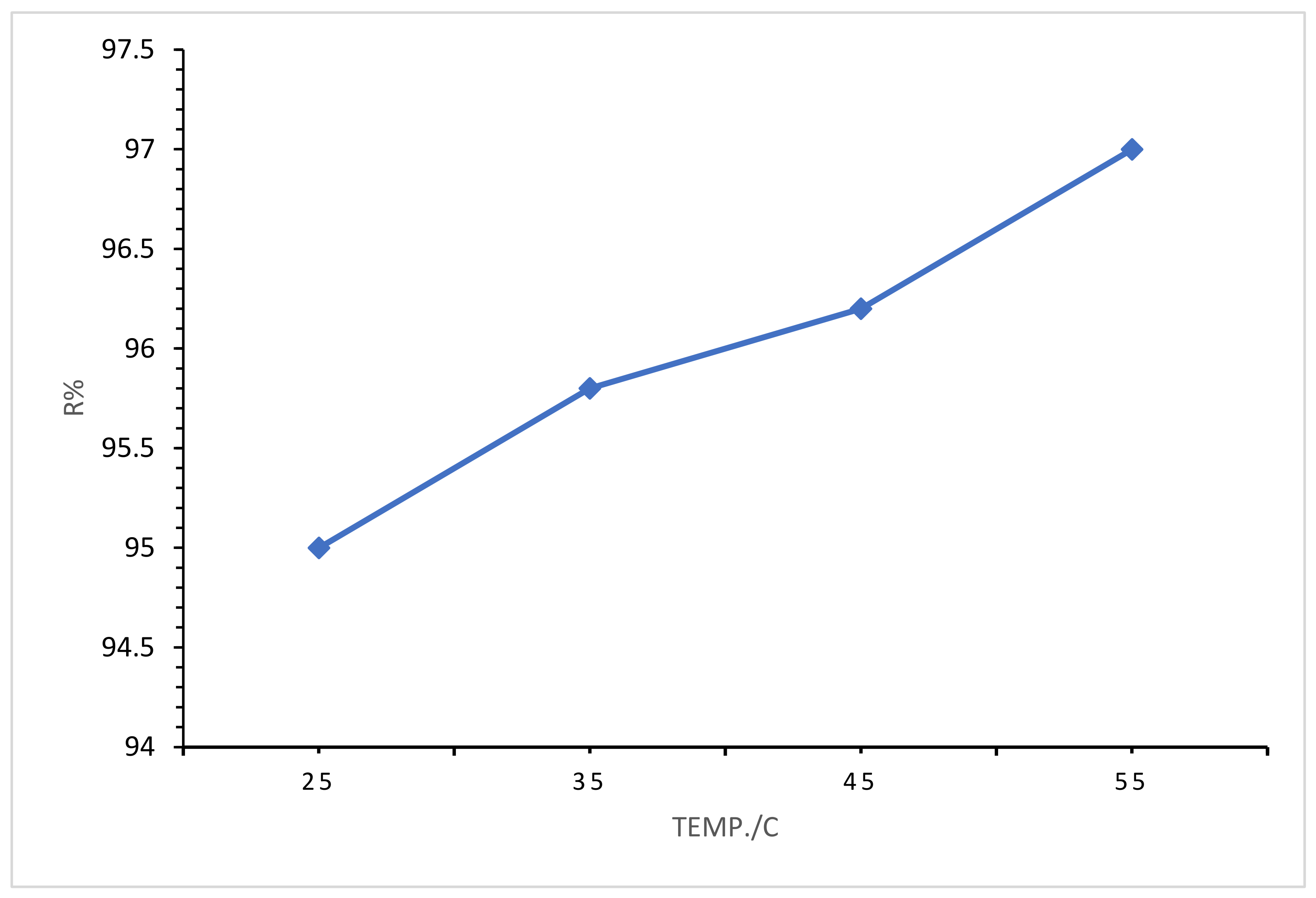
Temperature also influenced the adsorption behavior of phenol onto ANC. As presented in Figure 9, the adsorption efficiency increased progressively with increasing temperature from 25 to 55 °C. The enhancement in phenol removal at elevated temperatures indicates that heating the adsorption system favors the uptake process under the investigated conditions. This behavior may be associated with increased molecular mobility and improved transport of phenol molecules toward the accessible adsorption sites within the carbon structure. The observed temperature dependence is also consistent with the positive enthalpy value obtained from the thermodynamic analysis, which indicates the endothermic nature of the adsorption process [31].
Figure 9.
Effect of temperature on the adsorption onto ANC.
3.3.4. Effect of Adsorbent Dosage
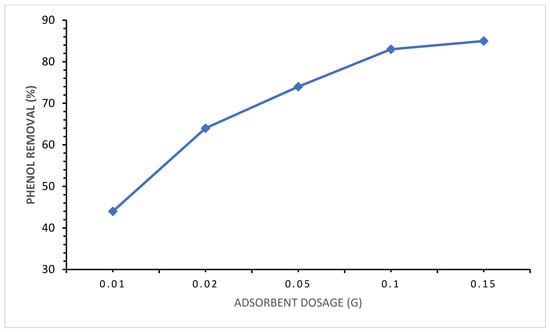
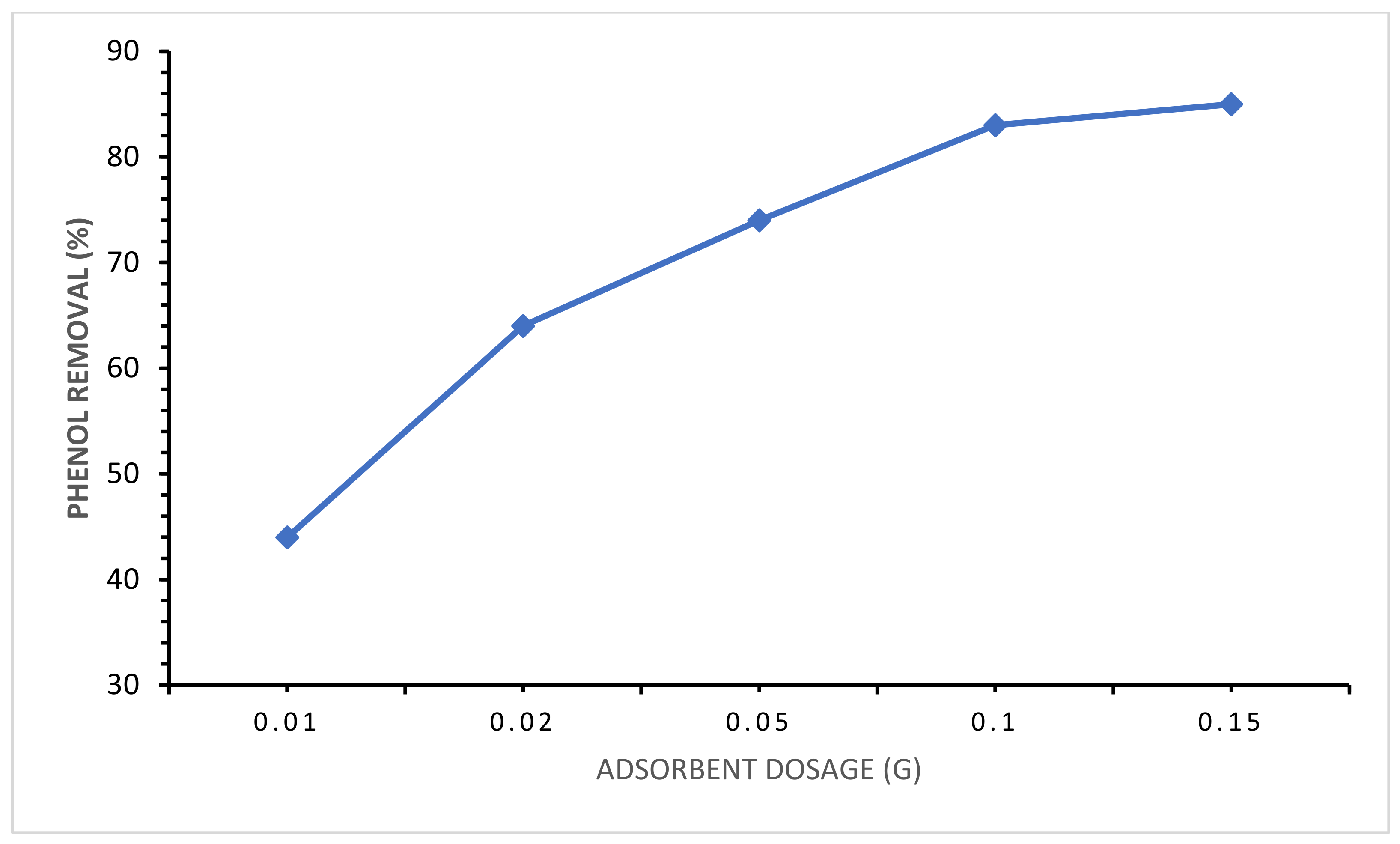
The amount of ANC added to the adsorption system had a direct effect on phenol removal. As shown in Figure 10, the removal efficiency increased with increasing adsorbent dosage and reached its maximum at 0.10 g. A further increase in the dosage to 0.15 g produced no appreciable improvement in phenol removal. The initial increase can be attributed to the greater number of available adsorption sites and the larger amount of carbon surface accessible to phenol molecules as the adsorbent mass increases. Once the optimum dosage was reached, most of the phenol available under the selected experimental conditions had already been removed, so the additional adsorption capacity provided by the higher adsorbent mass produced little further change in the removal efficiency. Therefore, 0.10 g was selected as the optimum adsorbent dosage for the subsequent experiments [32].
Figure 10.
Effect of Adsorbent Dosage on the adsorption onto ANC.
3.4. Adsorption Equilibrium and Isotherm Analysis
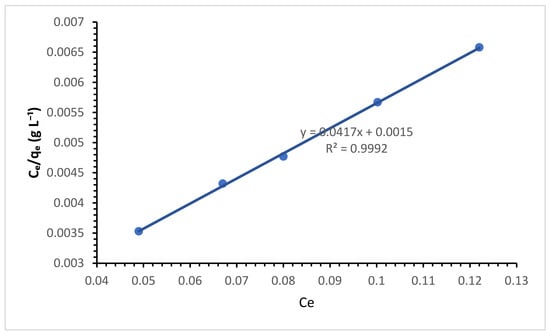
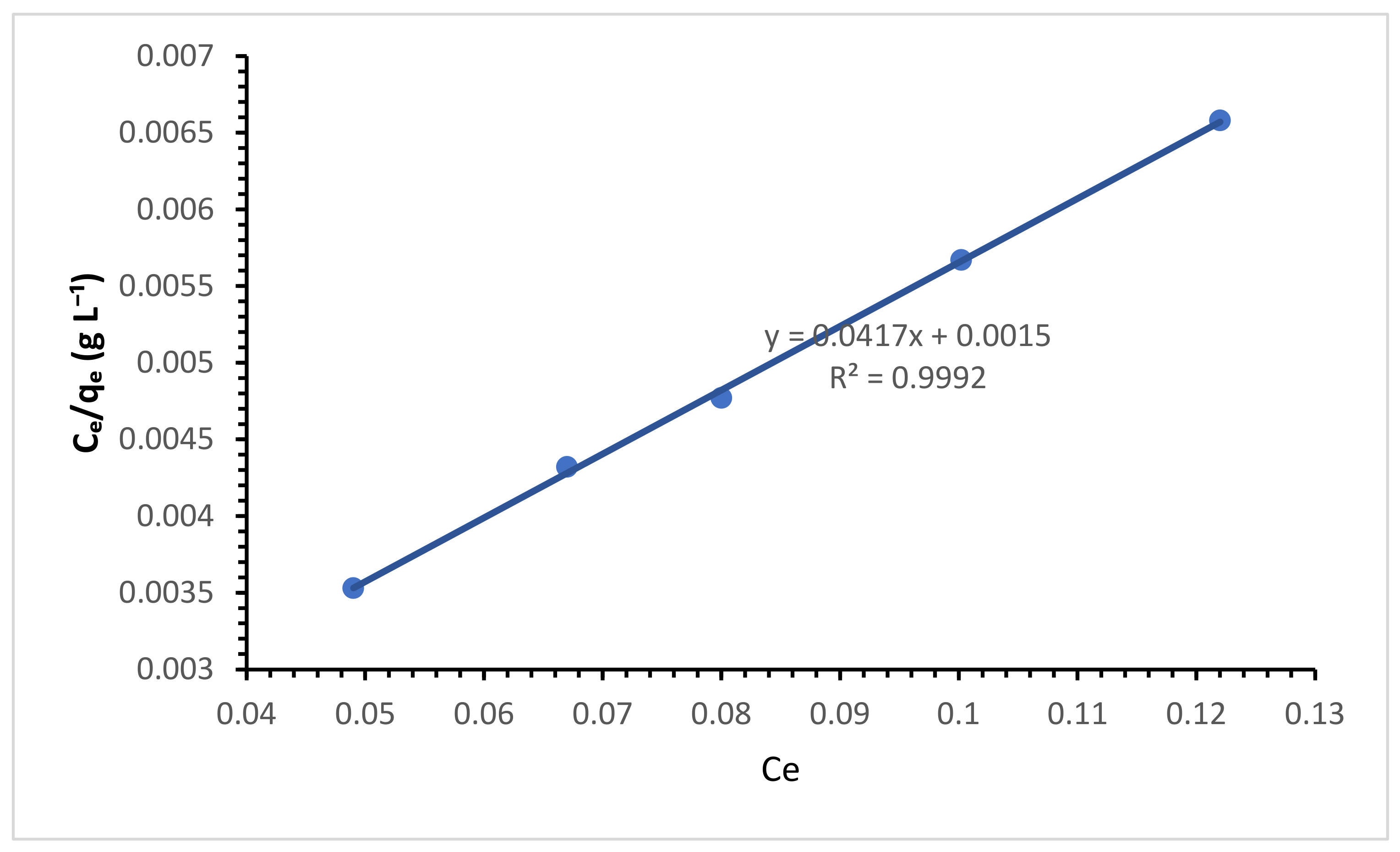
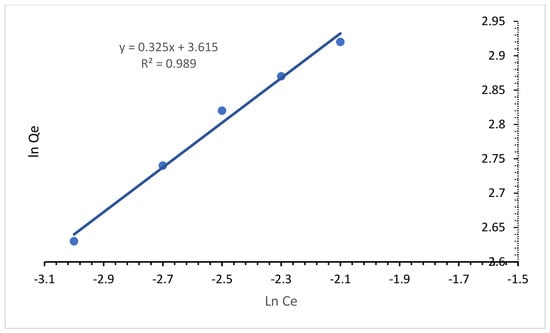
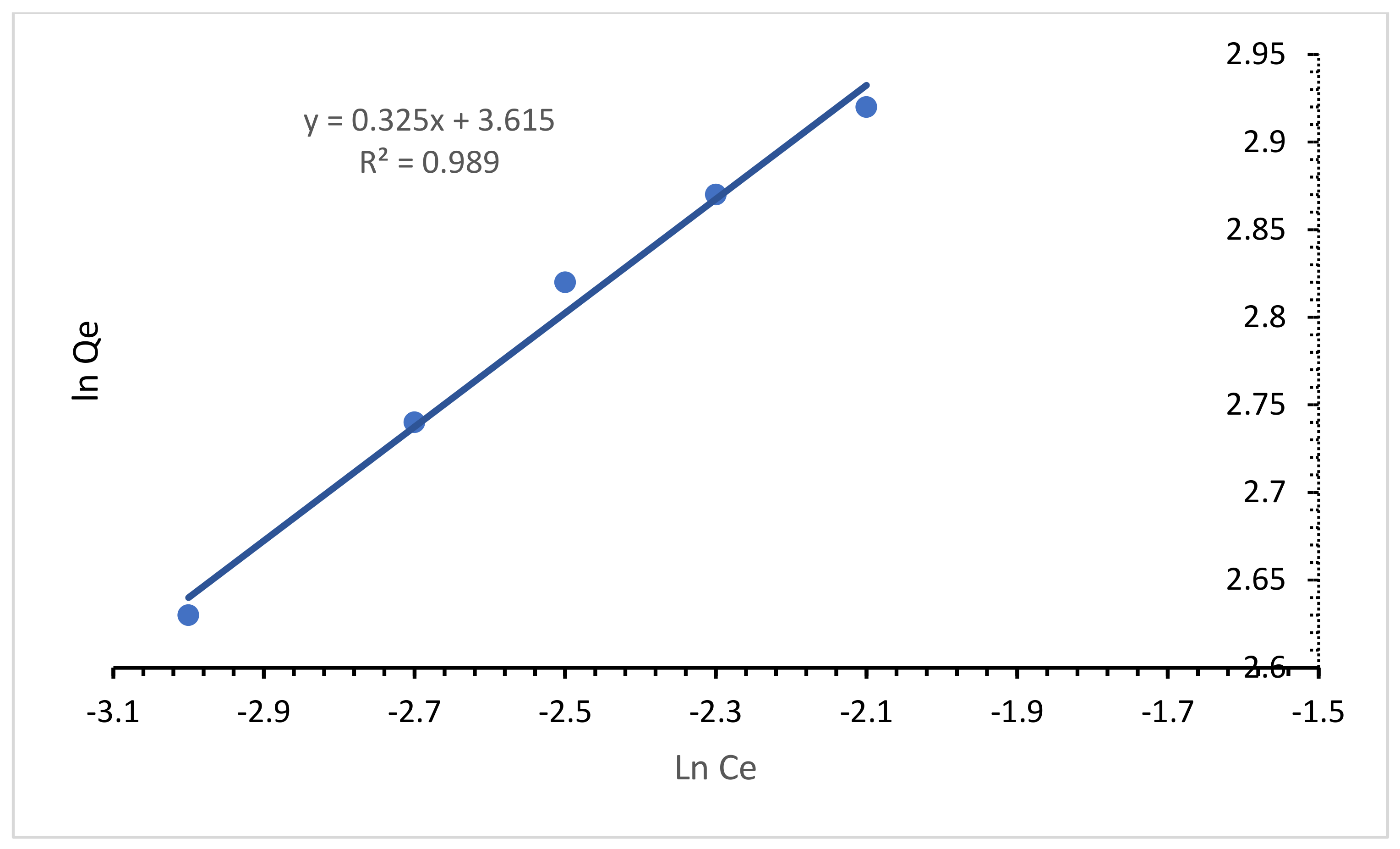
The equilibrium data were analyzed using the Langmuir and Freundlich isotherm models to examine the adsorption behavior of phenol on ANC. The corresponding linear equations are given in Equations (3) and (4), and the calculated parameters are summarized in Table 1 and Table 2. The linear plots obtained for the two models are presented in Figure 11 and Figure 12.
Table 1.
Experimental equilibrium adsorption data used for Langmuir and Freundlich isotherm modeling.
Table 2.
Linear and nonlinear Langmuir and Freundlich isotherm parameters for phenol adsorption onto ANC.
Figure 11.
Langmuir isotherm.
Figure 12.
Freundlich isotherm.
The Langmuir model provided an excellent fit to the experimental equilibrium data, with an R2 value of 0.9992, compared with 0.9890 for the Freundlich model. The maximum monolayer adsorption capacity obtained from the Langmuir equation was 23.98 mg g−1, with a Langmuir constant (K_L) of 27.8 L mg−1. The substantially higher correlation coefficient obtained for the Langmuir model indicates that the equilibrium behavior of phenol adsorption is better represented by a monolayer adsorption model under the investigated conditions. The Freundlich model nevertheless provided a relatively good fit, yielding K_F = 37.15 (mg g−1)(L mg−1)1/n and n = 3.077. The value of n greater than unity indicates favorable adsorption. In addition, the calculated separation factor (R_L) ranged from 0.00072 to 0.00358, with all values falling within the favorable range of 0 < R_L < 1. These results further demonstrate the favorable affinity of ANC toward phenol and support the suitability of the Langmuir model for describing the equilibrium adsorption behavior [33,34].
Nonlinear regression was additionally applied to the equilibrium data using the forms of the Langmuir and Freundlich equation. The nonlinear Langmuir model yielded qmax = 24.03 mg/g and KL = 27.8 L/mg (R2 =0.9954), whereas the nonlinear Freundlich model yielded KF = 36.27, n = 3.18, and R2 = 0.9845. These results are consistent with the linearized analysis, with the Langmuir model providing the better fit in both approaches.
3.5. Adsorption Thermodynamics
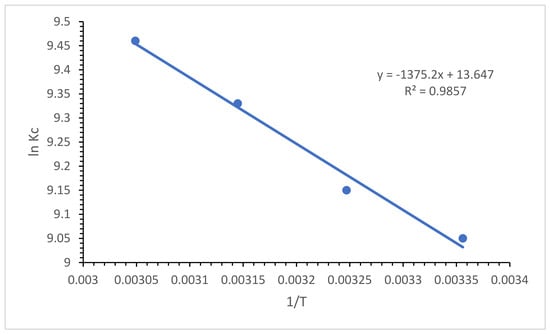
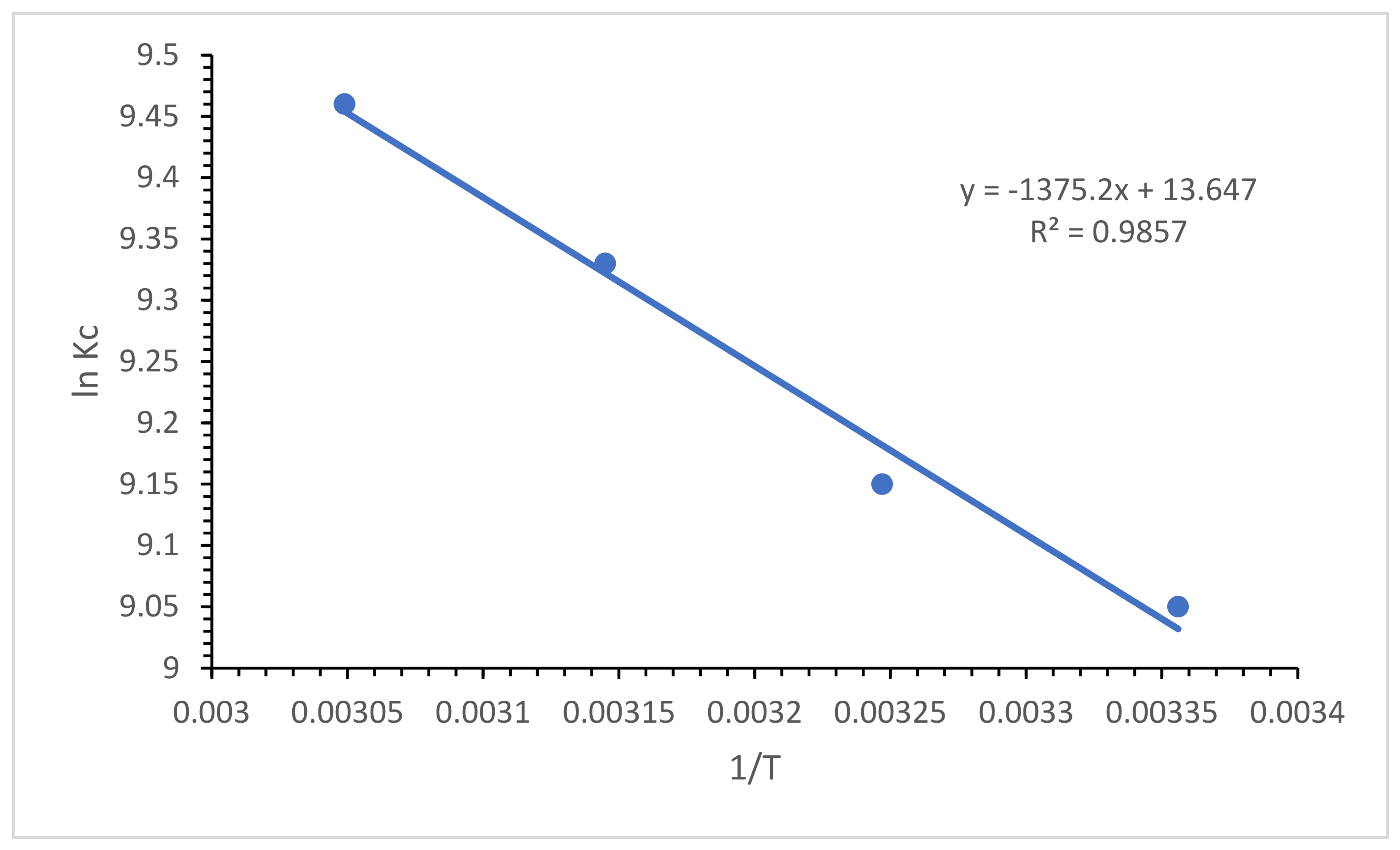
The thermodynamic analysis was performed over the temperature range of 298–328 K to assess the feasibility and energetic characteristics of phenol adsorption onto ANC. The standard Gibbs free energy change (ΔG°), enthalpy change (ΔH°), and entropy change (ΔS°) were calculated from the equilibrium data using Equations (5)–(8). The Van’t Hoff relationship was used to obtain ΔH° and ΔS° from the slope and intercept of the linear plot of ln K_e versus 1/T, respectively. This approach provides a quantitative assessment of the effect of temperature on the adsorption equilibrium and the energetic nature of the adsorption process [35].
Ke = CAe/Ce
ΔG° = ΔH° − TΔS°
The Van’t Hoff plot shown in Figure 13 exhibited good linearity, with R2 = 0.9857, indicating a strong linear relationship between ln K_e and 1/T over the investigated temperature range [36]. The calculated thermodynamic parameters are summarized in Table 3.
Figure 13.
Van’t Hoff plot for the adsorption of phenol onto activated nanocarbon (ANC).
Table 3.
Thermodynamic parameters for the adsorption process calculated using the dimensionless equilibrium constant (K c°).
The Gibbs free energy values were negative at all investigated temperatures, ranging from −22.42 kJ mol−1 at 298 K to −25.79 kJ mol−1 at 328 K. The negative ΔG° values indicate that phenol adsorption onto ANC is thermodynamically spontaneous under the investigated conditions. Moreover, the increasingly negative ΔG° values with increasing temperature indicate that the adsorption process becomes thermodynamically more favorable at elevated temperatures, consistent with the experimentally observed temperature-dependent adsorption behavior.
The positive enthalpy change (ΔH° = +11.43 kJ mol−1) confirms the endothermic character of the adsorption process and is consistent with the enhanced adsorption observed at higher temperatures. The positive entropy change (ΔS° = +113.47 J mol−1 K−1) indicates an increase in randomness at the solid–solution interface during phenol adsorption.
4. Discussion
4.1. The Material’s Textural Properties
The results of BET surface area confirm the development of a measurable porous structure following the activation treatment. The relatively developed surface area provides accessible surface sites that can contribute to the adsorption of phenol from aqueous solution, while the pore volume indicates the presence of void space within the carbon structure that may facilitate the accessibility of the adsorbate to the internal surface. However, because pore-size distribution was not determined in the present study, no quantitative assignment of the material to a specific micro- or mesoporous range is made. Therefore, the adsorption performance is interpreted in terms of the measured surface area and pore volume together with the surface functional groups identified by FTIR, rather than attributing phenol uptake solely to a particular pore-size range. The importance of both textural properties and surface chemistry in the adsorption of organic compounds by activated carbons has been reported previously [33,37].
4.2. Structural Characteristics and Surface Chemistry of ANC
4.2.1. XRD Interpretation
The XRD results indicate that the synthesized activated nanocarbon (ANC) possesses a predominantly disordered and turbostratic carbon structure with limited graphitic ordering. The broad diffraction feature observed around 2θ = 25–26°, associated with the (002) reflection, suggests irregular stacking of graphene-like layers and limited long-range structural order. Weak diffraction features in the region of 2θ = 40–45° may be attributed to the (100) reflection, indicating the presence of short-range ordering within the carbon framework. Additionally, several relatively sharp diffraction peaks are observed, suggesting the possible presence of minor crystalline phases associated with residual inorganic constituents from the diesel exhaust soot or the chemical activation process.
The structural disorder observed in the XRD pattern may be associated with phosphoric acid activation, which can promote structural rearrangement and defect formation within the carbon framework. These modifications may contribute to the development of a heterogeneous carbon structure and facilitate the formation of accessible adsorption sites. Such characteristics are commonly reported for chemically activated carbon materials and can enhance their adsorption performance [38,39].
However, XRD analysis alone cannot establish the origin of the secondary crystalline peaks or directly determine the porosity and surface characteristics of the material. Therefore, the structural information obtained from XRD is considered alongside the morphological and surface-chemical observations from FTIR, FESEM, TEM, and AFM analyses to provide a more comprehensive understanding of the synthesized ANC.
4.2.2. FTIR Interpretation
The FTIR results provide complementary information regarding the surface chemistry of the synthesized ANC. The broad O–H absorption band indicates the presence of hydroxyl-containing surface functionalities, which contribute to the polar character of the carbon surface. The absorption bands at 2921 and 2851 cm−1 indicate the presence of residual aliphatic C–H groups, whereas the band at 1590 cm−1 is associated with aromatic C=C vibrations and therefore provides evidence for the presence of conjugated carbon domains.
The absorption band near 1114 cm−1, assigned to C–O stretching, further indicates the presence of oxygen-containing functionalities on the activated carbon surface. Such functional groups can influence the surface polarity and hydrophilicity of activated carbon and provide potential sites for interactions with phenol molecules. The coexistence of aromatic carbon domains and oxygen-containing functionalities is particularly important for adsorption because the aromatic structure can contribute to π–π interactions, while polar surface groups can participate in hydrogen bonding and other intermolecular interactions [40].
The disappearance of the carbonyl band observed in the precursor after activation indicates that the surface chemistry was modified during the phosphoric acid treatment. However, the FTIR results alone should not be used to assign a specific phosphorus-containing surface species with certainty. Such an assignment would require additional evidence, such as XPS or complementary elemental analysis. Therefore, the present FTIR results are interpreted primarily in terms of the observed oxygen-containing functionalities [41,42].
4.2.3. FESEM Interpretation
The FESEM images reveal a heterogeneous and rough surface composed of interconnected nanoscale carbon domains. The observed aggregation of the carbon particles is expected for nanoscale carbon materials because of their high surface energy and the attractive forces acting between adjacent particles. Therefore, the presence of agglomerated regions does not necessarily indicate poor structural quality but rather reflects the tendency of nanosized carbon domains to associate during preparation.
More importantly, the FESEM images reveal irregular cavities and voids distributed throughout the carbon matrix. These morphological features are consistent with the effect of chemical activation, during which phosphoric acid promotes dehydration and structural rearrangement of the carbon precursor and contributes to the development of an open and heterogeneous carbon framework [42,43]. The resulting surface irregularity can increase the accessibility of the carbon surface and facilitate contact between phenol molecules and the available adsorption sites.
The FESEM observations therefore provide morphological evidence supporting the formation of a structurally heterogeneous activated carbon material. Nevertheless, the FESEM images should be considered as evidence of surface morphology rather than direct proof of the total internal pore volume or specific surface area, which would require BET analysis.
4.2.4. TEM Interpretation
The TEM images provide further insight into the nanoscale architecture of the synthesized ANC. The predominantly thin and partially transparent carbon domains indicate the presence of relatively thin carbon structures, while the darker regions can reasonably be attributed to overlapping carbon layers or locally thicker regions. Variations in electron contrast are commonly observed in partially ordered carbon nanostructures and do not, by themselves, indicate the presence of secondary crystalline phases [44].
The interconnected arrangement of the carbon domains also suggests the development of an open and heterogeneous nanoscale structure during activation. Such an architecture can provide accessible interfaces and relatively short pathways for the transport of adsorbate molecules toward the available surface sites. Similar relationships between activation-induced pore development and improved accessibility of adsorption sites have been reported for phosphoric-acid-activated carbon materials [45].
The TEM observations complement the FESEM results by providing additional insight into the nanoscale arrangement and internal structural features of the carbon domains, whereas FESEM primarily reveals the external surface morphology. Together with the predominantly disordered and turbostratic carbon structure indicated by XRD and the oxygen-containing functional groups identified by FTIR, these findings support the formation of an activated carbon framework with structural and surface characteristics potentially favorable for adsorption. The possible presence of minor crystalline phases suggested by XRD does not alter the predominantly carbonaceous nature of the synthesized material.
4.2.5. EDX Interpretation
The EDX spectrum confirms that carbon is the predominant elemental component of the synthesized ANC, consistent with the carbonaceous nature of the soot precursor and the predominantly disordered carbon structure indicated by XRD. The presence of oxygen is also consistent with the oxygen-containing functional groups identified by FTIR, suggesting the retention of oxygen-containing species following chemical activation. Additionally, the possible presence of minor crystalline phases suggested by XRD may be associated with residual inorganic constituents originating from the soot precursor or the activation process [44].
The relatively weak signals corresponding to Na, Mg, and Ca indicate the presence of minor inorganic constituents. These elements may originate from mineral components initially present in the soot precursor or from residual inorganic species retained during the preparation process. Their relatively low abundance suggests that they do not constitute the major elemental components of the prepared material.
It is important to note that EDX provides elemental information rather than direct identification of specific chemical functional groups. Accordingly, the interpretation of the oxygen signal is best considered together with the FTIR results rather than as independent evidence for particular surface functionalities.
4.2.6. Overall Structural Interpretation
Taken together, the characterization results provide a consistent understanding of the structural and morphological properties of the synthesized ANC. XRD indicates a predominantly disordered and turbostratic carbon structure with possible contributions from minor crystalline phases, while FTIR reveals the presence of oxygen-containing surface functional groups. FESEM and TEM demonstrate a heterogeneous nanoscale morphology with irregular and interconnected carbon domains, whereas AFM further confirms pronounced surface roughness. EDX supports the predominantly carbonaceous composition, with oxygen as the principal additional element. Overall, these findings suggest the formation of an activated nanocarbon material with structural and surface characteristics potentially favorable for adsorption.
The combination of these structural, morphological, and chemical characteristics provides a reasonable basis for the adsorption behavior observed in the subsequent experiments. In particular, the presence of accessible surface regions, oxygen-containing functionalities, and disordered carbon domains may provide multiple types of interaction sites for phenol molecules. The specific contribution of these features to phenol uptake is discussed in the adsorption and mechanism sections [24,26].
4.3. Adsorption Performance
4.3.1. Effect of Contact Time
The adsorption of phenol onto the synthesized activated nanocarbon (ANC) was initially evaluated as a function of contact time. As shown in Figure 7, phenol uptake increased rapidly during the early stage of the process and subsequently approached equilibrium at approximately 90 min. The rapid initial uptake can be associated with the high availability of vacant adsorption sites and the large concentration gradient between phenol molecules in solution and the ANC surface. As these sites became progressively occupied, the driving force for further adsorption decreased, resulting in a slower uptake rate until equilibrium was established. The relatively short equilibrium time indicates that the accessible surface of ANC can interact efficiently with phenol molecules. Therefore, 90 min was selected as the equilibrium contact time for the subsequent adsorption experiments [29].
4.3.2. Effect of Initial Phenol Concentration
The influence of the initial phenol concentration was investigated over the range of 10–50 mg L−1. As illustrated in Figure 8, the percentage removal decreased progressively with increasing initial phenol concentration, with the highest removal obtained at 10 mg L−1. At relatively low concentrations, the number of available adsorption sites on ANC is sufficient to accommodate a large fraction of the phenol molecules present in solution. Increasing the initial concentration increases the number of molecules competing for a limited number of accessible sites, leading to progressive surface occupation and a corresponding reduction in removal percentage. This behavior reflects the finite adsorption capacity of the material and provides the basis for the subsequent equilibrium analysis. The experimental equilibrium data were therefore used to evaluate the Langmuir and Freundlich adsorption models [44].
4.3.3. Effect of Adsorbent Dosage
The effect of ANC dosage was subsequently examined to determine the amount of adsorbent required for efficient phenol removal. As shown in Figure 10, the removal efficiency increased with increasing adsorbent mass and reached its maximum at 0.10 g. Increasing the dosage further to 0.15 g did not produce a significant improvement in removal. The initial increase is attributable to the greater number of available adsorption sites and the increased surface area provided by the additional ANC. Once the optimum dosage was reached, most of the phenol available under the selected experimental conditions had already been removed, and consequently the addition of further adsorbent produced little improvement in removal efficiency. Accordingly, 0.10 g was selected as the optimum dosage for the subsequent experiments [46].
4.3.4. Effect of Temperature
Temperature-dependent adsorption behavior was evaluated over the range of 25–55 °C. As presented in Figure 9, phenol removal increased progressively with increasing temperature, indicating that elevated temperature favored the adsorption process. The enhanced uptake may be related to increased molecular mobility and improved diffusion of phenol molecules toward accessible adsorption sites within the porous carbon structure. The positive temperature dependence also suggests an endothermic adsorption process, which is subsequently confirmed by the positive enthalpy change obtained from the thermodynamic analysis. Thus, the temperature results provide an important link between the observed adsorption behavior and the energetic characteristics of the process [47].
4.4. Adsorption Equilibrium and Isotherm Analysis
The equilibrium behavior of phenol adsorption onto ANC was evaluated using the Langmuir and Freundlich models. The calculated parameters are summarized in Table 1 and Table 2, while the corresponding linear plots are presented in Figure 11 and Figure 12.
The Langmuir model provided the best representation of the experimental equilibrium data, yielding a correlation coefficient of R2 = 0.9992, compared with R2 = 0.9890 for the Freundlich model. The maximum monolayer adsorption capacity calculated from the Langmuir model was 23.98 mg g−1, with a Langmuir constant (K_L) of 27.8 L mg−1. The substantially higher correlation coefficient indicates that the equilibrium behavior is predominantly consistent with the assumptions of the Langmuir model, suggesting that phenol adsorption approaches monolayer coverage of the available adsorption sites under the investigated conditions.
Although the Freundlich model showed a relatively good correlation, its lower R2 value indicates a less suitable description of the experimental equilibrium data. The Freundlich parameters were K_F = 37.15 (mg g−1)(L mg−1)1/n and n = 3.077. The value of n greater than unity indicates favorable adsorption. Furthermore, the calculated separation factor (R_L) ranged from 0.00072 to 0.00358, with all values falling within the favorable range of 0 < R_L < 1. The very low R_L values further indicate a strong affinity of the ANC surface toward phenol molecules. Overall, the isotherm results demonstrate that adsorption is highly favorable and that the Langmuir model provides the most appropriate description of the equilibrium data [48,49].
The predominance of the Langmuir model can be related to the structural characteristics of ANC established by the preceding characterization analyses. The porous and heterogeneous morphology observed by FESEM, TEM, and AFM, together with the oxygen-containing surface functionalities identified by FTIR, provides accessible regions for phenol uptake. The turbostratic carbon structure revealed by XRD may additionally contribute to the availability of structurally defective surface regions. These characteristics collectively provide a structural basis for the favorable adsorption behavior observed experimentally.
4.5. Thermodynamic Interpretation of Phenol Adsorption
The thermodynamic behavior of the adsorption process was evaluated at different temperatures (298–328/K) to determine the standard Gibbs free energy change (ΔG°, enthalpy change (Δ H°), and entropy change (Δ S°). To ensure thermodynamic consistency and compliance with standard state conditions, the apparent equilibrium constant (Kc) was converted into its dimensionless equivalent (Kc°) by accounting for the standard reference state (multiplying by 1000\g/L for aqueous systems) [31,50].
The values of () and (Δ S°) were calculated from the slope and intercept of the linear Van ‘t Hoff plot of ln Kc° versus 1/T according to Equation (9):
Furthermore, the standard Gibbs free energy change was calculated using Equation (10):
ΔG° = −R T ln Kc°
As summarized in Table 3, the ΔG° values were negative at all investigated temperatures, decreasing from −22.42 kJ mol−1 at 298 K to −25.79 kJ mol−1 at 328 K, confirming that phenol adsorption onto ANC is spontaneous and becomes more thermodynamically favorable with increasing temperature [51]. Although the magnitude of ΔG° may provide an approximate indication of adsorption energetics, it alone cannot conclusively distinguish between physisorption and chemisorption [52]. The positive ΔH° (+11.43 kJ mol−1) confirms the endothermic nature of adsorption, while the positive ΔS° (+113.47 J mol−1 K−1) indicates increased randomness at the solid–liquid interface, possibly associated with interfacial reorganization and displacement of surface-bound water molecules during phenol adsorption [52].
4.6. Possible Adsorption Interactions
The adsorption behavior of phenol onto the synthesized activated nanocarbon (ANC) can be interpreted in terms of several possible surface–adsorbate interactions. FTIR analysis confirmed the presence of oxygen-containing functional groups, particularly hydroxyl and C–O groups, while XRD indicated a partially disordered turbostratic carbon structure. In addition, FESEM, TEM, and AFM observations revealed a heterogeneous nanoscale carbon surface. These characteristics provide structural features that may contribute to phenol uptake [53].
In the present study, adsorption experiments were performed at the native pH of the phenol solutions (approximately pH 5–6), without systematic variation of solution pH. Therefore, although pH-dependent changes in phenol speciation and ANC surface protonation may influence adsorption, their specific contribution cannot be quantitatively established without pH-dependent adsorption and pHpzc measurements.
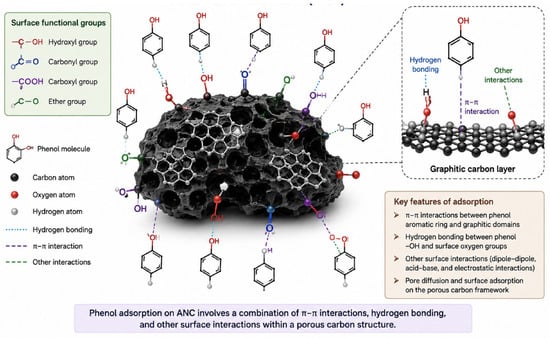
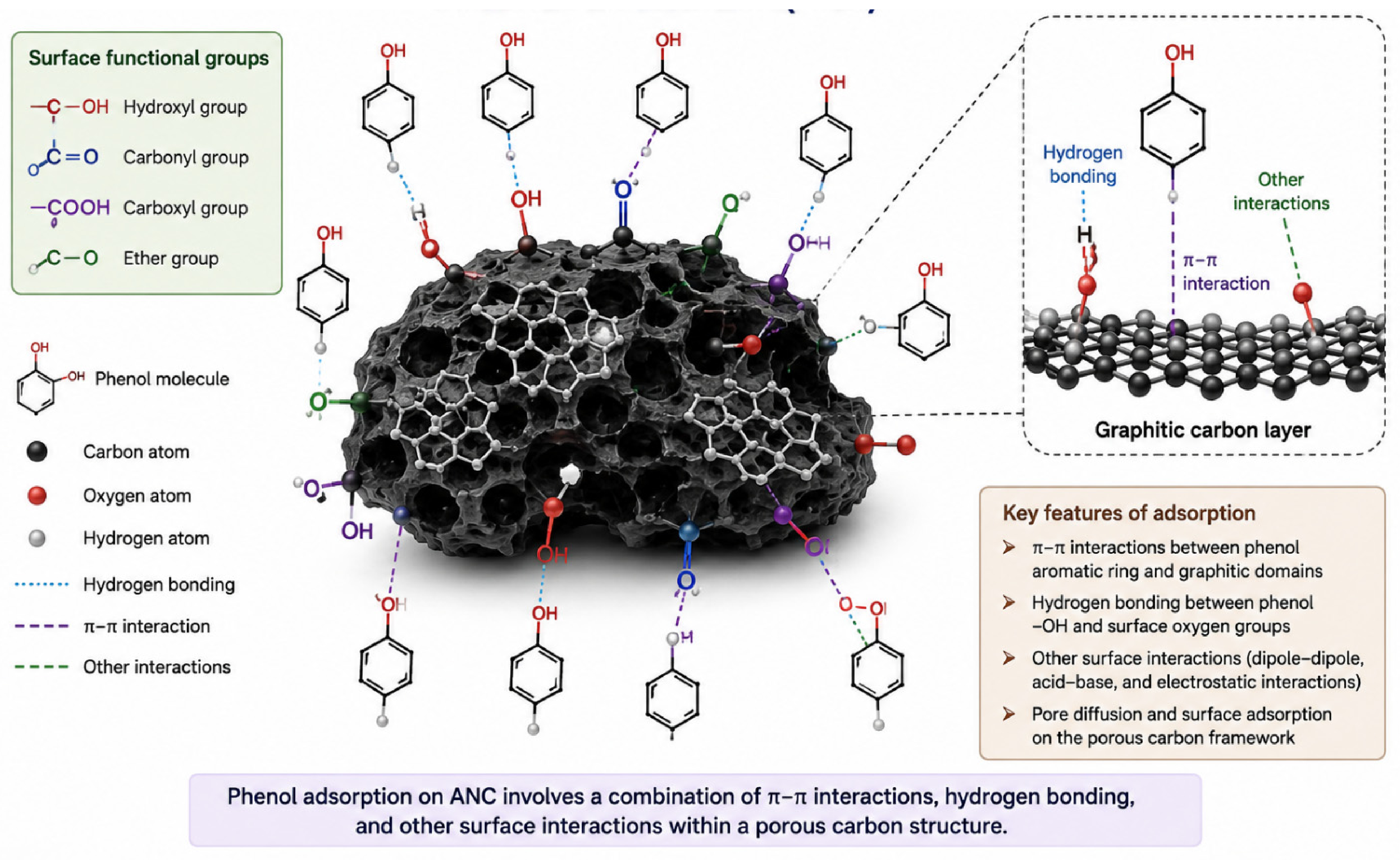
Based on the aromatic nature of phenol and the carbonaceous structure of ANC, π–π interactions between the aromatic ring of phenol and the π-electron-rich carbon domains may contribute to adsorption. Hydrogen bonding or other polar interactions involving the oxygen-containing surface functionalities may also contribute to phenol retention as illustrated in Figure 14. Such interactions have been reported for phenol adsorption onto activated carbon materials; however, their relative contributions depend strongly on surface chemistry, porosity, surface charge, and solution pH [54].
Figure 14.
The schematic illustrates possible interactions inferred from the physicochemical characteristics of ANC and literature reports; the individual contributions of these interactions were not directly confirmed in the present study.
The relatively rapid uptake during the initial adsorption period followed by an approach to equilibrium at approximately 90 min is consistent with the participation of readily accessible adsorption sites and mass transfer toward the available surface. However, the present experiments do not provide direct evidence to distinguish between external surface adsorption, pore diffusion, π–π interactions, hydrogen bonding, or other possible interactions [55].
The Langmuir model provided the best fit to the equilibrium data, indicating that the experimental equilibrium behavior is well described by the assumptions of the Langmuir model. Nevertheless, this result alone should not be interpreted as direct proof of a specific molecular adsorption mechanism. Similarly, the FTIR, XRD, FESEM, TEM, and AFM results provide evidence of the structural and chemical characteristics of ANC but do not independently confirm the proposed molecular interactions [55].
Therefore, the adsorption mechanism proposed in this study should be regarded as a plausible interpretation rather than a conclusively established mechanism. More definitive elucidation would require additional analyses, such as XPS to evaluate changes in surface chemical states before and after phenol adsorption and zeta-potential or pHPZC measurements to assess the role of surface charge. Comparative FTIR analysis before and after adsorption could also provide additional evidence for changes in surface functional groups.
4.7. Comparative Evaluation of Adsorption Capacity Against Waste-Derived Carbons
As presented in Table 4, the maximum adsorption capacity obtained in this study (23.98 mg/g) is superior or highly comparable to several conventional waste-derived adsorbents, such as coal, fly ash (5–30 mg/g) [56], rice husk char (14.38 mg/g) and palm seed coat carbon (18.3 mg/g) [57].
Table 4.
Comparative Table: Waste-Derived Adsorbents and Adsorption Capacities.
The prominent performance of the present material can be attributed to its well-developed porous architecture, high specific surface area, and abundant surface functional groups that facilitate strong interactions with the pollutant molecules. Beyond the competitive adsorption capacity, the key advantage of this material lies in its precursor origin; converting harmful environmental waste into a high-value functional carbon adsorbent provides a dual environmental benefit: solid waste management/upcycling and efficient wastewater remediation.
5. Conclusions
In this study, activated nanocarbon was successfully prepared from diesel exhaust soot through chemical activation with phosphoric acid, providing a practical route for converting a combustion-derived waste material into a functional carbon adsorbent. Structural and surface characterization by XRD, FTIR, FESEM, TEM, EDX, and AFM confirmed the formation of a predominantly disordered carbon structure with nanoscale morphology and oxygen-containing surface functionalities.
The adsorption experiments demonstrated that phenol uptake was strongly influenced by contact time, initial phenol concentration, temperature, and adsorbent dosage. Equilibrium was reached after approximately 90 min, while the optimum adsorbent dosage was 0.10 g. The highest removal efficiency was obtained at an initial phenol concentration of 10 mg L−1, and increasing the temperature from 25 to 55 °C enhanced the adsorption process. Equilibrium analysis showed that the Langmuir model provided the best fit to the experimental data (R2 = 0.9992), with a maximum adsorption capacity of 23.98 mg g−1, indicating that monolayer adsorption provides the most appropriate description of the equilibrium behavior under the investigated conditions.
Thermodynamic analysis confirmed that phenol adsorption was spontaneous and endothermic, with ΔG° values ranging from −22.42 to −25.79 kJ mol−1, ΔH° = +11.43 kJ mol−1, and ΔS° = +113.47 J mol−1 K−1. Overall, the results demonstrate that diesel exhaust soot can be effectively transformed into functional activated nanocarbon with favorable adsorption characteristics, highlighting its potential for waste valorization and the treatment of phenol-contaminated aqueous systems.
Author Contributions
Conceptualization, S.F.B. and S.A.A.; methodology, S.F.B.; software, H.A.J.; validation, S.F.B.; formal analysis, S.F.B.; investigation, S.F.B.; resources, S.A.A.; data curation, S.A.A.; writing—original draft preparation, S.F.B. and H.A.J.; writing—review and editing, S.A.A. and H.A.J.; visualization, S.A.A.; supervision, S.F.B.; project administration, S.F.B.; funding acquisition, H.A.J. All authors have read and agreed to the published version of the manuscript.
Funding
This research was supported by the British Council through the Going Global Partnerships–Researcher Challenges Grant (Grant Reference: RCG2024-003) as part of the project “Supporting Women’s Resilience to Climate Change through Technology and Education”, led by Liverpool John Moores University in partnership with Al-Maarif University and University of Anbar.
Data Availability Statement
The data supporting the findings of this study are available from the corresponding author upon reasonable request. The datasets generated during the study, including the characterization and phenol adsorption data, can be provided by the corresponding author upon reasonable request.
Acknowledgments
The authors gratefully acknowledge the financial support provided by the British Council through the Going Global Partnerships—Researcher Challenges Grant, as part of the project entitled “Supporting Women’s Resilience to Climate Change through Technology and Education”. In addition, during the preparation of this manuscript/study, the authors used ChatGPT (OpenAI, GPT-5.6 Luna) for generating the visual design of Figure 14 and the Graphical Abstract based on concepts and instructions provided by the authors and also for language refinement and grammar correction in selected parts of the Discussion section. All final content and analysis are the author’s own work. The authors have reviewed and edited the output and take full responsibility for the content of this publication.
Conflicts of Interest
The authors declare no conflicts of interest.
Abbreviations
The following abbreviations are used in this manuscript:
| AFM | Atomic Force Microscopy |
| ANC | Activated nanocarbon |
| DES | Diesel exhaust soot |
| EDX | Energy-Dispersive X-ray Spectroscopy |
| FE-SEM | Field Emission Scanning Electron Microscopy |
| FTIR | Fourier Transform Infrared Spectroscopy |
| TEM | Transmission Electron Microscopy |
| WWT | Wastewater treatment |
| XRD | X-ray Diffraction |
References
- Vierling, M.; Aboujaib, M.; Denolle, R.; Brilhac, J.F.; Molière, M. Soot Particle Emissions: Formation and Suppression Mechanisms in Gas Turbines. Gases 2024, 4, 446–467. [Google Scholar] [CrossRef] [Scilit]
- Yang, Y.; Ma, M.; Li, L.; Chen, S.; Liu, Z.; Li, F.; Wang, W. Formation characteristics of soot from the combustion of biodiesel-based nanofluid fuel: Influence of non-metallic nanoparticles. Fuel 2025, 399, 135484. [Google Scholar] [CrossRef] [Scilit]
- Ahmaruzzaman, M.; Mishra, S.R.; Gadore, V.; Yadav, G.; Roy, S.; Bhattacharjee, B.; Bhuyan, A.; Hazarika, B.; Darabdhara, J.; Kumari, K. Phenolic compounds in water: From toxicity and source to sustainable solutions—An integrated review of removal methods, advanced technologies, cost analysis, and future prospects. J. Environ. Chem. Eng. 2024, 12, 112964. [Google Scholar] [CrossRef] [Scilit]
- El Alouani, M.; Saufi, H.; Aouan, B.; Bassam, R.; Ben Tourtit, M.; Bassam, A.; Ahmina, W.; Rachdi, Y.; Belaaouad, S.; Alehyen, S. A Comprehensive Review on Green Synthesis and Characterization of Plant-Based Nanoparticles for Water Treatment Applications: Adsorption and Photodegradation of Organic and Inorganic Pollutants. Sustainability 2026, 18, 2721. [Google Scholar] [CrossRef] [Scilit]
- Yang, Y.X.; Ge, K.K.; ur Rehman, S.; Bi, H. Nanocarbon-based electrode materials applied for supercapacitors. Rare Met. 2022, 41, 3957–3975. [Google Scholar] [CrossRef] [Scilit]
- Neme, I.; Gonfa, G.; Masi, C. Activated carbon from biomass precursors using phosphoric acid: A review. Heliyon 2022, 8, e11940. [Google Scholar] [CrossRef] [Scilit] [PubMed]
- Mahendia, P.; Jangra, R.; Karakoti, M.; Sinha, O.P.; Sahoo, N.G.; Srivastava, A.; Rana, S.; Mahendia, S. Microwave-assisted synthesis of activated carbon from aerobic combustion of cotton in sesamee oil for high performance supercapacitor. Discov. Electrochem. 2026, 3, 52. [Google Scholar] [CrossRef] [Scilit]
- Kumari, R.; Ravi Kant, C. A Review on Oil-Derived Soot Electrodes for Efficient and Sustainable Supercapacitor Energy Storage Applications: A New Paradigm on Reusability. J. Electron. Mater. 2025, 54, 6029–6053. [Google Scholar] [CrossRef] [Scilit]
- Zou, Q.; Wang, B.; Gao, B.; Jiang, T.; Feng, Q.; Chen, M.; Zhang, J.; Zhang, X. Roles and mechanisms of carbonaceous materials in advanced oxidation coupling processes for degradation organic pollutants in wastewater: A review. Biochar 2023, 5, 86. [Google Scholar] [CrossRef] [Scilit]
- Zakaria, N.Z.J.; Rozali, S.; Mubarak, N.M.; Khalid, M. Synthesis of magnetic nanocarbon using palm oil as the green precursor via microwave-assisted arc for wastewater treatment. Sci. Rep. 2022, 12, 18698. [Google Scholar] [CrossRef] [Scilit] [PubMed]
- Ullah, S.; Shah, S.S.A.; Altaf, M.; Hossain, I.; El Sayed, M.E.; Kallel, M.; El-Bahy, Z.M.; ur Rehman, A.; Najam, T.; Nazir, M.A. Activated carbon derived from biomass for wastewater treatment: Synthesis, application and future challenges. J. Anal. Appl. Pyrolysis 2024, 179, 106480. [Google Scholar] [CrossRef] [Scilit]
- Kumar, G.; Kaushik, J.; Garg, A.K.; Saini, D.; Khare, P.; Sonkar, S.K. Pollutant diesel soot derived onion-like nanocarbons for the adsorption of organic dyes and environmental assessment of treated wastewater. Ind. Eng. Chem. Res. 2020, 59, 12065–12074. [Google Scholar] [CrossRef] [Scilit]
- Peña, G.D.G.; Reddy, K.S.K.; Varghese, A.M.; Prabhu, A.; Dabbawala, A.A.; Polychronopoulou, K.; Baker, M.A.; Anjum, D.; Das, G.; Aubry, C.; et al. Carbon dioxide adsorbents from flame-made diesel soot nanoparticles. Sci. Total. Environ. 2023, 859, 160140. [Google Scholar] [CrossRef] [Scilit] [PubMed]
- Ghazoui, M.; Boudouch, O.; Zahnoune, R.; Sylla, A.S.; Boukhrissi, N.; Oubaouz, M.; Chakraborty, S.; Elkacmi, R. Sustainable CO2 capture using phosphoric acid-activated carbon from the novel biomass Chamaerops humilis: Experimental optimization, characterization and DFT insight into the adsorption mechanism. Environ. Sci. Pollut. Res. 2026, 33, 2805–2826. [Google Scholar] [CrossRef] [Scilit] [PubMed]
- Azeez, S.A.; Hussein, F.M.; Al-Saedi, R.W.M. Adsorption isotherms for CBY 3G-P dye removal from aqueous media using tio2 degussa, Fe2O3, and TiO2/(DPC). Indones. J. Chem. 2023, 23, 702–715. [Google Scholar] [CrossRef] [Scilit]
- Sharma, G.; Sharma, S.; Kumar, A.; Lai, C.W.; Naushad, M.; Shehnaz; Iqbal, J.; Stadler, F.J. Activated carbon as superadsorbent and sustainable material for diverse applications. Adsorpt. Sci. Technol. 2022, 2022, 4184809. [Google Scholar] [CrossRef] [Scilit]
- Liu, X.; Liu, M.; Ma, C.; Yu, H.; Yu, W.; Liu, W. Research and Perspectives on Surface Functional Group Characterization of Activated Carbon Catalysts. Catalysts 2026, 16, 558. [Google Scholar] [CrossRef] [Scilit]
- Beltrán-Larrotta, J.I.; Moreno-Piraján, J.C.; Giraldo, L. New perspectives on the models of porous carbon. Comput. Struct. Biotechnol. J. 2025, 29, 156–165. [Google Scholar] [CrossRef] [Scilit] [PubMed]
- Li, Z.Q.; Lu, C.J.; Xia, Z.P.; Zhou, Y.; Luo, Z. X-ray diffraction patterns of graphite and turbostratic carbon. Carbon 2007, 45, 1686–1695. [Google Scholar] [CrossRef] [Scilit]
- Warren, B.E. X-ray diffraction in random layer lattices. Phys. Rev. 1941, 59, 693. [Google Scholar] [CrossRef] [Scilit]
- Enders, A.A.; North, N.M.; Fensore, C.M.; Velez-Alvarez, J.; Allen, H.C. Functional group identification for FTIR spectra using image-based machine learning models. Anal. Chem. 2021, 93, 9711–9718. [Google Scholar] [CrossRef] [Scilit] [PubMed]
- Mqehe-Nedzivhe, K.C.; Ojo, B.O.; Mabuba, N. Tailoring mesoporous ferrocene-modified activated carbon for phenol removal in wastewater. Adsorption 2025, 31, 49. [Google Scholar] [CrossRef] [Scilit]
- Boudrahem, N.; Aissani-Benissad, F.; Boudrahem, F.; Vial, C.; Audonnet, F.; Favier, L. Preparation and characterization of activated carbon developed from cotton cloth residue activated with phosphoric acid: Adsorption of clofibric acid. Water Sci. Technol. 2020, 82, 2513–2524. [Google Scholar] [CrossRef] [Scilit] [PubMed]
- Harris, P.J. New perspectives on the structure of graphitic carbons. Crit. Rev. Solid State Mater. Sci. 2005, 30, 235–253. [Google Scholar] [CrossRef] [Scilit]
- Goldstein, J.I.; Newbury, D.E.; Michael, J.R.; Ritchie, N.W.; Scott, J.H.J.; Joy, D.C. Electron beam—Specimen interactions: Interaction volume. In Scanning Electron Microscopy and X-Ray Microanalysis; Springer: New York, NY, USA, 2017; pp. 1–14. [Google Scholar] [CrossRef] [Scilit]
- Butt, H.J.; Cappella, B.; Kappl, M. Force measurements with the atomic force microscope: Technique, interpretation and applications. Surf. Sci. Rep. 2005, 59, 1–152. [Google Scholar] [CrossRef] [Scilit]
- Yusof, N.; Rana, D.; Ismail, A.F.; Matsuura, T. Microstructure of polyacrylonitrile-based activated carbon fibers prepared from solvent-free coagulation process. J. Appl. Res. Technol. 2016, 14, 54–61. [Google Scholar] [CrossRef] [Scilit]
- Foo, K.Y.; Hameed, B.H. Insights into the modeling of adsorption isotherm systems. Chem. Eng. J. 2010, 156, 2–10. [Google Scholar] [CrossRef] [Scilit]
- Ayawei, N.; Ebelegi, A.N.; Wankasi, D. Modelling and interpretation of adsorption isotherms. J. Chem. 2017, 2017, 3039817. [Google Scholar] [CrossRef] [Scilit]
- Kilic, M.; Apaydin-Varol, E.; Pütün, A.E. Adsorptive removal of phenol from aqueous solutions on activated carbon prepared from tobacco residues: Equilibrium, kinetics and thermodynamics. J. Hazard. Mater. 2011, 189, 397–403. [Google Scholar] [CrossRef] [Scilit] [PubMed]
- Tran, H.N.; You, S.J.; Hosseini-Bandegharaei, A.; Chao, H.P. Mistakes and inconsistencies regarding adsorption of contaminants from aqueous solutions: A critical review. Water Res. 2017, 120, 88–116. [Google Scholar] [CrossRef] [Scilit] [PubMed]
- Marsh, H.; Rodríguez-Reinoso, F. Characterization of activated carbon. Act. Carbon 2006, 1, 157–164. [Google Scholar] [CrossRef] [Scilit]
- Mahadadalkar, M.A.; Singh, A.K. Inaugural editorial for Discover Surfaces. Discov. Surf. 2026, 1, 1. [Google Scholar] [CrossRef] [Scilit]
- Lima, E.C.; Gomes, A.A.; Tran, H.N. Comparison of the nonlinear and linear forms of the van’t Hoff equation for calculation of adsorption thermodynamic parameters (∆S° and ∆H°). J. Mol. Liq. 2020, 311, 113315. [Google Scholar] [CrossRef] [Scilit]
- Lima, E.C.; Hosseini-Bandegharaei, A.; Moreno-Piraján, J.C.; Anastopoulos, I. A critical review of the estimation of the thermodynamic parameters on adsorption equilibria. Wrong use of equilibrium constant in the Van’t Hoof equation for calculation of thermodynamic parameters of adsorption. J. Mol. Liq. 2019, 273, 425–434. [Google Scholar] [CrossRef] [Scilit]
- Boulika, H.; El Hajam, M.; Hajji Nabih, M.; Idrissi Kandri, N.; Zerouale, A. Activated carbon from almond shells using an eco-compatible method: Screening, optimization, characterization, and adsorption performance testing. RSC Adv. 2022, 12, 34393–34403. [Google Scholar] [CrossRef] [Scilit] [PubMed]
- Belhachemi, M. Adsorption of organic compounds on activated carbons. In Sorbents Materials for Controlling Environmental Pollution; Núñez-Delgado, A., Ed.; Elsevier: Amsterdam, The Netherlands, 2021; pp. 355–385. [Google Scholar] [CrossRef] [Scilit]
- Radovic, L.R.; Moreno-Castilla, C.; Rivera-Utrilla, J. Carbon materials as adsorbents in aqueous solutions. In Chemistry and Physics of Carbon; Radovic, L.R., Ed.; CRC Press: Boca Raton, FL, USA, 2000; Volume 27, pp. 227–405. [Google Scholar]
- Bandosz, T.J.; Ania, C.O. Surface chemistry of activated carbons and its characterization. In Interface Science and Technology; Elsevier: Amsterdam, The Netherlands, 2006; Volume 7, pp. 159–229. [Google Scholar] [CrossRef] [Scilit]
- Puziy, A.M.; Poddubnaya, O.I.; Socha, R.P.; Gurgul, J.; Wisniewski, M. XPS and NMR studies of phosphoric acid activated carbons. Carbon 2008, 46, 2113–2123. [Google Scholar] [CrossRef] [Scilit]
- Marsh, H.; Rodríguez-Reinoso, F. Activation processes (chemical). In Activated Carbon; Rodríguez-Reinoso, Francisco, R., Eds.; Elsevier: Oxford, UK, 2006; Volume 6, pp. 322–365. [Google Scholar] [CrossRef] [Scilit]
- Zuo, S. Review on phosphoric acid activation for preparation of activated carbon (I): Roles of phosphoric acid. Chem. Ind. For. Prod. 2017, 37, 1–9. [Google Scholar] [CrossRef]
- Balcerzak, M.; Runka, T.; Śniadecki, Z. Influence of carbon catalysts on the improvement of hydrogen storage properties in a body-centered cubic solid solution alloy. Carbon 2021, 182, 422–434. [Google Scholar] [CrossRef] [Scilit]
- Omenat-Morán, D.; Durán-Valle, C.J.; Martínez-Cañas, M.A. Kinetic and mechanistic analysis of phenol adsorption on activated carbons from kenaf. Molecules 2024, 29, 4941. [Google Scholar] [CrossRef] [Scilit] [PubMed]
- Fernandez, E.; Hugi-Cleary, D.; López-Ramón, M.V.; Stoeckli, F. Adsorption of phenol from dilute and concentrated aqueous solutions by activated carbons. Langmuir 2003, 19, 9719–9723. [Google Scholar] [CrossRef] [Scilit]
- Girgis, B.S.; Temerk, Y.M.; Gadelrab, M.M.; Abdullah, I.D. X-ray diffraction patterns of activated carbons prepared under various conditions. Carbon Lett. 2007, 8, 95–100. [Google Scholar] [CrossRef] [Scilit]
- Chagu, J.; Mwakalesi, A.J. Effects of phosphoric acid concentration on properties of activated carbon from Strychnos spinose fruit shells. Sci. Rep. 2026, 16, 4009. [Google Scholar] [CrossRef] [Scilit] [PubMed]
- Ebrahimzadeh, F.; Akbari, A. Investigation the adsorption mechanisms, chemical resistance and mechanical strength of the synthesized chitosan/activated carbon composite in methylene blue removal. Sci. Rep. 2025, 15, 37820. [Google Scholar] [CrossRef] [Scilit] [PubMed]
- Kim, H.; Lee, M.E.; Kang, S.; Chung, J.W. Thermodynamic analysis of phenol adsorption by powdered activated carbon. J. Korean Soc. Environ. Eng. 2013, 35, 220–225. [Google Scholar] [CrossRef] [Scilit]
- Milonjić, S.K. A consideration of the correct calculation of thermodynamic parameters of adsorption. J. Serbian Chem. Soc. 2007, 72, 1363–1367. [Google Scholar] [CrossRef] [Scilit]
- Anastopoulos, I.; Kyzas, G.Z. Are the thermodynamic parameters correctly estimated in liquid-phase adsorption phenomena? J. Mol. Liq. 2016, 218, 174–185. [Google Scholar] [CrossRef] [Scilit]
- Zhou, X.; Zhou, X. The unit problem in the thermodynamic calculation of adsorption using the Langmuir equation. Chem. Eng. Commun. 2014, 201, 1459–1467. [Google Scholar] [CrossRef] [Scilit]
- Salame, I.I.; Bandosz, T.J. Role of surface chemistry in adsorption of phenol on activated carbons. J. Colloid Interface Sci. 2003, 264, 307–312. [Google Scholar] [CrossRef] [Scilit] [PubMed]
- Dąbrowski, A.; Podkościelny, P.; Hubicki, Z.; Barczak, M. Adsorption of phenolic compounds by activated carbon—A critical review. Chemosphere 2005, 58, 1049–1070. [Google Scholar] [CrossRef] [Scilit] [PubMed]
- Liu, Q.S.; Zheng, T.; Wang, P.; Jiang, J.P.; Li, N. Adsorption isotherm, kinetic and mechanism studies of some substituted phenols on activated carbon fibers. Chem. Eng. J. 2010, 157, 348–356. [Google Scholar] [CrossRef] [Scilit]
- Ahmaruzzaman, M. A review on the utilization of fly ash. Prog. Energy Combust. Sci. 2010, 36, 327–363. [Google Scholar] [CrossRef] [Scilit]
- Girish, C.R.; Murty, V.R. Adsorption of phenol from wastewater using locally available adsorbents. J. Environ. Res. Dev. 2012, 6, 763–772. [Google Scholar]

Disclaimer/Publisher’s Note: The statements, opinions and data contained in all publications are solely those of the individual author(s) and contributor(s) and not of MDPI and/or the editor(s). MDPI and/or the editor(s) disclaim responsibility for any injury to people or property resulting from any ideas, methods, instructions or products referred to in the content. |
© 2026 by the authors. Licensee MDPI, Basel, Switzerland. This article is an open access article distributed under the terms and conditions of the Creative Commons Attribution (CC BY) license.