


Abstract
Properties of defects in crystals composed of soft particles, such as colloids, differ markedly from those in metals. In this work, dislocation reactions in a bundle of carbon nanotubes (CNTs) are investigated using relaxational molecular dynamics. The problem is reduced to a two-dimensional model, where the strain state of the CNT bundle is fully determined by the cross-sectional shapes of the nanotubes arranged in a close-packed triangular lattice. A pair of edge dislocations with opposite topological charges is introduced into an uniaxially compressed bundle, and their relaxational dynamics are analyzed as a function of the distance d between the parallel planes along which the dislocations glide. When the dislocations move in the same plane (d = 0), they annihilate, restoring a defect-free structure. For negative distances (d < 0), their interaction results in the formation of a vacancy (d = −1), a bivacancy (d = −2), extended voidions (d = −3, −4), or dislocation dipoles (d < −4). In contrast to metals, vacancy clusters containing more than two missing particles in CNT bundles relax into extended voidions. For positive distances (d > 0), the dislocation reaction generates interstitial-type defects in the form of crowdions, which at sufficiently large separations (d > 4) can also be interpreted as dislocation dipoles. In most cases, except for d = 0 and d = 1, dislocation glide enables complete relaxation of the initial shear strain, even in the presence of defects. However, for d = 0 and d = 1, dislocation annihilation or immobilization limits plastic deformation, resulting in only partial stress relaxation. The observed effects are due to the elliptization of the cross-sections of soft carbon nanotubes in the cores of defects. These findings highlight significant differences in defect behavior between crystals of deformable particles and conventional metallic systems.
1. Introduction
Carbon nanotube (CNT) bundles and vertically aligned CNT forests represent an important mesoscale form of carbon nanomaterials in which the exceptional intrinsic properties of individual nanotubes are translated into collective mechanical, thermal, and transport characteristics relevant for practical applications [1,2,3,4,5]. In particular, aligned CNT assemblies are actively explored for thermal interface materials, microelectronic interconnects, electrodes, sensors, damping layers, and lightweight multifunctional composites [2,3,4,5,6,7]. In many of these applications, the functional response is governed not by a single nanotube, but by the cooperative behavior of a densely packed CNT ensemble, where intertube interactions, packing morphology, and collective defect processes become decisive [1,4,6].
At the same time, CNT bundles and forests commonly operate under external mechanical loading, including lateral compression, indentation, cyclic contact loading, and shock-like action [2,4,8]. A growing body of experimental and theoretical work shows that the deformation of aligned CNT assemblies is highly nonlinear and involves buckling, intertube sliding, interface slip, hysteresis, and irreversible structural rearrangements [4,8,9]. These observations indicate that the mechanical response of CNT arrays cannot be reduced to purely elastic bending of isolated nanotubes and that it is necessary to examine the microscopic mechanisms controlling their plastic deformation under applied loads [7,8,9,10,11].
A convenient viewpoint for such an analysis is to regard the cross-sections of nanotubes in a compressed bundle as a two-dimensional close-packed crystal of soft particles interacting through van der Waals forces and the elastic deformability of the CNT walls. In contrast to ordinary crystals of rigid particles, soft-particle crystals can support unusual extended point defects, including crowdions and voidions, whose structure is determined by cooperative particle displacements along close-packed directions [12,13]. Recent studies of soft colloidal crystals have demonstrated that vacancies and interstitials in such systems may relax into one-dimensional extended defects rather than remain compact, localized point defects, which strongly affects both plastic relaxation and transport properties [12]. This analogy suggests that the plastic deformation of CNT bundles should also be described in terms of defect generation, defect interaction, and collective rearrangement of nanotubes inside a deformable close-packed array. Submicron-sized soft colloidal particles under specific conditions can form crystals and exhibit phase transitions where particle compressibility plays an important role [14,15]. Soft particles can overlap and form stable clusters that self-assemble into periodic crystalline forms [16,17]. The flexibility of CNT cross-sections may also lead to non-trivial mechanical properties of CNT bundles.
Another issue of fundamental and practical importance is the mechanism of mass transfer in CNT assemblies subjected to deformation. In crystalline solids, dislocations are known to contribute not only to plastic flow but also to anomalous mass transport under strong external action, and dislocation-mediated mass transfer has been discussed for laser-driven processes, phase transformations, Ostwald ripening [18,19,20], and precipitate evolution [21]. Extended vacancy-type defects similar to voidions have also been analyzed in soft colloidal systems, helium, and metals, where they provide a mechanism for concerted transport of matter [12,13,19]. Therefore, if dislocation reactions in CNT bundles generate local regions of reduced or enhanced nanotube density, they may provide a natural microscopic mechanism for mass redistribution during plastic deformation.
Despite considerable interest in the mechanical behavior of carbon nanotube bundles, the elementary mechanisms of defect-mediated mass transfer in the cross-sectional plane remain insufficiently clarified. In particular, the interaction of compression-induced dislocations and the conditions under which they generate vacancy-like or interstitial-like collective defects are still poorly understood. The purpose of the present work is therefore to isolate these elementary mechanisms within a reduced cross-sectional model and to identify the structural scenarios of defect reactions under lateral compression. The study is not intended to reproduce the full three-dimensional finite-temperature response of a real CNT bundle, but rather to reveal the underlying geometric and relaxational mechanisms governing local defect transformations in the cross-sectional plane.
In this work, relaxational molecular dynamics is used to study defect formation and dislocation-mediated mass transfer in a laterally compressed bundle of zigzag CNTs under plane strain conditions. The problem is reduced to a two-dimensional model in which the state of the bundle is determined by the shapes and arrangement of CNT cross-sections forming a close-packed triangular lattice, and the interaction of two edge dislocations with opposite topological charges is analyzed as a function of the distance between their glide planes. Special attention is paid to the formation of vacancies, bivacancies, voidions, and crowdions, since these defects reveal the microscopic mechanisms of plastic deformation and mass transfer in an array of soft particles modeling the CNT bundle.
2. Simulation Details
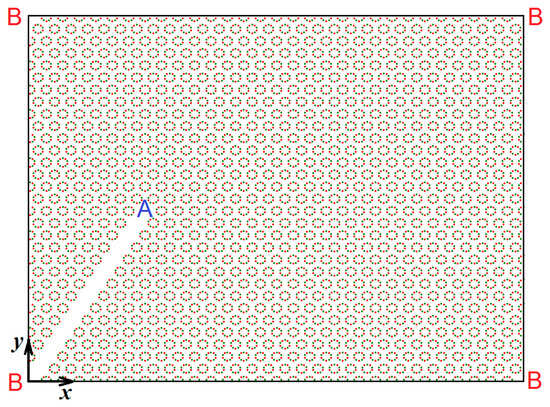
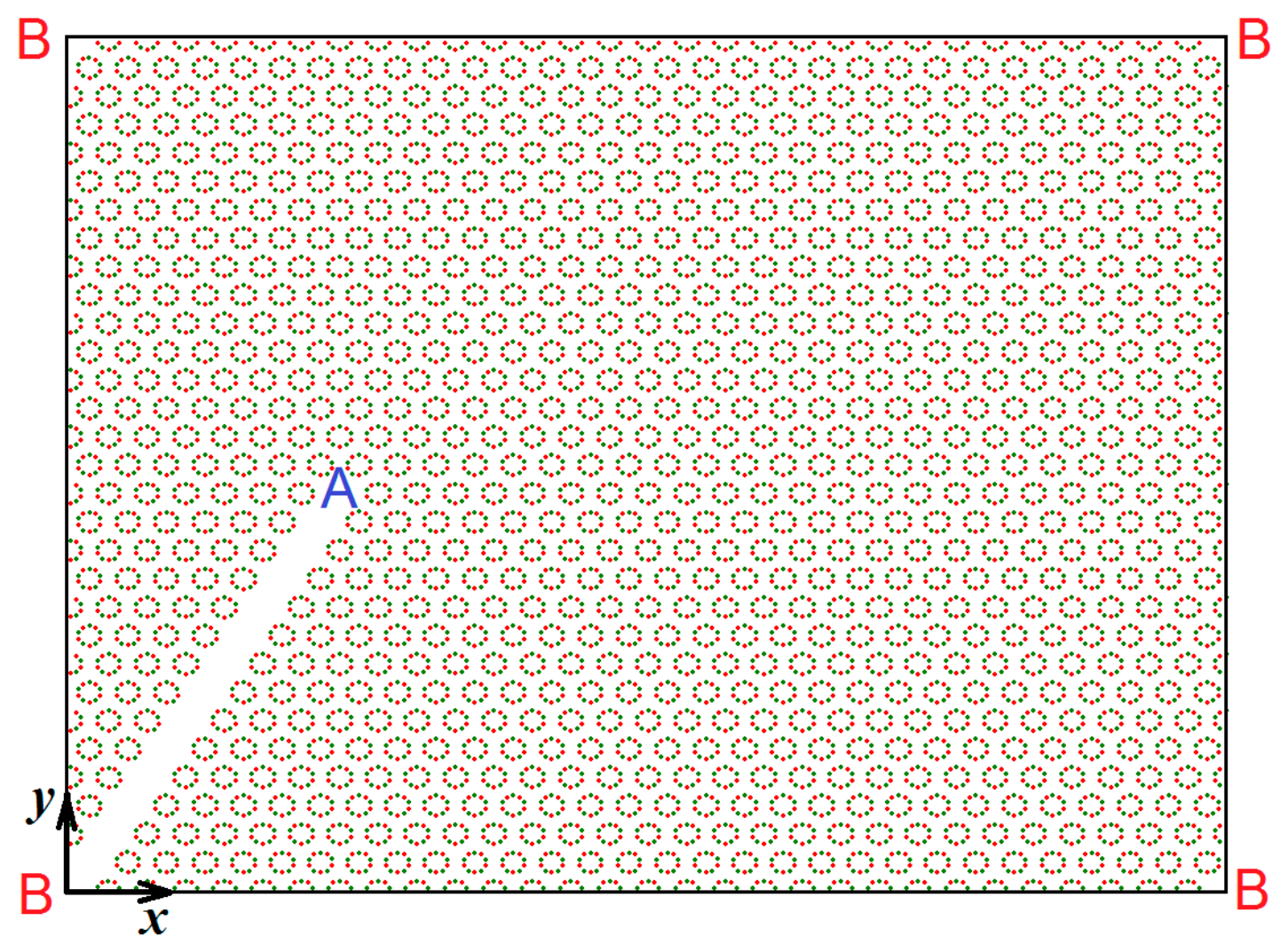
Relaxational dynamics of a bundle of (5,0) zigzag CNTs is investigated under plain strain condition assuming that all CNTs are aligned along the z-axis and their cross-sections make a close-packed triangular lattice, see Figure 1. (6,0) and (7,0) CNTs were also included for comparison in a few simulation runs. CNTs of small diameter are chosen to avoid the bistability effect exhibited by CNTs of sufficiently large diameter, when they can have two stable configurations—open and collapsed [22]. A pair of edge dislocations of the opposite topological charge is introduced in the computational cell having a shape of rhombuses by removing n CNTs from a densely packed row inclined to the x-axis by 60°. The problem is two-dimensional and the periodic boundary conditions are applied in both directions. The bundle is then uniformly compressed in the vertical direction by εyy = 0.15 and the relaxation dynamics begin until a (local) minimum of potential energy is reached and the system comes to equilibrium. It was found that the dislocations become mobile for εyy > 0.035 and they do not move at smaller values of the compressive strain.
Figure 1.
Initial configuration of a CNT bundle. From a 30 × 30 array of zigzag CNTs, n CNTs are removed from a densely packed row inclined to the x-axis by 60° (in this case, n = 15). Periodic boundary conditions are used. Each CNT is represented by 10 carbon chains oriented along the z-axis. The bundle is then uniformly compressed in the vertical direction by 15% (εyy = 0.15, εxx = εxy = 0). Relaxation dynamics begin from this initial configuration and continue until a (local) minimum of potential energy is reached and the system reaches equilibrium. As a result of relaxation, two dislocations initially form at points A and B, which then begin to slide.
The force field used in this study is described in detail in the work [22]. This is the effective force field that describes the interactions between the carbon atoms representing the straight chains of carbon atoms parallel to the z-axis. It includes the energy of the effective covalent interatomic interactions between the nearest atoms in the CNT wall (each atom has two neighbors), the effective energy of the valence angles, and the non-valence van-der-Waals interactions between nanotubes. This effective force field was fitted to the mechanical properties and phonon dispersion curves of graphene and CNTs of different diameter and has shown high accuracy in the modelling of various sp2 carbon nanostructures such as CNT bundles [22,23], carbon nanosprings [24], multilayer CNTs [25,26], graphene under pressure covering a slit [27], wrinkles in graphene on a substrate [28], dislocations in CNT bundles [29], and CNTs interacting with gases or liquids [30,31,32]. It should be emphasized that in the present study this force field is used within a reduced cross-sectional representation of the CNT bundle and is intended to describe the relative stability of defect configurations and their relaxational transformation pathways. The model is therefore employed as a mechanistic mesoscale approximation rather than as a fully atomistic tool for quantitatively reproducing dislocation-core energies or Peierls barriers. This distinction is important for interpreting the scope of the results and for avoiding overestimation of the quantitative predictive capability of the reduced model.
All CNTs have 10 carbon atoms in their cross-section, each atom stands for a rigid chain of carbon atoms parallel to the z-axis. CNT diameter is D = 3.97 Å. The non-orthogonal translation vectors of the equilibrium CNT array are a = ρ(1, 0), b = ρ (1/2, √3/2), where ρ is the distance between the centers of neighboring CNTs. In our case we have ρ = 7.038 Å, so that a = (7.038, 0), b = (3.519, 6.095) (in Angstrom). The distance between the walls of the nearest CNTs is about 3.07 Å. A small CNT diameter was intentionally chosen in order to remain within the regime where the tube cross-sections preserve a comparatively simple non-collapsed shape and the reduced soft-cross-section description remains physically transparent. This choice makes it possible to focus on the elementary defect-reaction mechanisms without the additional complications associated with strong ovalization or collapse of larger-diameter nanotubes. Accordingly, the present results should be interpreted as most directly applicable to small-diameter aligned CNT bundles, whereas larger diameters may lead to quantitatively different reaction thresholds and to additional structural transformation channels. This expectation is consistent with previous studies reporting diameter-dependent collapse and ovalization of CNT bundles under external loading [33].
The relaxational dynamics are performed by the steepest descent method with the limitation of the maximum displacement of the atoms to 0.01 Å. This limitation ensures the stability of the relaxation process especially at the early stage. The upper limit imposed on the displacement at a single relaxation step was introduced as a conservative numerical stabilization parameter. Its purpose is to ensure smooth relaxation in strongly distorted local configurations and to prevent excessively large coordinate updates near defect cores. Since the present work is focused on the topology and relative stability of the final relaxed states rather than on real-time kinetics, this parameter should be viewed as part of the numerical minimization procedure rather than as a physical dynamic quantity. A more systematic sensitivity analysis of this numerical setting is beyond the scope of the present study and will be useful in future work. The equilibrium is achieved when the maximum force acting on an atom is less than 10−7 eV/Å.
In all simulations presented below the CNT array initially has 30 × 30 zigzag CNTs and the number of removed CNTs is varied from n = 11 to n = 19. By varying n, one changes the distance between the planes where the two dislocations glide: for n = 15 they glide in the same plane and for n ≠ 0 the distance between the planes is d = 15 − n, which can be positive or negative.
The interactions between colloidal particles are often modelled by the repulsive potentials [12] but the van-der-Waals bonds between sp2 carbon structures are attractive at large distances and repulsive at small distances. We consider the CNT bundle under lateral compressive strain with a positive hydrostatic pressure when the repulsive forces act between CNTs.
The present approach is a reduced two-dimensional model of a laterally compressed bundle of long, parallel CNTs, in which the principal degrees of freedom are associated with the in-plane rearrangement and deformation of nanotube cross-sections. Such a formulation is appropriate for analyzing local cross-sectional defect reactions in sufficiently long, aligned bundles when the dominant structural changes occur in the transverse plane.
At the same time, the model does not explicitly include several factors that may be important under more general conditions, namely thermal activation, axial nonuniformity along the nanotube length, end effects, torsional loading, and diameter-dependent transitions to strongly ovalized or collapsed cross-sections. Therefore, the critical values of the geometric parameter d obtained in this work should be regarded as thresholds within the framework of the present reduced model rather than as universal constants for arbitrary CNT bundles.
This limitation is particularly relevant for larger-diameter CNTs, since diameter-dependent compliance and collapse of nanotube bundles under loading have been reported in the literature. In addition, studies of torsional loading show that the bundle response may depend on diameter and loading mode, with twisting-induced defects such as disclination lines significantly altering the mechanical behavior of CNT bundles [34,35]. Accordingly, the present results are most directly applicable to quasi-plane-strain cross-sectional rearrangements in aligned, non-twisted or weakly twisted bundles of small-diameter CNTs.
The calculations were performed in the athermal relaxational limit. This means that the study is aimed at identifying the energetically preferred relaxed configurations and defect-transformation pathways without explicit thermal fluctuations. Finite temperature may facilitate activated transitions, alter metastability ranges, and affect defect mobility, but these effects were not considered in the present work and require a separate finite-temperature analysis.
3. Results
3.1. The Process of Relaxation
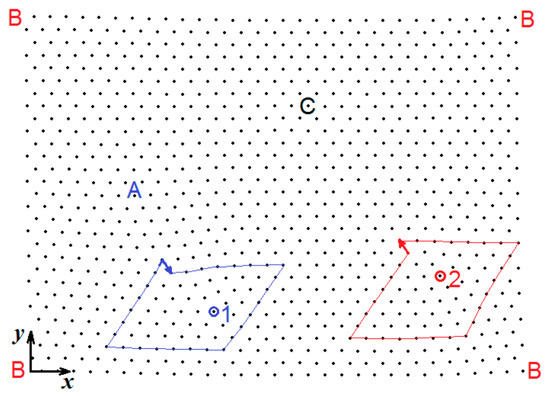
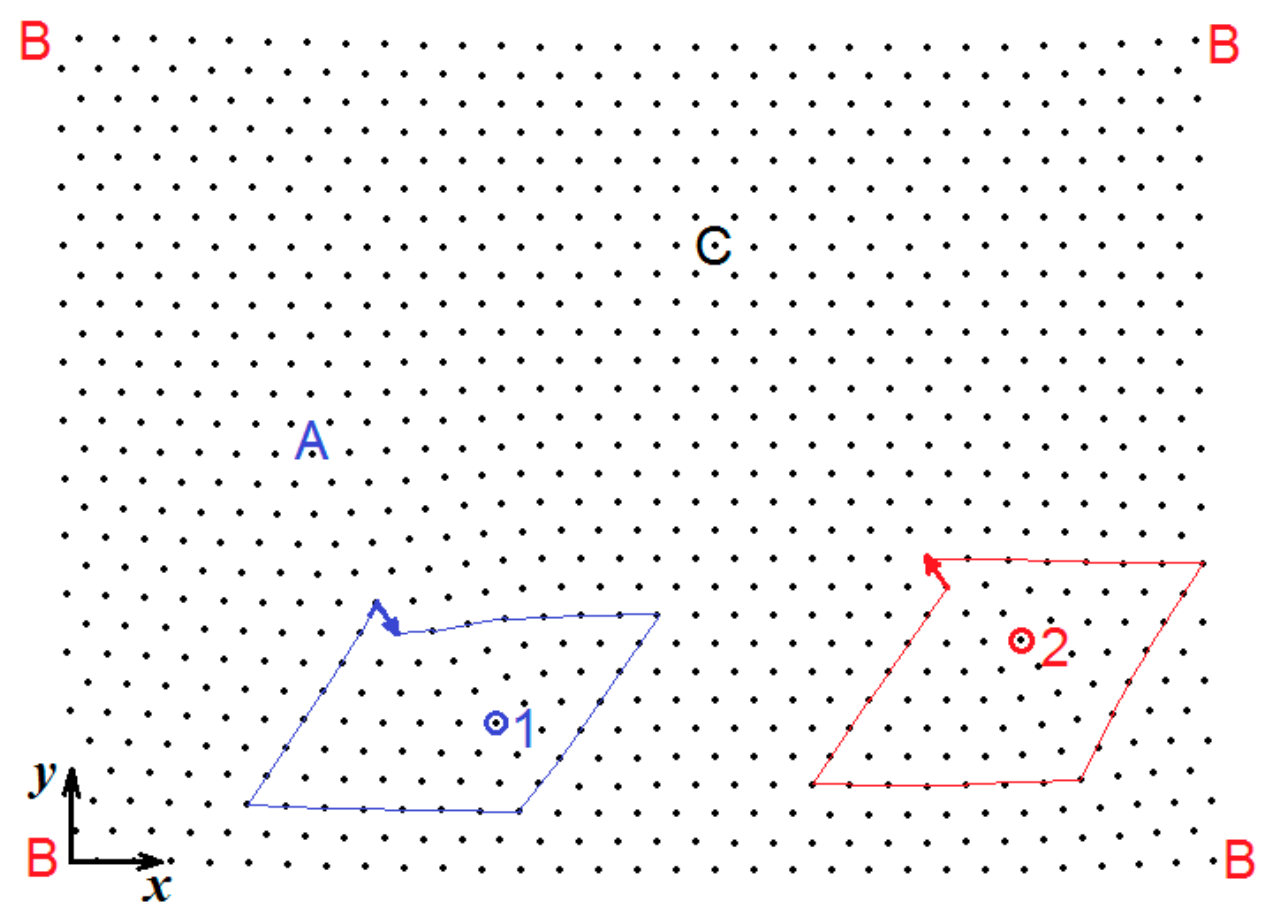
A snapshot of the structure during the relaxation is shown in Figure 2 for the case of n = 15. Black dots show the positions of the CNT cross-section centers of gravity. As mentioned above, the two edge dislocations are formed at the points A and B, they start to glide and at the time of the snapshot they reach the positions shown by the circles and labeled 1 and 2. The Burgers contours are plotted to find the Burgers vectors which are shown by the arrows.
Figure 2.
A computational cell with two dislocations, shown by small circles and labeled 1 and 2 for the case n = 15. Burgers’ contours are plotted to show the Burgers vectors of the dislocations (shown by arrows). These dislocations initially formed at points A and B and glided along the Burgers vectors to their actual positions. The structure shown is not in equilibrium, and the dislocations continue to glide along the Burgers vectors as the structure relaxes. They will meet at point C.
In the triangular lattice of carbon nanotube cross-sections, there are three close-packed directions: the first is parallel to the x-axis, and the other two are inclined to the x-axis at angles of π/3 and 2π/3. The Schmid factor is defined as
where ϕ is the angle between compressive stress and slip plane normal, and λ is the angle between stress and slip direction. The Schmid factor is maximum for the close-packed plane inclined to the x-axis at an angle of 2π/3, as in this case ϕ = 2π/3, λ = π/3, giving m = 0.433. Consequently, dislocations in a crystal compressed along the y-axis will slide along the Burgers vectors, see Figure 2.
m = cosϕ cosλ,
The structure presented in Figure 2 is not in equilibrium since the dislocations continue to glide and they will meet at point C. For the case of n = 15 presented in Figure 2, the dislocations glide in the same plane and they will annihilate at point C restoring the defect-free structure, as will be shown later. For n ≠ 15 the dislocations will glide in different parallel planes and the result of collision will depend on the distance between planes d = 15 − n.
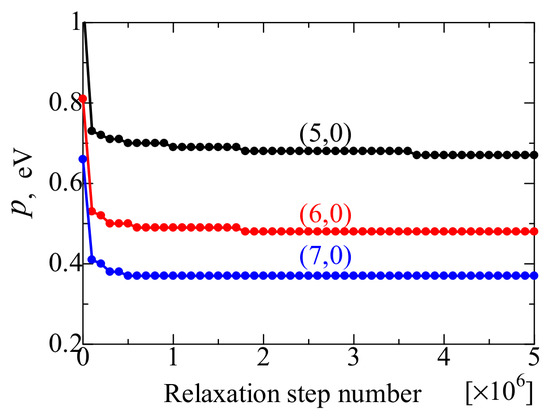
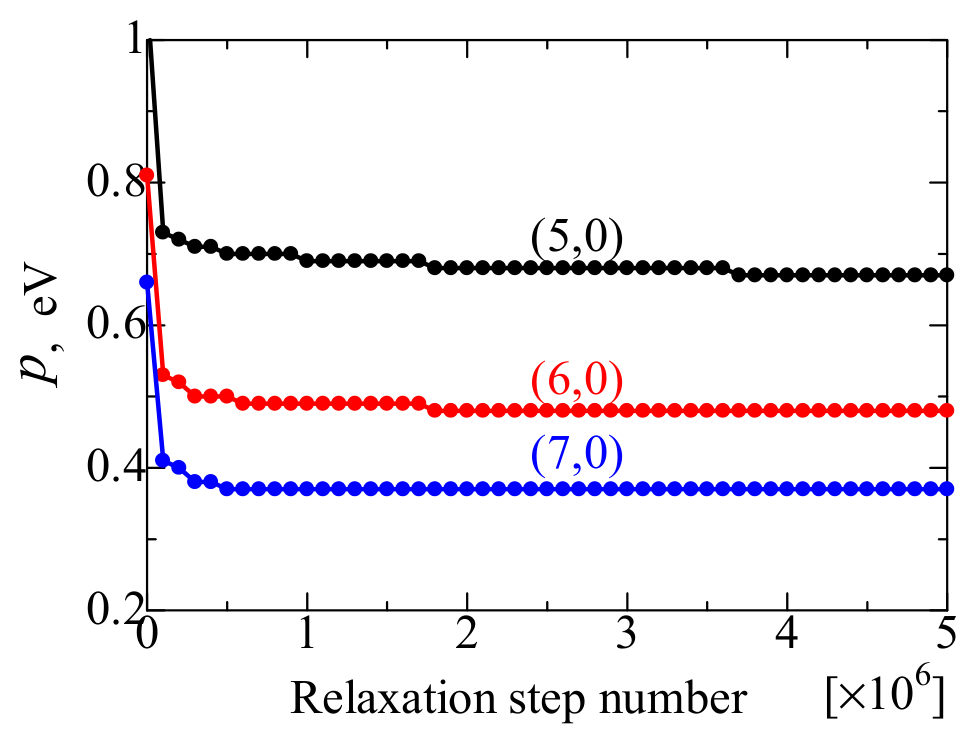
Convergence of the relaxation process is presented in Figure 3 for the 30 × 30 bundles of zigzag CNTs (5,0), (6,0), and (7,0) under compressive strain εyy = 0.15 with εxx = εxy = 0. In all three cases d = −2 (n = 17). Potential energy per atom p is shown as a function of the relaxation step number. Bundles of CNTs of smaller diameter require more relaxation steps to reach the equilibrium as the dislocations slide more slowly. For the bundle of (7,0) CNTs the relaxation is complete in about 2 × 10⁶ relaxation steps, while for (5,0) CNTs about 5 × 10⁶ relaxation steps are required.
Figure 3.
Potential energy per atom as a function of the relaxation step number for the 30 × 30 bundles of zigzag CNTs (5,0), (6,0), and (7,0) under compressive strain εyy = 0.15 with εxx = εxy = 0. In all three cases d = −2 (n = 17).
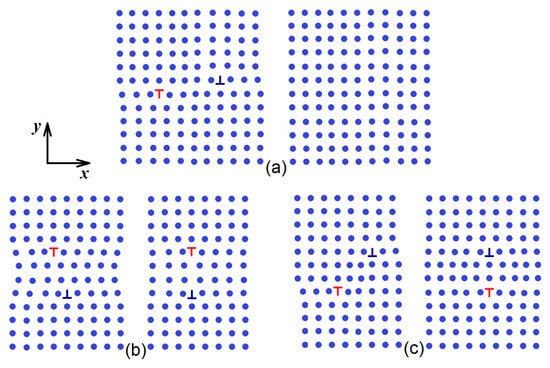
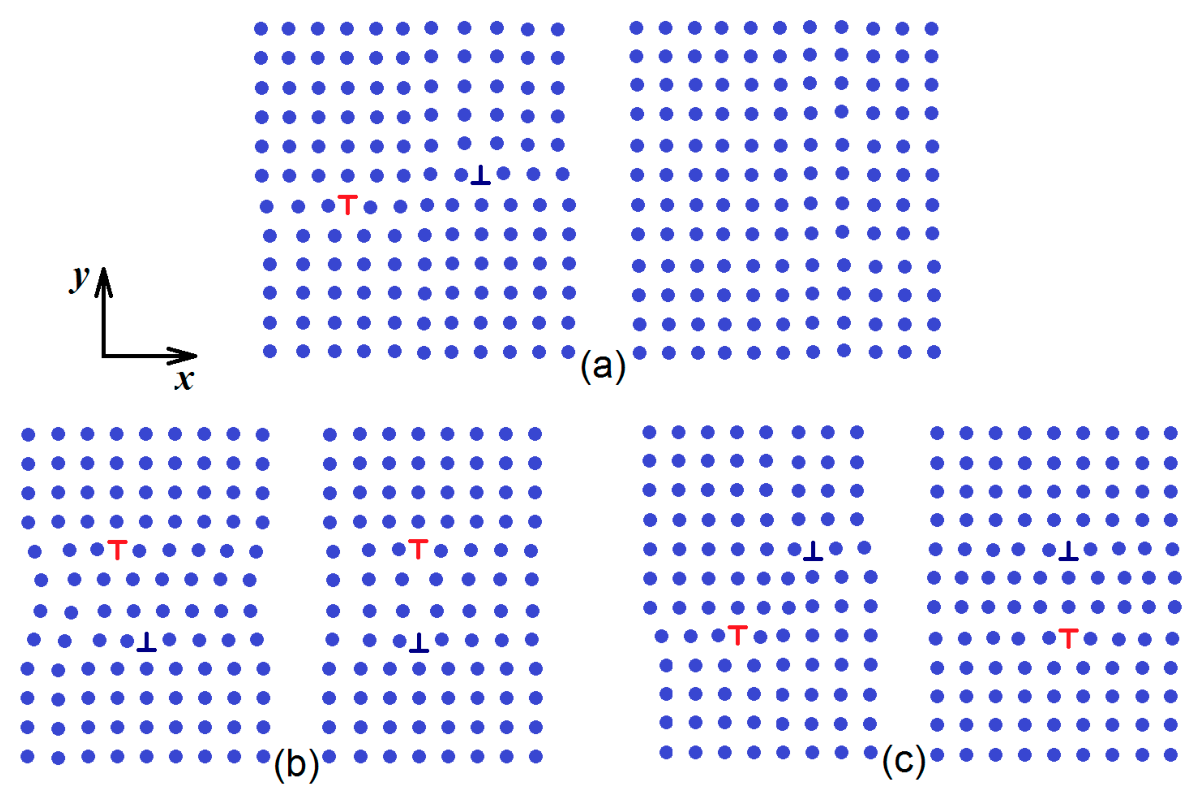
In order to understand the possible scenarios of the dislocation reactions moving in the parallel planes, a schematic plot is presented in Figure 4. In this figure, collisions between two edge dislocations of opposite topological charge gliding in parallel atomic planes in a square lattice are schematically shown. On the left is shown the sliding of dislocations towards each other, and on the right is the equilibrium structure. We use a square lattice to illustrate this textbook picture (see [36]), as it is easier to understand; however, the same processes occur in the triangular lattice of CNT cross-sections. Dislocations of opposite sign attract each other and move until they reach the minimum separation. When they glide in the same atomic plane (d = 0), as in (a), they annihilate and a defect-free lattice is restored. On the other hand, if they glide in different planes, they either annihilate with the formation of point defects or form a stable dislocation dipole. The former scenario occurs when the distance between the glide planes is small, while the latter occurs when it is large. In (b), the positive dislocation glides four atomic planes above the negative one (d = −4), resulting in the formation of four vacancies; alternatively, this configuration can be described as a dislocation dipole. In (c), the positive dislocation glides two atomic planes below the negative one (d = 2), and their annihilation leads to the formation of two interstitials.
Figure 4.
Schematic of dislocation collisions gliding toward each other in parallel atomic planes in a square lattice. Moving dislocations are shown on the left and their stable configurations on the right. In (a) the positive (red) and negative (blue) dislocations glide in the same plane and they annihilate completely resulting in a defect-free lattice. In (b), the positive dislocation glides four atomic planes above the negative one and their annihilation produces four vacancies. In (c), the positive dislocation glides two atomic planes below the negative one and their annihilation results in the appearance of two interstitials. The stable configurations in (b,c) can also be regarded as dislocation dipoles.
Thus, the principal result of the present calculations is not only the existence of individual defect configurations, but also the defect-reaction map controlled by the sign and magnitude of the separation parameter d. Negative d favors vacancy-like distributed mass-deficit structures, whereas positive d promotes the formation of interstitial-like crowdion configurations. The vicinity of d ≈ 0 corresponds to the transition between competing reaction channels and is therefore structurally the most sensitive regime. These defect-reaction scenarios are summarized in Table 1.
Table 1.
Relationship between the separation parameter d and the predominant relaxed defect configuration.
3.2. Defects Formed as the Result of Relaxation
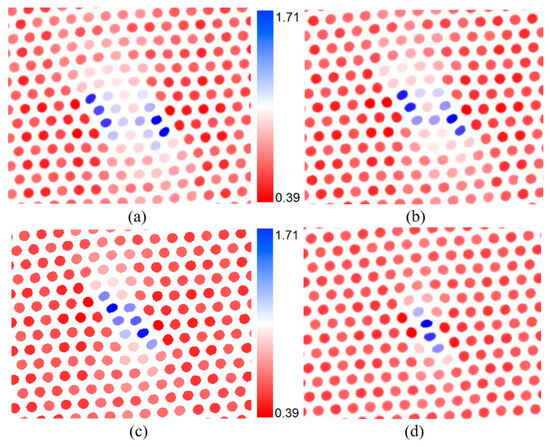
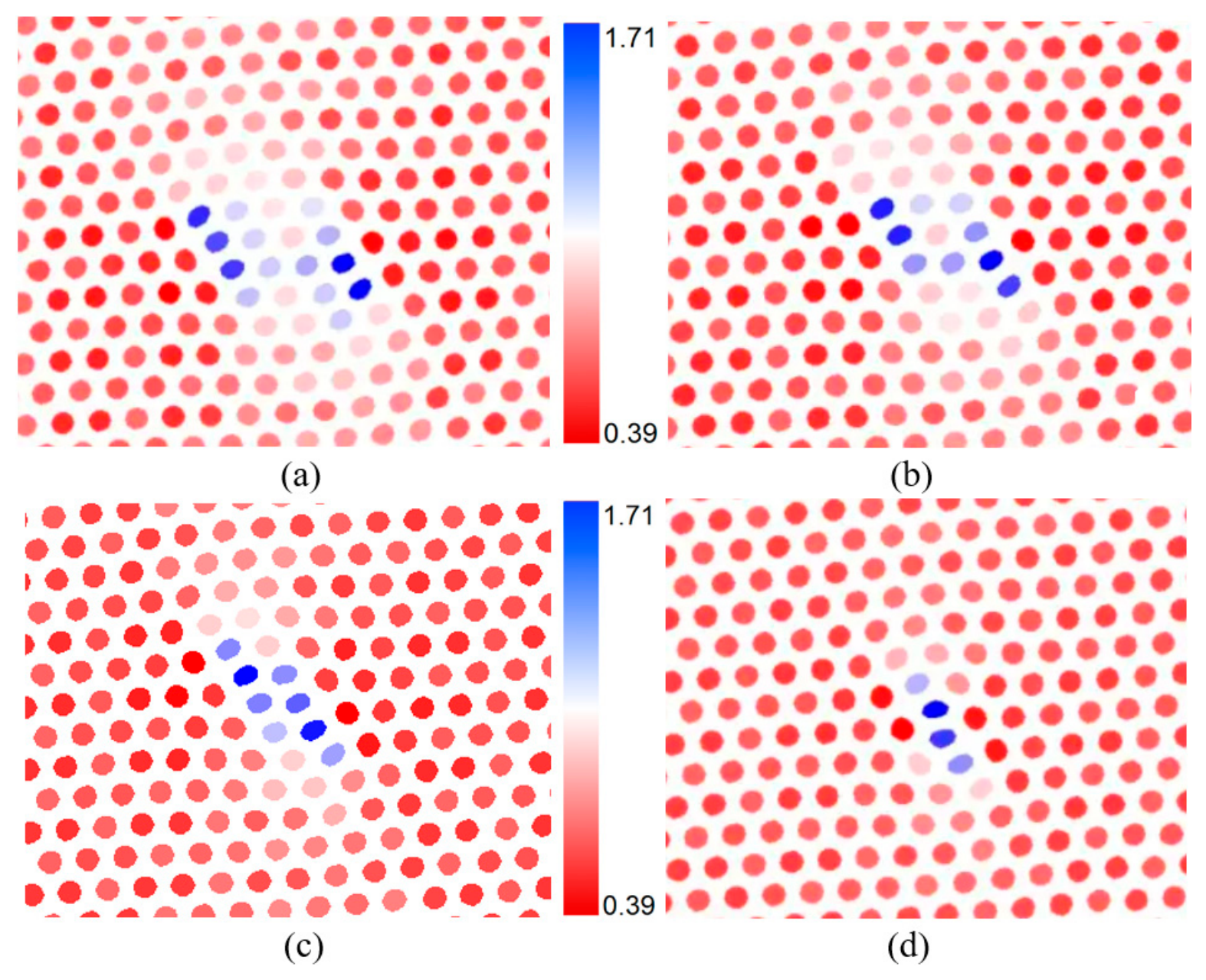
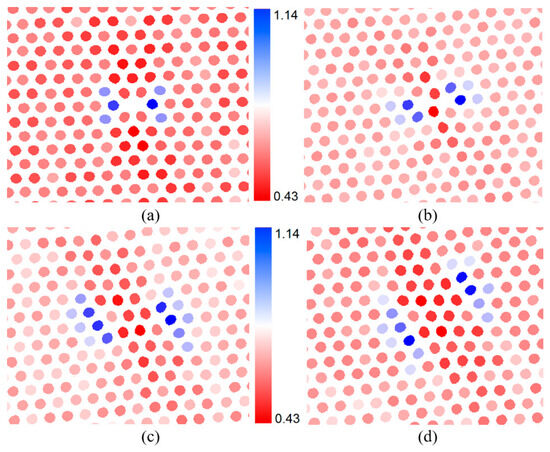
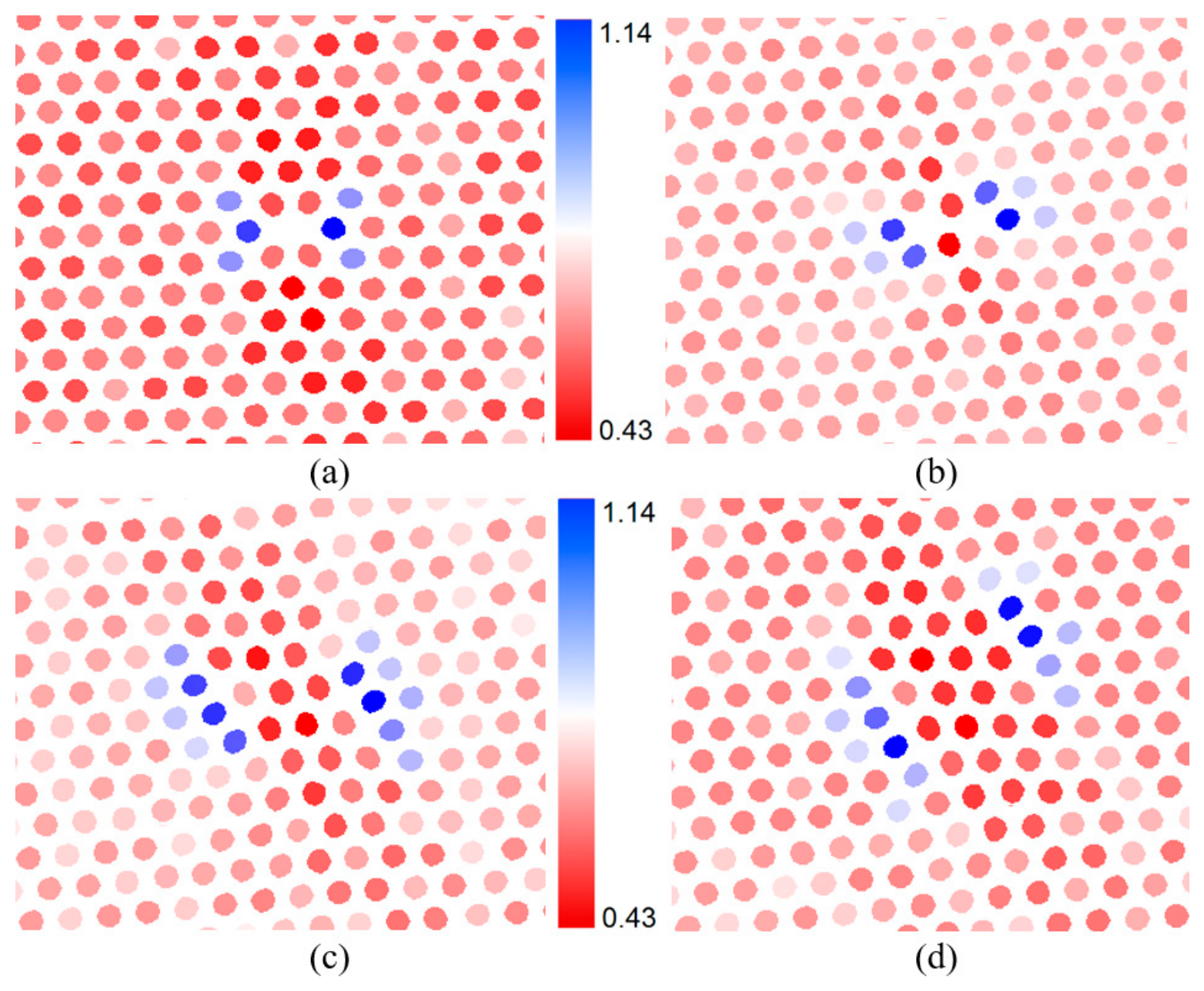
Now we come back to the triangular lattice of CNT cross-sections and show the equilibrium structures of the defects created as a result of the interaction of the two dislocations for different values of d, which is the distance between the gliding planes. The results for positive (negative) d are shown in Figure 5 and Figure 6. In these figures, the inner arear of CNT cross-sections is colored according to the potential energy of the CNTs per unit length with the red color corresponding to the minimum energy and the blue color to the maximum energy. The color bars in Figure 5 and Figure 6 show the energy values in eV. One can see the ellipticity of the CNT cross-sections in the vicinity of the defects.
Figure 5.
Equilibrium structure of defects in a CNT bundle formed as a result of the interaction of dislocations gliding in parallel planes at a distance (a) d = 4, (b) d = 3, (c) d = 2, and (d) d = 1. The regions of the CNT cross-sections are colored according to their potential energy per unit length: red (blue) corresponds to the minimum (maximum) energy, see the color bar in eV. The ellipticity of the CNT cross-sections near the defects is visible.
Figure 6.
Same as in Figure 5, but for negative d: (a) d = −1, (b) d = −2, (c) d = −3, and (d) d = −4.
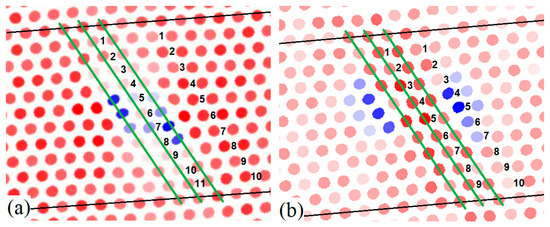
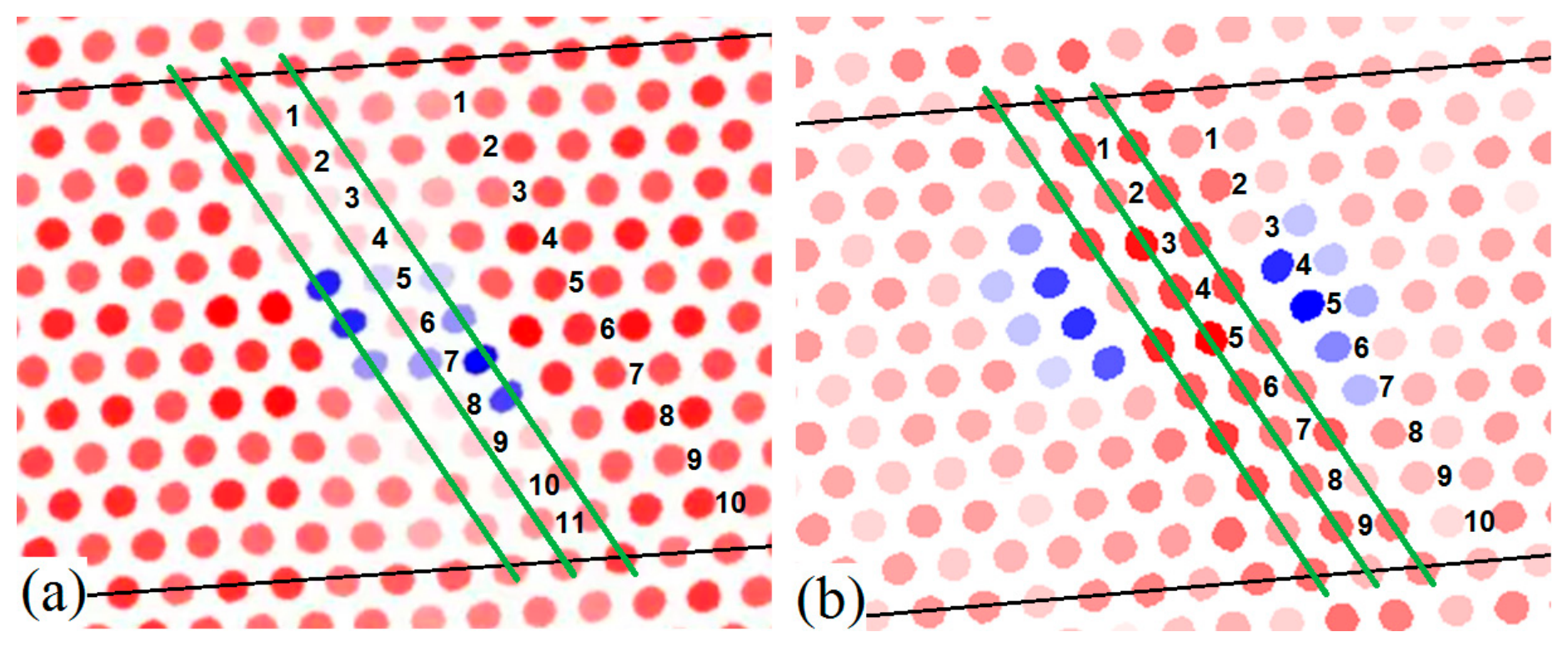
In Figure 5 the interstitial CNTs are formed in the form of crowdions. The number of crowdions is equal to d; that is, in (a), through (d), there are 4, 3, 2, and 1 crowdions, respectively. Recall that a crowdion in metals is formed by adding an extra atom in a close-packed atomic row; such interstitial configurations very often have the lowest potential energy as compared to other configurations. In atomic crystals, crowdions are usually associated with comparatively low migration barriers along close-packed directions, which may result in enhanced mobility. By analogy, the crowdion-like defects identified here may also exhibit relatively facile migration, although their activation energies were not evaluated in the present study. Note that single crowdion in Figure 5d has somewhat distorted structure as the close-packed atomic row with the interstitial CNT is not straight. With an increasing number of interstitial CNTs the crowdions become straighter. For the case of d = 3 shown in Figure 5b, the structure is replotted in Figure 7a to prove the existence of the interstitial CNTs in the three parallel crowdions marked with green lines. Along these lines there are 11 CNTs between the black parallel lines, while in other close-packed rows there are 10 CNTs between the black lines.
Figure 7.
(a) Three crowdions marked by the green lines; the case of d = 3. (b) Three voidions marked by the green lines; the case of d = −3.
In Figure 6, the defects formed in the structure with negative d are shown. These defects are (a) vacancy, d = −1, (b) bivacancy, d = −2, (c) three voidions, d = −3, and (d) four voidions, d = −4. For d < −4, the structure with voidions can be regarded as the dislocation dipole; though, there is not a sharp border between the voidion cluster and dislocation dipole and one can shift this border to d < −5 or even d < −6. Figure 6c for the case of d = −3 is replotted in Figure 7b to prove the absence of the CNTs in the three parallel voidions marked with green lines. Along these lines there are 9 CNTs between the black parallel lines, while in other close-packed rows there are 10 CNTs between the black lines.
This striking result shows that in the CNT bundle, vacancy clusters can exist only for two absent particles and for a larger number of absent particles the extended voidions are formed. The CNT bundle under lateral deformation can be regarded as the crystal of soft particles (CNT cross-sections). Interestingly, voidions have been observed in the crystals of elastically deformable spheres in the model of colloidal crystals [12] and in colloids and helium, where they were termed as the rod-like vacancies [13]. Mass transport by voidions in tungsten has been analyzed in the work [19] and by supersonic voidions in a 2D triangular lattice with Morse interactions in [37].
3.3. Relaxation of Shear Strain
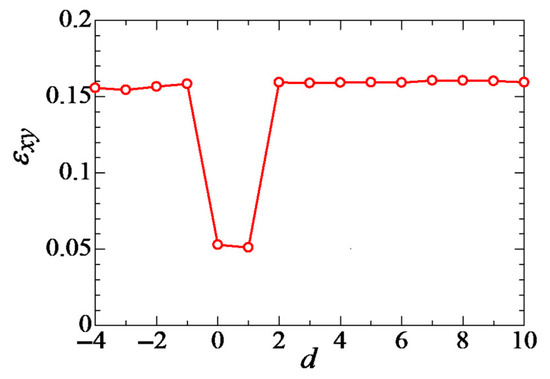
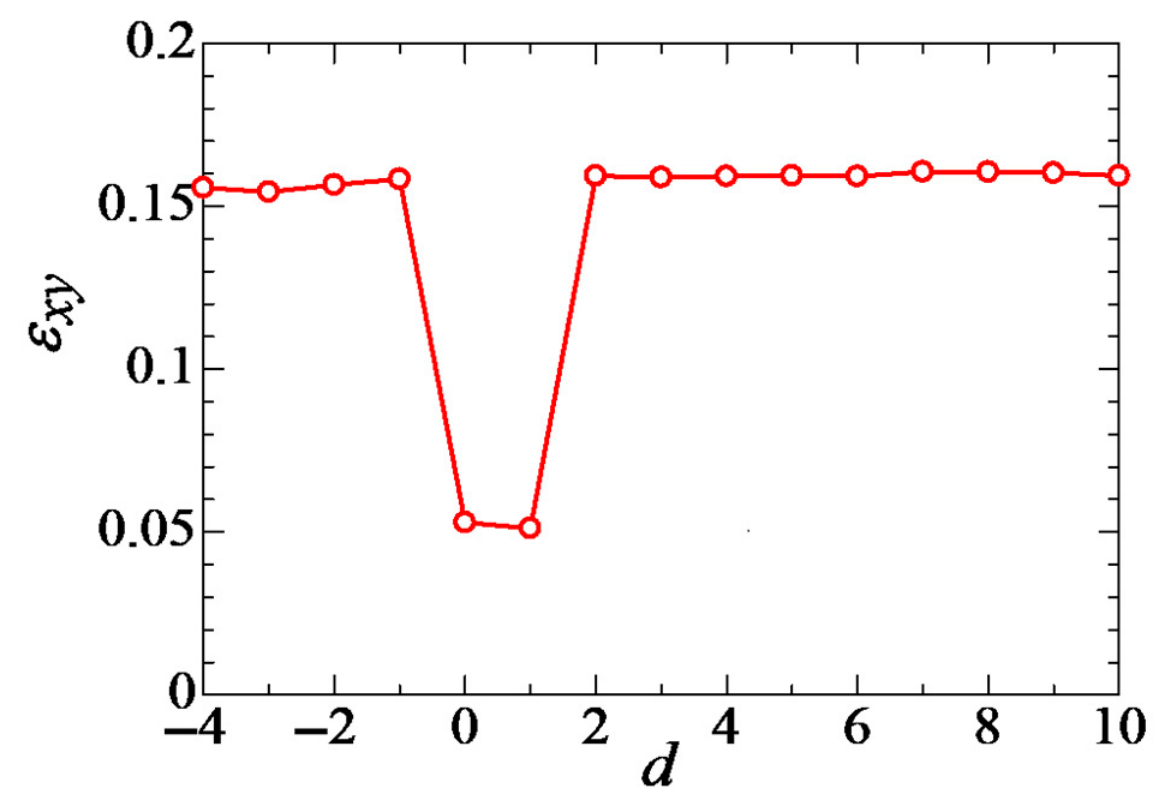
Let us discuss the macroscopic shear strain in the CNT bundle at the end of the relaxation process for different values of d. The shear strain is measured as the angle between the x-axis and a close-packed atomic row parallel to the black lines in Figure 7; before the relaxation, such atomic rows were parallel to the x-axis. The result is presented in Figure 8.
Figure 8.
Shear strain in the bundle.
Recall that the initial strain state of the bundle is εx = 0, εy = 0.15, εxy = 0. For uniaxial compression, the maximum shear strain is realized in the plane inclined to the x-axis by the angle θ = π/4. Using the well-known formulas for the transformation of the components of the plane strain,
one finds the strain components in the coordinate system rotated by the angle θ = π/4,
Here, εx, εy and εxy denote the components of the plane strain tensor in the original (x,y) coordinate system, while εX, εY and εXY are the corresponding components in the rotated (X,Y) frame obtained by rotation through the angle θ. The angle θ is measured from the x-axis to the X-axis, and the notation follows standard conventions of plane-strain transformation. Thus, the maximum initial shear strain in the system is equal to εXY = 0.15.
From Figure 8 it is evident that for all values of d except 0 and 1, the measured shear strain is equal to the initial shear strain; in other words, dislocation sliding results in complete relaxation of the initial shear strain. For d = 0 and 1, only one-third of the initial shear stress relaxes. For d = 0, as mentioned above, dislocations annihilate immediately after collision, and this occurs at the strain level εxy = 0.05. Further plastic deformation is impossible in the absence of dislocations. For d = −1, as reported in Section 3.2, a vacancy is formed when dislocations first meet at the strain level εxy = 0.05, see Figure 6a. Apparently, such a vacancy makes two dislocations immobile, and plastic deformation ceases. Surprisingly, in the case of d = −1, when a single vacancy is formed, dislocations do not annihilate and continue to glide until the shear strain is completely relaxed at εxy = 0.15 (see Figure 8). The formation of all other types of defects, such as divacancies, multiple crowdions, multiple voids, and dislocation dipoles (see Figure 5 and Figure 6), also does not stop dislocation glide, and the system relaxes until the shear stress disappears.
3.4. The Effect of the CNT Diameter
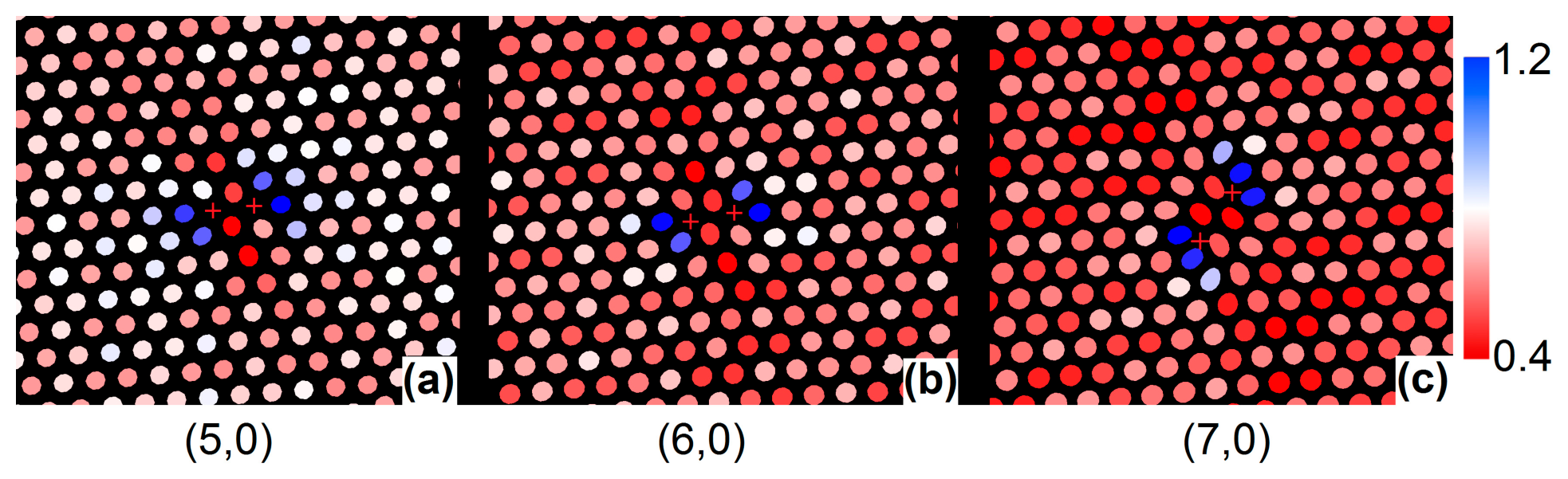
Here we analyze the 30 × 30 bundles of zigzag CNTs (5,0), (6,0), and (7,0) under compressive strain εyy = 0.15 with εxx = εxy = 0 and d = −2 (n = 17). In Figure 9 the relaxed structures are presented. CNT cross-sections are colored are colored according to their potential energy per unit length: red (blue) corresponds to the minimum (maximum) energy, see the color bar in eV.
Figure 9.
Relaxed structures of the 30 × 30 bundles of zigzag CNTs (a) (5,0), (b) (6,0), and (c) (7,0) under compressive strain εyy = 0.15 with εxx = εxy = 0 for the case of d = −2 (n = 17). Two vacancies are formed in all cases; their positions are marked with red crosses. The ellipticity of CNTs near the defects increases with increasing CNT diameter.
It is clear from Figure 9 that in all cases two vacancies are formed, and their positions are marked with red crosses. However, the arrangement of CNTs near the defects changes with CNT diameter. In particular, the ellipticity of the CNT cross-sections near the defects increases with increasing CNT diameter because the CNTs become softer. As a result, in Figure 9c, for the (7,0) CNTs, the structure of the vacancies resembles voidions.
4. Discussion and Conclusions
In this work, relaxation molecular dynamics was employed to elucidate the mechanisms of defect formation and mass transfer in a laterally compressed bundle of zigzag carbon nanotubes modeled as a two-dimensional crystal of soft particles (CNT cross-sections). A pair of edge dislocations with opposite topological charges was introduced into a close-packed triangular lattice of CNT cross-sections, and their relaxational dynamics were analyzed as a function of the distance d between the parallel glide planes. It was shown that the character of the final defect configuration, ranging from complete annihilation to the formation of vacancies, extended voidions, and crowdions, is fully controlled by this geometric parameter. Thus, dislocation reactions in the CNT bundle provide a well-defined microscopic mechanism for mass redistribution under plastic deformation. The use of a reduced cross-sectional MD-based model in this context is in line with previous efforts to employ atomistic and coarse-grained simulations for elucidating deformation mechanisms in individual CNTs and CNT-based assemblies under various loading conditions [38].
For d = 0, the two dislocations glide in the same close-packed row and annihilate, restoring the defect-free lattice, in full agreement with the textbook picture of dislocation reactions in crystalline solids. When the glide planes are shifted, d ≠ 0, the annihilation becomes incomplete and leads to the formation of intrinsic point defects or their clusters, or dislocation dipoles. At negative distances, d < 0, we observe the emergence of a vacancy for d = −1, a bivacancy for d = −2, and extended voidion type defects for |d| ≥ 3, while for sufficiently large |d| the configuration can be viewed as a dislocation dipole rather than a compact voidion cluster. An important and nontrivial result is that in a crystal of soft particles, such as a CNT bundle, a compact vacancy cluster is stable only up to two missing nanotubes, whereas for a larger number of missing particles the system spontaneously organizes into elongated voidions rather than into larger compact vacancy clusters.
The behavior at positive distances between the gliding planes, d > 0, is qualitatively different: in this case the dislocation reaction produces interstitial-type defects in the form of one or several crowdions. The number of crowdions is equal to d, and their structure becomes progressively straighter as the number of interstitial CNTs increases, reflecting the tendency of the system to minimize the elastic and van der Waals energy along a close-packed row. The analogy with crowdions in metals, where adding an extra atom into a close-packed row often yields the lowest energy interstitial configuration, suggests that crowdions in CNT bundles may also exhibit enhanced mobility along close-packed directions; however, the corresponding migration barriers were not calculated in the present work and remain to be quantified. In contrast, voidion-like defects correspond to regions of reduced local density and are expected to respond to stress or concentration gradients, but their mobility was likewise not evaluated explicitly in this study.
The reported dependence of the reaction outcome on the parameter d should also be considered in connection with the nanotube diameter. In the present work, the analysis was intentionally restricted to a small-diameter CNT in order to avoid collapse-related bistability and to isolate the elementary defect-reaction mechanisms in the cross-sectional plane. For larger diameters, the cross-sections become more compliant, and the competition between local packing rearrangement, elastic flattening, and defect formation is expected to become stronger. As a consequence, the quantitative boundaries between voidion-type, vacancy-type, and crowdion-type outcomes may shift, and additional channels associated with ovalization or collapse may become possible.
Taken together, these results demonstrate that dislocation motion in a CNT bundle under lateral compression inevitably leads to the generation of both low density (vacancy, voidion) and high density (crowdion) defect structures. The formation of such defects signifies a net transport of nanotubes (mass) within the bundle and thus provides a microscopic mechanism for dislocation-mediated mass transfer in this class of nanostructured materials. This conclusion is consistent with a broader body of evidence showing that directed flows of edge dislocations can contribute significantly to anomalous mass and heat transfer in solids subjected to intense external actions, including laser pulses and other high-energy loadings. Similar to the situation in metals and alloys, where dislocations participate in mass transfer during Ostwald ripening and other diffusional transformations, dislocation reactions in CNT bundles can be expected to influence long-time structural evolution under cyclic or sustained mechanical loading [39].
As the CNT diameter increases, the ellipticity of CNT cross-sections near defects increases because the tubes become softer (see Figure 9). The difference between the defect structure in CNT bundles and in structures with non-deformable particles becomes more pronounced with increasing CNT diameter.
The present study also highlights that a CNT bundle under lateral deformation is better viewed as a crystal of elastically deformable, soft particles rather than a rigid lattice, which explains the preference for extended voidions over compact vacancy clusters when more than two nanotubes are removed. The observed effects are due to the elliptization of the cross-sections of soft carbon nanotubes in the cores of defects. At the same time, previous studies of shear and friction between CNTs in bundles and yarns have shown that intertube interactions and local rearrangements can strongly influence load transfer and mechanical performance, which is consistent with the soft, deformable character of the bundle considered here [40]. This observation is in qualitative agreement with previous reports of voidions and related defects in soft colloidal crystals and in quantum solids such as helium, where extended rod-like vacancies (voidions) were shown to support concerted mass transport. The close analogy between voidions and crowdions in CNT bundles and similar defects in other soft condensed matter systems suggests that the concepts and methodologies developed here may be applicable to a broad class of nanostructured materials composed of deformable particles.
An additional point that should be kept in mind is that the present reduced model was not designed for direct quantitative evaluation of atomistically resolved dislocation-core energies or Peierls barriers. Such quantities are highly sensitive to the local atomic-scale reconstruction, whereas the current approach represents CNT cross-sections as deformable interacting objects in a reduced transverse description. For this reason, the results should be interpreted primarily as mechanistic and comparative, revealing the preferred structural scenarios of defect interaction rather than providing full atomistic barrier data. Overall, the present results establish the qualitative scenarios of dislocation-induced defect formation in the cross-sectional plane of a laterally compressed CNT bundle within the framework of the reduced model. At the same time, the study does not quantify thermal activation, migration barriers, or axial three-dimensional effects. These aspects should therefore be regarded as important limitations of the current formulation rather than as resolved questions.
In conclusion, we have established that the outcome of dislocation reactions in a laterally compressed CNT bundle is governed primarily by the separation between dislocation glide planes, which controls whether the system relaxes to a defect-free state, a configuration containing vacancies or voidions, or a structure containing one or several crowdions, or dislocation dipoles for larger separation between gliding planes. Vacancies and voidions represent regions of reduced nanotube density, while crowdions correspond to local density enhancement; their formation and potential mobility under load provide a clear microscopic scenario for mass transfer in CNT bundles undergoing plastic deformation. These findings deepen the understanding of defect physics in CNT assemblies and open up opportunities for controlling mass transport and mechanical response in CNT-based materials by tailoring dislocation structures and loading conditions.
Future work should address the quantitative kinetics of voidion and crowdion migration, including the evaluation of activation barriers, thermally assisted transformations, and possible interactions with external fields. It is also important to analyze the role of three-dimensional effects beyond the plane-strain approximation employed here, as well as the applicability of the proposed mechanisms to other carbon nanomaterials [41,42,43]. Particular attention should be paid to bundles of CNTs with larger diameters, since the deformability of carbon nanotube cross-sections increases with increasing diameter and may lead to ovalization or collapse, thereby modifying the reaction thresholds and defect-transformation pathways. Comparison with more detailed atomistic or quasi-three-dimensional models would additionally help to quantify the limits of the present reduced 2D description and to connect the identified elementary mechanisms with realistic CNT bundle behavior under complex loading.
Author Contributions
Conceptualization, S.V.D.; methodology, S.V.D. and E.A.K.; data curation, M.A.I. and A.M.K.; software, A.A.O.; investigation, O.V.A., D.A.D. and V.A.B.; writing—original draft preparation, S.V.D., E.A.K., A.A.O. and M.A.I.; writing—review and editing, V.A.B., A.M.K., D.A.D. and O.V.A. All authors have read and agreed to the published version of the manuscript.
Funding
For V.A.B. and A.M.K. this work was supported by the Russian Science Foundation, grant No. 25-73-20038. The work of E.A.K. was supported by the Ministry of Science and Higher Education of the Russian Federation within the framework of the state task of the Ufa University of Science and Technology (No. 075-03-2024-123/1) of the youth research laboratory “Metals and Alloys under Extreme Impacts”.
Data Availability Statement
The data presented in this study are available from the corresponding author upon reasonable request.
Acknowledgments
Computational facilities were provided by the Joint Supercomputer Center (JSCC) of the National Research Center “Kurchatov Institute”.
Conflicts of Interest
The authors declare no conflicts of interest.
References
- Rao, R.; Pint, C.L.; Islam, A.E.; Weatherup, R.S.; Hofmann, S.; Meshot, E.R.; Wu, F.; Zhou, C.; Dee, N.; Amama, P.B.; et al. Carbon nanotubes and related nanomaterials: Critical advances and challenges for synthesis toward mainstream commercial applications. ACS Nano 2018, 12, 11756–11784. [Google Scholar] [CrossRef] [Scilit] [PubMed]
- Ping, L.; Hou, P.-X.; Liu, C.; Cheng, H.-M. Vertically aligned carbon nanotube arrays as a thermal interface material. APL Mater. 2019, 7, 020902. [Google Scholar] [CrossRef] [Scilit]
- Zhang, Q.; Zhao, M.-Q.; Huang, J.-Q.; Nie, J.-Q.; Wei, F. Mass production of aligned carbon nanotube arrays by fluidized bed catalytic chemical vapor deposition. Carbon 2010, 48, 1196–1209. [Google Scholar] [CrossRef] [Scilit]
- Hajilounezhad, T.; Bao, R.; Palaniappan, K.; Bunyak, F.; Calyam, P.; Maschmann, M.R. Predicting carbon nanotube forest attributes and mechanical properties using simulated images and deep learning. npj Comput. Mater. 2021, 7, 134. [Google Scholar] [CrossRef] [Scilit]
- Roumeli, E.; Diamantopoulou, M.; Serra-Garcia, M.; Johanns, P.; Parcianello, G.; Daraio, C. Characterization of vertically aligned carbon nanotube forests grown on stainless steel surfaces. Nanomaterials 2019, 9, 444. [Google Scholar] [CrossRef] [Scilit] [PubMed]
- Bai, Y.; Yue, H.; Zhang, R.; Qian, W.; Zhang, Z.; Wei, F. Mechanical behavior of single and bundled defect-free carbon nanotubes. Acc. Mater. Res. 2021, 2, 998–1009. [Google Scholar] [CrossRef] [Scilit]
- Yankovskaya, U.I.; Zakharov, P.V. Heat resistance of a Pt crystal reinforced with CNT’s. Mater. Technol. Des. 2021, 3, 64–67. [Google Scholar] [CrossRef] [Scilit]
- Li, Q.; Ge, Y.; Tan, X.; Yu, Q.; Qiu, W. Experiment research on deformation mechanism of CNT film material. J. Nanomater. 2016, 2016, 3942671. [Google Scholar] [CrossRef] [Scilit]
- Wang, P.; Wang, D.; Wu, Y.; Zhou, Z.; Tian, J.; Sun, G.; Xu, S. Uncovering the interface slipping and microplastic accumulation mechanism of carbon nanotube fibers under different temperatures. Carbon 2025, 233, 119898. [Google Scholar] [CrossRef] [Scilit]
- Yankovskaya, U.I.; Sharapova, Y.R.; Zakharov, P.V. Effect of carbon nanotubes on the mechanical properties of Ni3Al polycrystal. Mater. Technol. Des. 2022, 4, 76–81. [Google Scholar] [CrossRef] [Scilit]
- Abdelhussien, A.; Yang, G.; Hussein, E.; Li, L.; Al-Abboodi, H.; Mohamad, B. Analysis of the mechanical characteristics of date seed powder-based composite carbon fiber reinforced polymers. Facta Univ. Ser. Mech. Eng. 2025, 23, 251–263. [Google Scholar] [CrossRef] [Scilit]
- de Jager, M.; de Jong, J.; Filion, L. Defects in crystals of soft colloidal particles. Soft Matter 2021, 17, 5718–5729. [Google Scholar] [CrossRef] [Scilit] [PubMed]
- Brady, R.M.; Samulski, E.T. Thermodynamics of melting in colloids and helium. J. Low Temp. Phys. 2022, 207, 160–170. [Google Scholar] [CrossRef] [Scilit]
- Debord, S.B.; Lyon, L.A. Influence of particle volume fraction on packing in responsive hydrogel colloidal crystals. J. Phys. Chem. B 2003, 107, 2927–2932. [Google Scholar] [CrossRef] [Scilit]
- Mladek, B.M.; Charbonneau, P.; Likos, C.N.; Frenkel, D.; Kahl, G. Multiple occupancy crystals formed by purely repulsive soft particles. J. Phys. Condens. Matter 2008, 20, 494245. [Google Scholar] [CrossRef] [Scilit]
- Barkan, K.; Engel, M.; Lifshitz, R. Controlled self-assembly of periodic and aperiodic cluster crystals. Phys. Rev. Lett. 2014, 113, 098304. [Google Scholar] [CrossRef] [Scilit]
- Vialetto, J.; Nussbaum, N.; Bergfreund, J.; Fischer, P.; Isa, L. Influence of the interfacial tension on the microstructural and mechanical properties of microgels at fluid interfaces. J. Colloid Interface Sci. 2022, 608, 2584–2592. [Google Scholar] [CrossRef] [Scilit] [PubMed]
- Filatov, O.V.; Pavliuk, Y.O.; Mazanko, V.F.; Bogdanov, S.Y.; Gertsriken, D.S.; Bogdanov, Y.I.; Vorona, S.P. Method for Determining the Diffusion and Drift Components of Anomalous Mass Transfer in Metals under External Influences. Metallofiz. Noveishie Tekhnol. 2025, 47, 39–55. [Google Scholar] [CrossRef] [Scilit]
- Mazilova, T.I.; Sadanov, E.V.; Voyevodin, V.N.; Ksenofontov, V.A.; Mikhailovskij, I.M. Impact-induced concerted mass transport on W surfaces by a voidion mechanism. Surf. Sci. 2018, 669, 10–15. [Google Scholar] [CrossRef] [Scilit]
- Alexandrova, I.V.; Alexandrov, D.V.; Makoveeva, E.V. Ostwald ripening in the presence of simultaneous occurrence of various mass transfer mechanisms: An extension of the Lifshitz-Slyozov theory. Philos. Trans. R. Soc. A 2021, 379, 20200308. [Google Scholar] [CrossRef] [Scilit] [PubMed]
- Aldeen, A.; Mahdi, D.; Zhongwei, C.; Disher, I.; Mohamad, B. Effect of isothermal and isochronal aging on the microstructure and precipitate evolution in beta-quenched n36 zirconium alloy. Facta Univ. Ser. Mech. Eng. 2025, 23, 49–63. [Google Scholar] [CrossRef] [Scilit]
- Savin, A.V.; Korznikova, E.A.; Dmitriev, S.V. Plane vibrational modes and localized nonlinear excitations in carbon nanotube bundle. J. Sound. Vib. 2022, 520, 116627. [Google Scholar] [CrossRef] [Scilit]
- Milić, P.; Marinković, D.; Ćojbašić, Ž. Geometrically nonlinear analysis of piezoelectric active laminated shells by means of isogeometric FE formulation. Facta Univ. Ser. Mech. Eng. 2025, 23, 387–405. [Google Scholar] [CrossRef] [Scilit]
- Savin, A.V.; Korznikova, E.A.; Dmitriev, S.V. Structural and helix reversal defects of carbon nanosprings: A molecular dynamics study. Comput. Mater. Contin. 2026, 86, 2. [Google Scholar] [CrossRef] [Scilit]
- Savin, A.V. Shock absorption by multilayer carbon nanotube packings. Phys. Rev. B 2025, 112, 245406. [Google Scholar] [CrossRef] [Scilit]
- Galiakhmetova, L.K.; Bachurin, D.V.; Korznikova, E.A.; Bayazitov, A.M.; Kudreyko, A.A.; Dmitriev, S.V. Shock loading of carbon nanotube bundle. Mech. Mater. 2022, 174, 104460. [Google Scholar] [CrossRef] [Scilit]
- Savin, A.V.; Dmitriev, S.V. Critical pressure values for graphene membrane covering a slit. Phys. Rev. B 2023, 108, 144107. [Google Scholar] [CrossRef] [Scilit]
- Savin, A.V. Wrinkle formation during uniaxial compression of a graphene sheet lying on a soft polymer substrate. Phys. Rev. B 2024, 110, 245409. [Google Scholar] [CrossRef] [Scilit]
- Pavlov, I.S.; Galiakhmetova, L.K.; Kudreyko, A.A.; Dmitriev, S.V. Mobility of dislocations in carbon nanotube bundles. Mater. Today Commun. 2024, 40, 110094. [Google Scholar] [CrossRef] [Scilit]
- Ilgamov, M.A.; Aitbaeva, A.A.; Pavlov, I.S.; Dmitriev, S.V. Carbon nanotube under pulsed pressure. Facta Univ. Ser. Mech. Eng. 2024, 22, 275–292. [Google Scholar] [CrossRef] [Scilit]
- Ilgamov, M.A.; Khakimov, A.G.; Dmitriev, S.V. Influence of the environment on the natural frequencies of vibrations of carbon nanotubes. Lobachevskii J. Math. 2025, 46, 2093–2108. [Google Scholar] [CrossRef] [Scilit]
- Kistanov, A.A.; Khadiullin, S.K.; Zhou, K.; Dmitriev, S.V.; Korznikova, E.A. Environmental stability of bismuthene: Oxidation mechanism and structural stability of 2D pnictogens. J. Mater. Chem. C 2019, 7, 9195–9202. [Google Scholar] [CrossRef] [Scilit]
- Elliott, J.A.; Sandler, J.K.W.; Windle, A.H.; Young, R.J.; Shaffer, M.S.P. Collapse of Single-Wall Carbon Nanotubes is Diameter Dependent. Phys. Rev. Lett. 2004, 92, 095501. [Google Scholar] [CrossRef] [Scilit] [PubMed]
- Lu, T.; Lei, X.-W.; Fujii, T. Nucleation of disclinations in carbon nanotube bundle structures under twisting loads. Carbon 2024, 228, 119287. [Google Scholar] [CrossRef] [Scilit]
- Pereira Júnior, M.L.; de Sousa Oliveira, T.; Monteiro, F.F.; da Cunha, W.F.; de Oliveira Neto, P.H.; Ribeiro Júnior, L.A. Torsional fracture of carbon nanotube bundles: A reactive molecular dynamics study. Phys. Chem. Chem. Phys. 2022, 24, 15068–15074. [Google Scholar] [CrossRef] [Scilit] [PubMed]
- Hirth, J.P.; Lothe, J. Theory of Dislocations, 2nd ed.; Krieger Publishing Company: Malabar, FL, USA, 1992. [Google Scholar]
- Shepelev, I.A.; Dmitriev, S.V.; Kudreyko, A.A.; Velarde, M.G.; Korznikova, E.A. Supersonic voidions in 2D Morse lattice. Chaos Solitons Fractals 2020, 140, 110217. [Google Scholar] [CrossRef] [Scilit]
- Salvetat, J.P.; Bhattacharyya, S.; Pipes, R.B. Progress on mechanics of carbon nanotubes and derived materials. J. Nanosci. Nanotechnol. 2006, 6, 1857–1882. [Google Scholar] [CrossRef] [Scilit] [PubMed]
- Sugonyako, I.S.; Babicheva, R.I.; Morkina, A.Y.; Tarov, D.V.; Dmitriev, S.V. Modeling the motion of edge dislocations in aluminum under high shear strains using molecular dynamics. Phys. Solid State 2025, 67, 81355. [Google Scholar] [CrossRef]
- Paci, J.T.; Furmanchuk, A.; Espinosa, H.D.; Schatz, G.C. Shear and Friction between Carbon Nanotubes in Bundles and Yarns. Nano Lett. 2014, 14, 6138–6147. [Google Scholar] [CrossRef] [Scilit] [PubMed]
- Polyakova, P.V.; Baimova, J.A. Layer-dependent mechanical properties of diamane and bornitrane. J. Phys. Chem. Solids 2026, 215, 113698. [Google Scholar] [CrossRef] [Scilit]
- Polyakova, P.V.; Murzaev, R.T.; Baimova, J.A. Mechanical properties of diamane: Orientation dependence of strength and fracture strain. Appl. Surf. Sci. 2025, 681, 161441. [Google Scholar] [CrossRef] [Scilit]
- Baimova, J.; Polyakova, P.; Shcherbinin, S. Effect of the structure morphology on the mechanical properties of crumpled graphene fiber. Fibers 2021, 9, 85. [Google Scholar] [CrossRef] [Scilit]

Disclaimer/Publisher’s Note: The statements, opinions and data contained in all publications are solely those of the individual author(s) and contributor(s) and not of MDPI and/or the editor(s). MDPI and/or the editor(s) disclaim responsibility for any injury to people or property resulting from any ideas, methods, instructions or products referred to in the content. |
© 2026 by the authors. Licensee MDPI, Basel, Switzerland. This article is an open access article distributed under the terms and conditions of the Creative Commons Attribution (CC BY) license.