


Abstract
Low-temperature pyrolysis around 250 °C represents a mild carbonization that differs from conventional high-temperature biochar production, and the role of pyrolysis duration under mild thermal conditions remains insufficiently understood. In this study, plant residues, including rice straw, sorghum leaves and stems, barley straw, and mixed woodchips, were converted into charred materials under low-temperature pyrolysis at 250 °C (4 h, 12 h) and compared with those produced at 500 °C (4 h). Pyrolysis at 250 °C (4 h) resulted in higher solid yields (51.9–72.8%) and higher recovery of carbon and nitrogen, whereas yields declined to 27.2–31.6% at 500 °C. Materials produced at 250 °C preserved abundant oxygen-containing functional groups, exhibited lower pH, and showed significantly higher cation exchange capacity (up to 93.68–119.91 cmolc/kg at 12 h). Prolonged treatment at 250 °C enhanced humification, increasing the carbon extracted from humic acid by 25.3–237.9%, whereas humic substances were largely decomposed at 500 °C. Structural analyses indicated that low-temperature chars maintained reactive surface chemistry, while high-temperature chars showed greater aromaticity and porosity, particularly for wood-derived materials (378.5 m2/g). Overall, low-temperature pyrolysis produces functionally active carbon materials suitable for saline-sodic soil amendment and nutrient management, whereas 500 °C pyrolysis generates more aromatic and porous materials better suited for long-term carbon stability and physical soil conditioning.
1. Introduction
With the continuous development of the global economy and agricultural production, the generation of organic solid wastes has increased rapidly, leading to severe environmental concerns. Among these wastes, agricultural residues represent a major category of renewable biomass resources. They include primary residues such as straw and leaves remaining in the field after harvesting, and secondary residues generated during the processing of agricultural products [1]. However, these residues are often underutilized, and in many regions, farmers still burn them directly in the field. According to statistics from the U.S. Environmental Protection Agency (EPA), open-field burning of one tonne of agricultural residues releases approximately 1400 kg of CO2, 58 kg of CO, 11 kg of particulate matter, 4.9 kg of NOₓ, and 1.2 kg of SO2 [2], leaving only about 5–10% ash, thereby contributing to global warming and atmospheric pollution. The efficient and environmentally sound utilization of agricultural residues has therefore become an urgent issue worldwide. Agricultural residues are rich in carbonaceous polymers such as cellulose, hemicellulose, and lignin [3], which make them suitable feedstocks for thermochemical conversion into energy and carbon materials.
Pyrolysis, defined as the thermal decomposition of biomass under oxygen-limited conditions, has been widely investigated as a means of converting agricultural wastes into carbon-rich solid products. Conventionally, pyrolysis conducted at moderate to high temperatures (typically 500–700 °C) yields highly carbonized materials characterized by condensed aromatic structures, large specific surface areas, and high chemical stability [4]. As the pyrolysis temperature increases, the biochar yield, cation exchange capacity (CEC), and the contents of N, H, O, as well as available nitrogen, phosphorus, and potassium decrease, whereas the ash content, pH, and the contents of C, P, and K increase. In addition, the abundance of alkaline functional groups and the degree of aromaticity are enhanced, along with increases in micropore volume, porosity, and specific surface area, resulting in stronger adsorption capacity [5]. Such materials are often referred to as biochar and have attracted considerable attention for environmental and agricultural applications. However, high-temperature pyrolysis is generally associated with substantial energy input, low solid yields, elevated pH values, and the loss of oxygen-containing functional groups, which may limit certain functional applications. For different feedstocks and application purposes, clarifying the relationship between preparation conditions and biochar (BC) properties is a prerequisite for its successful application [6], particularly in soil improvement. It has been reported that, by 2050, more than 50% of arable land worldwide may be affected by soil salinization [7,8]. The inherent alkalinity of biochar is a major constraint limiting its application in saline–alkaline soils [9]. Consequently, the effectiveness of biochar in the remediation of saline–alkaline land remains controversial [10,11,12].
In contrast, thermal treatment of biomass at temperatures below 300 °C is more appropriately classified as mild (low-temperature) pyrolysis rather than complete carbonization. Biochar produced within this low-temperature range retains a higher proportion of oxygen-containing functional groups, such as carboxyl and hydroxyl groups, resulting in lower pH values, higher cation exchange capacity (CEC), and greater surface reactivity compared with materials processed at higher temperatures [13,14,15,16]. Most existing studies, however, have either focused on high-temperature biochar or investigated only a single duration, leaving a critical gap in understanding the time-dependent transformation mechanisms under low-temperature conditions [13,17]. From a practical perspective, materials produced at a treatment temperature of 250 °C with short residence times remain underexplored. It is unclear whether, after soil application, these materials undergo further surface oxidation and chemical aging, thereby forming additional oxygen-containing functional groups over time and enhancing their functional performance [18]. At this temperature, partial depolymerization and reorganization of organic structures are promoted while a considerable portion of labile functional groups and volatile components is retained. Whether variations in pyrolysis duration can facilitate the formation of humus-like substances and chemically active compounds that are more beneficial to soil fertility remains an open question that warrants thorough investigation.
In this study, we systematically investigate the effects of low-temperature pyrolysis at 250 °C with different residence times on the chemical composition, surface functionality, and structural characteristics of agricultural-residue-derived charred materials. A representative high-temperature char produced at 500 °C is included as a reference to highlight the distinctive features and functional differences under low-temperature conditions. Particular emphasis is placed on elucidating the transformation mechanisms of functional groups and the formation of humic-like substances during the pyrolysis process. The objectives of this work are twofold: (i) to develop a low-temperature and energy-efficient utilization strategy for agricultural residues that is feasible under practical farm-scale conditions, and (ii) to design functional carbonized materials tailored to specific land conditions, especially saline–alkaline soils. The findings of this study are expected to provide both mechanistic insights and practical guidance for the rational design and application of low-temperature carbonized materials as environmentally functional soil amendments, thereby contributing to the sustainable management of agricultural residues.
2. Materials and Methods
2.1. Preparation of Charred Materials
Rice straw (R), sorghum leaves and stems (S), barley straw (B), and mixed conifer woodchips (W; primarily cedar) were used as feedstocks for charred material production. All raw materials were air-dried, ground, and sieved to pass through a 2 mm mesh. Approximately 20 g of each material was loosely packed into 280 mL porcelain crucibles. Pyrolysis was conducted in a muffle furnace (KDF S-90, Denken Co., Ltd., Kyoto, Japan) under partially covered conditions with limited oxygen supply at two temperatures, 250 °C and 500 °C, achieved by covering the crucibles with aluminum foil containing a small opening (1 × 1 cm), allowing restricted gas exchange while maintaining a semi-closed system. For the low-temperature treatment (250 °C), residence times of 4 h and 12 h were applied, whereas for the high-temperature treatment (500 °C), a residence time of 4 h was used. The resulting charred materials derived from rice straw, sorghum residues, barley straw, and woodchips were designated as RC, SC, BC, and WC, respectively. Pyrolysis conditions were denoted as 250-4, 250-12, and 500-4, corresponding to temperature (°C) and duration (h).
2.2. Charred Material Yield, Elemental Composition, and Recovery Rates
Charred material yield was calculated as the ratio of the dry mass of charred material obtained after pyrolysis to the dry mass of the corresponding raw material (1). The total carbon (C), nitrogen (N), and hydrogen (H) contents of raw materials and their derived charred materials were determined using an elemental analyzer (Vario EL III, Elementar Analysensysteme GmbH, Langenselbold, Germany). Carbon recovery rate (CRR) and nitrogen recovery rate (NRR) were calculated based on the elemental contents and mass yields of the charred materials (2). The atomic H/C ratio was calculated from elemental composition by converting mass percentages of hydrogen and carbon to molar quantities using their respective atomic weights (3).
2.3. Electrical Conductivity, pH, and Cation Exchange Capacity
The pH and electrical conductivity (EC) of charred materials were measured in a 1:10 (w/v) charred material to reverse osmosis (RO) water suspension using a pH meter (HM-30S, TOA Electronics Ltd., Tokyo, Japan) and an EC meter (CM-30R, TOA Electronics Ltd., Tokyo, Japan).
Cation exchange capacity (CEC) was determined using the ammonium acetate method [19]. Briefly, 1 g of charred material was saturated with 1.0 mol/L ammonium acetate (NH4OAc, pH 7.0) to replace exchangeable cations with NH4+. Excess NH4OAc was removed by washing with ethanol until chloride-free. The retained NH4+ was then displaced using 1.0 mol/L KCl solution, and the released NH4+ was quantified colorimetrically, and CEC was expressed as cmolc/kg.
2.4. Water-Soluble and Ammonium Acetate-Soluble Cations
Water-soluble and ammonium acetate-extractable potassium (K+), sodium (Na+), calcium (Ca2+), and magnesium (Mg2+) in charred materials were determined using an atomic absorption spectrophotometer (Z-2300, Hitachi High-Tech Corporation, Tokyo, Japan). For water-soluble cations, 1 g of charred material was shaken with 50 mL of deionized water for 1 h, followed by filtration through a 0.45 μm membrane filter. The concentrations of cations in the filtrate were measured directly. Ammonium acetate-extractable cations were obtained during the CEC determination using 1.0 mol/L NH4OAc (pH 7.0).
2.5. Carbon Determination and Optical Properties of Humic Substances Extracts
Humic substances were extracted from charred materials using an alkaline extractant composed of 0.1 mol/L NaOH and 0.1 mol/L Na4P2O7 mixed at a 1:1 volume ratio. To ensure comparability among samples, humic substances were extracted on a fixed carbon basis. For each determination, a charred material sample equivalent to 60 mg of organic carbon (C) was mixed with 30 mL of the extractant and shaken for 1 h at room temperature. The suspension was then centrifuged, and the supernatant was collected for subsequent analyses. Fulvic acid and humic acid fractions were separated by acidifying the extract to pH < 2 using concentrated sulfuric acid. The carbon contents of the total extract, fulvic acid fraction, and humic acid fraction were determined according to the method of Kumada using dichromate oxidation [20].
The optical properties of the resulting carbon extracts were characterized using ultraviolet–visible (UV–Vis) spectroscopy. Prior to analysis, all extracts were filtered through a 0.45 μm membrane filter to remove suspended particles and diluted when necessary. Absorbance measurements were performed at wavelengths of 400 and 600 nm using a UV-2200 spectrophotometer (Shimadzu Corporation, Kyoto, Japan). The degree of aromatic condensation and humification of the extracted carbon was evaluated using the ΔlogK parameter, calculated as log(A400) − log(A600). In addition, the absorbance of the diluted extract was measured at 600 nm (A600), and the color intensity parameter A600/1%C, representing the absorbance at 600 nm normalized to a carbon concentration of 1%, was calculated according to the following equation [21]:
where A600 is the measured absorbance of the diluted extract, d is the dilution factor, and E (%) represents the extraction percentage based on 60 mg of organic carbon.
A600/1%C = (A600 × d/E) × 500
2.6. Structural and Surface Characterization of Charred Materials
The functional groups of charred material samples were characterized using Fourier-transform infrared (FT-IR) spectroscopy with a Spectrum 65 spectrometer (PerkinElmer Inc., Waltham, MA, USA). Prior to analysis, approximately 5 mg of homogenized charred material was thoroughly mixed with 100 mg of KBr and pressed into pellets approximately 0.5 mm thick. FT-IR spectra were collected over the wavenumber range of 400–4000 cm−1 at a resolution of 4 cm−1 with 32 scans per sample.
The morphology and surface characteristics of charred materials were examined using scanning electron microscopy (SEM; SU8600, Hitachi High-Tech Corporation, Tokyo, Japan). Prior to observation, samples were mounted on aluminum stubs using conductive carbon tape and coated with a thin layer of gold to improve electrical conductivity. SEM observations were conducted at an accelerating voltage of 5–10 kV. Images were acquired at various magnifications depending on structural features. A secondary electron (SE) detector was used to obtain surface morphology images. The structural ordering of carbonaceous materials was further evaluated by Raman spectroscopy using a Renishaw inVia Raman spectrometer (Renishaw plc, Gloucestershire, UK). In addition, the specific surface area and pore characteristics of charred materials were determined using the Brunauer–Emmett–Teller (BET) method with a surface area and porosity analyzer (ASAP 2460, Micromeritics Instrument Corporation, Norcross, GA, USA).
2.7. Statistical Analysis
All collected data were subjected to basic statistical analysis using Microsoft Excel (Microsoft Corporation, Redmond, WA, USA), including the calculation of means and standard deviations, as well as partial graphical presentation. More advanced statistical analyses were performed using IBM SPSS Statistics 25 (IBM Corp., Armonk, NY, USA). One-way analysis of variance (ANOVA) was conducted to assess differences among groups, and Tukey’s test was used for post hoc multiple comparisons to determine significant differences among group means. Differences were considered statistically significant at p < 0.05 unless otherwise stated. Selected graphical representations of the data were generated using Origin 2024 (OriginLab Corporation, Northampton, MA, USA).
3. Results and Discussion
3.1. Charred Material Yield and Elemental Composition
The thermal decomposition behavior of biomass under different pyrolysis conditions governs both solid yield and elemental transformation, reflecting the fundamental pathways of carbonization. The effects of pyrolysis temperature, duration, and raw material type on charred material yield are shown in Table 1. The charred material yields followed the order 250-4 > 250-12 > 500-4, indicating that both increasing temperature and prolonged duration significantly enhanced biomass decomposition. At 250 °C, all raw materials produced relatively high yields of charred material, with wood-derived charred material reaching 72.8% under the 250-4 condition, significantly higher than gramineae straw-derived materials. This can be attributed to the higher lignin content of wood biomass. Lignin is known to exhibit greater thermal resistance than cellulose and hemicellulose, resulting in slower decomposition and higher solid retention under mild thermal conditions [22]. In contrast, herbaceous feedstocks, which contain higher proportions of thermally labile components such as hemicellulose, showed relatively lower yields. Among straw-derived materials, rice straw showed the highest yield (59.7%) under identical conditions. Extending the pyrolysis duration from 4 to 12 h at 250 °C led to a pronounced decline in charred material yields for all feedstocks, with reductions ranging from 21.9% to 28.1%. Prolonged duration at 250 °C further promoted devolatilization and secondary reactions, resulting in additional yield loss. This effect can be attributed not only to the continued release of volatile compounds but also to the gradual structural rearrangement and condensation reactions, which reduce the mass of labile fractions while increasing the relative stability of the remaining carbon matrix [23].
Table 1.
Yield, elemental composition and recovery rates under different pyrolysis conditions.
Increasing the pyrolysis temperature to 500 °C (4 h) resulted in a marked decrease in charred material yields (23.4–31.6%) across all plant-derived materials, reflecting intensified thermal cracking, depolymerization, and volatilization processes. The relatively higher yield of straw-derived charred materials at 500 °C can be attributed to their higher ash content, which becomes dominant after organic matter volatilization [24,25], whereas the lower ash content of wood results in a sharper yield decline despite its lignin-rich structure [22,26]. At this stage, decomposition of cellulose, hemicellulose, and lignin becomes more complete, leading to extensive release of volatile compounds. This trend is consistent with previous studies demonstrating that biomass yield decreases sharply above 400 °C due to rapid devolatilization and breakdown of organic structures [25]. From a mechanistic perspective, low-temperature pyrolysis (250 °C) represents a transitional regime characterized by partial decomposition and structural preservation, whereas high-temperature pyrolysis (500 °C) is dominated by extensive carbonization and aromatization [14,27]. Under low-temperature conditions, biomass components undergo limited cleavage, allowing a substantial fraction of oxygen-containing functional groups and intermediate products to remain within the solid matrix. This partially transformed state distinguishes low-temperature charred materials from conventional biochars.
The elemental composition and recovery of carbon (C) and nitrogen (N) in the charred materials were further evaluated (Table 1). The carbon recovery rate (CRR) and nitrogen recovery rate (NRR), defined as the proportions of C and N retained in the charred material relative to the raw material, were consistently higher at 250 °C than at 500 °C for all feedstocks, indicating that mild pyrolysis favors carbon fixation and nitrogen preservation. Increasing temperature significantly reduced both CRR and NRR due to enhanced volatilization of C- and N-containing compounds. Compared with wood-derived charred materials, straw-derived materials exhibited lower recovery efficiencies, likely due to the higher thermal sensitivity of cellulose- and protein-associated nitrogen, whereas lignin-rich wood promotes the formation of stable heterocyclic nitrogen structures [28,29]. Elemental composition further reflected progressive carbonization. Carbon content increased with temperature and duration, indicating dehydration, depolymerization, and secondary condensation reactions [26,27]. In contrast, hydrogen content decreased markedly, leading to lower H/C atomic ratios, which reflect dehydration, decarboxylation, and aromatization processes [14]. The declining H/C ratio suggests increasing structural stability and aromatic condensation, consistent with the formation of more recalcitrant carbon structures [30]. Nitrogen contents in charred materials were higher than those in the raw materials. For gramineae straw-derived charred materials, the highest nitrogen contents were observed under 250-12 condition, whereas for wood-derived charred material, the highest nitrogen content occurred under 500-4. Across all pyrolysis conditions, the C/N ratio followed the order S < R < B < W, and all charred materials exhibited lower C/N ratios than their corresponding raw materials. For gramineae straw-derived charred material, the C/N ratio increased in the order 250-12 < 250-4 < 500-4, whereas wood-derived charred material showed an opposite trend. The C/N ratios of wood-derived charred material were substantially higher than those of gramineae straw-derived charred material under identical pyrolysis conditions. High C/N ratios in charred material do not imply nitrogen immobilization in the same manner as fresh organic materials, because most nitrogen exists in heterocyclic or mineral-associated forms with limited bioavailability [31,32].
3.2. Basic Chemical Properties of Charred Materials
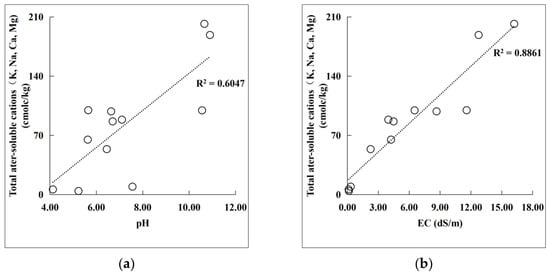
The evolution of chemical properties during pyrolysis provides important insights into the development of surface reactivity and the functional characteristics of charred materials. The basic chemical properties of charred materials, including pH, electrical conductivity (EC), soluble cation composition, and cation exchange capacity (CEC), are summarized in Table 2 and Table 3. These properties varied significantly with pyrolysis temperature, duration, and raw material type. For a given raw material, the pH of charred material increased significantly with increasing pyrolysis temperature (p < 0.05). Under the 250-4 condition, the pH values of gramineae straw-derived charred materials exhibited neutral to acidic pH values. This behavior can be attributed to the preservation and formation of organic acids and oxygen-containing functional groups during mild thermal decomposition, particularly within the temperature range of 180–250 °C, where hemicellulose and cellulose begin to degrade [33]. The pH also showed a positive correlation with water-soluble cation content (Figure 1a). In contrast, pyrolysis at 500 °C resulted in strongly alkaline materials due to the volatilization of organic components and enrichment of inorganic mineral phases, particularly alkali and alkaline earth metals [34]. This mineral concentration effect is more pronounced in herbaceous feedstocks due to their inherently higher ash content [35]. Across all pyrolysis conditions, gramineae straw-derived charred materials exhibited significantly higher pH values than wood-derived charred materials. Similar temperature-dependent increase was observed for wood-derived charred material, with pH rising from 5.23 at 250-4 to 7.56 at 500-4. At a constant temperature of 250 °C, extending the pyrolysis duration from 4 to 12 h resulted in a decrease in pH for all materials. Under the 250-12 condition, the pH of gramineae straw-derived charred materials declined to 5.63–6.64, while that of wood-derived charred material decreased further to 4.13.
Table 2.
The basic chemical properties of charred materials (pH, EC, CEC).
Table 3.
The basic chemical properties of charred materials (soluble components).
Figure 1.
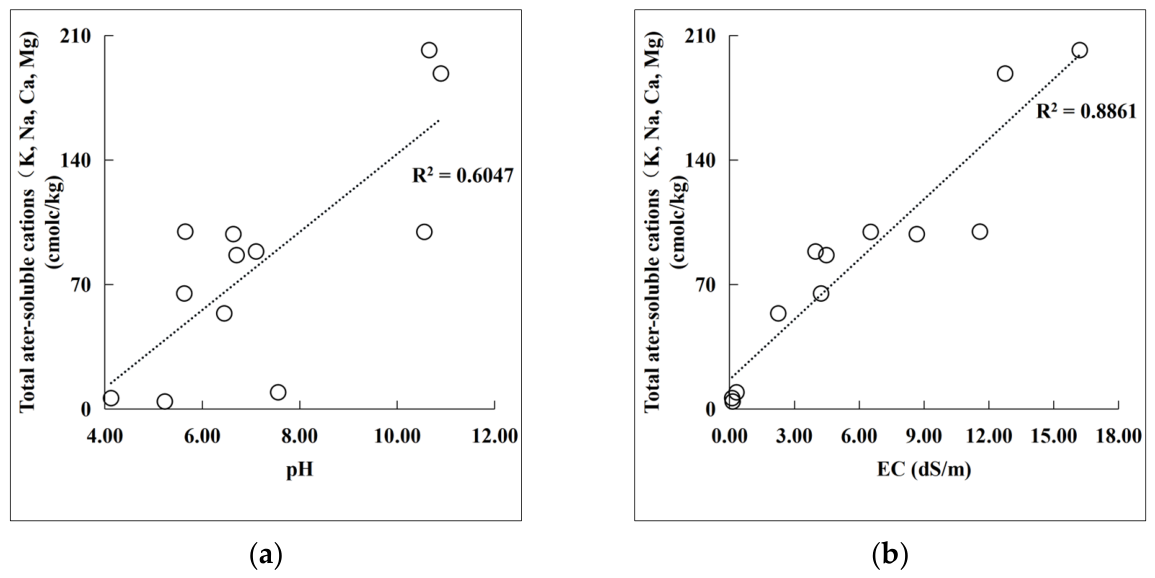
The correlation between (a) pH and (b) EC and water-soluble cation content. Circles represent individual data points, and the dashed lines indicate linear regression fits. R2 values are shown in each panel.
Electrical conductivity (EC) showed a strong positive correlation with water-soluble cation content, particularly potassium, as illustrated in Figure 1. As shown in Figure 1a,b, increases in soluble cation concentration correspond directly to increases in pH and EC, confirming that mineral release is a primary driver of these properties. This relationship is consistent with previous findings that EC is largely governed by soluble salts in biochar systems [34,35]. Gramineae straw-derived charred materials exhibited substantially higher EC values (2.25–16.20 dS/m) than wood-derived charred material (0.14–0.32 dS/m). Higher temperatures and longer durations increased EC due to thermal concentration of non-volatile minerals and enhanced solubility of salts. In contrast, low-temperature charred materials exhibited relatively low EC, which may be advantageous for applications in saline soils.
The ammonium acetate (NH4OAc)-soluble cation contents of charred material from various sources are presented in Table 3. The total amount of four kinds of NH4OAc-soluble cations (Mg2+, Ca2+, K+, Na+) increased with increasing pyrolysis temperature and duration for all raw materials. The total cation content of RC increased 2.5-fold, while that of SC increased 2.0-fold and BC increased 2.3-fold under the same conditions. In gramineae straw-derived charred materials, K+ was the dominant cation (45.24–185.68 cmolc/kg), whereas wood-derived charred material was characterized by comparatively lower total cation contents, with Ca2+ and K+ being the most abundant. Under identical pyrolysis conditions, the NH4OAc-soluble K+, Na+, and Mg2+ contents of wood-derived charred material were markedly lower than those of gramineae straw-derived charred material. The concentrations of water-soluble cations (WSCs), including K+, Na+, Ca2+, and Mg2+, varied considerably among charred materials (Table 3). In gramineae straw-derived charred materials, water-soluble Ca2+ and Mg2+ decreased significantly with increasing pyrolysis severity, indicating their transformation into exchangeable or sparingly soluble mineral forms, such as carbonates or silicates [36]. In contrast, in wood-derived charred material, Ca2+ was present predominantly in water-soluble form, likely due to the lower ash and silica contents of wood biomass, which limit its incorporation into stable mineral phases. Sodium and potassium were mainly present as water-soluble species in all charred materials, and the concentration of water-soluble K+ increased continuously with increasing pyrolysis temperature, suggesting enhanced release and retention of readily soluble K during pyrolysis. A positive correlation was observed between water-soluble cation concentrations and total cation contents, indicating that the exchangeable pool largely governs the nutrient-supplying potential of charred material, with the water-soluble fraction providing immediately available nutrients and the remaining fraction serving as a longer-term reserve.
The cation exchange capacity (CEC) trends of charred material from different materials followed a consistent pattern of 250-12 > 250-4 > 500-4 (Table 2). An increase in pyrolysis temperature led to a decrease in CEC (p < 0.05). There was no significant difference in CEC among the three gramineae straw-derived charred materials under identical pyrolysis conditions, except for BC at 500-4. Charred materials produced at 250-12 exhibited the highest CEC values (93.68–119.91 cmolc/kg), which were significantly greater than those obtained at 250-4 (23.02–61.19 cmolc/kg) and 500-4 (14.78–42.14 cmolc/kg). Moreover, the CEC of wood-derived charred material was significantly lower than that of gramineae straw-derived charred materials at 250-4. The significantly higher CEC observed under prolonged low-temperature conditions reflects the preservation and formation of oxygen-containing functional groups, particularly carboxyl groups, which provide negatively charged exchange sites [37]. These functional groups are essential for ion exchange processes and nutrient retention in soil systems. Mechanistically, prolonged duration at low temperature enhances functional group development without extensive carbonization, thereby maximizing surface reactivity and ion-exchange capacity. In contrast, high-temperature pyrolysis removes these functional groups through decarboxylation and dehydration reactions, resulting in lower CEC despite higher structural stability.
3.3. Amount and Optical Properties of Humic Substances in Charred Materials
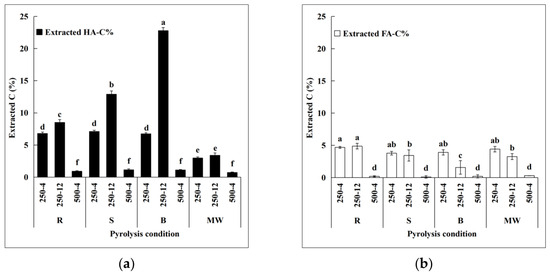
Pyrolysis duration plays a critical role in regulating the transformation of organic matter under low-temperature conditions, particularly in relation to humification processes. The formation of humic substances was strongly dependent on both temperature and duration (Figure 2). A substantially higher extracted carbon (Ex.C) content was obtained from charred materials produced at 250 °C compared with those produced at 500 °C. At 250 °C, prolonging the residence time from 4 h to 12 h resulted in a marked increase in total extracted carbon (FA + HA) across all feedstock-derived chars (as shown in Table S1, Supplementary Materials). Specifically, under the 250-12 h condition, the Ex.C content of HA increased by 25.3%, 81.7%, 237.9%, and 14.3% in RC, SC, BC, and WC, respectively, relative to the corresponding 250-4 treatments. In contrast, the Ex.C associated with the FA fraction decreased with prolonged pyrolysis time at 250 °C, indicating a transformation from low-molecular-weight to more condensed structures. This shift suggests that prolonged low-temperature treatment facilitates progressive polymerization and condensation of intermediate organic compounds. When the pyrolysis temperature was increased to 500 °C, the Ex.C contents of both FA and HA were drastically reduced. Under the 500-4 condition, FA- and HA-derived Ex.C values were significantly lower than those obtained at 250-4 h (p < 0.05) due to thermal decomposition [38]. The HA content in gramineae straw-derived charred materials decreased by 89.2–95.1%, while a reduction of 78.9% was observed for wood-derived char, indicating that humic substances were largely decomposed or transformed under higher-temperature treatment. At higher temperatures, cleavage of functional groups such as carboxyl, hydroxyl, and amino groups leads to the breakdown of humic precursors, preventing the formation and stabilization of humic-like macromolecules. This behavior is consistent with previous reports showing that humic substances decompose rapidly above 275–440 °C [4]. This duration-dependent transformation indicates that low-temperature pyrolysis induces a thermally driven humification process. Unlike biological humification, this process is governed by thermal reactions including dehydration, condensation, and polymerization of intermediate degradation products [38,39]. Similar thermochemical pathways have been proposed in studies on organic matter transformation during pyrolysis [40,41]. Specifically, low-molecular-weight compounds derived from partial decomposition of cellulose and hemicellulose act as precursors for humic substance formation. With increasing duration, these intermediates undergo condensation reactions, forming larger and more complex aromatic structures. This process results in increased molecular weight, reduced polarity, and enhanced structural stability of humic-like macromolecules.
Figure 2.
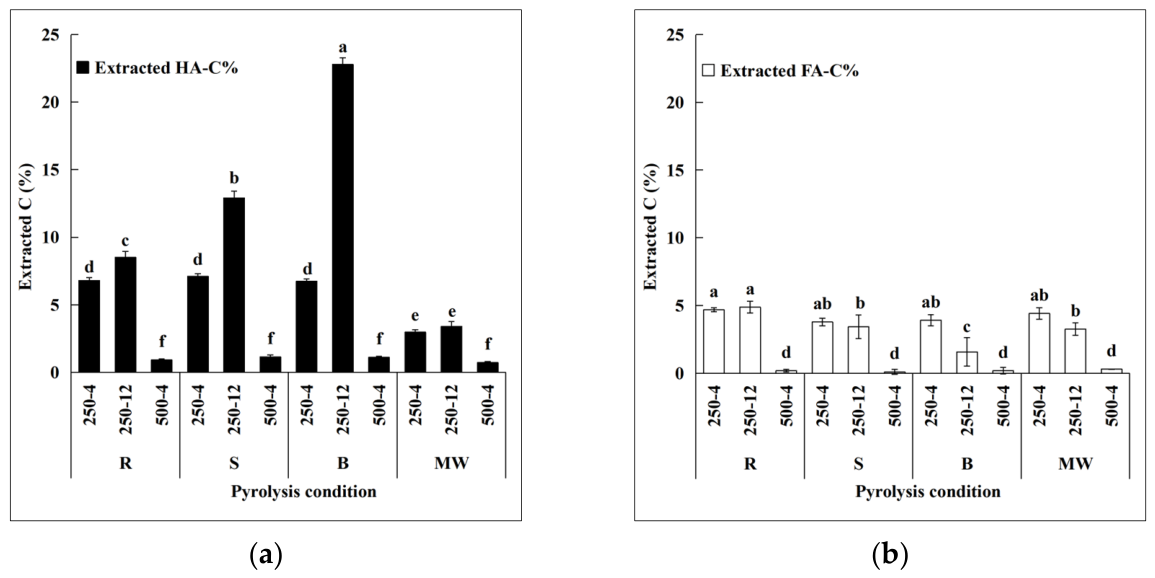
Extracted carbon percentages of (a) humic acid (HA-C%) and (b) fulvic acid (FA-C%) under different pyrolysis conditions. Different letters above the bars indicate significant differences among treatments within each material at p < 0.05 (Tukey’s test).
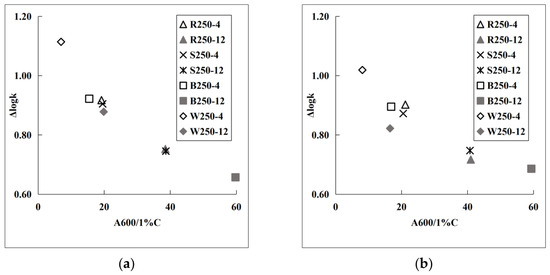
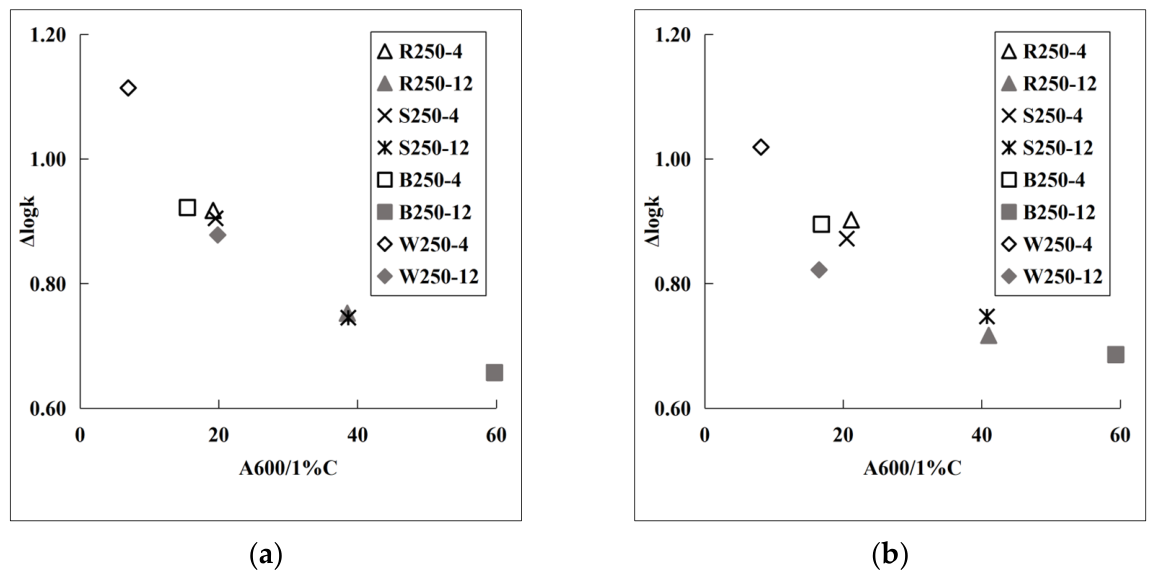
Optical properties of the extracted humic substances further reflected the structural evolution occurring under low-temperature pyrolysis. Charred materials produced at 500 °C were excluded from Figure 3 due to the extremely low absorbance of their alkaline extracts (as shown in Table S2, Supplementary Materials), indicating an almost complete absence of detectable humic substances. Therefore, optical indices were evaluated only for samples treated at 250 °C. Based on the spectral parameters ΔlogK and A600/1%C, humic substances extracted from chars treated at 250 °C changed with increasing residence time (Figure 3). A600 is defined as the absorbance at 600 nm of the undiluted humic extract. A600/1%C represents the specific visible absorbance of humic carbon normalized to a carbon concentration of 1%, and is therefore an indicator of the degree of humification, aromaticity, and molecular condensation of humic substances, following established UV–Vis characterization principles [42,43]. Both total humic substances (HS) and the humic acid (HA) fraction showed increasing A600/1%C values from 4 h to 12 h, reflecting a progressive darkening of color and a higher degree of humification with prolonged thermal treatment. After 12 h of treatment, the A600/1%C values reached the range of highly humified organic matter, and these products could be classified as “A-type humic acids” according to previous studies [18]. In contrast, ΔlogK values decreased over the same period, indicating a gradual shift toward more structurally complex humic substances. The lower humification degree of humic acid derived from wood-based charred materials compared with gramineae straw-derived materials can be attributed to inherent differences in feedstock composition. Wood biomass typically contains lower nitrogen and cellulose contents and a higher proportion of lignin, which promotes the formation of condensed aromatic structures but limits secondary polymerization of humic precursors [44]. HS generally exhibited lower A600/1%C values and slightly higher ΔlogK values than the HA fraction. This decrease can be attributed to the lower degree of aromatization and condensation of fulvic acid and its weaker visible light absorption. The incorporation of fulvic acid increases the total carbon content while contributing less to absorbance at 600 nm, thereby diluting the optical activity per unit carbon. Across all feedstocks, a consistent negative relationship between A600/1%C and ΔlogK was observed from 4 h to 12 h. This relationship highlights a coordinated pattern of optical and structural evolution of humic substances under low-temperature thermal treatment, characterized by increasing aromatic condensation and molecular complexity. Overall, the optical characteristics indicate that prolonged low-temperature pyrolysis promotes humification, molecular condensation, and chromophore development, whereas high-temperature treatment severely suppresses humic substance formation through extensive thermal degradation.
Figure 3.
The optical properties of (a) humic substance and (b) humic acid of charred materials under different pyrolysis conditions.
3.4. Surface Structural Characteristics of Charred Materials and Their Functional Implications
3.4.1. Microstructure of Charred Materials (SEM Analysis)
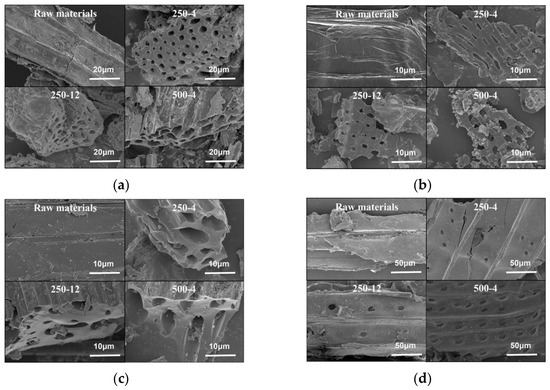
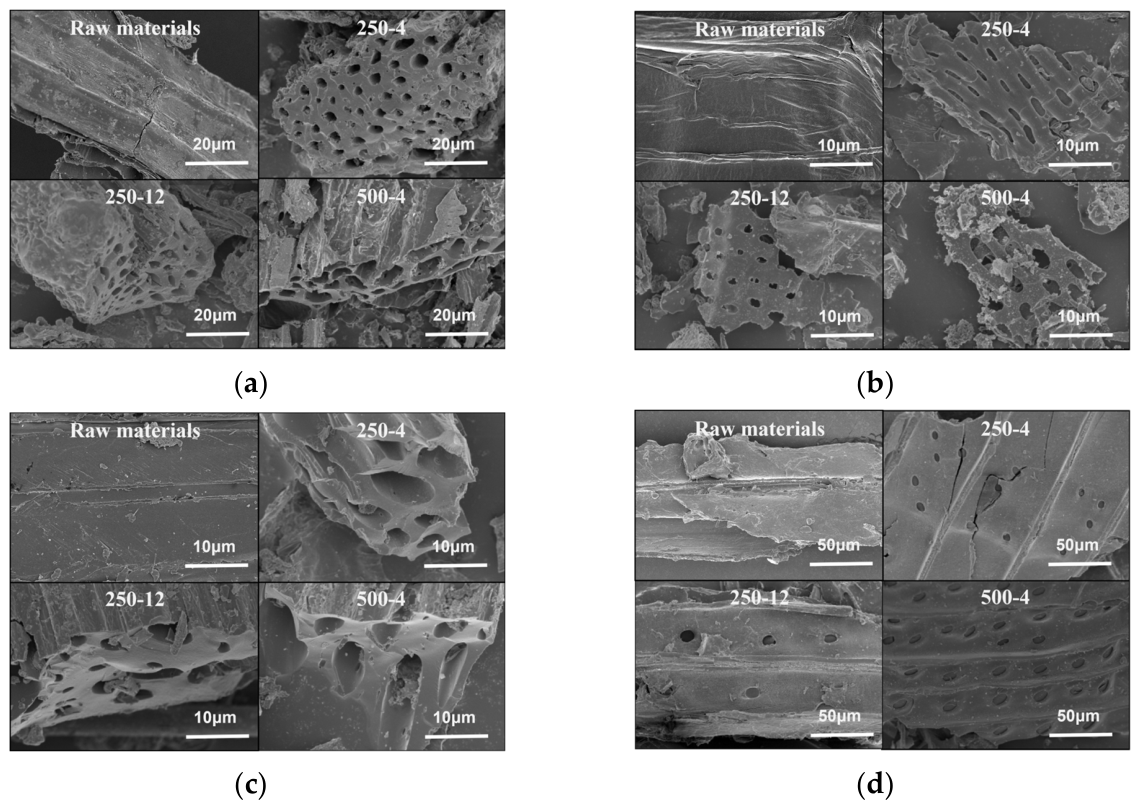
Structural evolution during pyrolysis reflects the extent of biomass decomposition and determines the development of pore networks in charred materials. Scanning electron microscopy (SEM) revealed clear differences in surface morphology and structural integrity of charred materials produced under different pyrolysis conditions (Figure 4). At 250 °C, gramineae straw-derived charred materials displayed a distinct tubular structure, characterized by relatively smooth inner walls and a limited number of pores. When the pyrolysis temperature was increased to 500 °C, the tube walls became thinner, and the number of pores increased. In this condition, the amount of debris in gramineae straw-derived charred materials rose significantly, whereas the change in wood-derived charred materials was less pronounced. At a constant temperature of 250 °C, extending the pyrolysis duration from 4 to 12 h did not substantially alter the overall microstructural framework of the charred materials, although an increase in surface debris was observed. For wood-derived charred material, a marked increase in pore development was evident only under the 500-4 condition (Figure 4d). Similar morphological changes have been reported in biomass-derived chars subjected to high-temperature pyrolysis [45].
Figure 4.
SEM images of four raw materials (R, S, B, and W) and their structural evolution after pyrolysis at 250 °C (4 and 12 h) and 500 °C (4 h): (a) R, (b) S, (c) B, and (d) W.
3.4.2. Specific Surface Area and Porosity of Charred Materials (BET Analysis)
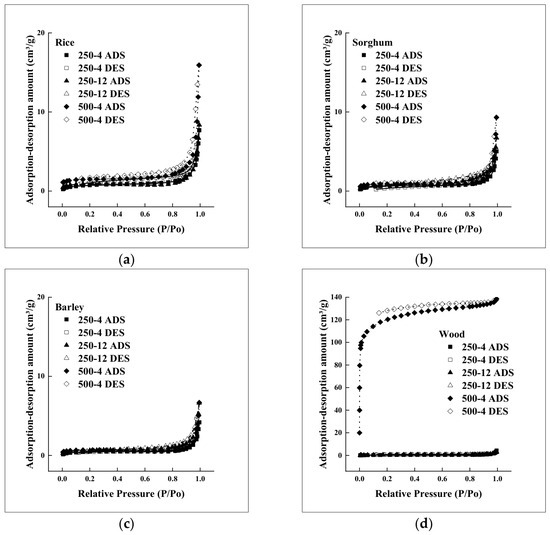
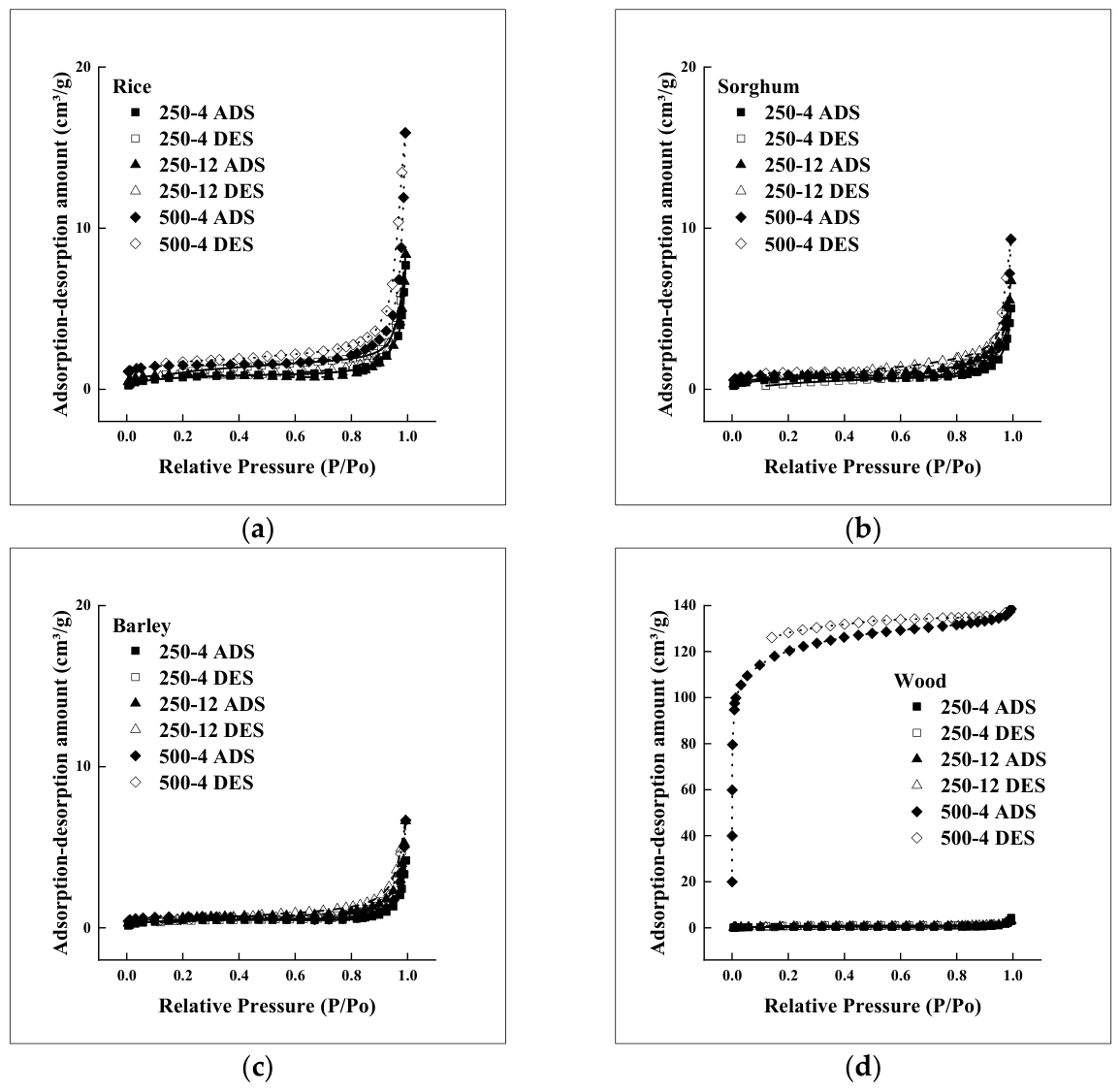
The BET specific surface area (SSA) of charred materials is presented in Table 4 and Figure 5. For gramineae straw-derived charred materials, SSA values increased only slightly as the pyrolysis temperature increased from 250 °C to 500 °C. In contrast, wood-derived charred material exhibited a pronounced increase in SSA, rising from 1.4 m2/g at 250-4 to 378.5 m2/g at 500-4. Such a sharp increase may also reflect the formation of microporous structures through the decomposition of lignin-derived frameworks. Nitrogen adsorption–desorption isotherms further showed that SSA increased progressively with increasing pyrolysis temperature for all charred materials (Figure 5). Wood-derived charred material produced at 500 °C exhibited a sharp increase in adsorption capacity at relative pressures below 0.1, followed by gradual saturation at higher pressures and the appearance of a hysteresis loop during desorption. In contrast, the adsorption behavior of gramineae straw-derived charred materials showed only modest changes across the examined temperature range. This difference can be attributed to the higher lignin content and structural rigidity of woody biomass, which favors the formation of stable pore networks during high-temperature carbonization [46].
Table 4.
BET specific surface area of charred material.
Figure 5.
Adsorption–desorption isotherms of charred materials derived from (a) Rice, (b) Sorghum, (c) Barley, and (d) Wood under various pyrolysis conditions (ADS = adsorption branch, DES = desorption branch).
3.5. Functional Group Composition and Carbon Structural Features of Charred Materials Based on FT-IR and Raman Analysis
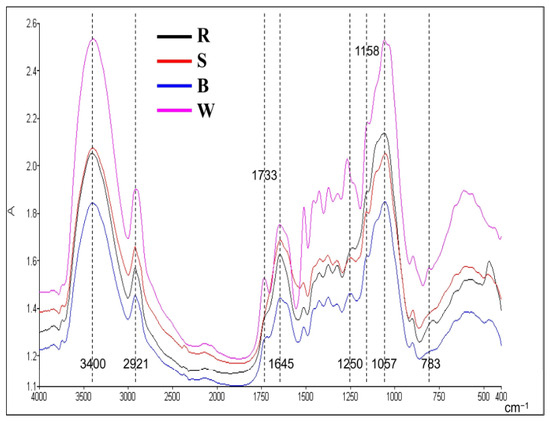
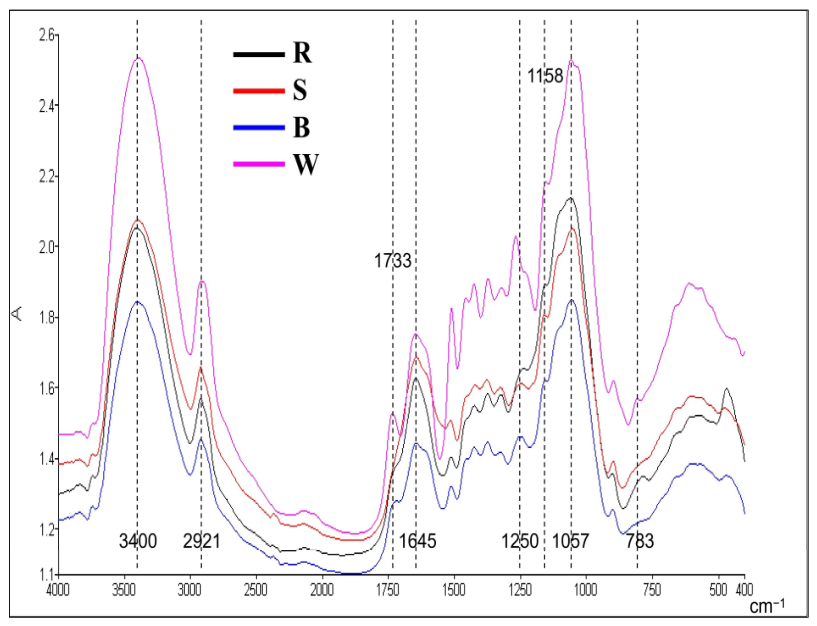
The evolution of functional groups and carbon structure provides key evidence for understanding the chemical transformation pathways during pyrolysis. The four raw materials exhibited abundant surface functional groups, with similar major absorption peak positions but varying relative intensities (Figure 6). The broad peak observed around 3400 cm−1 was attributed to the O–H stretching vibrations of phenolic or alcoholic hydroxyl groups. The asymmetric and symmetric C–H stretching vibrations of aliphatic –CH3 and –CH2 groups appeared near 2921 cm−1. The peak at 1733 cm−1 corresponded to the C=O stretching vibration of carboxylic acids. Aromatic skeletal vibrations were observed at approximately 1645 cm−1 and 783 cm−1. The peak near 1645 cm−1 may also reflect C=O stretching from ketones or aldehydes. The asymmetric stretching vibration of ether bonds (C–O–C) was observed at 1250 cm−1, while the symmetric stretching appeared at 1158 cm−1. Peaks around 1100 cm−1 were attributed to C–O stretching vibrations from aromatic ethers or various silicate groups.
Figure 6.
FT-IR spectra of the raw materials. R, S, B, and W denote rice, sorghum, barley, and wood, respectively. A (y-axis) represents absorbance. The vertical dashed lines indicate the positions of characteristic absorption bands.
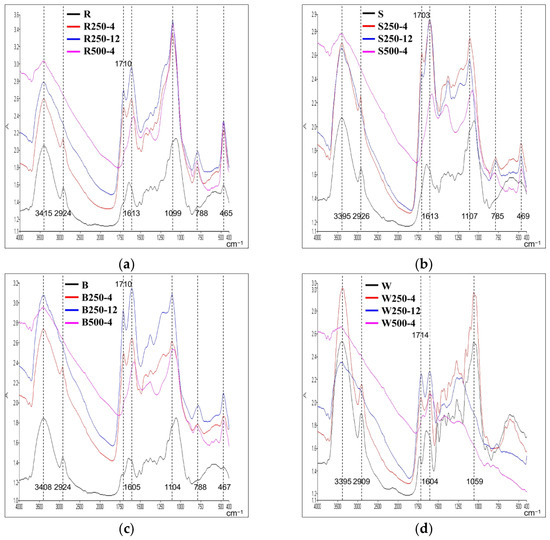
Pyrolysis temperature exerted a pronounced influence on the surface functional groups of the resulting charred materials (Figure 7). At 250 °C, changes in functional-group composition were relatively limited, and several oxygen-containing functional groups remained clearly detectable. Under the 250 °C-4 h condition, the aliphatic C–H stretching peak near 2924 cm−1 was preserved, whereas this peak disappeared after prolonged treatment at 250-12 and under the 500-4 condition, indicating progressive loss of functional groups due to dehydration and decarboxylation reactions [45,47]. The carboxylic acid C=O absorption near 1710 cm−1 became more pronounced at 250 °C, particularly after 12 h of pyrolysis, but was largely absent in charred materials produced at 500 °C, except for a weak signal in wood-derived samples. These findings are consistent with previous studies showing that low-temperature pyrolysis preserves functional groups important for chemical reactivity [47]. As the pyrolysis temperature increased to 500 °C, the intensities of hydroxyl (–OH), aromatic C=C, and C=O stretching vibrations decreased markedly. In addition, the absorption bands associated with inorganic components (Si–O–Si) became more pronounced with increasing temperature in gramineae straw-derived charred materials.
Figure 7.
FTIR spectra of charred materials derived from (a) Rice, (b) Sorghum, (c) Barley, and (d) Wood under various pyrolysis conditions (Red: 250-4, Blue: 250-12, Pink: 500-4, Black: raw materials). A (y-axis) represents absorbance. The vertical dashed lines indicate the positions of characteristic absorption bands.
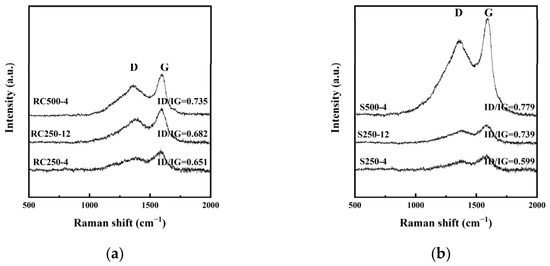
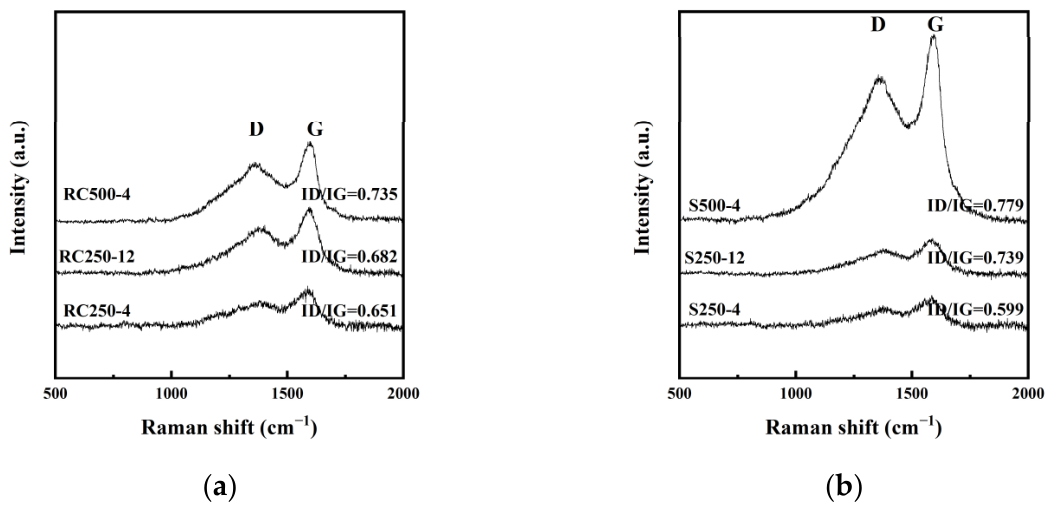
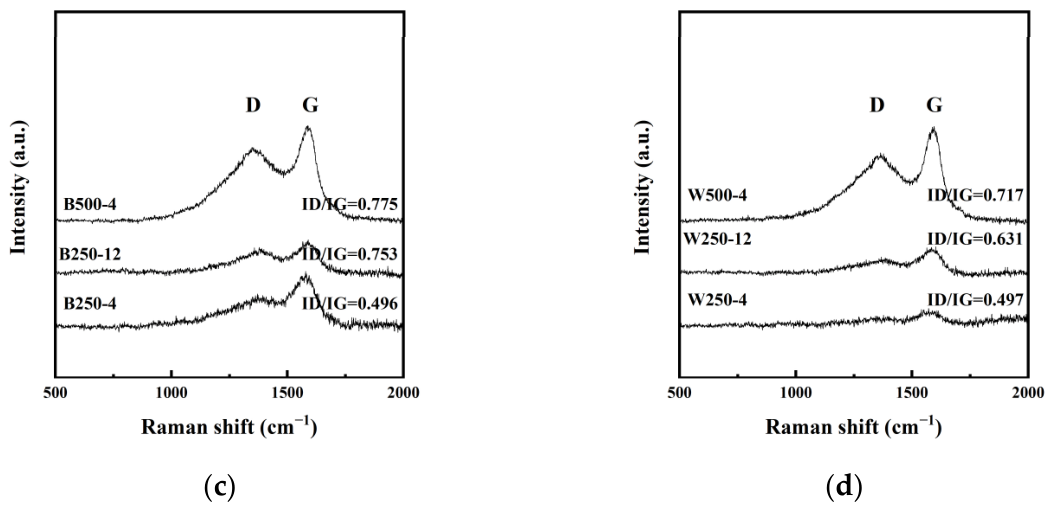
The Raman spectra showed three curves for each charred material under different pyrolysis conditions, with D-bands (1350 cm−1) and G-bands (1580 cm−1) clearly labeled in all spectra and ID/IG ratios provided for each curve (Figure 8). Overall, the ID/IG values indicated a relative increase in structural disorder with the longer residence time at 250 °C, and the highest disorder was observed for the 500 °C rapid pyrolysis, indicating a higher degree of structural disorder under more severe pyrolysis conditions, while the increase in disorder-related D-band intensity reflected a transformation toward more defective and condensed carbon structures [48,49]. This structural evolution was commonly associated with increased aromatic condensation and formation of graphitic domains. From a mechanistic perspective, low-temperature pyrolysis promotes functional-group-rich reactive carbon, whereas high-temperature pyrolysis produces highly aromatic, structurally stable carbon matrices with reduced surface functionality [14], highlighting the importance of tailoring pyrolysis conditions based on the desired material properties. Among the 250 °C conditions, the longer treatment (250-12) generally yielded intermediate ID/IG values, suggesting that dwell time at the same temperature could slightly modulate the defect density. This trade-off underscored the need to tailor pyrolysis conditions to the target material properties.
Figure 8.
Raman spectra of charred materials derived from (a) Rice, (b) Sorghum, (c) Barley, and (d) Wood under different pyrolysis conditions. The D band and G band represent the disordered carbon structure and graphitic carbon structure, respectively.
3.6. Characteristics and Applications Prospects of Low-Temperature Charred Materials
The combined effects of temperature, duration, and feedstock type can be integrated into a unified mechanistic framework describing the transformation of biomass into charred materials. Overall, the evolution of charred materials can be interpreted as a balance between functional group preservation and structural stabilization. At 250 °C, biomass undergoes incomplete carbonization, resulting in materials that retain oxygen-containing functional groups, humic-like substances, and high cation exchange capacity. Prolonged duration enhances secondary reactions, particularly condensation and humification, leading to increased molecular complexity without eliminating surface reactivity. In contrast, high-temperature pyrolysis promotes extensive devolatilization, aromatization, and pore development, resulting in highly stable carbon structures with lower chemical reactivity. Raw materials composition further modulates these processes by influencing decomposition pathways, mineral content, and structural stability. However, the combined effects of temperature and duration ultimately determine the balance between reactivity and stability. This integrated interpretation is supported by evidence from elemental composition (Table 1), chemical properties (Table 2 and Table 3), humic substance characterization (Figure 2 and Figure 3), and structural analysis (Figure 4, Figure 5, Figure 6, Figure 7 and Figure 8). Therefore, low-temperature charred materials can be conceptualized as a transitional carbon form that combines moderate stability with high chemical functionality, making them particularly suitable for applications such as nutrient retention, ion exchange, and soil amendment. From an application perspective, charred materials produced at 250 °C for shorter durations (4 h) may represent more practical and energy-efficient options, while prolonged treatments (12 h) define the upper boundary of functional development, particularly in terms of humification and cation exchange capacity. Therefore, low-temperature pyrolysis can be understood not merely as incomplete carbonization, but as a distinct pathway for generating functionally active carbon materials that bridge the gap between raw biomass and highly carbonized chars.
4. Conclusions
This study systematically evaluated the effects of low-temperature pyrolysis and residence time on the physicochemical properties, surface functionality, and humification behavior of charred materials derived from agricultural and forestry residues. By comparing materials produced under mild thermal conditions (250 °C, 4 h and 12 h) with those obtained via conventional high-temperature pyrolysis (500 °C, 4 h), the functional significance of low-temperature carbonization was clarified. Pyrolysis temperature was identified as the dominant factor controlling solid yield and elemental recovery. Mild carbonization at 250 °C resulted in substantially higher solid yields and enhanced carbon and nitrogen retention compared with high-temperature treatment. Low-temperature treatment also exerted a strong influence on surface chemical properties, and charred materials produced at 250 °C exhibited neutral to acidic pH values, abundant oxygen-containing functional groups, and significantly higher cation exchange capacity, particularly after prolonged duration. In contrast, high-temperature pyrolysis resulted in the depletion of polar functional groups and a marked decline in cation exchange capacity. Humic substance analysis further demonstrated that low-temperature pyrolysis strongly favored humification processes. Charred materials produced at 250 °C contained substantially higher amounts of extractable humic substances than those formed at 500 °C. Prolonged heating under mild conditions promoted the transformation of fulvic-like components into more condensed humic acid fractions, accompanied by increased aromaticity and molecular complexity. Overall, a pyrolysis temperature of approximately 250 °C represents an effective temperature for producing functionally active, low-temperature carbonized materials that combine high yield, preserved surface functionality, and enhanced humic substance content. Such materials occupy a transitional domain between raw biomass and highly carbonized chars and show strong potential for applications emphasizing nutrient retention, soil amendment, and reactive carbon utilization.
5. Future Perspectives
The mild carbonization of agricultural waste represents a future development trend from both economic and environmental perspectives. Based on previous studies and our team’s research on certain properties of low-temperature carbonization, future work will focus on the following aspects:
Future studies should focus on the functional properties of char obtained at 250 °C for 4 h, in comparison with the more conventional condition of 500 °C for 4 h. After soil application, its surface structure may undergo changes due to surface oxidation and chemical aging, leading to an increase in oxygen-containing functional groups such as carboxyl groups. As a result, it may exhibit chemical properties and functional behaviors different from those of traditional high-temperature char.
Char produced at 250 °C for 12 h exhibits advantages, including higher cation exchange capacity (CEC) and lower pH, and also demonstrates potential for forming Type A humic acid. Future studies will aim to determine the suitable application conditions for carbon materials produced under shorter pyrolysis durations.
For problematic soils, particularly saline–alkaline soils (characterized by high pH, high salinity, and low organic matter content), and in combination with current laboratory validations, efforts will be made to develop functional products derived from low-temperature pyrolysis that can be widely applied.
Supplementary Materials
The following supporting information can be downloaded at: https://www.mdpi.com/article/10.3390/c12020045/s1. Table S1: Total Extracted carbon content and Extracted carbon content of HA in charred materials under different pyrolysis conditions; Table S2: The optical properties of humic substance and humic acid of charred materials under different pyrolysis conditions.
Author Contributions
Conceptualization: S.Y., T.E., T.M., E.N. and Z.C.; methodology: S.Y., T.E., T.M., E.N. and Z.C.; validation: S.Y., T.E., T.M., E.N. and Z.C.; formal analysis: S.Y. and Z.C.; investigation: Z.C. and S.Y.; resources: S.Y. and T.E.; data curation: Z.C. and S.Y.; writing—original draft preparation: Z.C. and S.Y.; writing—review and editing: S.Y., T.E., T.M. and E.N.; visualization, Z.C. and S.Y.; supervision, S.Y.; project administration, S.Y.; funding acquisition, S.Y. All authors have read and agreed to the published version of the manuscript.
Funding
This research was supported in part by the International Platform for Dryland Research and Education (IPDRE) Program, Tottori University.
Data Availability Statement
The original contributions presented in the study are included in the article/Supplementary Material; further inquiries can be directed to the corresponding author.
Conflicts of Interest
The authors declare no conflicts of interest.
References
- Honorato-Salazar, J.; Sadhukhan, J. Annual biomass variation of agriculture crops and forestry residues, and seasonality of crop residues for energy production in Mexico. Food Bioprod. Process. 2020, 119, 1–19. [Google Scholar] [CrossRef] [Scilit]
- Tagade, A.; Kirti, N.; Sawarkar, A. Pyrolysis of agricultural crop residues: An overview of researches by Indian scientific community. Bioresour. Technol. Rep. 2021, 15, 100761. [Google Scholar] [CrossRef] [Scilit]
- Li, Y.; Xing, B.; Ding, Y.; Han, X.; Wang, S. A critical review of the production and advanced utilization of biochar via selective pyrolysis of lignocellulosic biomass. Bioresour. Technol. 2020, 312, 123614. [Google Scholar] [CrossRef] [Scilit] [PubMed]
- Krzyszczak, A.; Dybowski, M.; Czech, B. Formation of polycyclic aromatic hydrocarbons and their derivatives in biochars: The effect of feedstock and pyrolysis conditions. Anal. Appl. Pyrolysis 2021, 160, 105339. [Google Scholar] [CrossRef] [Scilit]
- Li, Y.; Sun, Y.; Liao, S.; Yang, J.; Sun, N. Effects of feedstock sources and pyrolysis temperature on biochar’s property and their resulting agronomic effects. Environ. Eng. 2019, 37, 722–727. [Google Scholar]
- Xiao, X.; Chen, B.; Chen, Z.; Zhu, L.; Schnoor, J. Insight into multiple and multilevel structures of biochars and their potential environmental applications: A critical review. Environ. Sci. Technol. 2018, 52, 5027–5047. [Google Scholar] [CrossRef] [Scilit]
- Shrivastava, P.; Kumar, R. Soil salinity: A serious environmental issue and plant growth promoting bacteria as one of the tools for its alleviation. Saudi J. Biol. Sci. 2015, 22, 123–131. [Google Scholar] [CrossRef] [Scilit]
- Yue, J.; Fu, Z.; Zhang, L.; Zhang, J.; Zhang, Z. The positive effect of different 24-epiBL pretreatments on salinity tolerance in Robinia pseudoacacia L. seedlings. Forests 2019, 10, 4. [Google Scholar] [CrossRef] [Scilit]
- Yuan, J.; Xu, R.; Zhang, H. The forms of alkalis in the biochar produced from crop residues at different temperatures. Bioresour. Technol. 2011, 102, 3488–3497. [Google Scholar] [CrossRef] [Scilit]
- Chen, W.; Zhang, W.; Meng, J. Advances and prospects in research of biochar utilization in agriculture. Sci. Agric. Sin. 2013, 46, 3324–3333. [Google Scholar]
- Akhtar, S.; Andersen, M.; Liu, F. Residual effects of biochar on improving growth, physiology and yield of wheat under salt stress. Agric. Water Manag. 2015, 158, 61–68. [Google Scholar] [CrossRef] [Scilit]
- Thomas, S.; Frye, S.; Gale, N.; Garmon, M.; Launchbury, R.; Machado, N.; Melamed, S.; Murray, J.; Petroff, A.; Winsborough, C. Biochar mitigates negative effects of salt additions on two herbaceous plant species. J. Environ. Manag. 2013, 129, 62–68. [Google Scholar] [CrossRef] [Scilit]
- Novak, J.; Cantrell, K.; Watts, D. Compositional and thermal evaluation of lignocellulosic and poultry litter chars via high and low temperature pyrolysis. J. Bioenergy Res. 2013, 6, 114–130. [Google Scholar] [CrossRef] [Scilit]
- Jindo, K.; Mizumoto, H.; Sawada, Y.; Sanchez-Monedero, M.; Sonoki, T. Physical and chemical characterization of biochars derived from different agricultural residues. J. Biogeosciences 2014, 11, 6613–6621. [Google Scholar] [CrossRef] [Scilit]
- Narzari, R.; Bordoloi, N.; Sarma, B.; Gogoi, L.; Gogoi, N.; Barkotoki, B.; Kataki, R. Fabrication of biochars obtained from valorization of biowaste and evaluation of its physicochemical properties. J. Bioresour. Technol. 2017, 242, 324–328. [Google Scholar] [CrossRef] [Scilit] [PubMed]
- Gao, J.; Yu, Q.; Liu, Z.; Zhao, J.; Xie, H. Experimental study on the effect of pyrolysis parameters on the biochar properties of birch sawdust. Renew. Energy Resour. 2025, 43, 995–1002. [Google Scholar]
- Lin, J.; Zhang, Y.; Liu, Y.; Xia, J.; Tong, S. Structure and properties of biochar under different materials and carbonization temperatures. Chin. J. Environ. Eng. 2016, 10, 3200–3206. [Google Scholar]
- Shindo, H.; Honna, T.; Yamamoto, S.; Honma, H. Contribution of charred plant fragments to soil organic carbon in Japanese volcanic ash soils containing black humic acids. Org. Geochem. 2004, 35, 235–241. [Google Scholar] [CrossRef] [Scilit]
- Chapman, H.; Pratt, P. Methods of Analysis for Soils, Plants and Water; University of California, Division of Agricultural Sciences: Riverside, CA, USA, 1961; pp. 6–124. [Google Scholar]
- Kumada, K. Chemistry of Soil Organic Matter; Japan Scientific Societies Press: Tokyo, Japan; Elsevier: Amsterdam, The Netherlands; New York, NY, USA, 1987; pp. 1–229. [Google Scholar]
- Yamamoto, S.; Honna, T.; Utsumi, K.; Eneji, A. Characterization of humic substances evaluated by optical properties of whole humus extract with Sodium hydroxide under room temperature. Jpn. J. Soil Sci. Plant Nutr. 2000, 71, 857–865. [Google Scholar]
- Ren, A.; Wang, Q.; Guo, B. Structure characterization and surface fractal analysis of sludge activated carbon. Acta Chim. Sin. 2006, 64, 1068–1072. [Google Scholar]
- Ge, L.; Xia, Y.; Liu, S.; Cheng, X.; Zhai, Y.; Ding, F. Effect of pyrolysis temperature and time on biochar production in a muffle furnace. Shenyang Agric. Univ. 2018, 49, 95–100. [Google Scholar]
- Lin, X.; Lyu, H.; Liu, Y.; Wang, Y.; Yang, S. Effects of biomass and carbonization temperature on biochar yield and characteristics. Acta Agric. Zhejiangensis 2016, 28, 1216–1223. [Google Scholar]
- Puri, L.; Hu, Y.; Naterer, G. Critical review of the role of ash content and composition in biomass pyrolysis. Front. Fuels 2024, 3, 1373307. [Google Scholar] [CrossRef] [Scilit]
- Hou, J.; Suo, Q.; Liang, H.; Xue, Q.; Liu, C. Effects of Carbonization Conditions on Biochar yield from Artemisia ordosica. J. Northwest Univ. (Nat. Sci. Ed.) 2015, 43, 169–175. [Google Scholar]
- Liu, Z.; Liu, M.; Niu, W.; Chen, Y.; Niu, Z. Effects of holding time on physical and chemical properties of utilizing different straw biochar fertilizer. Huazhong Agric. Univ. 2020, 39, 182–192. [Google Scholar]
- Lu, X.; Gu, X. A review on lignin pyrolysis: Pyrolytic behavior, mechanism, and relevant upgrading for improving process efficiency. Biotechnol. Biofuels 2022, 15, 106. [Google Scholar] [CrossRef] [Scilit]
- Wan, J.; Liu, L.; Wang, G.; Sang, L.; Liang, W.; Zhang, W.; Peng, C.; Fu, R. Unveiling the mechanisms of carbon conversion and loss in biochars derived from characteristic lignocellulosic biomass. J. Environ. Chem. Eng. 2022, 10, 108403. [Google Scholar] [CrossRef] [Scilit]
- Xiao, X.; Chen, Z.; Chen, B. H/C atomic ratio as a smart linkage between pyrolytic temperatures, aromatic clusters and sorption properties of biochars derived from diverse precursory materials. Sci. Rep. 2016, 6, 22644. [Google Scholar] [CrossRef] [Scilit]
- Clough, T.; Condron, L.; Kammann, C.; Müller, C. A Review of Biochar and Soil Nitrogen Dynamics. Agronomy 2013, 3, 275–293. [Google Scholar] [CrossRef] [Scilit]
- Tsai, C.; Chang, Y. Higher Biochar rate can be efficient in reducing nitrogen mineralization and nitrification in the excessive compost-fertilized soils. Agronomy 2021, 11, 617. [Google Scholar] [CrossRef] [Scilit]
- Zhang, J.; Chen, Q.; You, C. Biochar effect on water evaporation and hydraulic conductivity in sandy soil. Pedosphere 2016, 26, 265–272. [Google Scholar] [CrossRef] [Scilit]
- Novak, J.; Lima, I.; Xing, B. Characterization of designer biochar produced at different temperatures and their effects on a loamy sand. Ann. Environ. Sci. 2009, 3, 195–206. [Google Scholar]
- Gaskin, J.; Steiner, C.; Harris, K.; Das, C.; Bibens, B. Effect of low-temperature pyrolysis conditions on biochar for agricultural use. Trans. ASABE 2008, 51, 2061–2069. [Google Scholar] [CrossRef] [Scilit]
- Tomczyk, A.; Sokołowska, Z.; Boguta, P. Biochar physicochemical properties: Pyrolysis temperature and feedstock kind effects. Rev. Environ. Sci. Biotechnol. 2020, 19, 191–215. [Google Scholar] [CrossRef] [Scilit]
- Guo, Y.; David, A. Activated carbons prepared from rice hull by one-step phosphoric acid activation. Microporous Mesoporous Mater. 2006, 100, 12–19. [Google Scholar] [CrossRef] [Scilit]
- Cheng, L.; Zhang, B.; Xu, L.; Hou, C.; Liu, G. Thermal decomposition kinetics of humic acid. CIESC J. 2014, 65, 3470–3478. [Google Scholar]
- Mukherjee, A.; Zimmerman, A.; Harris, W. Surface chemistry variations among a series of laboratory-produced biochars. Geoderma 2011, 163, 247–255. [Google Scholar] [CrossRef] [Scilit]
- Zhao, M.; Chen, B.; Feng, M.; Chen, K.; Pan, J. Spectral characteristic of dissolved organic matter released from biochar at different pyrolysis temperature. Spectrosc. Spectr. Anal. 2020, 40, 2505–2511. [Google Scholar]
- Yan, D.; Ma, Y.; Song, K.; Ma, H.; Gao, R.; Yin, Y. Effect of feedstock material and pyrolysis temperature on dissolved organic matter in biochars. Environ. Sci. 2021, 40, 5030–5036. [Google Scholar]
- Stevenson, F. Humus Chemistry: Genesis, Composition, Reactions, 2nd ed.; John Wiley & Sons: New York, NY, USA, 1994. [Google Scholar]
- Swift, R. Organic matter characterization. In Methods of Soil Analysis: Part 3 Chemical Methods; Soil Science Society of America: Madison, WI, USA, 1996. [Google Scholar]
- Hu, Z.; Huo, W.; Chen, Y.; Zhang, Q.; Hu, M.; Zheng, W.; Shao, Y.; Pan, Z.; Li, X.; Zhao, J. Humic substances derived from biomass waste during aerobic composting and hydrothermal treatment: A Review. Front. Bioeng. Biotechnol. 2022, 10, 878686. [Google Scholar] [CrossRef] [Scilit]
- Liang, H.; Suo, Q.; Hou, J.; Liu, C. The structure characteristics and chemical properties of maize straw biochar and artemisia ordosica biochar prepared at different carbonization temperatures. Soils 2015, 47, 886–891. [Google Scholar]
- Mukome, F.; Zhang, X.; Silva, L. Use of chemical and physical characteristics to investigate trends in biochar feedstocks. J. Agric. Food Chem. 2013, 61, 2196–2204. [Google Scholar] [CrossRef] [Scilit]
- Hao, R.; Peng, S.; Song, Y.; Liu, M. Effects of different temperature on surface functional groups of black carbon. Ecol. Environ. Sci. 2010, 19, 528–531. [Google Scholar]
- Zhu, H.; Yu, G.; Guo, Q.; Wang, X. In situ Raman spectroscopy study on catalytic pyrolysis of a bituminous coal. Energy Fuels 2017, 31, 5817–5827. [Google Scholar] [CrossRef] [Scilit]
- Liu, H.; Xie, C.; Kang, Y.; Jiang, S.; Mei, X.; Xu, Y.; Dong, C. Influence of different pyrolysis temperatures on physical and chemical properties of biochar derived from pear branches. J. Nanjing Agric. Univ. 2019, 42, 895–902. [Google Scholar]

Disclaimer/Publisher’s Note: The statements, opinions and data contained in all publications are solely those of the individual author(s) and contributor(s) and not of MDPI and/or the editor(s). MDPI and/or the editor(s) disclaim responsibility for any injury to people or property resulting from any ideas, methods, instructions or products referred to in the content. |
© 2026 by the authors. Licensee MDPI, Basel, Switzerland. This article is an open access article distributed under the terms and conditions of the Creative Commons Attribution (CC BY) license.