


Abstract
In this work, sustainable aluminum-modified orange peels functionalized with graphene oxide (OP-Al-GO) were synthesized and evaluated for the removal of Methylene Violet (MV) and Reactive Red 120 (RR120) from aqueous solutions. Adsorption performance was systematically investigated in single-dye systems, binary dye mixtures, and real textile wastewater samples, and compared with that of orange peels (OP), orange peel–aluminum composite (OP-Al), and graphene oxide (GO). pHpzc analysis clarified the surface charge of the adsorbent, while SEM and FTIR showed that the incorporation of aluminum and GO increased roughness and functional groups appearance, enhancing dye adsorption and confirming successful interactions. The OP-Al-GO composites exhibited improved removal efficiency for both dyes (64.8% for RR120 and 96.2% for MV) at pH 3.0. The presence of aluminum improved structural stability and surface charge regulation, while graphene oxide contributed to multiple adsorption mechanisms, including electrostatic attraction and π–π interactions. The adsorption kinetics were found to follow a pseudo-second-order (PSO) kinetic model for RR120 and an intraparticle-diffusion model (IPD) for MV, while isotherm analysis revealed a Langmuir behavior for MV and a Freundlich behavior for RR120. Langmuir maximum adsorption capacities were 298.7 and 10.8 mg/g for MV and RR120, respectively. High removal efficiency was maintained in binary dye mixtures, with OP-Al-GO achieving 96.9% removal of MV and 85.7% of RR120. Furthermore, the proposed adsorbent was tested on real wastewater samples, and the results highlight that the proposed adsorbents are promising, low-cost, and environmentally sustainable for textile wastewater treatment.
1. Introduction
The rapid growth of the textile industry has led to the discharge of substantial volumes of dye-containing wastewater, representing a major environmental and public health concern [1]. Synthetic dyes are widely used due to their high color strength and durability; however, a significant fraction of these dyes remains unfixed to textile fibers and is released into aquatic environments during dyeing and finishing operations. Even at low concentrations, dyes can intensely color water, reducing light penetration and disrupting aquatic ecosystems [2]. In addition, many textile dyes and their breakdown products are also toxic, carcinogenic, and resistant to biodegradation, making wastewater treatment especially challenging [3].
Reactive dyes like Reactive Red 120 (RR120) are particularly problematic because of their high-water solubility and chemically stable aromatic structures, which limit the effectiveness of conventional treatment methods [4,5]. Likewise, cationic dyes such as Methylene Violet (MV) are extensively used in textile and printing processes and are known for their acute toxicity and persistence in the environment [6]. In real textile effluents, dyes are rarely present as single compounds but rather occur as complex mixtures of anionic and cationic dyes, often accompanied by salts and organic additives [7]. This complexity significantly limits the efficiency of many treatment technologies and highlights the need for adsorbents capable of operating effectively under single, binary, and real wastewater conditions.
Among the various wastewater treatment methods investigated for dye removal, such as biological degradation, chemical oxidation, membrane filtration, and coagulation–flocculation [8], adsorption has emerged as a highly effective and versatile approach. Its advantages include operational simplicity, high removal efficiency, and the ability to treat a wide range of contaminants without generating harmful by-products. The effectiveness of adsorption, however, depends largely on the properties of the adsorbent, driving research into advanced materials that are efficient, cost-effective, and environmentally sustainable [9,10].
In recent years, carbon-based materials have attracted significant attention for dye removal due to their high surface area and tunable surface chemistry [9]. Graphene oxide (GO), in particular, shows outstanding adsorption performance thanks to its two-dimensional structure and abundance of oxygen-containing functional groups, which enable electrostatic interactions, hydrogen bonding, and π–π stacking with aromatic dyes [11]. However, practical use of GO is limited by its high cost, tendency to aggregate in water, and challenges in post-treatment recovery [12,13].
To overcome these issues, bio-derived carbon materials from agricultural waste have gained interest [14,15]. Orange peels (OPs) are abundant, renewable, and rich in cellulose, hemicellulose, lignin, and pectin, offering multiple functional groups for dye adsorption [16]. Using orange peels as adsorbents supports circular economy principles and provides a sustainable alternative to conventional carbon materials [17]. Yet, raw orange peels often have limited adsorption capacity and structural stability, especially in complex dye systems [18].
The integration of biomass-derived carbon with advanced nanocarbon materials represents a promising strategy to enhance adsorption performance. In this context, the incorporation of aluminum ions (Al3+) plays a crucial role in composite formation [19]. Aluminum acts as a cross-linking agent between oxygenated functional groups (–OH, –COOH) on orange peels and graphene oxide, improving structural integrity and preventing GO restacking [20]. This allows Al3+ to act as a bridge between OP and GO, stabilizing the composite and promoting adsorption via electrostatic interactions and Al–O coordination. Moreover, aluminum introduces positively charged sites that enhance the adsorption of anionic dyes [21], thereby improving performance in mixed dye systems.
In this study, a novel OP-Al-GO carbon composite was synthesized and evaluated for the adsorption of MV and RR120 in single-dye systems, binary dye mixtures, and real textile wastewater samples. The resulting orange peel–aluminum–graphene oxide (OP-Al-GO) composite combines the sustainability and low cost of waste peels, the high surface area and multifunctional adsorption sites of graphene oxide, and the charge-regulating effects of aluminum, which acts as a coordination bridge, creating a synergistic adsorption. This synergistic structure is particularly effective for the simultaneous removal of anionic and cationic dyes, where competitive adsorption often limits the performance of conventional adsorbents. Although numerous studies have explored biomass-based and graphene-derived adsorbents, systematic investigations comparing raw biomass, metal-modified biomass, graphene oxide, and their composites remain limited. Moreover, most reported studies focus on single-dye systems, providing limited insight into real industrial wastewater conditions. Therefore, there is a clear need for sustainable adsorbents that are evaluated not only in single-dye systems but also in binary dye mixtures and real textile wastewater, addressing the common limitation of previous studies that focus solely on single-dye adsorption. The adsorption performance of OP-Al-GO was systematically compared with that of orange peels (OP), orange peel–aluminum composite (OP-Al), and graphene oxide (GO) to elucidate the role of each component and their synergistic effects. The ability of OP-Al-GO to simultaneously remove both anionic (RR120) and cationic (MV) dyes, as well as to treat real textile wastewater, highlights its practical relevance and distinguishes it from previously reported peel-based and metal-modified biomass adsorbents.
2. Materials and Methods
2.1. Materials
The materials used in this study included aluminum chloride hexahydrate (AlCl3·6H2O, ≥99% purity), hydrochloric acid (HCl, 37%), and sodium hydroxide (NaOH, ≥97.0% ACS). Graphite flakes (≥99.5%, analytical grade) were used to prepare graphene oxide (GO). The dyes studied were Reactive Red 120 (RR120, ≥90% dye content) and Methylene Violet (MV, ≥65% purity). All the above materials were obtained from Sigma-Aldrich (Merck KGaA, Darmstadt, Germany), except HCl, which was supplied by Panreac (Barcelona, Spain). Deionized water was used throughout all experiments. Orange peels (OP), collected prior to disposal, were washed, dried, and used as an agro-food waste material.
2.2. Synthesis of OP-Al-GO
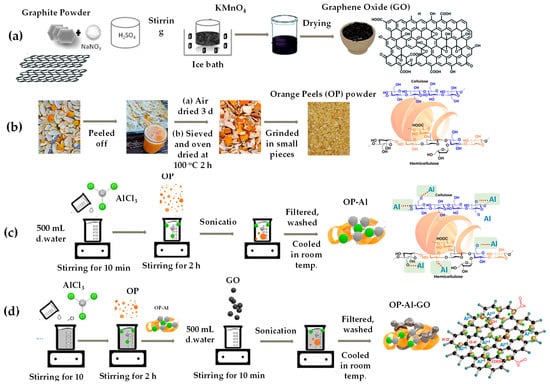
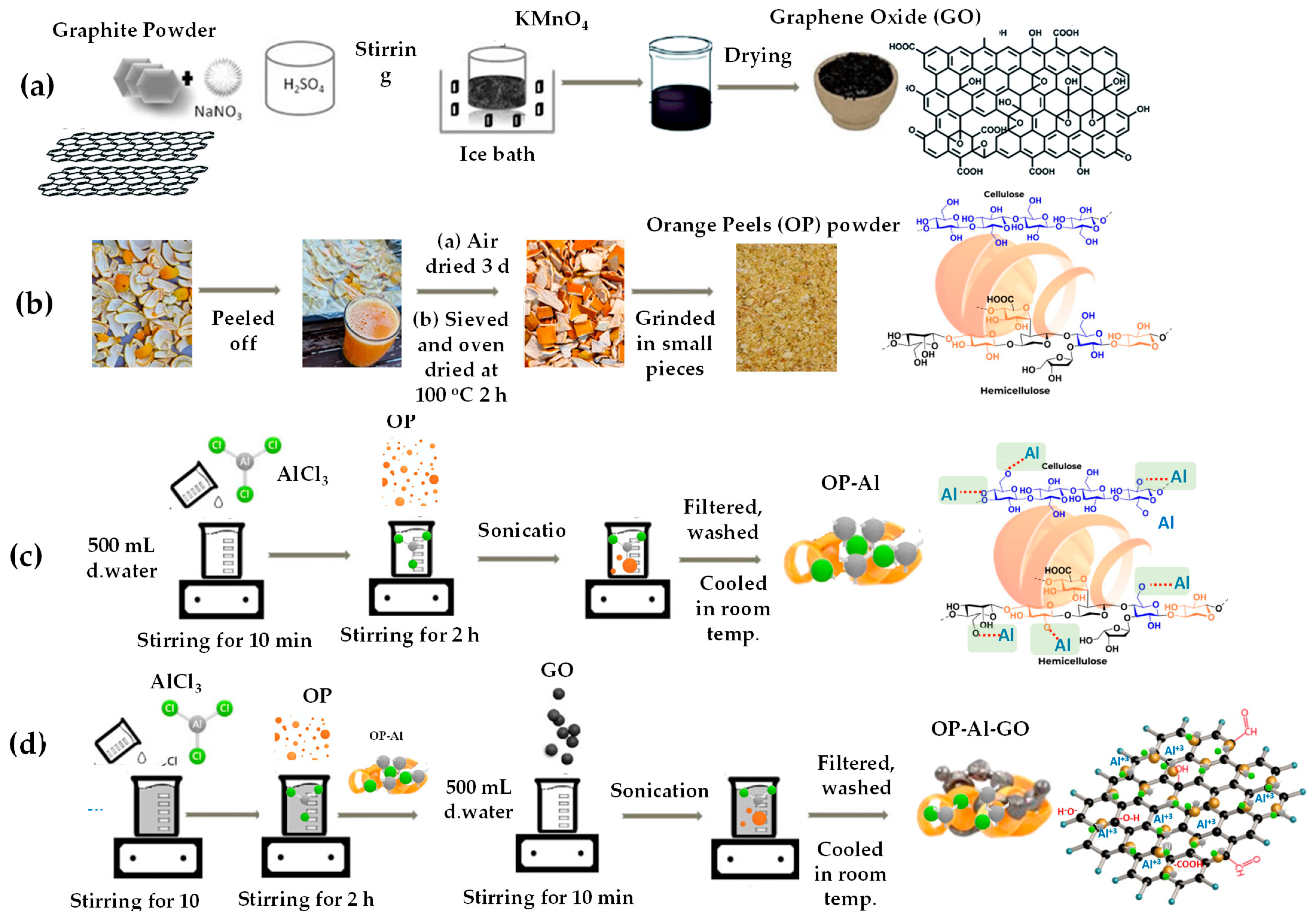
Graphene oxide (GO) was prepared via a modified Hummers’ method [22], where graphite powder was oxidized with concentrated H2SO4, KMnO4, and NaNO3 under controlled low-temperature conditions, following the improvements by Debnath et al. [23], after which the oxidized graphite was exfoliated through repeated washing and ultrasonication to obtain GO sheets (Figure 1a). In this way, graphite is oxidized to graphene oxide (GO), introducing oxygen-containing groups. Orange peels (OPs) were collected, washed, air-dried for three days, chopped, oven-dried at 100 °C for 2 h, and ground into a fine powder for adsorption experiments or composite synthesis (Figure 1b). By this procedure, cellulose, hemicellulose, and lignin functional groups (–OH, –COOH) are exposed. The OP-Al composite was prepared by mixing 1 g OP with 1 g AlCl3·6H2O in 500 mL water, stirring at 400 rpm for 2 h at 298 K, and subsequently sonicated (Figure 1c). Therefore, the coordination of Al3+ with OP functional groups forms OP-Al through Al–O bonds. In the case of the OP-Al-GO composite material, 1 g of GO was dispersed under stirring at 300 rpm in 500 mL of previously prepared OP-Al for 10 min. No transition-metal doping was applied to the carbon structure in this study. The OP-Al-GO composite was formed using Al3+ as a trivalent cation to coordinate functional groups on GO and orange peel, enhancing structural stability and adsorption efficiency. The final mixture was then subjected to ultrasound. The obtained composite was then filtered, washed with water, and allowed to cool to room temperature before being used as an adsorbent (Figure 1d). Bridges between OP-Al and GO sheets in the composite might be formed via electrostatic interactions, hydrogen bonding, and Al–O coordination [24].
Figure 1.
Synthesis procedure of: (a) graphene oxide (GO); (b) orange peels (OP); (c) OP-Al; (d) composite OP-Al-GO.
2.3. Adsorption Experiments
For the experiments, 20 mL of each dye solution at a fixed concentration was placed in 50 mL Falcon tubes, and a predetermined amount of adsorbent was added under controlled temperature conditions. The mixtures were agitated at 80 rpm using a Trayster overhead shaker and a Loopster rotator. The study investigated the effects of several parameters: solution pH (3.0, 7.0, and 9.0), initial dye concentration (10–150 mg/L), adsorbent dosage (0.3–1.0 g/L), and contact time, which varied from 5 to 300 min for kinetic studies and up to 24 h (1440 min) to reach equilibrium. After sampling, the solutions were filtered through a 0.45 µm nylon membrane, and the filtrates were analyzed. The dye removal efficiency (%R) was calculated using Equation (1):
where C0 represents the initial dye concentration, and Cf is the final (residual) concentration in mg/L, which can be determined at equilibrium (Cf = Ce) or at any given time (Cf = Ct), depending on the parameter examined.
Additionally, the adsorbent’s adsorption capacity (Qe) in mg/g was calculated using Equation (2):
where Ce is the dye concentration at equilibrium (mg/L), V is the solution volume (L), and m is the mass of the adsorbent (g).
2.3.1. Adsorption Isotherms
To interpret the adsorption isotherms, the experimental data were analyzed using the Langmuir and the Freundlich models, which are widely employed for describing adsorption behavior. The Langmuir isotherm, given by Equation (3) [25], relates the amount of adsorbate adsorbed at equilibrium (Qe) to its equilibrium concentration in the liquid phase, assuming monolayer coverage on a homogeneous surface. In contrast, the Freundlich model (Equation (4)) [26] accounts for adsorption on heterogeneous surfaces and describes the empirical relationship between Qe and the equilibrium concentration.
where Qm represents the maximum adsorption capacity (mg/g), and KL (L/mg) is the Langmuir constant related to the affinity (energy) of adsorption between the dye and the adsorbent. In the Freundlich model, KF is a constant indicative of the adsorption capacity, while 1/n reflects the adsorption intensity or surface heterogeneity (1/n = 0 indicates high heterogeneity; 1/n < 1 indicates favorable adsorption; and 1/n > 1 suggests cooperative adsorption)
2.3.2. Kinetics
Two kinetic models, the pseudo-first-order (PFO) and pseudo-second-order (PSO) models [27], and the intraparticle diffusion (IPD) [28], were employed to describe the kinetics of dye adsorption. These models are among the most widely applied in adsorption studies. The calculated kinetic parameters were subsequently analyzed to evaluate the adsorption rate and to gain insight into the possible adsorption mechanism. The PFO, PSO, and IPD models are expressed by Equations (5), (6), and (7), respectively.
where Qe denotes the amount of dye adsorbed at equilibrium (mg/g), Qt is the amount of dye adsorbed at time t (mg/g), is the rate constant of the pseudo-first-order (PFO) model (1/min), and t represents time (min). The parameter corresponds to the rate constant of the pseudo-second-order (PSO) model (g/(mg min). KIPD is the rate constant (mg/g min0.5), while the constant C (mg/g) reflects the thickness of the boundary layer.
2.4. Determination of Residual Dye Concentration
After adsorption, aliquots were collected from the supernatant (~5 cm below the surface) and filtered through a 0.45 μm nylon membrane. Dye concentrations were determined from absorbance measurements using a UV–Vis spectrophotometer (WTW Spectroflex 6100, Weilheim, Germany) and the calibration curve, at λmax of 515 nm for RR120 and 579 nm for MV [29].
2.5. Thermodynamics
Thermodynamic parameters, including the Gibbs free energy change (ΔG0, kJ/mol), enthalpy change (ΔH0, kJ/mol), and entropy change (ΔS0, kJ/mol·K), were calculated to evaluate the adsorption process and assess its potential spontaneity. Accordingly, experiments were conducted at several indicative temperatures (298, 308, 318, and 338 K), and the following equations (Equations (8)–(11)) were used to determine the thermodynamic parameters [30]. ΔG0 was calculated using Equation (9), while ΔH0 and ΔS0 were obtained from the slope and intercept of a ln(Kc) versus 1/T plot (Equation (11)).
2.6. Characterization Techniques
The surface of the adsorbent was characterized using commonly applied techniques. Samples were dried in an oven at 50–60 °C under atmospheric pressure for 3 h to ensure complete removal of water. Scanning electron microscopy (SEM)/Energy Dispersive Spectrometer (EDS) (Jeol JSM-6390 LV, Tokyo, Japan) operated at an accelerating voltage of 15 kV, was employed to examine the morphology, while Fourier-transform infrared spectroscopy (FTIR) (PerkinElmer, New York, NY, USA) was used to analyze the functional groups. Spectral data were acquired at 4 cm−1 resolution, with a scan rate of 20 scans min−1 over the range of 4000–400 cm−1. Pellets of KBr containing 1.0% of the sample were used for the analysis.
2.7. Regeneration
Over the past decades, the ability to reuse adsorbent materials has become increasingly important, offering both environmental and economic advantages [31]. To evaluate this aspect, the performance of the optimized OP-Al-GO adsorbent for dye removal was tested through batch experiments using a desorption process. Following established procedures, the spent adsorbent was treated with a 0.01 M NaOH solution (pH 12) and repeatedly rinsed until the wash water reached neutral pH [32]. This treatment effectively removed dye molecules trapped within the adsorbent’s pores, enabling the material to be regenerated and reused. In the present study, four consecutive adsorption–desorption cycles were carried out for the removal of RR120 and MV dyes.
2.8. Stubility Test
Adsorbent stability was assessed in double-distilled water at different pH values (3.0, 7.0, and 9.0), adjusted with HCl and NaOH, respectively. In each test, 0.05 g (W1) of the adsorbent was immersed in 50 mL of the corresponding solution and left for 24 h. The samples were then removed, oven-dried at 60 °C to constant weight (W2), and reweighed. Mass loss was subsequently determined using Equation (12) [33]:
3. Results and Discussion
3.1. Effect of Initial pH on the Adsorption of RR120 and MV
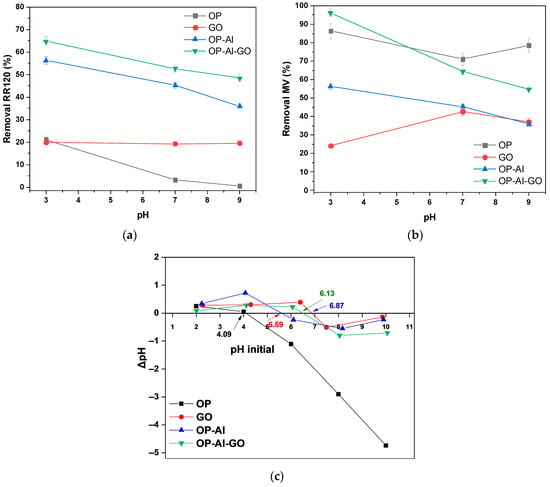
The influence of solution pH on the adsorption of Reactive Red 120 (RR120) and Methylene Violet (MV) onto OP, OP-Al, GO, and OP-Al-GO adsorbents is presented in Figure 2a and Figure 2b, respectively. The pH-dependent adsorption behavior reflects the combined effects of dye speciation and surface charge properties of the adsorbents.
Figure 2.
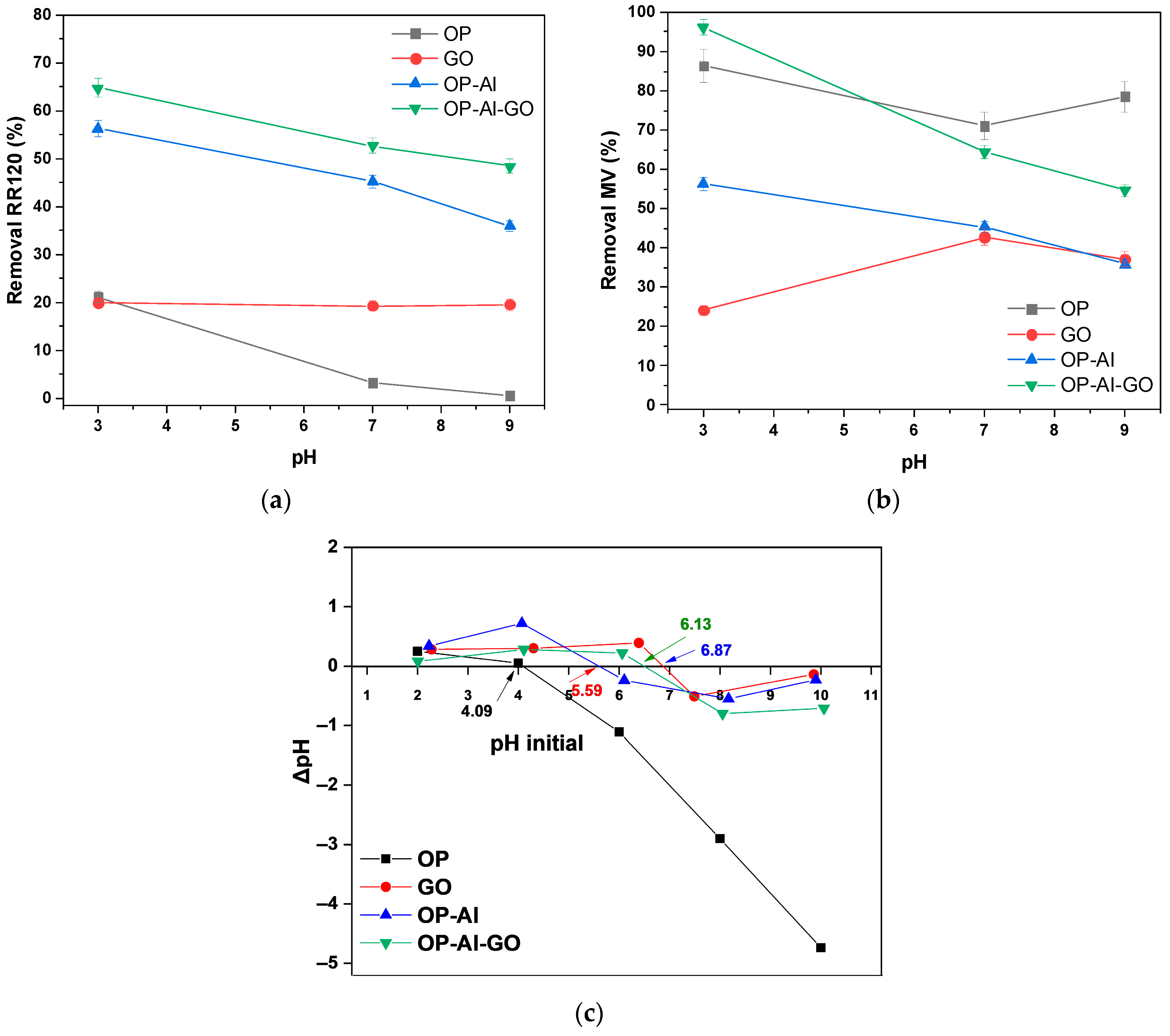
pH-dependent adsorption of (a) RR120 and (b) MV on OP, GO, OP-Al, and OP-Al-GO; C0 = 20 mg/L of each dye, dose 0.5 g/L OP-Al-GO, 24 h, at 298 K. (c) pHpzc of adsorbent materials.
Moreover, the point of zero charge (pHpzc) of the adsorbents is shown in Figure 2c. The pHpzc values provide useful insight into the surface charge behavior of the adsorbents [34]. In this study, the pHpzc was measured using the pH drift method [35], with initial solution pH adjusted between 2 and 10 ± 0.1. pHpzc corresponds to the pH at which the adsorbent surface has no net charge. At pH values below this point, the surface is predominantly positively charged and favors the uptake of anionic species, whereas above it, the surface becomes negatively charged and more favorable for cation adsorption. Raw orange peels showed a relatively low pHpzc, which can be attributed to the abundance of acidic functional groups such as carboxyl and hydroxyl groups on their surface [36]. Adding aluminum, the pHpzc shifted to higher values, indicating the introduction of additional positively charged sites associated with Al–OH groups. Graphene oxide exhibited acidic surface behavior, consistent with its high content of oxygen-containing functional groups [37]. Notably, OP-Al-GO and OP-Al displayed intermediate pHpzc values of 6.13 and 6.87, respectively, suggesting a balanced distribution of positive and negative surface charges. This balanced surface chemistry is advantageous for the adsorption of both anionic and cationic dyes and helps explain the superior performance of OP-Al-GO in removing RR120 and MV (Figure 2a,b).
Particularly, as shown in Figure 2a, the adsorption efficiency of RR120 decreases with increasing pH for all investigated materials. This behavior is characteristic of anionic dyes containing sulfonate groups (–SO3−), whose adsorption is favored under acidic conditions due to electrostatic attraction [38]. At low pH, the adsorbent surfaces are positively charged, promoting strong attraction toward negatively charged RR120 molecules. As the pH increases, deprotonation of surface functional groups results in a progressively negative surface charge, leading to electrostatic repulsion and reduced adsorption [39].
Among all the materials tested, OP-Al-GO consistently achieved the highest RR120 removal across the pH range studied (64.8%), followed by OP-Al (56.3%), raw OP (21.1%), and GO (19.9%) at pH 3.0. The superior performance of OP-Al-GO is linked to the presence of Al3+ species, which provide positively charged adsorption sites and enhance electrostatic interactions with RR120 [40]. Incorporating graphene oxide further increases the number of available adsorption sites and promotes non-electrostatic interactions, such as π–π stacking [41]. In contrast, the relatively low removal by raw OP highlights the limitations of unmodified biomass, while aluminum modification clearly improves RR120 uptake, confirming its key role in boosting anionic dye adsorption.
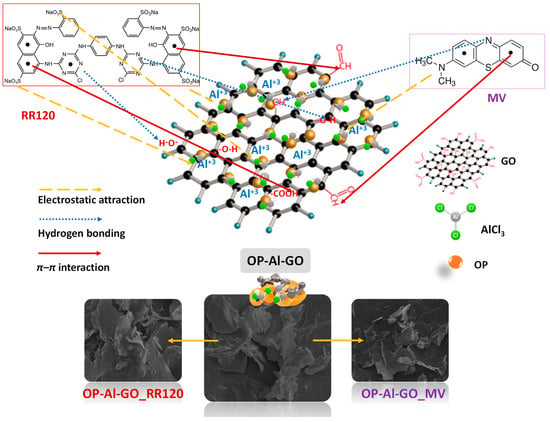
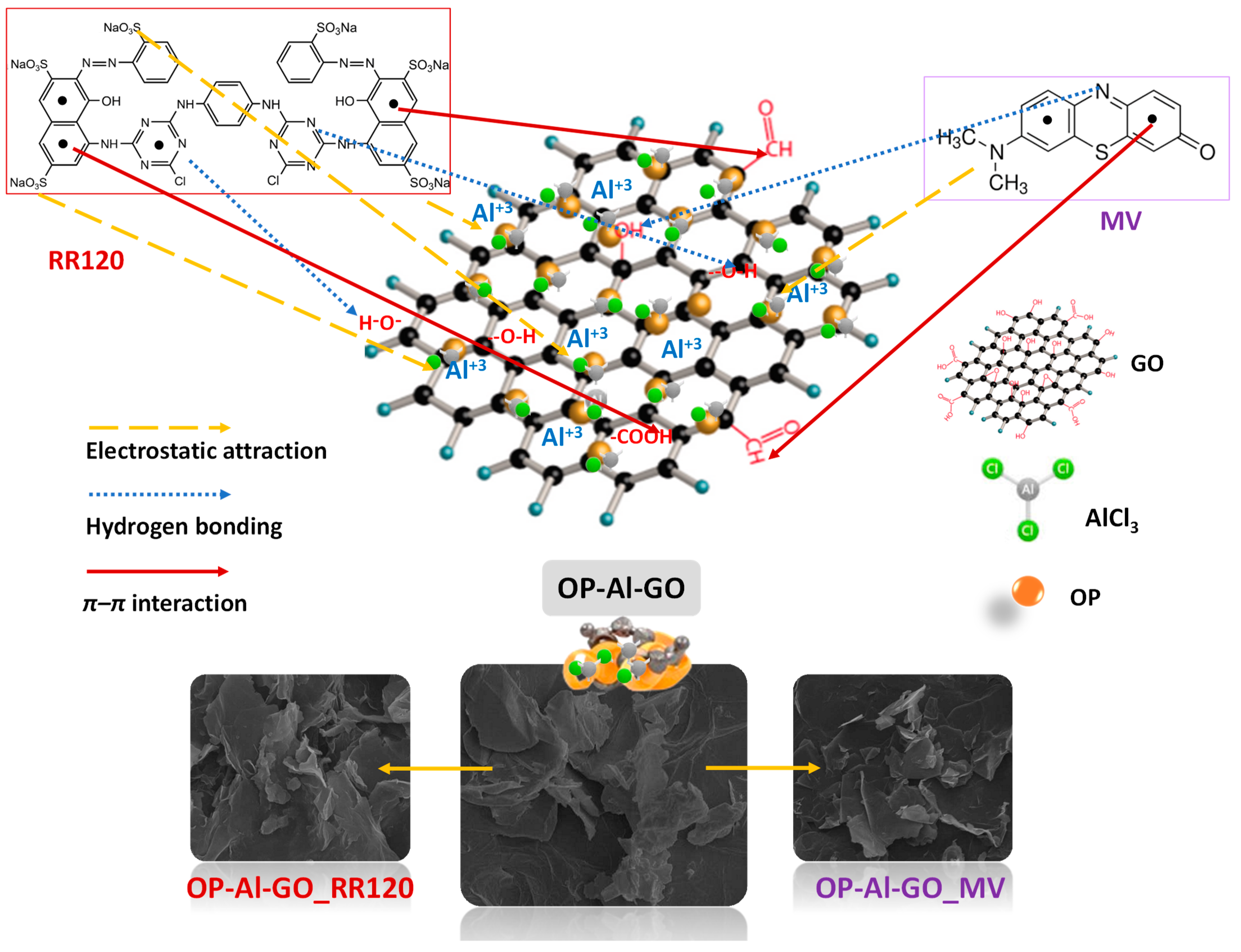
Furthermore, Figure 1b shows how solution pH affects MV adsorption on the different materials. Overall, MV is removed more efficiently than RR120 at all pH values, indicating a stronger affinity between MV and the adsorbent surfaces. At acidic conditions (pH 3.0), MV adsorption is maximized, with OP-Al-GO achieving the highest removal efficiency (96.2%), followed by OP (86.3%), OP-Al (56.3%), and GO (24.1%). This strong performance at low pH is due to electrostatic interactions. Under acidic conditions, surface groups like –OH and –COOH are protonated, giving the adsorbent a positive or less negative charge, while π–π interaction, hydrogen bonding, and possible complexation further enhance MV adsorption. The presence of Al species [40] and graphene oxide [42] in OP-Al-GO further enhances adsorption by providing additional active sites and a higher surface area. As the pH increases from acidic to neutral and alkaline conditions, a gradual decline in MV removal efficiency is observed for all adsorbents. This decrease is mainly due to changes in surface charge and competition with hydroxyl ions (OH−) at higher pH, which can weaken the electrostatic attraction and block active adsorption sites [43]. A tentative mechanism is illustrated in Figure 3. Despite this decline, OP-Al-GO consistently maintains superior adsorption performance compared to the other materials, indicating its structural and chemical advantages.
Figure 3.
Schematic diagram of tentative adsorption mechanism of RR120 and MV onto optimum OP-Al-GO adsorbent.
To quantitatively assess the synergistic behavior of OP-Al–GO, a Synergy Factor (SF) was introduced [44]. Therefore, the SF was calculated using the adsorption capacities of the individual components at pH 3.0 using a dosage of 0.5 g/L in 20 mg/L dye solutions for 24 h. The expected adsorption capacity was computed as the sum of individual Qe values, according to Equation (13), and the observed Qe for the composite was then divided by this value, according to Equation (14) [45]:
where are the adsorption capacities of the individual components. Qcomposite is the observed Qe for the composite, and Qexpected is the sum of individual Qe values.
SF > 1 → synergy; SF = 1 → additive; SF < 1 → antagonistic [46].
The relative results are presented in Table 1, where the synergistic effect of Al in the composite is investigated; thus, Q1 is for OP and Q2 is for GO adsorption capacities. According to the calculated SF values (Table 1), the incorporation of Al3+ into the composite exhibits a clear synergistic effect for RR120 adsorption (SF = 1.58), indicating that the OP-Al-GO composite performs significantly better than the sum of OP and GO alone.
Table 1.
Adsorption capacities and synergy factor (SF) of OP, OP-Al, GO, and OP-Al–GO.
In contrast, for MV, the SF value (0.87) is <1, suggesting that the presence of Al3+ does not produce a synergistic enhancement and may partially compete with cationic dye adsorption due to charge repulsion effects. Although the SF value for MV indicates the absence of a synergistic effect from Al3+ incorporation, the removal efficiency of MV remained very high (~96%). This may be due to the fact that the removal percentage reflects the overall availability of adsorption sites in the composite rather than the interaction synergy among individual components. In the case of MV, adsorption is primarily governed by strong electrostatic attraction between the cationic dye molecules and the negatively charged oxygen-containing functional groups of GO and OP, which dominate the adsorption [47,48]. Therefore, the high removal efficiency of MV is mainly attributed to the abundant surface functional groups of OP-Al-GO composite, even though the contribution of Al3+ does not provide additional synergistic enhancement.
3.2. Effect of Contact Time/Kinetic Models
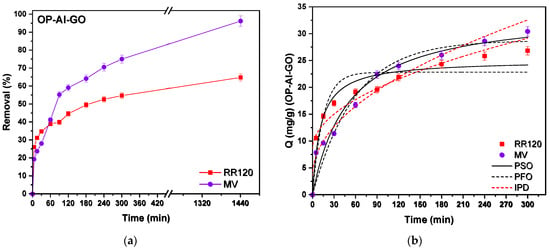
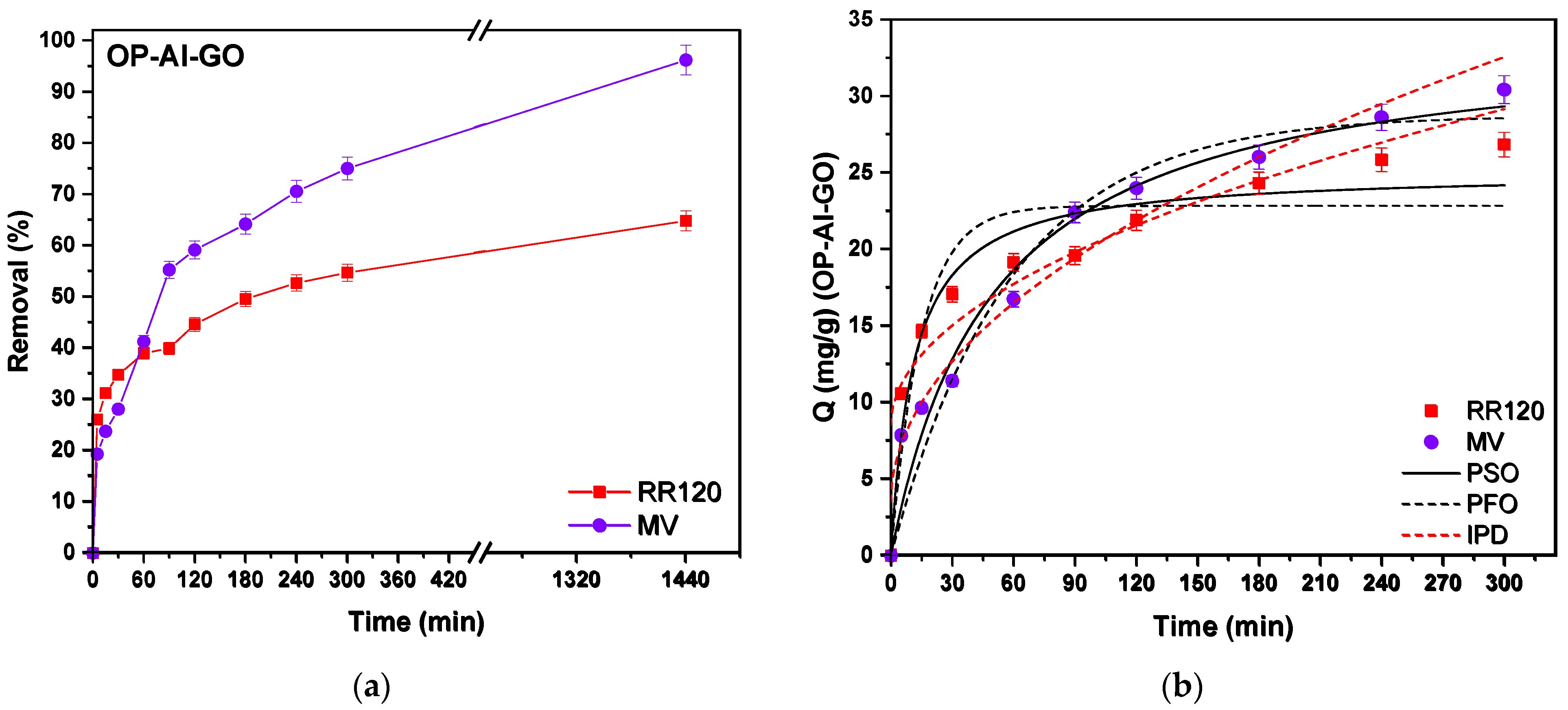
The effect of contact time on RR120 and Methylene Violet (MV) removal by the optimum OP-Al-GO adsorbent is shown in Figure 4a. For both dyes, adsorption was rapid during the first 5 min due to the availability of abundant active sites, reaching about 26% for RR120 and 19% for MV. Between 15 and 30 min, removal increased gradually, reflecting continued interaction between dye molecules and the adsorbent surface. From 60 to 120 min, the increase became slower but steady, indicating progressive occupation of adsorption sites. Beyond 180 min, removal approached a plateau, with 54.8% and 75% achieved at 300 min for RR120 and MV, respectively, while maximum removal was reached at 1440 min (64.8% for RR120 and 96.2% for MV). A contact time of 120 min (2 h)–300 (5 h) provides an effective balance between high removal efficiency and practical processing time.
Figure 4.
(a) Effect of contact time on RR120 and MV dye removal by optimum OP-Al-GO adsorbent; (b) non-linear kinetic models PFO, PSO, and IPD. C0 = 20 mg/L of each dye, dose 0.5 g/L OP-Al-GO, pH 3.0, at 298 K.
Moreover, the adsorption kinetics of Reactive Red 120 (RR120) and Methyl Violet (MV) onto the OP-Al-GO adsorbent were evaluated using the pseudo-first-order (PFO), pseudo-second-order (PSO), and intraparticle-diffusion model (IPD) kinetic models in order to elucidate the adsorption mechanism and rate-controlling steps Figure 4b. The kinetic parameters listed in Table 2 for the adsorption of RR120 and MV on OP-Al-GO (0.5 g/L, pH 3.0, 298 K) were obtained by fitting the experimental adsorption data to the non-linear PFO, PSO, and IPD kinetic models using OriginPro 9 software. According to the results, for RR120, the PSO model provides a better fit, i.e., higher correlation coefficients (R2) (R2 = 0.937) than the IPD model (R2 = 0.886) and PFO (R2 = 0.861), suggesting that surface interactions play a dominant role in the adsorption rate [49]. In contrast, for MV, the IPD model eventually exhibits a slightly higher correlation coefficient (R2 = 0.965) compared to PSO (R2 = 0.960), indicating a significant contribution of intraparticle diffusion. This behavior can be attributed to the smaller molecular size of MV, which facilitates its diffusion into the internal pores of the OP-Al-GO composite [50].
Table 2.
PFO, PSO, and IPD kinetic parameters model for the adsorption of RR120 and MV onto optimum OP-Al-GO (0.5 g/L), pH 3.0, T = 298 K.
Therefore, these findings demonstrate that the adsorption process is governed by multiple steps, including external surface adsorption and intraparticle diffusion, rather than being controlled solely by chemisorption. While the PSO model describes the overall kinetics well, it should not be interpreted as exclusive evidence of chemisorption but rather as indicative of adsorption involving both surface interactions and diffusion processes rather than pure chemisorption [51].
The better fit of the PSO model suggests that adsorption is strongly influenced by interactions between dye molecules and active sites on the OP-Al-GO surface [27]. However, the intraparticle diffusion analysis indicates that diffusion within the pores also contributes to the overall rate, particularly for the smaller MV molecules.
3.3. Isotherm Study
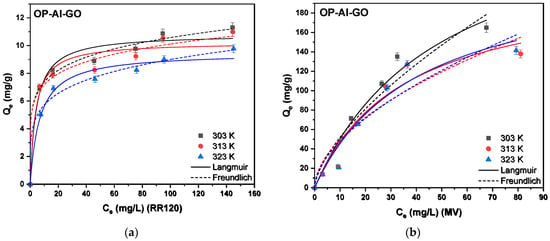
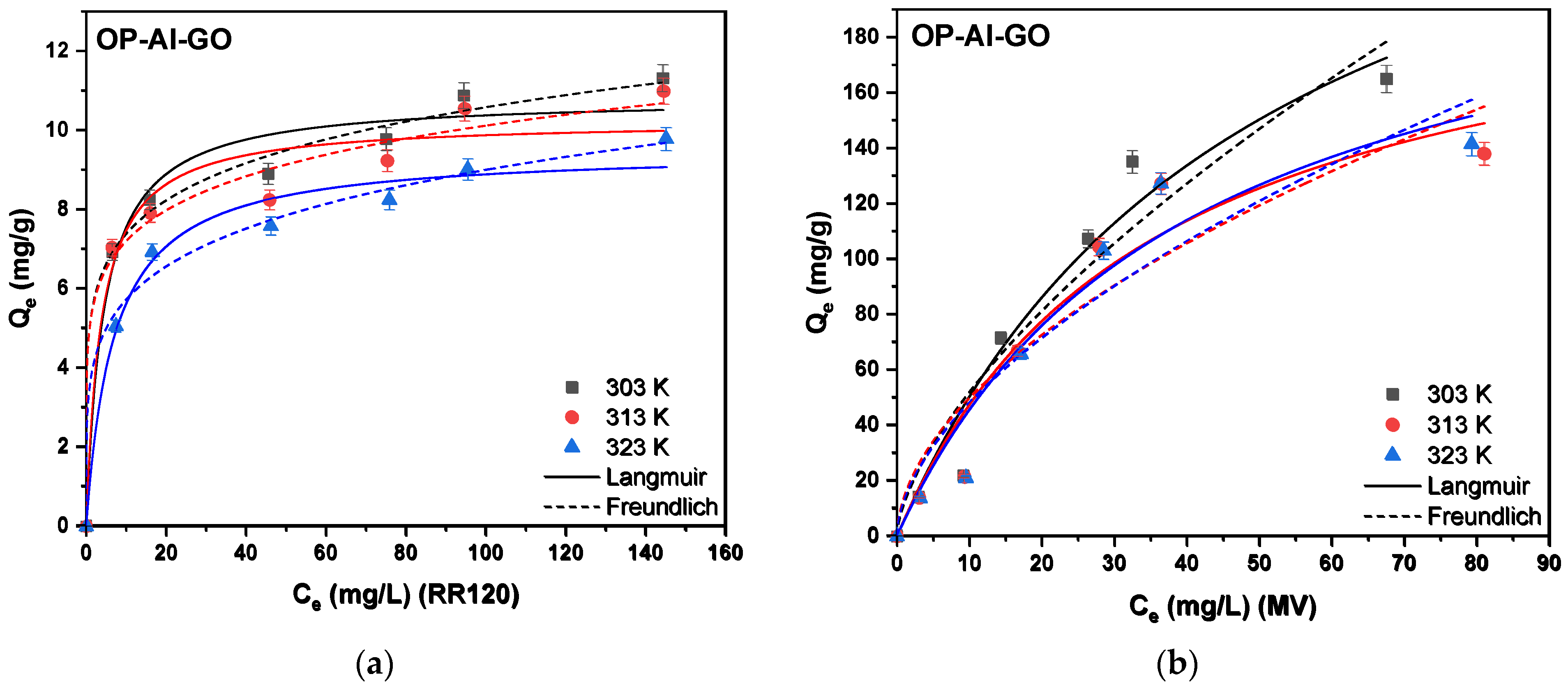
Adsorption isotherms describe the equilibrium distribution of adsorbate molecules between the liquid and solid phases and are used to identify appropriate models for adsorption system design. The equilibrium adsorption behavior of RR120 and MV dyes onto OP-Al-GO was evaluated using the Freundlich and Langmuir isotherm models at different temperatures (303–323 K), as illustrated in Figure 5. As observed, the adsorption capacity of both dyes increased with increasing equilibrium concentration and gradually approached saturation, indicating progressive occupation of available adsorption sites on the OP-Al-GO surface.
Figure 5.
Langmuir and Freundlich isotherm models for (a) RR120 and (b) MV removal: dose 0.5 g/L OP-Al-GO, pH 3.0, 90 min, at different temperatures (303–323 K).
As can be seen, for RR120, the Freundlich model showed an excellent fit to the experimental data across all temperatures (Table 3), as reflected by high correlation coefficients (R2 = 0.981–0.992), which are visibly compatible with the smooth curvature of the Freundlich fit lines in Figure 5a. The 1/n values (0.1477–0.1966) were all less than unity, indicating favorable adsorption and surface heterogeneity [52]. This suggests that RR120 adsorption occurs on a non-uniform surface with sites of varying energies, which agrees well with the heterogeneous nature of OP-Al-GO arising from the combined presence of orange peel functional groups, graphene oxide sheets, and aluminum species. Although the Langmuir model also showed reasonable agreement for RR120, its lower R2 values (0.945–0.977) indicate that monolayer adsorption on a homogeneous surface is less representative of the system. The gradual decrease in Langmuir maximum adsorption capacity (Qmax) with increasing temperature (from 10.83 to 9.50 mg/g) suggests that RR120 adsorption is mildly exothermic, which is consistent with weaker interactions such as electrostatic attraction and hydrogen bonding dominating the process [53].
Table 3.
Constants of Langmuir and Freundlich isotherm models for the adsorption of RR120 and (b) MV onto OP-Al-GO, at different temperatures (303–323 K).
In contrast, MV exhibited a markedly different adsorption behavior. As clearly shown in Figure 5b, the adsorption capacity of MV increased sharply with concentration and reached significantly higher equilibrium values than RR120. The Langmuir model provided a better fit for MV adsorption at all temperatures, with higher R2 values (0.931–0.952) compared to the Freundlich model (0.866–0.916). The close overlap between experimental data points and Langmuir fitting curves confirms that MV adsorption predominantly follows monolayer coverage on relatively uniform active sites [25]. The extremely high Langmuir maximum adsorption capacities for MV (Qmax = 213.30–298.68 mg/g) highlight the strong affinity of OP-Al-GO toward MV molecules. This behavior can be attributed to strong electrostatic attraction between the cationic MV dye and negatively charged functional groups on OP-Al-GO, as well as π–π stacking interactions between MV aromatic rings and graphene oxide layers [53]. The slight decrease in Qmax with increasing temperature suggests partial destabilization of adsorbed MV molecules at elevated temperatures, indicating that the adsorption process is predominantly exothermic.
The Freundlich 1/n values for MV (0.5423–0.6463) fall within the favorable adsorption range (0 < 1/n < 1), but their comparatively higher values indicate weaker surface heterogeneity effects [26] than observed for RR120.
Overall, the isotherm trends observed in Figure 5 and supported by the isotherm parameters in Table 2, indicate that RR120 adsorption on OP-Al-GO is better described by the Freundlich model, reflecting heterogeneous multilayer adsorption, whereas MV adsorption follows the Langmuir model, indicating monolayer adsorption with strong dye–adsorbent interactions. The OP-Al-GO composite exhibits much higher adsorption capacity for MV (298.68 mg/g) than for RR120 (10.83 mg/g), consistent with observed removal efficiencies of 96.2% and 64.8%, respectively. That can be attributed to their distinct molecular structures and interactions with the composite [54]. These findings further confirm the multifunctional nature of OP-Al-GO and its high effectiveness toward both anionic and cationic dyes, with particularly strong affinity for MV.
3.4. Thermodynamics
The thermodynamic parameters (Table 4) provide insight into the nature and spontaneity of RR120 and MV adsorption onto OP-Al–GO. For RR120, ΔG0 was positive, increasing from 3.352 kJ/mol at 303 K to 4.148 kJ/mol at 323 K, indicating non-spontaneous adsorption under standard conditions [55]. The process was exothermic (ΔH0 = −8.023 kJ/mol), and a positive ΔS0 (0.040 kJ/mol·K) suggests increased disorder at the interface, likely from water release during dye adsorption [49]. The combination of negative ΔH0 and positive ΔS0 shows that RR120 adsorption is enthalpy-driven but slightly hindered by temperature, consistent with the rise in ΔG0 at higher temperatures [56]. In contrast, MV adsorption was spontaneous (ΔG0 = −0.416 to −0.256 kJ/mol) and exothermic (ΔH0 = −2.837 kJ/mol), with a small positive ΔS0 (0.008 kJ/mol·K), indicating a slight increase in disorder [57,58]. The decrease in adsorption efficiency at higher temperatures aligns with its exothermic nature.
Table 4.
Thermodynamic parameters for RR120 and MV adsorption on optimum OP-Al-GO.
Overall, RR120 adsorption is non-spontaneous and mainly enthalpy-driven, whereas MV adsorption is weakly spontaneous, exothermic, and slightly entropy-favored. These differences likely reflect variations in molecular structure and interactions with OP-Al-GO functional groups. The thermodynamic model was derived from experimental adsorption data, with ΔG0, ΔH0, and ΔS0 calculated using the van’t Hoff equations (Equations (8)–(11)). The model fits the experimental data well (R2 = 0.906 for RR120 and 0.977 for MV), confirming the reliability of the results. This analysis highlights the strong influence of temperature on adsorption, which is critical for optimizing dye removal in wastewater treatment. Although RR120 adsorption shows positive ΔG0 values, indicating non-spontaneous operation under typical conditions, the thermodynamic model can show a reasonable correlation coefficient (R2 = 0.906) because R2 reflects the good fit of the van’t Hoff diagram to the experimental equilibrium data, not the spontaneous operation of the process [59]. In addition, the observed almost 70% removal confirms that adsorption occurs, and using a proper dimensionless K would yield negative ΔG0 values consistent with spontaneous uptake.
3.5. Effect of Adsorbent’s Mass
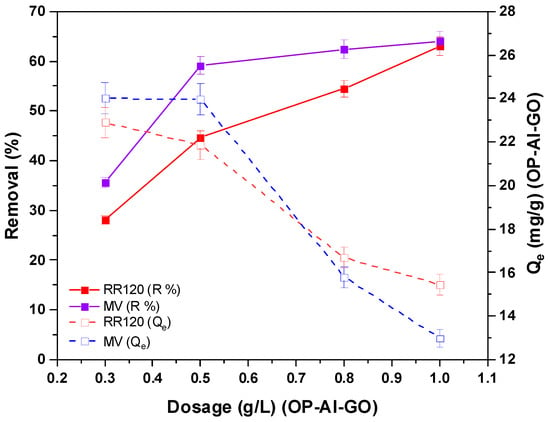
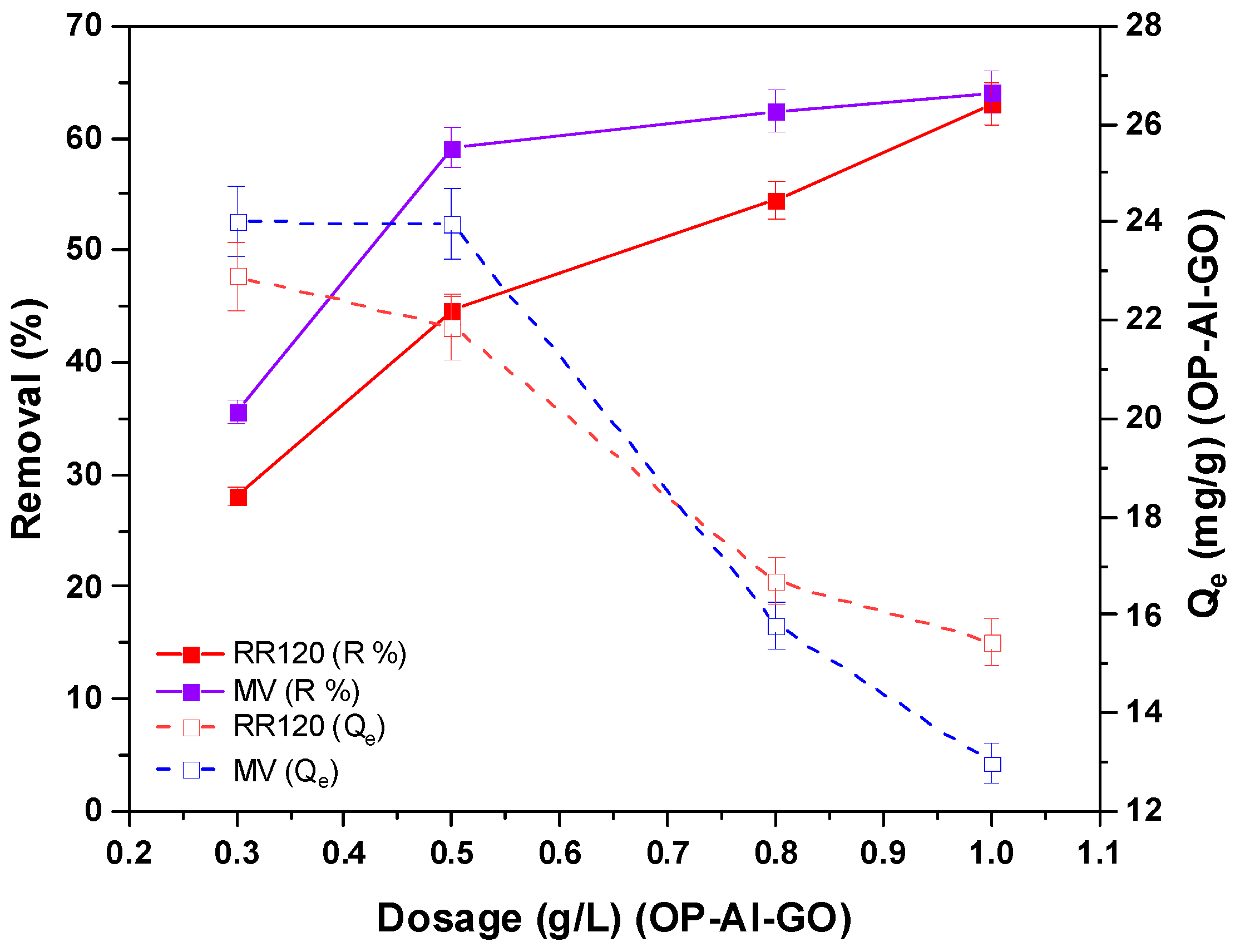
The effect of OP-Al-GO dosage on the removal efficiency and adsorption capacity of RR120 and MV was examined. As shown in Figure 6, increasing the adsorbent dose from 0.3 to 1.0 g/L led to a marked improvement in dye removal, with RR120 increasing from 28.02% to 63% and MV from 35.53% to 64.04% after 90 min. This trend reflects the greater number of available adsorption sites at higher dosages, which enables more dye molecules to be taken up from the solution [49,58]. MV consistently showed higher removal than RR120 at all dosages, indicating a stronger affinity for the OP-Al-GO surface, likely due to differences in functional groups that favor adsorption.
Figure 6.
Effect of dosage for optimum OP-Al-GO on the removal of RR120 and MV. C0 = 20 mg/L of each dye, pH 3.0, 90 min, at 298 K.
In contrast, the adsorption capacity (Qe, mg/g) decreased with increasing dosage. For RR120, Qe declined from 22.89 to 15.44 mg/g, while for MV, it decreased more sharply from 24 to 12.98 mg/g. This occurs because the same amount of dye is spread over more adsorbent, leaving many sites underutilized. Higher dosages can also cause particle aggregation, reducing the effective surface area [60]. The sharper decline of Qe for MV indicates that while it binds strongly to OP-Al-GO, saturation is reached at lower doses. From a practical standpoint, higher dosages maximize dye removal, while lower dosages are more cost-effective per gram of adsorbent.
Notably, the removal (%) and adsorption capacity (Qe) curves intersect at specific dosages. For RR120, the intersection occurs at 0.5 g/L (44% removal, 21.5 mg/g), while for MV, it occurs at 0.45 g/L (53% removal, 24 mg/g), highlighting dosages where both dyes achieve a balance between removal efficiency and adsorbent utilization. These intersection points can help identify the optimal dosage for simultaneous or efficient dye adsorption [61,62]. Since the curves intersect near 0.5 g/L, the initially selected dosage of 0.5 g/L for the experiments is confirmed as optimal.
Overall, these results confirm that OP-Al-GO is an efficient adsorbent for both RR120 and MV, with careful dosage selection being key to balancing total removal and adsorption efficiency.
3.6. Regeneration Study
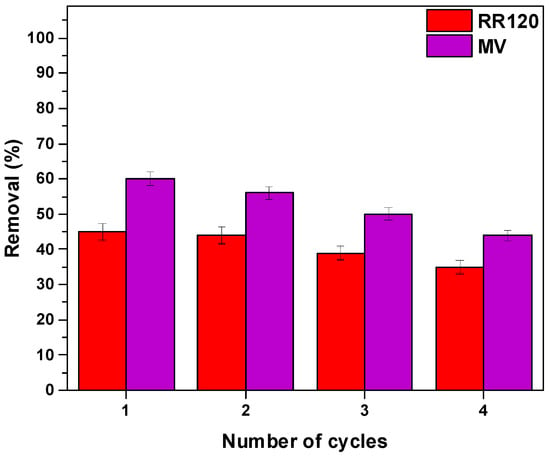
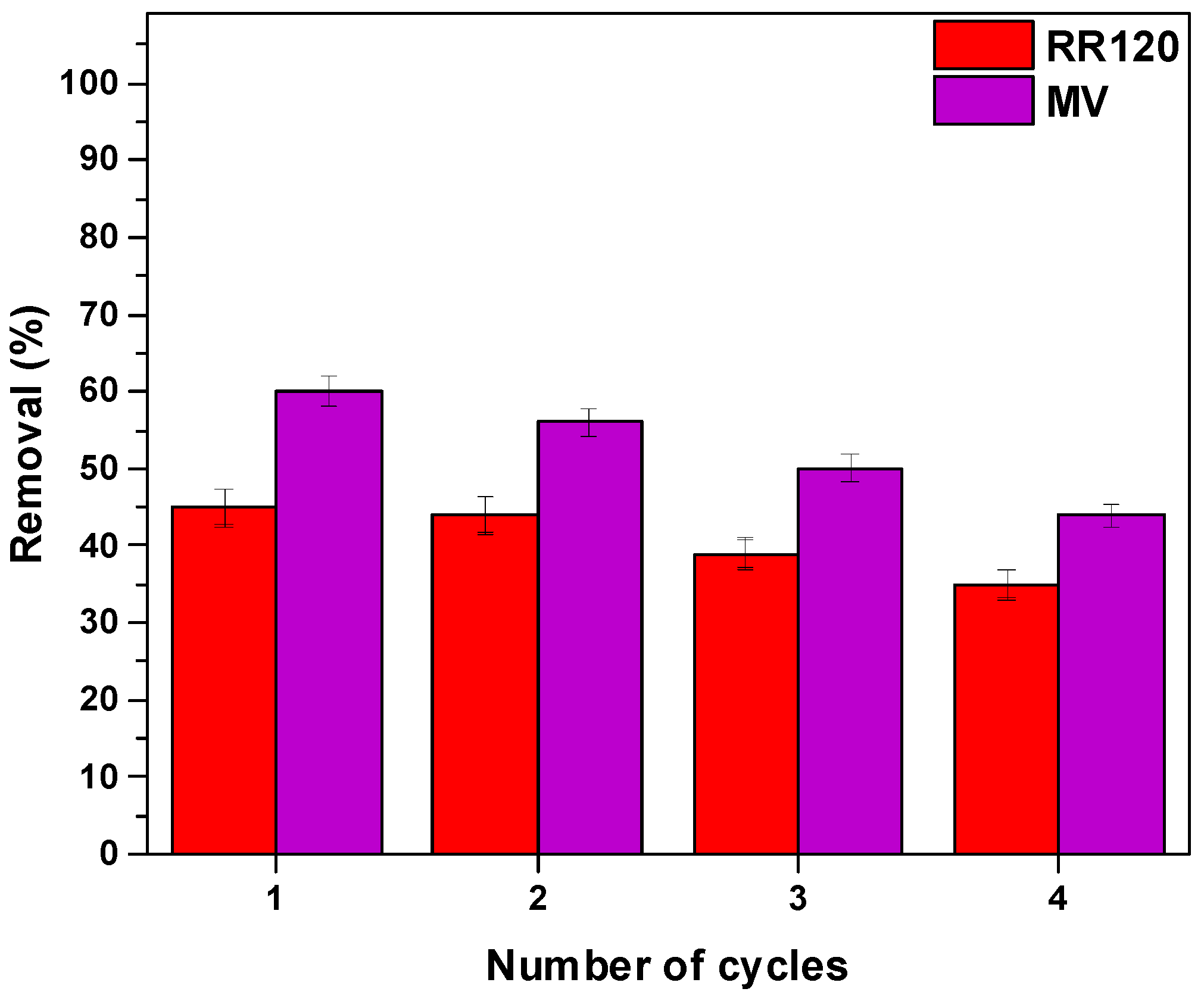
In Figure 7 are presented the regeneration–reuse results of optimum OP-Al-GO adsorbent materials for RR120 and MV removal, after four (4) adsorption–desorption cycles. In the 1st cycle, OP-Al-GO removed 45% of RR120 and 60% of MV after 2 h. However, after four regeneration cycles, the removal percentage for the material decreased to 35% and 44% for RR120 and MV, respectively. This decrement can be attributed to partial loss of active sites and pore blockage. Retention of high efficiency after four cycles, especially for MV, suggests satisfactory stability and reusability [63,64]. Overall, the results confirm the sufficient regeneration performance of OP-Al-GO and its potential exploitation for industrial wastewater treatment applications.
Figure 7.
Reusability of OP-Al-GO for RR120 and MV (C0 = 20 mg/L, dose = 0.5 g/L, pH = 3.0 ± 0.1, contact time = 2 h) over four adsorption–desorption cycles, with regeneration using 0.01 M NaOH.
3.7. Stability Tests
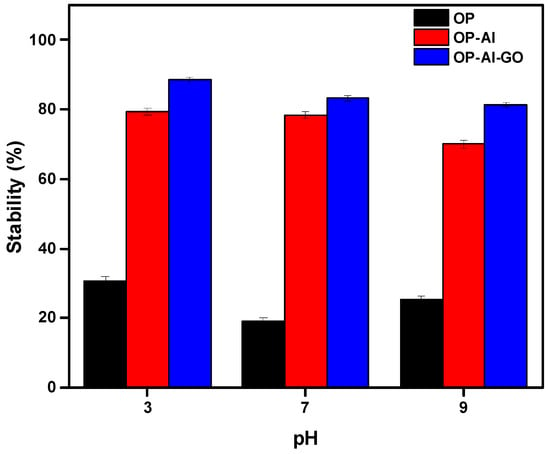
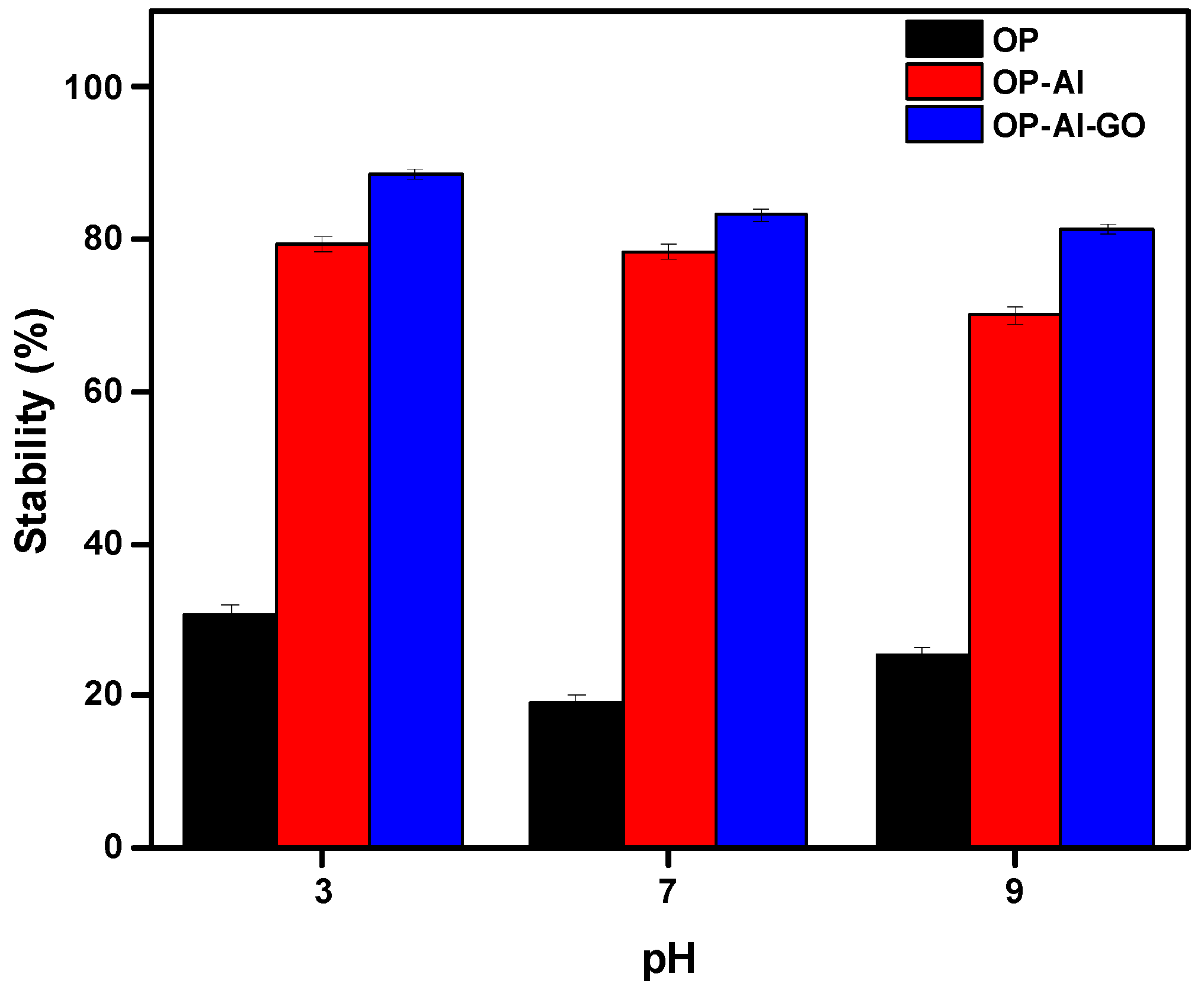
Figure 8 presents the stability test results for OP, OP-Al, and OP-Al-GO materials across different pH values. The data clearly show that OP-Al-GO exhibited the highest stability, followed by OP-Al and then OP. The improved stability of OP-Al compared to pure OP indicates that the incorporation of Al contributes to structural reinforcement, probably by forming strong coordination bonds with functional groups in OP, which reduces material degradation. The further enhancement observed in OP-Al-GO can be attributed to the addition of GO, which contains multiple oxygen-containing functional groups capable of forming hydrogen bonds and π–π interactions with OP-Al that prevent decomposition under varying pH conditions [65]. Overall, these results suggest that incorporating Al and GO not only improves the adsorption performance in dye removal but also enhances the composite’s potential for practical wastewater treatment applications.
Figure 8.
Stability study of OP, OP-Al, and OP-Al-GO aquatic solutions, pH 3.0–7.0, 9.0 for 24 h, T = 298 K).
3.8. Adsorption Behavior in Binary Dye Systems
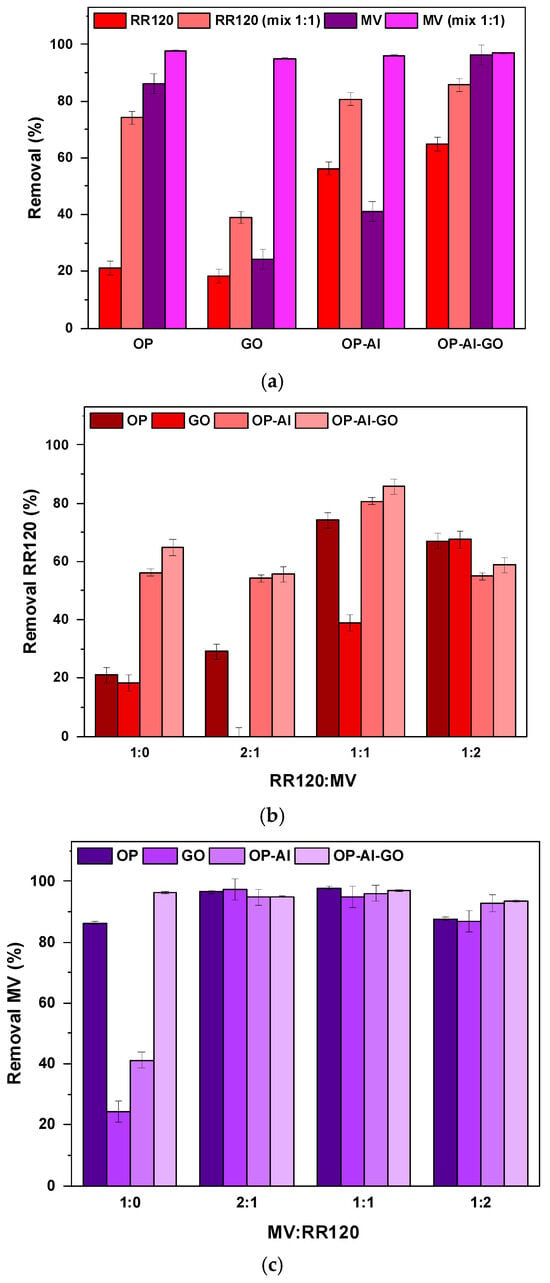
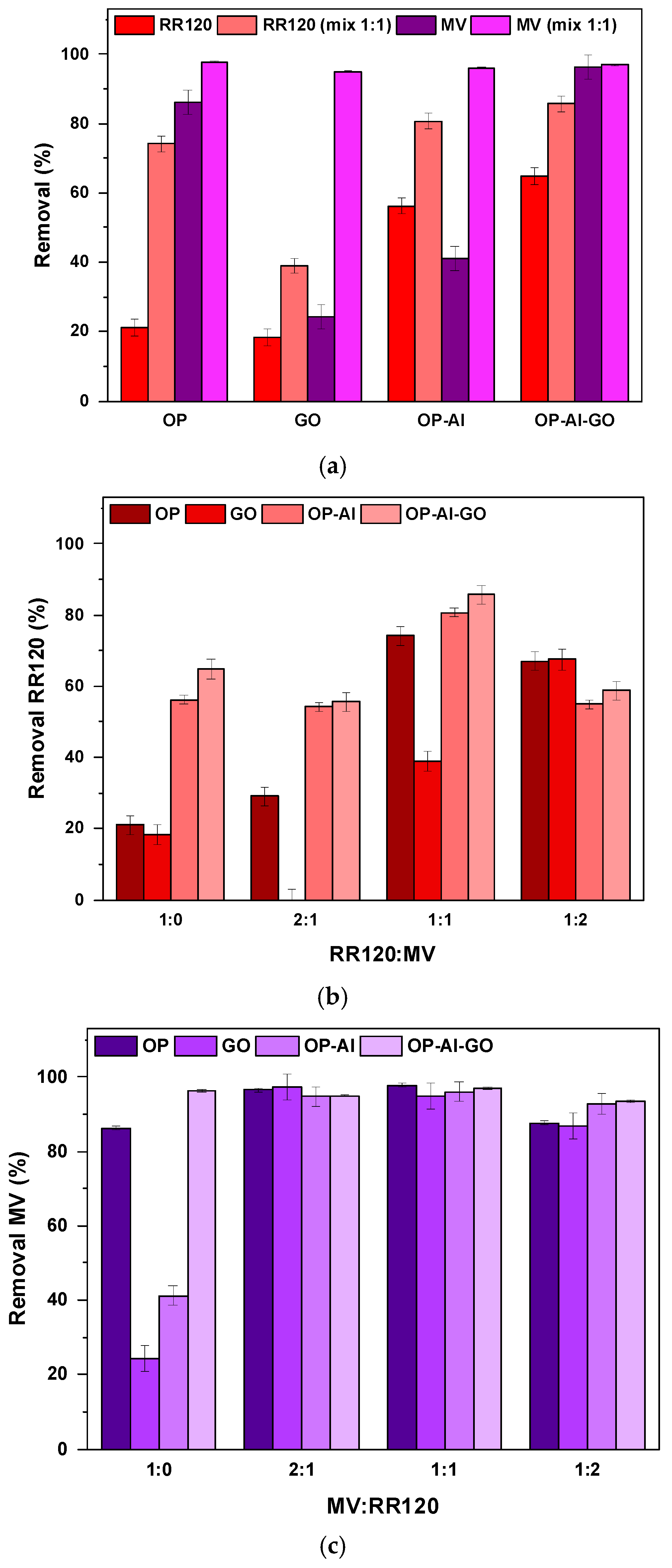
The removal efficiencies of RR120 and MV were strongly affected by both the dye ratio and the adsorbent type, in mixed systems, as shown in Figure 9a. For RR120, the removal of single dye was highest with OP-Al-GO (64.79%), followed by OP-Al (56.27%), while OP and GO were much lower (21.08% and 18.4%). In binary mixtures, the removal of RR120 generally increased (Figure 9b), reaching a maximum at the 1:1 molar ratio, with OP-Al-GO achieving 85.68%, highlighting the synergistic effects of the presence of MV on RR120 adsorption. OP and GO also showed improved RR120 removal in mixtures containing more MV, indicating cooperative adsorption mechanisms, such as multilayer formation or favorable surface interactions. Table 5 describes different molar ratios of dyes used in these experiments. Furthermore, MV adsorption was consistently high across all ratios and adsorbents. In single-dye systems, OP-Al-GO exhibited the highest removal (96.21%), followed by OP (86.3%), while GO and OP-Al were lower. In binary mixtures, MV removal remained robust (Figure 9c), with efficiencies exceeding 87% even in RR120-rich systems, demonstrating the strong affinity of MV for all adsorbents, especially the multi-component OP-Al-GO composite. Overall, the OP-Al-GO composite consistently exhibited the highest removal for both dyes at all ratios due to its synergistic structure, abundant active sites, and multiple adsorption mechanisms, making it the most effective adsorbent for the simultaneous removal of RR120 and MV from aqueous solutions. Similar findings for the synergistic interaction of anionic and cationic dyes have been reported in the literature [66].
Figure 9.
(a) Comparison of OP, GO, OP-Al, and OP-Al-GO adsorbents on the adsorption of RR120 and MV in single and binary dye systems, (b) RR120 removal in binary mixtures at different RR120:MV molar ratios, and (c) MV removal in binary mixtures at different MV:RR120 molar ratios. Sose 0.5/L, pH 3.0, 24 h, at 298 K.
Table 5.
Initial concentrations of RR120 and MV in binary dye systems at different molar ratios.
3.9. Real Textile Wastewater Samples
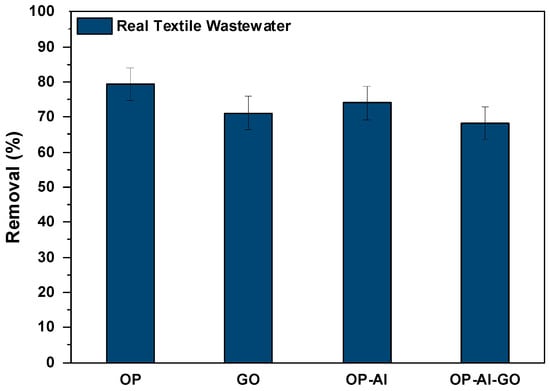
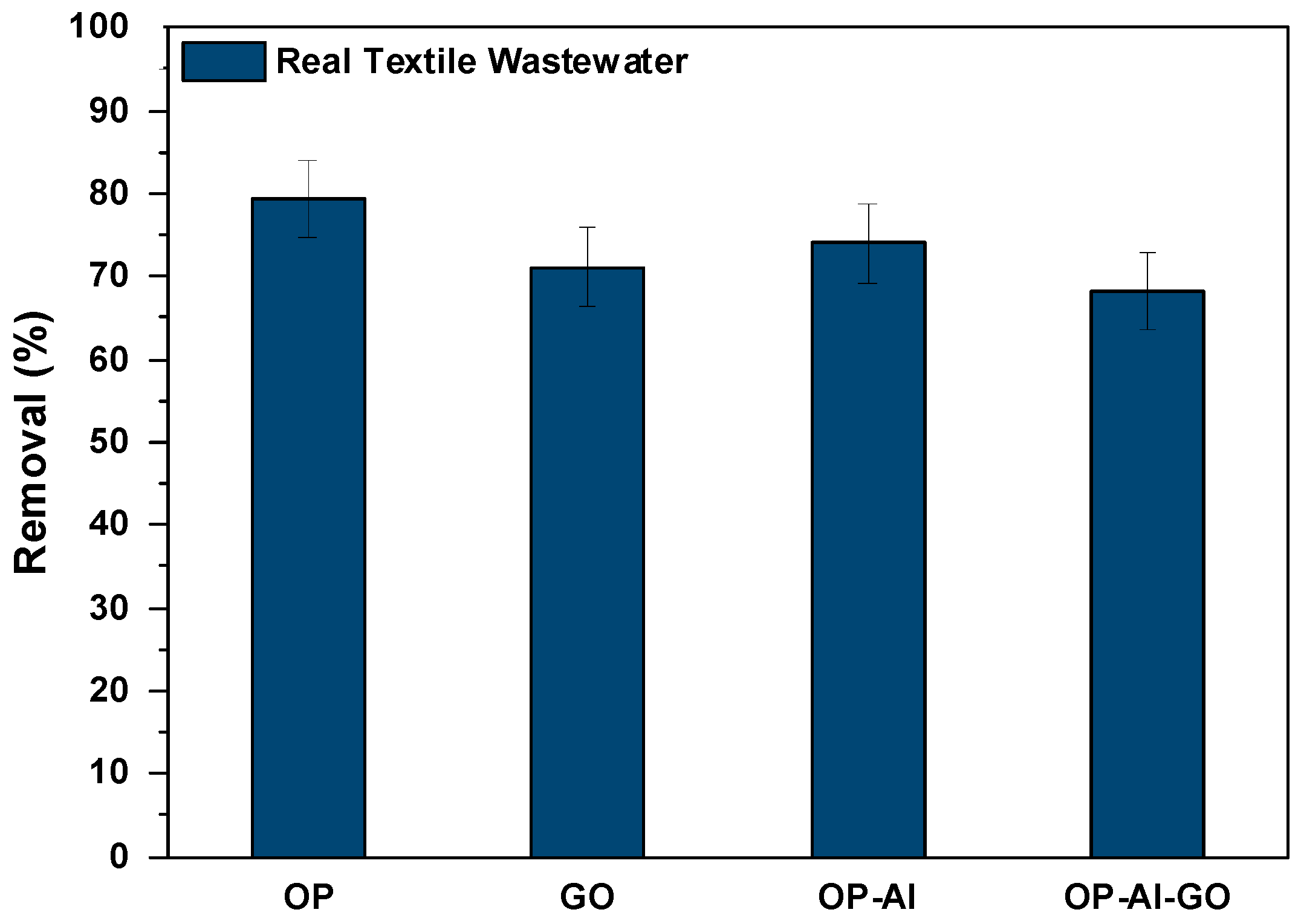
The proposed adsorbents in this study were further tested using untreated real wastewater collected from a textile dyeing facility in Langadas, Thessaloniki (Greece). OP, GO, OP-Al, and OP-Al-GO adsorbents were applied at a fixed dose of 0.5 g/L without pH adjustment (pH = 8.2) for 24 h. As shown in Figure 10, the adsorption of dyes from real textile wastewater varied when applying different adsorbents. OP showed the highest removal efficiency at 79.3%, followed by OP-Al (74.0%), GO (71.1%), and OP-Al-GO composite at 68.3%. Therefore, all adsorbents achieved notable dye removal, indicating their potential for practical wastewater treatment applications. The results also indicate that natural orange peel remains highly effective and cost-efficient for treating real textile effluents, likely because of its abundant functional groups and strong affinity for a wide range of dye molecules [67].
Figure 10.
Adsorbent performance in real textile wastewater.
In conclusion, the adsorption efficiencies of the studied materials were generally comparable (70–80%), indicating that performance differences were not substantial under real wastewater conditions. However, the OP-Al-GO composite exhibited significantly improved structural stability (Figure 8) compared to raw OP, highlighting its superior durability. This enhanced stability, combined with the presence of multiple active binding sites, supports the potential application of the composite as a multifunctional adsorbent for complex industrial effluents.
3.10. Characterization of the Adsorbents
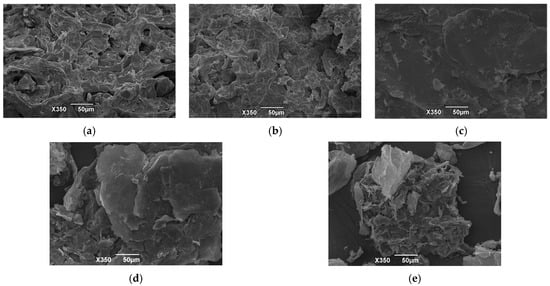
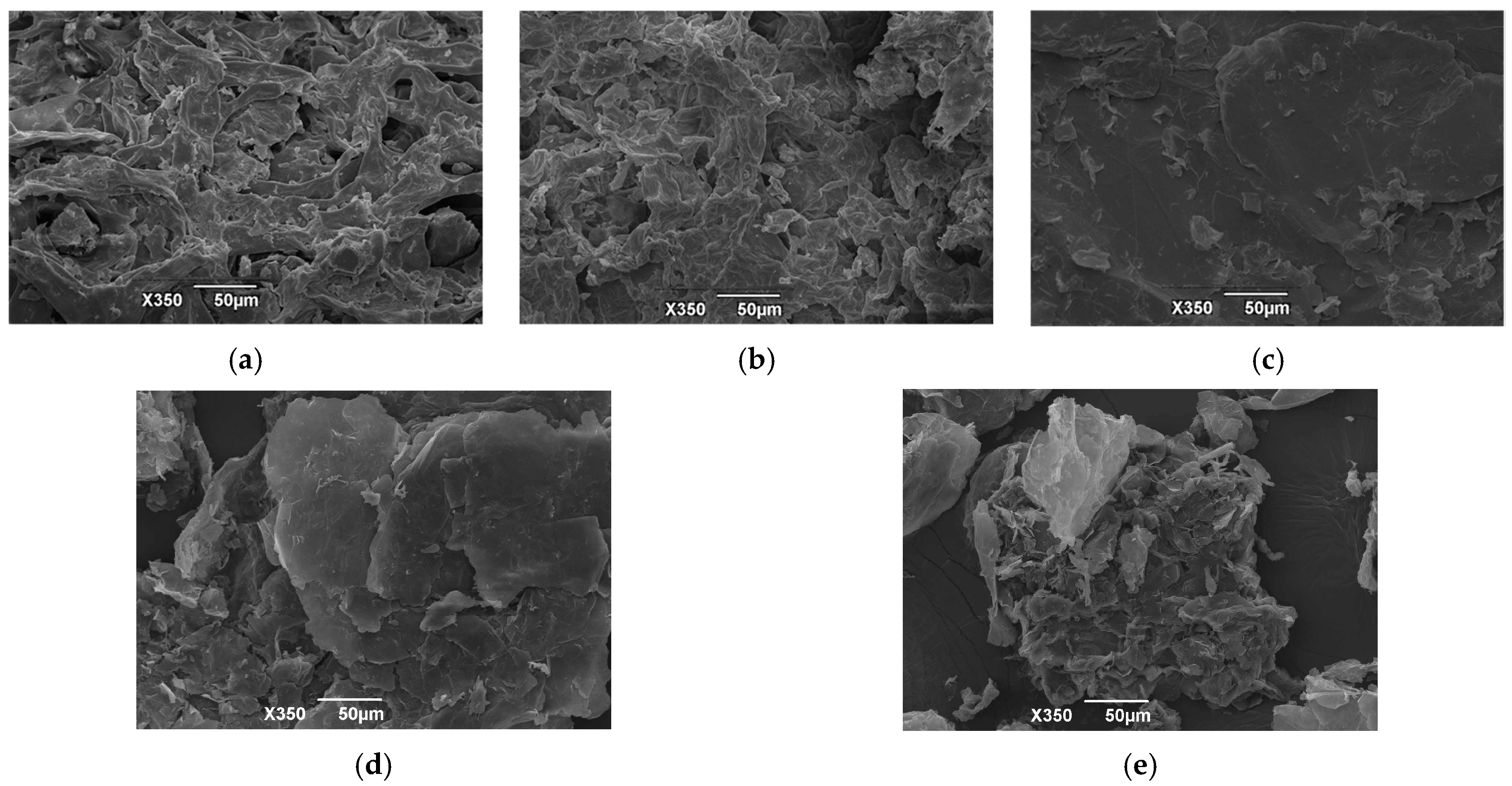
The SEM images in Figure 11 show how the adsorbent surfaces change before and after dye adsorption. OP (Figure 11a) has a rough, irregular, and porous surface with folded structures, offering some adsorption sites but with limited accessibility [68,69]. After aluminum modification (Figure 11b), the surface becomes more compact and aggregated, reflecting the successful incorporation of aluminum and the formation of Al–OH domains, which improve surface positivity and stability. Adding graphene oxide to the OP-Al structure (Figure 11c) creates the OP-Al-GO composite, with a more heterogeneous, wrinkled, and layered surface. This increases roughness and porosity, providing extra active sites and better diffusion pathways for adsorption.
Figure 11.
SEM images of (a) OP, (b) OP-Al, (c) OP-Al-GO before adsorption, and (d) OP-Al-GO_RR120, (e) OP-Al-GO_MV after adsorption of dyes.
Comparing OP-Al-GO before and after dye adsorption (Figure 11c–e) shows clear morphological changes. After RR120 adsorption (Figure 11d), the surface appears more compact and partially covered, suggesting the occupation of active sites by dye molecules and possible pore blockage due to electrostatic interactions between RR120 and positively charged Al–OH sites [70]. In contrast, after MV adsorption (Figure 11e), the surface becomes more aggregated and coated with irregular deposits, indicating stronger adsorption and higher surface coverage, consistent with the higher removal efficiency observed for MV [43]. These morphological changes confirm the effective interaction between both dyes and the OP-Al-GO surface and support the proposed adsorption mechanisms involving electrostatic attraction, π–π interactions, and hydrogen bonding.
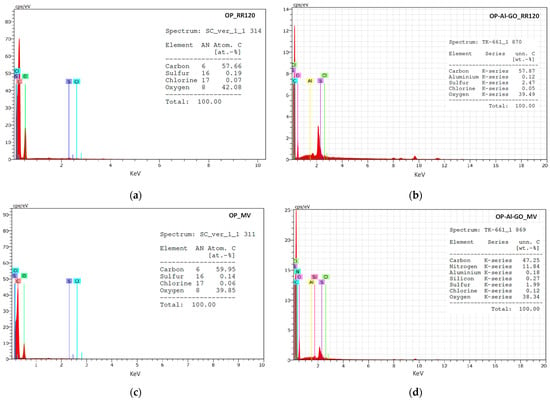
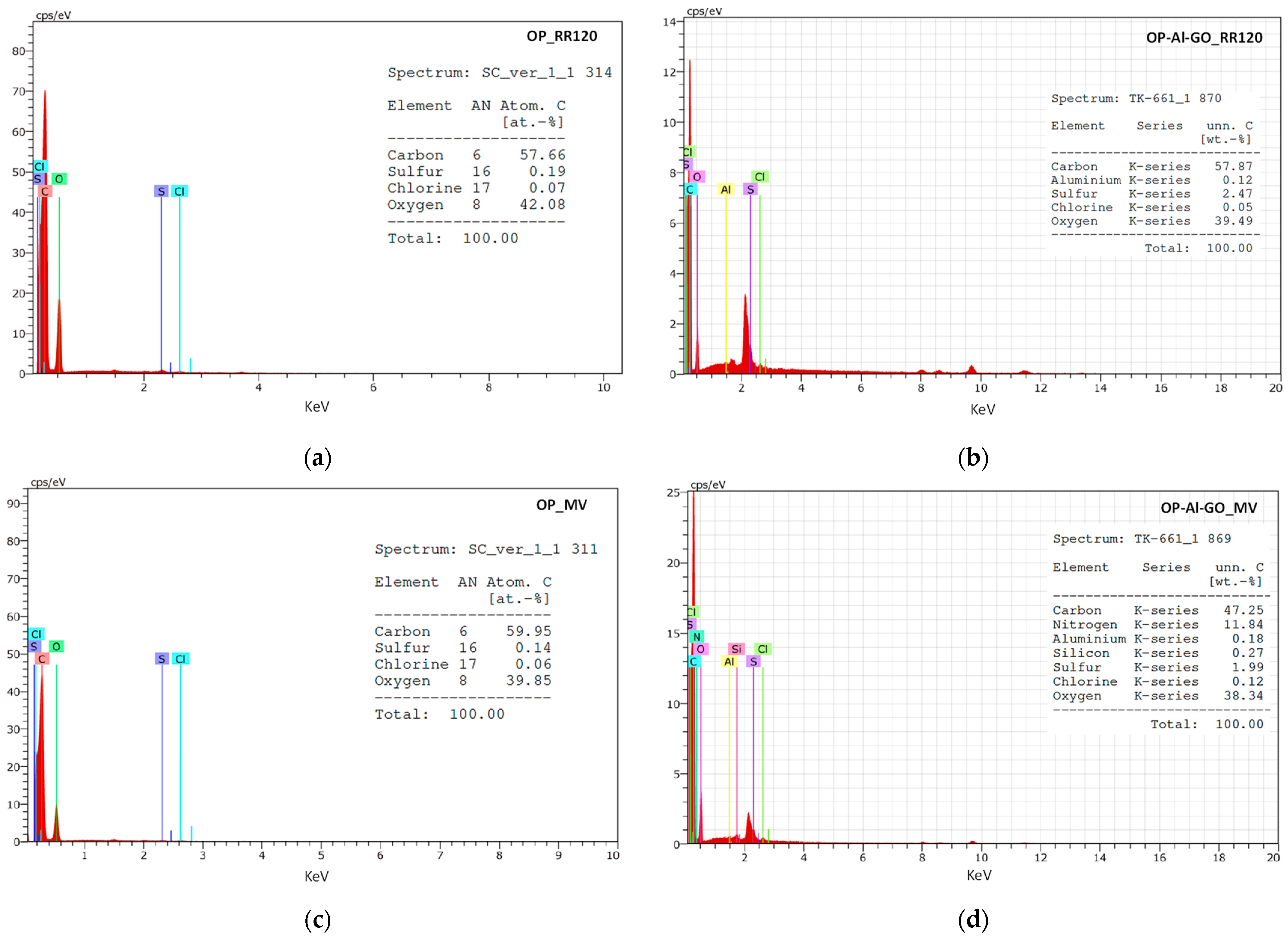
In addition, EDS analysis (Figure 12) confirms the successful incorporation of Al into the OP-Al-GO composite through the appearance of Al (aluminum) peaks, while the presence of S (sulfur), Cl (chlorine), and N (nitrogen) peaks after adsorption confirm the binding of RR120 (Figure 12a,b) and MV (Figure 12c,d) dye molecules to the surface of the adsorbent.
Figure 12.
EDS analysis of (a) OP after RR120 adsorption, (b) OP-Al-GO after RR120 adsorption, (c) OP after MV adsorption, and (d) OP-Al-GO after MV adsorption.
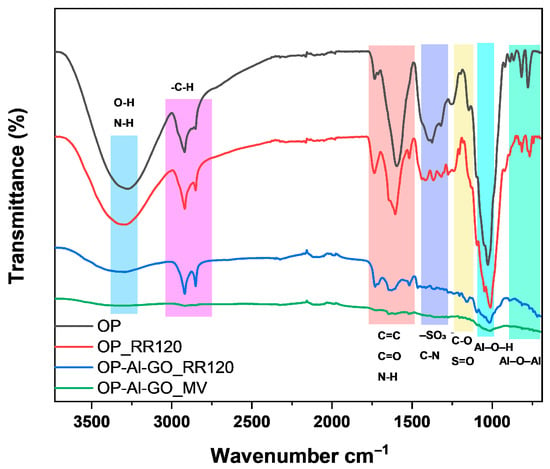
The FTIR spectra provide clear evidence of surface functional groups and their involvement in the adsorption of RR120 and MV onto the modified orange peel-based adsorbents (Figure 13). A broad and intense band centered around ~3400 cm−1, present in all spectra, is attributed to the stretching vibrations of hydroxyl (–OH) and possibly amine (–NH) groups inherent to the orange peel structure [71]. The absorption band at 2920 cm−1 is attributed to C–H stretching vibrations of aliphatic groups. The band observed at 1735 cm−1 corresponds to C=O stretching vibrations associated with carboxylic functional groups (–COOH and –COOCH3) [72]. After adsorption of RR120 and MV, noticeable changes in intensity and slight shifts of this band are observed, indicating the participation of these functional groups in the adsorption process, primarily through hydrogen bonding and electrostatic interactions with dye molecules.
Figure 13.
FTIR spectra of RR120 and MV adsorption.
Significant changes are also observed in the 1600–1400 cm−1 region, which corresponds to C=C aromatic stretching, C=O stretching, and N–H bending vibrations [36]. Compared with raw OP, the modified OP-Al-GO material shows enhanced peaks in this region due to the incorporation of aluminum and graphene oxide, which introduce additional oxygen-containing functional groups such as carboxyl (C=O) and hydroxyl groups [73]. After adsorption, new peaks or peak shifts appear in this region, particularly in the spectra of dye-loaded samples, reflecting the contribution of the aromatic structures of RR120 and MV and confirming strong interactions between the dyes and the adsorbent surface.
The region below 1500 cm−1 exhibits pronounced differences before and after adsorption, highlighting the complexity of dye–adsorbent interactions. For RR120-loaded samples, the appearance of new bands in the range of 1485–1369 cm−1 can be associated with vibrations of sulfonate (–SO3−) groups and C–N stretching, indicating successful binding of the anionic dye [74]. Additional changes in the 1000–1100 cm−1 region are attributed to C–O stretching vibrations and S=O stretching of RR120 [75]. In contrast, regarding MV adsorption, the peaks of C=O (∼1500 cm−1) and C=C (∼1400 cm−1) corresponding to aromatic ring vibrations had a higher intensity before adsorption, demonstrating the involvement of π–π stacking interactions between MV and graphene oxide sheets [58].
The successful incorporation of aluminum into the OP–GO structure is confirmed by the presence of characteristic Al–O and Al–O–Al vibrations in the lower wavenumber region. Bands appearing around ~1070–1020 cm−1 are attributed to Al–O–H bending modes, while broad and complex bands in the 400–800 cm−1 range (particularly around 600–700 cm−1) correspond to Al–O–Al stretching vibrations [21,64]. These features, which are absent or weak in raw OP, confirm the formation of aluminum hydroxide/oxide species within the composite structure and their stability after dye adsorption.
Overall, the observed spectral shifts and intensity changes—particularly in the O–H/N–H stretching region and the C=O/C=C region—confirm successful interaction and binding between the adsorbent and dye molecules. For RR120, adsorption is dominated by electrostatic attraction between sulfonate groups and positively charged Al-based sites, along with hydrogen bonding. For MV, adsorption occurs mainly through interactions with negatively charged functional groups, supplemented by π–π stacking, hydrogen bonding, and van der Waals forces, as also illustrated previously in Figure 3. These FTIR results strongly support the synergistic role of aluminum and graphene oxide in enhancing the adsorption capacity of OP-Al-GO toward both anionic and cationic dyes.
3.11. Feasibility of Scale-Up
The synthesis method developed in this study has potential for industrial or commercial use. Materials like orange peels are cheap and widely available, making raw material sourcing simple and practical. Using low-cost agricultural waste as precursors and simplifying the production steps could help reduce costs [76]. Laboratory-scale procedures such as stirring and sonication could be scaled up with mechanical mixers and industrial ultrasonic equipment, though care would be needed to ensure even dispersion and proper mass transfer in larger volumes. The process also works under mild conditions and avoids hazardous chemicals, which is favorable from a safety and environmental perspective. Overall, with some optimization, the method could be scaled up without major technical or economic issues.
3.12. Comparison with Literature
A comparison with recently reported adsorbents (Table 6) shows that some materials exhibit higher RR120 uptake under optimized laboratory conditions, such as CHT-ECH/CFA (237.7 mg/g at pH 4, 0.7 g/L) and BPC (22.0 mg/g at pH 2, 1 g/L). However, these materials are applied in single-dye systems and were not validated using real wastewater. By contrast, OP-Al-GO achieved 64.8% RR120 removal with a capacity of 10.8 mg/g at a lower dosage (0.5 g/L), and it was successfully tested in dye mixtures and actual textile effluent, indicating greater resistance to competitive effects.
Table 6.
Comparison of OP-Al-GO with other relevant adsorbents found in very recent literature, for the removal of RR120 and MV.
For MV removal, OP-Al-GO displayed a high adsorption capacity (298.7 mg/g, 96.2% removal), surpassing several literature-reported adsorbents, including DS (59.5 mg/g, 62.4%), MPPP-AC (90.1 mg/g, 92.8%), MCAC (134.1 mg/g, 90%), and CHS/WS (103.3 mg/g 93.4%). Its performance approaches that of ZSCS (476.2 mg/g), while requiring a lower adsorbent dose (0.5 g/L compared to 1 g/L). Notably, unlike most previous studies, OP-Al-GO was evaluated in both mixed-dye systems and real wastewater, supporting its wider practical relevance.
In summary, although the RR120 capacity is moderate, the composite offers a favorable combination of high MV uptake (298.7 mg/g), low dosage requirement (0.5 g/L), and confirmed efficiency in complex effluents, highlighting its practical advantages over many high-capacity adsorbents tested only under simplified conditions.
4. Conclusions
This study demonstrated the successful synthesis and application of a sustainable aluminum-modified orange peel functionalized with graphene oxide (OP-Al–GO) as an efficient adsorbent for the removal of both anionic (Reactive Red 120) and cationic (Methylene Violet) dyes from aqueous systems.
Adsorption performance was strongly pH-dependent, with optimal dye removal occurring under acidic conditions (pH 3.0). OP-Al-GO consistently outperformed raw orange peel, OP-Al, and graphene oxide in synthetic systems, achieving removal efficiencies of 64.8% for RR120 and 96.2% for MV. Kinetic studies revealed that dye adsorption onto OP-Al-GO occurs via a synergistic mechanism involving both surface interactions at active sites and diffusion into internal pores, with the relative contribution of each step depending on the dye’s molecular size. For RR120, the PSO model provides a better fit, in comparison to MV, where the IPD model eventually exhibits a slightly higher correlation coefficient.
Isotherm analysis showed that RR120 adsorption fits the Freundlich model, indicating heterogeneous, multilayer adsorption, while MV follows the Langmuir model, suggesting monolayer coverage with high affinity. Langmuir maximum adsorption capacities for MV were 298.7, and for RR120, 10.8 mg/g. Thermodynamic results confirmed that adsorption of both dyes is exothermic, with MV adsorption being spontaneous and RR120 adsorption non-spontaneous under the studied conditions. SEM and FTIR characterization revealed that adding aluminum and graphene oxide increased surface roughness, porosity, and the availability of functional groups, promoting strong interactions with both dyes. FTIR also confirmed successful binding between the adsorbent and dye molecules.
OP-Al-GO performed well in binary dye systems, demonstrating robustness under competitive adsorption. Although efficiency decreased slightly in real textile wastewater due to the content of pollutants, significant dye removal was still achieved, confirming its practical applicability. This study highlights the novelty of OP-Al-GO as a multifunctional, low-cost, and sustainable adsorbent capable of removing dyes of different charges and molecular sizes, offering a versatile alternative to conventional single-dye adsorbents for advanced wastewater treatment.
Author Contributions
Conceptualization, A.K.T.; methodology, S.F., G.Z.K., and A.K.T.; software, G.Z.K. and A.K.T.; validation, G.Z.K. and A.K.T.; formal analysis, S.F., G.Z.K., and A.K.T.; investigation, S.F., G.Z.K., and A.K.T.; resources, G.Z.K. and A.K.T.; data curation, S.F., G.Z.K., and A.K.T.; writing—original draft preparation, S.F., G.Z.K., and A.K.T.; writing—review and editing, A S.F., G.Z.K., and A.K.T.; visualization, G.Z.K., and A.K.T.; supervision, A.K.T. All authors have read and agreed to the published version of the manuscript.
Funding
This research received no external funding.
Data Availability Statement
All data analyzed during this study are included in this published article.
Conflicts of Interest
The authors declare no conflicts of interest.
References
- Castillo-Suárez, L.A.; Sierra-Sánchez, A.G.; Linares-Hernández, I.; Martínez-Miranda, V.; Teutli-Sequeira, E.A. A Critical Review of Textile Industry Wastewater: Green Technologies for the Removal of Indigo Dyes. Int. J. Environ. Sci. Technol. 2023, 20, 10553–10590. [Google Scholar] [CrossRef] [Scilit] [PubMed]
- Rocha, V.; Pontes, V.; Costa, S.M.; Fangueiro, R.; Ferreira, D.P. Algae-Powered Innovation: A Critical Review of Sustainable Textile Dyeing and Functionalization Strategies. Mater. Today Sustain. 2025, 31, 101209. [Google Scholar] [CrossRef] [Scilit]
- Das, S.; Cherwoo, L.; Singh, R. Decoding Dye Degradation: Microbial Remediation of Textile Industry Effluents. Biotechnol. Notes 2023, 4, 64–76. [Google Scholar] [CrossRef] [Scilit] [PubMed]
- Zaman, S.; Sen, S.; Fatema, M.K.; Haque, S.; Asif, S.M.H.; Abu Rayhan, M.; Biswas, A.; Sarker, S.; Hasan, M.J.; Ahmmed, M.; et al. Adsorption of Reactive Red 120 Dye from Simulated Wastewater Using Rice Straw Charcoal: Isotherm and Kinetic Studies. H2Open J. 2025, 8, 89–99. [Google Scholar] [CrossRef] [Scilit]
- Periyasamy, A.P. A Review of Bioremediation of Textile Dye Containing Wastewater. Clean. Water 2025, 4, 100092. [Google Scholar] [CrossRef] [Scilit]
- Fındık, S. Decolorization of Cationic Dyes Methyl Violet 2B and Malachite Green via a Heterogeneous Fenton-like Process Using a Novel Magnetic Zeolite-Xanthan Gum Composite. Int. J. Biol. Macromol. 2025, 307, 142193. [Google Scholar] [CrossRef] [Scilit]
- Islam, M.M.; Aidid, A.R.; Mohshin, J.N.; Mondal, H.; Ganguli, S.; Chakraborty, A.K. A Critical Review on Textile Dye-Containing Wastewater: Ecotoxicity, Health Risks, and Remediation Strategies for Environmental Safety. Clean. Chem. Eng. 2025, 11, 100165. [Google Scholar] [CrossRef] [Scilit]
- Al-Tohamy, R.; Ali, S.S.; Li, F.; Okasha, K.M.; Mahmoud, Y.A.-G.; Elsamahy, T.; Jiao, H.; Fu, Y.; Sun, J. A Critical Review on the Treatment of Dye-Containing Wastewater: Ecotoxicological and Health Concerns of Textile Dyes and Possible Remediation Approaches for Environmental Safety. Ecotoxicol. Environ. Saf. 2022, 231, 113160. [Google Scholar] [CrossRef] [Scilit]
- El Meziani, S.; Agnaou, H.; El Haddaj, H.; Boumya, W.; Barka, N.; Elhalil, A. Sustainable Adsorption Technologies for Textile Dye Removal: Advances in Biomass-Derived and Magnetically Modified Activated Carbons. Clean. Chem. Eng. 2025, 12, 100210. [Google Scholar] [CrossRef] [Scilit]
- Satyam, S.; Patra, S. Innovations and Challenges in Adsorption-Based Wastewater Remediation: A Comprehensive Review. Heliyon 2024, 10, e29573. [Google Scholar] [CrossRef] [Scilit]
- Jahan, N.; Roy, H.; Reaz, A.H.; Arshi, S.; Rahman, E.; Firoz, S.H.; Islam, M.S. A Comparative Study on Sorption Behavior of Graphene Oxide and Reduced Graphene Oxide towards Methylene Blue. Case Stud. Chem. Environ. Eng. 2022, 6, 100239. [Google Scholar] [CrossRef] [Scilit]
- Zhao, J.; Wang, Z.; White, J.C.; Xing, B. Graphene in the Aquatic Environment: Adsorption, Dispersion, Toxicity and Transformation. Environ. Sci. Technol. 2014, 48, 9995–10009. [Google Scholar] [CrossRef] [Scilit]
- Seromo, L.; Greesh, N.; Mofokeng, J.P. Synthesis, Morphology, and Structural Properties of Graphene Oxide (GO) and Its Composites with Transition Metal Phosphates for Application in Water Purification: A Review. Carbon Trends 2025, 21, 100566. [Google Scholar] [CrossRef] [Scilit]
- Alvez-Tovar, B.; Scalize, P.S.; Angiolillo-Rodríguez, G.; Albuquerque, A.; Ebang, M.N.; De Oliveira, T.F. Agro-Industrial Waste Upcycling into Activated Carbons: A Sustainable Approach for Dye Removal and Wastewater Treatment. Sustainability 2025, 17, 2036. [Google Scholar] [CrossRef] [Scilit]
- Li, G.; He, J.; Yao, J. A Review of Recent Advances in Biomass-Derived Porous Carbon Materials for CO2 Capture. C 2025, 11, 92. [Google Scholar] [CrossRef] [Scilit]
- Mihai, S.; Bondarev, A.; Călin, C.; Sȋrbu, E.-E. Adsorbent Biomaterials Based on Natural Clays and Orange Peel Waste for the Removal of Anionic Dyes from Water. Processes 2024, 12, 1032. [Google Scholar] [CrossRef] [Scilit]
- Tolkou, A.K.; Tsoutsa, E.K.; Kyzas, G.Z.; Katsoyiannis, I.A. Sustainable Use of Low-Cost Adsorbents Prepared from Waste Fruit Peels for the Removal of Selected Reactive and Basic Dyes Found in Wastewaters. Environ. Sci. Pollut. Res. 2024, 31, 14662–14689. [Google Scholar] [CrossRef] [Scilit]
- Fouda-Mbanga, B.G.; Onotu, O.; Tywabi-Ngeva, Z. Advantages of the Reuse of Spent Adsorbents and Potential Applications in Environmental Remediation: A Review. Green Anal. Chem. 2024, 11, 100156. [Google Scholar] [CrossRef] [Scilit]
- Rahimi, V.; Pimentel, C.H.; Gómez-Díaz, D.; Freire, M.S.; Lazzari, M.; González-Álvarez, J. Development and Characterization of Biomass-Derived Carbons for the Removal of Cu2+ and Pb2+ from Aqueous Solutions. C 2024, 11, 2. [Google Scholar] [CrossRef] [Scilit]
- Robertson, E.J.; Stehle, Y.Y.; Hu, X.; Kilby, L.; Olsson, K.; Nguyen, M.; Cortez, R. Al3+ Modification of Graphene Oxide Membranes: Effect of Al Source. Membranes 2022, 12, 1237. [Google Scholar] [CrossRef] [Scilit]
- Tsoutsa, E.K.; Tolkou, A.K.; Katsoyiannis, I.A.; Kyzas, G.Z. Composite Activated Carbon Modified with AlCl3 for the Effective Removal of Reactive Black 5 Dye from Wastewaters. J. Compos. Sci. 2023, 7, 224. [Google Scholar] [CrossRef] [Scilit]
- Hummers, W.S.; Offeman, R.E. Preparation of Graphitic Oxide. J. Am. Chem. Soc. 1958, 80, 1339. [Google Scholar] [CrossRef] [Scilit]
- Debnath, S.; Maity, A.; Pillay, K. Impact of Process Parameters on Removal of Congo Red by Graphene Oxide from Aqueous Solution. J. Environ. Chem. Eng. 2014, 2, 260–272. [Google Scholar] [CrossRef] [Scilit]
- Deshwal, N.; Singh, M.B.; Bahadur, I.; Kaushik, N.; Kaushik, N.K.; Singh, P.; Kumari, K. A Review on Recent Advancements on Removal of Harmful Metal/Metal Ions Using Graphene Oxide: Experimental and Theoretical Approaches. Sci. Total Environ. 2023, 858, 159672. [Google Scholar] [CrossRef] [Scilit]
- Langmuir, I. The adsorption of gases on plane surfaces of glass, mica and platinum. J. Am. Chem. Soc. 1918, 40, 1361–1403. [Google Scholar] [CrossRef] [Scilit]
- Freundlich, H. Über Die Adsorption in Lösungen. Z. Für Phys. Chem. 1907, 57, 385–470. [Google Scholar] [CrossRef] [Scilit]
- Benjelloun, M.; Miyah, Y.; Akdemir Evrendilek, G.; Zerrouq, F.; Lairini, S. Recent Advances in Adsorption Kinetic Models: Their Application to Dye Types. Arab. J. Chem. 2021, 14, 103031. [Google Scholar] [CrossRef] [Scilit]
- Weber, W.J., Jr.; Morris, J.C. Kinetics of Adsorption on Carbon from Solution. J. Sanit. Eng. Div. 1963, 89, 31–59. [Google Scholar] [CrossRef] [Scilit]
- American Public Health Association. Standard Methods for the Examination of Water and Wastewater; APHA: Washington, DC, USA, 1981. [Google Scholar]
- Fan, T.; Liu, Y.; Feng, B.; Zeng, G.; Yang, C.; Zhou, M.; Zhou, H.; Tan, Z.; Wang, X. Biosorption of Cadmium(II), Zinc(II) and Lead(II) by Penicillium Simplicissimum: Isotherms, Kinetics and Thermodynamics. J. Hazard. Mater. 2008, 160, 655–661. [Google Scholar] [CrossRef] [Scilit]
- Gkika, D.A.; Tolkou, A.K.; Katsoyiannis, I.A.; Kyzas, G.Z. The Adsorption-Desorption-Regeneration Pathway to a Circular Economy: The Role of Waste-Derived Adsorbents on Chromium Removal. Sep. Purif. Technol. 2025, 368, 132996. [Google Scholar] [CrossRef] [Scilit]
- Bayuo, J.; Rwiza, M.J.; Choi, J.W.; Mtei, K.M.; Hosseini-Bandegharaei, A.; Sillanpää, M. Adsorption and Desorption Processes of Toxic Heavy Metals, Regeneration and Reusability of Spent Adsorbents: Economic and Environmental Sustainability Approach. Adv. Colloid Interface Sci. 2024, 329, 103196. [Google Scholar] [CrossRef] [Scilit] [PubMed]
- Xu, H.; Yang, X.; Xie, L.; Hakkarainen, M. Conformational Footprint in Hydrolysis-Induced Nanofibrillation and Crystallization of Poly(Lactic Acid). Biomacromolecules 2016, 17, 985–995. [Google Scholar] [CrossRef] [Scilit] [PubMed]
- Jeffrey, K.B.; Zheng, A.L.T.; Hii, T.T.; Seng, K.W.K.; Chung, E.L.T.; Lease, J.; Andou, Y. Sustainable Dye Wastewater Treatment: Utilizing Duckweed-Derived Adsorbents for Efficient Methylene Blue Removal. Biomass Conv. Bioref. 2025, 15, 19157–19173. [Google Scholar] [CrossRef] [Scilit]
- Kosmulski, M. The pH Dependent Surface Charging and Points of Zero Charge. X. Update. Adv. Colloid Interface Sci. 2023, 319, 102973. [Google Scholar] [CrossRef] [Scilit]
- Dey, S.; Basha, S.R.; Babu, G.V.; Nagendra, T. Characteristic and Biosorption Capacities of Orange Peels Biosorbents for Removal of Ammonia and Nitrate from Contaminated Water. Clean. Mater. 2021, 1, 100001. [Google Scholar] [CrossRef] [Scilit]
- Lu, Y.; Huang, L.; Guo, Y.; Yang, X. Theoretical Insights into Origin of Graphene Oxide Acidity and Relating Behavior of Oxygen-Containing Groups in Water. Carbon 2021, 183, 355–361. [Google Scholar] [CrossRef] [Scilit]
- Ighalo, J.O.; López-Maldonado, E.A.; Igwegbe, C.A.; López López, J.R.; Méndez Herrera, P.F.; Egbosiuba, T.C.; Osaro, E.; Dulta, K.; Haskis, P.; Koulougliotis, D.; et al. A Comprehensive Review of the Adsorption of Eriochrome Black T (EBT) from Aqueous Solutions. Sustain. Chem. Environ. 2025, 12, 100299. [Google Scholar] [CrossRef] [Scilit]
- Hassan, A.A.; Ali, M.E.M.; Abdel-Latif, S.A.; Hasani, I.W.; Fahim, Y.A. Efficient Removal of Remazol Red Dye from Aqueous Solution Using Magnetic Nickel Ferrite Nanoparticles Synthesized via Aqueous Reflux. Sci. Rep. 2025, 15, 17527. [Google Scholar] [CrossRef] [Scilit]
- Abdelkrim, S.; Sardi, A.; Mokhtar, A.; Viscusi, G.; Hachemaoui, M.; Boukoussa, B.; Djelad, A.; Sassi, M.; Aloui, Z.; Abboud, M. Comparative Study of Dye Adsorption on Alginate and Functionalized Montmorillonite Hydrogel Beads. Int. J. Biol. Macromol. 2026, 337, 149480. [Google Scholar] [CrossRef] [Scilit]
- Zainab, F.; Aftab, A.; Mir, S.; Awwad, N.S.; Ibrahium, H.A. The Role and Significance of Graphene Oxide in the Remediation of Micro- and Nanoplastics from the Environment. RSC Adv. 2025, 15, 36670–36703. [Google Scholar] [CrossRef] [Scilit]
- Kweon, S.W.; Jang, D.-H.; Lee, T.J.; Kweon, H.-Y.; Kim, H.-S.; Kim, H.J. Synergistic Effects of Graphene Oxide Loading and Particle Size in Ice-Templated Carboxymethyl Cellulose–Based Aerogels on Dye Removal. Sci. Rep. 2025, 15, 41232. [Google Scholar] [CrossRef] [Scilit] [PubMed]
- Çelebi, M.; Söğüt, E.G. High-Efficiency Removal of Cationic Dye and Heavy Metal Ions from Aqueous Solution Using Amino-Functionalized Graphene Oxide, Adsorption Isotherms, Kinetics Studies, and Mechanism. Turk. J. Chem. 2022, 46, 1577–1593. [Google Scholar] [CrossRef] [Scilit] [PubMed]
- Lemke, P.; Jünemann, L.; Moerschbacher, B.M. Synergistic Antimicrobial Activities of Chitosan Mixtures and Chitosan–Copper Combinations. Int. J. Mol. Sci. 2022, 23, 3345. [Google Scholar] [CrossRef] [Scilit] [PubMed]
- Chen, W.; Wang, Z.; Jin, M.; Ferré, T.P.A.; Wang, J.; Huang, J.; Wang, X. Effect of Sodium Chloride and Manganese in Irrigation Water on Cotton Growth. Agron. J. 2018, 110, 900–909. [Google Scholar] [CrossRef] [Scilit]
- Soller, H.; Wedemeier, A. Prediction of Synergistic Multi-Compound Mixtures—A Generalized Colby Approach. Crop Prot. 2012, 42, 180–185. [Google Scholar] [CrossRef] [Scilit]
- Bhatnagar, A.; Sillanpää, M. Utilization of Agro-Industrial and Municipal Waste Materials as Potential Adsorbents for Water Treatment—A Review. Chem. Eng. J. 2010, 157, 277–296. [Google Scholar] [CrossRef] [Scilit]
- Hadadian, M.; Goharshadi, E.K.; Fard, M.M.; Ahmadzadeh, H. Synergistic Effect of Graphene Nanosheets and Zinc Oxide Nanoparticles for Effective Adsorption of Ni (II) Ions from Aqueous Solutions. Appl. Phys. A 2018, 124, 239. [Google Scholar] [CrossRef] [Scilit]
- Mubarak, N.S.A.; Jawad, A.H.; Nawawi, W.I. Equilibrium, Kinetic and Thermodynamic Studies of Reactive Red 120 Dye Adsorption by Chitosan Beads from Aqueous Solution. Energ. Ecol. Environ. 2017, 2, 85–93. [Google Scholar] [CrossRef] [Scilit]
- Li, Y.; Wang, S.; Shen, Z.; Li, X.; Zhou, Q.; Sun, Y.; Wang, T.; Liu, Y.; Gao, Q. Gradient Adsorption of Methylene Blue and Crystal Violet onto Compound Microporous Silica from Aqueous Medium. ACS Omega 2020, 5, 28382–28392. [Google Scholar] [CrossRef] [Scilit]
- Rocky, M.M.H.; Rahman, I.; Yoshioka, S.; Keya, J.A.; Wong, K.H.; Mashio, A.S.; Hasegawa, H. Modeling Sorption Kinetics in Environmental Separations: Advancing beyond Traditional Pseudo-Order Approaches. Sep. Purif. Technol. 2026, 383, 135987. [Google Scholar] [CrossRef] [Scilit]
- Acharya, A.; Jeppu, G.; Girish, C.R.; Prabhu, B.; Murty, V.R.; Martis, A.S.; Ramesh, S. Adsorption of Arsenic and Fluoride: Modeling of Single and Competitive Adsorption Systems. Heliyon 2024, 10, e31967. [Google Scholar] [CrossRef] [Scilit]
- Guerrero-Fajardo, C.A.; Giraldo, L.; Moreno-Pirajan, J.C. Isotherm, Thermodynamic, and Kinetic Studies of Dye Adsorption on Graphene Oxides with Varying Oxidation Degrees. Results Eng. 2025, 26, 104558. [Google Scholar] [CrossRef] [Scilit]
- Lei, C.; Yu, Y.; Zhang, X.; Wang, B.; Wang, X.; Cheng, X.; Ma, L. Insights into Efficient Removal of Cationic and Anionic Dyes by Olive Pomace Adsorbent. Sci. Rep. 2025, 15, 31778. [Google Scholar] [CrossRef] [Scilit] [PubMed]
- Aragaw, T.A.; Alene, A.N. A Comparative Study of Acidic, Basic, and Reactive Dyes Adsorption from Aqueous Solution onto Kaolin Adsorbent: Effect of Operating Parameters, Isotherms, Kinetics, and Thermodynamics. Emerg. Contam. 2022, 8, 59–74. [Google Scholar] [CrossRef] [Scilit]
- Zhou, X.; Yu, X.; Maimaitiniyazi, R.; Zhang, X.; Qu, Q. Discussion on the Thermodynamic Calculation and Adsorption Spontaneity Re Ofudje et al. (2023). Heliyon 2024, 10, e28188. [Google Scholar] [CrossRef] [Scilit]
- Akhtar, M.S.; Ali, S.; Zaman, W. Innovative Adsorbents for Pollutant Removal: Exploring the Latest Research and Applications. Molecules 2024, 29, 4317. [Google Scholar] [CrossRef] [Scilit]
- Ali, N.S.; Jabbar, N.M.; Alardhi, S.M.; Majdi, H.S.; Albayati, T.M. Adsorption of Methyl Violet Dye onto a Prepared Bio-Adsorbent from Date Seeds: Isotherm, Kinetics, and Thermodynamic Studies. Heliyon 2022, 8, e10276. [Google Scholar] [CrossRef] [Scilit]
- Yazidi, I.; Ziat, K.; Bardiji, N.E.; Boundati, Y.E.; Naji, A.; Haskouri, J.E.; Saidi, M. Adsorption kinetics, isotherm models, and thermodynamics: A brief review. In Artificial Intelligence and Emerging Materials for the Transition Toward Green and Smart Technologies; Boutahir, M., Elkhattabi, E.M., Zouini, M., Upadhyay, A., Gadam, H., Tyagi, A., Eds.; Engineering Materials; Springer Nature: Cham, Switzerland, 2026; pp. 93–105. ISBN 978-3-032-15480-4. [Google Scholar]
- Ebrahimzadeh, F.; Akbari, A. Investigation the Adsorption Mechanisms, Chemical Resistance and Mechanical Strength of the Synthesized Chitosan/Activated Carbon Composite in Methylene Blue Removal. Sci. Rep. 2025, 15, 37820. [Google Scholar] [CrossRef] [Scilit]
- Ma, C.M.; Hong, G.B.; Wang, Y.K. Performance Evaluation and Optimization of Dyes Removal Using Rice Bran-Based Magnetic Composite Adsorbent. Materials 2020, 13, 2764. [Google Scholar] [CrossRef] [Scilit]
- Vara, D.; Jha, S.; Bisht, S.; Shahabuddin, S.; Gaur, R.; Suhas; Tyagi, I. Sustainable Bio-Based Adsorbents for Simultaneous and Efficient Removal of Hazardous Dyes from Aqueous Solutions. Toxics 2024, 12, 266. [Google Scholar] [CrossRef] [Scilit]
- Zahed, M.; Jafari, D.; Esfandyari, M. Adsorption of Formaldehyde from Aqueous Solution Using Activated Carbon Prepared from Hibiscus Rosa-Sinensis. Int. J. Environ. Anal. Chem. 2022, 102, 2979–3001. [Google Scholar] [CrossRef] [Scilit]
- Kazeem, T.S.; Lateef, S.A.; Ganiyu, S.A.; Qamaruddin, M.; Tanimu, A.; Sulaiman, K.O.; Sajid Jillani, S.M.; Alhooshani, K. Aluminium-Modified Activated Carbon as Efficient Adsorbent for Cleaning of Cationic Dye in Wastewater. J. Clean. Prod. 2018, 205, 303–312. [Google Scholar] [CrossRef] [Scilit]
- Cruz-Benítez, M.M.; Castro-Rosas, J.; González-Morones, P.; Santos-López, E.M.; Villagómez-Ibarra, J.R.; Tlahuextl-Romero, A.M.; Fonseca-Florido, H.A.; Gómez-Aldapa, C.A. Biocomposites Based on Starch with Multi-functionalized Graphene Oxide: Effect of Graft Composition and Concentration. Polym. Compos. 2022, 43, 267–281. [Google Scholar] [CrossRef] [Scilit]
- Camparotto, N.G.; Neves, T.D.F.; Pereira, G.M.P.; Mastelaro, V.R.; Prediger, P. Synergistic Effect in Simultaneous Adsorption of Cationic and Anionic Emerging Contaminants by Chitosan Aerogels Containing Nanocellulose-Modified Tannic Acid. J. Water Process Eng. 2023, 53, 103749. [Google Scholar] [CrossRef] [Scilit]
- Arami, M.; Limaee, N.Y.; Mahmoodi, N.M.; Tabrizi, N.S. Removal of Dyes from Colored Textile Wastewater by Orange Peel Adsorbent: Equilibrium and Kinetic Studies. J. Colloid Interface Sci. 2005, 288, 371–376. [Google Scholar] [CrossRef] [Scilit]
- Afolabi, F.O.; Musonge, P.; Bakare, B.F. Adsorption of Copper and Lead Ions in a Binary System onto Orange Peels: Optimization, Equilibrium, and Kinetic Study. Sustainability 2022, 14, 10860. [Google Scholar] [CrossRef] [Scilit]
- Praipipat, P.; Ngamsurach, P.; Joraleeprasert, T. Synthesis, Characterization, and Lead Removal Efficiency of Orange Peel Powder and Orange Peel Powder Doped Iron (III) Oxide-Hydroxide. Sci. Rep. 2023, 13, 10772. [Google Scholar] [CrossRef] [Scilit]
- Bhuiyan, R.H.; Rahman, M.M.; Billah, M.M.; Ehsan, M.F.; Akter, T.; Hossain, M.S.; Rashid, M.M.; Islam, M.S.; Ray, S.K. Bio-Adsorbent for Wastewater Treatment: Amination of Green Coconut Husk Waste-Derived Lignin for the Removal of Congo Red Dye. RSC Adv. 2026, 16, 2093–2111. [Google Scholar] [CrossRef] [Scilit]
- Al-Tabakha, M.M.; Khan, S.A.; Ashames, A.; Ullah, H.; Ullah, K.; Murtaza, G.; Hassan, N. Synthesis, Characterization and Safety Evaluation of Sericin-Based Hydrogels for Controlled Delivery of Acyclovir. Pharmaceuticals 2021, 14, 234. [Google Scholar] [CrossRef] [Scilit]
- Yang, H.; Yan, R.; Chen, H.; Lee, D.H.; Zheng, C. Characteristics of Hemicellulose, Cellulose and Lignin Pyrolysis. Fuel 2007, 86, 1781–1788. [Google Scholar] [CrossRef] [Scilit]
- Suhaimin, N.S.; Hanifah, M.F.R.; Azhar, M.; Jaafar, J.; Aziz, M.; Ismail, A.F.; Othman, M.H.D.; Rahman, M.A.; Aziz, F.; Yusof, N.; et al. The Evolution of Oxygen-Functional Groups of Graphene Oxide as a Function of Oxidation Degree. Mater. Chem. Phys. 2022, 278, 125629. [Google Scholar] [CrossRef] [Scilit]
- Munagapati, V.S.; Wen, J.-C.; Pan, C.-L.; Gutha, Y.; Wen, J.-H. Enhanced Adsorption Performance of Reactive Red 120 Azo Dye from Aqueous Solution Using Quaternary Amine Modified Orange Peel Powder. J. Mol. Liq. 2019, 285, 375–385. [Google Scholar] [CrossRef] [Scilit]
- Kumar, S.; Tiwari, A.; Chaudhari, C.V.; Bhardwaj, Y.K. Chitosan Based Radiation Crosslinked and Grafted Matrix: An Environment Friendly Adsorbent for Dye Uptake. Radiat. Phys. Chem. 2023, 208, 110876. [Google Scholar] [CrossRef] [Scilit]
- Shah, H.H.; Amin, M.; Pepe, F.; Mancusi, E.; Fareed, A.G. Overview of Environmental and Economic Viability of Activated Carbons Derived from Waste Biomass for Adsorptive Water Treatment Applications. Environ. Sci. Pollut. Res. 2023, 32, 19084–19109. [Google Scholar] [CrossRef] [Scilit] [PubMed]

Disclaimer/Publisher’s Note: The statements, opinions and data contained in all publications are solely those of the individual author(s) and contributor(s) and not of MDPI and/or the editor(s). MDPI and/or the editor(s) disclaim responsibility for any injury to people or property resulting from any ideas, methods, instructions or products referred to in the content. |
© 2026 by the authors. Licensee MDPI, Basel, Switzerland. This article is an open access article distributed under the terms and conditions of the Creative Commons Attribution (CC BY) license.