Review

Textile Microplastics in Wastewater: A Critical Review of Removal and Carbonization Technologies


Department of Material Engineering, Faculty of Textile Engineering, Technical University of Liberec, Studentska 2, 46117 Liberec, Czech Republic
*
Author to whom correspondence should be addressed.
Submission received: 22 December 2025 / Revised: 20 February 2026 / Accepted: 4 March 2026 / Published: 9 March 2026
(This article belongs to the Section Carbon Materials and Carbon Allotropes)

Abstract

The rapid growth of synthetic textile production has intensified the release of micro- and nanoplastics (MPs/NPs) into aquatic environments, primarily through industrial effluents and domestic laundering. Textile-derived microplastics, especially polyester fibers and polymeric coating fragments, constitute a significant fraction of plastic contamination in wastewater systems. Although wastewater treatment plants (WWTPs) can remove a large proportion of MPs, substantial quantities accumulate in sewage sludge, raising concerns about long-term environmental persistence and secondary release pathways. This review critically examines the sources, classification, and release mechanisms of textile-based micro- and nanoplastics, including fibrous debris and coating-derived fragments. Then it focuses on current identification and removal technologies, such as sedimentation, coagulation/flocculation, electrocoagulation, flotation, membrane filtration, adsorption, and biodegradation, and on the emerging strategy of converting recovered microplastics into value-added porous carbon materials via hydrothermal treatment and pyrolysis. Carbonized microplastics exhibit high surface area and adsorption capacity for dyes, heavy metals, and organic pollutants, offering a circular approach that simultaneously mitigates plastic pollution and enhances wastewater treatment efficiency. By integrating source control, optimized removal technologies, and carbonization-based valorization, this review proposes a dual-benefit framework that transforms textile-derived microplastic waste from an environmental liability into a functional resource for sustainable water purification.

1. Introduction

Water is a necessary requirement for all living things on Earth to function. It is reasonable to argue that the existence of water is what makes Earth the only planet capable of supporting life [1]. As the population grows, water supplies are increasingly degraded by contaminants. Water quality is degraded and becomes hazardous to humans or the environment when harmful substances, such as chemicals or bacteria, pollute an aquifer, ocean, river, stream, lake, or other body of water. Recycled plastic accounts for a very small portion of the plastic produced worldwide. The majority of the remainder is now in the environment or open dumps. A portion of this plastic ends up in the ocean, lakes, and rivers. By 2050, it is predicted that 12 billion metric tons of plastic garbage will end up in landfills, open dumps, and the environment if existing consumption patterns and waste management techniques do not alter [2]. Natural weathering processes that occur once plastic items are in the environment cause them to gradually break down into smaller pieces. These particles are referred to as microplastics. The environmental problem of the twenty-first century is the contamination caused by microplastics. The topic pertains to the discharge, formation, and accumulation of tiny particles derived from plastic, as well as the detrimental effects they have on the environment and human health. In general, microplastics are defined as small plastic particles that range in size from 1 μm to 5 mm [3]. On the other hand, nanoparticles (NPs) are the smallest form of plastic waste, measuring less than 1 μm [4]. There are three possible ways that microplastics can cause harm: first, physical harm from the particles themselves; second, chemical harm from things like additives, sorbed chemicals, and toxic unbound monomers; and third, microbiological harm from pathogenic microorganisms attaching to and colonizing microplastics [5]. Throughout its entire life cycle (from manufacture to disposal), textile fabric sheds plastic fibrils and coatings (micro- and nanosized debris) due to a variety of mechanical and physical processes. Furthermore, these plastic components infiltrate into wastewater and end up in the environment during industrial and residential washing and drying [6]. A single washing cycle can remove more than 1900 fibers from a single piece of clothing, according to a report [7]. The most common polyester fabric had a discharge of 0.033–0.039% w/w fibers. A certain proportion of these fibers could get past wastewater treatment facilities and contaminate the environment worldwide. Up to 35% of MPs found in aquatic environments come from residential and commercial textile washing, making it a major source of MPs in wastewater. The textile industry is crucial in the introduction of MPs and the release of polymeric-coated fibrous fragments, such as when finishes are applied to polyester and other materials. Four research articles have reported on the emissions of polyester fibrous fragments. They analyzed the quantity of fibers emitted by various types of polyester clothing. Furthermore, polymeric coatings or chemically treated materials may produce microplastics that act as vectors for hazardous chemical contaminants [8]. The mitigating impact of various polymeric-based finishes on fiber fragments and filaments has been the subject of several studies. Various textile functions have been induced by chemical treatment. In textile coatings, the most commonly used functional finishes include antioxidants, antistatic agents, flame retardants, plasticizers, lubricants, slip agents, and stabilizers [9]. Each of these finishes serves a distinct and essential purpose in providing and enhancing the various functional qualities of textiles, such as softness, hardness, hydrophobicity, flame retardancy, antistatic charge dissipation, and antibacterial activity, among others. For instance, plasticizers such as phthalic esters (PAE) are frequently used to enhance the stretchability, flexibility, and durability of synthetic textiles [10]. The three most commonly used antioxidants are phenolics, organophosphates, and arylamines. However, due to their diverse physical and chemical characteristics, the harmful impacts of these finishes on human health and on the pollution of the aquatic environment are currently being studied. Secondly, there is a growing trend of using microplastics in wastewater treatment through adsorption. Microplastics possess large surface areas relative to their volume, making them suitable. Heavy metals, organic pollutants, and pharmaceuticals are just a few of the contaminants that microplastics can adsorb due to their large surface areas relative to their volume [11]. While much research has focused on MP release from textile fibers into wastewater, few studies have examined MP release from textile finishes or coatings. The study also preliminarily examines the potential impact of neglecting plastic pollution resulting from microplastics generated by textile polymeric coatings. The second section of the review examines emerging and promising sustainable strategies, specifically the transformation of recovered microplastics into value-added carbonaceous materials through carbonization. These porous carbon adsorbents exhibit high surface area and strong adsorption capacities for dyes, heavy metals, and organic pollutants, offering a circular approach to both plastic waste management and water purification. Moreover, a new approach to wastewater treatment emphasizes the use of micro- and nanoplastics for their ability to adsorb pollutants and support microbial growth. Hence, this comprehensive review aims to address two primary objectives: first, to collect microplastics from textile wastewater, and second, to utilize these collected plastics in wastewater treatment.

2. Classification of Micro and Nanoplastics

Microplastics are generally categorized according to their size, which can range from minuscule dimensions to less than 5 mm [12]. These tiny plastic particles are classified as nanoplastics (<1 μm) and microplastics (<5 mm) [13]. Typical categories of microplastics are fragments, microbeads, films, fibers, and pellets. Small microplastics (less than 10 μm) may move from the stomach into the circulatory systems of aquatic species [14]. Textile-derived microplastics (t-MPs) are a subset of environmental micro- and nanoplastics that merit distinct classification because their origin, morphology, and surface chemistry are dominated by textile polymer types (polyesters, polyamides, acrylics, regenerated cellulosics), yarn/fabric architecture, and finishing chemistries rather than by the generic fragment/film/bead taxonomy. For manuscript clarity this review classifies textile-based particles by (i) physical form (fibres, fibrils, films/flakes, polymeric microbeads and coating fragments), (ii) provenance (manufacturing loss, industrial finishing, domestic laundering, drying and textile disposal) and (iii) surface chemistry (native polymer, chemically treated or finish-coated), because these axes better predict fate, treatment response and toxicological behaviour than size alone. Adopting a textile-centric taxonomy aligns monitoring protocols with removal technologies (e.g., fibre-targeted filtration vs. density-separation of fragments) and avoids conflation with non-textile MP sources [15,16].

3. Textile-Based Microplastics and Their Release

3.1. Fibrous Microplastics

Fibrous microplastics (FMPs) have gained significant focus due to their morphology and material diversity, which produce environmental behaviors and exposure pathways that differ fundamentally from those of irregular fragments. While past studies identify natural and synthetic sources and distinguish two categories of human-made organic fibers, this binary classification is insufficient for risk appraisal. Common reporting lumps together fibers of very different chemistries (e.g., petroleum-derived synthetics, chemically modified natural polymers, and regenerated celluloses), yet these groups differ markedly in fragmentation pathways, surface chemistry, and persistence. The statement that fibrous MPs are “mainly composed of PES, PA, PLA, and cellulose acetate” is factually useful but mechanistically thin: polymer crystallinity, molecular weight distribution, and manufacturing finishes strongly modulate mechanical durability and thus shedding rates, and their parameters are rarely reported alongside polymer identity [17].
The exclusion of fibres from wool, silk, or native cellulose as MPs reflects a pragmatic taxonomy, but it creates a blind spot: regenerated or heavily chemically treated cellulosic fibres may behave more like synthetic polymers in the environment, challenging the neat “natural vs. synthetic” divide [18]. Similarly, the length-to-diameter morphological definition (>3:1 ratio; diameter ≤ 25 μm; length 1 μm–0.5 cm) [19] is valuable for comparability but masks functional heterogeneity, which ranges around 20 μm-diameter polyester filament; it will interact with biota and hydrodynamic forces very differently than a 2 μm fibril of the same polymer. Relying solely on geometric thresholds, therefore, risks conflating particles with divergent ecological consequences. These emergent biopolymer fibres (e.g., PLA) are often framed as environmentally preferable, yet their degradation kinetics under realistic aquatic and sedimentary conditions remain poorly quantified [17]. Without consistent reporting of degradation state and environmental half-lives, claims about reduced risk are premature. To advance from description to actionable insight, studies must pair polymer identification with structural (crystallinity, molecular weight), surface-chemical, and aging metrics that determine environmental fate.

3.2. Polyethylene Terephthalate-Based Microplastics

A highly important and widely used engineered thermoplastic material and polymer is polyethylene terephthalate (PET), a semi-crystalline, aromatic polymer that has multiple properties, including high strength, chemical resistance, toughness, great dimensional stability, a high glass transition temperature, and superior mechanical capabilities [20]. The most crucial element in determining its mechanical properties and the possibility of using diverse production methods for varied applications is its molecular weight [21]. PET is widely used to make plastic bottles. In the production of textile fibers, a significant amount of polyethylene terephthalate (PET) is used. Clothing made of PET is said to lose thousands of microfibers with every washing cycle. WWTPs do not break down PET-released plastic debris, and effluents containing NP are released into surface waters. Lei Tian introduced a brand-new technique for removing MP finishes from wastewater generated by household textiles. They employed a streamlined three-step approach to determine the mass concentrations of PET MP in WWTP influents and effluents, and to measure PET NP in domestic wastewater. Several separation processes, including sieving, filtering, evaporation, extraction, and digestion, were employed to process the material. They demonstrated that the proposed quantification technique is easy to use, efficient, and suitable for quantifying PET MP in wastewater. The estimated percentage of polyethylene terephthalate (PET) in the total MP found in the upper and lower water surfaces is 71.4% and 59.73% [22].
A study of Dubais and Libezeit found that fiber discharge from polyester fabric varied between 0.033 and 0.039% w/w at each wash [7]. These findings underscore the importance of understanding MP release during textile laundering to minimize direct emissions and discharges through Wastewater Treatment Plants. The effect of detergent on fiber emissions was observed by Niko L. Hartline et al. in a study using two types of mechanically aged polyester fabrics: one fresh and one that had been mechanically aged [23]. Fiber masses surpassing 0.3% by weight of the unwashed garment mass were liberated by the mechanically aged polyester clothing. Fiber emissions initially declined and then stabilized after 10 mild washings in the tests, which were conducted without the use of detergent [24]. Under certain washing circumstances, the addition of fabric softener and detergent had no discernible effect on fiber emissions [25]. Functional groups like amino, hydroxyl, and carboxyl are present as end groups of typical synthetic fibers. These fibers may have a major impact on the destiny of hydrophobic materials in the environment [26]. Although the amount of microplastics in the environment is unclear, the burden of washing textiles and personal care items has an impact on wastewater treatment facilities [27]. Research examined the emissions of polyester fibers and fragments when certain new and unused garments were machine-washed [28].
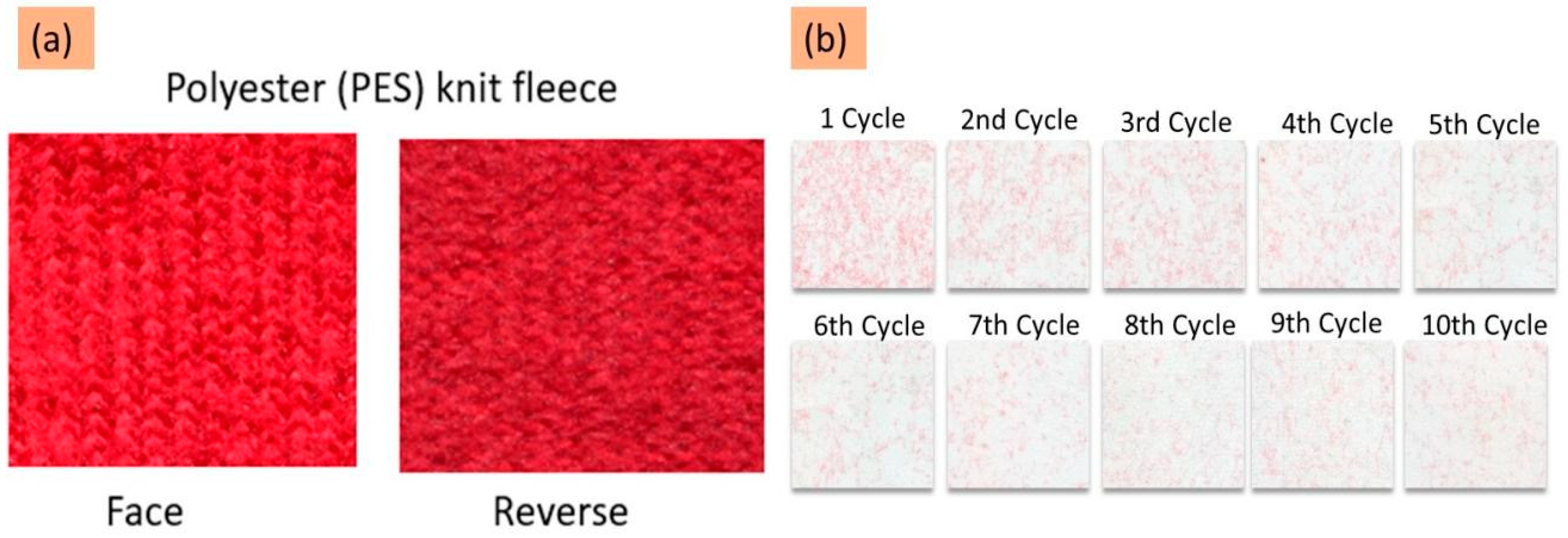
Domestic and industrial laundering are the dominant immediate pathways by which synthetic textile fragments enter wastewater streams. Fiber release depends primarily on fabric construction (pile vs. smooth), polymer chemistry (e.g., polyester, polyamide), mechanical ageing, and washing conditions (detergent type, temperature, mechanical action). Controlled washing studies demonstrate that a single cycle can release hundreds to thousands of fibers per garment, and mechanically aged polyester garments show substantially higher release than new garments. These observations imply that mitigation should target fabric design, finishing chemistry, and washing conditions rather than relying solely on end-of-pipe solutions [29]. Several physicochemical processes and parameters are involved in textile washing. The most significant of these are mechanics, washing time, chemistry, and temperature [28]. These work together to provide sufficient washing consequences [30]. Recently, a study was conducted in the chemical laboratory of the Technical University of Liberec, within the framework of the acknowledged project “Textile-derived micro-plastics in aquatic ecosystems: identification, characterizations, and effect assessment.” Several washing cycles were applied to a single jersey PES knitted fleece fabric. After each wash, the fabric’s physical appearance was examined. An analysis was done on the decrease in fibrous assembly across the fabric structure. The sample after the first wash and after the tenth cycle differed significantly, as indicated by visual inspection (see Figure 1).

4. Microplastics Produced from Polymeric Finishes

4.1. Textile Finishes as the Source of Microplastic Production

Wet textiles can produce micro- and nanoplastics from a variety of materials and polymeric finishes, suitable for a range of uses. Over time, polymeric finishes, such as coatings and laminates, may deteriorate and release MP into the environment. Two types of plastic waste are produced by textiles: MP released from polymeric coatings alone, and MP as fragments of synthetic fibers associated with polymeric coatings [15]. During textile washing, textile coatings may release microplastics, including both fibrous and polymeric microplastics [32]. The structure of the cloth, the washing environment, and external factors such as friction can all affect how many polymeric MP are released. Polymeric MP may also be released using smart-coated fabrics that employ microcapsules to deliver active ingredients in a controlled manner. Common polymeric materials most likely come from textile finishes, including polyurethanes, acrylates, silicones, melamines, epoxides, polyvinyl chloride, polystyrene, polyethylene, and polyimides, among others [33]. These polymeric MPs are the result of clothes washing activities and fragment over time in the environment [34].

4.2. Degradation Rates of Plastics in the Environment

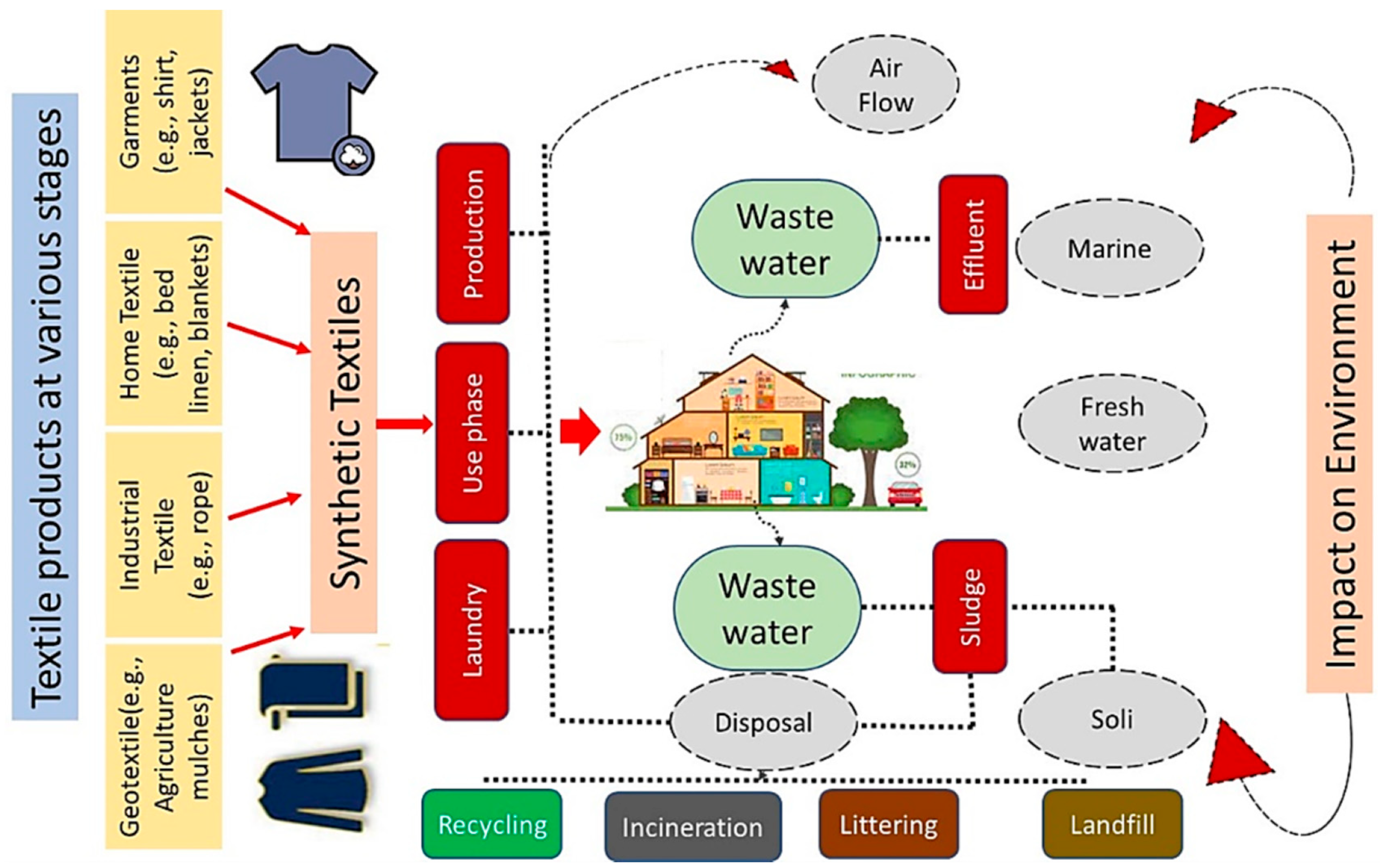
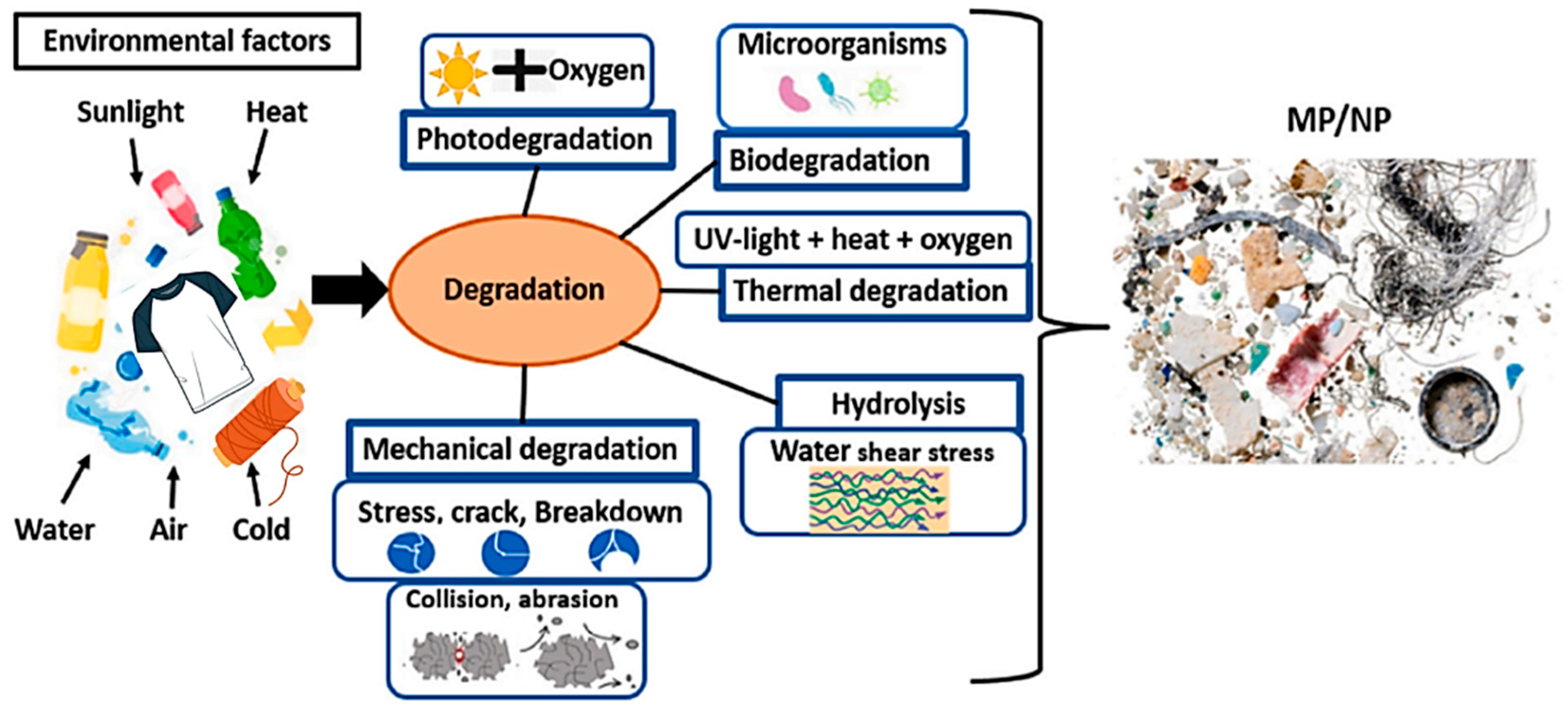
During the cleaning, washing, drying, manufacturing, and disposal phases of the life cycle of polymeric-coated textiles, micro- and nanoplastics are constantly released. Wind buildup, landfill leaching, and wastewater treatment plant discharges are among the ways the fibrous and coating materials released by MP might end up in the environment. Monitoring, control, and mitigation strategies for the release of polymeric-coated fibers, along with their sustainability, are considered in a life-cycle evaluation [35]. A schematic diagram of the emissions and environmental transport pathways of polymeric micro- and nanoplastics released from various polymeric substrates is depicted in Figure 2.
The discharge of polymeric MP from the washing of synthetic fabrics, which include polymeric coatings, has sparked public attention and environmental concerns [37]. The International Union for Conservation of Nature (IUCN) proposed that 35% synthetic textile fibers constitute the main source of micro and nanoplastics entering the seas. With an annual emission of 76.8 g, the Fraunhofer UMSICHT Institute calculated that MP from synthetic textile washing ranked number 10 among the top 10 sources of MP. MPs have been found to be significantly influenced by the washing of synthetic textiles [38,39], regardless of the many approaches, standards, and measurement scales that have been employed. Polyester and polyamide, two synthetic fibers that are frequently employed as textile coating materials, have the ability to release a surplus of MP [40].

4.3. Polyurethane Textile Finish

Polyurethane (PU), a common textile finish, enhances fabric quality and performance by providing several benefits, including water repellency, improved breathability, increased durability, softness, windproofing, elasticity, UV resistance, and enhanced stretch recovery [41]. The SEM, FTIR, and quantification techniques were used to investigate PU microplastic particles from textile effluent that exhibited fungal biodegradation. Chain scission, along with physical and chemical changes, alters the photodegradation pattern of polyurethane coatings on textiles. As the photoaging time increases, the formation of MP is a time-consuming process, characterized by various properties and debris release rates. After about 360 h of exposure, the number of PET-U-released nanoparticles was around 2.70 × 10¹¹ NPs/g, but the number of MPs produced increased significantly to 9.3232 × 10⁷ MPs/g [42].

4.4. Polyethylene-Based Textile Finish

Polyethylene can impart a hydrophobic quality to the surface of fabric and act as a barrier to keep out stains and impurities. Polyethylene treatments are very beneficial for textiles designed for water or sun protection. In particular circumstances, polyethylene coatings can help retain heat or cold by enhancing thermal insulation properties [43]. However, polyethylene (PE) coatings on textiles can produce MP that may harm health by affecting digestion and absorption of nutrients. A study was conducted to determine the presence of nano plastics in textile wastewater treatment facilities. Polyethylene and mechanical degradation of MP caused by water shear forces produced by water treatment processes may be the primary sources of polyethylene nanoplastics in the WWTP. They proposed that fiber synthesis produces microplastics, which are then converted into waste by a range of mechanical, thermal, and environmental processes (Figure 3). Empirical evidence indicates that polyethylene-based additives are discharged at the surface of the ocean rather than into deep-sea water, where the primary plastic components were intended to flow before reaching the sediment layer. The study carefully investigates the plastic particles released into marine water from polyethylene (PE) and soft polyvinyl chloride (PVC) plastic coatings [44]. The polymeric fragments were discovered in a sample of natural surface and deep seawater that was exposed to 13 °C (the temperature of Mediterranean deep seawater) for 30 days in the dark. The researchers found that the most abundant polymer in the aquatic environment is polyethylene (PE) covering [45]. Another study investigated the yield of nanoscale plastic debris from low-density polyethylene (PE) that was recovered. The yield that resulted from exposure to intense water washings included PE plastic particles of a nanoscale size with a density of more than 1012 L−1. By comparing each tested substrate to the initial water temperature, which changed from high to moderate, the number of particles released was detected. The collected plastic particles were found to have an average diameter of 30 to 80 nm, except for a very small number of particles that were found to be smaller than 200 nm [46].

4.5. PVAC and DMDHEU Textile Finish

Polyvinyl acetate (PVAC) is used as a textile film and resin matrix for fabric coating. The wastewater from textile production has an extensive greywater footprint, which enhances the risk of MP contamination from the production of polymeric-coated fabrics. Research in the Taipu River covers the gap between field data and policymaking about MP management by advancing our understanding of cleaner textile manufacturing. The dimethyl dihydroxy ethylene urea (DMDHEU) polymer is utilized extensively in the industry due to its remarkable wrinkle-healing capabilities and availability. The fabric structure is often covered with Fixapret ECO, a modified cross-linker with a reduced formaldehyde concentration [47,48].

4.6. Fluorocarbon Plastics Textile Finish

Fluorocarbon plastics contain fluorine atoms in their molecular structure. These polymers are also commonly referred to as fluoropolymers. These are well known for possessing a unique set of properties, including decreased friction, enhanced heat stability, high chemical resistance, and non-stick properties [49]. A fluorocarbon release coating patent (US 10,967,399 B2) was filed by Yu et al. [50]. According to him, fluoropolymers are highly resistant to a range of chemical attacks on functional coatings. There are multiple techniques for applying fluoropolymer release coatings to a substrate surface, including plasma deposition for an organo-fluorine coating on fabric surfaces and wet-chemical coating on textile substrates [51]. When these coatings were washed, they were likely to yield MP. Polyvinylidene Fluoride (PVDF), Perfluoroalkoxy Polymer (PFA), Ethylene Tetrafluoroethylene (ETFE), Polyhexafluoropropylene (FEP), Chlorotrifluoroethylene (ECTFE), and Polytetrafluoroethylene (PTFE) are a few well-known examples of fluorocarbon plastics. Due to their unique combination of properties, fluorocarbon polymers are utilized in numerous industries. These can also release perfluorinated compounds, which are persistent in the environment and have been associated with health and environmental hazards. As a result, ongoing research and efforts are being made to develop more sustainable alternatives and mitigate the environmental impact of these materials. Polytetrafluorethylene PTFE is among the most widely used fluorocarbon polymers. Due to its chemical resistance, it is frequently used in industrial settings as a liner material in tanks and pipelines, as well as in cookware (such as Teflon). Its non-stick properties are well known. Polytetrafluoroethylene (PTFE) coating on textiles has been the subject of numerous publications, some of which have focused on the process of creating a PTFE special base fabric. The study observed the use of a specially manufactured membrane composed of a hydrophilic layer covered atop hydrophobic PTFE to treat textile wastewater by membrane distillation [52]. In another study, a PTFE membrane covering material improved the thermal insulation properties of the cotton substrate. Additionally, the structure and properties of PTFE fibres were explained, demonstrating their exceptional heat stability and wide range of fineness. A PTFE film-coated PTFE grid composite film material with a layer of glass fibre grid cloth wrapped in PTFE film layers was studied [53]. Abhijit Nag et al. [54] utilized common metals to investigate the degradation of polytetrafluoroethylene (PTFE) coatings in water. Fluorocarbon polymeric fragments were found in around 53 mg of solid solids in the effluent, according to high-resolution mass spectrometry [54]. The study emphasized how harmful MP are to both the environment and human health. Andrzej et al. [55] examined the effects of washing on the mechanical characteristics of two specific fabrics composed of PTFE coating and glass threads. They performed uniaxial tensile tests to confirm the longitudinal stiffness and ultimate tensile strength of groups of specimens under various moisture conditions [55]. Even though the fundamental materials used in fabric production are intrinsically water-resistant, it was discovered that both in-plane watering at the cut ends and out-of-plane watering through the covering reduced the mechanical properties of the PTFE. A specifically designed membrane, composed of a hydrophilic layer over a hydrophobic polytetrafluoroethylene (PTFE) substrate, was created to address the issue of wetting. A remarkable 99% complete salt rejection was achieved [56].

4.7. Melamine-Based Finishes

Melamine is a preferred thermosetting plastic resin material for making practical fabrics because of its toughness, heat resistance, and flame-retardant properties [57]. In a study on the gradual release of small plastic particles (176 particles/L), Nile Red discovered that polystyrene and melamine coatings produced more microplastics (261 p/L) in hotter conditions (192 p/L) than in “cold” conditions (90 p/L). Another study found that compared to cleaning a melamine-coated bowl once (18 p/L), washing the dish 100 times generated an order of magnitude more microplastics (394 p/L). MP pollutants in rivers and lakes are of prime environmental relevance because pristine water systems serve as conduits for NPs to travel from land to sea. According to studies, there is a significant number of NP fragments in the upper and lower water surface, with concentrations ranging from 0.65 to 6.07 items/L and 0.30 to 3.63 items/L. They observed translucent fibres with important NP structures that ranged in size from 100 to 500 μm [58].

4.8. Microcapsule-Based Textile Finishes and Associated Microplastics

Microcapsule-based finishes and encapsulated functional agents (antimicrobials, fragrances, phase-change materials, insect repellents) have grown in textile applications because they provide controlled release and enhanced functionality, yet they also create a distinct source of polymeric debris when capsules or their polymeric shells fragment during use and washing. The particles released are typically micron-sized polymer shells containing active cargo and can act as vectors for both the encapsulated actives and sorbed pollutants; consequently, their treatment requires approaches that address both particulate removal and chemical fate. Waste-treatment strategies include (i) upstream design: use of biodegradable capsule shells or matrix-binding strategies to reduce detachment, (ii) capture at source: laundromat or on-machine filtration to intercept capsules before sewer entry, and (iii) downstream treatment: co-treatment in WWTPs combined with targeted adsorption/advanced oxidation for the residual active agents in sludge or effluent. Integration of capsule design with end-of-life management (e.g., bio-based shells that mineralize during sludge treatment) reduces long-term persistence and chemical risk. Monitoring protocols should explicitly differentiate capsule-derived polymer fragments from fiber fragments because their chemical payloads and environmental behavior differ [6].

5. Washings and Their Influence on the Release of Fiber Fragments

Fragmented fibers primarily enter waterways and wastewater systems through two main pathways: washing machines in households and discarded textiles in landfills. Despite the significance of this issue, there is a scarcity of quantitative research studies, with most existing studies relying on indirect methods to estimate the release of fiber fragments. One notable study by Napper et al. [6] investigated the release of fiber fragments from three types of synthetic garments (100% PAN, 65% polyester/35% cotton blend, and 100% PET) using a commercial washing machine. The study investigated the impact of detergent, conditioner, and temperature (30 °C and 40 °C) on the release of fiber fragments. Washing 6 kg of garments released a significant amount of fiber fragments 728,789 from 100% PAN garments, 496,030 from 100% PET garments, and 137,951 from 65% polyester/35% cotton garments. A separate study by Belzagui et al. [59] investigated fiber fragment emission from various fabric blends, including 70% PAN/30% PA6, 80% PET/20% elastane, and 100% PET. The results revealed that the PAN/PA blend fabric shed the maximum fiber fragments. The findings suggest that garment structure plays a crucial role in fiber fragment shedding. In particular, fluffy clothing composed of 100% PET woven textiles released more fiber fragments than non-fluffy clothing composed of blends such as 70% PAN/30% PA and 90% PET/20% elastane [59]. A frequent component of household laundry is detergent. According to Chiweshe and Crews, as well as De Falco et al., powder detergent produces greater fiber fragment emissions than liquid detergent [60]. However, zeolite, an inorganic component included in powder detergents, increases friction between clothes and machinery. Detergents with an alkali base hydrolyze fiber surfaces, allowing fiber fragments to be released. When it comes to shedding fiber particles during household washing, powder detergent is essential, but the chemical composition is more significant than that of liquid or powder detergents. Because detergent contains a surfactant that lowers surface tension and lubricates fibers to prevent releases, it also lessens the quantity of particles released by synthetic clothing [61]. Builders are essential for washing because they chelate the positive ions found in hard water. Although anionic surfactants are prone to binding with polyvalent ions in hard water, they are effective at removing dirt and stains [62]. Cleaning effectiveness is decreased by calcium ions, which serve as “glue” between the cloth surface and the stain. Nonionic detergents are costly yet readily soluble in water and effective in hard water. Polyoxymethylene groups, which lubricate clothing and lessen the release of fiber fragments, are frequently found in nonionic detergents. Enzymes such as lipases, amylases, cellulases, and proteases are added by the detergent industry to enhance the effectiveness of stain removal and speed up the washing process. Cellulase-containing detergents increase the reduction in fiber fragments during washing cycles by breaking down cellulosic fibers into monosaccharides. Despite being pricey, these enzymes work well for cleaning and removing stains but also negate more fiber fragments during washing.

6. Micro and Nanoplastics in Textile Wastewater

6.1. Textile Microplastics Identification

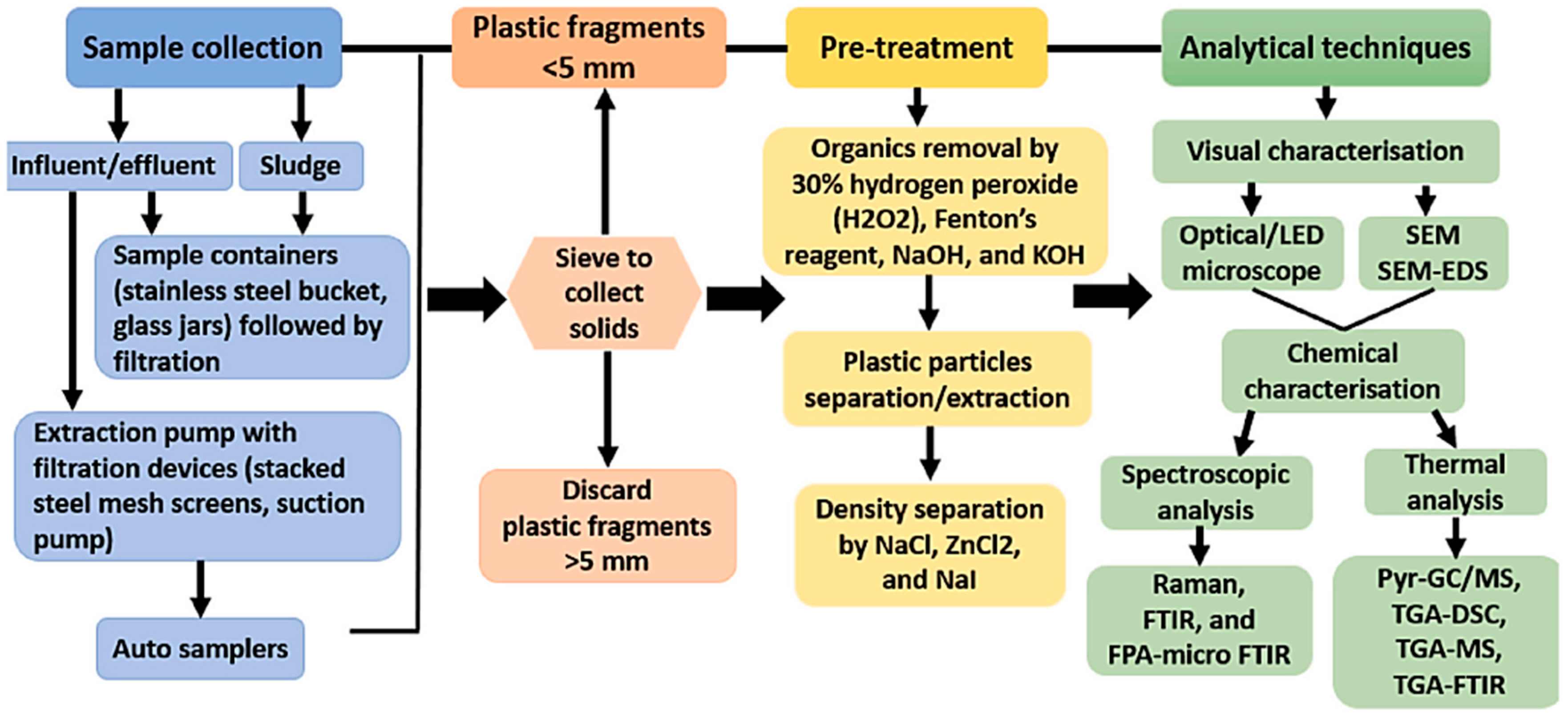
The growing presence of micro- and nano plastics in wastewater, particularly from the textile industry, poses a substantial environmental risk. Efficient detection, removal, and analysis of these contaminants are crucial to reduce their harmful effects on the environment and human well-being. Sirajum et al. [44] described an innovative method for eliminating micro and nano plastics from textile wastewater, employing a specialized technique involving the sampling of wastewater at various stages, including influent (wastewater entering treatment plants), effluent (treated wastewater discharged into the environment), and sewage sludge (residual solids generated during wastewater treatment). The proposed methods mark a crucial initial step in accurately characterizing and analysing microplastics and nanoplastics. Typically, sampling involves collecting wastewater in a container, such as a glass jar or stainless-steel bucket, and then subjecting it to filtration or using an automatic sampler for further analysis. Figure 4 shows the flow diagram of wastewater samples collection devices, pre-treatment methods, and analytical techniques used for NP/MP characterisation.
A comprehensive wastewater sampling protocol was employed, incorporating extraction pumps and filtration devices such as stacked stainless steel mesh screens, mobile membrane pumps, and suction pumps. Sieving processes utilizing filters with varying pore sizes and distributions were also applied to isolate micro and nanoplastics. Following these pretreatment steps, advanced analytical tools were used to further characterize and analyze the separated micro- and nanoplastics [63].

6.2. Removal of Micro and Nanoplastics from Wastewater

By implementing a combination of suitable methods, it is possible to effectively collect and analyze microplastics from both domestic laundering and industrial textile processes, thereby reducing their environmental impact. The conventional treatment processes used in water treatment plants include sedimentation, coagulation, flocculation, and/or density separation [64,65]. Several studies examined how well these treatment processes remove microplastics.

6.2.1. Removal Through Sedimentation

Sedimentation relies on gravitational settling and can remove 57–64% of suspended MPs during primary and secondary treatment stages [66]. Wastewater commonly contains microbeads and fragments, which may constitute up to 91.7% of detected particles [67]. Experimental simulations using polyethylene (PE) suspensions demonstrated that coagulation-assisted sedimentation significantly enhances removal efficiency [68,69].
Removal performance is highly pH-dependent due to changes in particle charge and coagulant speciation. For example, PE removal using polyferric sulfate (PFS) decreased from 80.3% at pH 5 to 29.85% at pH 9. The superior performance of PFS compared to polyaluminum chloride (PAC) and aluminum sulfate (AS) is attributed to its hydrolysis into polynuclear polymers that promote aggregation and settling. These findings underscore the importance of optimizing physicochemical conditions rather than relying solely on gravity-driven processes [70,71].

6.2.2. Removal Through Coagulation and Flocculation

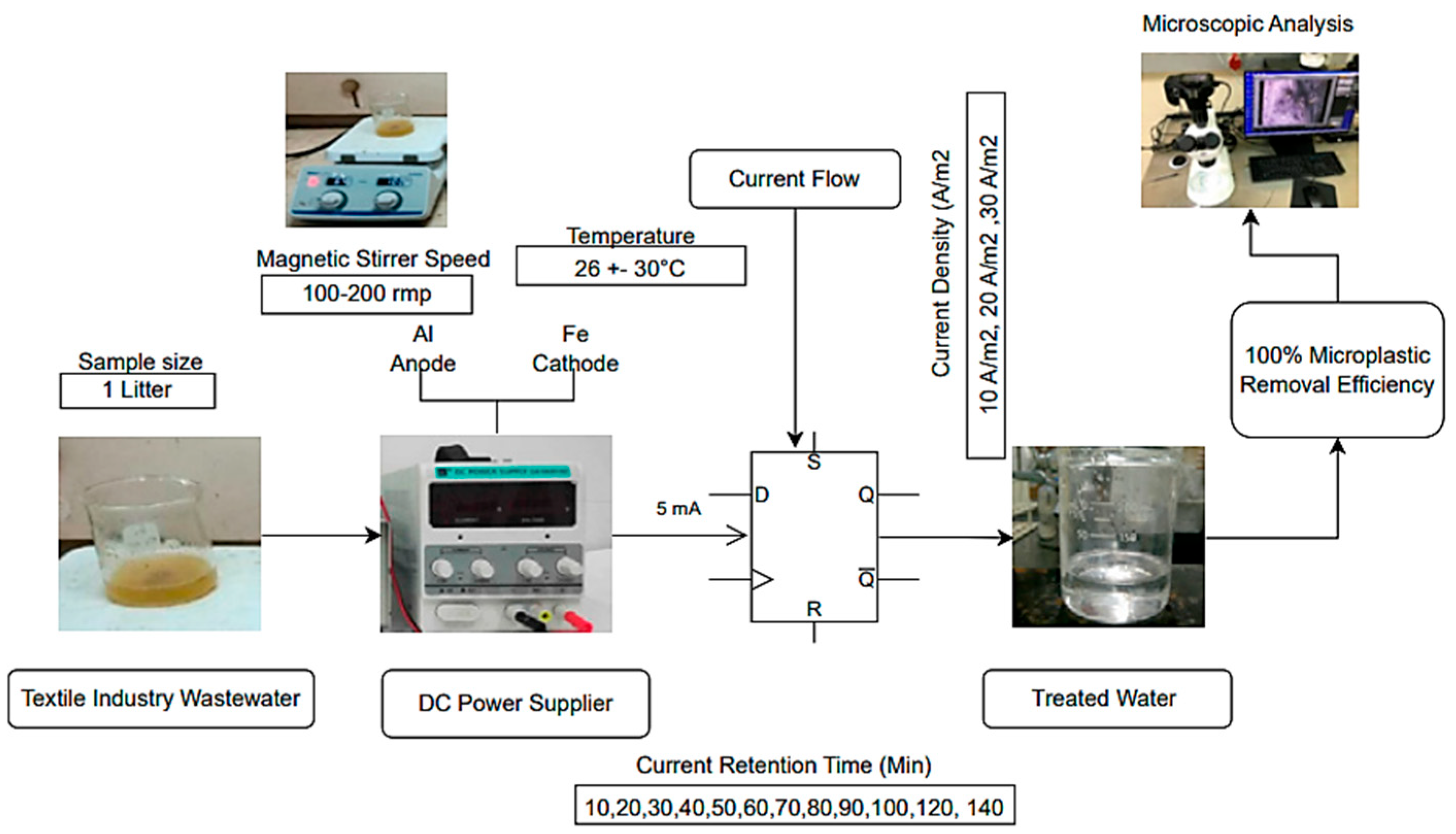
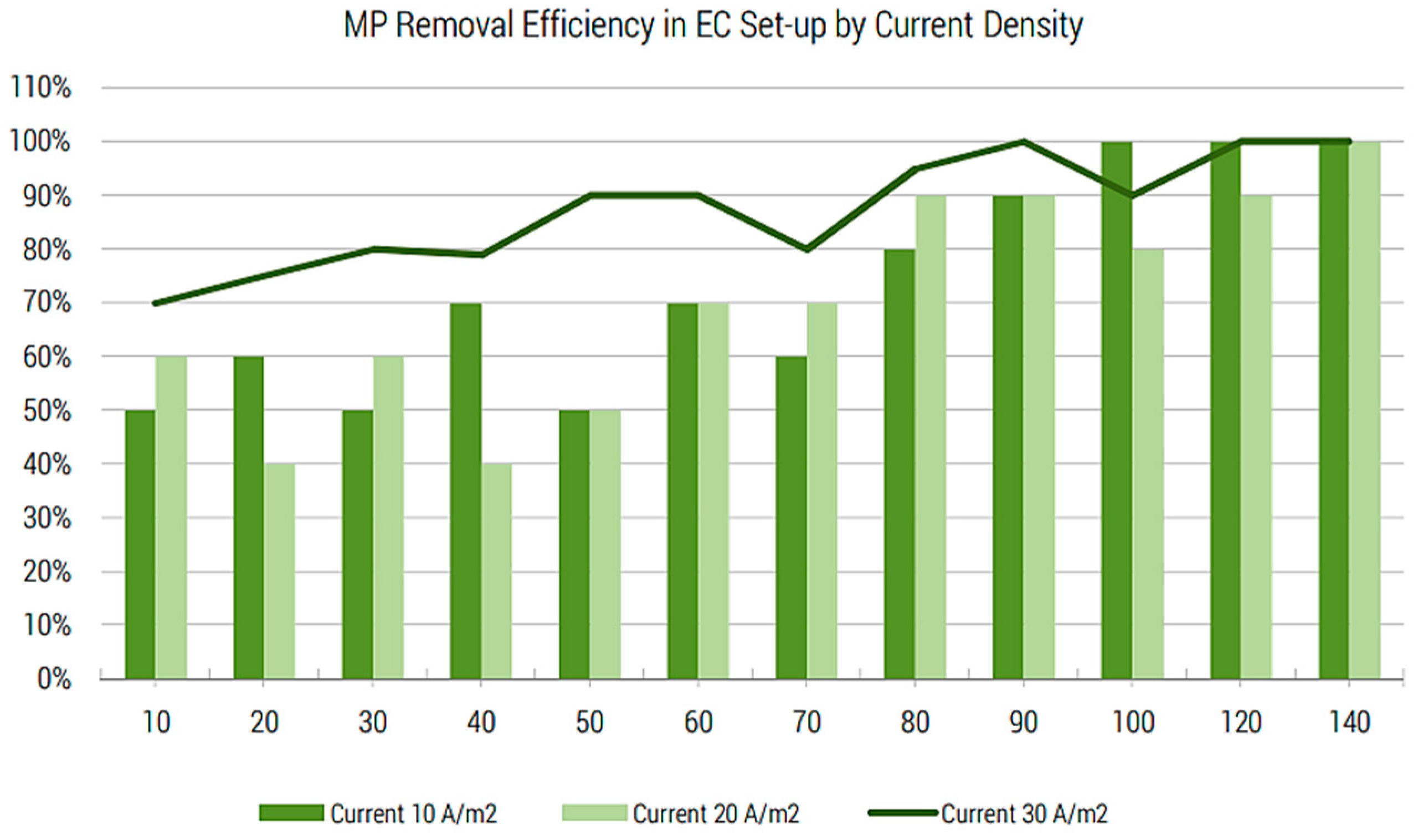
The process of coagulation, which is used to remove microplastics (MP) from water treatment plants, involves the hydrolyzed monomers of the positively charged coagulant adsorbing flocs onto the surface of negatively charged MP. Coagulation destabilizes negatively charged MPs by adsorbing hydrolyzed metal ions, reducing electrostatic repulsion, and facilitating floc formation [72]. Coagulants, including various aluminium salts (KAl (SO4)2.12H2O, Al2(SO4)3.18H2O and AlCl3.6H2O,) and iron salts (Fe2(SO4)3.9H2O, FeCl3.6H2O), are frequently used in the water treatment industry to settle MP to the bottom of the coagulation tank and collect them by producing flocculants. Aluminum-based salts generally outperform iron-based salts, particularly when combined with anionic polyacrylamide (PAM), which enhances sweep flocculation. Removal efficiencies of 82–84% have been reported for polyethylene and polystyrene MPs under optimized alum–PAM dosing [73]. Modified natural polymers, such as cationic starch (CS), have demonstrated removal efficiencies between 49.8–62.4%, with optimal performance at 90 mg/L. While promising, such systems require further validation under real wastewater matrices [74,75]. Electrocoagulation (EC) offers a more advanced alternative that uses metal ions to extract suspended metal nanoparticles (MNPs) from wastewater. Metal electrodes generate coagulant species in situ, while hydrogen bubbles aid flotation and separation [76]. Removal efficiencies exceeding 99% have been reported for 300 μm PE microbeads under optimized current densities [77,78]. However, operational parameters such as electrode configuration, current density, and pH significantly influence performance, and consistent 100% removal remains challenging. Although EC reduces chemical inputs and sludge production, scalability and energy consumption remain practical considerations. Furthermore, 100% MP removal efficiency is found to be uncertain within the system (Figure 5) [79].
According to Figure 6, different current densities at various times were observed to achieve 100% removal efficiency.
A 100% removal efficiency for microplastics was observed at 10, 20, and 30 A/m2. In a neutral pH environment, along with high current density, coagulant formation and bubble generation exceed normal values. In the state of high current density and high current supply periods current density, maximum removal with low current density has been shown in the recorded results [79].

6.2.3. Removal Through Flotation/Density Separation

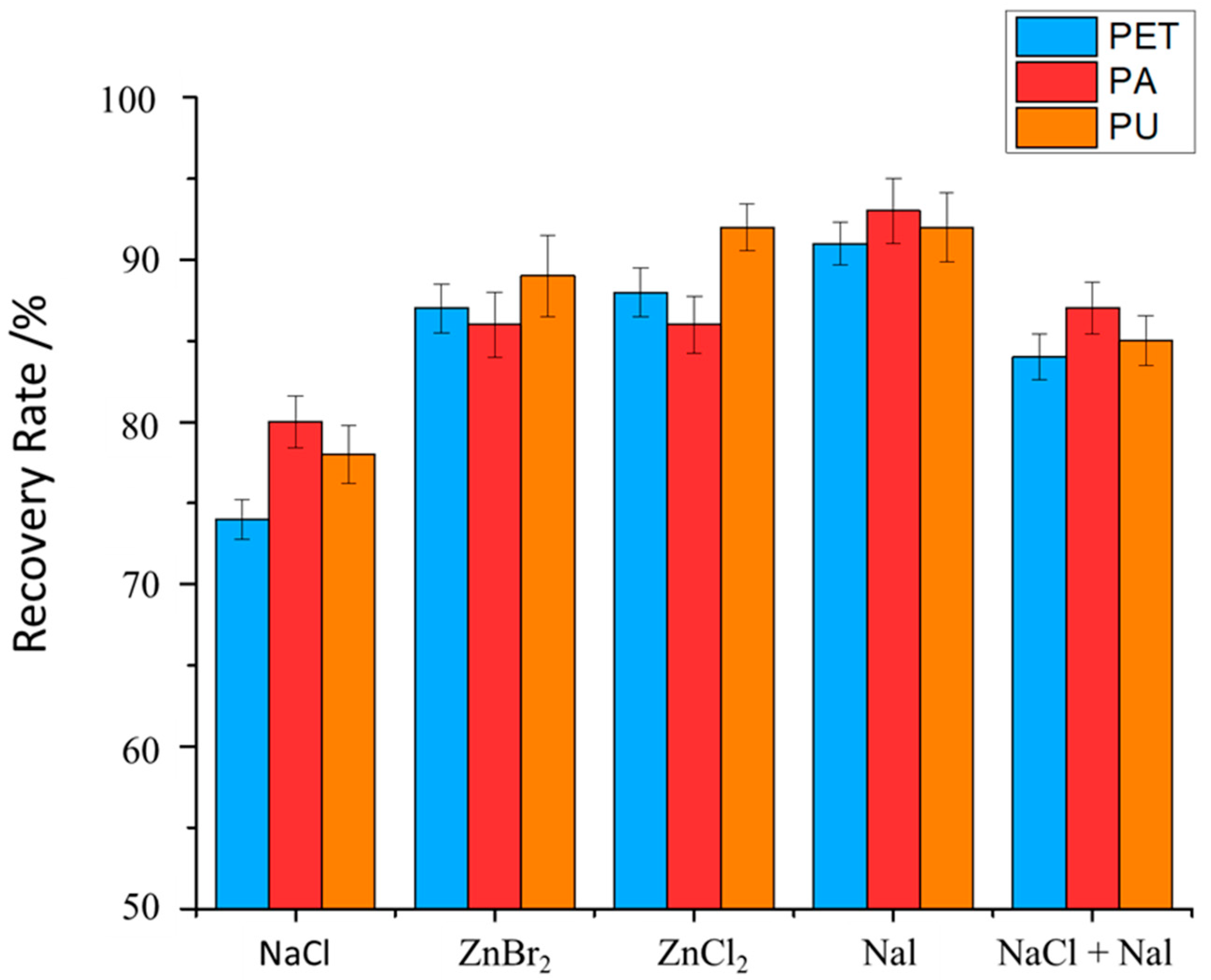
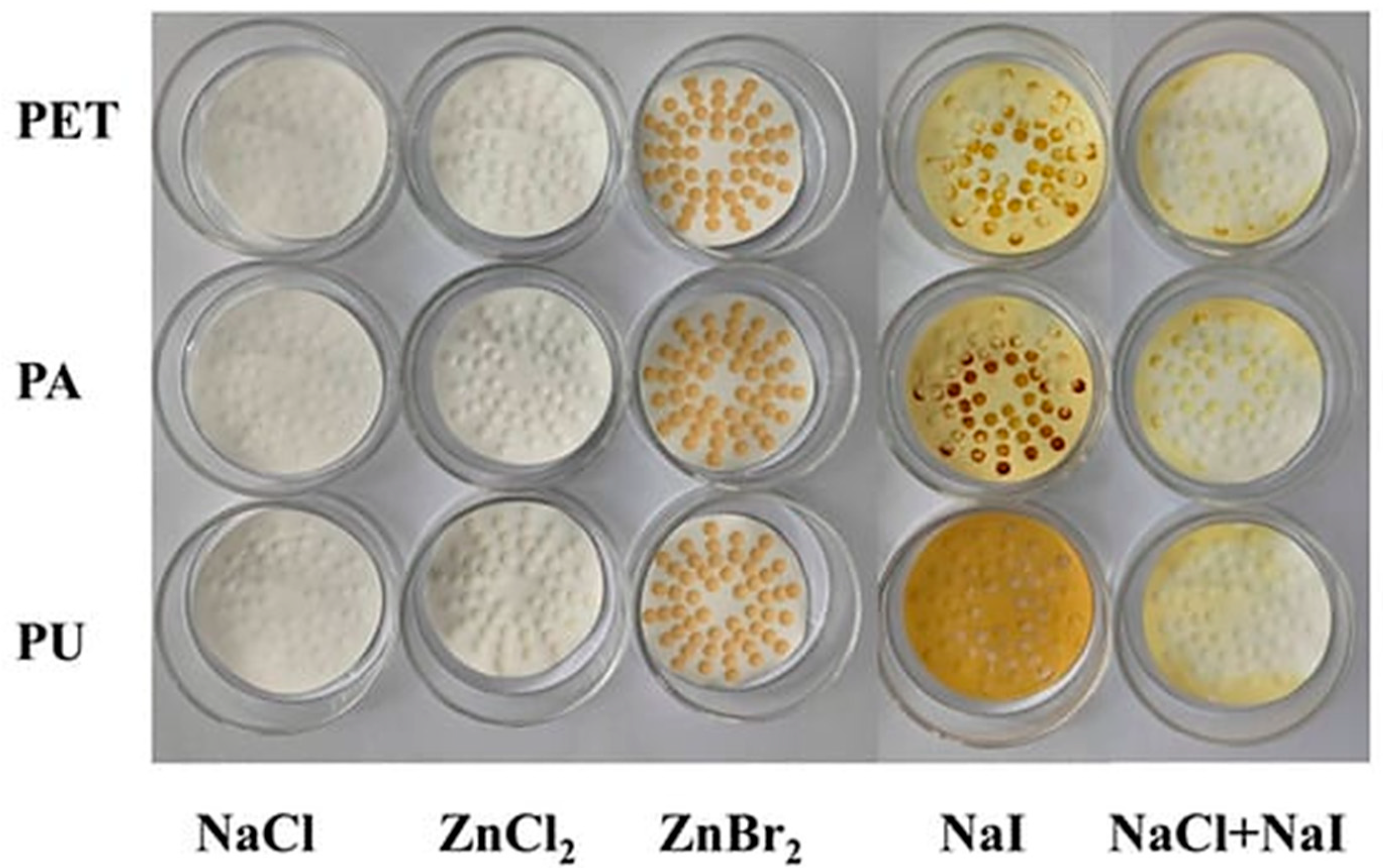
The flotation process consists of four fundamental steps. Primarily, bubbles form in wastewater. Gas bubbles are allowed to come into contact with suspended particles or oil droplets, the particles or oil droplets are allowed to stick to the bubble surface, and the air–solid mixture is raised in order to skim the floating materials [80]. Vacuum floatation, electrolytic floatation, dissolved air floatation (DAF), induced air floatation (IAF), and foam floatation are all methods of producing bubbles. In thick liquids, flotation is one of the most widely used methods for eliminating low-density plastic particles from silt or soil. Compared to the sedimentation process, dissolved air flotation is more costly to run and maintain, but it is an effective way to get rid of algae and low-density particles [81]. Flotation removes low-density plastics through bubble particle attachment and surface skimming [80]. Vacuum floatation, electrolytic floatation, dissolved air floatation (DAF), induced air floatation (IAF), and foam floatation are all methods of producing bubbles. Dissolved air flotation (DAF) is effective but operationally expensive compared to sedimentation [81]. Density separation using saline solutions remains a cost-effective laboratory technique for MP isolation [82]. A centrifugation step can be added to saline solutions after density separation to improve the ability to separate plastic from sediment and to collect microplastic fibers and granules from sediments [83]. Comparative assessments of NaCl, ZnCl2, NaI, ZnBr2, and mixed solutions reveal that NaCl, despite its low recovery (~74.2%), remains attractive due to cost and environmental compatibility [84,85,86,87]. The spiking recoveries of several textile microplastic density-separation solutions are shown in Figure 7.
Although NaCl solution can extract a wide range of microplastics, its use may be limited by oxidizing conditions and its high cost. The combined recovery of the two solutions was between them, suggesting that increasing the solution density could improve efficiency. The addition of NaCl controlled the oxidation of the NaCl solution on the filter membrane, thereby reducing the cost of the experiment (Figure 8). More methodical investigation is anticipated, as there are still unknowns about the separation of microplastics in mixed solutions [88]. ZnCl2 shows higher recoveries (up to 91.3%) and better repeatability than ZnBr2, which may leave interfering residues on filters. Nonetheless, most evaluations are conducted under simulated conditions, and performance in complex textile effluents requires further validation [89].

6.2.4. Removal Through Filtration Technologies

Filtration, including membrane technologies, plays a significant role in removing pollutants to purify water. Various techniques, including micro-, ultra-, and nanofiltration, as well as reverse osmosis, are often employed for water purification. Microfiltration (MF), a barometric process, usually differentiates suspended and colloidal particles (including plastic particles) from the water [90]. Ceramic microfiltration membranes have recently gained significant popularity due to their high operating temperatures, high mechanical stability, ease of regeneration, and resistance to harsh chemical conditions. Ultrafiltration retains particles larger than approximately 0.01 μm and is highly effective for removing microplastics (MPs), organic matter, and turbidity. Its relatively low energy demand and adaptability to both domestic and industrial applications enhance its practicality. Nanofiltration membranes (pore size 1–3 nm) efficiently remove electrolytes and low-molecular-weight organic compounds, including plastic-associated contaminants. Reverse osmosis combines non-porous and dense membrane characteristics under high pressure, enabling the removal of even monovalent ions. Membrane bioreactors (MBRs) integrate biological treatment with membrane filtration and have demonstrated removal efficiencies approaching 99% for MPs and nanoplastics (NPs) [91].
Sand Filtration
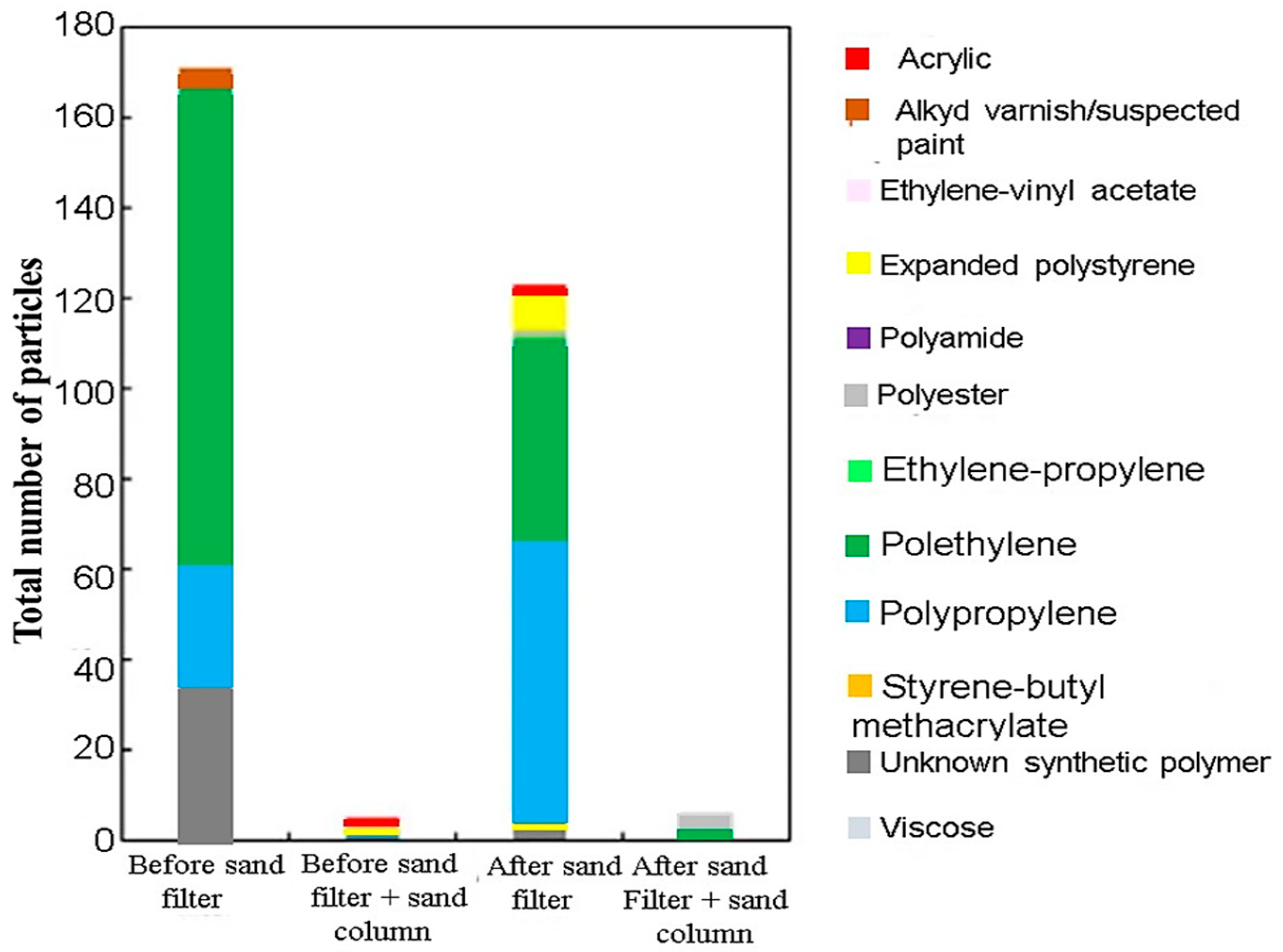
Sand filtration is a cost-effective technique frequently used in WWTPs to remove several components, serving as tertiary treatment. In one investigation, a lab-scale sand filter was used to remove MPs. Glass storage bottles of 2 L were used to collect wastewater samples from a plastic recycling plant, and characterization was performed based on size, shape, color, and polymer type using µ-FTIR and visual identification. They were categorized as beads, fragments, and fibers. A sand-filter column was used for sand filtration. Sand was cleaned using microplastic-free RO (Merck Millipore membrane filter with pore size of 0.22 µm) in two columns, burned at 550 °C. The typical particle size ranged from 0.7 to 1.4 mm. The columns were often covered with aluminum foil to prevent contamination. Considering certain strategic conditions, a flow rate of 7.24 cm3/min was used to filter the wastewater samples through a sand filter column with an internal diameter of 2.4 cm and a filter depth of 16 cm. In the control sample (collected), 9 particles, essentially fibers, were found, and the results were calibrated to the microplastic concentration in the control (Figure 9) [92].
Samples were digested with 10% KOH and filtered using GF/A glass fiber filters (pore size 1.6 μm, Ø 47 mm). Multiple blanks and chemical controls (10% KOH) were used to correct results. The lab sand filter removed virtually all detectable fractions in the examined samples, but variability in particle counts (often <1 particle·L−1 for some size classes) underlines limitations in quantification at low concentrations [92].
Microfiltration
Microfiltration (MF) comprises pressure-driven porous membranes (0–2 bar) with pore sizes ~0.1–10 μm. Laboratory and field studies report MP removal efficiencies up to 98.5% in controlled tests and 81.5–100% in drinking water treatment plants (DWTPs) and wastewater treatment plants (WWTPs) [93]. Four identical ceramic MF membranes and two commercially available ceramic MF membranes (Filtanium, TAMI Industries, Nyons, France) are used for comparison. The commercial membranes had substrate pore sizes of 4.5 μm and active layers of 0.8 and 0.14 μm; the TÜB˙ITAK membranes had substrates with 0.6 μm pores and 0.4 μm active layers. Bench-scale cross-flow rigs with pressure and flow monitoring, backwash and chemically enhanced backwash systems, and feed/permeate tanks were used to evaluate operational performance and MP retention [94]. Influent and secondary effluent MPs ranged in long-axis length from 17 to 427 μm, and short-axis diameters from 8 to 156 μm, with 20–60 μm particles being the most abundant; dominant polymer types included PP, PVC, PE, and rubber [94]. Removal principally follows size-exclusion; ceramic membranes with submicron active layers effectively retain MPs > ~10 μm, supporting high stable removal rates [95].
Ultrafiltration
Ultrafiltration (UF) membranes have pore diameters ~1–100 nm and operate at 1–10 bar. UF effectively removes MPs (1–5000 μm) and associated contaminants. For example, PE MPs (500–5000 μm) were removed from deionized water using a PVDF flat-sheet membrane with an average pore size of ~30 nm [96]. Luogo et al. (2022) [97] employed a SiC microfiltration membrane and a ZrO2 ultrafiltration membrane to investigate the removal of pollutants from laundry wastewater. Ultrafiltration (UF) membranes have pore diameters of 1–100 nm and operate at 1–10 bar. UF effectively removes MPs (1–5000 μm) and associated contaminants. For example, PE MPs (500–5000 μm) were removed from deionized water using a PVDF flat-sheet membrane with an average pore size of ~30 nm [97]. Polymer type, membrane surface properties (roughness, porosity, zeta potential, contact angle), and MPs’ hydrophobicity influence retention; studies indicate that PES UF membranes can outperform PVDF MF membranes in MP and nanoplastic removal when membrane materials are comparable [98].
Composite membranes (e.g., rGO/PAN) have been evaluated for treating effluents from a PET recycling facility located in the Silesian Province. Tests on process water (MP1) and raw wastewater (MP2) showed that rGO/PAN composites resist fouling better than unmodified PAN, yielding higher fluxes and reduced cake formation. Membranes with increasing rGO content exhibited greater surface porosity and higher permeate fluxes (membranes A–D: 85.0, 116.2, 139.3, and 320.5 L·m−2·h−1, respectively) and improved transport properties after repeated cleaning cycles [99,100]. The rGO/PAN composite membranes for the treatment of wastewater containing MPs are shown in Figure 10. Photographs of membranes after the two-stage UF process and three cleaning cycles. The pure PAN membrane (membrane 0) shows severe contamination and cake layer formation (white → dark brown), while rGO/PAN membranes (A–D) exhibit only slight discoloration with no visible cake layer. The amount of deposited impurities decreases from A to D [100].
Nanofiltration
Nanofiltration (NF) membranes (pore size 1–10 nm; 5–15 bar) remove low-molecular-weight organics and multivalent salts with a molecular weight cut-off (MWCO) of 200 Daltons from water and wastewater [101]. This method provides higher salt rejection and greater flux than reverse osmosis (RO) but requires elevated pressure. Limited studies on MPs indicate variable performance: an NF membrane with MWCO 400 Da removed MPs below detection in four of six samples and reduced concentrations from 0.018 to 0.002 MP·L−1 in two samples; further research is needed to optimize NF for MP removal [102].
Reverse Osmosis
Reverse osmosis (RO) uses dense membranes with effective pore diameters < 1 nm to remove monovalent ions and trace contaminants. RO typically achieves higher MP removal than conventional techniques; however, nanoplastics and MPs have been detected in RO permeate in some advanced treatment plants. Observed permeate fractions comprised ~60% fibers and 40% fragments, suggesting membrane imperfections, material properties, or larger effective pores allow some MP passage. RO should not be assumed to be an absolute barrier; identifying the mechanisms enabling MP persistence in permeate (membrane defects, fouling, material interactions) is essential to improve process design and risk management [1].
Membrane Bioreactors
Membrane bioreactors (MBRs) combine biological treatment with membrane filtration and include submerged and side-stream configurations. PVDF membranes are commonly used owing to larger pore sizes and reduced fouling propensity. Compared with conventional activated sludge (CAS), MBRs eliminate the need for a separate secondary settling tank, produce higher-quality effluent, and generate less sludge. MBRs perform well under short hydraulic retention time (HRTs), high mixed liquor suspended solids (MLSS), high loading rates, and extended sludge retention time (SRTs), and they demonstrate substantially higher MP removal than CAS [103]. Pilot-scale studies reported a reduction in MP concentration from 6.9 to 0.005 MP·L−1 (99.9% removal) when treating primary wastewater with MBR systems. CAS effluent concentrations were higher, ranging from 0.2 to ±0.06 MP·L−1, indicating that permeate from MBRs is typically much lower in MPs. Lares et al. [104] observed pilot MBRs reduced MP to 0.4 ± 0.1 MP·L−1 with 99.4% removal. Although MBRs can accumulate more MPs in sludge than CAS, their permeate quality supports their use where high MP removal is required [104].
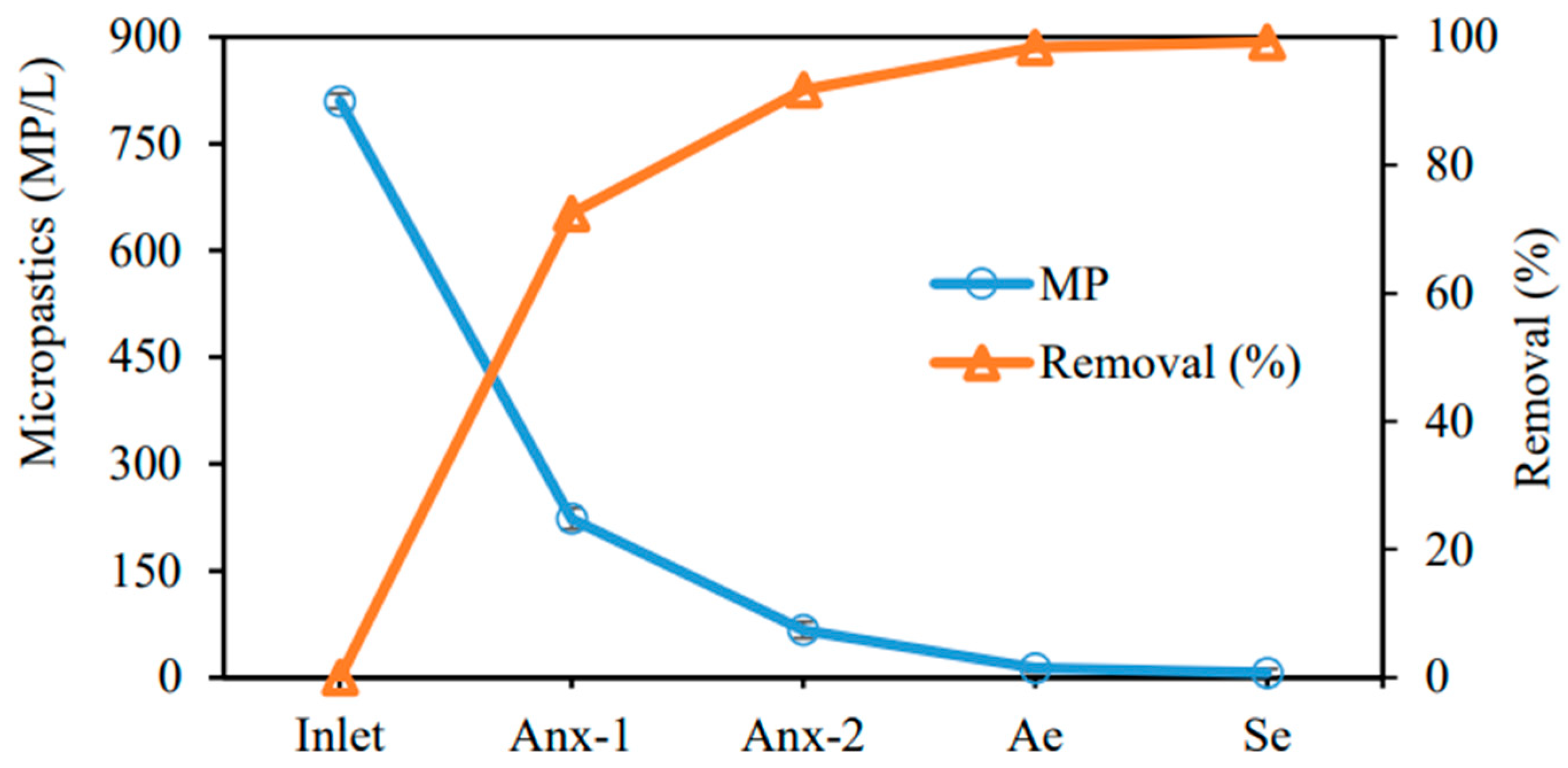
A lab-scale triple-phase biofilm A2O reactor (anoxic–anoxic–aerobic) with PET bio-carriers achieved overall MP removal of 99.18% over 53 days: anoxic-1 reduced MPs from 810 to 223.33 MP·L−1 (72.43%), anoxic-2 to 66.67 MP·L−1 (91.77%), aerobic to a further reduction (98.35%), and sedimentation produced final effluent ≈ 0.82% of influent MP concentration. These results align with literature reporting that A2O configurations can reduce MPs by 98% while primarily designed for nutrient and organic removal [105]. Figure 11 demonstrates the elimination of microplastics by means of the treatment processes comprising different steps over a span of 53 days in A2O reactor succeeding steady state.
Removal Through Adsorption
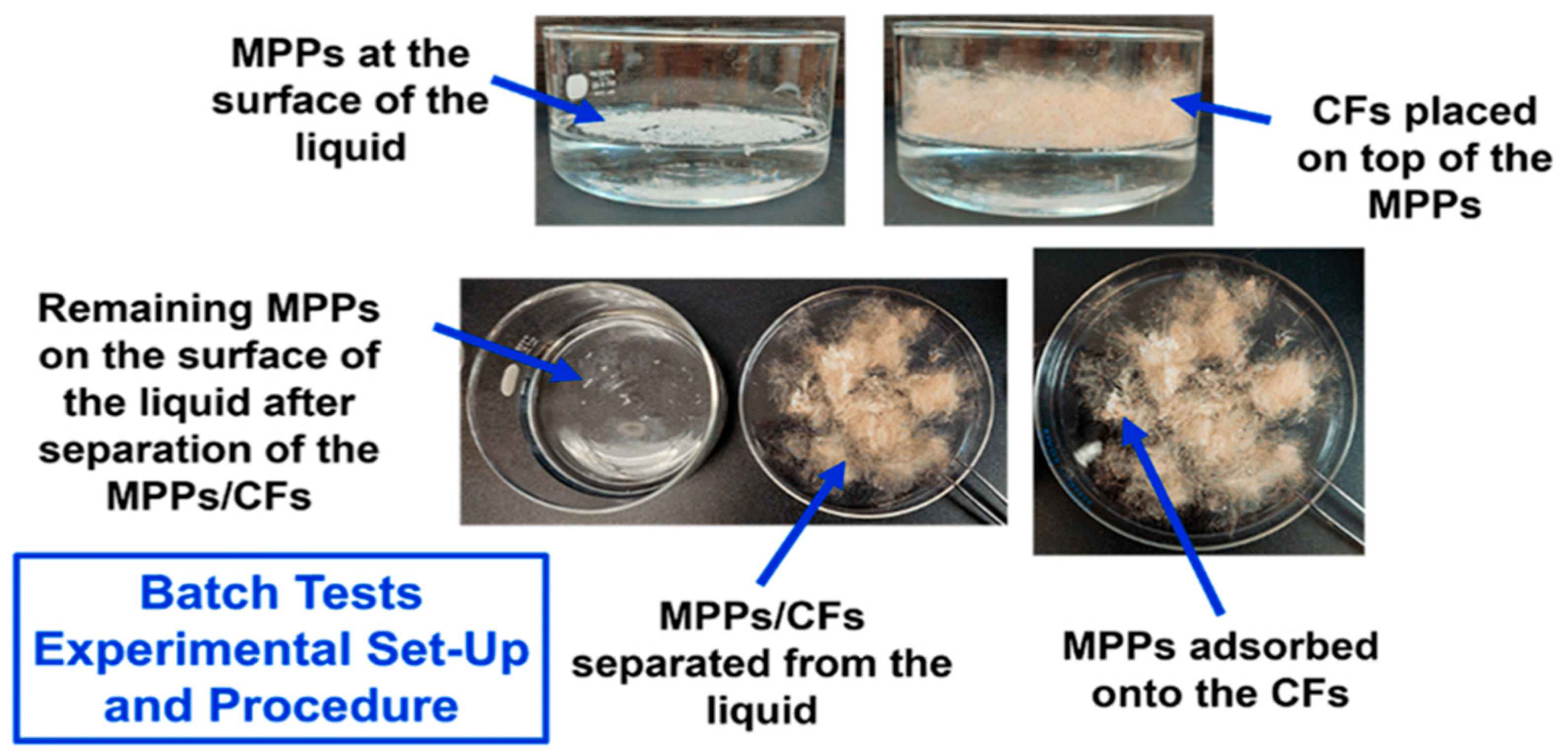
Adsorption is a widely used, effective sorption-based method for removing microplastics (MPs) and nanoplastics (NPs) from water [107], driven by electrostatic attraction, ion exchange, van der Waals forces, and π–π interactions. General sorbent efficacy is well documented; granular activated carbon (GAC) effectively removes MPs/NPs via electrostatic binding, with natural dissolved organic matter (Lake Geneva) enhancing removal three times than model water, and graphene-oxide 3D sorbents remove polystyrene MPs/NPs through strong π–π interactions [108]. Practical limitations include long contact times, costs, and secondary pollution from spent adsorbents unless they are reusable, so adsorption is often proposed as a pretreatment before advanced processes (RO, NF, AOPs) [109]. Natural sorbents such as cattail fibers (CF) have also been investigated for MP removal, with activated carbon (AC) used as a reference adsorbent. Batch adsorption experiments conducted in distilled water and produced water (PW; 2.1 wt% salinity and 105 ppm crude oil) demonstrated rapid adsorption driven by hydrophobic interactions rather than mechanical filtration. A fixed amount of CF (0.3 g) was added to MP-containing water, gently mixed to ensure contact, and subsequently separated and dried to determine the adsorption capacity gravimetrically. Repeated batch tests confirmed the feasibility of CF as a low-cost adsorbent for MP removal under varying water conditions [109,110]. The experimental setup and procedure utilized for the batch adsorption measurements are shown in Figure 12 [110].

6.2.5. Removal of Micro and Nanoplastics Through Degradation Methods Biodegradation

Microbial biodegradation uses extracellular enzymes from bacteria and fungi to depolymerize plastics into CO2 and H2O via hydrolytic cleavage and subsequent mineralization [111]. Species such as Bacillus spp., Brevibacillus spp., and Ideonella sakaiensis produce enzymes (e.g., PETase, MHETase) active against PET and other polymers; lignin-degrading fungi (laccases) also accelerate aromatic polymer breakdown [112]. Two processes are involved in the hydrolysis of plastics by enzymes: hydrolytic division and attachment to the polymer substrate [113]. Experimental studies demonstrate variable degradation rates depending on polymer type and microbial strain, with LDPE, HDPE, and polyester showing measurable but limited biodegradation under controlled conditions. Pure strains and microbial consortia, including Comamonas testosteroni, Alcaligenes faecalis, Aspergillus flavus, Exiguobacterium sp., and Pseudomonas tuomuresis, exhibit differing degradation efficiencies that can be enhanced through genetic modification or environmental pre-treatments such as thermo-photo oxidation. Notably, Ideonella sakaiensis efficiently degrades PET through the secretion of PETase and MHETase enzymes [114].
Photodegradation
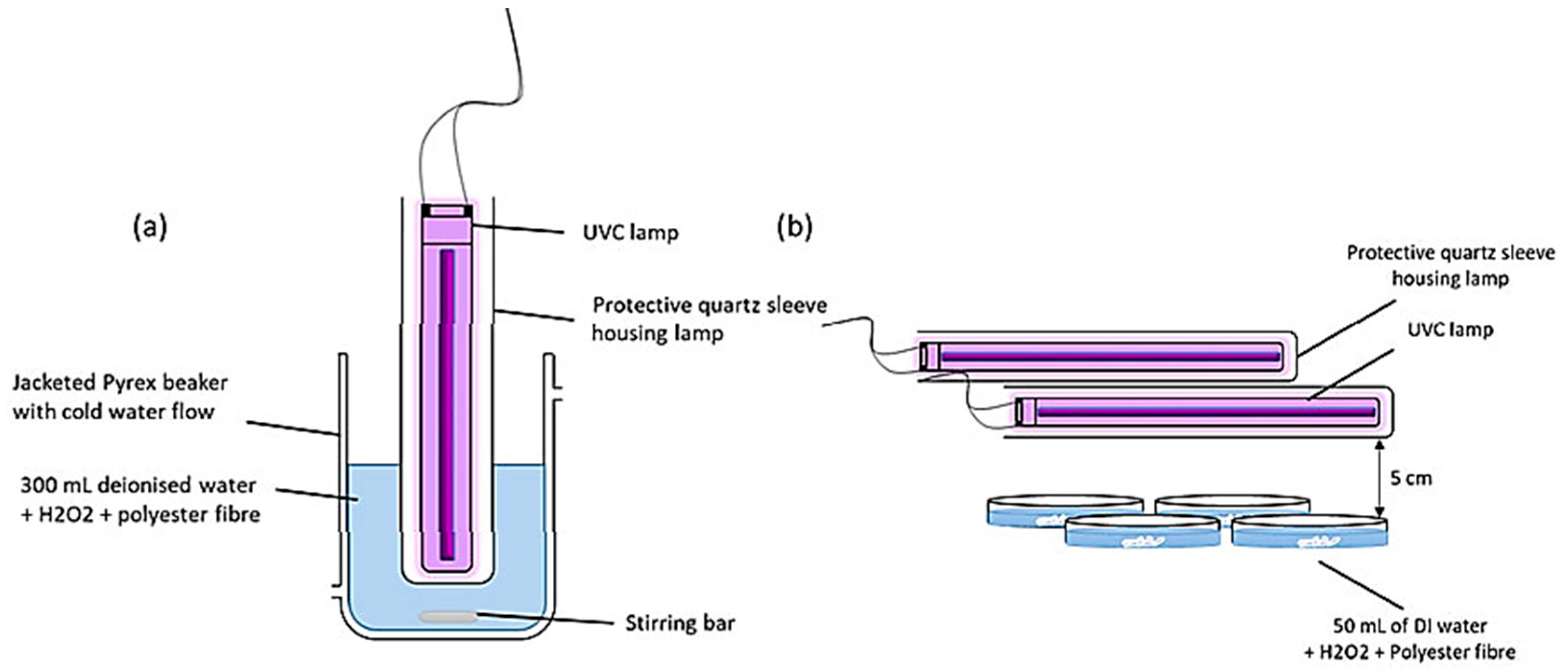
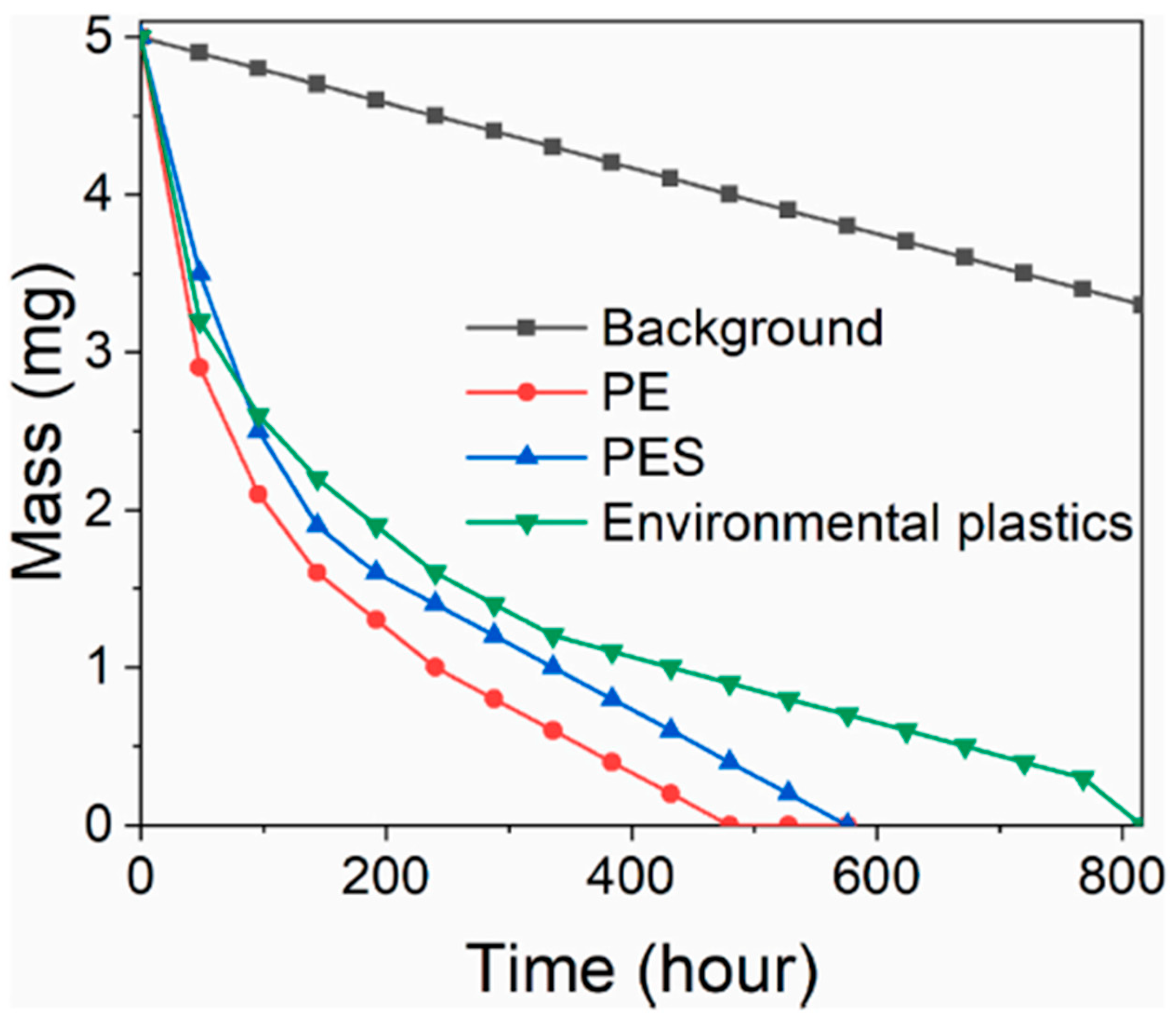
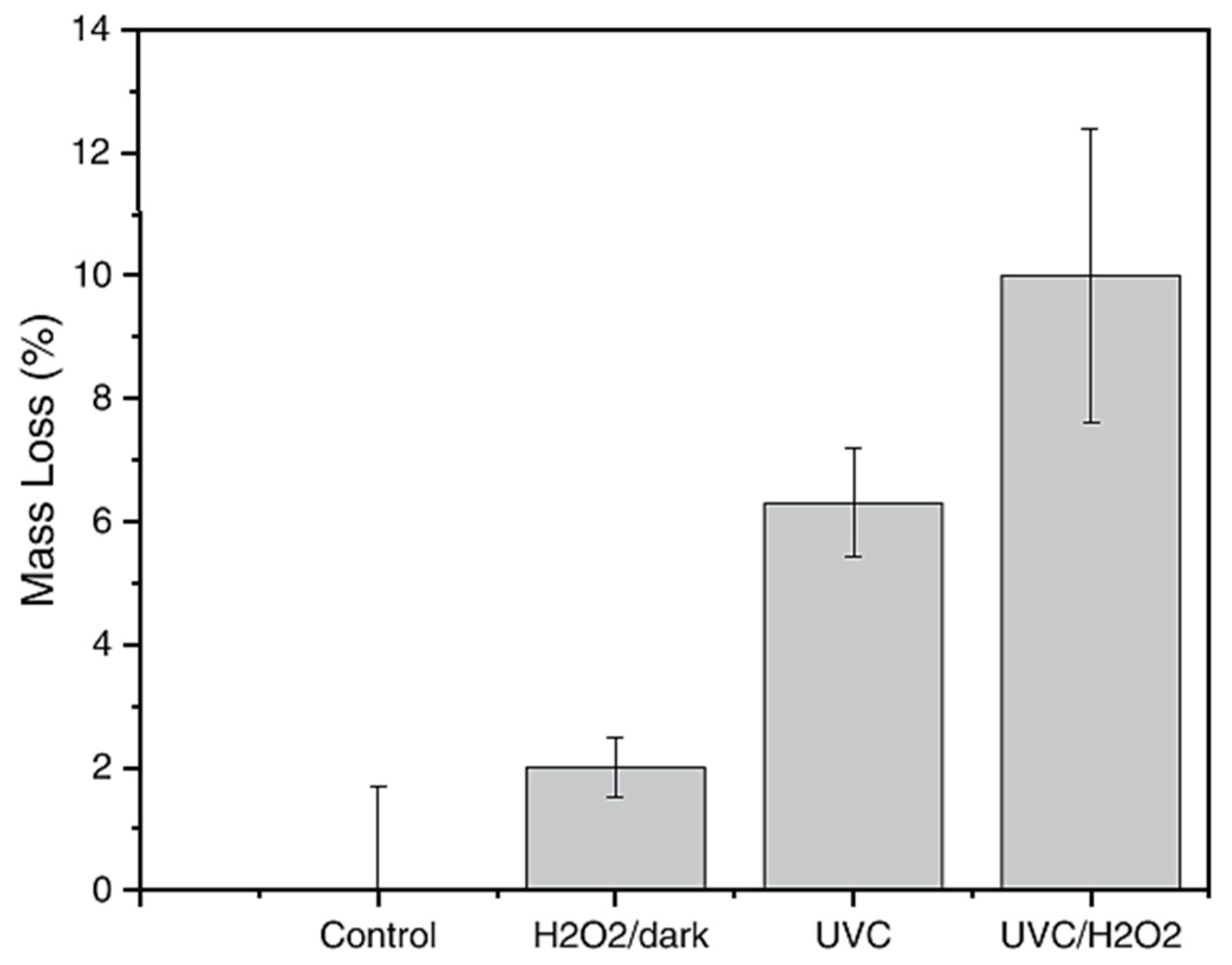
Plastic polymers undergo oxidative degradation upon exposure to light, leading to molecular chain scission, cross-linking, and the formation of gaseous and soluble byproducts. In natural environments, oxidative decomposition is the dominant pathway for the breakdown of microplastics (MPs) [115]. Xenon or UV irradiation increases surface area and hydroxyl group formation, weakening structural integrity and altering morphology, as confirmed by SEM analysis. Controlled UVC (254 nm) experiments on polyethylene terephthalate (PET) fibers in real wastewater matrices demonstrated limited degradation under single treatments. The reactor was protected from damaging UVC radiation leakage and outside light infiltration by a blacked-out fume hood (Figure 13). The procedure shown enhanced removal under combined photochemical oxidation. No mass loss occurred in dark controls, whereas UVC alone caused 6.3% mass loss, H2O2 alone 2%, and combined UVC/H2O2 achieved 10% degradation within 9 h [116].
The procedure shown enhanced removal under combined photochemical oxidation. The results are presented in Figure 14. No mass loss occurred in dark controls, whereas UVC alone caused 6.3% mass loss, H2O2 alone 2%, and combined UVC/H2O2 achieved 10% degradation within 9 h [116].
Photodegradation processes involve the effects of various photocatalysts and illumination on the chemical changes and degradation of different plastics. The degradation of microplastics depends on semiconductors such as TiO2 and ZnO, which serve as photocatalysts and sources of photons. The photogenerated electron (e) and hole (h+) pair are excited, initiating the photocatalytic process, when energy is required equal to or greater than the band gap energy (Eg). Since positive holes (h+) are produced in the valence band (VB) when electrons (e) in the VB move to the conduction band (CB), the process gains more from the small band gap [117]. The excited electrons from these charged particles will combine with the dissolved oxygen in the water to form superoxide radicals (O2−), which will then break down into hydroxyl radicals (OH) after they have settled on the surface. Reactive oxygen species (ROS) like this aid in the breakdown of plastics and organic pollutants. The valence band (VB) generates positive holes (h+) when electrons (e) go to the conduction band (CB). The excited state of these charged particles might cause them to settle on the surface. When excited electrons in water combine with dissolved oxygen, they produce superoxide radicals (O2−), which then break down into hydroxyl radicals (OH) [118]. Modified catalysts (C, N–TiO2) and oxidant-assisted systems (H2O2, Na2S2O8) further enhance degradation efficiency, particularly for smaller or pre-weathered particles [119,120,121]. TiO2/ZnO catalysts exhibited high efficiency in degrading microplastics (MPs) with diverse morphologies and chemical compositions and were therefore applied to environmental MPs, provided particle size allowed effective mixing with the tetrapod photocatalyst. As shown in Figure 15, all investigated MP types achieved complete mass loss, although degradation rates were material-dependent. These findings confirm the effectiveness of TiO2/ZnO core–shell catalysts for photocatalytic microplastic degradation [122].

6.2.6. Removal of Micro and Nanoplastics Through Electrochemical Oxidation

Advanced oxidation processes (AOP) involve oxidation reactions that utilize reactive oxygen species (ROS) to break down stubborn pollutants in water. The most commonly used AOPs in wastewater treatment facilities are UV light and chlorination. When chlorine, a disinfectant, is applied, it can degrade MNP by severing existing chemical bonds and forming new chlorine–carbon bonds, which may heighten toxicity and hydrophobic characteristics [123]. UV oxidation alters the chemical and physical properties of MP, leading to breakdowns such as granular oxidation, cracks, and flakes. MP that develops cracks and flakes can easily fragment into smaller pieces. UV light produces peroxy free radicals by breaking C–C bonds, which, in turn, lead to the breaking of polymeric chains. Ozonation can degrade the MP polymer structure into functional groups containing oxygen, significantly reducing MP levels and altering their physicochemical properties. Research has shown that approximately 90% of MP can be removed within 30 min of ozonation and over 90% decomposition of MP after 60 min at temperatures ranging from 35 to 45 °C. AOPs are a viable alternative to eliminating MP from the environment, but insufficient oxidation can produce hazardous byproducts that negatively impact both the ecosystem and human health. More research is necessary to investigate these potential alternatives [124]. The significant progress this electrochemical method has made in wastewater treatment has made it increasingly vital over the past two decades. It consists of two electrodes, the anode and cathode, which are linked to a power supply. When enough energy and a supporting electrolyte are provided, powerful oxidizing agents are generated. These agents decompose contaminants, resulting in the production of CO2, H2O, and various intermediates, or they can lead to complete mineralization [125]. Anodic oxidation (AO) and indirect cathode oxidation are the two main types of electrochemical oxidation. Among these, anodic oxidation is the most common and widely recommended method. This technique involves the direct oxidation of organic contaminants on the anode surface through charge transfer. On the other hand, indirect oxidation of pollutants uses hydroxyl radicals or other reagents in aqueous solution, such as hydrogen peroxide, ozone, and peroxymonosulfate. The Electro-Fenton method (EF) is another name for indirect cathode oxidation. This method uses a catalytic mechanism employing Fe2+ to break down hydrogen peroxide, producing reactive oxygen species (ROS), especially hydroxyl radicals. Organic pollutants degrade via a redox process initiated by these free radicals. A TiO2-based EF system effectively degrades PVC microplastics, achieving over 55% weight removal and 75% dechlorination at 0.7 V versus Ag/AgCl over 6 h at 100 °C. Furthermore, a study by Moreira et al. highlighted that sulphate and hydroxyl radicals are highly effective in eliminating persistent organic pollutants from water [126]. Cosmetic microplastics, primarily composed of polyethylene, can be effectively broken down by sulphate-based free radicals. To break down and remove organic pollutants and microplastics, this process is enhanced by the use of effective heterogeneous catalysts that generate free radicals. The Electro-Fenton process is renowned for its sustainability, offering excellent controllability, minimal secondary or tertiary pollution, and ease of operation. This is a promising approach to addressing the issues caused by environmental cosmetic microplastics [127].

6.2.7. Removal of Micro and Nanoplastics Through Magnetic Extraction

Microplastics can be effectively removed from wastewater through magnetic extraction methods. This process employs external magnetic forces, oxalic acid as a ferrous di-sorbent, and magnetic seeds composed of iron nanoparticles to isolate MP from seeds. The utilization of iron-based nanoparticles is attributed to their cost-effectiveness, ferromagnetic properties, and enhanced specific surface area. To ensure hydrophobicity, hexadecyltrimethoxysilane was applied to the nanoparticle surfaces, facilitating the adhesion of plastic particles. Nearly 92% of polyethylene (PE) and polystyrene (PS) beads in the 10–20 μm size range can be effectively removed. In contrast, microplastics such as polypropylene (PP), polyvinyl chloride (PVC), and polyethylene terephthalate (PET), which are smaller than 1 mm, have been removed at rates of up to 93%. Furthermore, 78% and 84% of medium-sized MPs (ranging from 200 μm to 1 mm) were successfully extracted from sediment and freshwater, respectively. Consequently, this method proves advantageous for removing small plastic particles less than 10 μm. The fact that these nanoparticles cannot be recycled and are not biodegradable adds to secondary contamination. Furthermore, by negatively impacting the nanoparticles, the presence of soil particles and lipophilic compounds may reduce the effectiveness of plastic removal [128]. Wang et al. recently presented TiO2-based photocatalytic micromotors for MP removal in aquatic environments [129]. The authors introduced two innovative methods for microplastic extraction: the shoveling effect, which increases microplastic mobility in a magnetic field to improve segregation, and phoretic interaction, which eliminates primary microplastics from personal care products. However, confirming micromotors’ selectivity and acknowledging the presence of plastic pieces remained a challenge [130]. Nano-Fe3O4 was used to magnetize MP at a concentration of 0.5 g·L−1. Five groups of nano-Fe3O4 were added to the mixture after the MP composition was set at 900 μm. The MP magnetized as a result of the nano-Fe3O4 adsorbed on its surface after stirring. A magnet was then used to eliminate, separate, and filter the magnetized MP. The ideal concentration of nano-Fe3O4 was determined by evaluating the removal efficiency. In the artificial seawater environment, the removal rates for size-different microplastics, specifically PET, PS, PP, and PE, were 88–98%, 84–98%, 84–97%, and 77–95%, respectively. The removal rates for the other three types of microplastics, except for PET, followed a pattern similar to that observed in the pure water system. This suggests that the removal efficiency of medium-sized (~500 μm) microplastics was lower than that of larger (~900 μm) and smaller (~200 μm) microplastics. [131]. Table 1 provides a detailed comparative analysis of various technologies utilized for microplastic removal. It highlights the specific limitations associated with each method, evaluates the efficiency of the removal processes, and discusses the challenges inherent to these techniques. Additionally, the table addresses the issue of sludge generation, which can occur as a byproduct of these microplastic removal methods, offering a comprehensive overview of their effectiveness and drawbacks.

7. Carbonization of Microplastics

Polymer-derived carbon materials are highly tunable thanks to the wide chemical diversity, structural flexibility, and processability of their precursors. The carbonization process—thermal decomposition in controlled atmospheres—removes heteroatoms, reorganizes carbon atoms into aromatic clusters, and produces amorphous, turbostratic, or graphitic structures depending on the method and thermal conditions. Recently, growing focus on energy storage, clean manufacturing, and sustainability has increased interest in carbonization techniques that allow precise control over morphology, porosity, surface chemistry, and graphitic order. This review examines polymer carbonization methods, highlighting their advantages, limitations, mechanisms, and suitability for various applications. Carbonizing polymers creates customizable carbon microstructures, with tunable porosity and physicochemical properties, supporting applications ranging from structural composites and filtration media to electrode materials for batteries and supercapacitors. It covers the fundamental mechanisms of polymer carbonization and evaluates key techniques, including thermal pyrolysis, hydrothermal carbonization, microwave-assisted carbonization, plasma and laser conversion, catalytic and template-assisted methods, and chemical activation. The review also discusses structure–property relationships, precursor choices, and emerging trends in sustainable, low-energy approaches. It concludes with insights into future research prospects and potential applications of polymer-derived carbons in next-generation technologies. Techniques such as thermal carbonization (inert-atmosphere heating) and hydrothermal carbonization (hot, compressed water) are central to converting polymers into carbon-based materials for applications such as energy storage and EMI shielding. These methods often involve an activation step using physical or chemical agents to develop porosity and enhance performance. Other advanced techniques, such as laser carbonization and electrospinning combined with carbonization, enable shape control and the incorporation of specialized functionalities. Converting plastic waste into carbon materials generally involves high-temperature heat treatment under various conditions, such as oxidative or inert atmospheres, with or without catalysts, at atmospheric or elevated pressures. This process, known as carbonization, transforms organic precursors like plastics into carbon products. These products include amorphous carbons—such as activated carbon, carbon fibers, and carbon spheres—and graphitic carbon nanomaterials, including carbon nanotubes and graphene [132,133,134,135].

7.1. Anoxic Pyrolysis Carbonization

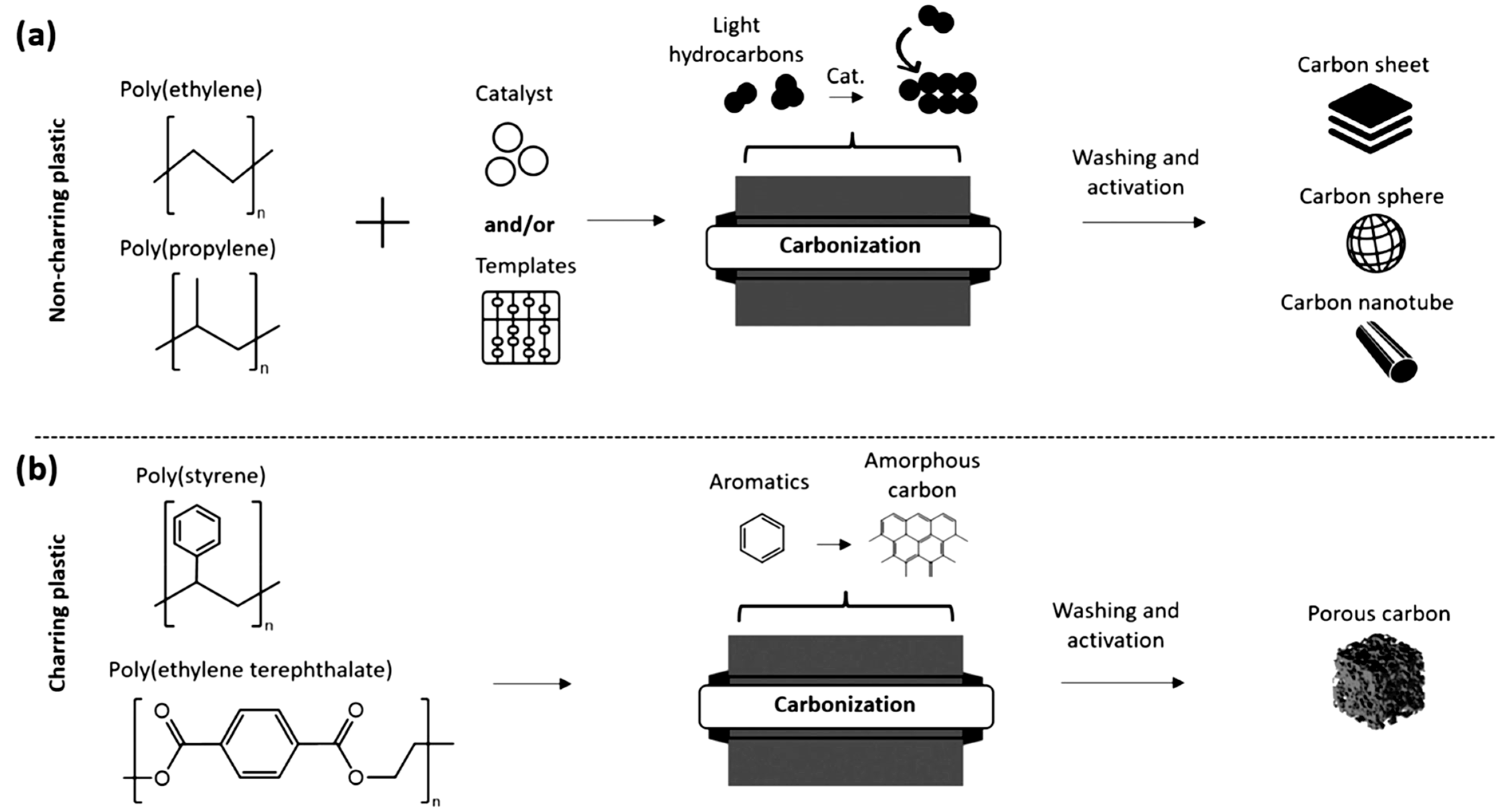
Anoxic pyrolysis carbonization involves heating plastics (polymers) at high temperatures under atmospheric pressure in an inert atmosphere like N2 or Ar. In this process, most carbon atoms in plastics convert into carbon materials via aromatization, while some carbon and non-carbon atoms—such as H, O, N, and Cl—are released as gases, including H2O, CO2, CO, H2, CH4, NH3, and HCl. For oxygen-containing plastics like cellulose, poly(ethylene terephthalate) (PET), and resins, carbonization can also occur through direct high-temperature heat treatment in an inert atmosphere, owing to oxygen atoms in their macromolecular chains, a process termed anoxic pyrolysis carbonization [136,137]. For oxygen-free plastics, such as polyacrylonitrile (PAN), polyolefins, and polyvinyl chloride (PVC), a stabilization process is necessary before carbonization. This involves pre-oxidation and pre-chemical treatments to stabilize the carbon chains, a step known as stabilization, followed by carbonization [138]. During the carbonization of PET and PS, which contain benzene rings in their structures, aromatics and oil products are generated. These compounds subsequently contribute to the formation of amorphous carbon [139]. This results from cyclization, aromatization, and cross-linking, rather than degradation into small molecules [140]. Consequently, polyolefins like PP and PE are regarded as non-charring, whereas aromatic plastics such as PET and PC are classified as charring plastics, as illustrated in Figure 16 [141]. Noncharring plastics are beneficial for producing structured carbon materials like graphene and carbon nanotubes through catalytic synthesis. Conversely, charring plastics usually produce amorphous carbon. Further activation, via chemical or physical methods, can enhance the surface area and porosity of these materials.
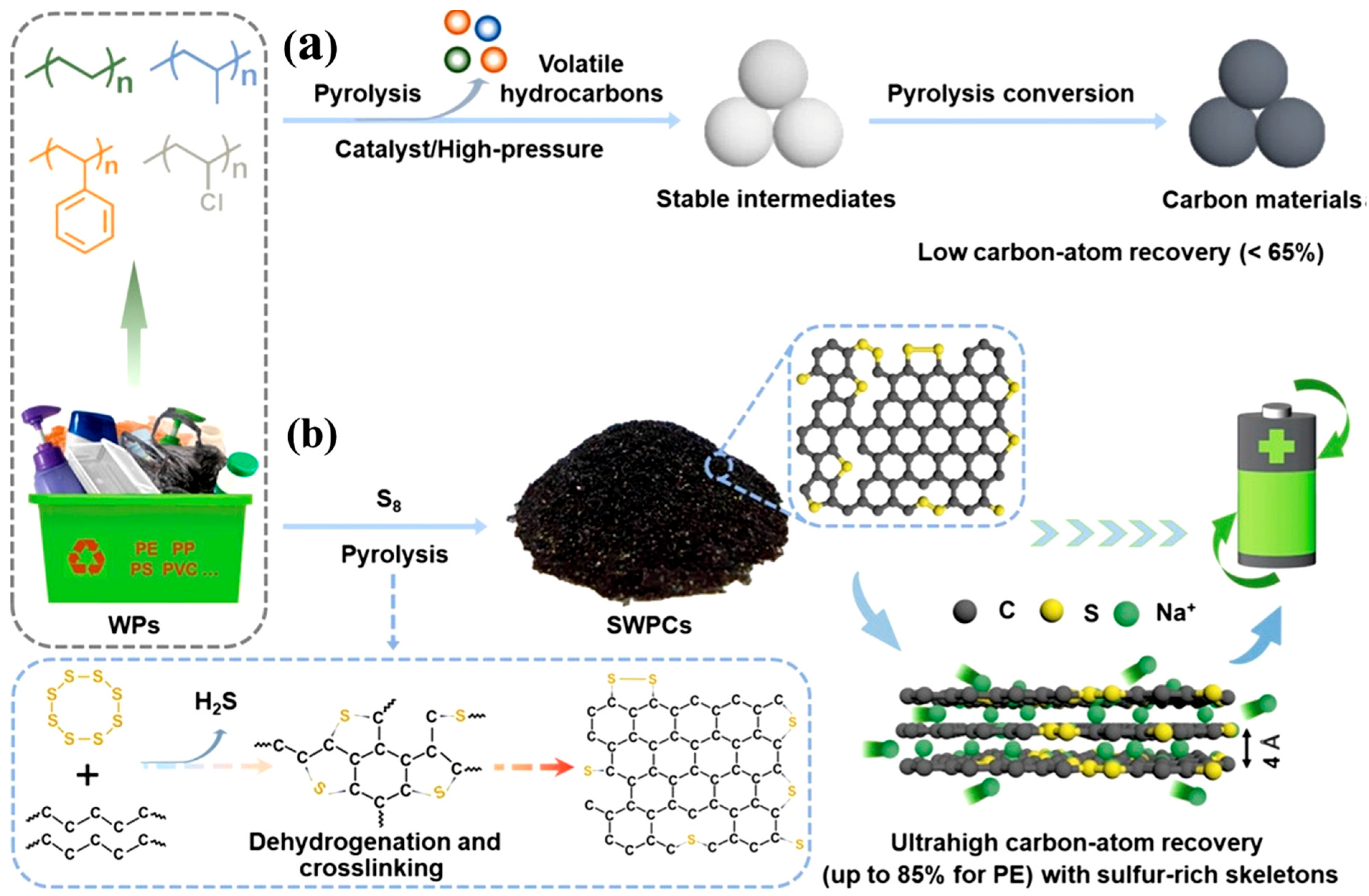
Plastic pyrolysis generally consists of two main reactions: thermal degradation into small hydrocarbons and thermal crosslinking into stable polymeric intermediates that produce carbon materials. As the process mainly involves thermal breakdown, waste plastics like PE, PP, and PS are usually completely converted into small hydrocarbons during direct pyrolysis, leaving minimal to no carbon residue. To promote the formation of thermally stable polymeric intermediates and enhance the process of converting plastics into carbon materials, researchers are developing additional catalysts and high-pressure equipment [142]. Tang et al. used a sulfur-assisted pyrolysis method to convert daily plastic waste into high-value carbon, achieving an extremely high carbon atom recovery rate (Figure 17) [143].

7.2. Hydrothermal Carbonization (HTC)

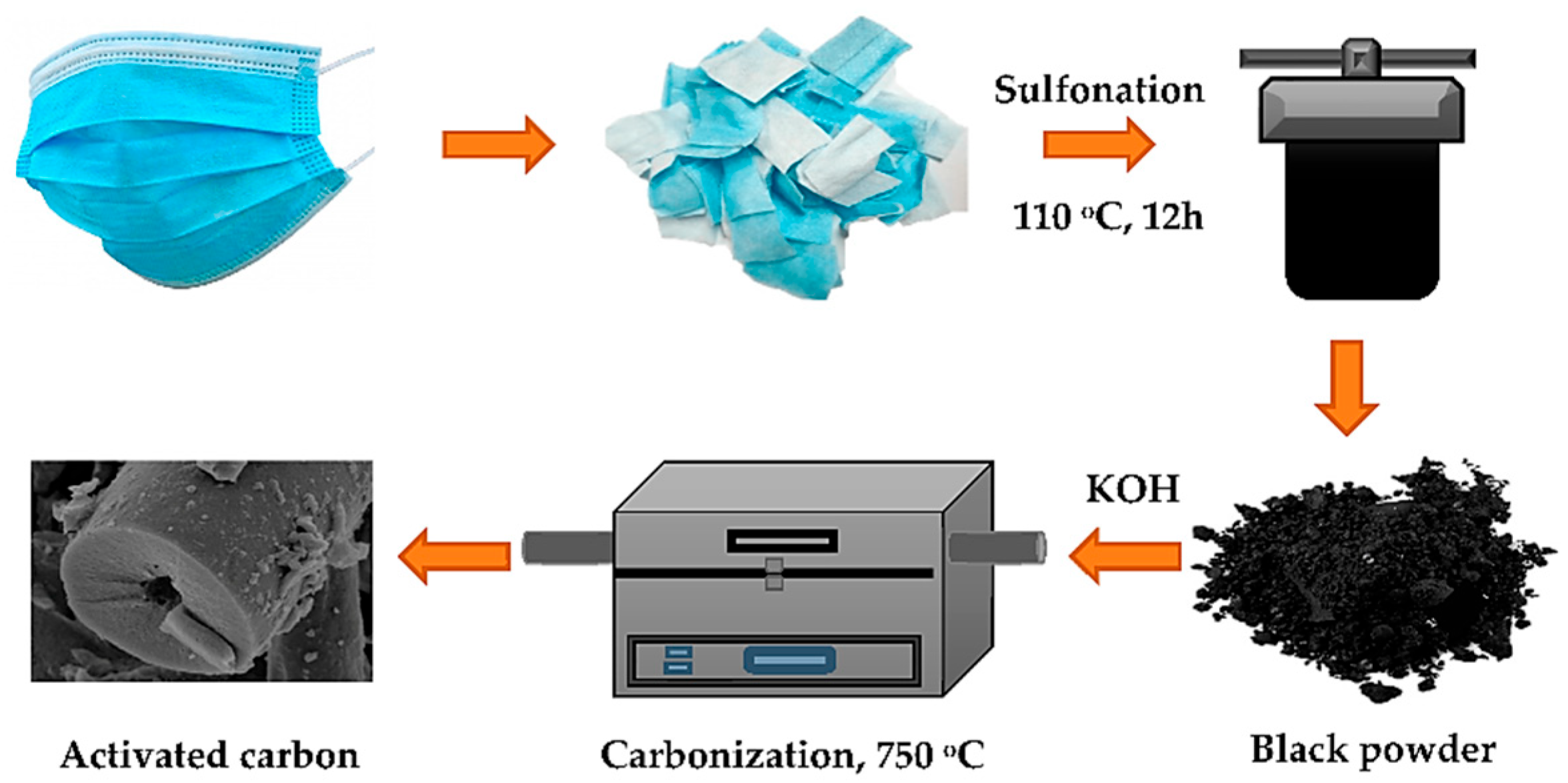
Hydrothermal carbonization (HTC) processes biomass, including organic waste like plant and plastic waste, in a water environment at high temperature (100–250 °C) and pressure. In this condition, water stays liquid but behaves differently—it’s a highly polar solvent with increased ionization and a reduced dielectric constant. These properties improve water’s ability to dissolve and react with organic materials, including polymers. For plastic waste, subcritical water hydrolysis promotes breaking polymer bonds and attacking polymer chains, resulting in the release of monomers and the fragmentation of polymers into smaller pieces [144,145]. Modern HTC applications utilize a diverse range of waste materials, including biomass, municipal solid waste, plastics, and bulk textiles, as feedstocks. Their aim is to generate solid carbon, various gases such as CO2, CO, CH4, and C2H4, and oil products [146,147,148]. HTC of plastic microfibers offers enhanced control over products compared to bulk plastics, thanks to their cleaner and more well-defined composition. The solvent selected also significantly influences the physical characteristics of the final product. This process involves an exothermic reaction where the waste polymer’s carbon content is transformed without oxidation. Hu et al. integrated sulfonation, hydrothermal treatment, and carbonization of porous polymers to recycle FM waste, as illustrated in Figure 18 [149].
Recently, low-temperature HTC has also been used to convert common household plastics such as PVC. PVC can be converted to carbon via low-temperature HTC due to its high reactivity toward chlorine substitution [151,152]. Low-temperature HTC is mainly applied to biomass to produce new carbon-based materials with nanostructures, such as spherical, fibrous, or sponge-like mesoporous carbons [153,154]. Different feedstock types and hydrothermal conditions can impact the efficiency of hydrothermal processes on plastics, leading to varied reaction mechanisms and end products. Understanding these mechanisms presents opportunities for future research to enhance polymer monomer production and minimize by-products. The success of HTC processes depends on several crucial factors: temperature, heating rate, pressure, reaction time, water-to-waste ratio and quality, waste characterization, particle size, biomass presence, mixing methods, catalyst type, and reactor design. Temperature plays a vital role, as it affects product properties, yield, and the energy required to break waste bonds. Different substrate types have different optimal temperature ranges, and the ideal temperature window varies slightly with the substrate’s melting point [155,156]. Ong et al. (2024) [157] suggest that the optimal HTC temperature for LDPE generally falls between 200 and 250 °C. Reaction times, influenced by desired product qualities, typically range from 1 to 3 h. Usually, around 240 °C is seen as ideal for enhancing carbon content and lowering nitrogen levels in the hydrochar, with about 2 h of reaction time being effective at this temperature [157]. Kaewtrakulchai et al. (2024) found that the optimal HTC temperature for PS is around 215–230 °C. The reaction typically lasts from 2 to 8 h, depending on the setup and desired outcomes. This temperature and time range facilitates effective conversion while preserving the material’s integrity [158]. Recent research has investigated the transformation of laundry microfiber waste into carbon materials via hydrothermal carbonization (HTC). Using actual microfibers collected from washing machine and dryer filters, scientists tested temperatures between 200–300 °C and reaction times from 1–8 h. They found that temperatures of 250 °C and 300 °C, with a 4-h reaction time, offered the best results. The study demonstrated that the properties of the produced carbon can be controlled by varying reaction conditions: lower temperatures primarily yield amorphous carbon, whereas higher temperatures result in more ordered structures resembling graphene or graphite [159]. Another study investigates the catalytic hydrothermal carbonization (HTC) of textile microfibers, a significant source of microplastic pollution, aiming to turn waste into useful carbon nanomaterials. Employing an Fe-Ni bimetallic catalyst, cotton and polyester (PET) microfibers were converted into both amorphous and graphitic carbon forms, such as carbon nanotubes, under gentle conditions (200 °C, 22 bar, 12 h). Analytical techniques, including SEM, TGA-DSC, FTIR, Raman spectroscopy, and TEM, were used to verify the conversion of microfibers into carbon-rich materials (Figure 19). This research shows that recycling mixed microfiber waste is feasible, supporting the circular economy and helping mitigate environmental issues [160].
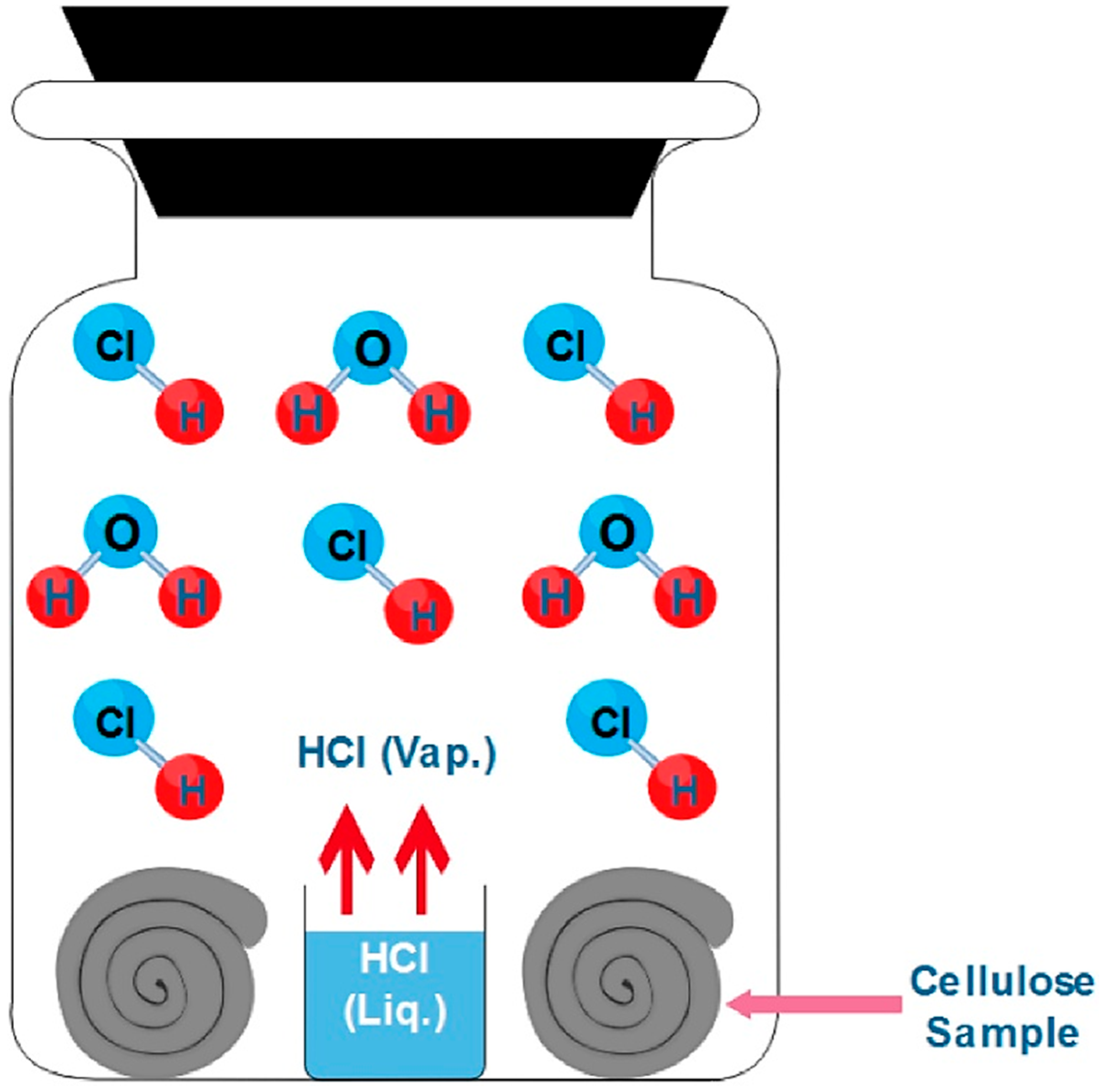
A new, practical method has been developed to decompose and carbonize cotton waste via vapor-phase-assisted hydrothermal treatment at low temperatures (Figure 20). This technique offers an innovative approach to processing cotton waste, significantly reducing its environmental impact. The process involves using hydrochloric acid (HCl) in different amounts, reaction durations, and temperatures. Throughout the treatment, the fabric’s color shifts from white to dark brown, finally turning black after depolymerization and carbonization [161].
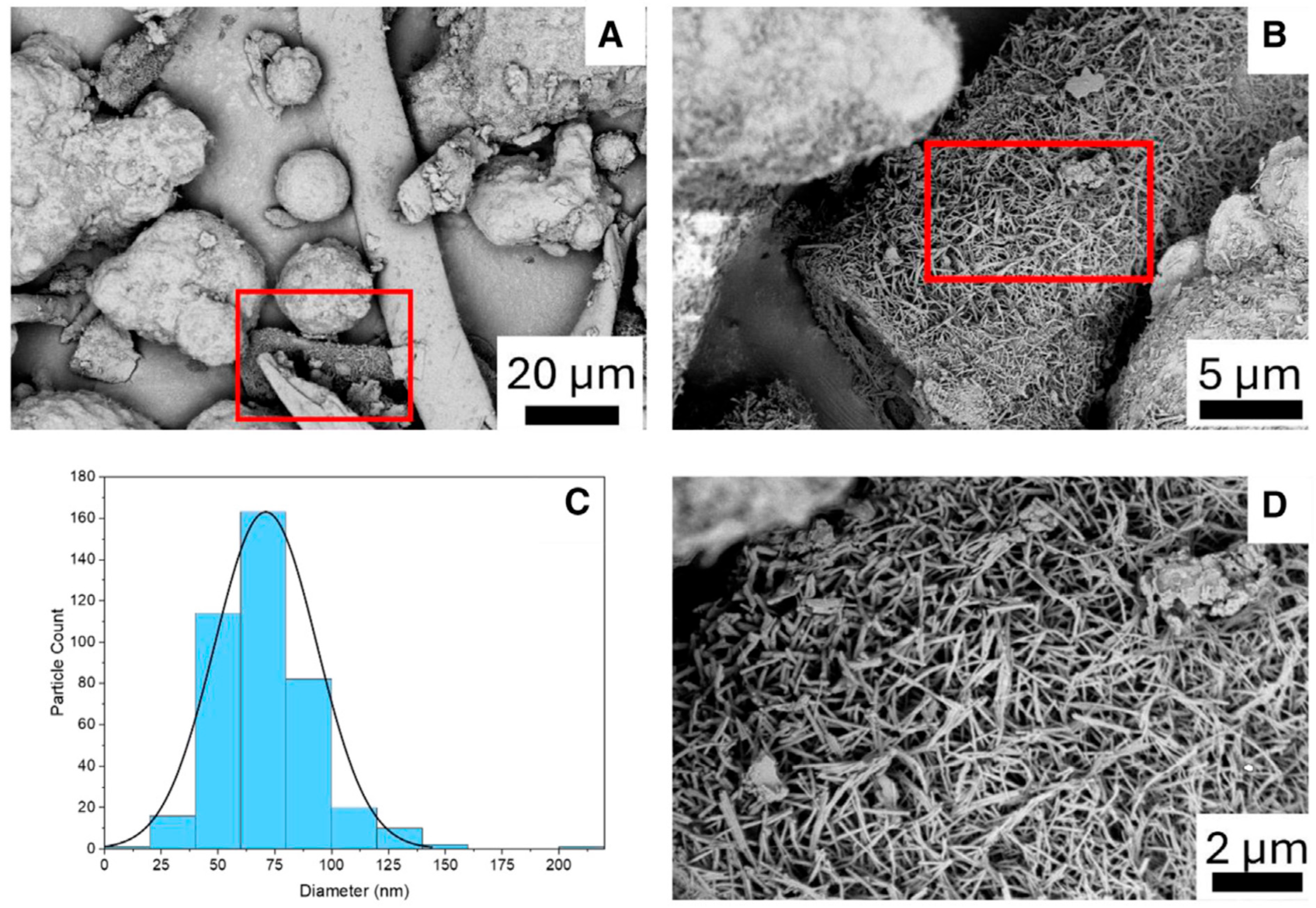
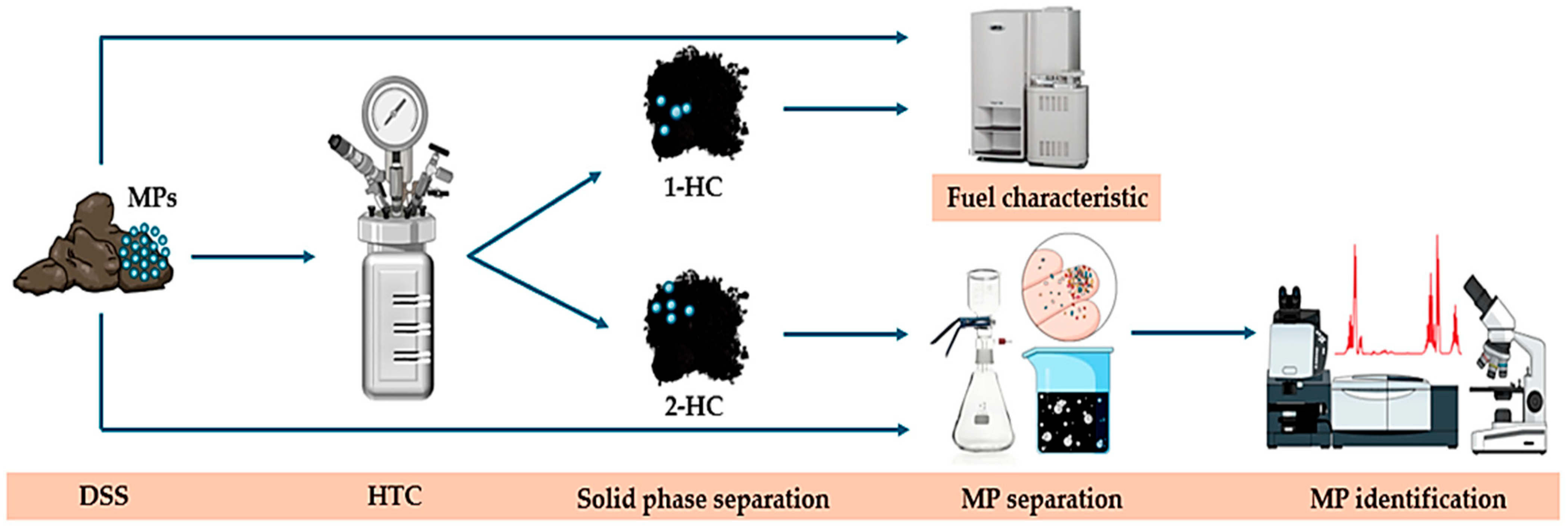
Microplastics (MPs) are a persistent category of emerging contaminants, with substantial quantities present in sewage sludge. A prior investigation explored the influence of hydrothermal carbonization (HTC) temperature on MPs and the characteristics of digested sewage sludge (DSS). HTC was conducted at 200, 210, and 220 °C for a duration of two hours within a batch reactor, as depicted in Figure 21. The resultant solid products were subjected to analysis for (i) mass balance and fuel properties, and (ii) the presence of microplastics utilizing Confocal Raman Microspectroscopy and Scanning Electron Microscopy. The findings confirm that hydrothermal carbonization affects both the quantity and structure of microplastics within digested sewage sludge. Polyethylene and polystyrene were identified in the sludge; however, after processing at 200 and 210 °C, only polyethylene persisted in the hydrochars. Initially, the count of microplastic particles increased at 200 °C, likely attributable to the breakdown of larger fragments, with the highest count observed at 210 °C [162].

7.3. Microwave-Assisted Carbonization

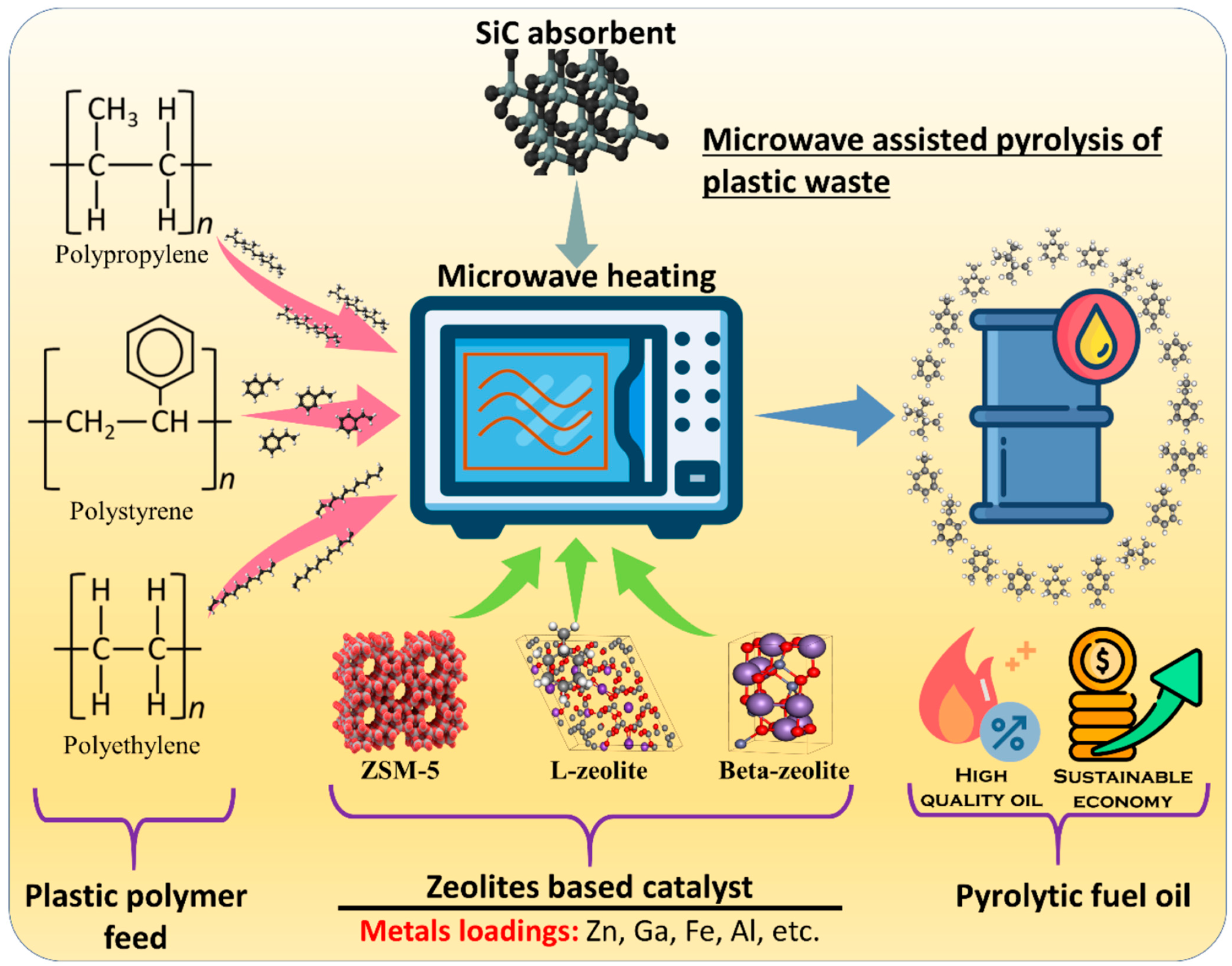
Microwave-assisted carbonization quickly converts plastic waste into various products. With microwave aid, plastics undergo thermal decomposition, producing carbon-rich solids, bio-oil, and gases. Microwaves are electromagnetic waves ranging from 300 MHz to 300 GHz. When they penetrate a material, they directly heat it through dipolar or interfacial polarization [163]. The pyrolysis temperature greatly influences PWCM yield, as higher temperatures usually decrease their formation. Moreover, producing valuable carbon materials depends on selecting specific waste plastics, using appropriate catalysts, and fine-tuning reaction parameters such as time, temperature, and atmosphere [164,165]. Microwave-assisted pyrolysis (MAP) derives energy from microwave radiation. As the process progresses, heat transfer shifts from internal to external heating, with both the heat source and raw materials heated contactlessly. Unlike conventional pyrolysis, which uses electric heaters or burners to heat plastics from the outside in via conduction, often causing uneven temperature distribution, high thermal inertia, and elevated energy use, MAP can quickly heat the material’s interior, boosting efficiency. Traditional pyrolysis can lead to hotspots, over-pyrolysis, the formation of non-condensable small molecules, and coking, while insufficient internal temperatures may result in the production of more long-chain hydrocarbons, thereby lowering recovery. MAP technology enables rapid internal heating and improved energy efficiency [165,166,167]. Microwave irradiation, which induces polymerization and carbonization, has been utilized to prepare carbon-based nanomaterials [168]. Microwave-assisted synthesis is a highly efficient technique for creating carbon nanomaterials. It provides rapid volumetric heating, accelerates reaction rates, and allows precise control over nanomaterial size and shape by tuning reaction parameters. This method also improves energy efficiency. Furthermore, the even heating of precursors during microwave synthesis ensures uniform nucleation and growth conditions, minimizes thermal gradients, and results in nanomaterials with a consistent size distribution [169,170]. Microwave heating utilizes materials with high dielectric properties and strong absorption, typically carbon-based materials and metal oxides. The process flow diagram for MAP applied to plastic polymer waste is illustrated in Figure 22 [171].
Microwave-assisted synthesis is an emerging, promising method for producing advanced carbon nanomaterials with improved properties and easier processing. Although most earlier studies focused on commercial conductive substrates, there has been limited investigation into using recycled materials for this technique [172,173]. Microwave irradiation enables the quick synthesis of carbon nanotubes (CNTs) under ambient conditions, providing significant advantages in energy efficiency and simplicity. This technique also demonstrates versatility, with potential for sustainable material development using recycled substrates. These qualities make microwave-assisted synthesis particularly attractive for producing affordable, eco-friendly nanomaterials, with promising prospects for scalable energy storage solutions. In a prior study, a sustainable approach was investigated for converting cigarette filter (CF) waste into high-performance supercapacitor electrodes (Figure 23). By employing deacetylated and carbonized CF powder as a base for growing CNTs via a nickel-catalyzed microwave method, nitrogen-doped CNTs (NCNTs) were rapidly generated using azobis(cyclohexanecarbonitrile), which served as both the carbon source and nitrogen precursor [174].
A previous study found that microwave-assisted pyrolysis of waste polystyrene can generate carbon nanospheres (CNS) using Mo-promoted, biochar-supported bimetallic catalysts. Among the tested formulations, the Fe:Co (1:3)/Mo/biochar catalyst was the most effective, producing the highest CNS yield of 78.5% and forming uniform spheres with diameters ranging from 100 to 215 nm. Raman analysis showed the lowest Id/Ig ratio (~0.63), indicating fewer defects and a higher level of graphitization compared to other catalysts [175]. Adding catalysts proved to be an effective strategy for enhancing the utilization of waste. Without catalysts, the product quality was low, reaction temperatures were elevated, and substantial energy was lost during the co-pyrolysis process. The introduction of catalysts can significantly improve the quality and selectivity of the target products by lowering the decomposition temperature, thereby reducing energy consumption [176,177]. Zhang et al. [178] presented a simple yet effective microwave plasma discharging technique that transforms plastics into hydrogen and carbon nanotubes with iron-based catalysts. Their findings showed a sixfold increase in yield when iron catalysts were used, compared to when they were absent. Moreover, no other gases were detected during the high-quality carbon nanotube production, indicating that iron-based catalysts uniquely enable continuous carbon generation of nanotubes [178].

7.4. Laser-Carbonization

Laser-carbonization is an innovative technique that enables the direct synthesis and application of functional carbonized materials, particularly in film-based or flexible electronic devices. Unlike traditional carbon materials and established carbonization technologies, this method is still in its early stages but shows great promise. The process involves converting polymers into carbon through laser-induced pyrolysis in a single, streamlined step. This transformation not only simplifies the production process but also yields high-quality carbon materials that are suitable for a diverse array of micro-scale device applications. The ability to create these materials efficiently opens up exciting possibilities for advancements in electronics and other fields [179,180]. Unlike traditional heat treatment, laser-induced carbonization (simply called laser carbonization) occurs very quickly and is shown in Figure 24. It is usually performed under ambient conditions, meaning without a controlled oxygen-free environment. A plasma-like substance known as a plume is generated during the process, which may also contribute to the pyrolysis of the polymer [181,182].
Laser technology offers a scalable, cost-effective approach to producing high-quality graphene. It meets the demand for detailed, patterned structures on both flexible and rigid surfaces, opening new possibilities for the synthesis and applications of graphene. These applications are particularly vital in flexible electronics, such as wearable devices, robotics, smart clothing, and electronic skins [183]. Unlike conventional high-temperature, anaerobic carbonization, laser-induced carbonization occurs instantly at room temperature in air. However, various polymer precursors react differently to near-infrared lasers. For instance, specialized engineering plastics such as polyimide [184], Aramid has strong laser responsiveness and a high residual carbon yield due to its π-π conjugated structure [185,186]. Mamleyev et al. [187] discovered that amide fibers show outstanding responsiveness to laser radiation, forming rough and high-density microstructures [187]. After laser-induced carbonization, amide fibers exhibit excellent conductivity and stable microstructures, making them ideal for flexible antibacterial coatings. In contrast, common plastics like polypropylene and polyethylene yield low residual carbon and respond poorly to near-infrared lasers. This makes them unsuitable for direct laser-induced carbonization and greatly restricts the use of laser irradiation for polymer carbonization [188].

7.5. Reaction Mechanism of Carbonization

Microplastic carbonization via thermochemical methods such as pyrolysis or hydrothermal carbonization involves a series of physicochemical changes that transform polymer chains into carbon-rich structures. Carbonization of polymeric microplastics (thermal pyrolysis, hydrothermal carbonization, microwave-assisted conversion) proceeds via two coupled pathways: (1) thermal depolymerization/volatile evolution and (2) thermally induced crosslinking/aromatization that yields carbonaceous residue. Oxygen-containing polymers (e.g., PET, cellulose derivatives) typically exhibit “charring” behaviour: under an inert atmosphere, they undergo cyclization, aromatization, and crosslinking, leading to a relatively high char yield and formation of porous amorphous carbon frameworks. In contrast, polyolefins (PE, PP) are non-charring under simple pyrolysis and tend to convert predominantly to volatile hydrocarbons unless special conditions (catalysts, sulfur-assisted routes, or high pressure) promote carbon-rich intermediates. Post-carbonization activation (chemical KOH/H3PO4 or physical CO2/steam) opens micro- and mesopores and increases the specific surface area required for adsorption applications. Mechanistically, the crucial steps are bond scission (C–C, C–O), radical recombination, cyclization to aromatics, and eventual graphitization under higher temperatures or catalytic templates; gas products include H2O, CO, CO2, CH4, and light hydrocarbons while heteroatoms (O, N, Cl) are released as volatiles or form surface functionalities on the carbon. These mechanistic pathways determine both carbon yield and surface chemistry, and therefore the adsorption affinity for dyes, metals, and organic micropollutants in wastewater applications [189]. The process usually starts with thermal depolymerization and random chain scission, leading to the formation of oligomers, monomers, and radical intermediates. For polyolefin microplastics such as polyethylene and polypropylene, C–C bond breaking primarily occurs above 400 °C, leading to aliphatic radicals that undergo β-scission, hydrogen abstraction, and secondary cracking [190,191]. As temperatures rise, dehydrogenation and cyclization reactions favor the formation of unsaturated hydrocarbons and aromatic compounds. These intermediates then undergo condensation and polyaromatic growth, resulting in turbostratic carbon structures. In polymers with aromatic groups, such as polystyrene or polyethylene terephthalate, phenyl groups promote earlier aromatic stabilization and speed up the formation of graphitic domains compared to aliphatic polymers [192]. During the advanced stages of carbonization, increased aromatization and cross-linking enhance structural order, while volatile compounds such as H2, CH4, CO, CO2, and light hydrocarbons are released. The final carbon form, whether amorphous, partially graphitized, or activated porous carbon, mainly depends on temperature, heating rate, residence time, and the reaction environment. Structural reorganization and stacking of polyaromatic layers usually happen above 600–900 °C, but complete graphitization requires even higher temperatures [193]. In hydrothermal carbonization (HTC) systems, a variety of complex chemical reactions occur under subcritical water conditions. Key processes include hydrolysis, which breaks down organic materials into simpler compounds; dehydration, which removes water molecules, resulting in more concentrated organic structures; and decarboxylation, which eliminates carboxyl groups from organic acids, further increasing the carbon content. These mechanisms work synergistically to facilitate the formation of oxygen-functionalized hydrochar intermediates. These intermediates play a crucial role in the subsequent stages of the HTC process, as they undergo further condensation reactions, leading to the development of a stable carbon framework. This sequential transformation not only enriches the carbon content of the final product but also influences its reactivity and suitability for various applications, such as in soil amendments, carbon sequestration, and energy production [158,159].

8. Activated Carbons for Wastewater Treatment Applications

The increasing demand for fresh water, driven by industrial growth, persistent droughts, and rising populations, is leading to a shortage of clean water resources, underscoring the urgency of effective water treatment solutions. The decline in available water sources can be addressed through various practical methods aimed at increasing usable water. Industrial and agricultural wastewaters are significant potential sources of water for different applications. Nonetheless, each water treatment method has limitations related to its application, cost, and efficiency. One promising approach is adsorption, which can treat wastewater from industrial or other activities, improving its quality for later use in industry and agriculture. In recent decades, significant research has focused on understanding the properties of adsorbent materials for removing hazardous compounds. Ensuring good water quality is vital to prevent long-term health issues, which can be achieved by adsorbing pollutants such as dyes, heavy metals, phenolics, and pharmaceuticals from liquids, thereby purifying the water and recovering valuable substances. The removal of hazardous inorganic and organic compounds from gas or liquid media using carbon-based materials (CBMs), with an emphasis on the interactions between adsorbents and adsorbates. Over the years, substantial progress has been made in understanding CBM adsorption mechanisms and isotherms, driven by increased research interest in these materials’ mechanisms and capacities for removing pollutants from aqueous solutions. Proper treatment of industrial wastewater is crucial, as untreated waste can severely harm human health and the environment [194].
In recent years, European laws governing the release of liquid effluents into the environment, specifically the Water Framework Directive, have become more stringent. This has raised concerns about pollutants like heavy metals and Contaminants of Emerging Concern (CECs). Heavy metals are bioaccumulative, non-biodegradable, and toxic, representing a threat to both human and animal health. Their presence in water bodies can result from natural sources or human activities such as waste disposal, industrial operations, or mining [195]. Wastewater streams generally contain metals such as nickel (Ni), copper (Cu), chromium (Cr), cadmium (Cd), and lead (Pb), along with many others. These metals are non-biodegradable, and their levels often lead to accumulation in living organisms, resulting in health problems for humans, animals, and plants [196]. Heavy metal ions are readily adsorbed by carbon materials due to their adaptable surface functional groups. Previous research has confirmed that carbon materials serve as effective adsorbents for metal particles. [197,198]. Adsorption is a proven and economical technique for eliminating these pollutants from liquid waste [199]. Common adsorbent materials include alumina, activated carbon, clays, silica gel, composites, zeolites, and biomass from various sources [200]. Recently, affordable activated carbons have been developed from char created by pyrolyzing plastic waste [201]. The primary use of these carbonaceous materials as adsorbents has garnered interest due to their impressive textural properties, which are achieved through convenient activation. However, additional qualities, such as electrical conductivity, capacitance, optical properties, and exceptional absorptivity, make these materials suitable for a wide range of applications, as illustrated in Figure 25. These include sensors for microbiological control, photodetectors, solar cell construction, energy storage in batteries and supercapacitors, membrane separation, and the use of feedstock for electrochemical devices, as well as catalyst supports [202].
Research on carbon-based nanomaterials as adsorbents has seen rapid growth and has garnered significant interest over the past decade. This is mainly due to the unique properties and diversity of carbon structures, which provide new opportunities in chemistry, physics, and engineering. Numerous water pollutants, including toxic metal ions, pharmaceuticals, pesticides, metalloids, and other inorganic and organic substances, can be effectively adsorbed by carbon-based materials through different mechanisms [203,204]. CAs can be prepared because of their unique properties, which allow them to adsorb various organic and inorganic substances, including metals [205], dyes [206], antibiotics [207], volatile organic compounds [208], organic solvents [209], oils [210], CO2 [211], and H2S [212]. A widely discussed application of CA in chemistry is its potential to adsorb organic compounds, particularly common hazardous materials. Generally, the presence of oxygen, nitrogen, and sulfur functional groups on the surfaces of carbon-based materials (CBMs), particularly carbon aerogels (CAs), can increase porosity, hydrophilicity, and the selectivity of adsorbents. Various CA derivatives have been examined for their ability to eliminate both organic and inorganic contaminants. In water-based solutions, interactions such as van der Waals forces, induced dipoles, dipole–dipole interactions, and hydrogen-bonding donor–acceptor relationships promote the attachment and concentration of chemical substances on various adsorbents. Carbon-based materials encompass activated carbon (AC), graphene, carbon nanotubes (CNTs), carbon nanofibers (CNFs), biochar (BC), and carbon aerogels (CAs). Figure 26 illustrates some different types of CBMs used in adsorption [200,213].

9. Utilization of Microplastics for Wastewater Treatment

Microplastic particles measuring less than 5 mm in diameter have recently garnered extensive scientific interest due to their widespread presence in marine ecosystems. Microplastics have attracted widespread recognition as environmental pollutants, but they can simultaneously serve as an opportunity for wastewater treatment innovation. Their adsorptive capability represents a primary application for microplastics within the wastewater treatment process. Microplastics exhibit remarkable volume-to-surface ratios, which enable them to effectively absorb a wide range of pollutants, including heavy metals, organic contaminants, and pharmaceutical substances. The adsorption capacity of MP for Pb (II) in various pH values was investigated using microplastics with different concentrations at gradients of 2, 3, 5, 10, and 15 mg/L (0.6 g/L). The effects of ionic strength on Pb adsorption were examined by adding NaCl at concentrations of 50, 200, and 500 mg/L, and the effect of the initial solution pH on capture was examined (3, 5, 7, 9). Different background electrolyte ions were used to test the adsorption ability. The process of capturing lead (II) in Milli-Q water, tap water, surface water, and stormwater by applying various organic layer treatment techniques, such as soaking and shaking microplastics with 0.1 M HCl or 0.1 M NaOH to dissolve organics, is investigated. It was discovered that pristine microplastics had a lower adsorption capability than soaking natural-aged microplastics. This suggests that the amount of organic layer on the microplastics might influence the capture process. According to the experimental findings, the organic layer on the surface of the microplastics can be harmed by acid or alkali. Analysis reveals that Pb(II) capture through microplastics depends heavily on the organic films found on microplastic surfaces [214]. Research indicates that microparticles (MPs) can absorb organic pollutants, including PCBs, PAHs, pesticides, chlorobenzenes, hydrocarbons, and antibiotics, through various interactions. MPs mainly rely on hydrophobic and van der Waals forces, with electrostatic interactions influenced by pH and charge. For example, MPs absorb bisphenol and other hydrophobic compounds through hydrophobic interactions, whereas acids cease adsorption when the pH exceeds their dissociation constant. Antibiotics’ ionization depends on their structure, affecting adsorption—for instance, Ciprofloxacin shows high MP affinity, and sulfamethoxazole favors acidic conditions. Overall, adsorption involves hydrogen bonds, halogen bonds, van der Waals, and π-π interactions [215].
Heavy metals and organic pollutants are efficiently adsorbed by microplastics due to their large surface area, high hydrophobicity, and chemical composition. The concepts of “Biofilm on microplastics” and “microplastics in biofilm” emerge when microplastics enter a biofilm-based reactor in wastewater treatment plants. The term “biofilm on microplastics” describes a thin layer of biofilm that forms on the surface of microplastics. Microplastics in biofilms interact with the primary biofilm on carriers, promoting the development of microbial communities. These microplastics can trigger biological reactions and alter the operation of biofilm reactors, thereby reducing overall reactor efficiency [216]. Microorganisms adhere more readily to hydrophobic surfaces, and the extent of colonization increases with surface roughness. Some studies suggest that these properties may enhance the non-polarity of the microplastic surface and introduce additional functional groups. Microorganisms transfer to microplastic surfaces in bulk solutions, forming microcolonies and living in a sessile mode. The biofilm on microplastics creates a new ecological niche known as “biofilm on microplastics” [217,218]. Biofilm stability, nutrient cycling, metabolic activity, and microbial composition are all affected by interactions between microplastics within the biofilm matrix and the microbial communities within it. Their physical and chemical characteristics, as well as their transportation and retention in reactors, can be influenced by their ability to interact with pre-existing biofilms or form new ones. Biofilm stability and nutrient cycling may be affected by this integration [219,220]. Biofilms on microplastics increase pollutant absorption and alter their interactions with contaminants. This alters the physical and chemical properties of microplastics, thereby affecting their ability to remove heavy metals. Studies show that aged microplastics, such as PLA and LDPE, accumulate metals, with a 44% increase in silver adsorption in PE microparticles with biofilm. Heavy metals adsorb via surface complexation, ion exchange, electrostatic interactions, and precipitation. Film diffusion drives metal migration through substrates and biofilms. Some biopolymer groups chelate heavy metals, boosting Pb absorption 13-fold compared to clean LDPE. Adding expanded polystyrene enhances the interaction of metal ions with PE. Using microplastics as carbon sources in biofilm reactors complicates reaction mechanisms and influences heavy metal bioavailability, nutrient metabolism, and removal efficiency, especially when microplastics migrate into biofilms [221,222].

10. Health and Environmental Implications of Textile-Derived Microplastics and By-Products

Textile-derived microplastics (MPs) and nanoplastics (NPs) are of particular concern because they pose persistent physical, chemical, and microbiological hazards and have demonstrable pathways of exposure to the human body. MPs from textiles are readily ingested and inhaled, and multiple biomonitoring studies now provide direct evidence that polymer particles reach human tissues and internal fluids, which have been repeatedly detected in human stool, demonstrating routine gastrointestinal exposure, and have been found in colectomy specimens, indicating their presence within the intestinal wall. More alarmingly, MPs have been identified in human placentas and in peripheral blood, establishing that small polymer particles can translocate beyond the gut and circulate systemically [223]. These observations raise plausible mechanisms for adverse human health effects that are supported by toxicological and mechanistic studies: inhaled or ingested MPs and NPs can provoke local and systemic inflammation, oxidative stress, mitochondrial dysfunction, and perturbations of cellular homeostasis in vitro and in animal models, and they may act as vectors for endocrine-active additives (e.g., phthalates, flame retardants, PFAS) or sorbed hydrophobic pollutants, thereby altering toxicokinetics when co-exposures occur. Respiratory exposures, particularly relevant for airborne fibers shed from textiles in indoor environments and for occupational cohorts in textile processing, have been experimentally associated with airway oxidative stress and pro-inflammatory responses, and inhaled nanosized particles possess the theoretical capacity to penetrate alveolar barriers and reach the circulation. The plastisphere colonizing aged fibers further complicates risk profiles because biofilm assemblages may concentrate opportunistic pathogens and antimicrobial-resistance genes, potentially modifying infectivity or immune responses upon exposure [224].
Epidemiological linkage between ambient/body burdens of MPs and defined human disease is not yet conclusive. The important methodological gaps remain (standardized particle metrics, contamination control, particle ageing, realistic dose metrics and co-exposure characterisation), but the convergence of (i) measured human exposure, (ii) plausible translocation pathways, (iii) mechanistic toxicity in cells and model organisms, and (iv) the capacity of MPs to carry biologically active chemicals argues for a precautionary, risk-based response. In practical terms for textile sources, this means prioritizing upstream measures (material selection and finishing chemistries that minimize shedding and hazardous additives, design for low shedding, and improved manufacturing and laundering practices) together with downstream controls (improved capture during wastewater treatment, reassessment of biosolid reuse given sludge concentration of MPs and sorbed contaminants, and targeted monitoring of occupational settings). To translate mechanistic findings into public health policy, future research should emphasize well-controlled human exposure studies, long-term cohort assessments in highly exposed populations (e.g., textile workers), and toxicology experiments that use environmentally aged textile-derived particles with realistic chemical loads to better resolve dose–response relationships relevant to human health [225].

11. Economic Feasibility, Scalability, and Key Challenges

Although converting microplastics into functional carbon materials via carbonization methods such as pyrolysis or hydrothermal carbonization is technically feasible, it currently faces significant economic hurdles. These processes are energy-intensive, needing high temperatures, pressure control, and often catalysts, which raise operational costs compared to standard carbon sources. The collection, separation, and purification of microplastics from waste or environmental samples are also costly and labor-intensive, as microplastics are often present at low concentrations within complex mixtures, further reducing their economic appeal as feedstock. Techno-economic analyses show that, even with large plastic volumes, profitability depends heavily on feedstock quality, energy costs, and product market value. Economic viability typically relies on co-products such as fuels or recovered monomers, or on policy incentives such as carbon credits or subsidies. For instance, systems combining pyrolysis and gasification to convert plastic waste into gas and carbon nanomaterials require careful operational optimization and often depend on external incentives to remain competitive with traditional energy and material options [226]. While research on microplastic-rich feedstocks is limited, studies on biosolids pyrolysis indicate that producing biochar, a carbon-rich product, can help offset processing costs if the biochar has market value, such as for soil amendment. However, this process requires a significant capital investment in dryers and reactors, and its feasibility largely depends on the ability to sell co-products [227]. Similarly, broader reviews of upcycling plastic waste into advanced carbon materials underscore that multi-stage conversion pathways can enhance material quality but also increase complexity and cost, often constraining these processes to niche, high-value applications rather than mass-scale deployment [228]. Therefore, given current technology and market conditions, microplastic carbonization is better seen as a proof-of-concept or a niche valorization pathway with environmental advantages, rather than a widely competitive, large-scale economic solution. Progress in process intensification, energy recovery, policy support, and the creation of high-value markets for carbon products will be essential to enhance the economic viability. The concept of valorizing textile-derived microplastics (MPs) into carbonaceous adsorbents addresses two pressing problems: waste plastic management and demand for high-performance adsorbents, but its large-scale feasibility is challenged by interlinked technical, logistical, and economic barriers. First, feedstock availability is fundamentally constrained: textile MPs are highly dispersed across laundry effluents, sewer networks, and biosolids, so reliable collection and pre-concentration incur substantial capital and operating costs and add transport-related energy burdens that can dominate cradle-to-gate footprints unless collection is local and high-yield (e.g., on-site laundromat capture or sludge diversion strategies). Second, the conversion step itself (pyrolysis/carbonization followed by physical or chemical activation) is energy-intensive; pyrolysis temperatures, residence times, and activating chemistries (KOH, H3PO4, steam) drive both direct energy consumption and indirect greenhouse-gas emissions, and consequently, the pyrolysis/activation stage typically appears as the largest contributor to life-cycle GHGs and cost in existing LCA and techno-economic studies. Third, process chemistry and product consistency pose scale-up risks: textile feedstocks are compositionally heterogeneous (mixtures of synthetic polymers, natural fibers, dyes, finishes, and additives), which yields chars with variable yields, surface chemistries, and ash contents, variability that complicates activation protocols and quality control for adsorbent specifications required in water- or air-treatment applications [201].
From an economic-competitiveness viewpoint, commercial granular and powdered activated carbons (GAC/PAC) produced at scale from coal, coconut shell or wood benefit from optimized supply chains and low incremental costs per tonne; therefore, MP-derived carbons must either achieve cost parity (including collection) or demonstrate clear functional advantages (e.g., higher specific surface area, tailored pore structure, superior affinity for target contaminants, or lower life-cycle impacts under the local energy mix) to displace incumbent products. Integration of feedstock capture, thermal conversion and end-use (for example, colocating carbonization units with industrial laundries, wastewater treatment plants, or sludge processing facilities) improves the economic case by cutting transport and handling costs and by enabling heat and material integration, but requires coordinated business models and supportive policy instruments (subsidies, carbon credits or regulatory limits on sludge application) to internalize environmental externalities [202]. Safety and residual management are additional constraints: carbonization of coated or chemically finished textiles can concentrate halogenated flame retardants, metals, and other additives into tars, off-gases, and ash fractions, necessitating robust off-gas treatment, tar management, and hazardous-waste handling that raise both CAPEX and OPEX and create permitting hurdles. Rigorous pilot-scale mass balances and emissions testing are therefore essential before upscaling [201].
Given these realities, the near-term research and deployment priorities are clear: (i) targeted techno-economic and LCA comparisons that include realistic collection and preprocessing costs and region-specific energy mixes; (ii) development and demonstration of low-temperature or catalytic hydrothermal/carbonization routes that reduce thermal energy demand and improve yield; (iii) decentralized pilot units integrated with laundromats, textile facilities or WWTPs to test logistics and local value capture; and (iv) end-use qualification studies demonstrating that MP-derived carbons meet or exceed performance metrics for specific applications (e.g., microplastic polishing, PFAS adsorption, dye removal) so that market uptake can occur without subsidization. Evidence from recent reviews and pilot projects suggests the pathway is technically feasible but will only be economically competitive where feedstock aggregation is low-cost or where policy/regulatory frameworks (or co-located industrial symbiosis) internalize the environmental benefits of diverting MPs from sludge and aquatic release [229]. As summarized in Table 2, the major cost advantage relative to conventional activated carbon production lies in waste valorization and potential environmental credits, whereas the principal limitations arise from feedstock heterogeneity.

12. Conclusions

Textile-based micro- and nanoplastics represent a critical, under-addressed component of global plastic pollution. Synthetic fibers such as polyester, polyamide, and acrylic, along with polymeric textile finishes (e.g., polyurethane, polyethylene, fluoropolymers, melamine resins, and microcapsule coatings), continuously release microplastic particles throughout their lifecycle, from manufacturing and washing to disposal. Domestic and industrial laundering remains a dominant emission pathway, influenced by fabric structure, mechanical aging, detergent chemistry, and washing conditions. While conventional wastewater treatment plants can achieve substantial removal efficiencies (often exceeding 90% under optimized conditions), complete elimination remains challenging. A significant fraction of captured microplastics accumulates in sludge, creating potential secondary contamination risks through land application or disposal. Advanced treatment technologies, including membrane bioreactors (MBRs), ultrafiltration, nanofiltration, electrocoagulation, and adsorption systems, demonstrate enhanced removal performance, yet scalability, cost, fouling, and energy demand remain limiting factors. Most importantly, this review highlights a paradigm shift: instead of viewing recovered microplastics solely as waste, they can be transformed through controlled carbonization (e.g., pyrolysis or hydrothermal carbonization) into porous carbon materials with high adsorption capacity. These carbonized derivatives show strong potential for removing dyes, heavy metals, and persistent organic pollutants, thereby closing the loop between pollution mitigation and resource recovery. Thus, integrating efficient capture technologies with carbonization-based valorization offers a sustainable and circular strategy for managing textile-derived microplastics.

Author Contributions

Conceptualization, A.A. and M.Z.K.; Methodology, A.A.; Software, M.Z.K.; Validation, A.A.; Formal Analysis, M.Z.K.; Resources, A.A. and M.Z.K.; Data Curation, M.Z.K.; Writing-original draft preparation, A.A. and M.Z.K.; Writing-review and editing A.A. and M.Z.K.; Visualization, M.Z.K.; Supervision, M.Z.K.; Project administration M.Z.K.; Funding acquisition, A.A. All authors have read and agreed to the published version of the manuscript.

Funding

This work was supported by the Ministry of Education, Youth and Sports. INTER-ACTION project number LUAUS23054 “Textile-derived micro-plastics in aquatic ecosystems: identification, characterization, and effect assessment”.

Data Availability Statement

No new data were created or analyzed in this study.

Conflicts of Interest

The authors declare that they have no conflicts of interest.

References

  1. Ziajahromi, S.; Neale, P.A.; Rintoul, L.; Leusch, F.D.L. Wastewater treatment plants as a pathway for microplastics: Development of a new approach to sample wastewater-based microplastics. Water Res. 2017, 112, 93–99. [Google Scholar] [CrossRef] [Scilit]
  2. Khoaele, K.K.; Gbadeyan, O.J.; Chunilall, V.; Sithole, B. The Devastation of Waste Plastic on the Environment and Remediation Processes: A Critical Review. Sustainability 2023, 15, 5233. [Google Scholar] [CrossRef] [Scilit]
  3. Andrady, A.L. Microplastics in the Marine Environment. Mar. Pollut. Bull. 2011, 62, 1596–1605. [Google Scholar] [CrossRef] [Scilit]
  4. Mellin, P.; Jönsson, C.; Åkermo, M.; Fernberg, P.; Nordenberg, E.; Brodin, H.; Strondl, A. Nano-sized by-products from metal 3D printing, composite manufacturing and fabric production. J. Clean. Prod. 2016, 139, 1224–1233. [Google Scholar] [CrossRef] [Scilit]
  5. Talukdar, A.; Kundu, P.; Bhattacharya, S.; Dutta, N. Microplastic contamination in wastewater: Sources, distribution, detection and remediation through physical and chemical-biological methods. Sci. Total Environ. 2024, 916, 170254. [Google Scholar] [CrossRef] [Scilit]
  6. Napper, I.E.; Thompson, R.C. Release of synthetic microplastic plastic fibres from domestic washing machines: Effects of fabric type and washing conditions. Mar. Pollut. Bull. 2016, 112, 39–45. [Google Scholar] [CrossRef] [Scilit]
  7. Dubaish, F.; Liebezeit, G. Suspended microplastics and black carbon particles in the Jade system, southern North Sea. Water Air Soil Pollut. 2013, 224, 1352. [Google Scholar] [CrossRef] [Scilit]
  8. Rist, S.; Carney Almroth, B.; Hartmann, N.B.; Karlsson, T.M. A critical perspective on early communications concerning human health aspects of microplastics. Sci. Total Environ. 2018, 626, 720–726. [Google Scholar] [CrossRef] [Scilit] [PubMed]
  9. Hahladakis, J.N.; Velis, C.A.; Weber, R.; Iacovidou, E.; Purnell, P. An overview of chemical additives present in plastics: Migration, release, fate and environmental impact during their use, disposal and recycling. J. Hazard. Mater. 2018, 344, 179–199. [Google Scholar] [CrossRef] [Scilit] [PubMed]
  10. Giuliani, A.; Zuccarini, M.; Cichelli, A.; Khan, H.; Reale, M. Critical review on the presence of phthalates in food and evidence of their biological impact. Int. J. Environ. Res. Public Health 2020, 17, 5655. [Google Scholar] [CrossRef] [Scilit] [PubMed]
  11. Lu, Y.; Li, M.-C.; Lee, J.; Liu, C.; Mei, C. Microplastic remediation technologies in water and wastewater treatment processes: Current status and future perspectives. Sci. Total Environ. 2023, 868, 161618. [Google Scholar] [CrossRef] [Scilit]
  12. Akkajit, P.; Sukkuea, A.; Thongnonghin, B. Comparative analysis of five convolutional neural networks and transfer learning classification approach for microplastics in wastewater treatment plants. Ecol. Inform. 2023, 78, 102328. [Google Scholar] [CrossRef] [Scilit]
  13. Okoffo, E.D.; O’Brien, S.; O’Brien, J.W.; Tscharke, B.J.; Rauert, C.; Rødland, E.S.; Ribeiro, F.; Burrows, S.D.; Toapanta, T.; Mueller, J.F.; et al. Does size matter? Quantification of plastics associated with size fractionated biosolids. Sci. Total Environ. 2022, 811, 152382. [Google Scholar] [CrossRef] [Scilit]
  14. Yuan, Z.; Nag, R.; Cummins, E. Human health concerns regarding microplastics in the aquatic environment—From marine to food systems. Sci. Total Environ. 2022, 823, 153730. [Google Scholar] [CrossRef] [Scilit] [PubMed]
  15. Gall, S.C.; Thompson, R.C. The impact of debris on marine life. Mar. Pollut. Bull. 2015, 92, 170–179. [Google Scholar] [CrossRef] [Scilit]
  16. Peller, J.R.; Tabor, G.; Davis, C.; Iceman, C.; Nwachukwu, O.; Doudrick, K.; Wilson, A.; Suprenant, A.; Dabertin, D.; McCool, J.-P. Distribution and Fate of Polyethylene Microplastics Released by a Portable Toilet Manufacturer into a Freshwater Wetland and Lake. Water 2023, 16, 11. [Google Scholar] [CrossRef] [Scilit]
  17. Salvador Cesa, F.; Turra, A.; Baruque-Ramos, J. Synthetic fibers as microplastics in the marine environment: A review from textile perspective with a focus on domestic washings. Sci. Total Environ. 2017, 598, 1116–1129. [Google Scholar] [CrossRef] [Scilit]
  18. Quintana, E.; Valls, C.; Roncero, M.B. Dissolving-grade pulp: A sustainable source for fiber production. Wood Sci. Technol. 2024, 58, 23–85. [Google Scholar] [CrossRef] [Scilit]
  19. Horton, A.A.; Walton, A.; Spurgeon, D.J.; Lahive, E.; Svendsen, C. Microplastics in freshwater and terrestrial environments: Evaluating the current understanding to identify the knowledge gaps and future research priorities. Sci. Total Environ. 2017, 586, 127–141. [Google Scholar] [CrossRef] [Scilit] [PubMed]
  20. Khan, M.Z. Hydrothermal Growth of TiO2 Nanoflowers on PET Fabrics for Functional Applications. J. Fiber Bioeng. Inform. 2021, 14, 199–210. [Google Scholar] [CrossRef] [Scilit]
  21. Ferreira, M.S.V.; Mousavi, S.H. Nanofiber technology in the ex vivo expansion of cord blood-derived hematopoietic stem cells. Nanomedicine 2018, 14, 1707–1718. [Google Scholar] [CrossRef] [Scilit]
  22. Tian, L.; Skoczynska, E.; Siddhanti, D.; van Putten, R.-J.; Leslie, H.A.; Gruter, G.-J.M. Quantification of polyethylene terephthalate microplastics and nanoplastics in sands, indoor dust and sludge using a simplified in-matrix depolymerization method. Mar. Pollut. Bull. 2022, 175, 113403. [Google Scholar] [CrossRef] [Scilit]
  23. Setala, F.N.O.; Magnussan, K.; Lehtiniemi, M. Distribution and abundance of surface water microlitter in the Baltic Sea: A comparison of two sampling methods. Mar. Pollut. Bull. 2016, 110, 177–183. [Google Scholar] [CrossRef] [Scilit]
  24. Janssen, C.R.; Koelmans, A.A.; Bakir, A.; Burton, G.A. Microplastic as a Vector for Chemicals in the Aquatic Environment: Critical Review and Model-Supported Reinterpretation of Empirical Studies. Environ. Sci. Technol. 2016, 50, 3315–3326. [Google Scholar] [CrossRef] [Scilit]
  25. Ladewig, A.T.C.S.; Bao, S. Natural Fibers: A Missing Link to Chemical Pollution Dispersion in Aquatic Environments. Environ. Sci. Technol. 2015, 49, 12609–12610. [Google Scholar] [CrossRef] [Scilit]
  26. Wagner, M.; Scherer, C.; Alvarez-Muñoz, D.; Brennholt, N.; Bourrain, X.; Buchinger, S.; Fries, E.; Grosbois, C.; Klasmeier, J.; Marti, T.; et al. Microplastics in freshwater ecosystems: What we know and what we need to know. Environ. Sci. Eur. 2014, 26, 9. [Google Scholar] [CrossRef] [Scilit]
  27. Thompson, R.; Browne, M.A.; Crump, P.; Niven, S.J.; Teuten, E.; Tonkin, A. Accumulation of Microplastic on Shorelines Woldwide: Sources and Sinks. Environ. Sci. Technol. 2011, 45, 9175. [Google Scholar] [CrossRef] [Scilit]
  28. Fan, W.; Bao, W.; Gong, R.H.; Ding, X.; Xue, Y.; Li, P. Optimizing a laundering program for textiles in a front-loading washing machine and saving energy. J. Clean. Prod. 2017, 148, 415–421. [Google Scholar] [CrossRef] [Scilit]
  29. Cai, Y.; Yang, T.; Mitrano, D.M.; Heuberger, M.; Hufenus, R.; Nowack, B. Systematic Study of Microplastic Fiber Release from 12 Different Polyester Textiles during Washing. Environ. Sci. Technol. 2020, 54, 4847–4855. [Google Scholar] [CrossRef] [Scilit] [PubMed]
  30. Šaravanja, A.; Pušić, T.; Dekanić, T. Microplastics in Wastewater by Washing Polyester Fabrics. Materials 2022, 15, 2683. [Google Scholar] [CrossRef] [Scilit]
  31. Ali, A.; Qamer, S.; Shahid, M.; Tomkova, B.; Khan, M.Z.; Militky, J.; Wiener, J.; Venkataraman, M. Micro- and Nanoplastics Produced from Textile Finishes: A Review. Langmuir 2024, 40, 17849–17867. [Google Scholar] [CrossRef] [Scilit]
  32. Machado, A.A.D.; Werner, K.; Christiane, Z.; Stefan, H.; Rillig, M.C. Microplastics as an Emerging Threat to Terrestrial Ecosystems. Glob. Change Biol. 2018, 24, 1405. [Google Scholar] [CrossRef] [Scilit]
  33. Hidalgo-Ruz, V.; Gutow, L.; Thompson, R.C.; Thiel, M. Microplastics in the Marine Environment: A Review of the Methods Used for Identification and Quantification. Environ. Sci. Technol. 2012, 46, 3060–3075. [Google Scholar] [CrossRef] [Scilit]
  34. Ali, S.S.; Elsamahy, T.; Koutra, E.; Kornaros, M.; El-Sheekh, M.; Abdelkarim, E.A.; Zhu, D.; Sun, J. Degradation of conventional plastic wastes in the environment: A review on current status of knowledge and future perspectives of disposal. Sci. Total Environ. 2021, 771, 144719. [Google Scholar] [CrossRef] [Scilit]
  35. Zhang, S.S.Y.Q.; Lykaki, M.; Alrajoula, M.T.; Markiewicz, M.; Kraas, C.; Kolbe, S.; Klinkhammer, K.; Rabe, M.; Klauer, R.; Bendt, E. Microplastics from textile origin—Emission and reduction measures. Green Chem. 2021, 21, 5247–5271. [Google Scholar] [CrossRef] [Scilit]
  36. Bianco, A.; Passananti, M. Atmospheric micro and nanoplastics: An enormous microscopic problem. Sustainability 2020, 12, 7327. [Google Scholar] [CrossRef] [Scilit]
  37. Boucher, J.; Friot, D. Primary Microplastics in the Oceans: A Global Evaluation of Sources. In Primary Microplastics in the Oceans: A Global Evaluation of Sources; IUCN: Gland, Switzerland, 2017. [Google Scholar] [CrossRef] [Scilit]
  38. Periyasamy, A.P.; Tehrani-Bagha, A. A review on microplastic emission from textile materials and its reduction techniques. Polym. Degrad. Stab. 2022, 199, 109901. [Google Scholar] [CrossRef] [Scilit]
  39. Kelly, M.R.; Lant, N.J.; Kurr, M.; Burgess, J.G. Importance of Water-Volume on the Release of Microplastic Fibers from Laundry. Environ. Sci. Technol. 2019, 53, 11735–11744. [Google Scholar] [CrossRef] [Scilit] [PubMed]
  40. De Falco, F.; Di Pace, E.; Cocca, M.; Avella, M. The contribution of washing processes of synthetic clothes to microplastic pollution. Sci. Rep. 2019, 9, 6633. [Google Scholar] [CrossRef] [Scilit]
  41. Hassabo, A.; Mohamed, N.; Gouda, N.; Khaleed, N. Polyurethane (PU) in textile finishing process. J. Text. Color. Polym. Sci. 2023, 21, 173–186. [Google Scholar] [CrossRef] [Scilit]
  42. Rajan, A.; Ameen, F.; Jambulingam, R.; Shankar, V. Biodegradation of Polyurethane by Fungi Isolated from Industrial Wastewater—A Sustainable Approach to Plastic Waste Management. Polymers 2024, 16, 1411. [Google Scholar] [CrossRef] [Scilit]
  43. Gashti, M.P.; Navid, M.Y.; Rahimi, M.H. Effects of coating of nano- and microemulsion silicones on thermal properties and flammability of polyethylene terephthalate textile. Pigment. Resin Technol. 2013, 42, 34–44. [Google Scholar] [CrossRef] [Scilit]
  44. Monira, S.; Roychand, R.; Hai, F.I.; Bhuiyan, M.; Dhar, B.R.; Pramanik, B.K. Nano and microplastics occurrence in wastewater treatment plants: A comprehensive understanding of microplastics fragmentation and their removal. Chemosphere 2023, 334, 139011. [Google Scholar] [CrossRef] [Scilit] [PubMed]
  45. Cózar, A.; Echevarría, F.; González-Gordillo, J.I.; Duarte, C.M. Plastic debris in the open ocean. Proc. Natl. Acad. Sci. USA 2014, 111, 10239–10244. [Google Scholar] [CrossRef] [Scilit]
  46. Zangmeister, C.D.; Radney, J.G.; Benkstein, K.D.; Kalanyan, B. Common Single-Use Consumer Plastic Products Release Trillions of Sub-100 nm Nanoparticles per Liter into Water during Normal Use. Environ. Sci. Technol. 2022, 56, 5448–5455. [Google Scholar] [CrossRef] [Scilit]
  47. Bayo, J.; Olmos, S.; López-Castellanos, J. Microplastics in an urban wastewater treatment plant: The influence of physicochemical parameters and environmental factors. Chemosphere 2020, 238, 124–593. [Google Scholar] [CrossRef] [Scilit]
  48. Chowdhury, K.P. Effect of Special Finishes on the Functional Properties of Cotton Fabrics. J. Text. Sci. Technol. 2018, 04, 49–66. [Google Scholar] [CrossRef]
  49. Mondal, S.; Pal, S.; Maity, J. Hydrophobic thin fluoropolymer coating on cotton surfaces. Int. J. Polym. Anal. Charact. 2018, 23, 376–382. [Google Scholar] [CrossRef] [Scilit]
  50. Yu, T.-H.; David, M.M.; Hagen, K.D.; Carpenter, S.J.; Hanson, E.J.; Wolk, M.B.; McMan, S.J.; Schwartz, E.L. Fluorocarbon Release Coating. U.S. Patent 10,967,399 B2, 6 April 2021. [Google Scholar]
  51. Richterich, R. Besoins Langagiers et Objectifs d’ Apprentissage. Rech. Appl. 1985, 3, 1–24. [Google Scholar]
  52. García, J.V.; Dow, N.; Milne, N.; Zhang, J.; Naidoo, L.; Gray, S.; Duke, M. Membrane distillation trial on textile wastewater containing surfactants using hydrophobic and hydrophilic-coated polytetrafluoroethylene (PTFE) membranes. Membranes 2018, 8, 31. [Google Scholar] [CrossRef] [Scilit]
  53. Hou, M.; Li, Q.; Che, Y. Hydrophilic Modification of Polytetrafluoroethylene (PTFE) Capillary Membranes with Chemical Resistance by Constructing Three-Dimensional Hydrophilic Networks. Polymers 2024, 16, 1154. [Google Scholar] [CrossRef] [Scilit] [PubMed]
  54. Nag, A.; Baksi, A.; Ghosh, J.; Kumar, V.; Bag, S.; Mondal, B.; Ahuja, T.; Pradeep, T. Tribochemical Degradation of Polytetrafluoroethylene in Water and Generation of Nanoplastics. ACS Sustain. Chem. Eng. 2019, 7, 17554–17558. [Google Scholar] [CrossRef] [Scilit]
  55. Ambroziak, A.; Kłosowski, P. Influence of water-induced degradation of polytetrafluoroethylene (Ptfe)-coatedwoven fabrics mechanical properties. Materials 2022, 15, 1. [Google Scholar] [CrossRef] [Scilit]
  56. Palacios-Marín, A.V.; Tausif, M. Fragmented fibre (including microplastic) pollution from textiles. Text. Prog. 2021, 53, 123–182. [Google Scholar] [CrossRef] [Scilit]
  57. Konde, S.; Brackmann, S.; Prume, J.; Philipps, M.G.; Koch, M. Nile Red staining for the detection of microplastics: A comprehensive study on the emission spectra. Res. Sq. 2023, 1–17. [Google Scholar]
  58. Xu, C.; Zhou, G.; Lu, J.; Shen, C.; Dong, Z.; Yin, S.; Li, F. Spatio-vertical distribution of riverine microplastics: Impact of the textile industry. Environ. Res. 2022, 211, 112789. [Google Scholar] [CrossRef] [Scilit]
  59. Belzagui, F.; Crespi, M.; Álvarez, A.; Gutiérrez-Bouzán, C.; Vilaseca, M. Microplastics’ emissions: Microfibers’ detachment from textile garments. Environ. Pollut. 2019, 248, 1028–1035. [Google Scholar] [CrossRef] [Scilit]
  60. De Falco, F.; Gullo, M.P.; Gentile, G.; Di Pace, E.; Cocca, M.; Gelabert, L.; Brouta-Agnésa, M.; Rovira, A.; Escudero, R.; Villalba, R.; et al. Evaluation of microplastic release caused by textile washing processes of synthetic fabrics. Environ. Pollut. 2018, 236, 916–925. [Google Scholar] [CrossRef] [Scilit]
  61. Cesa, F.S.; Turra, A.; Checon, H.H.; Leonardi, B.; Baruque-Ramos, J. Laundering and textile parameters influence fibers release in household washings. Environ. Pollut. 2020, 257, 113553. [Google Scholar] [CrossRef] [Scilit] [PubMed]
  62. Li, C.; Zhang, T.; Ji, X.; Wang, Z.; Sun, S.; Hu, S. Effect of Ca2+/Mg2+ on the stability of the foam system stabilized by an anionic surfactant: A molecular dynamics study. Colloids Surf. A Physicochem. Eng. Asp. 2016, 489, 423–432. [Google Scholar] [CrossRef] [Scilit]
  63. Simon, M.; van Alst, N.; Vollertsen, J. Quantification of microplastic mass and removal rates at wastewater treatment plants applying Focal Plane Array (FPA)-based Fourier Transform Infrared (FT-IR) imaging. Water Res. 2018, 142, 1–9. [Google Scholar] [CrossRef] [Scilit]
  64. Şimşek, B.; Sevgili, İ.; Ceran, Ö.B.; Korucu, H.; Şara, O.N. Nanomaterials Based Drinking Water Purification: Comparative Study with a Conventional Water Purification Process. Period. Polytech. Chem. Eng. 2018, 63, 96–112. [Google Scholar] [CrossRef] [Scilit]
  65. Bakos, V.; Szombathy, P.; Simon, J.; Jobbágy, A. Implementing Cost-effective Co-treatment of Domestic and Food-industrial Wastewater by Novel Methods for Estimating Industrial Load. Period. Polytech. Chem. Eng. 2020, 64, 505–513. [Google Scholar] [CrossRef] [Scilit]
  66. Bui, X.-T.; Vo, T.-D.-H.; Nguyen, P.-T.; Nguyen, V.-T.; Dao, T.-S.; Nguyen, P.-D. Microplastics pollution in wastewater: Characteristics, occurrence and removal technologies. Environ. Technol. Innov. 2020, 19, 101013. [Google Scholar] [CrossRef] [Scilit]
  67. Ngo, P.L.; Pramanik, B.K.; Shah, K.; Roychand, R. Pathway, classification and removal efficiency of microplastics in wastewater treatment plants. Environ. Pollut. 2019, 255, 113326. [Google Scholar] [CrossRef] [Scilit]
  68. Tang, W.; Li, H.; Fei, L.; Wei, B.; Zhou, T.; Zhang, H. The removal of microplastics from water by coagulation: A comprehensive review. Sci. Total Environ. 2022, 851, 158224. [Google Scholar] [CrossRef] [Scilit] [PubMed]
  69. Prokopova, M.; Novotna, K.; Pivokonska, L.; Cermakova, L.; Cajthaml, T.; Pivokonsky, M. Coagulation of polyvinyl chloride microplastics by ferric and aluminium sulphate: Optimisation of reaction conditions and removal mechanisms. J. Environ. Chem. Eng. 2021, 9, 106465. [Google Scholar] [CrossRef] [Scilit]
  70. Liu, S.; Zhuang, Q.; Huang, H.; Lin, X.; Yang, Y.; Wu, J. Removal Effect of Coagulating Sedimentation Method on Polyethylene Microplastics in Water. Asian Agric. Res. 2023, 15, 9. [Google Scholar]
  71. Ashenafi, M. Give to AgEcon Search. 2023. Available online: https://www.researchgate.net/publication/375895202_Give_to_AgEcon_Search (accessed on 20 December 2025).
  72. Parashar, N.; Hait, S. Recent advances on microplastics pollution and removal from wastewater systems: A critical review. J. Environ. Manag. 2023, 340, 118014. [Google Scholar] [CrossRef] [Scilit]
  73. Jamal, M.; Sarac, A.S.; Magner, E. Conductive copolymer-modified carbon fibre microelectrodes: Electrode characterisation and electrochemical detection of p-aminophenol. Sens. Actuators B Chem. 2004, 97, 59–66. [Google Scholar] [CrossRef] [Scilit]
  74. Du, Q.; Wei, H.; Li, A.; Yang, H. Evaluation of the starch-based flocculants on flocculation of hairwork wastewater. Sci. Total Environ. 2017, 601–602, 1628–1637. [Google Scholar] [CrossRef] [Scilit]
  75. Gao, W.; Mo, A.; Jiang, J.; Liang, Y.; Cao, X.; He, D. Removal of microplastics from water by coagulation of cationic-modified starch: An environmentally friendly solution. Sci. Total Environ. 2023, 904, 166787. [Google Scholar] [CrossRef] [Scilit] [PubMed]
  76. Perren, W.; Wojtasik, A.; Cai, Q. Removal of Microbeads from Wastewater Using Electrocoagulation. ACS Omega 2018, 3, 3357–3364. [Google Scholar] [CrossRef] [Scilit] [PubMed]
  77. Singh, J.; Shrivastava, A.; Mukophadhyaya, K.; Prasad, D.; Sharma, V. Design and Development of Composite Nonwoven Filter for Pre-filtration of Textile Effluents Using Nano-technology. J. Mater. Sci. Eng. 2017, 6, 1000340. [Google Scholar] [CrossRef]
  78. Rosariawari, F.; Rachmanto, T.A.; Mirwan, M.; Rahmayanti, D. Electrocoagulation Process to Reduce Microplastic in Wonokromo Surface Water. In Proceedings of the 2nd International Conference Eco-Innovation in Science, Engineering, and Technology, Kuantan, Malaysia, 25–26 November 2021. [Google Scholar] [CrossRef] [Scilit]
  79. Rasheed, Z. Electro-coagulation technique using iron [Fe] and aluminium [Al] for microplastics removal from fashion industry wastewater, Thailand. Econ. Environ. 2024, 90, 826. [Google Scholar] [CrossRef] [Scilit]
  80. Shammas, N.K.; Bennett, G.F. Principles of Air Flotation Technology. In Flotation Technology; Humana Press: Totowa, NJ, USA, 2010; pp. 1–47. [Google Scholar] [CrossRef] [Scilit]
  81. Ghernaout, D. The Best Available Technology of Water/Wastewater Treatment and Seawater Desalination: Simulation of the Open Sky Seawater Distillation. Green Sustain. Chem. 2013, 3, 68–88. [Google Scholar] [CrossRef]
  82. Konechnaya, O.; Lüchtrath, S.; Dsikowitzky, L.; Schwarzbauer, J. Optimized microplastic analysis based on size fractionation, density separation and μ-FTIR. Water Sci. Technol. 2020, 81, 834–844. [Google Scholar] [CrossRef] [Scilit]
  83. Stolte, A.; Forster, S.; Gerdts, G.; Schubert, H. Microplastic concentrations in beach sediments along the German Baltic coast. Mar. Pollut. Bull. 2015, 99, 216–229. [Google Scholar] [CrossRef] [Scilit]
  84. Karami, A.; Golieskardi, A.; Choo, C.K.; Romano, N.; Bin Ho, Y.; Salamatinia, B. A high-performance protocol for extraction of microplastics in fish. Sci. Total Environ. 2017, 578, 485–494. [Google Scholar] [CrossRef] [Scilit]
  85. Li, J.; Liu, Y.; Gao, Y.; Li, X.; Gong, Y. Study on the Extraction Method of Microplastic System in Textile Wastewater. Polymers 2023, 15, 1394. [Google Scholar] [CrossRef] [Scilit]
  86. Quinn, B.; Murphy, F.; Ewins, C. Validation of density separation for the rapid recovery of microplastics from sediment. Anal. Methods 2017, 9, 1491–1498. [Google Scholar] [CrossRef] [Scilit]
  87. Coppock, R.L.; Cole, M.; Lindeque, P.K.; Queirós, A.M.; Galloway, T.S. A small-scale, portable method for extracting microplastics from marine sediments. Environ. Pollut. 2017, 230, 829–837. [Google Scholar] [CrossRef] [Scilit] [PubMed]
  88. Nuelle, M.-T.; Dekiff, J.H.; Remy, D.; Fries, E. A new analytical approach for monitoring microplastics in marine sediments. Environ. Pollut. 2014, 184, 161–169. [Google Scholar] [CrossRef] [Scilit]
  89. Zobkov, M.B.; Esiukova, E.E. Evaluation of the Munich Plastic Sediment Separator efficiency in extraction of microplastics from natural marine bottom sediments. Limnol. Oceanogr. Methods 2017, 15, 967–978. [Google Scholar] [CrossRef] [Scilit]
  90. Poerio, T.; Piacentini, E.; Mazzei, R. Membrane Processes for Microplastic Removal. Molecules 2019, 24, 4148. [Google Scholar] [CrossRef] [Scilit]
  91. Bayo, J.; López-Castellanos, J.; Olmos, S. Membrane bioreactor and rapid sand filtration for the removal of microplastics in an urban wastewater treatment plant. Mar. Pollut. Bull. 2020, 156, 111211. [Google Scholar] [CrossRef] [Scilit] [PubMed]
  92. Umar, M.; Singdahl-Larsen, C.; Ranneklev, S.B. Microplastics Removal from a Plastic Recycling Industrial Wastewater Using Sand Filtration. Water 2023, 15, 896. [Google Scholar] [CrossRef] [Scilit]
  93. Acarer, S. A review of microplastic removal from water and wastewater by membrane technologies. Water Sci. Technol. 2023, 88, 199–219. [Google Scholar] [CrossRef] [Scilit]
  94. Pandey, B.; Zainuddin, A.H.; Saifuddin, M.F.U.; Razak, M.R.; Isa, N.M.; Ash’aari, Z.H.; Aris, A.Z. Microplastics in the Ecosystem: An Overview on Detection, Removal, Toxicity Assessment, and Control Release. Water 2022, 15, 51. [Google Scholar] [CrossRef] [Scilit]
  95. Acarer, S. Microplastics in wastewater treatment plants: Sources, properties, removal efficiency, removal mechanisms, and interactions with pollutants. Water Sci. Technol. 2023, 87, 685–710. [Google Scholar] [CrossRef] [Scilit]
  96. Karimi, A.; Khataee, A.; Vatanpour, V.; Safarpour, M. High-flux PVDF mixed matrix membranes embedded with size-controlled ZIF-8 nanoparticles. Sep. Purif. Technol. 2019, 229, 115838. [Google Scholar] [CrossRef] [Scilit]
  97. Luogo, B.D.P.; Salim, T.; Zhang, W.; Hartmann, N.B.; Malpei, F.; Candelario, V.M. Reuse of Water in Laundry Applications with Micro- and Ultrafiltration Ceramic Membrane. Membranes 2022, 12, 223. [Google Scholar] [CrossRef] [Scilit]
  98. Pizzichetti, A.R.P.; Pablos, C.; Álvarez-Fernández, C.; Reynolds, K.; Stanley, S.; Marugán, J. Evaluation of membranes performance for microplastic removal in a simple and low-cost filtration system. Case Stud. Chem. Environ. Eng. 2021, 3, 100075. [Google Scholar] [CrossRef] [Scilit]
  99. Hummers, W.S.; Offeman, R.E. Preparation of Graphitic Oxide. J. Am. Chem. Soc. 1958, 80, 1339. [Google Scholar] [CrossRef] [Scilit]
  100. Fryczkowska, B.; Przywara, L. Removal of microplastics from industrial wastewater utilizing an ultrafiltration composite membrane rGO/PAN application. Desalination Water Treat. 2021, 214, 252–262. [Google Scholar] [CrossRef] [Scilit]
  101. Puthai, W.; Kanezashi, M.; Nagasawa, H.; Tsuru, T. Development and permeation properties of SiO2-ZrO2 nanofiltration membranes with a MWCO of <200. J. Memb. Sci. 2017, 535, 331–341. [Google Scholar] [CrossRef] [Scilit]
  102. Barbier, J.-S.; Dris, R.; Lecarpentier, C.; Raymond, V.; Delabre, K.; Thibert, S.; Tassin, B.; Gasperi, J. Microplastic occurrence after conventional and nanofiltration processes at drinking water treatment plants: Preliminary results. Front. Water 2022, 4, 886703. [Google Scholar] [CrossRef] [Scilit]
  103. Barreto, C.M.; Garcia, H.A.; Hooijmans, C.M.; Herrera, A.; Brdjanovic, D. Assessing the Performance of an MBR Operated at High Biomass Concentrations. Int. Biodeterior. Biodegradation 2017, 119, 528–537. [Google Scholar] [CrossRef] [Scilit]
  104. Lares, M.; Ncibi, M.C.; Sillanpää, M.; Sillanpää, M. Occurrence, identification and removal of microplastic particles and fibers in conventional activated sludge process and advanced MBR technology. Water Res. 2018, 133, 236–246. [Google Scholar] [CrossRef] [Scilit]
  105. Nur, A.; Fauzi, M.; Soewondo, P.; Setiyawan, A.S.; Oginawati, K. The Occurrence of Microplastics on the Start-Up Process of an Anoxic Biofilm Batch Reactor. Int. J. GEOMATE 2022, 22, 63–70. [Google Scholar] [CrossRef] [Scilit]
  106. Nur, A.; Soewondo, P.; Setiyawan, A.S.; Oginawati, K. Microplastics in the continuous biofilm reactor: Occurrence, fate, and removal. IOP Conf. Ser. Earth Environ. Sci. 2022, 1065, 012012. [Google Scholar] [CrossRef] [Scilit]
  107. Ali, I.; Gupta, V.K. Advances in water treatment by adsorption technology. Nat. Protoc. 2006, 1, 2661–2667. [Google Scholar] [CrossRef] [Scilit]
  108. Ramirez Arenas, L.; Ramseier Gentile, S.; Zimmermann, S.; Stoll, S. Nanoplastics adsorption and removal efficiency by granular activated carbon used in drinking water treatment process. Sci. Total Environ. 2021, 791, 148175. [Google Scholar] [CrossRef] [Scilit] [PubMed]
  109. Ran, J.; Talebian-Kiakalaieh, A.; Zhang, S.; Hashem, E.M.; Guo, M.; Qiao, S.-Z. Recent advancement on photocatalytic plastic upcycling. Chem. Sci. 2024, 15, 1611–1637. [Google Scholar] [CrossRef] [Scilit] [PubMed]
  110. Bhagwat, K.P.; Rodrigue, D.; Romero-Zerón, L. Effective Removal of Microplastic Particles from Wastewater Using Hydrophobic Bio-Substrates. Pollutants 2024, 4, 231–250. [Google Scholar] [CrossRef] [Scilit]
  111. Ahmed, S.F.; Islam, N.; Tasannum, N.; Mehjabin, A.; Momtahin, A.; Chowdhury, A.A.; Almomani, F.; Mofijur, M. Microplastic removal and management strategies for wastewater treatment plants. Chemosphere 2024, 347, 140648. [Google Scholar] [CrossRef] [Scilit]
  112. Krishnan, R.Y.; Manikandan, S.; Subbaiya, R.; Karmegam, N.; Kim, W.; Govarthanan, M. Recent approaches and advanced wastewater treatment technologies for mitigating emerging microplastics contamination—A critical review. Sci. Total Environ. 2023, 858, 159681. [Google Scholar] [CrossRef] [Scilit]
  113. Lucas, N.; Bienaime, C.; Belloy, C.; Queneudec, M.; Silvestre, F.; Nava-Saucedo, J.-E. Polymer biodegradation: Mechanisms and estimation techniques—A review. Chemosphere 2008, 73, 429–442. [Google Scholar] [CrossRef] [Scilit]
  114. Oliveira, J.; Belchior, A.; da Silva, V.D.; Rotter, A.; Petrovski, Ž.; Almeida, P.L.; Lourenço, N.D.; Gaudêncio, S.P. Marine Environmental Plastic Pollution: Mitigation by Microorganism Degradation and Recycling Valorization. Front. Mar. Sci. 2020, 7, 567126. [Google Scholar] [CrossRef] [Scilit]
  115. Sacco, N.A.; Zoppas, F.M.; Devard, A.; González Muñoz, M.d.P.; García, G.; Marchesini, F.A. Recent Advances in Microplastics Removal from Water with Special Attention Given to Photocatalytic Degradation: Review of Scientific Research. Microplastics 2023, 2, 278–303. [Google Scholar] [CrossRef] [Scilit]
  116. Easton, T.; Koutsos, V.; Chatzisymeon, E. Removal of polyester fibre microplastics from wastewater using a UV/H2O2 oxidation process. J. Environ. Chem. Eng. 2023, 11, 109057. [Google Scholar] [CrossRef] [Scilit]
  117. Nakata, K.; Fujishima, A. TiO2 photocatalysis: Design and applications. J. Photochem. Photobiol. C Photochem. Rev. 2012, 13, 169–189. [Google Scholar] [CrossRef] [Scilit]
  118. Sutradhar, M. A review of microplastics pollution and its remediation methods: Current scenario and future aspects. Arch. Agric. Environ. Sci. 2022, 7, 288–293. [Google Scholar] [CrossRef] [Scilit]
  119. Ariza-Tarazona, M.C.; Villarreal-Chiu, J.F.; Hernández-López, J.M.; De la Rosa, J.R.; Barbieri, V.; Siligardi, C.; Cedillo-González, E.I. Microplastic pollution reduction by a carbon and nitrogen-doped TiO2: Effect of pH and temperature in the photocatalytic degradation process. J. Hazard. Mater. 2020, 395, 122632. [Google Scholar] [CrossRef] [Scilit]
  120. Saifuddin, M.; Ghaffari, Y.; Park, S.Y.; Kim, C.G. Rapid surface degradation of co-axially arranged polypropylene globules by nanoporous carbonized TiO2 assisted with UV-C. Environ. Res. 2022, 212, 113422. [Google Scholar] [CrossRef] [Scilit]
  121. Jiao, X.; Zheng, K.; Chen, Q.; Li, X.; Li, Y.; Shao, W.; Xu, J.; Zhu, P.J.; Pan, P.Y.; Sun, P.Y.; et al. Photocatalytic Conversion of Waste Plastics into C2 Fuels under Simulated Natural Environment Conditions. Angew. Chem. Int. Ed. 2020, 59, 15497–15501. [Google Scholar] [CrossRef] [Scilit]
  122. He, Y.; Rehman, A.U.; Xu, M.; Not, C.A.; Ng, A.M.C.; Djurišić, A.B. Photocatalytic degradation of different types of microplastics by TiOx/ZnO tetrapod photocatalysts. Heliyon 2023, 9, e22562. [Google Scholar] [CrossRef] [Scilit]
  123. Lv, X.; Dong, Q.; Zuo, Z.; Liu, Y.; Huang, X.; Wu, W.-M. Microplastics in a municipal wastewater treatment plant: Fate, dynamic distribution, removal efficiencies, and control strategies. J. Clean. Prod. 2019, 225, 579–586. [Google Scholar] [CrossRef] [Scilit]
  124. Rout, P.R.; Mohanty, A.; Aasth; Sharma, A.; Miglani, M.; Liu, D.; Varjani, S. Micro- and nanoplastics removal mechanisms in wastewater treatment plants: A review. J. Hazard. Mater. Adv. 2022, 6, 100070. [Google Scholar] [CrossRef] [Scilit]
  125. Anglada, A.; Ortiz, D.; Urtiaga, A.M.; Ortiz, I. Electrochemical oxidation of landfill leachates at pilot scale: Evaluation of energy needs. Water Sci. Technol. 2010, 61, 2211–2217. [Google Scholar] [CrossRef] [Scilit] [PubMed]
  126. Moreira, F.C.; Soler, J.; Fonseca, A.; Saraiva, I.; Boaventura, R.A.R.; Brillas, E.; Vilar, V.J.P. Electrochemical advanced oxidation processes for sanitary landfill leachate remediation: Evaluation of operational variables. Appl. Catal. B 2016, 182, 161–171. [Google Scholar] [CrossRef] [Scilit]
  127. Chen, J.; Wan, J.; Gong, Y.; Xu, K.; Zhang, H.; Chen, L.; Liu, J.; Liu, C. Effective electro-Fenton-like process for phenol degradation on cerium oxide hollow spheres encapsulated in porous carbon cathode derived from skimmed cotton. Chemosphere 2021, 270, 128661. [Google Scholar] [CrossRef] [Scilit]
  128. Grbic, J.; Nguyen, B.; Guo, E.; You, J.B.; Sinton, D.; Rochman, C.M. Magnetic Extraction of Microplastics from Environmental Samples. Environ. Sci. Technol. Lett. 2019, 6, 68–72. [Google Scholar] [CrossRef] [Scilit]
  129. Wang, L.; Kaeppler, A.; Fischer, D.; Simmchen, J. Photocatalytic TiO2 Micromotors for Removal of Microplastics and Suspended Matter. ACS Appl. Mater. Interfaces 2019, 11, 32937–32944. [Google Scholar] [CrossRef] [Scilit]
  130. Dey, T.K.; Uddin, M.E.; Jamal, M. Detection and removal of microplastics in wastewater: Evolution and impact. Environ. Sci. Pollut. Res. 2021, 28, 16925–16947. [Google Scholar] [CrossRef] [Scilit]
  131. Shi, X.; Zhang, X.; Gao, W.; Zhang, Y.; He, D. Removal of microplastics from water by magnetic nano-Fe3O4. Sci. Total Environ. 2022, 802, 149838. [Google Scholar] [CrossRef] [Scilit]
  132. Bazargan, A.; McKay, G. A review—Synthesis of carbon nanotubes from plastic wastes. Chem. Eng. J. 2012, 195–196, 377–391. [Google Scholar] [CrossRef] [Scilit]
  133. Deng, J.; You, Y.; Sahajwalla, V.; Joshi, R.K. Transforming waste into carbon-based nanomaterials. Carbon 2016, 96, 105–115. [Google Scholar] [CrossRef] [Scilit]
  134. Gong, J.; Chen, X.; Tang, T. Recent progress in controlled carbonization of (waste) polymers. Prog. Polym. Sci. 2019, 94, 1–32. [Google Scholar] [CrossRef] [Scilit]
  135. Al Aiti, M.; Jehnichen, D.; Fischer, D.; Brünig, H.; Heinrich, G. On the morphology and structure formation of carbon fibers from polymer precursor systems. Prog. Mater. Sci. 2018, 98, 477–551. [Google Scholar] [CrossRef] [Scilit]
  136. Choi, D.; Jang, D.; Joh, H.I.; Reichmanis, E.; Lee, S. High Performance Graphitic Carbon from Waste Polyethylene: Thermal Oxidation as a Stabilization Pathway Revisited. Chem. Mater. 2017, 29, 9518–9527. [Google Scholar] [CrossRef] [Scilit]
  137. László, K.; Bóta, A.; Dékány, I. Effect of heat treatment on synthetic carbon precursors. Carbon 2003, 41, 1205–1214. [Google Scholar] [CrossRef] [Scilit]
  138. Chen, S.; Liu, Z.; Jiang, S.; Hou, H. Carbonization: A feasible route for reutilization of plastic wastes. Sci. Total Environ. 2020, 710, 136250. [Google Scholar] [CrossRef] [Scilit]
  139. Ren, S.; Xu, X.; Hu, K.; Tian, W.; Duan, X.; Yi, J.; Wang, S. Structure-oriented conversions of plastics to carbon nanomaterials. Carbon Res. 2022, 1, 15. [Google Scholar] [CrossRef] [Scilit]
  140. Luo, Y.; Lin, X.; Lichtfouse, E.; Jiang, H.; Wang, C. Conversion of waste plastics into value-added carbon materials. Environ. Chem. Lett. 2023, 21, 3127–3158. [Google Scholar] [CrossRef] [Scilit]
  141. Blanchard, R.; Mekonnen, T.H. Valorization of plastic waste via chemical activation and carbonization into activated carbon for functional material applications. RSC Appl. Polym. 2024, 2, 557–582. [Google Scholar] [CrossRef] [Scilit]
  142. Gong, J.; Yao, K.; Liu, J.; Jiang, Z.; Chen, X.; Wen, X.; Mijowska, E.; Tiana, N.; Tang, T. Striking influence of Fe2O3 on the ‘catalytic carbonization’ of chlorinated poly(vinyl chloride) into carbon microspheres with high performance in the photo-degradation of Congo red. J. Mater. Chem. A Mater. 2013, 1, 5247–5255. [Google Scholar] [CrossRef] [Scilit]
  143. Tang, Y.; Cen, Z.; Ma, Q.; Zheng, B.; Cai, Z.; Liu, S.; Wu, D. A Versatile Sulfur-Assisted Pyrolysis Strategy for High-Atom-Economy Upcycling of Waste Plastics into High-Value Carbon Materials. Adv. Sci. 2023, 10, 2206924. [Google Scholar] [CrossRef] [Scilit]
  144. Shen, Y. A review on hydrothermal carbonization of biomass and plastic wastes to energy products. Biomass Bioenergy 2020, 134, 105479. [Google Scholar] [CrossRef] [Scilit]
  145. Yoganandham, S.T.; Sathyamoorthy, G.; Renuka, R.R. Emerging Extraction Techniques: Hydrothermal Processing. In Sustainable Seaweed Technologies: Cultivation, Biorefinery, and Applications; Elsevier: Amsterdam, The Netherlands, 2020; pp. 191–205. [Google Scholar] [CrossRef] [Scilit]
  146. Budyk, Y.; Fullana, A. Hydrothermal carbonization of disposable diapers. J. Environ. Chem. Eng. 2019, 7, 103341. [Google Scholar] [CrossRef] [Scilit]
  147. Iñiguez, M.E.; Conesa, J.A.; Fullana, A. Hydrothermal carbonization (HTC) of marine plastic debris. Fuel 2019, 257, 116033. [Google Scholar] [CrossRef] [Scilit]
  148. Zulkornain, M.F.; Shamsuddin, A.H.; Normanbhay, S.; Saad, J.M.; Zhang, Y.S.; Samsuri, S.; Ghani, W.A.W.A.K. Microwave-assisted Hydrothermal Carbonization for Solid Biofuel Application: A Brief Review. Carbon Capture Sci. Technol. 2021, 1, 100014. [Google Scholar] [CrossRef] [Scilit]
  149. Hu, X.; Lin, Z. Transforming waste polypropylene face masks into S-doped porous carbon as the cathode electrode for supercapacitors. Ionics 2021, 27, 2169–2179. [Google Scholar] [CrossRef] [Scilit]
  150. Ghimbeu, C.M.; Raymundo-Piñero, E.; Raship, N.A.; Nooraya, S.; Tawil, M.; Syaripuddin, M. PPE Waste-Derived Carbon Materials for Energy Storage Applications via Carbonization Techniques. C 2025, 11, 8. [Google Scholar] [CrossRef] [Scilit]
  151. Nagai, Y.; Smith, R.L.; Inomata, H.; Arai, K. Direct observation of polyvinylchloride degradation in water at temperatures up to 500 °C and at pressures up to 700 MPa. J. Appl. Polym. Sci. 2007, 106, 1075–1086. [Google Scholar] [CrossRef] [Scilit]
  152. Poerschmann, J.; Weiner, B.; Woszidlo, S.; Koehler, R.; Kopinke, F.D. Hydrothermal carbonization of poly(vinyl chloride). Chemosphere 2015, 119, 682–689. [Google Scholar] [CrossRef] [Scilit] [PubMed]
  153. Hu, B.; Wang, K.; Wu, L.; Yu, S.H.; Antonietti, M.; Titirici, M.M. Engineering carbon materials from the hydrothermal carbonization process of biomass. Adv. Mater. 2010, 22, 813–828. [Google Scholar] [CrossRef] [Scilit]
  154. Sevilla, M.; Fuertes, A.B. Chemical and structural properties of carbonaceous products obtained by hydrothermal carbonization of saccharides. Chem. A Eur. J. 2009, 15, 4195–4203. [Google Scholar] [CrossRef] [Scilit]
  155. Shekoohiyan, S.; Sajadi, A.; Moussavi, G.; Heidari, M. Hydrothermal carbonization of plastic wastes and effect of influential parameters on performance and challenges: A review. Int. J. Environ. Sci. Technol. 2025, 22, 8335–8376. [Google Scholar] [CrossRef] [Scilit]
  156. Ahamed Kameel, N.I.; Wan Daud, W.M.A.; Abdul Patah, M.F.; Mohd Zulkifli, N.W. Influence of reaction parameters on thermal liquefaction of plastic wastes into oil: A review. Energy Convers. Manag. X 2022, 14, 100196. [Google Scholar] [CrossRef] [Scilit]
  157. Ong, M.Y.; Nomanbhay, S.; Rosman, C.U.A.A.C.; Yusaf, T.; Silitonga, A.S. Hydrochar production through co-hydrothermal carbonization of water hyacinth and plastic waste. IOP Conf. Ser. Earth Environ. Sci. 2024, 1372, 012034. [Google Scholar] [CrossRef] [Scilit]
  158. Kaewtrakulchai, N.; Chanpee, S.; Jadsadajerm, S.; Wongrerkdee, S.; Manatura, K.; Eiad-Ua, A. Co-hydrothermal carbonization of polystyrene waste and maize stover combined with KOH activation to develop nanoporous carbon as catalyst support for catalytic hydrotreating of palm oil. Carbon Resour. Convers. 2024, 7, 100231. [Google Scholar] [CrossRef] [Scilit]
  159. Parrilla-Lahoz, S.; Jiménez-Páez, E.; Masteghin, M.G.; Pawlak, J.J.; Venditti, R.A.; Bird, R.; Servin, P.; Odriozola, J.A.; Reina, T.R.; Duyar, M.S. Upcycling textile derived microplastics waste collected from washer and dryers to carbonaceous products using hydrothermal carbonization. Waste Manag. 2025, 200, 114740. [Google Scholar] [CrossRef] [Scilit] [PubMed]
  160. Parrilla-Lahoz, S.; Zambrano, M.C.; Pawlak, J.J.; Venditti, R.A.; Reina, T.R.; Odriozola, J.A.; Duyar, M.S. Textile microfibers valorization by catalytic hydrothermal carbonization toward high-tech carbonaceous materials. iScience 2024, 27, 111427. [Google Scholar] [CrossRef] [Scilit] [PubMed]
  161. Wiener, J.; Khan, M.Z.; Frajová, J. Novel vapor-phase assisted hydrothermal decomposition of cellulose waste for future recycling of textiles. J. Ind. Text. 2025, 55, 15280837251361229. [Google Scholar] [CrossRef] [Scilit]
  162. Prus, Z.; Szkadłubowicz, K.; Mikusińska, J.; Dróżdż, A.; Brunarska, I.; Chwiej, J.; Styszko, K.; Wilk, M. The Effect of Hydrothermal Carbonization Temperature on Microplastic Content in Digested Sewage Sludge and Its Relation to the Fuel Properties of Hydrochars. Energies 2025, 18, 5105. [Google Scholar] [CrossRef] [Scilit]
  163. Menéndez, J.A.; Arenillas, A.; Fidalgo, B.; Fernández, Y.; Zubizarreta, L.; Calvo, E.G.; Bermúdez, J.M. Microwave heating processes involving carbon materials. Fuel Process. Technol. 2010, 91, 1–8. [Google Scholar] [CrossRef] [Scilit]
  164. Jie, X.; Li, W.; Slocombe, D.; Gao, Y.; Banerjee, I.; Gonzalez-Cortes, S.; Yao, B.; AlMegren, H.; Alshihri, S.; Dilworth, J.; et al. Microwave-initiated catalytic deconstruction of plastic waste into hydrogen and high-value carbons. Nat. Catal. 2020, 3, 902–912. [Google Scholar] [CrossRef] [Scilit]
  165. Yang, C.; Shang, H.; Li, J.; Fan, X.; Sun, J.; Duan, A. A Review on the Microwave-Assisted Pyrolysis of Waste Plastics. Processes 2023, 11, 1487. [Google Scholar] [CrossRef] [Scilit]
  166. Rajasekhar Reddy, B.; Malhotra, A.; Najmi, S.; Baker-Fales, M.; Coasey, K.; Mackay, M.; Vlachos, D.G. Microwave assisted heating of plastic waste: Effect of plastic/susceptor (SiC) contacting patterns. Chem. Eng. Process. Process Intensif. 2022, 182, 109202. [Google Scholar] [CrossRef] [Scilit]
  167. Pérez, A.S.L.; Castro, J.J.L.; Lozada, J.J. Castro Application of Microwave Energy to Biomass: A Comprehensive Review of Microwave-Assisted Technologies, Optimization Parameters, and the Strengths and Weaknesses. J. Manuf. Mater. Process. 2024, 8, 121. [Google Scholar] [CrossRef] [Scilit]
  168. Alarfaj, N.A.; El-Tohamy, M.F.; Oraby, H.F. CA 19-9 Pancreatic Tumor Marker Fluorescence Immunosensing Detection via Immobilized Carbon Quantum Dots Conjugated Gold Nanocomposite. Int. J. Mol. Sci. 2018, 19, 1162. [Google Scholar] [CrossRef] [Scilit]
  169. Adeola, A.O.; Duarte, M.P.; Naccache, R. Microwave-assisted synthesis of carbon-based nanomaterials from biobased resources for water treatment applications: Emerging trends and prospects. Front. Carbon 2023, 2, 1220021. [Google Scholar] [CrossRef] [Scilit]
  170. Sheng, D.; Liu, X.; Liu, B.; Zhang, T.; Zhou, S.; Yin, H.; Wang, Y.; Ran, J.; Zhang, Q.; Chao, D.; et al. Ultrafast Microwave Carbonization of Waste Using Graphene Microreactor for Efficient Energy Storage. Adv. Funct. Mater. 2025, 35, e08032. [Google Scholar] [CrossRef] [Scilit]
  171. Islam, K.M.O.; Ahmad, N.; Ummer, A.C.; Ahmed, U.; Siddiqui, M.N.; Millan, M.; Jameel, A.G.A. Microwave-Assisted pyrolysis of waste plastics: A comprehensive review on process parameters, catalysts, and future prospects. Results Eng. 2025, 26, 105571. [Google Scholar] [CrossRef] [Scilit]
  172. Kang, Y.; Yu, X.; Kota, M.; Park, H.S. Carbon nanotubes branched on three-dimensional, nitrogen-incorporated reduced graphene oxide/iron oxide hybrid architectures for lithium ion battery anode. J. Alloys Compd. 2017, 726, 88–94. [Google Scholar] [CrossRef] [Scilit]
  173. Zheng, W.; Zhang, P.; Chen, J.; Tian, W.B.; Zhang, Y.M.; Sun, Z.M. In situ synthesis of CNTs@Ti3C2 hybrid structures by microwave irradiation for high-performance anodes in lithium ion batteries. J. Mater. Chem. A Mater. 2018, 6, 3543–3551. [Google Scholar] [CrossRef] [Scilit]
  174. Choi, Y.J.; Lee, D.; Kwon, S.H.; Kim, K.H. Enhanced Capacitive Performance of Microwave-Driven CNTs on Carbonized Cigarette Filter Waste for Sustainable Energy Storage. Nanomaterials 2025, 15, 257. [Google Scholar] [CrossRef] [Scilit]
  175. Pathiyar, S.; Ravi, V. Efficient synthesis of sarbon nanospheres from waste plastic using a microwave-initiated, biochar-supported bimetallic catalytic method. Fuller. Nanotub. Carbon Nanostructures 2025, 36, 308–320. [Google Scholar] [CrossRef] [Scilit]
  176. Li, L.; Fu, W.; Liu, Y.; Gou, F.; Gao, Y.; Xing, Z. Research progress on methods, mechanisms, and applications of activated carbon preparation from waste plastics by pyrolysis. J. Mater. Cycles Waste Manag. 2025, 27, 2054–2075. [Google Scholar] [CrossRef] [Scilit]
  177. Wang, B.; Chen, Y.; Chen, W.; Hu, J.; Chang, C.; Pang, S.; Li, P. Enhancement of aromatics and syngas production by co-pyrolysis of biomass and plastic waste using biochar-based catalysts in microwave field. Energy 2024, 293, 130711. [Google Scholar] [CrossRef] [Scilit]
  178. Zhang, P.; Liang, C.; Wu, M.; Chen, X.; Liu, D.; Ma, J. High-efficient microwave plasma discharging initiated conversion of waste plastics into hydrogen and carbon nanotubes. Energy Convers. Manag. 2022, 268, 116017. [Google Scholar] [CrossRef] [Scilit]
  179. Liu, J.; Ji, H.; Lv, X.; Zeng, C.; Li, H.; Li, F.; Qu, B.; Cui, F.; Zhou, Q. Laser-induced graphene (LIG)-driven medical sensors for health monitoring and diseases diagnosis. Microchim. Acta 2022, 189, 54. [Google Scholar] [CrossRef] [Scilit]
  180. Ye, R.; Chyan, Y.; Zhang, J.; Li, Y.; Han, X.; Kittrell, C.; Tour, J.M. Laser-Induced Graphene Formation on Wood. Adv. Mater. 2017, 29, 1702211. [Google Scholar] [CrossRef] [Scilit]
  181. Devi, M.; Wang, H.; Moon, S.; Sharma, S.; Strauss, V. Laser-Carbonization—A Powerful Tool for Micro-Fabrication of Patterned Electronic Carbons. Adv. Mater. 2023, 35, 2211054. [Google Scholar] [CrossRef] [Scilit]
  182. Mamleyev, E.R.; Heissler, S.; Nefedov, A.; Weidler, P.G.; Nordin, N.; Kudryashov, V.V.; Länge, K.; MacKinnon, N.; Sharma, S. Laser-induced hierarchical carbon patterns on polyimide substrates for flexible urea sensors. NPJ Flex. Electron. 2019, 3, 2. [Google Scholar] [CrossRef] [Scilit]
  183. Farzana, S.; Lee, J.U.; Tuccitto, A.V.; Aguiar, R.; Shu, J.; Lee, P.C. Green catalyst-laser based approach for recycling plastic waste into high-quality graphene. Chem. Eng. J. 2025, 509, 161174. [Google Scholar] [CrossRef] [Scilit]
  184. Huang, F.; Feng, G.; Yin, J.; Zhou, S.; Shen, L.; Wang, S.; Luo, Y. Direct Laser Writing of Transparent Polyimide Film for Supercapacitor. Nanomaterials 2020, 10, 2547. [Google Scholar] [CrossRef] [Scilit] [PubMed]
  185. Nasser, J.; Groo, L.A.; Zhang, L.; Sodano, H. Laser induced graphene fibers for multifunctional aramid fiber reinforced composite. Carbon 2020, 158, 146–156. [Google Scholar] [CrossRef] [Scilit]
  186. Cheng, J.; Lin, Z.; Wu, D.; Liu, C.; Cao, Z. Aramid textile with near-infrared laser-induced graphene for efficient adsorption materials. J. Hazard. Mater. 2022, 436, 129150. [Google Scholar] [CrossRef] [Scilit] [PubMed]
  187. Mamleyev, E.R.; Falk, F.; Weidler, P.G.; Heissler, S.; Wadhwa, S.; Nassar, O.; Kumar, C.N.S.; Kübel, C.; Wöll, C.; Islam, M.; et al. Polyaramid-Based Flexible Antibacterial Coatings Fabricated Using Laser-Induced Carbonization and Copper Electroplating. ACS Appl. Mater. Interfaces 2020, 12, 53193–53205. [Google Scholar] [CrossRef] [Scilit]
  188. Cheng, J.; Fan, X.; Wan, L.; Wang, Z.; Tang, S.; Wu, D.; Wang, D.; Liu, C.; Cao, Z. Laser-induced carbonization strategy for designing efficient dual-layer solar wastewater evaporator. Chem. Eng. J. 2024, 495, 153498. [Google Scholar] [CrossRef] [Scilit]
  189. Chia, J.W.F.; Sawai, O.; Nunoura, T. Reaction pathway of poly(ethylene) terephthalate carbonization: Decomposition behavior based on carbonized product. Waste Manag. 2020, 108, 62–69. [Google Scholar] [CrossRef] [Scilit]
  190. Anuar Sharuddin, S.D.; Abnisa, F.; Wan Daud, W.M.A.; Aroua, M.K. A review on pyrolysis of plastic wastes. Energy Convers. Manag. 2016, 115, 308–326. [Google Scholar] [CrossRef] [Scilit]
  191. Miandad, R.; Barakat, M.A.; Aburiazaiza, A.S.; Rehan, M.; Nizami, A.S. Catalytic pyrolysis of plastic waste: A review. Process Saf. Environ. Prot. 2016, 102, 822–838. [Google Scholar] [CrossRef] [Scilit]
  192. Lopez, G.; Artetxe, M.; Amutio, M.; Alvarez, J.; Bilbao, J.; Olazar, M. Recent advances in the gasification of waste plastics. A critical overview. Renew. Sustain. Energy Rev. 2018, 82, 576–596. [Google Scholar] [CrossRef] [Scilit]
  193. Qureshi, M.S.; Oasmaa, A.; Pihkola, H.; Deviatkin, I.; Tenhunen, A.; Mannila, J.; Minkkinen, H.; Pohjakallio, M.; Laine-Ylijoki, J. Pyrolysis of plastic waste: Opportunities and challenges. J. Anal. Appl. Pyrolysis 2020, 152, 104804. [Google Scholar] [CrossRef] [Scilit]
  194. Sathya, K.; Nagarajan, K.; Carlin Geor Malar, G.; Rajalakshmi, S.; Raja Lakshmi, P. A comprehensive review on comparison among effluent treatment methods and modern methods of treatment of industrial wastewater effluent from different sources. Appl. Water Sci. 2022, 12, 70. [Google Scholar] [CrossRef] [Scilit] [PubMed]
  195. Singh, E.; Kumar, A.; Mishra, R.; You, S.; Singh, L.; Kumar, S.; Kumar, R. Pyrolysis of waste biomass and plastics for production of biochar and its use for removal of heavy metals from aqueous solution. Bioresour. Technol. 2021, 320, 124278. [Google Scholar] [CrossRef] [Scilit]
  196. Argun, M.E.; Dursun, S.; Ozdemir, C.; Karatas, M. Heavy metal adsorption by modified oak sawdust: Thermodynamics and kinetics. J. Hazard. Mater. 2007, 141, 77–85. [Google Scholar] [CrossRef] [Scilit] [PubMed]
  197. Sun, Y.; Gao, B.; Yao, Y.; Fang, J.; Zhang, M.; Zhou, Y.; Chen, H.; Yang, L. Effects of feedstock type, production method, and pyrolysis temperature on biochar and hydrochar properties. Chem. Eng. J. 2014, 240, 574–578. [Google Scholar] [CrossRef] [Scilit]
  198. Tounsadi, H.; Khalidi, A.; Machrouhi, A.; Farnane, M.; Elmoubarki, R.; Elhalil, A.; Sadiq, M.; Barka, N. Highly efficient activated carbon from Glebionis coronaria L. biomass: Optimization of preparation conditions and heavy metals removal using experimental design approach. J. Environ. Chem. Eng. 2016, 4, 4549–4564. [Google Scholar] [CrossRef] [Scilit]
  199. Rathi, B.S.; Kumar, P.S. Application of adsorption process for effective removal of emerging contaminants from water and wastewater. Environ. Pollut. 2021, 280, 116995. [Google Scholar] [CrossRef] [Scilit]
  200. Sabzehmeidani, M.M.; Mahnaee, S.; Ghaedi, M.; Heidari, H.; Roy, V.A.L. Carbon based materials: A review of adsorbents for inorganic and organic compounds. Mater. Adv. 2021, 2, 598–627. [Google Scholar] [CrossRef] [Scilit]
  201. Pérez-Huertas, S.; Calero, M.; Ligero, A.; Pérez, A.; Terpiłowski, K.; Martín-Lara, M.A. On the use of plastic precursors for preparation of activated carbons and their evaluation in CO2 capture for biogas upgrading: A review. Waste Manag. 2023, 161, 116–141. [Google Scholar] [CrossRef] [Scilit]
  202. Pereira, L.; Castillo, V.; Calero, M.; Blázquez, G.; Solís, R.R.; Martín-Lara, M.Á. Insights into using plastic waste to produce activated carbons for wastewater treatment applications: A review. J. Water Process Eng. 2024, 62, 105386. [Google Scholar] [CrossRef] [Scilit]
  203. Liu, P.; Yan, T.; Zhang, J.; Shi, L.; Zhang, D. Separation and recovery of heavy metal ions and salt ions from wastewater by 3D graphene-based asymmetric electrodes via capacitive deionization. J. Mater. Chem. A Mater. 2017, 5, 14748–14757. [Google Scholar] [CrossRef] [Scilit]
  204. Björklund, K.; Li, L.Y. Adsorption of organic stormwater pollutants onto activated carbon from sewage sludge. J. Environ. Manag. 2017, 197, 490–497. [Google Scholar] [CrossRef] [Scilit]
  205. Li, J.; Zheng, L.; Liu, H. A novel carbon aerogel prepared for adsorption of copper(II) ion in water. J. Porous Mater. 2017, 24, 1575–1580. [Google Scholar] [CrossRef] [Scilit]
  206. Lin, Y.F.; Chang, C.Y. Magnetic mesoporous iron oxide/carbon aerogel photocatalysts with adsorption ability for organic dye removal. RSC Adv. 2014, 4, 28628–28631. [Google Scholar] [CrossRef] [Scilit]
  207. Aylaz, G.; Okan, M.; Duman, M.; Aydin, H.M. Study on Cost-Efficient Carbon Aerogel to Remove Antibiotics from Water Resources. ACS Omega 2020, 5, 16635–16644. [Google Scholar] [CrossRef] [Scilit] [PubMed]
  208. Maldonado-Hódar, F.J.; Moreno-Castilla, C.; Carrasco-Marín, F.; Pérez-Cadenas, A.F. Reversible toluene adsorption on monolithic carbon aerogels. J. Hazard. Mater. 2007, 148, 548–552. [Google Scholar] [CrossRef] [Scilit]
  209. Gao, J.; Zhang, X.; Yang, J.; Zhou, J.; Tong, M.; Jin, Q.; Dai, F.; Dai, F. Ethylenediamine-Catalyzed Preparation of Nitrogen-Doped Hierarchically Porous Carbon Aerogel under Hypersaline Condition for High-Performance Supercapacitors and Organic Solvent Absorbents. Nanomaterials 2019, 9, 771. [Google Scholar] [CrossRef] [Scilit]
  210. Liu, Y.; Shi, T.; Zhang, T.; Yuan, D.; Peng, Y.; Qiu, F. Cellulose-derived multifunctional nano-CuO/carbon aerogel composites as a highly efficient oil absorbent. Cellulose 2019, 26, 5381–5394. [Google Scholar] [CrossRef] [Scilit]
  211. Hu, Y.; Tong, X.; Zhuo, H.; Zhong, L.; Peng, X.; Wanga, S.; Sun, R. 3D hierarchical porous N-doped carbon aerogel from renewable cellulose: An attractive carbon for high-performance supercapacitor electrodes and CO2 adsorption. RSC Adv. 2016, 6, 15788–15795. [Google Scholar] [CrossRef] [Scilit]
  212. Tian, H.; Wu, J.; Zhang, W.; Yang, S.; Li, F.; Qi, Y.; Zhou, R.; Qi, X.; Zhao, L.; Wang, X. High performance of Fe nanoparticles/carbon aerogel sorbents for H2S Removal. Chem. Eng. J. 2017, 313, 1051–1060. [Google Scholar] [CrossRef] [Scilit]
  213. Yang, K.; Wu, W.; Jing, Q.; Zhu, L. Aqueous Adsorption of Aniline, Phenol, and their Substitutes by Multi-Walled Carbon Nanotubes. Environ. Sci. Technol. 2008, 42, 7931–7936. [Google Scholar] [CrossRef] [Scilit]
  214. Fu, Q.; Tan, X.; Ye, S.; Ma, L.; Gu, Y.; Zhang, P.; Chen, Q.; Yang, Y.; Tang, Y. Mechanism analysis of heavy metal lead captured by natural-aged microplastics. Chemosphere 2021, 270, 128624. [Google Scholar] [CrossRef] [Scilit]
  215. Zhou, X.; Wei, J.; Liu, K.; Liu, N.; Zhou, B. Adsorption of Bisphenol A Based on Synergy between Hydrogen Bonding and Hydrophobic Interaction. Langmuir 2014, 30, 13861–13868. [Google Scholar] [CrossRef] [Scilit] [PubMed]
  216. Qiu, R.; Song, Y.; Zhang, X.; Xie, B.; He, D. Microplastics in Urban Environments: Sources, Pathways, and Distribution. In Microplastics in Terrestrial Environments: Emerging Contaminants and Major Challenges; Springer: Berlin/Heidelberg, Germany, 2020; pp. 41–61. [Google Scholar] [CrossRef] [Scilit]
  217. Yang, Y.; Liu, W.; Zhang, Z.; Grossart, H.-P.; Gadd, G.M. Microplastics provide new microbial niches in aquatic environments. Appl. Microbiol. Biotechnol. 2020, 104, 6501–6511. [Google Scholar] [CrossRef] [Scilit]
  218. Zhurina, M.V.; Bogdanov, K.I.; Gannesen, A.V.; Mart’yanov, S.V.; Plakunov, V.K. Microplastics as a New Ecological Niche For Multispecies Microbial Biofilms within the Plastisphere. Microbiology 2022, 91, 107–123. [Google Scholar] [CrossRef] [Scilit]
  219. He, S.; Jia, M.; Xiang, Y.; Song, B.; Xiong, W.; Cao, J.; Peng, H.; Yang, Y.; Wang, W.; Yang, Z.; et al. Biofilm on microplastics in aqueous environment: Physicochemical properties and environmental implications. J. Hazard. Mater. 2022, 424, 127286. [Google Scholar] [CrossRef] [Scilit]
  220. Huang, Y.; Hu, T.; Lin, B.; Ke, Y.; Li, J.; Ma, J. Microplastics-biofilm interactions in biofilm-based wastewater treatment processes: A review. Environ. Pollut. 2024, 361, 124836. [Google Scholar] [CrossRef] [Scilit]
  221. Stabnikova, O.; Stabnikov, V.; Marinin, A.; Klavins, M.; Vaseashta, A. The role of microplastics biofilm in accumulation of trace metals in aquatic environments. World J. Microbiol. Biotechnol. 2022, 38, 117. [Google Scholar] [CrossRef] [Scilit] [PubMed]
  222. Kalčíková, G.; Skalar, T.; Marolt, G.; Jemec Kokalj, A. An environmental concentration of aged microplastics with adsorbed silver significantly affects aquatic organisms. Water Res. 2020, 175, 115644. [Google Scholar] [CrossRef] [Scilit] [PubMed]
  223. Ibrahim, Y.S.; Anuar, S.T.; Azmi, A.A.; Khalik, W.M.A.W.M.; Lehata, S.; Hamzah, S.R.; Ismail, D.; Ma, Z.F.; Dzulkarnaen, A.; Zakaria, Z.; et al. Detection of microplastics in human colectomy specimens. JGH Open 2021, 5, 116–121. [Google Scholar] [CrossRef] [Scilit]
  224. Leslie, H.A.; van Velzen, M.J.M.; Brandsma, S.H.; Vethaak, A.D.; Garcia-Vallejo, J.J.; Lamoree, M.H. Discovery and quantification of plastic particle pollution in human blood. Environ. Int. 2022, 163, 107199. [Google Scholar] [CrossRef] [Scilit]
  225. Snehamayee, N.; Somya, S.; Kumar, S.C.; Niranjan, M.; Ranjan, S.B.; Kumar, M.N. Microplastics and Human Health: A Comprehensive Review on Exposure Pathways, Toxicity, and Emerging Risks. Microplastics 2026, 5, 8. [Google Scholar] [CrossRef] [Scilit]
  226. Tan, K.Q.; Ahmad, M.A.; Da Oh, W.; Low, S.C. Valorization of hazardous plastic wastes into value-added resources by catalytic pyrolysis-gasification: A review of techno-economic analysis. Renew. Sustain. Energy Rev. 2023, 182, 113346. [Google Scholar] [CrossRef] [Scilit]
  227. Keller, A.A.; Li, W.; Floyd, Y.; Bae, J.; Clemens, K.M.; Thomas, E.; Han, Z.; Adeleye, A.S. Elimination of microplastics, PFAS, and PPCPs from biosolids via pyrolysis to produce biochar: Feasibility and techno-economic analysis. Sci. Total Environ. 2024, 947, 174773. [Google Scholar] [CrossRef] [Scilit] [PubMed]
  228. Abdelfatah, A.M.; Hosny, M.; Elbay, A.S.; El-Maghrabi, N.; Fawzy, M. From Waste to Worth: Upcycling Plastic into High-Value Carbon-Based Nanomaterials. Polymers 2024, 17, 63. [Google Scholar] [CrossRef] [Scilit] [PubMed]
  229. Anuwa-Amarh, N.A.; Dizbay-Onat, M.; Venkiteshwaran, K.; Wu, S. Carbon-Based Adsorbents for Microplastic Removal from Wastewater. Materials 2024, 17, 5428. [Google Scholar] [CrossRef] [Scilit] [PubMed]
Figure 1. (a) Microscopic images of PES fleece and (b) microplastics eliminated from the surface of PES fleece fabric during washing and drying. Reproduced from Ali, A., et al. (2024) [31].
Carbon 12 00024 g001
Figure 2. An overview of polymeric microplastics (PMPs) or polymeric (PNPs) released from different source materials and products and their emissions and transport pathways to the environment. Redrawn with permission from Angelica Bianco [36].
Carbon 12 00024 g002
Figure 3. Possible pathways and mechanisms of plastic degradation and microplastic formation due to exposure to various environmental factors. Images showing the size and variability of microplastics. Reproduced from Monira, S., et al. (2023) [44].
Carbon 12 00024 g003
Figure 4. Flow diagram of current wastewater samples collection devices, pre-treatment methods, and analytical techniques used for NP/MP characterisation. Reproduced from Monira, S., et al. (2023) [44].
Carbon 12 00024 g004
Figure 5. Electro-coagulation Setup for Research Study. Reproduced from Rasheed et al. (2024) [79].
Carbon 12 00024 g005
Figure 6. Microplastics Removal Efficiency in EC Set-up by Current Density [79].
Carbon 12 00024 g006
Figure 7. Separation and recovery of textile microplastics by density separation solutions. Reproduced from Li et al. (2023) [85].
Carbon 12 00024 g007
Figure 8. Filter membranes after using density separation solutions. Reproduced from Li et al. (2023) [85].
Carbon 12 00024 g008
Figure 9. Distribution of different polymers for both types of wastewater, before and after the sand filter. Reproduced from Umar et al. (2023) [92].
Carbon 12 00024 g009
Figure 10. Photographs of the membranes before (above the dashed line) and after (below the dashed line) two-stage wastewater permeation. Reproduced from Fryczkowska et al. (2021) [100].
Carbon 12 00024 g010
Figure 11. The occurrence and removal of microplastics in the effluent of each treatment A2O reactor. Reproduced from Nur et al. (2022) [106].
Carbon 12 00024 g011
Figure 12. Batch adsorption tests: experimental set-up and procedure. Reproduced from Bhagwat et al. (2024) [110].
Carbon 12 00024 g012
Figure 13. Schematic illustration of (a) the immersion photo-reactor setup and (b) top-down photo-reactor setup. Reproduced from Easton et al. (2023) [116].
Carbon 12 00024 g013
Figure 14. Mass loss performance after 9 h of treatment. Initial concentration of polyester fibres is 16.7 mg L−1, H2O2 concentration was 500 mg L−1, and UVC dose was 129.6 J cm−2. Reproduced from Easton et al. (2023) [116].
Carbon 12 00024 g014
Figure 15. Degradation of different MPs by TiO2/ZnO photocatalyst. The experiment was performed using 400 mg Na2S2O8 and under 365 nm UV illumination with an intensity of 480 mW/cm2. Reproduced from He et al. (2023) [122].
Carbon 12 00024 g015
Figure 16. (a) Carbonization of non-charring plastics to produce carbon sheets/carbon spheres/carbon nanotubes; (b) carbonization of charring plastics to produce porous carbon. Reproduced from Blanchard et al. (2024) [141].
Carbon 12 00024 g016
Figure 17. Schematic illustration of various approaches for upcycling waste plastics (WPs) into high-value carbon materials, including (a) the traditional pyrolysis process using catalysts and/or high-pressure equipment, and (b) pyrolysis conducted with inexpensive elemental sulfur. Reproduced from Tang et al. (2023) [143].
Carbon 12 00024 g017
Figure 18. Hydrothermal carbonization technique for synthesizing porous carbon. Reproduced from Ghimbeu et al. (2025) [150].
Carbon 12 00024 g018
Figure 19. Carbon nanotube structures formed from PET/cotton after catalytic HTC reaction at 200 °C with 12 h of residence time at different magnifications (AC). (A) 20 mm resolution image showing possible CNT clusters, (B) 5 mm magnification of the red-delineated area from (A), and (D) 2 mm magnification of the area from (B), including the diameter distribution at (C). Reproduced from Parrilla-Lahoz, S., et al. (2024) [160].
Carbon 12 00024 g019
Figure 20. Schematic diagram for vapor-phase assisted hydrothermal carbonization of cotton. Reproduced from Wiener, J., Khan, M. Z., and Frajová, J. (2025) [161].
Carbon 12 00024 g020
Figure 21. Schematic overview of the experimental workflow. Reproduced from Prus, Z., et al. (2025) [162].
Carbon 12 00024 g021
Figure 22. Schematic of Microwave-assisted pyrolysis (MAP) of plastic waste. Reproduced from Islam, K. M. O., et al. (2025) [171].
Carbon 12 00024 g022
Figure 23. Schematic procedure for forming cigarette-filter-driven carbon filter powder (cCFP) and NCNT@cCFP using a microwave irradiation process. Reproduced from Choi, Y. J., Lee, D., Kwon, S. H., and Kim, K. H. (2025) [174].
Carbon 12 00024 g023
Figure 24. Illustration of the laser-carbonization and laser-patterning process. Reproduced from Devi, M., Wang, H., Moon, S., Sharma, S., and Strauss, V. (2023) [181].
Carbon 12 00024 g024
Figure 25. Potential application of carbon-derived materials obtained from plastic waste. Reproduced from Pereira et al. [202].
Carbon 12 00024 g025
Figure 26. Various applicable CBMs in adsorption processes. Reproduced from Sabzehmeidani et al. [200].
Carbon 12 00024 g026
Table 1. Comparative analysis of different technologies, their limitations.
Sr. No.TechnologyTypical Removal Efficiency (Reported)Particle-Size Range Effectively RemovedMain Operational LimitationsSludge/Secondary ResidueRefs.
1Sedimentation/Primary settling57–64%>100 µm (large fragments)Low for fibers & NPs, depends on densityLow-volume settled solids[70,71]
2Coagulation–Flocculation~60–>90% (varies with coagulant & conditions)~10 µm-mmSensitive to pH, ionic strength, coagulant dose; produces flocsConverts MPs to sludge → disposal needed[74,75]
3Electrocoagulation (EC)Up to ~99% (lab optimizations)~µm-mmEnergy & electrode management; current density controlFlocs/flotation residues; electrode sludge[79]
4Sand filtration49–100% (size-dependent; lab: 86–100% for many classes)>100 µm to some smaller fractionsChanneling, breakthrough, heterogeneity of feedFilter backwash solids[92]
5Microfiltration (MF)/Ultrafiltration (UF)98–99% (pilot/bench)MF: ~0.1–10 µm; UF: ~1–100 nm (effective vs. MPs/NPs)Fouling, cleaning, energyConcentrate/backwash solids[94,97]
6Nanofiltration (NF)/Reverse Osmosis (RO)Very high for many MPs; some nanoplastics reported in permeateNF/RO: <1 nm-10 nmHigh energy, concentrated brine, occasional permeation of NPsBrine concentrate[102]
7Membrane Bioreactor (MBR)~99% reported (pilot)Broad (fibers & fragments)High CAPEX & OPEX; foulingSludge with concentrated MPs[105]
8Adsorption (GAC, biochar, graphene)Effective for NPs/functionalized MPs (depends on surface chemistry)Nano, microCapacity, regeneration, potential secondary wasteSpent adsorbent[109]
9Magnetic/micromotor separation77–98% (lab)~10 µm to mmSecondary nanoparticle contamination risk; scalabilityMagnetic residues/used particles[131]
Table 2. Comparative cost feasibility and scalability considerations for textile-derived microplastic carbonization versus conventional activated carbon production.
ParameterTextile-Derived MP Carbon AdsorbentsConventional Activated Carbon (Coal/Coconut Shell/Wood)Economic ImplicationKey Challenges
Feedstock costLow or negative value (waste stream), but high collection and pre-concentration costStable bulk feedstock supply chainsCollection logistics may offset the feedstock advantageDispersed sources (laundry effluent, sludge), sorting requirements
Feedstock consistencyHighly heterogeneous (polyester, nylon, blends, coatings, dyes)Relatively uniform biomass or coal sourcesIncreased process variability increases operational costStandardization and quality control of char properties
Pre-processing costHigh (filtration, drying, separation, transport)Moderate (size reduction, drying)Major cost component in MP valorizationNeed for decentralized or co-located facilities
Energy requirementHigh (pyrolysis 400–800 °C + activation)High but optimized at an industrial scaleEnergy dominates OPEX unless waste heat or renewable integration is usedEnergy efficiency and carbon footprint
Activation chemicalsOften required (KOH, H3PO4, steam, catalytic additives)Established and optimized consumption ratesChemical consumption increases CAPEX/OPEXChemical recovery and waste management
Product yieldVariable depending on polymer composition and additivesPredictable yieldsYield variability affects economic predictabilityProcess optimization required
Adsorption performancePotentially high, tunable surface chemistry and pore structureCommercially standardized performanceEconomic feasibility improves if higher selectivity or capacity is demonstratedApplication-specific validation needed
Scale maturityLaboratory to pilot scaleFully industrializedHigher financial risk for scale-upLack of industrial demonstration plants
Environmental compliance costOff-gas treatment and ash handling are required due to additivesEstablished emission control systemsAdditional compliance costs are possibleHalogens, metals, finishing chemicals
Life-cycle environmental benefitPotentially favorable (waste diversion + resource recovery)Moderate, depending on feedstock sourcePolicy incentives may improve competitivenessRequires full LCA validation
Market competitivenessCurrently niche or application-specificLow-cost mass productionCompetitive only with functional advantage or policy supportMarket acceptance and certification
Disclaimer/Publisher’s Note: The statements, opinions and data contained in all publications are solely those of the individual author(s) and contributor(s) and not of MDPI and/or the editor(s). MDPI and/or the editor(s) disclaim responsibility for any injury to people or property resulting from any ideas, methods, instructions or products referred to in the content.