


Abstract
In this article, we address resistance forces and torques acting onto a body with arbitrary shape moving in an unsteady Stokes flow. We start analyzing the functional form of the expressions for forces and torques, which depend on the frequency parameter and on the position of the body in the domain of the fluid, and determining the asymptotic limits for high and low frequencies. In this regard, we show that, for high frequencies (hence short times), forces and torques are obtained by the associated hydrodynamic problems considering ideal potential flows, independently of the geometry of the problem. Afterwards, with the aim of obtaining expressions for forces and torques valid in the entire range of frequencies, we extend to the unsteady case the reflection method, largely employed in the theory of the steady Stokes flows. In this way, general expressions are provided in terms of the Faxén operators of the body and the Green function associated with the geometry of the confinement, that are valid, to the leading order, at any frequency, independently of the geometry of the problem. Finally, as the application of the general expressions, explicit relations for the resistance forces acting onto a spherical body with no-slip boundary conditions near a plane wall with full-slip boundary conditions are obtained, valid over the entire frequency range, provided that the distance between the plane and the sphere is larger than one sphere radius.
1. Introduction
Recent studies have shown that considering unsteadiness of fluid flows at microscales is crucial for understanding and controlling phenomena such as Brownian motion [1,2] and microswimming [3,4,5] or for improving investigation techniques, such as surfaces probing [6], and processes such as mixing and separation [7]. Although the very low Reynolds numbers allow us to neglect non-linear inertial effects at the microscale, whenever the characteristic time , with which the conditions on the system change, is comparable with the momentum diffusion time ( being a characteristic length of the system and the kinematic viscosity of the fluid), the steady Stokesian approximation becomes inadequate. In these cases, the linear inertial term entering the Navier–Stokes equations needs to be considered, obtaining, hence, the so-called unsteady Stokes regime. More specifically, linear inertial effects become significant whenever the Womersley number of the system, defined as , is not negligible.
Since the pioneering studies by Stokes on the effect of internal friction of fluids on the motion of pendulums [8], several contributions to the hydromechanics of bodies immersed in an unsteady Stokes flow have been presented. This problem is often formulated in the Fourier or Laplace domain, with the aim of eliminating the time variable in the differential equations governing the motion of the fluid, thus obtaining linear relations between hydrodynamic forces (and torques) and the velocity of immersed bodies. Classical results in this hydrodynamic regime include the force acting onto a sphere with no-slip boundary conditions translating with an arbitrary velocity provided by Boussinesq [9] and Basset [10] and the torque acting onto a no-slip sphere rotating with an arbitrary angular velocity provided in the book by Lamb [11] (p. 642) (in the frequency formulation) and by Feuillebois and Lasek [12]. For the case of a sphere immersed in a generic ambient flow, Faxén laws for the force and torque acting onto a sphere with no-slip ones are available in the literature [13,14,15,16]. More recent works considered the case of a sphere with boundary conditions different from no-slip boundary conditions moving in the unbounded flows [17,18,19,20]. Expressions for forces and torques on bodies different from a sphere are provided in [21]. Lawrence and Weinbaum [22,23] discussed the asymptotic behavior (for low and high frequencies) of forces acting onto bodies different from spheres, proposing an approximate functional form valid in the entire range of frequencies. By enforcing the approximation of the Basset–Boussinesq integral with an instantaneous term, the dynamics of spheres have been analyzed in [24,25,26]. The Green function of unsteady Stokes flow in the unbounded domain (referred to as unsteady Stokeslet hereafter) was obtained in the literature using different approaches [16,27,28,29,30,31,32]. Moreover, higher-order internal and external singularities are provided by Pozrikidis in [16] and by Hsiao and Young in [33]. Pozrikidis [16] also discusses and extends (whenever possible) to the unsteady Stokes flow useful theorems and results known in the singularity method for steady Stokes flows (see [32,34]), such as the slender body theory and the lower order Hinch–Kim dualism (see [35]) for solid particles with no-slip boundary conditions and drops.
In the case of confined fluid-particle interactions, hydrodynamic problems become mathematically more complicated, and exact expressions are rarely available in the literature. In [36], the authors provide the full Green function for the unsteady Stokes flow in the semi-space above a no-slip plane, completing and improving previous results available in the literature [16,37]. In [38], Simha et al. show that the Green function in the semi-space above a full-slip plane can be obtained by placing a mirror point force at the image point as in the case of steady Stokes flows. Although exact solutions provide forces and torques on immersed bodies in steady Stokes flows are known for several geometries, no solutions are available for bodies immersed in a confined unsteady Stokes flow, to the best of our knowledge. For example, while many results regarding a sphere moving in a steady Stokes flow confined by a plane wall are obtained by employing bispherical coordinates [39,40,41,42,43], separation of variables fails for the Helmholtz equation in this coordinate system, and consequently this approach cannot be extended to the unsteady Stokes regime [44].
An effective strategy for obtaining forces and torques on bodies immersed in confined flows consists in evaluating the leading order terms of the expansion in , ( being the characteristic length of the particle body and the characteristic distance between the body and the boundaries of the confinement), by using methods such as the image method [32,45,46], the reflection method [47,48] (see [46]) and asymptotic expansions [49]. There is a broad range of works in the literature that employ these approaches for obtaining forces and torques acting onto bodies immersed in confined steady Stokes flows; for example, [50,51,52,53,54]. As shown in [55], starting from the knowledge of the Faxén operators of a body in the unbounded Stokes flow and the Green function of the confinement without the body, it is possible to obtain the full expression of forces and higher-order moments acting on the body. As regards the unsteady Stokes flow, apart from a single contribution [56], most of the works have focused on the simpler problem of a sphere near a plane wall. However, even for the problem of a sphere oscillating near a plane wall, the results available in the literature are confusing and contradictory, and often their limits of applicability are not clearly defined. For example, the results provided in [57] do not preserve the symmetry of the grand-resistance matrix (it is straightforward to show that this property should hold also in the unsteady regime starting from the reciprocity theorem [32] (p. 154) and carrying out classical derivations applied in the steady case [32,46]). Furthermore, the force acting on a translating sphere provided by the author does not match the correction to the added mass due to the proximity of the no-slip plane wall in the limit of high frequencies (the Womersley number going to infinity). Similarly, the result provided in [58] does not match the expected force due to a sphere translating perpendicular to a no-slip plane wall in the limit for high frequencies. Additionally, as pointed out by Felderhof [37], by applying the fluctuation-dissipation theorem, the results in [58] provide an erroneous power law for the long-time decaying of the velocity autocorrelation function of a Brownian particle near a plane wall. In [37], Felderhof evaluated the diagonal entries of the Green function tensor in the semi-space and, by using the point particle approximation, obtained a closed-form expression for the force onto a sphere of radius translating at distance h from a plane wall correct to the order . However, as pointed out in [38], hydrodynamic forces provided in [37] depend inconsistently on the particle mass, although the hydrodynamic problem can be formulated without considering this parameter.
In [38], the authors evaluated the leading order in the -expansion of the forces acting onto a sphere translating near a plane wall with full-slip boundary conditions taking advantage of the simply expression of the Green function associated with the confinement. The results obtained by the authors match both the expected limits in the low—(where force in the stationary Stokes flow is recovered) and high-frequency range (where the force is provided by the added mass associated with the geometry of the problem). However, as we show in this article, the expressions for the hydrodynamic forces obtained by the authors [38] do not correspond to the exact forces over the entire frequency range (or Womersley numbers ) acting on an oscillating sphere near a full-slip plane even for . More specifically, we show that a higher-order contribution to the reflected fields should be considered in order to obtain the exact leading-order solution over the entire range of frequencies.
Therefore, to the best of our knowledge, there are no exact solutions, valid for , available in the literature concerning the motion of bodies in confined unsteady Stokes flows.
The aim of this article is to provide expressions for the hydrodynamic resistance forces and torques acting on an arbitrary body in unsteady Stokes flows valid over the entire range of frequencies. To this aim, we extend the reflection method to the unsteady Stokes flow and evaluate the forces and torques to the leading order in the series expansion in , by applying the Hinch–Kim dualism. These general expressions, valid over the entire range of the frequencies are applied to evaluate the hydrodynamic resistance forces in the case of a sphere with no-slip boundary conditions translating near a plane wall with full-slip boundary conditions.
The article is organized as follows. In Section 2, we state the problem of a body moving in a confined unsteady Stokes flow both in the time and frequency (Laplace) domain. In Section 3, we show that in the high-frequency limit the grand-resistance matrix of a body in unsteady confined Stokes flows can be obtained by corresponding solutions of a potential flow. In Section 4, we extend the reflection method to the unsteady Stokes flow. In Section 5, expressions for resistance forces and torques acting onto a body in a confined unsteady flow are provided correct to the order . In Section 6, the hydrodynamic forces acting onto a spherical particle with no-slip boundary conditions translating near a full-slip plane wall are derived by using analytical approximate expressions. The comparison of the analytical results with numerical Finite Element Method (FEM) simulations shows the validity of the former for any value of the Womersley number provided that the distance between the particle and the plane is greater than the particle radius.
2. Overview
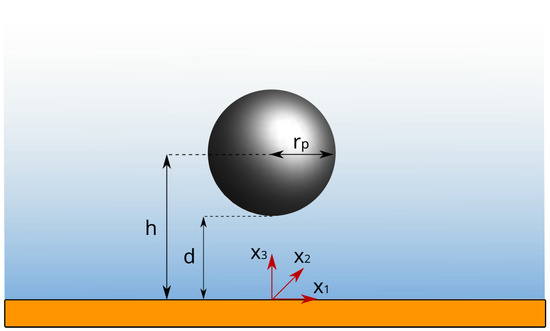
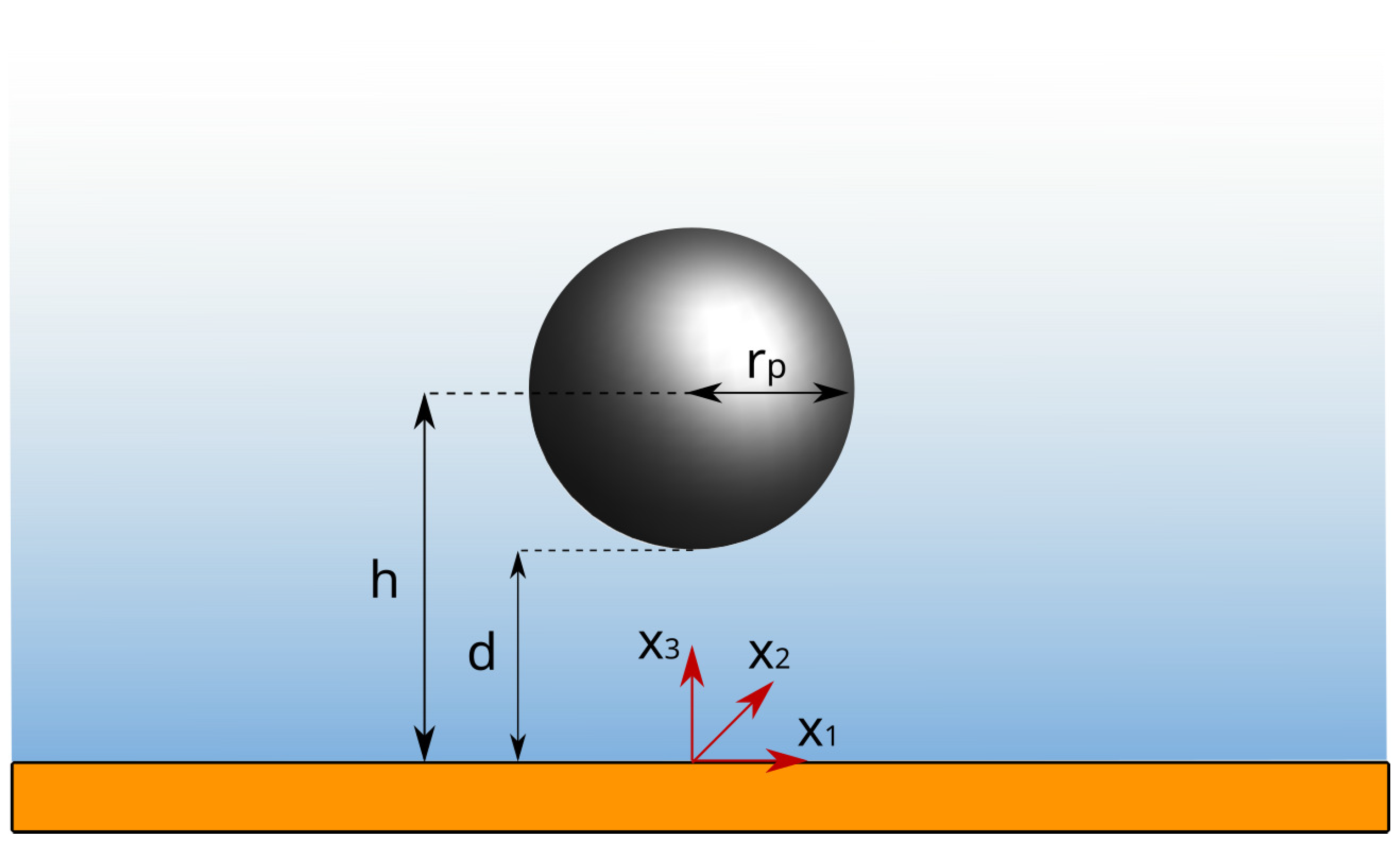
Consider a particle moving in an incompressible Newtonian confined fluid (see Figure 1), and let and be its viscosity and density, respectively. The Reynolds number is vanishingly small, and, whenever not otherwise specified, total adhesion is considered (no-slip boundary conditions) between the fluid and the surface of the particle and of the wall . Under these conditions, fluid motion is governed by the unsteady Stokes equations
equipped with the boundary conditions
where and are the velocity and the pressure fields of the fluid at point and time t, the fluid domain, and the time-dependent velocity and angular velocity of the particle, respectively, and the position vector centered at a barycentric point of the particle.
Figure 1.
Schematic representation of a spherical particle near a plane wall.
The hydrodynamic force and torque acting onto the particle are respectively
where is the unit normal vector directed inward into the fluid, represents the stress tensor field at the point , with , the superscript T indicating the transposition operation.
Let us denote the Laplace transform of a generic time-dependent function with the hatted notation , hence
The unsteady Stokes equations (1) in the Laplace domain becomes
equipped with the boundary conditions
where is the kinematic viscosity of the fluid. The associated stress tensor is , with being the identity matrix and . The force and torque in the Laplace domain read as
If we consider a spherical particle of radius in an unbounded fluid domain (free space), the Laplace transform of the hydrodynamic force acting onto the particle is given by [32,59]
that, considering a vanishing initial velocity , corresponds to the time-domain expression [9,10,32]
With reference to Equation (8), the term within parentheses consists of three contributions: (i) the first contribution is the Stokes resistance coefficient, obtained from the stationary Stokes equations setting in Equation (5); (ii) the second one is the Basset–Boussinesq coefficient, providing the second term at the r.h.s of Equation (9), which depends on the history of particle acceleration up to time t; (iii) the third contribution is proportional to the added mass of the sphere immersed in the fluid, corresponding in Equation (9) to a force increasing instantaneously the inertia of the particle. The Laplace transform of the hydrodynamic torque acting onto the spherical particle reads [11,32]
corresponding to torque in the time domain for which the added moment of inertia is vanishing [12,32] (the expression reported in [32] contains some typos)
When a body is immersed in a confined fluid, the hydrodynamic forces and torques should depend on the additional geometrical parameters representing the position of the particle in the confined domain a set of orientation angles . Furthermore, the isotropy break-up induced by confinement determines the occurrence of the coupling between forces and torques. Therefore, due to the linearity of Equations (5) and (6) with respect to the velocity and the angular velocity , the forces and torques acting on the body is a linear function of the latter,
where is the hydrodynamic grand-resistance matrix of the body at the position and orientation in the confined fluid. The grand-resistance matrix can be expressed in terms of the translational, rotational and roto-translational coupling friction matrices , , , as
Since, for , steady Stokes equations should be recovered from Equation (5), we can express the grand resistance matrix entering Equation (12) in the form
where
is the hydrodynamic grand-resistance matrix of the body at the position and orientation in the steady Stokes regime [46,60], and , , its translational, rotational, and roto-translational coupling friction matrices, respectively.
Equation (14) defines the matrix , which is a symmetric matrix (this symmetry is obtained straightforwardly following the same proof reported in [60] for the steady Stokes flow) possessing the property
From Equations (8) and (10), it is possible to dissect the expression for the matrix of a sphere in an unbounded flow as the sum of two separate contributions
where , and are the matrices collecting the Kirchhoff coefficients [61] (see [11] p. 164). More specifically, is the well-known added mass, firstly obtained by Green [62] in an unbounded potential flow, and and correspond to the added moment of inertia and the "added coupling of inertia", vanishing for a sphere (see [11,63,64]). In [65], Pozrkidis has shown that, in the limit (hence, at short times ), the hydrodynamic force acting on a body in unsteady Stokes flows is due to the added mass independently of the shape of the body. In the next section, we show that, in this limit, the entire grand-resistance matrix is represented by the grand-resistance matrix in the potential flow regime, independently of the shape of the body and of the confinement.
3. Hydrodynamic Forces and Torques Acting onto a Particle at Short Time (In the Limit )
In this section, we show that, independently of the geometry of the configuration (body + confinement), it is always possible to express the matrix as
with possessing the properties
and where the matrices of the Kirchhoff coefficients , and can be obtained from the solution of a potential-flow bounded problem [66,67].
If the fluid is confined, the matrices entering the second term at the r.h.s of Equation (17) are, generically, position and orientation-dependent. In order to define , and , consider the following harmonic problems [11,61,66,67]
and
so that the entries of , and are [11,64]
where, in Equations (20)–(24) and throughout this article, the Einstein summation convention for repeated indexes is adopted, and represents the Ricci–Levi Civita symbol (fundamental antisymmetric tensor).
As well known, Equation (1) (and consequently Equation (5)) representing the unsteady Stokes regime of a Newtonian incompressible fluid, are valid in the case that the Reynolds number ( being a characteristic velocity of the particle) is much smaller than one, , and the Strouhal number is of the same order of magnitude or greater than the reciprocal of the Reynolds number, . To investigate forces and torques acting on the particle in the limit (corresponding to a Womersley number ), it is convenient to normalize the equations governing the motion of the fluid Equations (5) and (6).
For the sake of simplicity, let us consider preliminary a translating body in the absence of rotation. Introducing the dimensionless variables , , , being the characteristic pressure of the system, Equation (5) become
where and . In order to preserve incompressibility for , we can choose , corresponding to the characteristic pressure of an accelerating fluid with characteristic acceleration . Therefore, Equation (25) reads
defining , the boundary conditions Equation (6) attain the form
As well known, the pressure of a Stokes flow is a harmonic field. In the limit for (hence ), the dimensionless Stokes Equation (26) reduces to the Laplacian equation
Due to the linearity of Equations (27) and (28) the solutions of these equations are homogeneous linear functions of the entries . Consequently, the tensorial/vectorial quantities and can be introduced so that
Substituting Equation (29) into Equations (27) and (28), the fields and , in the limit for , approach to and , solution of the problem
equipped with the boundary conditions
Consequently, the hydrodynamic force acting on the particle can be expressed in terms of and as
By using the Gauss theorem and the incompressibility constraint, the viscous part of the integral on the r.h.s of Equation (32) becomes
and in the limit for (i.e., ), it vanishes due to Equation (30) (the velocity field is harmonic in this limit). Therefore, for , we have
Setting , and comparing Equations (30), (31) and (34) with Equations (20) and (22), Equation (34) becomes
which proves the above statement as regards the translation contribution to the force.
The torque on the particle defined by Equation (7) can be expressed as
Using once again the Gauss theorem and the incompressibility constraint, the integral associated with the viscous term in Equation (36) vanishes for . Since by definition the comparison of Equation (36) with Equation (23) provides
which proves the claim stated at the beginning of this section as regards the translational contribution to the torque.
Next, consider the body rotating with angular velocity in the absence of translational motion. Reiterating the same procedure Equations (26)–(35), and defining in this case , one finally obtains
and
that completes the proof of the initial claim.
In the specific case of a sphere near a plane wall depicted in Figure 1, for which the only configurational parameter is the distance h from the plane, the grand-resistance matrix can be represented as
The expressions for , and for a sphere near a plane wall are available in the literature [39,41,42,48]. Furthermore, since is vanishing on the surface of a sphere, the added moment of inertia and the coupling terms are vanishing and , while the added mass tensor assumes the structure in the Cartesian coordinate system represented in Figure 1. The limit values for of the coefficients and are well known and they have been obtained by G.G. Stokes [68]
and
While several expressions for have been presented in the literature, valid over the entire range of h-values [69,70,71], the counterpart for was lacking. Only recently, Van Der Geld [72] obtained compact explicit expressions for and valid over the entire domain of h-values. Specifically,
and
and being infinite matrices depending on and h, the entries of which are
where and where the binomial coefficients are indicated by the parenthesis symbol according to the classical notation.
4. Reflection Method for Time Dependent Stokes Flow
Contrary to the steady Stokes-flow case, the linear inertial term in the equation governing the fluid motion makes so that the hydrodynamic forces and torques acting onto an oscillating particle are different from the forces and torques acting on a still particle immersed into an equivalently oscillating ambient flow.
More generally, if and are the force and the the torque acting on a rigid body of external surface , associated with the hydrodynamic problem
equipped with the boundary conditions
the force and the torque and acting on the same body associated with the hydrodynamic problem
and equipped with the boundary conditions
read
where is the domain of the particle and the volume element. Equations (51) and (52) are obtained by considering that , where is a generic ambient unsteady Stokes flow defined within the domain .
In extending the reflection method [46] to unsteady Stokes flows, it is necessary to take into account carefully the transformations Equations (51) and (52).
Let us consider the hydrodynamic problem Equations (1) and (2) of a particle moving in a confined unsteady Stokes flow with no-slip boundary conditions at the surface of the body and of the confinement. According to the reflection method [46], the velocity and pressure fields are expressed as the superposition of a countable system of fields
with associated stress tensor , .
Each field is a solution of the unsteady Stokes equations with boundary conditions
Owing to the linearity of the unsteady Stokes equations, each k-th field in Equation (53) contributes to the total force torque with an associated force and torque ,
By definition of the field , the force and the torque are the force and torque experienced by the body moving in the unbounded fluid.
The force and the torque due to the field are expressed by the integrals
and
The application of the Gauss divergence theorem provides
and
Let and be the force and the torque due to the field . Comparing them with Equations (51) and (52), it is possible to recognize that
and
being these the force and the torque acting on the still body immersed in the ambient flow . More generally, the force and the torque and , associated with the flow ,
and
are the force and the torque acting on the still body immersed in the ambient flow .
Indicating with and the force and the torque acting on the particle moving with velocity and angular velocity in the unbounded fluid, the total force and torque in the confined case can be expressed as
and
The same expressions, Equations (64) and (65), are obtained in the case full-slip boundary conditions at the confinement walls are assumed, namely, in the case the boundary conditions, substituting Equation (2), read
In Equation (66), is the unit vector normal to the surface of the confinement, a set of unit vectors tangential to the surface of the confinement and ⊗ the tensor product operator. In fact, by defining the reflected fields by the boundary conditions
the same analytical procedure applied for Equations (55)–(63) can be used identically.
At the steady state, where and , the classical expressions for the force and the torque [46,48] are recovered from Equations (64) and (65). Procopio and Giona [55], have analyzed the convergence properties of the series entering Equations (64) and (65) for steady Stokes flows developing a constructive method for evaluating each force and torque for arbitrary bodies. In this work, we assume the particle being far enough from the boundaries of the confinement, so that only the leading order terms need to be evaluated, and the series obtained from the "unsteady" reflection method converging, remanding to further works a more careful analysis of these aspects.
5. Approximate Expressions for Forces and Torques Acting onto a Particle Moving in a Confined Unsteady Stokes Flow
In this section, we provide approximate expressions for the hydrodynamic force and torque acting on bodies moving in unsteady Stokes flow in terms of the Green function of the confinement and of the Faxén operators of the body.
It is convenient to consider the hydrodynamic problem of a body moving in a confined unsteady Stokes flow in the frequency formulation (Laplace domain). The Laplace transform of the force and the torque on the particle due to the reflection fields obtained in Equations (64) and (65) provides
and
Starting from Equations (68) and (69), the approximation provided in [55] Section 6.2 can be extended to unsteady Stokes flows by taking into account the differences due to the unsteadiness. This implies that an additional dimensionless distance is present in the problem. Moreover, as discussed in the previous section, in unsteady conditions the problem of a translating body in a still fluid is not equivalent to the problem of a still body in a flow moving at the same constant velocity.
To begin with, let be the Laplace transform of the confined Green function of the unsteady Stokes equations (referred to as the confined Green function hereafter for brevity), centered at the pole and defined in the domain of the confinement , where is the Laplace transform of the unsteady Stokeslet (referred to as unsteady Stokeslet hereafter) and the Laplace transform of the regular part of the Green function (referred to as the regular part of the Green function hereafter). More specifically, the unsteady Stokeslet, obtained by different approaches in the literature [16,27,28,29,30,31,32] and reported in Appendix A, is the solution of the problem
vanishing at infinity, hence
where is the Dirac delta function centered at the position of the pole .
Whereas, the regular part is a bitensorial field solution of the unsteady Stokes equations
with boundary conditions
when no-slip boundary conditions are considered, and with boundary conditions
when full-slip boundary conditions are assumed at the surface of the confinement. Here, represents the stress tensor associated with the regular part of the Green function . In Equations (72)–(74) and in the remainder, the subscripts are distinguished according the bitensorial notation [73], using Latin letters for the entries of bitensors at the field point and Greek letters for the entries at the pole point .
Furthermore, assume that the velocity field around the body translating with velocity can be expressed by a linear integro-differential operator acting at the pole of the unsteady Stokeslet via the expression
while the velocity field due to the rotation of the body with velocity by a linear integro-differential operator acting at the pole of the unsteady Stokeslet via the expression
For example, in the case of a sphere with no-slip boundary conditions, we have
and
where .
Consider, for the sake of simplicity, the case of a particle translating without rotating (hence, ). Applying the operator to the system of Equations (72) and (73), and considering that the Laplace transform of the first reflection field (defined by the boundary conditions Equation (54) and consisting in the flow due to the particle translating into the unbounded fluid) is provided by the Equation (75), we have that the velocity field is given by
Equation (79) is valid also in the case that full-slip boundary conditions are assumed at the surface of the confinement, as can be shown by applying the operator to Equation (74), considering the reflection fields provided by Equation (67).
The analysis developed below does not require any specification of the boundary conditions at the surface of the confinement. Therefore, either the cases of no-slip or full-slip boundary conditions at the surface of the confinement are included.
As shown in [16], for immersed bodies having no-slip boundary conditions, the same operator , providing the velocity field around a translating particle if applied to the pole of the unsteady Stokeslet Equation (A1), provides the force acting onto the still particle immersed in a generic ambient flow. This property, referred to as the Hinch–Kim dualism [35], has been shown also for the operator , providing both the velocity field around the rotating particle and the torque acting onto the still particle in a generic ambient flow. Therefore, since provides the force acting on the still particle immersed, at the position , in the flow , we have [35]
and for the torque
Therefore, defining the symmetric matrices
and
it is possible to express and as
and
Higher-order reflected fields, and their associated forces, cannot be evaluated exactly solely from the knowledge of the operators and , providing the flows due to the rigid motion of the particle. Therefore, if we restrict the analysis exclusively to the use of the Faxén operators and , we are forced to approximate higher-order reflection fields by taking into account solely the leading-order terms. Of course a more general analysis of the unsteady Stokes problem is possible, by considering higher-order Faxén operators, and this will be developed in forthcoming works. Nevertheless, as shown below, the analysis restricted to the leading-order term provides fairly accurate results if the body is not too close to the confinement walls (for a spherical particle near a planar wall if the distance is in order of one particle radius). The velocity field can be approximated by a constant ambient flow acting on the particle with the velocity evaluated at the position point of the particle, thus
where the order of magnitude of the error has been evaluated using Equation (79), assuming a long-distance scaling for the regular part of the Green function analogous to that of the unsteady Stokeslet Equation (A1), hence . Using the same arguments adopted to obtain Equation (77), and substituting , we have
The force and torque due to can be thus expressed as
and
Approximating the force in Equation (80) by using the translational resistance matrix in the unbounded fluid according
we obtain
and
The equivalent procedure applied to the evaluation of higher-order reflection forces and torques provides
and
Considering that and , and substituting Equations (93) and (94) into Equations (68) and (69), we obtain the approximate expressions
and
By carrying out the same procedure, assuming the particle rotating with an angular velocity without translating, and considering that, in the unbounded domain of the fluid, and , we obtain
and
where the symmetric matrix is defined as
The expression for the force can be further simplified by simple matrix manipulations that finally lead to
Equations (95)–(98) are the equivalent expressions, for unsteady Stokes flows, of the extended Swan and Brady approximation derived in [55] for steady Stokes flows. As in the steady case, the order of magnitude of the error committed depends on the distance from the plane. However, in this case, there is not a single independent dimensionless group which can be defined. As it is shown in the next section, where an explicit example is reported, the results obtained from Equations (95)–(98) depend on via different dimensionless groups, such as , , , with . In the same way, the order of magnitude reported in the approximations Equations (95)–(98) should be interpreted considering all possible dimensionless groups obtained by the products of the characteristic lengths , and , with and with the constraint that due to the result obtained in Section 3.
Since for the sphere the operator (77) does not contain the first-order derivatives of the regular part of the Green function, the order of magnitude committed in the approximation Equation (86), becomes instead of . As a consequence, all the estimates reported for generic objects as a function of , should be rescaled by an order of magnitude in the case of the sphere.
Furthermore, for a sphere the coupling matrix in the unbounded fluid vanishes (), so that the 0-th order term in the expansion of the operator in Equation (78) is also vanishing. As a consequence, the error committed in approximating the total torque by Equations (96) and (98) reduces by a further order of magnitude.
6. Forces Acting onto a Sphere Translating near a Plane Wall with Full-Slip Boundary Conditions
In [38], Simha et al. evaluate the force acting onto a sphere with no-slip boundary conditions translating near a plane wall with full-slip boundary conditions by taking advantage of the simplicity of the Green function associated with this confinement. In fact, the regular part of the Green function, defined by Equations (72) and (74), assuming that is a plane wall, can be expressed in terms of the unsteady Stokeslet Equation (A1), solution of the unbounded problem Equations (70)–(71), as
where is the mirror operator. Making use of the latter expression, considering that the resistance matrix for the sphere in the unbounded fluid is and substituting the Faxén operator for the sphere Equation (77) into Equations (82) and (101), we finally obtain the expression for the force acting on a sphere (expressed in the Cartesian coordinate system depicted in Figure 1,
where
and
The dimensionless lengths entering Equations (107) and (108) are defined as and , where is the viscous penetration depth.
In the limit of the steady Stokes flow, Equation (107) provide
consistently with the results available in the literature [51,74]. In the high-frequency limit, as expected by the results obtained in Section 3, a force proportional to the confined added mass is recovered from Equation (107). In fact
It is interesting to compare these results with the literature. The expressions obtained in [38] are based on two different approximation methods: (i) a point particle method developed by Felderhof (for the unsteady Stokes equations) [37], consisting in evaluating via Equation (80) approximating , and (ii) a reflection method, consisting in considering only and in the series Equation (68), with evaluated via Equation (84). The expressions obtained by the reflection method in [38] (which is the most conservative regarding the error committed in the approximation) read in the present notation as
From the analysis developed in Section 5, it follows that it is necessary to include higher-order reflection forces in order to obtain correct expressions to the order . For example, from Equation (91), the first term in the expansion of is for a spherical particle (see the discussion at the end of Section 5). Therefore, neglecting this force does not allow us to evaluate correctly the effect of the confinement onto the inertial terms, which have an intensity order of magnitude of (as emerges from the expression of the added mass Equations (41) and (42)). The expressions obtained by both the point particle approximation and the reflection method truncated to match both the expected limits for and for (in the Fourier transform approach used in [38], where is the frequency of oscillation and i the imaginary unit). However, they differ, albeit slightly, from each other for values of .
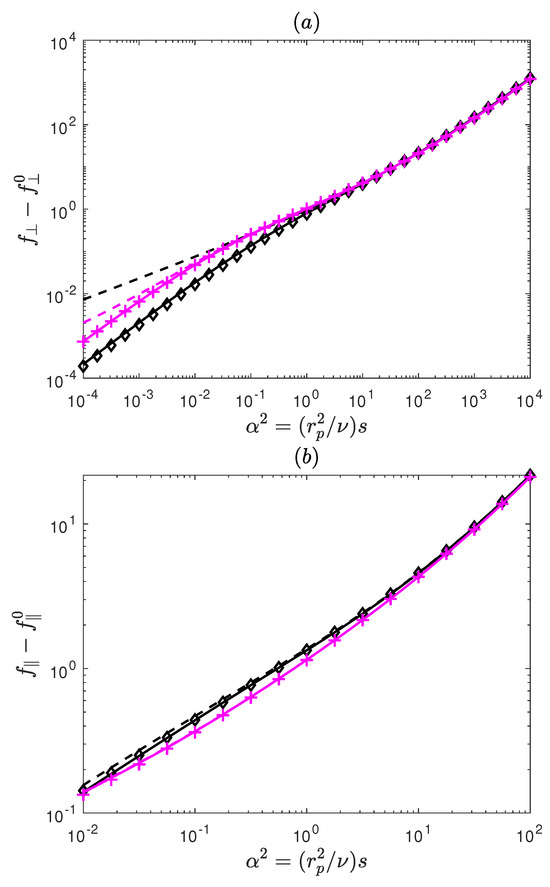
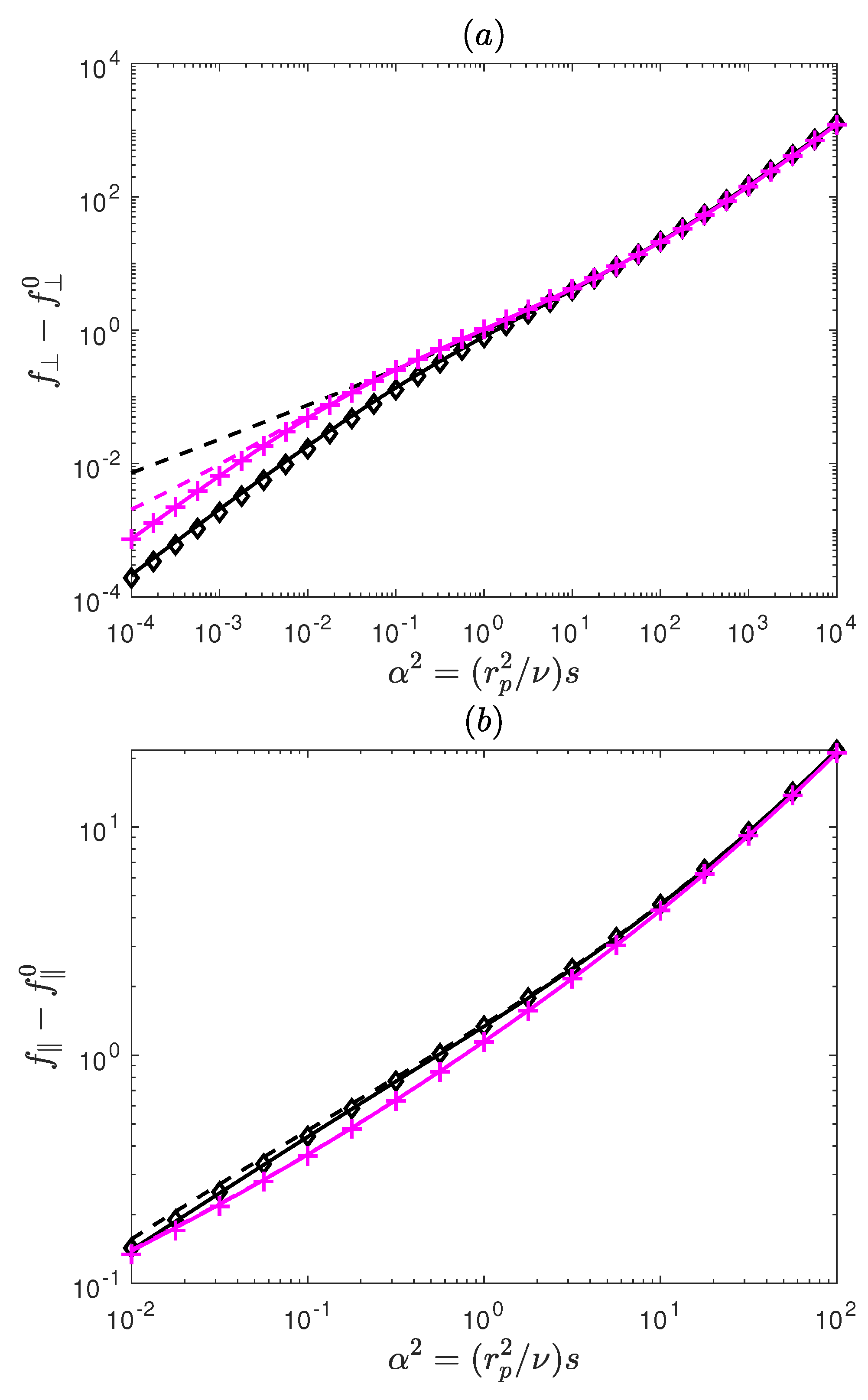
Figure 2 depicts the comparison of the results obtained by FEM simulations with the analytical expressions derived using the higher order reflection method Equation (107) and with the expressions Equation (111) obtained in [38]. More specifically, Figure 2 refers to the dimensionless forces and after the subtraction of their the stationary limits and ,
Figure 2.
Dimensionless Laplace transform of forces, with the stationary limit subtracted, acting on a sphere with no-slip boundary conditions, translating into an unsteady Stokes flow bounded by a plane with full-slip boundary conditions. Black diamonds (⋄) represent the results obtained via FEM simulations at , solid black lines the results obtained using Equation (107) t , and dashed black lines the results from [38] using Equation (111) at . Magenta plus signs (+) represent the results obtained via FEM simulations at , solid magenta lines the results derived using Equation (107) for , and dashed magenta lines the results from [38] using Equation (111) for . (a) depicts the forces perpendicular to the plane due to a translation perpendicular to the plane, while (b) the forces parallel to the plane due to a translation parallel to the plane.
It can be observed that the expressions Equation (111) do not match the results obtained via FEM numerical simulation at low frequencies especially as regards the perpendicular motion of the particle, whereas expressions Equation (107) provide valid results over the entire range of s-values.
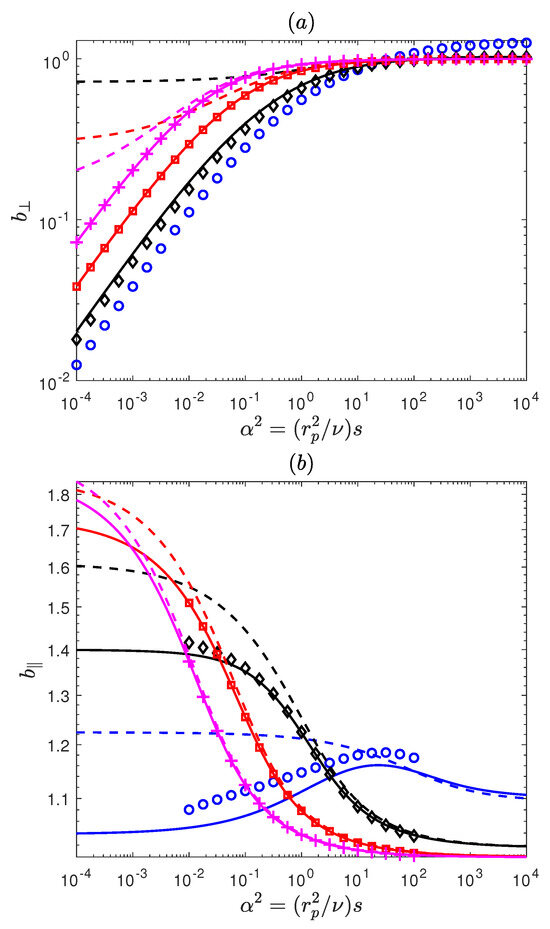
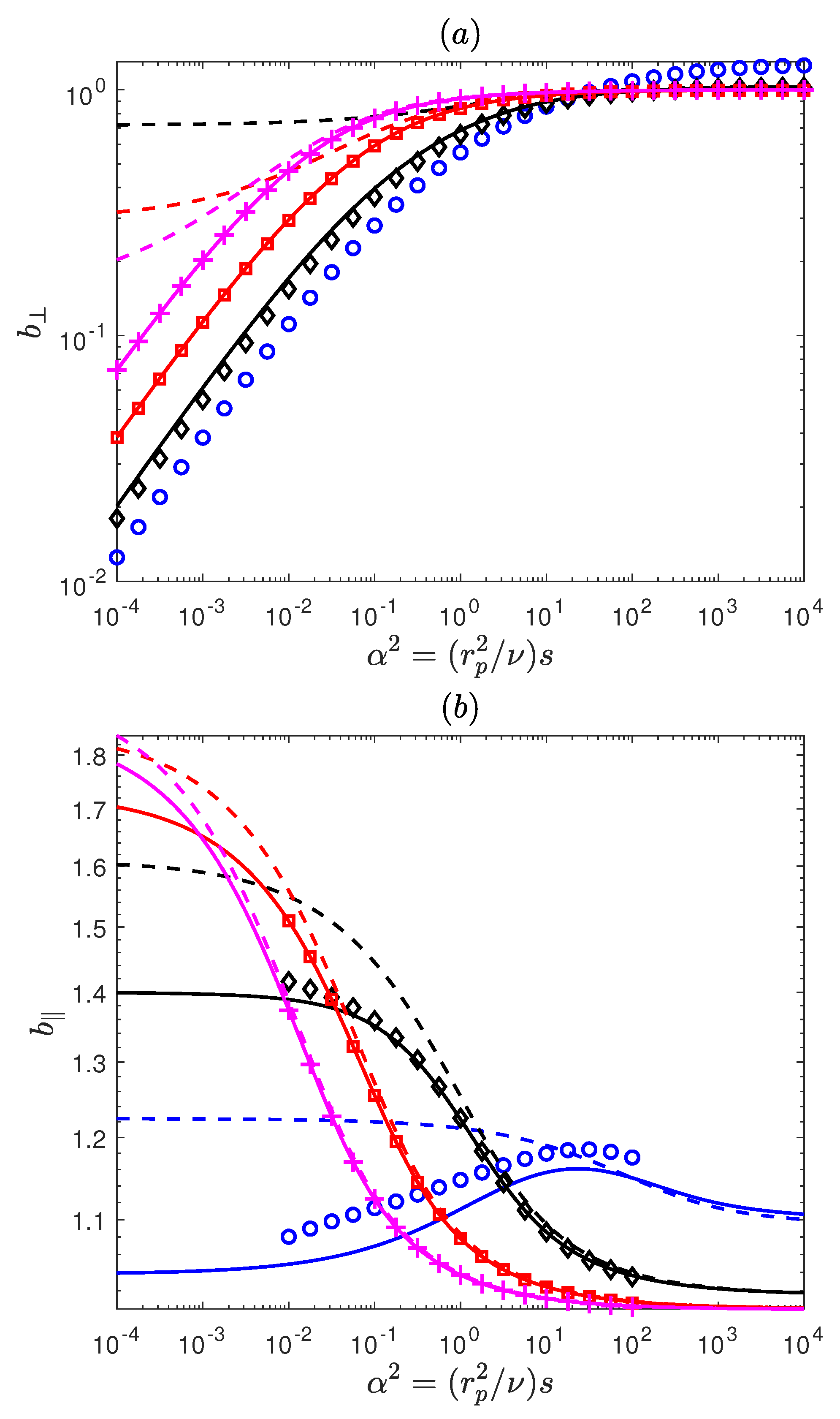
The discrepancy of the expressions obtained by the reflection method truncated to Equation (111) with the FEM simulations is more evident in Figure 3, where the Basset–Boussinesq correction factors and , defined as
are depicted. In Equation (113) we have set
Figure 3.
Basset–Boussinesq correction factors defined by Equation (113) for a sphere with no-slip boundary conditions translating near a plane wall with full-slip boundary conditions. Blue circles (∘) represent the results obtained via FEM simulations at , solid blue lines and dashed blue lines indicate the results derived using Equations (107) and (111), respectively, for the same distance. Black diamonds (⋄) represent the results obtained from FEM simulations at , solid black lines and dashed black lines indicate the results derived using Equations (107) and (111), respectively, for the same distance. Red squares (□) represent the results obtained via FEM simulations at , solid red lines and dashed red lines indicate the results derived using Equations (107) and (111), respectively, for the same distance. Magenta plus signs (+) represent the results obtained via FEM simulations at , solid magenta lines, and dashed magenta lines indicate the results derived using Equations (107) and (111), respectively, for the same distance. (a) displays the correction factors due to a translation perpendicular to the plane, while (b) the correction factors due to a translation parallel to the plane.
Figure 3 depicts the comparison of these quantities obtained by Equation (107), by Equation (111) and by FEM simulations.
The Basset–Boussinesq correction factor reported in Figure 3a, which by FEM simulations and by Equation (107) is found to be vanishing for , is instead different from zeros if evaluated by using Equation (111).
Results obtained by FEM simulations in the case of a sphere moving parallel to the plane wall are less accurate because it is not possible to take advantage by the axial symmetry possessed by the hydrodynamic problem of the sphere moving perpendicular to the plane wall. Since the numerical error is enhanced for extreme values of s ( and ), Figure 2b and Figure 3b depict the results in the range , in which numerical simulations are reliable and accurate. From the analysis of the data reported in Figure 3, it is possible to conclude that the expressions Equation (107) obtained using the approximation developed in Section 5 are accurate over the entire range of the frequencies (s values), given that the distance between the particle surface and the the plane wall is greater than one particle radius (, where as shown in Figure 1). The expressions for the force onto a spherical particle near a full-slip plane wall Equation (107) are, hence, an improvement of the results obtained by Simha et al. [38], which fail at low frequency even at large distances between sphere and plane ().
7. Conclusions
In this article, we have proposed general expressions for evaluating the resistance forces and torques acting on bodies in unsteady Stokes flows to the order . Moreover, we have obtained for the first time (to the best of our knowledge) an expression, valid for any frequency and for distances , for the hydrodynamic forces acting on a body in a confined fluid. Specifically, the case refers to a sphere with no-slip boundary conditions translating near a plane wall with full-slip boundary conditions. These results, useful in themselves in the study of particle transport and Brownian motion [1], represent the starting point for further developments in the theory of particle motion in confined unsteady Stokes flows, and admit both scientific and technological interest. Further developments may consider bodies with different boundary conditions and shapes once the associated Faxén operators are obtained either analytically or numerically. As well known from the case of steady Stokes flows regime, hydrodynamic forces and torques acting onto bodies with shapes different from the sphere (such as ellipsoidal and toroidal) will have non-vanishing coupling terms involving interesting rotational behavior if immersed in a shear flow [75,76,77,78] or close to a plane [79,80,81]. By obtaining forces and torques for bodies with these geometries it would be possible to evaluate the effect of the inertia of the fluid on their dynamics.
Jointly with the asymptotic analysis developed in Section 3 and with the extension of reflection method developed in Section 4 and Section 5, the explicit expressions derived provide us a clear view of the elements necessary to describe the resistance forces and torques acting on a body in a confined unsteady Stokes flow, their asymptotic behaviors, and the errors committed in adopting certain assumptions and simplifications.
The extension of the reflection method to the unsteady Stokes flows, shows us that it is necessary to consider carefully the peculiarities of the unsteadiness as the direct extension of the expressions derived in the steady case (as, for example, performed in [58]) may lead to incorrect results.
Finally, the proof that, in the limit of high frequencies (), the resistance forces and torques acting on a body are given by the confined Kirchhoff coefficients, ensure us that we can obtain, in this limit (which is the most problematic due to very small viscous penetration depths ), the forces and torques by solving much simpler potential problems.
Author Contributions
Conceptualization, G.P. and M.G.; Methodology, G.P. and M.G.; Software, V.B.; Data curation, G.P. and V.B.; Writing—original draft, G.P. All authors have read and agreed to the published version of the manuscript.
Funding
This research received no external funding.
Data Availability Statement
The original contributions presented in the study are included in the article, further inquiries can be directed to the corresponding author.
Conflicts of Interest
The authors declare no conflicts of interest.
Abbreviations
| Fluid density | |
| Dynamic viscosity | |
| Kinematic viscosity | |
| Characteristic time of the problem | |
| Momentum diffusion time | |
| Viscous penetration depth | |
| Characteristic length of the problem | |
| Characteristic length of the particle body | |
| Characteristic distance between the body and the | |
| confinement boundaries | |
| Characteristic velocity of the body | |
| Characteristic pressure of the fluid | |
| Reynolds number | |
| Strouhal number | |
| Womersley number | |
| Translational velocity of the body | |
| Angular velocity of the body | |
| Radius of a spherical body | |
| h | Distance of a planar wall from the center of the spherical body |
| d | Distance of a planar wall from the surface of the spherical body |
| Dimensionless distance of a planar wall from the center of the | |
| spherical body | |
| Domain of the fluid | |
| Domain of the body | |
| Surface of the confinement | |
| Surface of the body | |
| Unitary normal vector to | |
| Unitary normal vector to | |
| Set of unitary tangential vectors to | |
| t | Time |
| s | Laplace variable |
| Position of the fluid element | |
| Dimensionless position of the fluid element | |
| Position of the body/pole of singularities | |
| Set of orientation angles | |
| Position vector centered at the position of the body | |
| Norm of | |
| Laplace transform of the function • (see Equation (4)) | |
| ⊗ | Tensor product |
| Transpose of the matrix • | |
| Identity matrix | |
| Mirror operator | |
| Velocity field of the fluid | |
| Dimensionless Laplace transform of the velocity field of the fluid | |
| p | Pressure field of the fluid |
| Dimensionless Laplace transform of the pressure field of the fluid | |
| Stress tensor of the fluid | |
| Ambient flow | |
| Disturbance flow | |
| q | Pressure associated with the disturbance flow |
| Laplace transform of the unsteady Green function in the | |
| unbounded domain (unsteady Stokeslet for brevity, | |
| see the definition Equations (70) and (71)) | |
| Pressure field associated with | |
| Stress tensor associated with | |
| Laplace transform of the regular part of the confined unsteady | |
| Green function (regular part of the Green function for brevity, see | |
| the definition Equations (72) and (74)) | |
| Pressure field associated with | |
| Stress tensor associated with | |
| Laplace transform of the confined unsteady Green function | |
| Faxén operator for translations (see Equation (75)) | |
| Faxén operator for rotations (see Equation (76)) | |
| Hydrodynamic force acting on the body | |
| Hydrodynamic torque acting on the body | |
| Hydrodynamic grand-resistance matrix (see Equation (12)) | |
| , , | Translational, rotational and roto-translational coupling friction |
| matrices (see Equation (13)) | |
| , , | Translational, rotational and roto-translational coupling |
| friction matrices at for the steady Stokes flow (see Equation (15)) | |
| See Equation (14) | |
| Basset–Boussinesq hydrodynamic grand-resistance matrix | |
| (see Equation (18)) | |
| , | Potential flows (see Equations (20) and (21)) |
| , , | Added mass, added moment of inertia and added coupling |
| of inertia (see Equations (22)–(24)) | |
| , | Entries of the added mass of a sphere close to a plane |
| , | See Equations (45) and (46) |
| , , | See Equations (82), (83), (99) |
| , | Dimensionless entries of the translational friction matrix of |
| a sphere near a plane (see Equation (106)) | |
| , | See Equation (112) |
| , | See Equation (114) |
| , | Basset–Boussinesq correction factors (see Equation (113)) |
| , | See Equation (108) |
Appendix A. The Green Function of the Unsteady Stokes Flow in the Unbounded Domain
In this Appendix, the Laplace transform of the Green function of the unsteady Stokes flow in the unbounded domain obtained by different approaches in the literature (see for example [16,27,31,32]) is reported.
References
- Mo, J.; Simha, A.; Raizen, M.G. Brownian motion as a new probe of wettability. J. Chem. Phys. 2017, 146, 134707. [Google Scholar] [CrossRef] [Scilit] [PubMed]
- Mo, J.; Raizen, M.G. Highly resolved Brownian motion in space and in time. Annu. Rev. Fluid Mech. 2019, 51, 403–428. [Google Scholar] [CrossRef] [Scilit]
- Wei, D.; Dehnavi, P.G.; Aubin-Tam, M.; Tam, D. Is the zero Reynolds number approximation valid for ciliary flows? Phys. Rev. Lett. 2019, 122, 124502. [Google Scholar] [CrossRef] [Scilit] [PubMed]
- Wei, D.; Dehnavi, P.G.; Aubin-Tam, M.; Tam, D. Measurements of the unsteady flow field around beating cilia. J. Fluid Mech. 2021, 915, A70. [Google Scholar] [CrossRef] [Scilit]
- Bruot, N.; Cicuta, P.; Bloomfield-Gadêlha, H.; Goldstein, R.E.; Kotar, J.; Lauga, E.; Nadal, F. Direct measurement of unsteady microscale Stokes flow using optically driven microspheres. Phys. Rev. Fluids 2021, 6, 053102. [Google Scholar] [CrossRef] [Scilit]
- Zhang, Z.; Bertin, V.; Essink, M.H.; Zhang, H.; Fares, N.; Shen, Z.; Bickel, T.; Salez, T.; Maali, A. Unsteady drag force on an immersed sphere oscillating near a wall. J. Fluid Mech. 2023, 977, A21. [Google Scholar] [CrossRef] [Scilit]
- Dincau, B.; Dressaire, E.; Sauret, A. Pulsatile flow in microfluidic systems. Small 2020, 16, 1904032. [Google Scholar] [CrossRef] [Scilit]
- Stokes, G.G. On the Effect of the Internal Friction of Fluids on the Motion of Pendulums. Trans. Cambridge Philos. Soc. 1851, 9, 8–106. [Google Scholar]
- Boussinesq, J. Sur la resistance qu’oppose un fluide indefini en repos, sans pesanteur, au mouvement varie d’une sphere solide qu’il mouille sur toute sa surface, quand les vitesses restent bien continues et assez faibles pour que leurs carres et produits soient negligiables. C. R. Acad. Sc. Paris 1885, 100, 935–937. [Google Scholar]
- Basset, A.B., III. On the motion of a sphere in a viscous liquid. Phil. Trans. R. Soc. Lond. Ser. A 1888, 179, 43–63. [Google Scholar]
- Lamb, H. Hydrodynamics, 6th ed.; Dover Publications: Mineola, NY, USA, 1945. [Google Scholar]
- Feuillebois, F.; Lasek, A. On the rotational historic term in non-stationary Stokes flow. Q. J. Mech. Appl. Math. 1978, 31, 435–443. [Google Scholar] [CrossRef] [Scilit]
- Mazur, P.; Bedeaux, D. A generalization of Faxén’s theorem to nonsteady motion of a sphere through an incompressible fluid in arbitrary flow. Physica 1974, 76, 235–246. [Google Scholar] [CrossRef] [Scilit]
- Hills, B. A generalized Langevin equation for the angular velocity of a spherical Brownian particle from fluctuating hydrodynamics. Physica. A: Stat. Mech. Appl. 1975, 80, 360–368. [Google Scholar] [CrossRef] [Scilit]
- Gatignol, R. The Non-Uniform Motion of a Sphere in an Unsteady Non-Uniform Stream of Viscous Incompressible Fluid; De Gruyter: Berlin, Germany, 1983; Volume 63. [Google Scholar]
- Pozrikidis, C. A singularity method for unsteady linearized flow. Phys. Fluids Fluid Dyn. 1989, 1, 1508–1520. [Google Scholar] [CrossRef] [Scilit]
- Gatignol, R. On the history term of Boussinesq–Basset when the viscous fluid slips on the particle. C. R. Mécanique 2007, 335, 606–616. [Google Scholar] [CrossRef] [Scilit]
- Erbaş, A.; Podgornik, R.; Netz, R. Viscous compressible hydrodynamics at planes, spheres and cylinders with finite surface slip. Eur. Phys. J. E 2010, 32, 147–164. [Google Scholar] [CrossRef] [Scilit]
- Legendre, D.; Rachih, A.; Souilliez, C.; Charton, S.; Climent, É. Basset-Boussinesq history force of a fluid sphere. Phys. Rev. Fluids 2019, 4, 073603. [Google Scholar] [CrossRef] [Scilit]
- Premlata, A.; Wei, H.H. Atypical non-Basset particle dynamics due to hydrodynamic slip. Phys. Fluids 2020, 32, 097109. [Google Scholar] [CrossRef] [Scilit]
- Zhang, W.; Stone, H.A. Oscillatory motions of circular disks and nearly spherical particles in viscous flows. J. Fluid Mech. 1998, 367, 329–358. [Google Scholar] [CrossRef] [Scilit]
- Lawrence, C.; Weinbaum, S. The force on an axisymmetric body in linearized, time-dependent motion: A new memory term. J. Fluid Mech. 1986, 171, 209–218. [Google Scholar] [CrossRef] [Scilit]
- Lawrence, C.J.; Weinbaum, S. The unsteady force on a body at low Reynolds number; the axisymmetric motion of a spheroid. J. Fluid Mech. 1988, 189, 463–489. [Google Scholar] [CrossRef] [Scilit]
- Auguste, F.; Magnaudet, J. Path oscillations and enhanced drag of light rising spheres. J. Fluid. Mech. 2018, 841, 228–266. [Google Scholar] [CrossRef] [Scilit]
- Mathai, V.; Zhu, X.; Sun, C.; Lohse, D. Flutter to tumble transition of buoyant spheres triggered by rotational inertia changes. Nat. Commun. 2018, 9, 1792. [Google Scholar] [CrossRef] [Scilit] [PubMed]
- Ershkov, S.V.; Christianto, V.; Shamin, R.V.; Giniyatullin, A.R. About analytical ansatz to the solving procedure for Kelvin–Kirchhoff equations. Eur. J. Mech. B Fluids 2020, 79, 87–91. [Google Scholar] [CrossRef] [Scilit]
- Jones, R. Hydrodynamic fluctuation forces. Physica A: Stat. Mech. Appl. 1981, 105, 395–416. [Google Scholar] [CrossRef] [Scilit]
- Piva, R.; Morino, L. Vector Green’s function method for unsteady Navier-Stokes equations. Meccanica 1987, 22, 76–85. [Google Scholar] [CrossRef] [Scilit]
- Mauri, R.; Rubinstein, J. On the propagator of the Stokes equation and a dynamical definition of viscosity. Chem. Eng. Commun. 1996, 148, 385–390. [Google Scholar] [CrossRef] [Scilit]
- Chan, A.; Chwang, A. The unsteady Stokeslet and Oseenlet. Proc. Inst. Mech. Eng. Pt. C J. Mechan. Eng. Sci. 2000, 214, 175–179. [Google Scholar] [CrossRef] [Scilit]
- Giona, M.; Procopio, G.; Mauri, R. Hydrodynamic Green functions: Paradoxes in unsteady Stokes conditions and infinite propagation velocity in incompressible viscous models. Meccanica 2022, 57, 1055–1069. [Google Scholar] [CrossRef] [Scilit]
- Kim, S.; Karrila, S.J. Microhydrodynamics: Principles and Selected Applications; Dover Publications, Inc.: Mineola, NY, USA, 2005. [Google Scholar]
- Hsiao, C.H.; Young, D.L. The singularity method in unsteady Stokes flow: Hydrodynamic force and torque around a sphere in time-dependent flows. J. Fluid Mech. 2019, 863, 1–31. [Google Scholar] [CrossRef] [Scilit]
- Pozrikidis, C. Boundary Integral and Singularity Methods for Linearized Viscous Flow; Cambridge University Press: Cambridge, UK, 1992. [Google Scholar]
- Procopio, G.; Giona, M. On the Hinch–Kim dualism between singularity and Faxén operators in the hydromechanics of arbitrary bodies in Stokes flows. Phys. Fluids 2024, 36, 032016. [Google Scholar] [CrossRef] [Scilit]
- Fouxon, I.; Leshansky, A. Fundamental solution of unsteady Stokes equations and force on an oscillating sphere near a wall. Phys. Rev. E 2018, 98, 063108. [Google Scholar] [CrossRef] [Scilit]
- Felderhof, B. Effect of the wall on the velocity autocorrelation function and long-time tail of Brownian motion. J. Phys. Chem. B 2005, 109, 21406–21412. [Google Scholar] [CrossRef] [Scilit] [PubMed]
- Simha, A.; Mo, J.; Morrison, P.J. Unsteady Stokes flow near boundaries: The point-particle approximation and the method of reflections. J. Fluid Mech. 2018, 841, 883–924. [Google Scholar] [CrossRef] [Scilit]
- Jeffery, G.B. On the steady rotation of a solid of revolution in a viscous fluid. Proc. London Math. Soc. 1915, 2, 327–338. [Google Scholar] [CrossRef] [Scilit]
- Brenner, H. The slow motion of a sphere through a viscous fluid towards a plane surface. Chem. Eng. Sci. 1961, 16, 242–251. [Google Scholar] [CrossRef] [Scilit]
- Dean, W.R.; O’Neill, M.E. A slow motion of viscous liquid caused by the rotation of a solid sphere. Mathematika 1963, 10, 13–24. [Google Scholar] [CrossRef] [Scilit]
- O’Neill, M.E. A slow motion of viscous liquid caused by a slowly moving solid sphere. Mathematika 1964, 11, 67–74. [Google Scholar] [CrossRef] [Scilit]
- Goren, S.L. The hydrodynamic force resisting the approach of a sphere to a plane permeable wall. J. Colloid Interface Sci. 1979, 69, 78–85. [Google Scholar] [CrossRef] [Scilit]
- Kim, S.; Russel, W.B. Modelling of porous media by renormalization of the Stokes equations. J. Fluid Mech. 1985, 154, 269–286. [Google Scholar] [CrossRef] [Scilit]
- Lorentz, H.A. Abhandlungen Über Theoretische Physik; B. G. Teubner: Leipzig, Germany, 1907. [Google Scholar]
- Happel, J.; Brenner, H. Low Reynolds Number Hydrodynamics: With Special Applications to Particulate Media; Mechanics of Fluids and Transport Processes, Martinus Nijhoff Publishers: The Hague, The Netherlands, 1983. [Google Scholar]
- Smoluchowski, M. Über die Wechselwirkung von Kugeln die sich in einer zähen Flüssigkeit bewegen. Bull. Int. Acad. Sci. 1911, 1A, 28–39. [Google Scholar]
- Brenner, H. Effect of finite boundaries on the Stokes resistance of an arbitrary particle. J. Fluid Mech. 1962, 12, 35–48. [Google Scholar] [CrossRef] [Scilit]
- Cox, R.G.; Brenner, H. Effect of finite boundaries on the Stokes resistance of an arbitrary particle Part 3. Translation and rotation. J. Fluid Mech. 1967, 28, 391–411. [Google Scholar] [CrossRef] [Scilit]
- Wakiya, S. Viscous flows past a spheroid. J. Phys. Soc. Jpn. 1957, 12, 1130–1141. [Google Scholar] [CrossRef] [Scilit]
- Lee, S.H.; Chadwick, R.S.; Leal, L. Motion of a sphere in the presence of a plane interface. Part 1. An approximate solution by generalization of the method of Lorentz. J. Fluid Mech. 1979, 93, 705–726. [Google Scholar] [CrossRef] [Scilit]
- Hasimoto, H. Slow motion of a small sphere in a cylindrical domain. J. Phys. Soc. Jpn. 1976, 41, 2143–2144. [Google Scholar] [CrossRef] [Scilit]
- Barta, E.; Liron, N. Slender body interactions for low Reynolds numbers—Part I: Body-wall interactions. SIAM J. Appl. Math. 1988, 48, 992–1008. [Google Scholar] [CrossRef] [Scilit]
- Swan, J.W.; Brady, J.F. Particle motion between parallel walls: Hydrodynamics and simulation. Phys. Fluids 2010, 22, 103301. [Google Scholar] [CrossRef] [Scilit]
- Procopio, G.; Giona, M. On the theory of body motion in confined Stokesian fluids. J. Fluid Mech. 2024. [Google Scholar] [CrossRef] [Scilit]
- Felderhof, B. Transient flow of a viscous incompressible fluid in a circular tube after a sudden point impulse. J. Fluid Mech. 2009, 637, 285–303. [Google Scholar] [CrossRef] [Scilit]
- Wakiya, S. Effect of a plane wall on the impulsive motion of a sphere in a viscous fluid. Phys. Soc. Jpn. 1964, 19, 1401–1408. [Google Scholar] [CrossRef] [Scilit]
- Gotoh, T.; Kaneda, Y. Effect of an infinite plane wall on the motion of a spherical Brownian particle. J. Chem. Phys. 1982, 76, 3193–3197. [Google Scholar] [CrossRef] [Scilit]
- Basset, A.B. A Treatise on Hydrodynamics; Deighton, Bell and Co.: Cambridge, UK, 1888; Volume 2. [Google Scholar]
- Brenner, H. The Stokes resistance of an arbitrary particle—II: An extension. Chem. Eng. Sci. 1964, 19, 599–629. [Google Scholar] [CrossRef] [Scilit]
- Kirchhoff, G. Vorlesungen über Mathematische Physik; Druck Und Verlag Von B. G. Teubner: Leipzig, Germany, 1876. [Google Scholar]
- Green, G.V. Researches on the Vibration of Pendulums in Fluid Media. Trans. R. Soc. Edinburgh 1835, 13, 54–62. [Google Scholar] [CrossRef] [Scilit]
- Birkhoff, G. Hydrodynamics: A Study in Logic, Fact, and Similitude; Princeton University Press: Princeton, NJ, USA, 1960. [Google Scholar]
- Milne-Thomson, L.M. Theoretical Hydrodynamics; Macmillan Education: London, UK, 1968. [Google Scholar]
- Pozrikidis, C. A study of linearized oscillatory flow past particles by the boundary-integral method. J. Fluid Mech. 1989, 202, 17–41. [Google Scholar] [CrossRef] [Scilit]
- Chow, S.K.; Hou, A.Y.; Landweber, L. Hydrodynamic forces and moments acting on a body emerging from an infinite plane. Phys. Fluids 1976, 19, 1439–1449. [Google Scholar] [CrossRef] [Scilit]
- Miloh, T.; Landweber, L. Generalization of the Kelvin-Kirchhoff equations for the motion of a body through a fluid. Phys. Fluids 1981, 24, 6–9. [Google Scholar] [CrossRef] [Scilit]
- Stokes, G.G. On Some Cases of Fluid Motion. Trans. Cambridge Philos. Soc. 1843, 8, 105–137. [Google Scholar]
- Hicks, W.M., Xiii. On the motion of two spheres in a fluid. Phil. Trans. R. Soc. Lond. 1880, 171, 455–492. [Google Scholar]
- Basset, A.B. On the motion of two spheres in a liquid, and allied problems. Proc. Lond. Math. Soc. 1886, 1, 369–377. [Google Scholar] [CrossRef] [Scilit]
- Yang, F.L. A formula for the wall-amplified added mass coefficient for a solid sphere in normal approach to a wall and its application for such motion at low Reynolds number. Phys. Fluids 2010, 22, 123303. [Google Scholar] [CrossRef] [Scilit]
- Van der Geld, C.W.M. On the motion of a spherical bubble deforming near a plane wall. J. Eng. Math. 2002, 42, 91–118. [Google Scholar] [CrossRef] [Scilit]
- Procopio, G.; Giona, M. Bitensorial formulation of the singularity method for Stokes flows. Mat. Eng. 2022, 5, 1–34. [Google Scholar] [CrossRef] [Scilit]
- Frydel, D.; Rice, S.A. Lattice–Boltzmann study of the transition from quasi-two-dimensional to three-dimensional one particle hydrodynamics. Mol. Phys. 2006, 104, 1283–1297. [Google Scholar] [CrossRef] [Scilit]
- Jeffery, G.B. The motion of ellipsoidal particles immersed in a viscous fluid. Proc. R. Soc. Lond. Ser. A Contain. Pap. Math. Phys. Character 1922, 102, 161–179. [Google Scholar]
- Yarin, A.L.; Gottlieb, O.; Roisman, I.V. Chaotic rotation of triaxial ellipsoids in simple shear flow. J. Fluid Mech. 1997, 340, 83–100. [Google Scholar] [CrossRef] [Scilit]
- Cui, Z.; Zhao, L.; Huang, W.X.; Xu, C.X. Stability analysis of rotational dynamics of ellipsoids in simple shear flow. Phys. Fluids 2019, 31, 023301. [Google Scholar] [CrossRef] [Scilit]
- Ershkov, S.V.; Leshchenko, D.; Giniyatullin, A.R. A new solving procedure for the kelvin–Kirchhoff equations in case of a falling rotating torus. Int. J. Bifurc. Chaos Appl. Sci. Eng. 2021, 31, 2150010. [Google Scholar] [CrossRef] [Scilit]
- Di Leonardo, R.; Dell’Arciprete, D.; Angelani, L.; Iebba, V. Swimming with an image. Phys. Rev. Lett. 2011, 106, 038101. [Google Scholar] [CrossRef] [Scilit]
- Mitchell, W.H.; Spagnolie, S.E. Sedimentation of spheroidal bodies near walls in viscous fluids: Glancing, reversing, tumbling and sliding. J. Fluid Mech. 2015, 772, 600–629. [Google Scholar] [CrossRef] [Scilit]
- Bianchi, S.; Saglimbeni, F.; Di Leonardo, R. Holographic imaging reveals the mechanism of wall entrapment in swimming bacteria. Phys. Rev. X 2017, 7, 011010. [Google Scholar] [CrossRef] [Scilit]
Disclaimer/Publisher’s Note: The statements, opinions and data contained in all publications are solely those of the individual author(s) and contributor(s) and not of MDPI and/or the editor(s). MDPI and/or the editor(s) disclaim responsibility for any injury to people or property resulting from any ideas, methods, instructions or products referred to in the content. |
© 2024 by the authors. Licensee MDPI, Basel, Switzerland. This article is an open access article distributed under the terms and conditions of the Creative Commons Attribution (CC BY) license (https://creativecommons.org/licenses/by/4.0/).