


Abstract
Partially averaged Navier–Stokes (PANS) has evolved over the past two decades from a conventional RANS–DNS bridging model into a scale-resolving simulation framework with controllable turbulence resolution. By introducing the unresolved fractions of turbulent kinetic energy and dissipation, fk and fε, PANS regulates the partition between modeled and resolved turbulence. However, the turbulence resolution achieved in practical simulations is not solely determined by the prescribed parameters, but also depends on the interaction among turbulence closure, grid resolution, numerical dissipation, and physical modeling. This review summarizes the theoretical foundations, resolution-control strategies, and engineering applications of PANS, with particular emphasis on the consistency between prescribed and realized turbulence resolution. The formulation of partially averaged governing equations, closure transformations, scale relationships, and the limiting behaviors toward RANS and DNS are first discussed. Recent developments in variable-resolution formulations, commutation-error treatment, scale-supplying variables, near-wall resolution approaches, dissipation-resolution control, and variable-density extensions are subsequently reviewed. Applications to canonical turbulence, separated flows, rotating machinery, marine hydrodynamics, cavitation, heat transfer, combustion, and compressible flows are assessed in terms of turbulence statistics, coherent structures, spectral characteristics, and engineering prediction capability. Existing studies demonstrate that PANS can recover energetic unsteadiness suppressed by RANS and improve predictions of complex flows when sufficient numerical resolution and appropriate physical closures are provided. Nevertheless, reducing fk does not necessarily guarantee improved accuracy, as the prescribed resolution must be consistent with grid resolution, time-step selection, numerical schemes, boundary treatments, and multiphysics models. Future developments of PANS will focus on reliable resolution estimation, conservative variable-resolution strategies, consistent multiphysics scale closures, and systematic verification and validation procedures to establish quantitative relationships among prescribed resolution, numerical realization, and predictive accuracy. In PANS, fk and fε define a scale-dependent closure rather than a scale separation set directly to the grid or filter.
1. Introduction
Turbulence simulation is governed by a persistent trade-off among physical fidelity, computational affordability, and predictive reliability. Reynolds-averaged Navier–Stokes (RANS) closures remain the primary choice for high-Reynolds-number engineering applications because they model the entire turbulent fluctuation field statistically and enable affordable wall-bounded simulations. However, their one-point statistical description becomes insufficient when the prediction depends on the dynamics of coherent structures, such as flow separation, vortex breakdown, wake switching, unsteady pressure loading, broadband mixing, or turbulence–interface interactions. Large-eddy simulation (LES) provides a more direct representation of energetic turbulent motions, but its application to industrial Reynolds numbers remains restricted by near-wall resolution requirements, inflow specification, and sensitivity to implicit filtering introduced by the numerical method. Hybrid RANS–LES approaches, including detached-eddy simulation (DES), improved delayed DES (IDDES), and scale-adaptive simulation (SAS), reduce this cost by redistributing modeled and resolved turbulence; nevertheless, the transition region between the two descriptions may introduce uncertainty because the resolved and modeled contributions are not always independently controlled [1,2,3,4].
The partially averaged Navier–Stokes (PANS) method was introduced to make the modeled-resolved partition an explicit physical choice [5,6,7]. Its resolution parameters are ratios of unresolved to total turbulence quantities rather than direct functions of a grid cutoff. In the original - formulation,
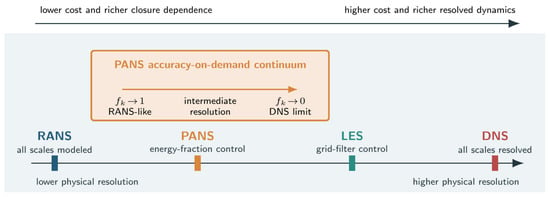
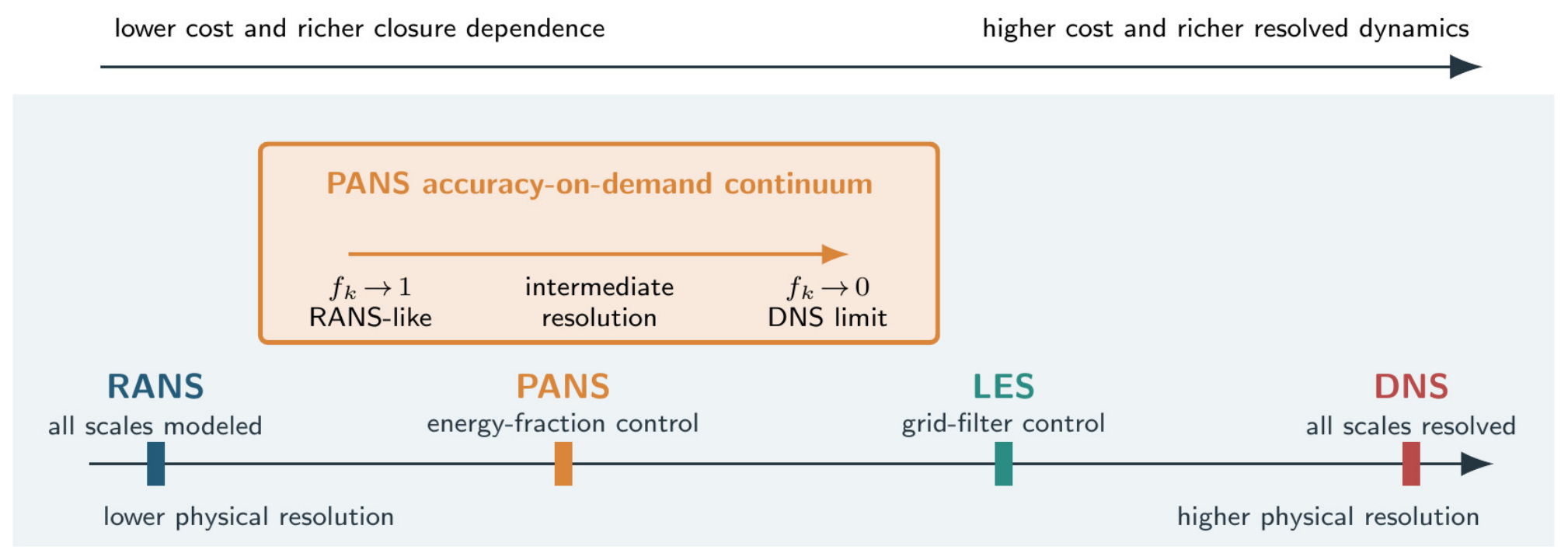
where the subscript denotes the unresolved field. Unity gives the parent RANS closure; decreasing reduces modeled kinetic energy and eddy viscosity so that dynamically admissible structures can appear in the resolved field. The formal double limit removes the turbulence closure and recovers the Navier–Stokes equations. This continuum is the source of PANS’s appeal, but it is not a guarantee of accuracy: the grid and numerical method must carry the scales that the closure releases. The resulting resolution continuum is illustrated in Figure 1.
Figure 1.
Conceptual location of PANS in the turbulence-simulation landscape.
Three characteristics define the development of PANS. First, PANS is not a single turbulence model but a general scale-resolution framework that can be applied to various parent closures, including -, - SST, nonlinear eddy-viscosity, and variable-density turbulence models [8,9,10,11,12]. Second, physical resolution and numerical resolution represent two interacting but independent dimensions. Grid refinement at fixed fk evaluates numerical uncertainty, whereas variation of fk on sufficiently resolved meshes examines the influence of turbulence modeling. However, reducing fk beyond the capability of the numerical system does not necessarily improve predictive accuracy [13,14]. Third, variable-resolution formulations introduce additional modeling requirements. When the resolution parameter varies in space or time, the partial-averaging operator no longer commutes with differentiation, resulting in commutation terms that must ensure consistent energy exchange between resolved and unresolved turbulence fields [15,16].
These characteristics distinguish PANS from simplified interpretations as either “coarse-grid LES” or low-viscosity URANS. The unresolved stress in PANS originates from a transformed RANS closure, and the resolution parameter represents an energetic partition rather than a purely geometric filtering scale. Fixed-point analyses have shown that conventional URANS tends to recover the original RANS production–dissipation equilibrium, whereas PANS modifies closure coefficients according to the prescribed resolution and maintains a different modeled turbulence state [17]. Therefore, the key criterion for evaluating PANS is not whether instantaneous structures visually resemble LES results, but whether the simulation achieves a turbulence-scale partition consistent with the underlying flow physics and the quantity of interest.
1.1. Scope and Evidence-Selection Criteria
This review examines the conditions under which PANS achieves a consistent partition between modeled and resolved turbulence. The discussion progresses from governing equations and closure transformations to resolution control, numerical realization, and engineering applications. Canonical flows are considered to isolate fundamental mechanisms, including nonequilibrium effects, separation, rotation, near-wall dynamics, and variable-density turbulence, whereas engineering applications are evaluated according to their ability to reproduce relevant physical mechanisms and predictive quantities. Representative canonical cases include bluff-body wakes, smooth-surface separation, and tube-bundle crossflow [18,19,20,21,22].
Emphasis is placed on studies reporting systematic variations of fk or fε, grid or time-step sensitivity, turbulence statistics, spectra, and quantitative validation against experiments or DNS. Instantaneous flow fields are considered qualitative evidence unless supported by statistical or spectral analysis. Because existing studies differ substantially in geometry, Reynolds number, parent closure, numerical method, and validation objectives, comparisons are made based on physical mechanisms, resolution adequacy, and validation depth rather than a universal ranking of model performance.
This is a structured narrative review, not a systematic or scoping review. We searched mainly the Web of Science Core Collection and Google Scholar, with the search updated through 31 July 2026.
Search terms included ‘partially averaged Navier–Stokes’, ‘PANS turbulence’, ‘resolution parameter’, ‘fk’, ‘fε’, ‘variable-resolution PANS’, and ‘commutation error’. Where appropriate, we combined these with ‘cavitation’, ‘heat transfer’, ‘combustion’, or ‘compressible flow’. We included studies on PANS formulation, resolution control, numerical implementation, verification and validation, or engineering applications that provided enough methodological or quantitative detail for assessment. We excluded duplicates, passing mentions of PANS, and papers without substantive PANS analysis. The literature was organized by the development of PANS and the physical questions addressed. We gave priority to PANS-specific and direct comparative studies reporting resolution parameters, numerical support, turbulence statistics, spectra, or quantitative validation.
Within this framework, PANS development is viewed as a sequence of extensions addressing different limitations of the original formulation. Constant-resolution studies established the closure transformation and modeled–resolved energy partition; two-stage and grid-informed methods addressed practical specification of fk; zonal and near-wall approaches adapted resolution distribution to wall-bounded flows; scale-supplying-variable formulations enabled local resolution control; and variable-resolution models introduced commutation terms to maintain energy consistency. Recent developments have further relaxed the conventional fε = 1 assumption and extended PANS to variable-density and multiphysics flows. These developments and their remaining challenges are summarized in Table 1.
Table 1.
Representative milestones in the evolution of the PANS paradigm.
1.2. Comparison of PANS with Other Turbulence-Simulation Approaches
As summarized in Table 2, PANS differs from RANS/URANS, LES, DES/IDDES, and SAS mainly in the mechanism used to define the modeled–resolved turbulence partition. RANS/URANS represent turbulent fluctuations through statistical closures, LES separates resolved and subgrid motions through spatial filtering, and DES/IDDES and SAS introduce grid- or model-scale-dependent transitions to recover large-scale unsteadiness. In contrast, PANS explicitly controls the unresolved fractions of turbulence quantities through fk and fε, providing a continuous adjustment of turbulence resolution. However, the realized resolution remains dependent on grid resolution, numerical dissipation, and closure modeling. Therefore, unlike methods based primarily on filtering or switching criteria, PANS defines resolution through an energetic partition between modeled and resolved turbulence.
Table 2.
Resolution-centered comparison of common turbulence-simulation strategies.
The distinction between PANS and LES involves more than the residual under repeated averaging. PANS transforms a parent RANS closure using the unresolved-to-total ratios fk and fε, which change the modeled time, length, and viscosity scales as more turbulence is resolved. LES uses an explicit or implicit spatial filter and models the resulting subfilter stress. The two methods may approach similar high-resolution limits, but use different control variables and closure constructions [7,8,14].
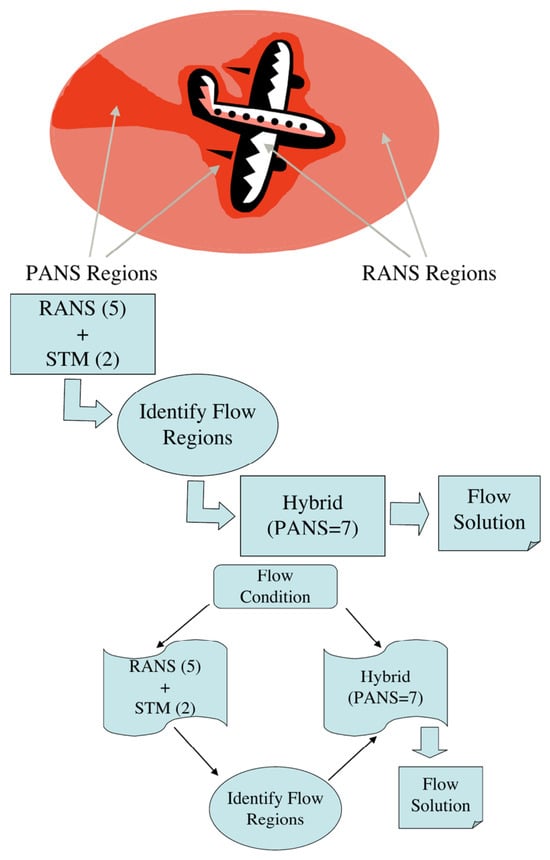
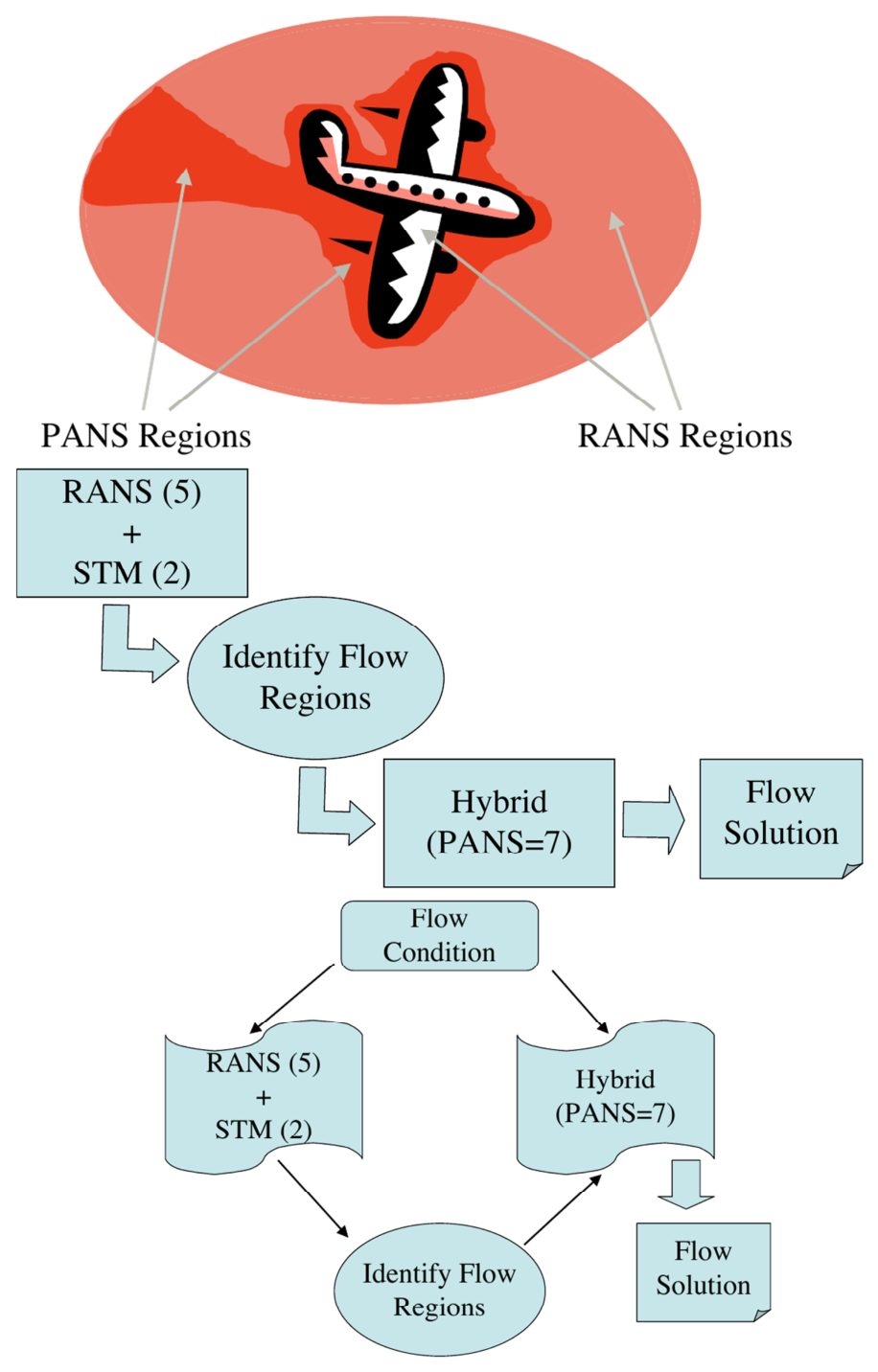
Zonal PANS, also described as PANS-RANS, retains one parent-closure family and varies fk and, where applicable, fε between RANS-like and scale-resolving regions. DES and IDDES blend or switch the RANS and LES length scales using grid-sensitive criteria and shielding functions. Both approaches require adequate grids and careful interface treatment. Variable-resolution PANS also introduces commutation or scale-transfer terms when the resolution changes. Hybrid RANS-LES studies have more often focused on gray-area behavior and modeled-stress depletion [1,2,3,4,15,16].
2. Mathematical Formulation of PANS
2.1. Instantaneous Equations and Generalized Partial Averaging
For a Newtonian fluid of constant density, the instantaneous velocity and kinematic pressure satisfy
Let denote a partial-averaging operation and decompose
Unlike Reynolds averaging, a general partial average does not require . The unclosed nonlinear contribution is therefore written with Germano’s generalized central moment,
Repeated averaging alone does not distinguish PANS from LES. An LES filter need not be an idempotent Reynolds operator, so filtering the residual again need not give zero. LES introduces a spatial cutoff and models the associated subfilter stress. PANS prescribes or computes fk and fε to transform a parent RANS closure for the unresolved turbulence. It provides a continuous hierarchy from RANS toward DNS rather than a separate branch of turbulence modeling.
If the operator commutes with spatial and temporal differentiation, application of to Equations (2) and (3) gives
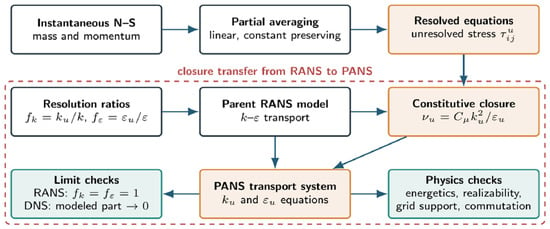
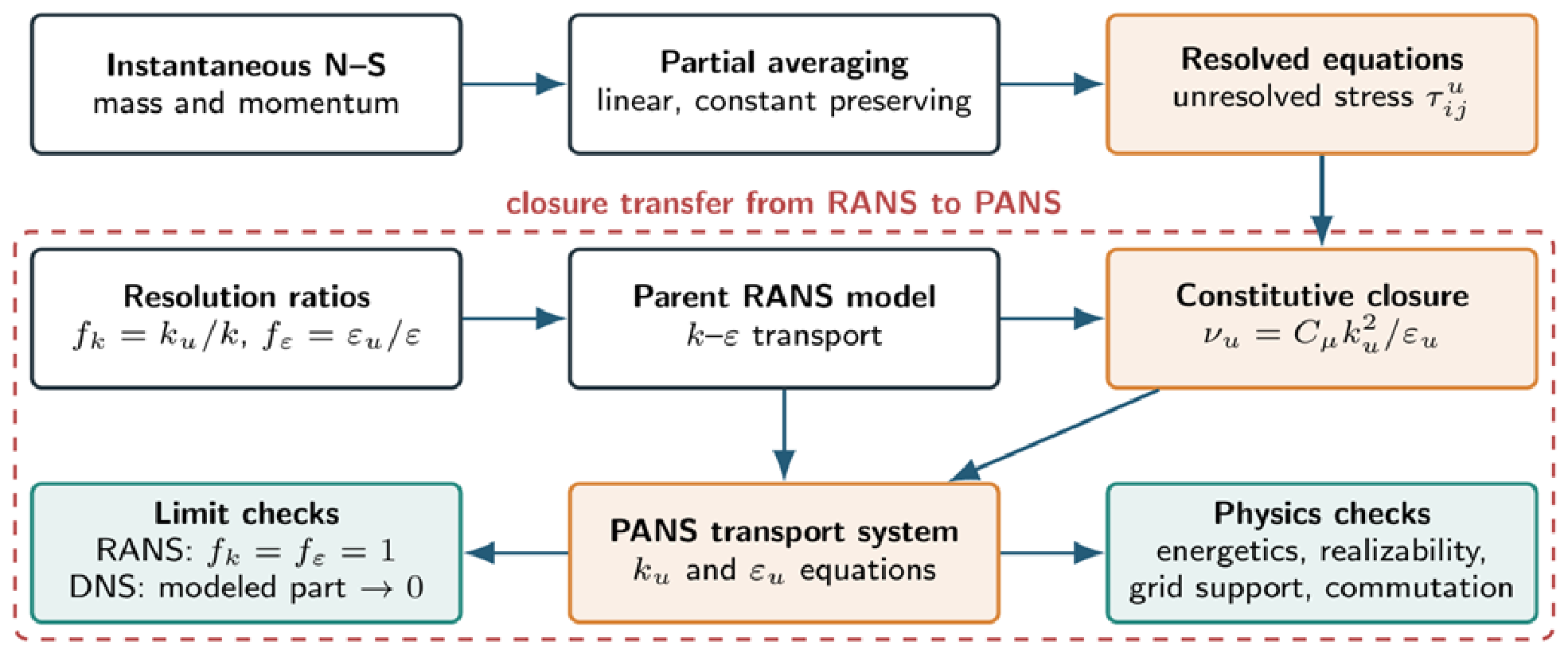
Equation (7) is exact for the selected operation; modeling enters through . If the operation changes in space or time, an additional commutation force appears, as derived in Section 3.2. The derivation sequence is summarized in Figure 2.
Figure 2.
Derivation pathway from the instantaneous conservation laws to a practical PANS closure.
2.2. Unresolved Stress and Transformed Two-Equation Closure
The linear eddy-viscosity form is
with unresolved production
For a - parent, dimensional consistency gives
Using Equation (1), the unresolved-to-total ratios of turbulence viscosity, time scale, and length scale follow without additional modeling:
These relations explain why is dynamically potent. Under the common engineering assumption , halving halves the modeled time scale, reduces the modeled length scale by , and reduces eddy viscosity by a factor of four. A coarse discretization must replace this lost modeled transport with resolved transport; otherwise, parameter reduction creates an energy deficit rather than fidelity.
The transformed transport equations for constant resolution are given by [7,34]:
Here and below, D/Dt denotes the material derivative following the resolved velocity.
where
Equation (16) defines the resolution-dependent transformation of the closure coefficients. The RANS limit is recovered for , for which the unresolved turbulence quantities coincide with their total counterparts. The formal DNS limit requires both and . Under this limit, , , and vanish, and the unresolved-stress contribution in Equation (7) is eliminated. The approach to this limit is constrained by the spectral distributions of turbulent kinetic energy and dissipation. Because dissipation is concentrated at smaller scales than most of the turbulent kinetic energy, a consistent scale partition generally satisfies:
Consequently, decreasing while retaining = 1 defines an intermediate PANS resolution but does not, by itself, constitute convergence toward DNS.
2.3. Spectral Meaning of
Although PANS does not impose a sharp spatial filter, its energetic resolution admits a spectral interpretation. If represents an energy-containing wavenumber and an effective cutoff, then
For an inertial-range spectrum ,
This scaling motivates grid-to-integral-scale formulas, but Equation (19) embeds isotropy, an inertial cutoff, and an effective relation between and . Those assumptions are fragile near walls, in rotation, and in anisotropic wakes. Characterization of partially resolved homogeneous turbulence further showed that velocity fluctuations and structure functions obey resolution-dependent scaling rather than simply reproducing a truncated DNS field [37].
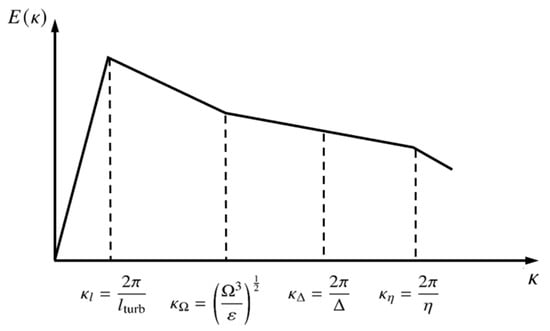
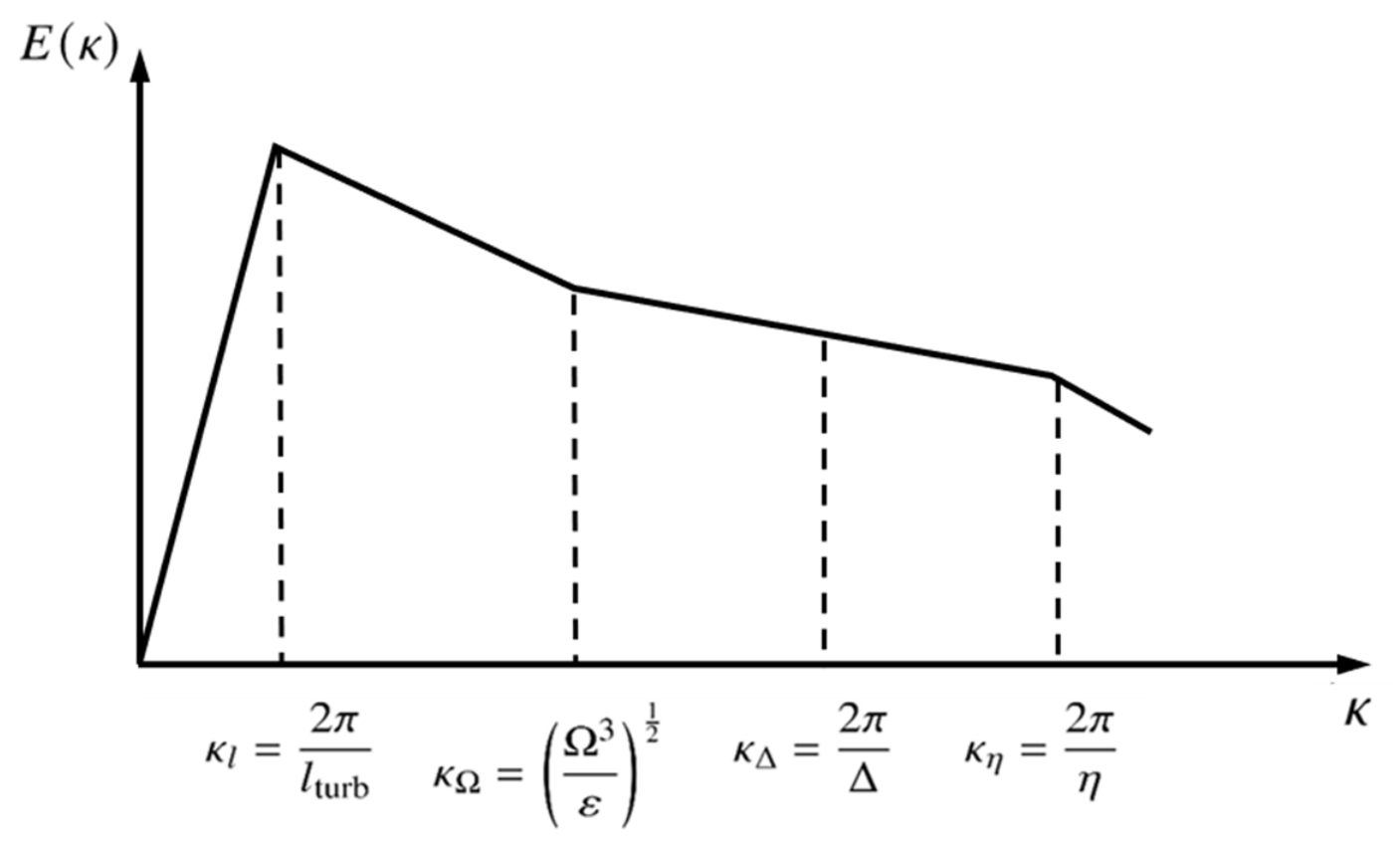
Rotation is a useful counterexample to a universal Kolmogorov estimate. Liu et al. [38] divided the spectrum into rotation-affected and conventional inertial subranges. Their model changes between turbulence-enhanced and turbulence-suppressed sides of a rotating channel and improves the resolved Taylor–Görtler structures. Figure 3 illustrates why an estimator derived from a single slope can allocate resolution incorrectly.
Figure 3.
Rotation-corrected spectral construction used to derive a local expression. Reproduced from Liu et al. [38].
2.4. Scale-Supplying Variables and Complete Dissipation Resolution
An a posteriori total-energy estimate can be formed as , with calculated from resolved velocity fluctuations. That estimate requires a statistically converged mean and may incorrectly count deterministic periodic motion as stochastic turbulence. Basara et al. [28] introduced a modeled resolved-energy variable, , satisfying
so that
The SSV is not the instantaneous resolved kinetic energy; it is a transported scale-supplying estimate used to compute an integral scale and update . Its main advantage is operational: moving geometries, cyclic engines, and injected flows can be treated without waiting for a long-time mean [33].
The corresponding complete-resolution framework estimates total dissipation as [34]
where denotes the strain-rate tensor associated with the resolved velocity fluctuations. In an SSV-based implementation, the resolved contribution to dissipation can be estimated without explicitly constructing a long-time-averaged velocity field. For most engineering grids, the dissipation range remains unresolved, and the assumption is therefore appropriate. When dissipation-range motions become resolved, however, must decrease consistently with the resolved dissipation. Otherwise, the unresolved dissipation is overrepresented and the formal DNS limit of the PANS formulation cannot be recovered.
2.5. Favre-Partial Averaging for Variable-Density Flow
Density variation couples momentum, internal energy, pressure work, species transport, and turbulent mass flux. A direct incompressible extension is therefore insufficient. Define ordinary and density-weighted partial averages by
The filtered mass equation is
and the momentum equation contains the Favre central moment
Pereira et al. [12] extended the Besnard–Harlow–Rauenzahn variable-density closure to PANS by introducing the resolution parameters and for the turbulent mass flux ai and the density-specific-volume covariance b, respectively. Unlike the positive-definite turbulent kinetic energy, ai is sign-indefinite, and both variables may approach zero. Resolution parameters based on their local ratios can therefore become ill-conditioned and must remain well posed near zero crossings. More generally, partially resolved multiphysics simulations require consistent resolution treatment of the coupled covariances that contribute to interscale transport. Applying PANS to the momentum equations while retaining RANS-level scalar, phase-change, or reaction closures may result in inconsistent modeled-resolved partitions among the coupled transport equations.
3. Resolution Control, Commutation, and Numerical Support
3.1. Fixed, Zonal, and Continuously Variable Resolution
Constant-fk simulations provide the clearest framework for separating modeling and numerical effects. Because the governing equations remain independent of grid size, grid refinement at fixed fk evaluates numerical uncertainty without modifying the turbulence model [13,14]. Conversely, varying fk on a sufficiently resolved grid, for example, from fk = 1 to 0.25, examines the sensitivity to physical resolution. However, constant resolution is computationally inefficient: a value appropriate for wake dynamics may be excessive for attached wall regions and insufficiently adaptive for free shear layers.
Zonal PANS introduces RANS-like resolution near walls while applying lower fk values in selected separated or wake regions. Early two-stage approaches employed RANS precursor solutions to determine resolution zones or estimate the fk distribution [6,25,39]. Continuously variable PANS instead determines fk from local grid and turbulence scales. A commonly used inertial-range estimate is
where Δ denotes an effective grid scale. Although computationally efficient, Equation (26) becomes circular when the total turbulent kinetic energy is obtained from the same unresolved field being partitioned. RANS precursor solutions, resolved fluctuation estimates, and scale-supplying-variable (SSV) transport provide different approaches to overcome this limitation [28,30,34].
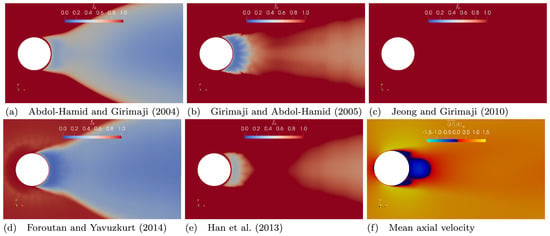
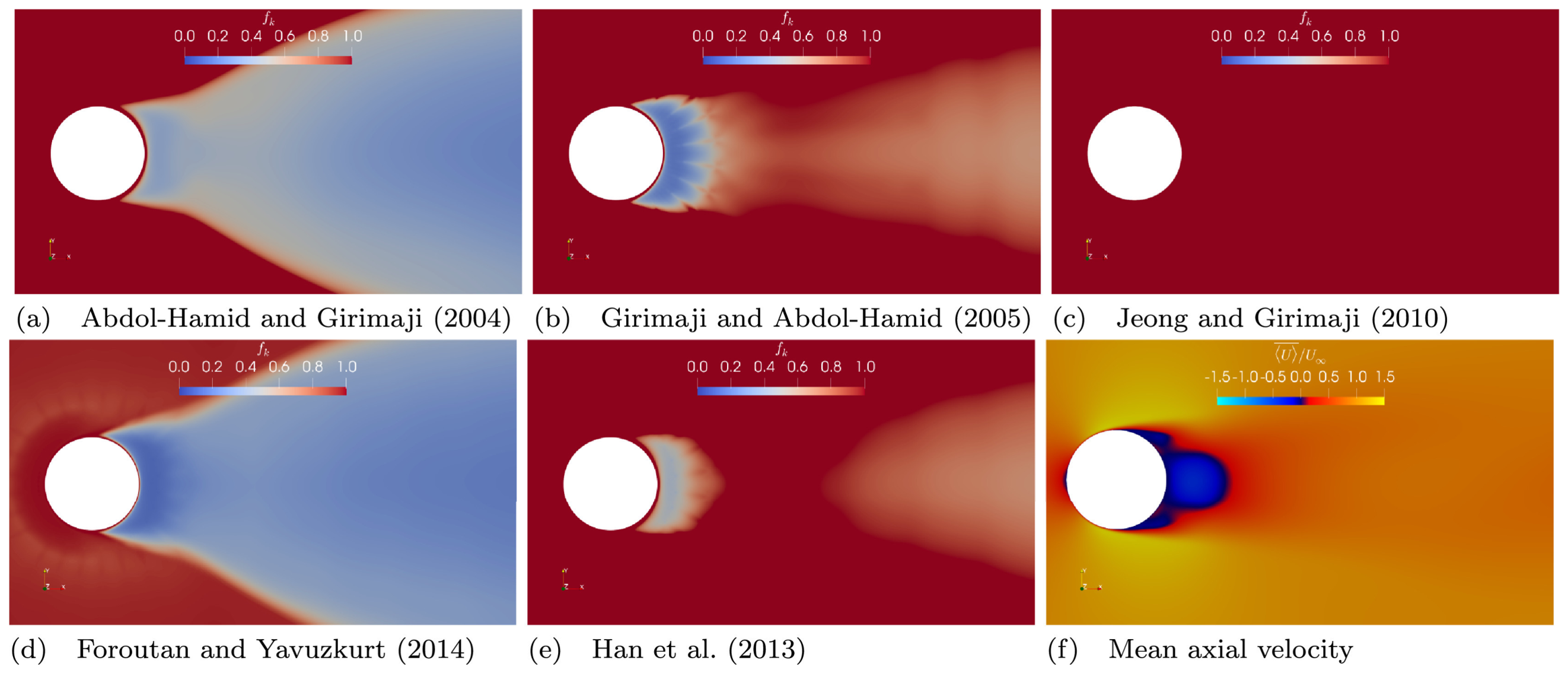
No resolution estimator is universally applicable. Klapwijk et al. [29] applied several formulations to identical cylinder and channel grids and obtained substantially different fk distributions. Some methods predicted extended low-fk wake regions, whereas others produced thin near-body zones or remained close to RANS behavior (Figure 4). These results demonstrate that a grid-based resolution estimate is not merely a preprocessing procedure, but an additional closure assumption.
Figure 4.
Static fk estimates and time-averaged axial velocity for circular-cylinder flow. Reproduced from Klapwijk et al. [29].
Therefore, prescribed and achieved resolutions should be evaluated separately. A posteriori indicators can be defined as:
A persistent difference between and , particularly when resolved spectra terminate near the energy-containing range, indicates that the intended turbulence partition has not been achieved. A single domain-averaged value is insufficient; resolution diagnostics should be examined locally in shear layers, wakes, vortex cores, and wall-transition regions. Representative regional and two-stage resolution strategies are illustrated in Figure 5.
3.2. Commutation Residues and Conservative Scale Transfer
Section 2.2 uses the original k–ε parent closure for the constant-resolution transformation. Here we use the commutation terms from the variable-resolution k–ω formulation of Kamble et al. [16], where ω is the specific dissipation rate. Both are two-equation closures within PANS. Since ω is proportional to ε/k, their resolution ratios satisfy fω = fε/fk. Using ω retains the modeled–resolved partition described in Section 2.2. A comparison of k–ε and k–ω PANS at several resolution levels found that the parent closure affects predictions even at the same unresolved kinetic-energy fraction [39].
The derivation of Equation (7) assumed that partial averaging commutes with differentiation. If changes, the implied filter changes and this assumption fails. The unresolved-energy equation for a - PANS form can be written [16]
where the advective transfer term is
and the diffusion commutation residue is
The corresponding dissipation-scale equation contains
These terms change the unresolved energy when the description changes. Conservation requires an equal and opposite exchange with the resolved field. Following the sign convention of Kamble et al. [16], the commutation residue enters the resolved momentum equation as , where the gradient-force model is
and the commutation viscosity can be positive or negative because energy can move in either direction. The sign convention is consequential: the work of contributes to resolved kinetic energy, in addition to a conservative flux.
The cancelation can be made explicit. Define the resolved kinetic energy and collect pressure work, viscous diffusion, unresolved-stress transport, and commutation transport in a flux . Adding the resolved kinetic-energy equation to Equation (28) gives
The ordinary production term cancels exactly between the two reservoirs. A resolution change is therefore energetically neutral if
Equation (34) is an algebraic energy-balance relation. In numerical implementations, its denominator requires regularization where the strain invariant approaches zero.
For a domain , integration of Equation (33) yields
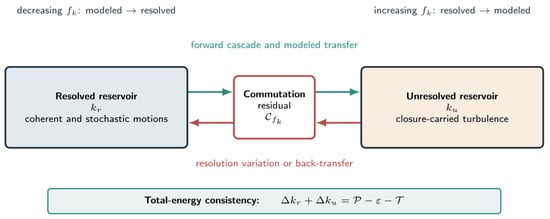
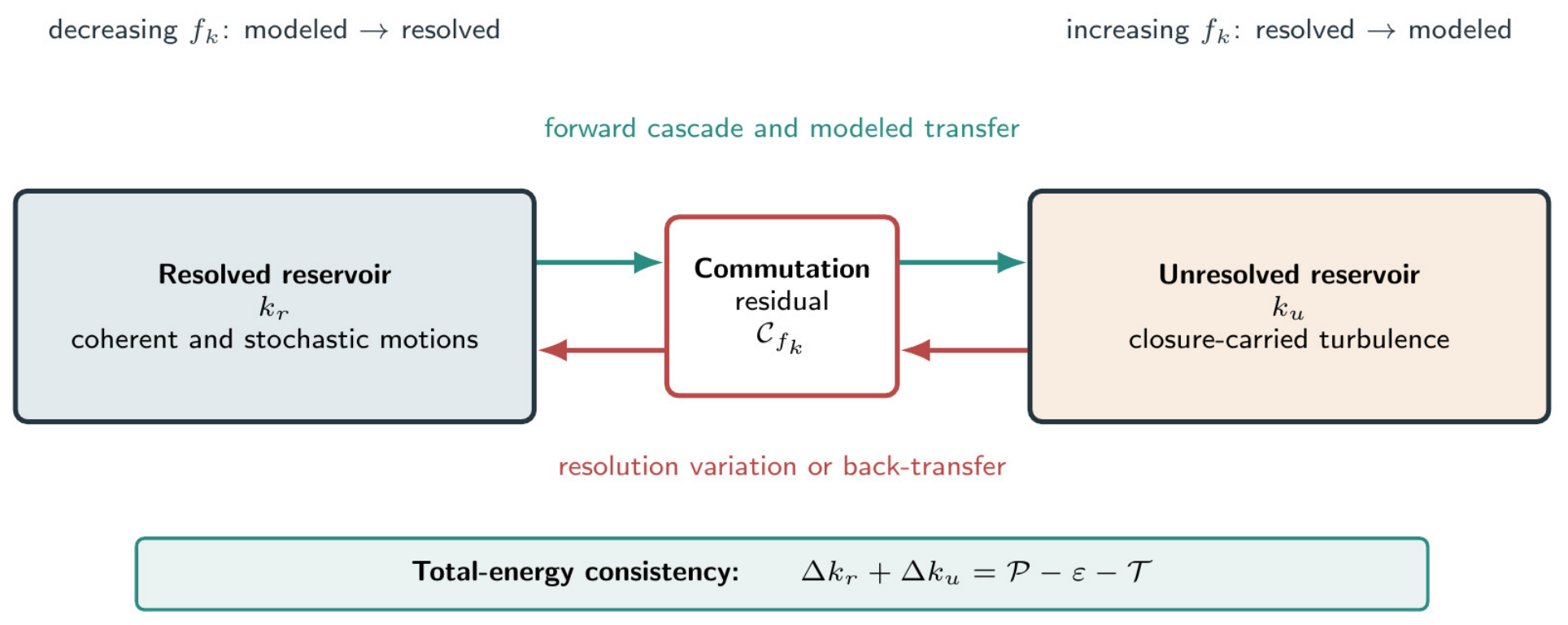
where contains boundary fluxes and externally supplied power. Thus, the conservation requirement does not imply that physical kinetic energy is constant; it requires that changing the modeled-resolved description introduces no artificial volumetric source or sink. The commutation viscosity is consequently not an ordinary dissipative eddy viscosity, and enforcing would preclude back-transfer and violate Equation (34) when . The associated modeled-resolved energy exchange is summarized in Figure 6.
Figure 6.
Energy accounting in variable-resolution PANS.
3.3. Near-Wall Resolution Control and Wall-Modeling Strategies
At high Reynolds numbers, near-wall resolution represents a major computational challenge for scale-resolving simulations. PANS treatments of wall regions mainly follow three strategies: low-Reynolds-number formulations integrate transformed equations to the wall [26]; elliptic-relaxation approaches retain wall-blocking effects and turbulence anisotropy through additional variables [9]; and zonal or wall-modeled approaches maintain fk ≈ 1 near the wall and reduce fk in outer separated or wake regions through a transition layer [16].
Near-wall PANS performance cannot be evaluated solely by y+. A model may predict reasonable wall stress while still misrepresenting separation, shear-layer development, or outer-layer structures. Conversely, resolving outer turbulence with wall functions may improve wake dynamics without ensuring accurate scalar transport, because heat flux remains dependent on near-wall closures. Cylinder heat-transfer studies showed that PANS can reproduce unsteady flow features on relatively coarse grids, whereas accurate Nusselt-number predictions still require appropriate wall treatment and sufficient physical resolution [40,41].
3.4. Grid, Time Step, and Numerical Dissipation
The smallest supported resolved wavelength is not the cell size. It depends on grid anisotropy, stencil, polynomial order, limiter, pressure-velocity coupling, time integration, and local Courant number. High-order flux reconstruction studies show that reducing truncation error can shift the useful PANS parameter range because less of the released energy is removed numerically [32]. The same on two discretizations is therefore not the same experiment unless their effective transfer functions are comparable.
For each region of interest, numerical support should be diagnosed with (i) cells per dominant instability wavelength or vortex-core diameter; (ii) spectra with a resolved inertial interval or at least a non-abrupt physical roll-off; (iii) modeled-to-resolved energy ratio; (iv) effective viscosity ; (v) time-step sensitivity of peaks and phase; and (vi) sampling uncertainty. Instantaneous -criterion visualization alone does not establish that these conditions are satisfied. The principal failure modes and corresponding diagnostics are summarized in Table 3.
Table 3.
Common PANS failure modes and discriminating diagnostics.
4. Engineering Applications and Multiphysics Extensions of PANS
4.1. Rotation and Curvature Effects in Turbomachinery Flows
Rotating and curved flows represent a stringent test for PANS because turbulence resolution and turbulence modeling are strongly coupled by rotation-induced anisotropy and scale redistribution. Unlike canonical shear flows, the local turbulence spectrum in rotating systems can deviate substantially from the isotropic assumptions underlying conventional fk estimation methods. Meanwhile, curvature modifies the production and transport of unresolved stresses, requiring not only appropriate resolution control but also improved constitutive modeling.
Existing PANS studies in rotating flows have therefore developed along two complementary directions. The first focuses on resolution specification by introducing rotation-dependent spectral corrections or alternative characteristic scales. These approaches aim to improve the estimation of the modeled–resolved partition under modified turbulence spectra. The second direction concerns closure improvement, where nonlinear formulations are employed to account for rotation- and curvature-induced stress anisotropy [10,36]. These two strategies address different aspects of the same problem: the former determines how much turbulence should be resolved, whereas the latter determines how the remaining unresolved turbulence is modeled.
Applications to swirling flows and turbomachinery have demonstrated that PANS can provide improved predictions of vortex breakdown, rotating separation, blade-passage interactions, and tip-leakage structures compared with conventional RANS approaches [38,42,43,44]. However, the reported improvements are not solely attributable to the turbulence model itself, because resolution specification, grid distribution, wall treatment, and numerical dissipation strongly influence the realized unsteadiness. Consequently, global performance parameters, such as pump head or efficiency, are insufficient to evaluate the scale-resolving capability of PANS. More discriminating assessments require quantities directly related to resolved turbulence dynamics, including pressure spectra, vortex evolution, circulation, and phase-dependent flow structures.
Wind-turbine wake simulations further extend these considerations to flows dominated by large-scale coherent motions. Existing comparisons with LES indicate that PANS can reproduce important wake features, including wake recovery, tip-vortex persistence, and large-scale meandering, when the dominant energetic structures are adequately resolved [45]. However, the appropriate resolution level for engineering prediction is determined by the flow structures controlling aerodynamic loading and power output rather than by the smallest turbulent scales. Further systematic assessment is therefore required for different inflow turbulence conditions, atmospheric environments, and operating regimes.
4.2. Ship Hydrodynamics and Propulsor Inflow
Marine hydrodynamics is an important application area for scale-resolving turbulence simulation, where engineering requirements extend beyond resistance prediction. While resistance is mainly governed by the mean flow, propulsion performance, vibration, cavitation, and noise depend strongly on the spatial and temporal characteristics of the stern wake. Therefore, PANS studies in marine applications have gradually shifted from integral force prediction toward the representation of wake topology, coherent structures, and propeller-plane inflow.
Early marine applications demonstrated that PANS could reproduce large-scale separated structures and bistable wake behavior with lower computational requirements than LES in the investigated configurations [46]. Subsequent studies of the Joubert BB2 submarine and KVLCC2 tanker further assessed resistance, wake asymmetry, appendage vortices, propeller-plane velocity, and confinement effects [47,48,49]. These studies indicate that the main advantage of PANS lies in improving the representation of energetic wake structures and unsteady flow features rather than significantly changing mean resistance predictions.
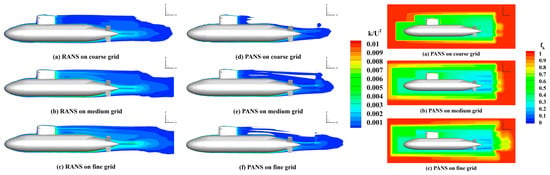
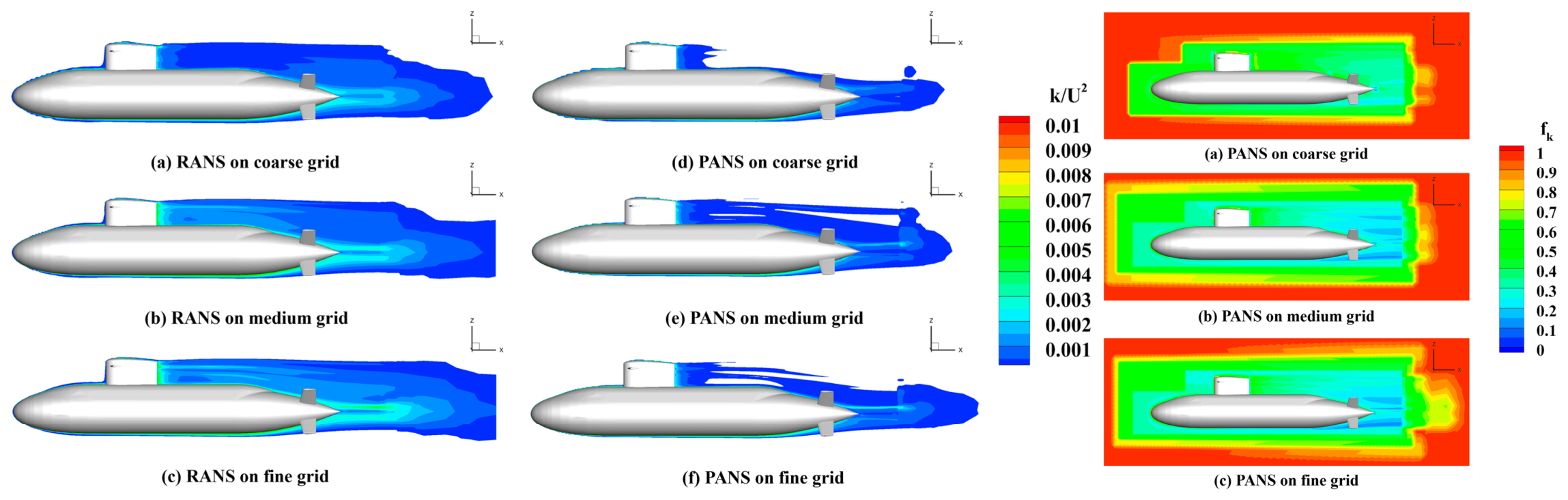
However, marine applications also reveal the complexity of resolution-controlled PANS. In grid-informed formulations, mesh refinement modifies both numerical accuracy and the modeled–resolved turbulence partition. As shown in Figure 7, the modeled turbulent kinetic energy and fk distribution around the Joubert BB2 submarine vary with grid resolution. A reduction in modeled energy does not necessarily indicate reduced turbulence intensity, since part of the energy may have been transferred to the resolved field. Therefore, numerical-resolution and model-resolution effects should be separated through fixed-fk grid refinement and independent fk-sensitivity studies.
Figure 7.
Joubert BB2 submarine: RANS/PANS modeled turbulence-energy distributions on three grids (left) and estimated PANS fields (right). Reproduced from Lee et al. [47].
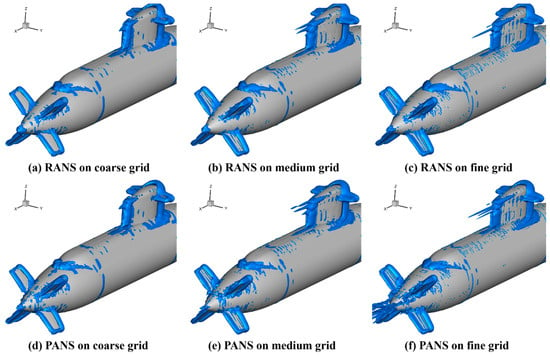
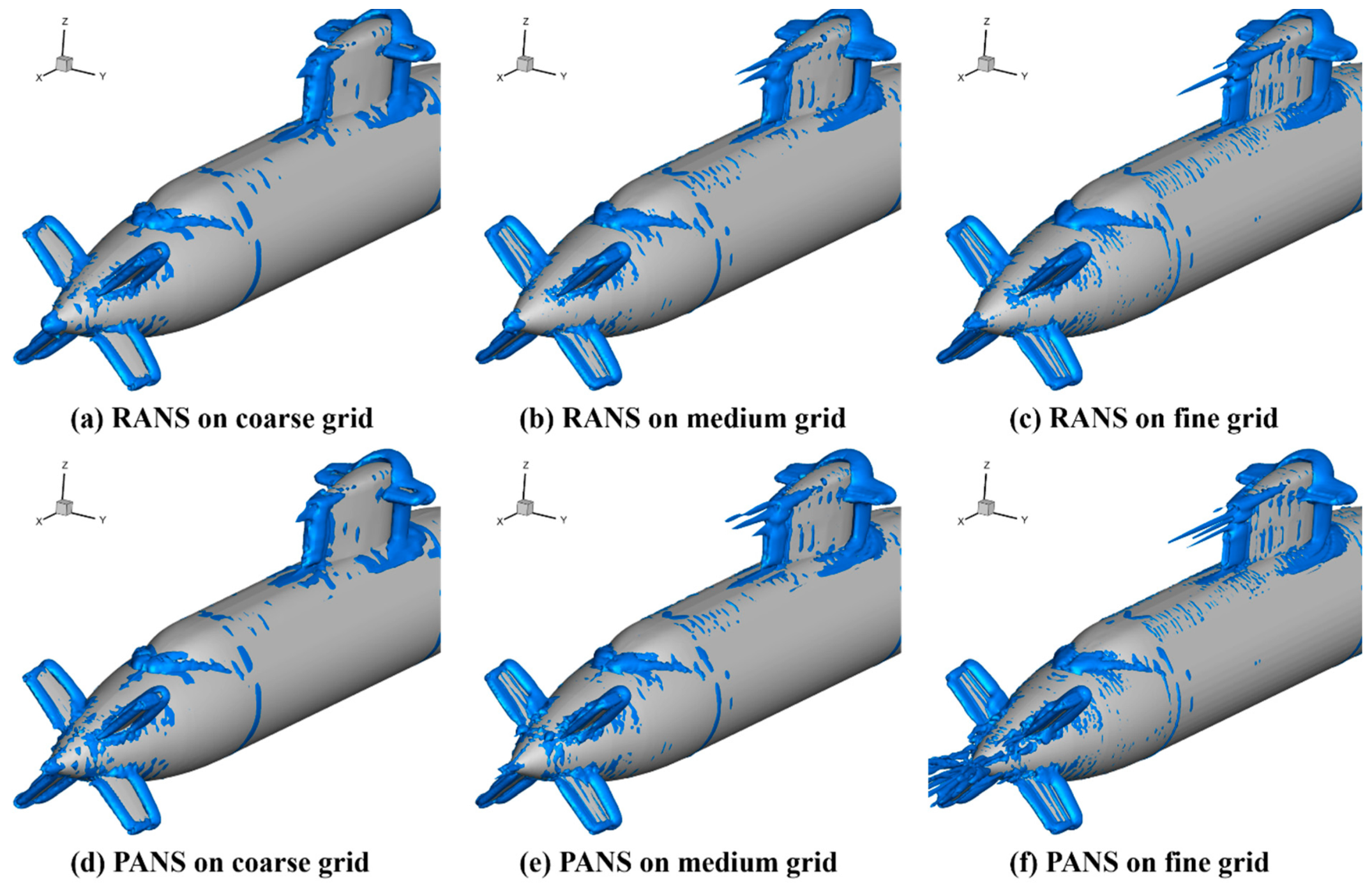
PANS has generally shown improved preservation of stern, bilge, and appendage vortices compared with linear eddy-viscosity RANS models [47,48,49]. As illustrated in Figure 8, grid refinement increases the continuity and structural detail of Q-criterion iso-surfaces around the Joubert BB2 submarine, indicating a greater contribution of resolved turbulence. Similar improvements have been reported for the asymmetric propeller-plane wake of the KVLCC2 tanker under confined conditions [48,49]. Nevertheless, these improvements may result from the combined effects of grid resolution, fk selection, and parent closure, which are not always independently evaluated. Instantaneous vortex visualization should therefore be interpreted as evidence of increased resolved content rather than direct proof of improved predictive capability.
Figure 8.
Iso-surfaces of Q-criterion for RANS (top) and PANS (bottom) around the Joubert BB2 submarine on coarse, medium, and fine grids. Reproduced from Lee et al. [47].
Current marine PANS studies remain dominated by wake visualization, mean velocity distributions, and integral performance parameters. More rigorous validation requires quantities directly related to unsteady propulsor inflow, including velocity harmonics, pressure spectra, vortex circulation, propeller loading, and uncertainty estimates. Overall, marine applications demonstrate the potential of PANS for engineering-scale stern-wake prediction, but a configuration-independent advantage over RANS or LES has not yet been established.
4.3. Cavitation and Turbulence-Phase-Change Coupling
Cavitation represents a challenging application of PANS because turbulence resolution and phase-change modeling are strongly coupled. Early PANS studies focused on sheet and cloud cavitation around hydrofoils and propellers [50,51,52], followed by extensions to three-dimensional vortex cavitation using curvature- and helicity-sensitive formulations [53,54]. Compared with conventional RANS, PANS generally produces stronger cavity shedding, vapor-cloud breakup, and pressure fluctuations, which are associated with reduced modeled eddy viscosity and improved representation of separated shear layers and re-entrant jets. However, the reported advantages are more evident for highly unsteady cloud and vortex cavitation, whereas improvements for attached sheet cavitation remain less consistent.
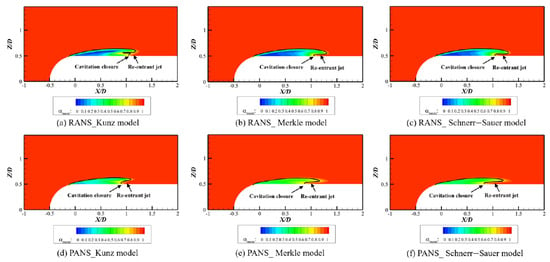
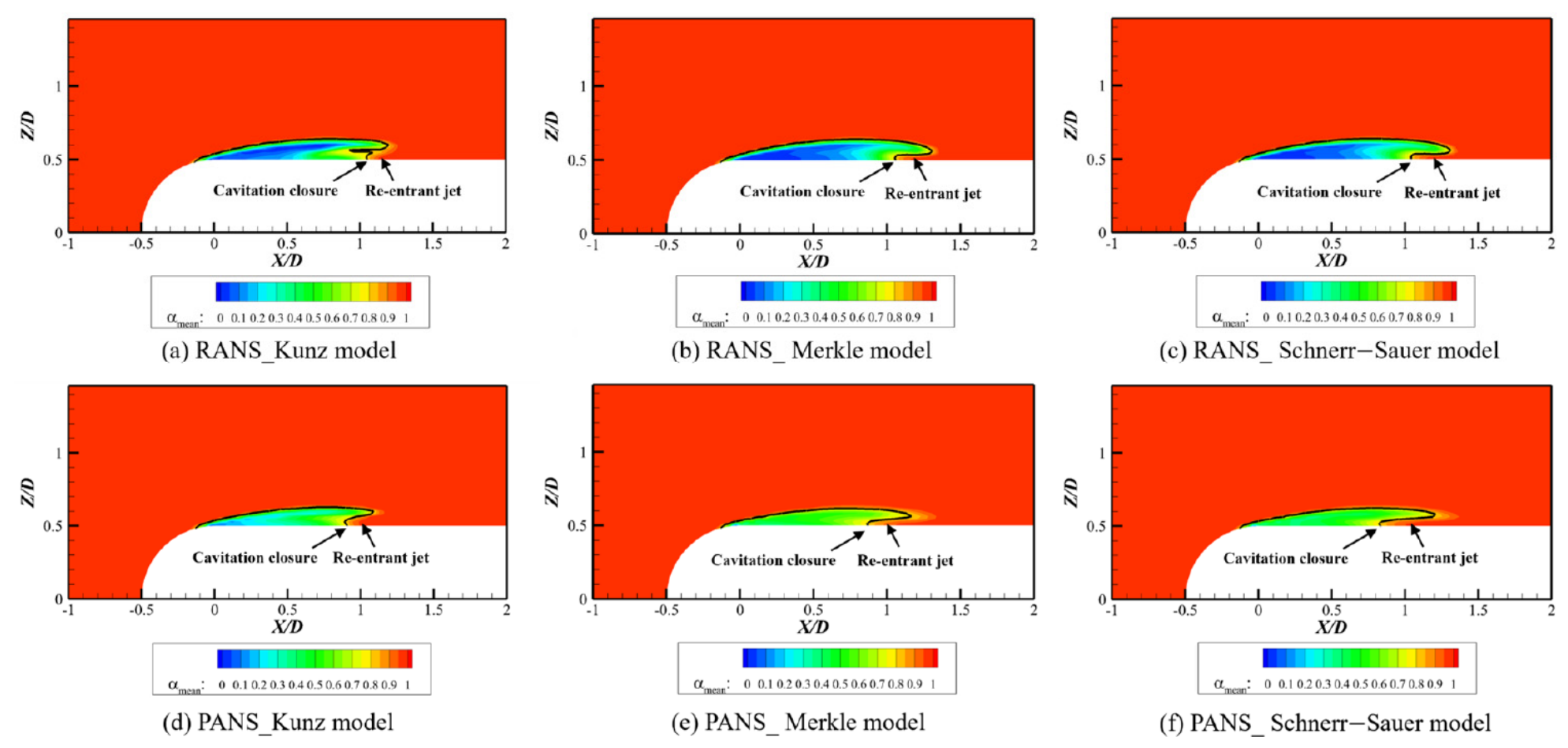
The predictive capability of cavitating PANS depends not only on turbulence resolution but also on mass-transfer models, nuclei conditions, and numerical discretization. As illustrated in Figure 9, different cavitation closures, including Kunz, Merkle, and Schnerr–Sauer models, produce substantial variations in cavity length and closure behavior under both RANS and PANS [55]. The influence of phase-change modeling can be comparable to that of turbulence treatment, indicating that cavitation prediction involves coupled uncertainties rather than turbulence modeling alone. Therefore, further assessment requires independent sensitivity analyses of fk, grid resolution, time step, mass-transfer parameters, and nuclei concentration, together with validation against cavity dimensions, shedding frequencies, pressure spectra, and collapse loads.
Figure 9.
Time-averaged vapor volume fraction for three cavitation closures coupled to RANS (top) and PANS (bottom). The comparison demonstrates that turbulence resolution and phase-change closure are interacting uncertainty sources. Reproduced from Lee et al. [55].
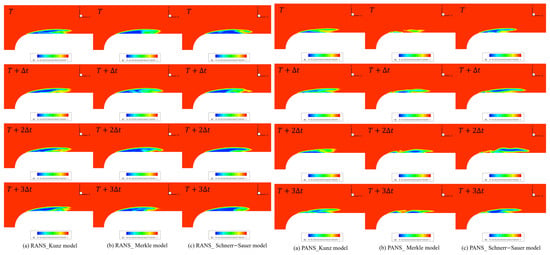
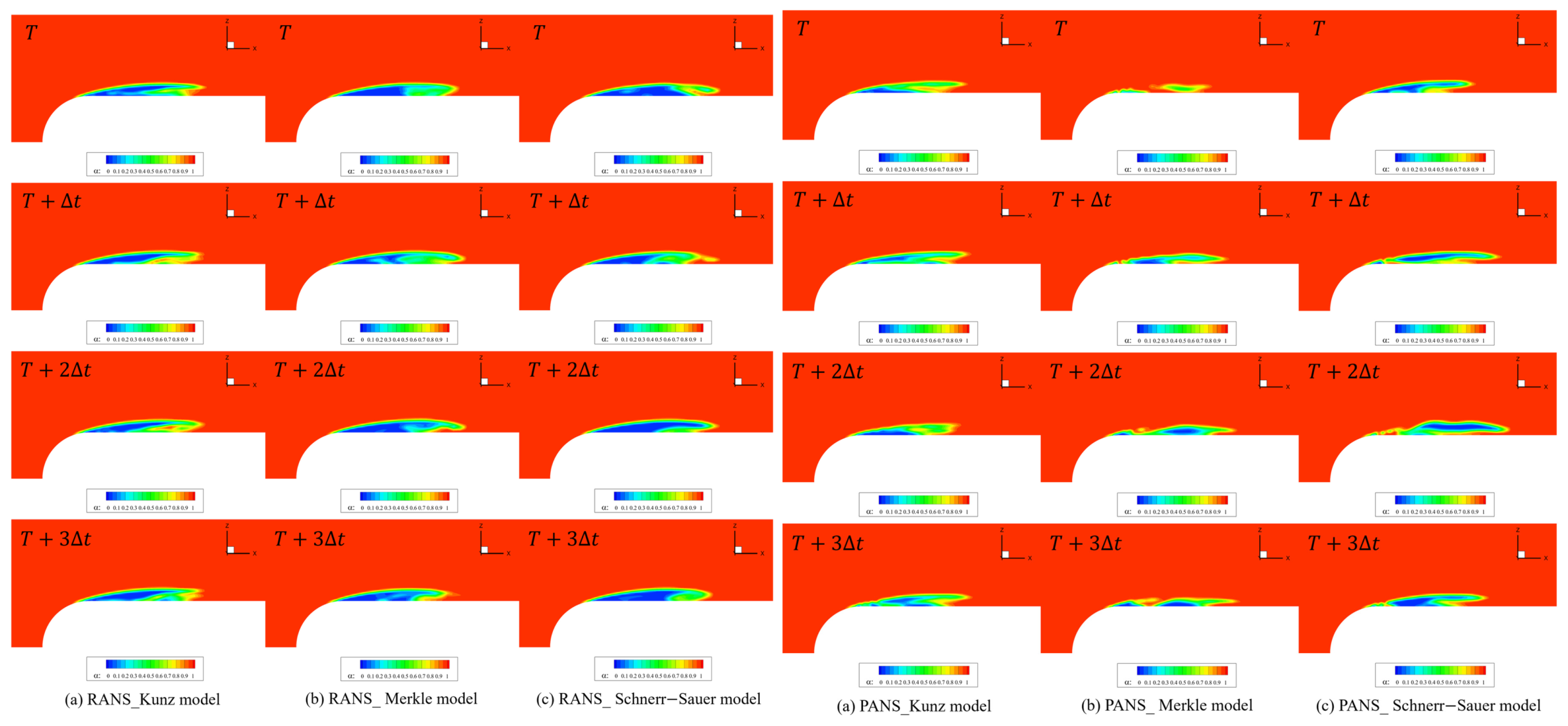
Temporal evolution provides a more stringent evaluation of cavitation dynamics than time-averaged vapor distributions. As shown in Figure 10, PANS produces stronger intermittency in cavity breakup and vapor-cloud transport than RANS for different mass-transfer models. However, increased unsteadiness does not necessarily indicate improved predictive accuracy and must be evaluated against experimental observations, including shedding frequency, cavity-length evolution, pressure fluctuations, and collapse dynamics. For cavitation-erosion prediction, vapor structures alone are insufficient; pressure impulses and collapse-location statistics are also required [56].
Figure 10.
Time evolution of vapor volume fraction for Kunz, Merkle, and Schnerr–Sauer cavitation models with RANS (left) and PANS (right). Reproduced from Lee et al. [55].
Applications of PANS to reacting, variable-density, and compressible flows remain less mature than those for incompressible turbulence. Existing studies have extended the framework to engine combustion [33,57], hydrogen dispersion [58], variable-density mixing [12], and compressible separated or jet flows [35]. A common challenge in these multiphysics applications is that resolution control is usually introduced for the momentum equations, whereas scalar transport, chemical reactions, and density-related correlations often rely on closures inherited from RANS models. Consequently, the consistency between resolved velocity fluctuations and unresolved thermochemical processes remains an open issue.
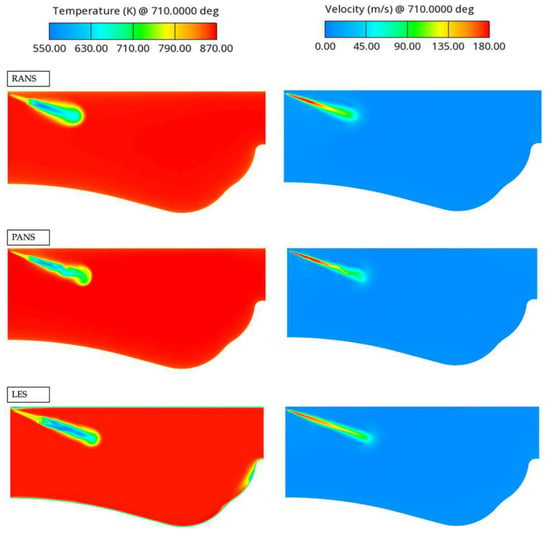
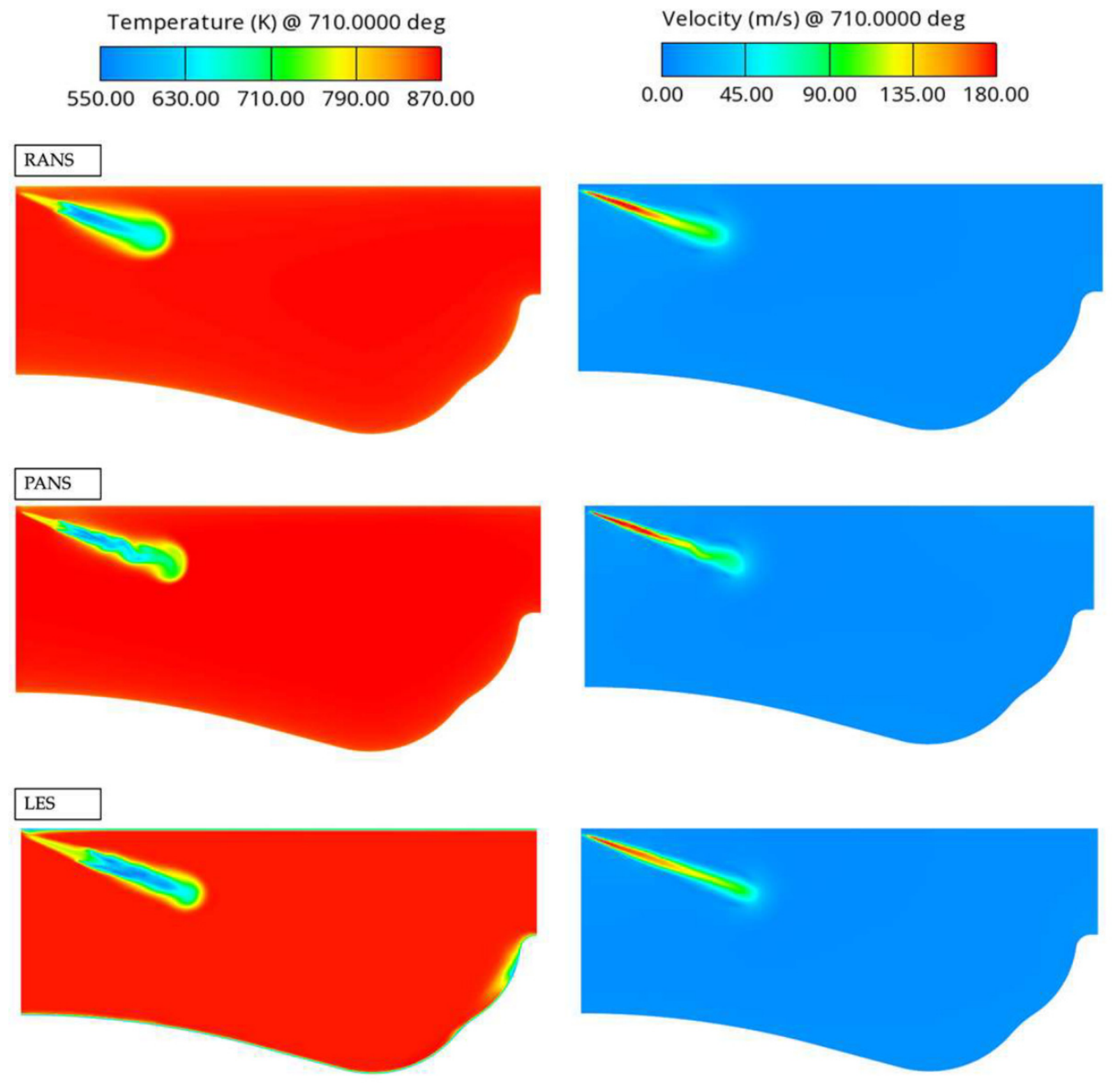
In combustion applications, SSV-based PANS has been coupled with flamelet-generated manifold chemistry to reduce the dependence on long-time averaging required by conventional formulations [33,57]. These studies have reproduced major trends in cylinder pressure and heat-release rate, while providing more spatially variable spray and temperature fields than RANS, as illustrated in Figure 11. Comparisons with LES generally indicate an intermediate level of resolved turbulence content. However, existing validation has mainly focused on global combustion quantities, whereas the individual effects of fk, spray breakup modeling, tabulated chemistry, and wall heat transfer have rarely been separated. Therefore, current evidence demonstrates the feasibility of PANS for reacting flows, but remains insufficient to establish predictive capability for local flame structures, pollutant formation, and strongly coupled multiphysics processes.
Figure 11.
Temperature (left) and velocity (right) fields from RANS, PANS, and LES for a dual-fuel engine calculation. Reproduced from Stipic et al. [33].
PANS has been used for buoyancy-driven hydrogen dispersion and combustion in confined spaces [58]. Uncertainties in release conditions, ventilation, and reaction chemistry make it difficult to isolate the effect of turbulence resolution. For variable-density turbulence, Favre-PANS based on the Besnard–Harlow–Rauenzahn closure introduces separate resolution parameters for turbulent mass flux and density-specific-volume covariance [12], extending scale partitioning beyond momentum transport. Validation has focused on canonical Rayleigh–Taylor instability and multimaterial mixing, using several physical-resolution levels and testing sensitivity to the unresolved fractions of the closure variables.
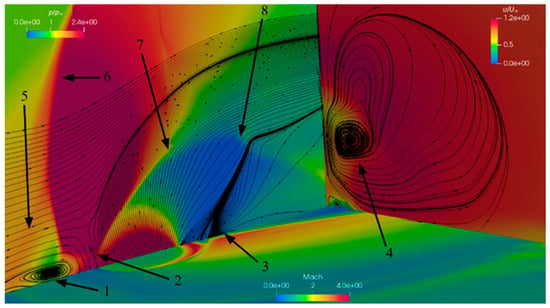
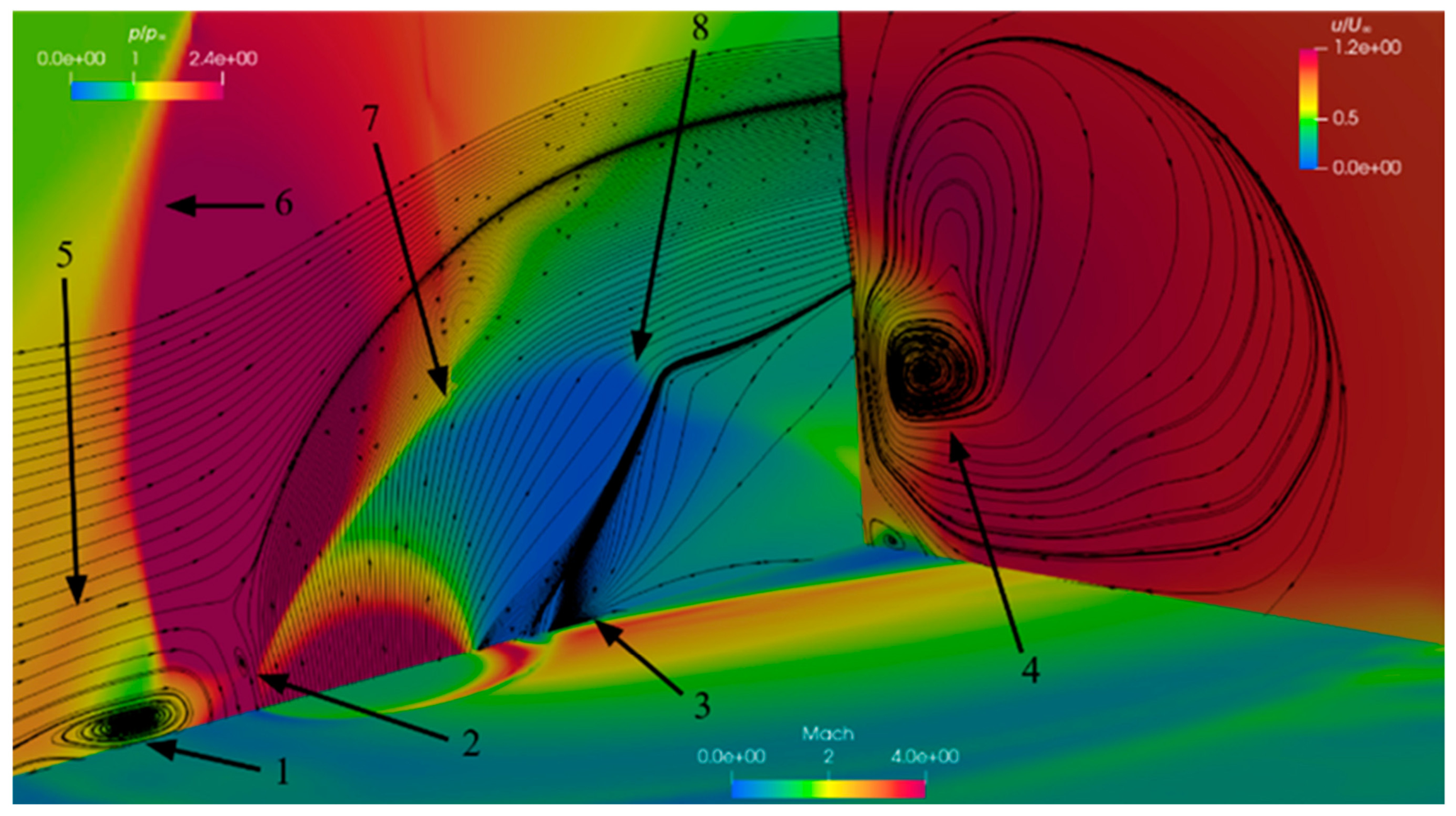
For compressible flows, blended partially averaged Navier–Stokes (BPANS) has been applied to separated flows, mixing layers, and supersonic jets through blended k−ε/k−ω closures and compressibility corrections [35]. As illustrated in Figure 12, BPANS can represent complex structures involving shocks, separation, and counter-rotating vortices in supersonic jet configurations. Nevertheless, fk only describes the partition of turbulent kinetic energy, whereas shock capturing, acoustic propagation, and compressibility effects remain strongly dependent on spatial and temporal discretization.
Figure 12.
Time-averaged near-field structure of a supersonic jet in crossflow predicted with BPANS, including separation, bow and barrel shocks, Mach disk, and counter-rotating vortex pair. Reproduced from Nastac et al. [35].
Overall, existing studies demonstrate the potential of PANS for thermochemical, variable-density, and compressible flows, but the current evidence remains strongly configuration-dependent. A unified resolution framework that consistently treats momentum, scalar, density, and acoustic fluctuations has not yet been established. The required closure coupling and validation criteria for different application categories are summarized in Table 4.
Table 4.
Application-specific closure couplings and minimum validation evidence.
5. Verification, Validation, and Uncertainty for PANS
Verification and validation practices in the PANS literature remain inconsistent. Existing studies frequently emphasize instantaneous vortical structures, but increased structural complexity alone does not demonstrate improved predictive accuracy. As fk decreases, a larger fraction of turbulence dynamics is transferred from the modeled to the resolved field, increasing the dependence of the solution on grid resolution, numerical dissipation, time-step size, inflow conditions, and statistical sampling.
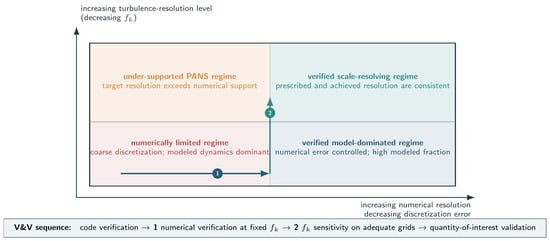
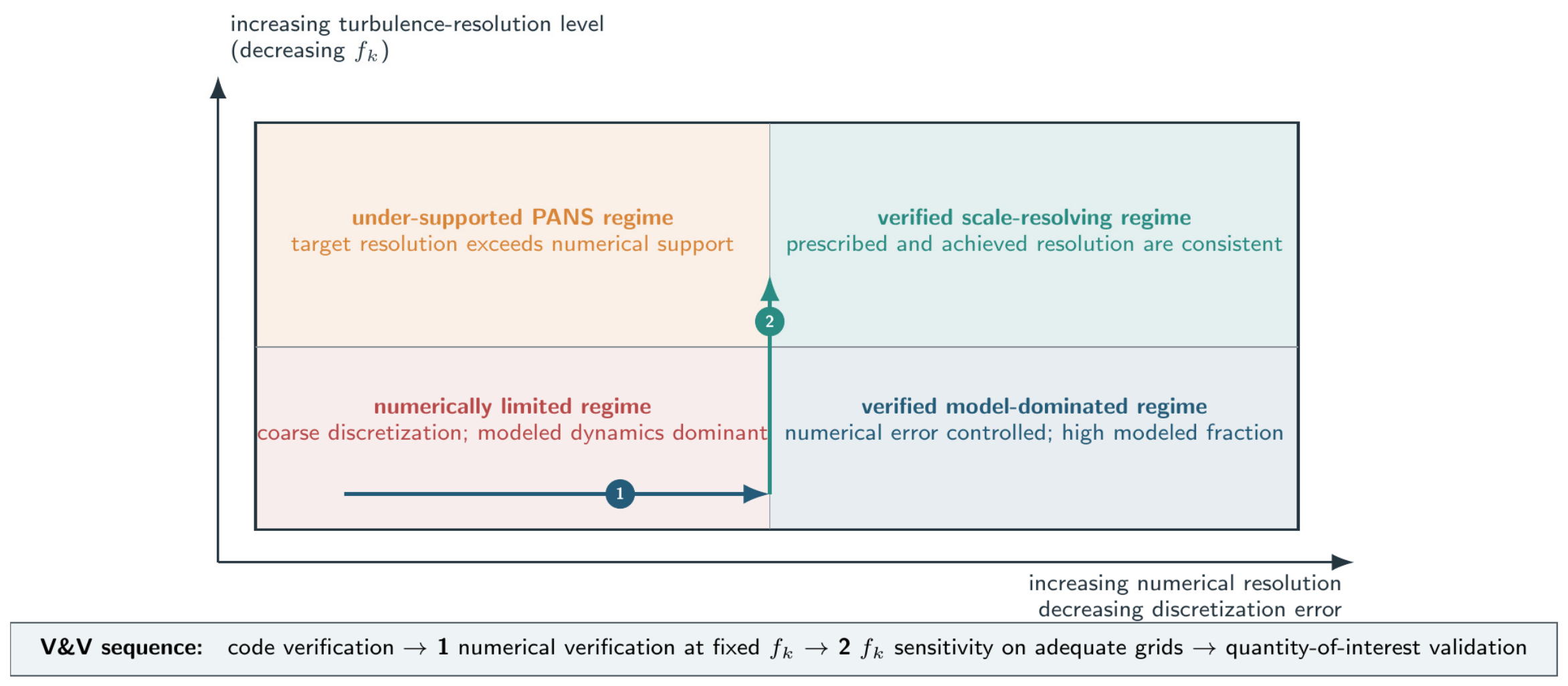
A reliable assessment of PANS therefore requires numerical-resolution and turbulence-modeling effects to be evaluated separately. Grid and time-step refinement should first be conducted at fixed fk to quantify numerical uncertainty, followed by fk-sensitivity analysis on grids capable of supporting the intended resolution. Combined with statistical-convergence assessment and validation against experiments or DNS, this two-dimensional evaluation provides a more rigorous basis for judging PANS predictive capability than qualitative interpretation of instantaneous flow structures alone.
5.1. Error Decomposition and Validation Uncertainty
For a quantity of interest , the total simulation error can be decomposed as [14,63,64,65]
where is input error, is modeling error, and includes discretization, iterative, round-off, and statistical errors. Comparing a simulation with experiment gives the comparison error
The modeling error is not equal to unless numerical, input, and experimental errors are negligible. If independent uncertainties are assumed, the validation uncertainty is
and is expected within at the selected confidence level. This formulation changes how claims should be written.
5.2. Two Independent Refinement Axes
Many SRS equations contain the grid scale directly, so refining the grid changes both discretization and model. Constant-resolution PANS can decouple them. Let denote a grid-refinement coordinate and the physical-resolution coordinate. Then the quantity of interest is a surface
Grid refinement at fixed estimates numerical uncertainty. Physical-resolution refinement demonstrably estimates adequate grid sensitivity to unresolved modeling. The mixed derivative indicates interaction: a large value means that conclusions about depend strongly on the grid [14]. The two-axis refinement framework is summarized in Figure 13.
Figure 13.
Two-axis PANS refinement concept.
For grid-adaptive PANS formulations, verification is complicated by the coupling between numerical resolution and turbulence resolution. Unlike constant-fk simulations, mesh refinement in dynamic-fk approaches modifies both discretization error and the modeled–resolved turbulence partition, making it difficult to separate numerical effects from modeling effects. Existing studies therefore distinguish fixed-fk grid refinement from fully adaptive fk-updating procedures to identify genuine numerical convergence.
In cylinder wakes, the Taylor–Green vortex, and Rayleigh–Taylor instability, further reductions in fk may have little effect on the quantities of interest once the grid is sufficiently resolved [13,66,67]. Accuracy depends on both numerical and turbulence resolution. It remains to be tested whether this two-coordinate assessment is equally effective for complex wall-bounded and multiphysics flows.
5.3. Claim-Specific Validation Ladders
Validation depth should match the claim. Four levels are useful:
- Integral performance: drag, lift, pressure drop, pump head, resistance, heat rate.
- Mean-field mechanism: separation, reattachment, wake deficit, wall pressure, cavity length.
- Turbulence transport: Reynolds stresses, scalar fluxes, anisotropy, energy budgets.
- Resolved dynamics: spectra, modal structures, phase-conditioned fields, vortex circulation, switching statistics.
Validation may be limited to level 1 when the conclusion is restricted to an integral quantity. Claims that PANS captures coherent physics or provides LES-comparable fidelity require evidence at levels 3 and 4. This hierarchy prevents an evidential asymmetry in which an integral RANS benchmark is used for validation while instantaneous PANS visualizations are used to infer new physics. A minimum reporting protocol based on this hierarchy is provided in Table 5.
Table 5.
Recommended minimum reporting protocol for predictive PANS studies.
6. Synthesis and Requirements for Predictive PANS
6.1. Application-Oriented Resolution Design
Existing studies indicate that successful PANS applications do not rely on a universal resolution parameter, but rather on whether the selected turbulence resolution is consistent with the underlying flow mechanisms of interest. A common feature of reliable simulations is that the target quantity of interest is first related to the dominant flow structures and transport processes governing its behavior, including their characteristic spatial and temporal scales. The parent closure is then selected for the remaining unresolved turbulence, followed by an appropriate constant, zonal, or dynamically varying resolution strategy. Meanwhile, grid resolution, time-step effects, and numerical discretization uncertainties are assessed independently, and validation focuses on quantities directly related to the prediction objective.
The literature does not support a single fk range for all flows. Values around 0.2–0.5 have often worked well for separated flows, but depend on the Reynolds number, geometry, parent closure, and numerical method. A comparison of k–ε and k–ω PANS for backward-facing-step and square-cylinder flows found that suitable fk values also depend on mesh support, modeled near-wall behavior, and the instability to be resolved [68]. Recent work has therefore focused less on a single optimum fk and more on whether quantities of interest change with further increases in turbulence resolution on an adequate grid.
6.2. Data-Assisted and Adaptive PANS
Data-driven turbulence studies suggest possible uses in PANS for resolution estimation, unresolved-stress modeling, and model-form uncertainty assessment [69,70,71]. These references provide general background; direct PANS studies remain scarce. Taghizadeh et al. [72] developed cut-off-dependent neural-network subfilter closures for PANS flow over periodic hills. Normalization reduced the closure’s sensitivity to the cut-off scale, providing an early example of a data-assisted closure that accounts for resolution.
This remains a proof of concept, with engineering use still to be established. Data-assisted formulations need to separate grid and numerical effects from turbulent transport. They must preserve conservation, Galilean invariance, realizability, near-wall asymptotic behavior, and energy consistency as resolution changes. Their transferability across Reynolds numbers, geometries, wall treatments, and numerical schemes must also be tested before the closures or resolution indicators can support predictive engineering calculations.
6.3. Outstanding Challenges
The remaining challenges for PANS development can be summarized in four aspects.
First, the complete-resolution framework requires further development. Most engineering applications still adopt the conventional assumption of fε = 1, whereas locally DNS-capable regions require a consistent reduction in both fk and fε. Recent SSV-based formulations provide a promising direction, but their applicability requires broader validation in both equilibrium and nonequilibrium turbulence [34].
Second, near-wall treatment remains a major limitation for engineering applications. Further progress requires a more consistent description of energy exchange between modeled and resolved turbulence near solid boundaries, together with compatible treatment of velocity, heat transfer, and species transport.
Third, multiphysics extensions require a unified scale-partition framework. Many current applications introduce PANS only for momentum transport, while scalar transport, phase change, and chemical reactions continue to rely on conventional statistical closures. This may result in inconsistent effective resolutions among coupled physical processes.
Finally, verification and validation procedures require further standardization. Future studies should provide more systematic reporting of resolution parameters, numerical transfer characteristics, statistical convergence, and uncertainty estimates, enabling quantitative connections among prescribed resolution, numerical realization, and predictive accuracy.
LES and hybrid RANS-LES share many of these limitations. Their results also depend on grid and time-step support, numerical dissipation, inflow turbulence, near-wall treatment, statistical convergence, and multiphysics closure. DES, IDDES, and SAS have additional uncertainty when resolved turbulence is not triggered as intended. PANS must also establish that the prescribed unresolved fractions are achieved. When fk and fε vary in space or time, energy transfer between modeled and resolved turbulence must remain conservative [1,2,3,4,14,15,16].
Overall, the development of PANS is gradually shifting from constructing a bridge between RANS and DNS toward establishing a predictive scale-resolving framework. The central question is therefore no longer whether PANS can generate LES-like instantaneous structures, but whether these resolved motions represent the relevant physical mechanisms and lead to reliable improvements in engineering prediction.
7. Summary
Over the past two decades, PANS research has established a substantial body of evidence demonstrating its ability to recover physically relevant unsteadiness beyond conventional RANS approaches. The most consistent benefits have been observed in flows dominated by large-scale separation, wake dynamics, and coherent structures, where the representation of energetic motions is more important than mean-flow prediction alone. These developments have expanded PANS from canonical validation cases toward a wide range of engineering applications.
At the same time, the literature indicates that the success of PANS is strongly problem dependent. Improvements reported in individual applications cannot be attributed solely to the reduction in modeled turbulence, because resolution specification, numerical realization, wall treatment, and coupled physical models jointly determine the final prediction. Consequently, comparisons among different PANS studies remain difficult unless the resolved turbulence content and associated uncertainties are evaluated consistently.
The future development of PANS will therefore rely less on extending applications alone and more on establishing transferable criteria for predictive simulations. Key requirements include physically consistent resolution control, reliable assessment of realized turbulence scales, and validation strategies linked to the mechanisms governing the quantity of interest. Such developments will determine whether PANS can evolve from a flexible scale-resolving approach into a generally predictive methodology for complex engineering flows.
Author Contributions
Conceptualization, J.Z. and Z.Y.; methodology, J.Z. and Z.Y.; investigation, J.Z.; writing—original draft preparation, J.Z. and Z.Y.; writing—review and editing, Y.W. and H.Y.; supervision, H.Y. All authors have read and agreed to the published version of the manuscript.
Funding
This research was funded by the National Natural Science Foundation of China (GrantNos. 52425111, 52306193, 12388101, 12502261), the Natural Science Foundation of Hainan Province (No. 425QN376), the Natural Science Foundation of Shandong Province (No.ZR2024QA050), the Basic Product Innovation Research Project (No. KY10100230067), and the Basic Research Project (Grant No. KY10100250185).
Institutional Review Board Statement
Not applicable.
Informed Consent Statement
Not applicable.
Data Availability Statement
No new data were created or analyzed in this study. Data sharing is not applicable to this article.
Conflicts of Interest
The authors declare no conflicts of interest.
References
- Spalart, P.R. Detached-eddy simulation. Annu. Rev. Fluid Mech. 2009, 41, 181–202. [Google Scholar] [CrossRef] [Scilit]
- Shur, M.L.; Spalart, P.R.; Strelets, M.K.; Travin, A.K. A hybrid RANS-LES approach with delayed-DES and wall-modelled LES capabilities. Int. J. Heat Fluid Flow 2008, 29, 1638–1649. [Google Scholar] [CrossRef] [Scilit]
- Menter, F.R.; Egorov, Y. The scale-adaptive simulation method for unsteady turbulent flow predictions. Part 1: Theory and model description. Flow Turbul. Combust. 2010, 85, 113–138. [Google Scholar] [CrossRef] [Scilit]
- Chaouat, B. The state of the art of hybrid RANS/LES modeling for the simulation of turbulent flows. Flow Turbul. Combust. 2017, 99, 279–327. [Google Scholar] [CrossRef] [Scilit] [PubMed]
- Girimaji, S.S.; Srinivasan, R.; Jeong, E. PANS turbulence model for seamless transition between RANS and LES: Fixed-point analysis and preliminary results. In Proceedings of the ASME/JSME 2003 4th Joint Fluids Summer Engineering Conference, Honolulu, HI, USA, 6–10 July 2003; Volume 2, pp. 1901–1909. [Google Scholar] [CrossRef] [Scilit]
- Girimaji, S.S.; Abdol-Hamid, K.S. Partially-averaged Navier-Stokes model for turbulence: Implementation and validation. In Proceedings of the 43rd AIAA Aerospace Sciences Meeting and Exhibit, Reno, NV, USA, 10–13 January 2005; p. 502. [Google Scholar] [CrossRef] [Scilit]
- Girimaji, S.S. Partially-averaged Navier-Stokes model for turbulence: A Reynolds-averaged Navier-Stokes to direct numerical simulation bridging method. J. Appl. Mech. 2006, 73, 413–421. [Google Scholar] [CrossRef] [Scilit]
- Lakshmipathy, S.; Girimaji, S.S. Extension of Boussinesq turbulence constitutive relation for bridging methods. J. Turbul. 2007, 8, N31. [Google Scholar] [CrossRef] [Scilit]
- Basara, B.; Krajnović, S.; Girimaji, S.S.; Pavlovic, Z. Near-wall formulation of the partially averaged Navier-Stokes turbulence model. AIAA J. 2011, 49, 2627–2636. [Google Scholar] [CrossRef] [Scilit]
- Liu, J.; Zuo, Z.; Wu, Y.; Zhuang, B.; Wang, L. A nonlinear partially-averaged Navier-Stokes model for turbulence. Comput. Fluids 2014, 102, 32–40. [Google Scholar] [CrossRef] [Scilit]
- Klapwijk, M.; Lloyd, T.; Vaz, G. The development of a partially averaged Navier-Stokes KSKL model. J. Fluids Eng. 2022, 144, 051501. [Google Scholar] [CrossRef] [Scilit]
- Pereira, F.S.; Grinstein, F.F.; Israel, D.M.; Rauenzahn, R.; Girimaji, S.S. Partially averaged Navier-Stokes closure modeling for variable-density turbulent flow. Phys. Rev. Fluids 2021, 6, 084602. [Google Scholar] [CrossRef] [Scilit]
- Pereira, F.S.; Vaz, G.; Eça, L.; Girimaji, S.S. Simulation of the flow around a circular cylinder at Re = 3900 with partially-averaged Navier-Stokes equations. Int. J. Heat Fluid Flow 2018, 69, 234–246. [Google Scholar] [CrossRef] [Scilit]
- Pereira, F.S.; Grinstein, F.F.; Israel, D.M.; Eça, L. Verification and validation: The path to predictive scale-resolving simulations of turbulence. J. Verif. Valid. Uncertain. Quantif. 2022, 7, 021003. [Google Scholar] [CrossRef] [Scilit]
- Wallin, S.; Girimaji, S.S. Commutation error mitigation in variable-resolution PANS closure: Proof of concept in decaying isotropic turbulence. In Proceedings of the 6th AIAA Theoretical Fluid Mechanics Conference, Honolulu, HI, USA, 27–30 June 2011; p. 3105. [Google Scholar] [CrossRef] [Scilit]
- Kamble, C.; Girimaji, S.S.; Razi, P.; Tazraei, P.; Wallin, S. Closure modeling in near-wall region of steep resolution variation for partially averaged Navier-Stokes simulations. Phys. Rev. Fluids 2022, 7, 044608. [Google Scholar] [CrossRef] [Scilit]
- Girimaji, S.S.; Jeong, E.; Srinivasan, R. Partially averaged Navier-Stokes method for turbulence: Fixed point analysis and comparison with unsteady partially averaged Navier-Stokes. J. Appl. Mech. 2006, 73, 422–429. [Google Scholar] [CrossRef] [Scilit]
- Jeong, E.; Girimaji, S.S. Partially averaged Navier-Stokes (PANS) method for turbulence simulations-flow past a square cylinder. J. Fluids Eng. 2010, 132, 121203. [Google Scholar] [CrossRef] [Scilit]
- Krajnović, S.; Minelli, G.; Basara, B. Partially-averaged Navier-Stokes simulations of two bluff body flows. Appl. Math. Comput. 2016, 272, 692–706. [Google Scholar] [CrossRef] [Scilit]
- Razi, P.; Tazraei, P.; Girimaji, S.S. Partially-averaged Navier-Stokes (PANS) simulations of flow separation over smooth curved surfaces. Int. J. Heat Fluid Flow 2017, 66, 157–171. [Google Scholar] [CrossRef] [Scilit]
- Kamble, C.; Girimaji, S.S. Characterization of coherent structures in turbulent wake of a sphere using partially averaged Navier-Stokes (PANS) simulations. Phys. Fluids 2020, 32, 105110. [Google Scholar] [CrossRef] [Scilit]
- Fowler, T.S.; Witherden, F.D.; Girimaji, S.S. Partially-averaged Navier-Stokes simulations of turbulent flow past a square cylinder: Comparative assessment of statistics and coherent structures at different resolutions. Phys. Fluids 2020, 32, 125106. [Google Scholar] [CrossRef] [Scilit]
- Lakshmipathy, S.; Girimaji, S.S. Partially averaged Navier-Stokes method for turbulent flows: K-ω model implementation. In Proceedings of the 44th AIAA Aerospace Sciences Meeting and Exhibit, Reno, NV, USA, 9–12 January 2006; p. 119. [Google Scholar] [CrossRef] [Scilit]
- Frendi, A.; Tosh, A.; Girimaji, S.S. Flow past a backward-facing step: Comparison of PANS, DES and URANS results with experiments. Int. J. Comput. Methods Eng. Sci. Mech. 2006, 8, 23–38. [Google Scholar] [CrossRef] [Scilit]
- Song, C.-S.; Park, S.-O. Numerical simulation of flow past a square cylinder using partially-averaged Navier-Stokes model. J. Wind Eng. Ind. Aerodyn. 2009, 97, 37–47. [Google Scholar] [CrossRef] [Scilit]
- Ma, J.M.; Peng, S.-H.; Davidson, L.; Wang, F.J. A low Reynolds number variant of partially-averaged Navier-Stokes model for turbulence. Int. J. Heat Fluid Flow 2011, 32, 652–669. [Google Scholar] [CrossRef] [Scilit]
- Pereira, F.S.; Eça, L.; Vaz, G.; Girimaji, S.S. Challenges in scale-resolving simulations of turbulent wake flows with coherent structures. J. Comput. Phys. 2018, 363, 98–115. [Google Scholar] [CrossRef] [Scilit]
- Basara, B.; Pavlovic, Z.; Girimaji, S.S. A new approach for the calculation of the cut-off resolution parameter in bridging methods for turbulent flow simulation. Int. J. Heat Fluid Flow 2018, 74, 76–88. [Google Scholar] [CrossRef] [Scilit]
- Klapwijk, M.; Lloyd, T.; Vaz, G. On the accuracy of partially averaged Navier-Stokes resolution estimates. Int. J. Heat Fluid Flow 2019, 80, 108484. [Google Scholar] [CrossRef] [Scilit]
- Davidson, L.; Friess, C. A new formulation of for the PANS model. J. Turbul. 2019, 20, 322–336. [Google Scholar] [CrossRef] [Scilit]
- Pereira, F.S.; Eça, L.; Vaz, G.; Girimaji, S.S. Investigating the effect of the closure in partially-averaged Navier-Stokes equations. J. Fluids Eng. 2019, 141, 121402. [Google Scholar] [CrossRef] [Scilit]
- Dzanic, T.; Girimaji, S.S.; Witherden, F.D. Partially-averaged Navier-Stokes simulations of turbulence within a high-order flux reconstruction framework. J. Comput. Phys. 2022, 456, 110992. [Google Scholar] [CrossRef] [Scilit]
- Stipic, M.; Basara, B.; Schmidt, S.J.; Adams, N.A. Tabulated chemistry combustion model for cost-effective numerical simulation of dual-fuel combustion process. Energies 2023, 16, 8040. [Google Scholar] [CrossRef] [Scilit]
- Basara, B.; Pavlovic, Z.; Girimaji, S.S. A complete resolution parameter framework for PANS enabling seamless RANS-DNS transition. Int. J. Heat Fluid Flow 2026, 121, 110484. [Google Scholar] [CrossRef] [Scilit]
- Nastac, G.; Schwalb, N.; Frendi, A. BPANS: A turbulence model that spans the speed range from subsonic to supersonic flows. Aerospace 2026, 13, 119. [Google Scholar] [CrossRef] [Scilit]
- Liu, B.; Zhai, G.; Zhang, X.; Cheng, L.; Lu, J. Numerical validation of a new nonlinear partially averaged Navier-Stokes model for simulating curved flows. Machines 2026, 14, 167. [Google Scholar] [CrossRef] [Scilit]
- Reyes, D.A.; Cooper, J.M.; Girimaji, S.S. Characterizing velocity fluctuations in partially resolved turbulence simulations. Phys. Fluids 2014, 26, 085106. [Google Scholar] [CrossRef] [Scilit]
- Liu, B.; Yang, W.; Liu, Z. A PANS method based on rotation-corrected energy spectrum for efficient simulation of rotating flow. Front. Energy Res. 2022, 10, 894258. [Google Scholar] [CrossRef] [Scilit]
- Abdol-Hamid, K.S.; Girimaji, S.S. A Two-Stage Procedure Toward the Efficient Implementation of PANS and Other Hybrid Turbulence Models; NASA/TM-2004-213260; NASA Langley Research Center: Hampton, VA, USA, 2004. Available online: https://ntrs.nasa.gov/citations/20040191597 (accessed on 31 July 2026).
- Ranjan, P.; Dewan, A. Partially averaged Navier-Stokes simulation of turbulent heat transfer from a square cylinder. Int. J. Heat Mass Transf. 2015, 89, 251–266. [Google Scholar] [CrossRef] [Scilit]
- Kořínek, T.; Tisovský, T.; Fraňa, K. Prediction of heat transfer from a circular cylinder in a cross-flow at a low sub-critical Reynolds number with the partially-averaged Navier-Stokes method. Int. J. Therm. Sci. 2021, 169, 106977. [Google Scholar] [CrossRef] [Scilit]
- Foroutan, H.; Yavuzkurt, S. A partially-averaged Navier-Stokes model for the simulation of turbulent swirling flow with vortex breakdown. Int. J. Heat Fluid Flow 2014, 50, 402–416. [Google Scholar] [CrossRef] [Scilit]
- Ye, W.; Zhu, Z.; Qian, Z.; Luo, X. Numerical analysis of unstable turbulent flows in a centrifugal pump impeller considering the curvature and rotation effect. J. Mech. Sci. Technol. 2020, 34, 2869–2881. [Google Scholar] [CrossRef] [Scilit]
- Ye, W.; Geng, C.; Ikuta, A.; Hachinota, S.; Miyagawa, K.; Luo, X. Investigation on the impeller-diffuser interaction on the unstable flow in a mixed-flow pump using a modified partially averaged Navier-Stokes model. Ocean Eng. 2021, 238, 109756. [Google Scholar] [CrossRef] [Scilit]
- Qian, Y.; Wang, T.; Yuan, Y.; Zhang, Y. Comparative study on wind turbine wakes using a modified partially-averaged Navier-Stokes method and large eddy simulation. Energy 2020, 206, 118147. [Google Scholar] [CrossRef] [Scilit]
- Zhang, J.; Minelli, G.; Rao, A.; Basara, B.; Bensow, R.; Krajnović, S. Comparison of PANS and LES of the flow past a generic ship. Ocean Eng. 2018, 165, 221–236. [Google Scholar] [CrossRef] [Scilit]
- Lee, C.; Lee, H.; Seok, W. A comparative study of RANS and PANS turbulence models for flow characterization around the Joubert BB2 submarine. J. Mar. Sci. Eng. 2025, 13, 1088. [Google Scholar] [CrossRef] [Scilit]
- Lee, H.; Lee, C.; Seok, W. Assessing the performance of PANS and RANS for accurate wake flow prediction around the KVLCC2. Int. J. Nav. Archit. Ocean Eng. 2026, 18, 100741. [Google Scholar] [CrossRef] [Scilit]
- Lee, C.; Lee, H.; Seok, W. Assessment of lateral wall confinement effects on KVLCC2 using partially-averaged Navier-Stokes. Eur. J. Mech. B/Fluids 2026, 119, 204530. [Google Scholar] [CrossRef] [Scilit]
- Huang, B.; Wang, G.-Y. Partially averaged Navier-Stokes method for time-dependent turbulent cavitating flows. J. Hydrodyn. 2011, 23, 26–33. [Google Scholar] [CrossRef] [Scilit]
- Ji, B.; Luo, X.; Wu, Y.; Peng, X.; Xu, H. Partially-averaged Navier-Stokes method with modified k-ε model for cavitating flow around a marine propeller in a non-uniform wake. Int. J. Heat Mass Transf. 2012, 55, 6582–6588. [Google Scholar] [CrossRef] [Scilit]
- Huang, R.; Luo, X.; Ji, B. Numerical simulation of the transient cavitating turbulent flows around the Clark-Y hydrofoil using modified partially averaged Navier-Stokes method. J. Mech. Sci. Technol. 2017, 31, 2849–2859. [Google Scholar] [CrossRef] [Scilit]
- Ye, W.; Yi, Y.; Luo, X. Numerical modeling of unsteady cavitating flow over a hydrofoil with consideration of surface curvature. Ocean Eng. 2020, 205, 107305. [Google Scholar] [CrossRef] [Scilit]
- Geng, C.; Qian, Z.-H.; Zheng, K.-X.; Ye, W.-X.; Luo, X.-W. Investigation on cavitating turbulent flow for the twisted NACA66 hydrofoil using a PANS model with helicity modification. J. Hydrodyn. 2024, 36, 219–231. [Google Scholar] [CrossRef] [Scilit]
- Lee, H.; Lee, C.; Kim, M.-S.; Seok, W. Numerical investigation of cavitation models combined with RANS and PANS turbulence models for cavitating flow around a hemispherical head-form body. J. Mar. Sci. Eng. 2025, 13, 821. [Google Scholar] [CrossRef] [Scilit]
- Park, J.; Seok, W. Comparative study of Reynolds-averaged Navier-Stokes and partially-averaged Navier-Stokes models for cavitation flows around a hemispherical head-form body. Eur. J. Mech. B/Fluids 2025, 113, 204265. [Google Scholar] [CrossRef] [Scilit]
- Stipic, M.; Basara, B.; Schmidt, S.; Adams, N. Numerical analysis of combustion process in the dual fuel internal combustion engine. SAE Int. J. Adv. Curr. Pract. Mobil. 2024, 6, 628–639. [Google Scholar] [CrossRef] [Scilit]
- Bie, H.Y.; Hao, Z.R. Simulation analysis on the risk of hydrogen releases and combustion in subsea tunnels. Int. J. Hydrogen Energy 2017, 42, 7617–7624. [Google Scholar] [CrossRef] [Scilit]
- Verma, S.; Dewan, A. Partially-averaged Navier-Stokes (PANS) approach for study of fluid flow and heat transfer characteristics in Czochralski melt. J. Cryst. Growth 2018, 481, 56–64. [Google Scholar] [CrossRef] [Scilit]
- Ma, A.; Zhao, H.; Li, X.; Wu, X. An assessment of PANS for simulation of turbulent cross flow over in-line tube bundles. Int. J. Heat Fluid Flow 2024, 110, 109603. [Google Scholar] [CrossRef] [Scilit]
- Busco, G.; Hassan, Y.A. Space and energy-based turbulent scale-resolving simulations of flow in a 5 × 5 nuclear reactor core fuel assembly with a spacer grid. Int. J. Heat Fluid Flow 2018, 71, 420–441. [Google Scholar] [CrossRef] [Scilit]
- Matozinhos, C.F.; Hassan, Y. Scale-resolving simulations of the flow in a nuclear fuel bundle with a channel spacer grid using partially averaged Navier-Stokes and large-eddy simulation. Phys. Fluids 2023, 35, 015115. [Google Scholar] [CrossRef] [Scilit]
- Oberkampf, W.L.; Trucano, T.G. Verification and validation in computational fluid dynamics. Prog. Aerosp. Sci. 2002, 38, 209–272. [Google Scholar] [CrossRef] [Scilit]
- Roy, C.J. Review of code and solution verification procedures for computational simulation. J. Comput. Phys. 2005, 205, 131–156. [Google Scholar] [CrossRef] [Scilit]
- Oberkampf, W.L.; Roy, C.J. Verification and Validation in Scientific Computing; Cambridge University Press: Cambridge, UK, 2010. [Google Scholar] [CrossRef] [Scilit]
- Pereira, F.S.; Grinstein, F.F.; Israel, D.M.; Rauenzahn, R.; Girimaji, S.S. Modeling and simulation of transitional Taylor-Green vortex flow with partially averaged Navier-Stokes equations. Phys. Rev. Fluids 2021, 6, 054611. [Google Scholar] [CrossRef] [Scilit]
- Pereira, F.S.; Grinstein, F.F.; Israel, D.M.; Rauenzahn, R.M.; Girimaji, S.S. Modeling and simulation of transitional Rayleigh–Taylor flow with partially averaged Navier–Stokes equations. Phys. Fluids 2021, 33, 115118. [Google Scholar] [CrossRef] [Scilit]
- Wang, H.; Zhou, D.; Yu, A.; Guo, J. Systematic evaluation of PANS-based turbulence models in separated flows at different resolved scales. Phys. Fluids 2025, 37, 095159. [Google Scholar] [CrossRef] [Scilit]
- Duraisamy, K.; Iaccarino, G.; Xiao, H. Turbulence modeling in the age of data. Annu. Rev. Fluid Mech. 2019, 51, 357–377. [Google Scholar] [CrossRef] [Scilit]
- Brunton, S.L.; Noack, B.R.; Koumoutsakos, P. Machine learning for fluid mechanics. Annu. Rev. Fluid Mech. 2020, 52, 477–508. [Google Scholar] [CrossRef] [Scilit]
- Xiao, H.; Cinnella, P. Quantification of model uncertainty in RANS simulations: A review. Prog. Aerosp. Sci. 2019, 108, 1–31. [Google Scholar] [CrossRef] [Scilit]
- Taghizadeh, S.; Witherden, F.D.; Girimaji, S.S. Scale-resolving simulations of turbulent flows with coherent structures: Toward cut-off dependent data-driven closure modeling. Phys. Fluids 2024, 36, 065143. [Google Scholar] [CrossRef] [Scilit]

Disclaimer/Publisher’s Note: The statements, opinions and data contained in all publications are solely those of the individual author(s) and contributor(s) and not of MDPI and/or the editor(s). MDPI and/or the editor(s) disclaim responsibility for any injury to people or property resulting from any ideas, methods, instructions or products referred to in the content. |
© 2026 by the authors. Licensee MDPI, Basel, Switzerland. This article is an open access article distributed under the terms and conditions of the Creative Commons Attribution (CC BY) license.