


Abstract
This paper investigates the combustion dynamics of interacting lazy multi-component gas plumes (i.e., buoyancy-dominated gas releases with a low initial momentum flux), a configuration relevant to coal mining waste emissions. By coupling a three-dimensional large eddy simulation (mesh size of 10−2 m; paralleling with 2048 processors) with detailed chemical kinetics (GRI-Mech 3.0), we analyzed the sensitivity of the flow structure and plume stabilization to the vent spacing of twin hydrogen-rich multi-component gas plumes (H2-CO-CH4-air). The results identified a distinct topological transition. While gas plumes from vents spaced at ( and D are the spacing and width of gas vents, respectively) evolve independently, those at closely spaced sources () exhibit rapid coalescence driven by hydrodynamic shielding. This hydrodynamic merging results in a unified column with an effective hydraulic diameter of . This leads to a significant reduction in the surface-to-volume ratio available for ambient air entrainment, maintaining a coherent combustible-rich core to higher altitudes than isolated-source correlations would predict. However, despite this mass retention, the rapid vertical acceleration of buoyancy-dominated flows induces high strain rates, significantly disrupting the reaction zone structure. These findings establish that, for clustered emission sources, the dispersion hazard is governed by a coupling between hydrodynamic coalescence, which maintains reactant concentration, and finite-rate chemistry, restricting oxidation efficiency. This paper provides critical insights for designing gas capture infrastructure and assessing flammability limits in multi-vent systems.
1. Introduction
Buoyant gas plumes are a fundamental flow across a diverse spectrum of natural and industrial processes. The dynamics of buoyancy-driven flows govern the transport and dispersion of pollutants, from large-scale geological gas venting and hydrothermal discharges [1,2] to accidental releases of hazardous chemicals in processing plants. In recent years, the relevance of these flows has intensified due to the rapid enlargement of energy infrastructures. For instance, the venting of combustible-rich gas (H2, CO, CH4) from coal mining wastes and spoil tips [3,4,5,6], the potential for accidental releases from hydrogen storage manifolds [7], and the lithium-ion battery thermal runaway off-gas [8] have impelled a rigorous reevaluation of safety protocols. Unlike the high-momentum jets typical of pressurized pipe leaks, these releases often occur in a very low momentum, highly buoyant “lazy” regime (Froude number ≪ 1) [9,10], where the flow evolution is mostly represented by density contrasts rather than initial momentum.
While the physics of isolated buoyant plumes has been extensively characterized, dating back to the classical theories of Morton et al. [9], real-world emission sources rarely occur in isolation. In scenarios such as natural outgassing from lignite spoil tips or the rupture of multi-cell battery modules, emissions occur through clustered vents or ruptured manifolds. The closeness of these emission sources leads to complex physicochemical interactions, including competition for ambient air entrainment before coalescing into a single, unified column. This merging process alters the turbulent structure of the flow [11,12,13,14], thereby modifying mixing rates, stabilization mechanisms, and the vertical extent of hazardous gases. Despite its practical importance, the coupling between hydrodynamic coalescence and combustion physiochemistry in highly buoyant flows remains an underexplored area of fluid mechanics and reaction flows.
A critical limitation in current safety modeling of coal mining waste emissions is the oversimplification of gas composition and the high computational cost. Most existing studies on plume interaction use simplified surrogates to represent the fuel source. However, emissions from geological spontaneous combustion and battery thermal runaway are complex, multi-component mixtures dominated by H2 and CO, often with CH4. H2 introduces high diffusivity and buoyancy forces, radically making the flow regime towards lower Froude numbers. The preferential diffusion due to non-unity Lewis number effects can lead to local pockets of flammability, retaining well beyond the limits predicted for pure CH4 [15]. Models that do not account for the specific mass fractions may significantly underestimate both the plume’s vertical acceleration and the toxicity of the unburnt mixture. Recent studies have used machine learning to enhance computational fluid dynamics and reduce computational cost, particularly for optimizing subgrid-scale (SGS) closures and super-resolving coarse flow fields [16,17,18]. However, these data-driven paradigms depend critically on high-fidelity training data and very often fail to generalize to unexplored regimes. Given this study’s specific buoyancy-dominated, multi-component gas configuration, there is currently no benchmark to train robust machine learning models. A high-fidelity, physicochemical dataset generated via explicit large eddy simulation (LES) remains a crucial prerequisite for enabling future, data-driven, robust modeling in this field of study.
The challenge of modeling these flows is further corroborated by the complex interaction between turbulence and finite-rate chemistry. In the buoyancy-dominated flow regime, the rapid vertical acceleration generates high strain rates at the plume periphery. Standard combustion models, which often assume chemical equilibrium, can predict robust, high-temperature flames in these merging regions. However, the competition between the turbulent mixing timescale and the chemical reaction timescale is crucial [19] and thereby requires a detailed description of the reaction kinetics. In hydrogen-rich multi-component gas mixtures, heat release is controlled by the rapid oxidation of H2 and CO, while trace CH4 acts as a slower-burning stabilizer [20,21,22]. Therefore, resolving the detailed reaction pathways numerically is crucial to correctly predict whether the merged plume will sustain a coherent flame or quench into a toxic, non-reacting gas cloud.
The current literature lacks analyses that account for critical factors, including the hydrodynamics of merging, the physics of buoyant-dominated acceleration, and the detailed kinetics of hydrogen-rich gas mixtures. Previous studies have primarily focused on either non-reacting merging jets or single reacting plumes, leaving a gap in understanding how source spacing () specifically influences the combustion efficiency of multi-component gas releases. This study addresses these gaps by investigating the combustion dynamics of interacting, twin equal hydrogen-rich multi-component gas plumes (H2-CO-CH4-air) using three-dimensional LES. By coupling the Deardorff SGS model with detailed chemical kinetics, we aim to move beyond simple mixing-length theories. The specific objectives of this work are (i) identifying the critical spacing regimes that govern the transition from isolated to merged flow structures, (ii) quantifying the effects of hydrogen-dominated buoyancy on the “shielding” of the fuel core, and (iii) evaluating the thermodynamic stability of the plume under high-strain, lazy conditions.
2. Methods
2.1. Governing Equations and Solver
We performed three-dimensional, compressible, reaction-flow simulations of mixed gas (H2-CO-CH4-air) combustion. The governing equations are the conservation of mass, momentum, energy, and chemical species, spatially filtered for large eddy simulation (LES) [23]. The simulations solved the Favre-filtered Navier–Stokes equations, in which the field variables are decomposed into a resolved scale component () and a subgrid scale (SGS) component [24]. The simulations were performed using a compressible, unsteady, finite-volume solver within the OpenFOAM framework [25], which is specifically designed for combustion applications. The PIMPLE algorithm was used for pressure-velocity coupling, enabling stable integration with large time steps in transient flows.
In this study, LES was selected to bridge the gap between computational efficiency and the need for high-fidelity temporal and spatial resolutions of transient flow features, which is crucial for modeling emissions in coal mining waste. In the context of the large-scale environment of coal mining waste emissions, the reaction flow is dominated by large-scale turbulent mixing. By resolving these energy-containing eddies rather than averaging, as in Reynolds-Averaged Navier–Stokes (RANS), LES can accurately predict local species concentrations and temperature gradients, which are essential for effectively capturing complex turbulent phenomena in the studied H2-CO-CH4-air system.
2.2. Turbulence Model
Modeling the unresolved SGS stress tensor () is necessary to close the filtered momentum equations. The SGS stress tensor is expressed by the following:
Therefore, this study selected the Deardorff SGS model rather than the Smagorinsky SGS model. In the Deardorff SGS model, the transport equation for the subgrid turbulent kinetic energy () is expressed by the following [24]:
2.3. Combustion Model and Reaction Kinetics
The turbulence-chemistry interaction was modeled using the Partially Stirred Reactor (PaSR) approach. The PaSR model accounts for the finite-rate chemistry effects inherent in detailed reaction mechanisms. The filtered reaction rate for the k-th species ) is expressed as follows [27,28]:
where is the laminar kinetic reaction rate calculated using the Arrhenius law, is the temperature, is the mass fraction of the i-th species, and is the pressure. The reactive volume fraction is calculated by , where is the ratio of the characteristic chemical timescale and is the subgrid mixing timescale. A distinct advantage of the use of the Deardorff SGS model with PaSR is the ability to compute directly from the resolved subgrid kinetic energy kSGS, without inferring it from the strain rate tensor. The mixing timescale is provided by the following [28]:
The chemical evolution of the H2-CO-CH4-air mixture was modeled using detailed chemical mechanisms that describe molecular-level events [29]. This study computed the chemical source terms using the GRI-Mech 3.0 detailed reaction mechanism. The GRI-Mech 3.0 comprises 325 elementary reactions and 53 species [30], which resolve the detailed kinetics of intermediate species (e.g., OH, CH, CO) and include detailed pathways for NOx formation and CO oxidation, allowing for simultaneous prediction of combustion efficiency and emissions. While primarily optimized for natural gas, this detailed reaction mechanism includes comprehensive representations of the H2 and CO oxidation sub-mechanisms (H2-O2 and CO-O2 subsets). This is essential for the current study because the studied emission is dominated by H2 and CO, suggesting that heat release is primarily controlled by the kinetics of these lighter species rather than trace CH4. Consequently, GRI-Mech 3.0 serves as a high-fidelity surrogate that can capture the essential radical-chain mechanisms required for accurate plume evolution and reactive interactions, which are the scope of this study. The thermodynamic properties of the species were calculated using NIST-JANAF data, and mixture transport properties were evaluated using Sutherland’s law and kinetic theory. It should be noted that this study focuses exclusively on gas-phase reactions; therefore, the secondary effects of coal dust and condensed-phase electrolyte droplets are considered outside its scope.
2.4. Computational Domain and Simulation Conditions
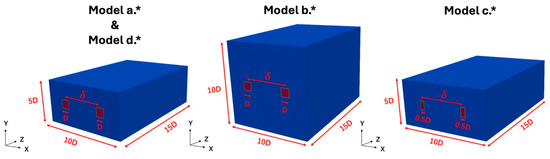
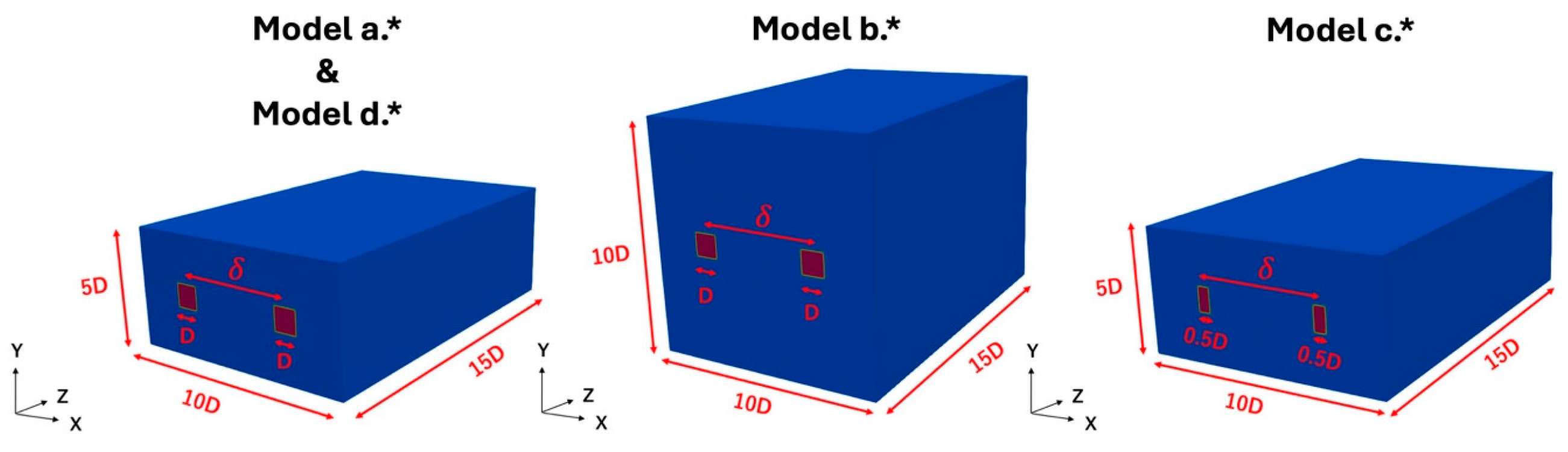
To investigate the effects of spacing of two individual gas vents (inlets) on combustion dynamics, we studied several models by varying the dimension of the model domain, and the spacing, width, and temperature of the gas vent rectangular hole (Table 1 and Figure 1). The models are labeled as a.m, b.m, c.m, and d.m, where the models with m = 1, 2, and 3 have a gas vent spacing of = 5D, 5D/2, and 5D/4, respectively (D = 0.2 m). The Models a.m, with a model dimension of (X, Y, Z) = (10D, 5D, 15D), a gas vent width of (X, Y) = (D, D), and a gas vent temperature of 350 K, are reference models. Compared to Models a.m, Models b.m have a larger model dimension of (X, Y, Z) = (10D, 10D, 15D), Models c.m have a gas vent width (X, Y) = (D/2, D), and Models d.m have a higher gas vent temperature of 400 K (Table 1 and Figure 1). The flow evolution is characterized by the dimensionless spacing parameter, , to generalize the effects of vent spacing.
Table 1.
Dimensions and temperature conditions of studied models where D = 0.2 m.
Figure 1.
Studied model domains (D = 0.2 m) and gas vent spacing (=5D, 5D/2, 5D/4). See Table 1 for Models a.*, b.*, c.*, and d.*.
We selected a characteristic dimension of D = 0.2 m to represent the width of mine gas vents. The dimensionless parameters based on D are considered valid for the range of 0.1 ≤ D ≤ 1.0 m, replicating the physical scales of typical coal waste gas vents. Within this range, the flow maintains a sufficiently high Reynolds number to ensure a fully developed turbulent regime, while the mesh resolution remains sufficiently fine to resolve the energy-containing scales of the turbulence spectrum.
Our simulations aimed to replicate the combustion of a multi-component gas (CH4 + CO + H2) released from gas holes on the surface of coal waste piles and abandoned mines. The initial conditions for the ambient atmosphere were set to typical air, with a temperature of 300 K, a pressure of 1.01325 × 10⁵ Pa, and a wind speed of 0 m/s. Gas is steadily discharged from the vent hole in the positive z-direction at a velocity of 0.01 m/s. The surface temperature of the gas vent hole was maintained at 350 K. The chemical composition of the discharged gas was based on that produced from lignite, including methane (CH4), carbon monoxide (CO), hydrogen (H2), and typical air. We assumed volume fractions of 4.2% CH4, 25.6% CO, 43.4% H2, and the remaining air, based on actual released gases reported in previous studies [3,31], although these fractions vary among coal waste piles. These conditions result in a source Froude number of Fr0 ≈ 0.01, indicating that the flow is driven entirely by buoyancy forces, with the initial momentum flux playing a negligible role in the plume’s near-field development. As boundary conditions, the gas vent hole surface was defined as an inflow boundary, and the top surface was set to a zero-gradient condition for free outflow while accounting for potential reverse flow due to local pressure variations. The side (x and y) boundaries were set to a zero-gradient condition for all variables except temperature. The side and top surfaces were fixed at 300 K.
The choice of the simulation’s mesh size influences chemical reactions [32]. The mesh size in this study was 10−2 m. Also, the physical and chemical timescales differ, and the chemical timescale can be much shorter when the chemical reaction is rapid [19]. In this study, the initial timestep was 1 × 10⁻⁸ s, and the Courant number remained C < 0.1 throughout each simulation. These were computationally intensive, and we used 2048 processors in our simulations. The simulation time was 3 s.
2.5. Model Verification and Hydrodynamic Validation
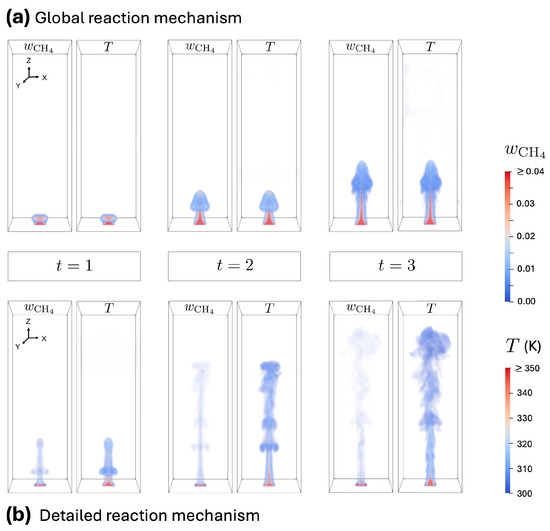
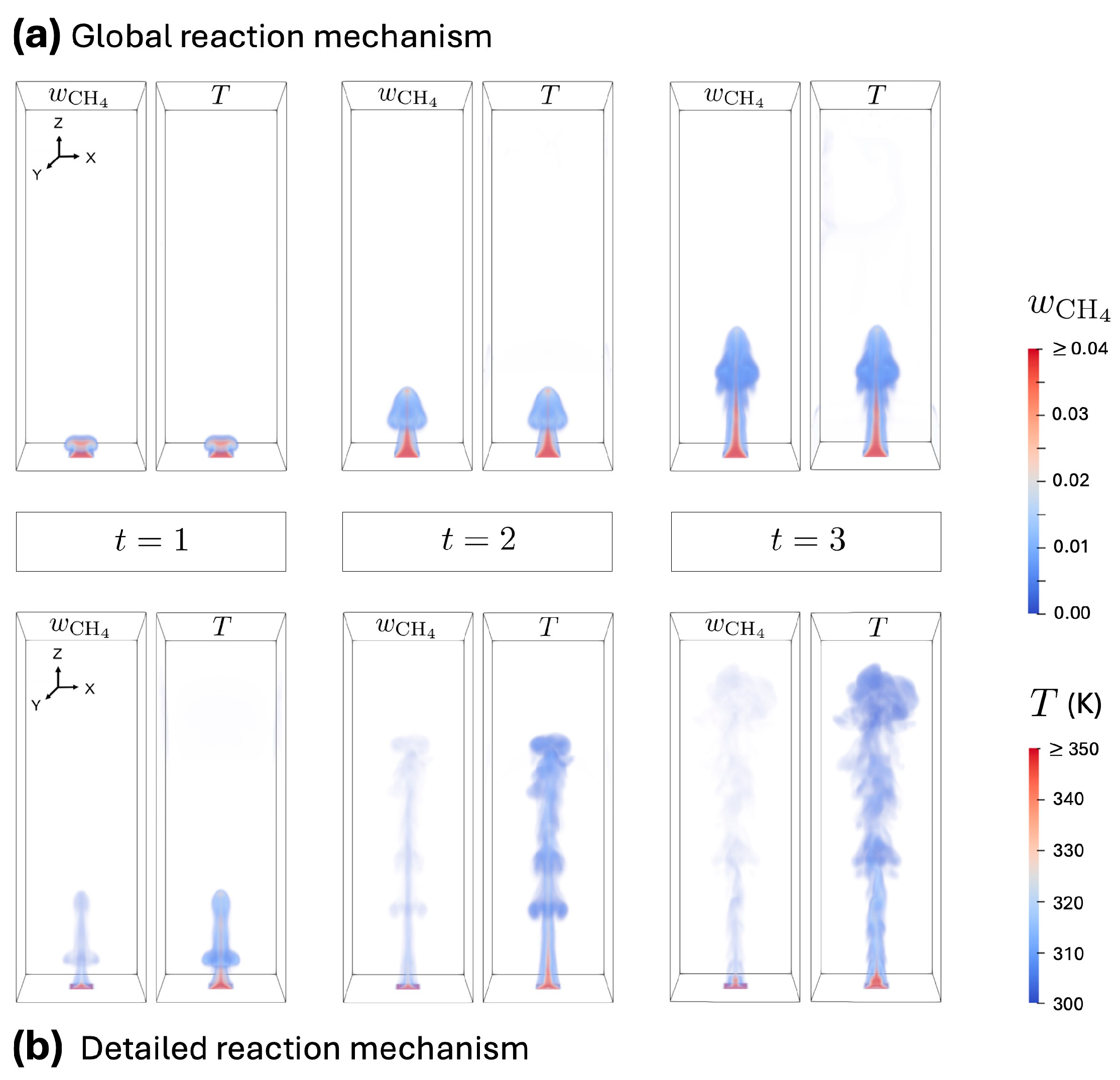
To ensure the reliability of our numerical framework, we conducted a comparative sensitivity analysis between a common global reaction mechanism [29] and the GRI-Mech 3.0 detailed reaction mechanism. We analyzed the plume evolution of the H2-CO-CH4-air mixture using a single-gas-hole configuration. The single-gas-hole configuration had a model dimension of (X, Y, Z) = (5D, 5D, 15D), with a gas vent width of (X, Y) = (D, D) and a gas vent temperature of 350 K (Figure 2).
Figure 2.
(a) CH4 mass fraction () and gas temperature profiles (T) at time t = 1, 2, 3 s in a single-gas-hole configuration using the global reaction mechanism. (b) CH4 mass fraction () and gas temperature profiles (T) at time t = 1, 2, 3 s in a single-gas-hole configuration using the detailed reaction mechanism.
For a buoyancy-dominated “lazy” plume, the centerline temperature decay is expected to follow a power law based on the self-similarity scaling [9] and actual experiments [33]. The centerline temperature decay is expressed by the following:
We observed that the detailed reaction mechanism led to a significantly faster vertical plume ascent by more accurately capturing the localized heat release and buoyancy effects inherent in the radial-chain reactions of the H2-CO-CH4-air mixture. Conversely, the global reaction mechanism produced an overly simplified, symmetric plume structure, which failed to capture temperature fluctuations and species gradients accurately. The global reaction mechanism yielded a broader lateral plume width, which is likely due to its inability to maintain the concentrated momentum core of the reactive ascending plume, leading to an overprediction of diffusive transport. Moreover, the global mechanism appeared to be considerably affected by the SGS vortex effects and the cutoff width (Δ), while the detailed mechanism effectively resolved the complex turbulence-chemistry interactions at the grid-resolved scale.
Ultimately, this single-gas-hole validation confirms that the detailed kinetic approach accurately replicates the complex buoyant-reactive physics, including entrainment, buoyancy–momentum coupling, and thermal decay. Having established the robustness for an isolated plume, our model serves as a validated framework for exploring the more complex hydrodynamic interactions, such as plume merging and shielding, in the dual-hole configurations targeted in this study.
3. Results and Discussion
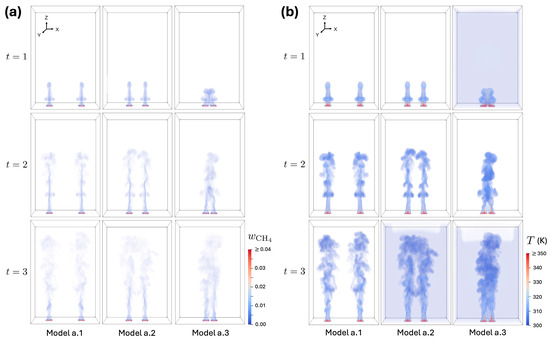
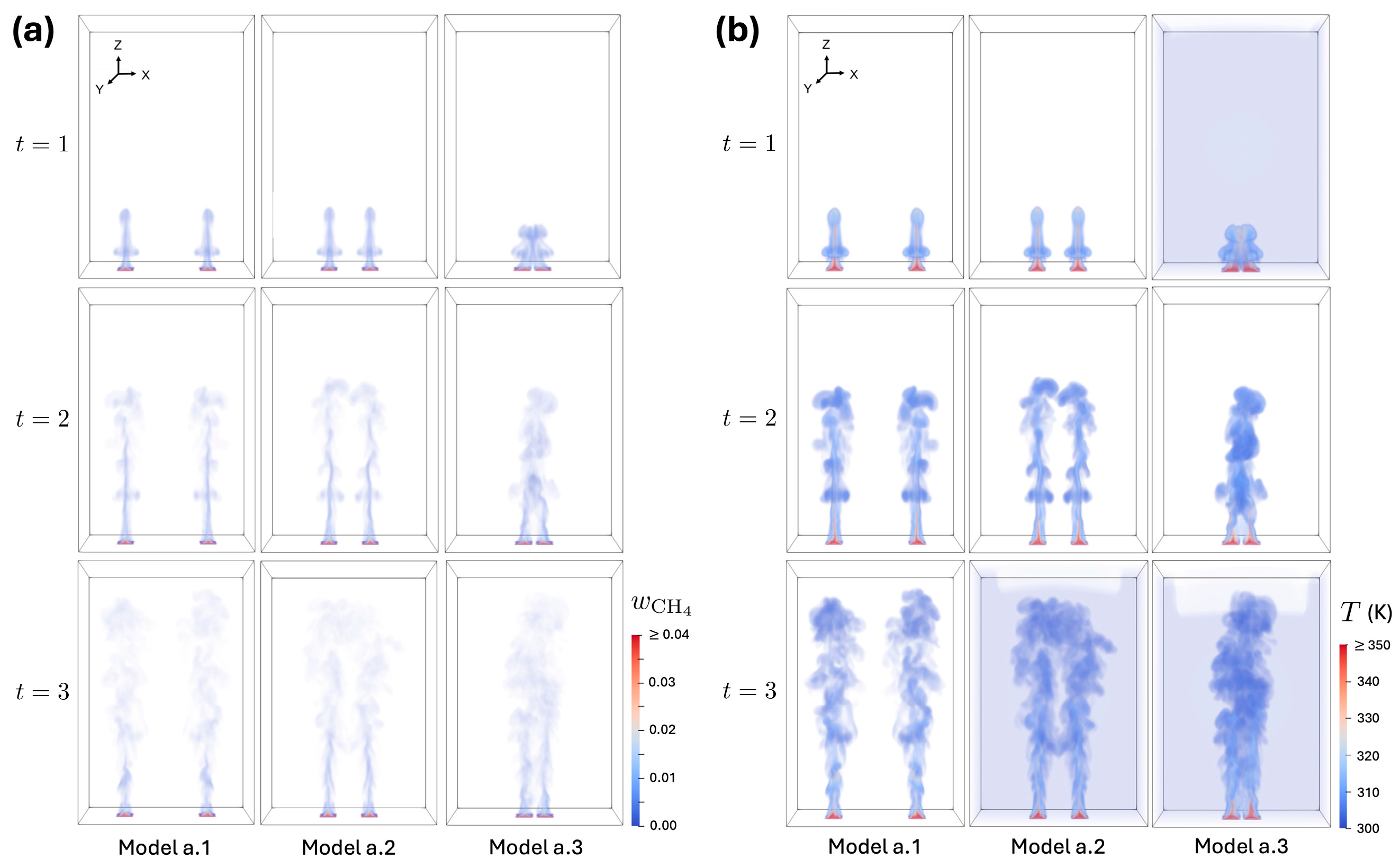
This section presents the results of combustion simulations of the gas mixture released from two individual gas holes when employing the detailed reaction mechanism. The analysis explores the impact of reaction mechanisms, gas hole spacing, hole size, gas temperature, and computational domain size on the behavior of the two co-flowing turbulent gas plumes. To analyze the spatial evolution and mixing dynamics, the spatial distribution of the resulting gas plume should be visualized. However, plotting the simultaneous dispersion of the full H2-CO-CH4-air blend would obscure the structural features of the reactive flow. In this study, the mass fraction of CH4 is used as a conservative scalar to track combustion dynamics in the studied gas mixture. Due to the hierarchical nature of hydrocarbon oxidation [20,21,22], the consumption of CH4 indicates the location of the primary reaction zone. Thus, tracking this single scalar field provides a clear visualization of the macroscopic morphology, lateral spreading, and air entrainment boundaries of the evolving H2-CO-CH4-air gas plume. For example, Figure 3 shows the simulation results of the CH4 mass fraction () and gas temperature (T) profiles at time t (s) in Models a.m (m = 1, 2, and 3; see Table 1 and Figure 1). As expected from the low source Froude number Fr0, the flow was in the pure plume regime where buoyancy forces dominated inertial momentum immediately upon gas release from vent holes.
Figure 3.
(a) CH4 mass fraction () profiles in Models a.m at time t = 1, 2, 3 s. (b) Gas temperature profiles (T) in Models a.m at time t = 1, 2, 3 s.
Furthermore, total CH4 mass ratios ( and ) were introduced to investigate the difference in the total CH4 mass among the studied models a.m, b.m, c.m, and d.m:
where and are the total CH4 mass integrated over the given model domain with the gas vent spacing m and at time t s in the results of Models β.m (β = a, b, c, d) and Models γ.m (γ = b, c, d), respectively. The total CH4 mass ratio serves as a global metric for the intensity of plume interactions.
3.1. Effect of Gas Vent Hole Spacing
Simulations with Models a.1, a.2, and a.3 examined three different spacing configurations between two individual equal gas holes with = 5, 5/2, and 5/4, respectively (Figure 3). The peak temperature was locally ~1040 K. Generally, a strong linear correlation was observed between the CH4 mass fraction () and gas temperature (T) profiles in all the studied models. This correlation implies that detailed kinetics effectively capture a physically realistic coupling between mixing and reaction. When the gas holes were spaced far apart ( = 5; Model a.1), the two co-flowing turbulent CH4 plumes behaved independently with no significant interaction (Figure 3a). When = 5/2 (Model a.2), the two co-flowing gas plumes merged into a single, combined plume at ~2 s, while they behaved independently at 1 s. When spaced closely ( = 5/4; Model a.3), the two jets released from the individual source holes rapidly merged into a single mixed plume. The low source Froude number indicates that the condition retards lateral spreading, facilitating the rapid coalescence observed in the closely spaced configurations ( = 5/4).
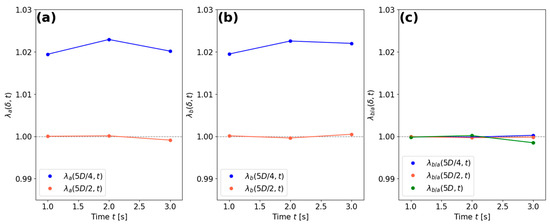
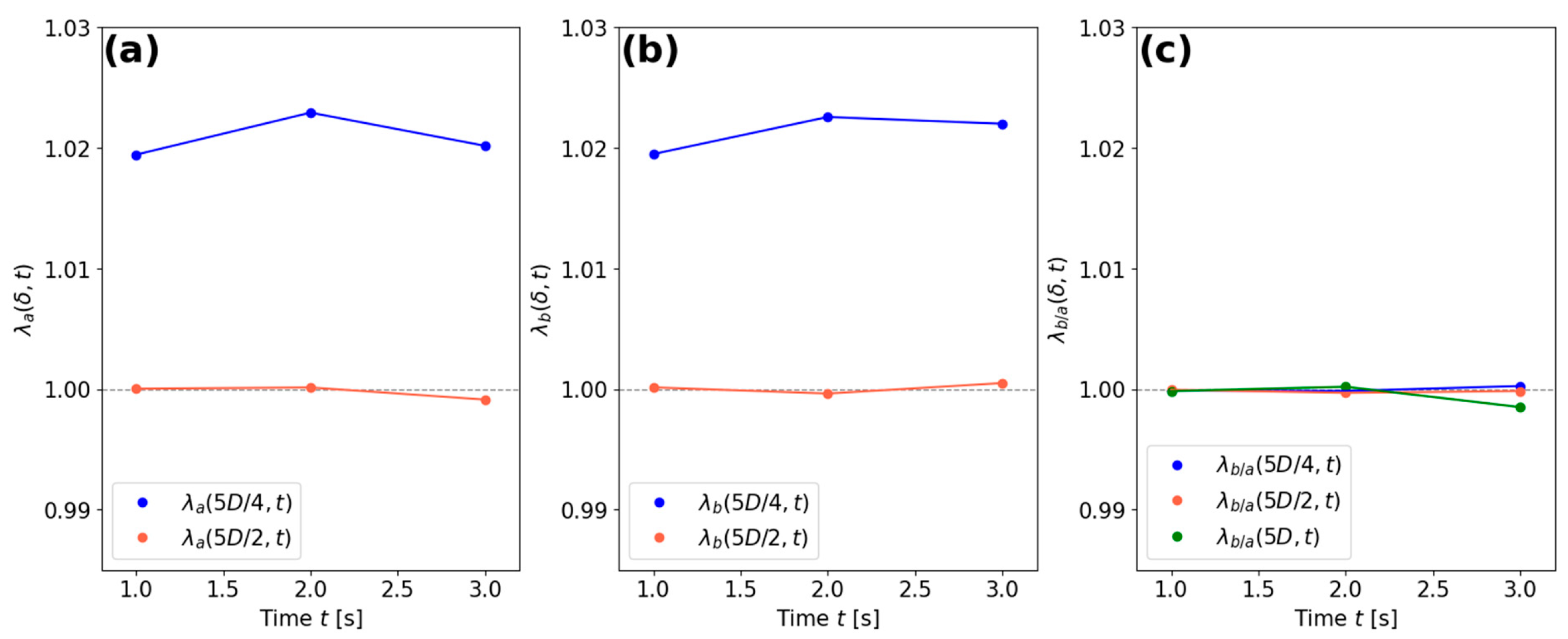
The total mass ratios ( and ) from Equations (6) and (7) further allowed us to quantitatively assess the effect of hole spacing on combustion reaction rates. While the ratio was approximately 1.00 throughout the simulation time, the ratio was higher than 1.019 in both Models a.m and b.m (Figure 4a,b). Here, the ratio was approximately 1.00 at any hole spacing and time t (Figure 4c), ensuring that the results between Models a.m and b.m are nearly identical, and thereby the model domain size is negligible. Thus, the analyses of the total mass ratio indicate that released gas in Models 1.a and 2.a ( = 5 spacing) and Models 1.b and 2.b ( = 5/2) was more consumed by combustion reaction than Models 1.c and 2.c ( = 5/4). This quantitative analysis confirms that gas vent proximity significantly affects CH4 survival rates and emphasizes that narrow vent spacings of exhibit strong hydrodynamic interactions, altering combustion efficiency and plume shape.
Figure 4.
(a) Total CH4 mass ratio in Models a.m. (b) Total CH4 mass ratio in Models b.m. (c) Total CH4 mass ratio .
3.2. Effect of Gas Vent Hole Size
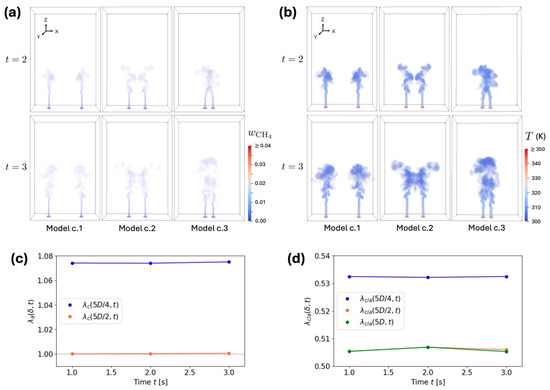
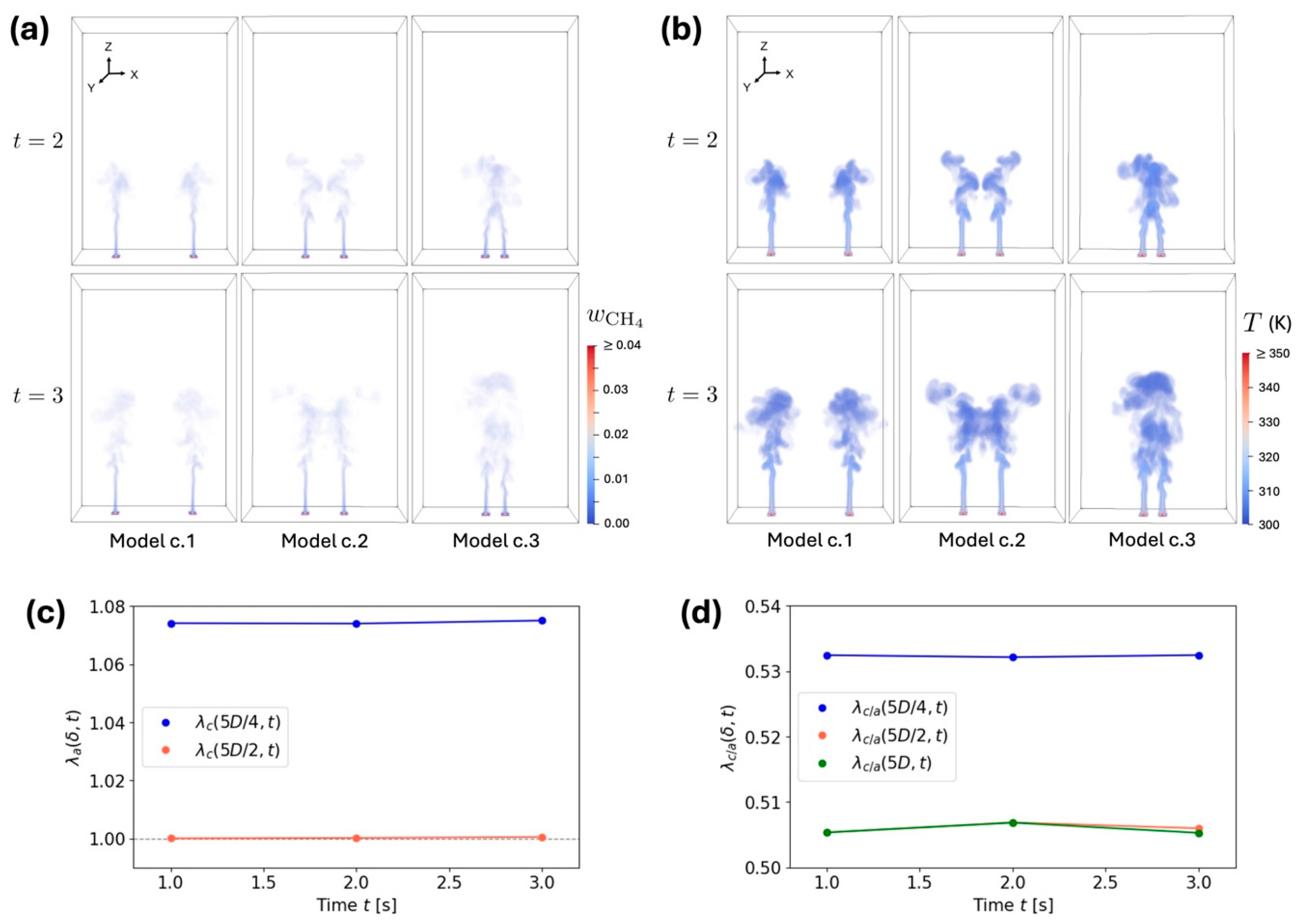
Simulations with Models c.1, c.2, and c.3 examined three different spacing configurations between two individual equal gas holes with = 5, 5/2, and 5/4, respectively, with reduced hole sizes of 0.5D × D (Figure 5). The reaching height of gas plumes in Models c.m was lower than that in Models a.m (Figure 4 and Figure 5). Nevertheless, when the gas holes were spaced far apart ( = 5; Model c.1), the two co-flowing turbulent gas plumes behaved independently with no significant interaction, like Model a.1. In closer spaced configurations (), the two co-flowing gas plumes merged into a single combined plume (Figure 5a,b). Although reducing the vent hole size generally reduced the total mass of surviving CH4, the spacing effects observed in Models a.m and b.m (see Section 3.1) persisted. The interaction between two co-flowing plumes remained a critical factor regardless of the absolute hole size.
Figure 5.
(a) CH4 mass fraction profiles in Models c.m at time t = 2, 3 s. (b) Gas temperature profiles in Models c.m at time t = 2, 3 s. (c) Total CH4 mass ratio in Models c.m. (d) Total CH4 mass ratio .
The total mass ratios ( and ) from Equations (6) and (7) further recognized the primary effect of hole spacing on combustion reaction rates (Figure 5c,d). The ratio was 1.074–1.075 (Figure 5c), slightly higher than the ratio . The ratio was 0.532 (Figure 5d), which was also slightly higher than expected from the fact that the source area was half compared to Model a.3. However, the ratio was 1.000 throughout the simulation time, and the ratios and were 0.505–0.507 throughout the simulation time, which aligns with the source area being half in Models c.1 and c.2. These analyses confirm that the hole proximity significantly affects the combustion efficiency regardless of the hole size.
The comparison of the reduced gas vent hole size (Figure 5) and the baseline gas vent hole size (Figure 3) revealed a strong dependence on the hole size. In the narrow vent, the released gas mixture in the plume rapidly entrains and mixes with the overlying cold air column. This dilution probably prevents the gas mixture from reaching sustained high temperatures, resulting in a maximum local temperature of only 421 K due to weak, early-stage exothermic reactions. Consequently, the comparison of gas vent hole size between D × D and 0.5D × D revealed a distinct sensitivity of the reactive flow and combustion dynamics to the gas vent scale. While these two cases represent a significant variation of 4× in vent area, further studies with a broader range of vent sizes are necessary to develop a comprehensive scaling law. Such studies were beyond the scope of this work due to the extreme computational requirements of the detailed-kinetic LES framework.
3.3. Effect of Gas Vent Hole Temperature
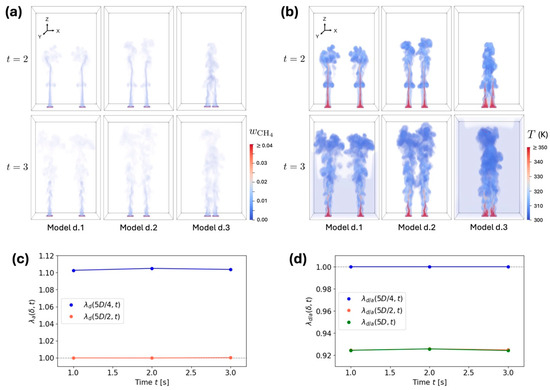
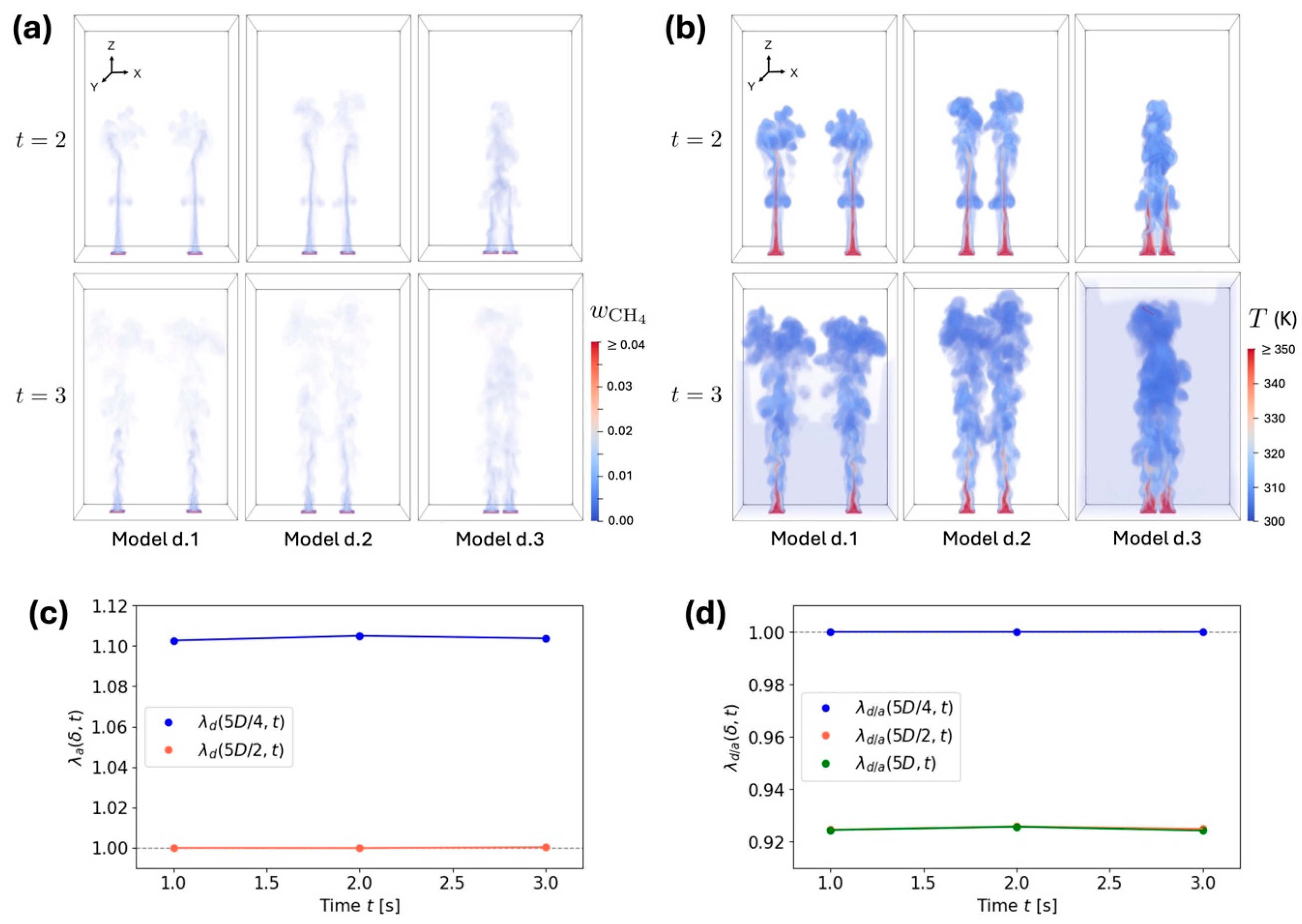
Simulations with Models d.1, d.2, and d.3 examined three different spacing configurations between two individual equal gas holes with = 5, 5/2, and 5/4, respectively, at a higher temperature of the gas vent hole surface at 400 K (Figure 6). Higher temperatures generally accelerate the laminar-turbulent transition of gas flow because they typically increase the molecular kinetic energy and modify viscosity [34,35]. In our simulations, higher gas hole temperatures indeed accelerated the transition from laminar to turbulent flow (Figure 6a), extending the high-temperature plume (locally ≥ 350 K) to over 20% of the domain height (Figure 6b) and significantly altering the near-field mixing efficiency (Figure 6c). Even with enhanced mixing, the implementation of detailed finite-rate kinetics revealed that the plume lift-off phenomena prevail. These effects are driven by the competition between turbulent transport timescales and chemical reaction timescales, a non-equilibrium process that the Deardorff SGS model captures by preserving the history of turbulent kinetic energy. Higher temperatures also promoted combustion, reducing the total mass of surviving CH4, as represented by the ratios and indicating well below 1.0 (Figure 6d). Notably, however, the gas hole temperature in the closely spaced configuration ( = 5/4) did not influence the total CH4 mass, as . Therefore, gas plumes spread diffusively from widely spaced holes even at higher hole temperatures, whereas closely spaced holes produced a well-developed vertical plume with local high-temperature regions in the upper layer.
Figure 6.
(a) CH4 mass fraction profiles in Models d.m at time t = 2, 3 s. (b) Gas temperature profiles in Models d.m at time t = 2, 3 s. (c) Total CH4 mass ratio in Models d.m. (d) Total CH4 mass ratio .
3.4. Merging Height
The merging height (Zm) generally scales linearly with spacing for turbulent equal twin plumes [11]:
where Cm is the constant determined experimentally. Our simulation results indicated a critical regime transition at . For the narrow spacing case ( = 5/4) in Models a.m, b.m, and d.m, the merging height Zm scales as Zm/D → 0 (Figure 3 and Figure 6), effectively creating a single buoyant column with an effective vent width . In contrast, the wide spacing case ( = 5) exhibited no effective merging observed within the computational domain height (Z/D < 15). This confirms that while the interaction length scale is related to vent spacing (), there is a regime deviation at wide spacing () where the linear scaling law in Equation (8) collapses to immediate merging.
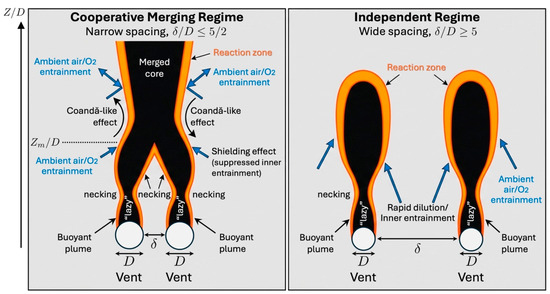
In standard non-buoyant jets, merging is driven purely by the spreading rate of the turbulent shear layers. However, in the studied buoyancy-dominated regime, the rapid vertical acceleration of the low-density gas generates a high-entrainment velocity field. This entrainment creates a hydrodynamic suction force between the plumes, associated with the Coandă-like effect, that pulls the plume centerlines inward (Figure 7). This “necking” behavior reduces the physical distance between the plumes, causing them to merge at a lower vertical height than predicted by linear spreading theories [11].
Figure 7.
Schematic of plume interaction regimes identified in this study.
The region below the merging height (Z < Zm) is characterized by high entrainment from the interstitial ambient gap between the two plumes before they merge. At Z < Zm, this inner entrainment path is cut off, reducing the total surface area available for oxidation. The early merging observed in the narrow-spacing case ( = 5/4) effectively seals the plume core from fresh oxygen, naturally present in the ambient air, at very low altitude. This explains the “shielding” phenomenon, in which the merging height serves as the vertical limit of efficient oxygenation, beyond which the plume core becomes combustible-rich and reaction-limited (Figure 7).
3.5. Engineering Implications
Beyond safety considerations, the hydrodynamic interactions identified in this study provide a strategic foundation for optimizing CH4 recovery from coal waste piles. Efficient valorization of spoil tip emissions requires extracting gas streams with sufficiently high calorific value [4,6], yet conventional passive venting often suffers from rapid dilution [36]. Here, our simulation results suggest that CH4 capture infrastructure must be adapted to the existing vent spacing (). At narrow spacings ( = 5/4), where simulations revealed effective retardation of the ambient air entrainment, vigorous plume merging and shielding (Figure 7), we recommend a “single pipe-to-multiple vents” strategy. This approach advantages mutual aerodynamic blockage to funnel a coherent, undiluted, and unburnt gas stream into a single collector, while significantly reducing infrastructure costs and avoiding the geotechnical risks of new drilling. Conversely, for sites with widely spaced vents ( ≥ 5), a “single pipe-to-single vent” configuration, in which each pipe is installed individually on the gas vent, is recommended to mitigate gas oxidation. Thus, a topology-dependent infrastructure design is essential for maximizing the viability of waste-to-energy conversion.
Beyond the specific context for coal waste piles, our findings have broader implications for industrial safety, particularly regarding the accidental release of hydrogen-rich mixtures. The simulation results demonstrate that the closely spaced vents () transition into a merged, shielded regime, which significantly retards air entrainment (Figure 7). When a lithium-ion battery fails (thermal runaway), it vents battery gas, with a typical mixture of H2, CO, CH4, and carbon dioxide (CO2) [37]. Electric vehicle battery packs consist of tightly clustered cells; situations in which multiple cells vent simultaneously yield exactly the “merging plume” scenario we investigated. The merging behavior and aerodynamic shielding analyzed here are directly applicable to understand how clustered vents retard air entrainment. However, since real lithium-ion battery vent gases contain high concentrations of non-combustible species (e.g., CO2) that act as thermal diluents, the enthalpy of combustion in actual battery fires will be lower than that of the idealized H2-CO-CH4 blend modeled here. While the fluid-dynamic merging regime remains highly relevant, applications to lithium-ion battery systems must explicitly account for these inert fractions to accurately predict thermal loads. Nevertheless, our results provide critical data on hydrogen safety distances for multi-point leak sources (e.g., valve manifolds) [38], demonstrating that plume coalescence generally reduces dilution rates and alters the hazardous flammability envelope. Future design protocols for multi-vent systems might need to account for this “merged but distinct” regime to prevent the accumulation of unburnt, toxic gas mixtures.
4. Conclusions
This paper investigated the hydrodynamic and chemical interactions of highly buoyant (lazy) multi-component twin gas plumes (CH4 + CO + H2 + air) using three-dimensional large eddy simulation coupled with the Deardorff subgrid scale model and detailed reaction mechanisms. By systematically varying the spacing of vents releasing twin equal plumes, the study elucidated the sensitivity of plume structure, entrainment rates, and plume stabilization to the vent geometry.
A central conclusion of this work is the identification of distinct flow regimes governed by the dimensionless spacing () between emission sources, where and D (0.1 ≤ D ≤ 1.0 m) are the spacing and width of gas vents, respectively. At wide spacing ( = 5), the mixture gas plumes evolved independently, with flow dynamics dominated by individual shear-layer instabilities and unregulated lateral entrainment of ambient air. Conversely, the configurations of narrow spacings ( = 5/4) exhibited immediate coalescence into a single, unified plume column, effectively behaving as a single source with an effective diameter of . This rapid merging is driven by a Coandă-like hydrodynamic suction and plume “necking,” which cuts off the inner entrainment path between plumes. This creates the “shielding effect,” in which the blockage of the inner shear layers restricts the entrainment of cold ambient air, effectively sealing the plume core from oxidation. Quantitatively, this was evidenced by the total CH4 mass ratio, which remained high (~1.0) at narrow spacings, indicating a significant retardation of air entrainment and combustion consumption compared to isolated, unmerged plumes and confirming that vent proximity effectively suppresses lateral mixing efficiency.
Moreover, this shielding phenomenon proved robust against variations in the vent hole size and surface temperature. Our results demonstrated that reducing the vent size by 50% (0.5D) does not disrupt the fundamental hydrodynamic shielding provided by narrow spacing, while it limits the peak local temperature to 421 K. While higher vent surface temperatures generally promoted turbulence and combustion, they did not diminish the shielding effect in the narrow spacing regime. These findings suggest a topology-dependent strategy for gas capture infrastructure; a single pipe-to-multiple vents configuration is recommended for narrow topologies ( 5/4), while a single pipe-to-single vent configuration is essential for wide topologies ( 5) to prevent oxidation of individual plumes. This study provides a quantitative basis for enhancing safety modeling for coal mining waste emissions and optimizing gas recovery from coal mining waste.
Author Contributions
Conceptualization, A.S. and A.K.; data curation, A.S. and A.K.; formal analysis, A.S. and A.K.; investigation, A.S., A.K. and M.N.; methodology, A.S. and A.K.; project administration, A.K.; resources, A.K.; software, A.S. and A.K.; supervision, A.K., M.N. and T.T.; validation, A.K.; visualization, A.S. and A.K.; writing—original draft, A.K.; writing—review and editing, M.N. and T.T. All authors have read and agreed to the published version of the manuscript.
Funding
This research received no external funding.
Institutional Review Board Statement
Not applicable.
Informed Consent Statement
Not applicable.
Data Availability Statement
The original contributions presented in this study are included in the article. Further inquiries can be directed to the corresponding author.
Acknowledgments
A.S. and A.K. are grateful to the City Office of Taku City and the Prefectural Government of Saga Prefecture, Japan, and Y. Okuma for fruitful discussions in our earlier study. The computation was performed on the former ITO supercomputer system under a general project at the Research Institute for Information Technology of Kyushu University.
Conflicts of Interest
The authors have no conflicts to disclose.
References
- Tsuji, T.; Takai, K.; Oiwane, H.; Nakamura, Y.; Masaki, Y.; Kumagai, H.; Kinoshita, M.; Yamamoto, F.; Okano, T.; Kuramoto, S. Hydrothermal fluid flow system around the Iheya North Knoll in the mid-Okinawa trough based on seismic reflection data. J. Volcanol. Geotherm. Res. 2012, 213–214, 41–50. [Google Scholar] [CrossRef] [Scilit]
- Kioka, A.; Tsuji, T.; Otsuka, H.; Ashi, J. Methane concentration in mud conduits of submarine mud volcanoes: A coupled geochemical and geophysical approach. Geochem. Geophys. Geosyst. 2019, 20, 792–813. [Google Scholar] [CrossRef] [Scilit]
- Dunnington, L.; Nakagawa, M. Fast and safe gas detection from underground coal fire by drone fly over. Environ. Pollut. 2017, 229, 139–145. [Google Scholar] [CrossRef] [Scilit]
- Lazorenko, G.; Kasprzhitskii, A.; Yatsenko, E.A.; Wensheng, L.; Chaudhary, S. Towards coal mining waste valorization: Gangue as resource for the production of geopolymer and related alkali-activated materials. Green Technol. Sustain. 2025, 3, 100205. [Google Scholar] [CrossRef] [Scilit]
- Saunois, M.; Martinez, A.; Poulter, B.; Zhang, Z.; Raymond, P.A.; Regnier, P.; Canadell, J.G.; Jackson, R.B.; Patra, P.K.; Bousquet, P.; et al. Global Methane Budget 2000–2020. Earth Syst. Sci. Data 2025, 17, 1873–1958. [Google Scholar] [CrossRef] [Scilit]
- Su, S.; Beath, A.; Guo, H.; Mallett, C. An assessment of mine methane mitigation and utilisation technologies. Prog. Energy Combust. Sci. 2005, 31, 123–170. [Google Scholar] [CrossRef] [Scilit]
- Song, B.; Wang, X.; Kang, Y.; Li, H. Research on hydrogen leakage diffusion and safety analysis in hydrogen fuel cell vehicles with regard to leakage location and ventilation ports. Int. J. Hydrogen Energy 2024, 83, 173–187. [Google Scholar] [CrossRef] [Scilit]
- Bugryniec, P.J.; Resendiz, E.G.; Nwophoke, S.M.; Khanna, S.; James, C.; Brown, S.F. Review of gas emissions from lithium-ion battery thermal runaway failure—Considering toxic and flammable compounds. J. Energy Storage 2024, 87, 111288. [Google Scholar] [CrossRef] [Scilit]
- Morton, B.R.; Taylor, G.I.; Turner, J.S. Turbulent gravitational convection from maintained and instantaneous sources. Proc. R. Soc. Lond. Ser. A Math. Phys. Sci. 1956, 234, 1–23. [Google Scholar] [CrossRef] [Scilit]
- Hunt, G.R.; Kaye, N.B. Lazy Plumes. J. Fluid Mech. 2005, 533, 329–338. [Google Scholar] [CrossRef] [Scilit]
- Kaye, N.B.; Linden, P.F. Coalescing axisymmetric turbulent plumes. J. Fluid Mech. 2004, 502, 41–63. [Google Scholar] [CrossRef] [Scilit]
- Cenedese, C.; Linden, P.F. Entrainment in two coalescing axisymmetric turbulent plumes. J. Fluid Mech. 2014, 752, R2. [Google Scholar] [CrossRef] [Scilit]
- Li, S.; Flynn, M.R. Merging of two plumes from area sources with applications to cooling towers. Phys. Rev. Fluids 2020, 5, 054502. [Google Scholar] [CrossRef] [Scilit]
- Patil, O.T.; Meehan, M.A.; Hamlington, P.E. Puffing frequency of interacting buoyant plumes. Phys. Rev. Fluids 2022, 7, L111501. [Google Scholar] [CrossRef] [Scilit]
- Regele, J.D.; Knudsen, E.; Pitsch, H.; Blanquart, G. A two-equation model for non-unity Lewis number differential diffusion in lean premixed laminar flames. Combust. Flame 2013, 160, 240–250. [Google Scholar] [CrossRef] [Scilit]
- Ihme, M.; Chung, W.T.; Mishra, A.A. Combustion machine learning: Principles, progress and prospects. Prog. Energy Combust. Sci. 2022, 91, 101010. [Google Scholar] [CrossRef] [Scilit]
- Choi, H.; Cho, C.; Kim, M.; Park, J. Perspective on machine-learning-based large-eddy simulation. Phys. Rev. Fluids 2025, 10, 110701. [Google Scholar] [CrossRef] [Scilit]
- Posch, S.; Gößnitzer, C.; Lang, M.; Novella, R.; Steiner, H.; Wimmer, A. Turbulent combustion modeling for internal combustion engine CFD: A review. Prog. Energy Combust. Sci. 2025, 106, 101200. [Google Scholar] [CrossRef] [Scilit]
- Goussis, D.A.; Maas, U. Model Reduction for Combustion Chemistry. In Turbulent Combustion Modeling; Echekki, T., Mastorakos, E., Eds.; Springer: Dordrecht, The Netherlands, 2011; Volume 95, pp. 193–220. [Google Scholar]
- Halter, F.; Chauveau, C.; Djebaïli-Chaumeix, N.; Gökalp, I. Characterization of the effects of pressure and hydrogen concentration on laminar burning velocities of methane–hydrogen–air mixtures. Proc. Combust. Inst. 2005, 30, 201–208. [Google Scholar] [CrossRef] [Scilit]
- Tahtouh, T.; Halter, F.; Samson, E.; Mounaïm-Rousselle, C. Effects of hydrogen addition and nitrogen dilution on the laminar flame characteristics of premixed methane–air flames. Int. J. Hydrogen Energy 2009, 34, 8329–8338. [Google Scholar] [CrossRef] [Scilit]
- Jing, Y.; Song, X.; Wu, R.; Wei, J.; Gong, Y.; Bao, W.; Bai, Y.; Wang, J.; Yu, G. Investigation on the improved lifted flame stabilization of methane/hydrogen mixtures with oxygen co-flow based on OH* chemiluminescence. Int. J. Hydrogen Energy 2024, 60, 556–565. [Google Scholar] [CrossRef] [Scilit]
- Pitsch, H. Large-eddy simulation of turbulent combustion. Annu. Rev. Fluid Mech. 2006, 38, 453–482. [Google Scholar] [CrossRef] [Scilit]
- Versteeg, H.K.; Malalasekera, W. An Introduction to Computational Fluid Dynamics: The Finite Volume Method, 2nd ed.; Pearson/Prentice Hall: Harlow, UK, 2007. [Google Scholar]
- Weller, H.G.; Tabor, G.; Jasak, H.; Fureby, C. A tensorial approach to computational continuum mechanics using object-oriented techniques. Comput. Phys. 1998, 12, 620–631. [Google Scholar] [CrossRef] [Scilit]
- Deardorff, J.W. The Use of Subgrid Transport Equations in a Three-Dimensional Model of Atmospheric Turbulence. J. Fluids Eng. 1973, 95, 429–438. [Google Scholar] [CrossRef] [Scilit]
- deBruynKops, S.; Riley, J. Large-eddy simulation of a reacting scalar mixing layer with arrhenius chemistry. Comput. Math. Appl. 2003, 46, 547–569. [Google Scholar] [CrossRef] [Scilit]
- An, J.; Zhu, M.; Chen, Z.; Liu, B.; Zhang, J.; Zhou, H. Impact of subgrid mixing timescale modelling on LES of hydrogen-fueled supersonic combustion. Int. J. Hydrogen Energy 2025, 194, 152349. [Google Scholar] [CrossRef] [Scilit]
- Kee, R.J.; Coltrin, M.E.; Glarborg, P.; Zhu, H. Chemically Reacting Flow: Theory, Modeling, and Simulation, 1st ed.; Wiley: Hoboken, NJ, USA, 2017. [Google Scholar]
- Simmie, J.M. Detailed chemical kinetic models for the combustion of hydrocarbon fuels. Prog. Energy Combust. Sci. 2003, 29, 599–634. [Google Scholar] [CrossRef] [Scilit]
- Liu, S.; Wang, Y.; Zhao, K.; Yang, N. Enhanced-hydrogen gas production through underground gasification of lignite. Min. Sci. Technol. 2009, 19, 389–394. [Google Scholar] [CrossRef] [Scilit]
- Gong, X.; Xu, Y.; Mahadeo, V.; Kaman, T.; Larsson, J.; Glimm, J. Mesh convergence for turbulent combustion. Discret. Contin. Dyn. Syst. 2016, 36, 4383–4402. [Google Scholar] [CrossRef] [Scilit]
- Chen, C.J.; Rodi, W. Vertical turbulent buoyant jets: A review of experimental data. NASA Sti/Recon Tech. Rep. A 1980, 80, 23073. [Google Scholar]
- Zhou, B.; Brackmann, C.; Li, Q.; Wang, Z.; Petersson, P.; Li, Z.; Aldèn, M.; Bai, X.-S. Distributed reactions in highly turbulent premixed methane/air flames: Part I. Flame structure characterization. Combust. Flame 2015, 162, 2937–2953. [Google Scholar] [CrossRef] [Scilit]
- Hong, C.; Asako, Y.; Morini, G.L.; Faghri, M. Variations in gas temperature and average velocity during laminar-turbulent transition in high-speed gas flow through microtubes. Exp. Therm. Fluid Sci. 2024, 155, 111196. [Google Scholar] [CrossRef] [Scilit]
- Karakurt, I.; Aydin, G.; Aydiner, K. Mine ventilation air methane as a sustainable energy source. Renew. Sustain. Energy Rev. 2011, 15, 1042–1049. [Google Scholar] [CrossRef] [Scilit]
- Wang, G.; Kong, D.; Ping, P.; Wen, J.; He, X.; Zhao, H.; He, X.; Peng, R.; Zhang, Y.; Dai, X. Revealing particle venting of lithium-ion batteries during thermal runaway: A multi-scale model toward multiphase process. eTransportation 2023, 16, 100237. [Google Scholar] [CrossRef] [Scilit]
- Yang, N.; Deng, J.; Wang, C.; Bai, Z.; Qu, J. High pressure hydrogen leakage diffusion: Research progress. Int. J. Hydrogen Energy 2024, 50, 1029–1046. [Google Scholar] [CrossRef] [Scilit]

Disclaimer/Publisher’s Note: The statements, opinions and data contained in all publications are solely those of the individual author(s) and contributor(s) and not of MDPI and/or the editor(s). MDPI and/or the editor(s) disclaim responsibility for any injury to people or property resulting from any ideas, methods, instructions or products referred to in the content. |
© 2026 by the authors. Licensee MDPI, Basel, Switzerland. This article is an open access article distributed under the terms and conditions of the Creative Commons Attribution (CC BY) license.