


Abstract
The stability analysis for isothermal three-component gas mixtures, in which one of the components exhibits real properties in the considered pressure range, is performed. The system of Navier–Stokes and diffusion equations in the Boussinesq approximation is considered, taking into account analogs of buoyancy effects in a density-stratified medium. The presented solution is obtained by the small-perturbation method using the principle of diffusion independence, while maintaining the condition of neutrality of convective perturbations. Expressions for the boundary between the “diffusion–gravitational convection” regimes are obtained in terms of partial Rayleigh numbers that account for the compressibility factor of the mixing components. The stability cartograms show that on the stability maps, the position of the boundary of the regimes change depends on the variation in the compressibility factor with a pressure change. When the compressibility factor changes, the values of the critical Rayleigh numbers, which are the intersection points of the boundary of the regimes change and the coordinate axes, decrease. It is established that the behavior of the partial Rayleigh numbers on the plane (Ra1, Ra2) is nonlinear for isothermal ternary mixtures, which have the general form H2 + N2O–N2 and He + CO2–N2, He + R12–Ar, at T = 298.0 K and elevated pressures. It is revealed that when taking into account the compressibility factor of the components, the partial Rayleigh numbers of the components decrease.
1. Introduction
Mixing in liquid and gaseous mixtures plays a significant role in natural and technological processes [1,2], which has led to increased interest in analyzing the properties of multicomponent systems [3,4]. Studies that examine combined mixing in multicomponent systems include those in which the behavior of such mixtures is determined by the interaction of various effects associated with heat and mass transfer mechanisms (convection, thermal conductivity, diffusion) [5,6]. In such cases, approaches for correctly identifying the regions where diffusion (thermodiffusion) [7] and convection caused by instability of the equilibrium state of the mixture [8] occur are of particular importance. As shown in [9,10], in non-isothermal binary mixtures, diffusion and thermodiffusion mass transfer can lead to a disruption of the system’s equilibrium. The instability threshold is determined by the relationships between thermophysical parameters and the magnitudes of temperature and concentration gradients, which can be established both experimentally [11] and computationally within the framework of the Rayleigh stability theory [12], extended to mixtures [13]. According to the results presented in [9,10,11,12,13], in a non-uniform temperature field, the nature of instability in the system changes abruptly in a stepwise manner with varying degrees of convective disturbances, as demonstrated by both experiments and numerical studies.
The shift in scientific focus towards studies of ternary and multicomponent mixtures has complicated the description of combined mass transfer. When applying the logic of kinetic descriptions of diffusion and thermodiffusion fluxes [7] to the case of ternary systems, one must note the challenges in determining the diffusion and thermodiffusion coefficients for multicomponent mixtures [14,15]. This primarily concerns the dependence of diffusion coefficients on the chosen frame of reference, the definition of the diffusion coefficient matrix for multicomponent systems, and its relationship with the composition of the mixture under study. For investigating the boundary between diffusive and convective regimes, the mathematical description of ternary mixtures becomes more complex not only due to the increase in the number of components and their associated interaction, but also because of the influence of cross-effects (thermodiffusion, diffusion thermal conductivity), which contribute additionally to the emergence of various instabilities [9,16]. It was also noted in [9] that the experimental methodology applied to study diffusive (thermodiffusive) and convective regimes in binary mixtures can, with certain modifications, be extended to ternary mixtures. The validity of this approach was demonstrated in a series of studies (see, for example, [17,18,19]) involving the measurement of diffusion and thermodiffusion coefficients in ternary mixtures aboard the International Space Station. Based on these works, a connection was also established between measurements under microgravity conditions and ground-based experiments, and satisfactory agreement between experimental and computational data was shown.
At the same time, it should be noted that the studies conducted in [9,10,11,12,13,14,15,16,17,18,19] were based on the fact that a temperature gradient can cause mass transfer by non-isothermal diffusion and thermal diffusion, which leads to the emergence of density-stratified regions of the medium, due to which convection occurs. It should be assumed that during isothermal mixing in multicomponent mixtures, due to the difference in diffusion coefficients, it is possible to form a density inversion, which causes the emergence of effects that are not always fully described in studies for non-isothermal diffusion. Experimental and theoretical studies presented in [20,21,22,23] showed that in isothermal multicomponent gas and vapor–gas mixtures, when the condition of decreasing density with height is realized, convective flows can occur. In [24], a preferential transfer of the component with the highest molecular weight was recorded, which is not typical for diffusion. Various features of the experimental and numerical studies are presented in the review [25] with an emphasis on the study of effects near the boundary of the change in the “diffusion–convection” regimes. As the analysis of the works presented in [25] showed, the experimental data are in adequate agreement with those calculated within the framework of the stability theory. At the same time, it was noted that in mixtures where one of the components is a gas with real properties, the discrepancy in the definition of the regions of existence of diffusion calculated within the framework of the approaches of the stability theory [23] and experimentally can be significantly larger. Such a discrepancy can be explained by both the lack of experimental data under the given conditions and by the methods for calculating pair and multicomponent diffusion coefficients. In the scientific literature related to the calculation of diffusion coefficients for mixtures with real-gases, the need to take into account the influence of intermolecular forces and the sizes of molecules is noted [7]. This can be done within the framework of kinetic concepts by introducing correlation corrections into the relations for calculating the diffusion coefficient [26], calculating the transfer coefficients within the framework of the lattice model of gas, allowing the interaction of molecules within the boundaries of one-dimensional stochastic lattices [27], and calculating the compressibility of diffusing gases [28]. In all the cases given for real gas mixtures, a significant discrepancy is noted in the calculated diffusion coefficients compared to the standard kinetic model [5,7]. Therefore, it should be assumed that in systems with real gases, the definition of the boundaries of the change in the “diffusion–convection” regimes should assume the influence of intermolecular forces reflected in the calculation of the corresponding diffusion coefficients.
Thus, it should be noted that failure to take into account the real properties of diffusing gases in multicomponent systems leads to a significant distortion in determining the boundary of the change in the “diffusion–convection” modes. The stability boundary determines the areas of diffusion and convective disturbances. Therefore, the purpose of the work is to identify a set of thermophysical parameters that form the boundary of the change in modes, which seems important for research in the field of combined mass transfer of gas mixtures with real properties.
In contrast to classical stability problems aimed at constructing the full stability spectrum of the basic state [6,8], the present work focuses on the analytical determination of the threshold for the occurrence of concentration convection caused by buoyancy forces under isothermal conditions. The boundary under consideration is not the stability limit in the strict hydrodynamic sense. It specifies the conditions under which the purely diffusive regime of mass transfer is disrupted and replaced by a macroscopic convective flow caused by concentration-dependent changes in density in the gravity field.
The scientific novelty of this work lies in explicitly accounting for real-gas effects in the analytical criterion for the onset of convection by incorporating the compressibility coefficients of the mixture components. While most previous studies considered the diffusion–convection transition under the assumption of ideal gas behavior, this study demonstrates that non-ideal thermodynamic properties can significantly shift the threshold for convection onset, especially at elevated pressures. Accounting for these effects is fundamentally important for the correct quantitative interpretation of experimental data obtained for ternary gas mixtures with components exhibiting pronounced deviations from ideal gas behavior.
2. Mathematical Model
Transport processes in multicomponent mixtures are more complex than in binary systems. In the general case, assuming the condition of independent diffusion
(where is the molar concentration of the ith component, is the vector of the diffusion flux density of the ith component) for an isothermal n-component system, the number of diffusion equations corresponds to the (n − 1) expression, and the number of independent diffusion coefficients corresponds to the (n − 1)2 values [29].
In [30,31,32], various approaches to determining the transport coefficients of multicomponent mixtures and the diffusion coefficient matrix were presented. The corresponding formalism was applied in studies of the stability of equilibrium in non-isothermal multicomponent systems confined in cavities of various geometries [10,13,16,33,34]. Analysis of the results reported in these works allows one to conclude that, for ternary mixtures, the condition of independent diffusion makes it possible to determine the critical parameters of mechanical equilibrium instability and to construct stability maps for mixing scenarios involving two and three components. A parametric study of such systems revealed the existence of different instability scenarios within a certain range of Rayleigh numbers, for example, the onset of monotonic instability, followed by a transition from monotonic to oscillatory instability.
Taking into account the results obtained in [6,10,13,16,33,34] for determining the boundaries of the change in the “diffusion–gravitational convection” regimes during isothermal mixing of a ternary gas mixture containing a component exhibiting real properties at moderate pressures, it can be considered possible to use the formalism of analysis for convective stability [6]. Extending the approach of [6] to the case of isothermal ternary mixtures and applying the condition of independent diffusion, we obtain the system of hydrodynamic equations, which includes the relations for diffusion and motion as follows [8,23]:
where ρ is the density, t is the time, p is the pressure, is the gravity acceleration vector, η and ξ are the coefficients of shear and bulk viscosity, n is the number density, is the weight-average velocity, is the number-average velocity. In addition, is the Hamilton operator (nabla), is the Laplacian, · denotes the scalar (dot) product, i, j = 1, 2. The Einstein summation rule here and later is assumed. Equation (1a) is the equation of motion of a viscous fluid in a gravitational field assuming constant coefficients of shear and bulk viscosity (Navier–Stokes equation) [29]. Equation (1b)1 is the continuity equation of the number density [35], Equation (1b)2 is the balance equation of the concentration of the ith component and Equation (1c) is the constitutive equation for the vector of the diffusion flux density of the ith component.
The coefficients are determined through the interdiffusion coefficients Dik (i = 1, 2, k = 1, 2, 3) and have the following form:
Note that for , i and j are the row and column numbers in the matrix of these coefficients, respectively. For , i and k are the component numbers.
In order to connect the thermodynamic parameters in the equations of diffusion and motion, we supplement system (1) with the constitutive equation of state medium:
are the compressibility factors of the ith component (1—light and 2—heavy) [7], T denotes the temperature.
Within the framework of the small-perturbation method [6], the concentration of the ith component and the pressure can be represented as the sum of constant average values taken as the starting point and their perturbations :
Moreover, taking into account the smallness of the perturbations of concentrations and pressures, as well as the density perturbations caused by them, Equation (3) within the framework of the Boussinesq approximation [6,8] can be transformed into the form:
where
with M0 as the average molar mass of the mixture, Z0 as the compressibility factor of the mixture, taken as the starting point,
is the coefficient of volumetric expansion by concentration,
is the coefficient of isothermal compressibility of the mixture,
where Bij is the second virial coefficient [7].
To obtain a system of equations of concentration convection for the disturbed quantities, the following assumptions are taken into account [6,23]:
1. , ,
2. , where the corresponding products are taken in absolute value.
3. The condition of smallness of relative changes in density (4) allows the continuity equation in the system of Equation (1) to be expressed in the form .
4. The coefficients do not depend on the composition for the first (lowest molecular weight) and second (highest molecular weight) components, which are taken into account when simplifying Equation (1b)2,
5. Density non-uniformity is significant only in the buoyancy force.
6. Due to the smallness of the non-stationary disturbances of mechanical equilibrium, terms that are quadratic in the disturbances, i.e., the terms and , are not taken into account.
The adopted simplifications result from the application of the small-perturbation method [6,8], used to solve the system of Equation (1), and are valid for any pressures and compositions of the ternary systems under consideration.
The methodology for solving the system of Equation (1) for a cylindrical channel with a circular Cross Section can be divided into several stages. At the first stage, after nondimensionalization with respect to the specified characteristic scales, equations for the component concentrations are obtained. Next, the velocity equation is formulated. At the second stage, solving the velocity equation yields a spectrum of critical Rayleigh numbers for odd and even modes. At the third stage, the boundary between the diffusion and convection regimes is determined. Finally, at the fourth stage, the compressibility factor is introduced into the equation for the mixture density gradient. Let us consider each stage of constructing the general solution in more detail.
The system of Equation (1), after applying the method of small perturbations and taking into account the above-mentioned assumptions, is transformed into a system of equations of concentration convection for the perturbed quantities. The resulting system is then nondimensionalized by introducing appropriate scales of units of measurement for the characteristic linear size of the cavity, time, velocity, pressure, and concentration. Thus, the system of convection equations for dimensionless perturbations (here and in what follows, the prime notation for perturbed quantities is omitted) takes the form [23]:
where is the Prandtl diffusion number, is the partial Rayleigh number, , is the projection of the partial concentration gradient of the ith component along the z-axis, ν is the kinematic viscosity, d is the characteristic size of the diffusion channel, is the unit vector in the direction of the z-axis. The parameters are calculated using Equation (2). In the dimensionless system of Equation (5), after dimensionless transformation, a partial Rayleigh number appears in the form , where g is the gravity acceleration and i = 1, 2. If one substitutes the expressions for and , one obtains the Rayleigh numbers for 1 (light) and 2 (heavy) components. For the problem under consideration, their form is given in Equation (12). Since the system of Equation (5) includes two Rayleigh numbers, they are called partial.
The system of Equation (5) makes it possible to determine the spectrum of normal perturbations of the mechanical equilibrium of a gas mixture in a cavity of a given geometry, which depends on the Rayleigh and Prandtl numbers, as well as on the ratios of the coefficients . Thus, the stability problem under consideration consists of determining the sequence of critical relations for the partial Rayleigh numbers and the corresponding critical modes of motion.
In the system of Equation (5), the component concentrations are measured relative to their constant average values , and the pressure p represents the deviation from the hydrostatic pressure.
In a ternary mixture, only two concentration gradients are independent, since the molar concentrations satisfy the condition c1 + c2 + c3 = 1. As a result, the third gradient can be expressed as a linear combination of the other two, and the system dynamics can be fully characterized by two independent partial Rayleigh numbers.
The system of Equation (5) has particular solutions that depend on time according to an exponential law (“normal” perturbations):
where λ is the temporal decrement in perturbations.
When solving the system of Equation (5), the following assumptions are adopted [6,36]: 1. Critical motions parallel to the channel axis are considered, and it is assumed that the concentration perturbations do not depend on z: , , . 2. Possible pressure perturbations are eliminated, since the pressure relaxation time is much shorter than the concentration relaxation time. Pressure perturbations are not ignored physically, but they are mathematically eliminated in the stability problem formulation due to the fact that the relaxation time of pressure perturbations is significantly less than the characteristic time of diffusion and convective development of concentration perturbations. As a result, the pressure adjusts quasi-instantly to the velocity field and is not an independent dynamic variable. 3. The problem is formulated in cylindrical coordinates (r,φ,z), with the z-axis directed upward along the cylinder axis. 4. The problem admits particular solutions for which the velocity u and the component concentrations depend on the azimuthal angle φ according to a harmonic law. 5. The boundary conditions assume that, at the boundary of the horizontal section of the channel, the velocity perturbations and the mass flux normal to the boundary vanish: u = 0, , i = 1,2 at r = ±1; 6. The perturbations do not depend on the vertical coordinate z; that is, a zero wave number in the z-direction is assumed.
The pressure perturbation is not treated as an independent variable in the linear stability problem [6]. Under the Boussinesq approximation, pressure enters the momentum equation as a Lagrange multiplier enforcing the incompressibility constraint . Taking the divergence of the linearized momentum equation yields the Poisson equation
For the considered class of perturbations, the concentration disturbances do not depend on the vertical coordinate, which leads to . As a result, the pressure gradient does not contribute to the neutral stability problem and can be consistently eliminated from the amplitude equations by projection onto the solenoidal velocity field. The pressure field can be reconstructed a posteriori from the above Poisson equation, if required.
Substituting the solution in the form (6) into the system of Equation (5) and taking into account the above-mentioned assumptions, one can obtain an amplitude system of equations for , which at λ = 0 is transformed into a system of equations of neutral perturbations:
An analytical solution of the system of equations of concentration convection (7) for a vertical cylindrical channel of circular cross section [36] with boundary conditions assuming the vanishing of the disturbances of the velocity and flow of matter at the boundaries made it possible to obtain, in terms of Rayleigh numbers , a boundary relation that determines the change in the “diffusion–convection” regimes in the form:
where , i.e., , . The value for the partial concentration gradient of the ith component depends on the initial composition of the mixture under consideration.
For a vertical cylindrical channel, γ is found from the following characteristic relationship:
where Jn and In are the Bessel functions of the 1st kind, and are the first derivatives of Bessel functions of the 1st kind. The solution of the characteristic relation (9) gives the following roots:
γ1 = 2.871; γ2 = 4.259; γ3 = 5.541; γ4 = 6.6771; …
Thus, for a fixed index n (the azimuthal component of the motion structure), Equation (9) yields an infinite sequence of roots …, numbered in ascending order. The corresponding motions are distinguished by their radial structure: a higher superscript corresponds to a greater number of velocity and concentration nodes [6]. Any critical Rayleigh number for motions of this type is characterized by two subscripts: . For the problem under consideration, the critical Rayleigh numbers take the following values:
Ra1 = 67.95; Ra2 = 329.1; Ra3 = 942.5; Ra4 = 2102.
Equation (8) is derived from the most dangerous mode from the stability standpoint (l = 1, n = 1). The critical concentration Rayleigh numbers depend on the mixture composition, as can be seen from the data presented in Section 3, Results and Discussion.
In order to take into account the compressibility factor in Equation (8), it is necessary to determine the equation of the line corresponding to the state of equilibrium of the mixture with a zero gradient of the total density. The density of the mixture is determined as follows:
where mi is mass of the molecule of the ith type and it is taken into account that . Differentiating the expression for density (10) with respect to the vertical coordinate z and taking into account relation (4) for and , as well as the condition of constancy of equilibrium gradients, we obtain
Equating the density gradient (11) to zero () and using the definition of partial Rayleigh numbers () introduced in (5), we find the corresponding equation for the line of zero density gradient:
where , .
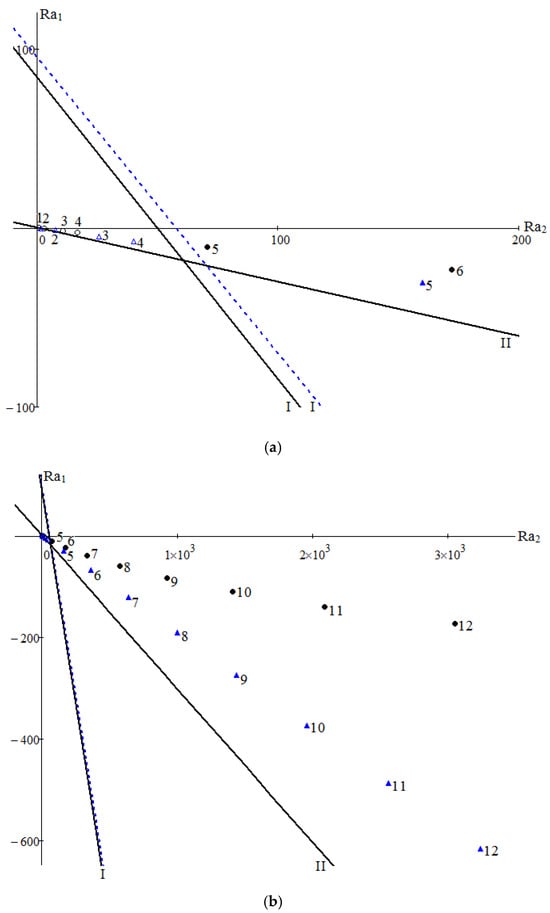
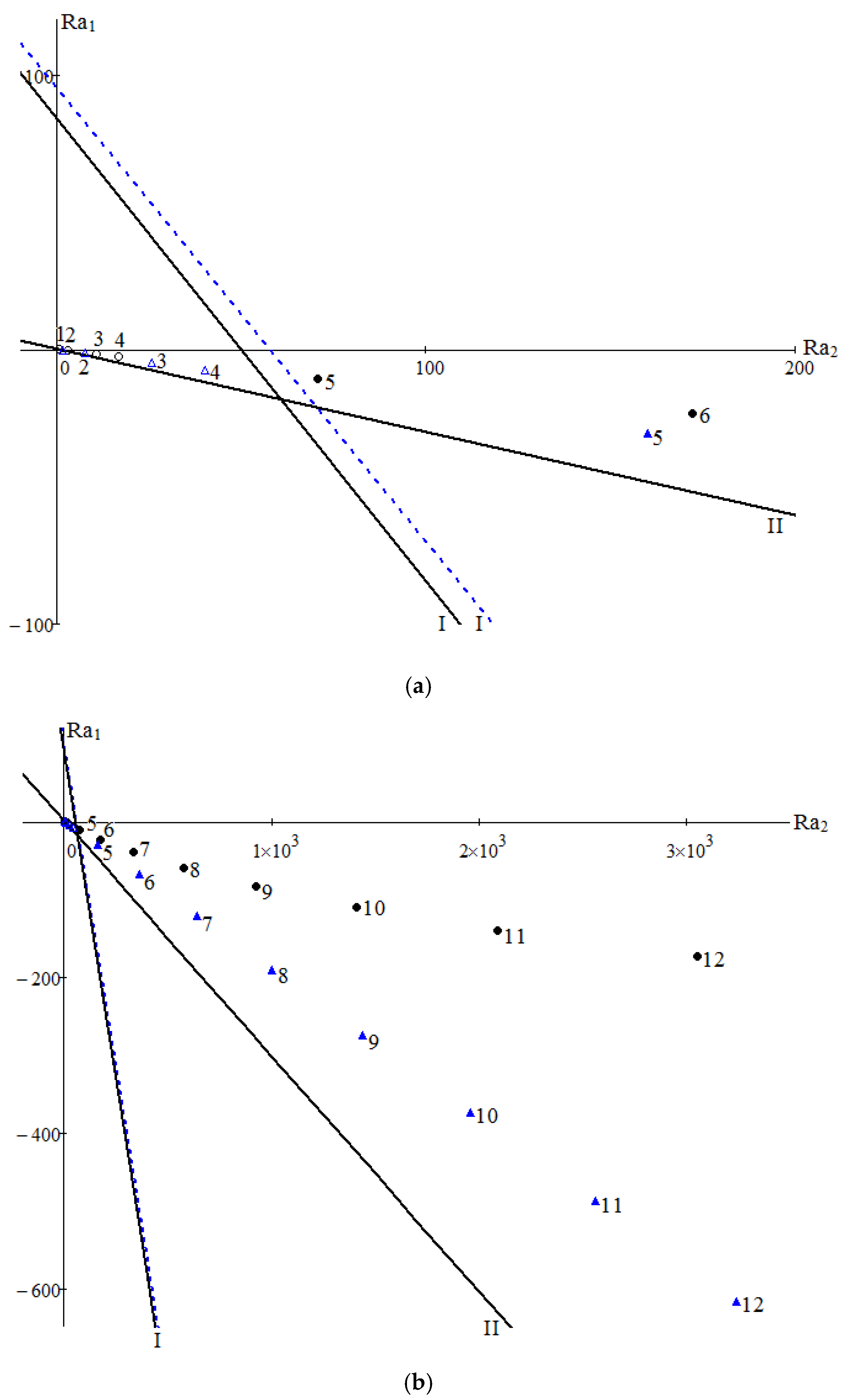
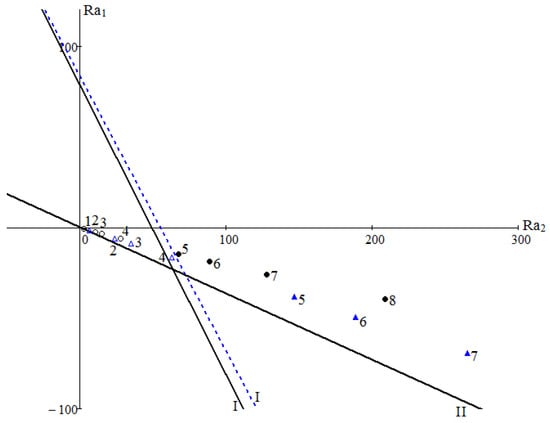
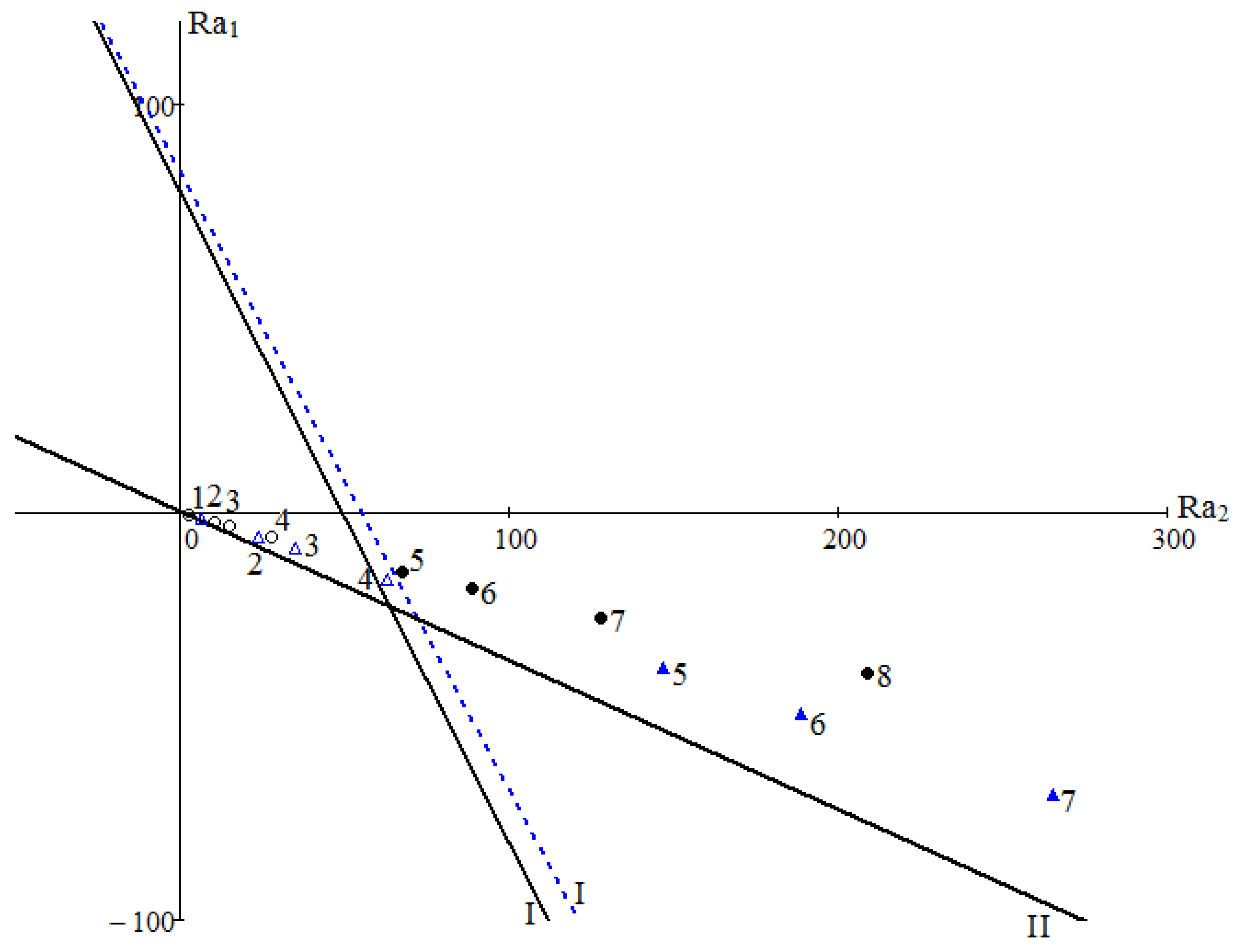
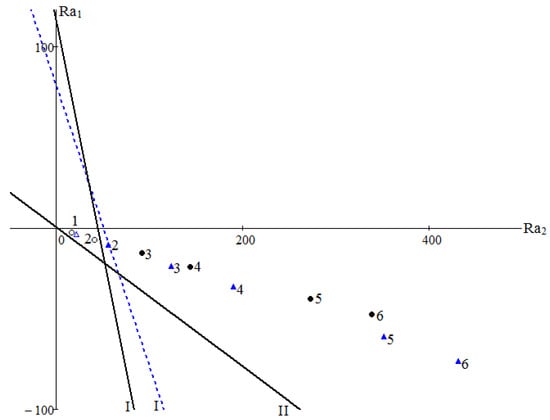
Equation (12) defines line II in the (Ra1, Ra2) plane, as shown in Figure 1, Figure 2 and Figure 3, separating the regions of decaying (stable diffusion) and growing (convection driven by concentration gradients) monotonic perturbations. The region below line II corresponds to stable diffusion, whereas the region above line II corresponds to convective motion.
Figure 1.
Stability map for the system 0.4163 H2 + 0.5837 N2O–N2 for different pressure ranges: (a) from 0.093 to 1.5 MPa; (b) from 1.0 to 4.5 MPa.
Figure 2.
Stability map for the system 0.44 He + 0.56 CO2–N2.
Figure 3.
Stability map for the system 0.7736 He + 0.2304 R12–Ar.
The ratio A2/A1, based on relation (11) (), is determined as follows:
Substituting expression (13) into Equation (8) instead of the ratio , we obtain the equation of the boundary line of monotonic instability in the following form:
Equation (14) defines straight line I in the (Ra1, Ra2) plane, as shown in Figure 1, Figure 2 and Figure 3, separating the regions of decaying (stable diffusion) and growing (convection driven by concentration gradients) monotonic perturbations. The region below line I corresponds to stable diffusion, while the region above line I corresponds to convection. Between lines I and II, there exists a region in which the mixture is unstable, even though the mixture density in the lower part of the channel is greater than that in the upper part. A similar situation is typical of the non-isothermal case in a binary liquid mixture [25].
When calculating the parameters in Equation (14), the dependence of the interdiffusion coefficients on the pressure and the compressibility factor of the components was taken into account through the following relationship [28]:
where is the normal atmospheric pressure, is the interdiffusion coefficient at normal conditions. The compressibility factor of the components can be found as an expansion in powers of pressure:
where , , B and C are the second and third virial coefficients, which can be calculated through the parameters σ and ε/k for the Lennard–Jones potential [5,7].
In conclusion, we note that in accordance with expression (16), the compressibility factor depends on pressure; therefore, the position of the stability line obtained in accordance with Formula (14) in the plane (Ra1, Ra2) also depends on pressure. Such a dependence was not recorded when obtaining the boundary relation in form (8) [36].
3. Results and Discussion
For a comparative analysis of the correctness of the proposed method for determining the boundary of the regime change, previously experimentally studied ternary systems were selected: 0.4163 H2 + 0.5837 N2O–N2, 0.7736 He + 0.2304 R12–Ar, 0.44 He + 0.56 CO2–N2 [23,36,37]. All measurements were carried out on a device implementing the two-flask method [38], modernized for measuring diffusion characteristics in channels of various geometric shapes [23]. In the experiments under consideration, binary mixtures of 0.4163 H2 + 0.5837 N2O, 0.44 He + 0.56 CO2 and 0.7736 He + 0.2304 R12 diffuse into N2 and Ar, respectively.
In accordance with [37], calculations for the system 0.4163 H2 + 0.5837 N2O–N2 were carried out at T = 298.0 K in the pressure range from 0.093 to 4.5 MPa for a vertical cylindrical channel of circular cross section with the following geometric characteristics: a length of 70.0 × 10⁻³ m and a diameter of 4.0 × 10⁻³ m. For the system 0.44 He + 0.56 CO2–N2 [23], calculations were carried out at T = 298.0 K in the pressure range from 0.25 to 2.0 MPa for a vertical cylindrical channel of circular cross section with the following geometric characteristics: a length of 64.0 × 10⁻³ m and a diameter of 4.0 × 10⁻³ m. Calculations for the system 0.7736 He + 0.2304 R12–Ar [36] were carried out at T = 298.0 K in the pressure range from 0.12 to 0.54 MPa for a vertical cylindrical channel of circular cross section with the following geometric characteristics: a length of 70.04 × 10⁻³ m and a diameter of 6.0 × 10⁻³ m. For the systems under consideration, the thermophysical properties given in Table 1 were used in the calculations.
Table 1.
Thermophysical properties of mixing gases and diffusion coefficients at p = 0.1 MPa, T = 298.0 K.
Figure 1, Figure 2 and Figure 3 show the stability map for the systems 0.4163 H2 + 0.5837 N2O–N2 (Figure 1), 0.44 He + 0.56 CO2–N2 (Figure 2) and 0.7736 He + 0.2304 R12–Ar (Figure 3).
The symbols ○, ● correspond to the partial Rayleigh numbers calculated using the formulas introduced in Equation (10). The partial Rayleigh numbers obtained in [23,36] are marked with the symbols Δ, ▲. The signs ○ and Δ characterize the diffusion process, and the symbols ● and ▲ correspond to convection.
Line I is the stability line (the solid line corresponds to the approach taking into account the compressibility factor, the dashed line is obtained in accordance with the approach described in [23,36]), and line II is the line of zero density gradient. The stability lines I, taking into account the compressibility factor, are plotted at the following pressures: 0.5 MPa (for the system 0.4163 H2 + 0.5837 N2O–N2), 0.58 MPa (for the system 0.44 He + 0.56 CO2–N2) and 0.19 MPa (for the system 0.7736 He + 0.2304 R12–Ar). The specified pressures correspond to the baric conditions under which the transition from the diffusion process to the unstable mixing regime with the subsequent formation of convective flows was experimentally recorded. The tendency to transition from the diffusion region to the convective area is preserved for both approaches, since the number of points lying above and below the corresponding stability lines coincides.
In Figure 1, the partial Rayleigh numbers were calculated at the following pressures p: (a) 1—0.093, 2—0.215, 3—0.4, 4—0.5, 5—1.0, 6—1.5 MPa; (b) 5—1.0, 6—1.5, 7—2.0, 8—2.5, 9—3.0, 10—3.5, 11—4.0, 12—4.5 MPa. In Figure 2, the partial Rayleigh numbers were calculated at the following pressures p: 1—0.25, 2—0.48, 3—0.58, 4—0.78, 5—1.19, 6—1.35, 7—1.6, 8—2.0 MPa. In Figure 3, the partial Rayleigh numbers were calculated at the following pressures p: 1—0.12, 2—0.19, 3—0.29, 4—0.36, 5—0.49, 6—0.54 MPa.
In the pressure range from 0.093 to 1.5 MPa (Figure 1a), the partial Rayleigh numbers for both approaches lie on the same line. According to Figure 1b, a further increase in pressure leads to the fact that the partial Rayleigh numbers, calculated taking into account the compressibility factor of the components, are located in the plane (Ra1, Ra2) nonlinearly. For the 0.44 He + 0.56 CO2–N2 system (Figure 2), the nonlinear behavior of the partial Rayleigh numbers begins at a pressure of 1.6 MPa, and for the 0.7736 He + 0.2304 R12–Ar system (Figure 3), nonlinearity is observed at a pressure of 0.36 MPa.
In accordance with Figure 1, Figure 2 and Figure 3, the stability boundaries obtained taking into account the compressibility factor are located on the cartograms below the stability boundary lines obtained in [23,36], which is associated with a change in the compressibility factor of the components of the gas systems under consideration depending on the pressure. In order to trace the change in the behavior of the stability boundary depending on the pressure, Table 2, Table 3 and Table 4 provide the coordinates at which the stability line intersects the ORa1 and ORa2 axes.
Table 2.
Values of coordinates at which the stability line intersects the coordinate axes for the system 0.4163 H2 + 0.5837 N2O–N2.
Table 3.
Values of coordinates at which the stability line intersects the coordinate axes for the system 0.44 He + 0.56 CO2–N2.
Table 4.
Values of coordinates at which the stability line intersects the coordinate axes for the system 0.7736 He + 0.2304 R12–Ar.
In accordance with Table 2, in the range from 0.093 to 2.5 MPa, the coordinates of the intersection points with the ORa1 axis decrease, and in the pressure range from 3.0 to 4.5 MPa, they increase. Perhaps, as noted in [37], this is due to the fact that the non-ideal component (nitrous oxide) creates a density gradient at which the effect of convection, leading to diffusion instability, is small in relation to the transfer caused by concentration gravitational convection. For the systems 0.44 He + 0.56 CO2–N2 and 0.7736 He + 0.2304 R12–Ar, only a decrease in the coordinates of the intersection points with the ORa1 axis is observed. This is due to the fact that the range of pressures studied for these systems does not exceed 1.6 MPa and 0.54 MPa, respectively.
In [6], the transition from a stable process to an unstable one for a cylindrical channel with a circular Cross Section occurs at a critical Rayleigh number of 67.95. The present problem is characterized by two critical Rayleigh numbers, which are presented in Table 2, Table 3 and Table 4 for the mixtures under consideration. The Rayleigh numbers presented in Table 2, Table 3 and Table 4, both for an ideal gas and considering the compressibility factor, are in good agreement with the critical Rayleigh number given in [6].
In general, the analytical predictions obtained with allowance for compressibility effects are consistent with the experimental observations reported in [23,36,37]. The proposed approach makes it possible to determine more accurately the boundary between diffusion and concentration-driven gravitational convection in ternary gas mixtures containing non-ideal components, as well as to refine the values of the partial Rayleigh numbers and thereby identify the point in the (Ra1, Ra2) plane corresponding to a given experiment.
4. Conclusions
This paper proposes an analytical criterion for the onset of concentration-induced gravitational convection in isothermal ternary gas mixtures, in which real-gas effects are explicitly taken into account through the compressibility coefficients of the mixture components. The analysis is based on the linearization of the hydrodynamic equations and the use of partial Rayleigh numbers associated with independent concentration gradients.
It is shown that deviations from ideal gas behavior lead to a systematic decrease in the critical values of the partial Rayleigh numbers and to a pressure-dependent shift in the boundary separating the purely diffusive transport regime from convection regimes driven by buoyancy forces. This effect becomes particularly pronounced at elevated pressures and cannot be described within the framework of the ideal gas approximation.
Application of the proposed criterion to a series of experimentally studied ternary gas mixtures demonstrates good agreement with the observed transitions from diffusive transport to concentration-driven convection. The results confirm that real-gas effects play a significant role in the quantitative prediction of the onset of convection in multicomponent gas mixtures under isothermal conditions.
The developed analytical model can serve as an effective tool for interpreting experimental data and for assessing the conditions for the onset of buoyancy-induced, concentration-driven convection in ternary gas systems containing components with pronounced non-ideal properties.
Author Contributions
Conceptualization, V.K., O.F. and H.A.; methodology, V.K. and O.F.; software, O.F. and M.T.; validation, V.K. and M.T.; formal analysis, M.T.; investigation, O.F.; resources, M.T.; data curation, V.K.; writing—original draft preparation, V.K. and O.F.; writing—review and editing, V.K., O.F. and H.A.; visualization, M.T.; supervision, V.K., O.F. and H.A.; project administration, V.K.; funding acquisition, V.K. All authors have read and agreed to the published version of the manuscript.
Funding
The work was supported by the Committee of Science of the Ministry of Science and Higher Education of the Republic of Kazakhstan (project No. AP23488139).
Institutional Review Board Statement
Not applicable.
Informed Consent Statement
Not applicable.
Data Availability Statement
This study is part of an ongoing project. The data that support the findings of this study are available from the corresponding author upon reasonable request.
Acknowledgments
The authors express appreciation to the Committee of Science of the Ministry of Science and Higher Education of the Republic of Kazakhstan for the financial support of the project No. AP23488139 “Study of the isothermal equilibrium stability of multicomponent gaseous media and the convective flows evolution at the initial formation stage” in the framework of which the part of results was obtained.
Conflicts of Interest
The authors declare no competing interests.
References
- Bejan, A. Convection Heat Transfer, 4th ed.; Wiley: New York, NY, USA, 2013. [Google Scholar]
- Carlier, J.; Papalexandris, M.V. Multiple steady states in laminar Rayleigh–Bénard convection of air. Fluids 2024, 9, 7. [Google Scholar] [CrossRef] [Scilit]
- Ahmadi, N.; Heck, K.; Rolle, M.; Helmig, R.; Mosthaf, K. On multicomponent gas diffusion and coupling concepts for porous media and free flow: A benchmark study. Comput. Geosci. 2021, 25, 1493–1507. [Google Scholar] [CrossRef] [Scilit]
- Neubert, K.; Kretzschmar, J.; dos Santos, T.R.; Härtig, C.; Harnisch, F. Making sense of gas measurements: Quantification of multicomponent gas mixtures in biological and chemical laboratory experiments. ChemTexts 2021, 29, 27. [Google Scholar] [CrossRef] [Scilit]
- Bird, R.; Stewart, W.; Lightfoot, E. Transport Phenomena, 2nd ed.; John Wiley & Sons: New York, NY, USA, 2007. [Google Scholar]
- Gershuni, G.; Zhukhovitskii, E. Convective Stability of Incompressible Fluids; Keter Publishing House: Jerusalem, Israel, 1976. [Google Scholar]
- Poling, B.; Prausnitz, J.; O’Connell, J. The Properties of Gases and Liquids, 5th ed.; McGraw Hill Professional: New York, NY, USA, 2001. [Google Scholar]
- Landau, L.; Lifshitz, E. Course of Theoretical Physics. In Fluid Mechanics; Pergamon Press: Oxford, UK, 1987; Volume 6. [Google Scholar]
- Köhler, W.; Mialdun, A.; Bou-Ali, M.M.; Shevtsova, V. The measurement of Soret and thermodiffusion coefficients in binary and ternary liquid mixtures. Int. J. Thermophys. 2023, 44, 140. [Google Scholar] [CrossRef] [Scilit]
- Lyubimova, T.P.; Kolchanova, E.A. The onset of double-diffusive convection in a superposed fluid and porous layer under high-frequency and small-amplitude vibrations. Transp. Porous Med. 2018, 122, 97–124. [Google Scholar] [CrossRef] [Scilit]
- Ahlers, G. Experiments with Rayleigh-Bénard convection. In Dynamics of Spatio-Temporal Cellular Structures; Springer Tracts in Modern Physics; Mutabazi, I., Wesfreid, J.E., Guyon, E., Eds.; Springer: New York, NY, USA, 2006; Volume 207, pp. 67–94. [Google Scholar] [CrossRef] [Scilit]
- Chillà, F.; Schumacher, J. New perspectives in turbulent Rayleigh-Bénard convection. Eur. Phys. J. E 2012, 35, 58. [Google Scholar] [CrossRef] [Scilit]
- Chen, S.; Tölke, J.; Krafczyk, M. Numerical investigation of double-diffusive (natural) convection in vertical annuluses with opposing temperature and concentration gradients. Int. J. Heat Fluid Flow 2010, 31, 217–226. [Google Scholar] [CrossRef] [Scilit]
- Sengers, J.V. Mass and thermodiffusion in non-equilibrium fluctuating hydrodynamics. Int. J. Thermophys. 2024, 45, 132. [Google Scholar] [CrossRef] [Scilit]
- Klein, T.; Kankanamge, C.J.; Koller, T.M.; Rausch, M.H.; Fröba, A.P.; Assael, M.J.; Wakeham, W.A.; Guevara-Carrion, G.; Vrabec, J. Definitions and preferred symbols for mass diffusion coefficients in multicomponent fluid mixtures including electrolytes (IUPAC Technical Report). Pure Appl. Chem. 2025, 97, 689–713. [Google Scholar] [CrossRef] [Scilit]
- Prokopev, S.; Lyubimova, T.; Mialdun, A.; Shevtsova, V. A ternary mixture at the border of Soret separation stability. Phys. Chem. Chem. Phys. 2021, 23, 8466–8477. [Google Scholar] [CrossRef] [Scilit]
- Galand, Q.; Vaerenbergh, S.V.; Köhler, W.; Khlybov, O.; Lyubimova, T.; Mialdun, A.; Ryzhkov, I.; Shevtsova, V.; Triller, T. Results of the DCMIX1 experiment on measurement of Soret coefficients in ternary mixtures of hydrocarbons under microgravity conditions on the ISS. J. Chem. Phys. 2019, 151, 134502. [Google Scholar] [CrossRef] [Scilit]
- Triller, T.; Bataller, H.; Bou-Ali, M.M.; Braibanti, M.; Croccolo, F.; Ezquerro, J.M.; Galand, Q.; Gavaldà, J.; Lapeira, E.; Laverón-Simavilla, A.; et al. Thermodiffusion in ternary mixtures of water/ethanol/triethylene glycol: First report on the DCMIX3-experiments per-formed on the International Space Station. Microgravity Sci. Technol. 2018, 30, 295–308. [Google Scholar] [CrossRef] [Scilit]
- Shevtsova, V.; Santos, C.; Sechenyh, V.; Legros, J.C.; Mialdun, A. Diffusion and Soret in ternary mixtures. Preparation of DCMIX2 experiment on the ISS. Microgravity Sci. Technol. 2014, 25, 275–283. [Google Scholar] [CrossRef] [Scilit]
- Dil’man, V.V.; Lipatov, D.A.; Lotkhov, V.A.; Kaminskii, V.A. Instability in unsteady-state evaporation of binary solutions into an inert gas. Theor. Found. Chem. Eng. 2005, 39, 566–572. [Google Scholar] [CrossRef] [Scilit]
- Dil’man, V.V.; Lotkhov, V.A. Molecular turbulent evaporation in a gravitational field. Theor. Found. Chem. Eng. 2015, 49, 102–106. [Google Scholar] [CrossRef] [Scilit]
- Zhavrin, Y.I.; Moldabekova, M.S.; Poyarkov, I.V.; Mukamedenkyzy, V. Experimental study of diffusion instability in three-component gas mixture without density gradient. Tech. Phys. Lett. 2011, 37, 721–723. [Google Scholar] [CrossRef] [Scilit]
- Kossov, V.; Fedorenko, O.; Asembaeva, M.; Mukamedenkyzy, V.; Moldabekova, M. Intensification of the separation of isothermal ternary gas mixtures containing carbon dioxide. Chem. Eng. Technol. 2021, 44, 2034–2040. [Google Scholar] [CrossRef] [Scilit]
- Kossov, V.; Fedorenko, O.; Zhakebayev, D. Features of multicomponent mass transfer in gas mixtures containing hydrocarbon components. Chem. Eng. Technol. 2019, 42, 896–902. [Google Scholar] [CrossRef] [Scilit]
- Kossov, V.; Altenbach, H. Diffusion mechanisms of convective instability in liquid and gas mixtures. Z. Angew. Math. Mech. 2023, 103, e202300801. [Google Scholar] [CrossRef] [Scilit]
- Melzi, N.; Khaouane, L.; Ammi, Y.; Hanini, S.; Laidi, M.; Zentou, H. Comparative study of predicting the molecular diffusion coefficient for polar and non-polar binary gas using neural networks and multiple linear regressions. Kem. Ind. 2019, 68, 573–582. [Google Scholar] [CrossRef] [Scilit]
- Krapivsky, P.L. Dynamics of repulsion processes. J. Stat. Mech. 2013, 2013, P06012. [Google Scholar] [CrossRef] [Scilit]
- Bogatyrev, A.F.; Belalov, V.R.; Nezovitina, M.A. Thermal diffusion in binary mixtures of moderately dense gases. J. Eng. Phys. Thermophys. 2013, 86, 1225–1231. [Google Scholar] [CrossRef] [Scilit]
- Brady, J.B. Reference frames and diffusion coefficients. Am. J. Sci. 1975, 275, 954–983. [Google Scholar] [CrossRef] [Scilit]
- Ghorayeb, K.; Firoozabadi, A. Molecular, pressure, and thermal diffusion in nonideal multicomponent mixtures. AIChE J. 2000, 46, 883–891. [Google Scholar] [CrossRef] [Scilit]
- Firoozabadi, A.; Ghorayeb, K.; Shukla, K. Theoretical model of thermal diffusion factors in multicomponent mixtures. AIChE J. 2000, 46, 892–900. [Google Scholar] [CrossRef] [Scilit]
- Mutoru, J.W.; Firoozabadi, A. Form of multicomponent Fickian diffusion coefficients matrix. J. Chem. Thermodyn. 2011, 43, 1192–1203. [Google Scholar] [CrossRef] [Scilit]
- Cox, S.M.; Moroz, I.M. Multiple bifurcations in triple convection with non-ideal boundary conditions. Phys. D Nonlinear Phenom. 1996, 93, 1–22. [Google Scholar] [CrossRef] [Scilit]
- Ryzhkov, I.I.; Shevtsova, V.M. Long-wave instability of a multicomponent fluid layer with the Soret effect. Phys. Fluids 2009, 21, 014102. [Google Scholar] [CrossRef] [Scilit]
- Altenbach, H. Kontinuumsmechanik—Eine Elementare Einführung in die Materialunabhängigen und Materialabhängigen Gleichungen, 4th ed.; Springer: Berlin/Heidelberg, Germany, 2018. [Google Scholar] [CrossRef] [Scilit]
- Kosov, V.N.; Fedorenko, O.V.; Zhavrin, Y.I.; Mukamedenkyzy, V. Instability of mechanical equilibrium during diffusion in a three-component gas mixture in a vertical cylinder with a circular cross section. Tech. Phys. 2014, 59, 482–486. [Google Scholar] [CrossRef] [Scilit]
- Zhavrin, Y.I.; Kosov, V.N.; Kul’zhanov, D.U.; Karataeva, K.K. Effect of the pressure on the type of mixing in a three-component gas mixture containing a component possessing the properties of a real gas. Tech. Phys. Lett. 2000, 26, 1108–1109. [Google Scholar] [CrossRef] [Scilit]
- Marrero, T.R.; Mason, E.A. Gaseous diffusion coefficients. J. Phys. Chem. Ref. Data 1972, 1, 3–118. [Google Scholar] [CrossRef] [Scilit]
- Vargaftik, N.B. Handbook of Physical Properties of Liquids and Gases. Pure Substances and Mixtures, 2nd ed.; Springer: Berlin/Heidelberg, Germany, 1975. [Google Scholar]
- Tang, M.J.; Cox, R.A.; Kalberer, M. Compilation and evaluation of gas phase diffusion coefficients of reactive trace gases in the atmosphere: Volume 1. Inorganic compounds. Atmos. Chem. Phys. 2014, 14, 9233–9247. [Google Scholar] [CrossRef] [Scilit]
- Bzowski, J.; Kestin, J.; Mason, E.A.; Uribe, F.J. Equilibrium and transport properties of gas mixtures at low density: Eleven polyatomic gases and five noble gases. J. Phys. Chem. Ref. Data. 1990, 19, 1179–1232. [Google Scholar] [CrossRef] [Scilit]

Disclaimer/Publisher’s Note: The statements, opinions and data contained in all publications are solely those of the individual author(s) and contributor(s) and not of MDPI and/or the editor(s). MDPI and/or the editor(s) disclaim responsibility for any injury to people or property resulting from any ideas, methods, instructions or products referred to in the content. |
© 2026 by the authors. Licensee MDPI, Basel, Switzerland. This article is an open access article distributed under the terms and conditions of the Creative Commons Attribution (CC BY) license.