


Abstract
Optimizing the rectification and pressure loss controlled by the aperture structure is challenging, with particular attention paid to the problem of precisely modeling the rectification process of multilayer wire mesh in pulse tube cryocoolers. This work offers a rectifier design method based on the regularized orifice plate. A novel rectifier that reduces flow resistance and shows rectification performance comparable to a woven wire mesh is created by analyzing its effects on the flow using numerical simulation. Flow uniformity and pressure loss are selected as evaluation metrics. Point flow velocity calibration is performed under fully developed flow conditions to derive a quantitative equation relating voltage to flow velocity. A multi-cross-section radial flow velocity distribution test platform is set up. The experimental results show that the uniformity of woven wire mesh reaches 0.9670 under low-flow conditions and 0.9629 for the novel eight-ring rectifier, but the pressure drop reduction reaches 57.64%; the uniformity of the novel eight-ring rectifier is improved by 0.91~1.94% compared to that of woven wire mesh under high-flow conditions, and the pressure drop is reduced by 87.74~89.09%. The rectifier features uniformly distributed apertures, facilitating modeling and machining.
1. Introduction
With the advantages of high efficiency, low vibration, long lifespan, and environmental friendliness, pulse tube cryocoolers are widely used in the fields of infrared detection [1], medical applications [2], and superconductivity [3]. However, during actual operation, the cross-sectional area of the flow path of the warm-end heat exchanger and the inertance tube differs significantly, which can lead to jetting. Without laminarization, this will destroy the internal temperature distribution of the refrigeration machine, leading to drastic changes in the temperature gradients within the pulse tube and the regenerator. Refrigeration efficiency is reduced due to the mixing of hot and cold masses, resulting in increased losses [4,5,6]. As a traditional rectifier, the wire mesh provides effective rectification. However, it also acts as a resistance element [7], leading to acoustic power loss [8]. Therefore, selecting the appropriate laminar flow configuration is crucial for improving flow field uniformity and reducing flow resistance.
An orifice plate-type rectifier is widely used as a device to improve the distribution of the pipeline flow field; it eliminates the uneven flow field and spinning caused by bends, valves, and other obstructions, thus improving the measurement accuracy of the flowmeter. Laws [9] proposed a rectifier design to effectively enhance the flow stability and uniformity through specific orifice arrangements and structural optimization. The design consisted of three circles of circular holes with different inner diameters and numbers of holes. Ouazzane et al. [10] proposed a design that combined a vane rectifier with an orifice plate rectifier; by comparing the velocity distribution of the flow field with and without the new design, they showed that the improved rectifier enhanced the rectification effect. Manshoor et al. [11] designed a fractal multilayer orifice plate rectifier, experimentally investigated the performance of different porosities, and verified the rectification effect using CFD methods, which effectively suppressed the swirling and asymmetric flow. Liu et al. [12] designed a convergent rectifier for the problem of eccentric jet generated via valve regulation, and used a combination of experimental and CFD methods to study the rectification effect of different convergence angles on the eccentric jet, and obtaining the best rectification effect with a 12° convergence angle. To achieve low turbulence intensity and a uniform axi-symmetric velocity profile at the jet exit, El Hassan et al. [13] used a converging chamber with a fifth-order polynomial shape leading into the jet nozzle, along with two honeycombs and a settling chamber. For the study of flow resistance, Singh et al. [14] used the CFD method to analyze the pressure regulation effect of single-orifice plate versus multi-orifice plate regulators, investigated the effect of different geometrical and flow parameters on the pressure recovery and flow coefficients, and verified the accuracy of the CFD predictions through experiments. Özahi [15] investigated the pressure loss characteristics of perforated plates at medium Reynolds numbers; analyzed the effects of porosity, number of pores, and pore distribution on the pressure loss; and established an empirical relationship between the pressure loss coefficient and porosity at medium Reynolds numbers. Riazanov et al. [16] investigated the effects of different designs of orifice inlet devices and integrated absorber grids on the coolant flow pattern in a fuel assembly rod bundle, and experimentally determined the loss coefficient of the orifice inlet device in fully open and maximally closed positions.
From these studies, it is clear that rectifiers have been extensively studied and applied in flow field optimization. However, most of the aforementioned studies have focused on optimizing conventional pipeline flow fields, with relatively limited research on applying these techniques to regulate internal flow fields within pulse tube refrigerators. Currently, pulse tube refrigerators still primarily rely on woven wire mesh for rectification, but this approach has two core limitations: First, as a resistance element, it causes acoustic power loss. Second, in numerical simulations, its complex random pore structure is difficult to model accurately and is typically simplified to an isotropic porous medium model, which exhibits different flow characteristics [17,18,19].
This study aims to explore a rectifier based on a regular orifice plate as an alternative to traditional woven wire mesh. Its core physical mechanism lies in achieving orderly dissipation and redistribution of jet energy through a regularly arranged perforated structure. Compared to the random porosity of woven wire mesh, structured orifice plates possess defined geometric parameters, facilitating precise modeling and optimized design. They also hold promise for significantly reducing flow resistance through structural optimization while maintaining uniform flow distribution. Therefore, the orifice plate rectifier is adopted as the fundamental structure for further development.
The main tasks addressed in this article are as follows: (1) The orifice plate is selected as the research object and, combined with the numerical simulation method, is designed step by step to obtain a new eight-ring rectifier whose rectification effect is closest to that of the woven wire mesh. (2) An experimental platform using a MEMS flow sensor with multiple cross-sections and radial point locations is set up, and the calibration of flow sensors in various flow states is carried out. (3) The physical fabrication of the novel eight-ring rectifier is completed. The rectification performance and pressure loss of the woven wire mesh and eight-ring rectifier are examined, and the feasibility of the ring structure is confirmed through experimental comparison.
2. Method
2.1. Numerical Simulation
2.1.1. Physical Model and Boundary Conditions
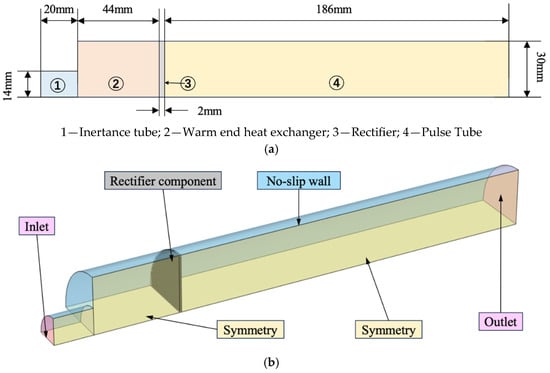
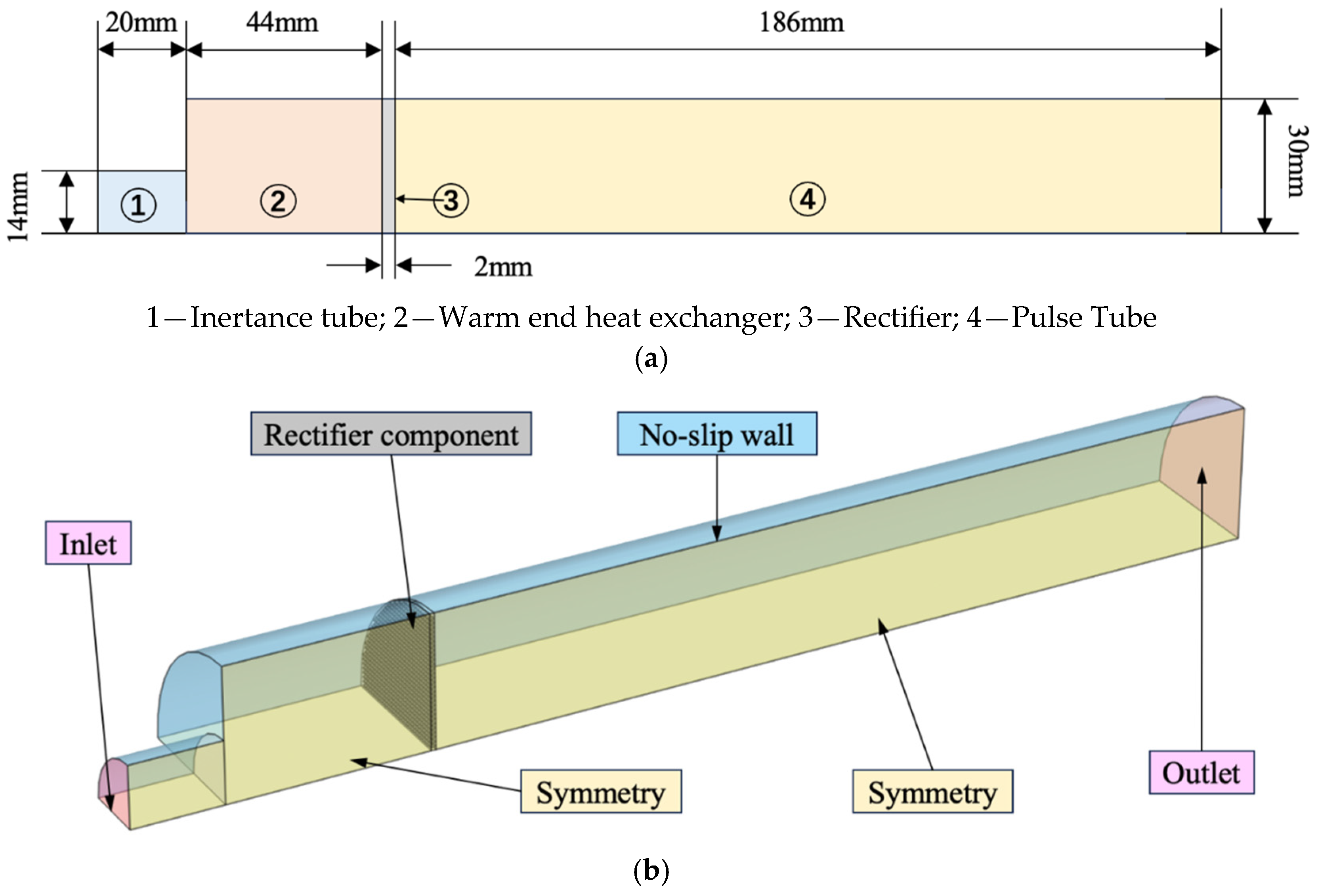
The main goal of this study is to verify the rectification effect of the rectifier on jet flows within the pulse tube system. The two-dimensional model of the inertance tube, warm-end heat exchanger, rectifier, and pulse tube is shown in Figure 1a. A quarter is taken to establish a three-dimensional unit module, and the dimensions of each structure are based on a two-dimensional model. Given the axisymmetric nature of the internal structure and orifice plate within the pulse tube refrigerators, and considering that this study primarily focuses on the uniformity of radial velocity distribution, the initial flow field is assumed to be axisymmetric. This approach has been widely adopted in similar studies involving perforated plates and porous media with symmetric layouts [17,20]. Therefore, it is reasonable to simplify the computational domain by applying symmetric boundary conditions. However, small-scale asymmetry may not be fully captured using the quarter-domain symmetry model.
Figure 1.
Computational domain. (a) Schematic diagram of two-dimensional model for pulse tube. (b) Schematic diagram of physical model and boundary conditions.
The inlet is defined as a fully developed flow with a specific velocity to provide a standardized, repeatable inlet flow field for all rectifier designs being compared. The distribution of high flow velocity at the center and low flow velocity near the walls poses a more stringent challenge to the rectifier’s rectification capability. Rectifiers that perform well under these conditions demonstrate higher reliability in practical applications. The outlet is specified as a pressure boundary condition. The walls on both sides of the model are assigned as symmetric boundary conditions, while the remaining walls are no-slip boundary conditions. To ensure proper experimental connection and consider economic and safety factors, the working fluid is chosen to be nitrogen, and the rectifier is made of structural steel. During the simulation phase, the Mach number of the nitrogen flow in tube is less than 0.3. This study focuses on the pressure drop caused locally by the rectifier, rather than the expansion process from high pressure to low pressure across the entire system, and the density variation caused by the maximum local pressure drop at the rectifier is approximately 10−3. Therefore, nitrogen is treated as an incompressible fluid. In the entire three-dimensional model, except for the rectifier, which is the solid domain, the remaining parts are designated as fluid domains. Figure 1b presents a schematic diagram of the physical model and boundary conditions.
2.1.2. Governing Equations
Existing research has indicated that the permeability and inertial resistance coefficient of porous media, as intrinsic properties, are primarily determined by the material’s microscopic geometric structure [21] and are unaffected by the external flow regime, whether it is oscillating or steady [22]. As long as the amplitude and frequency of the oscillating flow are insufficient to alter the microstructure of the medium, the mechanisms of viscous resistance and inertial resistance experienced by the fluid under steady flow remain valid at every instantaneous phase of the oscillating flow. Although real operating conditions in pulse tube cryocoolers involve oscillatory flow, under low-frequency conditions (below 4 Hz), the expected trend of variation is anticipated to remain broadly consistent between oscillatory and steady-state flow conditions [23]. The rectifier studied in this study has a thickness of 2 mm, and the fluid traverses in an extremely short time. Applying the resistance coefficient under steady-state flow to approximate its behavior under oscillatory flow, and using this similarity principle as the theoretical basis for preliminary design and selection of rectifier structures, constitutes a reasonable engineering simplification method. Although steady-state simulations cannot capture unsteady flow structures, comparisons and selections based on steady-state results are both efficient and reliable from an engineering perspective. The three-dimensional steady Reynolds-averaged equation (RANS) is applied in the simulation process to solve the continuity and momentum equations for incompressible fluids [24].
where ρ is the fluid density [kg/m3], u is the velocity vector [m/s], p is the pressure [Pa], μ is the dynamic viscosity [kg/(m·s)], ε is the porosity, and Si is the source term of the momentum equation [N/m3].
For the orifice plate, the source term Si is taken to be 0. A woven wire mesh with 80 mesh (0.12 mm wire diameter) is used as a control group, which is considered as a porous medium during the simulation, and permeability, inertial drag coefficient, etc., are used to calculate the loss of momentum in the wire mesh during fluid flow. The continuity equation for the porous media model is described by Equation (1), and Equation (2) is used to describe the momentum loss of the fluid in the porous media region [25]. The momentum source term Si is described by Equation (3).
Calculate the permeability and inertial resistance coefficient of the wire mesh based on its dimensions and parameters [26,27], following the procedure below.
where α is the permeability of the woven wire mesh, taken as 3.08 × 10⁻¹⁰ m2. dh is the hydraulic diameter [m], dw is the wire diameter [m], and C is the inertial drag coefficient of the woven wire mesh, taken as 8855 m−1. Re is the Reynolds number of the fluid, taken as 3698.25. mw is the quality of the wire mesh, taken as 36.4 g. ρmetal is the density of the wire mesh, taken as 7.9 g/cm3. Dw is the diameter of the wire mesh, taken as 8 cm. H is the thickness of the wire mesh, taken as 0.2 cm. The woven wire mesh porosity ε is 0.54.
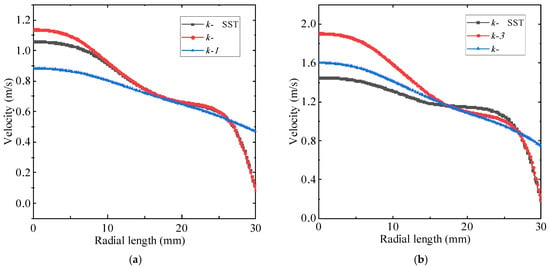
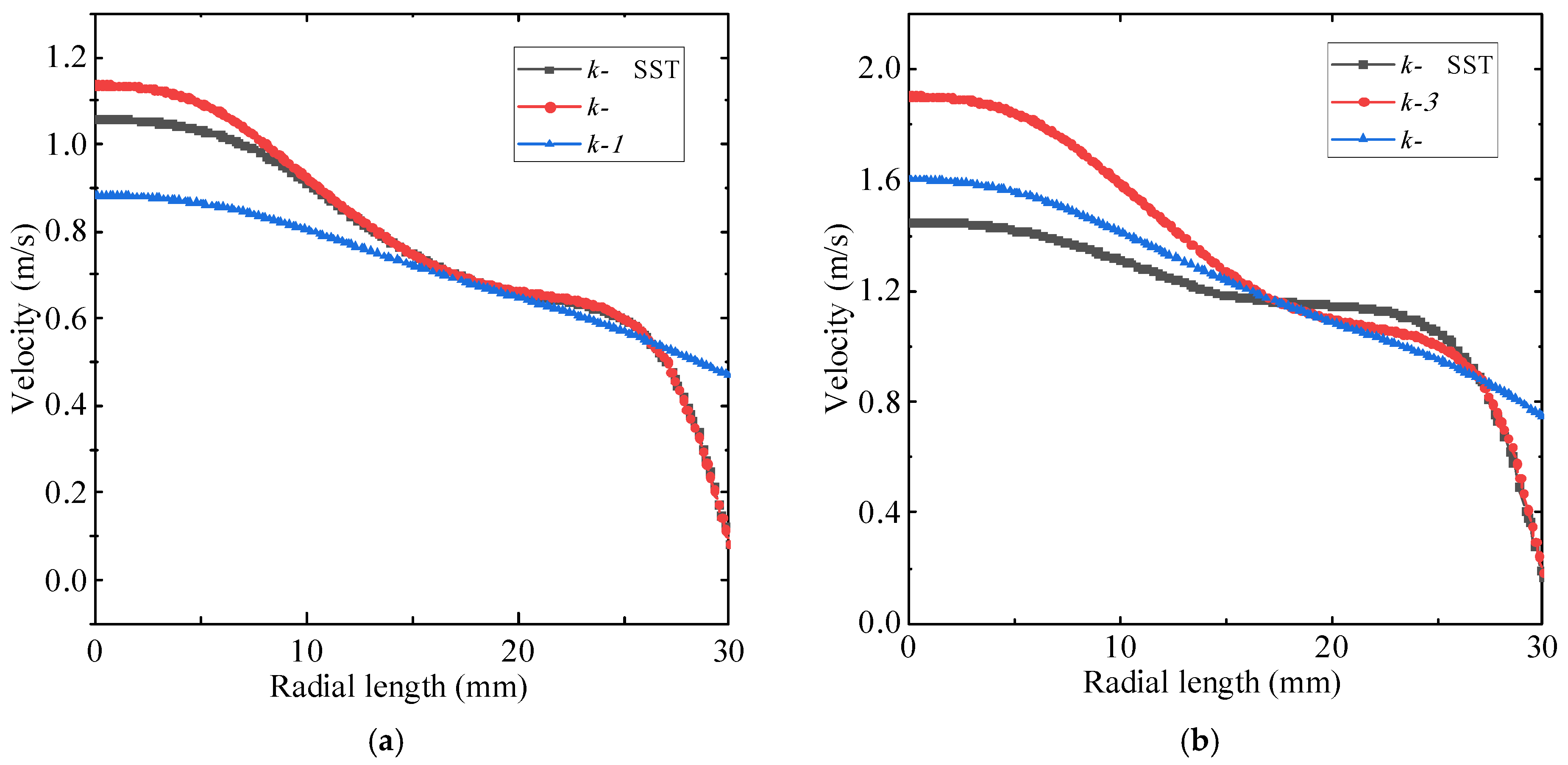
Under low-Reynolds-number laminar flow conditions (20 SLPM), the flow is dominated by viscous forces, and turbulent effects can be neglected. The laminar flow model can be directly applied to the solution. To evaluate the sensitivity of turbulence models, three turbulence models are selected and simulated under two operating conditions: an inlet velocity of 3 m/s (110 SLPM) and 5.1 m/s (200 SLPM). The simulation results are shown in Figure 2. The k-ω SST model combines the strengths of the k-ω model in the near-wall region with those of the k-ε model in the far-field region. This model effectively predicts flow and separation in the near-wall region and is suitable for the jet impact and wake development phenomena addressed in this study. The core objective of this study is to compare the relative performance of different rectifier structures, rather than to precisely predict absolute flow field values. Therefore, despite model uncertainties, the k-ω SST model remains robust and reliable for screening and comparing different design options. A separation solver using the PARDISO algorithm is employed, with a relative tolerance of 0.001.
Figure 2.
Radial velocity distribution curves. (a) The inlet velocity of 3 m/s; (b) The inlet velocity of 5.1 m/s.
2.1.3. Grid Independence Study
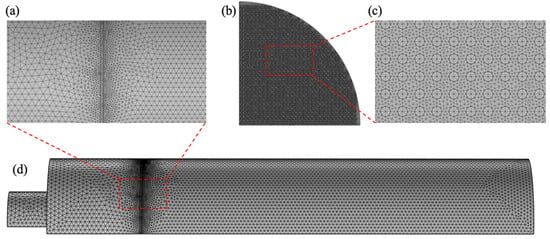
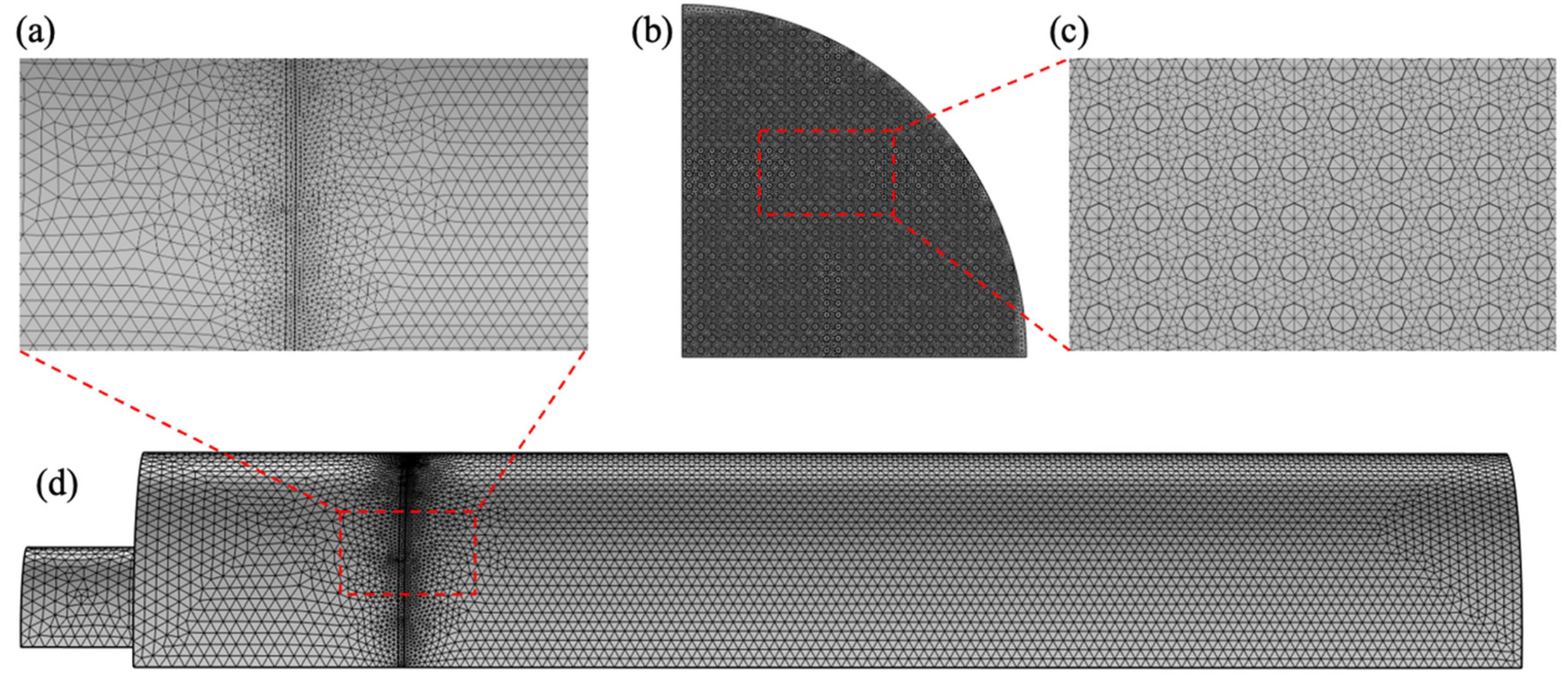
To improve the quality of grids while reducing computational effort, this section employs an unstructured grid for the inertance tube, the warm-end heat exchanger, the rectifier, and the pulse tube. The free tetrahedral meshes are used for all four sections. The hole section of the orifice plate rectifier has a unit size of 0.3 mm; the unit growth rate from the small hole to the solid region is 1.45; the unit growth rate from the orifice plate to the pulse tube is 1.13, with a maximum unit size of 1.7 mm; the unit growth rate from the orifice plate to the warm-end heat exchanger and inertance tube is 1.15, with a maximum unit size of 2 mm. The average quality of the grid is 0.643. Figure 3a illustrates the meshing methodology for the rectifier upstream and downstream, Figure 3b,c illustrate the meshing methodology for the rectifier, and Figure 3d presents a meshing approach for all computational domains.
Figure 3.
An example of the grids. (a) Partial magnified image of rectifier upstream and downstream. (b) The cross-section of the rectifier. (c) Partial magnified image of the rectifier. (d) All domains.
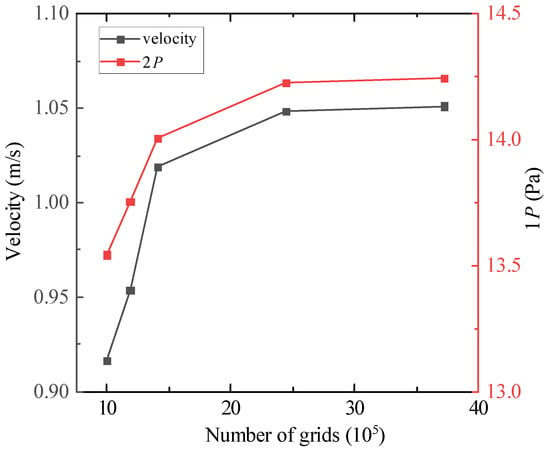
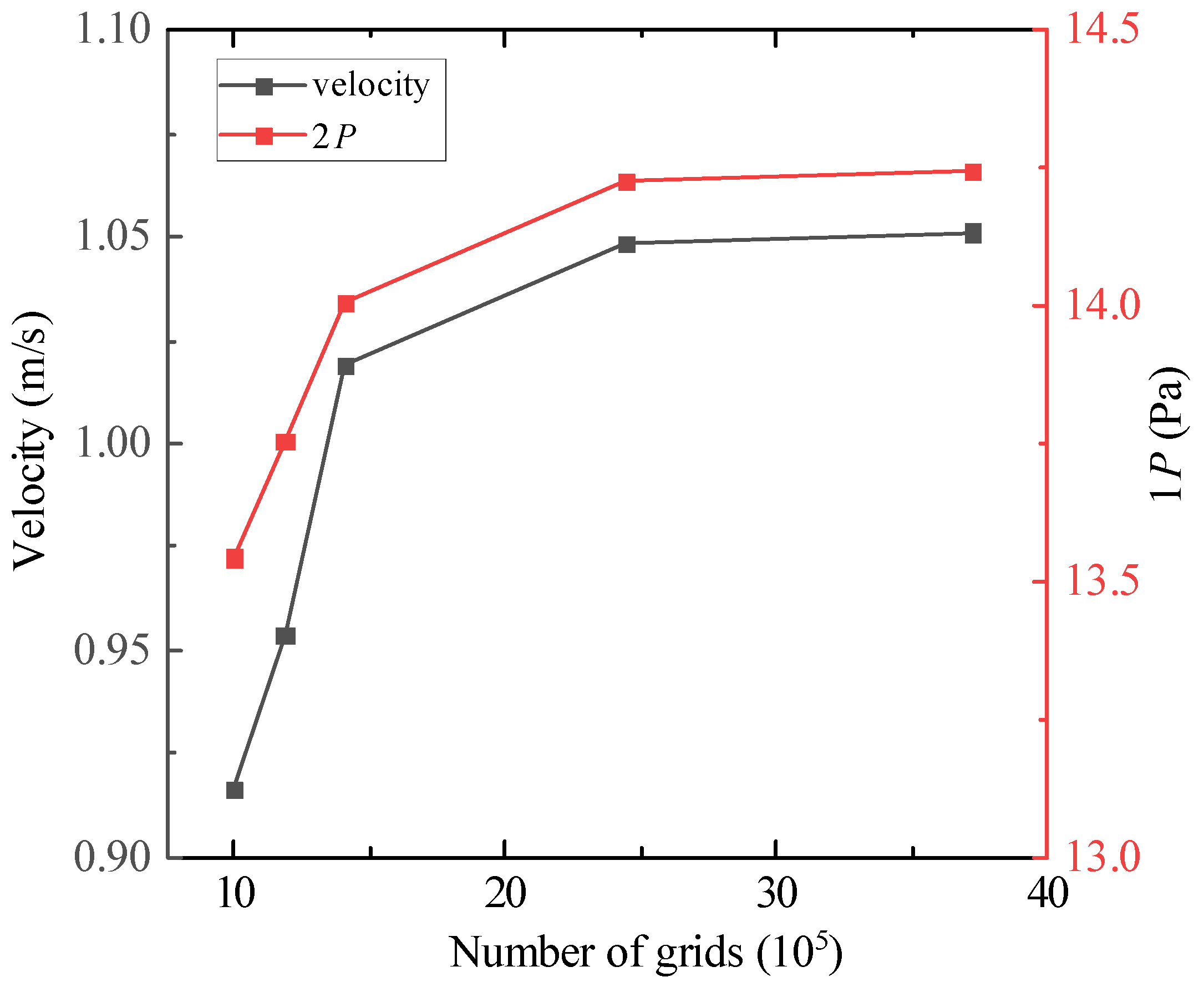
In order to select a suitable computational grid, taking into account the accuracy and rationalization of the calculation, the established three-dimensional model is divided into five groups with different numbers of grids: 9.957 × 10⁵, 1.181 × 10⁶, 1.408 × 10⁶, 2.437 × 10⁶, and 3.717 × 10⁶. The same boundary conditions and solution setup are performed for all five groups with different grids. The center point flow velocity at 1.5D from the rectifier and the pressure difference between the two sides of the rectifier are selected as criteria to determine grid independence. The results are shown in Figure 4. After the number of grids is 2.437 × 10⁶, the calculation result tends to stabilize, and the relative deviation does not exceed 0.3%. Therefore, it can be considered that the calculation result is independent of the grid.
Figure 4.
Grid independence verification.
2.2. Design Methodology of Rectifier
2.2.1. Design Cross-Section Selection
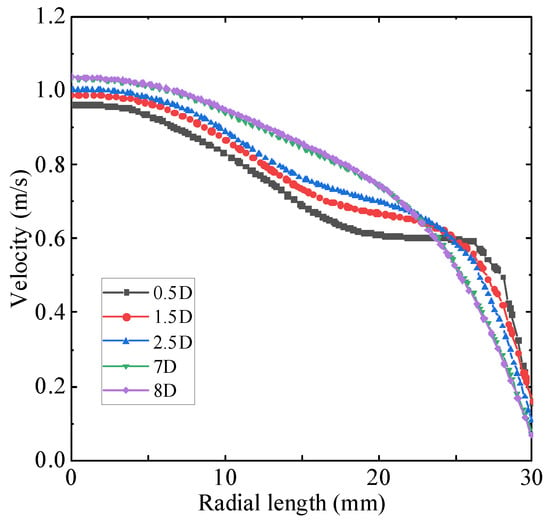
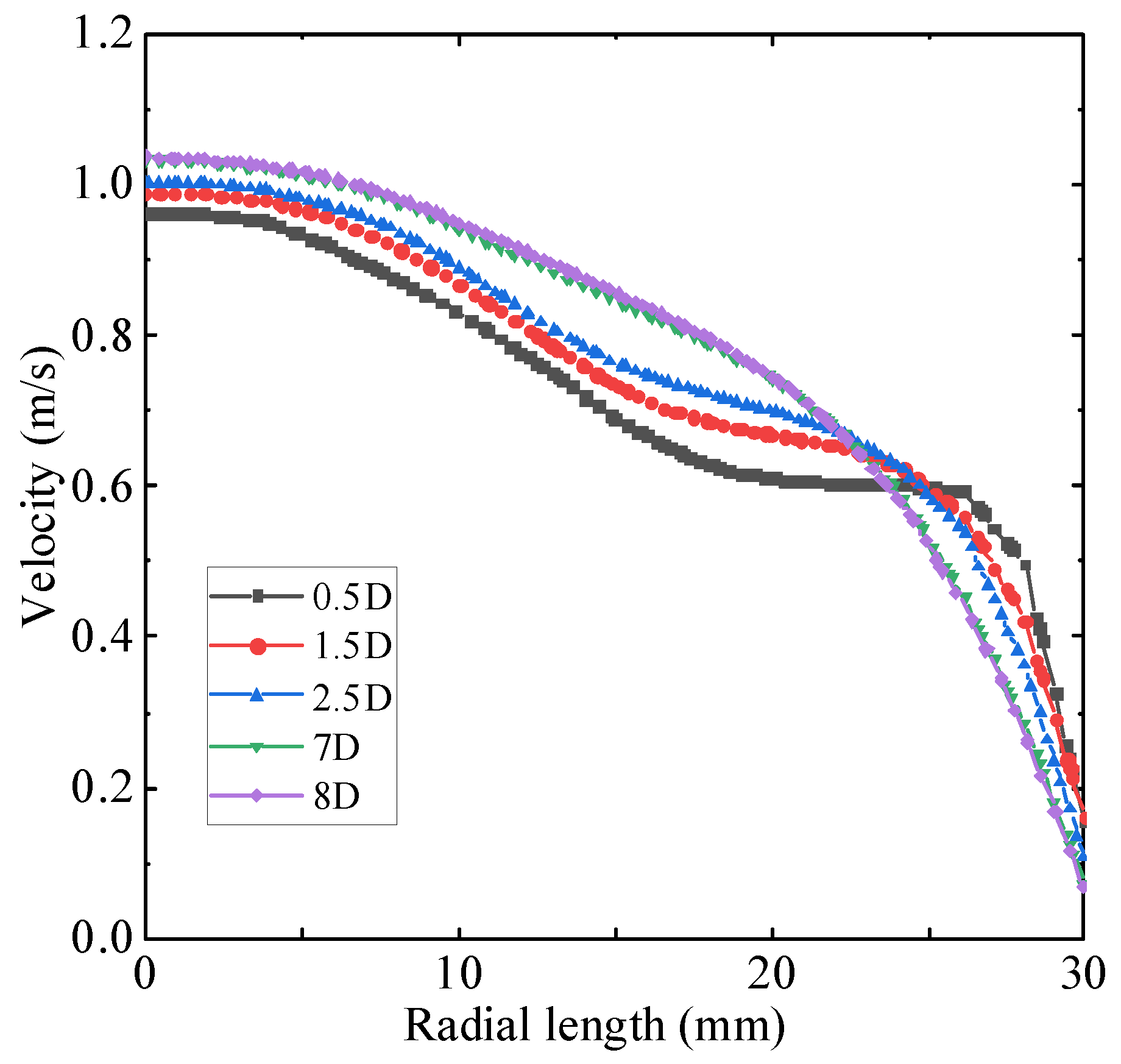
To determine the appropriate evaluation cross-section, flow development is simulated and compared for five downstream cross-sections of the rectifier at 0.5D, 1.5D, 2.5D, 7D, and 8D with an inlet velocity of 3 m/s, as shown in Figure 5. The results indicate that at 0.5D, the flow field remains strongly disturbed by the jet exiting the rectifier. Beyond 2.5D, the natural evolution of the pipeline flow field, where the velocity distribution gradually becomes parabolic, begins to dominate, complicating the independent assessment of the rectifier’s inherent benchmark. Ultimately, the downstream 1.5D cross-section is selected as the evaluation reference. At this location, the flow field has escaped the localized disturbance at the outlet, occupying a critical stage where the rectifying effect is fully manifested but not yet dominated by fully developed flow [28]. Consequently, it accurately characterizes the inherent rectifying performance of the orifice plate.
Figure 5.
Radial velocity distribution curves of different cross-sections.
2.2.2. Design Process
The initial aperture determines the fundamental acceleration of the fluid through the rectifier and the scale of the jet core. The objective is to identify a reference point where the velocity distribution characteristics produced by the orifice plate most closely match those of the woven wire mesh. The benchmark aperture still results in excessively high central velocities, with maximum momentum at the jet center, necessitating increased drag to suppress it. Therefore, gradually increasing the solid area from the center provides a gradient increase in flow resistance, effectively attenuating the momentum of the core jet. Large solid regions can cause flow separation and energy dissipation. Introducing gradient-expanded openings within the solid regions provides sufficient resistance to dampen the jet while maintaining adequate flowability, preventing flow separation, and achieving smoother momentum adjustment. During the design process, the overall shape of the velocity distribution curve and the relative deviation of velocity are used as screening criteria.
The aperture size needs to be determined. The woven wire mesh specifications are 80 mesh and 12 wires. Mesh size is the number of mesh apertures per inch distance, wire diameter is the diameter of the stainless-steel wire, and aperture diameter is the length of the side of the apertures. The relationship is expressed by Equation (8).
where Mw is the mesh number, dw is the wire diameter [m], and da is the aperture diameter [m]. An array of square apertures approximated the aperture of a single-layer woven wire mesh, and alignment is achieved using a circular orifice. Therefore, a square aperture with a side length of 0.1975 mm is determined to have the same area as a circular orifice with a diameter of 0.22 mm.
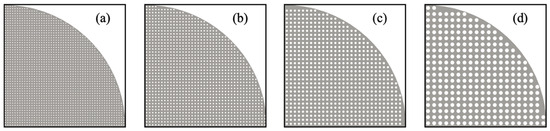
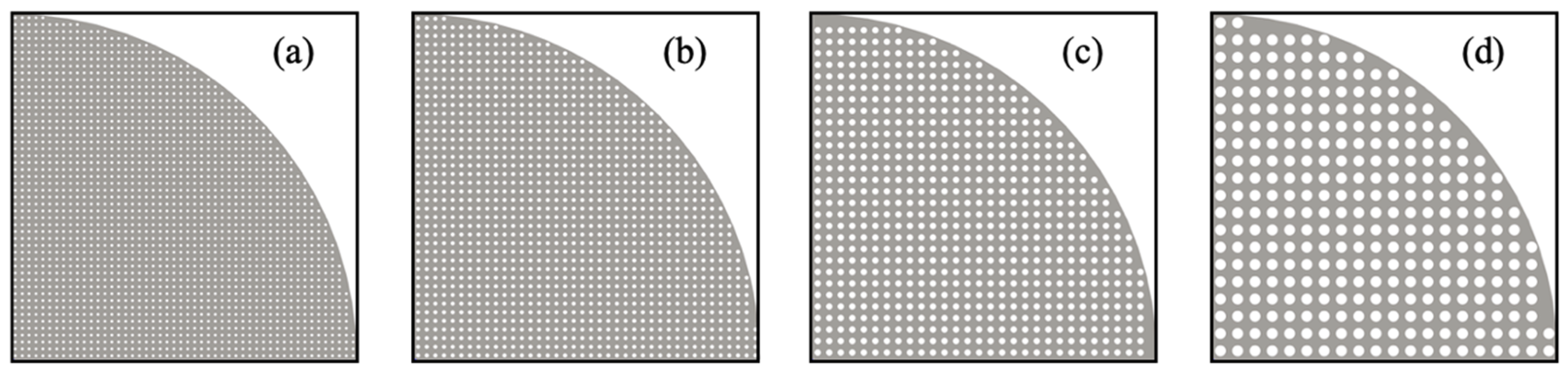
The rectification effects of different apertures of 0.22 mm, 0.3 mm, 0.6 mm, and 1 mm on the flow field are investigated and compared with the woven wire mesh. The rectifiers all have a radius of 30 mm, with the orifice in the lower left corner serving as the positioning reference. The rectifier with a 0.22 mm aperture is positioned 0.17 mm from both sides, with an array pitch of 0.34 mm in both horizontal and vertical directions. The rectifier with a 0.3 mm aperture is positioned 0.23 mm from both sides, with an array pitch of 0.46 mm in both horizontal and vertical directions. The rectifier with a 0.6 mm aperture is positioned 0.45 mm from both sides, with an array pitch of 0.9 mm in both horizontal and vertical directions. The rectifier with a 1 mm aperture is positioned 0.75 mm from both sides, with an array pitch of 1.5 mm in both horizontal and vertical directions. Figure 6 presents a schematic diagram of the rectifier at different aperture sizes.
Figure 6.
Schematic diagram of rectifier at different aperture sizes. (a) 0.22 mm; (b) 0.3 mm; (c) 0.6 mm; (d) 1 mm.
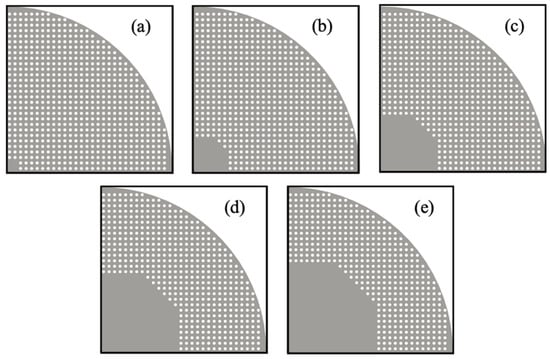
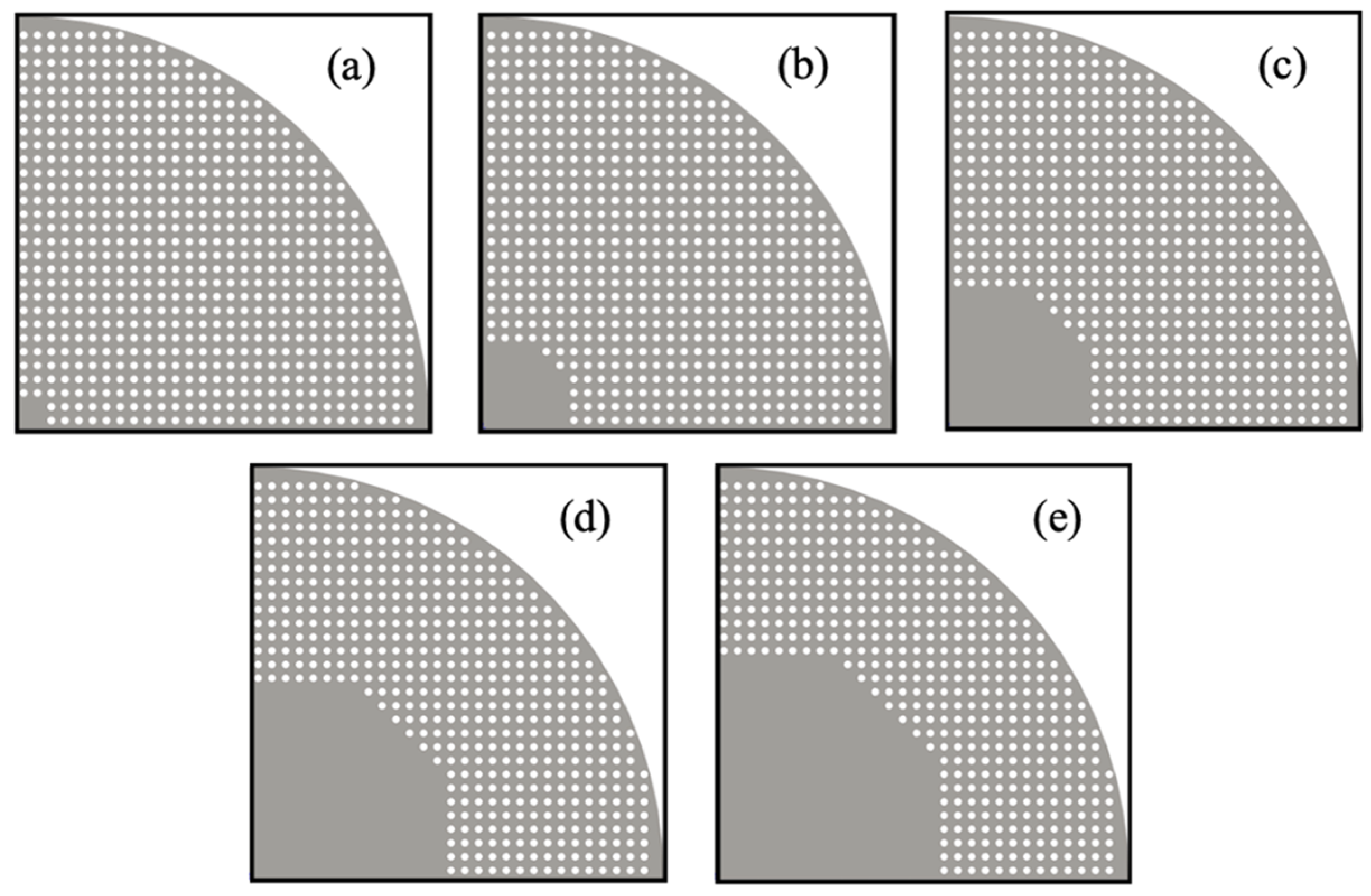
By comparing the rectification effects, it is found that the jet flow caused excessive central velocity, leading to a proposed design for the gradient solid region. The solid area percentage gradually increases from the center outward along the radius in steps corresponding to one aperture. The effects of rectification for 2, 6, 10, 14, and 16 solid circles are studied. Figure 7 presents a schematic diagram of the rectifier at different numbers of solid circles.
Figure 7.
Schematic diagram of rectifier at different numbers of solid circles: (a) 2 solid circles; (b) 6 solid circles; (c) 10 solid circles; (d) 14 solid circles; (e) 16 solid circles.
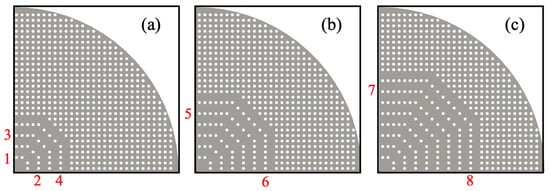
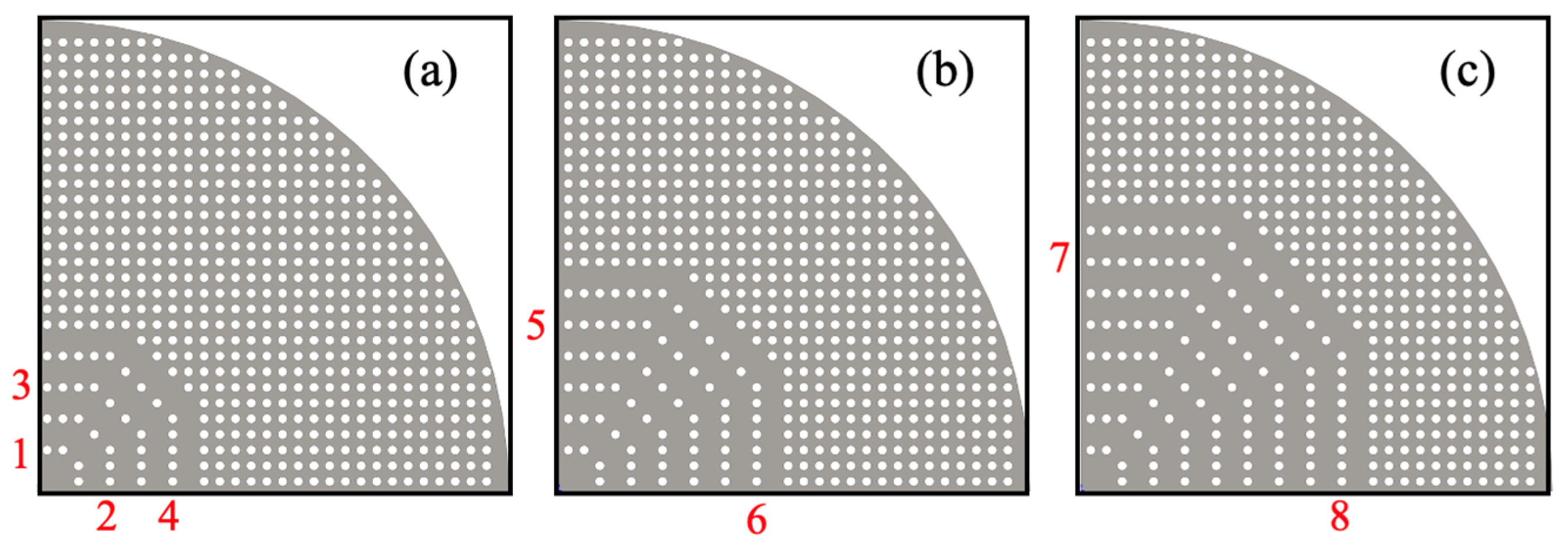
A vortex forms in the backflow region of the rectifier because of the increased solid region. Therefore, gradient openings are analyzed within the solid region. Adding different numbers of rings in the central region gradually expands the ring area according to the step size of two apertures. The rectification effects of 4, 6, and 8 rings were investigated. Figure 8 presents a schematic diagram of the rectifier at different rings. The red number represents the number of rings.
Figure 8.
Schematic diagram of rectifier at different rings: (a) four-ring; (b) six-ring; (c) eight-ring.
All rectifiers are assembled at the rectifier component location shown in Figure 1b and solved individually through simulation with an inlet velocity of 3 m/s. The radial velocity distribution at a distance of 1.5D downstream from the rectifier is investigated and compared with that of the woven wire mesh.
3. Experiment
3.1. Experimental Setup
The experimental system is designed to quantitatively assess the effect of the rectifier on flow field uniformity and pressure loss, and schematic and physical diagrams of the experimental platform are shown in Figure 9a,b. The system consists of three parts: the gas supply, test section, and data acquisition module. The gas supply module includes high-purity nitrogen, a pressure reduction valve, and a mass flow controller. The test module includes the rectifier and the measuring pipes, which are connected by flanges with sealing strips and made of transparent acrylic, with an inner diameter D of 60 mm and a wall thickness of 20 mm. Since the diameter of the output gas hose is smaller than that of the device inlet, two rectifiers are added to the inertance tube to prevent additional jet disturbances. To measure flow uniformity at various downstream sections and prevent nitrogen backflow, the pulse tube length is set to 600 mm. The data acquisition module includes a differential pressure transmitter and the MEMS flow sensor.
The pressure-reducing valve stabilizes the nitrogen outlet pressure in the range of 0.7 to 1.0 MPa. The mass flow controller (Alicat M-400SLPM-C, Alicat Scientific, Inc., Shanghai, China) uses the laminar differential pressure method to measure flow with a range of 0 to 400 SLPM (Standard Liters Per Minute) and an accuracy of ±0.5% F.S. The differential pressure transmitter (MDM 6000-DP, Micro Sensor Co., Ltd., Shanghai, China, range 0 to 6 kPa) measures the differential pressure on both sides of the rectifier.
Figure 9.
Experimental platform of rectifier. (a) Schematic diagram of experimental platform for rectification performance validation of flow rectification elements. (b) Photograph of experimental setup for flow rectification elements.
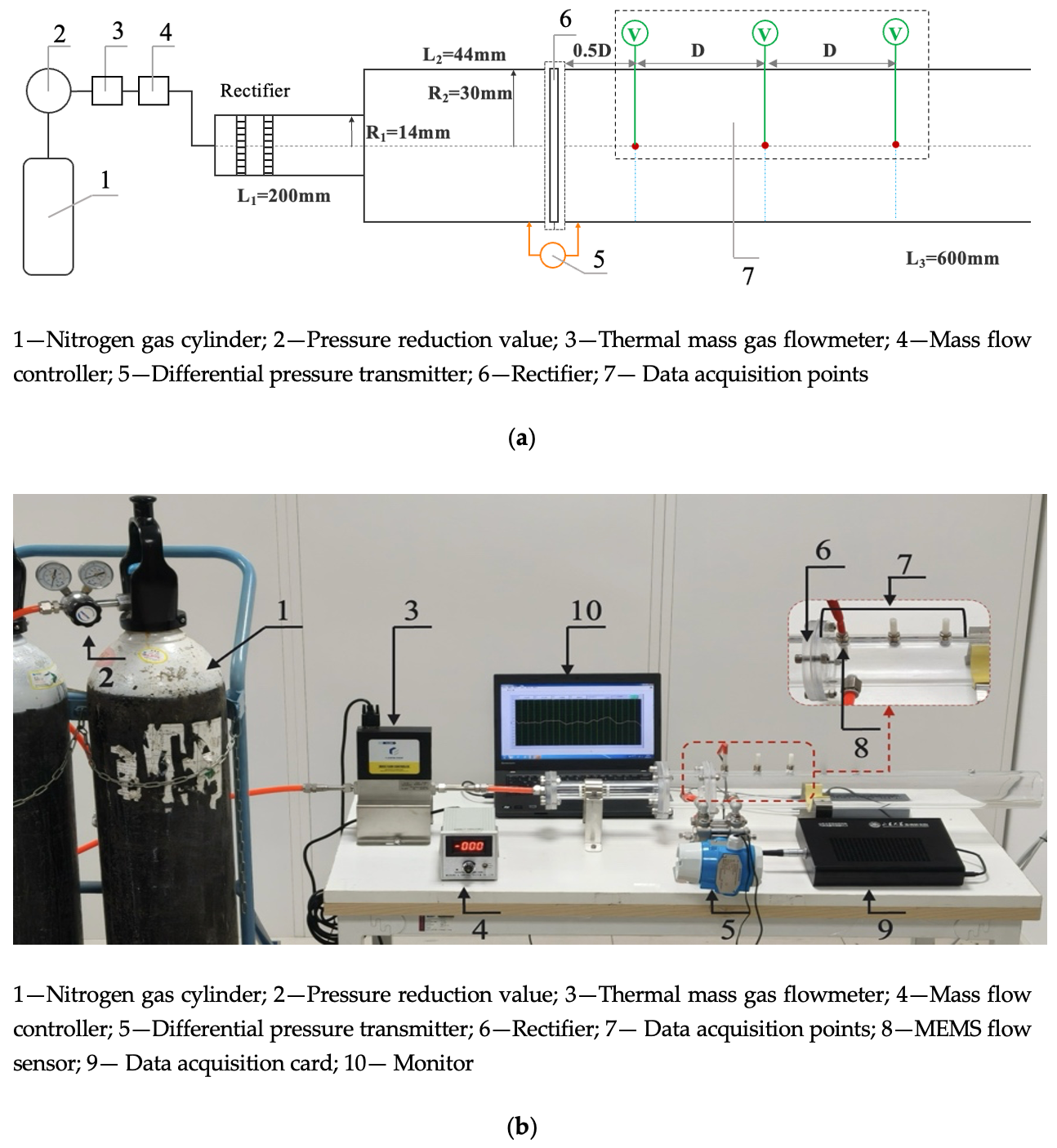
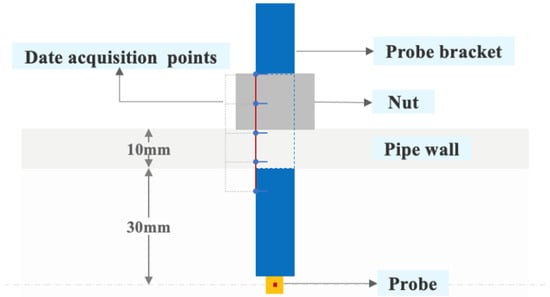
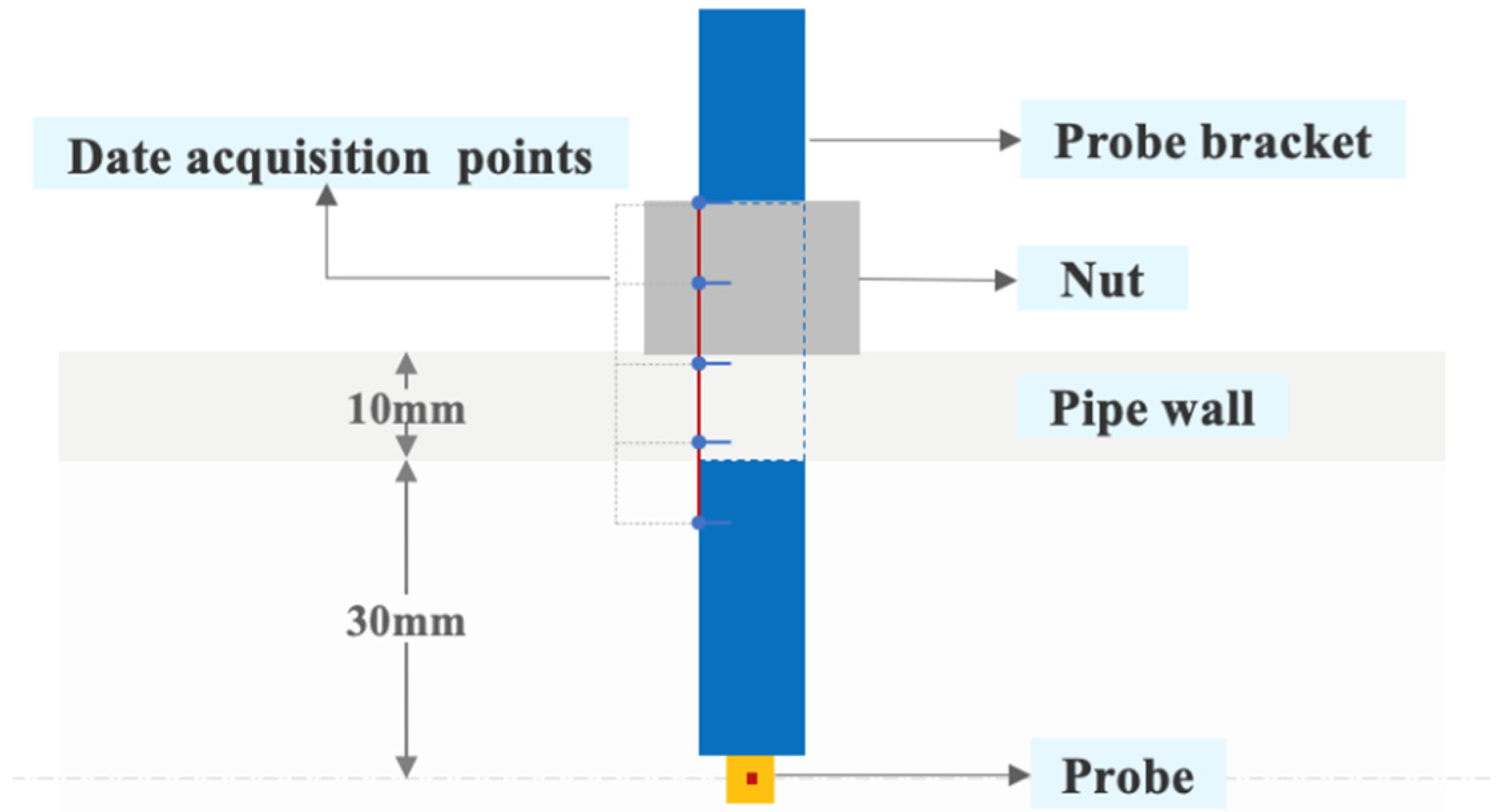
The MEMS flow sensor mainly consists of an intermediate heat-generating component and bridges on both sides. When there is no airflow on both sides, the resistance value is equal. When air flowed through the probe, a difference was produced on both sides of the resistance, causing a change in the output voltage. Measurement at the target points is carried out by moving the probe bracket up or down. The MEMS flow sensor itself introduces localized disturbances to the flow field. To minimize measurement errors caused by probe alignment, ensure the probe is strictly parallel to the direction of the incoming flow. The collected data consists of time-series signals representing sensor output voltages. For high-Reynolds-number conditions, the time series of the signals is first examined to confirm their fluctuation around the mean value. Subsequently, the time-averaged voltage values are employed for further calculations. Although this method filters out turbulent details, the time-averaged voltage obtained is precisely the physical quantity required for calculating flow uniformity metrics. Therefore, the measurement approach of the MEMS flow sensor aligns with the evaluation objectives of this study. Figure 10 presents a schematic diagram of the MEMS flow sensor and measurement points locations.
Figure 10.
Schematic diagram of MEMS flow sensor and measurement points locations.
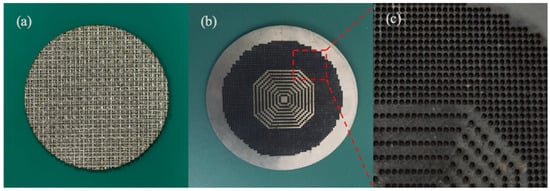
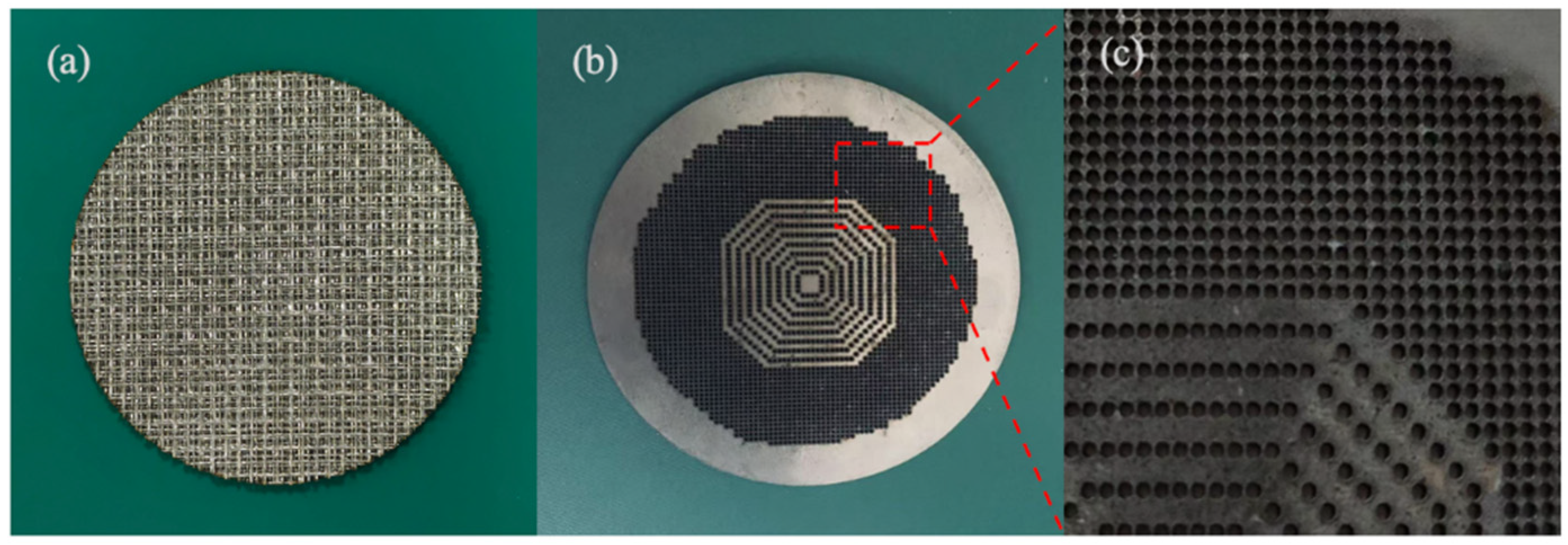
The woven wire mesh is shown in Figure 11a. Femtosecond pulsed laser etching is used to create the novel orifice plate rectifier, and the physical diagrams are shown in Figure 11b,c. The process uses a high-energy-density (>1014 W/cm2) laser beam to vaporize and remove the material, achieving micron-level etching accuracy [29,30].
Figure 11.
Physical diagram of rectifier. (a) Woven wire mesh. (b) Laser-etched rectifier. (c) Partial magnified image of laser-etched rectifier.
3.2. Calibration
To measure the velocity at specific points within the pipe, the MEMS flow sensor is calibrated to establish the relationship between flow velocity and voltage. The calibration experiments are conducted in a constant temperature and pressure environment, where the ambient temperature is maintained at 25 ± 0.5 °C by an air-conditioning system, the pressure is set to one atmosphere, and the pressure-reducing valve is stabilized at 0.7 MPa. To allow the gas within the pipe to develop fully, the pipe length is established. For laminar flow [31], the pipe length can be estimated using Equation (9); for turbulent flow [32], the pipe length can be estimated using Equation (10).
where D is the pipe diameter, set to 60 mm. Calculations show that the length needed for fully developed laminar flow is about 6.6 m, while the length for fully developed turbulent flow is around 1.2 m. To ensure the calibration point is located in the fully developed section, a tube length of 7 m is chosen. The axial calibration point is placed 6.8 m from the entrance.
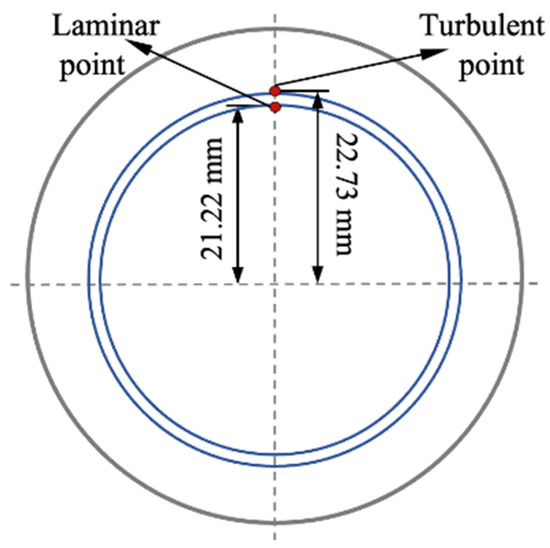
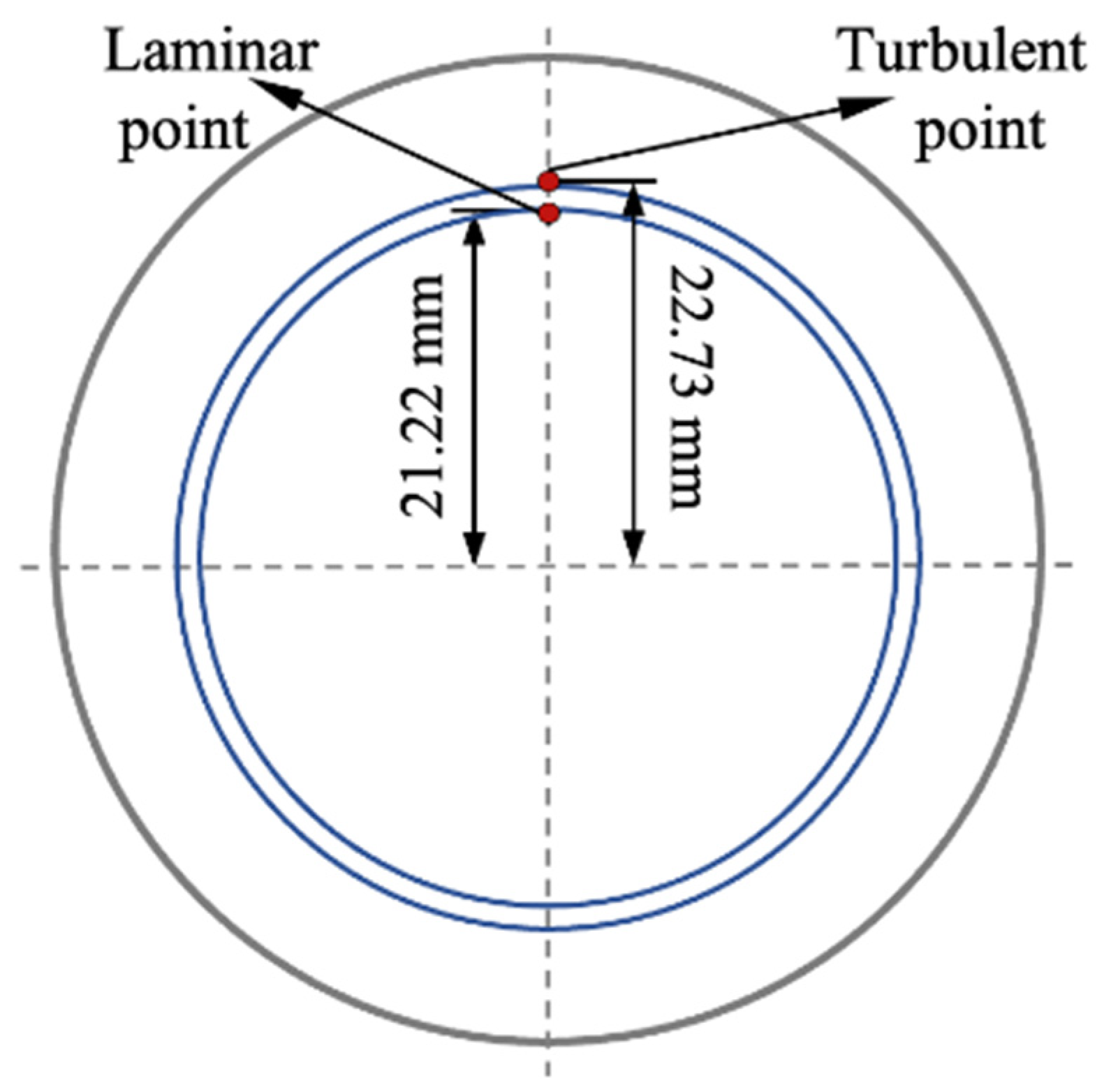
Laminar and turbulent flows are approximated by the mean velocity representing the cross-sectional flow velocity, except near the pipe wall. Under laminar flow conditions [33], the velocity distribution in the fully developed state approximates a parabolic curve. By applying the Poiseuille law, the position of the point where the average flow velocity occurs can be determined, as shown in Equation (11). In the turbulent flow state [34], the velocity distribution is relatively flat at full development, and the location of the point is determined according to the 1/7th power law as shown in Equation (12).
where R is the pipe radius, set to 30 mm. The radial calibration points for laminar and turbulent flow are determined through calculation, as shown in Figure 12.
Figure 12.
Schematic diagram of radial calibration points for laminar and turbulent flow.
In order to study the performance of the rectifier in different flow states, the determination of the velocity in the pipe is carried out. Therefore, the mass flow controller is configured for a flow range of 20–200 SLPM with an observable velocity range of 0.118–1.179 m/s in the warm-end heat exchanger. The Reynolds number in the warm-end heat exchanger ranges from 667.35 to 6673.55. Nitrogen is selected as the test gas because of its high safety and reasonable cost-effectiveness. The flow rates, flow velocities, and Reynolds numbers associated with the tests are listed in Table 1.
Table 1.
Nitrogen flow parameter settings in the experimental setup.
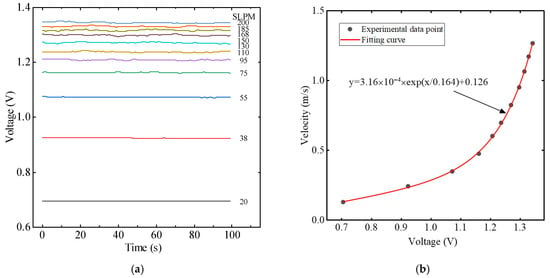
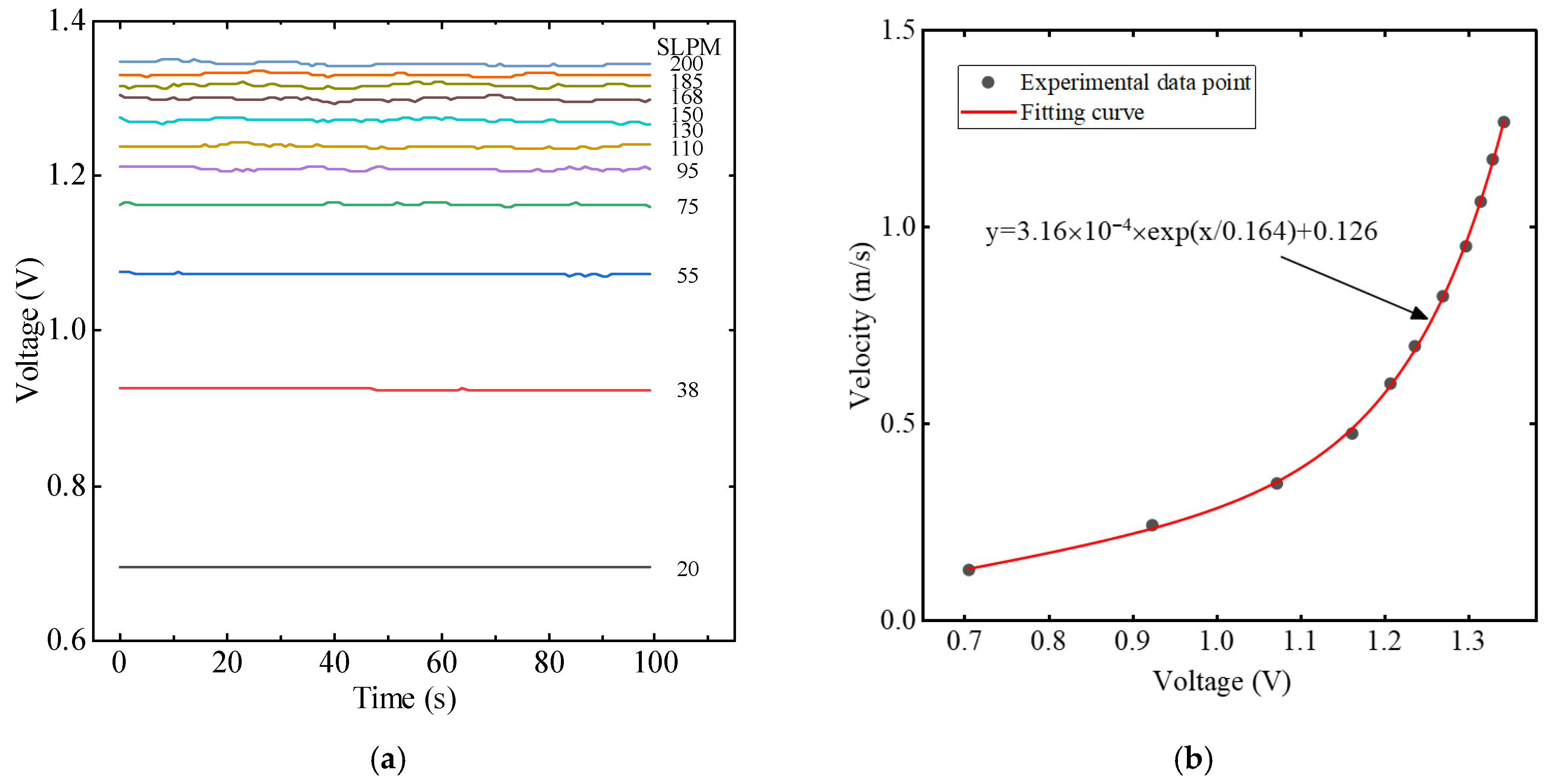
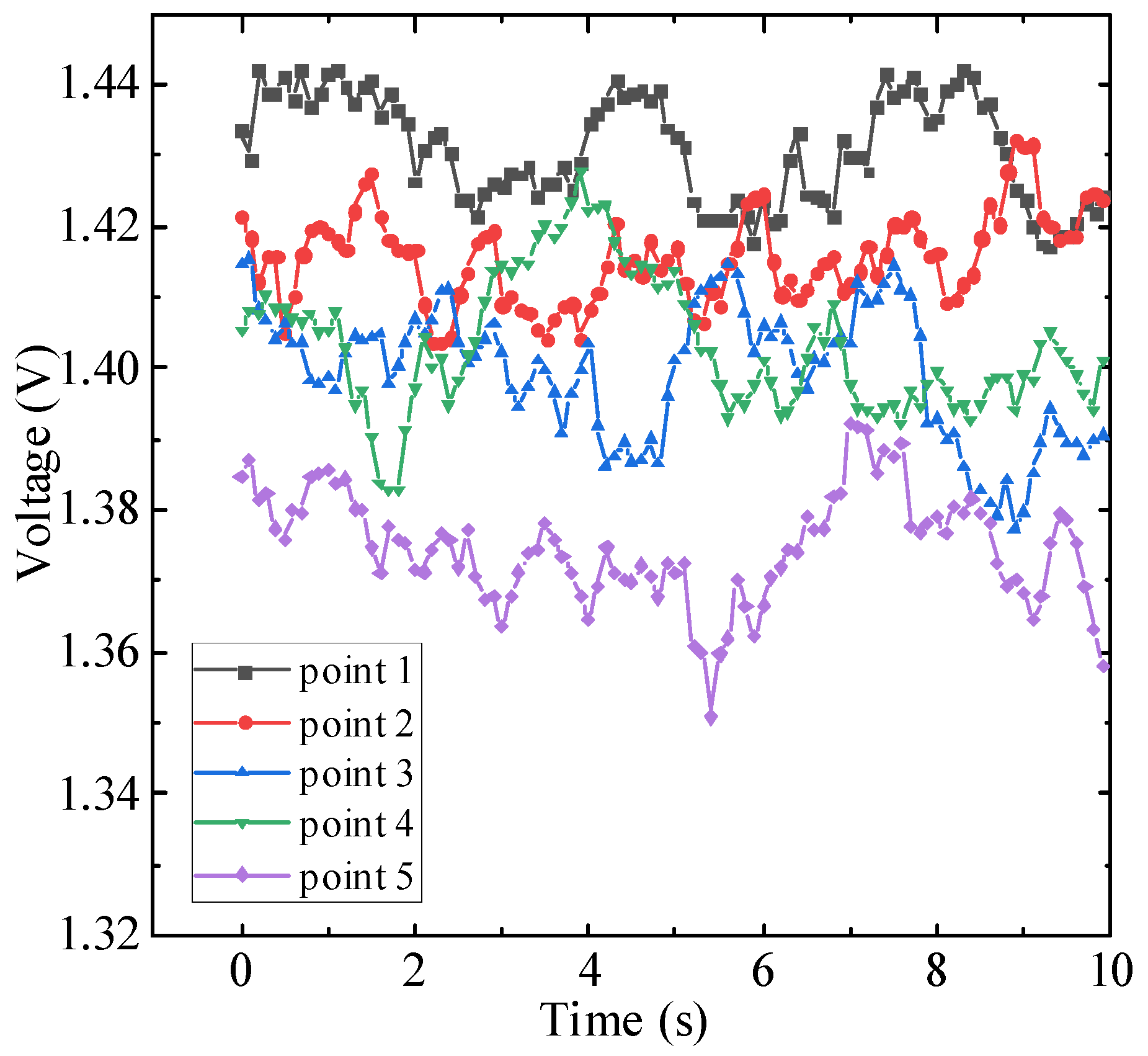
Under different flow conditions, the probe’s output voltage values are recorded, with each flow recording 100 voltage points. Figure 13a illustrates the trend of voltage with time for different flow conditions. The average value is taken as the final calibration result. By combining voltage data collected under laminar and turbulent flow conditions, a quantitative relationship between voltage and flow velocity is established, as shown in Figure 13b, with a goodness of fit R2 = 0.9995. After completing the preliminary fitting, the prediction results are further verified by comparing and analyzing them with the actual measurement data. The results show that the difference between them is within the permissible range, indicating that the established model has a high degree of accuracy and can be used for subsequent speed measurement.
Figure 13.
(a) Temporal variation in voltage under different flow rates. (b) Calibration fitting curve of voltage versus flow velocity.
3.3. Experimentation Method
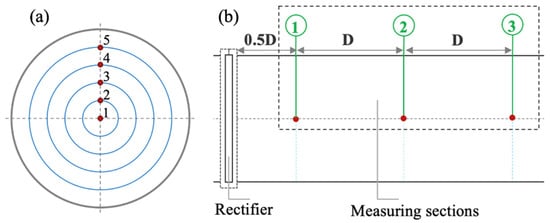
To evaluate the reliability of estimating cross-sectional average velocity based on a limited number of measurement points, average velocities are calculated using 3, 5, and 6 uniformly distributed radial measurement points, respectively. These results are then compared with the reference average obtained from high-density measurement points. The results indicate that the estimation errors for the three approaches are 4.79%, 4.93%, and 4.64%, respectively. With similar dispersion levels, all fall within an acceptable range of precision. Given that the five data acquisition points achieved the optimal balance between measurement efficiency and spatial resolution while ensuring an estimated error below 5% (4.93%), it is ultimately adopted as the method for characterizing the mean radial velocity. Five data acquisition points are spaced 6 mm apart along the radial direction, as shown in Figure 14a. Measuring sections are arranged downstream of the rectifier at intervals of 60 mm along the axial direction. Measuring sections are set at 0.5D downstream to capture the sudden change in velocity gradient, with a total of three sections (0.5D, 1.5D, and 2.5D) along the axial direction, as shown in Figure 14b, which are numbered sequentially as cross-sections 1–3. The data acquisition frequency is set to 11 Hz, with 100 voltage values recorded per acquisition, and the experiment is repeated three times to calculate the average value and eliminate random noise interference.
Figure 14.
Schematic diagram of data acquisition points. (a) Radial direction position. (b) Axial direction position.
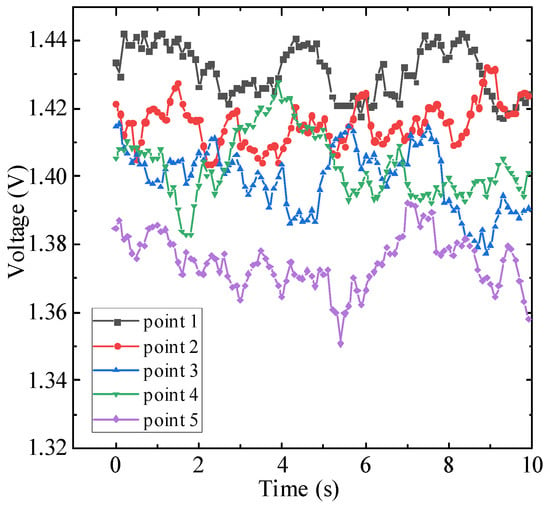
To verify the stability of data acquisition at high Reynolds numbers (200 SLPM), the time-dependent fluctuations of data from five collection points at the 1.5D location are analyzed, as shown in Figure 15. The fluctuation deviation at all five points is less than 1.76% of the average value. Therefore, using time-averaged velocity for flow uniformity calculations at high Reynolds numbers is feasible.
Figure 15.
Fluctuations in voltage values over time.
The flow uniformity and the pressure loss coefficient are selected as evaluation metrics to evaluate the performance of the rectifier element. The flow uniformity Cs is calculated using Equation (13), and a larger value of Cs indicates a higher uniformity of the flow. A dimensionless pressure loss coefficient K is used to characterize the pressure loss characteristics, following the standard, which is calculated as shown in Equation (15).
where Uavg is the mean value of all data [m/s], S is the standard deviation of all data, n is the total number of acquisition points, and Ui is the velocity value of the i-th sampling point [m/s].
where ΔP is the pressure loss on both sides of the rectifier [Pa], ρ is the fluid density, and Uavg is the average velocity of the undisturbed upstream cross-section of the rectifier [m/s]. Using the upstream undisturbed flow velocity ensures that the K characterizes the resistance of the rectifier, enabling fair and effective performance comparisons between rectifiers of different structures.
To ensure that experimental results can be meaningfully compared with simulation results, the simulated conditions are set to closely resemble the experimental implementation conditions. All simulated cases are conducted under identical, idealized, fully developed inlet conditions. However, due to practical site constraints, the actual inlet flow field in the experiments was not fully developed. All other conditions remained consistent. However, the primary objective of this study is to compare the relative performance of the novel rectifier with the conventional woven wire mesh rectifier. The structural characteristics of the rectifier itself exert a far greater influence on the downstream flow field than the subtle differences in the inlet velocity profile.
3.4. Uncertainty Analysis
The uncertainty mainly involves Type A and Type B. Type A examines the random error of the measured values, which can be estimated from N independent observations in the experiment. Type B uncertainty examines the random error of the system, the main sources of which are instrumentation, technical data, etc., and is mainly expressed in terms of test instrument error and empirical values. Type A uncertainty is calculated as shown in Equations (16)–(18).
where xavg is the arithmetic mean value of the measured parameter, N is the number of measurements of the same parameter, xi is the sample value of different measured parameters, Sn is the experimental standard deviation, and uA is the class A standard uncertainty. Ten sets of flow rate measurements are measured at the same point, and flow rates are listed in Table 2 with a Type A uncertainty of 0.49%.
Table 2.
Summary of data from ten independent replicate experiments.
The calculation of the uncertainty of Type B is shown in Equation (19).
where I is the accuracy of the measuring instrument, which is provided by the manufacturer. Z is the parameter for the different distribution types in uncertainty class B. A rectangular distribution is used for accuracy and applicability, . uB is the Type B standard uncertainty, and the main sources include the differential pressure transmitter, thermal gas mass flow meter, and MEMS flow sensor. The ranges, accuracies, and uncertainties of the individual instruments are listed in Table 3.
Table 3.
Type B uncertainty of experimental instruments.
Measurements are affected by several factors and require the synthesis of multiple uncertainty components. Since the components contained within the measurement results are independent of one another and do not affect each other, the combined standard uncertainty calculation method of direct synthesis is used, and the specific formula is shown in Equation (20).
where uC is the combined standard uncertainty. The uncertainty components in the table are calculated to give the combined uncertainty of 1.82% for the flow characteristic parameters.
4. Results and Discussion
4.1. Model Validity Verification
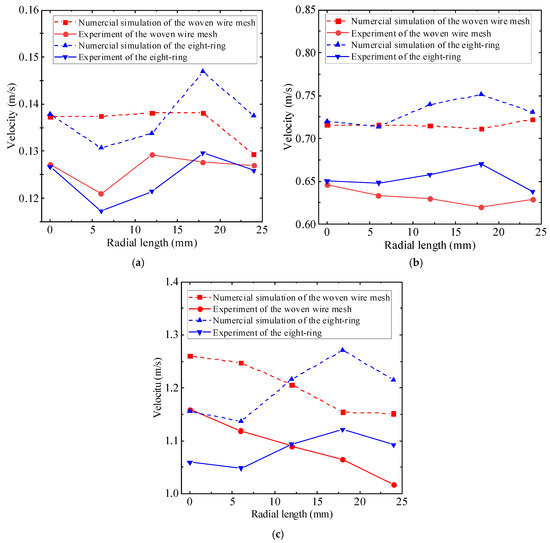
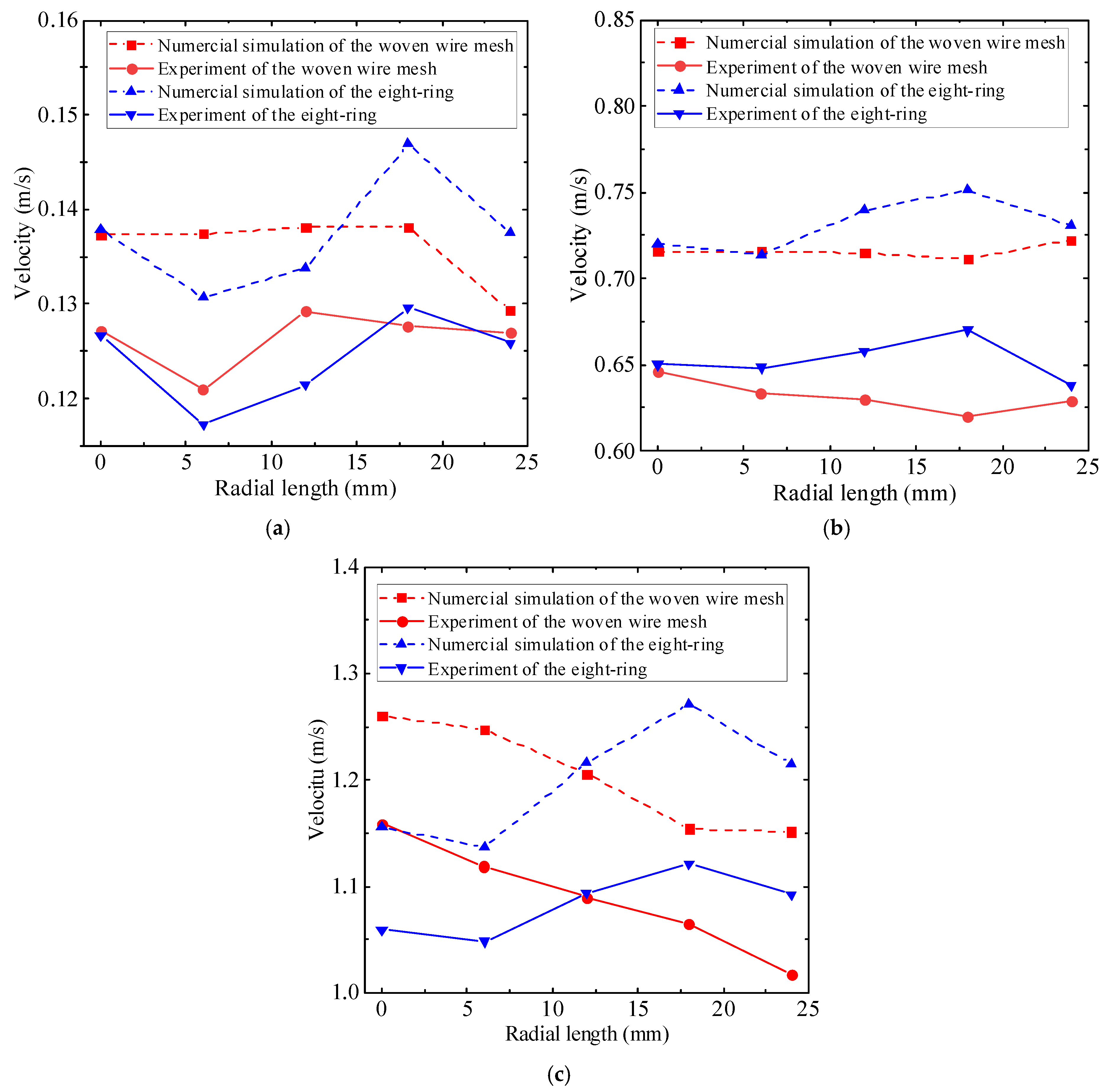
To validate the model’s applicability across a wide range of Reynolds numbers, the experimental data and simulation results are compared at three representative flow rates: low (20 SLPM), medium (110 SLPM), and high (200 SLPM). As shown in Figure 16, the maximum deviation reached 14.82%, the numerical simulations and experimental measurements show consistency in the radial velocity distribution. The trends of both methods align closely, though quantitative discrepancies exist, with the maximum deviation falling below 15%. This primarily stems from the combined effects of three factors: (1) experimental measurement uncertainty; (2) flow disturbance caused by probe intrusion; and (3) errors inherent to the simplifications within the numerical model itself. The combined uncertainty of this experimental system is 1.82%. The random error introduced by the measurement system itself constitutes a small but known component of the total deviation. When MEMS sensor probes measure within a flow field, it inherently introduces disturbances to the local flow. Although precise alignment minimizes this impact, it still causes deviations between the measured velocity at the probe point and the actual undisturbed velocity. This disturbance affects measurements across all rectifier structures similarly, thus having a relatively minor impact on comparing their relative performance. The simulation employs a quarter-model configuration to enforce flow field symmetry. In actual flow conditions, particularly turbulent flows, inherent instabilities and randomness may generate minute asymmetric structures. Furthermore, the k-ω SST model exhibits inherent model errors in predicting jet flows and separated flows, and steady-state simulations fail to capture transient fluctuations in the flow. However, this level of deviation is acceptable for engineering design and trend forecasting, demonstrating the reliability of numerical models as design tools. The time uniformity index calculated based on five radial measurement points provides a quantitative estimate of the uniformity of the flow field. Despite the limited number of measurement points, the results clearly reveal the performance differences between the two rectifiers at varying flow rates.
Figure 16.
Validation of simulated results with experimental data: (a) 20 SLPM; (b) 110 SLPM; (c) 200 SLPM.
4.2. Velocity Distribution
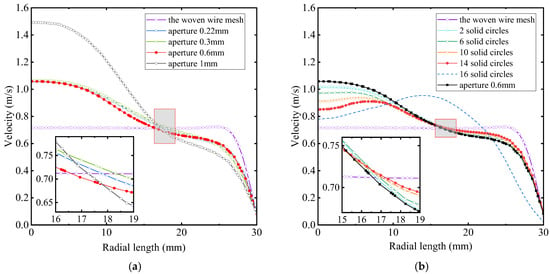
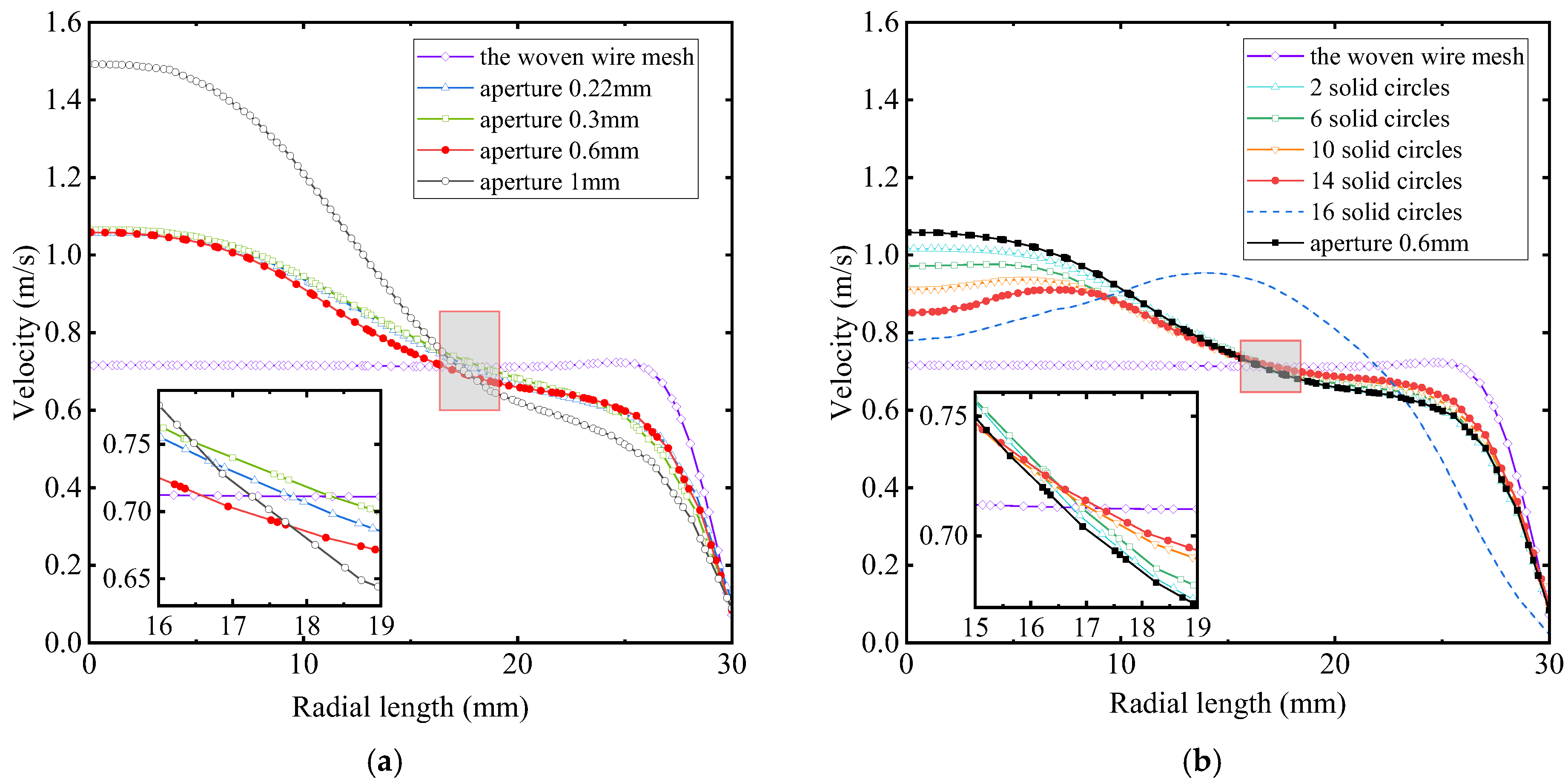
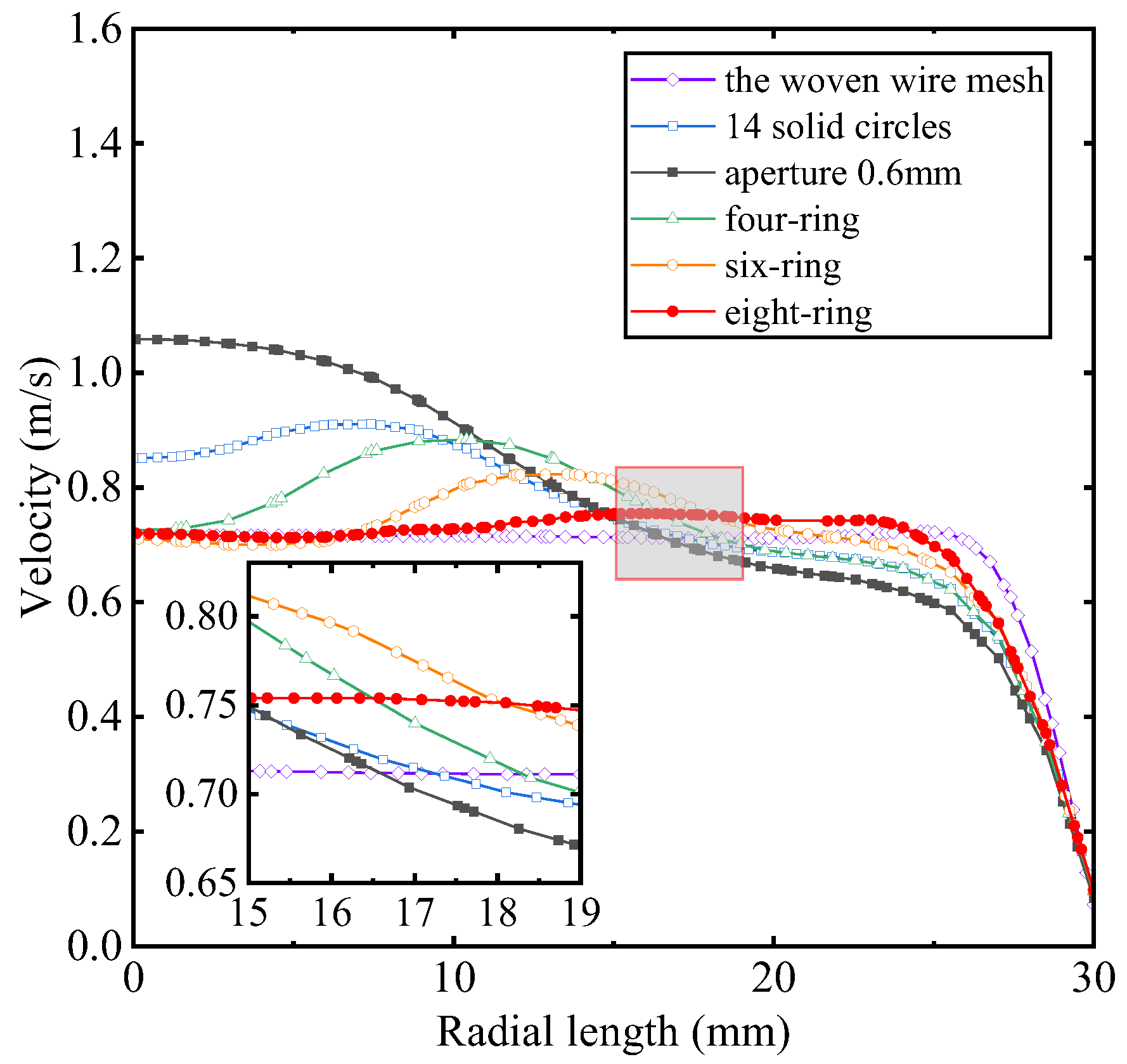
The velocity distribution curve of the rectifier and the woven wire mesh is analyzed by selecting an intercept line along the radius direction at a distance of 1.5D from the rectifier. The rectification of the flow field at different apertures of 1 mm, 0.6 mm, 0.3 mm, and 0.22 mm was compared. The velocity distribution curves are shown in Figure 17a. The results show that when the aperture is 0.6 mm, the curve is closest to that of the woven wire mesh. However, the center velocity is still significantly higher than that of the woven wire mesh, so further adjustments are needed at the center of the orifice plate rectifier.
Figure 17.
Radial velocity distribution curves. (a) Comparison between rectifier and woven wire mesh at different apertures. (b) Comparison between rectifier and woven wire mesh at different numbers of solid circles.
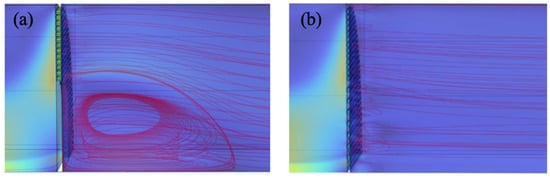
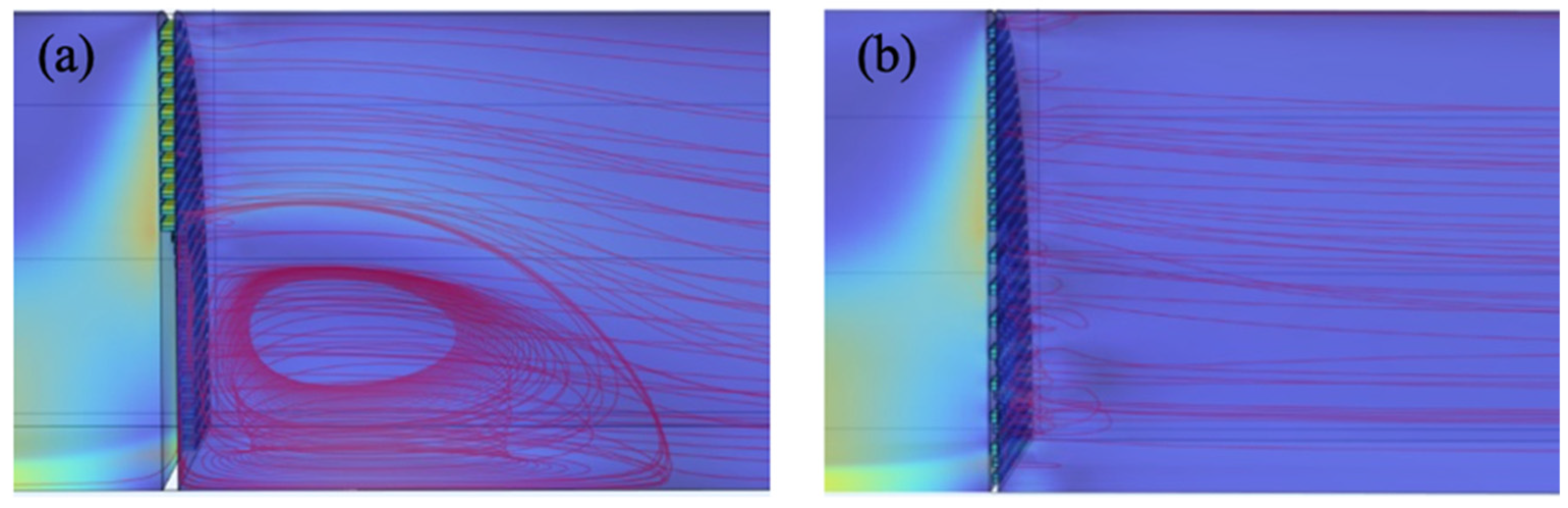
Figure 17b illustrates the velocity distribution curves for five sets of different numbers of solid circles. As the percentage of solid circles increases, the difference between the flow velocity distribution curve and the woven wire mesh decreases. The closest match with the woven wire mesh is observed with 14 solid circles, where the flow velocity at the center differs from that of the wire mesh by 18.86%, and the maximum difference is 27.26% at r = 7.12 mm. When the solid region expands to 16 solid circles, the center velocity varies from the woven wire mesh by 7.87%. Still, the middle velocity appears as a clear, abrupt change and differs from the woven wire mesh by 33.69%, which causes a vortex with an axial length of 28.96 mm on the back-flow side of the solid region due to the large solid area in the middle, as shown in Figure 18a. Therefore, gradient openings are considered in the solid region.
Figure 18.
(a) Vortex conditions in the backflow region of 16 solid circles. (b) Vortex conditions in the backflow region of the 8 rings.
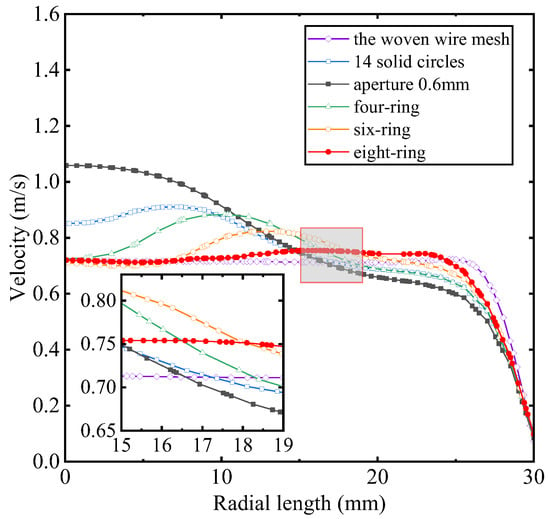
Figure 19 shows a comparison of the velocity distribution curves with different numbers of rings. The eight-ring rectifier’s velocity differs from that of the woven wire mesh by only 0.573% at the center, with a maximum of 5.77%. As shown in Figure 18b, the vortex phenomenon in the backflow region is significantly weakened. The rectification performance of woven wire mesh is 0.9762, while that of the eight-ring rectifier is 0.9472. Although its rectification efficiency remains slightly inferior to woven metal mesh, the eight-ring rectifier’s regular aperture design effectively reduces flow resistance, lowering the pressure drop from 81 Pa for woven wire mesh to 21.5 Pa for the eight-ring rectifier. The eight-ring rectifier is ultimately selected as the experimental subject.
Figure 19.
Radial velocity distribution curves of different ring structures.
4.3. Flow Uniformity and Pressure Drop
Sample datasets were obtained, and standard deviations were calculated from three independent repetitions of the experiment to quantify the dispersion of the results. Table 4 displays the standard deviation of the uniformity across the three cross-sections of the ring structure and the woven wire mesh at various flow rates.
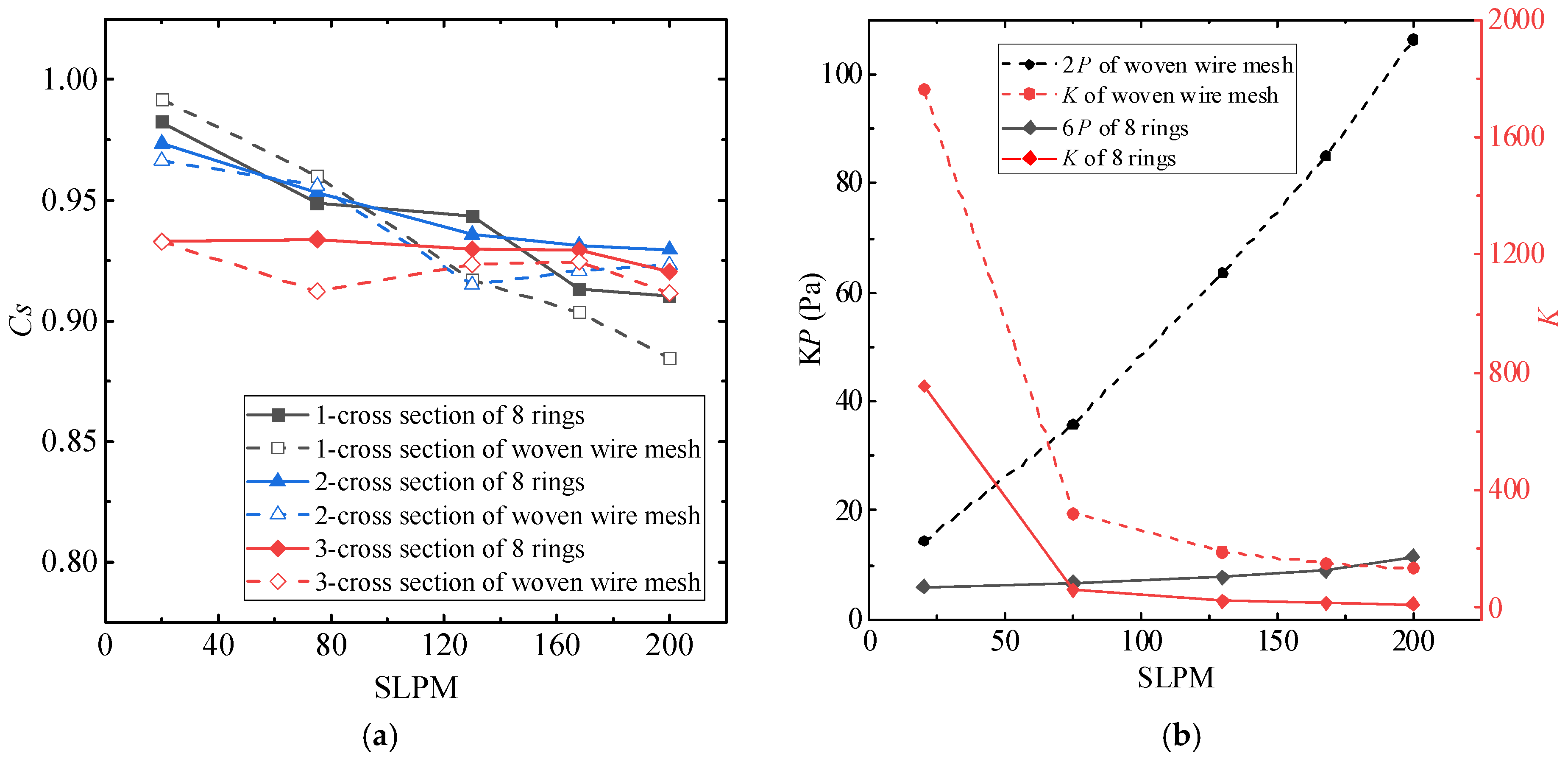
Figure 20a illustrates the comparison of the axial cross-section uniformity of the ring and the woven wire mesh at different flow rates. As flow increases, the uniformity of both the woven wire mesh and the eight-ring rectifier decreases, with the largest decline occurring at cross-section 1. The uniformity of the eight-ring rectifier at cross-section 1 decreases from 0.9824 to 0.9103, representing a decay rate of 7.33%. In contrast, the decay rate at the same section for the woven wire mesh reaches 10.81%, indicating that the eight-ring rectifier exhibits superior stability in flow field uniformity. Under laminar flow conditions, uniformity exhibits a decreasing trend along the axial direction. The motion of fluid particles is dominated by viscosity, causing the boundary layer to gradually thicken [35]. Wall friction causes a shift in the velocity distribution toward a parabolic profile, leading to higher central velocities and lower peripheral velocities. Under turbulent conditions, uniformity generally shows an upward trend along the axial direction. The reason is that the flow dominated by inertial forces showed higher turbulence intensity, which enhances lateral momentum exchange and offsets the negative effects of boundary layer development on flow uniformity.
Figure 20.
(a) Flow uniformity comparison between rings and woven wire meshes. (b) Pressure drop and pressure loss coefficients.
Table 4.
Standard deviation of uniformity.
At low flow conditions (20 SLPM), the axial average uniformity of the woven wire mesh is 0.9670, which is higher than the 0.9629 observed for the eight-ring rectifier. At 75 SLPM, the woven wire mesh still maintains a high degree of uniformity at cross-sections 1 and 2, but the uniformity of the ring starts to show an advantage at cross-section 3. The reason is that at low flow rates, the inertial forces of the fluid are weaker, and the dense mesh structure of the woven wire mesh can distribute the fluid more evenly. At high flow rates (>75 SLPM), the eight-ring rectifier effectively disperses turbulent energy and reduces local disturbances by optimizing aperture size and distribution, leading to better uniformity at high flow rates and a slight decrease in uniformity along the axial direction. At 130 SLMP, the axial average uniformity of the eight-ring rectifier is 0.9362; at 168 SLMP, it is 0.9246; and at 200 SLMP, it is 0.9201. The average uniformity is improved by 0.91% to 1.94% compared to the woven wire mesh. The minimum improvement value (0.91%) has already reached half of the combined uncertainty (1.82%), while the maximum value (1.94%) exceeds the uncertainty itself. The experiment presents a relative comparison, and when calculating this difference, some systematic errors cancel each other out.
Table 5 shows the standard deviation of the pressure drop across the cross-section upstream and downstream of the rectifier at various flow rates, based on three sets of independent replicate experiments. Figure 20b illustrates the variation in pressure loss coefficients with flow rate for the eight-ring rectifier with the preparation of the woven wire mesh. The pressure loss coefficient on both sides of the eight-ring rectifier is significantly decreased from 754.05 to 59.88, and the differential pressure ΔP increases from 6.1 Pa to 6.7 Pa in the low flow range from 20 to 75 SLPM. As the flow rate increased, the pressure loss coefficient K stabilized within the range of 130 to 200 SLPM at higher flow rate intervals. In the case of a 200 SLPM flow rate, the pressure loss coefficient of both sides of the ring structure is reduced to 14.58, and the pressure drop is 11.6 Pa, which is 89.09% lower than that of the woven wire mesh, indicating that the ring structure shows obvious advantages in terms of pressure loss under high flow conditions. At low flow rates, laminar flow dominates, with pressure loss primarily determined by viscous resistance. As the flow increases, fluid velocity accelerates, and inertial effects gradually become dominant, causing the K to decrease rapidly. During high-flow phases, the system enters a turbulent state where pressure loss is primarily dominated by energy dissipation caused by turbulence, and the K tends toward stability. The pressure loss of the eight-ring rectifier has been significantly reduced (57.64–89.09%), far exceeding the combined uncertainty.
Table 5.
Standard deviation of pressure drop.
5. Conclusions
This paper proposes a design concept for a regularized orifice plate rectifier. This orifice plate rectifier can replace traditional wire mesh, ensuring rectification performance while addressing the drawback of wire mesh being difficult to model accurately. Furthermore, its flow resistance is significantly lower than that of woven wire mesh.
- (1)
- Based on the radial velocity distribution of the woven wire mesh, a perforated plate was designed. The cross-section 1.5D downstream of the rectifier was selected to investigate the radial velocity distribution for different aperture sizes, solid circular, and ring structures. When the rectifier aperture is 0.6 mm and has eight rings, the deviation at the center from the woven mesh speed is only 0.573%, with a maximum deviation value of 5.77%.
- (2)
- As flow increases, the uniformity of both the woven wire mesh and the eight-ring rectifier decreases, with the largest decline occurring at cross-section 1. At low flow conditions (20 SLPM), the axial average uniformity of the woven wire mesh is 0.9670, which is higher than the 0.9629 observed for the eight-ring rectifier. The inertial forces of the fluid are weaker, and the dense mesh structure of the woven wire mesh can distribute the fluid more evenly. Within the flow range of 130 to 200 SLPM, the average flow uniformity of the eight-ring rectifier improves by 0.91% to 1.94% compared to the woven wire mesh. The standard deviation remains within 0.0162.
- (3)
- At low flow conditions, the pressure drop of the eight-ring rectifier is reduced by 57.64% to 81,28% compared to woven wire mesh. As the flow increases and inertial effects gradually become dominant, K decreases rapidly. During high-flow phases, the system enters a turbulent state where pressure loss is primarily dominated by energy dissipation caused by turbulence, and K tends toward stability. The pressure drop is reduced by 87.74% to 89.09% compared to woven wire mesh, indicating that the ring structure shows obvious advantages in terms of pressure loss under high flow conditions. The standard deviation remains within 0.864.
A novel design process for orifice plate rectifiers is proposed by combining numerical simulation with experimental validation. The rectifier features uniformly distributed apertures, facilitating modeling and machining. The core of this method lies in the logical sequence of its process, rather than a set of fixed parameter values. This process is applicable to pipes of various sizes. However, this study only examined the two aspects of the rectifier related to flow field regulation and pressure loss and does not verify the refrigeration performance of the entire pulse tube refrigerator system, which will be analyzed in future work. Additionally, the impact of changes in working fluid density and viscosity on the pressure drop characteristics of the rectifier will be considered.
Author Contributions
Conceptualization, Z.D.; methodology, Z.L. and G.L.; validation, Z.L.; investigation, Z.L. and G.L.; writing—original draft, Z.L.; writing—review and editing, G.L., Y.L. (Yan Li), Y.L. (Yanhua Lai), Z.D., and M.L.; visualization, Z.L. and G.L.; supervision, G.L., Y.L. (Yanhua Lai), Z.D., and M.L.; project administration, Y.L. (Yanhua Lai), Z.D., and M.L.; funding acquisition, Y.L. (Yanhua Lai). All authors have read and agreed to the published version of the manuscript.
Funding
This work was supported by the Key R&D Program of Shandong Province, China (No. 2023CXGC010508).
Data Availability Statement
Data is contained within the article.
Conflicts of Interest
The authors declare no conflicts of interest.
Symbols
The following symbols are used in this manuscript:
| u | Velocity [m/s] |
| p | Pressure [Pa] |
| Si | Source term [N/m3] |
| C | Inertial drag coefficient [m−1] |
| Re | Reynolds number [-] |
| Mw | Mesh number [-] |
| dw | Wire diameter [m] |
| da | Aperture diameter [m] |
| D | Pulse tube diameter [m] |
| R | Pulse tube radius [m] |
| r | Calibration position [m] |
| Cs | Flow uniformity [-] |
| S | Standard deviation [-] |
| n | Total number of acquisition points [-] |
| Uavg | Mean value of the velocity [m/s] |
| Ui | The velocity of i-th sampling point [m/s] |
| dh | Hydraulic diameter [m] |
| mw | Quality of the wire mesh [kg] |
| ρmetal | Density of the wire mesh [kg/m3] |
| Dw | Diameter of the wire mesh [m] |
| H | Thickness of the wire mesh [m] |
| L | Entrance length [m] |
| K | Pressure loss coefficient [-] |
| ΔP | Pressure differential [Pa] |
| xavg | Arithmetic mean value [-] |
| N | Number of measurements of the same parameter [-] |
| xi | Sample values [-] |
| Sn | Standard deviation [-] |
| uA | Type A standard uncertainty [-] |
| N | Number of measurements [-] |
| I | Accuracy [-] |
| Z | Constant [-] |
| uB | Type B standard uncertainty [-] |
| uC | Combined standard uncertainty [-] |
| Greek symbols | |
| ρ | Fluid density [kg/m3] |
| ε | Porosity [-] |
| μ | Dynamic viscosity [kg/(m·s)] |
| α | Permeability [m2] |
References
- Wang, N.; Tang, Q.; Xun, Y.; Liang, M.; Zhao, M.; Chen, H.; Liang, J. A Lightweight High-Capacity Pulse Tube Cryocooler Operating at 80 K. Cryogenics 2024, 138, 103800. [Google Scholar] [CrossRef] [Scilit]
- Oyama, D.; Kawai, J.; Kawabata, M.; Adachi, Y. Reduction of Magnetic Noise Originating from a Cryocooler of a Magnetoencephalography System Using Mobile Reference Sensors. IEEE Trans. Appl. Supercond. 2022, 32, 1200105. [Google Scholar] [CrossRef] [Scilit]
- Zhang, S.; Zhu, S. Impacts of the Regenerative Effect of the Aftercooler on Compression Chamber Efficiency. Therm. Sci. Eng. Prog. 2024, 55, 102909. [Google Scholar] [CrossRef] [Scilit]
- Yan, C.; Zhang, Y.; Qiu, J.; Chen, Y.; Wang, X.; Dai, W.; Ma, M.; Li, H.; Luo, E. Numerical and Experimental Study of Partly Tapered Pulse Tube in a Pulse Tube Cryocooler. Int. J. Refrig. 2020, 120, 474–480. [Google Scholar] [CrossRef] [Scilit]
- Xue, R.; Tan, J.; Zhao, B.; Zhao, Y.; Tan, H.; Wu, S.; Zhai, Y.; Ma, D.; Wu, D.; Dang, H. Thermodynamic Characteristics of a Single-Stage Stirling-Type Pulse Tube Cryocooler Capable of 1220 W at 77 K with Two Cold Fingers Driven by One Linear Compressor. Energy 2023, 278, 127968. [Google Scholar]
- Dang, Y.-X.; Du, S.; Song, X.; He, Y.-L. Optimization of Distribution Uniformity of Evaporator Orifice Plate Distributor. Int. J. Refrig. 2025, 175, 107–117. [Google Scholar] [CrossRef] [Scilit]
- Jung, J.; Jeong, S. Surface Heat Pumping Loss in a Pulse Tube Refrigerator. In Cryocoolers 12; Ross, R.G., Ed.; Springer: Boston, MA, USA, 2003; pp. 371–378. [Google Scholar]
- Badgujar, A.; Atrey, M. Theoretical and Experimental Investigation of Pressure Drop and Refrigeration Effect in Pulse Tube Cryocooler. Mech. Eng. Sci.-Part C 2016, 230, 1910–1920. [Google Scholar]
- Laws, E.M. Flow Conditioning—A New Development. Flow. Meas. Instrum. 1990, 1, 165–170. [Google Scholar]
- Ouazzane, K.; Benhadj, R. An Experimental Investigation and Design of Flow-Conditioning Devices for Orifice Metering. Mech. Eng. Sci.-Part C 2007, 221, 281–291. [Google Scholar] [CrossRef] [Scilit]
- Manshoor, B.; Nicolleau, F.C.G.A.; Beck, S.B.M. The Fractal Flow Conditioner for Orifice Plate Flow Meters. Flow Meas. Instrum. 2011, 22, 208–214. [Google Scholar] [CrossRef] [Scilit]
- Liu, Q.; Tian, S.; Lin, Z.; Zhu, Z. Effect of the Convergence Flow Conditioner on Rectifying Eccentric Jet Flow Induced by a Ball Valve. Flow Meas. Instrum. 2022, 83, 102091. [Google Scholar] [CrossRef] [Scilit]
- El Hassan, M.; Nobes, D.S. Experimental Investigation of the Vortex Dynamics in Circular Jet Impinging on Rotating Disk. Fluids 2022, 7, 223. [Google Scholar] [CrossRef] [Scilit]
- Singh, V.K.; John Tharakan, T. Numerical Simulations for Multi-Hole Orifice Flow Meter. Flow Meas. Instrum. 2015, 45, 375–383. [Google Scholar] [CrossRef] [Scilit]
- Özahi, E. An Analysis on the Pressure Loss through Perforated Plates at Moderate Reynolds Numbers in Turbulent Flow Regime. Flow Meas. Instrum. 2015, 43, 6–13. [Google Scholar] [CrossRef] [Scilit]
- Riazanov, A.; Dmitriev, S.; Doronkov, D.; Dobrov, A.; Pronin, A.; Solntsev, D.; Demkina, T.; Kuritsin, D.; Nikolaev, D. Effects of the Orifice and Absorber Grid Designs on Coolant Mixing at the Inlet of an RITM-Type SMR Fuel Assembly. Fluids 2025, 10, 278. [Google Scholar] [CrossRef] [Scilit]
- Cha, J.S.; Ghiaasiaan, S.M.; Desai, P.V.; Harvey, J.P.; Kirkconnell, C.S. Multi-Dimensional Flow Effects in Pulse Tube Refrigerators. Cryogenics 2006, 46, 658–665. [Google Scholar] [CrossRef] [Scilit]
- Zhao, Y.; Yu, G.; Tan, J.; Mao, X.; Li, J.; Zha, R.; Li, N.; Dang, H. CFD Modeling and Experimental Verification of Oscillating Flow and Heat Transfer Processes in the Micro Coaxial Stirling-Type Pulse Tube Cryocooler Operating at 90–170 Hz. Cryogenics 2018, 90, 30–40. [Google Scholar] [CrossRef] [Scilit]
- Rana, H.; Abolghasemi, M.A.; Stone, R.; Dadd, M.; Bailey, P. Numerical Modelling of a Coaxial Stirling Pulse Tube Cryocooler with an Active Displacer for Space Applications. Cryogenics 2020, 106, 103048. [Google Scholar] [CrossRef] [Scilit]
- Schulze, M.; Wagner, M.; Sattelmayer, T. Linearized Euler Equations for the Determination of Scattering Matrices for Orifice and Perforated Plate Configurations in the High Mach Number Regime. Aerospace 2016, 3, 33. [Google Scholar] [CrossRef] [Scilit]
- Wang, Y.; Yang, G.; Huang, Y.; Huang, Y.; Zhuan, R.; Wu, J. Analytical Model of Flow-through-Screen Pressure Drop for Metal Wire Screens Considering the Effects of Pore Structures. Chem. Eng. Sci. 2021, 229, 116037. [Google Scholar] [CrossRef] [Scilit]
- Pathak, M.G.; Patel, V.C.; Ghiaasiaan, S.M.; Mulcahey, T.I.; Helvensteijn, B.P.; Kashani, A.; Feller, J.R. Hydrodynamic Parameters for ErPr Cryocooler Regenerator Fillers under Steady and Periodic Flow Conditions. Cryogenics 2013, 58, 68–77. [Google Scholar] [CrossRef] [Scilit]
- Hsu, C.-T.; Fu, H.; Cheng, P. On Pressure-Velocity Correlation of Steady and Oscillating Flows in Regenerators Made of Wire Screens. J. Fluids Eng. 1999, 121, 52–56. [Google Scholar] [CrossRef] [Scilit]
- Yin, G.; Ong, M.C.; Zhang, P. Numerical Investigations of Pipe Flow Downstream a Flow Conditioner with Bundle of Tubes. Eng. Appl. Comput. Fluid Mech. 2023, 17, e2154850. [Google Scholar] [CrossRef] [Scilit]
- Ashwin, T.R.; Narasimham, G.S.V.L.; Jacob, S. CFD Analysis of High Frequency Miniature Pulse Tube Refrigerators for Space Applications with Thermal Non-Equilibrium Model. Appl. Therm. Eng. 2010, 30, 152–166. [Google Scholar] [CrossRef] [Scilit]
- Zhao, Y.; Dang, H. CFD Simulation of a Miniature Coaxial Stirling-Type Pulse Tube Cryocooler Operating at 128 Hz. Cryogenics 2016, 73, 53–59. [Google Scholar] [CrossRef] [Scilit]
- Xiao, G.; Peng, H.; Fan, H.; Sultan, U.; Ni, M. Characteristics of Steady and Oscillating Flows through Regenerator. Int. J. Heat Mass Transf. 2017, 108, 309–321. [Google Scholar] [CrossRef] [Scilit]
- Ouazzane, A.K.; Benhadj, R. Flow Conditioners Design and Their Effects in Reducing Flow Metering Errors. Sens. Rev. 2002, 22, 223–231. [Google Scholar] [CrossRef] [Scilit]
- Orazi, L.; Gnilitskyi, I.; Pavlov, I.; Serro, A.; Ilday, S.; Ilday, F. Nonlinear Laser Lithography to Control Surface Properties of Stainless Steel. CIRP Ann. 2015, 64, 193–196. [Google Scholar] [CrossRef] [Scilit]
- Manninen, M.; Hirvimäki, M.; Matilainen, V.-P.; Salminen, A. Comparison of Laser-Engraved Hole Properties between Cold-Rolled and Laser Additive Manufactured Stainless Steel Sheets. Appl. Sci. 2017, 7, 913. [Google Scholar]
- Durst, F.; Ray, S.; Ünsal, B.; Bayoumi, O.A. The Development Lengths of Laminar Pipe and Channel Flows. J. Fluids Eng. 2005, 127, 1154–1160. [Google Scholar] [CrossRef] [Scilit]
- Anselmet, F.; Ternat, F.; Amielh, M.; Boiron, O.; Boyer, P.; Pietri, L. Axial Development of the Mean Flow in the Entrance Region of Turbulent Pipe and Duct Flows. Comptes Rendus Méc. 2009, 337, 573–584. [Google Scholar] [CrossRef] [Scilit]
- Lewandowski, M.T.; Płuszka, P.; Pozorski, J. Influence of Inlet Boundary Conditions in Computations of Turbulent Jet Flames. Int. J. Numer. Methods Heat Fluid Flow 2018, 28, 1433–1456. [Google Scholar] [CrossRef] [Scilit]
- De Chant, L.J. The Venerable 1/7th Power Law Turbulent Velocity Profile: A Classical Nonlinear Boundary Value Problem Solution and Its Relationship to Stochastic Processes. Appl. Math. Comput. 2005, 161, 463–474. [Google Scholar] [CrossRef] [Scilit]
- Schlichting, H.; Gersten, K. Boundary-Layer Theory; Springer: Berlin/Heidelberg, Germany, 2017. [Google Scholar]

Disclaimer/Publisher’s Note: The statements, opinions and data contained in all publications are solely those of the individual author(s) and contributor(s) and not of MDPI and/or the editor(s). MDPI and/or the editor(s) disclaim responsibility for any injury to people or property resulting from any ideas, methods, instructions or products referred to in the content. |
© 2026 by the authors. Licensee MDPI, Basel, Switzerland. This article is an open access article distributed under the terms and conditions of the Creative Commons Attribution (CC BY) license.