3.1. Laplace’s Static Equilibrium
In almost all applications covered by the Navier–Stokes equations, the solutions correspond to observations, but in exceptional cases, they can lead to artifacts because they are not complete. This is the case with Laplace’s static equilibrium, where a drop of fluid takes on a spherical shape in another fluid that is immiscible with that of the drop under the influence of capillary forces or accelerations concentrated on the interface
between the two media. This problem can be solved analytically by taking certain assumptions into account. Laplace’s law can then be written as a pressure difference
, where
is the curvature of a sphere of radius
R. The problem posed here is different: it is a question of whether static equilibrium can be obtained as a convergence to the steady state of an evolution problem modeled by the Navier–Stokes equations. To transform this problem of two fluids separated by an interface with specified boundary conditions into a single-fluid model where the capillary terms are introduced in volumetric form into the Navier–Stokes equations, it is necessary to reformulate these terms based on the normal and tangential stresses of continuum mechanics.
where
is the viscous stress tensor,
p is the pressure, and
is the surface tension. The last term corresponds to Marangoni effects present if the surface tension depends on temperature. This condition of classical mechanics, which applies to the interface
between two fluids, is simplified in the case of two non-viscous fluids because, in the case of Newtonian fluids, the viscous stress tensor becomes zero with viscosity. For static equilibrium, only the second member remains, which is itself equal to zero.
The modeling of volumetric capillary source terms was carried out by J.U. Barckbill et al. [
6] considering non-viscous fluids and constant surface tension. The capillary force introduced into the Navier–Stokes equations thus becomes
where
is the normal outside the interface and
is an indicator of the presence of the interface in the volume.
To clarify the nature of this term, consider a drop of radius R of one fluid in equilibrium with another; the two immiscible fluids generate a surface tension per unit mass where is the surface tension. This case is simplified by limiting the physical domain to a plane and the drop to a circle of the same radius. This problem, known as Laplace’s capillary equilibrium, defines the capillary pressure difference as , where is the curvature of the interface at mechanical equilibrium. If the shape of the interface is not initially circular, the effects of capillarity induce velocities in both fluids that rapidly attenuate if the fluids are viscous, leading to perfect mechanical equilibrium where velocities are strictly zero on the macroscopic scale. The only question that arises here is whether the Navier–Stokes equations correctly simulate this phenomenon, both dynamically, of course, and in terms of static equilibrium.
This elementary test case used to qualify the capillary models introduced into the Navier–Stokes equations in the study of two-phase flows actually covers many physical and numerical aspects related to the choice of the discrete capillary model, the spatial approximation and time steps of the simulations, the choice of the interface tracking method, etc. Since the 1990s, many authors have reproduced this problem from the Navier–Stokes equations by incorporating a source term localized on the interface
. The best-known one is the model by Brackbill et al. [
6], the Continuum Surface Force (CSF) method, which introduces a source term based on the general definition of capillary force
where
is the normal outside the interface
,
is the local curvature, and
is the Dirac delta function, which specifies the location of the interface. Many variants have since been developed, most of which incorporate the density of fluids in the form of a ratio or a difference.
A phenomenon known as eddy currents or parasitic currents has been observed by authors who have used different capillary models to simulate small-scale two-phase flows. These parasitic effects are very well described by D. Harvie [
16], who studied the phenomenon by establishing a correlation between the amplitude of these parasitic effects and the physical parameters of the problem integrated into three dimensionless parameters, the capillary number
, the Reynolds number
, and the Weber number
. These quantities are written as
,
and
, where
V is a characteristic flow velocity,
is an average density, and
is the viscosity of the continuous phase. These parasitic currents, which can sometimes have a significant amplitude, persist indefinitely even when macroscopic mechanical equilibrium is reached. D. Harvie correctly attributes the presence of these currents to the generation of erroneous rotational components but does not give the root cause of these non-physical effects. Many authors claim to have significantly reduced these parasitic currents using more sophisticated capillary models, but they do not provide the exact cause of their existence and do not question the model based on Navier–Stokes equations; most authors attribute these effects to the discrete nature of numerical simulations. In summary, these parasitic currents, which persist over time in viscous and non-viscous fluids, reflect the inconsistency of these equations. Denner’s analysis [
17] shows that implicit treatment of capillary flows makes it possible to overcome the strict constraints associated with capillary waves.
This opinion on the Navier–Stokes equations with the capillary source term is supported by several objective reasons. The first observation corresponds to the analysis of the velocity field when a polar orthogonal structured mesh is adopted. In this case, parasitic currents are absent and the velocity very quickly becomes strictly zero. The reason for this is that the interface
only intersects segments that are orthogonal to it, so that the capillary force is a pure radial gradient whose accumulation in the pressure gradient
exactly reproduces the Laplace pressure difference,
. The second reason is related to the extension of the CSF model to tangential stresses, which are not taken into account by the model. Indeed, the capillary force (
20) can be projected along a normal component, but also in the form of a tangential stress, in the form
where
is the unit vector of each segment intersected by the interface and
is the normal to this vector in the same plane. This local decomposition leads to a formal separation of normal effects and tangential effects, which are assumed to be zero in the CSF model. The result is instructive: (i) if the second component is ignored, we obtain the previous result in which the pressure is close to that theoretically expected, and parasitic currents are present; (ii) taking into account the second component of (
21), a vortex superimposes itself on the compression of the drop. This rotational flow has no physical significance since the velocity at equilibrium must be strictly zero. However, the second component of the capillary force does exist and should result in a persistent tangential stress.
In summary, the Navier–Stokes equations were established based on the conservation of momentum derived from Newton’s second law, but the forces applied in the form of source terms were considered to be derived from scalar potentials. Dynamic or static equilibrium required the introduction of a potential, pressure, but no potential to ensure the equilibrium of tangential stresses. This lack of symmetry in the Navier–Stokes equations prevents certain properties associated with them, as defined by Noether’s theorems [
18]. Proof of this observation is provided by the following experiment: Laplace equilibrium is approximated using a simulation in polar coordinates where the drop is geometrically consistent with the mesh whose axes are oriented along
r and
. Thus, the normal outside the interface
is oriented along
r and the component along
is zero; in this case, the capillary acceleration is reduced to
and there are no more parasitic currents.
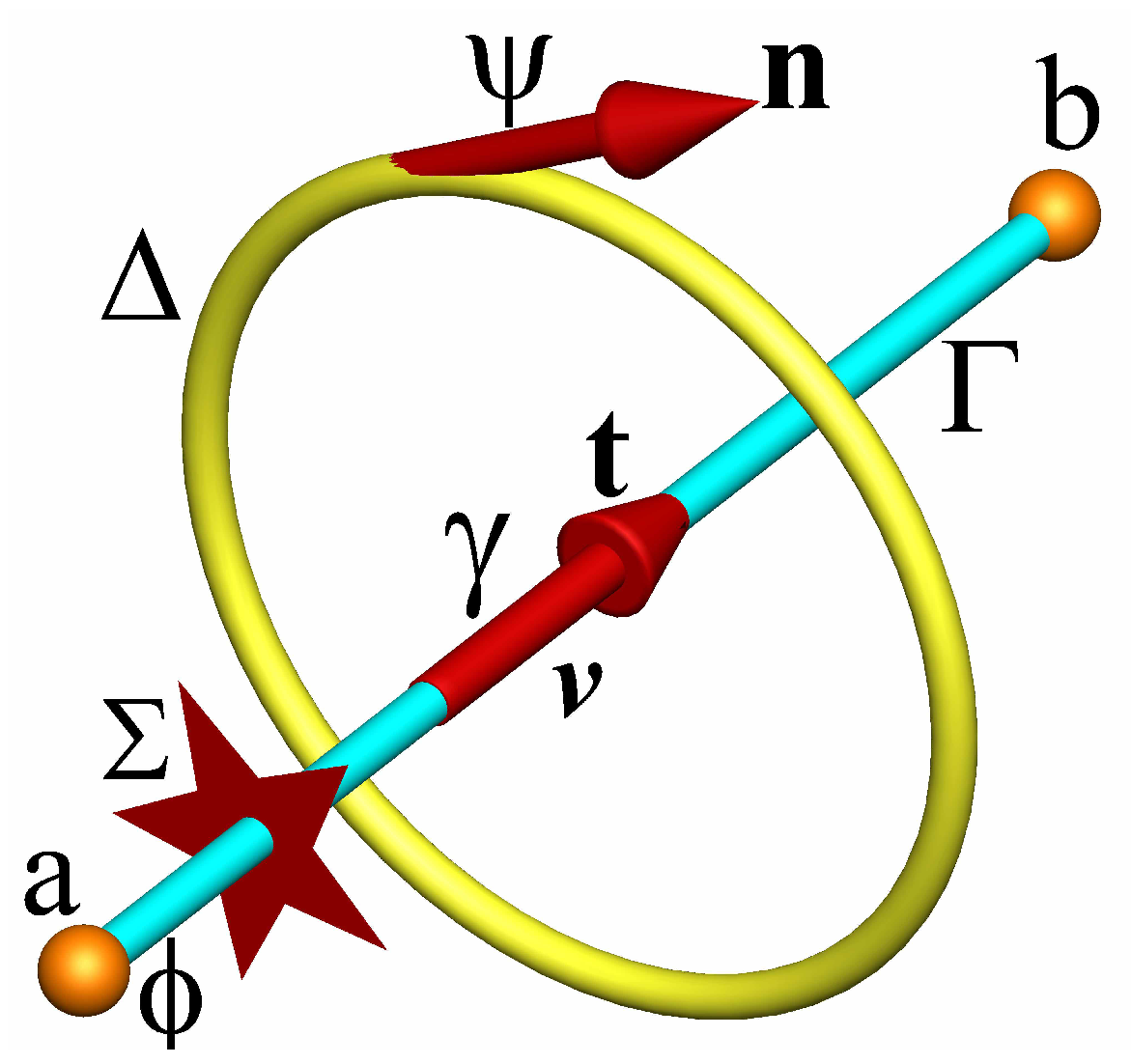
In discrete mechanics, all source terms of the law of motion (
4) are written a priori in the form of a Helmholtz–Hodge decomposition, particularly those of capillary effects,
where
is the normal vector to each of the facets
of the primitive geometry and
is the discrete surface tension.
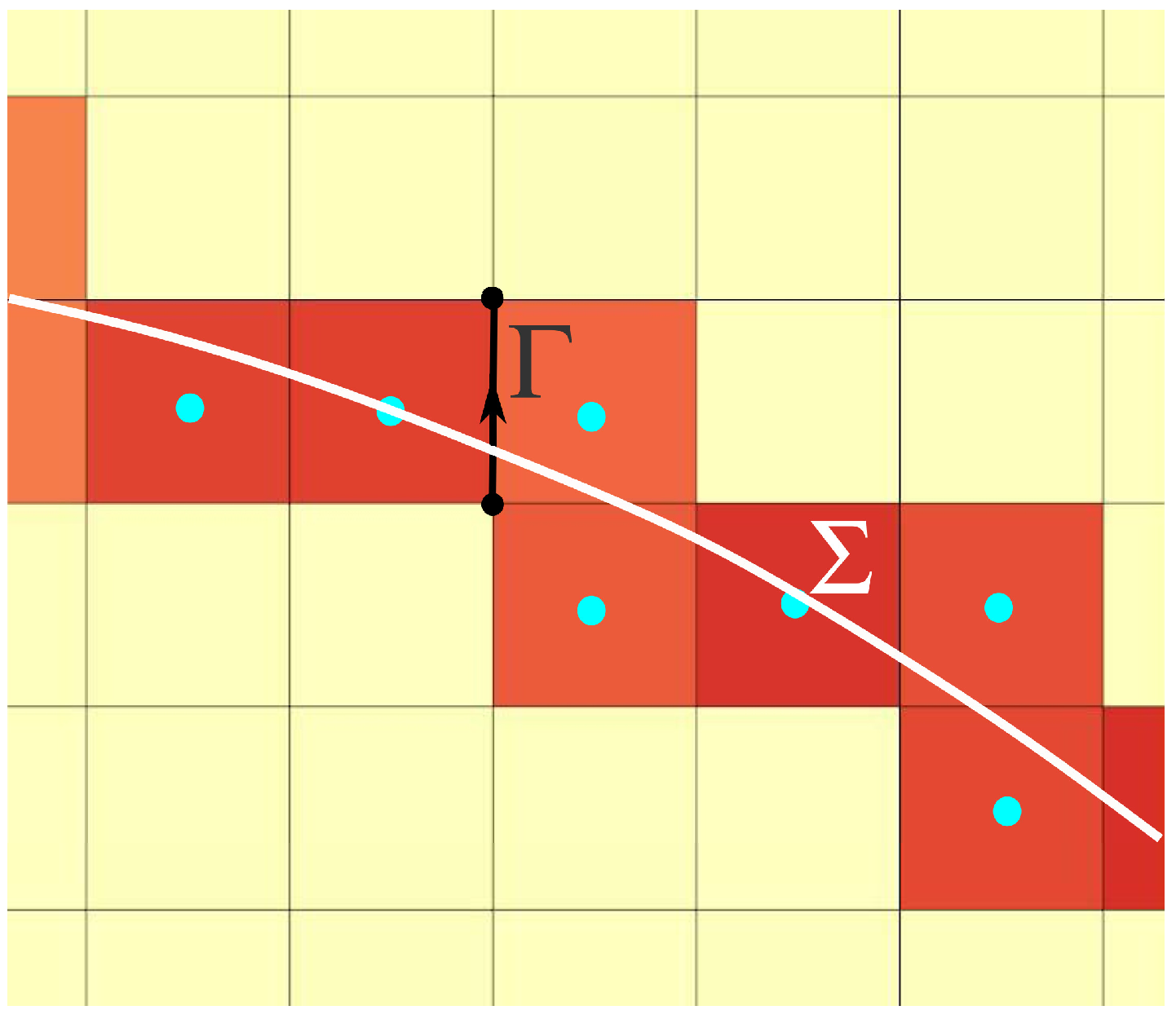
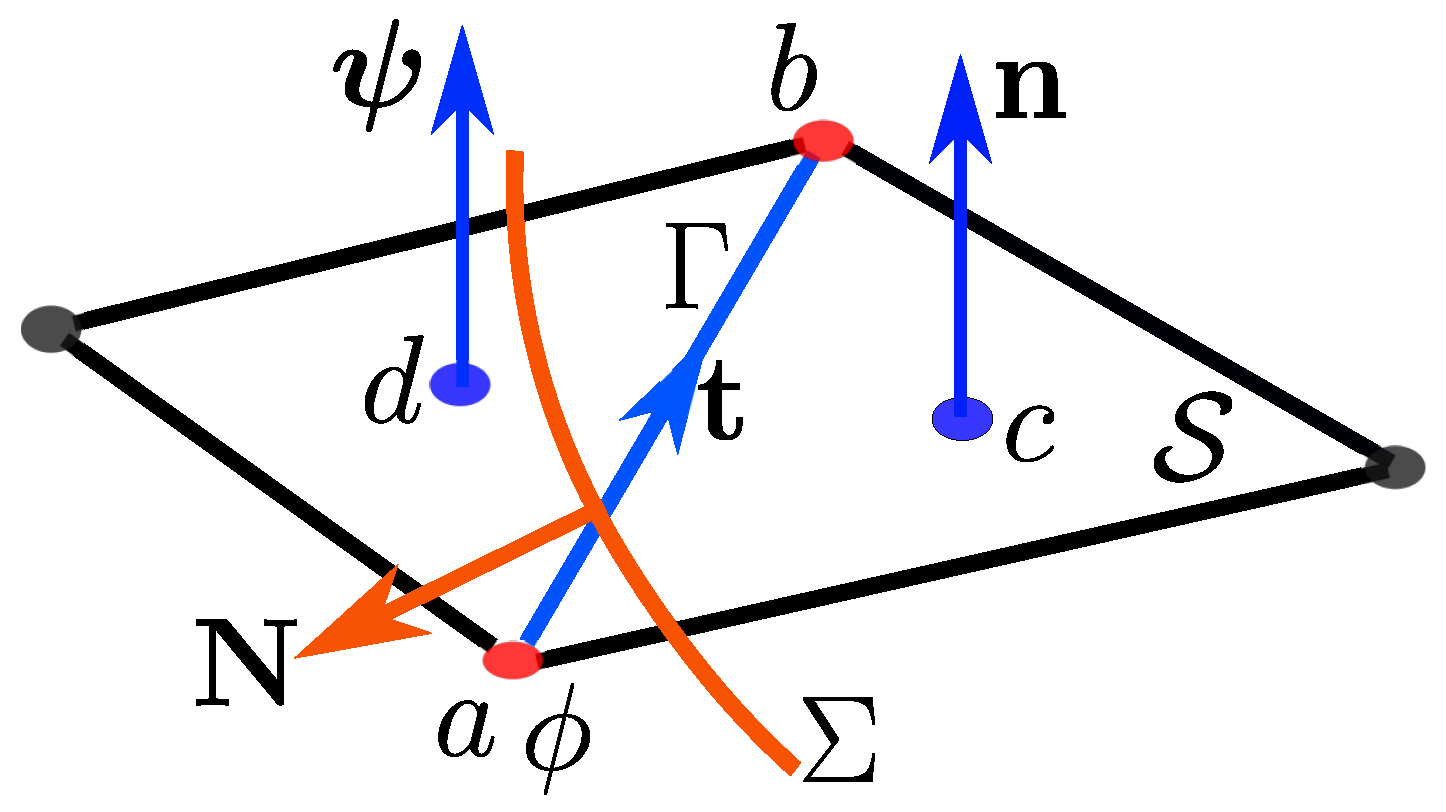
The location of the physical quantities is specified in
Figure 4, which shows the interface
between the two fluids; the scalar potential
and the surface tension
are positioned at the vertices of the primitive structure, and the vector potential
and the transverse surface tension
are located on the facet
. In the absence of variations in surface tension
as a function of temperature, the connection conditions between the two media are written as follows:
where, unlike in classical mechanics, the tangential stresses are not zero, even for an ideal fluid (
) or for a state of static equilibrium. In the latter case, the normal and tangential connection conditions are separated into two relations, (23a) and (23b). In fact, these conditions are implicitly satisfied in the discrete law of motion (
4) equipped with capillary source terms.
In the absence of the Marangoni effect, condition (
19) relating to classical mechanics is reduced to the normal component alone, which reproduces Laplace equilibrium when the curvature is constant. This is not the case for discrete mechanics, where tangential stresses due to capillary effects accumulate in the vector potential
. The explanation for this physical phenomenon lies in the similarity between fluid mechanics and solid mechanics. The bending of a beam generates compressive and shear stresses on either side of the neutral fiber. The Laplace equilibrium for two Newtonian fluids generated by capillary actions is, of course, a static state where the velocity is zero at equilibrium, but the pressure difference on either side of the interface only exists because the drop collapses in on itself, creating a radial movement counteracted by the incompressibility of the fluids. At the same time, the tangential stresses created by the non-zero curvature of the interface accumulate in the vector potential under the influence of the expansion of the fluid on the outside and its contraction in its concave part, even if the velocity remains zero. In this process, the role of viscosity is zero, as is velocity.
The discrete law of motion (
4) intrinsically solves this problem. Regardless of the discrete capillary model chosen, the physical parameters, the mesh quality, or the interface transport method, the capillary source term must be written in the form of a Helmholtz–Hodge decomposition, the sum of a curl-free component and a divergence-free component [
19]. If this is not the case, such as in the CSF model,
, or in any other model, the pressure difference will be obtained by accumulation of the compression effects included in this source term, but no other term in the Navier–Stokes equations will compensate for the rotational components of the parasitic currents. On the other hand, the discrete model (
4) introduces the vector potential
, which is equivalent to the scalar potential for compression effects in terms of rotational effects. In the case where the source term
is not decomposed beforehand, the capillary mechanical equilibrium is described by the equation
where terms involving velocity
are strictly zero.
The physical model is developed by the author in [
8] with numerous examples of capillary flows. In particular, the source term can be divided a priori into two components of a Helmholtz–Hodge decomposition,
, where the two capillary potentials can themselves be expressed as functions of velocity
. The discrete Equation (
4) allows us to simulate the evolution of velocity and potentials over time and naturally reduces to a static Equation (
24) when mechanical equilibrium is satisfied.
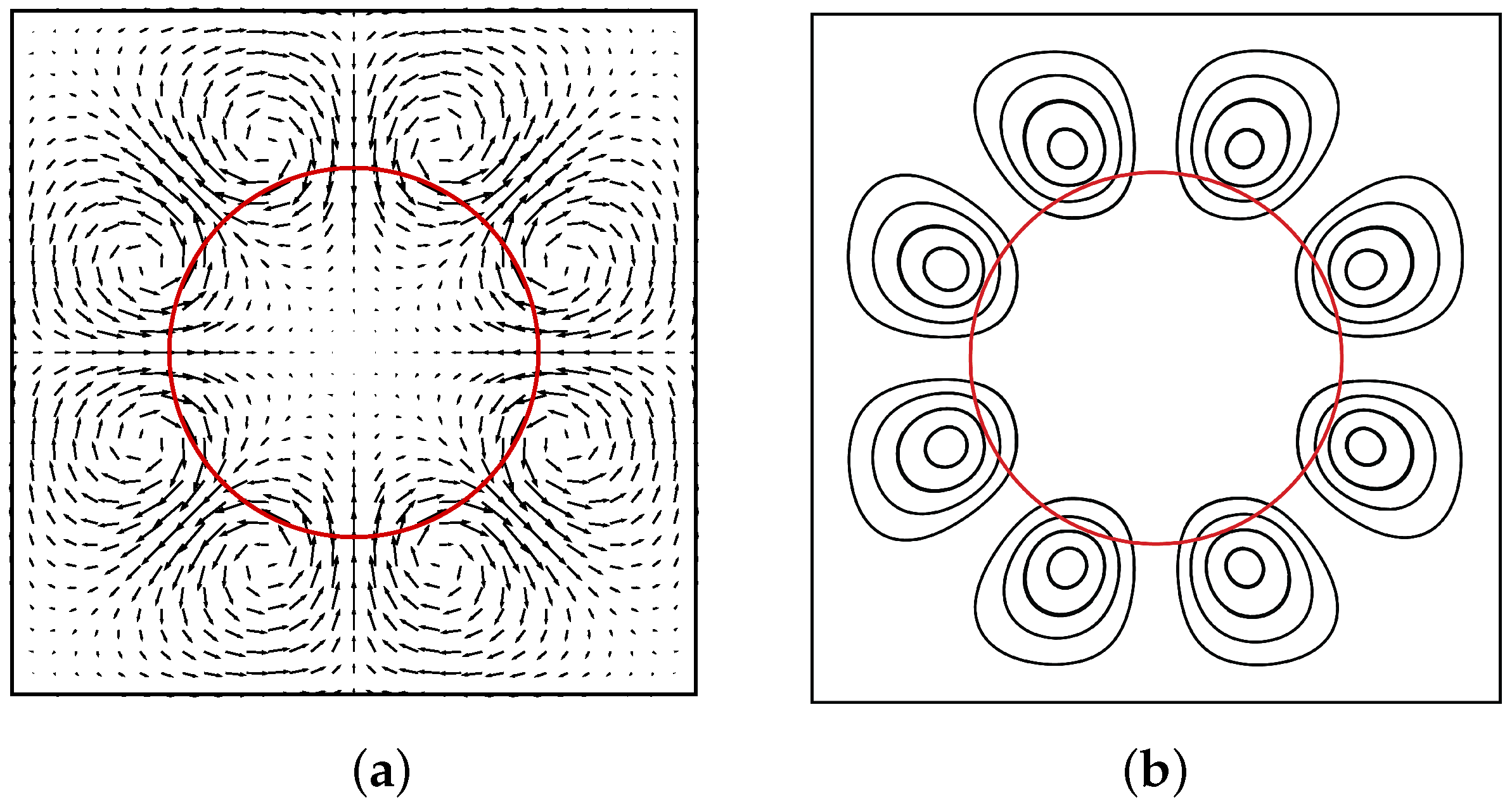
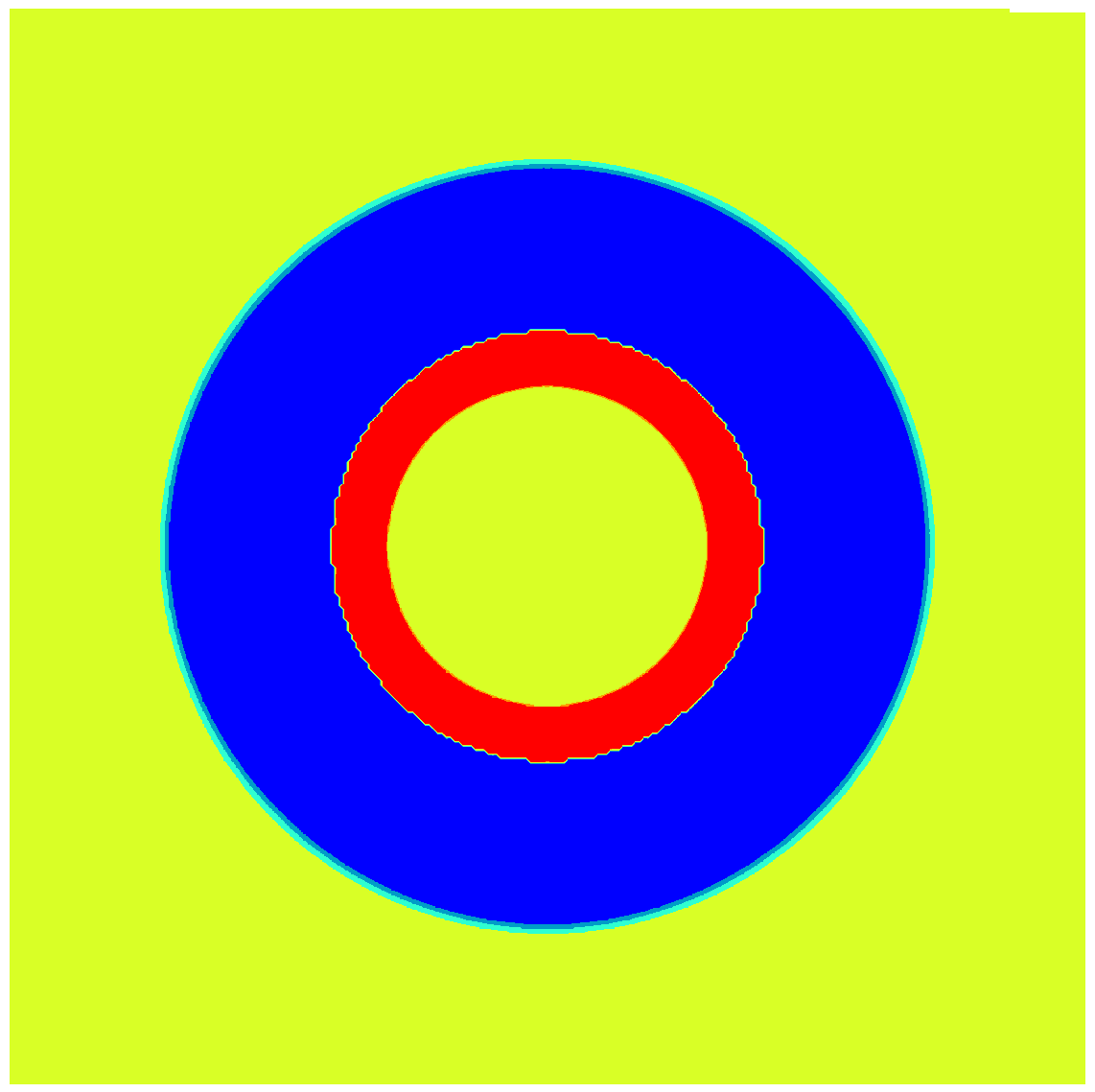
To clarify the nature of parasitic currents, consider a simple example of a cylindrical water droplet of radius
R in air contained within a square domain, as illustrated in
Figure 5. The numerical simulation based on Equation (
4) consists of integrating a source term
and calculating the variations in velocity and potential until a steady-state solution is obtained. The circle defining the interface
is projected onto a uniform structured mesh of
Cartesian meshes, and a ray tracing method allows, in the general case, the vertices of this mesh included in the object concerned to be detected. The curvature
is calculated from Lagrangian markers, but in this case, the curvature is constant and strictly equal to
. The surface tension per unit mass is also a constant equal to
; the normal to the interface
is also calculated with accuracy. Thus, the source term
is defined exactly, and no numerical error supports the idea of parasitic currents linked to purely numerical artifacts. The phenomenon observed using the Navier–Stokes equations does not depend on (i) the densities of the fluids, (ii) their viscosities, (iii) the number of meshes in the structured or unstructured mesh, or (iv) the time steps used for the simulations. As indicated by D. Harvie [
16], in the absence of forced convection, the intensity depends solely on capillary and inertial effects characterized by the capillary number
and the Weber number
. It is therefore not necessary to provide the numerical values used; the emphasis here is on the underlying reason for the existence of these parasitic currents. Observation of the results obtained with the two models presented in
Figure 5 shows that they are very different. With the Navier–Stokes equations, in the absence of the vector potential
, parasitic currents appear spontaneously in both fluids and cross the interface
; these persist indefinitely over time. When this potential is present in the discrete law of motion, the velocities attenuate rapidly and Equation (
24) is strictly satisfied with a zero velocity throughout the domain, i.e.,
in machine double precision. In the latter case, the scalar potential difference on either side of the interface is strictly equal to
, which is the theoretical value of Laplace’s capillary equilibrium. The absence of the vector potential in the Navier–Stokes equations leads to the maintenance of a rotational component whose existence cannot be guaranteed by the pressure gradient.
Table 2 shows the value of the residual velocity norm for a simulation performed using the Navier–Stokes equations, as well as the norm of the vector potential
for the proposed formulation in the case of Laplace’s static equilibrium. The velocity is never zero in the case of the Navier–Stokes equations, and the streamlines cross the interface between the two fluids in steady state. These behaviors do not depend on the time step or the spatial approximation.
Regardless of the capillary model, the properties of the fluids used, and the methodology chosen, the conclusions are always the same. The source term
is explicitly or implicitly decomposed into a curl-free component and a divergence-free component. In fact, the equation of motion (
4) behaves like a Helmholtz–Hodge extractor of the source term
. Since the scalar potential alone cannot accumulate both pressure and shear stresses, it is imperative to introduce and maintain the notion of vector potential
in all cases, including for Newtonian fluids. As in the previous example of capillary rise, mechanical equilibrium always results in the presence of these two potentials (25). The absence of this potential in the Navier–Stokes equations invalidates the notion of completeness necessary for any physical model.
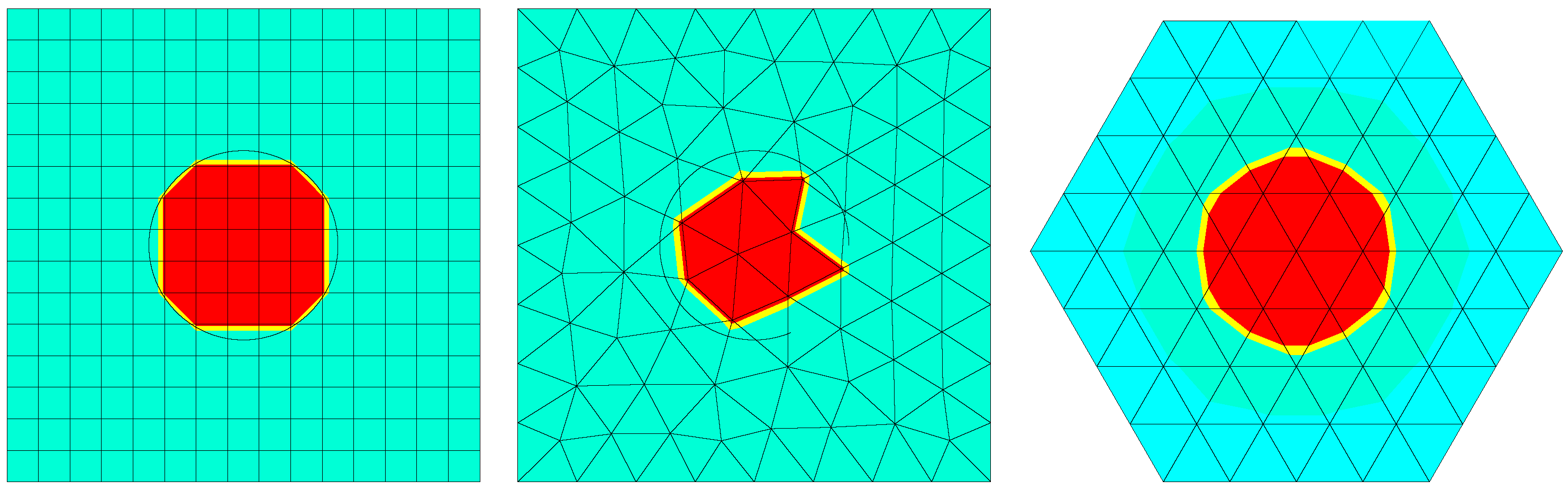
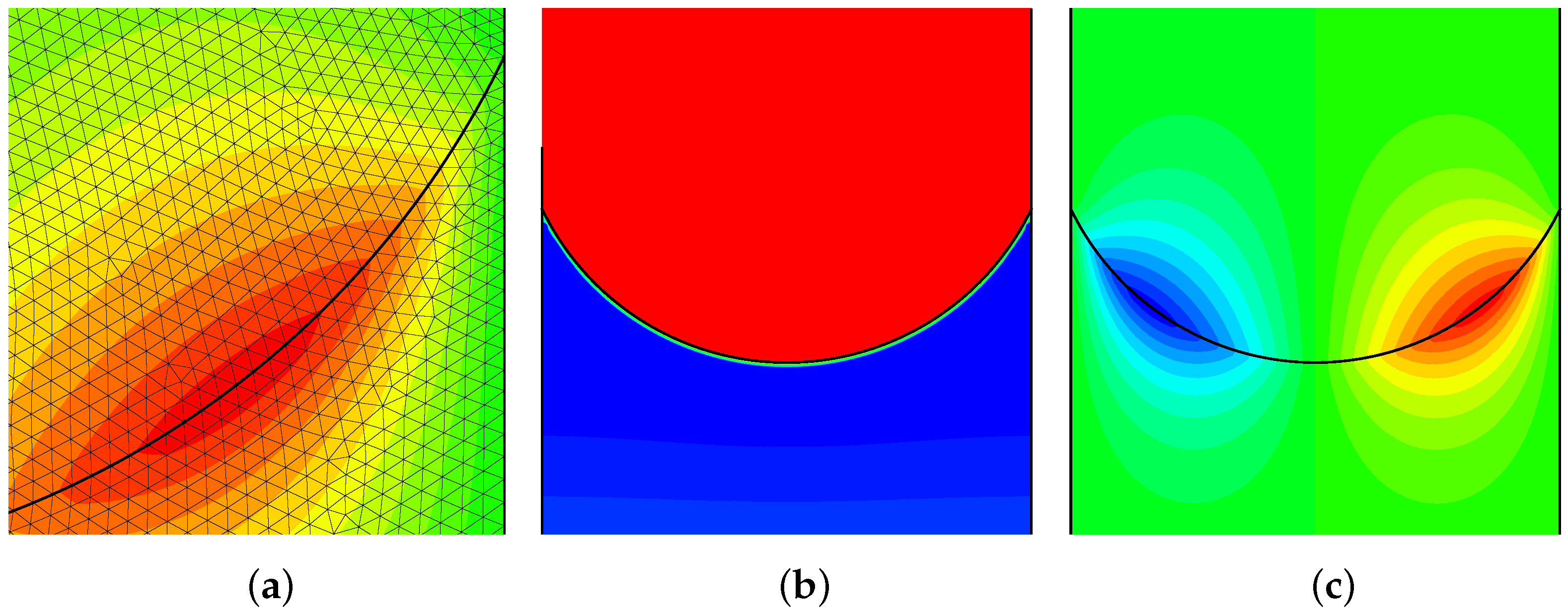
Figure 6 illustrates the results obtained for the Laplace problem in the context of discrete mechanics for several mesh examples: a structured Cartesian mesh, an unstructured mesh based on arbitrary triangles, and a mesh based on regular triangles.
In all cases, including highly distorted meshes, direct numerical simulation provides a solution without parasitic currents, i.e., velocities less than and an exact value for the pressure difference between the two phases.
3.2. Capillary Equilibrium of a Fluid Between Two Planar Surfaces
Based on current knowledge, static capillary equilibrium in a tube with a circular cross-section or between two planes is defined solely by Jurin’s formula, where is the capillary tension, is the average curvature, g is gravity, and is the height to which the meniscus rises in static equilibrium; it should be noted that this height is an average value that corresponds to the barycentric height. This quantity is of course correlated with the pressure difference existing between the lower and upper parts of the vertical capillary tube. The problem addressed here is that of the completeness of the modeling of this phenomenon given in the current framework with the sole contribution determined by the equilibrium of pressure. The objective is to prove physically and mathematically that static equilibrium cannot be obtained from this single explanation of pressure.
Consider two fluids, a liquid with density
and kinematic viscosity
covered by a gas with density
and kinematic viscosity
, contained between two planes separated by a distance
.
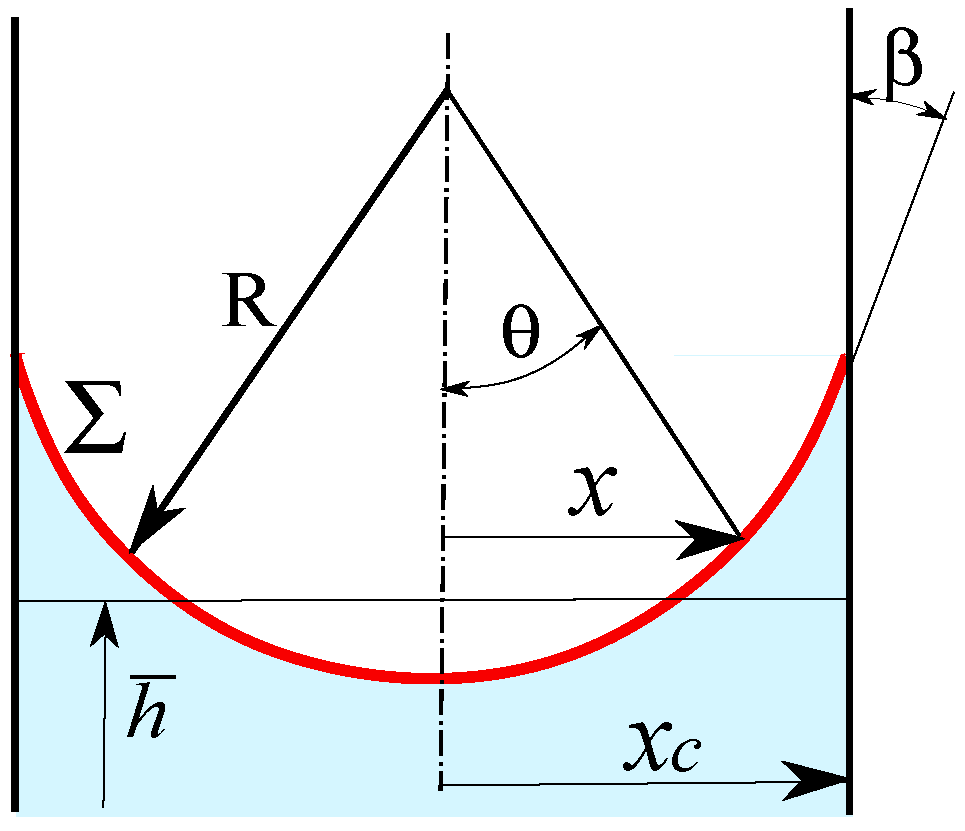
Figure 7 shows the interface
formed between the two vertical planes of these two immiscible fluids; it is part of a circle with radius
R, i.e., curvature
, connected to the two planar surfaces by a contact angle
. The gravitational acceleration is defined by the vector
. The surface tension between the two fluids is here set at
, where
is the traditional surface tension.
The source term representing external accelerations, capillary acceleration, and gravitational acceleration are not aligned in this case, and each is the sum of two components: one curl-free and the other divergence-free. The law of motion that expresses dynamic equilibrium in the presence of the other terms of compression and rotation is written as follows:
where the longitudinal and transverse velocities,
and
, define, respectively, the compressibility of the two fluids and the viscosity
for Newtonian viscous fluids; the quantities
and
are the longitudinal and transverse curvatures. The Cartesian coordinates
are calculated from the polar coordinates
where
x is the abscissa
x is counted from the median plane and the origin of
is defined from the barycentric height
.
The physical phenomena involved in capillary equilibrium are complex and closely related. The effect of gravity tends to pull the liquid down between the two planes to reach an equilibrium where the interface is horizontal. Capillary effects act to pull the liquid upward near the surfaces. These contradictory effects lead to a surface
that is part of a circle, neglecting the influence of gravity on the shape of the interface, which is a perfectly acceptable assumption if the distance between the two planes is small; this phenomenon is of secondary importance here, since the objective is to explain the origin of parasitic currents. The two contributions to static equilibrium are in fact related to the compression and rotation energies represented by the scalar and vector potentials. These two contributions are then written as follows:
with
where
is the kinematic viscosity of fluids.
The vector law of motion (
26) contains all the terms necessary to simulate the different phases of capillary rise, with inertia governing the inertial phase in the early stages of the simulation where the rise velocity is a function of time in
, and viscosity governing the later phase to reach static equilibrium where only gravitational and capillary effects persist indefinitely. It is this latter phase that is of interest, because the mathematical model, the law of motion, must be able to represent it strictly. This is the case in discrete mechanics where the law of motion, for a velocity set to zero in all terms, becomes
This relationship, where the gradient of one function is equal to dual curl of another function, is satisfied when these two orthogonal operators are equal to a harmonic function or a constant. Since potentials are only defined up to a constant, this relationship can be divided into two parts:
where
is related to the shape of the interface, which, in this case, is cylindrical. We can deduce that the height is equal to
, which corresponds to Jurin’s law, noting that
is the barycentric height and not the height below the meniscus used by many authors. Noting that
, we can finally deduce the expressions of the potentials as a function of
x or the polar angle
:
with
, where
is the limit angle, defined as the contact angle
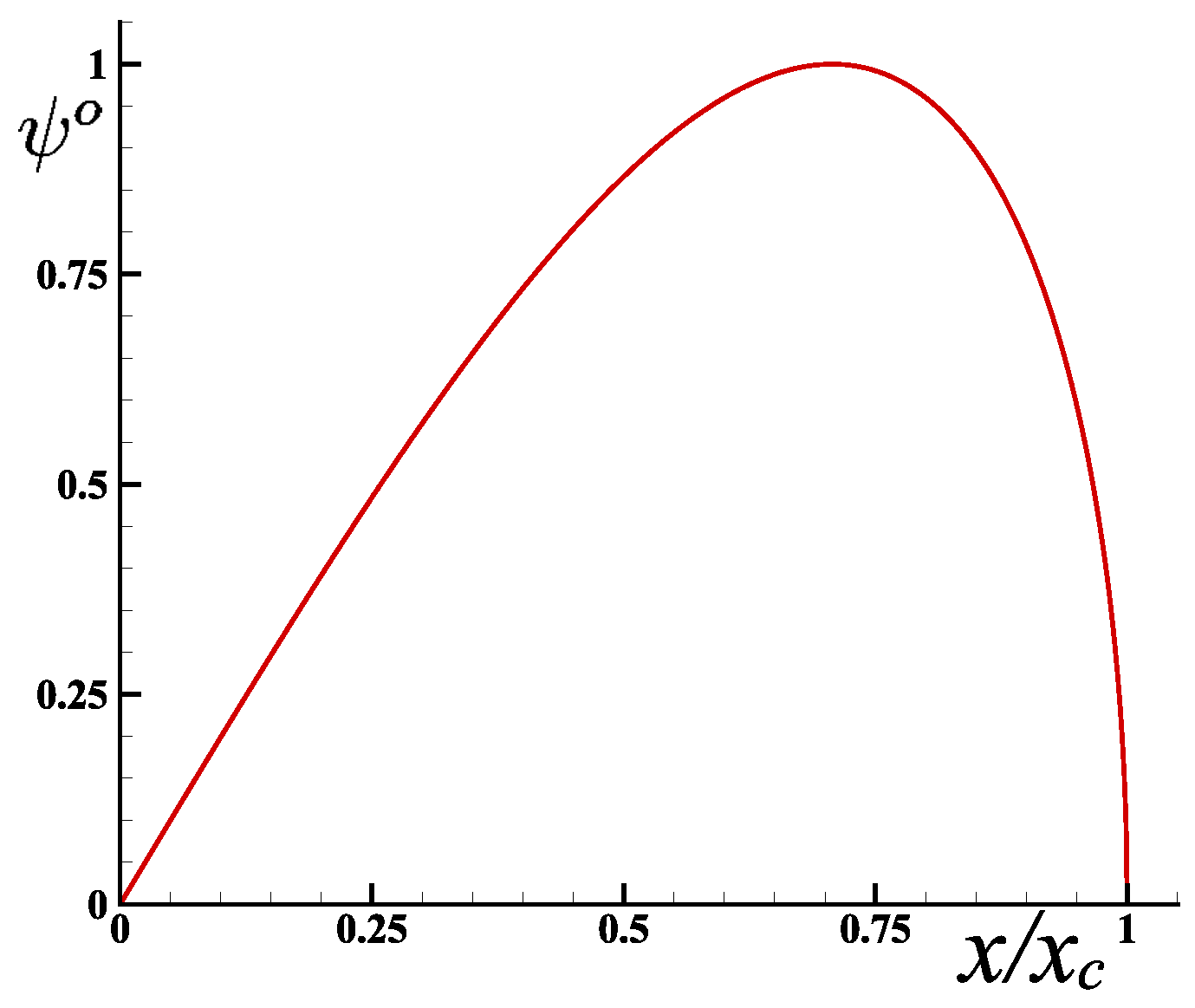
. The evolution of the vector potential
is shown in
Figure 8 as a function of the ratio
along the interface
. The maximum vector potential is reached for
.
Jurin’s law is incomplete and insufficient to represent capillary equilibrium. This statement is true from a mathematical and physical point of view; it is necessary that the capillary equilibrium relative to this problem be strictly respected. Most work on capillary rise aims to show that the capillary height
corresponds well to experiments or numerical simulations [
20,
21,
22,
23]. While experiments do indeed lead to the static equilibrium predicted by Jurin’s law, numerical simulations based on the Navier–Stokes equations reveal, regardless of the methodology used, parasitic currents in the form of vortices while the interface is stationary.
What physical analysis would allow us to conclude that there is a static equilibrium at a strictly zero velocity? The underlying reason is related to the accumulation of viscous stresses in a fluid. In the case of a Newtonian fluid, shear stress only exists if the fluid is in motion, so Newton’s law is written as
, where
is the dynamic viscosity. In discrete mechanics, the viscous stress takes another form,
. In a viscoplastic fluid such as Bingham fluid, with very low stresses, there is a threshold where the fluid behaves like a solid, the velocity becomes strictly zero, while the stress does not. In the meniscus area, the fluid tends to descend under the effect of gravity, but capillary effects cause it to rise back up near the walls, and the two actions are not aligned. A vortex forms and persists for a long period of time; viscous stresses accumulate as in a solid and the velocity decreases. The Newtonian fluid model is then no longer able to represent this behavior with a very long time constant. The discrete law of motion (
26) includes the equilibrium vector potential
, which allows viscous stresses to accumulate in the same way that the scalar potential
(or pressure) accumulates compressive stresses. Observation of fluids near a meniscus shows that velocities are not zero during capillary rise, but that they attenuate and tend toward zero when capillary equilibrium is reached. The modeling of an elastic solid is based on two potentials: the scalar potential
, which accumulates compressive stresses, and the vector potential
, which updates shear stresses from the term
, where
is the transverse velocity. At high time constants, Newtonian fluids do not accumulate shear stresses, and the product
is replaced by the kinematic viscosity
. In parallel with very low stresses, the shear energy is stored in the potential
, and the fluid then behaves like a solid.
After this physical analysis, the problem can be addressed directly by solving the law of motion. Consider the geometry illustrated in
Figure 7, which combines a liquid and a gas between two vertical planes. The densities of the liquid and gas expressed in SI units are, respectively, equal to
kg m
−3 and
kg m
−3. The kinematic viscosities are equal to
m
2s
−1. The contact angle is set to a value such that
and the half-distance between the two planes is equal to
m. Given the contact angle, the curvature of the interface is therefore equal to
m
−1. The surface tension
m
3s
−2 and the product
is equal to
m
2s
−2; furthermore, the value of gravity
ms
−2 leads to a barycentric capillary height of
10
−3 m. The domain is flat, rectangular, with dimensions
, and the base of the interface between the two fluids in static equilibrium is positioned at
. The value of the downward vertical gravity is chosen so as to obtain an upward or downward displacement of the interface, or static equilibrium. The primal topology is shown in
Figure 9a and corresponds to a mesh based on regular triangles delimiting the two media by a mesh line. The boundary conditions are associated with vertical solid walls (
) and horizontal free walls where the pressure is constant and equal to
. The pressure difference on either side of the interface resulting from the simulations must be equal to
at static equilibrium.
The procedure used to solve the problem by direct simulation consists of defining an interface
at a fixed average height
in the form of a portion of a circle and tessellating the two connected domains in two dimensions of space with regular triangles. Solving the law of motion then gives a non-zero velocity field whose average is positive or negative. Depending on the sign of this quantity, the height
is adjusted to obtain a zero velocity field. Depending on the parameters defined above, the process actually leads to a state of rest and a strictly zero velocity. The static equilibrium is then described by (
31),
where the gradient of one function is equal to twice the curl of another function. The Helmholtz–Hodge decomposition is the cornerstone of the derivation of the discrete law of motion; it is not used here a priori to separate the two components of a vector, but as a fundamental principle of the behavior of the entanglement of two phenomena. Maxwell’s frame of reference perfectly illustrates this principle by showing the respective roles of direct and induced actions. The results of the numerical simulation are presented in
Figure 9, where the two static equilibrium potentials
satisfy condition (
31).
The static equilibrium results are perfectly consistent in both the liquid and gas domains, with a scalar potential varying in the range and a vector potential around the interface varying around zero, . The average height m is therefore consistent with the imposed gravity value, m s−2.
To conclude this problem of capillary rise between two planes or a tube, we can say that static equilibrium can only be achieved by introducing a vector potential that accumulates shear stresses in the same way that pressure accumulates compressive stresses. This phenomenon raises the fundamental physical question of the Newtonian viscous model at very low shear stresses; viscosity is fundamentally a difficult parameter to determine at very low time constants or very low stresses.