


Abstract
Coronary artery disease (CAD) is the leading cause of mortality and morbidity in the world. While low-density lipoprotein cholesterol has been the main target of secondary prevention, inflammation has gained traction as a potential target for reducing adverse cardiovascular events. Hence, in this review, we aim to outline the current evidence base for the use of colchicine in CAD to provide more clarity from the findings in the recent trials and meta-analyses (LoDoCo2, COLCOT, COPS, CONVINCE, CLEAR-SYNERGY, COLOCT, and EKSTROM). Given colchicine’s low cost and widespread availability, it is a potential adjunct to lipid-lowering therapy. However, it may not be as effective in the secondary prevention of CAD as previously thought. Ongoing research on colchicine remains vital to determine its utility in patient populations beyond those with CAD as well as to better understand the fine balance between its therapeutic benefits and potential side effects.
1. Introduction
Although there have been notable advancements in recent decades, cardiovascular disease (CVD) continues to be the leading cause of morbidity and mortality globally [1]. Currently, the treatment for CAD consists of non-pharmacological and pharmacological management. The traditional cardiovascular risk factor reduction strategies include a healthy diet, physical activity, and cessation of alcohol and smoking. Blood pressure control, antiplatelet therapy, and lipid-lowering therapies—high-dose statins, ezetimibe, and PCSK9 inhibitors—are key to managing this pathological process [2].
Targeting low-density lipoprotein cholesterol (LDL-C) has become a central component of secondary preventive care, and addressing inflammation has also emerged as a potential method for reducing the risk of cardiovascular events [3]. The Canakinumab Anti-inflammatory Thrombosis Outcome Study (CANTOS) provided initial evidence that targeting inflammation may improve cardiovascular outcomes [4]. However, the high cost of canakinumab along with the increased rate of fatal infections made it a less promising drug [4]. Colchicine, on the other hand, is inexpensive, safe, and widely available.
Colchicine received further attention after the LoDoCo2 and COLCOT trials reported favourable results, prompting both the ESC and AHA to support its use for secondary prevention [2,5,6,7]. However, subsequent findings from the CONVINCE and CLEAR-SYNERGY trials have moderated earlier expectations regarding colchicine [8,9]. Given the increased number of trials and meta-analyses on this topic, we aim to evaluate current evidence to provide an up-to-date review on the utility of colchicine in coronary artery disease.
2. Chronic Inflammation in Atherosclerosis
Atherosclerosis is a chronic, progressive disease centred around inflammation as well as the innate and adaptive immune response [10]. The process is initiated when endothelial dysfunction results in LDL infiltration and accumulation in the tunica intima. The LDL particles oxidise, which triggers activation and production of inflammatory mediators that recruit circulating monocytes. These monocytes then differentiate into macrophages, which absorb oxidised LDLs, in turn becoming foam cells. Subsequently, vascular smooth muscle cells migrate to the area, which helps in the development of the fibrous plaque with a necrotic core and fibrous cap [11]. As atherosclerotic plaque grows, it can become unstable, subsequently resulting in plaque rupture and major cardiovascular events (MACE).
This chronic low-grade inflammation in patients has been proven to be a strong independent factor of MACE despite being on secondary prevention, as assessed by raised high-sensitivity CRP (hsCRP) levels [12]. The PROVE IT-TIMI 22 trial demonstrated that patients with lower CRP levels after statin therapy had better clinical outcomes compared to those with higher CRP levels, and this was independent of LDL-C levels [13].
The NLR family pyrin domain containing 3 (NLRP3) inflammasome is central to the residual inflammatory risk hypothesis. In atherosclerosis, cholesterol deposits, oxidised LDLs and danger-associated molecular patterns (DAMPs) are the main triggers for NLRP3 activation [14]. Upon activation, it triggers the secretion of cytokines like interleukin-1β (IL-1β), interleukin 6 (IL-6), and interleukin-18 (IL-18) [11]. The result is an increased inflammatory response and oxidative stress in endothelial cells. This persistent activation of NLRP3 and the interleukin cascade continues as an ongoing feedback loop. Specifically, IL-6 plays a key role in stimulating the production of acute-phase reactants like hsCRP, which further drives the recruitment and activation of inflammatory cells [15].
3. Mechanism of Action of Colchicine
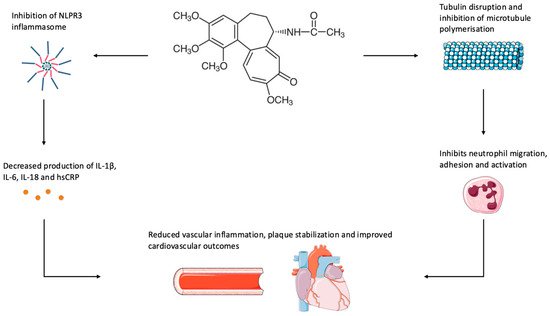
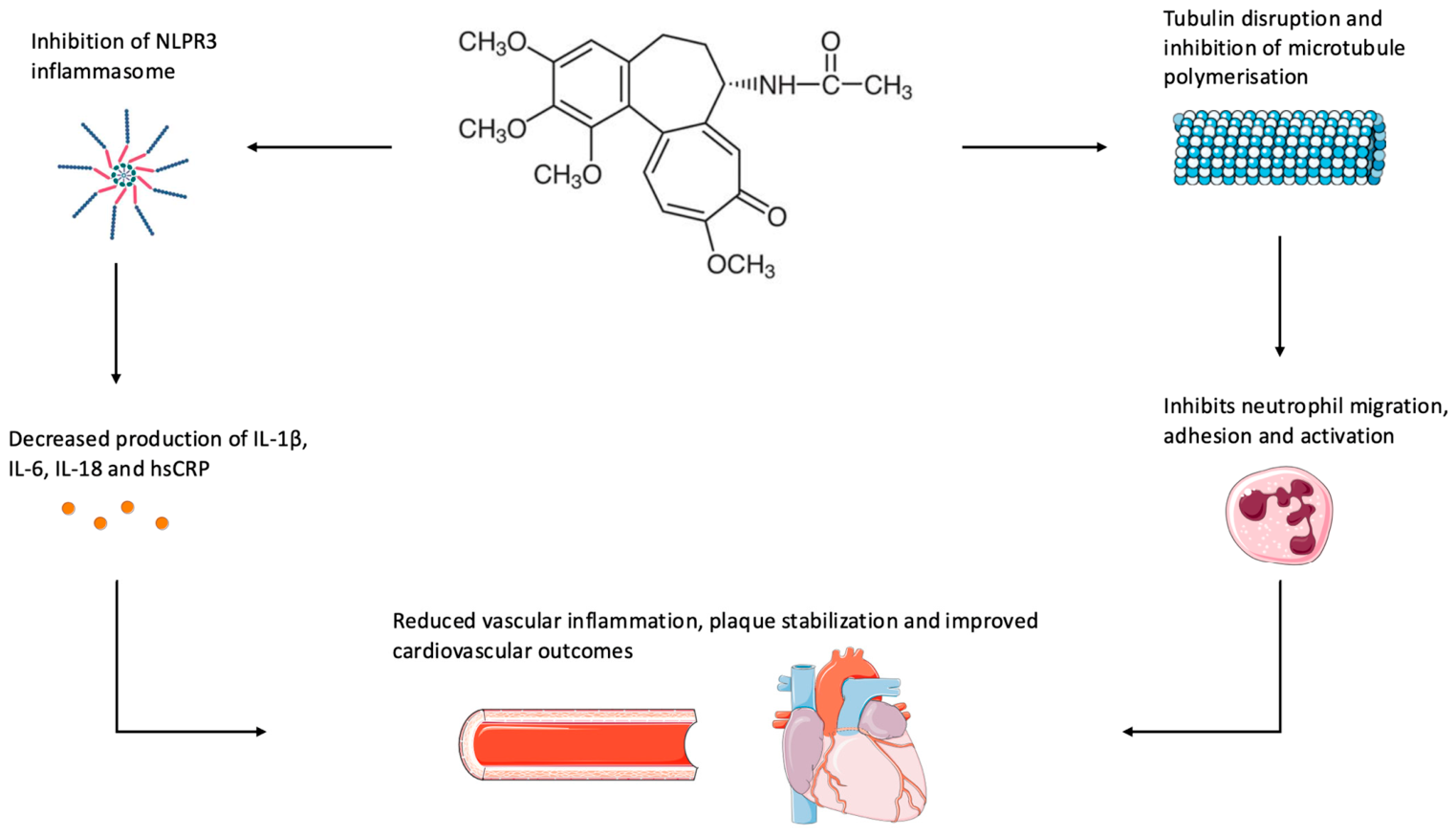
Colchicine is an oral medication that binds to tubulin, inhibiting tubulin polymerisation and microtubule formation [16,17] (Figure 1). This disrupts downstream cellular functions, including the cellular cytoskeleton, mitosis, and intracellular protein transport. Consequently, it leads to slower plaque growth, plaque stability, and prevention of plaque rupture with the suppression of secretion of smooth muscle cells, myofibroblasts, and fibrosis [18]. Colchicine also results in diminished surface expression of L-selectin adhesion molecules and E-selectin adhesion molecules and downregulates tumour necrosis factor receptors on macrophages and endothelial cells [18]. This inhibits neutrophil migration, adhesion, and activation, as well as leukocyte adhesion to the endothelium. Most importantly, colchicine has the ability to suppress the NLRP3 inflammasome. The NLRP3 inflammasome is present in myeloid cells and produces inflammatory cytokines IL-1β and IL-18 capable of promoting oxidisation of LDL, foam cell production, and progression of atherosclerotic plaques. Hence, inhibiting the NLRP3 inflammasome is helpful in preventing the activation of the innate immune response, preventing plaque progression and plaque rupture [16]. The NLRP3 inflammasome also triggers IL-6 production, which promotes hs-CRP production [16]. The use of colchicine also has downstream effects of reducing hs-CRP.
Figure 1.
Mechanism of action of colchicine.
4. Trials and Clinical Utility
Clinical characteristics of each study were extracted and presented in Table 1. We included data on population, colchicine dose, comparator, follow-up duration, baseline hsCRP and primary outcomes of studies.
Table 1.
Overview of colchicine trials.
4.1. Low-Dose Colchicine (LoDoCo2) Randomised Controlled Trial
The LoDoCo2 trial was a double-blinded randomised controlled trial that was conducted in Western Australia and the Netherlands [5]. A total of 5522 patients with stable coronary artery disease were enrolled, identified by invasive coronary angiography, computed tomography angiography, or a coronary-artery calcium score of 400 Agatston units or higher. Notably, 84% of these participants had a history of acute coronary syndrome (ACS).
Prior to trial initiation, there was a lead-in period of one month where patients received 0.5 mg of colchicine daily. This ensured only compliant patients without adverse side effects were included in the trial. Patients in the colchicine group continued to have 0.5 mg of colchicine daily with follow-ups every 6 months and a median follow-up duration of 28.6 months (IQR: 20.5–44.4). The LoDoCo2 trial demonstrated a significantly lower risk of cardiovascular death, spontaneous myocardial infarction, ischaemic stroke or ischaemia in the colchicine group compared to the placebo group (6.8% vs. 9.6%; HR: 0.69; 95% CI: 0.57–0.83; p < 0.001). Although insignificant, non-cardiovascular deaths and deaths from any cause had a higher incidence in the colchicine group compared to the placebo group, with a hazard ratio of 1.86 (0.99–3.48) and 1.21 (0.86–1.71), respectively. Unlike CANTOS, hsCRP was not routinely measured in LoDoCo2 and was not a prerequisite for randomisation [4].
4.2. Colchicine Cardiovascular Outcomes Trial (COLCOT)
The double-blinded COLCOT randomised a total of 4745 patients who had a myocardial infarction or planned percutaneous coronary interventions in the preceding 30 days. Patients in the colchicine group had 0.5 mg of colchicine daily, and all patients were followed up at the one-month mark and at every three months thereafter, with a median follow-up of 22.6 months. COLCOT demonstrated a significantly lower risk of cardiovascular death, resuscitated cardiac arrest, myocardial infarction, stroke and urgent hospitalisation for angina leading to coronary revascularisation in the colchicine group compared to the placebo group (5.5% vs. 7.1%; HR: 0.77; 95% CI: 0.64–0.96; p = 0.02) [6]. In addition, adverse events, including pneumonia, nausea and flatulence, were statistically significant in the colchicine group (0.09% vs. 0.4%, p = 0.03; 1.8% vs. 1.0%, p = 0.02; 0.6% vs. 0.2%, p = 0.02).
In COLCOT, only 207 patients had both baseline and post-treatment hsCRP measured (99 colchicine, 108 placebo). After six months, hsCRP dropped by 70% in the colchicine group and 66.6% in the placebo group, but the small sample size limits direct comparison. Notably, the median on-treatment hsCRP was 1.37 mg/L—well below the 2 mg/L threshold linked to outcomes in the CANTOS trial.
4.3. Colchicine in Patients with Acute Coronary Syndrome (COPS) Trial
The COPS trial was a double-blinded randomised controlled study conducted in Australia, enrolling 795 patients diagnosed with ACS and CAD [19]. CAD diagnosis was established via coronary angiography, defined as at least 30% luminal stenosis in an epicardial vessel measuring a minimum of 2.5 mm in diameter. Patients were treated either with percutaneous coronary intervention or received medical therapy. The colchicine regimen consisted of 0.5 mg administered twice daily for one month, followed by 0.5 mg once daily for the subsequent eleven months, with follow-up assessments at one, six, and twelve months. The study demonstrated a reduced incidence of the composite endpoint—including all-cause mortality, ACS, ischaemia-driven urgent revascularisation, and non-cardioembolic ischaemic stroke—at 12 months in the colchicine group compared with placebo (6.1% vs. 9.5%, HR: 0.65; 95% CI: 0.38–1.09; p = 0.09). However, rates of all-cause death and non-cardiovascular mortality were higher among patients receiving colchicine (2.0% vs. 0.25%, p = 0.018; 1.3% vs. 0%, p = 0.023). A subsequent meta-analysis including these three trials did not reveal any significant concerning signal for non-cardiovascular death [3].
4.4. CONVINCE Randomised Controlled Trial
The CONVINCE trial randomised 3144 patients with non-severe ischaemic stroke or high-risk transient ischaemic attack (TIA) within 72 h and 28 days to 0.5 mg colchicine daily or guideline-based therapy [8]. Patients with a modified Rankin Scale score of three or less were defined as having a non-severe ischaemic stroke, and they made up the bulk of patients in the trial (88.0% colchicine vs. 87.8% control). Patients who had transient focal motor or speech deficits, including an ABCD2 score of at least four, 50% or more stenosis of the large artery lumen, or hyperintensity on diffusion-weighted magnetic resonance imaging (MRI) with focal neurological deficits, were included as a high-risk TIA. These patients were followed up at 28 days, 90 days, and at six-month intervals thereafter with a median follow-up of 36 months. At 36 months of follow-up, the colchicine group had a non-significant lower incidence of first recurrent non-fatal ischaemic stroke, myocardial infarction, cardiac arrest, or hospitalisation in the colchicine group (9.8% vs. 11.7%; HR: 0.84; 95% CI: 0.68–1.05; p = 0.12).
In the trial, most patients had baseline hsCRP recorded, which showed a statistically significant decrease over three years (2.71 mg/L to 1.52 mg/L for colchicine and 2.82 mg/L to 1.91 mg/L for the control, p = 0.02). Although there was a significant reduction in hsCRP, 86.4% of patients had measurements at baseline compared to only 26.4% at the three-year mark. This notable decrease in sample size may affect the reliability of the results. One limitation of the trial was the absence of a placebo group, as the comparison group received guideline-based management only. The study also enrolled patients with high-risk TIA, a diagnosis that can be subjective due to the lack of definitive biomarkers or imaging criteria. Additionally, the trial occurred during the COVID-19 pandemic, leading to a two-month pause in recruitment, an extension of the overall trial duration by more than a year, and incomplete follow-up, factors that may have contributed to 8% fewer outcomes than anticipated and less conclusive results. During the pandemic, higher rates of stroke were observed among patients with COVID-19, as indicated by a retrospective cohort study in New York that reported a greater likelihood of stroke in individuals with COVID-19 compared to those with influenza infection (OR: 7.6, 95% CI: 2.3–25.2) [20]. The reduced enrolment rates during the pandemic may therefore be associated with patient hesitancy to attend hospitals during this period.
4.5. CLEAR-SYNERGY (OASIS 9) Trial
The most recent CLEAR-SYNERGY (OASIS 9) trial investigated patients with myocardial infarction (STEMI and large NSTEMI) who were enrolled within 72 h from their index PCI, and its findings were a stark contrast to those of LoDoCo2 and COLCOT [9]. A total of 7062 patients were included, and the majority of patients presented with a STEMI (95.3% colchicine vs. 94.8% placebo). In this trial, the dosage of colchicine was dependent on weight in the initial 90 days—0.5 mg twice a day for patients who were at least 70 kg and 0.5 mg once daily for patients less than 70 kg. All patients in the colchicine group had 0.5 mg once daily after the first 90 days. However, the protocol was changed during the study, and a reduced dose of colchicine was used (0.5 mg for all patients). After a median follow-up of three years, there was no significant reduction in the incidence of cardiovascular deaths, recurrent myocardial infarction, stroke, or unplanned ischaemia-driven coronary revascularisation (9.1% vs. 9.3%; HR: 0.99; 95% CI: 0.85–1.16). In addition, diarrhoea was a statistically significant adverse effect that occurred in the colchicine group (10.2% vs. 6.6%), which was not the case in COLCOT [5,6].
While hsCRP levels had a statistically significant least-squares mean level at three months (colchicine: 2.98 ± 0.19 mg/L vs. placebo: 4.27 ± 0.19 mg/L), inflammation was not controlled compared to levels seen in COLCOT and CANTOS [4]. In COLCOT, even though baseline hsCRP was high, colchicine still managed to result in a 70% reduction in hsCRP after six months from 4.27 mg/L to 1.37 mg/L [6].
This trial was conducted during the COVID-19 pandemic, which may have contributed to the low incidence of major adverse cardiovascular events (MACEs) reported. In a pre-pandemic analysis of death from cardiovascular causes, myocardial infarction, stroke, or revascularization, the hazard ratio was 0.78 (95% CI: 0.60–1.02), compared to 1.09 (95% CI: 0.88–1.35) during and 1.19 (95% CI: 0.79–1.78) after the pandemic. The pre-pandemic analysis indicated that colchicine might have had a favourable effect on MACE. During the pandemic, there was underreporting and fewer hospitalisations for non-fatal myocardial infarctions. Similar trends were observed in other trials conducted during the COVID-19 pandemic. A meta-analysis involving over 80,000 patients showed a significant reduction in the daily number of admissions for myocardial infarction during lockdown compared to the pre-pandemic period (14.7 vs. 40.6 patients per day) [21]. These factors likely influenced the findings of the CLEAR-SYNERGY trial as well as other studies conducted during the pandemic, such as IRONMAN and GUIDE-HF [22,23]. However, it is important to note that given the exploratory nature of this analysis, our viewpoints should be considered as hypothesis-generating rather than confirmatory.
Furthermore, in the spironolactone arm of the trial, the results were discordant with prior studies using mineralocorticoid receptor antagonists [24,25]. This raises further questions regarding the validity of the results obtained during the CLEAR-SYNERGY trial due to the effects of the COVID-19 pandemic.
Despite the findings from the CLEAR-SYNERGY trial, the updated systematic review and meta-analysis by Samuel et al., which includes the CLEAR-SYNERGY trial, still showed that colchicine resulted in a 25% reduction in MACE, a 29% reduction in myocardial infarction, a 37% reduction in ischaemic stroke and a 33% reduction in urgent coronary revascularisation [3]. This continues to support the ongoing use of colchicine as secondary prevention of cardiovascular events as per the American and European guidelines [2,7].
4.6. Colchicine–Optical Coherence Tomography Trial (COLOCT)
This double-blinded Colchicine–Optical Coherence Tomography Trial (COLOCT) included 104 patients who had been diagnosed and hospitalised with ACS within one month [26]. Patients had to have at least one non-culprit lesion with a stenosis diameter percentage of 30% to 70% estimated visually on coronary angiography and a lipid-rich plaque demonstrated on optical coherence tomography. Patients in the colchicine group had 0.5 mg of colchicine daily and were followed up at 12 months. COLOCT showed a statistically significant reduction in minimal fibrous cap thickness at the 12-month follow-up (87.2 μm; 95% CI: 69.9–104.5 μm vs. 51.9 μm; 95% CI: 32.8–71.0 μm). This supports the underlying mechanism of action of colchicine through plaque modification and stabilisation of plaque through inhibition of microtubule formation [27]. Though statistically insignificant, the colchicine group had lower incidences of major adverse cardiovascular and cerebrovascular events, defined as a composite of all-cause death, nonfatal myocardial infarction, nonfatal stroke, and revascularization because of ischemia (11.5% vs. 17.3%; p = 0.402).
4.7. EKSTROM Trial
The EKSTROM double-blinded randomised controlled trial randomised 72 patients with atherosclerosis proven on coronary angiography or computed tomography coronary angiography [28]. Patients in the colchicine group had 0.5 mg of colchicine daily and were followed up at three months, six months and 12 months. At 12 months, patients treated with colchicine had a significant reduction in total plaque volume compared to placebo. There was a statistically significant change in percent atheroma volume (PAV) of −1.1% (p = 0.009) between the colchicine and placebo groups. There was also a statistically significant reduction in dense calcified plaque volume of −0.9% PAV between the colchicine and placebo groups (p = 0.009). Prior studies have associated a 1% reduction in PAV with a 20% relative risk reduction in MACE [29]. Therefore, these results provide mechanistic support to colchicine studies performed pre-pandemic that showed a favourable outcome for patients with CVD treated with colchicine.
5. Safety Considerations
Colchicine has a narrow therapeutic index, with toxic doses at 0.1 mg/kg or more and potentially fatal doses at 0.8 mg/kg [30]. The most common adverse events are gastrointestinal, which include diarrhoea, vomiting and nausea. As noted in the CLEAR-SYNERGY and COLCOT trials, diarrhoea and nausea were significant adverse events in the colchicine group, respectively [6,9]. However, these gastrointestinal effects are often mild and can be avoided by starting with a low dose and slowly increasing to the therapeutic dose.
Colchicine has several drug interactions that need to be considered prior to commencement. Colchicine is a substrate for the efflux transporter P-glycoprotein and CYP3A4. Hence, it should be avoided in patients who are on CYP3A4 inhibitors (e.g., clarithromycin, itraconazole, ketoconazole, ritonavir) or G-glycoprotein inhibitors (e.g., cyclosporine, ranolazine) due to the risk of toxicity [31]. The concomitant use of colchicine and statin also increases the risk of myopathy since both medications are metabolised by P-glycoprotein and CYP3A4 [30].
Furthermore, prolonged use of colchicine is associated with bone marrow suppression. It is worth noting that the COLCOT did show that pneumonia was a significant adverse event in the colchicine group, and this may be related to reduced immunity in these patients [6]. A population-based cohort study by Tsai et al. also demonstrated a higher incidence of pneumonia in the colchicine group compared to the placebo group (18.6 vs. 126 per 1000 person-years, p < 0.05) [32]. As colchicine is metabolised in the liver and kidneys, it is important to consider dose adjustment in patients with renal or hepatic impairment.
6. Clinical Implications
The increase in the number of RCTs in the recent few years has been imperative in providing a large evidence base on the utility of colchicine in CAD. Early landmark trials like LoDoCo2 and COLCOT showed favourable results for colchicine in patients with CAD or MI compared to placebo. However, adverse events (pneumonia, nausea, flatulence) were significant in the colchicine group compared to the placebo group in COLCOT. Non-cardiovascular mortality was also significant in the colchicine group in COPS. However, in these trials, there is a skewed proportion of males compared to females, with approximately 20% or fewer women in the sample population, which is not to be expected in the general population. This is especially important given the differences in male and female physiology and the association with coronary artery disease. Pre-menopausal females have a protective factor for atherosclerosis and cardiovascular events due to oestrogen production and circulation [33,34]. More specifically, oestradiol increases nitric oxide production and decreases oxidative stress, vascular inflammation, and fibrosis, which is favourable for the maintenance of endothelial function and protection against atherosclerosis. However, the protective role of oestrogen is diminished in menopause, with increased autoantibody immune complexes and inflammatory response, which promote plaque formation and rupture [34]. This is also supported in the literature, where post-menopausal females had more vulnerable plaques that are at higher risk of plaque rupture compared to pre-menopausal females [35]. More importantly, females also have a more pronounced pro-inflammatory macrophage phenotype with increased expression of NLRP3 compared to males [36]. Given that colchicine has the ability to suppress the NLRP3 inflammasome, it would be beneficial for future trials to focus on the difference in utility of colchicine in males and females in suppressing the inflammatory pathway. Historical findings have also reported a higher incidence of CAD in males until the age of 70, at which point females overtake to have a higher incidence of CAD instead [37].
A recent meta-analysis looking at major RCTs in the past few years (LoDoCo, COLCOT, COPS, LoDoCo2, CONVINCE, CLEAR) demonstrated a substantial reduction in MACE, MI, ischaemic stroke and recurrent coronary revascularisation in the colchicine group compared to the placebo group. There was no significant difference in adverse events, all-cause and non-cardiovascular mortality. Another meta-analysis (LoDoCo, COLCOT, COPS, LoDoCo2, CONVINCE, CLEAR, CHANCE3, COLOCT, Deftereos et al.) showed similar outcomes—a 12% reduction in cardiovascular death, myocardial infarction or stroke and a non-significant difference in non-cardiovascular death but significant for gastrointestinal events [38]. However, compared to an earlier meta-analysis, it showed a significant difference in non-cardiovascular mortality and no difference in all-cause mortality [39]. Given the heterogeneity in non-cardiovascular mortality, colchicine adverse events, and similar all-cause mortality, it raises a concern regarding the use of colchicine for CAD. While colchicine could improve cardiovascular outcomes, it could come at a risk of non-cardiovascular outcomes and adverse effects while on the treatment.
Recent trials, including COLOCT and EKSTROM, both showed a reduction in minimal fibrous cap thickness and dense calcified plaque volume, respectively, which supports the mechanism of action of colchicine [26,28]. Another downstream effect of colchicine is the reduction in hsCRP. COLCOT and CONVINCE were the only two trials that attempted to evaluate the utility of colchicine in reducing hsCRP. While they did show improvements in hsCRP, both were limited in their generalisability given the small sample size [6,8]. COLCOT and CONVINCE showed an improvement in the colchicine group from 4.27 mg/L to 1.37 mg/L and 2.71 mg/L to 1.52 mg/L, respectively. This is in comparison to 5.09 mg/L to 1.60 mg/L and 2.82 mg/L to 1.91 mg/L, respectively, in the placebo group. The Physicians’ Health Study investigating the prognostic role of hsCRP in primary prevention demonstrated that hsCRP of at least 2.11 mg/L was associated with an increased risk of MI and stroke [40]. The 2019 ACC/AHA guidelines have a Class 2A recommendation for measurement of hsCRP in patients with an intermediate risk for CAD and suggest lipid-lowering therapy for patients with hsCRP of at least 2 mg/L [41]. Extrapolating from this, it is highly likely that a lower hsCRP below 2 mg/L would further reduce inflammation in CAD and improve cardiovascular outcomes. Hence, the lower hsCRP noted with the use of colchicine also suggests a favourable anti-inflammatory effect, which may contribute to its observed benefit in reducing MACE.
The results from the CLEAR-SYNERGY trial were discordant from all other trials discussed. However, a key limitation which cannot be dismissed was that recruitment of the majority of patients occurred during the COVID-19 pandemic. This significantly affects the validity of the trial’s results given the immense strain healthcare systems faced globally during the pandemic. It is vital to note that the pre-pandemic analysis supported the use of colchicine compared to the placebo group. CLEAR-SYNERGY remains the largest RCT looking at the utility of colchicine in the cardiovascular setting despite the less-than-optimal study timing. This result should be taken in a neutral manner until further large-scale RCTs are published.
7. Future Directions
Although CLEAR-SYNERGY’s findings are noteworthy, previous positive data suggest clinicians may still consider colchicine for patients with established CVD. Nevertheless, inconsistent trial results and gastrointestinal side effects mean routine use is not recommended.
Chronic heart failure is another condition closely linked with inflammation, which has been demonstrated in the TIME-CHF and RELAX trials [42,43]. Heart failure induces inflammation due to wall stress with a resultant release of cytokines including IL-1β, IL-6, TNF-α—IL-1β and TNF-α promoting ventricular remodelling, endothelial and contractile dysfunction, and IL-6 stimulating myocardial fibrosis and ventricular stiffening, which result in heart failure progression [44,45,46]. Similarly, the NLRP3 inflammasome remains central to the inflammatory cascade in heart failure. NLRP3 activation in endothelial cells is triggered by ischemia, oxidative stress, and cellular injury and leads to downstream release of cytokines, which further amplify local and systemic injury, promoting further myocardial injury [44]. While the CANTOS trial looked at patients post-myocardial infarction, it did show that canakinumab resulted in reduced hospitalisations for heart failure and heart failure-related mortality in patients with known heart failure [4]. Another study investigating the use of anakinra in heart failure patients demonstrated a reduction in hsCRP and N-terminal pro–B-type natriuretic peptide (NT-proBNP) after 12 weeks [47]. These positive results support the targeted use of anti-inflammatories, but more research will need to be done in this field to determine whether colchicine could be the target anti-inflammatory of choice in heart failure or ACS patients. Further insight is expected from the ongoing COLCOT-T2D, COLICA, and COLCARDIO-ACS trials, which focus on colchicine in diabetes, heart failure, and acute coronary syndrome.
8. Conclusions
Colchicine has proven effects on atherosclerosis but may not be the universal panacea for CAD as previously thought. There remains a clinical need for colchicine, but its use should be more nuanced with careful weighing of polypharmacy and adverse effects until we have the results from more targeted upcoming trials.
Funding
This research received no external funding.
Data Availability Statement
The original contributions presented in this study are included in the article. Further inquiries can be directed to the corresponding author.
Conflicts of Interest
The authors declare no conflicts of interest.
Glossary
| ACS | Acute Coronary Syndrome |
| AHA | American Heart Association |
| CAD | Coronary Artery Disease |
| CANTOS | Canakinumab Anti-Inflammatory Thrombosis Outcome Study |
| CI | Confidence Interval |
| COLCOT | Colchicine Cardiovascular Outcomes Trial |
| COLOCT | Colchicine–Optical Coherence Tomography Trial |
| COPS | Colchicine in Patients with Acute Coronary Syndrome Trial |
| CVD | Cardiovascular Disease |
| ESC | European Society of Cardiology |
| HR | Hazard Ratio |
| hsCRP | High Sensitivity C-Reactive Protein |
| LDL-C | Low-Density Lipoprotein Cholesterol |
| LoDoCo2 | Low-Dose Colchicine Randomised Controlled Trial |
| MACE | Major Adverse Cardiovascular Events |
| NSTEMI | Non-ST Elevation Myocardial Infarction |
| OR | Odds Ratio |
| PAV | Percent Atheroma Volume |
| PCI | Percutaneous Coronary Intervention |
| RCT | Randomised Controlled Trial |
| STEMI | ST Elevation Myocardial Infarction |
| TIA | Transient Ischaemic Attack |
References
- Shahjehan, R.D.; Sharma, S.; Bhutta, B.S. Coronary Artery Disease. In StatPearls; StatPearls Publishing: Treasure Island, FL, USA, 2025. [Google Scholar]
- Virani, S.S.; Newby, L.K.; Arnold, S.V.; Bittner, V.; Brewer, L.C.; Demeter, S.H.; Dixon, D.L.; Fearon, W.F.; Hess, B.; Johson, H.M.; et al. 2023 AHA/ACC/ACCP/ASPC/NLA/PCNA Guideline for the Management of Patients With Chronic Coronary Disease: A Report of the American Heart Association/American College of Cardiology Joint Committee on Clinical Practice Guidelines. Circulation 2023, 148, e9–e119. [Google Scholar] [PubMed]
- Samuel, M.; Berry, C.; Dubé, M.P.; Koenig, W.; López-Sendón, J.; Maggioni, A.P.; Pinto, F.J.; Roubille, F.; Tardif, J.C. Long-term trials of colchicine for secondary prevention of vascular events: A meta-analysis. Eur. Heart J. 2025, 46, 2552–2563. [Google Scholar] [CrossRef] [Scilit] [PubMed]
- Ridker, P.M.; Everett, B.M.; Thuren, T.; MacFadyen, J.G.; Chang, W.H.; Ballantyne, C.; Fonseca, F.; Nicolau, J.; Koenig, W.; Anker, S.D.; et al. Antiinflammatory Therapy with Canakinumab for Atherosclerotic Disease. N. Engl. J. Med. 2017, 377, 1119–1131. [Google Scholar] [CrossRef] [Scilit] [PubMed]
- Nidorf, S.M.; Fiolet, A.T.L.; Mosterd, A.; Eikelboom, J.W.; Schut, A.; Opstal, T.S.J.; The, S.H.K.; Xu, X.F.; Ireland, M.A.; Lenderink, T.; et al. Colchicine in Patients with Chronic Coronary Disease. N. Engl. J. Med. 2020, 383, 1838–1847. [Google Scholar] [CrossRef] [Scilit] [PubMed]
- Tardif, J.-C.; Kouz, S.; Waters David, D.; Bertrand Olivier, F.; Diaz, R.; Maggioni Aldo, P.; Pinto, F.J.; Ibrahim, R.; Gamra, H.; Kiwan, G.S.; et al. Efficacy and Safety of Low-Dose Colchicine after Myocardial Infarction. N. Engl. J. Med. 2019, 381, 2497–2505. [Google Scholar] [CrossRef] [Scilit] [PubMed]
- Visseren, F.L.J.; Mach, F.; Smulders, Y.M.; Carballo, D.; Koskinas, K.C.; Bäck, M.; Benetos, A.; Biffi, A.; Boavida, J.-M.; Capodanno, D.; et al. 2021 ESC Guidelines on cardiovascular disease prevention in clinical practice. Eur. Heart J. 2021, 42, 3227–3337. [Google Scholar] [CrossRef] [Scilit] [PubMed]
- Kelly, P.; Lemmens, R.; Weimar, C.; Walsh, C.; Purroy, F.; Barber, M.; Collins, R.; Cronin, S.; Czlonkowska, A.; Desfontaines, P.; et al. Long-term colchicine for the prevention of vascular recurrent events in non-cardioembolic stroke (CONVINCE): A randomised controlled trial. Lancet 2024, 404, 125–133. [Google Scholar] [PubMed]
- Jolly, S.S.; d’Entremont, M.A.; Lee, S.F.; Mian, R.; Tyrwhitt, J.; Kedev, S.; Montalescot, G.; Cornel, J.H.; Stanković, G.; Moreno, R.; et al. Colchicine in Acute Myocardial Infarction. N. Engl. J. Med. 2025, 392, 633–642. [Google Scholar] [CrossRef] [Scilit] [PubMed]
- Guo, X.; Ma, L. Inflammation in coronary artery disease-clinical implications of novel HDL-cholesterol-related inflammatory parameters as predictors. Coron. Artery Dis. 2023, 34, 66–77. [Google Scholar] [PubMed]
- González, L.; Bulnes, J.F.; Orellana, M.P.; Muñoz Venturelli, P.; Martínez Rodriguez, G. The Role of Colchicine in Atherosclerosis: From Bench to Bedside. Pharmaceutics 2022, 14, 1395. [Google Scholar] [CrossRef] [Scilit] [PubMed]
- Ridker, P.M.; Bhatt, D.L.; Pradhan, A.D.; Glynn, R.J.; MacFadyen, J.G.; Nissen, S.E. Inflammation and cholesterol as predictors of cardiovascular events among patients receiving statin therapy: A collaborative analysis of three randomised trials. Lancet 2023, 401, 1293–1301. [Google Scholar] [CrossRef] [Scilit] [PubMed]
- Ridker, P.M.; Cannon, C.P.; Morrow, D.; Rifai, N.; Rose, L.M.; McCabe, C.H.; Pfeffer, M.A.; Braunwald, E. C-reactive protein levels and outcomes after statin therapy. N. Engl. J. Med. 2005, 352, 20–28. [Google Scholar] [CrossRef] [Scilit] [PubMed]
- Karasawa, T.; Takahashi, M. Role of NLRP3 Inflammasomes in Atherosclerosis. J. Atheroscler. Thromb. 2017, 24, 443–451. [Google Scholar] [CrossRef] [Scilit] [PubMed]
- Ridker, P.M. From C-Reactive Protein to Interleukin-6 to Interleukin-1. Circ. Res. 2016, 118, 145–156. [Google Scholar] [CrossRef] [Scilit] [PubMed]
- Chen, T.; Liu, G.; Yu, B. Colchicine for Coronary Artery Disease: A Review. Front. Cardiovasc. Med. 2022, 9, 892588. [Google Scholar] [CrossRef] [Scilit] [PubMed]
- Buckley, L.F.; Libby, P. Colchicine’s Role in Cardiovascular Disease Management. Arterioscler. Thromb. Vasc. Biol. 2024, 44, 1031–1041. [Google Scholar] [CrossRef] [Scilit] [PubMed]
- Deftereos, S.G.; Beerkens, F.J.; Shah, B.; Giannopoulos, G.; Vrachatis, D.A.; Giotaki, S.G.; Siasos, G.; Nicolas, J.; Arnott, C.; Patel, S.; et al. Colchicine in Cardiovascular Disease: In-Depth Review. Circulation 2022, 145, 61–78. [Google Scholar] [PubMed]
- Tong, D.C.; Quinn, S.; Nasis, A.; Hiew, C.; Roberts-Thomson, P.; Adams, H.; Sriamareswaran, R.; Htun, N.M.; Wilson, W.; Stub, D.; et al. Colchicine in Patients With Acute Coronary Syndrome. Circulation 2020, 142, 1890–1900. [Google Scholar] [CrossRef] [Scilit] [PubMed]
- Merkler, A.E.; Parikh, N.S.; Mir, S.; Gupta, A.; Kamel, H.; Lin, E.; Lantos, J.; Schenck, E.J.; Goyal, P.; Bruce, S.S.; et al. Risk of Ischemic Stroke in Patients With Coronavirus Disease 2019 (COVID-19) vs Patients With Influenza. JAMA Neurol. 2020, 77, 1366–1372. [Google Scholar] [CrossRef] [Scilit] [PubMed]
- Baumhardt, M.; Dreyhaupt, J.; Winsauer, C.; Stuhler, L.; Thiessen, K.; Stephan, T.; Markovic, S.; Rottbauer, W.; Imhof, A.; Rattka, M. The Effect of the Lockdown on Patients With Myocardial Infarction During the COVID-19 Pandemic–A Systematic Review and Meta-Analysis. Dtsch. Arztebl. Int. 2021, 118, 447–453. [Google Scholar] [PubMed]
- Kalra, P.R.; Cleland, J.G.F.; Petrie, M.C.; Thomson, E.A.; Kalra, P.A.; Squire, I.B.; Ahmed, F.Z.; Al-Mohammad, A.; Cowburn, P.J.; Foley, P.W.X.; et al. Intravenous ferric derisomaltose in patients with heart failure and iron deficiency in the UK (IRONMAN): An investigator-initiated, prospective, randomised, open-label, blinded-endpoint trial. Lancet 2022, 400, 2199–2209. [Google Scholar] [PubMed]
- Lindenfeld, J.; Zile, M.R.; Desai, A.S.; Bhatt, K.; Ducharme, A.; Horstmanshof, D.; Krim, S.R.; Maisel, A.; Mehra, M.R.; Paul, S.; et al. Haemodynamic-guided management of heart failure (GUIDE-HF): A randomised controlled trial. Lancet 2021, 398, 991–1001. [Google Scholar] [PubMed]
- Pitt, B.; Zannad, F.; Remme Willem, J.; Cody, R.; Castaigne, A.; Perez, A.; Palensky, J.; Wittes, J. The Effect of Spironolactone on Morbidity and Mortality in Patients with Severe Heart Failure. N. Engl. J. Med. 1999, 341, 709–717. [Google Scholar] [CrossRef] [Scilit] [PubMed]
- Pitt, B.; Remme, W.; Zannad, F.; Neaton, J.; Martinez, F.; Roniker, B.; Bittman, R.; Hurley, S.; Kleiman, J.; Gatlin, M. Eplerenone, a Selective Aldosterone Blocker, in Patients with Left Ventricular Dysfunction after Myocardial Infarction. N. Engl. J. Med. 2003, 348, 1309–1321. [Google Scholar] [CrossRef] [Scilit] [PubMed]
- Yu, M.; Yang, Y.; Dong, S.-L.; Zhao, C.; Yang, F.; Yuan, Y.-F.; Liao, Y.-H.; He, S.-L.; Liu, K.; Wei, F.; et al. Effect of Colchicine on Coronary Plaque Stability in Acute Coronary Syndrome as Assessed by Optical Coherence Tomography: The COLOCT Randomized Clinical Trial. Circulation 2024, 150, 981–993. [Google Scholar] [CrossRef] [Scilit] [PubMed]
- Li, W.; Lin, A.; Hutton, M.; Dhaliwal, H.; Nadel, J.; Rodor, J.; Tumanov, S.; Örd, T.; Hadden, M.; Mokry, M.; et al. Colchicine promotes atherosclerotic plaque stability independently of inflammation. bioRxiv 2023. [Google Scholar] [CrossRef] [Scilit] [PubMed]
- Verghese, D.; Hamal, S.; Ghanem, A.; Kinninger, A.; Javier, D.; Ichikawa, K.; Benzing, T.; Krishnan, S.; Kianoush, S.; Hamidi, H.; et al. Effect of colchicine on progression of known coronary atherosclerosis in patients with STable CoROnary artery disease CoMpared to placebo (EKSTROM) trial-rationale and design. Am. Heart J. 2024, 277, 20–26. [Google Scholar] [PubMed]
- Bhindi, R.; Guan, M.; Zhao, Y.; Humphries, K.H.; Mancini, G.B.J. Coronary atheroma regression and adverse cardiac events: A systematic review and meta-regression analysis. Atherosclerosis 2019, 284, 194–201. [Google Scholar] [CrossRef] [Scilit] [PubMed]
- Finkelstein, Y.; Aks, S.E.; Hutson, J.R.; Juurlink, D.N.; Nguyen, P.; Dubnov-Raz, G.; Pollak, U.; Koren, G.; Bentur, Y. Colchicine poisoning: The dark side of an ancient drug. Clin. Toxicol. 2010, 48, 407–414. [Google Scholar] [CrossRef] [Scilit] [PubMed]
- Stamp, L.K.; Horsley, C.; Te Karu, L.; Dalbeth, N.; Barclay, M. Colchicine: The good, the bad, the ugly and how to minimize the risks. Rheumatology 2024, 63, 936–944. [Google Scholar] [PubMed]
- Tsai, T.L.; Wei, J.C.; Wu, Y.T.; Ku, Y.H.; Lu, K.L.; Wang, Y.H.; Chiou, J.Y. The Association Between Usage of Colchicine and Pneumonia: A Nationwide, Population-Based Cohort Study. Front. Pharmacol. 2019, 10, 908. [Google Scholar] [CrossRef] [Scilit] [PubMed]
- Fairweather, D. Sex differences in inflammation during atherosclerosis. Clin. Med. Insights Cardiol. 2014, 8, 49–59. [Google Scholar] [PubMed]
- Ryczkowska, K.; Adach, W.; Janikowski, K.; Banach, M.; Bielecka-Dabrowa, A. Menopause and women’s cardiovascular health: Is it really an obvious relationship? Arch. Med. Sci. 2023, 19, 458–466. [Google Scholar] [PubMed]
- Burke, A.P.; Farb, A.; Malcom, G.; Virmani, R. Effect of menopause on plaque morphologic characteristics in coronary atherosclerosis. Am. Heart J. 2001, 141, S58–S62. [Google Scholar] [CrossRef] [Scilit] [PubMed]
- Wei, X.; Li, M.; Cui, Z.; Wang, W.; Shao, S.; Yi, B.; Xu, B.; Ren, H.; Jia, H.; Yu, B.; et al. Atherosclerosis in women: Immune regulation under sex differences. Vessel. Plus 2025, 9, 26. [Google Scholar]
- Woodward, M. Cardiovascular Disease and the Female Disadvantage. Int. J. Environ. Res. Public Health 2019, 16, 1165. [Google Scholar] [CrossRef] [Scilit] [PubMed]
- d’Ntremont, M.-A.; Poorthuis, M.H.F.; Fiolet, A.T.L.; Amarenco, P.; Boczar, K.E.; Buysschaert, I.; Chan, N.C.; Cornel, J.H.; Jannink, J.; Jansen, S.; et al. Colchicine for secondary prevention of vascular events: A meta-analysis of trials. Eur. Heart J. 2025, 46, 2564–2575. [Google Scholar] [CrossRef] [Scilit] [PubMed]
- Akl, E.; Sahami, N.; Labos, C.; Genest, J.; Zgheib, A.; Piazza, N.; Jolly, S. Meta-Analysis of Randomized Trials: Efficacy and Safety of Colchicine for Secondary Prevention of Cardiovascular Disease. J. Interv. Cardiol. 2024, 2024, 8646351. [Google Scholar] [CrossRef] [Scilit] [PubMed]
- Ridker, P.M.; Cushman, M.; Stampfer, M.J.; Tracy, R.P.; Hennekens, C.H. Inflammation, aspirin, and the risk of cardiovascular disease in apparently healthy men. N. Engl. J. Med. 1997, 336, 973–979. [Google Scholar] [CrossRef] [Scilit] [PubMed]
- Arnett, D.K.; Blumenthal, R.S.; Albert, M.A.; Buroker, A.B.; Goldberger, Z.D.; Hahn, E.J.; Himmelfarb, C.D.; Khera, A.; Lloyd-Jones, D.; McEvoy, J.W.; et al. 2019 ACC/AHA Guideline on the Primary Prevention of Cardiovascular Disease: A Report of the American College of Cardiology/American Heart Association Task Force on Clinical Practice Guidelines. Circulation 2019, 140, e596–e646. [Google Scholar] [PubMed]
- Pfisterer, M.; Buser, P.; Rickli, H.; Gutmann, M.; Erne, P.; Rickenbacher, P.; Vuillomenet, A.; Jeker, U.; Dubach, P.; Beer, H.; et al. BNP-guided vs symptom-guided heart failure therapy: The Trial of Intensified vs Standard Medical Therapy in Elderly Patients With Congestive Heart Failure (TIME-CHF) randomized trial. JAMA 2009, 301, 383–392. [Google Scholar] [PubMed]
- Redfield, M.M.; Chen, H.H.; Borlaug, B.A.; Semigran, M.J.; Lee, K.L.; Lewis, G.; LeWinter, M.M.; Rouleau, J.L.; Bull, D.A.; Mann, D.L.; et al. Effect of phosphodiesterase-5 inhibition on exercise capacity and clinical status in heart failure with preserved ejection fraction: A randomized clinical trial. JAMA 2013, 309, 1268–1277. [Google Scholar] [PubMed]
- Van Linthout, S.; Tschöpe, C. Inflammation-Cause or Consequence of Heart Failure or Both? Curr. Heart Fail. Rep. 2017, 14, 251–265. [Google Scholar] [PubMed]
- Amara, M.; Stoler, O.; Birati, E.Y. The Role of Inflammation in the Pathophysiology of Heart Failure. Cells 2025, 14, 1117. [Google Scholar] [CrossRef] [Scilit] [PubMed]
- Trimarchi, G.; Pizzino, F.; Paradossi, U. Inflammation in chronic heart failure: An unsolved puzzle. Int. J. Cardiol. 2025, 432, 133281. [Google Scholar] [CrossRef] [Scilit] [PubMed]
- Van Tassell, B.W.; Trankle, C.R.; Canada, J.M.; Carbone, S.; Buckley, L.; Kadariya, D.; Del Buono, M.G.; Billingsley, H.; Wohlford, G.; Viscusi, M.; et al. IL-1 Blockade in Patients With Heart Failure With Preserved Ejection Fraction. Circ. Heart Fail. 2018, 11, e005036. [Google Scholar] [CrossRef] [Scilit] [PubMed]

Disclaimer/Publisher’s Note: The statements, opinions and data contained in all publications are solely those of the individual author(s) and contributor(s) and not of MDPI and/or the editor(s). MDPI and/or the editor(s) disclaim responsibility for any injury to people or property resulting from any ideas, methods, instructions or products referred to in the content. |
© 2026 by the authors. Licensee MDPI, Basel, Switzerland. This article is an open access article distributed under the terms and conditions of the Creative Commons Attribution (CC BY) license.