


Abstract
Anxiety, depressive symptoms, and physical activity may change during early recovery after cardiac surgery. In this prospective single-center cohort, 79 adults undergoing major open cardiac surgery were assessed preoperatively; Beck Anxiety Inventory (BAI) and Beck Depression Inventory-II (BDI-II) scores were reassessed on postoperative days 3–7 and at one month, and the International Physical Activity Questionnaire–Short Form was repeated at one month. Analyses included paired nonparametric tests and adjusted mixed-effects models. Among 59 patients with paired early assessments, median BAI scores increased from 9 to 12 (p = 0.002); 9 (15.3%) showed reliable individual worsening, whereas 46 (78.0%) showed no reliable change. Mixed-effects models identified a time effect for BAI (p = 0.010) but not BDI-II (p = 0.473). Among 32 one-month completers, BAI scores declined, while no BDI-II pairwise comparison survived Holm adjustment. Median total physical activity increased from 280 to 495 MET-min/week (p = 0.017), mainly through walking; low activity declined from 81.2% to 50.0% (p = 0.002). An inverse one-month activity–BDI-II correlation (ρ = −0.40; nominal p = 0.023) did not survive Holm adjustment. Limitations include substantial attrition, self-report, and no comparison group; these exploratory findings establish neither clinically important deterioration nor a causal surgical effect.
1. Introduction
Cardiac surgery plays an important role in treating advanced coronary artery disease, valvular heart disease, and other serious cardiac conditions. Although it can relieve symptoms and improve functional status and quality of life [1,2], the perioperative period can be physically and psychologically demanding. Patients may face uncertainty about surgery, concerns about complications or death, postoperative pain, and temporary dependence on others. Admission to an intensive care unit (ICU) may further contribute to psychological distress [1,3]. Recovery involves more than improvement in cardiac function; psychological well-being and physical activity also warrant attention.
Anxiety and depressive symptoms are common among patients undergoing cardiac surgery. A systematic review and meta-analysis of coronary artery bypass grafting (CABG) reported depression rates ranging from 19% to 37% before surgery and from 15% to 33% afterward, depending on the assessment instrument used [4]. Preoperative anxiety has been associated with longer hospital stays, while both anxiety and depressive symptoms have been linked to poorer health-related quality of life [2,5]. Preoperative anxiety has also been associated with increased long-term mortality after CABG [6]. The course of these symptoms, however, may vary during recovery. Previous studies have reported an increase in depressive symptoms during hospitalization or around discharge, followed by a decline over subsequent weeks [7,8]. Changes in anxiety and depressive symptoms have also been observed across the perioperative period in prospective CABG studies [9]. A single psychological assessment may therefore miss changes occurring during the early stages of recovery.
Physical activity is also relevant during this period. Patients awaiting cardiac procedures, particularly CABG, often report little moderate-to-vigorous physical activity and spend considerable time sedentary [10]. Preoperative inactivity has been associated with depressive symptoms [11] and a higher risk of the combined outcome of rehospitalization or mortality after surgery [12]. During longer-term follow-up, patients with higher levels of physical activity have generally reported fewer depressive symptoms [13]. A systematic review and meta-analysis also found that early postoperative mobilization may improve physical function by hospital discharge [14]. Physical activity and psychological symptoms are related aspects of recovery, but assessing one may not adequately capture the other.
Previous research has often considered these outcomes separately. Some studies have examined depressive symptoms between the preoperative period and hospital discharge [7], while others have investigated depression and physical activity during longer follow-up [8,11,13]. The relationship between preoperative psychological symptoms and subsequent clinical outcomes has also received considerable attention [2,5,6]. Evidence describing anxiety, depressive symptoms, and physical activity within the same cohort during the first postoperative month remains limited. For example, a previous study of preoperative physical activity and depressive symptoms did not assess anxiety [12]. Examining all three outcomes during early recovery may help characterize aspects of postoperative adjustment that would otherwise be considered separately.
In this prospective study, we assessed anxiety and depressive symptoms before surgery, during the early postoperative period, and one month after surgery. Physical activity was evaluated preoperatively and at one month. We aimed to describe changes in psychological symptom severity across these assessments and examine changes in physical activity levels, assessed both continuously and categorically, during the first postoperative month. Because both domains were measured in the same participants, we additionally examined whether physical activity was associated with anxiety and depressive symptom scores at baseline and one month, and whether changes in the two domains were related. As no primary outcome or time contrast was prespecified, all analyses were considered exploratory. The preoperative-to-early postoperative change in Beck Anxiety Inventory (BAI) scores was emphasized as the principal descriptive comparison.
2. Materials and Methods
2.1. Study Design, Setting, and Participants
This prospective single-center observational cohort study was conducted at the Department of Cardiovascular Surgery, Adana City Training and Research Hospital, Türkiye, between 1 June and 1 September 2026. All study assessments, including the one-month postoperative follow-up, were completed within this data-collection period. Adults aged ≥18 years undergoing major open cardiac surgery, including CABG, valvular surgery, combined procedures, and other major open cardiac procedures, were eligible if they were able to communicate in Turkish, complete the study instruments, and provide written informed consent. All included operations were open surgical procedures performed in the operating theatre through a sternotomy or a thoracotomy; percutaneous and transcatheter procedures were not eligible. Patients unable to complete the assessments reliably because of cognitive impairment, delirium, severe communication difficulties, major neurological sequelae, or clinical instability were excluded. Psychiatric history and psychotropic medication use were not exclusion criteria. The STROBE checklist is available as Supplementary Materials.
2.2. Study Sample and Follow-Up
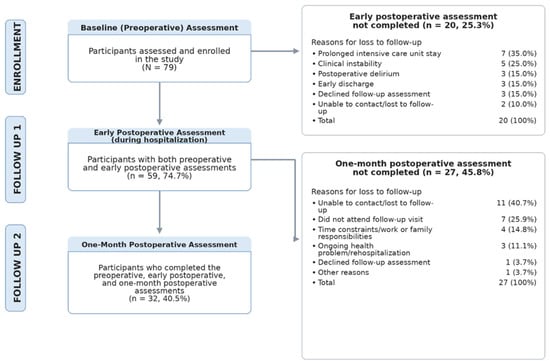
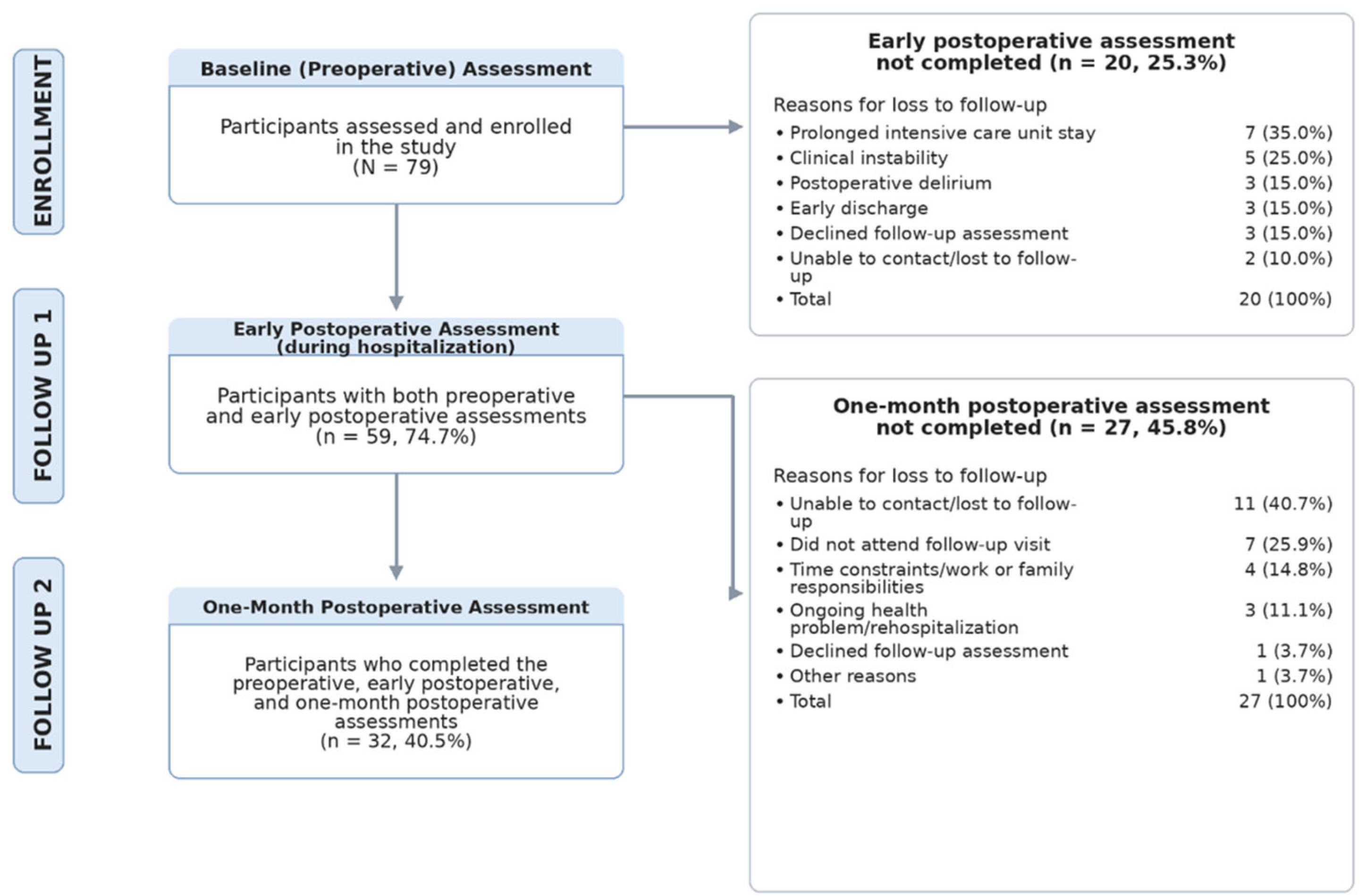
All eligible, consenting patients recruited during the predefined period were included (baseline n = 79; paired early postoperative assessments n = 59; complete three-time-point assessments n = 32; Figure 1). No primary outcome or time contrast was prespecified, and no a priori sample-size calculation was performed; analyses were therefore exploratory. Supplementary precision analysis based on observed paired differences showed a mean preoperative-to-early postoperative BAI change of +2.15 points (95% CI 0.65–3.65; CI half-width 1.50), with a minimum detectable mean difference of 2.10 points at 80% power (n = 59). At one month (n = 32), CI half-widths were 3.13 and 3.31 points for BAI and Beck Depression Inventory-II (BDI-II), respectively, with corresponding minimum detectable differences of 4.30 and 4.55 points. These retrospective estimates characterized precision rather than established adequate power; nonsignificant findings were therefore considered inconclusive. Primary analyses used observed data without imputation, mixed-effects models included all available repeated observations, and multiple imputation was restricted to missing-not-at-random sensitivity analyses.
Figure 1.
Participant flow across study assessments and reasons for loss to follow-up. Reasons for non-completion were not mutually exclusive; some participants had more than one documented reason.
2.3. Data Collection and Study Variables
Assessments were conducted preoperatively, on postoperative days 3–7 after clinical stabilization, and at one month. BAI and BDI-II were administered at all three assessments, whereas IPAQ-SF was administered preoperatively and at one month. Baseline variables included demographic characteristics, smoking, psychiatric history, psychotropic medication use, body mass index (BMI), hypertension, diabetes, dyslipidemia, and left ventricular ejection fraction. Perioperative data included surgical urgency, waiting time, procedure type, and ICU and hospital lengths of stay. Procedures were classified as isolated CABG, isolated valvular surgery, combined procedures, or other major open cardiac operations, detailed in Table 1. Exact assessment days within the postoperative window, pain intensity, analgesic and sedative exposure, ICU status at assessment, major postoperative complications, and rehabilitation participation were not recorded. ICU length of stay served only as an indirect indicator of postoperative clinical course. Participant characteristics were self-reported, while clinical and perioperative data were obtained from medical records. No study-specific questionnaire was developed.
Table 1.
Demographic, clinical, perioperative, and baseline outcome characteristics of the study cohort.
2.4. Psychological Measures
Anxiety symptoms were assessed using the 21-item BAI (score range 0–63) [15], validated in Turkish [16]. Depressive symptoms were measured using the 21-item BDI-II (score range 0–63), which assesses symptoms over the preceding two weeks [17] and has established Turkish validity and reliability [18]. Higher scores indicate greater symptom severity. Both scales were analysed continuously and classified descriptively using conventional severity bands: BAI, minimal (0–7), mild (8–15), moderate (16–25), and severe (26–63); BDI-II, minimal (0–13), mild (14–19), moderate (20–28), and severe (29–63). These categories are not diagnostic thresholds and have not been specifically validated for early recovery after cardiac surgery.
2.5. Physical Activity
Physical activity was assessed using the seven-item International Physical Activity Questionnaire–Short Form (IPAQ-SF), which records the weekly frequency and usual daily duration of walking, moderate- and vigorous-intensity activity, together with sitting time on a typical weekday [19]. Activity questions refer to bouts lasting at least 10 consecutive minutes during the preceding seven days. The Turkish version has demonstrated acceptable validity and reliability [20]. Item-level responses from 79 preoperative and 32 one-month assessments were processed according to the official IPAQ scoring protocol [21]. Activities lasting less than 10 min/day were recoded to zero, durations exceeding 180 min/day were truncated, and records exceeding 960 min/day of total activity were considered invalid. Two baseline activity entries required recoding under the 10-min rule; no duration truncation or record exclusion was necessary. Domain-specific MET-min/week scores were calculated as MET value × days/week × minutes/day, using 3.3, 4.0, and 8.0 METs for walking, moderate-, and vigorous-intensity activity, respectively. Total physical activity was the sum of these three domain scores; sitting time was recorded separately and excluded from the total. Activity was classified using the protocol’s combined frequency, duration, and MET-minute criteria. High activity was defined as ≥3 days of vigorous-intensity activity with total physical activity of ≥1500 MET-min/week, or ≥7 days of any combination of walking, moderate- and vigorous-intensity activity with total physical activity of ≥3000 MET-min/week. Moderate activity was defined as ≥3 days of vigorous-intensity activity for ≥20 min/day, ≥5 days of moderate-intensity activity and/or walking for ≥30 min/day, or ≥5 days of any combination of these activities with total physical activity of ≥600 MET-min/week. For the combined-day criteria, days were summed across the walking, moderate- and vigorous-intensity domains. Participants meeting neither category were classified as having low activity. The IPAQ-SF was self-administered by participants at the preoperative and one-month assessments.
2.6. Statistical Analysis
Statistical analyses were performed using Python 3.12.10 (NumPy 2.5.1, pandas 3.0.5, SciPy 1.18.0, and statsmodels 0.14.6). Categorical variables were summarized as n (%) and continuous variables as mean ± standard deviation or median (Q1–Q3). Paired BAI and BDI-II scores were compared using Wilcoxon signed-rank tests, with effect sizes (r) and Hodges–Lehmann differences (95% confidence intervals [CIs]). Hodges–Lehmann estimates were obtained as the pseudomedian of the within-participant differences, that is the median of the Walsh averages of all paired differences including zero differences, whereas zero differences were excluded from the signed-rank test statistics; the corresponding distribution-free CIs are approximate in the presence of ties. Three-time-point changes were assessed using Friedman tests (Kendall’s W) and Holm-adjusted pairwise comparisons. Physical activity was analysed continuously using paired Wilcoxon tests and categorically using Stuart–Maxwell and Bowker tests on the full 3 × 3 transition table, supplemented by an exact test. The observed discordant transitions involved only two categories, yielding one degree of freedom. Changes in low-activity prevalence were estimated with paired-proportion 95% CIs. Sensitivity analyses included a sign test, log(MET + 1) transformation, and exclusion of the most extreme activity change.
Follow-up attrition was examined using absolute standardized mean differences (SMDs), including multivariate SMDs for multicategory variables, and comparisons of early postoperative outcomes and perioperative characteristics. Completion probabilities were estimated using logistic regression, with age, sex, and hypertension in the parsimonious model and expanded models for sensitivity analysis. Time-specific stabilized inverse-probability weights, based on cumulative observation probabilities and truncated at the 1st and 99th percentiles, were applied in generalized estimating equations with exchangeable correlation and robust standard errors; baseline observations received unit weights. Missing-not-at-random sensitivity analyses used delta-adjusted pattern-mixture models for missing early and one-month outcomes, with 25 imputations per scenario, shifts of δ = −6 to +6 points, and pooling by Rubin’s rules.
Longitudinal sensitivity analyses used linear mixed-effects models with participant-specific random intercepts and categorical time effects, fitted by restricted maximum likelihood and adjusted for age, sex, BMI, hypertension, and psychiatric history. The estimand was the covariate-adjusted mean difference between assessments under a missing-at-random assumption conditional on observed scores and covariates. Because covariate selection incorporated clinical considerations and observed baseline imbalances, robustness was examined across four adjustment sets. Employment status was excluded because of its overlap with sex. Categorical and linear time specifications were compared using likelihood-ratio tests after maximum likelihood refitting. Model diagnostics included residual and random-effect distributions, heteroscedasticity, convergence, variance components, intraclass correlations, and leave-one-participant-out influence analyses. Additional robustness analyses used log(score + 1) transformations, random-slope models, and participant-level cluster bootstrap CIs (1000 resamples; percentile method). Overall time effects were assessed using Wald tests. Exact assessment days within the postoperative days 3–7 window were unavailable, precluding day-specific analyses.
Exploratory perioperative associations were examined using Spearman correlations and Mann–Whitney U tests. Associations between physical activity and psychological symptoms were examined with Spearman rank correlations in five sets of analyses: cross-sectional associations at the preoperative assessment (n = 79) and at one month (n = 32); associations between preoperative-to-one-month changes in activity and in symptom scores among participants with paired assessments (n = 32); associations between preoperative activity and subsequent symptom change; and comparisons of symptom scores across IPAQ-SF categories using Kruskal–Wallis tests. Total and walking MET-min/week and sitting time were considered. Spearman correlation coefficients are reported with p values and approximate 95% CIs obtained using Fisher’s z transformation. Because the IPAQ-SF was not administered on postoperative days 3–7, concurrent associations could not be examined at that assessment. These analyses comprised 24 tests, were regarded as exploratory, and were Holm-adjusted within each set without correction across sets. Individual reliable change was assessed using the Jacobson–Truax index, based on baseline standard deviations and published Turkish-version internal-consistency coefficients (BAI α = 0.93; BDI-II α = 0.90), with a two-sided 95% criterion. Reliable-change classifications were considered exploratory because population-specific test–retest reliability was unavailable; no established cardiac surgery-specific minimal clinically important difference was applied. Individual reliable change was distinguished from the group-level minimum detectable mean difference. Severity-category transitions were assessed using exact tests. Surgical heterogeneity was examined using Kruskal–Wallis and chi-square tests, procedure-specific score changes, and time-by-subgroup interactions for procedure type, surgical urgency, and prolonged ICU stay (≥4 days), assessed by likelihood-ratio tests after maximum likelihood fitting. All tests were two-sided (p < 0.05). No primary outcome, time contrast, analysis plan, or multiplicity strategy was prespecified; all analyses were exploratory. Holm adjustment was applied to longitudinal pairwise comparisons within each outcome and separately within each of the five exploratory physical activity–symptom association sets; no adjustment was applied across analysis sets or to the perioperative, subgroup and sensitivity analyses. Effect sizes and 95% CIs were emphasized.
3. Results
3.1. Participant Characteristics and Follow-Up
The cohort included 79 participants (mean age 59.6 ± 9.8 years; 55.7% male; mean BMI 28.7 ± 3.8 kg/m2). Isolated CABG (40.5%) and valvular surgery (26.6%) were the most common procedures. Baseline median BAI and BDI-II scores were 9 (Q1–Q3, 4–16) and 10 (6–14.5), respectively, and 74.7% had low physical activity according to IPAQ-SF criteria (Table 1). Psychological assessments were available for 59 participants early postoperatively and 32 at one month; the latter completed all three psychological assessments and paired physical activity assessments (Figure 1).
3.2. Baseline Characteristics According to One-Month Follow-Up Completion
Baseline imbalances between one-month completers and non-completers were most pronounced for hypertension (absolute SMD 0.57), employment status (0.53), sex (0.46), BMI (0.45), age (0.44), physical activity category (0.42), and psychiatric history (0.39; Supplementary Table S1). Among participants assessed early postoperatively (n = 59), BAI and BDI-II scores did not differ significantly by subsequent follow-up completion (p = 0.939 and 0.749, respectively). ICU stay measures were also comparable (all p ≥ 0.449), whereas hospital stay was longer among completers (median 11 vs. 8 days; p = 0.028). Early postoperative losses were predominantly related to clinical factors (15/20, 75.0%), whereas one-month losses were mainly logistical (22/27, 81.5%); three participants (11.1%) were lost because of ongoing illness or rehospitalization (Figure 1). These findings do not exclude outcome-related attrition, particularly because unobserved one-month outcomes remain unknown.
3.3. Changes in Anxiety and Depressive Symptoms
Among 59 participants with paired assessments, BAI scores increased early postoperatively (Hodges–Lehmann difference +2.0 points, 95% CI 1.0–3.0; p = 0.002), whereas BDI-II scores showed no significant change (p = 0.132). Among 32 participants with complete follow-up, BAI scores differed across assessments (Friedman p < 0.001), increasing early postoperatively (Holm-adjusted p = 0.006) and declining by one month (p = 0.002), with no significant difference between preoperative and one-month scores (p = 0.722). Although the overall BDI-II comparison was significant (p = 0.004), no pairwise difference remained significant after Holm adjustment (Table 2). Early postoperative BAI and BDI-II scores were not significantly associated with ICU or hospital length of stay (all p > 0.3). However, BDI-II changes differed between participants with and without prolonged ICU stay (median 0.0 vs. −3.5 points; p = 0.007), an unadjusted exploratory finding.
Table 2.
Longitudinal changes in anxiety and depressive symptom scores during the first postoperative month.
Reliable-change thresholds were ±6.3 points for BAI and ±5.7 points for BDI-II. Among 59 participants, 9 (15.3%) showed reliable BAI worsening, 4 (6.8%) improvement, and 46 (78.0%) no reliable change. Movement between BAI severity categories was not significant (exact p = 0.167), although seven participants crossed into the moderate-to-severe range (BAI ≥16) and two crossed out. Detailed severity distributions and transitions are presented in Supplementary Table S2. These findings indicate that statistically significant changes in BAI scores did not correspond to reliable individual deterioration in most participants.
3.4. Changes in Physical Activity
IPAQ-SF data were processed according to the official scoring protocol, with minimal effects of data cleaning and no invalid records. Among 32 participants with paired assessments, total physical activity increased from 280 to 495 MET-min/week (Hodges–Lehmann difference +116, 95% CI 49–198; p = 0.017), primarily through walking. This finding remained significant in sensitivity analyses, whereas sitting time and moderate- and vigorous-intensity activity showed no significant changes. Physical activity categories also shifted (Stuart–Maxwell p = 0.002): 10 participants moved from low to moderate activity, with no downward transitions. The proportion with low activity decreased from 81.2% to 50.0% (difference −31.2 percentage points, 95% CI −47.3 to −15.2; Table 3). Classification using the official IPAQ-SF algorithm differed from classification based solely on total MET-minutes in 11 of 79 baseline assessments (13.9%) and 9 of 32 one-month assessments (28.1%).
Table 3.
Physical activity measured by the IPAQ-SF before surgery and one month after surgery.
3.5. Associations Between Physical Activity and Psychological Symptoms
At baseline (n = 79), correlations between physical activity measures and BAI or BDI-II scores were negligible (|ρ| ≤ 0.05; all p ≥ 0.640). At one month (n = 32), total physical activity and walking were inversely correlated with BDI-II scores (ρ = −0.40, 95% CI −0.66 to −0.06; p = 0.023 and ρ = −0.39, 95% CI −0.65 to −0.04; p = 0.028, respectively). Changes in walking were also inversely correlated with changes in BAI scores (ρ = −0.36, 95% CI −0.63 to −0.01; p = 0.042). No other associations reached nominal significance, including those between preoperative activity and subsequent symptom changes. Of 24 exploratory tests, three were nominally significant, but none remained significant after within-set Holm adjustment (minimum adjusted p = 0.139; Supplementary Table S3). These findings require cautious interpretation given the small follow-up sample, multiple comparisons, and substantial attrition.
3.6. Mixed-Effects and Sensitivity Analyses
Mixed-effects models included 170 observations from 79 participants. The overall time effect was significant for BAI (Wald χ2 = 9.18, df = 2; p = 0.010), with higher early postoperative scores than preoperative scores (β = +2.38, 95% CI 0.69–4.06; p = 0.006). Scores declined by one month, with no significant difference from baseline. No overall time effect was observed for BDI-II (p = 0.473; Table 4). Both models converged, although residual and random-effect distributions departed from normality. Absolute residuals were positively correlated with fitted values for BAI (Spearman ρ = 0.29, p < 0.001), but not significantly for BDI-II (ρ = 0.14, p = 0.075). Participant-level cluster bootstrap analysis supported the early BAI increase (95% CI 0.95–3.78). Results were consistent across adjustment sets (BAI β = +2.27 to +2.38), log-transformed models, and random-slope specifications, with no influential individual observations. A categorical time specification fitted BAI better than a linear trend (likelihood-ratio p = 0.003), whereas no improvement was observed for BDI-II (p = 0.956). Full model coefficients and variance components are provided in Supplementary Table S4.
Table 4.
Adjusted mixed-effects analysis of anxiety and depressive symptom scores over time using all available observations.
3.7. Attrition and Missing-Data Sensitivity Analyses
Hypertension was associated with lower odds of one-month follow-up completion (OR = 0.37, 95% CI 0.14–0.99; p = 0.048), with similar estimates in expanded models (ORs 0.26–0.35), although limited events per predictor warrant caution. Inverse-probability weighting supported the early postoperative BAI increase (β = +2.65, 95% CI 1.18–4.12; p < 0.001), whereas BDI-II and one-month contrasts remained nonsignificant. In delta-adjusted pattern-mixture analyses, the early BAI increase persisted under missing at random (β = +2.99, 95% CI 0.75–5.23; p = 0.009) but was attenuated when unobserved scores were assumed to be lower (δ = −2: p = 0.051; δ = −4: p = 0.100). One-month estimates (47 missing assessments) were also assumption-dependent, including a nominally significant BDI-II contrast at δ = −2 (p = 0.048). Thus, informative dropout cannot be excluded, and findings at one month remain inconclusive.
3.8. Surgical Heterogeneity and Subgroup Analyses
The cohort included 32 patients undergoing isolated CABG, 21 undergoing valvular surgery, 8 undergoing combined procedures, and 18 undergoing other major open cardiac procedures. Baseline age differed across groups (p = 0.005), whereas preoperative BAI and BDI-II scores were comparable (p = 0.966 and 0.488, respectively). Although early postoperative BAI changes varied descriptively across procedure groups, between-group differences were not statistically significant (p = 0.112), nor were those for BDI-II (p = 0.439; Supplementary Table S5). Adjusted mixed-effects models showed no significant time × procedure-type interactions (BAI, p = 0.086; BDI-II, p = 0.219), or interactions with surgical urgency or prolonged ICU stay (all p ≥ 0.126). Given the small subgroup sizes, these exploratory analyses had limited power to detect potentially important differences. The findings should therefore be interpreted as preliminary aggregate observations across a heterogeneous surgical cohort.
4. Discussion
BAI scores increased modestly in the early postoperative period and declined among patients who completed the one-month follow-up. A similar pattern was observed in the mixed-effects models, although physical symptoms following surgery may have influenced BAI scores. Açıkel also reported an increase in anxiety scores on postoperative day 3 after CABG, with scores remaining elevated at one month [9]. Other studies involving CABG and mitral valve surgery have reported reductions in anxiety over longer follow-up periods [22,23]. Pain, sleep disturbances, physical limitations, and concerns about complications may play a role in perioperative distress [3], but we did not assess their individual contributions. Unlike the findings for BAI, the results for depressive symptoms were less consistent and did not allow firm conclusions about changes over time. By one month, physical activity had increased, mainly through walking. These findings suggest that psychological symptoms and physical activity do not necessarily follow the same course during early recovery.
Findings for depressive symptoms were inconclusive, consistent with the heterogeneous postoperative trajectories reported previously [7,8,9]. Interpretation of both psychological measures is complicated by the postoperative assessment window (days 3–7), during which pain, medication effects, sleep disruption, and clinical status may vary. Moreover, the BDI-II’s two-week recall period spans the preoperative and postoperative phases, while somatic items in both instruments may reflect surgical recovery rather than psychological distress. Exact assessment timing, relevant clinical exposures, and item-level data were unavailable, precluding adjustment for these factors or examination of cognitive-affective and somatic subscales. Although early postoperative BAI scores increased, most participants (78.0%) showed no reliable individual change, and only 15.3% met the exploratory threshold for reliable worsening. These findings suggest a small average shift in self-reported symptoms rather than established clinically important deterioration. Without a comparison group or diagnostic assessment, neither a causal effect of surgery nor the development of an anxiety disorder can be inferred. Nevertheless, perioperative psychological symptoms remain relevant to postoperative care [24,25,26].
During the first postoperative month, physical activity increased mainly through walking. Moderate- and vigorous-intensity activities remained uncommon, however, and half of the patients assessed at one month were still in the low-activity category. The increase may therefore reflect a gradual return to daily activities rather than a more general recovery in habitual physical activity. Previous studies have associated higher physical activity with fewer depressive symptoms and preoperative inactivity with poorer outcomes after cardiac surgery [11,12,13]. Early mobilization has also been shown to improve physical function by discharge [14], although better functional capacity does not necessarily mean that patients become more active in daily life. In a review of five randomized trials, Chen et al. found no significant overall reduction in ICU or hospital stay with early mobilization after cardiac surgery [27]. More recent studies have examined home-based virtual reality exercise after open-heart surgery [28] and wearable-supported telerehabilitation following CABG [29]. The former reported improvements in functional capacity, while the latter achieved gains in exercise capacity comparable to center-based rehabilitation. These findings concern structured rehabilitation programs, which differ from the habitual physical activity measured in our cohort. Studies of prehabilitation and exercise-based cardiac rehabilitation have also reported benefits for physical function, psychological symptoms, and quality of life [30,31,32,33,34]. Prospective research has further linked greater physical activity with a lower subsequent risk of depression [35,36]. A prospective study by Huang et al. followed 100 cardiac surgery patients, assessing depressive symptoms with the Patient Health Questionnaire-9, sleep quality, and physical activity with the IPAQ-SF before surgery and on postoperative days 7 and 30 [37]. Depressive symptoms peaked on day 7, and preoperative physical activity was inversely correlated with depressive symptoms (r = −0.44). We did not find a significant association between these measures before surgery, and changes in BDI-II scores in our cohort remained inconclusive. Differences in the instruments used, assessment timing, surgical case mix, and activity distributions may partly explain the contrasting results, but their individual contributions are uncertain. Our study also assessed anxiety symptoms and reliable changes in individual scores. In our exploratory analyses, physical activity was inversely correlated with BDI-II scores at one month, while changes in walking activity were inversely correlated with changes in BAI scores. Both findings were nominally significant, but neither remained significant after Holm adjustment. They should therefore be viewed as preliminary associations rather than evidence of a causal relationship or a change in the strength of these relationships over time. Interpretation is also limited by the small number of patients assessed at one month, substantial attrition, self-reported physical activity, and possible residual confounding.
These findings support assessment of psychological status at more than one perioperative time point. Preoperative anxiety and depressive symptoms have previously been associated with hospital length of stay, health-related quality of life, morbidity, and mortality [2,5,6,24]. Other studies have linked psychological and socioeconomic factors with postoperative length of stay, psychological resources with postoperative distress, and perioperative depression and anxiety with hospital readmission [38,39,40]. Reassessment during early hospitalization and after discharge may therefore provide information not captured by a single preoperative evaluation. The present results do not establish that repeated psychological assessment or rehabilitation interventions improve clinical outcomes, but they support consideration of psychological and functional recovery as separate components of postoperative follow-up. Recent research has increasingly focused on targeted perioperative psychological interventions and factors influencing recovery. Holzer et al. described a protocol for randomized trials evaluating perioperative mental health interventions [41], while Li et al. reported improvements in anxiety and depressive symptoms following a web-based intervention after CABG, without a significant reduction in major adverse cardiac or cerebrovascular events [42]. Emerging research has also examined illness perceptions and expectations in relation to preoperative quality of life [43], as well as fear of disease progression after cardiac surgery [44]. By examining anxiety and depressive symptoms alongside physical activity and distinguishing group-level changes from reliable individual deterioration, our study adds complementary descriptive evidence on early postoperative recovery. These findings may inform the design and timing of future psychological and rehabilitation interventions.
The prospective design, repeated assessments, and extensive sensitivity analyses strengthen this study. Nevertheless, its single-center setting, modest sample size, lack of prespecified primary outcomes or an a priori sample-size calculation, and substantial attrition limit precision and generalizability. One-month findings were particularly vulnerable to selection bias, as completers differed from non-completers in several baseline characteristics and hospital length of stay. Although inverse-probability weighting supported the early BAI increase, pattern-mixture analyses demonstrated sensitivity to missing-data assumptions. Informative dropout therefore cannot be excluded, and one-month findings should be restricted to participants with observed follow-up data. Additional limitations include the absence of exact assessment dates within the postoperative days 3–7 window, incomplete perioperative clinical data, reliance on self-reported measures, and lack of structured psychiatric assessments. Although bootstrap and alternative model specifications supported the principal findings, departures from residual normality warrant caution. Physical activity was measured at only two time points, predominantly reflected walking, and could not be examined in relation to rehabilitation participation. The heterogeneous surgical cohort and small subgroup sizes limited the ability to detect procedure-specific differences; nonsignificant interactions should not be interpreted as evidence of equivalent recovery trajectories. Moreover, the associations between physical activity and psychological symptoms were exploratory, and none remained significant after within-set Holm adjustment. The limited one-month sample and absence of concurrent activity measurements during postoperative days 3–7 further restrict interpretation. Accordingly, these findings do not support temporal or causal inferences. Given these limitations and the exploratory design, the findings should be interpreted as preliminary observations rather than confirmatory evidence of postoperative recovery patterns.
5. Conclusions
BAI scores were higher in the early days after cardiac surgery, although reliable worsening was observed in only a minority of patients. Among those assessed at one month, anxiety scores had declined, while changes in depressive symptoms remained uncertain. Physical activity increased mainly through walking, but half of the patients who completed follow-up still had low activity levels. The considerable loss to follow-up, reliance on self-reported measures, and lack of a comparison group limit the interpretation of these findings. The results describe changes in psychological symptoms and physical activity during early recovery, but do not establish whether surgery caused these changes or whether the two domains are related. Studies with larger patient groups, longer follow-up, and objective activity measurements are needed to clarify these patterns.
Supplementary Materials
The following supporting information can be downloaded at: https://www.mdpi.com/article/10.3390/jcdd13110600/s1, Table S1: Baseline, early postoperative, and perioperative characteristics according to one-month follow-up completion; Table S2: Symptom severity distributions and reliable individual change during early recovery after cardiac surgery; Table S3: Exploratory associations between physical activity and anxiety and depressive symptom scores; Table S4: Full fixed-effect coefficients and variance components of the adjusted mixed-effects models; Table S5: Preoperative-to-early postoperative changes in anxiety and depressive symptom scores according to surgical procedure group.
Author Contributions
Study conceptualization and design, S.K. and E.K.; data collection, S.K. and E.K.; analysis and interpretation of results, S.K. and E.K.; manuscript preparation, S.K. and E.K. All authors have read and agreed to the published version of the manuscript.
Funding
This research received no external funding.
Institutional Review Board Statement
The study was conducted in accordance with the Declaration of Helsinki and was approved by the Scientific Research Ethics Committee of Adana City Training and Research Hospital (approval date: 21 May 2026; decision no. 1361).
Informed Consent Statement
Written informed consent was obtained from all participants after providing a comprehensive explanation of the study’s objectives and procedures.
Data Availability Statement
The data supporting the findings of this study are available from the corresponding author upon reasonable request. The dataset is not publicly available due to ethical and privacy considerations related to the protection of participant confidentiality, as specific consent for the public deposition of individual-level data in an open-access repository was not obtained from the participants.
Conflicts of Interest
The authors declare no conflicts of interest.
Abbreviations
The following abbreviations are used in this manuscript:
| BAI | Beck Anxiety Inventory |
| BDI-II | Beck Depression Inventory-II |
| BMI | Body mass index |
| CABG | Coronary artery bypass grafting |
| CI | Confidence interval |
| IPAQ-SF | International Physical Activity Questionnaire–Short Form |
| MET | Metabolic equivalent of task |
| SMD | Standardized mean difference |
References
- Vu, T.; Smith, J.A. The pathophysiology and management of depression in cardiac surgery patients. Front. Psychiatry 2023, 14, 1195028. [Google Scholar] [CrossRef] [Scilit] [PubMed]
- Tully, P.J.; Baker, R.A. Depression, anxiety, and cardiac morbidity outcomes after coronary artery bypass surgery: A contemporary and practical review. J. Geriatr. Cardiol. 2012, 9, 197–208. [Google Scholar] [CrossRef] [Scilit] [PubMed]
- McCann, W.D.; Hou, X.-Y.; Stolic, S.; Ireland, M.J. Predictors of psychological distress among post-operative cardiac patients: A narrative review. Healthcare 2023, 11, 2721. [Google Scholar] [CrossRef] [Scilit] [PubMed]
- Correa-Rodríguez, M.; Abu Ejheisheh, M.; Suleiman-Martos, N.; Membrive-Jiménez, M.J.; Velando-Soriano, A.; Schmidt-RioValle, J.; Gómez-Urquiza, J.L. Prevalence of depression in coronary artery bypass surgery: A systematic review and meta-analysis. J. Clin. Med. 2020, 9, 909. [Google Scholar] [CrossRef] [Scilit] [PubMed]
- Gorini, A.; Giuliani, M.; L’Acqua, C.; Barbieri, S.; Sisillo, E.; Veglia, F.; Tremoli, E. Associations of preoperative self-rated symptoms of anxiety and depression on length of hospital stay and long-term quality of life in patients undergoing cardiac surgery. J. Cardiovasc. Nurs. 2022, 37, 213–220. [Google Scholar] [CrossRef] [Scilit] [PubMed]
- Tully, P.J.; Baker, R.A.; Knight, J.L. Anxiety and depression as risk factors for mortality after coronary artery bypass surgery. J. Psychosom. Res. 2008, 64, 285–290. [Google Scholar] [CrossRef] [Scilit] [PubMed]
- Horne, D.; Kehler, D.S.; Kaoukis, G.; Hiebert, B.; Garcia, E.; Duhamel, T.A.; Arora, R.C. Depression before and after cardiac surgery: Do all patients respond the same? J. Thorac. Cardiovasc. Surg. 2013, 145, 1400–1406. [Google Scholar] [CrossRef] [Scilit] [PubMed]
- Caspi-Avissar, N.; Grosman-Rimon, L.; Gohari, J.; Arazi, M.; Granot, D.; Ghanim, D.; Carasso, S.; Shalabi, A.; Sudarsky, D.; Eilat-Adar, S.; et al. Clinical, surgical, and sociopsychological factors and depression after cardiothoracic surgery. Ann. Thorac. Surg. 2021, 111, 1064–1070. [Google Scholar] [CrossRef] [Scilit] [PubMed]
- Teker Açıkel, M.E. Evaluation of depression and anxiety in coronary artery bypass surgery patients: A prospective clinical study. Braz. J. Cardiovasc. Surg. 2019, 34, 389–395. [Google Scholar] [CrossRef] [Scilit] [PubMed]
- Vasankari, S.; Hartikainen, J.; Vasankari, V.; Anttila, V.; Tokola, K.; Vähä-Ypyä, H.; Husu, P.; Sievänen, H.; Vasankari, T.; Halonen, J. Objectively measured preoperative physical activity and sedentary behaviour among Finnish patients scheduled for elective cardiac procedures: Baseline results from randomized controlled trial. BMC Sports Sci. Med. Rehabil. 2022, 14, 130. [Google Scholar] [CrossRef] [Scilit] [PubMed]
- Horne, D.; Kehler, D.S.; Kaoukis, G.; Hiebert, B.; Garcia, E.; Chapman, S.; Duhamel, T.A.; Arora, R.C. Impact of physical activity on depression after cardiac surgery. Can. J. Cardiol. 2013, 29, 1649–1656. [Google Scholar] [CrossRef] [Scilit] [PubMed]
- Kehler, D.S.; Stammers, A.N.; Horne, D.; Hiebert, B.; Kaoukis, G.; Duhamel, T.A.; Arora, R.C. Impact of preoperative physical activity and depressive symptoms on post-cardiac surgical outcomes. PLoS ONE 2019, 14, e0213324. [Google Scholar] [CrossRef] [Scilit] [PubMed]
- Cohen, M.; Grosman-Rimon, L.; Caspi-Avissar, N.; Eilat-Adar, S.; Zach, S.; Kodesh, E.; Lidor, R.; Menachemi, D.M.; Rimon, J.; Carasso, S.; et al. Depression and physical activity post-cardiac surgery: 18 months of follow-up. J. Cardiovasc. Nurs. 2026, 41, 270–275. [Google Scholar] [CrossRef] [Scilit] [PubMed]
- Kanejima, Y.; Shimogai, T.; Kitamura, M.; Ishihara, K.; Izawa, K.P. Effect of early mobilization on physical function in patients after cardiac surgery: A systematic review and meta-analysis. Int. J. Environ. Res. Public Health 2020, 17, 7091. [Google Scholar] [CrossRef] [Scilit] [PubMed]
- Beck, A.T.; Epstein, N.; Brown, G.; Steer, R.A. An inventory for measuring clinical anxiety: Psychometric properties. J. Consult. Clin. Psychol. 1988, 56, 893–897. [Google Scholar] [CrossRef] [PubMed]
- Ulusoy, M.; Sahin, N.H.; Erkmen, H. Turkish version of the Beck Anxiety Inventory: Psychometric properties. J. Cogn. Psychother. 1998, 12, 163–172. [Google Scholar]
- Beck, A.T.; Steer, R.A.; Brown, G.K. Manual for the Beck Depression Inventory-II; Psychological Corporation: San Antonio, TX, USA, 1996. [Google Scholar]
- Kapci, E.G.; Uslu, R.; Turkcapar, H.; Karaoglan, A. Beck Depression Inventory II: Evaluation of the psychometric properties and cut-off points in a Turkish adult population. Depress. Anxiety 2008, 25, E104–E110. [Google Scholar] [CrossRef] [Scilit] [PubMed]
- Craig, C.L.; Marshall, A.L.; Sjöström, M.; Bauman, A.E.; Booth, M.L.; Ainsworth, B.E.; Pratt, M.; Ekelund, U.; Yngve, A.; Sallis, J.F.; et al. International Physical Activity Questionnaire: 12-country reliability and validity. Med. Sci. Sports Exerc. 2003, 35, 1381–1395. [Google Scholar] [CrossRef] [Scilit] [PubMed]
- Saglam, M.; Arikan, H.; Savci, S.; Inal-Ince, D.; Bosnak-Guclu, M.; Karabulut, E.; Tokgozoglu, L. International Physical Activity Questionnaire: Reliability and validity of the Turkish version. Percept. Mot. Skills 2010, 111, 278–284. [Google Scholar] [CrossRef] [Scilit] [PubMed]
- IPAQ Research Committee. Guidelines for Data Processing and Analysis of the International Physical Activity Questionnaire (IPAQ)—Short and Long Forms; Revised November 2005. Available online: https://bb30.ndph.ox.ac.uk/ukb/ukb/docs/ipaq_analysis.pdf (accessed on 8 November 2026).
- Korbmacher, B.; Ulbrich, S.; Dalyanoglu, H.; Lichtenberg, A.; Schipke, J.D.; Franz, M.; Schäfer, R. Perioperative and long-term development of anxiety and depression in CABG patients. Thorac. Cardiovasc. Surg. 2013, 61, 676–681. [Google Scholar] [CrossRef] [Scilit] [PubMed]
- Botzet, K.; Dalyanoglu, H.; Schäfer, R.; Lichtenberg, A.; Schipke, J.D.; Korbmacher, B. Anxiety and depression in patients undergoing mitral valve surgery: A prospective clinical study. Thorac. Cardiovasc. Surg. 2018, 66, 530–536. [Google Scholar] [CrossRef] [Scilit] [PubMed]
- Takagi, H.; Ando, T.; Umemoto, T.; ALICE (All-Literature Investigation of Cardiovascular Evidence) Group. Perioperative depression or anxiety and postoperative mortality in cardiac surgery: A systematic review and meta-analysis. Heart Vessels 2017, 32, 1458–1468. [Google Scholar] [CrossRef] [Scilit] [PubMed]
- Doering, L.V.; Chen, B.; McGuire, A.; Cross Bodán, R.; Irwin, M.R. Persistent depressive symptoms and pain after cardiac surgery. Psychosom. Med. 2014, 76, 437–444. [Google Scholar] [CrossRef] [Scilit] [PubMed]
- Pignay-Demaria, V.; Lespérance, F.; Demaria, R.G.; Frasure-Smith, N.; Perrault, L.P. Depression and anxiety and outcomes of coronary artery bypass surgery. Ann. Thorac. Surg. 2003, 75, 314–321. [Google Scholar] [CrossRef] [Scilit] [PubMed]
- Chen, B.; Xie, G.; Lin, Y.; Chen, L.; Lin, Z.; You, X.; Xie, X.; Dong, D.; Zheng, X.; Li, D.; et al. A systematic review and meta-analysis of the effects of early mobilization therapy in patients after cardiac surgery. Medicine 2021, 100, e25314. [Google Scholar] [CrossRef] [Scilit] [PubMed]
- Sermsinsaithong, N.; Yuenyongchaiwat, K.; Thanawattano, C.; Buekban, C.; Kulchanarat, C.; Buranapuntalug, S.; Wattanananont, K.; Satdhabudha, O. Effects of a home-based rehabilitation exercise program on cardiorespiratory performance in community-dwelling adults who underwent heart surgery: Randomized controlled trial. JMIR Rehabil. Assist. Technol. 2025, 12, e68504. [Google Scholar] [CrossRef] [Scilit] [PubMed]
- Liu, H.; Wang, X.; Wang, C.; Kong, M.; Ma, J.; Liu, Y. Efficacy of home-based telerehabilitation versus center-based cardiac rehabilitation on cardiopulmonary function and exercise capacity in patients after coronary artery bypass grafting: A randomized controlled trial. J. Cardiopulm. Rehabil. Prev. 2026. advance online publication. [Google Scholar] [CrossRef] [Scilit] [PubMed]
- Furze, G.; Dumville, J.C.; Miles, J.N.V.; Irvine, K.; Thompson, D.R.; Lewin, R.J.P. “Prehabilitation” prior to CABG surgery improves physical functioning and depression. Int. J. Cardiol. 2009, 132, 51–58. [Google Scholar] [CrossRef] [Scilit] [PubMed]
- Reed, J.L.; Terada, T.; Cotie, L.M.; Tulloch, H.E.; Leenen, F.H.; Mistura, M.; Hans, H.; Wang, H.-W.; Vidal-Almela, S.; Reid, R.D.; et al. The effects of high-intensity interval training, Nordic walking and moderate-to-vigorous intensity continuous training on functional capacity, depression and quality of life in patients with coronary artery disease enrolled in cardiac rehabilitation: A randomized controlled trial (CRX study). Prog. Cardiovasc. Dis. 2022, 70, 73–83. [Google Scholar] [CrossRef] [Scilit] [PubMed]
- Anderson, L.; Oldridge, N.; Thompson, D.R.; Zwisler, A.-D.; Rees, K.; Martin, N.; Taylor, R.S. Exercise-based cardiac rehabilitation for coronary heart disease: Cochrane systematic review and meta-analysis. J. Am. Coll. Cardiol. 2016, 67, 1–12. [Google Scholar] [CrossRef] [Scilit] [PubMed]
- Dibben, G.O.; Faulkner, J.; Oldridge, N.; Rees, K.; Thompson, D.R.; Zwisler, A.-D.; Taylor, R.S. Exercise-based cardiac rehabilitation for coronary heart disease: A meta-analysis. Eur. Heart J. 2023, 44, 452–469. [Google Scholar] [CrossRef] [Scilit] [PubMed]
- Zheng, X.; Zheng, Y.; Ma, J.; Zhang, M.; Zhang, Y.; Liu, X.; Chen, L.; Yang, Q.; Sun, Y.; Wu, J.; et al. Effect of exercise-based cardiac rehabilitation on anxiety and depression in patients with myocardial infarction: A systematic review and meta-analysis. Heart Lung 2019, 48, 1–7. [Google Scholar] [CrossRef] [Scilit] [PubMed]
- Schuch, F.B.; Vancampfort, D.; Firth, J.; Rosenbaum, S.; Ward, P.B.; Silva, E.S.; Hallgren, M.; Ponce De Leon, A.; Dunn, A.L.; Deslandes, A.C.; et al. Physical activity and incident depression: A meta-analysis of prospective cohort studies. Am. J. Psychiatry 2018, 175, 631–648. [Google Scholar] [CrossRef] [Scilit] [PubMed]
- Pearce, M.; Garcia, L.; Abbas, A.; Strain, T.; Schuch, F.B.; Golubic, R.; Kelly, P.; Khan, S.; Utukuri, M.; Laird, Y.; et al. Association between physical activity and risk of depression: A systematic review and meta-analysis. JAMA Psychiatry 2022, 79, 550–559. [Google Scholar] [CrossRef] [Scilit] [PubMed]
- Huang, S.; Chen, Y.; Wang, Y.; Xu, S.; Zhang, J.; Jiang, T.; Xu, X.; Chan, Y.; Shi, X.; Wei, M.; et al. Associations of perioperative depression with sleep quality and physical activity levels in patients undergoing elective cardiac surgery: A prospective observational study. PLoS ONE 2026, 21, e0341232. [Google Scholar] [CrossRef] [Scilit] [PubMed]
- Poole, L.; Leigh, E.; Kidd, T.; Ronaldson, A.; Jahangiri, M.; Steptoe, A. The combined association of depression and socioeconomic status with length of post-operative hospital stay following coronary artery bypass graft surgery: Data from a prospective cohort study. J. Psychosom. Res. 2014, 76, 34–40. [Google Scholar] [CrossRef] [Scilit] [PubMed]
- Ai, A.L.; Huang, B.; Nash, V.; Stouffer, G.A. Optimism mitigated impacts of pre-operative depression and anxiety on post-operative distress in cardiac patients. Psychol. Health Med. 2025, 30, 460–472. [Google Scholar] [CrossRef] [Scilit] [PubMed]
- Tully, P.J.; Baker, R.A.; Turnbull, D.; Winefield, H. The role of depression and anxiety symptoms in hospital readmissions after cardiac surgery. J. Behav. Med. 2008, 31, 281–290. [Google Scholar] [CrossRef] [Scilit] [PubMed]
- Holzer, K.J.; Bartosiak, K.A.; Calfee, R.P.; Hammill, C.W.; Haroutounian, S.; Kozower, B.D.; Cordner, T.A.; Lenard, E.M.; Freedland, K.E.; Tellor Pennington, B.R.; et al. Perioperative mental health intervention for depression and anxiety symptoms in older adults study protocol: Design and methods for three linked randomised controlled trials. BMJ Open 2024, 14, e082656. [Google Scholar] [CrossRef] [Scilit] [PubMed]
- Li, J.; Deng, Y.; Jiang, Y. The effectiveness of a web-based information-knowledge-attitude-practice continuous intervention on the psychological status, medical compliance, and quality of life of patients after coronary artery bypass grafting surgery: A parallel randomized clinical trial. J. Cardiothorac. Surg. 2024, 19, 125. [Google Scholar] [CrossRef] [Scilit] [PubMed]
- Salzmann, S.; Stenzel, K.; Sadlonova, M.; Euteneuer, F.; Horn, N.; Rastan, A.J.; Lenz, J.; Böning, A.; Salzmann-Djufri, M.; Niemann, B.; et al. A biopsychological network approach to variables contributing to preoperative quality of life in patients undergoing cardiac surgery. Sci. Rep. 2025, 15, 8746. [Google Scholar] [CrossRef] [Scilit] [PubMed]
- Liang, Z.; Lin, S.; Sun, H.; Liao, Y.; Chen, C.; Zhang, M.; Song, H. Fear of disease progression in patients after open-heart surgery: A cross-sectional study. Heart Lung 2025, 73, 214–220. [Google Scholar] [CrossRef] [Scilit] [PubMed]

Disclaimer/Publisher’s Note: The statements, opinions and data contained in all publications are solely those of the individual author(s) and contributor(s) and not of MDPI and/or the editor(s). MDPI and/or the editor(s) disclaim responsibility for any injury to people or property resulting from any ideas, methods, instructions or products referred to in the content. |
© 2026 by the authors. Licensee MDPI, Basel, Switzerland. This article is an open access article distributed under the terms and conditions of the Creative Commons Attribution (CC BY) license.