


Abstract
Introduction: The 2018 revision of the United Network for Organ Sharing (UNOS) heart allocation system has shifted clinical practice toward increased use of temporary mechanical circulatory support (tMCS) as a bridge to transplantation (BTT). However, comparative outcomes between temporary and durable MCS strategies remain incompletely defined, particularly from a strategy-level perspective. We aim to compare clinical and peri-transplant outcomes between temporary and durable mechanical circulatory support strategies in patients undergoing heart transplantation. Methods: We conducted a single-center retrospective cohort study of consecutive adult patients who underwent orthotopic heart transplantation between October 2018 and October 2020. Patients were categorized according to MCS strategy as temporary (Impella 5.5 or axillary intra-aortic balloon pump) or durable left ventricular assist device (LVAD). Primary outcomes included device-to-transplant time, cardiopulmonary bypass time, and post-transplant ICU length of stay (LOS). Kaplan–Meier analysis and multivariable linear regression were used to evaluate outcomes and predictors. Results: A total of 26 patients were included, of whom 17 (65.4%) received tMCS and 9 (34.6%) durable LVAD support. Temporary MCS was associated with significantly shorter waitlist time (median 27.5–34 vs. 606 days, p = 0.002) and device-to-transplant time (7–13 vs. 572 days, p = 0.001). Kaplan–Meier analysis demonstrated significantly shorter time to transplantation with tMCS (log-rank χ2 = 18.98, p < 0.001). In multivariable analysis, tMCS remained independently associated with shorter device-to-transplant time (B = −495.23; 95% CI −714.38 to −276.08; p = 0.001) and shorter cardiopulmonary bypass time (B = −88.85; 95% CI −126.32 to −51.38; p = 0.001). No statistically significant differences in post-transplant ICU LOS or other early post-transplant outcomes were detected between groups. Conclusions: In this single-center cohort, temporary MCS was associated with significantly shorter time to transplantation and shorter cardiopulmonary bypass times compared with durable LVAD support, while no statistically significant differences in early post-transplant outcomes were detected between groups.
1. Introduction
Heart Failure-related cardiogenic shock (HF-CS) is the most severe presentation of the advanced heart failure spectrum. Although it has been experiencing a rise in its incidence during the last few decades, its mortality has remained unacceptably high (~50%), and practically unchanged [1,2]. Given its complexity and burden, HF-CS often requires escalation to mechanical circulatory support (MCS) as a bridge to transplantation (BTT) [1]. Historically, durable left ventricular assist devices (LVADs) have been the predominant strategy for bridging eligible patients to transplant, while providing sustained hemodynamic support and allowing outpatient management. However, LVAD implantation is frequently associated with important limitations, including device-related complications [3], increased surgical complexity, and more recently prolonged waiting periods under contemporary allocation systems.
The 2018 revision of the United Network for Organ Sharing (UNOS) heart allocation policy has substantially altered the landscape of BTT strategies. By prioritizing patients supported with temporary mechanical circulatory support (tMCS), including axillary intra-aortic balloon pump (Ax-IABP) and percutaneous ventricular assist devices such as Impella 5.5, the policy has shifted clinical practice toward increased utilization of temporary devices [4]. Contemporary registry data demonstrate a marked rise in tMCS use accompanied by shorter waitlist times and reduced waitlist mortality [5,6,7], while the use of durable LVAD as BTT has declined significantly to ~5% in 2021 in the United States [3].
Despite these changes, the optimal bridging strategy remains incompletely defined. While prior studies have compared specific devices, most notably Impella versus LVAD [8,9], these analyses are often limited by device-level comparisons rather than strategy-level evaluation. Moreover, differences in patient selection, severity of illness, and institutional practices complicate interpretation of these findings. Importantly, the physiological and logistical implications of temporary versus durable support extend beyond individual device performance, influencing transplant timing, perioperative complexity, and resource utilization.
Temporary MCS strategies may offer several theoretical advantages in the modern allocation era. These include avoidance of a second sternotomy, shorter time to transplantation due to prioritization within UNOS status tiers, and potentially reduced perioperative burden [6,10,11]. Conversely, durable LVAD support may remain advantageous in patients requiring prolonged stabilization or those with limited donor availability [12]. Given these considerations, there is a critical need to evaluate outcomes from a strategy-based perspective, comparing temporary versus durable MCS as BTT approaches rather than focusing solely on individual device comparisons.
Therefore, the aim of this study was to compare clinical and peri-transplant outcomes between patients bridged with tMCS (Impella 5.5 or Ax-IABP) and those supported with durable LVAD, with particular emphasis on waitlist time, device-to-transplant duration, and operative complexity.
2. Methods
2.1. Study Design and Population
This is a single-center retrospective cohort study that included consecutive adult patients evaluated for orthotopic heart transplantation at Mayo Clinic Florida between 18 October 2018, and 18 October 2020. The study focused on patients bridged to transplantation using MCS, reflecting contemporary clinical practice in the management of advanced heart failure and cardiogenic shock.
Patients who were 18 years or older who underwent transplantation following support with either temporary or durable MCS as a BTT strategy were included in the study. Although all patients ultimately underwent transplantation following MCS, the indication for device implantation was individualized. All patients included in the study had advanced heart failure and were undergoing evaluation and management by the multidisciplinary heart failure and transplant team at the time of device implantation for the escalation of cardiogenic shock care. Mechanical circulatory support served both as a bridge-to-transplant strategy and as a means of hemodynamic stabilization in patients with advanced heart failure and cardiogenic shock. While a substantial proportion of patients were already listed for transplantation at the time of device implantation (82.4% of temporary MCS patients and 77.8% of durable LVAD patients), others experienced clinical deterioration during the evaluation process and required escalation with mechanical circulatory support before eventual listing and transplantation. Temporary MCS was defined as support with Impella 5.5 or Ax-IABP, whereas durable MCS consisted of LVAD therapy with a HeartMate 3 (HM3) device. The study was designed to compare these three prespecified bridge-to-transplant strategies. Patients who underwent transplantation without prior MCS, received MCS for indications other than BTT, received a temporary support modality outside the prespecified study categories, including VA-ECMO, or did not subsequently proceed through the bridge-to-transplant pathway evaluated in this analysis were excluded. VA-ECMO was not included in the temporary MCS group because the study was intended to evaluate isolated Impella 5.5 and Ax-IABP bridge strategies rather than rescue or combination MCS configurations.
All patients considered for advanced therapies underwent a multidisciplinary evaluation by a heart failure and transplant team, including assessment of functional status and frailty through institutional transplant candidacy screening processes and physical therapy evaluation. Patients deemed excessively frail were not considered suitable transplant candidates. This ensured that device selection reflected individualized clinical decision-making rather than protocolized assignment.
2.2. Patient Assessment and Institutional Management
Patients with advanced heart failure at our institution are initially managed with optimization of guideline-directed medical therapy (GDMT) and placed on continuous inotropic support when indicated. Patients who demonstrate clinical or hemodynamic deterioration such as worsening renal function, functional status, or evidence of low cardiac output on invasive hemodynamic assessment are then admitted for further evaluation and escalation of care.
Our institution’s protocol requires routine hemodynamic monitoring using pulmonary artery catheterization or central venous access, which allows for serial assessment of cardiac output, and filling pressures. By determining the hemodynamic profiles of different patients, therapeutic strategies are then tailored and individualized. Escalation to MCS is usually reserved for patients who remain refractory to medical therapy.
After eligible patients underwent device implantation, they are managed by a multidisciplinary team involving advanced heart failure specialists, cardiothoracic surgeons, intensivists, specialized nurses, and physical/occupational therapists. Clinical monitoring includes serial laboratory evaluation, hemodynamic assessment, and imaging studies as clinically indicated. The ultimate goal of this multidisciplinary approach is to optimize end-organ function, maintain transplant candidacy, and minimize device-related complications.
2.3. Data Collection and Definitions
Clinical data were obtained from the electronic health record and included baseline demographic characteristics, comorbid conditions, and transplant-related variables. Baseline variables comprised age, sex, type of cardiomyopathy, left ventricular ejection fraction, INTERMACS profile at the time of device implantation, blood group, and UNOS status at transplantation. Information regarding transplant type, including isolated heart or combined heart–kidney transplantation, was also recorded. Pre-device hemodynamic parameters obtained from right heart catheterization, as well as measures of renal function including serum creatinine and eGFR, were collected when available.
Time-dependent outcomes were calculated using standardized clinical milestones and included waitlist time (time from listing to transplant), device-to-transplant time, listing-to-discharge time, device-to-discharge time, transplant-to-discharge time, and post-transplant ICU length of stay (LOS). In addition, intraoperative cardiopulmonary bypass time was collected as a surrogate of operative complexity.
Post-device complications were defined prior to analysis to ensure consistency. Stroke was defined as any ischemic or hemorrhagic cerebrovascular event confirmed by neuroimaging. Major bleeding was defined as bleeding requiring transfusion of at least two units of packed red blood cells or requiring procedural intervention. Pump thrombosis was defined as clinically suspected or lab-confirmed thrombosis requiring escalation of therapy or device exchange. Vascular complications included access-site complications requiring intervention, such as limb ischemia or surgical repair. Thirty-day readmission was defined as any hospital readmission within 30 days of device implantation. All variables included in the analysis were complete, and no missing data were identified.
2.4. Exposure Classification and Patient Selection Strategy
Patients were initially categorized according to the specific MCS device used, including Ax-IABP, Impella 5.5, and LVAD, for descriptive comparisons. For inferential analyses, patients were grouped according to MCS strategy into temporary or durable support.
The selection of MCS strategy was guided by clinical status, severity of cardiogenic shock, need for hemodynamic stabilization, suitability for durable LVAD implantation, and transplant candidacy as determined by a multidisciplinary team led by a board-certified Transplant Cardiologist. While both temporary and durable support strategies were ultimately utilized within a bridge-to-transplant framework, device selection also reflected the need for circulatory support and stabilization in patients with worsening heart failure and cardiogenic shock. Temporary MCS was preferentially utilized in patients with advanced heart failure and cardiogenic shock who remained refractory to optimized medical therapy but were considered suitable transplant candidates with a reasonable expectation of short-term bridging. In contrast, durable LVAD support was more commonly selected in patients requiring prolonged hemodynamic support, or in cases where stabilization and outpatient management were necessary to optimize transplant candidacy.
Given the known requirement for a waiting period following LVAD implantation prior to transplant eligibility, a standardized 90-day adjustment was applied to the LVAD group when calculating device-to-transplant time (except for 3 patients that required urgent heart transplant before the 90 days).
2.5. Statistical Analysis
All statistical analyses were performed using STATA statistical software (version 17.0SE, StataCorp, College Station, TX, USA). Continuous variables were assessed for normality using the Kolmogorov–Smirnov test and are presented as medians with interquartile ranges due to non-normal distributions, while categorical variables are presented as frequencies and percentages. For continuous variables, Kruskal–Wallis test was used to compare multiple groups, due to the non-parametric distribution of the data, while the chi-square test was used for comparison among categorical variables. Time-to-event analysis for time-to-transplantation was conducted using Kaplan–Meier curves, and differences between temporary and durable MCS strategies were assessed using the log-rank test.
To evaluate factors associated with key outcomes, including device-to-transplant time, cardiopulmonary bypass time, and post-transplant ICU LOS, univariable and multivariable linear regression analyses were performed. Covariates included in the multivariable models were selected based on clinical relevance and potential confounding, including age, sex, blood group, and UNOS status at transplantation. Given the limited sample size, multivariable models were constructed in a parsimonious manner to minimize the risk of overfitting. Accordingly, all regression analyses were considered exploratory and hypothesis-generating. Moreover, sensitivity analyses were additionally performed by incorporating INTERMACS profile into the multivariable models to assess the robustness of the primary findings. Results are reported as beta coefficients with corresponding 95% confidence intervals. A two-sided p-value of less than 0.05 was considered statistically significant.
2.6. Ethical Considerations
This study was conducted in accordance with the Declaration of Helsinki and was approved by the Mayo Clinic Institutional Review Board. Given the retrospective design, the requirement for informed consent was waived. Personal data protection was ensured by maintaining patient confidentiality and anonymity; thus, personal identification was not possible with the collected data.
3. Results
3.1. Baseline Demographic and Clinical Characteristics
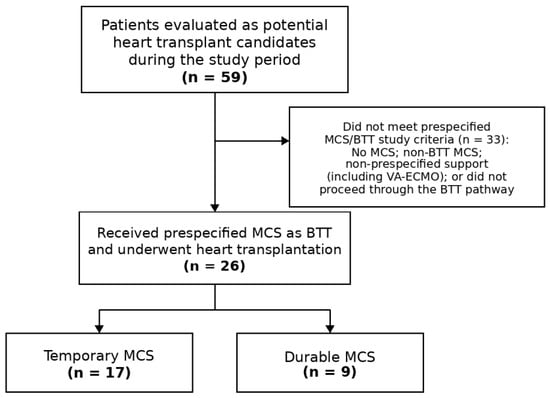
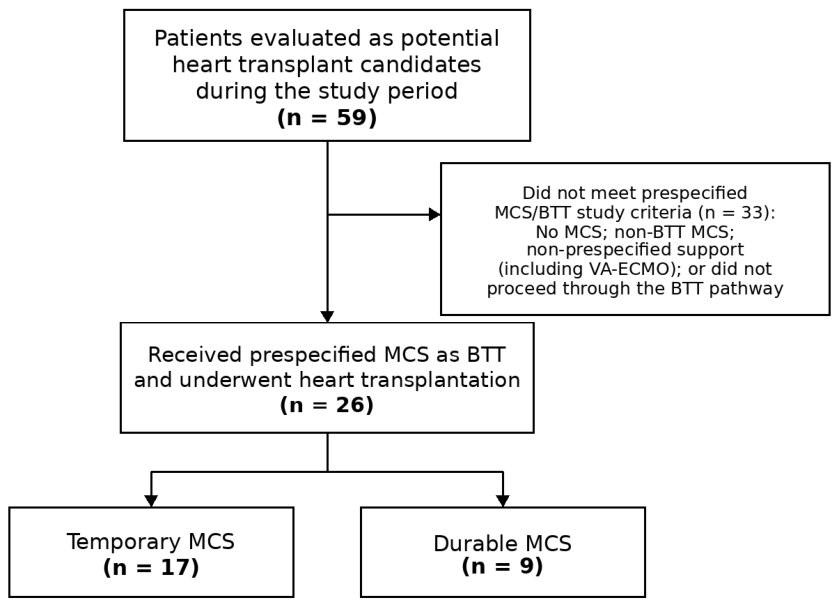
During the study period, 59 patients were evaluated as potential heart transplant candidates. Of these, 26 met the prespecified study criteria of receiving Impella 5.5, Ax-IABP, or durable LVAD support as a bridge-to-transplant strategy and subsequently underwent transplantation, forming the final analytic cohort (Figure 1). The remaining 33 patients did not meet the predefined exposure and/or bridge-to-transplant criteria. Reasons for exclusion included not requiring MCS before transplantation, receiving MCS for an indication other than BTT, receiving a support modality outside the prespecified study categories, including VA-ECMO, or not proceeding through the bridge-to-transplant pathway evaluated in this study. Because subsequent clinical outcomes were not systematically captured for patients outside the prespecified analytic cohort, outcome-specific categorization of these excluded patients could not be performed reliably. Of the 26 included patients, 17 received temporary MCS and 9 received durable LVAD support. As shown in Table 1, most participants were males (73.1%) and the median age was 58 years (48–64). The predominant etiology of cardiomyopathy was non-ischemic (65.4%). Most patients had an INTERMACS profile of 3 (42.3%), followed by profiles 4 (23.1%), and 2 (19.2%). The median left ventricular ejection fraction was 17.5% (14–20). The median pre-device creatinine was 1.40 (1.13–1.92), with a median pre-device eGFR of 53.50 (34–70). Blood group O was most common (65.4%), and most patients had a UNOS Status 2 at the time of transplant (88.5%). Combined heart–kidney transplantation was performed in 15.4% of patients. One-year mortality was 11.5% for the entire cohort.
Figure 1.
Patient selection flow diagram. MCS, mechanical circulatory support; BTT, bridge to transplantation.
Table 1.
Baseline characteristics by mechanical circulatory support strategy.
Post-device complications occurred in 30.8% of patients. The most common complication was stroke (15.4%), followed by major bleeding (7.7%). The 30-day readmission rate following device implantation was 15.4%, mostly driven by LVAD group.
Regarding transplant outcomes, the median waitlist time was 69.5 (19–528) days, and a median device-to-transplant time of 22.5 (9–515) days. When analyzing discharge times, patients had a median of 12.5 (10–14) days of transplant-to-discharge time, 35.5 (25–525) days of device-to-discharge time, 92 (32–549) days of listing-to-discharge time, and 5 (4–7) days of post-transplant ICU LOS. Finally, the median cardiopulmonary bypass time was 181 (155–191) minutes.
3.2. Comparison by Mechanical Circulatory Support Strategy
Descriptive comparisons were performed across individual device groups (Ax-IABP, Impella 5.5, and LVAD) to characterize baseline differences, while primary analyses focused on temporary versus durable mechanical support strategies.
Of the 26 included patients, 17 received temporary MCS (Ax-IABP, n = 8; Impella 5.5, n = 9), while 9 received durable LVAD support. When comparing device groups, patients supported with Impella 5.5 were older compared to those receiving Ax-IABP and LVAD (median age 65 vs. 54.5 vs. 50 years, p = 0.022). Although there were only 3 patients that had a UNOS status 3, the proportion of these patients was significantly higher on the LVAD group when compared to Ax-IABP and Impella 5.5 groups (33% vs. 0% vs. 0%, p = 0.041). Renal function was worse in the Impella 5.5 group, with higher pre-device creatinine (2.01 vs. 1.27 vs. 1.14 mg/dL; p = 0.044) and lower pre-device eGFR (28 vs. 61 vs. 70 mL/min/1.73 m2; p = 0.019) compared with the Ax-IABP and LVAD groups, respectively. No other statistically significant differences were detected across the three groups (Table 1).
Significant differences were observed in transplant-related time intervals. Median waitlist time was longer in the LVAD group compared to Ax-IABP and Impella 5.5 (606 vs. 27.5 vs. 34 days, p = 0.002). Similarly, device-to-transplant time was longer in the LVAD group (572 vs. 7 vs. 13 days, p = 0.001).
Device-to-discharge time and listing-to-discharge time were also longer in the LVAD group (581 vs. 23.5 vs. 39 days, p = 0.001; and 615 vs. 38 vs. 60 days, p = 0.001, respectively). In contrast, no statistically significant differences were detected in transplant-to-discharge time or post-transplant ICU LOS across groups (p = 0.743 and p = 0.290, respectively). Cardiopulmonary bypass time differed significantly between groups, with longer durations observed in the LVAD group (250 vs. 166.5 vs. 158 min, p = 0.001).
3.3. Pre-Device Hemodynamic Characteristics According to Mechanical Circulatory Support Strategy
Baseline hemodynamic characteristics prior to MCS implantation are summarized in Table 2. Overall, the cohort demonstrated elevated filling pressures and reduced cardiac index consistent with advanced heart failure. The median right atrial pressure was 11.5 mmHg (IQR 8–14), pulmonary capillary wedge pressure was 22 mmHg (IQR 18–28), and cardiac index was 2.07 L/min/m2 (IQR 1.70–2.58). Hemodynamic profiles were generally similar across support strategies, with no statistically significant differences observed in systemic blood pressure, filling pressures, pulmonary artery pressures, cardiac output, cardiac index, pulmonary vascular resistance, or systemic vascular resistance. A trend toward higher right ventricular systolic pressure was observed among patients supported with Ax-IABP compared with Impella 5.5 and durable LVAD support (74 vs. 31 vs. 55 mmHg, respectively; p = 0.050). Overall, these findings suggest a broadly comparable degree of hemodynamic compromise across support groups prior to device implantation.
Table 2.
Baseline hemodynamic characteristics prior to mechanical circulatory support implantation according to support strategy.
3.4. Kaplan–Meier Analysis of Time-to-Transplant According to Mechanical Circulatory Support Strategy
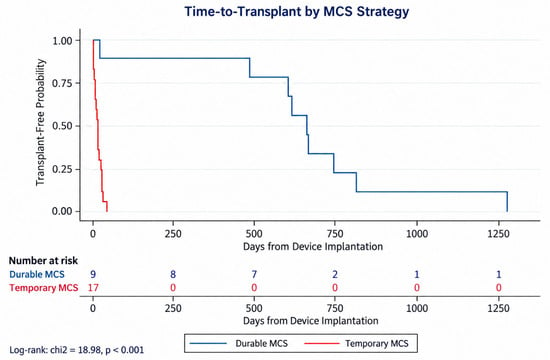
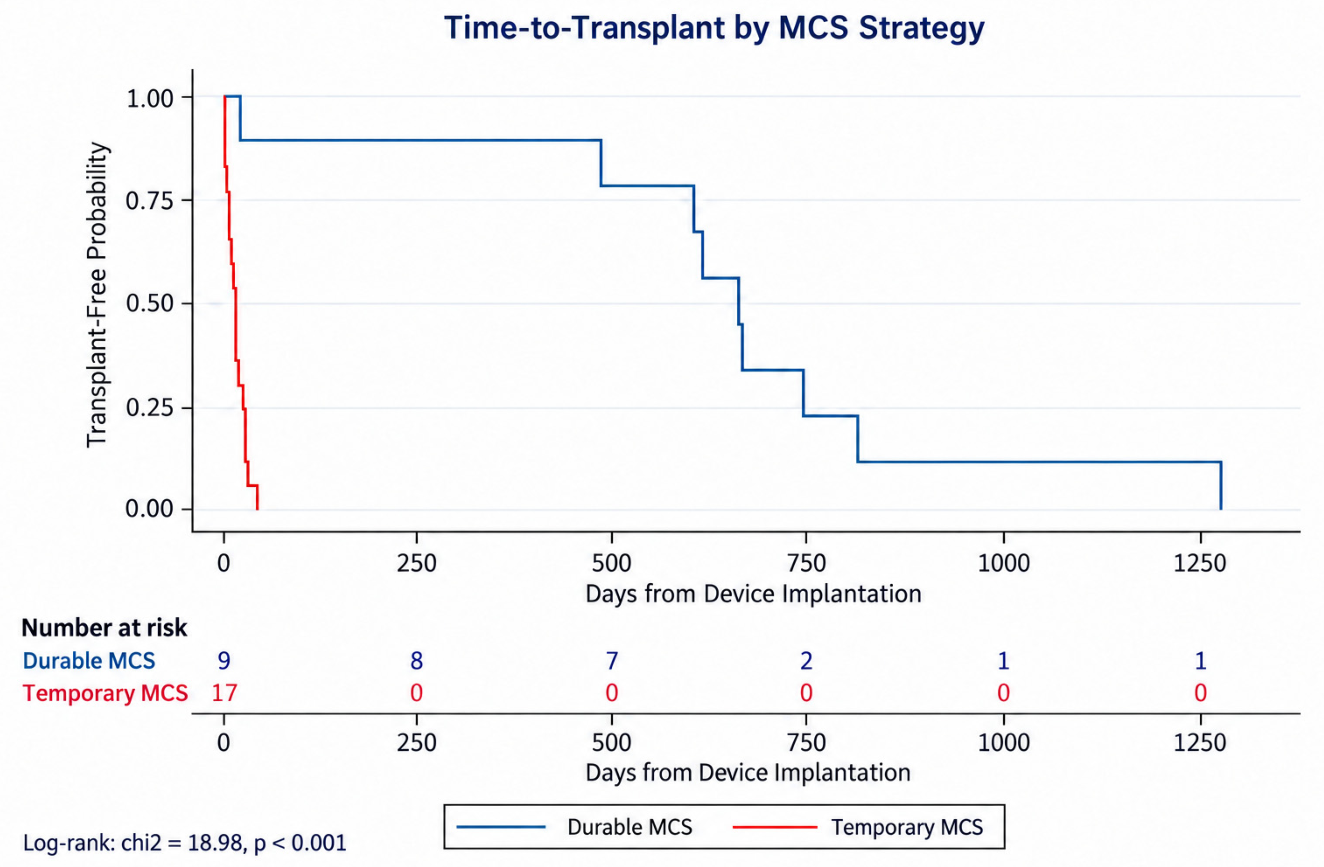
The Kaplan–Meier analysis of time-to-transplantation after MCS device placement, shown in Figure 2, demonstrated a significant difference between temporary and durable mechanical circulatory support strategies. The log-rank test confirmed a significant separation between the curves (χ2 = 18.98, p < 0.001), with shorter time to transplantation observed in patients supported with tMCS, indicating significantly shorter time-to-transplantation among patients supported with temporary MCS compared with durable MCS.
Figure 2.
Kaplan–Meier analysis of time-to-transplant according to mechanical circulatory support strategy. Temporary mechanical circulatory support (tMCS) was associated with significantly shorter time-to-transplantation compared with durable mechanical circulatory support (dMCS) (log-rank χ2 = 18.98, p < 0.001). Numbers at risk are displayed below the Kaplan–Meier curves.
3.5. Predictors of Device-to-Transplant Time
As shown in Table 3, univariable linear regression analyses identified temporary mechanical support as significantly associated with shorter device-to-transplant time (B = −639.19; 95% CI −799.91 to −478.47; p = 0.001) when compared to the durable mechanical support group. UNOS status 3 was associated with a significantly longer device-to-transplant time (B = 695.77; 95% CI = 332.24–1059.3, p = 0.001) when compared to patients with a UNOS status 2. Male sex (B = −270.38; 95% CI = −586.86–46.11, p = 0.091), age (B = −9.03; 95% CI = −21.06–2.99, p = 0.134), A blood group (B = 126.78; 95% CI = −229.2–482.77, p = 0.469) and B blood group (B = −219.22; 95% CI = −688.67–250.24, p = 0.344) were not associated with device-to-transplant time.
Table 3.
Univariable and multivariable linear regression analyses identifying predictors of device-to-transplant time in heart transplant recipients.
The multivariable linear regression model included all the variables on the univariable models either due to statistical significance or because they were perceived as potential confounders based on clinical reasoning and directed acyclic graphs. After adjusting for age, sex, blood group, and UNOS status, temporary mechanical support remained independently associated with shorter device-to-transplant time (B = −495.23; 95% CI −714.38 to −276.08; p = 0.001). UNOS Status 3 also remained independently associated with longer device-to-transplant time (B = 302.77; 95% CI 1.12 to 604.41; p = 0.049).
3.6. Predictors of Post-Transplant ICU LOS
As shown in Table 4, in univariable analysis, temporary mechanical support was not associated with post-transplant ICU LOS (B = 2.08; 95% CI −6.67 to 10.83; p = 0.628). Blood group B was associated with longer ICU stay (B = 14.33; 95% CI 2.19 to 26.48; p = 0.023), while other variables were not significant.
Table 4.
Univariable and multivariable linear regression analyses identifying predictors of post-transplant ICU LOS in heart transplant recipients.
In multivariable linear regression analysis, blood group B remained independently associated with longer post-transplant ICU LOS (B = 15.15; 95% CI 0.68 to 29.62; p = 0.041), whereas temporary mechanical support was not associated with this outcome after adjusting for male sex, age, blood group, and UNOS status.
3.7. Predictors of Cardiopulmonary Bypass Time
As shown in Table 5, univariable linear regression analyses identified temporary mechanical support as significantly associated shorter cardiopulmonary bypass time in univariable analysis (B = −68.50; 95% CI −96.19 to −40.82; p = 0.001) when compared to the durable mechanical support group. Male sex (B = −4.77; 95% CI = −47.6–38.07, p = 0.820), age (B = −0.96; 95% CI = −2.51–0.60, p = 0.217), A blood group (B = 30.98; 95% CI = −14.25–76.21, p = 0.170), B blood group (B = 9.98; 95% CI = −49.67–69.63, p = 0.170), and a UNOS status 3 (B = 31.29; 95% CI = −26.78–89.36, p = 0.277) were not associated with cardiopulmonary bypass time.
Table 5.
Univariable and multivariable linear regression analyses identifying predictors of cardiopulmonary bypass time in heart transplant recipients.
In multivariable linear regression analysis, temporary mechanical support remained independently associated with shorter cardiopulmonary bypass time (B = −88.85; 95% CI −126.32 to −51.38; p = 0.001) when compared to the durable mechanical support group, and adjusting for male sex, age, blood group, and UNOS status.
3.8. Sensitivity Analyses Including INTERMACS Profile
Sensitivity analyses incorporating INTERMACS profile into the multivariable models yielded findings consistent with the primary analyses. Temporary MCS remained independently associated with shorter device-to-transplant time (B = −570.19, p = 0.001) and shorter cardiopulmonary bypass time (B = −106.37, p < 0.001), while no significant association was observed with post-transplant ICU length of stay (B = −5.30, p = 0.512). Inclusion of INTERMACS profile did not materially alter the magnitude or direction of the observed associations, supporting the robustness of the primary results.
4. Discussion
The present study demonstrates that temporary mechanical circulatory support (MCS) strategies are associated with significantly shorter waitlist and device-to-transplant times compared with durable LVAD support, while no statistically significant differences were detected in early post-transplant recovery metrics across groups. Importantly, our analysis was designed to evaluate outcomes at the level of MCS strategy rather than individual device performance, and findings should be interpreted within this framework.
The magnitude of the difference in time to transplantation observed in our cohort reflects the structural changes introduced by the 2018 United Network for Organ Sharing (UNOS) allocation policy. This policy prioritized nondischargeable patients supported with tMCS, which resulted in a profound change in transplant practices [4,5]. National data demonstrate that tMCS utilization increased from approximately 25% to over 40–50% of cardiogenic shock admissions at transplant centers [13], while durable LVAD use as BTT declined to approximately 5% of MCS-supported patients [3]. Concurrently, waitlist times for high-priority patients decreased significantly, Ax-IABP-supported cohorts exhibited a reduction from approximately 35 days to 15 days (p < 0.001) [10], and overall waitlist mortality declined as well [6,10,14].
In our cohort, the difference in device-to-transplant time between strategies was substantial, and exceeded several hundred days in adjusted analyses, which highlights the clinical impact of allocation-driven prioritization. These findings align with registry-level [9] and single center analyses [15] demonstrating that tMCS-supported patients experience markedly shorter waitlist times despite higher acuity at listing. A prior single center experience in our center demonstrated similar median listing-to-transplant times of approximately 35 days with Impella support compared with 696 days with durable LVAD (p < 0.001), along with shorter cardiopulmonary bypass times (181 vs. 219 min, p = 0.002) [8], reinforcing the magnitude of strategy-level differences and operative implications observed in contemporary practice. This difference likely reflects increased surgical complexity in LVAD-supported patients, including redo sternotomy and device explantation, which may lead to prolonged cardiopulmonary bypass duration. In addition, prior institutional data have demonstrated lower intraoperative transfusion requirements in patients bridged with Impella 5.5 compared with durable LVAD, suggesting reduced surgical complexity and perioperative burden, which may further contribute to improved outcomes in carefully selected bridge-to-transplant populations [16].
Although the shorter time to transplantation observed with tMCS may significantly be influenced by contemporary allocation policy, the present analysis provides additional strategy-level peri-transplant information not routinely captured in national registry studies, including operative complexity, invasive pre-device hemodynamics, renal function, and early post-transplant recovery. These findings should be interpreted as exploratory and hypothesis-generating given the limited sample size.
Importantly, contemporary propensity-matched national data have demonstrated that, despite shorter time to transplantation, tMCS is associated with higher waitlist adverse events compared with durable LVAD support (35.2% vs. 15.9%, p < 0.001), with a significantly increased adjusted hazard of death or delisting (HR 3.37, p < 0.001), which may underscore the trade-off between expedited transplantation and waitlist risk [17]. However, these findings have not been replicated in single center or multicenter studies. Our study demonstrates favorable outcomes in patients supported with axillary tMCS (Impella 5.5 or Ax-IABP), which may reflect the benefit of a multidisciplinary approach to patient selection and management. These findings may also reflect differences in patient selection and center-level practices compared with registry-level analyses.
Beyond allocation effects, our results reflect a broader transformation in clinical practice. After the UNOS policy change, tMCS utilization increased significantly without major changes in baseline patient characteristics, suggesting that device selection is influenced not only by clinical severity but also by allocation structure [13]. This is further supported by data demonstrating a 338% increase in Ax-IABP utilization [6] and a marked rise in Impella use, indicating a systemic shift toward tMCS as a BTT strategy [11,18,19]. These findings are consistent with contemporary analyses suggesting that the allocation system has contributed to increased utilization of temporary support among transplant-eligible patients [4,7,19].
Despite these differences in pre-transplant timelines, no statistically significant differences in early post-transplant outcomes were observed between strategies in our cohort. This is consistent with a large UNOS registry analysis that included 1734 transplanted patients following the allocation policy change (October 2018–September 2020) and demonstrated similar 1-year survival between temporary and durable MCS strategies. The survival rates were 94.8% for tMCS versus 90.1% for durable LVAD (p = 0.06). Notably, after risk adjustment, durable LVAD support has been associated with a significantly higher hazard of mortality (HR 3.96, 95% CI 1.42–11.03, p = 0.009) [9], suggesting that post-transplant outcomes may not differ substantially between strategies in selected populations, although these observational data do not establish equivalence. However, given the limited sample size of our study, our findings should be interpreted as exploratory and hypothesis-generating. Another study using the UNOS registry data from 2016 to 2021 found no significant difference in 1-year survival between percutaneous and durable LVAD support (aHR 0.63, 95% CI 0.37–1.07), despite higher acuity in the percutaneous group [20]. These findings are further supported by long-term single-center data demonstrating no significant difference in survival across strategies (p = 0.18 overall) [15]. These findings suggest that accelerated transplantation was not associated with statistically significant differences in early or intermediate survival.
The prolonged waitlist times observed among LVAD-supported patients in our cohort are also consistent with contemporary trends. Nowadays, durable LVAD use has shifted predominantly toward destination therapy, which accounts for approximately 81% of cases, while its use as BTT has declined considerably [3]. Under the current allocation system, patients on durable MCS are deprioritized relative to those on tMCS, resulting in longer waiting periods unless complications arise.
The fundamental change in allocation philosophy seems to prioritize urgency over stability. However, these strategy-level advantages are accompanied by important trade-offs. Temporary MCS facilitates rapid transplantation but is associated with increased complication risk, particularly in complex or prolonged support scenarios. Registry data from the Cardiogenic Shock Working Group showed higher rates of bleeding (52% vs. 33%, p < 0.01), limb ischemia (9% vs. 3%, p < 0.01), and mortality (38% vs. 25%, p < 0.001) in patients receiving combination tMCS compared with single-device strategies [19]. In contrast, durable LVAD support provides sustained hemodynamic stabilization and enables outpatient management, but carries well-established risks, including stroke, pump thrombosis, bleeding, and the need for repeat sternotomy at the time of transplantation [3]. In addition, shorter time to transplantation may not necessarily represent the optimal long-term strategy for every patient. In selected candidates, particularly younger individuals, durable LVAD support (especially with HeartMate 3 devices) may provide prolonged circulatory support and greater flexibility in transplant timing. Accordingly, the choice between temporary and durable support should remain individualized based on patient characteristics, clinical trajectory, anticipated waitlist time, recovery potential, and long-term therapeutic goals.
Regarding device-specific data, Impella 5.5 has demonstrated high rates of successful bridging, with 87% of patients ultimately transplanted and median waitlist times of approximately 19 days, along with 1-year post-transplant survival of 89.5% [11]. Similarly, Ax-IABP strategies have shown bridging success rates above 90%, with median support durations of approximately 21 days and low rates of waitlist mortality (1.5%) [14]. Despite these favorable observational outcomes, randomized evidence remains limited. For example, the Altshock-2 randomized trial evaluating early Ax-IABP use in cardiogenic shock demonstrated no significant improvement in 60-day survival or bridging to heart replacement therapy (81% vs. 75%, p = 0.45) [21].
Another aspect to consider is potential myocardial recovery. Although not directly assessed in our cohort, studies have shown that up to 40% of patients supported with durable LVAD may achieve meaningful myocardial recovery under optimized unloading and medical therapy protocols [22]. In contrast, expedited transplantation facilitated by tMCS may limit the opportunity for recovery in selected patients. This raises the possibility that urgency-driven allocation may favor early transplantation over recovery-oriented strategies in certain clinical contexts.
Finally, from a systems perspective, the expansion of tMCS has introduced variability in practice patterns and may influence access to heart transplantation. Prior analyses have demonstrated that transplant center–level variation in MCS utilization is strongly associated with transplant rates, suggesting that institutional practices contribute to differences in allocation outcomes independent of patient characteristics [4]. Although not directly evaluated in our study, these findings raise important considerations regarding consistency and equity in transplant allocation and the bridge strategy to be used.
Our findings contribute to the growing body of literature evaluating temporary mechanical circulatory support as a bridge-to-transplant strategy in the contemporary allocation era. In our cohort, temporary MCS was associated with shorter time to transplantation, shorter cardiopulmonary bypass times, and no statistically significant differences in early post-transplant outcomes. However, these findings should be interpreted within the context of the study’s observational design and limited sample size, and the observed associations must be balanced against potential complications, resource utilization, and the possibility of missed recovery opportunities. Optimal device selection should remain individualized, incorporating patient acuity, anticipated wait time, recovery potential, and institutional expertise.
5. Limitations
The notable strengths of our study include the fact that we used a strategy-level evaluation of temporary versus durable MCS in the contemporary allocation era, allowing assessment of clinically meaningful differences beyond individual device comparisons. The analysis reflects real-world patient selection and multidisciplinary decision-making within an advanced heart failure and transplant center. Additionally, the inclusion of detailed peri-transplant and operative outcomes offers insight into endpoints not consistently captured in large registry studies. The use of adjusted analyses further strengthens the assessment of associations between MCS strategy and clinical outcomes.
However, there are several limitations that should be considered when interpreting our findings. First, this is a single-center experience with a small sample size, which may limit the stability of multivariable models. The study cohort was restricted to patients who received MCS as a bridge-to-transplant strategy and subsequently underwent transplantation; therefore, these findings may not be generalizable to MCS-supported patients who do not ultimately undergo transplantation. In addition, the temporary MCS cohort was restricted to the prespecified Impella 5.5 and Ax-IABP bridge strategies. Patients supported with VA-ECMO or other rescue or combination MCS configurations were not represented in the analytic cohort; therefore, the present findings should not be extrapolated to these populations. Given the limited sample size, regression analyses should be interpreted as exploratory and hypothesis-generating, and the observed associations require validation in larger multicenter cohorts. Additionally, although our findings may represent an important signal, given the limited sample size and low number of clinical events, the absence of statistically significant differences should not be interpreted as evidence of equivalence between temporary and durable MCS strategies. Second, the observational nature precludes causal inference, and residual confounding cannot be excluded. Although sensitivity analyses incorporating INTERMACS profile yielded findings consistent with the primary analyses, residual confounding cannot be excluded. While baseline hemodynamic characteristics and measures of renal function were available and are reported, other potentially relevant variables, including detailed end-organ dysfunction metrics, were not consistently available. Furthermore, although frailty was routinely assessed during multidisciplinary transplant evaluation, a standardized frailty metric was not available for quantitative analysis. Finally, SCAI shock stage was not routinely documented during the study period and could not be reliably assigned retrospectively because several required clinical components were inconsistently available. Third, baseline differences between groups, particularly related to clinical severity and allocation-driven prioritization, may introduce indication bias. Fourth, we applied a 90-day adjustment to LVAD-supported patients, although this was clinically justified to account for allocation-related constraints, it may also influence comparisons of device-to-transplant time. Fifth, despite multivariable adjustment and sensitivity analyses incorporating INTERMACS profile, residual confounding from unmeasured clinical factors cannot be excluded. Finally, the analysis was limited to early post-transplant outcomes, without assessment of long-term survival, rejection, or long-term complications.
6. Conclusions
In our cohort, tMCS strategies (Ax-IABP and Impella 5.5) were associated with significantly shorter time to transplantation and cardiopulmonary bypass time compared with durable LVAD support, while no statistically significant differences in early post-transplant recovery outcomes were detected between groups. These findings may reflect the impact of contemporary allocation practices, in which tMCS is prioritized and facilitates expedited transplantation. Optimal device selection in the current era should remain individualized by balancing the advantages of rapid transplantation offered by tMCS against the stabilizing and recovery potential of durable LVAD support. Our findings should be considered exploratory and hypothesis-generating and warrant validation in larger multicenter studies.
Author Contributions
H.M. conceptualized the study, performed data analysis, interpreted the results, and drafted the manuscript. A.D., L.R.B., A.M. and S.S. contributed to data collection, data interpretation, and critical revision of the manuscript. J.R., D.S.Y., M.A.L., J.N.-N., J.L. and P.P. contributed to study design, clinical interpretation, and critical revision of the manuscript for important intellectual content. R.G. conceived and supervised the study, contributed to study design and data interpretation, and critically revised the manuscript. All authors have read and agreed to the published version of the manuscript.
Funding
This research received no external funding.
Institutional Review Board Statement
The study was conducted in accordance with the Declaration of Helsinki and approved by the Institutional Review Board of the Mayo Clinic for studies involving humans (approval code: IRB # 22-004000) on 20 April 2024.
Informed Consent Statement
Patient consent was waived due to IRB approval for the retrospective study of patients supported with MCS.
Data Availability Statement
The datasets generated and/or analysed during the current study are available from the corresponding author on reasonable request.
Conflicts of Interest
The authors declare no conflicts of interest.
Abbreviations
| Ax-IABP | Axillary intra-aortic balloon pump |
| B | Beta coefficient |
| BTT | Bridge to transplantation |
| CI | Confidence interval |
| CPB | Cardiopulmonary bypass |
| GDMT | Guideline-directed medical therapy |
| HF | Heart failure |
| HF-CS | Heart failure-related cardiogenic shock |
| ICU | Intensive care unit |
| INTERMACS | Interagency Registry for Mechanically Assisted Circulatory Support |
| IQR | Interquartile range |
| LOS | Length of stay |
| LVAD | Left ventricular assist device |
| MCS | Mechanical circulatory support |
| tMCS | Temporary mechanical circulatory support |
| UNOS | United Network for Organ Sharing |
References
- Thiele, H.; Hassager, C. Cardiogenic Shock. N. Engl. J. Med. 2025, 394, 62–77. [Google Scholar] [CrossRef] [Scilit] [PubMed]
- Choi, K.H.; Kang, D.; Park, H.; Park, T.K.; Lee, J.M.; Song, Y.B.; Hahn, J.-Y.; Choi, S.-H.; Gwon, H.-C.; Cho, J.; et al. In-hospital and long-term outcomes of cardiogenic shock complicating myocardial infarction versus heart failure. Eur. J. Heart Fail. 2024, 26, 1594–1603. [Google Scholar] [CrossRef] [Scilit] [PubMed]
- Tedford, R.J.; Leacche, M.; Lorts, A.; Drakos, S.G.; Pagani, F.D.; Cowger, J. Durable Mechanical Circulatory Support. J. Am. Coll. Cardiol. 2023, 82, 1464–1481. [Google Scholar] [CrossRef] [Scilit] [PubMed]
- Maitra, N.S.; Dugger, S.J.; Balachandran, I.C.; Civitello, A.B.; Khazanie, P.; Rogers, J.G. Impact of the 2018 UNOS Heart Transplant Policy Changes on Patient Outcomes. JACC Heart Fail. 2023, 11, 491–503. [Google Scholar] [CrossRef] [Scilit] [PubMed]
- Truby, L.K.; Farr, M.; Topkara, V.K. Critically Appraising the 2018 UNOS Donor Allocation Policy: Adding Life Boats or Rearranging the Deck Chairs? Curr. Opin. Anaesthesiol. 2022, 35, 42–47. [Google Scholar] [CrossRef] [Scilit] [PubMed]
- O’Connell, G.; Wang, A.S.; Kurlansky, P.; Ning, Y.; Farr, M.A.; Sayer, G.; Uriel, N.; Naka, Y.; Takeda, K. Impact of UNOS allocation policy changes on utilization and outcomes of patients bridged to heart transplant with intra-aortic balloon pump. Clin. Transplant. 2022, 36, e14533. [Google Scholar] [CrossRef] [Scilit] [PubMed]
- Parker, W.F.; Chung, K.; Anderson, A.S.; Siegler, M.; Huang, E.S.; Churpek, M.M. Practice Changes at U.S. Transplant Centers after the New Adult Heart Allocation Policy. J. Am. Coll. Cardiol. 2020, 75, 2906–2916. [Google Scholar] [CrossRef] [Scilit] [PubMed]
- Goswami, R.; Ruiz, J.; Desai, A.; Wlodkowski, P.; Sareyyupoglu, B.; Kiley, S.; Bhattacharyya, A.; Yip, D.; Lyle, M.; Nativi-Nicolau, J.; et al. Percutaneous Temporary Mechanical Circulatory Support as a Bridge to Heart Transplantation in the Current UNOS Allocation System. Biomedicines 2025, 13, 2637. [Google Scholar] [CrossRef] [Scilit] [PubMed]
- Hess, N.R.; Hickey, G.W.; Keebler, M.E.; Huston, J.H.; McNamara, D.M.; Mathier, M.A.; Wang, Y.; Kaczorowski, D.J. Left ventricular assist device bridging to heart transplantation: Comparison of temporary versus durable support. J. Heart Lung Transplant. 2023, 42, 76–86. [Google Scholar] [CrossRef] [Scilit] [PubMed]
- Huckaby, L.V.; Seese, L.M.; Mathier, M.A.; Hickey, G.W.; Kilic, A. Intra-Aortic Balloon Pump Bridging to Heart Transplantation. Circ. Heart Fail. 2020, 13, e006971. [Google Scholar] [CrossRef] [Scilit] [PubMed]
- Cevasco, M.; Shin, M.; Cohen, W.; Helmers, M.R.; Weingarten, N.; Rekhtman, D.; Wald, J.W.; Iyengar, A. Impella 5.5 as a bridge to heart transplantation: Waitlist outcomes in the United States. Clin. Transplant. 2023, 37, e15066. [Google Scholar] [CrossRef] [Scilit] [PubMed]
- Varshney, A.S.; DeFilippis, E.M.; Cowger, J.A.; Netuka, I.; Pinney, S.P.; Givertz, M.M. Trends and Outcomes of Left Ventricular Assist Device Therapy. J. Am. Coll. Cardiol. 2022, 79, 1092–1107. [Google Scholar] [CrossRef] [Scilit] [PubMed]
- Varshney, A.S.; Berg, D.D.; Katz, J.N.; Baird-Zars, V.M.; Bohula, E.A.; Carnicelli, A.P.; Chaudhry, S.-P.; Guo, J.; Lawler, P.R.; Nativi-Nicolau, J.; et al. Use of Temporary Mechanical Circulatory Support for Management of Cardiogenic Shock Before and After the United Network for Organ Sharing Donor Heart Allocation System Changes. JAMA Cardiol. 2020, 5, 703–708. [Google Scholar] [CrossRef] [Scilit] [PubMed]
- Nishida, H.; Koda, Y.; Kalantari, S.; Nguyen, A.; Chung, B.; Grinstein, J.; Kim, G.; Sarswat, N.; Smith, B.; Song, T.; et al. Outcomes of Ambulatory Axillary Intraaortic Balloon Pump as a Bridge to Heart Transplantation. Ann. Thorac. Surg. 2021, 111, 1264–1270. [Google Scholar] [CrossRef] [Scilit] [PubMed]
- Finnan, M.J.; Bakir, N.H.; Itoh, A.; Kotkar, K.D.; Pasque, M.K.; Damiano, R.J.; Moon, M.R.; Ewald, G.A.; Schilling, J.D.; Masood, M.F. 30 Years of Heart Transplant: Outcomes After Mechanical Circulatory Support From a Single Center. Ann. Thorac. Surg. 2022, 113, 41–48. [Google Scholar] [CrossRef] [Scilit] [PubMed]
- Shapiro, A.B.; Fritz, A.V.; Kiley, S.; Sharma, S.; Patel, P.; Heckman, A.; Martin, A.K.; Goswami, R. Comparison of Intraoperative Blood Product Use During Heart Transplantation in Patients Bridged with Impella 5.5 versus Durable Left Ventricular Assist Devices. J. Cardiothorac. Vasc. Anesth. 2024, 38, 2567–2575. [Google Scholar] [CrossRef] [Scilit] [PubMed]
- Kassi, M.; Zook, S.; Nguyen, D.; Ingram, K.; Legha, S.; Yousefzai, R.; Kim, J.; Hussain, I.; Martin, C.M.; Gorthi, J.; et al. Differences in wait-list mortality: Temporary vs durable circulatory support devices. JHLT Open 2025, 9, 100312. [Google Scholar] [CrossRef] [Scilit] [PubMed]
- Iyengar, A.; Rekhtman, D.; Weingarten, N.; Song, C.; Shin, M.; Helmers, M.R.; Kelly, J.J.; Cevasco, M.; Atluri, P. Comparison of Intraaortic Balloon Pump and Impella 5.5 as Heart Transplant Bridging Strategies. Ann. Thorac. Surg. 2023, 116, 811–817. [Google Scholar] [CrossRef] [Scilit] [PubMed]
- Fried, J.; Farr, M.; Kanwar, M.; Uriel, N.; Hernandez-Montfort, J.; Blumer, V.; Li, S.; Sinha, S.S.; Garan, A.R.; Li, B.; et al. Clinical outcomes among cardiogenic shock patients supported with high-capacity Impella axial flow pumps: A report from the Cardiogenic Shock Working Group. J. Heart Lung Transplant. 2024, 43, 1478–1488. [Google Scholar] [CrossRef] [Scilit] [PubMed]
- Xia, Y.; Kim, J.S.; Eng, I.K.; Nsair, A.; Ardehali, A.; Shemin, R.J.; Kwon, M.H. Outcomes of heart transplant recipients bridged with percutaneous versus durable left ventricular assist devices. Clin. Transplant. 2023, 37, e14904. [Google Scholar] [CrossRef] [Scilit] [PubMed]
- Morici, N.; Sacco, A.; Frea, S.; Rota, M.; Villanova, L.; Gravinese, C.; Dini, C.S.; D’Ettore, N.; Maj, G.; De Lio, G.; et al. Early Intra-Aortic Balloon Support for Heart Failure-Related Cardiogenic Shock. J. Am. Coll. Cardiol. 2025, 85, 1587–1597. [Google Scholar] [CrossRef] [Scilit] [PubMed]
- Topkara, V.K.; Sayer, G.T.; Clerkin, K.J.; Wever-Pinzon, O.; Takeda, K.; Takayama, H.; Selzman, C.H.; Naka, Y.; Burkhoff, D.; Stehlik, J.; et al. Recovery with Temporary Mechanical Circulatory Support while Waitlisted for Heart Transplantation. J. Am. Coll. Cardiol. 2022, 79, 900–913. [Google Scholar] [CrossRef] [Scilit] [PubMed]

Disclaimer/Publisher’s Note: The statements, opinions and data contained in all publications are solely those of the individual author(s) and contributor(s) and not of MDPI and/or the editor(s). MDPI and/or the editor(s) disclaim responsibility for any injury to people or property resulting from any ideas, methods, instructions or products referred to in the content. |
© 2026 by the authors. Licensee MDPI, Basel, Switzerland. This article is an open access article distributed under the terms and conditions of the Creative Commons Attribution (CC BY) license.