


Abstract
The association between tumor characteristics and cardiovascular mortality in thyroid cancer (TC) remains poorly characterized. We identified 19,228 primary TC patients from SEER (2004–2015), with follow-up through 2020. Fine–Gray and cause-specific Cox models evaluated cardiovascular disease (CVD) mortality, with analyses by sex and age. A nomogram was developed for exploratory risk stratification, and separate continuous-age competing-risk models were assessed in training and validation cohorts. During a median follow-up of 8.3 years, 321 (18.7%) of 1713 deaths were CVD-related. Compared with localized disease, regional and distant stage were associated with higher cause-specific hazards of CVD death (csHR 1.32, 95% CI 1.03–1.71; and 2.46, 1.71–3.55, respectively). The distant-stage subdistribution association was elevated early after diagnosis and attenuated over follow-up (12-month sHR 2.79, 95% CI 1.61–4.83). Male sex was associated with a higher overall subdistribution hazard (sHR 2.19, 95% CI 1.73–2.78). The prediction model yielded validation AUCs of 0.854–0.895 at 5–10 years, but adding stage did not meaningfully improve five-year prediction beyond the baseline models evaluated. These findings support attention to cardiovascular risk at TC diagnosis and during survivorship, taking tumor stage, conventional risk factors and planned treatment into account.
1. Introduction
Thyroid cancer (TC) is the most prevalent endocrine malignancy, with a notably high 5-year survival rate approaching 98% in several high-income settings [1,2,3]. As the population of TC survivors continues to grow, attention has increasingly shifted toward long-term health risks, particularly non-cancer-related causes of death. Accumulating evidence indicates that cardiovascular disease (CVD) has emerged as the leading cause of non-cancer mortality among TC survivors. SEER studies have examined the contribution of prior cancer history and histological type to mortality after TC diagnosis [4,5]. According to SEER program data, CVD accounted for 21.3% of all deaths among TC patients, making it the leading cause of non-malignant mortality in this population [6].
The mechanisms underlying elevated cardiovascular risk in TC patients have traditionally been attributed to two main factors: the cardiotoxic effects of cancer treatments and the accumulation of traditional cardiovascular risk factors [7,8]. Thyroid-stimulating hormone (TSH) suppression therapy, a cornerstone of postoperative management for intermediate- and high-risk patients, has been implicated in elevated heart rate, increased diastolic blood pressure, and higher risks of atrial fibrillation and coronary heart disease [9]. A seminal study published in 2013 followed 524 differentiated thyroid cancer (DTC) patients and found higher cardiovascular mortality than in matched controls, with lower TSH levels associated with higher cardiovascular mortality within the DTC cohort [10]. Similarly, a 2019 study using data from the Korean National Health Insurance Service compared 182,419 TC patients with a 1:1 matched control group and found significantly increased risks of coronary heart disease and ischemic stroke among TC patients, with those taking levothyroxine doses of 170 μg/day or more facing adjusted hazard ratios of 1.47 for coronary heart disease and 1.56 for ischemic stroke [11]. A 2023 meta-analysis evaluating cardiovascular outcomes in TC patients assessed the impact of radioactive iodine therapy and found a neutral effect on cardiovascular outcomes with a pooled relative risk of 1.00 (95% CI 0.87–1.16) [12].
However, a growing body of evidence suggests that the association between TC and cardiovascular mortality extends beyond treatment-related toxicity and traditional risk factors. The Utah Cancer Survivors Study identified TSH suppression, cancer stage and pre-existing comorbidity among factors associated with cardiovascular disease in TC survivors [13]. This observation raises a question: do tumor characteristics at diagnosis help characterize subsequent cardiovascular vulnerability? The emerging “double-hit” hypothesis in cardio-oncology provides a biological rationale for examining tumor-related and treatment-related cardiovascular stress [14,15,16,17,18]. Subsequent cancer treatments then constitute a “second hit,” compounding the initial insult [7,8,17].
Despite these insights, the specific impact of thyroid cancer (TC) characteristics on cardiovascular mortality remains poorly characterized. TC has a striking female predominance in incidence (approximately a 3:1 female-to-male ratio), whereas males often present with more aggressive disease and less favorable cancer outcomes [19]. Whether associations between tumor characteristics and cardiovascular mortality differ by sex or age remains uncertain. These dimensions are clinically relevant when considering cardiovascular risk across the TC survivorship continuum [19].
Therefore, we conducted this large population-based study using the Surveillance, Epidemiology, and End Results (SEER) database to achieve three objectives: first, to investigate the association between tumor stage and cardiovascular mortality in TC patients after adjustment for selected covariates; second, to determine whether associations between tumor stage and CVD death differ by sex; and third, to explore associations across age groups. By employing Fine–Gray and cause-specific Cox models, we distinguish associations with the subdistribution hazard from those with the CVD death hazard among patients still alive [20]. Our findings aim to advance the understanding of cardiovascular vulnerability after TC diagnosis and to inform cardiovascular risk assessment for the growing population of TC survivors.
2. Materials and Methods
2.1. Study Design and Participants
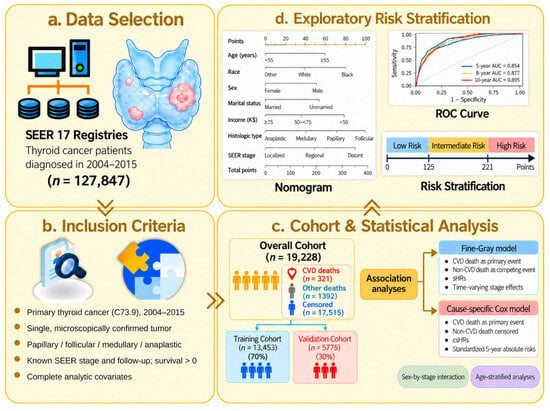
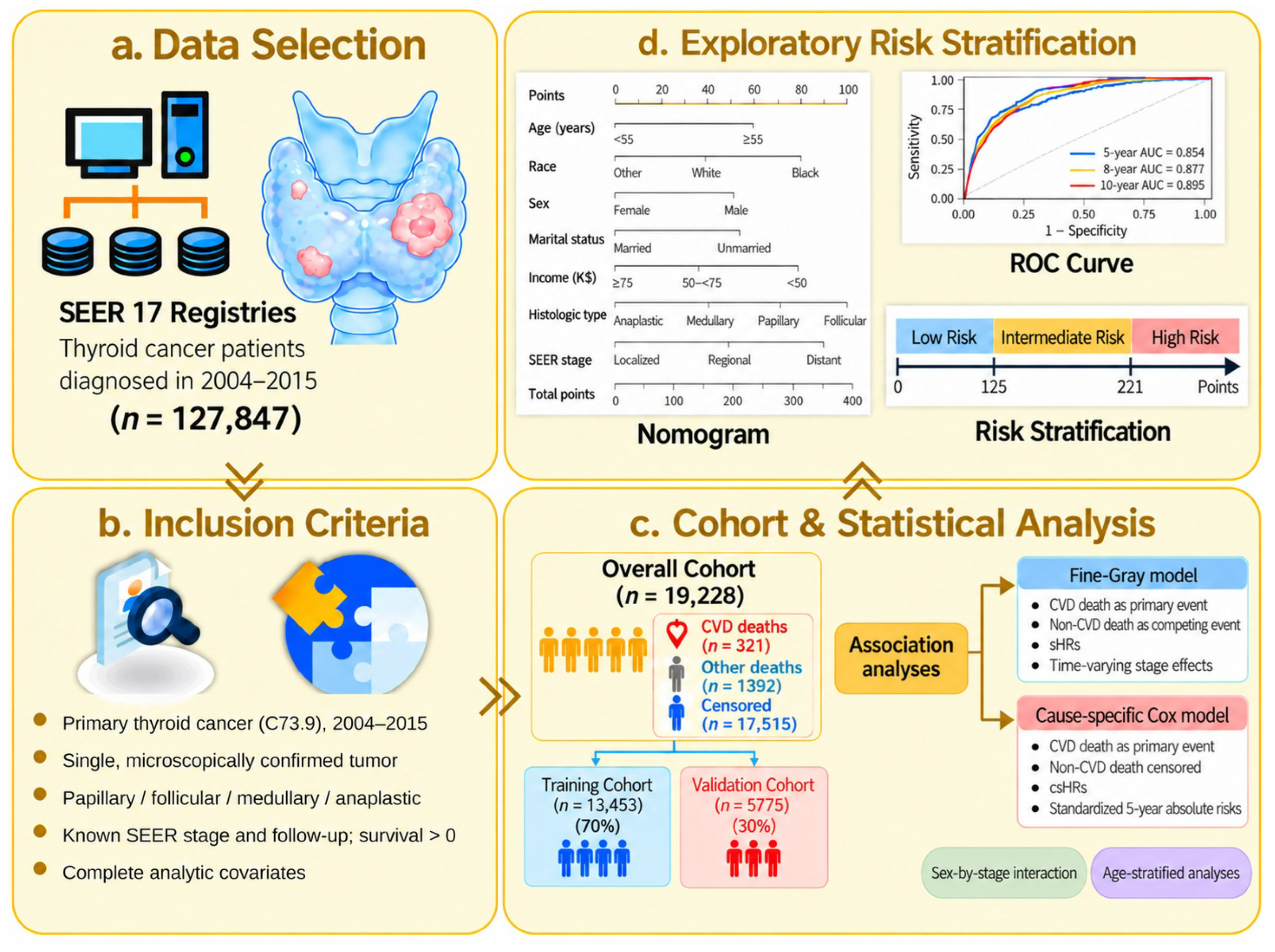
We conducted a population-based retrospective cohort study using the SEER 17 Registries Research Plus database, November 2022 submission, which covers approximately 26.5% of the United States population [21]. The source SEER 17 database covers diagnoses during 2000–2020; the analytic cohort was restricted to patients diagnosed during 2004–2015. Inclusion criteria were a single microscopically confirmed case of primary thyroid cancer (site C73.9) diagnosed in 2004–2015 and papillary, follicular, medullary or anaplastic histology. Exclusion criteria included the absence of a known localized, regional or distant category in the SEER “Combined Summary Stage (2004+)” field; nonpositive or missing survival time; unknown vital status or, among decedents, missing cause of death; and incomplete data for the covariates used in the primary and additional covariate-adjusted models: age, sex, race, marital status, area-level median household income, histology, tumor size, grade, multifocality, domicile, diagnosis year and diagnosis-to-treatment interval. These criteria yielded a common complete-record cohort of 19,228 patients for both association models. Figure 1 summarizes the patient selection process. Broader eligibility cohorts with less restrictive data-completeness requirements were evaluated only as sensitivity populations (Table S13; Supplementary Method S1).
Figure 1.
Selection of eligible patients and study design. The primary analytic cohort comprised 19,228 patients, meeting the stated clinical eligibility and complete-record criteria, including 321 cardiovascular deaths, 1392 other deaths and 17,515 censored observations. Prediction analyses used a random split of 13,453 training and 5775 validation patients; association analyses used the full primary cohort. Broader eligibility cohorts with less restrictive data-completeness requirements were sensitivity populations, not independent validation samples.
2.2. Study Variables and Primary Outcomes
Participant variables included age at diagnosis, year of diagnosis, sex, race, marital status, median household income, domicile, tumor multifocality, histological type, tumor size, tumor grade, SEER stage, time from diagnosis to treatment, radiotherapy, chemotherapy, and surgery. For descriptive summaries and the exploratory nomogram point scale, we categorized age at diagnosis into 2 groups using 55 years as the cutoff, consistent with the prognostic age boundary used for DTC [22]. Age was modeled continuously in the principal association and prediction analyses. Tumor size was classified as <20 mm, 20–40 mm, and >40 mm for descriptive analysis. Histological types were classified according to the morphological codes of the International Classification of Diseases for Oncology, 3rd edition (ICD-O-3), and tumor stage was classified as localized, regional or distant using the SEER field “Combined Summary Stage (2004+).” This summary-stage classification is distinct from AJCC TNM staging; distant disease includes specified extensive contiguous spread as well as distant metastasis (Tables S1 and S2).
In our study, causes of death were categorized as CVD and non-CVD, with CVD death being the primary endpoint of interest, wherein CVD causes consisted of diseases of the heart; hypertension without heart disease; cerebrovascular disease; atherosclerosis; aortic aneurysm and dissection; and other diseases of arteries, arterioles and capillaries (Table S3) [23]. Non-CVD death comprised all other causes and was treated as a competing event. Follow-up time was accumulated from the initial diagnosis of TC until loss-to-follow-up, death, or the last follow-up date (31 December 2020).
2.3. Statistical Analysis
Participants were randomized into training and validation cohorts in a 7:3 ratio for prediction analyses. Categorical variables were summarized using counts with percentages. Association analyses used the entire primary cohort. An exploratory categorical-age nomogram-derived point score and its previously selected risk-group cutoffs were retained [24]. Separate continuous-age competing-risk prediction models were evaluated in the same training/validation split.
Fine–Gray regression estimated subdistribution hazard ratios (sHRs), while cause-specific Cox regression estimated hazard ratios (csHRs), censoring non-CVD deaths. The primary multivariable model included stage, sex, continuous age using a four-degree-of-freedom natural spline, race, marital status, area-level median household income, histological type and continuous diagnosis year. Covariates were selected for clinical relevance rather than univariate significance. Cardiovascular risk factors, including diabetes that may develop after cancer diagnosis [25], were unavailable for adjustment. An additional covariate-adjusted sensitivity model added tumor size, grade and multifocality to assess robustness to correlated measures of tumor extent and aggressiveness, and the domicile and diagnosis-to-treatment interval to examine geographic context and recorded care timing. The diagnosis-to-treatment interval was included only in sensitivity adjustment because it may reflect disease severity or care pathways. Formal sex-by-stage interaction was assessed by a joint two-degree-of-freedom Wald test. Exploratory age-stratified analyses used 50 years as a pragmatic midlife cutoff, informed by hormonal changes around the menopausal transition and reported changes in cardiovascular risk patterns during midlife.
Stage-by-time terms evaluated nonproportional subdistribution hazards. Five-year absolute risks were estimated by combining cause-specific models for CVD and non-CVD death and standardizing over the primary cohort. Full specifications are provided in Supplementary Method S3.
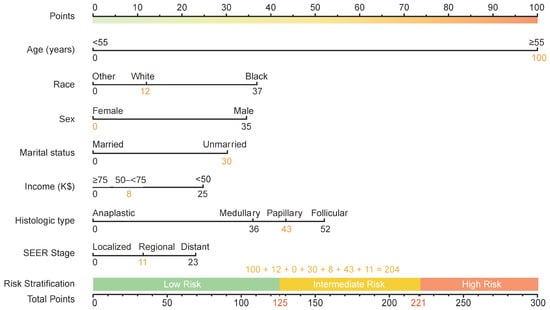
Discrimination and calibration of the separate continuous-age prediction models were evaluated at 5, 8 and 10 years using competing-risk AUC, Brier scores and grouped observed cumulative incidence. Paired comparisons evaluated the incremental contribution of stage within two fixed predictor sets: a demographic set and a nomogram-related set including histology. The previously selected exploratory cutoffs of 125 and 221 were applied to scores reconstructed from the displayed nomogram points (Table S10); the score groups remain exploratory [26]. Group-specific cumulative incidence accounted for non-CVD death and was compared using Gray’s test over follow-up restricted to 120 months. Statistical analyses used R software (versions 4.3.1 and 4.5.2). Tests were two-sided, with p < 0.05 as the nominal significance level; detailed specifications are provided in Supplementary Methods S2–S5.
Surgery, radiotherapy, and chemotherapy were summarized descriptively. Additional post hoc sensitivity analyses restricted patients to those undergoing surgery and adjusted for recorded radiation and chemotherapy, including a DTC-only analysis. SEER lacks detailed information on specific medications, dosages, and treatment duration; treatment-related confounding and survivor treatment bias therefore remain possible. Pretreatment cardiovascular history, important in population-based risk prediction [27], was also unavailable.
3. Results
3.1. Baseline Characteristics and CVD Mortality in the Overall Cohort
A total of 19,228 patients diagnosed with primary TC between 2004 and 2015 were included in this study, with a median follow-up of 8.3 years. The cohort was predominantly female (75.8%) and aged <55 years (68.1%). Papillary thyroid cancer (PTC) accounted for 87.9% of cases, and most patients presented with localized (64.8%) or regional (30.3%) disease. Nearly all patients underwent surgery (99.1%), and approximately half received radiotherapy (52.2%) (Table 1). Baseline characteristics of the training (n = 13,453) and validation (n = 5775) cohorts are presented in Table S4.
Table 1.
Baseline characteristics of 19,228 patients with thyroid cancer. Data are presented as n (%).
During follow-up, 1713 deaths occurred, of which 321 (18.7%) were attributed to CVD; 1392 patients died from other causes and 17,515 were censored (Table 1). The proportion dying from CVD was higher in men (2.9%) than in women (1.3%). CVD accounted for 18.7% of recorded deaths, alongside substantial mortality from other causes, and the proportion of CVD deaths differed by sex. Figure S1 displays the cause-specific cumulative hazard by sex.
3.2. Tumor Characteristics and CVD Death
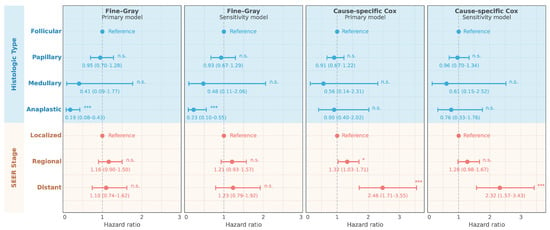
In multivariable analysis adjusting for the selected covariates, distant stage remained associated with an increased cause-specific hazard of CVD death (csHR 2.46, 95% CI 1.71–3.55), compared with localized disease. Regional stage also showed an association after adjustment (csHR 1.32, 95% CI 1.03–1.71). The corresponding sHRs were 1.10 (95% CI 0.74–1.62) and 1.16 (95% CI 0.90–1.50), respectively (Tables S5 and S6).
Notably, anaplastic thyroid carcinoma (ATC) was associated with a lower subdistribution hazard of CVD death than follicular carcinoma (sHR 0.19, 95% CI 0.08–0.43), reflecting the strong competing mortality in these patients. Among 411 patients with ATC, 7 died from CVD and 362 from other causes. The corresponding csHR was 0.90 (95% CI 0.40–2.02). The additional covariate-adjusted analysis produced similar stage estimates (Figure 2, Table S6).
Figure 2.
Associations between tumor characteristics and cardiovascular death. Fine–Gray subdistribution hazard ratios and cause-specific Cox hazard ratios with 95% confidence intervals in the primary cohort are outlined. The primary model adjusts for stage, sex, continuous age, race, marital status, income, histology and diagnosis year. The sensitivity model additionally adjusts for size, grade, multifocality, domicile and treatment interval. Both use 19,228 patients. Localized stage and follicular histology are reference groups. Time-varying stage estimates are provided in Table S11. Blue and red denote histological type and SEER stage, respectively. Points indicate hazard ratio estimates, horizontal bars indicate 95% confidence intervals, and vertical dashed lines indicate a hazard ratio of 1. n.s., not significant; * p < 0.05, *** p < 0.001.
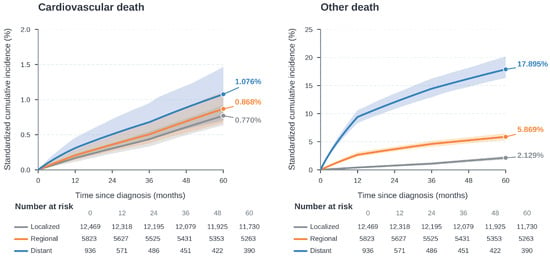
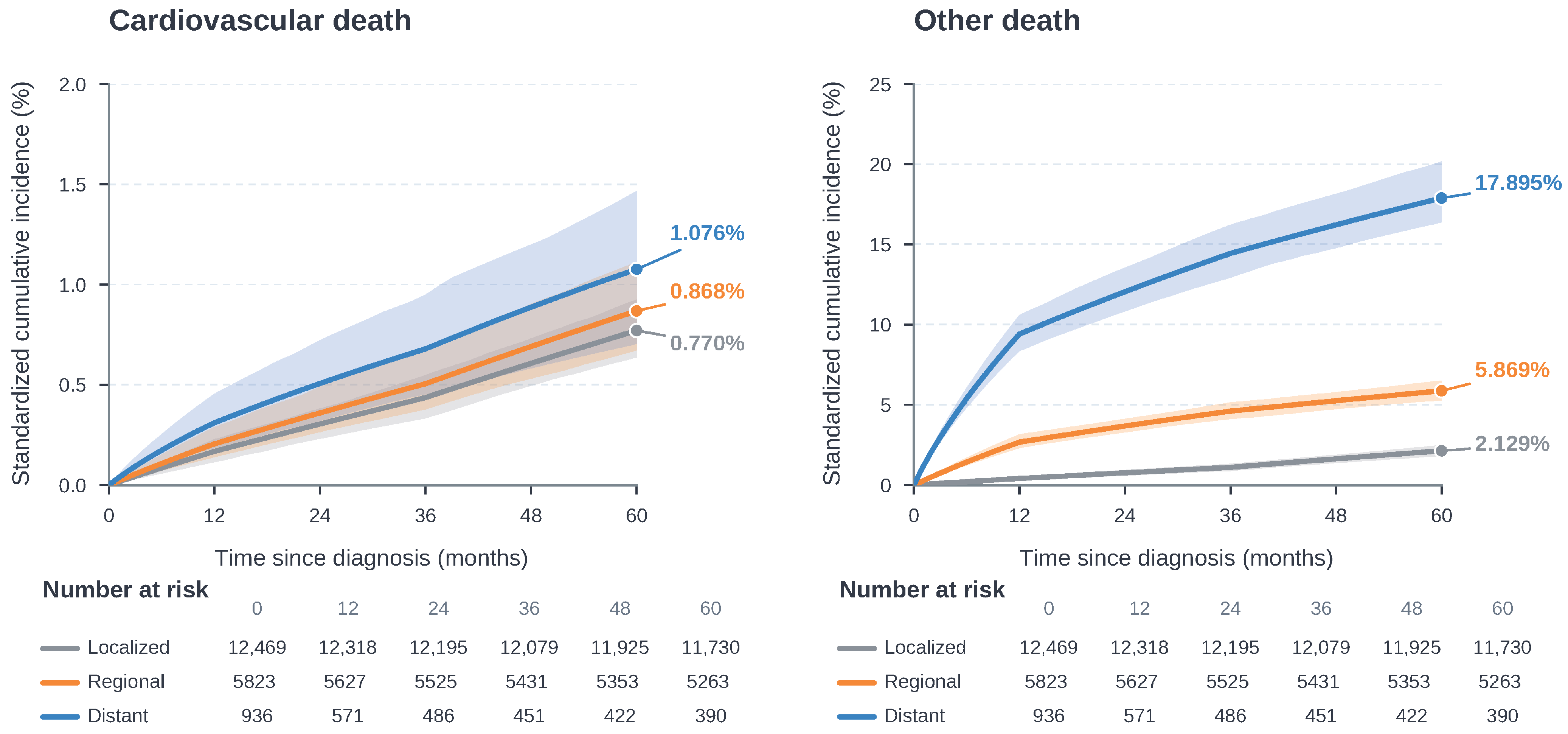
Stage associations varied over time in the Fine–Gray model (joint stage-by-time p = 7.81 × 10⁻⁵). For distant versus localized disease, the sHR was 2.79 (95% CI 1.61–4.83) at 12 months and 0.82 (95% CI 0.52–1.30) at 60 months (Figure S2; Table S11). The adjusted five-year CVD cumulative incidence was 0.770%, 0.868% and 1.076% for localized, regional and distant disease, respectively; stage risk differences and competing-death estimates are provided in Table S12.
In the broader eligibility sensitivity cohort (n = 90,105), estimates differed: distant stage was associated with a lower CVD subdistribution hazard (sHR 0.715, 95% CI 0.582–0.879) but a higher cause-specific hazard (csHR 1.70, 95% CI 1.41–2.05; Table S13). Surgery-restricted, treatment-adjusted sensitivity analyses retained the higher distant-stage cause-specific hazard (Table S15).
3.3. Associations by Sex and Age
Sex-conditional estimates from the interaction model showed elevated cause-specific hazards for distant disease in both men (adjusted csHR 2.60, 95% CI 1.60–4.24) and women (csHR 2.23, 95% CI 1.30–3.83). In the primary model without interaction terms, male sex was associated with a higher overall CVD subdistribution hazard (sHR 2.19, 95% CI 1.73–2.78). However, joint sex-by-stage interaction tests were not statistically significant in the Fine–Gray model (p = 0.233) or the cause-specific Cox model (p = 0.397); these data therefore do not establish that stage associations differ by sex.
We further stratified each sex by age using 50 years as an exploratory cutoff. There were 27 CVD deaths below age 50 and 294 at age ≥50; neither distant-stage subgroup below age 50 had a CVD death (0/85 men and 0/122 women). These sparse data limit assessment of age-related associations; potential contributions from changes in sex-hormone levels remain untested. Stage-specific event counts are presented in Tables S8 and S9.
3.4. Nomogram Development and Risk Stratification
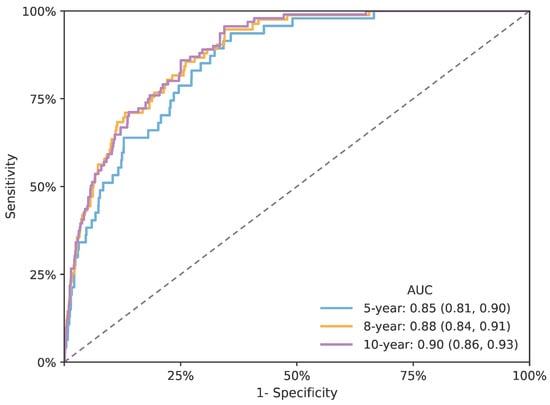
We retained an exploratory categorical-age nomogram-derived point score based on age, sex, race, marital status, area-level income, histological type and stage (Figure 3; Table S10). This point scale is distinct from the separately evaluated continuous-age competing-risk prediction model, which achieved validation AUCs of 0.854, 0.877 and 0.895 at 5, 8 and 10 years, respectively (Figure 4; Table S14). Grouped validation calibration and paired model comparisons are reported in Table S14; the point scale itself has not been externally validated.
Figure 3.
Exploratory nomogram-derived point score and cardiovascular risk stratification in thyroid cancer. The categorical-age score incorporates age at diagnosis, sex, race, marital status, area-level median household income, histologic type, and SEER summary stage. Point assignments are detailed in Table S10. Previously selected score cutoffs of 125 and 221 define the exploratory low- (green), intermediate- (yellow), and high-risk (orange) groups. The figure displays point assignments and risk strata rather than individual predicted survival probabilities.
Figure 4.
Time-dependent receiver operating characteristic curves for cardiovascular mortality in the internal validation cohort. Time-dependent receiver operating characteristic (ROC) curves at 5, 8, and 10 years were generated using the continuous-age competing-risk prediction model incorporating demographic characteristics, histological type, and time-varying effects of the SEER summary stage. In the internal validation cohort (n = 5775), the areas under the curve (AUCs) were 0.854 (95% CI, 0.811–0.897), 0.877 (95% CI, 0.844–0.909), and 0.895 (95% CI, 0.862–0.928) at 5, 8, and 10 years, respectively. Non-cardiovascular deaths were treated as competing events.
The stage-standardized cumulative incidence of cardiovascular and competing non-cardiovascular death is shown in Figure 5 (Table S12). Reconstructed nomogram score groups were compared using cumulative incidence and Gray’s tests in the training and internal validation cohorts (Figure S3; Table S17). These comparisons are exploratory and do not establish the calibration or clinical utility of the original point scale.
Figure 5.
Standardized cumulative incidence of cardiovascular and non-cardiovascular death by SEER stage. Curves show model-standardized cumulative incidence in the primary cohort (left, cardiovascular death; right, other death). Shading indicates pointwise 95% bootstrap confidence intervals; numbers at risk are observed counts (Table S12).
4. Discussion
In this population-based cohort of 19,228 TC patients, regional and distant disease were associated with higher cause-specific hazards of cardiovascular death. Distant-stage disease also showed an early elevation in the subdistribution hazard that attenuated over follow-up. These findings place the timing of cardiovascular events and the patient’s overall prognosis within the clinical interpretation of tumor characteristics.
For patients with advanced TC, cardiovascular prognosis must be considered alongside the substantial probability of death from other causes. These competing deaths reduce the opportunity to experience a cardiovascular death. ATC illustrates this distinction: substantial competing mortality contributes to a low cardiovascular subdistribution hazard, which should not be interpreted as cardiovascular protection.
Inflammation provides a biological framework for investigating cardiovascular vulnerability in cancer. Inflammatory biomarkers have been associated with survival in stage III colon cancer [28]. Experimental studies show that proinflammatory cytokines such as TNF-α promote endothelial activation and inflammatory signaling, providing a possible link with atherosclerosis [29]. These clinical and experimental observations provide biological context for the tumor-related “first hit” hypothesis.
Most CVD deaths occurred at older ages. Although women comprised 75.8% of the cohort, male sex was associated with a higher overall CVD subdistribution hazard. Age-related hormonal changes may contribute to background cardiovascular vulnerability; the menopausal transition has been associated with adverse changes in lipids, body composition and vascular health [30,31]. Experimental studies also describe estrogen-related vascular and inflammatory pathways [32,33]. These observations provide biological context only: menopausal status and hormone concentrations were not measured in SEER, so the present findings cannot be attributed to estrogen-related mechanisms.
In males, testosterone concentrations decline gradually with aging, and lower calculated free testosterone has been associated with incident heart failure in older men [34]. The cardiovascular effects of androgens are complex and include vascular, metabolic and myocardial pathways [35].
A nationwide analysis reported increased atrial fibrillation risk among DTC patients across surgical and radioactive iodine treatment groups [36]. Systemic therapies for radioactive iodine-refractory DTC can also have cardiovascular toxicities [37]. A meta-analysis of long-term TSH suppression reported increased atrial fibrillation and stroke risk [38]. The seminal study by Klein Hesselink et al. [10] demonstrated that DTC patients had significantly higher cardiovascular mortality compared to matched controls, with lower TSH associated with higher cardiovascular mortality within the DTC cohort. Subsequent meta-analyses reported increased atrial fibrillation risk [39] and a higher composite risk of cardiac or skeletal adverse events with TSH suppression [40]. In our surgery-restricted analyses, adjustment for recorded radiation and chemotherapy did not remove the higher cause-specific hazard associated with distant stage.
The Utah Cancer Survivors Study by Park et al. [13] identified cancer stage, treatment and comorbidity as relevant to cardiovascular disease risk. Our study extends this clinical question by examining cardiovascular death in relation to tumor stage over follow-up while accounting for competing mortality. This distinction is clinically relevant when the cardiovascular needs of patients with advanced disease are considered alongside those of long-term survivors.
We retained an exploratory nomogram-derived point score incorporating age, sex and tumor stage among its components [24]. Its reconstructed risk groups require external validation and should not guide clinical decisions. The separate continuous-age models showed good discrimination. Adding stage did not clearly improve five-year prediction beyond the corresponding base models (Table S14).
Current cardio-oncology guidelines recommend baseline cardiovascular risk assessment before potentially cardiotoxic treatment, with additional surveillance for high-risk individuals [41,42]. Cardiovascular risk is dynamic across the cancer continuum and should be re-evaluated during treatment and survivorship [42]. Consistent definitions of cardiovascular toxicities can improve outcome assessment in future TC survivorship studies [43]. Referral to cardio-oncology and additional cardiac testing should be guided by established cardiovascular risk and planned treatment [41,42]. Long-term survivors require continued attention to modifiable risk factors. Increased diabetes incidence after cancer diagnosis has also been reported in a nationwide Korean cohort [25], adding to the clinical importance of monitoring conventional risk factors during survivorship.
Future studies with direct measurements of menopausal status, sex hormones, inflammation, and treatment exposure are needed to test whether these factors contribute to sex-associated cardiovascular outcomes after TC [28,31,34,35]. Prospective external cohorts are also needed to validate the prediction models and determine whether tumor characteristics improve risk assessment beyond established cardiovascular factors.
Strengths and Limitations
Several limitations should be acknowledged. First, as a retrospective registry study, the SEER database lacks information on traditional cardiovascular risk factors (smoking, hypertension, diabetes, dyslipidemia) and detailed treatment data (TSH suppression levels, RAI doses), which may introduce residual confounding. Recorded treatment sensitivity analyses cannot remove confounding by treatment selection or timing. Second, the relatively low number of CVD deaths in certain subgroups (particularly younger patients and those with rare histologic types) limited statistical power, reflected in wide confidence intervals for some estimates. Third, our study population was drawn from the United States SEER registry and may not be generalizable to other geographic regions with different demographic characteristics, healthcare systems, or cardiovascular risk profiles. The primary cohort required complete records for the expanded covariate set so that the primary and additional adjustment models could be estimated in the same patients. Estimates in the broader eligibility cohort differed, particularly for the Fine–Gray model (Table S13); this indicates sensitivity to cohort definition and limits generalization, but does not by itself quantify selection bias. Cause-of-death coding may be imperfect. Stage nonproportionality was addressed with time-varying models, but the standardized risks remain dependent on model specification. Hormonal and menopausal status were not directly measured. The random split provides internal assessment of the continuous-age models. Score-group analyses used reconstructed displayed points rather than verified original unrounded scores; the nomogram point scale and risk cutoffs require external validation.
5. Conclusions
In this large population-based cohort, regional and distant TC were associated with higher cause-specific hazards of cardiovascular death than localized disease, and the distant-stage subdistribution association was elevated early after diagnosis. Male sex was associated with a higher overall CVD subdistribution hazard. Despite these associations, adding stage did not meaningfully improve five-year prediction beyond the baseline models evaluated. These findings support cardiovascular assessment from TC diagnosis through survivorship, with attention to conventional risk factors, planned treatment and overall prognosis.
Supplementary Materials
The following supporting information can be downloaded at https://www.mdpi.com/article/10.3390/jcdd13110565/s1. Supplementary Method S1. Study population and variable definitions. Supplementary Method S2. Multivariable regression and subgroup analyses. Supplementary Method S3. Time-varying associations and standardized absolute risks. Supplementary Method S4. Exploratory nomogram and competing-risk prediction. Supplementary Method S5. Treatment-related sensitivity analyses and diagnostics. Table S1. Morphological codes of histological types of thyroid cancer. Table S2. Classification and detailed description of Surveillance, Epidemiology, and End Results summary stage. Table S3. Specific causes of cardiovascular death. Table S4. Baseline characteristics of training and validation cohorts. Table S5. Primary multivariable associations with cardiovascular death. Table S6. Additional covariate-adjusted associations with cardiovascular death. Table S7. Sex-conditional stage associations and formal interaction tests. Table S8. Age-stratified stage and outcome counts in males. Table S9. Age-stratified stage and outcome counts in females. Table S10. Specific scores of prognostic factors in the exploratory nomogram. Table S11. Time-dependent stage associations with cardiovascular death. Table S12. Five-year absolute risks and stage risk differences. Table S13. Broader eligibility sensitivity analyses. Table S14. Competing-risk prediction models and validation performance. Table S15. Surgery-restricted treatment-adjusted sensitivity analyses. Table S16. Model diagnostics and sensitivity checks. Table S17. Exploratory cumulative incidence by reconstructed nomogram score group. Figure S1. Cause-specific cumulative hazard of cardiovascular death by sex. Nelson–Aalen cumulative hazard curves in the primary cohort (n = 19,228), stratified by sex. Non-cardiovascular deaths are censored at their occurrence. The vertical axis shows cause-specific cumulative hazard, not cumulative incidence or percentage risk. Figure S2. Time-varying stage associations with cardiovascular mortality. Fine–Gray subdistribution hazard ratios for regional and distant versus localized SEER summary stage. Shading represents pointwise 95% confidence intervals. The joint stage-by-time test yielded p = 7.81 × 10⁻⁵ (Table S11). Figure S3. Cardiovascular cumulative incidence by exploratory nomogram score group. Cumulative-incidence curves for reconstructed low (≤125), intermediate (126–221) and high (≥222) score groups in training and internal validation cohorts. Non-cardiovascular deaths were competing events; shading indicates pointwise 95% confidence intervals. Global Gray’s tests compare curves through 120 months (Table S17).
Author Contributions
Conceptualization: T.G., M.Y., M.H. and Y.C.; Methodology: T.G. and M.Y.; Formal Analysis: Y.C. and T.C.; Visualization: Y.C., C.L. and T.C.; Data curation: Y.C., C.L., T.C., Z.C., A.C. and X.H.; Writing—Original Draft: T.C., Z.C. and A.C.; Writing—Review and Editing: M.Y., T.G., Y.L., M.H. and Y.C.; Supervision and Project administration: M.Y., T.G. and M.H. All authors have read and agreed to the published version of the manuscript.
Funding
This research was funded by the Guangdong Basic and Applied Basic Research Foundation, grant number 2026A1515012277. The APC was funded by the Second Affiliated Hospital of Guangzhou Medical University.
Institutional Review Board Statement
This retrospective study used only de-identified data from the Surveillance, Epidemiology, and End Results (SEER) 17 Registries Research Plus database, without direct participant contact or access to personally identifying information. Under the National Cancer Institute’s SEER Research Plus data-access requirements, study-specific Institutional Review Board (IRB) approval is not required for use of this data product (https://seer.cancer.gov/data/product-comparison.html, accessed on 15 January 2024).
Informed Consent Statement
This secondary analysis used de-identified SEER registry data and involved no participant contact or access to directly identifying information.
Data Availability Statement
SEER data are available from the National Cancer Institute subject to registration and the applicable data-use agreement (https://seer.cancer.gov/data/, accessed on 15 January 2024). Analytic specifications and aggregate results are provided in the Supplementary Materials; further details are available from the corresponding author on reasonable request.
Acknowledgments
The authors thank the SEER database and the National Cancer Institute in the US.
Conflicts of Interest
The authors declare no conflicts of interest.
Abbreviations
| TC | Thyroid cancer |
| CVD | Cardiovascular disease |
| SEER | Surveillance, Epidemiology, and End Results |
| AJCC | American Joint Committee on Cancer |
| ICD-O-3 | International Classification of Diseases for Oncology, 3rd edition |
| ROC curves | Receiver operating characteristic curves |
| AUC | Area under the curve |
| PTC | Papillary thyroid cancer |
| ATC | Anaplastic thyroid carcinoma |
| MTC | Medullary thyroid carcinoma |
| FTC | Follicular thyroid carcinoma |
| HR | Hazard ratio |
| CI | Confidence interval |
| sHR | Subdistribution hazard ratio |
| csHR | Cause-specific hazard ratio |
| CIF | Cumulative incidence function |
| RAI therapy | Radioactive iodine therapy |
| TSH | Thyroid stimulating hormone |
References
- Sung, H.; Ferlay, J.; Siegel, R.L.; Laversanne, M.; Soerjomataram, I.; Jemal, A.; Bray, F. Global Cancer Statistics 2020: GLOBOCAN Estimates of Incidence and Mortality Worldwide for 36 Cancers in 185 Countries. CA Cancer J. Clin. 2021, 71, 209–249. [Google Scholar] [CrossRef] [Scilit] [PubMed]
- Chen, D.W.; Lang, B.H.H.; McLeod, D.S.A.; Newbold, K.; Haymart, M.R. Thyroid cancer. Lancet 2023, 401, 1531–1544. [Google Scholar] [CrossRef] [Scilit] [PubMed]
- Banerjee, M.; Muenz, D.G.; Worden, F.P.; Wong, S.L.; Haymart, M.R. Conditional survival in patients with thyroid cancer. Thyroid 2014, 24, 1784–1789. [Google Scholar] [CrossRef] [Scilit] [PubMed]
- Qiu, H.; Zhou, W.; Huang, Q.; Lin, H.; Zhou, Y.; Wu, C.; Huang, Y.; Leng, J. Role of Cancer History in Cardiovascular Mortality Among Different Age-group Patients With Differentiated Thyroid Cancer. J. Endocr. Soc. 2025, 9, bvae213. [Google Scholar] [CrossRef] [Scilit] [PubMed]
- Du, B.; Wang, F.; Wu, L.; Wang, Z.; Zhang, D.; Huang, Z.; Gao, L.; Li, Y.; Liang, C.; Li, P.; et al. Cause-specific mortality after diagnosis of thyroid cancer: A large population-based study. Endocrine 2021, 72, 179–189. [Google Scholar] [CrossRef] [Scilit] [PubMed]
- Wang, Q.; Zeng, Z.; Nan, J.; Zheng, Y.; Liu, H. Cause of Death Among Patients With Thyroid Cancer: A Population-Based Study. Front. Oncol. 2022, 12, 852347. [Google Scholar] [CrossRef] [Scilit] [PubMed]
- Curigliano, G.; Cardinale, D.; Dent, S.; Criscitiello, C.; Aseyev, O.; Lenihan, D.; Cipolla, C.M. Cardiotoxicity of anticancer treatments: Epidemiology, detection, and management. CA Cancer J. Clin. 2016, 66, 309–325. [Google Scholar] [CrossRef] [Scilit] [PubMed]
- Zamorano, J.L.; Lancellotti, P.; Rodriguez Muñoz, D.; Aboyans, V.; Asteggiano, R.; Galderisi, M.; Habib, G.; Lenihan, D.J.; Lip, G.Y.H.; Lyon, A.R.; et al. 2016 ESC Position Paper on cancer treatments and cardiovascular toxicity developed under the auspices of the ESC Committee for Practice Guidelines: The Task Force for cancer treatments and cardiovascular toxicity of the European Society of Cardiology (ESC). Eur. J. Heart Fail. 2017, 19, 9–42. [Google Scholar] [PubMed]
- Lee, E.K.; Ahn, H.Y.; Ku, E.J.; Yoo, W.S.; Lee, Y.K.; Nam, K.H.; Chai, Y.J.; Moon, S.; Jung, Y.S. Cardiovascular Outcomes in Thyroid Cancer Patients Treated With Thyroidectomy: A Meta-analysis. J. Clin. Endocrinol. Metab. 2021, 106, 3644–3654. [Google Scholar] [CrossRef] [Scilit] [PubMed]
- Klein Hesselink, E.N.; Klein Hesselink, M.S.; de Bock, G.H.; Gansevoort, R.T.; Bakker, S.J.; Vredeveld, E.J.; van der Horst-Schrivers, A.N.A.; van der Horst, I.C.C.; Kamphuisen, P.W.; Plukker, J.T.M.; et al. Long-term cardiovascular mortality in patients with differentiated thyroid carcinoma: An observational study. J. Clin. Oncol. 2013, 31, 4046–4053. [Google Scholar] [CrossRef] [Scilit] [PubMed]
- Suh, B.; Shin, D.W.; Park, Y.; Lim, H.; Yun, J.M.; Song, S.O.; Park, J.H.; Cho, B.; Guallar, E. Increased cardiovascular risk in thyroid cancer patients taking levothyroxine: A nationwide cohort study in Korea. Eur. J. Endocrinol. 2019, 180, 11–20. [Google Scholar] [CrossRef] [Scilit] [PubMed]
- Tsai, W.H.; Zeng, Y.H.; Lee, C.C.; Chien, M.N.; Liu, S.C.; Chien, K.L.; Cheng, S.P.; Tseng, P.J.; Tsai, M.C. Association between thyroid cancer and cardiovascular disease: A meta-analysis. Front. Cardiovasc. Med. 2023, 10, 1075844. [Google Scholar] [CrossRef] [Scilit] [PubMed]
- Park, J.; Blackburn, B.E.; Ganz, P.A.; Rowe, K.; Snyder, J.; Wan, Y.; Deshmukh, V.; Newman, M.; Fraser, A.; Smith, K.; et al. Risk Factors for Cardiovascular Disease Among Thyroid Cancer Survivors: Findings From the Utah Cancer Survivors Study. J. Clin. Endocrinol. Metab. 2018, 103, 2468–2477. [Google Scholar] [CrossRef] [Scilit] [PubMed]
- de Boer, R.A.; Meijers, W.C.; van der Meer, P.; van Veldhuisen, D.J. Cancer and heart disease: Associations and relations. Eur. J. Heart Fail. 2019, 21, 1515–1525. [Google Scholar] [CrossRef] [Scilit] [PubMed]
- Yu, A.F.; Steingart, R.M. ARIC Welcomes Cancer Survivors Into Their Communities: Unraveling the Link Between Cancer and Cardiovascular Disease. J. Am. Coll. Cardiol. 2022, 80, 33–35. [Google Scholar] [PubMed]
- Florido, R.; Daya, N.R.; Ndumele, C.E.; Koton, S.; Russell, S.D.; Prizment, A.; Blumenthal, R.S.; Matsushita, K.; Mok, Y.; Felix, A.S.; et al. Cardiovascular Disease Risk Among Cancer Survivors: The Atherosclerosis Risk In Communities (ARIC) Study. J. Am. Coll. Cardiol. 2022, 80, 22–32. [Google Scholar] [PubMed]
- Versmissen, J.; Power, J.R.; Moslehi, J. Vascular medicine and cardio-oncology—A new, evolving clinical frontier. Vasc. Med. 2020, 25, 205–207. [Google Scholar] [CrossRef] [Scilit] [PubMed]
- Willems, R.A.L.; Winckers, K.; Biesmans, C.; de Vos-Geelen, J.; Ten Cate, H. Evolving data on cardiovascular complications in cancer. Thromb. Res. 2022, 213, S87–S94. [Google Scholar] [CrossRef] [Scilit] [PubMed]
- Shobab, L.; Burman, K.D.; Wartofsky, L. Sex Differences in Differentiated Thyroid Cancer. Thyroid 2022, 32, 224–235. [Google Scholar] [CrossRef] [Scilit] [PubMed]
- Austin, P.C.; Fine, J.P. Practical recommendations for reporting Fine-Gray model analyses for competing risk data. Stat. Med. 2017, 36, 4391–4400. [Google Scholar] [CrossRef] [Scilit] [PubMed]
- Che, W.Q.; Li, Y.J.; Tsang, C.K.; Wang, Y.J.; Chen, Z.; Wang, X.Y.; Xu, A.D.; Lyu, J. How to use the Surveillance, Epidemiology, and End Results (SEER) data: Research design and methodology. Mil. Med. Res. 2023, 10, 50. [Google Scholar] [CrossRef] [Scilit] [PubMed]
- Nixon, I.J.; Wang, L.Y.; Migliacci, J.C.; Eskander, A.; Campbell, M.J.; Aniss, A.; Morris, L.; Vaisman, F.; Corbo, R.; Momesso, D.; et al. An International Multi-Institutional Validation of Age 55 Years as a Cutoff for Risk Stratification in the AJCC/UICC Staging System for Well-Differentiated Thyroid Cancer. Thyroid 2016, 26, 373–380. [Google Scholar] [CrossRef] [Scilit] [PubMed]
- Fung, C.; Fossa, S.D.; Milano, M.T.; Sahasrabudhe, D.M.; Peterson, D.R.; Travis, L.B. Cardiovascular Disease Mortality After Chemotherapy or Surgery for Testicular Nonseminoma: A Population-Based Study. J. Clin. Oncol. 2015, 33, 3105–3115. [Google Scholar] [CrossRef] [Scilit] [PubMed]
- Balachandran, V.P.; Gonen, M.; Smith, J.J.; DeMatteo, R.P. Nomograms in oncology: More than meets the eye. Lancet Oncol. 2015, 16, e173–e180. [Google Scholar] [CrossRef] [Scilit] [PubMed]
- Hwangbo, Y.; Kang, D.; Kang, M.; Kim, S.; Lee, E.K.; Kim, Y.A.; Chang, Y.J.; Choi, K.S.; Jung, S.Y.; Woo, S.M.; et al. Incidence of Diabetes After Cancer Development: A Korean National Cohort Study. JAMA Oncol. 2018, 4, 1099–1105. [Google Scholar] [PubMed]
- Camp, R.L.; Dolled-Filhart, M.; Rimm, D.L. X-tile: A new bio-informatics tool for biomarker assessment and outcome-based cut-point optimization. Clin. Cancer Res. 2004, 10, 7252–7259. [Google Scholar] [PubMed]
- Abdel-Qadir, H.; Thavendiranathan, P.; Austin, P.C.; Lee, D.S.; Amir, E.; Tu, J.V.; Fung, K.; Anderson, G.M. Development and validation of a multivariable prediction model for major adverse cardiovascular events after early stage breast cancer: A population-based cohort study. Eur. Heart J. 2019, 40, 3913–3920. [Google Scholar] [CrossRef] [Scilit] [PubMed]
- Cheng, E.; Shi, Q.; Shields, A.F.; Nixon, A.B.; Shergill, A.P.; Ma, C.; Guthrie, K.A.; Couture, F.; Kuebler, P.; Kumar, P.; et al. Association of Inflammatory Biomarkers With Survival Among Patients With Stage III Colon Cancer. JAMA Oncol. 2023, 9, 404–413. [Google Scholar] [CrossRef] [Scilit] [PubMed]
- Kiatsoonthon, K.; Phimthong, N.; Potikanond, S.; Wikan, N.; Nimlamool, W. Panduratin A Inhibits TNF Alpha-Stimulated Endothelial Cell Activation Through Suppressing the NF-κB Pathway. Biomolecules 2025, 15, 34. [Google Scholar] [CrossRef] [Scilit] [PubMed]
- El Khoudary, S.R.; Aggarwal, B.; Beckie, T.M.; Hodis, H.N.; Johnson, A.E.; Langer, R.D.; Limacher, M.C.; Manson, J.E.; Stefanick, M.L.; Allison, M.A. Menopause Transition and Cardiovascular Disease Risk: Implications for Timing of Early Prevention: A Scientific Statement From the American Heart Association. Circulation 2020, 142, e506–e532. [Google Scholar] [CrossRef] [Scilit] [PubMed]
- Mehta, J.M.; Manson, J.E. The menopausal transition period and cardiovascular risk. Nat. Rev. Cardiol. 2024, 21, 203–211. [Google Scholar] [CrossRef] [Scilit] [PubMed]
- da Silva, J.S.; Montagnoli, T.L.; Rocha, B.S.; Tacco, M.; Marinho, S.C.P.; Zapata-Sudo, G. Estrogen Receptors: Therapeutic Perspectives for the Treatment of Cardiac Dysfunction after Myocardial Infarction. Int. J. Mol. Sci. 2021, 22, 525. [Google Scholar] [CrossRef] [Scilit] [PubMed]
- Sabbatini, A.R.; Kararigas, G. Estrogen-related mechanisms in sex differences of hypertension and target organ damage. Biol. Sex Differ. 2020, 11, 31. [Google Scholar] [CrossRef] [Scilit] [PubMed]
- Njoroge, J.N.; Tressel, W.; Biggs, M.L.; Matsumoto, A.M.; Smith, N.L.; Rosenberg, E.; Hirsch, C.H.; Gottdiener, J.S.; Mukamal, K.J.; Kizer, J.R. Circulating Androgen Concentrations and Risk of Incident Heart Failure in Older Men: The Cardiovascular Health Study. J. Am. Heart Assoc. 2022, 11, e026953. [Google Scholar] [CrossRef] [Scilit] [PubMed]
- Liu, P.Y.; Death, A.K.; Handelsman, D.J. Androgens and cardiovascular disease. Endocr. Rev. 2003, 24, 313–340. [Google Scholar] [CrossRef] [Scilit] [PubMed]
- Heo, J.; Sohn, S.Y.; Kim, Y.J.; Cho, S.W. Risk of atrial fibrillation in patients with differentiated thyroid cancer: A nationwide population-based analysis. Korean J. Intern. Med. 2026, 41, 286–295. [Google Scholar] [CrossRef] [Scilit] [PubMed]
- Gruber, J.J.; Colevas, A.D. Differentiated thyroid cancer: Focus on emerging treatments for radioactive iodine-refractory patients. Oncologist 2015, 20, 113–126. [Google Scholar] [CrossRef] [Scilit] [PubMed]
- Yu, J.; Kaur, R.; Ayeni, F.E.; Eslick, G.D.; Edirimanne, S. Cardiovascular Outcomes of Differentiated Thyroid Cancer Patients on Long Term TSH Suppression: A Systematic Review and Meta-Analysis. Horm. Metab. Res. 2023, 55, 379–387. [Google Scholar] [CrossRef] [Scilit] [PubMed]
- Yang, X.; Guo, N.; Gao, X.; Liang, J.; Fan, X.; Zhao, Y. Meta-analysis of TSH suppression therapy and the risk of cardiovascular events after thyroid cancer surgery. Front. Endocrinol. 2022, 13, 991876. [Google Scholar] [CrossRef] [Scilit] [PubMed]
- Gubbi, S.; Al-Jundi, M.; Foerster, P.; Cardenas, S.; Butera, G.; Auh, S.; Wright, E.C.; Klubo-Gwiezdzinska, J. The Effect of Thyrotropin Suppression on Survival Outcomes in Patients with Differentiated Thyroid Cancer: A Systematic Review and Meta-Analysis. Thyroid 2024, 34, 674–686. [Google Scholar] [CrossRef] [Scilit] [PubMed]
- Lyon, A.R.; Dent, S.; Stanway, S.; Earl, H.; Brezden-Masley, C.; Cohen-Solal, A.; Tocchetti, C.G.; Moslehi, J.J.; Groarke, J.D.; Bergler-Klein, J.; et al. Baseline cardiovascular risk assessment in cancer patients scheduled to receive cardiotoxic cancer therapies: A position statement and new risk assessment tools from the Cardio-Oncology Study Group of the Heart Failure Association of the European Society of Cardiology in collaboration with the International Cardio-Oncology Society. Eur. J. Heart Fail. 2020, 22, 1945–1960. [Google Scholar] [CrossRef] [Scilit] [PubMed]
- Lyon, A.R.; López-Fernández, T.; Couch, L.S.; Asteggiano, R.; Aznar, M.C.; Bergler-Klein, J.; Boriani, G.; Cardinale, D.; Cordoba, R.; Cosyns, B.; et al. 2022 ESC Guidelines on cardio-oncology developed in collaboration with the European Hematology Association (EHA), the European Society for Therapeutic Radiology and Oncology (ESTRO) and the International Cardio-Oncology Society (IC-OS). Eur. Heart J. 2022, 43, 4229–4361. [Google Scholar] [CrossRef] [Scilit] [PubMed]
- Herrmann, J.; Lenihan, D.; Armenian, S.; Barac, A.; Blaes, A.; Cardinale, D.; Carver, J.; Dent, S.; Ky, B.; Lyon, A.R.; et al. Defining cardiovascular toxicities of cancer therapies: An International Cardio-Oncology Society (IC-OS) consensus statement. Eur. Heart J. 2022, 43, 280–299. [Google Scholar] [CrossRef] [Scilit] [PubMed]

Disclaimer/Publisher’s Note: The statements, opinions and data contained in all publications are solely those of the individual author(s) and contributor(s) and not of MDPI and/or the editor(s). MDPI and/or the editor(s) disclaim responsibility for any injury to people or property resulting from any ideas, methods, instructions or products referred to in the content. |
© 2026 by the authors. Licensee MDPI, Basel, Switzerland. This article is an open access article distributed under the terms and conditions of the Creative Commons Attribution (CC BY) license.