


Abstract
Background/Objectives: Older-adult patients in surgical care may face barriers to participation in treatment decisions and communication because of multimorbidity, organizational constraints, and age-related bias. This study examines the relationships between patient safety culture, perceived institutional ageism, organizational–managerial support, staff-perceived knowledge and safety education, and staff-perceived older-adult-patient participation in surgical care. Methods: A cross-sectional survey was conducted among 372 healthcare professionals working in surgical hospital departments. A structured self-administered questionnaire assessed these constructs. Patient safety culture was measured using a study-specific adaptation of a Slovenian hospital survey under HSOPSC 2.0 content, extended with short gerontology- and surgical-care-specific content. Confirmatory factor analysis and reliability analysis were conducted before Pearson correlation analyses, hierarchical multivariable regression, and mediation analysis. Results: Staff-perceived older-adult-patient participation was strongly associated with patient safety culture (r = 0.764, p < 0.001). In hierarchical regression, perceived institutional ageism, organizational–managerial support, and staff-perceived knowledge and safety education explained 53.1% of the variance in participation. Adding patient safety culture increased explained variance to 63.7% (ΔR2 = 0.106, p < 0.001). In the final model, patient safety culture was the strongest predictor (β = 0.503, p < 0.001), followed by staff-perceived knowledge and safety education (β = 0.235, p < 0.001) and organizational–managerial support (β = 0.167, p < 0.001). Perceived institutional ageism was not significant (β = −0.055, p = 0.088). Mediation analysis identified an indirect association between organizational–managerial support and participation through patient safety culture, accounting for 67.3% of the estimated total association; the cross-sectional design precludes causal interpretation. Conclusions: Patient safety culture emerged as the central organizational factor associated with staff-perceived older-adult-patient participation in surgical care. The findings suggest that safety culture, organizational support, and educational opportunities warrant further investigation as potential targets for improving participation in routine surgical pathways.
1. Introduction
Patient harm arising from healthcare is a major public health problem affecting millions of patients worldwide, and it is estimated that more than one in ten patients experience adverse events [1]. Medical practices that compromise patient safety may result in injury, disability, or even death. The widespread occurrence of such adverse events has underscored the importance of strengthening patient safety culture (PSC) across healthcare systems worldwide [2]. PSC is a core component of healthcare quality and patient safety, reflecting the organizational values, norms, attitudes, and practices through which safety is prioritized and enacted in everyday clinical work [3,4]. It is commonly conceptualized as a multidimensional construct that includes leadership, teamwork, communication openness, organizational learning, response to error, staffing, handoffs and information exchange, and management support for patient safety [3,4,5]. Since major patient safety reports emphasized the systemic nature of medical errors, PSC has increasingly been understood as an organizational mechanism for learning, risk reduction, and safer care delivery [6].
In surgical care, PSC is particularly important because care processes are complex, multidisciplinary, time-sensitive, and associated with an elevated risk of adverse events. Safe surgical care requires standardized procedures, effective communication, teamwork, and coordination across preoperative, intraoperative, and postoperative phases [7]. Studies on operating rooms and handover processes show that deficiencies in communication, teamwork, or procedural consistency may compromise patient safety [8,9]. These challenges are especially relevant for older adults, who often enter surgical care with multimorbidity, frailty, functional decline, cognitive or sensory limitations, polypharmacy, and reduced physiological reserve. Such factors may limit participation and shared decision-making, particularly in acute surgical settings [10,11]. Research on PSC in operating room settings remains scarce [12].
As a patient-centered approach, shared decision-making (SDM) promotes collaboration between patients and healthcare professionals, allowing perioperative decisions to be tailored to individual values and preferences [13]. Patient participation—which includes active involvement in communication, treatment planning, expression of preferences, SDM, and evaluation of care options—is increasingly recognized as an essential component of patient-centered care that enables patient autonomy [14]. In surgery, participation is especially important because patients may face operative and non-operative options with different risks, benefits, recovery trajectories, and implications for quality of life. In the context of surgical care for older adults, SDM facilitates treatment planning that incorporates patients’ priorities, such as preserving quality of life, maintaining functional independence, promoting long-term well-being, and improving survival [13]. However, SDM in surgical consultations remains inconsistently implemented, and patients and surgeons may differ in how they perceive the decision-making process [15]. Among older adults with multimorbidity, participation may be further constrained by communication issues and asymmetric power relationships between patients and clinical healthcare professionals [16], time pressure, complex information, assumptions about preferences, and difficulties integrating multiple goals of care [10].
Institutional ageism may further shape the conditions under which older-adult patients are invited, supported, or discouraged from participating in care. Ageism refers to stereotypes, prejudice, and discrimination based on age and may occur at individual, interpersonal, institutional, and societal levels [17]. In healthcare, institutional ageism may appear through assumptions that older-adult patients are less resilient, less capable of decision-making, less likely to benefit from interventions, or less deserving of intensive resources. In surgical settings, these assumptions are particularly relevant because decisions are often made under uncertainty and time pressure, and chronological age may be used as a simplified indicator of risk despite the importance of frailty, functional status, comorbidity, and patient goals. Ageism may also appear through patronizing or overly simplified communication, including forms of elderspeak [18].
From a social gerontological perspective, institutional ageism should not be understood only as individual prejudice, but as a structural phenomenon embedded in organizational routines, clinical norms, professional expectations, and resource allocation. Stereotype Embodiment Theory further suggests that cultural age stereotypes can become internalized and activated across the life course, influencing health through psychological, behavioral, and physiological pathways [19]. In surgical care, stereotypes that older adults are less capable, less resilient, or less able to participate may shape communication, treatment expectations, and opportunities for involvement. Older-adult patients perceive age-related discrimination from healthcare teams as well as disparities in the quality of hospital care provided to them [20]. Efforts to reduce ageism and strengthen ethical healthcare should include intergenerational learning opportunities, educational interventions, and effective organizational leadership to support policy and practice reforms [21].
PSC may provide an organizational context that supports older-adult-patient participation by promoting open communication, teamwork, psychological safety, structured procedures, organizational learning, and management support [3,4,5]. These features may encourage healthcare professionals to communicate clearly, invite patient questions, respond to concerns, and involve patients in care decisions. However, PSC should not be assumed to automatically eliminate institutional ageism. Although both constructs are organizationally relevant, institutional ageism may operate through partly distinct mechanisms, including implicit bias, professional beliefs about aging, paternalistic routines, and broader cultural expectations [22,23].
Organizational–managerial support and geriatric training are also expected to be relevant to older-adult-patient participation. Supportive organizations can provide protocols, staffing resources, geriatric consultation, adapted care environments, and leadership priorities that make patient involvement easier to implement. Such support may be directly associated with participation, but it may also be indirectly associated with participation through stronger PSC. Similarly, healthcare professionals with greater geriatric knowledge may be better prepared to recognize age-related vulnerabilities, adapt communication, assess decision-making capacity, and involve older-adult patients in shared decision-making. Gerontological education and clinical experience may also contribute to more positive attitudes toward older adults and reduce ageist attitudes [24].
Although PSC, patient participation, organizational support, geriatric training, and ageism have each been studied separately, their combined relationships remain insufficiently explored, particularly in surgical hospital settings. Existing PSC research has often focused on general hospital populations, patient experience, and staff perceptions [25], whereas geriatric models of surgical care and the specific safety and participation needs of older adult surgical patients remain underrepresented [26]. This gap is important to address because older-adult-patient participation may depend not only on individual clinician attitudes, but also on organizational conditions that support communication, shared decision-making, geriatric preparedness, and age-sensitive care. The study’s conceptual model draws primarily on the patient safety culture framework described by Sammer et al. [3], which emphasizes leadership, teamwork, communication, learning, and patient-centered care. This framework provides a rationale for examining organizational–managerial support and staff-perceived knowledge and safety education in relation to PSC and perceived older-adult-patient participation. The WHO Global Report on Ageism [17] provides a complementary perspective on institutional ageism as a potential barrier to participation. These relationships are examined at the level of individual healthcare professionals’ perceptions, without assuming causality or hospital-level effects.
Based on this theoretical framework, the study addressed four research questions (RQ) and five corresponding hypotheses (H), as presented in Table 1.
Table 1.
Research questions and hypotheses.
2. Materials and Methods
2.1. Questionnaire Development and Structure
Data were collected using a study-specific, self-administered questionnaire. The Hospital Survey on Patient Safety Culture Version 2.0 (HSOPSC 2.0) [27] and the Safety Attitudes Questionnaire (SAQ) [28] provided conceptual and methodological reference points. The SAQ was used as an orienting resource. The Slovenian hospital patient safety questionnaire documented by Bogataj et al. [29], where high significance of effects was detected even with a smaller sample, served as the primary source for adaptation. Slovenia was considered a relevant regional reference because of its cultural proximity to Croatia and the shared historical foundations of their healthcare systems. DeepL Pro was used to support translation into Croatian, and the research team adapted the wording and content for older adults in surgical settings. Additional gerontological and surgical-care content was developed by the research team based on relevant literature, which acknowledged the need to consider the local healthcare context when assessing PSC [30]. Previous Croatian psychometric studies of the original HSOPSC have supported its applicability in hospital settings, identifying 11 of its 12 dimensions [31] and reporting satisfactory overall internal consistency [32].
The questionnaire comprised 66 substantive items. The 48 PSC items covered 12 study-specific content domains: teamwork within the department, expectations and actions of superiors, organizational learning and improvement, feedback and learning from mistakes, communication openness, frequency of reporting errors, interdepartmental teamwork, management support, staffing and workload, information transfer, non-blaming culture, and overall perception of safety. The remaining 18 items addressed staff-perceived knowledge and safety education, perceived older-adult-patient participation, perceived institutional ageism, and organizational–managerial support. All items were rated on a 5-point Likert scale ranging from 1 = strongly disagree to 5 = strongly agree. Higher scores indicated higher levels of the construct as perceived by healthcare professionals.
Supplementary Table S1 provides an item-by-item comparison with the HSOPSC 2.0 and published Slovenian item codes, distinguishing reworded counterparts, age-specific variants, and study-specific formulations. The conceptual rationale for the questionnaire content is summarized in Supplementary Table S2. The additional content addressed patient involvement in treatment decisions and adapted communication, perceived age-related inequalities, staff-perceived knowledge and safety education, and organizational readiness for geriatric surgical care. These areas are conceptually consistent with literature on participation in acute geriatric surgical decision-making [11], perioperative shared decision-making among older adults [13], institutional ageism [17], and multidisciplinary geriatric models of surgical care [26]. Organizational items addressed individualized-care protocols, specialized staffing, geriatric consultation, environmental adaptation to sensory and mobility needs, delirium prevention, and early mobilization. Their clinical relevance is supported by the ACS NSQIP/AGS guideline on perioperative management of geriatric patients [33] and the American Geriatrics Society guideline on postoperative delirium [34].
General-care items and items specific to older-adult patients were combined within PSC, participation, and knowledge and safety education to capture both the broader care context and age-specific aspects of surgical care (Table 2 and Supplementary Table S1).
Table 2.
Overview of study constructs and measurement based on the Hospital Survey on Patient Safety Culture (HSOPSC) 2.0 [27], the Slovenian adaptation [29], and study-specific content.
Questionnaire items were grouped into five constructs according to their conceptual content and the study hypotheses: PSC, perceived institutional ageism, perceived older-adult-patient participation, staff-perceived knowledge and safety education, and organizational–managerial support. Supplementary Tables S3–S7 present item wording, response distributions, and retention status.
Table 2 summarizes the study constructs and their measurement focus.
2.2. Data Collection
Data were collected in Croatia between May and July 2026 using an anonymous electronic questionnaire administered through Google Forms. The survey link was sent to head nurses of surgical services at 30 healthcare institutions: 22 general hospitals, three clinical hospitals, and five clinical hospital centres. The list of institutions contacted for survey distribution is presented in Supplementary Table S8. Head nurses at the contacted institutions agreed to distribute the survey invitation to eligible healthcare professionals working in surgical services. As invitations were distributed through institutional channels, the exact number of individuals reached could not be independently verified.
The questionnaire was intended for nurses, physicians, and physiotherapists with direct patient contact, at least one year of work experience in a surgical department, and recent experience caring for older adult surgical patients within the previous three months. Eligibility criteria were communicated in the survey instructions, assessed through questionnaire responses, and checked during review of the submitted data. The first page explained the study purpose, voluntary participation, anonymity, and the right to discontinue before submission. Electronic informed consent was obtained before participants proceeded.
To protect participant confidentiality, the Google Forms survey was configured not to collect respondents’ email addresses. No names, personal identifiers, or information enabling individual responses to be linked to a specific participant, department, or participating institution were collected. Responses were submitted through the electronic platform using encrypted HTTPS connections. Following data collection, responses were exported to the research dataset, access to which was restricted to members of the research team involved in data processing and analysis. Findings were reported exclusively in aggregate form.
2.3. Statistical Analysis
Statistical analyses were conducted using jamovi statistical software version 2.6.44. Descriptive statistics were calculated to summarize participant characteristics and questionnaire responses, including means, standard deviations, frequencies, and percentages. Composite scores were calculated from retained questionnaire items, with higher scores indicating more favorable perceptions of the respective constructs, except for perceived institutional ageism.
Confirmatory factor analysis (CFA) evaluated the proposed measurement structures (Supplementary Table S9). Cronbach’s alpha, McDonald’s omega, and composite reliability (CR) assessed internal consistency (Supplementary Tables S10 and S11), while average variance extracted (AVE) assessed convergent validity (Supplementary Table S11) and the heterotrait–monotrait ratio (HTMT) assessed discriminant validity (Supplementary Table S12). These indices were interpreted alongside global model fit and item-level diagnostics [35]. Because sample size requirements depend on model complexity and factor loadings [36,37], a retrospective Monte Carlo simulation assessed factor-loading recovery at the achieved sample size under specified assumptions. This analysis was not an a priori sample-size calculation or independent validation of the instrument. Results are reported in Section 3.1.
Pearson correlation coefficients were calculated to examine bivariate associations among the study constructs, including the association between PSC and perceived older-adult-patient participation specified in H1. This method quantified the direction and strength of linear relationships between continuous composite scores. Hierarchical multiple linear regression was used to examine the independent associations specified in H1–H4 with perceived older-adult-patient participation and assess the incremental contribution of PSC. Perceived institutional ageism, organizational–managerial support, and staff-perceived knowledge and safety education were entered in Model 1, followed by PSC in Model 2. This sequence assessed whether PSC explained additional variance beyond the other study constructs. Changes in explained variance (ΔR2) were evaluated using the F-change test.
Statistical mediation analysis was performed using the medmod module in jamovi to examine the indirect association between organizational–managerial support and perceived older-adult-patient participation through PSC, as specified in H5. Unstandardized indirect, direct, and total associations were estimated without additional covariates. Confidence intervals were obtained from 5000 bootstrap resamples to accommodate the potentially asymmetric sampling distribution of the indirect association. Because the study was cross-sectional, mediation results were interpreted as statistical associations rather than evidence of causality.
Residual diagnostics assessed linearity and residual normality, variance inflation factors (VIF) assessed multicollinearity, and the Breusch–Pagan test assessed heteroskedasticity. Cook’s distance and leave-one-out analyses examined the influence of individual observations, while HC3 robust standard errors assessed robustness to heteroskedasticity (Supplementary Table S13). Sensitivity analyses examined dependence on PSC scoring and the inclusion of general-care items in the knowledge and safety education score (Supplementary Table S14). Analyses were also repeated in the nurse-only sample to assess sensitivity to professional composition. Exploratory principal component analysis (PCA) examined whether a single component dominated the covariance among questionnaire items as a descriptive diagnostic of potential common-method variance; it did not establish the absence of such bias (Supplementary Table S15). Statistical significance was set to p < 0.05.
To ensure transparency between the research questions, hypotheses, questionnaire domains, and statistical analyses, each hypothesis was linked to the corresponding survey constructs and analytical procedures in Table 3.
Table 3.
Mapping of research questions, hypotheses, questionnaire domains, and statistical analyses.
3. Results
3.1. Psychometric Evaluation of the Measurement Instrument
Principal gerontology-specific constructs generally demonstrated acceptable internal consistency. Across perceived older-adult-patient participation, perceived institutional ageism, organizational–managerial support, and staff-perceived knowledge and safety education, Cronbach’s alpha coefficients ranged from 0.718 to 0.857 and McDonald’s omega coefficients from 0.720 to 0.877 (Supplementary Table S10). CR values ranged from 0.777 to 0.901, providing additional support for construct reliability (Supplementary Table S11).
AVE was 0.619 for perceived older-adult-patient participation, 0.660 for perceived institutional ageism, and 0.634 for organizational–managerial support, meeting the 0.50 reference threshold for these constructs. Staff-perceived knowledge and safety education showed a lower AVE of 0.469, indicating comparatively weaker convergence and warranting more cautious interpretation of this construct (Supplementary Table S11).
Five of the six pairwise HTMT values among the four principal gerontology-specific constructs were below 0.85. The HTMT value between perceived older-adult-patient participation and staff-perceived knowledge and safety education was 0.879, indicating greater conceptual overlap between these two constructs than between the remaining construct pairs. This finding was considered in the interpretation of subsequent analyses (Supplementary Table S12).
The joint four-factor model converged and yielded an admissible solution, but its global fit was inadequate: scaled χ2(113) = 680.71, p < 0.001, robust comparative fit index (CFI) = 0.781, robust Tucker–Lewis index (TLI) = 0.737, robust root mean square error of approximation (RMSEA) = 0.154, and standardized root mean square residual (SRMR) = 0.092 (Supplementary Table S9). Consequently, the CR, AVE, and HTMT findings should be interpreted as supplementary measurement diagnostics and do not establish adequate fit of the proposed four-factor structure.
CFA further informed the measurement evaluation. Perceived older-adult-patient participation was retained as a three-item composite after exclusion of one problematic indicator from the original four-item model (Supplementary Table S16). Because the resulting three-item model was just-identified, global fit indices were not interpreted. Staff-perceived knowledge and safety education showed acceptable standardized factor loadings but comparatively weaker global model fit and was therefore interpreted with caution.
For PSC, domain-level CFA was conducted because PSC was conceptualized a priori as a broad multidimensional construct comprising 12 interrelated domains. An additional one-factor model of the 12 PSC domain composite scores was estimated using robust maximum likelihood (MLR) to examine whether the domains could be adequately represented by a single common factor. Although all standardized domain loadings were statistically significant and ranged from 0.596 to 0.913, global model fit was inadequate, scaled χ2(54) = 607.41, p < 0.001, robust CFI = 0.837, robust TLI = 0.800, robust RMSEA = 0.186, and SRMR = 0.074 (Supplementary Table S9). These findings indicated that the PSC domains shared substantial common variance but were not adequately represented by a strictly unidimensional latent model. Accordingly, the overall PSC score was retained and interpreted as a broad multidimensional summary indicator of the organizational safety environment rather than as a measure of a single latent construct.
This approach was consistent with the primary study hypotheses, which concerned the overall PSC context rather than any single PSC domain. Based on domain-level measurement evaluation, three problematic PSC indicators were excluded, and the final overall PSC score was calculated as the mean of 45 retained indicators. Internal consistency was assessed using Cronbach’s alpha and McDonald’s omega. Reliability estimates were acceptable to high for the main constructs and most PSC domains. The staffing/workload domain showed lower reliability but was retained to preserve coverage of staffing-related aspects of patient safety culture. Findings involving this domain were interpreted cautiously. Domain-specific reliability estimates, CFA results, and item-exclusion decisions are reported in Supplementary Tables S9, S10 and S16, respectively.
In the Monte Carlo simulation, all 1000 replications converged and yielded admissible solutions. The maximum absolute relative bias in the standardized factor loadings was 0.184%, root mean squared error (RMSE) ranged from 0.0097 to 0.0335, and coverage of nominal 95% confidence intervals ranged from 93.8% to 95.9%. These findings supported adequate recovery of the specified factor loadings at N = 372 under the assumptions of the simulation.
As an exploratory common-method diagnostic, the first unrotated principal component had an eigenvalue of 25.417 and accounted for 40.99% of the total variance across the 62 retained questionnaire indicators (Supplementary Table S15). The next four components accounted for 10.12%, 5.78%, 4.57%, and 2.48%, respectively. Thus, no single general component accounted for the majority of the total variance among the retained indicators. This finding was considered supplementary and does not exclude the possibility of common-method variance.
Overall, the retained scores showed acceptable internal consistency, whereas evidence of construct validity was mixed and limited. Although AVE met the 0.50 criterion for three of the four study-specific constructs, convergence was weaker for staff-perceived knowledge and safety education, and HTMT suggested limited discriminant separation between this construct and perceived older-adult-patient participation. The inadequate global fit of the joint four-factor model further limits the interpretation of these indices. The measurement findings should therefore be regarded as preliminary and require confirmation in an independent sample.
3.2. Participants
A total of 372 questionnaires were received, and all were included in the analysis. The sociodemographic and professional characteristics of participants are presented in Table 4.
Table 4.
Sociodemographic and professional characteristics of participants.
3.3. Responses to Questionnaire Items
Supplementary Tables S3–S7 present item wording, response frequencies, and retention status for patient safety culture, perceived older-adult-patient participation, organizational–managerial support, staff-perceived knowledge and safety education, and perceived institutional ageism. Detailed reasons for item exclusion are provided in Supplementary Table S16.
3.4. Descriptive Statistics and Correlation Analysis
PSC and perceived older-adult-patient participation had the highest mean scores (both M = 3.52), followed by staff-perceived knowledge and safety education (M = 3.50). Perceived institutional ageism had a mean score of 2.98, while organizational–managerial support showed the lowest mean score (M = 2.77). Descriptive statistics for all main study variables are presented in Table 5.
Table 5.
Descriptive statistics of the main study variables.
Pearson correlation analysis showed a strong positive association between PSC and perceived older-adult-patient participation (r = 0.764, p < 0.001, 95% CI [0.718, 0.804]). Perceived older-adult-patient participation was also positively associated with organizational–managerial support (r = 0.625, p < 0.001) and staff-perceived knowledge and safety education (r = 0.646, p < 0.001). In contrast, perceived institutional ageism was not significantly associated with perceived older-adult-patient participation (r = 0.059, p = 0.256). Correlations among all main study variables are presented in Table 6.
Table 6.
Pearson correlations among main study variables.
As an exploratory sensitivity analysis, all 12 PSC domains were positively associated with perceived older-adult-patient participation (r = 0.511–0.735, all p < 0.001). The strongest associations were observed for information transfer (r = 0.735), overall perception of safety (r = 0.723), and communication openness (r = 0.685). All associations remained statistically significant after Bonferroni adjustment (p < 0.0042).
3.5. Hierarchical Multiple Regression Analysis
Multivariable linear regression analysis showed that the model explained 63.7% of the variance in perceived older-adult-patient participation. PSC was the strongest predictor, followed by staff-perceived knowledge and safety education and organizational–managerial support, whereas perceived institutional ageism was not statistically significant. Detailed regression results are presented in Table 7.
Table 7.
Multiple regression predicting perceived older-adult-patient participation.
The first hierarchical linear regression model (Model 1) explained 53.1% of the variance in perceived older-adult-patient participation. The inclusion of PSC in Model 2 increased the explained variance to 63.7% (ΔR2 = 0.106, p < 0.001). In Model 2, PSC was the strongest positive predictor, followed by staff-perceived knowledge and safety education and organizational–managerial support, whereas perceived institutional ageism was not statistically significant (Table 8).
Table 8.
Hierarchical regression analysis predicting perceived older-adult-patient participation.
3.6. Mediation Analysis
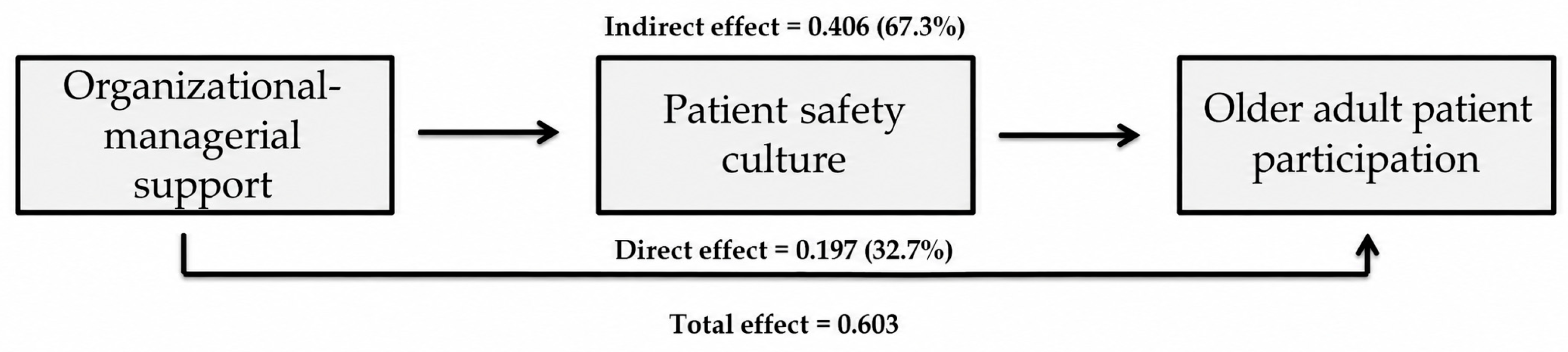
The mediation analysis identified a statistically significant indirect association between organizational–managerial support and perceived older-adult-patient participation through PSC, accounting for 67.3% of the total association. The direct association also remained statistically significant, consistent with partial statistical mediation (Table 9, Figure 1). However, given the cross-sectional study design, these findings do not establish temporal ordering or causality.
Table 9.
Mediation analysis of organizational–managerial support, PSC, and perceived older-adult-patient participation.
Figure 1.
Mediation model of organizational–managerial support, PSC, and perceived older-adult-patient participation.
3.7. Sensitivity and Robustness Analyses
Sensitivity analyses supported the stability of the main regression findings. Alternative weighting of the PSC domains and exclusion of the overall perception of safety domain produced comparable results. Restricting the knowledge and safety education score to items specifically referring to older-adult patients also yielded consistent findings (adjusted R2 = 0.625). Regression diagnostics indicated no problematic multicollinearity (VIF = 1.04–2.38), and the main associations remained statistically significant when HC3 robust standard errors were applied. Detailed sensitivity-analysis results are presented in Supplementary Table S14, and regression diagnostics and HC3 robustness results in Supplementary Table S13.
The nurse-only sensitivity analysis (n = 349) yielded results consistent with the full sample (N = 372). The regression model explained 61.5% of the variance in perceived older-adult-patient participation among nurses, compared with 63.7% in the full sample. Patient safety culture remained the strongest adjusted predictor in both samples (β = 0.489 and β = 0.503, respectively), followed by staff-perceived knowledge and safety education and organizational–managerial support. Perceived institutional ageism remained non-significant in both analyses. The indirect association between organizational–managerial support and participation through patient safety culture was statistically significant in both samples. Detailed comparisons are provided in Supplementary Table S17.
4. Discussion
4.1. Interpretation of the Main Findings
The findings indicate that PSC was the strongest predictor of staff-perceived older-adult-patient participation in surgical care, while organizational–managerial support and staff-perceived knowledge and safety education showed additional positive associations. Four hypotheses (H1, H2, H3, and H5) were supported, whereas H4 was not supported. The nurse-only sensitivity analysis yielded comparable findings, suggesting that the main associations were stable within the predominant professional group. However, this comparison does not establish equivalence between professions or generalizability to other healthcare professionals.
PSC remained the strongest predictor after adjustment for the other variables and increased the explained variance by 10.6 percentage points. This finding is consistent with previous research emphasizing the multidimensional nature of safety culture and its relationship with patient safety and quality of care [3,4,5,38]. Leadership, professional norms, and organizational practices are important components of healthcare culture [39]. In surgical care, where older-adult patients may face additional challenges related to multimorbidity, frailty, and complex treatment pathways, communication openness, teamwork, and reliable information transfer may be particularly relevant to patient participation. Nevertheless, the observed associations do not establish whether stronger safety culture leads to greater participation or whether staff perceptions reflect patients’ actual experiences.
The mediation analysis identified a significant indirect association between organizational–managerial support and perceived older-adult-patient participation through PSC, accounting for 67.3% of the total association. The direct association also remained significant, consistent with partial statistical mediation. These findings suggest that organizational support and safety culture are closely interconnected in relation to perceived patient participation. However, the cross-sectional design does not establish temporal ordering or a causal mediation mechanism.
Staff-perceived knowledge and safety education were positively associated with perceived older-adult-patient participation, including when the analysis was restricted to items specifically addressing older-adult patients. This finding is relevant to geriatric models of surgical care [26] and research emphasizing the recognition of ageism in healthcare [21,40]. However, the measure reflected staff perceptions rather than objectively assessed competence or verified educational exposure. Moreover, limitations in the measurement model and discriminant validity warrant caution when interpreting this association.
Contrary to H4, perceived institutional ageism was not significantly associated with perceived older-adult-patient participation in the adjusted model. This does not imply that ageism is unimportant. Previous research identifies ageism as a structural and interpersonal barrier to equitable healthcare and autonomy [17,22,23,40,41]. The present measure captured professionals’ perceptions of age-related inequalities, which may reflect both exposure to discriminatory practices and greater awareness of them. Ageism may also affect aspects of care not adequately captured by the participation measure, including communication, treatment decisions, and discharge planning. Furthermore, PSC and institutional ageism represent distinct organizational phenomena: improvements in safety culture may not necessarily eliminate age-related stereotypes or paternalistic practices [17,40,41,42]. Future research should therefore examine institutional ageism using patient-reported experiences and independent organizational assessments.
Finally, the psychometric findings support interpreting PSC as a multidimensional composite rather than a unidimensional latent construct, consistent with previous reviews [3,4,5]. Although sensitivity analyses supported the stability of the main regression findings, the measurement limitations should be considered when interpreting the associations.
4.2. Practical Implications
The findings highlight communication openness, teamwork, information transfer, and organizational support as relevant areas for improving older-adult-patient participation in surgical care. Surgical departments should consider integrating patient participation into preoperative communication, informed consent, multidisciplinary assessment, shared decision-making, and discharge planning. Staff education should address not only clinical risks and frailty but also communication, decision-making capacity, autonomy, sensory and cognitive needs, and recognition of ageism. As improvements in PSC may not necessarily eliminate age-related biases, targeted ageism-awareness interventions should also be considered. However, the effectiveness of these measures requires prospective evaluation using patient-reported participation alongside staff assessments and relevant safety outcomes.
4.3. Theoretical Implications
This study contributes to the integration of PSC theory, patient participation research, and social gerontology by linking organizational safety culture with staff-perceived older-adult-patient participation in surgical care. The findings are consistent with previous research emphasizing the multidimensional nature of safety culture [3,4,5] and the importance of communication, professional attitudes, and organizational conditions for patient participation and shared decision-making [10,11,43,44]. However, the observed individual-level associations do not establish causal relationships or demonstrate whether similar patterns exist at the organizational level. Furthermore, the findings highlight the conceptual distinction between PSC and institutional ageism, which operates at individual, interpersonal, and institutional levels [17,40,41,42]. The absence of a statistically significant association between perceived institutional ageism and participation does not diminish its theoretical relevance, particularly because the measure may reflect both perceived exposure to age-related inequalities and awareness of discriminatory practices.
4.4. Limitations
Several limitations should be considered when interpreting the findings. The cross-sectional design provides insight into associations among the study variables but cannot establish their temporal order or causality. The mediation findings therefore describe an indirect statistical association. The questionnaire was adapted to the study context and showed generally acceptable internal consistency. Its development did not include a separate expert-panel assessment, pilot study, or formal forward–backward translation, and measurement evaluation, item exclusion, and hypothesis testing used the same sample. Some factor models showed inadequate fit, the overall perception of safety model yielded an inadmissible solution, and knowledge and safety education showed weaker convergence and separation from participation. PSC was interpreted as a multidimensional summary score. The similar findings across alternative score specifications are encouraging, while independent validation would strengthen confidence in the measures.
The findings reflect healthcare professionals’ perspectives, which provide useful information about everyday care but may differ from patients’ experiences. Perceived institutional ageism may capture both perceived age-related inequalities and awareness of such practices. Participation and knowledge and safety education combined general-care content and content specific to older-adult patients, including a participation item referring to patients aged 85 years and above. These scores should therefore be understood within this mixed care context; knowledge and education were self-reported rather than independently verified. Collecting the measures through one questionnaire may also have introduced common-method and social desirability bias, which the exploratory PCA cannot rule out.
Voluntary, non-probability recruitment may have influenced who participated. The number of professionals receiving the invitation was unknown, so a response rate could not be calculated. Nurses represented 93.8% of respondents; the similar nurse-only findings support consistency within this group, while conclusions about other professions remain more limited. Anonymous data collection prevented adjustment for possible similarities among respondents within the same hospital or department, which HC3 standard errors do not address. Prehabilitation exposure was not assessed. Future studies could extend these findings through independent measurement validation, broader professional representation, patient-reported measures, organizational identifiers, and longitudinal follow-up.
4.5. Future Research
Future research should use longitudinal and intervention designs to examine whether improvements in PSC, organizational support, staff-perceived knowledge and safety education, and anti-ageism strategies lead to increased perceived older-adult-patient participation in surgical care. Mixed-methods studies would also be valuable, as qualitative interviews with older-adult patients, family members, clinicians, and managers could clarify how participation is enabled or constrained in daily practice. Further studies should distinguish staff-perceived knowledge from the content, frequency, and quality of safety education. Training focused mainly on frailty and risk may have different effects than training focused on autonomy, communication, resilience, and shared decision-making. Research should also explore whether specific PSC domains, particularly communication openness, information transfer, staffing, and non-blaming culture, are especially relevant for older adults in surgical pathways involving multiple departments and transitions of care.
5. Conclusions
Perceived older-adult-patient participation in surgical care should be considered in relation to both interpersonal processes and the broader organizational environment. PSC, organizational–managerial support, and staff-perceived knowledge and safety education represent potentially modifiable areas that warrant further investigation in relation to communication, shared decision-making, and older adults’ involvement in care.
Strategies for developing age-sensitive surgical care may therefore consider these organizational and educational conditions, while their effects on participation require prospective evaluation. Institutional ageism also warrants direct attention through age-sensitive communication, professional education, reflection on assumptions about aging, and organizational practices that protect autonomy and equitable participation. Supporting participation and addressing ageism remain complementary objectives in the development of age-sensitive surgical care.
Supplementary Materials
The following supporting information can be downloaded at https://www.mdpi.com/article/10.3390/geriatrics11060173/s1. Table S1: Item-level comparison of the study questionnaire with HSOPSC 2.0 and the published Slovenian questionnaire; Table S2: Conceptual rationale for questionnaire content; Table S3: Response frequencies for patient safety culture items; Table S4: Response frequencies for perceived older-adult-patient participation items; Table S5: Response frequencies for organizational–managerial support items; Table S6: Response frequencies for staff-perceived knowledge and safety education items; Table S7: Response frequencies for perceived institutional ageism items; Table S8: Healthcare institutions contacted for survey distribution; Table S9: Confirmatory factor analysis of study constructs and patient safety culture domains; Table S10: Internal consistency of study constructs and patient safety culture domains; Table S11: Composite reliability and average variance extracted for the main study-specific constructs; Table S12: Discriminant validity assessed using the heterotrait–monotrait ratio of correlations (HTMT); Table S13: Regression diagnostics and robustness analyses for the final regression model; Table S14: Sensitivity of regression findings to alternative composite-score specifications; Table S15: Exploratory principal component analysis as a diagnostic of potential common-method variance; Table S16: Indicators excluded after CFA-based measurement evaluation; and Table S17: Comparison of the final regression model in the full sample and in nurses.
Author Contributions
Conceptualization, I.J. and D.B.; methodology, I.J. and D.B.; software, I.J.; validation, D.B. and E.D.; formal analysis, I.J.; investigation, I.J.; resources, D.B.; data curation, D.B. and E.D.; writing—original draft preparation, I.J.; writing—review and editing, E.D.; visualization, I.J.; supervision, D.B. and E.D.; project administration, E.D. and D.B.; funding acquisition, E.D. and D.B. All authors have read and agreed to the published version of the manuscript.
Funding
This research was funded by the Slovenian Research and Innovation Agency (ARIS) under research project L5-70197, “Regional Model for Integration of Health and Care Infrastructures as Basis for Development of Optimal Community Care”, and research program P5-0342, “Socio-cultural and Organizational Aspects of Knowledge and Technology Transfer”.
Institutional Review Board Statement
The study was conducted in accordance with the Declaration of Helsinki. The survey was anonymous, participation was voluntary, and no identifiable personal or institutional data were collected. The study documentation was reviewed and approved by the relevant institutional authority of General Hospital “Dr. Anđelko Višić” Bjelovar, the researcher’s employing healthcare institution, under classification number 053-01/26-01/327, on 13 May 2026.
Informed Consent Statement
Informed consent was obtained from all subjects involved in the study.
Data Availability Statement
The data presented in this study are available on request from the corresponding author. The data are not publicly available due to privacy, ethical, and institutional restrictions related to the anonymity of participants and the participating healthcare institutions.
Acknowledgments
The authors thank the participating healthcare professionals and healthcare institutions for their time and support during data collection.
Conflicts of Interest
The authors declare no conflicts of interest.
Abbreviations
The following abbreviations are used in this manuscript:
| AVE | Average variance extracted |
| CFA | Confirmatory Factor Analysis |
| CFI | Comparative Fit Index |
| CI | Confidence Interval |
| CR | Composite reliability |
| DWLS | Diagonally Weighted Least Squares |
| H | Hypothesis |
| HSOPSC | Hospital survey on patient safety culture |
| HTMT | Heterotrait–monotrait ratio of correlations |
| MLR | Robust maximum likelihood |
| PCA | Principal component analysis |
| PSC | Patient safety culture |
| RMSE | Root mean squared error |
| RMSEA | Root mean square error of approximation |
| RQ | Research question |
| SAQ | Safety attitudes questionnaire |
| SD | Standard deviation |
| SDM | Shared decision-making |
| SE | Standard error |
| SRMR | Standardized root mean square residual |
| TLI | Tucker–Lewis index |
| VIF | Variance inflation factor |
| χ2 | Chi-square test |
References
- World Health Organization. Global Patient Safety Report 2024: Executive Summary; World Health Organization: Geneva, Switzerland, 2024. [Google Scholar] [CrossRef] [Scilit]
- Azyabi, A.; Karwowski, W.; Davahli, M.R. Assessing patient safety culture in hospital settings. Int. J. Environ. Res. Public Health 2021, 18, 2466. [Google Scholar] [CrossRef] [Scilit] [PubMed]
- Sammer, C.E.; Lykens, K.; Singh, K.P.; Mains, D.A.; Lackan, N.A. What is patient safety culture? A review of the literature. J. Nurs. Scholarsh. 2010, 42, 156–165. [Google Scholar] [CrossRef] [Scilit] [PubMed]
- Halligan, M.; Zecevic, A. Safety culture in healthcare: A review of concepts, dimensions, measures and progress. BMJ Qual. Saf. 2011, 20, 338–343. [Google Scholar] [CrossRef] [Scilit] [PubMed]
- Churruca, K.; Ellis, L.A.; Pomare, C.; Hogden, A.; Bierbaum, M.; Long, J.C.; Olekalns, A.; Braithwaite, J. Dimensions of safety culture: A systematic review of quantitative, qualitative and mixed methods for assessing safety culture in hospitals. BMJ Open 2021, 11, e043982. [Google Scholar] [CrossRef] [Scilit] [PubMed]
- Institute of Medicine. To Err Is Human: Building a Safer Health System; National Academies Press: Washington, DC, USA, 2000. [Google Scholar] [CrossRef] [Scilit] [PubMed]
- World Health Organization. WHO Guidelines for Safe Surgery 2009: Safe Surgery Saves Lives; World Health Organization: Geneva, Switzerland, 2009. [Google Scholar]
- Mallouli, M.; Tlili, M.A.; Aouicha, W.; Ben Rejeb, M.; Zedini, C.; Salwa, A.; Mtiraoui, A.; Ben Dhiab, M.; Ajmi, T. Assessing patient safety culture in Tunisian operating rooms: A multicenter study. Int. J. Qual. Health Care 2017, 29, 176–182. [Google Scholar] [CrossRef] [Scilit] [PubMed]
- Piper, D.; Lea, J.; Woods, C.; Parker, V. The impact of patient safety culture on handover in rural health facilities. BMC Health Serv. Res. 2018, 18, 889. [Google Scholar] [CrossRef] [Scilit] [PubMed]
- Pel-Littel, R.E.; Snaterse, M.; Teppich, N.M.; Buurman, B.M.; van Etten-Jamaludin, F.S.; van Weert, J.C.M.; Minkman, M.M.; Scholte op Reimer, W.J.M. Barriers and facilitators for shared decision making in older patients with multiple chronic conditions: A systematic review. BMC Geriatr. 2021, 21, 112. [Google Scholar] [CrossRef] [Scilit] [PubMed]
- Schuijt, H.J.; Smeeing, D.P.J.; Verberne, W.R.; Groenwold, R.H.H.; van Delden, J.J.M.; Leenen, L.P.H.; van der Velde, D. Perspective; recommendations for improved patient participation in decision-making for geriatric patients in acute surgical settings. Injury 2023, 54, 110823. [Google Scholar] [CrossRef] [Scilit] [PubMed]
- Nwosu, A.D.G.; Ossai, E.; Ahaotu, F.; Onwuasoigwe, O.; Amucheazi, A.; Akhideno, I. Patient safety culture in the operating room: A cross-sectional study using the Hospital Survey on Patient Safety Culture (HSOPSC) instrument. BMC Health Serv. Res. 2022, 22, 1445. [Google Scholar] [CrossRef] [Scilit] [PubMed]
- Weiss, Y.; Zarour, S.; Neuman, M.D.; Politi, M.C.; Tang, V.L.; Gisselbaek, M.; Berger-Estilita, J.; Saxena, S. Shared decision-making for older adults in the peri-operative setting: A narrative review. Eur. J. Anaesthesiol. 2025, 42, 767–773. [Google Scholar] [CrossRef] [Scilit] [PubMed]
- de Mik, S.M.L.; Stubenrouch, F.E.; Balm, R.; Ubbink, D.T. Systematic review of shared decision-making in surgery. Br. J. Surg. 2018, 105, 1721–1730. [Google Scholar] [CrossRef] [Scilit] [PubMed]
- Vogel, A.; Guinemer, C.; Fürstenau, D. Patients’ and healthcare professionals’ perceived facilitators and barriers for shared decision-making for frail and elderly patients in perioperative care: A scoping review. BMC Health Serv. Res. 2023, 23, 197. [Google Scholar] [CrossRef] [Scilit] [PubMed]
- Noordman, J.; Driesenaar, J.A.; Henselmans, I.; Verboom, J.; Heijmans, M.; van Dulmen, S. Patient participation during oncological encounters: Barriers and need for supportive interventions experienced by elderly cancer patients. Patient Educ. Couns. 2017, 100, 2262–2268. [Google Scholar] [CrossRef] [Scilit] [PubMed]
- World Health Organization. Global Report on Ageism; World Health Organization: Geneva, Switzerland, 2021. [Google Scholar]
- Schroyen, S.; Adam, S.; Marquet, M.; Jerusalem, G.; Thiel, S.; Giraudet, A.-L.; Missotten, P. Communication of healthcare professionals: Is there ageism? Eur. J. Cancer Care 2018, 27, e12780. [Google Scholar] [CrossRef] [Scilit] [PubMed]
- Levy, B. Stereotype embodiment: A psychosocial approach to aging. Curr. Dir. Psychol. Sci. 2009, 18, 332–336. [Google Scholar] [CrossRef] [Scilit] [PubMed]
- Gholamzadeh, S.; Shaygan, M.; Naderi, Z.; Hosseini, F.A. Age discrimination perceived by hospitalized older adult patients in Iran: A qualitative study. Health Promot. Perspect. 2022, 12, 45–55. [Google Scholar] [CrossRef] [Scilit] [PubMed]
- Nemiroff, L. We can do better: Addressing ageism against older adults in healthcare. Healthc. Manag. Forum 2022, 35, 118–122. [Google Scholar] [CrossRef] [Scilit] [PubMed]
- São José, J.M.S.; Amado, C.A.F.; Ilinca, S.; Buttigieg, S.C.; Taghizadeh Larsson, A. Ageism in health care: A systematic review of operational definitions and inductive conceptualizations. Gerontologist 2019, 59, e98–e108. [Google Scholar] [CrossRef] [Scilit] [PubMed]
- de Araújo, P.O.; Soares, I.M.S.C.; Vale, P.R.L.F.; de Sousa, A.R.; Aparicio, E.C.; Carvalho, E.S.S. Ageism directed to older adults in health services: A scoping review. Rev. Latino-Am. Enfermagem 2023, 31, e4020. [Google Scholar] [CrossRef] [Scilit]
- Fernández-Puerta, L.; Caballero-Bonafé, A.; de-Moya-Romero, J.R.; Martínez-Sabater, A.; Valera-Lloris, R. Ageism and associated factors in healthcare workers: A systematic review. Nurs. Rep. 2024, 14, 4039–4059. [Google Scholar] [CrossRef] [Scilit] [PubMed]
- Alabdaly, A.; Hinchcliff, R.; Debono, D.; Hor, S.-Y. Relationship between patient safety culture and patient experience in hospital settings: A scoping review. BMC Health Serv. Res. 2024, 24, 906. [Google Scholar] [CrossRef] [Scilit] [PubMed]
- Hughes, S.; Bui, U.; Douglas, C.; Taylor, A. Geriatric models of surgical care: A scoping review. J. Adv. Nurs. 2026, 82, 8425–8440. [Google Scholar] [CrossRef] [Scilit] [PubMed]
- Sorra, J.; Yount, N.; Famolaro, T.; Gray, L. AHRQ Hospital Survey on Patient Safety Culture Version 2.0: User’s Guide; Agency for Healthcare Research and Quality: Rockville, MD, USA, 2019; AHRQ Publication No. 19-0076. Available online: https://www.ahrq.gov/sites/default/files/wysiwyg/sops/surveys/hospital/hospitalsurvey2-users-guide.pdf (accessed on 9 October 2026).
- Sexton, J.B.; Helmreich, R.L.; Neilands, T.B.; Rowan, K.; Vella, K.; Boyden, J.; Roberts, P.R.; Thomas, E.J. The Safety Attitudes Questionnaire: Psychometric properties, benchmarking data, and emerging research. BMC Health Serv. Res. 2006, 6, 44. [Google Scholar] [CrossRef] [Scilit] [PubMed]
- Bogataj, D.; Grabar, D.; Robida, A.; Toplak Perovič, B. Kultura Varnosti Pacientov—Bolnišnice [Patient Safety Culture—Hospitals]; Alma Mater Press: Maribor, Slovenia, 2025. [Google Scholar] [CrossRef] [Scilit]
- Mesarić, J.; Šimić, D. Kultura sigurnosti pacijenta—Kako procijeniti? [Patient safety culture—How can it be assessed?]. Liječ. Vjesn. 2023, 145, 383–388. (In Croatian) [Google Scholar] [CrossRef] [Scilit]
- Brborović, H.; Šklebar, I.; Brborović, O.; Brumen, V.; Mustajbegović, J. Development of a Croatian version of the US Hospital Survey on Patient Safety Culture questionnaire: Dimensionality and psychometric properties. Postgrad. Med. J. 2014, 90, 125–132. [Google Scholar] [CrossRef] [Scilit] [PubMed]
- Friganović, A.; Režić, S.; Civka, K.; Kurtović, B.; Rotim, C.; Krupa, S. Croatian use of the Hospital Survey on Patient Safety Culture: A psychometric validation in a sample of Croatian nurses. Croat. Nurs. J. 2021, 5, 129–142. [Google Scholar] [CrossRef] [Scilit] [PubMed]
- Mohanty, S.; Rosenthal, R.A.; Russell, M.M.; Neuman, M.D.; Ko, C.Y.; Esnaola, N.F. Optimal perioperative management of the geriatric patient: A best practices guideline from the American College of Surgeons NSQIP and the American Geriatrics Society. J. Am. Coll. Surg. 2016, 222, 930–947. [Google Scholar] [CrossRef] [Scilit] [PubMed]
- American Geriatrics Society Expert Panel on Postoperative Delirium in Older Adults. American Geriatrics Society abstracted clinical practice guideline for postoperative delirium in older adults. J. Am. Geriatr. Soc. 2015, 63, 142–150. [Google Scholar] [CrossRef] [Scilit] [PubMed]
- Boateng, G.O.; Neilands, T.B.; Frongillo, E.A.; Melgar-Quiñonez, H.R.; Young, S.L. Best practices for developing and validating scales for health, social, and behavioral research: A primer. Front. Public Health 2018, 6, 149. [Google Scholar] [CrossRef] [Scilit] [PubMed]
- MacCallum, R.C.; Widaman, K.F.; Zhang, S.; Hong, S. Sample size in factor analysis. Psychol. Methods 1999, 4, 84–99. [Google Scholar] [CrossRef]
- Wolf, E.J.; Harrington, K.M.; Clark, S.L.; Miller, M.W. Sample size requirements for structural equation models: An evaluation of power, bias, and solution propriety. Educ. Psychol. Meas. 2013, 73, 913–934. [Google Scholar] [CrossRef] [Scilit] [PubMed]
- Lee, S.E.; Scott, L.D.; Dahinten, V.S.; Vincent, C.; Lopez, K.D.; Park, C.G. Safety culture, patient safety, and quality of care outcomes: A literature review. West. J. Nurs. Res. 2019, 41, 279–304. [Google Scholar] [CrossRef] [Scilit] [PubMed]
- Scott, T.; Mannion, R.; Davies, H.T.O.; Marshall, M.N. Implementing culture change in health care: Theory and practice. Int. J. Qual. Health Care 2003, 15, 111–118. [Google Scholar] [CrossRef] [Scilit] [PubMed]
- Wyman, M.F.; Shiovitz-Ezra, S.; Bengel, J. Ageism in the health care system: Providers, patients, and systems. In Contemporary Perspectives on Ageism; Ayalon, L., Tesch-Römer, C., Eds.; Springer: Cham, Switzerland, 2018; pp. 193–212. [Google Scholar] [CrossRef] [Scilit]
- Ayalon, L.; Tesch-Römer, C. (Eds.) Contemporary Perspectives on Ageism; Springer: Cham, Switzerland, 2018. [Google Scholar] [CrossRef] [Scilit]
- Chang, E.S.; Kannoth, S.; Levy, S.; Wang, S.Y.; Lee, J.E.; Levy, B.R. Global reach of ageism on older persons’ health: A systematic review. PLoS ONE 2020, 15, e0220857. [Google Scholar] [CrossRef] [Scilit] [PubMed]
- Sahlsten, M.J.M.; Larsson, I.E.; Sjöström, B.; Plos, K.A.E. An analysis of the concept of patient participation. Nurs. Forum 2008, 43, 2–11. [Google Scholar] [CrossRef] [Scilit] [PubMed]
- Tobiano, G.; Marshall, A.; Bucknall, T.; Chaboyer, W. Patient participation in nursing care on medical wards: An integrative review. Int. J. Nurs. Stud. 2015, 52, 1107–1120. [Google Scholar] [CrossRef] [Scilit] [PubMed]

Disclaimer/Publisher’s Note: The statements, opinions and data contained in all publications are solely those of the individual author(s) and contributor(s) and not of MDPI and/or the editor(s). MDPI and/or the editor(s) disclaim responsibility for any injury to people or property resulting from any ideas, methods, instructions or products referred to in the content. |
© 2026 by the authors. Licensee MDPI, Basel, Switzerland. This article is an open access article distributed under the terms and conditions of the Creative Commons Attribution (CC BY) license.