


Simple Summary
Freezing semen can help preserve valuable genetic material from threatened wildlife, but the same freezing method may not work equally well for different species. This study compared semen from Arabian oryx and Nubian ibex to determine whether the solution used to protect sperm during freezing affects the two species differently. Semen samples from each species were divided equally between an egg yolk-based solution and a commercial extender, allowing both treatments to be compared under the same freezing conditions. In Arabian oryx, sperm motility differed between extenders before freezing, and although the egg yolk-based solution yielded higher total motility after thawing, the proportional decline during freezing did not differ significantly between extenders. In contrast, the commercial extender resulted in smaller proportional declines in both total and progressive motility in Nubian ibex. Freezing also affected sperm shape and movement characteristics differently between the two species. These findings highlight the importance of considering sperm quality before freezing when evaluating extender performance and developing species-specific semen cryopreservation protocols. Such approaches may improve genetic resource preservation and support assisted reproduction and conservation programs for threatened wildlife.
Abstract
Species-specific responses to semen cryopreservation are important for developing germplasm preservation protocols for wild ruminants. This study compared cryopreservation responses of Arabian oryx (Oryx leucoryx) and Nubian ibex (Capra nubiana) semen extended with Egg Yolk–Tris Buffer (EYTB) or Steridyl under identical conditions. Five pooled samples per species were evaluated, with each pool divided into matched aliquots extended with EYTB or Steridyl. Total motility (TM), progressive motility (PM), sperm kinematics, and morphological abnormalities were assessed before freezing and after thawing. Significant Species-by-Extender interactions were detected for TM and PM (p < 0.001), indicating that extender-associated motility differed between species. A Significant Species-by-Extender-by-Stage interaction was observed for PM (p = 0.011). In Arabian oryx, pre-freezing TM differed between EYTB and Steridyl (79.80% vs. 48.82%), and although post-thaw TM was higher with EYTB (48.86 ± 7.30% vs. 25.92 ± 6.59%), the proportional decline in TM did not differ significantly between extenders (37.77% vs. 45.51%; adjusted p = 0.3536). Post-thaw PM was also higher with EYTB (34.92 ± 10.24% vs. 12.13 ± 6.07%; p = 0.003). The proportional decline in PM was also significantly smaller with EYTB (40.61% vs. 69.68%; adjusted p = 0.0366). In Nubian ibex, Steridyl resulted in higher post-thaw TM (36.64 ± 5.03% vs. 15.32 ± 3.07%; p < 0.001) and PM (25.43 ± 7.34% vs. 10.61 ± 2.00%; p = 0.011), with significantly smaller proportional declines in both parameters. Morphological abnormalities increased after cryopreservation (p < 0.001), with a significant Species-by-Extender-by-Stage interaction (p = 0.016). Sperm velocity parameters (VCL, VAP, and VSL) declined significantly after thawing (adjusted p < 0.001), with VCL decreasing from 84.69 to 27.29 µm/s in Arabian oryx and from 77.59 to 13.00 µm/s in Nubian ibex using EYTB. These findings indicate species-specific extender-associated responses, while emphasizing the importance of accounting for pre-freezing differences when interpreting post-thaw sperm quality. Further validation using larger sample sizes is needed before broader application in wildlife germplasm preservation programs.
1. Introduction
Semen cryopreservation is an important reproductive biotechnology for long-term preservation of male genetic resources and their use in assisted reproduction. In wildlife conservation, it supports genome resource banking by preserving genetic material beyond an individual’s reproductive lifespan, contributing to the management of genetic diversity in threatened populations [1,2,3].
Despite advances in semen preservation, sperm cryotolerance varies considerably among species. Cooling, freezing, and thawing expose spermatozoa to thermal and osmotic stresses that can impair membrane integrity, motility, and survival [4,5]. Differences in sperm and membrane characteristics further contribute to interspecific variation in cryosensitivity [1,3]. Therefore, cryopreservation protocols effective in one species may not provide equivalent protection in another.
Semen extender composition is a major determinant of sperm cryosurvival. Tris-based extenders containing egg yolk and glycerol are widely used in ruminants, but their efficacy may vary among species because extender components interact with species-specific sperm characteristics [3,4,6]. Comparing extenders under standardized conditions is therefore important for evaluating species-specific responses to cryopreservation. Studies in wild ruminants, including Iberian ibex, have highlighted the importance of cryoprotectant formulation and pre-freezing equilibration in semen cryopreservation [7,8]. Accordingly, EYTB and Steridyl were selected to compare a conventional laboratory-prepared extender with a commercial formulation under standardized cryopreservation conditions.
The Arabian oryx and Nubian ibex are wild bovids of conservation relevance in the Arabian Peninsula. Both species are the focus of active conservation efforts in Saudi Arabia, including captive breeding and reintroduction programs [9,10]. Previous studies characterized semen traits relevant to assisted reproduction in Arabian oryx [11]. In contrast, published information on semen cryopreservation in Nubian ibex remains limited. Whether these two species respond similarly to semen extenders under standardized cryopreservation conditions remains unclear.
Therefore, this study compared the cryopreservation responses of Arabian oryx and Nubian ibex semen extended with Egg Yolk–Tris Buffer (EYTB) or Steridyl under standardized conditions. Sperm motility, CASA-derived kinematics, and morphology were evaluated at pre-freezing and post-thawing stages. Based on previously reported interspecies differences in sperm cryotolerance and extender-dependent cryoprotection, we hypothesized that EYTB and Steridyl would differ in their ability to preserve total and progressive motility, CASA-derived sperm kinematics, and morphological integrity, with the magnitude and direction of these effects varying between Arabian oryx and Nubian ibex.
2. Materials and Methods
2.1. Chemicals
All reagents and chemicals were purchased from Sigma-Aldrich (St. Louis, MO, USA), unless otherwise specified.
2.2. Study Location
All experimental procedures were conducted at the Reproductive Research Laboratory, Prince Saud Al-Faisal Wildlife Research Center, National Center for Wildlife, Taif, Saudi Arabia (21°15′ N, 40°41′ E).
2.3. Animals
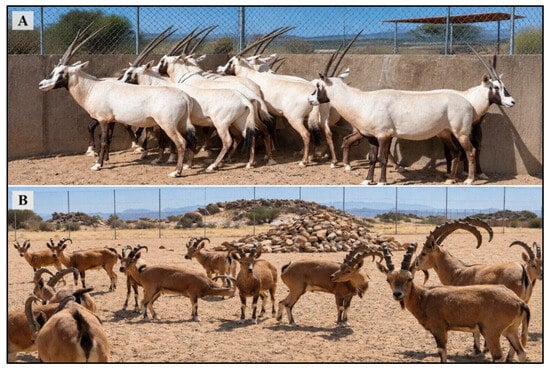
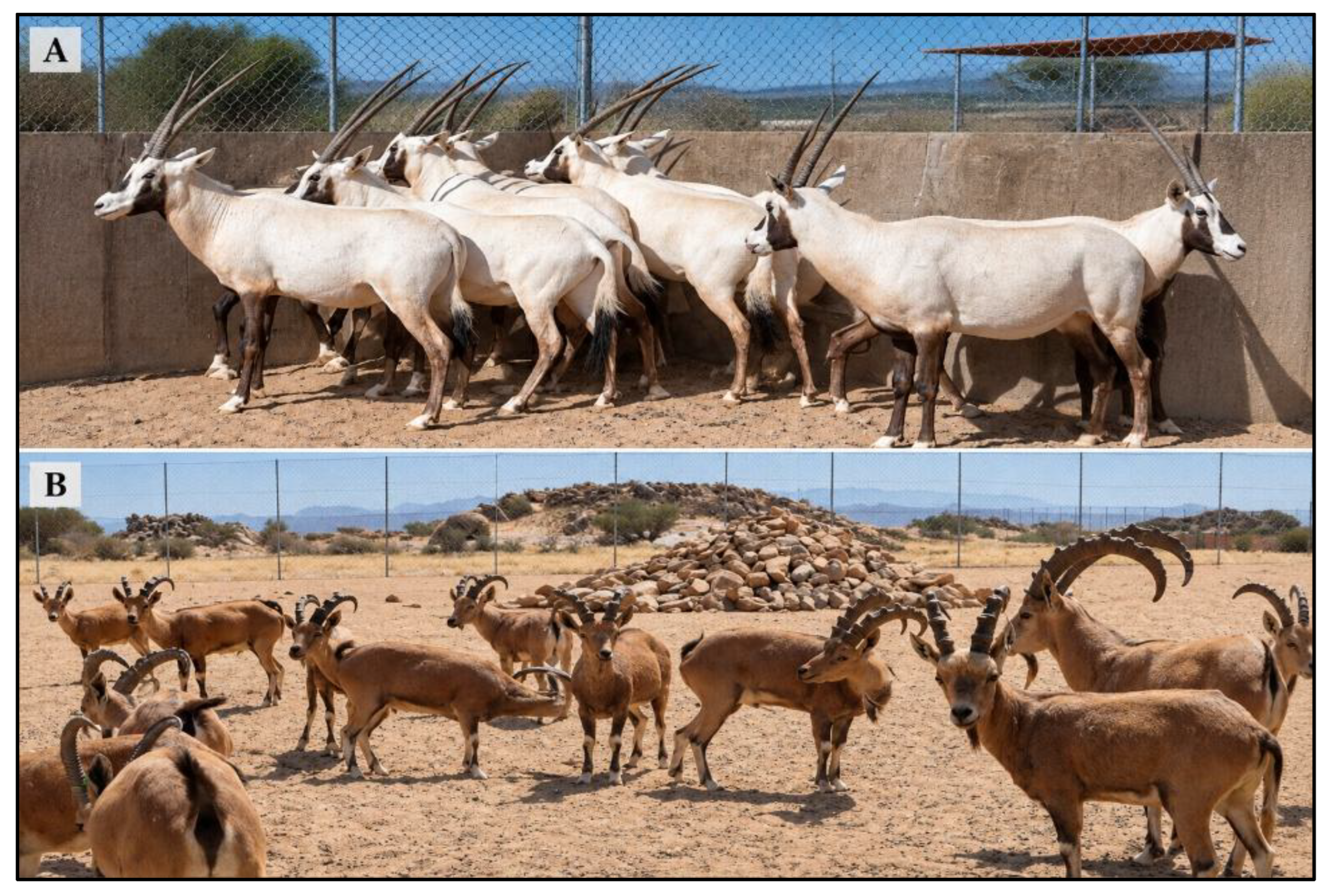
Twenty healthy and sexually mature males, including 10 Arabian oryx and 10 Nubian ibex aged 3–5 years, were used in the study (Figure 1). Arabian oryx weighed 110–120 kg and Nubian ibex 70–80 kg. All animals were housed under similar conditions in 10 × 10 m pens with shelter and shade, had ad libitum access to water and salt blocks, and received 5 kg of roughage and 0.5 kg of concentrate daily.
Figure 1.
Photographs of the study species maintained at the Prince Saud Al-Faisal Wildlife Research Center, Taif, Saudi Arabia: (A) Arabian oryx (Oryx leucoryx) and (B) Nubian ibex (Capra nubiana).
2.4. Semen Extenders
Two semen extenders were evaluated: Egg Yolk–Tris Buffer (EYTB) and Steridyl® (Minitube GmbH, Tiefenbach, Germany).
2.4.1. Steridyl
Steridyl is a commercial ruminant semen extender containing Tris, citric acid, sugar, buffering agents, glycerol, purified water, irradiated sterile egg yolk, tylosin, gentamicin, spectinomycin, and lincomycin. The Steridyl concentrate was diluted 1:1.5 (v/v) with purified water according to the manufacturer’s instructions, using the same preparation procedure for both Arabian oryx and Nubian ibex. The quantitative composition, including the exact concentrations of glycerol and egg yolk, is proprietary and is not disclosed by the manufacturer.
2.4.2. Egg Yolk–Tris Buffer (EYTB)
EYTB was freshly prepared according to the one-step freezing diluent described by Evans and Maxwell [12]. Each 100 mL contained 3.634 g Tris (hydroxymethyl)aminomethane, 1.990 g citric acid monohydrate, 0.500 g glucose, 15 mL egg yolk, 5 mL glycerol, 100,000 IU penicillin, and 100 mg streptomycin, with distilled water added to a final volume of 100 mL.
2.5. Semen Collection
Fresh semen was collected over four consecutive weeks, from mid-November to mid-December, with two collection sessions per week for each species, conducted on separate days for Arabian oryx and Nubian ibex. This resulted in eight collection sessions per species. At the beginning of each week, the ten males of each species were randomly divided into two groups of five. The first group underwent semen collection during the first weekly session, while the second group was used during the second session. At the beginning of each subsequent week, the males were randomly reassigned to two groups, so group composition varied across weeks. Accordingly, each male was scheduled for one collection attempt per week, resulting in 40 collection attempts per species over the study period.
Before semen collection, animals of both species were chemically immobilized by intramuscular administration of xylazine (1 mg/kg body weight), ketamine (10 mg/kg body weight), and medetomidine (0.06 mg/kg body weight) using a CO2-powered dart gun (DANiNJECT ApS, Kolding, Denmark) following a previously described immobilization protocol for Arabian oryx [11]. Semen was collected by electroejaculation following procedures previously described for Arabian oryx and wild ibex [11,13]. At 45 min after immobilization, anesthesia was reversed by intramuscular administration of atipamezole (0.25 mg/kg body weight) [11]. Animals were monitored by veterinary personnel throughout immobilization and recovery until normal posture and activity were restored. Ejaculates were visually screened immediately after collection, and samples showing blood or urine contamination or clearly poor gross appearance were discarded. Attempts yielding no semen were recorded as unsuccessful collections. Acceptable samples were retained in sterile, pre-warmed graduated tubes and maintained at 37 °C during transport to the laboratory.
2.6. Initial Semen Evaluation and Selection
Upon arrival at the laboratory, each ejaculate was evaluated for volume, consistency, and wave motion. Volume was measured using the graduated collection tube. Consistency was scored on a six-point scale from 0 to 5: 0 = clear, 1 = cloudy, 2 = milky, 3 = thin creamy, 4 = creamy, and 5 = thick creamy [12]. Wave motion was assessed by examining a drop of undiluted semen on a pre-warmed (37 °C) glass slide without a coverslip under phase-contrast microscopy at 40× magnification and scored from 0 (no motility) to 5 (very rapid wave movement with clear whirlpool formation) [14].
Ejaculates were ranked according to their overall quality, considering semen volume, consistency, and wave motion. Selection was based on the relative quality of the ejaculates available within each collection session rather than predefined numerical acceptance thresholds. Ejaculates considered suitable for pooling were selected, whereas lower-quality ejaculates were excluded.
Initial screening of individual ejaculates was limited to semen volume, consistency, and wave motion. CASA-derived motility and kinematic parameters and sperm morphology were subsequently assessed in the extended pooled samples at the pre-freezing and post-thawing stages, as described in Section 2.10.
2.7. Experimental Design, Pooling and Dilution
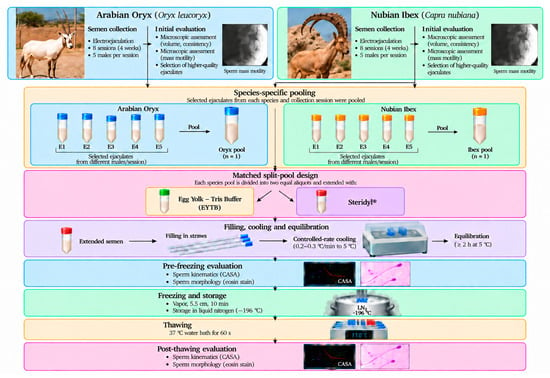
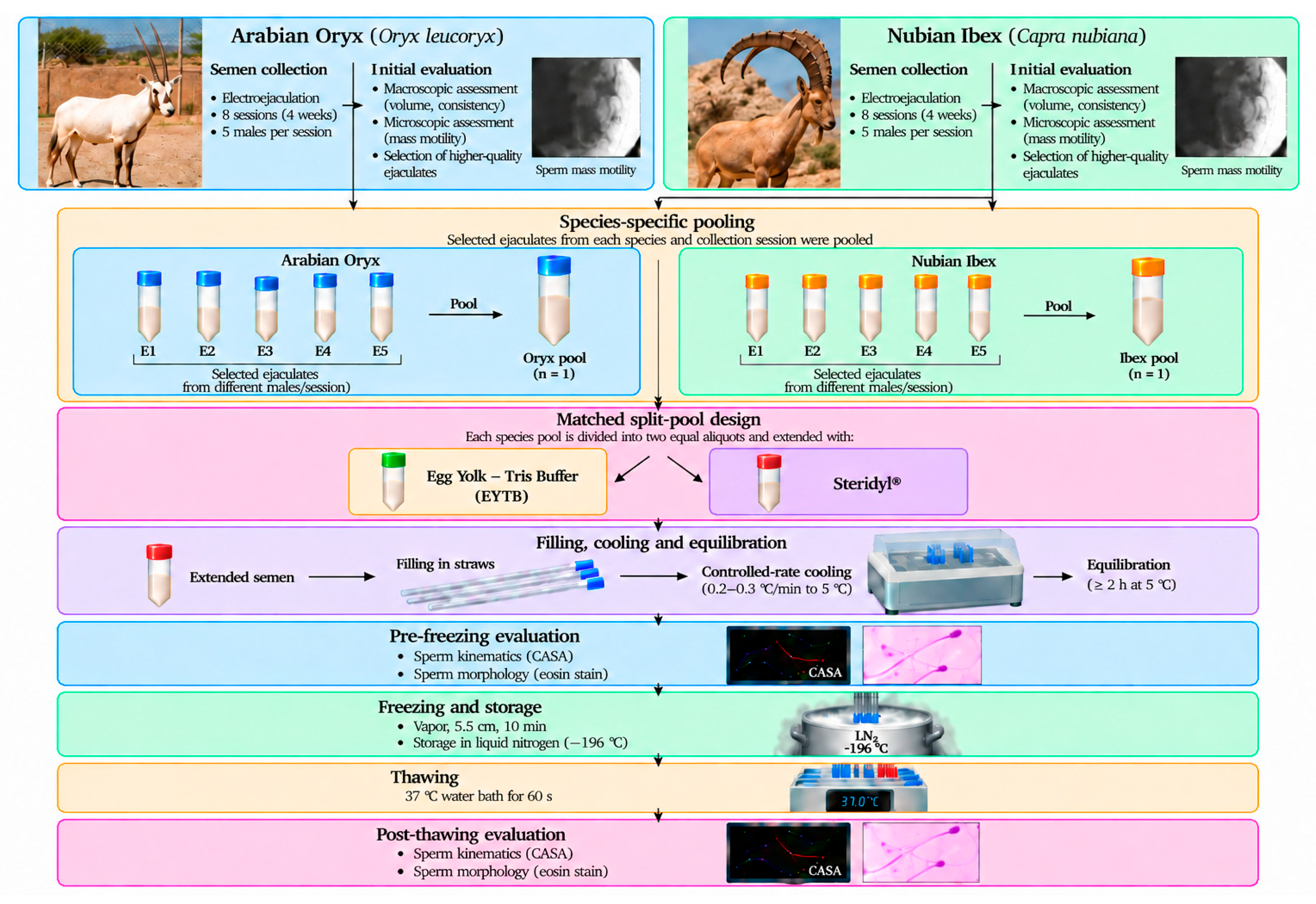
Following individual laboratory semen evaluation, selected ejaculates from the same species and collection session were pooled. Each contributing male provided one ejaculate per collection session; therefore, the number of ejaculates contributing to each pool corresponded to the number of contributing males. Consequently, the number of contributing males varied among pools, with a maximum of five males per pool. Sessions that did not yield suitable ejaculates for pooling were excluded. Of the eight collection sessions per species, five yielded eligible pools, resulting in five pooled samples per species (n = 5) (Figure 2). The number and anonymized identities of males contributing to each pool are provided in Supplementary Table S1. Some males contributed to multiple pools across collection sessions. In Arabian oryx, four of the nine contributing males participated in two pools each, resulting in four pairs of pools sharing at least one male. In Nubian ibex, five of the ten contributing males participated in two pools each, resulting in five pairs of pools sharing at least one male (Supplementary Table S1).
Figure 2.
Graphical representation of the experimental design and workflow of semen cryopreservation and evaluation in Arabian oryx and Nubian ibex.
Sperm concentration in each pool was determined using a hemocytometer. The required extender volume was calculated based on the initial sperm concentration and volume of each pool to achieve a final concentration of 125 × 106 spermatozoa/mL. Each pool was then divided into two equal aliquots, and half of the calculated extender volume was added to each aliquot using either EYTB or Steridyl. Samples were gently mixed on a tube rotator for 30 min at room temperature.
2.8. Straw Filling, Sealing and Cooling
Immediately after 30 min of gentle mixing at room temperature, extended semen was loaded into pre-labeled 0.25-mL straws (0.2 mL/straw) and sealed with sealing balls. The straws were cooled from room temperature to 5 °C at approximately 0.2–0.3 °C/min using a programmable cooling system and maintained at 5 °C for at least 2 h for equilibration before freezing.
2.9. Freezing, Storage and Thawing
Following equilibration, the straws were placed horizontally 5.5 cm above the surface of liquid nitrogen (LN2) for 10 min and then plunged into LN2 (−196 °C) [15]. The actual cooling rate during liquid nitrogen vapor exposure was not monitored, and no temperature–time cooling curve was recorded. Straws from the same species, collection session, and extender treatment were grouped as a single batch and stored in LN2. Post-thaw evaluation was performed one month after completion of all semen collection and freezing procedures.
For thawing, two straws from each batch were immersed in a 37 °C water bath for 60 s. Their contents were pooled into a single tube for semen quality assessment. The same number of straws was used for all batches and extender treatments.
2.10. Semen Quality Assessment
Semen quality was assessed at two stages of the cryopreservation procedure: after cooling and equilibration at 5 °C, immediately before freezing (pre-freezing assessment), and after thawing (post-thawing assessment). Identical procedures were used at both stages to evaluate sperm motility, kinematics, and morphology.
2.10.1. Computer-Assisted Sperm Analysis (CASA)
Sperm motility and kinematics were assessed using a computer-assisted semen analysis system (CASA; AndroVision®, Minitube GmbH, Tiefenbach, Germany) [16]. A 3-µL semen aliquot was loaded into a pre-warmed (37 °C), 20-µm-deep disposable counting chamber, and eight representative fields were analyzed per sample. The parameters recorded were total motility (TM, %), progressive motility (PM, %), curvilinear velocity (VCL, µm/s), average path velocity (VAP, µm/s), straight-line velocity (VSL, µm/s), curvilinear distance (DCL, µm), average path distance (DAP, µm), straight-line distance (DSL, µm), amplitude of lateral head displacement (ALH, µm), beat-cross frequency (BCF, Hz), wobble (WOB, %), linearity (LIN, %), and straightness (STR, %).
2.10.2. Sperm Morphology
Sperm morphology was assessed using eosin-stained smears following established principles for morphological evaluation of ruminant spermatozoa [12,17]. One drop of semen was mixed with two drops of 1% eosin on a pre-warmed glass slide, spread into a thin smear, and air-dried. At least 200 spermatozoa per sample were examined under phase-contrast microscopy at 400× magnification, and the total percentage of morphologically abnormal spermatozoa was recorded. Individual categories of morphological abnormalities were not quantified separately. Abnormalities included visible head defects, detached heads, abnormal or bent midpieces, coiled tails, and proximal or distal cytoplasmic droplets.
Morphological assessment was restricted to visible sperm abnormalities identified in eosin-stained preparations under light microscopy. No dedicated staining or functional assay was performed to assess acrosomal integrity.
2.11. Statistical Analysis
Statistical analyses were performed using IBM SPSS Statistics version 29.0 (IBM Corp., Armonk, NY, USA). Each pooled semen sample was considered an experimental unit, with five pools per species (n = 5). Each pool was divided into matched EYTB and Steridyl aliquots and evaluated at pre-freezing and post-thawing stages. Pre-freezing and post-thawing assessments were performed on separate subsamples from the same pool–extender combination and were therefore treated as paired observations at the pool level. Species was treated as the between-subject factor, whereas extender and stage were within-subject repeated-measures factors. CASA fields, spermatozoa examined for morphology, and straws from the same batch were treated as technical subsamples rather than replicates.
Total motility (TM), progressive motility (PM), and morphological abnormalities were analyzed using a three-factor mixed repeated-measures ANOVA, with species as the between-subject factor and extender and stage as within-subject factors. Main effects and all two- and three-way interactions were evaluated.
Within each species, paired-samples t-tests were used to compare pre-freezing and post-thawing values within each extender and to compare EYTB and Steridyl within each cryopreservation stage for total motility (TM), progressive motility (PM), and morphological abnormalities. These comparisons were based on matched pooled semen samples, with Holm adjustment applied across eight comparisons per outcome. Adjusted p-values < 0.05 were considered statistically significant.
Additionally, relative declines in total motility (TM) and progressive motility (PM) were calculated separately for each semen pool and extender as [(pre-freezing value − post-thaw value)/pre-freezing value] × 100. These declines were analyzed using repeated-measures ANOVA, with extender as the within-subject factor and species as the between-subject factor. Within-species comparisons between extenders were performed using paired-samples t-tests, with p values adjusted across the four comparisons using the Holm procedure.
The 11 CASA-derived kinematic parameters were analyzed using the same three-factor mixed repeated-measures ANOVA. To account for multiple kinematic endpoints, p values were adjusted separately within each factorial effect using the Benjamini–Hochberg false discovery rate (FDR) procedure, and statistical significance was based on FDR-adjusted p values.
Significant Species-by-Stage interactions for WOB and LIN that remained after FDR correction were further examined by simple-effects analysis. Values were averaged across extenders within each collection session, and pre-freezing and post-thawing marginal means were compared within each species using paired-samples t-tests. The two species-specific p values for each endpoint were adjusted using the Holm procedure.
As a sensitivity analysis, percentage-based outcomes (TM, PM, and morphological abnormalities) were subjected to an arcsine square-root transformation, and the three-factor mixed ANOVA was repeated using the transformed values. The three-way interaction was additionally evaluated using Welch’s heteroscedasticity-robust test on pool-level interaction contrasts. Normality of within-subject contrast scores was assessed within each species using Shapiro–Wilk tests and normal probability plots, while homogeneity of variances was examined using the median-centered Levene test (Brown–Forsythe). Because each within-subject factor had only two levels, the sphericity assumption was automatically satisfied. Given the small number of pools per species, sensitivity analyses were interpreted cautiously. Data are presented as mean ± standard deviation (SD). All tests were two-sided, with p < 0.05 considered statistically significant.
3. Results
3.1. Effects of Species, Extender, and Cryopreservation Stage on Sperm Motility
Factorial analysis showed significant effects of species (p = 0.008), extender (p = 0.004), and stage (p < 0.001) on total motility (TM). Significant Species-by-Extender (p < 0.001), Extender-by-Stage (p < 0.001) and Species-by-Extender-by-Stage (p = 0.034) interactions were also detected, whereas the Species-by-Stage interaction was not significant (p = 0.609).
For progressive motility (PM), significant effects were observed for extender (p = 0.002) and stage (p < 0.001), but not species (p = 0.095). Significant interactions were detected between species and extender (p < 0.001), extender and stage (p = 0.037), and Species-by-Extender-by-Stage (p = 0.011). The interaction between species and stage was not significant (p = 0.601).
Complete factorial ANOVA results, including F statistics, degrees of freedom, p values, and partial η2 for all main effects and interactions, are provided in Supplementary Table S5.
Descriptive TM and PM values are presented in Table 1. Both declined from pre-freezing to post-thawing, with the magnitude of decline varying by species and extender.
Table 1.
Sperm motility and morphological characteristics at pre-freezing and post-thawing stages in Arabian oryx and Nubian ibex semen extended with EYTB or Steridyl.
To account for differences in pre-freezing motility, relative declines in TM and PM were calculated separately for each semen pool and extender (Supplementary Table S2). Pool-level pre-freezing and post-thawing motility measurements, together with the corresponding relative declines, are provided in Supplementary Table S3. Significant interactions between species and extender were observed for both TM (F(1,8) = 39.722, p < 0.001, partial η2 = 0.832) and PM (F(1,8) = 33.672, p < 0.001, partial η2 = 0.808). In Arabian oryx, EYTB showed a significantly smaller relative decline in PM than Steridyl (40.61% vs. 69.68%; Holm-adjusted p = 0.0366), whereas the difference in TM was not significant (37.77% vs. 45.51%; p = 0.3536). In Nubian ibex, Steridyl showed significantly smaller relative declines in both TM (21.99% vs. 70.21%; Holm-adjusted p = 0.0025) and PM (31.84% vs. 76.58%; Holm-adjusted p = 0.0366).
3.2. Post-Thawing Extender Effects Within Species
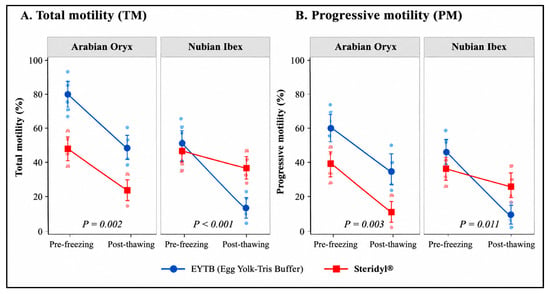
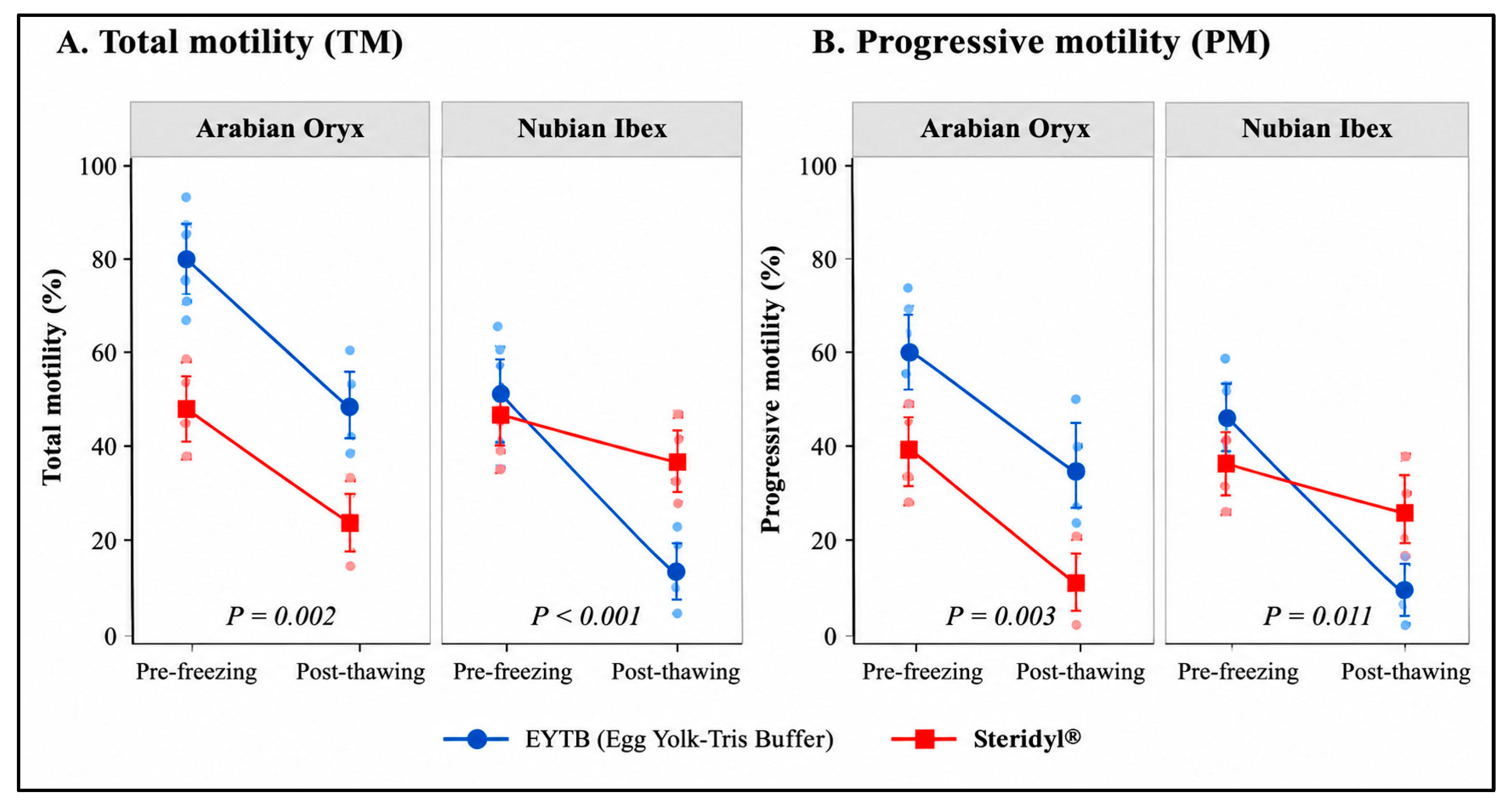
Table 1 provides the numerical values for total and progressive motility, whereas Figure 3 illustrates the patterns of change across species, extenders, and cryopreservation stages, facilitating visualization of their interactions.
Figure 3.
Species-specific effects of semen extender and cryopreservation stage on sperm motility in Arabian oryx and Nubian ibex. Total motility (TM; (A)) and progressive motility (PM; (B)) at the pre-freezing and post-thawing stages in semen extended with EYTB (circles) or Steridyl (squares). Data are presented as mean ± SD (n = 5 pooled semen samples per species), with individual data points shown. p values indicate post-thawing comparisons between extenders within each species.
Planned post-thawing comparisons showed a crossover response between species (Figure 3). In Arabian oryx, EYTB resulted in higher TM than Steridyl (48.86 ± 7.30% vs. 25.92 ± 6.59%, p = 0.002) and higher PM (34.92 ± 10.24% vs. 12.13 ± 6.07%, p = 0.003). In Nubian ibex, Steridyl resulted in higher TM than EYTB (36.64 ± 5.03% vs. 15.32 ± 3.07%, p < 0.001) and higher PM (25.43 ± 7.34% vs. 10.61 ± 2.00%, p = 0.011).
3.3. Sperm Morphological Abnormalities
Cryopreservation stage significantly affected sperm morphological abnormalities (p < 0.001), whereas species (p = 0.204) and extender (p = 0.604) had no significant overall effects. A significant Species-by-Extender-by-Stage interaction was detected (p = 0.016), while the Extender-by-Stage interaction was not significant (p = 0.051).
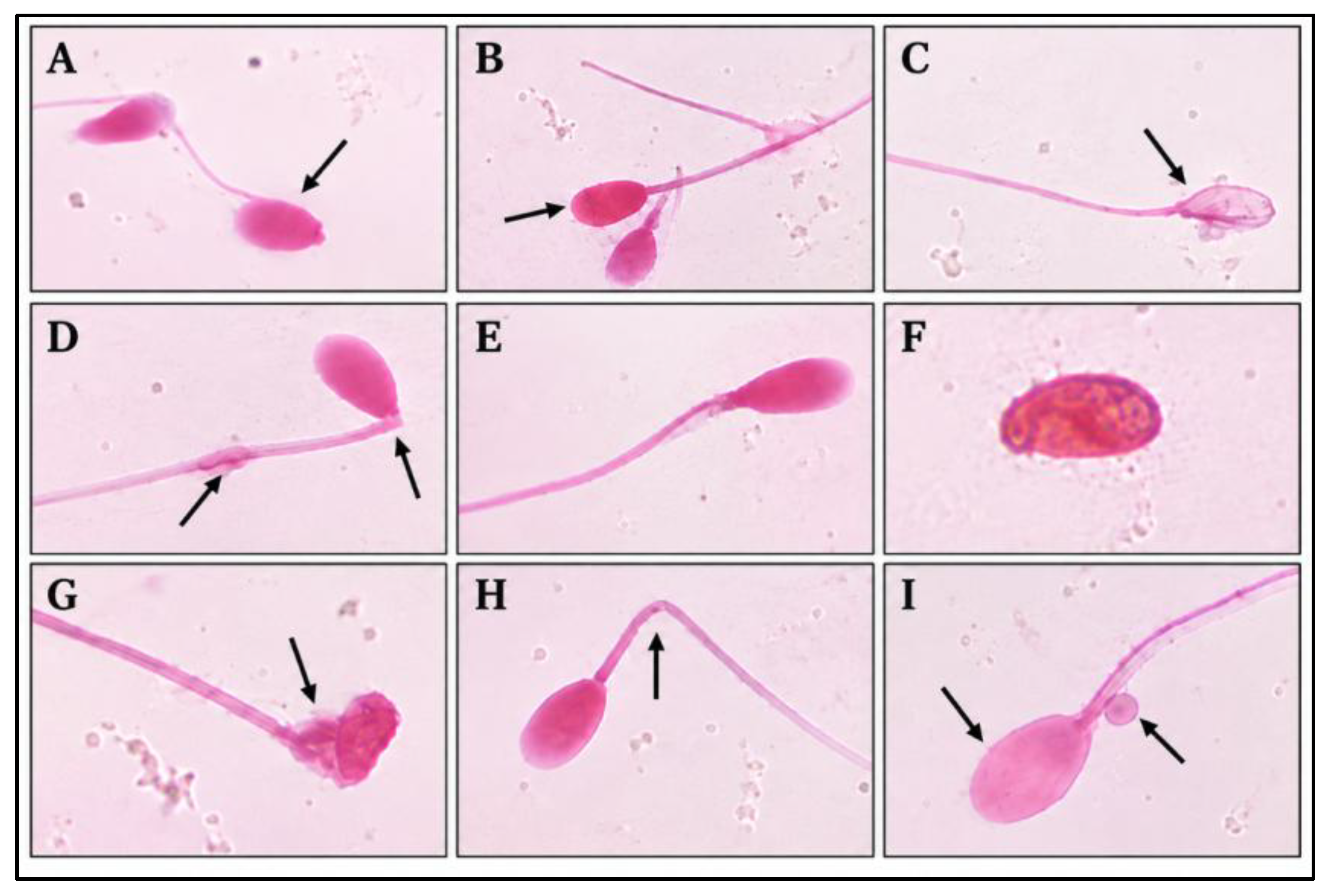
Morphological abnormalities increased from pre-freezing to post-thawing across both species (Table 1; Figure 4). Post-thawing comparisons showed no significant difference between EYTB and Steridyl in Arabian oryx (p = 0.369) or Nubian ibex (p = 0.070).
Figure 4.
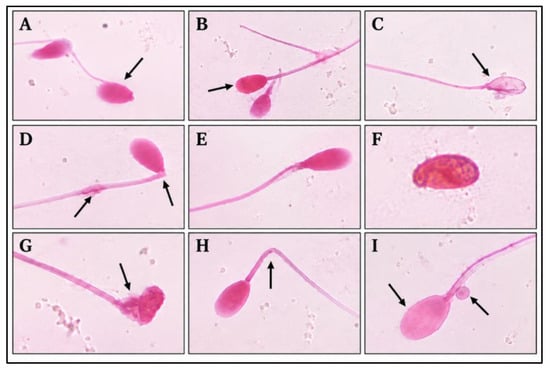
Representative photomicrographs of sperm morphological abnormalities in Arabian oryx. Eosin-stained spermatozoa showing (A) detached head, (B) abnormal head morphology, (C) small irregular head, (D) bent tail with distal cytoplasmic droplet, (E) degenerative form, (F) detached irregular head, (G) abnormal head and midpiece, (H) bent tail, and (I) giant head with proximal cytoplasmic droplet. Arrows indicate the corresponding morphological abnormalities. All photomicrographs were obtained from Arabian oryx spermatozoa and are presented to illustrate the observed types of abnormalities rather than to compare morphological differences between species. Images were obtained at 400× magnification.
3.4. Effects of Species, Extender, and Cryopreservation Stage on Sperm Kinematics
After Benjamini–Hochberg FDR correction, significant stage effects were observed for VCL, VAP, VSL, DCL, DAP, DSL, ALH, BCF, LIN, and STR, while significant species effects were observed for BCF, WOB, and LIN.
Among the interactions, only the Species-by-Extender effect for BCF and the Species-by-Stage effects for WOB and LIN remained significant after FDR correction. No Extender-by-Stage or Species-by-Extender-by-Stage interactions were significant after correction.
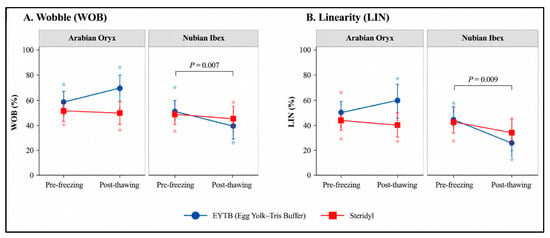
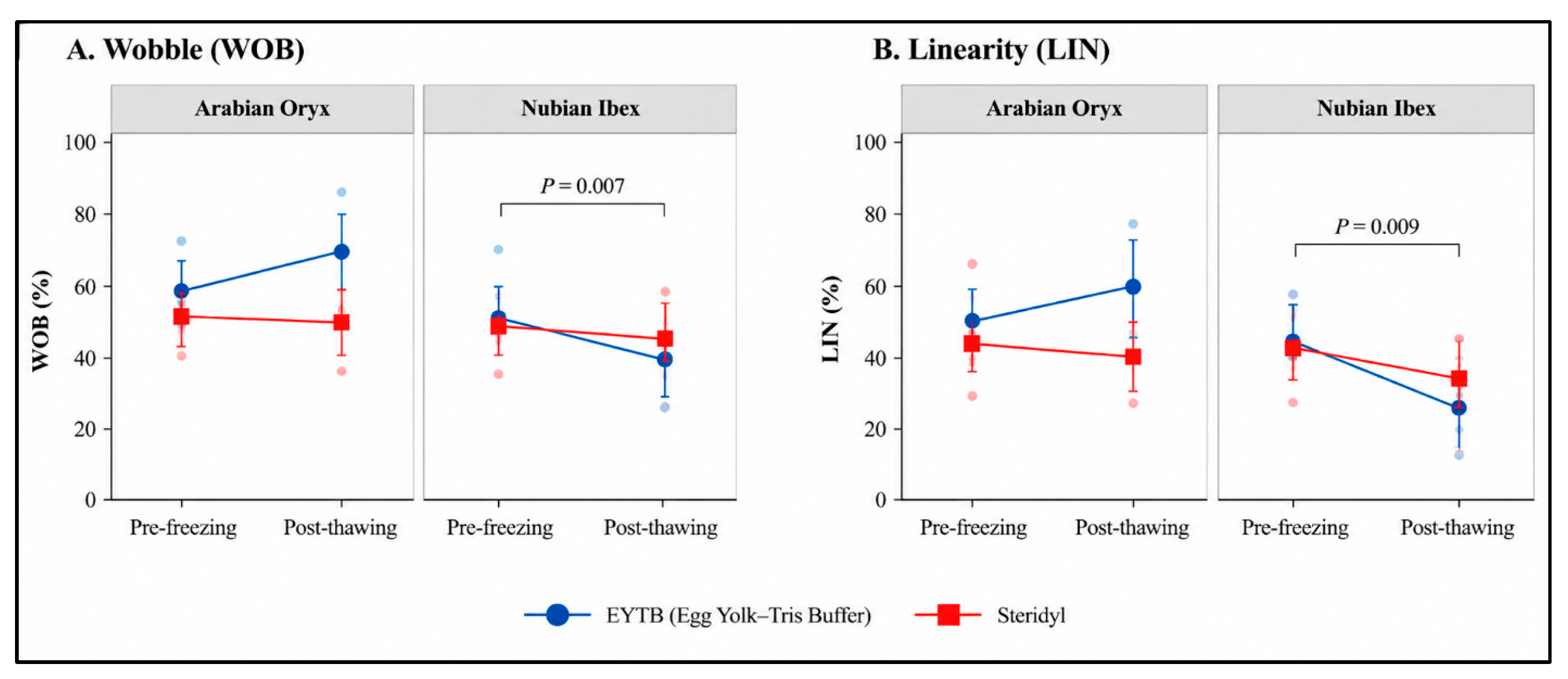
Simple-effects analysis of the significant Species-by-Stage interactions, averaged across extenders, showed significant decreases from pre-freezing to post-thawing in Nubian ibex after Holm correction (Figure 5). WOB decreased from 50.0 ± 1.5% to 41.7 ± 3.1% (Holm-adjusted p = 0.007) and LIN decreased from 43.0 ± 1.7% to 29.8 ± 5.2% (Holm-adjusted p = 0.009). In Arabian oryx, WOB increased from 54.9 ± 1.7% to 59.5 ± 5.9% (Holm-adjusted p = 0.090), while LIN increased from 46.8 ± 4.0% to 50.0 ± 7.9% (Holm-adjusted p = 0.215); neither change was statistically significant.
Figure 5.
Species-specific changes in sperm wobble and linearity across cryopreservation stages in Arabian oryx and Nubian ibex. Wobble (WOB; (A)) and linearity (LIN; (B)) at pre-freezing and post-thawing stages in semen extended with EYTB (circles) or Steridyl (squares). Data are presented as mean ± SD (n = 5 pooled semen samples per species), with individual data points shown. p values represent Holm-adjusted stage comparisons in Nubian ibex, averaged across extenders.
WOB and LIN were selected for graphical presentation to illustrate changes in sperm trajectory characteristics across species, extenders, and cryopreservation stages. Complete descriptive statistics (mean ± SD) for all 11 CASA-derived kinematic parameters, including those without statistically significant differences, are provided in Supplementary Table S6, while the corresponding factorial ANOVA results are presented in Supplementary Table S5.
3.5. Sensitivity Analysis
Sensitivity analyses of percentage-based outcomes are summarized in Supplementary Table S4. The three-way interaction between species, extender, and cryopreservation stage remained significant after arcsine square-root transformation for TM (p = 0.041), PM (p = 0.003), and morphological abnormalities (p = 0.014). Welch’s test applied to pool-level interaction contrasts derived from the transformed data supported the interactions for PM (p = 0.003) and morphological abnormalities (p = 0.016), but not for TM (p = 0.066). These findings indicate that the TM interaction was more sensitive to variance assumptions and should be interpreted cautiously.
4. Discussion
The present study revealed a clear species-dependent response to semen cryopreservation. EYTB yielded higher post-thaw total and progressive motility in Arabian oryx, whereas Steridyl was more effective in Nubian ibex. This crossover was supported by significant Species-by-Extender interactions. However, differences in post-thaw motility should be interpreted alongside the pre-freezing values, which differed between extender treatments. Analysis of proportional motility decline further demonstrated species-dependent extender responses, although the difference in proportional TM decline between extenders was not significant in Arabian oryx (Supplementary Table S2). To our knowledge, this is the first controlled comparison of extender-specific cryopreservation responses between Arabian oryx and Nubian ibex under identical conditions. These findings support species-specific selection and validation of semen extenders, consistent with interspecific variation in sperm cryoresistance among wild small ruminants [3].
The contrasting performance of EYTB and Steridyl should be interpreted as responses to their complete formulations rather than individual components. The marked difference in pre-freezing total motility between EYTB (79.80%) and Steridyl (48.82%) in Arabian oryx suggests that extender-associated differences were already evident before the freezing step. Because these measurements were obtained after dilution, cooling, and equilibration, the difference may reflect the combined effects of extender exposure and pre-freezing processing rather than freezing injury itself. Notably, both extender treatments originated from the same semen pools, and the Steridyl concentrate was prepared identically for both species. The substantially larger pre-freezing difference observed in Arabian oryx than in Nubian ibex is therefore consistent with a species-dependent response during extender exposure and pre-freezing processing. However, the available measurements cannot establish whether this difference arose immediately after dilution or developed during subsequent cooling and equilibration. Although the composition of EYTB was defined, the exact concentrations of key constituents in Steridyl were not disclosed by the manufacturer. Because individual ingredients were not evaluated separately, the observed differences cannot be specifically attributed to egg yolk, glycerol, sugars, or buffering agents. Differences in extender osmolality may influence sperm volume regulation and susceptibility to osmotic stress, whereas buffering capacity may affect pH stability during cooling and equilibration. However, pH and osmolality were not measured during the original experiments, and the extender preparations were not retained for retrospective analysis, preventing assessment of their potential contributions to the observed differences. Consequently, the physicochemical basis of the marked pre-freezing motility difference in Arabian oryx remains unresolved. Future studies should characterize both working extenders and assess sperm motility at successive stages of pre-freezing processing. Previous research in Iberian ibex demonstrated that cryoprotectant and sucrose concentrations influenced post-thaw sperm quality [7]. Similarly, equilibration conditions have been shown to affect sperm characteristics following cryopreservation in wild ruminants [8]. Although these studies employed different cryopreservation procedures, they highlight the importance of extender composition and processing conditions. Species-specific variation in sperm membrane properties and molecular composition may also influence extender compatibility. Membrane lipid organization, osmotic permeability, and sperm proteomic profiles have been associated with cryotolerance and freezability in small ruminants [3,18,19]. However, these mechanisms were not investigated in the present study and remain hypothetical. Cryopreservation broadly affected sperm quality, with significant stage effects on total and progressive motility, morphological abnormalities, and 10 of the 11 kinematic parameters. These changes are consistent with sperm cryoinjury involving thermal and osmotic stress and membrane alterations [5,18].
Kinematic responses also differed selectively between species. WOB and LIN decreased significantly after cryopreservation in Nubian ibex but not in Arabian oryx, indicating species-dependent changes in sperm trajectory characteristics. The nonsignificant numerical increases in WOB and LIN observed in Arabian oryx may reflect shifts in the relative proportions of sperm subpopulations surviving cryopreservation; however, this interpretation remains speculative because sperm subpopulations were not directly evaluated. BCF was the only kinematic parameter showing a significant Species-by-Extender interaction after FDR correction, further supporting differential extender responses between species. These findings indicate that different movement characteristics may respond differently to freeze–thaw stress [3].
Sperm morphology responded differently from motility. Morphological abnormalities increased after cryopreservation but did not differ significantly between extenders post-thawing in either species. Thus, the higher post-thaw motility observed with EYTB in Arabian oryx and Steridyl in Nubian ibex should not be interpreted as evidence of superior overall sperm quality.
However, the incidence of visible morphological abnormalities remained relatively low across treatments. Morphological assessment was based on eosin-stained preparations and conventional light microscopy, which limited detailed characterization of sperm defects. Neither acrosomal integrity nor plasma membrane functional integrity was directly assessed, including by the hypo-osmotic swelling test (HOST). Therefore, the morphological findings should not be interpreted as evidence of preserved acrosomal or plasma membrane integrity. Proximal cytoplasmic droplets were included among the visible morphological abnormalities, although they generally reflect incomplete epididymal maturation rather than cryopreservation-induced damage. Because individual abnormality categories were not quantified separately, the overall morphological abnormality rate should not be interpreted as a specific indicator of cryoinjury.
These findings have practical implications for wildlife conservation. Cryopreserved semen can preserve male genetic resources and support assisted reproduction in threatened species [3]. The species-specific extender responses observed here indicate that applying a single cryopreservation protocol across wild bovid species may compromise post-thawing sperm quality. Therefore, protocols for germplasm banking should be validated for each target species.
A major strength of this study was the matched split-pool design, which minimized collection-session variation when comparing extenders. However, only five pooled samples were evaluated per species, and pooling prevented assessment of individual-male variation in sperm freezability. Furthermore, some males contributed to multiple pools across collection sessions, potentially introducing biological dependence between pools. Because sperm quality was measured at the pooled-sample level rather than for individual males, the contribution of each male to the observed pool-level outcomes could not be estimated separately. Consequently, a conventional mixed-effects model incorporating individual males as random effects could not be reliably fitted to these data. Furthermore, restricting the analysis to pools without overlapping male contributors would substantially reduce the already limited sample size and statistical power. Therefore, the potential dependence between pools was not statistically adjusted for, and the resulting p-values should be interpreted cautiously. Furthermore, because only relatively higher-quality ejaculates were selected for pooling within each collection session, the pooled samples may overestimate the typical semen quality of the sampled males and should not be considered representative of their overall ejaculate quality. In addition, CASA measurements were not performed on fresh, undiluted semen before extender exposure, preventing an objective comparison of baseline sperm motility between Arabian oryx and Nubian ibex. Therefore, the separate effects of initial semen quality, extender exposure, cooling, and equilibration on sperm motility could not be determined. Evaluation was limited to motility, CASA-derived kinematics, and visible morphological abnormalities. Plasma membrane integrity, acrosomal integrity, mitochondrial membrane potential, and fertilizing capacity were not assessed. Therefore, extender-associated differences should not be interpreted as evidence of improved fertility. Previous research in scimitar-horned oryx demonstrated that cryopreserved spermatozoa could retain functional competence in a heterologous bovine in vitro fertilization system [20]. This finding highlights the value of functional reproductive assessments alongside conventional semen quality measurements.
Future studies should evaluate individual-male responses and incorporate functional sperm assays and reproductive outcomes to establish the biological significance of these findings.
Although a standardized liquid nitrogen vapor freezing protocol was applied across all treatments, the actual cooling rate was not measured. Therefore, potential species-specific responses to different freezing rates could not be evaluated.
5. Conclusions
This study demonstrated species-specific differences in post-thaw sperm motility following cryopreservation with EYTB and Steridyl in Arabian oryx and Nubian ibex. In Arabian oryx, EYTB yielded higher post-thaw total and progressive motility; however, pre-freezing total motility also differed between extenders, and the proportional decline in total motility was not significantly different. In contrast, EYTB showed a significantly smaller proportional decline in progressive motility in Arabian oryx, whereas Steridyl resulted in significantly smaller proportional declines in both total and progressive motility in Nubian ibex. These findings highlight the importance of accounting for pre-freezing differences when evaluating species-specific extender responses. However, the limited sample size, potential dependence between pooled samples, and absence of functional fertility assessments constrain conclusions regarding overall cryotolerance. Further studies incorporating additional sperm functional parameters and reproductive outcomes are needed to validate these findings.
Supplementary Materials
The following supporting information can be downloaded at https://www.mdpi.com/article/10.3390/vetsci13121294/s1: Table S1. Pool composition and traceability of contributing males; Table S2. Relative declines in total and progressive sperm motility; Table S3. Pool-level pre-freezing and post-thawing motility measurements and corresponding relative declines; Table S4. Sensitivity analyses of percentage-based outcomes; Table S5. Complete factorial ANOVA results; Table S6. Descriptive statistics for CASA-derived sperm kinematic parameters.
Author Contributions
Conceptualization, M.Q.A.-G.; Methodology, M.Q.A.-G., R.H.M.A., A.M.A. (Abdullah M. Alrashidi), S.M.A., F.A.A. (Feras A. Alghamdi), A.S.A., A.A., F.R.A., A.A.A. (Abdullah A. Alsahood), A.M.A. (Anwar M. Alanazi) and A.A.A. (Abdulmohsen A. Aljohar); Investigation, M.Q.A.-G., R.H.M.A., A.M.A. (Abdullah M. Alrashidi), S.M.A., F.A.A. (Feras A. Alghamdi), A.S.A., A.A., F.R.A., A.A.A. (Abdullah A. Alsahood), A.M.A. (Anwar M. Alanazi) and A.A.A. (Abdulmohsen A. Aljohar); Data Curation, M.Q.A.-G., A.M.A.S., A.H.A.-Q. and F.A.A. (Fahad A. Alduhayhi); Formal Analysis, M.Q.A.-G.; Validation, A.M.A.S., A.H.A.-Q., F.A.A. (Fahad A. Alduhayhi) and A.A.-B.; Supervision, M.Q.A.-G., A.M.A.S. and A.H.A.-Q.; Writing—Original Draft Preparation, M.Q.A.-G. and R.H.M.A.; Writing—Review & Editing, A.A.-B. All authors have read and agreed to the published version of the manuscript.
Funding
This research was supported by the Ongoing Research Funding Program (ORF-2026-811), King Saud University, Riyadh, Saudi Arabia. The study was conducted at the Prince Saud Al-Faisal Wildlife Research Center in Taif, under the authority of the National Center for Wildlife (NCW), Saudi Arabia. The NCW provided in-kind support through access to research facilities, equipment, and essential materials required for the experimental work.
Institutional Review Board Statement
The animal study protocol was approved by the Animal Research Ethics Committee of the National Center for Wildlife (NCW), Saudi Arabia (Approval No. NCW-(2/3)F20(V03), dated 2 September 2024). The approved study involved Arabian oryx (Oryx leucoryx) and Nubian ibex (Capra nubiana) at the Prince Saud Al-Faisal Wildlife Research Center in Taif, Saudi Arabia.
Informed Consent Statement
Not applicable.
Data Availability Statement
The data supporting the findings of this study are available from the corresponding author upon reasonable request.
Acknowledgments
The authors sincerely thank Mohammed Qurban, CEO of the National Center for Wildlife (NCW), for his support and facilitation of this study. Generative AI tools were used to enhance the visual presentation of Figure 2, including graphical elements and formatting, based on the experimental workflow originally designed by the authors. ChatGPT (GPT-5, OpenAI, San Francisco, CA, USA) was used solely for language editing and improving textual clarity. No generative AI tools were used for experimental design, statistical analysis, or scientific interpretation of the results. The authors reviewed the final content and take full responsibility for its accuracy and integrity.
Conflicts of Interest
The authors declare no conflicts of interest.
References
- Leibo, S.P.; Songsasen, N. Cryopreservation of gametes and embryos of non-domestic species. Theriogenology 2002, 57, 303–326. [Google Scholar] [CrossRef] [Scilit]
- Pukazhenthi, B.S.; Wildt, D.E. Which reproductive technologies are most relevant to studying, managing and conserving wildlife? Reprod. Fertil. Dev. 2004, 16, 33–46. [Google Scholar] [CrossRef] [Scilit]
- Santiago-Moreno, J.; Toledano-Díaz, A.; Castaño, C.; Velázquez, R.; Bóveda, P.; O’Brien, E.; Peris-Frau, P.; Pequeño, B.; Martínez-Madrid, B.; Esteso, M.C. Review: Sperm cryopreservation in wild small ruminants: Morphometric, endocrine and molecular basis of cryoresistance. Animal 2023, 17, 100741. [Google Scholar] [CrossRef] [Scilit]
- Medeiros, C.M.O.; Forell, F.; Oliveira, A.T.D.; Rodrigues, J.L. Current status of sperm cryopreservation: Why isn’t it better? Theriogenology 2002, 57, 327–344. [Google Scholar] [CrossRef] [Scilit]
- Peris-Frau, P.; Soler, A.J.; Iniesta-Cuerda, M.; Martín-Maestro, A.; Sánchez-Ajofrín, I.; Medina-Chávez, D.A.; Fernández-Santos, M.R.; García-Álvarez, O.; Maroto-Morales, A.; Montoro, V.; et al. Sperm cryodamage in ruminants: Understanding the molecular changes induced by the cryopreservation process to optimize sperm quality. Int. J. Mol. Sci. 2020, 21, 2781. [Google Scholar] [CrossRef] [Scilit]
- Ugur, M.R.; Saber Abdelrahman, A.; Evans, H.C.; Gilmore, A.A.; Hitit, M.; Arifiantini, R.I.; Purwantara, B.; Kaya, A.; Memili, E. Advances in cryopreservation of bull sperm. Front. Vet. Sci. 2019, 6, 268. [Google Scholar] [CrossRef] [Scilit]
- Pradiee, J.; Esteso, M.C.; Lopez-Sebastián, A.; Toledano-Díaz, A.; Castaño, C.; Carrizosa, J.A.; Urrutia, B.; Santiago-Moreno, J. Successful ultrarapid cryopreservation of wild Iberian ibex (Capra pyrenaica) spermatozoa. Theriogenology 2015, 84, 1513–1522. [Google Scholar] [CrossRef] [Scilit]
- Martín, A.; Castaño, C.; O’Brien, E.; Toledano-Díaz, A.; Guerra, R.; Gómez-Guillamón, F.; Santiago-Moreno, J. Equilibration time improves the sperm variables of wild ruminant ejaculated and epididymal sperm cryopreserved by ultra-rapid freezing. Cryobiology 2023, 113, 104579. [Google Scholar] [CrossRef] [Scilit]
- Ostrowski, S.; Bedin, E.; Lenain, D.M.; Abuzinada, A.H. Ten years of Arabian oryx conservation breeding in Saudi Arabia: Achievements and regional perspectives. Oryx 1998, 32, 209–222. [Google Scholar] [CrossRef] [Scilit]
- Stirnemann, I.; Faure, J.P.B.; Soultan, A.; Shah, M.S.; Gallacher, E.; Mann, G.K.H.; Browne, S. Current status of the Nubian ibex Capra nubiana in the Kingdom of Saudi Arabia. Oryx 2026, 60, 201–204. [Google Scholar] [CrossRef] [Scilit]
- Eljarah, A.; Alhaider, A.K.; Jawasreh, K.; Bani Ismail, Z.; Alhalah, A.; El-Bahr, S.M. Investigation of scrotal circumference, testicular dimensions and semen characteristics of the vulnerable Arabian oryx (Oryx leucoryx): An approach supports the future use of artificial insemination. Ital. J. Anim. Sci. 2017, 16, 484–489. [Google Scholar] [CrossRef] [Scilit]
- Evans, G.; Maxwell, W.M.C. Salamon’s Artificial Insemination of Sheep and Goats, 2nd ed.; Butterworths: Sydney, Australia, 1987. [Google Scholar]
- Santiago-Moreno, J.; Coloma, M.A.; Dorado, J.; Pulido-Pastor, A.; Gómez-Guillamon, F.; Salas-Vega, R.; Gómez-Brunet, A.; López-Sebastián, A. Cryopreservation of Spanish ibex (Capra pyrenaica) sperm obtained by electroejaculation outside the rutting season. Theriogenology 2009, 71, 1253–1260. [Google Scholar] [CrossRef] [Scilit]
- Avdi, M.; Banos, G.; Stefos, K.; Chemineau, P. Seasonal variation in testicular volume and sexual behavior of Chios and Serres rams. Theriogenology 2004, 62, 275–282. [Google Scholar] [CrossRef]
- El-Khawagah, A.R.M.; Kandiel, M.M.M.; Samir, H. Effect of quercetin supplementation in extender on sperm kinematics, extracellular enzymes release, and oxidative stress of Egyptian buffalo bulls frozen–thawed semen. Front. Vet. Sci. 2020, 7, 604460. [Google Scholar] [CrossRef] [Scilit]
- Verstegen, J.; Iguer-Ouada, M.; Onclin, K. Computer assisted semen analyzers in andrology research and veterinary practice. Theriogenology 2002, 57, 149–179. [Google Scholar] [CrossRef] [Scilit]
- Barth, A.D.; Oko, R.J. Abnormal Morphology of Bovine Spermatozoa; Iowa State University Press: Ames, IA, USA, 1989. [Google Scholar]
- Lv, C.; Wu, G.; Hong, Q.; Quan, G. Spermatozoa cryopreservation: State of art and future in small ruminants. Biopreserv. Biobank. 2019, 17, 171–182. [Google Scholar] [CrossRef] [Scilit]
- Martínez-Fresneda, L.; Sylvester, M.; Shakeri, F.; Bunes, A.; Del Pozo, J.C.; García-Vázquez, F.A.; Neuhoff, C.; Tesfaye, D.; Schellander, K.; Santiago-Moreno, J. Differential proteome between ejaculate and epididymal sperm represents a key factor for sperm freezability in wild small ruminants. Cryobiology 2021, 99, 64–77. [Google Scholar] [CrossRef] [Scilit]
- Roth, T.L.; Bush, L.M.; Wildt, D.E.; Weiss, R.B. Scimitar-horned oryx (Oryx dammah) spermatozoa are functionally competent in a heterologous bovine in vitro fertilization system after cryopreservation on dry ice, in a dry shipper, or over liquid nitrogen vapor. Biol. Reprod. 1999, 60, 493–498. [Google Scholar] [CrossRef] [Scilit]

Disclaimer/Publisher’s Note: The statements, opinions and data contained in all publications are solely those of the individual author(s) and contributor(s) and not of MDPI and/or the editor(s). MDPI and/or the editor(s) disclaim responsibility for any injury to people or property resulting from any ideas, methods, instructions or products referred to in the content. |
© 2026 by the authors. Licensee MDPI, Basel, Switzerland. This article is an open access article distributed under the terms and conditions of the Creative Commons Attribution (CC BY) license.