


Simple Summary
In recent years, the detection and spread of European-type porcine reproductive and respiratory syndrome virus (PRRSV) have increased in China, posing new risks to the pig industry through viral mutations and changes in pathogenicity. This study aimed to characterize the epidemiology and genetic changes in PRRSV in China from 2021 to 2025. We analyzed 43 key gene sequences from public databases and compared differences and genetic recombination among viral branches. Results showed that one traditional branch still dominated, while two new branches emerged simultaneously. No recombination was found in the analyzed genes, but there are differences between the new branch and other branches. In short, the epidemic pattern is becoming increasingly complex, and new branches require centralized monitoring. This study provides a foundation for early warning, vaccine development, and biosafety prevention and control, helping to reduce losses in the pig industry and minimize public health risks.
Abstract
Background: The detection rate of European Porcine Reproductive and Respiratory Syndrome Virus (PRRSV-1) is increasing in China, and the epidemic and evolutionary situation are complex. Method: Extract 43 PRRSV-1 ORF5 sequences from 2021 to 2025, and conduct phylogenetic, recombination, and genetic distance analyses using LV and VR-2332 as outgroups. Result: BJEU06-1-like subgroup remained dominant (65.1%), while New subgroup 1 accounted for 2.3%; New subgroups 1 and 2 were discovered, and no recombination was detected within ORF5. The genetic distance between NMEU09-1 and the New subgroup 1 is the largest (nucleotide 0.231, amino acid 0.192). Conclusions: The epidemic pattern of PRRSV-1 is complex, and New subgroups have evolutionary potential. Monitoring, early warning, and comprehensive prevention and control should be strengthened.
Dear Editor:
Veterinary Sciences is an international platform that integrates advanced scientific achievements in the field of animal infectious diseases and viral epidemiology. We would like to draw your attention to an important epidemiological development: the detection rate of PRRSV-1 in China is rapidly increasing, posing a serious potential epidemic threat. Your journal has been continuously monitoring the dynamics of virus evolution and epidemiology, which is reflected in its extensive pioneering research on this pathogen. Given its professional field, we believe that Veterinary Sciences has unique advantages in addressing this emerging focus.
While Porcine Epidemic Diarrhea Virus (PEDV), African Swine Fever Virus (ASFV), and PRRSV represent the core pathogens responsible for catastrophic losses in the global swine industry, the impact of PRRSV is particularly pronounced [1]. Its extensive genetic hypervariability and continuous recombinogenic potential are associated with immune evasion and disruption of production chains, and may potentially exacerbate health threats by expanding host tropism and facilitating viral–bacterial co-infections [2]. As an enveloped, single-stranded, positive-sense RNA virus with a genome of approximately 15 kb encompassing at least ten open reading frames (ORFs), PRRSV’s RNA-dependent RNA polymerase lacks proofreading activity—a fundamental attribute that dictates its high mutability [3]. This inherent genetic instability facilitates ongoing antigenic drift and recombination during transmission, complicating prevention and control efforts and resulting in profound economic devastation. Currently, PRRSV is classified into two distinct genotypes, PRRSV-1 and PRRSV-2, which exhibit significant antigenic divergence and share only 50% to 70% nucleotide sequence identity [4]. Historically, PRRSV-2 has always been the predominant genotype in China. However, recent longitudinal monitoring data indicate that the epidemiological situation of PRRSV-1 is becoming increasingly severe. According to previous monitoring reports, the detection rate of PRRSV-1 is steadily increasing, and its geographical distribution has reportedly expanded to more than 23 provinces [5]. The high genetic variability demonstrated by PRRSV-1 underscores its formidable epidemic potential. If left unchecked, it could deliver a significant blow to the livestock industry and warrants attention for potential broader public health implications. Consequently, conducting in-depth research into PRRSV-1 to elucidate its evolutionary and transmission patterns is not only of paramount scientific value but also serves as the essential foundation for constructing proactive early-warning systems and formulating early intervention strategies to forestall large-scale outbreaks.
PRRSV-1 was historically endemic to Europe before disseminating to North America and Asia [6]. In China, the virus was first identified through customs surveillance in 1997, with the first domestic strain successfully isolated in 2006 [7,8]. Currently, the circulating PRRSV-1 strains in China primarily belong to Subtype 1, which is further classified into four major subgroups: NMEU09-1-like, BJEU06-1-like, Amervac-like, and HKEU16-like. Among these, NMEU09-1-like and BJEU06-1-like represent the dominant lineages [5]. Historically, PRRSV-1 was characterized by low virulence or asymptomatic presentation with limited transmissibility; consequently, it received relatively little attention, leading to a paucity of effective diagnostic and preventive measures within the domestic industry.
However, recent surveillance indicates a widening geographical distribution across multiple provinces, signaling an expanding epidemiological footprint. Of particular concern is the emergence of the ZD-1 strain, which has diverged from the historically low-virulence profile to exhibit a moderate-to-high virulence phenotype [9]. Furthermore, the evolutionary trajectory of PRRSV-1 has shifted from single-lineage circulation toward complex multi-lineage recombination, including recombination events between wild-type and vaccine-derived strains [10,11]. Collectively, these phenomena underscore an increasingly severe landscape of PRRSV-1 prevalence and evolution. Within the PRRSV genome, the ORF5 gene—which encodes the principal envelope glycoprotein GP5—is not only one of the most hypervariable regions but also a critical target for vaccine development and the “gold standard” for molecular detection and genotyping [12]. Following the African Swine Fever (ASF) outbreaks, domestic biosecurity and disease monitoring capabilities have been significantly enhanced. To evaluate the prevalence of PRRSV-1 under these heightened biosecurity conditions over the past five years, we retrieved 43 PRRSV-1 ORF5 sequences (2021-2025) from the National Center for Biotechnology Information (NCBI) database for comprehensive analysis, utilizing the PRRSV-1 (LV) and PRRSV-2 (VR-2332) reference strains as outgroups. Although limited by the availability of public sequences, this dataset effectively reveals the emerging evolutionary trends of PRRSV-1 in China during this period.
For the phylogenetic and recombination analyses, the trimmed sequences were used to construct phylogenetic trees in MEGA7.0.26 using the Kimura two-parameter model and the neighbor-joining method, with 1000 bootstrap replicates. Genotypic classification was determined based on topological clustering. Pairwise nucleotide p-distances were calculated genome-wide using the same K2P model [13,14].
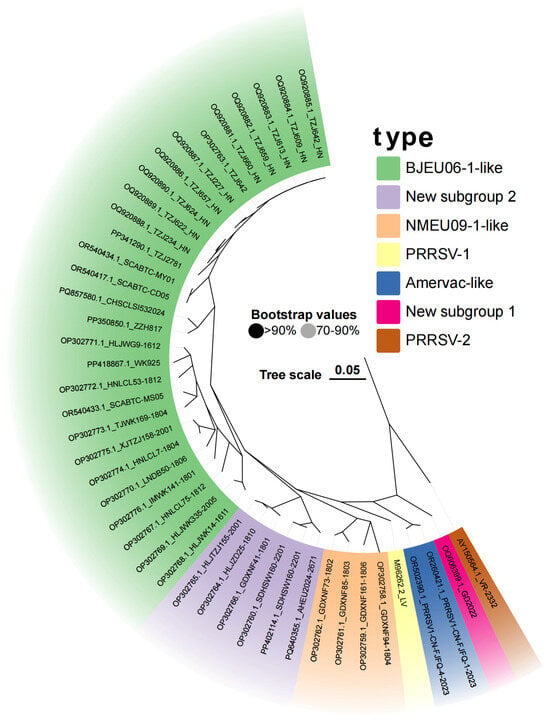
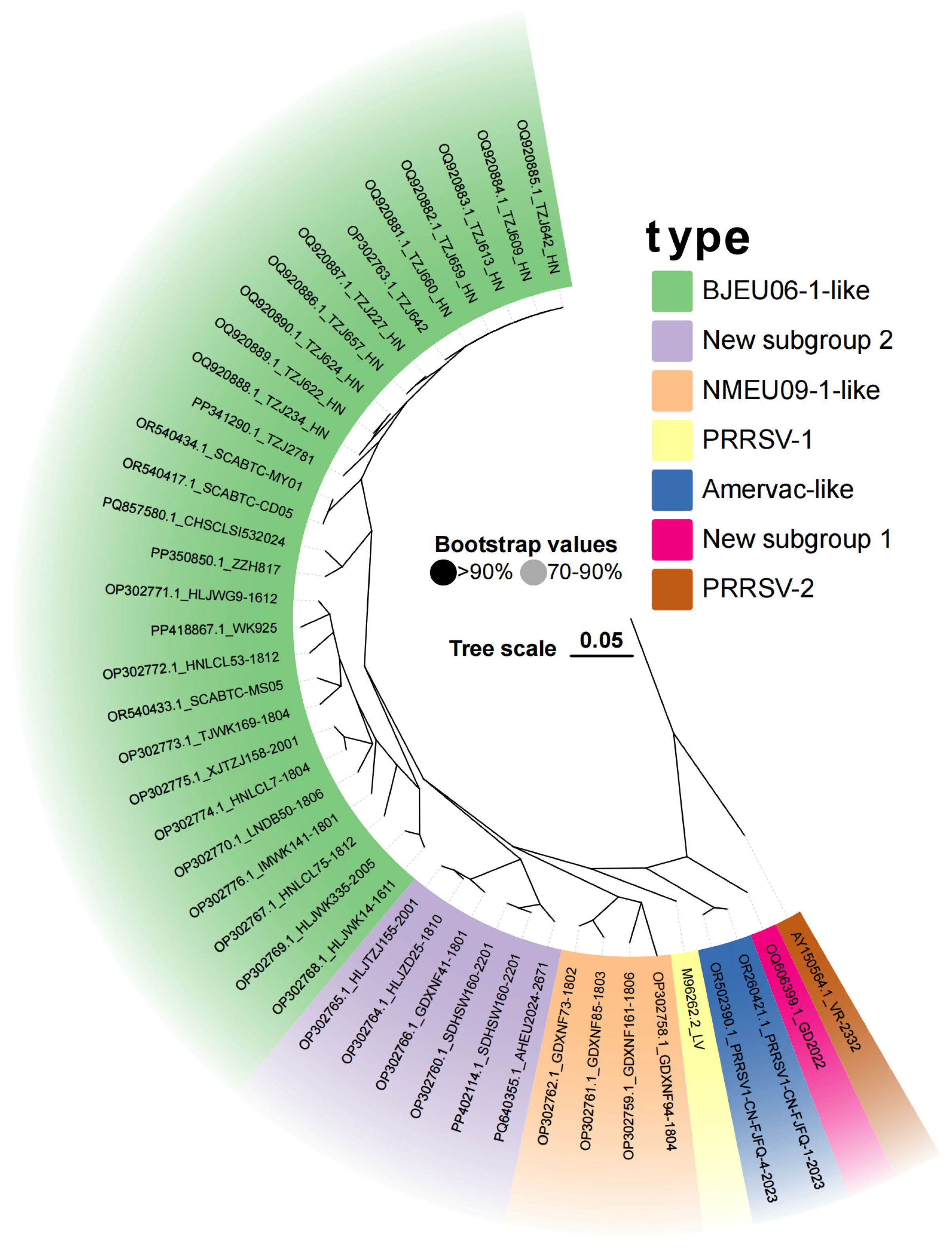
Phylogenetic analysis of the ORF5 gene reveals an increasingly complex epidemiological situation in China, with expansion ranges and evolutionary dynamics that cannot be ignored. Between 2021 and 2025, the BJEU06-1-like subgroup remained the predominant lineage (65.1%), while “New subgroup 1” exhibited the lowest frequency (2.3%). Crucially, we identified the emergence of two novel branches—designated New subgroup 1 and New subgroup 2-outside the established major clades (Figure 1). The appearance of these novel subgroups suggests that PRRSV-1 in China is transitioning away from its historical characteristics of low virulence and limited transmission. Within the framework of global public health and biosecurity, it is imperative to focus research efforts on these emerging lineages to prevent them from becoming dominant circulating subgroups.
Figure 1.
Epidemiological Distribution of PRRSV-1 ORF5 Gene, 2021–2025.
The extant literature suggests that the ORF5 gene, acting as a hypervariable region of the viral genome, is a frequent site for genetic recombination. Furthermore, the degree of genetic variation correlates positively with recombination frequency; these events collectively bolster viral fitness and transmissibility, potentially facilitating geographic expansion and complicating clinical management [15]. To investigate whether inter lineage recombination has driven the current epidemiological pattern, we conducted RDP4-based recombination analysis on the ORF5 sequence mentioned above. Interestingly, no obvious recombination events were detected in the 43 ORF5 sequences analyzed in this study. This discovery deserves high attention as it suggests that the transmission strategy of PRRSV-1 in China may diversify beyond relying solely on genome recombination mechanisms. However, the absence of detectable recombination does not equate to a loss of evolutionary vigor; rather, genetic diversity remains a critical indicator of the potential for viral divergence and mutation. Consequently, we shifted our focus to evaluating the intra-viral variation by conducting nucleotide and amino acid sequence diversity analyses across the PRRSV-1 subgroups. Genetic distance serves as a direct proxy for genetic diversity. Our analysis of nucleotide genetic distance between subgroups showed a difference (0.231) between NMEU09-1-like and New subgroup 1, followed by BJEU06-1-like and NMEU09-1-like (0.211), New subgroup 1 (0.209), and Amervac like (0.203) (Table 1). Conversely, the representative strain M96262.2 exhibited lower genetic distance from New subgroup 1 (0.147) and Amervac-like (0.155) (Table 1). The substantial diversity and high degree of variation observed in the mainstream BJEU06-1-like and NMEU09-1-like subgroups likely underpin their widespread prevalence. The inter-subgroup amino acid genetic distances mirrored the nucleotide patterns (Table 2), with the maximum divergence again observed between NMEU09-1-like and New subgroup 1 (0.192). The smallest amino acid distance was recorded between New Subgroup 1 and the representative strain M96262.2 (0.116). These genetic diversity analyses collectively demonstrate substantial evolutionary divergence among PRRSV-1 subgroups in China. Notably, the high genetic distance and unique diversity profile of New subgroup 1 relative to other clades suggest a heightened potential for environmental adaptation and further evolution. This emerging subgroup demands rigorous ongoing surveillance and prioritization in future biosafety frameworks.
Table 1.
Inter-subgroup nucleotide genetic distances of the PRRSV-1 ORF5 gene.
Table 2.
Inter-subgroup amino acid genetic distances of the PRRSV-1 ORF5 gene.
Recent systematic epidemiological surveillance further corroborates this evolutionary trajectory: not only is the detection rate of PRRSV-1 climbing across multiple provinces, but the diversity of circulating lineages has significantly transcended the historically defined major subgroups, such as NMEU09-1-like, BJEU06-1-like, Amervac-like, and HKEU16-like. Beyond the New subgroup 1 and New subgroup 2 identified in our current study, other researchers have documented the emergence of New subgroup 3 [5]. Notably, the GD2022 strain within our New subgroup 1 clade exhibits marked divergence from other subgroups in both genetic diversity and phylogenetic positioning. These findings serve as a critical warning; we must remain vigilant against the dissemination of these emerging strains and the high probability of them becoming the next dominant circulating lineages. Since the first report of PRRSV-2 (North American genotype) in China in 1996, the domestic swine industry has been besieged by successive waves of major outbreaks, including those driven by Highly Pathogenic PRRSV (HP-PRRSV) and NADC30-like strains [16]. Each stage of viral evolution has posed severe challenges to established prevention and control strategies. In contrast, systematic research on PRRSV-1 (European genotype) in China has been relatively limited, suffering from a long-term lack of academic and clinical focus. However, current surveillance data indicate a significant increase in PRRSV-1 detection across various regions, accompanied by alarming signs of enhanced virulence [8]. The fundamental intrinsic driver of this evolution lies in the high mutation rate and frequent genetic recombination characteristic of PRRSV-1 as a typical RNA virus. These traits enable the virus to bypass traditional low-virulence phenotypes and undergo pathogenic evolution. PRRSV genome replication relies on an RNA-dependent RNA polymerase characterized by inherent low fidelity and a lack of proofreading capability. This enzymatic deficiency facilitates the accumulation of point mutations and insertion/deletion events during replication, providing the necessary substrate for continuous viral evolution [17]. These shifts clearly indicate that the epidemiological landscape of PRRSV is undergoing a quiet but profound transformation. Based on the evidence presented above, it is clear that over the past two decades, PRRSV-1 strains circulating in China have undergone profound genetic changes. While direct phenotypic evidence requires further investigation, these genetic developments present formidable new challenges to China’s PRRS control strategies. This necessitates a fundamental strategic transition from a vaccine-centric approach toward “biosecurity-led avoidance and precision eradication” to ensure the sustained and stable development of the swine industry.
Supplementary Materials
The following supporting information can be downloaded at: https://www.mdpi.com/article/10.3390/vetsci13121274/s1. S1. Figure corresponding to the phylogenetic tree; S2. Final sequences.
Author Contributions
Conceptualization, X.H. and C.W.; methodology, Q.W.; software, J.X.; validation, S.F.; formal analysis, L.Q.; investigation, J.Z.; resources, C.C.; data curation, X.L.; writing—original draft preparation, X.H.; writing—review and editing, C.W.; supervision, H.C.; All authors have read and agreed to the published version of the manuscript.
Funding
This work was supported by the National Natural Science Foundation of China (32102628 and 32660976), the Doctoral Start-up Project of Longyan University, Fujian Province (LB2022009), and the Foundation of Key Biology Laboratory of Chinese Veterinary Medicine, Ministry of Agriculture and Rural Affairs, China (NYX2024003).
Institutional Review Board Statement
Not applicable.
Informed Consent Statement
Not applicable.
Data Availability Statement
The original data presented in the study are openly available in the National Center for Biotechnology Information (NCBI) GenBank database. The corresponding accession numbers are listed in the Supplementary Materials.
Acknowledgments
We express our sincere gratitude to the clinical veterinarians and swine industry stakeholders across China for their invaluable assistance in sample reporting and field observations. We also thank the technical staff at the Key Laboratory of Animal Diseases and Health of Longyan University for their support in molecular sequencing and computational resources.
Conflicts of Interest
The authors declare no conflicts of interest.
References
- Dixon, L.K.; Stahl, K.; Jori, F.; Vial, L.; Pfeiffer, D.U. African swine fever epidemiology and control. Annu. Rev. Anim. Biosci. 2020, 8, 221–246. [Google Scholar] [CrossRef] [Scilit] [PubMed]
- Lunney, J.K.; Fang, Y.; Ladinig, A.; Chen, N.; Li, Y.; Rowland, B.; Renukaradhya, G.J. Porcine reproductive and respiratory syndrome virus (PRRSV): Pathogenesis and interaction with the immune system. Annu. Rev. Anim. Biosci. 2016, 4, 129–154. [Google Scholar] [CrossRef] [Scilit] [PubMed]
- Meulenberg, J.J. PRRSV, the virus. Vet. Res. 2000, 31, 11–21. [Google Scholar] [CrossRef] [Scilit] [PubMed]
- Dea, S.; Gagnon, C.A.; Mardassi, H.; Pirzadeh, B.; Rogan, D. Current knowledge on the structural proteins of porcine reproductive and respiratory syndrome (PRRS) virus: Comparison of the North American and European isolates. Arch. Virol. 2000, 145, 659–688. [Google Scholar] [CrossRef] [Scilit] [PubMed]
- Sun, Q.; Xu, H.; An, T.; Cai, X.; Tian, Z.; Zhang, H. Recent progress in studies of porcine reproductive and respiratory syndrome virus 1 in China. Viruses 2023, 15, 1528. [Google Scholar] [CrossRef] [Scilit] [PubMed]
- Yim-Im, W.; Anderson, T.K.; Böhmer, J.; Baliellas, J.; Stadejek, T.; Gauger, P.C.; Krueger, K.M.; Vermeulen, C.J.; Buter, R.; Kazlouski, A.; et al. Refining genetic classification of global porcine reproductive and respiratory syndrome virus type 1 (PRRSV-1) and investigating their geographic and temporal distributions. Vet. Microbiol. 2025, 302, 110413. [Google Scholar] [CrossRef] [Scilit] [PubMed]
- Wang, Y.M.; Deng, L.S.; Huang, B.Z.; Li, H.-Y.; Duan, J.-Q.; Yan, Y.-X.; Lai, S.-Y.; Ai, Y.-R.; Zhou, Y.-C.; Qing, Y.; et al. Whole Genome Characterization and Pathogenicity of a SC2020-1-Like PRRSV-1 Strain Emerging in Southwest China. Transbound. Emerg. Dis. 2024, 2024, 5627927. [Google Scholar] [CrossRef] [Scilit] [PubMed]
- Yu, F.; Liu, L.; Tian, X.; Chen, L.; Huang, X.; Sun, Y.; Yan, Y.; Tian, Z.; Cai, X.; Liu, D.; et al. Genomic Analysis of Porcine Reproductive and Respiratory Syndrome Virus 1 Revealed Extensive Recombination and Potential Introduction Events in China. Vet. Sci. 2022, 9, 450. [Google Scholar] [CrossRef] [Scilit] [PubMed]
- Xu, H.; Gong, B.; Sun, Q.; Li, C.; Zhao, J.; Xiang, L.; Li, W.; Guo, Z.; Tang, Y.-D.; Leng, C.; et al. Genomic characterization and pathogenicity of BJEU06-1-like PRRSV-1 ZD-1 isolated in China. Transbound. Emerg. Dis. 2023, 2023, 6793604. [Google Scholar] [CrossRef] [Scilit] [PubMed]
- Qiu, Y.; Qiu, M.; Li, S.; Li, S.; Zhu, J.; Tian, K.; Chen, N. Emergence, prevalence and evolution of porcine reproductive and respiratory syndrome virus 1 in China from 1994 to 2024. Virology 2025, 605, 110457. [Google Scholar] [CrossRef] [Scilit] [PubMed]
- Chen, N.; Liu, Q.; Qiao, M.; Deng, X.; Chen, X.; Sun, M. Whole genome characterization of a novel porcine reproductive and respiratory syndrome virus 1 isolate: Genetic evidence for recombination between Amervac vaccine and circulating strains in mainland China. Infect. Genet. Evol. 2017, 54, 308–313. [Google Scholar] [CrossRef] [Scilit] [PubMed]
- Kim, W.I.; Kim, J.J.; Cha, S.H.; Wu, W.-H.; Cooper, V.; Evans, R.; Choi, E.-J.; Yoon, K.-J. Significance of genetic variation of PRRSV ORF5 in virus neutralization and molecular determinants corresponding to cross neutralization among PRRS viruses. Vet. Microbiol. 2013, 162, 10–22. [Google Scholar] [CrossRef] [Scilit] [PubMed]
- Kumar, S.; Stecher, G.; Tamura, K. MEGA7: Molecular Evolutionary Genetics Analysis Version 7.0 for Bigger Datasets. Mol. Biol. Evol. 2016, 33, 1870–1874. [Google Scholar] [CrossRef] [Scilit] [PubMed]
- Nakamura, T.; Yamada, K.D.; Tomii, K.; Katoh, K. Parallelization of MAFFT for large-scale multiple sequence alignments. Bioinformatics 2018, 34, 2490–2492. [Google Scholar] [CrossRef] [Scilit] [PubMed]
- Weng, C.; Huang, X.; Chen, Z.; He, M.; Zhang, B.; Li, H.; Xie, J.; Chen, M.; Qiu, L.; Li, X.; et al. Genetic evolution, epidemic trends, and recombination dynamics of PRRSV-1 in China. Front. Vet. Sci. 2025, 12, 1632917. [Google Scholar] [CrossRef] [Scilit] [PubMed]
- Guo, Z.; Chen, X.X.; Li, R.; Qiao, S.; Zhang, G. The prevalent status and genetic diversity of porcine reproductive and respiratory syndrome virus in China: A molecular epidemiological perspective. Virol. J. 2018, 15, 2. [Google Scholar] [CrossRef] [Scilit] [PubMed]
- Zhang, X.; Yang, Z.; Zhang, Z.; Wang, Z.; Zhao, Y.; Yang, T.; Gong, J.; Feng, K.; He, J.; Zheng, Q.; et al. Contribution of critical amino acid residues in the RNA-dependent RNA polymerase to the replication fidelity and viral ribavirin sensitivity of porcine reproductive and respiratory syndrome virus. Vet. Res. 2025, 56, 83. [Google Scholar] [CrossRef] [Scilit] [PubMed]
Disclaimer/Publisher’s Note: The statements, opinions and data contained in all publications are solely those of the individual author(s) and contributor(s) and not of MDPI and/or the editor(s). MDPI and/or the editor(s) disclaim responsibility for any injury to people or property resulting from any ideas, methods, instructions or products referred to in the content. |
© 2026 by the authors. Licensee MDPI, Basel, Switzerland. This article is an open access article distributed under the terms and conditions of the Creative Commons Attribution (CC BY) license.