


Simple Summary
Postoperative pain in cats is difficult to assess and manage effectively, as behavioral signs may be subtle and may be influenced by sedation. In this context, drugs such as dexmedetomidine are commonly included in anesthetic protocols and are often assumed to contribute to analgesia, although their actual impact on postoperative pain control remains unclear. In this study, we evaluated the analgesic effects of buprenorphine alone or combined with dexmedetomidine, compared to dexmedetomidine alone, in cats undergoing ovariohysterectomy that all received standardized sacrococcygeal epidural lidocaine. Pain was assessed using validated scales and by measuring the need for rescue analgesia. Cats receiving dexmedetomidine alone required rescue analgesia more frequently (83%) compared to those treated with buprenorphine (33%) or buprenorphine combined with dexmedetomidine (25%). These findings reinforce the importance of assessing rescue-analgesia requirements when comparing systemic analgesic treatments in cats receiving epidural lidocaine.
Abstract
The aim of this study was to compare the postoperative analgesic efficacy of buprenorphine, administered alone or in combination with dexmedetomidine, with that of dexmedetomidine alone in cats receiving standardized ultrasound-guided sacrococcygeal epidural lidocaine for ovariohysterectomy. Thirty-six cats (12.3 ± 4.5 months; 2.9 ± 0.5 kg) were enrolled in a randomized, prospective, blinded clinical trial following owners’ consent. Animals were allocated in three groups (n = 12 in each): buprenorphine (BG; 20 µg/kg), buprenorphine-dexmedetomidine (BDexG; 20 µg/kg + 10 µg/kg), or dexmedetomidine alone (DexG; 10 µg/kg). Anesthesia was induced with propofol and maintained with isoflurane. All cats received ultrasound-guided sacrococcygeal epidural analgesia with lidocaine (4 mg/kg). Sedation was assessed using a simple descriptive scale (SDS) and pain was evaluated using the UNESP-Botucatu Multidimensional Composite Pain Scale (UNESP-Botucatu-MCPS), Glasgow Composite Measure Pain Scale (CMPS-Feline) and Feline Grimace Scale (FGS) at multiple time points up to 24 h postoperatively. Rescue analgesia (dipyrone 25 mg/kg intravenously) was administered when any validated pain scale reached its predefined intervention threshold: CMPS-Feline ≥ 5, UNESP-Botucatu-MCPS ≥ 8, or FGS ≥ 4. The requirement for rescue analgesia was significantly higher in DexG (10/12, 83%) compared to BG (4/12, 33%) and BDexG (3/12, 25%). Pain scores were summarized descriptively. Scores recorded when rescue analgesia was indicated were retained, whereas subsequent scores were excluded because rescue medication could influence pain assessments. This resulted in treatment-dependent missing observations, particularly in DexG, limiting comparisons of postoperative pain-score patterns. Sedation scores differed among groups. In cats receiving standardized epidural lidocaine, buprenorphine alone or in combination with dexmedetomidine resulted in improved postoperative analgesic control, as evidenced by reduced need for rescue analgesia, compared to dexmedetomidine alone.
1. Introduction
Recognizing and assessing pain in cats remains both essential and challenging in clinical practice. Accurate evaluation requires integration of physiological parameters, species-specific behavioral changes, and validated pain assessment tools, as feline pain is inherently multidimensional, involving both sensory and affective components [1,2]. Surgical procedures such as ovariohysterectomy are associated with moderate pain, requiring appropriate perioperative analgesic strategies to ensure animal welfare [3].
Opioids are widely used for the management of acute pain, although their administration may be associated with dose-dependent adverse effects, including respiratory depression, bradycardia, and delayed recovery. Buprenorphine, a partial µ-opioid receptor agonist and κ antagonist, is commonly used in cats due to its favorable safety profile and prolonged duration of action. In contrast, other opioids frequently used in clinical practice, such as methadone, despite their perceived potency, are characterized by a shorter duration of analgesic effect, often requiring repeated dosing to maintain adequate nociceptive control. Buprenorphine presents a longer-lasting effect and a more stable analgesic profile in this context. Behavioral effects such as mydriasis, purring, and kneading are frequently observed and are generally interpreted as indicators of central opioid activity [3,4]. Despite its relatively delayed onset following intramuscular administration, buprenorphine has been consistently associated with effective postoperative analgesia for up to 6–8 h in cats undergoing elective ovariohysterectomy [5,6,7,8].
Dexmedetomidine, an α2-adrenergic agonist, is frequently incorporated into anesthetic protocols due to its sedative and sympatholytic properties, and is often assumed to contribute meaningfully to analgesia as part of multimodal approaches [9,10]. However, its analgesic effects are short-lived and may be difficult to distinguish from sedation-related behavioral suppression, particularly when assessed using observational pain scales. This distinction is clinically relevant, as sedation may mask pain-related behaviors without providing sustained nociceptive control.
Although the combination of dexmedetomidine with opioids is commonly used to enhance perioperative management, the extent to which dexmedetomidine contributes to postoperative analgesia, particularly when used alone or in combination with long-acting opioids, remains unclear. Furthermore, reliance on pain scoring systems without considering clinically relevant outcomes, such as the need for rescue analgesia, may underestimate meaningful differences between treatment protocols [11,12].
The aim of this study was to compare the postoperative analgesic efficacy of buprenorphine, administered alone or in combination with dexmedetomidine, with that of dexmedetomidine alone in cats receiving standardized ultrasound-guided sacrococcygeal epidural lidocaine for ovariohysterectomy. We hypothesized that each buprenorphine-containing protocol would reduce the requirement for postoperative rescue analgesia compared with dexmedetomidine. The comparison between the two buprenorphine-containing protocols was considered secondary.
2. Materials and Methods
2.1. Ethical Approval
The study protocol was approved by The Institutional Animal Ethics committee (1717120220)—University of São Paulo (USP)—Brazil. Experiments were conducted after an Informed Consent form was signed by the cat-owners.
2.2. Animals
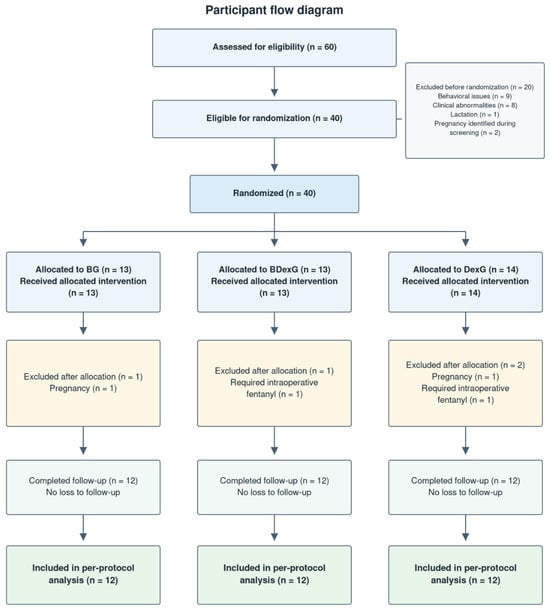
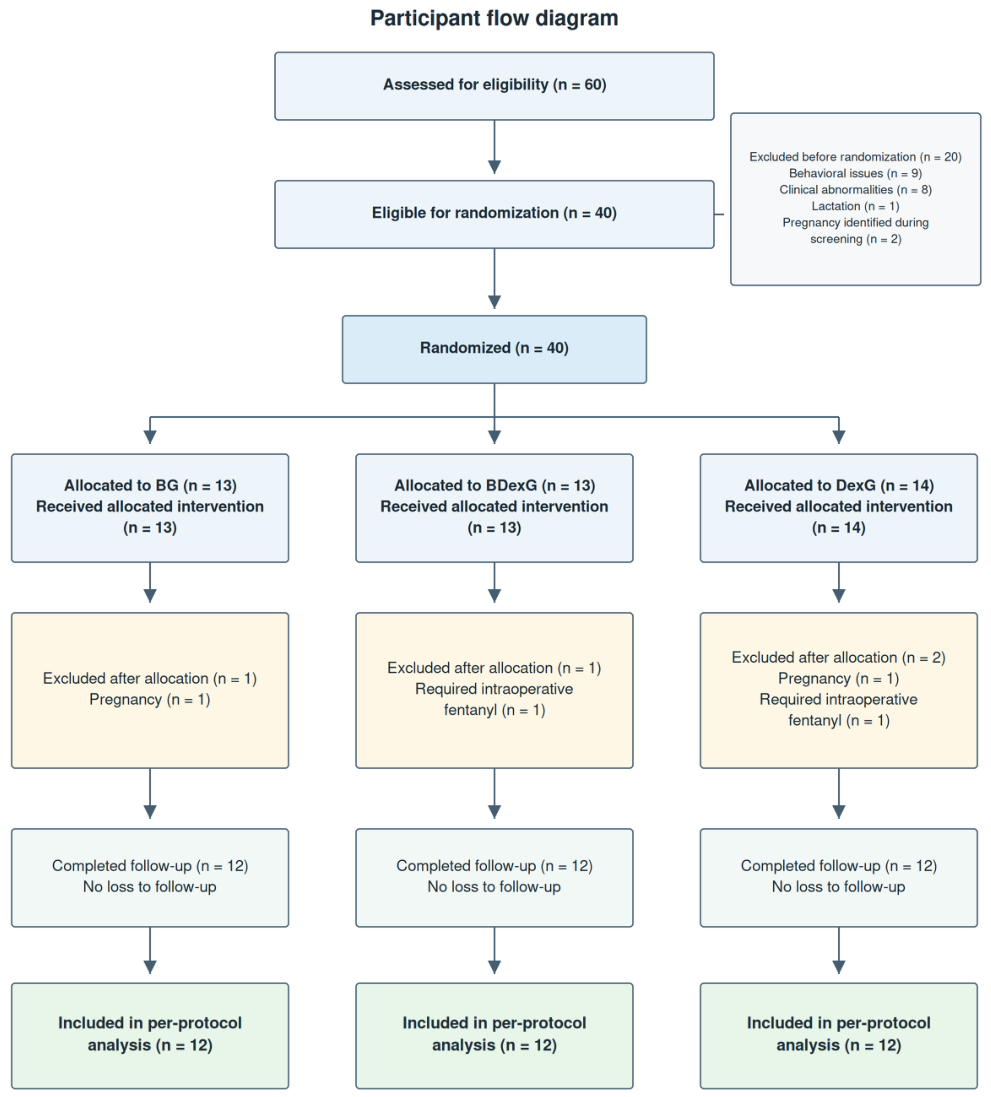
Sixty mixed-breed, young female client-owned cats were assessed for eligibility at the veterinary teaching hospital for elective ovariohysterectomy (Figure 1). The 36 cats included in the final analysis were 12.3 ± 4.5 months old and weighed 2.9 ± 0.5 kg. Cats were considered eligible if they were deemed healthy based on medical history, physical examination, complete blood count and serum biochemistry within reference ranges. Exclusion criteria included the presence of any comorbidity, pregnancy, aggressive or unmanageable behavior, prior trauma or any condition that could interfere with pain assessment.
Figure 1.
CONSORT flow diagram showing enrollment, randomization, allocation, and analysis of cats undergoing ovariohysterectomy. Cats were allocated to receive buprenorphine (BG), buprenorphine combined with dexmedetomidine (BDexG), or dexmedetomidine alone (DexG). “Received allocated intervention” indicates that cats received their assigned systemic treatment before undergoing ovariohysterectomy.
On the screening day, cats were housed individually in a quiet room, isolated from noise and other animals, and allowed to acclimatize to the assessment environment for one hour before baseline pain and sedation scores were obtained. Postoperative monitoring continued until 24 h after surgery, when the cats were discharged.
2.3. Experimental Design
This study was designed as a prospective, randomized, and blinded clinical trial. A randomization sequence (Online random sequence generator (http://www.randomization.com) was generated prior to enrollment using a 1:1:1 allocation ratio for three treatment groups (n = 12 per group). Cats received one of the following intramuscular treatments administered in the right quadriceps muscle, 20 min before anesthesia induction: buprenorphine (Beniv®, Ourofino Saúde Animal, Cravinhos, São Paulo, Brazil) (BG; 20 µg/kg), buprenorphine (Beniv®, Ourofino Saúde Animal, Cravinhos, São Paulo, Brazil) combined with dexmedetomidine (Dexdomitor®, Zoetis, São Paulo, Brazil) (BDexG; 20 µg/kg + 10 µg/kg), or dexmedetomidine (Dexdomitor®, Zoetis, São Paulo, Brazil) alone (DexG; 10 mcg/kg). Drug volumes were prepared using 1 mL insulin syringes and administered by members of the anesthesiology team (DF, JC, MA) who were not involved in pain and sedation assessments. The observer responsible for pain and sedation scoring (ITL) was blinded to treatment allocation. The primary outcome was the proportion of cats requiring postoperative rescue analgesia. Secondary outcomes included the timing of rescue analgesia, pain and sedation scores, adverse events, blood glucose concentrations, and serum cortisol concentrations.
2.4. Anesthesia and Surgery
Prior to anesthesia, food and water were withheld for 8 and 4 h, respectively. Cats were premedicated according to their assigned group by the anesthesiologists team (DF, JC, and MA). Sedation was assessed fifteen minutes after premedication by a single trained observer (ITL).
Approximately 20 min before anesthesia induction, a 22-gauge catheter (Nipro®, Cristália, Campinas, São Paulo, Brazil) was aseptically placed in the left cephalic vein. Anesthesia was induced with propofol (Propovan®, Cristália, Campinas, São Paulo, Brazil) (3–5 mg/kg) titrated to effect to allow endotracheal intubation. Lidocaine (Xylestesin 2%®, Cristália, Campinas, São Paulo, Brazil) 2% (2 mg/Kg) was instilled over the arytenoid cartilages before endotracheal intubation. Anesthesia was maintained with isoflurane (Isoforine®, Cristália, Campinas, São Paulo, Brazil), delivered in 60% oxygen (air-oxygen mixture) administered via a circle breathing system connected to an anesthesia machine (Drager Fabius Tiro®, Drager Medical, Lubeck, Germany) in spontaneous ventilation. Animals were positioned in sternal recumbency on a blanket placed over an electrical heating pad to maintain normothermia. Once an adequate anesthetic plane had been achieved, an ultrasound-guided sacrococcygeal epidural injection was performed using 2% lidocaine without vasoconstrictor (4 mg/kg), diluted with sterile water to a total volume of 0.36 mL/kg. All cats were continuously monitored using a multiparameter monitor (Inmonitor®, Inpulse Animal Health, Florianópolis, Santa Catarina, Brazil). Intravenous fluid therapy was administered throughout anesthesia using lactated Ringer’s solution (3 mL/kg/h). Monitoring included peripheral oxygen saturation (SpO2), electrocardiography for heart rate and rhythm (HR), esophageal temperature, respiratory rate (RR), end-tidal carbon dioxide (ETCO2), and expired isoflurane fraction (FEIso) measured using a sidestream gas analyzer (POET IQ2®, Criticare Technologies Inc., Warwick, RI, USA). Systolic arterial pressure (SAP) was measured using a non-invasive sphygmomanometer with the cuff placed proximal to the right carpus. Physiological parameters were recorded at standardized time points: 10 min after induction (T0), skin incision (TInc), right ovarian pedicle clamping (TRop), left ovarian pedicle clamping (TLop), cervical ligation (TCerv), and final suture (Tf).
During the intraoperative period, if heart rate (HR) and/or systolic arterial pressure (SAP) increased by more than 20% compared to baseline, fentanyl (Fentanest®, Cristália, Campinas, São Paulo, Brazil) (2 µg/kg) IV was administered. Cats were excluded after treatment allocation if pregnancy was identified intraoperatively, intraoperative rescue analgesia with fentanyl was required, or an adverse drug reaction, unexpected clinical finding, or other condition interfered with pain assessment. To maintain the target sample size, each cat excluded after allocation was replaced by the next eligible cat allocated to the corresponding treatment group until 12 cats had completed the study in each group. Surgery was performed using the same technique and by the same surgeon (AH). All cats were discharged from hospital 24 h after the procedure and were prescribed oral treatment for three days with dipyrone 25 mg/kg and meloxicam 0.1 mg/kg once a day.
2.5. Pain Assessment and Sedation
Pain was evaluated using three validated feline-specific scales appropriate for postoperative assessment following ovariohysterectomy: the UNESP-Botucatu Multidimensional Composite Pain Scale (UNESP-Botucatu-MCPS), the Glasgow Composite Measure Pain Scale–Feline (CMPS-Feline), and the Feline Grimace Scale (FGS). The UNESP-Botucatu MCPS comprises ten items, each scored from 0 to 3, yielding a total score of 0–30. A total score ≥8 was the predefined threshold for rescue analgesia [13,14]. The CMPS-Feline evaluates behavioral responses following interaction and clinical observation, with a score ≥ 5 indicating the need for rescue analgesia [15]. The FGS is a facial-expression-based scale composed of five action units (ear position, orbital tightening, muzzle tension, whisker position, and head position), each scored from 0 to 2. A total score ≥ 4 was considered indicative of pain requiring intervention [16].
Sedation was assessed using a simple descriptive scale (from 0 to 4), where 0 = no sedation; 1 = able to stand but is wobbly; 2 = in sternal recumbency; 3 = can lift its head; 4 = fast asleep/no response to hand clap [5].
Food was offered at each postoperative assessment beginning at T1h, defined as 1 h after the end of surgery. Food intake was considered as part of the UNESP-Botucatu pain-scale assessment; however, the amount consumed was not standardized or quantitatively recorded.
Assessments were performed in a standardized sequence: sedation scoring, followed by real-time FGS evaluation without interaction (FGS-RT), and subsequently CMPS-Feline and UNESP-Botucatu-MCPS, both involving observer interaction.
Evaluations were conducted at baseline (BT), 15 min after premedication (TPAM), and at 1, 2, 4, 6, 8, 12, and 24 h after the end of surgery (T1h, T2h, T4h, T6h, T8h, T12h, and T24h).
Rescue analgesia was administered when the CMPS-Feline score was ≥5, UNESP-Botucatu-MCPS score ≥ 8 or an FGS score ≥ 4.
Dipyrone (Febrax®, LBR Santa Cruz, São Paulo, Brazil) (25 mg/kg) IV was administered as first-line rescue analgesia. If pain persisted, meloxicam (Maxicam®, Ourofino Saúde Animal, Cravinhos, São Paulo, Brazil) (0.1 mg/kg) IV was administered. Animals that required additional analgesia after meloxicam were excluded from the study.
To avoid confounding by rescue treatment, the pain scores recorded at the time rescue analgesia was indicated were retained in the analysis, whereas all subsequent pain-score observations were excluded. Additionally, if cats did not require rescue analgesia up to 12 h postoperatively, dipyrone and meloxicam were administered prophylactically at the same doses and routes described above.
2.6. Laboratory Analysis
Blood samples for glucose and serum cortisol measurements were collected at baseline (BT), at right ovarian pedicle clamping (RopT), and 4 and 12 h after the end of surgery (T4h and T12h). At baseline, an additional 2 mL blood sample was collected from the jugular vein for complete blood count and serum biochemical analyses, including hepatic (ALT, AST, ALP, GGT, albumin, total protein) and renal (urea, creatinine) parameters. A drop of blood at each time point was used for glucose measurement using a portable glucometer (Optium Xceed®, Abbott, Alameda, CA, USA). Remaining samples were transferred into plain tubes, allowed to clot at room temperature for 10 min, and centrifuged at 2000 rpm for 20 min. Serum was aliquoted into microtubes and stored at −80 °C until analysis. Serum cortisol concentrations were measured using a commercial ELISA (Cortisol Cat ELISA Kit®, Abnova, Taipei, Taiwan) kit (detection range 0.005–0.3 µg/mL). Each serum sample was analyzed in duplicate using 25 µL per well. Samples were analyzed across four plates on different days, and absorbance was measured at 450 nm using an ELISA plate reader (Cortisol Cat ELISA Kit®, Abnova, Taipei, Taiwan). All laboratory analyses were performed at the Clinical Pathology Laboratory of the Department of Medical Clinic, FMVZ/USP.
2.7. Statistical Analysis
The statistical analysis was conducted under the supervision of an experienced statistician. Data were analyzed using GraphPad Prism software (version 8.0.18). Results are presented as mean ± standard deviation for parametric variables and median (range) for nonparametric variables, as appropriate. Quantitative data were analyzed using one-way analysis of variance (ANOVA), followed by Tukey’s post hoc test. Physiological parameters were analyzed using repeated measures ANOVA, followed by Dunnett’s post hoc test (within-group comparisons over time), and two-way ANOVA followed by Tukey’s post hoc test (between-group comparisons). Pain scores were summarized descriptively by group and assessment time using medians and ranges. The score recorded at the time rescue analgesia was indicated was retained, whereas subsequent pain-score observations were excluded to avoid confounding by rescue treatment. Because post-rescue missingness was treatment-dependent and therefore not random, no longitudinal inferential analysis of pain scores was performed. Sedation scores were analyzed using the Friedman test for repeated measures, followed by Dunn’s post hoc test. Rescue-analgesia requirements were compared among groups using the Fisher–Freeman–Halton exact test for the overall 3 × 2 contingency table, followed by two-sided Fisher’s exact tests. Holm adjustment was applied to the two comparisons of the buprenorphine-containing groups with DexG. The comparison between BG and BDexG was considered exploratory, and its p-value was reported without adjustment. Serum cortisol concentrations were analyzed using the Friedman test followed by Dunn’s post hoc test for within-group comparisons over time and the Kruskal–Wallis test followed by Dunn’s post hoc test for comparisons among groups.
An a priori sample-size calculation indicated a minimum requirement of 9 cats per treatment group (totaling 27 cats) based on a continuous framework using historical raw data repository parameters from our research line under identical surgical and clinical models [17]. Assumptions included a targeted minimal clinically important difference of 2.5 points on the 20-point Glasgow Feline Composite Measure Pain Scale Short Form (CMPS-F), a conservative pooled standard deviation (SD) of 1.75 points (determined at the peak postoperative pain interval of T4h), a two-sided alpha level of 0.05, and a nominal power of 90%. Consequently, this calculation did not establish the statistical power for rescue-analgesia requirement, the primary outcome of the present report. Statistical significance was set at p < 0.05.
3. Results
Sixty cats were assessed for eligibility. Twenty cats were excluded before randomization because of behavioral issues (n = 9), clinical abnormalities (n = 8), lactation (n = 1), or pregnancy identified during screening (n = 2). Forty cats proceeded to treatment allocation. Four cats were excluded after treatment allocation: one in BG because of pregnancy, one in BDexG because intraoperative fentanyl was required, and two in DexG, one because of pregnancy and one because intraoperative fentanyl was required. These cats were replaced. Replacement cats were allocated according to the next assignments in the randomization sequence, and 12 cats per group were included in the per-protocol analysis. Thus, 36 cats completed postoperative follow-up and were included in the final analysis. All 36 cats were discharged without postoperative complications.
Baseline characteristics, including age, body weight, and duration of surgery, did not differ between groups (Table 1).
Table 1.
Age, body weight, and duration of surgery in cats undergoing ovariohysterectomy.
3.1. Rescue Analgesia
Seventeen of the 36 cats included in the final analysis required postoperative rescue analgesia. None of these 36 cats required intraoperative rescue analgesia. The proportion of cats requiring postoperative rescue analgesia differed significantly among groups (overall exact p = 0.0111) and was higher in DexG (10/12; 83%) than in BG (4/12; 33%; Holm-adjusted p = 0.0361) and BDexG (3/12; 25%; Holm-adjusted p = 0.0246). No significant difference was detected between BG and BDexG (exploratory comparison; unadjusted p = 1.0000). In DexG, nine of the ten rescue events occurred within the first four postoperative hours. In BG, one cat required rescue analgesia at T2h and three at T6h, whereas in BDexG, one cat required rescue analgesia at T6h and two at T8h. No cat required more than one rescue dose. The distribution and timing of rescue analgesia are presented in Table 2.
Table 2.
Distribution and timing of rescue analgesia across groups.
3.2. Pain Scores
Pain scores assessed using the CMPS-Feline, FGS, and UNESP-Botucatu-MCPS are presented descriptively by group and assessment time in Table 3.
Table 3.
Median (range) pain scores assessed using the CMPS-Feline, FGS, and UNESP-Botucatu-MCPS in BG, BDexG, and DexG groups across postoperative time points.
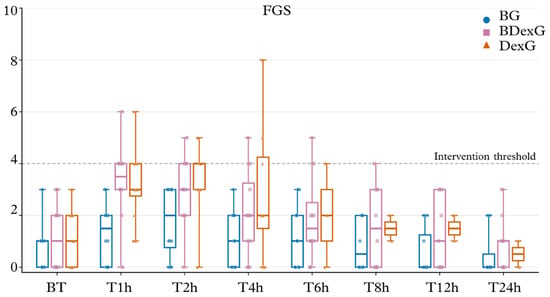
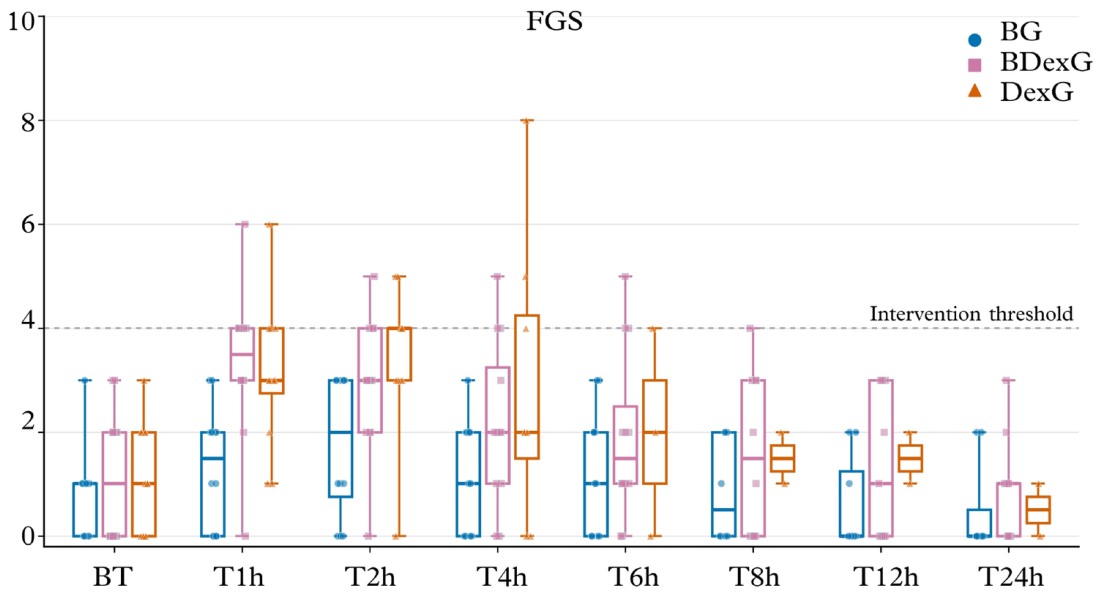
Descriptively, FGS scores were higher during the early postoperative period (T1–T2h) than at baseline in the dexmedetomidine and buprenorphine–dexmedetomidine groups (Figure 2). However, formal longitudinal comparisons of postoperative pain scores were not performed because observations obtained after rescue analgesia were excluded, resulting in treatment-dependent and progressively unbalanced sample sizes, particularly in DexG. The number of cats contributing pain-score data at each assessment decreased following rescue analgesia and is reported in the legend of Figure 2.
Figure 2.
Feline Grimace Scale (FGS) scores in cats receiving buprenorphine (BG), buprenorphine combined with dexmedetomidine (BDexG), or dexmedetomidine (DexG). Assessments were performed at baseline (BT) and at 1, 2, 4, 6, 8, 12, and 24 h after the end of surgery. Boxes represent the interquartile range, horizontal lines represent medians, and whiskers represent minimum and maximum values. Cats that had not required rescue analgesia received dipyrone and meloxicam after the T12h assessment. Thus, T24h pain scores in all groups were obtained following additional systemic analgesia. Observations obtained after rescue analgesia were excluded. Numbers of cats contributing data at BT/T1h/T2h/T4h/T6h/T8h/T12h/T24h were: BG (12/12/12/11/11/8/8/8), BDexG (12/12/12/12/12/11/9/9), and DexG (12/12/11/8/3/2/2/2).
3.3. Sedation Scores
Sedation scores were higher in dexmedetomidine-containing groups compared to the buprenorphine group during the premedication period and early postoperative time points (TPAM and T1h) (Table 4). Between groups, BG showed significantly lower sedation scores compared with BDexG at TPAM and T1h (p < 0.0001) and compared with DexG at the same time points (p = 0.0336 and p = 0.0019, respectively). Over time, in the BDexG group, baseline values were lower than those observed at T1h and T2h (p < 0.0001 and p = 0.0031, respectively). Similarly, in the DexG group, baseline values were lower compared with T1h (p < 0.0001).
Table 4.
Median (range) sedation scores according to a sedation scale (0–4: no sedation; cat was able to stand but is wobbly; in sternal recumbency; can lift its head; fast asleep/no response to hand clap) assessed in BG, BDexG, and DexG groups across perioperative time points.
3.4. Adverse Effects
Adverse events were mild and transient. Dysphoria was observed in two cats in BG and one cat in BDexG. Mydriasis was recorded in three cats in BG, and transient vocalization occurred in one cat in DexG. Emesis was observed in two cats in DexG, although one of these cats had not been appropriately fasted. Transient bradycardia was recorded in one cat in BDexG. Sialorrhea observed after intravenous dipyrone administration was considered temporally associated with rescue treatment rather than with the randomized protocol. No serious adverse events occurred, and no specific treatment or reversal agent was required.
3.5. Glucose Levels
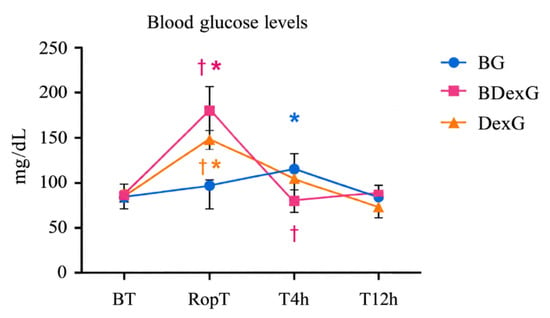
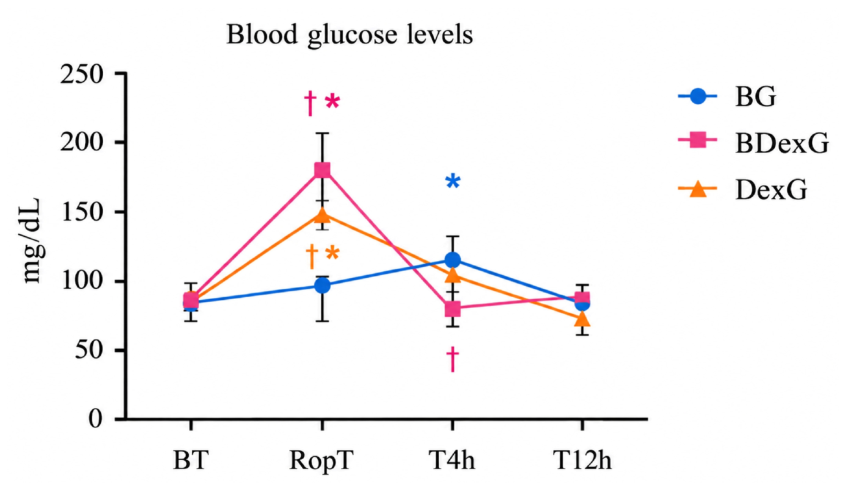
Glucose concentrations differed between groups and time points, with higher values observed in dexmedetomidine-containing groups during the early perioperative period (Figure 3). Between groups, BG showed significantly lower glucose concentrations compared to BDexG and DexG (p < 0.0001), whereas at T4h, BG values were higher than those observed in BDexG (p = 0.0052). Additionally, BDexG showed higher glucose concentrations compared to DexG (p = 0.0026). Regarding temporal changes, BG values at baseline were higher than at T4h (p = 0.0181). In contrast, in both BDexG and DexG, glucose concentrations at baseline were lower than those observed at RopT (p < 0.0001 for both comparisons).
Figure 3.
Blood glucose concentrations (mean ± standard deviation) in cats receiving buprenorphine (20 µg/kg; BG), buprenorphine combined with dexmedetomidine (20 µg/kg and 10 µg/kg, respectively; BDexG), or dexmedetomidine (10 µg/kg; DexG) (n = 12 per group). Measurements were obtained at baseline before premedication (BT), immediately after right ovarian pedicle clamping (RopT), and 4 and 12 h after the end of surgery (T4h and T12h, respectively). † Significantly different from BG at the same time point; * significantly different from baseline within the same group (p < 0.05).
3.6. Serum Cortisol Concentrations
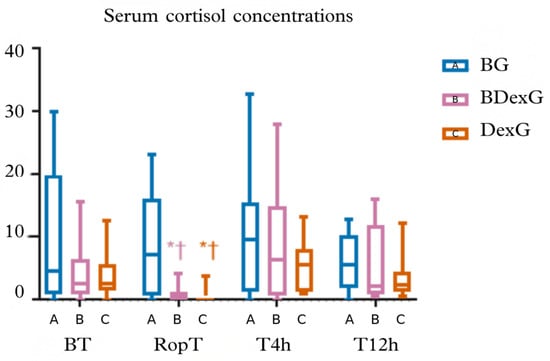
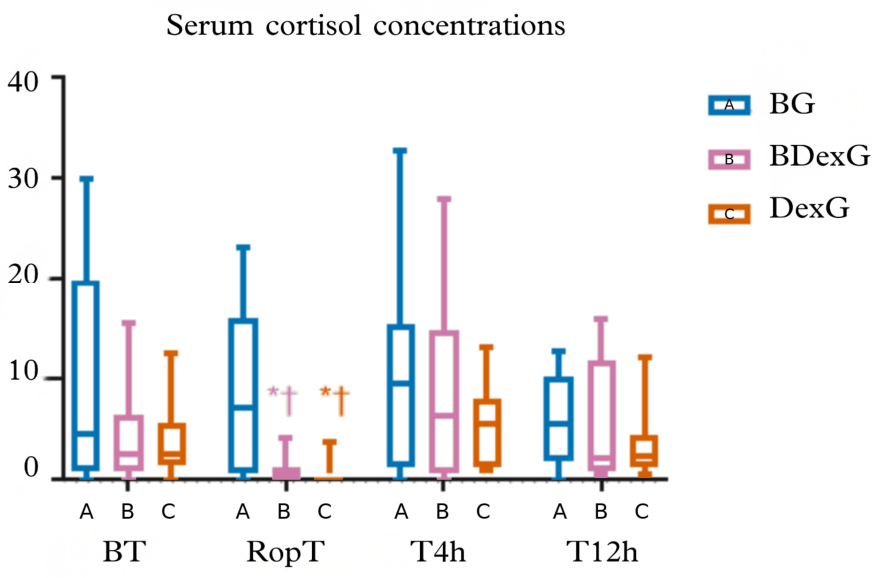
Serum cortisol concentrations differed among groups and across assessment times (Figure 4). In BDexG and DexG, cortisol concentrations were lower at RopT than at baseline (p = 0.0499 and p = 0.0027, respectively). At RopT, cortisol concentrations were higher in BG than in BDexG (p = 0.0298) and DexG (p = 0.0022). No other significant differences were observed among groups or across time.
Figure 4.
Serum cortisol concentrations in cats receiving buprenorphine (BG), buprenorphine combined with dexmedetomidine (BDexG), or dexmedetomidine (DexG). Measurements were obtained at baseline (BT), immediately after right ovarian pedicle clamping (RopT), and 4 and 12 h after the end of surgery (T4h and T12h, respectively). Boxes represent the interquartile range, horizontal lines represent medians, whiskers represent minimum and maximum values. * Significantly different from baseline within the same group; † significantly different from BG at the same time point (p < 0.05). Letters identify the treatment groups independently of colour: A, BG; B, BDexG; C, DexG.
4. Discussion
In this randomized clinical trial, the analgesic efficacy of buprenorphine administered alone or in combination with dexmedetomidine was compared with dexmedetomidine alone in female cats undergoing ovariohysterectomy. Overall, buprenorphine, whether used alone or combined with dexmedetomidine, was associated with better analgesic control during the postoperative period than dexmedetomidine alone, as evidenced by the lower requirement for rescue analgesia. No significant difference in rescue-analgesia requirement was detected between BG and BDexG. These findings are consistent with previous reports suggesting that, although dexmedetomidine may enhance perioperative management, its contribution to sustained postoperative analgesia remains uncertain [11].
Pain assessment was performed using three validated scales (CMPS-Feline, FGS, and UNESP-Botucatu-MCPS), for rescue analgesia decisions. All cats requiring rescue analgesia reached the intervention threshold on at least two of the three pain scales. However, reliance solely on pain scoring systems may underestimate clinically relevant differences between treatment protocols, as these tools have inherent limitations and may not fully capture analgesic adequacy or the temporal dynamics of pain control. This limitation has been widely recognized in the human medical literature, where reliance on unidimensional pain scores has been questioned and multidimensional approaches are increasingly advocated [12]. In this context, the timing of rescue analgesia provided additional clinically relevant information, complementing scale-based assessments. This observation is further supported by the low overall requirement for rescue analgesia in buprenorphine-treated groups, in which most animals maintained adequate analgesia throughout the 12 h observation period without additional analgesics. The progressive reduction in the number of cats contributing to the descriptive pain-score data, particularly in DexG, must be considered when interpreting postoperative score patterns. Cats requiring rescue analgesia were those experiencing greater pain and were consequently excluded from subsequent pain-score assessments. Therefore, later assessments increasingly represent the subset of cats that responded more favorably to their assigned treatment. In contrast, the incidence and timing of rescue analgesia were evaluated in all 36 cats included in the final analysis and provide a more robust basis for interpreting clinically relevant differences among the treatment protocols.
A commonly described analgesic approach for ovariohysterectomy involves multimodal protocols targeting different nociceptive pathways, typically combining opioids, α2-adrenergic agonists, and non-steroidal anti-inflammatory drugs (NSAIDs), with additional agents such as dipyrone being used in some protocols to further enhance analgesic efficacy and reduce the need for rescue analgesia [18,19,20].
However, the objective of the present study was to compare the postoperative analgesic contribution of the systemic treatments within a standardized protocol that included epidural lidocaine, without the routine administration of additional systemic analgesics during the first 12 postoperative hours. Therefore, cats that had not previously required rescue analgesia received dipyrone and meloxicam only after the T12h assessment. Despite the use of locoregional anesthesia and coadministration of buprenorphine with dexmedetomidine, 25% of cats in BDexG still required rescue analgesia. This finding is consistent with previous clinical observations in cats undergoing ovariohysterectomy, in which the use of opioids alone, such as tramadol at 2 mg/kg, was associated with higher rescue analgesia rates, whereas combination protocols including dipyrone significantly reduced the need for rescue interventions [20,21,22]. Although tramadol has shown variable analgesic efficacy across feline studies, its clinical effects appear to be dose dependent and should not be generalized as uniformly inconsistent. In cats undergoing ovariohysterectomy, tramadol administered at 4 mg/kg provided effective postoperative analgesia for up to 6 h without the need for rescue analgesia [22]. Tramadol also retains practical clinical relevance because, unlike injectable opioids that may require repeated administration by veterinary personnel, it can be administered orally by caregivers after hospital discharge. More recently, tramadol at 3 mg/kg, methadone at 0.2 mg/kg, and morphine at 0.2 mg/kg provided satisfactory postoperative analgesia in most cats undergoing ovariohysterectomy, with no clear superiority of the full µ-opioid agonists and with effects lasting up to 6 h. Experimental studies have also demonstrated that methadone-induced antinociception may be relatively short and varies according to dose, route of administration, and the nociceptive stimulus evaluated [23]. Therefore, opioid classification or presumed potency alone does not reliably predict the magnitude or duration of postoperative analgesia in cats. Clinical efficacy should instead be interpreted according to dose, duration of action, rescue-analgesia requirements, and the complete perioperative protocol. Epidural lidocaine typically provides analgesia for approximately 60–120 min [22,24,25,26]. Given the mean surgical durations of 35–39 min, the epidural technique likely contributed substantially to intraoperative analgesia and may explain the absence of intraoperative rescue analgesia in the cats included in the final analysis. Residual effects may also have influenced the earliest postoperative assessment. Although all cats received the same epidural protocol, an interaction between the systemic treatments and residual epidural effects during the early postoperative period cannot be excluded.
In the dexmedetomidine-only group (DexG), analgesia control was inadequate, with 10 out of 12 animals requiring rescue analgesia. This finding reinforces that dexmedetomidine, despite its sedative and analgesic properties, did not provide sustained postoperative analgesia as the sole systemic analgesic adjunct to epidural lidocaine. Its clinically relevant antinociceptive effect is short-lived, typically lasting less than 90 min [27], which may explain the early requirement for rescue analgesia in this group. Furthermore, increasing dexmedetomidine doses does not appear to improve analgesic efficacy. Previous studies demonstrated that even higher doses (10 µg/kg) failed to significantly increase nociceptive thresholds [9], suggesting a ceiling effect for analgesia while increasing sedation.
This dissociation between sedation and analgesia is clinically relevant. Residual sedative effects may interfere with pain assessment, particularly in the early postoperative period. In the present study, FGS scores were influenced in dexmedetomidine-treated groups during the first two hours after surgery, possibly reflecting sedation or dysphoria rather than pain. Dysphoria and mydriasis were observed in BG cats up to T2h postoperatively. In contrast, only one cat in BDexG exhibited dysphoria up to T1h, whereas one cat in DexG displayed vocalization until T1h. All events were transient and self-limiting and required no intervention. Of note, sedation scores remained elevated during the early postoperative assessments in the dexmedetomidine-containing groups and may have influenced pain assessment, particularly FGS scores. This differs from the findings of Evangelista et al., in which sedation induced by acepromazine–buprenorphine did not significantly affect FGS scores, suggesting that the influence of sedation on facial-expression-based pain assessment may depend on the pharmacological protocol [16]. Nevertheless, because postoperative pain and sedation occurred concurrently in the present study, their respective contributions to FGS scores cannot be determined. Dexmedetomidine produces dose-dependent sedation that may persist into the early postoperative period, even after its clinically meaningful antinociceptive effect has waned [28,29,30,31,32], thereby increasing the complexity of pain interpretation. This may have contributed to misinterpretation of behavioral signs and highlights a known limitation of pain assessment in sedated patients. In contrast, rescue analgesia was less frequently required and generally occurred later in the buprenorphine-containing groups, supporting a more sustained postoperative analgesic contribution of buprenorphine under the conditions of this study.
Rescue analgesia was required in 25% and 33% of animals in BDexG and BG, respectively, whereas 83% of animals in DexG required rescue. In the buprenorphine group, one cat required rescue analgesia at T2h, whereas the remaining three rescue events occurred at T6h. In BDexG, rescue analgesia was required only at later time points, at T6h and T8h. By contrast, most rescue events in DexG occurred within the first four postoperative hours. Cats that had not required rescue analgesia received dipyrone and meloxicam after the T12h assessment. Therefore, T24h pain scores in all groups were obtained following additional systemic analgesia and cannot be attributed solely to the randomized treatments. Although dipyrone (metamizole) is not approved in the United States, it is clinically used in Brazil and other countries. In cats undergoing ovariohysterectomy, dipyrone administered at 12.5 mg/kg every 12 h or 25 mg/kg every 24 h provided postoperative analgesia comparable to meloxicam, without clinically relevant adverse effects or laboratory abnormalities. More recently, the combination of dipyrone and tramadol was associated with improved postoperative analgesia and a lower requirement for rescue medication compared with either drug administered alone. These findings support the use of dipyrone as part of multimodal analgesic protocols and as rescue medication in the present study [21,33].
Opioid-associated behaviors such as purring, rolling, and kneading were also observed in BG but were considered expected pharmacological side effects rather than adverse events because they were transient, caused no apparent harm, and required no intervention. Additional adverse events were mild and self-limiting. Emesis occurred in two cats in DexG, although one had not been appropriately fasted, and one transient episode of bradycardia occurred in BDexG. Sedation was considered an expected pharmacological effect of dexmedetomidine rather than an adverse event [9,27]. Similarly, sialorrhea observed after intravenous dipyrone administration was temporally associated with rescue treatment and not with the randomized protocols. Given the small number of events, comparisons among groups should be interpreted descriptively.
Although no significant difference in rescue-analgesia requirement was detected between BG and BDexG, dexmedetomidine’s sedative effect may offer clinically relevant benefits during the preoperative period by facilitating handling and potentially reducing stress in cats. However, stress was not directly assessed in the present study. The lower frequency of dysphoria and absence of mydriasis in BDexG compared with BG may also suggest that dexmedetomidine attenuated the expression of some buprenorphine-associated behavioral effects. Nevertheless, the small number of events and the descriptive nature of these findings preclude definitive conclusions. Thus, the buprenorphine–dexmedetomidine combination may be clinically advantageous when reliable preoperative sedation and easier handling are desired. These potential benefits should be balanced against dexmedetomidine-associated effects, including alterations in blood glucose concentrations, residual sedation that may complicate postoperative pain assessment, and cardiovascular effects such as bradycardia, peripheral vasoconstriction, and reduced cardiac output [27]. Although only one transient episode of bradycardia was recorded in the present study, careful patient selection remains important, particularly in geriatric cats and those with cardiovascular disease.
Interpretation of plasma glucose concentrations in cats should be made cautiously because transient stress-induced hyperglycemia is well recognized in this species. As baseline samples were obtained shortly after hospital admission, stress-related increases in glucose concentrations cannot be excluded. Lower glucose concentrations observed in the buprenorphine-only group are consistent with the absence of dexmedetomidine, whose α2-mediated inhibition of pancreatic insulin secretion is a well-established cause of transient hyperglycemia [33].
Serum cortisol concentrations were highly variable. Nevertheless, the transient reduction observed at RopT in both dexmedetomidine-treated groups, together with the lower concentrations compared with BG at this time point, may reflect the sympatholytic and stress-attenuating effects of dexmedetomidine [34]. However, cortisol concentrations are influenced by multiple factors, including handling, hospitalization, anesthesia, and the surgical stimulus. Moreover, no significant differences were observed at T4h or T12h. Therefore, this transient perioperative finding should not be interpreted in isolation as evidence of superior analgesic efficacy.
Surgery duration was comparable among groups. Although it was numerically four minutes longer in DexG than in BG, this small difference, within the observed variability and with all procedures performed by the same surgeon, is unlikely to account for the marked difference in rescue-analgesia requirements.
Limitations
This study has some limitations that should be considered when interpreting the results. Residual sedative effects, particularly associated with dexmedetomidine, may have influenced pain assessment during the early postoperative period, potentially confounding behavioral and facial-expression-based scoring.
A methodological limitation of this study involves the a priori sample-size calculation. The calculation was strictly parameterized using continuous inputs (an anticipated difference of 2.5 points and a pooled SD of 1.75 points on the CMPS-F scale) derived from a previous identical clinical model [17] to satisfy software requirements. Because clinical pain scores are ultimately analyzed as non-parametric data (expressed as medians and ranges), this calculation did not establish power for detecting differences in rescue-analgesia requirements. This study was not designed as an equivalence or non-inferiority trial. Therefore, the absence of a statistically significant difference in rescue-analgesia requirement between BG and BDexG should not be interpreted as evidence of equivalent analgesic efficacy. The analysis was performed per protocol, excluding and replacing four cats after treatment allocation. These exclusions and replacements may have introduced bias into the comparison of postoperative rescue-analgesia requirements, particularly because two exclusions were related to the need for intraoperative fentanyl.
Nine cats had baseline UNESP-Botucatu MCPS scores ≥ 8 despite being considered clinically healthy and having no identified painful condition. Non-pain-related behavioral and physiological responses to handling and the hospital environment may have contributed to these scores. Additionally, repeated evaluations using multiple pain scales may have contributed to observer-related variability and potential animal fatigue over time. Although efforts were made to minimize environmental stress, the hospital setting itself may have influenced behavioral responses and pain expression. Although food was offered at each postoperative assessment from T1h onward, the amount consumed was not standardized or quantitatively recorded, and not all cats consumed food when it was offered. Consequently, differences in feeding status may have influenced postoperative glucose concentrations, particularly at T4h and T12h, and these results should be interpreted cautiously.
Finally, although all cats received epidural lidocaine, routine administration of additional systemic analgesics was withheld during the initial postoperative period unless rescue analgesia was indicated. This design allowed comparison of the postoperative analgesic contribution of the systemic treatments but differs from contemporary multimodal clinical practice and may limit the generalizability of the findings.
5. Conclusions
Within a standardized multimodal protocol that included epidural lidocaine, systemic treatments containing buprenorphine (20 µg/kg) were associated with a lower requirement for postoperative rescue analgesia than dexmedetomidine used as the sole systemic analgesic treatment. No significant difference in rescue-analgesia requirement was detected between buprenorphine alone and its combination with dexmedetomidine. Accordingly, the primary conclusion is based on the requirement for rescue analgesia, which was evaluated in all 36 cats, whereas longitudinal pain-score patterns should be interpreted descriptively because of the treatment-dependent exclusion of post-rescue observations.
Supplementary Materials
The following supporting information can be downloaded at: https://www.mdpi.com/article/10.3390/vetsci13111236/s1. File S1: Definitive Glasgow acute pain scale for cats: validation and intervention level; File S2: Facial expressions of pain in cats: the development and validation of Feline Grimace Scale; File S3: Validation of the English version of the UNESP-Botucatu multidimensional composite pain scale for assessing postoperative pain in cats.
Author Contributions
Conceptualization, I.T.d.L. and D.T.F.; methodology, I.T.d.L., A.A.P.D., F.N.d.A., I.R.H.G. and D.T.F.; software, I.T.d.L., A.A.P.D. and D.T.F.; validation, I.T.d.L., A.A.P.D., G.A.d.M.C. and D.T.F.; formal analysis, I.T.d.L., M.A.A.P. and D.T.F.; investigation, I.T.d.L., J.S.C., M.A.A.P., A.M.H., F.N.d.A. and D.T.F.; resources, A.M.H. and D.T.F.; data curation, I.T.d.L., A.A.P.D. and D.T.F.; writing—original draft preparation, I.T.d.L. and D.T.F.; writing—review and editing, F.N.d.A., I.R.H.G., A.A.P.D. and G.A.d.M.C.; visualization, I.T.d.L., J.S.C., M.A.A.P., A.M.H. and D.T.F.; supervision, D.T.F.; project administration, I.T.d.L. and D.T.F.; funding acquisition, D.T.F. All authors have read and agreed to the published version of the manuscript.
Funding
The authors declare that financial support was received for this work and/or its publication. This research was funded by Ourofino Saúde Animal Ltda, which provided financial support. The study was conducted within the facilities of the Faculty of Veterinary Medicine and Animal Science of the University of São Paulo, ensuring adherence to institutional guidelines and standards.
Institutional Review Board Statement
The animal study protocol was approved by the Animal Ethics Committee (CEUA) by University of São Paulo (USP), São Paulo, Brazil, under the protocol number 1717120220, 13 February 2020.
Informed Consent Statement
Informed consent was obtained from all subjects involved in the study.
Data Availability Statement
The original contributions presented in this study are included in the article/Supplementary Material. Further inquiries can be directed to the corresponding authors.
Acknowledgments
The authors would like to thank the USP Hospital and its staff for their technical and organizational support during the study.
Conflicts of Interest
F.N.d.A., I.R.H.G., G.A.d.M.C., and A.A.P.D. were employed by Ourofino Saúde Animal Ltda. The remaining authors declare that this work was conducted in the absence of any commercial or financial relationships that could be construed as potential conflicts of interest.
References
- Robertson, S.A. Managing Pain in Feline Patients. Vet. Clin. N. Am. Small Anim. Pract. 2008, 38, 1267–1290. [Google Scholar] [CrossRef] [Scilit] [PubMed]
- Raja, S.N.; Carr, D.B.; Cohen, M.; Finnerup, N.B.; Flor, H.; Gibson, S.; Keefe, F.J.; Mogil, J.S.; Ringkamp, M.; Sluka, K.A.; et al. The revised International Association for the Study of Pain definition of pain: Concepts, challenges, and compromises. Pain 2020, 161, 1976–1982. [Google Scholar] [CrossRef] [Scilit] [PubMed]
- Steagall, P.V.; Robertson, S.; Simon, B.; Warne, L.N.; Shilo-Benjamini, Y.; Taylor, S. 2022 ISFM Consensus Guidelines on the Management of Acute Pain in Cats. J. Feline Med. Surg. 2022, 24, 4–30. [Google Scholar] [CrossRef] [Scilit] [PubMed]
- Shah, M.D.; Yates, D.; Hunt, J.; Murrell, J.C. A comparison between methadone and buprenorphine for perioperative analgesia in dogs undergoing ovariohysterectomy. J. Small Anim. Pract. 2018, 59, 539–546. [Google Scholar] [CrossRef] [Scilit] [PubMed]
- Steagall, P.V.M.; Taylor, P.M.; Rodrigues, L.C.C.; Ferreira, T.H.; Minto, B.W.; Aguiar, A.J.A. Analgesia for cats after ovariohysterectomy with either buprenorphine or carprofen alone or in combination. Vet. Rec. 2009, 164, 359–363. [Google Scholar] [CrossRef] [Scilit] [PubMed]
- Watanabe, R.; Marcoux, J.; Evangelista, M.C.; Dumais, Y.; Steagall, P.V. The analgesic effects of buprenorphine (Vetergesic or Simbadol) in cats undergoing dental extractions: A randomized, blinded, clinical trial. PLoS ONE 2020, 15, e0230079. [Google Scholar] [CrossRef] [Scilit] [PubMed]
- Cannarozzo, C.J.; Kirch, P.; Campoy, L.; Gleed, R.D.; Lorenzutti, A.M.; Martin-Flores, M. Retrospective investigation of an association between high-dose buprenorphine and perpetuation of post-anesthesia hyperthermia in cats following ovariohysterectomy. J. Feline Med. Surg. 2021, 23, 777–782. [Google Scholar] [CrossRef] [Scilit] [PubMed]
- Martin-Flores, M.; Lorenzutti, A.M.; Nugen, S.A.; Boesch, J.M.; Kirch, P.J.; Merry, H.L.; Campoy, L. High-dose buprenorphine results in a greater occurrence of postoperative hyperthermia than morphine in a randomized clinical trial in cats undergoing ovariohysterectomy. Am. J. Vet. Res. 2022, 83, ajvr.21.11.0183. [Google Scholar] [CrossRef] [Scilit] [PubMed]
- Slingsby, L.S.; Murrell, J.C.; Taylor, P.M. Combination of dexmedetomidine with buprenorphine enhances the antinociceptive effect to a thermal stimulus in the cat compared with either agent alone. Vet. Anaesth. Analg. 2010, 37, 162–170. [Google Scholar] [CrossRef] [Scilit] [PubMed]
- Okur, D.T.; Çiplak, A.Y.; Aydin, Ş.; Okur, S.; Bedir, A.G.; Orhun, Ö.T.; Elban, Ş.; Tohumcu, V. Comparison of intra and postoperative analgesia efficacy of intraperitoneal levobupivacaine alone or in combination with dexmedetomidine in cats undergoing ovariohysterectomy; a randomized, prospective, blinded, clinical trial. Res. Vet. Sci. 2024, 180, 105442. [Google Scholar] [CrossRef] [Scilit] [PubMed]
- Peng, K.; Zhang, J.; Meng, X.W.; Liu, H.Y.; Ji, F.-H. Optimization of Postoperative Intravenous Patient-Controlled Analgesia with Opioid-Dexmedetomidine Combinations: An Updated Meta-Analysis with Trial Sequential Analysis of Randomized Controlled Trials. Pain Physician 2017, 20, 569–595. [Google Scholar] [CrossRef] [Scilit]
- Lemoine, A.; Martinez, V.; Bonnet, F. Pain measurement and critical review of analgesic trials: Pain scores, functional pain measurements, limits and bias of clinical trials. Best Pract. Res. Clin. Anaesthesiol. 2019, 33, 287–292. [Google Scholar] [CrossRef] [Scilit] [PubMed]
- Brondani, J.T.; Mama, K.R.; Luna, S.P.L.; Wright, B.D.; Niyom, S.; Ambrosio, J.; Vogel, P.R.; Padovani, C.R. Validation of the English version of the UNESP-Botucatu multidimensional composite pain scale for assessing postoperative pain in cats. BMC Vet. Res. 2013, 9, 2013. [Google Scholar] [CrossRef] [Scilit] [PubMed]
- Buisman, M.; Hasiuk, M.M.; Gunn, M.; Pang, D.S. The influence of demeanor on scores from two validated feline pain assessment scales during the perioperative period. Vet. Anaesth. Analg. 2017, 44, 3. [Google Scholar] [CrossRef] [Scilit] [PubMed]
- Reid, J.; Scott, E.M.; Calvo, G.; Nolan, A.M. Definitive Glasgow acute pain scale for cats: Validation and intervention level. Vet. Rec. 2017, 180, 449. [Google Scholar] [CrossRef] [Scilit] [PubMed]
- Evangelista, M.C.; Watanabe, R.; Leung, V.S.Y.; Monteiro, B.P.; O’tOole, E.; Pang, D.S.J.; Steagall, P.V. Facial expressions of pain in cats: The development and validation of a Feline Grimace Scale. Sci. Rep. 2019, 9, 19128. [Google Scholar] [CrossRef] [Scilit] [PubMed]
- Pereira, M.A.; Campos, K.D.; Gonçalves, L.A.; dos Santos, R.S.; Flôr, P.B.; Ambrósio, A.M.; Otsuki, D.A.; Matera, J.M.; Gomes, C.O.; Fantoni, D.T. Cyclooxygenases 1 and 2 inhibition and analgesic efficacy of dipyrone at different doses or meloxicam in cats after ovariohysterectomy. Vet. Anaesth. Analg. 2021, 2, 7–16. [Google Scholar] [CrossRef] [Scilit] [PubMed]
- Polson, S.; Taylor, P.M.; Yates, D. Analgesia after feline ovariohysterectomy under midazolam-medetomidine-ketamine anaesthesia with buprenorphine or butorphanol, and carprofen or meloxicam: A prospective, randomised clinical trial. J. Feline Med. Surg. 2012, 14, 553–559. [Google Scholar] [CrossRef] [Scilit] [PubMed]
- Slingsby, L.S.; Bortolami, E.; Murrell, J.C. Methadone in combination with medetomidine as premedication prior to ovariohysterectomy and castration in the cat. J. Feline Med. Surg. 2015, 17, 864–872. [Google Scholar] [CrossRef] [Scilit] [PubMed]
- Mahdmina, A.; Evans, A.; Yates, D.; White, K.L. Comparison of the effects of buprenorphine and methadone in combination with medetomidine followed by intramuscular alfaxalone for anaesthesia of cats undergoing ovariohysterectomy. J. Feline Med. Surg. 2020, 22, 77–83. [Google Scholar] [CrossRef] [Scilit] [PubMed]
- Fantoni, D.T.; Yazbek, K.V.B.; de Lima, I.T.; Cavaco, J.S.; Brito, A.C.; Barreto, É.V.; Matera, J.M.; Ambrósio, A.M.; Pereira, M.A.A. Analgesic efficacy of oral tramadol–dipyrone combination in cats undergoing ovariohysterectomy. Frontiers 2026, 13, 1773463. [Google Scholar] [CrossRef] [Scilit] [PubMed]
- Evangelista, M.C.; Silva, R.A.; Cardozo, L.B.; Kahvegian, M.A.P.; Rossetto, T.C.; Matera, J.M.; Fantoni, D.T. Comparison of preoperative tramadol and pethidine on postoperative pain in cats undergoing ovariohysterectomy. BMC Vet. Res. 2014, 10, 252. [Google Scholar] [CrossRef] [Scilit] [PubMed]
- Goich, M.; Bascuñán, A.; Faúndez, P.; Siel, D. Comparison of analgesic efficacy of tramadol, morphine and methadone in cats undergoing ovariohysterectomy. J. Feline Med. Surg. 2024, 26, 1098612X231224662. [Google Scholar] [CrossRef] [Scilit] [PubMed]
- DeRossi, R.; Hermeto, L.C.; Jardim, P.H.A.; Bicudo, N.d.A.; de Assis, K.T. Postoperative pain control in cats: Clinical trials with pre-emptive lidocaine epidural co-administered with morphine or methadone. J. Feline Med. Surg. 2016, 18, 882–888. [Google Scholar] [CrossRef] [Scilit] [PubMed]
- Dourado, A.; Gomes, A.; Teixeira, P.; Lobo, L.; Azevedo, J.T.; Dias, I.R.; Pinelas, R. Antinociceptive Effect of a Sacro-Coccygeal Epidural of Morphine and Lidocaine in Cats Undergoing Ovariohysterectomy. Vet. Sci. 2022, 11, 623. [Google Scholar] [CrossRef] [Scilit] [PubMed]
- Vullo, C.; Falcone, A.; Marino, G.; Monti, S.; Tambella, A.M.; Bufalari, A.; Catone, G. Comparison between the effects of epidural lidocaine, tramadol, and lidocaine–tramadol on postoperative pain in cats undergoing elective orchiectomy. Acta Vet. Scand. 2023, 65, 33. [Google Scholar] [CrossRef] [Scilit] [PubMed]
- Granholm, M.; McKusick, B.C.; Westerholm, F.C.; Aspegrén, J.C. Evaluation of the clinical efficacy and safety of dexmedetomidine or medetomidine in cats and their reversal with atipamezole. Vet. Anaesth. Analg. 2006, 33, 214–223. [Google Scholar] [CrossRef] [Scilit] [PubMed]
- Evangelista, M.C.; Benito, J.; Monteiro, B.P.; Watanabe, R.; Doodnaught, G.M.; Pang, D.S.; Steagall, P.V. Clinical applicability of the Feline Grimace Scale: Real-time versus image scoring and the influence of sedation and surgery. PeerJ 2020, 8, e8967. [Google Scholar] [CrossRef] [Scilit] [PubMed]
- Benito, J.; Monteiro, B.; Beaudry, F.; Steagall, P. Pharmacokinetics of bupivacaine with dexmedetomidine or epinephrine after intraperitoneal administration in cats. Vet. Anaesth. Analg. 2017, 44, 1262.e9. [Google Scholar] [CrossRef] [Scilit]
- Steagall, P.V.; Benito, J.; Monteiro, B.P.; Doodnaught, G.M.; Beauchamp, G.; Evangelista, M.C. Analgesic effects of gabapentin and buprenorphine in cats undergoing ovariohysterectomy using two pain-scoring systems: A randomized clinical trial. J. Feline Med. Surg. 2018, 20, 741–748. [Google Scholar] [CrossRef] [Scilit] [PubMed]
- Garbin, M.; Ruel, H.L.; Watanabe, R.; Malo, A.; Monteiro, B.P.; Steagall, P.V. Analgesic efficacy of an ultrasound-guided transversus abdominis plane block with bupivacaine in cats: A randomised, prospective, masked, placebo-controlled clinical trial. J. Feline Med. Surg. 2023, 25, 2. [Google Scholar] [CrossRef] [Scilit] [PubMed]
- Malo, A.; Cheng, A.J.; Ruel, H.L.; Monteiro, B.P.; Lutevele, N.; Marangoni, S.; Garbin, M.; Watanabe, R.; Steagall, P.V. Randomised, prospective, blinded, clinical trial of opioid-free injectable anaesthesia with or without multimodal analgesia in kittens undergoing ovariohysterectomy. J. Feline Med. Surg. 2023, 25, 3. [Google Scholar] [CrossRef] [Scilit] [PubMed]
- Charmandari, E.; Tsigos, C.; Chrousos, G. Endocrinology of the stress response. Annu. Rev. Physiol. 2005, 67, 259–284. [Google Scholar] [CrossRef] [Scilit] [PubMed]
- Fagerholm, V.; Haaparanta, M.; Scheinin, M. A 2-Adrenoceptor Regulation of Blood Glucose Homeostasis. Basic Clin. Pharmacol. Toxicol. 2011, 108, 365–370. [Google Scholar] [CrossRef] [Scilit] [PubMed]

Disclaimer/Publisher’s Note: The statements, opinions and data contained in all publications are solely those of the individual author(s) and contributor(s) and not of MDPI and/or the editor(s). MDPI and/or the editor(s) disclaim responsibility for any injury to people or property resulting from any ideas, methods, instructions or products referred to in the content. |
© 2026 by the authors. Licensee MDPI, Basel, Switzerland. This article is an open access article distributed under the terms and conditions of the Creative Commons Attribution (CC BY) license.