


Abstract
(1) Background: Carabidae is one of the most diverse families of Coleoptera. Many species of Carabidae are sensitive to anthropogenic impacts and are indicators of their environmental state. Some species of large beetles are on the verge of extinction. The aim of this research is to describe the Carabidae fauna of the Republic of Mordovia (central part of European Russia); (2) Methods: The research was carried out in April-September 1979, 1987, 2000, 2001, 2005, 2007–2022. Collections were performed using a variety of methods (light trapping, soil traps, window traps, etc.). For each observation, the coordinates of the sampling location, abundance, and dates were recorded; (3) Results: The dataset contains data on 251 species of Carabidae from 12 subfamilies and 4576 occurrences. A total of 66,378 specimens of Carabidae were studied. Another 29 species are additionally known from other publications. Also, twenty-two species were excluded from the fauna of the region, as they were determined earlier by mistake (4). Conclusions: The biodiversity of Carabidae in the Republic of Mordovia included 280 species from 12 subfamilies. Four species (Agonum scitulum, Lebia scapularis, Bembidion humerale, and Bembidion tenellum) were identified for the first time in the Republic of Mordovia.
Dataset: https://doi.org/10.15468/5zvf4v. Accessed on (12 October 2023)
Dataset License: Creative Commons Attribution (CC-BY) 4.0 License
1. Summary
The study of invertebrate biodiversity is still relevant for modern faunistic [1,2,3]. Changes in the structure of the habitat as a result of human activity are considered the greatest threats to biodiversity [4]. In many parts of the world, spatial patterns of habitat location and landscape structure have significantly changed as a result of ecosystem destruction and land-use intensification [5,6,7]. This has a significant impact on the biodiversity and structure of local communities [8]. One of the many causes of biodiversity loss is habitat modification, mainly because of the transformation of the natural landscape into agriculture [9]. The reduction and isolation of wild species can lead to the loss of biodiversity as a result of species extinction. A decrease in the size of habitat areas (fragmentation) and an increase in isolation between fragments changes the species richness and abundance of species, thereby changing the structure of the community [7,10]. Changes in climatic conditions, including aridization, and related secondary causes, such as fires, droughts, and floods, influence the loss of diversity [11,12,13]. Toxic chemical pollution, urbanization, deforestation, and the introduction of invasive species have recently significantly impacted regional biodiversity [14,15,16,17,18].
Although Coleoptera have been studied better than many other invertebrate groups, their regional fauna in central European Russia has not yet been fully identified. Ground beetles (Carabidae) are one of the largest families of Coleoptera, represented by many species in almost all terrestrial biocenoses. The majority of species live in soil and ground substrates, and few representatives are found under the bark of trees and on herbaceous plants [19,20,21]. Depending on edaphic conditions, humidity, relief, microclimate, and vegetation cover, certain species compositions of ground beetles have been established [22,23,24,25]. Therefore, they can serve as excellent indicators of the ecological conditions of biocenoses and are widely used in monitoring studies [26,27,28,29], including in specially protected natural areas [30,31]. Nowadays, many datasets have been published on the beetles in European Russia, including the western [32,33], southern [34,35], and eastern [36] regions. The Republic of Mordovia, occupying an intermediate position between the western and eastern regions of European Russia, is of great interest in faunal studies. Datasets were published earlier on the beetles of the largest protected natural areas, such as the Mordovia State Nature Reserve and National Park “Smolny” [37,38]. However, the diversity of the carabid fauna in this region is far from being limited to them.
The purpose of this study was to describe the fauna in the form of modern data on the occurrence of Carabidae (Coleoptera) in the Republic of Mordovia [39].
2. Data Description
2.1. Data Set Name
Each observation includes basic information, such as location (latitude/longitude), date of observation, observer name, and identifier name. Coordinates were determined in the field using a GPS device or after surveys using Google Maps (Table 1). A total of 66,378 specimens were studied.
Table 1.
Description of data in the dataset.
2.2. Figures, Tables, and Schemes
The dataset presented data on 251 species of Carabidae from 12 subfamilies studied during our research (Table 2). In addition, Table 2 includes another 29 species of Carabidae (Table 2), which have been reported in other publications [29,37,40,41,42,43].
Table 2.
Biodiversity of Carabidae species in the Republic of Mordovia.
Twenty-two species were excluded from the fauna records of the Republic of Mordovia. These include Amara sabulosa (Audinet-Serville, 1821) and Agonum duftschmidi J. Schmidt, 1994; Bembidion andreae (Fabricius, 1787); Bembidion cruciatum Dejean, 1831; Calomera littoralis conjunctaepustulata (Dokhtouroff, 1887); Clivina collaris (Herbst, 1784); Corsyra fusula (Fischer von Waldheim, 1820); Bembidion foraminosum (Sturm, 1825); Harpalus amplicollis Ménétriés, 1848; Harpalus atratus Latreille, 1804; Harpalus dispar Dejean, 1829; Harpalus flavicornis Dejean, 1829; Harpalus politus Dejean, 1829; Harpalus pygmaeus Dejean, 1829; Harpalus saxicola Dejean, 1829; Ophonus cordatus (Duftschmid, 1812); Ophonus puncticeps Stephens, 1828; Paradromius longiceps Dejean, 1826; Philorhizus notatus (Stephens, 1827); Poecilus laevicollis Chaudoir, 1842; Poecilus puncticollis Dejean, 1828; Dicheirotrichus ustulatus Dejean, 1829). Previously, they have been indicated in the publications of other authors [40,41,42,44,45,46,47,48,49]. These species have not been detected in our collections so far. Most of these species are also not recorded in neighbouring regions, which probably indicates, the erroneous identification of these species in the region. Thus, the total fauna of Carabidae in the Republic of Mordovia includes 280 species. Such species as Agonum scitulum Dejean, 1828, Lebia scapularis (Geoffroy, 1785), Bembidion humerale Sturm, 1825, and Bembidion tenellum Erichson, 1837 are new to the region and are included in this list.
Thus, the identified beetle fauna of the Republic of Mordovia includes 280 species, which is 14% of the known beetle fauna of Russia [50] and is close to the number of species in neighbouring regions located at the same latitude: the Republic of Tatarstan (303 species according to [51]), the Chuvash Republic (more than 270 species are data from the first author), and the Ryazan region (277 species according to [52]). High species richness, a large number of studied localities, a variety of collection methods, and the duration of the study make it possible to analyse the beetle fauna of Mordovia.
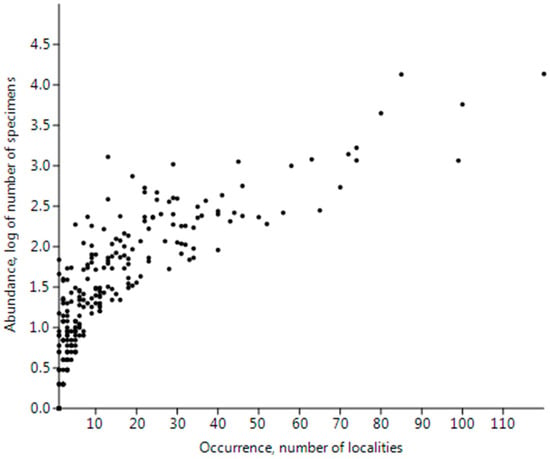
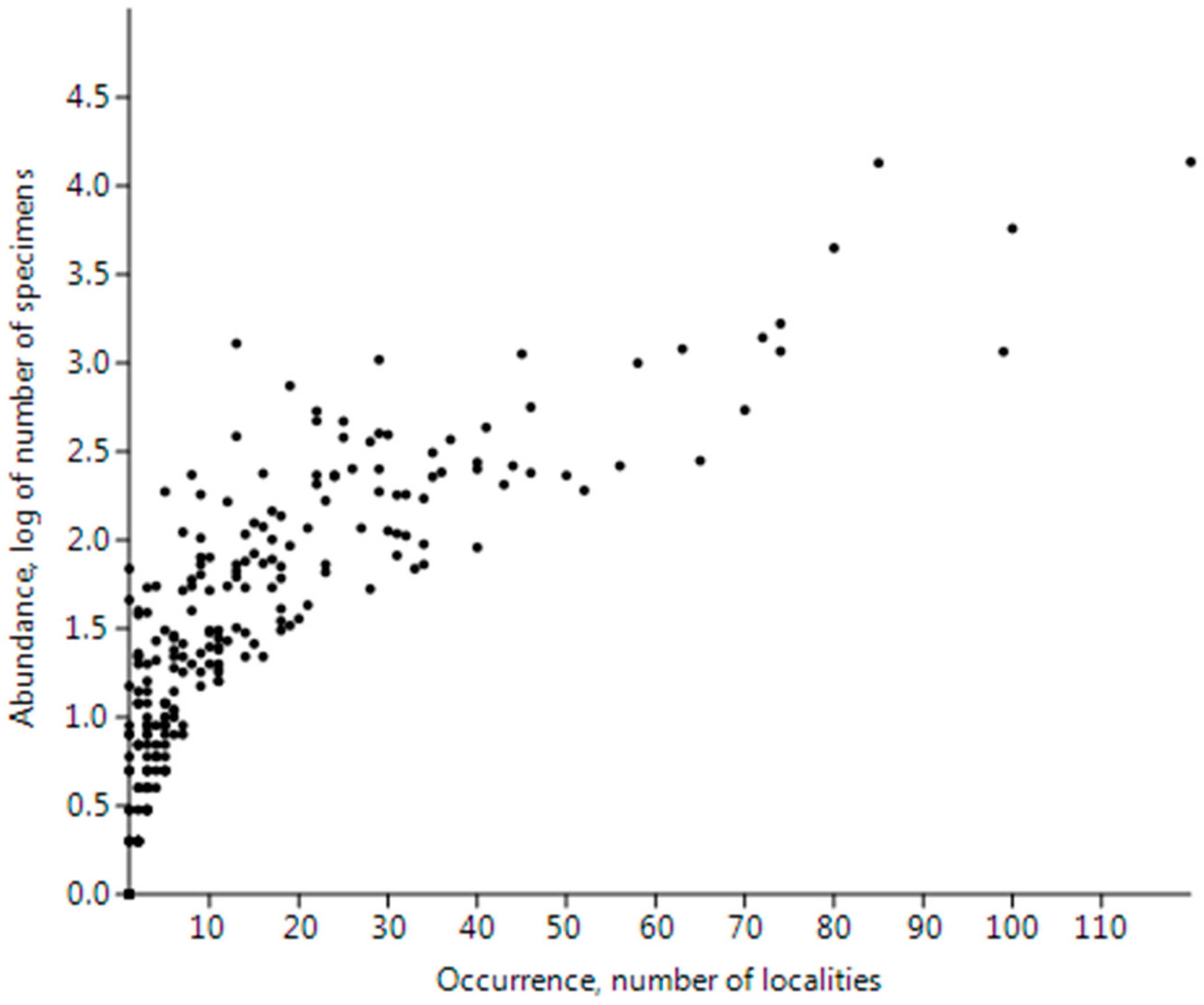
Regional fauna are often analysed using core and satellite hypotheses based on the analysis of species frequency distributions [53]. This approach has been successfully applied to beetles [54,55]. For the obtained dataset, 15 species of beetles found in 50 or more localities were classified as core species in the Republic of Mordovia (Figure 1).
Figure 1.
Occurrence—abundance distribution of ground beetle species in the Republic of Mordovia.
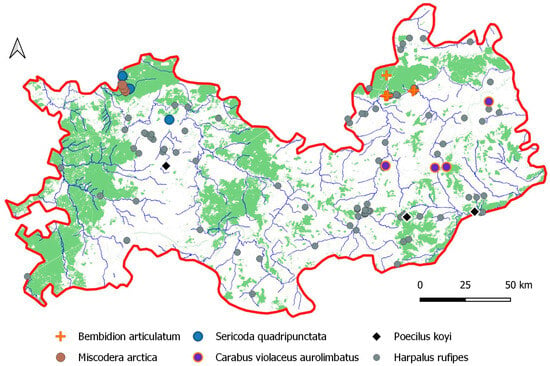
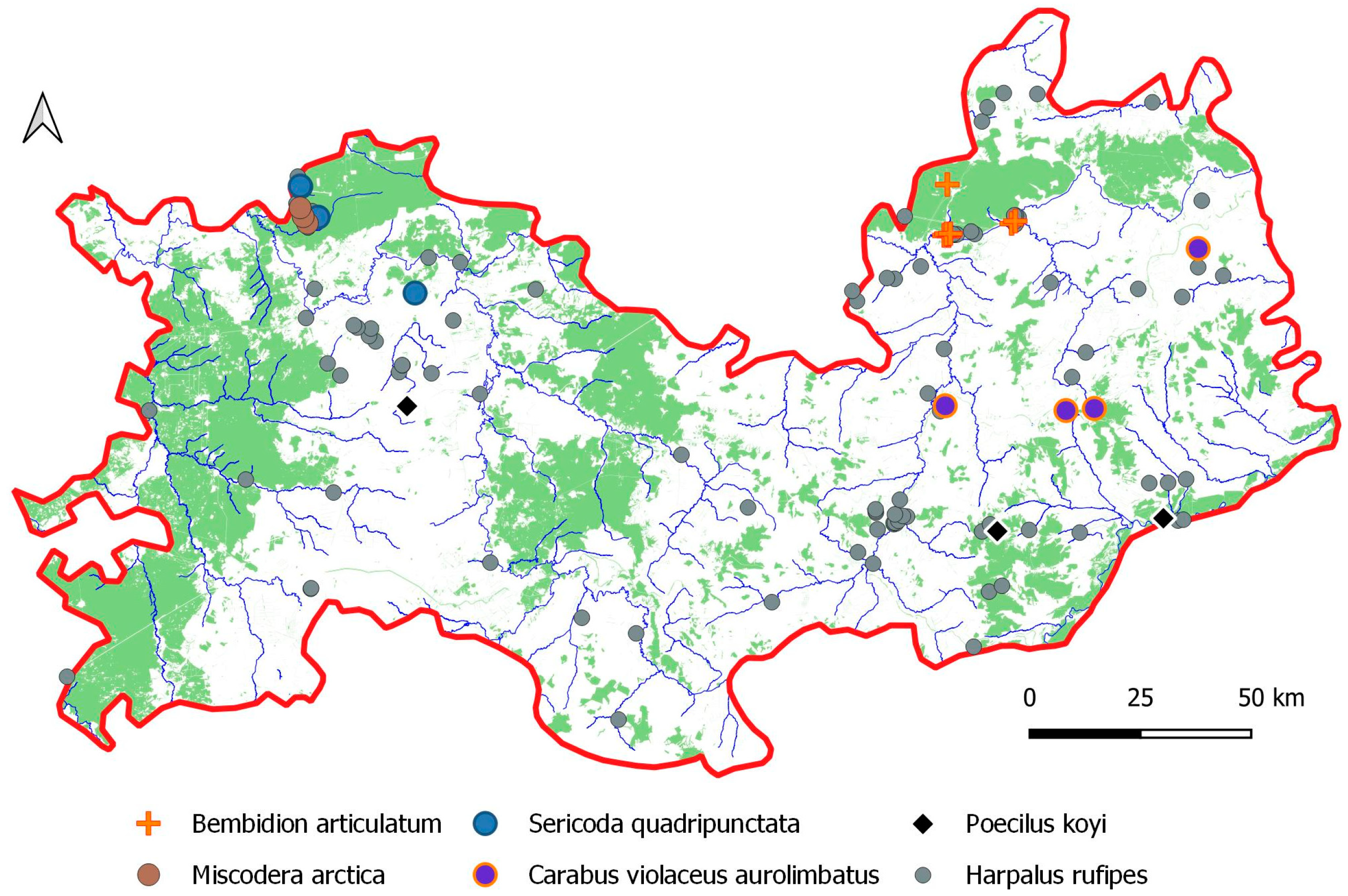
Harpalus rufipes had the highest occurrence level and was found at 120 localities (Figure 2). This accounted for almost 5% of all counted beetles. The high occurrence level and abundance of this species are probably due to both its ecological plasticity and good migratory ability [56,57,58], as well as its catchability using different collection methods. It is a mixophytophage capable of consuming both animal and plant food [59]. It has a polyvariant life cycle, hibernating at both larval and adult stages [60]. Due to this, Harpalus rufipes is a mass species in fields and gardens, but also occurs in floodplains [61] and forests, especially in anthropogenically disturbed forests [62].
Figure 2.
Distribution of the most frequent species, Harpalus rufipes, and some rare species in the Republic of Mordovia.
The second most common species were Pterostichus melanarius and Pterostichus niger. Both species are considered forest generalists and zoophages capable of facultatively consuming plant food [56]. They are zoophagous litter and soil-dwelling stratobionts [63]. The former species are well-adapted to life in the field because of their good burrowing ability, whereas the latter are able to travel long distances and occur in a variety of habitats via foot migration [64,65]. Both species have a polyvariant life cycle, which ensures that their populations are age-diverse and stable [66,67].
Poecilus versicolor belongs to the same group of life forms (zoophagous litter and soil-dwelling stratobionts), and is considered a characteristic of meadows. It is a mass species in some biotopes. Poecilus cupreus, which is close to its morphological and biological features, has a similar occurrence but does not reach such a high abundance. Additionally, among this group of life forms, Pterostichus oblongopunctatus, typical of forests, is at the core of the fauna. Among the smaller zoophagous litter-dwelling stratobionts, Pterostichus strenuus is the most abundant. Among the walking zoophagous epigeobionts, Carabus cancellatus and Carabus granulatus are at the core of the fauna. The first species in the zone of mixed and broad-leaved forests in the European part of Russia is usually considered an inhabitant of open biotopes [62]. However, it generally inhabits well-warmed forests [68].
Such Harpalus-like mixophytophage geohortobionts, such as Harpalus rubripes, Harpalus latus, Amara aenea, Harpalus affinis, Amara communis, and Harpalus tardus, are other species of the core fauna and inhabitants of open habitats. They are able to rapidly colonise suitable habitats by flight and consume both animal and plant food [63].
Thus, a peculiarity of the Republic of Mordovia is the predominance of open biotope species, including myxophytophagous species, in the core fauna, which distinguishes it from the western regions of the midlands [32,33]. In their core fauna, zoophagous and forest species occupy the main place. All representatives of the core are spring breeders sensu latu, or have polyvariant lifecycles.
Species with not very high occurrence but locally abundant include Carabus arvensis baschkiricus, Limodromus assimilis, and Carabus nemoralis. The first beetle is considered a xero-thermophilic species inhabiting well-warmed coniferous forests, clearings, heathlands [68]. L. assimilis is a forest species whose distribution is determined by soil moisture and forest litter [69]. The latter species in the European part of Russia is an inhabitant of anthropogenically disturbed forests and continues to disperse eastward [62,68]. In the Republic of Mordovia, it is characteristic of the forest habitats of Saransk and its surroundings.
The group of single individuals included a quarter of the entire species list in the dataset (62 out of 251). The reasons for their rarity vary. Some species, due to their biological peculiarities, are rarely caught in traps, especially in soil traps. These are, for example, Trechoblemus micros and Dromius spp. Others are apparently rare in this region. Among them, species with single occurrences but relatively high abundance, such as Carabus stscheglowi, and Bembidion striatum, require special attention from the point of view of protection.
This group of rare species is of great interest for analysis. Most of these species are found in different parts of the region with suitable habitats. However, some species, according to the data obtained, have a geographically limited distribution in the region (Figure 2).
Thus, Miscodera arctica is found only in the northwestern part of the Republic (Mordovia State Nature Reserve). In the European part of Russia, it is a stenotopic species inhabiting dry lichen pine forests [70]. Serricoda quadripunctata is found in the same part of the republic, but with a greater move towards the centre. Bembidion articulatum is found in the northeastern part (National Park “Smolny”). Bembidion litorale was found in both territories. These hygrophilous and mesohygrophilous species are probably limited by their confinement to certain biotopes and their limited migration abilities. At the same time, Harpalus froelichi, which is generally considered a thermophilous psammophilous species [71], was found only in the northeastern part of the Republic. Carabus violaceus aurolimbatus, a rare, predominantly forest-steppe taxon that gravitates to open landscapes, was recorded exclusively in the eastern part of the Republic [68]. Finally, Poecilus koyi, for which very little data have been published, is located in the southern half of the Republic from northwest to southeast.
The data obtained can be used to clarify the configuration of the range of beetle species.
3. Methods
3.1. Study Area
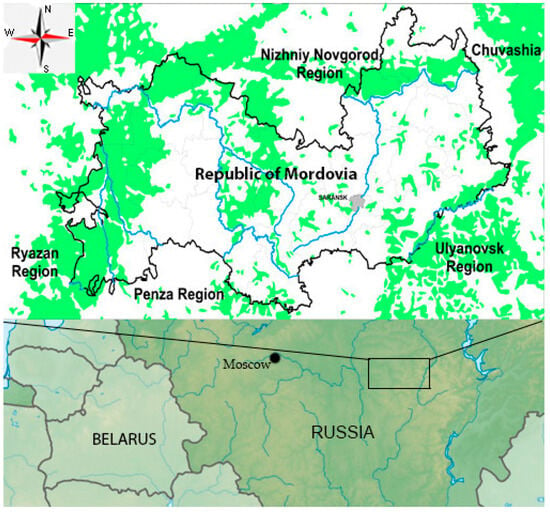
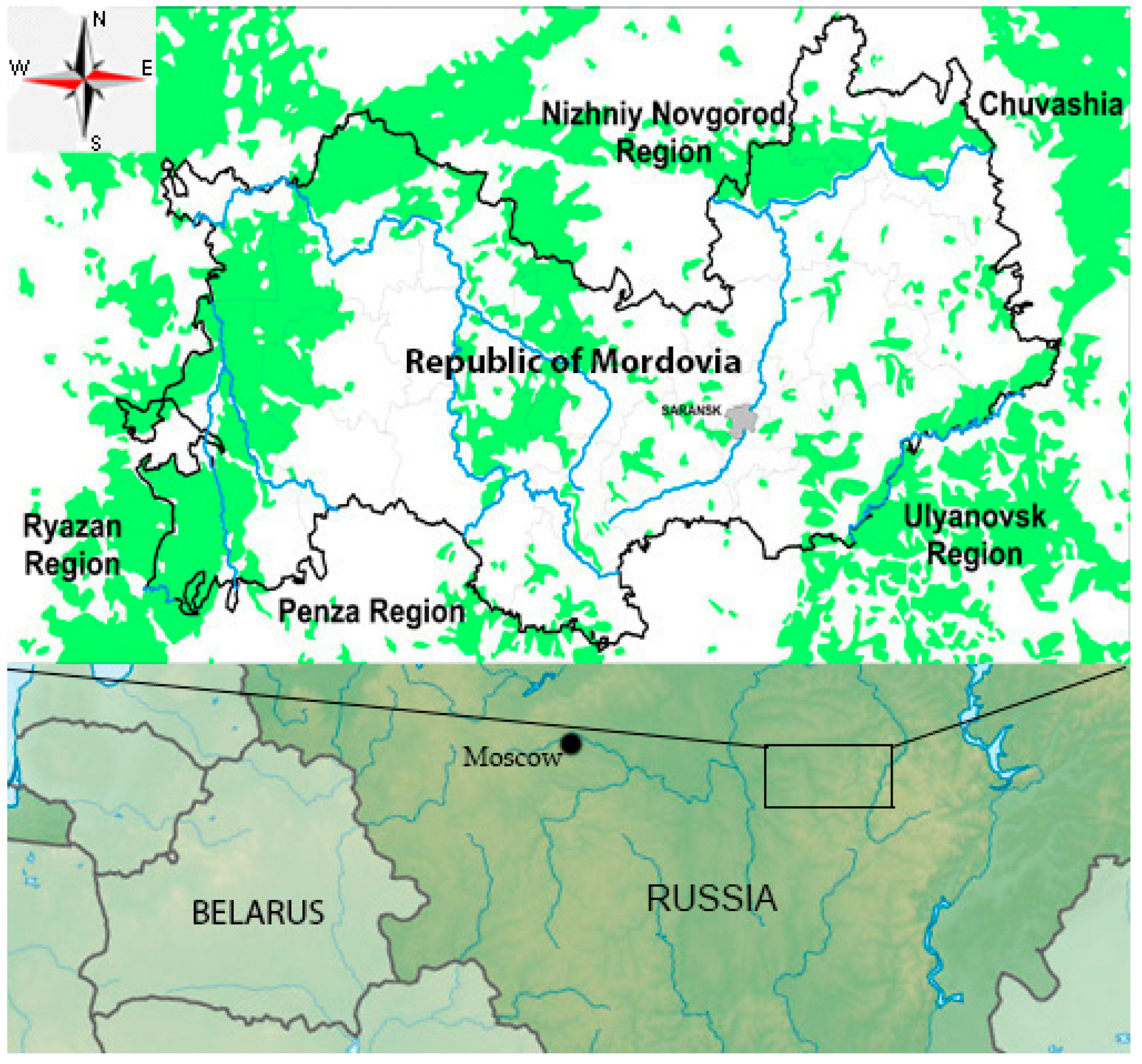
The Republic of Mordovia is located at the junction of the Volga Upland and the Oka-Don Lowlands (Figure 3). The Volga Upland occupies the eastern part of the region and is hilly. The flat surfaces of the watershed massifs had absolute heights ranging from 280 to 320 m. Steep slopes are widespread, where the active demolition of weathering products takes place. The active development of erosion processes has resulted in a significantly dense gully beam network. The Oka-Don lowland is located in the western part of the region, constituting a lower and less hilly plain. The maximum absolute mark rarely exceeded 180 m. The lowlands have wide watershed spaces of up to 10 km and gentle slopes and are poorly dissected by ravines and gullies.
Figure 3.
Study area for obtaining information from the dataset.
The average temperature of the coldest month (January) varied from −11.5 °C to −12.3 °C, and that of the warmest month (July) varied from 18.9 °C to 19.8 °C. Thus, the annual amplitude was 32.1 °C. The average annual air temperature varies from 3.5 °C to 4.0 °C. Three types of air masses participated in the formation of the main features of the climate: Arctic, temperate, and tropical, with a predominance of the second type. Air masses are represented by two varieties: continental and marine. Marine contains a large amount of moisture, and in the cold period, it often causes the formation of thaws, and in the summer, cool weather. The average annual precipitation on the territory of Mordovia is 480 mm. During the long-term observations, periods of higher and lower moisture levels were observed. The deviation between the minimum and maximum values was 180 mm. During the year, precipitation prevailed during the warm period. From April to October, they fell to 80% of the annual norm. The average precipitation in July is approximately 65 mm, and the minimum monthly precipitation is 15–30 mm in February [72].
3.2. Design of Research, Identification and Taxonomic Position of Samples
We used traditional collection methods. We actively used a manual collection of samples using nets, pitfall traps, light fishing, window traps, pan traps, and partial beer traps [73,74]. Pitfall traps were most actively used. These traps were set during April-September 1979, 1987, 2000, 2001, 2005, 2007–2022 years. One trap was a 0.5-L plastic cup containing 200 mL of 4% formalin solution. In different biotopes, we installed from 10 to 20 such traps. The distance between the traps was 1.5–2.0 m. All samples were studied by S.K. Alekseev and L.V. Egorov. Identification was performed according to the methods described by Müller-Motzfeld [75] and Isaev [76]. We followed the proposed nomenclature in the works of Kryzhanovskii et al. [77], Lobl, and Lobl [78].
To estimate the abundance of each species listed in Table 2, the following definitions were used. “Single individual” means that single specimens of a species were found in no more than two localities in a region. “Rare species” refers to species with an abundance of up to 50 specimens occurring in 3–9 localities. “Common species” are species with an abundance of up to 100, found in more than 10 localities. “Numerous species” are Carabidae, with a total abundance of more than 100 specimens occurring in at least 20 percent of studied localities.
Author Contributions
Conceptualization, L.V.E.; methodology, A.B.R., V.V.A. and G.B.S.; software, O.N.A.; validation, A.B.R.; formal analysis, L.V.E., A.B.R. and V.V.A.; investigation, A.B.R., M.N.E., S.V.L., E.A.L. and G.B.S.; resources, A.B.R., S.K.A., M.N.E., S.V.L., E.A.L. and G.B.S.; data curation, S.K.A., M.N.E. and O.N.A.; writing—original draft preparation, A.B.R. and V.V.A.; writing—review and editing, L.V.E. and A.B.R.; visualization, A.B.R.; supervision, L.V.E. and V.V.A.; project administration, A.B.R.; funding acquisition, A.B.R. All authors have read and agreed to the published version of the manuscript.
Funding
This research was funded by Russian Science Foundation, grant number 22-14-00026.
Institutional Review Board Statement
Not applicable.
Informed Consent Statement
Not applicable.
Data Availability Statement
Data is contained within the article.
Acknowledgments
The authors are grateful for scientific advice and assistance in species identification by B.M. Kataev and I.I. Kabak (St. Petersburg, Russia).
Conflicts of Interest
The authors declare no conflict of interest.
References
- Fattorini, S. Faunistic knowledge and insect species loss in an urban area: The tenebrionid beetles of Rome. J. Insect Conserv. 2013, 17, 637–643. [Google Scholar] [CrossRef] [Scilit]
- Ejsmont-Karabin, J. Does the world need faunists? Based on rotifer (Rotifera) occurrence reflections on the role of faunistic research in ecology. Int. Rev. Hydrobiol. 2019, 104, 49–56. [Google Scholar] [CrossRef] [Scilit]
- Isaia, M.; Arnedo, M.A.; Mammola, S. A multi-layered approach uncovers overlooked taxonomic and physiological diversity in Alpine subterranean spiders (Araneae: Linyphiidae: Troglohyphantes). Invertebr. Syst. 2022, 36, 354–371. [Google Scholar] [CrossRef] [Scilit]
- Foley, J.A.; DeFries, R.; Asner, G.P.; Barford, C.; Bonan, G.; Carpenter, S.R.; Chapin, F.S.; Coe, M.T.; Daily, G.C.; Gibbs, H.K.; et al. Global consequences of land use. Science 2005, 309, 570–574. [Google Scholar] [CrossRef] [Scilit]
- Shinkarenko, S.S. Influence of the climatic factors on the mass flowering dates of Bulbocodium versicolor (Melanthiaceae) at the south-eastern border of its range. Nat. Conserv. Res. 2022, 7, 26–45. [Google Scholar] [CrossRef] [Scilit]
- Adom, D. Catch them young: Children as bearers of indigenous ecological knowledge for biodiversity conservation in Ghana. J. Wildl. Biodivers. 2022, 6, 12–25. [Google Scholar] [CrossRef]
- Caminha-Paiva, D.; Gomes, V.M.; Cunha-Blum Alves, M.J.P.; Rosa, D.C.P.; Santiago, J.C.; Negreiros, D.; Fernandes, G.W. Floristic mosaics of the threatened Brazilian Campo rupestre. Nat. Conserv. Res. 2022, 7, 10–18. [Google Scholar] [CrossRef] [Scilit]
- Tscharntke, T.; Brandl, R. Plant–insect interactions in fragmented landscapes. Annu. Rev. Entomol. 2004, 49, 405–430. [Google Scholar] [CrossRef] [Scilit]
- Ribeiro, M.C.; Metzger, J.P.; Martensen, A.C.; Ponzoni, F.J.; Hirota, M.M. The Brazilian Atlantic forest: How much is left, and how is the remaining forest distributed? Implications for conservation. Biol. Conserv. 2009, 142, 1141–1153. [Google Scholar] [CrossRef] [Scilit]
- Steffan-Dewenter, I. Landscape context affects trap-nesting bees, wasps, and their natural enemies. Ecol. Entomol. 2002, 27, 631–637. [Google Scholar] [CrossRef] [Scilit]
- Zouaimia, A.; Adjami, Y.; Zebsa, R.; Youcefi, A.; Bensakhri, Z.; Bensouilah, S.; Amari, H.; Ouakid, M.-L.; Houhamdi, M.; Mahdjoub, H.; et al. Phenology of the regionally Critically Endangered dragonfly Urothemis edwardsii in the National Park of El Kala, Northeast of Algeria. Nat. Conserv. Res. 2022, 7, 1–9. [Google Scholar] [CrossRef] [Scilit]
- Ruchin, A.B.; Alekseev, S.K.; Khapugin, A.A. Post-fire fauna of carabid beetles (Coleoptera, Carabidae) in forests of the Mordovia State Nature Reserve (Russia). Nat. Conserv. Res. 2019, 4, 11–20. [Google Scholar] [CrossRef] [Scilit]
- Dedyukhin, S.V. Fauna and biotopic distribution of weevils (Coleoptera: Curculionoidea) of the Zhiguli State Nature Reserve, Russia. Nat. Conserv. Res. 2022, 7, 55–69. [Google Scholar] [CrossRef] [Scilit]
- Varet, M.; Burel, F.; Pétillon, J. Can urban consolidation limit local biodiversity erosion? Responses from carabid beetle and spider assemblages in Western France. Urban Ecosyst. 2014, 17, 123–137. [Google Scholar] [CrossRef] [Scilit]
- Trujillo-Arias, N.; Serrano-Cardozo, V.H.; Ramírez-Pinilla, M.P. Role of a campesine reserve zone in the Magdalena Valley (Colombia) in the conservation of endangered tropical rainforests. Nat. Conserv. Res. 2023, 8, 49–63. [Google Scholar] [CrossRef] [Scilit]
- Juiling, S.; Leon, S.K.; Jumian, J.; Tsen, S.; Lee, Y.L.; Khoo, E.; Sugau, J.B.; Nilus, R.; Pereira, J.T.; Damit, A.; et al. Conservation assessment and spatial distribution of endemic orchids in Sabah, Borneo. Nat. Conserv. Res. 2020, 5, 136–144. [Google Scholar] [CrossRef] [Scilit]
- Sushchuk, A.A.; Matveeva, E.M. Soil nematodes of coniferous forests in the Finnish-Russian Friendship Nature Reserve. Nat. Conserv. Res. 2021, 6, 76–88. [Google Scholar] [CrossRef] [Scilit]
- Liu, X.; Wang, X.; Bai, M.; Shaw, J.J. Decrease in carabid beetles in grasslands of Northwestern China: Further evidence of insect biodiversity loss. Insects 2022, 13, 35. [Google Scholar] [CrossRef] [Scilit]
- Gordienko, T.A.; Vavilov, D.N.; Lukyanova, Y.A. Structural organization of the community of land and soil invertebrates in natural and disturbed areas of Tanayev meadows of the Nizhnaya Kama National Park. Proc. Mordovia State Nat. Reserve 2021, 29, 38–50. [Google Scholar]
- Parhomenko, O.; Langraf, V.; Petrovičová, K.; Komlyk, V.; Brygadyrenko, V. Morphometric variability of ground beetles Bembidion minimum (Coleoptera, Carabidae): Who should change more, males or females? Nat. Conserv. Res. 2022, 7, 42–69. [Google Scholar] [CrossRef] [Scilit]
- Rischen, T.; Ehringhausen, K.; Heyer, M.; Fischer, K. Responses of selected beetle families (Carabidae, Chrysomelidae, Curculionidae) to non-crop habitats in an agricultural landscape. Biologia 2022, 77, 2149–2159. [Google Scholar] [CrossRef] [Scilit]
- Pozsgai, G.; Quinzo-Ortega, L.; Littlewood, N.A. Grazing impacts on ground beetle (Coleoptera: Carabidae) abundance and diversity on semi-natural grassland. Insect Conserv. Divers. 2021, 15, 36–47. [Google Scholar] [CrossRef] [Scilit]
- Avtaeva, T.A.; Sukhodolskaya, R.A.; Brygadyrenko, V.V. Modeling the bioclimatic range of Pterostichus melanarius (Coleoptera, Carabidae) in conditions of global climate change. Biosyst. Divers. 2021, 29, 140–150. [Google Scholar] [CrossRef] [Scilit]
- Porhajašová, J.I.; Babošová, M. Impact of arable farming management on the biodiversity of Carabidae (Coleoptera). Saudi J. Biol. Sci. Press. 2022, 29, 103371. [Google Scholar] [CrossRef] [Scilit] [PubMed]
- Anselmo, L.; Rizzioli, B. Side threats: Further possible effects of warming on the high alpine narrow endemic Carabus cychroides (Coleoptera: Carabidae). Nat. Conserv. Res. 2022, 7, 88–94. [Google Scholar] [CrossRef] [Scilit]
- Brooks, D.R.; Bater, J.E.; Clark, S.J.; Monteith, D.T.; Andrews, C.; Corbett, S.J.; Beaumont, D.A.; Chapman, J.W. Large carabid beetle declines in a United Kingdom monitoring network increases evidence for a widespread loss in insect biodiversity. J. Appl. Ecol. 2012, 49, 1009–1019. [Google Scholar] [CrossRef] [Scilit]
- Baranová, B.; Manko, P.; Jászay, T. Waste dumps as local biodiversity hotspots for soil macrofauna and ground beetles (Coleoptera: Carabidae) in the agricultural landscape. Ecol. Eng. 2015, 81, 1–13. [Google Scholar] [CrossRef] [Scilit]
- Koivula, M.J. Useful model organisms, indicators, or both? Ground beetles (Coleoptera, Carabidae) reflecting environmental conditions. ZooKeys 2011, 100, 287–317. [Google Scholar] [CrossRef] [Scilit]
- Ruchin, A.; Alekseev, S.; Khapugin, A.; Esin, M. Fauna and species diversity of ground beetles (Coleoptera, Carabidae) in meadows. Entomol. Appl. Sci. Lett. 2021, 8, 28–39. [Google Scholar] [CrossRef] [Scilit]
- Khalimov, F. The ground beetles (Coleoptera, Carabidae) of the Karatepa and Chakilkalyan mountains (west part of Zarafshan Mountains Range, Uzbekistan). Biosyst. Divers. 2020, 28, 265–271. [Google Scholar] [CrossRef] [Scilit]
- Sundukov, Y.N.; Makarov, K.V. The ground beetles of the tribus Trechini (Carabidae) on the Southern Kuril Islands. Nat. Conserv. Res. 2021, 6, 15–51. [Google Scholar] [CrossRef] [Scilit]
- Shashkov, M.; Alexeev, S.; Ivanova, N. Communities of ground beetles (Carabidae, Coleoptera) in broad-leaved forests of protected and urban areas of the Kaluga Oblast (European Russia). Biodivers. Data J. 2020, 8, e58688. [Google Scholar] [CrossRef] [Scilit] [PubMed]
- Aleksanov, V.; Alekseev, S.; Shashkov, M. Ground beetles (Carabidae) in urban habitats of Kaluga City (Russia). Biodivers. Data J. 2022, 1, e76100. [Google Scholar] [CrossRef] [Scilit] [PubMed]
- Avtaeva, T. Family Carabidae of the Chechen Republic. Version 1.1; Occurrence Dataset; Complex Institute named after Kh.I. Ibragimov of the Russian Academy of Sciences: Groznyi, Russia, 2019. [Google Scholar] [CrossRef]
- Makarov, K.; Matalin, A. Carabid beetles of the environs of Lake Elton: Fauna, population dynamics, demography. Biodivers. Data J. 2020, 8, e58297. [Google Scholar] [CrossRef] [Scilit]
- Vavilov, D. Ground Beetles (Coleoptera, Carabidae) of “Volzhskiye Prostory” Reserve. Version 1.1.; Occurrence Dataset; Research Institute for Problems of Ecology and Mineral Wealth Use of Tatarstan Academy of Sciences: Kazan, Russia, 2020. [Google Scholar] [CrossRef]
- Ruchin, A.; Alekseev, S.; Egorov, L.; Artaev, O.; Semishin, G.; Esin, M. Ground beetle fauna (Coleoptera, Carabidae) of Mordovia State Nature Reserve (Russia). Biodivers. Data J. 2021, 9, e69807. [Google Scholar] [CrossRef] [Scilit] [PubMed]
- Ruchin, A.B.; Alekseev, S.K.; Artaev, O.N.; Khapugin, A.A.; Lobachev, E.A.; Lukiyanov, S.V.; Semishin, G.B. Dataset: Fauna of adult ground beetles (Coleoptera, Carabidae) of the National Park “Smolny” (Russia). Data 2022, 7, 84. [Google Scholar] [CrossRef] [Scilit]
- Egorov, L.; Alekseev, S.; Aleksanov, V.; Ruchin, A.; Esin, M.; Lukiyanov, S.; Lobachev, E.; Artaev, O.; Semishin, G. Fauna of ground beetles (Coleoptera, Carabidae) of the Republic of Mordovia (Russia); Occurrence Dataset; Joint Directorate of the Mordovia State Nature Reserve and National Park “Smolny”: Smolny, Russia, 2023. [Google Scholar] [CrossRef]
- Budilov, V.V.; Budilov, P.V. Spatial and Temporal Distribution of Carabidofauna (Coleoptera, Carabidae) in Agrocenoses of the Middle Volga Region; Mordovia Book Publishing: Saransk, Russia, 2007; 132p. [Google Scholar]
- Chegodaeva, N.D. The Influence of Protective Forest Strips on the Number and Species Composition of Ground Beetles of the adjacent Barley Field. In Animal Ecology and Problems of Regional Education; Mordovia State University: Saransk, Russia, 1998; pp. 79–83. [Google Scholar]
- Feoktistov, V.F. Fauna of Carabidae (Coleoptera) of the Mordovia State Nature Reserve. Izv. Samara Sci. Cent. Russ. Acad. Sci. 2008, 10, 145–149. [Google Scholar]
- Egorov, L.V.; Ruchin, A.B.; Semenov, V.B.; Semionenkov, O.I.; Semishin, G.B. Checklist of the Coleoptera of Mordovia State Nature Reserve, Russia. ZooKeys 2020, 962, 13–122. [Google Scholar] [CrossRef] [Scilit]
- Timraleev, Z.A.; Chikina, T.V.; Rusyaeva, I.N. Ground Beetles (Coleopera, Carabidae) in Steppe Biotopes of Mordovia; Dep. in VINITI 25. 01.89. No. 617-In 89; Mordovia State University: Saransk, Russia, 1989; 14p. [Google Scholar]
- Makunina, L.S. Distribution of Ground Beetles (Coleoptera, Carabidae) along the Slope Profile of the Pishlya River Valley in the Middle Volga Region. In Problems of Soil Zoology; M.: KMK Publ.: Moscow, Russia, 2002; p. 108. [Google Scholar]
- Kiselev, I.E. Species Composition and Ecological Structure of Carabidocomplexes of the Main Microstations of the City. In Animal Ecology and Problems of Regional Education: Materials of the XXXIV Scientific Conference of Teachers and Students “Evsevev Readings”, Date, Location; Mordovia State University: Saransk, Russia, 1998; pp. 35–37. [Google Scholar]
- Timraleev, Z.A. Ground Beetles (Coleopera, Carabidae) of the Agrocenosis of Winter Rye in Mordovia; Dep. in VINITI 18.09.86. No. 6705-In 86; Mordovia State University: Saransk, Russia, 1986; 19p. [Google Scholar]
- Timraleev, Z.A.; Aryukov, V.A.; Bardin, O.D. Comparative analysis of the fauna and population of ground beetles (Coleopera, Carabidae) of meadows and agrocenoses of Mordovia. Zool. J. 2002, 81, 1517–1522. [Google Scholar]
- Timraleev, Z.A. Harmful and Useful Insects of Grain Crops of the South of the Non-Chernozem Zone of Russia; Mordovia State University Publishing: Saransk, Russia, 1992; 184p. [Google Scholar]
- Makarov, K.V.; Kryzhanovskiy, O.L.; Belousov, I.A.; Zamotajlov, A.S.; Kabak, I.I.; Kataev, B.M.; Shilenkov, V.G.; Matalin, A.V.; Fedorenko, D.N. Taxonomical List of Ground Beetles (Carabidae) of Russia. 2020. Available online: http://www.zin.ru/Animalia/Coleoptera/rus/car_rus.htm (accessed on 25 May 2020). (In Russian)
- Zherebtsov, A.K. Keys to Ground Beetles (Coleoptera, Carabidae) of the Republic of Tatarstan; Kazan State University: Kazan, Russia, 2000; 74p. [Google Scholar]
- Trushitsyna, O.S.; Morozova, A.Y. Ground beetle Carabus marginalis Fabricius, 1794 (Coleoptera, Carabidae)—A new species of the Ryazan region. Tr. Okskogo Zapov. 2019, 38, 358–360. [Google Scholar]
- Hanski, I. Dynamics of regional distribution: The core and satellite species hypothesis. Oikos 1982, 38, 210–221. [Google Scholar] [CrossRef] [Scilit]
- Niemelä, J.K.; Spence, J.R. Distribution of forest dwelling carabids (Coleoptera): Spatial scale and the concept of communities. Ecography 1994, 17, 166–175. [Google Scholar] [CrossRef] [Scilit]
- Ulrich, W.; Zalewski, M. Abundance and co-occurrence patterns of core and satellite species of ground beetles on small lake islands. Oikos 2006, 114, 338–348. [Google Scholar] [CrossRef] [Scilit]
- Wallin, H.; Ekbom, B.S. Movements of carabid beetles (Coleoptera: Carabidae) inhabiting cereal fields: A field tracing study. Oecologia 1988, 77, 39–43. [Google Scholar] [CrossRef] [Scilit]
- Zhang, J.; Drummond, F.A.; Liebman, M.; Hartke, A. Phenology and dispersal of Harpalus rufipes De Geer (Coleoptera: Carabidae) in agroecosystems in Maine. J. Agric. Entomol. 1997, 14, 171–186. [Google Scholar]
- Kujawa, K.; Sobczyk, D.; Kajak, A. Dispersal of Harpalus rufipes (Degeer) (Carabidae) between shelterbelt and cereal field. Pol. J. Ecol. 2006, 54, 243–252. [Google Scholar]
- Brygadyrenko, V.V.; Reshetniak, D.Y. Trophic preferences of Harpalus rufipes (Coleoptera, Carabidae) with regard to seeds of agricultural crops in conditions of laboratory experiment. Balt. J. Coleopterol. 2014, 14, 179–190. [Google Scholar]
- Matalin, A.V. Specific features of life cycle of Pseudoophonus (s. str.) rufipes Deg. (Coleoptera, Carabidae) in Southwest Moldova. Biol. Bull. Russ. Acad. Sci. 1997, 24, 371–381. [Google Scholar]
- Makarov, K.V.; Matalin, A.V. Ground-Beetle Communities in the Lake Elton Region, Southern Russia: A Case Study of a Local Fauna (Coleoptera, Carabidae). Species and Communities in Extreme Environments. In Festschrift towards the 75th Anniversary and a Laudatio in Honour of Academician Yuri Ivanovich Chernov; Pensoft Publishers & KMK Scientific Press Ltd.: Sofia, Bulgaria; Moscow, Russia, 2009; pp. 357–384. [Google Scholar]
- Gryuntal, S. Organization of Communities of Ground Beetles (Coleoptera, Carabidae) of Forest Biogeocenoses of the East European (Russian) Plain; Galleya-Print: Moscow, Russia, 2008; 484p. (In Russian) [Google Scholar]
- Sharova, I.K. Life Forms of Ground Beetles (Coleoptera, Carabidae); Nauka: Moscow, Russia, 1981; 243p. [Google Scholar]
- Wallin, H. Spatial and temporal distribution of some abundance carabid beetles (Col., Carabidae) in cereal fields and adjacent habitats. Pedobiologia 1985, 28, 19–34. [Google Scholar]
- Thomas, C.F.G.; Green, F.; Marshall, E.J.P. Distribution, dispersal and population size of the ground beetles, Pterostichus melanarius (Illiger) and Harpalus rufipes (Degeer) (Coleoptera, Carabidae), in field margin habitats. Biol. Agric. Hortic. 1997, 15, 337–352. [Google Scholar] [CrossRef] [Scilit]
- Matalin, A.V. Geographic variability of the life cycle in Pterostichus melanarius (Coleoptera, Carabidae). Entomol. Rev. 2006, 86, 409–422. [Google Scholar] [CrossRef] [Scilit]
- Matalin, A.V. The Life Cycles of Grounds Beetles (Coleoptera, Carabidae) in West Palaearctic. Ph.D. Thesis, Moscow State Pedagogical University, Moscow, Russaia, 2011; 549p. [Google Scholar]
- Turin, H.; Penev, L.; Casale, A. (Eds.) The Genus Carabus in Europe: A Synthesis; Pensoft: Sofia, Bulgaria; Moscow, Russia, 2003; 511p. [Google Scholar]
- Antvogel, H.; Bonn, A. Environmental parameters and microspatial distribution of insects: A case study of carabids in an alluvial forest. Ecography 2001, 24, 470–482. [Google Scholar] [CrossRef] [Scilit]
- Alekseev, S.K. Miscodera Arctica. Red Data Book of Kaluga Region; OOO «Vash Dom»: Kaluga, Russia, 2017; pp. 55–56. [Google Scholar]
- Lindroth, C.H. Ground Beetles (Carabidae) of Fennoscandia: A Zoogeographic Study: Part 1. Specific Knowledge Regarding the Species; Amerind Publisher Co. Pvt. Ltd.: New Delhi, India, 1992; Volume xxviii, 630p. [Google Scholar]
- Yamashkin, A.A.; Ruzhenkov, V.V.; Yamashkin, A.A. Geography of the Republic of Mordovia; MGU Publishing: Saransk, Russia, 2004; 168p. [Google Scholar]
- Golub, V.B.; Tsurikov, M.N.; Prokin, A.A. Insect Collections: Collection, Processing and Storage of Material; KMK Scientific Press Ltd.: Moscow, Russia, 2012; 339p. [Google Scholar]
- Ruchin, A.B.; Egorov, L.V.; Khapugin, A.A.; Vikhrev, N.E.; Esin, M.N. The use of simple crown traps for the insects collection. Nat. Conserv. Res. 2020, 5, 87–108. [Google Scholar] [CrossRef] [Scilit]
- Müller-Motzfeld, G. Bd. 2, Adephaga 1: Carabidae (Laufkäfer). In Die Käfer Mitteleuropas; Freude, H., Harde, K.W., Lohse, G.A., Klausnitzer, B., Eds.; Spektrum: Heidelberg/Berlin, Germany, 2004. [Google Scholar]
- Isaev, A.Y. Keys to Coleoptera of the Middle Volga Region. Part 1. Adephaga and Myxophaga; Series Nature of the Ulyanovsk Region; Ulyanovsk State University: Ulyanovsk, Russia, 2002; pp. 1–120. (In Russian) [Google Scholar]
- Kryzhanovskij, O.L.; Belousov, I.A.; Kabak, I.I.; Kataev, B.M.; Makarov, K.V.; Shilenkov, V.G. A Checklist of the Ground-Beetles of Russia and Adjacent Lands (Insecta, Coleoptera, Carabidae); Pensoft: Sofia, Bulgaria; Moscow, Russia, 1995; 271p. [Google Scholar]
- Lobl, I.; Lobl, D. Catalogue of Palaearctic Coleoptera—Volume 1; Revised and Updated Edition. Brill Online 2017, 1, 1–617. [Google Scholar] [CrossRef]

Disclaimer/Publisher’s Note: The statements, opinions and data contained in all publications are solely those of the individual author(s) and contributor(s) and not of MDPI and/or the editor(s). MDPI and/or the editor(s) disclaim responsibility for any injury to people or property resulting from any ideas, methods, instructions or products referred to in the content. |
© 2023 by the authors. Licensee MDPI, Basel, Switzerland. This article is an open access article distributed under the terms and conditions of the Creative Commons Attribution (CC BY) license (https://creativecommons.org/licenses/by/4.0/).