


Abstract
Singlish is a code-mixed creole formed from English and multiple Asian languages and dialects, predominantly spoken in Singapore. Translation of Singlish to standard UK English broadens comprehension of the creole and supports downstream analyses such as sentiment analysis, yet few annotated resources exist for this purpose. We present a dataset of 2788 Singlish Short Messaging Service (SMS) texts sampled from the NUS SMS Corpus, each paired with (1) native-speaker annotations of the non-English languages present and their corresponding spans, (2) native-speaker translations into standard English, and (3) Large Language Model (LLM)-generated language-detection and translation outputs produced by five open-source models (Mistral-7B, LLaMA-3.1, Gemma-2, Qwen-2.5 and Phi-3.5) using a multi-step prompting pipeline. We describe the data collection, annotation, and LLM-generation protocols, and technically validate the LLM-generated layers against the native-speaker references using BLEU, ROUGE, and BERTScore, finding an average BERTScore F1 of 0.90. This dataset supports research on code-mixed and creole machine translation, automatic language identification, and the evaluation of LLMs on low-resource, code-mixed language varieties, and enables downstream applications such as sentiment analysis of Singlish text.
Dataset:
https://doi.org/10.5281/zenodo.22657729.
Dataset License: CC-BY
1. Summary
This Data Descriptor presents a dataset of Singlish Short Messaging Service (SMS) texts paired with expert language annotations, expert English translations, and Large Language Model (LLM)-generated translation and language-detection outputs, intended to support research on code-mixed creole translation and automatic language identification.
Singlish is a creole formed from code-mixing English with other Asian languages. Singlish is predominantly spoken in Singapore and Singaporean diasporas around the world. The creole arose as an artifact of colloquial English communication within a multicultural society. Singlish incorporates phrases and sentence structures influenced by regional languages and dialects, such as Malay and Chinese, which is a result of the movement of people within southeast Asia [1]. As such, Singlish is a code-mixed language that deviates significantly from its substrate language; English speakers who are familiar with only the American or British variants of English tend to have difficulty understanding Singlish [2].
A code-mixed sentence is one that comprises vocabulary from different languages and language variants [3]. The code-mixed sentence can also assume the grammar structure of its superstrate languages while comprising only English terms. As a result, for the Singlish language, non-Singlish speakers might find it difficult to fully understand a Singlish sentence even if it only comprises English words. For example, the Singlish phrase “what talking you” loosely translates to “what are you talking about”, and typically conveys feelings of frustration and disdain, which is not obvious to non-Singlish speakers. Developing tools and resources to computationally translate code-mixed languages contributes to the comprehension of the Singlish creole, and to social understanding of the cultures of its native speakers. Such resources can also improve Artificial Intelligent (AI) chat assistants [4], and multi-agent social systems [5] to better comprehend commands written in Singlish and respond to users appropriately.
Prior computational work on code-mixed translation has largely relied on pre-trained multilingual language models such as mBERT and XLM-R [6,7], and, more recently, on LLM-based prompting approaches for other code-mixed language pairs [8,9]. However, past studies of code-mixed translation mostly considered a single non-English language paired with English within a sentence [10,11], whereas Singlish uniquely comprises multiple south-Asian languages (i.e., Chinese, Cantonese, Malay, Hindi) alongside English within a single sentence. Existing Singlish-specific resources remain limited: Chow et al. [12] developed a Singlish dictionary aided by ChatGPT (OpenAI, 2023); Wang et al. [13] evaluated a multicultural understanding model on a Singlish-to-English translation task; Liu et al. [2] attempted Singlish-to-English translation with a BART model (METEOR score of 81.6); and Foo and Ng [14] found that GPT-2-based translation of Singlish Reddit texts was often inaccurate. None of these prior efforts released a large, expertly annotated Singlish SMS dataset that pairs Source Text with both language-span labels and reference translations, and that also provides an LLM-generated annotation layer for benchmarking—a gap this Data Descriptor addresses.
Translating Singlish to English increases the accessibility and understanding of the language beyond the southeast-Asian region. We therefore constructed and describe here a dataset derived from text messages written in Singlish, expertly annotated with language spans and reference translations, and enriched with LLM-generated translation and language-detection outputs produced via a multi-step prompting pipeline (Section 3). We technically validate these LLM-generated layers against the native-speaker references (Section 3.3), and describe the dataset’s composition and reuse potential in Section 2 and Section 4.
1.1. Dataset Contributions
This dataset, and the multi-step LLM annotation pipeline used to help produce it, make the following contributions:
1.1.1. Data Contribution
We release a dataset of SMS texts written in Singlish, comprising the following: (1) Source Texts sampled from the NUS-SMS-Corpus; (2) native-speaker annotations indicating the languages code-mixed within each sentence; (3) native-speaker Reference Texts translating each sentence into standard UK English; and (4) an LLM-generated layer of language-detection and translation outputs from five open-source models. This dataset can be used to study the Singlish creole itself (e.g., its lexical variety or the uniqueness of borrowed sentence structures), to train or evaluate code-mixed translation and language-identification systems, and to benchmark LLMs on a genuinely multilingual, low-resource creole.
1.1.2. Methodological Contribution
As a secondary contribution to the dataset itself, we contribute a reusable multi-step LLM-prompting pipeline—a language-detection step followed by a translation step—for enriching code-mixed datasets with an additional, model-generated annotation layer. This methodology produced LLM translations that achieved a high semantic similarity to the expertly annotated Reference Texts (average BERTScore F1 = 0.90), and it also surfaces the languages code-mixed within a sentence, paving the way for data-driven interpretations of Singlish texts and translations. We did not ablate this two-step design against direct single-step Singlish-to-English prompting, so we present it here as one working method for producing the LLM-generated layer with this dataset, rather than a demonstrated improvement over simpler prompting.
2. Data Description
The dataset comprises five components, summarized in Table 1: (1) Source Texts, (2) native-speaker language-span annotations, (3) native-speaker Reference Texts, (4) LLM-generated language-detection outputs, and (5) LLM-generated translation outputs. The collection and annotation protocols for each component are described in Section 3.
Table 1.
Summary of the dataset components released with this Data Descriptor.
The Source Texts are 2788 Singlish SMS messages, each at least 20 words long, randomly sampled from the NUS-SMS-Corpus [15]. Each Source Text is paired one-to-one with a native-speaker Reference Text (a standard-English translation) and with native-speaker language-span annotations identifying which portions of the sentence, if any, were written in Chinese, Malay, Indonesian, Hokkien, Cantonese, or Teochew. In addition, each Source Text is paired with five LLM-generated language-detection records and five LLM-generated translation records, one per model (Mistral-7B, LLaMA-3.1, Gemma-2, Qwen-2.5 and Phi-3.5; see Section 3), yielding derived records per task. These LLM-generated records can be used as-is or as a benchmark for future code-mixed translation and language-identification systems, and their quality is technically validated in Section 3.3.
3. Methods
This section describes how the Source Texts were sampled, how the Reference Texts and language annotations were produced, how the LLM-generated language-detection and translation layers were generated, and how those LLM-generated layers were technically validated.
3.1. Data Collection and Annotation
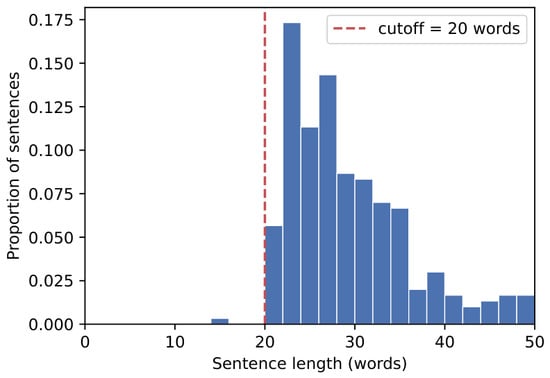
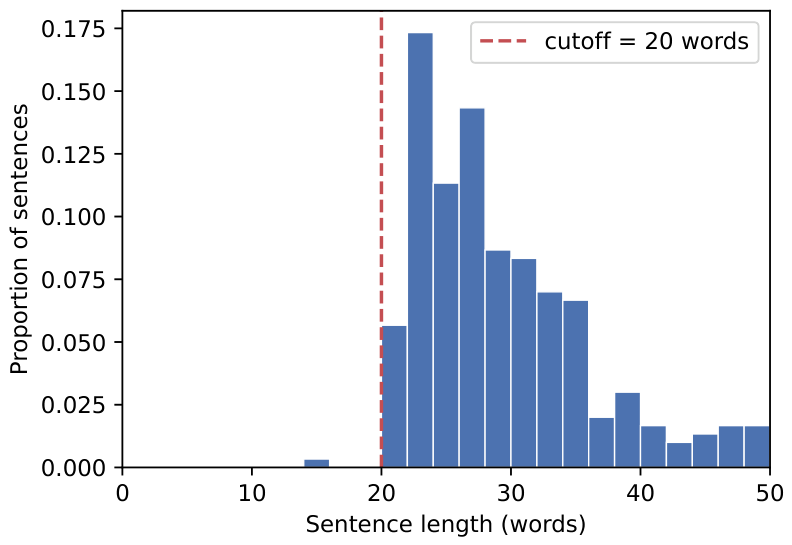
The Source Texts (Section 2) were obtained from the NUS-SMS-Corpus [15], a compilation of the use of Singlish in Short Messaging Service (SMS) texts. This corpus represented how Singlish is used in daily text conversations. We randomly sampled 2788 sentences with more than 20 words to form the Source Texts. We required a minimum length of 20 words because shorter SMS texts in the source corpus were disproportionately single-language, single-clause messages that were rarely code-mixed (e.g., greetings, acknowledgments). These sentences are, by construction of the Singlish creole, linguistically and lexically diverse. The sampled sentence totaled approximately 9514 words with a mean of 31.7 words per sentence. These sentences drew on a vocabulary of roughly 2827 unique tokens, and 6.3% of the sentences contained two or more non-English languages. The distribution of the sentence lengths are presented in Figure 1.
Figure 1.
Distribution of sentence lengths of Source Texts (words per sentence).
To create the Reference Texts, we recruited three native Singlish speakers who had a Bachelors’ education in university with English as a medium of instruction. The speakers annotated the portions of the Source Texts that were written in languages other than English. These languages include the following: Chinese, Malay, Indonesian, and Chinese dialects (Hokkien and Teochew). Then, the speakers translated the Singlish sentence into formal English. These annotators worked independently for both language and translation tasks, then cross-checked the results, and discussed any differences before coming to an agreement.
3.2. Multi-Step LLM Prompting for the Language-Detection and Translation Layers
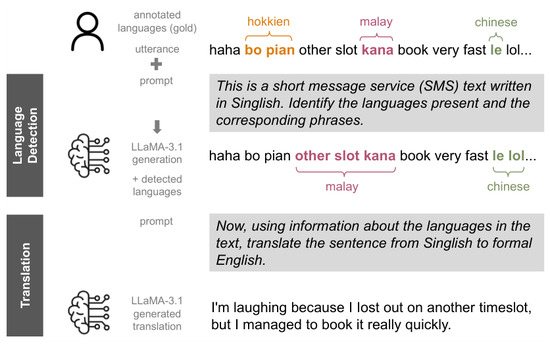
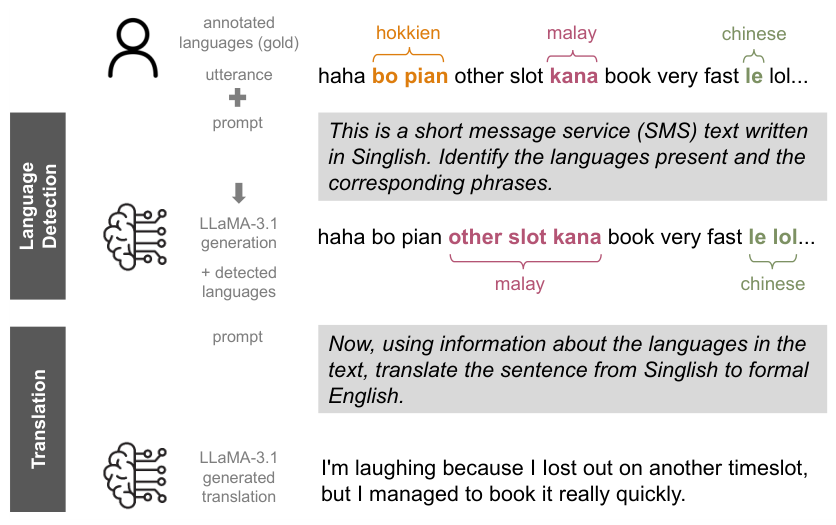
To enrich the dataset with an additional, model-generated layer of language-detection and translation annotations, we adopted a multi-step prompting architecture for the translation of Singlish sentences. Figure 2 illustrates the prompting scheme adopted. First, we prompted the LLMs to identify the languages present in the text and the corresponding phrases (“Language Detection” step). In a code-mixed scenario, the task of automatic language identification is important to facilitate further processing, in our case, for translation [16]. Next, we provided the LLMs with a Singlish sentence and the languages it identified in the previous step, and required an output of a sentence translated into standard formal English (“Sentence Translation” step). We loosely refer to standard English or standard UK English as the form of the language that can be widely understood by the English-speaking population, regardless of nationality or culture. This is the English we interface with on news sites, or government websites. We use the standard UK English because Singapore was once a British colony, hence its formal English is more likely to be based on the UK English. Overall, this task takes a sentence written in Singlish creole that is understood by a group of southeast-Asian diaspora and translates the sentence to an English sentence that is widely understood by the general English language population.
Figure 2.
Multi-step prompting scheme for the Language Detection and Sentence Translation tasks.
We used five open-sourced pre-trained LLMs to perform both language detection and translation tasks. We chose to use LLMs because these models can handle multilingual sentences, and thus were suitable for Singlish sentences that contain spans of multiple languages. These models were as follows: Mistral-7B-Instruct-v0.3-Q4_K_M.gguf [17], meta-llama-3.1-8b-instruct [18], gemma-2-2b-instruct [19], qwen2.5-14b-instruct [20], Phi-3.5-mini-128k-instruct [21]. The models were obtained from the HuggingFace library (https://huggingface.co/ (accessed in 15 June 2025)). In the rest of the paper, we refer to these models as Mistral-7B, LLaMA-3.1, Gemma-2, Qwen-2.5, and Phi-3.5, respectively.
Prompts for LLMs
The following were the input prompts for the LLMs. All prompts were carried out at a moderate temperature setting of 0.7 to balance accuracy and creativity as required in a translation task. The detailed prompts and settings are presented in Appendix A.
The Language Detection step can be defined as follows: Given a Singlish sentence as the input, the output should be the languages present in the text and the corresponding phrases written in that language. The language detection prompt had the message as a parameter and asked the LLM to identify the languages used in the short text messages written in Singlish. Canonically, the language detection task infers the language of an entire sequence from its given context. In our experiments, we aimed to detect all the languages and language variants present in a sequence, which can be more than one. These non-English vocabularies are referred to as other-language. This task used the following prompt:
- prompt = f“This is a short message
- service (SMS) text written in Singlish.
- Identify the languages present
- and the corresponding phrases.
- Message: {message}”
The Sentence Translation step can be defined as follows: Given a Singlish sentence as the input, the output should be a sentence translated into standard English. The sentence translation prompt uses the text message and the languages detected from the previous step as parameters. The language information helps the LLM better understand the Singlish sentence.
- prompt = f“Now, using information about
- the languages in the text:
- {language_info}, translate the sentence
- from Singlish to standard English.
- Message: {message}”
3.3. Technical Validation
To assess the quality and usability of the LLM-generated language-detection and translation layers described above, we validated them against the native-speaker Reference Texts and language annotations (Section 2), using both quantitative metrics and manual qualitative inspection by native Singlish speakers.
3.3.1. Language-Detection Layer
Quantitative Validation
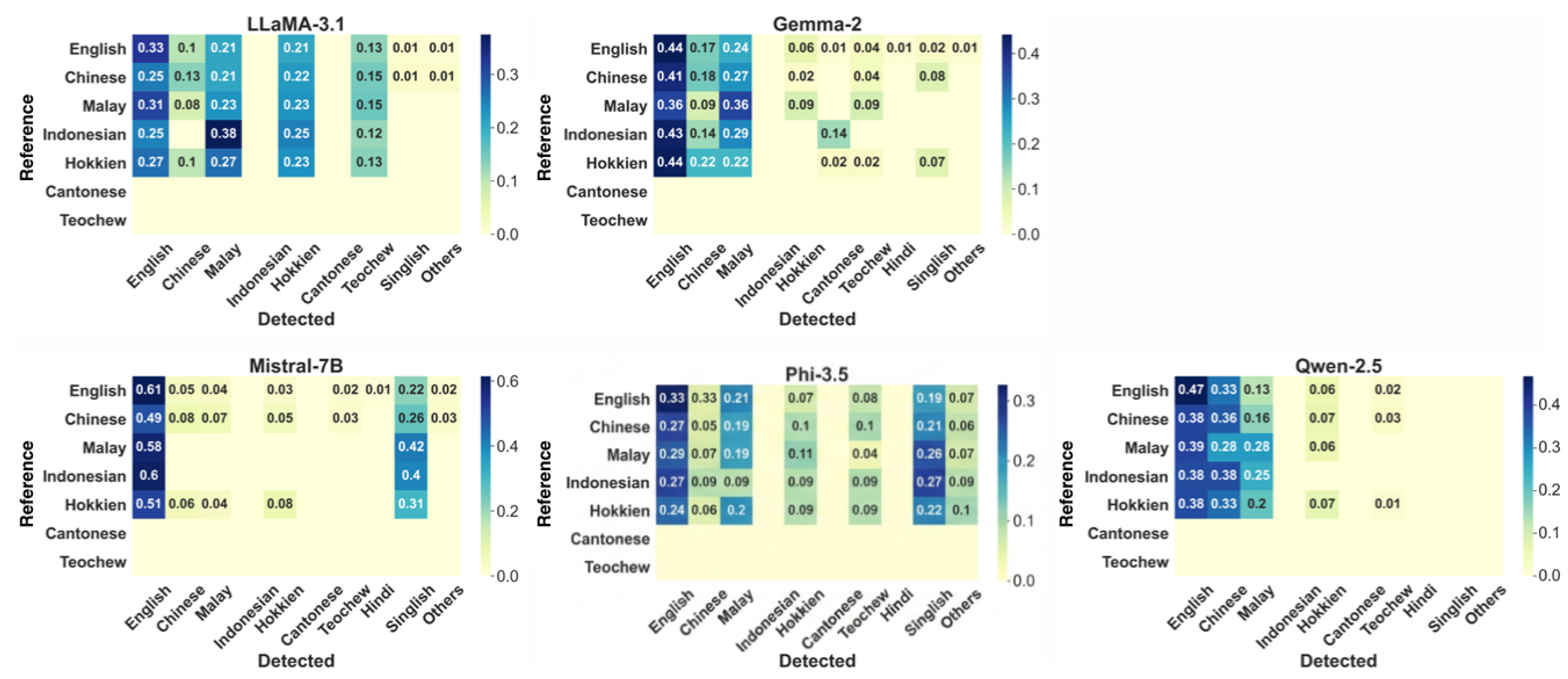
We compared the detected languages of a sentence returned by the LLMs against the annotated set of reference languages, and normalized the results against the total number of actual languages identified. We also noted down the most common predicted languages that were not within our original pre-defined list of language labels. This pre-defined list consisted of the languages: English, Chinese, Malay, Indonesian, Hokkien, Cantonese and Teochew. This was the list used by the expert annotators to annotate the sentences. Note that we ignored sentences where the LLMs did not return a result, or returned a malformed result.
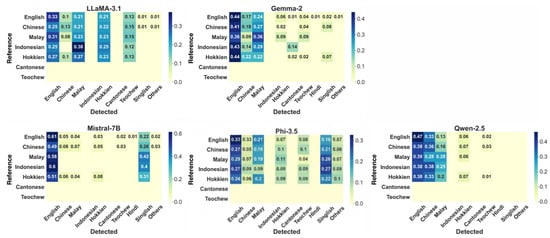
Figure 3 presented correlation plots of the reference language labels against the detected set of languages by LLMs. The Qwen-2.5 model returned the most number of valid responses, while LLaMA-3.1 returned the least number of valid responses. Table 2 quantifies this gap, showing the exclusion rate for null or malformed language-detection responses ranged from 1.7% to 6.7% for four of the five models, but reached 76.0% for LLaMA-3.1. Consequently, the confusion-matrix comparison in Figure 3 draws on a much smaller and potentially less representative subset of sentences for LLaMA-3.1 than for the other four models, and LLaMA-3.1’s language-detection results should be interpreted with this in mind. This exclusion is specific to the language-detection layer: the translation outputs underlying Table 3 were generated and scored for the same sentences for all five models, with no missing or malformed translation outputs for any model. Surprisingly, LLaMA-3.1, Mistral-7B and Phi-3.5 were able to correctly identify that the sentences were written in Singlish, and Phi-3.5 expressed this capability to the highest extent.
Figure 3.
Confusion matrix of the detected language labels by LLMs (Detected), against reference language labels from annotators (Reference). We unit-normalize each row for comparison across models.
Table 2.
Valid vs. excluded (null or malformed) language-detection responses per model. A response was counted as valid if it parsed as well-formed JSON containing at least one language label; models are sorted by exclusion rate.
Table 3.
Performance of LLMs on rewriting Singlish texts to standard English. Best performance in bold. (The source-reference BERTScore baseline at 0.9253 is higher than most LLM-scores, likely because the source contains many non-English tokens unknown to BERTScore, which depresses the source-reference score.).
All models except LLaMA-3.1 were able to identify languages that were not in the predefined set of language labels, indicating that the LLMs are able to draw from intrinsic knowledge. Interestingly, the same set of LLMs identified the Hindi language as part of some of the texts. Hindi is indeed one of the languages that is constantly code-mixed within Singlish, although it was not specified in the set of expert language labels. This finding provided hope that the LLMs were able to cope with the evolution of language usages, which is particularly important in the case of a language creole like Singlish, where Asian influences are constantly being incorporated into the vernacular.
Qualitative Validation
Through manual inspections by native Singlish speakers, we identified three main types of errors that LLMs make within this step. Examples for each error type are illustrated in Table 4.
Table 4.
Examples of errors identified. Reference span indicated in bold italics.
- Misidentified span but correct label.
- Correctly identified span but incorrect language prediction.
- Identified span that is English (false positive).
Error type (1) represented accurate language detection with span-detection errors. LLaMA-3.1 incorrectly identified words preceding the Malay word “kana” also as Malay words even though that was not the case. Anecdotally, this error was frequently observed when the Source Text’s structure was not a standard English structure. This out-of-distribution texture structure might have contributed to the error. We note that while the span-detection portion might fail, the main language detection task was still correct.
Next, error type (2) was inaccurate label detection. Here, the language was wrongly identified, but the span was correctly highlighted. For example, Mistral-7B correctly identified the span “matter pata nai tha”, but predicted the language to be Malay instead of Indonesian. Similarly, LLaMA-3.1 identified the span “nait kai siu hei chong lai” as Teochew instead of Hokkien. These two examples show that regional languages and dialects can be similar to each other. LLMs struggled to differentiate such differences and misclassified these labels.
Lastly, error type (3) includes errors where the LLM identifies a span where there is no other-language detected. The Phi-3.5 model identifies the phrase “wil nevr go unrecognized” as in the Malay language, likely due to the abbreviation (or misspelling) of the word “will” as “wil” and “nevr” to “never”.
These results showed that LLMs can aid in the Language Detection task, although they lacked accuracy for the more nuanced languages. This is especially so for the more tonal languages like the Chinese dialects of Teochew and Hokkien. We curated a list of phrases that are generally incorporated within Singlish texts and the languages that they are adapted from in Table 5. This list provided context to the languages that commonly occur in the Singlish creole.
Table 5.
Phrases commonly found in Singlish texts and the language they are adapted from.
3.3.2. Translation Layer
Quantitative Validation
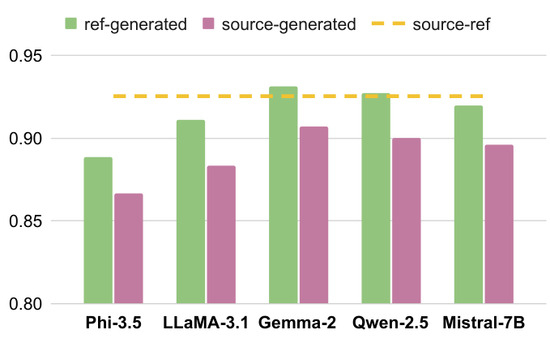
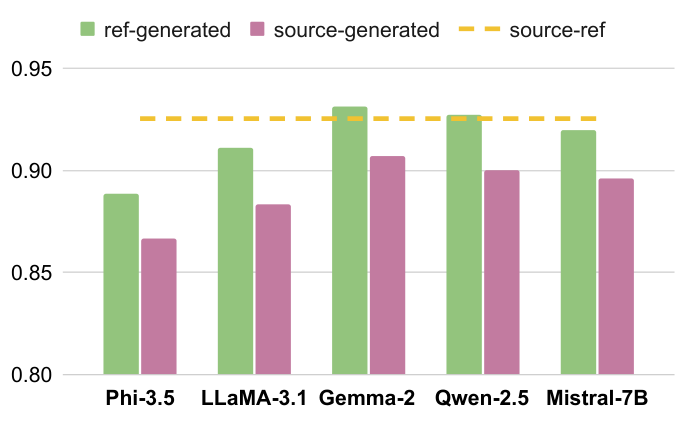
To evaluate the translation output of LLMs, we compared the generated translations against the reference translations written by the human annotators using BLEU, ROUGE and BERTScore. The BLEU [22] and ROUGE [23] metrics captured lexical similarity between source and generated text by taking into account the precision and recall of n-gram overlaps. We reported the ROUGE-L, which is based on the longest common subsequence overlap. The BERTScore metric compared contextual word embeddings between two sentences [24], which captures the semantic similarity between the sentences and is reported to correlate relatively well with human judgment [25]. We report the BERTScore-F1 similarity scores in Figure 4. (Note that the BERTScore-F1 is a similarity metrics rather than a classification accuracy).
Figure 4.
BertScore performance of generated text against Source Text. Dotted yellow line represents the source-reference baseline performance when the Source Text is evaluated against the human Reference Text.
We included a source-reference similarity baseline performance in our scoring metrics. This baseline is computed by scoring the untranslated Singlish Source Texts directly against the human reference translation (Translated Texts) using the same three metrics. This baseline is not an upper bound on achievable translation quality, though. This baseline compares how similar the untranslated Singlish text is already to its English reference under each metric, rather than representing an alternative translation system. Table 3 shows that the performance of the translation task varies across the different LLMs and metrics. The variance in performance thus necessitates the search for suitable model parameters for translation.
While Gemma-2 performed the best among the LLMs in lexical-matching metrics (BLEU, ROUGE), there still exists a gap between its generations and the baseline performance. Interestingly, we see a high semantic similarity between Gemma-2’s generations and the reference sentences. This suggests that while the generations might be paraphrased, contributing to relatively lower lexical similarity scores, the meaning of the text is largely retained.
Overall, the average BERTScore of the LLMs was 0.90. The Gemma-2 model performed the best, with a BERTScore of 0.93. A high BERTScore indicates that generated translation was semantically closed to the reference translation by the expert annotators under this transformed-based similarity metric. However, it does not by itself guarantee the translated meaning is fully correct, as we will observe in the qualitative analysis.
We also noted that the source-reference baseline’s BERTScore was lower than that of Gemma-2. This is consistent with the baseline measuring a different quantity than the LLM translations. While we did not claim that the baseline score was the theoretical upper-bound on the translation quality, the similarity between the Source Text and the English reference was depressed by the fact that the Source Text contained many non-English Singlish tokens that are unknown to the underlying BERTScore evaluation model.
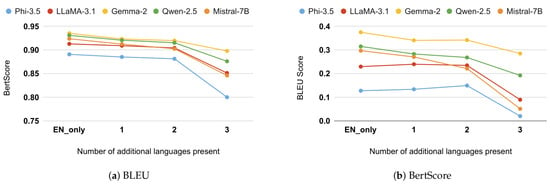
An interesting analysis dimension was how the degree of code-mixing affected translation performance. We used the number of additional languages (on top of English) present as a proxy for the degree of code-mixing present in a sentence. Figure 5 shows that translation performance degraded as more languages were present in the Source Text across both lexical and semantic metrics. The performance dip was especially notable when more than two additional languages were present. This observation was within expectations: if a sentence contained only English tokens, then the machine required less effort for evaluating and re-writing of the sentence tokens. A well-trained LLM was assumed to be able to generate fluent text, which we expected when we retrieved the output standard English texts. Conversely, if a sentence contained multi-lingual tokens, then the machine required more analytical effort for evaluating and translating the sentence before generation. We note that this trend is based on a modest number of highly code-mixed sentences (i.e., only 6.3% of the Source Texts contain two or more non-English languages).
Figure 5.
Performance of LLM translation against the number of languages present in the Source Text.
Qualitative Validation
Singlish relies heavily on context for accurate understanding. As a result, the machine translations may seem correct, but were conceptually incorrect. Through manual inspections by native speakers, we identified three main types of errors that the LLMs make within this step.
Table 6 shows an example of how the generated translation may seem to be reasonable, but has a different meaning to the intended message. The generated text suggested that the subject managed to “book a slot” quickly. However, the intended meaning of the sentence was that the subject was unable to obtain his desired slot, as “the other slots were booked out quickly”. This example highlights the nuances in code-mixed creoles, and why they are difficult for machines to interpret and translate.
Table 6.
Generations by LLaMA-3.1.
Finally, as with all LLM generations, our translations also suffered from hallucinations, where information not present in the Source Text appeared in the generation. Table 7 provides some examples. The Source Text was a simple text message conversation about meeting on the first day of school, but Phi-3.5 crafted an email response regarding a school trip, and Mistral-7B added information about admission tickets.
Table 7.
Examples of hallucinations of LLMs in generated translations. Hallucinations are marked in italics.
Overall, the LLM-generated translation layer achieves high contextual fidelity to the human references (best BERTScore = 0.93). However, as Table 6 shows, this high BERTScore does not guarantee the intended meaning of the original sentence is preserved. We therefore present this derived-data layer as usable as a benchmark and starting point for further work on Singlish creole translation and code-mixed NLP, rather than evidence of high translation fidelity on its own, while the qualitative errors documented above (Section 4) should be taken into account by downstream users.
4. Interpreting Singlish: Guidance for Data Users
This section discusses the linguistic characteristics of Singlish that data users should be aware of when working with this dataset, notes limitations of the current release, and suggests potential reuse applications.
Singlish can be difficult for a native English speaker to interpret because its code-mixed structure is adopted from the native languages of its speakers: sentences typically lack clear subject and object pronouns, frequently employ sentence-final particles (e.g., leh, lor, meh) borrowed from Chinese dialects, and omit connecting copula words before adjectives and nouns [26]. Unlike conventional code-mixed translation between two otherwise-intact languages [27], Singlish is a stabilized creole variety with its own grammar, syntax, discourse conventions, and pragmatic norms that cannot be decomposed into independent source languages [28]. Consistent with this, the qualitative errors identified during technical validation (Section 3.3) mostly occurred even when the constituent languages were correctly identified, indicating that the principal difficulty for downstream users lies in the creole’s grammatical and pragmatic structure rather than in recognizing individual language spans. Data users should therefore anticipate the following recurring characteristics of the Source Texts in this dataset, each illustrated below with a concrete example from the dataset.
- Sentence Structures Formed from Derived Languages
Each part of the code-mixed sentence typically adopted the language structure of its language. That is, the portion written in English will adopt the English language structure; the portion written in Chinese will adopt the Chinese language structure. For example, “i just now go down eat” is a legitimate Singlish sentence, yet it does not have a legitimate English sentence structure. This sentence structure is the structure of its derived language, Chinese: 我刚才下去吃, and the Singlish sentence is a direct translation of the Chinese phrase. Therefore, information processing tools designed for the English language will not be accurate to process the sentence. LLMs bring hope to this problem because they have been shown to be able to understand the sentence structures of a wide variety of languages [29].
- Lack of Subject
The lack of a subject in Singlish sentences makes it difficult for machines to determine the speaker or the topic of the sentence [26]. While native speakers can infer the subject from preceding conversational contexts, the conversational environment, the tone or the attitude of the speaker, such information was unavailable to the LLMs. Table 7 presented examples of how the LLMs misinterpret the subject. In the sentence “surely bring us tour around the school one”, all LLMs either inferred the subject to be the author or the receiver. In fact, the author and the receiver were both tour participants; the subject was an unnamed third party.
- Ambiguity of Tenses
Singlish typically uses the present tense, bearing a resemblance to the Chinese and Malay languages where verbs are not inflected for tenses [30]. For example, the Chinese sentence 我下去吃 translated to Singlish is “I go down eat”. The translated sentence gives no indication as to whether the author was presently heading down to eat or had already headed down to eat. At other times, to express an action in the past, Singlish texts intentionally suffix a word with “-ed”. An instance from our dataset is “solo-ed”, to indicate that the author had previously performed the action alone. Therefore, an added challenge in Singlish translation was diambiguating the tenses within a sentence to properly reflect the speaker’s intentions.
- Singlish Drops the Transitive Verbs
One of the Singlish sentences from the dataset is “[…] Is it for the same exhibition on this coming weekend?”. A translated version of this sentence would contain several transitive verbs that were dropped in the construction of the Singlish sentence: “[…] Is it for the same exhibition [happening] on this coming weekend?” Singlish embodies conversational brevity [31], and in doing so, misses the transitive verbs. The LLMs thus had to infer these phrases from the implicit information embedded in the sentence or the surrounding sentences.
This distinction also motivates a linguistic equity perspective for data users. NLP systems have traditionally prioritized standardized, high-resource languages, often treating creoles and regional varieties as noisy deviations rather than legitimate linguistic systems [32,33]. We therefore encourage users of this dataset to treat Singlish as a structured language variety in its own right, rather than as an irregular mixture to be normalized away, so as to preserve speaker intent, cultural identity, and pragmatic meaning in downstream applications.
4.1. Limitations
We acknowledge the following limitations of the current dataset release. Crucially, our dataset is primarily based on SMS, which may differ from spoken Singlish, which therefore warrants future studies into other colloquial usages of Singlish. While our dataset was derived from SMS conversations, the conversational style, brevity, and code-mixed language observed in SMS remain characteristic of contemporary messaging platforms like WhatsApp and Telegram [34]. Future data collection efforts should target such online platforms, but we expect many of the linguistic phenomena captured here to generalize beyond SMS.
All three machine translation evaluation metrics require a human reference translation, which is somewhat in tension with the low-resource motivation of this dataset. High-quality reference translations are indeed the resource that is scarce for many code-mixed varieties. There are reference-free “quality estimation” approaches to machine-translation evaluation [35]. Such approaches do not require a reference translation, and are a natural extension for future work on this dataset, especially because Singlish is a low-resource variety for which reference-independent evaluation is valuable. Further, sentences for which a model returned no result or a malformed result were excluded from the final set of model comparison rather than counted as failures. We flag this exclusion as a methodological caveat, and recommend that future evaluations of this layer handle such excluded sentences.
Further, we chose the two-step prompting pipeline (language detection -> translation) as a reasonable design choice, and did not ablate this against a single-step prompting scheme. Future work should explore the pipeline variations to validate the design choice.
Finally, while this dataset supports research into creole translation from the perspective of linguistic equity, the LLM-generated annotation layer was not explicitly audited for how linguistic biases in LLMs manifest in code-mixed settings. Existing studies have shown that LLMs exhibit disparities across low-resource languages and language varieties [36,37]. It remains unclear whether code-mixing amplifies these biases by introducing additional ambiguity, or instead mitigates them when higher-resource languages provide contextual cues. Data users interested in this question could examine whether the LLM-generated translation quality in this dataset systematically varies according to the dominant donor language (e.g., Hokkien-, Malay-, or Chinese-influenced Singlish) or the degree of code-mixing within an utterance—both of which can be derived from the language-span annotations included in the release.
4.2. Potential Reuse Applications
Beyond benchmarking code-mixed translation and language-identification systems, this dataset may support the following reuse applications.
- Understanding creole usage in informal settings
An understanding of the code-mixed Singlish creole also provides a window into online opinions, which are especially important in events like political elections and natural crises. Many such analyses only focus on pure-English texts, missing out the important opinions of native people or other language diasporas. For example, refs. [38,39] examined only the English-based tweets in Asian political events, leaving out crucial information in the tweets written in the code-mixed languages of Chinese–English and Indonesian–English. Translation models trained or evaluated on this dataset could help recover such missing code-mixed opinions.
- Understanding code-mixed creole through contextual cues
Often, the translation output from the LLMs does not take into account the cultural and language cues from the surrounding sentences. The interpretation of code-mixed languages should incorporate the implied culture- and language-specific norms from the surrounding sentences. Future work using this dataset could extend the released single-sentence records with surrounding conversational context to fine-tune the machine translation models to reflect such nuances [6].
Author Contributions
All authors contributed to conceptualization, methodology, software, formal analysis, investigation, writing—original draft preparation, and writing—review and editing. All authors have read and agreed to the published version of the manuscript.
Funding
There is no funding to report.
Informed Consent Statement
Ethical review and approval were waived for this study. The annotation task was carried out by members of the research team (the paper’s co-authors and one additional research colleague working under the same project), performing expert linguistic annotation as part of their normal research duties rather than as externally recruited human subjects. The task involved no more than minimal risk—it is routine linguistic judgment and translation work with on medical, psychological, or sensitive content, and no personally identifiable information about any annotator was collected, analyzed or reported anywhere in this study.
Data Availability Statement
The dataset described in this Data Descriptor is available at https://doi.org/10.5281/zenodo.22657729.
Acknowledgments
The authors thank Russell Goh for his help with standard English translations and language annotations. The authors thank the National University of Singapore Development Grant for funding the work.
Conflicts of Interest
The authors declare no conflicts of interest.
Appendix A. Prompts Used for Large Language Models
We performed a multi-step prompting scheme with Large Language Models for the Language Detection and the Sentence Translation tasks. Here are the prompts used:
Appendix A.1. For Language Detection
The language detection prompt takes in the message as a parameter and asks the LLM to identify the languages used in the short text messages written in Singlish.
- prompt = f“This is a short message service
- (SMS) text written in Singlish. Identify
- the languages present and the
- corresponding phrases.
- Message: {message}”
- messages=[
- {“role”: “assistant”,
- “content”: “““
- You are an AI that identifies
- languages used in Singlish messages.
- Identify the languages and
- corresponding phrases.
- Return an array consisting of
- [{“language”: language, “phrase”: phrase}]
- in valid JSON format.
- Do not return any other text.
- ”””},
- {“role”: “user”, “content”: prompt}
- ]
Appendix A.2. For Sentence Translation
The sentence translation prompt not only takes the text message as a parameter, but also takes in the information about the languages detected from the previous step as a parameter. The language information helps the LLM better understand the Singlish sentence.
- prompt = f“Now, using information about
- the languages in the text: {language_info},
- translate the sentence from Singlish
- to standard English.
- Message: {message}”
- messages=[
- {“role”: “assistant”,
- “content”: “““
- You are an AI that translates Singlish
- to standard English. Use the
- identified languages and phrases
- to provide an accurate translation.
- Return only the translated text,
- and no other text.
- ”””},
- {“role”: “user”, “content”: prompt}
- ]
References
- Deterding, D. Singapore English; Edinburgh University Press: Edinburgh, UK, 2007. [Google Scholar]
- Liu, Z.; Ni, S.; Aw, A.; Chen, N. Singlish message paraphrasing: A joint task of creole translation and text normalization. In Proceedings of the 29th International Conference on Computational Linguistics, Gyeongju, Republic of Korea, 12–17 October 2022; pp. 3924–3936. [Google Scholar]
- McLellan, J. Mixed codes or varieties of English? In The Routledge handbook of world Englishes; Routledge: Oxfordshire, UK, 2020; pp. 422–435. [Google Scholar]
- Xiao, Y.; Ng, L.H.X.; Liu, J.; Diab, M.T. Humanizing Machines: Rethinking LLM Anthropomorphism Through a Multi-Level Framework of Design. In Proceedings of the 2025 Conference on Empirical Methods in Natural Language Processing, Suzhou, China, 4–9 November 2025; Christodoulopoulos, C., Chakraborty, T., Rose, C., Peng, V., Eds.; Association for Computational Linguistics (ACL): Suzhou, China, 2025; pp. 3331–3350. [Google Scholar] [CrossRef] [Scilit]
- Ng, L.H.X.; Cruickshank, I.J.; Lim, A.X.W.; Carley, K.M. Social Theory Should Be a Structural Prior for Agentic AI: A Formal Framework for Multi-Agent Social Systems. arXiv 2026, arXiv:2605.07069. [Google Scholar] [CrossRef] [Scilit]
- Santy, S.; Srinivasan, A.; Choudhury, M. BERTologiCoMix: How does code-mixing interact with multilingual BERT? In Proceedings of the Second Workshop on Domain Adaptation for NLP, Kyiv, Ukraine, 20 April 2021; pp. 111–121. [Google Scholar]
- Jayanthi, S.M.; Nerella, K.; Chandu, K.R.; Black, A.W. Codemixednlp: An extensible and open nlp toolkit for code-mixing. arXiv 2021, arXiv:2106.06004. [Google Scholar]
- Gupta, A.; Bhogal, A.; Ghosh, K. Code-Mixer Ya Nahi: Novel Approaches to Measuring Multilingual LLMs’ Code-Mixing Capabilities. arXiv 2024, arXiv:2410.11079. [Google Scholar]
- Yadav, A.; Garg, T.; Klemen, M.; Ulcar, M.; Agarwal, B.; Sikonja, M.R. Code-mixed Sentiment and Hate-speech Prediction. arXiv 2024, arXiv:2405.12929. [Google Scholar]
- Srivastava, V.; Singh, M. Phinc: A parallel hinglish social media code-mixed corpus for machine translation. arXiv 2020, arXiv:2004.09447. [Google Scholar]
- Kartik, K.; Soni, S.; Kunchukuttan, A.; Chakraborty, T.; Akhtar, M.S. Synthetic data generation and joint learning for robust code-mixed translation. In Proceedings of the 2024 Joint International Conference on Computational Linguistics, Language Resources and Evaluation (LREC-COLING 2024), Torino, Italy, 20–25 May 2024; pp. 15480–15492. [Google Scholar]
- Chow, S.Y.; Shin, C.U.; Bond, F. This Word Mean What: Constructing a Singlish Dictionary with ChatGPT. In Proceedings of the 2nd Workshop on Resources and Technologies for Indigenous, Endangered and Lesser-resourced Languages in Eurasia (EURALI)@ LREC-COLING 2024, Torino, Italy, 20–25 May 2024; pp. 41–50. [Google Scholar]
- Wang, B.; Liu, Z.; Huang, X.; Jiao, F.; Ding, Y.; Aw, A.; Chen, N.F. Seaeval for multilingual foundation models: From cross-lingual alignment to cultural reasoning. arXiv 2023, arXiv:2309.04766. [Google Scholar]
- Foo, L.T.E.; Ng, L.H.X. Disentangling Singlish Discourse Particles with Task-Driven Representation. arXiv 2024, arXiv:2409.20366. [Google Scholar]
- Chen, T.; Kan, M.Y. Creating a live, public short MESSAGE SERVICE CORPUS: The NUS SMS corpus. Lang. Resour. Eval. 2013, 47, 299–335. [Google Scholar] [CrossRef] [Scilit][Green Version]
- Barman, U.; Das, A.; Wagner, J.; Foster, J. Code Mixing: A Challenge for Language Identification in the Language of Social Media. In Proceedings of the First Workshop on Computational Approaches to Code Switching, Doha, Qatar, 25 October 2014; Diab, M., Hirschberg, J., Fung, P., Solorio, T., Eds.; Association for Computational Linguistics (ACL): Doha, Qatar, 2014; pp. 13–23. [Google Scholar] [CrossRef] [Scilit]
- Jiang, A.Q.; Sablayrolles, A.; Mensch, A.; Bamford, C.; Chaplot, D.S.; Casas, D.d.l.; Bressand, F.; Lengyel, G.; Lample, G.; Saulnier, L.; et al. Mistral 7B. arXiv 2023, arXiv:2310.06825. [Google Scholar]
- Meta. Llama 3 Model Card. 2024. Available online: https://github.com/meta-llama/llama3/blob/main/MODEL_CARD.md (accessed on 1 June 2026).
- Team, G.; Mesnard, T.; Hardin, C.; Dadashi, R.; Bhupatiraju, S.; Pathak, S.; Sifre, L.; Rivière, M.; Kale, M.S.; Love, J.; et al. Gemma: Open models based on gemini research and technology. arXiv 2024, arXiv:2403.08295. [Google Scholar]
- Peng, B.; Quesnelle, J.; Fan, H.; Shippole, E. Yarn: Efficient context window extension of large language models. arXiv 2023, arXiv:2309.00071. [Google Scholar]
- Abdin, M.; Jacobs, S.A.; Awan, A.A.; Aneja, J.; Awadallah, A.; Awadalla, H.; Bach, N.; Bahree, A.; Bakhtiari, A.; Behl, H.; et al. Phi-3 technical report: A highly capable language model locally on your phone. arXiv 2024, arXiv:2404.14219. [Google Scholar]
- Papineni, K.; Roukos, S.; Ward, T.; Zhu, W.J. BLEU: A method for automatic evaluation of machine translation. In Proceedings of the ACL ’02: 40th Annual Meeting on Association for Computational Linguistics, Philadelphia, PA, USA, 6–12 July 2002; pp. 311–318. [Google Scholar] [CrossRef] [Scilit]
- Lin, C.Y. ROUGE: A Package for Automatic Evaluation of Summaries. In Proceedings of the Text Summarization Branches Out, Barcelona, Spain, 25–26 July 2004; pp. 74–81. [Google Scholar]
- Hanna, M.; Bojar, O. A fine-grained analysis of BERTScore. In Proceedings of the Sixth Conference on Machine Translation, Online, 10–11 November 2021; pp. 507–517. [Google Scholar]
- Zhang, T.; Kishore, V.; Wu, F.; Weinberger, K.Q.; Artzi, Y. BERTScore: Evaluating Text Generation with BERT. arXiv 2019, arXiv:1904.09675. [Google Scholar] [CrossRef] [Scilit]
- Ningsih, N.S.; Rahman, F. Exploring the Unique Morphological and Syntactic Features of Singlish (Singapore English). J. Engl. Acad. Prof. Commun. 2023, 9, 72–80. [Google Scholar] [CrossRef] [Scilit]
- Myers-Scotton, C. Social Motivations for Codeswitching: Evidence from Africa; Oxford University Press: Oxford, UK, 1993. [Google Scholar]
- Gupta, A.F. The Step-Tongue: Children’s English in Singapore; Multilingual Matters: Bristol, UK, 1994. [Google Scholar]
- Qin, L.; Chen, Q.; Zhou, Y.; Chen, Z.; Li, Y.; Liao, L.; Li, M.; Che, W.; Yu, P.S. A survey of multilingual large language models. Patterns 2025, 6, 101118. [Google Scholar] [CrossRef] [Scilit] [PubMed]
- Lin, J.W. Time in a language without tense: The case of Chinese. J. Semant. 2006, 23, 1–53. [Google Scholar] [CrossRef] [Scilit]
- Lai, Y.S.; Tan, Y.Y. Singlish particles and politeness work in face-threatening speech acts. Asian Engl. 2023, 25, 146–166. [Google Scholar] [CrossRef] [Scilit]
- Bender, E.M.; Gebru, T.; McMillan-Major, A.; Shmitchell, S. On the dangers of stochastic parrots: Can language models be too big? In Proceedings of the 2021 ACM Conference on Fairness, Accountability, and Transparency, Toronto, ON, Canada, 3–10 March 2021; pp. 610–623. [Google Scholar]
- Blasi, D.; Anastasopoulos, A.; Neubig, G. Systematic Inequalities in Language Technology Performance across the World’s Languages. In Proceedings of the 60th Annual Meeting of the Association for Computational Linguistics (Volume 1: Long Papers), Dublin, Ireland, 22–27 May 2022; pp. 5486–5505. [Google Scholar]
- Foo, L.T.E.; Ng, W.A.; Li, W.; Ng, L.H.X. Stylistic Evolution and LLM Neutrality in Singlish Language. arXiv 2026, arXiv:2601.06580. [Google Scholar]
- Elmakias, I.; Vilenchik, D. An oblivious approach to machine translation quality estimation. Mathematics 2021, 9, 2090. [Google Scholar] [CrossRef] [Scilit]
- Alhanai, T.; Kasumovic, A.; Ghassemi, M.M.; Zitzelberger, A.; Lundin, J.M.; Chabot-Couture, G. Bridging the Gap: Enhancing LLM Performance for Low-Resource African Languages with New Benchmarks, Fine-Tuning, and Cultural Adjustments. In Proceedings of the AAAI Conference on Artificial Intelligence. Association for the Advancement of Artificial Intelligence, Philadelphia, PA, USA, 25 February–4 March 2025; Volume 39, pp. 27802–27812. [Google Scholar] [CrossRef] [Scilit]
- Li, Z.; Shi, Y.; Liu, Z.; Yang, F.; Payani, A.; Liu, N.; Du, M. Language Ranker: A Metric for Quantifying LLM Performance Across High and Low-Resource Languages. In Proceedings of the AAAI Conference on Artificial Intelligence. Association for the Advancement of Artificial Intelligence, Philadelphia, PA, USA, 25 February–4 March 2025; Volume 39, pp. 28186–28194. [Google Scholar] [CrossRef] [Scilit]
- Jacobs, C.S.; Ng, L.H.X.; Carley, K.M. Tracking China’s cross-strait bot networks against Taiwan. In Proceedings of the International Conference on Social Computing, Behavioral-Cultural Modeling and Prediction and Behavior Representation in Modeling and Simulation, Pittsburgh, PA, USA, 20–22 September 2023; Springer: Berlin/Heidelberg, Germany, 2023; pp. 115–125. [Google Scholar]
- Ng, L.H.X.; Bartulovic, M.; Carley, K.M. Tiny-BotBuster: Identifying Automated Political Coordination in Digital Campaigns. In Proceedings of the International Conference on Social Computing, Behavioral-Cultural Modeling and Prediction and Behavior Representation in Modeling and Simulation, Pittsburgh, PA, USA, 18–20 September 2024; Springer: Berlin/Heidelberg, Germany, 2024; pp. 25–34. [Google Scholar]

Disclaimer/Publisher’s Note: The statements, opinions and data contained in all publications are solely those of the individual author(s) and contributor(s) and not of MDPI and/or the editor(s). MDPI and/or the editor(s) disclaim responsibility for any injury to people or property resulting from any ideas, methods, instructions or products referred to in the content. |
© 2026 by the authors. Licensee MDPI, Basel, Switzerland. This article is an open access article distributed under the terms and conditions of the Creative Commons Attribution (CC BY) license.