


Abstract
Artificial intelligence (AI) agents and large language model (LLM) agents are beginning to move materials discovery beyond isolated prediction tasks and toward tool-grounded workflows that can retrieve prior knowledge, configure simulations, launch calculations, inspect outputs, and decide what to do next. However, adjacent reviews on materials informatics, self-driving laboratories, natural-language processing in materials science, and autonomous chemistry have not isolated simulation-driven materials workflows as a distinct evidence base. This review addresses that gap through PRISMA-guided searches in Scopus (8 May 2026) and Web of Science (15 June 2026) for English-language journal articles published between 2022 and 2026. The combined search returned 232 records; 27 full texts were assessed and 26 studies were included in the final qualitative synthesis after one full-text exclusion. No eligible study was published in 2022 or 2023, indicating that the field emerged only in 2024 and expanded rapidly in 2025–2026. Catalysis and adsorption tasks (n = 6) and alloy design or evaluation (n = 5) dominated the corpus, while specialized multi-agent architectures were the most common pattern (n = 13). Across the included studies, agentic reasoning was most often coupled to workflow orchestration or integration tools, molecular-dynamics or atomistic simulation environments, and materials-data or machine learning screening pipelines; public repositories or archival artifacts were reported in 18 of 26 studies, experimental validation in six, and robotic closed-loop execution in only one study. The strongest evidence came from workflows that grounded language model decisions in simulators, structured databases, or experimentally verifiable outputs rather than in free-form text alone. This review therefore establishes AI agent workflow orchestration as a distinct analytical category within materials discovery and identifies the reporting, validation, and reproducibility conditions required for these systems to function as credible scientific infrastructure rather than as conversational demonstrations.
1. Introduction
Materials discovery is increasingly limited not by the absence of predictive models, but by the difficulty of coordinating the full sequence of scientific work that surrounds them: retrieving prior knowledge, constructing candidate structures, preparing simulation inputs, selecting toolchains, interpreting outputs, and deciding whether another iteration is justified. Machine learning and materials informatics have already transformed candidate prioritization, property prediction, and inverse design [1,2]. At the same time, broader acceleration agendas now integrate artificial intelligence, high-performance computing, automation, and robotics into multi-stage discovery pipelines rather than isolated modeling tasks [2,3,4]. In practice, the bottleneck is therefore increasingly procedural and organizational. The central challenge is not only to predict a property, but to manage the sequence of reasoning and action that connects a scientific objective to executable computational or experimental steps [2,3,4,5,6,7,8,9,10].
Recent reviews document important parts of this transition, but they do not synthesize the same object of study. Reviews of self-driving laboratories emphasize closed-loop experimentation, hardware integration, and laboratory automation [3]. Reviews of AI-driven materials design focus more broadly on generative models, inverse design, reinforcement learning, and materials-discovery acceleration [4]. Other reviews concentrate on natural-language processing in materials science, large language models for materials and chemistry, reticular chemistry, or generative crystal-structure modeling [5,11,12,13,14]. In parallel, chemistry-oriented reviews have shown that large language models can move beyond text generation toward tool use, retrieval, planning, code execution, and multi-agent coordination [5,6,7,8,9,10]. Taken together, this literature shows that autonomous scientific systems are becoming technically plausible. It does not yet provide a focused systematic synthesis of studies in which agents are used to orchestrate simulation-centered materials workflows.
That distinction matters because a property-prediction model, a literature assistant, a generative model, and an agent that configures and executes a simulator are not equivalent scientific objects. Once the unit of analysis shifts from the model to the workflow, different evaluation criteria become necessary. In this review, an agentic workflow was understood minimally as a system that selects tools, parameterizes a computational task, triggers execution of the relevant toolchain, inspects the resulting outputs, and determines whether and how the next iteration should proceed. In simulation-driven materials discovery, the key issue is whether the system can connect reasoning to action across tools such as density functional theory packages, molecular dynamics engines, adsorption and process simulators, CALPHAD environments, crystallographic curation routines, and programmable analysis pipelines. Under that view, the relevant questions are no longer limited to accuracy of prediction. They include which material domains are actually being targeted, which tool families are being orchestrated, how autonomy is bounded in practice, how validation is performed, and how often prompts, traces, repositories, and failure cases are reported in reproducible form [5,6,7,8,9,10].
To the best of our knowledge, no prior review has isolated simulation-driven, tool-orchestrating AI agent workflows for materials discovery as a distinct evidence base with study-level extraction of autonomy, validation, and reproducibility [3,4,5,6,7,8,9,10,11,12,13,14]. This is not a minor gap in categorization. Without that distinction, studies that execute atomistic simulations, studies that manage databases and ranking pipelines, and studies that merely expose a conversational interface to materials knowledge can all be collapsed under the same label of agentic AI, even though they differ substantially in scientific function and evidentiary strength. The novelty of the present review therefore lies in treating agentic AI not as a generic synonym for artificial intelligence in materials science, but as a workflow architecture whose scientific value depends on planning, coordinating, executing, and evaluating discovery tasks across tool-integrated computational environments.
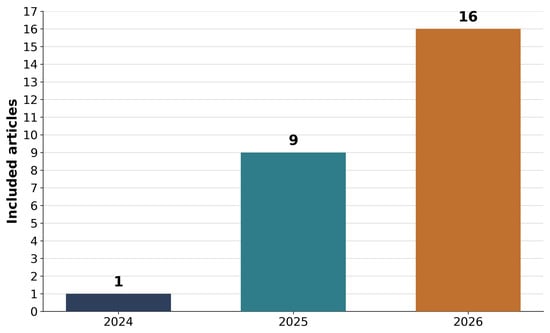
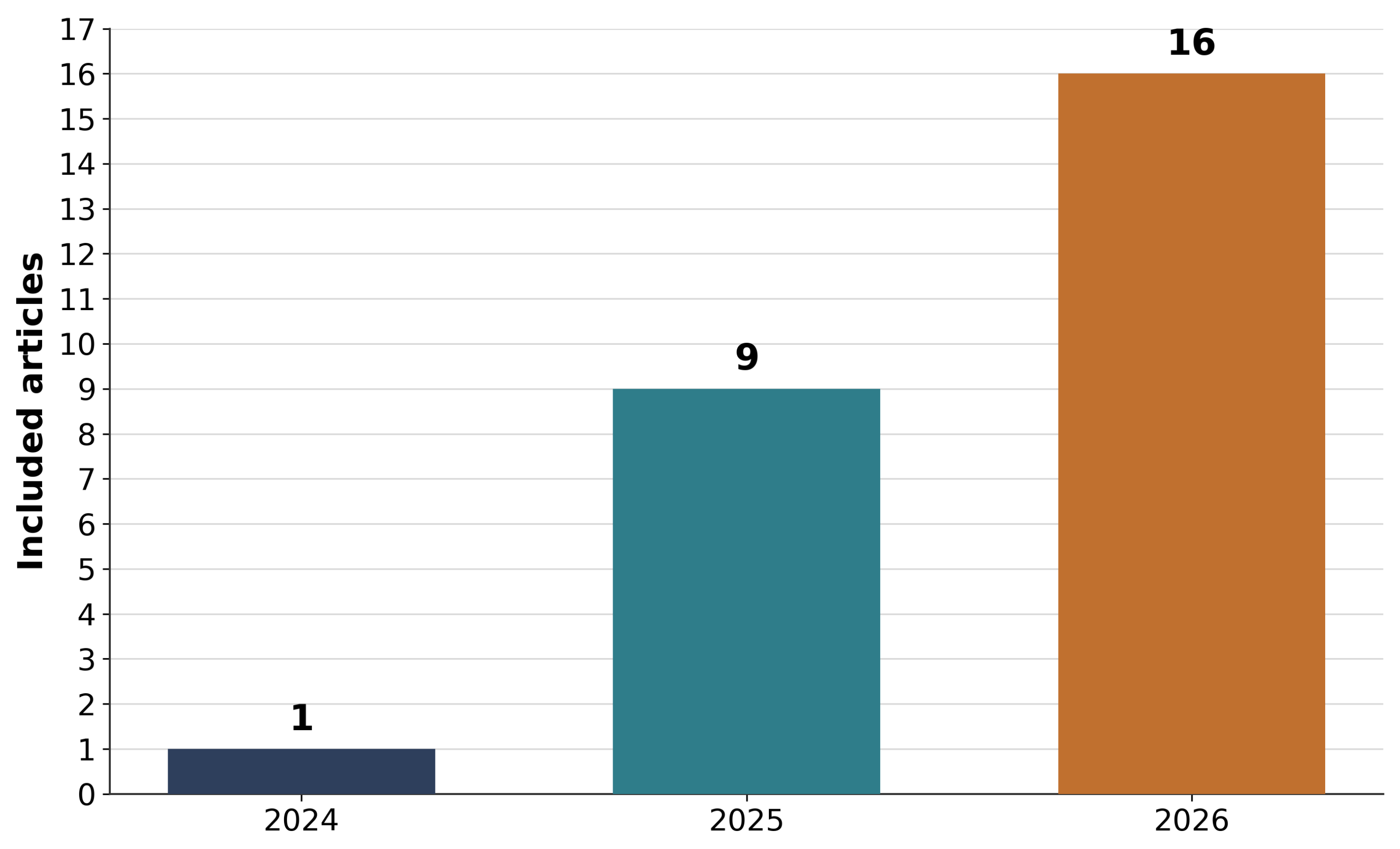
Accordingly, the present study provides a PRISMA-guided systematic review of journal articles retrieved from Scopus and Web of Science and published between 2022 and 2026, with staged screening, cross-database deduplication, full-text assessment, and qualitative synthesis of the final corpus. No eligible article was ultimately retained from 2022 or 2023; one was identified in 2024, nine in 2025, and sixteen in the partial year 2026, which underscores how quickly this literature is emerging and why a workflow-level synthesis has become timely. The review maps the literature across application domains, agent architectures, tool-grounding strategies, autonomy levels, validation practices, and reproducibility signals. Its purpose is not simply to inventory papers, but to show that the field is currently defined by orchestration-heavy designs, credibility through external tool grounding, and reporting practices that still lag behind technical enthusiasm.
2. Materials and Methods
2.1. Review Design and Reporting Framework
This study was designed as a systematic review and reported in accordance with PRISMA 2020 [15,16]. Because the expected evidence base was methodologically heterogeneous, a pooled meta-analysis was not pursued. The retained studies span catalysts, alloys, porous materials, polymers, crystal-generation tasks, atomistic simulation workflows, and robotic materials research, with markedly different validation bases and reporting styles. The synthesis was therefore structured as a comparative qualitative review focused on workflow architecture, computational role, autonomy, validation, and reproducibility. Searches and screening were conducted through Scopus (https://www.scopus.com) and Web of Science Core Collection (https://www.webofscience.com); software and repository names reported in the evidence tables are characteristics extracted from the cited studies.
2.2. Database, Search Strategy, and Search Date
Scopus and Web of Science Core Collection were selected because, together, they provide broad coverage across materials science, chemistry, chemical engineering, physics, and computational research while supporting transparent screening and cross-database auditability. The Scopus search was executed on 8 May 2026, and the equivalent Web of Science topic search was executed on 15 June 2026. The exact Scopus search equation applied to the title, abstract, and keyword fields was: TITLE-ABS-KEY((“AI agent*” OR “artificial intelligence agent*” OR “LLM agent*” OR “large language model agent*” OR “agentic AI” OR “multi-agent system*” OR “multiagent system*” OR “autonomous agent*” OR “tool-using agent*” OR “ReAct agent*” OR “planner-executor” OR “agentic workflow*”) AND (“materials discover*” OR “material discover*” OR “materials design” OR “material design” OR “materials informatics" OR “computational materials” OR catalyst* OR alloy* OR polymer* OR zeolite* OR “metal-organic framework*” OR “crystalline material*” OR “energy material*” OR “functional material*” OR “high entropy alloy*” OR “phase diagram*”) AND (simulation OR computational OR DFT OR “density functional theory” OR “molecular dynamics” OR LAMMPS OR CALPHAD OR “high-throughput screening” OR “workflow orchestration” OR “simulation tool*” OR “phase-field” OR MOOSE OR “Quantum ESPRESSO” OR “atomistic simulation”)) AND PUBYEAR > 2021 AND PUBYEAR < 2027 AND DOCTYPE(ar) AND LANGUAGE(English).
The query combined three conceptual blocks within the title, abstract, and keyword fields. The first captured agentic AI terminology, including AI agents, LLM agents, autonomous agents, multi-agent systems, tool-using agents, ReAct agents, and agentic workflows. The second captured the materials-discovery scope, including materials discovery, materials design, materials informatics, computational materials, catalysts, alloys, polymers, zeolites, metal–organic frameworks, crystalline materials, energy materials, functional materials, and high-entropy alloys. The third captured simulation and computation, including DFT, molecular dynamics, CALPHAD, high-throughput screening, workflow orchestration, simulation tools, phase-field methods, Quantum ESPRESSO, and atomistic simulation.
2.3. Eligibility Criteria
Records were eligible when they were indexed in Scopus or Web of Science as English-language journal articles published between 2022 and 2026; described an AI agent, LLM agent, autonomous agent, or multi-agent workflow as an operational part of the study; addressed materials discovery, design, optimization, or closely related computational materials tasks; and included a simulation, computational modeling, screening, code execution, or domain tool component that was materially relevant to the workflow. Reviews, perspectives, editorials, conference papers, book chapters, and notes were excluded, as were studies that discussed AI in materials science without an explicit agentic workflow. Conference papers were excluded to maintain a homogeneous, peer-reviewed, fully indexed evidence base with comparable reporting depth, since the workflow-level extraction used here typically requires the detail of a full journal article; this restriction may nonetheless bias coverage toward subfields that publish primarily in journals.
2.4. Selection Process and Full-Text Assessment
To probe recall beyond the primary query, the agentic terminology block was re-run with the synonyms self-driving, closed-loop, autonomous workflow, automated simulation pipeline, materials acceleration platform, and active learning over the same window in both databases. The additional records were self-driving laboratory or active learning studies without an explicit tool-orchestrating agent layer and did not change the eligible set once the unchanged criteria were applied; the well-known in-scope systems (e.g., AtomAgents, VASPilot, Adsorb-Agent) are all captured by the primary query. The cross-database design was deliberately limited to Scopus and Web of Science, the two principal curated, peer-reviewed bibliometric databases.
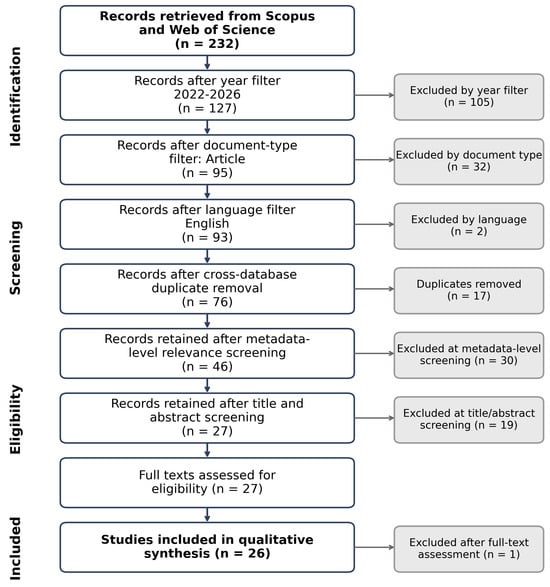
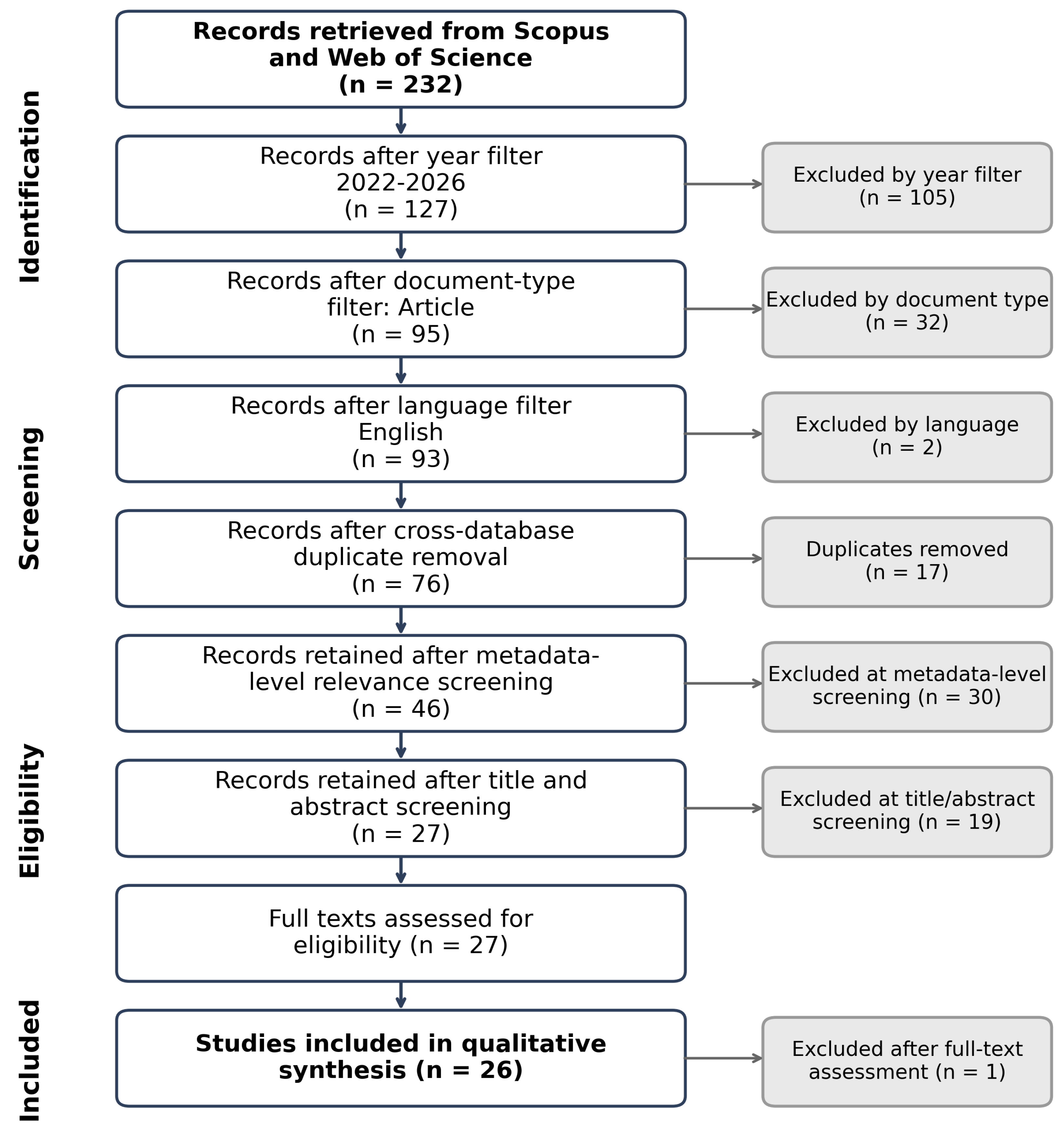
The screening process followed a staged dual-database logic. The combined searches yielded 232 records, corresponding to 189 from Scopus and 43 from Web of Science. These records were reduced to 127 after the 2022–2026 time window, 95 after restriction to journal articles, and 93 after exclusion of non-English records. Cross-database duplicate control using DOI and normalized titles removed 17 overlapping records, leaving 76 unique English-language articles for thematic screening. First, 30 records were excluded at the metadata level because titles and abstracts indicated review articles or clearly off-scope uses of terms such as agent-based, autonomous, simulation, or multi-agent in non-material domains or without an explicit AI agent workflow coordinating materials computations. Second, the remaining 46 records underwent title-and-abstract assessment, which excluded 19 additional articles because they still lacked a qualifying agentic materials-discovery workflow, addressed non-material domains, or used agent-based modeling in a non-AI sense. Twenty-seven full texts were therefore assessed. One article was excluded at full text because the acronym DFT referred to design-for-test automation in VLSI benchmarking rather than density functional theory or materials discovery. Record-level reasons for the pre-full-text exclusions are provided in Appendix A.
2.5. Data Extraction and Qualitative Synthesis
Data extraction was performed by only one researcher while the other approved the final collected corpus. This process was structured around the review question rather than bibliographic description alone. For each eligible study, the extraction framework captured the application domain, material class, agent architecture, tool family, workflow autonomy, validation strategy, reported quantitative evidence, reproducibility signals, and the main limitation acknowledged by the study. The classification categories were anchored to the published literature rather than defined ad hoc: autonomy was coded using the established degree-of-autonomy scale for self-driving laboratories, whose piecewise, semi-closed-loop, and closed-loop regimes correspond to the medium, medium–high, and high bands used here, and the architecture categories follow established taxonomies of LLM-based agent systems that separate single-agent and planner–executor designs from role-specialized multi-agent systems. The tool-grounding distinction between simulator-native and discovery-manager workflows is an operational categorization proposed here. This structure was selected to distinguish papers that merely mention agentic AI from papers that actually use agents to plan, execute, evaluate, or iteratively refine computational discovery workflows.
2.6. Methodological Scope and Limitations
Several scope conditions should be considered when interpreting the final corpus. First, the formal review was limited to Scopus and Web of Science Core Collection, which improves reproducibility but can still omit relevant studies indexed elsewhere. Second, the corpus was restricted to English-language journal articles. Third, agentic AI terminology remains unstable, so no single search equation can fully exhaust a rapidly evolving vocabulary. Fourth, the 2026 segment is necessarily partial because the searches were executed on 8 May 2026 and 15 June 2026. Finally, the retained studies differ substantially in material domain, toolchain, and evidence maturity, which is why the review is framed as a qualitative synthesis rather than a pooled effect-size analysis. All reported proportions derive from a corpus of n = 26, so each inclusion or exclusion shifts a proportion by roughly 3.8 percentage points and the right-censored 2026 segment should not be read as a growth rate. Although the two principal curated databases were searched, studies indexed only in other repositories or released as preprints may be under-represented. A sensitivity re-run augmenting the agentic block with terms such as self-driving, closed-loop, and active learning surfaced mostly self-driving laboratory studies without an explicit tool-orchestrating agent layer and did not change the eligible set.
3. Results
3.1. Corpus Profile and Publication Dynamics
The final synthesis comprised 26 studies. Figure 1 shows that the main attrition occurred before full-text assessment rather than after it. Of the 76 deduplicated English-language records, 30 were removed at metadata level as clearly off-scope and 19 more were excluded at title-and-abstract screening, leaving 27 full texts and 26 final included studies after one full-text exclusion. Although the formal review window covered 2022–2026, no paper published in 2022 or 2023 met the eligibility criteria after screening and full-text assessment. This does not mean that early candidate records were absent. Instead, the candidate records from 2022–2023 that reached thematic screening were excluded because they concerned service operation simulations, elastomer aging, biofilm morphology, urban electrification, wastewater metabolism, or other non-target uses of agent-based modeling rather than AI agent orchestration for materials discovery. The four WoS-unique records that required full-text audit all proved eligible and strengthened the 2025–2026 segment, but they did not change the absence of any eligible 2022–2023 study. The eligible evidence base therefore begins effectively in 2024, grows in 2025, and continues into the partial year 2026; because the searches were executed in 2026 the latest-year count is right-censored and is not evidence of an accelerating annual rate. This emergence pattern is consistent with the view that agentic materials workflows constitute a genuinely new research front rather than a mature body of literature that had simply been overlooked.
Figure 1.
PRISMA flow diagram of the combined Scopus and Web of Science identification, screening, full-text assessment, and final inclusion process.
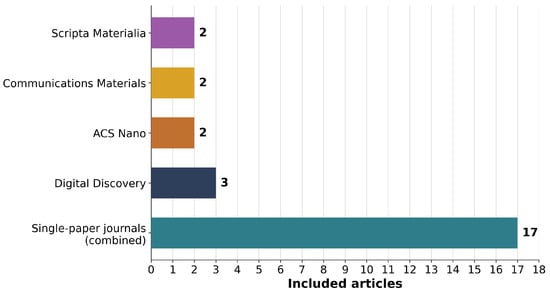
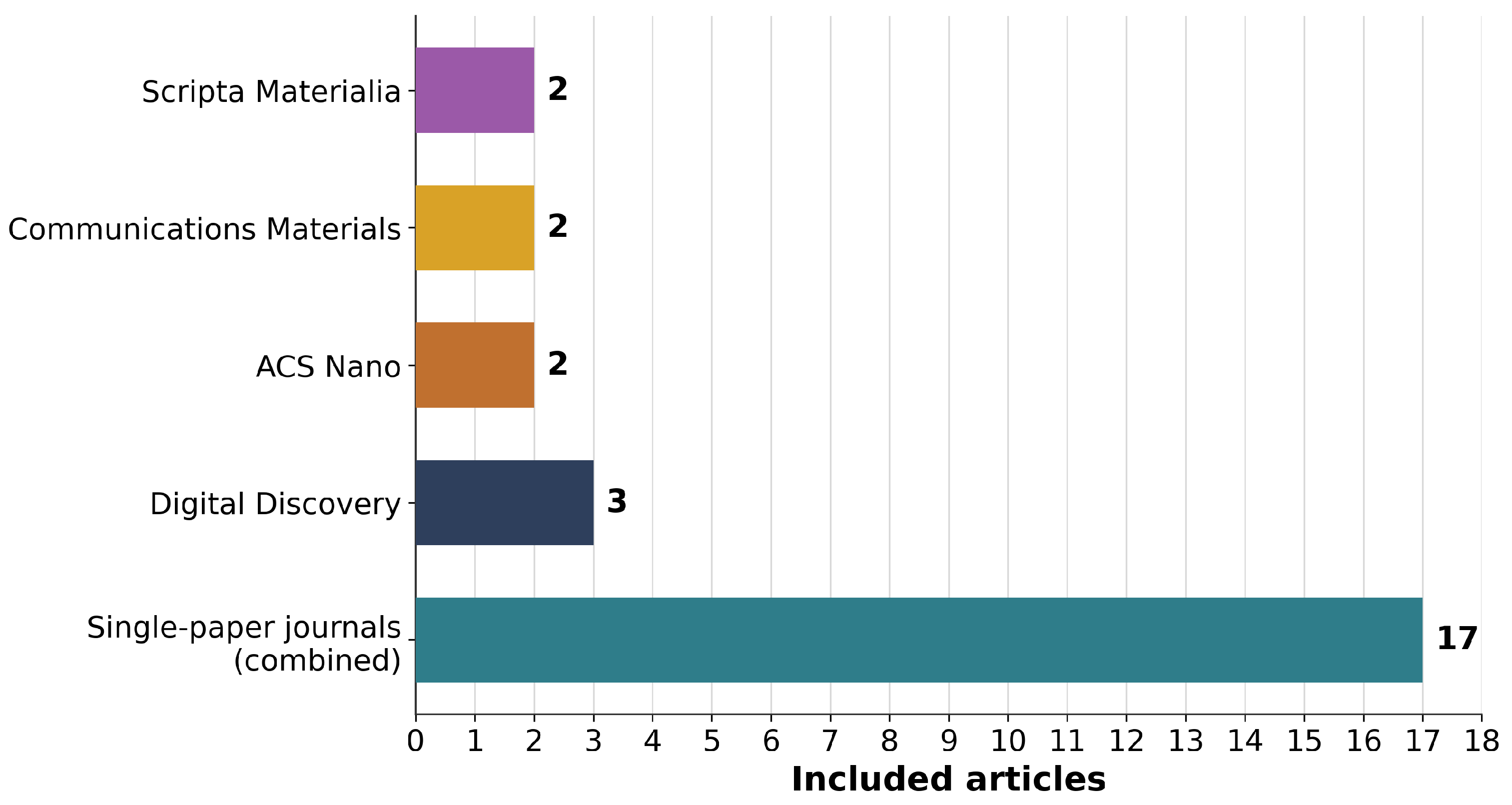
Outlet distribution was dispersed. Digital Discovery published three included articles, while ACS Nano, Communications Materials, and Scripta Materialia each published two; the remaining 17 studies were distributed across 17 different journals with a single contribution each. This pattern suggests that the area has not yet consolidated around a single disciplinary home. Instead, it spans catalysis, materials engineering, atomistic simulation, porous materials, robotics, and computational chemistry venues.
The study-level characteristics of the included corpus are summarized in Table 1.
Table 1.
Characteristics of the included combined corpus, including application domain, architecture pattern, tool families, and validation basis.
3.2. Application Domains and Workflow Roles
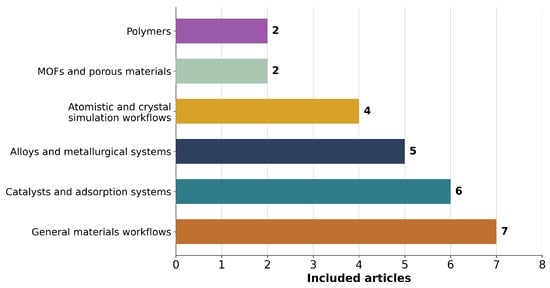
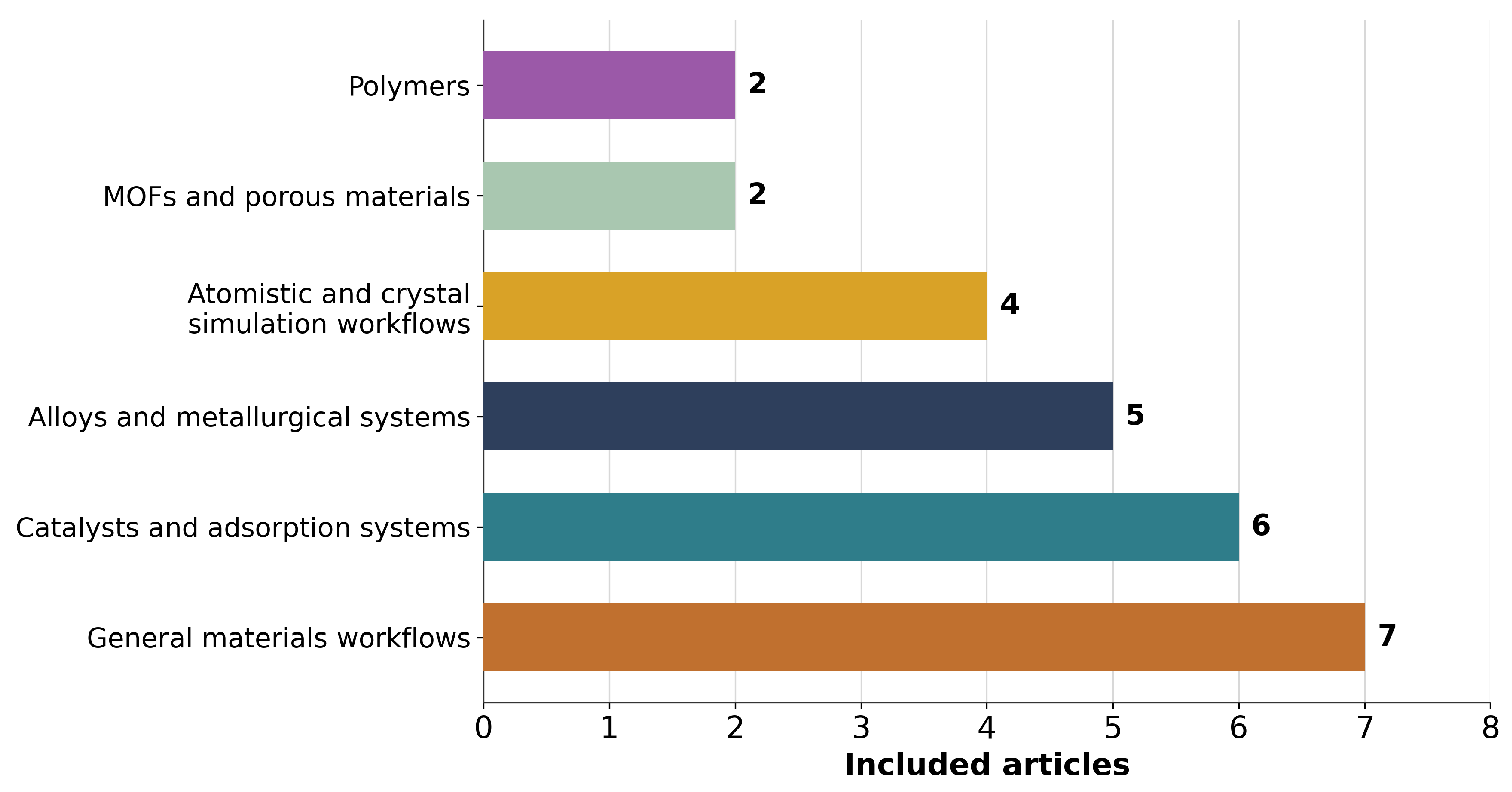
Catalysis and adsorption tasks formed the largest application block, represented by six studies on electrocatalyst design, adsorption-configuration search, biomass-valorization catalysis, MOF catalyst optimization, and single-atom-alloy discovery [19,20,27,28,30,34]. Alloy design and evaluation formed the second-largest block with five studies [18,23,29,31,33]. The remaining literature was distributed across general materials-workflow papers, atomistic simulation infrastructures, MOF and porous-material screening, and polymer simulation [17,21,22,24,25,26,32,35,36,37,38,39,40,41,42]. This distribution shows that the field is presently strongest where agents can either reduce the cost of iterative search or orchestrate heterogeneous computational steps that are otherwise labor-intensive. The annual distribution, outlet concentration, and domain grouping are shown in Figure 2, Figure 3 and Figure 4, respectively.
Figure 2.
Annual publication distribution of the final combined corpus after full-text assessment.
Figure 3.
Outlet concentration of the final corpus; seventeen studies were dispersed across seventeen single-paper journals, while four outlets contributed more than one study.
Figure 4.
Distribution of the final corpus by primary material or application group.
3.3. Agent Architectures and Tool Integration
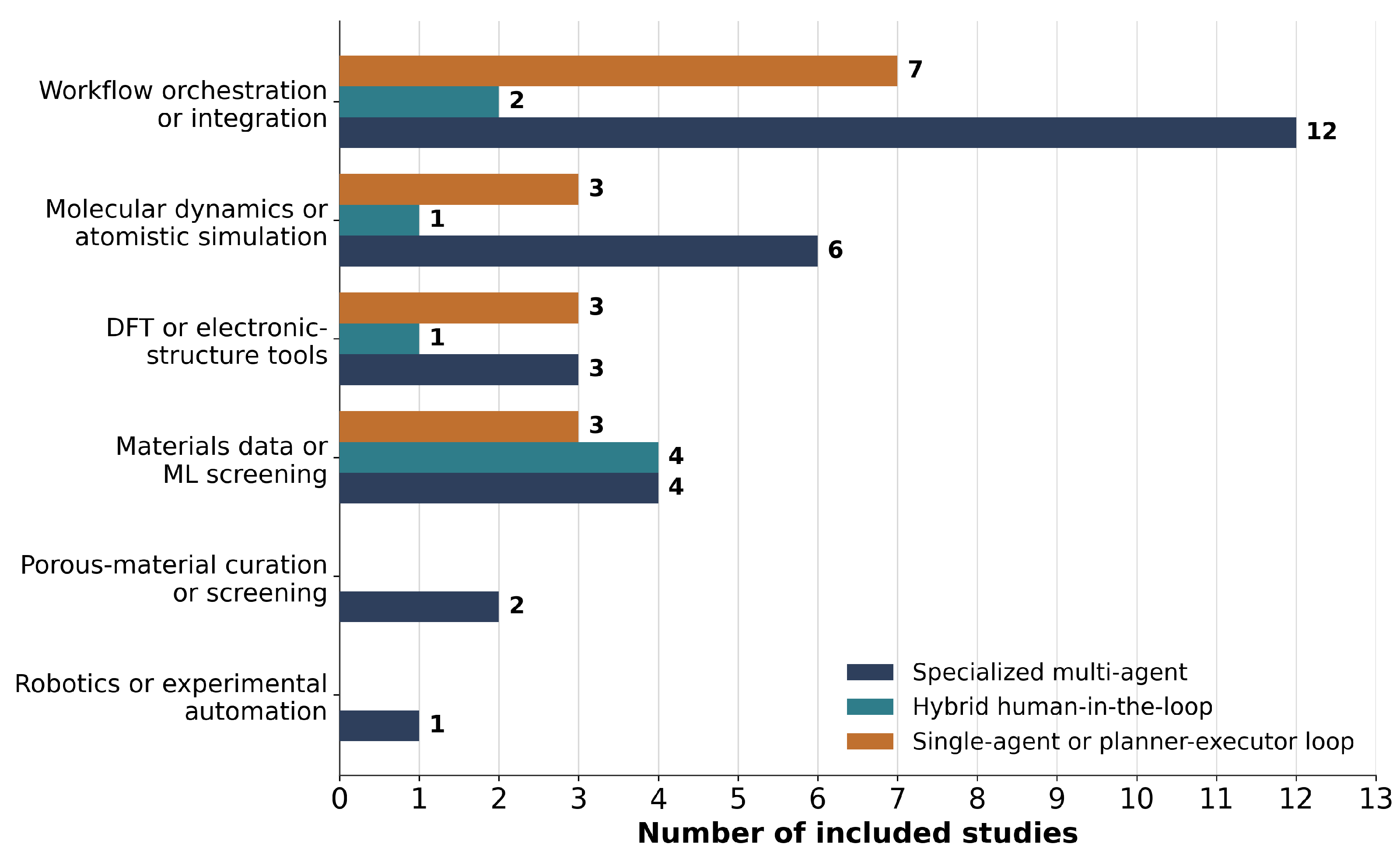
Specialized multi-agent architectures were the dominant pattern, appearing in 13 of the 26 included studies. These papers typically split the workflow into role-specific agents for planning, structure retrieval, simulation execution, analysis, and quality control [18,19,21,25,26,35,36,37,38,41,42]. A second group of studies used hybrid human-in-the-loop designs, where the agentic layer guided design or analysis but final judgment remained partly manual [20,22,27,30,31]. A third group relied on more compact planner–executor or single-agent loops that repeatedly called tools and updated decisions from the observed outputs [24,28,29,32,33,34,39,40]. Across all three groups, the common pattern was not unrestricted natural-language reasoning; it was tool-grounded orchestration.
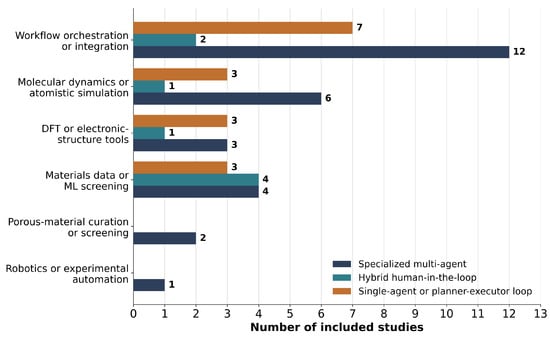
Tool grounding was broad but not evenly distributed. Workflow orchestration or integration appeared in 21 of the 26 included studies, molecular dynamics or atomistic simulation environments in ten, materials data or machine learning screening pipelines in eleven, explicit DFT or electronic-structure tools in seven, porous-material curation or screening in two, and robotic execution in one. Several of the strongest simulation-centered papers were explicit about this grounding. VASPilot autonomously configured and executed VASP studies across convergence, band-structure, and lattice-optimization tasks [25]. The end-to-end atomistic framework in Digital Discovery linked structure generation, potential discovery, LAMMPS execution, OVITO analysis, and phonon post-processing in a single agentic pipeline [36], while GENIUS benchmarked autonomous Quantum ESPRESSO protocol generation and repair at scale [42]. By contrast, papers such as the electrocatalyst-informatics, biomass-screening, and modular multi-task materials agent studies [19,30,41] were agentic in a broader but still relevant sense: they coordinated retrieval, structured extraction, ranking, simulation setup, and prediction rather than a single first-principles simulator. Figure 5 summarizes tool-family use across the main architecture patterns.
Figure 5.
Distribution of tool-family use across the major architecture patterns observed in the included studies.
3.4. Validation Patterns, Quantitative Evidence, and Reproducibility
Validation quality was heterogeneous. Some papers offered benchmark-style quantitative evidence. Adsorb-Agent recovered comparable adsorption energies in 83.7% of benchmark systems and better energies in 35.0% while using only 26.9% of the candidate configurations on average [28]. The crystal-generation worker–supervisor framework reduced execution-level hallucinations from 100% to as low as 5% and reached 82% structural match accuracy for fully specified prompts [32]. The alloy-optimization loop improved tensile-strength estimates from starting values of 8.26–9.81 GPa to maxima of 13.31–18.70 GPa [33]. The single-atom-alloy catalyst agent linked a structural descriptor to adsorption with R2 = 0.94 and RMSE = 0.20 eV, and then experimentally validated a YCu-SAA catalyst at 60% FE for C2+ products [34]. GENIUS passed early execution validation for about 80% of 295 benchmark prompts and autonomously recovered 76.3% of initially failed cases [42], while MatAgent completed 94–96% of property-retrieval tasks and 89–91% of property-prediction tasks across three 100-question rounds [40]. Other papers were more demonstrative, emphasizing workflow feasibility, design navigation, or case-based success rather than tightly standardized metrics [17,18,21,22,35,37,38,39,41].
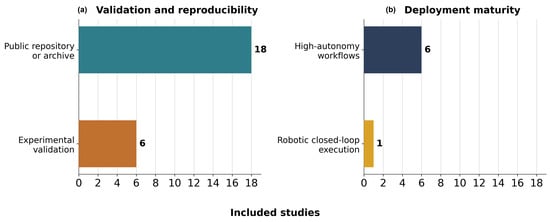
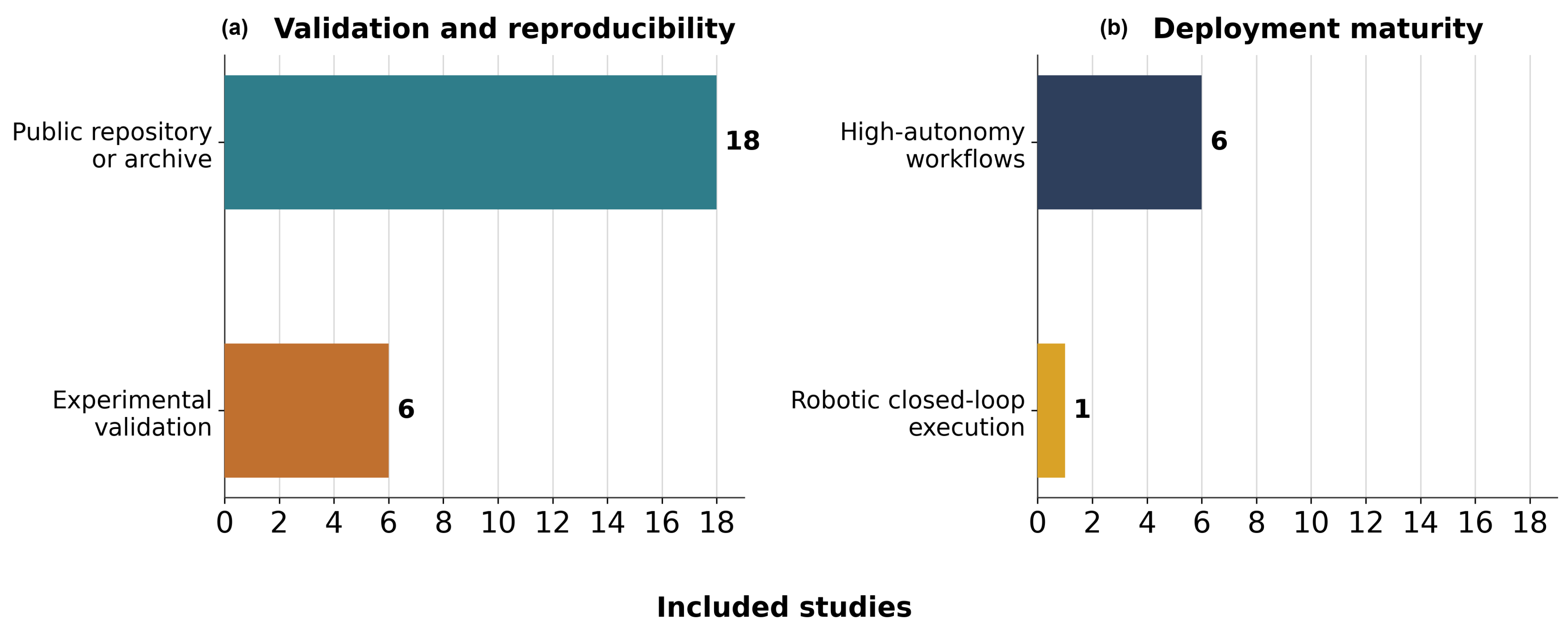
Reproducibility signals were present but uneven. Public repositories or archival artifacts were identified in 18 of the 26 included studies. Experimental validation appeared in six studies, while high-autonomy workflows were limited to six; the remaining corpus was concentrated in medium-high (twelve) and medium (eight) autonomy. Only one article demonstrated genuine robotic closed-loop execution [35]. In several papers, the strongest reproducibility evidence came from public code, tutorials, datasets, or supplementary traces [18,19,20,21,23,25,28,30,31,35,36,37,38,39,40,41,42]. In others, the workflow could be reconstructed only partially from supporting information, and prompt logs, failure traces, or decision histories remained incomplete [17,22,24,26,27,29,33,34].
Figure 6 summarizes validation, reproducibility, and deployment-maturity signals observed across the final corpus. Table 2 summarizes the main quantitative evidence, reproducibility artifacts, and study-level limitations reported by the included corpus.
Figure 6.
Validation, reproducibility, and deployment-maturity signals observed across the final combined corpus. (a) Validation basis and autonomy profile. (b) Reproducibility and deployment signals.
Table 2.
Quantitative highlights, reproducibility artifacts, and main limitations reported by the included studies.
3.5. Metadata-Derived Thematic Emphasis
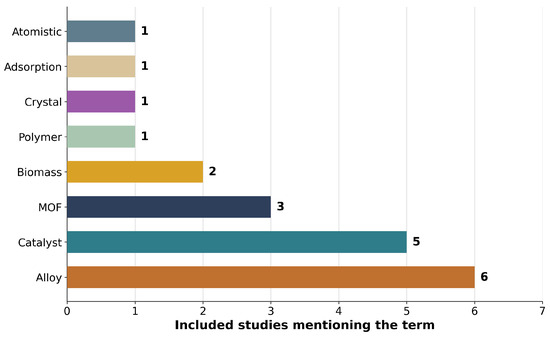
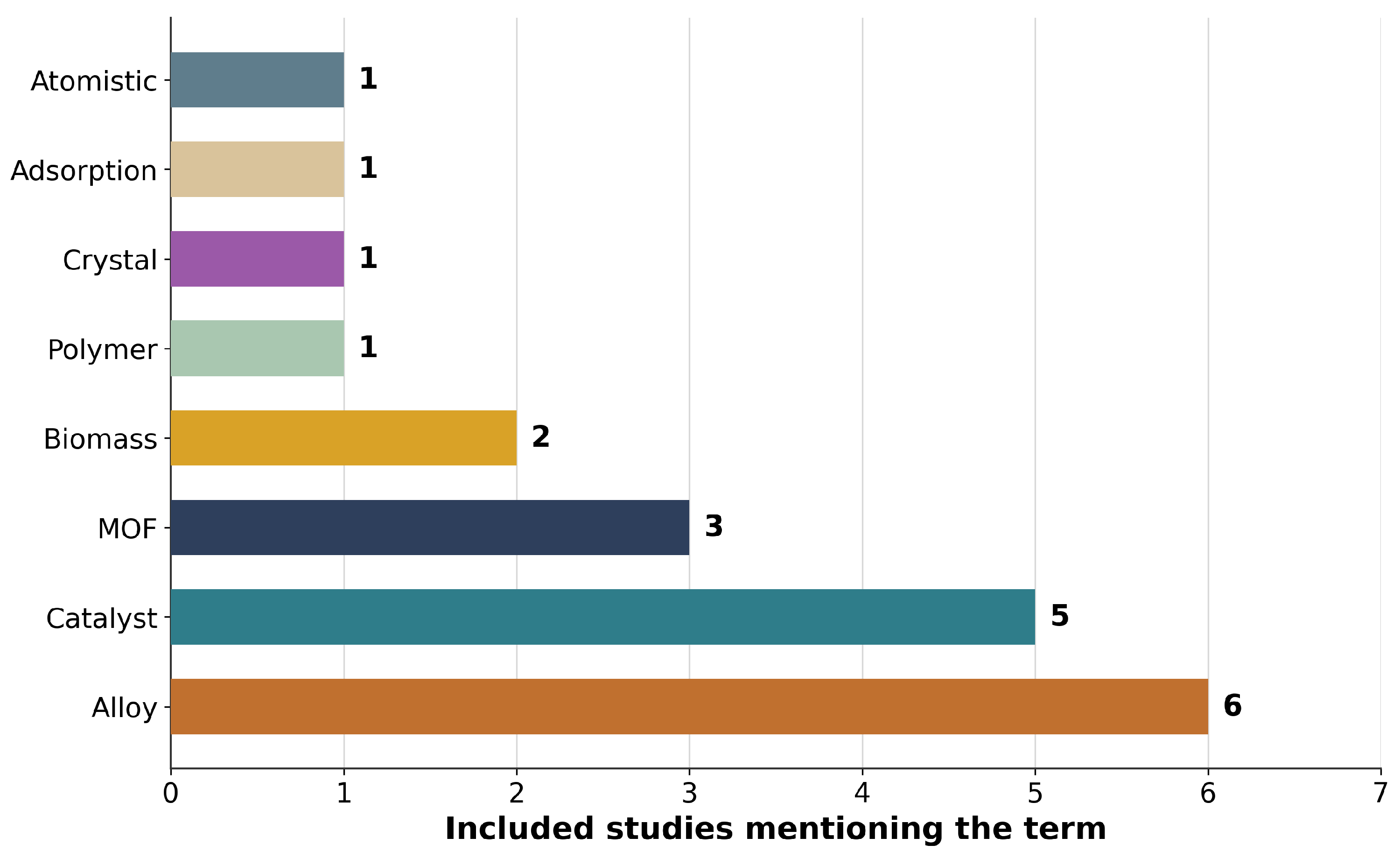
Because author-keyword fields were inconsistently populated across the included records, an auxiliary metadata-derived term-frequency profile was constructed from normalized title terms supplemented by any available author-keyword fields. Figure 7 shows that alloy- and catalyst-centered studies remain the dominant domain-oriented signals, while MOF-, polymer-, atomistic-, and crystal-related terms form smaller but visible thematic niches. This profile is consistent with the domain analysis above and helps distinguish where the field is already concentrated from where it is still exploratory.
Figure 7.
Frequency of normalized thematic terms derived from titles and any available author-keyword metadata in the included corpus.
4. Discussion
4.1. From Model-Centric AI to Workflow-Centric AI
The clearest message from the corpus is that the field is moving from model-centric AI toward workflow-centric AI. Earlier materials acceleration agendas emphasized prediction, inverse design, or generalized automation [2,3,4]. The literature synthesized here shows something more specific: the scientific contribution increasingly lies in how agents coordinate heterogeneous steps across databases, code, simulators, schedulers, and analysis routines, not simply in what a single model predicts. Twenty-one of the twenty-six included studies contained an explicit orchestration or integration layer, and no eligible study was found before 2024, which indicates that this literature is not a long-standing subfield but a recent architectural shift. That pattern aligns with broader discussions of tool-augmented language models and autonomous chemistry agents [5,6,7,8,9,10], but the final corpus is more operationally concrete than much of the perspective literature because it documents how agentic systems are embedded inside executable materials workflows and judged against tangible computational or experimental outputs. Across the included studies, agentic functions fall into three recurrent roles: infrastructure and orchestration layers that manage heterogeneous software stacks [21,25,36,37,38,39,40,41,42], search-space reduction loops that accelerate candidate evaluation or optimization [28,29,33], and discovery systems that carry computational reasoning far enough to support experimentally relevant decisions [20,22,27,34,35,39].
4.2. Why Tool Grounding Matters
A second important pattern is that tool grounding remains the main credibility mechanism. A significant selection effect is observed: the eligibility criteria require a simulation, computational, or domain-specific tool component, resulting in a corpus composed solely of tool-based studies. The importance of tool-based grounding as a mechanism for establishing credibility is, therefore, partly a consequence of the inclusion criteria and should not be interpreted as indicating that tool-based grounding is more prevalent than non-tool-based methods in the general literature. Our claim is more specific: within tool-based agent materials workflows, credibility is based on the tool interface, rather than on unstructured text. The most persuasive papers did not treat the language model as a stand-alone scientific authority. Instead, they linked it to DFT, molecular dynamics, adsorption screening, process simulation, CALPHAD, crystallographic curation, or robotic execution [18,21,25,28,29,31,32,33,34,35,36,39,40,41,42]. This grounding matters because it converts abstract reasoning into constrained action and creates natural checkpoints at which the workflow can be inspected, corrected, or benchmarked. It also reveals that not all agentic materials papers should be interpreted in the same way. Some studies are simulator-native: the agent configures or executes atomistic or thermodynamic tools directly [21,25,28,29,31,33,36,38,39,40,41,42]. Others act more as discovery managers around retrieval, ranking, surrogate models, or protocol navigation [19,20,26,30,41]. Both modes are scientifically relevant, but they rely on different evidentiary anchors. In practical terms, that distinction is what separates a scientific workflow from a fluent assistant, and it explains why explicit DFT-coupled systems, although still a minority, are among the most convincing demonstrations in the corpus. It also brings into view a form of hidden infrastructure that is easy to underestimate: CIF cleaning, input-file generation, job submission, error recovery, post-processing, and software-to-software translation. Papers such as SmartCIF, DynaMate, VASPilot, Matty, GENIUS, and ToPolyAgent show that a substantial share of the current advance lies not in replacing scientific judgment with text generation, but in making these brittle infrastructural steps programmable and recoverable [21,25,37,38,39,42].
4.3. Autonomy Is Advancing, but Still Uneven
At the same time, autonomy remains uneven. Only six studies met the criteria for high autonomy, whereas twelve were classified as medium–high and eight as medium. Only one study demonstrated full robotic closed-loop execution [35]; a single case is reported as an existence proof rather than a field-level measure. The distribution is also domain-sensitive. Hybrid human-in-the-loop systems accounted for four of the six experimentally validated papers, which suggests that human oversight appears to be retained more often where the downstream consequences of an incorrect decision are more costly or irreversible, although the small sample precludes strong inference [20,22,27,30,31]. This should not be read as a failure of the field. It indicates that, at present, agentic materials discovery is strongest when agents handle search, coordination, and execution while experts retain authority over framing, feasibility, and interpretation. A central tension in the corpus is that operational autonomy and materials-level validation do not peak in the same studies: the clearest simulator orchestration papers benchmark execution, search efficiency, or error reduction with unusual precision, whereas the papers with the clearest experimental transfer often remain hybrid and domain-scaffolded. The literature therefore shows more evidence of competent orchestration than of fully self-driving scientific autonomy, and it is best interpreted along separate axes of operational autonomy, scientific fidelity, and discovery transfer.
4.4. Reproducibility Remains a Methodological Fault Line
Reproducibility is another dividing line between promising demonstrations and reusable research infrastructure. Public repositories or archival artifacts were present in 18 of the 26 included studies, but their depth varied substantially. Repository support was more common in specialized multi-agent systems than in compact single-agent loops, yet even in the better-documented papers, prompt logs, intervention histories, scheduler settings, failure traces, and environment specifications were often incomplete. For tool-grounded systems, reproducibility cannot be reduced to source code alone. It also depends on the versioned interfaces through which the agent calls external tools, the templates used to prepare inputs, the repair logic used after failures, the stopping criteria for iterative loops, and the computational budgets under which the workflow was evaluated. The broader literature on autonomous scientific systems has already argued for more rigorous evaluation protocols and transparent tool interfaces [3,5,7,8,9,10,11,12]. The present review reinforces that argument from a materials perspective: without stronger reporting of trajectories, interventions, benchmark criteria, and environment-level dependencies, it remains difficult to compare systems fairly or to distinguish genuine autonomy from carefully curated demonstrations. A useful minimum reporting matrix would separate operational metrics such as task completion, recovery from tool failure, and iteration cost; scientific-fidelity metrics such as agreement with DFT, MD, process simulation, or experiment; and discovery-utility metrics such as candidate improvement, screening efficiency, or successful experimental transfer.
4.5. Research Agenda and Domain Implications
The domain distribution helps explain where the field currently gains traction. Catalysis and adsorption systems (n = 6) and alloys and metallurgical systems (n = 5) dominate because both areas offer relatively clear quantitative loops between structured data, simulation, mechanistic hypotheses, and optimization. Four of the six experimentally validated studies belonged to catalysis and adsorption, whereas alloy studies more often demonstrated computational optimization than experimental closure. We hypothesise, rather than conclude, that this asymmetry may reflect more mature descriptor cultures, stronger mechanistic priors, and more established simulation-to-experiment pathways in catalysis; given the small denominators this remains a small-sample observational hypothesis. Alloy-design papers, by contrast, often achieve impressive autonomous optimization within molecular dynamics or CALPHAD-like environments, but their translation to experimentally confirmed materials performance remains less common. Smaller subliteratures in polymers, MOF curation, and end-to-end atomistic workflows show that the field is broadening, but they have not yet reached the same density of validation or methodological convergence. The next stage of progress is therefore unlikely to come from generic claims about AI agents in materials science. It is more likely to come from deepening a smaller set of tool-rich domains in which the agent can repeatedly act on quantitative feedback and where domain-specific benchmarks can be standardized. Importantly, the corpus already demonstrates several concrete successes: autonomous VASP execution across routine electronic-structure tasks [25], large-scale Quantum ESPRESSO protocol generation and repair [42], substantial reduction of adsorption-search effort without collapsing energy quality [28], adaptive alloy optimization under repeated MD feedback [33], catalyst discovery with experimental confirmation [34], and one genuine multi-agent robotic closure [35]. These are not yet a mature ecosystem, but they do show that the field has progressed beyond speculative proof-of-concept rhetoric.
Several priorities follow from this synthesis. First, benchmark tasks should be defined more explicitly, especially for simulator setup, recovery from failure, adsorption search, multistep optimization, and cross-tool orchestration under realistic compute constraints. Second, reproducibility packages should include prompts, tool traces, code, representative failures, and environment specifications rather than source code alone. Third, papers should report autonomy boundaries more carefully, including when humans intervene, which decisions remain manual, and how much wall time, API usage, or high-performance-computing effort is required to complete a workflow. Fourth, the field would benefit from a clearer taxonomy that distinguishes literature assistants, workflow managers, simulator executors, and genuinely closed-loop optimizers rather than placing them all under a single agentic label. Fifth, opportunities for the next wave of work lie in portability across tool environments, broader coverage of underrepresented material classes, and agent designs that can transfer beyond one benchmark workflow or one research group’s software stack. Finally, experimental validation must become more common, because computational success without materials-level confirmation is not enough to establish scientific utility. These priorities do not weaken the present literature. They identify the conditions under which agentic workflows could mature from impressive case studies into trusted research instruments.
5. Conclusions
This review identifies a young but rapidly expanding literature on agentic workflows for simulation-driven materials discovery. Within a dual-database five-year window, the final evidence base emerged only in 2024 and accelerated sharply in 2025–2026, with catalysis, adsorption, and alloy design as the dominant application areas. The strongest papers were not those making the broadest claims about artificial intelligence. They were the ones that coupled language model reasoning to concrete computational tools, explicit validation logic, and at least partially reproducible artifacts. The field is therefore already past the stage of purely speculative discussion, but it has not yet reached methodological standardization. The most defensible conclusion is that agentic AI is becoming a practical architecture for orchestrating materials workflows, especially where search, simulation, and analysis can be iterated in a tool-grounded loop and evaluated against physically meaningful endpoints. Future progress will depend less on larger models alone than on stronger benchmarking, sharper reporting discipline, clearer autonomy boundaries, deeper physical grounding, and more frequent translation from computational success to experimentally meaningful materials outcomes.
Author Contributions
Conceptualization, A.A.-M.; methodology, A.A.-M.; software, A.A.-M.; validation, A.A.-M., A.V.-A., S.R.-F. and F.D.; formal analysis, A.A.-M., A.V.-A., S.R.-F. and F.D.; investigation, A.A.-M., A.V.-A., S.R.-F. and F.D.; resources, A.A.-M., A.V.-A., S.R.-F. and F.D.; data curation, A.A.-M.; writing—original draft preparation, A.A.-M.; writing—review and editing, A.A.-M., A.V.-A., S.R.-F. and F.D.; visualization, A.A.-M.; supervision, A.A.-M.; project administration, A.A.-M. All authors have read and agreed to the published version of the manuscript.
Funding
This research received no external funding.
Data Availability Statement
The complete data extraction and selection decisions underlying this systematic review are documented in the manuscript, including Appendix A and Table A1. Additional derived files generated during the analysis can be made available by the corresponding author upon reasonable request.
Acknowledgments
During the preparation of this manuscript, the authors used cloud-based AI-assisted language tools for final language polishing, including typographical, wording, and grammatical revisions. The authors reviewed and edited the output and take full responsibility for the content of this publication.
Conflicts of Interest
The authors declare no conflict of interest.
Appendix A. Record-Level Exclusions Prior to Full-Text Synthesis
Table A1 reports the records excluded before full-text assessment, together with the stage at which they were removed and the main reason for exclusion. Appendix A is included to make the transition from the deduplicated English-language combined set to the final assessed full-text set fully auditable.
Table A1.
Record-level exclusions before full-text assessment.
References
- Butler, K.T.; Davies, D.W.; Cartwright, H.; Isayev, O.; Walsh, A. Machine learning for molecular and materials science. Nature 2018, 559, 547–555. [Google Scholar] [CrossRef] [Scilit] [PubMed]
- Pyzer-Knapp, E.O.; Pitera, J.W.; Staar, P.W.J.; Takeda, S.; Laino, T.; Sanders, D.P.; Sexton, J.; Smith, J.R.; Curioni, A. Accelerating materials discovery using artificial intelligence, high performance computing and robotics. npj Comput. Mater. 2022, 8, 84. [Google Scholar] [CrossRef] [Scilit]
- Tom, G.; Schmid, S.P.; Baird, S.G.; Cao, Y.; Darvish, K.; Hao, H.; Lo, S.; Pablo-García, S.; Rajaonson, E.M.; Skreta, M.; et al. Self-Driving Laboratories for Chemistry and Materials Science. Chem. Rev. 2024, 124, 9633–9732. [Google Scholar] [CrossRef] [Scilit] [PubMed]
- Cheng, M.; Fu, C.-L.; Okabe, R.; Chotrattanapituk, A.; Boonkird, A.; Hung, N.T.; Li, M. Artificial intelligence-driven approaches for materials design and discovery. Nat. Mater. 2026, 25, 174–190. [Google Scholar] [CrossRef] [Scilit] [PubMed]
- Ramos, M.C.; Collison, C.J.; White, A.D. A review of large language models and autonomous agents in chemistry. Chem. Sci. 2025, 16, 2514–2572. [Google Scholar] [CrossRef] [Scilit] [PubMed]
- Yoshikawa, N.; Skreta, M.; Darvish, K.; Arellano-Rubach, S.; Ji, Z.; Kristensen, L.B.; Li, A.Z.; Zhao, Y.; Xu, H.; Kuramshin, A.; et al. Large language models for chemistry robotics. Auton. Robot. 2023, 47, 1057–1086. [Google Scholar] [CrossRef] [Scilit]
- Bran, A.M.; Cox, S.; Schilter, O.; Baldassari, C.; White, A.D.; Schwaller, P. Augmenting large language models with chemistry tools. Nat. Mach. Intell. 2024, 6, 525–535. [Google Scholar] [CrossRef] [Scilit] [PubMed]
- Boiko, D.A.; MacKnight, R.; Kline, B.; Gomes, G. Autonomous chemical research with large language models. Nature 2023, 624, 570–578. [Google Scholar] [CrossRef] [Scilit] [PubMed]
- Jablonka, K.M.; Schwaller, P.; Ortega-Guerrero, A.; Smit, B. Leveraging large language models for predictive chemistry. Nat. Mach. Intell. 2024, 6, 161–169. [Google Scholar] [CrossRef] [Scilit]
- Jablonka, K.M.; Ai, Q.; Al-Feghali, A.; Badhwar, S.; Bocarsly, J.D.; Bran, A.M.; Bringuier, S.; Brinson, L.C.; Choudhary, K.; Circi, D.; et al. 14 examples of how LLMs can transform materials science and chemistry: A reflection on a large language model hackathon. Digit. Discov. 2023, 2, 1233–1250. [Google Scholar] [CrossRef] [Scilit] [PubMed]
- Jiang, X.; Wang, W.; Tian, S.; Wang, H.; Lookman, T.; Su, Y. Applications of natural language processing and large language models in materials discovery. npj Comput. Mater. 2025, 11, 79. [Google Scholar] [CrossRef] [Scilit]
- Pei, Z.; Yin, J.; Zhang, J. Language models for materials discovery and sustainability: Progress, challenges, and opportunities. Prog. Mater. Sci. 2025, 154, 101495. [Google Scholar] [CrossRef] [Scilit]
- Zheng, Z.; Rampal, N.; Inizan, T.J.; Borgs, C.; Chayes, J.T.; Yaghi, O.M. Large language models for reticular chemistry. Nat. Rev. Mater. 2025, 10, 369–381. [Google Scholar] [CrossRef] [Scilit]
- De Breuck, P.-P.; Wang, H.-C.; Rignanese, G.-M.; Botti, S.; Marques, M.A.L. Generative AI for crystal structures: A review. npj Comput. Mater. 2025, 11, 370. [Google Scholar] [CrossRef] [Scilit]
- Page, M.J.; McKenzie, J.E.; Bossuyt, P.M.; Boutron, I.; Hoffmann, T.C.; Mulrow, C.D.; Shamseer, L.; Tetzlaff, J.M.; Akl, E.A.; Brennan, S.E.; et al. The PRISMA 2020 statement: An updated guideline for reporting systematic reviews. BMJ 2021, 372, n71. [Google Scholar] [CrossRef] [Scilit] [PubMed]
- Page, M.J.; Moher, D.; Bossuyt, P.M.; Boutron, I.; Hoffmann, T.C.; Mulrow, C.D.; Shamseer, L.; Tetzlaff, J.M.; Akl, E.A.; Brennan, S.E.; et al. PRISMA 2020 explanation and elaboration: Updated guidance and exemplars for reporting systematic reviews. BMJ 2021, 372, n160. [Google Scholar] [CrossRef] [PubMed]
- Buehler, M.J. Generative Retrieval-Augmented Ontologic Graph and Multiagent Strategies for Interpretive Large Language Model-Based Materials Design. ACS Eng. Au 2024, 4, 241–277. [Google Scholar] [CrossRef] [Scilit] [PubMed]
- Ghafarollahi, A.; Buehler, M.J. Automating alloy design and discovery with physics-aware multimodal multiagent AI. Proc. Natl. Acad. Sci. USA 2025, 122, e2414074122. [Google Scholar] [CrossRef] [Scilit] [PubMed]
- Hu, X.; Chen, S.; Chen, L.; Wang, H.; Zhang, X.; Zhou, Z. Automating structure-activity analysis for electrochemical nitrogen reduction catalyst design through multi-agent collaborations. Natl. Sci. Rev. 2025, 12, nwaf372. [Google Scholar] [CrossRef] [Scilit] [PubMed]
- Lin, J.; Zhao, D.; Lu, S.; Li, R.; Xu, X.; Wang, Z.; Li, W.; Ji, Y.; Zhang, C.; Shi, L.; et al. Conversational Large-Language-Model Artificial Intelligence Agent for Accelerated Synthesis of Metal-Organic Frameworks Catalysts in Olefin Hydrogenation. ACS Nano 2025, 19, 23840–23858. [Google Scholar] [CrossRef] [Scilit] [PubMed]
- Mendible-Barreto, O.A.; Díaz-Maldonado, M.; Esteva, F.J.C.; Torres, J.E.; Córdova-Figueroa, U.M.; Colón, Y.J. DynaMate: Leveraging AI-agents for customized research workflows. Mol. Syst. Des. Eng. 2025, 10, 585–598. [Google Scholar] [CrossRef] [Scilit]
- Su, H.; Lei, S.; Chen, Y.; Lv, Y.; Zhang, Q. Human-Machine Collaborative Design of SnTe-Based Thermoelectric Materials via a Multiagent Framework Leveraging Large Language Models. ACS Appl. Mater. Interfaces 2025, 17, 63572–63584. [Google Scholar] [CrossRef] [Scilit] [PubMed]
- Ghafarollahi, A.; Buehler, M.J. Rapid and automated alloy design with graph neural network-powered large language model-driven multi-agent AI. MRS Bull. 2025, 50, 1309–1324. [Google Scholar] [CrossRef] [Scilit]
- Liu, Z.; Chai, Y.; Li, J. Toward Automated Simulation Research Workflow through LLM Prompt Engineering Design. J. Chem. Inf. Model. 2025, 65, 114–124. [Google Scholar] [CrossRef] [Scilit] [PubMed]
- Liu, J.; Zhu, T.; Ye, C.; Fang, Z.; Weng, H.; Wu, Q. VASPilot: MCP-facilitated multi-agent intelligence for autonomous VASP simulations. Chin. Phys. B 2025, 34, 117106. [Google Scholar] [CrossRef] [Scilit]
- Li, Y.; Zhao, J.; Cao, X.E.; Li, S. A large language model-based multi-agent methodology for intelligent materials screening: A case study on MOFs for CO2 capture. Sep. Purif. Technol. 2026, 394, 137462. [Google Scholar] [CrossRef] [Scilit]
- Zhao, P.; Zhang, Y.; Chen, B.; Zhao, W.; Chen, Z.; Guan, L.; Sun, S.; Zhang, S.; Li, Y.; Peng, W.; et al. AI-Agent-Guided Design of Dual-Scale Modulated Nickel-Based Catalyst with Built-In Electric Field for Enhanced Biomass Electrooxidation. ACS Nano 2026, 20, 10640–10650. [Google Scholar] [CrossRef] [Scilit] [PubMed]
- Ock, J.; Meda, R.S.; Vinchurkar, T.; Jadhav, Y.; Farimani, A.B. Adsorb-Agent: Autonomous identification of stable adsorption configurations via a large language model agent. Digit. Discov. 2026, 5, 617–629. [Google Scholar] [CrossRef] [Scilit]
- Roy, A.; Devanathan, R.; Soulami, A.; Sushko, M.L. Agentic AI for autonomous discovery of radiation-tolerant CoCrFeMnNi high entropy alloys. Scr. Mater. 2026, 279, 117286. [Google Scholar] [CrossRef] [Scilit]
- Liu, A.; Kim, G.; Song, H. Agentic AI framework for accelerated catalyst design in biomass valorization via small language models and automated machine learning. Chem. Eng. J. 2026, 535, 175701. [Google Scholar] [CrossRef] [Scilit]
- Pak, P.; Chandrasekhar, A.; Farimani, A.B. Agentic additive manufacturing alloy evaluation. Addit. Manuf. Lett. 2026, 31, 100355. [Google Scholar] [CrossRef] [Scilit]
- Baibakova, V.; Serov, A. Agentic framework for programmatic crystal structure generation using a fine-tuned worker-supervisor large language model. Energy AI 2026, 24, 100710. [Google Scholar] [CrossRef] [Scilit]
- Roy, A.; Devanathan, R.; Nartu, M.S.K.K.Y.; Joshi, V.V. Autonomous alloy composition optimization using molecular dynamics guided by a large language model. Scr. Mater. 2026, 272, 117048. [Google Scholar] [CrossRef] [Scilit]
- Wang, X.; Li, Z.; Zhang, D.; Li, H.; Xu, H.; Cheng, D. Catalysis AI Agent Guides Discovering the Universal Design Principle of Cu-Based Single-Atom Alloy Catalysts for CO2 Electroreduction. Angew. Chem. Int. Ed. 2026, 65, e24612. [Google Scholar] [CrossRef] [Scilit] [PubMed]
- Shi, T.; Li, Y.; Wang, Z.; Xu, W.; Jiang, G.; Dai, D.; Zhou, J.; Huang, H.; He, R.; Ramakrishna, S.; et al. Knowledge-driven autonomous materials research via collaborative multi-agent and robotic system. Matter 2026, 9, 2102577. [Google Scholar] [CrossRef] [Scilit]
- Vriza, A.; Kornu, U.; Koneru, A.; Chan, H.; Sankaranarayanan, S.K.R.S. Multi-agentic AI framework for end-to-end atomistic simulations. Digit. Discov. 2026, 5, 440–452. [Google Scholar] [CrossRef] [Scilit]
- Zhang, Q.; Zhang, C.; Wang, L. SmartCIF: A context-aware multi-agent system for automated preprocessing and curation of MOF CIFs. Phys. Chem. Chem. Phys. 2026, 28, 9566–9575. [Google Scholar] [CrossRef] [Scilit] [PubMed]
- Ding, L.; Carrillo, J.; Do, C. ToPolyAgent: AI agents for coarse-grained bead-spring topological polymer simulations. Digit. Discov. 2026, 5, 901–909. [Google Scholar] [CrossRef] [Scilit]
- Wang, X.; Zeng, Q.; Xu, D.; Zhang, L.; Jiang, G.; Yang, M. Accelerating materials discovery via AI-Agent integration of large language models and simulation tools. J. Mater. Inform. 2026, 6, 9. [Google Scholar] [CrossRef] [Scilit]
- Lv, S.; Peng, L.; Wu, W.; Yao, Y.; Jiao, S.; Hu, W. Bridging language models and computational materials science: A prompt-driven framework for material property prediction. Mater. Genome Eng. Adv. 2025, 3, e70013. [Google Scholar] [CrossRef] [Scilit]
- Chaudhari, A.; Ock, J.; Farimani, A.B. Modular large language model agents for multi-task computational materials science. Commun. Mater. 2026, 7, 131. [Google Scholar] [CrossRef] [Scilit]
- Soleymanibrojeni, M.; Aydin, R.; Guedes-Sobrinho, D.; Dias, A.C.; Piotrowski, M.J.; Wenzel, W.; Rêgo, C.R.C. GENIUS: An agentic AI framework for autonomous design and execution of simulation protocols. Commun. Mater. 2026, 7, 115. [Google Scholar] [CrossRef] [Scilit]

Disclaimer/Publisher’s Note: The statements, opinions and data contained in all publications are solely those of the individual author(s) and contributor(s) and not of MDPI and/or the editor(s). MDPI and/or the editor(s) disclaim responsibility for any injury to people or property resulting from any ideas, methods, instructions or products referred to in the content. |
© 2026 by the authors. Licensee MDPI, Basel, Switzerland. This article is an open access article distributed under the terms and conditions of the Creative Commons Attribution (CC BY) license.