


Abstract
The genus Bacillus is widely recognized for its metabolic versatility, enabling it to colonize extreme environments, including sites contaminated with metals. In this study, we report the genome of B. velezensis strain HM1, isolated from sulfur-rich mine tailings from silver mining activities in southwestern Mexico. Isolation was performed by heat treatment followed by selective cultivation in a medium enriched with mine tailings extract (metals and sulfates), resulting in a single dominant morphotype corresponding to strain HM1. Whole-genome sequencing was carried out using the Illumina NovaSeq platform (2 × 250 bp). The assembled genome of strain HM1 has a size of 4,044,128 bp, distributed across 20 contigs, with an N50 of 700,388 bp and an L50 of 3, and an average coverage of 66.8×. The GC content was 46.31%, with an estimated completeness of 99.81% and contamination of 0.01%. Genome analyses indicate that the assembly corresponds to a single chromosome, with no evidence of plasmid replicons. Genome annotation identified 3950 coding sequences (CDSs), 83 tRNAs, 11 rRNAs, 26 ncRNAs, and 4 sORFs. Phylogenomic analysis, together with genomic similarity metrics (ANI > 98.6%, AAI > 98.8%, dDDH > 87%), confirms its classification as Bacillus velezensis. Functionally, the genome encodes multiple genes involved in resistance to metals and metalloids (including ABC transporters, efflux pumps, and biotransformation enzymes), as well as a complete pathway for sulfate assimilation. Collectively, these genomic features reveal a broad repertoire of adaptive strategies employed by strain HM1 to thrive in metal-contaminated environments.
Dataset: The assembled genome (GCA_041519775.1) presented in the study are openly available in the NCBI BioProject PRJNA1150606 (https://www.ncbi.nlm.nih.gov/bioproject/?term=+PRJNA1150606, accessed on 13 May 2026).
Dataset License: Not applicable
1. Summary
The genus Bacillus belongs to the phylum Firmicutes, class Bacilli, order Bacillales, and family Bacillaceae, and is widely recognized for its ecological and biotechnological relevance [1,2]. Although its classification was initially based on cellular phenotypic traits, such as rod shape, Gram-positive staining, and the ability to form endospores, phylogenetic and genomic studies have demonstrated that it constitutes a taxonomically heterogeneous and continuously evolving group, with more than 400 validly published species [3]. From an ecological perspective, Bacillus is a ubiquitous genus found in soils, water, air, and microbiomes associated with plants and animals [4]. Its adaptive capacity is linked to diverse physiological and genetic mechanisms that enable it to withstand nutrient limitation and extreme conditions such as high temperatures, desiccation, and exposure to radiation and chemical agents [5].
Several bacterial species exhibit resistance to heavy metals and metalloids (HMMs) through biochemical mechanisms encoded in both chromosomal and mobile genetic elements [6]. These mechanisms include active metal efflux, enzymatic biotransformation, intracellular sequestration, metal-responsive regulation, and biomineralization, all of which reduce metal toxicity and bioavailability [7]. Mine tailings, a byproduct of precious metal extraction, are highly restrictive environments characterized by acidic pH, elevated metal concentrations, nutrient limitation, and low organic matter content [8,9]. They contain diverse sulfide minerals, such as pyrite (FeS2), chalcopyrite (CuFeS2), and galena (PbS), which are oxidized by water and native microbiota, releasing sulfates and other oxidized sulfur compounds [10]. The generation of acid mine drainage (AMD) further increases metal solubility and toxicity, limiting biological colonization [11]. Nevertheless, some Bacillus species have successfully adapted to these conditions [12,13].
Despite this, the genomic basis underlying such adaptations remains incompletely understood. Here, we characterize the genome of Bacillus velezensis HM1, a strain isolated from sulfur-rich silver mine tailings in Taxco de Alarcón, Guerrero, Mexico. Through genome assembly, functional annotation, and targeted mining of genes involved in metal resistance and sulfur metabolism, we identify key biochemical strategies that enable this strain to colonize and persist in this extreme environment.
2. Data Description
2.1. Isolation of Bacillus velezensis HM1
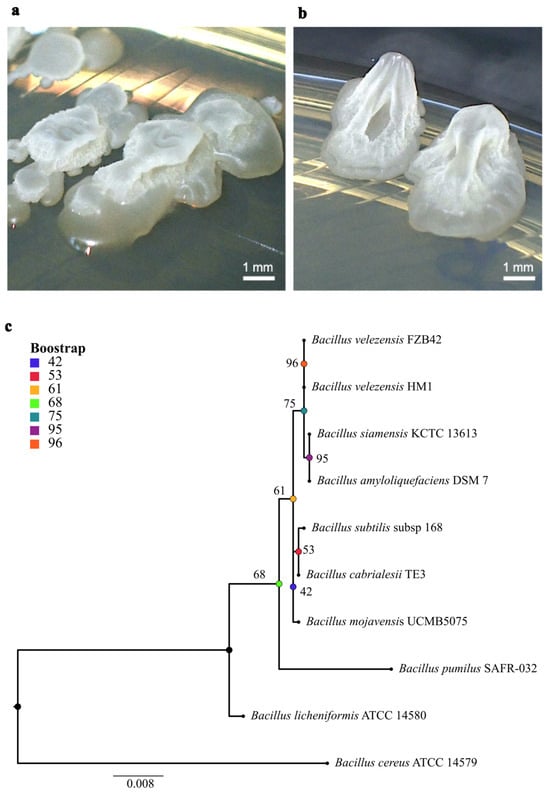
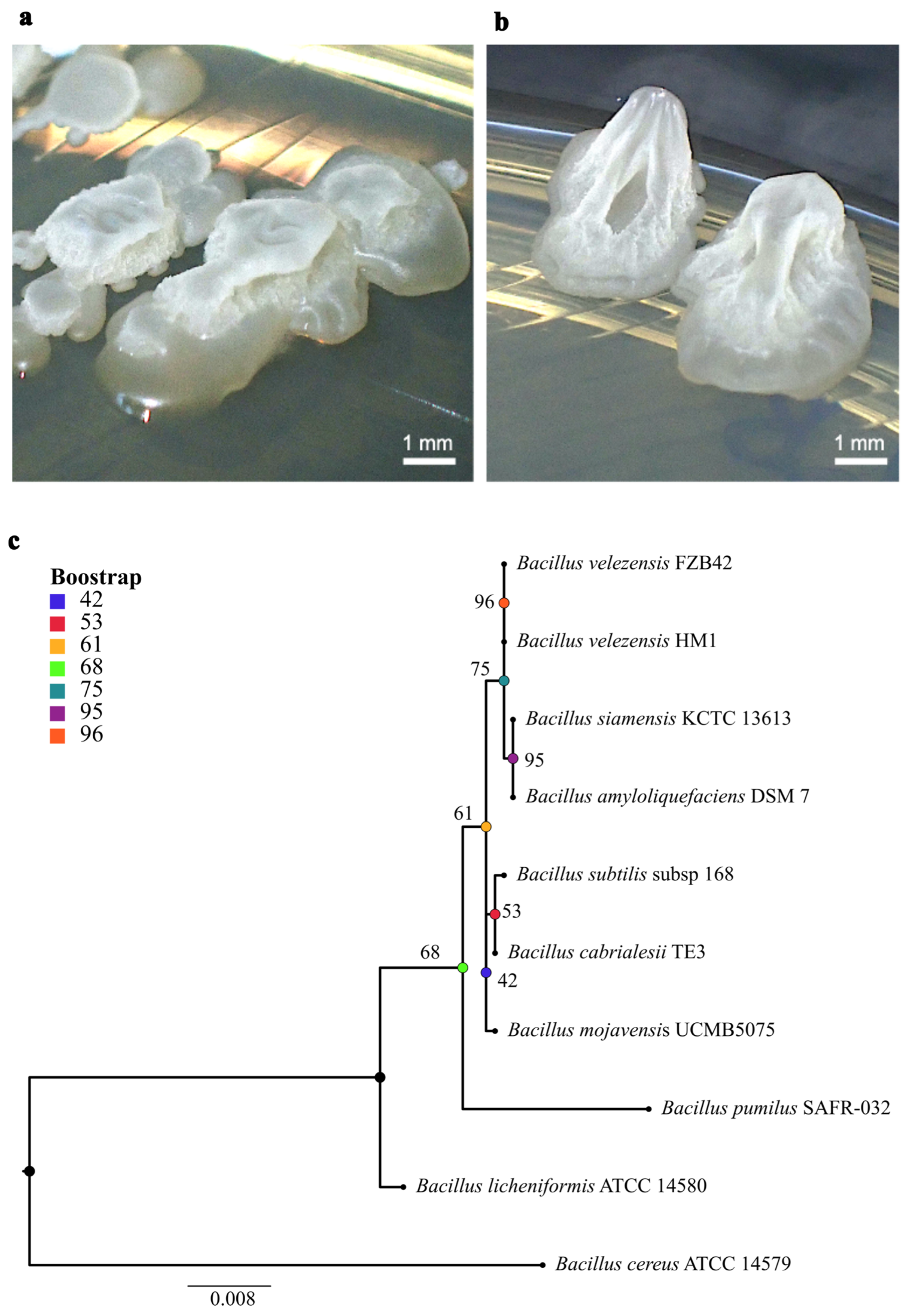
The metal-resistant strain HM1 was isolated from mine tailings collected at the “El Fraile” site in Taxco de Alarcón, Guerrero, Mexico. As an initial selection step, samples were subjected to heat treatment (80 °C for 20 min) to enrich for spore-forming bacteria. Subsequently, suspensions and serial dilutions were prepared and plated on R2A medium supplemented with a metal-enriched extract, with the aim of selecting metal-tolerant strains. This second selection step yielded a single dominant colony morphotype (strain HM1), which was isolated and purified. On a rich PY medium, colonies exhibited an opaque white appearance, irregular shape, and lobulated margins. They also displayed a phenotype consistent with extracellular matrix production (Figure 1a,b), a characteristic commonly observed in species of the genus Bacillus [14]. The identification of the genus was confirmed by phylogenetic analysis of the partial sequence of the 16s rRNA gene (Figure 1c).
Figure 1.
Morphology and phylogenetic placement of Bacillus velezensis HM1. (a,b) Colonial morphology of strain HM1 on PY medium, showing a rough surface, dry farinose texture, slightly umbonate elevation, and radial growth with coalescent structures. (c) Maximum likelihood 16S rRNA gene phylogeny of strain HM1 and related taxa, inferred with IQ-TREE (GTR+G+I). Node values represent ultrafast bootstrap (UFBoot) support (1000 replicates).
2.2. Genomic Insights into Bacillus velezensis HM1
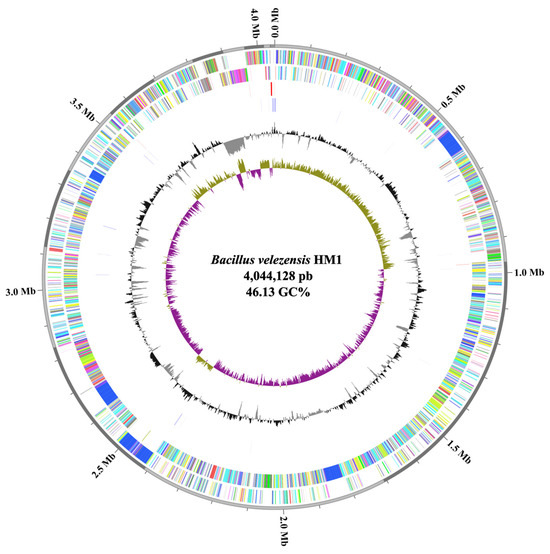
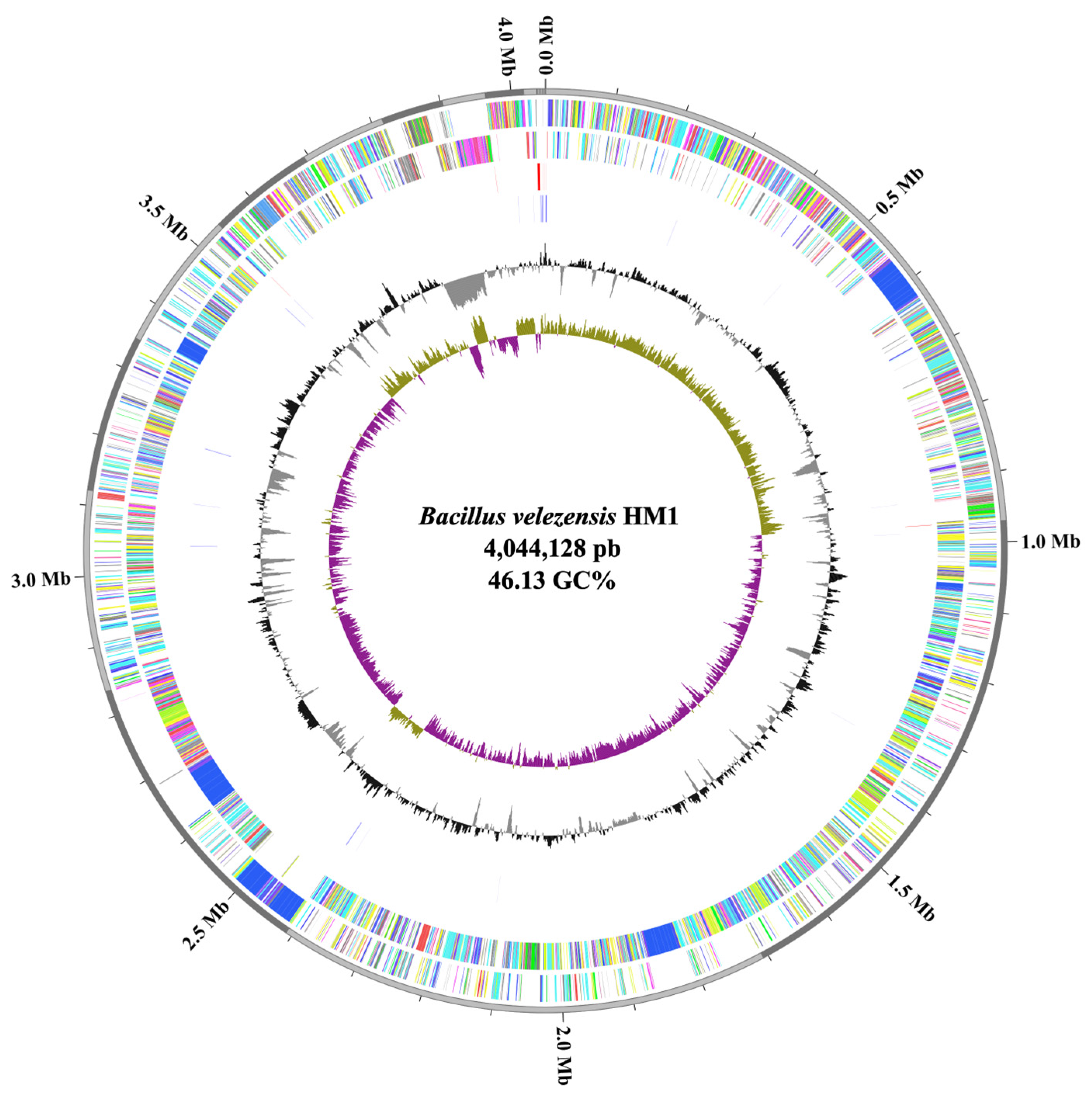
Whole-genome sequencing of Bacillus velezensis HM1 generated a total of 582,787 reads, which were used for genome assembly (Table 1). The assembly resulted in a genome of 4,044,128 bp distributed across 20 contigs, with a maximum contig length of 969,499 bp. The assembly exhibited an N50 of 700,388 bp and an L50 of 3, as well as an N75 of 283,754 bp and an L75 of 5, with an average coverage of 66.8×. The GC content was 46.13%, with no ambiguous nucleotides detected (N = 0) (Figure 2). Genome completeness was estimated at 99.81%, with a contamination level of 0.01%. The predicted coding density was 89.7%, comprising 3950 coding sequences (CDSs), 83 transfer RNA genes (tRNAs), 11 ribosomal RNA genes (rRNAs), 26 non-coding RNAs (ncRNAs), and 4 small open reading frames (sORFs). No plasmid replicons were identified within the assembled contigs.
Table 1.
Genomic characteristics of Bacillus velezensis HM1.
Figure 2.
Circular genome representation of Bacillus velezensis HM1. From the outer to the inner rings: coding sequences (CDSs) on the forward strand, CDSs on the reverse strand, RNA genes (tRNA and rRNA), GC content, and GC skew.
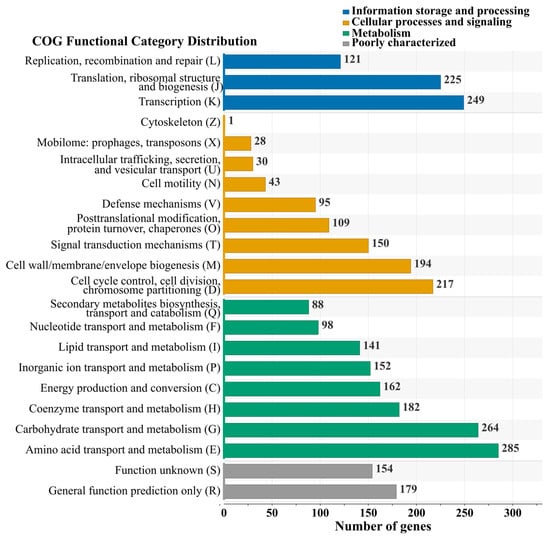
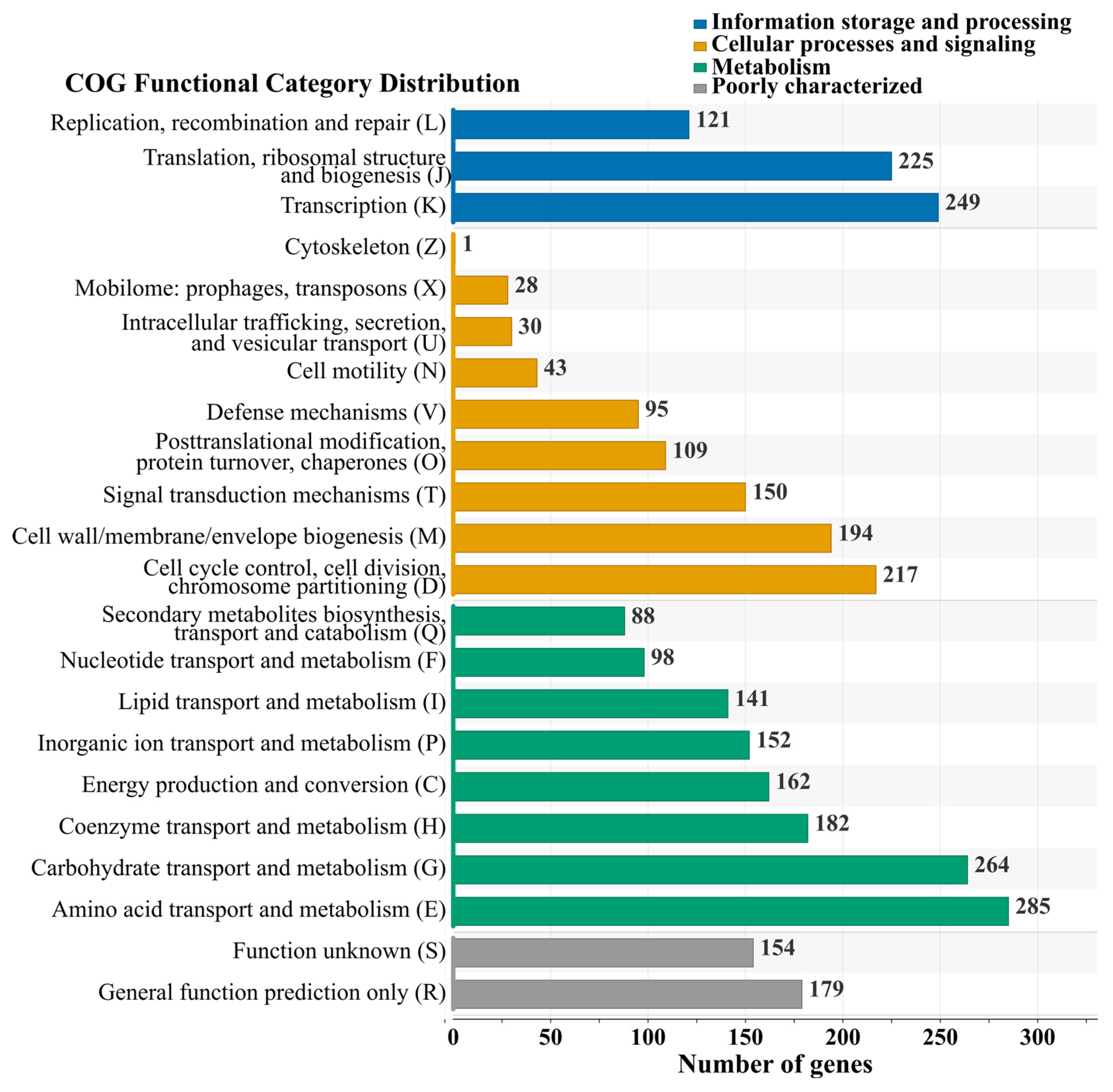
Functional annotation assigned 3167 of the 3950 predicted coding sequences (80.18%) to COG functional categories (Figure 3). Metabolism was the most represented category, particularly amino acid transport and metabolism (E = 285), carbohydrate transport and metabolism (G = 264), and coenzyme transport and metabolism (H = 182), suggesting a metabolically versatile genomic repertoire in strain HM1. The “Information Storage and Processing” category was primarily represented by transcription (K = 249) and translation, ribosomal structure, and biogenesis (J = 225). Within “Cellular Processes and Signaling,” the most abundant functions included cell cycle control and chromosome partitioning (D = 217) and cell wall/membrane/envelope biogenesis (M = 194). Notably, defense mechanisms (V = 95) and signal transduction (T = 150) were also well represented.
Figure 3.
Functional annotation of the genome of Bacillus velezensis HM1. Distribution of predicted proteins across COG (Clusters of Orthologous Groups) functional categories, showing the relative abundance of genes involved in metabolism, cellular processes and signaling, information storage and processing, and poorly characterized functions.
The “Poorly Characterized” category comprised 333 genes, including those assigned to general function prediction (R = 179) and unknown function (S = 154). This fraction likely represents a reservoir of unexplored functions potentially associated with environmental adaptation, highlighting the genomic novelty associated with strains inhabiting extreme, metal-impacted environments.
2.3. Phylogenetic Position of Bacillus velezensis HM1
The taxonomic assignment of the strain HM1 was established using Overall Genome Relatedness Indices (OGRIs) through comparisons with genomes of phylogenetically related strains available in the Genome Taxonomy Database (GTDB) (Table 2). Average nucleotide identity (ANI) values indicated high similarity to Bacillus velezensis NRRL B-41580T (98.85%) and Bacillus velezensis FZB42 (98.62%). Consistently, average amino acid identity (AAI) values were 98.96% and 98.81%, respectively, while digital DNA–DNA hybridization (dDDH) yielded values of 89.4% and 87.9% relative to these strains. Pairwise comparisons for each index are provided in Tables S1–S3. Collectively, these values exceed established species delineation thresholds (ANI ≥ 95%; AAI ≥ 95%, dDDH ≥ 70%), confirming the assignment of HM1 to Bacillus velezensis.
Table 2.
Genomic similarity indices of Bacillus sp. HM1 with closely related strains.
2.4. Genetic Determinants of Metal Resistance
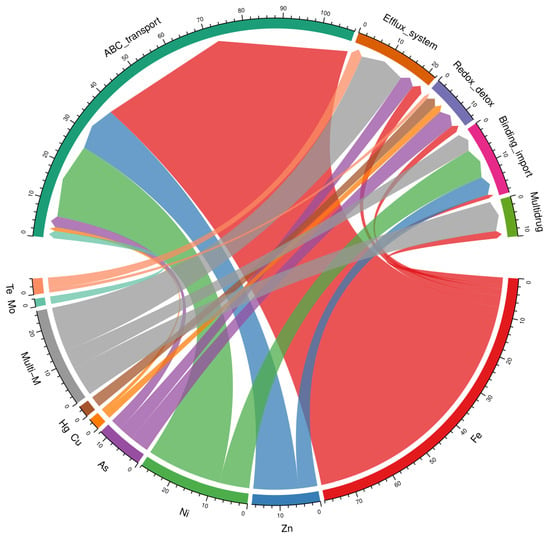
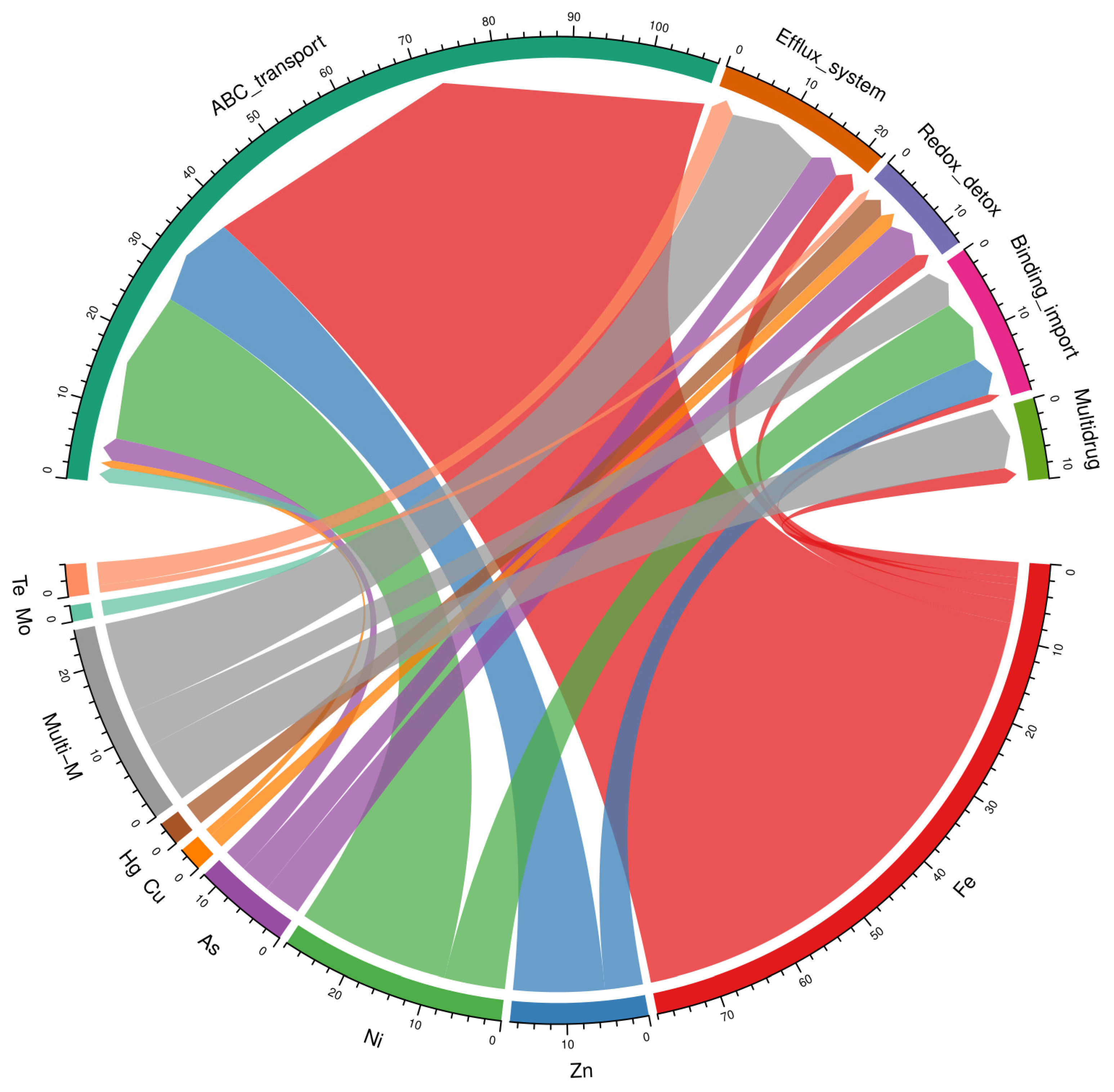
Analysis of proteins encoded in the genome of B. velezensis HM1 identified a diverse repertoire of putative microbial metal resistance genes (MMRGs). The most common systems were those associated with iron (43.3%), followed by nickel (16.7%) and zinc (10.0%). To a lesser extent, genes related to arsenic (5.3%), as well as copper, magnesium, and tellurium (each 2.7%), and mercury (2.0%) were identified. These genes were classified into five functional categories: transport/efflux, uptake, redox biotransformation, intracellular homeostasis, and metal-associated stress response (Figure 4, Table A1).
Figure 4.
Distribution and metal resistance mechanisms in B. velezensis HM1. Inner sectors represent metals (Fe, Zn, Ni, As, Cu, Hg, Mo, Te, and Multi-metal), while outer sectors correspond to grouped functional categories of resistance (ABC transport, efflux systems, redox/detoxification, binding/import, and multidrug resistance). Link widths are proportional to the number of loci associated with each metal–mechanism combination. Specific patterns were observed; for example, the ABC transport system dominated in iron (Fe), indicating a transport-based uptake strategy. In contrast, arsenic (As) exhibits a more balanced distribution between efflux and redox/detoxification mechanisms, reflecting a multifunctional resistance strategy. Nickel (Ni) is characterized by a combination of transport and binding/import systems, suggesting highly structured uptake systems.
The predominant mechanism corresponded to ABC-type transport systems and permeases (64.7%), including multiple copies of transporters associated with iron (families such as fbpC, fecE, fecD), zinc (znuABC), nickel (nikABCDE), and molybdate (modA). Efflux systems (18.0%) were also identified, including P-type ATPases involved in metal transport (Cd/Zn/Co-ATPase), cation antiporters (fieF, mneP), and specific pumps for arsenic (arsB) and copper (copZ, ycnJ), which are involved in the extrusion of toxic metals.
Within the biotransformation category (10.7%), key enzymes such as reductases and oxidases were detected, including arsenate reductase (arsC), arsenite methyltransferase (arsM), arsenite oxidase (aioA), and mercury reductases, all of which contribute to the conversion of metals into less toxic forms. Additionally, proteins associated with oxidative stress response (5.3%) were identified, including superoxide dismutases (sodA), as well as quinone-dependent systems (arsH), which contribute to mitigating metal-induced cellular damage. To a lesser extent, proteins associated with tellurium resistance (terD, klaB) and NRAMP-type divalent cation transport systems (mntH) were identified. The absence of canonical sil and pbr operons suggests that strain HM1 may rely on alternative and potentially non-specific resistance mechanisms to cope with the elevated concentrations of Pb and Ag present in this mine tailings environment.
2.5. Genetic Determinants of Sulfur Metabolism
Key genes involved in the sulfate assimilation pathway were identified, including sat (sulfate adenylyltransferase), cysC (adenylylsulfate kinase), cysH (phosphoadenylylsulfate reductase), cysI (heme-containing subunit of the NADPH-dependent assimilatory sulfite reductase), cysE (serine O-acetyltransferase), and cysK (cysteine synthase A). This gene set is consistent with a putative assimilatory sulfate reduction pathway involved in the conversion of sulfate to sulfide and its subsequent incorporation into sulfur-containing amino acids, particularly cysteine.
In conclusion, the genomic features identified in B. velezensis HM1 provide a genome-based framework for exploring potential mechanisms associated with persistence in metal- and sulfur-rich mine tailings environments. These findings provide a useful resource for future comparative and experimental studies focused on environmental Bacillus strains.
3. Methods
3.1. Isolation and Culture Conditions
Strain HM1 was isolated from mine tailings collected at the “El Fraile” site (18°31′55″ N, 99°37′43″ W). Tailings samples (pH 6.7–7.4) were subjected to heat treatment at 80 °C for 20 min, followed by cooling at room temperature. Subsequently, suspensions were prepared in sterile saline solution (0.85% NaCl), and serial dilutions were performed and spread-plated onto R2A medium (Reasoner’s 2A; yeast extract 0.5 g L−1, peptone 0.5 g L−1, casein hydrolysate 0.5 g L−1, glucose 0.5 g L−1, soluble starch 0.5 g L−1, dipotassium phosphate 0.3 g L−1, magnesium sulfate 0.024 g L−1, and sodium pyruvate 0.3 g L−1), supplemented with an aqueous tailings extract at a 1:5 ratio (tailings:water). Metal concentrations in these residues were as follows: Ag (30.50 ± 6.80 mg kg−1), Cd (39.50 ± 55.60 mg kg−1), Cu (225 ± 98 mg kg−1), Fe (55 ± 16 g kg−1), Mn (940 ± 1534 mg kg−1), Pb (3677 ± 1481 mg kg−1), V (16.30 ± 12.90 mg kg−1), Zn (3118 ± 3329 mg kg−1), and As (1324 ± 846 mg kg−1) [8]. Plates were incubated at 30 °C for 72 h. Colonies displaying distinct morphologies were purified by cross-streaking on PY medium (yeast extract 3 g L−1, peptone 5 g L−1, agar 15 g L−1, pH 7) and incubated at 30 °C for 24 h.
3.2. Whole-Genome Sequencing
Cells from a pure culture of strain HM1, grown for 24 h in PY broth, were sent to MicrobesNG (The BioHub Birmingham, Birmingham, UK) for genomic DNA sequencing. Forty microliters of a cell suspension were lysed in 120 µL of TE buffer supplemented with lysozyme and RNase A (0.1 mg mL−1), followed by incubation at 37 °C for 25 min. Subsequently, proteinase K (0.1 mg mL−1) and SDS (0.5% v/v) were added, and the mixture was incubated at 65 °C for 5 min.
Genomic DNA was purified using an equivalent volume of SPRI beads and resuspended in 10 mM Tris-HCl (pH 8.0). DNA quantification was performed using the Quant-iT dsDNA HS kit (Thermo Fisher Scientific, Waltham, MA, USA) on an Eppendorf AF2200 plate reader (Eppendorf, Hamburg, Germany). Library preparation was carried out on a Hamilton Microlab STAR automated system using the Nextera XT Library Prep kit (Illumina, San Diego, CA, USA), following the manufacturer’s instructions with two modifications: increased DNA input concentration and extension of PCR elongation time to 45 s. Sequencing was performed on an Illumina NovaSeq 6000 platform (paired-end, 250 bp).
3.3. Genome Assembly, Functional Annotation and Taxonomic Assignment
Raw read quality was assessed using FastQC v0.12.1, and high-quality reads (Phred > 30) were retained using TrimGalore v0.6.4 [15]. Genome assembly was performed with SPAdes v3.15.5 [16], while completeness and contamination were evaluated using CheckM v1.2.2 [17]. Gene prediction and functional annotation were conducted using Bakta v1.11.0 [18]. Genome visualization was generated using MGCplotter v1.0.1, and functional classification of genes was assigned using COGclassifier v1.0.4 (https://github.com/moshi4/MGCplotter/, accessed on 13 May 2026). Taxonomic assignment of the genome was performed using the Genome Taxonomy Database Toolkit (GTDB-Tk v2.6.1, database release 18 February 2026) [19]. In silico DNA–DNA hybridization (dDDH) analyses were conducted with phylogenetically related strains using the TYGS server (https://tygs.dsmz.de/, accessed on 13 May 2026). Average nucleotide identity (ANI) was calculated from genome alignments using MUMmer implemented in pyani v0.2.12 [20], and average amino acid identity (AAI) was estimated using CompareM v0.1.2 (https://github.com/dparks1134/CompareM/, accessed on 13 May 2026).
3.4. Genome Mining of Metal Resistance Genes and Sulfur Metabolism
Identification of microbial metal resistance genes (MMRGs) was performed using a hidden Markov model (HMM)-based approach. Predicted protein sequences were analyzed with HMMER v3.4 against the MetHMMDB database. MetHMMDB is a curated database of 254 profile Hidden Markov Models (HMMs) representing 121 microbial metal resistance genes (MMRGs) and associated functions. The database uses HMM-based functional annotation to improve the sensitivity and specificity of MMRG detection in genomic datasets compared with conventional sequence similarity-based approaches [21]. Stringent filtering criteria were applied: bit score ≥ 60, coverage ≥ 70%, and E-value ≤ 1 × 10⁻¹⁰, retaining only hits meeting all three thresholds [22]. Genes were subsequently classified according to the associated chemical element (metal or metalloid), functional mechanism, and biological role. Genes associated with sulfur metabolism were identified through BLASTp v2.17.0 searches between the HM1 proteome and a curated UniProt protein database. Representative genes from major bacterial sulfur metabolic pathways were included, including assimilatory sulfate reduction, dissimilatory sulfate reduction, and oxidation of reduced sulfur compounds. Similarity searches were conducted using stringent thresholds (E-value ≤ 1 × 10⁻¹⁵, sequence identity ≥ 30%, and alignment coverage ≥ 70%).
4. User Notes
The genome assembly and associated annotations of Bacillus velezensis HM1 are publicly available through NCBI under BioProject PRJNA1150606 (accession GCA_041519775.1). Raw sequencing reads, assembled contigs, and annotation files (including GFF, protein FASTA, and functional assignments) can be downloaded for downstream analyses. The dataset is suitable for comparative genomics, functional annotation refinement, and studies of microbial adaptation to mine tailings and acid mine drainage (AMD).
The functional traits described in this study are based on genome annotation and in silico predictions derived from bioinformatic analyses. Therefore, the inferred capacities related to metal resistance, sulfur assimilation, and metabolic versatility should be considered potential functional attributes that require future experimental validation under controlled conditions.
Supplementary Materials
The following supporting information can be downloaded at: https://www.mdpi.com/article/10.3390/data11050119/s1, Table S1: Average Nucleotide Identity (ANI) values (%) among Bacillus strains used for phylogenomic comparison; Table S2: Average Amino Acid Identity (AAI) values (%) among Bacillus strains used for phylogenomic comparison; Table S3: In silico DNA–DNA hybridization (dDDH) values (%) among Bacillus strains used for species delineation.
Author Contributions
Conceptualization, J.L.A.-N. and G.C.-F.; methodology, J.L.A.-N. and G.C.-F.; software, J.L.A.-N. and G.C.-F.; formal analysis, G.C.-F. and L.J.G.-G.; investigation, G.C.-F., L.J.G.-G. and J.L.A.-N.; resources, J.L.A.-N.; data curation, M.A.R.-M., J.D.C.-Z. and A.A.-M.; writing—original draft preparation, J.L.A.-N.; writing—review and editing, J.L.A.-N., G.C.-F., M.A.R.-M., J.D.C.-Z. and A.A.-M.; funding acquisition, J.L.A.-N. All authors have read and agreed to the published version of the manuscript.
Funding
This research was funded by the GetGenome initiative at the Sainsbury Laboratory in Norwich, UK, with support from the Gatsby Charitable Foundation and the Biotechnology and Biological Sciences Research Council, as part of the “GetGenome Mexico 2023” project. Number Project: 20230818.
Institutional Review Board Statement
Not applicable.
Informed Consent Statement
Not applicable.
Data Availability Statement
The assembled genome (GCA_041519775.1) presented in the study are openly available in NCBI BioProject PRJNA1150606 (https://www.ncbi.nlm.nih.gov/bioproject/?term=+ PRJNA1150606), accessed on 13 May 2026.
Acknowledgments
We thank UATI for their expert technical support and server maintenance at Centro de Ciencias Genómicas, UNAM.
Conflicts of Interest
The authors declare no conflicts of interest.
Appendix A
Table A1.
Microbial Metal Resistance Genes (MMRGs) of Bacillus velezensis HM1.
References
- Parte, A.C.; Sardà Carbasse, J.; Meier-Kolthoff, J.P.; Reimer, L.C.; Göker, M. List of Prokaryotic names with Standing in Nomenclature (LPSN) moves to the DSMZ. Int. J. Syst. Evol. Microbiol. 2020, 70, 5607–5612. [Google Scholar] [CrossRef] [Scilit] [PubMed]
- List of Prokaryotic Names with Standing in Nomenclature (LPSN). Genus Bacillus. Available online: https://lpsn.dsmz.de/genus/bacillus (accessed on 13 May 2026).
- Xu, X.; Kovacs, A.T. How to identify and quantify the members of the Bacillus genus? Environ. Microbiol. 2024, 26, e16593. [Google Scholar] [CrossRef] [Scilit] [PubMed]
- Liu, J.; Cui, X.; Liu, Z.; Guo, Z.; Yu, Z.; Yao, Q.; Sui, Y.; Jin, J.; Liu, X.; Wang, G. The Diversity and Geographic Distribution of Cultivable Bacillus-Like Bacteria Across Black Soils of Northeast China. Front. Microbiol. 2019, 10, 1424. [Google Scholar] [CrossRef] [Scilit] [PubMed]
- Aqel, H.; Farah, H.; Al-Hunaiti, A. Ecological versatility and biotechnological promise: Comprehensive characterization of the isolated thermophilic Bacillus strains. PLoS ONE 2024, 19, e0297217. [Google Scholar] [CrossRef] [Scilit] [PubMed]
- Fakhar, A.; Gul, B.; Gurmani, A.R.; Khan, S.M.; Ali, S.; Sultan, T.; Chaudhary, H.J.; Rafique, M.; Rizwan, M. Heavy metal remediation and resistance mechanism of Aeromonas, Bacillus, and Pseudomonas: A review. Crit. Rev. Environ. Sci. Technol. 2020, 52, 1868–1914. [Google Scholar] [CrossRef] [Scilit]
- Nnaji, N.D.; Anyanwu, C.U.; Miri, T.; Onyeaka, H. Mechanisms of Heavy Metal Tolerance in Bacteria: A Review. Sustainability 2024, 16, 11124. [Google Scholar] [CrossRef] [Scilit]
- Talavera Mendoza, O.; Yta, M.; Moreno Tovar, R.; Dótor Almazán, A.; Flores Mundo, N.; Duarte Gutiérrez, C. Mineralogy and geochemistry of sulfide-bearing tailings from silver mines in the Taxco, Mexico area to evaluate their potential environmental impact. Geofís. Int. 2005, 44, 49–64. [Google Scholar] [CrossRef] [Scilit]
- Lindsay, M.B.J.; Moncur, M.C.; Bain, J.G.; Jambor, J.L.; Ptacek, C.J.; Blowes, D.W. Geochemical and mineralogical aspects of sulfide mine tailings. Appl. Geochem. 2015, 57, 157–177. [Google Scholar] [CrossRef] [Scilit]
- Martín-Crespo, T.; Gómez-Ortiz, D.; Martín-Velázquez, S. Geoenvironmental Characterization of Sulfide Mine Tailings. In Applied Geochemistry with Case Studies on Geological Formations, Exploration Techniques and Environmental Issues; Mazadiego, F.L., De Miguel Garcia, E., Barrio-Parra, F., Izquierdo-Diaz, M., Eds.; IntechOpen: London, UK, 2019. [Google Scholar]
- Zhang, S.; Wu, P.; Zhang, J.; Li, Q.; Luo, C. Effects of acid mine drainage on microbial community development and physicochemical properties of mine contaminated sites in Southwest China. Sci. Rep. 2025, 15, 20776. [Google Scholar] [CrossRef] [Scilit] [PubMed]
- Ayangbenro, A.S.; Babalola, O.O. Genomic analysis of Bacillus cereus NWUAB01 and its heavy metal removal from polluted soil. Sci. Rep. 2020, 10, 19660. [Google Scholar] [CrossRef] [Scilit] [PubMed]
- Herrera-Quiterio, A.; Toledo-Hernández, E.; Aguirre-Noyola, J.L.; Romero, Y.; Ramos, J.; Palemón-Alberto, F.; Toribio-Jiménez, J. Antagonic and plant growth-promoting effects of bacteria isolated from mine tailings at El Fraile, Mexico. Rev. Argent. Microbiol. 2020, 52, 231–239. [Google Scholar] [CrossRef] [Scilit] [PubMed]
- Guéneau, V.; Jiménez, G.; Castex, M.; Briandet, R. Insights into the genomic and phenotypic characteristics of Bacillus spp. strains isolated from biofilms in broiler farms. Appl. Environ. Microbiol. 2024, 90, e0066324. [Google Scholar] [CrossRef] [Scilit] [PubMed]
- Krueger, F. Trim Galore!: A Wrapper Around Cutadapt and FastQC to Consistently Apply Adapter and Quality Trimming to FastQ Files, with Extra Functionality for RRBS Data; Babraham Institute: Cambridge, UK, 2015. [Google Scholar]
- Prjibelski, A.; Antipov, D.; Meleshko, D.; Lapidus, A.; Korobeynikov, A. Using SPAdes de Novo Assembler. Curr. Protoc. Bioinform. 2020, 70, e102. [Google Scholar] [CrossRef] [Scilit] [PubMed]
- Parks, D.H.; Imelfort, M.; Skennerton, C.T.; Hugenholtz, P.; Tyson, G.W. CheckM: Assessing the quality of microbial genomes recovered from isolates, single cells, and metagenomes. Genome Res. 2015, 25, 1043–1055. [Google Scholar] [CrossRef] [Scilit] [PubMed]
- Schwengers, O.; Jelonek, L.; Dieckmann, M.A.; Beyvers, S.; Blom, J.; Goesmann, A. Bakta: Rapid and standardized annotation of bacterial genomes via alignment-free sequence identification. Microb. Genom. 2021, 7, 000685. [Google Scholar] [CrossRef] [Scilit] [PubMed]
- Chaumeil, P.A.; Mussig, A.J.; Hugenholtz, P.; Parks, D.H. GTDB-Tk: A toolkit to classify genomes with the Genome Taxonomy Database. Bioinformatics 2019, 36, 1925–1927. [Google Scholar] [CrossRef] [Scilit]
- Pritchard, L.; Glover, R.H.; Humphris, S.; Elphinstone, J.G.; Toth, I.K. Genomics and taxonomy in diagnostics for food security: Soft-rotting enterobacterial plant pathogens. Anal. Methods 2016, 8, 12–24. [Google Scholar] [CrossRef] [Scilit]
- Ciuchcinski, K.; Dziurzynski, M. Fast and accurate detection of metal resistance genes using MetHMMDb. bioRxiv 2025. bioRxiv:2024.2012.2026.629440. [Google Scholar] [CrossRef] [Scilit]
- Cuaxinque-Flores, G.; Gómez-Godínez, L.J.; Armenta-Medina, A.; Zelaya-Molina, L.; Ramos, J.; Aguirre-Noyola, J.L. Genome Insights into Kocuria sp. KH4, a Metallophilic Bacterium Harboring Multiple Biosynthetic Gene Clusters (BGCs). Microbiol. Res. 2025, 16, 255. [Google Scholar] [CrossRef] [Scilit]

Disclaimer/Publisher’s Note: The statements, opinions and data contained in all publications are solely those of the individual author(s) and contributor(s) and not of MDPI and/or the editor(s). MDPI and/or the editor(s) disclaim responsibility for any injury to people or property resulting from any ideas, methods, instructions or products referred to in the content. |
© 2026 by the authors. Licensee MDPI, Basel, Switzerland. This article is an open access article distributed under the terms and conditions of the Creative Commons Attribution (CC BY) license.