


Error in Figure
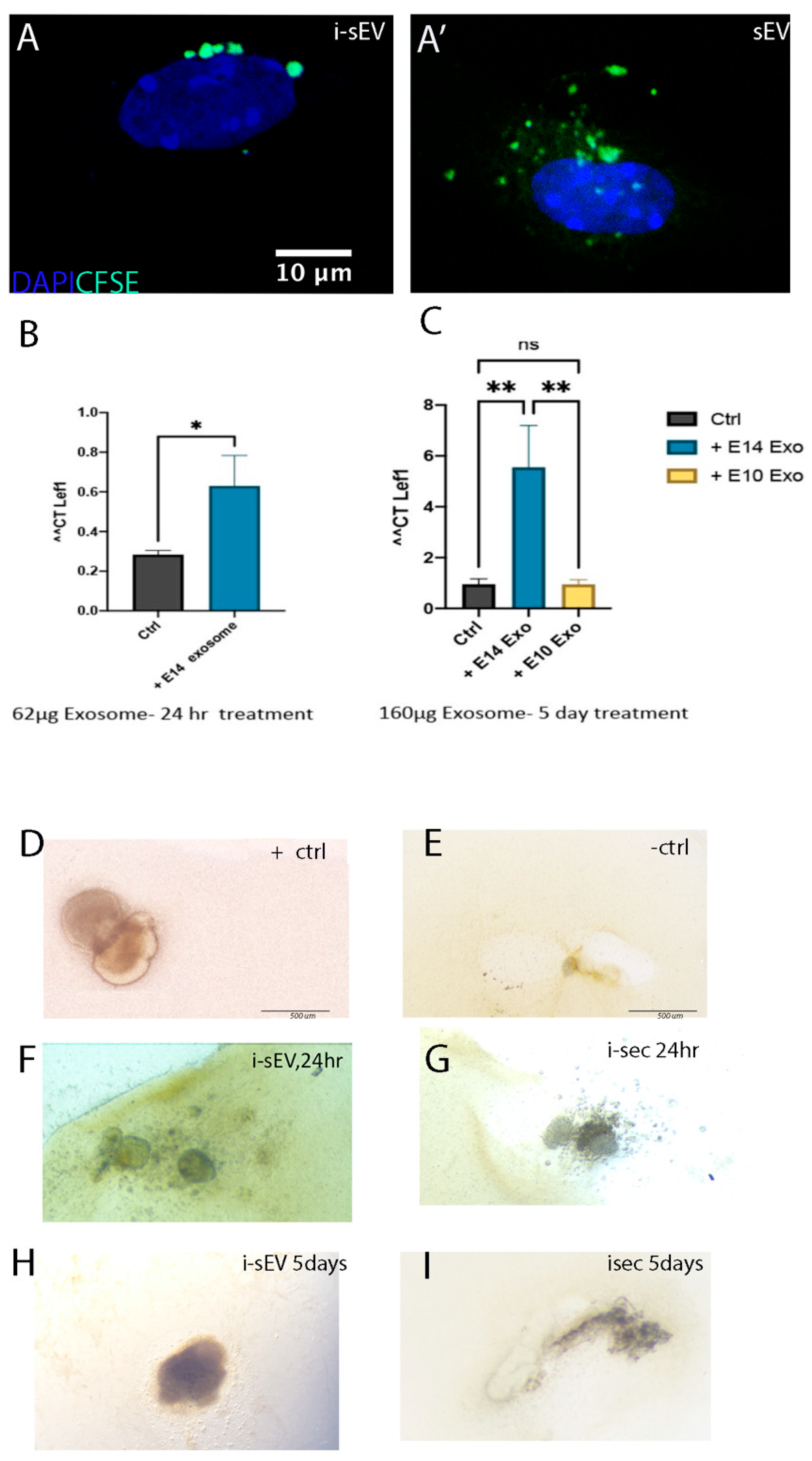
In the original publication [1], an error was identified in Figure 7, affecting panels D–I. The updated Figure 7 includes replacement microscopic images for panels D–I that correspond to the appropriate treatment conditions used in this study. This correction does not affect the figure legend, the manuscript text, or the interpretation of the results. The scientific conclusions of the study remain unchanged.
In addition, the Acknowledgments Section has been updated to thank Dr. Ana Angelova and Xuechen Zhang for their support during the recombination experiments.
The corrected Figure 7 appears below. The authors state that the scientific conclusions are unaffected. This correction was approved by the Academic Editor. The original publication has also been updated.
Figure 7.
Generation of bioengineered teeth using i-sEV and i-Sec. CFSE-labelled i-sEV and s-EV are taken up by E10.5 branchial arch mesenchyme after 24 h. (A,A′) Expression of Lef1 after treatment of tooth germ epithelium with i-sEV for 24 h (B) and 5 days (C). Recombination of fresh E14.5 mesenchyme cells with E13.5 tooth germ epithelial cells (D). Recombination of E10.5 branchial arch mesenchyme with E13.5 tooth germ epithelial cells (E). Recombination of i-sEV-treated epithelial cells for 24 h with E10.5 branchial arch mesenchyme (F). Recombination of i-sEV-treated epithelial cells for 5 days with E10.5 branchial arch mesenchyme (G). Recombination of i-Sec-treated epithelial cells for 24 h with E10.5 branchial arch mesenchyme (H). Recombination of i-Sec-treated epithelial cells for 5 days with E10.5 branchial arch mesenchyme (I). p < 0.002 (**), p < 0.033 (*), p > 0.12 (ns).
Acknowledgments
Ultracentrifugation was performed at NMES Britannia House Research Facilities (Chemistry) at King’s College London. Proteomics analysis was carried out by Steven Lynham in the Centre of Excellence for Mass Spectrometry, Denmark Hill, King’s College London. Flow cytometry was carried out at the Advanced Cytometry Platform, R&D department, Guy’s and St Thomas’ NHS Foundation Trust, Guy’s Hospital, London, SE1 9RT, and, particularly, by Anna Rose. We thank NOVOGENE (UK) Ltd. for their support in conducting the sequencing for the project. We would like to thank Ana Angelova and Xuechen Zhang for their helpful discussions and support during recombination experiments.
Reference
- Birjandi, A.A.; Sharpe, P. The Secretome of the Inductive Tooth Germ Exhibits Signals Required for Tooth Development. Bioengineering 2025, 12, 96. [Google Scholar] [CrossRef] [Scilit] [PubMed]
Disclaimer/Publisher’s Note: The statements, opinions and data contained in all publications are solely those of the individual author(s) and contributor(s) and not of MDPI and/or the editor(s). MDPI and/or the editor(s) disclaim responsibility for any injury to people or property resulting from any ideas, methods, instructions or products referred to in the content. |
© 2026 by the authors. Licensee MDPI, Basel, Switzerland. This article is an open access article distributed under the terms and conditions of the Creative Commons Attribution (CC BY) license.