


Abstract
Deep learning has significantly enhanced one-dimensional biosignal processing in wearable devices by enabling accurate and intelligent signal analysis. Wearable devices operate using optimized model parameters obtained through offline training. However, physiological variations among users necessitate periodic model updates to maintain performance. Conventional retraining requires storing both existing and newly acquired datasets, leading to increased memory consumption and computational overhead, which limits its deployment in resource-constrained wearable devices. To address this challenge, this work proposes an incremental learning framework based on an incremental denoising convolutional autoencoder (I-D-CAE) that incrementally updates the model using newly available data while preserving previously learned knowledge, thereby avoiding the need to retain the complete historical dataset. The proposed framework adapts to newly available data while retaining previously learned model parameters and maintaining a fixed model-parameter size. Experimental results demonstrate that the proposed method achieves improved reconstruction accuracy and reduced reconstruction loss, demonstrating its potential for adaptive biosignal processing in resource-constrained wearable devices.
1. Introduction
The rapid advancement of wearable device technology has transformed modern healthcare by enabling continuous, real-time monitoring of physiological signals beyond traditional clinical environments. Wearable devices equipped with intelligent sensing capabilities facilitate early detection and management of chronic diseases, support remote patient monitoring, and promote personalized healthcare. The integration of Artificial Intelligence (AI) algorithms for accurate biosignal interpretation, intelligent decision-making, and user-specific customization has further enhanced the capabilities of smart wearable devices.
One-dimensional (1D) signal processing plays a crucial role in wearable devices as they enable efficient analysis of time-series physiological signals acquired from the human body. Biosignals such as electrocardiograms (ECG), electromyograms (EMG), and electroencephalograms (EEG) are inherently represented as 1D temporal sequences, and they contain valuable information related to an individual’s physiological state. In wearable devices, efficient 1D signal processing is essential for real-time monitoring, early diagnosis, and continuous assessment of health conditions while operating under strict constraints of limited memory, computational capability, and energy consumption.
Deep Learning (DL) has proved to be effective for one-dimensional biosignal processing in recent years [1,2]. In general, DL techniques require offline training of the system with well-equipped, highly configured processors. The offline training involves the process of determining the ideal parameters (weights and biases), and the learned optimal parameters are configured into the wearables. In real-time scenarios, the statistical range of the data may vary from patient to patient. Hence, the DL model requires periodic retraining to update the learned metrics [3,4]. However, this updating of metrics should not require more memory or impact the performance of wearable devices due to the retraining process.
To address this issue, an incremental learning framework based on I-D-CAE is proposed in this study. The proposed approach updates the previously learned model parameters using newly available data while preserving the existing model architecture and maintaining a fixed model-parameter size. Traditional transfer learning transfers only a portion of knowledge and fine-tunes the model for specific data. But in incremental learning (IL), the knowledge from the previous model is employed to retrain the model for both previous and future evolving data streams. The key contributions of this work are as follows:
- •
- Memory-efficient incremental learning framework: updates the model parameters without increasing the overall model size.
- •
- Knowledge transfer for adaptation: uses previously learned weights and biases as the initial parameters for training on new data, enabling the adapted model to retain knowledge from both old and new datasets.
In this study, the proposed approach is implemented along with the reconstruction of biosignals from their compressive measurements. In wearable devices, the collected data has to be compressed at the edge level before being sent to the receiver or clinician. The receiver receives the data and has to reconstruct the compressed data without knowing the target data. Since convolutional encoders are effective for biosignal systems [5,6,7,8], a DL model denoising convolutional autoencoder (D-CAE) architecture is proposed in this work. By training the D-CAE model, the learned optimal parameters are configured on both the sender and receiver sides. The learned parameters are applied to compress (encode) the incoming data on the wearable device. This encoded data is decompressed (decoded) at the receiver side with the optimal parameters obtained through the same training process. ECG, EEG, and EMG are widely used physiological signals in wearable health monitoring, with ECG used in cardiac health assessment, EEG used in epilepsy and seizure monitoring, and EEG/EMG-based measurements used for sleep assessment. Therefore, these three biosignals are considered in this study as representative physiological signals for experimental evaluation [9,10,11,12,13,14].
The remainder of this article is organized as follows. Section 2 provides a brief overview of the existing relevant work in the literature. Section 3 provides an overview of the sequential fine-tuning approach. Section 4 presents the proposed I-D-CAE approach, and Section 5 discusses its results. Section 6 provides the conclusions and the future work.
2. Related Works
Various studies have been carried out in the literature to maintain the battery level of wireless wearables by compressing the data before sending it to the receiver. Algorithms like dictionary learning methods, namely self-organizing map (SOMP), vector quantization (VQ), online dictionary (OD) [3], and codebook based methods like SVD-ASCII character encoding [4] utilize dictionaries or codebooks to encode (compress) the data. But these dictionaries or codebooks require periodic updating when they encounter fresh unknown data. As a result, the dictionary size increases when fresh, unidentified data are added. However, this leads to an increasing memory size, and it can impact the performance of memory-constrained wearable devices.
DL methods for lossy biosignal compression, such as autoencoders (AE), have proved to be efficient, low-complexity algorithms. Since a Convolutional Neural Network (CNN) is a powerful tool for extracting essential features from raw input data, it is employed with AE to yield a convolutional autoencoder (CAE). Recent studies have shown that CAE performs better in compressing and reconstructing biosignals [5,6]. Furthermore, because of the wearer’s movements, signals obtained via wireless wearable devices are susceptible to noise contamination. A denoising autoencoder (DAE) is a promising technique to denoise the signal simultaneously [7,8] while it is reconstructed from its compressive measurements. Since raw data have been employed as input, there is no need for a pre-processing step for denoising when a DAE has been employed in the proposed work. However, the trained DAE model needs to be retrained or modified when the system encounters new, unfamiliar data. The existing DAE-based compression frameworks lack adaptive learning capability and require complete retraining when exposed to evolving data distributions, resulting in increased memory and computational requirements. Therefore, an efficient learning strategy is required to update deep learning models using newly acquired data while preserving previously learned knowledge and maintaining the memory footprint.
The incremental learning (IL) technique provides an effective solution for such applications. Nowadays, IL has achieved great success in real-time applications [15] that require continuous learning of new streams of data. To handle such new evolving data streams, IL is a promising technique for memory-constrained devices [16] that requires periodical updates of the model with new data while retaining knowledge from the previous data. In fact, IL aims to remodel the system by covering both the knowledge of new and old datasets [17]. This is also referred to as a continual learning model, as it continuously acquires new knowledge without forgetting the previous one. Unlike traditional transfer learning methods, it not only fine-tunes the model [18] for specific data, but also adapts the model for previous and future evolving data streams.
Recent studies have demonstrated the potential of incremental and continual learning for resource-constrained edge and wearable systems, particularly for enabling models to adapt to continuously generated data without relying on repeated offline retraining. However, memory utilization remains an important consideration since on-device learning may require storage for model parameters, intermediate data, or previously acquired samples. To address this issue, recent works have investigated lightweight on-device incremental learning, memory-efficient replay, and efficient lifelong learning for edge platforms [19,20,21,22]. Denoising autoencoder-based approaches have also been increasingly investigated for physiological signal processing, including wearable ECG denoising and reconstruction [23,24,25,26,27]. However, the integration of memory-efficient incremental model updating with a denoising convolutional autoencoder for signal processing under the memory constraints of wearable devices remains insufficiently explored. Hence, this study proposes a memory-efficient incremental D-CAE framework that progressively adapts the model to newly acquired signal data while limiting the memory requirements associated with model updating. The proposed framework is evaluated with respect to both resource utilization and signal-processing performance, providing an assessment of the trade-off between memory efficiency and denoising/reconstruction quality.
In the proposed study, the following challenges associated with deploying deep learning models in resource-constrained wearable devices are addressed:
2.1. Space Complexity of Wearable Devices
Wearable devices are highly miniaturized and operate with limited memory resources. Therefore, updating the configured model parameters (weights and biases) without increasing the model size is a critical challenge. Conventional retraining approaches require additional memory to store historical and newly acquired datasets. This makes them unsuitable for resource-constrained wearable platforms. In this work, the proposed approach addresses this challenge by enabling incremental model updates while maintaining the original memory footprint of the learned parameters.
2.2. Memory Replay and Continuous Learning
Wearable devices continuously acquire new data streams due to variations in user-specific physiological characteristics. Therefore, periodic model updates are required to maintain learning performance. Conventional incremental learning approaches often rely on memory replay, where previously acquired data must be stored and combined with new data during retraining. This results in increased memory requirements, which will be a challenge in smart wearable devices. The proposed approach overcomes this limitation by utilizing previously learned parameters as the initial weights and biases for incremental retraining and enables the updated model to retain knowledge from previous datasets. Hence, it adapts to newly acquired data without storing the complete historical dataset.
3. Sequential Fine-Tuning Methodology
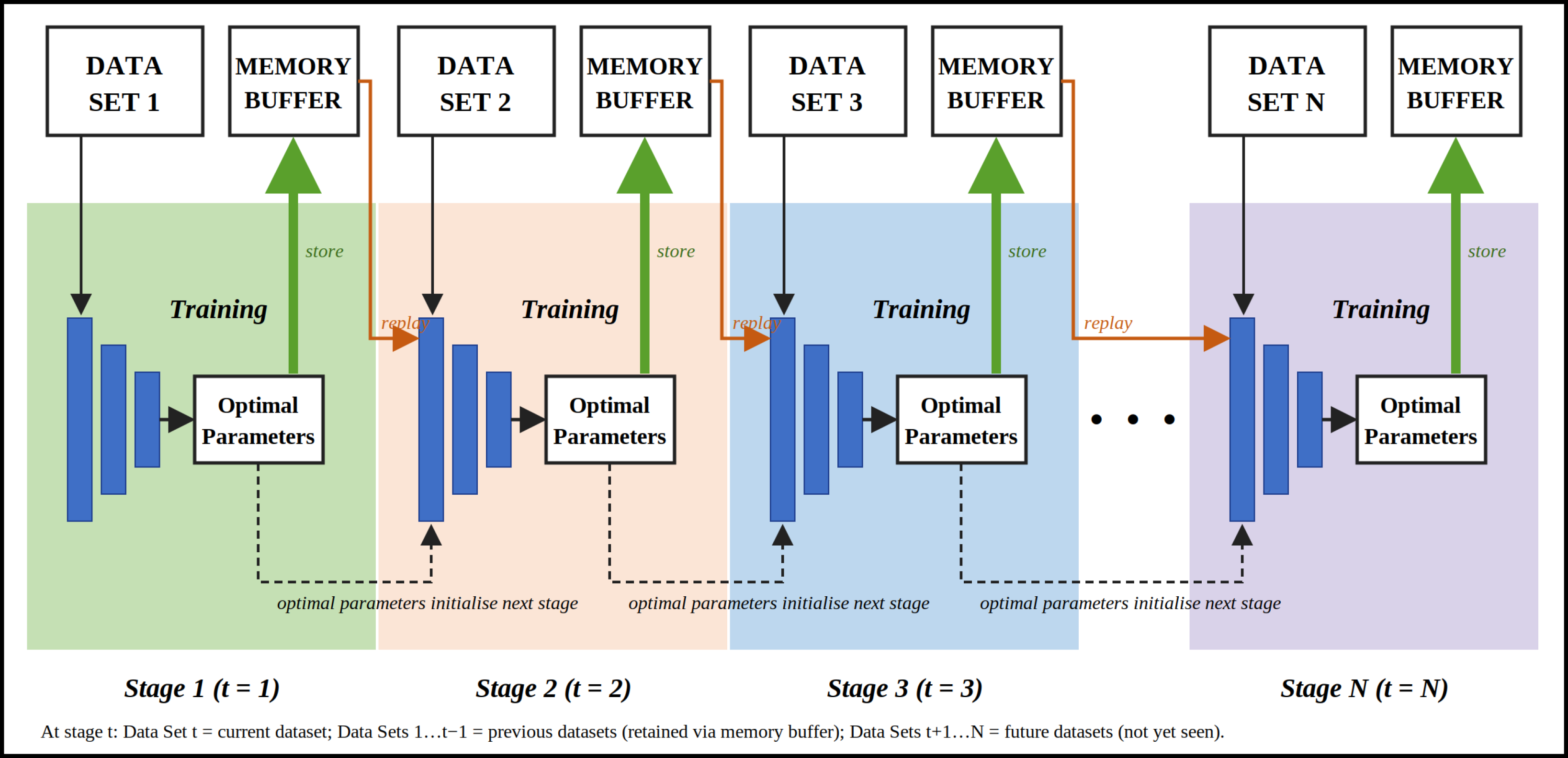
In sequential fine-tuning, the model is initially trained using the existing dataset, and the learned optimal parameters are stored in the memory buffer of the wearable device. When new data become available, these stored parameters are reused as the initial weights and biases for retraining the model. This enables the updated model to adapt to both the previously learned data and the newly acquired dataset. The process can be repeated incrementally as future data streams continue to evolve. Since the previously learned parameters are reused during the model updating, the system can maintain good performance on both historical and new data. This incremental learning process and the workflow of sequential fine-tuning are presented in Figure 1.
Figure 1.
Sequential fine-tuning workflow.
3.1. Sequential Fine-Tuning Method
Incremental learning (IL) has been extensively employed in neural network research to enable models to continuously adapt to evolving data distributions without requiring complete retraining. Existing IL techniques are broadly categorized into three major approaches: memory replay, regularization-based methods, and architectural approaches. Memory replay methods preserve previously acquired knowledge by reusing learned model parameters, such as weights and biases, or representative samples during retraining on newly available data. Regularization-based methods address the challenge of catastrophic forgetting by constraining significant changes to parameters that are essential for previously learned tasks, thereby maintaining knowledge retention while accommodating new information. In contrast, architectural approaches preserve existing knowledge by freezing parts of the network and extending the architecture with additional layers or subnetworks to learn new tasks. The proposed framework integrates the strengths of the first two categories. It initializes the retraining process using the previously learned weights and biases stored in the wearable device’s memory buffer, thereby facilitating effective knowledge replay. Compared to architectural approaches, the proposed framework maintains a fixed network architecture without introducing additional layers. It results in a computationally efficient and memory-conscious solution suitable for resource-constrained wearable healthcare devices.
This continual learning may forget the previous data information while retraining the model for a new dataset. Even though the previous parameters are used for initializing the retraining process, it may forget the previously learned knowledge. Usually, deep learning models suffer from this problem called catastrophic forgetting [28]. Recent studies have been carried out and have shown that, through a regularization term in the loss function, the catastrophic forgetting of previous tasks can be prevented. In [29], a quadratic penalty is proposed, and it is named elastic weight consolidation (EWC). Based on the Fisher information matrix to quantify the relevance of each weight of the corresponding task, the EWC penalty term combines the vital weights that are critical to remembering the prior tasks to overcome catastrophic forgetting.
A progress and compression framework is presented in [30]. It proposes an online version of EWC that may retain the previous knowledge when adapting to information from a new task. The work in [31] introduces a surrogate loss function that is comparable to EWC. The importance of model parameters is estimated continuously throughout the entire learning process. It enables more effective preservation of previously acquired knowledge. The work in [32] has applied parameter pruning for preserving the knowledge learned by old tasks with a pretrained network and keeps the learned parameters without any changes. The work in [33] demonstrates that the learning without forgetting (LwF) method can work better than other approaches for new tasks. The work in [34] proposes a copy weight (CW) technique with L2 regularization to avoid catastrophic forgetting. In [35], the effectiveness of the EWC technique is validated, and it showcases that EWC can successfully avoid the catastrophic forgetting problem. Hence, this work also employs the EWC regularization term in the loss function to optimize the model parameters during incremental retraining while preserving previously acquired knowledge.
3.2. Working Principle
In conventional neural network (NN) training, the model is initialized with randomly generated weights and biases and trained using a dataset that follows a specific data distribution. The trained model is subsequently evaluated using test samples drawn from the same or a similar distribution. However, in real-world healthcare applications, the characteristics of physiological data will vary significantly across patients and over time due to individual differences and differing health conditions. A model trained on a fixed dataset cannot generalize well to newly arriving data. To address this limitation, the proposed incremental learning framework based on the I-D-CAE continuously adapts the model to newly available data without requiring complete retraining from scratch.
- Step 1. Training the model using the Existing Dataset
Initially, the neural network is trained using the currently available dataset. The training process begins with randomly initialized weights and biases that are iteratively optimized to minimize the training loss. After convergence, the optimized model parameters represent the learned knowledge of the existing dataset and are used for subsequent prediction tasks.
- Step 2. Save the model to the memory buffer
Once the initial training is completed, the optimized model parameters are stored into the memory buffer of the wearable device. The stored model serves as prior knowledge and can be reused during future incremental learning. They eliminate the need to train the network from random initialization.
- Step 3. Memory Replay
When new data become available, the optimized parameters stored in the memory buffer are retrieved and reused to initialize the same NN for incremental retraining. This memory replay mechanism transfers the previously acquired knowledge to the new learning process. It enables the model to preserve historical information while adapting to the evolving dataset.
- Step 4. Incremental Retraining with the Newly Evolved Dataset
Instead of initializing the network with random weights and biases, the retraining process is initiated with the previously learned parameters. These parameters provide a better starting point for optimization. They lead to faster convergence and improved learning efficiency. The proposed framework incorporates the EWC regularization term during retraining to preserve important parameters associated with the previously learned tasks. This mitigates the catastrophic forgetting issue while adapting the model to the new dataset.
- Step 5. Updated Knowledge
After incremental retraining, the updated weights and biases are stored back into the memory buffer, and they replace the previous parameter set. The NN architecture remains unchanged throughout the process, and only the model parameters are updated to incorporate knowledge from both the historical and newly acquired datasets. Whenever additional data become available, the process is repeated from Step 2. It allows the model to continuously evolve while maintaining the previously acquired knowledge. Through this iterative parameter update mechanism, the proposed framework achieves efficient continual learning without increasing the model complexity and makes it suitable for resource-constrained wearable healthcare devices.
4. Proposed Methodology
This study primarily focuses on the efficient utilization of the limited memory resources available on wearable devices. To address this constraint, an incremental learning framework is adopted, in which model parameters, including weights and biases, are progressively updated as new data become available. This reduces the need for repeated retraining using the complete historical dataset. Existing studies have investigated incremental and continual learning for resource-constrained wearable and IoT systems. The existing studies have emphasized computational efficiency, adaptation, or other resource constraints. In the proposed work, memory-efficient model updating for signal processing is carried out for resource-constrained wearable devices. The proposed framework is therefore intended to reduce the memory requirements associated with model adaptation while maintaining the capability to incorporate newly acquired data.
For experimental evaluation, a D-CAE model is employed in an incremental fashion to combine the denoising capability of a DAE with the feature-learning capability of CAE. Denoising convolutional autoencoders have been successfully investigated for signal denoising and reconstruction, including applications involving physiological signals such as electrocardiograms. The proposed D-CAE architecture consists of two principal components: an encoder and a decoder. The encoder transforms the input signal into a lower-dimensional latent representation by learning informative features from the input while reducing the influence of noise. The decoder then maps this latent representation back to the signal domain to reconstruct the corresponding denoised signal. This encoder–decoder architecture enables the model to learn a compact representation of the input and subsequently reconstruct the signal while suppressing noise. The effectiveness of this approach in preserving relevant signal characteristics should, however, be established experimentally using appropriate reconstruction and denoising metrics. The detailed architecture and operational procedure of the I-D-CAE framework is presented in Section 4.3.
4.1. Working Principle of D-CAE Method
4.1.1. Encoder Section of D-CAE Model
Initially the input signal X is distorted by Gaussian noise, resulting in a noisy signal . It is passed to the convolutional layer to convolve the given noisy input with a given number of filters with specified filter size Fsize and stride value S. The convolution function and the output size Osize in each convolutional layer are given in Equations (1) and (2) respectively.
here, h represents the hidden representation (compressed) of the noisy input , denotes the previous layer input, W represents the weight and b is bias for corresponding layer l. f (•) is the activation function Hyperbolic Tangent function (TanH) employed throughout the D-CAE model.
Osize = ((Isize − fsize)/S) + 1
4.1.2. Decoder Section of D-CAE Model
The hidden representation is passed to the deconvolutional layer to deconvolve the given compressed input with a given number of filters and a specified filter size Fsize and stride value S. The deconvolution function and the output size Osize in each deconvolutional layer are defined in Equations (3) and (4) respectively.
here denotes the decoded (reconstructed) output of the noisy input , represents the hidden representation (compressed) from previous layer l − 1, W represents the weight and b is the bias for the corresponding layer l. f (•) is the activation function of the Hyperbolic Tangent function (TanH) employed throughout the D-CAE model.
Osize = ((Isize − 1) S) + fsize
4.1.3. Training I-D-CAE Model
During the training process, the reconstruction loss was predicted using the MSE loss function for each iteration. To achieve minimal loss, the D-CAE model was backpropagated to update the weights and biases. The parameters were optimized for minimal reconstruction loss based on the following function:
As the D-CAE model employs the DAE architecture, the reconstructed signal is always compared with the uncorrupted version of the input signal to compute the reconstruction loss based on Equation (5). m is the number of samples in the input signal X. In this manner, the D-CAE model is trained to concurrently denoise and recover the original clean signal from its compressed version.
4.2. Architectural Details of Proposed D-CAE Model
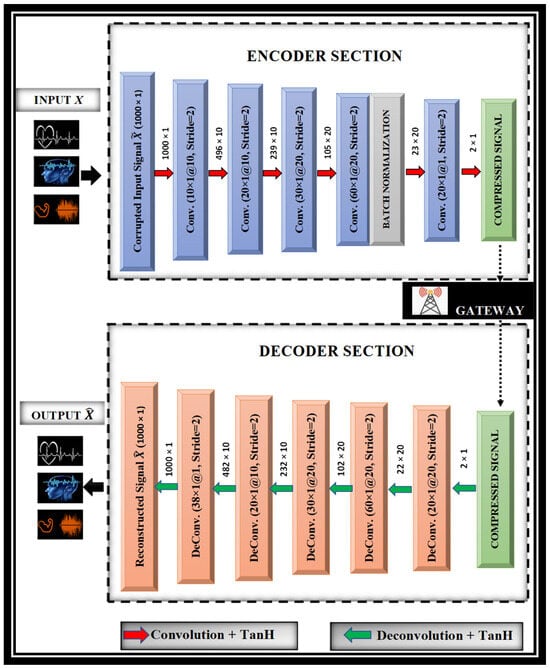
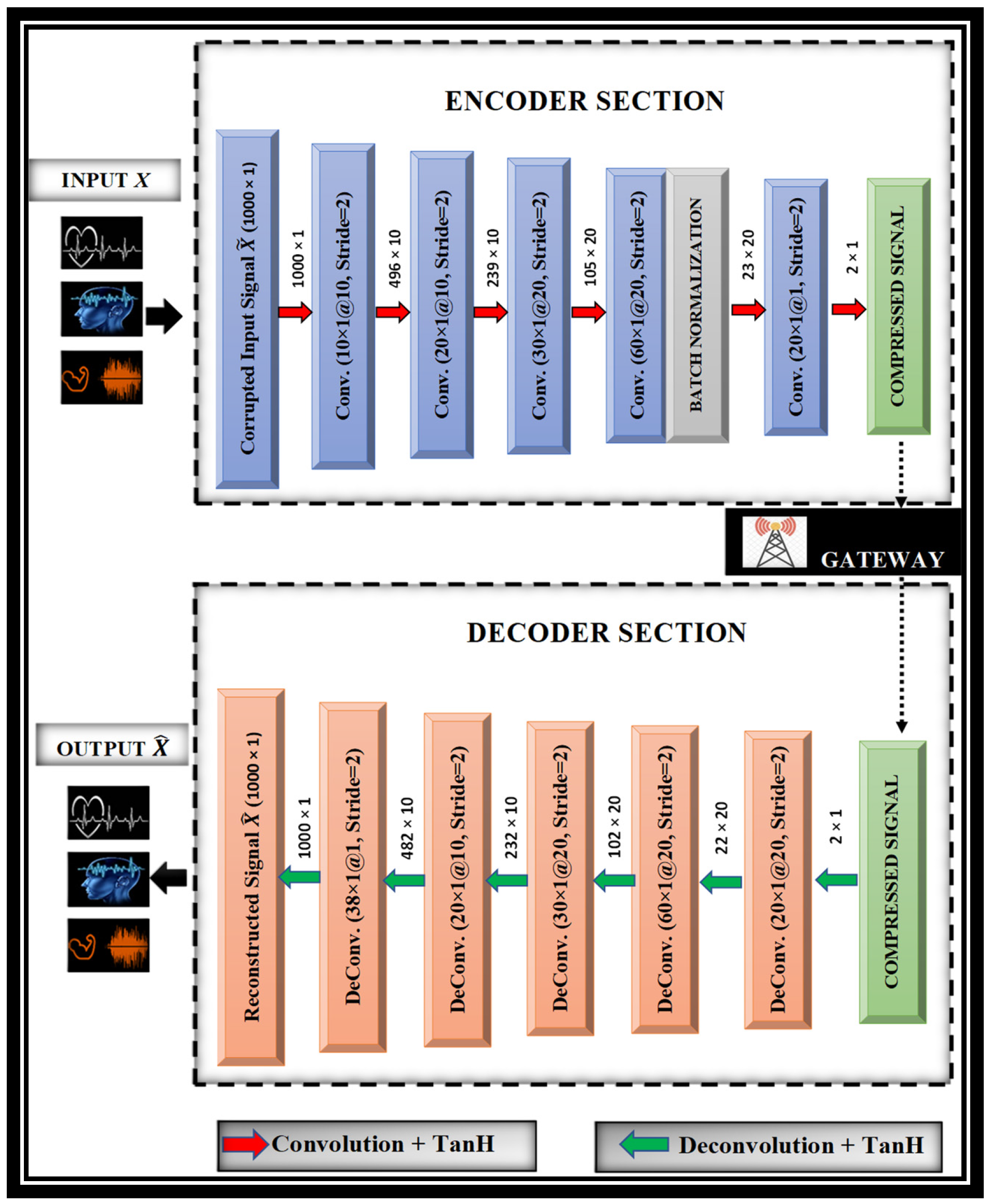
Figure 2 clearly shows how the noisy input is compressed through the D-CAE encoder model and sent to the receiver to reconstruct the original clean signal through the D-CAE decoder model. Because the biosignals acquired through wearable devices are contaminated with noise, Gaussian noise was applied to distort the clean signal at different input signal-to-noise ratio (SNR) levels of (−1, 0, 5, 9) dB and fed into the D-CAE encoder model. In the encoder portion, each convolutional layer convolves the input with a given filter size, stride value of 2, and a number of filters in each convolutional layer based on Equation (1).
Figure 2.
Proposed D-CAE model for biosignal compression and reconstruction.
In this manner, the input size of 1000 × 1 is downsampled to a size of 2 × 1 lower space representation at the end of the encoder section. Similarly, the compressed data 2 × 1 is then fed into the decoder section to be decompressed by applying transpose convolution to the input. Using the filter size, stride value of two, and number of filters given in each convolutional layer, the original size of 1000 × 1 is restored based on Equation (3).
The D-CAE model avoids dense networks and employs a Fully Convolutional Neural Network (FCN) to avoid the computational burden and to learn local spatial information efficiently. Maxpool is completely avoided in the D-CAE model to prevent the loss of information. Finally, the output value produced by each neuron in the last layer of the decoder section was compared with each neuron in the input layer of the original clean version of the corrupted input to predict the loss value. By doing so, the D-CAE model simultaneously removes the noise from the distorted data when reconstructing the original data from its compressed version. The D-CAE model was demonstrated using the ECG, EEG, and EMG signal datasets. The proposed D-CAE model is a Fully Convolutional Network (FCN)-based architecture and eliminates the use of pooling layers to preserve the temporal and spatial information of the input signal. The model comprises a total of eleven fully convolutional layers that perform feature extraction, compression, and reconstruction of the input data through an encoder–decoder framework.
Since the dataset used in this study is normalized within the range of −1 to 1, the hyperbolic tangent (Tanh) activation function is employed, as it is effective in reconstructing data within this range. However, the Tanh activation function is susceptible to the vanishing gradient problem, and it can degrade the learning capability of deep networks. To overcome this limitation, a Batch Normalization (BN) layer is incorporated at the end of the encoder section. During the encoding process, extracted features that are evenly distributed within the range of −1 to 1 facilitate effective signal representation and reconstruction. The BN layer normalizes the encoded features and improves their distribution with respect to the activation function. It enables the output features to be more effectively mapped within the desired range [6]. The training process has been carried out for 1000 epochs. As a result, the encoded representation retains meaningful information beyond the limiting values of −1 and 1, and it contributes to improved signal reconstruction performance.
4.3. Proposed I-D-CAE Model
Adapting a model to a new and unknown task without increasing the size of the previously learned knowledge remains a challenging problem in continual learning. The proposed work addresses this challenge through an incremental learning framework that enables the model to adapt to newly available data while maintaining a fixed model-parameter size. The effectiveness of the proposed approach is demonstrated using the I-D-CAE, which provides an effective framework for adaptive biosignal reconstruction through sequential model updating. The I-D-CAE model enables efficient signal compression and reconstruction compared to existing state-of-the-art approaches. This section presents the proposed I-D-CAE model that integrates the sequential fine-tuning strategy into the D-CAE architecture. The primary objective of this study is to maintain the space efficiency of wearable devices by utilizing low-complexity learning algorithms. Through the sequential fine-tuning approach, the learned parameters of the proposed I-D-CAE model can be incrementally updated to incorporate new data distributions without increasing the model size or computational complexity. The working principle of the I-D-CAE model is given below:
- A.
- Learning Session-1 of I-D-CAE model
In learning session-1, the D-CAE model was trained on the currently available dataset to obtain a set of optimal weights Wp and bias bp. Training was initialized with random weights and biases. The learned weights were stored in the memory buffer of wearables, as shown in Figure 1.
- B.
- Learning Session-2 of I-D-CAE model
To adapt the existing trained D-CAE model to a new dataset, the saved optimal parameters are fetched from the memory buffer and employed as initial weights and biases when the D-CAE model is retrained for a different dataset. Retraining the D-CAE model yields a new set of optimal weights Wn and bias bn. The updated configuration is stored in a memory buffer for future use.
- C.
- Training Phase of I-D-CAE Model
During the training process, the reconstruction loss was predicted using the MSE loss function in each iteration. To achieve minimal loss, the I-D-CAE model was trained using backpropagation to update the weights and biases. The parameters were optimized to minimize reconstruction loss based on Equation (5). Because the I-D-CAE model employs the DAE architecture, the reconstructed signal is always compared to the original clean signal X of the corrupted input signal to compute the reconstruction loss based on Equation (5). In this manner, the I-D-CAE model is trained to denoise and simultaneously decompress the compressed signal to produce the original clean signal.
- D.
- Retraining Phase of I-D-CAE Model
Elastic weight consolidation (EWC), a penalty term, was included during the retraining phase of the I-D-CAE model. To prevent catastrophic forgetting while learning new optimal parameters from a new dataset, EWC includes a new penalty term in the MSE loss function. This causes the parameters of the newly trained model to remain in the minimum error around the optimal parameters of the prior dataset. While retraining the I-D-CAE model, the following objective function is optimized:
is the MSE error loss value between the target value and reconstructed output for the new dataset. is an EWC penalty term where is a tuning parameter, F is the diagonal precision given by the Fisher information matrix, θ is the new weights and biases vector to be optimized, and is the previously optimized weights and biases through Equation (5). The Fisher matrix evaluates the significance of the respective model parameter θ in remembering the older tasks, and it is a vital term in the EWC function. If the Fisher term in Equation (6) is ignored, then it will be a clear L2-norm on the parameters of the training model. The authors of [35] proved that the L2-norm is not very helpful in overcoming catastrophic forgetting (i.e., incrementally learning without forgetting previously learned knowledge).
5. Results and Discussion
5.1. Experimental Setup
Python 3.8 programming language was employed to develop the I-D-CAE model. It was created using the Keras library, with TensorFlow as the backend, and it has the ability to define the network model in a less complex manner. The implemented experimental analysis had the following system configurations. The operating system was Windows 10, with an 8th Gen Intel i5-8250U CPU running at 1.6 GHz and 8 GB RAM.
5.2. Evaluation Metrics
Evaluation of the proposed method is essential for quantifying the performance of the algorithm. Distortion measures such as computational efficiency (CE), compression ratio (CR), root mean square error (RMSE), signal-to-noise ratio (SNR), percent root mean square difference (PRD), cross-correlation (CC), and quality score (QS) were used to validate the proposed methodology. Lower RMSE and PRD values and greater SNR and QS values indicate that the system performed satisfactorily. These evaluative measures are defined as follows:
The RMSE is a standard measure that determines the differences between the original signal and the reconstructed signal , where K is the total number of samples.
The PRD determines how well the signal is recovered from its compressed form and it is defined as
The SNR measures the quality of the signal after it has been denoised and recovered from its distorted form, and it is given by
The ratio of the original signal X to the compressed signal Xcompressed is known as CR [36]. This is described as follows:
CR = X/Xcompressed
QS describes the signal’s reconstruction quality and will be useful for precise comparison with state-of-the-art approaches.
QS = CR/PRD
The correlation between the original and recovered signal is defined by CC. It will either be 1 for a strong correlation or 0 for a weak correlation.
CE defines the computational efficiency of the algorithm and reveals the computational efficiency of the algorithm. A higher value of CE shows low complexity of the algorithm, and a lower value of CE implies high complexity of the algorithm. CE is defined as follows:
CE = CR/Computation Time
5.3. Experimental Data
ECG recordings were obtained from the MIT-BIH arrhythmia [37] database, which was collected from 47 subjects. Since most of the previous studies were performed on records nos. 100, 117, and 119, for fair comparison, they were chosen for the proposed model. Initially, Record No. 100 was trained using the D-CAE model with random weight initialization. To perform incremental learning, record no. 117 is trained by initiating training with weights that have already been learned from record no. 100. Similarly, record no. 119 is trained by initiating training with weights that have already been learned from record no. 117. All three records were prepared as 100 fragments from each record separately, and each fragment contained 1000 numbers of samples (3 records × 100 fragments). For each record, these 100 fragments are randomly divided into training and testing sets, with 80% allocated for training and the remaining 20% reserved for the testing phase.
The EMG recordings were collected from the PhysioBank [38] database. Readings were recorded for healthy, myopathy, and neuropathy patients. Initially, training is performed on a Healthy Record through the D-CAE model with randomly initialized weights. To perform incremental learning, the myopathy record was trained by initializing the training with previously learned weights from the healthy record. Then, incremental learning is performed by training neuropathy records with previously learned weights from myopathy records. All records were prepared as 100 fragments, and each fragment contained 1000 samples (3 records × 100 fragments). For each record, these 100 fragments are randomly divided into training and testing sets, with 80% allocated for training and the remaining 20% reserved for the testing phase.
The EEG recordings used in this study were obtained from the Bonn dataset [39]. Only five datasets, F, N, O, S, and Z, were included in this collection, and each record had 100 single-channel EEG segments. Using the D-CAE model, Record F is trained with randomly initialized weights and biases. To perform incremental learning, Record N is trained by initiating the training with previously learned weights from Record F. Then, Record O is trained, initializing with previously learned weights from Record N. Similarly, Records S and Z are trained incrementally. All records were prepared as 100 fragments from each record, and each fragment contained 1000 samples (five records × 100 fragments). For each record, these 100 fragments are randomly divided into training and testing sets, with 80% allocated for training and the remaining 20% reserved for the testing phase.
5.4. Experimental Results
To conduct experiments, the datasets were separated into 80% for training and 20% for testing. An experimental study was performed for the I-D-CAE model, and the test results are presented in Table 1, Table 2, Table 3, Table 4, Table 5, Table 6, Table 7, Table 8, Table 9, Table 10, Table 11, Table 12, Table 13 and Table 14.
5.4.1. Performance Analysis of I-D-CAE Model
The performance of the proposed model can be examined in terms of the following: A. reconstruction loss; B. denoising ability; C. reconstruction quality; D. computational efficiency, and it is compared with current research methods.
- Reconstruction Loss
Although the proposed method is carefully designed, there may be some loss of information while reconstructing the target data. Therefore, the evaluation metric RMSE was applied to predict the error loss between the original and the reconstructed signals. The reconstruction losses for ECG, EMG, and EEG signals are presented in Table 1, Table 2 and Table 3, respectively, and are compared with recent state-of-the-art methods.
Table 1.
Comparative analysis of RMSE test score of the proposed I-D-CAE model with current related methods for ECG signals.
Table 2.
Comparative analysis of RMSE test score of the proposed I-D-CAE model with current related methods for EMG signal.
Table 3.
Comparative analysis of RMSE test score of the proposed I-D-CAE model with current related methods for EEG signals.
- B.
- Denoising Ability
Contaminated data are commonly obtained using wireless portable devices. Therefore, the proposed algorithm focuses on denoising the signal acquired through a wireless wearable device. The SNR score reveals the denoising ability of the algorithm, and the test SNR scores are listed in Table 4, Table 5 and Table 6. The proposed model produces a better SNR value for a high CR when compared to related methods.
Table 4.
Comparative analysis of SNR test score of the proposed I-D-CAE model with current related methods for ECG signal.
Table 5.
Comparative analysis of SNR test score of the proposed I-D-CAE model with current related methods for EMG signal.
Table 6.
Comparative analysis of SNR test score of the proposed I-D-CAE model with current related methods for EEG signal.
- C.
- Reconstruction Quality
Using the I-D-CAE model, the input was compressed and then reconstructed. Therefore, it is important to verify the quality scores of the reconstructed signals. Table 7, Table 8 and Table 9 show a comparative analysis of the test QS value of the proposed I-D-CAE model with current related methods for ECG, EMG, and EEG signals. For a fair comparison, the QS values were calculated and tabulated. Some studies [5,40,42,47,53,54] yielded lower PRD values than the proposed method because of its lower CR. However, the proposed model yields a much better QS value with a higher CR than all other studies.
Table 7.
Comparative analysis of test QS value of the proposed I-D-CAE model with current related methods for ECG signal.
Table 8.
Comparative analysis of test QS value of the proposed I-D-CAE model with current related methods for EMG signal.
Table 9.
Comparative analysis of test QS value of the proposed I-D-CAE model with current related methods for EEG signal.
- D.
- Computational Efficiency (CE)
Because wearables are energy-hungry devices, the computation time of the algorithm should be considered. The run time of the algorithm was considered to realize the complexity of the algorithm. The high CE value of the algorithm reveals its lower complexity and low CE, which indicates that the algorithm is more complex. Table 10, Table 11 and Table 12 show the CE of the ECG, EMG, and EEG signals for the proposed work, which are compared with those in related articles.
Table 10.
Comparative analysis of CE value of the proposed I-D-CAE model with current related methods for ECG signal.
Table 11.
Comparative analysis of CE value of the proposed I-D-CAE model with current related methods for EMG signal.
Table 12.
Comparative analysis of CE value of the proposed I-D-CAE model with current related methods for EEG signal.
5.4.2. Proposed D-CAE Model vs. I-D-CAE Model
In independent training, the model is independently initialized and trained for each dataset or task, using MSE as the loss function. In sequential fine-tuning with EWC, the proposed incremental model is updated using new data while incorporating an EWC penalty to regularize changes to parameters that are important for previously learned data.
In Table 13, a comparative analysis is performed between the proposed D-CAE model and the I-D-CAE model. Except for the CE value, the I-D-CAE model achieves better results than the D-CAE model. Because wearables are memory-constrained, it is important to consider the storage capacity of the wearable device. From Table 14, it can be observed that the size of the learned optimum configurations stored in the wearable memory buffer is 3026 kB for the D-CAE model. The size remains the same even after the model was incrementally updated or adapted for new and old datasets. The I-D-CAE model also produces the same 3026 KB of optimal parameters. Table 14 presents the computational analysis of independent training versus sequential fine-tuning with EWC. From the table, it is clear that the training time for the model using incremental learning is lower than that required for training with random weight initialization. This is because the incremental learning approach uses the weights and biases learned from previous training, allowing the model to converge more quickly. Moreover, the learned optimal model size (weights and biases) remains unchanged even after incremental learning, as shown in Table 14. From Table 13 and Table 14, it can be inferred that the incremental deep learning process improves reconstruction quality while preserving the memory space of the wearable device.
Table 13.
Comparative analysis between independent training and sequential fine-tuning with EWC.
Table 14.
Computational analysis between independent training and sequential fine-tuning with EWC.
6. Conclusions
In this work, an incremental learning framework based on the incremental denoising convolutional autoencoder (I-D-CAE) is proposed for adaptive one-dimensional biosignal reconstruction in wearable devices. The proposed approach addresses the computational overhead associated with conventional retraining by incrementally updating previously learned model parameters using newly available data while preserving previously acquired knowledge and avoiding the need to retain the complete historical dataset. The proposed framework maintains a fixed model-parameter size after incremental updating, while enabling adaptation to newly available biosignal data. To validate the proposed approach, the I-D-CAE was developed and evaluated through comprehensive experiments using ECG, EMG, and EEG signals. The experimental results demonstrate improved reconstruction accuracy and reduced reconstruction loss compared with the baseline D-CAE under the evaluated experimental conditions, while maintaining the same model-parameter storage size after incremental updating. These results indicate the potential of the proposed incremental learning strategy for adaptive biosignal reconstruction in wearable applications. However, the present study does not include hardware-level evaluation of peak memory consumption, execution latency, or energy consumption during incremental training. Future research will therefore focus on developing lightweight on-device incremental learning methods with reduced computational and energy requirements and evaluating their performance on representative wearable and edge-computing hardware.
Author Contributions
E.D.: conception and design, or analysis and interpretation of the data; writing—original draft preparation; M.R.: methodology; formal analysis; writing—review and editing; visualization; S.-B.K.: formal analysis; writing—review and editing; visualization. All authors have read and agreed to the published version of the manuscript.
Funding
This research received no external funding.
Institutional Review Board Statement
Not applicable.
Informed Consent Statement
Not applicable.
Data Availability Statement
The original contributions presented in this study are included in the article. Further inquiries can be directed to the corresponding author(s).
Conflicts of Interest
The authors declare no conflicts of interest.
References
- Jeong, I.; Chung, W.G.; Kim, E.; Park, W.; Song, H.; Lee, J.; Oh, M.; Kim, E.; Paek, J.; Lee, T.; et al. Machine Learning in Biosignal Analysis from Wearable Devices. Mater. Horiz. 2025, 12, 6587–6621. [Google Scholar] [CrossRef] [Scilit] [PubMed]
- Abreu, C.; Bédard, C.; Lourme, J.-C.; Piro, B. Wearable Sensors for Health Monitoring. Biosensors 2026, 16, 93. [Google Scholar] [CrossRef] [Scilit] [PubMed]
- Qian, J.; Tiwari, P.; Gochhayat, S.P.; Pandey, H.M. A Novel Double-Dictionary-Based ECG Compression Technique for IoTH. IEEE Internet Things J. 2020, 7, 10160–10170. [Google Scholar] [CrossRef] [Scilit]
- Mukhopadhyay, S.K.; Ahmad, M.O.; Swamy, M.N.S. SVD and ASCII Character Encoding-Based Compression of Multiple Biosignals for Remote Healthcare Systems. IEEE Trans. Biomed. Circuits Syst. 2018, 12, 137–150. [Google Scholar] [CrossRef] [Scilit] [PubMed]
- Yıldırım, Ö.; Acharya, U.R.; Tan, R.S. An Efficient Compression of ECG Signals Using Deep Convolutional Auto-Encoders. Cogn. Syst. Res. 2018, 52, 198–211. [Google Scholar] [CrossRef] [Scilit]
- Wang, F.; Ma, Q.; Liu, W.; Chang, S.; Wang, H.; He, J.; Huang, Q. A Novel ECG Signal Compression Method Using Spindle Convolutional Auto-Encoder. Comput. Methods Programs Biomed. 2019, 175, 139–150. [Google Scholar] [CrossRef] [Scilit] [PubMed]
- Daci, R.; Taleb-Ahmed, A.; Patrono, L.; Distante, C. Sparse Temporal AutoEncoder for ECG Anomaly Detection. Sensors 2026, 26, 1589. [Google Scholar] [CrossRef] [Scilit] [PubMed]
- Devindi, I.; Liyanage, S.; Jayarathna, T.; Alawatugoda, J.; Ragel, R. A Novel ECG Compression Algorithm Using Pulse-Width Modulation Integrated Quantization for Low-Power Real-Time Monitoring. Sci. Rep. 2024, 14, 17162. [Google Scholar] [CrossRef] [Scilit] [PubMed]
- Wang, R.; Mathada Veera, S.C.; Asan, O.; Liao, T. A Systematic Review on the Use of Consumer-Based ECG Wearables on Cardiac Health Monitoring. IEEE J. Biomed. Health Inform. 2024, 28, 6525–6537. [Google Scholar] [CrossRef] [Scilit] [PubMed]
- Handa, P.; Lavanya; Goel, N.; Garg, N. Software Advancements in Automatic Epilepsy Diagnosis and Seizure Detection: 10-Year Review. Artif. Intell. Rev. 2024, 57, 181. [Google Scholar] [CrossRef] [Scilit]
- de Gans, C.J.; Burger, P.; van den Ende, E.S.; Hermanides, J.; Nanayakkara, P.W.B.; Gemke, R.J.B.J.; Rutters, F.; Stenvers, D.J. Sleep Assessment Using EEG-Based Wearables—A Systematic Review. Sleep Med. Rev. 2024, 76, 101951. [Google Scholar] [CrossRef] [Scilit] [PubMed]
- Banerjee, S.; Singh, G.K. Quality Guaranteed ECG Signal Compression Using Tunable-Q Wavelet Transform and Möbius Transform-Based AFD. IEEE Trans. Instrum. Meas. 2021, 70, 4008211. [Google Scholar] [CrossRef] [Scilit]
- Liu, Y.; Yang, F.; Wu, B. Compression of EEG Signals with the LSTM-Autoencoder via Domain Adaptation Approach. Comput. Methods Biomech. Biomed. Eng. 2025, 28, 1547–1560. [Google Scholar] [CrossRef] [Scilit] [PubMed]
- Pal, H.S.; Kumar, A.; Vishwakarma, A.; Singh, G.K.; Lee, H.-N. A New Automated Compression Technique for 2D Electrocardiogram Signals Using Discrete Wavelet Transform. Eng. Appl. Artif. Intell. 2024, 133, 108123. [Google Scholar] [CrossRef] [Scilit]
- Yang, Q.; Wang, L.; Wicker, J.; Dobbie, G. Continual Learning: A Systematic Literature Review. Neural Netw. 2026, 195, 108226. [Google Scholar] [CrossRef] [Scilit] [PubMed]
- Pratama, M.; Pedrycz, W.; Webb, G.I. An Incremental Construction of Deep Neuro-Fuzzy System for Continual Learning of Nonstationary Data Streams. IEEE Trans. Fuzzy Syst. 2020, 28, 1315–1328. [Google Scholar] [CrossRef] [Scilit]
- Gallego, A.-J.; Calvo-Zaragoza, J.; Fisher, R.B. Incremental Unsupervised Domain-Adversarial Training of Neural Networks. IEEE Trans. Neural Netw. Learn. Syst. 2021, 32, 4864–4878. [Google Scholar] [CrossRef] [Scilit] [PubMed]
- Parisi, G.I.; Kemker, R.; Part, J.L.; Kanan, C.; Wermter, S. Continual Lifelong Learning with Neural Networks: A Review. Neural Netw. 2019, 113, 54–71. [Google Scholar] [CrossRef] [Scilit] [PubMed]
- Duan, B.; Wang, Q.; Liu, D.; Zhou, W.; He, Z.; Miao, S. LODAP: On-Device Incremental Learning via Lightweight Operations and Data Pruning. J. Syst. Archit. 2025, 168, 103571. [Google Scholar] [CrossRef] [Scilit]
- Park, H.-S.; Chu, H.-C.; Sung, M.-K.; Kim, C.; Lee, J.; Kim, D.-W.; Lee, J. Survey on Replay-Based Continual Learning and Empirical Validation on Feasibility in Diverse Edge Devices Using a Representative Method. Mathematics 2025, 13, 2257. [Google Scholar] [CrossRef] [Scilit]
- Moon, H.J.; Cho, S.B. An Efficient Method of Lifelong Learning with Differentiable Memory for Edge Computing. In Proceedings of the 58th Hawaii International Conference on System Sciences (HICSS 2025); IEEE Computer Society: Honolulu, HI, USA, 2025; pp. 7268–7276. [Google Scholar] [CrossRef] [Scilit]
- Mittal, D.A.; Rey, V.F.; Bello, H.; Lukowicz, P.; Suh, S. PACL+: Online Continual Learning Using Proxy-Anchor and Contrastive Loss with Gaussian Replay for Sensor-Based Human Activity Recognition. Expert Syst. Appl. 2025, 292, 128603. [Google Scholar] [CrossRef] [Scilit]
- Li, X.; Zhang, Y.; Zhou, F.; Zhang, P.; Ji, X. Efficient On-Device Continuous Learning Enabling Evolutionary Edge Intelligence. Neurocomputing 2026, 669, 132515. [Google Scholar] [CrossRef] [Scilit]
- Kanoga, S.; Tsukiji, Y.; Karakida, R. Continual Learning in Inertial Measurement Unit-Based Human Activity Recognition with User-Centric Class-Incremental Learning Scenario. Expert Syst. Appl. 2025, 280, 127469. [Google Scholar] [CrossRef] [Scilit]
- Lomoio, U.; Veltri, P.; Guzzi, P.H.; Liò, P. Design and Use of a Denoising Convolutional Autoencoder for Reconstructing Electrocardiogram Signals at Super Resolution. Artif. Intell. Med. 2025, 160, 103058. [Google Scholar] [CrossRef] [Scilit] [PubMed]
- Ullah, H.; Heyat, M.B.B.; Biswas, T.; Neha, N.I.; Raihan, M.M.S.; Lai, D. An End-to-End Motion Artifacts Reduction Method with 2D Convolutional De-Noising Auto-Encoders on ECG Signals of Wearable Flexible Biosensors. Digit. Signal Process. 2025, 160, 105053. [Google Scholar] [CrossRef] [Scilit]
- Park, H.-S.; Sung, M.-K.; Kim, D.-W.; Lee, J. Real-Time On-Device Continual Learning Based on a Combined Nearest Class Mean and Replay Method for Smartphone Gesture Recognition. Sensors 2025, 25, 427. [Google Scholar] [CrossRef] [Scilit] [PubMed]
- Park, G.-M.; Yoo, S.-M.; Kim, J.-H. Convolutional Neural Network with Developmental Memory for Continual Learning. IEEE Trans. Neural Netw. Learn. Syst. 2021, 32, 2691–2705. [Google Scholar] [CrossRef] [Scilit] [PubMed]
- Kirkpatrick, J.; Pascanu, R.; Rabinowitz, N.; Veness, J.; Desjardins, G.; Rusu, A.A.; Milan, K.; Quan, J.; Ramalho, T.; Grabska-Barwinska, A.; et al. Overcoming Catastrophic Forgetting in Neural Networks. Proc. Natl. Acad. Sci. USA 2017, 114, 3521–3526. [Google Scholar] [CrossRef] [Scilit] [PubMed]
- Schwarz, J.; Luketina, J.; Czarnecki, W.M.; Grabska-Barwińska, A.; Teh, Y.W.; Pascanu, R.; Hadsell, R. Progress & Compress: A Scalable Framework for Continual Learning. arXiv 2018, arXiv:1805.06370. [Google Scholar]
- Zenke, F.; Poole, B.; Ganguli, S. Continual Learning through Synaptic Intelligence. In Proceedings of the 34th International Conference on Machine Learning; PMLR: Sydney, Australia, 2017; Volume 70, pp. 3987–3995. [Google Scholar]
- Mallya, A.; Davis, D.; Lazebnik, S. Piggyback: Adapting a Single Network to Multiple Tasks by Learning to Mask Weights. In Proceedings of the European Conference on Computer Vision (ECCV); Springer: Cham, Switzerland, 2018; pp. 67–82. [Google Scholar]
- Li, Z.; Hoiem, D. Learning without Forgetting. IEEE Trans. Pattern Anal. Mach. Intell. 2018, 40, 2935–2947. [Google Scholar] [CrossRef] [Scilit] [PubMed]
- Jung, H.; Ju, J.; Jung, M.; Kim, J. Less-Forgetful Learning for Domain Expansion in Deep Neural Networks. In Proceedings of the AAAI Conference on Artificial Intelligence; AAAI Press: New Orleans, LA, USA, 2018; Volume 32, pp. 3358–3365. [Google Scholar] [CrossRef] [Scilit]
- Piqué, F.; Kalidindi, H.T.; Fruzzetti, L.; Laschi, C.; Menciassi, A.; Falotico, E. Controlling Soft Robotic Arms Using Continual Learning. IEEE Robot. Autom. Lett. 2022, 7, 5469–5476. [Google Scholar] [CrossRef] [Scilit]
- Dinashi, K.; Ameri, A.; Akhaee, M.A.; Englehart, K.; Scheme, E. Compression of EMG Signals Using Deep Convolutional Autoencoders. IEEE J. Biomed. Health Inform. 2022, 26, 2888–2897. [Google Scholar] [CrossRef] [Scilit] [PubMed]
- Moody, G.B.; Mark, R.G. The Impact of the MIT-BIH Arrhythmia Database. IEEE Eng. Med. Biol. Mag. 2001, 20, 45–50. [Google Scholar] [CrossRef] [Scilit] [PubMed]
- Andrzejak, R.G.; Lehnertz, K.; Mormann, F.; Rieke, C.; David, P.; Elger, C.E. Indications of Nonlinear Deterministic and Finite-Dimensional Structures in Time Series of Brain Electrical Activity: Dependence on Recording Region and Brain State. Phys. Rev. E 2001, 64, 061907. [Google Scholar] [CrossRef] [Scilit] [PubMed]
- Goldberger, A.L.; Amaral, L.A.N.; Glass, L.; Hausdorff, J.M.; Ivanov, P.C.; Mark, R.G.; Mietus, J.E.; Moody, G.B.; Peng, C.-K.; Stanley, H.E. PhysioBank, PhysioToolkit, and PhysioNet: Components of a New Research Resource for Complex Physiologic Signals. Circulation 2000, 101, e215–e220. [Google Scholar] [CrossRef] [Scilit] [PubMed]
- Liu, T.-Y.; Lin, K.-J.; Wu, H.-C. ECG Data Encryption Then Compression Using Singular Value Decomposition. IEEE J. Biomed. Health Inform. 2018, 22, 707–713. [Google Scholar] [CrossRef] [Scilit] [PubMed]
- Wu, F.-Y.; Yang, K.; Yang, Z. Compressed Acquisition and Denoising Recovery of EMGdi Signal in WSNs and IoT. IEEE Trans. Ind. Inform. 2018, 14, 2210–2219. [Google Scholar] [CrossRef] [Scilit]
- Oyobé Okassa, A.J.; Mvogo Ngono, J.; Ele, P. Compression of the EMG Signals by Walsh-Hadamard Transform Associated with the Predictive Coding DPCM. Int. J. Syst. Signal Control Eng. Appl. 2019, 12, 1–7. [Google Scholar] [CrossRef] [Scilit]
- Oyobé-Okassa, A.J.; Assoumou, D.A.; Elé, P. Compression of EMG Signals by Superimposing Methods: Case of WPT and DCT. Int. J. Eng. Technol. 2016, 8, 1335–1343. [Google Scholar]
- Khalid, B.; Majid, M.; Nizami, I.F.; Anwar, S.M.; Alnowami, M. EEG Compression Using Motion Compensated Temporal Filtering and Wavelet Based Subband Coding. IEEE Access 2020, 8, 102502–102511. [Google Scholar] [CrossRef] [Scilit]
- Li, C.; Tao, W.; Cheng, J.; Liu, Y.; Chen, X. Robust Multichannel EEG Compressed Sensing in the Presence of Mixed Noise. IEEE Sens. J. 2019, 19, 10574–10583. [Google Scholar] [CrossRef] [Scilit]
- Shaw, L.; Rahman, D.; Routray, A. Highly Efficient Compression Algorithms for Multichannel EEG. IEEE Trans. Neural Syst. Rehabil. Eng. 2018, 26, 957–968. [Google Scholar] [CrossRef] [Scilit] [PubMed]
- Tan, C.; Zhang, L.; Wu, H.-T. A Novel Blaschke Unwinding Adaptive-Fourier-Decomposition-Based Signal Compression Algorithm with Application on ECG Signals. IEEE J. Biomed. Health Inform. 2019, 23, 672–682. [Google Scholar] [CrossRef] [Scilit] [PubMed]
- Bera, P.; Gupta, R.; Saha, J. Preserving Abnormal Beat Morphology in Long-Term ECG Recording: An Efficient Hybrid Compression Approach. IEEE Trans. Instrum. Meas. 2020, 69, 2084–2092. [Google Scholar] [CrossRef] [Scilit]
- Mitra, D.; Zanddizari, H.; Rajan, S. Investigation of Kronecker-Based Recovery of Compressed ECG Signal. IEEE Trans. Instrum. Meas. 2020, 69, 3642–3653. [Google Scholar] [CrossRef] [Scilit]
- Filho, E.B.L.; da Silva, E.A.B.; de Carvalho, M.B. On EMG Signal Compression with Recurrent Patterns. IEEE Trans. Biomed. Eng. 2008, 55, 1920–1923. [Google Scholar] [CrossRef] [Scilit] [PubMed]
- Mangia, M.; Prono, L.; Marchioni, A.; Pareschi, F.; Rovatti, R.; Setti, G. Deep Neural Oracles for Short-Window Optimized Compressed Sensing of Biosignals. IEEE Trans. Biomed. Circuits Syst. 2020, 14, 545–557. [Google Scholar] [CrossRef] [Scilit] [PubMed]
- Sriraam, N. Quality-on-Demand Compression of EEG Signals for Telemedicine Applications Using Neural Network Predictors. Int. J. Telemed. Appl. 2011, 2011, 860549. [Google Scholar] [CrossRef] [Scilit] [PubMed]
- Kovács, P.; Fridli, S.; Schipp, F. Generalized Rational Variable Projection with Application in ECG Compression. IEEE Trans. Signal Process. 2020, 68, 478–492. [Google Scholar] [CrossRef] [Scilit]
- Trabuco, M.H.; Costa, M.V.C.; Macchiavello, B.; Nascimento, F.A.O. S-EMG Signal Compression in One-Dimensional and Two-Dimensional Approaches. IEEE J. Biomed. Health Inform. 2018, 22, 1104–1113. [Google Scholar] [CrossRef] [Scilit] [PubMed]
- Burguera, A. Fast QRS Detection and ECG Compression Based on Signal Structural Analysis. IEEE J. Biomed. Health Inform. 2019, 23, 123–131. [Google Scholar] [CrossRef] [Scilit] [PubMed]
- Liu, D.H.; Imtiaz, S.A. Studying the Effects of Compression in EEG-Based Wearable Sleep Monitoring Systems. IEEE Access 2020, 8, 168486–168501. [Google Scholar] [CrossRef] [Scilit]
Disclaimer/Publisher’s Note: The statements, opinions and data contained in all publications are solely those of the individual author(s) and contributor(s) and not of MDPI and/or the editor(s). MDPI and/or the editor(s) disclaim responsibility for any injury to people or property resulting from any ideas, methods, instructions or products referred to in the content. |
© 2026 by the authors. Licensee MDPI, Basel, Switzerland. This article is an open access article distributed under the terms and conditions of the Creative Commons Attribution (CC BY) license.