


Abstract
Despite the availability of several scour calculation methods, bridge scour analysis for scour susceptible rocks is much less understood than its counterpart for sands, because scour calculation equations were traditionally obtained using flume tests with sands. As a result, there are three major knowledge gaps in the bridge scour analysis for susceptible rocks: (1) a rock classification system is needed for scour considerations to serve as a pre-screening process before conventional scour analysis involving sampling, erodibility testing, and scour calculation, (2) there has been a lack of information to guide the scour analysis for rocks including detailed procedures, needed and available data, and interpretation of results, especially for real bridge sites, and (3) detailed comparisons between the available rock scour calculation methods and the widely used sand-based scour depth calculation equations are rare. This paper presents a study to bridge the above knowledge gaps. First, a rock classification system was proposed for the bedrock of Michigan to exemplify the use of a pre-screening tool for rock preliminary scour susceptibility determination. Then, two methods were selected for two modes of scour that are common to bridges: the Erodibility Index Method for the quarrying and plucking mode of rock scour and the NCHRP-717 method for the abrasion mode. Case studies were conducted at two real bridge sites using these methods as well as sand-based equations. These case studies are intended to demonstrate practical implementation using available project data, compare the outcomes of different scour-analysis methods, and identify common data limitations and implementation challenges.
1. Introduction
Catastrophic bridge failures in the U.S. have caused human deaths in addition to millions of U.S. dollars in economic loss [1,2,3,4,5]. Most of the highway bridge failures in the U.S. happened due to scouring of bed materials around the bridge foundation [1,2]. After the failure of a bridge on I-90 over the Schoharie Creek in New York during a flood in 1987, the Federal Highway Administration (FHWA) developed guidelines for evaluating highway bridges with scour-critical conditions [6]. These guidelines have been implemented within the U.S. and have directed both research and practice, including direct estimations of scour depths, evaluation of scour susceptibilities for bridges, and bridge design against scour [7].
Some major experiences and guidelines have been compiled by FHWA into three Hydraulic Engineering Circulars: “HEC-20 Stream Stability at Highway Structures” [8], “HEC-18 Evaluating Scour at Bridges” [9], and “HEC-23 Bridge Scour and Stream Instability Countermeasures” [10]. The HEC-18 is the primary guidance document for bridge scour analysis. Most of the state Departments of Transportation (DOTs) in the U.S. follow the HEC-18 procedures for bridge scour analysis, e.g., HEC-18 Edition 4 [11] or HEC-18 Edition 5 [9]. However, some DOTs have made some modifications to the HEC-18 procedures to address the state’s specific conditions [12,13,14,15]. The HEC-18 equations, including the CSU (Colorado State University) equation for pier live-bed and clear-water scour, Froehlich and HIRE equations for abutment live-bed scour, modified Lauren’s equation for live-bed contraction scour, and another modified Lauren’s equation for clear-water contraction scour, have been used in practice since the late 1980s. These equations, which are termed HEC-18 Non-cohesive Equations throughout the paper, were developed for non-cohesive (or cohesionless) materials and thus have been relatively well established for the scour in non-cohesive beds [16].
Despite the progress, one major concern that is still present is the inadequate consideration of cohesive soils and scour-susceptible rocks in the scour prediction equations [6,17]. The scour processes in cohesive soils and scour-susceptible rocks are significantly different from the scour process in non-cohesive soils [6,18]. The most obvious difference is that materials scour at different rates. Non-cohesive soils are rapidly eroded by flowing water, while geomaterials with significant cementation, especially rocks, are more scour resistant and thus require a much longer time to complete the scour process [9,19]. A substantial amount of research has been conducted to understand the scour process in cohesive soils, and some studies are available for scour in erodible rocks [6,20,21,22,23,24,25,26]. Especially, for rocks, the fourth [11] and fifth [9] editions of HEC-18 summarize some useful information for bridge scour analysis in such materials. However, there are significant gaps in the existing knowledge for scour analysis in rocks as follows according to Michigan’s bridge scour analysis practice and our recent state-of-the-practice survey conducted with state DOTs [27].
1. A rock classification system is needed for scour considerations to serve as a pre-screening process before conventional scour analysis involving sampling, erodibility testing, and scour calculation. This is because sampling processes like rock core drilling in a non-scour-susceptible rock can produce highly fractured samples and scour analysis with such samples will estimate high scour depths, leading to over-conservative design such as unnecessary deep foundations on hard and intact rocks, which occurs in Michigan and other states.
2. There has been a lack of information to guide the scour analysis in rocks, especially for real bridge sites, though multiple scour depth calculation methods for rocks have been proposed. It is also unclear how to obtain the information needed for scour calculations from typical project information, such as the geotechnical report, and how the hydraulics information can be integrated with the scour analysis. A detailed demonstration of using such information and implementing typical rock scour calculation methods via case studies is desired by field engineers.
3. Detailed comparisons between the available rock scour calculation methods and the widely used HEC-18 Non-cohesive Equations are missing. Without such comparisons, states that have scour susceptible rocks but still use the HEC-18 Non-cohesive Equations for scour analysis in rocks will have large discrepancies in predicted and field-measured scour conditions and over-conservative foundation designs.
This paper addresses bridge scour in rock by integrating geological characterization with engineering analysis. Specifically, this study (1) proposes a rock classification framework for preliminary scour susceptibility assessment, (2) presents a structured procedure for selecting and applying scour prediction methods for sand, cohesive soils, and rock, and (3) demonstrates the application of these approaches through two representative case studies, including comparison with conventional HEC-18 equations. The objective is to improve the practical implementation of bridge scour analysis in rock by organizing existing methods into a usable workflow and demonstrating their application with representative bridge-site data. The study does not propose a new fundamental scour equation and does not provide independent field validation of scour-depth predictions; instead, it focuses on method selection, data requirements, implementation procedures, and uncertainty arising from incomplete site characterization.
2. Scour Calculation Methods
2.1. Basics of Scour in Rocks and Available Methods
Rocks are generally more scour resistant compared to soils. For example, rocks like sandstones, shales and glacial tills take months to erode, limestones take years, while granites remain intact over centuries [9,19]. For bridges founded on rock, the scour mode is an essential concept when discussing scour susceptibility. There are four different rock scour modes in natural channels: dissolution, cavitation, quarrying and plucking, and abrasion [9,28,29]. Dissolution is the scour mode applicable for soluble rocks. Generally, soluble rocks are not used for bridge foundations except limestone and dolostone, which do not have any evidence of scour in an engineering time-scale [30,31]. Cavitation is common in the pipe and tunnel design [30], but it rarely happens at bridge sites [6,9]. The quarrying and plucking mode of scour is common in jointed and/or fractured rocks. This process involves block removal and is governed by the block size and geometry, stream velocity, and turbulence intensity [30]. Abrasion is the progressive mode of rock scour that gradually takes place in degradable rocks due to hydraulic loading over time [6]. Both the above literature and field observations in Michigan indicated that the quarrying and plucking mode and the abrasion mode of scour are the most common types of scour at bridge sites, therefore, only these two modes were considered in this study.
To identify possible bridge scour modes in erodible rocks, the NCHRP-717 report titled ‘Scour at Bridge Foundations on Rock’ includes a flow chart [6,30]. In addition, Niemann et al. [32] proposed a risk-based screening approach for bridge foundations in erodible rock. In this approach, a bridge site can be scored based on the geologic province, rock type, weathering effect, longitudinal flow profile, presence of joints, condition of the scour surface, sample field test, and lab test results [32,33]. Once the scour mode is identified, the appropriate scour depth calculation method can be selected.
Rock scour mechanisms have also been studied in a broader hydraulic-engineering and geomorphology literature. For example, Hancock et al. [28] and Whipple et al. [29] discussed the mechanics of bedrock river incision, including abrasion, plucking, and cavitation, and emphasized that rock erosion depends on both hydraulic loading and rock-mass characteristics. Coleman et al. [34] investigated the fluvial entrainment of protruding fractured rock, which is directly relevant to quarrying and plucking mechanisms at fractured rock beds. Bollaert et al. [35] developed a physically based model for rock scour under high-velocity jet impact, and [36] further discussed numerical modeling of scour at bridge foundations on rock. Brandimarte et al. [22] demonstrated the importance of stochastic flow analysis for time-dependent scour prediction, highlighting the broader need to account for hydrograph variability and hydraulic uncertainty. These studies provide important mechanics-based and modeling perspectives.
Annandale [20] proposed a geomechanical classification system together with an erosion threshold to characterize the ability of rocks to resist erosion. The erosion threshold was proposed to indicate the stream power required for initiating the erosion of the bed material with a certain erodibility. Smith [37] applied Annandale’s [20] findings to bridge scour analysis and outlined a preliminary procedure to predict contraction scour depth and pier scour depth in bedrock. However, this procedure required further refinement and calibration. Later, the Erodibility Index Method was used in clear-water scour predictions for bridge piers founded on rocks [38,39,40,41]. Unfortunately, this Erodibility Index Method did not account for protruding rocks [34,42] and the continuous movement of water and bedload over the rock-bed channel [43]. Bollaert [36] proposed a set of threshold velocities for rock plucking in terms of the shape, thickness, and protrusion of the rock block. Numerical modeling of threshold flow velocities was performed using the Comprehensive Scour Model (CSM) [35,44,45] for predicting the scour depth with respect to the pier diameter. Both the Erodibility Index Method and the method developed by Bollaert [36] were capable of determining the maximum scour depth, especially for the quarrying and plucking mode of scour [30,46]. However, structures founded on degradable rocks may experience a different scour mode, e.g., abrasion, and may not reach the maximum scour depth within their life spans. Therefore, the time rate of scour is an important parameter for the abrasion mode of rock scour. A modification of the Erodibility Index Method was proposed by Huang et al. [47] for soft bedrock erosion. Keaton et al. [30] suggested a probability-weighted approach to represent the channel annual average scour condition and hydraulic loading for predicting rock scour (NCHRP-717).
To understand the rock scour calculation field practices adopted by the state DOTs in the U.S., Liu et al. [27] contacted thirty state DOTs based on a previous AASHTO survey. This survey revealed that 10% of the contacted DOTs follow the Erodibility Index Method for rock beds and/or have past research on it, 16.7% follow NCHRP-717 for rock beds and/or have past research on it, 10% have their own methods for scour depth calculation, another 16.7% do not conduct scour depth calculation for rock beds at all and/or have no special considerations for rock bed, and the remaining 47% are not specific about rock scour calculation methods. Since the Erodibility Index Method and the NCHRP-717 are the most commonly used ones among practitioners, essential details about these two methods are presented in the Supplemental Material to offer the necessary information to understand and reproduce the scour analysis to be introduced later.
2.2. Methods Used
2.2.1. Erodibility Index Method
The Erodibility Index Method [20] was originally developed for determining the erosion resistance of earth materials in general. Later, this method was used to calculate pier scour at bridges founded on jointed rocks [38,39,40,41]. However, studies on the use of the Erodibility Index Method for determining the contraction scour and abutment scour on rocks are limited. Moreover, this method was developed for jointed rocks and jointed rocks primarily undergo the quarrying and plucking mode of scour. As a result, this method was developed particularly for this mode of scour. The erodibility index of any earth material can be calculated with Equation (1):
where is the erodibility index, is the mass strength number based on the Unconfined Compressive Strength (UCS), is the block/particle size number calculated from the Rock Quality Designation number (RQD) and the number of joint sets, is the shear strength number calculated based on the joint condition and separation, and is the relative orientation parameter or ground structure number accounting for joint orientation with respect to the flow direction. Higher values of indicate greater resistance to hydraulic erosion and scour.
The procedure begins by determining the erodibility index of the material and comparing the available stream power at different depths with the critical stream power corresponding to the calculated erodibility index. Scour is expected when the available stream power exceeds the critical stream power. Additional implementation details are provided in the Supplemental Material.
2.2.2. Nchrp-717
NCHRP-717 [30] represents a scour depth calculation method for progressive rock scour, which is specific to the site rock characteristics. One of the major input parameters comes from material testing, i.e., the modified slake durability test [48] on rock samples. This test [30] is a modified version of the standard slake durability test, i.e., ASTM D4644 [49]. Three major modifications are made: the oven drying is eliminated, the test-increment duration is extended, and the number of test increments is increased [48]. The modified slake durability test is used to determine the Geotechnical Scour Number (), which characterizes the long-term erosion susceptibility of degradable rock materials under hydraulic loading. The GSN parameter is then used in Equation (2) to estimate progressive rock scour depth as a function of cumulative stream power exposure over time.
where the scour depth is related to the cumulative stream power acting on the rock surface and the erosion resistance represented by . Unlike the Erodibility Index Method, which primarily evaluates maximum scour associated with quarrying and plucking, NCHRP-717 explicitly considers time-dependent degradation and abrasion processes.
Recent comparative studies on erosion testing devices also indicate that differences in device geometry and testing procedure can influence measured erodibility, reinforcing the need to match the selected test method with the intended scour-analysis framework [50]. More details about the material testing and the scour analysis method are given in the Supplemental Material. Though this method was developed for scour at bridge foundations on rock, HEC-18 Edition 5 recommends this method only for pier scour in erodible rock.
2.2.3. Method Selection Remarks
Both selected methods have important limitations. The Erodibility Index Method is well suited for evaluating quarrying and plucking in jointed or fractured rock, but it depends strongly on geological parameters such as joint spacing, joint condition, joint orientation, and rock mass characterization. These parameters can be subjective when not measured directly in the field. NCHRP-717 addresses progressive abrasion and time-dependent degradation, but it requires site-specific modified slake durability testing and reliable stream-power histories. Using assumed or literature-based GSN values may be useful for illustration but is not recommended for design-level assessment. These limitations motivate the sensitivity analysis presented later in the manuscript.
2.3. Proposed Procedure for Bridge Pier Scour Analysis for Rocks
The available scour prediction methods differ in applicability and underlying assumptions. The Erodibility Index Method is most appropriate for jointed, fractured, or blocky rock where quarrying and plucking are the dominant or controlling scour mechanisms. Its main strengths are that it incorporates rock-mass strength, discontinuity condition, block size, joint orientation, and stream power; however, its results can be sensitive to geological characterization and may be uncertain when joint conditions, dip orientation, or rock-mass structure are inferred rather than measured. The NCHRP-717 method is most appropriate for degradable rock subject to progressive abrasion and time-dependent hydraulic loading. Its strength is that it explicitly considers cumulative stream power and material degradation, but it requires representative modified slake durability testing and reliable discharge or stream-power histories. The Comprehensive Scour Model and related rock-plucking models provide more mechanics-based treatment of rock-block removal and pressure transmission, but they generally require detailed hydraulic and rock-block information that may not be available in routine bridge projects. In contrast, conventional HEC-18 non-cohesive equations were developed for cohesionless sediments and do not account for rock strength, weathering, or discontinuities; therefore, when directly applied to rock foundations, they may provide conservative estimates rather than material-specific predictions. Accordingly, method selection should be based on material type, dominant scour mechanism, available site data, project risk level, and the intended use of the scour estimate.
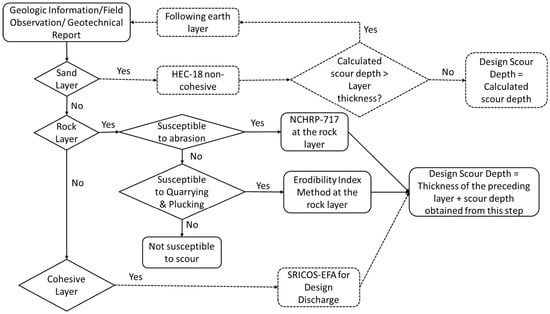
This study proposes a procedure, as shown in Figure 1, to lay down a framework for the selection of pier scour calculation methods and implementation of pier scour analysis in all earth materials including rocks. In this framework, the HEC-18 Non-cohesive Pier Equation is still recommended for pier scour analysis in sand layers. The SRICOS-EFA is proposed for calculating the pier scour depth in cohesive soils, the Erodibility Index Method is recommended for predicting the quarrying and plucking mode of pier scour in scour-susceptible rocks, and the NCHRP-717 method is selected for analyzing the abrasion mode of pier scour in scour-susceptible rocks.
Figure 1.
Flow-chart of a proposed framework for selecting pier scour analysis method. Bridge scour analysis in rock strata is marked using solid lines while that for cohesive layers uses dashed lines. Both are shown because these two may coexist on one site.
As illustrated in Figure 1, the pier scour analysis starts with the assessment of available geological information, field observations, and existing geotechnical reports. The analysis should be carried out layer by layer because multiple soil and rock formations may exist within the bridge foundation strata. For each layer, the material type is first identified. If the layer consists of rock, the dominant scour mode(s) need to be determined. The determination of scour susceptibility should be based on available geological and geotechnical information, including rock type, weathering condition, discontinuity characteristics, joint orientation, field observations, and available laboratory testing results.
In principle, abrasion can occur in a wide range of rock types when sediment-laden flow provides sufficient hydraulic loading over time. However, abrasion is generally expected to be negligible for resistant igneous and metamorphic rocks and for well-cemented sedimentary rocks under typical bridge-site conditions. By contrast, abrasion should be considered for weak sedimentary rocks, such as soft shale and clay-rich mudstone, where progressive degradation may occur under repeated hydraulic loading. NCHRP-717 is recommended for analyzing this type of scour.
Quarrying and plucking should be considered for highly fractured and/or heavily weathered rock formations. These characteristics should be evaluated based on the rock mass in its natural state rather than on samples significantly disturbed during coring, sampling, or transportation. The Erodibility Index Method is recommended for evaluating scour associated with quarrying and plucking mechanisms. If a rock layer is determined to be not susceptible to significant scour mechanisms, substantial scour is generally not expected under typical bridge-site hydraulic conditions. The procedure continues until scour cannot reach the next underlying layer. The scour depths obtained for individual layers are then combined to estimate the total scour depth. The layer-by-layer procedure is primarily intended for sites with mixed or stratified subsurface conditions. For sites underlain by a single thick material layer, the corresponding material-specific scour method may be sufficient.
3. Geology and Material Classification
This section presents a regional material classification system developed using Michigan’s surface bedrock geology. The classification is intended as a Michigan-specific pre-screening tool for identifying whether a rock unit may be susceptible to scour and what type of analysis may be appropriate. The general approach, i.e., linking regional geology, expected scour mechanisms, and method selection, is transferable, but the specific classifications presented here should not be directly extrapolated to regions with different geological settings without local geological and geotechnical evaluation. The classification framework presented herein may also provide useful reference information for regions with comparable geological conditions. It provides an example of constructing similar customized material classification systems for other regions. For this reason, the surface geology of Michigan will be introduced first to provide the necessary background knowledge, and then, based on it, the material classification system will be laid out.
3.1. Surface Geology of Michigan
The geologic formations of Michigan span more than 3.5 billion years, from some of the oldest Precambrian rocks to loose, unconsolidated drift left behind by the continental ice sheets of the Pleistocene period. This fact makes this geographical region a representative example to illustrate the rock classification for bridge scour considerations. The geology is primarily characterized by the Paleozoic sedimentary Michigan Basin and Precambrian crystalline formations. The Pre-Cambrian old crystalline igneous and metamorphic rocks with some sedimentary and metasedimentary formations are present in the western Upper Peninsula [51,52].
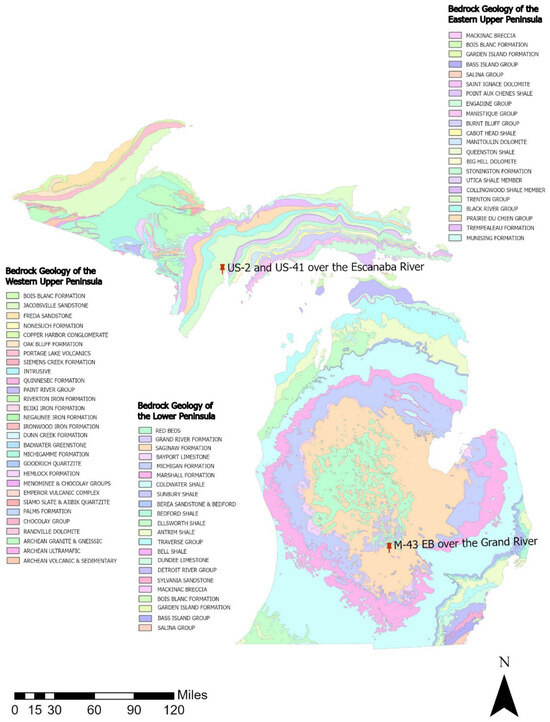
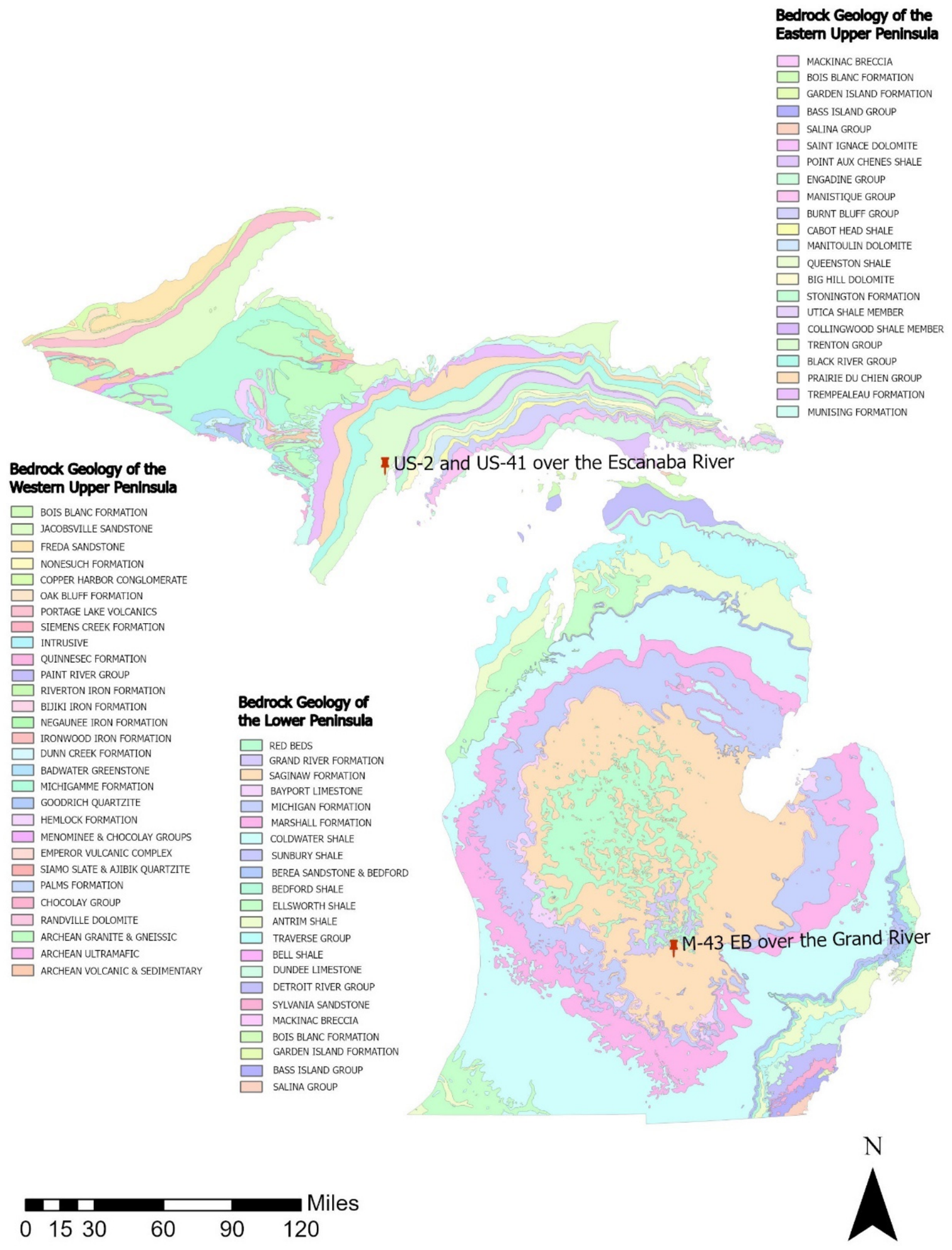
Much of Michigan’s bedrock is covered by unconsolidated Pleistocene glacial deposits. However, numerous rock outcrops are exposed along rivers, lakes, and quarries, particularly in the western Upper Peninsula [51,52], which makes these formations directly relevant to bridge scour analysis. The generalized bedrock geology of Michigan is summarized in Figure 2 [53]. As shown in Figure 2, variations in rock type across the region correspond to differences in expected scour resistance, providing a basis for preliminary classification.
Figure 2.
Bedrock geology of Michigan in detail [53] and location of the case studies.
3.1.1. Bedrock Geology of the Lower Peninsula
As we move from the rim to the center of the Lower Peninsula, the sedimentary rocks become younger, which are also softer and more susceptible to scour, as a general trend. The youngest rocks can be found in a small area near the center of the Michigan Basin named ‘Red Beds’. This entire area is covered by glacial outwash and has no outcrop. Surrounding the Red Beds, the Grand River Formation and Saginaw Formation occur, around which there are the Bayport Formation, Michigan Formation, Marshall Formation, and Coldwater Shale. All of these rocks have outcrops in multiple places. A thin layer of the Sunbury Shale overlies the Coldwater Shale in most places, which is not exposed on the ground surface (Figure 2).
A variety of sedimentary formations are present across the Lower Peninsula, including shale, sandstone, limestone, and mixed units [53]. Many of these formations have surface outcrops, particularly along rivers and lakes, making them directly relevant to bridge scour analysis. These outcropping formations are directly exposed to hydraulic loading, and their material properties and structural features (e.g., jointing and weathering) govern the dominant scour mechanisms, including abrasion and quarrying/plucking.
3.1.2. Bedrock Geology of the Eastern Upper Peninsula
The Eastern Upper Peninsula has a range of sedimentary formations including shale, dolomite, and limestone units (Figure 2). All these rocks of the Eastern Upper Peninsula have isolated outcrops except the Bass Island Group [53]. These formations are generally more resistant than those in the Lower Peninsula, and scour is typically limited unless local weathering or structural discontinuities are present.
3.1.3. Bedrock Geology of the Western Upper Peninsula
The Western Upper Peninsula has a combination of igneous, metamorphic, and sedimentary formations, including volcanic and intrusive rocks (Figure 2). Except for the Bois Blanc Formation and Intrusives, all the rocks in the Western Upper Peninsula have several outcrops [53]. These older crystalline and volcanic rocks are generally strong and resistant to erosion, and scour is typically negligible unless significant fracturing or weathering is present.
The geological characteristics described above directly influence scour behavior. In particular, rock type, age, weathering condition, and structural features such as joints and bedding control both the dominant scour mechanisms (abrasion or quarrying/plucking) and the selection of appropriate scour prediction methods. In general, younger sedimentary rocks tend to exhibit lower strength and higher susceptibility to erosion, while older igneous and metamorphic rocks are more resistant. These differences form the basis for the classification framework used in this study to assess scour susceptibility and select appropriate analysis methods.
3.2. Material (Rock) Classification for Scour Considerations
The classification system developed in this study is based on the geological characteristics described in the previous section. In particular, rock type, age, weathering condition, and structural features such as joints and bedding are used as indicators of scour susceptibility and governing erosion mechanisms. This connection allows regional geological information to support the preliminary selection of scour analysis methods.
The Michigan rocks introduced in Section 3.1 were assessed for their scour susceptibility. Rock units with no surface outcrops were not classified as exposed bedrock scour concerns in this preliminary screening because they are unlikely to directly interact with channel flow under typical surface conditions. As can be seen in Table 1, a three-tier classification system was established to classify the rocks having outcrops based on information from the literature and the research team’s experience. For Michigan bridge sites, this table may be used as an initial screening reference before detailed field observations, geotechnical investigation, or erosion testing are available. For sites outside Michigan, the table should not be used directly unless the local bedrock units and engineering properties are demonstrably comparable. Instead, the same classification logic should be reconstructed using local geological maps, rock descriptions, weathering conditions, discontinuity information, and available field or laboratory evidence. This rock classification system for bridge scour considerations was constructed based on the three-tier system proposed by Niemann et al. [32], which applied NCHRP-717 [6] in a West Virginia DOT study.
Table 1.
Sample of Classification of Michigan bedrock for scour considerations (Full table given in the Supplemental Material).
The three-tier system suggests the following recommendations:
Tier I—The bridge is safe from future scour.
Tier II—The bridge is exposed to the abrasion mode of scour.
Tier III—The bridge is exposed to the quarrying mode of scour.
The classification results in Table 1 indicate that many Michigan bedrock units, particularly older crystalline rocks in the Upper Peninsula, are expected to have limited scour susceptibility, while several sedimentary units in the Lower Peninsula are conservatively classified as potentially susceptible to abrasion, quarrying and plucking, or both. These distinctions reflect differences in rock strength, weathering, and structural features such as joints and bedding. The classification is intended as a preliminary screening tool; for site-specific applications, detailed geotechnical and geological investigations are required to identify the governing scour mechanisms and to support the selection of appropriate scour prediction methods.
4. Case Studies
4.1. Overview
The selected rock scour calculation methods were implemented at two representative bridge sites in Michigan to demonstrate how rock scour analysis can be conducted using typical project data. These case studies are illustrative implementation examples rather than validation cases, because site-specific field scour measurements corresponding to the analyzed design discharges were not available. The case studies were designed to evaluate: (1) how the proposed classification framework guides method selection, (2) what input parameters are required by the Erodibility Index Method and NCHRP-717, (3) which parameters are commonly missing from geotechnical or hydraulic reports, and (4) how rock-based predictions compare with HEC-18 Non-cohesive Equation results. Both sites were analyzed using available geotechnical, structural, hydraulic, and nearby USGS streamflow data. When required input parameters were unavailable, assumptions were made and documented.
The case study of M-43 EB over the Grand River is introduced in the following, while the second case study of US-2 and US-41 over the Escanaba River is presented in the Supplemental Material. In this study, design discharge refers to the flow condition used for scour evaluation, and design scour depth refers to the predicted total scour depth based on the combined effects of all relevant material layers.
4.2. M-43 Eb over the Grand River
4.2.1. General Information and Analysis
The M-43 EB over the Grand River Bridge is located in Ionia County in Michigan. As discussed in the geology section, this region is characterized by sedimentary bedrock formations, which are generally more susceptible to scour than older crystalline rocks (Figure 2). Lithological constituents of Saginaw Formation are sandstone, shale, limestone, and coal [54]. At this location, the river flows to the north, and the nearest USGS gaging station is located downstream of the bridge. The geotechnical report for this site recorded that the old bridge was replaced after 2011 with a three-span, 286-ft-long steel girder bridge. The bridge piers are supported by drilled shafts with diameters ranging from 48 inches to 57 inches, and the shafts are socketed into sandstone bedrock. For calculation, a diameter of 57 inches was used for both of the piers.
At Pier #1, a sand layer overlies weathered sandstone, which is underlain by less weathered sandstone. At Pier #2, two sand layers are present above similar rock formations. Following the proposed implementation procedure (Figure 1), the scour depth for the sand layers was obtained using the HEC-18 Non-cohesive Equation. Since the two piers were identical, the same scour depth was obtained using the HEC-18 Non-cohesive Equation for both piers (Table 2). At Pier #1, the scour depth exceeded the sand layer thickness (i.e., 2 ft, in Table 2, Column 2) for both of the design discharges. By contrast, at Pier #2, the scour was confined within the sand layers (i.e., 10.5 ft, in Table 2, Column 3) for the analyzed cases. So, a further calculation was carried out only for Pier #1.
Table 2.
Scour depth calculated using the HEC-18 Non-cohesive Equation at M-43 over the Grand River.
4.2.2. Scour Analysis Using the Erodibility Index Method
The following information (Table 3) was used to determine the erodibility index of the rock layer at Pier #1. Some information was collected from the geotechnical report, while the other parameters were assumed, as the needed depth could not be directly obtained from the existing project data. These assumed parameters represent conservative engineering estimates based on observed material conditions and are intended to illustrate the implementation procedure rather than provide design-level predictions.
Table 3.
Rock layer input information for the Erodibility Index Method at M-43 EB over the Grand River.
Table 4 lists the calculation of the scour depth at Pier #1 using the Erodibility Index Method. As shown, the scour ceased at the depth of 2.1 ft for a design discharge of 19,400 cfs, whereas the scour reached 8.3 ft for a design discharge of 26,800 cfs. Compared with the HEC-18 Non-cohesive Equation, the Erodibility Index Method predicted substantially smaller scour at the lower design discharge and a closer value at the higher design discharge. Specifically, the calculated scour depth is approximately 25% at the 19,400 cfs discharge and 86% at the 26,800 cfs discharge. This result indicates that the difference between rock-based and non-cohesive scour predictions depends on both geological resistance and hydraulic loading. Therefore, the use of HEC-18 equations without considering rock properties can either substantially overestimate scour or produce results closer to rock-based methods under more severe hydraulic conditions.
Table 4.
Scour calculation at Pier #1 of M-43 over the Grand River using the Erodibility Index Method.
4.2.3. Comparison of Design Scour Depths
Table 5 presents the design scour depth at the piers of M-43 EB over the Grand River. Design scour depth was calculated following the procedure proposed in Figure 1. It is observed that applying HEC-18 Non-cohesive Equation at the sand layer and the Erodibility Index Method at the rock layer, the design scour depth is 2.1 ft (2 ft of scour at sand layer and 0.1 ft of scour at rock layer) for 19,400 cfs of flow and 8.3 ft (2 ft of scour at sand layer and 6.3 ft of scour at rock layer) for 26,800 cfs at Pier #1; and is 8.5 ft (at sand layer) for 19,400 cfs of flow and 9.7 ft (at sand layer) for 26,800 cfs at Pier #2. However, field observations at the site did not indicate significant scour, suggesting that predictions based solely on HEC-18 equations may be overly conservative for rock foundations. For comparison purposes, the scour depth at Pier #1 obtained using only the HEC-18 Non-cohesive Pier Equation is also shown in Table 5. It is seen that if HEC-18 Non-cohesive Pier Equation is used irrespective of the earth layer, the scour depth will be over-conservative. Recent FHWA NextScour case studies have similarly emphasized the importance of integrating hydraulic analysis, erosion testing, and geological characterization for scour assessment in complex subsurface conditions [55,56].
Table 5.
Design scour depth at the piers of M-43 EB over the Grand River.
These results indicate that method selection can significantly influence predicted scour depth and, consequently, foundation design. In particular, applying HEC-18 equations to rock layers without accounting for material resistance may lead to overly conservative designs.
4.3. Sensitivity Analysis
4.3.1. Erodibility Index Method
To obtain a more comprehensive understanding, sensitivity analysis was performed for the parameters in the Erodibility Index Method. Every parameter mentioned in the Erodibility Index Method is important since each parameter is equally weighted in the Erodibility Index determination equation (Equation (S1) in the Supplemental Material). Some parameters are easily available in the geotechnical report, while some others, such as dip angle, dip direction, and the ratio of joint spacing, are not. Thus, these parameters had to be assumed in the Erodibility Index Method scour calculations. This is common in the application of this method; however, the possible impacts of such assumptions are not that clear especially in real-world examples. To check the sensitivity of these parameters, multiple cases have been analyzed for the rock layer at Pier #1 of M-43 over the Grand River. Table 6 shows how the results might change if these parameters vary.
Table 6.
Sensitivity study of selected parameters on erodibility index and scour depth for rock layer at Pier #1 of M-43 over the Grand River.
As shown, these parameters can significantly affect the calculation results for the scour depth. This indicates that the accurate acquisition of these parameters in the field is highly desired. Therefore, it is highly recommended to obtain such information in the surveying or geotechnical investigation stages for typical bridges, especially when bridge scour needs to be considered. If such information is not available in the existing reports, additional field investigations are recommended for acquiring such information to ensure accurate bridge scour analysis results. This level of variability also suggests that uncertainty in geological parameters can significantly affect design scour depth and should be explicitly considered in engineering decision-making. Although the sensitivity to geological parameters introduces uncertainty into the analysis, the results also emphasize the importance of obtaining appropriate geological characterization during site investigation and geotechnical exploration.
4.3.2. Nchrp-717
To complement the sensitivity analysis, NCHRP-717 was applied at the rock layer of Pier #1 of M-43 over the Grand River as an illustrative exercise, although the rock layer at this site was classified as primarily susceptible to quarrying and plucking rather than abrasion. This site was used because published ranges of GSN values are available for similar sandstone materials. The upper and lower bounds of the possible GSN values, i.e., 4.54 × 10⁻⁶ ft[]−1 and 2.53 × 10⁻⁵ ft[]−1 [31] were used for the sandstone bedrock at Pier #1 of M-43 over the Grand River to determine the scour depth using NCHRP-717. It was found that the predicted scour depths fell into the range between 0.000068 ft and 0.00038 ft, which can be viewed as negligible. However, the assumed GSN values produced an 81% variation in predicted scour depth. This result shows that although the absolute scour depth was negligible in this illustrative case, assumed GSN values can introduce substantial relative uncertainty. Therefore, the modified slake durability test should be conducted when NCHRP-717 is used for design-level scour assessment. This also highlights that NCHRP-717 is highly sensitive to material characterization and should not be applied without site-specific testing.
4.4. Future Outlook
Based on experience gained through the above case studies and information from the literature, a brief future outlook on validation, countermeasures, and monitoring is provided here to complete the study. Future implementation of the proposed workflow should also be linked with field validation, scour countermeasure evaluation, and proactive monitoring of hydraulic infrastructure. Recent reviews of local scour countermeasures, including hydraulic, structural, and biotechnical measures, indicate that scour assessment and scour mitigation should be considered together in risk-informed bridge management [57]. In addition, emerging concepts such as Civil Infrastructure 4.0 emphasize the integration of sensing, data management, and proactive asset management for critical infrastructure systems [58]. Recent sensing studies, including the development of instrumented particles for water infrastructure hazards, also demonstrate the potential for improved monitoring of hydraulic processes relevant to scour and erosion [59]. These developments suggest that future validation of rock scour workflows should not rely only on retrospective design calculations, but should combine field observations, repeat bathymetric surveys, hydraulic records, geotechnical characterization, and sensing-based monitoring when feasible.
5. Conclusions
This study contributes to the current body of knowledge for bridge scour analysis for rocks by synthesizing, integrating, and reviewing the existing bridge scour calculation methods by exemplifying the detailed use of the most suitable methods at typical bridge sites. To facilitate future practice, a rock classification system was proposed and implemented for the geographical region of the sites, i.e., the state of Michigan in the U.S. for pre-screening of materials and to guide scour analysis and for identifying typical issues that one may encounter in the implementation of such methods for rock scour analysis. The following conclusions are drawn.
- Research on contraction scour and abutment scour in erodible rock is needed since very little information is available on this subject.
- The proposed rock classification system can be used as a preliminary screening step for bridges founded on Michigan bedrock. Its direct applicability is limited to the geological conditions for which it was developed. For other regions, the classification should be considered an example of how a regional pre-screening system can be developed, rather than a ready-to-use classification table.
- The case studies indicate that HEC-18 Non-cohesive Pier Equation may substantially overpredict scour depth in rock layers when geological resistance is not explicitly considered. The differences can be significant, depending on the geological and hydraulic conditions.
- The input parameters for the Erodibility Index Method, especially observations of the geological conditions, are critical, because calculations with assumptions may generate very high scour depths, leading to unnecessarily expensive foundation designs.
- The Erodibility Index Method can be applied to layered earth strata, but care is required to assign the correct material properties and stream-power calculations to each layer and depth interval.
- When using NCHRP-717, the modified slake durability test is strongly recommended because assumed GSN values can produce large relative differences in predicted scour depth, as shown by the sensitivity analysis.
The results demonstrate that incorporating geological characterization and erosion-based methods can provide a more material-specific and practically interpretable assessment for rock foundations than directly applying conventional sand-based equations to rock layers. However, because independent field-measured scour depths were not available, the results should not be interpreted as proof of predictive accuracy. Further field monitoring, site-specific erosion testing, and documented scour measurements are needed to validate and refine the proposed workflow. The proposed framework provides a practical approach for integrating these methods into engineering practice, although further work is needed to reduce uncertainty and improve parameter estimation for field applications.
Supplementary Materials
The following supporting information can be downloaded at: https://www.mdpi.com/article/10.3390/hydrology13070190/s1, More details are provided about the scour analysis methods, the classification of Michigan bedrock for scour considerations, and the second case study, which include Figures S1–S3 and Tables S1–S5.
Author Contributions
Conceptualization, Z.L.; methodology, Z.L., D.E.S. and S.V.; software, D.E.S.; validation, D.E.S. and Z.L.; formal analysis, D.E.S.; writing—original draft preparation, D.E.S. and S.V.; writing—review and editing, D.E.S., Z.L., B.B. and S.V.; visualization, D.E.S.; supervision, Z.L., S.V. and B.B.; project administration, Z.L.; funding acquisition, Z.L. and S.V. All authors have read and agreed to the published version of the manuscript.
Funding
This research is supported by the Michigan Department of Transportation (MDOT OR 16-009). The study also benefited from the data-driven computing supported by NSF Award 1742656.
Data Availability Statement
The original contributions presented in this study are included in the article/Supplementary Material. Further inquiries can be directed to the corresponding author.
Conflicts of Interest
Author Darud Sheefa was employed by the company IEA Inc. The remaining authors declare that the research was conducted in the absence of any commercial or financial relationships that could be construed as a potential conflict of interest.
References
- Lagasse, P.F.; Richardson, E.V. ASCE compendium of stream stability and bridge scour papers. J. Hydraul. Eng. 2001, 127, 531–533. [Google Scholar] [CrossRef] [Scilit]
- Lagasse, P.F. Countermeasures to Protect Bridge Piers from Scour; Transportation Research Board: Washington, DC, USA, 2007; Volume 593. [Google Scholar]
- Liang, F.; Bennett, C.R.; Parsons, R.L.; Han, J.; Lin, C. A literature review on behavior of scoured piles under bridges. In Contemporary Topics in In Situ Testing, Analysis, and Reliability of Foundations; American Society of Civil Engineers (ASCE): Reston, VA, USA, 2009; pp. 482–489. [Google Scholar]
- Jones, S.J.; Richardson, E.V. A Decade of High Priority Bridge Scour Research in the US. In Proceedings of the 2nd International Conference on Scour and Erosion (ICSE-2), Singapore, 14–17 November 2004. [Google Scholar]
- Little, R.G. Toward more robust infrastructure: Observations on improving the resilience and reliability of critical systems. In Proceedings of the 36th Annual Hawaii International Conference on System Sciences, Big Island, HI, USA, 6–9 January 2003; IEEE: New York, NY, USA, 2003; p. 9. [Google Scholar]
- Keaton, J.R.; Mishra, S.K.; Clopper, P.E. Scour at Bridge Foundations on Rock; Transportation Research Board: Washington, DC, USA, 2012; Volume 717. [Google Scholar]
- Moore, A. Determination of Scour Susceptibility Through Rapid Assessment; University of Missouri: Kansas City, MO, USA, 2012. [Google Scholar]
- Lagasse, P.; Zevenbergen, L.; Spitz, W.; Arneson, L. Stream Stability at Highway Structures, US Department of Transportation; Report No. HIF 12-004, HEC-20; Federal Highway Administration: Arlington, VA, USA, 2012.
- Arneson, L. Evaluating Scour at Bridges; Federal Highway Administration: Arlington, VA, USA, 2012.
- Lagasse, P.; Clopper, P.; Pagan-Ortiz, J.; Zeverbergen, L.; Arneson, L.; Schall, J.; Girard, L. Bridge Scour and Stream Stability Countermeasures (Vols. 1 and 2), HEC-23; FHWA-NHI-09-111; Federal Highway Administration, US Department of Transportation: Washington, DC, USA, 2009.
- Richardson, E.V.; Davis, S.R. Evaluating Scour at Bridges; Federal Highway Administration, Office of Bridge Technology: Washington, DC, USA, 2001.
- Schuring, J.R.; Dresnack, R.; Golub, E.; Khan, M.A.; Young, M.R.; Dunne, R.; Aboobaker, N. Review of bridge scour practice in the US. In Scour and Erosion; CRC Press: Boca Raton, FL, USA, 2010; pp. 1110–1119. [Google Scholar]
- Carpenter, D.D.; Miller, C. A Critical Evaluation of Bridge Scour for Michigan Specific Conditions; Lawrence Technological University, Department of Civil Engineering: Southfield, MI, USA, 2011. [Google Scholar]
- Benedict, S.T.; Caldwell, A. Development and Evaluation of Clear-Water Pier and Contraction Scour Envelope Curves in the Coastal Plain and Piedmont Provinces of South Carolina; Geological Survey (US): Reston, VA, USA, 2016.
- TxDOT. Geotechnical Manual; Texas Department of Transportation: Austin, TX, USA, 2018.
- Benedict, S.T. Assessment of the NCHRP Abutment Scour Prediction Equations with Laboratory and Field Data; Clemson University Institute of Computational Technology: Clemson, SC, USA, 2014. [Google Scholar]
- Devi, Y.S.; Barbhuiya, A. Bridge pier scour in cohesive soil: A review. Sādhanā 2017, 42, 1803–1819. [Google Scholar] [CrossRef] [Scilit]
- Ansari, S.; Kothyari, U.; Ranga Raju, K. Influence of cohesion on scour around bridge piers. J. Hydraul. Res. 2002, 40, 717–729. [Google Scholar] [CrossRef] [Scilit]
- Gazi, A.H.; Afzal, M.S.; Dey, S. Scour around piers under waves: Current status of research and its future prospect. Water 2019, 11, 2212. [Google Scholar] [CrossRef] [Scilit]
- Annandale, G. Erodibility. J. Hydraul. Res. 1995, 33, 471–494. [Google Scholar] [CrossRef] [Scilit]
- Briaud, J.-L.; Ting, F.C.; Chen, H.; Gudavalli, R.; Perugu, S.; Wei, G. SRICOS: Prediction of scour rate in cohesive soils at bridge piers. J. Geotech. Geoenviron. Eng. 1999, 125, 237–246. [Google Scholar] [CrossRef] [Scilit]
- Brandimarte, L.; Montanari, A.; Briaud, J.-L.; D’Odorico, P. Stochastic flow analysis for predicting river scour of cohesive soils. J. Hydraul. Eng. 2006, 132, 493–500. [Google Scholar] [CrossRef] [Scilit]
- Najafzadeh, M.; Barani, G.-A. Experimental study of local scour around a vertical pier in cohesive soils. Scientiairanica 2014, 21, 241–250. [Google Scholar]
- Kho, K.T.; Valentine, E.; Glendinning, S. An experimental study of local scour around circular bridge piers in cohesive soils. In Proceedings of the 2nd International Conference on Scour and Erosion (ICSE-2), Singapore, 14–17 November 2004. [Google Scholar]
- Najafzadeh, M.; Barani, G.-A.; Azamathulla, H.M. GMDH to predict scour depth around a pier in cohesive soils. Appl. Ocean Res. 2013, 40, 35–41. [Google Scholar] [CrossRef] [Scilit]
- Chaudhuri, S.; Debnath, K. Observations on initiation of pier scour and equilibrium scour hole profiles in cohesive Sediments. ISH J. Hydraul. Eng. 2013, 19, 27–37. [Google Scholar] [CrossRef] [Scilit]
- Liu, Z.L.; Sheefa, D.E.; Vitton, S.; Barkdoll, B. Improved Calculation of Scour Potential in Cohesive Soils and Scour-Susceptible Rock; Michigan Department of Transportation: Lansing, MI, USA, 2020.
- Hancock, G.S.; Anderson, R.S.; Whipple, K.X. Beyond power: Bedrock river incision process and form. Geophys. Monogr.-Am. Geophys. Union 1998, 107, 35–60. [Google Scholar] [CrossRef] [Scilit]
- Whipple, K.X.; Hancock, G.S.; Anderson, R.S. River incision into bedrock: Mechanics and relative efficacy of plucking, abrasion, and cavitation. Geol. Soc. Am. Bull. 2000, 112, 490–503. [Google Scholar] [CrossRef]
- Keaton, J.R.; Mishra, S.K.; Clopper, P.E. Scour at bridge foundations on rock: Overview of NCHRP project no. 24–29. In Scour and Erosion; CRC Press: Boca Raton, FL, USA, 2010; pp. 749–756. [Google Scholar]
- Titi, H.H.; Liao, Q.; Laflin, A.; Keaton, J.R.; Kean, W.; Wheeler, A.F. Predicting Scour of Bedrock in Wisconsin; Wisconsin Department of Transportation, Research and Library Unit: Madison, WI, USA, 2017.
- Niemann, W.L.; Wait, I.W.; Keaton, J.R. A proposed risk-based screening strategy for bridges potentially affected by rock scour. Environ. Eng. Geosci. 2017, 23, 221–241. [Google Scholar] [CrossRef] [Scilit]
- Zatar, W.; Wait, I.; Niemann, W.; Rahall, N.J. Criteria for Predicting Scour of Erodible Rock in West Virginia; West Virginia Department of Transportation: Charleston, WV, USA, 2013.
- Coleman, S.E.; Melville, B.W.; Gore, L. Fluvial entrainment of protruding fractured rock. J. Hydraul. Eng. 2003, 129, 872–884. [Google Scholar] [CrossRef] [Scilit]
- Bollaert, E.F.; Schleiss, A.J. Physically based model for evaluation of rock scour due to high-velocity jet impact. J. Hydraul. Eng. 2005, 131, 153–165. [Google Scholar] [CrossRef] [Scilit]
- Bollaert, E.F. Numerical modeling of scour at bridge foundations on rock. In Scour and Erosion; CRC Press: Boca Raton, FL, USA, 2010; pp. 767–776. [Google Scholar]
- Smith, S.P. Preliminary Procedure to Predict Bridge Scour in Bedrock; Colorado Department of Transportation [Division of Transportation Development]: Denver, CO, USA, 1994.
- Annandale, G. Erosion of rock by hydraulic forces. In Proceedings of the Vail Rocks 1999, The 37th US Symposium on Rock Mechanics (USRMS), Vail, CO, USA, 6–9 June 1999. [Google Scholar]
- Annandale, G.W.; Smith, S.P. Proposed pier scour procedure for rock formations. In Proceedings of the Stream Stability and Scour at Highway Bridges: Compendium of Stream Stability and Scour Papers; Water Resources Engineering (Hydraulics) Division of the American Society of Civil Engineers: Reston, VA, USA, 1998; p. 180. [Google Scholar]
- Annandale, G.W.; Smith, S.P. Scour in erodible rock I: The Erodibility Index. In Proceedings of the Stream Stability and Scour at Highway Bridges: Compendium of Stream Stability and Scour Papers; Water Resources Engineering (Hydraulics) Division of the American Society of Civil Engineers: Reston, VA, USA, 1999; p. 77. [Google Scholar]
- Annandale, G.; Smith, S. Calculation of Bridge Pier Scour Using the Erodibility Index Method; Golden Associates: Fairless Hills, PA, USA, 2001. [Google Scholar]
- Coleman, S.E.; Melville, B.W.; Gore, L. Closure to “Fluvial entrainment of protruding fractured rock” by Stephen E. Coleman, Bruce W. Melville, and Lance Gore. J. Hydraul. Eng. 2005, 131, 143–144. [Google Scholar] [CrossRef] [Scilit]
- Dickenson, S.E.; Bailie, M.W. Predicting Scour in Weak Rock of the Oregon Coast Range; Oregon State University. Department of Civil, Construction, and Environmental Engineering: Corvallis, OR, USA, 1999. [Google Scholar]
- Bollaert, E.; Schleiss, A. Transient Water Pressures in Joints and Formation of Rock Scour Due to High-Velocity Jet Impact; EPFL-LCH: Lausanne, Switzerland, 2002. [Google Scholar]
- Bollaert, E. A comprehensive model to evaluate scour formation in plunge pools. Int. J. Hydropower Dams 2004, 11, 94–101. [Google Scholar]
- Annandale, G.W. Processes and proxies defining maximum and time rate of scour of rock around bridge piers. In Contemporary Topics in In Situ Testing, Analysis, and Reliability of Foundations; American Society of Civil Engineers (ASCE): Reston, VA, USA, 2009; pp. 514–521. [Google Scholar]
- Huang, M.; Liao, J.-J.; Pan, Y.-W.; Cheng, M. Modifications of the erodibility index method for the evaluation of the soft bedrock erosion. In Proceedings of the 47th US Rock Mechanics/Geomechanics Symposium, San Francisco, CA, USA, 23–26 June 2013. [Google Scholar]
- Keaton, J.R.; Mishra, S.K. Modified slake durability test for erodible rock material. In Scour and Erosion; CRC Press: Boca Raton, FL, USA, 2010; pp. 743–748. [Google Scholar]
- ASTM D4644-16; Standard Test Method for Slake Durability of Shales and Other Similar Weak Rocks. ASTM: West Conshohocken, PA, USA, 2016.
- Nicks, J.E.; Ghaaowd, I.I.; Pagenkopf, J.; Shan, H.; Wiblishauser, O. Comparison between the Erosion Function Apparatus and the Ex Situ Scour Testing Device: Preliminary Findings. In Proceedings of the Geo-Congress 2024, Vancouver, BC, Canada, 25–28 February 2024; pp. 570–578. [Google Scholar]
- Harrison, W.B.I. Geology of Michigan. Available online: https://scholarworks.wmich.edu/michigangeologicalrepository/2 (accessed on 14 July 2026).
- Sommers, L.M. Michigan: A Geography; Routledge: Abingdon, UK, 2019. [Google Scholar]
- DEQ. GeoWebFace. Available online: https://experience.arcgis.com/experience/c44f7e5e509b4c879ea37c8f1e6972ea#zoom_to_selection=true (accessed on 14 July 2026).
- USGS. Geologic Units in Michigan (State in United States). Available online: https://mrdata.usgs.gov/geology/state/fips-unit.php?code=fUS26 (accessed on 14 July 2026).
- Shan, H.; Pagenkopf, J.R.; Li, C.; Zhang, N.; Pastrich, D.; Wiblishauser, O.; Huang, C.; Kerenyi, K. NextScour Case Study: The Lafayette Avenue Bridge Over the Saginaw River in Bay City, Michigan; United States Department of Transportation: Washington, DC, USA, 2023.
- Shan, H.; Pagenkopf, J.R.; Nicks, J.; Xie, Z.; Li, C.; Wiblishauser, O.; Huang, C.; Kerenyi, K. NextScour Case Study: The I–6064/I–95 Bridge Replacements Over the Lumber River in Lumberton, NC; Bureau of Transportation Statistics: Washington, DC, USA, 2024.
- Bharadwaj, M.R.; Gupta, L.K.; Pandey, M.; Valyrakis, M. Countermeasures for local scour around the bridge pier: A review. Acta Geophys. 2025, 73, 701–728. [Google Scholar]
- Michalis, P.; Konstantinidis, F.; Valyrakis, M. The road towards Civil Infrastructure 4.0 for proactive asset management of critical infrastructure systems. In Proceedings of the 2nd International Conference on Natural Hazards & Infrastructure (ICONHIC), Chania, Greece, 23–26 June 2019; pp. 23–26. [Google Scholar]
- Al-Obaidi, K.; Xu, Y.; Valyrakis, M. The design and calibration of instrumented particles for assessing water infrastructure hazards. J. Sens. Actuator Netw. 2020, 9, 36. [Google Scholar] [CrossRef] [Scilit]

Disclaimer/Publisher’s Note: The statements, opinions and data contained in all publications are solely those of the individual author(s) and contributor(s) and not of MDPI and/or the editor(s). MDPI and/or the editor(s) disclaim responsibility for any injury to people or property resulting from any ideas, methods, instructions or products referred to in the content. |
© 2026 by the authors. Licensee MDPI, Basel, Switzerland. This article is an open access article distributed under the terms and conditions of the Creative Commons Attribution (CC BY) license.