


Abstract
The Japanese Garden of La Paz, Bolivia, is a sociocultural space with high biodiversity, with its lagoon receiving treated effluent from the “Las Cholas” Wastewater Treatment Unit. Preliminary monitoring revealed elevated organic matter concentrations, raising concerns about water quality. This study aimed to design a constructed wetland (CW) to remove organic load and demonstrate its potential as a nature-based solution (NBS) for sustainable management. Physicochemical parameters and the trophic state index were evaluated during the dry and wet seasons. Macrophyte species were identified, and the most suitable species were selected through a systematic literature review considering treatment performance and local availability. The results showed alkaline conditions, low nutrient concentrations, and a mesotrophic trophic status. A total of 139 vascular plant species were recorded, including Cyperus involucratus, Azolla filiculoides, and Eichhornia sp. Cyperus involucratus was selected due to its abundance and reported BOD5 or COD removal efficiency. The proposed system consists of a horizontal subsurface flow CW incorporating permeable reactive barriers filled with water hyacinth leaves as a biosorbent. A design flow rate of 0.86 m3/day was adopted for the proposed CW, corresponding to a hydraulic retention time (HRT) of 1.68 days and an estimated BOD5 removal efficiency of 68.54%.
1. Introduction
Urban lakes and ornamental ponds are among the landscape elements that greatly enhance the quality of life in urban areas; they offer recreational and educational activities and help regulate the urban climate [1,2]. They contribute multiple ecosystem services, such as flood mitigation, the moderation of local climatic variability, and an enhancement in runoff water quality, and support for biodiversity and recreational value [3]. However, urban aquatic systems are highly vulnerable to anthropogenic pressures, such as stormwater runoff, the accumulation of contaminants or nutrients from surrounding built environments, and hydrological disturbances that undermine water quality and ecosystem functioning [4,5,6,7].
These conditions can exacerbate eutrophication processes, especially in small urban water bodies. Eutrophication, characterized by excessive inputs of minerals and nutrients (primarily nitrogen and phosphorus), leads to the proliferation of aquatic plants, increased accumulation of organic matter, and deterioration of ecological balance [8,9].
Nature-based solutions (NbSs) are sustainable strategies to address complex environmental challenges related to anthropogenic pressures. Constructed wetlands (CWs) represent a widely applied NbS to enhance water quality [10]; they mimic natural ecosystems by boosting biological, physical, and chemical purification processes [11,12,13]. Furthermore, they replace conventional wastewater treatment processes to create a sustainable system based on a natural ecosystem [14].
Background and Context
The Japanese Garden (JG), located in La Paz, Bolivia, is a sociocultural urban space donated by the Japanese Society of La Paz. The site hosts a rich biological diversity, encompassing a variety of both aquatic and terrestrial plant species. The lagoon receives pre-treated water from the “Las Cholas” Wastewater Treatment Unit, which is a preliminary treatment system. Prior monitoring indicated elevated organic matter and turbidity, suggesting ecological imbalance and imminent stress to aquatic life [15]. Given the region’s seasonal climatic variability, pollutant accumulation may intensify during the dry season, compromising both environmental quality and the site’s cultural value.
Seasonal variations in water quality conditions and pollutant loads in the JG lagoon provide essential information for the design of a CW adapted to the ecological dynamics of the site. By characterizing temporal variations in organic matter, turbidity and nutrient concentrations, the treatment system can be designed to maintain the ecological functions and sociocultural value of the lagoon [16]. Furthermore, the optimization of hydraulic retention time is critical to achieving effective pollutant removal while preventing excessive hydraulic stress and ensuring sustainable operation [17]. Therefore, an adaptive design approach enables the CW to enhance urban water resilience by balancing treatment efficiency, ecological integrity, and long-term sustainability.
In this sense, adaptive and sustainable water management strategies are required to enhance the lagoon’s ecological resilience while preserving its biodiversity, landscape integrity, and sociocultural value. The proposed CW serves as a nature-based complementary system, utilizing sedimentation, physical filtration, and biological degradation to enhance the quality of the water diverted through the recirculation system of the lagoon. This study develops a combined treatment (CW and biosorbents) as a complementary unit to improve lagoon water quality. The system establishes key sizing parameters, including wetland dimensions and hydraulic retention time. It offers technical guidance for sustainable water management in a culturally significant urban green area and contributes potential co-benefits for climate resilience as an NbS.
2. Materials and Methods
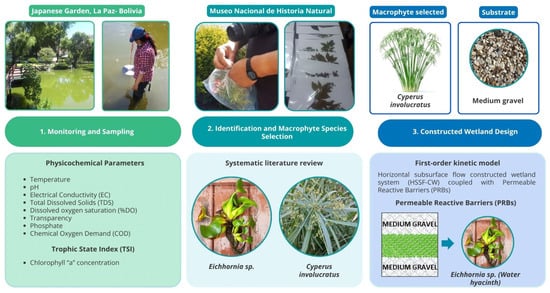
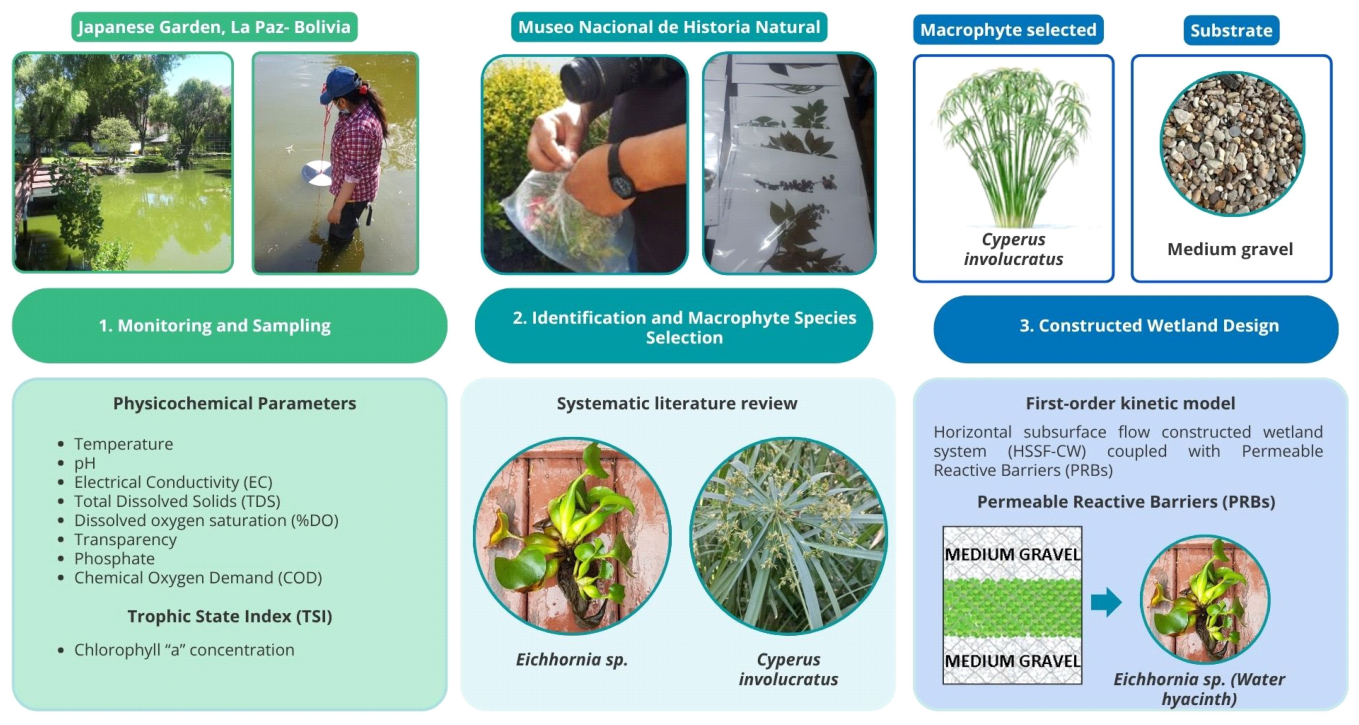
This study followed three phases: water quality monitoring and sampling, identification and macrophyte selection, and CW design. The overall methodological framework is presented in Figure 1.
Figure 1.
A schematic overview of the research methodology for monitoring and sampling, identification and macrophyte selection, and CW design.
2.1. Study Area
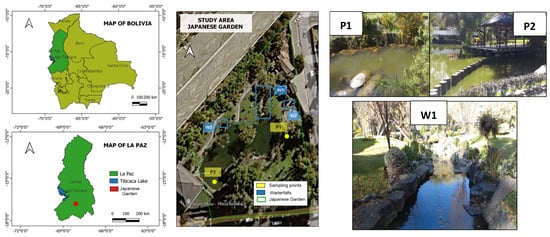
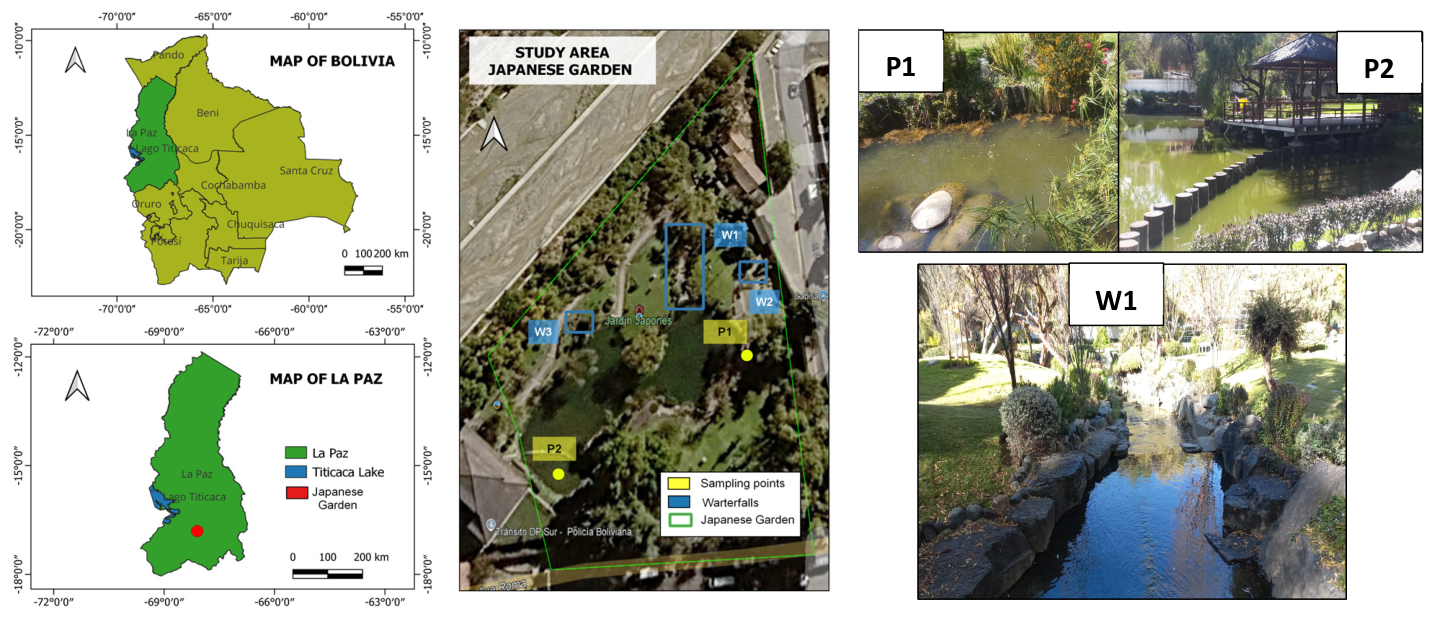
The JG is situated in the Southern Macro-district of La Paz, Bolivia. It is geographically positioned at 16°32′27″ S latitude and 68°05′31″ W longitude, at an elevation of 3250 m above sea level (Figure 2). The site lies within a geological zone corresponding to the Andean Altiplano, characterized by the presence of sediments and rocks commonly found in the region. The climate is variable, with an average annual temperature ranging between 7.25 and 19.75 °C and annual precipitation between 351.4 and 353 mm. There are three artificial waterfalls that oxygenate the lagoon through water recirculation using a manually operated submersible pump.
Figure 2.
A description of the study area, where P1 and P2 are sampling points, and W1, W2, and W3 are artificial waterfalls. The source of this study is Google Earth, and the maps and photographs are by the authors.
2.2. Description of Hydraulic Characteristics
Three waterfalls (W1, W2, and W3) contribute to internal water circulation and oxygenation through a manually operated submersible pump. The pumping system operates for eight hours per day, distributed between the morning and afternoon, and is switched off at night.
The lagoon’s inflow rate was not directly quantified during the study period, and a water balance was therefore not established. An overflow structure provides a discharge pathway to the Irpavi River when the lagoon reaches excess water levels. This overflow functions as an intermittent outlet, and its discharge rate is difficult to quantify because of the characteristics of the structure. In addition, the lagoon has an irregular geometry, and no stage–volume relationship has been established. Consequently, neither inflow nor outflow rates could be measured during the study period.
The hydraulic conditions of the lagoon were distinguished from the parameters for the proposed CW design. In particular, the design flow rate was considered a design parameter rather than a measured hydraulic flow of the lagoon. It was obtained through an iterative CW sizing procedure according to available space within the waterfall W1.
2.3. Monitoring and Sampling
Periodic monitoring and water sampling were conducted biweekly over an eight-month period from May 2022 to February 2023, excluding January and June due to the unavailability of measuring equipment and laboratory access. The monitoring covered both the dry season (May to September) and the wet season (October to February). Two sampling locations were systematically selected based on prior monitoring data from the study area (P1 and P2). A total of 28 water samples were collected, 14 for each sampling point. The samples were transferred to the laboratory on ice at 4 °C and stored in the refrigerator until analysis. Transportation and storage procedures followed the guidelines established in the Standard Methods for the Examination of Water and Wastewater [9].
A separate periodic monitoring campaign was conducted at W1 for eight months between August 2023 and July 2024 to obtain chemical oxygen demand (COD) values as the influent concentrations for the proposed CW. In January, February, March and April 2024, COD measurements were not available because W1 was undergoing maintenance.
2.4. Analytical Methods
Temperature, electrical conductivity (EC), pH, total dissolved solids (TDS), and dissolved oxygen (DO) parameters were measured using a multiparameter device (HANNA, HI98194 Portable Meter, Nușfalău, Romania. Transparency was assessed at each sampling site using a Secchi disk. Additional water quality parameters were analyzed in the laboratory. Phosphate, COD, and chlorophyll a were determined according to the 4500-P E, 5220 C, and 10200 H methods, respectively [18].
2.5. Calculation of Trophic State Index (TSI)
The Carlson trophic state index (TSI) was applied to evaluate the eutrophication level of the JG lagoon. In this study, this index was estimated using only chlorophyll a concentration, based on the following equation [19]:
where CHL is the concentration of chlorophyll “a” in mg/m3. The TSI scale ranges from 0 to 100, and trophic conditions are classified as oligotrophic (TSI < 30), mesotrophic (30 < TSI < 60), eutrophic (60 < TSI < 90), or hypereutrophic (90 < TSI < 100) [20].
2.6. Water Quality Assessment and Regulatory Criteria
The water quality findings were compared with the maximum permissible limits according to the Bolivian Regulation on Water Pollution Control (Reglamento en Materia de Contaminación Hídrica, RMCH) (Classes A–D) [21]. The reference values used for the parameters evaluated in this study are presented in Table 1.
Table 1.
The maximum permissible values according to the Bolivian Regulation on Water Pollution Control (RMCH) (Classes A–D) for the studied parameters in the Japanese Garden lagoon.
2.7. Vegetation Cover Identification
Vegetation cover was identified through field observations, photographs, and plant specimen collections. Species identification was carried out in collaboration with the Bolivian Natural History Museum, based on the analysis of collected specimens, comparison with reference material from the Bolivian National Herbarium, and consultation of specialized publications on ornamental plant species.
2.8. Systematic Review for Macrophyte Selection
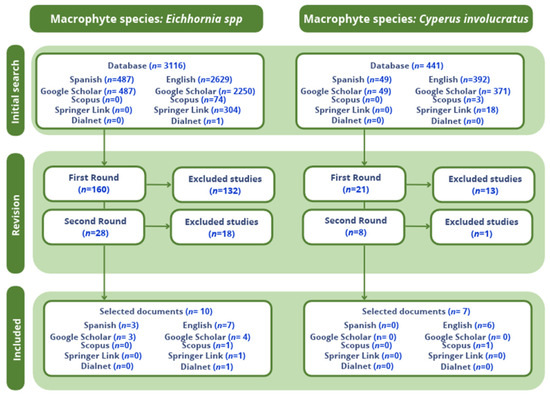
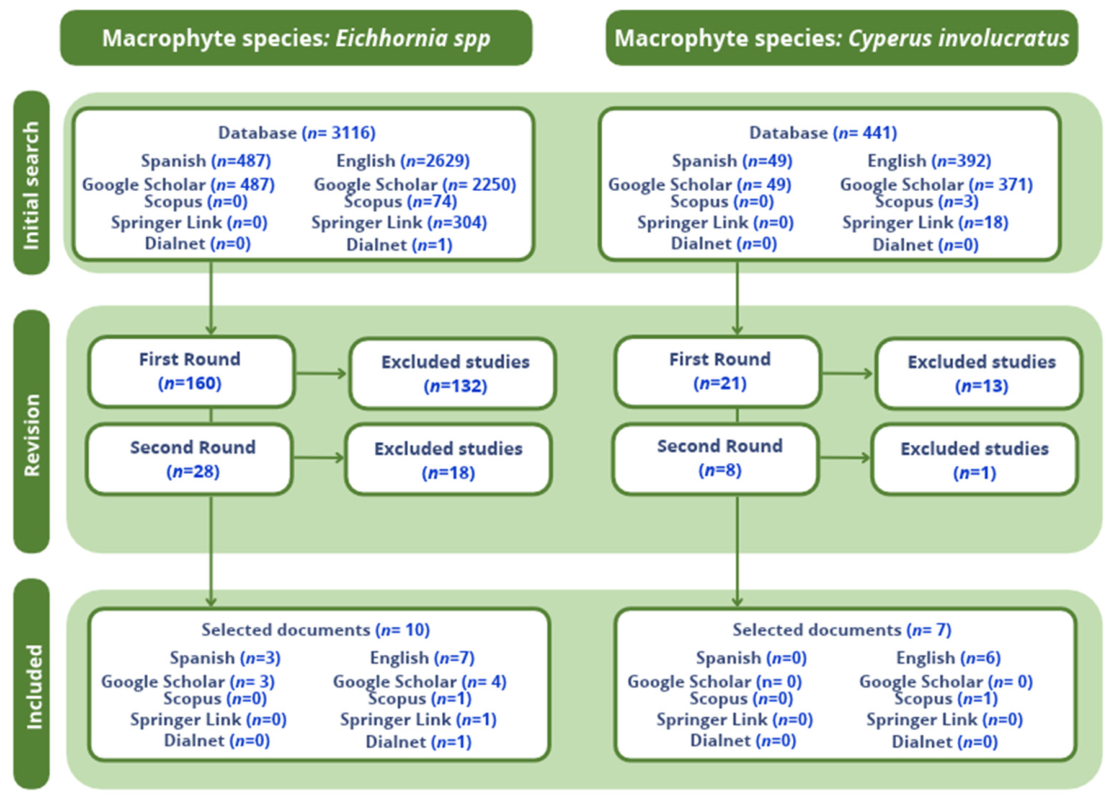
Macrophyte species were selected through a systematic literature review following PRISMA 2020 guidelines [23]. The databases used were Google Scholar, Scopus, Springer Link, and Dialnet (Figure 3). The initial search yielded 3116 and 441 documents without applying any exclusion criteria for Eichhornia spp. and Cyperus involucratus, respectively. The keywords and Boolean operators used in the search included “scientific name of the macrophyte species”, “artificial wetland,” “COD,” and “BOD5.” The selection criteria included articles published in English and Spanish between 2014 and 2024. For Eichhornia spp., the number of articles was reduced to 160 and 21 for Cyperus involucratus. The last search was conducted in February 2025.
Figure 3.
A description of the systematic review for both macrophyte species.
Quality Assessment and Data Extraction
First round: Articles and thesis abstracts were analyzed, and open access articles with unavailable full texts were excluded. The number of articles was reduced to 160 and 21 for Eichhornia spp. and Cyperus involucratus, respectively.
Second round: Duplicate articles were removed, and the variables of interest were examined, resulting in 28 primary documents for Eichhornia spp. and 8 articles for Cyperus involucratus.
Final selection: This stage involved the evaluation of the methodology and findings presented in each article related to the type of wastewater and wetland, pH, temperature, HRT, COD, BOD5 and data on the removal of other contaminants. This screening yielded 10 articles for Eichhornia spp. (Google Scholar: n = 7; Scopus: n = 1; Springer Link: n = 1; Dialnet: n = 1). The number of articles was reduced to 7 (Google Scholar: n = 6; Scopus: n= 1) for Cyperus involucratus.
Differences among the reported findings were compared considering the type of wastewater treated, wetland configuration, and operating parameters such as HRT.
The Critical Appraisal Skills Program (CASP) was used to evaluate the quality of the articles. In qualitative research methodology, CASP is a common tool for assessing their strengths and limitations [24,25]. This tool uses key questions grouped into three sections, internal validity, results, and applicability, to analyze the methodological strengths and weaknesses of the articles reviewed [26]. Documents classified as low-quality were not included, while studies categorized as moderate- and high-quality were considered in the analysis.
2.9. Literature Review for Biosorbent Selection
A literature review of wastewater biosorbents was conducted to identify a suitable biosorbent for the permeable reactive barriers (PRBs) as a proposed combined treatment. The reviewed studies were screened for reported performance in removing organic matter, using indicators such as dissolved organic matter (DOM), chemical oxygen demand (COD), and biochemical oxygen demand (BOD5). The biosorbent as a PRB component was incorporated into the proposed CW system based on its reported contribution to pollutant removal. However, it was not experimentally evaluated in the present study.
2.10. Constructed Wetland Design
The proposed CW is designed as a complementary treatment unit integrated with one of the waterfalls of the JG lagoon. W1 was identified as the most suitable location because it provides sufficient space for the installation of the wetland. In addition, the predominantly horizontal water flow at this location is consistent with the hydraulic configuration of a horizontal subsurface flow CW. Therefore, the available area within W1 ranged from 1.7 to 2.5 m in width, and this constraint was considered for the design.
Modeling the system as a plug-flow reactor, [27] proposed a first-order kinetic approach, and it was used to determine the surface area for the BOD removal rate. This model requires determining the temperature-dependent areal rate constant (KT) and the HRT. The corresponding equations are presented in Table 2:
Table 2.
Equations for the CW design.
The influent concentration “Co” for the proposed wetland was determined through COD measurements at W1 from August 2023 to July 2024. COD was used because it provides a direct measure of the overall oxidizable organic load and has been applied for organic load characterization in CW systems [29]. However, the Reed model expresses organic matter removal in terms of BOD; therefore, the measured COD could not be directly used as the influent parameter. BOD was consequently estimated from COD using a BOD/COD ratio of 0.6. This ratio provides an estimate of the biodegradable fraction of the organic matter, for which the BOD/COD ratio is commonly used as an indicator [30]. Ref. [27] reported that BOD/COD ratios can vary according to wastewater characteristics, with values around 0.6 occurring within the range associated with more biodegradable wastewater. Therefore, 0.6 was selected as a representative intermediate value for the design, avoiding the use of either a lower or higher biodegradability assumption.
The effluent concentration was selected according to permissible limits for BOD, Class C, using the intermediate value within the range limits (Ce = 10 mg/L). The CW design influent flow rate was iteratively determined using the surface area and L/W ratio equations in Table 2.
2.11. Removal Efficiency
The estimated BOD removal efficiency was determined through the following equation:
where Co and Ce are influent and effluent BOD concentrations (mg/L), respectively.
3. Results
3.1. Physicochemical Parameters
3.1.1. Temperature and pH
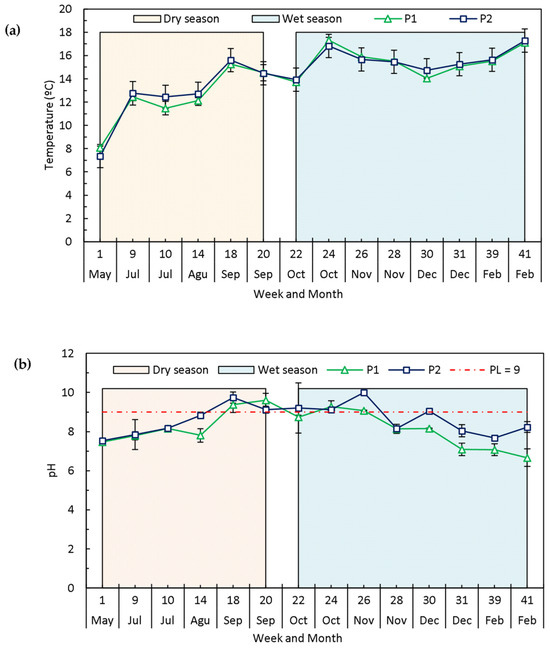
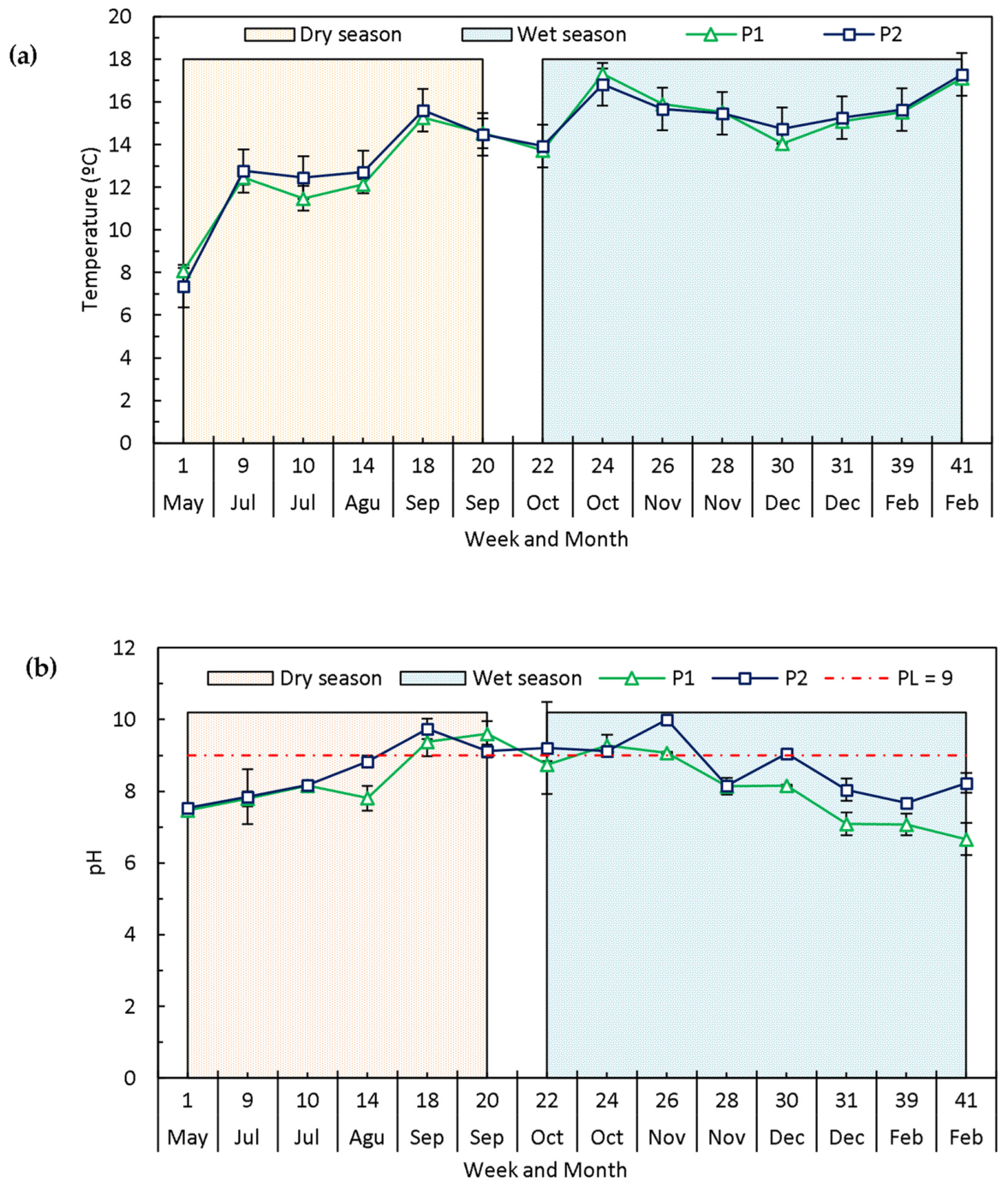
Figure 4a shows water temperature during the monitoring period; in the dry season, the lowest temperatures were recorded in May at both sampling points (P1: 8.09 ± 0.14 °C; P2: 7.35 ± 0.27 °C), while the highest values were observed in September (P1: 15.24 ± 0.19 °C; P2: 15.61 ± 0.69 °C). During the wet season, the lowest wet season values occurred in early October (P1: 13.73 ± 0.11 °C; P2: 13.92 ± 0.56 °C). The maximum values were recorded in the second week of October (17.32 ± 0.25 °C) and in February for P2 (17.29 ± 0.01 °C). Overall, water temperature showed a clear seasonal pattern, and both sampling points demonstrated similar temporal trends.
Figure 4.
(a) Water temperature variation in P1 and P2 during May 2022–February 2023. The dry season corresponds to May–September, while the wet season corresponds to October–February. (b) pH variation at P1 and P2 during the same monitoring period. PL indicates the permissible limit (pH = 9) established by the Bolivian Regulation on Water Pollution Control (RMCH), Class “C”.
The average pH was similar between the sample points, with values indicating a generally alkaline tendency (Figure 4b). During the dry season, pH increased at both points, with the maximum values in September (P1: 9.60 ± 0.35; P2: 9.74 ± 0.28), exceeding the permissible limit (pH = 9) established by the Bolivian Regulation on Water Pollution Control (RMCH, Class “B”). In the wet season, pH showed greater variability. At P1, a decreasing trend was observed, with a maximum in October (9.27 ± 0.30) and a minimum in February (6.66 ± 0.45). In contrast, P2 exhibited irregular fluctuations, with a peak in November (9.99 ± 0.04) and a minimum in February (7.67 ± 0.14), with values approaching the regulatory limit toward the end of the period. A greater temporal variability was observed at P2 during the dry season.
3.1.2. Electrical Conductivity (EC), Total Dissolved Solids (TDS) and Dissolved Oxygen Saturation (%DO)
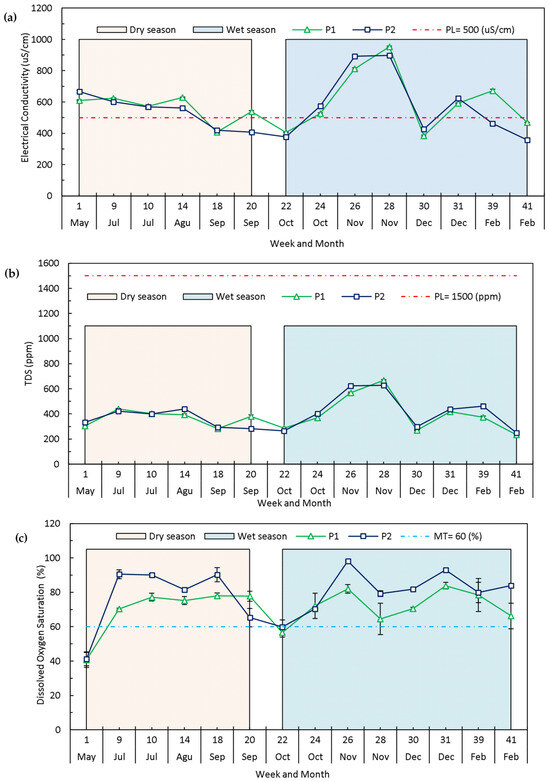
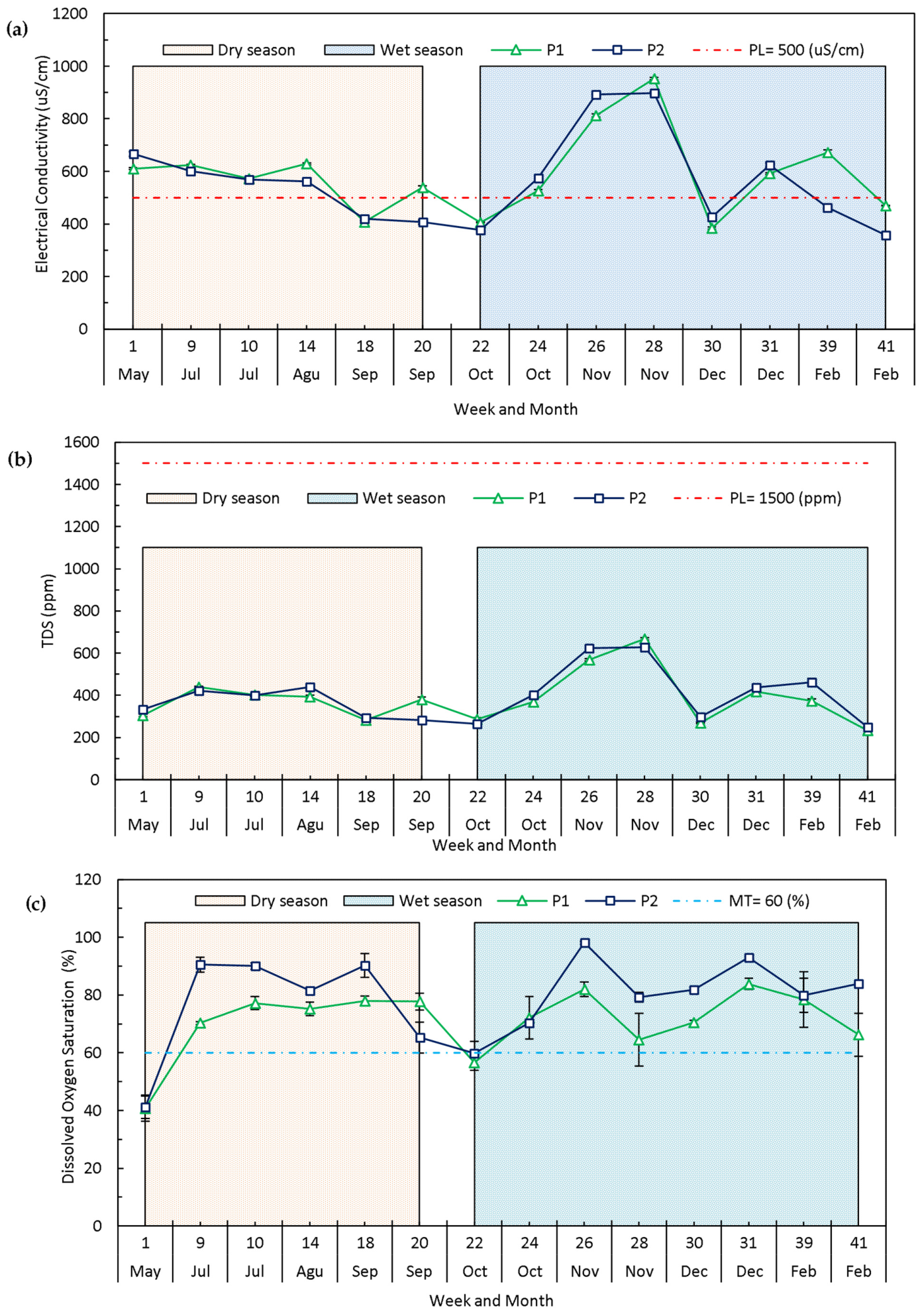
Figure 5a shows relatively high electrical conductivity at both sampling points. During the dry season, conductivity exhibited a decreasing trend at both sites; however, values above the recommended limit of 500 μS/cm (Vice-Ministry of Water Resources and Irrigation, VRHR-MMAYA, Class “C”) [22] were recorded in May, July, and August. The highest conductivity was measured in August at P1 (627.33 ± 3.79 μS/cm) and in May at P2 (666.00 ± 8.96 μS/cm). During the wet season, conductivity showed a variable pattern, with a marked increase from October to November, reaching peak values in November (P1: 955.33 ± 4.97 μS/cm; P2: 898.33 ± 3.79 μS/cm), well above the recommended limit. The minimum values were recorded in December for P1 (384.33 ± 3.79 μS/cm) and in February for P2 (357.33 ± 1.43 μS/cm). Overall, electrical conductivity showed a higher value during the wet season. However, the peak values in November suggest a specific action or activity that occurred at P2 that caused a considerable increment.
Figure 5.
Seasonal variation in physicochemical parameters at sampling points P1 and P2 during the monitoring period (May 2022–February 2023). The dry season comprised May–September, whereas the wet season extended from October to February. (a) In terms of electrical conductivity (EC), PL represents the permissible limit (EC = 500 µS/cm) recommended by the Viceministry of Water Resources and Irrigation (VRHR-MMAYA), Class “C”. (b) Regarding total dissolved solids (TDS), PL represents the permissible limit (TDS = 1500 ppm) established by the Bolivian Regulation on Water Pollution Control (RMCH, Class “C”). (c) As for dissolved oxygen saturation, MT represents the minimum threshold (DO = 60%) established by the Bolivian Regulation on Water Pollution Control (RMCH, Class “C”).
Regarding total dissolved solids (TDS), values at both sample points remained below the permissible limit (1500 ppm; RMCH, Class “C”) (Figure 5b), with concentrations ranging from 232.67 to 668 ppm. During the dry season, the lowest values were recorded in September (P1: 282.33 ± 6.25 ppm; P2: 283.00 ± 2.48 ppm) and maximum values in July for P1 and August for P2 both with the same value (438.67 ± 3.79 ppm).
In the wet season, higher and more variable values were observed, with peaks in November (P1: 668.00 ± 5.17 ppm; P2: 628.67 ± 2.87 ppm) and minimum values in February (P1: 232.67 ± 13.7 ppm; P2: 250.00 ± 0.00 ppm). Neither of the sampling points exceeded the permissible limits. Nevertheless, there was greater variability during November, indicating that an activity at both points was carried out that provoked it.
Concerning dissolved oxygen saturation (%DO), values ranged from 40.77 to 98.10% (Figure 5c) and were generally above the minimum threshold (60%, RMCH, Class “C”). During the dry season, the lowest values were recorded in May (P1: 40.77 ± 4.52%; P2: 41.13 ± 3.93%), while the highest values were observed in September for P1 (77.98 ± 1.67%) and during the first week of July P2 (90.53 ± 2.57%). In the wet season, %DO concentrations gradually increased, with peak values observed in December for P1 (83.80 ± 1.97%) and in November for P2 (98.10 ± 0.43%). Meanwhile, the lowest values were recorded in October (P1: 56.57 ± 2.66%; P2: 59.77 ± 4.24%). Overall, the levels of dissolved oxygen were low during October, indicating insufficient oxygenation and a possible stagnation.
3.1.3. Transparency and Phosphate
Transparency ranged from 0.10 to 0.45 m (Table 3), with generally lower values at P1 compared to P2. During the dry season, the lowest transparency values were recorded in May for P1 and in September for P2 (both 0.18 m), while the highest values occurred in July (P1: 0.35 m; P2: 0.45 m). In August, no value was reported for P1, as the Secchi disk remained visible at the bottom.
Table 3.
Transparency data (m) at sampling points and in study periods.
In the wet season, transparency showed variable behavior. The lowest values were observed in November (P1: 0.10 m; P2: 0.13 m). The highest transparency for P1 was recorded in October and November (0.15 m), while for P2 it occurred in February (0.35 m). Similarly, no values were reported for P1 in October, December, or February because the Secchi disk was fully visible at the bottom. Based on the findings, P1 and P2 showed irregular water levels, which is related to the shape of the lagoon. Furthermore, P2 showed less transparency than P1, suggesting that P2 was exposed to anthropogenic activities.
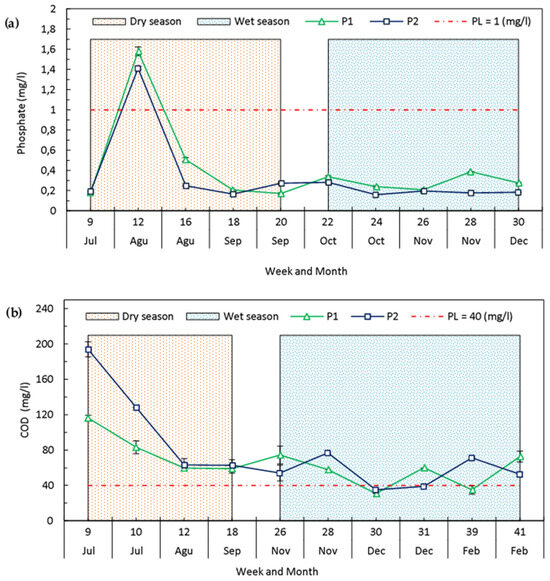
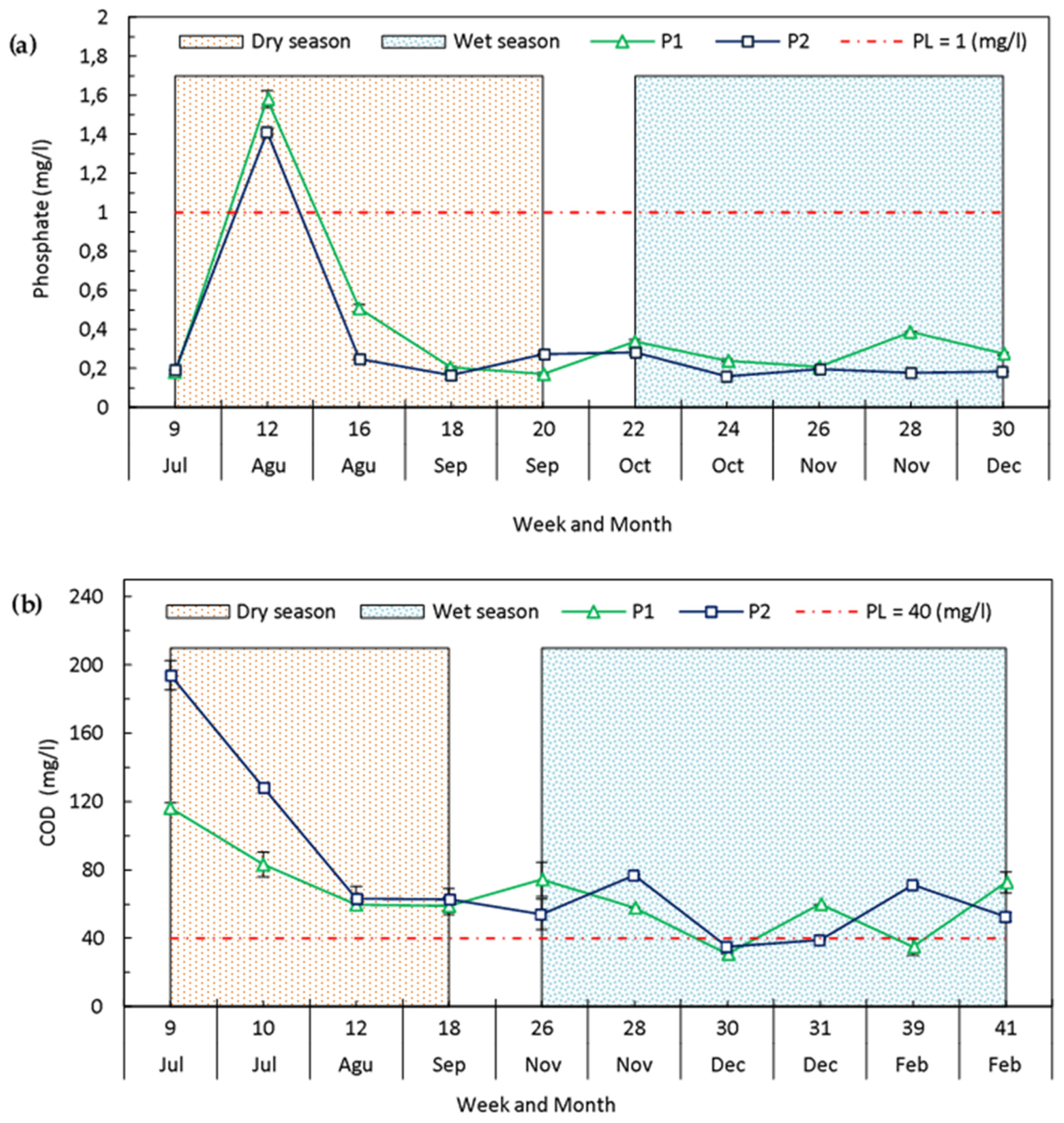
In relation to phosphate, concentrations were generally below the permissible limit (1 mg/L; RMCH, Class “C”) (Figure 6a) at both sampling points. Representative samples were not collected in May or February. During the dry season, the lowest concentrations were recorded in September (P1 and P2: 0.17 mg/L), while the highest values were observed in August (P1: 1.58 ± 0.04 mg/L; P2: 1.41 ± 0.02 mg/L), exceeding the permissible limit. In the wet season, phosphate concentrations were lower and showed a variable pattern. The lowest values were observed in November for P1 (0.21 ± 0.00 mg/L) and in October for P2 (0.16 ± 0.00 mg/L), while the highest concentrations were recorded in November for P1 (0.39 ± 0.01 mg/L) and in October for P2 (0.28 ± 0.02 mg/L). Overall, phosphate concentrations were higher in August, indicating stagnation and causing the accumulation of this nutrient.
Figure 6.
Variation in concentrations at sampling points P1 and P2 during the monitoring period (May 2022–February 2023): (a) phosphate and (b) COD The dry season comprised May–September, whereas the wet season extended from October to February. PL represents the permissible limit established by the Bolivian Regulation on Water Pollution Control (RMCH, Class “C”), corresponding to 1 mg/L for phosphate (PO43−) and 40 mg/L for COD. Representative samples could not be collected in May or February for phosphate analysis or in May or October for COD analysis; therefore, no analyses were performed for these months.
3.1.4. Chemical Oxygen Demand (COD)
Chemical oxygen demand (COD) values ranged from 31 to 194 mg/L and were consistently above the permissible limit (40 mg/L; RMCH, Class “C”) (Figure 6b) at both sample points throughout the study period, except for December and February. Representative samples could not be collected in May or October, and consequently, COD analyses were not performed for these months. During the dry season, the lowest concentrations were recorded in September (P1: 59.00 ± 4.97 mg/L; P2: 62.67 ± 6.25 mg/L), while the highest values were observed in July (P1: 116.33 ± 2.87 mg/L; P2: 194.00 ± 8.61 mg/L). During the wet season, COD levels gradually decreased, with values generally lower than those recorded in the dry season. The lowest value was observed in December (P1: 31.00 ± 0.00 mg/L; P2: 35.00 ± 0.00 mg/L). The highest COD values were recorded in November, during the first week for P1 (74.33 ± 10.0 mg/L) and the second week for P2 (77.00 ± 0.00 mg/L).
3.2. Trophic State Index (TSI)
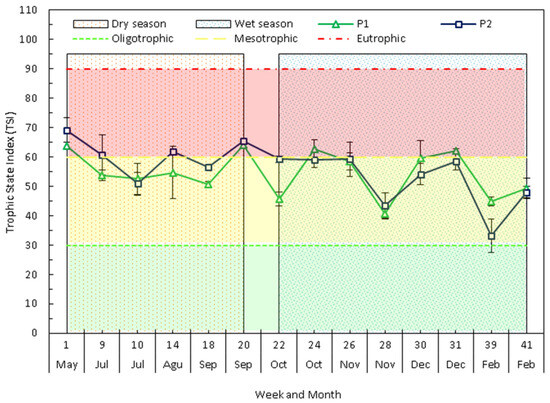
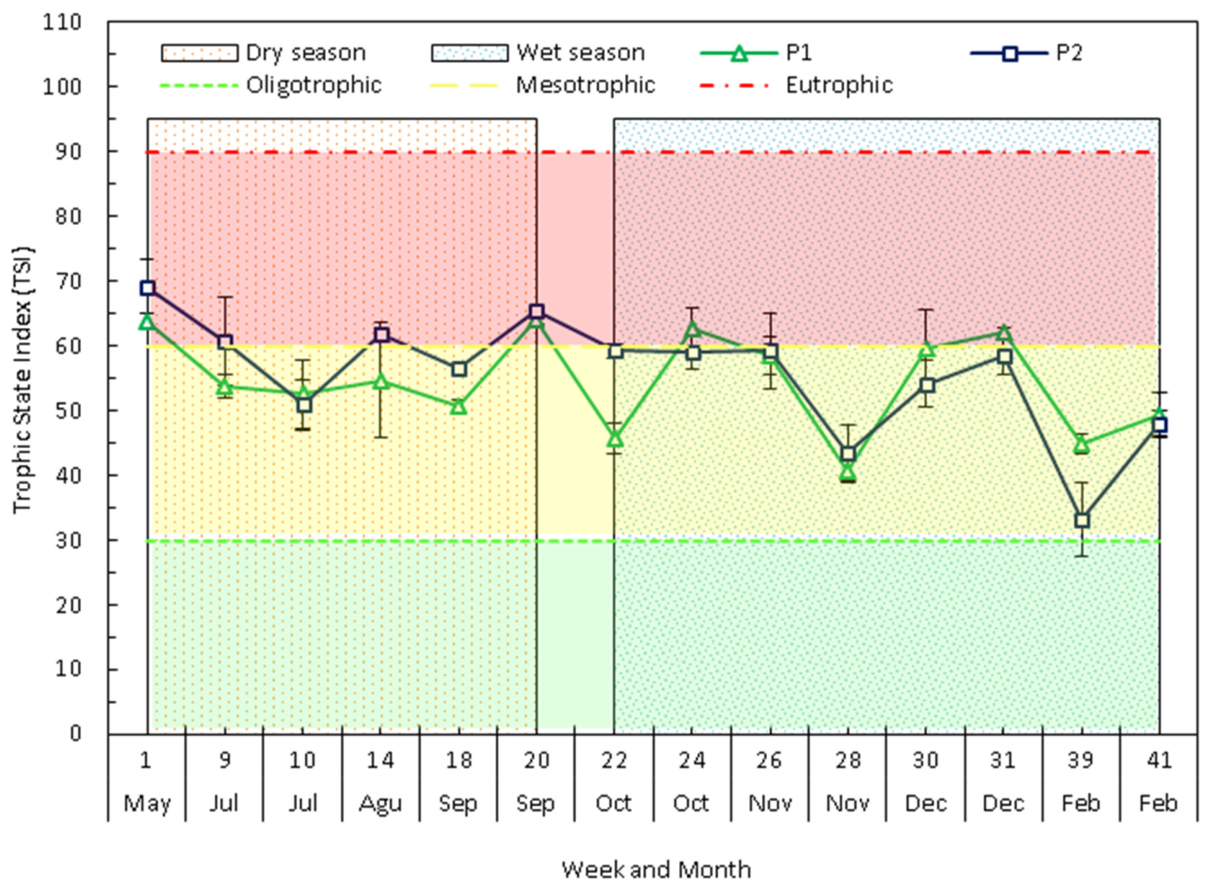
Carlson’s TSI values, based on chlorophyll a, ranged from 33.23 to 69.19, indicating mesotrophic to eutrophic conditions (Figure 7). Mesotrophic conditions predominated during both the dry and wet seasons, although higher trophic states were observed in September–October. The lowest values occurred in February at P2 (33.23 ± 5.63), while the highest were recorded in September at P2 (65.38 ± 0.51). Overall, the results suggest moderate nutrient availability with seasonal fluctuations in trophic status.
Figure 7.
Trophic state index (TSI) variation at sampling points P1 and P2 during the monitoring period (May 2022–February 2023). The dry season ran from May to September, whereas the wet season ran from October to February. Trophic status categories were classified as oligotrophic (Green) (TSI < 30), mesotrophic (Yellow) (30 ≤ TSI < 60), and eutrophic (Red) (60 ≤ TSI < 90) [11].
3.3. Vegetation Cover Characterization
According to [31], 139 vascular plant species have been recorded across the different sections of the garden, most of which are exotic species introduced from Europe and Asia, primarily for ornamental purposes and their adaptability to local environmental conditions. Among the aquatic vegetation, three macrophyte species were identified: Cyperus involucratus, Azolla filiculoides, and Eichhornia sp.
3.4. Systematic Literature Review
Table 4 and Table 5 compile the articles selected for this review, summarizing their contributions to the study of the water treatment efficiency of Eichhornia sp. and Cyperus involucratus. They detail the type of wetland system, COD and BOD5 removal findings, and other significant parameters.
Table 4.
Systematic review findings on water quality treatment efficiency of Eichhornia sp. in CWs.
Table 5.
Systematic review findings on water quality treatment efficiency of Cyperus involucratus in CWs.
According to Table 4 and Table 5, Eichhornia sp. and Cyperus involucratus have a high capacity for the removal of organic matter, nutrients, and other pollutants in constructed wetlands. Eichhornia sp. has been widely used in free water surface CWs for the treatment of both domestic and industrial wastewaters. This species exhibits a high capacity for the removal of organic matter as well as heavy metals. In contrast, Cyperus involucratus has been used in both vertical and horizontal subsurface flow constructed wetlands for the treatment of domestic wastewater and landfill leachate. Both species can remove a wide range of contaminants in either surface flow or subsurface flow constructed wetland systems.
Although both species remove a wide range of contaminants in both surface and subsurface flow constructed wetlands, they differ in their morphological characteristics, such as stalks, leaves, roots, inflorescences, and reproductive strategies. Eichhornia sp. is a free-floating aquatic macrophyte, whereas Cyperus involucratus is an emergent semi-aquatic plant. These traits drove the choice of C. involucratus for wetland design, as it effectively removes organic matter and tolerates environmental volatility.
3.5. Constructed Wetland Design
3.5.1. Biosorbent Materials
Table 6 summarizes the removal efficiencies reported in the literature for specific biosorbents. The variation in the reported DOM removal efficiencies is attributed to differences in the physicochemical properties of the biosorbents, including specific surface area, initial adsorption rate, thermal stability, and mesopore volume [49]. In contrast, activated carbons derived from organic materials such as palm kernel and tropical almond exhibited higher removal efficiencies for COD and BOD5. According to [50] the enhanced performance is attributed to their high specific surface area and well-developed pore structure, including both micropores and mesopores, which facilitate the adsorption and retention of organic compounds [50]. Biochar-derived materials, such as rice husk, palm kernel, and tropical almond, showed higher COD and BOD5 values due to physicochemical modifications induced during pyrolysis. However, the production of biochar depends strongly on energy use, feedstock handling, capital, and transport, which can limit its applicability in low-resource settings [51].
Table 6.
Reported performance of potential biosorbent materials for wastewater treatment applications for removing organic matter.
3.5.2. PRB Configuration
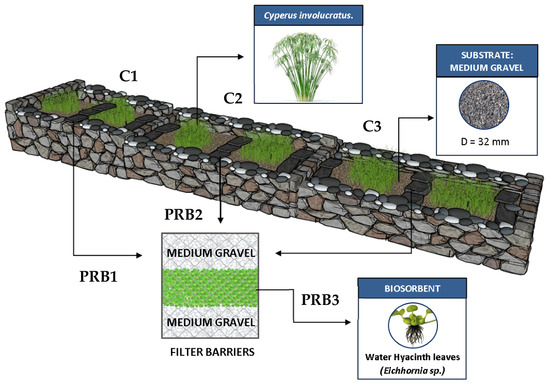
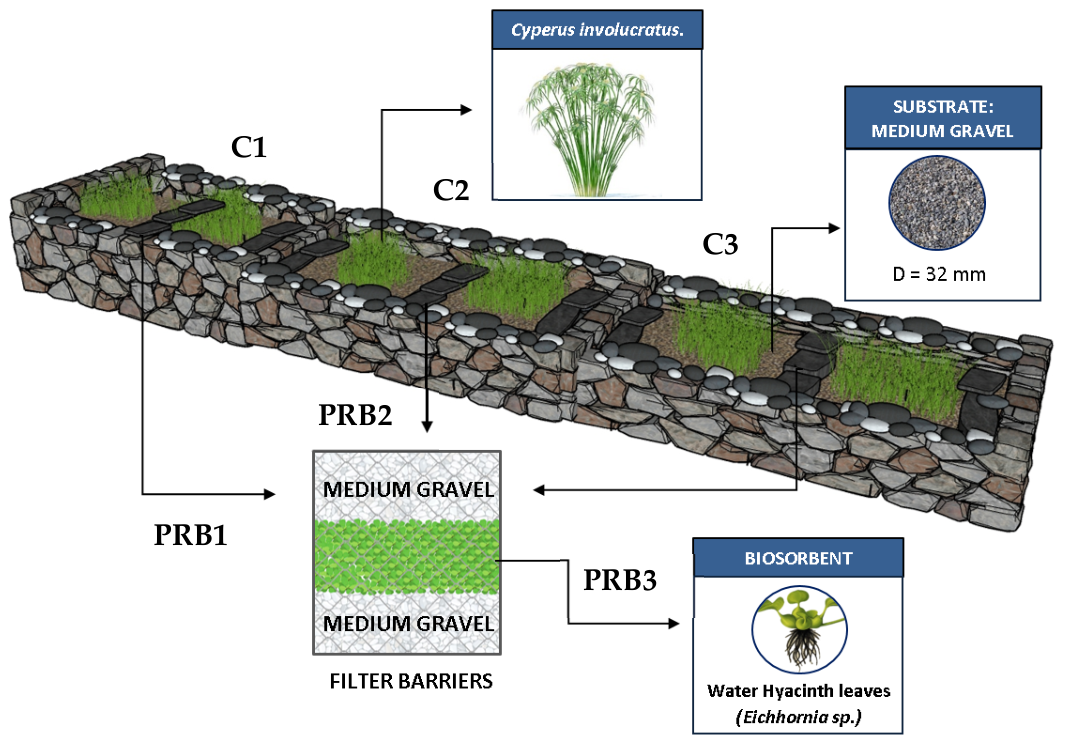
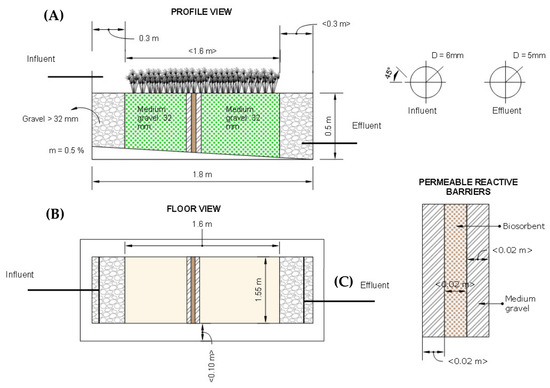
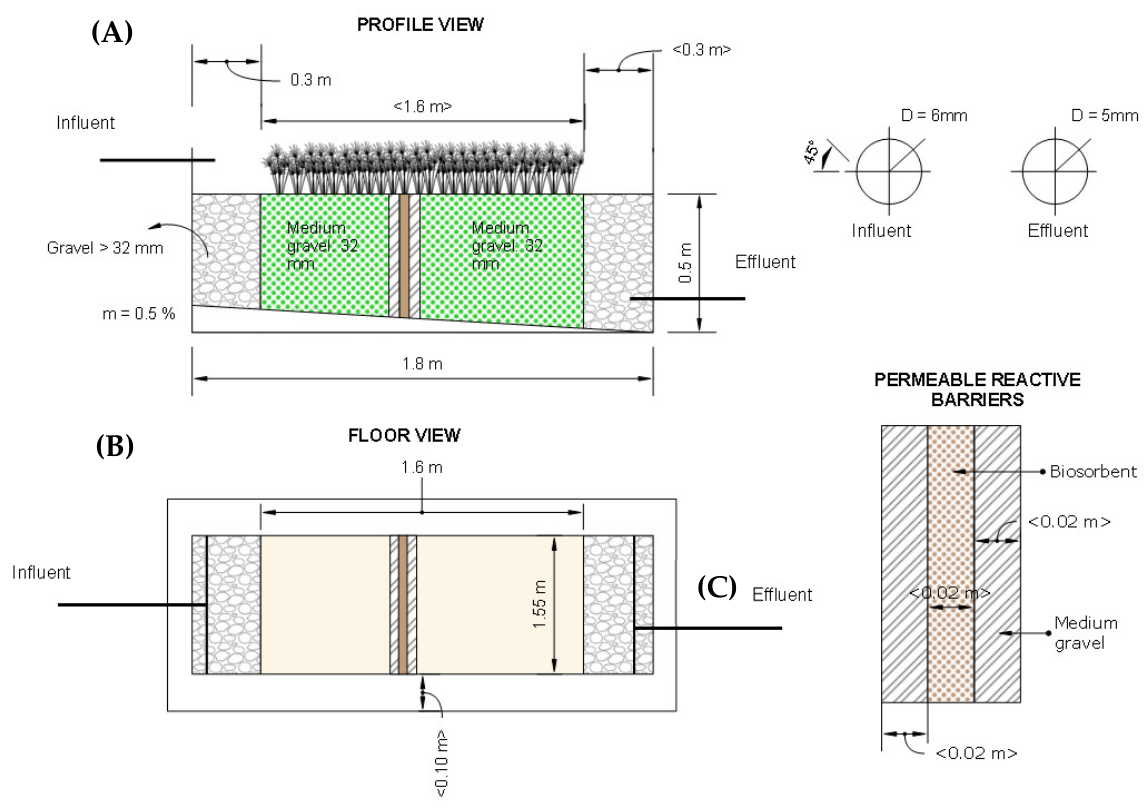
A three-layer configuration was proposed for the PRBs. The upper and lower layers would consist of medium gravel to provide structural support and maintain hydraulic stability, while the intermediate layer would contain the proposed bioadsorbent material and serve as the primary reactive zone for contaminant retention and adsorption. The general design configuration is presented in Figure 8, and the proposed dimensions are shown in Figure 9.
Figure 8.
A schematic of the proposed horizontal subsurface flow constructed wetland (HSSF-CW) coupled with permeable reactive barriers (PRBs) containing locally available biosorbents, specifically water hyacinth (Eichhornia crassipes) leaves. C1, C2, and C3 represent the sequential wetland treatment cells, while PRB1, PRB2, and PRB3 represent the corresponding permeable reactive barriers.
Figure 9.
Detailed drawing of each treatment cell of HSSF-CW system coupled with PRBs: (A) profile view of proposed system, (B) plan view, and (C) detailed configuration of each PRB unit.
The design consists of an integrated horizontal subsurface flow constructed wetland (HSSF-CW) coupled with PRBs. The system has three treatment cells as PRBs, each filled with locally available biosorbents. The incorporation of these barriers is intended to enhance contaminant removal through adsorption, filtration, and processes, thereby improving the overall treatment performance of the wetland system.
3.5.3. Design Parameters
To determine the influent COD concentration for the proposed CW design, an eight-month monitoring period was conducted at Waterfall 1 (W1). The mean COD concentration measured during this period was 52.98 mg/L, which was adopted as the design influent COD concentration. The corresponding BOD5 concentration was estimated at 31.79 mg/L based on the BOD5/COD ratio. The mean minimum water temperature (Tw) recorded at W1 was 11.64 °C, corresponding to the coldest month of the monitoring period (June 2024). Following the design methodology and equations presented in Table 2, this temperature was adopted as the design temperature for the proposed CW to represent a conservative operating condition, since lower temperatures may reduce biological reaction rates and, consequently, treatment performance. The value of 11.64 °C was therefore used specifically as a design parameter and should not be interpreted as the absolute minimum temperature recorded at the other monitoring points (P1 and P2). Medium gravel was considered the primary support and filtration medium due to its widespread use in subsurface flow constructed wetlands, adequate hydraulic conductivity, and low economic cost. A porosity value of 0.4 was considered for this material [28]. An operational water depth of 0.5 m was adopted, taking into account the root length of the macrophytes [28].
All the design parameters were determined based on the available space within the waterfall W1, without compromising its aesthetic value as a strict requirement of the Japanese society. The proposed constructed wetland influent flow rate was iteratively determined using the surface area equation and taking a length-to-width ratio of 3:1 (Table 7). The available width of Waterfall 1 (W1) ranged from 1.7 to 2.5 m. W1 was selected as the most suitable location for implementing the proposed CW system because it is the longest waterfall, extending from the water source toward the lagoon and providing sufficient longitudinal space for the installation and integration of the proposed treatment unit. Based on the design calculations, a design inflow rate of 0.86 m3/d was iteratively determined and selected for the proposed complementary treatment unit (Table 8).
Table 7.
CW influent flow rate iteration and wetland dimensions.
Table 8.
Design parameters for the proposed CW.
The 0.86 m3/day design flow represents the hydraulic loading of the proposed CW, not the total inflow to the Japanese Garden lagoon. This is a theoretical design parameter for the proposed CW rather than a direct measurement of the lagoon’s hydraulic inflow. Since lagoon inflow was not directly measured, the CW contribution to the overall lagoon water quality could not be quantitatively assessed.
4. Discussion
4.1. The Biophysical and Biochemical Characterization of the Lagoon
The observed water temperatures showed some variation between the dry and wet seasons, with relatively lower temperatures generally recorded during the dry season and higher temperatures during the wet season. These differences may be associated with variations in solar radiation, nocturnal heat loss, and precipitation patterns, which might influence water temperature [57]. As solar radiation decreases, nights are longer and cooler, which facilitates heat loss in the surface layer. Furthermore, the temperature of the water is lower at greater depths due to thermal stratification [58].
The pH alkaline values indicate a higher concentration of hydroxide ions (OH−), suggesting the presence of carbonate (CO32−) and bicarbonate (HCO3−) as more relevant chemical species. This behavior is consistent with monitoring data from the National Institute of Health Laboratory (INLASA) and the Water Laboratory of the Municipal Environmental Monitoring Office (GMMA-LAB-AGUA) [59]. Alkalinity in water is commonly attributed to the presence of carbonate and bicarbonate ions, often associated with Na+, K+, Ca2+ and Mg2+ cations [60]. Since treated domestic wastewater enters the lagoon, the presence of these ions may also be linked to the use of powdered detergents and soaps [61]. Additionally, macrophyte photosynthesis drives down dissolved carbon dioxide (CO2) levels. This process reduces acidity and increases pH, a phenomenon commonly observed in these aquatic systems [62].
These values of electrical conductivity indicate the presence of dissolved electrolytes that are influenced by ions such as Na+, K+, Ca2+ and Mg2+, which increased both conductivity and salinity levels in the water [63]. The higher values recorded during the wet season could be attributed to anthropogenic activities in the surroundings of the lagoon such as runoff from domestic waste, farmlands or other pollutants [64].
This study recorded relatively low phosphate concentrations. These findings differ from those reported by the National Institute of Health Laboratories (INLASA), which recorded phosphate concentrations of 5.9 and 0.29 mg/L. Similarly, the Water Laboratory of the Municipal Environmental Monitoring Office (GMMA-LAB-AGUA) reported a concentration of 0.88 mg/L [59]. The variability among reported values may be attributed to differences in site management practices, including cleaning and maintenance activities within the lagoon. In addition, the presence of macrophytes may have contributed to the lower phosphate concentrations observed, as these plants are capable of assimilating nutrients through their roots and shoots under a wide range of environmental conditions [65].
The elevated organic matter concentrations observed at both sampling points during July may be associated with an increase in the number of geese present in the garden surrounding the lagoon. Goose droppings contain substantial amounts of organic matter, nitrogen, and phosphorus, potentially promoting eutrophication processes in receiving water bodies [66]. Even when fecal material is not deposited directly into the water, rainfall runoff can transport contaminants from the shoreline into the lagoon, thereby increasing nutrient and organic matter inputs [66].
It should be noted that, due to the multiple factors involved in eutrophication processes, establishing strict boundaries between trophic classes remains challenging [67]. Chlorophyll a concentration and Secchi depth reflect phosphorus and nitrogen availability, which regulates algal biomass and determines aquatic trophic status [68]. A mesotrophic state is generally characterized by an intermediate level of nutrient availability and biological productivity, often associated with the presence of submerged aquatic vegetation [68].
4.2. Key Trend Notes from the Review and the Assessment
According to the reviewed studies, Eichhornia sp. has a high capacity for removing organic matter from different types of wastewaters. In most cases, COD and BOD5 removal efficiencies exceeded 60%, reaching values close to 90% in domestic and industrial wastewater treatment systems [35,38]. Although these findings demonstrate the potential of Eichhornia sp. for removing biodegradable organic pollutants in CWs, its use requires careful consideration due to its invasive nature and rapid proliferation. Its extensive root system provides a large surface area for retaining nutrients and contaminants and serves as a suitable environment for microbial colonization and biofilm formation [69]. However, uncontrolled growth may block sunlight penetration, potentially reducing dissolved oxygen levels and affecting photosynthetic processes within the aquatic ecosystem [70]. Furthermore, its rapid proliferation may create favorable conditions for the breeding of disease vectors such as mosquitoes [71]. Therefore, despite its reported treatment capacity, the use of Eichhornia sp. in CW applications should be considered only under controlled conditions and with appropriate management measures.
In contrast, Cyperus involucratus is a semi-aquatic plant with submerged roots that provide greater substrate stabilization and habitat support. Its cylindrical stems and underground rhizomatous root system provide effective anchorage in the soil. Unlike Eichhornia sp., C. involucratus is considered less invasive due to its mode of reproduction; however, monitoring is recommended to assess its potential for biological invasion [70].
The systematic review confirms that both species degrade a broad spectrum of contaminants in both surface flow and subsurface flow wetland configurations. However, they differ considerably in their morphological characteristics, particularly in the stalks, leaves, roots, inflorescences, and reproductive traits. Its unique morphology and ornamental appeal make Cyperus involucratus a highly viable choice for wetland designs.
The assessment provides a coherent picture of a lagoon under seasonal pressure, where water quality fluctuates but remains persistently influenced by wastewater inputs and local ecological dynamics. Across the monitoring period, the lagoon displayed alkaline conditions, elevated conductivity, episodic peaks in COD, and a trophic status that shifted between mesotrophic and eutrophic conditions, indicating that the system is not severely collapsed but is clearly stressed and vulnerable to further degradation. At the same time, the relatively low phosphate and TDS values in several periods suggest that the lagoon still retains some self-regulatory capacity, which is important because it indicates that restoration through a low-energy intervention remains feasible.
The dry season appears to be associated with stronger concentration effects and higher COD, while wet season conditions introduce greater variability and occasional dilution but also some spikes in conductivity and organic load that may be linked to runoff and external disturbance.
4.3. Constructed Wetland Design
Previous studies have reported the biosorption potential of water hyacinth (Eichhornia crassipes) leaves for the removal of metals, dyes, and other pollutants, highlighting their potential as a low-cost biosorbent for different applications [72]. Furthermore, the species represents a renewable biomass resource that could be integrated into nature-based wastewater treatment systems. The reported sorption performance of its leaf biomass has been associated with the presence of functional groups capable of interacting with different contaminants. However, these properties are based on findings reported in the literature and were not experimentally evaluated in the present study [72,73]. Therefore, water hyacinth leaves may be considered a potential biosorbent, although further research is needed to evaluate their performance and long-term effectiveness for organic matter removal under real operating conditions.
CWs are considered an essential element of nature-based solutions and sustainable water management [74]. They align with the objectives of Integrated Water Resources Management (IWRM) by contributing to environmental, social, and economic water goals across the whole water system [75,76]. The proposed constructed wetland is consistent with IWRM because it uses ecological processes to improve water quality while minimizing energy demand and infrastructure intensity. Rather than relying solely on conventional engineering, IWRM supports hybrid approaches that combine technical efficiency with ecological restoration. In this sense, the wetland serves as a practical example of how water management can align with natural systems.
The JG lagoon can benefit from a compact constructed wetland integrated with PRBs, serving as a nature-based solution to improve water quality without undermining the site’s landscape integrity. The proposed design is technically modest and conceptually important because it links urban biodiversity conservation and water quality improvement in a culturally significant space. The systematic review provided an evidence-based foundation for macrophyte selection, linking the reported treatment potential of each species with the requirements of the proposed CW design. Furthermore, C. involucratus is already available in the JG lagoon, indicating that it is adapted to local environmental conditions, supporting ecological compatibility while maintaining effective pollutant removal performance.
Incorporating permeable reactive barriers based on biosorbents offers an additional treatment mechanism that complements macrophyte-mediated removal. By combining biological processes with passive sorption, this proposed configuration can enhance contaminant retention without requiring a significant increase in energy consumption. Beyond contaminant removal, the system is designed to operate within the lagoon’s existing ecological setting, linking water purification with habitat enhancement and the preservation of its landscape and recreational functions. In this regard, the proposal’s ecologically grounded nature stems from integrating ecological processes and passive treatment into a site-specific strategy, rather than relying solely on vegetation. Long-term monitoring will be crucial for evaluating treatment performance, system stability, and the impacts on water quality and the lagoon’s ecological functions.
From an IWRM perspective, the lagoon should be understood as part of a connected water system rather than as an isolated urban feature. The water quality problems observed in the Japanese Garden lagoon not only are a local treatment issue but also reflect upstream and catchment-scale processes, including pre-treated wastewater inflows, and broader land–water interactions. In this sense, the proposed constructed wetland represents an IWRM-aligned intervention because it supports the coordinated management of water quantity, water quality, ecosystem health, and cultural value within the same system.
The IWRM lens also strengthens the case for integrating nature-based solutions into urban water planning. Instead of relying solely on conventional treatment or end-of-pipe approaches, the constructed wetland leverages natural processes to improve lagoon inflow quality while maintaining ecological functions and landscape integrity. This is important because IWRM emphasizes balancing the competing uses and values of water, including biodiversity conservation, recreation, and public well-being. The lagoon, therefore, becomes a practical example of how water management can move beyond technical pollution control toward more integrated and adaptive governance.
5. Conclusions
Water quality monitoring in the Japanese Garden lagoon revealed alkaline conditions and elevated electrical conductivity and COD levels exceeding the Bolivian environmental standards for Class C waters, while phosphate and total dissolved solids remained within permissible limits. The trophic assessment indicated a predominantly mesotrophic state. A total of 139 vascular plant species and three macrophyte species were identified, with Cyperus involucratus selected for wetland design due to its abundance and efficiency in organic matter and nutrient removal. A horizontal subsurface flow constructed wetland integrated with PRBs was proposed using the Reed (KC) model. The PRBs filled with available and local biosorbents are proposed to enhance the removal of organic matter and other pollutants. The proposed system has a design flow rate of 0.86 m3/day, a hydraulic retention time of 1.68 days, a surface area of 7.25 m2, and an estimated BOD5 removal efficiency of 68.54%.
From a design perspective, the CW system is based not only on treatment efficiency but also on species suitability. Macrophyte selection should therefore be interpreted not simply as choosing plants with high pollutant removal potential but as a more careful balancing exercise that favors species that are locally available, non-invasive, and well adapted to the climatic conditions of the JG. Species selection for constructed wetlands should consider not only reported removal performance but also ecological suitability, resilience under local environmental conditions, availability, and invasion potential. Considering these factors together provides a more comprehensive basis for species selection and supports the long-term applicability of the proposed wetland design.
The JG lagoon contributes to recreation, aesthetics, biodiversity, and environmental regulation while also receiving wastewater-derived inflow. The proposed treatment system aims to improve water quality without undermining the lagoon’s broader social and ecological functions. Overall, lagoons can serve as a small but meaningful model for IWRM in urban settings, where ecological restoration, wastewater reuse, and cultural landscape protection are treated as interconnected objectives rather than separate concerns.
We acknowledge that effective water management in this case involves not only engineers and researchers but also municipal authorities, environmental managers, landscape custodians, and possibly local users. IWRM highlights the need for coordination among these actors to ensure that decisions on treatment, maintenance, and conservation are not made in isolation. We can frame the CW as a shared management response requiring institutional collaboration. The objective is not simply to remove organic load but to do so in an environmentally responsible, cost-conscious, and locally feasible way.
IWRM encourages solutions that reduce pollution while also conserving resources and supporting long-term resilience. The use of locally available macrophytes, gravel media, and passive treatment processes reflects this sustainability-oriented perspective. This paper contributes not just an academic analysis but a practical design proposal that can guide future action. IWRM is useful here because it links scientific evidence, engineering design, and management relevance. Translating water quality data into a CW system demonstrates how research can inform implementable solutions within an integrated framework.
This study is limited by the absence of an experimental validation of the proposed constructed wetland. The removal efficiency of BOD was estimated from COD measurements and design parameters. Future research should validate the system at the pilot scale under the wet and dry seasons by measuring flow, COD, BOD and other parameters to evaluate treatment performance. The proposed integration of a biosorbent and PRBs was not experimentally quantified in this study.
By translating water quality data into a constructed wetland design, this study demonstrates how research can inform implementable solutions within an integrated framework and position CWs as nature-based solutions.
Author Contributions
Conceptualization, C.A.C.C. and P.C.S.R.; methodology, P.C.S.R. and C.A.C.C.; validation, P.C.S.R. and C.A.C.C.; formal analysis, C.A.C.C.; investigation, C.A.C.C.; data curation, C.A.C.C.; writing—original draft preparation, C.A.C.C. and P.C.S.R.; writing—review and editing, P.C.S.R. and N.N.; supervision, P.C.S.R. and C.C.; project administration, C.C.; funding acquisition, C.C. All authors have read and agreed to the published version of the manuscript.
Funding
This research was funded by the Swiss Agency for Development and Cooperation (COSUDE)—Application of non-conventional methods for the reduction in the concentration of metallic ions and organic pollutants from contaminated water bodies in rural communities of the Municipality of Viacha (CVG-415).
Data Availability Statement
The original contributions presented in this study are included in the article. Further inquiries can be directed at the corresponding author.
Acknowledgments
The authors acknowledge Rosember Hurtado Ulloa and Paola Velásquez Noriega from the Museo Nacional de Historia Natural for their valuable support in plant species identification and the preparation of the technical report used in this study. During the preparation of this manuscript, ChatGPT was used solely to review the document’s grammar. The authors have reviewed and edited the output and take full responsibility for the content of this publication. English editing support was provided by Görkem Yavuz from UNU CRIS.
Conflicts of Interest
The authors declare no conflicts of interest. The funders had no role in the design of the study; in the collection, analyses, or interpretation of data; in the writing of the manuscript; or in the decision to publish the results.
Abbreviations
The following abbreviations are used in this manuscript:
| BGI | Blue-Green Infrastructure |
| NBS | Nature-Based Solution |
| CWs | Constructed Wetlands |
| EC | Electrical Conductivity |
| TDS | Total Dissolved Solids |
| DO | Dissolved Oxygen |
| COD | Chemical Oxygen Demand |
| TSI | Trophic State Index |
| HSSF-CW | Horizontal Subsurface Flow Constructed Wetland |
| PRBs | Permeable Reactive Barriers |
| IWRM | Integrated Water Resources Management |
References
- Martínez-Arroyo, A.; Jáuregui, E. On the environmental role of urban lakes in Mexico City. Urban Ecosyst. 2000, 4, 145–166. [Google Scholar] [CrossRef] [Scilit]
- Persson, J. Urban Lakes and Ponds BT—Encyclopedia of Lakes and Reservoirs; Bengtsson, L., Herschy, R.W., Fairbridge, R.W., Eds.; Springer: Dordrecht, The Netherlands, 2012; pp. 836–839. [Google Scholar]
- Krivtsov, V.; Forbes, H.; Birkinshaw, S.; Olive, V.; Chamberlain, D.; Buckman, J.; Yahr, R.; Arthur, S.; Christie, D.; Monteiro, Y.; et al. Ecosystem services provided by urban ponds and green spaces: A detailed study of a semi-natural site with global importance for research. Blue-Green Syst. 2022, 4, 1–23. [Google Scholar] [CrossRef] [Scilit]
- Bennion, H.; Smith, M.A. Variability in the water chemistry of shallow ponds in southeast England, with special reference to the seasonality of nutrients and implications for modelling trophic status. Hydrobiologia 2000, 436, 145–158. [Google Scholar] [CrossRef] [Scilit]
- Sharip, Z.; Mohamad, M.F. Microbial Contamination in Urban Tropical Lentic Waterbodies and Ponds along an Urbanization Gradient. Pertanika J. Trop. Agric. Sci. 2019, 42, 165. [Google Scholar]
- Rodrigues, A.; Calheiros, C.S.; Teixeira, P.; Galvão, A. Water Quality Assessment of Urban Ponds and Remediation Proposals. Hydrology 2022, 9, 114. [Google Scholar] [CrossRef] [Scilit]
- Warter, M.M.; Tetzlaff, D.; Soulsby, C.; Goldhammer, T.; Gebler, D.; Vierikko, K.; Monaghan, M.T. Understanding ecohydrology and biodiversity in aquatic nature-based solutions in urban streams and ponds through an integrative multi-tracer approach. Hydrol. Earth Syst. Sci. 2025, 29, 2707–2725. [Google Scholar] [CrossRef] [Scilit]
- Bouhassoun, A.; Chaptal, E.; Fevrier, J.; Francois, R.; Hesling, P.; Menage, C.; Picard, L.; Plessis, M.; Poirier, R.; Zipper, D. Informe de práctica misión jóvenes expertos—MJ ’ ECKO—2018: Estudio pluridisciplinario del Lago Titicaca (Bolivia—Perú): Impactos de los cambios globales sobre la calidad del agua y las actividades productivas. Situación actual, escenarios y modos; Instituto de Investigación y Acción, para el Desarrollo Integral (IIADI): La Paz, Bolivia, 2018. [Google Scholar]
- San Miguel, G.; Martín-Girela, I.; Ruiz, D.; Rocha, G.; Curt, M.D.; Aguado, P.L.; Fernández, J. Environmental and economic assessment of a floating constructed wetland to rehabilitate eutrophicated waterways. Sci. Total Environ. 2023, 884, 163817. [Google Scholar] [CrossRef] [Scilit] [PubMed]
- Islam, M.A.S.; Saeed, T.; Majed, N. Role of constructed wetlands in mitigating the challenges of industrial growth and climate change impacts in the context of developing countries. Front. Environ. Sci. 2022, 10, 1065555. [Google Scholar] [CrossRef] [Scilit]
- Pérez-Salazar, R.; Mora-Aparicio, C.; Alfaro-Chinchilla, C.; Sasa-Marín, J.; Scholz, C.; Rodríguez-Corrales, J.Á. Biogardens as constructed wetlands in tropical climate: A case study in the Central Pacific Coast of Costa Rica. Sci. Total Environ. 2019, 658, 1023–1028. [Google Scholar] [CrossRef] [Scilit] [PubMed]
- Moreira, F.D.; Dias, E.H.O. Constructed wetlands applied in rural sanitation: A review. Environ. Res. 2020, 190, 110016. [Google Scholar] [CrossRef] [Scilit] [PubMed]
- Agaton, C.B.; Guila, P.M. Ecosystem Services Valuation of Constructed Wetland as a Nature-Based Solution to Wastewater Treatment. Earth 2023, 4, 78–92. [Google Scholar] [CrossRef] [Scilit]
- Bastian, R.K.; Hammer, D.A. The Use of Constructed Wetlands for Wastewater Treatment and Recycling. In Constructed Wetlands for Water Quality Improvement; CRC Press: Boca Raton, FL, USA, 2020; pp. 59–68. [Google Scholar]
- SGLAB. Resultados de Laboratorio; SGLAB: Singapore, 2021. [Google Scholar]
- Rahman, M.E.; Bin Halmi, M.I.; Bin Abd Samad, M.Y.; Uddin, M.K.; Mahmud, K.; Abd Shukor, M.Y.; Sheikh Abdullah, S.R.; Shamsuzzaman, S.M. Design, Operation and Optimization of Constructed Wetland for Removal of Pollutant. Int. J. Environ. Res. Public Health 2020, 17, 8339. [Google Scholar] [CrossRef] [Scilit] [PubMed]
- Yuan, J.; Wang, B.; Hou, Z.; Peng, J.; Li, D.; Chu, Z. Response of Nitrogen Removal Performance and Microbial Distribution to Seasonal Shock Nutrients Load in a Lakeshore Multicell Constructed Wetland. Processes 2023, 11, 2781. [Google Scholar] [CrossRef] [Scilit]
- APHA. Standard Methods for the Examination of Water and Wastewater, 17th ed.; American Public Health Association: Washington, DC, USA, 1989. [Google Scholar]
- Carlson, R.E. A trophic state index for lakes. Limnol. Oceanogr. 1977, 22, 181–380. [Google Scholar] [CrossRef] [Scilit]
- Das Sarkar, S.; Gogoi, P.; Sarkar, U.K.; Ghosh, B.D.; Mishal, P. Trophic State Index to assess aquatic ecosystem health. Indian Farming 2019, 69, 63–66. [Google Scholar]
- Legislacion Boliviana. Reglamento en Materia de Contaminacion Hidrica; Legislacion Boliviana: La Paz, Bolivia, 1995. [Google Scholar]
- Gobierno Autónomo Municipal De La Paz G.A.M.L.P. Propuesta de Clasificación de los Cuerpos de Agua de la Cuenca del Río Choqueyapu; Gobierno Autónomo Municipal De La Paz G.A.M.L.P.: La Paz, Bolivia, 2021; pp. 29–31.
- Page, M.J.; McKenzie, J.E.; Bossuyt, P.M.; Boutron, I.; Hoffmann, T.C.; Mulrow, C.D.; Shamseer, L.; Tetzlaff, J.M.; Akl, E.A.; Brennan, S.E. Declaración PRISMA 2020: Una guía actualizada para la publicación de revisiones sistemáticas. Rev. Esp. Cardiol. 2021, 74, 790–799. [Google Scholar] [CrossRef] [Scilit] [PubMed]
- Critical Appraisal Skills Programme. CASP Qualitative Checklist. 2024. Available online: https://casp-uk.net/casp-checklists/CASP-checklist-systematic-reviews-checklist-2024.pdf (accessed on 1 October 2026).
- Long, H.A.; French, D.P.; Brooks, J.M. Optimising the value of the critical appraisal skills programme (CASP) tool for quality appraisal in qualitative evidence synthesis. Res. Methods Med. Health Sci. 2020, 1, 31–42. [Google Scholar] [CrossRef] [Scilit]
- Domínguez-Solís, D.; Martínez-Rodríguez, M.C.; Ramírez-Escamilla, H.G.; Campos-Villegas, L.E.; Domínguez-Solís, R. Constructed Wetlands as a Decentralized Treatment Option for Domestic Wastewater: A Systematic Review (2015–2024). Water 2025, 17, 1451. [Google Scholar] [CrossRef] [Scilit]
- Reed, S.C.; Crites, R.W.; Middlebrooks, E.J. Natural Systems for Waste Management and Treatment; McGraw-Hill, Inc.: Columbus, OH, USA, 1995. [Google Scholar]
- Lara, J. Diseño de Humedales de Tratamiento. In Humedales de tratamiento: Alternativa de saneamiento de aguas residuales aplicable en América Latina, Primera; Pontificia Universidad Javeriana: Bogotá, Colombia, 2018; pp. 146–194. [Google Scholar]
- Kato, K.; Inoue, T.; Ietsugu, H.; Sasaki, H.; Harada, J.; Kitagawa, K.; Sharma, P.K. Design and performance of hybrid constructed wetland systems for high-content wastewater treatment in the cold climate of Hokkaido, northern Japan. Water Sci. Technol. 2013, 68, 1468–1476. [Google Scholar] [CrossRef] [Scilit] [PubMed]
- Coppini, E.; Palli, L.; Antal, A.; Del Bubba, M.; Miceli, E.; Fani, R.; Fibbi, D. Design and start-up of a constructed wetland as tertiary treatment for landfill leachates. Water Sci. Technol. 2019, 79, 145–155. [Google Scholar] [CrossRef] [Scilit] [PubMed]
- Hurtado, R.; Velásquez, P. Diagnóstico de la Flora del Jardín Japonés; Informe Nº05; Museo Nacional de Historia Natural (MNHN): La Paz, Bolivia, 2022. [Google Scholar]
- Díaz, A.; Atencio, V.; Pardo, S. Assessment of an artificial free-flow wetland system with water hyacinth (Eichhornia crassipes) for treating fish farming effluents. Rev. Colomb. Cienc. Pecu. 2014, 27, 202–210. [Google Scholar] [CrossRef] [Scilit]
- Gaballah, M.; Ismail, K.; Aboagye, D.; Ismail, M.; Sobhi, M.; Stefanakis, A. Effect of design and operational parameters on nutrients and heavy metal removal in pilot floating treatment wetlands with Eichhornia Crassipes treating polluted lake water. Environ. Sci. Pollut. Res. 2021, 28, 25664–25678, Correction in Environ. Sci. Pollut. Res. 2021, 28, 25679. [Google Scholar] [CrossRef] [Scilit] [PubMed]
- Ting, W.H.T.; Tan, I.A.W.; Salleh, S.F.; Abdul Wahab, N. Ammoniacal nitrogen removal by Eichhornia crassipes-based phytoremediation: Process optimization using response surface methodology. Appl. Water Sci. 2020, 10, 80. [Google Scholar] [CrossRef] [Scilit]
- Lopez, J.S.; Barrera, J.D. Fitodepuración con Cuatro Especies de Macrófitas Flotantes Mediante el Sistema de Aireación a Escala Piloto de la Laguna “Mansión” de la Universidad Peruana Unión; Universidad Peruana Unión: Lima, Peru, 2021. [Google Scholar]
- Chang, K.; Huamán, C.R. Eficiencia en el Tratamiento de Aguas Residuales Domesticas Mediante las Macrófitas Eichhornia Crassipes y Pistia Stratiotes, Plantas Típicas de la Selva Peruana; Universidad Peruana Unión: Lima, Peru, 2019. [Google Scholar]
- Flores Saldaña, M. Aplicación de Humedal Artificial con Macrofitas Flotantes en la Recuperación de Aguas Residuales Domésticas, Moyobamba-San Marin. Bachelor’s Thesis, Fondo Editorial, Universidad Nacional de San Martín, San Martín, Argentina, 2014. [Google Scholar]
- Alawadhi, N.; Hayder, G. Effectiveness of phytoremediation treatment of pre-treated domestic wastewater. Ecol. Eng. Environ. Technol. 2021, 22, 124–134. [Google Scholar] [CrossRef] [Scilit] [PubMed]
- Bhutiani, R.; Khanna, D.R.; Tyagi, V.; Ahamad, F. Utilisation of free floating macrophytes for milk process unit wastewater treatment. Environ. Conserv. J. 2016, 17, 187–193. [Google Scholar] [CrossRef] [Scilit]
- Lu, B.; Xu, Z.; Li, J.; Chai, X. Removal of water nutrients by different aquatic plant species: An alternative way to remediate polluted rural rivers. Ecol. Eng. 2018, 110, 18–26. [Google Scholar] [CrossRef] [Scilit]
- Saha, P.; Shinde, O.; Sarkar, S. Phytoremediation of industrial mines wastewater using water hyacinth. Int. J. Phytoremediat. 2017, 19, 87–96. [Google Scholar] [CrossRef] [Scilit] [PubMed]
- Le, H.Q.A.; Dinh, T.N.; Phan, D.T.; Nguyen, M.P.; Pham, N.N.; Nguyen, V.L.; Rudolph, K.-U.; Hilbig, J. Treatment of shrimp farm effluents using a combination of native plant species in the Mekong Delta region. Int. J. Environ. Sci. Technol. 2023, 20, 4459–4466. [Google Scholar] [CrossRef] [Scilit]
- Wang, H.; Yang, C.; Wang, B.; He, Z.; Fu, T. Nitrogen removal performance and microbiological characteristics for the landfill leachate treatment in a three-stage vertical flow constructed wetlands system. Environ. Technol. Innov. 2022, 28, 102728. [Google Scholar] [CrossRef] [Scilit]
- Huong, V.; Huong, N. Reseach waste wate treatment ability of Hoang Van Thu joint stock company of paper by using constructed wetlands. J. Sci. Technol. 2015, 139, 137–142. [Google Scholar]
- Ung, H.T.T.; Leu, B.T.; Tran, H.T.H.; Nguyen, L.N.; Nghiem, L.D.; Hoang, N.B.; Pham, H.T.; Duong, H.C. Combining flowform cascade with constructed wetland to enhance domestic wastewater treatment. Environ. Technol. Innov. 2022, 27, 102537. [Google Scholar] [CrossRef] [Scilit]
- Yang, C.; Fu, T.; Wang, H.; Chen, R.; Wang, B.; He, T.; Pi, Y.; Zhou, J.; Liang, T.; Chen, M. Removal of organic pollutants by effluent recirculation constructed wetlands system treating landfill leachate. Environ. Technol. Innov. 2021, 24, 101843. [Google Scholar] [CrossRef] [Scilit]
- Kamal, M.A. Performance Evaluation of Subsurface Vertical Flow Constructed Wetlands to treat and reuse Institutional Wastewater in arid regions (KSA). J. Environ. Eng. Its Scope 2023, 6, 32–47. [Google Scholar]
- Sun, Y.; Tang, K.; Song, H.; Jiang, D.; Chen, S.; Tu, W.; Cai, L.; Huang, H.; Zhang, F. The Effect of Domestic Sewage Treatment on Islands Using Ecological Treatment Processes: A Case Study of Haimen Island, Fujian Province. Int. J. Environ. Res. Public Health 2022, 19, 15440. [Google Scholar] [CrossRef] [Scilit] [PubMed]
- Kusumadewi, R.A.; Ali, F.; Laksono, S.; Putra, N.; Fathoni, A.M.; Rezqi, K.; Mahlia, T.M. Organic Adsorbents for Removing Dissolved Organic Matter (DOM): Toward Low-Cost Water Purification. Water 2025, 17, 2433. [Google Scholar] [CrossRef] [Scilit]
- Liu, S.; Wei, W.; Wu, S.; Zhang, F.; Cheng, H. Efficient dichloromethane and toluene removal via lignin derived oxygen and nitrogen-containing activated carbons with well-developed micro-mesopore structure. Diam. Relat. Mater. 2022, 124, 108922. [Google Scholar] [CrossRef] [Scilit]
- Dhinesh, R.; Aruna, S.; Manikandavelu, D.; Ravaneswaran, K.; Kirthiga, S.S.; Al-Ghanim, K.A.; Kamaraj, C. Naturally derived organic biochar as an alternative to commercially activated carbon in the oxygen removal of seafood processing wastewater. J. Chem. Technol. Biotechnol. 2024, 99, 1691–1702. [Google Scholar] [CrossRef] [Scilit]
- Luo, Y.; Li, R.; Sun, X.; Liu, X.; Li, D. The roles of phosphorus species formed in activated biochar from rice husk in the treatment of landfill leachate. Bioresour. Technol. 2019, 288, 121533. [Google Scholar] [CrossRef] [Scilit] [PubMed]
- Oteng-Peprah, M.; Obeng, P.A.; Acheampong, M.A.; Anang, M.A. Fixed-bed column sorption kinetic rates on the removal of both biochemical oxygen demand (BOD5) and chemical oxygen demand (COD) in domestic greywater by using palm kernel activated carbon. Water Pract. Technol. 2023, 18, 1628–1638. [Google Scholar] [CrossRef] [Scilit]
- Oteng-Peprah, M.; Agyei-Tuffour, B.; Animpong, M.A.; Nana, F.; Osei, D.O.-M.; Acheampong, M.A. Adsorptive Removal of Biochemical Oxygen Demand (BOD5) and Chemical Oxygen Demand (COD) from Greywater Using Activated Carbon Prepared from Tropical Almond and Palm kernel Shells; Universal Wiser Publisher: Singapore, 2023. [Google Scholar]
- El Shahawy, A.; Heikal, G. Regression, kinetics and isotherm models for biosorption of organic pollutants, suspended and dissolved solids by environmentally friendly and economical dried Phragmites australis. RSC Adv. 2018, 8, 40511–40528. [Google Scholar] [CrossRef] [Scilit] [PubMed]
- Campion, L.; Bekchanova, M.; Malina, R.; Kuppens, T. The costs and benefits of biochar production and use: A systematic review. J. Clean. Prod. 2023, 408, 137138. [Google Scholar] [CrossRef] [Scilit]
- Medina, C. Modelación Hidrológica Bajo Escenarios De Cambio Climático Para Un Embalse De Abastecimiento De Agua En La Paz, Bolivia. Investig. Desarro. 2021, 21, 63–78. [Google Scholar] [CrossRef] [Scilit]
- Fernández, D.; Sandoval, E.F.C. Dinámica temporal de algunos parámetros físico químicos del agua del embalse San Jacinto, Tarija, Bolivia. Odontol. Actual 2021, 11, 53–63. [Google Scholar]
- Layme, R. Solicitud de Información Referente al Jardín Japones; Informe Nº022; EMAVERDE: La Paz, Bolivia, 2020. [Google Scholar]
- Can Chulim, Á.; Ramírez Ayala, C.; Ortega Escobar, M.; Trejo López, C.; Cruz Díaz, J. Evaluación de la relación de adsorción de sodio en las aguas del río Tulancingo, estado de Hidalgo, México. Terra Latinoam. 2008, 26, 243–252. [Google Scholar]
- Allah, M.N.A.; Abdel-Halim, W.; Halim, H.S.A. Identification and Selection of the Best Industrial Wastewater Treatment Techniques for Detergents Industry: A Case Study of Detergent Manufacturing Plant. Int. J. Eng. Sci. 2016, 5, 57–76. [Google Scholar]
- Reitsema, R.E.; Wolters, J.-W.; Preiner, S.; Meire, P.; Hein, T.; De Boeck, G.; Blust, R.; Schoelynck, J. Response of Submerged Macrophyte Growth, Morphology, Chlorophyll Content and Nutrient Stoichiometry to Increased Flow Velocity and Elevated CO2 and Dissolved Organic Carbon Concentrations. Front. Environ. Sci. 2020, 11, 527801. [Google Scholar] [CrossRef] [Scilit]
- Nazneen, S.; Raju, N.J.; Madhav, S.; Ahamad, A. Spatial and temporal dynamics of dissolved nutrients and factors affecting water quality of Chilika lagoon. Arab. J. Geosci. 2019, 12, 243. [Google Scholar] [CrossRef] [Scilit]
- Kodom, K.; Onoyinka, A.A.; Mkude, I.T.; Out, S.A.; Yeboah, J.O. Physicochemical parameters assessment and seasonal variations of surface water quality of the Volta lake in Ghana. Int. J. Res. 2018, 5, 989–1007. [Google Scholar]
- Vymazal, J. Constructed wetlands for wastewater treatment: Five decades of experience. Environ. Sci. Technol. 2011, 45, 61–69. [Google Scholar] [CrossRef] [Scilit] [PubMed]
- Swallow, M.; Huffman, J.; Van Why, K.; D’Angelo, G. The effect of goose management on water quality. In Proceedings of the Vertebrate Pest Conference; University of California: Davis, CA, USA, 2010; Volume 24. [Google Scholar]
- Moreno, D.; López, A.; Quintero, J. Métodos para identificar, diagnosticar y evaluar el grado de eutrofia. ContactoS 2010, 78, 25–33. [Google Scholar]
- Juri, G. Análisis de la Relación Entre la Concentración de Clorofila “a” y la Transparencia de los Lagos Monitoreados por la Red de Calidad de la DGA, y Elaboración de un Ranking de Lagos Basado en el Estado Trófico Otorgado por estos Parámetros; DGA: Santiago, Chile, 2018.
- Ahmad, M.M.; Alam, M.T.; Naaz, S. Water Hyacinth is A Potential Aquatic Plant Used in Water Treatment: A Short Review. Sch. Acad. J. Biosci. 2025, 7, 898–907. [Google Scholar] [CrossRef] [Scilit]
- Monroy, A.; Martínez, J.; Caicedo, G. Estrategias de aprovechamiento del jacinto de agua (Eichhornia crassipes) hacia la producción de bioetanol. Cienc. Desarro. 2022, 13, 185–200. [Google Scholar] [CrossRef] [Scilit]
- Escobar, K.; Jiménez, A.; Caselles-osorio, A. Especies invasoras, salud y conocimientos en un humedal tropical: Estudio interdisciplinario en la Ciénaga de Santo Tomás. Jangwa Pana 2021, 20, 259–283. [Google Scholar] [CrossRef] [Scilit]
- Aranda-García, E.; Guerrero-Coronilla, I.; Cristiani-Urbina, E. Water Hyacinth Leaves Are an Efficient, Green, and Cost-Effective Biosorbent for the Removal of Metanil Yellow from Aqueous Solution: Kinetics, Isotherm, and Thermodynamic Studies. Molecules 2024, 29, 3409. [Google Scholar] [CrossRef] [Scilit] [PubMed]
- Tesi, G.O.; Ejeromedoghene, O.; Alli, Y.A.; Okunoja, H.B.; Ipeaiyeda, A.R. Adsorption and desorption performances of Eichhornia crassipes (water hyacinth) roots and leaves powder towards metal ions in industrial wastewater. Ovidius Univ. Ann. Chem. 2025, 36, 1–12. [Google Scholar] [CrossRef] [Scilit]
- Zhang, Y.; You, X.; Huang, S.; Wang, M.; Dong, J. Knowledge Atlas on the Relationship between Water Management and Constructed Wetlands—A Bibliometric Analysis Based on CiteSpace. Sustainability 2022, 14, 8288. [Google Scholar] [CrossRef] [Scilit]
- Sethi, G.; Lavanya, C.; Chandana, C.; Mahajan, S.; Pathani, A.; Khurana, S.; Kumar, S.; Alhadrawi, D.A.H. Assessing Sustainable Water Management Using Integrated Water Resources Management (IWRM). E3S Web Conf. 2024, 581, 01040. [Google Scholar] [CrossRef] [Scilit]
- Chuma, G.B.; Mondo, J.M.; Wellens, J.; Majaliwa, J.M.; Egeru, A.; Bagula, E.M.; Lucungu, P.B.; Kahindo, C.; Mushagalusa, G.N.; Karume, K.; et al. Effectiveness of wetlands as reservoirs for integrated water resource management in the Ruzizi plain based on water evaluation and planning (WEAP) approach for a climate-resilient future in eastern D.R Congo. Sci. Rep. 2024, 14, 21577. [Google Scholar] [CrossRef] [Scilit] [PubMed]

Disclaimer/Publisher’s Note: The statements, opinions and data contained in all publications are solely those of the individual author(s) and contributor(s) and not of MDPI and/or the editor(s). MDPI and/or the editor(s) disclaim responsibility for any injury to people or property resulting from any ideas, methods, instructions or products referred to in the content. |
© 2026 by the authors. Licensee MDPI, Basel, Switzerland. This article is an open access article distributed under the terms and conditions of the Creative Commons Attribution (CC BY) license.