


Abstract
Carbon dioxide (CO2) corrosion affects the integrity of energy and process infrastructure, yet the field has lacked a quantitative description of its own structure and evolution. This study presents a scientometric analysis of CO2 corrosion research published between 2005 and 2025, based on 8671 documents retrieved from Scopus and Web of Science and processed in VOSviewer for co-authorship, co-citation, and keyword co-occurrence mapping. Annual output rose from low and irregular levels in the early period to sustained growth from approximately 2013 onward, and more than 80% of cumulative citations were recorded after 2016, indicating that the recently published literature constitutes the field’s actively cited base. Ranked by publication volume, China and the United States are the leading contributors across both databases, followed by a stable group of European and other national communities; at the institutional level, energy-focused organizations predominate, and Corrosion Science is the most frequently occurring and most strongly connected source in the co-citation network. Keyword co-occurrence mapping resolves the literature into four thematic clusters: physic-chemical context, degradation quantification, electrochemical and surface-analytical methods, and industrial application. The analysis also indicates that broad CO2-based queries retrieve substantial adjacent-field literature; corrosion-specific search terms are therefore suggested for delimiting this domain in future bibliometric studies.
1. Introduction
The integrity of critical infrastructure across the global energy sector including oil and gas production, transportation, and the rapidly expanding domain of Carbon Capture, Utilization, and Storage (CCUS), faces a persistent and multi-billion-dollar annual threat from carbon dioxide (CO2) corrosion [1,2,3,4]. The economic implications are substantial: worldwide corrosion costs are estimated to exceed $2.5 trillion annually [5,6], with a significant proportion directly attributable to CO2-induced failures [7]. Beyond the financial burden, the phenomenon poses severe safety and environmental risks, underscoring an urgent, industry-wide need for deeper mechanistic understanding to guide the development of next-generation mitigation and predictive technologies [8,9].
Research on carbon dioxide corrosion mechanisms gained significant momentum in the mid-1970s with the pioneering work of de Waard and Milliams, who developed the first semi-empirical model quantifying the effects of CO2 partial pressure and temperature on corrosion rates. This foundational work established a cornerstone for modern predictive Corrosion Science [10]. The following period saw the maturation of dedicated research programmes across multiple continents. By the late 1980s and early 1990s, the Institute for Energy Technology (IFE) in Norway, with key researchers such as A. Dugstad and L. Lunde, had established a mature programme investigating CO2 corrosion mechanisms [11,12,13]. Parallel contributions emerged from other academic institutions, including the University of Tulsa in the United States, represented by J.R. Shadley and S.A. Shirazi [14], and the Curtin Corrosion Centre in Australia [15,16]. This trajectory of institutional research was further accelerated by the founding of the Institute for Corrosion and Multiphase Technology (ICMT) at Ohio University in the early 1990s, which rapidly became a pivotal research hub under the leadership of S. Nešić [17,18,19].
Carbon dioxide corrosion, commonly referred to as “sweet corrosion,” occurs when carbon steel is exposed to CO2-saturated aqueous environments. Under the moderate temperature conditions relevant to oil and gas production and transportation systems, dry CO2 alone does not promote the aqueous electrochemical corrosion of carbon steel. However, when water is present, CO2 dissolves in the aqueous phase and initiates a sequence of electrochemical reactions that can severely compromise material integrity. The corrosion mechanism begins with the dissolution and hydration of CO2 to form carbonic acid (H2CO3), which partially dissociates to yield a continuous supply of H+ ions [20,21]. Despite being a weak acid, H2CO3 plays a pivotal electrochemical role by enhancing the cathodic hydrogen-evolution reaction and, consequently, accelerating the anodic dissolution of iron. This interaction may result in high corrosion rates that manifest as general or localized attack, depending on environmental conditions [22,23].
To provide a structured overview of this broad field, the major issues investigated in CO2 corrosion research can be organized into six interconnected areas. The first concerns the influence of environmental and chemical parameters, including temperature [24], CO2 partial pressure [25], solution pH [26,27], and hydrodynamic conditions [28,29,30], which collectively affect the kinetics of anodic dissolution and cathodic reactions. The second concerns the formation, protective capacity, and stability of iron carbonate (FeCO3) scales [31,32,33]. These scales are strongly influenced by temperature [34], pH, Fe2+ supersaturation [35], and flow regime [36,37], while elevated shear stress may remove protective films and promote a transition from general corrosion to localized corrosion [38,39].
The third major issue concerns system chemistry and the role of aggressive species. Organic acids, including acetic acid [40,41,42] and formic acid [43], chlorides [44], and contaminants such as H2S [45], O2, SOx [46], and NOx [47] can substantially alter the underlying electrochemical processes and corrosion rates [48]. The fourth issue concerns corrosion mitigation, particularly the effectiveness of corrosion inhibitors as an important control strategy in CO2-containing environments [49,50]. The fifth issue concerns the development of corrosion-prediction models. Building upon decades of mechanistic research, numerous predictive models have been developed to translate fundamental understanding into practical forecasting tools [51,52]. Early empirical and semi-empirical frameworks, such as the de Waard–Milliams correlation, provided foundational insights but were limited in generality [10]. This work prompted the development of a diverse ecosystem of prediction models, including empirical and semi-empirical approaches, such as Norsok, Cormed, Lipucor, KSC, Tulsa, Predict, Sweetcor, Corplus, Ohio, and ULICOR [53,54], as well as more fundamentally based mechanistic frameworks, including Hydrocor, Dreams, OLI Studio, and FREECORP, which mathematically describe chemical, electrochemical, and transport processes [55]. Finally, the sixth issue concerns the evolution of the research community itself, including the authors, institutions, collaboration networks, journals, and thematic directions that have shaped the development of CO2 corrosion research.
Over the past two decades, research across these interconnected areas has expanded rapidly, reflecting the central importance of CO2 corrosion to material integrity in the energy, transportation, and industrial sectors. However, the resulting literature has become increasingly broad, multidisciplinary, and difficult to navigate, particularly for researchers seeking to identify the principal knowledge hubs, publication venues, influential contributors, and emerging thematic directions of the field. Although narrative reviews provide important mechanistic and technological insights, they do not systematically reveal the large-scale structure, collaboration patterns, or thematic evolution of a research domain. Scientometric methods offer a quantitative and reproducible approach for mapping such large and fragmented bodies of literature and have been applied across related corrosion subfields.
In response, the present study conducts a comprehensive scientometric mapping of CO2 corrosion research over the period (2005–2025) using records retrieved from Scopus and Web of Science. The objectives are organized into two complementary analytical levels. The first level, basic bibliometric mapping, characterizes the descriptive development of the field by examining publication and citation trends, subject areas, document types, database coverage, influential journals, productive countries, and leading institutions. The second level, deeper relational and intellectual-structure analysis, investigates co-authorship and institutional collaboration networks to identify major research hubs; co-citation patterns to reveal influential publications and the intellectual foundations of the field; and keyword co-occurrence and thematic evolution to identify dominant research clusters and emerging directions over time. By integrating these two levels of analysis, the study provides a structured orientation of CO2 corrosion research across its principal scientific and technological issues. It is intended to assist both established researchers and newcomers by clarifying where knowledge is produced, which authors and institutions have shaped the field, how collaboration networks are organized, and which thematic directions are most active or emerging.
2. Methodology
Because this study is a systematic scientometric analysis rather than a narrative review, its conclusions rest entirely on the reproducibility of the underlying data-collection and processing protocol. This section therefore defines the complete workflow database selection, search strategy, screening criteria, dataset handling, and network-mapping parameters that governs every result reported, ensuring that the analysis can be independently reproduced and validated.
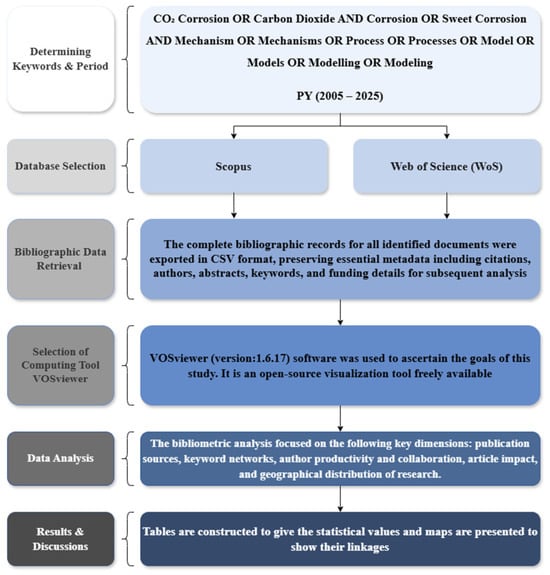
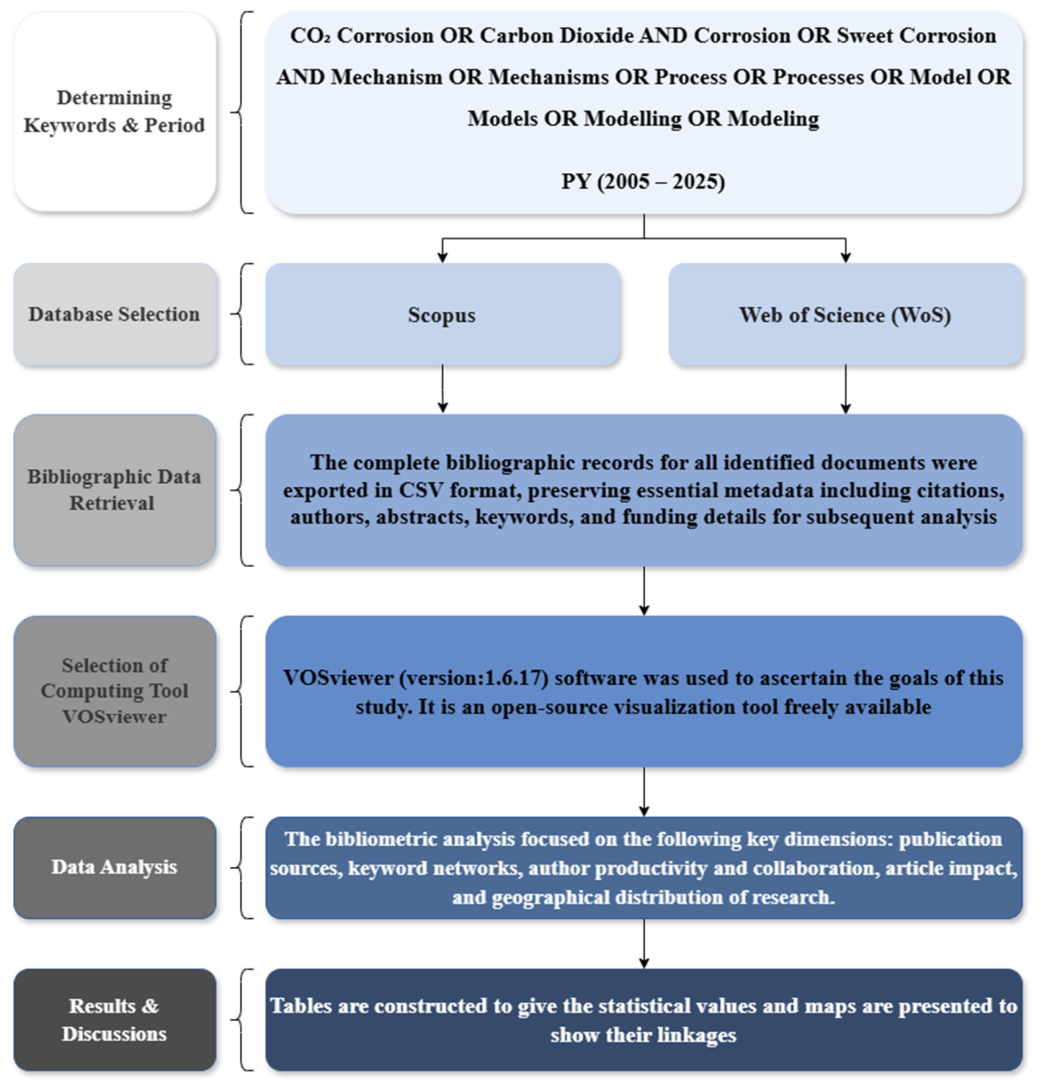
Following a bibliometric approach similar to that used in the analysis of supercritical CO2 power cycles and in a recent scientometric study of surfactant adsorption in chemical enhanced oil recovery [56,57], and consistent with established guidelines for conducting bibliometric research, this study systematically maps the intellectual structure of CO2 corrosion mechanism research. The overall workflow is detailed in Figure 1. A structured query was executed in the title, abstract, and keyword fields of the Scopus [58] and Web of Science [59] databases to balance recall with precision. The search covered the period from 2005 to 2025, capturing two decades of modern research, using the following key terms, (“CO2 corrosion” OR “carbon dioxide corrosion” OR “sweet corrosion”) AND (mechanism OR mechanisms OR process OR processes OR model OR models OR modelling OR modeling), as mentioned in [60,61,62,63,64]. The mechanism and model-oriented qualifiers were deliberately included to bias retrieval toward mechanistic and predictive studies, the focus of this review. No additional restrictions on document type, language, or subject area were applied; the only inclusion criteria were the publication period (2005–2025) and the keyword query defined above. This deliberately inclusive strategy was adopted to capture the research landscape as completely as possible and to avoid biasing the analysis through restrictive filtering. This dual-database approach ensured robustness and enabled cross-validation of the findings, the two corpora being analyzed in parallel rather than merged, to avoid double-counting while allowing their agreement to serve as a measure of reliability.
Figure 1.
Workflow for the bibliometric analysis of CO2 corrosion mechanism research (2005–2025).
The complete bibliographic data was exported in excel CSV (Comma-Separated Values) format to preserve all essential metadata including authors, affiliations, sources, keywords, and citation counts for analysis. For the processing and visualization of complex bibliometric networks, VOSviewer (version 1.6.17) [65] was selected for its proven efficacy in mapping co-occurrence and co-authorship networks, making it an ideal tool for uncovering the conceptual structure and collaborative dynamics within the research field; All networks were constructed using full counting and association-strength normalization, with the specific inclusion thresholds reported alongside each analysis in Section 3. In every map, node size reflects the weight of an item (publications, citations, co-occurrences), node colour denotes its cluster, and the connecting lines represent links between items, with more strongly related items positioned closer together; all network figures were exported at high resolution to ensure these connections are visible.
The data were retrieved on 4 October 2025; consequently, the final year (2025) was only partially indexed at the time of collection and is treated as incomplete throughout the analysis. The partial 2025 data were excluded from the exponential fit and from all trend conclusions, being retained in the figures only for completeness and transparency. This dual approach allows the overall growth trajectory and its year-to-year dynamics to be evaluated statistically rather than asserted qualitatively.
3. Results and Discussion
3.1. Publication Trends and Growth Trajectory (2005 to 2025)
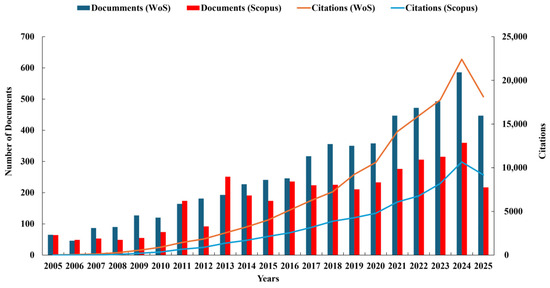
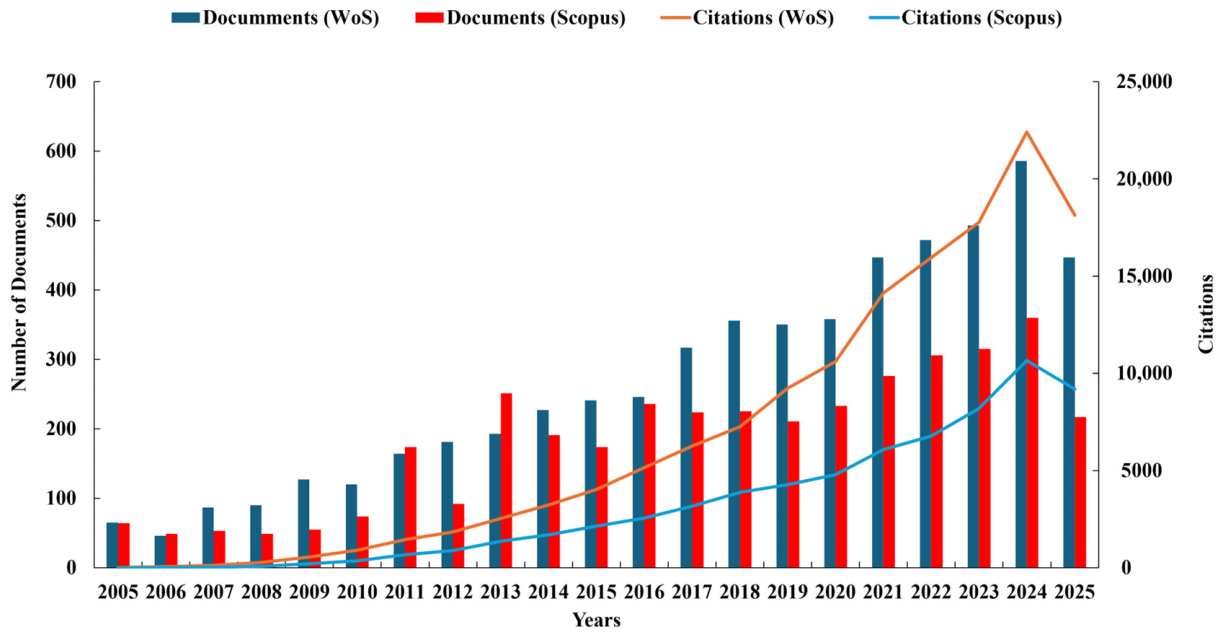
The publication and citation dynamics of CO2 corrosion research over 2005–2025 are summarized in Figure 2. The Scopus and Web of Science (WoS) queries [66] returned 5619 documents (142,071 citations) and 3052 documents (67,800 citations), respectively—a marked increase relative to the preceding 37-year period (1968–2005), which contained only 471 documents. This indicates that, although the field originated in the 1970s, the large majority of its literature has been produced within the last two decades.
Figure 2.
Number of publications and citations over the years, according to Scopus and Web of Science databases.
Figure 2 shows that this growth developed unevenly rather than at a constant rate. In the early years (2005–2010), annual publication and citation counts remained comparatively low and changed little from year to year. Over the following decade (2011–2020), both indicators rose steadily, and in the most recent fully indexed years (2021–2024) annual output reached the highest values of the period, with 586 publications and 22,422 citations recorded in WoS for 2024. The overall trajectory is therefore one of progressive, accelerating accumulation rather than steady linear increase, with the rate of yearly growth itself increasing across the period.
The growth, however, is not purely quantitative. The most informative feature of Figure 2 is the divergence between the publication and citation curves: cumulative citations have risen faster than output, with more than 80% accruing after 2016. This decoupling shows that the field’s recent expansion does not dilute impact through sheer volume but consolidates a frequently cited core—recent work is both more numerous and more often built upon—so that the literature published after 2016 now functions as the field’s active reference base. A plausible driver of this shift is the global scale-up of Carbon Capture, Utilization, and Storage (CCUS), which redirected attention toward degradation in dense-phase CO2 streams containing process impurities and produced a cluster of highly cited recent reviews [67].
The year-to-year tempo of this growth was examined using the Annual Growth Rate (), defined as
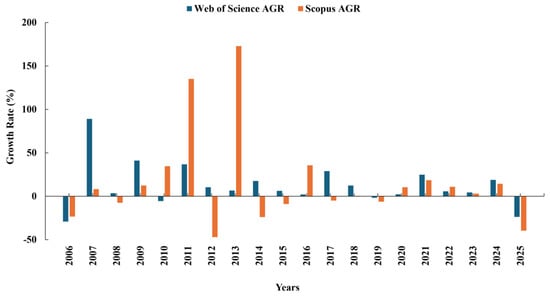
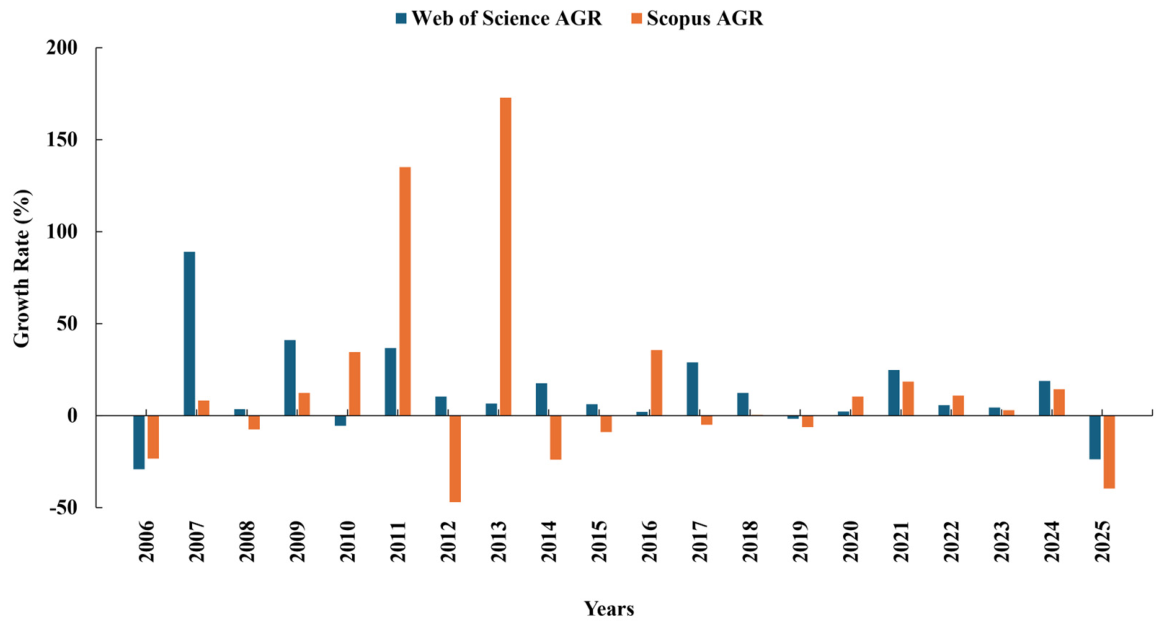
where and are the publication counts in successive years (Equation (1)). The profile (Figure 3) reveals two distinct regimes. In the early period (2005–2012), both databases show large, erratic year-on-year swings; these are best understood as a small-base effect, in which a few additional papers produce a disproportionately large percentage change rather than a meaningful trend, and they should not be read as genuine surges in research activity. From approximately 2013 onward the AGR settles into consistently positive but smaller values, indicating that growth became structural rather than sporadic: the field moved from an emergent stage, dependent on a few active groups, to a sustained-development stage supported by a broad international community. The persistence of positive AGR through 2024, without the deceleration that would indicate saturation, shows that the field has not yet reached a plateau in output.
Figure 3.
Annual growth publication rate for the last 20 years.
The most recent year, 2025, shows an apparent contraction (−23.7% in WoS, −39.7% in Scopus) that is not interpreted as a genuine decline but as an artefact of incomplete indexing, the effect of which can be quantified directly. Because the data were collected on 4 October 2025, only about 76% of the calendar year had elapsed at the time of retrieval, and recent and early-access records were not yet fully indexed. Pro-rating the partial 2025 count to a full-year equivalent dividing the recorded WoS output by the ≈0.76 fraction of the year elapsed yields an estimate of approximately 588 documents, essentially equal to the 2024 value and incompatible with a genuine downturn. The difference in magnitude between the two databases reinforces this interpretation: a real decline would appear similarly in both sources, whereas the markedly larger drop in Scopus is consistent with the two databases indexing recent records at different rates—the signature of an indexing artefact rather than a change in the underlying trend. The 2025 point is therefore retained in Figure 2 and Figure 3 for transparency but excluded from all trend conclusions, which are based on the fully indexed period 2005–2024.
3.2. Subject Area Distribution
The analysis of subject areas, detailed in Table 1, confirms that CO2 corrosion mechanism research is a multidisciplinary field. The distribution reveals a clear hierarchy of scientific disciplines engaged in this domain. The field is firmly anchored in Materials Science and Engineering, the dominant categories in both Web of Science (WoS) and Scopus. This underscores a core mission split between understanding the fundamental degradation of materials and developing practical engineering solutions. A strong, shared foundation in Chemistry, Chemical Engineering, and Electrochemistry (the latter prominently featured in WoS) highlights the central role of electrochemical processes and reaction mechanisms at the heart of CO2 corrosion. The significant presence of Energy/Energy Fuels in both databases explicitly links the research to its critical application in the oil and gas sector.
Table 1.
Subject area distribution in Scopus and Web of Science.
The key difference between the databases lies in their granularity. WoS more distinctly highlights specialized domains like Metallurgy and Metallurgical Engineering, emphasizing the deep focus on the behaviour of metallic alloys, and Electrochemistry, confirming the field’s foundational basis in electrochemical science. Furthermore, the presence of other subjects provides insight into the field’s evolving methodologies. Notably, the inclusion of Computer Science, Mathematics, and Physics signals the growing importance of computational modelling, simulation, and advanced physical analysis in understanding and predicting complex corrosion mechanisms.
The agreement between Scopus and Web of Science on the leading subject areas confirms that CO2 corrosion research is a convergence point between fundamental science—materials, chemistry, electrochemistry and applied engineering. This is the one cross-database consistency check on which the descriptive findings of this study rest.
3.3. Journals Analysis
A bibliometric analysis of the literature on CO2 corrosion mechanisms reveals a core group of highly influential journals in the field. The subsequent examination focuses on the top 10 journals from this refined list, as detailed in Table 2. When comparing the leading sources from the Scopus and Web of Science (WoS) databases, a significant overlap is observed, underscoring their shared importance.
Table 2.
Top 10 journals in Scopus and Web of Science.
Notably, Corrosion Science stands as the premier journal in this domain, ranking first in WoS with 312 documents and second in Scopus with 119. While the Scopus list is led by the NACE International Corrosion Conference Series (now known as Association for Materials Protection and Performance—AMPP), a prominent conference proceeding rather than a traditional journal, its removal from the comparison highlights the similarity in the top journals across both databases even more. Key journals such as Corrosion, International Journal of Greenhouse Gas Control, Construction and Building Materials, Energy, Procedia, Electrochimica Acta, and Engineering Failure Analysis consistently appear near the top of both lists. This convergence highlights these publications as the primary and most trusted venues for disseminating research on CO2 corrosion, with Corrosion Science unequivocally being the central anchor for scholarly work in this area.
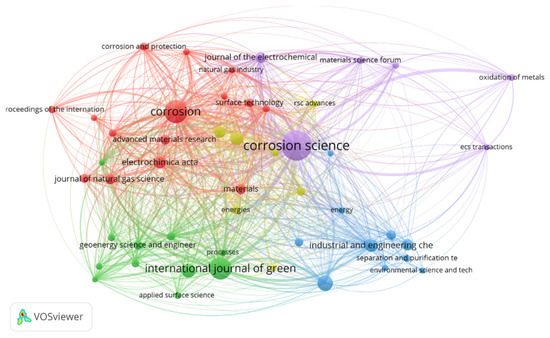
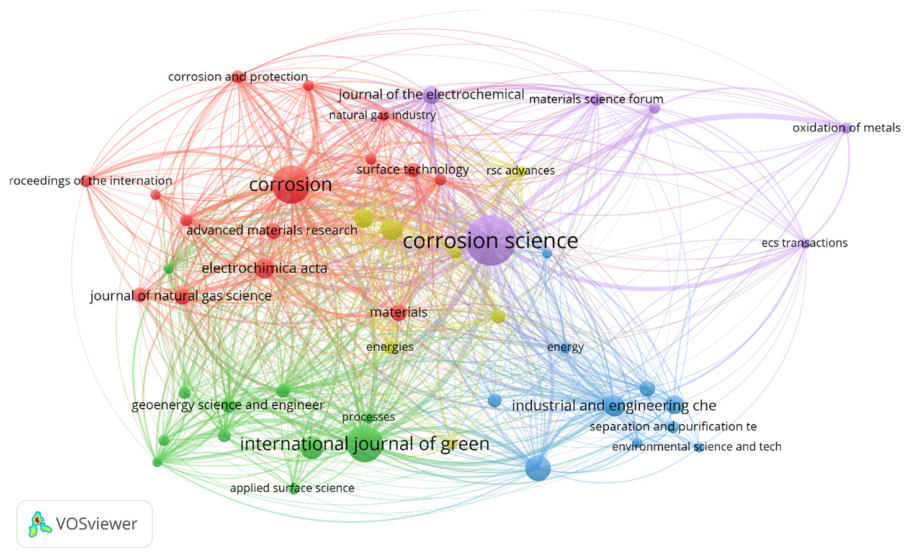
To further elucidate the network of influential publications, a co-citation analysis of the sources was performed using VOSviewer (Figure 4 and Figure 5), using Scopus dataset. This analysis was applied to the same refined pool of literature, which originated from 1531 sources with a minimum citation threshold of 20, resulting in 52 qualifying sources. The results, detailed in the accompanying table and visualized in Figure 5, provide a quantitative measure of intellectual influence.
Figure 4.
Co-citation map of the most cited journals; (Cluster 1: Purple, Cluster 2: Green, Cluster 3: Blue, Cluster 4: Red, Cluster 5: Yellow), and links represent co-citation relationships.
Figure 5.
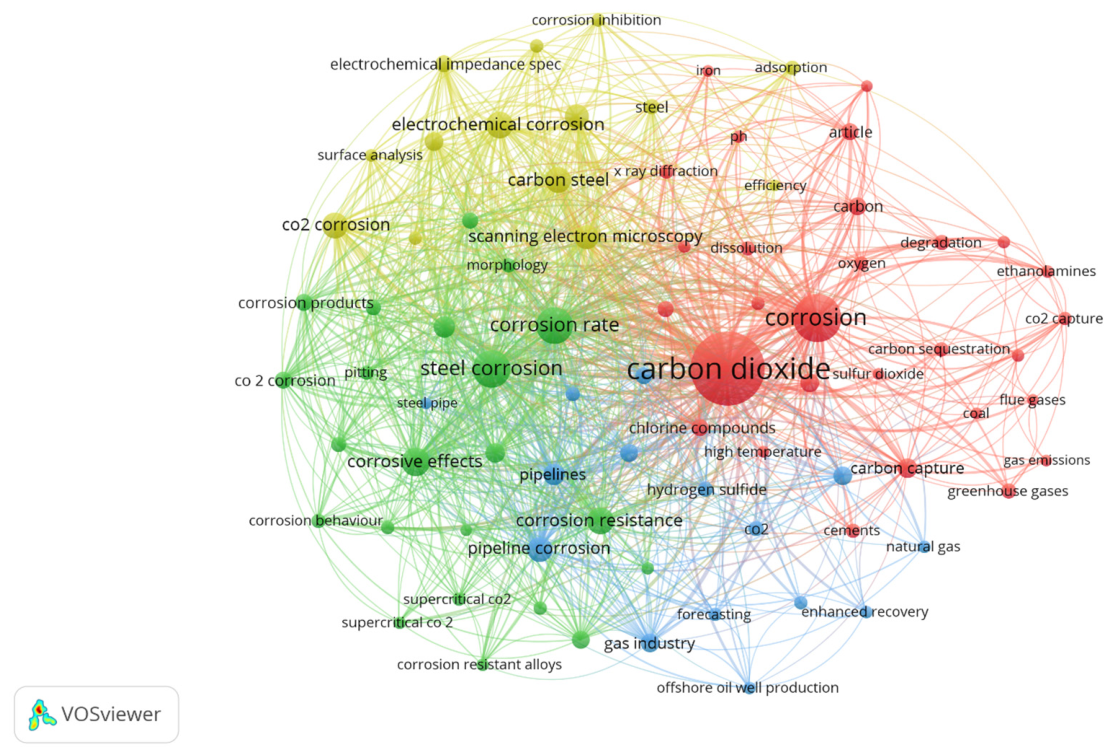
Keyword co-occurrence map; (Cluster 1: Red, Cluster 2: Green, Cluster 3: Blue, Cluster 4: Yellow), and links represent co-citation relationships.
As summarized in Table 3, The Journal of Corrosion Science not only leads in document count but also emerges as the most influential node in the co-citation network, boasting the highest citations (460) and the greatest total link strength (571), indicating its pivotal role in connecting research themes. The Corrosion journal follows as a strongly connected second node. Notably, while Oxidation of Metals ranks fourth in citations (104), its high total link strength (299) suggests it serves as a critical bridge within the literature, connecting specialized knowledge on protective scales to the broader field of CO2 corrosion. The position of other sources further defines the research landscape: The International Journal of Greenhouse Gas Control anchors the CCUS application theme, while Electrochimica Acta provides a foundation for fundamental electrochemical studies. This network analysis confirms that the core journals form a tightly interconnected knowledge base, with Corrosion Science acting as the principal hub for scholarly discourse. The data clearly differentiates between sources of high volume, such as the NACE Conference Series, and sources of foundational influence, with Corrosion Science being the preeminent venue for the field’s most impactful research.
Table 3.
Top 10 journals used in Scopus for CO2 corrosion mechanism research.
The co-citation pattern shows that the field’s most-cited venues are also its most connected, meaning the literature is anchored to a compact set of core journals rather than dispersed across many; Corrosion Science occupies this anchoring role, linking otherwise separate research themes.
3.4. Keywords Analysis: Conceptual Structure and Thematic Evolution
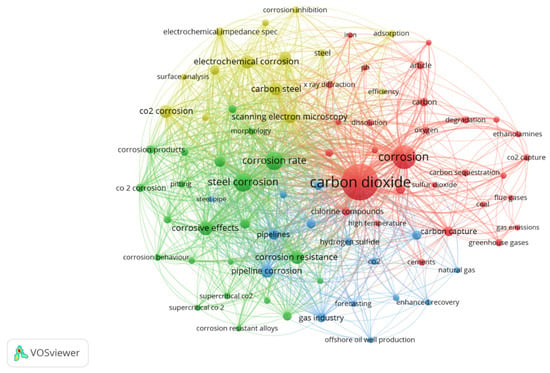
Keywords define the core themes and conceptual boundaries of a scientific field. To map the intellectual structure of CO2 corrosion mechanism research, a keyword co-occurrence analysis was conducted using VOSviewer. Applying a minimum occurrence threshold of 10 refined the initial set of 20,135 keywords to a network of 2185 terms; the 200 most relevant were used to generate the conceptual map in Figure 5, and the top 20 by total link strength are listed in Table 4.
Table 4.
Top 10 keywords used in Scopus for CO2 corrosion mechanism research.
The network is organized around two foundational nodes. “Carbon dioxide” is the dominant term, with both the highest frequency (2725 occurrences) and by far the greatest total link strength (TLS = 18,797), confirming its role as the central hub bridging otherwise distinct research themes [24,68,69]. “Corrosion” forms the second anchor (1161 occurrences, TLS = 8451) [48,70,71,72]. The very high link strength of these two terms—rather than their frequency alone—is what identifies them as structurally fundamental, since it shows they co-occur across the full breadth of the literature rather than within any single sub-topic.
The map resolves into four thematic clusters whose composition reveals how the field is conceptually partitioned. The red cluster establishes the broad physico-chemical and applied context surrounding the central “carbon dioxide” node. The green cluster represents the core of the field: the quantification of degradation, where highly connected terms such as “steel corrosion” (TLS = 7084) and “corrosion rate” (TLS = 6099) act as co-dependent descriptors of material loss [73,74], and the presence of “scanning electron microscopy” (TLS = 3197) reflect the established role of microstructural characterization in mechanistic studies. The yellow cluster groups the electrochemical and surface-analytical methods (e.g., electrochemical corrosion, electrochemical impedance spectroscopy, surface analysis) through which these mechanisms are probed, while the blue cluster links the field to its applied setting in oil and gas production and CCUS, connecting corrosion-resistance and pipeline terms to carbon capture, natural gas, and enhanced recovery. Together, these clusters trace a coherent structure spanning fundamental chemistry (red), degradation quantification (green), electrochemical methodology (yellow), and industrial application (blue).
Beyond mapping the field’s structure, the network also yields a methodological observation relevant to bibliometric practice. The dominant “carbon dioxide” node is connected not only to corrosion descriptors but also, and strongly, to terms belonging to adjacent energy domains such as carbon capture, carbon sequestration, flue gases, greenhouse gases, and ethanolamines (red cluster), whereas the specifically corrosion-oriented term “CO2 corrosion” appears as a comparatively minor node (TLS = 3211). This pattern indicates that broad CO2-based queries tend to draw in literature from neighbouring fields rather than the corrosion literature specifically. Consequently, combined, corrosion-specific phrasing (e.g., “carbon dioxide corrosion”) is preferable for delimiting the mechanistic corrosion literature, while a formal comparison of the recall and precision of alternative seed terms represents a useful direction for future bibliometric work.
3.5. Productive Authors
A quantitative assessment of author productivity reveals the individuals who have most substantially shaped the literature on CO2 corrosion mechanisms. The rankings, derived from both Scopus and Web of Science (WoS), reveal a consistent core of leading researchers, confirming the robustness of their influence across different bibliographic databases, as summarized in Table 5.
Table 5.
The top 10 contributing authors based on Scopus and Web of Science databases.
Among all contributors, S. Nesic emerges as the most prolific researcher, with 83 publications indexed in Scopus and 86 in WoS, almost twice as many as most other top-tier authors in the Scopus database. This highlights his pivotal role in shaping the field. The data reveals distinct collaborative hubs. A significant cluster originates from the Institute for Corrosion and Multiphase Technology (ICMT) at Ohio University, USA, which includes, alongside Nesic, other top contributors like B. Brown (38 documents in Scopus), M. Singer (33), and S. Wang. In parallel, a strong European hub is evident, primarily formed by R. Barker (47 documents) and A. Neville (45 documents) from the University of Leeds, United Kingdom. Their sustained partnership is a defining feature of the field’s collaborative landscape.
Furthermore, the data quantifies the significant contribution of researchers affiliated with Chinese institutions, a trend aligned with the geographical analysis. In the WoS list, authors such as Y. Wang (78 documents), J. Zhang (61), and Y. Li (50) rank second, third, and fifth, respectively. This highlights China’s major role in research output and indicates the presence of several productive domestic teams.
The Scopus and Web of Science rankings identify the same core group of authors, indicating that research output is concentrated within a limited number of long-standing groups and institutional partnerships. This concentration of output within stable groups is characteristic of a mature, specialized field rather than one driven by dispersed or transient contributions.
The concentration of output within a few long-standing institutional partnerships indicates that the field’s knowledge is produced by stable research groups rather than by transient or isolated contributions, a structure typical of a mature, specialized discipline.
3.6. Country-Level Contribution
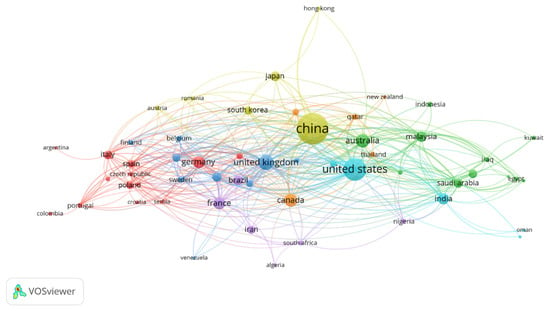
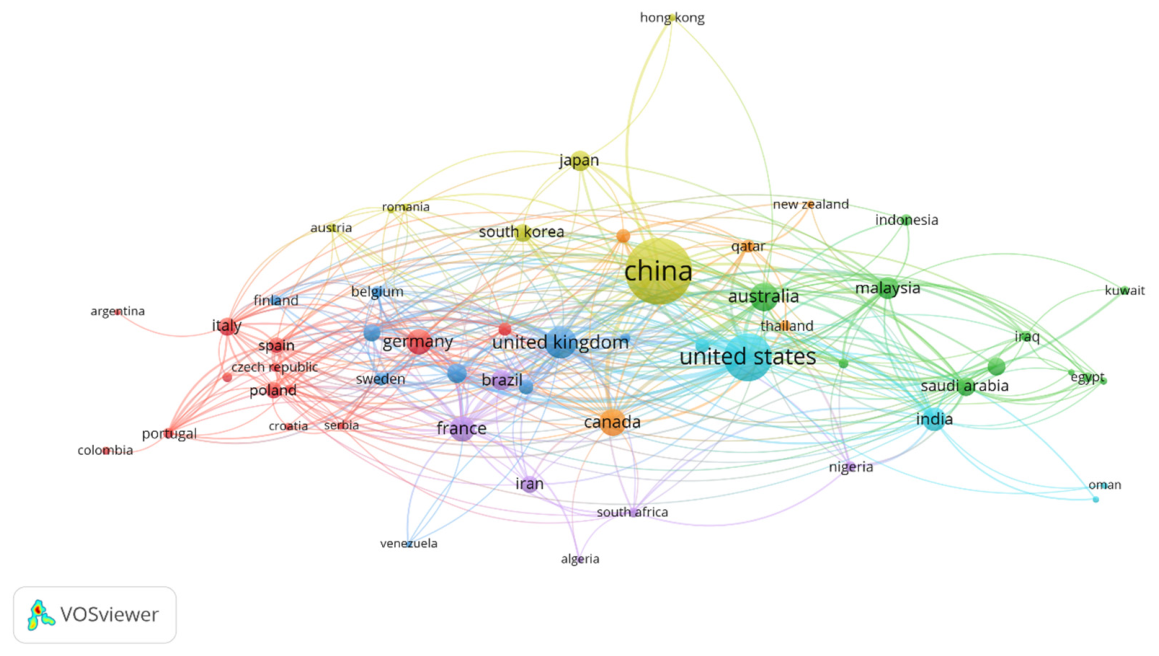
This section examines the geographic distribution of research output. The metric used throughout is publication volume, defined as the number of documents indexed per country in each database; it measures productivity and should not be interpreted as a measure of citation impact or scientific influence, which are not assessed at the country level in this study. A country-level co-authorship network of the Scopus database is shown in Figure 6, where node size is proportional to a country’s document count and links represent co-authored publications between countries; the analysis spans 57 countries.
Figure 6.
Country co-authorship map; (Cluster 1: Yellow, Cluster 2: Green, Cluster 3: Blue, Cluster 4: Red, Cluster 5: Purple), and links represent co-citation relationships.
Ranked by document count, a clear and consistent hierarchy emerges across both databases (Table 6). China is the most productive contributor, with 1112 documents in Scopus and 2170 in Web of Science (WoS), followed by the United States (518 in Scopus; 741 in WoS) and the United Kingdom (199 in Scopus; 286 in WoS). The two leading contributors are therefore separated by a substantial margin: in WoS, China’s output is approximately 2.9 times that of the United States and 7.6 times that of the United Kingdom, confirming that the leadership in volume is pronounced rather than marginal.
Table 6.
The top 10 contributing countries based on Scopus and Web of Science databases.
Below the top three, a stable group of nations occupies the upper ranks of both databases Australia, Canada, France, and Germany together with India, all of which exceed 100 documents in at least one database and recur within the top ten of both. The principal difference between the two sources is one of absolute counts rather than ranking: WoS records systematically higher document numbers than Scopus for the same countries (e.g., China 2170 vs. 1112; United States 741 vs. 518), reflecting the broader indexing coverage of WoS rather than a difference in which countries lead. The lower-middle ranks are more database-dependent—Scopus includes Malaysia and Brazil in its top ten, whereas WoS instead lists South Korea and Iran indicating that, beyond the dominant contributors, national rankings are sensitive to database coverage and should be interpreted with corresponding caution. The recurrence of the same leading group across two independent databases nonetheless confirms a stable and well-established global research network, in which output is concentrated in a small number of countries with major stakes in the energy sector.
3.7. Leading Research Institutions
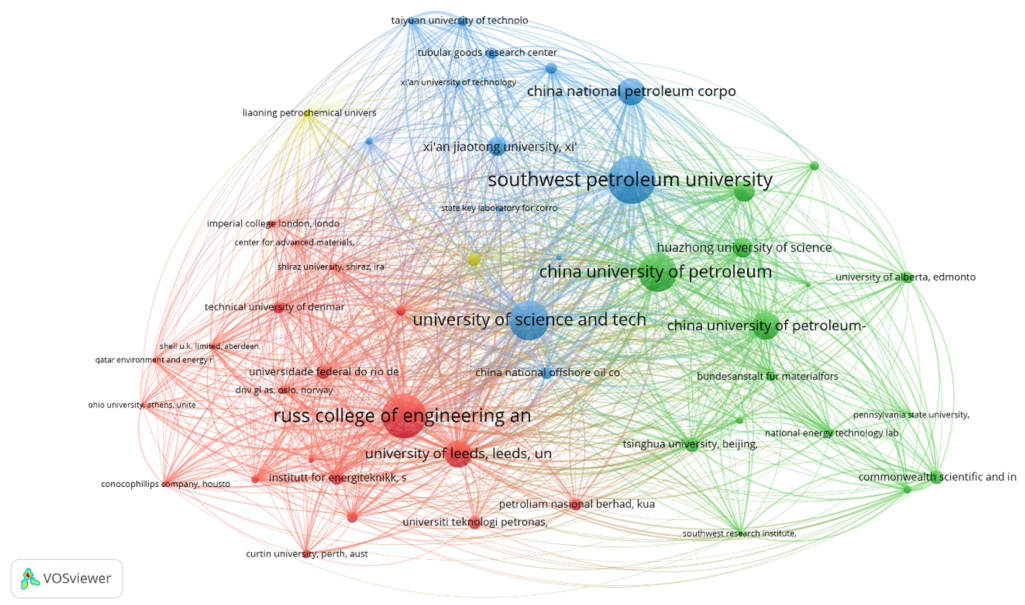
To identify the core institutions in CO2 corrosion research, a pool of 2475 institutions was reduced to 215 by applying thresholds of at least five documents and twenty citations per institution; the most connected of these are shown in the co-authorship network of Figure 7. The metric used to rank institutions in this section is publication volume, defined as the number of indexed documents per institution (Table 7); the co-authorship network in Figure 7 is used to describe how these institutions are grouped into collaborative communities rather than to assign individual centrality scores.
Figure 7.
Scientific visualization of the top 50 research institutions from the Scopus database (Cluster 1: Blue, Cluster 2: Red, Cluster 3: Green, Cluster 4: Yellow) and links represent co-citation relationships.
Table 7.
The top 10 contributing institutions from Scopus and Web of Science databases.
By document count, the leading institutions are predominantly Chinese and energy-focused. In Web of Science, the four most productive entities are China University of Petroleum (225 documents), Southwest Petroleum University (213), China National Petroleum Corporation (209), and the Chinese Academy of Sciences (184); Scopus shows the same leading group in a closely comparable order, led by Southwest Petroleum University (111) and including the Russ College of Engineering and Technology at Ohio University (102). The consistency of this ranking across two independent databases indicates that institutional output is concentrated in a small set of organizations rather than dispersed and that this concentration reflects sustained national investment in corrosion research for oil and gas infrastructure rather than the activity of a single centre.
Beyond their volume, the composition of the leading institutions characterizes the nature of the field. The presence of an industry organization, the China National Petroleum Corporation, among the highest-output entities (209 WoS documents) evidences a direct industry–academia linkage, while the predominance of petroleum- and materials-focused universities confirms that the field is driven primarily by applied material-integrity problems. Significant non-Chinese contributors, Ohio University’s Russ College of Engineering (117 WoS documents), the United States Department of Energy (137), the University of Leeds (59 Scopus documents), and France’s CNRS (109 WoS documents)—show that, although output is concentrated, the field remains internationally distributed across organizations in the major energy-producing economies.
The co-authorship map in Figure 7 organizes these institutions into distinct colour-coded communities, broadly corresponding to a Chinese group, a North American group associated with Ohio University, and a European group associated with the University of Leeds and the CNRS. The presence of links between these communities indicates that collaboration, while regionally concentrated, also extends across them, consistent with the internationally distributed authorship reported in Section 3.5. Taken together, the document-count ranking (Table 7) and the community structure of Figure 7 show that CO2 corrosion research is produced by a compact group of energy-focused institutions organized into a small number of regionally anchored but interconnected collaborative communities.
4. Conclusions
This study converted a large, fragmented, and multidisciplinary body of CO2 corrosion literature into a single interpretable map. Its central result is that the field has matured from an emergent into a structured and internationally organized research domain, possessing a stable intellectual core, a recognizable set of leading contributors, and a coherent thematic architecture that is consistent across two independent databases.
Three findings substantiate this conclusion and, taken together, define the field’s present state. First, the field is both large and still expanding: output has grown from sporadic to sustained since the early 2010s, and the faster accumulation of citations than of publications—with the majority of citations concentrated in the most recent decade—shows that the field’s influence is consolidating around a recently formed, actively cited core rather than being diluted by volume. Second, this activity is concentrated rather than dispersed: a small group of energy-focused institutions and a stable set of long-standing research groups account for a large share of the output, and the same leading countries and authors recur across both databases, indicating a well-established and internationally connected research network rather than a fragmented one. Third, the literature is organized around a stable conceptual structure spanning fundamental physico-chemical context, the quantification of material degradation, electrochemical and surface-analytical methods, and industrial application an architecture that links the field’s mechanistic origins to its current applied concerns, most notably CCUS.
Two interpretive cautions qualify these findings. Bibliometric prominence is not equivalent to foundational influence: rankings based on the 2005–2025 window necessarily understate the formative contributions of early centres such as IFE Norway and the Curtin Corrosion Centre, whose pioneering work predates or sits at the edge of the analysis period. The geographic and institutional results should therefore be read as measures of recent productivity, not of historical or scientific priority.
Beyond describing the field, the analysis is intended as a practical orientation tool, identifying the principal databases, journals, contributors, institutions, and thematic areas that a researcher entering the domain would need to locate. It also yields a methodological observation of broader relevance to bibliometric practice: because the dominant term “carbon dioxide” connects strongly to adjacent energy fields, broad CO2-based queries tend to retrieve substantial neighbouring literature, so corrosion-specific phrasing is recommended for delimiting this domain; a formal recall-and-precision comparison of alternative seed terms remains a useful direction for future work.
Finally, several limitations bound the interpretation of these results. The corpus was restricted to Scopus and Web of Science, so contributions indexed only in other databases are not represented, and the systematically higher counts in Web of Science reflect differences in indexing coverage rather than in underlying output. The retrieval depended on the chosen search terms and on the mechanism and model-oriented qualifiers, which were selected to focus the corpus but may have excluded relevant studies using different terminology; no restrictions on language, document type, or subject area were applied, so the corpus reflects this deliberately inclusive strategy. Because citations accumulate over time, the most recent publications are necessarily undervalued by citation-based indicators, and the partially indexed final year (2025) was excluded from all trend conclusions. These constraints define the scope within which the present findings should be understood and motivate the cross-database comparison used throughout as a consistency check.
Author Contributions
Conceptualization, investigation, resources, and writing—original draft preparation, M.-C.B.-A.; Visualization, editing, and investigation, M.-A.K.; Supervision, visualiza-tion, review and editing, A.B.; Supervision, review and editing, M.O. All authors have read and agreed to the published version of the manuscript.
Funding
This research received no external funding.
Data Availability Statement
The original contributions presented in this study are included in the article. Further inquiries can be directed to the corresponding authors.
Acknowledgments
The authors would like to express their sincere appreciation to Politecnico di Milano for the academic environment and support that facilitated this study.
Conflicts of Interest
The authors declare no conflicts of interest.
References
- Zhao, C.; Wang, J.; Li, X.; Huang, J.; Chen, H.; Bi, J.; Liu, S.; Lu, G.; Song, K.; Guo, S. Progress in Corrosion Protection Research for Supercritical CO2 Transportation Pipelines. Coatings 2024, 14, 1378. [Google Scholar] [CrossRef] [Scilit]
- Bender, R.; Féron, D.; Mills, D.; Ritter, S.; Bäßler, R.; Bettge, D.; De Graeve, I.; Dugstad, A.; Grassini, S.; Hack, T.; et al. Corrosion challenges towards a sustainable society. Mater. Corros. 2022, 73, 1730–1751. [Google Scholar] [CrossRef] [Scilit]
- Matamoros-Veloza, A.; Stawski, T.M.; Vargas, S.; Neville, A. Study of a Local Structure at the Interface between Corrosion Films and Carbon Steel Surface in Undersaturated CO2 Environments. ACS Omega 2023, 8, 8497–8504. [Google Scholar] [CrossRef] [Scilit] [PubMed]
- Zhang, J.; Yang, P.; Xia, Z.; Wang, C.; Li, Y. Experimental study on the influence of CO2 corrosion on hydrogen permeation and hydrogen embrittlement sensitivity of X52 pipeline steel. Eng. Fail. Anal. 2025, 176, 109622. [Google Scholar] [CrossRef] [Scilit]
- Bhaskaran, R.; Rahman, A.; Juneja, S.; Sonik, U.; Kaur, S.; Kaur, J.; Rengaswamy, N.S. An analysis of the updated cost of corrosion in India. Mater. Perform. 2014, 53, 56–65. [Google Scholar] [CrossRef] [Scilit]
- Koch, G. 1—Cost of corrosion. In Trends in Oil and Gas Corrosion Research and Technologies; El-Sherik, A.M., Ed.; Woodhead Publishing Series in Energy; Woodhead Publishing: Boston, MA, USA, 2017; pp. 3–30. [Google Scholar] [CrossRef] [Scilit]
- Kermani, M.B.; Harrop, D. The impact of corrosion on the oil and gas industry. SPE Prod. Facil. 1996, 11, 186–190. [Google Scholar] [CrossRef] [Scilit]
- Paolinelli, L.D.; Pérez, T.; Simison, S.N. The effect of pre-corrosion and steel microstructure on inhibitor performance in CO2 corrosion. Corros. Sci. 2008, 50, 2456–2464. [Google Scholar] [CrossRef] [Scilit]
- Dong, Z.; Zhang, M.; Li, W.; Wen, F.; Dong, G.; Zou, L.; Zhang, Y. Development of a Predictive Model for Carbon Dioxide Corrosion Rate and Severity Based on Machine Learning Algorithms. Materials 2024, 17, 4046. [Google Scholar] [CrossRef] [Scilit] [PubMed]
- De Waard, C.; Milliams, D.E. Carbonic acid corrosion of steel. Corrosion 1975, 31, 177–181. [Google Scholar] [CrossRef] [Scilit]
- Videm, K.; Dugstad, A. Corrosion of carbon steel in an aqueous carbon dioxide environment. Mater. Perform. 1989, 28, 3. [Google Scholar]
- Nešić, S.; Lunde, L. Carbon dioxide corrosion of carbon steel in two-phase flow. Corrosion 1994, 50, 717–727. [Google Scholar] [CrossRef] [Scilit]
- Dugstad, A.; Lunde, L.; Videm, K. Parametric study of CO2 corrosion of carbon steel. In Proceedings of the CORROSION 1994, Baltimore, MD, USA, 27 February–4 March 1994; NACE International: Houston, TX, USA, 1994; pp. 1–16. [Google Scholar] [CrossRef] [Scilit]
- Dayalan, E.; Vani, G.; Shadley, J.R.; Shirazi, S.A.; Rybicki, E.F. Modeling CO2 corrosion of carbon steels in pipe flow. In Proceedings of the CORROSION 1995, Orlando, FL, USA, 26–31 March 1995; NACE International: Houston, TX, USA, 1995; pp. 1–24. [Google Scholar] [CrossRef] [Scilit]
- Tan, M.Y. Electrochemical Studies on Carbon Dioxide Corrosion and Its Inhibition. Doctoral Dissertation, Deakin University, Burwood, Australia, 1996. [Google Scholar]
- Tan, Y.J.; Kinsella, B.; Bailey, S. The evaluation of corrosion inhibitor film persistency using electrochemical impedance spectroscopy and electrochemical noise analysis. In CORROSION 1996; NACE International: Houston, TX, USA, 1996; pp. 1–18. [Google Scholar] [CrossRef] [Scilit]
- Nordsveen, M.; Nešić, S.; Nyborg, R.; Stangeland, A. A mechanistic model for carbon dioxide corrosion of mild steel in the presence of protective iron carbonate films—Part 1: Theory and verification. Corrosion 2003, 59, 443–456. [Google Scholar] [CrossRef] [Scilit]
- Nesic, S.; Pots, B.F.M.; Postlethwaite, J.; Thevenot, N. Superposition of diffusion and chemical reaction controlled limiting currents-application to CO2 corrosion. J. Corros. Sci. Eng. 1995, 1, 1–14. [Google Scholar]
- Vitse, F.; Nešić, S.; Gunaltun, Y.; de Torreben, D.; Duchet-Suchaux, P. Mechanistic model for the prediction of top-of-the-line corrosion risk. Corrosion 2003, 59, 1075–1084. [Google Scholar] [CrossRef] [Scilit]
- Choi, Y.; Nesic, S.; Young, D. Effect of Impurities on the Corrosion Behavior of CO2 Transmission Pipeline Steel in Supercritical CO2—Water Environments. Environ. Sci. Technol. 2011, 45, 3818. [Google Scholar] [CrossRef] [Scilit]
- Zhu, J.; Ma, B.; Li, D.; Zhang, Y.; Xu, L. Role of bicarbonate in CO2 corrosion of carbon steel. Electrochim. Acta 2024, 478, 143818. [Google Scholar] [CrossRef] [Scilit]
- Li, S.; Zeng, Z.; Harris, M.A.; Sánchez, L.J.; Cong, H. CO2 corrosion of low carbon steel under the joint effects of time-temperature-salt concentration. Front. Mater. 2019, 6, 10. [Google Scholar] [CrossRef] [Scilit]
- Almeida, T.D.C.; Bandeira, M.C.E.; Moreira, R.M.; Mattos, O.R. New insights on the role of CO2 in the mechanism of carbon steel corrosion. Corros. Sci. 2017, 120, 239–250. [Google Scholar] [CrossRef] [Scilit]
- Elgaddafi, R.; Ahmed, R.; Shah, S. Corrosion of carbon steel in CO2 saturated brine at elevated temperatures. J. Pet. Sci. Eng. 2021, 196, 107638. [Google Scholar] [CrossRef] [Scilit]
- Chen, X.; Yang, X.; Zeng, M.; Wang, H. Influence of CO2 partial pressure and flow rate on the corrosion behavior of N80 steel in 3.5% NaCl. Int. J. Electrochem. Sci. 2023, 18, 100218. [Google Scholar] [CrossRef] [Scilit]
- Pessu, F.; Barker, R.; Neville, A. The influence of pH on localized corrosion behavior of X65 carbon steel in CO2-saturated brines. Corrosion 2015, 71, 1452–1466. [Google Scholar] [CrossRef] [Scilit] [PubMed]
- Tanupabrungsun, T.; Brown, B.; Nesic, S. Effect of pH on CO2 Corrosion of Mild Steel at Elevated Temperatures. In Proceedings of the CORROSION 2013, Orlando, FL, USA, 17–21 March 2013; NACE International: Houston, TX, USA, 2013; pp. 1–11. [Google Scholar] [CrossRef] [Scilit]
- Zhang, Y.-N.; Zhang, S.-G.; Luo, J.-H.; Long, Y.; Ji, N.; Fan, B.; Wang, S.-M. Effect of Flow Rate on the Corrosion Behavior of P110 Steel in High-Ca2+ and High-Cl− Environment. Metals 2022, 12, 1183. [Google Scholar] [CrossRef] [Scilit]
- Florez, J.J.A.; Ferrari, J.V. Fluid flow effects on CO2 corrosion: A review of applications of rotating cage methodology. Anti-Corros. Methods Mater. 2019, 66, 507–519. [Google Scholar] [CrossRef] [Scilit]
- Carmona-Hernandez, A.; Sánchez-Garrido, R.A.; Palacios-González, E.; Flores-Frías, E.A.; Landa-Gómez, A.E.; Mejía-Sánchez, E.; Espinoza-Vázquez, A.; Orozco-Cruz, R.; Galván-Martínez, R. Electrochemical Characterization of CO2 Corrosion Inhibition of API X100 by a Gemini Surfactant Under Static and Dynamic Conditions. Metals 2025, 15, 918. [Google Scholar] [CrossRef] [Scilit]
- Lazareva, A.; Owen, J.; Vargas, S.; Barker, R.; Neville, A. Investigation of the evolution of an iron carbonate layer and its effect on localized corrosion of X65 carbon steel in CO2 corrosion environments. Corros. Sci. 2021, 192, 109849. [Google Scholar] [CrossRef] [Scilit]
- De Motte, R.A.; Barker, R.; Burkle, D.; Vargas, S.M.; Neville, A. The early stages of FeCO3 scale formation kinetics in CO2 corrosion. Mater. Chem. Phys. 2018, 216, 102–111. [Google Scholar] [CrossRef] [Scilit]
- Sk, M.H.; Clarke, S.; Woolley, M.; Osudare, A.; Agrawal, S.; Sharifi, N.; Eberl-Craske, D.; Lindsay, R.; Casford, M.; Smith, A.; et al. In situ early-stage CO2 corrosion scale study with 2D synchrotron SAXS-WAXS. Corros. Sci. 2025, 257, 113267. [Google Scholar] [CrossRef] [Scilit]
- Elgaddafi, R.; Ahmed, R.; Osisanya, S. Modeling and experimental study on the effects of temperature on the corrosion of API carbon steel in CO2-Saturated environment. J. Pet. Sci. Eng. 2021, 196, 107816. [Google Scholar] [CrossRef] [Scilit]
- Rogowska, M.; Gudme, J.; Rubin, A.; Pantleon, K.; Ambat, R. Effect of Fe ion concentration on corrosion of carbon steel in CO2 environment. Corros. Eng. Sci. Technol. 2016, 51, 25–36. [Google Scholar] [CrossRef] [Scilit]
- Wang, Z.; Zhao, Y.; Liu, M.; Shen, H.; Fang, Q.; Yao, J. Investigation of the effects of small flow rate and particle impact on high temperature CO2 corrosion of N80 steel. Corros. Sci. 2022, 209, 110735. [Google Scholar] [CrossRef] [Scilit]
- Qin, M.; Chen, S.; Ye, N.; Chen, Y.; Zhang, S.; Li, K.; Liao, K. Study on the evolution mechanism and influencing factors of CO2 corrosion product film under pipe flow. Int. J. Press. Vessel. Pip. 2025, 216, 105506. [Google Scholar] [CrossRef] [Scilit]
- Li, W.; Pots, B.F.M.; Brown, B.; Kee, K.E.; Nesic, S. A direct measurement of wall shear stress in multiphase flow-Is it an important parameter in CO2 corrosion of carbon steel pipelines? Corros. Sci. 2016, 110, 35–45. [Google Scholar] [CrossRef] [Scilit]
- Ige, O.O.; Barker, R.; Hu, X.; Umoru, L.E.; Neville, A. Assessing the influence of shear stress and particle impingement on inhibitor efficiency through the application of in-situ electrochemistry in a CO2-saturated environment. Wear 2013, 304, 49–59. [Google Scholar] [CrossRef] [Scilit]
- Ajayi, F.O.; Lyon, S. Mitigation of top- and bottom-of-the-line CO2 corrosion in the presence of acetic acid (I): pH control using methyl diethanolamine. Mater. Corros. 2021, 72, 1177–1188. [Google Scholar] [CrossRef] [Scilit]
- Fajardo, V.; Canto, C.; Brown, B.; Nesic, S. Effect of Organic Acids in CO2 Corrosion. In Proceedings of the CORROSION 2007, Nashville, TN, USA, 11–15 March 2007; NACE International: Houston, TX, USA, 2007; pp. 1–18. [Google Scholar] [CrossRef] [Scilit]
- Talukdar, A.; Rajaraman, P.V. Effect of acetic acid in CO2-H2S corrosion of carbon steel at elevated temperature. Mater. Today Proc. 2022, 57, 1842–1845. [Google Scholar] [CrossRef] [Scilit]
- Ayyagari, S.; Eslami, M.; Sani, F.M.; Choi, Y.S.; Brown, B.; Nesic, S. Effect of formic acid on aqueous corrosion mechanisms of mild steel. Electrochim. Acta 2024, 503, 144863. [Google Scholar] [CrossRef] [Scilit]
- Liu, Q.Y.; Mao, L.J.; Zhou, S.W. Effects of chloride content on CO2 corrosion of carbon steel in simulated oil and gas well environments. Corros. Sci. 2014, 84, 165–171. [Google Scholar] [CrossRef] [Scilit]
- Qin, M.; Liao, K.; He, G.; Zou, Q.; Zhao, S.; Zhang, S. Corrosion mechanism of X65 steel exposed to H2S/CO2 brine and H2S/CO2 vapor corrosion environments. J. Nat. Gas Sci. Eng. 2022, 106, 104774. [Google Scholar] [CrossRef] [Scilit]
- Sun, J.; Sun, C.; Wang, Y. Effects of O2 and SO2 on Water Chemistry Characteristics and Corrosion Behavior of X70 Pipeline Steel in Supercritical CO2 Transport System. Ind. Eng. Chem. Res. 2018, 57, 2365–2375. [Google Scholar] [CrossRef] [Scilit]
- Turner, L.G.; Dawson, G.K.W.; Golding, S.D.; Pearce, J.K. CO2 and NOx reactions with CO2 storage reservoir core: NOx dissolution products and mineral reactions. Int. J. Greenh. Gas Control 2022, 120, 103750. [Google Scholar] [CrossRef] [Scilit]
- Sonke, J.; Morland, B.H.; Moulie, G.; Franke, M.S. Corrosion and chemical reactions in impure CO2. Int. J. Greenh. Gas Control 2024, 133, 104075. [Google Scholar] [CrossRef] [Scilit]
- Fonseca, D.; Tagliari, M.R.; Guaglianoni, W.C.; Tamborim, S.M.; Borges, M.F. Review Article Carbon Dioxide Corrosion Mechanisms: Historical Development and Key Parameters of CO2-H2O Systems. Int. J. Corros. 2024, 2024, 5537767. [Google Scholar] [CrossRef] [Scilit]
- Chauhan, D.S.; Quraishi, M.A.; Qurashi, A. Recent trends in environmentally sustainable Sweet corrosion inhibitors. J. Mol. Liq. 2021, 326, 115117. [Google Scholar] [CrossRef] [Scilit]
- Nesic, S.; Postlethwaite, J.; Olsen, S. An Electrochemical Model for Prediction of Corrosion of Mild Steel in Aqueous Carbon Dioxide Solutions. Corrosion 1996, 52, 280–294. [Google Scholar] [CrossRef] [Scilit]
- Alsalem, M.M.; Ryan, M.P.; Campbell, A.N.; Campbell, K.S. Modelling of CO2 corrosion and FeCO3 formation in NaCl solutions. Chem. Eng. J. 2022, 451, 138966. [Google Scholar] [CrossRef] [Scilit]
- Nyborg, R. Overview of CO2 Corrosion Models for Wells and Pipelines. In Proceedings of the CORROSION 2002, Denver, CO, USA, 7–12 April 2002; NACE International: Houston, TX, USA, 2002; pp. 1–16. [Google Scholar] [CrossRef] [Scilit]
- Jiang, C.; Ren, Y.; Gao, L.; Cao, F.; Chai, X.; Li, Y. Complete Construction and Research of CO2 Corrosion Prediction Model for a Gas Field Wellbore. Mater. Corros. 2025, 76, 1342–1352. [Google Scholar] [CrossRef] [Scilit]
- Zhang, Y.; Pang, X.; Qu, S.; Li, X.; Gao, K. Discussion of the CO2 corrosion mechanism between low partial pressure and supercritical condition. Corros. Sci. 2012, 59, 186–197. [Google Scholar] [CrossRef] [Scilit]
- Reyes-Belmonte, M.A.; Guédez, R.; Montes, M.J. Bibliometric analysis on supercritical CO2 power cycles for concentrating solar power applications. Entropy 2021, 23, 1289. [Google Scholar] [CrossRef] [Scilit] [PubMed]
- Hadji, M.E.M.; Maouche, M.-F.; Kethiri, M.-A.; Ben-Ameur, M.-C.; Khodja, M.; Drouiche, N.; Grassl, B.; Lebouachera, S.E.I. Scientometric Mapping of Surfactant Adsorption onto Reservoir Rocks in Chemical Enhanced Oil Recovery Applications: Research Trends and Emerging Frontiers (2005–2025). ChemEngineering 2026, 10, 82. [Google Scholar] [CrossRef] [Scilit]
- Elsevier. Scopus. Available online: https://www.scopus.com (accessed on 4 October 2025).
- Clarivate. Web of Science. Available online: https://www.webofscience.com (accessed on 4 October 2025).
- Huang, F.; Liu, S. Flow Characteristics and Corrosion Mechanisms of Carbon Dioxide in Different Phases at Pipeline Defects. Energy Fuels 2025, 39, 19959–19976. [Google Scholar] [CrossRef] [Scilit]
- Yan, T.; Xu, L.; Zeng, Z.; Pan, W. iScience ll Mechanism and anti-corrosion measures of carbon dioxide corrosion in CCUS: A review. iScience 2024, 27, 108594. [Google Scholar] [CrossRef] [Scilit] [PubMed]
- Obot, I.B.; Sorour, A.A.; Verma, C.; Al-Khaldi, T.A.; Rushaid, A.S. Key parameters affecting sweet and sour corrosion: Impact on corrosion risk assessment and inhibition. Eng. Fail. Anal. 2023, 145, 107008. [Google Scholar] [CrossRef] [Scilit]
- Porcayo-Calderon, J.; Canto, J.; Martinez-de-la-Escalera, L.M.; Neri, A. Sweet Corrosion Inhibition by CO2 Capture. Molecules 2022, 27, 5209. [Google Scholar] [CrossRef] [Scilit] [PubMed]
- Xhanari, K.; Wang, Y.; Yang, Z.; Finšgar, M. A Review of Recent Advances in the Inhibition of Sweet Corrosion. Chem. Rec. 2021, 21, 1845–1875. [Google Scholar] [CrossRef] [Scilit] [PubMed]
- van Eck, N.J.; Waltman, L. VOSviewer, Version 1.6.17; Centre for Science and Technology Studies, Leiden University: Leiden, The Netherlands, 2021; Available online: https://www.vosviewer.com (accessed on 15 January 2026).
- Donthu, N.; Kumar, S.; Mukherjee, D.; Pandey, N.; Lim, W.M. How to conduct a bibliometric analysis: An overview and guidelines. J. Bus. Res. 2021, 133, 285–296. [Google Scholar] [CrossRef] [Scilit]
- Simons, A.; Tavangar, R.; Verbeken, K.; Depover, T. A review of corrosion in flowing conditions during dense phase CO2 transport for carbon capture, utilization, and storage (CCUS). Eng. Fail. Anal. 2025, 181, 109905. [Google Scholar] [CrossRef] [Scilit]
- Kahyarian, A.; Brown, B.; Nešić, S. The Unified Mechanism of Corrosion in Aqueous Weak Acids Solutions: A Review of the Recent Developments in Mechanistic Understandings of Mild Steel Corrosion in the Presence of Carboxylic Acids, Carbon Dioxide, and Hydrogen Sulfide. Corrosion 2020, 76, 268–278. [Google Scholar] [CrossRef] [Scilit] [PubMed]
- Nešić, S.; Kahyarian, A.; Choi, Y.S. Implementation of a comprehensive mechanistic prediction model of mild steel corrosion in multiphase oil and gas pipelines. Corrosion 2019, 75, 274–291. [Google Scholar] [CrossRef] [Scilit] [PubMed]
- Messinese, E.; Ormellese, M.; Brenna, A. Advancing a Comprehensive Model for Carbon Steel Corrosion in Weak Acids: Validation Using Valeric and Acetic Acids. Appl. Sci. 2024, 14, 11341. [Google Scholar] [CrossRef] [Scilit]
- Gjertsen, S.; Seiersten, M.; Palencsar, A.; Hemmingsen, T. The effect of weak acids on active corrosion rate in top-of-line corrosion. Corros. Sci. 2024, 236, 112253. [Google Scholar] [CrossRef] [Scilit]
- Nešić, S. Key issues related to modelling of internal corrosion of oil and gas pipelines—A review. Corros. Sci. 2007, 49, 4308–4338. [Google Scholar] [CrossRef] [Scilit]
- Ma, H.; Zhang, W.; Wang, Y.; Ai, Y.; Zheng, W. Advances in corrosion growth modeling for oil and gas pipelines: A review. Process Saf. Environ. Prot. 2023, 171, 71–86. [Google Scholar] [CrossRef] [Scilit]
- Messinese, E.; Ormellese, M.; Brenna, A. Tafel-Piontelli model for the prediction of uniform corrosion rate of active metals in strongly acidic environments. Electrochim. Acta 2022, 426, 140804. [Google Scholar] [CrossRef] [Scilit]

Disclaimer/Publisher’s Note: The statements, opinions and data contained in all publications are solely those of the individual author(s) and contributor(s) and not of MDPI and/or the editor(s). MDPI and/or the editor(s) disclaim responsibility for any injury to people or property resulting from any ideas, methods, instructions or products referred to in the content. |
© 2026 by the authors. Licensee MDPI, Basel, Switzerland. This article is an open access article distributed under the terms and conditions of the Creative Commons Attribution (CC BY) license.