


Abstract
The management strategy requires a shift to change-oriented management. These management approaches are process- and activity-oriented and are based on the assumption that the future is difficult to predict and ineffective for modeling. The aim of this study is to present a model of food safety management using a process approach based on the PDCA cycle set in the international standard ISO 22000:2018 by supplementing the regulatory requirements for food safety management. After analyzing the aspects of food safety management, a model is proposed for risk analysis and assessment at the operational and organisational level. In this study, the FMEA method for risk assessment of storage of foods of plant origin was used. The research can be useful for producers and traders in the planning and development of food safety management systems according to the requirements of the ISO 22000:2018 standard. The implementation of documented rules for compliance with the requirements of the international standard is aimed at the management and control of processes at the operational and organisational level in the activities of companies. Process management and data analysis is a direction to improve activities aimed at minimizing food safety risks.
1. Introduction
Currently, food safety is achieved by introducing regulatory approaches to ensure it. Each country introduces requirements for each actor in the food chain, requiring the development and implementation of food safety management and assurance systems. For food producers, this is mandated by the Food Act [1], with responsibility placed entirely on the food producers themselves. Food safety is enshrined in European legislation [2] and international rules [3]. These rules are aimed at increasing consumer confidence in the safety of marketed food. They mandate the adoption of measures to manage potential risks throughout the food chain [4].
The challenges faced by food producers are related to work in crisis and epidemiological situations, lack and scarcity of resources, increasing competition, growing customer requirements and expectations, and staff competence. These are the reasons to look for approaches that will provide the realisation of the set goals [5]. It has long been proven that this provides an opportunity for positioning and recognition in international markets in a highly competitive environment [6,7].
The application of a science-based risk assessment approach is a reason to revisit current concepts related to food safety management. The study can be useful in the planning and development of modern food safety management systems, considering the specific risks in the storage sector of commodities of plant origin (e.g., cereals). The implementation of sector-specific documented rules against the general requirements of the ISO 22000:2018 standard is aimed at the management of plant commodity storage processes in order to minimise the assessed safety risks at operational and organisational level.
In most cases, the production of one product by one food operator is a raw material for another food operator used in other end products in the food chain. Therefore, any occurrence of alerts on food accidents or withdrawals from the market can be perceived as non-compliance related to the safety of finished foods [8]. The planning of the necessary conditions and resources to ensure the implementation of the processes of production and control of products, as well as the processes themselves, are the basis for ensuring the safety of food products throughout the food chain [9]. Focus needs to be placed also on the integration of quality and risk management in the supply chain to examine the theoretical and practical guidelines and address the main risks of non-compliance with the customer and legislative requirements that arise in a constantly changing external environment [10].
The aim of this study is to present a model of food safety management using a process approach based on the PDCA (Plan-Do-Check-Act) cycle, set out in the international standard ISO 22000:2018, by supplementing the regulatory requirements for food safety management. After analyzing the aspects of food safety management, a model is proposed for risk analysis and assessment at the operational and organisational level, considering the influence of specific internal and external environmental factors in food production. The model is based on the ability to assess and reassess risk at the operational and organisational level in plant commodity storage. The assessment considers the degree of influence of internal and external environmental circumstances specific to the storage of plant commodities in the Republic of Bulgaria.
The object of study in the article is the management of processes and their peculiarities in the storage of goods of plant origin. For the purpose of the analysis, five legal entities (operators producing and storing goods of plant origin—grain), including small and medium-sized enterprises, in the sector of production and storage of grain were studied. The focus of the study on enterprises from the grain production sector is a consequence of the importance of grain production for the agricultural production structure of Bulgaria. According to the data of the Ministry of Agriculture of Bulgaria [11], grain production occupies about 60% of the sown area in the country, with 85% of the crop farms producing grain. There are over 10 thousand farms with more than 50 hectares. Grain production is the most important export-oriented sector for Bulgarian agriculture.
The agricultural sector in Bulgaria is exposed to different types of risks that occur with high frequency and lead to highly variable food outcomes. The variety of external and internal circumstances influencing performance management have a positive or negative impact on the ability of an organisation to achieve results in maintaining a food safety management system (FSMS). For specific environmental conditions, the peculiarities of technological processes of storage of goods of plant origin help from a standardized management approach to develop and implement FSMS of manufactured goods which are different in content and structure. Incorporating the specific features and requirements of the storage of commodities of plant origin helps to refine the key elements of the FSMS, processes aimed at managing individual risks and opportunities presented.
The study tests the hypothesis that in the management of risks in the processes securing the activity of the companies, the application of the FSMS achieves benefits for the plant commodity storage sector in the Republic of Bulgaria because sector-specific hazards of different nature are identified.
This article presents a methodological framework for the implementation of scientific methods for safety management in the storage of goods of plant origin (grain-based foods) set out in the ISO 22000:2018 standard. Certification by a third independent party was performed for the companies under study.
Ten years ago, food safety was seen as planning measures and actions to ensure the concept of safety as a preventive approach. At present, it is required to present objective evidence that the planned measures have been implemented effectively and efficiently enough in practice to ensure that the food consumed will not have an adverse health effect on the consumer. The search for solutions from government bodies and institutions on the protection of human health from the consumption of dangerous foods is the basis for the imposition of strategies and implementation of management principles [12].
The management strategy requires moving towards change-oriented management. These management approaches are process- and activity-oriented and are based on the assumption that the future is difficult to predict and ineffective to model.
1.1. Understanding Food Safety Management System
As a term, a food safety management system is a set of programs and procedures based on good manufacturing practice and the principles of the Hazard Analysis and Critical Control Point (HACCP) system. Safety management as a system is concerned with the specific characteristics and diversity of the individual building blocks and requires in-depth knowledge of their application [13]. Food safety management is seen as an effective tool to ensure compliance against requirements. This is achieved in practice only when the scope of the system and the developed operating rules are adequate to the requirements of the industry and the specific working methods of the company as an individual entity.
In the development of food safety management concepts, attention has been paid to the accumulation of toxicological doses in humans and animals from residues of chemical contaminants and how they accumulate in food [14]; the epidemiology of foodborne illness [15]; and globally validated analytical methods and resulting good practices [16].
The periodicity and scope of controls associated with processes and products is aimed at ensuring impact and minimizing the influence of risks on operations [17]. The management of food safety is directed entirely towards the application of approaches relying on risk-based thinking. Management based on identified and assessed risks is significantly different from the classical approaches based on hazard analysis of the process previously applied in practice. This significant shift in thinking about the mechanisms by which food safety policies and science can interact and collaborate marks the beginning of the most contemporary stage in the evolution of food safety [18].
A proper understanding of the nature and characteristics of safety management as well as its role in the company’s operations is determined by the influence of the following important aspects:
- -
- Defining the framework and scope of safety management—safety management of considered and planned actions to ensure that safety is at a level that is practicable. The systematic use of tools is necessary to identify, analyse, evaluate, and control the types of hazards that may arise in the operation of the various core and ancillary processes in the enterprise [19].
- -
- The need for management—using the principle of process orientation and viewing processes as a management system, safety control is achieved. Through management, hazards are influenced by addressing the causes of the manifestation of an already identified hazard [20].
- -
- Selection of methods to analyse, measure and evaluate the effectiveness of the safety management system mechanisms put into practice towards continuous improvement [21].
Bulgarian producers are obliged to identify and analyse all types of hazards (biological, chemical and physical contaminants) for the food, identifying possible sources from raw materials, consumables, production environment, production processes and distribution of the produced food. In this sense, the acquisition of knowledge and experience based only on information on food incidents remains possible, but is generally perceived as an insufficiently effective approach to address food safety issues. There is a need to accumulate and analyse information on the occurrence of risks and their manifestation as epidemics in large geo-refuge areas at a level more comprehensive than the country level. The manifestation of the same risks under the influence of different objective factors impacting on safety necessitates a search for rapid responses at the international level [22].
1.2. Food Safety Management System according to the Requirements of the ISO 22000:2018 Standard
As early as 2000, with the adoption of the ISO 9000:2000 standard [23], it was emphasised that quality management is directly related to all other aspects of the activity, such as food safety, environment, etc. Ensuring food safety, as the most important property of quality, needs to be perceived and managed as an element of all management activities. The ability to manage different aspects of the activity is based on the principles set out in the different standards related to management systems [24].
Management is seen as a set of many processes, subject to the principles set out in management standards, such as: customer orientation; leadership; involvement of people; process approach; continuous improvement; decision-making based on facts and mutually beneficial relationships with suppliers [25].
The management principles were successfully introduced in 2005 in the requirements for a food safety management system with the publication of the ISO 22000:2005 standard [26] and were further developed and supplemented with the adoption of the new revision of ISO 22000:2018 standard [27].
It is known that in order for an organisation to function effectively, it is necessary to coordinate many related activities. An activity that uses the “input” and turns it into a “result” can be considered as a process, i.e., the application of a “process approach”. The process approach is the systematic identification and management of both processes and the relationships between them. The advantage of the process model is in the current control over the processes and the relationships between them. Therefore, the implementation of the principles set out in food safety management standards is an appropriate tool to assist organisations in identifying and controlling food safety hazards [28].
The organisation’s goals are achieved more effectively when related resources and activities are managed as processes and when individual processes work together to form an integrated management system through the implementation of the PDCA approach. PDCA is an effective approach to problem solving and change management, and is enshrined as a basic principle in the standards governing the requirements of management systems. Its implementation provides an opportunity to make planned decisions, which at a later stage can be assessed for the degree of their impact on processes and activities. The application of the PDCA cycle in all process management models consists in the results obtained being evaluated for compliance with the planned ones, relying on the scientific method and the repetition of the PDCA cycle as a basic principle until the achievement of the goal is confirmed or denied. By implementing a process approach in its food safety management system, each organisation will be able to plan its processes and determine the extent of their impact, which will ensure that its processes are provided with adequate resources and managed appropriately, including ensuring that opportunities for improvement are determined according to the influence of the external environment [29].
Management processes guide the organisation and help provide the necessary resources. The aim is to identify, evaluate and improve the main processes and how effectively they contribute to achieving the mission of the organisation. Involving users in the various stages of process management and taking into account their expectations contributes to efficiency. In all cases, each organisation must be able to identify its key processes that it carries out in order to achieve the expected results and to protect itself from the impacts that may cause non-compliance [30].
In many cases, the input elements for one process are the output for another process and vice versa, i.e., when identifying processes, it is important to establish their interrelationships and degree of influence, because the possibilities for one process may be a risk for another (for example, the characteristics of supplied raw materials are input for the production of finished products; the production of finished products is input for planning and implementation of the processes for realisation of the prepared ready-made foods for the consumers). In many cases, the possibilities for one process can be hazardous and pose a risk to another in safety management.
The modern food safety management system accumulates and combines the requirements of the established global standards ISO 22000:2018 and the growing regulatory requirements of the European Union, but under specific working conditions under the influence of different circumstances and dynamic working environment. The references and requirements set out in the ISO 22000:2018 standard can be applied as a model for process planning, management, verification and improvement, and not only as a standard allowing certification [31].
The present study deals with a standardized approach of building a FSMS, but designed to specific operating conditions to the storage of commodities of plant origin, considering the specific physiological and technological requirements of this commodity group. Cereals have high importance in the human food chain. It is for these reasons that ways to improve cereal processing technology and practice must be addressed on an ongoing basis.
The establishment of an FSMS as required by the standard determines the application of a uniform approach on how to document the rules and define the scope of production in order to market safe food in harmonizing the requirements for commodities of plant origin nationally and internationally [32].
Modern quality and safety management systems, according to the requirements of the adopted standards ISO 9001 and ISO 22000, refer to and encompass the basic principles of management aimed at the successful implementation of activities, control and analysis of the results of processes and in the order from strategic to operational processes, with clearly defined responsibilities [33]. Structuring a management system according to the requirements of the ISO 22000:2018 standard can be integrated with other management systems [34].
The management systems required by these standards are customer-centric by applying the principles of leadership, process, continuous improvement and risk-based thinking:
- -
- Customer orientation: the aim with the application of this principle is aimed at meeting the increasing and growing needs of consumers by providing them with high quality safe food products.
- -
- Process orientation: by applying this principle to the establishment of a management system, the aim is to identify, coordinate and manage all the main and ancillary activities in the process stages of production.
- -
- PDCA Cycle: ensures continuous improvement BMS to maximize the efficiency of all process activities paying close attention to those weak points in the scope of activities that do not add value to the company.
- -
- Defining the context of the organisation: both standards focus on defining the effects of external and internal environmental factors on the quality and safety of the food products produced, as well as the overall management of processes and activities.
- -
- Risk-based thinking: the production and marketing of food products to the customer inevitably involves the occurrence of various hazards, some of which have a high potential to generate risks with very serious consequences for each producer. Risk management is seen as the systematic application of policies, procedures and practices to manage information sharing, consultation, identification of circumstances, and risk identification, analysis, assessment, impact, monitoring and review.
The application of standardized approaches to the management of production processes and of the processes that support and enable production [35] allows the achievement of a reduction of non-conformities. This ensures a better use of planned resources, [31,36] avoiding costs resulting from accidents, failures, complaints about defective products and returns. Therefore, the result will be improved productivity and lower production costs [37,38]. Research shows [39] that standardized management systems are necessary in agri-food supply chain risk management, regardless of the role the organisation plays in the supply chain.
A proper understanding of the nature and characteristics of safety management through FSMS defines the contribution and role of academia and is useful for the company’s operations from the following aspects:
- -
- defining the framework and scope of safety management-the management of safety by considered and planned actions to ensure this safety at a practicable level;
- -
- contributes to academia in the systematic presentation of approaches applicable to the identification, analysis, assessment and control of the types of specific hazards in the storage of commodities of plant origin that may arise in the operation of the various main and ancillary processes in the enterprise;
- -
- it helps to clarify issues addressing the need for management by using the principle of process orientation and considering processes as a management system;
- -
- enriches the research position supported by the application of methods of analysis, risk assessment, on the basis of which safety system management mechanisms with a practical-applied function can be introduced.
For Bulgarian producers and in particular the sector of companies carrying out storage processes of plant commodities are obliged to identify and analyse all types of hazards (biological, chemical and physical contaminants) specific to the agricultural sector. In order to do this in practice, they need to identify possible sources from raw materials, consumables, production environment, production processes and distribution of the food produced. In this sense, the acquisition of knowledge and experience based only on information on standardised approaches and information remains possible, but is generally perceived as an insufficiently effective approach to address specific food safety issues. Hence the need to analyse information on the occurrence and manifestation of risks at a level that is not only comprehensive but also tailored to the specific country context. The manifestation of the same risks under the influence of different objective factors affecting safety requires specific responses and solutions.
The management of processes in the respective organisation is carried out considering the degree of influence of external and internal circumstances of the environment. In this sense, the definition of an organisational framework with responsibilities and authorities, the identification of processes and the development of a strategy through measurable safety objectives are measures to control hazards and the resulting risks to the safety of prepared foods. These elements form the scope and mechanisms of action of modern FSMS.
The periodicity and scope of controls related to processes and products is aimed at ensuring impact and minimizing the impact of risks on operations. The management of food safety is fully focused on risk-based approaches. Management based on the identified and assessed risks is significantly different from the classical approaches based on hazard analysis in the technological process applied so far in practice. This significant change in thinking about the mechanisms by which food safety policy and science can interact and cooperate marks the beginning of the most modern stage in the evolution of food safety.
2. Materials and Methods
The food safety management system (FSMS) in accordance with the requirements of the international standard ISO 22000:2018 is perceived as a means to ensure that all potential food hazards are properly identified, assessed and controlled so as to not pose a risk to the health of consumers. The standard does not exclude from its structure the application of HACCP principles, thus ensuring compliance with national and European food safety legislation.
Applying the principles of safety management relies mainly on prevention, focusing on pre-planned measures for analysis and control of processes. In this way, in practice, it ensures that security is achieved [40]. The FSMS provides the tools and determines the activities for dealing with the foreseen and unforeseen consequences in the sale of food [41].
This is realized by applying a process approach by identifying processes and their relationship. All processes of an organisation can be considered as elements of a comprehensive system, which determines the need for a systematic approach to ensuring the safety and health of consumers [42].
In line with the stated aim, the study employs a process approach closely related to systems analysis and synthesis in identifying the core elements in the scope of safety management systems and implementing additional risk assessment approaches by applying the expert approach. The importance of the impact of various external and internal environmental circumstances is recognised. Validated and standardised methods have been used in this study. The FMEA (Failure Modes and Effects Analysis) method is applied to assess risk at the organisational level in the processes of the company’s operations. The applied risk assessment method uses the available quantitative (numerical) information to provide a quantifiable end result. The FMEA method, unlike other risk assessment methods, is applied to determine actions that would influence the identified and assessed risks in the studied object in the direction of their minimisation to an acceptable level. The FMEA is used as a basis for determining corrective actions that would reduce the risks associated with the study site by deriving the probabilities of hazardous situations occurring. By applying a standardised method, the assessment and reassessment of each type of risk is carried out, regardless of its nature and consequences—positive or negative. This method is characterised by greater objectivity and accuracy of the research procedure and the final result. The above methods are standardized and validated in the IEC 31010:2019 [43] (risk management and risk assessment techniques) adopted and harmonized in Bulgaria.
Through FMEA it is possible to analyse the effectiveness of the measures applied in the process of storage of plant commodities when there are many deviations from the predefined parameters. It should be noted that the final quantitative results may be influenced by the validity, representativeness and accuracy of the input information. In this case, the quantitative results obtained should not be considered as exact outputs (as indicators), but rather as a quantitative estimate with possible variations depending on the quality of the input data. The application of this method highlights the possibility of reaching a conclusion offering a much wider range of information than the initial facts, also known as the reliability of the conclusion, which varies and depends on the impact of future events. The characteristic part of this method is the fact that it allows the identification and assessment of the weight as well as the quantification of the risk of the process of plant commodity storage.
In this way, it is possible to prioritise and define which of the identified and assessed risks could be addressed to minimise them to an acceptable level. One of the essential tasks is to identify the most adequate measures to ensure the implementation of processes related to the storage of plant commodities. By applying the FMEA method, the severity of the identified risks is assessed and quantified, which is the basis for refining and planning all the costs necessary to carry out risk impact measures.
The impact on each risk individually may cause new risks or changes to existing risks according to the specific nature and conditions of the activity. Implementation of active measures to influence the risk can be considered as “risk reduction”, “risk elimination”, “risk prevention” and “risk minimisation” [44].
Another standardized method used is HACCP (hazard analysis critical control points), designed to identify and evaluate potential/actual hazards and minimize the risks from these hazards solely in the production process. These methods are characterized by greater objectivity and accuracy of the research procedure and the final result.
Process management in organisations producing and storing crop products such as cereals is carried out considering the degree of influence of external and internal environmental circumstances. In this sense, the definition of an organisational framework with responsibilities and authorities, the identification of processes and the development of a strategy through measurable safety objectives are measures to control hazards and the resulting risks to the safety of the finished food. These elements form the scope and operating mechanisms of modern FSMS.
The model for building a modern safety management system through risk assessment in the identified processes in the scope of activities is to achieve compliance with the requirements set out in the standard ISO 22000: 2018.
The model can be applied to different organisations, but emphasizes an important point, that each organisation is strictly individual and specific in terms of its activities and management, based on technological and production features that determine the production of its products. The analysis and control of all hazards at the operational level in the technological process of production and risk assessment of the identified processes at the organisational level are preventive tools for eliminating the hazards in the finished food produced [45]. A concrete example in the creation of a safety management system for the performance of the main activities will be presented.
3. Results
3.1. Food Safety Management System (FSMS) Model with the Application of the PDCA Cycle
The permanent positioning on the market and satisfying the requirements of a growing target group of consumers are related to the achievement of the business goals of each economic entity and to the ability to manage all elements of the activity as a whole, i.e., as a unified system. Therefore, successful management is the management related to the application of models that have proven their functioning by planning and controlling the processes and activities within the scope of a system to ensure a safe product is on the market [46].
In practice, it is very difficult to define and differentiate together and separately the processes carried out from the company’s activities, because the processes and activities themselves interact and are linked in a way that affects the safety of the product.
A management system model can be created according to accepted criteria in order to be able to prove at a later stage that the achieved results from the operation of the model have ensured full compliance with the accepted criteria.
It is very important in the formation of the scope of an FSMS to not apply the template vision, derived as specific and adequate for the industry or sector of food production. When applying the model, it is important for FSMS to comply with the specific features of the activity, scale of work and perceived technological operations, type and qualification of employees and last but not least the geographical location of the company and its specific requirements to the target group and other concerned parties. With the importance of forming the context, activities are planned and implemented, and the processes of each company begin to operate in a common network.
Therefore, when presenting the FSMS model, we link the elements of the system by identifying processes and activities to create a systematic approach to managing the safety of the food offered. This gives us a subsequent opportunity to measure and evaluate these processes.
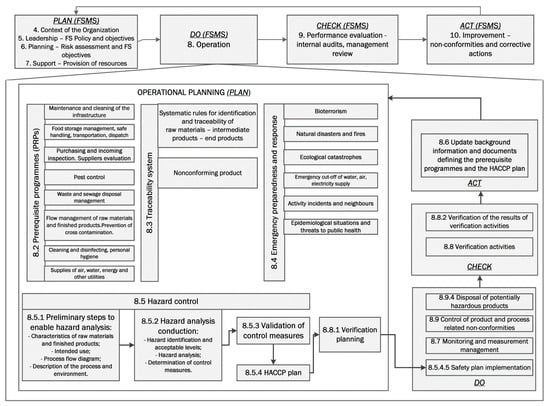
The general diagram of the safety processes is presented in Figure 1 as at the organisational and operational level the main, additional, control and management processes are identified, and the interrelations between them are presented based on the action of the PDCA cycle, set as a requirement in the standard ISO 22000:2018.
Figure 1.
Model for building FSMS through the PDCA cycle (Source: authors).
In determining the processes shown in Figure 1, the key focus is the definition of organisational processes known as “Management Processes”—those that add value to the organisation and on which the achievement of its main objectives depends, and those that shape the company’s activities in terms of strategic planning, resource provision and management of FSMS.
The additional/supporting (operational) processes serve the main ones and support their realisation. As part of the ancillary processes, the so-called control processes are applied to control the implementation of the main processes and the achievement of the planned results in terms of ensuring the safety of the product and the system as a whole. The model presents all processes at the organisational and operational level, which have the ability to achieve measurable results in accordance with measurable goals.
Each process combines many activities, some of which are directly under the direction of others, and others are subject to the influence of external influences. In connection with this and based on the requirements of the standard ISO 22000: 2018 and HACCP specification, with full application of the process approach, a summary diagram of all main, auxiliary and control processes related to the activity is prepared (see Figure 1). By defining the organisational framework, the specific processes for specific production can be determined. The specificity of the processes for each company is the basis for determining and planning the specific elements, factors and criteria that form safety.
The presented model for building a FSMS should not be perceived as a static quantity or phenomenon and not a ready template or response to non-compliance with an organisation; rather, we can say that it is a dynamic and constantly evolving process with skills, experience and dealing with unforeseen circumstances.
Through the attached model, developed and implemented FSMS, each food company will provide:
- Implementation and application of the requirements of the standard ISO 22000:2018 and the legal requirements of the Republic of Bulgaria in its activities and will prove the safety of the manufactured product to all interested parties;
- Proof of compliance with the requirements for an effective food safety system based on Good Manufacturing and Hygienic Practices and HACCP principles;
- Guarantee to all interested parties that safety is ensured and maintained throughout the food chain (from the acceptance and use of food ingredients-raw materials, through the production, storage and sale of finished products to direct and consumption by target groups of consumers).
3.2. Identification of Processes. Risk Assessment Model in FSMS
The identification of the different types of processes covers:
- Processes related to determining the context and requirements of interested parties;
- Processes related to resource management (purchasing, material and human resources, maintenance of appropriate infrastructure and environment);
- Processes related to the management of risks and opportunities for the safety of prepared foods;
- Processes related to planning the creation of safe foods (performing analysis and assessment of hazards, preparation of a technological diagram of the process and preparation of a HACCP plan);
- Processes related to planning measures to control the adequacy of the HACCP plan with the actual state of infrastructure and technological diagram of production;
- Processes related to ensuring the conditions for safe food production related to the hygiene of premises, equipment and personnel;
- Processes related to identification and traceability of raw materials-intermediate products-finished products;
- Processes related to management and disposal of non-compliant raw materials and their subsequent use;
- Processes related to preparedness for response and response to emergencies and incidents (climate, natural and bioterrorism or the emergence of food epidemics);
- Quality management planning processes;
- Processes related to ensuring the management, main, auxiliary (additional) and control processes;
- Processes related to the management of documented information;
- Processes related to the monitoring and control of products and processes;
- Processes related to the storage and handling of raw materials, semi-finished and finished products, object of the company’s activity;
- Processes related to the management of products hazardous to health withdrawn from the market;
- Processes of verification and validation of the HACCP plan and the food safety system as a whole;
- Processes related to the management of non-compliant product and corrective actions before release for shipment;
- Processes related to conducting internal and external audits by control bodies and second parties;
- Processes related to the improvement of FSMS.
The processes listed above can be characterized by emphasizing their specific features. These processes are key to the food safety management system as a whole and are involved in the planning, operation and control of products.
3.3. The Identification of the Processes Related to the Planning and Actions for Managing the Risks and Opportunities for the Product and the System Is a New Moment in the Implementation or Maintenance of the FSMS
By managing the processes related to risk assessment analysis and impact, the determination of the input–output models of the processes in the company is achieved.
Planning is very essential in order to:
- Determine the type and number of indicators for each process to measure and quantify the effectiveness of each process, including the risks and opportunities inherent in the process;
- Identify, analyse, assess and subsequently manage safety risks and opportunities at the organisational and operational level;
- Keep the company’s activities up to date in accordance with the applicable regulatory and other requirements;
- Formulate safety objectives and plan activities to achieve them on risks, as measures to manage the identified risks for each process;
- Reassess the risks and measure the residual risk as a measure of the degree of impact on the risk;
- Plan for changes related to safety risks.
The company ensures the implementation of food storage processes to meet the requirements and needs of customers and consumers by defining approaches that ensure the completeness of the initial results of the processes and process control data. In this way, it provides appropriate evidence to prove that the implementation of all basic, ancillary and control processes is objective and transparent.
When applying the safety requirements set out in the standard, the effectiveness of risk management actions is periodically assessed in practice, ensuring and warranting that the expected results in food storage can be achieved. The impact on the risk will in practice lead to the prevention or reduction of undesirable safety consequences or the identification of a new unspecified hazard to the finished product are ways in which safety is monitored and controlled.
All actions taken to manage risks and opportunities are proportionate to the potential impact on the compliance of stored foods. It is very important to note that by applying the model for building a FSMS according to the accepted criteria of the standard ISO 22000:2018, the assessment of risks and opportunities is limited to assessing events and assessing their consequences of the company’s activities.
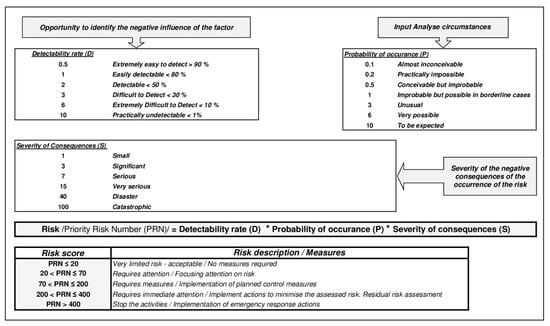
Numerical values of each of the components of the priority risk number (PRN) are determined, which are classified into four groups according to Figure 2. Determining the quantitative value for the severity and probability and establishing the risk for each factor assumes the values shown in Figure 2.
Figure 2.
Determining the risk class (Source: authors).
The implementation of measures related to risk management creates the basis for increasing the efficiency of FSMS, to achieve better results and prevent negative consequences, and is also a basis for setting priorities in the development of the company. The results of the risk assessment can serve as a basis for making adequate management decisions related to achieving the goals by maintaining an efficient safety management system based on the requirements of the ISO 22000:2018 standard, ensuring safety, maintaining the confidence of the consumer and the implementation of measures for continuous improvement.
The final risk factor is calculated by equation in Figure 2 and classified quantitatively in the order specified in Table 1. The selected presented producer is from north-eastern Bulgaria, cultivating 4500 ha of land, 60% of which is sown with soft wheat with an average yield of 5500 kg/ha (total quantity produced 14,850 tonnes). In addition, this producer purchases 10,000 tonnes of cereals from other suppliers, which he sells to an international customer under FOB contracts for export by sea to third countries. It has a staff of 17, of which 11 are involved in the agricultural production of the goods and 6 are involved in ensuring the activities of incoming control, storage of commodities and maintenance of the infrastructure.
Table 1.
Risk assessment for the storage of food of plant origin.
The manufacturer provides certified quality cereals as per the requirements of commercial specification, thereby meeting the customer and regulatory requirements for quality and safety of the batches supplied. Observed problem areas in the storage of crop commodities in the manufacturer’s established infrastructure are as follows:
- -
- Insufficient financial resources to provide instrumental methods for grading of raw material deliveries at incoming inspection. This is the reason for purchasing laboratory services from accredited laboratories to control the quality and safety of the batches formed.
- -
- Shortage of in-house skilled personnel to handle the receiving and storage of the raw materials both produced and purchased. The depopulation of rural areas is one of the main causes of staff shortages.
- -
- Inability to constantly control the storage parameters of goods of plant origin, which creates preconditions for the appearance of non-compliant product.
- -
- The maintenance and renovation of technological equipment for the storage of commodities of plant origin is one of the problem areas in the management of the activity due to lack of financial resources.
The results of the analysis of the investigated company for the production and storage of plant foods from grain show the following estimates:
- -
- The risk scale reaches the highest level for the risk requiring immediate action (200–400) within the processes of resource management, available infrastructure, delivery and incoming control, with two of the same PRN groups (above 400) requiring business shutdown-lack of spare parts and poor planning of purchasing and detection of microbiological contamination in the delivery of raw materials.
- -
- Initial risks requiring immediate action as well as shutdown are characterized by severity of consequences in the group of very serious (value 15) and extremely serious S (40). The value 40 is inherent to activities related to infrastructure and supply and incoming control, and it is noteworthy that even the value is characteristic for an estimated initial risk PRN 60 (requires attention), with a mild degree of detectability (D)-1 and probability of occurrence (P)-3, related to buildings and facilities.
- -
- Qualification and competence of personnel is assessed with initial risk requiring immediate action and formation of residual risk requiring attention and assessment. In addition, the risks in this group are highly probable (6) for both initial and residual risk.
- -
- Initial risks are extremely difficult to detect (D)-6 in activities again related to lack of qualified personnel, available infrastructure and supplies, but also in the dispatch of non-compliant products. The same value is also observed for internal audit processes, non-intermittent improvement and risk and opportunity assessment.
- -
- A real probability of occurrence (P) of 10 exists for the risks of lack of funds for laboratory equipment and acceptance of contaminated food.
- -
- For the most part, the initial risks for individual activities are rated with severity of consequences (S) as serious and very serious.
- -
- Residual risk occurs at PRNs of initial risk in the 200–400 range requiring immediate action. Such a risk may also be detected and require assessment at an initial risk PRN of 180 requiring control activities when associated with a lack of adequate control of food storage parameters, but with very limited risk values PRN 7. Initial risk requiring attention PRN 21 and associated with the disposition of non-compliant products also forms a very limited risk-PRN 18. The activities and causes of non-compliance mismanagement and corrective actions result in a residual acceptable risk-PRN 18.
- -
- The highest residual risk values correlate with the risk originally identified in the human resource management activities and available infrastructure.
- -
- The degree of detectability (D) of the residual risk is mostly in the range 3–6 (difficult and extremely difficult to detect), probability of occurrence at most 1–3 (unlikely and likely) and with varying severity of consequences-from significant to very serious.
The planning and implementation of risk mitigation measures are focused mainly on the impact on significant risks, which require the implementation of immediate and concrete measures. Risk mitigation measures include detailed control of any risk prevention activities and control of the implementation of risk mitigation activities to the minimum possible levels. The planning of measures is always related to the provision of resources (financial, material and human), which are approved by the top management for risk reduction. Table 1 shows that a number of risks with a risk rank have been identified and assessed (PRN is greater than 200) as requiring immediate action. One of the most significant risks is the acceptance of supplies of food contaminated with pathogenic microorganisms (moulds and bacteria). In many cases, when an organisation is unable to act on real risks, it acts to transfer them to another food operator. For example, in many cases, when batches of products of plant origin are inspected on entry, they are refused for storage due to individual batch deliveries having unacceptable values for species and quantity of micro-organisms. A decision is taken to return the delivery and not accept it for storage. In this way, the given operator is released from the obligation to dispose of a supply with real biological risk, but in the food chain the risk continues to exist, only the user responsible for the risk is different. It is possible for another operator to accept it without being able to identify it, during which time the risk may increase to unacceptable levels with values of much greater severity of impact. There is risk avoidance and transfer.
In many cases, when the level of risk requires measures related to the termination of the activity, then the operator himself is unable to cope or influence the risk. The perception and implementation of actions are based on individual planning and focus on risk impact at the industry or country level. These situations require the establishment of policies for joint action in agrarian and food safety related to the impact of identified risks in the food chain (for example: measures for preventive activities in the eastern fields of infection and reduction of plant invasion, adaptive agricultural practices related to weed control, fertilisation and use of species of adaptive plant varieties and their resistance to drought).
Many of the assessed risks (see Table 1) are critical and are defined as risks from the activities of the organisation, i.e., these can be identified as organisational risks. The same can be assumed to have occurred within the organisation and are directly linked to the storage processes of the products of plant origin. In case of these risks (e.g., increase of live contamination and amount of mycotoxins in case of disturbed parameters and storage conditions), immediate action is taken to mitigate the risk. The development and implementation of control for risk prevention, detection or correction (regulation) of the causes of risk are most often planned interventions (e.g., drying, chemical treatment during storage in live infection, ventilation under appropriate conditions-low humidity and temperature). The control over the effective implementation of these measures is aimed at minimizing the risk. The goal is to achieve the maximum effect in reducing live infection, which has been identified as a hazard with a real biological risk of mycotoxins. The achieved effect after the implementation of the planned measures is closely monitored. Quantitative determination of the effect of the impact is achieved by re-assessment of the risk, i.e., quantitative measurement of residual risk (PRN 2). If the residual risk values are in the range that requires monitoring actions, it is necessary to apply follow-up mechanisms to monitor this residual risk. As a result, this means that the residual risk is managed and its follow-up is included in the scope of the FSMS to be managed. If the residual risk after reassessment is within the range requiring immediate action, in this situation the organisation shall take extraordinary action to address that risk (including the destruction of batches for which the biological risk has been identified and which pose a risk for the health of consumers during implementation for further processing).
Of particular importance for the adequate identification and assessment of all specific risks to the activities of the organisation is the shortage or complete absence of qualified and experienced staff. Risk management actions often involve outsourcing or service providers. In any case, if there are no qualified staff, including staff engaged in the implementation and control of the main activities for the storage of plant foods, he himself may pose a risk of recurrence of already mastered risks in the direction of much more high degree of impact and criticality of the consequences. In this situation, for the risks of a critical nature, the measures taken are related to the termination of the company’s activities. Other situations related to the emergence of critical risks, which result in the cessation of the activities of the organisation is the emergence of epidemiological situations related to the seizure and destruction of products prescribed as measures by the executive agencies.
4. Discussion and Conclusions
The application of the approaches set out in the established international standards creates conditions for the development of a modern safety management system at both operational level (including the regulated HACCP specification) and organisational level. Through a modern HACCP system for the storage of plant commodities, which combines international safety requirements and the requirements of national legislation, conditions are provided for the identification, assessment and management of all manifested risks directly affecting the health of consumers.
During the study, the extent of the impact of the measures implemented aimed at minimising or controlling the assessed risks were not identified. These points could represent future lines of research such as to derive quantitative results from this:
- -
- How the implementation of new technological practices or new technological equipment in the production processes of storage will achieve and regulate the storage temperature of goods of plant origin to reduce the intensity of development of hazards of biological origin?
- -
- How will the regulation of the large number of suppliers of small batches and heterogeneous quality improve the quality performance of raw materials in practice?
- -
- The introduction of rapid methods for the implementation of incoming control of supplied raw materials are just some of the important points to investigate for companies with operating FSMS in the agri-food sector.
Due to the importance of FSMS within safety and supply chain management schemes in the agri-food sector, another possible line of inquiry is to investigate and quantify the effectiveness of high-risk processes on both the company’s operations and the products it produces.
By defining the scope and impact of the food safety management systems set as a regulatory requirement, as well as the specific features of its individual elements, objective evidence for ensuring safety can be investigated and derived.
This study attempts to identify opportunities for applying modern approaches and methods to improve the functioning of food safety management systems under specific conditions, namely the storage of plant commodities, by applying the requirements of the latest editions of international food safety management standards. Adopting the approaches in a documented modern safety management system creates opportunities to manage, at an operational level, identified hazards (through analysis and assessment) and, at an organisational level, the resulting risks associated with impacts on consumer health.
The quantitative results obtained from the risk analysis and assessment are the basis for planning events and activities that can be used as a basis for introducing additional approaches related to securing and controlling risks at organisational level to ensure and ensure the safety of the food supply. Specific organisational and technological activities and actions shall be planned in order to achieve an impact in terms of improvement of product properties and control of the correct functioning of the processes for the storage of plant commodities.
The introduction of practices related to the monitoring and measurement of each of the assessed risks individually provides the framework for systematic risk management concerning the safety of stored plant commodities.
As the system is documented and implemented, the focus is on identifying the interrelated processes as a single system for the effective and efficient operation of each organisation’s activities towards achieving its policy and objectives.
Through the establishment and implementation of a modern food safety management system in the agri-food production, the prerequisites for achieving the following results are created:
- -
- Preventive controls are being implemented, focusing on the re-elimination of hazards or their reduction to tolerable limits on the one hand, and taking measures to influence the risk before the release of plant commodities into segments of the food chain;
- -
- Applying scientific and technological knowledge through risk analysis and assessment methods at the organisational level, as well as hazard analysis on product at the operational level related to plant commodity storage processes;
- -
- A functioning and continuously verified system allow risks to be minimised, with actions aimed at protecting consumer health;
- -
- Creating confidence and certainty on the part of the consumer that their requirements and preferences have been achieved, and increases their trust in the organisation;
- -
- The effective operation of an independently assessed and recognised system allows companies to protect themselves from the impact of the surrounding environment and successfully position themselves in the market by demonstrating a willingness to meet the expectations and requirements of all stakeholders;
- -
- Efficient use of inputs as preventive measures to manage assessed risks are aimed at reducing the cost of responding to non-conformities related to the safety of manufactured products;
- -
- Conditions are created for the performance of activities and processes in a controlled environment;
- -
- The system provides the company with the framework and evidence required to produce safe food as a participant in the food chain;
- -
- Having a modern safety management system in place allows for more effective, regulated (government) control and efficient implementation of dynamically changing national and global requirements.
The presented model of food safety management system is a sequence of well-planned organisational and technological activities and actions aimed at product parameters and identified processes. By introducing practices related to analysis, measurement and improvement, risk management determined by the impact of various circumstances in a specific and dynamic work environment is ensured.
The requirements of the established world standards and the growing normative requirements of the European Union are accumulated and united through a food safety management system. The documentation of the system emphasizes the identification of interconnected processes as a single system that contributes to the effective and efficient operation of each organisation to achieve its policies and objectives. The references and requirements set out in the ISO 22000:2018 standard can be applied as a model for planning, management, verification and improvement of processes, and not only as standards allowing certification.
Author Contributions
Conceptualisation, A.S. and D.S.; methodology, A.S. and V.M.; validation, V.M., D.S. and D.K.; resources, D.S. and D.K.; writing—original draft preparation, A.S. and D.S.; writing—review and editing, V.M.; visualisation, D.S. and D.K.; supervision, A.S.; project administration, D.K. All authors have read and agreed to the published version of the manuscript.
Funding
This research received no external funding.
Institutional Review Board Statement
Not applicable.
Informed Consent Statement
Not applicable.
Data Availability Statement
Not applicable.
Acknowledgments
The study presented in the paper is the result of the authors’ work under the research project NPI-47/2020 “Contemporary approaches for sustainable management of the agro-food chain in Bulgaria”, implemented with the support of the University of Economics-Varna and financial assistance from the state budget of the Republic of Bulgaria.
Conflicts of Interest
The authors declare no conflict of interest.
References
- Food Act. State Gazette; Official Publication of the Republic of Bulgaria; National Assembly: Sofia, Bulgaria, 2020; Issue 52, pp. 2–38. [Google Scholar]
- Regulation (EC). No 178/2002 of the European Parliament and of the Council of 28 January 2002 laying down the general principles and requirements of food law, establishing the European Food Safety Authority and laying down procedures in matters of food safety. Off. J. 2002, L031, 1–24. [Google Scholar]
- CODEX; Codex Alimentarius Commission: Codex Committee on Food Hygiene. Guideline for the Application of Hazard Analysis Critical Control Point (HACCP) System (Alinorm 97/13A, Appendex II); FAO/WHO: Rome, Italy, 1993. [Google Scholar]
- World Health Organization. Food Safety Team & Food and Agriculture Organization of the United Nations. In Proceedings of the Guidance on Regulatory Assessment of HACCP: Report of a Joint FAO/WHO Consultation on the Role of Government Agencies in Assessing HACCP, Geneva, Switzerland, 2–6 June 1998; World Health Organization: Geneva, Switzerland, 1998. Available online: apps.who.int/iris/handle/10665/64440 (accessed on 18 June 2022).
- Dora, M.; Kumar, M.; Van Goubergen, D.; Molnar, A.; Gellynck, X. Food quality management system: Reviewing assessment strategies and a feasibility study for European food small and medium-sized enterprises. Food Control 2013, 31, 607–616. [Google Scholar] [CrossRef] [Scilit]
- Gereffi, G.; Lee, J. A global value chain approach to food safety and quality standards. In Global Health Diplomacy for Chronic Disease Prevention Working Paper Series; Duke University: Durham, NC, USA, 2002; p. 51. [Google Scholar]
- Henson, S. The role of public and private standards in regulating international food markets. J. Int. Agric. Trade Dev. 2008, 4, 63–81. [Google Scholar]
- Kowalska, A.; Manning, L. Using the rapid alert system for food and feed: Potential benefits and problems on data interpretation. Crit. Rev. Food Sci. Nutr. 2021, 61, 906–919. [Google Scholar] [CrossRef] [Scilit] [PubMed]
- Stefanova, M.G. Risk analysis and impact of raw materials for achievement of sustainable quality of biscuit products. J. Food Sci. Eng. 2017, 7, 227–238. [Google Scholar] [CrossRef] [Scilit]
- Stefanova, M.G. Integrating Quality and Risk Management in Logistics; IntechOpen: London, UK, 2022; p. 122. [Google Scholar] [CrossRef] [Scilit]
- Ministry of Agriculture, Food and Forestry of Republic of Bulgaria. Agricultural Report 2021. Available online: https://www.mzh.government.bg/media/filer_public/2022/01/21/ad_2021_en.pdf (accessed on 18 June 2022).
- Visciano, P.; Schirone, M. Food frauds: Global incidents and misleading situations. Trends Food Sci. Technol. 2021, 114, 424–442. [Google Scholar] [CrossRef] [Scilit]
- Fulponi, L. The globalization of private standards and the agri-food system. In Global Supply Chains, Standards. Affects Rural Development and Poverty, 1st ed.; Swinnen, J.F.M., Ed.; CAB International: Cambridge, UK, 2007; Available online: https://sherekashmir.informaticspublishing.com/670/1/9781845931858.pdf (accessed on 18 June 2022).
- EFSA. EFSA Panel on Food Contact Materials, Enzymes, Flavourings and Processing Aids (CEF). Scientific Opinion on Flavouring Group Evaluation 20, Revision 3 (FGE.20Rev3): Benzyl Alcohols, Benzaldehydes, a Related Acetal, Benzoic Acids, and Related Esters from Chemical Groups 23 and 30; European Food Safety Authority: Palma, Italy, 2011. [Google Scholar] [CrossRef]
- Mallon, C.A.; Elsas, J.D.V.; Salles, J.F. Microbial invasions: The process, patterns, and mechanisms. Trends Microbiol. 2015, 23, 719–729. [Google Scholar] [CrossRef] [Scilit]
- WHO. Advancing Food Safety Initiatives: Strategic Plan for Food Safety Including Foodborne Zoonoses 2013–2022; World Health Organization: Geneva, Switzerland, 2014; Available online: www.who.int/publications/i/item/9789241506281 (accessed on 18 June 2022).
- Taylor, M.R.; Hoffmann, S.A. Redesigning food safety. Issues Sci. Technol. 2001, 17, 26–30. [Google Scholar]
- Carlson, C. Effective FMEAs: Achieving Safe, Reliable, and Economical Products and Processes Using Failure Mode and Effects Analysis; John Wiley& Sons: Hoboken, NJ, USA, 2012; 464p. [Google Scholar]
- Baines, N. Delivering Performance in Food Supply Chains. In Quality and Safety Standards in Food Supply Chains, 1st ed.; Woodhead Publishing: Cambridge, UK, 2010. [Google Scholar]
- Mena, C.; Graham, S. Delivering Performance in Food Supply Chains; Elsevier: Cambridge, UK, 2010. [Google Scholar]
- Soon, J.M.; Baines, R.N. Public and Private Food Safety Standards: Facilitating or Frustrating Fresh Produce Growers? Laws 2013, 2, 1–19. [Google Scholar] [CrossRef] [Scilit]
- Orriss, G.; Whitehead, A. Hazard analysis and critical control point (HACCP) as a part of an overall quality assurance system in international food trade. Food Control 2000, 11, 345–351. [Google Scholar] [CrossRef] [Scilit]
- ISO 9000:2000; Quality Management Systems—Fundamentals and Vocabulary. ISO: Geneva, Switzerland, 2000. Available online: https://www.iso.org/standard/29280.html (accessed on 20 April 2022).
- Nováková, R.; Cekanova, K.; Pauliková, A. Integration management system–new of requirements of ISO 9001:2015 and ISO 14001:2015 standards. Prod. Eng. Arch. 2016, 13, 35–40. [Google Scholar] [CrossRef] [Scilit]
- ISO 9001:2015; Quality Management Systems—Requirements. International Organization for Standardization with Technical Committee: Geneva, Switzerland, 2015; p. 29.
- ISO 22000:2005; Food Safety Management Systems—Requirements for Any Organization in the Food Chain. International Organization for Standardization with Technical Committee: Geneva, Switzerland, 2005; p. 32.
- ISO 22000:2018; Food Safety Management Systems—Requirements for Any Organization in the Food Chain. International Organization for Standardization with Technical Committee: Geneva, Switzerland, 2018; p. 37.
- Zimon, D.; Domingues, P. Impact of implementation of ISO 22000 on food safety throughout the supply chain: Insights from Poland, Slovakia and Portugal. Int. J. Product. Qual. Manag. 2020, 30, 509–526. [Google Scholar] [CrossRef] [Scilit]
- Stefanova, M.G.; Stoyanova, A. Process-based approach in the Quality management systems implementation. In Proceeding of the Commodity Science in a Changing World: 20th IGWT Symposium, University of Economics, Varna, Bulgaria, 12–16 September 2016; pp. 470–476. [Google Scholar]
- Granja, N.; Domingues, P.; Cabecinhas, M.; Zimon, D.; Sampaio, P. ISO 22000 Certification: Diffusion in Europe. Resources 2021, 10, 100. [Google Scholar] [CrossRef] [Scilit]
- Casolani, N.; Liberatore, L.; Psomas, E. Implementation of quality management system with ISO 22000 in food Italian companies. Calitatea 2018, 19, 125–131. [Google Scholar]
- Barbancho-Maya, G.; López-Toro, A.A. Determinants of quality and food safety systems adoption in the agri-food sector. Br. Food J. 2022, 124, 219–236. [Google Scholar] [CrossRef] [Scilit]
- Rafeeque, M.K.; Sekharan, M.N. Multiple food safety management systems in food industry: A case study. Int. J. Food Sci. Nutr. 2018, 23, 37–44. [Google Scholar]
- Chen, H.; Liu, S.; Chen, Y.; Chen, C.; Yang, H.; Chen, Y. Food safety management systems based on ISO 22000:2018 methodology of hazard analysis compared to ISO 22000:2005. Accredit. Qual. Assur. 2020, 25, 23–37. [Google Scholar] [CrossRef] [Scilit]
- Carmona-Calvo, M.A.; Suárez, E.M.; Calvo-Mora, A.; Periáñez-Cristóbal, R. Sistemas de gestión de la calidad: Un estudio en empresas del sur de España y norte de Marruecos. In European Research on Management and Business Economics (ERMBE); Elsevier: Amsterdam, The Netherlands, 2016; Volume 22, pp. 8–16. [Google Scholar] [CrossRef] [Scilit]
- Escanciano, C.; Leticia Santos-Vijande, M. Implementation of ISO-22000 in Spain: Obstacles and key benefits. Br. Food J. 2014, 116, 1581–1599. [Google Scholar] [CrossRef] [Scilit]
- Díaz Romero, C.C.; Rodríguez Rojas, Y.L. Beneficios e impactos de la implementación de normas técnicas en las organizaciones: Una revisión sistemática. SIGNOS Investig. En Sist. De Gestión 2016, 8, 133–167. [Google Scholar] [CrossRef] [Scilit]
- Gil, L.; Ruiz, P.; Escrivá, L.; Font, G.; Manyes, L. A decade of Food Safety Management System based on ISO 22000: A global overview. Rev. De. Toxicol. 2017, 34, 84–93. [Google Scholar]
- Zimon, D.; Madzík, P. Standardized management systems and risk management in the supply chain. Int. J. Qual. Reliab. Manag. 2020, 37, 305–327. [Google Scholar] [CrossRef] [Scilit]
- da Cunha, D.T. Improving food safety practices in the foodservice industry. Curr. Opin. Food Sci. 2021, 42, 127–133. [Google Scholar] [CrossRef] [Scilit]
- Stefanova, M.G.; Gotcheva, V. Possibilities for integrating the requirements of food quality and safety management standards. In Scientific Works of University of Food Technologies—Plovdiv; University of Food Technologies: Plovdiv, Bulgaria, 2016; Volume 63, pp. 111–118. [Google Scholar]
- Samani, M.A.; Ismail, N.; Leman, Z.; Zulkifli, N. Development of a conceptual model for risk-based quality management system. Total Qual. Manag. Bus. Excell. 2019, 30, 483–498. [Google Scholar] [CrossRef] [Scilit]
- IEC 31010:2019; Risk Management—Risk Assessment Techniques, Technical Committee: ISO/TC 262 Risk Management, ICS: 03.100.01 Company Organization and Management in General, 2nd ed. International Organization for Standardization with Technical Committee: Geneva, Switzerland, 2019; p. 264. Available online: https://www.iso.org/standard/72140.html (accessed on 20 April 2022).
- Bulgarian Institute of Standardization. БДC EN IEC 31010:2019, Risk Management—Risk Assessment Techniques. Available online: https://bds-bg.org/bg/project/show/bds:proj:105683 (accessed on 20 June 2022).
- Stoyanova, A. Unified Approach to Integrated Food Quality and Safety Management. In Sustainable Supply Chain Management for the Global Economy: Handbook of Research; IGI Global Publisher: Hershey, PA, USA, 2020; pp. 238–259. Available online: www.igi-global.com/chapter/unified-approach-to-integrated-food-quality-and-safety-management/257473 (accessed on 20 June 2022).
- Nayak, R.; Waterson, P. Global food safety as a complex adaptive system: Key concepts and future prospects. Trends Food Sci. Technol. 2019, 91, 409–425. [Google Scholar] [CrossRef] [Scilit]


Publisher’s Note: MDPI stays neutral with regard to jurisdictional claims in published maps and institutional affiliations. |
© 2022 by the authors. Licensee MDPI, Basel, Switzerland. This article is an open access article distributed under the terms and conditions of the Creative Commons Attribution (CC BY) license (https://creativecommons.org/licenses/by/4.0/).