


Enhancement of In-Store Product Replenishment Flow and Introduction of Pull Approach in a Food Retail Chain




Abstract
1. Introduction
2. Literature Review
2.1. Origins and Evolution of Lean Thinking
2.2. Practical Applications and Limitations of Lean in Retail Supply Operations
- A scarcity of empirical evidence evaluating Pull-based replenishment in supermarkets, particularly regarding its effects on operational efficiency and labour resource allocation. While works such as the work from Guimarães et al. [3] and from Marques et al. [28] investigate in-store logistics, few provide quantifiable insights into this specific transition.
- Limited exploration of integrating Lean methodologies with real-time inventory tracking, a key factor in reducing stockouts and improving on-shelf availability. Although Lean has shown success in broader distribution and e-commerce settings [29,36,53], its application at the shelf level remains underdeveloped.
3. Methodology
4. Results
4.1. Initial Situation: “Push” Approach
4.2. Intervention: Implementation of the “Pull” Mechanisms
- i.
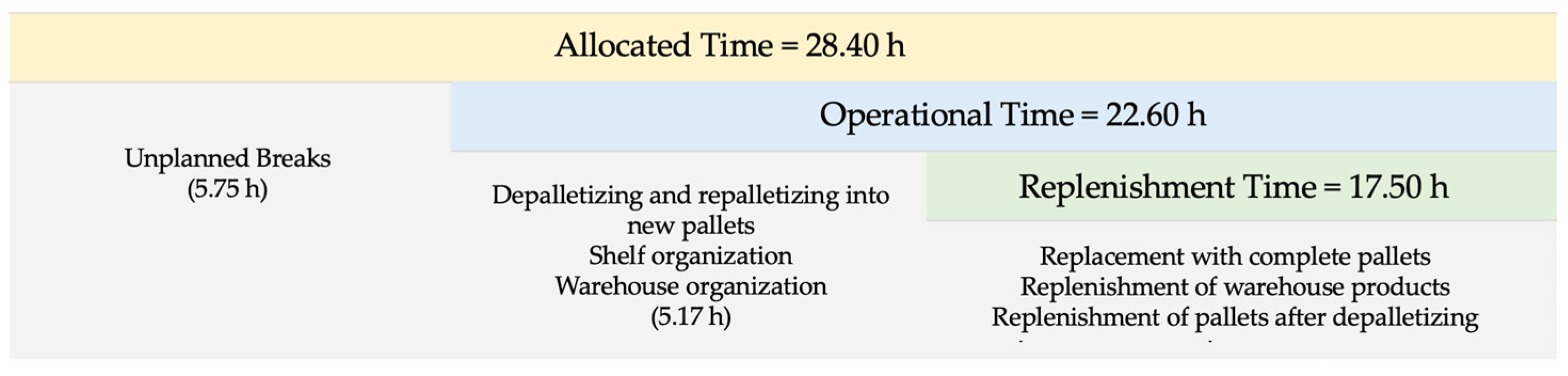
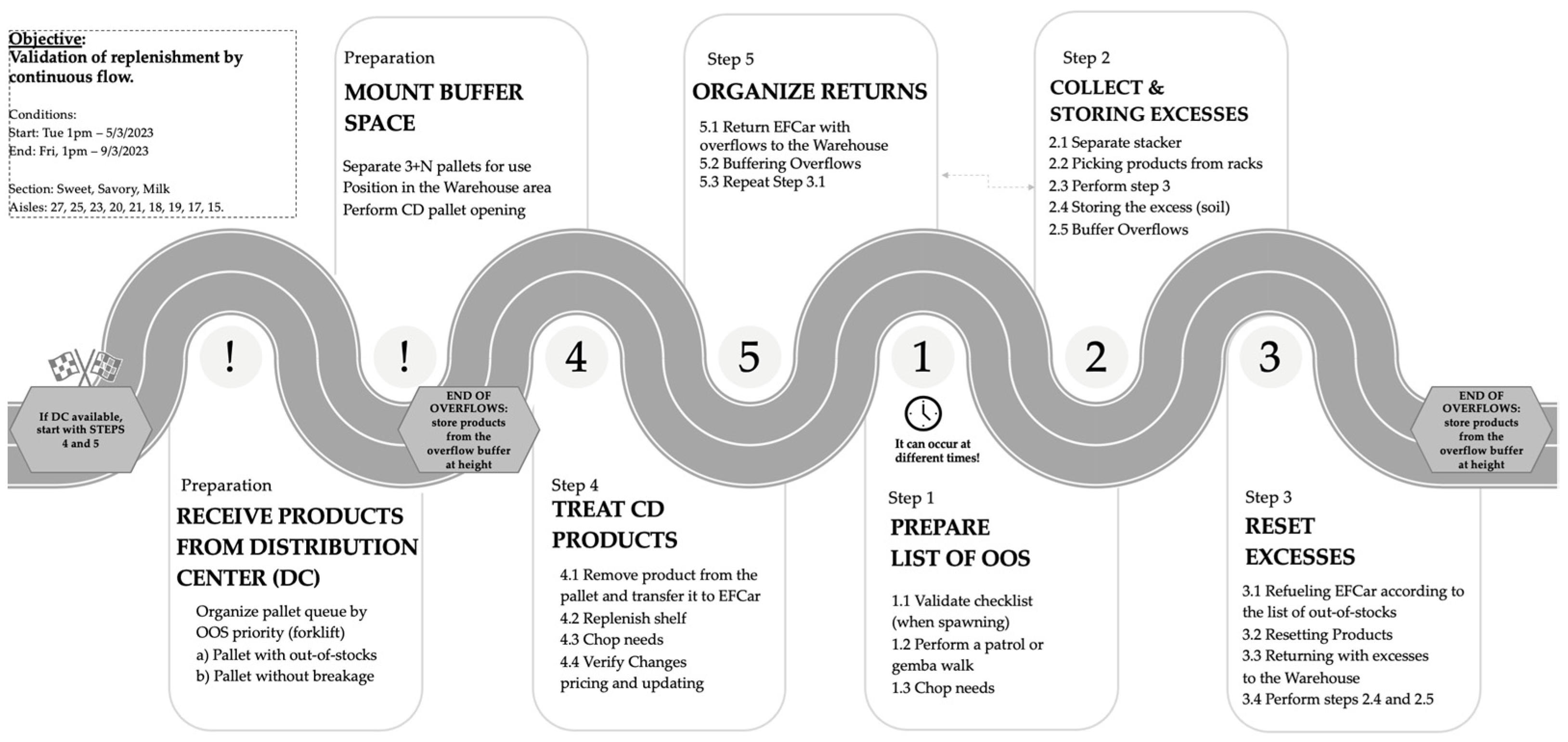
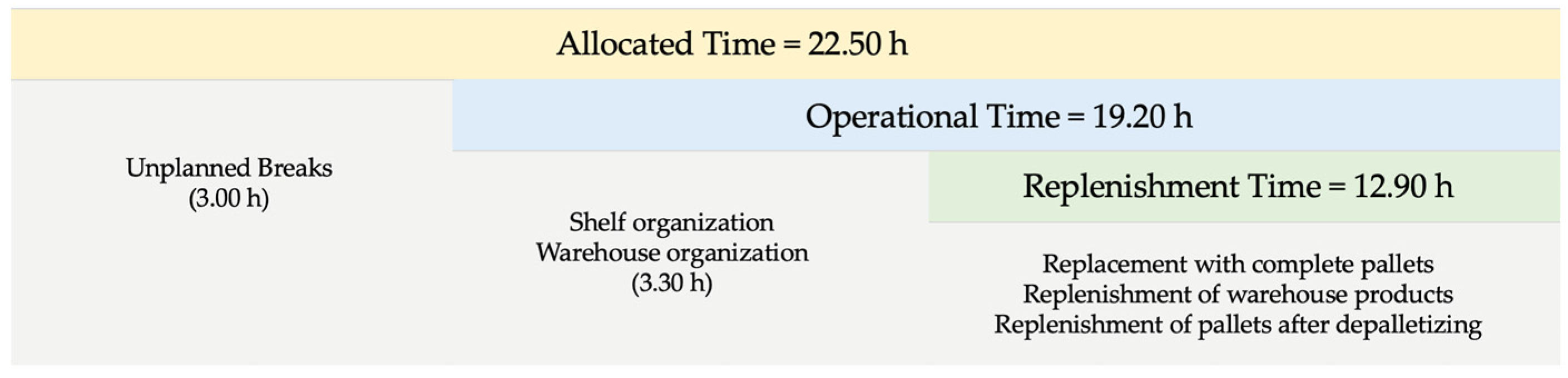
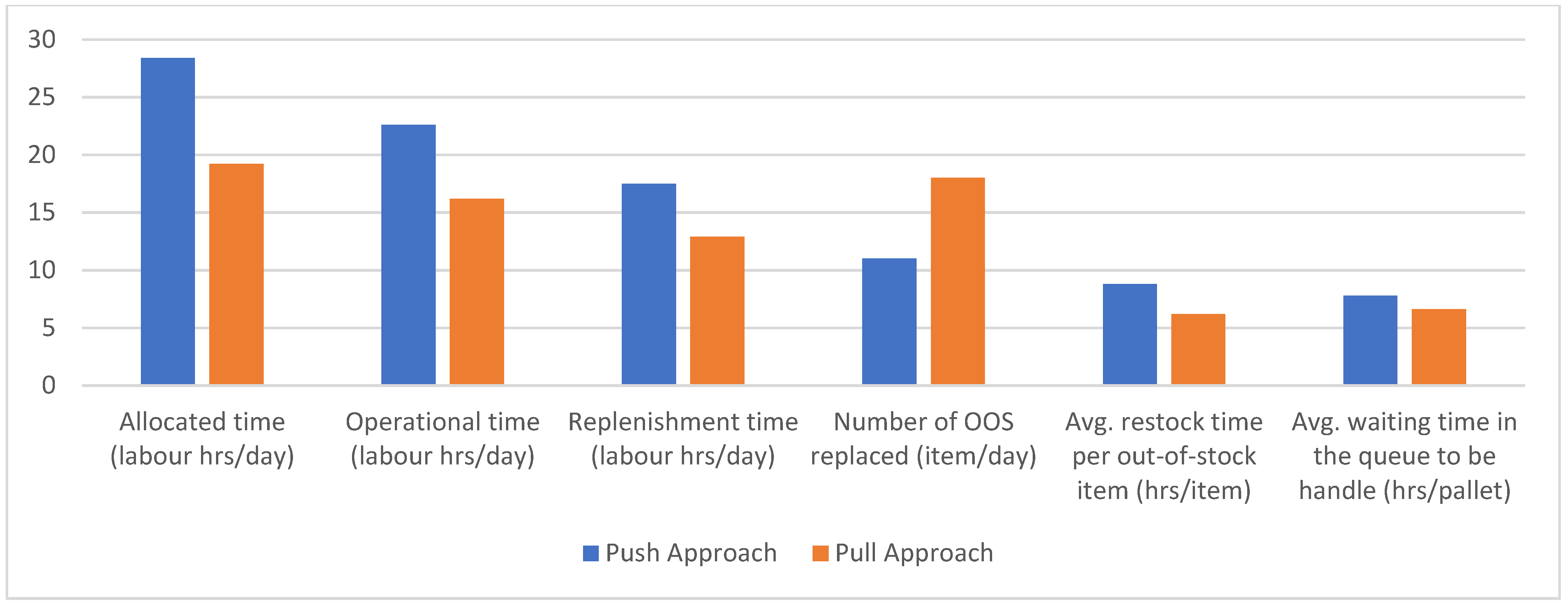
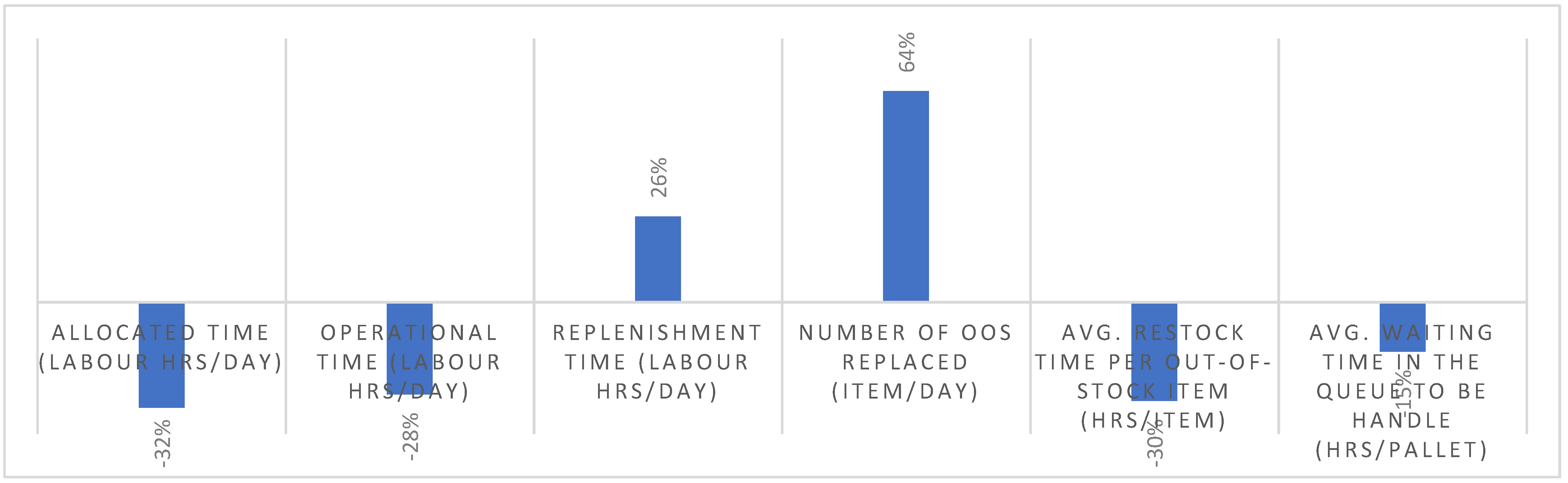
- Operational gains: the intervention focused on refining and adjusting the process to increase operational efficiency, which was validated through time improvements. By transitioning from a “push” to a “pull” replenishment system, we reduced unnecessary handling and transportation, which resulted in a decrease in the number of daily working hours from 28.40 to 19.20. This time saving of approximately 32%, demonstrates the reduction in resource requirements and the elimination of excessive movements, such as sorting pallets, disposing of cardboard, and operating pallet trucks. There was also an elimination of transport and movements related to the returning of products to the warehouse. The improvement has also minimized unproductive tasks, showing a leaner and more efficient process, with fewer delays and optimized resource allocation.
- ii.
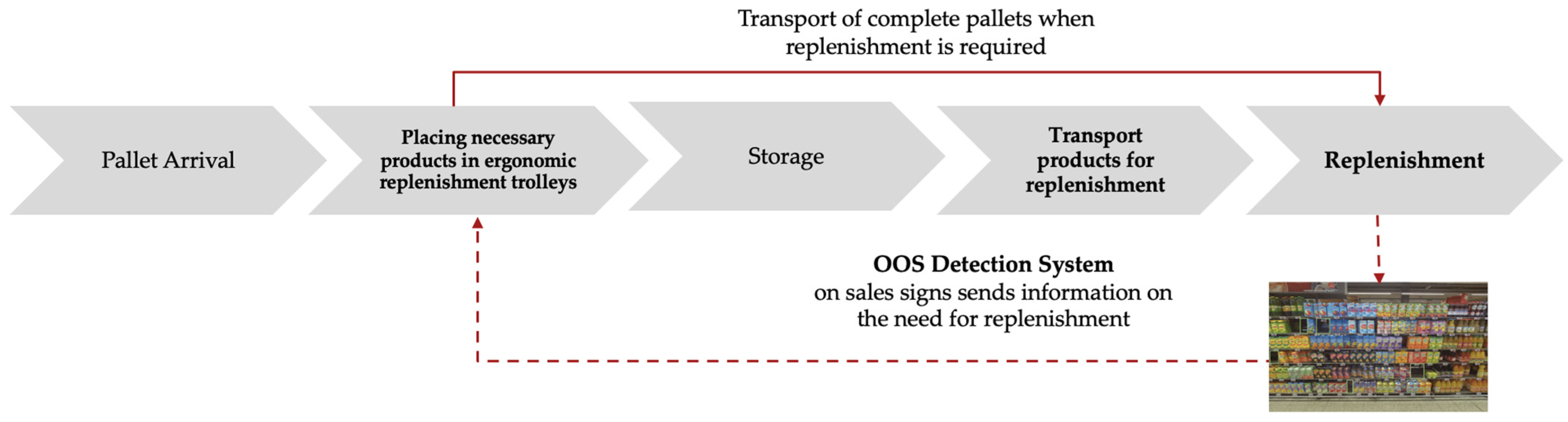
- Service level: getting products on the shelves in less time and with a wider range of items has allowed us to respond better and faster to customer needs. Switching to a pull approach increased the availability of products on the shelves during store opening hours, providing a faster response to customer needs. The results of a study carried out in the cereals aisle showed an estimated 64% improvement in the availability of products on the shelves, as well as a 15% reduction in the waiting time to replenish each item (measured by the indicator “Average waiting time to replenish each missing item”). These changes ensure that customers are faced with fewer stock-outs and more readily available products, directly improving their shopping experience and satisfaction.
- iii.
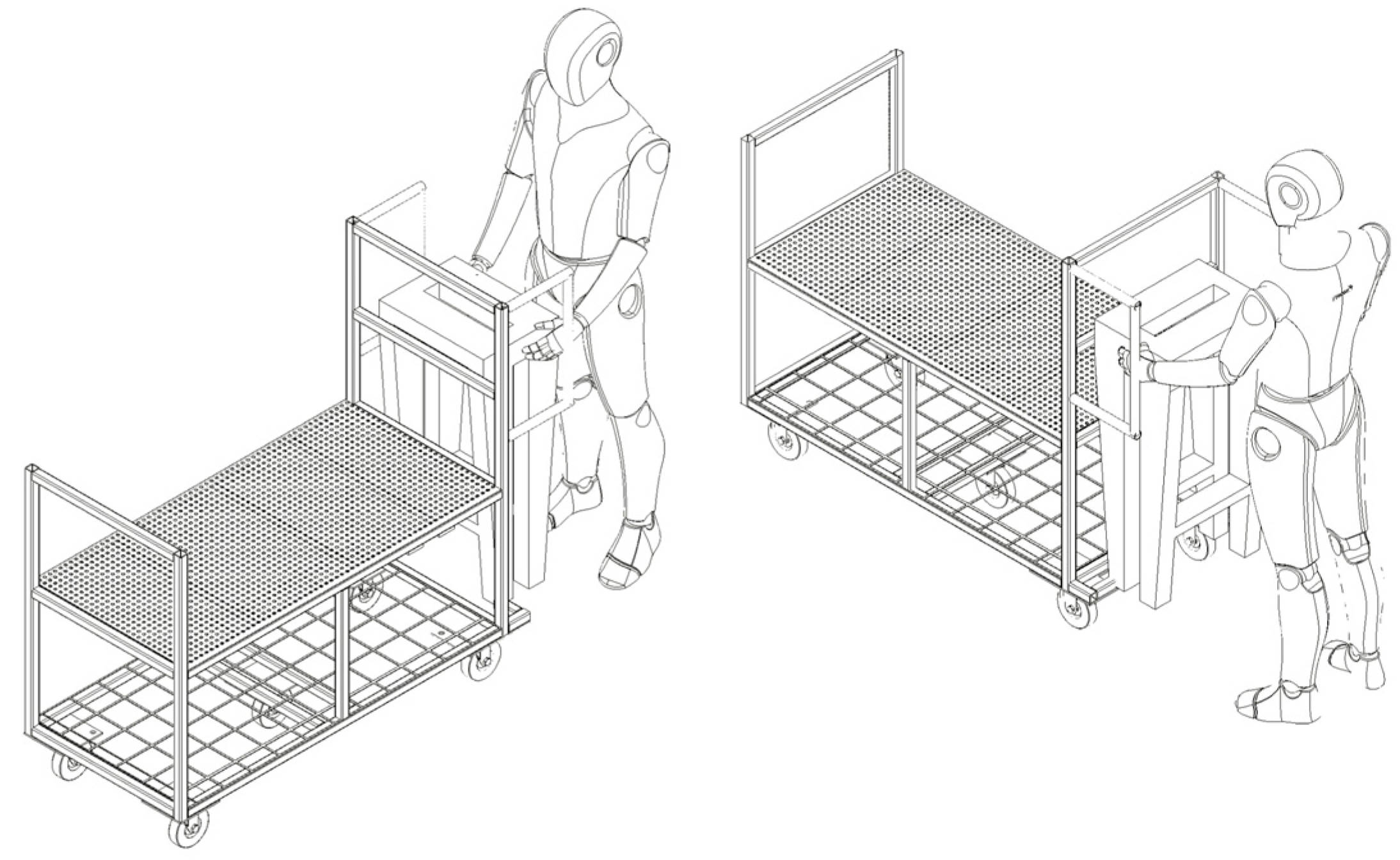
- Team adaptation needs: implementing a new replenishment method requires the team to adapt to the new workflow and responsibilities, which can be a challenge. This trans-formation of the process can generate resistance as employees adapt to different tasks and routines, especially when incorporating new techniques and equipment, replenishment at various times of the day and the use of ergonomic trolleys. Managing this transition is important to ensure that the team fully adopts the “pull” replenishment approach. Training has been provided to help operators understand the concept and prioritize based on product needs, but ongoing support and communication is crucial to minimize resistance and support long-term adoption of the new procedures.
5. Discussion
6. Conclusions
Author Contributions
Funding
Data Availability Statement
Acknowledgments
Conflicts of Interest
References
- Hamilton, S.F.; Liaukonyte, J.; Richards, T.J. Pricing Strategies of Food Retailers. Annu. Rev. Resour. Econ. 2020, 12, 87–110. [Google Scholar] [CrossRef] [Scilit]
- Filipe, D.; Pimentel, C. Production and Internal Logistics Flow Improvements through the Application of Total Flow Management. Logistics 2023, 7, 34. [Google Scholar] [CrossRef] [Scilit]
- Guimarães, R.; Almeida, L.; Barros, M.; Afecto, M.C.; Figueira, M.L.; Mota, D.; Galvão, M.; Barreira, M.; Lima, R.M. Restructuring picking and restocking processes on a hypermarket. Prod. Eng. Arch. 2022, 28, 64–72. [Google Scholar] [CrossRef] [Scilit]
- Marques, P.A.; De Carvalho, A.M. Reducing Shrinkage and Stockouts in a Food Retail Store. J. Tek. Ind. 2021, 23, 93–100. [Google Scholar] [CrossRef] [Scilit]
- Womack, J.; Jones, D. Lean thinking: Banish Waste and Create Wealth in Your Corporation; Fee Press: New York, NY, USA, 1996; ISBN 0-7432-4927-5. [Google Scholar]
- Moorthy, R.; Behera, S.; Verma, S. On-Shelf Availability in Retailing. Int. J. Comput. Appl. 2015, 115, 47–51. [Google Scholar] [CrossRef] [Scilit]
- Liker, J. Toyota Way: 14 Management Principles from the World’s Greatest Manufacturer; McGraw-Hill Education: New York, NY, USA, 2004; ISBN 0071392319. [Google Scholar]
- Monden, Y. Toyota Production System: An Integrated Approach to Just-in-Time; Springer: New York, NY, USA, 1993; ISBN 9780412582202. [Google Scholar]
- Womack, J.; Jones, D.; Roos, D. The Machine That Changed the World; Free Press: New York, NY, USA, 1990; ISBN 0892563508. [Google Scholar]
- Naftanaila, I.; Radu, C.; Cioana, G. Operational Excellence-A Key to World-Class Business Performance. Stud. Bus. Econ. 2013, 8, 133–141. [Google Scholar]
- Delbridge, R.; Oliver, N. Narrowing the gap? Stock turns in the Japanese and Western car industries. Int. J. Prod. Res. 1991, 29, 2083–2095. [Google Scholar] [CrossRef] [Scilit]
- Hogg, T.M. Lean Manufacturing. Hum. Syst. Manag. 1993, 12, 35–40. [Google Scholar] [CrossRef] [Scilit]
- Dekier, Ł. The origins and evolution of Lean Management system. J. Int. Stud. 2012, 5, 46–51. [Google Scholar] [CrossRef] [Scilit]
- Thomas, H.R.; Horman, M.J.; de Souza, U.E.L.; Zavřski, I. Reducing Variability to Improve Performance as a Lean Construction Principle. J. Constr. Eng. Manag. 2002, 128, 144–154. [Google Scholar] [CrossRef] [Scilit]
- Ibrahim, A.R.; Imtiaz, G.; Mujtaba, B.; Vinh Vo, X.; Ahmed, Z.U. Operational excellence through lean manufacturing: Considerations for productivity management in Malaysia’s construction industry. J. Transnatl. Manag. 2020, 25, 225–256. [Google Scholar] [CrossRef] [Scilit]
- Carvalho, J.D. Continuous Improvement in Organizations; River Publishers: Gistrup, Denmark, 2023. [Google Scholar]
- Pojasek, R.B. Lean, six sigma, and the systems approach: Management initiatives for process improvement. Environ. Qual. Manag. 2003, 13, 85–92. [Google Scholar] [CrossRef] [Scilit]
- Buell, R.S.; Turnipseed, S.P. Application of lean six sigma in oilfield operations. SPE Prod. Facil. 2004, 19, 201–208. [Google Scholar] [CrossRef] [Scilit]
- Ali, Y.; Younus, A.; Khan, A.U.; Pervez, H. Impact of Lean, Six Sigma and environmental sustainability on the performance of SMEs. Int. J. Product. Perform. Manag. 2021, 70, 2294–2318. [Google Scholar] [CrossRef] [Scilit]
- Kidd, P.T. Agile Manufacturing: Forging New Frontiers, 1st ed.; Addison-Wesley: Boston, MA, USA, 1994; ISBN-13:978-0201631630. [Google Scholar]
- Kurtz, J.; Nagy, P. Agile software development with SCRUM invited talk. In Proceedings of the 10th Symposium on Programming Languages and Software Tools, SPLST 2007, Dobogókő, Hungary, 14–16 June 2007. [Google Scholar]
- Conboy, K.; Fitzgerald, B. Toward a conceptual framework of Agile methods. In Extreme Programming and Agile Methods—XP/Agile Universe 2004; Lecture Notes in Computer Science (Including Subseries Lecture Notes in Artificial Intelligence and Lecture Notes in Bioinformatics); Springer: Berlin/Heidelberg, Germany, 2004; Volume 3134, pp. 105–116. [Google Scholar] [CrossRef] [Scilit]
- Saad, S.M.; Gindy, N.N.Z. Future shape of the responsive manufacturing enterprise. Benchmarking 2007, 14, 140–152. [Google Scholar] [CrossRef] [Scilit]
- Abernathy, F.H.; Dunlop, J.T.; Hammond, J.H.; Weil, D. A Stitch in Time: Lean Retailing and the Transformation of Manufacturing–Lessons from the Apparel and Textile Industries; Oxford University Press: Oxford, UK, 1999; Volume 121. [Google Scholar]
- Marques, P.A.; Carvalho, A.M.; Santos, J.O. Improving Operational and Sustainability Performance in a Retail Fresh Food Market Using Lean: A Portuguese Case Study. Sustainability 2022, 14, 403. [Google Scholar] [CrossRef] [Scilit]
- Rajagopalan, S.; Kumar, K.R. Retail stocking decisions with order and stock sales. J. Oper. Manag. 1994, 11, 397–410. [Google Scholar] [CrossRef] [Scilit]
- Silva, P.; Braga, A.; Mota, S.; Soares, M.; Ferreira, M.R. A Lean-Kaizen implementation: A case study in the food retail industry. In Reviving Businesses with New Organizational Change Management Strategies; IGI Global: Hershey, PA, USA, 2021. [Google Scholar] [CrossRef] [Scilit]
- Marques, P.A.; Jorge, D.; Reis, J. Using Lean to Improve Operational Performance in a Retail Store and E-Commerce Service: A Portuguese Case Study. Sustainability 2022, 14, 5913. [Google Scholar] [CrossRef] [Scilit]
- Qin, Y.; Liu, H. Application of Value Stream Mapping in E-Commerce: A Case Study on an Amazon Retailer. Sustainability 2022, 14, 713. [Google Scholar] [CrossRef] [Scilit]
- Jimenez, L.B.; Cuadros, C.C.; Aranibar, M.T.N. Systematic literature review of the application of lean methodologies in the retail sector. In Proceedings of the International Conference on Industrial Engineering and Operations Management, Singapore, 7–11 March 2021. [Google Scholar]
- Jie, F.; Gengatharen, D. Australian food retail supply chain analysis. Bus. Process Manag. J. 2019, 25, 271–287. [Google Scholar] [CrossRef] [Scilit]
- Quispe-Romani, M.; Cespedes-Saric, P.; Altamirano-Flores, E.; Viacava-Campos, G. Kaizen Philosophy to Improve Service Levels at an OTR Tire Distribution Company. In Proceedings of the 2022 Congreso Internacional de Innovacion y Tendencias en Ingenieria (CONIITI), Bogota, Colombia, 5–7 October 2022. [Google Scholar] [CrossRef] [Scilit]
- Egoavil Bazán, R.S.; Rodriguez Ortiz, N.S.; De Pina, J.M.M. Lean Management Practices Applied in Retail Sector Businesses: A Systematic Review of Literature. In Proceedings of the 4th South American International Conference on Industrial Engineering and Operations Management, Lima, Peru, 8–11 May 2023. [Google Scholar] [CrossRef] [Scilit]
- Plapper, P.; Oberhausen, C.; Minoufekr, M. Application of value stream management to enhance product and information flows in supply chain networks–Based on the example of web-based automotive retail business. Manag. Prod. Eng. Rev. 2018, 9, 13–19. [Google Scholar] [CrossRef]
- Marrucci, L.; Marchi, M.; Daddi, T. Improving the carbon footprint of food and packaging waste management in a supermarket of the Italian retail sector. Waste Manag. 2020, 105, 594–603. [Google Scholar] [CrossRef] [Scilit] [PubMed]
- Panayiotou, N.A.; Stergiou, K.E. Development of a retail supply chain process reference model incorporating Lean Six Sigma initiatives. Int. J. Lean Six Sigma 2023, 14, 209–251. [Google Scholar] [CrossRef] [Scilit]
- Cox, A.; Chicksand, D. The limits of lean management thinking: Multiple retailers and food and farming supply chains. Eur. Manag. J. 2005, 23, 648–662. [Google Scholar] [CrossRef] [Scilit]
- Taylor, D.H. Demand management in agri-food supply chains: An analysis of the characteristics and problems and a framework for improvement. Int. J. Logist. Manag. 2006, 17, 163–186. [Google Scholar] [CrossRef] [Scilit]
- Naruo, S.; Toma, S.G. From toyota production system to lean retailing. Lessons from seven-eleven Japan. In IFIP International Federation for Information Processing; Springer: Boston, MA, USA, 2007; Volume 246. [Google Scholar] [CrossRef] [Scilit]
- Quinones, M.; Gomez-Suarez, M.; Cruz-Roche, I.; Díaz-Martín, A.M. Technology: A strategic imperative for successful retailers. Int. J. Retail Distrib. Manag. 2023, 51, 546–566. [Google Scholar] [CrossRef] [Scilit]
- Sezen, B.; Turkkantos, S. The effects of relationship quality and lean applications on buyer-seller relationships. Int. J. Bus. Perform. Supply Chain Model. 2013, 5, 378–400. [Google Scholar] [CrossRef] [Scilit]
- Kaelberer, M. Wal-mart goes to Germany: Culture, institutions, and the limits of globalizations. Ger. Polit. Soc. 2017, 35, 1–18. [Google Scholar] [CrossRef] [Scilit]
- Abdelhadi, A. Applying lean manufacturing to retail business to prevent the spread of COVID-19. Acad. Strateg. Manag. J. 2021, 20, 1–5. Available online: https://www.abacademies.org/articles/applying-lean-manufacturing-to-retail-business-to-prevent-the-spread-of-covid-19-10852.html (accessed on 7 May 2025).
- Panizo, N.P.G.P.; Alvarez, T.Z.O.; Ortiz, R.N.M. Increase inventory accuracy and availability through the implementation of a logistics process control model based on lean tools in SMEs in the retail sector. In Proceedings of the 2024 9th International Engineering, Sciences and Technology Conference (IESTEC), Panama, Panama, 23–25 October 2024; pp. 1–6. [Google Scholar] [CrossRef] [Scilit]
- Aitken, J.; Childerhouse, P.; Christopher, M.; Towill, D. Designing and Managing Multiple Pipelines. J. Bus. Logist. 2005, 26, 73–96. [Google Scholar] [CrossRef] [Scilit]
- Fisher, M. Rocket science retailing: The 2006 philip mccord morse lecture. Oper. Res. 2009, 57, 527–540. [Google Scholar] [CrossRef] [Scilit]
- Notomi, N.; Tsukamoto, M.; Kimura, M.; Yamamoto, S. ICT and the future of the retail industry-Consumer-centric retailing. NEC Tech. J. 2015, 10, 38–41. [Google Scholar]
- Mollenkopf, D.; Stolze, H.; Tate, W.L.; Ueltschy, M. Green, lean, and global supply chains. Int. J. Phys. Distrib. Logist. Manag. 2010, 40, 14–41. [Google Scholar] [CrossRef] [Scilit]
- Hamerski, D.C.; Formoso, C.T.; Isatto, E.L.; Cevallos, C.A. Combining lean and agile project management in a multi-project environment: Case study in a retail company. In Proceedings of the 27th Annual Conference of the International Group for Lean Construction, Dublin, Ireland, 3–5 July 2019. [Google Scholar] [CrossRef] [Scilit]
- Lukic, R. The effects of application of lean concept in retail. Econ. Ser. Manag. 2012, 15, 88–98. [Google Scholar]
- Macedo, H.; Tomaz, L.; Guimarães, L.; Cerqueira-Pinto, L.; Sá, J.C.; Dinis-Carvalho, J. Development of a Classification Model for Value-Added and Non-Value-Added Operations in Retail Logistics: Insights from a Supermarket Case Study. Sustainability 2025, 17, 3177. [Google Scholar] [CrossRef] [Scilit]
- Hamim, H.; Hasnan, N.; Asha’ari, M.J. On-Shelf Availability (OSA) and Firm Performance: The Moderating Effects of Lean Practices in Retail Industry. J. Pengur. 2023, 68. [Google Scholar] [CrossRef] [Scilit]
- Aravamudhan, V.; Sengodan, A.; Mohanraj, P.; Balaji, S. Improving the Carbon Footprint of Managing Food and Packaging Waste in the Food Industries. ECS Trans. 2022, 107, 79–88. [Google Scholar] [CrossRef] [Scilit]
- Bravo-Paliz, J.S.; Avilés-Sacoto, S.V. Characterizing the integration of BRC food safety certification and lean tools: The case of an Ecuadorian packaging company. TQM J. 2023, 35, 872–892. [Google Scholar] [CrossRef] [Scilit]
- Shinya, Y.; Ai, O.; Mayumi, S.; Motoyuki, N.; Kenichi, I.; Narumitsu, N. A Relaxed and Enjoyable Customer Experience, More Efficient Store Management-The Cashierless Future is Here. NEC Tech. J. 2021, 15, 85–88. [Google Scholar]
- Abualsauod, E.H. Quality improvement in retail-distribution of Saudi thobe using six-sigma. Int. J. Retail Distrib. Manag. 2023, 53, 1–20. [Google Scholar] [CrossRef] [Scilit]
- Huerta-Soto, R.; Ramirez-Asis, E.; Tarazona-Jiménez, J.; Nivin-Vargas, L.; Norabuena-Figueroa, R.; Guzman-Avalos, M.; Reyes-Reyes, C. Predictable inventory management within dairy supply chain operations. Int. J. Retail Distrib. Manag. 2023, 53, 1–17. [Google Scholar] [CrossRef] [Scilit]
- Mehla, A.; Raman, R. The Rise of Smart Retail: Enhancing Operations with Cutting-Edge Algorithms. In Proceedings of the 2023 Global Conference on Information Technologies and Communications (GCITC), Bangalore, India, 1–3 December 2023; pp. 1–5. [Google Scholar] [CrossRef] [Scilit]
- Shekhawat, S. Use of AI and IoT to make Retail Smarter. In Proceedings of the 3rd International Informatics and Software Engineering Conference, IISEC 2022, Ankara, Türkiye, 15–16 December 2022. [Google Scholar] [CrossRef] [Scilit]
- Firdaus, A.M.; Kusumo, D.S. Development of Financial Management Application for Frutimart Business Operation Using Lean Software Development. In Proceedings of the 2024 International Conference on Data Science and Its Applications (ICoDSA), Bali, Indonesia, 10–11 July 2024; pp. 445–450. [Google Scholar] [CrossRef] [Scilit]
- Kankaanhuhta, V.; Packalen, T.; Väätäinen, K. Digital transformation of forest services in finland—A case study for improving business processes. Forests 2021, 12, 781. [Google Scholar] [CrossRef] [Scilit]
- Coughlan, P.; Coghlan, D. Action research for operations management. Int. J. Oper. Prod. Manag. 2002, 22, 220–240. [Google Scholar] [CrossRef] [Scilit]
- Saunders, M.N.K.; Lewis, P.; Thornhill, A. Research Methods for Business Students, 8th ed.; Pearson: London, UK, 2019; ISBN 9781292208787. [Google Scholar]
- Shah, B. What should be lean buffer threshold for the forward-reserve warehouse? Int. J. Product. Perform. Manag. 2023, 72, 361–387. [Google Scholar] [CrossRef] [Scilit]



| Lean Tool/Concept | Publications |
|---|---|
| Kaizen | [27,28,29,30,31,32,33] |
| Value Stream Mapping | [29,30,32,33,34] |
| DMAIC | [33,34,35,36] |
| Lean in general | [37,38,39,40,41,42] |
| Kanban | [33,43,44,45] |
| 5S | [31,33,43] |
| Operational Excellence | [46,47] |
| Andon | [43] |
| Pull concept | [31,37,38,48] |
| Agile Project Management | [49] |
Disclaimer/Publisher’s Note: The statements, opinions and data contained in all publications are solely those of the individual author(s) and contributor(s) and not of MDPI and/or the editor(s). MDPI and/or the editor(s) disclaim responsibility for any injury to people or property resulting from any ideas, methods, instructions or products referred to in the content. |
© 2025 by the authors. Licensee MDPI, Basel, Switzerland. This article is an open access article distributed under the terms and conditions of the Creative Commons Attribution (CC BY) license (https://creativecommons.org/licenses/by/4.0/).
Share and Cite
Vieira, E.; Tomaz, L.; Leitão, J.; Fernandes, J.; Dinis-Carvalho, J. Enhancement of In-Store Product Replenishment Flow and Introduction of Pull Approach in a Food Retail Chain. Logistics 2025, 9, 61. https://doi.org/10.3390/logistics9020061
Vieira E, Tomaz L, Leitão J, Fernandes J, Dinis-Carvalho J. Enhancement of In-Store Product Replenishment Flow and Introduction of Pull Approach in a Food Retail Chain. Logistics. 2025; 9(2):61. https://doi.org/10.3390/logistics9020061
Chicago/Turabian StyleVieira, Elisa, Larissa Tomaz, José Leitão, João Fernandes, and José Dinis-Carvalho. 2025. "Enhancement of In-Store Product Replenishment Flow and Introduction of Pull Approach in a Food Retail Chain" Logistics 9, no. 2: 61. https://doi.org/10.3390/logistics9020061
APA StyleVieira, E., Tomaz, L., Leitão, J., Fernandes, J., & Dinis-Carvalho, J. (2025). Enhancement of In-Store Product Replenishment Flow and Introduction of Pull Approach in a Food Retail Chain. Logistics, 9(2), 61. https://doi.org/10.3390/logistics9020061

