


Abstract
Using non-Saccharomyces yeasts is a promising way to modulate wine composition, particularly in warm regions where high sugar levels result in wines with high alcohol content and low acidity. This study examined the impact of various inoculation methods involving Lachancea thermotolerans and Metschnikowia pulcherrima on the chemical and aromatic profiles of Tempranillo wines. Five treatments were tested: a control with Saccharomyces cerevisiae; two sequential inoculations, with each non-Saccharomyces species followed by S. cerevisiae; and two co-inoculations of both species at different ratios, followed by S. cerevisiae. L. thermotolerans was found to significantly increase lactic acid levels, resulting in higher acidity and lower pH, particularly at higher doses. Wines inoculated with M. pulcherrima exhibited the highest levels of fruity esters, whereas L. thermotolerans increased higher alcohols, acetaldehyde and ethyl lactate, but reduced ester content. Co-inoculations produced intermediate or synergistic effects, depending on the proportions of the yeast species. Aromatic analysis indicated that treatments involving M. pulcherrima were associated with higher contributions to the fruity, floral and waxy aromatic series, while L. thermotolerans increases creamy series. Multivariate analysis clearly differentiated wines according to the dominant species. Overall, the co-inoculation of both yeasts is an effective method of modulating volatile composition and aroma-related parameters in warm-climate red wines.
1. Introduction
In recent decades, climate change has emerged as a major challenge for the global wine industry. Rising global temperatures cause grapes to ripen earlier, resulting in higher sugar content and significantly reduced acidity, primarily due to the degradation of malic acid [1,2,3,4]. Consequently, wines produced in warm regions tend to have a higher ethanol content and higher pH, as well as lower acidity. This has a negative impact on their sensory balance, freshness, and microbiological stability [5,6]. Furthermore, these conditions may alter the synthesis of varietal aromatic compounds, reducing wine aromatic complexity [7,8]. These changes have driven the development of new oenological strategies aimed at restoring the chemical and sensory balance of wines without compromising their typicity.
Traditionally, alcoholic fermentation has been dominated by Saccharomyces cerevisiae yeast due to its high tolerance of ethanol and efficient fermentation [9]. However, in recent years, considerable interest has emerged in non-Saccharomyces yeasts, which form part of the natural grape and must microbiota [10,11]. These species possess distinctive metabolic traits that can positively influence wine composition.
Lachancea thermotolerans, a non-Saccharomyces yeast, has received special attention due to its ability to produce lactic acid from sugars during fermentation [12,13,14,15]. This bioacidification capacity naturally increases the acidity and reduces the pH of the wine, thereby improving its freshness, microbiological stability and sensory balance [16,17,18]. Furthermore, this species can influence the aromatic profile of wine by producing compounds such as higher alcohols and major esters, such as ethyl lactate, which contribute to its sensory complexity [19,20]. However, other studies have reported reductions in aromatic potential, particularly the reduction of minor ethyl esters [17,21].
Conversely, Metschnikowia pulcherrima has demonstrated significant oenological potential thanks to its capacity to enhance the aromatic profile of wine. This yeast can produce high levels of esters associated with fruity and floral aromas, which contribute significantly to the aromatic complexity of wine [22,23,24]. It also exhibits enzymatic activity, including β-glucosidase, which releases varietal aromatic compounds from non-volatile precursors found in grapes [24,25,26]. When co-inoculated with Saccharomyces cerevisiae, Metschnikowia pulcherrima helps to produce wines with differentiated volatile composition and aroma-related profiles, without compromising fermentation efficiency [24,25,27,28].
Overall, using non-Saccharomyces yeasts is a promising biotechnological strategy for improving wine quality and mitigating the negative effects of climate change. Specifically, species such as Lachancea thermotolerans and Metschnikowia pulcherrima can naturally increase acidity and improve aromatic complexity, resulting in more balanced wines that are better suited to current climatic conditions.
However, the effects of interactions between yeasts, particularly with regard to the aromatic profile or inoculation dose, and the use of fermentations involving two or more non-Saccharomyces yeasts remain insufficiently characterised. Only a few studies are available on the subject, including some by the authors of this paper [20,29,30]. This study specifically evaluates the influence of different sequential and co-inoculation strategies involving Lachancea thermotolerans and Metschnikowia pulcherrima at various ratios on the chemical composition and aromatic profile of Tempranillo wines, which typically have a high pH and low acidity in warm climates.
2. Materials and Methods
2.1. Harvest and Vinifications
Tempranillo grapes from a vineyard owned by Viñas de Alange, S.A. in Alange, Badajoz, Spain (38°40′21″ N 6°16′20″ W) were used. The grapes were manually harvested in 15 kg boxes. They were then mechanically destemmed and crushed and divided into 15 fermenters, each containing 15 kg of the harvested grapes.
At harvest time, the grapes were in optimal condition, with a sugar content of 245 g/L, a pH level of 3.44 and total acidity of 5.08 g/L, expressed as tartaric acid.
All vinifications were performed in triplicate as independent biological replicates. In all cases, commercial yeasts from Lallemand Inc. (Madrid, Spain) were used: Saccharomyces cerevisiae (Velluto Evolution®), Lachancea thermotolerans (Level2 Laktia®) and Metschnikowia pulcherrima (Level2 Flavia®). This allows a direct link to be established between this research and the wine sector. The following inoculations were performed: (1) control with S. cerevisiae; (2) sequential inoculation of L. thermotolerans and S. cerevisiae after 48 h; (3) sequential inoculation of M. pulcherrima and S. cerevisiae after 48 h; (4) co-inoculation of M. pulcherrima and L. thermotolerans at a ratio of 1:2, followed by sequential inoculation of S. cerevisiae after 48 h; and (5) co-inoculation of M. pulcherrima and L. thermotolerans at a ratio of 2:1, followed by sequential inoculation of S. cerevisiae after 48 h. All inoculations were performed at 25 g/hL, except for the double doses at 50 g/hL, which were used to increase the presence of the second yeast, in line with the methods of other authors [31].
Malolactic fermentation took place alongside alcoholic fermentation. The malolactic bacterium Lactiplantibacillus plantarum (ML Prime®, Lallemand Bio, S.L.) was inoculated 24 h after the initial inoculation of S. cerevisiae.
Alcoholic fermentation took place at a controlled temperature of 21 ± 1 °C. The cap was kept moist by punching down the grapes every 24 h to promote the extraction of phenolic compounds from the skins. Fermentation progress was monitored by taking daily density measurements until values below 995 g/L were reached. Once fermentation was complete, the grape mass was pressed using a pneumatic press.
The wine was then clarified using a mixture of vegetable protein (Proveget 100®, Agrovin S.A., Alcázar de San Juan, Spain) and bentonite (Bengel®, Agrovin S.A.), at doses of 15 and 25 g/hL, respectively.
2.2. Enological General Parameters
The general parameters of the wine (pH, titratable acidity, volatile acidity, ethanol content and colour index) were determined in accordance with official procedures [32]. Additionally, the malic and lactic acid content was determined using enzymatic methods and reflectometry with Reflectoquant™ equipment (Merck®, Darmstadt, Germany).
2.3. Analysis of Volatile Compounds
Volatile compounds detected in must and wine were classified into two categories based on their concentration levels: major volatile compounds (≥10 mg/L) and minor volatile compounds (<10 mg/L). All analyses were conducted in triplicate using three independent biological replicates.
2.3.1. Major Volatile Compounds
The major volatile compounds and polyols were quantified using an Agilent Technologies HP 6890 Series II gas chromatograph (Palo Alto, CA, USA), which was fitted with a 50 m long, 0.25 mm internal diameter, 0.4 µm film thickness CP-WAX 57 CB capillary column and equipped with a flame ionisation detector (FID). The analytical procedure followed the methodology described by Peinado et al. [33].
For each analysis, 0.5 µL of the prepared wine sample was injected. The samples consisted of 10 mL of wine that had been spiked with 1 mL of 4-methyl-2-pentanol (1024 mg/L) as the internal standard. Prior to injection, tartaric acid was removed by precipitation using 0.2 g of calcium carbonate, followed by centrifugation at 300× g.
The chromatographic parameters were set as follows: a split ratio of 30:1 and FID detection. The oven temperature programme started at 50 °C and was held for 15 min. It then increased at a rate of 4 °C per minute up to 190 °C, where it was held for a further 35 min. The injector and detector temperatures were set to 270 °C and 300 °C, respectively. Helium was used as the carrier gas with an initial flow rate of 0.7 mL/min, which was maintained for 16 min. This was then increased by 0.2 mL/min to achieve a final flow rate of 1.1 mL/min, which was sustained for a further 52 min. Compound identification and quantification were carried out by analysing authentic standards under identical chromatographic conditions.
2.3.2. Minor Volatile Compounds
These compounds were determined in two consecutive steps, both of which had previously been described in detail by López de Lerma et al. [34].
In the first step, volatile compounds were extracted using stir bar sorptive extraction (SBSE) technique using PDMS. Stir bars (10 mm in length with a 0.5 mm PDMS film thickness; Gerstel GmbH, Mülheim an der Ruhr, Germany) were placed in vials containing 10 mL of a 1:10 diluted sample, along with 0.1 mL of hexyl butyrate (0.4116 mg/L) as the internal standard. The samples were stirred at 1500 rpm for 100 min to allow the adsorption of the volatile compounds onto the stir bars. After extraction, the stir bars were removed and transferred into thermal desorption tubes for subsequent chromatographic analysis.
In the second step, the extracted volatile compounds were analysed by gas chromatography coupled with mass spectrometry (GC–MS) using a Gerstel TDS 2 thermal desorption unit. The stir bars were placed inside the desorption tubes and heated to 280 °C to release the adsorbed compounds. These compounds were then adsorbed in a CIS 4 programmed temperature vaporisation (PTV) inlet system, which was maintained at 25 °C and equipped with a Tenax adsorption trap. The CIS was then heated to transfer the concentrated compounds into the GC–MS system, which contained an Agilent-HP-5MS capillary column (length: 60 m; internal diameter: 0.25 mm; film thickness: 0.25 µm). The mass spectrometer operated in electron impact mode at 70 eV, scanning a mass range of 35–550 Da.
Compound identification was achieved by injecting analytical standards under the same chromatographic conditions as the samples, and by comparing the resulting retention times and mass spectra with those contained in the NIST and Wiley spectral library. Quantification was performed using calibration curves as was described by Palenzuela et al. [35].
2.3.3. Calculation of Aromatic Series
Odour activity values (OAVs) were calculated by dividing the concentration of each volatile compound by its corresponding odour perception threshold (Supplementary Material Table S1 [34,36,37,38,39,40,41,42,43,44,45,46,47,48,49,50,51,52,53,54,55,56,57]).
Aromatic series were defined by grouping volatile compounds that shared similar sensory descriptors. The overall value of each aromatic series was determined by summing the OAVs of the compounds belonging to that series. Nine aromatic categories were established: chemical, green, citrus, creamy, floral, fruity, green fruit, honey and waxy. Depending on their sensory properties, individual volatile compounds could be included in one or more aromatic series.
2.4. Statistical Analysis
An ANOVA statistical analysis was performed to determine whether the observed differences were statistically significant. When significant differences were identified, a Tukey post hoc analysis (p < 0.05) was conducted to categorise them into homogeneous groups. All analyses were performed using IBM SPSS Statistics 25 (Armonk, NY, USA).
A cluster heatmap was also created using open-source Python programming language (version 3.9.7) within the Anaconda Jupyter Project environment (Anaconda Inc., Austin, TX, USA).
3. Results and Discussion
3.1. Enological General Parameters
Table 1 shows the general parameters analysed in the different wines. The ability of L. thermotolerans yeast to produce lactic acid from sugars has been well documented [12,14,58,59]. This influences other parameters, such as an increase in titratable acidity and a decrease in pH (Table 1). The increase in lactic acid observed during the co-inoculation of L. thermotolerans and M. pulcherrima appears primarily associated with the higher inoculation dose of L. thermotolerans rather than a true synergistic interaction. Although synergistic effects have been reported in mixed fermentations [20,29,30], in this study lactic acid production increased only when L. thermotolerans was inoculated at 50 g/hL. When the dose of L. thermotolerans was 25 g/hL and M. pulcherrima 50 g/hL, lactic acid production was even lower than in the sequential Lt + Sc treatment. These findings are consistent with Vicente et al. [31], who demonstrated that lactic acid production increases when the inoculation rate of L. thermotolerans exceeds that of S. cerevisiae.
Table 1.
Enological general parameters determined in the produced wines.
Volatile acidity increases slightly when L. thermotolerans is involved in fermentation. Similar results have been obtained by other researchers, who have explained this by reference to the rebalancing of the reducing power in the cell cytoplasm resulting from lactic acid production [17,30]. In all cases, however, the volatile acidity values can be considered adequate for a high-quality red wine.
Regarding the parameters related to phenolic composition, wines produced with L. thermotolerans intervention have higher colour intensity values, particularly when inoculated with M. pulcherrima. This effect may be attributed to enhanced stability of anthocyanins under lower pH conditions, together with possible improvements in copigmentation phenomena during early fermentation stages [60]. The same occurs with total polyphenol index.
3.2. Volatile Compounds
A total of 58 volatile compounds were identified and grouped into the following chemical families: alcohols, esters, aldehydes, ketones, lactones, terpenes and norisoprenoids.
Table 2 shows the concentrations of the identified volatile compounds in wines produced using different inoculation protocols. The presence of non-Saccharomyces yeasts was found to cause significant changes in practically all the analysed chemical families, confirming their ability to modulate the aromatic profile of wine, as previously described by various authors [22,61,62,63].
Table 2.
Volatile aroma compounds quantified in the produced wines.
In the alcohol group, treatments containing a high proportion of L. thermotolerans (Lt + Sc and Mp + Lt 1:2) had the highest levels of major alcohols, showing significant differences compared to the control and Mp + Sc treatments. This increase was primarily due to elevated levels of propanol and isobutanol, consistent with previous reports describing the influence of L. thermotolerans on fermentative metabolism and cellular redox balance [17]. The higher production of these alcohols may reflect an enhanced flux through the Ehrlich pathway, driven by alterations in amino acid catabolism and redox rebalancing associated with lactic acid formation. Regarding minor alcohols, the highest total value was achieved by the Mp + Lt (1:2) treatment, primarily due to a significant increase in hexanol. Conversely, the Mp + Sc treatment exhibited the lowest levels of minor alcohols, particularly hexanol and octanol. These compounds are associated with green and herbaceous aromas and originate from the lipoxygenase pathway of grape fatty acids [64]. Given that the reduction of C6 aldehydes to their corresponding alcohols is generally almost complete during alcoholic fermentation, the higher hexanol levels observed in treatments involving L. thermotolerans are unlikely to be related to species-specific reductive activity. Rather, they may reflect differences in precursor extraction from grape tissues or indirect effects of fermentation dynamics on C6 compound retention. Conversely, 2-phenylethanol exhibits significantly lower values in treatments involving L. thermotolerans, with the lowest value observed in the Mp + Lt (2:1) treatment. This behaviour can be explained by differences in nitrogen metabolism of each yeast species [65].
The most pronounced differences between the treatments were observed in the minor esters, which are key compounds associated with fruity aroma descriptors [64]. The Mp + Sc treatment had the highest total concentration, significantly exceeding the other treatments. In contrast, Lt + Sc and Mp + Lt (1:2) showed marked decreases in minor ester content, consistent with previous studies describing a reduction in acetate and ethyl ester synthesis in the presence of L. thermotolerans [17,26,30,31,66]. This effect may be associated with alterations in acetyl-CoA availability and cellular redox balance linked to lactic acid production, which can limit ester biosynthesis. The reduction was particularly evident for isoamyl acetate, ethyl octanoate, ethyl decanoate, hexyl acetate and 2-phenylethyl acetate, all of which are major contributors to fruity aroma descriptors. However, certain esters such as ethyl propanoate and ethyl isobutanoate reached significantly higher values in the Mp + Lt (1:2) treatment, indicating a selective modulation of ester formation depending on the inoculation strategy. Among the major esters, ethyl lactate showed the most pronounced increase in treatments involving L. thermotolerans, reaching its highest concentration in Mp + Lt (1:2). This behaviour is directly related to the increased availability of lactic acid produced by L. thermotolerans, which enhances its chemical esterification with ethanol during fermentation and early post-fermentation stages [9]. Nevertheless, co-inoculation of both non-Saccharomyces yeasts, particularly when M. pulcherrima predominated, partially restored the ester content reduced by L. thermotolerans, with potential implications for aroma-related characteristics (see Section 3.2.1).
In the aldehyde group, acetaldehyde exhibited significantly higher levels in the L. thermotolerans treatments (Lt + Sc and Mp + Lt 1:2). This increase is consistent with the need to re-establish intracellular redox equilibrium during lactate formation, as acetaldehyde accumulation may compensate for NADH/NAD+ imbalances generated by increased lactate dehydrogenase activity [15,17]. In contrast, while minor aldehydes displayed variable behaviour across treatments, octanal was the most markedly affected compound, showing notably lower concentrations in wines involving L. thermotolerans. As octanal is associated with citrus notes [64], its substantial reduction may influence aroma-related characteristics. Regarding ketones, the Mp + Lt (1:2) treatment had significantly higher acetoin content than the others, while the Lt + Sc treatment showed increased levels of 3-heptanone and acetophenone.
Lactones exhibited more modest variations, though a notable increase in butyrolactone was observed in the Mp + Lt (2:1) treatment. Conversely, γ-nonalactone exhibited higher concentrations in the control and Mp + Sc treatments. This behaviour suggests that the dominant species in fermentation has a specific effect on these compounds associated with lactic and ripe fruit notes [64].
Finally, significant increases were observed in the group of terpenes and norisoprenoids in treatments involving non-Saccharomyces yeasts, particularly L. thermotolerans. The maximum value of β-citronellol was reached in Lt + Sc, while nerolidol and methyl dihydrojasmonate increased significantly in the co-inoculations, particularly in Mp + Lt (1:2) and Mp + Lt (2:1). These results are consistent with those reported by other authors, who attribute this effect to enhanced β-glucosidase activity and improved acid-catalysed hydrolysis of glycosylated terpene precursors under lower pH conditions [27,63,64,67].
Overall, the results in Table 2 confirm that M. pulcherrima promotes the synthesis of fruit esters and certain terpenes, while L. thermotolerans increases the production of alcohols, acetaldehyde, ethyl lactate and carbonyl compounds while simultaneously reducing the content of certain minor esters. Co-inoculations showed intermediate or partially synergistic profiles. Mp + Lt (1:2) stood out due to its high levels of minor alcohols, acetoin and ethyl lactate. Mp + Lt (2:1) showed partial recovery of esters and increased levels of terpene compounds.
3.2.1. Aromatic Series
To facilitate interpretation of the results, the volatile compounds were grouped into different aromatic series by summing their odour activity values. This approach has been widely used in wine aroma studies [17,35,56,68,69]. Nine aromatic series were established in total, providing an overview of the changes induced by the different inoculation protocols (Table 3).
Table 3.
Aromatic series obtained for the produced wines.
The most significant differences between the treatments were observed in the Fruity, Green Fruit and Waxy series. The wine made with M. pulcherrima (Mp + Sc) had the highest values of these three series and showed significant differences compared to the other treatments and the control. In contrast, the Lt + Sc wine had the lowest values, confirming the reducing effect of L. thermotolerans on fruit esters as described by other authors [17,31,66]. These series mainly consist of esters, the most notable of which are the ethyl esters of hexanoic, octanoic, butanoic and propanoic acids, as well as isoamyl acetate. The latter has the highest odour activity value in the Fruity series and contributes aromatic notes reminiscent of banana [64]. Co-inoculations with non-Saccharomyces yeasts exhibited intermediate behaviour. Notably, Mp + Lt (2:1) exhibited significantly higher values than Lt + Sc and Mp + Lt (1:2) in the aforementioned series. These results indicate that increasing the relative proportion of M. pulcherrima mitigates the suppressive effect of L. thermotolerans on ester biosynthesis.
Similar trends were observed in the Green and Honey series, with the highest values found in Mp + Sc, the control group, and Mp + Lt (2:1). Phenylacetaldehyde was the main contributor in both series, together with hexanal in the Green series and 2-phenylethyl acetate in the Honey series. Phenylacetaldehyde can be formed through oxidation of 2-phenylethanol and via Strecker degradation of phenylalanine under oxidative conditions [64,70]. In turn, the concentration of this alcohol is closely related to the nitrogen metabolism of the yeast species and the secretion of enzymes [71,72].
Significantly higher values were observed in the control wine of the Citrus series, followed by Mp + Sc, while the lowest values were observed in Lt + Sc. This behaviour is primarily driven by the higher concentrations of octanal, nonanal and decanal, which are key contributors to citrus-related aroma perception [64].
In contrast, the highest values in the Creamy series were found in the treatments with the highest presence of L. thermotolerans, particularly in Mp + Lt (1:2) and Lt + Sc. This behaviour is directly related to the higher concentration of ethyl lactate in these wines, formed by the esterification of ethanol with lactic acid produced by L. thermotolerans [9,73].
In the Floral series, the Mp + Sc treatment had the highest value, which was significantly higher than that of the other wines. This is due to a higher content of 2-phenylethanol and 2-phenylethanol acetate, which are compounds that are characteristic of floral aromas and are closely related to yeast nitrogen metabolism through the Ehrlich pathway. Several studies have described the high capacity of certain M. pulcherrima strains to produce these compounds, achieving concentrations much higher than those obtained with S. cerevisiae [74].
3.2.2. Multivariate Analysis of the Aromatic Series
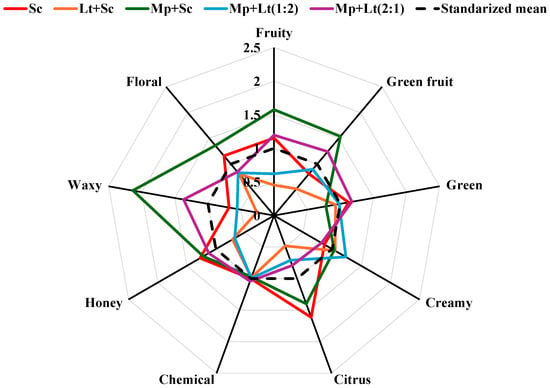
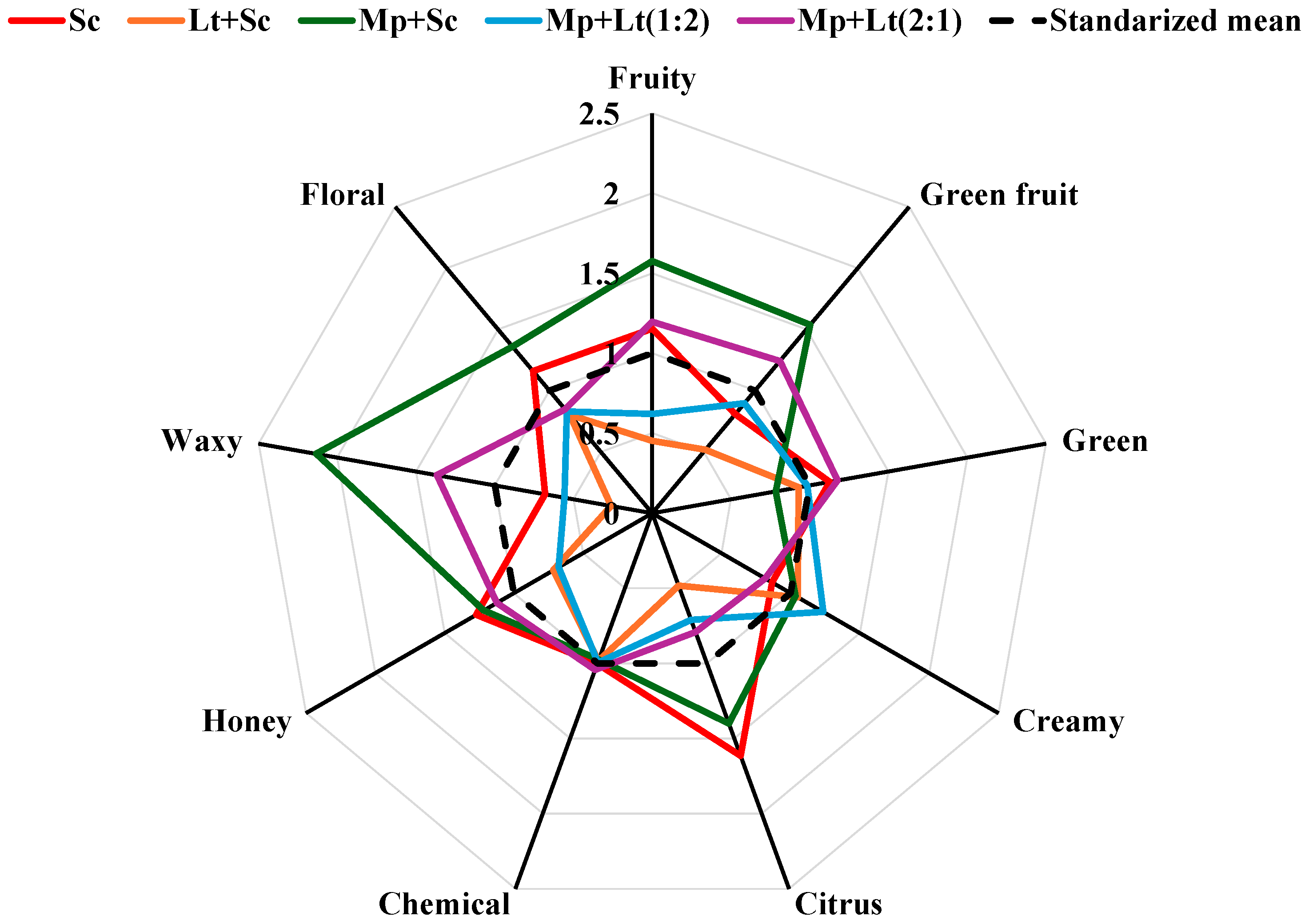
Multivariate analysis in the form of standardised radial graphs integrating the nine aromatic series (Figure 1) provided an overview of the volatile composition of the wines, enabling the simultaneous visualisation of differences between various inoculation protocols. Each polygon reflects the relative contribution of the main aromatic series—fruity, green fruit, green, creamy, citrus, chemical, honey, waxy and floral—to the total volatile profile. Standardising the axes enabled direct comparison between samples, revealing the impact of inoculation type and the proportion of non-Saccharomyces yeasts on the aromatic series. In the graph, the values are expressed in standardised form, with the broken black line corresponding to the mean value (equal to 1 after standardisation). Thus, series above this value indicate an above-average aromatic contribution, while those below reflect a lower relative intensity.
Figure 1.
Star plots of the aromatic series. Sc: S. cerevisiae; Lt + Sc: sequential inoculation of L. thermotolerans and S. cerevisiae after 48 h; Mp + Sc: sequential inoculation of M. pulcherrima and S. cerevisiae after 48 h; Mp:Lt (1:2): co-inoculation of M. pulcherrima and L. thermotolerans at a ratio of 1:2, followed by sequential inoculation of S. cerevisiae after 48 h; Mp:Lt (2:1): co-inoculation of M. pulcherrima and L. thermotolerans at a ratio of 2:1, followed by sequential inoculation of S. cerevisiae after 48 h.
The analysis clearly distinguishes two types of behaviour among the wines studied. On the one hand, the wines in the Lt + Sc and Mp + Lt (1:2) series have a profile characterised by below-average values in most aromatic categories, particularly Fruity, Green Fruit, Waxy, Floral and Citrus. In contrast, these treatments show above-average values in the Creamy series, indicating an aromatic profile dominated by compounds associated with lactic and creamy notes. This behaviour is consistent with the greater presence of L. thermotolerans in these treatments, which reduces fruit esters and increases ethyl lactate.
In contrast, the control, Mp + Sc and Mp + Lt (2:1) wines have more similar aromatic profiles, with above-average values in the fruity, green fruit and waxy series, and in some cases in floral and honey. This pattern indicates a greater contribution of compounds associated with fruit esters and aromatic alcohols, resulting in a volatile profile associated with fruit and floral aroma descriptors. Within this group, the Mp + Sc treatment exhibits the highest values in the fruit series, whereas the Mp + Lt (2:1) treatment exhibits an intermediate profile, suggesting a compensatory effect between the two non-Saccharomyces yeasts.
The radial representation provides a distinctive aromatic fingerprint, allowing clear differentiation of wines according to dominant metabolic patterns. Treatments dominated by L. thermotolerans are characterised by a profile with lower contribution of fruit-related aromatic series and greater creamy notes, while treatments with a higher proportion of M. pulcherrima are associated with higher contribution of fruit- and floral-associated compounds.
3.3. Cluster Heatmap Analysis
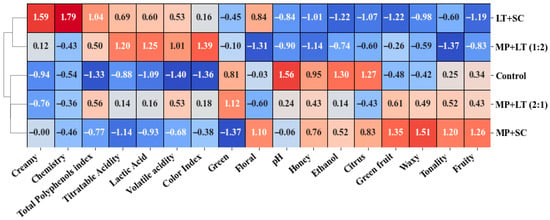
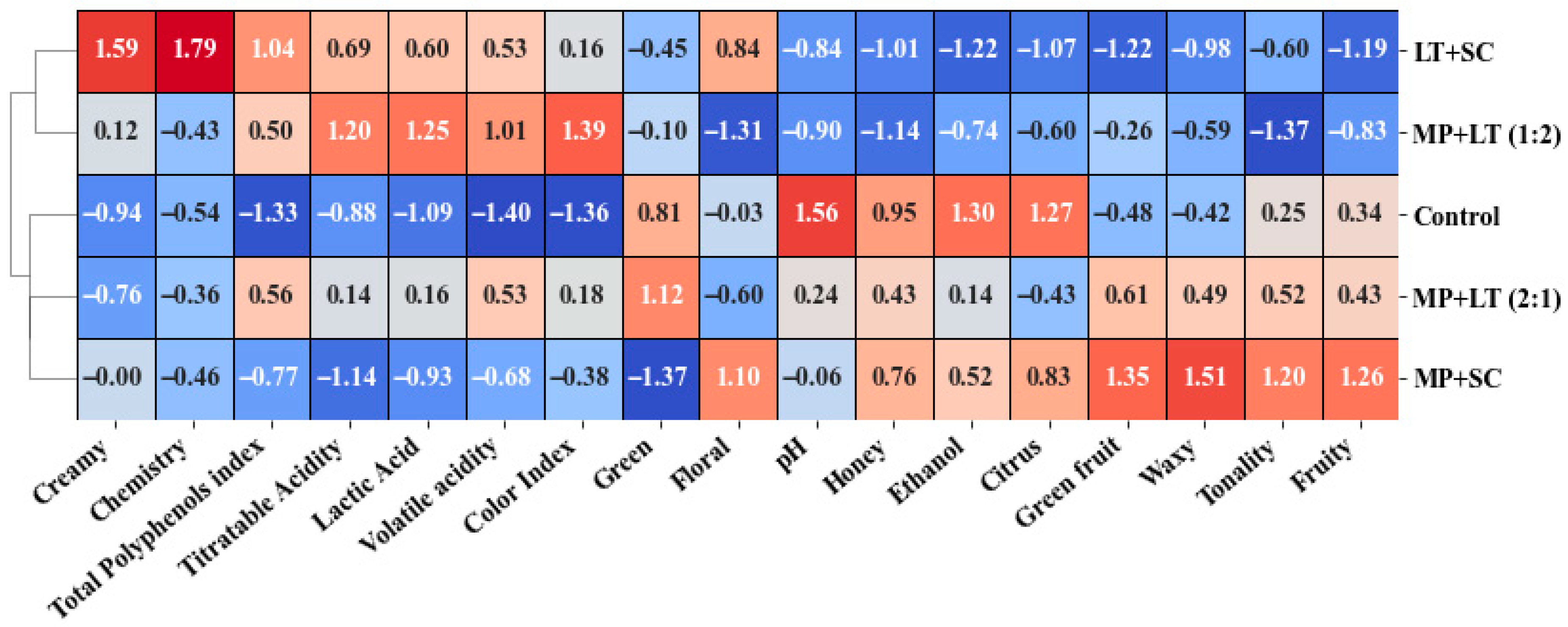
The cluster analysis was represented by a heatmap based on standardised values to simultaneously visualise the relationships between the different wines and the analysed variables (Figure 2). In this representation, positive values indicate direct correlations between variables and are shown in shades of red, the intensity of which increases with the value of the correlation. Conversely, negative values reflect inverse correlations and are represented by shades of blue, which become more intense as the absolute value of the negative correlation increases.
Figure 2.
Cluster heatmap analysis obtained for the produced wines. Values above 0 indicate a positive correlation (red), whereas values below 0 indicate a negative correlation (blue). Control: S. cerevisiae; Lt + Sc: sequential inoculation of L. thermotolerans and S. cerevisiae after 48 h; Mp + Sc: sequential inoculation of M. pulcherrima and S. cerevisiae after 48 h; Mp:Lt (1:2): co-inoculation of M. pulcherrima and L. thermotolerans at a ratio of 1:2, followed by sequential inoculation of S. cerevisiae after 48 h; Mp:Lt (2:1): co-inoculation of M. pulcherrima and L. thermotolerans at a ratio of 2:1, followed by sequential inoculation of S. cerevisiae after 48 h.
The analysis identified two main groups of wines that were clearly differentiated in terms of their chemical composition and aromatic profile. The first group included wines made with a higher proportion of L. thermotolerans (Lt + Sc and Mp + Lt 1:2). These wines showed positive correlations with variables associated with higher acidity, such as titratable acidity, lactic acid and volatile acidity. This translates into intense red tones in the relevant boxes on the heatmap. At the same time, they showed negative correlations with variables such as pH and ethanol content (blue tones), confirming the acidifying effect and slight reduction in alcohol content associated with this yeast.
From an aromatic perspective, these wines exhibited negative correlations with most of the aromatic series dominated by esters, particularly the Fruity, Green Fruit and Waxy series. This suggests that these compounds have a lower relative contribution in the presence of L. thermotolerans. Conversely, positive correlations were observed with the Creamy series, reflecting an increase in ethyl lactate and other compounds associated with lactic and creamy notes. These results confirm the role of L. thermotolerans in modulating the aromatic profile towards less fruity and more creamy descriptors.
The second group included the control wine and treatments where M. pulcherrima was the only non-Saccharomyces yeast inoculated (Mp + Sc), or where its proportion was greater in co-inoculation (Mp + Lt 2:1).
These wines showed positive correlations with the aromatic series associated with esters, particularly the Fruity, Green fruit, and Waxy series. This is reflected by intense red tones in these variables. This behaviour indicates greater production or preservation of fruit esters, resulting in a volatile profile characterized by higher contributions of ester-related compounds.
By contrast, these treatments exhibited negative correlations with acidity-related variables, such as lactic acid and titratable acidity. This confirms the differential effect of M. pulcherrima compared to L. thermotolerans. Notably, the Mp + Sc wine exhibited a correlation pattern closely resembling the control for acidity- and pH-related variables, while Mp + Lt (2:1) exhibited intermediate values, suggesting a combined effect of both yeasts.
Analysis of the colour intensities in the heat map therefore enables the variables with the greatest discriminatory power to be identified. The most intense negative correlations (shown in blue) were concentrated between the fruit series and the acidity-related variables in treatments dominated by L. thermotolerans, suggesting a metabolic trade-off between acidification and ester synthesis under the studied fermentation conditions. Conversely, the most intense positive correlations (red) were observed between the Fruity, Green Fruit and Waxy series in treatments with a high presence of M. pulcherrima, demonstrating the direct relationship between this yeast and the formation of fruity compounds.
Overall, the heat map confirms that the dominant species and their relative proportions in co-inoculations are the most influential factors in determining the chemical and aromatic profile of wine. Treatments with a predominance of L. thermotolerans are associated with more acidic and lower contribution of ester-related aromatic series, whereas treatments with a greater presence of M. pulcherrima exhibit higher relative abundance of ester-related compounds and are therefore closer to the control. These findings corroborate the results of the volatile compound and aromatic series analyses, reinforcing the potential of targeted co-inoculation strategies as a precision tool for aroma modulation.
4. Conclusions
The results of this study confirm the significant impact of non-Saccharomyces yeasts on the chemical and aromatic composition of Tempranillo wines from warm climates. Lachancea thermotolerans was found to have a strong acidifying effect, increasing the concentration of lactic acid, total acidity and colour intensity while reducing the level of ethanol. It also promoted the formation of higher alcohols, acetaldehyde and ethyl lactate, resulting in wines with a volatile profile associated with creamy-related aromatic series and lower levels of fruity esters.
By contrast, Metschnikowia pulcherrima increased the production of fruity and floral esters, producing wines with higher scores in the fruity, green fruit, waxy and floral aromatic series. Wines produced with this yeast exhibited acidity profiles similar to the control but with enhanced ester-related complexity.
Co-inoculation strategies produced intermediate or synergistic effects, depending on the relative inoculation ratio. Treatment with a higher proportion of L. thermotolerans resulted in the greatest acidification and the highest levels of ethyl lactate and minor alcohols. In contrast, treatment dominated by M. pulcherrima partially restored ester content, enhancing terpene-related compounds. Multivariate analyses confirmed the clear separation between wines dominated by each non-Saccharomyces species, highlighting the decisive influence of inoculation strategy on the final aromatic profile.
Overall, the combined use of L. thermotolerans and M. pulcherrima represents a robust biotechnological strategy to mitigate the impact of climate change on warm-climate red wines. By fine-tuning inoculation ratios, winemakers can strategically modulate acidity, redox balance and ester biosynthesis, enabling the production of wines with modified acidity balance and differentiated volatile profiles.
Supplementary Materials
The following supporting information can be downloaded at: https://www.mdpi.com/article/10.3390/foods15071249/s1, Table S1: Odour descriptor, odour threshold and aroma series assigned to the volatile compounds identified in the wines analysed.
Author Contributions
Conceptualization: R.A.P. and F.S.-S.; Methodology: R.A.P., N.L.d.L. and F.S.-S.; Formal Analysis: F.S.-S., G.C., S.N. and N.L.d.L.; Writing—Original Draft Preparation: R.A.P., S.N., G.C., N.L.d.L. and F.S.-S.; Writing—Review and Editing: R.A.P. and F.S.-S.; Supervision: R.A.P.; Project Management: R.A.P.; Funding Acquisition: R.A.P. All authors have read and agreed to the published version of the manuscript.
Funding
The authors are grateful for the funding received through Project TED2021-129208B-100 by MICIU/AEI/10,13039/501100011033 and by the European Union NextGenerationEU.
Institutional Review Board Statement
Not applicable.
Informed Consent Statement
Not applicable.
Data Availability Statement
The original contributions presented in this study are included in the article/Supplementary Materials. Further inquiries can be directed to the corresponding author.
Acknowledgments
The authors would like to sincerely thank Bodegas Viñas de Alange, SA, and Bodegas Alvear SA for kindly providing the grapes used to conduct the experimental trials.
Conflicts of Interest
The authors declare no conflicts of interest.
Abbreviations
The following abbreviations are used in this manuscript:
| GC-FID | Gas chromatography–flame ionization detector |
| GC-MS | Gas chromatography–mass spectrometry |
| OAV | Odour activity value |
| TDS | Thermal desorption unit |
References
- Mira de Orduña, R. Climate Change Associated Effects on Grape and Wine Quality and Production. Food Res. Int. 2010, 43, 1844–1855. [Google Scholar] [CrossRef] [Scilit]
- van Leeuwen, C.; Sgubin, G.; Bois, B.; Ollat, N.; Swingedouw, D.; Zito, S.; Gambetta, G.A. Climate Change Impacts and Adaptations of Wine Production. Nat. Rev. Earth Environ. 2024, 5, 258–275. [Google Scholar] [CrossRef] [Scilit]
- Fraga, H. Viticulture and Winemaking under Climate Change. Agronomy 2019, 9, 783. [Google Scholar] [CrossRef] [Scilit]
- Dinis, L.-T.; Bernardo, S.; Yang, C.; Fraga, H.; Malheiro, A.C.; Moutinho-Pereira, J.; Santos, J.A. Mediterranean Viticulture in the Context of Climate Change. Cienc. Tec. Vitivinic. 2022, 37, 139–158. [Google Scholar] [CrossRef] [Scilit]
- Bindon, K.; Varela, C.; Kennedy, J.; Holt, H.; Herderich, M. Relationships between Harvest Time and Wine Composition in Vitis vinifera L. Cv. Cabernet Sauvignon 1. Grape and Wine Chemistry. Food Chem. 2013, 138, 1696–1705. [Google Scholar] [CrossRef] [Scilit]
- van Leeuwen, C.; Darriet, P. The Impact of Climate Change on Viticulture and Wine Quality. J. Wine Econ. 2016, 11, 150–167. [Google Scholar] [CrossRef] [Scilit]
- Pons, A.; Allamy, L.; Schüttler, A.; Rauhut, D.; Thibon, C.; Darriet, P. What Is the Expected Impact of Climate Change on Wine Aroma Compounds and Their Precursors in Grape? OENO One 2017, 51, 141–146. [Google Scholar] [CrossRef] [Scilit]
- Allamy, L.; Van Leeuwen, C.; Pons, A. Impact of Harvest Date on Aroma Compound Composition of Merlot and Cabernet-Sauvignon Must and Wine in a Context of Climate Change: A Focus on Cooked Fruit Molecular Markers. OENO One 2023, 57, 99–112. [Google Scholar] [CrossRef] [Scilit]
- Moreno, J.J.; Peinado, R.A. Enological Chemistry; Academic Press: Cambridge, MA, USA, 2012. [Google Scholar]
- Boban, A.; Vrhovsek, U.; Carlin, S.; Milanović, V.; Gajdoš Kljusurić, J.; Jurun, Z.; Mucalo, A.; Budić-Leto, I. Impact of Indigenous Non-Saccharomyces Yeasts on Early Volatile Fermentation Metabolites of White Maraština Grape Must. Eur. Food Res. Technol. 2025, 251, 2125–2141. [Google Scholar] [CrossRef] [Scilit]
- Capozzi, V.; Tufariello, M.; Berbegal, C.; Fragasso, M.; De Simone, N.; Spano, G.; Russo, P.; Venerito, P.; Bozzo, F.; Grieco, F. Microbial Resources and Sparkling Wine Differentiation: State of the Arts. Fermentation 2022, 8, 275. [Google Scholar] [CrossRef] [Scilit]
- Benito, S. The Impacts of Lachancea thermotolerans Yeast Strains on Winemaking. Appl. Microbiol. Biotechnol. 2018, 102, 6775–6790. [Google Scholar] [CrossRef] [Scilit]
- Benito, S. Combined Use of Lachancea thermotolerans and Schizosaccharomyces pombe in Winemaking: A Review. Microorganisms 2020, 8, 655. [Google Scholar] [CrossRef] [Scilit] [PubMed]
- Vicente, J.; Navascués, E.; Calderón, F.; Santos, A.; Marquina, D.; Benito, S. An Integrative View of the Role of Lachancea thermotolerans in Wine Technology. Foods 2021, 10, 2878. [Google Scholar] [CrossRef] [Scilit]
- Hranilovic, A.; Gambetta, J.M.; Schmidtke, L.; Boss, P.K.; Grbin, P.R.; Masneuf-Pomarede, I.; Bely, M.; Albertin, W.; Jiranek, V. Oenological Traits of Lachancea thermotolerans Show Signs of Domestication and Allopatric Differentiation. Sci. Rep. 2018, 8, 14812. [Google Scholar] [CrossRef] [Scilit]
- Gobbi, M.; Comitini, F.; Domizio, P.; Romani, C.; Lencioni, L.; Mannazzu, I.; Ciani, M. Lachancea thermotolerans and Saccharomyces cerevisiae in Simultaneous and Sequential Co-Fermentation: A Strategy to Enhance Acidity and Improve the Overall Quality of Wine. Food Microbiol. 2013, 33, 271–281. [Google Scholar] [CrossRef] [Scilit] [PubMed]
- Sánchez-Suárez, F.; Palenzuela, M.D.V.; Rosal, A.; Peinado, R.A. Innovative Fermentation Approach Employing Lachancea thermotolerans for the Selective Production of High-Acidity Wines, Designed for Blending with Low-Acidity Counterparts to Achieve Chemically and Organoleptically Balanced Final Compositions. Foods 2025, 14, 2773. [Google Scholar] [CrossRef] [Scilit] [PubMed]
- Benito, Á.; Calderón, F.; Palomero, F.; Benito, S. Quality and Composition of Airen Wines Fermented by Sequential Inoculation of Lachancea thermotolerans and Saccharomyces cerevisiae. Food Technol. Biotechnol. 2016, 54, 135. [Google Scholar] [CrossRef] [Scilit]
- Vaquero, C.; Escott, C.; Heras, J.M.; Carrau, F.; Morata, A. Co-Inoculations of Lachancea thermotolerans with Different Hanseniaspora Spp.: Acidification, Aroma, Biocompatibility, and Effects of Nutrients in Wine. Food Res. Int. 2022, 161, 111891. [Google Scholar] [CrossRef] [Scilit]
- Escott, C.; Vaquero, C.; Loira, I.; López, C.; González, C.; Morata, A. Synergetic Effect of Metschnikowia pulcherrima and Lachancea thermotolerans in Acidification and Aroma Compounds in Airén Wines. Foods 2022, 11, 3734. [Google Scholar] [CrossRef] [Scilit]
- Vicente, J.; Vladic, L.; Navascués, E.; Brezina, S.; Santos, A.; Calderón, F.; Tesfaye, W.; Marquina, D.; Rauhut, D.; Benito, S. A Comparative Study of Lachancea thermotolerans Fermentative Performance under Standardized Wine Production Conditions. Food Chem. X 2024, 21, 101214. [Google Scholar] [CrossRef] [Scilit]
- Ciani, M.; Canonico, L.; Comitini, F. Improving White Wine Aroma and Structure by Non-Saccharomyces Yeasts. In White Wine Technology; Elsevier: Amsterdam, The Netherlands, 2022; pp. 117–130. [Google Scholar]
- Comitini, F.; Gobbi, M.; Domizio, P.; Romani, C.; Lencioni, L.; Mannazzu, I.; Ciani, M. Selected Non-Saccharomyces Wine Yeasts in Controlled Multistarter Fermentations with Saccharomyces cerevisiae. Food Microbiol. 2011, 28, 873–882. [Google Scholar] [CrossRef] [Scilit]
- Vicente, J.; Ruiz, J.; Belda, I.; Benito-Vázquez, I.; Marquina, D.; Calderón, F.; Santos, A.; Benito, S. The Genus Metschnikowia in Enology. Microorganisms 2020, 8, 1038. [Google Scholar] [CrossRef] [Scilit]
- Ruiz, J.; Belda, I.; Beisert, B.; Navascués, E.; Marquina, D.; Calderón, F.; Rauhut, D.; Santos, A.; Benito, S. Analytical Impact of Metschnikowia pulcherrima in the Volatile Profile of Verdejo White Wines. Appl. Microbiol. Biotechnol. 2018, 102, 8501–8509. [Google Scholar] [CrossRef] [Scilit]
- Binati, R.L.; Maule, M.; Luzzini, G.; Martelli, F.; Felis, G.E.; Ugliano, M.; Torriani, S. From Bioprotective Effects to Diversification of Wine Aroma: Expanding the Knowledge on Metschnikowia pulcherrima Oenological Potential. Food Res. Int. 2023, 174, 113550. [Google Scholar] [CrossRef] [Scilit]
- Testa, B.; Coppola, F.; Iorizzo, M.; Di Renzo, M.; Coppola, R.; Succi, M. Preliminary Characterisation of Metschnikowia pulcherrima to Be Used as a Starter Culture in Red Winemaking. Beverages 2024, 10, 88. [Google Scholar] [CrossRef] [Scilit]
- Perpetuini, G.; Rossetti, A.P.; Quadrani, L.; Arfelli, G.; Piva, A.; Suzzi, G.; Tofalo, R. Sequential Inoculation of Metschnikowia pulcherrima and Saccharomyces cerevisiae as a Biotechnological Tool to Increase the Terpenes Content of Pecorino White Wines. Fermentation 2023, 9, 785. [Google Scholar] [CrossRef] [Scilit]
- Vaquero, C.; Loira, I.; Heras, J.M.; Carrau, F.; González, C.; Morata, A. Biocompatibility in Ternary Fermentations With Lachancea thermotolerans, Other Non-Saccharomyces and Saccharomyces cerevisiae to Control PH and Improve the Sensory Profile of Wines From Warm Areas. Front. Microbiol. 2021, 12, 656262. [Google Scholar] [CrossRef] [Scilit] [PubMed]
- Sánchez-Suárez, F.; Martínez-García, R.; Peinado, R.A. Climate Change Adaptation in Winemaking: Combined Use of Non-Saccharomyces Yeasts to Improve the Quality of Pedro Ximénez Wines. Microorganisms 2025, 13, 1908. [Google Scholar] [CrossRef] [Scilit] [PubMed]
- Vicente, J.; Navascués, E.; Kelanne, N.; Santos, A.; Yang, B.; Benito, S. Optimizing Inoculation Strategies with Lachancea thermotolerans and Saccharomyces cerevisiae for Enhanced Wine Acidity Management and Fermentative Performance. Appl. Food Res. 2025, 5, 101306. [Google Scholar] [CrossRef] [Scilit]
- OIV. Compendium of International Methods of Wine and Must Analysis; OIV: Dijon, France, 2023; ISBN 9782850380686. [Google Scholar]
- Peinado, R.A.; Moreno, J.A.; Muñoz, D.; Medina, M.; Moreno, J. Gas Chromatographic Quantification of Major Volatile Compounds and Polyols in Wine by Direct Injection. J. Agric. Food Chem. 2004, 52, 6389–6393. [Google Scholar] [CrossRef] [Scilit]
- López de Lerma, N.; Peinado, R.A.; Puig-Pujol, A.; Mauricio, J.C.; Moreno, J.; García-Martínez, T. Influence of Two Yeast Strains in Free, Bioimmobilized or Immobilized with Alginate Forms on the Aromatic Profile of Long Aged Sparkling Wines. Food Chem. 2018, 250, 22–29. [Google Scholar] [CrossRef] [Scilit] [PubMed]
- Palenzuela, M.D.V.; López de Lerma, N.; Sánchez-Suárez, F.; Martínez-García, R.; Peinado, R.A.; Rosal, A. Aroma Composition of Wines Produced from Grapes Treated with Organic Amendments. Appl. Sci. 2023, 13, 8001. [Google Scholar] [CrossRef] [Scilit]
- Ogawa, M.; Vararu, F.; Moreno-Garcia, J.; Mauricio, J.C.; Moreno, J.; Garcia-Martinez, T. Analyzing the Minor Volatilome of Torulaspora delbrueckii in an Alcoholic Fermentation. Eur. Food Res. Technol. 2022, 248, 613–624. [Google Scholar] [CrossRef] [Scilit]
- Zhang, Y.-S.; Du, G.; Gao, Y.-T.; Wang, L.-W.; Meng, D.; Li, B.-J.; Brennan, C.; Wang, M.-Y.; Zhao, H.; Wang, S.-Y.; et al. The Effect of Carbonic Maceration during Winemaking on the Color, Aroma and Sensory Properties of ‘Muscat Hamburg’ Wine. Molecules 2019, 24, 3120. [Google Scholar] [CrossRef] [Scilit]
- Peinado, R.A.; Mauricio, J.C.; Moreno, J. Aromatic Series in Sherry Wines with Gluconic Acid Subjected to Different Biological Aging Conditions by Saccharomyces cerevisiae Var. Capensis. Food Chem. 2006, 94, 232–239. [Google Scholar] [CrossRef] [Scilit]
- Qu, J.; Chen, X.; Wang, X.; He, S.; Tao, Y.; Jin, G. Esters and Higher Alcohols Regulation to Enhance Wine Fruity Aroma Based on Oxidation-Reduction Potential. LWT 2024, 200, 116165. [Google Scholar] [CrossRef] [Scilit]
- Li, H.; Tao, Y.-S.; Wang, H.; Zhang, L. Impact Odorants of Chardonnay Dry White Wine from Changli County (China). Eur. Food Res. Technol. 2008, 227, 287–292. [Google Scholar] [CrossRef] [Scilit]
- Muñoz-Castells, R.; Moreno, J.; García-Martínez, T.; Mauricio, J.C.; Moreno-García, J. Assessing the Impact of Commercial Lachancea thermotolerans Immobilized in Biocapsules on Wine Quality: Odor Active Compounds and Organoleptic Properties. Fermentation 2024, 10, 303. [Google Scholar] [CrossRef] [Scilit]
- Guth, H. Quantitation and Sensory Studies of Character Impact Odorants of Different White Wine Varieties. J. Agric. Food Chem. 1997, 45, 3027–3032. [Google Scholar] [CrossRef] [Scilit]
- Peinado, R.A.; Moreno, J.; Bueno, J.E.; Moreno, J.A.; Mauricio, J.C. Comparative Study of Aromatic Compounds in Two Young White Wines Subjected to Pre-Fermentative Cryomaceration. Food Chem. 2004, 84, 585–590. [Google Scholar] [CrossRef] [Scilit]
- Leffingwell & Associates Odor Properties & Molecular Visualization. Available online: http://www.leffingwell.com/esters.htm (accessed on 1 February 2025).
- Takeoka, G.; Buttery, R.G.; Ling, L. Odour Thresholds of Various Branched and Straight Chain Acetates. LWT-Food Sci. Technol. 1996, 29, 677–680. [Google Scholar] [CrossRef] [Scilit]
- Ferreira, V.; López, R.; Cacho, J.F. Quantitative Determination of the Odorants of Young Red Wines from Different Grape Varieties. J. Sci. Food Agric. 2000, 80, 1659–1667. [Google Scholar] [CrossRef] [Scilit]
- Swiegers, J.H.; Bartowsky, E.J.; Henschke, P.A.; Pretorius, I.S. Yeast and Bacterial Modulation of Wine Aroma and Flavour. Aust. J. Grape Wine Res. 2005, 11, 139–173. [Google Scholar] [CrossRef] [Scilit]
- Buttery, R.G.; Turnbaugh, J.G.; Ling, L.C. Contribution of Volatiles to Rice Aroma. J. Agric. Food Chem. 1988, 36, 1006–1009. [Google Scholar] [CrossRef] [Scilit]
- Gómez-Míguez, M.J.; Cacho, J.F.; Ferreira, V.; Vicario, I.M.; Heredia, F.J. Volatile Components of Zalema White Wines. Food Chem. 2007, 100, 1464–1473. [Google Scholar] [CrossRef] [Scilit]
- Moreno, J.A. Influencia Del Tipo de Envejecimiento Sobre El Perfil Aromático de Vinos Generosos Andaluces. Ph.D. Thesis, University of Córdoba, Córdoba, Spain, 2005. [Google Scholar]
- Buttery, R.G.; Seifert, R.M.; Guadagni, D.G.; Ling, L.C. Characterization of Additional Volatile Components of Tomato. J. Agric. Food Chem. 1971, 19, 524–529. [Google Scholar] [CrossRef] [Scilit]
- Zhang, S.; Petersen, M.; Liu, J.; Toldam-Andersen, T. Influence of Pre-Fermentation Treatments on Wine Volatile and Sensory Profile of the New Disease Tolerant Cultivar Solaris. Molecules 2015, 20, 21609–21625. [Google Scholar] [CrossRef] [Scilit]
- Burdock, G.A.; Fenaroli, G. Fenaroli’s Handbook of Flavor Ingredients, 6th ed.; Taylor & Francis: Boca Raton, FL, USA, 2010. [Google Scholar]
- Gottmann, J.; Vestner, J.; Fischer, U. Sensory Relevance of Seven Aroma Compounds Involved in Unintended but Potentially Fraudulent Aromatization of Wine Due to Aroma Carryover. Food Chem. 2023, 402, 134160. [Google Scholar] [CrossRef] [Scilit]
- Martínez-García, R.; Mauricio, J.C.; García-Martínez, T.; Peinado, R.A.; Moreno, J. Towards a Better Understanding of the Evolution of Odour-Active Compounds and the Aroma Perception of Sparkling Wines during Ageing. Food Chem. 2021, 357, 129784. [Google Scholar] [CrossRef] [Scilit]
- Martín-García, F.J.; Palacios-Fernández, S.; López de Lerma, N.; García-Martínez, T.; Mauricio, J.C.; Peinado, R.A. The Effect of Yeast, Sugar and Sulfur Dioxide on the Volatile Compounds in Wine. Fermentation 2023, 9, 541. [Google Scholar] [CrossRef] [Scilit]
- Zhu, L.-X.; Zhang, M.-M.; Shi, Y.; Duan, C.-Q. Evolution of the Aromatic Profile of Traditional Msalais Wine during Industrial Production. Int. J. Food Prop. 2019, 22, 911–924. [Google Scholar] [CrossRef] [Scilit]
- Battjes, J.; Melkonian, C.; Mendoza, S.N.; Haver, A.; Al-Nakeeb, K.; Koza, A.; Schrubbers, L.; Wagner, M.; Zeidan, A.A.; Molenaar, D.; et al. Ethanol-Lactate Transition of Lachancea thermotolerans Is Linked to Nitrogen Metabolism. Food Microbiol. 2023, 110, 104167. [Google Scholar] [CrossRef] [Scilit]
- Morata, A.; Loira, I.; Tesfaye, W.; Bañuelos, M.A.; González, C.; Suárez Lepe, J.A. Lachancea thermotolerans Applications in Wine Technology. Fermentation 2018, 4, 53. [Google Scholar] [CrossRef] [Scilit]
- Forino, M.; Picariello, L.; Rinaldi, A.; Moio, L.; Gambuti, A. How Must PH Affects the Level of Red Wine Phenols. LWT 2020, 129, 109546. [Google Scholar] [CrossRef] [Scilit]
- Escribano, R.; González-Arenzana, L.; Portu, J.; Garijo, P.; López-Alfaro, I.; López, R.; Santamaría, P.; Gutiérrez, A.R. Wine Aromatic Compound Production and Fermentative Behaviour within Different Non-Saccharomyces Species and Clones. J. Appl. Microbiol. 2018, 124, 1521–1531. [Google Scholar] [CrossRef] [Scilit]
- Pérez, D.; Denat, M.; Minebois, R.; Heras, J.M.; Guillamón, J.M.; Ferreira, V.; Querol, A. Modulation of Aroma and Chemical Composition of Albariño Semi-Synthetic Wines by Non-Wine Saccharomyces Yeasts and Bottle Aging. Food Microbiol. 2022, 104, 103981. [Google Scholar] [CrossRef] [Scilit] [PubMed]
- Padilla, B.; Gil, J.V.; Manzanares, P. Past and Future of Non-Saccharomyces Yeasts: From Spoilage Microorganisms to Biotechnological Tools for Improving Wine Aroma Complexity. Front. Microbiol. 2016, 7, 411. [Google Scholar] [CrossRef] [Scilit] [PubMed]
- Waterhouse, A.L.; Sacks, G.L.; Jeffery, D.W. Understanding Wine Chemistry; Wiley: Hoboken, NJ, USA, 2016; ISBN 9781118627808. [Google Scholar]
- Li, J.; Yuan, M.; Meng, N.; Li, H.; Sun, J.; Sun, B. Influence of Nitrogen Status on Fermentation Performances of Non-Saccharomyces Yeasts: A Review. Food Sci. Hum. Wellness 2024, 13, 556–567. [Google Scholar] [CrossRef] [Scilit]
- Izquierdo-Cañas, P.M.; del Fresno, J.M.; Malfeito-Ferreira, M.; Mena-Morales, A.; García-Romero, E.; Heras, J.M.; Loira, I.; González, C.; Morata, A. Wine Bioacidification: Fermenting Airén Grape Juices with Lachancea thermotolerans and Metschnikovia pulcherrima Followed by Sequential Saccharomyces cerevisiae Inoculation. Int. J. Food Microbiol. 2025, 427, 110977. [Google Scholar] [CrossRef] [Scilit]
- Zhang, P.; Zhang, R.; Sirisena, S.; Gan, R.; Fang, Z. Beta-Glucosidase Activity of Wine Yeasts and Its Impacts on Wine Volatiles and Phenolics: A Mini-Review. Food Microbiol. 2021, 100, 103859. [Google Scholar] [CrossRef] [Scilit]
- Dumitriu (Gabur), G.-D.; Sánchez-Suárez, F.; Peinado, R.A.; Cotea, V.V.; de Lerma, N.L.; Gabur, I.; Simioniuc, V. Metabolomics of Red Wines Aged Traditionally, with Chips or Staves. Foods 2024, 13, 196. [Google Scholar] [CrossRef] [Scilit] [PubMed]
- Dumitriu (Gabur), G.-D.; Peinado, R.A.; Cotea, V.V.; López de Lerma, N. Volatilome Fingerprint of Red Wines Aged with Chips or Staves: Influence of the Aging Time and Toasting Degree. Food Chem. 2020, 310, 125801. [Google Scholar] [CrossRef] [Scilit]
- Monforte, A.R.; Martins, S.I.F.S.; Silva Ferreira, A.C. Strecker Aldehyde Formation in Wine: New Insights into the Role of Gallic Acid, Glucose, and Metals in Phenylacetaldehyde Formation. J. Agric. Food Chem. 2018, 66, 2459–2466. [Google Scholar] [CrossRef] [Scilit]
- López-Rituerto, E.; Avenoza, A.; Busto, J.H.; Peregrina, J.M. Evidence of Metabolic Transformations of Amino Acids into Higher Alcohols through 13 C NMR Studies of Wine Alcoholic Fermentation. J. Agric. Food Chem. 2010, 58, 4923–4927. [Google Scholar] [CrossRef] [Scilit]
- Wang, X.; Fan, G.; Peng, Y.; Xu, N.; Xie, Y.; Zhou, H.; Liang, H.; Zhan, J.; Huang, W.; You, Y. Mechanisms and Effects of Non-Saccharomyces Yeast Fermentation on the Aromatic Profile of Wine. J. Food Compos. Anal. 2023, 124, 105660. [Google Scholar] [CrossRef] [Scilit]
- Hranilovic, A.; Albertin, W.; Capone, D.L.; Gallo, A.; Grbin, P.R.; Danner, L.; Bastian, S.E.P.; Masneuf-Pomarede, I.; Coulon, J.; Bely, M.; et al. Impact of Lachancea thermotolerans on Chemical Composition and Sensory Profiles of Merlot Wines. Food Chem. 2021, 349, 129015. [Google Scholar] [CrossRef] [Scilit] [PubMed]
- del Fresno, J.M.; Rodríguez, Y.; Soler, M.; Escott, C.; Palomero, F.; Cuerda, R.; Morata, A. Use of Non-Saccharomyces Yeasts to Modulate Oenological Parameters in Albillo Mayor White Wines. Eur. Food Res. Technol. 2025, 251, 3619–3631. [Google Scholar] [CrossRef] [Scilit]

Disclaimer/Publisher’s Note: The statements, opinions and data contained in all publications are solely those of the individual author(s) and contributor(s) and not of MDPI and/or the editor(s). MDPI and/or the editor(s) disclaim responsibility for any injury to people or property resulting from any ideas, methods, instructions or products referred to in the content. |
© 2026 by the authors. Licensee MDPI, Basel, Switzerland. This article is an open access article distributed under the terms and conditions of the Creative Commons Attribution (CC BY) license.