


Abstract
This study evaluated the effects of replacing whole-crop corn silage (WCS) with potato peel residue–corn stalk silage (PPS) on ruminal fermentation (n = 6 per treatment), rumen bacterial communities (n = 3 per treatment), carcass traits (n = 6 per treatment), and meat quality (n = 6 per treatment) in finishing Angus bulls. Thirty-six bulls (16 months of age; initial body weight, 546.75 ± 25.76 kg) were randomly assigned to 3 diets (n = 12 per treatment): WCS, 50% replacement of WCS with PPS on a dry matter basis (MIX), or 100% replacement (PPL). The experiment consisted of a 7 d adaptation period followed by a 120 d feeding period, after which 6 bulls per treatment were slaughtered. Compared with WCS and MIX, PPL was associated with lower ruminal pH (p = 0.026), higher dressing percentage from 54.67% to 56.69% (by 3.70%; p = 0.016), and lower early post-mortem (pre-rigor) meat redness (a*) from 20.06 to 17.89 (by 10.82%; p = 0.021). Exploratory microbiome analysis indicated a higher relative abundance of Lactobacillus in PPL than in WCS, whereas no significant differences were detected in bacterial alpha diversity or overall community structure among dietary treatments. Total saturated, monounsaturated, and polyunsaturated fatty acids (n = 3 per treatment) showed no significant differences among dietary treatments. Within the measured outcomes of this study, replacing 50% of WCS with PPS resulted in no statistically significant differences in ruminal fermentation characteristics, carcass traits, or most meat-quality indices, whereas complete replacement was associated with lower ruminal pH and early post-mortem meat redness.
1. Introduction
The transition toward sustainable food systems necessitates the effective valorization of agro-industrial by-products and crop residues to mitigate environmental impacts and foster a circular bioeconomy [1,2,3,4]. Potatoes are a staple crop globally, serving as a primary source of food energy [5,6,7]. However, industrial potato processing generates substantial quantities of potato peel residue (PPR). This by-product is rich in starch, pectin, soluble carbohydrates, crude protein, dietary fiber, phenolic compounds, and bioactive peptides, representing a high-energy biomass with functional potential [8,9]. Although potato processing by-products have been evaluated in livestock diets [10,11,12], feed safety represents the primary concern governing the practical application of PPR in Angus bulls’ nutrition. Specifically, raw potato by-products inherently contain toxic glycoalkaloids (predominantly α-solanine and α-chaconine) concentrated in the periderm tissues, which pose potential risks of gastrointestinal toxicity, compromised mucosal integrity, and metabolic disorders [13,14]. Furthermore, the combination of high moisture content and rapid microbial spoilage undermines storage stability and heightens the risk of secondary metabolite accumulation, thereby threatening digestive safety [15].
Concurrently, corn stalks (CS) represent an abundant agricultural residue that supplies physically effective neutral detergent fiber (peNDF) essential for maintaining rumen motility [16,17]. Nevertheless, raw CS exhibits a dense lignocellulosic architecture that limits microbial enzymatic access and ruminal degradability [18,19,20]. Although physical [21,22], chemical [23,24], and biological pretreatments can disrupt this complex matrix to enhance digestibility, their widespread adoption is hindered by elevated processing costs and imbalanced nutrient profiles [25]. Co-ensiling PPR with CS offers a synergistic upcycling solution to address their mutual limitations [26,27]. The abundant water-soluble carbohydrates in PPR serve as immediate fermentation substrates for lactic acid bacteria, promoting rapid acidification that prevents oxidative spoilage while partially weakening the fibrous matrix of CS [28,29,30]. Consequently, co-ensiled mixtures can serve as a balanced, cost-effective forage replacement without compromising ruminal homeostasis [31,32].
Although numerous trials have evaluated the inclusion of potato co-products and processing wastes in finishing cattle diets and reported variable responses in feedlot performance, digestibility, carcass traits, meat composition, meat quality, and carcass-fat fatty acid profiles [33,34,35,36,37], significant knowledge gaps remain. Most previous studies utilized raw, wet, or single-ingredient ensiled potato by-products rather than a balanced co-silage combining potato peel residue with corn stalks (PPS) designed to simultaneously address moisture-spoilage and lignocellulosic recalcitrance. Moreover, earlier beef trials rarely integrated high-throughput sequencing of rumen bacterial communities with targeted profiling of intramuscular lipid metabolites in finishing Angus bulls.
In modern food science, the impact of alternative feed ingredients extends beyond animal growth parameters to encompass carcass yield, meat sensory attributes, and human nutritional profiles. Utilizing the same animal trial, we previously demonstrated that replacing whole-crop corn silage (WCS) with PPS maintained growth performance, reduced feed costs, and altered serum antioxidant indicators in finishing Angus cattle [38]. However, the systemic downstream impacts of PPS inclusion on detailed carcass characteristics, meat quality, intramuscular fatty acid profiles, and the underlying ruminal microbiota remain uncharacterized.
Therefore, the present study evaluated the effects of replacing WCS with PPS at 0%, 50%, and 100% on carcass traits, early post-mortem meat quality, targeted muscle fatty acid profiles, and ruminal fermentation and bacterial communities in finishing Angus bulls, with carcass traits and ruminal fermentation characteristics designated as primary outcomes. We hypothesized that graded dietary replacement of WCS with PPS would independently alter ruminal fermentation parameters and induce exploratory shifts in rumen bacterial community composition, modify carcass yield characteristics, and produce distinct responses in early post-mortem meat-quality indices and targeted intramuscular lipid profiles, without assuming a direct causal chain across these outcome families.
2. Materials and Methods
2.1. Animal Ethics Statement
The experiment was conducted at the Liutaitan Beef Cattle Breeding Cooperative, Shangdu County, Ulanqab, Inner Mongolia Autonomous Region, China. All animal procedures were approved by the Experimental Animal Committee of Henan University of Science and Technology (approval no. SYLY-2022ZY0098).
2.2. Preparation of Potato Peel Residue–Corn Stalk Silage
Potato peel and pulp residue (PPR) was sourced from commercial French-fry production (Lamb Weston Food Co., Ltd., Ulanqab, Inner Mongolia, China). In this study, PPR refers specifically to Potato Peel combined with Limited pulp residues generated during industrial high-pressure thermal steam peeling. This industrial peeling procedure utilized mechanical explosive depressurization, where raw potatoes underwent a brief, controlled high-temperature and high-pressure hydrothermal treatment to cleanly detach the outer epidermal skin along with a minor, superficial layer of adhering starchy parenchymal tissue (pulp). This thermal–mechanical process induces partial pre-cooking, resulting in the partial gelatinization of superficial starch and thermal solubilization or gelation of pectin within the peeled skins, thereby enhancing carbohydrate accessibility and fermentability for ruminal microbes while preserving structural fiber integrity.
Regarding raw material safety, the potatoes processed by the facility were rigorously screened and monitored prior to industrial food processing to ensure compliance with national food and feed safety standards, with potential chemical contaminants (such as heavy metals, pesticide residues, and antibiotics) strictly controlled below safe regulatory thresholds. To prevent aerobic spoilage and secondary fermentation, the freshly discharged wet PPL was transported immediately from the plant, and the elapsed time from thermal separation to mixing with chopped corn stalks was strictly controlled within 6 to 12 h. Corn stalks were chopped to a length of 3 to 5 cm using a circular stalk pulverizer (model S-3; Sunite Right Banner Machinery Manufacturing Factory, Inner Mongolia, China). Fresh PPR and chopped corn stalks were thoroughly mixed at a dry matter (DM) ratio of 2:1, packed into an above-ground bunker silo, and ensiled for 90 d. The analyzed proximate compositions of the individual whole-crop corn silage (WCS) and potato peel residue–corn stalk silage (PPS) are detailed in Supplementary Table S1.
2.3. Animals, Experimental Design, and Diets
Thirty-six healthy 16-month-old Angus bulls (initial body weight, 546.75 ± 25.76 kg) were used in a randomized block design. Animals were blocked by initial body weight (BW) and randomly assigned to 1 of 3 dietary treatments (n = 12 bulls per treatment; 3 large loose-housing pens in total, with 1 pen per treatment and 12 bulls housed and group-fed together per pen). The feeding trial was conducted from August to November 2023. The WCS treatment received a conventional total mixed ration containing whole-crop corn silage as the principal forage. In the MIX and PPL treatments, 50% and 100% of WCS, respectively, were replaced with PPS on a DM basis. The 127 d experiment comprised a 7 d adaptation period followed by a 120 d feeding period. Total mixed rations were offered twice daily at 07:00 and 17:00, and the amount offered was adjusted to allow ad libitum intake, following the technical standard for intensive fattening of Angus bulls [39]. Water was freely available via automatic waterers in each pen. Before the experiment, all bulls received routine anthelmintic treatment, and the facilities were cleaned and disinfected. Diets were formulated according to the Chinese Feeding Standard of Beef Cattle (NY/T 815-2004) [40]. Ingredient composition and nutrient concentrations are presented in Table 1. Throughout the 120 d feeding period, all 36 bulls maintained excellent health status with zero clinical illnesses or mortality.
Table 1.
Ingredient composition and nutrient concentrations of the experimental diets (Dry matter basis).
The animals, dietary treatments, and experimental period were the same as those described in our previous report, which focused on growth performance, apparent nutrient digestibility, serum biochemical indices, antioxidant status, and economic outcomes [38]. Carcass traits, meat quality, muscle fatty-acid composition, ruminal fermentation, and rumen bacterial communities were not reported previously and are evaluated here. Previously published outcomes are cited only to provide context.
2.4. Sample Collection and Measurements
At the end of the 120 d feeding period, 6 bulls per treatment with final live body weights closest to their respective treatment means (excluding any animals with overt physical abnormalities) were selected for slaughter to ensure representative sampling of each dietary group. Following slaughter, carcass traits, early post-mortem meat quality, and ruminal fermentation parameters were measured on all 6 slaughtered bulls per treatment, whereas a random subsample of 3 bulls per treatment was subjected to high-throughput rumen bacterial sequencing and targeted intramuscular fatty acid profiling.
2.4.1. Chemical Analysis
All samples were analyzed for DM (method 967.03), CP (method 984.13), and ash (method 942.05) according to standard analytical procedures [41]. The contents of NDF and ADF were determined using established protocols [42]. Calcium (Ca) and phosphorus (P) concentrations were analyzed according to national standard methods (GB/T 13885-2017; GB/T 6437-2018) [43,44].
2.4.2. Rumen Fluid Collection and Analysis
On day 120, approximately 200 mL of rumen fluid was collected from each sampled bull using an oral stomach tube 3 to 4 h post-feeding. Ruminal pH was measured immediately using a portable pH meter [45]. Samples were filtered through four layers of cheesecloth without chemical acidification at collection, snap-frozen on dry ice for transport, and stored at −80 °C until analysis.
Prior to volatile fatty acid (VFA) analysis, thawed rumen fluid samples were centrifuged at 12,000× g for 20 min at 4 °C to collect the supernatant. Individual and total VFAs (and the acetate-to-propionate ratio) were analyzed using an Agilent 7890A gas chromatography system equipped with an AT-FFAP capillary column (30 m × 0.32 mm × 0.5 μm). Nitrogen was used as the carrier gas at a constant flow rate of 2.1 mL/min with a split ratio of 40:1 and an injection volume of 0.6 μL. The oven temperature was programmed from 50 °C to 120 °C at 3 °C/min and then to 180 °C, with flame ionization detection (FID) at 250 °C, hydrogen fuel gas at 40 mL/min, and make-up/combustion air at 450 mL/min. Microbial crude protein (MCP, mg/mL) is also reported in the results; however, the detailed bench assay records for MCP determination were not retained, so no unverified assay procedure is described here.
Total microbial genomic DNA was extracted using the E.Z.N.A.® soil DNA Kit (Omega Bio-tek, Norcross, GA, USA) following the manufacturer’s instructions, and DNA concentration, integrity and purity were checked using a NanoDrop 2000 spectrophotometer (Thermo Scientific, Waltham, MA, USA) and 1.0% agarose gel electrophoresis. The hypervariable V3–V4 region of the bacterial 16S rRNA gene was amplified using primers 338F (5′-ACTCCTACGGGAGGCAGCAG-3′) and 806R (5′-GGACTACHVGGGTWTCTAAT-3′) on a T100 Thermal Cycler (Bio-Rad, Hercules, CA, USA) in a 20 μL reaction mixture containing 4 μL of 5× FastPfu buffer, 2 μL of 2.5 mM dNTPs, 0.8 μL of each primer (5 μM), 0.4 μL of FastPfu DNA polymerase, and 10 ng of template DNA, under the following cycling conditions: initial denaturation at 95 °C for 3 min; 27 cycles of 95 °C for 30 s, 55 °C for 30 s, and 72 °C for 30 s; and a final extension at 72 °C for 10 min. Amplicons were purified using the PCR Clean-Up Kit (YuHua, Shanghai, China), quantified via Qubit 4.0, and subjected to paired-end sequencing on an Illumina NextSeq 2000 platform (Majorbio Bio-Pharm Technology Co. Ltd., Shanghai, China) following standard library preparation and sequencing workflows.
Raw paired-end sequencing reads were demultiplexed and quality-filtered using fastp (v0.19.6). Paired-end reads were merged using FLASH (v1.2.11), and the resulting sequences were processed using DADA2 in QIIME 2 (v2020.2) to generate amplicon sequence variants (ASVs). Taxonomic classification was performed using the SILVA database (release 138). Predicted microbial functional profiles were inferred using PICRUSt2 (v2.2.0). Raw sequencing data were deposited in the NCBI Sequence Read Archive under BioProject accession PRJNA1557589.
2.4.3. Carcass Measurements and Muscle Sampling
At the end of the feeding period, six representative bulls per treatment group with body weights closely mirroring their respective treatment means were selected and transported by the farm to a certified commercial slaughterhouse. Feed and water were withheld for 24 and 8 h, respectively, before recording preslaughter body weight. Under official veterinary supervision, slaughter was performed by qualified abattoir personnel using standard commercial humane protocols, including mechanical captive-bolt stunning followed by immediate exsanguination. Hot carcass weight was recorded immediately after removal of the head, hide, feet, and viscera. Research personnel participated strictly in post-mortem sample collection and carcass trait measurements. Dressing percentage was calculated as follows:
Dressing percentage (%) = carcass weight/preslaughter body weight × 100%.
After deboning, net meat percentage and meat-to-bone ratio were calculated as follows:
Net meat percentage (%) = net meat weight/preslaughter body weight × 100%.
Meat-to-bone ratio = net meat weight/bone weight.
A representative block of the longissimus dorsi muscle spanning across the 12th to 13th rib section was collected, dissected, and divided into 2 portions. One portion was used immediately for meat-quality measurements, and the other was stored at −20 °C for proximate composition and fatty-acid analyses.
The cross-sectional area of the longissimus dorsi muscle (eye-muscle area) between the 12th and 13th ribs was traced on sulfuric-acid paper and measured using a 1 cm × 1 cm transparent grid. Backfat thickness (cm) was measured using a vernier caliper over the longissimus dorsi muscle between the 12th and 13th ribs (at three-quarters of the length of the eye muscle from the chine bone). Marbling was scored according to Chinese Agricultural Industry Standard NY/T 676-2010 [46].
2.4.4. Meat-Quality Measurements and Proximate Composition
Meat-quality traits were measured in the longissimus dorsi samples as described below.
Muscle pH, Warner-Bratzler shear force (WBSF), and water loss rate were determined according to NY/T 2793-2015 [47]. Specifically, muscle pH was measured strictly following the timing and procedures specified in the standard using a portable pH meter (UB-7; Denver Instrument, Denver, CO, USA) immediately after sample excision. It should be noted that because these measurements were performed immediately post-slaughter on pre-rigor muscle samples without a prolonged post-mortem chilling and ageing period, the recorded pH, shear force and color (a*, b*, L*) values reflect early post-mortem (pre-rigor) instantaneous characteristics rather than ultimate aged meat quality. For WBSF determination, a 5 cm × 3 cm × 2.5 cm block cut parallel to the muscle fibers was heated in a 72 °C water bath until its internal temperature reached 70 °C. After cooling, 3 to 5 cores (1 cm × 1 cm) were sheared perpendicular to the fibers using a digital tenderness meter (C-LM3B; Beijing Tianxiang Feiyu Technology Co., Ltd., Beijing, China). Cooking loss was determined simultaneously by recording the weight change before and after water-bath heating and expressed as a percentage. Water loss rate was determined by the pressure method using a water-holding-capacity tester (RH-100; Guangzhou Runhu Instruments Co., Ltd., Guangzhou, China).
Immediately after carcass fabrication, CIE lightness (L*), redness (a*), and yellowness (b*) were measured using a handheld colorimeter (WF30; Shenzhen Wave Optoelectronics Technology Co., Ltd., Shenzhen, China) equipped with an 8 mm aperture, utilizing an Illuminant D65 light source, a 10° standard observer, and specular component excluded (SCE) mode, following a standard blooming period of 30 min at 4 °C.
Moisture, CP, and ether extract (EE) concentrations in longissimus dorsi muscle were determined according to AOAC (2006) methods [41]: Moisture (AOAC 930.15), Crude Protein (AOAC 984.13, utilizing the standard 6.25 nitrogen-to-protein conversion factor), and Ether Extract (AOAC 920.39).
2.4.5. Fatty-Acid Analysis
Fatty acids in longissimus dorsi muscle samples were analyzed by MetWare Biotechnology Co., Ltd. (Wuhan, China) using an Agilent 7890B–7000D GC–MS/MS system. Briefly, thawed and homogenized muscle tissue (0.05 g) was extracted with 150 μL of methanol, 200 μL of methyl tert-butyl ether (MTBE), and 50 μL of 36% phosphoric acid solution, vortexed for 3 min, and centrifuged at 12,000 r/min for 5 min at 4 °C. An aliquot (200 μL) of the supernatant was evaporated to dryness under a nitrogen stream, mixed with 300 μL of 15% boron trifluoride in methanol, vortexed for 3 min, and incubated at 60 °C for 30 min. After cooling to room temperature, 500 μL of n-hexane and 200 μL of saturated sodium chloride solution were added, followed by vortexing for 3 min and centrifugation at 12,000 r/min for 5 min at 4 °C; 100 μL of the upper n-hexane layer was collected for GC–MS/MS analysis.
Chromatographic separation was performed on a DB-5MS capillary column (30 m × 0.25 mm × 0.25 μm; Agilent) using high-purity helium as the carrier gas at a flow rate of 1.0 mL/min with splitless injection (1.0 μL). The oven temperature program was set as follows: 40 °C for 2 min, ramped to 200 °C at 30 °C/min (held for 1 min), ramped to 240 °C at 10 °C/min (held for 1 min), and ramped to 285 °C at 5 °C/min (held for 3 min). Mass spectrometric detection was conducted at 70 eV with an ion source temperature of 230 °C, transfer line temperature of 240 °C, quadrupole temperature of 150 °C, solvent delay of 4 min, and selected ion monitoring (SIM) mode. External standard calibration curves were constructed across 0.01–50 μg/mL (1/x weighting, R2 > 0.99) without an internal standard, and sample concentrations (μg/g) were calculated from peak areas using the calibration equations and extraction/dilution/mass factors. Because this targeted GC–MS/MS workflow does not include conventional total-lipid extraction followed by saponification or hydrolysis, the reported values represent the fatty acids quantified within this targeted panel rather than exhaustive total-lipid fatty acids or ether extract.
2.5. Statistical Analysis
In this group-feeding trial, the pen (n = 1 pen per dietary treatment, with 12 bulls grouped together) served as the experimental unit for dietary treatment allocation and TMR delivery, whereas the individual slaughtered bull (n = 6 per treatment for ruminal fermentation, carcass traits, and meat quality; n = 3 per treatment for rumen microbiota and muscle fatty acids) served as the observational and analytical unit for post-mortem and physiological measurements. Prior to statistical analysis, data were screened for potential outliers using studentized residuals (values exceeding ± 3 SD from the group mean were considered outliers and removed). Continuous carcass, meat-quality, ruminal-fermentation, and alpha-diversity outcomes were analyzed using SPSS version 22.0 (IBM Corp., Armonk, NY, USA) via a general linear model (GLM) procedure that incorporated the randomized block design as a fixed effect according to the model Yij = μ + Bi + Ti + eij, where Yij is the observation, μ is the overall mean, Bi is the fixed effect of the initial body weight block, Ti is the fixed effect of dietary treatment (0%, 50%, and 100% PPS replacement), and eij is the residual error. When the overall diet effect was significant, means were compared using Duncan’s multiple-range test.
Prior to analysis, the normality of residuals and homogeneity of variances were verified using the Shapiro–Wilk and Levene’s tests. For microbial analyses, differences in alpha diversity among groups were evaluated using the Kruskal–Wallis test. Differences in bacterial community composition were assessed using permutational multivariate analysis of variance (PERMANOVA) based on Bray–Curtis dissimilarities. Differentially abundant taxa were identified using linear discriminant analysis effect size (LEfSe), with an LDA score > 2.0 and p < 0.05. To evaluate individual-level associations independently of dietary treatments, Spearman rank correlations were performed on model residuals after removing treatment fixed effects, with false-discovery-rate (FDR) adjustment for multiple comparisons, whereas unadjusted p values are reported for individual univariate and non-parametric comparisons across outcome tables and are interpreted cautiously alongside designated primary outcomes and exploratory findings. Exact p-values are reported unless p < 0.001. Statistical significance was declared at p < 0.05 and 0.05 ≤ p < 0.10 was considered a tendency.
3. Results
3.1. Ruminal Fermentation Characteristics
Ruminal pH was lower in PPL than in WCS and MIX (p = 0.026; Table 2). Diet did not affect MCP, individual VFA concentrations, total VFA concentration, or the acetate-to-propionate ratio (p ≥ 0.094).
Table 2.
Ruminal fermentation characteristics of finishing Angus bulls fed diets containing potato peel residue–corn stalk silage.
3.2. Rumen Microbial Diversity and Community Structure
3.2.1. Alpha Diversity Analysis
Diet did not affect the Chao1, Shannon, or Simpson indices (p ≥ 0.205; Table 3), indicating no detectable change in bacterial richness or alpha diversity.
Table 3.
Alpha-diversity indices of rumen bacterial communities in finishing Angus bulls.
3.2.2. Beta Diversity Analysis
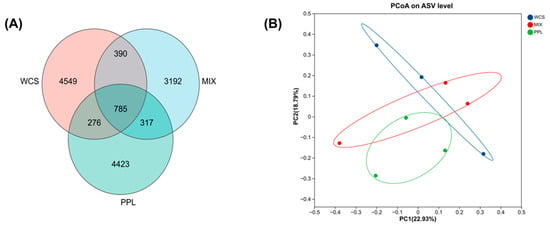
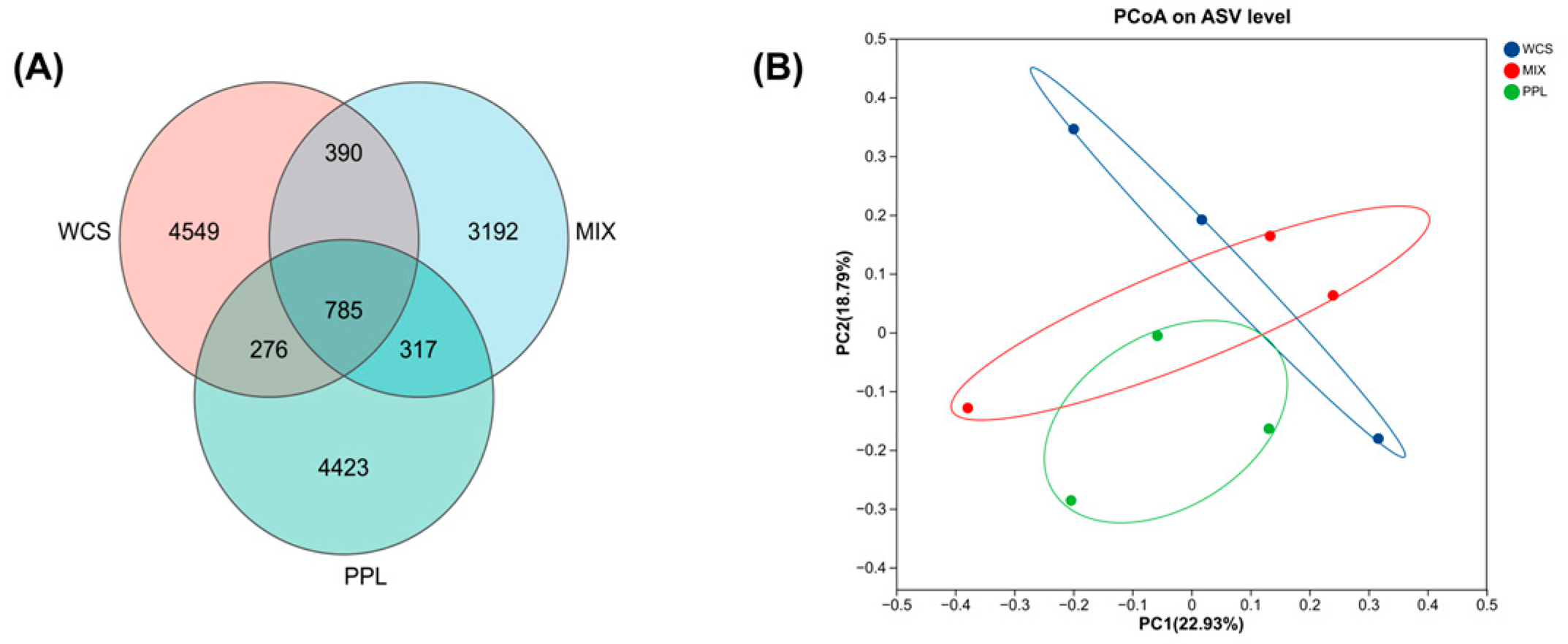
Following quality filtering, denoising, and chimera removal, a total of 357,310 sequences were retained, with an average of 39,701 ± 5346 sequences per sample (mean ± SD) for downstream microbial community analyses. As illustrated by the Venn diagram (Figure 1A), the three treatments shared 785 ASVs, whereas 4549, 3192, and 4423 ASVs were unique to WCS, MIX, and PPL, respectively.
Figure 1.
(A) Shared and unique amplicon sequence variants (ASVs) among treatments; (B) Principal coordinate analysis (PCoA) of rumen bacterial communities in finishing Angus bulls fed the experimental diets.
For beta diversity, the first 2 principal coordinates explained 22.93% and 18.79% of the variation, respectively (41.72% cumulatively; Figure 1B). Permutational multivariate analysis of variance (PERMANOVA) indicated that no significant differences were detected in overall bacterial community structure among treatments.
3.2.3. Taxonomic Composition
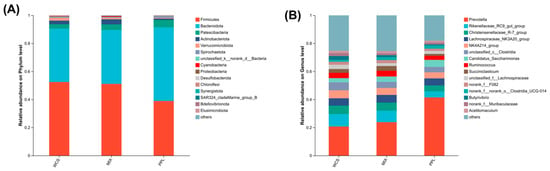
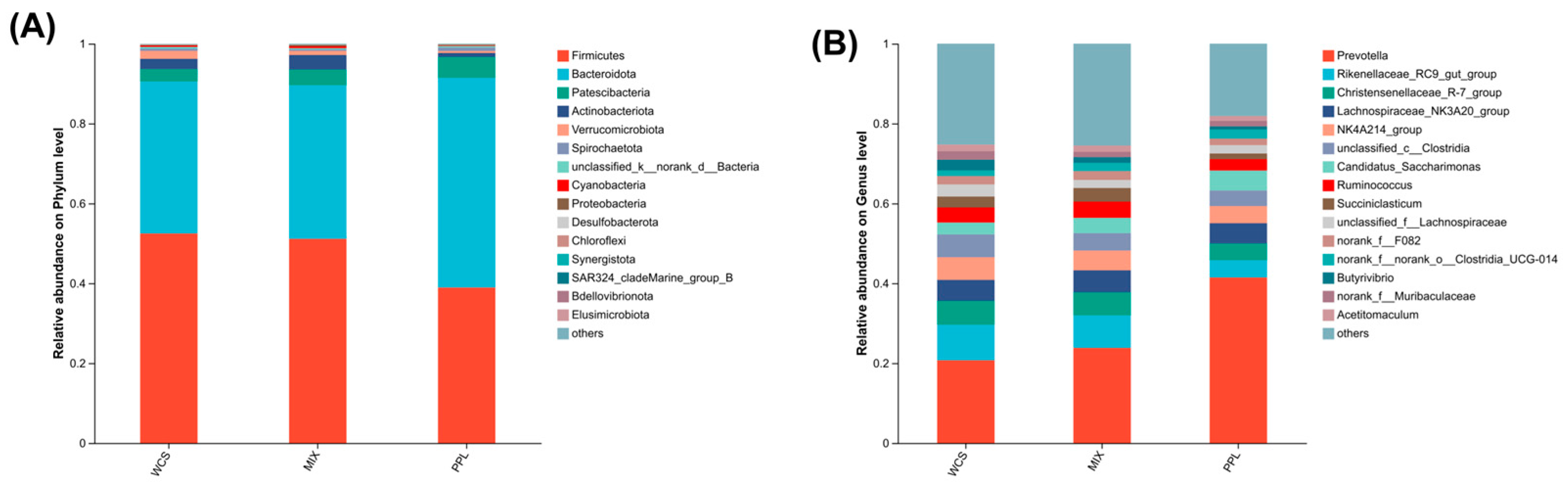
Firmicutes and Bacteroidota together accounted for more than 90% of the rumen bacterial community across treatments (Figure 2A), with no statistically significant differences detected in their relative abundances among treatments (p > 0.05). Prevotella was the predominant genus across treatments, and its relative abundance did not differ among treatments (p = 0.246; Figure 2B).
Figure 2.
(A) Mean relative abundance of major ruminal bacterial phyla in finishing Angus bulls fed the experimental diets; (B) Mean relative abundance of major ruminal bacterial genera in finishing Angus bulls fed the experimental diets.
3.3. Differential Bacterial Taxa
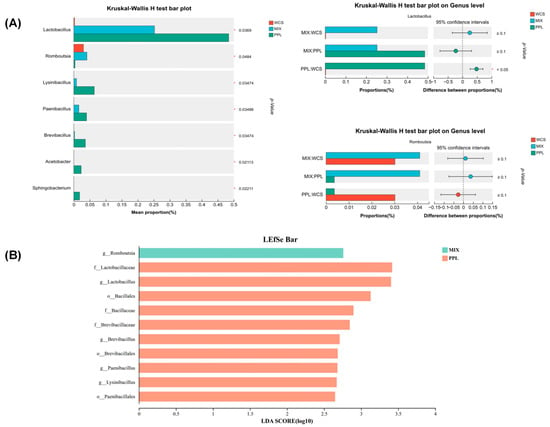
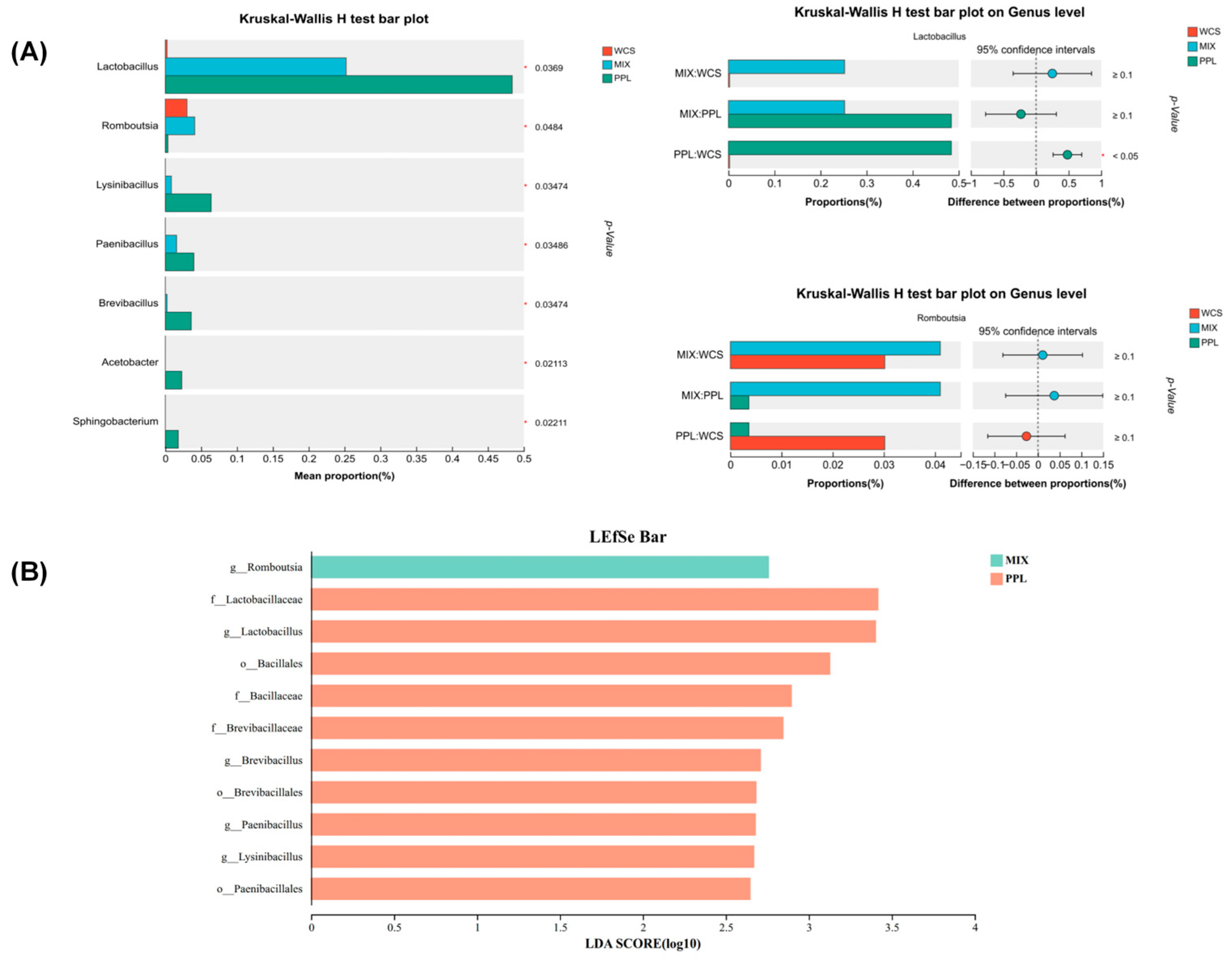
Exploratory differential abundance analyses were performed on the sequencing subset (n = 3 per treatment) without global multiplicity correction across all detected taxa. The Kruskal–Wallis test identified 7 genera with unadjusted p < 0.05 among dietary treatments (Figure 3A). Pairwise comparisons generated within the differential abundance workflow showed a higher relative abundance of Lactobacillus in PPL than in WCS (p < 0.05), whereas MIX did not differ significantly from either treatment. Although overall Kruskal-Wallis tests reached p < 0.05 for Romboutsia and the remaining low-abundance genera, no significant differences were detected in the subsequent pairwise comparisons.
Figure 3.
(A) Rumen bacterial genera differing among dietary treatments based on the Kruskal–Wallis test; (B) LEfSe analysis of differentially abundant rumen bacterial taxa among dietary treatments.
Exploratory LEfSe analysis (LDA score > 2.0 and p < 0.05) identified bacterial taxa that discriminated among dietary treatments (Figure 3B). Romboutsia was associated with the MIX treatment, whereas Lactobacillus and members of the family Lactobacillaceae were associated with the PPL treatment. Additional PPL-associated taxa shown in Figure 3B included members of Bacillales, Bacillaceae, Brevibacillales, Brevibacillaceae, Brevibacillus, Paenibacillales, Paenibacillus, and Lysinibacillus. No discriminative taxa above the specified LDA threshold were identified for the WCS treatment. Collectively, these differential taxon findings are exploratory given the small sample size (n = 3 per group).
3.4. Predicted Microbial Functions
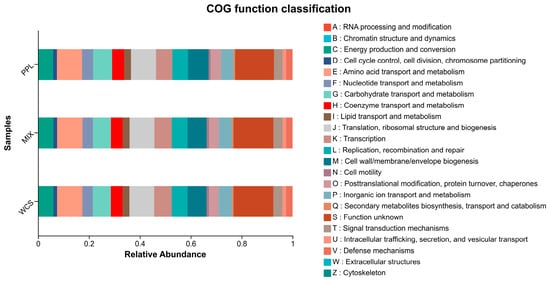
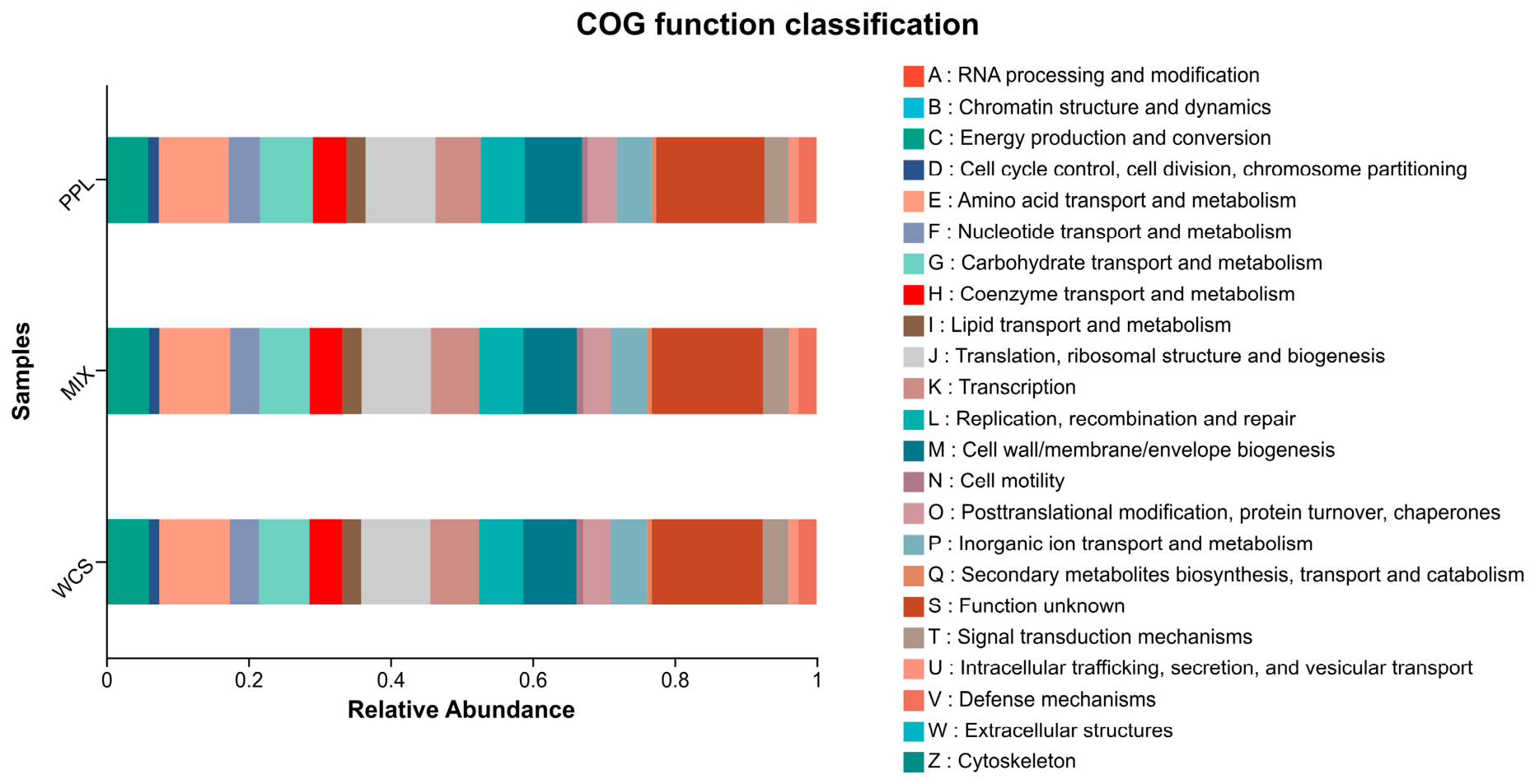
PICRUSt2 was used to predict the functional potential of the rumen bacterial communities. The predominant predicted Clusters of Orthologous Groups functional categories were S, E, J, G, and M, with no significant differences among dietary treatments (Figure 4).
Figure 4.
PICRUSt2-predicted Clusters of Orthologous Groups functional categories of rumen bacterial communities.
3.5. Slaughter Performance
Preslaughter body weight, carcass weight, net meat percentage, meat-to-bone ratio, backfat thickness, and eye-muscle area did not differ among treatments (p ≥ 0.437; Table 4). Dressing percentage was greater in PPL than in WCS and MIX (p = 0.016). All carcasses had a marbling score of 2.
Table 4.
Carcass traits of finishing Angus bulls fed diets containing potato peel residue–corn stalk silage.
3.6. Meat Quality and Proximate Composition
Muscle pH, WBSF, water loss rate, cooking loss, L*, and b* did not differ among treatments (p ≥ 0.156; Table 5). Redness (a*) was lower in PPL than in WCS and MIX (p = 0.021). Muscle moisture, CP, or EE concentrations did not differ among treatments (p ≥ 0.142; Table 6).
Table 5.
Meat-quality traits of longissimus dorsi muscle from finishing Angus bulls.
Table 6.
Proximate composition of longissimus dorsi muscle from finishing Angus bulls (Fresh weight basis, %).
3.7. Fatty Acid Composition
Total saturated fatty acids (SFA), monounsaturated fatty acids (MUFA), polyunsaturated fatty acids (PUFA), n-3 PUFA, n-6 PUFA, and their reported ratios did not differ among treatments (p ≥ 0.151; Table 7). Caprylic acid (C8:0) was lower in MIX and PPL than in WCS (p = 0.006). Tridecylic acid (C13:0) was lower, whereas γ-linolenic acid (C18:3n-6) was greater in MIX than in WCS (p = 0.018 and p = 0.032, respectively); PPL did not differ from either treatment for these fatty acids.
Table 7.
Targeted fatty acid profiles (μg/g) and derived class sums/ratios in the longissimus dorsi muscle of finishing Angus bulls.
3.8. Correlation Analysis
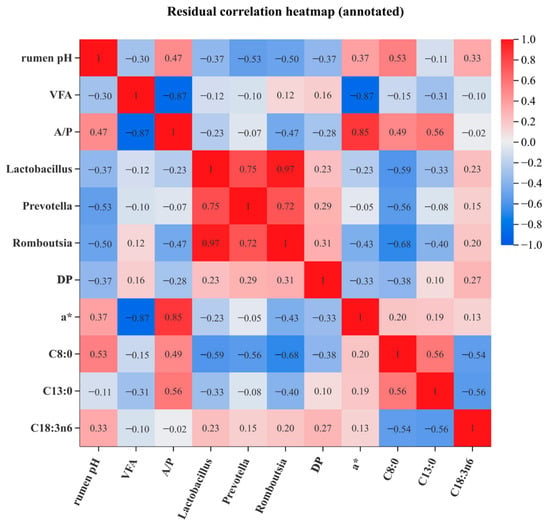
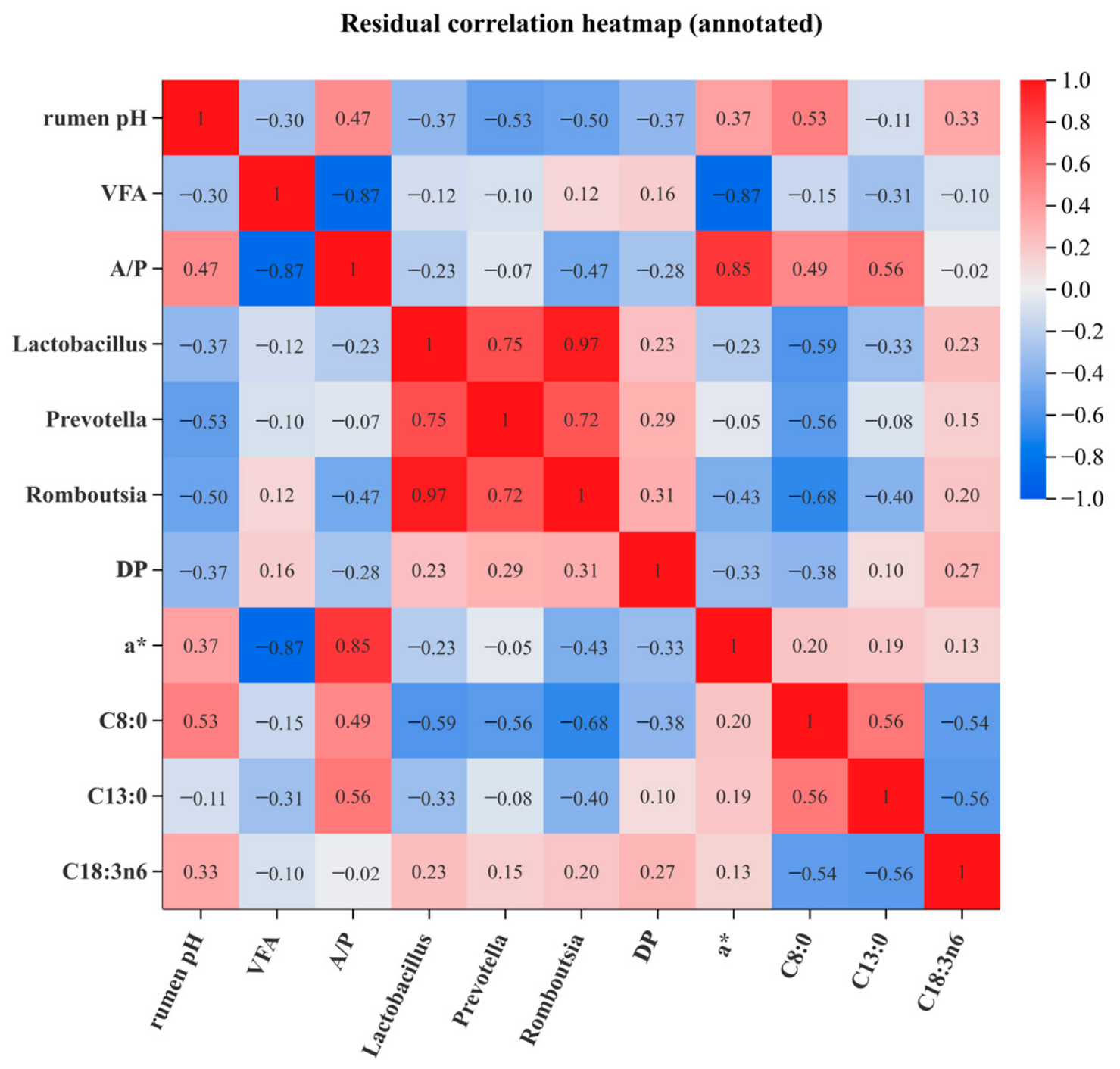
Exploratory Spearman rank correlation analysis (n = 9) was performed on model residuals after removing dietary treatment fixed effects to evaluate individual-level association patterns among ruminal fermentation variables, selected bacterial genera, dressing percentage (DP), meat redness (a*), and fatty acids (Figure 5). Because separate per-pair false-discovery-rate (FDR)-adjusted p values (q values) were not retained alongside the correlation matrix and n = 9 provides limited statistical power under multiple-testing control, the coefficients reported below are presented strictly as exploratory descriptive patterns rather than multiplicity-confirmed significant correlations. Across the residual matrix, ruminal pH showed positive and negative coefficient patterns with the acetate-to-propionate ratio (r = 0.47) and the relative abundances of Prevotella and Romboutsia (r = −0.53 and −0.50, respectively), whereas total VFA concentration showed a negative coefficient with the acetate-to-propionate ratio (r = −0.87). Relative abundance of Lactobacillus showed positive coefficients with Prevotella and Romboutsia (r = 0.75 and 0.97, respectively).
Figure 5.
Spearman correlations among ruminal fermentation variables, selected bacterial genera, and meat-quality traits (n = 9). Red and blue indicate positive and negative correlations, respectively. Color intensity indicates the magnitude of the correlation coefficient (r).
Meat redness showed positive and negative coefficients with the acetate-to-propionate ratio (r = 0.85) and total VFA concentration (r = −0.87), respectively. Caprylic acid (C8:0) showed positive coefficients with ruminal pH and C13:0 (r = 0.53 and 0.56, respectively) and negative coefficients with the relative abundances of Lactobacillus, Prevotella, and Romboutsia (r = −0.59, −0.56, and −0.68, respectively). Finally, C18:3n-6 showed negative coefficients with C8:0 and C13:0 (r = −0.54 and −0.56, respectively).
4. Discussion
The physiological and multi-omics findings of the present study should be interpreted within the baseline cohort context of our companion study on 36 finishing Angus bulls (n = 12 per treatment; previously published in Chinese [38]), in which replacing WCS with PPS maintained final live body weights (748–753 kg) and ADG (1.67–1.73 kg/d, p > 0.05) while reducing pen-level DMI (p < 0.05). Because DMI was recorded per pen and the slaughtered bulls (n = 6 per treatment, with n = 3 subsampled for sequencing and fatty acid profiling) were selected near their respective group mean final body weights, these cohort metrics serve as contextual background rather than direct causal links across outcome sets. Within the outcomes directly measured here, 100% replacement (PPL) increased dressing percentage but decreased ruminal pH and early post-mortem meat redness, whereas 50% replacement (MIX) preserved most carcass and meat-quality traits; associations with specific bacterial taxa represent concurrent patterns rather than proof of microbial mediation.
The greater dressing percentage in PPL occurred without differences in preslaughter body weight or carcass weight. Potato processing by-products, such as potato peels, have traditionally been recognized as valuable and nutritive feed resources [48], while co-ensiling strategies can effectively optimize fermentation profiles and energy characteristics [49,50]. Although diets with greater energy supply can increase carcass yield in finishing ruminants [51,52], the present data do not establish improved energy utilization or altered nutrient partitioning because energy balance, visceral-organ weights, and body composition were not measured. Although broader zootechnical parameters and growth performance from this comprehensive trial have been reported in a companion publication, the absence of these detailed physiological indices in the present dataset limits a definitive mechanistic explanation for the elevated dressing percentage. The greater dressing percentage may instead reflect differences in gut fill or other noncarcass components [53]. Muscle moisture, CP, and EE concentrations were unaffected, indicating no detectable differences in the measured proximate composition of longissimus dorsi muscle among treatments [54].
Although Lactobacillus showed a higher relative abundance in PPL than in WCS in the exploratory differential analysis, ruminal lactate was not quantified in this study. In the rumen, lactic acid functions as a highly dynamic intermediate metabolite that is typically turned over rapidly by lactate-utilizing microbial populations. Therefore, a higher relative abundance of the Lactobacillus based on 16S rRNA sequencing does not necessarily indicate a proportional accumulation of ruminal lactate, given that compositional profiles do not directly measure metabolic flux or active enzymatic activity. Moreover, because Lactobacillus occurred at low relative abundance (<0.5% mean relative abundance in Figure 3A), sample size was limited to n = 3 per treatment, and ruminal lactate or feed/silage microbiota were not measured, the co-occurrence of lower ruminal pH and higher Lactobacillus relative abundance in PPL is treated strictly as an exploratory observation rather than evidence of specific selection of acid-tolerant taxa or a direct causal mechanism [55]. Future studies incorporating repeated pH monitoring, direct metabolite profiling, and characterization of feed/silage microbiota are needed to clarify these dynamics [56,57].
Firmicutes and Bacteroidota dominated the rumen bacterial community across treatments [58], whereas no statistically significant differences were detected in alpha-diversity indices or overall bacterial community structure among treatments. Lactobacillus was more abundant in PPL than in WCS, potentially reflecting unsequenced feed-borne microbial inputs rather than direct drivers of fermentation changes, whereas Prevotella did not differ among treatments. Romboutsia showed an overall treatment effect but no significant pairwise differences [59,60]. Therefore, the numerical variation in Romboutsia abundance should not be interpreted as a specific effect of the MIX treatment. Correlations among Lactobacillus, Prevotella, Romboutsia, and ruminal pH describe covariation but do not establish microbial interactions or causal relationships [61,62]. Furthermore, the residual correlation analysis (Figure 5) provided preliminary insights into the covariation between low-abundance bacterial taxa and ruminal fermentation parameters. However, given the constraint of n = 9 total observations, these correlation parameters are unsuited for inferring mechanistic ecological interactions or causal relationships. Instead, these observed residual associations must be interpreted with caution and serve strictly as exploratory trends for hypothesis generation in future large-cohort studies. Collectively, these exploratory findings suggest relatively modest taxonomic responses to PPS inclusion despite no statistically significant shifts being detected in overall community structure at n = 3 per group [63,64].
Complete replacement of WCS with PPS decreased early post-mortem meat redness (a*) measured immediately after carcass fabrication, which may affect instrumental color appearance [65]. Because color was measured immediately after carcass fabrication and muscle glycogen, lactate, and myoglobin redox forms were not measured, the underlying mechanism and implications for color stability during retail display remain unknown [66,67]. Meat redness was correlated with the acetate-to-propionate ratio and total VFA concentration [68,69], but these associations do not demonstrate that ruminal fermentation altered postmortem muscle metabolism. Furthermore, muscle pH and Warner–Bratzler shear force were measured immediately post-slaughter and thus reflect instantaneous pre-rigor properties rather than ultimate eating quality or cold-shortening susceptibility after standard 24–48 h chilling. As a concrete hypothesis for future meat science validation, the lower ruminal pH observed in the 100% replacement group (PPL) could theoretically alter gluconeogenic propionate supply and mild systemic acid load, thereby modifying ante-mortem muscle glycogen reserves, ultimate pH24 decline during commercial chilling, and subsequent myoglobin blooming stability. No significant difference in redness was detected between the MIX and WCS treatments, warranting further evaluation of partial PPS replacement. In addition, rumen fluid in the present study was collected once at 3 to 4 h post-feeding via an oral stomach tube rather than via rumen cannulation or across multiple time points. Oral stomach-tube sampling is convenient and non-invasive for larger cohorts, but it can be influenced by variable saliva contamination (potentially shifting pH upward), may under-represent particle-associated microbial communities compared with solid/digesta fractions, and captures only a single post-feeding snapshot rather than diurnal fermentation dynamics. Accordingly, the observed pH, VFA, MCP, and microbial profiles should be interpreted within these sampling constraints, and future studies incorporating multi-timepoint sampling or complementary digesta fractions would help further substantiate these findings. PPS inclusion resulted in limited changes in the muscle fatty-acid composition. Although minor differences were observed in certain trace fatty acids, namely C8:0, C13:0, and C18:3n-6, their absolute concentrations were extremely low (ranging from 0.4 to 0.9 µg/g). More importantly, the main structural lipid classes, including total SFA, MUFA, and PUFA, as well as n-3 and n-6 PUFA, did not differ among treatments. Because these individual fatty acids occurred at such negligible concentrations and major fatty-acid classes were unaffected, the biological and human nutritional relevance of these differences appears limited [70]. Furthermore, correlations of C8:0 with ruminal pH and bacterial genera are hypothesis-generating and cannot establish altered ruminal biohydrogenation without measurements of dietary fatty acids, ruminal lipid intermediates, or relevant microbial functions.
Several methodological limitations of this study should be acknowledged. First, although 12 bulls per treatment were housed in single group-feeding pens (one pen per treatment; lacking pen-level replication) with rations delivered per pen, post-mortem and laboratory measurements were analyzed at the individual-bull level without incorporating pen as a random effect; consequently, potential within-pen clustering could not be mathematically partitioned in the linear models, all p-values should be interpreted cautiously with this group-housing structure in mind, and the single-pen design along with the single site, breed, and sex may limit broader generalization. Second, ruminal parameters were measured at a single post-feeding oral stomach-tube sampling time point, and detailed temporal variations in silage composition and safety parameters (such as glycoalkaloids across storage) were not exhaustively profiled across the single silage batch. Third, post-mortem meat quality was evaluated on pre-rigor/early post-mortem muscle without prolonged ageing, sensory panels, or oxidative-stability testing, and intramuscular fatty acids were profiled using a targeted GC–MS/MS panel without total-lipid hydrolysis. Accordingly, future larger-scale, multi-center studies incorporating longitudinal sampling, full silage chemical/safety characterization, and extended post-mortem meat-quality tracking are warranted to further substantiate these findings.
5. Conclusions
Within the scope of the outcomes directly measured in this study, replacing 50% of WCS with PPS on a dry matter basis resulted in no statistically significant differences in ruminal fermentation characteristics, carcass traits, or most early post-mortem meat-quality indices in finishing Angus bulls, and major muscle fatty acid classes (SFA, MUFA, and PUFA) were unaffected. In contrast, complete (100%) replacement of WCS with PPS was associated with higher dressing percentage alongside lower ruminal pH and lower immediate post-mortem (pre-rigor) meat redness (a*). These findings are strictly confined to the physiological, carcass, and pre-rigor meat-quality variables evaluated herein and do not extend to economic performance, animal health safety, or consumer retail acceptability, which require further validation in larger-scale trials.
Supplementary Materials
The following supporting information can be downloaded at: https://www.mdpi.com/article/10.3390/foods15234239/s1. Supplementary Table S1, Chemical composition and nutri-tional values of the experimental feed ingredients (Dry matter basis); Supplementary Table S2, Relative abundance of the 5 most abundant rumen bacterial phyla (%); and Supplementary Table S3, Relative abundance of the 15 most abundant rumen bacterial genera (%).
Author Contributions
Methodology, J.S., Y.L. (Yuanxiao Li) and T.J.; Investigation (laboratory analyses), Y.L. (Yulian Liu); Investigation (animal trial, sample collection, and laboratory analyses), M.L.; Investigation (animal trial and sample collection), Q.K.; supervision, J.S.; writing—original draft preparation, Y.L. (Yulian Liu); writing—review and editing, Y.L. (Yuanxiao Li), T.J. and Y.L. (Yulian Liu). All authors have read and agreed to the published version of the manuscript.
Funding
This work was supported by the Central Government Guidance Fund for Local Science and Technology Development (grant no. 2022ZY0098) and the Public Welfare Project of the Henan Provincial Department of Agriculture and Rural Affairs, “Development and Extension of Mixed-Fermented Feed from Agricultural By-products” (grant no. NYNCTNYZXZJ01).
Institutional Review Board Statement
All animal procedures were approved by the Experimental Animal Committee of Henan University of Science and Technology (approval no. SYLY-2022ZY0098; approval date: 2022-07-09).
Informed Consent Statement
Not applicable.
Data Availability Statement
The raw 16S rRNA gene sequencing data generated in this study are publicly available in the NCBI Sequence Read Archive (SRA) under BioProject accession number PRJNA1557589. The original contributions presented in this study are included in the arti-cle/supplementary material. Further inquiries can be directedssss to the corresponding authors.
Acknowledgments
The authors would like to thank all members of the laboratory for their support during this study and acknowledge Li for his guidance and suggestions.
Conflicts of Interest
The authors declare no conflicts of interest.
References
- Wang, M.; Han, H.; Shang, Y.; Zhang, L.; Zhang, Y.; Su, C.; Lian, H.; Fu, T.; Gao, T. Effect of the replacement of maize silage and soyabean meal with mulberry silage in the diet of Hu lambs on growth performance, serum biochemical indices, slaughter performance, and meat quality. Animals 2022, 12, 3164. [Google Scholar] [CrossRef] [Scilit] [PubMed]
- Pan, S.; Wang, D.; Lin, Y.; Cheng, M.; Zhu, F.; Guo, Y. Effects of ginger straw silage with enzymes on growth performance, digestion and metabolism, meat quality and rumen microflora diversity of Laiwu Black goat. Animals 2024, 14, 2040. [Google Scholar] [CrossRef] [Scilit] [PubMed]
- Gunun, P.; Cherdthong, A.; Khejornsart, P.; Wanapat, M.; Polyorach, S.; Kaewwongsa, W.; Gunun, N. Replacing concentrate with yeast-or EM-fermented cassava peel (YFCP or EMFCP): Effects on the feed intake, feed digestibility, rumen fermentation, and growth performance of goats. Animals 2023, 13, 551. [Google Scholar] [CrossRef] [Scilit] [PubMed]
- Long, Y.; Zhang, N.; Bi, Y.; Ma, T.; Paengkoum, P.; Xin, J.; Xiao, W.; Zhao, Y.; Yuan, C.; Wang, D.; et al. Partially substituting roughage with traditional Chinese herbal medicine residues in the diet of goats improved feed quality, growth performance, hematology, and rumen microbial profiles. BMC Vet. Res. 2024, 20, 576. [Google Scholar] [CrossRef] [Scilit] [PubMed]
- Durst, P.; Bayasgalanbat, N. Promotion of Underutilized Indigenous Food Resources for Food Security and Nutrition in Asia and the Pacific; Food and Agriculture Organization of the United Nations: Rome, Italy, 2014. [Google Scholar]
- Tian, J.; Chen, J.; Ye, X.; Chen, S. Health benefits of the potato affected by domestic cooking: A review. Food Chem. 2016, 202, 165–175. [Google Scholar] [CrossRef] [Scilit] [PubMed]
- Robertson, T.M.; Alzaabi, A.Z.; Robertson, M.D.; Fielding, B.A. Starchy carbohydrates in a healthy diet: The role of the humble potato. Nutrients 2018, 10, 1764. [Google Scholar] [CrossRef] [Scilit] [PubMed]
- Kibar, A.A.; Aslan, Ö.; Dasgin, H.; Önder Fırat, E.; Avcı, H.R.; Koçer, S.; Tosun, F. Recovery of proteins and bioactive peptides from potato peels. Food Sci. Nutr. 2025, 13, e71028. [Google Scholar] [CrossRef] [Scilit] [PubMed]
- Omer, H.A.; Abdel-Magid, S.S.; Ahmed, S.M.; Mohamed, M.I.; Awadalla, I.M. Response to partial replacement of yellow corn with potato processing waste as non-traditional source of energy on the productive performance of Ossimi lambs. Trop. Anim. Health Prod. 2010, 42, 1195–1202. [Google Scholar] [CrossRef] [Scilit] [PubMed]
- Okine, A.; Hanada, M.; Aibibula, Y.; Okamoto, M. Ensiling of potato pulp with or without bacterial inoculants and its effect on fermentation quality, nutrient composition and nutritive value. Anim. Feed Sci. Technol. 2005, 121, 329–343. [Google Scholar] [CrossRef] [Scilit]
- Nelson, M.L. Utilization and application of wet potato processing coproducts for finishing cattle. J. Anim. Sci. 2010, 88, E133–E142. [Google Scholar] [CrossRef] [Scilit] [PubMed]
- Zunong, M.; Tuerhong, T.; Okamoto, M.; Hongo, A.; Hanada, M. Effects of a potato pulp silage supplement on the composition of milk fatty acids when fed to grazing dairy cows. Anim. Feed Sci. Technol. 2009, 152, 81–91. [Google Scholar] [CrossRef] [Scilit]
- EFSA Panel on Contaminants in the Food Chain (CONTAM); Schrenk, D.; Bignami, M.; Bodin, L.; Chipman, J.K.; del Mazo, J.; Hogstrand, C.; Hoogenboom, L.R.; Leblanc, J.; Nebbia, C.S.; et al. Risk assessment of glycoalkaloids in feed and food, in particular in potatoes and potato-derived products. EFSA J. 2020, 18, e06222. [Google Scholar] [CrossRef] [Scilit] [PubMed]
- Korpan, Y.I.; Nazarenko, E.A.; Skryshevskaya, I.V.; Martelet, C.; Jaffrezic-Renault, N.; El’skaya, A.V. Potato glycoalkaloids: True safety or false sense of security? Trends Biotechnol. 2004, 22, 147–151. [Google Scholar] [CrossRef] [Scilit] [PubMed]
- Gowda, N.K.; Vallesha, N.C.; Awachat, V.B.; Anandan, S.; Pal, D.T.; Prasad, C.S. Study on evaluation of silage from pineapple (Ananas comosus) fruit residue as livestock feed. Trop. Anim. Health Prod. 2015, 47, 557–561. [Google Scholar] [CrossRef] [Scilit] [PubMed]
- Wang, B.; Wang, D.; Wu, X.; Cai, J.; Liu, M.; Huang, X.; Wu, J.; Liu, J.; Guan, L. Effects of dietary physical or nutritional factors on morphology of rumen papillae and transcriptome changes in lactating dairy cows based on three different forage-based diets. BMC Genom. 2017, 18, 353. [Google Scholar] [CrossRef] [Scilit] [PubMed]
- Grant, R.J. Symposium review: Physical characterization of feeds and development of the physically effective fiber system. J. Dairy Sci. 2023, 106, 4454–4463. [Google Scholar] [CrossRef] [Scilit] [PubMed]
- Kumari, D.; Singh, R. Pretreatment of lignocellulosic wastes for biofuel production: A critical review. Renew. Sustain. Energy Rev. 2018, 90, 877–891. [Google Scholar] [CrossRef] [Scilit]
- Xing, B.S.; Han, Y.; Wang, X.C.; Ma, J.; Cao, S.; Li, Q.; Wen, J.; Yuan, H. Cow manure as additive to a DMBR for stable and high-rate digestion of food waste: Performance and microbial community. Water Res. 2020, 168, 115099. [Google Scholar] [CrossRef] [Scilit] [PubMed]
- Xing, B.S.; Han, Y.; Wang, X.C.; Wen, J.; Cao, S.; Zhang, K.; Li, Q.; Yuan, H. Persistent action of cow rumen microorganisms in enhancing biodegradation of wheat straw by rumen fermentation. Sci. Total Environ. 2020, 715, 136529. [Google Scholar] [CrossRef] [Scilit] [PubMed]
- White, B.H.; Clayton, E.H.; Friend, M.A. The effect of mechanical processing of wheaten straw on intake and rumen parameters following grain feeding in sheep. Anim. Prod. Sci. 2014, 54, 1455–1459. [Google Scholar] [CrossRef] [Scilit]
- Bai, B.; Ge, G.; Wang, Z.; Liu, M.; Liu, Y.; Sheng, P.; Ma, W.; Wu, H.; Zhang, Z.; Jia, Y. Extrusion puffing and enzymes improve silage performance and in vitro digestibility of sorghum straw by altering microbial composition, volatiles and anti-nutritional factors. Ind. Crops Prod. 2025, 227, 120837. [Google Scholar] [CrossRef] [Scilit]
- Zhang, H.; Xu, X.; Shi, Z.; Zhu, L.; Shi, S.; Wang, X.; Liu, X.; Han, L. Lignocellulose deconstruction and mechanistic insights into wheat straw using extrusion-ammoniation synergistic pretreatment. Ind. Crops Prod. 2025, 228, 120820. [Google Scholar] [CrossRef] [Scilit]
- Ma, Y.; Chen, X.; Xiao, J.; Liu, S.; Wang, J.; Cao, Z. Effects of alkalization treatment on chemical composition and in vitro ruminal fermentation of anaerobically stored rice stover. J. Anim. Sci. 2020, 98, 76. [Google Scholar] [CrossRef] [Scilit]
- Nie, D.; Yao, L.; Xu, X.; Zhang, Z.; Li, Y. Promoting corn stover degradation via sequential processing of steam explosion and cellulase/lactic acid bacteria-assisted ensilage. Bioresour. Technol. 2021, 337, 125392. [Google Scholar] [CrossRef] [Scilit] [PubMed]
- Chen, J.; Huang, G.; Xiong, H.; Qin, H.; Zhang, H.; Sun, Y.; Dong, X.; Lei, Y.; Zhao, Y.; Zhao, Z. Effects of mixing garlic skin on fermentation quality, microbial community of high-moisture Pennisetum hydridum silage. Front. Microbiol. 2021, 12, 770591. [Google Scholar] [CrossRef] [Scilit] [PubMed]
- Anjum, M.I.; Javaid, S.; Ashfaq, F.; Iqbal, J. Effects of maize silage substitution with sugarbeet or citrus pulp ensiled with corncobs on growth performance, digestibility, and economic benefits in buffalo calves. Trop. Anim. Health Prod. 2022, 54, 326. [Google Scholar] [CrossRef] [Scilit] [PubMed]
- Su, J.; Xue, Y.; Zhang, K.; Liu, Z.; Lv, J.; Yang, Q.; Li, Z.; Liu, C.; Xin, H. The effects of Lactobacillus plantarum, Bacillus subtilis, a lignocellulolytic enzyme system, and their combination on the fermentation profiles, chemical composition, bacterial community, and in situ rumen digestion of fresh waxy corn stalk silage. Animals 2024, 14, 3442. [Google Scholar] [CrossRef] [Scilit] [PubMed]
- Du, Z.; Yamasaki, S.; Oya, T.; Cai, Y. Cellulase-lactic acid bacteria synergy action regulates silage fermentation of woody plant. Biotechnol. Biofuels Bioprod. 2023, 16, 125. [Google Scholar] [CrossRef] [Scilit] [PubMed]
- Dai, T.; Dong, D.; Wang, J.; Yin, X.; Zong, C.; Jia, Y.; Shao, T. Effects of wet brewers grains on fermentation quality and in vitro ruminal digestibility of mixed silage prepared with corn stalk, sweet potato peel and dried apple pomace in southeast China. J. Anim. Physiol. Anim. Nutr. 2023, 107, 340–349. [Google Scholar] [CrossRef] [Scilit] [PubMed]
- Sugimoto, M.; Saito, W.; Ooi, M. The effects of urea-treated potato pulp (PP) ensiled with beet pulp or wheat bran pellets to reduce moisture of PP and flake density of corn grain supplemented with the PP silage on digestibility and ruminal fermentation in beef steers. Anim. Sci. J. 2010, 81, 316–324. [Google Scholar] [CrossRef] [Scilit] [PubMed]
- Babaeinasab, Y.; Rouzbehan, Y.; Fazaeli, H.; Rezaei, J. Chemical composition, silage fermentation characteristics, and in vitro ruminal fermentation parameters of potato-wheat straw silage treated with molasses and lactic acid bacteria and corn silage. J. Anim. Sci. 2015, 93, 4377–4386. [Google Scholar] [CrossRef] [Scilit] [PubMed]
- Nelson, M.L.; Busboom, J.R.; Cronrath, J.D.; Falen, L.; Blankenbaker, A. Effects of graded levels of potato by-products in barley- and corn-based beef feedlot diets: I. Feedlot performance, carcass traits, meat composition, and appearance. J. Anim. Sci. 2000, 78, 1829–1836. [Google Scholar] [CrossRef] [Scilit] [PubMed]
- Radunz, A.E.; Lardy, G.P.; Bauer, M.L.; Marchello, M.J.; Loe, E.R.; Berg, P.T. Influence of steam-peeled potato-processing waste inclusion level in beef finishing diets: Effects on digestion, feedlot performance, and meat quality. J. Anim. Sci. 2003, 81, 2675–2685. [Google Scholar] [CrossRef] [Scilit] [PubMed]
- Pen, B.; Oyabu, T.; Hidaka, S.; Hidari, H. Effect of potato by-products based silage on growth performance, carcass characteristics and fatty acid composition of carcass fats in Holstein steers. Asian-Australas. J. Anim. Sci. 2005, 18, 490–496. [Google Scholar] [CrossRef] [Scilit]
- Duynisveld, J.L.; Charmley, E. Potato processing waste in beef finishing diets; effects on performance, carcass and meat quality. Anim. Prod. Sci. 2018, 58, 546–552. [Google Scholar] [CrossRef] [Scilit]
- Shi, C.; Li, Y.; Wang, H.; Zhang, S.; Deng, J.; Aziz-Ur-Rahman, M.; Cui, Y.; Lu, L.; Zhao, W.; Qiu, X.; et al. From Food Waste to Sustainable Agriculture: Nutritive Value of Potato By-Product in Total Mixed Ration for Angus Bulls. Foods 2024, 13, 2771. [Google Scholar] [CrossRef] [Scilit] [PubMed]
- Li, M.; Li, Y.; Wang, J.; Song, Z.; Yao, J.; Yue, Y.; Bao, W.; Sun, J.; Kong, Q. Effects of mixed silage of potato peels and corn straw on growth performance, nutrient apparent digestibility and serum biochemical and antioxidant indices of fattening cattle. Chin. J. Anim. Nutr. 2024, 36, 7108–7119. (In Chinese) [Google Scholar]
- T/NAIA 0341-2024; Technical Specification for the Fattening of Angus Bulls. Ningxia Association for Agricultural Industry and Analysis (NAIA): Yinchuan, China, 2024.
- NY/T 815-2004; China National Feeding Standard of Beef Cattle. China Agriculture Press: Beijing, China, 2004.
- Association of Official Analytical Collaboration. Official Methods of Analysis, 18th ed.; Association of Official Analytical Collaboration International: Gaithersburg, MD, USA, 2006. [Google Scholar]
- Van Soest, P.J.; Robertson, J.B.; Lewis, B.A. Methods for dietary fiber, neutral detergent fiber, and nonstarch polysaccharides in relation to animal nutrition. J. Dairy Sci. 1991, 74, 3583–3597. [Google Scholar] [CrossRef] [Scilit] [PubMed]
- GB/T 13885-2017; Determination of the Contents of Calcium, Copper, Iron, Magnesium, Manganese, Potassium, Sodium and Zinc in Feeds—Method Using Atomic Absorption Spectrometry. Standards Press of China: Beijing, China, 2017.
- GB/T 6437-2018; Determination of Phosphorus in Feeds—Spectrophotometry. Standards Press of China: Beijing, China, 2018.
- Liu, H.; Zhou, J.; Degen, A.; Liu, H.; Cao, X.; Hao, L.; Shang, Z.; Ran, T.; Long, R. A comparison of average daily gain, apparent digestibilities, energy balance, rumen fermentation parameters, and serum metabolites between yaks (Bos grunniens) and Qaidam cattle (Bos taurus) consuming diets differing in energy level. Anim. Nutr. 2022, 12, 77–86. [Google Scholar] [CrossRef] [Scilit] [PubMed]
- NY/T 676-2010; Assessment of Beef Carcass Grading and Cut Specifications. China Agriculture Press: Beijing, China, 2010.
- NY/T 2793-2015; Determination of PH and Shear Force in Meat China. Agriculture Press: Beijing, China, 2015.
- Calcio Gaudino, E.; Colletti, A.; Grillo, G.; Tabasso, S.; Cravotto, G. Emerging processing technologies for the recovery of valuable bioactive compounds from potato peels. Foods 2020, 9, 1598. [Google Scholar] [CrossRef] [Scilit] [PubMed]
- Luo, X.; Liu, Y.; Lei, L.; Shen, J.; Zhang, Q.; Wang, Y.; Ruan, R.; Cui, X. Co-ensiling of rice straw and distillers grains to increase methane production and maximise energy output. Bioresour. Technol. 2023, 386, 129496. [Google Scholar] [CrossRef] [Scilit] [PubMed]
- Alvarado-Ramírez, E.R.; Maggiolino, A.; Elghandour, M.M.M.Y.; Rivas-Jacobo, M.A.; Ballesteros-Rodea, G.; Palo, P.; Salem, A.Z.M. Impact of co-Ensiling of maize with Moringa oleifera on the production of greenhouse gases and the characteristics of fermentation in ruminants. Animals 2023, 13, 764. [Google Scholar] [CrossRef] [Scilit] [PubMed]
- Kang, K.; Ma, J.; Wang, H.; Wang, Z.; Peng, Q.; Hu, R.; Zou, H.; Bao, S.; Zhang, W.; Sun, B. High-energy diet improves growth performance, meat quality and gene expression related to intramuscular fat deposition in finishing yaks raised by barn feeding. Vet. Med. Sci. 2020, 6, 755–765. [Google Scholar] [CrossRef] [Scilit] [PubMed]
- Honig, A.C.; Inhuber, V.; Spiekers, H.; Windisch, W.; Götz, K.U.; Ettle, T. Influence of dietary energy concentration and body weight at slaughter on carcass tissue composition and beef cuts of modern type Fleckvieh (German Simmental) bulls. Meat Sci. 2020, 169, 108209. [Google Scholar] [CrossRef] [Scilit] [PubMed]
- Swanson, R.M.; Neville, T.L.; McCarthy, K.L.; Kassetas, C.J.; Borowicz, P.P.; Crouse, M.S.; Reynolds, L.P.; Dahlen, C.R.; Caton, J.S. Differing planes of nutrition alter serum and histotroph amino acid composition in nonpregnant, multiparous beef cows on day 3 of the estrous cycle. J. Anim. Sci. 2024, 102, skae199. [Google Scholar] [CrossRef] [Scilit] [PubMed]
- Yi, S.; Zhao, Y.; Wu, H.; Meng, Q.; Zhou, Z. Enhancing the feeding value of corn stover for beef cattle via steam explosion: Effects on rumen digestibility, growth and meat quality. Animal 2026, 20, 101796. [Google Scholar] [CrossRef] [Scilit] [PubMed]
- Castillo-Lopez, E.; Hartinger, T.; Ricci, S.; Xu, K.; Schwartz-Zimmermann, H.E.; Berthiller, F.; Reisinger, N.; Zebeli, Q. Association between the severity of subacute ruminal acidosis and the microbiome of the rumen, and the metabolome of the rumen, blood, and milk in primiparous cows. J. Dairy Sci. 2025, 108, 12298–12313. [Google Scholar] [CrossRef] [Scilit] [PubMed]
- Qiu, Q.; Gao, C.; Gao, Z.; Rahman, M.A.U.; He, Y.; Cao, B.; Su, H. Temporal Dynamics in Rumen Bacterial Community Composition of Finishing Steers during an Adaptation Period of Three Months. Microorganisms 2019, 7, 410. [Google Scholar] [CrossRef] [Scilit] [PubMed]
- Chen, Q.; Cui, Y.F.; Zhang, Z.X.; Jiang, F.C.; Meng, X.Y.; Li, J.J.; Cui, D.Y.; Jia, J.L. Effect of alfalfa supplementary change dietary non-fibrous carbohydrate (NFC) to neutral detergent fiber (NDF) ratio on rumen fermentation and microbial function in Gansu alpine fine wool sheep (Ovis aries). Anim. Biotechnol. 2024, 35, 2262539. [Google Scholar] [CrossRef] [Scilit] [PubMed]
- Torres Manno, M.A.; Gizzi, F.O.; Martín, M.; Espariz, M.; Magni, C.; Blancato, V.S. Metagenomic approach to infer rumen microbiome derived traits of cattle. World J. Microbiol. Biotechnol. 2023, 39, 250. [Google Scholar] [CrossRef] [Scilit] [PubMed]
- Luo, C.; Jiang, F.; Zhong, A.; He, X.; Liu, X.; Huang, Y.; Gao, Y. Effects of Isoacid Supplementation on In Vitro Rumen Fermentation, Nutrient Degradability and Bacterial Community Diversity Using Corn Silage-Highland Barley Straw as Substrates in Yaks. Microorganisms 2026, 14, 692. [Google Scholar] [CrossRef] [Scilit] [PubMed]
- Fan, Q.; Wanapat, M.; Yan, T.; Hou, F. Altitude influences microbial diversity and herbage fermentation in the rumen of yaks. BMC Microbiol. 2020, 20, 370. [Google Scholar] [CrossRef] [Scilit] [PubMed]
- Liang, J.; Chang, J.; Zhang, R.; Fang, W.; Chen, L.; Ma, W.; Zhang, Y.; Yang, W.; Li, Y.; Zhang, P.; et al. Metagenomic analysis reveals the efficient digestion mechanism of corn stover in Angus bull rumen: Microbial community succession, CAZyme composition and functional gene expression. Chemosphere 2023, 336, 139242. [Google Scholar] [CrossRef] [Scilit] [PubMed]
- Mgeni, M.S.; Zhang, L.; Chen, Y.; Dong, X.; Xiu, Z.; Zhang, J.; Chen, J.; Sun, Y. Effects of dandelion extracts on the ruminal microbiota, metabolome, and systemic inflammation in dairy goats fed a high-concentrate diet. Vet. Sci. 2025, 13, 28. [Google Scholar] [CrossRef] [Scilit] [PubMed]
- Gao, K.; Geng, C. Alterations in the rumen bacterial communities and metabolites of finishing bulls fed high-concentrate diets supplemented with active dry yeast and yeast culture. Front. Microbiol. 2022, 13, 908244. [Google Scholar] [CrossRef] [Scilit] [PubMed]
- Neves, A.L.A.; Vieira, R.A.M.; Vargas-Bello-Pérez, E.; Chen, Y.; McAllister, T.; Ominski, K.H.; Lin, L.; Guan, L.L. Impact of feed composition on rumen microbial dynamics and phenotypic traits in beef cattle. Microorganisms 2025, 13, 310. [Google Scholar] [CrossRef] [Scilit] [PubMed]
- Testa, M.L.; Grigioni, G.; Panea, B.; Pavan, E. Color and marbling as predictors of meat quality perception of Argentinian consumers. Foods 2021, 10, 1465. [Google Scholar] [CrossRef] [Scilit] [PubMed]
- Krell, J.; Poveda-Arteaga, A.; Weiss, J.; Witte, F.; Terjung, N.; Gibis, M. Influence of different storage atmospheres in packaging on color stability of beef. J. Food Sci. 2024, 89, 5774–5787. [Google Scholar] [CrossRef] [Scilit] [PubMed]
- Henriott, M.L.; Herrera, N.J.; Ribeiro, F.A.; Hart, K.B.; Bland, N.A.; Eskridge, K.; Calkins, C.R. Impact of myoglobin oxygenation state prior to frozen storage on color stability of thawed beef steaks through retail display. Meat Sci. 2020, 170, 108232. [Google Scholar] [CrossRef] [Scilit] [PubMed]
- Oh, S.; Mbiriri, D.T.; Ryu, C.; Lee, K.; Cho, S.; Choi, N.J. In vitro and in vivo evaluation of kenaf (Hibiscus cannabinus L.) as a roughage source for beef cattle. Asian-Australas. J. Anim. Sci. 2018, 31, 1598–1603. [Google Scholar] [CrossRef] [Scilit] [PubMed]
- Ran, T.; Fang, Y.; Wang, Y.T.; Yang, W.Z.; Niu, Y.D.; Sun, X.Z.; Zhong, R.Z. Effects of grain type and conditioning temperature during pelleting on growth performance, ruminal fermentation, meat quality and blood metabolites of fattening lambs. Animal 2021, 15, 100146. [Google Scholar] [CrossRef] [Scilit] [PubMed]
- Chen, R.; Wang, F.; Xie, S.; Ban, Y.; Gao, C.; Li, P.; Qin, J.; Xu, Y.; Lu, Q.; Wang, X.; et al. Effects of fermented Rosa roxburghii Tratt pomace on growth performance, lipid metabolism, antioxidant activity, and amino and fatty acid profile in goats. PLoS ONE 2026, 21, e0342308. [Google Scholar] [CrossRef] [Scilit] [PubMed]

Disclaimer/Publisher’s Note: The statements, opinions and data contained in all publications are solely those of the individual author(s) and contributor(s) and not of MDPI and/or the editor(s). MDPI and/or the editor(s) disclaim responsibility for any injury to people or property resulting from any ideas, methods, instructions or products referred to in the content. |
© 2026 by the authors. Licensee MDPI, Basel, Switzerland. This article is an open access article distributed under the terms and conditions of the Creative Commons Attribution (CC BY) license.