


Abstract
In this work organic hemp flour was fermented with Bifidobacterium breve BR03, Bifidobacterium animalis subsp. lactis BB12, and Lactiplantibacillus plantarum LB325 and compared with spontaneous fermentation, with the aim to produce a functional product suitable as an adjuvant functional starter in bread making. The comparison among fermentation performances of organic hemp flour fermented by probiotic and beneficial bacteria was evaluated. Volatile organic compounds (VOCs) were monitored at 0, 6, 24 and 48 h by HS-SPME/GC-MS. Fermentation significantly modified the volatilome, generating strain-specific profiles. A core set of 50 VOCs was shared among all treatments, while spontaneous fermentation showed the highest diversification. Principal component Analysis (PCA) revealed a clear separation according to fermentation time and microbial inoculum, with organic acids, alcohols and terpenes representing the main discriminant compound classes. BB12 was mainly associated with citral, β-myrcene and (−)-carvone, whereas LB325 was characterized by thymol, α-terpineol, humulene and nitrogen-containing organic acids. B. breve BR03 was associated with nonanoic acid and β-caryophyllene. Several of these compounds are known for their bioactivities. Notably, LB325 was linked to aminocaproic acid and other bioactive compounds. LB325 showed high bifidobactogenic activity but low lactobacillogenic activity, whereas hemp flour fermented with BB12 showed high scores in both prebiotic activities. Overall, targeted probiotic and beneficial bacteria fermentation effectively modulated the hemp flour volatilome and promoted the formation of strain-specific bioactive compounds, supporting the development of functional fermented hemp-based foods driven by probiotic and beneficial bacteria cultures.
1. Introduction
Hemp seed flour, obtained from Cannabis sativa sativa L. seeds, is a nutrient-rich ingredient characterized by a high protein content (27.7–89.9%), a balanced amino acid composition, unsaturated fatty acids, dietary fiber, and a wide range of bioactive compounds including polyphenols and antioxidants [1]. Previous studies have demonstrated several functional properties of hemp-derived ingredients [2,3,4,5,6]. Hemp flour has been reported to enhance the antioxidant capacity of food products [7], reduce lipid oxidation in meat systems [8], and serve as a valuable ingredient for plant-based milk alternatives [3,9]. Fermentation is widely recognized as an effective technological approach to improve the nutritional and functional properties of plant-based foods [10]. Fermentation increases nutrient bioavailability, promotes the formation of short-chain fatty acids (SCFAs) and organic acids, and enriches the content of bioactive compounds. In hemp flour, fermentation has been reported to increase total polyphenol content by approximately 21% and total free amino acids (TFAA) by 158%, supporting microbial growth and improving the nutritional profile of the substrate [11]. Fermented plant-based products such as mung bean protein preparations and kombucha-derived beverages have demonstrated the ability to modulate the gut microbiota, promoting the growth of beneficial microorganisms including bifidobacteria and lactobacilli [12,13]. Similarly, fermented hemp products have shown promising potential in supporting probiotic and beneficial bacteria growth, increasing polyphenol concentrations, and enhancing antioxidant activity [3,14]. Furthermore, fermentation of hemp substrates using human microbiota has been reported to stimulate SCFA production, suggesting potential benefits for gut health [15]. Despite these promising findings, information regarding the effects of controlled probiotic and beneficial bacteria fermentation on the volatile profile of hemp seed flour remains limited. Therefore, the aim of the present study was to investigate the impact of spontaneous and probiotic and beneficial bacteria-driven fermentations on the volatile metabolome of hemp seed flour using SPME-GC-MS analysis.
2. Materials and Methods
2.1. Hemp Flour Fermentation
Materials. Organic hemp seed flour (Table 1) was supplied by Fior di Loto s.r.l. (Torino, Italy). Upon arrival, the flour was vacuum-sealed and stored at 4–7 °C until use. According to the manufacturer’s declaration, the hemp flour contained, per 100 g of product, 24 g protein, 49 g dietary fiber, 6.6 g fat, 6.0 g carbohydrates, 6.0 g sugars, and 0.003 g salt.
Table 1.
Description of samples and materials.
Microorganisms. The beneficial strains used in this study to ferment organic hemp flour were: Bifidobacterium breve BR03 (DSM 16604, Braunschweig, Germany) and Lactiplantibacillus plantarum LB325 (NCIMB 8299), and the probiotic strain was Bifidobacterium animalis subsp. lactis BB12 (DSM 15954).
These strains were selected because of their documented functional effects and ability to ferment hemp food products, as previously described [3,4,5], and were obtained from the microbial collection of the Department of Agricultural and Food Sciences (DISTAL), University of Bologna. Bacterial inocula were prepared from glycerol stocks stored at −80 °C and propagated in MRS broth (de Man-Rogosa-Sharpe, Oxoid, Thermo Fisher Scientific, Waltham, MA, USA) at 37 °C. For B. breve BR03 and B. animalis BB-12 cultures, MRS broth was supplemented with 0.05% (v/v) L-cysteine and incubated under microaerophilic conditions using oxygen-reducing catalyst systems (Oxoid, Thermo Fisher Scientific, USA) for 24 h.
Fermentation procedure. Fermentation trials were conducted at a flour-to-inoculum ratio of 1:1 (w/v). Briefly, 7 g of hemp flour was mixed with 5.5 mL sterile distilled water and 1.5 mL bacterial suspension previously standardized to approximately 7 log CFU/mL Control samples were subjected to spontaneous fermentation without probiotic and/or beneficial bacteria inoculation. All experiments were carried out in duplicate and monitored at 0, 6, 24 and 48 h of fermentation.
2.2. Food Analyses
pH analysis was carried out in triplicate with a pH meter (Mettler Toledo, Milano, Italy), calibrated with standard buffer solutions of pH 4.00, 7.00, and 10.00. Water activity was measured with the AquaLab apparatus (Decagon Devices Inc., Pullman, WA, USA), as previously described [16,17]. Moisture content was determined by gravimetry to constant weight with AOAC Official Method 925.10.
2.3. SPME-GC-MS Analysis
Volatile organic compounds (VOCs) were evaluated using an Agilent 7890A gas chromatograph (Agilent Technologies, Santa Clara, CA, USA) coupled to an Agilent 5975 mass spectrometer operating in electron impact mode at 70 eV. Separation was achieved using a Chrompack CP-Wax 52 CB capillary column (50 m × 0.32 mm i.d.) (Agilent, Santa Clara, CA, USA). The SPME-GC-MS protocol was performed according to previously published methods [3,14,16], with minor modifications. Briefly, 3 mL of sample were transferred into 10-mL glass vials and supplemented with 10 μL of 4-methyl-2-pentanol (final concentration: 4 mg/L) as internal standard. Samples were equilibrated at 45 °C for 10 min before exposure of the Carboxen-PDMS fiber (85 μm coating) (Merck KGaA, Darmstadt, Germany), for 40 min. Prior to each analysis, the fiber was thermally conditioned in the GC injector at 250 °C for 10 min. Desorption was subsequently carried out in the injection port for 10 min under splitless conditions. The oven temperature program was as follows: 50 °C for 1 min, followed by heating at 1.5 °C/min to 65 °C and then at 3.5 °C/min to 220 °C, which was maintained for 25 min. The injector, interface, and ion source temperatures were 250 °C, 250 °C, and 230 °C, respectively. Helium was used as carrier gas at a flow rate of 3 mL/min. Compound identification was performed by comparison of mass spectra and retention indices with NIST libraries and previously characterized standards. VOCs were expressed as relative percentages of the total volatile fraction. Data were reported as normalized mean values obtained from duplicate experiments performed independently.
2.4. Microbial Strains and Growth Conditions
The following list of bacteria was used to evaluate prebiotic activity of fermented hemp flour samples and experimental controls. The strains used were probiotic microbial strains and/or beneficial strains obtained from commercial cultures (Bromatech, Albese, CO, Italy) or deposited type strains or probiotic-like strains and pathogenic coliforms belonging to the Culture Collection of the University of Bologna. The list included: (i) Escherichia coli ATCC 25922 and Escherichia coli NCIMB 555, called coliform mix; (ii) a beneficial lactobacilli mix, obtained from the commercial product “Ramnoselle” (Bromatech, Italy) after isolation and propagation on selective medium and specific growth condition of single species, i.e., Lactobacillus acidophilus LA14, Lactobacillus acidophilus LA1, Lacticaseibacillus rhamnosus C1112 Lacticaseibacillus rhamnosus HN001, and Limosilactobacillus reuterii LR92, called lactobacilli mix; (iii) a mix of beneficial bifidobacteria, obtained from the commercial product “Bifiselle” (Bromatech, Italy) after isolation and propagation on selective medium and specific growth condition of single species, i.e., Bifidobacterium lactis BL-04, Bifidobacterium bifidum BB-06, Bifidobacterium breve BB-03 and Bifidobacterium longum BL-05 and additional Bifidobacterium breve BR03 (DSM 16604) and Bifidobacterium bifidum NCIMB 700795, called bifidobacteria mix; iv) the bacterial inocula for hemp flour fermentation, i.e., Bifidobacterium breve BR03 (DSM 16604), Bifidobacterium animalis subsp. lactis BB12 (DSM 15954), Lactiplantibacillus plantarum subsp. plantarum LB325 (NCIMB 8299). Beneficial bacteria have been previously isolated from commercial supplements and repeatedly propagated in our laboratory [3,14,16]. All bacteria were cultured from glycerol stocks stored at −80 °C and propagated in selective media (Oxoid, Thermo Fisher Scientific, Waltham, MA, USA).
The concentration of bacteria to obtain the initial inoculum was calculated by absorbance value at OD600, with UV-VIS LLG-uniSPEC 2 spectrophotometer (Mettler-toledo Spa, Milano, Italy), using an internal standard curve. The selective broths and agars (Thermo Fisher Scientific, Waltham, MA, USA) used to propagate the strains were: MRS (De Man, Rogosa and Sharpe) for aerobic lactobacilli and bifidobacteria, MRS + 0.05 g/L cysteine for anaerobic lactobacilli and bifidobacteria and BHI (Brain Heart Infusion) broth for Escherichia coli strains. For prebiotic potential, cultivation and propagation of bacteria was made according to previous reports [14,16]. Enumeration was made of culture-dependent and -independent techniques, i.e., plate counts and qPCR quantification, respectively. Briefly, culture-dependent technique was made as follows: (i) lactobacilli mix was counted on MRS agar after propagation for at least 24 h at 37 °C in jars with anaerobiosis catalyst (Oxoid, USA); (ii) bifidobacteria mix was counted on MRS agar supplemented with 0.05 g/dL L-cysteine (Merck KGaA, Darmstadt, Germany) after propagation in the same conditions of lactobacilli; (iii) E. coli mix was counted on BHI agarafter propagation at 37 °C for 24 h. Strains were all maintained at −80 °C in 20% (v/v) glycerol (Merck KGaA, Darmstadt, Germany) with the appropriate medium. From refrigerated stocks, bacteria were propagated for two consecutive passages, before preparing the working suspensions. Total bacteria were enumerated on Plate Count Agar (PCA) at 30 °C and 37 °C for 48 h. Microbial load was calculated from both culture-dependent (plate counts) and culture-independent quantifications (qPCR) as the mean of t triplicates (n = 3) for plate counts and sixtuplicates (n = 6) for qPCR and expressed as Log10 cells/mL ± SD (standard deviation) [14,16,17]. Enumeration by qPCR is described in the following section.
2.5. Quantification of Bacterial DNA by qPCR
Microbial DNA of media and the prebiotic activity assay was extracted with the Spin Food Nucleus DNA Extraction Kit (Macherey-Nagel, Darmstadt, Germany). Genetic standards for qPCR were prepared from serial diluted (1:10 v:v) PCR amplicons using the ProFlex PCR system (Applied Biosysterms, Foster City, CA, USA) and SuperFi Platinum Taq (Invitrogen, Carlsbad, CA, USA) and purified with the GeneJet PCR purification kit (Thermo Fisher Scientific, USA). Absolute quantitative PCR was performed with QuantStudio 5 (Applied Biosystem, Foster City, CA, USA) and QuantStudio Design and Analyse 2.1 software (Applied Biosystem, USA). Reactions were applied as previously described [3,14,16] and details of primers used are present in Supplementary Material.
2.6. Evaluation of Prebiotic Score of Fermented Hemp Flour Samples
Fermented hemp flour and fructooligosaccharides (FOS) samples were used for calculating the prebiotic scores, including the lactobacillogenic effect, based on the comparison of the growth of lactobacilli and coliforms in presence of the sample and the positive (FOS) and negative (glucose) controls, and the bifidobactogenic effect, based on the comparison of the growth of bifidobacteria and coliforms in presence of the sample and the positive (FOS) and negative (glucose) controls, with the related formula from two biological independent experiments and technical triplicates, including plate counts and qPCR quantifications, as previously described [3,14,16]. Briefly, 1 mL of suspension of fermented hemp flour was placed in 9 mL of broth in order to obtain concentrations at 1 g/dL. Additionally, 1 g/dL of FOS from chicory (Merck, Germany) was used as a prebiotic positive control and 1 g/dL of glucose was used as a negative control. The microorganisms used were contained in three bacterial mixes: (i) a beneficial lactobacili mix; (ii) a beneficial bifidobacteria mix; and (iii) a mix of two pathogenic Escherichia coli. All bacterial mixtures were used at the final concentration of 6 Log10 cells/mL.
2.7. Statistical Analysis
All statistical analyses were conducted using Statistica 8.0 software (Tibco Inc., Palo Alto, CA, USA). The assumption of normality was assessed using the Shapiro–Wilk test, while homoscedasticity was evaluated through Levene’s test [18]. Differences among sample groups were examined via multivariate analysis of variance (MANOVA), and relationships among variables were further explored using principal component analysis (PCA), followed by post hoc Tukey’s honestly significant difference (HSD) test and Duncan’s post hoc for prebiotic activity (p < 0.05) [13,15]. Organization of dataset, normalization and preparation of PCA was conducted as previously presented [3,14,16]. Pairwise comparison and Venn diagrams were elaborated with the digital tool available at https://molbiotools.com/listcompare.php (last accessed on 16 July 2025). Heatmaps were elaborated with Shiny App Heatmapper (Babicki et al., 2016) [19]. All results are expressed as mean values ± standard deviation obtained at least from duplicate batches in three independent experiments.
3. Results and Discussion
3.1. Physicochemical Analyses
The fermentation kinetics of hemp flour were markedly influenced by the microbial starter culture, as demonstrated by the observed changes in viable cell counts and pH, throughout the 48 h fermentation period (Table 2). Overall, all inoculated strains successfully adapted to the hemp flour matrix, reaching final populations above 9 Log CFU/mL, indicating that hemp flour can provide an adequate nutritional environment for bacterial growth and metabolic activity.
Table 2.
Total bacterial counts, pH and water activity of fermented flours samples.
A significant (p < 0.05) increase in cell density was observed for all inoculated cultures during fermentation. B. breve BR03, B. subsp. lactis BB12, and Lp. plantarum LB325 increased from initial populations of approximately 6–7 Log CFU/mL to final values exceeding 9.5 Log CFU/mL after 48 h. These results highlight the suitability of hemp flour as a fermentation substrate despite its relatively complex composition and lower availability of simple carbohydrates compared with conventional microbial growth media. Similar growth performances have been reported in other plant-based fermentations, where microorganisms utilize endogenous carbohydrates and progressively release additional nutrients through enzymatic degradation of matrix components [20,21].
Among the tested starters, Lp. plantarum LB325 exhibited the most rapid early adaptation, reaching more than 8 Log CFU/mL after only 6 h of fermentation. This behaviour is consistent with the well-documented ecological versatility of Lp. plantarum, which possesses an extensive repertoire of carbohydrate-active enzymes enabling efficient utilization of diverse plant-derived substrates [22]. Such metabolic flexibility is considered one of the main reasons for the widespread use of this species in cereal-, legume-, and vegetable-based fermentations [23].
The progressive decrease in pH confirmed the active metabolism of all microbial cultures and the production of organic acids during fermentation. However, the acidification profiles differed among the tested strains. The most pronounced pH reduction was observed in FHF-BR03, where pH decreased from 6.22 to 4.11 after 48 h. Similarly, FHF-LB reached a final pH of approximately 4.50, whereas FHF-BB12 stabilized at slightly higher values (pH 4.41). The ability to rapidly acidify food matrices is technologically advantageous because low pH conditions contribute to product stability and may inhibit the growth of spoilage and undesirable microorganisms [24].
Interestingly, spontaneous fermentation exhibited delayed initial microbial growth compared with inoculated samples but ultimately achieved microbial counts comparable to those observed for starter-driven fermentations after 24 h. This finding suggests that autochthonous microorganisms naturally present in hemp flour can proliferate efficiently once adapted to the matrix. However, spontaneous fermentation resulted in slower process control during the early stages, confirming the importance of defined starter cultures for obtaining reproducible fermentation outcomes [25]. Similar observations have been reported in other plant fermentations where uncontrolled microbial communities produced greater variability in acidification rates and metabolite production than selected strains [26]. Water activity remained consistently high throughout the fermentation process, with values close to 0.99 in all conditions. The absence of substantial differences among treatments indicates that microbial growth and acidification were not associated with meaningful changes in water availability. This result was expected because fermentation primarily affects substrate biochemistry rather than moisture content in slurry-based systems. Nevertheless, the high water activity recorded throughout the process provided favourable conditions for microbial metabolism and population expansion [27].
From a technological perspective, the combination of high microbial viability and substantial acidification indicates that hemp flour represents a suitable substrate for controlled bacterial fermentations. The attainment of populations exceeding 9 Log CFU/mL demonstrates efficient microbial adaptation, while the pH reduction below 4.7 suggests active carbohydrate metabolism and successful establishment of the fermentative process. These characteristics are particularly relevant for the development of fermented hemp-based ingredients, as both microbial biomass accumulation and acidification are key determinants of product stability, functionality, and sensory evolution during fermentation [3,14].
In general, the results demonstrate that the fermentation performance of hemp flour is strongly strain-dependent. While all selected microorganisms successfully colonized the matrix, Lp. plantarum showed the fastest adaptation during the early fermentation stages, whereas B. breve achieved the greatest final acidification. These findings suggest that different starter cultures may be strategically selected according to the desired technological characteristics of the final fermented ingredient.
3.2. Growth of Beneficials and Opportunistic Bacteria
To introduce the mechanisms underlying prebiotic functionality of fermented hemp flour, the growth responses of lactobacilli, bifidobacteria, and coliform bacterial consortia were directly evaluated in the presence of fermented hemp flour preparations. The results (Table 3) demonstrated that the fermentation strategy significantly influenced the microbial selectivity of the resulting substrates, confirming that microbial bioprocessing can effectively modulate the functional properties of hemp flour.
Table 3.
Bacterial enumerations on selective broths and 1% w/v of samples by plate-count and qPCR methods.
The highest stimulation of the lactobacilli consortium (Table 3) was observed for hemp flour fermented with B. breve BR03 (FHF-BP) and B. animalis subsp. lactis BB12 (FHF-BB12), reaching cell densities above 10 Log10 cells/mL and significantly exceeding those obtained with FOS. These findings suggest that bifidobacterial fermentation generated metabolites particularly suitable for lactobacilli proliferation. Similar effects have been described in fermented plant matrices, where microbial hydrolysis of complex carbohydrates increases the availability of low-molecular-weight fermentable substrates and growth-promoting compounds for lactic acid bacteria [28,29]. Such results are consistent with the lactobacillogenic indices reported previously, supporting the hypothesis that bifidobacterial fermentation enhances the capacity of hemp flour to selectively support lactobacilli [3,4,11,14].
A markedly different behavior was observed for the bifidobacteria consortium (Table 3). Among all tested substrates, FHF-LB exhibited the highest bifidobacterial growth (10.23 Log10 cells/mL), significantly (p < 0.05) surpassing both FOS and all other fermented hemp flour preparations. This observation provides a mechanistic explanation for the elevated bifidobactogenic index previously observed for this sample. Notably, the stimulation achieved by FHF-LB exceeded that obtained with FOS, a benchmark prebiotic recognized for its selective utilization by bifidobacteria [30]. These findings suggest that fermentation with Lp. plantarum LB325 generated metabolites or sugar fractions that were particularly suitable for bifidobacterial metabolism.
The metabolic versatility of Lp. plantarum may explain this superior performance. This species possesses a broad enzymatic arsenal capable of degrading plant cell wall polysaccharides and releasing fermentable carbohydrates, peptides, and phenolic derivatives from complex botanical matrices [20]. Furthermore, biotransformation of hemp polysaccharides may generate carbohydrate structures that are preferentially metabolized by bifidobacteria through specific saccharolytic pathways, thereby enhancing their competitive fitness [31]. Similar cross-feeding phenomena have been reported in fermented cereal and legume substrates, where metabolites generated by lactic acid bacteria subsequently supported the growth of bifidobacteria during in vitro gut fermentation [25,32].
Interestingly, the enhanced growth of beneficial microorganisms was not always accompanied by suppression of coliform populations (Table 3). Indeed, FHF-LB also promoted the highest growth of the coliform consortium. At first glance, this may appear contradictory to its elevated bifidobactogenic index. However, prebiotic functionality should be interpreted in terms of selective advantage rather than absolute inhibition of competing microorganisms [30]. The bifidobactogenic index incorporates both beneficial and opportunistic populations and therefore reflects the overall ecological balance within the microbial community. Consequently, despite supporting coliform growth, FHF-LB provided an even greater stimulation of bifidobacteria, ultimately yielding the highest selective bifidobactogenic effect among the tested samples.
Conversely, FHF-BP and FHF-BB12 generated the greatest stimulation of lactobacilli while maintaining moderate coliform proliferation. This microbial response likely contributed to the elevated lactobacillogenic indices reported previously and suggests that fermentation by bifidobacteria may produce a substrate composition particularly favourable for lactobacilli. Such observations further highlight that different starter cultures can steer the functional profile of fermented hemp flour toward distinct microbial targets.
As expected, glucose exhibited the lowest growth-promoting capacity for both beneficial bacterial groups. Although glucose is readily metabolized by many microorganisms, it lacks the selective characteristics that define prebiotic substrates and therefore cannot provide a competitive advantage to beneficial gut taxa [33]. Similarly, spontaneously fermented hemp flour showed limited ability to stimulate either lactobacilli or bifidobacteria, confirming that controlled fermentation is necessary to optimize the microbiota-modulating potential of hemp-based ingredients.
Collectively, these findings demonstrate that the microbial selectivity of fermented hemp flour is strongly dependent on the starter culture employed. Fermentation with bifidobacteria preferentially enhanced lactobacilli growth, whereas fermentation with Lp. plantarum LB325 markedly improved bifidobacterial proliferation beyond the level achieved by the commercial prebiotic FOS. These results reinforce the concept that targeted fermentation represents an effective strategy for tailoring the microbiota-modulating properties of hemp-derived functional ingredients and support the development of fermented hemp products as novel prebiotic candidates.
3.3. Prebiotic Activity
The prebiotic activity of fermented hemp flour (FHF) was strongly influenced by the fermentation starter employed, highlighting the importance of microbial bioprocessing in modulating the functional properties of plant-derived substrates (Table 4). The lactobacillogenic and bifidobactogenic indices revealed distinct selective effects on beneficial bacterial populations, suggesting that fermentation-induced modifications of hemp flour components may differentially stimulate microbial growth.
Table 4.
Prebiotic activity of fermented hemp flour and control.
The highest lactobacillogenic activities were observed for FHF fermented with B. breve BR03 (0.59 ± 0.09) and B. animalis subsp. lactis BB12 (0.55 ± 0.05), with values comparable to those obtained with the positive control FOS (0.58 ± 0.03). These findings indicate that bifidobacterial fermentation may generate or preserve carbohydrate fractions capable of selectively stimulating lactobacilli. Similar observations have been reported for cereal- and legume-based fermentations, where microbial enzymatic activities release low-molecular-weight oligosaccharides and soluble fibers that become more accessible to beneficial gut microorganisms [33,34].
Interestingly, despite showing comparable lactobacillogenic activities to FOS, the bifidobactogenic activities of FHF-BP and FHF-BB12 remained significantly lower than the FOS control. This suggests that the fermentation process carried out by bifidobacteria may preferentially produce metabolites supporting lactobacilli rather than promoting further bifidobacterial proliferation. Previous studies have demonstrated that fermentation can modify the chemical structure of dietary fibers, leading to selective microbial responses depending on substrate composition and metabolite availability [35].
In contrast, FHF fermented with Lp. plantarum LB325 exhibited the highest bifidobactogenic activity (0.76 ± 0.14), significantly exceeding that of FOS (0.51 ± 0.04). This result is particularly noteworthy because FOS is widely recognized as one of the most effective prebiotic ingredients currently used in functional foods [30]. The enhanced bifidobactogenic effect observed in FHF-LB may be attributed to the extensive enzymatic repertoire of Lp. plantarum, including glycosidases, esterases, and proteolytic systems capable of releasing fermentable compounds from complex plant matrices [20]. Hemp flour contains substantial amounts of insoluble and soluble polysaccharides, protein-derived peptides, and phenolic compounds, all of which may undergo biotransformation during fermentation and contribute to the selective stimulation of bifidobacteria [36].
The poor performance of FHF-S for both lactobacillogenic and bifidobactogenic activities demonstrate that controlled fermentation is essential for developing targeted prebiotic functionality. The lack of a defined starter culture likely resulted in inconsistent metabolic pathways and insufficient production of bioactive metabolites. Similar outcomes have been reported in studies comparing spontaneous versus starter-driven fermentations, where controlled microbial consortia generally produce more predictable and functionally relevant biochemical modifications [25].
The observed differences among fermented samples may also be linked to microbial cross-feeding mechanisms. Fermentation products such as organic acids, partially hydrolyzed polysaccharides, and oligosaccharides can serve as secondary substrates for other gut microorganisms, enhancing selective microbial growth beyond the direct utilization of the original hemp constituents [31]. Therefore, the superior bifidobactogenic potential of FHF-LB may reflect the generation of metabolites that are particularly favourable to Bifidobacterium spp., whereas bifidobacterial fermentations may have favoured compounds more readily utilized by lactobacilli.
So far, our results demonstrate that the prebiotic potential of hemp flour is not solely an intrinsic property of the raw material but is strongly dependent on the fermentation strategy applied. Among the tested starters, Lp. plantarum LB325 appeared particularly effective in enhancing bifidobactogenic activity, whereas bifidobacterial strains generated products with lactobacillogenic properties comparable to FOS. These findings support the use of targeted fermentation approaches as a promising tool for developing hemp-based functional ingredients capable of selectively modulating gut microbiota composition.
3.4. Volatile Organic Compounds Related to the Transformation Process
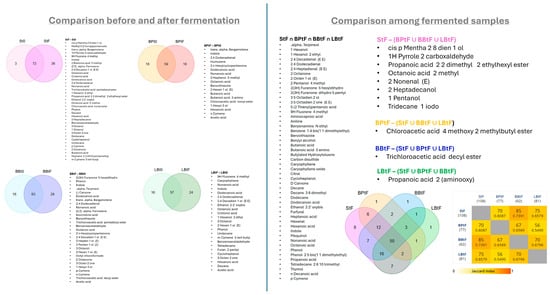
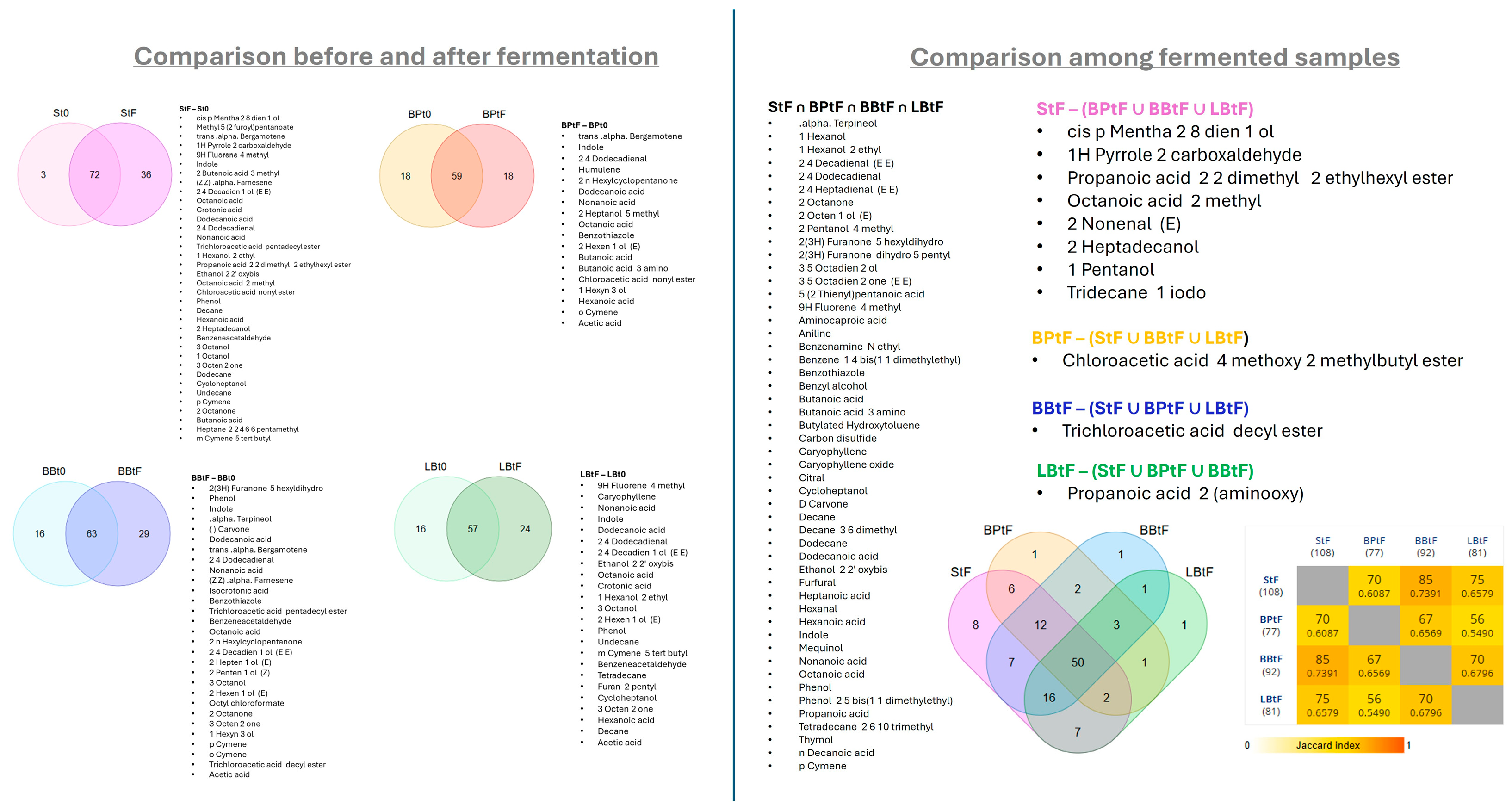
The Venn diagram analysis (Figure 1) showed that fermentation substantially altered the volatile profile of all samples, although the extent of these changes depended on the microbial inoculum. In the spontaneously fermented sample FHF-S, 72 compounds were shared before and after fermentation, while 3 compounds were exclusively detected at the initial stage and 36 compounds appeared only after fermentation. Among the newly generated metabolites, nonanoic acid was identified, suggesting an active lipid metabolism and the formation of compounds with potential antimicrobial properties [37]. The high number of exclusive compounds indicates that spontaneous fermentation promoted the greatest diversification of the volatile fraction, likely due to the metabolic contribution of the indigenous microbiota.
Figure 1.
Volatilome composition of hemp organic flour fermented by probiotic and beneficial bacteria explained by the theory of sets, with Venn diagrams and pair-wise intersection map. FHF = Fermented Hemp Flour (Fior di Loto, Torino, Italy); whole volatilome of the dataset comprising all samples, time points and replicates; S = FHF with spontaneous fermentation (StF); BP = FHF with Bifidobacterium breve BR03 (BPtF); BB12 = FHF with Bifidobacetrium animalis subsp. lactis BB12 (BBtF); FHF- LB = FHF with Lactiplantibacillus plantarum LB325 (LBtF); t0 = beginning of fermentation (0 h); tF = endpoint of fermentation (48 h). Supporting tables are available in supplementary materials.
The sample fermented with B. breve (BPtF) showed 59 compounds common to both stages, together with 18 compounds exclusively detected before fermentation and 18 newly formed compounds after fermentation. Compared with spontaneous fermentation, B. breve induced a more selective remodeling of the volatile profile, suggesting a targeted metabolic activity rather than a broad diversification of metabolites.
Similarly, fermentation with B. animalis subsp. lactis BB-12 resulted in 63 shared compounds, 16 compounds exclusive to the initial stage and 29 newly generated compounds. Among these, (−)-carvone was detected, a bioactive monoterpene known for its bioactive properties as well as its contribution to herbal and mint-like aroma notes [38]. In contrast, Lp. plantarum LB325 generated 24 compounds exclusively after fermentation, while 57 compounds remained unchanged throughout the process. Notably, caryophyllene was identified among the fermentation-derived metabolites, contributing spicy and woody sensory notes and exhibiting recognized anti-inflammatory activity [39].
When comparing all fermented products, 50 volatile compounds were common to all treatments, indicating the existence of a core fermentation-derived metabolome regardless of the inoculum used. Nevertheless, each fermentation strategy generated specific metabolites. Spontaneous fermentation produced eight exclusive compounds, including (E)-2-nonenal, whereas B. breve and BB-12 each generated unique ester compounds. Conversely, Lp. plantarum produced an amino-oxidized derivative of propanoic acid, highlighting its distinctive amino acid metabolism.
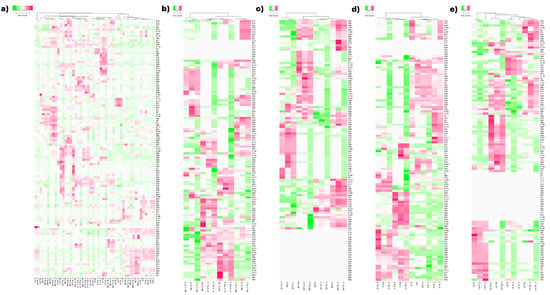
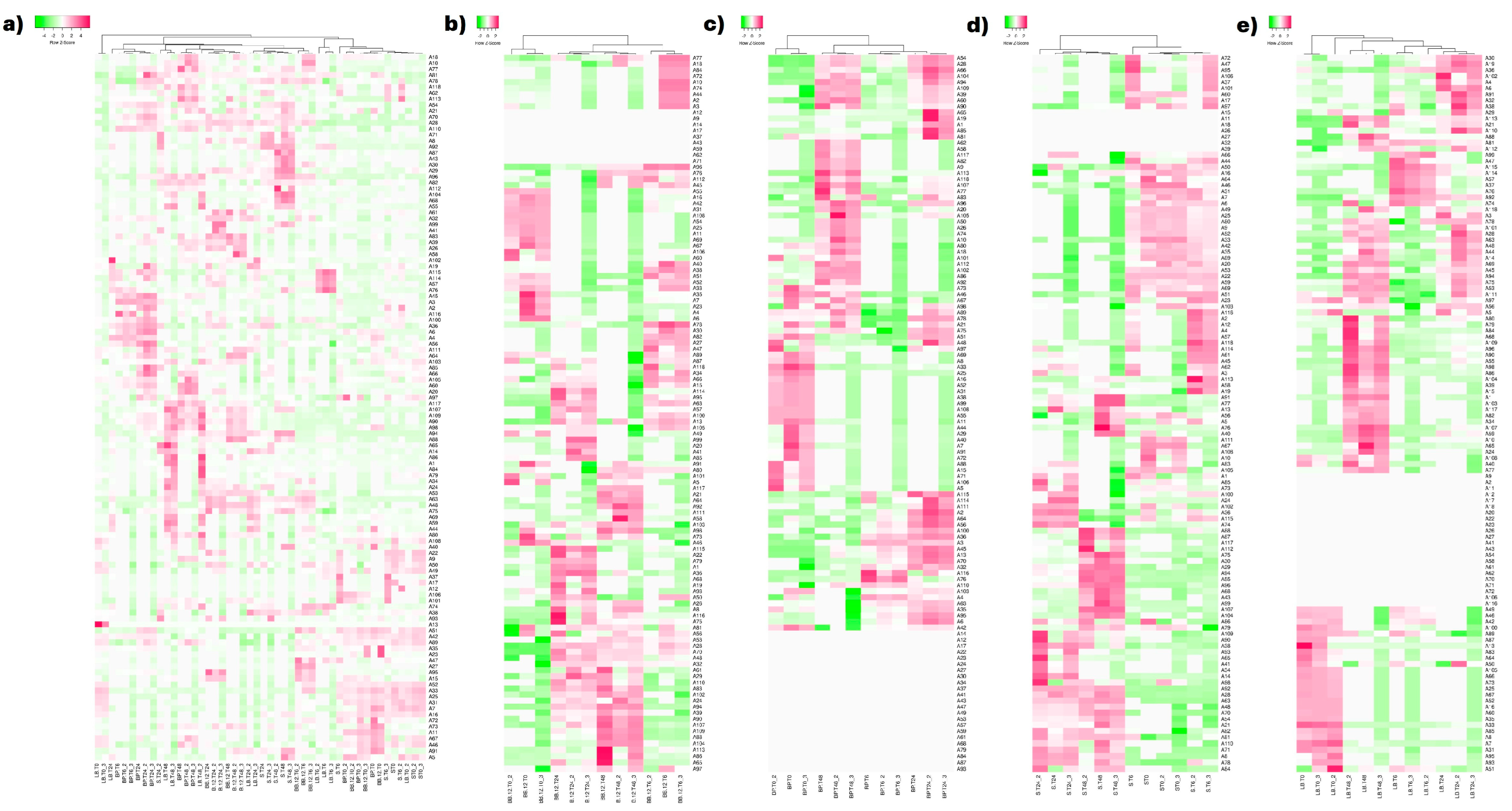
The Jaccard similarity analysis confirmed these observations. The highest similarity was observed between StF and BBtF (J = 0.7391), followed by BBtF and LBtF (J = 0.6796), indicating a substantial overlap in their volatile compositions. The lowest similarity was found between BPtF and LBtF (J = 0.5490), suggesting that these strains induced the most divergent metabolic responses. Overall, the results demonstrate that fermentation preserved a common set of volatile compounds while simultaneously generating strain-specific metabolites capable of influencing both the sensory characteristics and the functional value of the final products. The heatmap analysis (Figure 2) confirmed that fermentation progressively reshaped the hemp flour volatilome, with samples primarily clustering according to fermentation time and microbial inoculum. Across all treatments, the greatest changes were observed after 24 and 48 h, highlighting fermentation time as a main driver of volatile compound evolution. Spontaneous fermentation showed the broadest volatilome variability, characterized by a more heterogeneous pattern of compound accumulation and depletion over time. In contrast, samples inoculated with B. breve BR03, B. animalis BB12 and Lp. plantarum LB325 displayed more defined clustering profiles, suggesting a strain-specific modulation of volatile metabolism. Among the inoculated samples, BB12 and LB325 exhibited the most pronounced shifts at the late fermentation stages, indicating a greater capacity to generate characteristic volatile signatures.
Figure 2.
Volatilome composition of hemp organic flour fermented by probiotic and beneficial bacteria at different timepoints (0, 6, 24 and 48 h). FHF = Fermented Hemp Flour (Fior di Loto, Torino, Italy); (a) whole volatilome of the dataset comprising all samples, time points and replicates; (b) FHF-S = FHF with spontaneous fermentation; (c) FHF-BP = FHF with Bifidobacterium breve BR03; (d) FHF-BB12 = FHF with Bifidobacetrium animalis subsp. lactis BB12; (e) FHF-LB = FHF with Lactiplantibacillus plantarum LB325; Results from 3 independent experiments. Clusterization by column category and Pearson rank correlation. A supporting tables with compounds codes and names is available in supplementary materials. These findings are consistent with previous studies demonstrating that microbial fermentation selectively modifies volatile profiles through the activation of specific metabolic pathways involved in carbohydrate, amino acid and lipid catabolism, ultimately contributing to the sensory and functional properties of fermented plant-based matrices [3,14]. Overall, the heatmaps support the results obtained from the Venn diagrams, confirming that each microbial culture generated a distinct volatilomic fingerprint despite the presence of a common core of fermentation-derived compounds.
3.5. PCA of Volatile Organic Compounds During Hemp Flour Fermentation
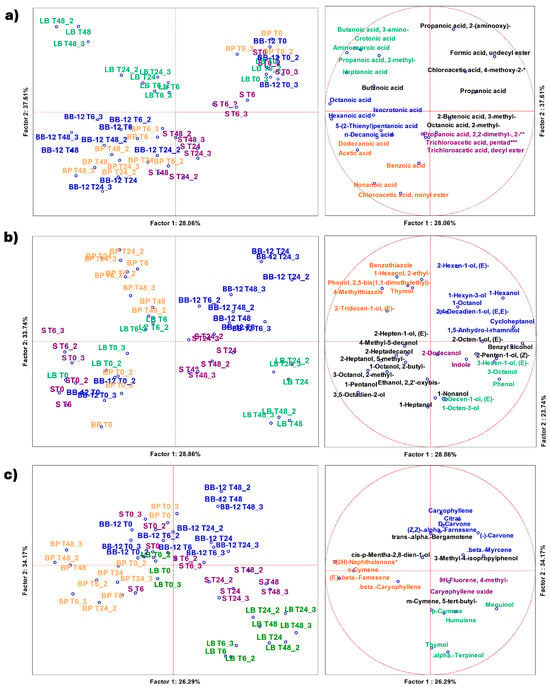
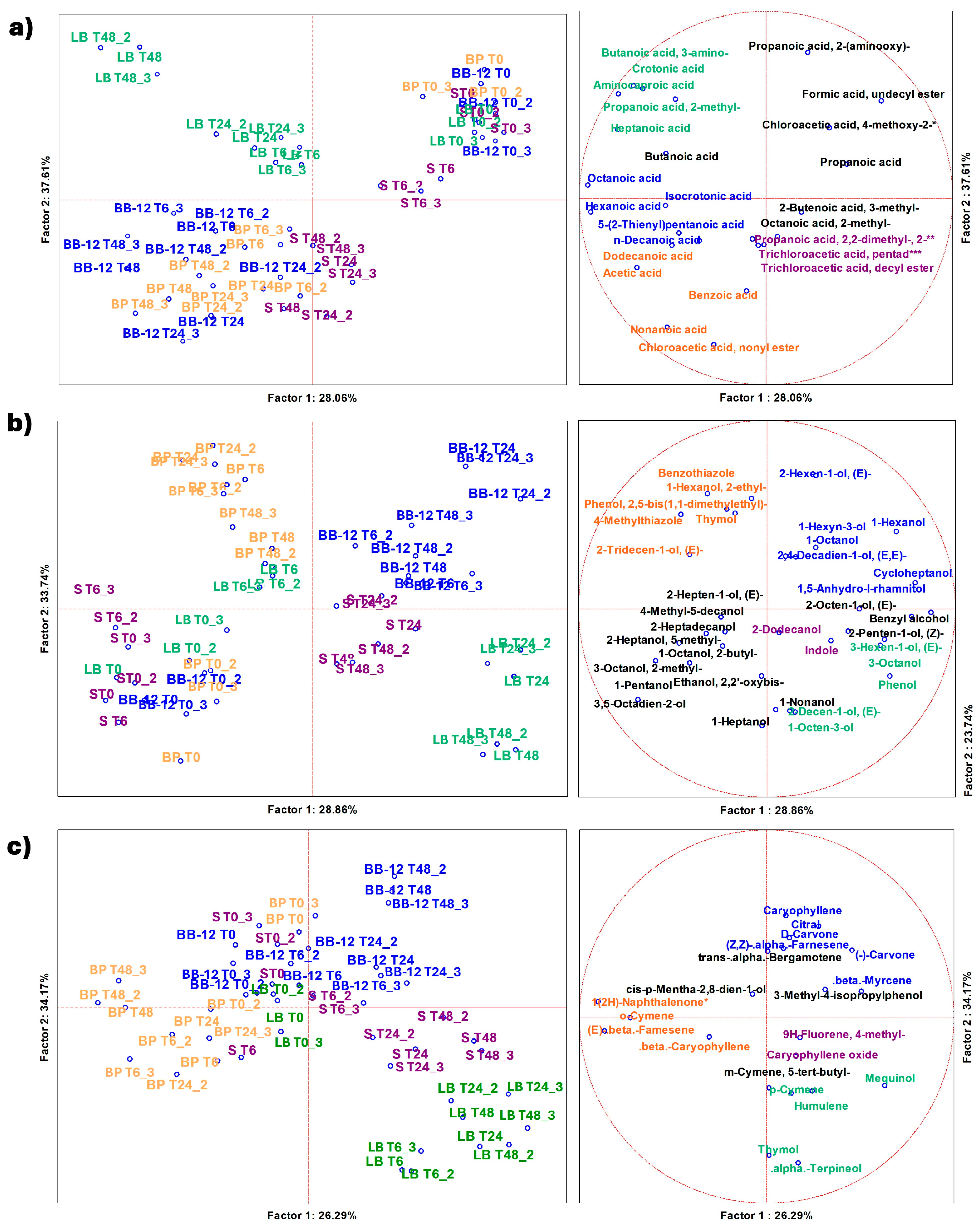
The PCA of volatile organic compounds (Figure 3) confirmed that both fermentation time and starter culture significantly influenced the volatilome of hemp flour. In all three models, samples collected at T24 and T48 tended to separate from T0 and T6, indicating a progressive metabolic remodeling during fermentation. Similar clustering patterns have been reported for fermented plant matrices, where microbial metabolism drives the conversion of endogenous precursors into new volatile compounds, resulting in distinct strain-dependent aromatic fingerprints [3,14].
Figure 3.
Volatile organic compounds (VOCs) of the volatilome of fermented hemp flour during probiotic and/or beneficial bacteria fermentation at different time points explained by principal component analysis (PCA). (a) Organic acids and esters; (b) linear and aromatic alcohols; (c) terpenes. T0 = beginning of fermentation; T6 = 6 h of fermentation; T24 = 24 h of fermentation; T48 = 48 h of fermentation. FHF = Fermented Hemp Flour (Fior di Loto, Torino, Italy); S = FHF with spontaneous fermentation; BP = FHF with Bifidobacterium breve BR03; BB12 = FHF with Bifidobacetrium animalis subsp. lactis BB12; FHF-LB = FHF with Lactiplantibacillus plantarum LB325; t0 = beginning of fermentation (0 h); tF = endpoint of fermentation (48 h); _2 and _3 = replicates. Results from 3 independent experiments. Supporting tables are available in supplementary materials. For organic acids and esters (a), Lp. plantarum LB325 samples were associated with amino-organic acids such as 2-aminooxy-propanoic acid and propanoic acid derivatives, whereas B. breve BR03 was characterized by nonanoic acid and benzoic acid. On the opposite side of the score plot, BB12 samples were associated with octanoic, hexanoic and isocrotonic acids, suggesting a more pronounced lipid-derived metabolism. The spontaneous fermentation samples occupied an intermediate position and were mainly associated with butanoic acid derivatives. These observations indicate that the different microbial cultures preferentially activated distinct pathways involved in amino acid and fatty acid catabolism, leading to the production of specific volatile acids and esters. Asterisks indicate significant differences (* p < 0.05, ** p < 0.01, *** p < 0.001).
The PCA of linear and aromatic alcohols (Figure 3b) highlighted a marked discrimination of BB12 samples, especially at T24 and T48, which clustered with 2-hexen-1-ol, 1-hexanol, 1-octanol, 2-octen-1-ol and 2,4-decadien-1-ol. These compounds are frequently associated with green, herbaceous and fruity notes originating from the oxidative metabolism of unsaturated fatty acids. In contrast, Lp. plantarum samples were characterized by 1-octen-3-ol, trans-2-decen-1-ol and phenol, whereas spontaneous fermentation was linked to 2-hepten-1-ol and 3-octanol. Such differences suggest that each microbial culture selectively modified the alcohol fraction of the volatilome through specific oxidoreductase activities.
The clearest separation among treatments was observed in the terpene PCA (Figure 3c). BB12 clustered with β-myrcene, citral, trans-α-bergamotene, α-farnesene and (−)-carvone, whereas Lp. plantarum was strongly associated with α-terpineol, thymol, humulene, p-cymene and mequinol. B. breve occupied an intermediate position and showed associations with β-caryophyllene and β-farnesene. Since terpenes are among the major aroma-active compounds in hemp and other botanical matrices, these results indicate that probiotic and/or beneficial bacteria fermentation can substantially modulate terpene biotransformation, generating distinct sensory profiles depending on the inoculated strain.
A particularly interesting aspect emerging from the PCA of organic acids and esters was the association of Lp. plantarum LB325 with nitrogen-containing compounds, including aminocaproic acid and amino-substituted propanoic acid derivatives. These metabolites may reflect an active amino acid catabolism and suggest the involvement of pathways associated with the biosynthesis of bioactive amino compounds. In particular, several Lp. plantarum strains possess glutamate decarboxylase systems that enable the production of γ-aminobutyric acid (GABA), a bioactive metabolite increasingly investigated for its neuromodulatory effects, and recent studies have highlighted the remarkable ability of particular strains of Lp. plantarum to accumulate GABA in fermented foods [40,41]. Although GABA was not directly quantified in the present study, the occurrence of amino-containing organic acids in LB325-fermented samples suggests an intense nitrogen metabolism that may contribute to the functional value of fermented hemp flour.
Several VOCs identified as discriminant markers among treatments are also characterized by relevant biological activities. BB12 fermentation was associated with citral, β-myrcene and (−)-carvone, compounds widely recognized for their bioactive properties. In particular, carvone has recently attracted considerable interest due to its broad spectrum of pharmacological activities [42]. Likewise, LB325 was associated with thymol, α-terpineol, humulene and p-cymene, terpenes known to exhibit antimicrobial activity and to contribute substantially to the sensory quality of fermented foods. B. breve BR03 showed associations with β-caryophyllene and α-farnesene; among these, β-caryophyllene is particularly noteworthy as a selective CB2 receptor agonist with documented anti-inflammatory, neuroprotective and immunomodulatory properties [43,44]. Therefore, beyond shaping the aroma profile, probiotic and/or beneficial bacteria fermentation appears to promote the formation and accumulation of bioactive metabolites that may enhance the nutraceutical potential of fermented hemp flour. From our analyses it also results that it is possible to modulate the nuances and improve the bioactive compounds and functionality of hemp flour with fermentation depending on the starter culture employed. The generated products can be further exploited in order to originate an adjuvant bioactive dough to add to leavening of bakery foods and make them functional.
4. Conclusions
This study demonstrates that controlled fermentation represents an effective strategy for enhancing both the functional and sensory properties of hemp seed flour, supporting its application as a novel ingredient for gluten-free and plant-based food formulations. Fermentation with selected probiotic and beneficial strains (B. breve BR03, B. animalis subsp. lactis BB12, and Lp. plantarum LB325) resulted in substantial modifications of the substrate, promoting the generation of bioactive metabolites, improving its prebiotic potential, and shaping distinct volatile profiles associated with desirable sensory characteristics. All probiotic and beneficial strains exhibited high viability during fermentation, confirming hemp flour as a suitable growth substrate for beneficial microorganisms. In particular, B. animalis subsp. lactis BB-12 and Lp. plantarum LB325 reached cell densities exceeding 9 Log cells/mL, while Lp. plantarum showed rapid acidification kinetics, likely driven by lactic acid production, a metabolic feature associated with enhanced microbial stability and inhibition of spoilage microorganisms. B. breve BR03 achieved the lowest final pH values, reflecting an active production of lactate and acetate and confirming the ability of bifidobacteria to efficiently metabolize hemp-derived substrates. The stability of water activity throughout fermentation further suggests favorable storage characteristics of the fermented matrices.
The prebiotic activity assays provided additional evidence of the functional value of fermented hemp flour. Among the tested formulations, Lp. plantarum LB325 had the highest bifidobactogenic activity but poor lactobacillogenic activity, while B. animalis subsp. lactis BB12-fermented hemp flour exhibited good scores of both the prebiotic activities, stimulating the growth of beneficial lactobacilli and bifidobacteria similarly to FOS, the prebiotic reference.
In parallel, SPME-GC-MS analysis revealed a marked enrichment of volatile organic compounds (VOCs) and functional metabolites following fermentation. Each microbial strain generated a unique metabolic fingerprint characterized by specific patterns of volatile compounds, organic acids, alcohols, esters, and terpenes. B. breve BR03 promoted the accumulation of dodecanoic acid, a compound associated with antimicrobial activity, together with aromatic molecules contributing fruity and floral notes. B. animalis subsp. lactis BB12 displayed a pronounced capacity for terpene biotransformation, leading to the formation of carvone, while Lp. plantarum LB325 favored the synthesis of aminocaproic acid, eventually involved in the pathway of γ-aminobutyric acid, a bioactive compound of considerable nutraceutical interest, as well as functional terpenes such as humulene and terpineol. By contrast, spontaneous fermentation generated a less balanced aromatic profile and a lower degree of functional enrichment.
Multivariate statistical analysis confirmed that both the fermentation time and the microbial strain were major determinants of product differentiation, highlighting the critical role of targeted microbial selection in tailoring the chemical, functional, and sensory characteristics of fermented hemp-based ingredients. Collectively, these results indicate that probiotic and beneficial strains fermentation can simultaneously improve the prebiotic activity, bioactive composition, and aroma profile of hemp flour, creating synergistic benefits that enhance its overall nutritional and technological value.
Given its richness in dietary fiber, high-quality proteins, and phytochemicals, hemp flour emerges as a particularly promising substrate for the development of next-generation functional foods. The combination of intrinsic hemp bioactives with fermentation-driven biotransformation processes offers a sustainable approach for producing value-added ingredients with potential applications in bakery products, dairy alternatives, nutrition bars, powdered supplements, and other plant-based formulations.
Future research should investigate the stability of volatile and bioactive compounds during processing and storage, characterize residual microbial populations and potential postbiotic effects, and evaluate consumer acceptance through sensory studies. Generally, the present findings provide strong evidence that controlled probiotic and beneficial strains fermentation can unlock the functional potential of hemp flour, supporting its use as a multifunctional ingredient capable of delivering nutritional, technological, sensory, and gut-health benefits in innovative food products.
Supplementary Materials
The following supporting information can be downloaded at https://www.mdpi.com/article/10.3390/foods15234220/s1. Table S1. Primers pairs employed for PCR and qPCR reactions and quantifications; Table S2. ANOVA whole model R, categorized by time point; Table S3. ANOVA whole model R, categorized by inoculum; Table S4. ANOVA loadings for percentage of contribution of the volatilome, categorized by time points; Table S5. ANOVA loadings for percentage of contribution of the volatilome, categorized by inoculum; Table S6. Names and codes of chemical compounds of Figure 2 [45,46,47,48].
Author Contributions
Conceptualization = L.N., A.G.; methodology = L.N., A.G.; validation = L.N., A.G.; formal analysis = V.B.B., D.A., L.N., M.T., M.S., G.P.; investigation = V.B.B., D.A., L.N.; resources = L.N., A.G.; data curation = V.B.B., D.A., L.N.; writing—original draft preparation = V.B.B., L.N. and D.A.; writing—review and editing = V.B.B., L.N., D.A., T.G.T., M.T., M.S., G.P., A.G.; visualization = V.B.B., L.N., D.A.; supervision = L.N., A.G.; project administration = L.N., A.G.; funding acquisition = L.N., A.G. All authors have read and agreed to the published version of the manuscript.
Funding
This research did not receive any external fundings.
Institutional Review Board Statement
Not applicable.
Informed Consent Statement
Not applicable.
Data Availability Statement
The original contributions presented in this study are included in the article/Supplementary Materials. Further inquiries can be directed to the corresponding author.
Conflicts of Interest
The authors declare no conflicts of interest.
References
- Nguyen, A.; Manful, C.F.N.; Aryee, A.N. Hempseeds as sustainable plant-based source of bioactive peptides with biofunctional properties. Front. Nutr. 2026, 13, 1926667. [Google Scholar] [CrossRef] [Scilit] [PubMed]
- Nissen, L.; Zatta, A.; Stefanini, I.; Grandi, S.; Sgorbati, B.; Biavati, B.; Monti, A. Characterization and antimicrobial activity of essential oils of industrial hemp varieties (Cannabis sativa L.). Fitoterapia 2010, 81, 413–419. [Google Scholar] [CrossRef] [Scilit] [PubMed]
- Nissen, L.; di Carlo, E.; Gianotti, A. Prebiotic potential of hemp blended drinks fermented by probiotics. Food Res. Int. 2020, 131, 109029. [Google Scholar] [CrossRef] [Scilit] [PubMed]
- Nissen, L.; Casciano, F.; Babini, E.; Gianotti, A. The Exploitation of a Hempseed Byproduct to Produce Flavorings and Healthy Food Ingredients by a Fermentation Process. Microorganisms 2021, 9, 2418. [Google Scholar] [CrossRef] [Scilit] [PubMed]
- Nissen, L.; Casciano, F.; Babini, E.; Gianotti, A. Beneficial metabolic transformations and prebiotic potential of hemp bran and its alcalase hydrolysate, after colonic fermentation in a gut model. Sci. Rep. 2023, 13, 1552. [Google Scholar] [CrossRef] [Scilit] [PubMed]
- Setti, L.; Samaei, S.P.; Maggiore, I.; Nissen, L.; Gianotti, A.; Babini, E. Comparing the Effectiveness of Three Different Biorefinery Processes at Recovering Bioactive Products from Hemp (Cannabis sativa L.) Byproduct. Food Bioprocess Technol. 2020, 13, 2156–2171. [Google Scholar] [CrossRef] [Scilit]
- Montemurro, M.; Beccaccioli, M.; Perri, G.; Rizzello, C.G.; Reverberi, M.; Pontonio, E. A chestnut-hemp type-II sourdough to improve technological, nutritional, and sensory properties of gluten-free bread. Int. J. Food Microbiol. 2023, 404, 110322. [Google Scholar] [CrossRef] [Scilit] [PubMed]
- Papatzimos, G.; Mitlianga, P.; Basdagianni, Z.; Kasapidou, E. Hemp Flour as a Functional Ingredient for the Partial Replacement of Nitrites in a Minced Meat Model: Effect on Nutrient Composition, Antioxidant Profile and Sensory Characteristics. Appl. Sci. 2024, 14, 3925. [Google Scholar] [CrossRef] [Scilit]
- Nakov, G.; Trajkovska, B.; Atanasova-Pancevska, N.; Daniloski, D.; Ivanova, N.; Lučan Čolić, M.; Jukić, M.; Lukinac, J. The influence of the addition of hemp press cake flour on the properties of bovine and ovine yoghurts. Foods 2023, 12, 958. [Google Scholar] [CrossRef] [Scilit] [PubMed]
- Sawant, S.S.; Park, H.Y.; Sim, E.Y.; Kim, H.S.; Choi, H.S. Microbial fermentation in food: Impact on functional properties and nutritional enhancement—A review of recent developments. Fermentation 2025, 11, 15. [Google Scholar] [CrossRef] [Scilit]
- Di Biase, M.; Cifarelli, V.; Montemurro, M.; Lonigro, S.L.; Pulpito, M.; Bruno, A.; D’Antuono, I.; Minisci, A.; Nionelli, L.; Convertino, S.; et al. Hempseed flour-based bioingredient fermented by Lactiplantibacillus plantarum ITM21B for salt-reduced bread production in industrial bakery environment. Food Bioprocess Technol. 2026, 19, 202. [Google Scholar] [CrossRef] [Scilit]
- Lavefve, L.; Cureau, N.; Rodhouse, L.; Marasini, D.; Walker, L.M.; Ashley, D.; Lee, S.O.; Gadonna-Widehem, P.; Anton, P.M.; Carbonero, F. Microbiota profiles and dynamics in fermented plant-based products and preliminary assessment of their in vitro gut microbiota modulation. Food Front. 2021, 2, 268–281. [Google Scholar] [CrossRef] [Scilit]
- Tampanna, N.; Chansuwan, W.; Wichienchot, S. Effect of Plant-Based Mung Bean Products on Digestibility and Gut Microbiome Profiling Using In Vitro Fecal Fermentation. Plant Foods Hum. Nutr. 2024, 79, 460–467. [Google Scholar] [CrossRef] [Scilit] [PubMed]
- Nissen, L.; Casciano, F.; Babini, E.; Gianotti, A. Prebiotic potential and bioactive volatiles of hemp byproduct fermented by lactobacilli. LWT 2021, 151, 112201. [Google Scholar] [CrossRef] [Scilit]
- Fan, S.; Zhang, Z.; Duncan, G.J.; Morris, A.; Scobbie, L.; Henderson, D.; Morrice, P.; Russell, W.R.; Duncan, S.H.; Neacsu, M. Bioprocessing of hempseed (Cannabis sativa L.) food by-products increased nutrient and phytochemical in vitro bioavailability during digestion and microbial fermentation. Appl. Sci. 2023, 13, 5781. [Google Scholar] [CrossRef] [Scilit]
- Nissen, L.; Addazii, D.; Casciano, F.; Danesi, F.; Rodriguez-Estrada, M.T.; Mercatante, D.; Ben Ayache, S.; Lotfi, A.; Argiriou, A.; Ayfantopoulou, G.; et al. Carob Syrup: Prebiotic Potential of a Neglected Functional Beverage of Mediterranean Countries. Foods 2024, 13, 4172. [Google Scholar] [CrossRef] [Scilit] [PubMed]
- Mercatante, D.; Santoni, M.; Nissen, L.; Didos, S.; Salvatori, G.; D’Ambrosio, G.J.; Farneti, A.; Chiarello, E.; Casciano, F.; Picone, G.; et al. Nutritional, Chemical, and Functional Properties of Wholegrain Einkorn Pasta Through Cooking and Digestion: A Comparative Study with Wholegrain Durum Wheat Pasta. Foods 2025, 14, 370. [Google Scholar] [CrossRef] [Scilit] [PubMed]
- Granato, D.; de Araújo Calado, V.Ô.M.; Jarvis, B. Observations on the use of statistical methods in Food Science and Technology. Food Res. Int. 2014, 55, 137–149. [Google Scholar] [CrossRef] [Scilit]
- Babicki, S.; Arndt, D.; Marcu, A.; Liang, Y.; Grant, J.R.; Maciejewski, A.; Wishart, D.S. Heatmapper: Web-enabled heat mapping for all. Nucleic Acids Res. 2016, 44, W147–W153. [Google Scholar] [CrossRef] [Scilit] [PubMed]
- Filannino, P.; Di Cagno, R.; Gobbetti, M. Metabolic and functional paths of lactic acid bacteria in plant foods: Get out of the labyrinth. Curr. Opin. Biotechnol. 2018, 49, 64–72. [Google Scholar] [CrossRef] [Scilit] [PubMed]
- Verni, M.; Pontonio, E.; Rizzello, C.G. Microbial biotechnology of cereal- and legume-based fermentations. Foods 2020, 9, 827. [Google Scholar] [PubMed]
- Siezen, R.J.; van Hylckama Vlieg, J.E.T. Genomic diversity and versatility of Lactiplantibacillus plantarum in food and gastrointestinal ecosystems. Microb. Cell Fact. 2011, 10, S3. [Google Scholar] [PubMed]
- Marco, M.L.; Heeney, D.; Binda, S.; Cifelli, C.J.; Cotter, P.D.; Foligné, B.; Gänzle, M.; Kort, R.; Pasin, G.; Pihlanto, A.; et al. Health benefits of fermented foods: Microbiota and beyond. Curr. Opin. Biotechnol. 2017, 44, 94–102. [Google Scholar] [CrossRef] [Scilit] [PubMed]
- Leroy, F.; De Vuyst, L. Lactic acid bacteria as functional starter cultures for the food fermentation industry. Trends Food Sci. Technol. 2004, 15, 67–78. [Google Scholar] [CrossRef] [Scilit]
- Tamang, J.P.; Watanabe, K.; Holzapfel, W.H. Diversity of microorganisms in global fermented foods and beverages. Front. Microbiol. 2016, 7, 377. [Google Scholar] [CrossRef] [Scilit] [PubMed]
- Coda, R.; Melama, L.; Rizzello, C.G.; Curiel, J.A.; Sibakov, J.; Holopainen, U.; Pulkkinen, M.; Sozer, N. Effect of air classification and fermentation by Lactobacillus plantarum on the nutritional properties of wheat bran. J. Cereal Sci. 2014, 59, 218–227. [Google Scholar]
- Beuchat, L.R. Water activity and microbial stability of foods. Food Technol. 1981, 35, 98–105. [Google Scholar]
- Marco, M.L.; Sanders, M.E.; Gänzle, M.; Arrieta, M.C.; Cotter, P.D.; De Vuyst, L.; Hill, C.; Holzapfel, W.; Lebeer, S.; Reid, G.; et al. The international scientific association for probiotics and prebiotics (ISAPP) consensus statement on fermented foods. Nat. Rev. Gastroenterol. Hepatol. 2021, 18, 196–208. [Google Scholar] [CrossRef] [Scilit] [PubMed]
- Verni, M.; Pontonio, E.; Rizzello, C.G. Advances in the exploitation of sourdough fermentation for the production of innovative cereal-based functional foods. Microorganisms 2019, 7, 254. [Google Scholar]
- Gibson, G.R.; Hutkins, R.; Sanders, M.E.; Prescott, S.L.; Reimer, R.A.; Salminen, S.J.; Scott, K.; Stanton, C.; Swanson, K.S.; Cani, P.D.; et al. Expert consensus document: The International Scientific Association for Probiotics and Prebiotics (ISAPP) consensus statement on the definition and scope of prebiotics. Nat. Rev. Gastroenterol. Hepatol. 2017, 14, 491–502. [Google Scholar] [CrossRef] [Scilit] [PubMed]
- Rivière, A.; Selak, M.; Lantin, D.; Leroy, F.; De Vuyst, L. Bifidobacteria and butyrate-producing colon bacteria: Importance and strategies for their stimulation in the human gut. Front. Microbiol. 2016, 7, 979. [Google Scholar] [CrossRef] [Scilit] [PubMed]
- Pontonio, E.; Rizzello, C.G. Food fermentations using lactic acid bacteria: Other plant-based matrices. In Lactic Acid Bacteria: Microbiological and Functional Aspects; CRC Press: Boca Raton, FL, USA, 2019; pp. 679–729. [Google Scholar]
- Markowiak, P.; Śliżewska, K. Effects of probiotics, prebiotics, and synbiotics on human health. Nutrients 2017, 9, 1021. [Google Scholar] [CrossRef] [Scilit] [PubMed]
- Verni, M.; Pontonio, E.; Rizzello, C.G. Use of lactic acid bacteria for the functionalization of cereal and legume matrices. Foods 2020, 9, 1743. [Google Scholar] [PubMed]
- Holscher, H.D. Dietary fiber and prebiotics and the gastrointestinal microbiota. Gut Microbes 2017, 8, 172–184. [Google Scholar] [CrossRef] [Scilit] [PubMed]
- Leonard, W.; Zhang, P.; Ying, D.; Fang, Z. Hempseed in food industry: Nutritional value, health benefits, and industrial applications. Compr. Rev. Food Sci. Food Saf. 2020, 19, 282–308. [Google Scholar] [CrossRef] [Scilit] [PubMed]
- Desbois, A.P.; Smith, V.J. Antibacterial free fatty acids: Activities, mechanisms of action and biotechnological potential. Appl. Microbiol. Biotechnol. 2010, 85, 1629–1642. [Google Scholar] [CrossRef] [Scilit] [PubMed]
- de Carvalho, C.C.C.R.; da Fonseca, M.M.R. Carvone: Why and how should one bother to produce this terpene. Food Chem. 2006, 95, 413–422. [Google Scholar] [CrossRef] [Scilit]
- Francomano, F.; Caruso, A.; Barbarossa, A.; Fazio, A.; La Torre, C.; Ceramella, J.; Mallamaci, R.; Saturnino, C.; Iacopetta, D.; Sinicropi, M.S. Β-Caryophyllene: A sesquiterpene with countless biological properties. Appl. Sci. 2019, 9, 5420. [Google Scholar] [CrossRef] [Scilit]
- Iorizzo, M.; Paventi, G.; Di Martino, C. Biosynthesis of Gamma-Aminobutyric Acid (GABA) by Lactiplantibacillus plantarum in Fermented Food Production. Curr. Issues Mol. Biol. 2023, 46, 200–220. [Google Scholar] [CrossRef] [Scilit] [PubMed]
- Montagano, F.; Prete, R.; Fanti, F.; Dell’Orco, F.; Oliva, E.; Compagnone, D.; Corsetti, A. Enrichment of γ-aminobutyric acid (GABA) in a legume-based beverage through the fermentation by Lactiplantibacillus plantarum. Curr. Res. Food Sci. 2025, 11, 101176. [Google Scholar] [CrossRef] [Scilit] [PubMed]
- Pina, L.T.S.; Serafini, M.R.; Guimarães, A.G. Carvone and its pharmacological activities: A systematic review. Phytochemistry 2022, 196, 113080. [Google Scholar] [CrossRef] [Scilit] [PubMed]
- Ricardi, C.; Mazzierli, A.; Guglielmo, S.; Origlia, N.; Gado, F.; Polini, B. Multi-Target Protective Effects of β-Caryophyllene (BCP) at the Intersection of Neuroinflammation and Neurodegeneration. Int. J. Mol. Sci. 2025, 26, 6027. [Google Scholar] [CrossRef] [Scilit] [PubMed]
- Cao, L.; Li, S.; Yan, X.; Wang, Y.; Zhang, S.; Mu, Y.; Niu, W.; Ma, L. Β-Caryophyllene Prevents Cognitive Impairment in Mice Following Acute Sleep Deprivation by Alleviating Hippocampal Structural and Functional Alterations. Neuropharmacology 2025, 283, 110752. [Google Scholar] [CrossRef] [Scilit] [PubMed]
- Lane, D.J. 16S/23S rRNA sequencing, p 115–175. In Nucleic Acid Techniques in Bacterial Systematics; Stackebrandt, E., Goodfellow, M., Eds.; John Wiley & Sons: New York, NY, USA, 1991. [Google Scholar]
- Walter, J.; Hertel, C.; Tannock, G.W.; Lis, C.M.; Munro, K.; Hammes, W.P. Detection of Lactobacillus, Pediococcus, Leuconostoc, and Weissella species in human feces by using group-specific PCR primers and denaturing gradient gel electrophoresis. Appl. Environ. Microbiol. 2001, 67, 2578–2585. [Google Scholar] [CrossRef] [Scilit] [PubMed]
- Masco, L.; Ventura, M.; Zink, R.; Huys, G.; Swings, J. Polyphasic taxonomic analysis of Bifidobacterium animalis and Bifidobacterium lactis reveals relatedness at the subspecies level: Reclassification of Bifidobacterium animalis as Bifidobacterium animalis subsp. animalis subsp. nov. and Bifidobacterium lactis as Bifidobacterium animalis subsp. lactis subsp. nov. Int. J. Syst. Evol. Microbiol. 2004, 54, 1137–1143. [Google Scholar] [CrossRef] [Scilit] [PubMed]
- Zhou, P.; Bogan, J.A.; Welch, K.; Pickett, S.R.; Wang, H.J.; Zaritsky, A.; Helmstetter, C.E. Gene transcription and chromosome replication in Escherichia coli. J. Bacteriol. 1997, 179, 163–169. [Google Scholar] [CrossRef] [Scilit] [PubMed]

Disclaimer/Publisher’s Note: The statements, opinions and data contained in all publications are solely those of the individual author(s) and contributor(s) and not of MDPI and/or the editor(s). MDPI and/or the editor(s) disclaim responsibility for any injury to people or property resulting from any ideas, methods, instructions or products referred to in the content. |
© 2026 by the authors. Licensee MDPI, Basel, Switzerland. This article is an open access article distributed under the terms and conditions of the Creative Commons Attribution (CC BY) license.