


Abstract
Anisakid nematodes are important foodborne hazards in marine fish, but molecular data from imported seafood examined within the Serbian official control system remain scarce. This study characterized anisakid and related ascaridoid molecular profiles in parasite material recovered during official examination of imported marine fish and fishery products. Seventy-four selected molecular test records were analysed by multiplex PCR targeting the internal transcribed spacer region of ribosomal DNA. Specific amplification was obtained in 55 records (74.3%). The predominant result was an Anisakis simplex sensu lato/A. pegreffii hybrid-like multiplex-PCR banding profile (39 records), followed by A. pegreffii (8), Contracaecum osculatum (6), and Anisakis typica (2); Anisakis taxa accounted for 89.1% of positive records. Hake (Merluccius spp.) predominated among records with known fish identity, although record-level positivity was similar in hake and mackerel (Scomber spp.). Spain accounted for most records with a known origin, while positivity and profile distributions were descriptively comparable with other known origins. Multiplex-PCR banding profiles provide a useful complement to routine parasitological examination and baseline descriptive information for surveillance of anisakid-related hazards in imported seafood in Serbia; however, the assay alone cannot confirm hybrid genotypes or parasite viability. The findings describe selected laboratory molecular-test records and do not constitute estimates of anisakid prevalence in imported fish.
1. Introduction
Fish and fishery products constitute an important component of the human diet and are increasingly traded across national borders, providing consumers in landlocked countries with access to a wide range of marine species. However, the expansion of international seafood trade, together with the increasing consumption of fresh, chilled, frozen, and minimally processed products, may facilitate the introduction and dissemination of biological hazards, including foodborne zoonotic parasites. Among these, anisakid nematodes are of particular relevance to food safety because they occur in numerous commercially exploited marine fish species and may pose both infectious and allergenic risks to consumers [1,2,3].
Anisakid nematodes belong to the family Anisakidae, which includes several taxa of veterinary, ecological, and public health importance. Zoonotically relevant taxa include species of Anisakis and Contracaecum, as well as taxa historically assigned to the genus Pseudoterranova. Recent molecular taxonomic studies have reinstated the genus Phocanema for pinniped-associated species that were previously classified within Pseudoterranova [4]. In contrast, Hysterothylacium is a related ascaridoid genus currently assigned to the family Raphidascarididae and should therefore be distinguished taxonomically from true anisakids.
The life cycles of anisakid nematodes are complex and typically involve crustaceans and fish as intermediate or paratenic hosts, whereas marine mammals and, for certain taxa, piscivorous birds serve as definitive hosts. Humans are accidental hosts and may acquire infection through the consumption of raw or insufficiently cooked fish containing viable infective third-stage (L3) larvae [2,5,6].
The principal zoonotic species within the genus Anisakis are Anisakis simplex sensu stricto and Anisakis pegreffii. Both species have been repeatedly detected in fish intended for human consumption and have been implicated in confirmed cases of human anisakiasis [2,6]. Other anisakid taxa are also relevant from a food-safety perspective. Members of the former Pseudoterranova complex are recognized etiological agents of human disease, whereas Contracaecum spp. are widely distributed in marine ecosystems and may occur in commercially important fish species. Accurate identification, preferably to the species level when permitted by the diagnostic approach, is therefore essential for epidemiological investigations, source attribution, and risk assessment.
The public-health significance of anisakid nematodes is related not only to infection by viable larvae but also to their allergenic potential. Ingestion of live larvae may result in acute gastrointestinal disease, whereas exposure to parasite-derived allergens can trigger IgE-mediated hypersensitivity reactions, including urticaria and, in severe cases, anaphylaxis. Importantly, allergic manifestations may occur following exposure to parasite antigens even when larvae are no longer viable [7,8].
The occurrence and tissue distribution of anisakid larvae are highly heterogeneous and depend on multiple host- and environment-related factors, including fish species, geographical origin, fishing area, trophic position, host age and size, and the anatomical site examined. Larvae are commonly concentrated in the viscera and body cavity, but they may also be present in edible muscle. In some fish species, post-mortem migration from the viscera into the musculature has been demonstrated and may be influenced by storage time and temperature, underscoring the importance of rapid chilling and appropriate post-harvest handling [9,10,11].
Morphological identification of larval ascaridoids has inherent limitations. Although morphological examination is useful for assigning specimens to broad morphotypes or genera, reliable discrimination among closely related species is considerably more difficult when only larval stages are available. Molecular methods therefore provide an important additional level of diagnostic resolution, particularly in official food control and in investigations involving products originating from geographically diverse sources [12,13]. A recent systematic review further highlighted the expanding role of DNA-based, immunochemical, and mass-spectrometry-based approaches for detecting anisakid material in food matrices, while also identifying persistent challenges related to methodological standardization and cross-study comparability [14].
European legislation recognizes the potential risk associated with viable parasites in fishery products. Regulation (EC) No. 853/2004, as amended by Commission Regulation (EU) No. 1276/2011, requires freezing of fishery products intended to be consumed raw or subjected to processing treatments insufficient to kill viable parasites, unless specific exemptions apply. For parasites other than trematodes, the prescribed freezing treatment is at least −20 °C for no less than 24 h or −35 °C for no less than 15 h. Adequate heat treatment, including exposure of the product core to at least 60 °C for at least 1 min, is likewise considered effective for killing viable parasites [15,16].
A global review of published human anisakidosis cases showed that etiological identification has often been incomplete or inconsistent, with many cases reported only as Anisakis sp. or A. simplex sensu lato. This limitation hampers comparisons across regions and weakens epidemiological linkage between parasites detected in seafood and cases of human disease [6]. A subsequent global review of anisakidosis risk factors and clinical management further emphasized the continuing importance of exposure to raw or undercooked seafood, as well as the need for accurate parasite identification for effective surveillance and diagnosis [17].
Despite the substantial body of literature on anisakid parasites in European marine fish, published molecular data on imported seafood examined within the Serbian official control system remain scarce. Serbia is a landlocked country and therefore depends on international trade for its supply of marine fish and fishery products. Imported seafood may originate from ecologically and geographically distinct marine environments in which different anisakid species and genotypes circulate, creating a need for reliable molecular characterization of parasites encountered during official examination.
Therefore, the aim of the present study was to characterize anisakid and related ascaridoid molecular profiles detected in parasite material recovered during official examination of imported marine fish and fishery products in Serbia. Particular emphasis was placed on the descriptive distribution of molecular findings by harmonized fish category, recorded country of origin, and year of examination, where metadata were available. Given the retrospective and laboratory-based nature of the dataset, the analysis was interpreted with explicit consideration of its inherent limitations, including incomplete metadata and the non-random composition of submitted samples.
2. Materials and Methods
2.1. Study Material and Data Source
The study included parasite material recovered during official parasitological examination of imported marine fish and fishery products submitted to the Department for Food and Feed Safety at the Institute of Veterinary Medicine of Serbia, which acts as the national reference laboratory for fish diseases.
During the study period of October 2022–December 2024, a total of 91 imported fish and fishery-product samples were subjected to routine parasitological examination within the official control system. Molecular testing was subsequently performed on selected parasite material considered morphologically compatible with anisakid or related ascaridoid larvae at the molecular biology diagnostic laboratory of the Department for Bacteriology and Parasitology. Not all morphologically suspicious larvae recovered during routine examination were subjected to molecular testing. Larvae were selected non-randomly: from each parasitologically positive sample, up to two intact L3 larvae were tested, representing approximately 10% of all recovered larva (Selection prioritized intact, morphologically unambiguous larvae; the tested subset is therefore not a random sample of recovered larvae.
For the purposes of the present retrospective study, the available laboratory database comprised 74 molecular test records. The recorded variables included the date of examination, fish identity, declared country of origin, product or processing description, laboratory notes, and molecular test result. A unique identifier linking each molecular test record to an individual fish, sample, consignment, or recovered larva was not consistently available in the dataset. Accordingly, the individual database row was defined as the unit of analysis, and molecular test records were not assumed to represent independent fish specimens.
Therefore, the results are reported as record-level molecular findings and not as estimates of anisakid prevalence in imported fish or fishery products examined in Serbia. Where proportions are presented, they refer exclusively to the available molecular test records or to defined subsets of those records. Descriptive analyses were performed according to the available laboratory records.
This dataset represents a retrospective series of laboratory molecular-test records obtained during routine official examinations, rather than a probability-based epidemiological sample of imported fish or consignments.
Product or processing descriptions were available in 55 of the 74 molecular test records; each available description explicitly referred to frozen fish or a frozen fishery product. No product-level freezing time–temperature history, parasite-viability result, quantitative larval burden or anatomical distribution was systematically captured in the analysis dataset. Commercial country of origin was not treated as equivalent to FAO fishing area.
2.2. Sample Homogenisation and DNA Extraction
Recovered larvae were individually transferred into 2 mL microcentrifuge tubes containing 600 µL of phosphate-buffered saline (PBS) and one 5 mm metal bead. Tissue disruption and homogenisation were performed using a TissueLyser II (Qiagen, Hilden, Germany).
Genomic DNA was extracted individually from each larva using the DNeasy Blood & Tissue Kit (Qiagen, Hilden, Germany), according to the manufacturer’s instructions for animal tissue samples. Each larva was processed separately throughout homogenisation and DNA extraction to minimise the risk of cross-contamination between specimens. The resulting DNA extracts were used as templates for subsequent multiplex PCR analysis.
2.3. Multiplex PCR Assay
Molecular identification was performed using a multiplex PCR assay targeting the internal transcribed spacer (ITS) region of ribosomal DNA (rDNA). The taxon-specific primer panel was based on the multiplex PCR method developed by the European Union Reference Laboratory for Parasites (EURL-P) for the molecular identification of anisakid larvae. The reaction mixture and thermal cycling conditions described below correspond to the laboratory protocol applied in the present study [18].
PCR amplification was performed using 2× PCR Multiplex Master Mix (EURx, Gdańsk, Poland) in a final reaction volume of 25 µL. Each reaction contained 12.5 µL of 2× PCR Multiplex Master Mix, 0.6 µL of each primer, 6.1 µL of nuclease-free water, and 1.0 µL of extracted DNA template.
The multiplex reaction included nine oligonucleotide primers: eight taxon-specific forward primers and one common reverse primer (RevBT). All primer working solutions were prepared at a concentration of 10 µM. Primer sequences and the targeted genomic region are presented in Table 1.
Table 1.
Oligonucleotide primers used for multiplex PCR amplification of the ITS region.
The use of multiple taxon-specific forward primers in combination with a common reverse primer enabled the simultaneous generation of taxon-specific diagnostic amplification profiles within a single multiplex PCR reaction. Amplification patterns obtained from field-derived parasite material were interpreted using the assay-defined diagnostic banding patterns and the available reference controls.
According to the EURL-P MI-10 protocol [18], the expected amplicon sizes are 588 bp (ASPf/RevBT) and 672 bp (APE1/RevBT) for the Anisakis simplex s.l./Anisakis pegreffii assay components; 143 bp for the Anisakis physeteris group (APyf/RevBT); 427 bp for Anisakis typica (ATf/RevBT); 799 bp for Contracaecum osculatum (COf/RevBT); 307 bp for Contracaecum rudolphii (CRf/RevBT); 370 bp for Pseudoterranova spp. (PDf/RevBT); and 991 bp for Hysterothylacium aduncum (HAf/RevBT).
2.4. Positive and Negative Controls
Reference DNA samples were included as positive controls to verify assay performance and the expected taxon-specific amplification patterns. The positive-control panel included reference DNA from Anisakis simplex sensu stricto, Anisakis pegreffii, and Pseudoterranova spp., kindly provided by the European Union Reference Laboratory for Parasites (EURL-P), Istituto Superiore di Sanità, Rome, Italy, through Dr Marco Lalle.
A no-template control containing the complete PCR reaction mixture without DNA template was included in each run to monitor potential contamination and non-specific amplification. Amplification profiles obtained from field-derived parasite material were interpreted by comparison with the available reference controls. The reference DNA explicitly documented in the laboratory record comprised A. simplex sensu stricto, A. pegreffii, Pseudoterranova spp. and C. osculatum.
The reference DNAs were used to check the expected amplification of the documented control taxa, while the no-template control was used to monitor potential contamination. Assignment of other assay-defined profiles was based on the diagnostic fragment sizes specified in the EURL-P method [18].
2.5. Thermal Cycling Conditions
PCR amplification was performed according to the thermal cycling profile presented in Table 2.
Table 2.
Thermal cycling conditions used for multiplex PCR amplification.
The thermal cycling programme consisted of an initial denaturation step at 95 °C for 10 min, followed by 30 cycles of denaturation at 94 °C for 30 s, annealing at 56 °C for 1 min 30 s, and extension at 72 °C for 30 s. A final extension step was performed at 68 °C for 7 min, followed by a hold at 8 °C until further processing.
2.6. Analysis and Interpretation of PCR Products
Amplified PCR products were analysed by agarose gel electrophoresis. A DNA molecular-weight marker was included to estimate the size of the amplification products. Molecular profile assignment was based on the diagnostic banding pattern generated by the multiplex PCR assay and comparison with the corresponding reference positive controls. The identifications reported in this study are assignments based on multiplex-PCR banding patterns, not independent sequence-confirmed species identifications. PCR amplicons were not sequenced, and multilocus genotyping was not performed. Consequently, a profile compatible with the assay-defined A. simplex s.l./A. pegreffii category cannot, on its own, establish an individual hybrid genotype.
The assay-defined Anisakis simplex s.l./Anisakis pegreffii hybrid-like category was assigned on the basis of an electrophoretic profile comprising products expected at approximately 588 and 672 bp, assessed against the EURL-P MI-10 reference pattern [18] and the available control reactions. This designation refers only to the observed multiplex-PCR banding pattern and must not be interpreted as independent evidence of a genetically confirmed hybrid individual.
Records showing the expected taxon-specific amplification pattern were classified according to the corresponding molecular profile. Records without a specific diagnostic amplification pattern were interpreted as negative, provided that the positive and no-template controls yielded the expected valid results.
Proportions and their two-sided 95% confidence intervals were calculated descriptively using the Wilson score method. Because molecular test records could not be assumed to represent independent fish specimens, these intervals describe the record-level data and are not interpreted as population-level prevalence estimates.
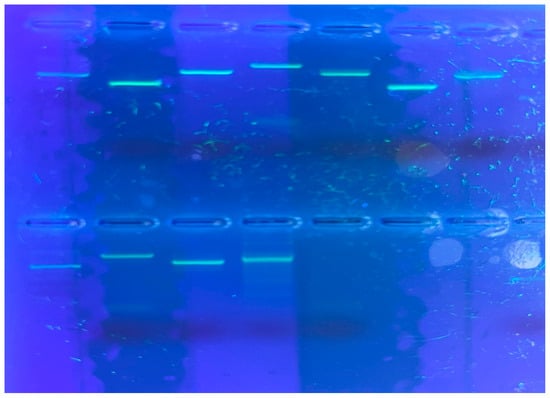
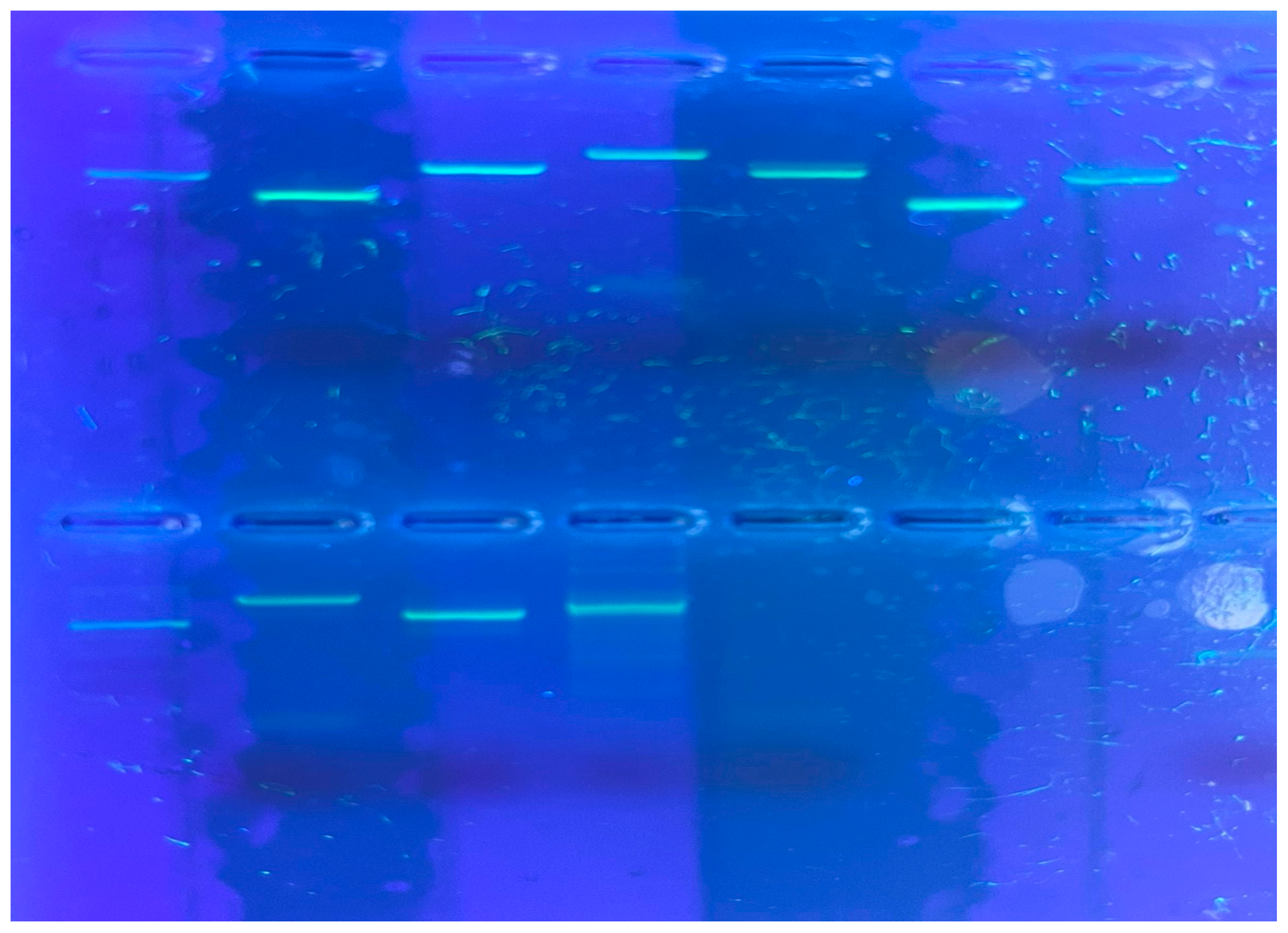
A representative agarose gel electrophoresis image of multiplex-PCR control samples and reference controls is shown in Figure 1.
Figure 1.
Agarose gel electrophoresis of multiplex-PCR products from control samples and reference controls. Upper row (left to right): lane 1, 100–1000 bp DNA ladder; lane 2, Pseudoterranova decipiens control sample; lane 3, Anisakis simplex s.l./A. pegreffii hybrid-like profile control sample; lane 4, Contracaecum osculatum control sample; lane 5, A. pegreffii control sample; lane 6, Pseudoterranova spp. positive control; lane 7, A. pegreffii positive control; lane 8, no-template negative control. Lower row (left to right): lane 1, 100–1000 bp DNA ladder; lane 2, C. osculatum positive control; lane 3, A. simplex s.l./A. pegreffii hybrid-like profile control; lane 4, 50–500 bp DNA ladder.
3. Results
Specific amplification was obtained in 55 of 74 molecular test records, corresponding to a molecular confirmation proportion of 74.3% (95% CI: 63.3–82.9%), whereas 19 records (25.7%) yielded no specific amplification. This proportion reflects molecular confirmation among preselected parasite-material records and should not be interpreted as the prevalence of anisakid infection in imported fish in Serbia (Table 3). The most frequently detected molecular profile was the assay-defined Anisakis simplex s.l./A. pegreffii hybrid-like PCR profile, identified in 39 records (70.9% of PCR-positive records; 95% Wilson CI: 57.9–81.2%). This represented 52.7% of all 74 molecular test records and 70.9% of the 55 PCR-positive records. A. pegreffii-compatible profiles occurred in 8 records (10.8% of all records; 14.5% of positive records; 95% Wilson CI: 7.6–26.2%), C. osculatum-compatible profiles in 6 (8.1%; 10.9%; 95% Wilson CI: 5.1–21.8%), and A. typica-compatible profiles in 2 (2.7%; 3.6%; 95% Wilson CI: 1.0–12.3%). Overall, Anisakis-compatible profiles accounted for 49 of 55 positive records (89.1%; 95% Wilson CI: 78.2–94.9%). All reported proportions are descriptive record-level summaries or summaries of explicitly defined subsets.
Table 3.
Distribution of molecularly identified taxa.
Among molecular test records with documented examination dates (n = 61), four were examined in 2022, 54 in 2023, and three in 2024. Specific amplification was obtained in 4, 40, and 3 records, respectively. Given the unequal distribution and limited number of records across years, these findings were interpreted descriptively, without statistical comparisons or conclusions regarding temporal trends.
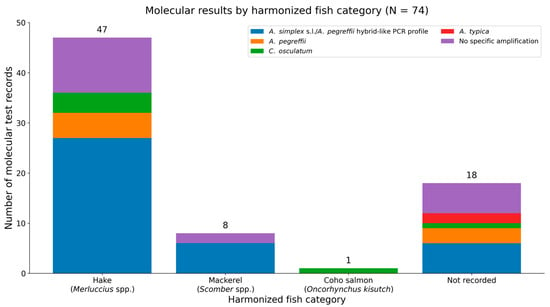
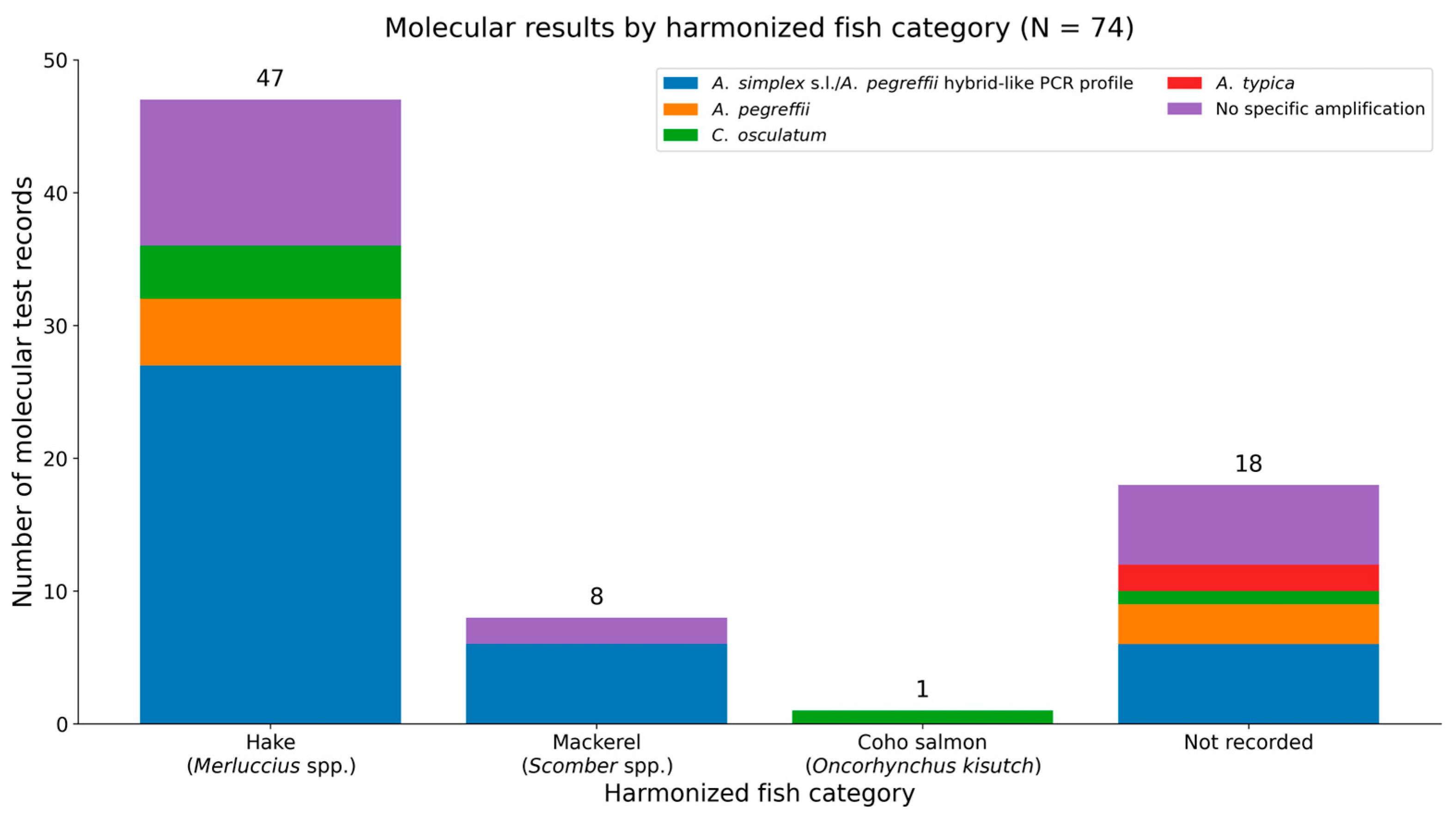
Fish identity was available for 56 of the 74 molecular test records. Following harmonization of the recorded fish categories, hake (Merluccius spp.) accounted for 47 of 56 records (83.9%) with a known fish identity, mackerel (Scomber spp.) for 8 of 56 (14.3%), and coho salmon (Oncorhynchus kisutch) for 1 of 56 (1.8%). Fish identity was not recorded for the remaining 18 records (Figure 2).
Figure 2.
Distribution of molecular results according to harmonized fish category. Fish identity was unavailable for 18 of the 74 molecular test records. Individual records were not assumed to represent independent fish specimens.
Record-level molecular positivity was 36/47 (76.6%; 95% CI: 62.8–86.4%) in hake and 6/8 (75.0%; 95% CI: 40.9–92.9%) in mackerel. The single coho salmon record was positive for C. osculatum. Among the 36 positive hake records, the A. simplex s.l./A. pegreffii hybrid profile accounted for 27 (75.0%), A. pegreffii for 5 (13.9%), and C. osculatum for 4 (11.1%); A. typica was not detected in this category. All six positive mackerel records showed the A. simplex s.l./A. pegreffii hybrid profile.
The similarity in record-level positivity between hake and mackerel indicates that the higher absolute number of positive findings in hake largely reflected the predominance of hake records in the dataset. However, because individual molecular test records could not be assumed to represent independent fish specimens, these proportions are descriptive and should not be interpreted as species-specific prevalence estimates.
Recorded origin was available for 56 of the 74 molecular test records. Spain accounted for 44 of 56 records (78.6%) with a known origin. The remaining known-origin records were attributed to the United Kingdom (n = 4), Scotland (n = 4), Argentina (n = 1), the United States (n = 1), Russia (n = 1), and South America (n = 1). Origin information was unavailable for 18 records.
Record-level molecular positivity was 33/44 (75.0%; 95% Wilson CI: 60.6–85.4%) among records originating from Spain and 10/12 (83.3%; 95% Wilson CI: 55.2–95.3%) among records from all other known origins combined. Among PCR-positive records with a known origin, the A. simplex s.l./A. pegreffii hybrid profile predominated in both groups, accounting for 25/33 (75.8%; 95% Wilson CI: 59.0–87.2%) positive records from Spain and 8/10 (80.0%; 95% Wilson CI: 49.0–94.3%) positive records from other known origins. A. pegreffii accounted for 12.1% and 10.0% of positive records, respectively, whereas C. osculatum accounted for 12.1% and 10.0%, respectively. Both A. typica records lacked origin information. Owing to the small number of records from origins other than Spain, these comparisons were considered descriptive.
Specific PCR amplification was not obtained in 19 of the 74 molecular test records (25.7%; 95% Wilson CI: 17.1–36.7%), despite prior morphological classification of the recovered material as compatible with anisakid or related ascaridoid larvae. Among the 19 records without specific PCR amplification, hake was the most frequently documented fish category (n = 11), followed by mackerel (n = 2). Spain was the most frequently recorded commercial origin (n = 11), followed by the United Kingdom (n = 2). All records with a documented examination year dated from 2023 (n = 14). These findings are descriptive and do not establish the reason for the absence of amplification.
4. Discussion
The present study demonstrated a high molecular confirmation proportion among parasite material selected following routine parasitological suspicion in imported marine fish and fishery products examined in Serbia. Of 74 molecular test records, 55 (74.3%) yielded a target-specific amplification profile. Anisakis taxa accounted for 49 of the 55 positive records (89.1%), with the A. simplex s.l./A. pegreffii hybrid profile representing the predominant molecular finding (39/55; 70.9%).
Mercken et al. [19] reported substantial variation in the occurrence of Anisakidae among fish species and fishing areas in a systematic review relevant to the Belgian market, with the highest pooled occurrence observed in the Northeast Atlantic. In a separate empirical study of fish available on the Belgian market, Mercken et al. [9] detected ascaridoid nematodes in 53% of 415 commercial fish samples and in 27% of fillets, with Anisakis simplex reported as the predominant identified species. These values are not directly comparable with the 74.3% molecular confirmation proportion observed in the present study because the studies differed in sampling framework, analytical unit, specimen selection, and diagnostic approach.
A directly relevant comparison from another landlocked seafood-importing country is provided by Smagulova et al. [20], who examined 670 imported fish specimens marketed in Kazakhstan and used parasitological examination together with PCR, sequencing and phylogenetic analysis. Their study identified several anisakid taxa, including Anisakis simplex, A. pegreffii and Contracaecum osculatum. Unlike that specimen-level survey, the present analysis is based on selected molecular test records from official examinations, without sequence confirmation or systematically recorded parasite burdens. Thus, numerical comparisons of infestation prevalence or taxon frequencies are not valid, although both studies underscore the need for strengthened molecular surveillance of imported seafood.
The predominance of Anisakis in the present dataset is nevertheless consistent with the broad occurrence of this genus in commercially important marine fish. The relative contribution of A. simplex sensu stricto and A. pegreffii is known to vary geographically. In commercial fish from the Adriatic Sea, Mladineo and Poljak [21] identified A. pegreffii in 95.95% and A. simplex s.s. in 4.05% of molecularly characterized Anisakis larvae. Similarly, A. pegreffii was the dominant member of the A. simplex complex in fish from northern Sardinia [22]. By contrast, studies from Atlantic systems have reported a greater contribution of A. simplex s.s. [19]. These geographical differences are relevant when interpreting molecular findings in imported seafood originating from multiple marine regions.
Recent studies involving hake further support the importance of this host group in anisakid surveillance. Cipriani et al. [11] examined European hake (Merluccius merluccius) from Norwegian waters and molecularly identified four anisakid species, with A. simplex s.s. as the predominant species and C. osculatum also detected. Larvae were also found in edible muscle, highlighting the food-safety relevance of hake as a commercially important host. However, direct numerical comparison with the present dataset is not appropriate because the fish species represented within the harmonized Merluccius spp. category, fishing areas, sampling design, and analytical units differed substantially.
Within the present dataset, hake represented the majority of records with available fish identity (47/56), but record-level molecular positivity was similar in hake (76.6%) and mackerel (75.0%). Accordingly, the higher absolute number of positive hake records largely reflected the predominance of hake in the dataset and should not be interpreted as evidence of a higher probability of infection in hake. Positive hake records showed a broader range of molecular profiles, including the A. simplex s.l./A. pegreffii hybrid profile, A. pegreffii, and C. osculatum, whereas all six positive mackerel records showed the A. simplex s.l./A. pegreffii hybrid profile. Although this pattern is noteworthy, it should be interpreted cautiously because only eight mackerel records were available and the independence of individual molecular records could not be established.
At the product level, González-Soñora et al. [23] detected Anisakis larvae or Anisakis DNA in 6.94% of frozen and processed hake products marketed in Spain using visual, UV-based, and molecular approaches. Similarly, Papapostolou et al. [24] detected anisakid larvae in 32 of 108 ready-to-eat fish products from the Greek market and molecularly confirmed A. simplex s.s. and A. pegreffii; the sampled products included Scomber scombrus and S. colias. These recent market-based studies illustrate that anisakid surveillance remains relevant in both hake- and mackerel-based products, including frozen, processed, and ready-to-eat products, although reported occurrence depends strongly on product type, host species, capture area, and diagnostic approach.
The most frequent result was the assay-defined A. simplex s.l./A. pegreffii hybrid-like multiplex-PCR banding profile (39/55 PCR-positive records, 70.9%). This pattern must not be equated with a sequence-confirmed or multilocus-confirmed hybrid genotype. In principle, banding patterns of this kind may reflect a true hybrid genotype, more than one DNA template in the tested material, or assay-related ambiguity; the underlying explanation cannot be resolved from the existing data alone. The distinction is especially important because the study did not include sequencing or multilocus nuclear genotyping. Mattiucci et al. [25] used a multi-marker approach to investigate A. simplex s.s., A. pegreffii and their hybridization, illustrating a higher evidentiary standard for identifying hybrids. Although these taxa are known to co-occur in some marine regions, the high proportion of this PCR pattern in the present selected records cannot be used to estimate the frequency of biological hybridization in the source fish populations. Incomplete capture-area metadata, potential clustering of records within submitted samples, and differences in molecular approaches prevent direct numerical comparison with most population-based studies.
The presence of different molecular profiles in material selected for official examination is useful as a descriptive surveillance baseline, but the present design cannot distinguish whether differences between countries or fish categories result from catch area, processing, sampling, or diagnostic selection. In particular, a declared commercial origin is not a substitute for a documented marine capture area.
Recorded origin provided an additional descriptive perspective. Spain accounted for 44 of 56 records (78.6%) with a known origin, whereas record-level molecular positivity was 75.0% among records from Spain and 83.3% among records from all other known origins combined. The distribution of molecular profiles was also broadly comparable between these groups: the A. simplex s.l./A. pegreffii hybrid profile accounted for 75.8% of positive records from Spain and 80.0% of positive records from other known origins, whereas A. pegreffii and C. osculatum each represented approximately one tenth of positive records in both groups. No pronounced origin-related difference in molecular profile distribution was apparent in the present dataset. However, these observations should be interpreted strictly descriptively because the non-Spain group was small and heterogeneous, recorded commercial origin does not necessarily correspond to the fishing area, and origin information was unavailable for both A. typica records.
Anisakis pegreffii was identified in eight records, representing 14.5% of all PCR-positive records. This finding is consistent with the recognized importance of A. pegreffii in Mediterranean and adjacent marine systems. Nevertheless, no firm ecological inference can be drawn from the recorded-origin variable alone because the commercial origin of a product may differ from the actual geographical area in which the fish was caught.
Anisakis typica was detected in two positive records. This species has previously been molecularly identified in commercially important fish, including specimens from the Canary Islands together with A. simplex s.s., A. pegreffii, and hybrid genotypes [26]. Its contribution to documented human anisakiasis is considerably less established than that of A. simplex s.s. and A. pegreffii. The present finding should therefore primarily be interpreted as evidence of the taxonomic diversity of anisakids present in imported marine products rather than as evidence of equivalent zoonotic risk.
Contracaecum osculatum was identified in six records, accounting for 10.9% of PCR-positive records. This finding is relevant because Contracaecum larvae occur in commercially important marine fish and may be difficult to distinguish reliably from other ascaridoid larvae by morphology alone. Moreover, Mehrdana et al. [27] demonstrated IgE-mediated cross-reactivity between proteins of A. simplex and C. osculatum in sensitized patients, suggesting that the food-safety relevance of Contracaecum may extend beyond the direct risk associated with viable larvae.
The absence of specific PCR amplification in 19 of the 74 records illustrates both the value and the limitations of combining morphological screening with molecular identification. Morphological compatibility with anisakid or related ascaridoid larvae does not constitute species-level confirmation, whereas failure of amplification may result from several factors, including DNA degradation, low template quantity, primer–target mismatch, or other technical limitations. Consequently, negative molecular results should not automatically be interpreted as evidence that the original morphological classification was incorrect. The available metadata did not establish an association between the absence of specific amplification and any particular fish category, commercial origin, or examination year. The 19 records without specific amplification were not subjected to repeat PCR testing. No alternative-primer assay or sequencing confirmation was performed on these records. This limits interpretation of the reason for the absence of amplification, and these observations were retained as records without a specific PCR profile rather than assigned to a particular taxon.
Molecular detection does not, by itself, demonstrate that viable infective larvae were present at the point of consumption. Appropriate freezing and heat treatment can effectively inactivate viable anisakid larvae. Under European Union legislation, fishery products intended to be consumed raw or subjected to processing insufficient to kill viable parasites generally require parasite-killing freezing unless specified exemptions apply. For parasites other than trematodes, the prescribed treatment is at least −20 °C for no less than 24 h or −35 °C for no less than 15 h [16]. The present investigation did not assess parasite viability, and molecular positivity must therefore not be presented as a measured consumer infection risk. In addition to infection by viable larvae, anisakid allergens may elicit hypersensitivity responses in sensitized consumers, and parasite inactivation cannot be treated as proof that all allergenic potential has been eliminated [7,8].
No quantitative estimate of infection risk, allergenic risk, or species-specific prevalence can be derived from this dataset. Future surveillance should link individually analysed larvae to individual fish and consignments, record capture areas and anatomical localization, and where feasible use confirmatory sequencing or multilocus markers.
Comparable requirements are incorporated into Serbian veterinary-sanitary legislation. The Serbian regulation governing veterinary-sanitary and general and specific hygiene requirements for food of animal origin prescribes, for parasites other than trematodes, freezing of fishery products so that all parts of the product reach at least −20 °C for a minimum of 24 h or −35 °C for a minimum of 15 h. The same regulation provides defined exemptions, including products that have undergone, or are intended to undergo, heat treatment sufficient to kill viable parasites, i.e., reaching a core temperature of at least 60 °C for at least 1 min [28].
These requirements are particularly relevant when interpreting molecular findings in imported seafood because detection of parasite DNA does not necessarily indicate the presence of viable larvae at the time the product reaches the consumer. Recent experimental modelling further indicates that the inactivation of Anisakis L3 larvae during cooking depends on the entire time–temperature history rather than on peak temperature alone [29].
The recent EFSA reassessment further confirms the continuing relevance of parasite surveillance in wild-caught marine fish. EFSA concluded, with 99–100% certainty, that no particular wild-caught fish species from specific marine fishing areas consumed in the EU/EFTA can generally be considered free from parasites of public-health importance [30]. This finding supports the continued implementation of risk-based surveillance of imported seafood and, at the same time, highlights the importance of detailed information on fishing area and host species for meaningful epidemiological interpretation and comparison.
5. Conclusions
The present study highlights the value of molecular identification as a complementary tool in the routine parasitological examination of imported marine fish and fishery products. Assay-defined molecular banding profiles add taxonomic information to morphological screening, while their interpretation remains limited by the absence of sequence confirmation, multilocus genotyping and viability assessment.
At the same time, interpretation of surveillance data should account for the structure of the examined material and the completeness of associated epidemiological metadata. Differences observed among fish categories or recorded geographical origins should therefore be considered descriptive and should not be interpreted as evidence of host- or origin-specific risk. Future surveillance would benefit from standardized recording based on unique sample and consignment identifiers, complete information on host species and FAO fishing area, quantitative parasite burden, and individual molecular identification of recovered larvae. Such an approach would substantially strengthen the epidemiological value of surveillance data and provide a more robust basis for risk assessment, temporal trend analysis, and targeted monitoring of anisakid parasites in imported fishery products.
Author Contributions
Conceptualization, A.V. and J.K.; methodology, A.V., M.K. and V.R.; software, M.K.; validation, A.V.; formal analysis, A.V., M.K. and J.K.; investigation, A.V., N.R. and M.K.; resources, A.V., J.K. and V.R.; data curation, M.K. and A.V.; writing—original draft preparation, M.K. and A.V.; writing—review and editing, J.K., N.R. and V.R.; visualization, A.V. and M.K.; supervision, A.V. and J.K.; project administration, A.V., M.K. and J.K.; funding acquisition, A.V.; supervision, J.K. and A.V. All authors have read and agreed to the published version of the manuscript.
Funding
This research was funded by the Ministry of Science, Technological Development and Innovation of the Republic of Serbia (Contract No. 451-03-33/2026-03/200030).
Institutional Review Board Statement
Not applicable.
Informed Consent Statement
Not applicable.
Data Availability Statement
The data presented in this study are available on request from the corresponding author due to institutional data-sharing restrictions of IVMS.
Acknowledgments
The authors gratefully acknowledge the European Union Reference Laboratory for Parasites (EURL-P), Istituto Superiore di Sanità, Rome, Italy, for providing the reference DNA used as positive controls. During the preparation of this manuscript, the authors used ChatGPT-6, OpenAI, 2026, for the purposes of language editing and text formatting. The authors have reviewed and edited the output and take full responsibility for the content of this publication.
Conflicts of Interest
The authors declare no conflicts of interest.
References
- Bao, M.; Pierce, G.J.; Pascual, S.; Gonzalez-Munoz, M.; Mattiucci, S.; Mladineo, I.; Cipriani, P.; Buselic, I.; Strachan, N.J.C. Assessing the risk of an emerging zoonosis of worldwide concern: Anisakiasis. Sci. Rep. 2017, 7, 43699. [Google Scholar] [CrossRef] [Scilit] [PubMed]
- Mattiucci, S.; Cipriani, P.; Levsen, A.; Paoletti, M.; Nascetti, G. Molecular epidemiology of Anisakis and anisakiasis: An ecological and evolutionary road map. In Advances in Parasitology; Elsevier: Amsterdam, The Netherlands, 2018; Volume 99, pp. 93–263. [Google Scholar] [CrossRef] [Scilit] [PubMed]
- Ye, X.; Wang, J.; Huang, J.; Hong, H. Marine Nematodes in Seafood: A Review of Food Safety Concerns, Advanced Detection Techniques, and Mitigation Strategies. J. Food Prot. 2026, 89, 100803. [Google Scholar] [CrossRef] [Scilit] [PubMed]
- Bao, M.; Giulietti, L.; Levsen, A.; Karlsbakk, E. Resurrection of genus Phocanema Myers, 1959, as a genus independent from Pseudoterranova Mozgovoi, 1953, for nematode species (Anisakidae) parasitic in pinnipeds and cetaceans, respectively. Parasitol. Int. 2023, 97, 102794. [Google Scholar] [CrossRef] [Scilit] [PubMed]
- Mattiucci, S.; D’Amelio, S. Anisakiasis. In Helminth Infections and Their Impact on Global Public Health; Bruschi, F., Ed.; Springer: Vienna, Austria, 2014; pp. 325–365. [Google Scholar] [CrossRef] [Scilit]
- Shamsi, S.; Barton, D.P. A critical review of anisakidosis cases occurring globally. Parasitol. Res. 2023, 122, 1733–1745. [Google Scholar] [CrossRef] [Scilit] [PubMed]
- Audicana, M.T.; Kennedy, M.W. Anisakis simplex: From obscure infectious worm to inducer of immune hypersensitivity. Clin. Microbiol. Rev. 2008, 21, 360–379. [Google Scholar] [CrossRef] [Scilit] [PubMed]
- Nieuwenhuizen, N.E.; Lopata, A.L. Allergic reactions to Anisakis found in fish. Curr. Allergy Asthma Rep. 2014, 14, 455. [Google Scholar] [CrossRef] [Scilit] [PubMed]
- Mercken, E.; Van Damme, I.; Vangeenberghe, S.; Serradell, A.; De Sterck, T.; Lumain, J.P.L.; Gabriël, S. Ascaridoids in commercial fish: Occurrence, intensity and localization in whole fish and fillets destined for the Belgian market. Int. J. Food Microbiol. 2020, 327, 108657. [Google Scholar] [CrossRef] [Scilit] [PubMed]
- Cipriani, P.; Giulietti, L.; Bao, M.; Palomba, M.; Mattiucci, S.; Levsen, A. Post-mortem tissue migration of Anisakis simplex (s.s.) larvae (Nematoda: Anisakidae) in three commercially harvested fish species from the Northeast Atlantic: The role of storage time and temperature. Food Control 2024, 157, 110162. [Google Scholar] [CrossRef] [Scilit]
- Cipriani, P.; Bao, M.; Giulietti, L.; Storesund, J.E.; Staby, A.; Levsen, A. Anisakid parasites (Nematoda: Anisakidae) in European hake (Merluccius merluccius) from Norwegian waters: Considerations on food safety and host population ecology. Food Control 2025, 171, 111097. [Google Scholar] [CrossRef] [Scilit]
- Mattiucci, S.; Nascetti, G. Advances and trends in the molecular systematics of anisakid nematodes, with implications for their evolutionary ecology and host-parasite co-evolutionary processes. In Advances in Parasitology; Elsevier: Amsterdam, The Netherlands, 2008; Volume 66, pp. 47–148. [Google Scholar] [CrossRef] [Scilit] [PubMed]
- EFSA Panel on Biological Hazards (BIOHAZ). Re-evaluation of certain aspects of the EFSA Scientific Opinion of April 2010 on risk assessment of parasites in fishery products, based on new scientific data. Part 1: ToRs1–3. EFSA J. 2024, 22, e8719. [Google Scholar] [CrossRef] [Scilit] [PubMed]
- Schotte, F.; Saelens, G.; Devleesschauwer, B.; Gabriël, S. Methods for the detection of anisakid material in different food matrices: A systematic review. Food Waterborne Parasitol. 2026, 44, e00344. [Google Scholar] [CrossRef] [Scilit] [PubMed]
- European Parliament and Council. Regulation (EC) No 853/2004 of 29 April 2004 laying down specific hygiene rules for food of animal origin. Off. J. Eur. Union 2004, L 139, 55–205. [Google Scholar]
- European Commission. Commission Regulation (EU) No 1276/2011 of 8 December 2011 amending Annex III to Regulation (EC) No 853/2004 as regards the treatment to kill viable parasites in fishery products for human consumption. Off. J. Eur. Union 2011, L 327, 39–41. [Google Scholar]
- Fujisawa, Y.; Barton, D.P.; Shamsi, S. Risk Factors of Anisakidosis at the Global Level: A Review. Curr. Clin. Microbiol. Rep. 2025, 12, 17. [Google Scholar] [CrossRef] [Scilit]
- European Union Reference Laboratory for Parasites (EURL-P). Identification of Anisakidae Larvae at the Species Level by Multiplex PCR; Method MI-10, Rev. 2; Istituto Superiore di Sanità: Rome, Italy, 2024. [Google Scholar]
- Mercken, E.; Van Damme, I.; Serradell, A.; Gabriël, S. Presence of Anisakidae in commercial fish species imported into the Belgian food markets: A systematic review and meta-analyses. Int. J. Food Microbiol. 2020, 318, 108456. [Google Scholar] [CrossRef] [Scilit] [PubMed]
- Smagulova, A.; Bulashev, A.; Jazina, K.; Uakhit, R.; Lider, L.; Bekenova, A.; Valeeva, D.; Kiyan, V. Foodborne Helminths in Imported Fish: Molecular Evidence from Fish Products in the Kazakhstan Market. Foods 2025, 14, 3466. [Google Scholar] [CrossRef] [Scilit] [PubMed]
- Mladineo, I.; Poljak, V. Ecology and genetic structure of zoonotic Anisakis spp. from Adriatic commercial fish species. Appl. Environ. Microbiol. 2014, 80, 1281–1290. [Google Scholar] [CrossRef] [Scilit] [PubMed]
- Piras, M.C.; Tedde, T.; Garippa, G.; Virgilio, S.; Sanna, D.; Farjallah, S.; Merella, P. Molecular and epidemiological data on Anisakis spp. (Nematoda: Anisakidae) in commercial fish caught off northern Sardinia (western Mediterranean Sea). Vet. Parasitol. 2014, 203, 237–240. [Google Scholar] [CrossRef] [Scilit] [PubMed]
- González-Soñora, R.; Ramilo, A.; Ríos-Castro, R.; Abollo, E.; Pascual, S. Detection of Anisakis spp. (Nematoda, Anisakidae) in frozen and processed hake products marketed in Spain. Int. J. Food Microbiol. 2026, 450, 111645. [Google Scholar] [CrossRef] [Scilit] [PubMed]
- Papapostolou, E.N.; Chaintoutis, S.C.; Gousia, P.; Karpouza, A.; Kachrimanidou, M.; Diakou, A. Food Safety Concerns: Anisakis spp. in Ready-to-Eat Fish from the Greek Market. Pathogens 2025, 14, 981. [Google Scholar] [CrossRef] [Scilit] [PubMed]
- Mattiucci, S.; Acerra, V.; Paoletti, M.; Cipriani, P.; Levsen, A.; Webb, S.C.; Canestrelli, D.; Nascetti, G. No more time to stay single in the detection of Anisakis pegreffii, A. simplex (s.s.) and hybridization events between them: A multi-marker nuclear genotyping approach. Parasitology 2016, 143, 998–1011. [Google Scholar] [CrossRef] [Scilit] [PubMed]
- Martin-Carrillo, N.; Garcia-Livia, K.; Baz-Gonzalez, E.; Abreu-Acosta, N.; Dorta-Guerra, R.; Valladares, B.; Foronda, P. Morphological and molecular identification of Anisakis spp. (Nematoda: Anisakidae) in commercial fish from the Canary Islands coast (Spain): Epidemiological data. Animals 2022, 12, 2634. [Google Scholar] [CrossRef] [Scilit] [PubMed]
- Mehrdana, F.; Lavilla, M.; Kania, P.W.; Pardo, M.A.; Audicana, M.T.; Longo, N.; Buchmann, K. Evidence of IgE-mediated cross-reactions between Anisakis simplex and Contracaecum osculatum proteins. Pathogens 2021, 10, 950. [Google Scholar] [CrossRef] [Scilit] [PubMed]
- Republic of Serbia. Rulebook on Veterinary-Sanitary Conditions, i.e. General and Specific Conditions for the Hygiene of Food of Animal Origin, as well as Conditions for the Hygiene of Food of Animal Origin. Official Gazette of the Republic of Serbia, Nos. 25/2011, 27/2014 and 86/2023. Available online: https://pravno-informacioni-sistem.rs/eli/rep/sgrs/ministarstva/pravilnik/2011/25/5/reg (accessed on 10 September 2026).
- Usieto, M.; Careche, M.; Otero, L. Predicting inactivation of Anisakis L3 after non-isothermal heat treatments: Impact of thermal conditions during and after cooking. Food Control 2026, 181, 111790. [Google Scholar] [CrossRef] [Scilit]
- EFSA Panel on Biological Hazards (BIOHAZ). Re-evaluation of certain aspects of the EFSA Scientific Opinion of April 2010 on risk assessment of parasites in fishery products, based on new scientific data. Part 2. EFSA J. 2024, 22, e9090. [Google Scholar] [CrossRef] [Scilit] [PubMed]

Disclaimer/Publisher’s Note: The statements, opinions and data contained in all publications are solely those of the individual author(s) and contributor(s) and not of MDPI and/or the editor(s). MDPI and/or the editor(s) disclaim responsibility for any injury to people or property resulting from any ideas, methods, instructions or products referred to in the content. |
© 2026 by the authors. Licensee MDPI, Basel, Switzerland. This article is an open access article distributed under the terms and conditions of the Creative Commons Attribution (CC BY) license.