


Abstract
This study analyzed the structural evolution of the Ecuadorian publishing ecosystem indexed in Scopus during the period 2016–2025 using indicators of scientific production, bibliometric impact, quartile positioning, citation concentration, editorial persistence, and women’s participation. Bibliometric information was obtained from the SCImago Journal & Country Rank (SJR) database by constructing a longitudinal journal-year panel of Ecuadorian scientific journals. The results revealed a sustained expansion of the national publishing ecosystem, reflected in substantial growth in publication output, journal coverage, citation performance, and average SJR values. However, this expansion was not accompanied by equivalent improvements in quartile positioning, as journals classified in Q3 and Q4 continued to predominate throughout the study period. The analysis also identified a high concentration of bibliometric impact within a limited set of journals, along with significant disciplinary transformations, characterized by the growing participation of Engineering and STEM-related fields. Female participation increased over time, although heterogeneous patterns persisted across disciplinary areas. To provide an integrated perspective on ecosystem evolution, a Composite Indicator of Editorial Development (CIED) was constructed, combining dimensions of visibility, citation efficiency, editorial coverage, quartile positioning, and impact dispersion. Overall, the findings indicate that the Ecuadorian publishing ecosystem has strengthened its editorial development and international visibility over the last decade, while persistent asymmetries in quartile distribution and citation concentration continue to pose important challenges to broader integration into the global structure of scientific communication.
1. Introduction
Scientific production and international academic communication processes have undergone an accelerated structural transformation over the last two decades due to the digitization of publishing, the consolidation of reference databases, and the increasing use of bibliometric indicators in academic evaluation systems (Maró et al., 2026). In this context, global scientific production continues to be organized in a hierarchical structure characterized by the coexistence of a highly centralized core and a scientific periphery with less capacity to accumulate prestige, citations, and international visibility (Muhammad et al., 2025; Plekhanov et al., 2023). For Latin American scientific systems, indexing on platforms such as Scopus (Elsevier) and Web of Science (Clarivate) has ceased to be merely an objective of institutional internationalization and has become a strategic component of national university quality-assurance models and global academic ranking systems (Aliaga, 2020). However, the incorporation of peripheral journals into these evaluation infrastructures is not a neutral process, since it involves adapting to logics of recognition, legitimation, and accumulation of scientific capital that are dominant in international circuits governed by algorithmic dynamics that tend to reproduce inequalities within international citation networks (Damar et al., 2025; Salatino, 2022).
The Ecuadorian case provides a particularly relevant context for analyzing these tensions. Following the enactment of the Organic Law of Higher Education (LOES) in 2010 (National Assembly of Ecuador, 2010) and the subsequent consolidation of national institutional evaluation systems, initially under the Council for Evaluation, Accreditation, and Quality Assurance of Higher Education (CEAACES, 2011–2018) and later through the Council for Quality Assurance of Higher Education (CACES, since 2018), the Ecuadorian university system progressively incorporated indexed output indicators as central components of academic evaluation and institutional accreditation (Hernández et al., 2024). Within this regulatory framework, Ecuadorian universities simultaneously intensified the pressure to publish in international journals and the need to strengthen their own scientific journals through the adoption of Open Journal Systems (OJS), peer review processes, Digital Object Identifiers (DOIs), and editorial strategies geared toward indexing in Scopus and SciELO (Collazo-Reyes, 2013; García-Ramírez, 2023). Consequently, the Ecuadorian publishing field transitioned from predominantly local models with limited circulation to schemes of professionalization and progressive international integration (Taipicaña Vergara et al., 2024). Indeed, this transition reduces the marginalization and isolation of Latin American universities; however, integration does not eliminate inequalities, as it also reinforces dynamics of academic dependence and subordination to the dominant circuits of knowledge circulation.
Within Latin America, Ecuador represents a relatively small but rapidly evolving scientific system. Despite its limited size compared with larger regional publishing ecosystems such as those of Brazil, Chile, or Colombia, the country has seen substantial institutional efforts to strengthen journal quality, international visibility, and indexing performance. Consequently, Ecuador provides an informative case for examining how emerging Diamond Open Access publishing ecosystems evolve under conditions of limited scale and peripheral positioning within global scientific communication networks.
Unlike other publishing systems dominated by commercial models based on Article Processing Charges (APCs), most Ecuadorian journals operate under Diamond Open Access institutional schemes, funded primarily by public and private universities. This model eliminates direct costs for both authors and readers and has been considered one of the main characteristics of contemporary Latin American scientific communication (Vervoort et al., 2021). Several studies have suggested that this type of publishing structure could foster relatively more inclusive mechanisms for knowledge dissemination, especially in peripheral scientific systems characterized by budgetary constraints and less access to international funding (Barbaro et al., 2025). However, the actual capacity of these models to generate sustained international visibility and reduce the structural asymmetries of global science remains a subject of debate.
Scientometric literature warns that international indexing is only the first stage of integration into global scientific communication networks (Verma et al., 2025). In this context, once incorporated into Scopus, emerging journals enter highly hierarchical citation fields, where historically established publications disproportionately concentrate prestige, academic legitimacy, and citation accumulation through mechanisms of reproduction and accumulation of scientific capital known in sociological literature as the Matthew effect, whereby prior visibility tends to amplify over time (Khokhlov, 2021; Kwiek & Roszka, 2026). But beyond the visible and the cumulative, this dynamic aligns with the idea that the scientific field is a competitive space in which actors occupy unequal positions based on the capital they possess (Bourdieu, 2003). Under these dynamics, indicators such as SCImago Journal & Country Rank (SJR), which weights citations according to the authority of the issuing sources, tends to reinforce relatively stable bibliometric stratification structures represented by the Q1–Q4 quartiles (Fu et al., 2022). Consequently, an increase in publication volume does not necessarily guarantee equivalent improvements in editorial positioning, especially for journals in peripheral scientific systems with limited international centrality and lower levels of scientific collaboration (López-Illescas et al., 2009; Singh et al., 2026). However, the present study does not directly evaluate scientific prestige, network centrality, or mechanisms of cumulative advantage. Consequently, these perspectives are used only to provide contextual interpretation of the observed bibliometric patterns, rather than as empirically tested constructs.
The prevalence of these asymmetries not only reinforces dynamics of concentrated publishing prestige and dependence on global knowledge production circuits but also establishes sociodemographic inequalities between territories and institutions (Garro-Aburto et al., 2025), which translate into geopolitical and epistemological power relations. At the same time, intracategorical inequalities are also reproduced, that is, inequalities between academic actors, as exemplified by the Matilda effect (Rossiter, 1993), through which gender inequalities acquire relevance. In this context, this effect is expressed in the structural bias of scientific contributions made by women, which tend to receive less recognition, citation, and representation in high-impact journals than those made by men (Lincoln et al., 2012; Song et al., 2024). These differences tend to intensify in STEM fields, where historical processes of disciplinary masculinization persist, while feminized disciplines, generally located in the social sciences and humanities, exhibit relatively higher levels of female participation (Merayo et al., 2022; N. Wang et al., 2023).
In Latin America, bibliometric studies on scientific production have generally favored macro-regional approaches or analyses focused on institutional productivity, leaving the structural evolution of national journals as nodes of international scientific validation relatively unexplored (Herrera-Franco et al., 2021). In the case of Ecuador, previous research has documented the increase in researchers’ scientific output and the progressive strengthening of international indexing; however, significant gaps remain regarding the capacity of national journals to accumulate bibliometric impact, maintain editorial stability, develop quartile mobility, and reduce inequalities associated with gender and disciplinary stratification (Herrera-Franco et al., 2021).
Despite the growing literature on scientific production and research evaluation in Ecuador, important knowledge gaps remain regarding the evolution of the national journal ecosystem itself. Most previous studies have focused on scientific productivity, institutional performance, international collaboration, or research evaluation, whereas comparatively little attention has been paid to journals as units of analysis. Longitudinal evidence integrating editorial persistence, quartile mobility, citation concentration, and the development of Diamond Open Access publishing ecosystems remain limited; moreover, few studies have attempted to synthesize multiple dimensions of journal ecosystem development through a unified analytical framework. Addressing these gaps is essential for understanding how emerging national publishing systems evolve within global scientometric structures.
The novelty of this study lies in integrating multiple dimensions of journal ecosystem development into a single longitudinal framework. Unlike previous studies focused primarily on scientific productivity, institutional performance, or citation indicators, the present research simultaneously examines publication growth, bibliometric visibility, quartile mobility, editorial persistence, citation concentration, disciplinary composition, and female participation within Ecuadorian Scopus-indexed journals. Furthermore, the study introduces an exploratory composite indicator designed to synthesize the structural evolution of the national publishing ecosystem over time.
To address these gaps, this study analyzed the structural evolution of the Ecuadorian Scopus-indexed journal ecosystem during 2016–2025 using indicators of scientific production, bibliometric impact, quartile mobility, editorial persistence, citation concentration, disciplinary composition, and female participation. Specifically, the study examined how publication output evolved over time, whether productive expansion was accompanied by improvements in bibliometric visibility and impact, how editorial persistence and quartile mobility were distributed across journals, how female participation varied among disciplinary areas, and what the proposed composite indicator reveals about the structural evolution of the national publishing ecosystem.
2. Materials and Methods
2.1. Study Design and Source of Information
The research was conducted using a retrospective scientometric approach to analyze the structural evolution of the Ecuadorian publishing ecosystem indexed in Scopus during 2016–2025. The study examined the dynamics of scientific production, bibliometric visibility, quartile positioning, disciplinary composition, and the representation of women in Ecuadorian scientific journals included in the SJR database.
Bibliometric information was obtained from SJR, a platform based on metadata indexed in Scopus. Information retrieval was performed using the filter corresponding to Ecuador and restricting the analysis to the document type “Journal”. Conferences were excluded. Proceedings, book series, and commercial publications were excluded due to structural differences from peer-reviewed scientific journals.
The analysis period spanned 2016–2025. The time frame was defined based on the criteria of consistency and representativeness of the indexed Ecuadorian publishing ecosystem. Before 2016, the number of Ecuadorian journals registered in SJR was extremely small, limiting the possibility of conducting longitudinal structural analyses and robust national-level bibliometric comparisons. In contrast, from 2016 onward, a more sustained expansion of the indexed publishing system is evident, enabling a more stable analytical assessment of growth dynamics, concentration, and scientific visibility. The year 2025 was considered the upper limit, as it corresponded to the last period for which consolidated information was available in SJR at the time of data extraction.
Furthermore, the selected time frame coincides with the consolidation process of national university evaluation and accreditation systems following the implementation of the Organic Law of Higher Education (LOES). During this period, institutional evaluation was initially managed by the Council for Evaluation, Accreditation, and Quality Assurance of Higher Education (CEAACES, 2011–2018) and subsequently by the Council for Quality Assurance of Higher Education (CACES, since 2018).
To reduce biases associated with editorial survival, both active and discontinued journals indexed in the SJR during the period analyzed were included. Consequently, the resulting panel exhibited an unbalanced longitudinal structure because not all journals were indexed throughout the study period.
2.2. Bibliometric Variables Analyzed
The analysis used bibliometric indicators reported by the SJR database for each journal and each year. Variables considered included the annual number of documents published, cumulative citations over a three-year period, citations per document, the SJR, the H-index, quartile ranking, the number of active journals, and female participation (%Female).
Scientific output was analyzed using the annual volume of indexed documents, while bibliometric visibility was assessed using cumulative citations, citations per document, and average SJR. Editorial positioning was examined using quartile distribution and the H-index. Female participation was analyzed using the %Female indicator reported by the SJR database. This variable was extracted directly from the platform together with the remaining bibliometric indicators and was analyzed as reported by the original source. Consequently, the study did not perform independent gender identification, classification, or verification procedures. Likewise, no independent calculations of SJR, H-index, or other bibliometric indicators were conducted. All variables were analyzed as provided by the SJR database. Missing values, when present in the original source, were not imputed or estimated and were treated as unavailable observations.
2.3. Disciplinary Classification and Organization of the Panel
The journals were organized according to the thematic categories of the All-Science Journal Classification (ASJC) system available in the SJR database. Subsequently, the original categories were grouped into six broad disciplinary macro-areas for comparative and longitudinal purposes: Health Sciences, Life Sciences, Engineering & STEM, Social Sciences, Arts & Humanities, and Multidisciplinary.
Because some journals are assigned to more than one ASJC category, each title was ultimately classified into a single macro-disciplinary area according to its predominant thematic orientation within the SJR classification. This procedure was adopted to avoid duplicate counting and to facilitate consistent longitudinal comparisons among broad disciplinary fields. Consequently, each journal contributed only once to the disciplinary analyses performed in this study.
The database was cleaned through duplicate verification, chronological organization, and disciplinary recording. Subsequently, longitudinal aggregations were constructed by journal, year, and scientific macro-area to examine the structural trajectories of the Ecuadorian publishing ecosystem.
2.4. Indicators Derived from Bibliometric Efficiency and Concentration
To characterize the structural dynamics of the Ecuadorian publishing ecosystem indexed in Scopus, indicators derived from relative citation efficiency, bibliometric impact concentration, and editorial persistence were calculated using longitudinal records provided by the SJR platform.
Citation efficiency (CE) was estimated by the ratio between citations and documents accumulated within three-year rolling windows (Equation (1)):
where represents citation efficiency in year , corresponds to the total number of citations accumulated within the three-year rolling window, and represents the total number of documents accumulated during the same period. The use of three-year rolling windows made it possible to reduce interannual fluctuations associated with the delayed maturation of citations and to obtain more stable estimates of the system’s relative bibliometric performance.
The concentration of bibliometric impact was assessed by the cumulative proportion of citations concentrated in the three and five journals with the highest annual citation volume (Equation (2)):
where represents the cumulative citations of journal i in year t; k corresponds to the subset of journals with the highest volume of citations (Top-3 or Top-5); and n represents the total number of active indexed journals in each year analyzed.
Editorial persistence was estimated by the temporal continuity of the indexed journals in the period 2016–2025, classifying the titles according to their accumulated permanence in Scopus into categories of high persistence, intermediate persistence and discontinuous persistence.
2.5. Construction of the Composite Indicator of Editorial Development
To synthesize the multidimensional development of the Ecuadorian publishing ecosystem indexed in Scopus, a Composite Indicator of Editorial Development (CIED) was constructed. This index was conceived as a composite, exploratory measure that integrates bibliometric signals associated with publishing prestige, citation efficiency, quartile ranking, system coverage, and impact distribution. Consequently, the CIED does not measure editorial development in a subjective sense, but rather a set of observable structural conditions that can strengthen or limit the editorial positioning of a national ecosystem of indexed journals.
The index was calculated annually for the period 2020–2025, as consolidated information on documents and citations accumulated in three-year rolling windows was available during that timeframe. The CIED formulation integrated five components: normalized SJR, normalized citation efficiency, quartile maturity, editorial coverage, and bibliometric impact dispersion. The selection of the five components was based on their complementary representation of key dimensions of publishing system development. SJR was included as an indicator of journal prestige and international visibility; citation efficiency reflects the capacity of the system to generate citations relative to its publication volume; quartile maturity captures the relative positioning of journals within the SJR hierarchy; editorial coverage represents the breadth and continuity of the indexed journal system; and impact dispersion reflects the degree to which bibliometric influence is distributed across journals rather than concentrated in a small core. The general equation was the following Equation (3):
where () represents the value of the Composite Indicator of Editorial Development in year t; () corresponds to the normalized annual average SJR; () represents the normalized citation efficiency; () expresses the average quartile maturity; () represents the relative editorial coverage; and () measures the dispersion of the bibliometric impact.
Equal weighting was adopted because the was conceived as an exploratory composite indicator rather than a predictive or causal model. In the absence of theoretical or empirical evidence supporting differential weights among components, each dimension was assumed to contribute equally to the overall characterization of the publishing ecosystem. Similar equal-weight approaches are frequently employed in exploratory composite indices when the objective is descriptive synthesis rather than formal measurement of latent constructs.
The average annual SJR and citation efficiency were normalized using min-max transformation, to express both indicators on a common scale of 0 to 1 (Equation (4)):
where () is the normalized value of the indicator in the year (t), () is the observed value, () corresponds to the minimum value of the analyzed series and () to the maximum value. This normalization was applied only to continuous variables with different original scales.
Citation efficiency was calculated as the ratio between citations and accumulated documents within three-year rolling windows (Equation (5)):
Quartile maturity was operationalized by mapping the SJR quartiles to a 0–1 scale, assigning the following values: Q1 = 1.00, Q2 = 0.75, Q3 = 0.50, and Q4 = 0.25. Subsequently, the annual average quartile maturity of journals active in each year was calculated. This transformation allowed the incorporation of the journals’ relative positions within the international bibliometric hierarchy without assuming absolute equivalence between quartiles.
Editorial coverage was calculated as the proportion of active journals in each year relative to the annual maximum observed during the analyzed period (Equation (6)):
Finally, the dispersion of the impact was calculated as the complement of the concentration of citations accumulated by the Top-5 national journals (Equation (7)):
where () represents the percentage of citations accumulated by the five most cited journals in year (t). Thus, higher values of () indicate a less concentrated distribution of bibliometric impact, while low values reflect a greater dependence of the system on a small core of journals.
The was initially expressed on a 0–1 scale and was subsequently rescaled to 0–100 points to facilitate its comparative interpretation (Equation (8)):
For descriptive interpretation, CIED scores were grouped into the following categories: very low (0–20), low (21–40), intermediate (41–60), upper-intermediate (61–70), high (71–85), and very high (86–100). This classification was used for interpretive purposes and not as an absolute normative threshold. Therefore, the should be interpreted as a relative descriptive indicator of editorial development within the Ecuadorian publishing ecosystem indexed in Scopus, rather than as a direct measure of journal quality, scientific excellence, trust, or legitimacy.
Because the CIED was conceived as an exploratory descriptive indicator, formal validation procedures, robustness assessments, and sensitivity analyses were beyond the scope of the present study. Consequently, the indicator should be interpreted as a descriptive tool designed to synthesize multiple dimensions of ecosystem development rather than as a definitive measure of editorial quality, scientific performance, or editorial legitimacy. An additional limitation is that the relative contribution of its components may influence the final score under alternative weighting schemes or normalization procedures. Therefore, the results derived from the CIED should be interpreted primarily as evidence of general structural tendencies within the Ecuadorian publishing ecosystem. Future research may strengthen the methodological assessment of the indicator through sensitivity analyses, weighting simulations, alternative normalization approaches, and comparisons with external scientometric benchmarks.
2.6. Data Processing and Bibliometric Analysis
Data processing and analysis were performed using R (version 4.3.2) and Python (version 3.11.5). The organization of the bibliometric panel included variable cleaning, temporal standardization, and the consolidation of longitudinal indicators. The dplyr, tidyr, janitor, data.table, ggplot2, and patchwork packages were primarily used for this purpose.
The statistical analysis was descriptive and longitudinal. Absolute frequencies, proportions, means, relative growth rates, and annual bibliometric distributions were calculated. Patterns of editorial concentration, temporal persistence, and evolution of quartile ranking within the indexed Ecuadorian ecosystem were also examined.
The visualizations included time series of scientific output, the evolution of the average SJR, quartile distribution, disciplinary composition, and bibliometric concentration structures. All graphical representations were constructed using longitudinal comparability criteria to avoid distortions arising from arbitrary differences in time scale or editorial coverage.
2.7. Methodological Considerations
Due to the secondary and aggregated nature of the SJR/Scopus databases, the results should be interpreted as structural representations of the Ecuadorian publishing ecosystem rather than as individual measures of scientific productivity. It is also recognized that international bibliometric indicators operate within global structures of knowledge circulation and legitimation that can differentially influence peripheral scientific systems.
Likewise, the exploratory nature of the CIED implies that its results should be interpreted with caution, particularly when comparing periods characterized by substantial changes in journal coverage, citation accumulation, or indexing dynamics. Although the indicator provides a useful synthetic representation of ecosystem evolution, it does not establish causal relationships among the dimensions considered. Furthermore, because formal robustness assessments and sensitivity analyses were beyond the scope of the present study, the indicator should be interpreted as an exploratory descriptive measure rather than as a definitive evaluation of editorial quality or scientific performance.
3. Results and Discussion
3.1. Longitudinal Dynamics of the Production, Visibility and Editorial Integration of Ecuadorian Journals Indexed in Scopus (2016–2025)
The longitudinal evolution of Ecuadorian journals indexed in Scopus reveals more than a simple increase in publication volume. Between 2016 and 2025, the ecosystem experienced simultaneous growth in indexed output, editorial coverage, and bibliometric visibility, suggesting a progressive consolidation of national scientific publishing. However, this expansion was not uniform across all dimensions. While the number of active journals increased from 1 to 10 and annual publication output rose from 15 to 294 documents, the evolution of impact-related indicators was comparatively slower, suggesting that editorial expansion and bibliometric positioning followed partially distinct trajectories. Consequently, the principal transformation observed during the study period was not merely quantitative growth, but the gradual construction of a more visible and institutionally consolidated publishing ecosystem within international scientific communication networks (Table 1).
Table 1.
Longitudinal evolution of publication output, citation impact and editorial coverage in Scopus-indexed Ecuadorian journals (2016–2025).
From a structural perspective, this expansion can be interpreted within the framework of an unequal global scientific system, in which peripheral countries enter international scientific production networks, yet a center-periphery divide persists in production and legitimation of knowledge. In this context, Ecuadorian journals, even those indexed in Scopus, operate within what the literature has termed peripheral publishing systems, characterized by less centrality in citation networks and limited participation in the dominant flows of scientific recognition (Ferro et al., 2026; Saes et al., 2025). Consequently, the observed increase in scientific output should be interpreted not solely as quantitative growth but also as part of a gradual process of integration into the structurally hierarchical networks of the global academic field.
Production growth intensified from 2020 onward, marking the transition from an incipient phase to a stage of greater editorial consolidation. However, citation metrics showed a dynamic partially decoupled from document growth. Citations reported by the SJR three-year citation indicator showed sustained growth throughout the analyzed period, increasing from 1 in 2016 to 550 in 2025. In parallel, citations per document increased progressively from 0.034 in 2016 to 0.697 in 2024, then decreased slightly to 0.672 in 2025. This behavior suggests that the expansion of document volume was accompanied by a gradual strengthening of relative bibliometric visibility and the capacity for citation accumulation within the Ecuadorian publishing ecosystem. This pattern is consistent with scientometric literature in emerging scientific systems, where increased output indexed in international databases generates a progressive consolidation of visibility, since citation impact typically accumulates gradually after publication and often requires several years to reach stable levels of recognition within scientific communication networks (D. Wang et al., 2013). The marginal reduction in citations per document during 2024–2025, despite the continued growth in publications, reflects the phenomenon of metric dilution characteristic of rapidly expanding peripheral systems, where increased volume does not translate proportionally into an accumulation of citations due to limitations in integration into high-density international networks (Hussain et al., 2026; Peña-Cáceres et al., 2025). This partial decoupling between volume and impact is typical of publishing ecosystems in a transitional consolidation phase, in which productive capacity precedes the stabilization of relative impact within global hierarchies of scientific recognition (Ferro et al., 2026; Saes et al., 2025).
The evolution of SJR partially supports this interpretation. The average value increased from 0.101 in 2016 to 0.210 in 2025, representing a relative increase of almost 107.9%. Although these values remain moderate compared to those of journals in core scientific systems, the upward trend suggests a relative expansion in visibility and integration into international citation circuits, rather than a linear process of convergence toward hegemonic structures of scientific recognition. In this sense, the increase in SJR does not necessarily imply a substantial redistribution of global bibliometric prestige, since the dynamics of scientific legitimation remain deeply conditioned by the historical hierarchies of knowledge circulation, editorial concentration, and the structural dependence between center and periphery. From this perspective, the observed growth could be interpreted more as a controlled peripheral expansion within the international scientific system than as an effective transformation of its epistemological power structures. This interpretation aligns with studies showing that emerging publishing ecosystems can increase coverage, output, and relative visibility without substantially altering global asymmetries of scientific recognition (Gómez-Núñez et al., 2011; Vaishya et al., 2025).
In parallel, the sociodemographic composition of the system shows significant changes in women’s participation, although in the opposite direction to the expected equity. This participation decreased from 53.85% in 2016 to 42.18% in 2025, demonstrating a widening of the representation gap in the Ecuadorian publishing ecosystem indexed in Scopus. This downward trend contradicts findings reported in the open-access literature in Latin America, where studies indicate that institutional open-access models can promote greater inclusion of women in scientific production, especially in non-commercial publishing environments (Işıkgöz et al., 2025; Kyambade et al., 2024). The observed contradiction suggests that indexing in international databases, such as Scopus, could introduce structural filters that differentially affect women’s participation. Indeed, several studies have reported persistent gender inequalities in scientific visibility, leadership positions, and citation impact (Holman et al., 2018; Sugimoto & Larivière, 2023; West et al., 2013). It is possible that, although there has been a general increase in the representation of women in Latin American science, they tend to concentrate in regional circuits of lower bibliometric hierarchy, while the global circuits indexed in Scopus reproduce historical gender asymmetries; that is, what matters is not only how many women publish, but also where they are publishing and what prestige they gain in those circuits (Rossiter, 1993). In this sense, the observed decrease in women’s participation could reflect that Ecuadorian journal, upon consolidating themselves in more competitive international circuits, become subject to selection dynamics that reproduce structural gender biases, in which women face greater barriers to accessing leadership editorial positions or publishing in higher-impact journals within the Scopus system.
The results show that the Ecuadorian publishing ecosystem has entered a consolidation phase, characterized by simultaneous growth in scientific output, editorial coverage, and relative bibliometric visibility. Although citation and SJR indicators show an upward trend during the analyzed period, international impact levels remain moderate compared to those of journals in core scientific systems. In this context, the observed expansion appears to be more a result of a gradual integration into global scientific communication structures than a substantial transformation of international hierarchies of academic recognition (Sugimoto & Larivière, 2023). These findings reinforce the idea that peripheral journals, even when they manage to expand their presence in international databases, continue to operate under structural constraints that limit the sustained accumulation of bibliometric authority and global scientific centrality (Holman et al., 2018).
3.2. Longitudinal Evolution of Editorial Production and Visibility (2016–2025)
Figure 1 shows the annual evolution of scientific production and citations of Ecuadorian journals indexed in Scopus/SJR during the period 2016–2025. The analysis shows a sustained expansion in document volume, from 15 documents in 2016 to 294 in 2025. This trajectory was not entirely linear, with an initial phase of low production between 2016 and 2019, followed by more marked growth from 2020 onwards and sustained expansion between 2022 and 2025.
Figure 1.
Annual publications and citations of Ecuador-indexed journals (SJR), 2016–2025.
In terms of citations, the metrics showed an upward trend throughout the entire time series. Cumulative citations reported by the SJR three-year citation indicator increased from 1 in 2016 to 550 in 2025, while citations per document reached their highest value in 2024 (0.697). These results demonstrate a gradual strengthening of the citation accumulation capacity in the Ecuadorian publishing ecosystem.
In the Ecuadorian case, the inflection point observed in the dynamics of scientific production coincides temporally with the consolidation of the regulatory framework for higher education, structured around the Organic Law of Higher Education (LOES), enacted in 2010 (National Assembly of Ecuador, 2010) and substantially amended in 2018 (National Assembly of Ecuador, 2018), as well as with the evolution of the national quality assurance system. This system was initially implemented by the Council for Evaluation, Accreditation, and Quality Assurance of Higher Education (CEAACES) and, following the 2018 legal reform, was reconfigured as the Council of Quality Assurance of Higher Education (CACES), which formally assumes responsibility for institutional evaluation and accreditation.
From an analytical perspective, this regulatory framework introduced explicit mechanisms for evaluating academic performance based on indicators of indexed scientific output, particularly in mainstream databases such as Scopus and Web of Science. The operationalization of these criteria in institutional accreditation and university categorization processes generated systemic incentives to increase both the volume of publications and their international visibility. In terms of the economics of science, this change can be interpreted as a reconfiguration of the academic reward system, where publication in indexed journals becomes a substitute indicator of scientific quality and productivity, inducing a significant increase in national publishing output and pressure to publish in highly indexed journals (Castillo & Powell, 2020).
This phenomenon is consistent with empirical evidence in emerging scientific systems, where the introduction of regulatory frameworks based on bibliometric metrics produces immediate expansion effects on production and, with some delay, on integration into international citation networks (Bornmann & Mutz, 2014).
The Ecuadorian trajectory should also be interpreted within the broader South American publishing landscape. Compared with larger scientific systems such as those of Brazil, Colombia, and Chile, Ecuador entered international indexing processes relatively late and with a substantially smaller editorial base. Consequently, the increase from one active Scopus-indexed journal in 2016 to ten journals in 2025 represents a comparatively rapid relative expansion, despite the ecosystem remaining modest in absolute terms. Unlike countries with long-established publishing infrastructures and larger research investments, Ecuador illustrates the accelerated development of an emerging editorial ecosystem undergoing institutional consolidation and progressive integration into international scientific communication networks. Therefore, the significance of the observed growth lies not only in its magnitude but also in the speed at which it occurred relative to the national publishing system’s initial size.
Meanwhile, the parallel growth in citations suggests that the expansion of publications was accompanied by a greater capacity for integration into scientific communication networks. The temporal lag observed between the increase in publication output and the subsequent growth in citations is consistent with the cumulative nature of citation accrual described in scientometric literature (Lee & Shim, 2026). Because citations typically accumulate progressively after publication, increases in publication volume are often followed by delayed increases in citation counts. Therefore, the citation growth observed between 2021 and 2025 may partly reflect the expansion of the Ecuadorian publishing ecosystem during previous years rather than immediate citation responses. As Hu et al. (2020) explain, the three-year citation metric of the SJR favors the accumulation of impact over the medium term. Ecuadorian journals, by publishing a high volume of documents between 2020 and 2022, contributed to a “pool of citable articles” that fostered the sustained growth of citations observed between 2021 and 2025.
While the number of documents increased from 212 in 2023 to 274 in 2024 and 294 in 2025, the cumulative citations over a three-year period also continued to grow, rising from 409 to 513 and then to 550. The sociodemographic composition of the system showed significant fluctuations in women’s participation throughout the time series. The %Female indicator ranged from 32.94% to 53.85%, demonstrating heterogeneous representation across years and indexed journals. Although the observed values suggest a relatively significant presence of women in the Ecuadorian publishing ecosystem, the temporal variations indicate that their participation did not follow a linear trajectory of sustained growth. This behavior aligns with studies showing that the representation of women in peripheral scientific systems can increase quantitatively without necessarily translating into an equivalent redistribution of bibliometric prestige (Goyanes et al., 2024) or positions of greater academic centrality (Wu et al., 2019).
3.3. Editorial Production and Quartile Mobility in Ecuadorian Journals Indexed in Scopus (2016–2025)
Quartile mobility reveals that the expansion of the Ecuadorian ecosystem indexed in Scopus during 2016–2025 was not accompanied by a proportional transformation in its relative positioning within the international bibliometric hierarchy. Figure 2 shows that journals such as Revista Ecuatoriana de Neurología, Revista Politécnica, Retos, and Granja progressively increased their publication volume after 2020, albeit with varying magnitudes and growth rates. However, Figure 3 shows that this increased productivity did not translate into equivalent quartile mobility, which remained largely unchanged, as the structural predominance of Q3 and Q4 persisted throughout almost the entire time series. This decoupling between publication expansion and the accumulation of bibliometric prestige suggests that the operational consolidation of Ecuadorian journals progressed more rapidly than their capacity to integrate into global networks with high citation density.
Figure 2.
Temporal trajectories of publication output by Ecuadorian journals (Scopus/SJR), 2016–2025.
Figure 3.
SJR quartile trajectories (Q1–Q4) by journal and year (2016–2025).
Figure 2 shows significant inter-journal heterogeneity in both the magnitude of production and its temporal stability. Revista Ecuatoriana de Neurología reached approximately 86 articles in 2021, becoming the main hub of editorial production within the national system for much of the recent period. In contrast, journals such as Granja, Retos, and Íconos maintained considerably more moderate trajectories, with an annual average of fewer than 25 articles. This difference implies that the most productive journal published more than three times the annual volume of several other journals within the system, demonstrating a strong concentration of editorial capacity. Furthermore, while some publications showed abrupt increases after 2020, others maintained relatively stable trends, indicating that the expansion of the ecosystem did not follow a homogeneous dynamic, but rather different rates of institutional growth and operational consolidation. Maskana was available only in 2025, with 39 documents, and is therefore represented by a single marker rather than a connected temporal trajectory; no values were imputed for earlier years.
However, the quantitative expansion observed in Figure 2 contrasts with the limited quartile mobility observed in Figure 3. Throughout the analyzed period, no Ecuadorian journals were recorded in Q1, while most observations were concentrated in Q3 and Q4. Even journals that significantly increased their publication volume did not achieve sustained increases in their SJR rankings. This pattern is particularly evident in Revista Politécnica and Revista Ecuatoriana de Neurología, which registered visible increases in publication volume between 2020 and 2024 without substantially changing their relative ranking. Structurally, this indicates that publication growth did not translate into an equivalent redistribution of the system’s bibliometric positioning.
The persistence of Q3–Q4 throughout almost the entire time series is relevant considering that the Ecuadorian ecosystem simultaneously experienced an expansion of publications, an increase in the number of indexed journals, and gradual improvements in the average SJR score. Even so, these transformations were insufficient to significantly alter the system’s quartile architecture. From a scientometric perspective, this behavior suggests that upward mobility depends on more complex mechanisms than simply an increase in publications, including international citation density, thematic centrality, and accumulated legitimacy within global scientific communication networks (Li et al., 2013). Furthermore, the explanation for this expansion of scientific output may be more closely linked to variables related to increased funding, institutional pressure, growing internationalization, the creation of doctoral programs and research incubators, than to variables associated with the acquisition of symbolic capital.
Merton’s theory of cumulative advantage (Merton, 1968) provides a useful interpretive perspective for understanding the persistence of bibliometric hierarchies. The observed concentration of journals in Q3 and Q4 is consistent with patterns described in the Matthew Effect literature, whereby previously visible actors may accumulate additional visibility over time (Drivas & Kremmydas, 2020). However, the present study does not directly test cumulative advantage mechanisms, citation network dynamics, or longitudinal prestige accumulation. Therefore, the Matthew Effect is discussed only as a theoretical lens through which the observed quartile patterns may be interpreted. Consequently, peripheral journals face structural difficulties in converting document growth into bibliometric authority, since relative impact depends not only on the absolute number of citations received but also on the centrality and prestige of the citing journals. The SJR incorporates precisely this hierarchical logic by weighing citations according to the authority of the issuing sources (Bask & Bask, 2015). Thus, Ecuadorian journals compete not only in terms of document productivity, but also in international networks, where the distribution of citations exhibits high levels of scientific concentration (Larivière et al., 2009; V. Rodríguez et al., 2022).
The contrast between Íconos and several Ecuadorian technical journals is particularly illustrative of these structural differences. Although Íconos maintained relatively moderate publication volumes, it stabilized in Q2 during the final years of the analyzed period, whereas journals with higher production levels remained predominantly in Q3 and Q4. This behavior suggests that upward mobility depends less on the extensive expansion of publication volume and more on factors associated with thematic internationalization, regional articulation, collaborative density, and the capacity to engage in established scientific debates. The stability and recognition achieved by Íconos in Q2 may be interpreted as being consistent with processes commonly described in the literature on symbolic capital and academic recognition. However, because the present study does not directly measure prestige accumulation, network centrality, or reputation mechanisms, this interpretation should be considered exploratory. This is especially relevant considering that it is a social science journal originating from peripheral contexts and competing within a profoundly unequal global scientific system. Indeed, recent studies have shown that citation opportunities, visibility patterns, and pathways to international recognition vary substantially across disciplinary fields, which may contribute to differences in quartile mobility and bibliometric performance among journals operating in peripheral scientific systems (Céspedes, 2021; Narayan et al., 2023).
The prolonged stability of Q3–Q4 also suggests the existence of dependent trajectories (path dependency) in the Ecuadorian publishing ecosystem. Once journals are positioned within certain metric ranges, quartile positions often remain relatively stable over time, a pattern that has been reported in studies of bibliometric stratification and journal ranking systems (Newman, 2009). This phenomenon has been widely documented in studies on bibliometric mobility, in which peripheral scientific systems exhibit persistent difficulties in modifying historical stratification patterns, even in scenarios of sustained growth in scientific output (Marx & Bornmann, 2016).
The results show that Ecuador’s publishing expansion between 2016 and 2025 constituted a genuine process of operational consolidation and broadening of international reach, although it was accompanied by limited and structurally asymmetric quartile mobility. The coexistence of the accelerated increase in publication volume and the persistence of Q3–Q4 rankings demonstrates that while indexing in Scopus strengthens international visibility, it does not automatically guarantee a sustained accumulation of bibliometric prestige. On the contrary, the Ecuadorian case suggests that peripheral scientific ecosystems can experience rapid phases of productive expansion without substantially altering their relative position within the global architecture of scientific evaluation, thus reinforcing the persistence of international citation hierarchies and academic authority.
These quartile dynamics should be interpreted with caution given the relatively small size of the Ecuadorian Scopus-indexed journal ecosystem, particularly during the earlier years of the study period. Because the total number of indexed journals remained limited, changes affecting a small number of journals may produce comparatively large fluctuations in aggregated quartile indicators. Consequently, the observed patterns should be interpreted as indicative trends in ecosystem evolution rather than precise measures of structural transformation.
3.4. Disciplinary Transition and Decoupling Between Productive Growth and Bibliometric Impact
The results reveal the structural configuration of the scientific system, characterized by a disciplinary transition, a redistribution of editorial weight, and a partial dissociation between production volume and bibliometric impact.
Figure 4 shows that the Health Sciences area dominated the initial period (2016–2021), reaching a peak of 86 articles in 2021. This represents a 5.7-fold increase relative to the 15 articles recorded in 2016, corresponding to an approximate compound annual growth rate of 42%. This trend is consistent with the global expansion of biomedical research reported during the same period, particularly in response to increased scientific activity associated with recent health challenges, as documented in international bibliometric studies (Burbano Santos et al., 2015; Bibliometric et al., 2024).
Figure 4.
Temporal evolution of scientific production by macro-disciplinary fields (2016–2025).
However, from 2022 onward, a significant shift toward Engineering & STEM is observed, with production increasing from 31 articles in 2022 to 99 in 2024, representing a 219% increase in just two years. This accelerated growth suggests a trend that could reflect a greater relative expansion of technological areas within the Ecuadorian publishing ecosystem, aligned with digitization, artificial intelligence, and technological innovation, as has been reported in emerging economies with strategies focused on strengthening applied science (Fire & Guestrin, 2019).
Figure 5 allows this dynamic to be examined at the journal level and reveals that growth was not homogeneous, but rather highly concentrated. For example, journals such as Ingenius and Revista Politécnica registered simultaneous increases in publication volume and SJR, suggesting progressive improvements in editorial visibility. In contrast, Revista Ecuatoriana de Neurología maintained a relatively stable output, although with limited variations in SJR, suggesting a stabilization of its ranking without a significant expansion of international visibility.
Figure 5.
Journal-level publication dynamics and SJR-based citation concentration patterns across time (2016–2025).
A key finding is the evidence of a decoupling between output and impact. Although some journals increase the number of articles published, the SJR does not grow proportionally. This phenomenon has been described as “citation saturation,” in which increased volume does not necessarily translate into greater scientific influence (Krajcsák, 2021). In fact, recent studies indicate that the correlation between productivity and citations can be moderate or even weak in regional contexts (Confraria et al., 2017).
Additionally, the emergence of multidisciplinary journals beginning in 2022, peaking at 59 articles per journal by 2025, reflects a shift toward disciplinary convergence. This trend aligns with the literature indicating that contemporary scientific problems require integrated approaches, thereby increasing the relevance of journals with broad coverage (Danermark, 2019). In this context, multidisciplinarity not only acts as a catalyst for research output but also as a mechanism for enhancing visibility and fostering international collaboration (Negi et al., 2025).
Furthermore, Figure 5 shows marked variation in SJR across journals, with values ranging from 0.10 to 0.33. This dispersion indicates heterogeneity in bibliometric visibility and weighted citation influence. Because the SJR weights citations according to the prestige of the citing sources, higher values indicate stronger relative positioning within international citation networks (Srisawad et al., 2024).
Complementing the annual SJR trajectories presented in Figure 5, the journal-level H-index values summarized in Table 3 ranged from 3 to 16. Bionatura (H-index = 16) and Retos (Ecuador) (H-index = 14) recorded the highest cumulative values, whereas Estoa and Maskana presented the lowest values (H-index = 3). Because the H-index accumulates citations over the indexed lifetime of a journal, it reflects historical influence rather than current annual performance. Consequently, this indicator was interpreted together with recent publication output and SJR trajectories to distinguish cumulative impact from contemporary editorial dynamics (Shah & Jawaid, 2023).
The results reveal three key processes shaping the recent evolution of the scientific system. A progressive disciplinary shift toward technological areas is observed, accompanied by a concentration of growth in a subset of journals that are simultaneously increasing their output and visibility. In parallel, a partial dissociation between publication volume and bibliometric impact is identified, suggesting that increased productivity does not necessarily translate into greater scientific influence. These patterns reflect structural dynamics of the global scientific system, which, in this case, manifest themselves in regional contexts where editorial consolidation processes are still underway.
3.5. Editorial Prestige, Disciplinary Stratification and Partially Divergent Patterns Regarding the Matilda Effect in Ecuadorian Journals Indexed in Scopus
Incorporating the female participation (%Female) indicator into scientometric analysis allows us to move beyond mere demographic description and examine how the dynamics of publishing prestige interact with disciplinary stratification in a peripheral scientific ecosystem. In the Ecuadorian case, the relationship between gender, bibliometric impact, and publishing positioning does not strictly reproduce the patterns traditionally documented in mainstream science; rather, it reveals partially divergent structural configurations associated with the characteristics of the Latin American Diamond Open Access model.
Longitudinal analysis of records from 2016 to 2025 reveals significant heterogeneity in the distribution of women’s participation across major disciplinary fields. Table 2 shows that the Multidisciplinary category had the highest average participation by women, at 61.22%, although this is based on a small number of observations. Among the fields with the strongest structural presence in the system, the Social Sciences registered an average of 48.28%, followed by Health Sciences at 45.75%. In contrast, Engineering and CS showed the lowest average, at 12.80%, confirming a marked gap in the representation of women in technological fields. These differences are not marginal, as the gap between the Social Sciences and Engineering and CS exceeds 35 percentage points, demonstrating a pattern of horizontal segmentation consistent with the international literature on gender inequality in STEM fields (Ioannidis et al., 2023; Jaramillo et al., 2025).
Table 2.
Gender participation structure (%Female) across macro-disciplinary areas in Ecuadorian journals indexed in Scopus (2016–2025).
The interaction between women’s participation, disciplinary structure, and bibliometric prestige reveals heterogeneous editorial configurations within the Ecuadorian ecosystem indexed in Scopus. In general, journals with higher levels of women’s participation also tended to exhibit relatively more competitive bibliometric performance within the Ecuadorian ecosystem, particularly in the Social Sciences and Humanities. Although this trend was not uniform across all disciplinary macro-areas, the results suggest that journals with greater representation of women do not experience systematic metric penalties in the national system. This behavior partially contrasts with patterns documented in core scientific systems, where women’s participation tends to be concentrated in areas with lower citation density and less representation in high-impact journals (Ioannidis et al., 2023; Jaramillo et al., 2025).
From a structural perspective, this result constitutes a partially divergent pattern with respect to the trends classically associated with the “Matilda Effect,” understood as the historical bias that reduces the recognition, visibility, and citation of scientific work developed by women (D. Rodríguez, 2025; Rajkó et al., 2025). In the Ecuadorian case, journals with the highest levels of female participation, primarily in the Social Sciences and Humanities, coincided with some of the most competitive performance metrics within the ecosystem. Journals such as Íconos and Sophia stabilized in Q2 during the final years of the analyzed period while maintaining female participation rates close to or above 50%. In contrast, several STEM journals remained predominantly in Q3 and Q4 despite registering significant increases in publication volume.
Table 3 illustrates the interaction between editorial prestige, disciplinary macro-area, and women’s participation at the journal level. The results show that the highest-ranked journals in the Social Sciences simultaneously exhibit relatively high SJR values and higher levels of gender equity. Íconos, for example, increased its SJR from 0.158 to 0.301 between 2021 and 2025, accompanied by a female participation rate of 52.4%. Similarly, Sophia achieved an SJR of 0.268 in 2025, with a female participation rate of 48.7%. In contrast, technical journals such as Revista Politécnica and Ingenius, despite registering sustained metric improvements, maintained female participation rates below 25%.
Table 3.
Intersection between editorial prestige, disciplinary structure and female participation in Ecuadorian journals indexed in Scopus.
Evidence suggests that Ecuadorian publishing performance depends largely on the interaction between disciplinary domain, collaborative structure, and sociodemographic composition. Social science journals appear to benefit from regional dynamics of thematic circulation, a higher density of Latin American collaboration, and less concentrated publication patterns than those observed in highly internationalized STEM fields. Several studies have indicated that Latin American social sciences possess greater capacity for regional articulation and less dependence on highly centralized Anglophone networks, thereby partially reducing the structural citation barriers that affect peripheral journals (Beigel et al., 2024; Sivertsen, 2016).
In contrast, engineering and science journals operate in considerably more competitive and concentrated bibliometric environments, where scientific authority is dominated by Anglophone journals with high international centrality. Under these conditions, Ecuadorian STEM publications face a double structural constraint: on the one hand, a lower capacity to accumulate international citations; on the other, the persistence of historical gender gaps associated with the masculinization of technological fields. The fact that journals with substantial increases in publication output and progressive improvements in the SJR continue to show low levels of female participation suggests that publishing expansion alone does not automatically modify pre-existing sociodemographic inequalities.
However, the system’s overall behavior suggests that the Ecuadorian Diamond Open Access model could serve as a partial mechanism for mitigating structural inequalities. Unlike commercial publishing systems based on APCs, where publication costs pose additional barriers for researchers with limited access to funding, Ecuadorian journals operate predominantly under schemes funded by public and private universities, thereby eliminating direct costs for authors and readers. Several recent studies have suggested that this model promotes greater academic inclusion and reduces mechanisms of economic exclusion in international scientific communication (Ayeni & Larivière, 2025; Fuchs & Sandoval, 2013).
The results show that the evolution of Ecuadorian publishing cannot be interpreted solely through classic production and citation indicators. The system presents a complex structure in which bibliometric prestige, scientific discipline, and women’s participation interact in differentiated ways. Although significant inequalities persist in STEM fields, particularly in engineering and the exact sciences, the evidence suggests that Ecuadorian social science and humanities journals have managed to combine competitive bibliometric visibility with greater sociodemographic equity. This behavior should be interpreted cautiously. Although some journals combine relatively high female participation with competitive bibliometric performance within the Ecuadorian ecosystem, the present study does not directly evaluate the mechanisms required to assess the Matilda Effect. Therefore, these findings only suggest patterns that may warrant future investigation.
3.6. Concentration of Impact, Editorial Persistence and Structural Consolidation of the Ecuadorian Ecosystem Indexed in Scopus
To complement the aggregate production and citation indicators presented in the previous sections, the citation efficiency, impact concentration, and editorial persistence of Ecuadorian journals indexed in Scopus from 2016 to 2025 were analyzed. This integrated approach allows us to assess whether the observed growth in the ecosystem reflected a homogeneous expansion of the system or, conversely, was driven by a restricted core of journals with greater capacity to accumulate prestige and bibliometric stability.
Citation efficiency was estimated as the ratio of triennial citations to triennial documents, with the aim of controlling for the mechanical effect resulting from the increased volume of publications (V. Rodríguez et al., 2022; Viera-Arroyo et al., 2025). The results show a progressive improvement in the system’s relative performance, especially between 2020 and 2023. Citation efficiency showed a progressive improvement between 2020 and 2023, rising from 0.312 to 0.661, suggesting a relative increase in the system’s capacity to accumulate citations within the analyzed rolling window. Particularly relevant, efficiency remained relatively stable during 2024–2025, despite a decrease in total citations relative to the 2023 peak and a sustained increase in document volume. This behavior suggests that the decoupling between the increase in documents and the relative reduction in citations per document is not solely due to a volumetric effect, but also to bibliometric maturation mechanisms and the delayed accumulation of impact inherent in rolling citation windows.
However, the growth in impact was not evenly distributed among the journals in the system. Table 4 shows that a high proportion of annual citations were systematically concentrated in a small subset of journals. Between 2020 and 2025, the top three national journals accounted for between 53.5% and 69.2% of annual triennial citations, while the top five accumulated between 74.7% and 85.8% of the total citations in the system. The year 2023 represented the peak of concentration, when just five journals accounted for approximately 86% of all citations recorded in the Ecuadorian ecosystem indexed in Scopus.
Table 4.
Citation efficiency and concentration of bibliometric impact in Ecuadorian journals indexed in Scopus (2020–2025).
These results indicate that the Ecuadorian ecosystem has a highly concentrated structure, in which a relatively small core group of publishers acts as the main recipient of scientific attention and citations. From a scientometric perspective, this behavior is consistent with Merton’s theory of cumulative advantage (Merton, 1968). According to this theory, journals that achieve early visibility tend to subsequently reinforce their position through circular mechanisms of legitimation and citation. Consequently, the overall expansion of the system does not necessarily imply an equitable distribution of impact but can coexist with highly concentrated hierarchical structures.
The observed concentration also helps to explain several of the patterns described in the previous sections. The persistence of Q3–Q4, discussed in Section 3.2, and the partial dissociation between productivity growth and bibliometric impact, analyzed in Section 3.3, can be interpreted as manifestations of a system in which the capacity to accumulate prestige remains restricted to a limited subset of journals. Thus, although the Ecuadorian ecosystem simultaneously increased production, editorial coverage, and citation volume, bibliometric authority remained highly asymmetrical.
The structure of editorial persistence reinforces this interpretation. Longitudinal analysis shows that the system’s growth was accompanied by significant heterogeneity in the continuity of indexed journals. While some titles maintained a virtually continuous presence throughout the decade, others exhibited intermittent or even discontinuous trajectories. Table 5 shows that journals such as Revista Ecuatoriana de Neurología achieved complete persistence (10/10 years), while others exhibited partial or episodic persistence, particularly during the accelerated expansion phases after 2019.
Table 5.
Editorial persistence and structural continuity of Ecuadorian journals indexed in Scopus (2016–2025).
The coexistence of highly persistent and discontinued journals is particularly relevant for interpreting the dynamics of the Ecuadorian publishing ecosystem. Journals with greater temporal continuity not only have more opportunities for citation accumulation, but also a greater likelihood of stabilizing collaborative networks, consolidating editorial processes, and achieving bibliometric maturity. In contrast, journals with short or intermittent histories face structural limitations in developing sustained scientific authority, since citation-based indicators require relatively long periods to stabilize (Castillo-Nuñez et al., 2026).
From a systemic perspective, these results suggest that the consolidation of Ecuadorian publishing operated under a dual model, comprising a relatively stable core and a more volatile publishing periphery. This behavior aligns with what has been described in peripheral scientific systems highly dependent on institutional funding, university governance, and national policies for scientific evaluation (Avello-Mártínez et al., 2025; Por et al., 2016). Under these conditions, publishing survival serves not only as an administrative attribute but also as a critical mechanism for accumulating scientific legitimacy.
The evidence shows that the recent evolution of the Ecuadorian ecosystem cannot be interpreted solely based on aggregated indicators of document production. Although the system experienced rapid expansion between 2019 and 2023, bibliometric impact remained heavily concentrated in a small number of journals with higher levels of structural persistence. This pattern suggests that the integration of Ecuadorian journals into Scopus progressed more rapidly in terms of coverage and volume than in the effective redistribution of scientific authority, reproducing dynamics of concentration and stratification consistent with contemporary peripheral scientific systems.
3.7. Composite Indicator of Editorial Development and Longitudinal Evolution of the Ecuadorian Publishing Ecosystem
The integration of indicators of bibliometric prestige, citation efficiency, quartile maturity, editorial coverage, and impact dispersion allowed the structural evolution of the Ecuadorian publishing ecosystem to be synthesized through the Composite Indicator of Editorial Development (CIED). The index increased from 9.0 points in 2020 to 73.2 points in 2025 (Table 6), reflecting a progressive improvement in the relative conditions of editorial performance throughout the analyzed time series. This trend is consistent with patterns reported in other emerging scientific systems, where publishing expansion is frequently accompanied by improvements in coverage and relative bibliometric performance (V. Rodríguez et al., 2022; Van Noorden, 2014).
Table 6.
Longitudinal evolution of the Composite Indicator of Editorial Development (CIED).
However, the values obtained should not be interpreted as absolute evidence of international scientific consolidation. Because the CIED was constructed through the internal normalization of variables derived exclusively from the Ecuadorian ecosystem, the index expresses relative levels of editorial development within national dynamics rather than equivalencies with globally consolidated publishing systems. This distinction is important, as several studies have shown that relative bibliometric indicators can reflect substantial internal improvements even in contexts where structural limitations persist regarding internationalization, citation centrality, and quartile ranking (Al-Jamimi et al., 2022; Belter, 2015).
The main contribution of the CIED, therefore, lies not in demonstrating the full consolidation of the Ecuadorian publishing system, but rather in revealing an internal structural transition characterized by greater publishing coverage and a sustained increase in citation efficiency. The growth of this latter component, from 0.000 in 2020 to 0.935 in 2025, suggests that the system has progressively transformed documentary expansion into relative scientific visibility. The observed increase in citation efficiency suggests that the Ecuadorian publishing ecosystem has progressively improved its capacity to generate citations relative to publication output. Although this pattern is consistent with perspectives discussed in the literature on cumulative advantage and scientific recognition, the present study does not directly evaluate these mechanisms. Consequently, such frameworks are used only as interpretive perspectives to contextualize the observed bibliometric evolution (Desrochers et al., 2018; Karadag & Ciftci, 2023).
However, the persistence of moderate quartile maturity values and impact dispersion demonstrates that Ecuadorian publishing growth remains constrained by structural limitations associated with citation concentration and low mobility toward Q1–Q2. Recent studies have shown that peripheral scientific systems can increase production and citations without proportionally altering their position within the global hierarchy of scientific communication, because bibliometric influence has historically been concentrated in publishing centers with high international centrality (Padilla & Gil, 2022). Following this logic, the predominant persistence of Q3–Q4 observed in Ecuador suggests that recent publishing strengthening has occurred more rapidly in operational capacity than in international bibliometric positioning.
Methodologically, the CIED should be understood as an exploratory indicator of editorial development, not as a universal measure of scientific quality. Its main contribution lies in integrating multiple bibliometric dimensions into a single interpretive framework, allowing for the identification of longitudinal trends that would be difficult to observe with isolated indicators. In this sense, the index’s performance suggests that Ecuador’s publishing expansion during 2020–2025 was accompanied by improvements in internal bibliometric indicators, although still insufficient to substantially alter the persistent asymmetries that characterize the international distribution of bibliometric influence (Freire et al., 2026).
4. Conclusions
The Ecuadorian publishing ecosystem indexed in Scopus experienced sustained expansion and diversification during 2016–2025, as reflected in increased publication output, broader journal coverage, improved citation performance, and greater visibility within international indexing systems. However, this quantitative growth was not accompanied by equivalent improvements in quartile positioning, as the ecosystem remained predominantly concentrated in Q3 and Q4 journals and continued to exhibit a high concentration of bibliometric impact within a limited group of journals. The results also revealed important disciplinary transformations, particularly the growing participation of Engineering and STEM-related fields, together with heterogeneous patterns of female participation across disciplines. In this context, the Composite Indicator of Editorial Development (CIED) provided an exploratory framework for integrating complementary dimensions of ecosystem evolution, including visibility, citation performance, editorial coverage, and impact dispersion, although it should be interpreted as a descriptive synthesis tool rather than as a validated measurement scale. Overall, the findings indicate that the Ecuadorian publishing ecosystem has strengthened its editorial development and international visibility during the last decade, while persistent asymmetries in quartile distribution and citation concentration suggest that important challenges remain for achieving broader integration into the global structure of scientific communication.
Author Contributions
Conceptualization, O.M.Q.; methodology, O.M.Q.; software, O.M.Q.; validation, O.M.Q. and A.L.Y.T.; formal analysis, O.M.Q.; investigation, O.M.Q. and A.L.Y.T.; resources, O.M.Q.; data curation, O.M.Q.; writing—original draft preparation, O.M.Q.; writing—review and editing, O.M.Q. and A.L.Y.T.; visualization, O.M.Q.; supervision, O.M.Q.; project administration, O.M.Q. All authors have read and agreed to the published version of the manuscript.
Funding
This research received no external funding.
Data Availability Statement
The bibliometric data used in this study were obtained from the SJR platform based on Scopus-indexed records. The processed longitudinal database and analytical scripts used during the current study are available from the corresponding author upon reasonable request.
Acknowledgments
The authors acknowledge the institutional support provided by the Universidad Politécnica Estatal del Carchi during the development of this research. During the preparation of this manuscript, the authors used ChatGPT (OpenAI, GPT-5.5) to revise and refine the English version of the manuscript. The authors reviewed and edited all outputs and take full responsibility for the content of this publication.
Conflicts of Interest
The authors declare no conflicts of interest.
References
- Aliaga, F. M. (2020). Evolución de la edición científica en revistas de Ciencias Sociales y determinación de Latinoamérica como ecosistema característico. RELIEVE—Revista Electrónica de Investigación y Evaluación Educativa, 26(2), 1–20. [Google Scholar] [CrossRef] [Scilit]
- Al-Jamimi, H. A., BinMakhashen, G. M., & Bornmann, L. (2022). Use of bibliometrics for research evaluation in emerging markets economies: A review and discussion of bibliometric indicators. Scientometrics, 127(10), 5879–5930. [Google Scholar] [CrossRef] [Scilit]
- Avello-Mártínez, R., Rodríguez, V. G., Quiroz, R. C., Tolozano-Benites, R., & Monteses, J. B. (2025). Analysis of scientific production published in the journals of the Ecuador collection in SciELO: Trends and challenges (2014–2022). Revista General de Información y Documentación, 35(1), 149–160. [Google Scholar] [CrossRef] [Scilit]
- Ayeni, P., & Larivière, V. (2025). Inequity, precarity, and disparity: Exploring systemic and institutional barriers in open access publishing. Journal of Librarianship and Information Science, 58(2), 1073–1090. [Google Scholar] [CrossRef] [Scilit]
- Barbaro, A., Barbaro, M. C., & Napolitani, F. (2025). No fees, no barriers—But what standards? Considerations on the DIAMAS diamond OA standard applied to a public health journal. Publication, 13(4), 53. [Google Scholar] [CrossRef] [Scilit]
- Bask, M., & Bask, M. (2015). Cumulative (dis)advantage and the Matthew effect in life-course analysis. PLoS ONE, 10(11), e0142447. [Google Scholar] [CrossRef] [Scilit] [PubMed]
- Beigel, F., Sánchez Pereyra, A., Octavio Alonso-Gamboa, J., Salatino, M., Gallardo, O., Ferreira Gonçalves, A., Carrillo Romero, O., Alejandro Flores Chávez, M., Durán Muñoz María Guadalupe Trinidad Arguello Mendoza, E., Pereyra, S., Gonçalves, F., Romero, C., Chávez, F., Muñoz, D., & Arguello Mendoza, E. (2024). OLIVA-2: Las revistas iberoamericanas indexadas en Biblat y Latindex: Fuentes fundamentales para conocer la producción científica global. E-Ciencias de La Información. [Google Scholar] [CrossRef] [Scilit]
- Belter, C. W. (2015). Bibliometric indicators: Opportunities and limits. Journal of the Medical Library Association: JMLA, 103(4), 219. [Google Scholar] [CrossRef] [Scilit] [PubMed]
- Bibliometric, C. A., Khan, S., Khondoker, M., Ibrahim, H., Mueti, N., Fatai Ogunbayo, B., & Aigbavboa, C. (2024). A bibliometric analysis and systematic review of productivity management-related studies. Engineering Proceedings, 76(1), 37. [Google Scholar] [CrossRef] [Scilit]
- Bornmann, L., & Mutz, R. (2014). Growth rates of modern science: A bibliometric analysis based on the number of publications and cited references. Journal of the Association for Information Science and Technology, 66(11), 2215–2222. [Google Scholar] [CrossRef] [Scilit]
- Bourdieu, P. (2003). El oficio de científico: Ciencia de la ciencia y reflexividad. SciELO Argentina. [Google Scholar]
- Burbano Santos, P., Miró, O., Martín-Sánchez, F. J., Fernández Pérez, C., & Casademont, J. (2015). Producción científica e impacto bibliométrico de un grupo representativo de internistas españoles con trayectoria investigadora consolidada. Revista Clínica Española, 215(7), 371–379. [Google Scholar] [CrossRef] [Scilit] [PubMed]
- Castillo, J. A., & Powell, M. A. (2020). Research productivity and international collaboration: A study of Ecuadorian science. Journal of Hispanic Higher Education, 19(4), 369–387. [Google Scholar] [CrossRef] [Scilit]
- Castillo-Nuñez, J. P. S., Minchon-Medina, C. A., Clemente-Vega, A., Vallenas-Aroni, N. R., Lozano-Lozano, M., & Báez-Sepúlveda, M. (2026). Editorial predictors of the discontinuation of open access scientific journals in Scopus: An analysis from DOAJ. Publications, 14(1), 2. [Google Scholar] [CrossRef] [Scilit]
- Céspedes, L. (2021). Latin American journals and hegemonic languages for academic publishing in Scopus and web of science. Trabalhos Em Linguística Aplicada, 60(1), 141–154. [Google Scholar] [CrossRef] [Scilit]
- Collazo-Reyes, F. (2013). Growth of the number of indexed journals of Latin America and the Caribbean: The effect on the impact of each country. Scientometrics, 98(1), 197–209. [Google Scholar] [CrossRef] [Scilit]
- Confraria, H., Mira Godinho, M., & Wang, L. (2017). Determinants of citation impact: A comparative analysis of the global south versus the global north. Research Policy, 46(1), 265–279. [Google Scholar] [CrossRef] [Scilit]
- Damar, M., da Trindade, T. G., & Pinto, A. D. (2025). Scientific production in primary health care in Latin American and Caribbean countries (1980–2024): A web of science perspective. Atención Primaria, 57(9), 103224. [Google Scholar] [CrossRef] [Scilit] [PubMed]
- Danermark, B. (2019). Applied interdisciplinary research: A critical realist perspective. Journal of Critical Realism, 18(4), 368–382. [Google Scholar] [CrossRef] [Scilit]
- Desrochers, N., Paul-Hus, A., Haustein, S., Costas, R., Mongeon, P., Quan-Haase, A., Bowman, T. D., Pecoskie, J., Tsou, A., & Larivière, V. (2018). Authorship, citations, acknowledgments and visibility in social media: Symbolic capital in the multifaceted reward system of science. Social Science Information, 57(2), 223–248. [Google Scholar] [CrossRef] [Scilit]
- Drivas, K., & Kremmydas, D. (2020). The Matthew effect of a journal’s ranking. Research Policy, 49(4), 103951. [Google Scholar] [CrossRef] [Scilit]
- Ferro, R. C., do Nascimento Costa, P. R., Soares, C. M. P., & de Sousa, P. H. M. (2026). Interdisciplinarity and hegemonies in gastronomy research: Insights from a bibliometric mapping and identifying prominent research agendas. International Journal of Gastronomy and Food Science, 44, 101488. [Google Scholar] [CrossRef] [Scilit]
- Fire, M., & Guestrin, C. (2019). Over-optimization of academic publishing metrics: Observing Goodhart’s Law in action. GigaScience, 8(6), giz053. [Google Scholar] [CrossRef] [Scilit] [PubMed]
- Freire, A. G. H., Freire, A. H. H., Ramos, C. A. C., Cariapaza, L. M. M., & Maron, B. V. M. (2026). Scientific production of Peru and Ecuador: A comparative bibliometric analysis. Iberoamerican Journal of Science Measurement and Communication, 6(1), 1–14. [Google Scholar] [CrossRef] [Scilit]
- Fu, Y. C., Marques, M., Tseng, Y. H., Powell, J. J. W., & Baker, D. P. (2022). An evolving international research collaboration network: Spatial and thematic developments in co-authored higher education research, 1998–2018. Scientometrics, 127(3), 1403–1429. [Google Scholar] [CrossRef] [Scilit]
- Fuchs, C., & Sandoval, M. (2013). The diamond model of open access publishing: Why policy makers, scholars, universities, libraries, labour unions and the publishing world need to take non-commercial, non-profit open access serious. TripleC: Communication, Capitalism & Critique. Open Access Journal for a Global Sustainable Information Society, 11(2), 428–443. [Google Scholar] [CrossRef]
- García-Ramírez, Y. (2023). Analyzing the relationship between scientific publications and researchers’ variables: A Scopus-based study of a private Ecuadorian university. In M. Shelley, & O. T. Ozturk (Eds.), Proceedings of the international conference on research in education and science (ICRES 2023) (pp. 1824–1842). International Society for Technology, Education, and Science (ISTES). Available online: https://www.icres.net (accessed on 20 June 2026).
- Garro-Aburto, L. L., Rivera-Arellano, E. G., Chávez-Díaz, J. M., & Ochoa-Guevara, S. P. (2025). Motivation for scientific publication at the university level: Analyses in Peru, Ecuador, and Colombia. Education Sciences, 15(11), 1468. [Google Scholar] [CrossRef] [Scilit]
- Goyanes, M., Herrero, E., & de-Marcos, L. (2024). Gender differences in representation, citations, and H-index: An empirical examination of the field of communication across the ten most productive countries. PLoS ONE, 19(11), e0312731. [Google Scholar] [CrossRef] [Scilit] [PubMed]
- Gómez-Núñez, A. J., Vargas-Quesada, B., de Moya-Anegón, F., & Glänzel, W. (2011). Improving SCImago journal & country rank (SJR) subject classification through reference analysis. Scientometrics, 89(3), 741–758. [Google Scholar] [CrossRef] [Scilit]
- Hernández, R. V., Peña, S. R., Pérez, S. M., & Muyulema, D. M. (2024). Analysis of Ecuador’s higher education processes. 593 Digital Publisher CEIT, 9(4), 106–117. [Google Scholar] [CrossRef] [Scilit]
- Herrera-Franco, G., Montalván-Burbano, N., Mora-Frank, C., & Bravo-Montero, L. (2021). Scientific research in Ecuador: A bibliometric analysis. Publications, 9(4), 55. [Google Scholar] [CrossRef] [Scilit]
- Holman, L., Stuart-Fox, D., & Hauser, C. E. (2018). The gender gap in science: How long until women are equally represented? PLoS Biology, 16(4), e2004956. [Google Scholar] [CrossRef] [Scilit] [PubMed]
- Hu, Y. H., Tai, C. T., Liu, K. E., & Cai, C. F. (2020). Identification of highly-cited papers using topic-model-based and bibliometric features: The consideration of keyword popularity. Journal of Informetrics, 14(1), 101004. [Google Scholar] [CrossRef] [Scilit]
- Hussain, W., Merigó, J. M., Baraheem, H., & Ratten, V. (2026). From regional roots to global reach: A 30-year bibliometric analysis of the journal of Management & Organization. Journal of Management & Organization, 32(1), 215–266. [Google Scholar] [CrossRef] [Scilit]
- Ioannidis, J. P. A., Boyack, K. W., Collins, T. A., & Baas, J. (2023). Gender imbalances among top-cited scientists across scientific disciplines over time through the analysis of nearly 5.8 million authors. PLoS Biology, 21(11), e3002385. [Google Scholar] [CrossRef] [Scilit] [PubMed]
- Işıkgöz, M. E., Şahbudak, M., Deveci, M. E., & Öztunç, M. (2025). Challenges and successes in promoting gender equality through physical education and sports: A systematic review. BMC Public Health, 25(1), 2117. [Google Scholar] [CrossRef] [Scilit] [PubMed]
- Jaramillo, A. M., Macedo, M., Oliveira, M., Karimi, F., & Menezes, R. (2025). Systematic comparison of gender inequality in scientific rankings across disciplines. arXiv, arXiv:2501.13061. [Google Scholar] [CrossRef] [Scilit]
- Karadag, E., & Ciftci, S. K. (2023). Why research productivity of some scientists is higher? Effects of social, economic and cultural capital on research productivity. Heliyon, 9(8), e18762. [Google Scholar] [CrossRef] [Scilit] [PubMed]
- Khokhlov, A. N. (2021). How scientometrics became the most important science for researchers of all specialties. Moscow University Biological Sciences Bulletin, 75(4), 159–163. [Google Scholar] [CrossRef] [Scilit] [PubMed]
- Krajcsák, Z. (2021). Researcher performance in Scopus articles (RPSA) as a new scientometric model of scientific output: Tested in business area of V4 countries. Publications, 9(4), 50. [Google Scholar] [CrossRef] [Scilit]
- Kwiek, M., & Roszka, W. (2026). Top performers and top journals: Persistent concentration in scientific publishing. arXiv, arXiv:2603.00069. [Google Scholar] [CrossRef] [Scilit]
- Kyambade, M., Tushabe, M., Namatovu, A., & Oyella, S. (2024). Bridging the gender gap: Analyzing women’s participation and leadership representation in university governance. Cogent Social Sciences, 10(1). [Google Scholar] [CrossRef] [Scilit]
- Larivière, V., Gingras, Y., & Archambault, É. (2009). Brief communication the decline in the concentration of citations, 1900–2007. Journal of the American Society for Information Science and Technology, 60(4), 858–862. [Google Scholar] [CrossRef] [Scilit]
- Lee, S., & Shim, W. (2026). An empirical analysis of open access citation advantages in library and information science. Information Research an International Electronic Journal, 31, 1733–1750. [Google Scholar] [CrossRef] [Scilit]
- Li, E. Y., Liao, C. H., & Yen, H. R. (2013). Co-authorship networks and research impact: A social capital perspective. Research Policy, 42(9), 1515–1530. [Google Scholar] [CrossRef] [Scilit]
- Lincoln, A. E., Pincus, S., Koster, J. B., & Leboy, P. S. (2012). The Matilda effect in science: Awards and prizes in the US, 1990s and 2000s. Social Studies of Science, 42(2), 307–320. [Google Scholar] [CrossRef] [Scilit] [PubMed]
- López-Illescas, C., Noyons, E. C. M., Visser, M. S., de Moya-Anegón, F., & Moed, H. F. (2009). Expansion of scientific journal categories using reference analysis: How can it be done and does it make a difference? Scientometrics, 79(3), 473–490. [Google Scholar] [CrossRef] [Scilit]
- Maró, Z. M., Jámbor, A., Kovács, S., & Török, Á. (2026). A bibliometric analysis of the trends and topics in global value chain participation research between 2006 and 2024. Quality & Quantity, 60, 10805–10831. [Google Scholar] [CrossRef] [Scilit]
- Marx, W., & Bornmann, L. (2016). Change of perspective: Bibliometrics from the point of view of cited references—A literature overview on approaches to the evaluation of cited references in bibliometrics. Scientometrics, 109(2), 1397–1415. [Google Scholar] [CrossRef] [Scilit] [PubMed]
- Merayo, N., Ayuso, A., Es, A. A., Merayo, N., & Ayuso, A. (2022). Analysis of barriers, supports and gender gap in the choice of STEM studies in secondary education. International Journal of Technology and Design Education, 33(4), 1471–1498. [Google Scholar] [CrossRef] [Scilit] [PubMed]
- Merton, R. K. (1968). The matthew effect in science. Science, 159(3810), 56–62. [Google Scholar] [CrossRef] [Scilit]
- Muhammad, H., Khatijah, O., Abdul, H. M. A. S., Bin, Asif, S., Muqaddas, A., Junaid, Z. M., & Asad, J. (2025). Exploring the intersection of digital transformation and workforce productivity: A comprehensive bibliometric review. Multidisciplinary Reviews, 8(6), 2025164. [Google Scholar] [CrossRef] [Scilit]
- Narayan, A., Chogtu, B., Janodia, M., Radhakrishnan, R., & Venkata, S. K. (2023). A bibliometric analysis of publication output in selected South American countries. F1000Research, 12, 1239. [Google Scholar] [CrossRef] [Scilit] [PubMed]
- National Assembly of Ecuador. (2010, October 1). Organic law of higher education (Ley Orgánica de Educación Superior, LOES) (Official Register Supplement No. 298). Available online: https://www.ces.gob.ec/documentos/Normativa/LOES.pdf (accessed on 20 June 2026).
- National Assembly of Ecuador. (2018, August 2). Organic reform law to the organic law of higher education (Ley Orgánica Reformatoria a la Ley Orgánica de Educación Superior) (Official Register Supplement No. 297). Available online: https://www.asambleanacional.gob.ec/es/multimedios-legislativos/41234-ley-organica-reformatoria-la-ley (accessed on 20 June 2026).
- Negi, P., Jaiswal, A., & Mathur, G. (2025). Knowledge sharing and green innovation: A literature review for future research agenda. Social Sciences & Humanities Open, 12, 101889. [Google Scholar] [CrossRef] [Scilit]
- Newman, M. E. J. (2009). The first-mover advantage in scientific publication. Europhysics Letters, 86(6), 68001. [Google Scholar] [CrossRef] [Scilit]
- Padilla, V. S., & Gil, Y. T. R. (2022). Indicators to achieve a better positioning of Ecuadorian scientific journals. Bionatura, 7(1), 1–8. [Google Scholar] [CrossRef] [Scilit]
- Peña-Cáceres, O., Garay-Silupu, E., Aguilar-Chuquizuta, D., & Silva-Marchan, H. (2025). Research trends and networks in self-explaining autonomous systems: A bibliometric study. Computers, Materials and Continua, 84(2), 2151–2188. [Google Scholar] [CrossRef] [Scilit]
- Plekhanov, D., Franke, H., & Netland, T. H. (2023). Digital transformation: A review and research agenda. European Management Journal, 41(6), 821–844. [Google Scholar] [CrossRef] [Scilit]
- Por, P., Feyen, J., Milia, M., Van Hoof, H. B., Quinde, K., Ochoa, V., Abril, V., & Bojorque, J. (2016). Improving the publication visibility of Ecuador’s higher education system. Maskana, 7(2), 113–125. [Google Scholar] [CrossRef] [Scilit]
- Rajkó, A., Herendy, C., Goyanes, M., & Demeter, M. (2025). The Matilda effect in communication research: The effects of gender and geography on usage and citations across 11 countries. Communication Research, 52(2), 209–232. [Google Scholar] [CrossRef] [Scilit]
- Rodríguez, D. (2025). Matilda effect: Challenges to the visibility and recognition of women in health sciences. Revista Gregoriana de Ciencias de la Salud, 2(2), 6–9. [Google Scholar] [CrossRef] [Scilit]
- Rodríguez, V., Flores-Sanchez, M., Zambrano, C. H., Rincón, L., Paz, J. L., & Torres, F. J. (2022). Analysis of Ecuador’s SCOPUS scientific production during the 2001–2020 period by means of standardized citation indicators. Heliyon, 8(4), e09329. [Google Scholar] [CrossRef] [Scilit] [PubMed]
- Rossiter, M. W. (1993). The Matthew Matilda effect in science. Social Studies of Science, 23(2), 325–341. [Google Scholar] [CrossRef] [Scilit]
- Saes, M. S. M., Souza, R. F., Feitosa, E. R. M., Val, A. L., & Marcovitch, J. (2025). When periphery matters: A computational analysis through network science and topic modeling of the scientific production on Pirarucu. Revista de Economia e Sociologia Rural, 63, e284419. [Google Scholar] [CrossRef] [Scilit]
- Salatino, M. (2022). Los circuitos lingüísticos de la publicación científica latinoamericana. Tempo Social, 34(3), 253–294. [Google Scholar] [CrossRef] [Scilit]
- Shah, F. A., & Jawaid, S. A. (2023). The H-index: An indicator of research and publication output. Pakistan Journal of Medical Sciences, 39(2), 315–316. [Google Scholar] [CrossRef] [Scilit] [PubMed]
- Singh, K. P., Verma, R., Lochab, A., & Kumar, A. (2026). Examining the global application of internet of things (IoT) in agriculture: A bibliometric analysis of research trends. Discover Agriculture, 4(1), 38. [Google Scholar] [CrossRef] [Scilit]
- Sivertsen, G. (2016). Patterns of internationalization and criteria for research assessment in the social sciences and humanities. Scientometrics, 107(2), 357–368. [Google Scholar] [CrossRef] [Scilit] [PubMed]
- Song, Y., Wang, X., & Li, G. (2024). Can social media combat gender inequalities in academia? Measuring the prevalence of the Matilda effect in communication. Journal of Computer-Mediated Communication, 29(1). [Google Scholar] [CrossRef] [Scilit]
- Srisawad, S., Lertsittiphan, K., Saenkla, P., & Tunsirirut, S. (2024). Indicators and factors related to one-year improved SCImago journal rank in nursing journals: A bibliometric analysis. Nursing Open, 11(8), e70022. [Google Scholar] [CrossRef] [Scilit] [PubMed]
- Sugimoto, C. R., & Larivière, V. (2023). Equity for women in science. Harvard University Press. [Google Scholar] [CrossRef] [Scilit]
- Taipicaña Vergara, J. A., Hidalgo Achig, M. F., Sinchiguano Molina, G., Salguero Núñez, C. S., & Chiguano Umajinga, N. R. (2024). Factors impacting the integration of AI in Ecuadorian higher education: Perspectives and implications. Sapienza: International Journal of Interdisciplinary Studies, 5(4), e24075. [Google Scholar] [CrossRef] [Scilit]
- Vaishya, R., Shekhawat, S., Vaish, A., & Migliorini, F. (2025). Evolution of journal rankings in orthopedics and sports medicine (2000–2024). Die Orthopädie, 54(10), 795–803. [Google Scholar] [CrossRef] [Scilit] [PubMed]
- Van Noorden, R. (2014). The impact gap: South America by the numbers. Nature, 510(7504), 202–203. [Google Scholar] [CrossRef] [Scilit] [PubMed]
- Verma, R., Gupta, N., & Kumar, A. (2025). A comprehensive scientometric study of research trends in cybersecurity from 2000 to 2024 using Biblioshiny and VOSviewer. Discover Networks, 1(1), 10. [Google Scholar] [CrossRef] [Scilit]
- Vervoort, D., Ma, X., & Bookholane, H. (2021). Equitable open access publishing: Changing the financial power dynamics in Academia. Global Health: Science and Practice, 9(4), 733–736. [Google Scholar] [CrossRef] [Scilit] [PubMed]
- Viera-Arroyo, W., Vera, L., Moya, M., López, D., Vásquez-Castillo, W., & Caicedo, C. (2025). An assessment of scientific productivity: Review in the area of agricultural and biological sciences in Ecuador using scientometrics and Lotka’s Law. Publications, 13(4), 59. [Google Scholar] [CrossRef] [Scilit]
- Wang, D., Song, C., & Barabási, A. L. (2013). Quantifying long-term scientific impact. Science, 342(6154), 127–132. [Google Scholar] [CrossRef] [Scilit] [PubMed]
- Wang, N., Tan, A. L., Zhou, X., Liu, K., Zeng, F., & Xiang, J. (2023). Gender differences in high school students’ interest in STEM careers: A multi-group comparison based on structural equation model. International Journal of STEM Education, 10(1), 59. [Google Scholar] [CrossRef] [Scilit]
- West, J. D., Jacquet, J., King, M. M., Correll, S. J., & Bergstrom, C. T. (2013). The role of gender in scholarly authorship. PLoS ONE, 8(7), e66212. [Google Scholar] [CrossRef] [Scilit] [PubMed]
- Wu, L., Wang, D., & Evans, J. A. (2019). Large teams develop and small teams disrupt science and technology. Nature, 566(7744), 378–382. [Google Scholar] [CrossRef] [Scilit] [PubMed]
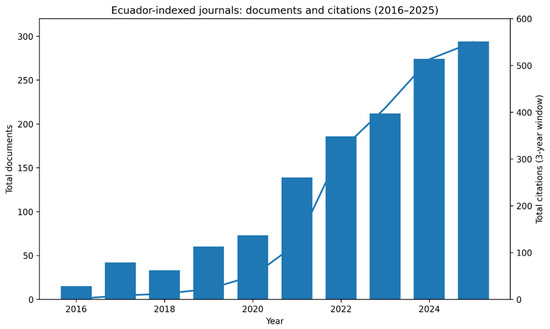
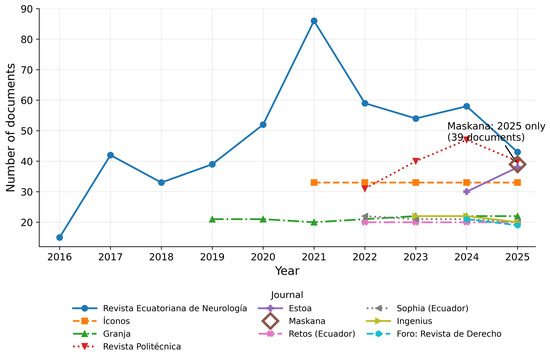
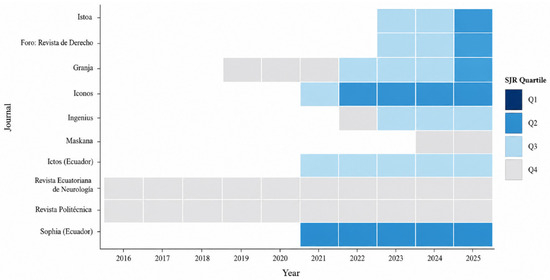
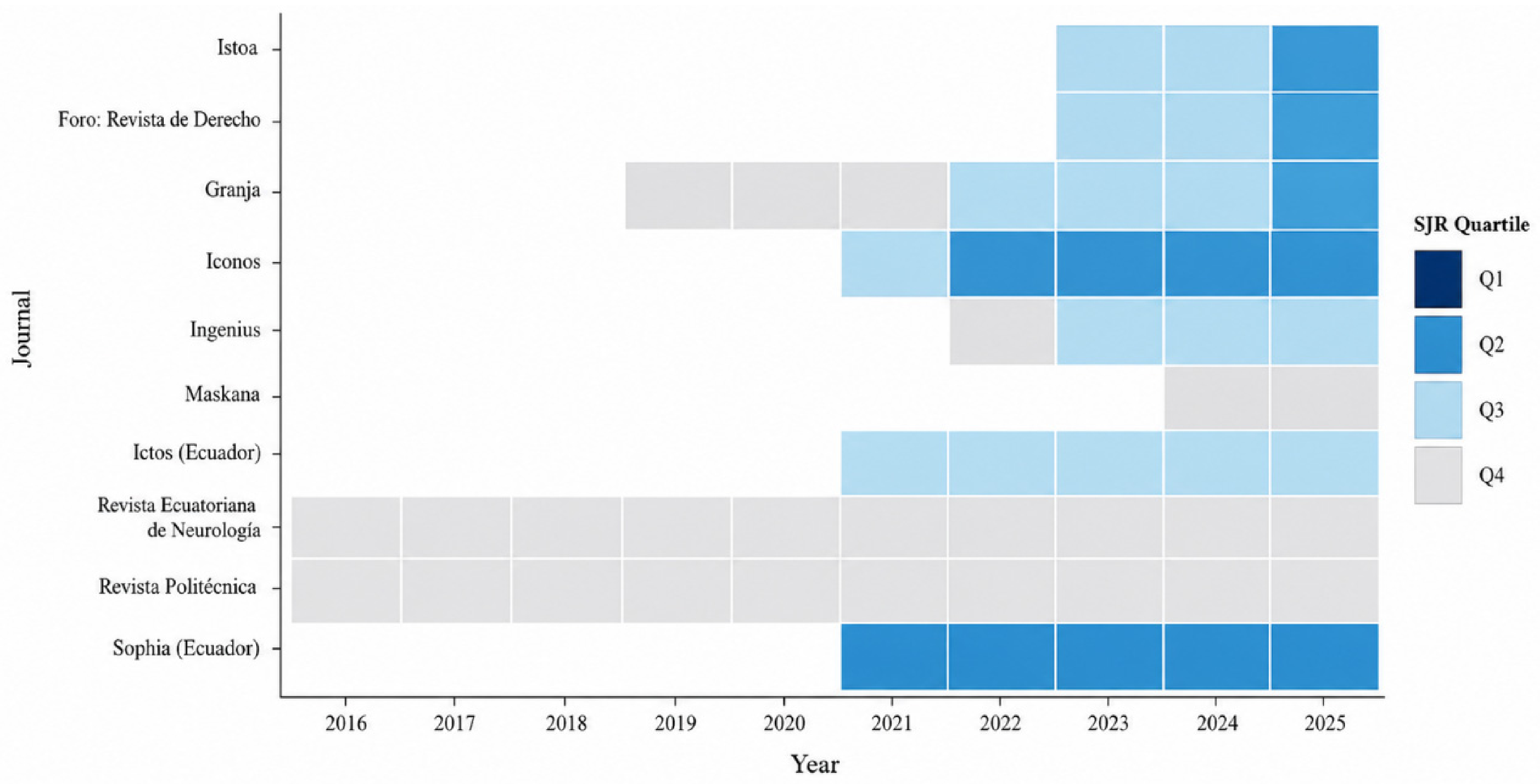
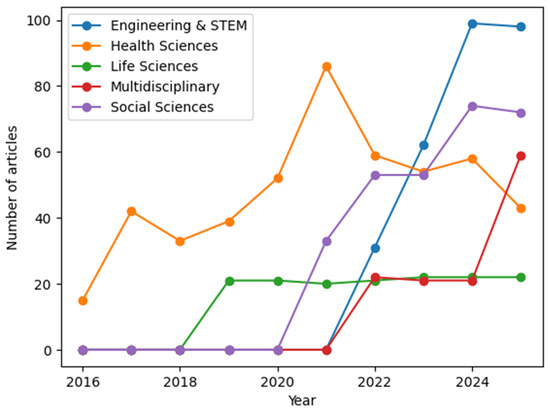
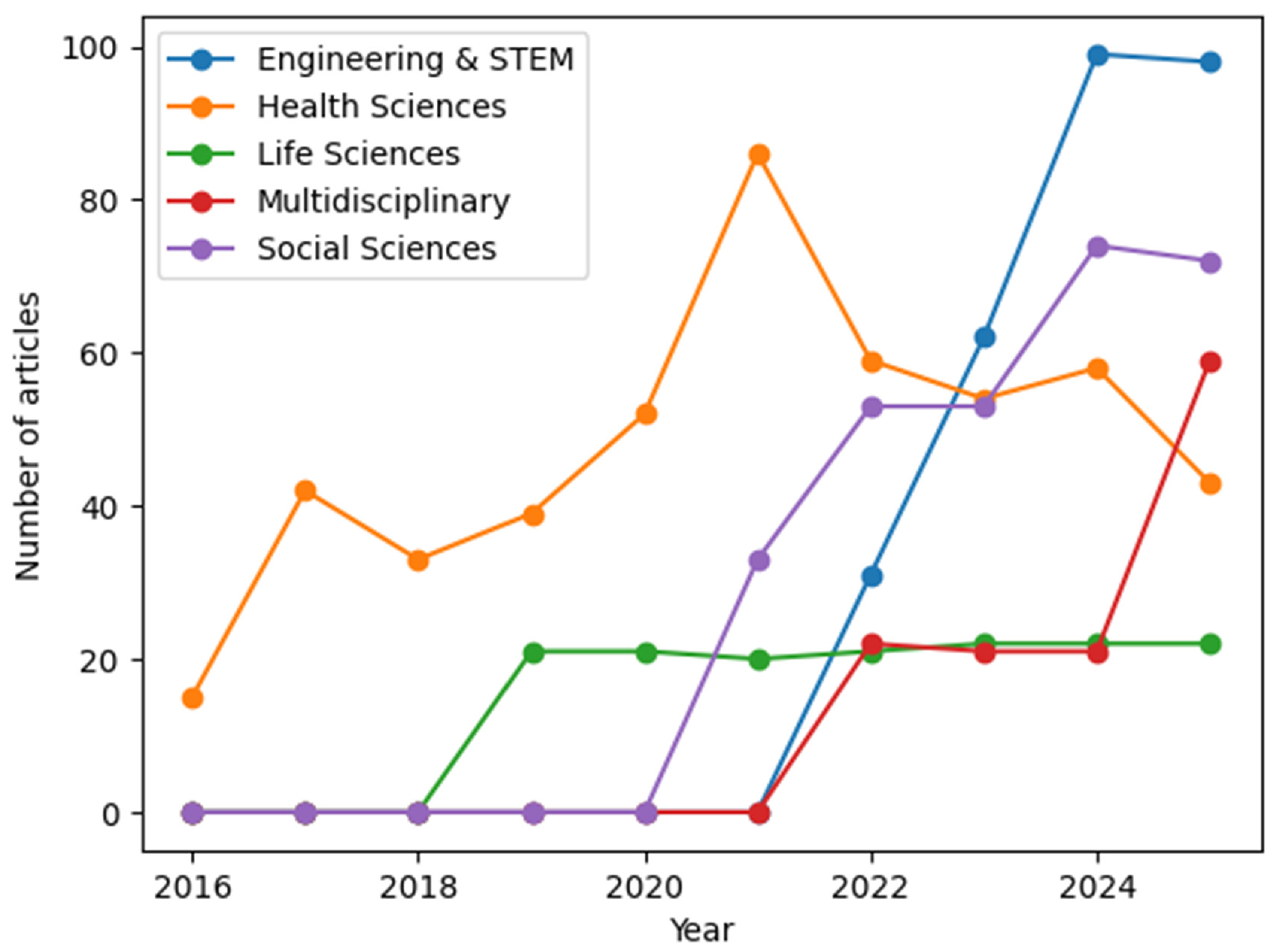
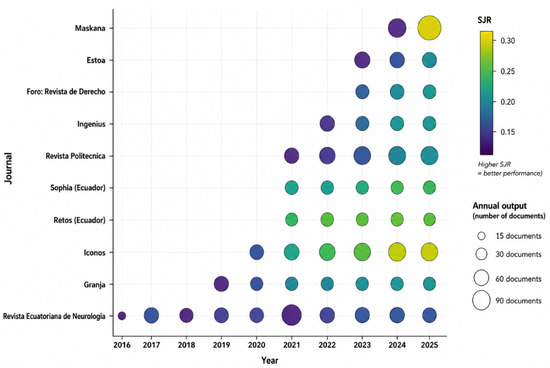
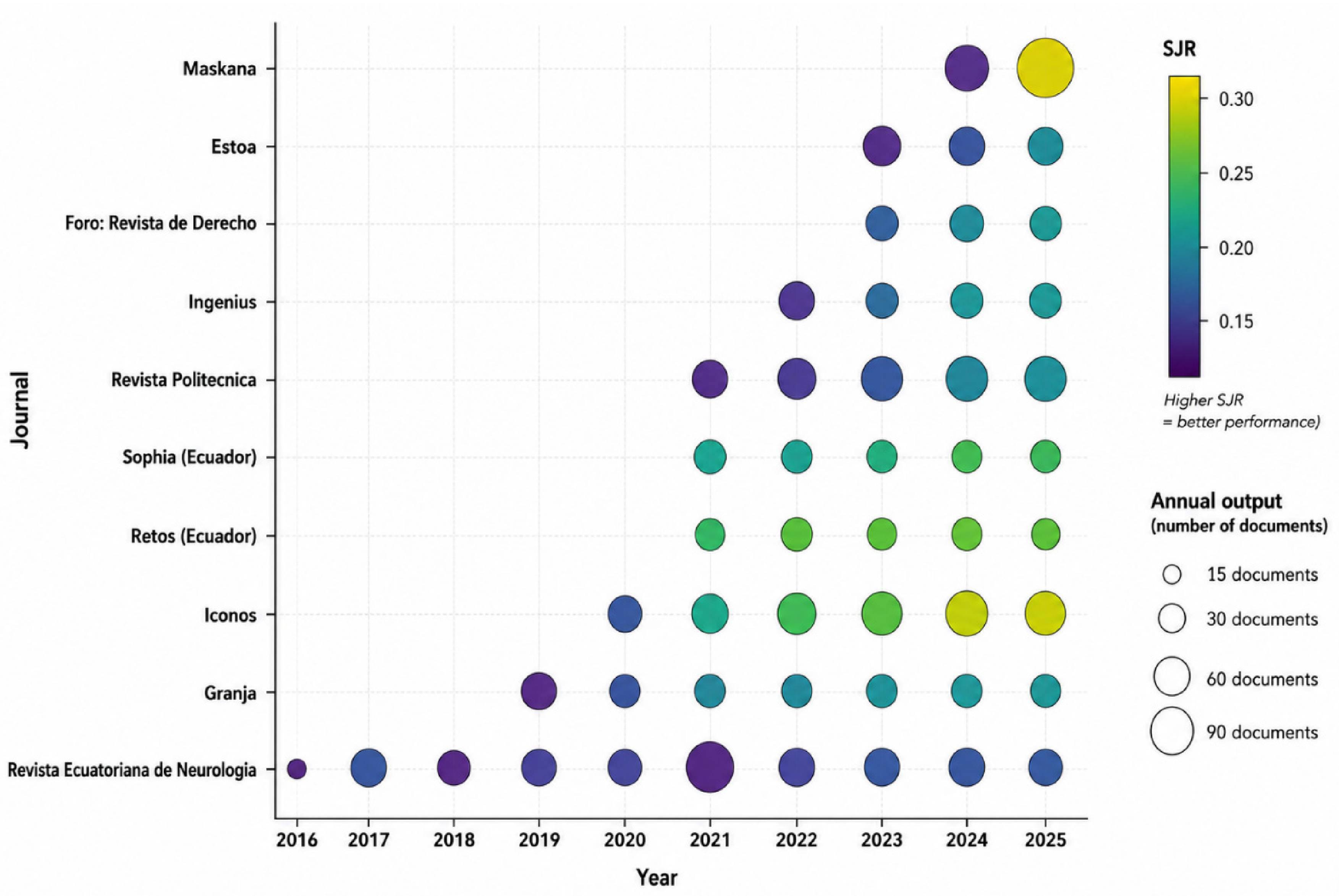

Disclaimer/Publisher’s Note: The statements, opinions and data contained in all publications are solely those of the individual author(s) and contributor(s) and not of MDPI and/or the editor(s). MDPI and/or the editor(s) disclaim responsibility for any injury to people or property resulting from any ideas, methods, instructions or products referred to in the content. |
© 2026 by the authors. Licensee MDPI, Basel, Switzerland. This article is an open access article distributed under the terms and conditions of the Creative Commons Attribution (CC BY) license.