


Abstract
A high-efficiency molten salt oxidation strategy for hazardous spent ion-exchange resins is much needed. The optimized ternary carbonate system (Li2CO3-K2CO3-Na2CO3, 44:26:30 wt%) with a 1:1 salt-to-resin ratio achieves oxidation efficiencies above 98% for single resins and 99% for mixed resins at 800–850 °C for 2 h. A pre-pyrolysis at 550 °C for 0.5 h traps volatile pollutants released at 300–550 °C. An excess air coefficient of 1.25 accelerates the breakdown of sulfur-carbon bonds, eliminating toxic hydrocarbons and CO. This work provides reliable parameters for industrial treatment of such hazardous waste.
1. Introduction
Ion-exchange technology is widely used for nuclide separation during the nuclear fuel cycle, isotope production and application, and radiochemistry experiments. This technology has made significant contributions to the development of China’s nuclear industry and plays an irreplaceable role in the management and removal of radionuclides, as well as the treatment of radioactive waste [1]. Ion-exchange resins are employed to treat low-level radioactive liquid waste generated during the operation and decommissioning of nuclear facilities [2]. Due to their high decontamination factor, ion-exchange resins hold a significant position in the treatment of conventional radioactive wastewater [3]. Currently, in China, most of the process wastewater produced from operating nuclear power plant reactor cooling water, spent fuel pool water, uranium conversion, military production and research, and radioactive waste treatment facilities is purified using ion-exchange resins [4]. After use, these resins contain a certain amount of radioactivity and are classified as radioactive waste. With the rapid development of China’s nuclear industry, the quantity of resin-based radioactive waste will continue to increase. According to national environmental protection requirements, this spent resin must be treated and disposed of promptly to ensure personnel and environmental safety [5].
Ion-exchange resins are organic polymer particles that allow the exchange of ions from a solution with ionic groups within the resin [6]. In practice, granular resins, such as strongly basic anion resins or strongly acidic cation resins, are typically used individually or mixed in specific proportions. Once spent, these resins lose their exchange capacity and are not regenerated but are treated and disposed of as radioactive waste [7]. Spent radioactive resins exhibit the following main characteristics: (1) They contain radionuclides such as 90Sr, 137Cs, U, Pu, with widely varying activity concentration levels [8]; (2) they are organic substances that are flammable and susceptible to radiation and biological decomposition, producing flammable and explosive gases like: H2, CH4, and NH3 [9,10]; (3) chemical elements contained within the resin, such as S, N, and P, are highly corrosive to equipment and facilities [11,12,13]; (4) long-term storage leads to pulverization and hardening, while the contained radioactivity damages the resin structure, potentially causing the release of radioactive material and complicating further treatment [14]; (5) Spent resin is a substance that has not yet reached a final stable state and requires further safe treatment before final disposal [15].
Due to the lack of safe and effective treatment technologies, resins can only be temporarily stored in centralized facilities. However, some spent resins have already shown pulverization and hardening after prolonged storage, posing significant safety risks to safe storage, personnel health, and the environment [16,17]. To date, the treatment of spent resin remains an unresolved problem in China’s field of radioactive waste management [18,19]. With increasingly stringent environmental protection requirements in China, the long-term temporary storage of radioactive spent resin is no longer permitted. Therefore, the development of treatment technologies for radioactive spent resin is essential to completely resolve the safety hazards posed by such waste [20].
Molten salt oxidation (MSO) is a thermal treatment process used for oxidizing and effectively destroying combustible organic waste [21]. It involves injecting the combustible organic waste together with a stoichiometric excess of oxidizing air into a molten salt bath [22]. The oxidation reaction occurs within the melt, allowing metal ions to be converted into oxides that are retained within the molten salt system, resulting in low waste generation and significant volume reduction [23]. If Na2CO3 is used as the molten salt, the reactions for organic substances can be represented by the following equations [24,25,26], where X represents a halogen:
For hydrocarbons:
2CaHb + (2a + b/2)O2 = 2aCO2 + bH2O
For nitrogen-containing organic waste:
C2HbNc + (a + b/4)O2 = aCO2 + b/2H2O + c/2N2
For halogen-containing organic waste:
CaHbXc + c/sNa2CO3 + (a + (bc)/4)O2 = (a + c/s)CO2 + b/2H2O + cNaX
For sulfur-containing organic waste:
CaHbSc + cNa2CO3 + (a + b/4 + 3c/2)O2 = (a + c)CO2 + b/2H2O + cNa2SO4
Other non-oxidizable components (such as radionuclides, heavy metals, etc.) remain in the spent salt, existing as metals or oxides [27]. The reaction equations for radionuclides and heavy metals in a Na2CO3 molten salt system are as follows [28,29,30]:
CS2SO3 + Na2CO3 + 1/2O2 → Cs2CO3 + Na2SO4
SrSO3 + Na2CO3 + 1/2O2 → SrCO3 + Na2SO4
SrCO3 → SrO + CO2
CoSO3 + Na2CO3 + 1/2O2 → CoCO3 + Na2SO4
CoCO3 → CoO + CO2
PbSO3 + Na2CO3 + 1/2O2 → PbCO3 + Na2SO4
PbCO3 → PbO + CO2
CdSO3 + Na2CO3 + 1/2O2 → CdCO3 + 2Na2SO4
CdCO3 → CdO + CO2
However, systematic research on the optimal molten salt systems for treating resins, as well as associated treatment conditions, is relatively limited. To address this gap, this paper screens the optimal molten salt systems for treating different resins, investigates the factors affecting resin treatment within an optimal salt system, and examines the impact of the resin on the molten salt composition.
In the field of radioactive spent resin treatment, various processes have been developed, each with its own applicability and limitations [31]. Cement solidification is simple to operate and low in cost, but it suffers from low waste loading, high nuclide leachability, and significant volume increase, making it difficult to meet the requirements for efficient volume reduction. Incineration technology achieves a high volume reduction ratio and can be operated continuously; however, problems such as insufficient operational stability, incomplete combustion, large flue gas volumes, and equipment fouling and clogging limit its engineering application. The hot super-compaction technique produces compacted waste cakes suitable for direct disposal, but a significant rebound effect exists, accompanied by secondary pollution from liquid and gaseous effluents, requiring complex post-treatment systems.
High-integrity container (HIC) technology requires no solidifying agents, adds almost no volume to the waste, and simplifies the process flow. However, issues such as organic degradation and radiolytic gas generation during long-term storage are prominent, and the free water content is difficult to precisely control. Wet oxidation processes feature mild reaction conditions and low secondary pollution but have stringent requirements for the material of construction of the reactor, limiting their large-scale application. Plastic solidification exhibits a far lower nuclide leachability than cement solidification and excellent resistance to acid and alkali corrosion. Nevertheless, its complex process, high cost, poor aging resistance of the solidified waste form, and insufficient operational safety remain unresolved [32].
In contrast, molten salt oxidation, as a next-generation treatment method, addresses the shortcomings of the aforementioned technologies. It enables the complete oxidative decomposition of spent resin, with over 99.5% of the radionuclides stably retained in the molten salt system. The process is flameless, uniformly controllable in temperature, requires no additional fuel, produces minimal off-gas, and can co-treat high-calorific-value organic liquids. It represents the most balanced technology for the disposal of radioactive spent resin currently available [33].
2. Results and Discussion
2.1. Screening of the Optimal Molten Salt System
The optimal molten salt system was screened by primarily investigating the effect of different resin-to-salt mass ratios on the resin oxidation efficiency and conducting supplementary experiments to screen the optimal system for mixed resin. Additional characterization work was performed on the effects of time and temperature on the resin MSO process. Specific information on the three resins used is as follows: anion exchange resin: moisture content 60–70%, particle size (>90% within 0.4–1.2 mm); cation exchange resin: moisture content 50–58%, particle size (>90% within 0.4–1.2 mm). The mixed resin used was a mixture of the two resin types.
2.1.1. Screening of the Optimal System for Anion Exchange Resin Treatment
- (1)
- Sulfate, Chloride, and Nitrate Systems
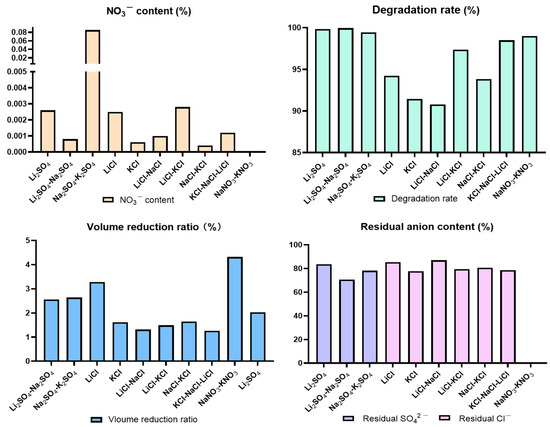
Oxidation experiments were conducted on anion exchange resin under air at 800 °C for 2 h using Li2SO4, Li2SO4-Na2SO4 (50 wt%:50 wt%), Na2SO4-K2SO4 (50 wt%:50 wt%), LiCl, KCl, LiCl-NaCl (50 wt%:50 wt%), LiCl-KCl (50 wt%:50 wt%), NaCl-KCl (50 wt%:50 wt%), KCl-NaCl-LiCl (33 wt%:33 wt%:33 wt%), NaNO3-KNO3 (50 wt%:50 wt%). The volume reduction ratio, degradation efficiency (DRE), and waste salt composition after oxidation were analyzed. Figure 1 shows that the DRE of anion exchange resin exceeded 98% in all sulfate systems.
Figure 1.
Volume reduction ratio, DRE, and waste salt composition after oxidation in different systems.
In chloride systems, only the KCl-NaCl-LiCl ternary mixture achieved a DRE > 98%. In the NaNO3-KNO3 system, the DRE reached 99.0%. However, the volume reduction ratios for all systems failed to meet the project’s technical specifications. The nitrate content in the waste salt was extremely low, indicating that these systems could not effectively adsorb the nitrogen oxides generated during the oxidation of the anion exchange resin. Additionally, although nitrates showed a good oxidation effect on the resin, severe corrosion and obvious cracking of the crucible were observed. Therefore, for safety reasons, the use of nitrates alone for the molten salt oxidation of resins is not recommended.
- (2)
- Carbonate Systems
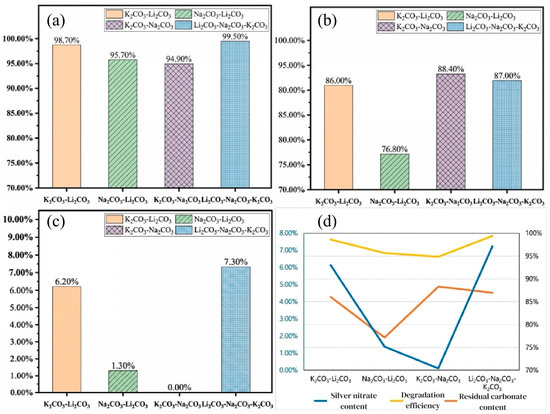
Oxidation experiments were conducted on anion exchange resin under air at 800 °C for 2 h using K2CO3-Li2CO3 (50 wt%:50 wt%), Na2CO3-Li2CO3 (50 wt%:50 wt%), K2CO3-Na2CO3 (50 wt%:50 wt%), Li2CO3-Na2CO3-K2CO3 (44 wt%:30 wt%:26 wt%). The carbonate content in the waste salt was determined by HCl titration using phenolphthalein as indicator. The results are shown in Figure 2. They indicate that the K2CO3-Na2CO3 system retained the highest carbonate content (88.4%), but the retention rate in the ternary system was similar (87%). The nitrate content in the waste salt was further analyzed by ion chromatography.
Figure 2.
Oxidation effect of different binary carbonate systems on anion exchange resin: (a) Degradation efficiency; (b) Residual carbonate content; (c) Content of generated nitrate; (d) Variation of silver nitrate content, degradation efficiency, and residual carbonate content.
For anion exchange resin, a simple binary carbonate system could achieve a high degradation rate, with the K2CO3-Li2CO3 system performing best and the K2CO3-Na2CO3 system performing worst. Using these two systems, the effect of the resin-to-salt mass ratio on oxidation efficiency was investigated. The results (shown in Figure S1) demonstrate that under conditions of K2CO3-Li2CO3, carbonate system, oxidation temperature of 800 °C, and an oxidation time of 2 h, the anion exchange resin was efficiently oxidized regardless of the mass ratio, with DRE reaching above 98%. However, for the K2CO3-Na2CO3 system, reducing the resin-to-salt ratio to 1:2 or 1:3 was necessary to achieve the same result.
SEM morphology analysis was performed on the oxidation residues (Figure S2). Under the same conditions (800 °C, 2 h, air), residual resin particles were still present in the residue oxidized in K2CO3-Na2CO3, while the residue oxidized in K2CO3-Li2CO3 was completely powdered. This indicates that the K2CO3-Li2CO3 system is significantly more effective at destroying the oxidation residue, further confirming its superiority. Therefore, for anion exchange resin, if using only a binary carbonate system, the K2CO3-Na2CO3 system (1:1 by mass) can be considered optimal. However, the ternary carbonate system exhibited better oxidation performance than the binary systems, achieving an efficiency of 99.5% (see Figure 1). Thus, to unify the process formulation for all three resin types, the ternary carbonate system can be selected for treating anion exchange resin.
2.1.2. Screening of Molten Salt Systems for Cation Resin
- (1)
- Chloride Systems
Infrared analysis of the oxidation products of cation resin in various chloride systems is displayed in Figure S3. The peak at 3457 cm−1 is the vibrational absorption band of hydroxyl groups in water. Regardless of the molten salt system, after 2 h of oxidation, the characteristic absorption bands of the resin’s sulfonic acid functional group at 1230, 1180, 1130, and 1030 cm−1 disappeared. The characteristic absorption band of para-disubstituted benzene at 820 cm−1 also vanished, indicating that the sulfonic acid groups were destroyed by the MSO process. The spectra of the final pyrolysis products were very similar, suggesting that despite the different molten salt systems, the final products after oxidative pyrolysis were essentially the same.
- (2)
- Carbonate Systems
The pyrolysis products of cation exchange resin in different carbonate systems were characterized by FT-IR (see Figure S3b). The peak at 3457 cm−1 is assigned to the O-H stretching vibration of water. After 2 h of oxidation, regardless of the salt system, the characteristic absorption bands of the resin’s sulfonic acid group at 1230, 1180, 1130, and 1030 cm−1 disappeared, along with the band for para-disubstituted benzene at 820 cm−1. To calculate the intensity of the sulfonic acid group peaks, integration was performed over the characteristic region of 1030–1230 cm−1. The integrated intensity was strongest for the untreated cation exchange resin. After oxidation, the integrated area was smallest for the ternary system, indicating that the ternary carbonate system possesses the strongest ability to destroy the sulfonic acid functional group.
2.1.3. Screening of Molten Salt Systems for Mixed Resin
Under air atmosphere, the oxidation efficiency of mixed anion-cation resin was compared in Li2CO3-Na2CO3, Li2CO3-K2CO3, Li2CO3-Na2CO3-K2CO3 systems at the same time intervals but different temperatures (Figure S4). The temperature range was: 250 °C, 350 °C, 450 °C, 550 °C, 650 °C, 700 °C, 800 °C; the oxidation times were 0.5–2 h, Based on a comprehensive comparison, the oxidation efficiency of the ternary system was superior to that of the binary systems; therefore, the ternary system was selected as optimal for the oxidation of mixed resin.
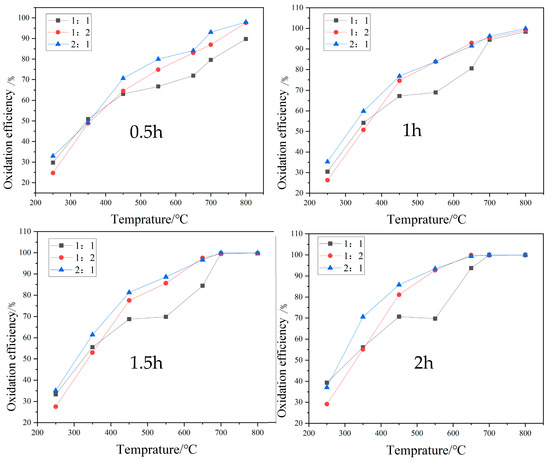
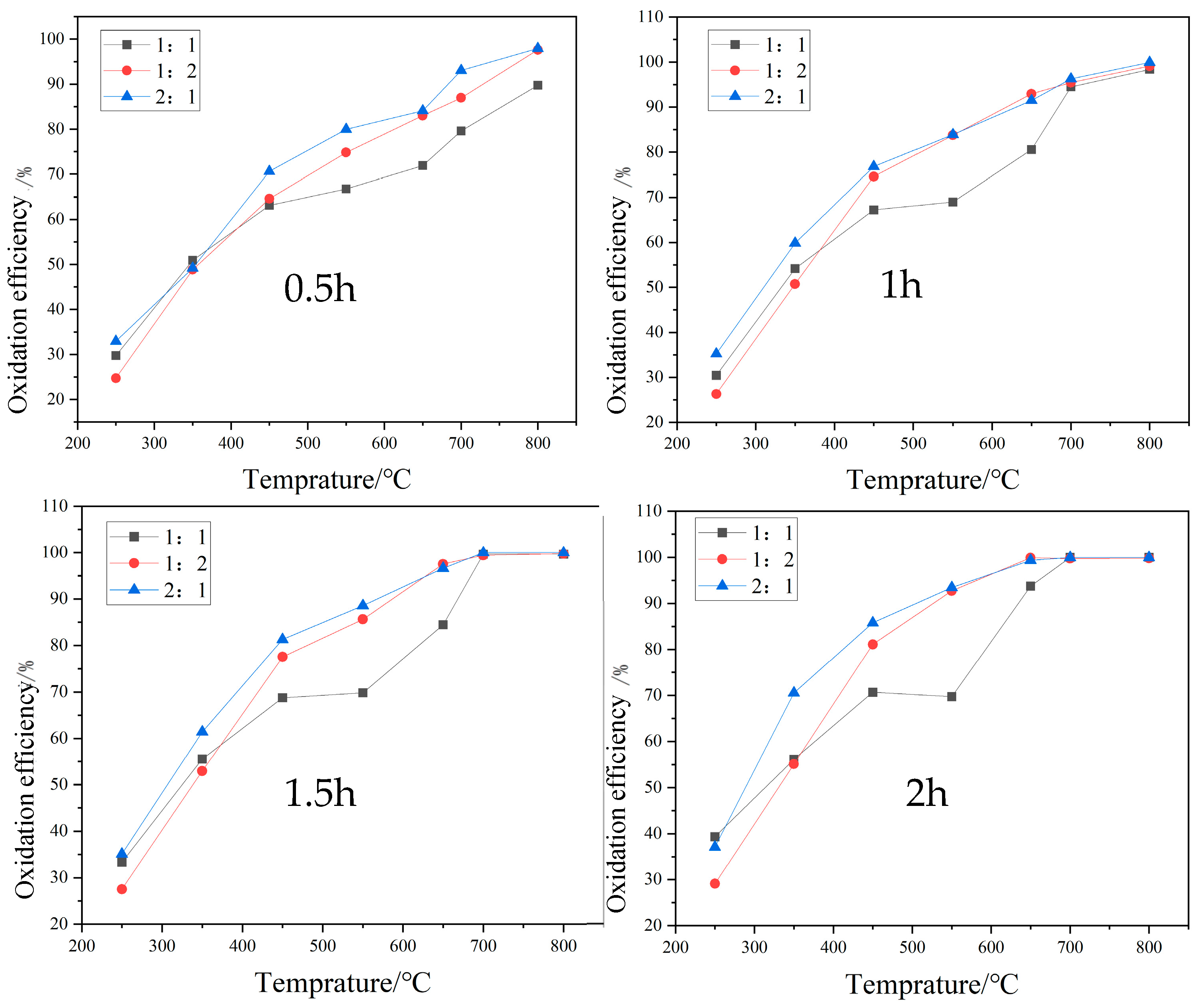
Figure 3 shows a comparison of the oxidation efficiency of the Li2CO3-Na2CO3-K2CO3 system for different resin-to-salt ratios. The temperature points were 250 °C, 350 °C, 450 °C, 550 °C, 650 °C, 700 °C, 800 °C; and the oxidation times were 0.5–2 h. A comprehensive comparison of oxidation efficiencies for each ratio leads to the following conclusion: below 450 °C, the efficiency of the resin:salt = 1:2 system was significantly lower than the others. This is potentially because the increased amount of carbonate in the system absorbs more heat, reducing the oxidation efficiency of the resin. Above 450 °C, the efficiency of the 2:1 system was superior to the other two ratios. When the temperature exceeded 700 °C, all three systems achieved an oxidation efficiency of 99.99%.
Figure 3.
Effect of different resin-to-salt ratios, times, and oxidation temperatures on resin pyrolysis efficiency.
2.2. Experimental Results for Different Resin-to-Salt Ratios
After identifying the optimal molten salt system for resin oxidation, the effects of varying the resin-to-salt ratio on MSO performance and off-gas adsorption were investigated.
Previous research indicated that off-gas generation occurs mainly in the 300–550 °C stage (destruction of functional groups and the styrene-divinylbenzene backbone) and the 700–900 °C stage (breaking of sulfur-carbon bonds) [34]. Direct high-temperature oxidation causes off-gases from both stages to evolve simultaneously, increasing the likelihood of resin volatilization and reducing the retention of metal ions and the efficiency of off-gas adsorption. To improve the adsorption of off-gases by the molten salt and the retention of metal ions, the following process flow experiment was conducted. A pre-pyrolysis step (0.5 h) was performed on samples with different resin-to-salt ratios at 550 °C with an excess air coefficient of 0.25. After completing four feed and pre-pyrolysis cycles (simulating a process requirement of 5 kg of total resin, 1.25 kg/batch, 4 feeds total), the temperature was raised to 800 °C for 2 h of oxidation to achieve complete resin destruction.
Gas sampling and gas chromatography analysis were performed for the gases generated during each of the four pre-pyrolysis feed steps and the final high-temperature oxidation for anion exchange resin in the ternary carbonate system at ratios (resin:salt) of 1:2, 1:1, and 2:1 (see Figure S5). The comparison reveals that the variety of hydrocarbon species increased with the resin-to-salt ratio, and when the ratio was 2:1, the hydrocarbon content increased significantly. The CO content was substantially lower than the CO2 content. Calculating the CO/CO2 ratio shows that at a resin-to-salt ratio of 1:1, this ratio was minimized, indicating more complete resin oxidation.
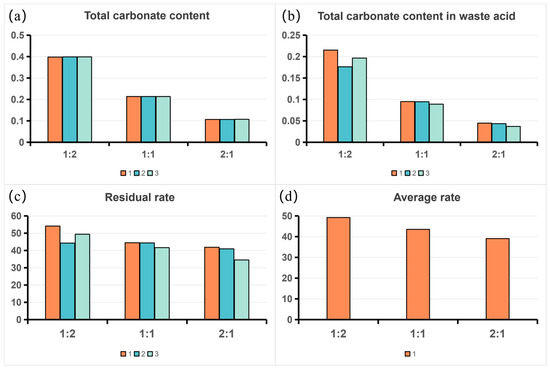
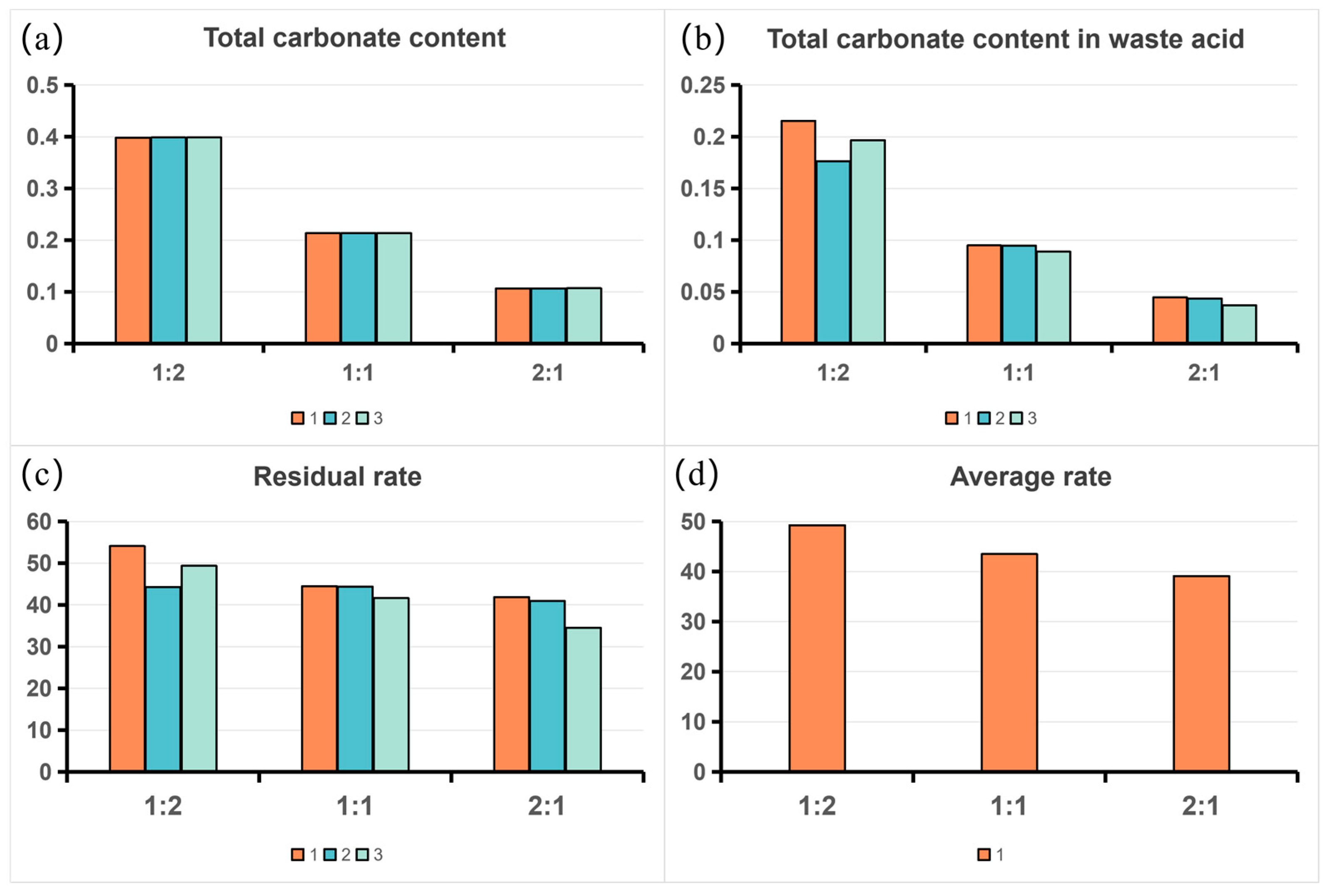
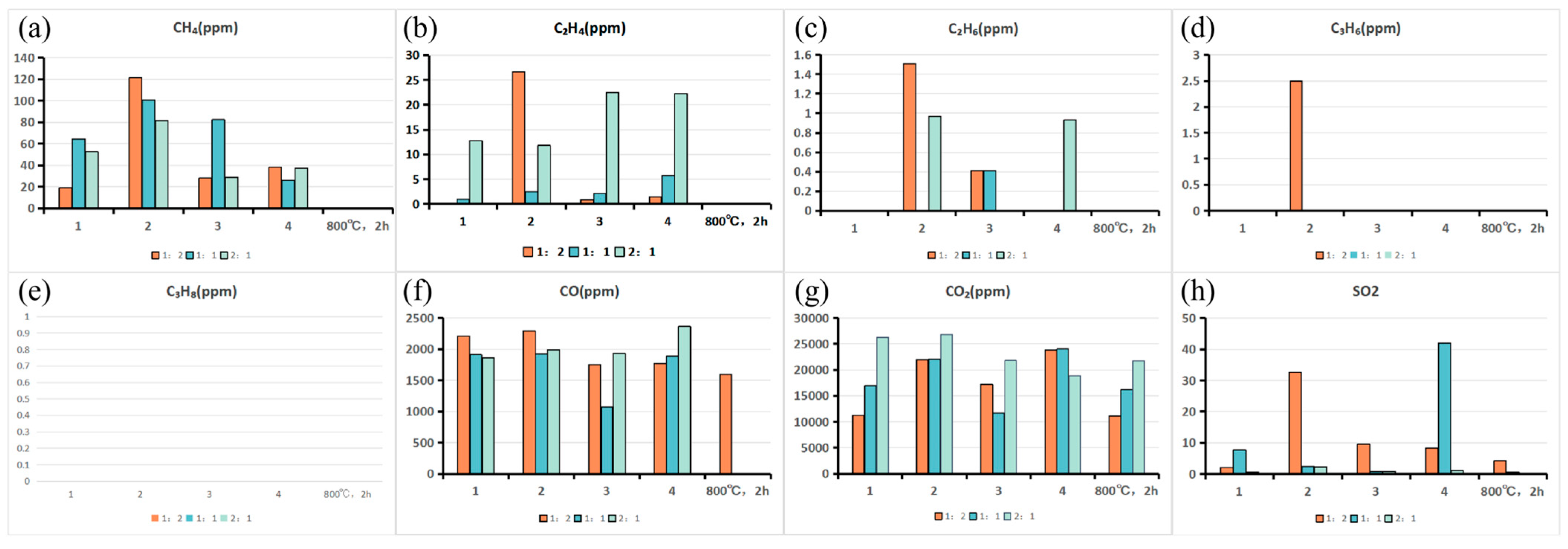
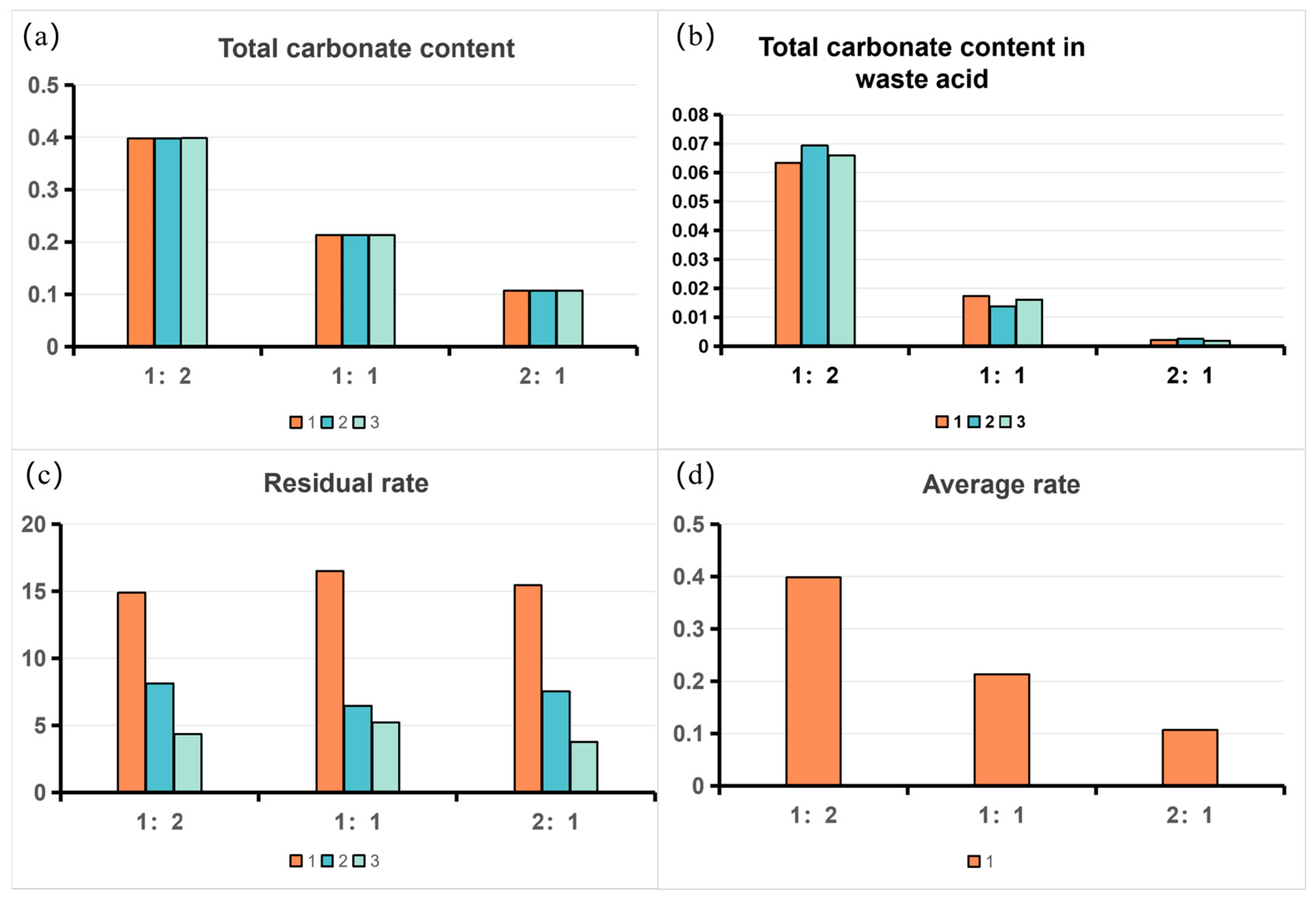
After completing the process simulation experiments for the three feed ratios, carbonate titration was performed on the waste salt samples. The results are shown in Figure 4. The average values indicate a decreasing trend in residual carbonate content with increasing resin proportion, suggesting higher molten salt consumption. However, the difference in residual rates between the different ratios was not substantial. Therefore, for anion exchange resin, a resin:salt ratio of 1:1, which exhibits good oxidation performance, can be selected for feeding.
Figure 4.
Residual carbonate rate of anion exchange resin after process condition oxidation under different resin:salt ratios: (a) Total carbonate content; (b) Total carbonate content in waste acid; (c) Residual rate; (d) Average rate.
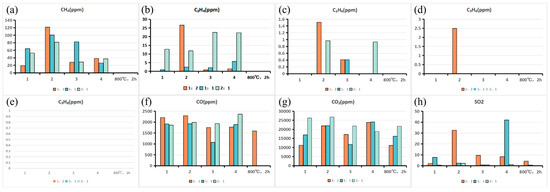
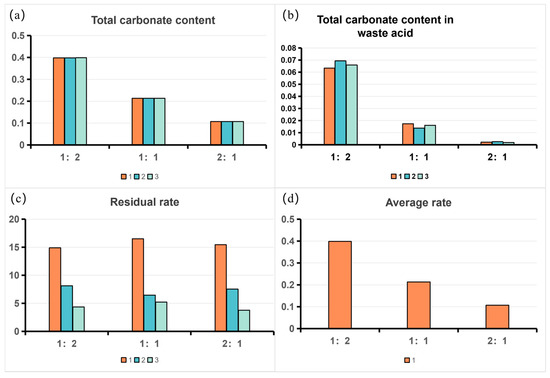
Process simulation experiments, as described above, were conducted for cation exchange resin at different ratios. The gas data are shown in Figure 5. The results indicate that the adsorption efficiency for SO2 increases with a higher salt-to-resin ratio.
Figure 5.
Changes in thermoxidative gas product composition of cation exchange resin under different resin:salt ratios: (a) CH4; (b) C2H4; (c) C2H6; (d) C3H6; (e) C3H8; (f) CO; (g) CO2; (h) SO2.
At a resin:salt ratio of 1:2, SO2 production was barely detectable. Consistent with the anion exchange resin data, at higher resin-to-salt ratios, the oxidation of cation exchange resin produced a variety of hydrocarbon species. Notably, no propane signal could be observed under any experimental condition, indicating that the oxidative pyrolysis of resin skeletons cannot generate stable saturated C3 alkane products. As observed, at the resin:salt ratio of 1:1, a large amount of CO2 was produced, and the CO/CO2 ratio was at its minimum (See Figure S6).
After completing the process simulation experiments for the three feed ratios, carbonate titration was performed on the waste salt samples. The results are shown in Figure 6. The average values indicate a decreasing trend in residual carbonate content with increasing resin proportion, confirming higher molten salt consumption.
Figure 6.
Residual carbonate rate of cation exchange resin after process condition oxidation under different resin:salt ratios: (a) Total carbonate content; (b) Total carbonate content in waste acid; (c) Residual rate; (d) Average rate.
2.3. Study on the Influence of Different Resin-to-Salt Ratios on Molten Salt Composition
- (1)
- Anion Exchange Resin
As shown in Figure S7, the nitrate content in the waste salt was highest at a salt-to-resin ratio of 1:1 and lowest at 1:3. The nitrate content first increased and then decreased with increasing temperature, reaching a maximum at 500 °C. This is likely because the resin functional groups are completely destroyed at this temperature. As the temperature increases further, the nitrate content decreases significantly, possibly due to nitrates promoting the destruction of the styrene-divinylbenzene backbone of the anion exchange resin and also due to nitrate decomposition at high temperatures. Compared to other ratios, the 1:1 ratio contains more carbonate, providing better encapsulation of the resin and therefore more complete absorption of off-gases, resulting in the highest nitrate content. The presence of nitrates may also contribute to the optimal oxidation effect observed for anion exchange resin at the 1:1 ratio.
- (2)
- Cation Exchange Resin
As shown in Figure S7, the carbonate molten salt’s adsorption efficiency for sulfur-containing gases was optimal at a salt-to-resin ratio of 1:1, corresponding to the highest sulfate content, and poorest at 1:3, corresponding to the lowest sulfate content. Corresponding to the destruction of sulfonic acid groups in the cation exchange resin at 400 °C, the sulfate content increased significantly after 400 °C, reaching a maximum of 20.15% at 550 °C. This suggests that sulfate formation in the carbonate melt is not direct; rather, the carbonate absorbs sulfur-containing gases, which subsequently convert to sulfates, requiring a certain temperature. Compared to other ratios, the 1:3 ratio contains less carbonate, providing poorer resin encapsulation and insufficient absorption of off-gases, leading to the lowest nitrate content, which also shows little variation with temperature.
- (3)
- Mixed Resin
The variation in nitrate content in waste salt after MSO of mixed resin with temperature is shown in Figure S7. Similar to the anion exchange resin, as the salt-to-resin ratio decreased from 1:1 to 1:3, the carbonate melt’s ability to adsorb nitrogen-containing gases generated from the destruction of quaternary ammonium groups diminished, leading to a lower nitrate content in the salt. Compared to the nitrate content in waste salt from the oxidation of pure anion exchange resin, the nitrate content in the mixed resin samples decreased significantly. A plausible reason is that, besides promoting resin oxidation, nitrates also facilitate the oxidation of sulfur compounds in the melt to form corresponding sulfates. This process consumes nitrates, resulting in a lower nitrate content in the mixed resin case.
The sulfate content in waste salt after MSO of mixed resin showed a trend of first increasing and then decreasing with temperature (see Figure S7), peaking at 500 °C. This peak occurs 50 °C earlier than for the cation exchange resin, and the peak value (25.44%) is higher than that for the cation resin (20.14%). A potential reason is the presence of nitrates, which promotes sulfate formation. Therefore, it can be concluded that sulfate formation in the melt is not a direct result of off-gas adsorption but requires certain oxidizing conditions and temperature. The sulfate content in the waste salt increased significantly as the salt-to-resin ratio increased from 1:3 to 1:1, indicating that more carbonate enhances the retention rate of sulfur-containing off-gases during the MSO process, providing a precondition for subsequent oxidation and temperature increase needed for sulfate formation.
3. Materials and Methods
3.1. Chemicals and Materials
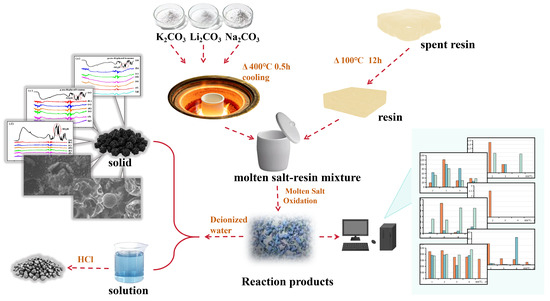
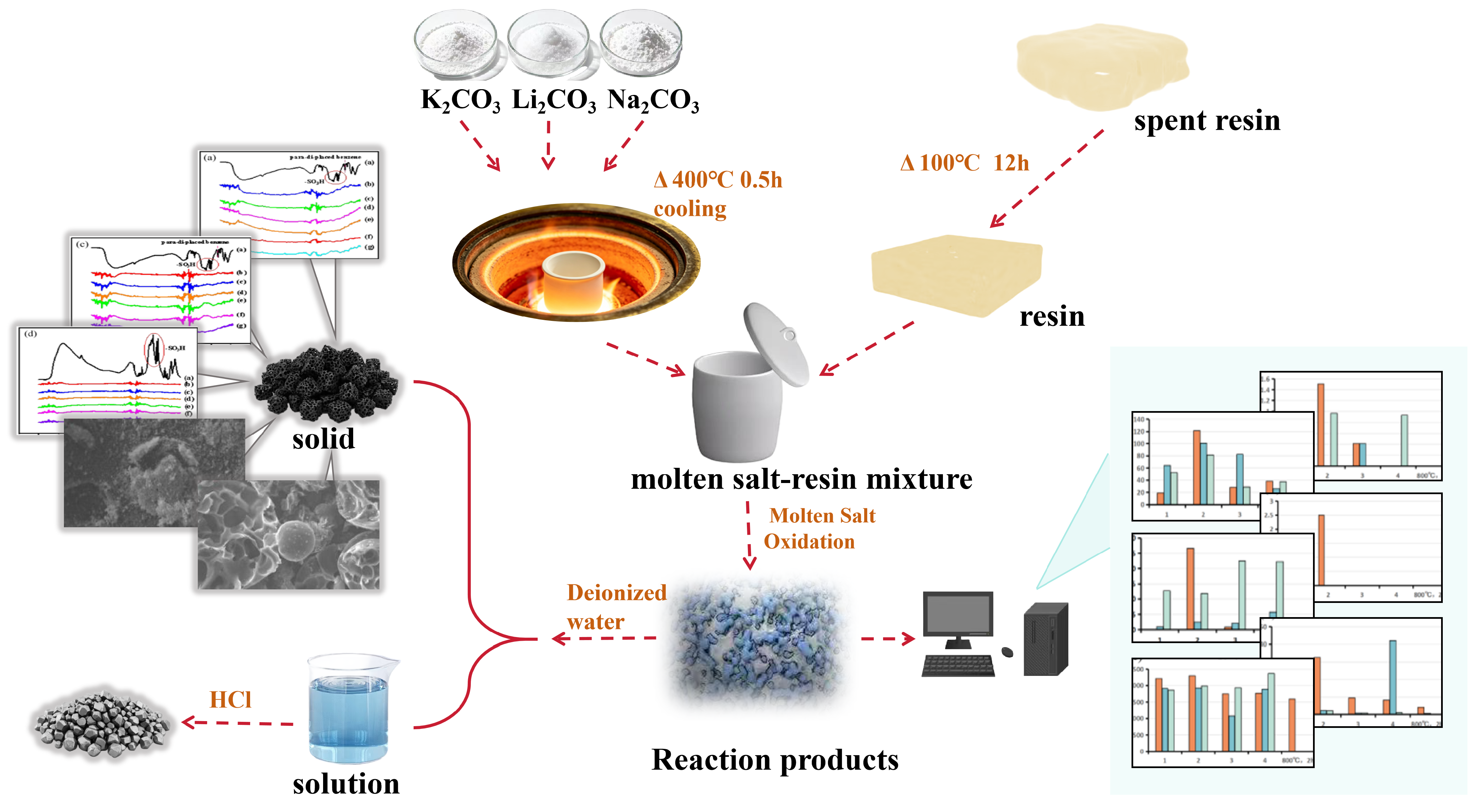
All analytical reagent grade carbonates including Na2CO3, K2CO3, and Li2CO3 were acquired from Sigma-Aladdin Reagent Co., Ltd., Shanghai, China. while waste resin was sourced from China National Nuclear Corporation, Beijing, China. Before MSO, as shown in Figure 7, a series of salt systems were pre-melted at 400 °C for 0.5 h. These systems covered various compositions: Li2CO3-Na2CO3-K2CO3 (44 wt.%:26 wt.%:30 wt.%), K2CO3-Li2CO3 (50 wt.%:50 wt.%), Na2CO3-Li2CO3 (50 wt.%:50 wt.%), K2CO3-Na2CO3 (50 wt.%:50 wt.%), LiCl-NaCl (50 wt.%:50 wt.%), LiCl-KCl (50 wt.%:50 wt.%), NaCl-KCl (50 wt.%:50 wt.%), KCl-NaCl-LiCl (33 wt.%:33 wt.%:33 wt.%). The NaNO3-KNO3 (50 wt.%:50 wt.%), and so on. Moreover, the composites of waste resin and ternary carbonates at mass ratios of 1:1, 1:2 and 2:1.
Figure 7.
A flowchart of the resin oxidation experiment.
Results proved that the molten salts were chemically stable during the experiments. After being dried at 100 °C for 12 h, the waste resin was fully mixed with the cooled molten salts to carry out the MSO experiment.
3.2. Characterization of Oxidized Products
After the molten salt oxidation treatment, XRD measurements (D8 ADVANCE Bruker AXS GmbH, Karlsruhe, Germany) were carried out on waste salts at 40 kV and 150 mA, with diffraction angles spanning 5° to 85°. Forty milliliters of deionized water was used to dissolve soluble nitrate, sulfate and carbonate species. The obtained solution and solid residues were then harvested.
After drying at 374 K for 12 h, the residue was analyzed by FT-IR spectroscopy (Spectrum 100, Perkin-Elmer Inc., Waltham, MA, USA) using the KBr pellet approach, as well as by SEM (SUB8600 Hitachi High-Tech Corporation, Tokyo, Japan). Online-MS was utilized to identify gaseous products generated during the MSO of waste gloves within the ternary salt system across a temperature interval of 25–800 °C. Furthermore, 50 mL 1 M HCl was adopted to remove carbonate ions from the solution.
4. Conclusions
In this study, a ternary carbonate molten salt system (Li2CO3-K2CO3-Na2CO3, 44:26:30 wt%) was systematically optimized for the harmless treatment of anionic, cationic, and mixed ion-exchange resins. The optimal molten salt-to-resin mass ratio of 1:1 and tailored thermal oxidation parameters (800 °C/2 h for anionic resin and 850 °C/2 h for cationic and mixed resins) were determined, achieving a high resin oxidation efficiency exceeding 98% for single-type resins and up to 99% for mixed resins. Comparative proportion experiments demonstrated that a high resin-to-salt ratio (3:1, 4:1) could improve volume reduction but caused incomplete molten salt coverage, excessive hydrocarbon emission and unstable oxidation performance, whereas the 1:1 ratio guaranteed superior oxidation completeness and operational compatibility for engineering application. A pre-pyrolysis condition of 550 °C for 0.5 h was validated to effectively capture intermediate volatile pollutants within the 300–550 °C gas evolution interval. Further oxidation mechanism analysis indicated that oxygen supply significantly regulated gaseous product distribution; an optimal excess air coefficient of 1.25 effectively promoted the cleavage and thorough oxidation of sulfur-carbon intermediate bonds, facilitated the conversion of hydrocarbons and carbon monoxide into harmless CO2 and H2O, and enhanced the adsorption and immobilization capacity of molten salt toward flue gas pollutants. Overall, this work clarified the coupling relationship among molten salt composition, mass ratio, thermal schedule, and oxygen atmosphere, established a stable and high-efficiency molten salt oxidation process for waste ion-exchange resins, and provided fundamental parametric support and feasible technical guidance for the design and safe operation of industrial hazardous waste treatment devices.
Supplementary Materials
The following supporting information can be downloaded at: https://www.mdpi.com/article/10.3390/inorganics14080199/s1, Figure S1: Morphology of oxidation residues of S-1 anion resin in K2CO3–Li2CO3 (a) and K2CO3–Na2CO3 (b) systems; Figure S2: Morphology of the residue after oxidation of anionic resins in Li2CO3–K2CO3 (a) and Na2CO3–K2CO3 (b) systems; Figure S3: FT-IR spectra of cation exchange resin and molten salt oxidation products: (a) chloride system (b); carbonate system; (c) other system; Figure S4: Peak intensity areas calculated from the integration of characteristic peaks at 1030–1230 cm−1 for pure resin and different molten salt systems; Figure S5: Effects of different time periods and oxidation temperatures on the pyrolysis efficiency of resins under various carbonate systems; Figure S6: Changes in gas components during thermal oxidation of anionic exchange resins under different salt ratios (a) CH4; (b) C2H4; (c) C2H6; (d) C3H6; (e) C3H8; (f) CO; (g) CO2; Figure S7: Detection results of nitrate and sulfate concentrations in waste salts after oxidation of anion, cation, and mixed ion exchange resins under different salt-to-resin ratios: (a) Anion exchange resin—nitrate; (b) Cation exchange resin—sulfate; (c) Mixed ion exchange resin—nitrate; (d) Mixed ion exchange resin—sulfate.
Author Contributions
X.W.: methodology, data curation, investigation, writing—original draft. S.C.: data curation, investigation, funding acquisition. F.L. and Y.Z. (Yuhao Zhang): investigation, data curation; Y.Z. (Yanghai Zheng): funding acquisition, writing—review and editing; H.C.: investigation, funding acquisition; S.G.: investigation, funding acquisition; H.D.: investigation, writing—review and editing, funding acquisition; Z.D.: investigation, writing—review and editing, funding acquisition; Y.Y.: funding acquisition, writing—review and editing. All authors have read and agreed to the published version of the manuscript.
Funding
This work was financially supported by the Natural Science Foundation of Zhejiang Province P.R. China (LLSQN25E030002), the National Natural Science Foundation of China (22176045 and 21976047), the Key Research and Development Program of Zhejiang Province (2026C02A3016). the Cooperative Project of Lishui University Longquan Research Institute (No. HXZKA2025128).
Data Availability Statement
The original contributions presented in this study are included in the article/Supplementary Materials. Further inquiries can be directed to the corresponding authors.
Conflicts of Interest
Suwen Chen was employed by Lishui Huanke Environmental Protection Consulting Co., Ltd. and Haizhou Cao was employed by Zhejiang Suichang Huijin Nonferrous Metals Co., Ltd. The remaining authors declare that the research was conducted in the absence of any commercial or financial relationships that could be construed as a potential conflict of interest. The funders had no role in the design of the study; in the collection, analyses, or interpretation of data; in the writing of the manuscript; or in the decision to publish the results.
References
- Veliscek-Carolan, J. Separation of actinides from spent nuclear fuel: A review. J. Hazard. Mater. 2016, 318, 266–281. [Google Scholar] [CrossRef] [Scilit]
- Li, B.; Chen, M. A comprehensive review on treatment technologies of spent ion exchange resins in nuclear power plants. J. Environ. Chem. Eng. 2024, 12, 112456. [Google Scholar] [CrossRef] [Scilit]
- Leybros, A.; Roubaud, A.; Guichardon, P.; Boutin, O. Supercritical water oxidation of ion exchange resins in a stirred reactor: Numerical modelling. Chem. Eng. Sci. 2012, 69, 170–180. [Google Scholar] [CrossRef] [Scilit]
- Liu, X.; Xue, Y.; Yan, Y.-D.; Li, G.-Q.; Xu, W.-D.; Ma, F.-Q.; Liu, X.; Zhang, Q.-G. The effect of air on oxidation decomposition of uranium-containing cationic exchange resins in Li2CO3-Na2CO3-K2CO3 molten-salt system. RSC Adv. 2023, 13, 18347–18362. [Google Scholar] [CrossRef] [Scilit] [PubMed]
- Wang, Y.-L.; Xue, Y.; Zheng, Y.-H.; Liu, X.; Zhang, Q.-G.; Ma, F.-Q.; Zhang, M.-L.; Xie, R.-Y.; Chang, S.; Yan, Y.-D. Revolutionizing radioactive waste resin treatment: A comprehensive review of advanced technologies and future directions. Prog. Nucl. Energy 2026, 190, 105987. [Google Scholar] [CrossRef] [Scilit]
- Alexandratos, S.D. Ion-exchange resins: A retrospective from Industrial and Engineering Chemistry Research. Ind. Eng. Chem. Res. 2009, 48, 388–398. [Google Scholar] [CrossRef] [Scilit]
- Hafeez, M.A.; Singh, B.K.; Yang, S.H.; Kim, J.; Kim, B.; Shin, Y.; Um, W. Recent advances in Fenton-like treatment of radioactive ion exchange resins. Chem. Eng. J. Adv. 2023, 14, 100456. [Google Scholar] [CrossRef] [Scilit]
- Zhang, Q.; Yan, Y.; Zheng, Y.; Hu, G.; Xue, Y.; Guo, S.; Xie, R.; Hua, L.; Wang, J.; Zhang, M. Thermodynamics-informed modifier selection for molten salt oxidation of simulated cation resin: Synergistic oxygen-vacancy catalysis and enhanced Cs/Sr retention of WO3. Chem. Eng. J. 2026, 531, 174362. [Google Scholar] [CrossRef] [Scilit]
- Navarro-González, R.; Aliev, R. Gaseous products formed by γ-irradiation of bisphenol-A polycarbonate. Polym. Bull. 2000, 45, 419–424. [Google Scholar] [CrossRef] [Scilit]
- Jadhav, A.L.; Muniasamy, L.; Rajesh, P.; Amirthapandian, S.; Bera, S.; Mohan, T.K. Influence of microstructure on the radiolytic stability of anionic resins. Radiat. Phys. Chem. 2025, 241, 112543. [Google Scholar] [CrossRef] [Scilit]
- Liu, X.; Yan, Y.-D.; Xue, Y.; Zheng, Y.-H.; Wang, J.-P.; Zhang, Q.-G.; Wang, Y.-L.; Ma, F.-Q. Advanced strategies for conversing and fixing sulfur during waste resins oxidation through Ca/Zn oxides enhanced Na2CO3-K2CO3 system. Process Saf. Environ. Prot. 2024, 188, 970–981. [Google Scholar] [CrossRef] [Scilit]
- Silva, R.A.; Hawboldt, K.A.; Zhang, Y. Application of resins with functional groups in the separation of metal ions/species—A review. Miner. Process. Extr. Metall. Rev. 2018, 39, 395–413. [Google Scholar] [CrossRef] [Scilit]
- Baidak, A.; Laverne, J.A. Radiation-induced decomposition of anion exchange resins. J. Nucl. Mater. 2010, 407, 211–219. [Google Scholar] [CrossRef] [Scilit]
- Rizzo, A.; Bruni, S.; Gessi, A.; Marghella, G.; Moretti, L.; Telloli, C.; Rizzato, C.; Luce, A. Morphological study of Ionic Exchange Resins to support the 14C release investigation from radioactive wastes—EURATOM CAST project. Radiocarbon 2018, 60, 1809–1817. [Google Scholar] [CrossRef] [Scilit]
- Kamaruzaman, N.S.; Kessel, D.S.; Kim, C.-L. Management of Spent Ion-Exchange Resins from Nuclear Power Plant by Blending Method. J. Nucl. Fuel Cycle Waste Technol. 2018, 16, 65–82. [Google Scholar] [CrossRef] [Scilit]
- Wang, J.; Wan, Z. Treatment and disposal of spent radioactive ion-exchange resins produced in the nuclear industry. Prog. Nucl. Energy 2015, 78, 47–55. [Google Scholar] [CrossRef] [Scilit]
- Nair, S.T.; Sureshkumar, M.K.; Deepa, A.K.; Padda, K.K.; Pancholi, K.C.; Anand, G. Significance of dose estimation and radiological data analysis in safe management of high active spent resins. Radiat. Prot. Environ. 2025, 48, 72–77. [Google Scholar] [CrossRef] [Scilit]
- Yang, J.; Yao, X.; Ye, L.; Jin, H.; Wang, Y. The treatment and disposal of radioactive liquid waste and solid waste in nuclear power plants. Prog. Chem. 2025, 37, 1373–1383. [Google Scholar] [CrossRef]
- Han, Y.D.; Liu, Y.; Zhu, F.; Deng, S.; Wei, G.L.; Zhang, S.D. Research on radioactive organic waste treatment technology. At. Energy Sci. Technol. 2025, 59, 2017–2027. [Google Scholar] [CrossRef]
- Zhang, S.; Chen, M.; Li, B.; Pan, Y.; Yang, L. Thermal degradation of spent cation exchange resin with fixatives or metal ion catalysts: Insights from experiments, thermodynamics and kinetics. Thermochim. Acta 2025, 754, 180174. [Google Scholar] [CrossRef] [Scilit]
- Yao, Z.T.; Li, J.H.; Zhao, X.Y. Molten salt oxidation: A versatile and promising technology for the destruction of organic-containing wastes. Chemosphere 2011, 84, 1167–1174. [Google Scholar] [CrossRef] [Scilit] [PubMed]
- Li, Y.; Wang, J. Review of the destruction of organic radioactive wastes by supercritical water oxidation. Sci. Total Environ. 2021, 788, 149396. [Google Scholar] [CrossRef] [Scilit] [PubMed]
- Zheng, Y.-H.; Yan, Y.-D.; Xu, W.-D.; Xue, Y.; Liu, X.; Wang, Y.-L.; Ma, F.-Q.; Zhu, K. An ideal method for efficiently intercepting sulfur and cesium during molten salt oxidation of cation exchange resins doped with cesium. Inorg. Chem. Commun. 2023, 156, 111100. [Google Scholar] [CrossRef] [Scilit]
- Hsu, P.C.; Foster, K.G.; Ford, T.D.; Wallman, P.H. Treatment of solid wastes with molten salt oxidation. Waste Manag. 2000, 20, 363–369. [Google Scholar] [CrossRef] [Scilit]
- Kovařík, P.; Navratil, J.D.; John, J. Scientific and engineering literature mini review of molten salt oxidation for radioactive waste treatment and organic compound gasification as well as spent salt treatment. Sci. Technol. Nucl. Install. 2015, 2015, 407842. [Google Scholar] [CrossRef] [Scilit]
- Yang, H.C.; Cho, Y.J.; Eun, H.C.; Lee, E.H.; Kim, I.T.; Kim, J.H. Destruction of chlorobenzene and carbon tetrachloride in a two-stage molten salt oxidation reactor system. Chemosphere 2008, 73, S311–S315. [Google Scholar] [CrossRef] [Scilit] [PubMed]
- Yang, H.C.; Cho, Y.J.; Eun, H.C.; Yoo, J.H.; Kim, J.H. Behavior of toxic metals and radionuclides during molten salt oxidation of chlorinated plastics. J. Environ. Sci. Health Part A 2004, 39, 1601–1616. [Google Scholar] [CrossRef] [Scilit] [PubMed]
- Zheng, Y.-H.; Yan, Y.-D.; Xue, Y.; Wang, Y.-L.; Liu, X.; Mi, W.-S.; Zhang, Q.-G.; Li, Y.; Ma, F.-Q.; Zhang, M.-L.; et al. Catalytic effect of cesium on the oxidation behavior of cation exchange resins in Li2CO3-Na2CO3-K2CO3 melt. Environ. Sci. Pollut. Res. 2022, 29, 64215–64224. [Google Scholar] [CrossRef] [Scilit] [PubMed]
- Zheng, Y.; Rui, J.Q.; Wang, Y.L.; Yin, T.Q.; Guo, S.R.; Xue, Y.; Ma, F.Q.; Wu, Y.H.; Yan, Y.D. The catalytic behavior of Sr2+, Cs+, and NO3− in the molten salt oxidation of waste mixed resin. Inorg. Chem. Commun. 2025, 173, 113772. [Google Scholar] [CrossRef] [Scilit]
- Liu, X.; Yan, Y.-D.; Xue, Y.; Zheng, Y.-H.; Xu, W.-D.; Wang, Y.-L.; Zhang, Q.-G.; Ma, F.-Q.; Zhu, K.; Wang, J.-P. Efficient fixation of Co2+ and organic sulfur from cation exchange resins into CaO enhanced molten Li2CO3-Na2CO3-K2CO3 system. Sep. Purif. Technol. 2023, 318, 123991. [Google Scholar] [CrossRef] [Scilit]
- International Atomic Energy Agency. Application of Thermal Technologies for Processing of Radioactive Waste (IAEA-TECDOC-1527); IAEA: Vienna, Austria, 2006. [Google Scholar]
- Fuller, A.J.; Doudou, S.; Kent, J.E.; Harvey, E.J.; Wickham, S.M. Assessing the value of thermal treatment technologies. IOP Conf. Ser. Mater. Sci. Eng. 2020, 818, 012003. [Google Scholar] [CrossRef] [Scilit]
- Nieminen, M.; Olin, M.; Laatikainen-Luntama, J.; Wickham, S.M.; Doudou, S.; Fuller, A.J.; Kent, J.; Fournier, M.; Clarke, S.; Scales, C.; et al. Thermal treatment for radioactive waste minimisation. EPJ Nucl. Sci. Technol. 2020, 6, 25. [Google Scholar] [CrossRef] [Scilit]
- Liu, Z.; Chen, M.; Li, B. Experimental evaluation on pyrolysis and gasification characteristics of simulated waste cation exchange resin. J. Therm. Anal. Calorim. 2024, 149, 10965–10982. [Google Scholar] [CrossRef] [Scilit]
Disclaimer/Publisher’s Note: The statements, opinions and data contained in all publications are solely those of the individual author(s) and contributor(s) and not of MDPI and/or the editor(s). MDPI and/or the editor(s) disclaim responsibility for any injury to people or property resulting from any ideas, methods, instructions or products referred to in the content. |
© 2026 by the authors. Licensee MDPI, Basel, Switzerland. This article is an open access article distributed under the terms and conditions of the Creative Commons Attribution (CC BY) license.