
Study on the Influence of Different Molten Salt Systems on the Composition of Resin Molten Salt Oxidation Products

 , , , ,
Abstract
1. Introduction
2. Results and Discussion
2.1. Screening of the Optimal Molten Salt System
2.1.1. Screening of the Optimal System for Anion Exchange Resin Treatment
- (1)
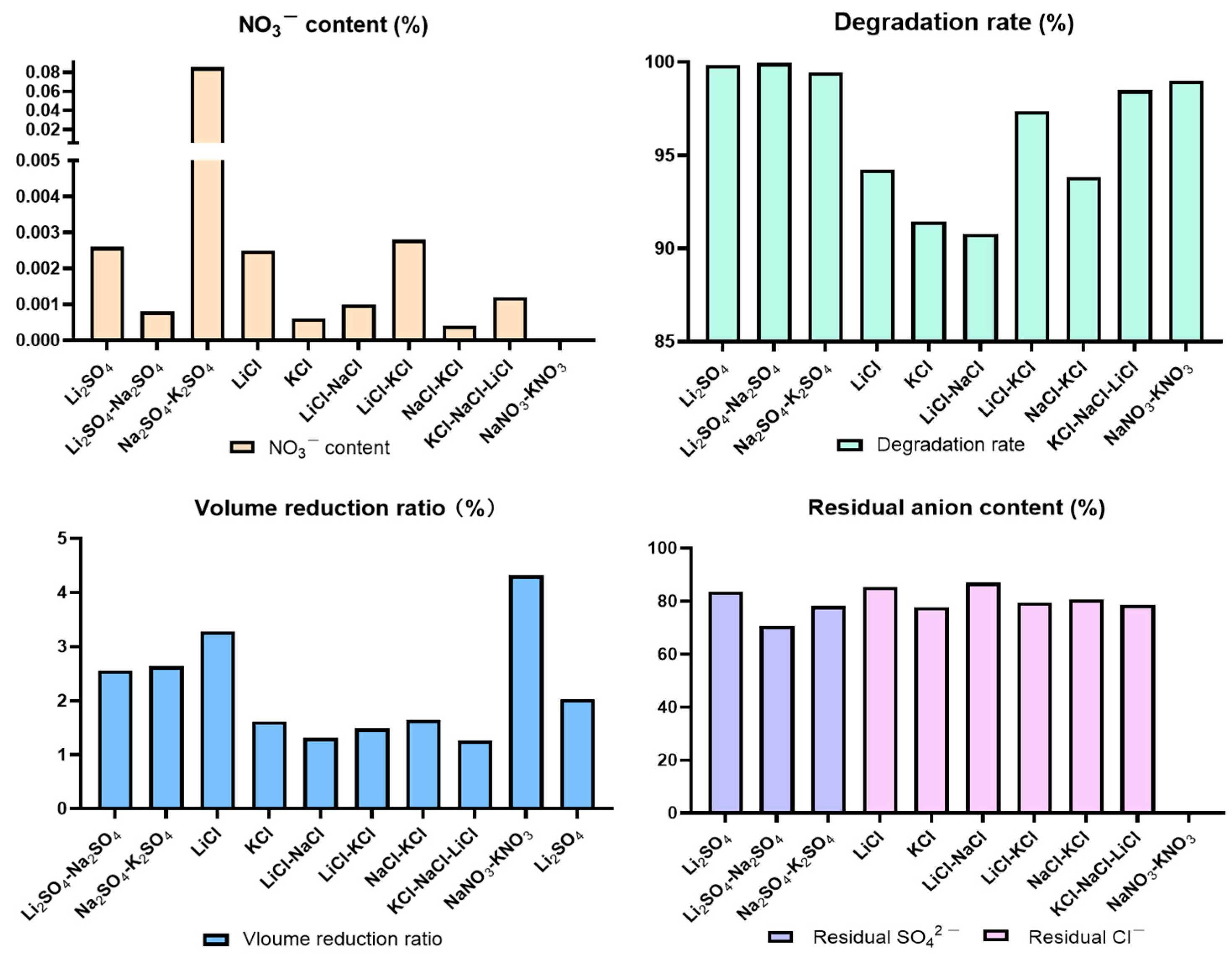
- Sulfate, Chloride, and Nitrate Systems
- (2)
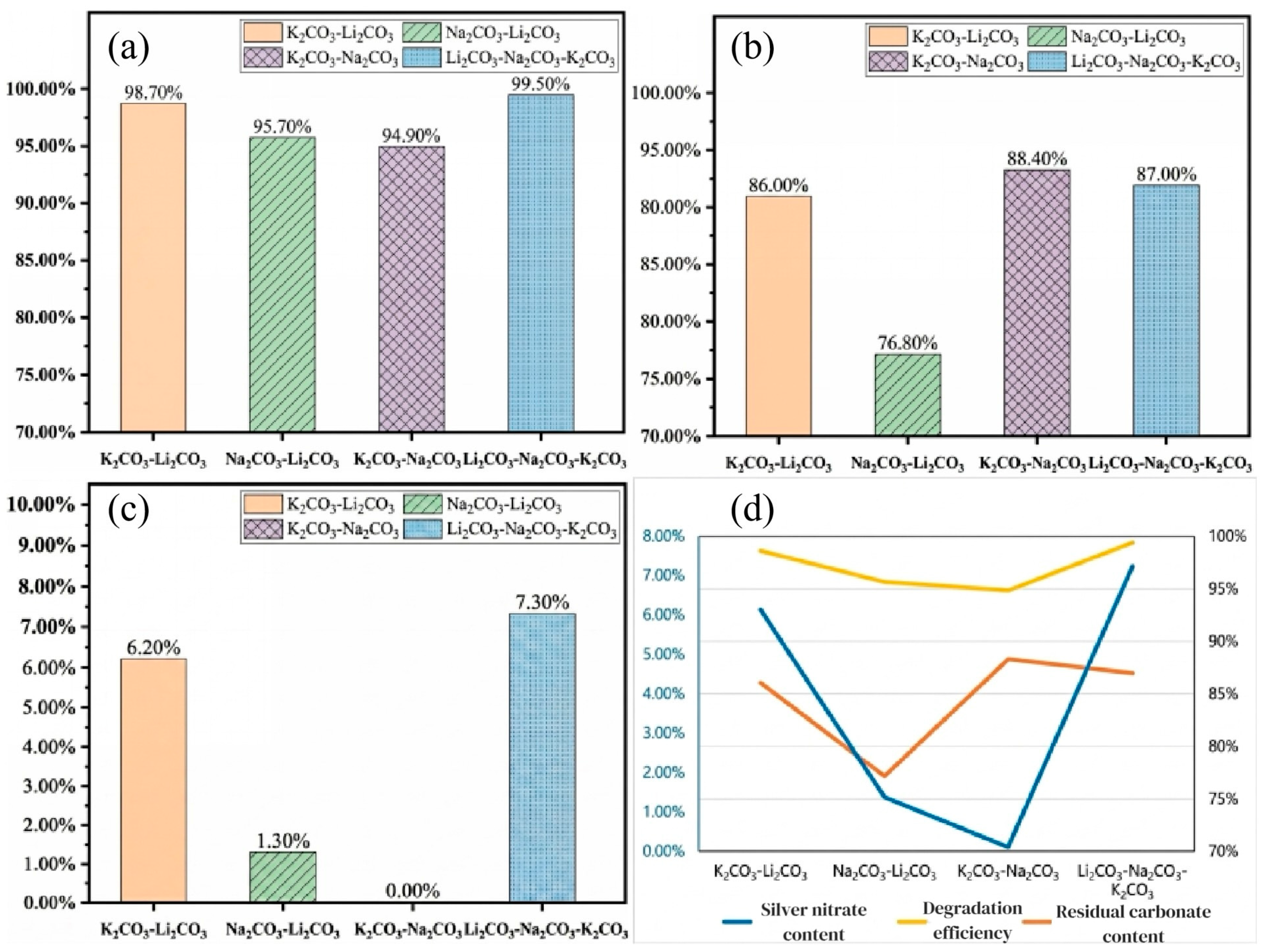
- Carbonate Systems
2.1.2. Screening of Molten Salt Systems for Cation Resin
- (1)
- Chloride Systems
- (2)
- Carbonate Systems
2.1.3. Screening of Molten Salt Systems for Mixed Resin
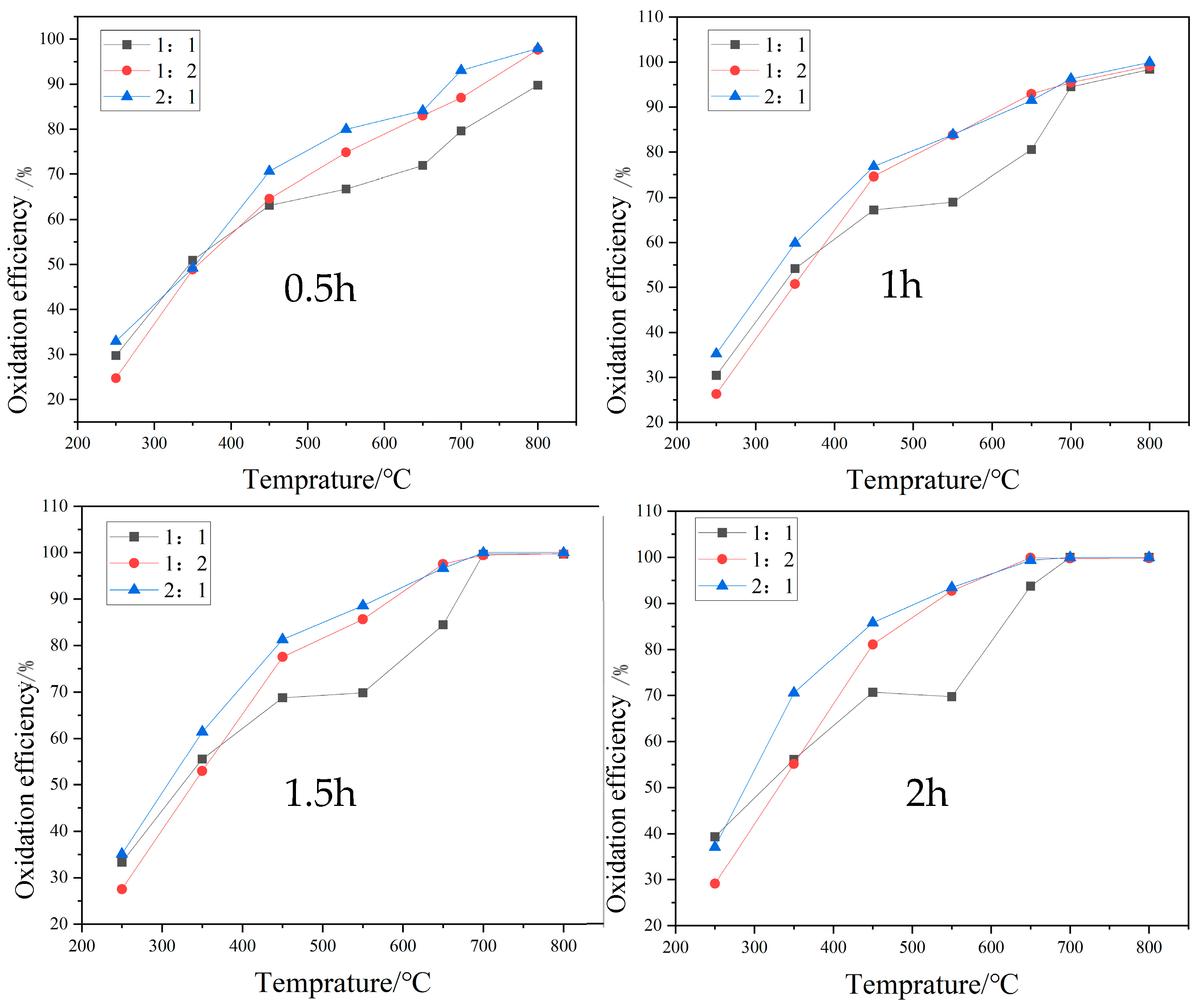
2.2. Experimental Results for Different Resin-to-Salt Ratios
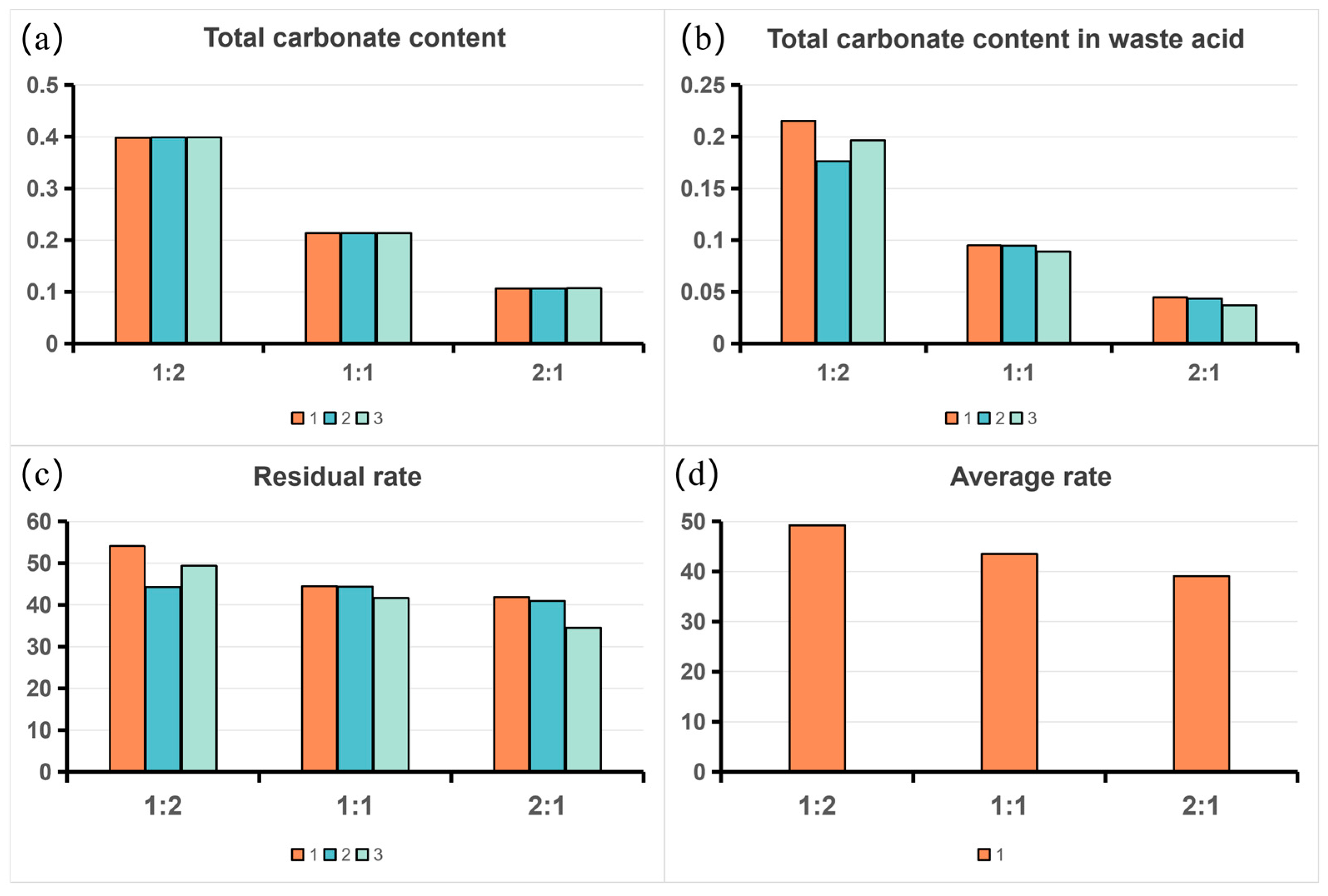
2.3. Study on the Influence of Different Resin-to-Salt Ratios on Molten Salt Composition
- (1)
- Anion Exchange Resin
- (2)
- Cation Exchange Resin
- (3)
- Mixed Resin
3. Materials and Methods
3.1. Chemicals and Materials
3.2. Characterization of Oxidized Products
4. Conclusions
Supplementary Materials
Author Contributions
Funding
Data Availability Statement
Conflicts of Interest
References
- Veliscek-Carolan, J. Separation of actinides from spent nuclear fuel: A review. J. Hazard. Mater. 2016, 318, 266–281. [Google Scholar] [CrossRef] [Scilit]
- Li, B.; Chen, M. A comprehensive review on treatment technologies of spent ion exchange resins in nuclear power plants. J. Environ. Chem. Eng. 2024, 12, 112456. [Google Scholar] [CrossRef] [Scilit]
- Leybros, A.; Roubaud, A.; Guichardon, P.; Boutin, O. Supercritical water oxidation of ion exchange resins in a stirred reactor: Numerical modelling. Chem. Eng. Sci. 2012, 69, 170–180. [Google Scholar] [CrossRef] [Scilit]
- Liu, X.; Xue, Y.; Yan, Y.-D.; Li, G.-Q.; Xu, W.-D.; Ma, F.-Q.; Liu, X.; Zhang, Q.-G. The effect of air on oxidation decomposition of uranium-containing cationic exchange resins in Li2CO3-Na2CO3-K2CO3 molten-salt system. RSC Adv. 2023, 13, 18347–18362. [Google Scholar] [CrossRef] [Scilit] [PubMed]
- Wang, Y.-L.; Xue, Y.; Zheng, Y.-H.; Liu, X.; Zhang, Q.-G.; Ma, F.-Q.; Zhang, M.-L.; Xie, R.-Y.; Chang, S.; Yan, Y.-D. Revolutionizing radioactive waste resin treatment: A comprehensive review of advanced technologies and future directions. Prog. Nucl. Energy 2026, 190, 105987. [Google Scholar] [CrossRef] [Scilit]
- Alexandratos, S.D. Ion-exchange resins: A retrospective from Industrial and Engineering Chemistry Research. Ind. Eng. Chem. Res. 2009, 48, 388–398. [Google Scholar] [CrossRef] [Scilit]
- Hafeez, M.A.; Singh, B.K.; Yang, S.H.; Kim, J.; Kim, B.; Shin, Y.; Um, W. Recent advances in Fenton-like treatment of radioactive ion exchange resins. Chem. Eng. J. Adv. 2023, 14, 100456. [Google Scholar] [CrossRef] [Scilit]
- Zhang, Q.; Yan, Y.; Zheng, Y.; Hu, G.; Xue, Y.; Guo, S.; Xie, R.; Hua, L.; Wang, J.; Zhang, M. Thermodynamics-informed modifier selection for molten salt oxidation of simulated cation resin: Synergistic oxygen-vacancy catalysis and enhanced Cs/Sr retention of WO3. Chem. Eng. J. 2026, 531, 174362. [Google Scholar] [CrossRef] [Scilit]
- Navarro-González, R.; Aliev, R. Gaseous products formed by γ-irradiation of bisphenol-A polycarbonate. Polym. Bull. 2000, 45, 419–424. [Google Scholar] [CrossRef] [Scilit]
- Jadhav, A.L.; Muniasamy, L.; Rajesh, P.; Amirthapandian, S.; Bera, S.; Mohan, T.K. Influence of microstructure on the radiolytic stability of anionic resins. Radiat. Phys. Chem. 2025, 241, 112543. [Google Scholar] [CrossRef] [Scilit]
- Liu, X.; Yan, Y.-D.; Xue, Y.; Zheng, Y.-H.; Wang, J.-P.; Zhang, Q.-G.; Wang, Y.-L.; Ma, F.-Q. Advanced strategies for conversing and fixing sulfur during waste resins oxidation through Ca/Zn oxides enhanced Na2CO3-K2CO3 system. Process Saf. Environ. Prot. 2024, 188, 970–981. [Google Scholar] [CrossRef] [Scilit]
- Silva, R.A.; Hawboldt, K.A.; Zhang, Y. Application of resins with functional groups in the separation of metal ions/species—A review. Miner. Process. Extr. Metall. Rev. 2018, 39, 395–413. [Google Scholar] [CrossRef] [Scilit]
- Baidak, A.; Laverne, J.A. Radiation-induced decomposition of anion exchange resins. J. Nucl. Mater. 2010, 407, 211–219. [Google Scholar] [CrossRef] [Scilit]
- Rizzo, A.; Bruni, S.; Gessi, A.; Marghella, G.; Moretti, L.; Telloli, C.; Rizzato, C.; Luce, A. Morphological study of Ionic Exchange Resins to support the 14C release investigation from radioactive wastes—EURATOM CAST project. Radiocarbon 2018, 60, 1809–1817. [Google Scholar] [CrossRef] [Scilit]
- Kamaruzaman, N.S.; Kessel, D.S.; Kim, C.-L. Management of Spent Ion-Exchange Resins from Nuclear Power Plant by Blending Method. J. Nucl. Fuel Cycle Waste Technol. 2018, 16, 65–82. [Google Scholar] [CrossRef] [Scilit]
- Wang, J.; Wan, Z. Treatment and disposal of spent radioactive ion-exchange resins produced in the nuclear industry. Prog. Nucl. Energy 2015, 78, 47–55. [Google Scholar] [CrossRef] [Scilit]
- Nair, S.T.; Sureshkumar, M.K.; Deepa, A.K.; Padda, K.K.; Pancholi, K.C.; Anand, G. Significance of dose estimation and radiological data analysis in safe management of high active spent resins. Radiat. Prot. Environ. 2025, 48, 72–77. [Google Scholar] [CrossRef] [Scilit]
- Yang, J.; Yao, X.; Ye, L.; Jin, H.; Wang, Y. The treatment and disposal of radioactive liquid waste and solid waste in nuclear power plants. Prog. Chem. 2025, 37, 1373–1383. [Google Scholar] [CrossRef]
- Han, Y.D.; Liu, Y.; Zhu, F.; Deng, S.; Wei, G.L.; Zhang, S.D. Research on radioactive organic waste treatment technology. At. Energy Sci. Technol. 2025, 59, 2017–2027. [Google Scholar] [CrossRef]
- Zhang, S.; Chen, M.; Li, B.; Pan, Y.; Yang, L. Thermal degradation of spent cation exchange resin with fixatives or metal ion catalysts: Insights from experiments, thermodynamics and kinetics. Thermochim. Acta 2025, 754, 180174. [Google Scholar] [CrossRef] [Scilit]
- Yao, Z.T.; Li, J.H.; Zhao, X.Y. Molten salt oxidation: A versatile and promising technology for the destruction of organic-containing wastes. Chemosphere 2011, 84, 1167–1174. [Google Scholar] [CrossRef] [Scilit] [PubMed]
- Li, Y.; Wang, J. Review of the destruction of organic radioactive wastes by supercritical water oxidation. Sci. Total Environ. 2021, 788, 149396. [Google Scholar] [CrossRef] [Scilit] [PubMed]
- Zheng, Y.-H.; Yan, Y.-D.; Xu, W.-D.; Xue, Y.; Liu, X.; Wang, Y.-L.; Ma, F.-Q.; Zhu, K. An ideal method for efficiently intercepting sulfur and cesium during molten salt oxidation of cation exchange resins doped with cesium. Inorg. Chem. Commun. 2023, 156, 111100. [Google Scholar] [CrossRef] [Scilit]
- Hsu, P.C.; Foster, K.G.; Ford, T.D.; Wallman, P.H. Treatment of solid wastes with molten salt oxidation. Waste Manag. 2000, 20, 363–369. [Google Scholar] [CrossRef] [Scilit]
- Kovařík, P.; Navratil, J.D.; John, J. Scientific and engineering literature mini review of molten salt oxidation for radioactive waste treatment and organic compound gasification as well as spent salt treatment. Sci. Technol. Nucl. Install. 2015, 2015, 407842. [Google Scholar] [CrossRef] [Scilit]
- Yang, H.C.; Cho, Y.J.; Eun, H.C.; Lee, E.H.; Kim, I.T.; Kim, J.H. Destruction of chlorobenzene and carbon tetrachloride in a two-stage molten salt oxidation reactor system. Chemosphere 2008, 73, S311–S315. [Google Scholar] [CrossRef] [Scilit] [PubMed]
- Yang, H.C.; Cho, Y.J.; Eun, H.C.; Yoo, J.H.; Kim, J.H. Behavior of toxic metals and radionuclides during molten salt oxidation of chlorinated plastics. J. Environ. Sci. Health Part A 2004, 39, 1601–1616. [Google Scholar] [CrossRef] [Scilit] [PubMed]
- Zheng, Y.-H.; Yan, Y.-D.; Xue, Y.; Wang, Y.-L.; Liu, X.; Mi, W.-S.; Zhang, Q.-G.; Li, Y.; Ma, F.-Q.; Zhang, M.-L.; et al. Catalytic effect of cesium on the oxidation behavior of cation exchange resins in Li2CO3-Na2CO3-K2CO3 melt. Environ. Sci. Pollut. Res. 2022, 29, 64215–64224. [Google Scholar] [CrossRef] [Scilit] [PubMed]
- Zheng, Y.; Rui, J.Q.; Wang, Y.L.; Yin, T.Q.; Guo, S.R.; Xue, Y.; Ma, F.Q.; Wu, Y.H.; Yan, Y.D. The catalytic behavior of Sr2+, Cs+, and NO3− in the molten salt oxidation of waste mixed resin. Inorg. Chem. Commun. 2025, 173, 113772. [Google Scholar] [CrossRef] [Scilit]
- Liu, X.; Yan, Y.-D.; Xue, Y.; Zheng, Y.-H.; Xu, W.-D.; Wang, Y.-L.; Zhang, Q.-G.; Ma, F.-Q.; Zhu, K.; Wang, J.-P. Efficient fixation of Co2+ and organic sulfur from cation exchange resins into CaO enhanced molten Li2CO3-Na2CO3-K2CO3 system. Sep. Purif. Technol. 2023, 318, 123991. [Google Scholar] [CrossRef] [Scilit]
- International Atomic Energy Agency. Application of Thermal Technologies for Processing of Radioactive Waste (IAEA-TECDOC-1527); IAEA: Vienna, Austria, 2006. [Google Scholar]
- Fuller, A.J.; Doudou, S.; Kent, J.E.; Harvey, E.J.; Wickham, S.M. Assessing the value of thermal treatment technologies. IOP Conf. Ser. Mater. Sci. Eng. 2020, 818, 012003. [Google Scholar] [CrossRef] [Scilit]
- Nieminen, M.; Olin, M.; Laatikainen-Luntama, J.; Wickham, S.M.; Doudou, S.; Fuller, A.J.; Kent, J.; Fournier, M.; Clarke, S.; Scales, C.; et al. Thermal treatment for radioactive waste minimisation. EPJ Nucl. Sci. Technol. 2020, 6, 25. [Google Scholar] [CrossRef] [Scilit]
- Liu, Z.; Chen, M.; Li, B. Experimental evaluation on pyrolysis and gasification characteristics of simulated waste cation exchange resin. J. Therm. Anal. Calorim. 2024, 149, 10965–10982. [Google Scholar] [CrossRef] [Scilit]


Disclaimer/Publisher’s Note: The statements, opinions and data contained in all publications are solely those of the individual author(s) and contributor(s) and not of MDPI and/or the editor(s). MDPI and/or the editor(s) disclaim responsibility for any injury to people or property resulting from any ideas, methods, instructions or products referred to in the content. |
© 2026 by the authors. Licensee MDPI, Basel, Switzerland. This article is an open access article distributed under the terms and conditions of the Creative Commons Attribution (CC BY) license.
Share and Cite
Wang, X.; Chen, S.; Liu, F.; Zhang, Y.; Zheng, Y.; Cao, H.; Guo, S.; Dong, H.; Dong, Z.; Yan, Y. Study on the Influence of Different Molten Salt Systems on the Composition of Resin Molten Salt Oxidation Products. Inorganics 2026, 14, 199. https://doi.org/10.3390/inorganics14080199
Wang X, Chen S, Liu F, Zhang Y, Zheng Y, Cao H, Guo S, Dong H, Dong Z, Yan Y. Study on the Influence of Different Molten Salt Systems on the Composition of Resin Molten Salt Oxidation Products. Inorganics. 2026; 14(8):199. https://doi.org/10.3390/inorganics14080199
Chicago/Turabian StyleWang, Xuepeng, Suwen Chen, Feichi Liu, Yuhao Zhang, Yanghai Zheng, Haizhou Cao, Shengrong Guo, Haiqian Dong, Zhiqiang Dong, and Yongde Yan. 2026. "Study on the Influence of Different Molten Salt Systems on the Composition of Resin Molten Salt Oxidation Products" Inorganics 14, no. 8: 199. https://doi.org/10.3390/inorganics14080199
APA StyleWang, X., Chen, S., Liu, F., Zhang, Y., Zheng, Y., Cao, H., Guo, S., Dong, H., Dong, Z., & Yan, Y. (2026). Study on the Influence of Different Molten Salt Systems on the Composition of Resin Molten Salt Oxidation Products. Inorganics, 14(8), 199. https://doi.org/10.3390/inorganics14080199