A Recent Review of the Therapeutic Potential of Gold, Platinum, and Puthenium Complexes Combined with Certain Organic Compounds
Abstract
1. Introduction
2. Biological and Medicinal Application of Metal Complexes
2.1. Inorganic Compounds with Anti-Cancer Properties
2.1.1. Gold(I/III)-Based Anti-Cancer Compounds
2.1.2. Platinum-Based Anti-Cancer Compounds
Platinum(II)-Based Anti-Cancer Drugs
Platinum(IV)-Based Anti-Cancer Drugs
2.1.3. Ruthenium-Based Anti-Cancer Compounds
2.2. Structure–Activity Relationships of Metal-Based Anticancer Complexes
2.3. Metal Complexes with Antimicrobial Properties
2.3.1. Gold(I/III)-Based Compounds with Antimicrobial Properties
2.3.2. Platinum (II/IV)-Based Compounds with Antimicrobial Activities
2.3.3. Ruthenium(II/III)-Based Compounds with Antimicrobial Activities
3. Conclusions
4. Future Directions
Supplementary Materials
Author Contributions
Funding
Data Availability Statement
Conflicts of Interest
Abbreviations
| TrxR | thioredoxin reductase |
| DMSO | dimethyl sulfoxide |
| AuNPs | gold nano particles |
| NP | nano particle |
| ATP | adenosine triphosphate |
| PEG | polyethylene glycol |
| PET | positron emission tomography |
| MM | multiple myeloma |
| HCC | hepatocellular carcinoma |
| ROS | reactive oxygen species |
| FDA | Food and Drug Administration |
| 4T1 | mouse mammary carcinoma cell line |
| Bcl-2 | B-cell lymphoma 2 |
| MDA-MB-231 | A human breast adenocarcinoma cell line established from a patient with metastatic mammary adenocarcinoma |
| MCF-7 | Another human breast cancer cell line used in cancer research |
| A549 | A human lung carcinoma cell line |
| PC3 | A human prostate cancer cell line |
| BXPC-3 | A human pancreatic cancer cell line |
| PBMCn | Peripheral Blood Mononuclear Cells |
| SAR | Structure–activity relationship |
| CT-DNA | calf thymus-Deoxyribonucleic acid |
| MMP | mitochondrial membrane potential |
| CDK1 | cyclin-dependent kinase 1 |
| Cdc25A | cell division cycle 25 A |
| B16-F10 | a specific murine melanoma cell line derived from the B16 tumor line |
| A2780 | ovarian cancer cell line |
| ASNS | asparagine synthetase |
| HepG2 | A human liver carcinoma cell line |
| HeLa | A common human cervical cancer cell line |
| SKOV3 | A human ovarian cancer cell line |
| BEL-7404 | A human hepatocellular carcinoma cell line |
| NCI-H460 | A human large cell lung carcinoma cell line |
| U251 | A human glioblastoma cell line |
| SMMC-7721 | A human hepatocellular carcinoma cell line |
| LLC | Lewis Lung Carcinoma |
| C57BL | inbred laboratory mouse strain |
| TDO | tryptophan-2,3-dioxygenase |
| AHR | aryl hydrocarbon receptor |
| NSAIDs | non-steroidal anti-inflammatory drugs |
| COX-2 | cyclooxygenase-2 |
| COXs | cyclooxygenases |
| IL | interleukin |
| OA | octanoate |
| HL-7702 | non-malignant human liver cells |
| CT26 | murine (mouse) cell line representing a highly immunogenic colorectal carcinoma |
| TPPMS | triphenylphosphine monosulfonate |
| MMCs | minimum microbiocidal concentration |
| MRSA | Methicillin-Resistant Staphylococcus aureus |
| Ca2+-Mg2+-ATPase | Calcium Magnesium adenosine triphosphatase |
| PGE2 | prostaglandin E2 |
| iNOS | nitric oxide synthase |
| TNF-α | Tumor Necrosis Factor-alpha |
| NF-κB | Nuclear Factor kappa-light-chain-enhancer of activated B cells |
| MCP-1 | Monocyte Chemoattractant Protein-1 |
References
- Rosenberg, B.; Van Camp, L.; Krigas, T. Inhibition of cell division in Escherichia coli by electrolysis products from a platinum electrode. Nature 1965, 205, 698–699. [Google Scholar] [CrossRef] [PubMed]
- Nunes, M.; Duarte, D.; Vale, N.; Ricardo, S. The Antineoplastic Effect of Carboplatin Is Potentiated by Combination with Pitavastatin or Metformin in a Chemoresistant High-Grade Serous Carcinoma Cell Line. Int. J. Mol. Sci. 2023, 24, 97. [Google Scholar] [CrossRef] [PubMed]
- Thein, K.Z.; Karp, D.D.; Tsimberidou, A.; Gong, J.; Sulovic, S.; Shah, J.; Milton, D.R.; Hong, D.S.; Janku, F.; McQuinn, L.; et al. Selinexor in combination with carboplatin and paclitaxel in patients with advanced solid tumors: Results of a single-center, multi-arm phase Ib study. Investig. New Drugs 2022, 40, 290–299. [Google Scholar] [CrossRef] [PubMed]
- Hadisadegh, S.N.; Ghanbarikondori, P.; Sedighi, A.; Afyouni, I.; Javadpour, N.; Ebadi, M. Improving Cancer Therapy: Design, Synthesis, and Evaluation of Carboplatin-Based Nanoliposomes against Breast Cancer Cell Lines. Asian Pac. J. Cancer Biol. 2024, 9, 121–127. [Google Scholar] [CrossRef]
- Skverchinskaya, E.; Levdarovich, N.; Ivanov, A.; Mindukshev, I.; Bukatin, A. Anticancer Drugs Paclitaxel, Carboplatin, Doxorubicin, and Cyclophosphamide Alter the Biophysical Characteristics of Red Blood Cells, In vitro. Biology 2023, 12, 230. [Google Scholar] [CrossRef] [PubMed]
- Meteran, H.; Knudsen, A.Ø.; Jørgensen, T.L.; Nielsen, D.; Herrstedt, J. Carboplatin plus Paclitaxel in Combination with the Histone Deacetylate Inhibitor, Vorinostat, in Patients with Recurrent Platinum-Sensitive Ovarian Cancer. J. Clin. Med. 2024, 13, 897. [Google Scholar] [CrossRef] [PubMed]
- Baraka, B.; Ponda, D.J.; Hanna, J.; Gomez, D.; Aithal, G.; Arora, A. Efficacy and Toxicity Profile of Carboplatin/Gemcitabine Chemotherapy in Locally Advanced or Metastatic Biliary Tract Cancer: A Single UK Centre Experience. Cancers 2025, 17, 3102. [Google Scholar] [CrossRef] [PubMed]
- Huang, C.-Y.; Cheng, M.; Lee, N.-R.; Huang, H.-Y.; Lee, W.-L.; Chang, W.-H.; Wang, P.-H. Comparing Paclitaxel–Carboplatin with Paclitaxel–Cisplatin as the Front-Line Chemotherapy for Patients with FIGO IIIC Serous-Type Tubo-Ovarian Cancer. Int. J. Environ. Res. Public Health 2020, 17, 2213. [Google Scholar] [CrossRef] [PubMed]
- Xu, B.; Cheng, H.; Li, K.; Lv, Y.; Zeng, X.; Liu, T.; Yu, W.; Guo, W. Carboplatin and nab-paclitaxel chemotherapy with or without atezolizumab as front-line management for treatment-naïve metastatic nonsquamous non-small cell lung cancer with PD-L1 staining: A retrospective study. J. Cancer Res. Clin. Oncol. 2022, 148, 3029–3038. [Google Scholar] [CrossRef] [PubMed]
- Li, X.; Cheng, Y.; Yang, Z.; Ji, Q.; Huan, M.; Ye, W.; Liu, M.; Zhang, B.; Liu, D.; Zhou, S. Glioma-targeted oxaliplatin/ferritin clathrate reversing the immunosuppressive microenvironment through hijacking Fe2+ and boosting Fenton reaction. J. Nanobiotechnol. 2024, 22, 93. [Google Scholar] [CrossRef] [PubMed]
- Marotta, C.; Cirri, D.; Kanavos, I.; Ronga, L.; Lobinski, R.; Funaioli, T.; Giacomelli, C.; Barresi, E.; Trincavelli, M.L.; Marzo, T.; et al. Oxaliplatin(IV) Prodrugs Functionalized with Gemcitabine and Capecitabine Induce Blockage of Colorectal Cancer Cell Growth—An Investigation of the Activation Mechanism and Their Nanoformulation. Pharmaceutics 2024, 16, 278. [Google Scholar] [CrossRef] [PubMed]
- Ye, T.; Wu, C.; Na, J.; Liu, X.; Huang, Y. Multi-Pathway Study for Oxaliplatin Resistance Reduction. Curr. Issues Mol. Biol. 2025, 47, 172. [Google Scholar] [CrossRef] [PubMed]
- Sue-Chue-Lam, C.; Brezden-Masley, C.; Sutradhar, R.; Yu, A.Y.X.; Baxter, N.N. The Association of Oxaliplatin-Containing Adjuvant Chemotherapy Duration with Overall and Cancer-Specific Mortality in Individuals with Stage III Colon Cancer: A Population-Based Retrospective Cohort Study. Curr. Oncol. 2023, 30, 6508–6532. [Google Scholar] [CrossRef] [PubMed]
- Lin, Z.; Huang, Z.; Qiu, J.; Shi, Y.; Zuo, D.; Qiu, Z.; He, W.; Niu, Y.; Yuan, Y.; Li, B. m6A-mediated lnc-OXAR promotes oxaliplatin resistance by enhancing Ku70 stability in non-alcoholic steatohepatitis-related hepatocellular carcinoma. J. Exp. Clin. Cancer Res. 2024, 43, 206. [Google Scholar] [CrossRef] [PubMed]
- Chen, S.; Zhou, Q.; Ng, K.-Y.; Xu, Z.; Xua, W.; Zhu, G. Advances in technical strategies for monitoring the reduction of platinum(IV) complexes. Inorg. Chem. Front. 2024, 11, 3085–3118. [Google Scholar] [CrossRef]
- Navas, F.; Chocarro-Calvo, A.; Iglesias-Hernandez, P.; Fernandez-Garcia, P.; Morales, V.; Garcia-Martinez, J.M.; Sanz, R.; De la Vieja, A.; Garcia-Jimenez, C.; Garcia-Muñoz, R.A. Promising anticancer prodrugs based on Pt(IV) complexes with bisorganosilane ligands in axial positions. J. Med. Chem. 2024, 67, 6410–6424. [Google Scholar] [CrossRef] [PubMed]
- Liaw, B.C.; Tsao, C.-K.; Seng, S.; Jun, T.; Gong, Y.; Galsky, M.D.; Oh, W.K. Biomarker development trial of satraplatin in patients with metastatic castration–resistant prostate cancer. Oncologist 2023, 28, 366-e224. [Google Scholar] [CrossRef] [PubMed]
- Novak, J.; Zykova, A.R.; Potemkin, V.A.; Sharutin, V.V.; Sharutina, O.K. Platinum(IV) compounds as potential drugs: A quantitative structure-activity relationship study. BioImpacts 2023, 13, 373–382. [Google Scholar] [CrossRef] [PubMed]
- Galanski, M.; Jakupec, M.; Keppler, B. Update of the preclinical situation of anticancer platinum complexes: Novel design strategies and innovative analytical approaches. Curr. Med. Chem. 2005, 1, 2075–2094. [Google Scholar] [CrossRef] [PubMed]
- Öğütçü, H.; Yetim, N.K.; Özkan, E.H.; Eren, O.; Kaya, G.; Sarı, N.; Ali, D. Nanospheres caped Pt(II) and Pt(IV): Synthesis and evaluation as antimicrobial and antifungal agent. Pol. J. Chem. Technol. 2017, 19, 74–80. [Google Scholar] [CrossRef]
- Hall, M.D.; Hambley, T.W. Platinum(IV) antitumour compounds: Their bioinorganic chemistry. Coord. Chem. Rev. 2002, 232, 49–67. [Google Scholar] [CrossRef]
- Weaver, E.L.; Bose, R.N. Platinum(II) catalysis and radical intervention in reductions of platinum(IV) antitumor drugs by ascorbic acid. J. Inorg. Biochem. 2003, 95, 231–239. [Google Scholar] [CrossRef] [PubMed]
- Hall, M.D.; Mellor, H.R.; Callaghan, R.; Hambley, T.W. Basis for design and development of platinum(IV) anticancer complexes. J. Med. Chem. 2007, 50, 3403–3411. [Google Scholar] [CrossRef] [PubMed]
- Zhong, Y.; Jia, C.; Zhang, X.; Liao, X.; Yang, B.; Cong, Y.; Pu, S.; Gao, C. Targeting drug delivery system for platinum(IV)-based antitumor complexes. Eur. J. Med. Chem. 2020, 194, 112229. [Google Scholar] [CrossRef] [PubMed]
- Sava, G.; Zorzet, S.; Turrin, C.; Vita, F.; Soranzo, M.; Zabucchi, G.; Cocchietto, M.; Bergamo, A.; DiGiovine, S.; Pezzoni, G.; et al. Dual Action of NAMI-A in inhibition of solid tumor metastasis: Selective targeting of metastatic cells and binding to collagen. Clin. Cancer Res. 2003, 9, 1898–1905. [Google Scholar] [PubMed]
- Bergamo, A.; Gagliardi, R.; Scarcia, V.; Furlani, A.; Alessio, E.; Mestroni, G.; Sava, G. In vitro cell cycle arrest, in vivo action on solid metastasizing tumors, and host toxicity of the antimetastatic drug NAMI-A and cisplatin. J. Pharmacol. Exp. Ther. 1999, 289, 559–564. [Google Scholar] [CrossRef] [PubMed]
- Balfourier, A.; Kolosnjaj-Tabi, J.; Luciani, N.; Carn, F.; Gazeau, F. Gold-based therapy: From past to present. Proc. Natl. Acad. Sci. USA 2020, 117, 22639–22648. [Google Scholar] [CrossRef] [PubMed]
- Lu, Y.; Ma, X.; Chang, X.; Liang, Z.; Lv, L.; Shan, M.; Lu, Q.; Wen, Z.; Gust, R.; Liu, W. Recent development of gold(I) and gold(III) complexes as therapeutic agents for cancer diseases. Chem. Soc. Rev. 2022, 51, 5518–5556. [Google Scholar] [CrossRef] [PubMed]
- Penninckx, S.; Heuskin, A.-C.; Michiels, C.; Lucas, S. Gold nanoparticles as a potent radiosensitizer: A transdisciplinary approach from physics to patient. Cancers 2020, 12, 2021. [Google Scholar] [CrossRef] [PubMed]
- Ansari, E.; Kumar, R.; Ratnam, A. Gold–NHC complexes: From synthetic aspects to anti-cancer activity. Dalton Trans. 2025, 54, 7553–7601. [Google Scholar] [CrossRef] [PubMed]
- Stefanache, A.; Miftode, A.M.; Constantin, M.; Bogdan Goroftei, R.E.; Olaru, I.; Gutu, C.; Vornicu, A.; Lungu, I.I. Noble Metal Complexes in Cancer Therapy: Unlocking Redox Potential for Next-Gen Treatments. Inorganics 2025, 13, 64. [Google Scholar] [CrossRef]
- Conceição, N.R.; Mahmoud, A.G.; Dietl, M.C.; Caligiuri, I.; Rizzolio, F.; Carabineiro, S.A.C.; Rudolph, M.; da Silva, M.F.C.G.; Pombeiro, A.J.L.; Stephen, A.; et al. Exploring the catalytic and anticancer activity of gold(I) complexes bearing 1,3,5-triaza-7-phosphaadamantane (PTA) and related ligands. New J. Chem. 2025, 49, 7216–7226. [Google Scholar] [CrossRef]
- Reddy, T.S.; Privér, S.H.; Ojha, R.; Mirzadeh, N.; Velma, G.R.; Jakku, R.; Hosseinnejad, T.; Luwor, R.; Ramakrishna, S.; Wlodkowic, D.; et al. Gold(I) complexes of the type [AuL{κC-2-C6H4P(S)Ph2}] [L = PTA, PPh3, PPh2(C6H4-3-SO3Na) and PPh2(2-py)]: Synthesis, characterisation, crystal structures, and In vitro and In vivo anticancer properties. Eur. J. Med. Chem. 2025, 281, 117007. [Google Scholar] [CrossRef] [PubMed]
- Mirabelli, C.K.; Johnson, R.K.; Sung, C.M.; Faucette, L.; Muirhead, K.; Crooke, S.T. Evaluation of the in vivo antitumor activity and in vitro cytotoxic properties of auranofin, a coordinated gold compound, in murine tumor models. Cancer Res. 1985, 45, 32–39. [Google Scholar] [PubMed]
- Du, Y.; Xia, L.; Jo, A.; Davis, R.M.; Bissel, P.; Ehrich, M.F.; Kingston, D.G.I. Synthesis and evaluation of doxorubicin-loaded gold nanoparticles for tumor-targeted drug delivery. Bioconjug. Chem. 2018, 29, 420–430. [Google Scholar] [CrossRef] [PubMed]
- Astolfi, P.; Pisani, M.; Giorgini, E.; Rossi, B.; Damin, A.; Vita, F.; Francescangeli, O.; Luciani, L.; Galassi, R. Synchrotron characterization of hexagonal and cubic lipidic phases loaded with azolate/phosphane gold(I) compounds: A new approach to the uploading of gold(I)-based drugs. Nanomaterials 2020, 10, 1851. [Google Scholar] [CrossRef] [PubMed]
- Walther, W.; Althagafi, D.; Curran, D.; O’Beirne, C.; Mc Carthy, C.; Ott, I.; Basu, U.; Büttner, B.; Sterner-Kock, A.; Müller-Bunz, H.; et al. In-vitro and in-vivo investigations into the carbene-gold anticancer drug candidates NHC*-Au-SCSNMe2 and NHC*-Au-S-GLUC against advanced prostate cancer PC3. Anticancer Drugs 2020, 31, 672–683. [Google Scholar] [CrossRef] [PubMed]
- Guarra, F.; Terenzi, A.; Pirker, C.; Passannante, R.; Baier, D.; Zangrando, E.; G’omez-Vallejo, V.; Biver, T.; Gabbiani, C.; Berger, W.; et al. 124I Radiolabeling of a AuIII-NHC Complex for In vivo Biodistribution Studies. Angew. Chem. Int. Ed. 2020, 59, 17130–17136. [Google Scholar] [CrossRef] [PubMed]
- Sze, J.H.; Raninga, P.V.; Nakamura, K.; Casey, M.; Khanna, K.K.; Berners-Price, S.J.; Di Trapani, G.; Tonissen, K.F. Anticancer activity of a Gold(I) phosphine thioredoxin reductase inhibitor in multiple myeloma. Redox Biol. 2020, 28, 101310. [Google Scholar] [CrossRef] [PubMed]
- Sankarganesh, M.; Raja, J.D.; Revathi, N.; Solomon, R.V.; Kumar, R.S. Gold(III) complex from pyrimidine and morpholine analogue Schiff base ligand: Synthesis, characterization, DFT, TDDFT, catalytic, anticancer, molecular modeling with DNA and BSA and DNA binding studies. J. Mol. Liq. 2019, 294, 111655. [Google Scholar] [CrossRef]
- Mirzadeh, N.; Telukutla, S.R.; Luwor, R.; Privér, S.; Velma, G.R.; Jakku, R.K.; Andrew, S.N.; Plebanski, M.; Christian, H.; Bhargava, S. Dinuclear orthometallated gold(I)-gold(III) anticancer complexes with potent in vivo activity through an ROS-dependent mechanism. Metallomics 2021, 13, mfab039. [Google Scholar] [CrossRef] [PubMed]
- Arojojoye, A.S.; Kim, J.H.; Olelewe, C.; Parkin, S.; Awuah, S.G. Chiral gold(III) complexes: Speciation, in vitro, and in vivo anticancer profile. Chem. Commun. 2022, 58, 10237–10240. [Google Scholar] [CrossRef] [PubMed]
- Gamberi, T.; Chiappetta, G.; Fiaschi, T.; Modesti, A.; Sorbi, F.; Magherini, F. Upgrade of an Old Drug: Auranofin in Innovative Cancer Therapies to Overcome Drug Resistance and to Increase Drug Effectiveness. Med. Res. Rev. 2022, 42, 1111–1146. [Google Scholar] [CrossRef] [PubMed]
- Capparelli, E.V.; Bricker-Ford, R.; Rogers, M.J.; McKerrow, J.H.; Reed, S.L. Phase I Clinical Trial Results of Auranofin, a Novel Antiparasitic Agent. Antimicrob. Agents Chemother. 2017, 61, e01947-16. [Google Scholar] [CrossRef] [PubMed]
- Fereidoonnezhad, M.; Mirsadeghi, H.A.; Abedanzadeh, S.; Yazdani, A.; Alamdarlou, A.; Babaghasabha, M.; Almansaf, Z.; Faghih, Z.; McConnell, Z.; Shahsavari, H.R. Synthesis and Biological Evaluation of Thiolate Gold (i) Complexes as Thioredoxin Reductase (TrxR) and Glutathione Reductase (GR) Inhibitors. New J. Chem. 2019, 43, 13173–13182. [Google Scholar] [CrossRef]
- Shichibu, Y.; Negishi, Y.; Tsukuda, T.; Teranishi, T. Large-Scale Synthesis of Thiolated Au25 Clusters via Ligand Exchange Reactions of Phosphine-Stabilized Au11 Clusters. J. Am. Chem. Soc. 2005, 127, 13464–13465. [Google Scholar] [CrossRef] [PubMed]
- Sun, R.W.-Y.; Lok, C.-N.; Fong, T.T.-H.; Li, C.K.-L.; Yang, Z.F.; Zou, T.; Siu, A.F.-M.; Che, C.-M. A Dinuclear Cyclometalated Gold (III)–Phosphine Complex Targeting Thioredoxin Reductase Inhibits Hepatocellular Carcinoma in vivo. Chem. Sci. 2013, 4, 1979–1988. [Google Scholar] [CrossRef]
- Rubbiani, R.; Zehnder, T.N.; Mari, C.; Blacque, O.; Venkatesan, K.; Gasser, G. Anticancer Profile of a Series of Gold(III) (2-phenyl)Pyridine Complexes. ChemMedChem 2014, 9, 2781–2790. [Google Scholar] [CrossRef] [PubMed]
- Solvi, T.N.; Reiersølmoen, A.C.; Orthaber, A.; Fiksdahl, A. Studies towards Pyridine-Based N,N,O-Gold(III) Complexes: Synthesis, Characterization and Application. Eur. J. Org. Chem. 2020, 2020, 7062–7068. [Google Scholar] [CrossRef]
- Marta Nagy, E.; Ronconi, L.; Nardon, C.; Fregona, D. Noble Metal-Dithiocarbamates Precious Allies in the Fight against Cancer. Mini Rev. Med. Chem. 2012, 12, 1216–1229. [Google Scholar] [CrossRef] [PubMed]
- Ronconi, L.; Giovagnini, L.; Marzano, C.; Bettìo, F.; Graziani, R.; Pilloni, G.; Fregona, D. Gold Dithiocarbamate Derivatives as Potential Antineoplastic Agents: Design, Spectroscopic Properties, and in vitro Antitumor Activity. Inorg. Chem. 2005, 44, 1867–1881. [Google Scholar] [CrossRef] [PubMed]
- Williams, M.R.; Bertrand, B.; Hughes, D.L.; Waller, Z.A.; Schmidt, C.; Ott, I.; O’Connell, M.; Searcey, M.; Bochmann, M. Cyclometallated Au(III) Dithiocarbamate Complexes: Synthesis, Anticancer Evaluation and Mechanistic Studies. Metallomics 2018, 10, 1655–1666. [Google Scholar] [CrossRef] [PubMed]
- Carlos Lima, J.; Rodriguez, L. Phosphine-Gold (I) Compounds as Anticancer Agents: General Description and Mechanisms of Action. Anti-Cancer Agents Med. Chem. (Former. Curr. Med. Chem.-Anti-Cancer Agents) 2011, 11, 921–928. [Google Scholar] [CrossRef] [PubMed]
- Kumar, P.; Navya, P.N.; Begum, A.; Ojha, R.; Plebanski, M.; Bhargava, S.K. Unveiling the anticancer potential of gold-sulfur complexes: Mechanisms, delivery strategies, and clinical progression. Coord. Chem. Rev. 2025, 541, 216809. [Google Scholar] [CrossRef]
- Checconi, P.; Mariconda, A.; Catalano, A.; Ceramella, J.; Pellegrino, M.; Aquaro, S.; Sinicropi, M.S.; Longo, P. Searching for New Gold(I)-Based Complexes as Anticancer and/or Antiviral Agents. Molecules 2025, 30, 1726. [Google Scholar] [CrossRef] [PubMed]
- Marinova, P.; Tsoneva, S.; Frenkeva, M.; Blazheva, D.; Slavchev, A.; Penchev, P. New Cu(II), Pd(II) and Au(III) complexes with 2-thiouracil: Synthesis, Characteration and Antibacterial Studies. Russ. J. Gen. Chem. 2022, 92, 1578–1584. [Google Scholar] [CrossRef]
- Marinova, P.; Stoitsov, D.; Burdzhiev, N.; Tsoneva, S.; Blazheva, D.; Slavchev, A.; Varbanova, E.; Penchev, P. Investigation of the Complexation Activity of 2,4-Dithiouracil with Au(III) and Cu(II) and Biological Activity of the Newly Formed Complexes. Appl. Sci. 2024, 14, 6601. [Google Scholar] [CrossRef]
- Marinova, P.; Burdzhiev, N.; Blazheva, D.; Slavchev, A. Synthesis and Antibacterial Studies of a New Au(III) Complex with 6-Methyl-2-Thioxo-2,3-Dihydropyrimidin-4(1H)-One. Molbank 2024, 2024, M1827. [Google Scholar] [CrossRef]
- Marinova, P.E.; Tamahkyarova, K.D. Synthesis and Biological Activities of Some Metal Complexes of 2-Thiouracil and Its Derivatives: A Review. Compounds 2024, 4, 186–213. [Google Scholar] [CrossRef]
- Marinova, P.; Blazheva, D.; Nikolova, S. Anticancer Applications of Gold Complexes: Structure–Activity Review. Appl. Sci. 2026, 16, 1114. [Google Scholar] [CrossRef]
- Komeda, S.; Casini, A. Next-generation anticancer metallodrugs. Curr. Top. Med. Chem. 2012, 12, 219–235. [Google Scholar] [CrossRef] [PubMed]
- Todorov, L.; Kostova, I. Recent Trends in the Development of Novel Metal-Based Antineoplastic Drugs. Molecules 2023, 28, 1959. [Google Scholar] [CrossRef] [PubMed]
- Wang, Y.; Yuan, H.; Fang, R.; Lu, J.; Duo, J.; Li, G.; Wang, W.J. A new gold(I) phosphine complex induces apoptosis in prostate cancer cells by increasing reactive oxygen species. Mol. Cell. Biochem. 2025, 480, 2265–2276. [Google Scholar] [CrossRef] [PubMed]
- Kauffman, G.B.; Pentimalli, R.; Doldi, S.; Hall, M.D. Michele Peyrone (1813–1883), discoverer of cisplatin. Platin. Met. Rev. 2010, 54, 250–256. [Google Scholar] [CrossRef]
- Rosenberg, B.; Van Camp, L.; Trosko, J.E.; Mansour, V.H. Platinum compounds: A new class of potent antitumour agents. Nature 1969, 222, 385–386. [Google Scholar] [CrossRef] [PubMed]
- Shen, D.-W.; Pouliot, L.M.; Hall, M.D.; Gottesman, M.M. Cisplatin resistance: A cellular self-defense mechanism resulting from multiple epigenetic and genetic changes. Pharmacol. Rev. 2012, 64, 706–721. [Google Scholar] [CrossRef] [PubMed]
- Johnstone, T.C.; Park, G.Y.; Lippard, S.J. Understanding and improving platinum anticancer drugs–phenanthriplatin. Anticancer Res. 2014, 34, 471–476. [Google Scholar] [PubMed]
- Kenny, R.G.; Marmion, C.J. Toward Multi-Targeted Platinum and Ruthenium Drugs—A New Paradigm in Cancer Drug Treatment Regimens? Chem. Rev. 2019, 119, 1058–1137. [Google Scholar] [CrossRef] [PubMed]
- Bazsefidpar, P.; Eftekhar, E.; Jahromi, M.Z.; Nikpoor, A.R.; Moghadam, M.E.; Zolghadri, S. In-vitro cytotoxicity and in-vivo antitumor activity of two platinum complexes with 1,3-dimethyl pentyl glycine ligand against breast cancer. J. Inorg. Biochem. 2023, 241, 112144. [Google Scholar] [CrossRef] [PubMed]
- Dimitrijević Stojanović, M.N.; Franich, A.A.; Jurišević, M.M.; Gajović, N.M.; Arsenijević, N.N.; Jovanović, I.P.; Stojanović, B.S.; Mitrović, S.L.; Kljun, J.; Rajković, S.; et al. Platinum(II) complexes with malonic acids: Synthesis, characterization, in vitro and in vivo antitumor activity and interactions with biomolecules. J. Inorg. Biochem. 2022, 231, 111773. [Google Scholar] [CrossRef] [PubMed]
- Qin, L.-Q.; Wei, Z.-Z.; Yang, L.; Qin, Q.-P.; Zeng, J.-J.; Tan, M.-X.; Liang, H. Strong in vitro and in vivo cytotoxic effects of two platinum(II) complexes with cryptolepine derivatives. Med. Chem. Res. 2021, 30, 1419–1426. [Google Scholar] [CrossRef]
- Maciel, L.L.F.; Silva, M.B.; Moreira, R.O.; Cardoso, A.P.; Fernandes, C.; Horn, A.; de Aquino Almeida, J.C.; Kanashiro, M.M. In vitro and in vivo relevant antineoplastic activity of platinum(II) complexes toward triple-negative MDA-MB-231 breast cancer cell line. Pharmaceutics 2022, 14, 2013. [Google Scholar] [CrossRef] [PubMed]
- Ruiz, M.C.; Resasco, A.; Di Virgilio, A.L.; Ayala, M.; Cavaco, I.; Cabrera, S.; Aleman, J.; León, I.E. In vitro and in vivo anticancer effects of two quinoline–platinum(II) complexes on human osteosarcoma models. Cancer Chemother. Pharmacol. 2019, 83, 681–692. [Google Scholar] [CrossRef] [PubMed]
- Mo, X.; Chen, K.; Chen, Z.; Chu, B.; Liu, D.; Liang, Y.; Xiong, J.; Yang, Y.; Cai, J.; Liang, F. Antitumor activities for two Pt(II) complexes of tropolone and 8-hydroxyquinoline derivative. Inorg. Chem. 2021, 60, 16128–16139. [Google Scholar] [CrossRef] [PubMed]
- Marinova, P.; Marinov, M.; Kazakova, M.; Feodorova, Y.; Penchev, P.; Sarafian, V.; Stoyanov, N. Synthesis and in vitro activity of platinum(II) complexes of two fluorenylspirohydantoins against a human tumor cell line. Biotechnol. Biotechnol. Equip. 2014, 28, 316–321. [Google Scholar] [CrossRef] [PubMed]
- Ahmedova, A.; Pavlović, G.; Marinov, M.; Marinova, P.; Momekov, G.; Paradowska, K.; Yordanova, S.; Stoyanov, S.; Vassilev, N.; Stoyanov, N. Synthesis and anticancer activity of Pt(II) complexes of spiro-5-substituted 2,4-dithiohydantoins. Inorganica Chim. Acta 2021, 528, 120605. [Google Scholar] [CrossRef]
- Franich, A.A.; Živković, M.D.; Ilić-Tomić, T.; Đorđević, I.S.; Nikodinović-Runić, J.; Pavić, A.; Janjić, G.V.; Rajković, S. New minor groove covering DNA binding mode of dinuclear Pt(II) complexes with various pyridine-linked bridging ligands and dual anticancer-antiangiogenic activities. J. Biol. Inorg. Chem. 2020, 25, 395–409. [Google Scholar] [CrossRef] [PubMed]
- Gadre, S.; Manikandan, M.; Duari, P.; Chhatar, S.; Sharma, A.; Khatri, S.; Kode, J.; Barkume, M.; Kasinathan, N.K.; Nagare, M.; et al. A rationally designed bimetallic platinum (II)- ferrocene antitumor agent induces non-apoptotic cell death and exerts in vivo efficacy. Chem.—A Eur. J. 2022, 28, e202201259. [Google Scholar] [CrossRef] [PubMed]
- Hu, D.; Yang, C.; Lok, C.; Xing, F.; Lee, P.; Fung, Y.M.E.; Jiang, H.; Che, C. An Antitumor Bis(N-Heterocyclic Carbene)Platinum(II) Complex That Engages Asparagine Synthetase as an Anticancer Target. Angew. Chem. 2019, 131, 11030–11034. [Google Scholar] [CrossRef]
- Liang, G.-B.; Yu, Y.-C.; Wei, J.-H.; Kuang, W.-B.; Chen, Z.-F.; Zhang, Y. Design, synthesis and biological evaluation of naphthalenebenzimidizole platinum(II) complexes as potential antitumor agents. Eur. J. Med. Chem. 2020, 188, 112033. [Google Scholar] [CrossRef] [PubMed]
- Cai, L.; Yu, C.; Ba, L.; Liu, Q.; Qian, Y.; Yang, B.; Gao, C. Anticancer Platinum-based Complexes with Non-classical Structures. Appl. Organomet. Chem. 2018, 32, e4228. [Google Scholar] [CrossRef]
- Coluccia, M.; Natile, G. Trans-Platinum Complexes in Cancer Therapy. Anti-Cancer Agents Med. Chem. (Former. Curr. Med. Chem.-Anti-Cancer Agents) 2007, 7, 111–123. [Google Scholar] [CrossRef] [PubMed]
- Krause-Heuer, A.M.; Grünert, R.; Kühne, S.; Buczkowska, M.; Wheate, N.J.; Le Pevelen, D.D.; Boag, L.R.; Fisher, D.M.; Kasparkova, J.; Malina, J.; et al. Studies of the Mechanism of Action of Platinum(II) Complexes with Potent Cytotoxicity in Human Cancer Cells. J. Med. Chem. 2009, 52, 5474–5484. [Google Scholar] [CrossRef] [PubMed]
- Callari, M.; Aldrich-Wright, J.R.; de Souza, P.L.; Stenzel, M.H. Polymers with Platinum Drugs and Other Macromolecular Metal Complexes for Cancer Treatment. Prog. Polym. Sci. 2014, 39, 1614–1643. [Google Scholar] [CrossRef]
- Brown, A.; Kumar, S.; Tchounwou, P.B. Cisplatin-Based Chemotherapy of Human Cancers. J. Cancer Sci. Ther. 2019, 11, 97. [Google Scholar] [PubMed] [PubMed Central]
- Huang, J.-Y.; Chen, M.-H.; Kuo, W.-T.; Sun, Y.-J.; Lin, F.-H. The Characterization and Evaluation of Cisplatin-Loaded Magnetite–Hydroxyapatite Nanoparticles (mHAp/CDDP) as Dual Treatment of Hyperthermia and Chemotherapy for Lung Cancer Therapy. Ceram. Int. 2015, 41, 2399–2410. [Google Scholar] [CrossRef]
- Ghosh, S. Cisplatin: The First Metal Based Anticancer Drug. Bioorg. Chem. 2019, 88, 102925. [Google Scholar] [CrossRef] [PubMed]
- Tang, C.; Livingston, M.J.; Safirstein, R.; Dong, Z. Cisplatin Nephrotoxicity: New Insights and Therapeutic Implications. Nat. Rev. Nephrol. 2023, 19, 53–72. [Google Scholar] [CrossRef] [PubMed]
- Alcindor, T.; Beauger, N. Oxaliplatin: A Review in the Era of Molecularly Targeted Therapy. Curr. Oncol. 2011, 18, 18–25. [Google Scholar] [CrossRef] [PubMed]
- Cersosimo, R.J. Oxaliplatin-Associated Neuropathy: A Review. Ann. Pharmacother. 2005, 39, 128–135. [Google Scholar] [CrossRef] [PubMed]
- Göschl, S.; Schreiber-Brynzak, E.; Pichler, V.; Cseh, K.; Heffeter, P.; Jungwirth, U.; Jakupec, M.A.; Berger, W.; Keppler, B.K. Comparative Studies of Oxaliplatin-Based Platinum(IV) Complexes in Different in vitro and in vivo Tumor Models. Metallomics 2017, 9, 309–322. [Google Scholar] [CrossRef] [PubMed]
- O’Dowd, P.D.; Sutcliffe, D.F.; Griffith, D.M. Oxaliplatin and Its Derivatives—An Overview. Coord. Chem. Rev. 2023, 497, 215439. [Google Scholar] [CrossRef]
- Stein, A.; Arnold, D. Oxaliplatin: A Review of Approved Uses. Expert Opin. Pharmacother. 2012, 13, 125–137. [Google Scholar] [CrossRef] [PubMed]
- Chin, C.F.; Wong, D.Y.Q.; Jothibasu, R.; Ang, W.H. Anticancer Platinum (IV) Prodrugs with Novel Modes of Activity. Curr. Top. Med. Chem. 2011, 11, 2602–2612. [Google Scholar] [CrossRef] [PubMed]
- Gibson, D. Platinum(IV) Anticancer Prodrugs–Hypotheses and Facts. Dalton Trans. 2016, 45, 12983–12991. [Google Scholar] [CrossRef] [PubMed]
- Barbanente, A.; Gandin, V.; Ceresa, C.; Marzano, C.; Ditaranto, N.; Hoeschele, J.D.; Natile, G.; Arnesano, F.; Pacifico, C.; Intini, F.P.; et al. Improvement of kiteplatin efficacy by a benzoato Pt(IV) prodrug suitable for oral administration. Int. J. Mol. Sci. 2022, 23, 7081. [Google Scholar] [CrossRef] [PubMed]
- Hua, S.; Chen, F.; Xu, G.; Gou, S. Multifunctional platinum(IV) complexes as immunostimulatory agents to promote cancer immunochemotherapy by inhibiting tryptophan-2,3-dioxygenase. Eur. J. Med. Chem. 2019, 169, 29–41. [Google Scholar] [CrossRef] [PubMed]
- Chen, Y.; Wang, Q.; Li, Z.; Liu, Z.; Zhao, Y.; Zhang, J.; Liu, M.; Wang, Z.; Li, D.; Han, J. Naproxen platinum(IV) hybrids inhibiting cycloxygenases and matrix metalloproteinases and causing DNA damage: Synthesis and biological evaluation as antitumor agents in vitro and in vivo. Dalton Trans. 2020, 49, 5192–5204. [Google Scholar] [CrossRef] [PubMed]
- Harper, B.W.J.; Petruzzella, E.; Sirota, R.; Faccioli, F.F.; Aldrich-Wright, J.R.; Gandin, V.; Gibson, D. Synthesis, characterization and in vitro and in vivo anticancer activity of Pt(IV) derivatives of [Pt(1S,2S-DACH)(5,6- dimethyl-1,10-phenanthroline)]. Dalton Trans. 2017, 46, 7005–7019. [Google Scholar] [CrossRef] [PubMed]
- Jin, S.; Muhammad, N.; Sun, Y.; Tan, Y.; Yuan, H.; Song, D.; Guo, Z.; Wang, X. Multispecific platinum(IV) complex deters breast cancer via interposing inflammation and immunosuppression as an inhibitor of COX-2 and PD-L1. Angew. Chem. Int. Ed. 2020, 59, 23313–23321. [Google Scholar] [CrossRef] [PubMed]
- Yang, J.; Sun, X.; Mao, W.; Sui, M.; Tang, J.; Shen, Y. Conjugate of Pt(IV)–histone deacetylase inhibitor as a prodrug for cancer chemotherapy. Mol. Pharm. 2012, 9, 2793–2800. [Google Scholar] [CrossRef] [PubMed]
- Alessio, M.; Zanellato, I.; Bonarrigo, I.; Gabano, E.; Ravera, M.; Osella, D. Antiproliferative activity of Pt(IV)-bis(carboxylato) conjugates on malignant pleural mesothelioma cells. J. Inorg. Biochem. 2013, 129, 52–57. [Google Scholar] [CrossRef] [PubMed]
- Novohradsky, V.; Zanellato, I.; Marzano, C.; Pracharova, J.; Kasparkova, J.; Gibson, D.; Gandin, V.; Osella, D.; Brabec, V. Epigenetic and antitumor effects of platinum(IV)-octanoato conjugates. Sci. Rep. 2017, 7, 3751. [Google Scholar] [CrossRef] [PubMed]
- Marinova, P.; Marinov, M.; Georgiev, D.; Becheva, M.; Penchev, P.; Stoyanov, N. Synthesis and antimicrobial study of new Pt(IV) and Ru(III) complexes of fluorenylspirohydantoins. Rev. Roum. Chim. 2019, 64, 595–601. [Google Scholar] [CrossRef]
- Tamasi, G.; Merlino, A.; Scaletti, F.; Heffeter, P.; Legin, A.A.; Jakupec, M.A.; Berger, W.; Messori, L.; Keppler, B.K.; Cini, R. Ru(CO)x}-Core complexes with benzimidazole ligands: Synthesis, X-ray structure and evaluation of anticancer activity in vivo. Dalton Trans. 2017, 46, 3025–3040. [Google Scholar] [CrossRef] [PubMed]
- Xu, Z.; Huang, J.; Kong, D.; Yang, Y.; Guo, L.; Jia, X.; Zhong, G.; Liu, Z. Potent half-sandwich Ru(II) N^N (aryl-BIAN) complexes: Lysosome-mediated apoptosis, in vitro and in vivo anticancer activities. Eur. J. Med. Chem. 2020, 207, 112763. [Google Scholar] [CrossRef] [PubMed]
- Swaminathan, S.; Haribabu, J.; Kalagatur, N.K.; Nikhil, M.; Balakrishnan, N.; Bhuvanesh, N.S.P.; Kadirvelu, K.; Kolandaivel, P.; Karvembu, R. Tunable anticancer activity of furoylthiourea-based RuII–arene complexes and their mechanism of action. Chem.—A Eur. J. 2021, 27, 7418–7433. [Google Scholar] [CrossRef] [PubMed]
- Elsayed, S.A.; Harrypersad, S.; Sahyon, H.A.; El-Magd, M.A.; Walsby, C.J. Ruthenium(II)/(III) DMSO-based complexes of 2-aminophenyl benzimidazole with in vitro and in vivo anticancer activity. Molecules 2020, 25, 4284. [Google Scholar] [CrossRef] [PubMed]
- Chen, Y.; Li, W.; Yang, Y.; Zhong, R.; Hu, H.; Huang, C.; Chen, J.; Liang, L.; Liu, Y. Significant increase of anticancer efficacy in vitro and in vivo of liposome entrapped ruthenium(II) polypyridyl complexes. Eur. J. Med. Chem. 2023, 257, 115541. [Google Scholar] [CrossRef] [PubMed]
- Kar, B.; Paira, P. One pot three component synthesis of DNA targeting phototoxic Ru(II)-p-cymene dipyrido [3,2-a:2′,3′-c]phenazine analogues. Dalton Trans. 2022, 51, 15686–15695. [Google Scholar] [CrossRef] [PubMed]
- Nikolić, S.; Arakelyan, J.; Kushnarev, V.; Mutasim Alfadul, S.; Stanković, D.; Kraynik, Y.I.; Grgurić-Šipka, S.; Babak, M.V. Coordination of Ru(II)-Arene Fragments to Dipyridophenazine Ligands Leads to the Modulation of Their In vitro and In vivo Anticancer Activity. Inorg. Chem. 2023, 62, 8188–8199. [Google Scholar] [CrossRef] [PubMed]
- Alessio, E.; Messori, L. NAMI-A and KP1019/1339, Two Iconic Ruthenium Anticancer Drug Candidates Face-to-Face: A Case Story in Medicinal Inorganic Chemistry. Molecules 2019, 24, 1995. [Google Scholar] [CrossRef] [PubMed]
- Thota, S.; Rodrigues, D.A.; Crans, D.C.; Barreiro, E.J. Ru(II) Compounds: Next-Generation Anticancer Metallotherapeutics? J. Med. Chem. 2018, 61, 5805–5821. [Google Scholar] [CrossRef] [PubMed]
- Zarić, R.Ž.; Pirković, M.S.; Hamzagić, N. Ruthenium(II) Complexes as Potential Apoptosis Inducers in Cancer Therapy. Exp. Appl. Biomed. Res. (EABR) 2024, 25, 71–79. [Google Scholar] [CrossRef]
- Shi, J.; Xie, L.; Gong, W.; Bai, H.; Wang, W.; Wang, A.; Cao, W.; Tong, H.; Wang, H. Insight into the anti-proliferation activity and photoinduced NO release of four nitrosylruthenium isomeric complexes and their HSA complex adducts. Metallomics 2024, 16, mfae005. [Google Scholar] [CrossRef] [PubMed]
- Khan, T.A.; Bhar, K.; Samanta, R.; Bhatt, S.; Singh, M.; Rani, R.; Kumar, V.; Sharma, A.K. A bis-quinoline ruthenium(II) arene complex with submicromolar cytotoxicity in castration-resistant prostate cancer cells. Chem. Commun. 2024, 60, 1579–1582. [Google Scholar] [CrossRef] [PubMed]
- Chen, L.; Yu, W.; Tang, H.; Zhang, S.; Wang, J.; Ouyang, Q.; Guo, M.; Zhu, X.; Huang, Z.; Chen, J. Cyclometalated ruthenium complexes overcome cisplatin resistance through PI3K/mTOR/Nrf2 signaling pathway. Metallomics 2024, 16, mfae002. [Google Scholar] [CrossRef] [PubMed]
- Wei, L.; He, X.; Zhao, D.; Kandawa-Shultz, M.; Shao, G.; Wang, Y. Biotin-conjugated Ru(II) complexes with AIE characteristics as mitochondria-targeted photosensitizers for enhancing photodynamic therapy by disrupting cellular redox balance. Eur. J. Med. Chem. 2024, 264, 115985. [Google Scholar] [CrossRef] [PubMed]
- Bhattacharya, S.; Adon, T.; Dsouza, K.; Kumar, H.Y. Exploring the Future of Metal-Based Anticancer Agents: A Comprehensive Review of Ruthenium-Based Complexes. Chem. Sel. 2025, 10, e202404147. [Google Scholar] [CrossRef]
- Saidin, S.; Jumat, M.A.; Mohd Amin, N.A.A.; Saleh Al-Hammadi, A.S. Organic and inorganic antibacterial approaches in combating bacterial infection for biomedical application. Mater. Sci. Eng. C Mater. Biol. Appl. 2021, 118, 111382. [Google Scholar] [CrossRef] [PubMed]
- Hess, J. Rational approaches towards inorganic and organometallic antibacterials. Biol. Chem. 2021, 403, 363–375. [Google Scholar] [CrossRef] [PubMed]
- Bijelic, A.; Aureliano, M.; Rompel, A. The antibacterial activity of polyoxometalates: Structures, antibiotic effects and future perspectives. Chem. Commun. 2018, 54, 1153–1169. [Google Scholar] [CrossRef] [PubMed]
- Biegański, P.; Szczupak, Ł.; Arruebo, M.; Kowalski, K. Brief survey on organometalated antibacterial drugs and metal-based materials with antibacterial activity. RSC Chem. Biol. 2021, 2, 368–386. [Google Scholar] [CrossRef] [PubMed]
- Rofeal, M.; Abdelmalek, F.; Steinbüchel, A. Naturally-Sourced Antibacterial Polymeric Nanomaterials with Special Reference to Modified Polymer Variants. Int. J. Mol. Sci. 2022, 23, 4101. [Google Scholar] [CrossRef] [PubMed]
- Torres, N.S.; Abercrombie, J.J.; Srinivasan, A.; Lopez-Ribot, J.L.; Ramasubramanian, A.K.; Leung, K.P. Screening a commercial library of pharmacologically active small molecules against Staphylococcus aureus biofilms. Antimicrob. Agents Chemother. 2016, 60, 5663–5672. [Google Scholar] [CrossRef] [PubMed]
- Wiederhold, N.P.; Patterson, T.F.; Srinivasan, A.; Chaturvedi, A.K.; Fothergill, A.W.; Wormley, F.L.; Ramasubramanian, A.K.; Lopez-Ribot, J.L. Repurposing auranofin as an antifungal: In-vitro activity against a variety of medically important fungi. Virulence 2017, 8, 138–142. [Google Scholar] [CrossRef] [PubMed]
- Cassetta, M.I.; Marzo, T.; Fallani, S.; Novelli, A.; Messori, L. Drug repositioning: Auranofin as a prospective antimicrobial agent for the treatment of severe Staphylococcal infections. Biometals 2014, 27, 787–791. [Google Scholar] [CrossRef] [PubMed]
- de Almeida, A.M.; de Oliveira, B.A.; de Castro, P.P.; de Mendonça, C.C.; Furtado, R.A.; Nicolella, H.D.; da Silva, V.L.; Diniz, C.G.; Tavares, D.C.; Silva, H.; et al. Lipophilic gold(I) complexes with 1,3,4-oxadiazol-2-thione or 1,3-thiazolidine-2-thione moieties: Synthesis and their cytotoxic and antimicrobial activities. Biometals 2017, 30, 841–857. [Google Scholar] [CrossRef] [PubMed]
- Epstein, T.D.; Wu, B.; Moulton, K.D.; Yan, M.; Dube, D.H. Sugar-Modified Analogs of Auranofin Are Potent Inhibitors of the Gastric Pathogen Helicobacter pylori. ACS Infect. Dis. 2019, 5, 1682–1687. [Google Scholar] [CrossRef] [PubMed]
- Wu, B.; Yang, X.; Yan, M. Synthesis and Structure–Activity Relationship Study of Antimicrobial Auranofin against ESKAPE Pathogens. J. Med. Chem. 2019, 62, 7751–7768. [Google Scholar] [CrossRef] [PubMed]
- Frik, M.; Jiménez, J.; Gracia, I.; Falvello, L.R.; Abi-Habib, S.; Suriel, K.; Muth, T.R.; Contel, M. Luminescent di- and polynuclear organometallic gold(I)-metal (Au2, {Au2Ag}n and {Au2Cu}n) compounds containing bidentate phosphanes as active antimicrobial agents. Chem. Eur. J. 2012, 18, 3659–3674. [Google Scholar] [CrossRef] [PubMed]
- Chen, X.; Sun, S.; Huang, S.; Yang, H.; Ye, Q.; Lv, L.; Liang, Y.; Shan, J.; Xu, J.; Liu, W.; et al. Gold(I) selenium N-heterocyclic carbene complexes as potent antibacterial agents against multidrug-resistant gram-negative bacteria via inhibiting thioredoxin reductase. Redox Biol. 2023, 60, 102621. [Google Scholar] [CrossRef] [PubMed]
- Ndugire, W.; Raviranga, N.G.H.; Lao, J.; Ramström, O.; Yan, M. Gold Nanoclusters as Nanoantibiotic Auranofin Analogues. Adv. Healthc. Mater. 2022, 11, 2101032. [Google Scholar] [CrossRef] [PubMed]
- Ratia, C.; Ballén, V.; Gabasa, Y.; Soengas, R.G.; Velasco-de Andrés, M.; Iglesias, M.J.; Cheng, Q.; Lozano, F.; Arnér, E.S.J.; López-Ortiz, F.; et al. Novel gold(III)-dithiocarbamate complex targeting bacterial thioredoxin reductase: Antimicrobial activity, synergy, toxicity, and mechanistic insights. Front. Microbiol. 2023, 14, 1198473. [Google Scholar] [CrossRef] [PubMed]
- Pintus, A.; Aragoni, M.C.; Cinellu, M.A.; Maiore, L.; Isaia, F.; Lippolis, V.; Orrù, G.; Tuveri, E.; Zucca, A.; Arca, M. [Au(pyb-H)(mnt)]: A novel gold(III) 1,2-dithiolene cyclometalated complex with antimicrobial activity (pyb-H=C-deprotonated 2-benzylpyridine; mnt=1,2-dicyanoethene-1,2-dithiolate). J. Inorg. Biochem. 2017, 170, 188–194. [Google Scholar] [CrossRef] [PubMed]
- Chakraborty, P.; Oosterhuis, D.; Bonsignore, R.; Casini, A.; Olinga, P.; Scheffers, D.J. An organogold compound as potential antimicrobial agent against drug-resistant bacteria: Initial mechanistic insights. Chem. Med. Chem. 2021, 16, 3060–3070. [Google Scholar] [CrossRef] [PubMed]
- Büssing, R.; Karge, B.; Lippmann, P.; Jones, P.G.; Broönstrup, M.; Ott, I. Gold(I) and gold(III) N-heterocyclic carbene complexes as antibacterial agents and inhibitors of bacterial thioredoxin reductase. Chem. Med. Chem. 2021, 16, 3402–3409. [Google Scholar] [CrossRef] [PubMed]
- Pereira, A.K.D.S.; Manzano, C.M.; Nakata, D.H.; Clavijo, J.C.T.; Pereira, D.H.; Lustri, W.R.; Cobri, P.P. Synthesis, crystal structures, DFT studies, antibacterial assays and interaction assessments with biomolecules of new platinum(ii) complexes with adamantane derivatives. New J. Chem. 2020, 44, 11546–11556. [Google Scholar] [CrossRef]
- Yu, W.-H.; Yiu, S.-C.; Lau, M.-T.; Ho, P.-Y.; Lam, P.-L.; Chui, C.-H.; Wong, W.-Y. Synthesis and Characterization of Neutral Cyclometalated Platinum(II) Complexes and their Antibacterial and Cytotoxic Evaluations. Eur. J. Inorg. Chem. 2023, 26, 1434–1948. [Google Scholar] [CrossRef]
- Lunagariya, M.V.; Thakor, K.P.; Varma, R.R.; Waghela, B.N.; Pathak, C.; Patel, M.N. Synthesis, characterization and biological application of 5-quinoline 1,3,5-trisubstituted pyrazole based platinum(ii) complexes. Med. Chem. Commun. 2018, 9, 282–298. [Google Scholar] [CrossRef] [PubMed]
- Lacerda, M.L.d.; Rossi, D.A.; Lourenzatto, E.C.A.; Takeuchi, M.G.; Souza, W.A.; Silva, R.T.C.; Julio, L.G.; Guerra, W.; Melo, R.T.d. Antimicrobial Resistance Challenged with Platinum(II) and Palladium(II) Complexes Containing 1,10-Phenanthroline and 5-Amino-1,3,4-Thiadiazole-2(3H)-Thione in Campylobacter jejuni. Antibiotics 2022, 11, 1645. [Google Scholar] [CrossRef] [PubMed]
- Tümer, M.; Ekinci, D.; Tümer, F.; Bulut, A. Synthesis, characterization and properties of some divalent metal(II) complexes: Their electrochemical, catalytic, thermal and antimicrobial activity studies. Spectrochim. Acta Part A Mol. Biomol. Spectrosc. 2007, 67, 916–929. [Google Scholar] [CrossRef] [PubMed]
- Radić, G.P.; Glođović, V.V.; Ratković, Z.R.; Novaković, S.B.; Garcia-Granda, S.; Roces, L.; Menéndez-Taboada, L.; Radojević, I.D.; Stefanović, O.D.; Čomić, L.R.; et al. Synthesis, characterization and antimicrobial activity of novel platinum(IV) and palladium(II) complexes with meso-1,2-diphenyl-ethylenediamine-N,N′-di-3-propanoic acid–Crystal structure of H2-1,2-dpheddp·2HCl·H2O. J. Mol. Struct. 2012, 1029, 180–186. [Google Scholar] [CrossRef]
- Nam-Cha, S.H.; Domínguez-Jurado, E.; Tinoco-Valencia, S.L.; Pérez-Tanoira, R.; Morata-Moreno, N.; Alfaro-Ruiza, R.; Lara-Sánchez, A.; Esteban, J.; Luján, R.; Alonso-Moreno, C.; et al. Synthesis, characterization, and antibacterial activities of a heteroscorpionate derivative platinum complex against methicillin-resistant Staphylococcus aureus. Front. Cell. Infect. Microbiol. 2023, 13, 1100947. [Google Scholar] [CrossRef] [PubMed]
- Poljarević, J.M.; Krstić, M.P.; Grgurić-Šipka, S.; Sovilj, S.P.; Mišić, D.R.; Sabo, T.J. Platinum(IV) complexes with N-alkylphenothiazines: Synthesis, characterization, and antibacterial activity. J. Coord. Chem. 2013, 66, 3760–3769. [Google Scholar] [CrossRef]
- Frei, A.; Ramu, S.; Lowe, G.J.; Dinh, H.; Semenec, L.; Elliott, A.G.; Zuegg, J.; Deckers, A.; Jung, N.; Bräse, S.; et al. Platinum Cyclooctadiene Complexes with Activity against Gram-positive Bacteria. Chem. Med. Chem. 2021, 16, 3165. [Google Scholar] [CrossRef] [PubMed]
- de Sousa, A.P.; Ellena, J.; Gondim, A.C.S.; Lopes, L.G.F.; Sousa, E.H.S.; de Vasconcelos, M.A.; Teixeira, E.H.; Ford, P.C.; Holanda, A.K.M. Antimicrobial activity of cis-[Ru(bpy)2(L)(L′)]n+ complexes, where L = 4-(4-chlorobenzoyl)pyridine or 4-(benzoyl)pyridine and L′ = Cl− or CO. Polyhedron 2018, 144, 88–94. [Google Scholar] [CrossRef]
- Liao, X.; Jiang, G.; Wang, J.; Duan, X.; Liao, Z.; Lin, X.; Shen, J.; Xiong, Y.; Jiang, G. Two ruthenium polypyridyl complexes functionalized with thiophen: Synthesis and antibacterial activity against Staphylococcus aureus. New J. Chem. 2020, 44, 17215–17221. [Google Scholar] [CrossRef]
- Bu, S.; Jiang, G.; Jiang, G.; Liu, J.; Lin, X.; Shen, J.; Xiong, Y.; Duan, X.; Wang, J.; Liao, X. Antibacterial activity of ruthenium polypyridyl complexes against Staphylococcus aureus and biofilms. J. Biol. Inorg. Chem. 2020, 25, 747–757. [Google Scholar] [CrossRef] [PubMed]
- Li, F.; Weber, D.K.; Morgan, J.L.; Collins, J.G.; Keene, F.R. An approach to therapeutic agents through selective targeting of destabilised nucleic acid duplex sequences. Dalton Trans. 2012, 41, 6528–6535. [Google Scholar] [CrossRef] [PubMed]
- Sun, B.; Sundaraneedi, M.K.; Southam, H.M.; Poole, R.K.; Musgrave, I.F.; Keene, F.R.; Collins, J.G. Synthesis and biological properties of tetranuclear ruthenium complexes containing the bis [4(4′-methyl-2,2′-bipyridyl)]-1,7-heptane ligand. Dalton Trans. 2019, 48, 14505–14515. [Google Scholar] [CrossRef] [PubMed]
- Southam, H.M.; Smith, T.W.; Lyon, R.L.; Liao, C.; Trevitt, C.R.; Middlemiss, L.A.; Cox, F.L.; Chapman, J.A.; El-Khamisy, S.F.; Hippler, M.; et al. A thiol-reactive Ru(II) ion, not CO release, underlies the potent antimicrobial and cytotoxic properties of CO-releasing molecule-3. Redox Biol. 2018, 18, 114–123. [Google Scholar] [CrossRef] [PubMed]
- Nobre, L.S.; Jeremias, H.; Romão, C.C.; Saraiva, L.M. Examining the antimicrobial activity and toxicity to animal cells of different types of CO-releasing molecules. Dalton Trans. 2016, 45, 1455–1466. [Google Scholar] [CrossRef] [PubMed]
- Wang, L.; Liu, L.; Wang, X.; Tan, Y.; Duan, X.; Zhang, C.; Cheng, J.; Xiong, Y.; Jiang, G.; Wang, J.; et al. Ruthenium(II) complexes targeting membrane as biofilm disruptors and resistance breakers in Staphylococcus aureus bacteria. Eur. J. Med. Chem. 2022, 238, 114485. [Google Scholar] [CrossRef] [PubMed]
- Al-Wahish, M.A.; Saadh, M.; Salama, A.H. Synthesis, characterization and antibacterial activity of ruthenium complex bearing 3,3′-dicarboxy-2,2′-bipyridine ligand. Pharmacia 2023, 70, 405–410. [Google Scholar] [CrossRef]
- Huang, H.-Y.; Wang, Q.; Zhang, C.-Y.; Chen, Z.-X.; Wang, J.-T.; Liao, X.-W.; Yu, R.-J.; Xiong, Y.-S. Synthesis and biological evaluation of ruthenium complexes containing phenylseleny against Gram-positive bacterial infection by damage membrane integrity and avoid drug-resistance. J. Inorg. Biochem. 2023, 242, 112175. [Google Scholar] [CrossRef] [PubMed]
- Namiecińska, E.; Grazul, M.; Sadowska, B.; Więckowska-Szakiel, M.; Hikisz, P.; Pasternak, B.; Budzisz, E. Arene-Ruthenium(II) Complexes with Carbothiamidopyrazoles as a Potential Alternative for Antibiotic Resistance in Human. Molecules 2022, 27, 468. [Google Scholar] [CrossRef] [PubMed]
- Zhou, R.; Gao, J.; Li, Y.; Raziq, K.; Afrasiyab; Chen, L.; Sun, D. An aromatic ruthenium complex with high antimicrobial efficiency by disrupting biofilms and recruiting M2 macrophages. Inorganica Chim. Acta 2025, 578, 122546. [Google Scholar] [CrossRef]
- Gorle, A.K.; Feterl, M.; Warner, J.M.; Wallace, L.; Keene, F.R.; Grant Collins, J. Tri- and tetra-nuclear polypyridyl ruthenium(ii) complexes as antimicrobial agents. Dalton Trans. 2014, 43, 16713–16725. [Google Scholar] [CrossRef] [PubMed]
- Desmard, M.; Davidge, K.S.; Bouvet, O.; Morin, D.; Roux, D.; Foresti, R.; Ricard, J.D.; Denamur, E.; Poole, R.K.; Montravers, P.; et al. A carbon monoxide-releasing molecule (CORM-3) exerts bactericidal activity against Pseudomonas aeruginosa and improves survival in an animal model of bacteraemia. FASEB J. 2009, 23, 1023–1031. [Google Scholar] [CrossRef] [PubMed]
- Tavares, A.F.; Parente, M.R.; Justino, M.C.; Oleastro, M.; Nobre, L.S.; Saraiva, L.M. The Bactericidal Activity of Carbon Monoxide–Releasing Molecules against Helicobacter pylori. PLoS ONE 2013, 8, e83157. [Google Scholar] [CrossRef] [PubMed]
- Carvalho, S.M.; Marques, J.; Romão, C.C.; Saraiva, L.M. Metabolomics of Escherichia coli Treated with the Antimicrobial Carbon Monoxide-Releasing Molecule CORM-3 Reveals Tricarboxylic Acid Cycle as Major Target. Antimicrob. Agents Chemother. 2019, 63, 10-1128. [Google Scholar] [CrossRef] [PubMed]
- Stinger, T.; Seldon, R.; Liu, N.; Warner, D.F.; Tam, C.; Cheng, L.W.; Land, K.M.; Smith, P.J.; Chibale, K.; Smith, G.S. Antimicrobial activity of organometallic isonicotinyl and pyrazinyl ferrocenyl-derived complexes. Dalton Trans. 2017, 46, 9875–9885. [Google Scholar] [CrossRef] [PubMed]
- Tao, R.; Lu, Y.; Xia, W.; Zhang, C.; Wang, C. Characterization and antibacterial activity of ruthenium-based shikimate cross-linked chitosan composites. Int. J. Biol. Macromol. 2022, 217, 890–901. [Google Scholar] [CrossRef] [PubMed]
- Vadivel, T.; Dhamodaran, M. Synthesis, characterization and antibacterial studies of ruthenium(III) complexes derived from chitosan schiff base. Int. J. Biol. Macromol. 2016, 90, 44–52. [Google Scholar] [CrossRef] [PubMed]
- Pancu, D.F.; Scurtu, A.; Macasoi, I.G.; Marti, D.; Mioc, M.; Soica, C.; Coricovac, D.; Horhat, D.; Poenaru, M.; Dehelean, C. Antibiotics: Conventional Therapy and Natural Compounds with Antibacterial Activity-A Pharmaco-Toxicological Screening. Antibiotics 2021, 10, 401. [Google Scholar] [CrossRef] [PubMed]
- Shabalina, A.V.; Kozlov, V.A.; Popov, I.A.; Gudkov, S.V. A Review on Recently Developed Antibacterial Composites of Inorganic Nanoparticles and Non-Hydrogel Polymers for Biomedical Applications. Nanomaterials 2024, 14, 1753. [Google Scholar] [CrossRef] [PubMed]
- Butler, M.S.; Vollmer, W.; Goodall, E.C.A.; Capon, R.J.; Henderson, I.R.; Blaskovich, M.A.T. A Review of Antibacterial Candidates with New Modes of Action. ACS Infect. Dis. 2024, 10, 3440–3474. [Google Scholar] [CrossRef] [PubMed]
- Meneghetti, F.; Barlocco, D. Novel Antibacterial Agents 2022. Pharmaceuticals 2024, 17, 370. [Google Scholar] [CrossRef] [PubMed] [PubMed Central]
- Liu, G.; Gui, Y.; Shi, W.; Yang, H.; Feng, S.; Liang, S.; Zhou, C.; Zhou, Q.; Li, H.; Li, G.; et al. Therapeutic efficacy of compound organic acids administration on methicillin-resistant Staphylococcus aureus-induced arthritis in broilers. Poult. Sci. 2024, 103, 104219. [Google Scholar] [CrossRef] [PubMed]


| Compound Class | Coordination Geometry | Cancer Cell Lines | Median IC50 (µM) | In Vivo Evaluation | Key Mechanism | Reference |
|---|---|---|---|---|---|---|
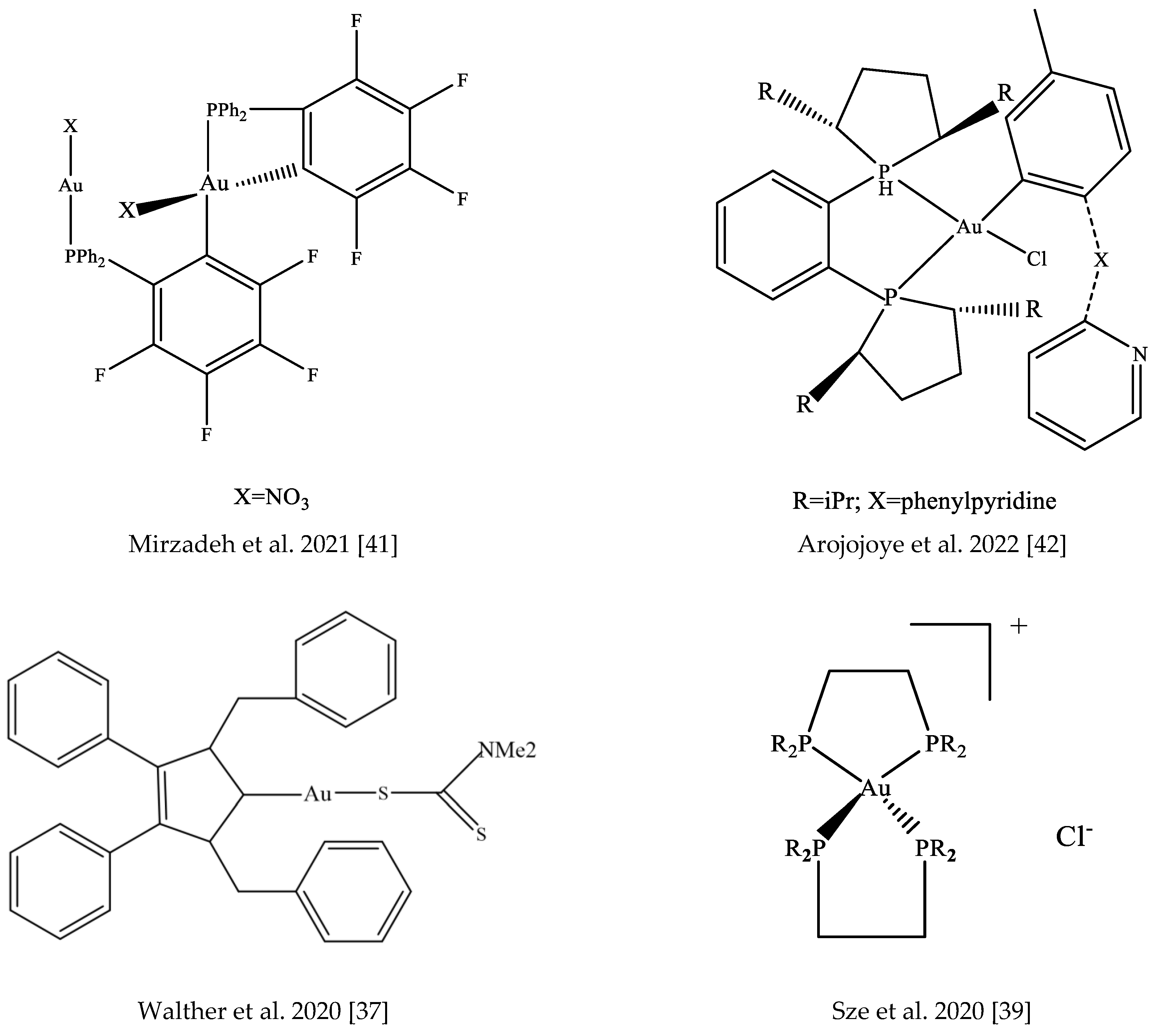
| Linear Au(I)–phosphine | Linear P–Au–Cl | ovarian (A2780, A2780cis), colon (HCT116), lung (A549), normal human lung fibroblasts (MRC-5) cell lines | 0.22–0.29 in A2780; 8–58 in A2780cis; 0.15–0.3 in HCT116; 19–31 in A549; inactive against normal cells (IC50 > 100 μM) | Not reported | Not reported | Conceição et al. [32] |
| Linear Au(I)–phosphine | Mononuclear and dinuclear Au(I), P-Au-C C-Au_P | cervical (HeLa), prostate (PC-3), non-small cell lung adenocarcinoma (A549), and fibrosarcoma (HT-1080) | 0.08–3.5 | [AuL{κC-2-C6H4P(S)Ph2}] L = PTA exhibited notable antiangiogenic characteristics in an in vivo model using transgenic zebrafish Tg(fli1a:EGFP). | TrxR → ROS → apoptosis | Reddy et al. [33] |
| Carbene-derived gold(I) complexes | Linear C-Au-S | prostate cancer cell line (PC3) | 1.2–7.4 | Demonstrated significant anti-tumor effect towards prostate cancer cell line PC3. | Inhibited tumor pro-gression in mice bearing PC3 xenografts. | Walther et al. [37] |
| N-heterocyclic carbene (NHC) ligands | Linear C-Au-C; C-Au-Cl; Square-planar with C, I, Cl and C, I donor atoms | HCT116-p53wt, HCT116-p53wt/, OxR, 10HCT116-p53ko, HCT116-p53ko/, OxR, A2780, A2780cis, MCF-7, A375, N87 | 0.9–6.2 | Both compounds exhibited potent antiproliferative effects against multiple cancer cell lines, including A2780, A2780cis, HCT116-p53wt, and MCF-7. | Following labeling with radioactive iodine and administration to rats, the second complex rapidly distributed to major organs within 1–5 min. | Guarra et al. 2020 [38] |
| gold(I) phosphine complex | bis-chelated tetrahedral [Au(d2pype)2]Cl | RPMI8226, U266 and JJN3 myeloma cells | 0.25–2.6 | Strongly blocked TrxR activity in myeloma cells, whether sensitive or resistant to bortezomib, which slowed their growth. | Reduced the growth of RPMI8226 myeloma tumors in NOD/SCID mice. | Sze et al. 2020 [39] |
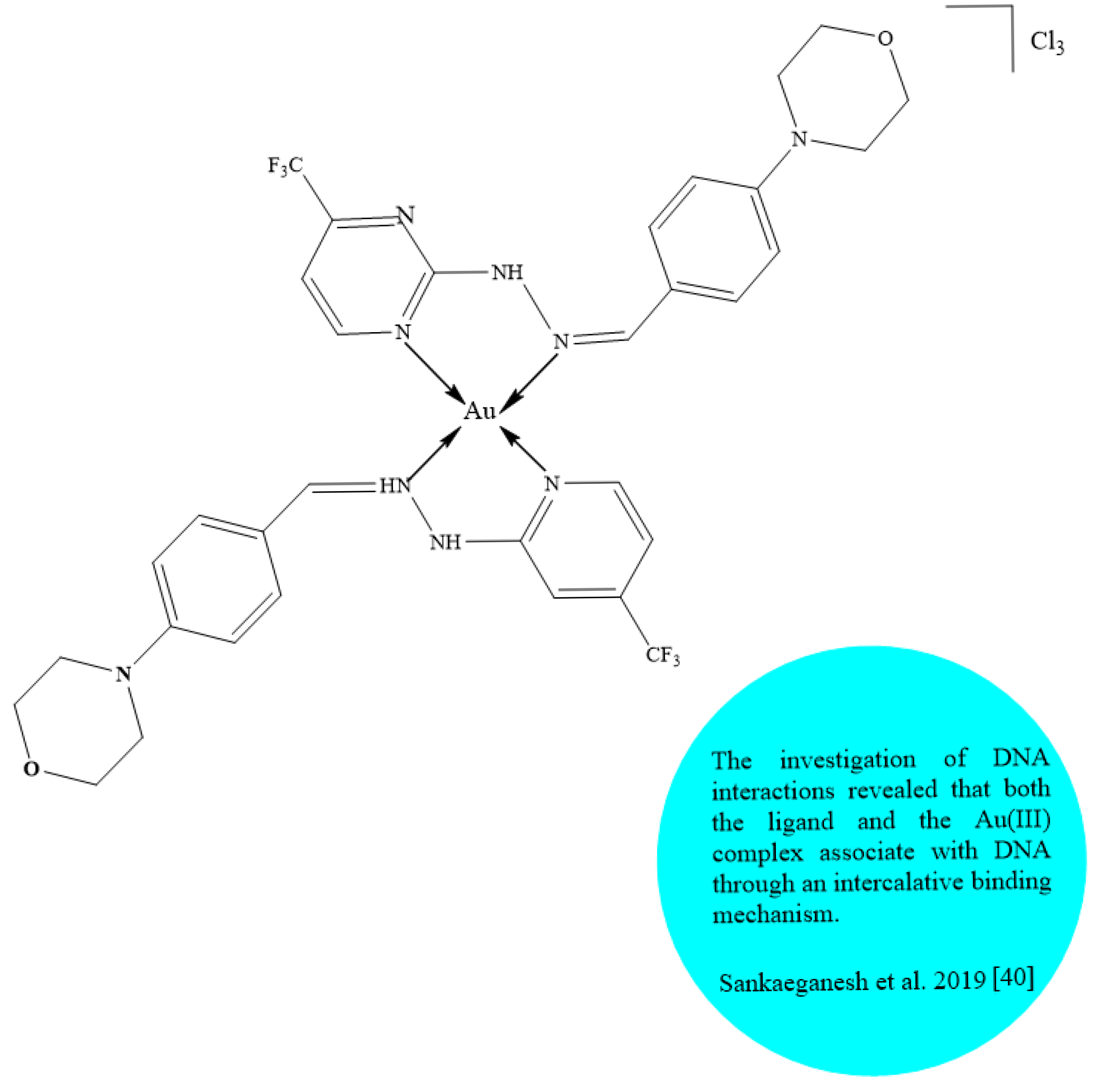
| Au(III) with bulky substituents | Square-planar | Breast (MCF-7), liver (HepG2), cervical (HeLa), lung (A549) and one normal cell line (NHDF- normal human dermal fibroblasts | 20.6 ± 0.98 μg/mL, MCF-7; 22.68 ± 1.13 μg/mL, HepG2; 32.00 ± 1.60 μg/mL, HeLa; 33.19 ± 1.66 μg/mL, A549 | The Au(III) compound attacked cancer cells but did not harm normal cells | In vivo studies in tumor-bearing mice demonstrated the anticancer potential of the Au(III) derivative. | Sankarganesh et al. 2019 [40] |
| dinuclear gold(I)–gold(III) complexes | Square-planar with chelate for Au(III) (C,P,X) and linear for Au(I) (P,X) | Prostate (DU145), HeLa, Bone, (HT1080—fibrosarcoma), Hek-293T (normal, human embryonic kidney cells) | 0.78–11.8 in DU145; 0.011–1.32 in HeLa; 0.062–0.46 in HT1080; 2.56–13.9 in Hek-293T | Exhibited cytotoxicity and suppressed the proliferation of multiple cancer cell lines, including HeLa and DU145. | Reduced the growth of HeLa tumors in Balb/c nude mice. | Mirzadeh et al. 2021 [41] |
| Au(III) with bulky substituents | Square-planar with chelate | H460, MDA-MB-231, MDA-MB-468 and BT-33 | 1.3–2.95 | Showed toxic activity against four aggressive cancer cell types, including H460, MDA-MB-231, MDA-MB-468 and BT-33 glioblastoma at micromolar levels. | At 10 mg/kg, tumor growth in 4T1-inoculated Balb/c mice was slightly lower than in untreated mice. | Arojojoye et al. 2022 [42] |
| Gold Complex | Key Findings | Mechanism | References |
|---|---|---|---|
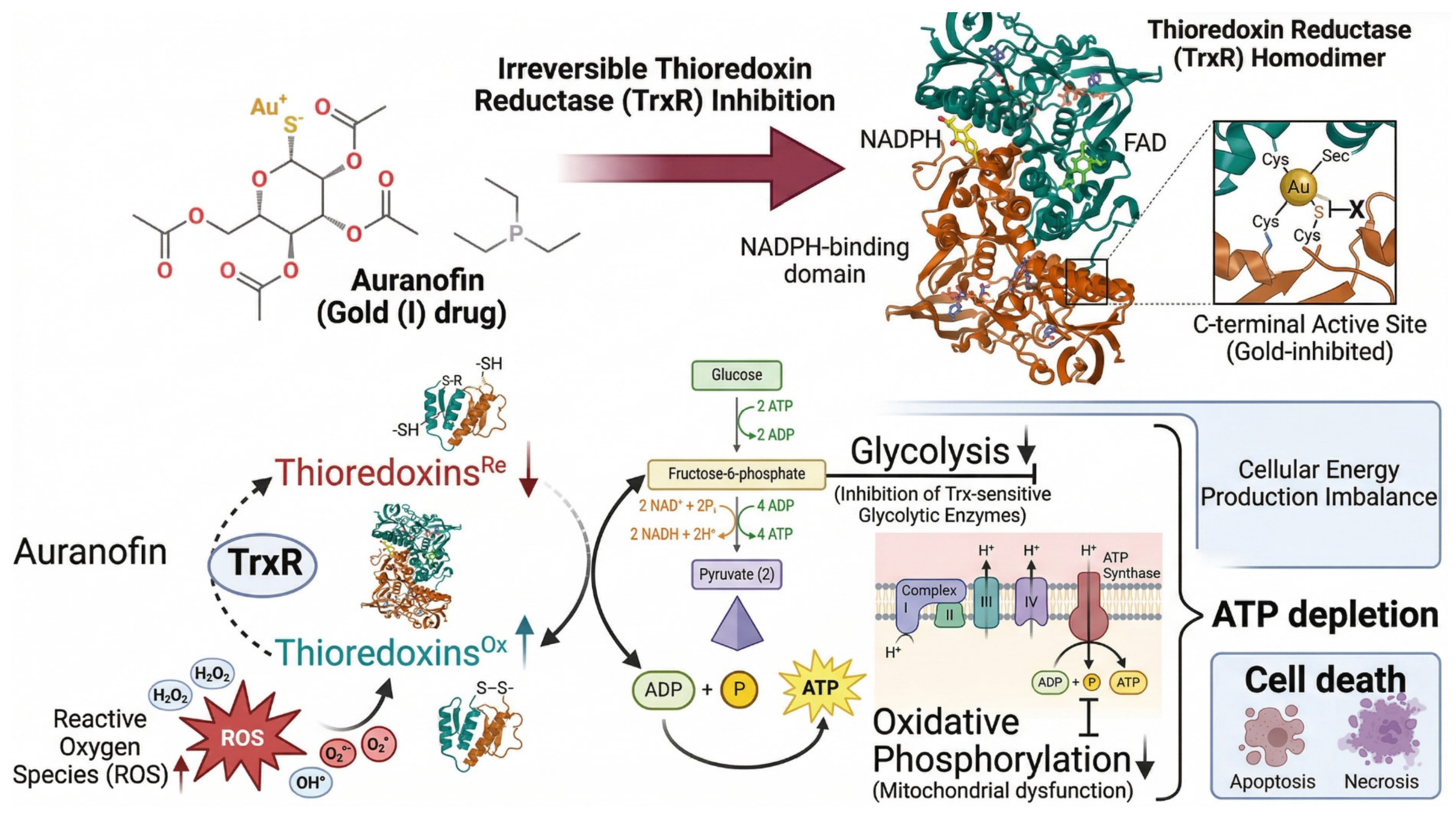
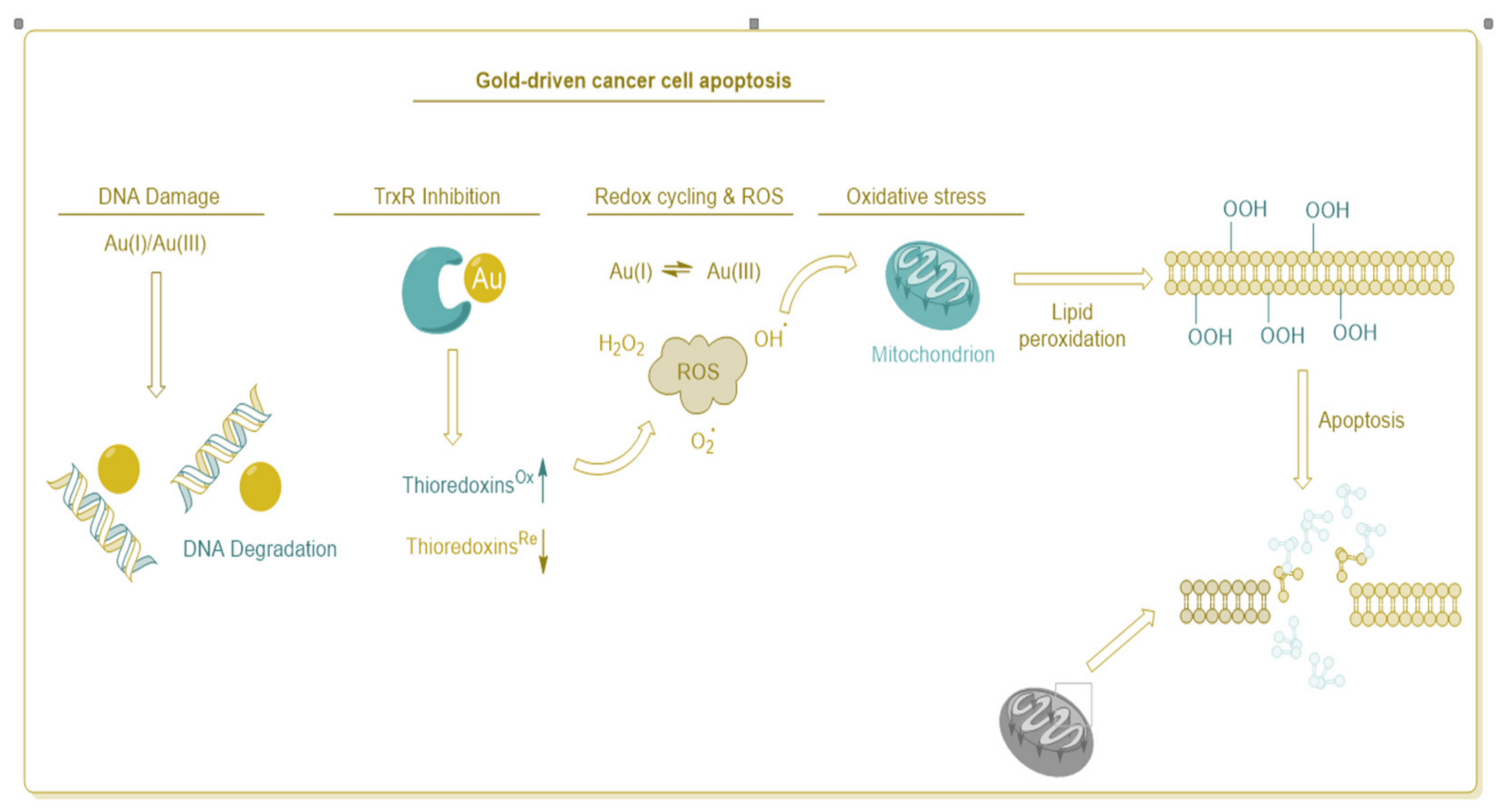
| Auranofin | ROS generation, selective redox disruption, apoptosis | TrxR inhibition | [43,44] |
| Au(I)-thiolates | ROS-induced mitochondrial damage, apoptosis | ROS generation, mitochondrial damage | [45,46] |
| Au(I)-NHC complexes | ROS generation, selective cytotoxicity, apoptosis | Redox cycling, DNA intercalation | [47] |
| Au(III)-pyridine | DNA intercalation, ROS-induced apoptosis | DNA interaction, oxidative stress | [48,49] |
| Au(III)-dithiocarbamates | ROS-induced DNA damage, apoptosis | Metal ion exchange, ROS generation | [50,51,52] |
| Au(III)-phosphine | Mitochondrial dysfunction, DNA binding, apoptosis | ROS generation, DNA binding | [53] |
| Compound Class | Coordination Geometry | Cancer Cell Lines | Median IC50 (µM) | In Vivo Evaluation | Key Mechanism | Reference |
|---|---|---|---|---|---|---|
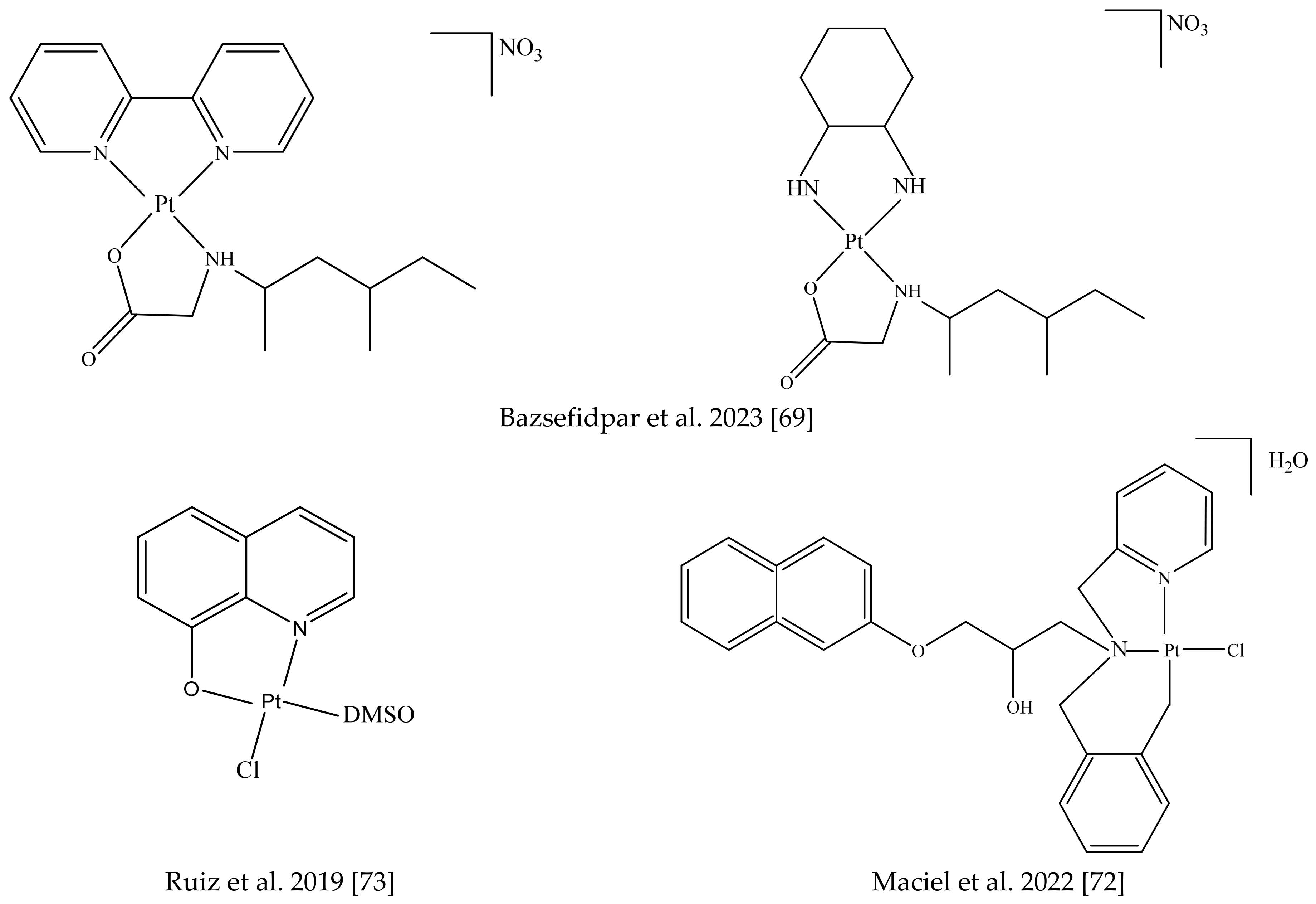
| Pt(II) with bulky substituents | Square-planar with bis-chelate | SKBR3 breast cancer cells | 15–39 | Exhibited stronger cytotoxicity against SKBR3 cells than oxaliplatin and carboplatin. | Showed anticancer activity in a 4T1 allotransplanted breast tumor model in Balb/c mice, significantly reducing tumor volume. | Bazsefidpar et al. 2023 [69] |
| Pt(II) with bulky substituents | Square-planar with bis-chelate | HCT116, 4T1 and CT26. | 4T1 35.6 ± 0.2 in HCT116 (IC50 25.3 ± 0.1), and CT26 (IC50 45.2 ± 0.4), | Exhibited significant cytotoxic effect against multiple cancer cell lines, including HCT116, 4T1 and CT26. | Pt(II) complex showed significant anticancer activity in an orthotopic 4T1 mouse tumor model without histopathological toxicity in the heart, lung, liver, or kidney. | Stojanović et al. 2022 [70] |
| cryptolepine derivatives | Square-planar with bis-chelate | T-24 cells and normal HL-7702 cells | 1.3 ± 0.1 and 0.2 ± 0.2 | Induced programmed cell death in T-24 cells more efficiently than cisplatin. | Administration of the Pt(II) complex (2.0 mg/kg every 2 days) reduced T-24 xenograft growth in mice. | Qin et al. 2021 [71] |
| α- and β-naphthyl groups | Square-planar with bis-chelate | breast cancer (MDA-MB-231 and MCF-7), lung (A549), prostate (PC3), pancreas (BXPC-3), and normal peripheral blood mononuclear (PBMC) cells | 14.4 ± 1.1; 8.0 ± 1.1 (MDA-MB-231); 20.5 ± 1.1; 16.2 ± 1.2 (MCF-7); 35.3 ± 1; 18 ± 1.1 (A549); 23 ± 1.1; 14.4 ± 1.2 (PC-3); 16.3 ± 1.1; 13.7 ± 1.1 (BXPC-3); 22.0 ± 1.0; 42.0 ± 1.0 (PBMC) | Pt-13 induced cytotoxicity in multiple tumor cell lines, including A549, PC3, MDA-MB-231, MCF-7, BXPC-3, and PBMC. | Strongly suppressed MDA-MB-231 tumor xenograft growth in BALB/c nude mice. | Maciel et al. 2022 [72] |
| Quinoline–platinum complexes | Square-planar with bis-chelate | human osteosarcoma MG-63 cells | 4–39 | Quinoline–platinum complexes induced cytotoxicity in cisplatin-resistant human osteosarcoma MG-63 cells. | Inhibited growth of human osteosarcoma xenografts in mice. | Ruiz et al. 2019 [73] |
| Quinoline–platinum complexes | Square-planar | HeLa, A549, T24, and NCI-H460 cells | 3.6 ± 0.63 | Induced cytotoxicity in HeLa, A549, T24, and NCI-H460 cells more efficiently than cisplatin. | In female Balb/c nude mice, tumor xenograft growth was inhibited with efficacy comparable to cisplatin. | Mo et al. 2021 [74] |
| Platinum Complex | Redox Mechanism | Primary Target | References |
|---|---|---|---|
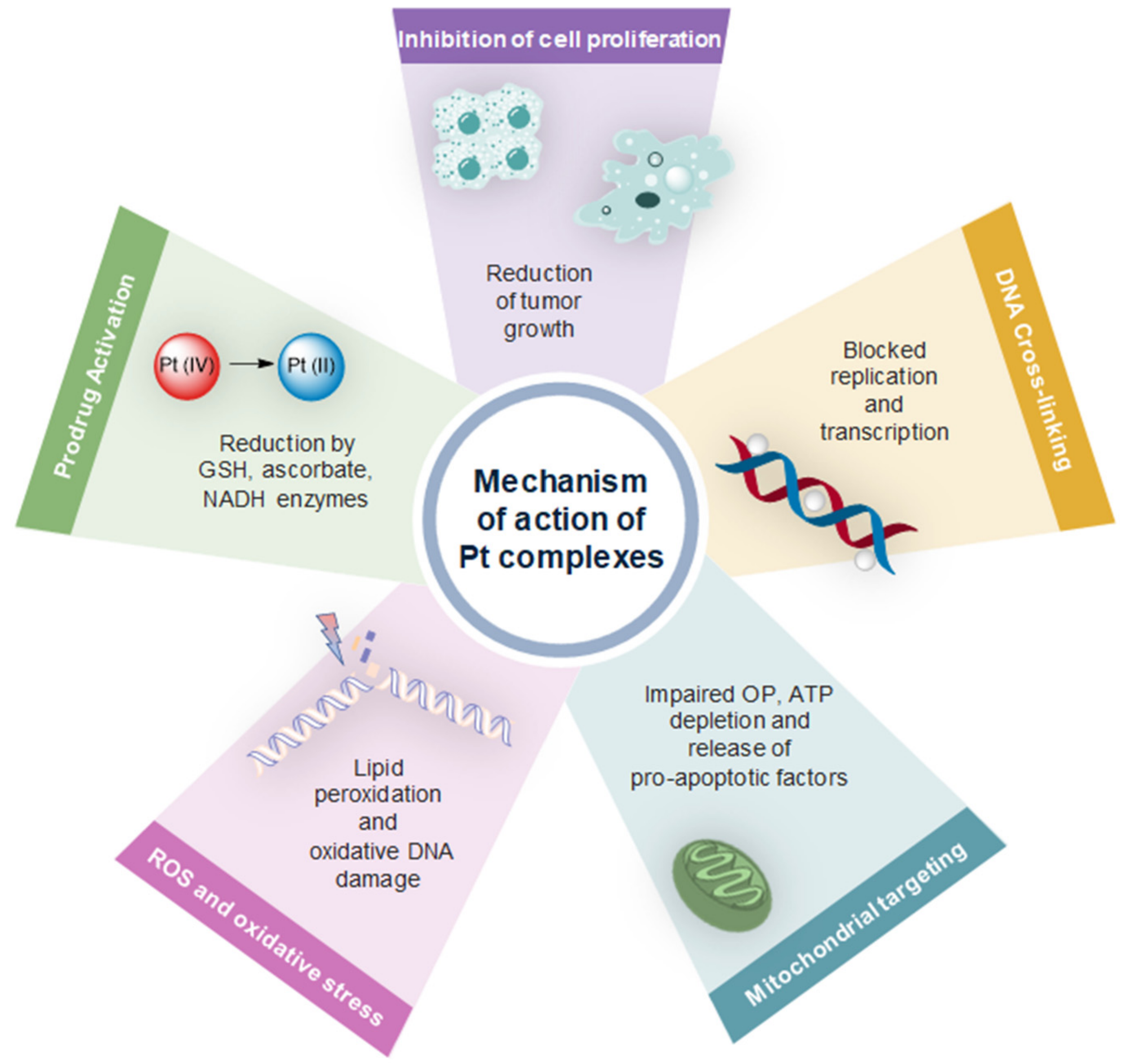
| Cisplatin | ROS generation, DNA damage | DNA (guanine residues) | [85,86,87,88] |
| Oxaliplatin | Oxidative stress, apoptosis | DNA, ROS pathways | [89,90,91,92,93] |
| Pt(IV) prodrugs | Redox-sensitive reduction, ROS activation | Tumor-specific reduction | [94,95] |
| Compound Class | Coordination Geometry | Cancer Cell Lines | Median IC50 (µM) | In Vitro and In Vivo Evaluation | Key Mechanism | Reference |
|---|---|---|---|---|---|---|
| Benzoato Pt(IV) prodrug | octahedral | Lewis lung carcinoma (LLC) | 0.11 ± 0.08 | An in vivo neurotoxicity test could better ascertain the potential of compound 1 as an antitumor drug suitable for oral administration | In a murine LLC model, administration of the complex (5 mg/kg) reduced tumor mass by 72.5%. | Barbanente et al. 2022 [96] |
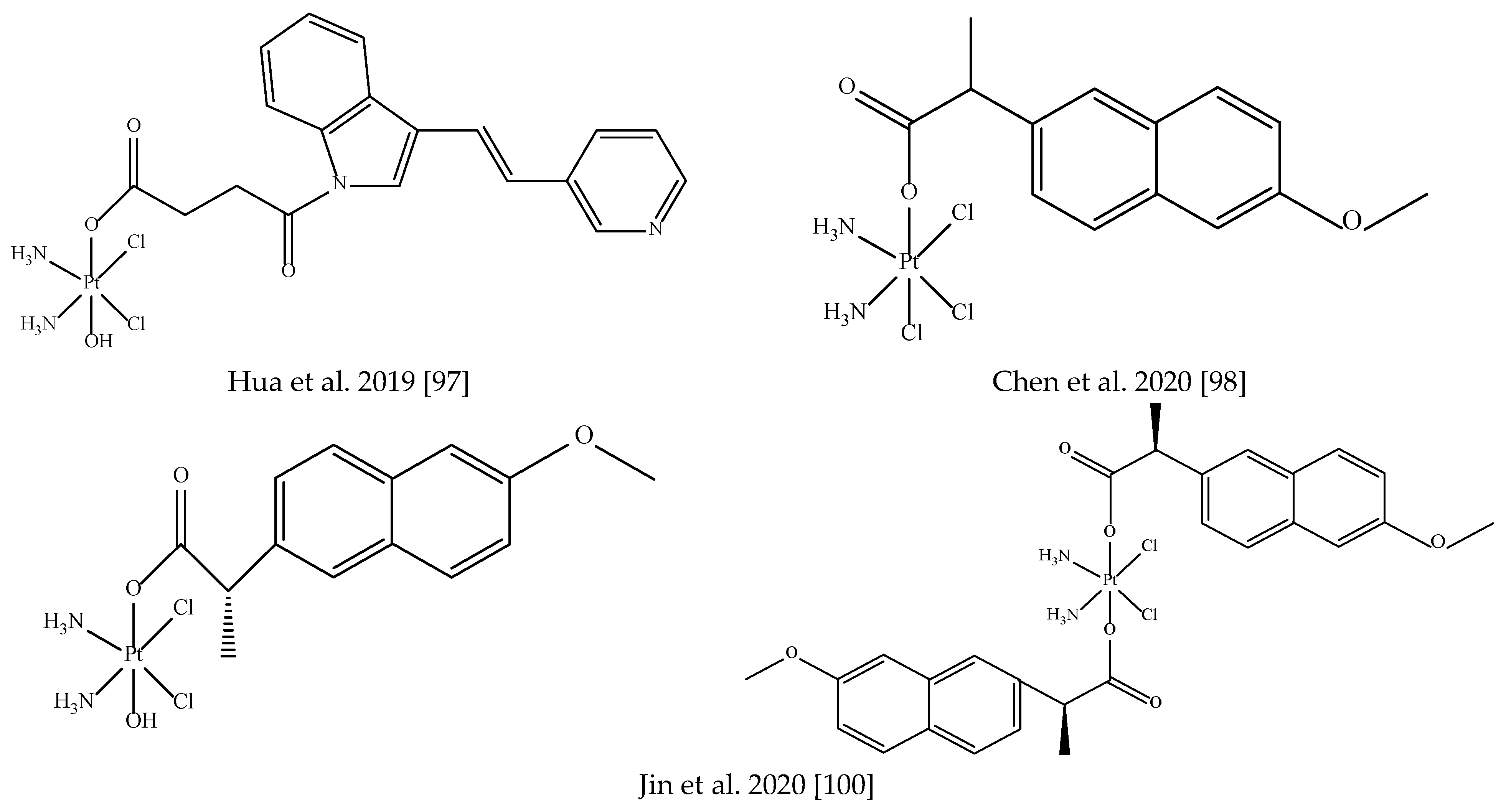
| Pt(IV) with bulky substituents | octahedral | HEPG2 cells | 0.30 ± 0.025 | Caused cell death in HEPG2 cells. | In mice, HepG2 tumor xenograft growth was inhibited, with activation of T cells enhancing antitumor immunity. | Hua et al. 2019 [97] |
| naproxen platinum(IV) complex | octahedral | A549, A549R, SKOV-3, and CT-26 | 2.2–66 in A549; 4.8–89.7 in A549R; 8.5–73.6 in SKOV-3; 0.2–76.8 in CT-26 | Reduced growth of cancer cells such as A549, A549R, SKOV-3, and CT-26. | In BALB/c mice, CT26 tumor growth was inhibited to a level comparable with oxaliplatin and cisplatin. | Chen et al. 2020 [98] |
| Pt(IV) with bulky substituents | octahedral | MCF-7, MDA-MB-435, MDA-MB-231 | 0.17–7.0 in MCF-7; 0.16–30 in MDA-MB-231; 0.34–8.24 in MDA-MB-231 | In human cancer cell lines (MCF-7, MDA-MB-435, MDA-MB-231), proliferation was inhibited and cytotoxicity induced, while MCF-7 cell migration was delayed in a wound healing assay. | In female Balb/C mice, MDA-MB-231 tumor growth was inhibited. | Jin et al. 2020 [100] |
| Compound Class | Coordination Geometry | Cancer Cell Lines | Median IC50 (µM) | In Vivo and in Vitro Evaluation | Key Mechanism | Reference |
|---|---|---|---|---|---|---|
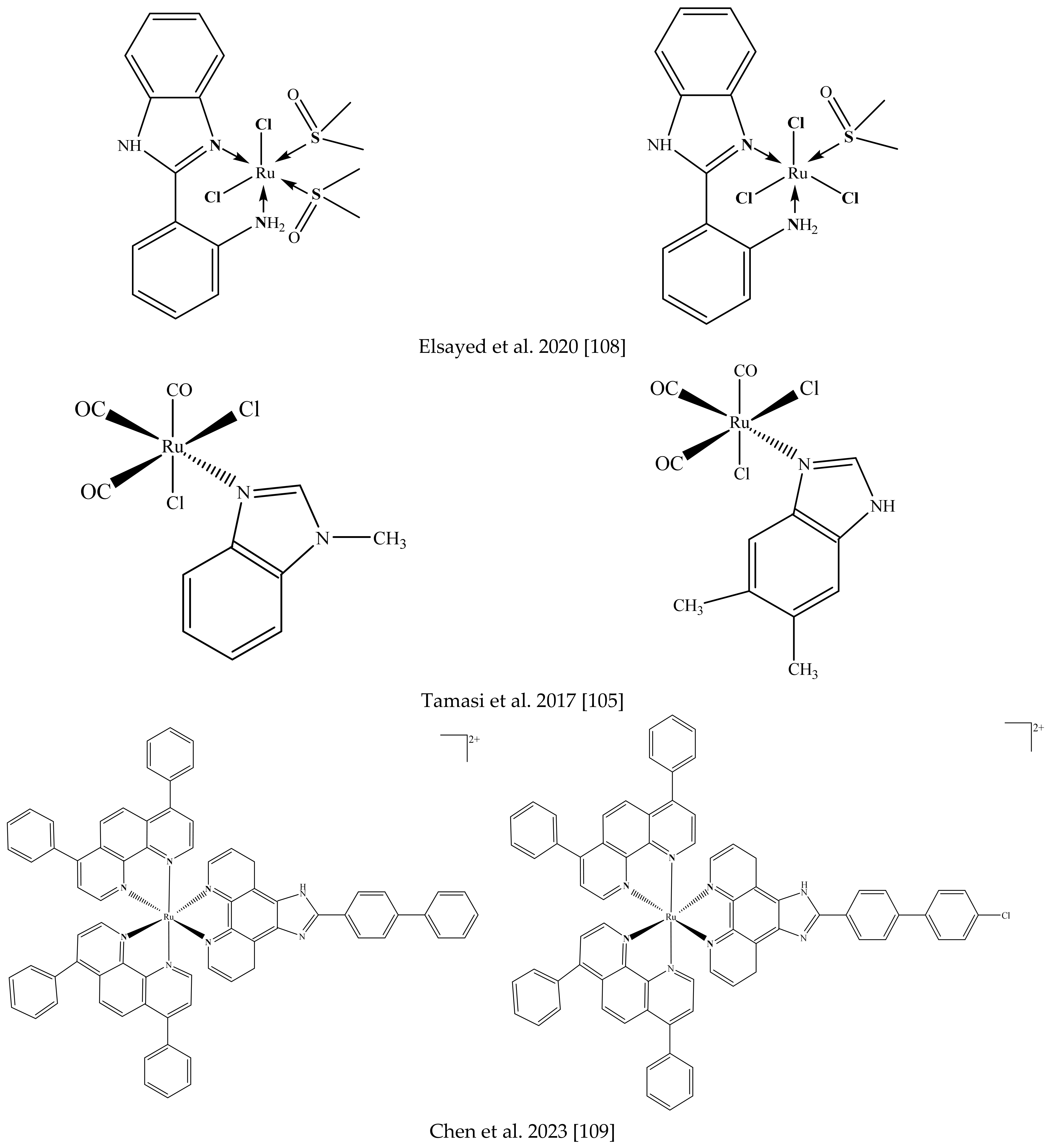
| 2-aminophenyl benzimidazole | octahedral | human breast cancer (MCF7), human colorectal cancer (Caco2), and normal human liver cell lines (THLE-2) | 230–290 in MCF-7; 250–380 in Caco2; 1800–5500 in THLE-2 | Exhibited cytotoxicity against multiple human tumor cell lines, including MCF-7 and Caco-2. | In the EAC mouse model, the treatment inhibited liver cancer cell proliferation by inducing apoptosis, increasing Bax and Caspase-3 levels, and decreasing Bcl-2 levels in the liver. | Elsayed et al. 2020 [108] |
| ruthenium(II) polypyridyl complexes | octahedral | B16, A549, HepG2, SGC-7901, HeLa, BEL-7402, non-cancer LO2 | 3.4 ± 0.1; 3.5 ± 0.1 in SGC-7901 | The two complexes exhibited strong antiproliferative effect against SGC-7901cells. | In nude mice, SGC-7901 tumor xenograft growth was inhibited by 53.5% and 72.9% at doses of 1.23 and 2.46 mg/kg, respectively. | Chen et al. 2023 [109] |
| ruthenium(II) benzimidazole ligands | octahedral | A549, CH1/PA-1 and SW480 cancer cells | 212 ± 24, 216 ± 5 in A549; 48 ± 4, 44 ± 7 in SW480; 56 ± 3, 55 ± 1 in CH1/PA-1 | The two complexes showed moderate cytotoxicity in three human cancer cell lines in vitro in the range of the clinically studied ruthenium complex KP1019. | fac-[RuII(CO)3Cl2(N3-DMBI)] showed anticancer activity in vivo by significantly decreasing the tumor growth of a murine CT-26 colon cancer model. | Tamasi et al. 2017 [105] |
| Ru(II)-arene fragments to dipyridophenazine ligands | octahedral | MDAMB- 231 and HCT116 cell lines. | 2.0 ± 0.6, 2.9 ± 0.8 in MDAMB- 231; 2.1 ± 0.2, 1.9 ± 0.4 in HCT116 cell lines | Displayed significant cytotoxic activity in the low micromolar range (IC50 ≈ 2–3) in MDAMB-231 and HCT116 cell lines. | TrxR → ROS → apoptosis | Nikolić et al. 2023 [110,111] |
| Ru(II)-compounds with aryl-bis(imino) acenaphthene chelating ligands | tetrahedral | A549, HepG2, HeLa HT29, HCT-116, SMMC-7721, and CT26. | 2.3 ± 0.3, 25.6 ± 3.4 in CT26 cells; | Reduced the growth of CT26 xenografted tumor in BALB/c mice. | Accumulation of Ru(II) complex within the lysosome inducing lysosomal dysfunction in CT26 cells. | Xu et al. 2020 [106] |
| acylthiourea ligands | pseudo-octahedral piano-stool geometry | A549 and A549cisR cancer lines, as well as HUVEC normal cells | 6.52 in A549 14.45 in cisA549R cells | Demonstrated lesser toxicity than Cis-DDP and a relatively superior survival rate of mice injected with Ru(III) compound. | Apoptosis induction and arrest the cell cycle in S-stage. | Swaminathan et al. [107] |
| Feature | Gold Complexes | Platinum Complexes | Ruthenium Complexes |
|---|---|---|---|
| Representative compounds | Auranofin, Au(I)/Au(III) complexes. | Cisplatin, Carboplatin, Oxaliplatin. | NAMI-A, KP1019, KP1339, TLD1433. |
| Primary molecular target | Thioredoxin reductase (TrxR), mitochondrial proteins, cysteine- and selenocysteine-containing proteins. | Nuclear DNA (formation of DNA intra- and interstrand cross-links). | DNA, proteins, mitochondria, enzymes, and multiple signaling pathways. |
| Mechanism of action | Induces oxidative stress, inhibits redox homeostasis, promotes mitochondrial dysfunction and apoptosis. | DNA damage, inhibition of DNA replication and transcription, apoptosis. | Multitarget mechanism involving DNA interaction, ROS generation, enzyme inhibition, and modulation of cell signaling. |
| Major advantages | Effective against platinum-resistant tumors; unique non-DNA targets; strong TrxR inhibition; potential immunomodulatory effects. | Clinically validated; high efficacy against numerous solid tumors; well-established treatment protocols. | Lower systemic toxicity; selective activation in hypoxic tumors; multiple oxidation states; versatile coordination chemistry. |
| Major limitations | Limited clinical data; stability challenges; interactions with sulfur-containing biomolecules; relatively few approved candidates. | Nephrotoxicity, neurotoxicity, ototoxicity, myelosuppression, drug resistance, poor tumor selectivity. | Limited clinical success despite promising preclinical results; complex pharmacokinetics; no globally approved anticancer drug to date. |
| Drug resistance | May overcome platinum resistance through distinct molecular targets. | Frequently affected by intrinsic and acquired resistance (reduced uptake, enhanced DNA repair, drug efflux). | Generally lower cross-resistance with platinum drugs due to different mechanisms of action. |
| Selectivity toward cancer cells | Moderate to high, depending on ligand design and targeting strategy. | Moderate; significant toxicity toward normal rapidly dividing cells. | Generally higher owing to preferential accumulation and activation within tumor tissues. |
| Systemic toxicity | Generally lower than platinum complexes but dependent on ligand structure and dose. | Relatively high; dose-limiting toxicities are common. | Generally lower than platinum complexes. |
| Clinical development | Mostly preclinical and early clinical investigation; Auranofin is approved for rheumatoid arthritis and is being repurposed for cancer. | Multiple FDA- and EMA-approved drugs widely used in oncology. | Several candidates have entered clinical trials (e.g., NAMI-A, KP1019/KP1339, TLD1433), but no globally approved Ru-based anticancer drug. |
| Future prospects | Optimization of ligand stability, tumor targeting, and combination therapy. | Development of next-generation platinum drugs with reduced toxicity and resistance. | Development of multifunctional and targeted Ru complexes with improved pharmacokinetics and clinical efficacy. |
Disclaimer/Publisher’s Note: The statements, opinions and data contained in all publications are solely those of the individual author(s) and contributor(s) and not of MDPI and/or the editor(s). MDPI and/or the editor(s) disclaim responsibility for any injury to people or property resulting from any ideas, methods, instructions or products referred to in the content. |
© 2026 by the authors. Licensee MDPI, Basel, Switzerland. This article is an open access article distributed under the terms and conditions of the Creative Commons Attribution (CC BY) license.
Share and Cite
Marinova, P.; Strandzheva, M.; Blazheva, D.; Lungu, I.I.; Cioanca, O.; Hancianu, M.; Stefanache, A. A Recent Review of the Therapeutic Potential of Gold, Platinum, and Puthenium Complexes Combined with Certain Organic Compounds. Inorganics 2026, 14, 200. https://doi.org/10.3390/inorganics14080200
Marinova P, Strandzheva M, Blazheva D, Lungu II, Cioanca O, Hancianu M, Stefanache A. A Recent Review of the Therapeutic Potential of Gold, Platinum, and Puthenium Complexes Combined with Certain Organic Compounds. Inorganics. 2026; 14(8):200. https://doi.org/10.3390/inorganics14080200
Chicago/Turabian StyleMarinova, Petya, Miroslava Strandzheva, Denica Blazheva, Ionut Iulian Lungu, Oana Cioanca, Monica Hancianu, and Alina Stefanache. 2026. "A Recent Review of the Therapeutic Potential of Gold, Platinum, and Puthenium Complexes Combined with Certain Organic Compounds" Inorganics 14, no. 8: 200. https://doi.org/10.3390/inorganics14080200
APA StyleMarinova, P., Strandzheva, M., Blazheva, D., Lungu, I. I., Cioanca, O., Hancianu, M., & Stefanache, A. (2026). A Recent Review of the Therapeutic Potential of Gold, Platinum, and Puthenium Complexes Combined with Certain Organic Compounds. Inorganics, 14(8), 200. https://doi.org/10.3390/inorganics14080200