


Abstract
The study investigates Co2+/M4+ (Sn, Zr, Hf)-substituted M-type barium ferrites to understand phase formation, structural evolution and magnetic behavior. Ferrites with the general composition BaFe12−x−yCoxMyO19 were synthesized via sodium carbonate flux and analyzed using powder and single-crystal X-ray diffraction, wavelength dispersive X-ray spectroscopy, X-ray absorption spectroscopy and magnetic measurements. Structural analysis showed increasing lattice parameters with increasing degree of substitution, confirming incorporation of the substituting tetravalent metals. Differing maximum substitution levels were determined for the different systems, with wavelength dispersive X-ray spectroscopy providing the most reliable compositional data. A slight excess of the tetravalent metals Sn4+, Zr4+ and Hf4+ relative to Co2+ was frequently observed. X-ray absorption spectroscopy and wavelength dispersive X-ray spectroscopy analyses indicated negligible Fe2+ formation and no clear trends for formation of vacancies. Site occupancy analysis assigned tetravalent cations primarily to the Fe(4) site (4f2), with evidence that cobalt partially occupies the Fe(3) site (4f1). Magnetic measurements revealed decreasing saturation magnetization, remanence and coercivity at room temperature with increasing substitution level, while low-temperature measurements showed enhanced remanence and coercivity.
1. Introduction
Hexaferrites are highly investigated materials due to their various possible applications such as permanent magnets, transistors, energy storage or recording media [1,2,3]. Recent research on hexaferrites has focused in particular on the properties of cobalt-substituted materials, which are considered promising candidates for microwave absorption applications due to their high effective absorption bandwidth [4,5,6]. In this context, co-substitution offers the additional advantage of enabling a targeted tuning of ferrite properties while simultaneously reducing the required amount of cobalt, a resource that is both limited and increasingly costly. Furthermore, cobalt-substituted ferrites exhibit potentially intriguing magnetic properties arising from the presence of unpaired spins of cobalt ions [7], distinguishing their behavior from that of ferrites substituted exclusively with diamagnetic ions. In this regard, the specific crystallographic sites occupied by the substituent ions are of crucial importance, since the pure barium hexaferrite with magnetoplumbite type crystal structure, BaFe12O19, realizes a ferrimagnetic order of the moments localized on the iron atoms distributed over five distinct crystallographic sites [8,9]. Based on magnetic measurements, bond valence calculations, and neutron diffraction data, both the tetrahedrally coordinated Fe(3) site (4f1) and the face-sharing octahedra doubles associated with Fe(4) (4f2) have repeatedly been identified as preferred sites for cobalt incorporation in M-type ferrites [10,11,12,13]. In addition, the octahedrally coordinated Fe(5) (12k) has also been proposed as a potential substitution site for cobalt, as reported by Batlle et al. [10]. In contrast to previous studies that discussed Mg2+- and Zn2+-substituted ferrites [14,15], cobalt may occur not only in the Co2+ oxidation state but also as Co3+ [12]. This variability could, in principle, allow for higher substitution levels, as Fe3+ may then be replaced by the isovalent Co3+.
The aim of the investigations presented in this work is to provide a comprehensive characterization of the ferrite systems BaFe12−x−yCoxMyO19 (M = Sn, Zr, Hf), via detailed crystallographic investigations using powder and single-crystal X-ray diffraction, X-ray absorption spectroscopy and wavelength dispersive X-ray spectroscopy to pin down possible site preferences, valence states and charge balance mechanisms as well as magnetic measurements. In particular, an effort is made to identify, for each substituting metal, both the preferred crystallographic site and the upper limit of substitution. Furthermore, possible mechanisms of charge compensation are examined and the precise chemical compositions are analyzed. In addition, hysteresis curves are measured for samples for which phase-pure synthesis has been achieved, and the resulting magnetic parameters are compared with literature data.
2. Results and Discussion
M-type hexaferrites of the general composition BaFe12−x−yCoxMyO19 with M = Sn, Zr, Hf were synthesized from sodium carbonate flux. Ground powder samples were investigated regarding their phase fractions, magnetic properties and valence states of iron. Furthermore, single crystals were investigated regarding their composition and crystal structure. Knowledge of the crystal structure of BaFe12O19 is therefore of great importance for the evaluation.
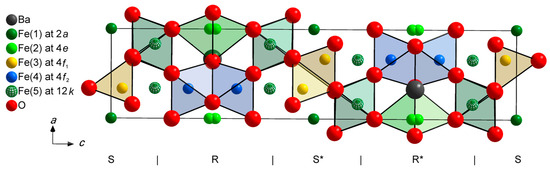
The crystal structure of BaFe12O19 (BaM), derived from a close-packed arrangement of oxygen layers, is depicted in Figure 1 and can be described in terms of alternating R- and S-blocks. The R-block consists of three consecutive hexagonally stacked close-packed oxygen layers, whereas the S-block comprises two close-packed oxygen layers in a cubic stacking. Accordingly, the stacking sequence of BaM can be expressed as RSR*S*, where the asterisk indicates a 180° rotation of the respective block about the crystallographic c-axis.
Figure 1.
Extended unit cell of BaFe12O19 with labeled blocks and coordination polyhedra around selected cations.
Beyond this block-based representation, the structure may also be rationalized in terms of atomic positions and the connectivity of coordination polyhedra surrounding the cation sites. The oxygen atoms occupy five distinct crystallographic Wyckoff positions. Within the central layer of the three hexagonally close-packed layers forming the R-block, one-quarter of the oxygen atoms are replaced by barium ions at the 2d site, which exhibit an anticuboctahedral coordination environment.
The iron cations reside in the interstitial sites created by the stacking of the oxygen layers and are distributed over five crystallographically distinct Wyckoff positions. These sites exhibit octahedral coordination for Fe(1) (2a), Fe(4) (4f2) and Fe(5) (12k), tetrahedral coordination for Fe(3) (4f1) and trigonal bipyramidal coordination for Fe(2) (2b). The latter site is more accurately described as a split position with 50% occupancy at the 4e site, resulting in a coordination environment that deviates from an ideal trigonal bipyramid and is better approximated as intermediate between trigonal bipyramidal and tetrahedral geometry.
2.1. PXRD and Lattice Parameters
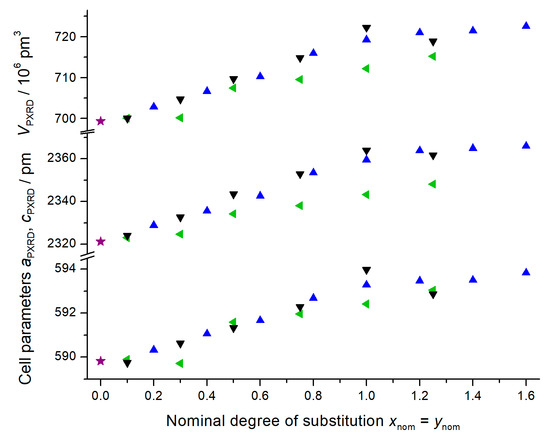
Initially, ground powders of the samples were investigated by powder X-ray diffraction to determine their phase composition and the phase fractions were estimated using the Rietveld method. The corresponding refinements are shown in Figures S1–S20. It was observed that the synthesis of cobalt-substituted ferrites BaFe12−x−yCoxMyO19 led to the presence of increased amounts of secondary phases, particularly in the case of Co/Zr, where such phases already appeared at very low nominal degrees of substitution xnom = ynom = 0.30. For both Co/Sn- and Co/Hf-substituted ferrites, the predominant secondary phase was residual γ-Fe2O3 [16] as identified by Rietveld refinements of the PXRD patterns. At higher substitution levels xnom = ynom ≥ 1.20, additional secondary phases were detected for the Co/Hf system, namely the perovskite BaHfO3 and excess HfO2. In the case of Co/Zr-substituted ferrites, the most frequently observed secondary phases were W-type ferrites (general formula: BaM2+2Fe16O27) and γ-Fe2O3. In some instances, the perovskite BaZrO3 or X-type ferrites (general formula: Ba2M2+2Fe28O46) were also identified. The lattice parameters and the average substitution degrees yPXRD,Sn/Zr/Hf of the synthesized M-type ferrites, as obtained from the Rietveld refinements, are summarized in Table S1, the amounts of secondary phases in Table S2. The increase in lattice parameters can be explained by considering the ionic radii of the relevant species listed in Table S3. The effective ionic radii of Sn4+, Zr4+, and Hf4+ as well as of Co2+ (both high- and low-spin for various coordination numbers) are larger than the corresponding ionic radius of Fe3+. Therefore, based on the evolution of the lattice parameters with increasing nominal substitution level shown in Figure 2, it can be concluded that iron in the ferrite structure is progressively substituted by the aforementioned metal ions.
Figure 2.
Unit cell parameters a and c and unit cell volume V from Rietveld refinement for BaM (purple) and Co/Sn (green), Co/Zr (black) and Co/Hf-substituted samples (blue) versus the nominal degree of substitution xnom = ynom.
Overall, the increase in unit cell volume for the Co/Sn-substituted ferrites is somewhat less pronounced than for the other two series, which can be attributed to the smaller effective ionic radius of Sn4+ (69 pm) compared to Zr4+ (72 pm) and Hf4+ (71 pm). For the Co/Hf-substituted ferrites, a clear flattening of the increase in lattice parameters is observed for xnom = ynom ≥ 1.00, indicating that the maximum substitution limit has been reached. A similar tendency toward a plateau is also evident for BaFe12−x−yCoxZryO19 at xnom = ynom ≥ 1.00. In contrast, for the Co/Sn-substituted ferrites, no maximum of the lattice parameters is observed up to xnom = ynom = 1.25 based on Rietveld refinements of powder X-ray diffraction data. This suggests that the substitution limit for BaFe12−x−yCoxSnyO19 has not yet been reached within the range of compositions investigated in this study.
Due to the higher electron densities of Sn, Zr and Hf compared to Fe, a mixed occupancy of the Fe(4) site (4f2) by the tetravalent metals was clearly identified from the Rietveld refinements. In contrast, as discussed in the introduction, several iron sites are considered as potential substitution sites for cobalt [10,11,12,13]. Since cobalt and iron cannot be unambiguously distinguished based on the X-ray diffraction data available here, a mixed occupancy of the iron sites with cobalt was not implemented in the refinements.
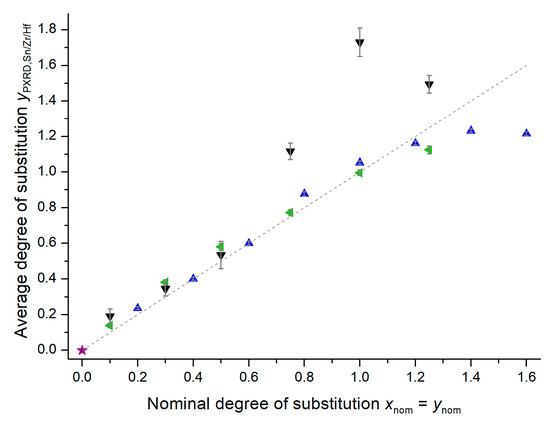
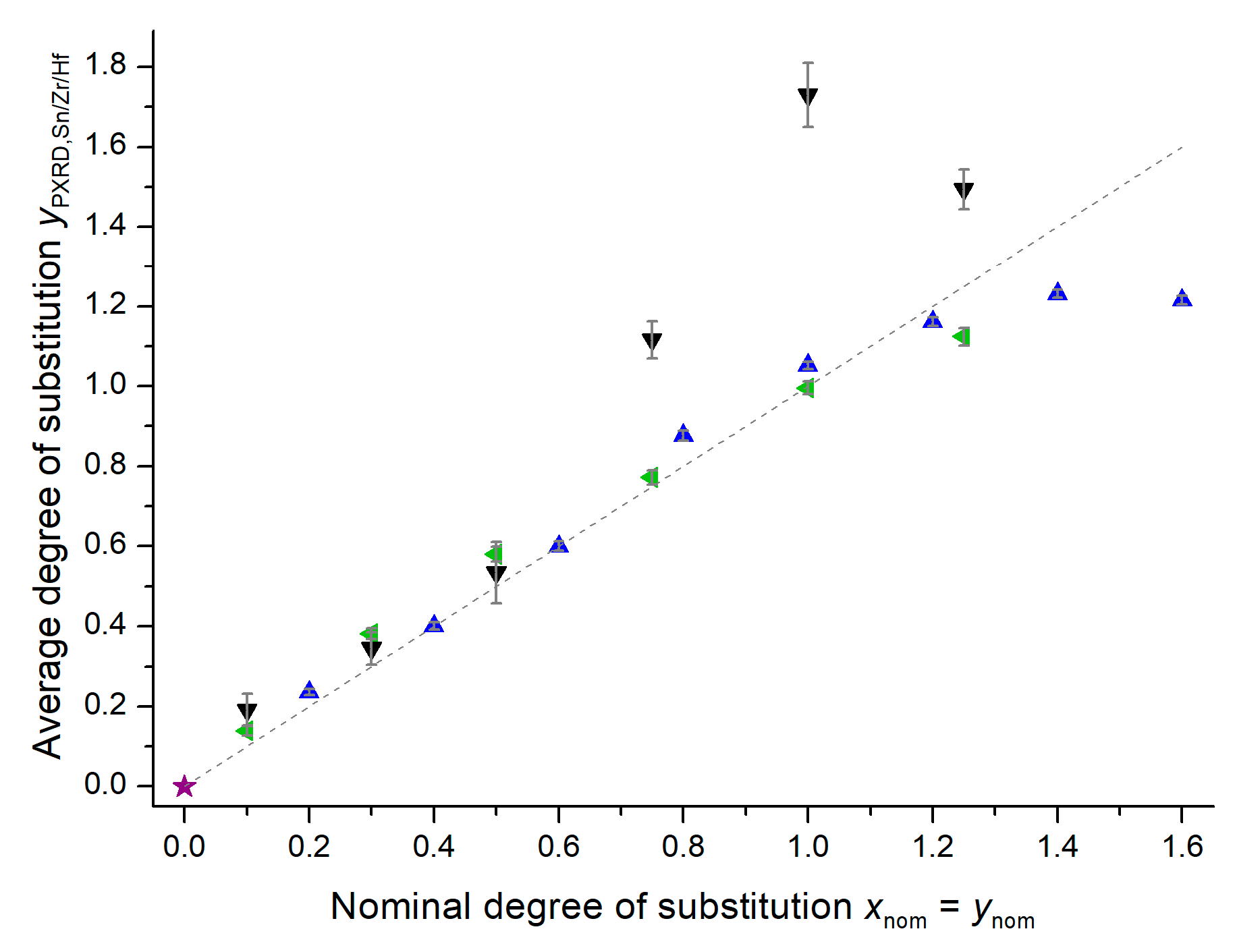
Figure 3 shows a plot of the average substitution degree yPXRD,Sn/Zr/Hf derived from Rietveld refinements on PXRD data versus the nominal target degree of substitution. For both the Co/Sn- and Co/Hf-substituted ferrites, good agreement between the nominal substitution level and the experimentally determined yPXRD,Sn/Hf is observed up to xnom = ynom ≈ 1.2. For Co/Hf, the attainment of the maximum substitution level is clearly evident at yPXRD,Hf,max ≈ 1.22. In the case of Co/Sn-substitution, a slight flattening is observed at xnom = ynom = 1.25, yielding yPXRD,Sn ≈ 1.12, suggesting that the substitution limit may also be close to ≈1.2. However, to draw a reliable conclusion regarding the substitution limit for Co/Sn-substituted ferrites, further experiments at higher nominal substitution levels are required. For Co/Zr-substituted ferrites, a significant deviation of the average substitution degree is already observed from xnom = ynom ≥ 0.75 onward. This deviation corresponds to a pronounced increase in the measured degree of substitution like it was also observed for manganese in Mn/Ti-substituted BaFe12−x−yMnxTiyO19 [17], in contrast to the shortfall in the targeted degree of substitution like observed for the Ti-substituted series BaFe12−xTixO19 [18] and the aluminium-substituted SrFe12−xAlxO19 [19]. This behavior can be attributed to the extensive formation of secondary phases. Not only are the molar ratios required for the formation of BaFe12−x−yCoxZryO19 altered, but the reduced reliability of the Rietveld refinements, caused by peak overlap among the different ferrite types formed, also plays a significant role.
Figure 3.
Average degree of substitution yPXRD,Sn (green), yPXRD,Zr (black) and yPXRD,Hf (blue) including error bars for the M-type hexaferrite obtained from Rietveld refinements on PXRD data versus the nominal degree of substitution (pure BaM in purple). The dashed line represents the ideal relationship ynom = yPXRD and is intended as a guide to the eye.
2.2. Magnetic Properties
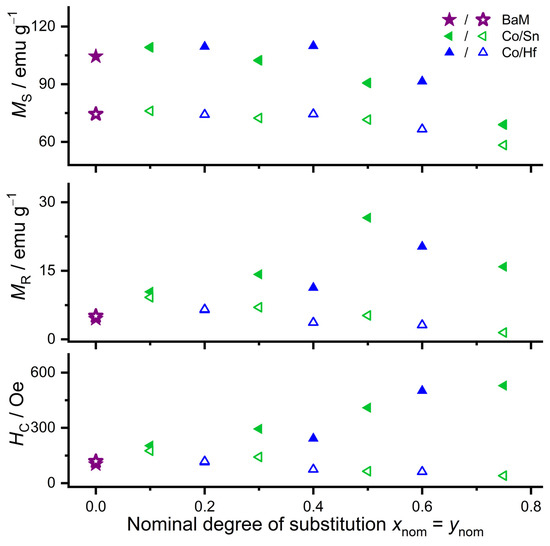
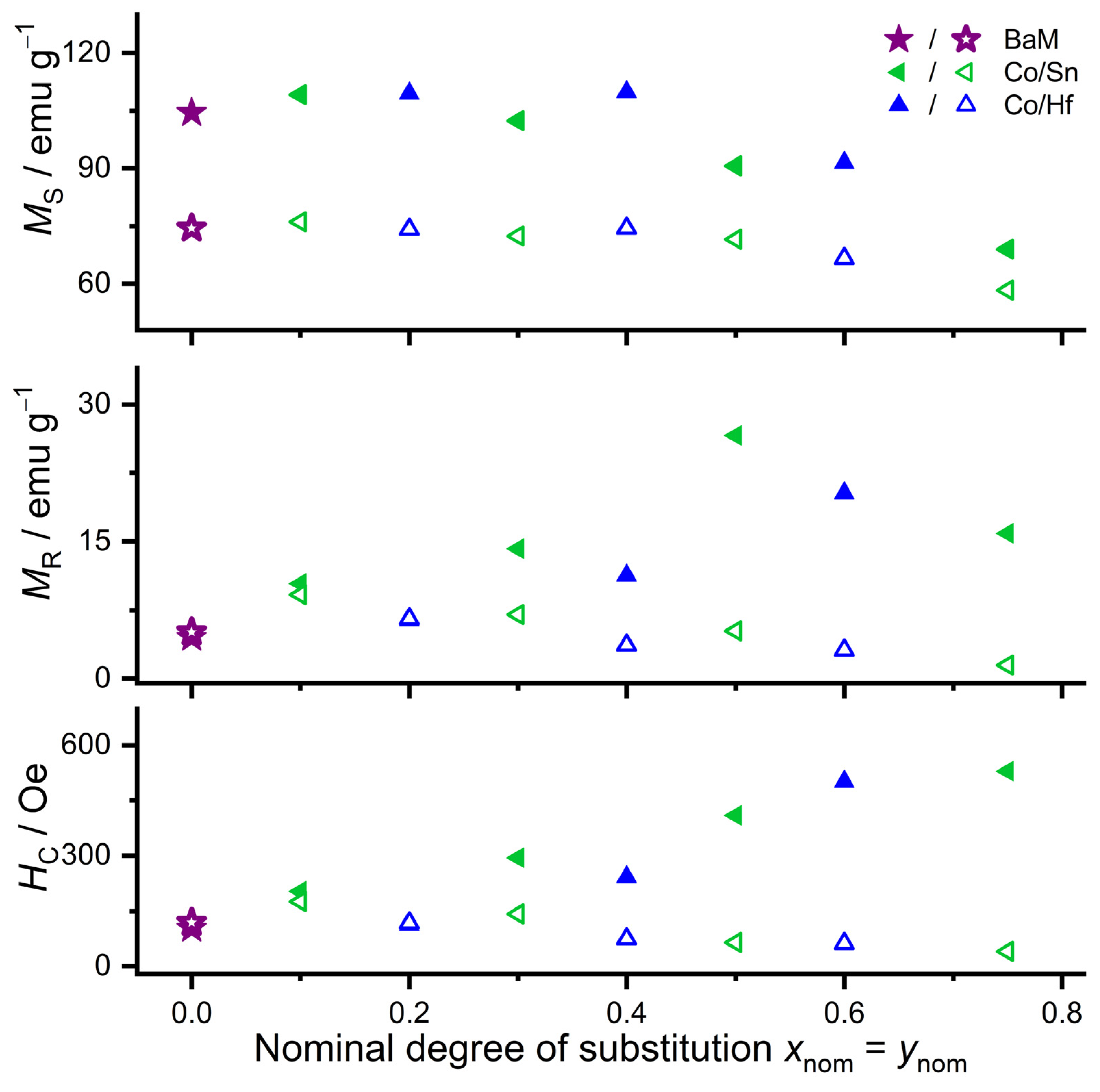
As discussed in the previous paragraph, the synthesis of cobalt-substituted ferrites resulted in the increased formation of secondary phases with rising level of substitution, which limits the number of samples suitable for investigation of the magnetic properties of the M-type phases. Magnetic measurements of the Co/Zr series were therefore entirely omitted, as only the CoZr(1) sample (xnom = ynom = 0.10) could be obtained in a single phase, precluding any meaningful analysis of trends in the magnetic parameters. For all other samples identified as single-phase by powder X-ray diffraction, hysteresis curves were recorded including unsubstituted BaFe12O19, as shown in Figures S21–S25. Figure 4 presents the magnetic parameters MS, MR and HC derived from these hysteresis measurements as a function of the nominal substitution level for 27 °C and −270 °C.
Figure 4.
Magnetic parameters of CoSn(1)–CoSn(4) (green) and CoHf(1)–CoHf(3) (blue) in comparison with unsubstituted BaM (purple) plotted against the nominal degree of substitution xnom = ynom. The filled symbols represent the measurement data at −270 °C while the open symbols indicate the measurements at 27 °C.
It can be observed that the values of the saturation magnetization remain nearly constant at the level of the unsubstituted ferrite for all samples with xnom = ynom ≤ 0.4. For both Co/Sn- and Co/Hf-substituted ferrites, a decrease in MS is observed at higher substitution levels at both temperatures. Similarly, Gao et al. reported constant to slightly increasing values of MS, as well as MR and HC, for x ≤ 0.15 in SrFe12−2xCoxSnxO19 [11]. This behavior is also confirmed in the present study, where a slight increase in the magnetic parameters is observed at low substitution levels for both the Co/Sn and Co/Hf series. Although the magnetic properties of substituted hexaferrites depend on various parameters, this can most straightforwardly be explained by the preferred mixed occupancy of the Fe(4) site (4f2, spin down) by diamagnetic tetravalent cations. In addition, based on further studies, it can be assumed that cobalt is partially located on the Fe(4) site and/or the Fe(3) site (4f1), thereby replacing additional spin down Fe3+ ions [11]. At 27 °C, both the remanent magnetization and the coercive field decrease with increasing substitution level and approach zero. This trend is expected, as the increasing incorporation of diamagnetic ions into the crystal structure progressively disrupts the magnetic interactions. In contrast, at −270 °C, an increase in MR and HC with increasing substitution level is observed. This behavior can be attributed to the growing number of magnetic domains in combination with the reduced thermal energy required for spin reversal and has likewise been reported for related ferrite systems [14,15].
2.3. XAS Investigations
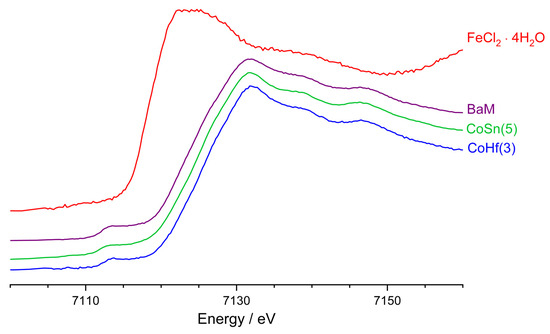
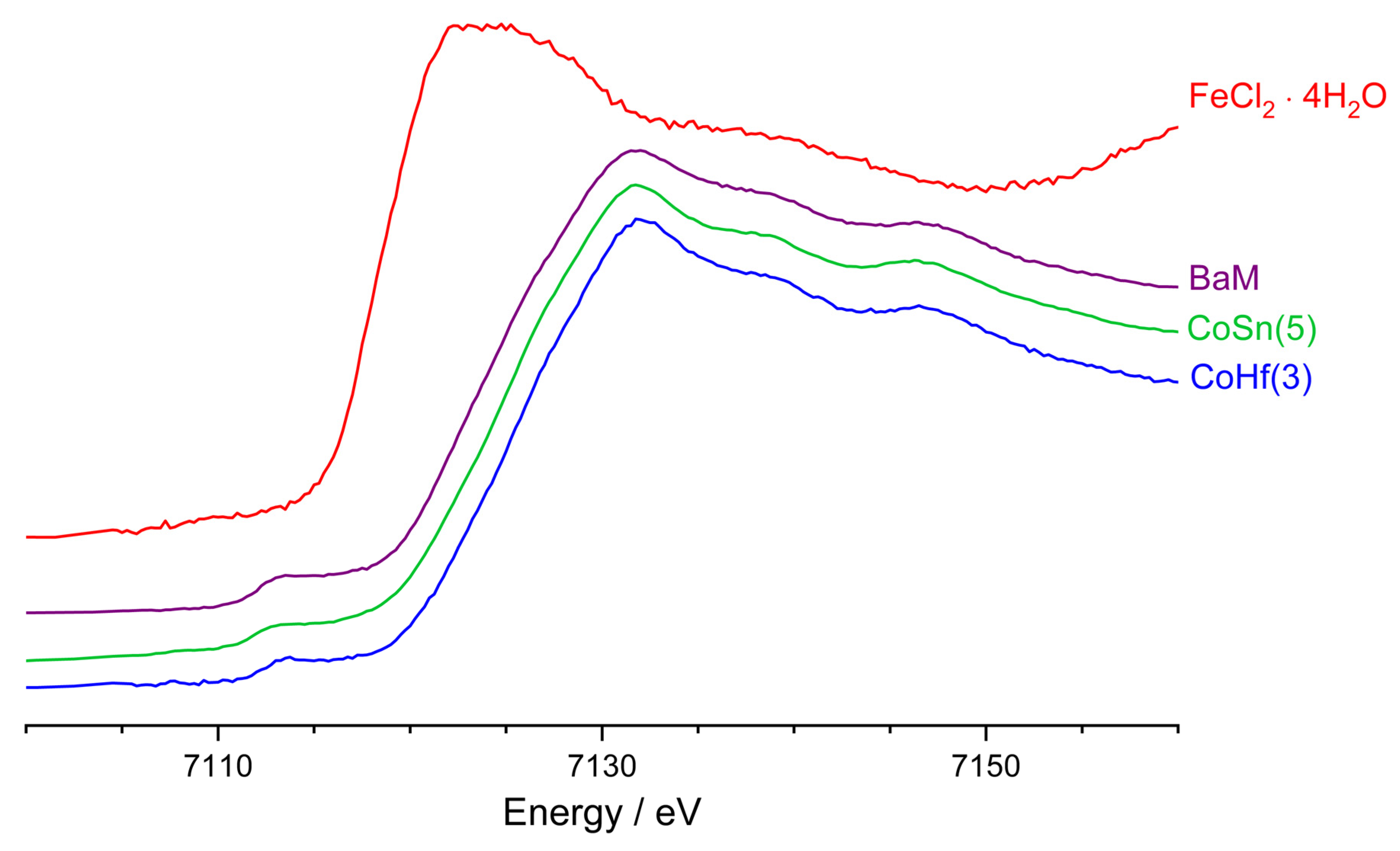
The series of Co-substituted ferrites BaFe12−x−yCoxMyO19 (M = Sn, Zr, Hf) offers a wide range of possible charge compensation mechanisms. In the simplest case, x equals y and charge neutrality is maintained by Co2+/M4+ substitution. However, an excess of the tetravalent cation relative to cobalt is also conceivable, which could be compensated, for example, by partial reduction in Fe3+ to Fe2+ or by the formation of vacancies on the transition metal sites. A combination of partial reduction and vacancy formation is likewise possible. In addition, cobalt may be partially oxidized during synthesis in air at 1300 °C, potentially substituting iron with isovalent Co3+. To gain insight into the prevailing charge compensation mechanisms, XANES spectra of the samples CoSn(5) and CoHf(3) were recorded at the Fe K-edge and compared with BaM and FeCl2·4H2O (see Figure 5). Due to the high number of secondary phases discussed in Section 2.1, particularly the formation of W-type ferrites in the Co/Zr-substituted samples, these were not investigated further by XANES. Measurement of Co K-edge XANES spectra was not feasible due to the relatively low cobalt content in the samples. Comparison of the Fe K-edge XANES spectra reveals no indication of Fe2+ within the experimental uncertainty with a lower detection limit of 5%. This suggests that the majority of cobalt is present as Co2+ and that either x ≈ y holds, or charge compensation is predominantly achieved via vacancy formation.
Figure 5.
Fe K-edge XANES spectra of CoSn(5) (green) and CoHf(3) (blue) compared to the spectra of FeCl2·4H2O (red) and BaM (purple).
2.4. Composition Determination via WDX
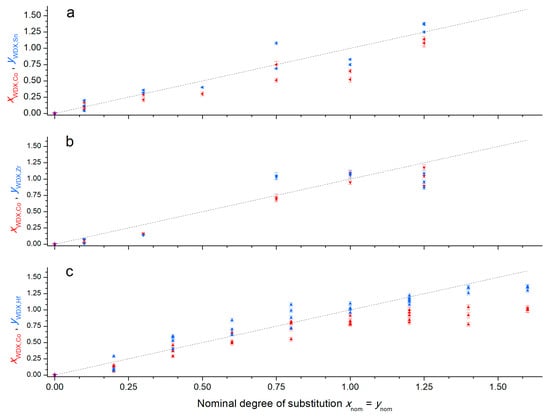
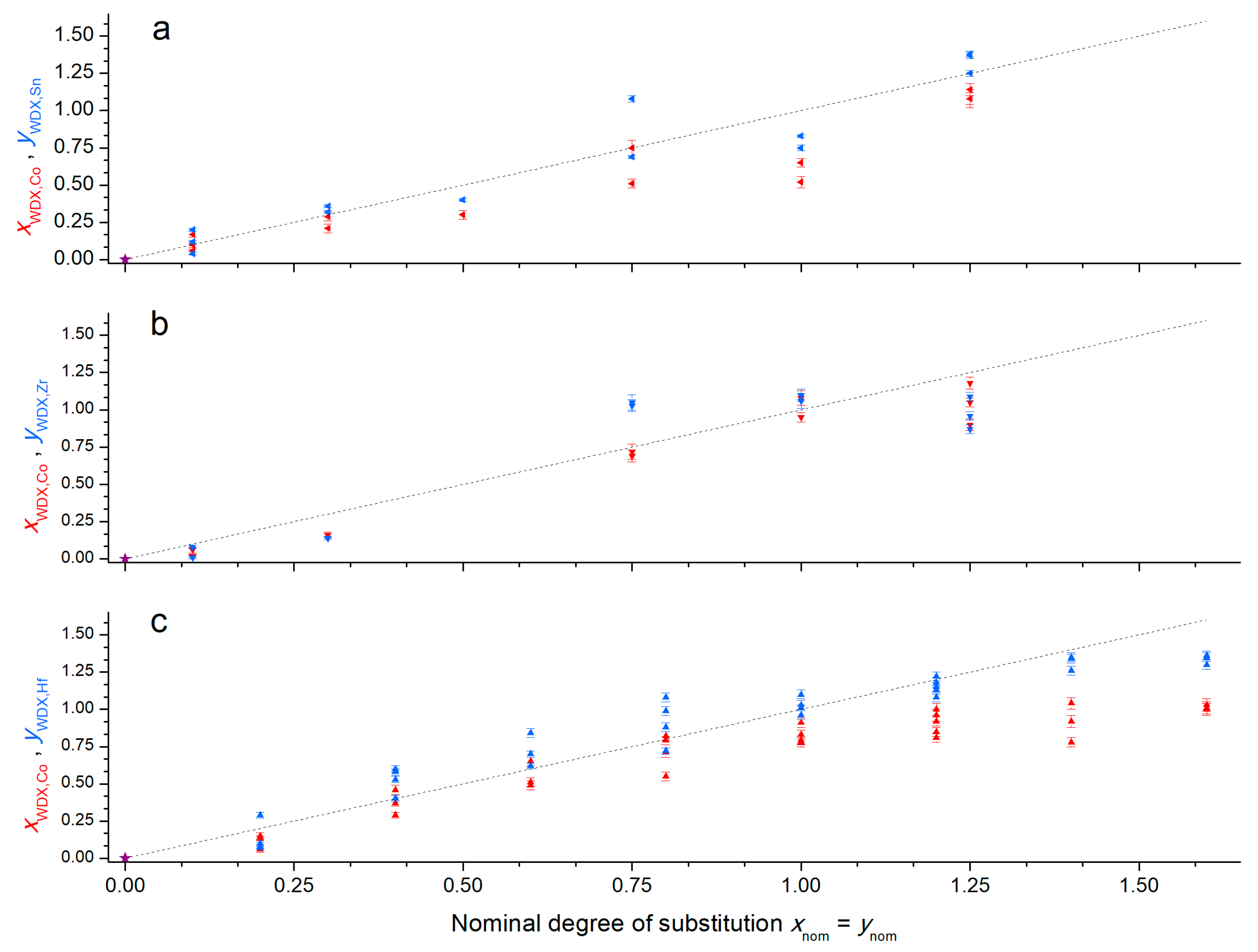
In the following, the composition of individual crystals is examined in more detail through wavelength dispersive X-ray spectroscopy (WDX), with particular emphasis on the atomic ratios of cobalt to the respective tetravalent cation. For each selected crystal, the composition was determined at 4–10 measurement points and averaged accordingly. The standard materials used for quantification are listed in Section 3. For the calculation of the oxygen content, it was assumed that the cations are present exclusively as Ba2+, Fe3+, Co2+, Sn4+, Zr4+ and Hf4+. When interpreting the results, it must therefore be considered that minor systematic errors may arise, as any Fe2+ and Co3+ potentially present are not taken into account, which may also lead to deviations between the calculated and actual oxygen content. The obtained elemental mass fractions are summarized in Table S4 for BaFe12−x−yCoxSnyO19, Table S5 for BaFe12−x−yCoxZryO19 and Table S6 for BaFe12−x−yCoxHfyO19. The results were normalized to the oxygen content and the corresponding fractions of iron, cobalt and the tetravalent cation are listed in Tables S7–S9. In addition, vacancy concentrations were calculated by subtracting the fractions of iron and the substituting metals from 12. Negative values of the vacancy concentration arise from measurement and normalization errors and are therefore interpreted as full occupancy of all sites. Figure 6 shows plots of the substitution degrees obtained from the WDX measurements as a function of the nominal target values. In some cases, multiple crystals from the same synthesis batch—i.e., with identical nominal substitution levels—were selected for the analysis, allowing for an assessment of the variation in x and y within a given sample.
Figure 6.
Degree of substitution obtained from WDX for (a) BaFe12−x−yCoxSnyO19, (b) BaFe12−x−yCoxZryO19, and (c) BaFe12−x−yCoxHfyO19 for tin/zirconium/hafnium (blue) and cobalt (red) versus nominal degree of substitution (pure BaM in purple). The dashed line represents the ideal progression for xWDX, yWDX = xnom = ynom and is intended as a guide for the eye.
Considering first the series of Co/Sn-substituted ferrites shown in Figure 6a, it is evident that the measured substitution degree generally increases with nominal degree and remains rather close within the range depicted. The calculated tin content in the samples is consistently slightly higher than the cobalt content. It can also be observed that the measured cobalt content is typically somewhat lower than the nominal value, which is likely attributable to the formation of cobalt-containing secondary phases during synthesis, which are typically removed upon post-treatment. The maximum substitution degrees observed in the WDX measurements were xWDX,Co = 1.14(4) for cobalt and yWDX,Sn = 1.38(2) for tin. However, based on the available data, no plateau indicative of reaching a substitution limit can be identified. It can therefore be assumed that even higher substitution degrees may be achievable.
Drawing conclusions about the evolution of the substitution degree in Co/Zr-substituted ferrites presented in Figure 6b is considerably more challenging, as fewer crystals suitable for WDX analysis could be identified. In particular, the formation of significant amounts of W-type ferrites, as already discussed in Section 2.1, hindered the targeted selection of M-type crystals. The measured substitution degree for cobalt follows the nominal value relatively closely and is only slightly lower. In combination with zirconium, however, a tendency toward a plateau can still be discerned. The maximum observed substitution degrees were xWDX,Co = 1.18(4) and yWDX,Zr = 1.10(4), with cobalt exhibiting a slightly higher maximum degree of substitution than zirconium. This may be interpreted as an indication that a small fraction of cobalt is present as Co3+ in the ferrite. In contrast, clear trends are observed for the Co/Hf-substituted ferrites shown in Figure 6c. Up to xnom = ynom = 1.0, the measured substitution degrees roughly follow the nominal values, after which a distinct flattening is evident. While the cobalt and hafnium contents are still very similar at low substitution levels, an increasing excess of hafnium in the ferrite becomes apparent for xnom = ynom ≥ 0.6. The maximum substitution degree determined for cobalt was xWDX,Co = 1.04(4), which is slightly lower than in the Co/Sn- and Co/Zr-substituted ferrites. For hafnium, a maximum value of yWDX,Hf = 1.36(3) was obtained, which is similar to the value observed for tin in the Co/Sn system.
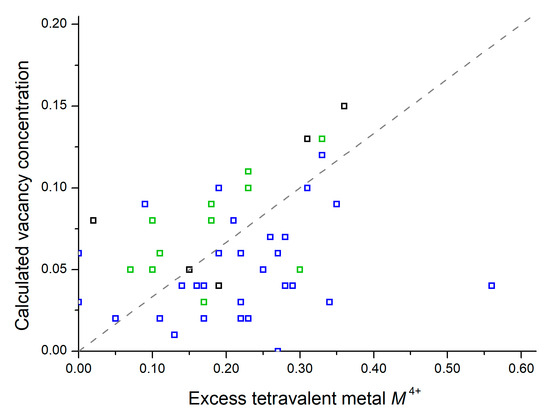
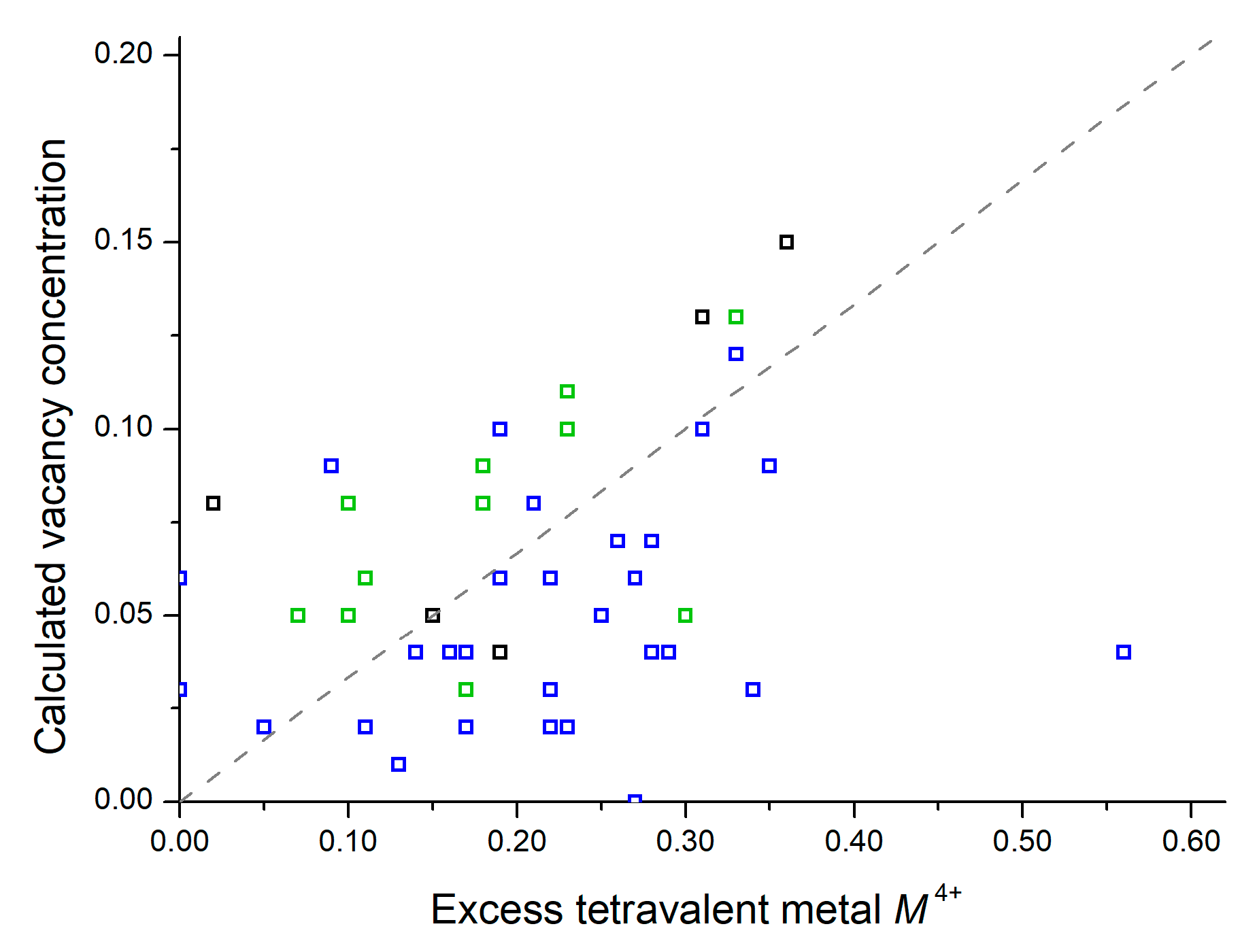
Since in many cases a higher fraction of the tetravalent cation compared to cobalt was observed, the possibility of vacancy formation as a charge compensation mechanism is considered next. Figure 7 shows a plot of the calculated vacancy concentration as a function of the excess of the tetravalent cation (yM4+ − xCo2+). The dashed line represents the ideal trend expected if charge compensation were achieved entirely by vacancies on the transition metal sites. Although the calculated vacancy concentrations □WDX appear to lie predominantly along this line, the data must be treated with considerable caution. Not only are the vacancy concentrations in the order of the experimental uncertainty, but additional inaccuracies may arise from the calculation of the oxygen content and the normalization of the data. As a result, the absolute values of the metal fractions are likely subject to minor systematic errors. Assuming that cobalt is present exclusively as Co2+ may lead to an underestimation of the oxygen content, whereas assuming that iron is present solely as Fe3+ may result in an overestimation. Depending on the actual fractions of Co3+ and Fe2+ present, these normalization errors could partially compensate each other. Since both the Fe2+ content and the number of vacancies required for charge compensation in Co-substituted ferrites are expected to be very small, no definitive conclusion regarding the dominant charge compensation mechanism can be drawn from the XAS and WDX measurements.
Figure 7.
Vacancy concentrations calculated from WDX measurements plotted against the excess (yM4+ − xCo2+) of the tetravalent metal (green—Sn; black—Zr; blue—Hf). The dashed line represents the ideal progression for exclusive charge balance by formation of vacancies and is intended as a guide for the eye.
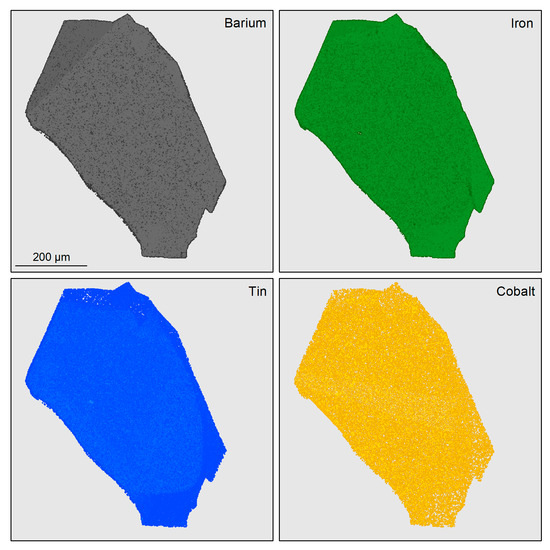
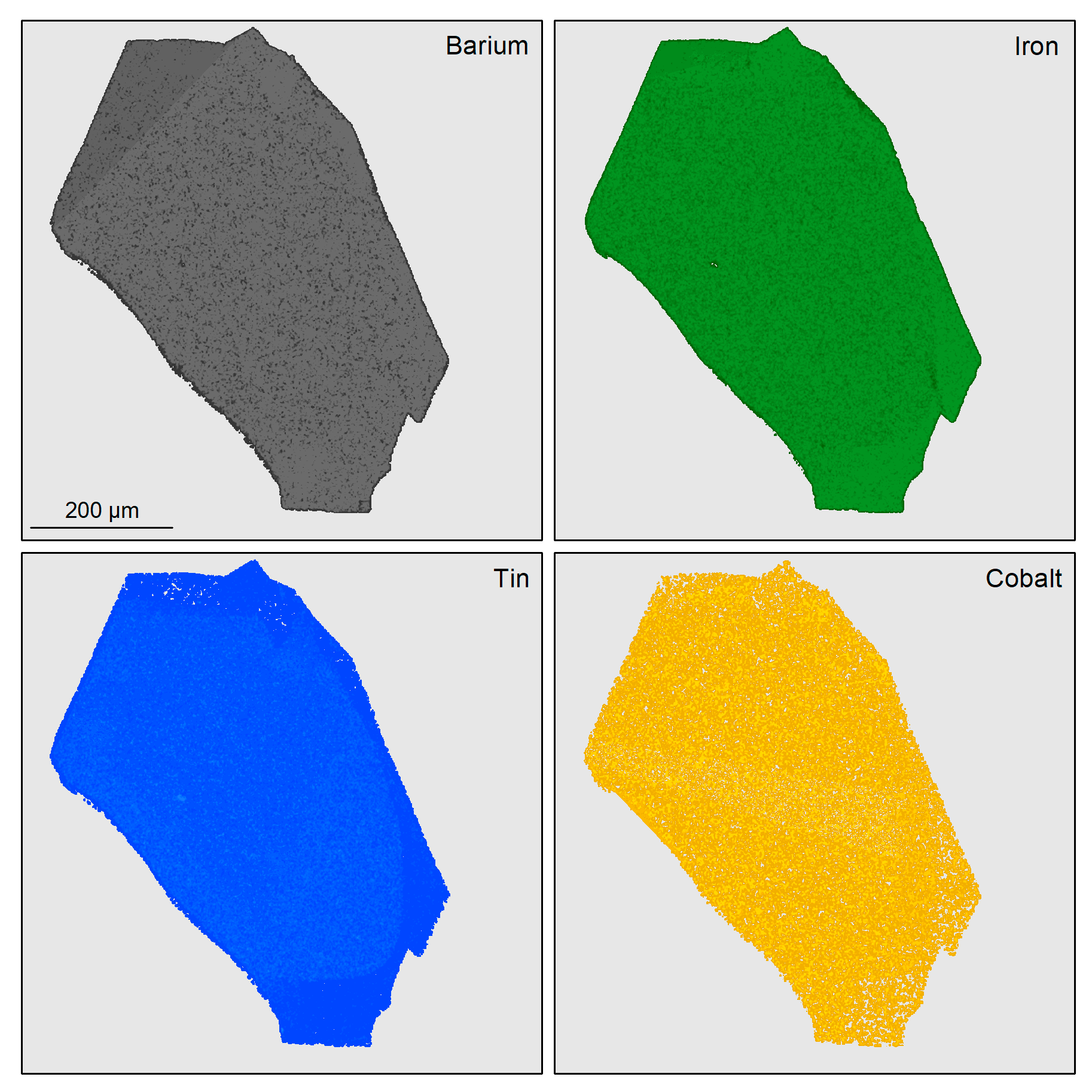
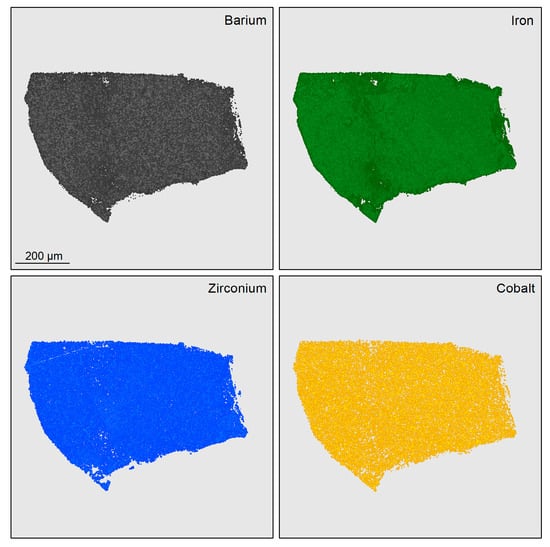
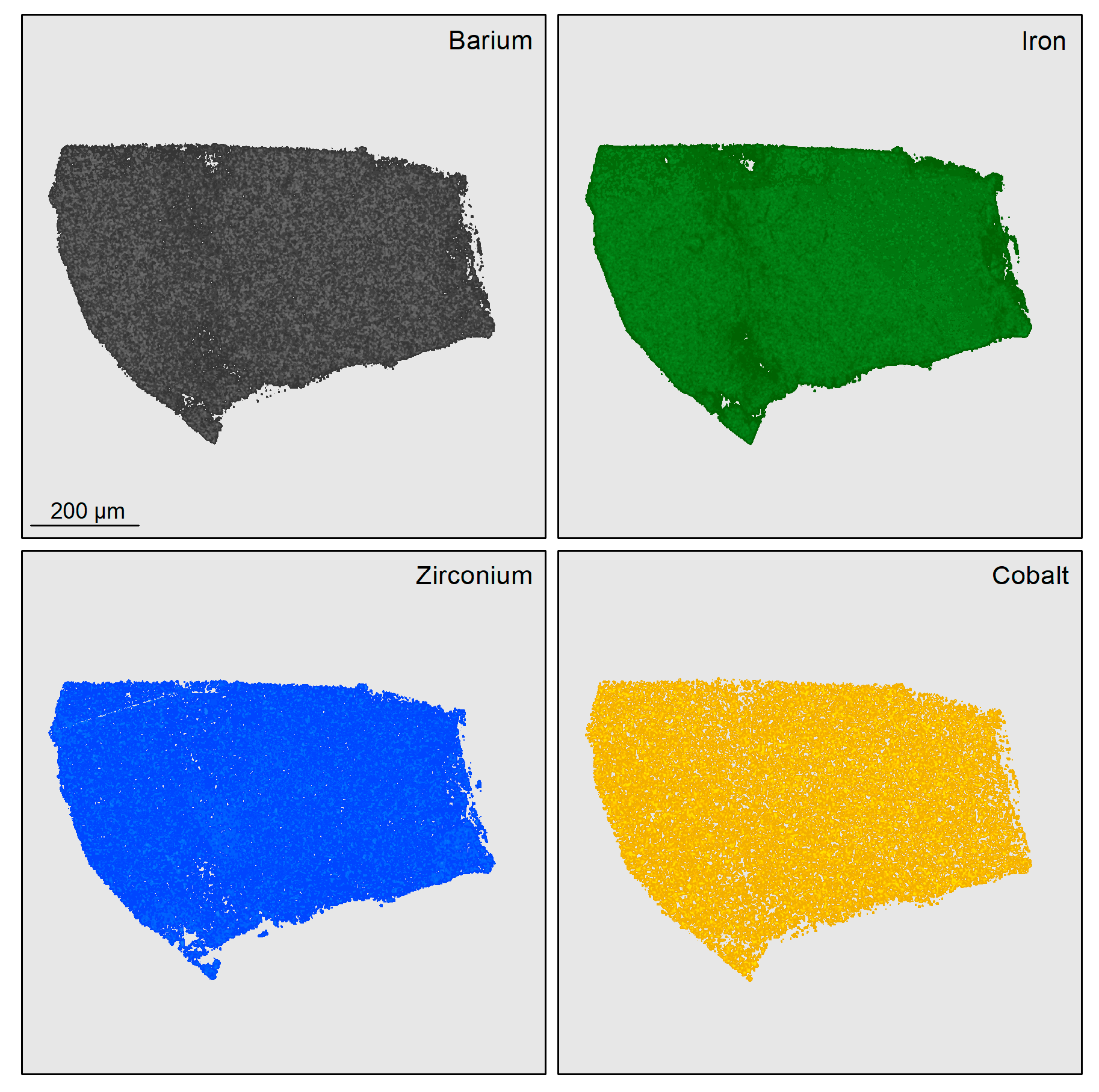
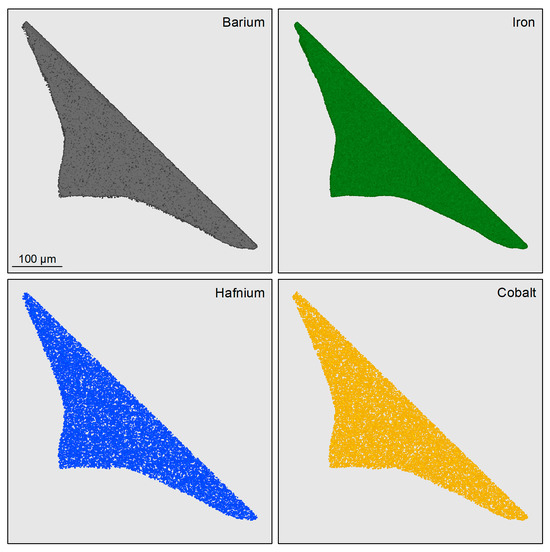
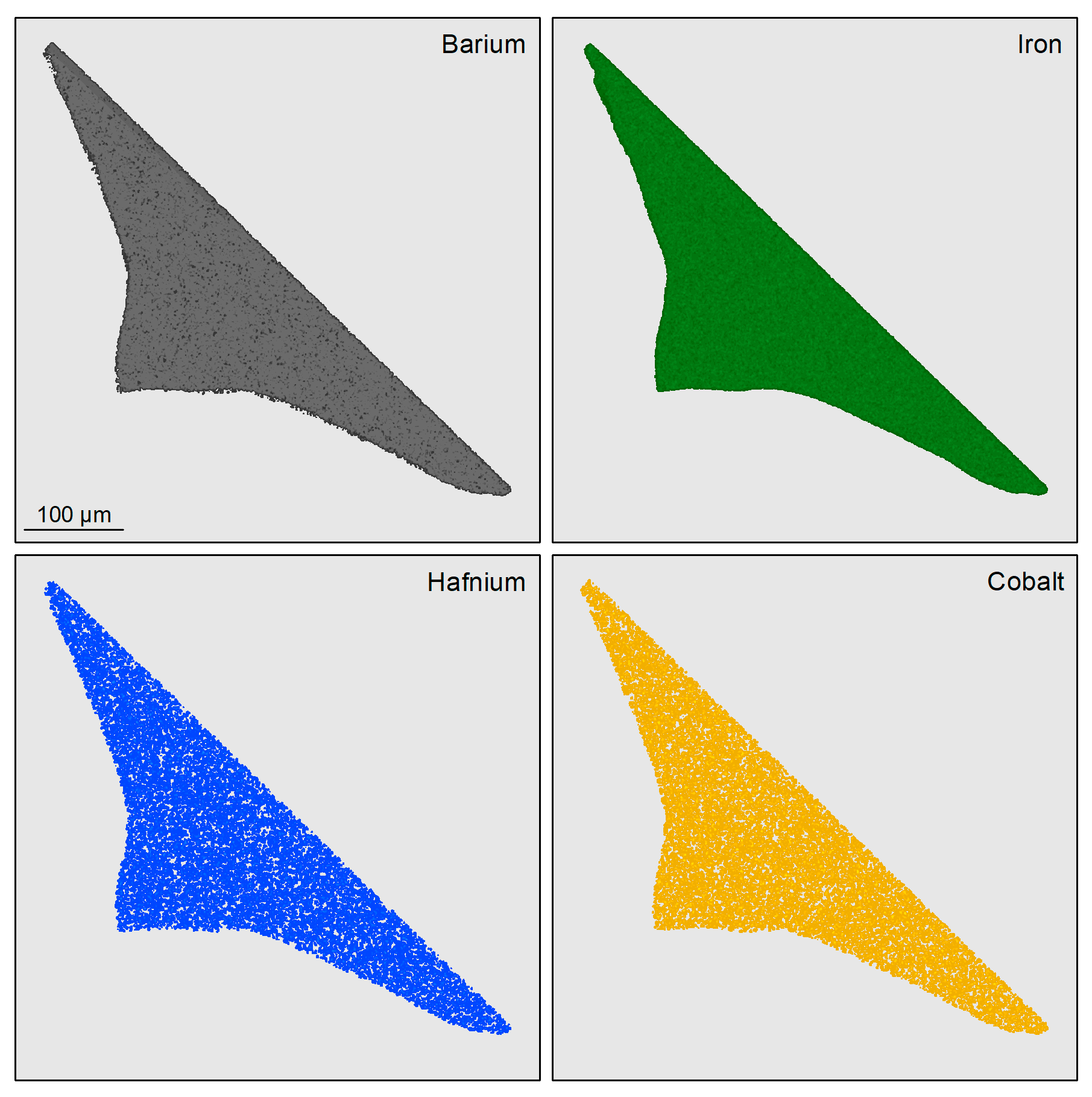
Finally, the distribution of cations on the crystal surface was examined to ensure that the substituting metal ions do not accumulate locally at specific regions, which could otherwise bias the calculated empirical formulas. Figure 8, Figure 9 and Figure 10 show elemental mappings for one representative crystal from each of the Co/M4+ series (M = Sn, Zr, Hf). For all three crystals, a homogeneous distribution of all elements across the crystal surface is observed. This indicates that no significant elemental segregation occurs on the micrometer scale and supports the conclusion that the derived empirical formulas are independent of the specific measurement position on the crystal surface, yielding consistent compositional results throughout the investigated areas.
Figure 8.
EDX maps of the crystal CoSn(6)sc2 for barium, iron, tin and cobalt.
Figure 9.
EDX maps of the crystal CoZr(5)sc1 for barium, iron, zirconium and cobalt.
Figure 10.
EDX maps of the crystal CoHf(1)r1 for barium, iron, hafnium and cobalt.
2.5. Influence of Substitution on the Crystal Structure
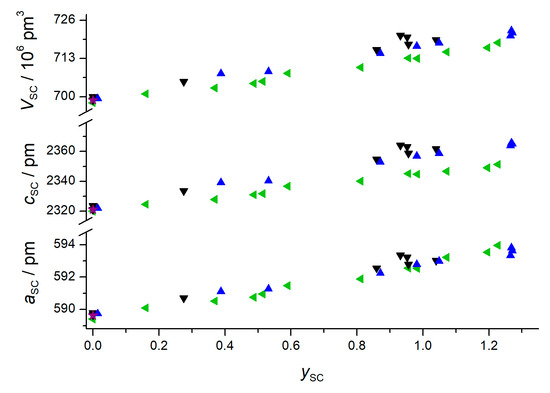
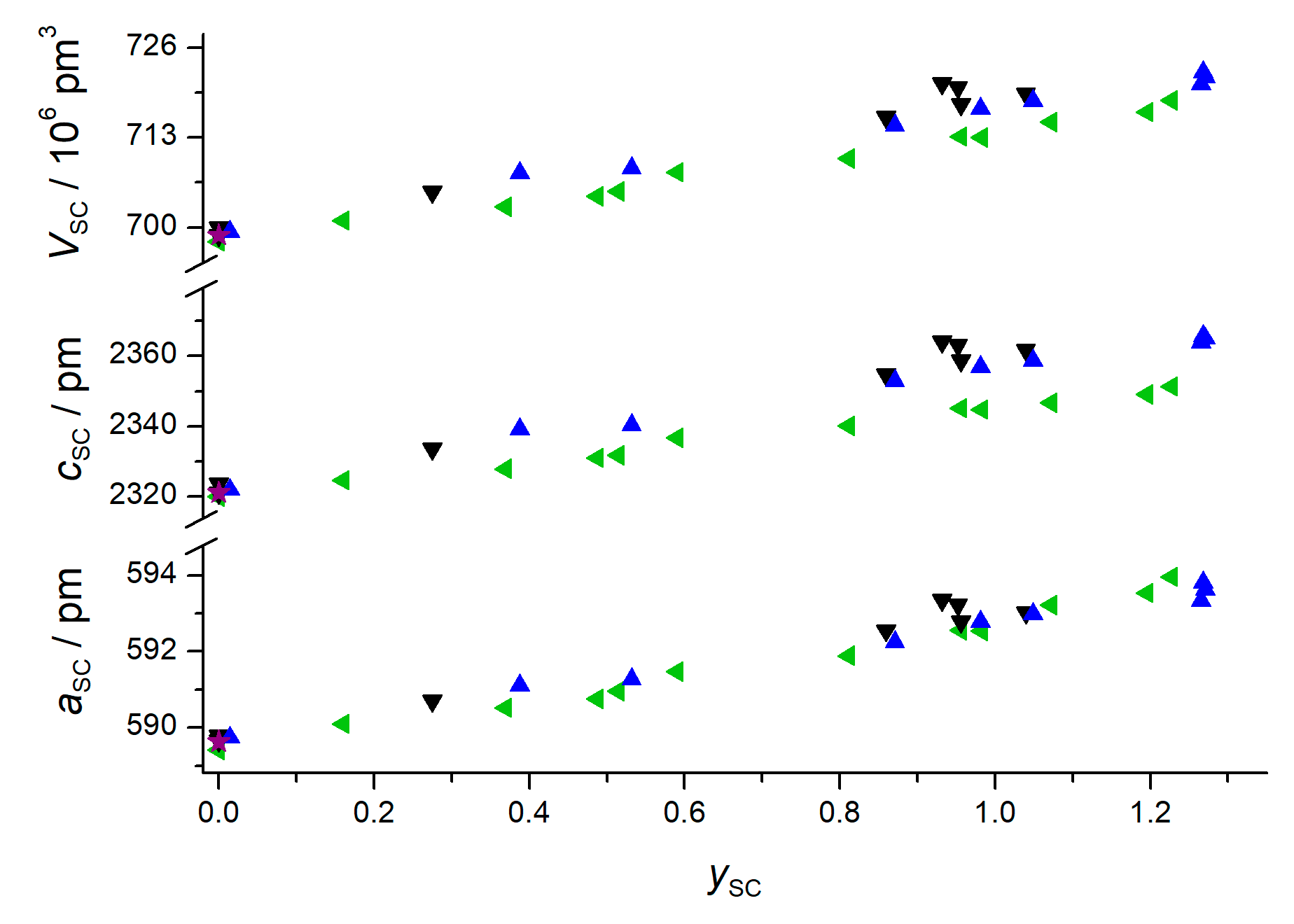
Some of the crystals previously analyzed through WDX were additionally used for single-crystal X-ray diffraction (SCXRD) experiments. Figure 11 shows the variation in the unit cell parameters as a function of the degree of substitution of the tetravalent metals, as determined from the structure refinements. A mixed occupancy of the iron sites with cobalt was not considered during the structure refinements, due to the very similar X-ray scattering factors of these two elements. The tetravalent cations could be unambiguously assigned to the Fe(4) site (4f2) based on the electron density distribution. For all three series, an almost linear increase in the unit cell parameters is observed for the individual crystals with increasing degree of substitution, consistent with the trend obtained from Rietveld refinement of PXRD data on microcrystalline powders (see Section 2.1). Overall, the obtained values for cSC,Sn and VSC,Sn are slightly lower than the corresponding values for the co-substituted ferrites containing zirconium and hafnium. This can be explained by the smaller effective ionic radius of Sn4+ (69 pm) compared to Zr4+ (72 pm) and Hf4+ (71 pm). The maximum substitution level observed for crystals of the Co/Sn series was ySC,Sn,max = 1.23(1) based on SCXRD data, yPXRD,Sn,max = 1.12(2) from PXRD data and yWDX,Sn,max = 1.38(2) from WDX measurements. It should be noted that only the WDX analysis explicitly accounts for the cobalt content. Therefore, these values are considered the most reliable. The apparent underestimation of the tin content in the X-ray diffraction data may indicate that a minor fraction of tin is located on sites other than Fe(4) (4f2). However, refinement of the site occupancies for the remaining iron positions did not provide any evidence supporting this assumption. It is also possible that a small fraction of the charge compensation in BaFe12−x−yCoxSnyO19 is realized via vacancies, which may likewise be located on the Fe(4) site (4f2). Such an arrangement could be structurally favored, as the Fe(4) position features pairs of face-sharing octahedra. In a simplified local picture, vacancies could be prone to pair in one of these octahedra with the larger tin ion with the higher +4 charge in the second octahedron. Overall, this would lead to an underestimation of the tin content in the structure within the applied structural model for refinement. Since both WDX and SCXRD analyses were performed on selected single crystals and measurements with both methods were not always carried out on the same crystal, it is also possible that no crystal with a correspondingly high degree of substitution was selected for SCXRD. In contrast, the substitution degree derived from PXRD data represents an average over a large number of crystallites. This suggests a broader distribution of substitution levels within a given batch, with less substituted crystals generally exhibiting superior growth behavior and therefore being preferentially formed.
Figure 11.
Unit cell parameters aSC and cSC and unit cell volume VSC, derived from SCXRD data for BaM (purple), Co/Sn- (green), Co/Zr- (black) and Co/Hf-substituted samples (blue) plotted as a function of the degree of substitution ySC of the tetravalent cations obtained from the corresponding structure refinements.
For Co/Zr-substituted ferrites, maximum substitution levels of ySC,Zr,max = 1.04(5) from SCXRD data, yPXRD,Zr,max = 1.73(7) from PXRD data and yWDX,Zr,max = 1.10(4) from WDX measurements were observed. The values obtained from single-crystal and WDX analyses are in good agreement, whereas the PXRD-derived value represents a clear outlier, significantly exceeding both the results of the other methods and the nominal target substitution level. However, as discussed in Section 2.1, the samples with high nominal substitution were consistently multiphase. The coexistence of M-, W- and X-type ferrite phases, which show very similar reflection positions, renders both the determination of substitution levels and phase fractions challenging. Thus, these values should be interpreted with caution.
For Co/Hf-substituted ferrites, maximum substitution levels of ySC,Hf,max = 1.27(1) from SCXRD data, yPXRD,Hf,max = 1.23(1) from PXRD data and yWDX,Hf,max = 1.36(3) from WDX measurements were determined. Here, the results are in close agreement, likely because hafnium can be readily distinguished from iron in XRD due to its significantly higher scattering power, enabling a more precise quantification. As already noted in the discussion of the WDX results (see Section 2.4), the maximum substitution levels of tin and hafnium are similar, whereas zirconium is incorporated to a somewhat lesser extent into the M-type structure.
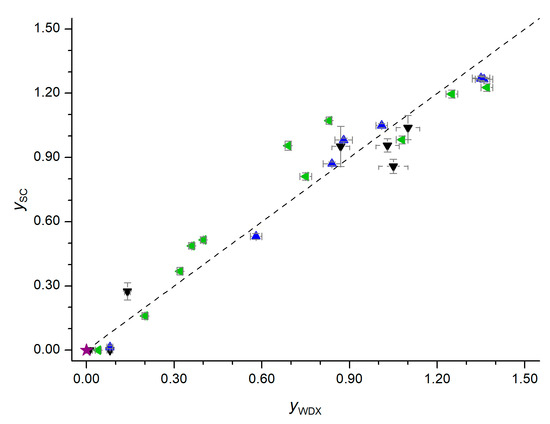
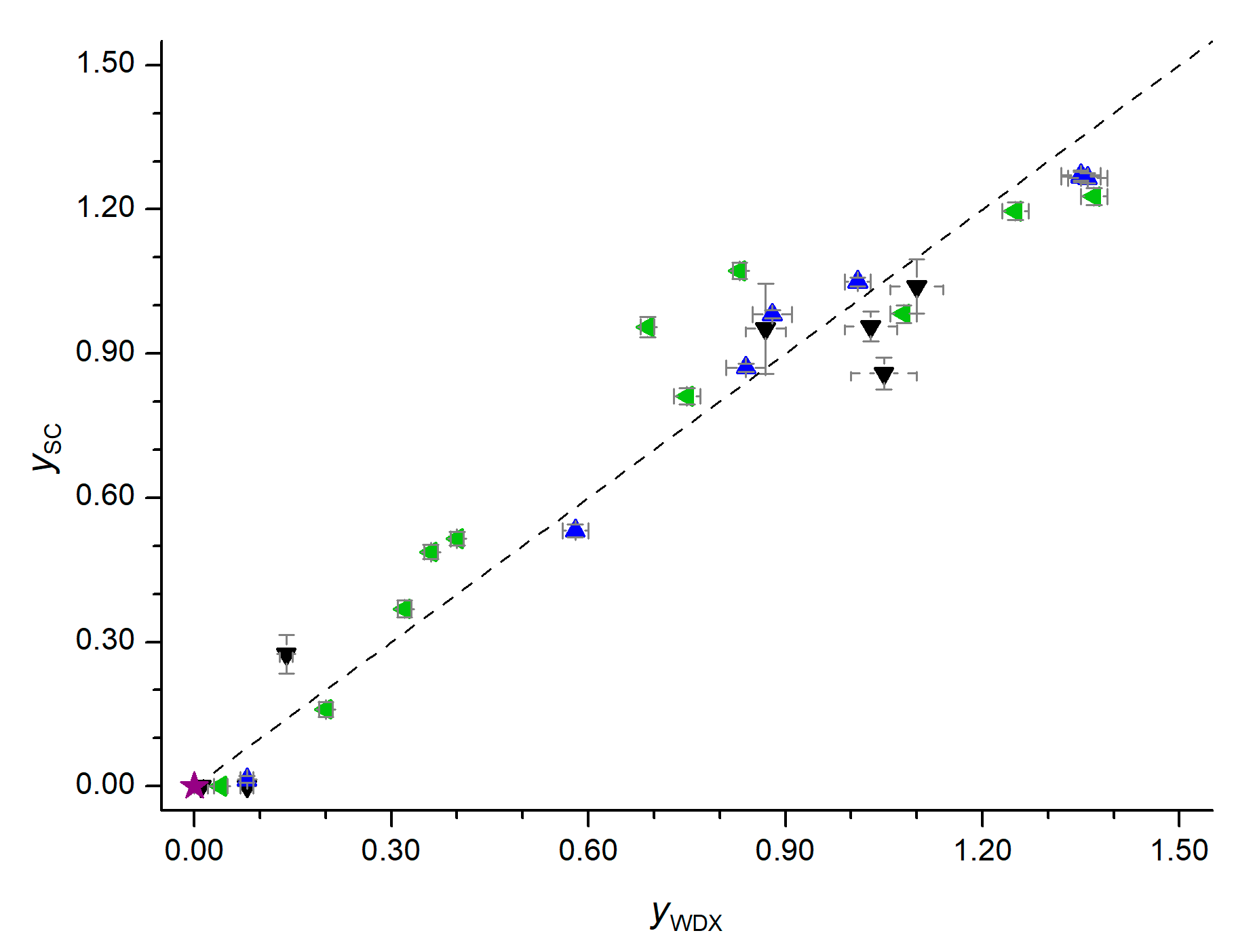
Figure 12 presents a comparison of substitution levels obtained from SCXRD and WDX measurements on the same crystal. As noted above, the yM4+ values (M = Sn, Zr, Hf) determined by both methods are very similar. This further suggests that, in the case of Co/Sn-substituted ferrites, no single crystal with the maximum achievable degree of substitution was selected for the SCXRD analysis.
Figure 12.
Substitution levels of the tetravalent cations tin (green), zirconium (black) and hafnium (blue) refined from SCXRD data, compared with the corresponding degree of substitution obtained from WDX measurements on the same crystals (pure BaM in purple). The dashed line serves as a guide to the eye for the ideal correlation where ySC = yWDX.
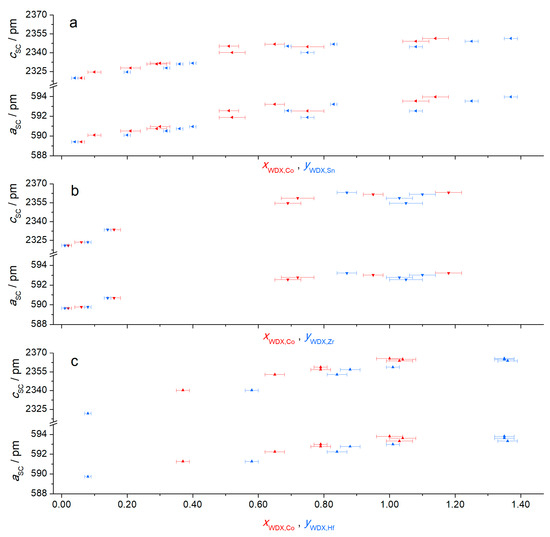
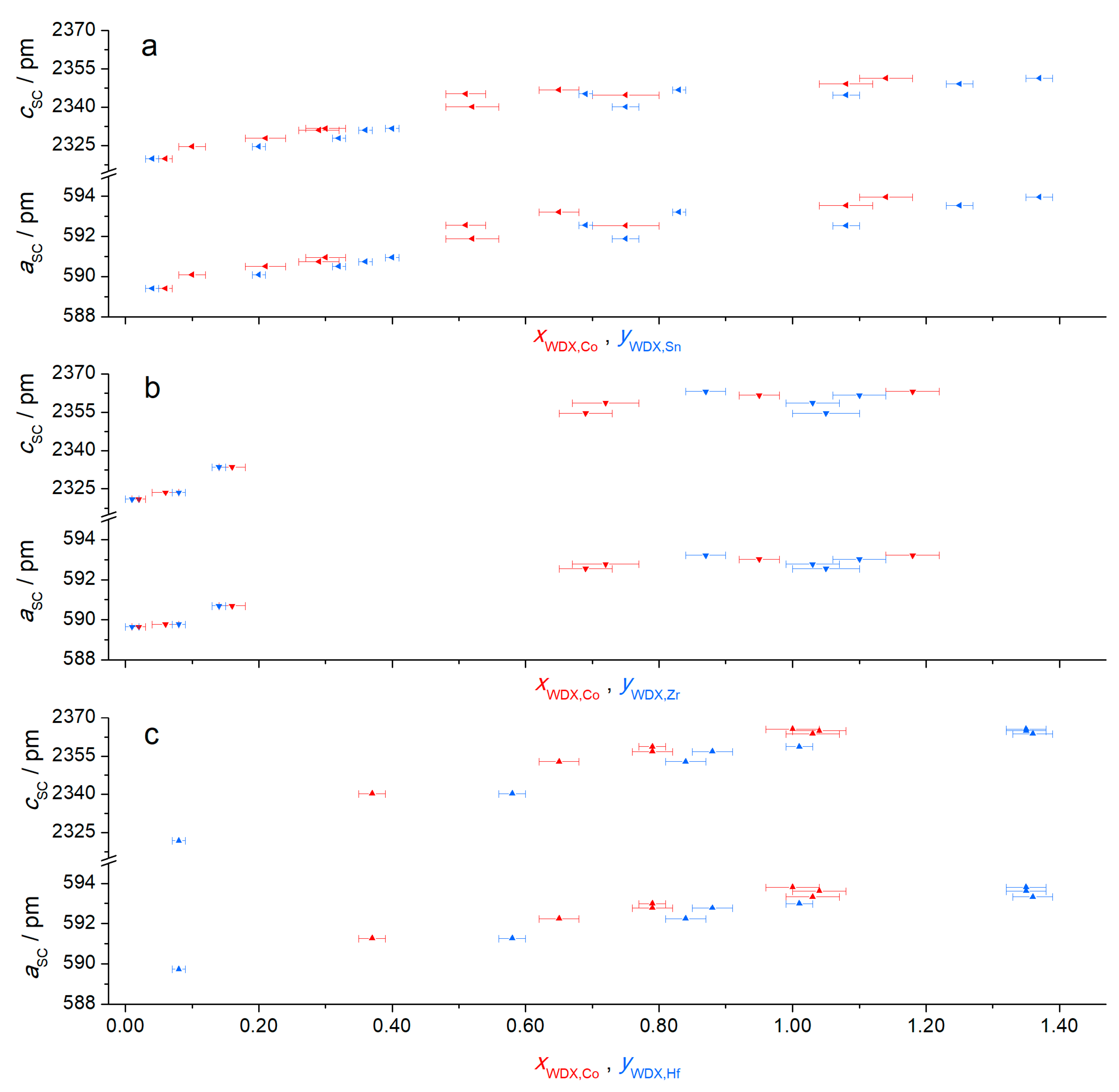
In addition, the lattice parameters obtained from SCXRD were plotted as a function of the substitution levels determined by WDX, as shown in Figure 13a for BaFe12−x−yCoxSnyO19, Figure 13b for BaFe12−x−yCoxZryO19 and Figure 13c for BaFe12−x−yCoxHfyO19. These results confirm the previously proposed assumptions that, for the Co/Sn-substituted ferrites, the substitution limit has not yet been reached, whereas for the other two series a clear tendency toward saturation is observed, as indicated by a flattening in the increase in the lattice parameters.
Figure 13.
Unit cell parameters aSC and cSC for (a) BaFe12−x−yCoxSnyO19, (b) BaFe12−x−yCoxZryO19, and (c) BaFe12−x−yCoxHfyO19 derived from SCXRD data plotted as a function of the substitution levels xWDX,Co (red) and yWDX,Sn/Zr/Hf (blue) obtained from WDX measurements. In total, four data points correspond to each individual crystal, and red and blue points at the same ordinate value represent the two lattice parameters of a given crystal. The uncertainties of the lattice parameters are smaller than the symbol size and are therefore not shown.
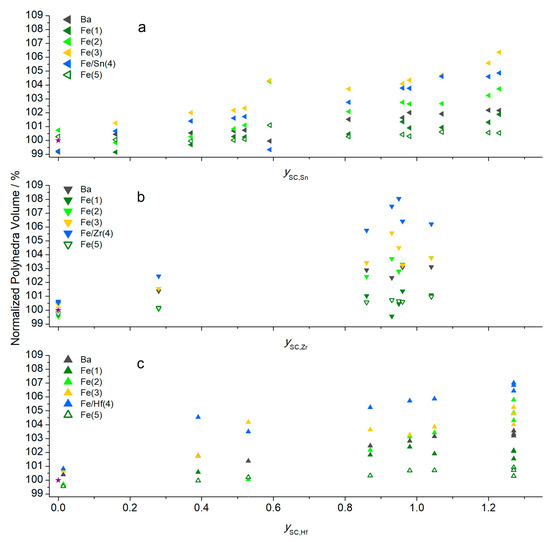
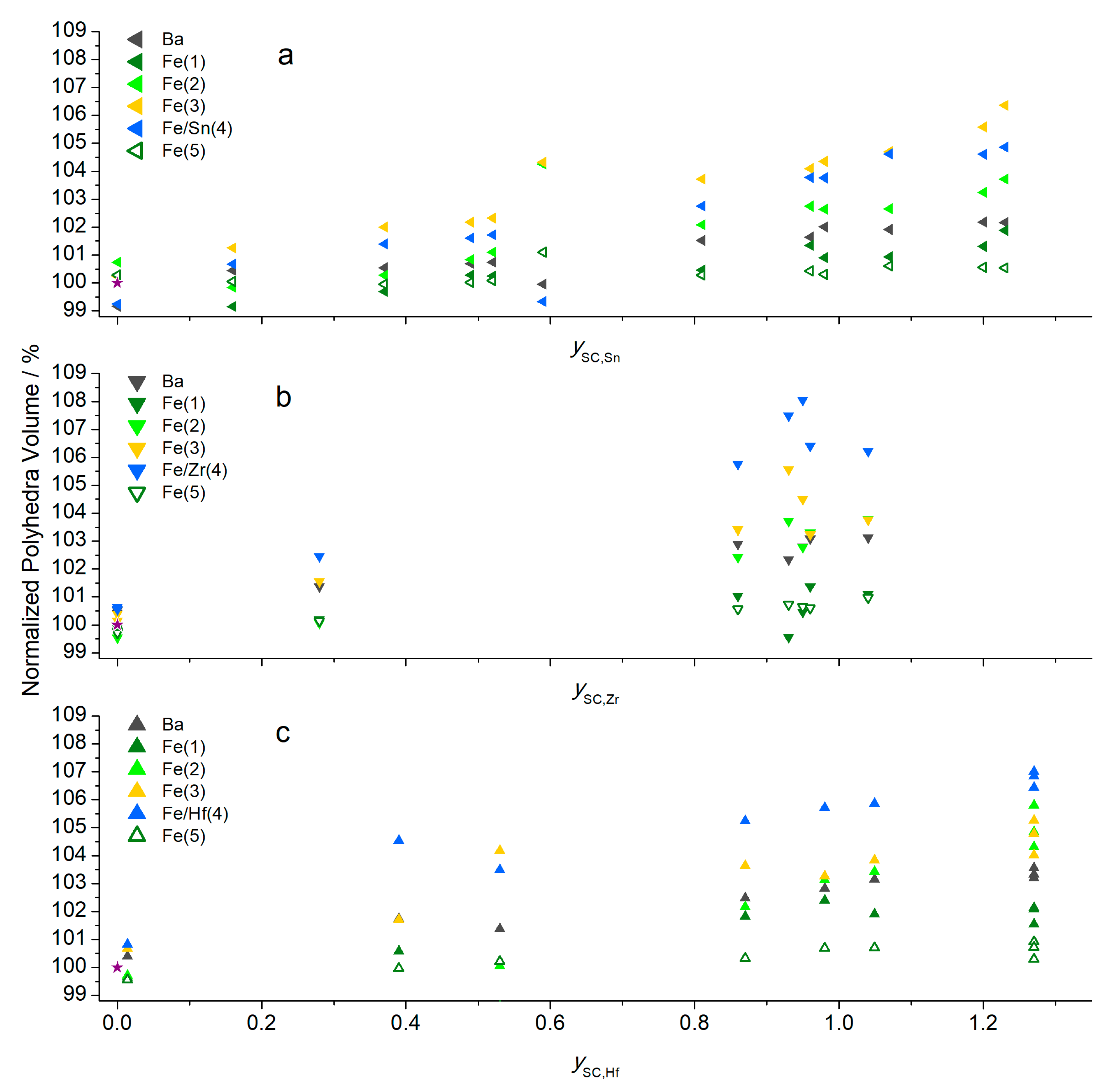
The following paragraph examines in more detail the effects of substitution on the individual coordination polyhedra. The polyhedra volumes were calculated using the program Polynator 1.7.1 [20] from the structural data obtained from refinements of the single-crystal X-ray diffraction (SCXRD) intensities and the resulting data were subsequently normalized to the polyhedra volumes of the unsubstituted BaM reference. Figure 14 presents the obtained relative volumes as a function of the substitution levels ySC,Sn/Zr/Hf, which were likewise determined by refinements of the SCXRD data. As noted previously, the tetravalent metals can be unambiguously assigned to the Fe(4) site (4f2). This assignment is further corroborated by the 5–8% larger polyhedra volumes surrounding Fe(4), observed consistently across all three substitution series. The magnitude of the increase is in agreement with the effective ionic radii [21], being smallest for Co/Sn and largest for Co/Zr. The polyhedra surrounding Ba and Fe(2), which are likewise located within the R-block, exhibit volume increases of 2–3.5% for Co/Sn and Co/Zr and up to 5.5% for Co/Hf in the case of the trigonal bipyramid surrounding Fe(2) (4e). This expansion is likely attributable to the enlargement of the adjacent face-sharing octahedral units centered at Fe(4) (4f2). In contrast, the volumes of the block-connecting octahedra surrounding Fe(5) (12k) increase by no more than 1%. This observation suggests that, contrary to the substitution at this site proposed by Batlle et al. [10], no significant mixed occupancy of Co2+ (high spin) and Fe3+ (high spin) occurs at this specific site. However, based on ionic radii considerations, a mixed occupancy involving low-spin Co2+ would be conceivable, as the corresponding radii are very similar (Co2+, low spin, 65 pm; Fe3+, high spin, 64.5 pm) and thus no substantial change in the polyhedra volumes would be expected. The tetrahedra surrounding Fe(3) (4f1) within the S-block show a volume increase of 4–6%, indicating that at least a fraction of Co2+ is likely located at this site, in agreement with [10] (Co2+, 58 pm; Fe3+, 49 pm). Based on the ionic radii, contributions of the larger Fe2+ would also be feasible; however, it is not expected to occur in tetrahedral coordination in M-type ferrites. Finally, the octahedra surrounding Fe(1) (2a) expand by up to 2%, which may either result from the expansion of the neighboring tetrahedra or point to minor substitution at this position.
Figure 14.
Normalized polyhedra volumes versus degree of substitution ySC,Sn/Zr/Hf for (a) BaFe12−x−yCoxSnyO19, (b) BaFe12−x−yCoxZryO19, and (c) BaFe12−x−yCoxHfyO19 obtained from SCXRD refinements (pure BaM in purple).
3. Materials and Methods
Hexaferrites with nominal compositions BaFe12−x−yCoxSnyO19 (CoSn(1)–CoSn(6)) and BaFe12−x−yCoxZryO19 (CoZr(1)–CoZr(6)) were synthesized using sodium carbonate as flux, with targeted degrees of substitution of xnom = ynom = 0.10, 0.30, 0.50, 0.75, 1.00, and 1.25. Appropriate molar amounts of BaCO3 (p.a., Roth, Karlsruhe, Germany), Fe2O3 (99.0%, Riedel-de Haën, Seelze, Germany), Co2O3 (p.a., Riedel-de Haën, Seelze, Germany), SnO2 (99.9%, Aldrich, St. Louis, MO, USA), ZrO2 (PSZ, Merck, Darmstadt, Germany) and 25 mol-% Na2CO3 (p.a., Honeywell, Charlotte, NC, USA) were thoroughly homogenized in an agate mortar and heated in air in a platinum crucible to 1300 °C over 10 h. The temperature was maintained for 36 h, followed by controlled cooling to 500 °C over 60 h. After switching off the furnace, the resulting products were washed with half-concentrated nitric acid and demineralized water to remove residual flux. For the series BaFe12−x−yCoxHfyO19 (CoHf(1)–CoHf(8)), eight samples with xnom = ynom ranging from 0.20 to 1.60 in increments of 0.20 were prepared using HfO2 (99.9%, Zr ≤ 0.5%, Merck) as the hafnium source. The synthesis procedure was analogous to that employed for the Co/Sn- and Co/Zr-substituted systems. An unsubstituted BaFe12O19 sample (BaM) was additionally prepared as a reference.
Powder X-ray diffraction (PXRD) data were collected on a STADI P diffractometer (STOE & Cie GmbH, Darmstadt, Germany) using Mo-Kα1-radiation (λ = 70.930 pm) and a MYTHEN-1K detector (Dectris, Baden, Switzerland). Rietveld refinements were performed with TOPAS-Academic (Version V7.21) [22] to determine lattice parameters, average substitution levels and, for multiphase samples, approximate phase fractions. Preferred orientation effects were corrected using a model based on March [23].
Single crystals were isolated from nearly all samples and mounted in glass capillaries for single-crystal X-ray diffraction (SCXRD) measurements on a κ-CCD four-circle diffractometer (Bruker-Nonius, Karlsruhe, Germany) employing Mo-Kα radiation (λ = 71.073 pm). Structure solutions and refinements were carried out using SHELXL-2018/1 [24]. Polyhedral volumes were calculated with the Polynator software [20]. During refinement, full occupancy of all cation sites was assumed.
Chemical compositions were determined by wavelength dispersive X-ray spectroscopy (WDX) using an SX 100 electron microprobe (Cameca, Gennevilliers, France) equipped with a scanning electron microscope (SEM). Multiple crystals per sample, including those used for SCXRD, were analyzed. Prior to measurement, the samples were coated with a thin carbon layer to prevent charging. Quantification was performed using baryte BaSO4 (for Ba), hematite Fe2O3 (for Fe), CoO (for Co), cassiterite SnO2 (for Sn), zirconium Zr (for Zr) and hafnium Hf (for Hf) as standards.
Magnetic measurements were carried out on powders of single-phase samples using a SQUID magnetometer (MPMS3, Quantum Design, Pfungstadt, Germany). For hysteresis measurements at −270 °C and 27 °C, approximately 10–15 mg of sample were immobilized in a gelatin capsule with cotton wool, mounted on a plastic straw and inserted into the measurement chamber.
To probe the electronic states of iron, X-ray absorption spectroscopy (XAS) at the Fe K-edge (7112 eV) was performed using an easyXAFS300+ spectrometer (easyXAFS, Renton, WA, USA) equipped with a KETEK AXAS silicon drift detector (Munich, Germany) and an Ag-anode X-ray source (20 kV, 12 mA), utilizing the (440) harmonic of Si(110). Spectra were recorded with an exposure time of 15 s per point and averaged over 10 scans. The samples were prepared by grinding 20–30 mg of microcrystalline powder and mounting the material between X-ray amorphous adhesive tapes. Data analysis was conducted using the Demeter software package [25] and oxidation states were evaluated by comparison with reference compounds (FeCl2·4H2O, BaFe12O19) measured under identical conditions. The energy scale was calibrated using an iron foil standard.
4. Conclusions
In this work, M-type ferrites of the composition BaFe12−x−yCoxMyO19 with M = Sn, Zr, Hf synthesized via Na2CO3 flux were investigated in detail. In particular, for the Co/Zr-substituted ferrites, the formation of secondary phases was observed already at relatively low nominal substitution levels, for example in the form of W-type or X-type ferrites. Across all three series, unreacted starting materials (predominantly Fe2O3) were also detected. The coexistence of multiple ferrite phases within a single sample renders an unambiguous characterization of the intrinsic properties of the Co/Zr-substituted M-type ferrite by XANES or magnetic measurements unfeasible. For both Co/Sn- and Co/Hf-substituted ferrites, decreasing values of the saturation magnetization MS, remanence MR and coercive field HC are observed at room temperature with increasing nominal substitution level. In contrast, at low temperatures, an increase in remanence and coercivity is evident.
The evolution of the lattice parameters derived from single-crystal and powder XRD data shows an increase with increasing substitution level for all series, indicating successful incorporation of the substituents into the structure. For Co/Sn, maximum substitution levels of xWDX,Co,max = 1.14(4) and 1.12(2) ≤ ySn,max ≤ 1.38(2) were obtained, with the upper limit derived from WDX measurements. The determination of the cobalt content from PXRD or SCXRD data is not feasible due to the similar scattering powers of cobalt and iron. Therefore, WDX data are considered the most reliable. However, the evolution of the lattice parameters as a function of the degree of substitution suggests that the upper substitution limit for Co/Sn has not yet been reached within the scope of this study. For Co/Zr-substituted ferrites, maximum degrees of substitution of xWDX,Co,max = 1.18(4) and 1.04(5) ≤ yZr,max ≤ 1.73(7) were observed. The upper limit, obtained from Rietveld refinements, must be treated with caution, as W-type and X-type ferrites were present simultaneously. Due to the similar block-stacking sequences of these ferrites and the M-type phase, many reflections overlap, complicating the accurate determination of substitution levels. It is therefore likely that the true substitution limit lies in the narrower range of 1.04(5) ≤ yZr,max ≤ 1.10(4). In the case of Co/Hf-substituted ferrites, values of xWDX,Co,max = 1.04(4) and 1.23(1) ≤ yHf,max ≤ 1.36(3) were determined. The variation in hafnium content obtained from different methods is significantly smaller than that for tin and zirconium likely due to the large differences scattering power between hafnium and iron.
Overall, a slightly higher proportion of the tetravalent metal compared to cobalt is generally incorporated into the ferrite structure. XANES measurements at the Fe K-edge revealed no indication of significant amounts of Fe2+. Likewise, WDX data did not show a clear trend indicating the formation of vacancies for charge compensation. However, the charge imbalance introduced by the excess tetravalent cations in the cobalt-substituted ferrites is rather small, as the cobalt content is only slightly lower than the M4+ fraction. Consequently, the required concentration of vacancies and/or Fe2+ is likely too low to be reliably quantified within experimental uncertainty. Furthermore, SCXRD data provided no evidence for vacancies on transition metal sites. Nevertheless, the tetravalent cations could be unambiguously assigned to the Fe(4) site (4f2). Based on the pronounced increase in tetrahedra volumes with increasing substitution level, it is inferred that at least a fraction of the cobalt occupies the Fe(3) site (4f1), although minor amounts of cobalt on other transition metal sites cannot be excluded.
Supplementary Materials
The following supporting information can be downloaded at: https://www.mdpi.com/article/10.3390/inorganics14060158/s1, Figures S1–S20: Rietveld refinements; Figures S21–S25: Magnetic measurements; Table S1: Unit cell parameters from Rietveld refinements; Table S2: Phase composition from Rietveld refinements; Table S3: Effective ionic radii of selected elements; Tables S4–S9: WDX data.
Author Contributions
Conceptualization, R.N. and Y.M.D.; methodology, R.N. and Y.M.D.; validation, R.N. and D.P.E.; formal analysis, Y.M.D. and D.P.E.; investigation, Y.M.D., K.-I.M.-B. and I.S.; resources, R.N. and D.P.E.; data curation, R.N. and Y.M.D.; writing—original draft preparation, Y.M.D.; writing—review and editing, R.N., K.-I.M.-B., I.S. and D.P.E.; visualization, Y.M.D.; supervision, R.N.; project administration, R.N.; funding acquisition, R.N. All authors have read and agreed to the published version of the manuscript.
Funding
The funding for the in-house X-ray absorption spectrometer and the SQUID magnetometer were generously provided by the University of Stuttgart and the Deutsche Forschungsgemeinschaft (DFG, German Research Foundation)—Grant No. 495153105 and INST 41/887-1-FUGG.
Institutional Review Board Statement
Not applicable.
Informed Consent Statement
Not applicable.
Data Availability Statement
The data presented in this study are available in the Supplementary Material.
Acknowledgments
We thank Falk Lissner for the SCXRD measurements.
Conflicts of Interest
The authors declare no conflicts of interest.
Abbreviations
The following abbreviations are used in this manuscript:
| a.u. | arbitrary unit |
| p.a. | pro analysi, for analytical purpose |
| BaM | BaFe12O19, unsubstituted M-type hexaferrite |
| PXRD | powder X-ray diffraction |
| SCXRD | single-crystal X-ray diffraction |
| SEM | scanning electron microscope |
| SQUID | superconducting quantum interference device |
| WDX | wavelength dispersive X-ray spectroscopy |
| XANES | X-ray absorption near-edge structure |
| XAS | X-ray absorption spectroscopy |
| XRD | X-ray diffraction |
References
- Bhattacharya, P.; Dhibar, S.; Hatui, G.; Mandal, A.; Das, T.; Das, C.K. Graphene decorated with hexagonal shaped M-type ferrite and polyaniline wrapper: A potential candidate for electromagnetic wave absorbing and energy storage device applications. RSC Adv. 2014, 4, 17039. [Google Scholar] [CrossRef] [Scilit]
- Gerber, R.; Atkinson, R.; Šimša, Z. Magnetism and magneto-optics of hexaferrite layers. J. Magn. Magn. Mater. 1997, 175, 79–89. [Google Scholar] [CrossRef] [Scilit]
- Pullar, R.C. Hexagonal ferrites: A review of the synthesis, properties and applications of hexaferrite ceramics. Prog. Mater. Sci. 2012, 57, 1191–1334. [Google Scholar] [CrossRef] [Scilit]
- Wang, X.; Wang, B.; Wei, S.; Wang, Y.; Liang, Y.; Li, L. Tunable magnetic and microwave absorption properties of barium ferrite particles by site-selective Co2+-Zr4+ Co-doping. J. Alloys Compd. 2023, 960, 170777. [Google Scholar] [CrossRef] [Scilit]
- Hussain, A.; Gul, I.H.; Khan, M.Z. Enhancement of dielectric, magnetic and microwave absorption properties of Co2+-Zr4+ substituted SrFe12O19 nanoparticles. Ceram. Int. 2024, 51, 4768–4779. [Google Scholar] [CrossRef] [Scilit]
- Joshi, R.; Singh, J.; Dhruv, P.; Jotania, R.; Ammar-Merah, S.; Sombra, A.; Singh, C. Fabrication of Co-Hf Doped Ba-Sr Hexagonal Ferrite for Economical and Lightweight Microwave Absorber Application: Functionalization of Structural, Morphological, Hysteresis, Electromagnetic Metrics and Tunable Bandwidth. IEEE Trans. Magn. 2025, 61. [Google Scholar] [CrossRef] [Scilit]
- Kreisel, J.; Vincent, H.; Tasset, F.; Paté, M.; Ganne, J.P. An investigation of the magnetic anisotropy change in BaFe12−2xTixCoxO19 single crystals. J. Magn. Magn. Mater. 2001, 224, 17–29. [Google Scholar] [CrossRef] [Scilit]
- Townes, W.D.; Fang, J.H.; Perrotta, A.J. The crystal structure and refinement of ferrimagnetic barium ferrite, BaFe12O19. Z. Kristallogr. 1967, 125, 437–449. [Google Scholar] [CrossRef] [Scilit]
- Adelsköld, V. X-Ray Studies on Magneto-Plumbite, PbO·6Fe2O3, and other Substances resembling “Beta-Alumina”, Na2O·11Al2O3. Ark. Kemi Mineral. Geol. 1938, 12A, 1–9. [Google Scholar]
- Batlle, X.; Fontcuberta, J.; Obradors, X.; Pernet, M.; Vallet, M.; Cabañas, M.; Rodríguez, J. Cationic distribution, magnetization and magnetic anisotropy of Co2+ doped M-type barium ferrite. J. Magn. Magn. Mater. 1990, 83, 465–467. [Google Scholar] [CrossRef] [Scilit]
- Gao, S.; Kan, X.; Liu, X.; Feng, S.; Lv, Q.; Zhu, Y.; Meng, Q.; Zhang, C.; Sun, W. Effect of Sn4+–Co2+ co-substitution on structural and magnetic properties of SrFe12-2xSnxCoxO19 M–type strontium ferrite. J. Magn. Magn. Mater. 2024, 599, 172082. [Google Scholar] [CrossRef] [Scilit]
- Wu, X.; Chen, W.; Wu, W.; Ning, Y.; Chen, S. Synthesis of hexagonal Co3+-substituted Sr-ferrites via ball-milling assisted ceramic process and their magnetic properties. J. Mater. Sci. Mater. Electron. 2017, 28, 18815–18824. [Google Scholar] [CrossRef] [Scilit]
- Sandiumenge, F.; Galí, S.; Rodríguez-Clemente, R. X-ray single crystal study of cobalt-tin containing hexagonal ferrites: BaFe12−2xCoxSnxO19 (x∼1.28) and BaFe4−2ySn2+yCoyO11 (y∼1.32). Mater. Res. Bull. 1992, 27, 417–424. [Google Scholar] [CrossRef] [Scilit]
- Dreer, Y.M.; Shestov, I.; Estes, D.P.; Niewa, R. Synthesis and Characterization of Magnesium Co-Substituted M-Type Ferrites BaFe12−x−yMgxMyO19 with M = Zr, Hf. Materials, 2026; submitted.
- Dreer, Y.M.; Shestov, I.; Estes, D.P.; Niewa, R. Characterization of zinc co-substituted M-type hexaferrites BaFe12−x−yZnxMyO19 with M = Sn, Zr, Hf. Ceram. Int. 2026; submitted.
- Greaves, C. A powder neutron diffraction investigation of vacancy ordering and covalence in γ-Fe2O3. J. Solid State Chem. 1983, 49, 325–333. [Google Scholar] [CrossRef] [Scilit]
- Dreer, Y.M.; Häßner, M.; Estes, D.P.; Biswas, I.; Niewa, R. Characterization of manganese and titanium co-substituted M-type hexaferrites. Ceram. Int. 2025, 51, 34056–34067. [Google Scholar] [CrossRef] [Scilit]
- Mehnert, K.-I.; Häßner, M.; Dreer, Y.M.; Biswas, I.; Niewa, R. Crystal Structure and XPS Study of Titanium-Substituted M-Type Hexaferrite BaFe12−xTixO19. Inorganics 2023, 11, 207. [Google Scholar] [CrossRef] [Scilit]
- Häßner, M.; Vinnik, D.A.; Niewa, R. Thermal History Dependent Al Distribution in Aluminum Substituted Strontium Hexaferrite. Materials 2020, 13, 858. [Google Scholar] [CrossRef] [Scilit]
- Link, L.; Niewa, R. Polynator: A tool to identify and quantitatively evaluate polyhedra and other shapes in crystal structures. J. Appl. Cryst. 2023, 56, 1855–1864. [Google Scholar] [CrossRef] [Scilit]
- Shannon, R.D. Revised effective ionic radii and systematic studies of interatomic distances in halides and chalcogenides. Acta Crystallogr. A 1976, 32, 751–767. [Google Scholar] [CrossRef] [Scilit]
- Coelho, A.A. TOPAS and TOPAS-Academic: An optimization program integrating computer algebra and crystallographic objects written in C++. J. Appl. Cryst. 2018, 51, 210–218. [Google Scholar] [CrossRef] [Scilit]
- March, A. Mathematische Theorie der Regelung nach der Korngestalt bei affiner Deformation. Z. Kristallogr. 1932, 81, 285–297. [Google Scholar] [CrossRef] [Scilit]
- Sheldrick, G.M. Crystal structure refinement with SHELXL. Acta Crystallogr. C 2015, 71, 3–8. [Google Scholar] [CrossRef] [Scilit]
- Ravel, B.; Newville, M. ATHENA, ARTEMIS, HEPHAESTUS: Data analysis for X-ray absorption spectroscopy using IFEFFIT. J. Synchrotron Radiat. 2005, 12, 537–541. [Google Scholar] [CrossRef] [Scilit]
Disclaimer/Publisher’s Note: The statements, opinions and data contained in all publications are solely those of the individual author(s) and contributor(s) and not of MDPI and/or the editor(s). MDPI and/or the editor(s) disclaim responsibility for any injury to people or property resulting from any ideas, methods, instructions or products referred to in the content. |
© 2026 by the authors. Licensee MDPI, Basel, Switzerland. This article is an open access article distributed under the terms and conditions of the Creative Commons Attribution (CC BY) license.