
Article

Plant-Mediated Fabrication of Copper-Oxide-Decorated Magnetic Nanocarriers for β-Galactosidase Immobilization: Toward Sustainable Biocatalysis in Lactose Processing


by
Naif Abdullah R. Almalki
1,2
1
Department of Biochemistry, King Abdulaziz University, Jeddah 21589, Saudi Arabia
2
Experimental Biochemistry Unit, King Fahad Medical Research Centre, King Abdulaziz University, Jeddah 21589, Saudi Arabia
Inorganics 2026, 14(6), 159; https://doi.org/10.3390/inorganics14060159
Submission received: 14 May 2026 / Revised: 2 June 2026 / Accepted: 8 June 2026 / Published: 12 June 2026
(This article belongs to the Special Issue Sustainable Metal Catalysis for Green Chemical Transformations)

Abstract

This study reports the plant-mediated synthesis of copper-oxide-decorated magnetic iron oxide composite (CuO@Fe3O4) nanoparticles using Dolomiaea costus extract and their application as nanocarriers for β-galactosidase immobilization. The fabricated nanocomposite exhibited favorable physicochemical properties, achieving an immobilization efficiency of 83%, with enhanced thermal and pH tolerance compared to the free enzyme. Kinetic analysis revealed a modest increase in Km and a 31% decrease in Vmax after immobilization, while maintaining 69% of the catalytic activity, confirming the system’s suitability for industrial lactose hydrolysis. Reusability and storage tests showed 79% retained activity after five cycles and 77% after 60 days at 4 °C. In milk hydrolysis, the immobilized enzyme achieved 77% conversion within 3 h, following pseudo-first-order kinetics. Biocompatibility was evaluated using HepG2 cells via the MTT assay. BDH, MDH, and ABC maintained high cell viability across the tested dilution range of 25–100% (v/v), indicating no detectable cytotoxic effect under the experimental conditions, whereas cisplatin showed marked cytotoxicity with an IC50 of 14.98 µg/mL. These findings demonstrate that the green-synthesized CuO@Fe3O4 support provides a safe, reusable, and magnetically recoverable platform for β-galactosidase immobilization, offering a promising sustainable strategy for producing lactose-free dairy products.

1. Introduction

Enzyme immobilization, defined as the confinement of enzymatic molecules onto an insoluble solid support, has gained substantial importance in industrial and biotechnological processes [1]. Compared to their free counterparts, immobilized enzymes exhibit several key advantages, including enhanced structural stability, increased resistance to denaturation, improved operational reusability, easier product recovery, and compatibility with continuous processing systems [2]. These attributes contribute to reduced processing costs and elevated catalytic efficiency, rendering immobilized enzymes particularly suitable for large-scale and long-term industrial use [3]. Crucially, the choice of immobilization technique and support material plays a critical role in determining the functional performance and stability of the immobilized biocatalyst, underscoring the need for careful optimization in industrial applications [4]. β-Galactosidase (EC 3.2.1.23), commonly known as lactase, is an industrially valuable enzyme renowned for its ability to catalyze the enzymatic cleavage of lactose into the monosaccharides glucose and galactose [5]. This biocatalytic process plays a critical role within the dairy sector, particularly in the production of lactose-free and low-lactose formulations tailored for individuals with lactose intolerance, a condition affecting more than 70% of the global adult population [6]. Beyond improving digestibility, lactose hydrolysis also prevents lactose crystallization in concentrated dairy formulations and enhances both the sweetness and overall sensory quality of milk and whey-derived products [7]. Although β-galactosidases are produced across diverse biological sources, including animals, plants, and microorganisms, microbial β-galactosidases are preferred for industrial applications due to their high catalytic efficiency and ease of production [8]. However, the practical application of free β-galactosidase is hindered by its limited operational stability, vulnerability to thermal and chemical denaturation, and challenges related to separation and reuse [9]. As a result, enzyme immobilization strategies have been extensively investigated to enhance the stability, reusability, and process efficiency of β-galactosidase, thereby improving its industrial applicability.
Magnetic nanoparticles, particularly magnetite (Fe3O4), have emerged as highly promising supports for enzyme immobilization owing to their distinctive physicochemical properties. One of their key advantages is their superparamagnetic behavior, which enables rapid and efficient recovery from reaction media using an external magnetic field, thereby facilitating simplified downstream processing and easy biocatalyst recycling [10,11]. In addition to magnetic responsiveness, Fe3O4 nanoparticles possess a high surface-area-to-volume ratio, excellent chemical stability, and intrinsic biocompatibility, all of which contribute to their suitability for constructing robust, efficient, and reusable immobilized enzyme systems [12]. To further improve the catalytic efficiency and operational stability of immobilized enzymes, surface functionalization of magnetic nanoparticles is frequently employed. Among various modifying agents, copper (Cu) and its derivatives have attracted significant interest due to their high catalytic potential, economic viability, and natural abundance [13]. Functionalizing magnetic iron oxide nanoparticles with copper oxide (CuO@Fe3O4) enables a synergistic integration of the magnetic recoverability of Fe3O4 with the redox-active and surface-enhancing characteristics of copper. This modification can lead to increased enzyme immobilization efficiency, enhanced catalytic activity, and improved stability under operational conditions [13]. Notably, copper-based metal–organic frameworks (Cu-MOFs) have recently been investigated as advanced platforms for β-galactosidase immobilization, showing superior performance in terms of enzyme stability, reusability, and lactose hydrolysis efficiency [14]. These results underscore the promise of copper-functionalized materials as next-generation supports for biocatalytic applications. Compared with bare Fe3O4 and conventional polymer- or silica-coated magnetic supports, the CuO@Fe3O4 system offers several advantages for β-galactosidase immobilization. Fe3O4 provides magnetic recoverability and facile biocatalyst recycling, while CuO contributes additional surface-active sites and improved enzyme–support interactions, which may enhance enzyme stabilization and catalytic performance [15,16,17]. Furthermore, plant-mediated synthesis offers an environmentally friendly alternative to conventional nanoparticle fabrication by reducing the use of harsh chemicals and improving sustainability [18,19,20]. Therefore, the novelty of this work lies in integrating green synthesis, copper oxide surface decoration, magnetic recovery, and β-galactosidase immobilization into a single reusable biocatalytic platform for lactose hydrolysis. The synthesis methodology of nanomaterials plays a crucial role in dictating their structural characteristics, surface chemistry, and environmental sustainability. Conventional chemical synthesis approaches often involve the use of toxic solvents, elevated temperatures, and high energy inputs, leading to hazardous byproducts that threaten both human health and ecological balance. In contrast, green synthesis methods, particularly those utilizing plant-based extracts, provide an eco-friendly, cost-effective, and sustainable alternative for nanoparticle fabrication [18]. These biosynthetic routes exploit the phytochemicals present in plant extracts, such as flavonoids, alkaloids, terpenoids, and phenolics, which act as natural reducing, capping, and stabilizing agents [19]. For instance, Azadirachta indica has been widely used for the green synthesis of silver and iron oxide nanoparticles due to its potent antioxidant and bioactive compounds [12], while Peganum harmala extract has demonstrated remarkable efficacy in reducing metal ions for synthesizing magnetite and bimetallic nanoparticles [20]. Despite extensive research on enzyme immobilization, green synthesis of nanomaterials, and lactose hydrolysis, a significant gap remains in integrating these domains, particularly with respect to the development of green-synthesized copper-oxide-decorated magnetic iron oxide composite (CuO@Fe3O4) for β-galactosidase immobilization. To date, no studies have reported the use of CuO@Fe3O4 nanocomposites as a support for β-galactosidase, whether synthesized by conventional or green methods. While green synthesis of magnetic nanoparticles has been investigated for other enzymes, such as the study by Fotiadou et al. (2021), who employed Olive Leaf-mediated ZnO–Fe nanoparticles for lipase immobilization [21], and Almalki et al. (2025), who used Capparis cartilaginea extract to fabricate silver ferrite nanoparticles for antimicrobial applications [22], no literature to date has explored CuO@Fe3O4 as a green, multifunctional platform for β-galactosidase immobilization. Therefore, this study aims to pioneer a novel, environmentally friendly synthesis route for CuO@Fe3O4 nanoparticles and to evaluate their performance as a support matrix for β-galactosidase. The goal is to enhance lactose hydrolysis efficiency, enzyme stability, and reusability, thereby contributing to a new direction in sustainable biocatalyst design.

2. Results and Discussion

The selection of suitable support material is critical for successful enzyme immobilization, as it directly affects the biocatalyst’s activity, stability, and reusability in industrial and biotechnological processes. In recent years, demand for eco-friendly and sustainable practices in enzyme immobilization has intensified, driving the development of green synthesis strategies for support materials. These environmentally benign approaches not only reduce hazardous waste and the ecological footprint but also offer safer and more cost-effective production routes. In the present study, the green-synthesized support material demonstrated outstanding performance in β-galactosidase immobilization, achieving an immobilization efficiency (IE) of 83%. This high efficiency indicates effective enzyme loading and strong interaction between the enzyme and the support matrix, both of which are essential for retaining catalytic functionality post-immobilization. The superior IE observed here can be attributed to the favorable physicochemical properties of the support, such as surface area, functional group availability, and biocompatibility, as well as to the optimized immobilization conditions. When benchmarked against previous reports, the obtained 83% IE compares very favorably. For example, Shen et al. reported a similar IE of 83.2% using a biomimetic calcification strategy, demonstrating that the current method is competitive with well-established immobilization protocols [23]. Moreover, the present efficiency surpasses the 79% IE reported by Al-Harbi and Almulaiky for β-galactosidase immobilized on Cu-trimesic acid metal–organic frameworks (MOFs), despite the MOF-based system exhibiting excellent thermal stability and reusability [14]. Other studies in the literature report significantly lower efficiencies, further highlighting the effectiveness of the current approach. For instance, Panesar et al. and Braga et al. reported immobilization efficiencies ranging from 2.9% to 75.66%, depending on the choice of support material [24,25]. Specifically, the use of Sephadex G-75 and chitosan beads resulted in IEs of 75.66% and 75.19%, respectively [24]. Additionally, Cabuk et al. achieved an 81.4% IE using a chitosan-hydroxyapatite complex, which is comparable to the current study and further supports the effectiveness of biocompatible polymer-based matrices [26].

2.1. Morphological Characterization of Functionalized Nanocomposites

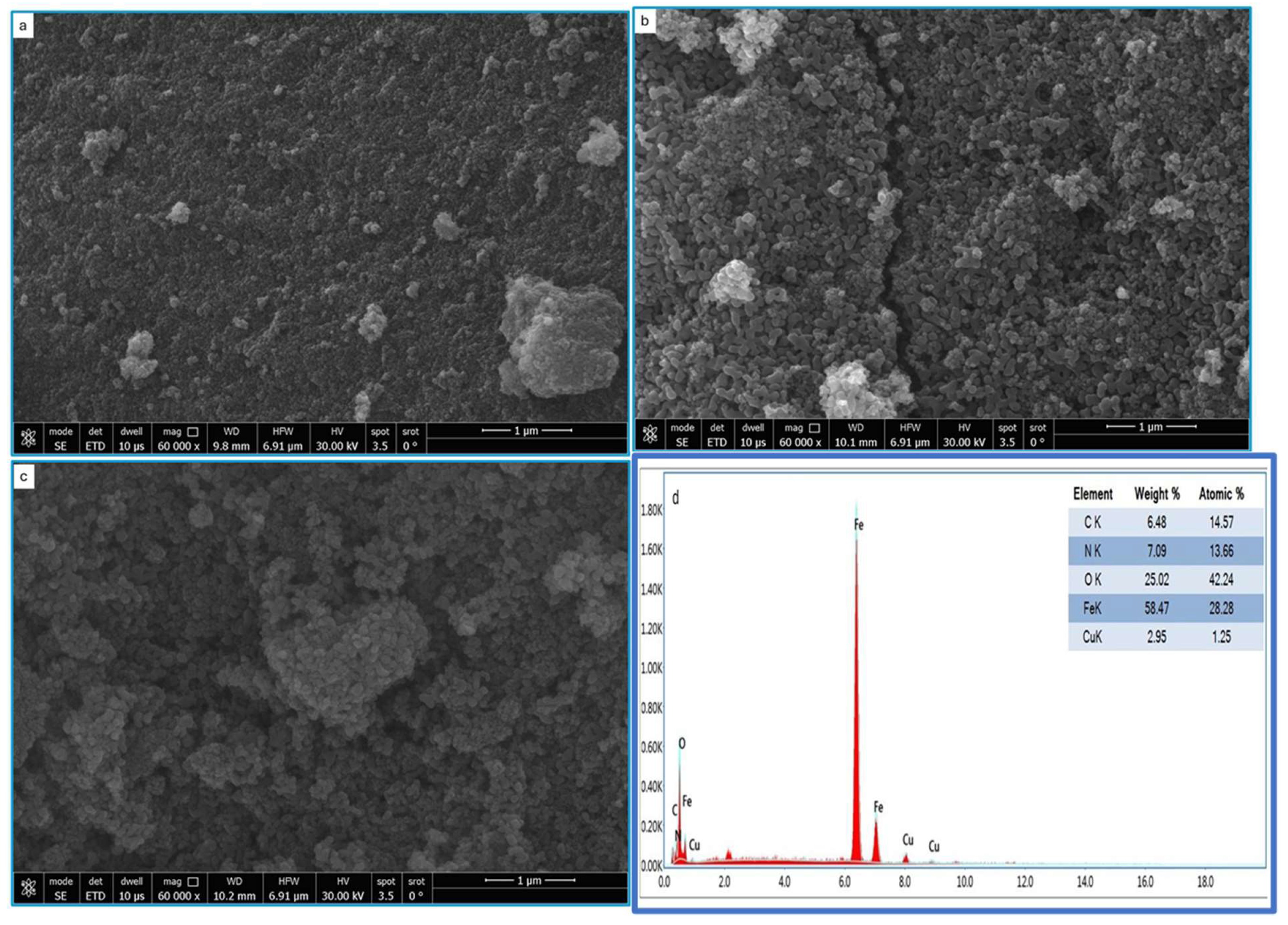
The SEM and EDX characterization results in Figure 1 elucidate the morphological and compositional evolution of Fe3O4 nanoparticles following copper decoration and β-galactosidase (β-Gala) immobilization. In the SEM image of bare Fe3O4 (Figure 1a), the nanoparticles display a dense, aggregated structure composed of near-spherical particles with a compact and uniform surface. This morphology is typical for magnetite synthesized via chemical co-precipitation, where strong magnetic dipole interactions and van der Waals forces contribute to particle agglomeration, as previously reported by Sabur and Gafur [27]. Upon incorporation of copper (Figure 1b), the CuO@Fe3O4 nanostructure reveals increased surface roughness and granularity, indicative of the successful deposition of CuO onto the Fe3O4 core. These surface features are consistent with previous studies showing that Cu-functionalized Fe-based nanomaterials demonstrated enhanced surface area and catalytic potential, as described by Hassan et al. [28]. Further modification with β-Galactosidase (Figure 1c) results in a smoother and more homogenously coated surface, likely due to the formation of a proteinaceous layer. Such surface passivation is attributed to the steric stabilization and colloidal dispersion provided by enzyme immobilization, in agreement with reports by Kaboudin et al. [29] and Lesiak et al. [30], who observed similar effects with biomolecule-functionalized magnetic nanomaterials. The EDX spectrum (Figure 1d) confirms the elemental composition of the final nanocomposite, showing significant Fe and O peaks corresponding to the magnetite core, Cu peaks from surface modification, and the presence of C and N elements attributed to the organic enzyme layer. Collectively, these results demonstrate the successful stepwise fabrication of a functional CuO@Fe3O4 nanocarrier capable of immobilizing β-Galactosidase, thus enhancing the material’s biocatalytic potential.

2.2. FTIR Characterization of Functionalized Nanocomposites

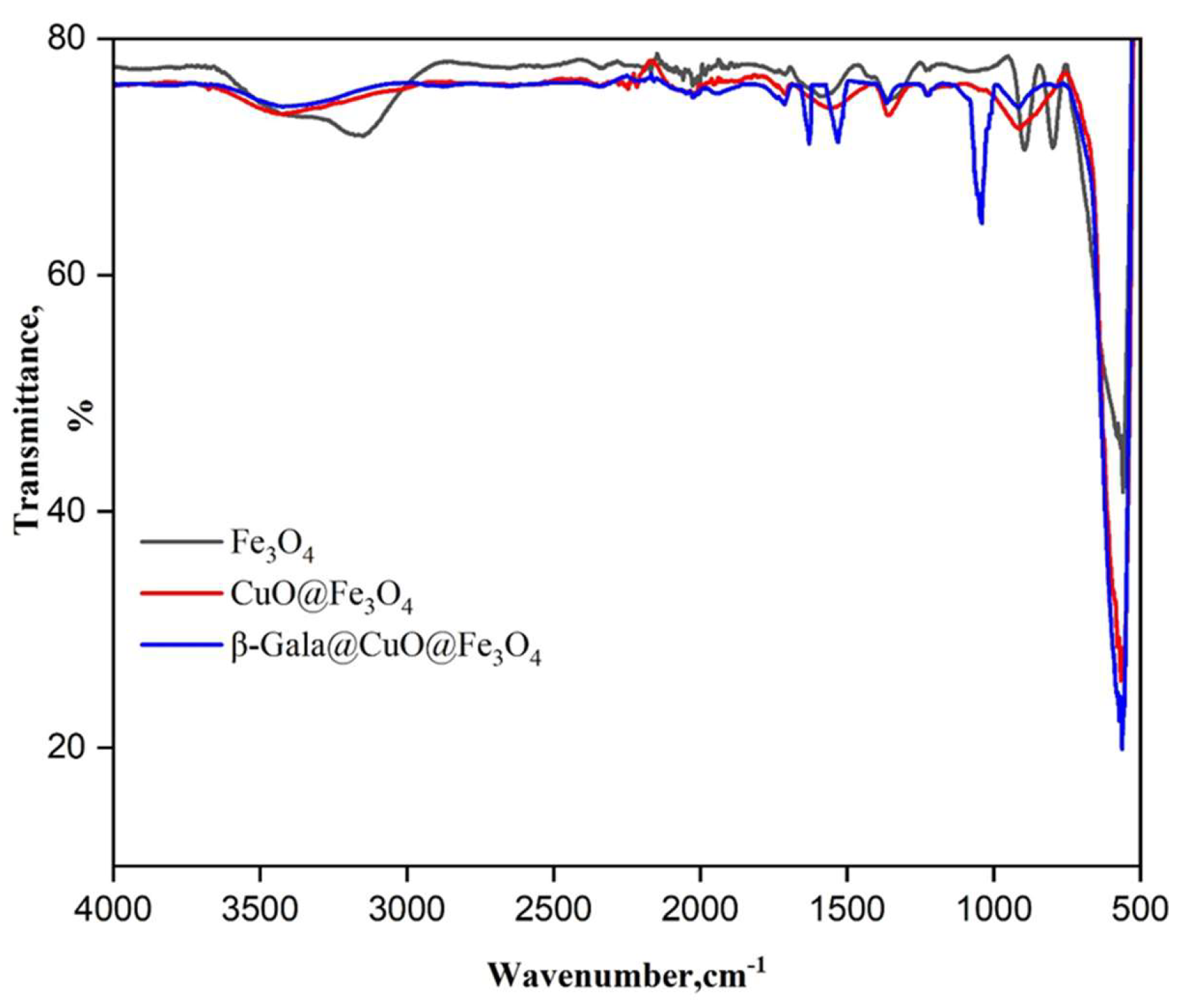
The FTIR spectra in Figure 2 illustrate the structural and chemical modifications of Fe3O4 nanoparticles through copper surface modification and β-galactosidase enzyme immobilization. For the bare Fe3O4 sample, the spectrum shows prominent absorption peaks at 3154, 1583, 1381, 895, 795, and 556 cm−1. The sharp band at 556 cm−1 is attributed to Fe–O stretching vibrations in the spinel structure of magnetite, which is a well-established characteristic for Fe3O4 as noted in the prior literature [30,31]. The frequency peaks at 3154 cm−1 and 1583 cm−1 are associated with O–H stretching and bending vibrations, respectively, indicative of adsorbed water and surface hydroxyl groups. The bands at 895 and 795 cm−1 are attributed to bending vibrations of –OH or lattice modes, while the peak at 1381 cm−1 likely corresponds to carbonate or carboxylate contamination from atmospheric exposure or aqueous synthesis [31]. Upon copper oxide decoration (CuO@Fe3O4), the Fe–O stretching band shifted from 556 to 572 cm−1, indicating changes in the local bonding environment after CuO formation on the magnetic iron oxide surface. The band observed at 911 cm−1 can be assigned to Cu–O-related vibrations and/or surface Fe–O–Cu interactions, supporting the successful formation of the CuO-decorated magnetic composite. The appearance of a new peak at 911 cm−1 is attributed to Cu–O stretching or altered Fe–O–Cu lattice vibrations, reflecting successful surface functionalization with copper species [28]. The FTIR spectrum of β-Gala@CuO@Fe3O4 further supports enzyme immobilization. New peaks at 1640 cm−1 and 1530 cm−1 correspond to the amide I and amide II bands, respectively, which are characteristic of protein secondary structures, confirming the presence of β-galactosidase on the nanoparticle surface. The band observed around 1040 cm−1 is more appropriately attributed mainly to phosphate-related vibrations, likely originating from phosphate buffer used during enzyme immobilization and washing, with possible overlap from protein-associated C–O/C–N vibrations. Therefore, this band was not used as primary evidence for enzyme immobilization. The successful immobilization of β-galactosidase is instead supported mainly by the appearance of amide I and amide II bands at approximately 1640 and 1530 cm−1, together with the changes observed in surface charge and textural properties after enzyme loading. The Fe–O (and possibly Cu–O) stretching remains detectable at 540 cm−1, slightly shifted due to enzyme interaction and surface coverage.

2.3. Textural Properties and Surface Charge Characterization

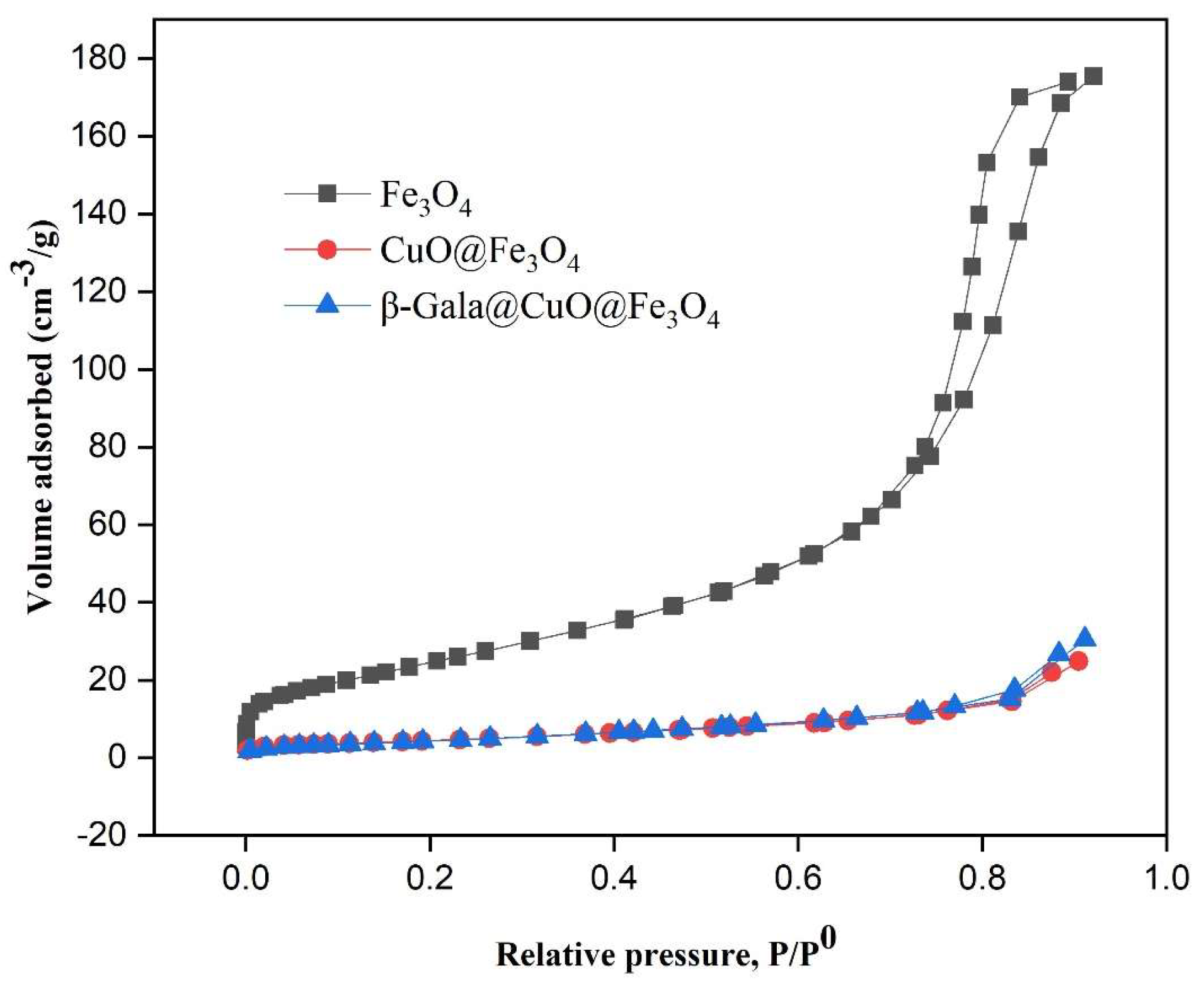
The nitrogen adsorption–desorption isotherms and BET analysis reveal key insights into the structural evolution of Fe3O4, CuO@Fe3O4, and β-Gala@CuO@Fe3O4 (Figure 3, Table 1). Pristine Fe3O4 exhibited a high surface area (96 m2/g) and mesoporosity (12.41 nm), consistent with reported values for synthesized magnetite [32,33]. Upon copper functionalization, a substantial reduction in surface area (to 18.7 m2/g) and a drop in pore volume (0.25 to 0.033 cm3/g) were observed, attributed to pore blocking, nanoparticle agglomeration, and copper formation during calcination, paralleling findings by Poursattar et al. [34]. Type IV isotherms with H3-type hysteresis loops confirmed the presence of mesoporous structures, though reduced uptake in CuO@Fe3O4 signaled pore network densification [16]. β-Galactosidase immobilization induced only minor changes in surface area (18.5 m2/g) and BJH pore diameter (14.27 nm), suggesting surface binding due to the enzyme’s large size, while DFT analysis showed reduced micropore volume (0.015 cm3/g), indicating partial pore blockage. The zeta potential increased from +13.62 mV (Fe3O4) to +34.5 mV (CuO@Fe3O4) due to Cu2+ species, then shifted to −0.9 mV after enzyme loading, confirming successful immobilization via electrostatic interaction with negatively charged residues [35,36]. The mesoporous size range (12–14 nm) remained ideal for β-galactosidase activity and substrate diffusion [37]. Importantly, the preserved mesoporosity, favorable surface charge, and magnetic recoverability make β-Gala@CuO@Fe3O4 a competitive immobilization matrix for biocatalysis. Minimal surface area loss (1%) during enzyme loading, compared to the typical 20–40% reported in the literature [37,38], indicates efficient use of surface without excessive pore blockage. This structural integrity ensures high immobilization efficiency, retention of enzymatic activity, and potential reuse in lactose hydrolysis or similar applications.

2.4. Magnetic Characterization

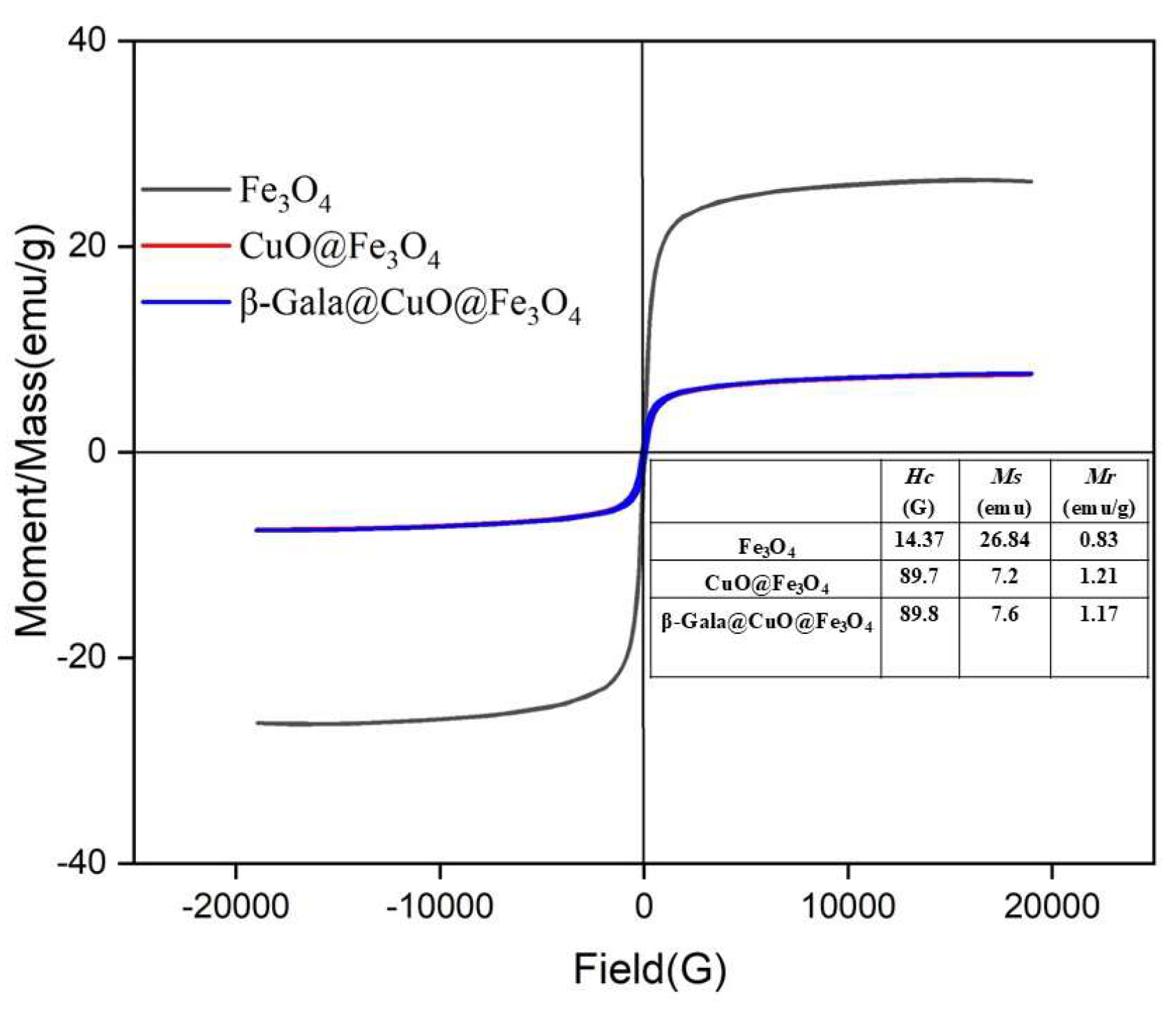
The VSM analysis confirms the magnetic evolution of Fe3O4, CuO@Fe3O4, and β-Gala@CuO@Fe3O4 (Figure 4). Pristine Fe3O4 exhibited soft ferrimagnetic behavior, with a high saturation magnetization (Ms = 26.84 emu/g) and a low coercivity (Hc = 14.37 G), making it suitable for magnetic separation [39,40]. After copper functionalization, Ms sharply decreased to 7.2 emu/g, and Hc increased to 89.7 G, attributed to the deposition of weak magnetic copper phases and enhanced surface anisotropy [41,42]. β-Galactosidase immobilization led to minimal changes (Ms = 7.6 emu/g; Hc = 89.8 G), consistent with reports that protein coatings minimally impact core magnetism [43,44]. The slight increase in Ms post-immobilization may result from the removal of surface impurities, exposing more magnetic material [16]. The observed rise in remanence (Mr) from 0.83 to 1.21 emu/g also reflects improved magnetic memory effects. Despite reduced magnetization, all samples retained ferrimagnetic behavior, ensuring efficient magnetic recovery, even under reuse conditions. Thus, β-Gala@CuO@Fe3O4 exhibits semi-hard magnetic behavior with good separation potential and operational stability.

2.5. XRD Analysis

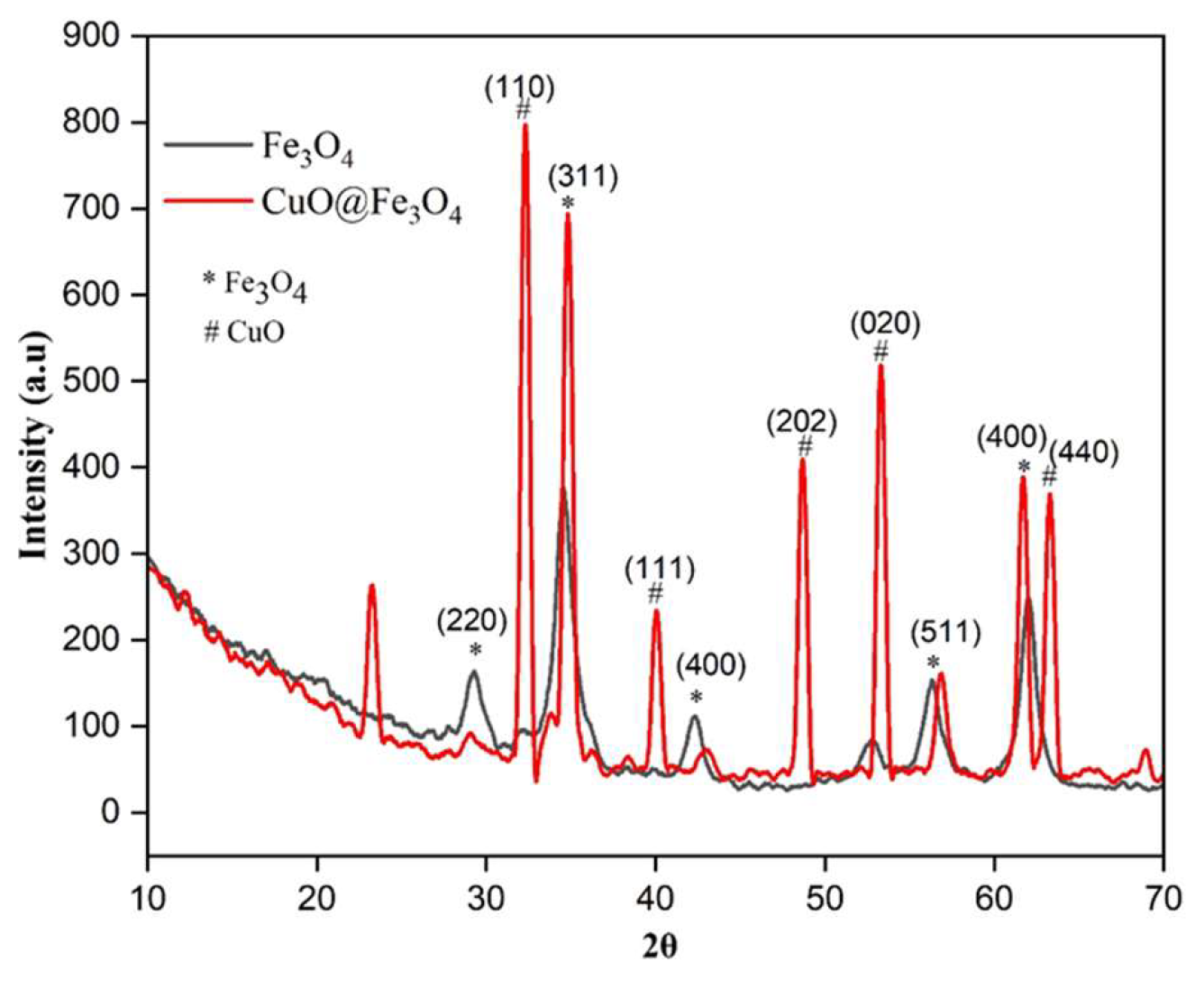
Figure 5 compares the powder XRD pattern of pristine magnetite (Fe3O4) with the CuO-decorated magnetic iron oxide composite, denoted CuO@Fe3O4 for consistency. The Fe3O4 trace shows the cubic-spinel reflections at 2θ ≈ 30.1° (220), 35.5° (311, strongest), 43.1° (400), 53.5° (422), 57.0° (511), and 62.6° (440), in agreement with ICDD/JCPDS PDF 19-0629. It should be noted that calcination at 800 °C may promote partial oxidation of Fe3O4. No distinct reflections characteristic of hematite (α-Fe2O3) were observed in the diffractogram; however, the possible presence of minor maghemite (γ-Fe2O3) cannot be completely excluded because of its close structural similarity to Fe3O4. Therefore, the calcined support is more accurately described as a CuO-decorated magnetic iron oxide composite. After copper functionalization, all spinel peaks remain and additional tenorite (monoclinic CuO) lines appear at ≈32.5° (110), 35.5–35.7° (overlapped with Fe3O4 (311)), 38.7° (111), 48.7° (202), 53.4° (020), 58.3° (202), 61.5° (113), and 66.2° (311), matching PDF 05-0661. A weak broad feature was observed around 2θ ≈ 22°. Since this signal does not correspond to the characteristic reflections of the dominant crystalline iron oxide and CuO phases and exhibits low intensity and broad character, it was not considered in the phase assignment. The absence of fcc-Cu reflections at ~43.3° (111) and ~50.4° (200) rules out metallic copper and confirms that copper is present as CuO. Small systematic deviations (<~1°) between measured and reference positions are consistent with specimen displacement/zero error or mild lattice strain. The noticeable line broadening relative to bulk standards indicates nanocrystallite dimensions. The line broadening of the Fe3O4 (311) and CuO (111) reflection at 2θ = 35.5° (FWHM = 0.57178°) yields a Scherrer crystallite size of ≈14.6 nm using D = /(βcosθ), with K = 0.9 and Cu Kα λ = 1.5406 Å.

2.6. Kinetic Behavior

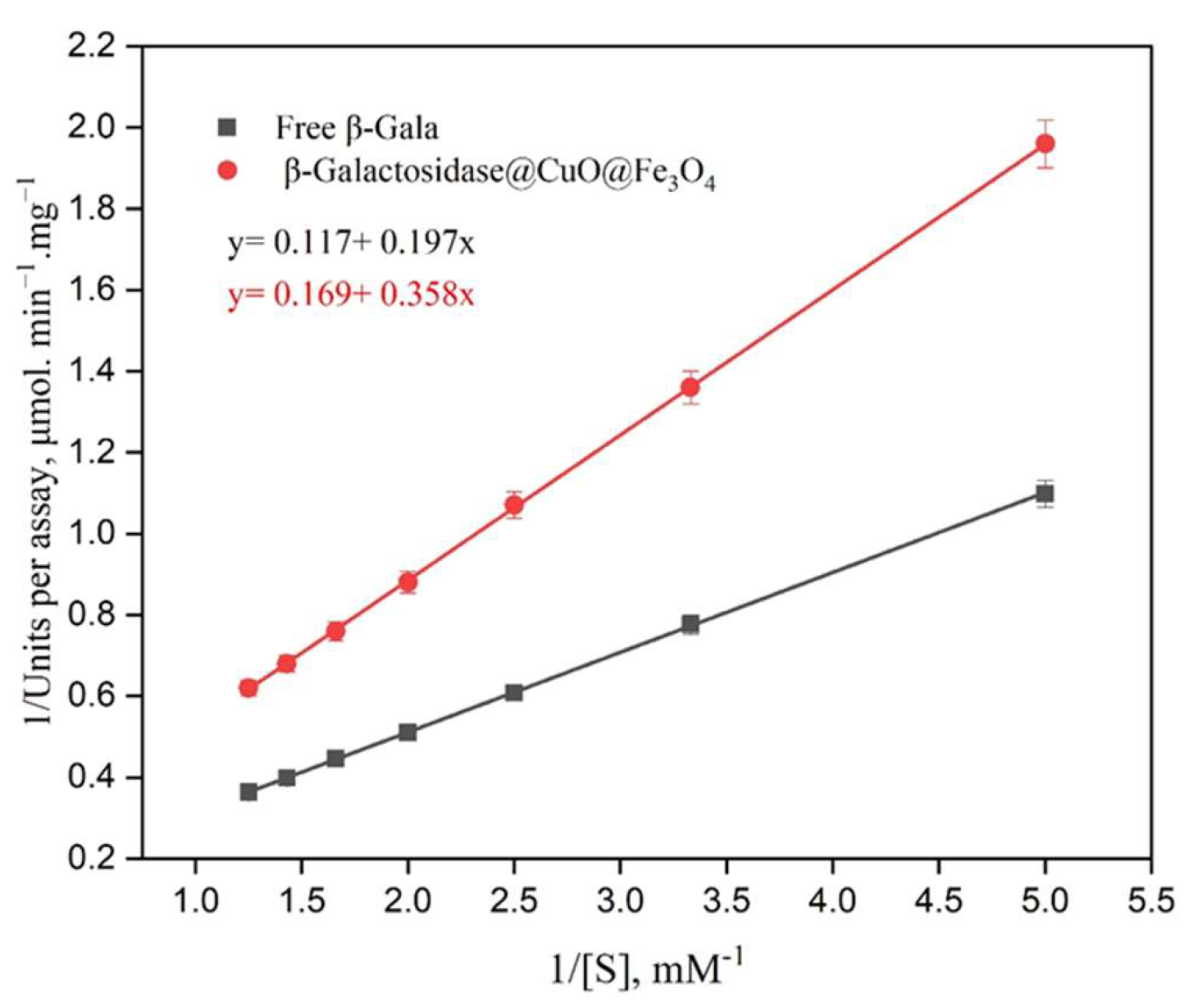
The kinetic analysis of β-galactosidase, both free and immobilized on CuO@Fe3O4 nanoparticles, revealed typical immobilization-induced effects as shown in Figure 6 and Table 2. The Km increased from 1.68 to 2.12 mM, indicating a 26% reduction in substrate affinity, while Vmax decreased by 31% (8.54 to 5.92 μmol·min−1·mg−1), consistent with literature trends [45,46]. The kcat values also dropped proportionally (16.3 to 11.3 s−1), reflecting reduced catalytic turnover upon immobilization [47]. Despite this, 69% activity was retained, and the catalytic efficiency (kcat/Km) of the immobilized enzyme remained acceptable (5.12 mM−1·s−1) for industrial lactose hydrolysis [24]. Minimal Km increase and high linearity in Lineweaver–Burk plots suggested limited mass transfer limitations. Comparatively, the CuO@Fe3O4 support performed favorably versus other immobilization systems like chitosan, silica, and polymer-coated MNPs [45,48,49]. The maintained activity, good reusability, and magnetic recoverability highlight the system’s practical viability. Although some catalytic efficiency is sacrificed, the benefits of operational stability and economic reuse make CuO@Fe3O4 a competitive support for immobilized enzyme applications [50,51].

2.7. Influence of pH and Temperature

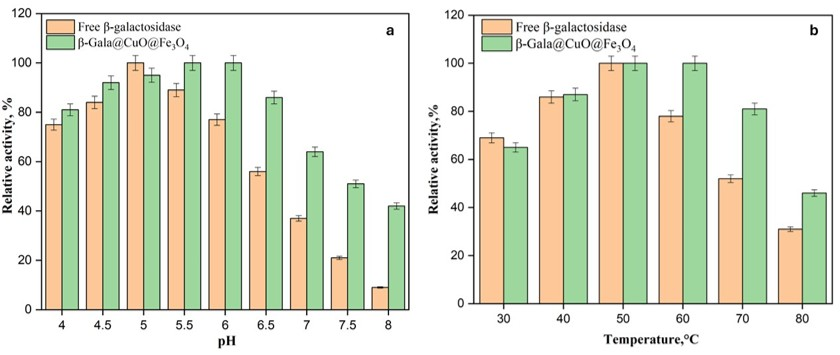
The catalytic performance of both free and immobilized β-galactosidase was markedly affected by pH (Figure 7a) and temperature (Figure 7b), with immobilization on CuO@Fe3O4 significantly enhancing the stability of the enzyme under both conditions. The free enzyme displayed optimal activity at pH 5.0, whereas the immobilized form exhibited a shifted optimum in the range of pH 5.5–6.0 and maintained higher relative activity over a broader pH spectrum, suggesting improved conformational robustness and structural integrity [14,52]. Similarly, thermal activity profiles revealed that the free enzyme was most active at 50 °C, while the immobilized counterpart retained its maximum activity at 50–60 °C and preserved over 80% of its activity even at 70 °C. This enhancement is primarily attributed to nano-confinement effects and multipoint attachment, which restrict molecular flexibility and protect against thermal denaturation [53]. These observations agree with earlier reports indicating that immobilization commonly results in a 5–10 °C elevation in temperature optima and increased tolerance to both acidic and alkaline environments [54]. Such improved operational stability makes the immobilized β-galactosidase particularly well-suited for industrial processes, including lactose hydrolysis in acidic dairy matrices and biocatalysis in thermally demanding systems.

2.8. Reusability of Immobilized Enzyme

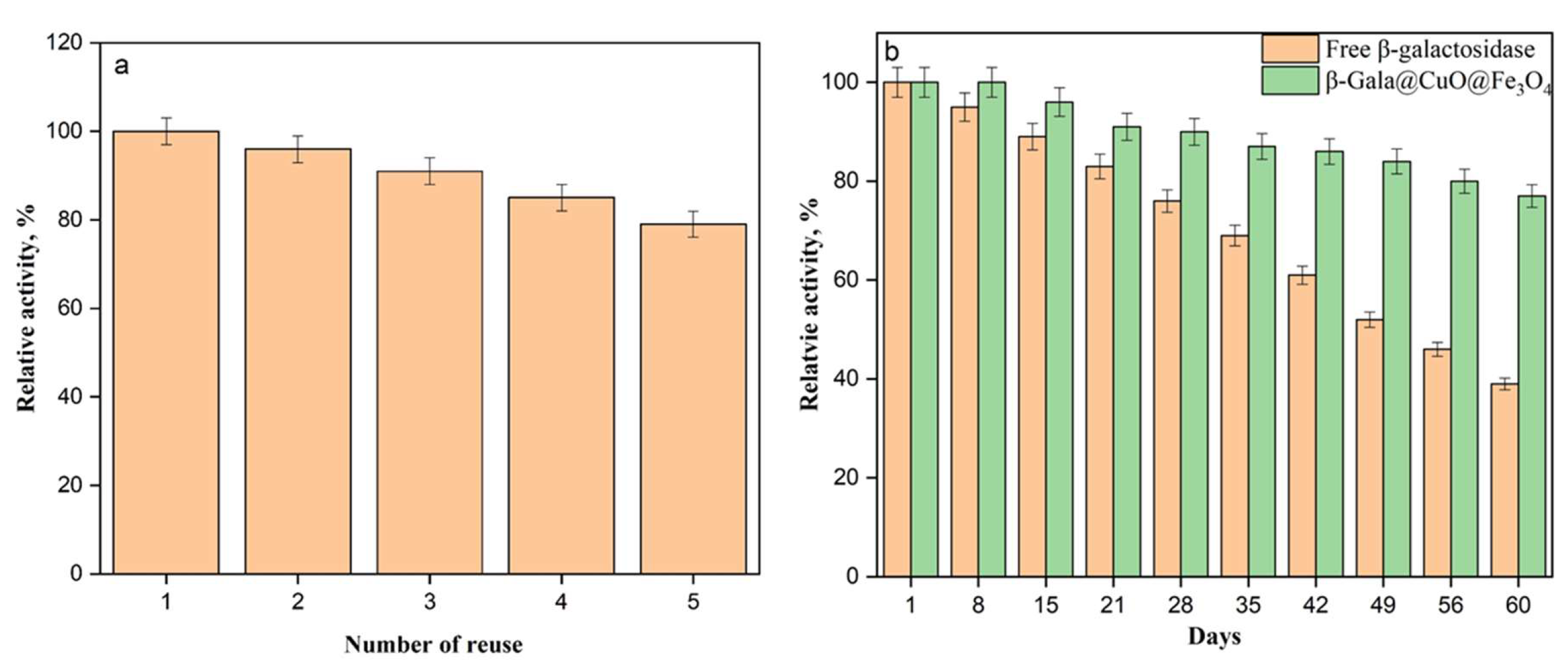
One of the key benefits of enzyme immobilization, particularly for industrial purposes, is its potential for reusability, which allows the enzyme to be recycled over extended periods, thereby lowering the overall cost of the biocatalytic process [4]. In this study, a novel support, CuO@Fe3O4, was employed to immobilize β-galactosidase, resulting in a stable biocatalyst that could be readily separated from reaction products and reused across multiple cycles. Experimental data demonstrated that the immobilized β-galactosidase retained 79% of its initial catalytic efficiency after 5 repeated cycles (Figure 8a). This exceptional performance was attributed to the electrostatic interaction of the enzyme onto the CuO@Fe3O4 matrix, which contributed to increased conformational rigidity and enhanced reusability [55]. Chen et al. [56] observed retention of over 90% of the initial activity after 15 cycles. Additionally, β-galactosidase immobilized on a UV-cured epoxy polymer film retained only around 51% of its activity after 12 cycles [57]. In contrast, Alshanberi et al. [58] further demonstrated that the enzyme maintained 83% activity following six reuse cycles. Selvarajan et al. [59] reported that cross-linked β-galactosidase immobilized on ZnO nanoparticles preserved 88.02% of its activity after three cycles. The long-term stability of β-galactosidase was significantly enhanced through immobilization on CuO@Fe3O4 nanoparticles (Figure 8b). After 60 days at 4 °C, the immobilized enzyme preserved 77% of its initial activity, while the free form retained only 39%, representing a 1.97-fold improvement. This enhanced preservation is attributed to multipoint binding, microenvironmental protection, aggregation prevention, and copper-mediated stabilization effects [60]. Compared to previous studies, such as Hassan et al. [55], who reported 78.6% retention after 90 days using alginate/tea waste, the CuO@Fe3O4 system exhibits comparable performance. Other systems like Fe3O4–chitosan covalent supports [61] demonstrated lower retention rates under similar or shorter durations.

2.9. Lactose Hydrolysis

The time-course of lactose hydrolysis reveals a dynamic interplay between catalytic activity and mass transfer phenomena. The rapid initial conversion, followed by a progressive slowdown as substrate is consumed, is characteristic of enzymatic reactions approaching equilibrium or facing product inhibition. Both the free and immobilized β-galactosidase preparations demonstrated high efficacy, reaching 78 ± 1.97% and 80 ± 1.54% hydrolysis at 3 h, respectively (Table 3). The slightly lower conversion rate observed for the immobilized form during the initial phase (0.5–1.0 h) is consistent with transient mass-transfer limitations, a well-documented occurrence for enzymes bound to solid supports [62,63]. During this period, the substrate must diffuse from the bulk solution through the unstirred liquid layer and potentially into the porous structure of the support to reach the active sites, transiently lowering the apparent reaction rate compared to the freely diffusing enzyme.
Interestingly, the performance of the immobilized biocatalyst matched and slightly surpassed that of the free enzyme after 1.5 h. This suggests that the initial diffusional constraints are soon outweighed by the benefits of the immobilized microenvironment. Such advantages can include the mitigation of product inhibition, a known issue in which both galactose and glucose can competitively inhibit β-galactosidase activity [64,65], and the creation of a more favorable local pH environment that sustains the enzyme’s active conformation [66]. The calculated pseudo-first-order rate constants (kfree = 0.50 h−1; kimm = 0.53 h−1) and the comparable half-times (t1/2 = 1.4 h) quantitatively support the immobilized enzyme’s equivalent, if not slightly superior, kinetic efficiency under these conditions. From a practical standpoint, achieving comparable kinetics is a significant success, as the crucial advantage of the immobilized preparation lies in its straightforward magnetic recovery and potential for reuse, making it a superior candidate for continuous or repeated-batch industrial hydrolysis processes [46].
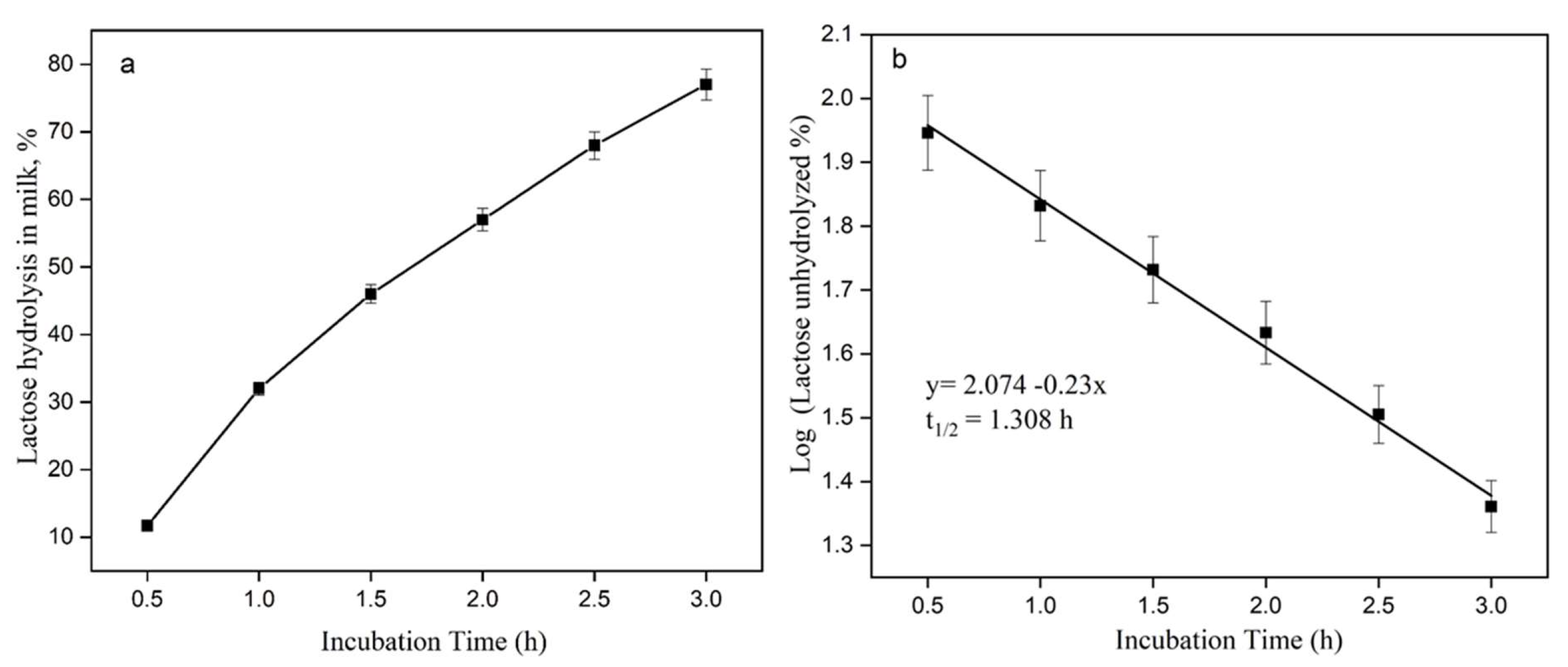
When applied to a complex food matrix like whole milk, the immobilized β-galactosidase demonstrated robust performance, achieving 77% lactose hydrolysis within 3 h (Figure 9a). The excellent linearity (R2 = 0.995) of the semi-log plot of unconverted lactose versus time (Figure 9b) confirms that the hydrolysis follows pseudo-first-order kinetics under the tested conditions. This kinetic behavior is often observed in enzymatic reactions where the substrate concentration is not rate-limiting or when studied in a complex environment [67]. The apparent rate constant (k = 0.529 h−1) and the corresponding half-life (t1/2 = 1.31 h) provide valuable benchmarks for process design. The hydrolytic performance obtained in the present study compares favorably with previously reported β-galactosidase systems. For example, β-galactosidase immobilized on Cu-trimesic acid metal–organic frameworks achieved approximately 83% lactose hydrolysis after 4 h and 85% after 5 h [14], whereas the present CuO-decorated magnetic iron oxide support reached 80% hydrolysis within only 3 h under the tested conditions. Furthermore, Zhang et al. reported that a genetically engineered β-galactosidase exhibiting reduced galactose inhibition achieved more than 90% lactose hydrolysis after 48 h [65]. These comparisons demonstrate that the developed CuO-based magnetic biocatalyst provides rapid lactose conversion while additionally offering the practical advantages of magnetic recovery and reuse. Based on this model, the time required to achieve 90% (t90) and 95% (t95) hydrolysis can be projected to be 4.37 h and 5.68 h, respectively, offering predictable endpoints for industrial production of lactose-free milk.
The slight concavity noted in the raw conversion curve at early time points, which was less pronounced in buffer, is likely attributable to matrix-associated mass transfer limitations within the milk itself. The complex network of fat globules and protein micelles in milk creates a more tortuous diffusion path for the substrate compared to a simple aqueous buffer [68]. Nevertheless, the consistent first-order behavior observed in the semi-log plot indicates that once the lactose substrate reaches the enzyme’s active sites, the intrinsic catalytic rate is the dominant factor. This high catalytic efficiency, coupled with the high final conversion levels, strongly supports the applicability of this green-synthesized, magnetically recoverable biocatalyst for the industrial processing of milk and other dairy products [46].

2.10. Cytotoxicity and Biocompatibility Evaluation

The cytotoxicity of the process-derived filtrates was evaluated using HepG2 cells as a liver-associated toxicity model for nanomaterial-related safety assessment [69]. Cisplatin, used as a positive control, caused a clear dose-dependent reduction in cell viability with an IC50 of 14.98 μg/mL, confirming the responsiveness of the MTT assay (Figure S1, Supplementary Materials) [70]. In contrast, milk-derived hydrolysate (MDH), buffer-derived hydrolysate (BDH), and acetate buffer control (ABC) maintained high HepG2 cell viability across the tested dilution range of 25–100% (v/v) (Figures S2–S4, Supplementary Materials), indicating no detectable cytotoxic effect under the experimental conditions. The absence of detectable cytotoxicity may be attributed to the food-compatible nature of β-galactosidase [71], the magnetic recoverability of the CuO@Fe3O4 support, and the limited carry-over of the immobilized biocatalyst into the final filtrates [72]. This interpretation is also consistent with reports showing that the biological response to iron oxide and copper oxide nanoparticles depends strongly on concentration, surface properties, and synthesis route, with green-synthesized materials often showing improved biocompatibility [73,74]. Overall, the MTT results indicate that MDH, BDH, and ABC did not exert appreciable cytotoxic effects under the tested conditions. Nevertheless, future studies should include complementary assays, such as LDH release, ROS detection, and ICP-MS-based migration analysis, to further confirm the safety of the hydrolysates for food-related applications [70,75].

3. Materials and Methods

Sodium dihydrogen phosphate, disodium hydrogen phosphate, ferric chloride hexahydrate (FeCl3·6H2O), ferrous sulfate heptahydrate (FeSO4·7H2O), copper nitrate (Cu(NO3)2), glucose, lactose, nitrophenyl-β-Dgalactopyranoside (o-NPG), and Aspergillus oryzae β-galactosidase (≥8.0 units/mg solid) were purchased from Sigma-Aldrich (St. Louis, MO, USA). The glucose oxidase–peroxidase kit was purchased from Megazyme International Ireland Ltd. (Wicklow, Ireland).

3.1. Plant Extract Preparation

Plant extracts for green synthesis were prepared using Dolomiaea costus powder obtained from a local market. Specifically, 10 g of the powdered plant material was suspended in 100 mL of distilled water and heated at 60 °C for 30 min to facilitate the extraction of bioactive phytochemicals. The resulting mixture was centrifuged at 10,000 rpm for 10 min to remove insoluble matter. The clear supernatant, representing the aqueous plant extract, was carefully collected and stored under refrigeration for subsequent use in nanoparticle synthesis.

3.2. Green Synthesis of CuO@Fe3O4 Nanoparticles

Copper-oxide-decorated magnetic iron oxide composite (CuO@Fe3O4) was synthesized using a green synthesis approach involving Dolomiaea costus aqueous extract as a bioreductant and stabilizing agent. The synthesis was performed in two stages. First, Fe3O4 nanoparticles were prepared by dissolving FeCl3·6H2O (10 mM) and FeSO4·7H2O (5 mM) in a 2:1 molar ratio in 100 mL of deionized water. The solution was heated to 80 °C under vigorous stirring, after which 50 mL of D. costus extract was added dropwise. The pH of the reaction mixture was adjusted to 10 using 25% ammonium hydroxide solution, resulting in the immediate formation of a black precipitate. The mixture was maintained at 80 °C for an additional hour under constant stirring. The resulting Fe3O4 nanoparticles were separated by filtration, washed thoroughly with deionized water and ethanol to eliminate residual impurities, and dried in a vacuum oven at 60 °C for 2 h. The dried product was then ground into a fine powder for further use.
In the second stage, 0.5 g of the synthesized Fe3O4 nanoparticles were redispersed in 100 mL of deionized water under vigorous stirring to form a homogeneous suspension. Separately, a 5 mM copper nitrate solution was prepared in 50 mL of deionized water and gradually added to the Fe3O4 suspension. Subsequently, another 50 mL of D. costus extract was added dropwise to the mixture. The reaction was allowed to proceed at 70 °C for 2 h under continuous stirring. The formation of CuO@Fe3O4 nanoparticles was indicated by a characteristic color change. The final product was recovered by filtration, washed repeatedly with deionized water and ethanol to remove unreacted precursors and byproducts, and then dried in a vacuum oven at 60 °C for 2 h. Finally, the dried CuO@Fe3O4 nanoparticles were calcinated at 800 °C for 2 h to enhance crystallinity and stability.

3.3. Characterization of Synthesized Nanoparticles

The synthesized Fe3O4 and CuO@Fe3O4 nanoparticles underwent comprehensive characterization using a suite of analytical techniques to ascertain their morphology, crystalline structure, chemical composition, and magnetic properties. X-ray diffraction (XRD) analysis was carried out on a Bruker Advance D8 diffractometer (Billerica, MA, USA) equipped with Cu Kα radiation (λ = 1.5418 Å) to verify the crystalline phases and structural purity of the synthesized nanoparticles. Fourier-transform infrared (FT-IR) spectroscopy, performed using a PerkinElmer Spectrum 100 spectrometer (Waltham, MA, USA), was employed to identify functional groups and analyze the vibrational modes present in the samples. The morphology and surface features were examined through field-emission scanning electron microscopy (FESEM). In conjunction, elemental distribution was investigated by energy-dispersive X-ray spectroscopy (EDX) using a Bruker Nano XFlash 5010 detector (Billerica, MA, USA). Specific surface area analysis was performed using the Brunauer–Emmett–Teller (BET) method. Nitrogen adsorption–desorption isotherms were obtained at 77 K with a Quantachrome Touchwin v1.21 instrument (Boynton Beach, FL, USA). Pore characteristics were evaluated from the adsorption branch using the Barrett–Joyner–Halenda (BJH) model, while pore volume estimations were refined using Density Functional Theory (DFT) via the Quantachrome ASiQwin software, version 5.2. Magnetic properties were investigated with a Lakeshore 7400 vibrating sample magnetometer (VSM) (Westerville, OH, USA). Furthermore, surface charge measurements were determined through zeta potential analysis, carried out on a Malvern Zetasizer (Version 7.12, Malvern, UK), providing insights into colloidal stability and surface behavior of the nanoparticles.

3.4. Immobilization of β-Galactosidase on CuO@Fe3O4 Nanoparticles

The β-galactosidase enzyme was immobilized onto green-synthesized CuO@Fe3O4 nanoparticles through a physical adsorption technique. Specifically, 100 mg of CuO@Fe3O4 nanoparticles were suspended in 10 mL of a β-galactosidase solution (5 mg enzyme in 0.1 M sodium phosphate buffer, pH 7.0). The mixture was incubated at 25 °C for 6 h under gentle shaking at 150 rpm to facilitate enzyme adsorption onto the nanoparticle surface. Following incubation, the immobilized enzyme complex (β-Gala@CuO@Fe3O4) was magnetically separated from the supernatant using an external magnetic field. The collected supernatant was analyzed using the Bradford protein assay to quantify the amount of unbound enzyme and thereby calculate the immobilization efficiency [76]. The immobilized enzyme was washed three times with 0.1 M sodium phosphate buffer (pH 7.0) to remove any loosely adsorbed or unbound enzyme molecules. The resulting β-Gala@CuO@Fe3O4 biocatalyst was stored at 4 °C for further characterization and application. The immobilization efficiency (IE) was calculated using the following equation:
IE (%) = [(Total protein introduced − Unbound protein)/Total protein introduced] × 100

3.5. β-Galactosidase Activity Assay

β-Galactosidase activity was assessed following the methodology described by Cavaille and Combes [77]. The reaction mixture, totaling 1 mL, was prepared by dissolving 6.5 mM of o-nitrophenyl-β-D-galactopyranoside (o-NPG) in a 0.1 M Na-acetate buffer at pH 5.0. To this, 1.5 mM of magnesium chloride (MgCl2) was added, along with a minimal quantity of free enzyme or 10 mg of immobilized form. To quantify the o-nitrophenol (o-NP) liberated through the enzymatic reaction, the mixture was incubated in a water bath at 37 °C for 5 min. Following this incubation period, the reaction was effectively terminated by the addition of 1 mL of a 10% (w/v) sodium carbonate (Na2CO3) solution. Subsequently, the absorbance of the resulting solution was measured at a wavelength of 420 nm. One unit of β-galactosidase activity is defined as the amount of enzyme required to release 1.0 µmole of o-nitrophenol under the standard assay conditions.

3.6. Kinetic Parameters

The catalytic efficiency of free β-galactosidase and the immobilized β-Gala@CuO@Fe3O4 system was evaluated through kinetic experiments employing o-NPG as the substrate. The maximum velocity (Vmax) and the Michaelis–Menten constant (Km), indicative of enzyme–substrate binding affinity, were obtained by fitting the experimental results to the Michaelis–Menten model via nonlinear regression analysis. Enzyme activity measurements were performed at pH 5.0 and 37 °C across substrate concentrations ranging from 0.2 to 0.8 mM. Each assay was conducted in triplicate, and the values of Vmax and Km are presented as the mean ± standard error.

3.7. Effect of pH and Temperature on Enzyme Activity

The catalytic activities of free β-galactosidase and β-Gala@CuO@Fe3O4 were evaluated across a range of pH values (4.0 to 9.0) using different buffer systems: sodium acetate buffer for pH 4.0–6.0, sodium phosphate buffer for pH 6.5–7.5, and Tris-HCl buffer for pH 8.0–9.0. The relative activity at each pH was calculated by taking the activity at the optimal pH as 100%. Additionally, the thermal activity profiles of both free and immobilized enzymes were assessed by incubating them in 0.1 M potassium phosphate buffer (pH 6.5) at temperatures ranging from 30 °C to 80 °C for 15 min. The residual activity at each temperature was determined relative to the activity at the optimum temperature, which was considered 100%.

3.8. Reusability and Storage Stability of Immobilized Enzyme

The operational stability of the immobilized β-galactosidase was assessed through repeated batch hydrolysis cycles to evaluate its reusability. Following each lactose hydrolysis cycle, the immobilized enzyme was magnetically recovered from the reaction mixture, washed three times with 0.1 M sodium acetate buffer (pH 5.0), and reintroduced into a fresh lactose solution. The residual enzymatic activity was determined after each cycle, and the percentage of retained activity was calculated accordingly.
For storage stability evaluation, the immobilized β-galactosidase was stored at 4 °C in 0.1 M sodium acetate buffer (pH 5.0). The residual catalytic activity was measured at periodic intervals for 4 weeks and compared with the initial activity to determine the enzyme’s stability over time.

3.9. Lactose Hydrolysis Assay

The catalytic efficiency of both free and immobilized β-galactosidase was assessed by measuring the amount of glucose released during lactose hydrolysis, employing the glucose oxidase–peroxidase (GOD–POD) colorimetric method. An appropriate quantity of the enzyme (free or immobilized form) was incubated with a 50 g/L lactose solution prepared in 0.1 M sodium acetate buffer (pH 5.0) under continuous stirring at 37 °C. At selected time intervals (0.5, 1, 1.5, 2, 2.5, and 3 h), aliquots were withdrawn and used for glucose quantification. For the assay, 0.5 mL of each sample was combined with 1.5 mL of GOD–POD reagent and incubated at 37 °C for 15 min. The reaction was terminated by the addition of 1 mL of 6 N hydrochloric acid (HCl), and the absorbance of the developed chromophore was measured at 540 nm to determine the glucose concentration.

3.10. Lactose Hydrolysis from Milk

To evaluate the catalytic performance of the immobilized β-galactosidase in real samples, 10 mg of the immobilized enzyme was added to 1 mL of whole milk and stirred at 110 rpm at room temperature. At predetermined time intervals, aliquots were collected, and the residual lactose concentration was measured using the previously described GOD–POD assay following appropriate sample dilution and clarification steps. The extent of lactose hydrolysis was calculated using the following equation:
Lactose hydrolysis (%) = [Amount of glucose before treatment/Amount of glucose after treatment] × 100
Lactose unhydrolyzed (%) = 100 − lactose hydrolysis (%)

3.11. Kinetic Analysis of Lactose Hydrolysis

The kinetics of lactose hydrolysis were evaluated by plotting the logarithm of the percentage of unhydrolyzed lactose against time. The slope of this first-order kinetic plot is directly related to the rate constant (k) according to the equation:
Slope = k 2.303
From the calculated rate constant, the time required for 50% hydrolysis of lactose (half-life, t1/2) was determined using the standard first-order kinetic expression:
t 1 / 2 = 0.693 k
These relationships allow for a quantitative assessment of the reaction rate and the efficiency of both free and immobilized β-galactosidase in lactose degradation over time.

3.12. MTT Cytotoxicity Assay on HepG2 Cells for Evaluating Buffer- and Milk-Derived Hydrolysates

Human cancer cell line HepG2 was obtained from King Abdulaziz University, Faculty of Science, Biochemistry Department, Tissue Culture Unit. Cells were maintained in T75 flasks using Gibco DMEM supplemented with 10% fetal bovine serum (FBS) and 1% antibiotics under standard culture conditions (37 °C, 5% CO2, 95% humidity). Upon reaching 90% confluency, adherent cells were detached with 0.25% trypsin (4 mL, 5 min, 37 °C), pelleted, and resuspended in complete medium. Viable cells were quantified via trypan blue (0.4%) staining and hemocytometer counting. For cytotoxicity assays, 10,000 cells/well were seeded in 96-well plates (0.1 mL complete medium) and incubated for 24 h. The plate was then incubated for 24 h. Each well containing attached cells was treated with serial v/v dilutions of the original filtrates prepared in complete DMEM medium. The tested concentrations were 25%, 50%, 75%, and 100% (v/v), corresponding to dilution factors of 1:4, 1:2, 3:4, and undiluted filtrate, respectively, for buffer-derived hydrolysate (BDH), milk-derived hydrolysate (MDH), and acetate buffer control (ABC). All treatments were performed in triplicate (24 h incubation). After adding 100 µL of MTT to 0.5 mg/mL serum-free medium to each well, the incubation was left in the dark for three hours. In total, 100 µL of DMSO was added and incubated for 15 min. The absorbance was measured at 595 nm using a Japanese Bio-RAD microplate reader. IC50 values were derived from dose–response curves generated in GraphPad Prism 9 [78,79].

4. Conclusions

This work demonstrates the successful green synthesis of CuO@Fe3O4 nanoparticles using Dolomiaea costus extract and their application as an efficient magnetic support for β-galactosidase immobilization. The developed biocatalyst showed high immobilization efficiency, improved pH and thermal stability, good reusability, and effective lactose hydrolysis in both buffer and milk, achieving more than 77% hydrolysis within 3 h. Cytotoxicity assessment further indicated no detectable toxic effect of the process-derived filtrates on HepG2 cells under the tested conditions, supporting the biocompatibility of the system. Despite these promising results, some limitations should be considered. The present study was conducted under batch laboratory-scale conditions, and long-term operation in continuous or pilot-scale dairy processing was not evaluated. In addition, further studies are required to assess possible enzyme leaching, metal ion migration, catalyst durability during extended reuse, and regulatory safety requirements. Future work should therefore focus on process optimization, continuous lactose hydrolysis, magnetic recovery efficiency, cost analysis, and migration studies to confirm the feasibility of this green, magnetically recoverable biocatalyst for industrial lactose-free dairy production.

Supplementary Materials

The following supporting information can be downloaded at: https://www.mdpi.com/article/10.3390/inorganics14060159/s1. Figure S1. A dose-response curve for the effect of cisplatin on HepG2 cell viability; Figure S2. An Illustrates the effect of milk-derived hydrolysate (MDH) on the viability of HepG2 cells; Figure S3. The effect of a buffer-derived hydrolysate (BDH) on HepG2 cell viability; Figure S4. The effect of the Acetate buffer control (ABC) on the viability of HepG2 cells.

Funding

The project was funded by the Deanship of Scientific Research (DSR) at King Abdulaziz University, Jeddah, under grant no. (IPP: 251-130-2025).

Institutional Review Board Statement

Not applicable.

Informed Consent Statement

Not applicable.

Data Availability Statement

All relevant data are within the manuscript and its Supporting Information file.

Acknowledgments

The project was funded by the Deanship of Scientific Research (DSR) at King Abdulaziz University, Jeddah, under grant no. (IPP: 251-130-2025). The authors, therefore, acknowledge with thanks DSR for technical and financial support.

Conflicts of Interest

The author declares that he has no competing financial or non-financial interests.

References

  1. Katrolia, P.; Liu, X.; Li, G.; Kopparapu, N.K. Enhanced properties and lactose hydrolysis efficiencies of food-grade β-galactosidases immobilized on various supports: A comparative approach. Appl. Biochem. Biotechnol. 2019, 188, 410–423. [Google Scholar] [CrossRef]
  2. Neto, C.A.C.G.; e Silva, N.C.G.; de Oliveira Costa, T.; de Albuquerque, T.L.; Gonçalves, L.R.B.; Fernandez-Lafuente, R.; Rocha, M.V.P. The β-galactosidase immobilization protocol determines its performance as catalysts in the kinetically controlled synthesis of lactulose. Int. J. Biol. Macromol. 2021, 176, 468–478. [Google Scholar] [CrossRef]
  3. Alotaibi, A.N.; Al-Dakhil, A.; Alwabsi, H.A.; Althobaiti, I.O.; El-Shishtawy, R.M.; Almulaiky, Y.Q. Sustainable synthesis of alginate–cobalt ferrite nanocomposites for horseradish peroxidase immobilization: Enhanced stability, reusability, and catalytic efficiency. Bioprocess Biosyst. Eng. 2025, 48, 1207–1219. [Google Scholar] [CrossRef] [PubMed]
  4. Zeyadi, M.; Almulaiky, Y.Q. Chitosan-Based metal-organic framework for stabilization of β-glucosidase: Reusability and storage stability. Heliyon 2023, 9, e21169. [Google Scholar] [CrossRef]
  5. Luan, S.; Duan, X. A novel thermal-activated β-galactosidase from Bacillus aryabhattai GEL-09 for lactose hydrolysis in milk. Foods 2022, 11, 372. [Google Scholar] [CrossRef]
  6. Acharya, P.; Fernandes, A.; Chatli, M.K.; Rana, T. Lactose intolerance—A global problem? In Handbook of Milk Production, Quality and Nutrition; Academic Press: Cambridge, MA, USA, 2025; pp. 329–345. [Google Scholar]
  7. Goff, H.D.; Hynes, E.H.; Perotti, M.C.; Kelly, P.M.; Hogan, S.A. Significance of lactose in dairy products. In Advanced Dairy Chemistry: Volume 3: Lactose, Water, Salts and Minor Constituents; Springer International Publishing: Cham, Switzerland, 2022; pp. 39–104. [Google Scholar]
  8. Kalathinathan, P.; Sain, A.; Pulicherla, K.; Kodiveri Muthukaliannan, G. A review on the various sources of β-galactosidase and its lactose hydrolysis property. Curr. Microbiol. 2023, 80, 122. [Google Scholar] [CrossRef]
  9. Damin, B.I.S.; Kovalski, F.C.; Fischer, J.; Piccin, J.S.; Dettmer, A. Challenges and perspectives of the β-galactosidase enzyme. Appl. Microbiol. Biotechnol. 2021, 105, 5281–5298. [Google Scholar] [CrossRef] [PubMed]
  10. Peiman, S.; Maleki, B. Fe3O4@ SiO2@ NTMPThio-Cu: A sustainable and eco-friendly approach for the synthesis of heterocycle derivatives using a novel dendrimer template nanocatalyst. Sci. Rep. 2024, 14, 17401. [Google Scholar] [CrossRef]
  11. Mohamed, S.A.; Al-Harbi, M.H.; Almulaiky, Y.Q.; Ibrahim, I.H.; El-Shishtawy, R.M. Immobilization of horseradish peroxidase on Fe3O4 magnetic nanoparticles. Electron. J. Biotechnol. 2017, 27, 84–90. [Google Scholar] [CrossRef]
  12. Akhtar, M.S.; Fiaz, S.; Aslam, S.; Chung, S.; Ditta, A.; Irshad, M.A.; Al-Mohaimeed, A.M.; Iqbal, R.; Al-Onazi, W.A.; Rizwan, M.; et al. Green synthesis of magnetite iron oxide nanoparticles using Azadirachta indica leaf extract loaded on reduced graphene oxide and degradation of methylene blue. Sci. Rep. 2024, 14, 18172. [Google Scholar] [CrossRef]
  13. Mavaddatiyan, L.; Zeynizadeh, B. A new strategy for immobilization of copper on the Fe3O4@ EDTA nanocomposite and its efficient catalytic applications in reduction and one-pot reductive acetylation of nitroarenes and also N-acetylation of arylamines. Heliyon 2024, 10, e35062. [Google Scholar] [CrossRef] [PubMed]
  14. Al-Harbi, S.A.; Almulaiky, Y.Q. Cu-trimesic acid-based metal organic frameworks for improved ß-galactosidase immobilization: Enhanced stability, reusability and lactose hydrolysis. J. Mol. Liq. 2023, 392, 123456. [Google Scholar] [CrossRef]
  15. Liu, M.; Ye, Y.; Ye, J.; Gao, T.; Wang, D.; Chen, G.; Song, Z. Recent advances of magnetite (Fe3O4)-based magnetic materials in catalytic applications. Magnetochemistry 2023, 9, 110. [Google Scholar] [CrossRef]
  16. Cavalcante, A.L.G.; Dari, D.N.; da Silva Aires, F.I.; de Castro, E.C.; Dos Santos, K.M.; Dos Santos, J.C.S. Advancements in enzyme immobilization on magnetic nanomaterials: Toward sustainable industrial applications. RSC Adv. 2024, 14, 17946–17988. [Google Scholar] [CrossRef]
  17. Rabbani, G.; Khan, M.J.; Ahmad, A.; Maskat, M.Y.; Khan, R.H. Effect of copper oxide nanoparticles on the conformation and activity of β-galactosidase. Colloids Surf. B Biointerfaces 2014, 123, 96–105. [Google Scholar] [CrossRef]
  18. Zeyadi, M.; Aldhahri, M.M.; Salwati, H.M.; Al-Maaqar, S.M.; Almulaiky, Y.Q. Citric acid-optimized green synthesis of AgNPs: A sustainable approach for effective antimicrobial agents. Biocatal. Biotransform. 2025, 43, 384–394. [Google Scholar] [CrossRef]
  19. Gomaa, F.; Mohammed, M.I. Eco-friendly synthesis of CuO/PMMA nanocomposite films for efficient rhodamine B dye photocatalytic degradation. J. Inorg. Organomet. Polym. Mater. 2025, 35, 5651–5673. [Google Scholar] [CrossRef]
  20. Khan, A.; Anas, M.; Bibi, F.; Ali, M.; Khalil, A.T.; Munawar, K.S.; Mohamed, H.E.A.; Hkiri, K.; Maaza, M.; Shinwari, Z.K. Phytochemical-mediated green synthesis of Silver, Copper, and Ag–Cu bimetallic nanoparticles using peganum harmala demonstrating advanced catalytic, antioxidant, and biomedical applications. Appl. Biochem. Biotechnol. 2025, 197, 3630–3667. [Google Scholar] [CrossRef]
  21. Fotiadou, R.; Chatzikonstantinou, A.V.; Hammami, M.A.; Chalmpes, N.; Moschovas, D.; Spyrou, K.; Polydera, A.C.; Avgeropoulos, A.; Gournis, D.; Stamatis, H. Green synthesized magnetic nanoparticles as effective nanosupport for the immobilization of lipase: Application for the synthesis of lipophenols. Nanomaterials 2021, 11, 458. [Google Scholar] [CrossRef]
  22. Almalki, N.A.R.; Aldhahri, M.M.; Al-Maaqar, S.M.; Almulaiky, Y.Q. Gelatin Assisted Green Synthesis of Silver Ferrite Nanoparticles Using Capparis Cartilaginea Extract for Enhanced Antimicrobial Activity. ChemistrySelect 2025, 10, e202405149. [Google Scholar] [CrossRef]
  23. Shen, Q.; Yang, R.; Hua, X.; Ye, F.; Zhang, W.; Zhao, W. Gelatin-templated biomimetic calcification for β-galactosidase immobilization. Process Biochem. 2011, 46, 1565–1571. [Google Scholar] [CrossRef]
  24. Panesar, P.S.; Kumari, S.; Panesar, R. Potential applications of immobilized β-galactosidase in food processing industries. Enzym. Res. 2010, 2010, 473137. [Google Scholar] [CrossRef]
  25. Braga, A.R.; Silva, M.F.; Oliveira, J.V.; Treichel, H.; Kalil, S.J. A new approach to evaluate immobilization of β-galactosidase on Eupergit® C: Structural, kinetic, and thermal characterization. Quím. Nova 2014, 37, 796–803. [Google Scholar] [CrossRef]
  26. Cabuk, B.; Tari, C.; Harsa, S.T. β-Galactosidase immobilization on chitosan-hydroxyapatite complex: Effects of immobilization conditions. J. Nutr. Health Food Eng. 2014, 1, 13–23. [Google Scholar]
  27. Sabur, M.A.; Gafur, M.A. Crystallographic, morphological, magnetic, and thermal characterization of superparamagnetic magnetite nanoparticles (Fe3O4) synthesized by chemical coprecipitation method and calcined at 250 °C for 4 h. J. Nanomater. 2024, 2024, 9577778. [Google Scholar] [CrossRef]
  28. Hassan, F.; Talib, U.; Saif, S.; Akhter, P.; Ali, F.; Abbas, M.; Younas, U.; Ashraf, K.; Alamri, S.; Zaman, Q.U. Pectin functionalized with Cu/Fe nanoparticles for enhanced degradation of methylene blue from wastewater. Front. Sustain. Food Syst. 2024, 8, 1395730. [Google Scholar] [CrossRef]
  29. Kaboudin, B.; Momen, T.; Kazemi, F.; Ray, P. Novel β-Cyclodextrin Functionalized Core-Shell Fe3O4 Magnetic Nanoparticles for the Removal of Toxic Metals from Water. ChemRxiv 2021. [Google Scholar] [CrossRef]
  30. Lesiak, B.; Rangam, N.; Jiricek, P.; Gordeev, I.; Tóth, J.; Kövér, L.; Mohai, M.; Borowicz, P. Surface study of Fe3O4 nanoparticles functionalized with biocompatible adsorbed molecules. Front. Chem. 2019, 7, 642. [Google Scholar] [CrossRef]
  31. Dinçer, C.A.; Yıldız, N.; Aydoğan, N.; Çalımlı, A. A comparative study of Fe3O4 nanoparticles modified with different silane compounds. Appl. Surf. Sci. 2014, 318, 297–304. [Google Scholar] [CrossRef]
  32. Ghoohestani, E.; Samari, F.; Homaei, A.; Yosuefinejad, S. A facile strategy for preparation of Fe3O4 magnetic nanoparticles using Cordia myxa leaf extract and investigating its adsorption activity in dye removal. Sci. Rep. 2024, 14, 84. [Google Scholar] [CrossRef] [PubMed]
  33. Wojciechowska, A.; Lendzion-Bieluń, Z. Synthesis and characterization of magnetic nanomaterials with adsorptive properties of arsenic ions. Molecules 2020, 25, 4117. [Google Scholar] [CrossRef]
  34. Poursattar Marjani, A.; Asadzadeh, F.; Danandeh Asl, A. Fe3O4@ Glycerol-Cu as a novel heterogeneous magnetic nanocatalyst for the green synthesis of 2-amino-4 H-chromenes. Sci. Rep. 2022, 12, 22173. [Google Scholar] [CrossRef] [PubMed]
  35. Pham, M.L.; Leister, T.; Nguyen, H.A.; Do, B.C.; Pham, A.T.; Haltrich, D.; Yamabhai, M.; Nguyen, T.H.; Nguyen, T.T. Immobilization of β-galactosidases from Lactobacillus on chitin using a chitin-binding domain. J. Agric. Food Chem. 2017, 65, 2965–2976. [Google Scholar] [CrossRef] [PubMed]
  36. El-Shishtawy, R.M.; Al Angari, Y.M.; Alotaibi, M.M.; Almulaiky, Y.Q. Acrylic fabric and nanomaterials to enhance α-amylase-based biocatalytic immobilized systems for industrial food applications. Int. J. Biol. Macromol. 2023, 233, 123539. [Google Scholar] [CrossRef] [PubMed]
  37. El-Shishtawy, R.M.; Hussein, M.A.; Almulaiky, Y.Q. Advanced catalytic systems: Hydroxyapatite-coated Fe3O4 MNPs for laccase enzyme immobilization. Mater. Today Commun. 2025, 46, 112931. [Google Scholar] [CrossRef]
  38. Almulaiky, Y.Q.; Al-Harbi, S.A. Innovative immobilization of β-glucosidase on amidoximated acrylic fabric integrated with magnetite Fe3O4 nanoparticles. Int. J. Biol. Macromol. 2025, 306, 141172. [Google Scholar] [CrossRef]
  39. Espinosa-Faller, F.J.; Hoy-Benítez, J.; Colina-Ruiz, R.A.; Contreras, J.G.; de Leon, J.M.; Lezama-Pacheco, J.S.; Llamazares, J.S.; Caballero-Briones, F. Magnetic properties of nano (iron oxide)-decorated graphene oxide. Mater. Chem. Phys. 2024, 317, 129173. [Google Scholar] [CrossRef]
  40. Hadadian, Y.; Masoomi, H.; Dinari, A.; Ryu, C.; Hwang, S.; Kim, S.; Cho, B.K.; Lee, J.Y.; Yoon, J. From low to high saturation magnetization in magnetite nanoparticles: The crucial role of the molar ratios between the chemicals. ACS Omega 2022, 7, 15996–16012. [Google Scholar] [CrossRef]
  41. Alirezvani, Z.; Dekamin, M.G.; Valiey, E. Cu (II) and magnetite nanoparticles decorated melamine-functionalized chitosan: A synergistic multifunctional catalyst for sustainable cascade oxidation of benzyl alcohols/Knoevenagel condensation. Sci. Rep. 2019, 9, 17758. [Google Scholar] [CrossRef]
  42. Tatarchuk, T.; Shyichuk, A.; Naushad, M.; Danyliuk, N.; Lapchuk, I. Copper-substituted magnetite as a Fenton-like catalyst boosted with electromagnetic heating. J. Water Process Eng. 2024, 60, 105170. [Google Scholar] [CrossRef]
  43. Mylkie, K.; Nowak, P.; Rybczynski, P.; Ziegler-Borowska, M. Polymer-coated magnetite nanoparticles for protein immobilization. Materials 2021, 14, 248. [Google Scholar] [CrossRef]
  44. Darwesh, O.M.; Ali, S.S.; Matter, I.A.; Elsamahy, T.; Mahmoud, Y.A. Enzymes immobilization onto magnetic nanoparticles to improve industrial and environmental applications. In Methods in Enzymology; Academic Press: Cambridge, MA, USA, 2020; Volume 630, pp. 481–502. [Google Scholar]
  45. Bayramoglu, G.; Cimen, A.G.; Arica, M.Y. Immobilisation of β-galactosidase onto double layered hydrophilic polymer coated magnetic nanoparticles: Preparation, characterisation and lactose hydrolysis. Int. Dairy J. 2023, 138, 105545. [Google Scholar] [CrossRef]
  46. Pessela, B.C.C.; Mateo, C.; Fuentes, M.; Vian, A.; García, J.L.; Carrascosa, A.V.; Guisán, J.M.; Fernández-Lafuente, R. The immobilization of a thermophilic β-galactosidase on Sepabeads supports decreases product inhibition: Complete hydrolysis of lactose in dairy products. Enzym. Microb. Technol. 2003, 33, 199–205. [Google Scholar] [CrossRef]
  47. Stoytcheva, M.; Zlatev, R.; Velkova, Z.; Gochev, V.; Montero, G. Electrochemical Studies on the Kinetic Behavior of Some Immobilized Enzymes. Biosensors and Bioelectronics Open Access. 2018. Available online: https://www.gavinpublishers.com/article/view/electrochemical-studies-on-the-kinetic-behaviour-of-some-immobilized-enzymes (accessed on 7 June 2026).
  48. Ansari, S.A.; Satar, R. Biotechnological application of β-galactosidase immobilized on glutaraldehyde crosslinked chitosan-coated manganese oxide nanoparticles. Ind. Biotechnol. 2024, 20, 305–311. [Google Scholar] [CrossRef]
  49. Ricardi, N.C.; de Menezes, E.W.; Benvenutti, E.V.; da Natividade Schöffer, J.; Hackenhaar, C.R.; Hertz, P.F.; Costa, T.M.H. Highly stable novel silica/chitosan support for β-galactosidase immobilization for application in dairy technology. Food Chem. 2018, 246, 343–350. [Google Scholar] [CrossRef]
  50. Bilal, M.; Zhao, Y.; Rasheed, T.; Iqbal, H.M. Magnetic nanoparticles as versatile carriers for enzymes immobilization: A review. Int. J. Biol. Macromol. 2018, 120, 2530–2544. [Google Scholar] [CrossRef]
  51. Grosová, Z.; Rosenberg, M.; Rebros, M. Perspectives and applications of immobilised beta-galactosidase in food industry-a review. Czech. J. Food Sci. 2008, 26, 1. [Google Scholar] [CrossRef]
  52. Rodrigues, R.C.; Ortiz, C.; Berenguer-Murcia, Á.; Torres, R.; Fernández-Lafuente, R. Modifying enzyme activity and selectivity by immobilization. Chem. Soc. Rev. 2013, 42, 6290–6307. [Google Scholar] [CrossRef]
  53. Ansari, S.A.; Damanhory, A.A. Biotechnological application of Aspergillus oryzae β-galactosidase immobilized on glutaraldehyde modified zinc oxide nanoparticles. Heliyon 2023, 9, e13089. [Google Scholar] [CrossRef] [PubMed]
  54. Miao, M.; Li, S.; Yang, S.; Yan, Q.; Xiang, Z.; Jiang, Z. Engineering the β-galactosidase from Aspergillus oryzae for making lactose-free and no-sugar-added yogurt. J. Dairy Sci. 2024, 107, 6602–6613. [Google Scholar] [CrossRef] [PubMed]
  55. Hassan, M.E.; Ibrahim, G.E.; Abdella, M.A. Enhancement of β-galactosidase catalytic activity and stability through covalent immobilization onto alginate/tea waste beads and evaluating its impact on the quality of some dairy products. Int. J. Biol. Macromol. 2024, 278, 134810. [Google Scholar] [CrossRef]
  56. Chen, T.; Yang, W.; Guo, Y.; Yuan, R.; Xu, L.; Yan, Y. Enhancing catalytic performance of β-glucosidase via immobilization on metal ions chelated magnetic nanoparticles. Enzym. Microb. Technol. 2014, 63, 50–57. [Google Scholar] [CrossRef]
  57. Beyler-Çigil, A.; Danis, O.; Sarsar, O.; Kahraman, M.V.; Ogan, A.; Demir, S. Optimizing the immobilization conditions of β-galactosidase on UV-cured epoxy-based polymeric film using response surface methodology. J. Food Biochem. 2021, 45, e13699. [Google Scholar] [CrossRef]
  58. Alshanberi, A.M.; Satar, R.; Ansari, S.A. Stabilization of β-galactosidase on modified gold nanoparticles: A preliminary biochemical study to obtain lactose-free dairy products for lactose-intolerant individuals. Molecules 2021, 26, 1226. [Google Scholar] [CrossRef] [PubMed]
  59. Selvarajan, E.; Mohanasrinivasan, V.; Subathra Devi, C.; George Priya Doss, C. Immobilization of β-galactosidase from Lactobacillus plantarum HF571129 on ZnO nanoparticles: Characterization and lactose hydrolysis. Bioprocess Biosyst. Eng. 2015, 38, 1655–1669. [Google Scholar] [CrossRef] [PubMed]
  60. Mateo, C.; Palomo, J.M.; Fernandez-Lorente, G.; Guisan, J.M.; Fernandez-Lafuente, R. Improvement of enzyme activity, stability and selectivity via immobilization techniques. Enzym. Microb. Technol. 2007, 40, 1451–1463. [Google Scholar] [CrossRef]
  61. Pan, C.; Hu, B.; Li, W.; Sun, Y.I.; Ye, H.; Zeng, X. Novel and efficient method for immobilization and stabilization of β-d-galactosidase by covalent attachment onto magnetic Fe3O4–chitosan nanoparticles. J. Mol. Catal. B Enzym. 2009, 61, 208–215. [Google Scholar]
  62. Serio, M.; Maturo, C.; Alteriis, E.D.; Parascandola, P.; Tesser, R.; Santacesaria, E. Lactose hydrolysis by immobilized β-galactosidase: The effect of the supports and the kinetics. Catal. Today 2003, 79, 333–339. [Google Scholar] [CrossRef]
  63. Xiu, G.; Jiang, L.; Li, P. Mass-transfer limitations for immobilized enzyme-catalyzed kinetic resolution of racemate in a batch reactor. Ind. Eng. Chem. Res. 2000, 39, 4054–4062. [Google Scholar] [CrossRef]
  64. Jurado, E.; Camacho, F.; Luzón, G.; Vicaria, J.M. A new kinetic model proposed for enzymatic hydrolysis of lactose by a β-galactosidase from Kluyveromyces fragilis. Enzym. Microb. Technol. 2002, 31, 300–309. [Google Scholar] [CrossRef]
  65. Zhang, Z.; Zhang, F.; Song, L.; Sun, N.; Guan, W.; Liu, B.; Tian, J.; Zhang, Y.; Zhang, W. Site-directed mutation of β-galactosidase from Aspergillus candidus to reduce galactose inhibition in lactose hydrolysis. 3 Biotech 2018, 8, 452. [Google Scholar] [CrossRef]
  66. Gestrelius, S.; Mattiasson, B.; Mosbach, K. On the regulation of the activity of immobilized enzymes. Microenvironmental effects of enzyme-generated pH changes. Eur. J. Biochem. 1973, 36, 89–96. [Google Scholar] [CrossRef]
  67. Cadena, P.G.; Wiggers, F.N.; Silva, R.A.; Lima Filho, J.L.; Pimentel, M.C. Kinetics and bioreactor studies of immobilized invertase on polyurethane rigid adhesive foam. Bioresour. Technol. 2011, 102, 513–518. [Google Scholar] [CrossRef]
  68. Radovich, J.M. Mass transfer effects in fermentations using immobilized whole cells. Enzym. Microb. Technol. 1985, 7, 2–10. [Google Scholar] [CrossRef]
  69. Bukar, A.M.; Abdullah Jesse, F.F.; Che Abdullah, C.A.; M Noordin, M.; Z Kyari, M.; Norman, A.; Mohd-Lila, M. In vitro cytotoxicity evaluation of green synthesized alumina nanoscales on different mammalian cell lines. Sci. Rep. 2024, 14, 3204. [Google Scholar] [CrossRef]
  70. Thomas, J.; Kumar, V.; Sharma, N.; John, N.; Umesh, M.; Kumar Dasarahally Huligowda, L.; Kaur, K.; Utreja, D. Recent approaches in nanotoxicity assessment for drug delivery applications: Challenges and prospects. Med. Drug Discov. 2025, 25, 100204. [Google Scholar] [CrossRef]
  71. Chalella Mazzocato, M.; Jacquier, J.C. Recent Advances and Perspectives on Food-Grade Immobilisation Systems for Enzymes. Foods 2024, 13, 2127. [Google Scholar] [CrossRef] [PubMed]
  72. Chen, Y.; Hou, S. Recent progress in the effect of magnetic iron oxide nanoparticles on cells and extracellular vesicles. Cell Death Discov. 2023, 9, 195. [Google Scholar] [CrossRef] [PubMed]
  73. Gopinath, K.; Sathishkumar, G.; Xu, L. An Overview of the Copper Oxide Nanofillers Integrated in Biopolymer Composites for Food Packaging Applications. Polymers 2024, 14, 81. [Google Scholar]
  74. Amin, N.; Aziz, K. Copper oxide-based nanoparticles in agro-nanotechnology: Advances and applications for sustainable farming. Agric. Food Secur. 2025, 14, 5. [Google Scholar] [CrossRef]
  75. Nowak-Jary, J.; Machnicka, B. Comprehensive Analysis of the Potential Toxicity of Magnetic Iron Oxide Nanoparticles for Medical Applications: Cellular Mechanisms and Systemic Effects. Int. J. Mol. Sci. 2024, 25, 12013. [Google Scholar] [CrossRef] [PubMed]
  76. Bradford, M.M. A rapid and sensitive method for the quantitation of microgram quantities of protein utilizing the principle of protein-dye binding. Anal. Biochem. 1976, 72, 248–254. [Google Scholar] [CrossRef]
  77. Cavaille, D.; Combes, D. Characterization of β-galactosidase from Kluyveromyces lactis. Biotechnol. Appl. Biochem. 1995, 22, 55–64. [Google Scholar]
  78. Ali, E.M.; Elashkar, A.A.; El-Kassas, H.Y.; Salim, E.I. Methotrexate loaded on magnetite iron nanoparticles coated with chitosan: Biosynthesis, characterization, and impact on human breast cancer MCF-7 cell line. Int. J. Biol. Macromol. 2018, 120, 1170–1180. [Google Scholar] [CrossRef] [PubMed]
  79. Plumb, J.A. Cell sensitivity assays: The MTT assay. In Cancer Cell Culture: Methods and Protocols; Humana Press: Totowa, NJ, USA, 2004; pp. 165–169. [Google Scholar]
Figure 1. SEM image of (a) Fe3O4, (b) CuO@Fe3O4, (c) β-Gala@CuO@Fe3O4, and (d) EDX spectrum and elemental composition of β-Gala@CuO@Fe3O4.
Inorganics 14 00159 g001
Figure 2. FTIR spectra of Fe3O4, CuO@Fe3O4, and β-Gala@CuO@Fe3O4.
Inorganics 14 00159 g002
Figure 3. N2 adsorption–desorption isotherms of material support before and after immobilization.
Inorganics 14 00159 g003
Figure 4. Magnetic hysteresis loops of material support before and after immobilization.
Inorganics 14 00159 g004
Figure 5. XRD pattern of material support.
Inorganics 14 00159 g005
Figure 6. Kinetic behavior of free and immobilized β-galactosidase. All experiments were performed in triplicate, and the results are expressed as mean ± standard deviation (SD).
Inorganics 14 00159 g006
Figure 7. Effect of (a) pH and (b) temperature on the enzyme activity. All experiments were performed in triplicate, and the results are expressed as mean ± standard deviation (SD).
Inorganics 14 00159 g007
Figure 8. (a) Reusability of immobilized laccase and (b) storage stability of free and immobilized β-galactosidase. All experiments were performed in triplicate, and the results are expressed as mean ± standard deviation (SD).
Inorganics 14 00159 g008
Figure 9. (a) Lactose hydrolysis in milk by immobilized β-galactosidase as a function of incubation time; (b) first-order kinetic plot of unhydrolyzed lactose versus incubation time. Data are presented as mean ± SD (n = 3).
Inorganics 14 00159 g009
Table 1. Surface area (SBET), pore properties, and zeta potential of material support.
SBET m2/gPore Volume cm3/gPore Diameter (BJH) (nm)Total Pore Volume (DFT) (cm3/g)Zeta Potential
(mV)
Fe3O4960.2512.410.2513.62
CuO@Fe3O418.70.03312.670.03534.5
β-Gala@CuO@Fe3O418.50.04714.270.015−0.9
Table 2. Kinetic behaviors of free and immobilized β-galactosidase. All experiments were performed in triplicate, and the results are expressed as mean ± standard deviation (SD).
ParameterFree β-Galaβ-Gala@CuO@Fe3O4
Km (mM) 1.68 ± 0.032.12 ± 0.01
Vmax (μmol·min−1mg−1)8.54 ± 0.055.92 ± 010
kcat (s−1)16.3 ± 0.0811.3 ± 0.03
kcat/Km (mM−1s−1)9.71 ± 0.055.12 ± 0.02
Table 3. Lactose hydrolysis efficiency (%) of free and immobilized β-galactosidase in 50 g/L lactose solution over time. All experiments were performed in triplicate, and the results are expressed as mean ± standard deviation (SD).
Lactose Hydrolysis Efficiency (%)
Time (h)Free B-GalaImmobilized B-Gala
0.519.2 ± 0.9517.5 ± 0.84
138.4 ± 1.1735.4 ± 1.06
1.551.2 ± 1.2553 ± 1.13
263 ± 1.4365 ± 1.38
2.571.2 ± 1.5472 ± 1.46
378 ± 1.9780 ± 1.54
Disclaimer/Publisher’s Note: The statements, opinions and data contained in all publications are solely those of the individual author(s) and contributor(s) and not of MDPI and/or the editor(s). MDPI and/or the editor(s) disclaim responsibility for any injury to people or property resulting from any ideas, methods, instructions or products referred to in the content.