
Synthesis and Antitumor Activity of Metallates Incorporating Functionalized Azolium Salts

 , , , , and
Abstract
1. Introduction
2. Results
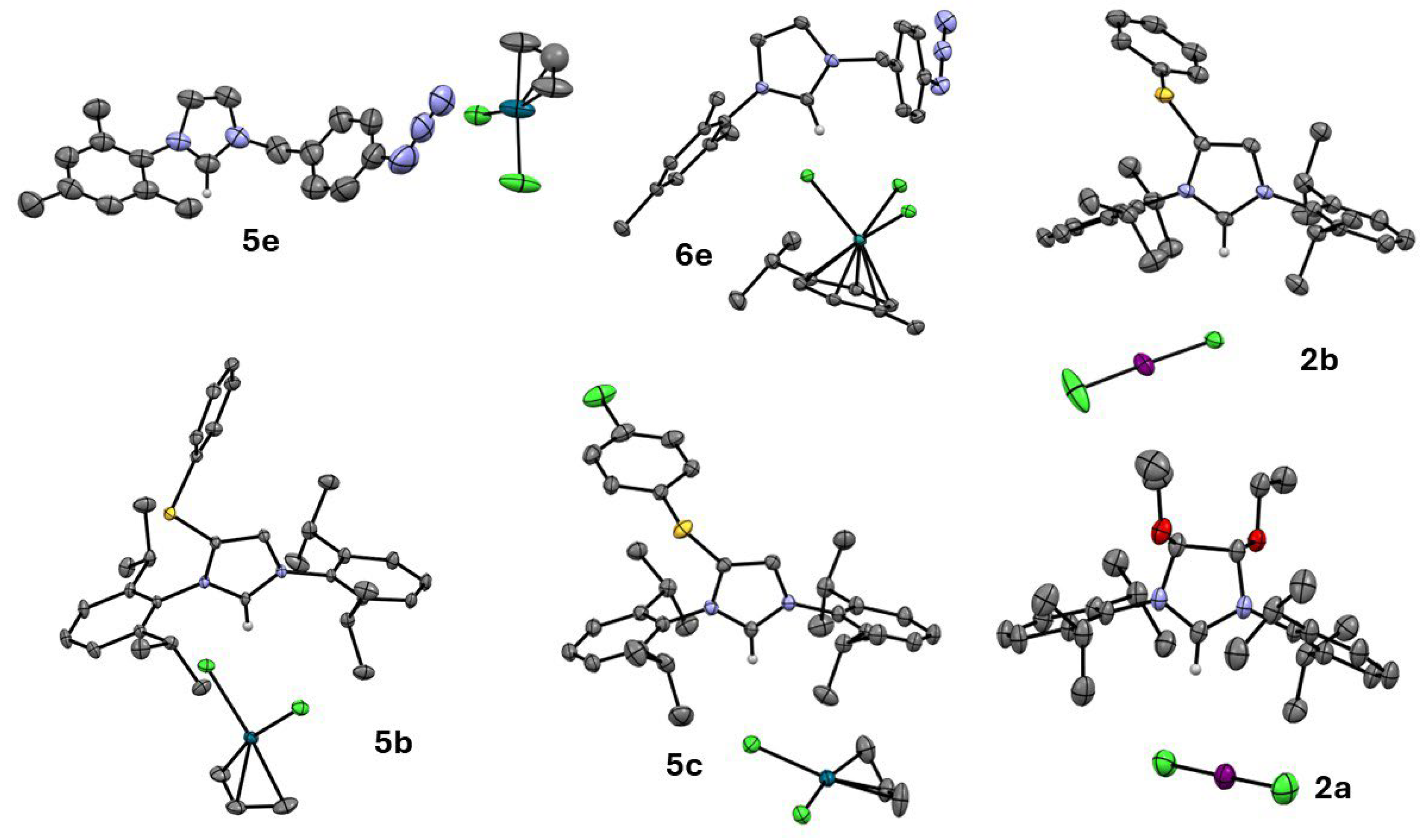
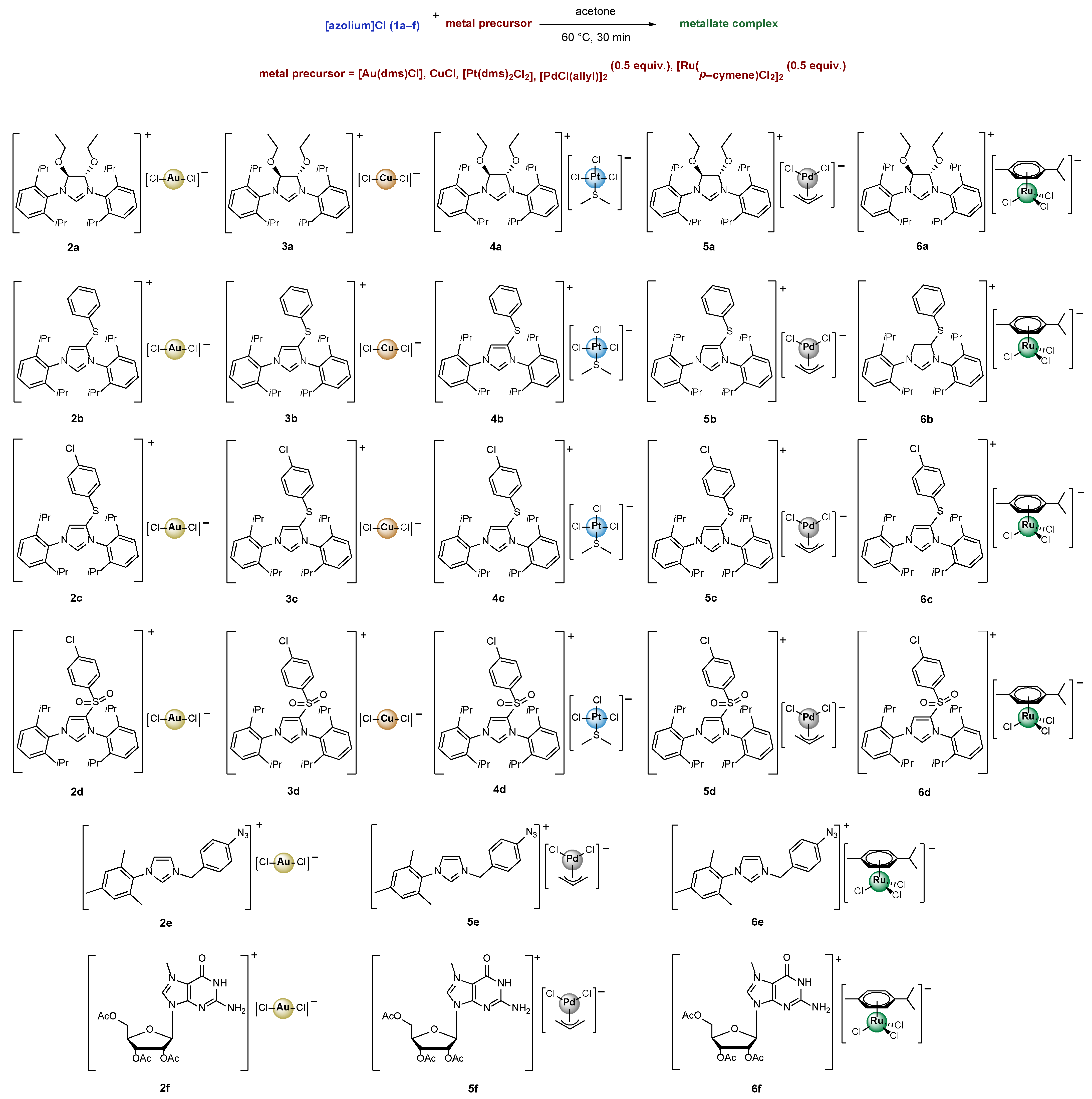
2.1. Synthesis of Azolium-Derived Metallates
2.2. Antiproliferative Activity of Metallate Complexes Towards Ovarian Cancer and Normal Cells
3. Materials and Methods
3.1. Reagents
3.2. Instruments
3.3. Synthesis of Metallates Derived from Azolium Salts
3.4. Crystal Structure Determination
3.5. Cytotoxicity Assay
4. Conclusions
Supplementary Materials
Author Contributions
Funding
Data Availability Statement
Conflicts of Interest
References
- Alassadi, S.; Pisani, M.J.; Wheate, N.J. A Chemical Perspective on the Clinical Use of Platinum-Based Anticancer Drugs. Dalton Trans. 2022, 51, 10835–10846. [Google Scholar] [CrossRef] [PubMed]
- Tsvetkova, D.; Ivanova, S. Application of Approved Cisplatin Derivatives in Combination Therapy against Different Cancer Diseases. Molecules 2022, 27, 2466. [Google Scholar] [CrossRef] [PubMed]
- Matulonis, U.A.; Sood, A.K.; Fallowfield, L.; Howitt, B.E.; Sehouli, J.; Karlan, B.Y. Ovarian Cancer. Nat. Rev. Dis. Prim. 2016, 2, 16061. [Google Scholar] [CrossRef]
- Torre, L.A.; Trabert, B.; DeSantis, C.E.; Miller, K.D.; Samimi, G.; Runowicz, C.D.; Gaudet, M.M.; Jemal, A.; Siegel, R.L. Ovarian Cancer Statistics, 2018. CA-Cancer J. Clin. 2018, 68, 284–296. [Google Scholar] [CrossRef]
- Pignata, S.; Cecere, S.C.; Du Bois, A.; Harter, P.; Heitz, F. Treatment of Recurrent Ovarian Cancer. Ann. Oncol. 2017, 28, viii51–viii56. [Google Scholar] [CrossRef]
- Oun, R.; Moussa, Y.E.; Wheate, N.J. The Side Effects of Platinum-Based Chemotherapy Drugs: A Review for Chemists. Dalton Trans. 2018, 47, 6645–6653. [Google Scholar] [CrossRef]
- Hanif, M.; Hartinger, C.G. Anticancer Metallodrugs: Where Is the Next Cisplatin? Future Med. Chem. 2018, 10, 615–617. [Google Scholar] [CrossRef]
- Abdolmaleki, S.; Aliabadi, A.; Khaksar, S. Riding the Metal Wave: A Review of the Latest Developments in Metal-Based Anticancer Agents. Coord. Chem. Rev. 2023, 501, 215579. [Google Scholar] [CrossRef]
- Santini, C.; Pellei, M.; Gandin, V.; Porchia, M.; Tisato, F.; Marzano, C. Advances in Copper Complexes as Anticancer Agents. Chem. Rev. 2013, 114, 815–862. [Google Scholar] [CrossRef] [PubMed]
- Marzano, C.; Pellei, M.; Tisato, F.; Santini, C. Copper Complexes as Anticancer Agents. Anti-Cancer Agents Med. Chem. 2009, 9, 185–211. [Google Scholar] [CrossRef] [PubMed]
- Lee, S.Y.; Kim, C.Y.; Nam, T.-G. Ruthenium Complexes as Anticancer Agents: A Brief History and Perspectives. Drug Des. Dev. Ther. 2020, 14, 5375–5392. [Google Scholar] [CrossRef]
- Leenders, S.H.A.M.; Gramage-Doria, R.; De Bruin, B.; Reek, J.N.H. Transition Metal Catalysis in Confined Spaces. Chem. Soc. Rev. 2014, 44, 433–448. [Google Scholar] [CrossRef] [PubMed]
- Alves, K.M.; Honorato, J.; Lião, L.M.; Velozo-Sa, V.S.; Guedes, A.P.M.; Dutra, J.d.L.; Ayalla, A.P.; Ellena, J.; Batista, A.A.; Gonçalves, P.J. Meso-Tetra-(4-Pyridyl)Porphyrin/Palladium(Ii) Complexes as Anticancer Agents. Dalton Trans. 2021, 50, 16254–16264. [Google Scholar] [CrossRef] [PubMed]
- Moreno-Alcántar, G.; Picchetti, P.; Casini, A. Gold Complexes in Anticancer Therapy: From New Design Principles to Particle-Based Delivery Systems. Angew. Chem. Int. Ed. 2023, 62, e202218000. [Google Scholar] [CrossRef]
- Bertrand, B.; Williams, M.R.M.; Bochmann, M. Gold(III) Complexes for Antitumor Applications: An Overview. Chem. Eur. J. 2018, 24, 11840–11851. [Google Scholar] [CrossRef]
- Vergara, E.; Casini, A.; Sorrentino, F.; Zava, O.; Cerrada, E.; Rigobello, M.P.; Bindoli, A.; Laguna, M.; Dyson, P.J. Anticancer Therapeutics That Target Selenoenzymes: Synthesis, Characterization, In Vitro Cytotoxicity, and Thioredoxin Reductase Inhibition of a Series of Gold(I) Complexes Containing Hydrophilic Phosphine Ligands. ChemMedChem 2009, 5, 96–102. [Google Scholar] [CrossRef]
- Reddy, T.S.; Privér, S.H.; Mirzadeh, N.; Luwor, R.B.; Reddy, V.G.; Ramesan, S.; Bhargava, S.K. Antitumor and Antiangiogenic Properties of Gold(III) Complexes Containing Cycloaurated Triphenylphosphine Sulfide Ligands. Inorg. Chem. 2020, 59, 5662–5673. [Google Scholar] [CrossRef]
- Frik, M.; Fernández-Gallardo, J.; Gonzalo, O.; Mangas-Sanjuan, V.; González-Alvarez, M.; Del Valle, A.S.; Hu, C.; González-Alvarez, I.; Bermejo, M.; Marzo, I.; et al. Cyclometalated Iminophosphorane Gold(III) and Platinum(II) Complexes. A Highly Permeable Cationic Platinum(II) Compound with Promising Anticancer Properties. J. Med. Chem. 2015, 58, 5825–5841. [Google Scholar] [CrossRef]
- Massoud, S.S.; Louka, F.R.; Salem, N.M.H.; Fischer, R.C.; Torvisco, A.; Mautner, F.A.; Vančo, J.; Belza, J.; Dvořák, Z.; Trávníček, Z. Dinuclear Doubly Bridged Phenoxido Copper(II) Complexes as Efficient Anticancer Agents. Eur. J. Med. Chem. 2022, 246, 114992. [Google Scholar] [CrossRef]
- Carcelli, M.; Tegoni, M.; Bartoli, J.; Marzano, C.; Pelosi, G.; Salvalaio, M.; Rogolino, D.; Gandin, V. In Vitro and in Vivo Anticancer Activity of Tridentate Thiosemicarbazone Copper Complexes: Unravelling an Unexplored Pharmacological Target. Eur. J. Med. Chem. 2020, 194, 112266. [Google Scholar] [CrossRef] [PubMed]
- Kapdi, A.R.; Fairlamb, I.J.S. Anti-Cancer Palladium Complexes: A Focus on PdX2L2, Palladacycles and Related Complexes. Chem. Soc. Rev. 2014, 43, 4751–4777. [Google Scholar] [CrossRef]
- Fong, T.T.; Lok, C.; Chung, C.Y.; Fung, Y.E.; Chow, P.; Wan, P.; Che, C. Cyclometalated Palladium(II) N-Heterocyclic Carbene Complexes: Anticancer Agents for Potent in Vitro Cytotoxicity and in Vivo Tumor Growth Suppression. Angew. Chem. Int. Ed. 2016, 55, 11935–11939. [Google Scholar] [CrossRef]
- Zhou, X.-Q.; Xiao, M.; Ramu, V.; Hilgendorf, J.; Li, X.; Papadopoulou, P.; Siegler, M.A.; Kros, A.; Sun, W.; Bonnet, S. The Self-Assembly of a Cyclometalated Palladium Photosensitizer into Protein-Stabilized Nanorods Triggers Drug Uptake In Vitro and In Vivo. J. Am. Chem. Soc. 2020, 142, 10383–10399. [Google Scholar] [CrossRef]
- Zhou, X.-Q.; Wang, P.; Ramu, V.; Zhang, L.; Jiang, S.; Li, X.; Abyar, S.; Papadopoulou, P.; Shao, Y.; Bretin, L.; et al. In Vivo Metallophilic Self-Assembly of a Light-Activated Anticancer Drug. Nat. Chem. 2023, 15, 980–987. [Google Scholar] [CrossRef]
- Carneiro, T.J.; Martins, A.S.; Marques, M.P.M.; Gil, A.M. Metabolic Aspects of Palladium(II) Potential Anti-Cancer Drugs. Front. Oncol. 2020, 10, 590970. [Google Scholar] [CrossRef]
- Karges, J.; Tharaud, M.; Gasser, G. Polymeric Encapsulation of a RU(II)-Based Photosensitizer for Folate-Targeted Photodynamic Therapy of Drug Resistant Cancers. J. Med. Chem. 2021, 64, 4612–4622. [Google Scholar] [CrossRef]
- Karges, J.; Kuang, S.; Maschietto, F.; Blacque, O.; Ciofini, I.; Chao, H.; Gasser, G. Rationally Designed Ruthenium Complexes for 1- and 2-Photon Photodynamic Therapy. Nat. Commun. 2020, 11, 3262. [Google Scholar] [CrossRef] [PubMed]
- Schleisiek, J.; Michaltsis, E.; Mayer, S.; Montesdeoca, N.; Karges, J. Necrosis Inducing Tetranuclear Ru(II)–Re(I) Metal Complex for Anticancer Therapy. Dalton Trans. 2024, 54, 942–950. [Google Scholar] [CrossRef] [PubMed]
- Yan, Y.K.; Melchart, M.; Habtemariam, A.; Sadler, P.J. Organometallic Chemistry, Biology and Medicine: Ruthenium Arene Anticancer Complexes. Chem. Commun. 2005, 4764–4776. [Google Scholar] [CrossRef] [PubMed]
- Zhang, P.; Sadler, P.J. Advances in the Design of Organometallic Anticancer Complexes. J. Organomet. Chem. 2017, 839, 5–14. [Google Scholar] [CrossRef]
- Bugarcic, T.; Habtemariam, A.; Deeth, R.J.; Fabbiani, F.P.A.; Parsons, S.; Sadler, P.J. Ruthenium(II) Arene Anticancer Complexes with Redox-Active Diamine Ligands. Inorg. Chem. 2009, 48, 9444–9453. [Google Scholar] [CrossRef]
- Scattolin, T.; Logvinov, A.A.; Tzouras, N.V.; Cazin, C.S.J.; Nolan, S.P. Advances in the Synthesis and Applications of N-Heterocyclic Carbene Metal Complexes with a Focus on the Weak Base Route. Organometallics 2023, 42, 2692–2730. [Google Scholar] [CrossRef]
- Collado, A.; Gómez-Suárez, A.; Martin, A.R.; Slawin, A.M.Z.; Nolan, S.P. Straightforward Synthesis of [Au(NHC)X] (NHC = N-Heterocyclic Carbene, X = Cl, Br, I) Complexes. Chem. Commun. 2013, 49, 5541. [Google Scholar] [CrossRef]
- Santoro, O.; Collado, A.; Slawin, A.M.Z.; Nolan, S.P.; Cazin, C.S.J. A General Synthetic Route to [Cu(X)(NHC)] (NHC = N-Heterocyclic Carbene, X = Cl, Br, I) Complexes. Chem. Commun. 2013, 49, 10483. [Google Scholar] [CrossRef]
- Zinser, C.M.; Nahra, F.; Brill, M.; Meadows, R.E.; Cordes, D.B.; Slawin, A.M.Z.; Nolan, S.P.; Cazin, C.S.J. A Simple Synthetic Entryway into Palladium Cross-Coupling Catalysis. Chem. Commun. 2017, 53, 7990–7993. [Google Scholar] [CrossRef] [PubMed]
- Maliszewski, B.P.; Tzouras, N.V.; Guillet, S.G.; Saab, M.; Beliš, M.; Van Hecke, K.; Nahra, F.; Nolan, S.P. A General Protocol for the Synthesis of Pt-NHC (NHC = N-Heterocyclic Carbene) Hydrosilylation Catalysts. Dalton Trans. 2020, 49, 14673–14679. [Google Scholar] [CrossRef] [PubMed]
- Saito, R.; Prato, A.; Rubbi, A.; Orian, L.; Scattolin, T.; Nolan, S.P. Simple Synthesis of [Au(NHC)X] Complexes Utilizing Aqueous Ammonia: Revisiting the Weak Base Route Mechanism. Dalton Trans. 2024, 54, 59–64. [Google Scholar] [CrossRef] [PubMed]
- Sioriki, E.; Lordan, R.; Nahra, F.; Van Hecke, K.; Zabetakis, I.; Nolan, S.P. In Vitro Anti-atherogenic Properties of N-Heterocyclic Carbene Aurate(I) Compounds. ChemMedChem 2018, 13, 2484–2487. [Google Scholar] [CrossRef]
- Sioriki, E.; Gaillard, S.; Nahra, F.; Imad, R.; Ullah, K.; Wajid, S.; Sharif, D.; Fayyaz, S.; Arshad, F.; Choudhary, M.I.; et al. Investigating the Biological Activity of Imidazolium Aurate Salts. ChemistrySelect 2019, 4, 11061–11065. [Google Scholar] [CrossRef]
- Scattolin, T.; Pessotto, I.; Cavarzerani, E.; Canzonieri, V.; Orian, L.; Demitri, N.; Schmidt, C.; Casini, A.; Bortolamiol, E.; Visentin, F.; et al. Indenyl and Allyl Palladate Complexes Bearing N-Heterocyclic Carbene Ligands: An Easily Accessible Class of New Anticancer Drug Candidates. Eur. J. Inorg. Chem. 2022, 2022, e202200103. [Google Scholar] [CrossRef]
- Schiavo, A.; Baio, G.; Bru, F.; Guerra, I.; Mechrouk, V.; Achard, T.; Baldissin, S.; Bellemin-Laponnaz, S.; Cazin, C.S.J.; Tubaro, C.; et al. Expanding the Chemical Space of Allyl Palladates with Anticancer Properties. Eur. J. Inorg. Chem. 2025, 28, e202500146. [Google Scholar] [CrossRef]
- Donati, C.; Hashim, I.I.; Pozsoni, N.B.; Bourda, L.; Van Hecke, K.; Cazin, C.S.J.; Visentin, F.; Nolan, S.P.; Gandin, V.; Scattolin, T. Investigation of the in Vitro Anticancer Potential of Bis(Imino)Acenaphthene–N-Heterocyclic Carbene Transition Metal Complexes Revealed TrxR Inhibition and Triggering of Immunogenic Cell Death (ICD) for Allyl Palladates. RSC Med. Chem. 2025, 16, 2592–2602. [Google Scholar] [CrossRef]
- Lorenzon, T.; Papadopoulos, Z.; Rubbi, A.; Demitri, N.; Orian, L.; Montesdeoca, N.; Karges, J.; Scattolin, T. Synthesis of Ananikov-Type N-Heterocyclic Carbene Golden Synthons as Ferroptosis Inducing Anticancer Agents. Inorg. Chem. Front. 2026, 13, 3986–4004. [Google Scholar] [CrossRef]
- Tonon, G.; Berton, C.; Piccoli, A.; Demitri, N.; Rizzolio, F.; Visentin, F.; Holland, J.P.; Scattolin, T. Light-Driven Bioconjugation of Organometallic Compounds via Aryl Azide Photochemistry. ChemRxiv 2026, 1–13. [Google Scholar] [CrossRef]
- Bräse, S.; Gil, C.; Knepper, K.; Zimmermann, V. Organic Azides: An Exploding Diversity of a Unique Class of Compounds. Angew. Chem. Int. Ed. 2005, 44, 5188–5240. [Google Scholar] [CrossRef]
- Renfrew, A.K. Transition Metal Complexes with Bioactive Ligands: Mechanisms for Selective Ligand Release and Applications for Drug Delivery. Metallomics 2014, 6, 1324–1335. [Google Scholar] [CrossRef] [PubMed]
- Fabrega, C.; Hausmann, S.; Shen, V.; Shuman, S.; Lima, C.D. Structure and Mechanism of mRNA CAP (Guanine-N7) Methyltransferase. Mol. Cell 2004, 13, 77–89. [Google Scholar] [CrossRef]
- Francescato, G.; Orsini, G.; Petronilho, A. Gold Mono- and Bis-N-Heterocyclic Carbenes Based on mRNA Cap0. ACS Omega 2025, 10, 47327–47333. [Google Scholar] [CrossRef]
- Hegde, R.P.; Demitri, N.; Héroux, A.; Olivo, A.; Bais, G.; Cianci, M.; Storici, P.; Dumitrescu, D.-G.; Varshney, N.K.; Gopal, B.; et al. Macromolecular Crystallography at Elettra: Current and Future Perspectives. J. Synchrotron Radiat. 2025, 32, 757–765. [Google Scholar] [CrossRef] [PubMed]
- Kabsch, W. XDS. Acta Crystallogr. D 2010, 66, 125–132. [Google Scholar] [CrossRef] [PubMed]
- Winn, M.D.; Ballard, C.C.; Cowtan, K.D.; Dodson, E.J.; Emsley, P.; Evans, P.R.; Keegan, R.M.; Krissinel, E.B.; Leslie, A.G.W.; McCoy, A.; et al. Overview of theCCP4 Suite and Current Developments. Acta Crystallogr. D 2011, 67, 235–242. [Google Scholar] [CrossRef]
- Evans, P.R.; Murshudov, G.N. How Good Are My Data and What Is the Resolution? Acta Crystallogr. D 2013, 69, 1204–1214. [Google Scholar] [CrossRef]
- Sheldrick, G.M. SADABS, Version 2014/5; University of Göttingen: Göttingen, Germany, 2014. [Google Scholar]
- Sheldrick, G.M. SHELXT—Integrated Space-Group and Crystal-Structure Determination. Acta Crystallogr. A 2014, 71, 3–8. [Google Scholar] [CrossRef]
- Sheldrick, G.M. Crystal Structure Refinement with SHELXL. Acta Crystallogr. C 2014, 71, 3–8. [Google Scholar] [CrossRef] [PubMed]
- Emsley, P.; Lohkamp, B.; Scott, W.G.; Cowtan, K. Features and Development of Coot. Acta Crystallogr. D 2010, 66, 486–501. [Google Scholar] [CrossRef] [PubMed]
- Farrugia, L.J. WinGX and ORTEP for Windows: An Update. J. Appl. Crystallogr. 2012, 45, 849–854. [Google Scholar] [CrossRef]



| Compound | 5b—100 K | 5c—100 K | 5e—100 K |
| Formula | PdCl2C3H5[C33H41N2S] | PdCl2C3H5[C33H40ClN2S] | PdCl2C3H5[C19H20N5] ⋅1/2CHCl3 |
| M/g·mol−1 | 716.11 | 750.55 | 596.45 |
| Space group | P-1 | P ca21 | C 2/c |
| Crystal system | Triclinic | Orthorhombic | Monoclinic |
| a/Å | 10.864 (2) | 17.244 (3) | 27.851 (6) |
| b/Å | 11.595 (2) | 8.805 (2) | 14.294 (3) |
| c/Å | 16.208 (3) | 23.600 (5) | 14.157 (3) |
| α/° | 83.19 (3) | 90 | 90 |
| β/° | 71.52 (3) | 90 | 111.11 (3) |
| γ/° | 64.80 (3) | 90 | 90 |
| V/Å3 | 1752.0 (8) | 3583.3 (12) | 5258 (2) |
| Z | 2 | 4 | 8 |
| T/K | 100 (2) | 100 (2) | 100 (2) |
| Dc/g·cm−3 | 1.357 | 1.391 | 1.507 |
| F(000) | 744 | 1552 | 2408 |
| μ/mm−1 | 0.525 | 0.564 | 0.735 |
| Measured Reflections | 85,924 | 73,308 | 45,641 |
| Unique Reflections | 14,556 | 15,800 | 10,911 |
| Rint | 0.1049 | 0.0623 | 0.0539 |
| Obs. Refl.ns [I ≥ 2σ(I)] | 13,994 | 15,236 | 7251 |
| θmin–θmax/° | 1.16–31.17 | 1.51–31.10 | 1.37–31.11 |
| hkl ranges | −17,16; −19,19; −26,27 | −27,27; −13,13; −39,39 | −43,44; −22,22; −19,20 |
| R(F2) (Obs.Refl.ns) | 0.0432 | 0.0348 | 0.0759 |
| wR(F2) (All Refl.ns) | 0.1195 | 0.0950 | 0.2783 |
| No. Variables | 401 | 406 | 304 |
| Goodness of fit | 1.034 | 1.047 | 1.108 |
| Δρmax; Δρmin/e·Å−3 | 2.26; −1.30 | 1.24; −0.86 | 1.25; −2.01 |
| CCDC Deposition N. | 2518446 | 2518448 | 2518450 |
| Compound | 6e—100 K | 2a—100 K | 2b—100 K |
| Formula | RuCl3C10H14[C19H20N5] ⋅C4H10O | AuCl2[C31H47N2O2] ⋅1/2C4H10O | AuCl2[C33H41N2S] |
| M/g·mol−1 | 734.15 | 784.63 | 765.60 |
| Space group | P-1 | P-1 | P 21/n |
| Crystal system | Triclinic | Triclinic | Monoclinic |
| a/Å | 9.417 (2) | 10.666 (2) | 8.417 (2) |
| b/Å | 13.215 (3) | 17.452 (3) | 19.079 (4) |
| c/Å | 14.980 (3) | 19.530 (4) | 20.529 (4) |
| α/° | 78.04 (3) | 83.16 (3) | 90 |
| β/° | 75.41 (3) | 85.78 (3) | 94.56 (3) |
| γ/° | 72.50 (3) | 75.15 (3) | 90 |
| V/Å3 | 1703.0 (7) | 3485.4 (13) | 3286.3 (11) |
| Z | 2 | 4 | 4 |
| T/K | 100 (2) | 100 (2) | 100 (2) |
| Dc/g·cm−3 | 1.432 | 1.495 | 1.547 |
| F(000) | 760 | 1588 | 1528 |
| μ/mm−1 | 0.499 | 3.082 | 3.304 |
| Measured Reflections | 70,002 | 46,248 | 43,301 |
| Unique Reflections | 14,657 | 13,168 | 14,411 |
| Rint | 0.0994 | 0.0603 | 0.1144 |
| Obs. Refl.ns [I ≥ 2σ(I)] | 13,624 | 11,995 | 11,214 |
| θmin–θmax/° | 1.24–31.17 | 1.06–22.21 | 1.27–31.12 |
| hkl ranges | −15,15; −21,21; −23,23 | −13,13; −21,21; −23,23 | −13,13; −31,31; −34,34 |
| R(F2) (Obs.Refl.ns) | 0.0412 | 0.0356 | 0.0547 |
| wR(F2) (All Refl.ns) | 0.1135 | 0.1002 | 0.1364 |
| No. Variables | 397 | 755 | 379 |
| Goodness of fit | 1.055 | 1.018 | 0.957 |
| Δρmax; Δρmin/e·Å−3 | 1.40; −1.72 | 2.17; −1.69 | 1.14; −2.42 |
| CCDC Deposition N. | 2518453 | 2518455 | 2518456 |
| Compound | IC50 (µM) | Selectivity Index (S.I.) | ||
|---|---|---|---|---|
| A2780 | A2780cis | MRC-5 | ||
| Cisplatin | 0.23 ± 0.02 | 80 ± 20 | 3 ± 1 | 0.075 |
| 2a | 0.24 ± 0.05 | 0.15 ± 0.08 | 4.0 ± 0.3 | 21 |
| 2b | 0.24 ± 0.07 | 0.2 ± 0.1 | 0.27 ± 0.05 | 1 |
| 2c | 0.21 ± 0.05 | 0.2 ± 0.1 | 0.24 ± 0.05 | 1 |
| 2d | 0.7 ± 0.1 | 1.4 ± 0.4 | 4.0 ± 0.5 | 4 |
| 2e | 3.0 ± 0.8 | 17 ± 2 | 80 ± 20 | 8 |
| 2f | 13 ± 4 | 3 ± 2 | 90 ± 10 | 11 |
| 3a | 0.18 ± 0.03 | 0.20 ± 0.08 | 5.3 ± 0.7 | 28 |
| 3b | 0.11 ± 0.04 | 0.21 ± 0.07 | 0.25 ± 0.05 | 1.6 |
| 3c | 0.06 ± 0.01 | 0.2 ± 0.1 | 0.26 ± 0.05 | 2 |
| 3d | 0.10 ± 0.07 | 0.13 ± 0.07 | 0.5 ± 0.2 | 4 |
| 4a | 0.4 ± 0.1 | 0.20 ± 0.03 | 4.3 ± 0.1 | 14 |
| 4b | 0.23 ± 0.04 | 0.2 ± 0.1 | 2.4 ± 0.4 | 11 |
| 4c | 0.26 ± 0.03 | 0.27 ± 0.09 | 4.1 ± 0.2 | 15 |
| 4d | 0.10 ± 0.02 | 0.2 ± 0.1 | 5.4 ± 0.2 | 36 |
| 5a | 0.26 ± 0.03 | 0.3 ± 0.2 | 5 ± 2 | 18 |
| 5b | 0.25 ± 0.05 | 0.2 ± 0.1 | 0.33 ± 0.05 | 1.5 |
| 5c | 0.31 ± 0.06 | 0.3 ± 0.1 | 9 ± 1 | 30 |
| 5d | 0.14 ± 0.07 | 0.2 ± 0.1 | 0.43 ± 0.09 | 2.5 |
| 5e | 1.6 ± 0.1 | 1.73 ± 0.06 | 80 ± 20 | 48 |
| 5f | 4.0 ± 0.2 | 5.3 ± 0.6 | >100 | >22 |
| 6a | 0.26 ± 0.07 | 0.14 ± 0.09 | 5.8± 0.6 | 29 |
| 6b | 0.24 ± 0.03 | 0.2 ± 0.1 | 0.25 ± 0.02 | 1 |
| 6c | 0.20 ± 0.04 | 0.2 ± 0.1 | 0.29 ± 0.05 | 1 |
| 6d | 0.19 ± 0.05 | 0.2 ± 0.1 | 0.26 ± 0.03 | 1 |
| 6e | 5.9 ± 0.1 | 10 ± 2 | 80 ± 10 | 10 |
| 6f | >100 | >100 | >100 | N.A. |
Disclaimer/Publisher’s Note: The statements, opinions and data contained in all publications are solely those of the individual author(s) and contributor(s) and not of MDPI and/or the editor(s). MDPI and/or the editor(s) disclaim responsibility for any injury to people or property resulting from any ideas, methods, instructions or products referred to in the content. |
© 2026 by the authors. Licensee MDPI, Basel, Switzerland. This article is an open access article distributed under the terms and conditions of the Creative Commons Attribution (CC BY) license.
Share and Cite
Lorenzon, T.; Schiavo, A.; Piccoli, A.; Perin, N.; Rodighiero, L.; Demitri, N.; Tonon, G.; Visentin, F.; Rizzolio, F.; Caligiuri, I.; et al. Synthesis and Antitumor Activity of Metallates Incorporating Functionalized Azolium Salts. Inorganics 2026, 14, 155. https://doi.org/10.3390/inorganics14060155
Lorenzon T, Schiavo A, Piccoli A, Perin N, Rodighiero L, Demitri N, Tonon G, Visentin F, Rizzolio F, Caligiuri I, et al. Synthesis and Antitumor Activity of Metallates Incorporating Functionalized Azolium Salts. Inorganics. 2026; 14(6):155. https://doi.org/10.3390/inorganics14060155
Chicago/Turabian StyleLorenzon, Tommaso, Alessia Schiavo, Anita Piccoli, Nicolò Perin, Lorenzo Rodighiero, Nicola Demitri, Giovanni Tonon, Fabiano Visentin, Flavio Rizzolio, Isabella Caligiuri, and et al. 2026. "Synthesis and Antitumor Activity of Metallates Incorporating Functionalized Azolium Salts" Inorganics 14, no. 6: 155. https://doi.org/10.3390/inorganics14060155
APA StyleLorenzon, T., Schiavo, A., Piccoli, A., Perin, N., Rodighiero, L., Demitri, N., Tonon, G., Visentin, F., Rizzolio, F., Caligiuri, I., Scianna, M., Cazin, C. S. J., Nolan, S. P., & Scattolin, T. (2026). Synthesis and Antitumor Activity of Metallates Incorporating Functionalized Azolium Salts. Inorganics, 14(6), 155. https://doi.org/10.3390/inorganics14060155